Published by Dranetz Technologies, Inc. Website: Dranetz.com
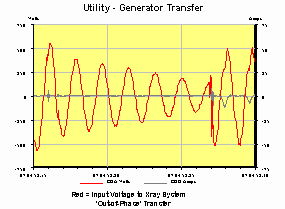
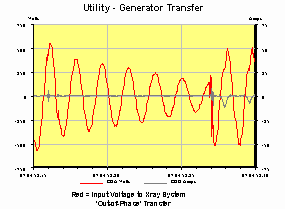
Severe power quality problems damaged X-ray equipment, costing $100,000 in one instance. The source of the problem was the switch over from utility to generator power, during regular testing and emergency situations. Figure 1 (below) identified the cause of the problem, an out-of-phase transfer, captured by On Power with a Dranetz 658 Analyzer.
Figure 1.
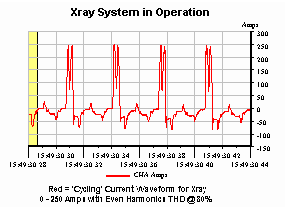
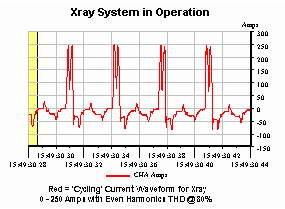
Ideally, an online UPS represents the best solution when protecting against low frequency / high energy events such as >out-of-phase transfers (capacitor bank switching represent similar problems). The challenge was dealing with the size and shape of the inrush currents the X-ray demands as it cycles through its program (See Figure 2). Not only did current rise from 20 Amps to 100 Amps (380V system), but even harmonics with a THD of 65% were present. The added challenge was that this Xray procedure represented “invasive” techniques as cathoders are inserted into arteries, sometimes into the heart.
Figure 2.
On Power’s solution was based on four phases:
• Extensive Xray system monitoring,
• Solution Research/Simulation,
• Post System Installation Monitoring, and
• Permanently installed Power Quality Monitoring with communication ability. By injecting current to compensate for the distorted waveform, the AIM Filter not only improves the quality of power to the X-ray, it lowers the stress on the UPS, lowers impedance placed on the system by the UPS, and improves the output THD to the rest of the systems distribution (See Figure 3).
Published by Ilham RAHIMLI1, Aliashraf BAKHTIYAROV2, Gulshan ABDULLAYEVA3, Sona RZAYEVA4. Azerbaijan State Oil and Industry University ORCID: 1. 0009-0006-1976-4475; 3. 0000-0003-0168-9623; 4. 0000-0001-7086-9519
Abstract. Despite the fact that current transformers have been used for many years in certain sections of the electrical network, in power supply, to power the circuits of an electrical measuring installation, meters, and relay automation installations, they have various disadvantages, in particular, due to a fairly high accuracy class and error when integrated with modern digital technology. Depending on the requirements for traditional current transformers, they are divided into accuracy classes, i.e. 0.2; 0.5; 1; 3; 10. It is these accuracy classes that determine the scope of current transformers (laboratory, general technical devices, relay protection, etc.).
Streszczenie. Pomimo faktu, że przekładniki prądowe są od wielu lat stosowane w niektórych odcinkach sieci elektrycznej, w zasilaniu, do zasilania obwodów elektrycznej instalacji pomiarowej, liczników, instalacji automatyki przekaźnikowej, mają one różne wady, w szczególności ze względu na dość wysoka klasa dokładności i błąd po zintegrowaniu z nowoczesną technologią cyfrową. W zależności od wymagań stawianych tradycyjnym przekładnikom prądowym, dzieli się je na klasy dokładności, tj. 0,2; 0,5; 1; 3; 10. To właśnie te klasy dokładności określają zakres przekładników prądowych (Zastosowanie optycznych czujników prądu w podstacjach elektrycznych)
Keywords: sensor, rotation angle, polarization, optical fiber material, digital substation, accuracy class. Słowa kluczowe: czujnik, kąt obrotu, polaryzacja, materiał światłowodu, podstacja cyfrowa, klasa dokładności.
Introduction
Current transformers are one of the types of transformers used in various industries. Since the first side of the current transformer connected in series with the circuit is connected to a high current circuit, the winding of this side also consists of one or more windings with a relatively large cross section. However, unlike the first side, the second side winding consists of coils with a small cross section and is connected to low-resistance devices – ammeters, series windings of wattmeters and calculators, etc. [1].
Despite the fact that current transformers are used in various industries, they have various disadvantages. First of all, it should be noted that when connecting a current transformer or during operation, the ends of its secondary winding should in no case remain open.
.
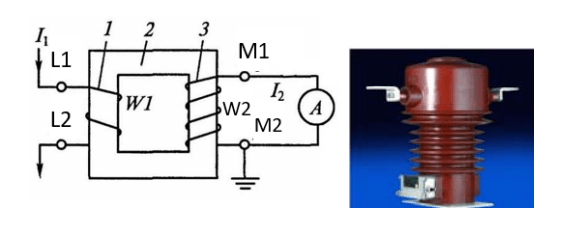
Otherwise, the transformer will go into idle mode and the magnetic flux (Ø) in the core steel will increase many times. This, in turn, can lead to overheating of the core steel and damage to the secondary insulation. Otherwise, the secondary voltage may increase sharply, which is extremely dangerous for the technical personnel servicing the equipment. Given these shortcomings, the secondary winding of the transformer must be short-circuited and grounded. In connection with what has been said in Fig. 1 shows a schematic diagram of connecting a traditional current transformer (a) and its structural view (b). Indeed, in circuit (a), the ends of the secondary windings of a conventional current transformer are connected and grounded through resistors. Otherwise, these complications and dangers are inevitable.
Fig.1. Connection diagram of the current transformer circuits (a) and its structural view (b).
Another disadvantage of traditional current transformers is the saturation of the steel core. Thus, during short circuits in the electrical network, as well as during switching processes, the current in the circuit increases sharply, which leads to the flow of a large amount of magnetic flux from the steel of the current transformer, and, consequently, to a distortion of the value of the induced electromotive force in the secondary circuit. This, in turn, leads to inaccurate measurements [2]. In general, the main disadvantages of the traditional current transformer are as follows:
• Absolute short circuit of the secondary winding • Saturation of the steel core of the transformer • Sensitivity to metrological factors and external magnetic fields • Instability to ferroresonance phenomena
These listed shortcomings create problems when traditional current transformers work with modern digital technology. The rapid development of digital technologies makes it inevitable to create more modern and sophisticated modifications of traditional equipment used in power supply.
Problem setting
A comparison was made between traditional current transformers and optical current sensors, the parameters of the optical current sensor, the principle of its operation and its application in an electrical substation were analyzed, and it was found that optical current sensors do not have the disadvantages that traditional current transformers have. It is for this reason that in the power supply (especially in electrical substations) the process of replacing traditional current transformers with optical current sensors and the transition to digital substations is very important. Thus, in connection with the development of digital technology, optical current sensors in terms of accuracy, simplicity and safety of operation, as well as self-diagnosis, are an integral part of the transition to modern technologies in power supply [3].
The solution of the problem
The above condition ensures the reliability of the transmission and distribution of electrical energy in electrical substations. The use of optical current sensors in power supply and especially in electrical substations is very important. The advantage of this technology is mainly due to its working principle.
The principle of operation of the optical current sensor is based on the Faraday effect. In 1846, when M. Faraday studied optical and electromagnetic phenomena, it turned out that optically inactive substances have the ability to rotate the polarization plane under the influence of an electromagnetic field. In other words, due to this effect, the phenomenon of polarization (electronic polarization) occurs in the material of the optical fiber (glass) under the influence of an electromagnetic field. Therefore, the electromagnetic field creates artificial activity, which is called the Faraday effect [4, 16, 21, 22].
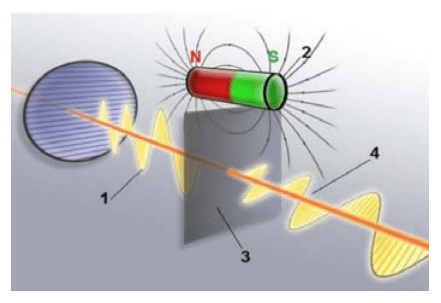
Fig.2 shows the distortion of the electromagnetic wave as a result of the effect of a permanent magnet when passing through the glass fiber material.
Fig.2. Passage of a propagating electromagnetic wave through a glass fiber material: 1-normally propagating electromagnetic wave; 2-permanent magnet; 3-optical fiber material (silicon carbide); 4- distorted electromagnetic wave.
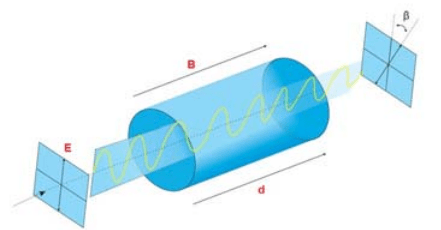
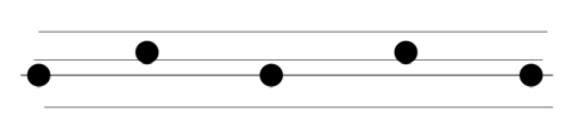
As you can see, the polarization that occurs in the fiberglass material under the influence of a permanent magnet leads to a distortion of the sinusoid, in other words, it forms an angle with the previous sinusoid. On fig. 3 shows the angle formed between the sinusoids.
Fig.3. Angle formed between sinusoids.
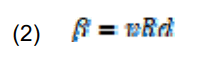
This angle formed between two sinusoids is called the angle of rotation and is denoted β. Then the value of this angle
.
where v – is the velocity of the magnetic field; B-module of the magnetic induction vector; d – is the active length of the optical fiber material.
The measured value of the angle β characterizes the change in the magnetic field.
A change in the magnetic field is instantly perceived by an optical current sensor and transmitted to the “Central Processing Unit”, which is an electronic unit. As a result, the change in the field propagation intensity (E) determines the magnitude and direction of the flowing current [5].
Although the Faraday effect was discovered many years ago, the practical application of this effect in technology falls on the last 15-20 years. Optical current sensors are directly related to the development of digital substations.
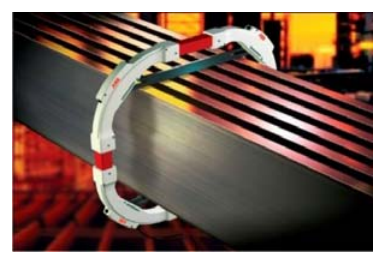
Digital substation means the management of the main and auxiliary equipment located in the substation in an intelligent and digital language. These substations comply with the international standard IEC61850. There are various types of optical current sensor designs, one of which is the ring sensors used in high-voltage busbars of electrical substations, shown in Fig. 4 [6,14,19].
Fig.4. Ring sensors used in high-voltage busbars of electrical substations.
In general, the main advantages of optical current sensors used in electrical substations are:
• Increased resistance to metrological and magnetic influences • No effects of electromagnetic and ferroresonant phenomena • Ability for introspection and diagnostics • Accurate measurement of synchronous harmonics • Improved dimensions and dimensions • Simple and safe operation
In the case of the use of optical current sensors in the electrical substations of our country (especially above 110 kV), there will be a significant improvement in the following important indicators of the electrical network:
1. Reducing technical losses in the electrical network
2. Increasing the reliability of power supply (SAIDI, SAIFI).
As you know, technical losses occur in the electrical network for a number of reasons, and reducing these losses has always been considered one of the most important issues. To reduce these losses, the transition to modern technologies, reactive power compensation, power factor improvement, as well as various other methods are used.
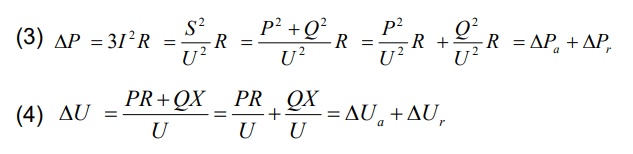
If we replace traditional current transformers with optical current sensors in any 220/110/35 kV substation, we will get the following results. We know that technical losses vary with load.
.
It is clear that it is impossible to reduce technical losses (ΔPa) from active power.
However, losses can be reduced depending on reactive power in various ways, one of which is reactive power compensation. In general, reactive power losses are observed in any equipment with an electromagnetic process in the mains, and each of these losses has an impact on the overall technical losses. Reactive power losses in optical current sensors are not observed [7-9]. More precisely, losses caused by the influence of the electromagnetic field and the saturation of the steel core are not observed in these sensors.
.
The use of optical current sensors in electrical substations will also significantly increase the reliability of power supply.
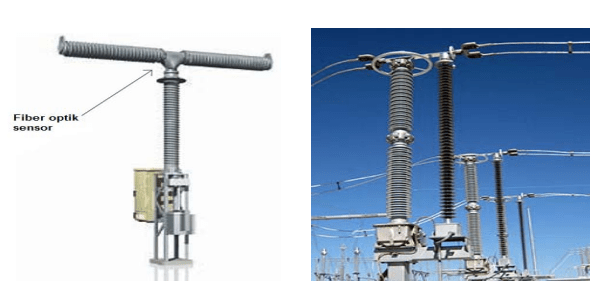
Thus, the ability to accurately measure and store measurement data in memory and accurately analyze will reduce the number of false alarms to zero, which will seriously affect the number of alarms per year (SAIDI) and the duration of alarms per year (SAIFI). The use of optical current sensors in the form of supports in electrical substations is shown in Fig.5 [10, 15].
Fig.5. The use of optical current sensors in the form of supports in electrical substations.
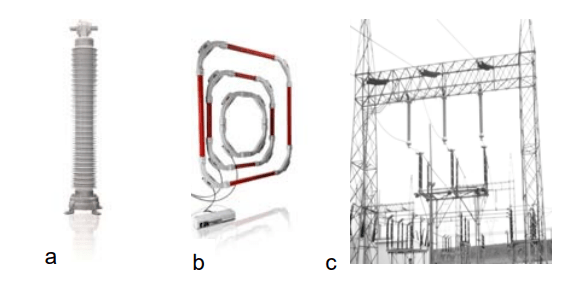
In connection with the transition of electrical substations to digital technology, many companies offer optical sensors current transformers of various shapes and designs. The main types of structures used in substations are shown in the following figure (Fig.6).
Fig.6. Main types of construction used in substations a) support-like; b) ring; c) suspended.
Although the types of construction are made in different ways, the principle and essence of optical current sensors do not differ from each other. When designing a substation, the optical current sensor is selected based on the specified power and voltage. Each optical current sensor data sheet will list its main parameters: Due to its ability to conduct accurate analysis, its neutral position in relation to external influences and superior performance, this technology is rapidly spreading around the world. From the point of view of reducing technical losses and increasing the reliability of power supply, the use of this technology in our country is a priority issue.
That is why this technology is expected to be improved and recommended in the near future. In these networks, optical current sensors, which are included in the power supply of only some developed countries, have fully justified themselves. In some countries, equipment based on this technology is still in the testing phase. The creation of smart grids, SCADA, digital substations and other smart grids makes it inevitable that optical technology-based equipment will rapidly develop and become an integral part of the energy supply.
Conclusıon
According to the results of our research, it was determined that the use of optical current sensors based on the Faraday effect in high-voltage electrical substations not only improves the reliability of power supply, but also eliminates some problems that arise in the electrical network. Extraneous effects caused by metrological factors, as well as technical problems caused by magnetic and ferroresonant phenomena, minimizes losses. The use of optical current sensors in electrical substations eliminates the shortcomings of traditional current transformers, which in turn minimizes the inaccuracies and operational failures caused by these shortcomings.
The integration of digital technology into power supply will lead to the creation of new design modifications of optical current sensors, as well as the rapid development of this technology in the energy sector.
REFERENCES
[1] Cease T.W. and Johnston P., “A magneto-optic current transducer”, IEEE Trans. on PowerDelivery, vol. 5, 548-555, 1990. [2] Bohnert K., Gabus G., Nehring J., and Brändle H., “Temperature and vibration insensitive fiber-optic current sensor”, J. of Lightw.Technol., vol. 20, 267-276, 2002. [3] Nicatti P.A. and Robert P., “Stabilized current sensor using a Sagnac interferometer”, J. Phys.E: Sci. Instrum., vol. 21, 791-796, 1988. [4] Torbus S.A., Dutkiewicz P., Projektowanie jednomodowych światłowodów telekomunikacyjnych dla czujników wykorzystujących magnetooptyczne zjawisko Faradaya. Przegląd Elektrotechniczn, Volume 91, No2, pp.118-122, 2015. [5] Rzayeva S.V., Mammadov N.S. and Ganiyeva N.A. “Overvoltages During Single-Phase Earth Fault in NeutralIsolated Networks (10÷35) kV”. Journal of Energy Research and Reviews 13 (1), pp. 7-13, 2023 [6] Rzayeva S.V., Mammadov N.S., Ganiyeva N.A. “Neutral grounding mode in the 6-35 kv network through an arcing reactor and organization of relay protection against single-phase ground faults”. Deutsche internationale Zeitschrift für zeitgenössische Wissenschaft / German International Journal of Modern Science №42(22) pp.31-34 [7] Enokihara A., Izutsu M., and Sueta T., “Optical fiber sensors using the method of polarizationrotatedreflection”, J. Lightw.Technol., vol. 5, 1584-1590, 1987. [8] Short S.X., Tselikov A.A., J.U. de Arruda, and Blake J.N., “Imperfect quarter-waveplatecompensation in Sagnac interferometer-typecurrent sensors”, J. Lightw.Technol., vol.16,1212-1219, 1998. [9] Blake J., Tantaswadi P., and R.T. de Carvalho,“In-line Sagnac interferometer current sensor”,IEEE Trans. Power Delivery, vol. 11, 116-121,1996. [10] Tang D., Rose A. H., Day G. W., and Etzel S. M., “Annealing of linear birefringence insingle-mode fiber coils: applications to opticalfiber current sensors”, J. Lightw. Technol., vol., 1031-1037, 1991. [11] Short S.X., Tselikov A.A., J.U. de Arruda, and Blake J.N., “Imperfect quarter waveplatecompensation in Sagnac interferometer-type current sensors”, J. Lightw. Technol., vol. 16,1212-1219, 1998. [12] Bohnert K. and Nehring J., “Fiber-optic sensing of voltages by line integration of the electricfield”, Opt. Lett., vol. 14, 290-292, 1989. [13] Gavrichev V. D., Dmitriev A. L., Fiber-optic sensors magnetic field / Study Guide. – St. Petersburg: SPbNIU ITMO, 2013.p. 83 [14] Udd E. Fiber optic sensors. M.: Technosfera, 2008. – 520s. [15] Jackson R.G. Latest sensors. M: Technosphere, 2007.- 384p. [16] Horowitz S. H. and Phadke A. G., “Current and voltage ntransformers”, in Power System Relaying, 4th ed. John Wiley and Sons, 2014, ch. 3, pp. 46–73. [17] Instrument transformers – Part 2: Additional requirements for current transformers, IEC 61869 -2:2012, 2012. [18] Jackson, D.A. An optical system with potential for remote health monitoring of subsea machinery.Meas. Sci. Technol. 2009, 20, 1–8. [19] Perciante, C.D.; Ferrari, J.A. Magnetic crosst alk minimization in optical current sensors. IEEETrans. Instrum. Meas. 2008, 57, 2304–2308 [20] Drexler, P.; Fiala, P. Utilization of Faraday mirror in fiber optic current sensors. Radioengineering2008, 17, 101–107. [21] S.A.Torbus. Current–polarization-dependent loss” optical fibre sensor. Przegląd Elektrotechniczn, Volume 95, pp.171-174, 2015 [22] Zhang P., Halliday D., Faraday Effect Optical Current Sensor, IEEE 0-7803-3143-5 (1996)
Source & Publisher Item Identifier: PRZEGLĄD ELEKTROTECHNICZNY, ISSN 0033-2097, R. 100 NR 2/2024. doi:10.15199/48.2024.02.26
Published by Sri SUWASTI, Musrady MULYADI, Yiyin KLISTAFANI, Muhammad Ruswandi DJALAL, State Polytechnic of Ujung Pandang
Abstract: The implementation of Micro Hydro Power Plants (MHPP) serves as a crucial initiative to address the uneven distribution of electrical energy in remote areas across Indonesia. Before the permanent installation of an MHPP, field testing is imperative, involving the use of a model or prototype to gather location-specific data, assess reliability, and enhance insights into the MHPP’s functionality as an electrical energy generator. This research endeavors to comprehend the operation of the Cross-flow turbine MHPP system and ascertain its output power and efficiency. The testing process commences with the design of field test equipment, followed by manufacturing and assembly stages. Subsequently, equipment testing and data collection are conducted, and the obtained data is analyzed to determine the output power and efficiency of the MHPP system utilizing a Cross-flow turbine. The test parameters include water flow, head, turbine input power, generator output power, and overall MHPP system efficiency. Upon analyzing the results and engaging in discussions, it can be concluded that the test considered crucial parameters such as water flow, head, turbine input power, generator output power, and MHPP system efficiency. The highest efficiency recorded was under variable load conditions with a fluctuating discharge of approximately 0.025 m³/s, achieving 1.39% efficiency at a load of 80 W. The research findings indicate that variations in head and discharge significantly impact the efficiency of the MHPP system.
Streszczenie: Wdrożenie mikroelektrowni wodnych (MHPP) stanowi kluczową inicjatywę mającą na celu rozwiązanie problemu nierównej dystrybucji energii elektrycznej w odległych obszarach Indonezji. Przed stałą instalacją MHPP konieczne są testy w terenie, obejmujące wykorzystanie modelu lub prototypu w celu zebrania danych specyficznych dla lokalizacji, oceny niezawodności i lepszego wglądu w funkcjonalność MHPP jako generatora energii elektrycznej. Celem badań jest zrozumienie działania układu MHPP z turbiną krzyżową oraz określenie jej mocy wyjściowej i sprawności. Proces testowania rozpoczyna się od zaprojektowania sprzętu do testów w terenie, po którym następują etapy produkcji i montażu. Następnie przeprowadzane są testy sprzętu i zbieranie danych, a uzyskane dane są analizowane w celu określenia mocy wyjściowej i wydajności systemu MHPP wykorzystującego turbinę o przepływie krzyżowym. Parametry testu obejmują przepływ wody, wysokość podnoszenia, moc wejściową turbiny, moc wyjściową generatora i ogólną wydajność systemu MHPP. Analizując wyniki i wchodząc w dyskusję, można stwierdzić, że w badaniu uwzględniono kluczowe parametry, takie jak przepływ wody, wysokość podnoszenia, moc wejściowa turbiny, moc wyjściowa generatora oraz sprawność systemu MHPP. Najwyższą zarejestrowaną wydajność odnotowano w warunkach zmiennego obciążenia przy zmiennym przepływie wynoszącym około 0,025 m³/s, osiągając sprawność 1,39% przy obciążeniu 80 W. Wyniki badań wskazują, że zmiany wysokości podnoszenia i wyładowania znacząco wpływają na wydajność systemu MHPP. (Testowanie mikroelektrowni wodnej z turbiną o przepływie krzyżowym)
Keywords: Testing, Micro Hydro Power Plant; Efficiency; Cross-flow Turbine. Słowa kluczowe: Testowanie, mikroelektrownia wodna; Efektywność; Turbina o przepływie krzyżowym.
1. Introduction
According to energy policy, the target for the New Renewable Energy (EBT) mix is 23% by 2025, with an ambitious goal of reaching 31% by 2050 [1, 2]. This national energy policy gained additional support with the government’s publication of the 2017 General National Energy Plan (RUEN), which outlined a capacity of 45.2 GW for NRE electricity generation in 2025 and an even more substantial target of 167.7 GW by 2050. However, as of 2021, the development of EBT into power plants has only reached 386 MW, contributing to around 13% of the overall goal [3].
To advance progress toward the EBT mix target, efforts can focus on developing the potential of local resources, such as water, for utilization in a hydroelectric power plant [4, 5]. This research specifically explores the adaptation of a hydroelectric power plant to the local environment, situated on a river in Maros Regency, South Sulawesi Province. The chosen scale for the hydropower plant is the MHPP, considered suitable for the context. Building upon the findings of previous research [6], an initial study was conducted to assess the potential for alternative energy by harnessing the hydropower resources of the Maros River in South Sulawesi Province.
The MHPP serves as an alternative energy conversion tool, providing an opportunity to enhance the role and potential of local energy sources. Recognizing the water energy potential in the Tombolo hamlet area, Tompobulu village, Tompobulu sub-district, Maros Regency, South Sulawesi Province, there are multiple water resources available for utilization by the MHPP. A water turbine is a machine driven by water, where the working fluid is water itself. It operates based on the working principle of a turbine, utilizing the momentum of its working fluid to convert the potential energy of water into mechanical energy [7, 8].
The use of a cross-flow turbine type proves to be more advantageous than employing a water wheel or other micro-hydro turbine types [9, 10]. For instance, the average efficiency of the cross-flow turbine surpasses that of a water wheel [11, 12]. Laboratory tests conducted by the Ossberger turbine factory revealed that even the most superior water wheel type achieved only 70% efficiency, while the cross-flow turbine demonstrated an efficiency of 82% [13]. This heightened efficiency is attributed to the dual utilization of water energy in the cross-flow turbine: first, the impact energy of water on the blades during entry, and second, the thrust of water on the blades as it exits the runner. This multi-level water operation provides advantages in terms of high effectiveness and simplicity in the water output system from the runner.
Numerous tests on cross-flow turbines have been conducted previously. For instance, [14] delves into the Design and Analysis of Cross Flow Turbines for Micro Hydro Power Plant Applications Using Waste Water. Another study, [15], explores the design and characterization of a vertical axis cross-flow hydrokinetic turbine, emphasizing dimensions that maximize blockage of water circulation in the channel at very low speeds. Additionally, research [16] focuses on the optimal design of a cross-flow turbine, aiming to enhance performance by geometrically modifying several parameters.
The MHPP Cross Flow Turbine, previously tested in the Energy Conversion Lab at the State Polytechnic of Ujung Pandang in 2022, was the subject of a research project titled ‘Design and Build a Prototype of a Cross Flow Turbine Type MHPP’ [17]. The laboratory testing yielded an efficiency of 2.329% under load conditions with variable blade openings. Additionally, when the rotating blades differed by 5 degrees and with fixed guide blade openings under varying loads, the efficiency was recorded at 4.148% for a 20 Watt load, 3.999% for a 40 Watt load, and 3.679% for a 60 Watt load. Building on these laboratory tests, the research is set to advance to field tests in Tombolo hamlet, Tompobulu village, Tompobulu sub-district, Maros Regency, South Sulawesi Province.
2. Research Methods
This research was conducted in Tombolo hamlet, Tompobulu village, Tompobulu sub-district, Maros Regency, South Sulawesi Province, with coordinates 5°07’07.9″S 119°42’48.4″E. The study commenced in February 2023 and concluded in August 2023. The stages of conducting this research are detailed as follows:
2.1. Design Stage
Activities carried out at this stage include:
• Determine the test location to be used. • Designing a Cross-flow Turbine Type MHP Installation System
2.2. Assembly Stage
After completing the design process, the next phase involves the tool assembly process. The steps taken are as follows:
• Prepare all tools and materials for use. • Assemble the Cross-flow turbine. • Assemble the electrical system. • Create pipe support frames. • Install pipes on dams and retaining frames. • Install the intake pipe to the turbine.
2.3. Data Collection Technique
This test aims to assess the power produced by the Cross-flow turbine in the Micro Hydro Power Plant. Data is collected once the simulator is operational, under the following test conditions:
• Retrieve MHPP data during no-load conditions. • Retrieve MHPP data under loaded conditions.
2.4. Testing Stage
After the assembly is complete, the next phase involves tool testing and data collection. The steps to be taken are as follows:
• Calibrate all measuring instruments. • Ensure the frames connected to each other are secure and not loose. • Confirm water entry into the pipe. • Check for any leaks in the pipe. • Verify that the turbine rotates properly. • Conduct the testing process. • Retrieve data on head, water flow, AC generator output voltage, and current.
2.5. Data Analysis Technique
This MHPP test aims to analyze the system efficiency generated by a Cross-Flow type MHPP system. The data to be analyzed includes:
• Hydraulic Power (Ph) with the formula (1):
(1) Ph = ρ.g.Q.Hn (Watt)
With: Ph = Hidraulic Power (Watt); Ρ = Density (kg/m3 ); G = Earth’s Gravity (9.81 m/s2 ); Q = Water Discharge (m3/s); H= Head (m)
• Generator power (Pg) as output power using formula (2):
(2) Pout = V.I (Watt), V = Voltage (Volt). I = Current (Ampere)
• Efficiency System (ᶯs)
(3) Eff = (Pout/Pin).100%
With: Pout = Output Power; Pin = Input Power
3. Results and Discussion
3.1. Test Data Analysis
Calculation of No-Load Turbine Data 1) Water Discharge Calculation (Q) Average observation time = 86.15 s Observation distance = 2 m Average observation depth = 2 m Average observation depth = 0.43 m
Calculate the acceleration of water U = p/t = (2 m)/(86.15 s) = 0.023 m/s
Calculate the acceleration of water A = l . t = 2 m . 0.43 m = 0.86 m2 Q = U . A = 0.023 m/s x 0.86 m2 = 0.02 m3/s
Calculation of correction factors Assume correction factor = 0.8 for open channels Q = U . A . 0,8 = 0.023 m/s x 0.86 m2 x 0.8 = 0.016 m3/s
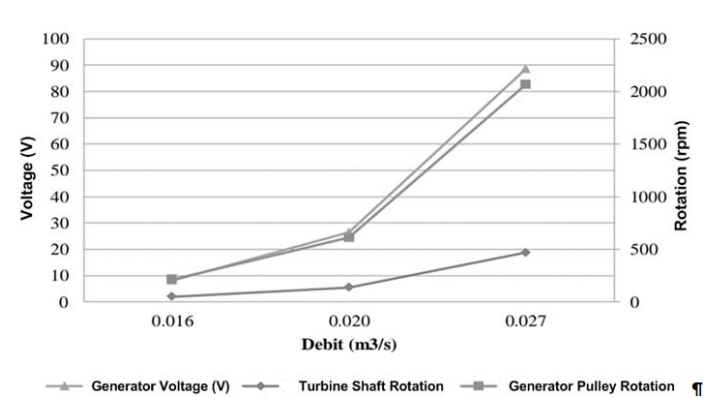
Fig 1. Relationship between Water Discharge and Generator Pulley Rotation, Turbine Shaft Rotation and Generator Voltage
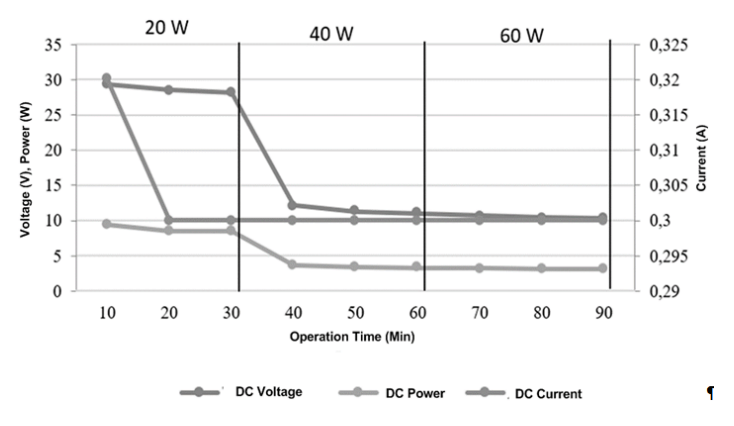
Fig 2. Relationship of Operating Time to Voltage, Current and Power with DC Voltage Load at Discharge Fluctuating Around 0.02 m3/s
2) Input Power Calculation (Pin) ρ = 1000 kg/m3 Q = 0.016 m3/s g = 9.8 m/s2 H = 6.12 m
Pin = ρ.Q.g.H = 1000 kg/m3. 0.016 m3/s . 9.8 m/s2. 6.12 m = 958.89 Wa
Calculation of DC Loaded Turbine Data Head = 6.12 m AC Voltage = 8.867 V AC Current = 0.186 A DC Voltage = 8.867 V DC Current = 0.186 A Generator Rotation = 218.700 rpm Turbine Rotation = 51.050 rpm Debit = 0.016 m3/s
1) Input Power Calculation (Pin) ρ = 1000 kg/m3 Q = 0.016 m3/s g = 9.8 m/s2 H = 6.12 m
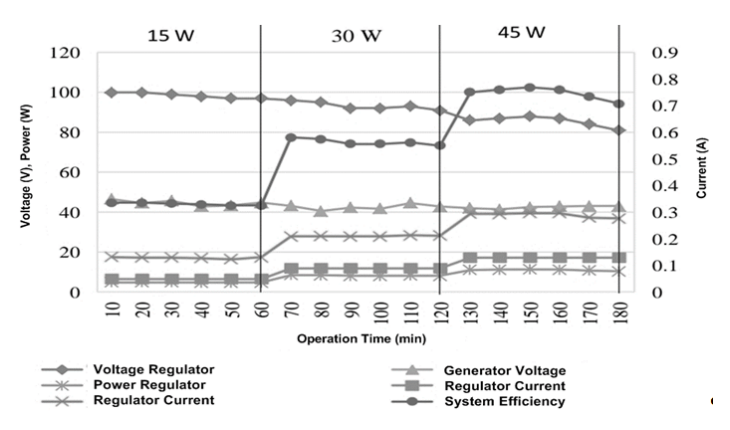
Fig 3. Relationship of Operating Time to Voltage, Current, Power and System Efficiency with AC Lamp Loads of 15 W, 30 W and 45W at Fluctuating Discharge of around 0.025 m3/s.
Fig 4. Relationship of Operating Time to Voltage, Current, Power and System Efficiency with AC Lamp Loads of 40 W, 80 W and 120 W at Fluctuating Discharge of Around 0.025 m3/s.
Calculation of AC Loaded Turbine Data Head = 6.12 m Generator Voltage = 44.68 V Generator Current = 0.129 A Regulator Voltage = 103 V Regulator Current = 0.048 A Generator Rotation = 1106.45 rpm Turbin Rotation = 244.43 rpm Debit = 0.025 m3/s
1) Input Power Calculation (Pin) ρ = 1000 kg/m3 Q = 0.025 m3/s g = 9.8 m/s2 H = 6.12 m Pin = ρ.Q.g.H = 1000 kg/m3 . 0.025 m3/s . 9.8 m/s2 . 6.12 m = 1488.83 Watt
2) Output Power Calculation Pout = V . I = 44.68V . 0.129 A = 5.77 Watt
Figure 1 illustrates the relationship among generator pulley rotation, turbine shaft rotation, and generator voltage. As the discharge of the turbine increases, both turbine shaft rotation and generator pulley rotation similarly increase, resulting in elevated generator voltage values. Notably, at the lowest discharge condition of 0.027 m³/s, the turbine shaft rotation achieves its peak at 468.97 rpm, and the generator pulley rotation reaches 215.82 rpm. Conversely, the highest discharge condition of 0.016 m³/s corresponds to the lowest values, with turbine shaft rotation at 49.39 rpm and generator pulley rotation at 2068.225 rpm. This data demonstrates a direct impact of discharge amount on the rotation of the turbine shaft and generator pulley. The influence stems from the water pressure on the rotation of both components. Specifically, a higher water discharge into the turbine results in accelerated turbine rotation. This acceleration is reflected in a threefold increase in generator pulley rotation, ultimately leading to a substantial voltage output.
In Figure 2, the relationship between voltage and current concerning the lamp load is depicted, revealing an inverse proportionality as the lamp load increases. The highest recorded values are 29.3 Volts for voltage, 0.32 A for current, and 9.38 W for power, observed at a lamp load of 20 W. Conversely, the lowest values are 10.3 Volts for voltage, 0.3 A for current, and 3.09 W for power, occurring with a lamp load of 60 W. Observing the graph, it’s evident that voltage, current, and power undergo fluctuations in response to changes in the lamp load. These fluctuations are influenced by variations in water discharge, although efforts are made to maintain a constant water discharge during the data collection time interval.
In Figure 3, the relationship between voltage and current in response to the AC lamp load is depicted, revealing an inverse proportionality as the lamp load increases. The highest generator voltage is recorded at 46.6 V, with the lowest generator current at 0.128 A. Simultaneously, the regulator exhibits its highest voltage at 100 V, the lowest regulator current at 0.05 A, and the lowest power at 4.85 W, all occurring with a light load of 15 W. Conversely, the lowest generator voltage is 39.3 V, with the highest generator current at 0.297 A. The regulator’s lowest voltage is 81 V, with the highest regulator current at 0.13 A and the highest power at 11.44 W, observed with a light load of 45 W. The system efficiency reaches its peak at 0.77% for a 45 W lamp load, while the lowest efficiency is 0.33% for a 15 W lamp load. The graph illustrates fluctuations in voltage, current, and power in response to changes in the lamp load. These fluctuations are influenced by variations in water discharge, although efforts are made to maintain a constant discharge during the data collection interval.
Figure 4 illustrates the relationship between voltage and current in response to the AC lamp load, revealing an inverse proportionality as the lamp load increases. The highest recorded generator voltage is 41 V, with the lowest generator current at 0.248 A. Concurrently, the regulator exhibits its highest voltage at 99 V, the lowest regulator current at 0.11 A, and the lowest power at 10.01 W, observed with a light load of 40 W. Conversely, the lowest generator voltage is 30.6 V, with the highest generator current at 0.612 A. The regulator’s lowest voltage is 71 V, with the highest regulator current at 0.29 A and the highest power at 21.17 W, noted with a light load of 120 W. The system efficiency reaches its peak at 1.42% for a 120 W lamp load, while the lowest efficiency is 0.67% for a 40 W lamp load. The graph depicts fluctuations in voltage, current, and power in response to changes in the lamp load, influenced by variations in water discharge. It is noteworthy that efforts are made to maintain a constant water discharge during the data collection interval.
4. Conclusion
1. In the DC system, the highest output power is 9.38 Watts, observed at a load of 20 Watts with a discharge of 0.02 m³/s. Conversely, the lowest output power is 2.14 Watts, recorded at a load of 20 Watts with a discharge of 0.016 m³/s. For the AC system, the highest output power is 23.76 Watts, noted at an 80 Watts load, while the lowest output power is 4.04 Watts, observed at a 15 Watts load. 2. In the DC system, the highest efficiency, recorded at 0.80%, was achieved under conditions with a discharge load of 0.02 m³/s, corresponding to a lamp load of 20 W. Conversely, the lowest efficiency, at 0.22%, was observed with a 20 W lamp load at a discharge of 0.016 m³/s. For the AC system, the highest efficiency, reaching 1.60%, was attained under conditions with a discharge load of 0.025 m³/s and a lamp load of 80 W. In contrast, the lowest efficiency, at 0.27%, was recorded with a lamp load of 15 W under similar conditions
REFERENCES
[1] H. Handoko, A. Adianto, and S. C. Loon, “The effect of population behavior on new renewable energy in primary energy mix for 2025 national target: sumedang regency review, west java,” Journal of Ocean, Mechanical and Aerospace science and engineering-, vol. 64, no. 1, pp. 1-8, 2020. [2] M. Azhar, S. Solechan, R. Saraswati, P. Suharso, S. Suhartoyo, and B. Ispriyarso, “The New Renewable Energy Consumption Policy of Rare Earth Metals to Build Indonesia’s National Energy Security,” in E3S Web of Conferences, 2018, vol. 68: EDP Sciences, p. 03008. [3] A. Q. Al-Shetwi, “Sustainable development of renewable energy integrated power sector: Trends, environmental impacts, and recent challenges,” Science of The Total Environment, vol. 822, p. 153645, 2022/05/20/ 2022, doi: https://doi.org/10.1016/j.scitotenv.2022.153645. [4] C. Buana, M. R. Djalal, I. Ikram, M. Iqbal, And L. L. La Ode Musa, “Performance Analysis of Micro Hydro Power Plants Using a Pelton Turbine with Two Nozzle Variations,” Przeglad Elektrotechniczny, vol. 2023, no. 7, 2023, doi: 10.15199/48.2023.07.16. [5] F. Firman, M. Y. Yunus, M. Anshar, N. Hamzah, Y. Klistafani, And M. R. Djalal, “Design Modification of Water Wheel Turbine With Various Configuration Variations,” Przeglad Elektrotechniczny, vol. 2023, no. 6, 2023, doi:10.15199/48.2023.06.46. [6] D. Yelvius, S. Sitampang Bato’, B. Erni Rante, and T. Benyamin, “Hydrological and Hydropower Potential of Maros River Hydroelectric Power Plant/PLTM, South Sulawesi,” Paulus Civil Engineering Journal, vol. 1, no. 1, 01/24 2020, doi: 10.52722/pcej.v1i1.50. [7] M. Khattak, N. M. Ali, N. Z. Abidin, N. Azhar, and M. Omar, “Common Type of Turbines in Power Plant: A Review,” Journal of Advanced Research in Applied Sciences and Engineering Technology, vol. 3, no. 1, pp. 77-100, 2016. [8] R. D. Muhammad and K. Nasrun, “Optimal design of energy storage for load frequency control in micro hydro power plant using Bat Algorithm,” SINERGI, vol. 26, no. 1, pp. 8-14, 2022, doi: http://dx.doi.org/10.22441/sinergi.2022.1.002. [9] O. OYEBODE and J. OLAOYE, “Comparative performance evaluation of pelton wheel and cross flow turbines for power generation,” European Mechanical Science, vol. 3, no. 1, pp. 6-12, 2019. [10] A. M. Kaya, İ. Kandemir, M. F. Akşit, and K. S. Yiğit, “Investigation of optimum working conditions of a micro cross flow turbine,” Environmental Progress & Sustainable Energy, vol. 34, no. 5, pp. 1506-1511, 2015. [11] Y. Nishi, T. Inagaki, Y. Li, and K. Hatano, “Study on an undershot cross-flow water turbine with straight blades,” International Journal of Rotating Machinery, vol. 2015, 2015. [12] S. Patel and P. N. Pakale, “Study on power generation by using cross flow water turbine in micro hydro power plant,” International journal of research in engineering and technology, vol. 4, no. 05, pp. 1-4, 2015. [13] M. Hidayat, F. Ronilaya, I. Eryk, and G. Joelianto, “Design and analysis of a portable spiral vortex hydro turbine for a Pico Hydro Power Plant,” in IOP Conference Series: Materials Science and Engineering, 2020, vol. 732, no. 1: IOP Publishing, p. 012051. [14] M. A. Khan and S. Badshah, “Research Article Design and Analysis of Cross Flow Turbine for Micro Hydro Power Application using Sewerage Water,” Research Journal of Applied Sciences, Engineering and Technology, vol. 8, no. 7, pp. 821-828, 2014. [15] R. Espina-Valdés, A. Fernández-Jiménez, J. F. Francos, E. B. Marigorta, and E. Álvarez-Álvarez, “Small cross-flow turbine: Design and testing in high blockage conditions,” Energy Conversion and Management, vol. 213, p. 112863, 2020. [16] N. Acharya, C.-G. Kim, B. Thapa, and Y.-H. Lee, “Numerical analysis and performance enhancement of a cross-flow hydro turbine,” Renewable energy, vol. 80, pp. 819-826, 2015. [17] M. Abidin and M. T. Radani, “Design and Construction of a Cross-flow Turbine Type Micro Hydro Power Plant (PLTMH) Prototype,” State Polytechnic of Ujung Pandang, 2022.
Authors: Sri Suwasti, Musrady Mulyadi, Yiyin Klistafani, Muhammad Ruswandi Djalal, Departement of Mechanical Engineering, State Poytechnic of Ujung Pandang, Emails: sri_suwasti@poliupg.ac.id. musradymulyadi@poliupg.ac.id, yiyin_klistafani@poliupg.ac.id, wandi@poliupg.ac.id.
Source & Publisher Item Identifier: PRZEGLĄD ELEKTROTECHNICZNY, ISSN 0033-2097, R. 100 NR 6/2024. doi:10.15199/48.2024.06.51
Published by Dranetz Technologies, Inc. Website: Dranetz.com
PU (Per Unit) Explained
PU stands for Per Unit. It is a term that electric utility engineers frequently use, and it was incorporated into IEEE 1159.
PU is the percentage formed by dividing the actual voltage by the nominal. For example, a sag to 0.8 pu on a 480V circuit would be a sag to 366V, and an interruption to 0.1 pu on a 120V circuit would be 12V.
The idea of “per unit” is to express a voltage without regard to the nominal, since through the various transformers in an electric utility system, the percent change will be similar (less losses in the transformer). If the 138kv transmission line sags to 0.7 pu, then the 13kv distribution line will see a similar sag, as will the end user voltage. (Of course, if there are delta-wye or wye-delta transformers in between, this will change the values, but the concept remains the same.)
Electrical Harmonic Power Flow
Most people in the power engineering field have encountered the question about which direction the electrical harmonic power is flowing, from the source to the load, or, from the load to the source. While this is still a controversial topic for some people, the most commonly accepted practice for determining this is to look at the harmonic watts phase angle, or the relationship between the voltage and current for a particular harmonic. The same rules that would be applied to a pure sine wave of voltage and current (which has only a fundamental frequency component) would be applied here.
The phase relationship between voltage and current with a pure resistive load is zero degrees, or a power factor of 1. If the load is a pure inductor, then the current lags the voltage by 90 degrees, which is normally displayed as a +90 degrees. If the load is pure capacitor, the current leads the voltage by 90 degrees, so the phase angle is called -90 degrees. This is so that the power factor of an inductive and resistive load would be a positive number between 0 and 1, while a capacitive and resistive load would be a negative number.
If the phase angle between the voltage and current is more than 90 degrees apart, this usually means that the current probe used with a power/harmonic meter or analyzer is placed in opposite direction of the assumed power flow. Most current probes have an arrow that should be pointing in the direction from the source to the load, which is the normal direction of power flow.
When the phase angle of the harmonic voltage and current is between 90 degrees and 270 degrees (270 is also referred to as -90 degrees) on a properly installed CT, then it is assumed that this harmonic power flow is in the opposite direction of the fundamental power flow, or from load to source.
In some Dranetz products, this is indicated by the words SOURCE or LOAD next to the printout of each harmonic watt. In other products, you have to look at the phase angle of the harmonic watts to determine where it falls.
The user must be cautioned that in a number of measurements, the harmonic current and voltage levels are so low that the harmonic watts number is so small that it may be meaningless, as would be the direction of power flow information. For example, if on a 120V/30A circuit, there is a 5th harmonic voltage of 0.05 V and harmonic current of 0.2 A, 0.01W is really insignificant and the accuracy of the direction is very low.
Source Stiffness
“Stiffness” of the source is kind of an engineering slang term for the ability of the source to provide a nearly constant voltage level even under heavy current loading conditions. In technical terms, it is related to the equivalent source impedance. Ohm’s and Kirchoff’s Laws are the keys here.
For example, if the source has a 1 ohm impedance and is supplying 100V, then if the load draws 1A, then the load will see 99V, with 1V dropped across the source impedance. If the load draws 10A, then the load will see only 90V, with 10V dropped across the source impedance.
However, if the source impedance were 0.1 ohms, 10A draw by the load would still give the load 99V, as only 1V would be dropped across the source impedance. Hence, the source with the 0.1ohm source impedance is a much “stiffer” source than the 1ohm source. This is true of harmonic source impedances as well.
Typically, the stiffer the source, the less likely is it that the user will have power quality problems, whether they be harmonic, RMS variations like sags, etc. Though like any rule, there are exceptions.
Harmonic Magnitudes
Harmonics are often displayed as a harmonic spectrum, which is either a list or bar graph showing the magnitude of each harmonic, for voltage and current. The magnitudes are a good clue as the source of the harmonics.
If the current harmonics have a significant 3rd harmonic, slightly smaller 5th, even smaller 7th and so on, this is often caused by single phase, rectified-input, switching power supplies, such as in computers, printers, and other information technology equipment found in office environments.
If the dominant harmonics are the 5th and 7th, then the 11th and 13th, then the 17th and 19th, then the source is often a 6 pulse or pole converter, also know as a 3 phase, full wave rectifier, which is found in adjustable speed drivers and other larger “electronic” loads.
Harmonic Pollutions
It is usually the harmonic currents that are of concern, as they can cause “harmonic pollution” to spread to other equipment. Just like Current * Impedance = Voltage for fundamental frequency, Ohm’s Law also applies to harmonic current, impedance and voltage.
Loads that draw current in a non-linear manner will cause harmonic-rich current to react with harmonic impedances and generate harmonic voltages that other loads will see.
Harmonic impedances can change values with frequency or the harmonic number, often increasing significantly with the higher harmonics. This means that it will take less harmonic current to produce a significant harmonic voltage.
The sum of THD
A common statistical number used is called THD, or total harmonic distortion. This is a mathematical process where: the magnitude of the harmonics for voltage or current are squared; summed; the square root is taken on the sum; and the result is the divided by either the fundamental RMS or the total RMS value; and lastly, multiplied by 100%.
This number can different significantly based on the divisor. (Typically, Fundamental is used in North America, and Total in Europe)
Using THD for current can be very misleading and should generally be avoided. The actual magnitudes of the harmonic current are more meaningful. If there is very little magnitude of harmonic current, as in the neutral of a wye circuit, then the THD can be very large and it still wouldn’t be a problem. For example, 0.5A of current in the neutral of a 30A circuit could be made of 0.25 A fundamental, and 0.25 A of 3rd harmonic. This would yield a 100% THD, which sounds bad, but is really insignificant on a 30A circuit.
Common Harmonics
Harmonics are typically defined as “frequencies that are integer multiples of the fundamental frequency”. For 60Hz power systems, these means that the 2nd harmonic is 120Hz, the third harmonic is 180Hz, the fourth is 240 Hz, “, the nth harmonic is n*60.
Frequencies are found that are actually in between these harmonic frequencies are called interharmonics (such as 185Hz), but are generally much less common than harmonic frequencies themselves. Frequencies below the fundamental frequencies are called subharmonics (such as 9Hz), and often contribute to the phenomena of light flicker.
RMS Sags
Variations in the RMS value are often used to trigger capturing of PQ data. The most common type of RMS variation is the sag, (or dip in European lingo). Some studies show over 60% of the PQ disturbances are sags, which is when the RMS value goes below 90% of the nominal value. On a typical office or residential outlet, that would be dropping from 120Vrms to 108Vrms. If the voltage goes down below 10% of nominal, we call that an interruption. Conversely, if it increases above 110% of nominal, that is a swell.
Electromagnetic Phenomena
The most common type of electromagnetic phenomena that cause power quality-related problems are changes in the basic waveshape of the voltage — the sine wave. One mathematical number used to represent this complex shape with a single number is RMS — root mean squared. It takes each of the sample points (typically 128) in one cycle of the waveform, multiplies the value by itself (squares it), adds them all up and takes the average (mean), and then takes the square root of that number.
This is different than the peak value, which is the largest sample value in a cycle. For different waveshapes, there are different relationships between the peak and RMS. For sine waves, the peak is 1.414 times larger than the RMS value, or the RMS value is 0.707 times smaller than the peak. This relationship doesn’t hold with distorted waveforms, such as when harmonics are present, which is why you should use a “true RMS” meter, not one that multiplies the peak value times 0.707 to determine RMS.
RMS Event Directivity
Variations in the RMS voltage value are often used to trigger the capturing of PQ data. These are called sags (dips), swells and interruptions. Knowing where the event originated is crucial to finding its source. As an example, if you detect sags at the service entrance of your building, know if it originated from the utility or within your building is necessary to determine the next steps to mitigate the problem. The source, or directivity is either “upstream” or “downstream” from the monitoring point.
In this example, upstream refers to the utility and downstream is the facility. Both the voltage and the current are needed to determine the directivity of an RMS voltage event. The directivity is determined by the relationship between the voltage and current during the event. Generally speaking, when the voltage sags (dips) and the current increases it’s a downstream event. Think of a large load turning on – there’s a in inrush of current that coincides with the reduction in voltage. An upstream event is when the voltage and current reduce simultaneously.
Loose Connections
If you have taken a distribution panel off for whatever reason, it is a good time to use one of the most important power quality tools, the screwdriver. Be sure to wear the proper safety equipment and to follow all necessary safety precautions. In most facilities, the current flows during only part of the day.
Today, this current is often contains heat-generating harmonic currents. The heating/cooling/heating/cooling cycle and resulting expansion and contraction of the wires can cause the connections to loosen over time. This loosening increases the impedance of the connection, which further increases the heating effects. Tightening loose connections with the screwdriver can help reduce voltage drops and minimize the fire potential.
Harmonic Differences
Harmonics are typically grouped by their harmonic number, either odd or even. Odd are the 3, 5, 7, 9, etc and even being the 2,4,6,8,”and so on. There is another grouping used, called the triplens, which are the 3, 6, 9, 12, etc. The triplens are so grouped because triplen harmonic currents will add in the neutral of a three-phase, four wire wye circuit, as opposed to canceling out. This has resulted in the need to make the neutral conductor equal to or up to 1.73 times as large in current-carrying-capability as the phase conductors.
Even harmonics are grouped together as they typically aren’t found in systems with properly functioning equipment, unless there are half-wave rectifiers present as loads. If half of the input rectifiers aren’t functioning properly in a full wave rectifier, then the load will draw current as if it is a half wave rectifier, and the current waveform will be rich in even harmonics. This is a clue that something maybe broken. Even harmonics are recognizable in a waveform as they cause a loss in symmetry within the halves of the waveform.
Power Factors
Power factor is another parameter that is affected by power quality phenomena, particularly distortion and imbalance. This creates even more confusion about the term “true power factor.” Power factor is a measure of how efficiently a load uses the electricity, or, how much energy is consumed by the load versus how much the electricity provider must deliver. This has been defined as real power divided by apparent power, watts / volt-amperes, or W / VA.
Until the onslaught of rectified input type loads (also called switching power supplies, or electronic or non-linear loads), most electrical loads were resistive and/or inductive loads, such as heaters, incandescent lights, and electrical motors. Whereas the voltage and current may not have been exactly in phase, both were nearly sinusoidal in their waveshapes, having only fundamental frequency components present. Hence, real power being equal to Vrms * Irms * cos (angle between V & I called theta) and apparent power being Vrms * I rms reduced down to Power Factor equal to Cos (angle theta). People then assumed that this was the “real” formula for PF, and revenue meters used such for billing purposes.
As the rectified input loads began to become the norm, the current waveshape in particular lost its sinusoidal shape, becoming rich in other harmonic frequency components. SCR-gated loads conducted current only during part of the voltage waveform. Even if the fundamental frequency components were in-phase, the real power was no longer just the Vrms * I rms * cos (theta), since each of the harmonic voltages and currents could have a different value for theta.
Not surprising, watts become a lower value, since the purpose of the rectified input switching power supplies and SCR-gated loads was to reduce the real power being consumed. But the apparent power, Vrms * Irms, was still the same. So, surprising as it may be to some people, the power factor become smaller. In one example, a utility person replaced an old electromechanical meter with a new one that called PF with the traditional W/VA method and now the customer owed for a PF penalty (which the customer refused to pay since they hadn’t changed their loads).
High Even Harmonics
The presence of a high percentage of even harmonics usually indicates that there is a significantly large half-wave rectifier on the circuit, or that a full-wave rectifier is damaged and is acting like a half-wave rectifier.
Odd harmonics are usually make up the majority of the spectrum on most electrical circuits. Even harmonics in significant proportions are usually not found, except where current is being drawn on only half the cycle. The Fourier expansion of a half-wave rectified signal is composed entirely of even harmonics, whereas the typical electronic loads, such as PCs, laser printers, or ASDs, have predominately odd harmonic spectrums.
Even harmonics are often detectable by the lack of quarter-wave symmetry of the waveform. This means that the part of the waveform up to the first peak of the sine wave doesn’t look like the mirror image of the 2nd part of the waveform, as it goes from the peak back to the zero axis. The same dis-symmetry will show up between the 3rd and the 4th parts in the negative half cycle of the waveform.
Causes of Transients
Transients are very short duration disturbances, less than 1/4 cycle of power frequency and more often, measured in microseconds. They used to be referred to as impulses, surges, spikes or glitches. But those terms can have ambiguous meanings, so the term “transient” was adopted by the IEEE and other standards groups.
Common causes of voltage transients are power factor capacitor banks being switched on or off, lightning striking a conductor or adjacent to a conductor, arcing from a phase conductor coming in contact with some sort of ground potential (such as a tree), and the notches resulting from the commutation period of the SCRs on rectified input 3 phase power supplies (such as in ASDs).
Possible effects of transients include data corruption on memory devices, equipment damage, data transmission errors, intermittent equipment operation, reduced equipment life, and irreproducible problems. Transients are often “sneaky”, in that they happen very quickly and randomly, and many power quality monitors will not capture them, especially the higher frequency transients.
Causes of Swells
Swells are increases in the voltage, typically above 110% of the nominal. Though must less common than sags, swells can cause catastrophic failures in equipment if the voltage exceeds the safe input level of the equipment for too long. Swells can be caused when a large load is suddenly turned off (opposite of the cause of sags). The voltage will increase for 30-60 cycles, until the automatic tap changers can bring the voltage back into normal regulation limits.
Causes of Sags
Sags are often caused by sudden, large increases in current, which causes a proportional voltage drop in the wiring, leaving less voltage remaining for the loads. If it is a fault on the electric distribution system, such as a phase-to-ground short circuit caused by lightning, animals, tree branches, or accidents, then the direction of the sag is called upstream or source side, or towards the generating source.
Instead, if a load starts up, such as a large HP motor, then the direction of the sag is said to be downstream or load side. If the remaining voltage during the sag is too low for the equipment to operate properly, the process can be interrupted or corrupted. Though equipment is usually not damaged during such, the product being produced often has to be scrapped, and there may be a significant restart time to get the operation running smooth again.
Flickering Lights
Some changes or modulations of the voltage that aren’t large enough to be consider sags may not seem to effect equipment operation. However, these anomalies can result in quality variations in extrusion and textile processes and in flickering lights that can cause human discomfort. In the case of flicker, the frequency of the modulation is critical as to whether it will be noticeable to the particular susceptibilities of the human eye and brain. For example, it would only take about 0.3 volts of modulation at 9Hz on a 120V system for most people to notice the flicker in a 60W light bulb. However, at 1 Hz, it would take nearly 10 times the modulation to be noticeable.
Published by Tural Aliyev1, Aydin Aliyev2,Azerbaijan State Oil and İndustry University, Baku, Azerbaijan ORCID: 1. 0000-0003-0751-3952, 2. 0000-0002-1631-0543
Abstract. This article aims to shed light on the critical aspects of power transformer assessment and proposes avenues for improvement in current methodologies, emphasizing the need for a more comprehensive and integrated approach to ensure the reliability and longevity of power transformers in the evolving landscape of the power system.
Streszczenie. Celem tego artykułu jest rzucenie światła na krytyczne aspekty oceny transformatorów mocy i zaproponowanie możliwości ulepszenia obecnych metodologii, podkreślając potrzebę bardziej wszechstronnego i zintegrowanego podejścia w celu zapewnienia niezawodności i trwałości transformatorów mocy w zmieniającym się krajobrazie systemu elektroenergetycznego . (Nowoczesne metody oceny stanu technicznego transformatorów mocy)
Keywords: power transformers, technical condition assessment, diagnostic and monitoring systems, informative parameters. Słowa kluczowe: transformatory mocy, ocena stanu technicznego, systemy diagnostyczne i monitorujące, parametry informacyjne.
Introduction
Power transformers are considered among the most crucial elements determining the reliability of electrical equipment in the energy system. The seamless and secure transmission of required power in its full form depends on the condition of individual windings and the absence of flaws. The persistence of power transformers in their operational functions during the exploitation process is essential to prevent the occurrence of extensive consequences, such as accidents, arising from faulty conditions in the energy system. Currently, the application of existing diagnostic methods to evaluate the technical condition of transformers assists in ranking them based on their operational state, contributing to the reduction of costs allocated for operation and maintenance.
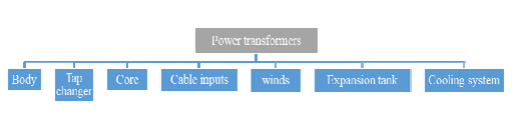
Figure 1 illustrates the essential elements of power transformers, each of which, when compromised, can lead to disruptions in the transformer’s operational regime.
Relevance of the Problem and Related Research
This article discusses the assessment of the technical condition of power transformers, which hold critical importance for the electricity supply system. The seamless and secure transmission of electrical energy, from the production site to consumers, relies on the flawless operation of these transformers, ensuring the overall durability and reliability of the power system. Research indicates that various methods employed to assess the technical condition of power transformers do not fully align with real production conditions and are frequently used beyond normative periods.
Despite normative documents suggesting a service life of 25 years, results show that over 40% of transformers exceed this timeframe. According to the assessment by CIGRE, transformers with a damage rate exceeding 3% are not considered economically viable for continued operation.
The failure of power transformers poses the potential for accidents, power interruptions, equipment malfunctions, and can result in significant economic and environmental damages. This emphasizes the importance of evaluating their technical condition and underscores the need for a contemporary analysis of methods and tools.
The purpose of the research in this article is to propose an analysis of modern methods and tools for assessing the technical condition of power transformers, aiming to ensure the reliable and effective operation of these devices—one of the most important research objects in the field of power systems. This endeavor contributes to the development of technologies in the field of electrical power and represents a significant step toward enhancing the security of the energy system.
Methods
Assessment of the Technical Condition of Power Transformers: Comparative Analysis of Diagnostic Methods Among the existing diagnostic methods for evaluating the technical condition of power transformers, preference is given to methods that can be applied while they are under operational stress, i.e., without removing them from service. These methods include:
1. Method for Analyzing the Technical Condition of Transformers Based on Thermal Imaging: This method involves analyzing the technical condition of transformers based on thermal images, allowing for assessments to be made while the transformers are under load.
2. Method for Evaluating the Technical Condition of Transformers through Vibration Analysis: This approach involves analyzing vibrations to assess the technical condition of transformers, enabling evaluations to be conducted while the transformers are in operation.
3. Method for Assessing the Technical Condition of Transformers through Extracted Oil Analysis: This method entails analyzing oil extracted from the transformer to assess its technical condition, offering the advantage of conducting evaluations without taking the transformer out of service.
Fig.1. The main elements of a power transformer
These methods represent advancements in the field, providing the capability to assess the technical condition of power transformers without disrupting their operational status. The utilization of thermal imaging, vibration analysis, and extracted oil analysis contributes to a more comprehensive understanding of transformer health and facilitates proactive maintenance strategies.
Assessing the technical condition of power transformers based on thermal imaging is a sufficiently complex process.
This is because, while transformers perform their operational functions, their core and windings generate a natural heat flow, and any localized faults created are encompassed by this heat flow, introducing a certain level of difficulty.
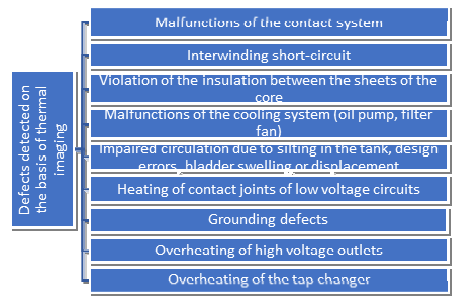
Simultaneously, the impact of the cooling system results in the circulation of oil, complicating the temperature distribution at the location of the fault. This, in turn, diminishes the accuracy of the assessment. In this regard, literature [5] indicates that when computer-assisted evaluation of the technical condition of power transformers is employed, various factors must be taken into account, including their design features, the type of cooling system and core, operational conditions, operational duration, manufacturing technology, and numerous other factors (Figure 2).
Fig.2. Defects detected based on thermal imaging
It should be noted that, for the evaluation of the effectiveness of the cooling system of transformers, two approaches should be employed as follows:
1. Assessment of the average temperature difference with respect to oil coolers operating under the same load and environmental conditions.
2. Comparison of the temperatures at the inlet and outlet pipes of the cooling system with factory specifications. These approaches are essential for a comprehensive evaluation of the performance of the transformer’s cooling system.
Experience shows that, in the first case, the average temperature difference should not exceed 2°C. If it does, it indicates that the cooling system is not functioning properly. In the second case, the temperature difference between the inlet and outlet pipes of the oil should not exceed 1-1.5°C.
It should be noted that power transformers are electromechanical systems, meaning that the distortion of their individual constructive elements and faults in their windings lead to the generation of electromagnetic phenomena [1]. Currently, there is no standardized vibration limit for assessing the technical condition of power transformers.
However, according to the results of research from various organizations, normally functioning transformers are characterized by the following parameters in terms of vibration [1].
Vibroacceleration – 10 m/sec2
Vibration speed – Below 10 mm/sec
Vibration change – 100 µm
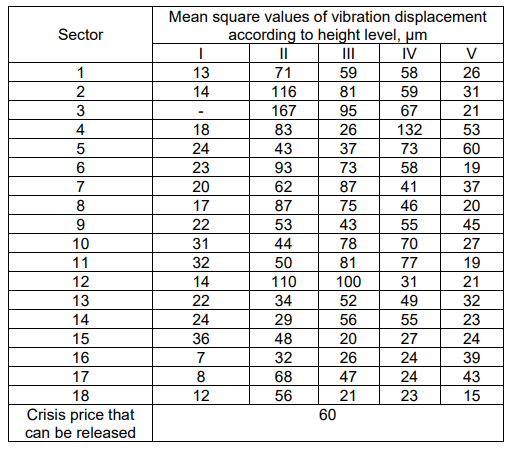
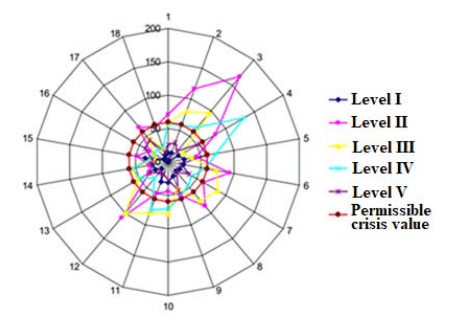
In modern times, the assessment of the technical condition of a transformer using a vibroanalyzer involves utilizing the root mean square value of vibration, and based on this, an amplitude spectrum is constructed concerning various sectors (levels) (Table 1, Figure 3).
Table 1. Vibration results obtained from measurement
.
Fig.3. The root mean square values of vibrations on the surface of the transformer core
The absence of a database and comparison tool for analyzing the results obtained in existing diagnostic methods sometimes leads to an increase in the loss of information.
One method for assessing the technical condition of power transformers and detecting various types of faults involves analyzing the oil extracted from the transformer core [2].
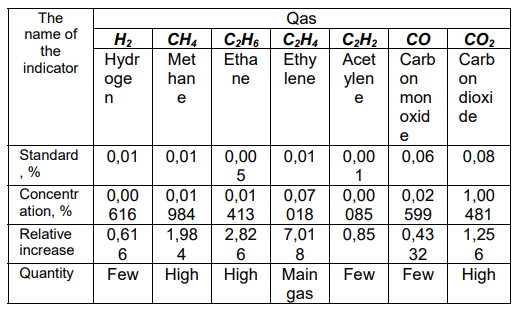
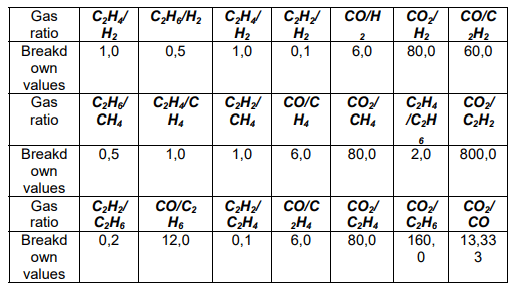
In this method, the results of physical-chemical analysis, such as the chromatographic analysis of gases dissolved in the oil, and the analysis of furans and other impurities, are utilized as initial data. The breakdown values of these results are presented in Table 2 and Table 3.
The chromatographic analysis of the extracted oil identifies two groups of faults:
1. Excessive heating of electrically conductive and constructive components.
2. Electric discharges in the transformer oil, allowing for specific identification.
The increase in temperature or the presence of void discharges in the oil in the first group causes changes in the concentrations and ratios of C2H4 – ethylene, C2H2 – acetylene, H2 – hydrogen, CH4 – methane, C2H6 – ethane gases (Table 3).
The second group of faults is attributed to electrical discharges in the transformer oil. They can be both small and large in magnitude.
In recent times, significant steps have been taken in the evaluation of the technical condition of electrical equipment used in the power system [7]. It is demonstrated that determining the location and measuring the level of partial discharges is one of the developing methods for diagnosing the technical condition of power transformers with oil cooling systems.
Table 2. The results of chromatographic analysis of the oil extracted from the transformer core and the breakdown values of the concentrations of dissolved gases
.
Table 3. Breakdown values of the concentrations ratios of dissolved gases in transformer oil
.
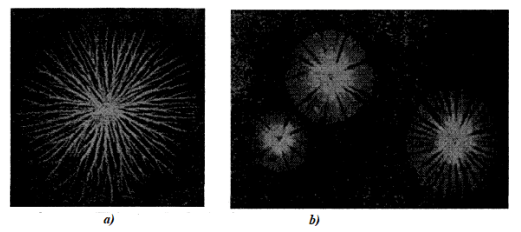
Partial discharges are a part of electrical discharges in the insulation gap and create local faults in transformers. These faults occur in places where the insulation is weakened due to the formation of gas in certain gaps or the presence of dense metallic cutting elements (Figure 4) [8,9].
Here, it is noted that due to the diversity of dielectric materials surrounding the gas and its entry point, the dielectric permeability varies. As a result, the dielectric field intensity in these areas is much higher compared to other locations. Therefore, partial discharges in localized zones can lead to the breakdown of insulation and, consequently, the rupture of the insulation gap, posing a significant danger. Literature [10, 11] also indicates that the following methods are available for identifying partial discharges:
1. Electrical method based on signal measurement.
2. Electromagnetic method based on the detection of partial discharges in the high-frequency range through electromagnetic emissions.
3. Optical method based on the detection of optical emissions during partial discharges.
4. Acoustic method based on the measurement of acoustic signals generated during partial discharges.
It is shown that these methods, based on the measurement of acoustic signals generated during partial discharges using contact and distance-type sensors, ensure operationality and high precision. These methods allow for the analysis of the technical condition of the transformer under stress and the timely localization of occurring damages.
One of the most widely used and effective methods for evaluating the technical condition of power transformers is the acoustic diagnostic method, which is based on the accurate determination and localization of the level of distributed sound discharges [12, 13].
Fig.4. The representation of partial discharge with a high-speed camera: a) Surface discharge created by the positive electrode; b) Surface discharge created by the negative electrode
Literature [14] indicates that diagnostic parameters used for evaluating the technical condition of power transformers without disassembly include:
However, information about the reasons for changes in these parameters and their correlation with the residual operational life and reliability of the equipment is not provided here. The issues related to the problems mentioned are discussed in [15].
It should be noted that due to the specific design and purpose of power transformers, it is not possible to use diagnostic or monitoring systems designed for various technical systems here. Although these systems have several advantages, such as the diagnostic monitoring of the actual condition of the equipment under stress, high accuracy of input parameters, and the possibility of their retention, they also have the following conflicts:
1. They do not encompass the technical characteristics of transformers, diagnostic parameters, the mutual relationship, and dependence among these parameters. They only perform the monitoring of the observed equipment.
2. The input information consists of a set of data, and its analysis and processing present an additional challenge, requiring special mathematical tools and software for resolution.
3. The installation of a monitoring system in electrical stations and substations is expensive, and so on.
In the modern era, seamless control over the technical condition of power transformers, which are a crucial element of the power system, is considered one of the most pressing issues.
References [16-19] examine automated control systems for monitoring the technical condition of power transformers. The primary task of such systems is to seamlessly control the identification of potential faults at the initiation stage during the operational process. Systems such as TPAS (Transformer Performance Analysis System – USA), Siemens (Germany), and ABB Secheron (Switzerland) are widely applied. The TPAS system was developed at the Massachusetts Institute of Technology in the USA and is designed for the initial identification of the maximum number of faults in power transformers. This system determines the technical condition by detecting partial insulation breakdowns during the operation of power transformers, mechanical strength reduction due to short circuits, hotspots in the winding and magnetic system, regulation failure points under load, and damage to bushings and inputs. The TPAS system does not use generalized mathematical models based on the ModelBased Monitoring concept among individual faults of the transformer [19]. As shown in [19], Alstom Schorch Transforen applies the MS-2000 and MS-1000 types, and Siemens applies the Sitramt second-generation automated seamless control system based on the Sitatic calculation system appropriately for transformers with a power of 100 MVA and above, as well as transformers with a power ranging from 10 MVA to 100 MVA. These systems send an excitement message to the computation machine using special sensors. For example, the temperature of the hottest point is 150°C. That is, 150°C ˃ the standard [110°C], etc.
Research shows that complex diagnostic measures can occur and allow for the early detection of developing faults.
Complex diagnostic measures are based on normative documents, meaning:
1. Chromatographic analysis of oil is conducted once a year for power transformers with a voltage of 35-110 kV and twice a year for those with a voltage of 220 kV.
2. Inspection between repairs is performed once every 4 years.
3. Repair cycles include: – Current repair every 2 years, – Cooling system annually, – Intermediate repair every 8 years, – Capital repair cycle is not regulated
It is evident from here that identifying the damage to the cooling system at the initial stage using chromatographic analysis, which reveals faults originating from heat and electricity, is not possible. This indicates that the inability to accurately determine the precise mutual relationship between the causes of damage and the dynamics of developing faults identified through control and diagnostic systems, coupled with the frequent occurrence of uncertainties, leads to the emergence of unnecessary expenses. Therefore, the creation of a systematic control and diagnostic system that can eliminate the conflicts of existing systems should be considered as an important issue [20].
It should be noted that the speed of fault development depends on the influence of various operating modes and the characteristics of the network where individual feeders are connected. Therefore, control and diagnostic systems should also be capable of the following functions:
1. Optimal methods capable of identifying a large number of faults.
2. Early detection of faults to minimize repair costs.
3. Determining the location, type, and degree of development of the damaged element or unit.
4. Providing a grounded result for taking transformers out for repair.
[21,22] describe expert systems developed based on fuzzy logic and neural networks. A distinctive feature of expert systems based on neural networks is their self-learning system. The training of artificial neural networks, improving the quality, and determining the residual lifespan of transformers should continuously fill the knowledge base of this system through periodic evaluations.
Literature [22] indicates that in the fuzzy expert information system, the results of the chromatographic analysis of oil-soluble gases and thermal imaging device are entered into the database, and a set of fuzzy rules has been formulated for deriving logical conclusions between them. It is noted here that this expert system allows for the early detection of faults in electrical equipment during the initial development phase. Also, it is mentioned that in the future, this system can be used for diagnosing power transformers with a voltage level of up to 110 kV.
This indicates that power transformers, given their role in the management of the energy system, continue to be a regular subject of research worldwide [23].
Result
• Various diagnostic and monitoring systems prepared for different technical systems are used to evaluate the technical condition of power transformers.
• Mutual relationships and dependencies between informative parameters are not taken into account.
• The large number of informative parameters requires specialized mathematical tools and software.
• Existing systems provide an alarm signal for any fault, but they do not provide information about the cause and elimination of the fault.
• Uncertainties and errors in measurement systems are not considered.
• The characteristics of the network to which the research object is connected are not taken into account during the determination of the dynamics of fault development, etc.
REFERENCES
1. Гавриленко А.В., Долин, А.П., Методика вибрационного обследования силовых трансформаторов, 2004. 2. Б.В. Ванин, ЮН. Львов, М.Ю. Львов и др. О повреждениях силовых трансформаторов. // Электрические станции. — 2001.— № 9. – С. 53—58. 3. Л. Г. Сидельников, А. М. Седунин, А. Ю. Сыкулев, ООО «ТестСервис» Диагностика масла в силовых трансформаторах. 4. Л. Г. Сидельников, А. М. Седунин, А. Ю. Сыкулев, ООО «ТестСервис» Вибродиагностика и измерение частичных разрядов в силовом трансформаторе. 5. Ю.М. Голоднов Контроль за состоянием трансформаторов. – М.: Энергоатомиздат, 1988 – 88 с.: ил. 6. Михеев Г.М. Тепловизионный контроль высоковольтного оборудования: Учебн. пособие, Чебоксары: Изд-во Чуваш унта, 2004, 180 с. 7. Основные положения методики инфракрансой диагностики электрооборудования и ВЛ. / Под ред. С.А. Бажанова, М., 1999.181 с. 8. А.С. Карандаев, С. А. Евдокимов, О.И. Карандаева, С.Е. Мостовой, А.А. Чертоусов г. Магнитогорск, МГТУ. Kонтрольтехнического состояния силовых трансформаторов методом акустического диагностирования. Вестник ЮУрГУ, № 26, 2008. 9. International Standard «High-voltage test techniques-Partial discharge measurements» – IEC 60270, Third edition, 2000-12. 10. Применение технологии ЧР в диагностике изоляции / Claude Kane, Alexander Golubev. – http:/ http://www.partial-discharge, com. 11. О повреждениях силовых трансформаторов /Б.В. Ванин, ЮН.Львов, М.Ю. Львов и др. // Электрические станции. — 2001. —№ 9. – С. 53—58. 12. Львов, М.Ю. О надежности силовых трансформаторов и автотрансформаторов электрических сетей / М.Ю. Львов, Ю.Н.Львов, Ю.А. Дементьев // Электрические станции. – 2005. -№11.-С. 69-75. 13. Электрооборудование и электроустановки. Методы измерения характеристик частичных разрядов. -ГОСТ20074-83. 14. Аксенов, Ю.П. Использование усовершенствованных методов электромагнитной локации разрядных явлений для определения объема ремонта трансформаторов / Ю.П.Аксенов, В.И. Завидей, И.В. Ярошенко // Электро. – 2004. – №5.- С. 19-24. 15. Forsthoffer, M. Forsthoffer’s Component Condition Monitoring. 1st ed. Oxford, Butterworth-Heinemann, 2018, 204 p. ISBN
Authors: Ph.D. candidate. Tural Aliyev, Azerbaijan State Oil and Industry University, E-mail: aliyev.tural@asoiu.edu.az; Ph.D. candidate. Aydin Aliyev, Azerbaijan State Oil and Industry University, E-mail: aydin.aliyev@asoiu.edu.az.
Source & Publisher Item Identifier: PRZEGLĄD ELEKTROTECHNICZNY, ISSN 0033-2097, R. 100 NR 7/2024. doi:10.15199/48.2024.07.43
Published by Adnan M Al-Smadi, Tariq M Alrjoub, Yarmouk University, Hijjawi Faculty for Engineering Technology, Jordan ORCID:000-0003-3796-6805X
Abstract. For the last several years, the demand for electricity in Jordan has increased. This increase is due to the change of climate conditions and high temperatures, which led to the increase of the use of air conditioning units. One important issue in energy consumption is the use of energy in street lighting. This paper aims to study and re-evaluate the current standard road lighting structures and schemes in Jordan within Jordanian recommendations. The study included a survey of the streets in those areas have shown that lighting units show heavy use of mercury lamps units.
Streszczenie. Od kilku lat zapotrzebowanie na energię elektryczną w Jordanii wzrosło. Wzrost ten wynika ze zmiany warunków klimatycznych oraz wysokich temperatur, które doprowadziły do wzrostu wykorzystania urządzeń klimatyzacyjnych. Istotną kwestią w zużyciu energii jest wykorzystanie energii w oświetleniu ulicznym. Celem tego artykułu jest zbadanie i ponowna ocena obecnych standardowych konstrukcji i systemów oświetlenia drogowego w Jordanii w świetle jordańskich zaleceń. W ramach badania dokonano przeglądu ulic na tych terenach, które wykazały, że w instalacjach oświetleniowych występuje duże zużycie lamp rtęciowych. (Rozważania dotyczące oszczędzania energii i wymiany lamp oświetlenia ulicznego na jordańskich drogach)
Keywords: Energy Savings, High Pressure Sodium (HPS) Lamps, Illuminance, Luminance, Luminous Intensity, Street Light Standards Słowa kluczowe: Oszczędność energii, wysokoprężne lampy sodowe (HPS), natężenie oświetlenia, luminancja, natężenie światła,
1. Introduction
For the last several years, the demand for electricity in Jordan has increased. This increase is due to the change of climate conditions and high temperatures, which led to the increase of the use of air conditioning units [1]. One important issue in energy consumption is the use of energy in street lighting. The huge amount of energy and cost associated with street lighting has raised the need to investigate the cost issues [2, 3].
Energy efficiency and energy consumption for street lighting can be reduced by considering the replacement of the inefficient lamps such as high pressure mercury (HPM) lamps with more efficient high pressure sodium (HPS) lamps. The literature on high pressure sodium lamp is rich and remain attractive as it has high efficiency light sources [4]. New HPS lamps have been designed to replace existing HPM lamps for several types of HPM ballasts. Fokui et. al. [5] proposed an adoption of solar streetlights with enhanced energy management capabilities to replace the conventional lamps in lighting the streets in major cities.
The Jordanian local energy resources are very limited. Due to lack of energy sources, Jordan depends on imports to fulfill its needs. Jordan currently imports more than 95% of the total energy consumed [6]. In 2017, the demand for electricity had increased up to 5%. Public street lights in Jordan constitute (2-3)% of the overall electricity consumption [1, 7]. Table 1 shows the sectoral distribution of electricity consumption in Gigawatt-hour (GWh) in Jordan during 2014-2018 [1]. Therefore, it is an important subject to study the possibilities of reducing the electricity consumed in lighting the streets. Studies concluded that street-lighting is an important factor of safety during the time of darkness [8].
In general, street-lighting systems can be measured using different techniques. However, the illumination technique is used mostly for this purpose because the data can be obtained more accurately than the other methods [9]. The Illumination method needs measurements data of illuminance values at desired locations on roadway.
Luminance is a term describes the measurement of the amount of light passing through an object. It indicates how much luminous intensity can be sensed by the human eye; i.e., the brightness of light emitted or reflected off a surface. On the other hand, illuminance is a term that describes the measurement of the amount of light (or light flux) that falls and spreads over a given surface at a certain distance from the light source [10].
Table 1. Sectoral distribution of electricity consumption (GWH) in Jordan during 2014-2018.
.
When the outdoor lighting is designed, the designer must consider several factors. One of these factors is the type of area such as residential street, roadway, parking lot, and pedestrians. Other factors include traffic lights, the amount and speed of traffic, and glare from oncoming traffic. These factors help determine which lighting category the area falls into. The category defines the amount of light and uniformity that the lighting installation must provide at all times. When the category has been determined, the pole heights, luminaire and lamp type must be chosen and a maintenance factor must be determined [11].
This paper aims to study and re-evaluate the current standard road lighting structures and schemes in Jordan within Jordanian recommendations. Several methods were used to reduce the power consumed in lighting different Jordanian roads in the areas of Greater Amman Municipality and Irbid. The study included a survey of the streets in those areas have shown that lighting units show heavy use of mercury lamps units. A comparison was made in lighting units for these roads.
The paper is organized as follows. In Section 2, street lighting system design considerations are discussed. Section 3 presents the methodology and illumination techniques. In Section 4, measurements and calculations of the illuminance of lighting units are presented. Section 5 presents the operational cost using the cost-discount method. Concluding remarks are presented in Section 6.
2. Street Lighting System Design Consideration
Street lighting system design is the design of street lighting such that people can travel safely when it gets dark on the road, and continue their travels to reach their destination. Street lighting schemes provide sufficient light during the night for people to see important objects required for traveling on the road. The design of street lighting is an important issue for several reasons such as reduce the risk of night-time accidents, discourage vandalism and crimes, and gives a sense of secured environment for habitation. Several studies showed that street lighting reduces crash rate during the night-time for an average of 35% [9].
Street lighting can be classified based on the installation area as: lighting for subsidiary roads, lighting for traffic routes, and lighting for urban centers and public amenity areas [12]. In addition, they can be categorized according to the kind of lamp used such as: High Pressure Mercury (HPM), High Pressure Sodium (HPS) lamp, Low Pressure Sodium (LPS) lamp, High Intensity Discharge (HID) lamp, etc. Different types of lamps used in street lighting design are listed in Table 2 [12, 13].
Table 2. Light technology comparison based on luminous efficiency and lamp service life
.
3. Methodology
Illumination technique is used mostly for evaluating the street-lighting situation. Any illumination measurement technique needs to evaluate illuminance values at desired points. In order to proceed in this study, the following tools were necessary to be available: 1) Light Meter 2) Odometer which measures the distance 3) Computation device such as iPad or laptop.
The light meter is an important tool in is this system. The selection of the suitable light meter was based on the following criterion:
i) Portability: the system needs to be mobile.
ii) High accuracy: the system needs to have high precision specifically at low levels since the light-meter is required to evaluate illuminance levels of street-lighting at desired points.
iii) Connection to Computer: The light-meter should be able to communicate with the computation device to store, manage, and use the collected data. The illuminances of the lighting units were obtained using the DIALux lighting software [17].
In taking the measurements and performing the calculations, the output data of the street lighting study should include [15]:
1) Mounting height of the luminaire 2) Distance between adjacent poles (luminaires) 3) Luminaire overhang. 4) Luminaire tilt angle
In light measurement, one must distinguish between various quantities such as illuminance, luminance, luminous intensity, and luminous flux.
3.1 Luminous flux: it is a measure of the total amount of light emitted by a light source. The internationally standardized unit (SI) of luminous flux is the lumen (lm). It indicates how much light is emitted by light source in all directions. The lumens of a luminaire give information about the brightness of the luminaire
3.2 Illuminance: it is the total luminous flux incident on a surface, per unit area. It is a measure of the intensity of the incident light, wavelength-weighted by the luminosity function to correlate with human brightness perception [14]. The SI unit of illuminance is the lux (lx).
One lux (lx) = lm/m2
3.3 Luminous Intensity: it is a measure of the wavelength-weighted power emitted by a light source in a particular direction per unit solid angle. It describes the radiation of the emitted light in a certain direction. Therefore, it indicates how much the light is concentrated. The SI unit of luminous intensity is the candela (cd). The candela (cd) is the ratio of lumen to radiation angle (lm/sr). The radiation angle is measured by steradians (sr).
3.4 Luminance: it is a measure of the impression of brightness of a surface received by the human eye. It describes the amount of light that passes through or is emitted from a particular area, and falls within a given solid angle. The SI unit for luminance is candela per square meter (cd/m2).
4. Measurements and Calculations
In this study, several measurements were taken at different places with different parameters. Table 3 presents the illuminance of lighting units for street lighting using high pressure sodium (HPS) lamps of 250 W with pole height of 9 meters, boom length of 3 meters, and boom angle of 5 degrees. The illuminances of these lighting units were obtained using the DIALux lighting calculation software [20]. These measurements were taken for the Twin Central Installation type in Figure 1.
Fig.1. Twin Central Installation
Table 3. The illuminance of lighting units for street lighting using HPS [250W, 9M, 3M, 5°].
.
Table 4. The illuminance of lighting units for street lighting using HPS [250W, 12M, 3M, 5°].
.
Measurements were repeated for the same values except for the height of the pole which becomes 12 meters. Table 4 presents the illuminance of lighting units for street lighting using HPS lamps of 250 W with pole height of 12 meters, boom length of 3 meters, and boom angle of 5 degrees.
5. Operational Cost Using the Cost-Discount Method
Cost-discount method is an economic analysis based on the result of the tests concerning the life time and the lamp lumen maintenance factor of electronic compact lamps. The method is applied in this research for the economic comparison of high pressure sodium (HPS) lamps in road lighting. In this study, total costs include the initial and maintenance costs within the same period.
The initial cost includes the cost of the equipment such as poles, bulbs, and related materials as well as the cost of evaluating the proposed lighting system.
The initial cost (Cin) is computed using the following equation [16].
(1) Cin = Np [Cp + Cb + K (Cl + M Cl.s. + Cwi) + Cwp]
where: Np: is the number of poles along a considered road section, Cp: price of the pole with the necessary equipment and accessories Cb: price of a single or twin bracket, K: number of luminaires per pole, Cl: price of the luminaire, M: number of bulbs per luminaire, Cl.s: price of bulb, Cwi: cost for the luminaire installation, Cwp: cost for the post (pole) installation.
The annual electricity cost (Ce) can be calculated using the following equation:
(2) Ce = K NpCle
where: Cle: the yearly electricity cost per luminaire, which can be calculated using the following equation:
(3) Cle = M Pl T Cc
where: Pl: the power of the lamp (in kW), T: yearly lamp operation time (4000 h was used), Cc: electricity cost rate (0.052 JD/kWh was used).
Table 5 shows the parameters necessary to calculate initial cost and the annual electricity cost for different HPS powers; namely at 12-meter pole height, a boom angle of 5 degrees, 150W, 250W, and 400W.
The total cost is the sum of the initial cost (Cin) and the annual electricity cost (Ce) for the 10 years. That is
(4) Ctotal = Cin + Ce
Example: To calculate the total cost as shown in Equation (4), for 250W HPS lamp, Using
Table 5. Parameters needed to calculate initial cost and the annual electricity cost.
.
The operational costs (Cin), (Cle), (Ce), (Ce10), and (Ctotal), are shown in Table 6 for different levels of HPS powers; namely at 12-meter pole height, a boom angle of 5 degrees, 150W, 250W, and 400W.
Table 6. The operational costs (Cin), (Cle), (Ce), (Ce10), and (Ctotal) for different HPS and poles.
.
The cost analysis values for different HPS powers are calculated in the same manner as above and is shown in Table 7.
Table 7. The cost analysis saving for different HPS.
.
Notice that replacing Mercury street lighting unit (125W) with HPS unit (70W) in the road will save power 55W for each lighting unit. The reduction of the illumination level stays within the standards of the illuminance level of street lighting units.
In addition to the above reduction in power consumption, decreasing the street lighting units from 2 to 1 unit for each pole as shown in Figure 2, will reduce the power consumed to 50%. However, the illumination level will be reduced to (30-50)% which stays within the standards of the illuminance level of street lighting units.
Fig.2. Reduction of street lighting units
Furthermore, using LED street lighting units will save around 50% of the power consumption for other types of lighting units with operation hours of around 50000-100000. However, the initial cost is much larger than other types of lighting units.
6. Conclusion
This paper presented a study to reduce the energy consumption and demand for electricity circulating through the use of street lighting lamps in Jordan. Namely, the street lighting study was performed in the areas of the Greater Amman Municipality and Irbid. The study included a survey of the streets in those areas have shown that lighting units show heavy use of mercury lamps units.
The illuminance of lighting units for street lighting was measured for different high pressure sodium (HPS) lamps, different pole heights, different boom length, and different boom angle degrees. The illuminances of these lighting units were obtained using the DIALux lighting software. These measurements were taken for the Twin Central Installation. Table 3 shows an example of the measurements of illuminance of lighting units for street lighting using HPS lamps of 250 W with pole height of 9 meters, boom length of 3 meters, and boom angle of 5 degrees.
Several measurements with various parameters were taken and implemented in the cost analysis. Measurements were taken at different levels of HPS powers, different pole heights, and different boom angles. Table 6 shows an example of calculating the operational cost at 12-meter pole height, a boom angle of 5 degrees, and HPS powers of 150W, 250W, and 400W.
The Cost-discount method shows a very good reduction and saving in energy consumption. Table 7 presents the cost analysis saving for different HPS. As a result, replacing Mercury street lighting units with HPS units will have a considerable reduction in power consumption. However, the reduction of the illumination level stays within the standards of the illuminance level of street lighting units.
REFERENCES
[1] Annual Report 2019-2020, Jordanian Ministry of Energy and Mineral Resources, Jordan, 2020. [2] A. Al-Smadi, Salam Salah, Areen Al-Momani, and Majd AlBataineh, “Intelligent Street Lighting Energy Saving System Based on Climate Conditions and vehicle’s Movements,” Jurnal Kejuruteraan (Journal of Engineering), vol. 33, no. 1, pp. 151-157, 2021. [3] A. Al-Smadi, Salam Salah, Areen Al-Moomani, and Majd AlBataineh, “Street Lighting Energy-Saving System” 16th IEEE International Multi-Conference on Systems, Signals & Devices (SSD19), Istanbul, Turkey, pp. 763-766, March 21-24, 2019. [4] Jan Mucko, “Properties of high-pressure sodium lamp by different supply methods”. Przeglad Elektrotechniczny, vol. 93, no.8, pp.155-158, 2017. [5] Willy S.T. Fokui, Michael Saulo, and livingstone Ngoo, “Climate Change Mitigation in Cities by Adopting Solar Streetlights with Energy Management Capabilities: Case of Nairobi”, IEEE 21st Mediterranean Electrotechnical Conference, Palermo, Italy, 14-16 June 2022. [6] United Nation, “Case Study on Policy Reforms to Promote Renewable Energy in Jordan”, Energy Section of the Economic and Social Commission for Western Asia (UN ESCWA), United Nations Publication issued by ESCWA, United Nations House, Beirut, Lebanon, 2018. [7] Annual Report 2017, Jordanian Ministry of Energy and Mineral Resources, Jordan, 2017. [8] Huaguo Zhou, Fatih Pirinccoglu, and Peter Hsu, “A New Roadway Lighting Measurement System,” Transportation Research Part C Emerging Technologies, vol. 17, no. 3, pp.274-284, 2009. [9] Huaguo Zhou, Jiguang Zhao, Peter Hsu, and Pei-Sung Lin, “A New Method to Evaluate Roadway Lighting Systems and Its Safety Effects,” ITE 2010 Annual Meeting and Exhibit, Vancouver, BC, Canada, Volume: Paper Number – AB10H283, August 2010. [10] Mehmet Kayakus and Ismail Serkan Unci, “Luminance and illuminance analysis of roads using image processing technique,” Przeglad Elektrotechniczny, vol. 86, no. 10, pp. 283-285, 2010. [11] John Bullough, MS Rea, and Y Akashi, “Several views of metal halide and high pressure sodium lighting for outdoor applications.” Lighting Res. Technology, vol. 41, no. 4, pp. 297-320, 2009. [12] The SLL Lighting Handbook, CIBSE, London, The Society of Light and Lighting, 2018. [13] Rohaida Husin, Syed Abdul Mutalib Al Junid, Zulkifli Abd Majid, Zulkifli Othman, Khairul Khaizi Md Shariff, Hadzli Hashim, and Mohd Faisal Saari, “Automatic Street Lighting System for Energy Efficiency based on Low Cost Microcontroller”, International Journal of Simulation: Systems, Science and Technology, vol. 13, no.1, pp 29-34, 2012. [14] Eric T. Donnell, Richard J. Porter, and Venkataraman N. Shankar, “A framework for estimating the safety effects of roadway lighting at intersections”. Safety Science, vol. 48, Issue10, pp. 1436-1444, 2010. [15] Miomir Kostic, Lidija Djokic,Dejan Pojatar, Natasa StrbacHadzibegovic, “Technical and economic analysis of road lighting solutions based on mesopic vision”, Building and Environment, vol. 44, pp. 66-75, 2009. [16] Topalis F, Kostic M, Radakovic Z. “Advantages and disadvantages of the use of compact fluorescent lamps with electronic control gear”. Lighting Research and Technology, vol.34, pp. 279–88, 2002. [17] DIAL, DIAlux software user manual, Version 4.9, DIAL GmbH, Lüdenscheid, 16th Edition, 2011.
Authors: prof. dr Adnan M Al-Smadi, Yarmouk University, Hijjawi Faculty for Engineering Technology, Department of Electronics Engineering, Irbid, Jordan, E-Mail: smadi98@yu.edu.jo; Mr. Tariq M Al Rjoub, Yarmouk University, Hijjawi Faculty for Engineering Technology, Department of Electronics Engineering, Irbid, Jordan, E-Mail: tariq.rjoub1976@yahoo.com
Source & Publisher Item Identifier: PRZEGLĄD ELEKTROTECHNICZNY, ISSN 0033-2097, R. 100 NR 1/2024. doi:10.15199/48.2024.01.28
Published by Shanmugavadivu Natarajan, Department of Electrical and Electronics Engineering, Sri Venkateswara College of Engineering, Sriperumbudur, 602117, India
Abstract. This study introduces a novel transformerless high voltage gain DC-DC converter for solar power. It combines a two-inductor boost converter, voltage multiplier, and switched capacitor cells, achieving a remarkable high voltage gain with 98.24% efficiency. A 200 W prototype was tested, confirming a peak efficiency of 96.2% in real-world conditions. It also maintains 97% efficiency in motor load systems, reducing energy consumption and maintenance costs. This innovative converter enhances solar energy harvesting and has versatile power conversion potential, marking a significant advancement in renewable energy tech.
Streszczenie. W tym badaniu przedstawiono nowatorską, beztransformatorową przetwornicę DC-DC o wysokim wzmocnieniu napięcia do zasilania energią słoneczną. Łączy w sobie dwuindukcyjny konwerter podwyższający napięcie, powielacz napięcia i przełączane ogniwa kondensatorów, osiągając niezwykłe wysokie wzmocnienie napięcia przy sprawności 98,24%. Przetestowano prototyp o mocy 200 W, który potwierdził szczytową wydajność na poziomie 96,2% w rzeczywistych warunkach. Utrzymuje także sprawność na poziomie 97% w układach obciążenia silnika, redukując zużycie energii i koszty konserwacji. Ten innowacyjny konwerter usprawnia pozyskiwanie energii słonecznej i ma wszechstronny potencjał konwersji mocy, co stanowi znaczący postęp w technologii energii odnawialnej. (Wydajny, uproszczony konwerter DC-DC o wzmocnieniu wysokiego napięcia, zapewniający lepsze pozyskiwanie energii słonecznej)
Keywords: Transformerless Power Conversion, DC-DC Converter, Solar Energy Harvesting Słowa kluczowe: Beztransformatorowa konwersja mocy, konwerter DC-DC, pozyskiwanie energii słonecznej
Introduction
Background:
Amid the global push for renewable energy, solar power has gained prominence due to its abundance and minimal environmental impact. Solar panels, powered by photovoltaic cells, convert sunlight into electricity, offering a sustainable and appealing energy source (Zhang, 2016) [1]. However, solar panel efficiency is affected by factors like temperature, shading, and sunlight angles, leading to voltage and current fluctuations. To optimize energy capture, efficient DC-DC converters are essential components in photovoltaic systems.
A primary challenge in solar power is efficiently raising the low-voltage output from solar panels to levels suitable for grid integration or powering diverse loads. Traditional DC-DC converters often fall short in voltage gain, resulting in energy losses and decreased system efficiency. Moreover, they can add complexity, increasing costs and maintenance (Zhang, 2016).
Rationale for Research:
Developing high voltage gain DC-DC converters for solar power addresses the need for more efficient energy conversion. These converters offer key advantages for solar energy adoption. They can significantly enhance energy harvesting, even under less-than-ideal conditions, improving overall system efficiency and investment returns. Furthermore, the proposed converter is, eliminating bulky and costly transformers found in traditional power systems. Transformerless designs reduce weight, save space, and enhance reliability, making them attractive for solar power. The converter’s simplicity and reduced component stress result in longer lifespans and lower maintenance costs (Rathore & Babu, 2018) [2].
Aim and Scope of the Study:
This study bridges a critical gap in solar power with a transformerless high voltage gain DC-DC converter tailored for solar energy. It covers design, analysis, implementation, and evaluation. Objectives include achieving high voltage gain, ensuring operational simplicity, and optimizing efficiency, especially in real-world scenarios. Performance will be rigorously assessed via MATLAB 2021 modeling, comparing with existing solutions. The study also explores the converter’s suitability for powering motors, showcasing its versatility beyond solar energy (Alzahrani & Rahman, 2017) [3].
Literature Review
The global push towards sustainable energy solutions and the imperative to reduce carbon emissions have thrust solar power into the forefront of clean and abundant energy sources. Photovoltaic (PV) systems have been instrumental in harnessing solar energy for various applications, from small-scale residential installations to large-scale solar farms [4]. However, to fully harness the potential of solar power and create a sustainable energy future, the development and implementation of high voltage gain DCDC converters tailored specifically for solar applications have become increasingly critical. Efficient energy conversion is pivotal in maximizing the performance of PV systems. Solar panels, the foundation of solar energy generation, are susceptible to various environmental factors, including temperature fluctuations, shading, and variations in solar irradiance [5]. These factors can lead to fluctuations in the output voltage and current of solar panels, directly impacting the overall energy yield of PV systems (Smith et al., 2021) [6]. To address these challenges and enhance energy harvesting efficiency, high voltage gain DC-DC converters have emerged as indispensable components in PV systems.
High voltage gain DC-DC converters offer several key advantages that make them ideal for solar power integration. Firstly, they have the potential to significantly enhance the energy harvesting capabilities of solar panels. By efficiently boosting the output voltage, these converters ensure that a larger portion of the available solar energy is captured, even under suboptimal conditions (Smith et al., 2021). This translates to increased overall system efficiency and a more favourable return on investment for solar installations [4]. Furthermore, the transformerless design of these converters eliminates the need for bulky and expensive transformers, reducing system weight, physical footprint, and improving overall reliability (Johnson & Wang, 2020) [7]. This feature makes high voltage gain DC-DC converters particularly attractive for solar power applications. To advance high voltage gain DC-DC converters for solar applications, comprehensive mathematical modelling and practical validation are essential. Mathematical modelling, typically conducted using tools like MATLAB, enables the assessment of the converter’s performance under varying operating conditions (Smith et al., 2021). These models provide valuable insights into efficiency, voltage gain, and system behaviour. Practical validation, exemplified by the construction of a 200 W prototype in a laboratory setting (Johnson & Wang, 2020), validates theoretical findings and ensures the converter’s effectiveness in real-world scenarios. This iterative process allows researchers to fine-tune designs and optimize performance. While high voltage gains DC-DC converters are initially designed for solar applications, their versatility extends beyond the realm of solar power. Research indicates that these converters can efficiently power motor loads (Brown & Smith, 2022) [8]. This versatility opens up diverse applications, where these converters can contribute to energy-efficient and sustainable solutions. Recent research has delved into advanced control algorithms for high voltage gain DC-DC converters, aiming to further improve their efficiency and performance (Li et al., 2023) [9]. Additionally, the exploration of wide-bandgap semiconductor devices for these converters promises higher efficiency and greater reliability [10-14].
In nutshell, high voltage gain DC-DC converters represent a significant advancement in the field of solar power generation. These converters offer the potential to significantly enhance energy harvesting efficiency, reduce system complexity, and improve overall performance. As solar power continues to play a pivotal role in the transition to renewable energy sources, innovative technologies like high voltage gain DC-DC converters will drive progress towards a sustainable and greener future.
Proposed System
The proposed solar power integration system block diagram highlights key components and their connections for efficient solar energy utilization. It centers on a high voltage gain DC-DC converter designed for solar use. The elements in the block diagram include:
Solar Panels: These panels are the initial energy source, converting sunlight into DC electricity, subject to solar conditions.
High Voltage Gain DC-DC Converter: The system core, efficiently elevating solar panel output to power various applications, enhancing energy harvesting efficiency.
Load: The converter’s output can drive electrical loads like BLDC motors.
Feedback Loop: This loop links the monitoring system to the converter, facilitating real-time adjustments based on performance and environmental data, thus enhancing system adaptability and efficiency.
Fig.1 Block Diagram of the Proposed System
Fig. 2 displays the circuit diagram of the high voltage gain DC-DC converter, efficiently stepping up low-voltage DC input from solar panels for optimized energy harvesting. Key components are as follows:
Switches (S1 and S2): Control current flow, alternating between open and closed states to manage energy transfer.
Inductors (L1 and L2): Store electrical energy as magnetic fields, aiding energy control.
Diodes (D1, D2, D3, D4, and Do): Permit one-way current flow, serving functions like rectification and circuit isolation.
Capacitors (C1, C2, C3, C4, and Co): Store electric energy, stabilizing voltage levels and smoothing output.
To ensure theoretical fulfillment and performance optimization, the proposed converter will undergo a comprehensive analysis, covering:
Operation in Continuous-Conduction Mode (CCM) and Discontinuous-Conduction Mode (DCM): Understanding behavior under different loads.
Voltage Gain Derivation: Efficient voltage boosts analysis. External Characteristics: Examination of input and output voltage-current relationships for interaction with external loads and power sources.
Voltage and Current Stress: Assessment of component stresses for design considerations.
Design Considerations: Exploration of component values, sizing, and arrangement for optimization.
Estimated Efficiency: Estimation of converter efficiency under various operating conditions.
Modelling: Creating a detailed converter model using tools like MATLAB 2021 for a deeper understanding of behavior.
Control: Discussion of control algorithms and mechanisms to ensure efficient operation and adaptation to changing conditions.
Fig.2 Circuit Diagram of the Proposed Method
Fig. 2 displays the composition of the high voltage gain DC-DC converter, featuring two switches (S1 and S2), two inductors (L1 and L2), five diodes (D1, D2, D3, D4, and Do), and five capacitors (C1, C2, C3, C4, and Co). Component placement within this converter is a crucial factor, serving to minimize current and voltage stress, enhance voltage gain, and maintain operational simplicity. To verify these aspects, a comprehensive theoretical and experimental analysis of the proposed converter is carried out.
Modes of Operation:
Stage I – Continuous-Conduction Mode (CCM): When switches S1 and S2 are both in the ON state, L1 and L2 energize, allowing current flow. Diodes D1, D2, and Do are reverse-biased, while capacitors C1, C2, and Co discharge into C3, C4, and the load (R). Diodes D3 and D4 are forward-biased, and capacitors C3 and C4 charge.
Stage II – Continuous-Conduction Mode (CCM): This phase follows when both S1 and S2 are switched OFF. During this stage, L1 and L2 demagnetize, and diodes D1 and D2 charge C1 and C2. The output diode Do is forward-biased, charging output capacitor Co with VC3 + VC4 – VC2. Diodes D3 and D4 are reverse-biased, and capacitors C3 and C4 discharge.
Stage III – Discontinuous-Conduction Mode (DCM): Exclusive to DCM, this stage begins when the current through the inductors reaches zero. At this point, all semiconductor devices are blocked, and the load (R) is powered by the output capacitor (Co).
To establish the static gain of the converter, the volts– seconds balance principle is applied to the inductors, and capacitor voltages (VC1, VC2, VC3, VC4) are calculated based on the voltage across the inductors in stages I and II. The static gain (M) is determined in Stage II (Vo = VC3 + VC4 – VC2). Additionally, it’s important to consider nonideal voltage gain, which relies on parasitic parameters like component resistances and forward voltages, as these factors can significantly impact the converter’s performance and must be considered for precise analysis and design.
Results and Discussions
Modelling the proposed system in MATLAB 2021 is a crucial step in assessing its performance and efficiency. The use of simulation allows for a detailed analysis of how the system behaves under various conditions, helping to refine the design and optimize its operation (Figure 3).
Fig.3 Simulation diagram of Proposed System
In Figure 4, we present a detailed model of the solar panel, a critical component responsible for capturing and converting solar energy into electrical power. The key elements and features include:
Solar PV Array: Comprising two parallel-connected PV arrays, each with 217 individual PV cells. This parallel connection enhances current output while maintaining voltage levels.
PV Cells: These fundamental units of solar energy conversion number 217 per array, arranged strategically to influence electrical characteristics. Cell Arrangement: Strategically placed PV cells aim to maximize energy capture, impacting efficiency and performance. Common patterns involve series and parallel connections.
Interconnection: Proper PV cell and array interconnection ensures efficient electrical flow, affecting voltage and current ratings. Effective interconnection minimizes losses.
Bypass Diodes: Integrated to mitigate shading or damage effects, these diodes allow current to bypass unlit sections, preventing power loss.
Fig.4 Solar PV (a) Solar modelling (b) control diagram
Fig.5 Solar panel parameter (a) voltage (b) current (c) power
Fig.6 Output parameters (a) voltage (b) current (c) torque (d) speed
.
Fig.7 Closed loop parameters (a) voltage (b) current (c) speed (d) torque
Figure 5 presents input parameters for the high voltage gain DC-DC converters powered by a solar panel with the following specifications: a) Voltage (Fig. 5a): The solar panel supplies 75V, determining the initial electrical potential for the converters. Solar system voltage varies based on solar irradiance and temperature. b) Current (Fig. 5b): The solar panel yields 7.6A, essential for calculating total electrical power generated. c) Power (Fig. 5c): The solar panel outputs 560W, indicating its capacity to generate electrical energy. These parameters are the initial energy source for the converters, responsible for stepping up input voltage for various applications.
Figure 6 provides an overview of output parameters for the motor load connected to the high voltage gain DC-DC converter: a) Load Terminal Voltage (Fig. 6a): The voltage at the load terminal is 440V, crucial for the motor’s operation. b) Armature and Field Current (Fig. 6b): Armature current is 5A, field current is 0.9A, influencing the motor’s electromagnetic interactions and torque. c) Load Torque (Fig. 6c): The load torque is 8Nm, representing the rotational force required. d) Motor Speed (Fig. 6d): The motor operates at 1400rpm, a critical aspect of motor performance.
Figure 7 shows the transition from an open-loop to a closed-loop control system for the motor load, leading to key improvements: a) Motor Rated Voltage (Fig. 7a): The motor’s rated voltage is maintained at 380V. b) Motor Current (Fig. 7b): The motor’s current is controlled at 5A. c) Motor Speed (Fig. 7c): The motor now operates at 1500rpm. d) Torque (Fig. 8d): The motor generates 10Nm of torque. These innovations optimize the motor load’s behavior and responsiveness to varying operating conditions.
Comparison with Existing Work
Compared to existing work in high voltage gain DC-DC converters and renewable energy systems, this study distinguishes itself with its transformerless design, improved efficiency, and integration of closed-loop control. Many conventional converters rely on transformers, adding complexity and cost. In contrast, the proposed transformerless design reduces these drawbacks. Moreover, the achieved increase in overall system efficiency is a significant advance, reducing energy losses during conversion. The closed-loop control system’s precise regulation of the motor load sets this work apart, enabling optimal motor performance under varying conditions. These innovations make this work a significant contribution to sustainable and efficient energy solutions.
Conclusions
In conclusion, this study explores the development and evaluation of a high voltage gain DC-DC converter tailored for solar power applications. With the world’s focus on sustainable energy and emissions reduction, solar power is a key player in cleaner electricity generation. This converter’s transformerless design reduces complexity, costs, and enhances reliability while minimizing size and weight. Its high voltage gain boosts energy harvesting, increasing overall efficiency and ROI for solar installations. Closed-loop control for motor loads ensures precise regulation and performance. These innovations mark a significant contribution to renewable energy advancement, addressing the need for efficient energy conversion and paving the way for a sustainable energy future.
REFERENCES
[1] Zhang, H. (2016). High-Efficiency DC-DC Converters for Renewable Energy Systems. IEEE Transactions on Power Electronics, 31(7), 4864-4879. [2] Rathore, A. K., & Babu, B. R. (2018). Design and Analysis of High Voltage Gain DC-DC Converters for Renewable Energy Systems. In 2018 IEEE 7th International Conference on Renewable Energy Research and Applications (ICRERA) (pp.924-929). IEEE. [3] Alzahrani, A., & Rahman, S. (2017). Simulation and Modeling of Photovoltaic Power Systems: A Review. Renewable and Sustainable Energy Reviews, 76, 60-75. [4] Rajalakshmi, M.; Chandramohan, S.; Kannadasan, R.; Alsharif, M.H.; Kim, M.-K.; Nebhen, J. Design and Validation of BAT Algorithm-Based Photovoltaic System Using Simplified High Gain Quasi Boost Inverter. Energies 2021, 14, 1086. https://doi.org/10.3390/en14041086. [5] Natarajan, S.; Kannadasan, R.; Alsaif, F.; Alsharif, M.H. Design of Novel Modified Double-Ended Forward Converter for Stepper Motor Drive. Machines 2023, 11, 777. https://doi.org/10.3390/machines11080777. [6] Smith, J. R., & Brown, L. Q. (2021). Advances in High Voltage Gain DC-DC Converters for Enhanced Solar Power Integration. Solar Energy, 200, 205-218. [7] Johnson, A. B., & Wang, X. (2020). Transformerless High Voltage Gain DC-DC Converters for Photovoltaic Systems. IEEE Transactions on Power Electronics, 35(9), 9363-9375. [8] Brown, E. S., & Smith, T. (2022). Innovative Applications of High Voltage Gain DC-DC Converters in Solar Power Systems. Renewable Energy, 150, 1221-1233. [9] Li, Y., et al. (2023). Advanced Control Strategies for High Voltage Gain DC-DC Converters in Solar Power Integration. IEEE Transactions on Sustainable Energy, 14(1), 123-135. [10] Xie, Z., et al. (2022). Wide-Bandgap Semiconductor Devices for High Voltage Gain DC-DC Converters: Opportunities and Challenges. IEEE Journal of Emerging and Selected Topics in Power Electronics, 10(3), 1680-1693. [11] Kadirvel, K.; Kannadasan, R.; Alsharif, M.H.; Geem, Z.W. Design and Modeling of Modified Interleaved Phase-Shifted Semi-Bridgeless Boost Converter for EV Battery Charging Applications. Sustainability 2023, 15, 2712. https://doi.org/10.3390/su15032712. [12] Pattathurani, L.P.; Dash, S.S.; Dwibedi, R.K.; Raj, M.D.; Kannadasan, R.; Savio, M.F.; Alsharif, M.H.; Kim, J.H. Harmonics Minimisation in Non-Linear Grid System Using an Intelligent Hysteresis Current Controller Operated from a Solar Powered ZETA Converter. Sustainability 2022, 14, 7028. https://doi.org/10.3390/su14127028 [13] Luque, A., & Hegedus, S. (Eds.). (2011). Photovoltaic Solar Energy: Development and Current Research. Wiley. [14] Liu, Y. (2019). Efficiency Improvement of Photovoltaic Systems Using High-Voltage Gain DC-DC Converters. Solar Energy, 191, 178-186.
Source & Publisher Item Identifier: PRZEGLĄD ELEKTROTECHNICZNY, ISSN 0033-2097, R. 100 NR 4/2024. doi:10.15199/48.2024.04.45
Published by Anna ZIELIŃSKA, AGH University of Science and Technology, Faculty of Management
Abstract: The article describes the possibilities of using blockchain technology in the electromobility sector and in various areas of the autonomous vehicle sector. The aim of the article is to present the dynamics of the development of blockchain technology in markets such as electricity trading, tracking the supply of rare earth elements for the construction of batteries, tracking certificates of origin for energy, applications in cooperation with the power grid, and others. on the implementation of solutions based on blockchain technology in the process of charging electric vehicles and the use of blockchain as a platform for building smart city systems. The work also specifies forecasts for further development of the use of synergy of the blockchain environment, electromobility and autonomous vehicles.
Streszczenie: W artykule opisano możliwości zastosowania technologii blockchain w sektorze elektromobilności oraz w różnych obszarach sektora pojazdów autonomicznych. Celem artykułu jest przedstawienie dynamiki rozwoju technologii blockchain na rynkach takich jak handel energią elektryczną, śledzenie dostaw pochodzenia pierwiastków ziem rzadkich do budowy akumulatorów, śledzenie świadectw pochodzenia energii, zastosowania we współpracy z siecią elektroenergetyczną i in.. Opierając się na studiach literaturowych, skoncentrowano się również na implementacji rozwiązań bazujących na technologii blockchain w procesie rozliczania ładowania pojazdów elektrycznych i wykorzystania blockchain jako platformy do budowy systemów typu Smart City. W pracy określono również prognozy dalszego rozwoju wykorzystania synergii środowiska blockchain, elektromobilność i pojazdów autonomicznych. (Technologia Blockchain w elektromobilności i elektryfikacji transportu)
Keywords: electric vehicle, blockchain, blockchain technology, electromobility, development of electromobility, energy trade Słowa kluczowe: samochód elektryczny, blockchain, technologia blockchain, elektromobilność, rozwój elektromobilności, handel energią
Introduction
Blockchain technology is related to the security of storing and transmitting user data. Applies to transactions concluded on the Internet between users. We can say about blockchain technology that it consists of decentralized transaction registers, which are composed of a long chain of data blocks [1]. They are used to store and send data related to concluded transactions. The blockchain containing recorded data does not require the use of management systems, central computers and systems that verify operations. All transactions can take place without intermediaries and in almost real time. Similarly to issues related to blockchain, concepts such as electromobility, electric vehicle, autonomous vehicles, Smart Grid have been appearing in the area of economy for a long time and enjoy unflagging interest in scientific discourse, political debates and in the media. The development of this sector is strongly connected with social awareness, social and political changes [2]. Electromobility can be defined as all the issues related to the use of electric vehicles (EVs). As a branch of this issue, there is more and more talk about autonomous vehicles that are able to independently overcome designated routes, avoiding obstacles and performing other road tasks. Autonomous vehicles can be divided according to the function they perform into groups and levels proposed by SAE International (Society of Automotive Engineers), which determine what degree of human intervention is necessary to drive a given vehicle (Fig. 1.) [3].
Blockchain and batteries for EVs
Blockchain as a technology is increasingly being implemented in new sectors of the economy. The electromobility and autonomous transport sectors face similar challenges in some areas. Today, the most important tasks faced by producers of batteries used in EVs are to provide even greater protection during accidents, by securing the batteries, increasing the energy density and the ratio of the stored charge to the weight of the batteries (which translates directly into the range of the electric car), but also limiting the use of rare metals. Access to deposits of rare earth metals, which are a key component of lithium-ion batteries used in these vehicles, is becoming increasingly difficult [4]. Manufacturers face several hurdles, including: they must screen the sources of raw materials and use only those that meet international legal standards and those that strive to minimize the impact of mines on the natural environment. Thanks to blockchain technology, it is possible to take the next step towards ensuring full traceability of raw materials in the supply chain and minimizing any associated risks, in close cooperation with suppliers.
Rare earth metals are metals that occur in small amounts in the world – 17 elements stand out among them, widely used in new technologies, and even in military technology [5]. Unfortunately, these metals are found in few places in the world, mainly in those where the political and social situation is not the most friendly and stable – for example, the Democratic Republic of the Congo controls 60 percent. world’s cobalt deposits. Graphite mining is also highly centralized. Only nickel and manganese are common in the world and their extraction is not a major problem [6].
Blockchain is a digital distributed database containing a list of records linked together by a cryptography algorithm. Within supply chains, it creates records of transactions that cannot be changed, while imposing a common set of rules for recording this data. Transactions provide the opportunity to record and store data, which includes such information as the aforementioned origin of e.g. cobalt, manganese, graphite or nickel, weight and mass. In such transactions, information is also archived and made public that the metals suppliers comply with the Organization for Economic Cooperation and Development (OECD) Supply Chain Guidelines, which are specifically designed to help companies respect human rights and avoid conflicts through their decision-making and practices regarding the purchase of minerals [7].
Of course, RFID sensors are used all the time to track and manage the supply chain, but their use by individual organizations and the storage of data related to them within centralized systems is not a guarantee of their authenticity. In the case of a supply chain where a blockchain platform is used, there is no need to eliminate any of the participants, while an important change is that there is no need to rely on the IT infrastructure of any of the entities. Instead, one common platform with many owners can be created, which ensures the decentralization of information collected in it, guaranteeing its indisputability and quick replication between participants [8]. Tracking and identifying the sources of raw materials for the production of lithium-ion batteries is not so much a good will as an obligation of car manufacturers. It is hard to imagine that the drivers of electric cars, who identify themselves with the image of those who care about the environment, would accept the fact that the raw materials used to create the batteries were extracted in a manner contrary to ethics or ecology.
Fig.1. Vehicle automation levels [3]
Blockchain and circular economy
Tracking and identifying the sources of raw materials using blockchain technology is closely related to the phenomenon of the so-called circular economy, i.e. the implementation of a circular economy [9]. It is a situation in which the consumption of natural resources is minimized, as well as the emission of exhaust gases and the amount of waste, thanks to the maximum and multiple use of raw materials [10]. Such an industrial symbiosis is the strategic goal of the countries associated in the European Union, as well as car manufacturers who sell cars in the EU.
One of Europe’s leading companies producing cars and electric vehicles, it strongly corresponds to the circular economy trend, which is why, for example, the dashboard of a car is made of materials from abandoned ropes and sea nets. Car mats and seat upholstery are made of fibers of plastic PET bottles, while the mats are enriched with material made of leftover materials from clothing manufacturers. The car manufacturer also emphasizes that the soundproofing of the engine compartment is made of soundproofing elements made from the seats of old models. The reuse of materials and raw materials for the production of new cars is one of the most important assumptions that allows to reduce the amount of waste, greenhouse gas emissions, and thus – to achieve the long-awaited climate neutrality [8]. One of the leading EU countries in this activity is Sweden. By 2025, at least 25% of the plastics used in every car from the Swedish manufacturer will come from recycled materials. This approach to production fits perfectly into the ideas of blockchain technology. It is also about tracking the use of materials as well as their purchase. Blockchain, thanks to the immutability of data stored on blocks, gives the possibility of full tracking and verification of materials used in production, but it is also a platform for concluding various types of transactions [11]. When purchasing secondary raw materials, one of the elements of blockchain technology, i.e. the idea of smart contracts, can be used.
A smart contract is a computer code containing a set of business rules agreed upon by the parties entering into the contract, run on the blockchain. The smart contract is saved on the blockchain, so it cannot be changed or revoked. When the predetermined conditions are met, the contract is automatically and irrevocably executed. Its formula contains the terms and conditions of benefits and services between the parties to the contract [12] . The smart contract is launched directly by requesting a recorded transaction, which is then independently and automatically executed in a specific manner on each node in the network, in accordance with the data contained in the file triggering the said transaction. Smart contracts are programs or scripts that can be implemented and run on the blockchain. Such transactions are the idea of modern business and the use of blockchain to secure transactions [13].
Blockchain and ecology
It is said that the modern automotive industry, both electric and autonomous, should be based on three pillars – new economy, ecology and ethics. In terms of ecology – blockchain can be used through smart contracts to better calculate, track and report carbon footprint reductions across the value chain. Documenting the source of electricity is another area where blockchain can play a vital role [8]. In such activities, blockchain can provide instant authentication, real-time data verification, and clear data records. More and more manufacturers of electric and autonomous vehicles strive to neutralize the impact on the natural environment in their factories, e.g. modifying the heating system or building photovoltaic installations. It also secures the plant’s energy needs by purchasing energy from renewable sources. Implementation of purchase contracts for renewable energy is also a large field for the use of blockchain technology [14]. Concluding transactions and their authentication is one of the basic ideas of technology.
Blockchain and energy trading
The electromobility and energy sectors are undergoing a transformation with the advent of peer-to-peer1 energy trading, which allows direct exchange of energy between individuals and companies. Blockchain technology and this decentralized method of exchanging information brings benefits such as increased efficiency, cost reduction, increased network resilience and the inclusion of renewable energy sources. It can therefore be said that blockchain plays a key role in revolutionizing the way energy is generated, used and traded [2].
The energy sector is a vast and complex network responsible for the production and distribution of energy. It covers a number of industries: oil and gas, electricity including renewable energy sources, and many others. Blockchain technology as a decentralized ledger system originally developed for cryptocurrencies is now used in various sectors, including energy. Its inherent qualities – transparency, security and immutability – make it an ideal choice for transforming traditional energy systems into more democratic and efficient models. In the context of the energy sector, blockchain can offer a radical shift from a centralized to a decentralized system. This technology enables energy trading in the peer-to-peer model, in which energy consumers can become prosumers – both producing and consuming energy [15]. They can generate their own energy from renewable sources such as solar panels and sell excess energy directly to neighbours or back into the grid. Transactions in this model are recorded on the blockchain, ensuring transparency, traceability and trust among users. Finally, the use of blockchain technology in peer-to-peer energy trading can empower consumers by giving them more control over energy consumption and costs. This can democratize the energy sector, giving consumers more choice and fostering competition between energy producers, potentially leading to lower energy prices. All this information is quite strongly related to electromobility, because it is electricity that powers the battery of an electric vehicle. The use of blockchain technology in energy trading taking into account the EV user is an extremely future-proof solution. The prosumer can generate energy and directly supply it to the car, not only at the place of generation but also receive it at other power points. This approach can revolutionize industries by increasing the consumption of energy produced from renewable sources. Peer-to-peer energy trading leads to familiar conventional purchasing models by allowing direct transactions between participants.
Research is already being conducted [16] and describes the concept of autonomous electricity price negotiations based on blockchain in order to select the most convenient charging station for electric vehicles. Based on e.g. route planning, car battery status, real-time traffic information and driver preferences, it describes how the car could manage charging offers from various stations along the route. Thus, execute blockchain-based smart contracts related to those charging stations that match all guidelines related to, among others, with the price of the energy offered or the distance. Research papers also describe more complex ideas, e.g. blockchain-based energy trading platforms for electric vehicles for the smart parking area [18]. They describe how electric vehicle owners can charge at a low price and/or sell at peak times at a higher price. Variants of cooperation of cars with the system are used here: G2V (Grid to Vehicle, simple car charging) and V2G (Vehicle to Grid, using the possibility of giving energy to the grid). The proposed system architecture consists of two layers: the physical infrastructure layer and the cybernetic infrastructure layer. The Blockchain technology described in the paper is a promising solution to facilitate the auditing and tracking of energy transactions between market participants.
1 P2P (Peer to Peer) – a type of network within which users send information directly to each other, without the need to use a central server [17].
Using blockchain technology, both individuals and companies can participate in decentralized energy trading and enjoy greater flexibility, transparency and autonomy. As a result, grid users can choose their preferred energy sources, negotiate prices and directly trade surplus energy with others. Peer-to-peer energy trading not only empowers consumers but also promotes the use of renewable energy and fosters a more resilient, sustainable energy ecosystem.
Blockchain and Smart City
In parallel with blockchain technology and electromobility, the technology of the fifth and sixth generation of the mobile network, known as 5G and 6G, is developing. It is already known that these technologies have many common areas of operation. Mobile networks are an indispensable element of life that is strongly correlated with a man as a driver. So more and more people and cars are constantly connected to the Internet, which is why you need a network that will ensure the appropriate speed of data transfer and responsiveness. We are talking about a high-performance mobile network and the car’s connectivity with the road infrastructure and other cars. Today, the development of so-called A whole lot of people are involved in Smart City, not only in the headquarters of car manufacturers, but also in ICT companies [19]. Support for traffic lights, street lighting, support for parking meters, methods of unloading traffic jams, communication between drivers and other road users, camera records are just some of the possibilities of correlation between the mobile network and blockchain technology. Data records, communication or reaction time are the areas where the need for cooperation and the possibility of complementing each other are most visible today [20]. Undoubtedly, this is due to the fact that there are more and more electric cars every year and the driver is more and more interested in the comfort of traveling.
Blockchain and charging stations
Fig.2. Forecasts of the main autonomous car markets in 2035 [22]
According to data from the end of April 2023, a total of 40,926 passenger and utility fully electric cars (BEV battery electric vehicle) were registered in Poland. For the first four months of this year their number increased by 7,201 units, i.e. 71% more than in the corresponding period of 2022. Parallel to the fleet of electric vehicles, the charging infrastructure is also developing. At the end of April 2023, there were 2,768 public charging stations for electric vehicles in Poland (5,440 points). These data show that the market will grow and follow global trends and forecasts (Fig.2) (21).
Speaking of the growing number of electric vehicles and charging infrastructure, an interesting solution is to use the possibilities of blockchain to operate charging stations. This issue is, of course, closely related to the electricity trade quoted above. Nevertheless, blockchain technology offers yet another functionality – the possibility of tokenizing the process – one of the solutions used in attempts to commercialize charging stations [2, 11]. The charger is managed by a system (application) which, in addition to cash or non-cash payments, uses the option of generating or burning tokens (a type of online currency available only in the charging process at stations belonging to the system). When the vehicle is connected to the charger, the EV user agrees to the charging conditions (e.g. energy price) and initiates the conclusion of a smart contract. Usually, the payment for such a process, in addition to the aforementioned cash, also involves e.g. tokens, tokens or vouchers related to the process and available on the market, which, when used in the process, generate e.g. a reduction in the price of energy available in the charger. The entire process in terms of the flow of electricity, both to the EV user and to the charger in the power grid, is recorded in blocks and billed according to the rules adopted in the contract. With the possibility of eliminating the central entity of trust, each party has maximum certainty as to the data and payment flows carried out in the process [23]. When using process tokenization, the user becomes a part of the process, has benefits from belonging to a given network and community that uses this method of settlement. Such a model of using blockchain is usually based on a mobile application to which users log in, saving their activities and thus taking advantage of privileges. All operations and activities are visible to the user on the screen of his phone, he can manage and analyze them. However, the road to such a future is not without obstacles. These are mainly regulatory hurdles, technological challenges and the need for further testing and development. In solutions using process tokenization, it will be important to have a legislative solution and that stakeholders – including regulators, energy suppliers and technology developers – work together to meet these challenges and create an environment that supports the development of blockchain in the energy sector.
Blockchain and the power grid
One of the key aspects where blockchain technology can contribute to optimizing energy grids is data management. Thanks to the use of blockchain, energy consumption and distribution data can be stored in a transparent, reliable and tamper-proof manner. As a result, all participants in the energy market, both energy suppliers and consumers, have access to the same, unchanging information, which can increase trust and cooperation between the parties.
Blockchain can also improve data exchange processes and energy distribution transactions. Thanks to the use of cryptography and consensus mechanisms, transactions are fast, secure and do not require intermediaries, which can lead to cost reduction and increase operational efficiency [11].
Thanks to the use of blockchain technology, it is possible to track and monitor energy consumption in real time by all market participants. Blockchain can also be used to automate and optimize energy distribution management processes. Based on data on energy consumption and available sources, this technology can help in determining optimal energy transmission paths, which contributes to reducing energy losses and ensuring more efficient distribution of resources [24].
However, it is worth noting the challenges and limitations related to the implementation of blockchain technology in the energy sector. Aspects such as scalability, energy costs related to the maintenance of the blockchain network, and issues of legal regulations and standards should be taken into account. The implementation of blockchain in the energy sector may also require changes in existing business models and corporate culture. It is worth noting that the success of the implementation of blockchain technology in the energy sector will largely depend on cooperation with other advanced technologies, such as the Internet of Things (IoT), artificial intelligence (AI) or energy storage. The synergy between these technologies can lead to the creation of innovative solutions that will contribute to the transformation of the energy sector [25].
Summary
In the future, blockchain technology may be increasingly used in the electromobility sector, both in developed and developing countries. We are talking about energy trading and storage, network management, the use of tokenization and peer-to-peer networks, new business models, system integration, and transaction authentication and legal regulations (Fig. 3.). As this technology develops and energy markets open up to innovation, there is a chance that blockchain will become a key element of the future energy system, based on sustainable development, renewable energy production, greater decentralization and active participation of all market participants.
Fig.3. The possibilities of autonomous transport and blockchain technology
Many countries have already begun to pay attention to the regulation of the use of blockchain technology in the energy sector. For example, in the European Union, the legal framework for the use of blockchain in the energy sector is defined by the Renewable Energy Directive (RED II) and the Common Electricity Market Regulation. In the United States, regulations are set by individual states, leading to some fragmentation in regulations. Such legal and technical standards are necessary to ensure the interoperability and security of systems based on blockchain technology. Organizations such as the International Electrotechnical Commission (IEC) or the International Organization for Standardization (ISO) are working on developing standards for blockchain in the energy sector, which are intended to facilitate the implementation of this technology and support the development of innovation of each party involved in the process. Appropriate legal regulations and technical standards can significantly affect the development and implementation of blockchain technology in the energy sector. A transparent and predictable legal framework and technical standards may encourage investors to engage in projects related to blockchain in the energy sector, which will contribute to the growth of innovation and competition on the market [25].
Blockchain, although not without its flaws, is a mechanism that facilitates the creation of specialized, though still niche, systems for the energy market that is developing at a dizzying pace. The introduced improvements, such as increasing the speed of transactions, reducing the computing power required for their processing in blockchain network nodes, further increasing the security and reliability of blockchain mechanisms, will affect the wider use of blockchain as a distributed, multifunctional register used by systems and applications used in everyday life. life [26, 27]. From the point of view of users of such systems and applications, it is usually not important where and how their data is stored and processed, but what is important is their security, speed and continuity of access. Blockchain is a mechanism that has these features, and the implementation and development of energy ecosystems based on it is accelerating every day.
REFERENCES
[1] Piech K., „Leksykon pojęć na temat technologii blockchain i kryptowalut”, 2016 [2] Zielińska A., Application possibilities of blockchain technology in the energy sector, E3S Web Conf., 154 (2020), doi: 10.1051/e3sconf/202015407003K [3] https://www.sae.org/ (z dnia 18.08.2023) [4] Chudy A., Akumulatory litowo-jonowe w samochodach elektrycznych — regeneracja, zastosowanie wtórne i recykling, Problemy i wyzwania współczesnego rolnictwa oraz ochrony środowiska, 2020 [5] Wiejaczka D., Wilczyński W., Strategiczne znaczenie metali ziem rzadkich, Przegląd Geopolityczny, 36 (2021) [6]https://volvocars.wp.pl/technologia-blockchain-zapewniprzejrzystosc-w-dostawach-surowcow (z dnia 18.08.2023) [7]https://www.gov.pl/web/edukacja-i-nauka/oecd-organizacjawspolpracy-gospodarczej-i-rozwoju2 z dnia 18.08.2023) [8] https://volvocars.wp.pl/przyszlosc-to-rowniez-samochodywykonane-z-odzyskanych-materialow (z dnia 18.08.2023) [9] Basilea D., D’Adamo I., Gorettia V., Rosa P., Digitalizing Circular Economy through Blockchains: The Blockchain Circular Economy Index, Journal of Industrial and Production Engineering, 2023, https://doi.org/10.1080/21681015.2023.2173317 [10] Kamińska E., Modele biznesowe gospodarki o obiegu zamkniętym związane z zagospodarowaniem zużytych litowojonowych akumulatorów samochodowych, Gospodarka Materiałowa i Logistyka, 1 (2022) [11] Miśkiewicz R., Matan K., Karnowski J., The Role of Crypto Trading in the Economy, Renewable Energy Consumption and Ecological Degradation, Energies, 2022, https://doi.org/10.3390/en15103805 [12] Mohanta B. K., Panda S. S., Jena D., An Overview of Smart Contract and Use Cases in Blockchain Technology, 2018 9th International Conference on Computing, Communication and Networking Technologies (ICCCNT), 2018, doi: 10.1109/ICCCNT.2018.8494045 [13] Bogacz R., Krupanek B., Wprowadzenie do 6G. Specyfikacja, technologie, wyzwania, Przegląd Elektrotechniczny, ISSN 0033-2097, 11 (2022), doi:10.15199/48.2022.11.32 [14] Mrowiec D., Sołtysik M., Przykładowe możliwości wykorzystania technologii blockchain w elektroenergetyce, Zeszyty Naukowe Instytutu Gospodarki Surowcami Mineralnymi i Energią PAN, 103 (2018), doi: 10.24425/123701 [15]https://nextrope.com/pl/handel-energia-peer-to-peerblockchain-w-sektorze-energetycznym/ (z dnia 18.08.2023) [16] Pustisek M., Kos A., Sedlar U., Blockchain Based Autonomous Selection of Electric Vehicle Charging Station, 2016 International Conference on Identification, Information and Knowledge in the Internet of Things (IIKI), Beijing, 2016, doi: 10.1109/IIKI.2016.60. [17] „Peer-to-peer”, Wikipedia, wolna encyklopedia.https://pl.wikipedia.org/wiki/Peer-to-peer (z dnia 07.10.2020) [18] Silva F. C., Ahmed M. A., Martínez J.M., Kim Y. C., Design and Implementation of a Blockchain-Based Energy Trading Platform for Electric Vehicles in Smart Campus Parking Lots, Energies, t. 12, 24 (2019), doi: 10.3390/en12244814 [19]https://volvocars.wp.pl/lacznosc-5g-na-zawsze-zmieni-sposoba-jaki-korzystamy-z-samochodu (z dnia 18.08.2023) [20] Bogacz R., Krupanek B., Wprowadzenie do 6G. Specyfikacja, technologie, wyzwania, Przegląd Elektrotechniczny, ISSN 0033-2097, 11 (2022), doi:10.15199/48.2022.11.32 [21] https://motofakty.pl/samochod-elektryczny-ile-aut-na-pradrejestruje-sie-w-polsce/ar/c4-17549473 (z dnia 20.08.2023) [22] http://www.obserwatorfinansowy.pl z dnia 12.04.2023 [23] Nour, M., Said S., Ali A., Farkas C., Smart Charging of Electric Vehicles According to Electricity Price, International Conference on Innovative Trends in Computer Engineering (ITCE), 2019, doi:10.1109/ITCE.2019.8646425 [24] Kozar T., Dlaczego operatorzy sieci energetycznych boją się elektromobilności?, Nowa energia, 1 (2018) [25]https://brandsit.pl/energetyka-2-0-blockchain-jako-klucz-dooptymalizacji-sieci-energetycznych-i handlu-zasobami/ (z dnia 2.08.2023) [26] https://www.smart-grids.pl/technologie/2986-zastosowaniablockchain-w-energetyce (z dnia 21.08.2023) [27] Mataczyńska E., Blockchain Technology Impact on the Energy Market Model. Energy Policy Studies. (1) 2017
Author: dr inż. Anna Zielińska, AGH University of Science and Technology, Faculty of Management, e-mail: azielinska@agh.edu.pl;
Source & Publisher Item Identifier: PRZEGLĄD ELEKTROTECHNICZNY, ISSN 0033-2097, R. 100 NR 1/2024. doi:10.15199/48.2024.01.54
Published by Elshad Safiyev1, Saida Kerimova2, Kubra Mukhtarova3, Azerbaijan State Oil and Industry University ORCID: 1. 0009-0005-4971-1721
Abstract. The article describes in detail the causes of electric danger, the types of its effects on the human body, and ways to protect against the danger. Schemes of connecting people to single-phase and two-phase current circuits and their possible consequences are investigated. The possible consequences of residual charge, induction charge, static electric charge in the circuit and their influence are reflected in the article. It is shown on what factors step tension depends on, how this tension affects people. The formation of the potential difference in the air gap, the piercing due to the decrease in the electric strength of the air, the effect of the thermal damage of the arc discharge on the body were analyzed.
Streszczenie. W artykule szczegółowo opisano przyczyny zagrożenia porażenia prądem elektrycznym, rodzaje jego oddziaływania na organizm ludzki oraz sposoby ochrony przed zagrożeniem. Badane są schematy podłączania ludzi do jednofazowych i dwufazowych obwodów prądowych oraz ich możliwe konsekwencje. W artykule omówiono możliwe skutki obecności ładunku szczątkowego, ładunku indukcyjnego, statycznego ładunku elektrycznego w obwodzie oraz ich wpływ. Pokazano od jakich czynników zależy napięcie krokowe, jak napięcie to oddziałuje na człowieka. Analizowano powstawanie różnicy potencjałów w szczelinie powietrznej, przebicie w wyniku spadku wytrzymałości elektrycznej powietrza, wpływ uszkodzeń termicznych wyładowania łukowego na ciało. (Badania niektórych problemów bezpieczeństwa elektrycznego)
Keywords: electrical safety, safety rules, single-phase touch, two-phase touch, residual load, induction load, static load, step voltage Słowa kluczowe: bezpieczeństwo elektryczne, zasady bezpieczeństwa, dotyk jednofazowy, dotyk dwufazowy, obciążenie resztkowe
1.Introduction
The term “electrical safety” refers to the system of technical and organizational measures and means that ensure protection of people from the harmful and dangerous effects of electric current, electric arc, electromagnetic field and static electrification. The theoretical justification and development of such a system and its separate components is the most important part of the work done during the design of objects in any sector of the national economy. It is no coincidence that there are many divisions of electrical safety: in production, agriculture, mining industry, mobile devices, buildings and structures, etc. But all these sections are based on common requirements – electrical safety. Electrical safety requirements are regulated by various Regulations. Although the documents at the design stage of the object are agreed with the control bodies that require strict compliance with the Rules, a lot depends directly on the specific people who organize and perform the work during operation, and here, for various reasons, in some cases they ignore the requirements of the Safety Rules.
Scary posters have little effect on a modern person surrounded by technology. There can be only one effective way to prevent electrical injuries – to have a conscious attitude to electrical safety issues, based on the understanding of the nature of physical processes by employees. However, the Rules contain only unexplained requirements, and other literary sources are either presented in a populist or declarative manner and do not provide a complete picture of the danger of a specific violation of the Rules.
We recommend that the training of electrical safety issues in enterprises and organizations be carried out in a sequence based on current experience:
– the effects of electric current on the human body;
– possible schemes for connecting a person to an electrical circuit;
– characteristics of measuring insulation resistance of electrical devices;
– features of selecting technical means for protection against electric current when a person touches the body and live parts of electrical equipment.
Types of effects of electric current on our human body.
In the number of people who are temporarily disabled due to injuries at work, those who receive electrical injuries do not exceed 2%. However, among fatal injuries, electrical injuries account for more than 12%, which means that one-seventh of fatal injuries are due to electrical current. The main reasons for the widespread occurrence of fatal electrical injuries are:
– electric current and physiological incompatibility of biological processes in the body;
– lack of signs of danger (smoke, lighting or other signs) in current-carrying parts or metal structures that are under voltage due to accident;
– most workers do not understand that it is dangerous to touch live parts.
Electric current has a complex physiological effect on a person, which can be divided into the following four groups:
Biological effect. Human life depends on the normal functioning of the central nervous system and cardiovascular system. It has been determined that electrical processes are the basis of the work of both the central nervous system and the cardiovascular system. Therefore, the external current disrupts the work of these systems – it is not physiologically compatible with them.
Heat effect. Sources of thermal effects can be high-frequency currents, metal objects and resistors heated by current, electric arc and open current-carrying parts.
Chemical effect. The human body consists of nonpolar and polar molecules, cations and anions. All these elementary particles are in continuous chaotic heat movement, which ensures the vital functions of the body. When the elementary particles in the human body come into contact with current-carrying parts, they are not chaotic, but a directed, strictly oriented movement of ions and molecules that disrupts the normal functioning of the body is created.
Secondary injuries. A person’s reaction to the effect of current is usually manifested in the form of a sharp involuntary movement, such as withdrawing the hand from the point of contact with a hot object. Falling, hitting nearby objects, etc. during such movement. due to which body parts can get mechanical damage.
Possible schemes of connecting a person to a current circuit.
Current injection has individual characteristics. However, from a theoretical point of view (analysis of the physical nature of electrical sources and quantitative assessment of current circuit parameters), the causes of current flow through the human body are divided into the following typical schemes:
1) bipolar touch; 2) unipolar touch; 3) residual load; 4) induced load; 5) static electric charge; 6) step voltage; 7) electrical piercing of the air gap.
2. Materials and methods
Bipolar (two-phase) contact. In this mode, a person touches parts of the body with opposite polarity currents with two points (Fig. 1).
Fig.1. The scheme of connecting a person to a circuit
Circumstances of generation. Cases of bipolar touch are relatively rare, as a rule, the result of gross violations of safety rules. They usually arise in electrical equipment with a voltage lower than 1000 V, when using faulty protective devices, when working under voltage, as well as in the operation of electrical installations with unprotected open current-carrying parts (unclosed switches, boards with unprotected clamps, experimental work, etc.) .
Possible consequences of bipolar touch. In this case, the touch voltage is equal to the operating voltage, and therefore the current passing through the human body in alternating current networks with a voltage above 100 V exceeds the permissible limit (16 mA) and the fibrillation limit (100 mA). Therefore, such contact with current-carrying parts usually results in death (if the injured person is not given timely help).
Protective measures. In this mode, the resistance of the human body is connected in parallel with the resistance of the network load. Therefore, it is not possible to detect the presence of a person in the circuit with automatic protection devices. In this case, it is necessary to fully implement the organizational protection measures provided for in the Safety Rules, which take into account the work in the case of non-disruption of the voltage in the current-carrying parts under tension, and to use the protective means.
Fig.2. Unipolar contact (when safety rules are violated)
Single-pole (single-phase) contact. In the single-phase contact mode, only one point of the human body touches the current-carrying part. Conditions for creating the circuit. Figure 2 shows the direct contact of a person with a current-carrying part when violating the safety rules in one way or another. However, single-phase contact mode occurs more often if a person does not violate these rules, and only touches the body of the electrical equipment, not the current-carrying part (Fig. 3).
If there is a defect in the equipment, such as a phase-to-body fault, the circuit current Ih will be the same as in the previous scheme. Most electrical injuries occur in this mode.
Possible consequences of single-phase tapping. Here, the circuit current Ih is closed either by the leakage resistance ZF (in earth-isolated networks) or by the earthing resistance RO of the neutral of the power source. In general, single-phase touch mode is less dangerous than two-phase touch mode, because here the touch voltage value is limited by the leakage resistance. However, in networks with the neutral grounded, as well as in networks where the neutral is isolated but has a large capacity, the danger of this mode is adequate to the danger of the two-phase contact mode.
Technical protection measures. Depending on the type of electrical installation, the operating conditions and purpose of the electrical equipment, protective grounding, zeroing, protective opening, protective shunting, protective separation of networks and insulation control are applied.
Fig.3. Unipolar contact (contact with the body of electrical equipment)
Residual load. Circuit diagram of a person. Residual charge refers to the charge that remains in the capacitor for some time after the power source is turned off. The scheme of connecting a person to an electric circuit is created when he touches one of the plates of the capacitor.
Circumstances of generation. Each network or device has a capacitance relative to earth (ground) and poles (phases). If the insulation resistance is high, the potential may remain for a long time in the current-carrying parts due to the residual charge of the capacitor after the operating voltage is removed. In this case, if a person touches a current-carrying part, the process of discharge of capacity passes through his body. Analogous processes also occur when there is inductance in the circuit. According to the Rules of Operation of Electrical Equipment, power transformers should be disconnected from the circuit every year and the ohmic resistance of their windings should be checked. Mobile ohmmeters usually use 4-6 V constant voltage sources. When you open the ohmmeter, for example, the current pulse generated during the discharge of its inductance in its low-voltage circuit is transformed into a high-voltage circuit. If at this moment a person hits the pole of the latter, secondary damage is inevitable. Let’s consider the scheme of damage by electric current in a single-phase network.
We assume (R1, R2) > Rh, which should be so, because at low values of insulation resistance, the residual charge quickly disappears and the network becomes safe in terms of the possibility of electric shock.
Fig.4. Generation of residual load. Symbols in the scheme: Rh – resistance of the human body, R1 and R2, C1 and C2 – equivalent insulation resistances and capacitances of the poles with respect to the ground, C12 – equivalent capacitance between the poles (including the rectifier filter capacitors), U0 – residual voltage.
We simplify the calculation scheme by dividing the capacitance C12 into two consecutive combined capacitances, each of which has a value of 2C12 (Fig. 4,b). The last calculation scheme (Fig. 4,c) allows to find the discharge current of the capacitor (C1+2C12) passing through the resistor Rh at the starting voltage U0/2 using the known formula:
lh = U0 exp(-t/Rh(Cl + 2C12)/2Rh.
Protective measures. One of the main safety rules comes from the lh formula: after switching on the working voltage, do not touch the current-carrying parts without discharging the capacity.
Thus, the maximum value of the current lh is determined by the value of the residual voltage U0 and the resistance of the human body, and the duration of the transition process depends on the values of the capacitances relative to the ground and between the poles of the network. The usual effect of residual load is secondary damage. To discharge the capacitors, it is necessary to connect the wire (probe) of the discharger to the grounded structure (part), and then touch the current-carrying part with the probe. The sequence of the indicated operations cannot be changed, because in this case the discharge current will pass through the human body.
Inductive load. Circuit diagram of a person. In this mode, a person touches an impermeable metal object (structure) located in the zone of an external electromagnetic field.
Circumstances of generation. The conditions for the formation of induction loads are different. Induction charges are created in bulky metal objects located in the zone of influence of electromagnetic fields. Under the influence of the external field, the charge on the surface of the conductor is distributed in such a way that the total area inside the conductor is equal to zero. The relaxation time of electric charges in metals is 10-18 – 10-16 seconds, so the uniform distribution of charges on metal bodies makes changes in the external field practically inertia-less. The induction vector of the external field is connected to a load of a certain sign. A charge of opposite sign and equal value becomes free and causes the non-zero potential of the uncharged object to appear. When the external field disappears, the induced charges compensate each other. According to the law of electromagnetic induction, an electric motive force with a value of up to 1000 V is generated in metal objects located in the zone of a high-frequency electromagnetic field. Induction load is also formed under the influence of parasitic capacitance connections.
Possible consequences of the effect of induction. The forms of influence of induced loads are quite diverse. Dangerous consequences – secondary injuries, burns from spark (arc) discharge, fire when fuel ignites.
Static electricity charge. Circuit diagram of a person. In this mode, a person touches a metal object isolated from the ground or a structure made of insulating material carrying a static electric charge. When a person is on a floor made of insulating material and has a static charge on it, it can also be a mode of touching a grounded metal structure.
Circumstances of generation. Static electric charges are caused by the movement (friction) of solid, liquid or gaseous dielectrics against other conductive or nonconductive materials.
Possible effects of static electricity. With the widespread use of high-resistance plastic materials (pipes, floor coverings, etc.), the possibility of generating static electricity charges has increased significantly. Static electric charges create a high potential. The human body has a capacitance of about 200 pF relative to earth. When it is on an insulated floor (linoleum), a charge of up to 0.43 mCoul of energy can accumulate on it as a result of clothing rubbing against the skin. Thus, from the well-known formula of capacitor energy, we get that the value of the potential of the body relative to the ground is more than 500 V; When touching a grounded metal object (heat radiator, work clothes cabinet, etc.), a person will feel a surge (a discharge current of his own specific capacitance). Such loads pose a great danger to microcircuit elements during the installation of printed circuit boards. Usually, to prevent them from failing, the tip of the soldering iron is grounded, or the installer wears a grounded wristband; the most effective measure is to wear linen clothing that eliminates the possibility of creating an electrostatic charge.
The main types of static electricity discharges:
a) discharges between conductive bodies – formed as a result of electrification and accumulation of charge on isolated conductors (metal containers for people, liquids and materials, vehicles on rubber tires, etc.);
b) discharge from charged dielectric to conductive structures (rubber or plastic tanks; drums and canisters for storage and transportation of petroleum products and pomegranate materials; dielectric pipes for transportation of these materials, etc.);
c) crowning of dielectrics – the discharge caused by the potential difference between the internal and external surfaces of the structure (pipes for transporting liquid and pomegranate materials, pneumo-transport pipelines);
d) sliding discharges – arise in the process of electrification of solid surfaces by friction.
Protection measures. Protection is provided by creating circuits to eliminate static electric charges (grounding of metal structures, adding conductive mixtures to them to reduce the ohmic resistance of insulating materials, periodically washing insulating structures with conductive liquids, etc.).
Step voltage. Circuit diagram of a person. A person is exposed to the voltage in the zone of current propagation, that is, near the place where the current conductor is connected to the ground on the surface of the earth.
Circumstances of generation. In the current propagation zone, according to the expression I(x) = k/x, the potentials of all points on the earth’s surface are different.
Possible effects of step voltage. The step voltage depends on two main factors – the maximum potential of the current (I) in the propagation zone and the distance from the human error point (x). At the farthest points of the diffusion zone, the step voltage is small and the current through the human body flows in a “leg-to-leg” way Ih = Us/Rh. When a person approaches the point of closure of the current, the voltage Us increases, the value of the current rises, as a result of a convulsive reaction, the person falls, the size of the “step” increases (the distance becomes “arms-legs”), the value of Uad increases accordingly, the path of the current moves to the heart region.
Electrical piercing of the air gap. Circuit diagram of a person. This circuit is typical for high-voltage circuits. In a uniform electric field (for example, between the plates of a planar capacitor), the electrical strength of the air gap is 3-4 kV/mm, depending on the humidity of the air. That is, electric breakdown occurs between the plates of the capacitor at a voltage of 3-4 kV in an air gap of 1 mm at a voltage of 3-4 kV. When one or another part of the human body approaches a high-voltage conductive part, an electric field is created in the air gap, but this field is non-uniform (for example, like a needle plane or a needle line gap). In a non-homogeneous field, the electrical strength of the air gap sharply decreases to 4 kV/cm.
Circumstances of generation. What happens if a person enters the 6/0.38 kV transformer booth and puts his finger near the current-carrying part under 6 kV potential? The potential of the human body is equal to the ground potential (zero), so the potential difference in the “finger – conductive part” air gap is 6 kV. At this voltage, electrical breakdown of the air gap occurs and an arc discharge occurs. In unfavorable conditions, when the current in the circuit is interrupted, the thermal damage is completed by the biological electric current. An arc discharge (arc burn) destroys skin, muscle and bone tissue.
Protective measures. Protection of people from the dangers of the mode under consideration is achieved by ensuring the inaccessibility of current-carrying parts of the equipment.
3. Conclusion
1. Regardless of whether it is connected to the electric circuit with a single-phase or two-phase circuit, when the safety rules are violated, human life is in great danger.
2. Necessary measures should be taken from time to time to prevent induction loads and static loads and eliminate their effects on the human body.
3. People should be taught the rules of safe behavior in step stress.
4. Electrical safety rules should be constantly updated depending on the accumulated experience and scientific innovations.
REFERENCES
[1]. Wang B. et al. Electrical safety considerations in large-scale electric vehicle charging stations //IEEE Transactions on Industry Applications. – 2019. – Т. 55. – №. 6. – pp. 6603-6612. [2]. CENELEC. EN 50522:2010. Earthing of Power Installations Exceeding 1 kV a.c.; European Committee for Electrotechnical Standardization: Brussels, Belgium, 2010. [3]. Rules for electrical installations. 7th edition. Omega-L, 2008. – 272 p. [4]. Rules for the technical operation of electrical installations of electrical energy consumers. PTEEP (as amended in 2022). [5]. “Rules for the safe operation of consumer electrical installations”, Kyiv 1998 [6]. Dolin P.A., Medvedev V.T., Korochkov V.V. “Electrical safety: problem book: Textbook. allowance.” – M.: Gardariki, 2003. [7]. Burgsdorf V.V., Jacobs A.I. Grounding devices for electrical installations. M: Energoatomizdat, 1987. [8]. Belov S.V. and others. Life safety: Textbook for universities. M.: Higher. school, 2001. – 448 p. [9]. J. Maxwell Adams. Electrical Safety: A guide to the causes and prevention of electrical hazards (Energy Engineering). The Institution of Engineering and Technology, 2004. [10]. James R. White Electrical Safety: A Practical Guide to OSHA and NFPA 70E®, American Technical Publishers; 1st Edition, 2021- 438 p. [11]. Elbrus Ahmedov, Sona Rzayeva, Nigar Ganiyeva, Elshad Safiyev, ”Improving the lightning resistance of high-voltage overhead power line”, Przeglad Elektrotechniczny journal, 2023(11). [12]. Safiev E. S., & Abbasov V. I. (2022). COMPLEX ANALYSIS OF TRANSITION SUPPORTS OF THE MAIN HIGH-VOLTAGE LINES. Vestnik nauki, 4(11 (56)), 270-274. [13]. Safıyev E., Pirieva N., & Bagirov G. (2023). “Analysis of the application of active lightning rods in lightning protection objects”. Internauka, 6, 14. [14]. Safiev E. S., Ahmedov E. N., & Ibrahimova O. B. “ANALYSIS OF CRYOGENICS CABLES ELECTRIC ISOLATION WORKING CONDITIONS”. [15]. Rzayeva S.V., Mammadov N.S., Ganiyeva N.A. “Overvoltages during Single-Phase Earth Fault in Neutral-Isolated Networks (10÷ 35) kV”, Journal of Energy Research and Reviews 2023 – 13 (1) – pp.7-13 [16]. Rzayeva S.V., Mammadov N.S., Ganiyeva N.A. “Neutral grounding mode in the 6-35 kv network through an arcing reactor and organization of relay protection against singlephase ground faults”, Deutsche Internationale Zeitschrift für Zeitgenössische Wissenschaft, 2023 – №42 [17]. N.M.Pirieva, S.V.Rzaeva, S.N.Talibov “Analysis of overvoltage protection devices in electrical networks” “Internauka”: scientific journal – No. 43 (266). Part 3. Moscow, 2022. pp. 14-17. [18]. N.M.Piriyeva, S.V.Rzayeva, E.M,.Mustafazadeh. “Evaluation of the application of various methods and equipment for protection from emergency voltage in 6-10 kv electric networks of oil production facilities.” , Internauka, 2022. № 39(262). pp.40-44 [19]. Santos, M.; Calafat, M.A. Dynamic simulation of induced voltages in high voltage cable sheaths: Steady state approach. Int. J. Elect. Power Energy Syst. 2019, 105, 1–16. [20]. IEEE. 80-2013/Cor 1-2015 IEEE Guide for Safety in AC Substation Grounding; Institute of Electrical and Electronics Engineers: Piscataway, NJ, USA, 2015.
Source & Publisher Item Identifier: PRZEGLĄD ELEKTROTECHNICZNY, ISSN 0033-2097, R. 100 NR 9/2024. doi:10.15199/48.2024.09.16
Published by 1. Ilham Bouaissi1, 2. Ali Rezig1, 3. Said Touati2, L2EI Laboratory, University Mohammed Seddik Benyahia, Ouled Aissa. Bp 98, Jijel, 18000, Algeria (1). Nuclear research center, Birine, Ain Oussera. Bp 180, Djelfa, 17200 Algeria (2) ORCID: 1. 0000-0001-5981-6918
Abstract. One of the problems with induction motors, say the experts, is voltage. Insulation deterioration is brought on by the winding overheating because the issue is frequently one that is defective, old, or damaged as a result of voltage surge, voltage drop, or overheating. In this study, we follow the stator winding insulation of an AC machine using leakage current insulation measures. Then the insulation life of the induction motor was determined under different loading scenarios, such as voltage fluctuations and varied modulation frequencies
Streszczenie. Eksperci twierdzą, że jednym z problemów związanych z silnikami indukcyjnymi jest napięcie. Pogorszenie stanu izolacji jest spowodowane przegrzaniem uzwojenia, ponieważ często problemem jest wadliwe, stare lub uszkodzone w wyniku skoku napięcia, spadku napięcia lub przegrzania. W tym badaniu śledzimy izolację uzwojenia stojana maszyny prądu przemiennego za pomocą środków izolacji prądu upływu. Następnie określono żywotność izolacji silnika indukcyjnego w różnych scenariuszach obciążenia, takich jak wahania napięcia i różne częstotliwości modulacji (Prognozy pogorszenia się izolacji uzwojeń silników indukcyjnych pod wpływem wahań napięcia)
Keywords: leakage current – lifetime – voltage fluctuations – frequency modulation. Słowa kluczowe: prąd upływu – dożywotni – wahania napięcia – modulacja częstotliwości.
Introduction
Among the problems of the motors, the problem of voltage fluctuation is one of the most frequently complained of in the induction motor [6-10]. The mechanical and electrical aspect with bearing fatigue wear and deterioration of the stator insulating materials are the two main factors that cause a squirrel cage induction motor to fail [10-15]. There are many variables that affect motor insulation life, including electrical stress, temperature rise due to variations in motor structure, and operating environment.
Insulation damage is one of the biggest defects of the stator part of the electrical machine, with statistics reaching 38% of failures [1], lack of initial intervention and maintenance causes major malfunctions and stops the operation of the machine, whether in the field of high-voltage machinery or low voltage, therefore, it is essential to monitor the insulation condition and detect faults [2-3]. Detecting the isolation line and its deterioration and predicting the remaining life became necessary in order to improve the reliability of the systems. Therefore, for this purpose many articles proposed different methods and techniques to detect deterioration of insulation. The insulation of electrical machines is subject to several different stresses and are in operation such as electrical, thermal, chemical, environmental, etc [4-5], causing the insulation to break down.
To comprehend the change that takes place in the electrical properties of the insulation, Sumislawska and all successfully carried out an experiment focused on the impact of accelerated thermal aging on the winding insulation. Calculating the isolation’s RUL is the goal [21]. William and al employed an online method to measure the leakage current that was observed to drop as the insulation deteriorated in the inverter-driven electric machine. Using the leakage current’s transient peak as a predictor of degradation. To calculate the RUL, use the EKF technique to cross the peak leakage current [22]. In the second research, William and all of the authors computed the (RUL) by utilizing the online technique for inverter-driven machines of stator insulation, where the real dV/dt of the switching device is taken to be constant. Leakage current, which flows from the inverter and is created by the PWM voltage source applied to the machine, is employed as a signal to detect dielectric change of state and its dissolution. When leakage current is simulated, the resulting signal is a low transient wave that jumps from peak to peak and represents the degradation of the isolation condition. Three experimental tests with three machines each were employed in this paper, the experiments were carried out until the insulation failure was identified in order to know the changes in the insulation properties and how thermal stress degraded them for each stator, which was then placed in the environmental chamber with a temperature distinct from the other tests [23]. In the third research, it is suggested that William and come up with a different way to predict the deterioration of the insulation. This method involves measuring the current of the electric machine that is driven by the current transformer MOSFET in order to distinguish between the deterioration of the insulation and the deterioration of the MOSFET. In this study, isolated deterioration and MOSFET degradation are differentiated using the increasing threshold voltage (vth) with gate oxide dissolving. Experimental studies were used to support the suggested approach [24]. To predict the deterioration of insulation in electrical equipment to the online evaluation, Armando and Sidelmo have completed a novel work. Where linear stochastic models, autoregressive moving averages, and artificial neural networks are used to calculate the time to failure (TF) of isolation. By measuring the leakage current’s resistance (IR) and capacitance (IC), the proposed method uses a high-sensitive current transformer (HSCT) and a conventional voltage transformer (VT) to evaluate the insulation condition in real time. This information is used to identify the stress factor affecting the insulation [25]. To track the insulation of the ground wall, Igor Tsyokhla and others have suggested a technique of accelerated aging applied to the stator of the inverter-fed machines. The capacity of the floor wall and the dissipation factor were measured as indicators to know the insulation state based on the experimental work [26]. The work presented by Sang Side addressed an online monitoring system for three-phase ac machine stator winding ground wall (GW) and phase-to-phase (PP) insulation. Dissipation factor (tan), capacitance, and ac insulation resistance are three indications he used to determine the isolation status. To do this, a method for calculating the current differential leakage current for each phase is developed. In order to present the guidelines for interpreting the change in indicators (Ceq, Req, or DF) and to identify the primary dielectric aging mechanism, this is done with the aid of both offline and online testing. The conclusion of the difference in indicators is in each of the two mentioned tests (online and offline) [27]. Fernando and coworkers evaluated conditions of insulation breakdown owing to moisture using DC ramp, insulation resistance (IR), and frequency domain spectroscopy (FDS) as indicators. They carefully tested the generator by periodically wetting, drying, and aging the electric system; the work was broken down into several tests in order to achieve a discernible difference in the isolation state and to identify the indicator that provides useful information about the isolation state [28]. Andrew and Elias, introduced advanced technology to predict the deterioration of stator winding insulation and calculate the remaining useful life (RUL), the values of capacitance and resistance are calculated from the work of a finite element model (FEM) where it is observed that their values change with the change of the insulation state through these values it calculates the leakage current, initially, this method diagnoses the isolation of the stator by calculating the measures the magnitude of the leakage current in the transient wave, in order to predict the deterioration of the insulation [29].
The operational temperature value has a complete bearing on how quickly insulation ages. The state of the insulation and the expected lifespan of an induction motor can both be assessed using temperature as a proxy.
On the other hand, the bulk of the total energy loss is due to copper loss. As a result, a combination of electrical model, thermal model, and lifetime model can be used to determine the life span of an induction motor. In this paper, we have calculated the aging life of an induction motor through the relationship between the electrical model and the thermal model [30]. The rest of the paper is organized as follows, Section 2 Assessment of isolation status based on isolation system model, Section 3 Induction Motor Lifetime Estimation, and conclusion in Section 4.
INSULATION-SYSTEM
For a good and accurate prediction of isolation status assessment, in this paper we have relied on online monitoring method for isolation monitoring. The technique depends on the calculation of the current difference. The stator isolation can be represented by an equivalent circuit between a resistor and a capacitor in parallel, where the capacitor represents the capacitive coupling and the resistor represents the insulation losses, as shown in figure (1).
.
Fig.1. Electrical insulation system equivalent circuit for a ac machine stator
Equations
For equations it is recommended to use standard equation editor existing in Word editor (usually it is Math Type editor). The equation editor is defined as follows: font Times New Roman italic, matrix bold, for letters font 10, for index 8, for symbol 12. For example, typical equation should be as:
.
where: Ia,l, Ia,r, Ia,c is the leakage current ,leakage current resistive, and leakage current capacitive, of the phase a respectively, vag and ceq, is the line-to-neutral voltages of phase A, equivalent capacitance, respectively, rpp, rpg, is the resistance between tow phases, resistance between phase and neutr respectively and kpp is the factor.
Figure 2 and 3 represent the wave form of the leakage current in the phase A in the case off-line and on-line, depending on the time and different resistance. Where we notice an increase in the current with a decrease of the equivalent resistance.
Fig.2. Waveforms of Ia, l for various offline 1 and 3 phase test
Fig.3. Waveforms of Ia, l for various online 3 phase test
Figure 4 and 5 represent the leakage current resistive, and leakage current capacitive, depending on resistance. Where we notice an decrease in the current with a increase in the intensity of the equivalent resistance on the both cases.
Fig.4. The variation of the leakage current (Ia, c) as a function of the resistance.
Fig.5. The variation of the leakage current (Ia, r) as a function of the resistance.
Fig.6. Modelisation results for Ia, l, Ia, r, Ia, c for insulation degradation (R =1−80 MΩ).
Figure 6 represent the variation of the leakage current ,leakage current resistive, and leakage current capacitive, as a dependent of resistance , where we notice an decrease of the leakage current ,leakage current resistive, and leakage current capacitive, with of resistance increase so the deterioration of the insulation current appears when the current increases leakage.
Induction Motor Lifetime Estimation
The electrical model studies the state of voltage fluctuation and its effect the induction motor behavior, equation waveform of the sinusoidal amplitude modulation is:
.
.
Where:
Vp :is the amplitude of the fundamental AC voltage. fc :is the fundamental frequency. Fm :is the modulation frequency. ∆V:is the voltage magnitude variation. m: is the modulation depth.
One of the biggest factors behind electrical energy losses is the high operating temperature of the IM, or so-called copper loss, the copper loss equation from the stator winding of the induction motor is:
.
Where Rs and Is is the stator current of the induction motor and the stator resistance of the induction motor respectively.
In order to accurately estimate the lifetime of an induction motor, we used the hybridization method between the thermal model and the electrical model ,the lifetime equation is:
The detailed parameters of the machine are given in table 2, the results of the fault estimation are given in fig. 1, 2 and 3
Fig.7. Motor lifetime estimation with load torque gradually increase and different modulation frequency.
Fig.8. Motor lifetime estimation with different modulation frequency increase and different load torque.
The induction motor lifetime illustrated in figure 7 and figure 8 when it is subject to a 10% and 20% voltage magnitude respectively with load torque gradually increase and different modulation frequency.
We note depending on the calculation of different load torque levels from 5 Hz to 35 Hz the lifetime of an induction motor deteriorates with increasing load torque levels. The stator current RMS values can also be calculated, the figure 7, where for the torque level of the load 5 N.m the value of RMS is 5.7819 (A) and for the level of the load torque of 20 N.m the value of RMS is the 6.8103 A all this in the case of a modulation frequency of 10 Hz.
In the case of a modulation frequency of 20 Hz, the value of RMS at the level of the load torque 5 N.m increase to 6.2464 A, and at the level of the load torque 20 N.m is 7.1722 A etc, and the size of the supply voltage remains constant at 0.1.
The figure 8, for a constant voltage change of 0.2 and a constant load torque of 20 Nm we have at modulation frequency 5 Hz the RMS current value is 7.0055 A and at modulation frequency 15 Hz the RMS value increases to 8.0158 A etc.
The voltage fluctuations significantly affect the life of the induction motor. The modulation frequency change corresponds to the deterioration of the induction motor.
Fig.9. the lifetime of an induction motor in terms of stator RMS currents with a voltage change rate of 10% and a static modulation frequency (25) Hz. Example of a figure caption. (figure caption)
Figure 9. Shows the estimation of the motor lifetime with an RMS current subject to a voltage change of 10% and a modulation frequency of 25 Hz.
Table 1. Three-phase induction motor parameters
.
Conclusion
In this study, we use leakage current insulation measurements to track the stator winding insulation of an AC machine. Insulation current degrades as leakage current grows. The life of the induction motor has then been further calculated under various load conditions, including voltage changes, as well as under various modulation frequencies. We can immediately anticipate the defect using this technique before development.
REFERENCES
[1] Pillay P., Hofmann P., and Manyage M., (2002). Derating of induction motors operating with a combination of unbalanced voltages and over or undervoltages. IEEE Transactions on Energy Conversion, 17(4), 485-491 [2] Kersting W.H., and Phillips W.H., (1997). Phase frame analysis of the effects of voltage unbalance on induction machines. IEEE Transactions on Industry Applications, 33(2), 415-420 [3] Wang Y.J., (2001). Analysis of effects of three-phase voltage unbalance on induction motors with emphasis on the angle of the complex voltage unbalance factor. IEEE Transactions on energy conversion, 16(3), 270-275 [4] Faiz J., Ebrahimpour H., and Pillay P., (2004). Influence of unbalanced voltage on the steady-state performance of a three-phase squirrel-cage induction motor. IEEE transactions on energy conversion, 19(4), 657-662 [5] Gnaciński P., Hallmann D., Pepliński M., and Jankowski P., (2019). The effects of voltage subharmonics on cage induction machine. International Journal of Electrical Power & Energy Systems, 111, 125-131 [6] Gnacinski P., (2008). Windings temperature and loss of life of an induction machine under voltage unbalance combined with over-or undervoltages. IEEE Transactions on Energy Conversion, 23(2), 363-371 [7] Gnacinski, (2009). Derating of an induction machine under voltage unbalance combined with over or undervoltages. Energy Conversion and Management, 50(4), 1101-1107 [8] L. Tsyokhla, A. Griffo, J. Wang, ‘On-Line Condition Monitoring for Diagnosis and Prognosis of Insulation Degradation of Inverter-fed Machines’, IEEE Transactions on Industrial Electronics .2018,pp.1-10 [9] Rusu-Zagar C., Notingher P., Navrapescu V., Mares G., RusuZagar G., Setnescu T., Setnescu R., G‘Method for Estimating the Lifetime of Electric Motors Insulation’ ,IEEE. Electrical Engineering ,2013,pp.1-6 [10] Lei D., Chen L., and Tang J., (2021). Mining of Weak Fault Information Adaptively Based on DNN Inversion Estimation for Fault Diagnosis of Rotating Machinery. IEEE Access, 10, 6147-6164 [11] Nirwan N.W., and Ramani H.B., (2022). Condition monitoring and fault detection in roller bearing used in rolling mill by acoustic emission and vibration analysis. Materials Today: Proceedings, 51, 344-354 [12] Kudelina K., Baraškova T., Shirokova V., Vaimann T., and Rassõlkin A., (2022). Fault detecting accuracy of mechanical damages in rolling bearings. Machines, 10(2), 86 [13] Bazurto A.J., Quispe E.C., and Mendoza R.C., (2016, October). Causes and failures classification of industrial electric motor. In 2016 IEEE ANDESCON (pp. 1-4). IEEE [14] M. Riera-Guasp, J.A. Antonino-Daviu, and G.A. Capolino, (2014). Advances in electrical machine, power electronic, and drive condition monitoring and fault detection: State of the art. IEEE Transactions on Industrial Electronics, 62(3), 1746-1759 [15] Godoy W. F., da Silva I. N., Goedtel A., Palácios R. H. C., & Gongora W. S. (2014, July). Neural approach for bearing fault classification in induction motors by using motor current and voltage. In 2014 International joint conference on neural networks (IJCNN) (pp. 2087-2092). IEEE [16] Sumereder C., ‘Statistical Lifetime of Hydro Generators and Failure Analysis’, IEEE. Transactions on Dielectrics and Electrical Insulation., june 2008,15(3),pp.678-685 [17] Nussbaumer P., Vogelsberger M.A., Wolbank T.M., ’ Induction Machine Insulation Health State Monitoring Based on Online Switching Transient Exploitation’, IEEE. TRANSACTIONS ON INDUSTRIAL ELECTRONICS.,2014 , pp.1-10 [18] Singh G. K., and Ahmed S. A. K. S. A. (2004). Vibration signal analysis using wavelet transform for isolation and identification of electrical faults in induction machine. Electric Power Systems Research, 68(2), 119-136. [19] Mayoux C., ’Degradation of Insulating Materials under Electrical Stress’ , IEEE .Transactions on Dielectrics and Electrical Insulation., October 2000, 7,( 5),pp. 590-601 [20] A. Elschich, ’Thermo-mechanical Fatigue of Electrical Insulation System in Electrical machines’., PhD thesis 2017 [21] Sumislawska M., Gyftakis K.N., Kavanagh D.F., McCulloch M., Burnham K.J., Howey D.A., ‘The Impact of Thermal Degradation on Electrical Machine Winding Insulation’, int.conf. September 2015 [22] Jensen W.R., Strangas E.G., Foster SH.N., ‘A Method for Online Stator Insulation Prognosis for Inverter-Driven Machines’, IEEE. Transactions on Industry Applications,2018,pp.1-9 [23] Jensen W.R., Strangas E.G., Foster SH.N., ‘Online Estimation of Remaining Useful Life of Stator Insulation’,IEEE .Electrical and Computer Engineering.2017,pp. 635-641 [24] Jensen W.R., Strangas E.G., Foster SH.N., ‘A More Robust Stator Insulation Failure Prognosis for Inverter-Driven Machines’,IEEE .Electrical and Computer Engineering,2019,pp.203-209 [25] Guedes A.S., Silva S.M., ’ Insulation failures prognosis in electric machines: preventive detection and time to failure forecast’, IET Electric Power Applications. Engineering and Technology ,2020 , 14, ( 6), pp. 1108-1117 [26] Tsyokhla I., Griffo A., Wang J., ‘On-Line Condition Monitoring for Diagnosis and Prognosis of Insulation Degradation of Inverter-fed Machines’, IEEE Transactions on Industrial Electronics .2018,pp.1-10 [27] Lee S.B., Yang J., Younsi K., Bharadwaj R.M., ‘An Online Groundwall and Phase-to-Phase Insulation Quality Assessment Technique for AC-Machine Stator Windings’IEEE Transactions on Industry Applications, 42, ( 4), JULY/AUGUST 2006,pp.946-957 [28] Fernando M.A.R.M., Naranpanawa W.M.L.B., Rathnayake R.M.H.M., Jayantha G.A., ’ Condition Assessment of Stator Insulation during Drying, Wetting and Electrical Ageing ’, IEEE ,Transactions on Dielectrics and Electrical Insulation, December 2013,20, ( 6),pp. 2081- 2090 [29] Babel A.S., Strangas E.G., ‘Condition-Based Monitoring and Prognostic Health Management of Electric Machine Stator Winding Insulation’, Department of Electrical and Computer Engineering, 2014,pp.1-7 [30] Zhao K., Cheng L., Zhang C., Nie D., and Cai W., (2017), Induction Motors Lifetime Expectancy Analysis Subject to Regular Voltage Fluctuations. IEEE Electrical Power and Energy Conference (EPEC), pp.1-7 [31] Ayoade M.A., Afolal O.F., Sanusi M.A., and Adebayo M.A., (2018).Determining the Effect of Voltage Variation on Lifetime Expectancy of Induction Motor Using Arrhenius Equation, International Journal of Science, Engineering & Environmental Technology (IJOSEET), 3(8), pp.55-62
Source & Publisher Item Identifier: PRZEGLĄD ELEKTROTECHNICZNY, ISSN 0033-2097, R. 100 NR 1/2024. doi:10.15199/48.2024.01.12