Elevator Control Problem

Published by Dranetz – BMI Case Studies


Newly constructed condominium building in Westchester County, NY.

The condominium developer could not get the necessary permits for operation because the two building elevators would not run on the building’s emergency back-up generator. The problem was originally diagnosed as excessive voltage drop between the main service entrance in the basement and the tenth floor motor room. The technicians involved spent a lot of time and money trying to fix this presumed problem which had been incorrectly diagnosed. Among the solutions tried were: Adjustment of the transformer taps to +5 percent, replacement of the transformer with a model with a lower impedance model, and installation of an electronic tap switching regulator. A 450 kw emergency generator was even brought in for testing to see if it would be necessary to replace the existing 175 kw unit.

All of these attempts had some limited success, but none offered an acceptable solution.

A consultant used a power monitor to evaluate the quality of the voltage and current supplied to the elevator motor. Figure 1 shows the current swell during motor startup, while Figure 2 reveals the effect of the current demand on the voltage.

Elevator Control Problem figure1
Figure 1
Elevator Control Problem figure2
Figure 2

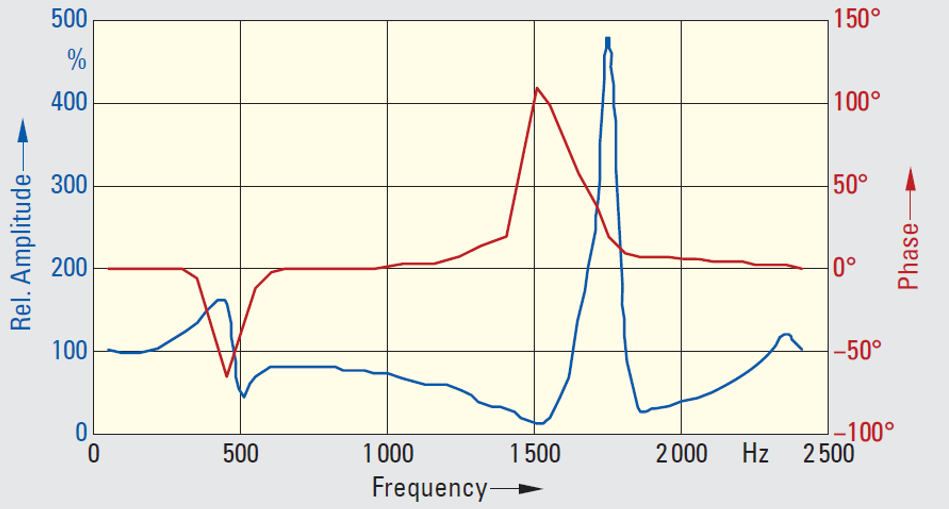
Using the power monitor was essential to uncover the real problem. Two factors became evident: First, the true RMS voltage reported by the monitor showed that the values measured by the less accurate average reading DVM’s were misleading. The actual voltage drop was not as severe as first indicated. Second, analysis of the current and voltage waveforms (both visually and using harmonic analysis) showed that harmonic distortion, not low voltage, was the real source of the problem, Figure 3. The level of the fifth and seventh harmonics in the voltage waveform was due to the reactance of the generator windings in response to nonlinear current demand from the elevator motor controller. A circuit in the motor controller was sensitive to harmonic distortion at these frequencies, mistaking them for a phase rotation error. The solution was achieved by replacing this circuit at a cost of a few dollars.

Harmonic Distortion of Current

Published by Dranetz – BMI Case Studies


Office building with personal computers, terminals, copiers, and other electric office equipment supplied by three-phase wye service.

Facility engineers at this site experienced repeated problems with the failure of electrical distribution equipment. A distribution transformer overheated and failed, circuit breakers were tripping, and electrical connectors were burning out. These problems are all symptomatic of overload conditions.

However, initial measurements of phase currents using a true RMS ammeter showed current readings of 257 to 298 amps. These values did not exceed equipment ratings. 

Impact of Thunderstorms

Published by Dranetz – BMI Case Studies


As the first thunderstorms of the season begin to roll through, it is important to safeguard your facility’s equipment against the significant damage that can be caused by the high frequency transient energy of lightning strikes. The first step is to make sure that you power monitor is up to the job and is capable of capturing these events. Unfortunately, many are not—here’s why. The term “transient” is now being defined in nearly every PQ monitoring equipment spec sheet to mean anything from a ¼ cycle drop-out to a sub-microsecond impulsive transient. According to IEEE, RMS variation are events that last longer than ½ cycle, leaving transients to be anything shorter than that. So, a typical instrument that samples the voltage at 128 times a cycle and triggers on an RMS variation will only capture the typical 1.2 x 50 microsecond lightning impulsive transient if it happens to occur during that sampling cycle. The odds of your monitor capturing such is at best, 33%.

Your odds go up significantly if your monitor has the ability to capture high frequency transients through either a 1MHz or faster sampling rate, or using high-frequency, reset-able dual peak detectors. Peak detectors incorporate high frequency circuitry into a peak-hold circuit that saves the largest magnitude value until it is reset. Provided that it is reset often, such as 128 times a cycle, it will capture that lightning-generated voltage transient and enable you to assess any impact to equipment.

Now we will evaluate the most common PQ occurrence during lightning storms and see how an effective monitor captures these events. In the following example, there were nearby direct or coupled lightning strikes to the electrical distribution wiring that feeds the facility. The facility relied on several surge suppressor strips, which contain TVSS (transient voltage surge suppressors) devices. These are components that are able to divert large amounts of energy into the ground conductor or phase-to-phase, away from the load, by radically lowering their impedance when the voltage tries to climb above a preset value.

When these TVSS devices work properly, the voltage level is clamped at a safe level, often under 250V peak for a 120V AC line. Many PQ monitors are set to 500V peak or higher for transient triggering, but when the lightning strike occurs and the TVSS works, the PQ monitor will not trigger. In this case, ignorance is not bliss as the strike did cause a significant current transient, meaning that the energy had to go somewhere. Fortunately, a PQ monitor that triggers on current transients using peak detectors will enable you to capture that data and evaluate the performance of the TVSS.

But why should you care about the event if the TVSS worked and the voltage was clamped, especially if there was no obvious equipment damage? Unfortunately, the TVSS was impacted slightly and each time it takes a hit, it loses some of its capability to divert the energy. Enough times, and the TVSS may fail. Then you have no protection, and you do not even know it. By monitoring for both current and voltage transients, you can see that the lightning transient did impact the electrical system, that the TVSS devices did their job, and determine if those devices are degrading and need to be replaced before a catastrophic failure. In other words, an effective monitoring instrument can be used to schedule maintenance in advance of devastating failures, optimize your mitigation equipment and maximize electric reliability.

Now let’s look at the data: Voltage A and Current C are upstream, whereas Voltage B and Current D are near the load. The first two figures show the voltage and current waveforms when there is no TVSS in the circuit. Not surprising, the 1038Vpk and 92A transient appears the same at both monitoring locations. The third figure shows a zoomed in version of the transients, with the fast rise and somewhat slower decay of the classic lightning impulsive transient.

The last two figures shows what happens when the same transient is generated into surge suppressor strip rated at 400V. Upstream from the device, the voltage is clamped to just over 400V but the current rises to 360A. Downstream, the voltage is under 400V and the current a mere 5A. Clearly, the device did its job, this time. But if the monitor had been set to 500Vpk trigger, the transient into the TVSS circuit would not have been captured without current transient triggering. With a 250Vpk TVSS, the probability of missing the event on a voltage-triggered monitor is greater, even with high-frequency transient voltage detection This data underscores the need for a monitoring instrument that can truly capture high-speed current transients before they capture your equipment.

Impact of Thunderstorms

Service Area Flicker

Published by Dranetz – BMI Case Studies


An entire service area of a Midwest facility. The utility was receiving complaints of annoying light flicker from an entire neighborhood. When the utility connected a power monitor to the 240V distribution bus the problem was quantified. The RMS Voltage event summary, Figure 1, indicates the bus voltage was essentially constant until a load was applied which caused the RMS voltage to oscillate between 228V and 242V.

Service Area Flicker figure1
Figure 1

Figure 2 shows 64 cycles of the 240-volt waveform during the disturbance period. It is almost impossible to analyze the small voltage variations from this diagram. Expanding the waveform around the peaks of the sine wave clarifies the situation.

Service Area Flicker figure2
Figure 2

In Figure 3, it is evident there are alternatively three low voltage cycles followed by three high voltage cycles, for a flicker frequency of 10 Hertz. This flicker frequency can be determined by properly positioning the cursors as shown here, or by simply dividing 60 Hertz by six.

Waveform expansion permits examination of peaks of cycles shown in previous figure. These are sine waves, although they do not appear to be so.

Service Area Flicker figure3
Figure 3

During this period, the voltage variation was approximately 4 volts. The ability of the power monitor to capture 64 cycles and to allow examination of peak amplitude changes by expanding the waveform made this analysis possible.

IEEE Standard 519-1981 indicates that human eye sensitivity to voltage flicker peaks at about 10 Hertz, thus accounting for customer annoyance.

Investigation revealed that the voltage variation was caused by a malfunctioning continuous welder within the service area. The welder was operating on an incorrect duty cycle: three cycles on, three cycles off.

Welder duty cycle was corrected so voltage variations did not create an annoying flicker frequency. 

Major Health Care Center

Published by Dranetz – BMI Case Studies


Severe power quality problems damaged X-ray equipment, costing $100,000 in one instance. The source of the problem was the switch over from utility to generator power, during regular testing and emergency situations. Figure 1(below) identified the cause of the problem, an out-of-phase transfer, captured by On Power with a Dranetz 658 Analyzer.

Major Health Care Center figure1
Figure 1

Ideally, an online UPS represents the best solution when protecting against low frequency / high energy events such as out-of-phase transfers (capacitor bank switching represent similar problems). The challenge was dealing with the size and shape of the inrush currents the X-ray demands as it cycles through its program (See Figure 2). Not only did current rise from 20 Amps to 100 Amps (380V system), but even harmonics with a THD of 65% were present. The added challenge was that this X-ray procedure represented “invasive” techniques as catheters are inserted into arteries, sometimes into the heart.


Major Health Care Center figure2
Figure 2

On power solution was based on four phases:

  1. Extensive X-ray system monitoring
  2. Solution research/simulation
  3. Post system installation monitoring
  4. Permanently installed Power Quality Monitoring with communication ability. By injecting current to compensate for the distorted waveform, the AIM Filter not only improves the quality of power to the X-ray, it lowers the stress on the UPS, lowers impedance placed on the system by the UPS, and improves the output THD to the rest of the systems distribution (See Figure 3).
Major Health Care Center figure3
Figure 3

Stalled Motors

Published by Dranetz – BMI Case Studies


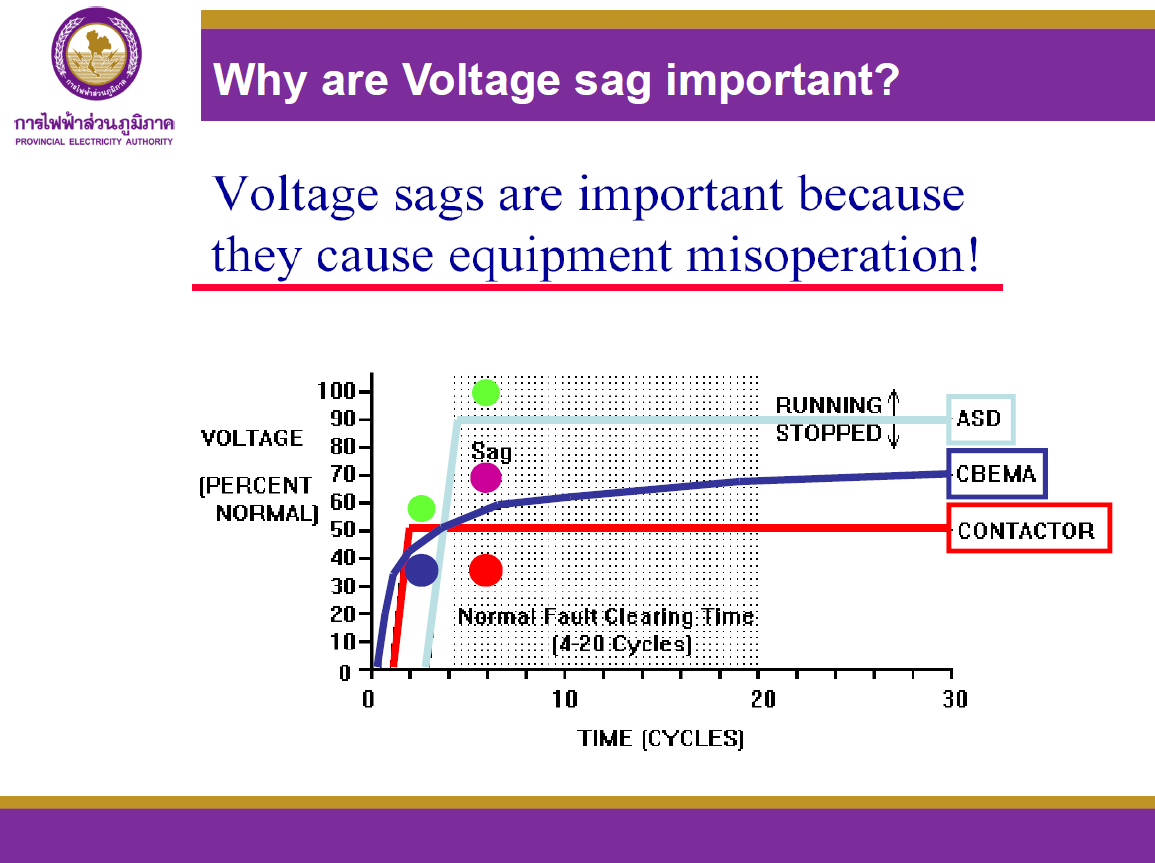
In this case study, we look at an industrial customer with two 1250hp motors on a 4kV circuit, whose motors would not start. To determine the problem, we installed a Dranetz – BMI PP4300 at the motor input. The power monitoring instrument quickly identified the motor itself as the source of the problem. In fact, the motor start caused a deep sag to occur, which impacted the motor control circuitry and stopped the motor from starting. In effect, the motor was “shooting itself in the foot,” creating a cycle of non-performance.

The customer was presented with several mitigation options, including adding more capacity to the circuit, installing a constant voltage transformer, or installing an uninterruptible power supply (UPS) system. The customer selected the UPS option, which was installed to protect the motor control circuitry during motor start-up and verified using the PP 4300.

Inrush currents, such as those associated with motor starting can cause interaction problems with other loads. When motors are started they typically draw 6-10 times their full load, which can cause voltage sags. These events can dim lights, cause contactors to drop out, disrupt sensitive equipment, and as in our case study, affect the successful start of a motor. The use of a power quality monitor that can capture waveforms during long duration start-ups will be quite effective in characterizing and optimizing motor starts.

Stalled Motors


Light Flicker In An Office Complex

Published by Dranetz – BMI Case Studies


The second floor of an end unit of an office-condo complex in the Washington DC area. The office space consisted of a reception and meeting area, two private offices, a kitchen area, and a bathroom. The entire area was powered from a single three-phase 208/120V wye feed from a transformer bank located right below and outside the office.

A light flicker problem had been noticeable for several years. It was most visible in the bathroom and outside hallway. The source of the flicker was undetermined, though it was suspected to be the HVAC units on the roof, as there was an audible sound in the bathroom that accompanied the flicker.

The voltage and current of both phases were monitored at the breaker panel (which happened to be in the bathroom). The top two lines in Figure 1 are the line-to-neutral voltages of two of the three phases in the 208/120 wye circuit. The lower two lines are the current, with the one at 26 Amps corresponding to the 124 Vrms nominal voltage (referred henceforth as the Blue Phase). The voltage of the Blue phase varied between 118.3 and 126.3Vrms, while the current varied 23.4-26.8 Arms. The other phase shown (Black Phase), varied from 115.3V-123.3Vrms while the current varied 17.2-19.4 Arms.

Light Flicker in an Office Complex figure1
Figure 1

Light Flicker in an Office Complex figure2
.

Light Flicker in an Office Complex figure3
.

Voltage fluctuation is usually the cause of light flicker. The human eye is most sensitive around 8.8 Hz, where less than a 0.5% variation in the RMS value will be noticeable by most people. This is especially true with incandescent lights, which were found in the bathroom and hallway.

To determine the source of the voltage fluctuations, the variation in voltage and current were used to calculate approximate source and load impedances. The load impedance was fairly constant (5 ohms phase A, 6 ohms phase B), while the source impedance was changing significantly (0.4-5 ohms on both phases). This pointed to the source of the problem as being external to point of measurement, or back towards the source.

This could also be deduced by looking at the time plots and seeing that the current was changing very little during the voltage fluctuation. For a load side problem, the current usually changes significantly to produce the voltage variation. The change noticed in the current is nearly proportional to the change in voltage, which one would expect in a linear system. The voltage variation was so large that it was noticeable in the audible sound produced by the bathroom fan, which was mistaken as being the HVAC system.

Since the source of the problem was determined to be before the electric meter, the utility company was contacted to determine the source in their system.

Voltage Transients Causing Diode Failures

Published by Dranetz – BMI Case Studies


A plastic extrusion manufacturer in the mid-West had a 480V delta feeding a plastic extrusion machine. The ASD-driven synchronous motor in the extruder had a half-wave bridge rectifier circuit to provide excitation voltage to the pole coils.

Diodes on the half-wave bridge exciter circuit were blowing out, and the filters to the SCRs were being damaged.

Three channels of the voltage supply feeding the extruder were monitored for just two seconds before enough data was collected to determine the cause of the failures. As shown in Figure 1, a burst of transients would occur three times a second. The RMS voltage did not change significantly during these transients.

Voltage Transients Causing Diode Failures figure1
Figure 1

Closer examination of the waveforms showed that the transients were a repetitive series of voltage transients, occurring six times a cycle on all three phases. An example of the voltage waveforms for one phase is shown in Figure 2.


Voltage Transients Causing Diode Failures figure2
Figure 2

These repetitive voltage transients are referred to as voltage notches. The maximum voltage of the transient could produce damage, and the notches that cross the zero axis could result in zero errors. lose examination of the transients is shown in Figure 3.
 

Voltage Transients Causing Diode Failures figure3
Figure 3


Analysis

The following were calculated values of this voltage disturbance monitoring period:

  • Number of transients: 192
  • Amplitude: -580 volts
  • Worst Absolute amplitude (from zero crossing): 864
  • Rise time: 1.0851 microseconds
  • Frequency (1/4*rise): 230.4 kilohertz
  • Number of zero crossing errors this frame: 146
  • Worst zero crossing width: 61440 microseconds
  • Worst zero crossing delta voltage: 168 volts
  • Worst notch area: 0.021475 volt-seconds


Transient Analysis

The absolute amplitude value confirmed the cause of the damage to the diodes, as this voltage exceeded the ratings of the diodes in the half-wave bridge. The extremely fast rise time and equivalent frequency greater than 100KHz of the transient indicates that the source of the transient is relatively close to the measuring point. This would indicate that the origin of these transients was an electronic switching load such as a bridge rectifier used on many electronic motor drives. The transients on other phase voltage channels were not the same polarity, but occurred at relatively the same time, as shown in Figure 4.

Zero crossing errors can cause timing problems with phase controlled and electronic loads. Clocks can run faster and power electronics, such as SCRs and switching diodes, can misfire and be damaged. Notching can also trip protective relaying, stress power electronics, and cause excessive heat in motors and transformers.


Voltage Transients Causing Diode Failures figure4
Figure 4


Harmonic Analysis

The harmonic analysis in Figure 5 of the initial waveform event of Phase BC Voltage shows the channel’s total harmonic distortion was 11.2%. The highest harmonic was the 2nd, at 8.3%. The high values of even harmonics is attributed to the half-wave rectifier, whose Fourier expansion is made up of solely even harmonics.
.

Voltage Transients Causing Diode Failures figure5
Figure 5

Repetitive voltage transients are usually caused by phase-angle controlled loads, such as three phase converters. A voltage notch results from two phases being momentarily short- circuited during the commutation period. In this case, they were creating by the ASD drive itself, which converts the AC to DC and then back to AC to control the motor’s speed and torque. The half-wave bridge used as the voltage exciter was the source of the abnormally high even harmonics.

The solution employed was to place MOVs with appropriate clamping voltage across the diodes in the bridge to prevent their destruction. Though not used at this site, special filters, such as certain line tracking filters, can be used to alleviate zero crossing errors. In addition, power conditioning devices, chokes or special filters could be used to “fill in” the notches and smooth out the waveform.


Harmonics Generated from the Source

Published by Dranetz – BMI Case Studies


The subject company manufactures meat products such as sausage, salami, and bologna. Most of their load consists of HVAC and refrigeration as they have about 6000 sq. ft. of cold room storage. They also have machinery such as grinders, slicers, and presses. The facility is served by a 120/240V through a utility-owned 500 kVA High-Leg Delta transformer that they share with another factory.

Interruptions occurred when a main 1200 amps circuit breaker was tripped frequently. The events occurred often and sometimes several times a day. Previous measurements had not shown the reason for the events as the highest measurement of current shown was 760 amps, which was not enough to cause the breaker to trip.

From the recordings, the following was noted:

At times the peak current exceeded the 1200A breaker rating without tripping the breaker. An interruption that was tied to such a peak current was detected only once during the measurement period. Further investigation from the wave forms captured determined that the voltages were distorted during such times. This distortion caused nuisance tripping of other breakers and caused the capacitor banks to fry.

A long-term measurement showed that the capacity of the breaker could be reached when a combination of tasks occurred at the same time.

Since most of the load at this site is linear, no harmonics are generated from within the facility. When we looked outside the factory, the cause of the distortion was traced to faulty power transformer.

Harmonics Generated from the Source figure1

Harmonics Generated from the Source figure2

The utility replaced the transformer and enabled the factory to increase capacity and production. 

IEC 61000-4-30 Class A Edition 3

The IEC 61000-4-30 Class A standard defines the measurement methods, time aggregation, accuracy, and evaluation, for each power quality parameter to obtain reliable, repeatable and comparable results between various brands and models of PQ instruments and systems.

IEC 61000-3-30 Class A Edition 2

IEC 6100-4-30 Class A Edition 2 standardizes the measurements of:

  • Power frequency
  • Supply voltage magnitude
  • Flicker (by reference to IEC 61000-4-15)
  • Voltage dips/sags and swells
  • Voltage interruptions
  • Supply voltage unbalance
  • Voltage harmonics, and interharmonics (referenced to IEC 61000-4-7)
  • Mains signaling voltage
  • Rapid voltage changes
  • Magnitude of current
  • Current harmonics and interharmonics (referenced to IEC 61000-4-7)
  • Current unbalance


IEC 61000-4-30 Edition 3 Introduced new measurements definitions and PQ parameters.

“This third edition cancels and replaces the second edition published in 2008. This edition constitutes a technical revision”.

  • Rapid voltage changes
  • Flicker class F1
  • Magnitude of the current
  • Current unbalance
  • Current harmonics (by reference to IEC 61000-4-7)
  • Current interharmonics (by reference to IEC 61000-4-7)

Additional changes in harmonic parameters from IEEE 519 2014

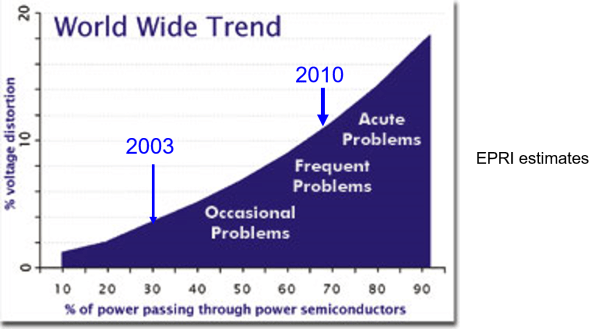
The number of harmonics to be evaluated. In many application, 50 harmonics are not enough and modern DC to AC inverters used in Wind and Solar generation have significate harmonic component up to the 100th.


Recording resolution – the latest edition of the IEEE 519 requires a daily and weekly harmonic evaluation of both voltage and current at 150/180 cycles (~3sec) resolution per phase. An edition 3 compliant instrument must record this data and prepare a report from the instrument.

Why these revised standards are important to electric utilities?

1. Rapid Voltage Change (RVC) parameter captures voltage changes (sags) that can be disruptive to some loads without exceeding the standard of +/- 5% voltage change limit. An instrument that does not make RVC measurements will miss these events. So a utility may receive customer complaints (most common is light flickers) and not have any data to find the source of the complaint. (most common is large motor starts or other sudden load or distributed generation switching. (tripping)

2. The Edition 3 revision transfers the responsibility for measurement methods continue in this standard, but responsibility for influence quantities, performance, and test procedures are transferred to IEC 62586 -1 and -2.

Part 1, namely IEC 62586-1, was constructed to define a comprehensive PQ device product standard, coined within as PQIs. The standard outlines safety, electromagnetic compatibility (EMC), climatic, and mechanical requirements, and refers to IEC 62586-2 for functional aspects. These requirements serve to ensure the instrument’s robustness will be suitable for its installation within the severe environments of a power station or substation.

Part 2, IEC 62586-24, defines the functional tests cited in the first part of the series. These tests are intended to comprehensively verify the PQ measurement methods outlined in 4-30. This chapter was established to provide traceable and repeatable procedures to verify the compliance of each PQ metric outlined in 4-30. This firstly addresses the main shortcoming of 4-30 and ensures better method adherence between PQ meter manufacturers. Additionally, the standard allows regulatory laboratories adhering to ISO/IEC 170255 to issue conformance reports and certificates according to IEC 62586-1 or IEC 62586-2 (with compliance to IEC 62586-2 meaning compliance to IEC 61000-4-30). The latter provides PQ meter manufacturers a way to provide internationally recognized compliance for the entire scope of PQI requirements.

3. To help ensure accurate PQ metrics in the harsh installation environment of a power station or substation, a number of electromagnetic compatibility (EMC) and influence quantity tests were also added to the scope of the IEC 62586 series.

“IEC 62586-2:2013 specifies functional tests and uncertainty requirements for instruments whose functions include measuring, recording, and possibly monitoring power quality parameters in power supply systems, and whose measuring methods (class A or class S) are defined in IEC 61000-4-30. This standard applies to power quality instruments complying with IEC 62586-1. This standard may also be referred to by other product standards (e.g. digital fault recorders, revenue meters, MV or HV protection relays) specifying devices embedding class A or class S power quality functions according to IEC 61000-4-30. These requirements are applicable in single, dual- (split phase) and 3-phase a.c. power supply systems at 50 Hz or 60 Hz.”

4. Environmental impact on the instrument from a laboratory environment. (25 Degrees C to a substation environment 40 Degrees C + ) is now part of the requirement of this standard. Detailed measurement procedures for Harmonics including to the 100th are included. Reporting of the harmonics to IEEE 519-2014 with harmonic limits specified for 1 and 1 week are included.

5. Detailed measurement procedures for Harmonics including to the 100th are included.

6. Reporting of the harmonics to IEEE 519-2014 with harmonic limits specified for 1 and 1 week are included.

All of these issues can be defined as IEC 61000-4-30 Class A, Edition 3 compliant.