General Reference – Modeling for Harmonic Analysis

Published by Electrotek Concepts, Inc., PQSoft Case Study: General Reference – Modeling for Harmonic Analysis, Document ID: PQS0303, Date: January 10, 2003.


Abstract: Harmonics have existed on electric power systems for many years. Recently, however, much more attention has been given to monitoring and analyzing the presence and effects of harmonics on utility and customer devices than in the past. This new concern is the result of significant increases in harmonic distortion on many electric power systems in recent years.

Harmonic distortion problems range in severity from nuisance tripping of customer equipment to failure of very expensive utility and customer equipment. This case provides an overview of harmonic modeling for system studies.

INTRODUCTION

A fundamental objective of electric utility operations is to supply each electric customer with a constant sinusoidal voltage. The voltage signal at any point within the power system is ideally a constant sinusoidal signal that repeats at a rate of precisely 60 times per second, or 60 Hz. Although not perfect, the voltage signal produced by power system generators approximates a perfect sinusoid with a rather high degree of accuracy. Almost all load equipment connected to the electric power system has been designed to operate from a sinusoidal voltage source.

Some load equipment, however, does not draw a sinusoidal current from a perfectly sinusoidal voltage source. This equipment is said to be “nonlinear”; that is, the relationship between voltage and current at every instant of time is not constant. Because power systems are voltage-regulated, current drawn by any load does not affect neighboring devices since it is voltage, not current, that they share. Non-sinusoidal currents are generally not a problem for parallel connected loads. Present trends in the electric power industry have placed an increased emphasis on the impact of nonlinear equipment. These include:

− The increasing size and application of nonlinear equipment. The most important nonlinear equipment classification is power electronic equipment. The percentage of electric power that passes through power electronic equipment is increasing dramatically because of the increased energy efficiency and flexible control that power electronic devices provide.

− Increased application of capacitors to maximize the utilization of existing power system equipment. Utilities encourage their customers to make better use of transformer capacity with power factor penalty clauses in rate structures; the utilities themselves may rely on capacitor application at both transmission and distribution levels to provide necessary voltage control as system load fluctuates over the course of a day or season.

− Modern architectural/construction practices. The use of single-phase harmonic loads (lighting and office PC’s) requires that reduced size neutral wiring no longer be employed. Unfortunately, under-floor wiring with daisy-chained neutrals makes modification to these circuits difficult.

MODELING FOR HARMONIC ANALYSIS

Harmonic simulation programs are used for a wide variety of studies. Some of the most important applications include:

− Application of capacitors / harmonic resonance
− Utility transmission and distribution banks
− Industrial customer power factor correction
− Impact of harmonics on equipment / derating
− Design of harmonic filters
− Analysis of equipment failure
− Evaluation of harmonic standards (IEEE 519-1992 Compliance)

Harmonic studies have become an important part of power system analysis and design. They are used to determine distortion levels and identify dangerous resonance conditions. Such studies are important because of the amount of harmonic producing load is increasing significantly. As harmonics propagate throughout the system they increase losses and equipment loss-of-life. Equipment can be damaged by overcurrents or overvoltages resulting from resonance conditions. Additionally, harmonics can interfere with communication and control circuits. Studies involving harmonic analysis generally fall into two categories. One is design, such as the placement and sizing of capacitor banks and the specification of harmonic filters. The other is solving operating problems, such as equipment failure or misoperation.

Program Inputs

Harmonic simulation programs require input data to describe the electrical network, nonlinear load characteristics, and the output requirements. The electrical network data is based on individual elements (lines, transformers, capacitors, etc.). Detailed descriptions of the data requirements for each element supported and the other data case requirements are provided in the software user’s manual. The basic elements of a data case are listed below.

− Special request information (i.e. frequency scan simulation)
− Lumped branch data – resistance, inductance, capacitance
− Coupled R-L elements (represented by positive and zero sequence data)
− Transmission lines and cables
− Transformers (including exciting current)
− Nonlinear load elements (harmonic current injection)
− Linear load elements
− Synchronous and induction machine models
− Desired outputs

Program Outputs

The main output of a harmonic simulation consists of the frequency domain information describing node voltages, differential voltages (node-node), and branch currents. The programs often perform a full steady state solution to develop initial operating conditions for the harmonic solution. The initial conditions used for nonlinear elements depend on the specific model involved. The output from the steady state solution is very useful for debugging the harmonic model. The various output quantities available include:

− Steady-state phasor solution – branch voltages and currents (illustrated in Figure 1 ), bus voltages, power loss, and power flows.

− Spectral data – voltage and current magnitudes and angles as a function of frequency (frequency scan option, illustrated in Figure 2.

− Frequency scan – the system impedance versus frequency at the selected bus of interested illustrated in Figure 3.

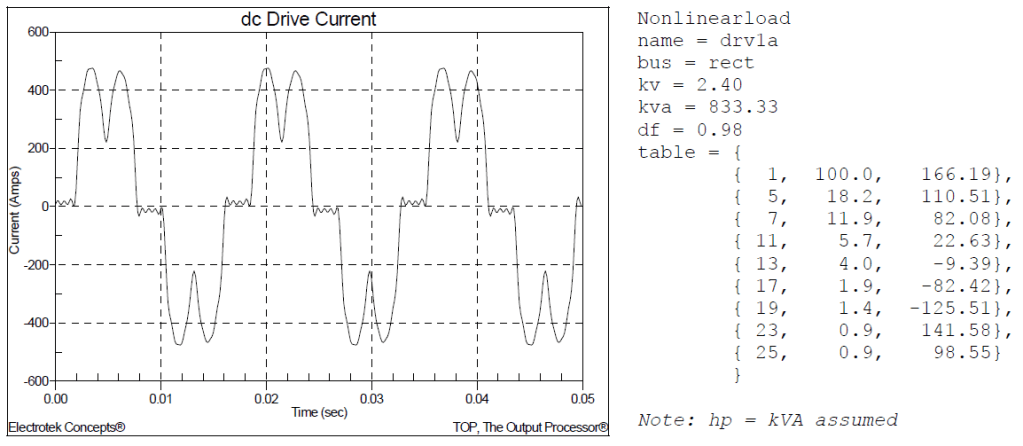
Figure 1 – Example Output: Branch Current Waveform
Figure 2 – Example Output: Branch Current Spectrum
Figure 3 – Example Output: Frequency Response

Study Procedure

The following is a suggested procedure for using a harmonic simulation program to perform harmonic studies:

− Identify the study objectives. The objectives will dictate the frequency range of interest, the modeling requirements, the variables to be investigated, and the types of output that are needed from the simulation.

− Develop the system model. The extent of the system model depends on the capacitors and/or lines to be switched and the frequency range of interest. Obviously, it would be desirable if the model could include the entire system and you could just switch the device(s) of interest.

− Draw a connection diagram and assign bus names. The bus labels will be used in the harmonic data file for identification.

− Develop component models. Each component model (transmission line, transformer, breaker, etc.) will depend on the frequency range of interest and the specific harmonic event being evaluated.

− Run a steady-state solution case. This case will verify system connectivity and provides a sanity check on many of the system components. This is a very important step that must not be skipped, or gross errors could result.

− Estimate the expected results. This can be done from previous studies, from the literature, or from hand calculations. It is important to know what to expect from the simulation so that major problems can be identified quickly.

− Use a sensitivity analysis for unknown or important quantities. Important variables from the simulation should be evaluated to determine their impact on results. These could include capacitor bank size, transformer size, line length, source strength, etc.

− Develop solutions. Possible solutions (i.e. filters) are evaluated and design specifications are developed.

Simulation Process

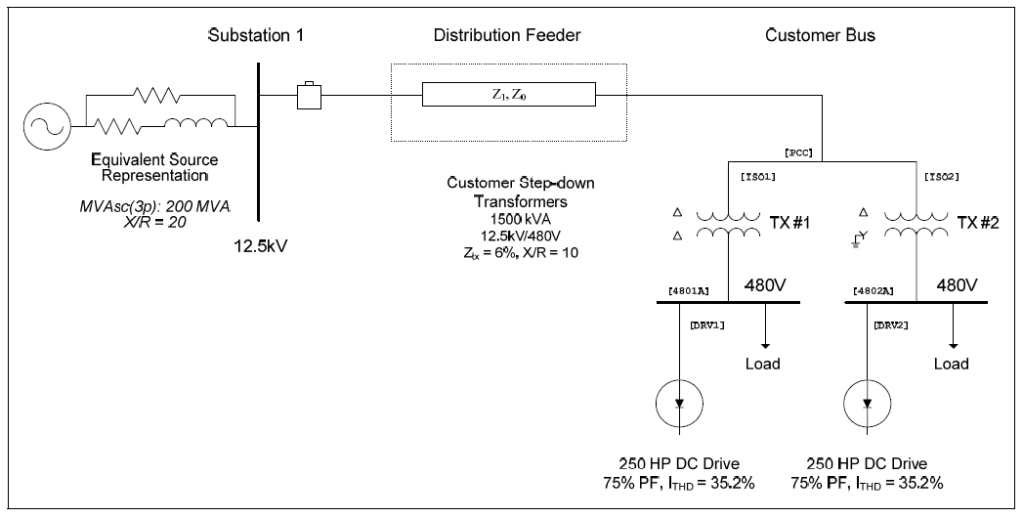
The process for completing a harmonic simulation consists of first collecting and developing the necessary data to represent the circuit to be modeled. Often this system representation is completed by “describing” the interconnection and component values in a simple ASCII text file. For example, the following SuperHarm datafile excerpt represents a 1500kVA, three-phase step-down transformer.

//
// Step down transformer #1 (@ service entrance)
// 1500 kVA, 12.5kV / 480 Volt, (connection – delta / wye-ground)
// Z = 6% @ 1.5 MVA, X/R = 10
// Ie = 1% @ 100% V
//
TRANSFORMER NAME = STEP1 H = DELTA X = WYE
MVA = 1.50 %IMAG = 1.0 KV.H = 12.5 KV.X = 0.480
H.A = PCC_A H.B = PCC_B H.C = PCC_C
X.A = 4801A X.B = 4801B X.C = 4801C X.N = GROUND
MVAB.HX = 1.5 %R.HX = 0.6 %X.HX = 6.0
.

After the data file has been created, it is submitted to the harmonic solution engine (solver). The solver reads the data file, line-by-line, and reports any significant errors. Satisfied that the case will solve, the solver generates a matrix representation of the interconnected system.

In general, there are two types of harmonic simulations:

− Frequency Scans: The frequency scan is the simplest and most commonly used technique for harmonic analysis. A scan calculates the frequency response characteristic at a particular bus or node. Usually, this is accomplished by injecting one amp into the bus over a range of frequencies and then observing the resultant voltage. The resultant voltage is directly related to the system impedance in ohms. Frequency scan analysis is the best method for identifying resonance conditions. It has also been used a great deal in filter design.

− Distortion Simulations: Harmonic distortion simulations use harmonic source characteristics of nonlinear loads to determine current and voltage distortion levels at various points in the system. Harmonic source characteristics (current source) are obtained from field measurements, other simulation programs (Electromagnetic Transients Program – EMTP), or a library of typical waveforms. Distortion simulations are useful for evaluating component duty and determining harmonic limit compliance (i.e. IEEE 519-1992).

Developing a System Model

One of the most important problems associated with developing a system model is “How much of the system do I need to model?” Unfortunately, there are no hard-and-fast rules to guide a user; it is often more of a feel that is developed over time. A good starting point for harmonic studies is to model one or two buses back from the bus of interest (connection of nonlinear load). However, even this simple guideline fails from time-to-time. Perhaps the best method for determining the appropriate system model is to start with a small simple circuit that accurately represents the phenomena, and then add more of the system details to determine their impact on the solution result.

In addition to the need to accurately select the appropriate portion of the system to model, the user must determine if a single-phase model will correctly represent the system and phenomena of concern. Many harmonic studies are completed using a single-phase (positive sequence) representation.

However, there are several cases when the user must extend the model to a full three-phase representation.

− Single-phase of unbalanced harmonic sources – the imbalance can only be represented with a three-phase model.

− Harmonic current cancellation – when there are multiple harmonic current sources, a certain amount of cancellation will occur. Determining the level of cancellation requires modeling the current sources with both magnitude and phase angle information, and modeling the system using a three-phase representation.

− Single-phase capacitor banks – balanced positive sequence models are not sufficient when there are single-phase capacitor banks on the system.

− Telephone interference – the influence of residual harmonic current is the critical factor, therefore, the system and harmonic source imbalance must be fully modeled in order to accurately determine the residual currents.

− Triplen harmonic voltage sources – a three-phase model is required to accurately represent the high zero sequence impedance.

Fortunately, most harmonic analysis programs provide the capability to easily extend the model to a full three-phase representation. Therefore, developing a three-phase model would seem to provide the highest level of flexibility.

Model Verification

The single most important tool that the user has for verifying the simulation results is a basic knowledge of power system harmonics. Field test results, technical papers, basic textbooks, and more experienced engineers can all help. Learning by doing can be very frustrating and applying the simulation results can be risky, when the user does not feel comfortable with the results of the study.

When verifying the results of a harmonic case, the user should always check the input parameter interpretation and network connectivity. The steady-state solution should be checked to verify known quantities, such as bus voltage, branch currents, etc.

Presentation of Results

Upon completion of the harmonic simulation case, an evaluation of the accuracy of the results is required. As previously mentioned, it is desirable that the user have a basic understanding of the phenomena of interest. In essence, the user should know what the result should be (or at least have a good idea of what the waveform should look like) before completing the case. In reality, however, this is not always the case, so it becomes even more important that the user have confidence in the accuracy of the data file.

Simulation results are generally presented in the form of impedance vs. frequency plots and voltage and current distortion levels (waveforms). Presentation of simulation results may take a number of different forms (i.e. graphical, tabular, etc.). It may be just as important to present the result in a way easily understood by the audience, as it is to complete the simulation correctly. Failure of either results in no action taken.

In addition, study results may take the form of summary tables and/or graphs that illustrate the results for multiple simulations. For example, one common method for presentation of results is in the form of a distortion (THD) vs. variable graph. The “variable” may be quantities like transformer size, capacitor size, choke size, etc. It is much easier for the audience to understand the impact of a specific variable on the distortion range using this method.

REFERENCES

Power System Harmonics, IEEE Tutorial Course, 84 EH0221-2-PWR, 1984.

Measuring Voltage and Current Harmonics in Distribution Systems, M. F. McGranaghan, J. H. Shaw, R. E. Owen, IEEE Paper 81WM126-2, November 1981.

Harmonic Measurement Technique, D. P. Hartman, IEEE Tutorial Course on Power System Harmonics, 84EH-0221 2-PWR.


RELATED STANDARDS
IEEE Standard 519-1992
IEEE Standard 1036-1992

GLOSSARY AND ACRONYMS
ASD: Adjustable-Speed Drive
PWM: Pulse Width Modulation
THD: Total Harmonic Distortio

Detecting Power Systems Failure based on Fuzzy Rule in Power Grid

Published by Suren DRAN. R1, Parvatha VARTHINI. B2,
Research Scholar, Department of Information Technology, Sathyabama University, Chennai, Tamilnadu, India (1), Professor & Head, Department of Computer Applications, St. Joseph’s College of Engineering, Chennai, Tamilnadu, India (2)


Abstract. Load balancing is an important feature that keeps the power system safe from overloading. Load details can be obtained from Circuit Breaker’s Relay Meter and it is connected to computer. Power balancing and failure detection will be done using Fuzzy Rule, which is helpful for the operator to recover the power fault quickly. Because of this power sharing between the substations, in turn between feeders, the load balancing of the power system is maintained. This is applied in the real time system using tree topology to get the result more quickly than the existing Petri Net Model.

Streszczenie. Przedstawiono możliwości wykorzystania logiki rozmytej do analizy obciążę i nierównowagi mocy systemu energetycznego. Analizowany jest rozdział mocy między podstacjami oraz sposoby równoważenia rozdziału mocy żeby zapobiec przeciążeniom. (Wykrywanie nieprawidłowości w systemie energetycznym bazujące na logice rozmytej)

Keywords: Power Grid, Load Balancing, Power Failure Detection, Fuzzy Rule.
Słowa kluczowe: sieć energetyczna, nierównowaga obciążeń, logika rozmyta

Introduction

An electric power system is a network of electrical components used to supply, transmit and use electric power. Since the power grid failure diagnosis method in practical application has problems such as adaptability of the diagnosis algorithm, acquisition of fault information, and fault tolerance of model, Petri Net (PN) model was used to pick out fault components. It is a powerful inference mechanism, but simulates all of the system states and all transition judgments by the token passing in a quite straightforward manner, the graphical representation for a moderate system shows very complex configuration. So it’s more time-consuming and fault detection cannot be done quickly. Weather conditions can change the consumer usage and extreme weather conditions can cause overloading. Previously Petri net model was used to detect the fault in the Power System and the false tripping or operating information was picked out. When one area is overloaded, the loads can be transferred to the less loaded areas using switches. Grid balancing provides how much load has to be transferred to maintain system within limits. This helps in preventing the damage of electrical devices. It is implemented at the substation side at the power distribution level. In this paper, the design and implementation of Grid balancing and power failure detection is done using Fuzzy Rules Algorithm and calculated using Java Swing program in order to quickly detect the fault in the power grid system as it is a platform independent GUI framework for Java, which follows a single-threaded programming model. This is applied in the real time power system using tree topology and got the result more quickly than the existing Petri Net Model.

Aims

To detect the Power Systems Failure in the Real Power Grid using Fuzzy Logic (FL) Algorithm and calculated using Java Swing Program which runs in Netbeans IDE, version 6.9? To share the load between substations so that if a substation shuts down, those on either side continue to feed electricity to that substation using Fuzzy logic technique.

Scope

The increasing requirements of power in day-to-day life in all fields make it necessary to maintain power delivery service with minimum interruption. The goal of power system fault analysis is to provide as quickly as possible an action to restore the power delivery by load balancing.

Literature Survey

An electric power system is a network of electrical components used to supply, transmit and use electric power. Paper [1] proposes a hierarchical fault diagnosis model of a large scale power system adopting multi-agent system technology and based on dispatch integrated information platform. Paper [2] reports another diagnosis method by information fusion of multi-data resources. With the form of graphic representations, PN simulates the states and operations of a system transition. Load balancing is the process of improving the performance of a parallel and distributed system through distribution of load among the processors [3, 4]. Load balancing provides substations to meet extra load demands. Load balancing of power is done by open/close tie-switches in the distribution feeders (F). Overloading of network is maintained by transferring load from heavily loaded feeders to the less loaded feeders. It allows smoothing the load demands by distribution, reduced feeder losses and increased network reliability [5]. In centralized load balancing schemes, all these information need to be stored at one location where load balancing decisions are made [21]. Up to now, many AI methods applied to fault diagnosis try to figure the full association map, such as MAS [6], artificial neuronal network [7], expert system (ES) [8,9] and so on. PN is a powerful inference mechanism and has been successfully applied in the areas of service restoration scheduling for distribution systems [10–12], fault section estimation, rule-based evaluation, and power system protection, but simulates all of the system states and all transition judgments by the token passing in a quite straightforward manner, the graphical representation for a moderate system shows very complex configuration. The two most important concepts within FL are that of linguistic variable and the fuzzy if-then rule [13]. Using the priority scheduling for MNP (mobile node packets) forwarded from old FA to new FA will reduce its waiting time in the old FA (foreign agent) [19]. Fuzzy logic is a superset of conventional (Boolean) logic that has been extended to handle the concept of partial truth, i.e. truth values between “completely true” and “completely false” [14]. Swing is a platform-independent, Model-View-Controller GUI framework for Java, which follows a single-threaded programming model [15, 16]. Enhance dynamic composition of business process for modeling the Web services discovery and selection process using PetriNet [22]. NetBeans IDE supports development of all Java application types (Java SE) [17]. It helps developers find memory leaks and optimize speed [18]. With the form of graphic representations, PN simulates the states and operations of a system transition. Petri Net simulates all of the system states and all transition judgments by token passing in a quite straightforward manner, the graphical representation for a moderate system shows very complex configuration.

Proposed System

Colored Petri Net (CPN) concept along with fuzzy logic is used in Real System for detecting the Power fault and maintaining the load balancing in the power substation. In CPN, a place node owns several colors to represent different states and based on the colors the judgment functions in a transition node check the states of the incoming place nodes. The characteristics dramatically simplify the graphical representation of the traditional Petri Net and also improve the execution efficiency.

System Architecture of Power Grid

The system architecture of power grid is shown in Fig 1. It contains one PDS (Power Delivering Station) and two PRS (Power Receiving Station). In Fig. 2, F1 and F2 denote Feeders F1 and F2, SW denotes switches, LD denotes load delivering station and TR denotes transformer. If fault occurs in F2 due to overload the SW2 will be opened by manual operation. After this SW3 will be closed (normally open condition) to deliver the power to the affected area of F2. If fault occurs in F1 the vice versa will happen. Because of this resource sharing is taking place which makes the balancing of the power system’s load.

Fig. 1. System architecture of power grid
Modules

This paper is done with the following four modules:

1. Power grid system
2. Power fault
3. Power fault analysis and
4. Load balancing process

Fig. 2. Diagrammatic representation of Fully Automated Power Failure Detection Modules

The diagrammatic representation of modules is given in Fig.2.

Power grid system

It includes a number of substations interconnected together and each substation is having power transformers, breakers and isolator switches through which power sharing is done.

For each PDS, there is a corresponding T node. For each element in the PDS such as feeder, bus bar, switch, and transformer, there is a corresponding P node. The relationship among the elements, the bi-directed arcs are created between P nodes and T nodes.

Power fault

Power fault may occur due to human operational mistakes, overload of the current, machine fault, etc.

Power fault analysis

Each electrical equipment and line has a limited amount of current. If the amount is exceeded power fault will occur which will be analyzed using Petri net model, genetic algorithm, fuzzy logic, etc. In this project fuzzy logic is used for analyzing the power fault.

Load balancing

Load balancing is a very important feature that keeps the system safe from overloading. The flowchart for load balancing is given in Fig. 3 and the load balancing process is explained in Fig. 4.

Fig. 3. Flow chart for load balancing
Fig. 4. Representation of Load balancing process
Fuzzy Rule

In Fig 5, Fuzzy Rule is used for fault detection and load balancing to achieve resource sharing between substations.

Fig. 5. Fuzzy Rule based Power Failure Monitoring System

Fuzzy logic is a superset of conventional (Boolean) logic that has been extended to handle the concept of partial truth, i.e. truth values between “completely true” and “completely false”. Fuzzy logic offers an alternative technique to the design of such a control system making decisions based on human expertise, thus avoiding complex calculations [26]. Fuzzy Petri Nets (FPN) technology is used for accurate fault diagnosis in power system when some incomplete and uncertain alarm information of protective relays. It is shown from several cases that the faulted system elements can be diagnosed correctly by use of these models. By the suggested method, it is possible to decline diagnosis time according to traditional methods. Finally, the suggested method can easily be adapted to different power system networks. It is practicable an impressive for fault diagnosis in power system [27]. Combining the Generalized Stochastic Petri nets (GSPN) properties and high level Petri nets facilities, a structural simplified model Logical Explicit Stochastic Petri Nets (LESPN), having the same modeling power as GSPN, is built. LESPN primitive architectural modules are used in repairable power systems dependability modeling [28].

Fuzzification

Firstly, a crisp set of input data are gathered and converted to a fuzzy set using fuzzy linguistic variables, fuzzy linguistic terms and membership functions. This step is known as fuzzification. Fuzzy Set: Two valued set (0, 1)

Inference

An inference is made based on a set of rules, i.e. IF …. THEN rule

Defuzzification

The resulting fuzzy output is mapped to a crisp output using the membership functions.

Algorithm 1
Step 1: Define the linguistic variables and terms(initialization)
Step 2: Construct the membership functions (initialization)
Step 3: Construct the rule base (initialization)
Step 4: Convert crisp input data to fuzzy values using the membership functions (fuzzification)
Step 5: Evaluate the rules in the rule base (inference)
Step 6: Combine the results of each rule (inference)
Step 7: Convert the output data to non-fuzzy values (defuzzification)
.
Linguistic variables

∞ Quantification variables (All, Many, None)
∞ Usability variables (Sometimes, Frequently, Always)
∞ Likelihood variables (Possible, Likely, Certain)

Membership function
Fig. 6. Membership function

a = 0, b = 25, c = 50, d = 75, e = 100, f = 125, g = 150, h = 175

(1) μNormal(Load) = {1 , d ≤ x ≤ e}
(2) μHigh(Load) = {1 , f ≤ x ≤ g}
(3) μtooHigh(Load) = {(h – Load)/(h – g)} g ≤ x ≤ h
(4) load = x

Algorithm 2

1. Read the all sub station’s load values connected with X substation via remote metering method.
2. Compare the load values to find which is the smallest
3. Connect the X substation to Substation that is having smallest load values.

Fuzzy Rule

Fuzzy Logic or Rule is a logical system, which is an extension of multi-valued logic that is intended to serve as logic for approximate reasoning.

Fig. 7. Model diagram of power delivering from substation (SS)-1

The two most important concepts within Fuzzy Logic (FL) are Linguistic variable and fuzzy if-then rule. In this paper I have used the fuzzy if-then rule.

1. IF (load is more than too-high) THEN command is fault.
2. IF (load is too-high) THEN command is Reduce the Load.
3. IF (load is Normal) THEN command is no-change.

Fig. 8. Model diagram of power delivering from SS-2 to SS-1 due to feeder 1 fault in SS1
Fig. 9. Model diagram of power delivering from SS-3 to SS-1 due to feeder 1 fault in SS1

Figure 8 represents the model diagram of power delivering. Additional requirements on modulation scheme for AC Converters include true grid synchronous operation with Phase-control of the switching frequency harmonics, in order to interlace all converters onboard, and topology specific requirements related to the parallel/series configurations of the line-side converters for traction drives and auxiliary power supply converters) [20].

Tree Topology

Tree topology integrates the characteristics of Star and Bus Topology. In this topology, the numbers of Star networks are connected using Bus. This main cable seems like a main stem of a tree, and other star networks as the branches. Workflow composition systems are designed for enabling users to assemble components into workflows based on Petri Net model [23]. When a fault happens, the component connecting topology trees were used for creating the Petri Nets model of possible fault components [24]. The digital information is transformed to fuzzy fault degree through fuzzy Petri nets and the analogue information is transformed to wavelet fault characteristics through the wavelet analysis [25].

Advantages of Tree Topology

1. Expansion of network is possible and easy.
2. Here, we divide the whole network into segments (star networks), which can be easily managed and maintained.
3. Error detection and correction is easy.
4. Each segment is provided with dedicated point-to-point wiring to the central hub.
5. If one segment is damaged, other segments are not affected

Advantages of Proposed Work

1. No need for manual reading and fault calculation.
2. Even ON/OFF indication and fault trip alarm failure occurs due to battery and aging problem; fault can be identified, and the load can be balanced through this project calculation method.
3. Fault identification and fault recovery is very quick.
4. Using this project Resource sharing and load balancing can be done easily.
5. The algorithm can be applied in the Real Power system, whereas in previous Petri Net model and colored pertinent model this is not possible. It is used only as graphical representation model/Simulation model.
6. This fully automated power failure Detection Grid service can be accessed from anywhere at any time through grid portal.

Experiments

This is the first page for running the Java swing program for which Net Beans IDE version 6.9 is used.

Fig. 10. Initial load-setting page for breakers and transformers

This is the load-setting page for breakers and transformers. In Fig. 10, Values are assigned as given in the Screen shot. In this box A, B and C denote Feeder Breakers. A1–A5, B1–B3 and C1–C4 denote the corresponding transformers. For all the feeder breakers the maximum power of 200 Ams is assigned. After setting the load in the box the below substation diagram (Fig. 11) is obtained. The values are reflected in the diagram.

Fig. 11. Load- reflected in substation

Fault is created in Source A and power is supplied to the affected area of Source A by resource sharing from Source B. Source C will be overloaded if affected area of Source A is connected to Source C.

Fig. 12. Fault Occur in the Source A

In this screen shot, we can see the comment if Source A is connected to Source C it will be overloaded because the power need for Source A is 137Ams and Source C already has 86 Ams so if Source A is connected to Source C then total Ams will be 223Ams, which is overload. Because of this Source A should be connect to Source B.

Table explanation
¤ Voltage: incoming voltage of Sources A, B, C
¤ Ams: summation of total transformer current/3
¤ MW: Voltage X Ams
¤ Status: displays the Ams value converted into fuzzy logic command.
.

Voltage in column one of table indicates the incoming voltage of Substation A, i.e., source A, Ams indicates how much load is utilized by the connected area of Source A. The Ams is calculated by adding all transformers current values divided by 3 which means if the current in the breaker relay shows 1 Ams the line will carry 3 Ams. But in the actual substation if the line carries 300 Ams the current in the breaker relay shows 1 Ams. The Ams present in the table will be compared each and every time with the Feeder Breaker Relay Ams wherein Fuzzy calculation is implemented to estimate the line current to reduce the fault, Load and share the load to the affected area. It helps the Operator for quick Operation and avoids the Power interruption and Power Losses. MW is calculated by multiplying the voltage and Ams it informs the operator how much amount of MegaWatt is delivered /received to/from the affected area. Status column indicates the present status of the load from which the operator can easily take the decision. Fault is created in Source A and power is supplied to the affected area of Source A by resource sharing from Source C. Source B will be overloaded if affected area of Source A is connected to Source B.

Fig. 13. Resource Sharing from C to A

In above screenshot (Fig. 13), we can see the comment if Source A is connected to Source B it will be overloaded because the power need for Source A is 120 Ams and Source B already has 83 Ams so if Source A is connected to Source B the total Ams will be 203 Ams, which is overload. Because of this Source A should be connected to Source C. Membership function is calculated in the status bar of the following substation diagram (Fig. 14).

Fig. 14. Calculate the Membership function and Resource Sharing from B to C

Fig. 15, Fault is created in Source B and power is supplied to the affected area of Source B by resource sharing from Source A. Source C will be overloaded if affected area of Source B is connected to Source C.

Fig. 15 Fault Occur in the Source B and Resource Sharing from A to B
Fig. 16. Resource Sharing from C to B

The Fault created in Source B is shown below and the power is supplied to the affected area of Source B by resource sharing from Source C. In Fig. 16, Source A will be overloaded if affected area of Source B is connected to Source A.

Fig. 17, shows the Fault created in Source C and power is supplied to the affected area of Source C by resource sharing from Source B. Source A will be overloaded if affected area of Source C is connected to Source A.

Fig. 17. Resource Sharing from B to C

The screen shot shows that the Fault is created in Source C and power is supplied to the affected area of Source C by resource sharing from Source A. Source B will be overloaded if affected area of Source C is connected to Source B.

Fig. 18 Resource Sharing from A to C

As shown above (Fig. 18), in all the screen shots we can observe which transformer is overloaded and in which feeder the fault has occurred.

Table 1. Sample test results

Sub StationABCFuzzy Remarks
AmpsToo LowOver LoadNormalSubstation B Connected with substation A
AmpsLowLowOver LoadSubstation C Connected with substation A
AmpsOver LoadLowToo LowSubstation A Connected with substation C
AmpsOver LoadNormalHighSubstation A Connected with substation B
AmpsNormalHighOver LoadSubstation C Connected with substation A
AmpsHighOver LoadNormalSubstation B Connected with substation C
.

Since by using FL method we can detect the location of fault exactly it saves the time of the operator and the fault can be quickly rectified and the power can be supplied to the affected area immediately from the area where there is excess of power available by means of resource sharing.

MW = √3 Voltage Amps*Cosθ

Mega Watt = MW
Cos indicates Power factor
Power factor should Maintain 0.9 to 1.0
a = too Low Load = 25 amps to 50 Amps
b = Low Load = 50 to 75 Amps
c = Normal Load = 75 to 100 Amps
d = High Load = 100 to 150 Amps
e = too high load = 150 to 200 Amps
Above 200 Amps fault
Substation A total Load =( a1 + a2 + a3 + a4 )/3
Substation B total Load =( b1 + b2 + b3 )/3
Substation C total Load =( c1 + c2 + c3 + c4 + c5)/3
If total load < 50 = too low
If total load < 75 = low
If total load < 100 = Normal
If total load < 150 = High
If total load < 200 = too High
If total load < 200 = Over load
Total Load should not increase above 200 Amps then system will get fault.

Summary and Conclusions

As fuzzy logic is simple and quick in detecting the power fault in the power system it is used in this project. In this project the location of fault is detected quickly and exactly so it saves the time of the operator and the fault can be rectified quickly and the power can be supplied to the affected area immediately from the area where there is excess of power available by means of resource sharing. Normally each and every power grid substation is connected with Load Control Centre. Load Control Centre will be monitoring those of Substations every second. If fault occurs in one Substation that will be obtained by Load control Centre through SCADA (Supervisory control and Data Acquisition) and informed to healthy substations which are connected with the faulty Substation, then only power will be shared to faulty substation. In which Data Traffic is a major drawback because at the same time many substations may fail when communication delay will be happened so that resource recovery and load balancing will be delayed, people will be affected without power, cost loss. This Project will overcome the present status of power sharing and fault diagnosis power system method through the following steps. Each and every Grid substation connected with more than two substations, if fault occurs in one among the substations, share the load from low load substation to affected substation through LAN connected with Substation computer. So there is no need for Load Control Centre.

Acknowledgments: The authors would like to thank the reviewers and Mr. K. RAJU, Electrical Engineer for their detailed reviews and constructive comments, which have helped improve the quality of this paper.

REFERENCES

[1] Zhu Chuanbai, Guo Chuangxin, Cao Yijia, Hierarchical fault diagnosis model of a large-scale power system based on dispatch integrated information platform, Automation of Electric Power Systems, pp. 51–55,2009
[2] Guo Chuangxin, Peng Mingwei, Liu Yi, Novel approach for fault diagnosis of the power grid with Information fusion of multi-data resources, Proceedings of the CSEE, pp.1–7, 2009
[3] S. Sharma, S. Singh, and M. Sharma, Performance Analysis of Load Balancing Algorithms, World Academy of Science, Engineering and Technology, Vol. 38, 2008
[4] G. R. Andrews, D. P. Dobkin, and P. J. Downey, Distributed allocation with pools of servers, ACM, pp. 73–83, 1982
[5] M. A. Kashem, V. Ganapathy, G. B. Jasmon, A geometric approach for three-phase load balancing in distribution networks, pp. 293 – 298, Vol.1, IEEE, 2000
[6] LI Lan-fang, LIU Kai-pei, HU Yu-hang, Architecture of Multi-Agent Based Distributed Monitoring and Control System for Substations, Power System Technology;2004-22
[7] BI Tianshu, NI Yixin, WU Fuli, YANG Qixun, A Novel Neural Network Approach for Fault Section Estimation, CSEE, 2002
[8] Fang Peipei, Li Yongli, Yang Xiaojun, Transmission Power System Fault Diagnosis Based on Petri Nets and Expert System, Proceedings of the CSU-EPSA, pp. 26-30, 2005
[9] Sun Jing, Qin Shiyin, Song Yonghua, Fuzzy Petri Nets and its Application in the Fault Diagnosis of Electric Power Systems, Proceedings of the CSEE, pp. 74-79, 2004
[10] Y.M. Park, K.H. Lee, Application of Expert System to Power System Restoration in Local Control Center, International Journal of Electrical Power and Energy System, 1995
[11] Jaw-Shyang Wu, Chen-ching Liu, Ken-Lee Liou, A Petri Net Algorithm for Scheduling of generic restoration actions, IEEE Trans. on Power Systems, pp.69–76, 1997
[12] Jaw-Shyang Wu, A Petri-Net Algorithm for Multiple Contingencies of Distribution System Operation, IEEE Trans. On Power Systems, pp.1164–1171, 1998
[13] Andries P. Engelbrecht, Computational Intelligence, Wiley Publications, 2nd edition, Chapter 21, pp. 465-474, 2007
[14] http://en.wikipedia.org/wiki/Fuzzy_logic
[15] Sun and Netscape to jointly develop Java Foundation Class, Netscape Communications Corporation. 2011-08-08
[16] Swing threading and the event-dispatch thread – JavaWorld, Welcome to JavaWorld.com 2008-05-17
[17] http://en.wikipedia.org/wiki/NetBeans
[18] ^ “Profiler”, Netbeans.org. Retrieved 2008-05-17
[19] Fayza A. Nada, Improving Mobile IP Performance Through Priority Scheduling, AUTOMATIKA, pp.365–3692011
[20] Nenad Težak, Ivan Bahun, Ivan Petrovi´c, Active Suppression of Low-frequency Interference Currents by Implementation of the High-performance Control System for the Grid-interfaced Converters, AUTOMATIKA, pp.199–214, 2012
[21] Qin Zheng,Chen-Khong Tham,Bharadwaj Veeravalli, Dynamic Load Balancing and Pricing in Grid Computing with Communication Delay, J. of Grid Computing, pp.239–253, 2008
[22] Liang-Jie Zhang and Bing Li, Requirements Driven Dynamic Services Composition For Web Services and Grid Solutions, Journal of Grid Computing, pp.121–140, 2004
[23] Jia Yu and Rajkumar Buyya, A Taxonomy of Workflow Management Systems for Grid Computing, Journal of Grid Computing, pp.171–200, 2006
[24] GAO Zhanjun, GAO Nuo, WANG Lei, LI Zhaofei, Power System Fault Diagnosis Based On Power Grid, IET, 2012
[25] WANG Lei, CHEN Qing, GAO Zhanjun, Power Systems Fault Diagnosis Based On Grid Computing, IEEE, 2011
[26] José L. AZCUE-PUMA1, Alfeu J. SGUAREZI FILHO, Ernesto RUPPERT, Fuzzy logic based vector control for three-phase induction motor, PRZEGLAD ELEKTROTECHNICZNY JOURNAL, 2013
[27] Nihat PAMUK , Yılmaz UYAROGLU, The Fault Diagnosis for Power System Using Fuzzy Petri Nets, PRZEGLĄD ELEKTROTECHNICZNY JOURNAL, 2012-7a
[28] Mariana DUMITRESCU, Using Stochastic Petri Nets for power system computation Dependability, PRZEGLĄD ELEKTROTECHNICZNY, Electrical Review 200


Authors: Surendran. R, Research Scholar, Department of Information Technology, Sathyabama University, Chennai, Tamilnadu, India, B. Parvatha varthini, Professor & Head, Department of Computer Applications, St. Joseph’s College of Engineering, Chennai, Tamilnadu, India , E-mail : surendran.mtech.it@gmail.com parvathavarthini@gmail.com


Source & Publisher Item Identifier: PRZEGLĄD ELEKTROTECHNICZNY, ISSN 0033-2097, R. 89 NR 8/2013

Experiment and Analysis of High Power Line-Start PM Motor

Published by Qinfen LU, Xiaoyan HUANG, Yunyue YE, Youtong FANG, Zhejiang University


Abstract. This paper investigates the performance of a high power line-start permanent-magnet motor (LSPM) by experiment, which is developed for industrial fans, pumps and compressors to reduce the energy consumption. The no-load back-EMF is measured and compared with predicted result of FEM. In order to assess the line starting ability, the rotor-locked test is carried out and then the starting torque ratio is deduced which is lower than that of induction motor of the same power. By adjusting the load, the efficiency and power factor during all operation condition are obtained. It is found this proposed LSPM has not only higher power factor and efficiency, but also high overload ability. After its starting ability of reduced voltage is analyzed, several useful methods are pointed out for designing high power LSPM which should start with limited current.

Streszczenie. Zbadano właściwości silnika wysokiej mocy LSPM w zastosowaniu przemysłowym do pomp, wentylatorów i kompresorów pod kątem redukcji zużycia energii. Zbadano silnik przy zablokowanym wirniku i na tej podstawie przewidywano moment startowy. Przy zmianie obciążenia określono współczynnik mocy i sprawność. (Eksperyment i analiza silnika dużej mocy o rozruchu bezpośrednim typu LSPM)

Keywords: High power, line-start, Permanent-magnet motor, experiment, start ability, reduced voltage
Słowa kluczowe: silnik z magnesami trwałymi, silnik LSPM.

Introduction

The high power motors are widely used to drive fans, pumps and compressors in industry, so their efficiency is improved as possible for saving the energy. Compared with induction motor, line-start permanent-magnet motor (LSPM) has higher efficiency and power factor. Moreover, it can direct replace the existing induction motor without adding any equipment. Therefore, it is an attractive choice [1-3].

From topology, the stator of LSPM is the same as that of a normal induction motor, and permanent magnets are inserted in the squirrel cage rotor. In ideal condition, its starting torque is produced by electromagnetic induction phenomenon at the rotor conductor bars, and the synchronously operating torque is generated by permanent magnets. In fact, the inserted permanent magnet not only decides LSPM’s performance at synchronous speed, but also worsens its starting ability because it produces braking torque and affects the magnetic field circuit. Since the start ability of LSPM depends on both squirrel cage rotor bars and the inserted permanent magnets including their shape, material, size and position [4-6], the suitable configuration of rotors are continually proposed to improve the performance [7].

Normally, the low power LSPM is designed to line start which can makes the starting torque maximize. But it should be indicated high power LSPM (>100kW) is often not allowed to line start in normal industrial application. Although there are many papers on the research on the low power LSPM [1-9], the high power LSPM still need be developed in theory and application due to rigorous starting condition [10-12].

In this paper, the performance of a 4-pole 250kW LSPM which keeps the configuration of induction motor as much as possible is measured including no-load test, rotor-locked test and load test. By analysis these test data, it is found that this LSPM has not only high efficiency at synchronous speed, 1500r/min, but also a sufficient line starting ability with voltage, 380V. Since this LSPM is often asked to start at low voltage in industry, the starting ability of low voltage is analyzed. The results show this design method of only inserting permanent magnets to rotor is not suitable to high power LSPM with requirement of reduced voltage starting. At last, several useful designing methods are introduced to improve starting ability.

Motor configuration

As many low power LSPMs, this 250kW LSPM also keeps the configuration of induction motor as much as possible. Table I lists the main specifications.

Table 1. Specifications of proposed LSPM

ItemsQuantity
Rated power (kW)250
Rated speed (rpm)1500
Rated voltage (V)380
Rated current(A)410
Rated efficiency0.97
Rated power factor0.96
Winding connectionΔ
Number of pole pairs2
Stator outer diameter(mm)590
Stator inner diameter(mm)400
Number of turns of stator slot10
Number of stator slots72
Air gap length(mm)1.6
Number of rotor slots62
Rotor outer diameter(mm)396.8
Rotor inner diameter(mm)130
The material of rotor barAluminium
Coercive force of magnet (kA/m)987
Remanence of NdFeB magnets (T)1.3
.
Fig.1. Cross section of half of proposed LSPM.
Fig.2. Rotor photo of proposed LSPM.

Fig.1 shows the cross sections and Fig.2 shows photo of its rotor. Its stator is almost same to that of induction motor with same power. The only difference is that the stator slots are skewed by one rotor slot pitch in order to reduce the cogging torque. To rotor, squirrel cage and axis are same and the interior permanent magnets are inserted in rotor yoke without any vents. In addition, its air gap is larger than that of induction motor. There are three pieces of permanent magnets of one pole, one is large and radial magnetized, and other two are small and circumferential magnetized. Two air holes between permanent magnets have functions of the flux barrier and vents.

Motor experiments

The test platform is shown in Fig.3 including test LSPM, transducer, DC motor, temperature tester, resistance tester and digital testing system. The test LSPM is connected with a DC motor by a torque-speed transducer. The DC motor acts as motor to drive the LSPM at no-load, while acts as generator at load. By this test platform, the steady performance and transient starting performance can be obtained by adjusting operation condition.

Fig.3. The test platform of LSPM.

A. No-load back-EMF

When DC motor drives the LSPM to rated speed, 1500r/min, the no-load back-EMF is measured. Fig.4 shows its fundamental wave component of measurement and predicted results by FEM. As it can be seen, the measurement is equal to rated line voltage, 380V, and is a little bigger than that of FEM, 365V. The error is mainly caused by two reasons, one is performance of permanent magnet is better than calculation value and the other is actual air-gap length exists certain error. That is to say, the prototype is a little overexcitation. Although it improves the stability performance and pull-in torque, it also worsens the start ability. If the line voltage improves to 400V, the start ability becomes better in line start condition.

Fig.4. Fundamental component of Back-EMF.

B. Starting torque

Due to the line-start current is much bigger than that of power limitation, it can’t be direct measured. Therefore, this paper adopted rotor-locked test to measure starting torques at serial low voltages. Based on these data, the short-circuit impedance is calculated, and then the line-start current and torque are calculated. Fig.5 shows the measurements. The line-start current is 2650A and the line-start torque is 2683.1 N.m. Compared with rated value, the starting current ratio is 6.46 and the starting torque ratio is 1.69. They are lower than that of induction motor due to reducing magnetic field circuit. Apparently, it can start smoothly at full line voltage with pump load.

Fig.5. The rotor-locked measurements of LSPM.

C. Load Performance

Due to the limited of power supply, this LSPM can’t realize line-start function in this platform. In this experiment, the DC motor is adopted to help the start of this LSPM. There are three steps in this experiment. First, this LSPM without power supply is driven close to synchronous speed. Secondly, this LSPM is connected with power supply when the back-EMF and line voltage have same phase angle measured by rotating-lamp method. Finally, this LSPM can be measured at different load by adjusting excitation current of DC motor. At line voltage 380V, the measured rating power factor and efficiency are 0.964, 0.966 respectively, which accord with the design requirement.

Since the back-EMF is equal 380V, the line voltage class can be increased to 400V in order to improving the start ability. The steady performance of different load is shown in fig.6. At rating output power, the power factor and efficiency are 0.932, 0.969 respectively. At output power, 315kW, the power factor and efficiency are 0.93, 0.968 respectively. As it can be seen, the efficiency keeps almost constant and power factor is lowered along with voltage improving, which is still higher than that of induction motor. Provided that line start is allowed, the voltage class of this LSPM prefers 400V to 380V.

D. Temperature

Compared with induction motor, the LSPM have lower steady-state current and high efficiency, therefore, the temperature is certainly lower than that of induction motor without changing the stator. When this LSPM operates in steady temperature condition, the measured temperature rise of winding is only 43.7K. In addition, the measured temperatures of stator iron, bearing and shell are 55.7℃, 47.7℃ and 37.7℃. Apparently, the steady temperature is much lower than that of insulation class. Therefore, the output power can be improved to 315kW without any problem.

By experimental investigation, this LSPM meets the design requirement including high steady performance at rating power and sufficient line-start ability. Moreover, it can improve its power class to 315kW due to low temperature rise.

Fig.6. Measured results of LSPM at voltage, 400V.
Fig.7. The transient starting speed and current of LSPM at no load with current limitation, 1000A.

By transient model of FEM, the starting ability of different voltage is investigated. The results are shown in Fig.7 and Fig.8. Apparently, Fig.7 shows this LSPM can’t start at no load with current limitation, 1000A. In order to start this LSPM at no load, the minimum voltage is 257V. The corresponding starting current is approximate 1792A and starting torque is about 1227N.m. The braking torque is so big that the start process becomes difficult. On this point, the permanent magnet is overused in order to guarantee high rated power factor. Therefore, the design value of rating power factor should be lowered for improving the start ability of reduced voltage.

Fig.8. Transient starting speed of different voltage.
Method of improving starting ability

When the LSPM starts, the starting torque includes asynchronous driving torque produced by rotor bars and synchronous braking torque produced by permanent magnets. The former one is mainly decided by voltage and rotor resistance, while the latter one depends on slip, back-EMF, stator resistance and synchronous reactance. At line start, the former one arrives to maximum value so it is much bigger than the latter one. It can start without question with pump load, only the starting time is longer than that of induction motor. Moreover, the speed of LSPM increases not so smoothly as that of induction motor, especially at lower speed.

To low power LSPM, the starting is no problem since the line-start is allowed. Except this, its power factor and efficiency can be improved much since that of corresponding induction motor are not so high. That is to say, this design of low power LSPM is relatively easy. Sometimes, the amending method is only inserting the permanent magnet to available rotor.

Unlike low power LSPM, the high power LSPM is often asked to start of reduced voltage due to the limitation of power system. Its starting ability worsens rapidly because the former one decreases along with the square of voltage and the latter one almost keeps constant. Therefore, the improving starting ability of reduced voltage should be carried out on two hands. One is improving asynchronous driving torque as possible, and the other is decreasing the synchronous braking torque properly. Of course, the design should make sure the steady performance of LSPM is better than that of induction motor at first. Since the high power of induction motor has high power factor and efficiency, the rated power factor of LSPM can’t be asked improving so much as that of low power LSPM. To the high power LSPM of reduced voltage starting, the amending method of only inserting permanent magnets to rotor as that lower power LSPM can’t be adopted any more in order to improving the starting ability and high rated performance. In general, the main amending methods are follows:

(1) The rated power factor of designed LSPM should adopt suitable value. Then the volume of permanent magnets can be controlled to let LSPM operate in underexcitation condition.

(2) Both rotor and stator of iron core are optimized in order to enlarge the rotor room as possible.

(3) Rotor slots are shortened and shaped for large starting ability. The starting torque ratio prefers to three times more.

(4) Due to line start capability of the high power LSPM is limited by large staring current, so high voltage is better choice to obtain good performance.

Conclusions

This paper investigates the performance of a high power LSPM which keeps the configuration as much as that of induction motor. Its no-load back-EMF, starting torque and steady-state performances at different loads are measured by a test platform. Compared with design requirement, this LSPM not only has higher efficiency and power factor, moreover keeps sufficient line-start ability at pump load. But it can’t start considering current limitation, 1000A. As a result, the amending method of only inserting permanent magnets into the rotor isn’t suitable to high power LSPM with reduced voltage starting. Finally, corresponding useful methods are introduced. In the future, the new LSPM with starting ability of reduced voltage will be developed.

The authors acknowledge the financial support of the National Natural Science Foundation of China (NSFC 51077115 ) and and Zhejiang Provincial Natural Science Foundation of China (R1110033).

REFERENCES

[1] R.Y. Tang, Modern Permanent Magnet machines- theory and design, Beijing: Machine Industry press, 1997(In Chinese).
[2] K. Kurihara and M. A. Rahman, “High-efficiency line-start interior permanent-magnet synchronous motors,” IEEE Trans. Ind. Appl.,vol.40, no.3, pp.789-796, 2004.
[3] G.H. Kang, J. Hur, H. Nam, J.P. Hong and G.T. Kim, “Analysis of irreversible magnet demagnetization in line-start motors based on the finite-element method,” IEEE Trans. Magn.,vol.39, no.3, pp.1488-1491, 2003.
[4] C.K. Lee, B.I. Kwon, B.T. Kim, K.I. Woo and M.G. Han, “Analysis of magnetization of magnet in the rotor of line start permanent magnet motor,” IEEE Trans. Magn.,vol.39, no.3, pp.1499-1502, 2003
[5] F. Libert, J. Soulard, and J. Engstrom, “Design of a 4-pole line start permanent magnet synchronous motor,” In Proc. ICEM 2002, Brugge, Belgium, Aug. 25–28, 2002
[6] D. Rodger, H.C. Lai, R.J. Hill-cottingham, P.C. Coles and F. Robinson, “A new high efficiency line start motor with high starting torque, In Proc. IET 2006, Mar.,2006, pp.551-555
[7] W. Fei, P. C. K. Luk, J. Ma, J. X. Shen and G. Yang, “A High-performance line-Start permanent magnet synchronous motor amended from a small industrial three-phase induction motor”, IEEE Trans. Magn.,vol.45, no.10, pp.4724-4727, 2009.
[8] A.M. Knight and C. Mcclay, “The design of high-efficiency linestart motors,” IEEE Trans. Ind. Appl., vol.36, no.6, pp.1555-1562, 2004.
[9] D. Stoia, M. Antonozie, D. Ilea and M. Cernat, “Design of linestart PM motors with high power factor,” In Proc. Powereng 2007, Portugal, Apr. 2007, pp.342-346.
[10] M. A. Rahman and A. M. Osheiba, “Performance of a large line-start permanent magnet synchronous motor,” IEEE Trans. Energy Convers., vol. 5, Mar. 1990,pp. 211–217.
[11] Q. Zhao, X. Wang, S. Yu, D. Zhang, Z. An and R. Tang, “Study and design for large line-start permanent magnet synchronous motor,” In Proc. ICEMS 2003, vol.1, Beijing, 2003, pp.132-133.
[12] Qinfen Lu and Yunyue Ye, “Design and analysis of high power line-start Permanent-Magnet motor”, IEEE Trans. Magn.,vol.44, no.11, pp.4417-4420, 2008.
[13] C. K. Lee and B.I. Kwon, “Design of post-assembly magnetization system of line start permanent-magnet motors using FEM,” IEEE Trans. Magn.,vol.41, no.5, 2005, pp.1928- 1928


Authors: Associate professor Qinfen Lu works in college of Electrical Engineering, Zhejiang Unversity, P.R.China, 310027 Dr. Xiaoyan Huang works in college of Electrical Engineering, Zhejiang Unversity, P.R.China, 310027, Email:eezxh@zju.edu.cn.


Source & Publisher Item Identifier: PRZEGLĄD ELEKTROTECHNICZNY (Electrical Review), ISSN 0033-2097, R. 88 NR 2/20

Harmonic Evaluation at an Industrial Facility

Published by Electrotek Concepts, Inc., PQSoft Case Study: Harmonic Evaluation at an Industrial Facility, Document ID: PQS0502, Date: March 31, 2005.


Abstract: A harmonic evaluation was performed at the plastic film manufacturer’s facility. The goals of the evaluation were to develop a solution to mitigate the harmonic voltage distortion caused by the ac and dc adjustable speed drives; the solution must allow the utility to install power factor correction equipment on the 13.8 kV distribution system that supplies the facility. The customer is also interested in improving power factor at the manufacturing facility.

INTRODUCTION

Plastic Film Maker is a manufacturer of polypropylene film that is extruded into plastic sheets for use in many different industries. Local Utility supplies power to the Plastic Film Maker facility through six 13.8kV/480/277V padmount service transformers. The transformers are either 2,500 kVA or 3,000 kVA and are connected delta/wye. The six facility transformers are supplied from a 69/13.8kV substation transformer that is about 1,000 feet from the plant.

The Plastic Film Maker process load is made up of resistive heating, adjustable speed drives, and miscellaneous facility load. The process utilizes both ac and dc adjustable speed drives.

Passive harmonic filters are installed at the 480 volt buses of each of the six facility transformers. Five of the filters are rated at 300 kVAR and one is a 600 kVAR bank. All of the filters are tuned to about 249 Hz (4.1 to 4.2 harmonic).

The harmonic evaluation includes measurements at Plastic Film Maker, modeling of the Plastic Film Maker power system, and harmonic simulations.

The harmonic evaluation meets the following objectives:

1. Perform a site survey and power quality audit of the Plastic Film Maker facility.
2. Evaluate the effect of power quality on reliable operation of equipment.
3. Evaluate transformer overheating, derating and impact of harmonic distortion on transformer life.
4. Evaluate harmonic distortion with respect to IEEE Std. 519-1992.
5. Provide recommendations on how to add 10 MW of process load to the Plastic Film Maker facility.

Figure 1 – Electrical Power System One-line
Field Measurements

Field measurements were taken at each main bus.

Figure 2 – Example Measurement Snapshot at Main Bus 1
Simulations

A power system model for the Plastic Film Maker facility and the supplying Local Utility power system was developed. The model was used to simulate harmonic voltage distortion and to evaluate power system impedance with respect to power system configurations and equipment.

Harmonic Simulations

The harmonic simulations performed with SuperHarm were verified with the measurements that were taken at the Plastic Film Maker facility. Measurements are used to create the base case for the harmonic simulations. The measurements that represent the worst case harmonic current injected into the power system are used to develop the base case model. The base case represents “normal” conditions at Plastic Film Maker.

The base case simulations are compared with the measurements to verify the accuracy of the model. Table 1 – Simulation Base Case Comparison to Measurements shows the comparison between the measurement THDV and the simulated THDV at the 480 volt main buses.

Table 1 – Simulation Base Case Comparison to Measurements

.

Measurements were not performed at the 13.8 kV bus on November 16th or 17th. Simulations show the harmonic voltage and current distortion that can be expected at the PCC for different conditions. The base case THDV at the PCC is 1.50% and the base case TDD is 9.75%. The demand current used to calculate the TDD is 250 amps.

IEEE Std. 519-1992 Evaluation

The point of common coupling (PCC) is the point on the electrical power system that is common between the utility, the customer performing the evaluation, and all other customers served from the same supply. At Plastic Film Maker’s Morristown facility, the PCC is the 13.8 kV Local Utility supply to the 6 facility substation transformers. The 13.8 kV supply to Plastic Film Maker is the point that is common to Local Utility, Plastic Film Maker, and other customers served from the 13.8 kV supply.

The total demand distortion (TDD) is the ratio of the harmonic current injected into the utility power system by a facility to the maximum average monthly demand current. TDD is a better indicator of harmonic current than THDI. THDI is a measure of how distorted the current is and it does not provide any indication of whether or not the current distortion should be a concern or not. TDD has an inherent quality that THDI does not have because it evaluates harmonic current relative to demand current.

The IEEE Std. 519 recommended TDD limit at Plastic Film Maker’s 13.8 kV bus is 8.0%. The maximum simulated TDD at the PCC with Option 1 exercised is 4.24%.

The recommended THDV limit at Plastic Film Maker’s 13.8 kV bus is 5.0%. The maximum simulated THDV at the PCC with the recommended harmonic filters on-line is 1.60%.

Frequency Scans

Figure 3 shows the results of the base case frequency scan. The series resonance is at the 4.2 harmonic. The series resonance results from the installed filters at the 480 volt main buses. The frequency scan for the recommended option will look the same except the series resonance (notch) will be at the 4.7th harmonic.

Figure 3 – Electrical Power System Impedance

There are filters installed at Plastic Film Maker. The filters are installed at the 480 volt main buses and are tuned to about the 4.2 harmonic. The reactors installed in series with the capacitor banks appear to be an after thought because the capacitors are rated at 480 volts. Capacitor banks configured as filters at the 480 volt level should use capacitors that are rated greater than 480 volts due to the voltage rise at the capacitors. 600 volt capacitors work well in these applications since the voltage does not exceed the rating of the capacitors.

Power Factor Correction

This section summarizes the power factor improvement that results from the installation of passive filters at Plastic Film Maker.

Summary of Reactive Power Requirements

Table 2 summarizes the power factor improvement that results from adding compensation at the main 480 volt buses 4, 5, and 6. A compensation of about 320 kVAR results from adding 500 kVAR of 600 volt capacitors for this application on the 480 volt system.

Table 2 – Results of adding Compensation to Buses 4, 5, and 6

.

Table 3 summarizes the power factor improvement that results from adding compensation at the main 480 volt buses 1, 2, and 3. A compensation of about 960 kVAR results from adding 1,500 kVAR of 600 volt capacitors for this application on the 480 volt system.

Table 3 – Results of adding Compensation to Buses 1, 2, and 3

.

The power factor correction should be configured as a harmonic filter tuned to the 4.7th harmonic (282 Hz) to prevent excessive distortion and problems with magnification of capacitor switching transients at the 480 volt level.

Recommendations

Install Harmonic Filters at All Main Buses Tuned to 4.7h

The existing filters that are tuned near the 4.1 harmonic should be removed before the installation of passive harmonic filter banks tuned to 282 Hz (4.7 harmonic). The results of the study indicate the installation of 1,500 kVAR filters at main buses 1, 2, and 3 and the installation of 500 kVAR filters at main buses 4, 5, and 6. Appendix A includes the filter design spreadsheets for both the 1,500 kVAR and the 500 kVAR filter.

Recommended filter sizes and buses:

1. 1,500 kVAR at Main Bus 1
2. 1,500 kVAR at Main Bus 2
3. 1,500 kVAR at Main Bus 3
4. 500 kVAR expandable to 1,000 kVAR, or more, at Main Bus 4
5. 500 kVAR expandable to 1,000 kVAR, or more, at Main Bus 5
6. 500 kVAR expandable to 1,000 kVAR, or more, at Main Bus 6

The new filters could be installed as fixed banks. The voltage rise associated with the 1,500 kVAR filters is 3.3%. The calculated voltage rise at the 480 volt buses with no load, or a small amount of load, is 16 volts. Controls should be implemented to remove the filters from service during light load conditions. The new filters at buses 4, 5, and 6 can be installed to allow for the installation of additional compensation in the future.

Billing data shows that the power factor of the facility is lowest during the summer months. The power factor may be low during the summer because of air conditioner operation. The billing data shows that 1,000 kVAR banks may be required to prevent the power factor from decreasing during the summer. Calculations show that the reactive demand charge during the summer will be about $1,200 with 500 kVAR banks at buses 4, 5, and 6. The reactive demand charge would be reduced to $498 if at least 1,000 kVAR filters were installed at these buses.

1,000 kVAR filters at buses 4, 5, and 6 would help improve the overall power factor of the facility. A leading power factor at these buses is not a problem as long as the voltage does not exceed an unacceptably high level.

Calculations show that plant power factor will range from about 0.87 to 0.95 with the following conditions:

− Existing filters removed from all buses.
− New 1,500 kVAR tuned banks installed at buses 1, 2, and 3.
− New 500 kVAR tuned banks installed at buses 4, 5, and 6.

Calculations show that plant power factor will range from about 0.91 to 0.95 with the following conditions:

− Existing filters removed from all buses.
− New 1,500 kVAR tuned banks installed at buses 1, 2, and 3.
− New 1,000 kVAR tuned banks installed at buses 4, 5, and 6.

Additional compensation must be installed for Plastic Film Maker’s plant power factor to be maintained greater than 0.95 when process load is increased. The recommended filters will reduce the average monthly reactive demand charge from $1,808 to $498.

This option requires the purchase of at least 6,000 kVAR of compensation as harmonic filters. This option does not allow Plastic Film Maker to continue to utilize any of the existing filters. Filters tuned to the 4.7 harmonic perform a better job of reducing the harmonic current injected into the utility power system than filters tuned to the 4.2 harmonic. The new filters will be more robust and more reliable than the existing filters.

Harmonic cancellation

The results of the study do not indicate a need for the installation of 13.8kV/480V delta/delta transformers at Plastic Film Maker. Applying a mix of delta/wye and delta/delta transformers had been considered because this practice can provide additional cancellation of harmonic current, especially the 5th and 7th harmonics that are usually dominant in industrial facilities.

Simulations show that some harmonic cancellation exists at the 480 volt level and the 13.8 kV level. The significant amount of dc drives at Plastic Film Maker makes the application of delta/delta transformers less attractive than if ac drives were a larger part of the total load. The operating conditions of dc drives can vary greatly. If the drive is running near it’s rating the displacement power factor is high. When the drive operates at relatively low power levels, the displacement power factor will be low. The variation in load levels and dc drive displacement power factor enhances the cancellation of harmonics.

Facility electrical personnel need to be aware of the 30 degree phase differential when delta/delta and delta/wye transformers do supply a facility. The 480 volt system would not be able to be completely paralleled without the use of additional phase shifting transformers. Paralleling the secondary, or low voltage, windings of the facility transformers may or may not be a concern at Plastic Film Maker.

The results of the study do not indicate that the application of delta/delta transformers at Plastic Film Maker would improve the cancellation of harmonic current at the PCC significantly.

Transformer derating

The 13.8kV/480V facility transformers at Plastic Film Maker do not need to be derated after the recommended filters are installed and they are in operation. Calculations show that transformers without new filters installed should be derated to 0.92 p.u. This amount of derating is typical. Transformer derating is more of a concern when a transformer is supplying one adjustable speed drive. When a transformer is dedicated to serving only one drive there is no harmonic cancellation and transformer derating factors can range from 0.90 to 0.80 p.u.

Addition of process load at Plastic Film Maker

The results of the study do indicate that the Plastic Film Maker use the recommendations of this harmonic evaluation when new facility transformers and process load is added. The recommended filters that will be installed at buses 1, 2, and 3 allow Plastic Film Maker to add process load to those buses up to the rating of the transformers.

A harmonic filter should be installed at the transformer secondary, the 480 volt bus, when additional facility transformers are added to supply new process load. If the load supplied by the new transformer is comparable to the load supplied by facility transformers 1, 2, or 3, then a 1,500 kVAR filter should be applied. If the load supplied by the transformer is comparable to the load supplied by facility transformers 4, 5, or 6, then a 500 kVAR filter should be applied. A check should be performed to verify the proper filter size before additional process lines are in operation at Plastic Film Maker.

Plastic Film Maker can add load to all of the existing facility transformers. The 1,500 kVAR filters are based on 3,000 kVA of load with harmonic load current of 900 amps (25% of the fundamental current for 3,000 kVA). The 500 kVAR filters are based on 1,500 kVA of load with harmonic load current of 270 amps (15% of the fundamental current for 1,500 kVA).

Enhancing of a DC Air-Conditioning System Based on Solar Power Generation

Published by Marwa Ben SLIMENE2,3, Mohamed Arbi KHLIFI1,3,
Faculty Engineering, Islamic University of Madinah KSA (1), College of Computer Science and Engineering, University of Haʼil, Haʼil, (2), SIME Laboratory, ENSIT, University of Tunis, (3)


Abstract. Photovoltaics powered DC air conditioners have a lot of potential for energy-efficient cooling while also being very cost-effective. They have the potential to significantly cut energy consumption in the construction sector, which is critical in meeting the larger goal of lowering greenhouse gas emissions. In this paper, the performance of a split-unit DC air conditioner is evaluated. The DC air conditioner, which operates directly on 48 VDC and includes a variable-speed compressor, has lately become accessible on the international market. This study discusses a number of topics, including energy use, investigation of the coefficient of performance (COP) and power quality concerns. Solar power is the primary energy source, as it is a renewable resource that is both readily available and beneficial to future generations. The output of the DC air conditioner can be alternatively changed according to the size of the room by altering the speed of the Brushless DC motor in this work.

Streszczenie. Klimatyzatory DC zasilane fotowoltaiką mają duży potencjał w zakresie energooszczędnego chłodzenia, a jednocześnie są bardzo opłacalne. Mają potencjał, aby znacząco obniżyć zużycie energii w sektorze budowlanym, co ma kluczowe znaczenie dla osiągnięcia większego celu, jakim jest obniżenie emisji gazów cieplarnianych. W tym artykule oceniana jest wydajność klimatyzatora DC typu split. Klimatyzator DC, który działa bezpośrednio na 48 VDC i zawiera sprężarkę o zmiennej prędkości, stał się ostatnio dostępny na rynku międzynarodowym. W niniejszym opracowaniu omówiono szereg tematów, w tym zużycie energii, badanie współczynnika wydajności (COP) i problemy z jakością energii. Energia słoneczna jest podstawowym źródłem energii, ponieważ jest zasobem odnawialnym, który jest zarówno łatwo dostępny, jak i korzystny dla przyszłych pokoleń. Moc klimatyzatora DC można alternatywnie zmienić w zależności od wielkości pomieszczenia, zmieniając prędkość bezszczotkowego silnika prądu stałego w tej pracy. (Wzmocnienie systemu klimatyzacji DC opartego na wykorzystaniu energii słonecznej)

Keywords: DC Compressor, Performance, Solar Energy, COP, Solar air-conditioner,
Słowa kluczowe: kompresor DC, klimatyzacja, energia słoneczna

Introduction

The United Nations Framework Convention on Climate Change decided to keep global average temperature increases well below 2 degrees Celsius over pre-industrial levels in order to limit climate change risks and impacts. Aside from the need to reduce emissions, the growing number of HVAC systems leads to a rise in grid electricity costs due to high peak demands [1-5].

Direct current (DC) compressors have the potential to be used in energy-efficient refrigeration systems because these compressors do not require additional components such as a power inverter that an alternative current compressor would require. By utilizing this compressor, any problem related to the interaction of the refrigerant cycle components and the rapidly-changing operating conditions of the air conditioners is solved [6-8].

Solar-powered air conditioning has made significant development in recent years, owing to the fact that air conditioning is nearly a requirement in every structure in Saudi Arabia if the summer temperature exceeds 45 degrees Celsius [9-11].

The building energy consumption accounts for about 75% of the total energy consumption, and air conditioning energy consumption accounts for more than half of the building energy consumption in KSA. So energy saving of the air conditioning system is necessary [12-14].

Air conditioners are important especially in countries like Kingdom of Saudi Arabia (KSA) which has a hot weather most of the year. Air conditioner consider as one of the devices which needs a lot of power to work properly and that may incur high cost so we want to use some technology to reduce this amount of power consumed. Photovoltaic solar energy is a suitable choice for usage in buildings because of its high reliability, availability, low maintenance requirements, and potential to reduce greenhouse gas emissions.

In fact, the number of solar cooling and heating systems on the market is steadily expanding, as are the technologies accessible [15-18].

DC grid has gained a special attention by many researchers, especially in the last decade. The two main factors that emphasize the DC grid area of study include the DC nature of the majority of distributed generation sources, as well as the emerging of new DC loads that need several power conversion stages when connected into the current AC network. Therefore, it is needed to study the possibility of converting, either partially or completely, the current AC network to a corresponding DC network [19-23].

Our paper which is enhancing technologies for solar powered DC air conditioners is aim to reduce the power consumed by the air conditioners by controlling the speed of the rotor of the brushless DC motor. In this paper we will going to explain this technology in details and try to understand all its advantages and disadvantages. Also, we will be going to explain the design of a solar-powered air conditioning system in depth in this paper, and its performance over the course of a cooling season will be explored using PV panels to generate the required electricity for a small-scale air conditioning system.

In comparison with other systems which also use renewable energy for air conditioning, this one presents significant advantages. It is comparatively simple, reliable, has low maintenance needs and its renewable energy production is entirely self-consumed.

Analysis of the DC Air Conditioner with Rotary Compressor

In order to calculate overall efficiency of air conditioner we must find electrical and thermal power and divide them to find ratio, but our focus here is only for efficiency. The next figure shows the refrigerant cycle inside air conditioner. In order to calculate thermal efficiency, we must measure temp before and after the desired component so in our case we need to do that for condenser, compressor, evaporator and expansion valve. so, we need to measure temperature on point 1,2,3 and 4 as shown in figure 1.

Fig.1: Regurgitant Cycle

Hence, we find efficiency of each part by doing rest of calculation and by the mean of using density and refrigerant flow rate.
For compressor: T4-T1;
For evaporator: T3-T4;

After measure temperature we can know calculate heat energy from this formula:

Qvaporator = meCp [T3 -T4]

Where:

Q: heat energy
me: mass flow rate
Cp: specific heat Air Flow Thermal Efficiency

Fig.2: Cooling cycle

We can apply same concept but this time for air instead of refrigerant for evaporator we measure temperature of warm air before passing evaporator and then measure its temperature after passing it and same thing done for condenser. so, by calculating air efficiency and refrigerant efficiency we can now find the overall thermal efficiency.

Before calculating heat energy, we need first to find mass flow rate, which can be find by multiplying flow speed, cross sectional area and gas constant of air.

me = (ρ) (A) (V)
Qair = meCp [Twarm – Tcold]

Another way to express specific heat and temperature is Enthalpy, it can be expressed as:

Δh = Cp [Twarm – Tcold]

Hence

Qair = meΔh

As we can see here there are four cases each case is set to percentage of compressor consumption so we can see the difference between measurement in each case. But we must mention that this case is in steady state which make calculation and measurement way easier. where the room temperature is lower than reference value and hence compressor will not be working. The solution for this is to use heater in order to increase temperature in the room and hence compressor start working. In each case we must set different temperature. After calculating output heat energy, we must compute input electric energy to compressor in order to find efficiency percentage. It can be expressed by the following formula:

𝜂 = Wth / Welc

After finding the efficiency, we can compare it to regular air conditioners to find if our project is sufficient to save energy or not.

Simulation of Air Conditioner

In this Part we are going to make simulation for two things: Refrigeration Cycle, Compressor and Refrigeration Cycle Simulation

Fig.3: Expansion Valve
Fig.4: Condenser
Fig.5: Evaporator
Fig.6: Compressor
Fig.7: Refrigerator Compartment
Fig.8: Control of Refrigerator Cycle
Fig.9: Refrigerator Cycle

And the results be as following:

Fig.10: Compressor Power

Inside compressor there is crankshaft that connected to piston that used to compress refrigerant, then we can imagine that compression curve is not continuous as rotation curve of the motor. Same thing that appears in figure 10.

The cooling capacity increased with decreasing the outdoor temperature and increasing the indoor temperature. Also, it increased with increasing the compressor operation ratio. The temperature of the condenser was more sensitive for the variation of the outdoor temperature and the temperature of the evaporator was more sensitive for the variation of the indoor temperature.

If the air conditioning system has reached steady state and normal operation, the temperature of air blowing out of the outside compressor/condenser unit will feel warmer than the ambient outdoor air temperature. Not too much to say here but as we can see compartment (room temperature) is almost constant and does not have sudden change as inlet temperature.

Fig. 11: Evaporator Temperature
Fig. 12: Mass Flow Rate

Fig.12 shows mass flow of refrigerant inside cooling cycle. mass flow is arbitrary high now were piston pressures refrigerant. Again, shape must be as pulses.

As it absorbs as much heat as possible while it’s a liquid the temperature Remains the same, roughly around 40 degrees but will vary according to conditions ( room temperature, outside temperature, charge- over or undercharged) then it will begin to increase in temperature, what is called superheat ( the temperature of a substance above its boiling point at a given pressure) superheat on most ac is 8–12 ( so given that approximate 40 degrees it would be 48–52 degree) degrees depending on type of system and if it’s operating properly.

Conclusion

The purpose of this research is to develop, simulate, and analyze the performance of a solar-powered air conditioning system that is also a photovoltaic (PV) system. Solar air conditioners can be a cost-effective alternative to traditional air conditioners. Electrical equivalent, characteristic curve, and factors affecting PV cell output are only a few of the parameters that must be considered whether on a PV system or an air conditioning system.

Acknowledgements

The authors extend their appreciation to the Deputyship for Research & Innovation, Ministry of Education in Saudi Arabia for finding this research work through the project number (20/11)

REFERENCES

[1] Al Qdah, K.S. Performance of Solar-Powered Air Conditioning System under AlMadinah AlMunawwarah Climatic Conditions. Smart Grid and Renewable Energy, 6, 209-219.2015.
[2] Aguilar, F.J.; Ruiz, J.; Lucas, M.; Vicente, P.G. Performance Analysis and Optimisation of a Solar On-Grid Air Conditioner. Energies, 14, 8054. 2021.
[3] IEA. The Future of Cooling: Opportunities for Energy-Efficient Air Conditioning; Annual report; The Organisation for Economic Co-operation and Development: Paris, France, 2018.
[4] Mohamed Arbi Khlifi, Marwa Ben Slimene “Efficient Off Grid Solar Powered DC Air Conditioning System” PRZEGLĄD ELEKTROTECHNICZNY, 10.15199/48.2021.06.2. 2021.
[5] Alrashed, F.; Asif, M. Saudi building industry’s views on sustainability in buildings: Questionnaire survey. Energy Procedia 2014, 62, 382–390.
[6] Matar, W. A look at the response of households to time-of-use electricity pricing in Saudi Arabia and its impact on the wider economy. Energy Strateg. Rev. 2017, 16, 13–23.
[7] S. Bharath Subramaniam, Air Conditioner Using Exhaust Gas of Automobiles, International Journal of Mechanical Engineering and Technology, 8(5), 2017, pp. 11191126.
[8] Ghanim Kadhim Abdul Sada, Dhamyaa Saad Khudhour and Moumin Mahdi Issa, Utilization of Solar Energy for Enhancement Efficiency of Steam Power Plant.International Journal of Mechanical Engineering and Technology, 7(5), 2016, pp. 336–343.
[9] Wang, X.; Xia, L.; Bales, C.; Zhang, X.; Copertaro, B.; Pan, S.; Wu, J. A systematic review of recent air source heat pump (ASHP) systems assisted by solar thermal, photovoltaic and photovoltaic/thermal sources. Renew. Energy 2020, 146, 2472–2487.
[10] Fernández Bandera, C.; Pachano, J.; Salom, J.; Peppas, A.; Ramos Ruiz, G. Photovoltaic Plant Optimization to Leverage Electric Self Consumption by Harnessing Building Thermal Mass. Sustainability 2020, 12, 553.
[11] Aguilar, F.; Aledo, S.; Quiles, P. Experimental analysis of an air conditioner powered by photovoltaic energy and supported by the grid. Appl. Therm. Eng. 2017, 123, 486–497.
[12] Aguilar, F.; Crespí-Llorens, D.; Quiles, P. Techno-economic analysis of an air conditioning heat pump powered by photovoltaic panels and the grid. Sol. Energy 2019, 180, 169– 179
[13] Opoku, R.; Mensah-Darkwa, K.; Samed Muntaka, A. Technoeconomic analysis of a hybrid solar PV-grid powered airconditionerfor daytime office use in hot humid climates—A case study in Kumasi city, Ghana. Sol. Energy 2018, 165, 65–74.
[14] Hui Ren, Wenhao Cai: Research on Grid-Connected Photovoltaic System Based on Improved Algorithm. PRZEGLĄD ELEKTROTECHNICZNY, ISSN 0033-2097, R. 98 NR 7/2019
[15] Li, Y.; Zhao, B.; Zhao, Z.; Taylor, R.; Wang, R. Performance study of a grid-connected photovoltaic powered central air conditioner in the South China climate. Renew. Energy 2018, 126, 1113–1125.
[16] M. J. Abdul-Kareem, F. M. Mohammed, and M. A. Jabbar, “Investigation of high performance split air conditioning system by using Hybrid PID controller,” Applied Thermal Engineering, 129, 1240-1251, 2018.
[17] Y. Lia, G. Zhanga, G.Z. Lva, A.N. Zhangb, R.Z. Wang. “Performance study of a solar photovoltaic air conditioner in the hot summer and cold winter zone,” Solar Energy 117,167-179, 2015.
[18] B. J. Huanga, T. Houa, P. C. Hsua, T. H. Lina, Y. T. Chena, C. W. Chena, K. Lia, K.Y. Lee, “Design of direct solar PV driven air conditioner,” Renewable Energy, 88, 95-101, 2016.
[19] L. Farkad, M. A. Atiya, and A. A. Al-Hemiri, “Test of solar adsorption air-conditioning powered by evacuated tube collectors under the climatic conditions of Iraq,” Renewable Energy, 142, 20-29, 2019.
[20] Li, Y., Zhao, B., Zhao, Z., Taylor, R., Wang, R. Performance study of a grid-connected photovoltaic powered central air conditioner in the South China climate. Renew. Energy 126, 1113–1125.2019.
[21] Mugnier, D., Neyer, D., White, S.D. (Eds.). The Solar Cooling Design Guide Case Studies of Successful Solar Air Conditioning Design. Wiley. 2017.
[22] Opoku, R., Mensah-Darkwa, K., Samed Muntaka, A. Technoeconomic analysis of a hybrid solar PV-grid powered airconditioner for daytime office use in hot humid climates? A case study in Kumasi city, Ghana. Sol. Energy 165, 65–74. 2018.
[23] Xu, Y., Li, M., Luo, X., Ma, X., Wang, Y., Li, G., Hassanien, R.H.E. Experimental investigation of solar photovoltaic operated ice thermal storage air-conditioning system. Int. J. Refrig. 86, 258 –272, 2018.


Authors: Dr. Marwa Ben Slimene, College of Computer Science and Engineering, University of Haʼil, Haʼil, KSA, PO Box 2440. Ha’il – 81451, E-mail: benslimene.marwa@gmail.com; Prof. Mohamed Arbi KHLIFI, Faculty Engineering, Islamic University of Madinah, AlMadinah Monawarah, KSA, Abo Bakr Al Siddiq, Al Jamiah, Medina 42351, E-mail: medarbi.khlifi@gmail.com;


Source & Publisher Item Identifier: PRZEGLĄD ELEKTROTECHNICZNY, ISSN 0033-2097, R. 98 NR 8/2022. doi:10.15199/48.2022.08.04

Use of the Renewable and Waste Energy Sources in Heat Storage Systems Combined with ORC Power Plants

Published by Piotr KOLASIŃSKI, Politechnika Wrocławska, Instytut Techniki Cieplnej i Mechaniki Płynów, Zakład Termodynamik


Abstract. ORC systems are mainly powered from waste and renewable energy sources. In many cases this type of energy sources are specified by the dynamic capacity and thermal characteristics. Such situation has negative influence on ORC power plant working conditions. In this paper the conception of heat storage systems (HSS) combined with the ORC power plants was presented. Use of (HSS) in ORC power plant can improve working conditions and can have influence for raise of the energy generation efficiency.

Streszczenie. Najczęściej układy ORC zasilane są przez odpadowe lub odnawialne źródła energii o zmiennych w czasie charakterystykach termicznych wydajnościowych. Mają one negatywny wpływ na warunki pracy układów ORC. W artykule przedstawiono koncepcję wykorzystania systemów akumulacji ciepła skojarzonych z układami ORC. Takie rozwiązanie może poprawić warunki pracy siłowni oraz mieć wpływ na zwiększenie efektywności procesów konwersji energii (Wykorzystanie odnawialnych i odpadowych źródeł energii w akumulatorach ciepła skojarzonych z układami ORC)

Słowa kluczowe: ORC, akumulator ciepła, HSS, analiza termodynamiczna
Keywords: ORC system, heat accumulator, HSS, thermodynamic analysis.

Introduction

Characteristic feature of the ORC systems is their often mating with the heat sources characterized by changeable, dynamic characteristics. Such heat source characteristic in many cases has negative influence for ORC system work conditions, including continuous system operation. Changeable sources can be found mainly in the group of alternative energy sources. It is possible to consider the changeable characteristic of:

– waste energy sources,
– renewable energy sources

The first group refers to the heat carriers practically appearing in each industrial energy conversion process, and being the waste of main technological chain. Such refers to the heat collected in the following products: flue gases, cooling mediums, solid waste (slags, coke, etc.) and technical gases with higher thermodynamic parameters than those occurring in the surroundings. In most cases energy from these mediums is not recovered and it is being dissipated to the surroundings. Comprehensively problems connected with industrial waste energy and techniques of its recovery were described in [1], [2], [3] and [4].

The second group is formed by the natural sources with higher thermodynamic parameters than those in surroundings, but occurring periodically. A good example of such source can be the geyser, or solar collector working in changeable insolation conditions and different time of day and a year.

For the economical and energy profitable assessment of this specific energy sources the energetic analyses can be used. Problems connected with this analysis were comprehensively described in [1].

According to the described above problems it is interesting to consider potential of the HSS application in ORC systems. Such solution can enable possibility of changeable heat source characteristic modulation and in the result improve ORC system work conditions.

Heat Accumulators and Heat Storage Systems

Heat accumulators are the devices useful for the effective and long term heat storage and its recovery for further use. Such devices were comprehensively described in [5]. Ideal heat accumulator should be characterized by the following features:

– large heat capacity – obtained by use of the proper construction material and a proper material structure (for ex. honeycomb); the material should have large ability of heat absorption,
– compact dimensions,
– simple construction,
– easiness in assembly and transport,
– large reliability,
– full automation.

Ideal heat accumulator should enable realization of the heat accumulation process without the necessity of phase change in heat accumulating medium – according to isochoric process described by v=idem. equation. In fig.1 the isochoric heat accumulation process on T-s diagram is presented. In fig.2 the comparison with the other thermodynamic processes is presented.

.

Fig.1. Isochoric heat accumulation process 2’- 1’ – cooling of the heat source, 1 – 2 – isochoric heat accumulation process

The heat amount transferred from the heat source to the accumulating medium can be calculated for each of process with help of relation:

.

As it can be observed from fig.2 the highest value of accumulated heat is obtained for the isochoric process.

The heat accumulators can be useful for heat storage and its transport for further distances. In this case the heat storage system (HSS) design and construction is needed. The example of HSS can be use of the industrial glycerine, which large amounts are produced in chemical industry. Often the glycerine is secondary product of the main production process and it is treated as the waste medium. The idea of glycerine use in HSS for the waste heat accumulation and district heating is presented in fig.3.

Nowadays the possibility of phase changing materials (PCM), such as the hydrated salts, for heat accumulation is being analysed in many scientific units worldwide. The list of possible to use in HSS PCM materials were presented in [6]. Author has presented initial results of his own research in this matter in [7]. Interesting application of HSS based on PCM for the central heating in Court Centre in Düsseldorf was presented in [8].

.

Fig.2. Comparison of other possible heat accumulation processes with isochoric process

.

Fig.3. Idea of glycerin use in HSS for the waste heat accumulation and district heating

.

Fig.4. Scheme of the ORC power plant combined with the HSS 1 – vapour generator; 2 – heat accumulator/HSS; 3 – expander; 4 – generator; 5 – condenser; 6 – feeding pump

.

Fig. 5. Different possibilities of the HSS use in the ORC systems a) stabilization of the heat source characteristic; b) ensure of the additional vapour inlet to the expander; c) preheating of working substance; d) assist in CHP 1 – vapour generator; 2 – heat accumulator/HSS; 3 – expander; 4 – generator; 5 – condenser; 6 – feeding pump; 7 – working medium reservoir

The Analysis of Possibility of Heat Accumulators and HSS Use in the ORC Power Plant Powered by the Heat Source with Changeable Characteristic

Use of the heat accumulator or HSS in ORC power plant powered by the heat source with changeable characteristic can have following purposes:

– modulation of the energy source characteristic in order to its stabilization and improvement of the ORC system work conditions,
– initial heating of the working medium,
– provision of the reserve energy source in case of momentary decay of the main energy source,
– assist in the CHP realization, – raise of the system efficiency,
– ensure of the additional vapour inlet to the expander. In fig.4 the ORC power plant combined with the HSS is presented, in Fig. 5 the different possibilities of the HSS use in the ORC systems are presented.

Modulation of the heat source characteristic

In fig.6 the changeable capacity characteristic of vapour obtained with use of dynamic energy source is presented. As it can be observed the vapour generator working with this source has dynamic changeable and momentary nearly decayed characteristic. In fig.7 the same characteristic but combined with capacity characteristic of vapour obtained from HSS is presented. HSS is modulating the changeable vapour generator capacity in such a way that total vapour amount characteristic is nearly stable.

.

Fig.6. Changeable capacity characteristic of vapour obtained with use of dynamic energy source

.

Fig.7. Modulation of changeable vapour generator capacity characteristic with use of HSS

The modulation of changeable vapour generator capacity characteristic can be realized with use of the system presented In fig.5a. The efficiency of this system can be calculated from the following equation:

.

where: WORC – work done in the expander, QORC – heat transferred to the working medium in the evaporator, QHSS – heat transferred to the working medium in the HSS.

Ensure of additional vapour inlet to the expander

Such solution would be helpful for use of the energy collected in additional flux of vapour, transferred directly to the expander inlet. Additional flux of working medium can be supplied from other modules if the module system formed by different subassemblies with different technical tasks is being considered.

Such solution can be realized with use of system presented In fig.5b. The efficiency of this system can be calculated from the following equation:

.

where: WORC – work done in the first stage of the expander, W’ORC – work done in the second stage of the expander, QORC – heat transferred to the working medium in the evaporator, QHSS – heat transferred to the working medium in the HSS.

Additional flux of working medium (liquid or vapour) is transferred to the HSS where its thermodynamic parameters are raised. Then this medium is transferred to the expander where it is being expanded and additional work is done. Such solution can be helpful also in case of the main energy source decay – the system would be able to continue the operation for some time period. As it results from authors estimations [4] application of the additional vapour inlet to the expander can contribute to raise the efficiency of ORC system by 1-2%.

Initial heating of working medium

The heat collected in the HSS can be used for initial heating of working medium. Use of such solution can be helpful in:

– lowering energy load of main energy source,
– possibility of many energy sources with different temperatures use in system,
– raising of ORC system efficiency. In fig.5c the construction scheme of ORC power plant with initial heating of working medium provided by HSS is presented. The efficiency of this system can be calculated from the following equation:

.

where: WORC – work done in the expander, QORC – heat transferred to the working medium in the evaporator, QHSS – heat transferred to the working medium in the HSS. The initial heating of working medium can contribute to raise of the ORC system efficiency by approx. 1% [4].

Assist in CHP realization

The HSS can be also helpful as assist in CHP realization. It can be assumed that the condenser cooling medium is water, which is then used for heating up of the water in central heating system. The heat transferred in the condenser by the ORC system working medium, for the sake of the low range of operation temperatures, can be insufficient for ensure of needed raise of heated medium temperature. In this purpose the HSS can be used in order to heat up the water to the needed temperature. In fig. 5d the construction scheme of ORC power plant with HSS used for heating up the central heating water is presented. The efficiency of this system can be calculated from the following equation:

.

where: WORC – work done in the expander, QCHP – generated heat, QORC – heat transferred to the working medium in the evaporator, QHSS – heat transferred to the working medium in the HSS.

The application of HSS for warming up of the central heating water can contribute to raise of the ORC system efficiency by 3 – 4% [4].

Summary and Conclusions

Presented in paper proposals of HSS use in ORC power systems can contribute to:

– raise in renewable and waste energy sources use,
– raise of efficiency of different energy forms generation in ORC systems,
– decentralization of energy supply system,
– raise of energy safety,
– development of regional energetic systems and Autonomous Energy Regions described in [9], [10] and [11],
– use of local energy sources with low potentials.

At present author is working on design of test set-up of hybrid ORC-HSS system. The system will be powered by the low thermal potential heat source. R1234ze is considered as a working fluid. The HSS will be specially constructed with use of honeycomb shape cooper plates. Specially shaped working fluid flow channels will enable the possibility of carrying out a wide range of experiments. In particular the following research analyses will be carried out:

– influence of the heat transfer processes in HSS for the changeable heat source characteristic modulation,
– influence of the additional vapour inlet to the expander on the ORC system efficiency,
– influence of the heat transfer processes in HSS on the hybrid ORC-CHP system efficiency.

Initially, during the tests, the HSS will be loaded with help of the electric heaters. During the research analysis it will be loaded from the real waste heat source. The design and construction of the HSS prototype is the subject of currently prepared patent application.

REFERENCES

[1] Praca zbiorowa, Przemysłowa energia odpadowa: zasady wykorzystania; urządzenia, WNT Warszawa (1993).
[2] Gnutek Z., Kolasiński P., Lamperski J., Odzysk ciepła z odpadowych źródeł energii, Materiały XIII Sympozjum Wymiany Ciepła i Masy, Tom 1, pod red. H. Chauna, Wydawnictwa Uczelniane Politechniki Koszalińskiej, (2007).
[3] Ochęduszko S., Teoria maszyn cieplnych cz. III, PWT, (1955).
[4] Kolasiński P., Termodynamika układów konwersji energii o zmiennej ilości czynnika roboczego, Praca doktorska, Politechnika Wrocławska, Wrocław (2010).
[5] Domański R., Magazynowanie energii cieplnej, PWN, (1990).
[6] Agyenim F., Hewitt N., Eames P., Smyth M., A review of materials, heat transfer and phase change problem formulation for latent heat thermal energy storage systems (LHTESS), Renewable and Sustainable Energy Reviews vol. 10, (2010).
[7] Kolasiński P., Zawadzka E., Wstępna analiza możliwości wykorzystania roztworów przesyconych do pozyskiwania ciepła ze źródeł alternatywnych o niskich potencjałach, Materiały XIV Sympozjum Wymiany Ciepła i Masy, Wydawnictwo Politechniki Szczecińskiej, Szczecin (2010).
[8] Kuczia P., Wielkogabarytowy gruntowy wymiennik ciepła w korelacji z centralnym zasobnikiem ciepła z materiałów zmiennofazowych PCM w Centrum Sądowym w Düsseldorfie – studium przypadku, Instal nr.3 rocznik 2012, Warszawa (2012).
[9] Gnutek Z., Kolasiński P., Struktura energetyczna Dolnego Śląska – zagadnienia wybrane, Cieplne Maszyny Przepływowe – Turbomachinery nr 132, Wyd. Politechniki Łódzkiej, (2007).
[10] Gnutek Z., Analiza w obszarze potencjału rozwojowego regionu: Cz.5. Analiza potencjału rozwojowego regionu w dziedzinie energii odnawialnych i alternatywnych, Raport I-20, Wrocław (2007).
[11] Gnutek Z., Autonomiczne regiony energetyczne sposobem na racjonalizację wykorzystania odpadowych i odnawialnych źródeł energii, Przyszłość energii odnawialnej – polityka energetyczna, trendy, Materiały I Dolnośląskiego Forum Energii Odnawialnej, Wrocław (2007).


Autorzy: dr inż. Piotr Kolasiński, Politechnika Wrocławska, Instytut Techniki Cieplnej i Mechaniki Płynów, Zakład Termodynamiki, Wybrzeże Wyspiańskiego 27, 50-370 Wrocław, E-mail: piotr.kolasinski@pwr.wroc.pl;


Source & Publisher Item Identifier: PRZEGLĄD ELEKTROTECHNICZNY, ISSN 0033-2097, R. 89 NR 7/2013

Harmonic Resonance Evaluation for Feeder and Substation Capacitor Banks

Published by Electrotek Concepts, Inc., PQSoft Case Study: Harmonic Resonance Evaluation for Feeder and Substation Capacitor Banks, Document ID: PQS0706, Date: July 27, 2007.


Abstract: A utility operates feeder and substation capacitor banks on a 25.56kV distribution feeder. The utility uses frequency scan simulations to determine the effect of distribution feeder and substation capacitor banks on harmonic resonance and frequency response characteristics. It is assumed that the simulations will show that the frequency response characteristics of the feeder are very dependent on the status of the feeder and substation capacitor banks.

This case study evaluates the effect of substation and feeder capacitor banks on the frequency response characteristic of a 25.56kV distribution feeder.

INTRODUCTION AND MODEL DEVELOPMENT

The effect of distribution feeder and substation capacitor banks on harmonic resonance and frequency response characteristics was studied for the system shown in Figure 1. The accuracy of the system model was verified using three-phase and single-line-to-ground fault currents and other steady-state quantities, such as capacitor bank rated current and voltage rise.

Figure 1 – Oneline Diagram for the Feeder Resonance Case Study
SIMULATION RESULTS

Frequency scan analysis was used to determine the impedance vs. frequency characteristic for the circuit for various operating conditions. The frequency range for these cases was 60 Hz to 5,000 Hz (1 Hz increment). The load on the feeder for the full load condition was approximately 10.4 MVA at 98% power factor. The following frequency scan cases were completed:

Case NumberScan LocationLoad ConditionSubstation Capacitor BankFeeder Capacitor Bank
Case 1a1Full LoadOffAll Off
Case 1b1Full LoadOffAll On
Case 1c1Full LoadOnAll Off
Case 1d1Full LoadOnAll On
Case 2a2Full LoadOffAll Off
Case 2b2Full LoadOffAll On
Case 2c2Full LoadOnAll Off
Case 2d2Full LoadOnAll On
Case 3a3Full LoadOffAll Off
Case 3b3Full LoadOffAll On
Case 3c3Full LoadOnAll Off
Case 3d3Full LoadOnAll On
.

Figure 2 shows the impedance vs. frequency simulation results for scan location number 1 for the four operating conditions.

Figure 2 – Frequency Response at Scan Location Number 1

Figure 3 shows the impedance vs. frequency simulation results for scan location number 2 for the four operating conditions.

Figure 3 – Frequency Response at Scan Location Number 2

Figure 4 shows the impedance vs. frequency simulation results for scan location number 3 for the four operating conditions.

Figure 4 – Frequency Response at Scan Location Number 3
SUMMARY

The simulations show that the frequency response characteristics of the feeder are very dependent on the status of the feeder and substation capacitor banks. Additional observations include:

1. For scan locations number 1 and number 2 (end of feeder segments), the simulated frequency response is generally more severe for the condition of having the smaller distributed feeder capacitor banks in service as compared to having the larger substation capacitor bank in service.

2. For scan location number 3 (substation bus), the simulated frequency response is generally more severe for the condition of having the larger substation capacitor bank in service as compared to having the smaller distributed feeder capacitor banks in service.

3. It is often difficult to generalize the affect on voltage distortion levels when the location and characteristics of the harmonic producing loads are not known. The resulting voltage distortion for the different operating conditions will depend on the locations, ratings, and characteristics of the various nonlinear loads on the circuit. For example, if the nonlinear loads are near the ends of two feeder segments (scan locations 1 and 2), it is likely that the feeder voltage distortion will be somewhat higher for the condition of having the feeder capacitors in services. However, if the nonlinear loads are near the substation (scan location 3), it is likely that the feeder voltage distortion will be somewhat higher for the condition of having the larger substation capacitor bank in service. Actual current and voltage distortion levels may be determined by field measurement and/or more detailed computer simulations that include the harmonic current source characteristics.

REFERENCES

Power System Harmonics, IEEE Tutorial Course, 84 EH0221-2-PWR, 1984.


RELATED STANDARDS
IEEE Std. 519-1992 IEEE Std. 1036-1992

GLOSSARY AND ACRONYMS
ASD: Adjustable-Speed Drive
CF: Crest Factor
DPF: Displacement Power Factor
PF: Power Factor
PWM: Pulse Width Modulation
THDG: Total Harmonic Distortion
TPF: True Power Factor

Study on a New Method for Overvoltage Measurement using CVT

Published by Si WENRONG, Jin HENG, Huang HUA, Fu CHENZHAO,
East China Electric Power Test & Research Institute Company Limited, Shanghai, China


Abstract. This paper introduces a new method for overvoltage measurements in 500kV power system using capacitor voltage transformer (CVT). It is realized with a voltage sensor installed within CVT as the low-voltage capacitor C3 connection in series with the high-voltage (HV) capacitor C1 and the median-voltage capacitor C2. Simulations studies and laboratory tests in manufactory (NISSIN ELECTRIC WUXI Co., Ltd.) have confirmed the validity and practicability of the technique.

Streszczenie. Opisano nowa metodę pomiaru przepięć w sieci 500 KV przy użyciu dzielnika kondensatorowego. Urządzenie sprawdzono w laboratorium. (Analiza nowej metody pomiaru przepięć z wykorzystaniem kondensatorów)

Keywords: capacitor voltage transformer (CVT); overvoltage measurement; low-voltage capacitor C3.
Słowa kluczowe: przepięcia, pomiar napięcia.

Introduction

The measurement of voltages in a.c. networks is a necessity which does not create undue difficulties in low- or medium-voltage systems. As the system voltage rises, however, the cost of any additional apparatus connected to it rapidly increases on account of the large amount of insulating material required. For this reason, the CVT is the main instrument transformer in the extra high voltage (EHV) systems due to their reduced size and cost compared to wound voltage transformers. Reference [1] described the design of a CVT with the analyze of the performance of a CVT with compensating reactor and intermediate voltage transformer.

But, as we all know, the conventional CVTs do not have a uniform (flat) frequency response, which makes them unsuitable for use in harmonic or overvoltage (transient disturbances) measurements. Other devices between EHV power systems and instrumentation, such as capacitor or resistance dividers are expensive options in terms of cost and space in substations, as they cannot be used for supplying relays and require regular calibration [2]. A method that has been mentioned in literature is the use of CVT transfer function to compensate for the CVT response at harmonic frequencies [3]. Reference [4] showed a test method that is used to determine CVT transfer function. And overvoltage measurement was suggested in literature [5] resorting the secondary protection terminals of CVT.

In this article, a new method is proposed that makes it possible to use the conventional CVTs in overvoltage measurements of EHV systems. The technique has the advantages of minimal cost and time involved in retrofitting to installed CVTs and implementing it in new units without changing CVT design parameters or procedure. According to the present stage of the project, this contribution deals mainly with two aspects: a) Laboratory experiments regarding the transmission of lightning and switching impulse voltages through a CVT within a low-voltage capacitor C3 (voltage sensor) installed; b) The development of a online measuring device based on CVTs in substation for the monitoring of HV transient overvoltages. As the part one, only aspect a) will be shown in this paper.

Description of overvoltage measurement using CVT

The basic diagram of a 500kV rated voltage CVT is given in Figure 1. It consists mainly in a capacitive voltage divider C1-C2 and a medium-to-low transformer T. An auxiliary terminal may be used for telecommunication between substations (shown in Figure 1(c)), with a high-frequency carrier in the range of tens of kHz, having as support one conductor of HV transmission line. In this case, the switch K is open and the earthing reactor L1 assures the 50 Hz grounding of capacitive voltage divider. Regarding to the secondary terminals 1a and 2a, the 50 Hz rated secondary voltage can be output. Besides those electrical components introduced, the P is protective gap, L is the medium voltage choke, and BL is a surge arrester.

Actually, some researchers once tried to use the secondary terminals 1a or 2a to record transient disturbances as mentioned above, the test result with lightning impulse voltage will be also shown in the section “Overvoltage tests in laboratory” in this paper.

Fig.1. (a) Picture of a CVT with 500kV level widely used in East China Grid; (b) Circuit diagram for a conventional CVT; (c) Circuit diagram for a CVT with high-frequency carrier; (d) Using C3 instead of L1

To characterize, in a statistical approach, the share of HV events at the electromagnetic environment of an open-air substation, a long-term record of transient overvoltages may be useful. The main difficulty, to fulfil a suitable recording system, regarding the costs and locations, in a substation is that of HV impulse divider. The proposed solution is based on a modification of existing CVTs consisting in (shown in Figure 1(d)): a) the removal of the earthing reactor L1; b) the addition to CVT of a measuring capacitor C3 as the low-voltage arm of a capacitive voltage divider. This relatively cheap and simple solution doesn’t need an additional place in substation and doesn’t disturb the basic functions of CVT regarding the measuring and the protection. Design and installation of the capacitor C3 will be shown in following sections.

For the circuit diagram given in Figure 1(d) with C3 instead of L1, simulation tests with switching and lightning impulse voltages are shown in the Figure 2, which supports the modification in theoretically. In the simulation circuit, the rated capacitance value of CVT is 5.1 nF, while C3 is 20 µF.

Fig.2. (a) Simulation result of a switching impulse voltage; (b) Simulation result of a lightning impulse voltage

Here, it should be pointed that the method with C3 instead of L1 was once used to harmonic voltage measurements in NISSIN ELECTRIC WUXI Co., Ltd. The C3 is shown in Figure 3 with a value of 20 µF. And it does not influence the output error of the secondary terminals.

Fig.3. The C3 used to harmonic voltage measurements

Fig.4. Lightning impulses tests on the C3 shown in Figure 3

Depending on this C3, the lightning impulse tests were done in our high voltage laboratory (harmonic voltage measurements are ignored in this paper). It shows a poor result that the peak values of overvoltages form the C3 are unstable including the waveshapes, which is shown in Figure 4. The reason to explain the results is that the C3 is a shunt power capacitor of self-healing type and its value is unstable under high frequency impulse voltage. Apparently, a non-inductive capacitor should be made as the C3 to measured impulse voltages with high frequency components.

Design and temperature coefficient of the C3

Figure 5 gives the geometry parameters of an element capacitance of the designed C3 and its inside configuration. The coaxial distribution of those capacitance elements make the C3 more non-inductive relatively.

Fig.5. (a) Geometry parameters of an element capacitance of C3; (b) the C3 developed and its inside configuration

Fig.6. Temperature coefficient

The temperature coefficient shown in Figure 6 is the capacitance change of the C3 per ℃ over a specified temperature range. The performance is extremely good during the variation of -25 ℃ to 50 ℃, which fits well the environment temperature of an open-air substation.

Overvoltage tests in laboratory

Figure 7 shows the impulse voltage tests arrangement. In Figure 7(b), F is the standard HV impulse divider and S is the impulse voltage generator. Impulse waveshapes from the F, the capacitance C3 and the secondary terminal 1a are recorded synchronously by the oscilloscope of DPO7104 type (its analog bandwidth is 1 GHz, the maximum sample rate is 20 GSample/s). The impulse waveshape from F obtained at the same time as the signal source is used to verify the signals detected from the C3 and the secondary terminal 1a connected to a resistor equivalent to the rated load. In Figure 7(b), the voltage signal from F is set to be the trigger source.

Fig.7. (a) Picture of impulse voltage test arrangement for CVT in laboratory; (b) Circuit diagram of impulse voltage test for CVT

The transmission of lightning impulse (fast front) transient overvoltages was investigated for applied impulse voltages with various rise times between 5 µs to 100 µs, peak values between 400 kV to 1600 kV, and the time to half-values between 50 µs to 250 µs. While the transmission of switching impulse (slow front) transient overvoltages was investigated for applied impulse voltages with various rise times between 250 µs to 1000 µs, peak values between 300 kV to 900 kV, and the time to half-values between 2500 µs to 5000 µs. Figure 8 and Figure 9 shows the typical test results of the applied and the measured voltage waveshapes under lightning impulse 5.5/65 µs and switching impulse 375/2800 µs, with sample rate of 100 MSample/s and 5 MSample/s respectively. The one with high amplitude is from the F and the one with low amplitude is from the C3 (see the Figure 7). In case of the lightning impulse, average deviations of the measured voltage against the applied voltage for 30 tests were:

– for the front time -6.29%
– for the half-value time -1.25%

In case of the switching impulse, average deviations of the measured voltage against the applied voltage for 30 tests were:

– for the front time -1.05%
– for the half-value time -2.38%

Fig.8. (a) One of test results under lightning impulse voltage of 1500 kV (negative polarity); (b) One of test results under lightning impulse voltage of 1500 kV (positive polarity)

Fig.9. (a) One of test results under switching impulse voltage of 900 kV (negative polarity); (b) One of test results under switching impulse voltage of 900 kV (positive polarity)

The measuring device preserves the crest value ratio of 3600 with a small deviations under different test voltages shown in Figure 10. The result of switching impulse is better than the ones of lightning impulse for the transmission of slower front transient overvoltages.

Apparently, these registered deviations, regarding the time’s parameters are in acceptable tolerances for transient overvoltage measurements [6].

The transmission of fast front overvoltage form the secondary terminal 1a connected to a resistor equivalent to the rated load is illustrated in Figure 11 with main frequency component analyzed. The transmitted overvoltage has an entirely different waveshape from the applied voltage, characterized by a strong oscillation, with a main ground frequency about 0.8 MHz, followed by a very long tail in range of hundred of µs, but with meaningless small values.

The shape of transmitted voltage suggests a capacitive coupling of the high-frequencies during the whole applied overvoltage and the secondary terminals cannot be used to measure transient disturbances for the medium-to-low transformer T existing.

Fig.10. (a) The crest value ratio under lightning impulse tests; (b) The crest value ratio under switching impulse tests

Fig.11. (a) One of test results from the secondary terminal 1a under lightning impulse tests; (b) Main frequency components analysis for two voltage waveshape in (a)

Conclusions

A new method is proposed that makes it possible to use the conventional CVTs in overvoltage measurement of EHV systems. It is realized with a voltage sensor installed within CVT as the low-voltage capacitor C3 connection in series with the high-voltage capacitor C1 and the median-voltage capacitor C2. Laboratory tests have confirmed the validity and practicability of this technique. All deviations of the impulse waveshape detected from the C3 including the time’s parameters compared with standard impulse divider are in acceptable tolerances for transient disturbances measurements.

Based on these works, the planned future works are: a) Completion of transient overvoltageas monitoring system based on existing CVTs within the designed C3 with an adequate acquisition system; b) Implementation the transient overvoltage monitoring system in a representative substation and starting a monitoring program.

REFERENCES

[1] Billig E., The design of a capacitor votlage transformer, The Proceedings of the Intuition of Electrical Engineers, 96 (1949), No. 54, 793-802
[2] Ghassemi F., Gale P., Cumming T., Coutts C., Harmonic voltage measurements using CVTs, IEEE Transactions on Power Delivery, 20 (2005), No. 1, 443-449
[3] Iravani M., Wang X., Polishchuk J., Sarshar A., A new method for the ccvt performance analysis using field measurements, signal processing and EMTP modeling, IEEE Transactions on Power Delivery, 9 (1994), No. 4, 1904-1917
[4] Ghassemi F., Gale P., Clegg B., Cumming T., Coutts C., Method to measure cvt transfer function, IEEE Transactions on Power Delivery, 17 (2002), No. 4, 915-920
[5] Guo Q., Chen P., Huang H., Study on the transfer overvoltage test of capacitor voltage transformer, Power Capacitor & Reactive Power Compensation, 30 (2009), No. 4, 25-28
[6] IEC Standard 60-2: High-voltage test techniques. Part 2: measuring sytems. 2nd edition, 1994.


Authors: Dr. Si Wenrong, East China Electric Power Test & Research Institude Company Limited, Shanghai, China, 200437, Email: siwenrong@gmail.com; Jin Heng, East China Electric Power Test & Research Institude Company Limited, Shanghai, China, 200437, E-mail: dsy_jinh@ec.sgcc.com.cn; Huang Hua, East China Electric Power Test & Research Institude Company Limited, Shanghai, China, 200437, E-mail: dsy_huangh@ec.sgcc.com.cn; Dr. Fu Chenzhao, East China Electric Power Test & Research Institude Company Limited, Shanghai, China, 200437, E-mail: dsy_fucz@ec.sgcc.com.cn.


Source & Publisher Item Identifier: PRZEGLĄD ELEKTROTECHNICZNY (Electrical Review), ISSN 0033-2097, R. 87 NR 9a/2011

Effect of Distribution Feeder Loading on Harmonic Resonance

Published by Electrotek Concepts, Inc., PQSoft Case Study: Effect of Distribution Feeder Loading on Harmonic Resonance, Document ID: PQS0703, Date: July 26, 2007.


Abstract: A utility operates 1200 kVAr and 600 kVAr capacitor banks on a 25.56kV distribution feeder. The utility uses frequency scan simulations to determine the effect of the capacitor banks and seasonal load levels on the impedance vs. frequency response characteristics for the feeder. It is assumed that the results will be more severe for the low load condition because there are lower levels of damping.

This case study evaluates the effect of seasonal load variation on the frequency response characteristic of a 25.56kV distribution feeder.

INTRODUCTION AND MODEL DEVELOPMENT

The effect of seasonal load variation on the frequency response characteristic of a 25.56kV distribution feeder was studied for the system shown in Figure 1. The accuracy of the system model was verified using three-phase and single-line-to-ground fault currents and other steady-state quantities, such as capacitor bank rated current and voltage rise. Frequency scan analysis was used to determine the impedance vs. frequency characteristic for the feeder for various operating conditions.

Figure 1 – Oneline Diagram for the Feeder Resonance Case Study
SIMULATION RESULTS

The following frequency scan cases were completed for the case study:

Case NumberScan LocationLoad ConditionCapacitor Bank Status
Case 1a1Full LoadAll Off
Case 1b1Full LoadAll On
Case 1c2Full LoadAll Off
Case 1d2Full LoadAll On
Case 1e3Full LoadAll Off
Case 1f3Full LoadAll On
Case 1g130% LoadAll Off
Case 1h130% LoadAll On
Case 1i230% LoadAll Off
Case 1j230% LoadAll On
Case 1k330% LoadAll Off
Case 1l330% LoadAll On
.

The frequency range for these cases was 60 Hz to 5,000 Hz (1 Hz increment). The load on the feeder for the “full load” condition was approximately 10.4 MVA at 98% power factor.

Figure 2 shows the impedance vs. frequency simulation results for scan location number 1 (600kVAr, full load) without and with the feeder capacitor banks in service.

Figure 2 – Frequency Response at Scan Location Number 1 with Full Load

Figure 3 shows the impedance vs. frequency simulation results for scan location number 2 (1,200kVAr, full load) without and with the feeder capacitor banks in service.

Figure 3 – Frequency Response at Scan Location Number 2 with Full Load

Figure 4 shows the impedance vs. frequency simulation results for scan location number 3 (substation bus, full load) without and with the feeder capacitor banks in service.

Figure 4 – Frequency Response at Scan Location Number 3 with Full Load

Figure 5 shows the impedance vs. frequency simulation results for scan location number 1 (600kVAr, 30% load) without and with the feeder capacitor banks in service.

Figure 5 – Frequency Response at Scan Location Number 1 with 30% Load

Figure 6 shows the impedance vs. frequency simulation results for scan location number 2 (1,200kVAr, 30% load) without and with the feeder capacitor banks in service.

Figure 6 – Frequency Response at Scan Location Number 2 with 30% Load

Figure 7 shows the impedance vs. frequency simulation results for scan location number 3 (substation bus, 30% load) without and with the feeder capacitor banks in service.

Figure 7 – Frequency Response at Scan Location Number 3 with 30% Load

Figure 8 shows the amplification factors for scan location number 1 (600kVAr) for the full load and 30% load conditions. Amplification factor is defined as the ratio of impedance with capacitor banks to the impedance without capacitor banks (e.g., Case 1b divided by Case 1a).

Figure 8 – Amplification Factors for Scan Location Number 1

Figure 9 shows the amplification factors for scan location number 2 (1,200kVAr).

Figure 9 – Amplification Factors for Scan Location Number 2

Figure 10 shows the amplification factors for scan location number 3 (substation bus).

Figure 10 – Amplification Factors for Scan Location Number 3
SUMMARY

The simulation results show that the impedance vs. frequency response characteristics for the feeder are more severe for the low load condition due to the fact that there are lower levels of damping (resistive elements).

Additional observations include:

1. For scan location number 1, the simulated parallel (high impedance) resonant frequencies were approximately 360 Hz, 700 Hz, and 1420 Hz. The series (lower impedance) resonant frequencies were approximately 540 Hz, and 1,200 Hz. The amplification factor range was between 0 and 3.4.

2. For scan location number 2, the parallel resonant frequencies were approximately 360 Hz and 700 Hz. The series resonant frequency was approximately 500 Hz. The amplification factor range was between 0 and 4.2.

3. For scan location number 3, the parallel resonant frequencies were approximately 360 Hz, 660 Hz, and 1380 Hz. The series resonant frequencies were approximately 460 Hz, 700 Hz, and 1440 Hz. The amplification factor range was between 0 and 1.83.

REFERENCES

Power System Harmonics, IEEE Tutorial Course, 84 EH0221-2-PWR, 1984.


RELATED STANDARDS
IEEE Std. 519-1992, IEEE Std. 1036-1992

GLOSSARY AND ACRONYMS
ASD: Adjustable-Speed Drive
CF: Crest Factor
DPF: Displacement Power Factor
PF: Power Factor
PWM: Pulse Width Modulation
THD: Total Harmonic Distortion
TPF: True Power Factor

Power Network Parameters Standards with Implements IEEE-1459 Power Definitions

Published by Andrzej OLENCKI1, Daniel BELICA2, Jarosław MARKIEWICZ3, Piotr MRÓZ4 ,
Calmet Spółka z o.o. Zielona Góra (1,2,3), Uniwersytet Zielonogórski (4)


Abstract. The development of Polish portable standards of power network parameters and their concepts are presented, taking into account the requirements of the IEEE-1459 standard in the scope of the separation of the fundamental frequency power components P1 and Q1 from apparent power S for the purpose of calibrating electricity meters. The issues of calibration uncertainty of working active power P1 meters were discussed and two concepts of their calibration were presented: with the use of active power P standards and wit the use of working active power P1 standards.

Streszczenie. Przedstawiono rozwój krajowych przenośnych wzorców parametrów sieci energetycznej i ich koncepcje z uwzględnieniem wymagań standardu IEEE-1459 w zakresie wydzielenia komponentów mocy P1 i Q1 o częstotliwości podstawowej z mocy pozornej S dla potrzeb wzorcowania liczników energii. Omówiono zagadnienia niepewności wzorcowania liczników roboczej mocy czynnej P1 oraz przedstawiono dwie koncepcje ich wzorcowania: z zastosowaniem wzorców mocy czynnej P i z zastosowaniem wzorców roboczej mocy czynnej P1. (Wzorce parametrów sieci energetycznej z implementacją definicji mocy wg IEEE-1459).

Keywords: electricity meter, reference meter, power calibrator, automatic test system.
Słowa kluczowe: licznik energii elektrycznej, licznik wzorcowy, kalibrator mocy, automatyczny system testujący.

Introduction

The state of the three-phase power network is presented by means of a vector graph and a set of values of such network parameters as: voltages and currents, phase shift angles (or power factors), angles between voltages, frequency and also active, reactive and apparent powers and energies. To calculate the values of these parameters, parameter definitions and their analytical models in the form of equations are needed, which are implemented in the algorithms of measurement (for meters) and reproduction (for sources) of the power network parameter standards.

In 2010, after 30 years of discussing new power definitions, when the mechanism of electricity flow under non-sinusoidal conditions was well known, IEEE 1459 [1] was developed, which provides consistent and unambiguous power definitions better suited for electricity billing purposes under sinusoidal and non-sinusoidal conditions. The primary innovation of the IEEE 1459 standard is the separation of the fundamental frequency power components P1 and Q1 from the apparent power S. The active, reactive and apparent powers with basic frequency are the quintessence of the power flow in electric networks. They define what is generated, transmitted, distributed and sold by the electric utilities and bought by the end users. This standard is based on the belief that a fair distribution of financial burdens between the electricity supplier and recipient is a prerequisite for maintaining a high quality of electricity supply. In addition, it is stated that the current level of microprocessor technology allows manufacturers of electrical instruments to construct new, accurate and versatile metering equipment that are able to measure electricity defined by means of advanced mathematical models.

Technical specifications and subject standards for active energy meters currently used in North America (ANSI C12 series) and Europe (IEC 62052 series) and international recommendations OIML R46 [2] are not yet adapted to the rational settlement of energy in non-sinusoidal conditions. Currently, the need to measure the first harmonics of power for energy billing purposes only applies to reactive energy measurement [3].

Works [4, 5] describe the design of electricity meter construction with implemented the new power definitions of the IEEE 1459 standard for the needs of comparative measurements of power P and P1, Q and Q1 as well as S and S1 of energy flow in connections of real users. A Radian 4150 Meter Test Set [6] was used to calibrate and test these electricity meters. The 4150 includes a Radian RD-30 Reference Standard for determining the accuracy of the meter under test. Unfortunately the Radian RD-30 measures only P and Q powers and it is not possible to measure the fundamental frequency power components P1 and Q1 in non-sinusoidal conditions.

The errors evaluation of a wattmeter for the measurement of IEEE 1459 standard power quantities in non-sinusoidal conditions was described in [7]. A Multifunction Calibrator Fluke 5720A [8] and a precision current shunt were used as a power network parameters standard.

Induction meters are replaced for electronic meters in the last 20 years on a massive scale. During this time, many papers [9-12] were published on the errors of active energy electronic meters in relation to the requirements of current standards for meters. Unfortunately, these standards are based on the definition of power developed in the 1940s, this definition does not take into account the changes that have occurred in the last 50 years, in particular the flow of energy caused by harmonic voltages and currents [1, 13].

The development of polish standards for sinusoidal and non-sinusoidal, stable and variable power networks parameters, by 2009, is described in [14]. At that time, papers were published on the subject of energy flow directions as well as working and reflected active power [15] as well as the correctness of electricity meter readings. An important area of using network parameter standards is checking revenue electricity meters in two situations: meters connected to the network and meters disconnected from the network. The next part of the work describes the development of polish standards of network parameters in the last decade, with particular emphasis on the possibility of checking electricity meters P, P1, Q and Q1 under non-sinusoidal voltages and currents.

Standards for testing of electricity meters connected to the network

The indications of revenue electricity meters are the basis for financial settlements between the energy supplier and its recipient, and therefore checking the accuracy of meter indications is given big attention. This is manifested, inter alia, in checking the accuracy of the meters connected to the network on site of their installation. The recommended form of verifying the correctness of connecting the meter to the network and checking the error of the meter is the non-invasive connection of the meter tester (reference meter) into the circuit of the measuring and billing system, without the need to disconnect the current and voltage circuits of the meter, as shown in Figure 1.

Fig.1. The scheme of connecting the meter tester in the measuring and billing circuit

Meter testers, in accordance with the draft standard IEC 62057-2 [16], are named as the Portable Working Standard [17] or the Portable Reference Meter [18] and according to the definition [16] are working standards used for measurement of current, voltage, power, energy and error of electricity meters and also, if needed, for measurement of the burden for voltage and current transformers, determination of the ratio error and phase displacement for current transformers. The most advanced testers have implemented the power quality analyzer functionality, such as MTE PWS 3.3 [17] or the polish Calmet TE30 [19], which according to the terminology used in the standard [16] is named as a Portable Three Phase Standard Meter and Energy Quality Analyzer.

The TE30 tester introduced in 2014 meets the requirements of the IEC 62057 standard and has the functionality of an power quality analyzer and also is distinguished by the innovation possibility of measuring power and energy according to various versions of the power cuboid [20], in particular according to the IEEE 1459 [1] with separate components power P1 and Q1. The implemented functions of measuring the power spectrum, reflected active power, harmonic power and distortion power allow evaluation of energy flows. The reference meter function of the fundamental active power enables the measurement of percentage error in the calculation of electricity due to uncontrolled energy flows through the installed measuring and billing system. The energy cuboid measurement function with separated components of the first harmonics enables the measurement of all energy components for the calculation of non-technical losses of electricity caused to the harmonic energy flow [21].

Standards for testing of electricity meters disconnected from the network

The advantage of using standards to reproduce network parameters is that they allow checking electricity meters at all required load points of the meter, but this requires disconnecting the voltage and current circuits of the meter from the power grid, as shown in Figure 2. Two concepts are used to construction of standards to reproduce power network parameters:

• as a set of measuring power supply and reference meter necessary to ensure the required accuracy of voltage, current and power reproducing,
• as a three-phase power and energy calibrator (Fig. 2).

In Poland, in Zielona Góra, from many years [14], the building concept of standards for testing of electricity meters disconnected from the network is been developing, based on the power and energy calibrators. In 2014, the three-phase power and energy calibrator Calmet C300B [22] was introduced with the function of an automatic electricity meter tester, which allows checking the meter error in two measurement configurations:

• with reference to the accuracy of the internal calibrator standard (Fig. 2). This makes it possible to check the electricity meter error of powers P and P1, Q and Q1 with uncertainty up to 0.02%,

• with reference to the accuracy of the external reference meter (Fig. 3). The measurement system is then implemented according to the first concept of standard construction, in which the calibrator performs the function of a precise three-phase measuring power supply and the function of standard is taken over by an external reference meter.

Fig.2. The scheme of the measuring system for checking the electricity meter error with the accuracy related to the calibrator

In the system with an external reference meter, shown in Figure 3, the calibrator has two impulse inputs for counting impulses from the meter under test and the reference meter. In this system it is possible to check electricity meters of such powers, which are measured by reference meters and with such uncertainties as guaranteed by reference meters. Well-known reference meters measure electricity of P and Q powers, e.g. the Radian RD33 meter [23], while the authors are not known of other, than TE30 [19], reference meters of P1 and Q1 powers.

Comparing the systems presented in Figures 2 and 3, it can be seen that the use of an external reference meter (Fig. 3) results in an almost double increase in the number of connections required. The revenue meter is a highly nonlinear load and connected as a meter under test to the calibrator output can cause additional distortion of the calibrator output signals. In a situation where additional and uncontrolled distortion of the calibrator output voltages and currents affects the accuracy of the meter error determination, it is recommended to use a system with an external reference meter.

Fig.3. The scheme of the measuring system for checking the electricity meter error with the accuracy related to the external reference meter
Automatic Test Systems

In recent years, a new kind of standards for checking electricity meters has appeared, which are named as the Three-phase Fully Automatic Test System with Reference Standard and Integrated Current and Voltage Source. Examples of such systems are Zera MT781 / MT786 [24], MTE PTS 3.3C [25] and the first Polish Calmet TS33 system [26]. These systems allow the checking of meters completely connected to the network (Fig. 1) or completely disconnected from the network (Fig. 2) and additionally checking the meters in the “mixed” connection system shown in Figure 4.

Fig.4. The scheme of the measuring system for checking the electricity meters in current injection mode

Checking the electricity meter error in a mixed system has two advantages simultaneously:

• non-invasive test – no need to disconnect the meter voltage and current circuits,
• the possibility to perform an automatic test at predefined load points.

In the discussed connection system, the TS33 test system is used as a system with a reference meter and an integrated current source – the power calibrator of this system works in the mode of a three-phase synchronized current source (frequency and phase shift angles) with input voltage.

The TS33 system introduced in 2019 meets the requirements of the IEC 62057-2 standard [16] for the function of a reference meter, has the functionality of the power quality analyzer and is distinguished by the innovation possibility to measure and reproduce power and energy according to the IEEE 1459 [1] with separate components P1 and Q1 power for checking the error of electricity meters P, P1, Q and Q1 powers with uncertainty up to 0.05%.

Calibration uncertainty of electricity meters at fundamental frequency

Active power in non-sinusoidal conditions is given by the formula:

.

where: P1 – fundamental active power, Pn – harmonic active power of order n, PH – harmonic active power, Vn – RMS value of harmonic voltage of order n, In – RMS value of harmonic current of order n, φn – phase angle between the Vn and In.

Equation (1) shows, that two concepts of P1 electricity meter calibration are possible. The first, using the standard of fundamental harmonic active power, according to the following calibration equation:

.

where: P1MUT – reading from meter under test, P1S – fundamental active power measured or reproduced with used power network parameters standard, u(P1S) – uncertainty of fundamental active power of standard.

In the second concept, the active power standard can be used according to the following calibration equation:

.

where: PS – active power measured or reproduced with used power network parameters standard, u(PS) – uncertainty of active power of standard, PH – harmonic active power, u(PH) – uncertainty of harmonic active power of standard.

Equation (3) shows that calibration of the P1 electricity meter using the P power standard under non-sinusoidal conditions is possible – the P1 working power value is obtained by subtracting the calculated value of the harmonic power PH from the active power value PS . However, the uncertainty balance should take into account the uncertainty of harmonic active power expressed by the formula:

.

where: u(Vn)/Vn and u(In)/In are the uncertainties of voltage and current harmonics and u(cosφn) is the uncertainty of the harmonic power factor given by the formula:

.

where: u(φn) is the uncertainty of the harmonic phase shift angle.

Analysis of equations (4) and (5) shows that when calibrating the P1 active power meter using the P active power reference meter in the measuring systems shown in Figures 1 and 3, or using a calibrator (Fig. 2), knowledge is required on the values of amplitudes and harmonic phases of test voltages and currents of distorted signals and on the uncertainty of their reproduction.

The TE30 [19] reference meter, the C300B [22] calibrator and the TS33 [26] test system with the error check function of the P and P1, Q and Q1 power meters in non-sinusoidal conditions allow to check electricity meters according to the IEEE 1459 without the need for laborious procedures associated with taking into account the uncertainty of harmonics reproduction according to the formula (4).

Conclusions

The discussion about the need to measure the electricity of the fundamental active power for accounting purposes has been going on for many years and was crowned with the development of the IEEE 1459 standard. Over the past ten years, a new generation of portable power network parameters standards has been developed and introduced for production: TE30 reference meter with power quality analyzer function, C300B three-phase power / energy calibrator with automatic meter tester function and the first Polish Automatic Test System with a reference meter and integrated current and voltage source model TS33. All of the above standards have the functions of automated checking of active and reactive power electricity meters as well as the first harmonics of these powers implemented, which is an innovation in the area of power network parameters standards for the purposes of checking electricity meters. Calibration of P1 electricity meters using the P1 reference meter improves the calibration process because there is no need to include harmonics uncertainty (uncertainty of amplitudes and phases) in the uncertainty balance, what is required when using the P reference meter.

REFERENCES

[1] IEEE Std 1459-2010, IEEE Standard Definitions for the Measurement of Electric Power Quantities Under Sinusoidal, Nonsinusoidal, Balanced, or Unbalanced Conditions, The Institute of Electrical and Electronics Engineers, USA, 2010
[2] OIML R 46-1/-2 Edition 2012, Active electrical energy meters. Part 1: Metrological and technical requirements. Part 2: Metrological controls and performance tests, France, 2012
[3] IEC 62053-24:2014, Electricity metering equipment (a.c.) – Particular requirements – Part 24: Static meters for reactive energy at fundamental frequency (classes 0,5 S, 1 S and 1)
[4] Berrisford A.J.: Smart Meters Should be Smarter, IEEE PES Conference, San Diego, California, USA, 2012
[5] Berrisford A.J.: A Smarter Meter: IEEE-1459 power definitions in an Off-the-Shelf Smart Meter, IEEE I2MTC Conference, Pisa, Italy, 2015, 830-835
[6] Automated Test Platform Model 4150, Radian Research, USA, http://www.radianresearch.com/pdf/Model_4150_Brochure_INTER.pdf
[7] Cataliotti A., Cosentino V., Cara D., Lipari A., Nuccio S.: A DAQ-based sampling wattmeter for IEEE Std. 1459-2010 powers measurements. Uncertainty evaluation in non-sinusoidal conditions, Measurement, Volume 61, 2015, 27-38
[8] The 5700A/5720A Series II High Performance Multifunction Calibrators. Extended Specifications, Fluke, USA
[9] Rui Wang, Jing Yuan: Study on electrical energy meter for energy measuring under harmonics condition, AEST Conference, China, 2016
[10] Volokhin V., Diahovchenko I., Kurochkina V., Kanalik M.: The influence of non-sinusoidal supply voltage on the amount of power consumption and electricity meter readings, Energetika,
T .63 (2017), Nr. 1, 1-7
[11] Bilik P., Prauzek M., Josefova T.: Precision check of energy meters under nonsinusoidal conditions, CIRED Conference, Stockholm, 2013, 1-4
[12] Novotny J., Drapela J., Topolanek D.: Fraquency responce of revenue meters in measured active energy, ICHQP Conference, Brazil, 2016, 524-529
[13] Cetina Quijano, Roscoe A., Wright P.: Challenges for Smart Electricity Meters due to Dynamic Power Quality Conditions of the Grid: A Review, AMPS Conference, Liverpool, UK, 2017
[14] Olencki A.: Rozwój wzorców parametrów sieci energetycznej, Pomiary, Automatyka, Kontrola, nr 12, 2009, 409-411
[15] Czarnecki L., Toups T., Working and Reflected Active Powers of Three Phase Loads, Przegląd Elektrotechniczny, 91 (2015), nr.11, 149-153
[16] IEC 62057-2 /Ed.1, Portable Test Equipment and Test Procedure for Electricity Meter and Electricity Meter Installation, 2009
[17] PWS 3.3 Three-phase Portable Working Standard and Power Quality Analyzer, MTE, Switzerland, 2016, https://www.mte.ch/data/files/PWS%203.3%20English_R02%20(07.2016).pdf
[18] MT320 Three Phase Reference Meter, ZERA, Germany, https://www.zera.de/fileadmin/pdf_and_more/Products/Meters/Portable/MT320_CAT_EXT_GB_V105.pdf
[19] Three Phase Network Analyzer and Tester of Electricity Meters and Instrument Transformers TE30. Calmet, TE30 Data sheet EN 2018-03 https://www.calmet.com.pl/images/pdf/TE30-Three-Phase-Working-Standard-Data-Sheet-EN.pdf
[20] Olencki A.: Sprawdzanie poprawności pomiaru energii elektrycznej z zastosowaniem wzorca prostopadłościanu mocy i energii, Zeszyty Naukowe Wydziału Elektrotechniki i Automatyki Politechniki Gdańskiej, Nr 66, 2019, 67-70
[21] Olencki A.: Pomiar strat nietechnicznych energii elektrycznej z wykorzystaniem nowoczesnych technik diagnostycznych, Pomiary i Diagnostyka w Sieciach Elektroenergetycznych, Kołobrzeg, 2018, 35-44
[22] Three Phase Power Calibrator and Tester of Power Engineering Devices C300B. Calmet, C300B Data sheet EN 2019-06 https://www.calmet.com.pl/images/pdf/C300B-ThreePhase-Power-Calibrator-Data-Sheet-EN.pdf
[23] RD33 Portable Three-phase Electricity Standard, Operations Manual, Radian Research, USA,
http://www.radianresearch.com/manuals/RD-33.pdf
[24] Moving Test – MT781/MT786 Three-phase Fully Automatic Test System with Integrated Current and Voltage Source, Zera,Germany, 2016, https://www.zera.de/fileadmin/pdf_and_more/Products/Meters/Portable/MT78x_Pros_EXT_GB_V404.pdf
[25] PTS 3.3C Three-phase fully automatic test system with class 0.05 reference standard and integrated three-phase current and voltage source, MTE Meter Test Equipment, Switzerland, 2015, https://www.mte.ch/data/files/PTS%203.3%20C%20English_R04%20(08.2015).pdf
[26] Three-phase Fully Automatic Test System with Reference Standard and Integrated Current and Voltage Source TS33. Calmet, TS33 Data sheet EN 2019-06 https://www.calmet.com.pl/images/pdf/TS33-Three-PhaseFully-Automatic-Test-System-Data-Sheet-EN.


Authors: dr hab. inż. Andrzej Olencki, Calmet Spółka z o.o., ul. Kukułcza 18, 65-472 Zielona Góra, E-mail: A.Olencki@calmet.eu; mgr inż. Daniel Belica, Calmet Spółka z o.o., ul. Kukułcza 18, 65- 472 Zielona Góra, E-mail: D.Belica@calmet.eu; mgr inż. Jarosław Markiewicz, Calmet spółka z o.o., ul. Kukułcza 18, 65-472 Zielona Góra, E-mail: J.Markiewicz@calmet.eu; dr inż. Piotr Mróz, Uniwersytet Zielonogórski, Instytut Metrologii, Elektroniki i Informatyki, ul. Prof. Z. Szafrana 2, 65-516 Zielona Góra, E-mail: P.Mroz@imei.uz.zgora.pl


Source & Publisher Item Identifier: PRZEGLĄD ELEKTROTECHNICZNY, ISSN 0033-2097, R. 96 NR 3/2020. doi:10.15199/48.2020.03.01