Evaluation of Harmonic Impacts from Compact Fluorescent Lights On Distribution Systems

Published by Electrotek Concepts, Inc., PQSoft Case Study: Evaluation of Harmonic Impacts from Compact Fluorescent Lights On Distribution Systems, Document ID: PQS0322, Date: April 16, 2003.


Abstract: This case study presents the results of a research investigation into the impact of compact fluorescent lights (CFLs) on an existing distribution system. The analysis uses a combination of EMTP simulations and conventional harmonic analysis simulations (SuperHarm) to predict the distribution system distortion levels as a function of system characteristics and CFL penetration levels. Compact fluorescent light characteristics from measurements and distribution system data collected are utilized to develop simulation models.

This case study is summarized from a paper presented at PQA 1994 by Rory Dwyer and Afroz K. Khan, from Electrotek Concepts, and Robert K. McCluskey, Roger Sung, and Thomas Houy, from Southern California Edison.

INTRODUCTION

Compact fluorescent lights (CFLs) provide significant energy savings over incandescent lighting. As a result, CFLs are being promoted as part of energy conservation programs at many electric utilities. A recent study performed by Worcester Polytechnic Institute (Emanuel, 1992) estimated the impact of these lights on distribution system voltage distortion levels. The results indicated that relatively low CFL penetration levels could cause the feeder voltage distortion to exceed 5%.

A number of questions associated with the models used in the Worcester Polytechnic Institute study need to be addressed. For instance, only the feeder of interest was modeled while other feeders supplied from the same bus, with their loads and capacitors, were not included in the model. The effect of the load characteristics on system resonance conditions is also a question. These concerns are explored in the following research investigation.

COMPACT FLUORESCENT CHARACTERISTICS

Measurements were performed for a wide variety of CFLs. These tests evaluated the harmonic characteristics of each lamp. This resulted in three general categories of CFLs:

1. High distortion electronic ballast CFLs. These typically have current distortion levels exceeding 100%.

2. Low distortion electronic ballast CFLs. These have distortion levels typically below 30% based on using some type of harmonic control technology in the ballast, such as series filters.

3. Magnetic ballast CFLs. These have distortion levels below 20% based on the characteristics of the lamp in series with a ballast inductance.

DESCRIPTION OF DISTRIBUTION SYSTEM STUDIED

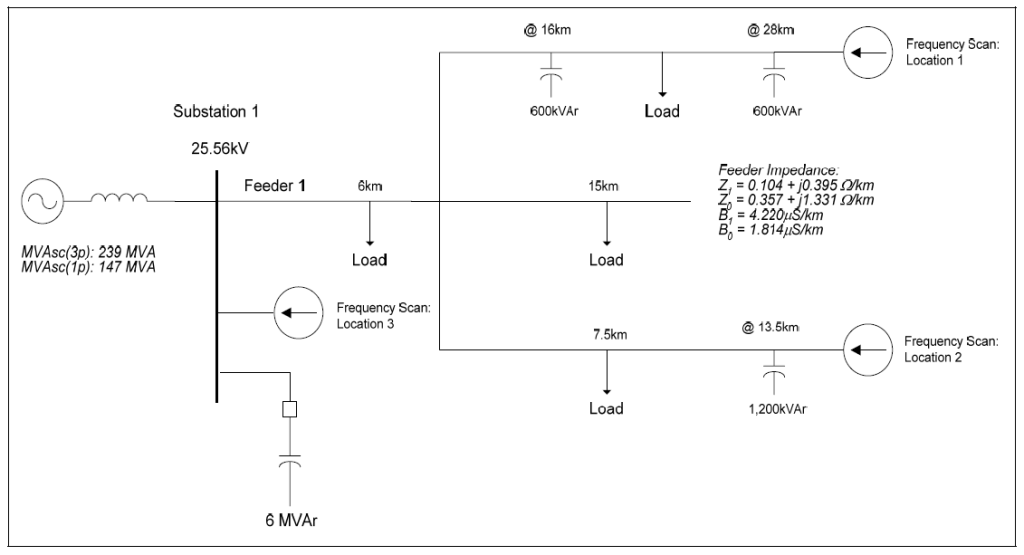
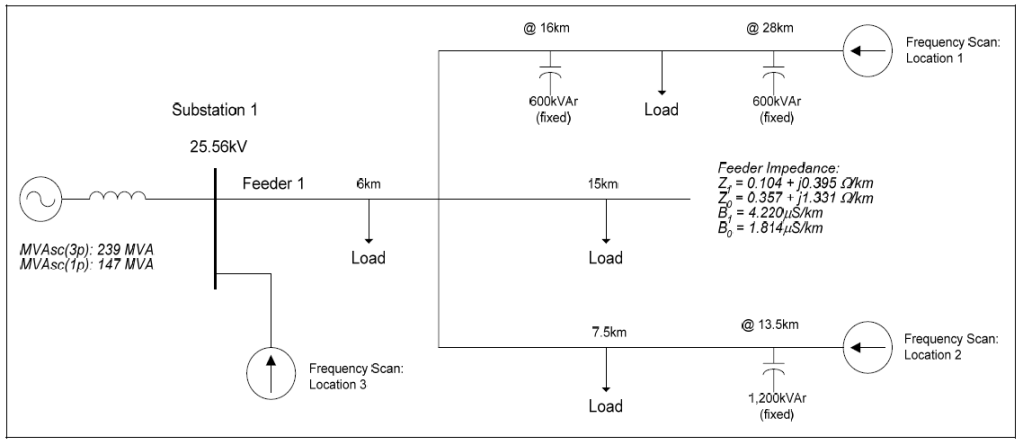
A simplified one line representation of the system studied can be seen in Figure 1. This system consists of six parallel feeders serviced by a 44.8 MVA substation transformer with a substation capacitor bank of 6000 kVAr. The primary feeder modeled for this study is the Feeder 1 12/6.9kV circuit. Approximately 31% of the loads on this feeder are commercial. These commercial loads are serviced line to line. The residential loads are serviced line-to-line overhead and either line-to-line or line-to-neutral underground.

Figure 1: Feeder System One-Line Diagram
FREQUENCY RESPONSE CHARACTERISTICS

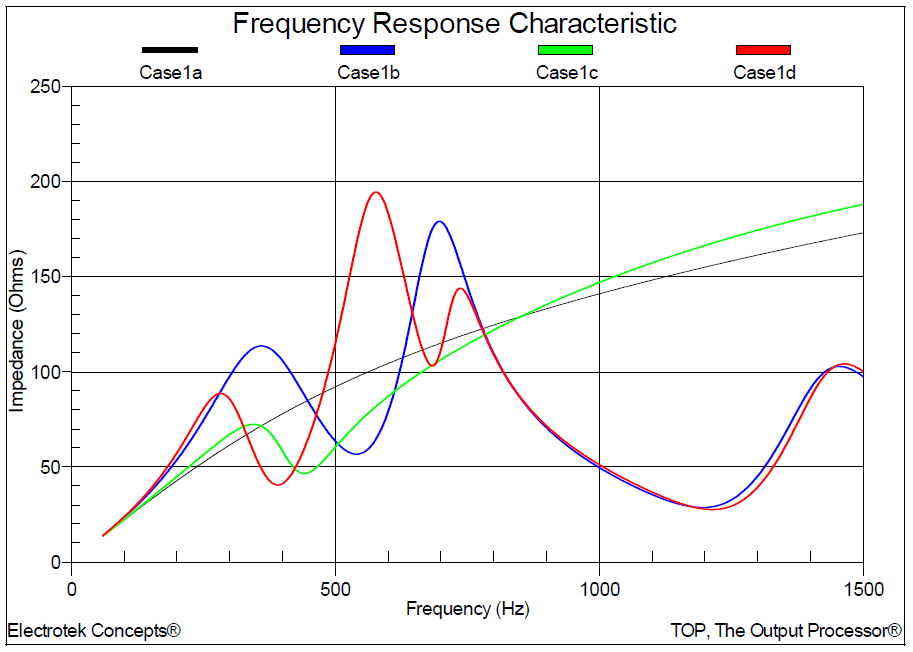
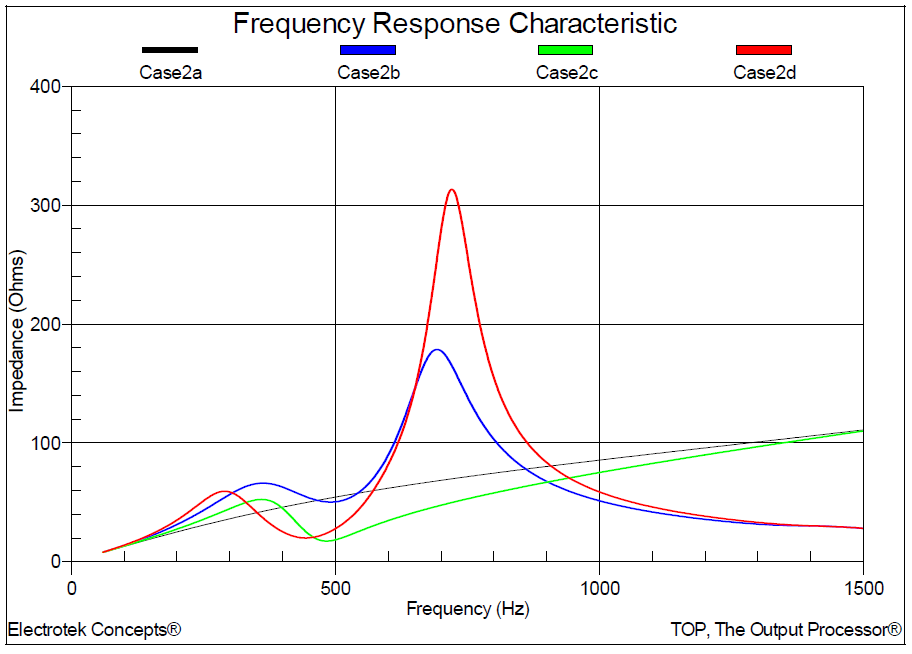
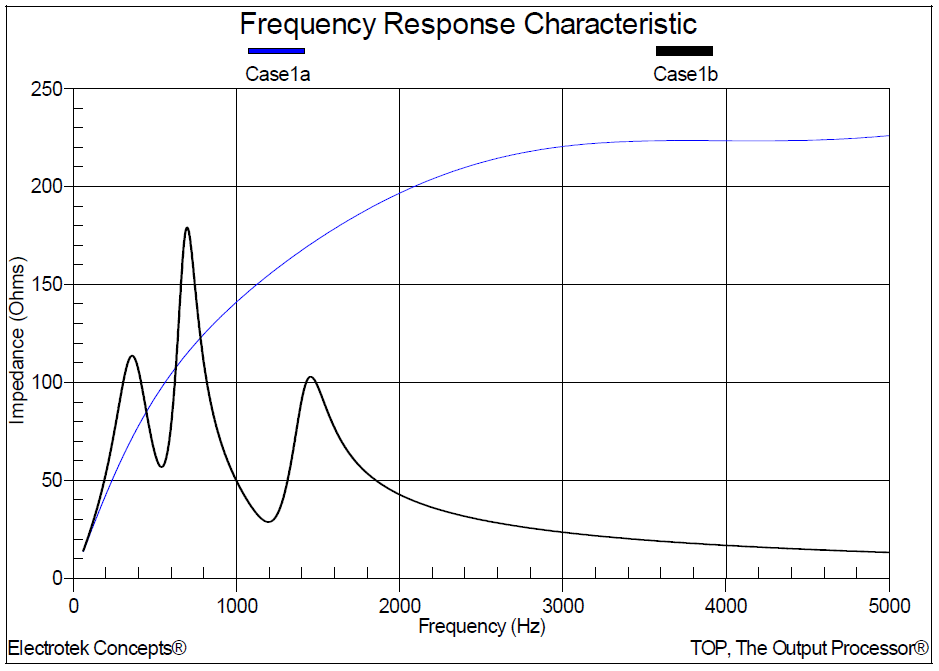
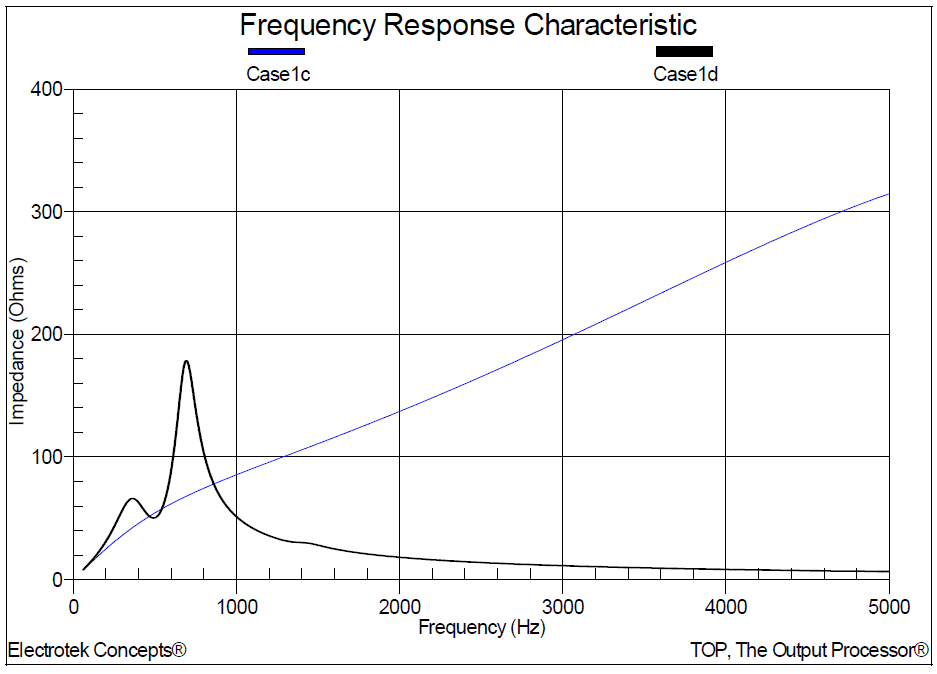
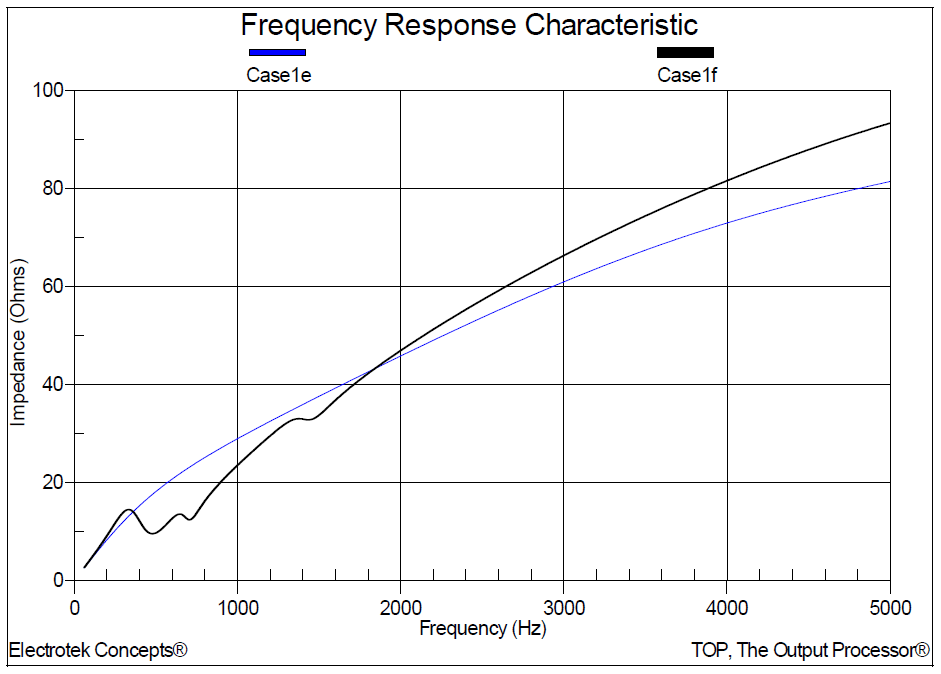
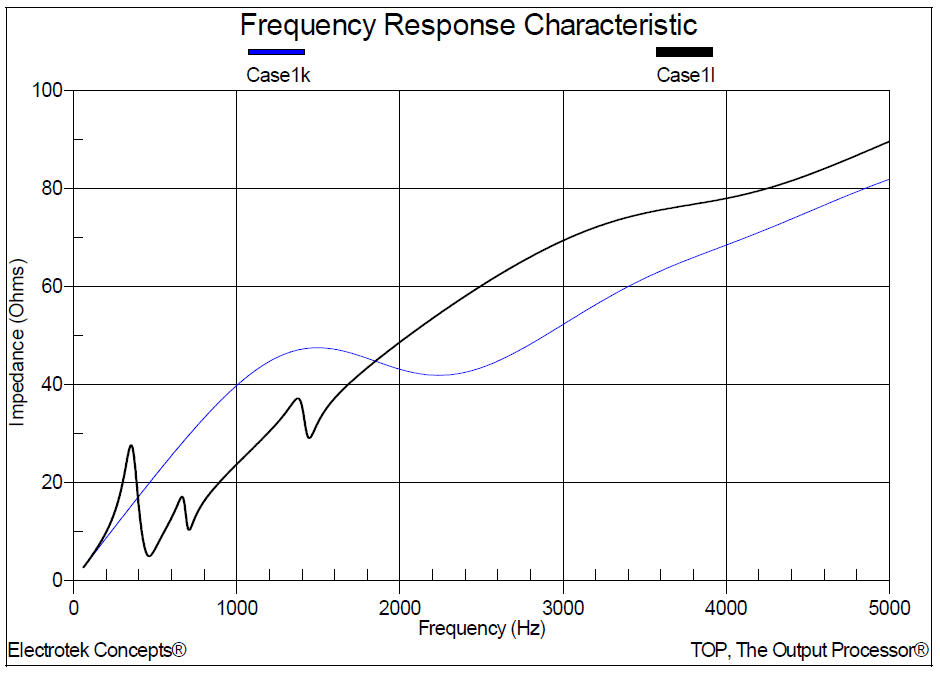
The distribution system frequency response characteristics determine the impact of the harmonic currents on the system voltage distortion. The frequency response is determined by the system strength, the capacitors in service, and the amount of load (damping). Several key configurations were investigated. Figure 2 illustrates the frequency response characteristics with the substation capacitor bank incorporated along with some of the banks on the parallel feeders. The substation capacitor bank moves the primary system resonant peak to reach the 5th harmonic. In relation to the other scans performed, this case appears to be the worst situation regarding undesirable high 5th harmonic impedances. This scenario will be utilized as the basis for evaluating CFL penetration impacts.

Figure 2: Effect of Nonlinear Load Representation

One important effect that needs to be considered is the load characteristics, especially when the load includes a significant amount of power electronics equipment (power supplies). The load characteristics utilized in the previous section consist of basically resistive load to include the damping effect on system resonances. A resistive representation is not accurate for most nonlinear loads.

EMTP Simulations

Simulations from the Electromagnetic Transients Program (EMTP) are used to develop approximate models that can be used in the frequency domain simulations to evaluate the impact of these loads on the overall system frequency response characteristics. The EMTP model was developed to obtain a benchmark comparison for a residential circuit example. The circuit shown in Figure 3 was used to represent a single distribution transformer supplying four residences. Each residence is assumed to have six 25 W CFLs. Typical impedances are used to represent the household wiring and the cabling between the residences. Other loads are also included for the residences: 100 W electronic load (TV), 150 W incandescent lighting, and 100 W refrigerator load.

Figure 3: Simulated System

Effect on System Frequency Response

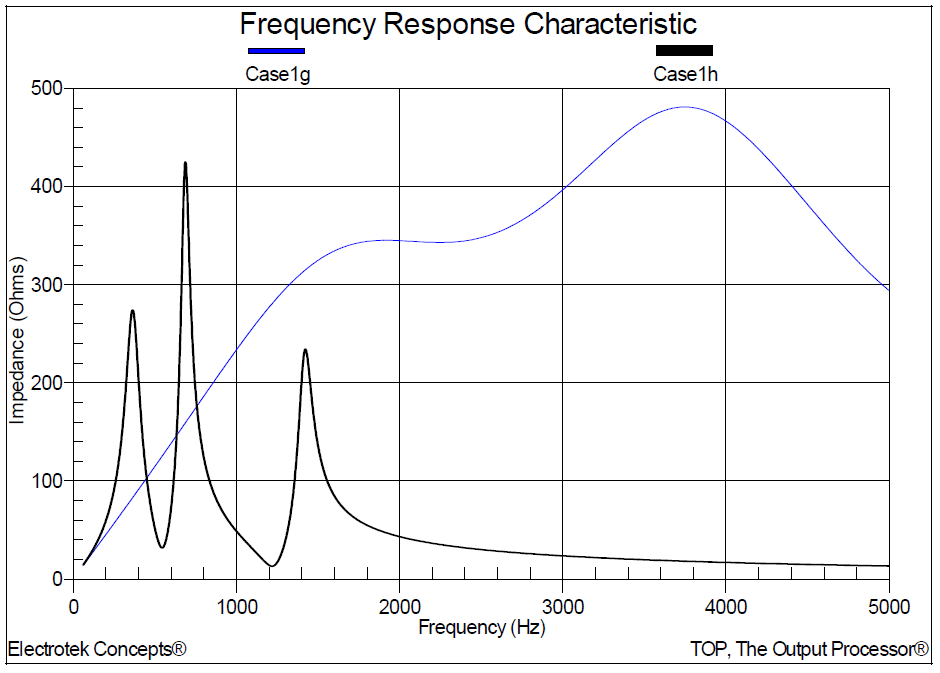
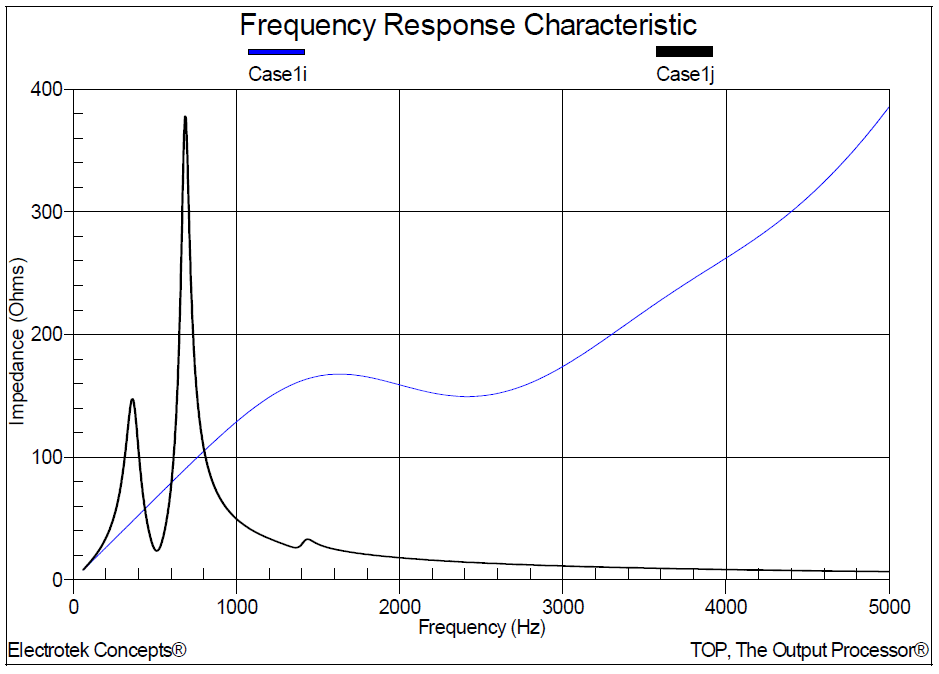
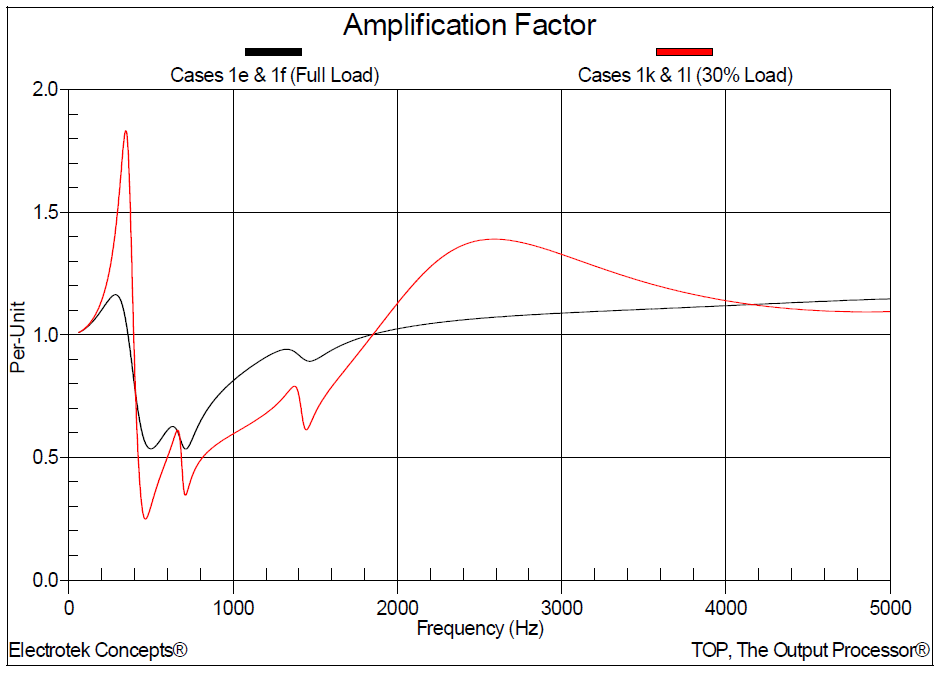
To obtain the frequency response characteristics for the impact of non-linear loads on the system, the parameters obtained from the EMTP simulations for load characterization were incorporated into the existing frequency scan model. Figure 4 illustrates the resulting characteristics at mid-feeder.

Figure 4: Frequency Response Comparison

The figure above provides a comparison of the light loading frequency response characteristics with linear loads and with both linear and non-linear loads. As expected, the frequency scan with the addition of non-linear loads shifts the resonance points to the right with a slight additional harmonic resonance around the 2nd harmonic. The addition of the non-linear load characteristics, derived from EMTP simulations, results in a filter effect at the lower frequencies. It can be seen that the high impedance, previously observed at the 5th harmonic, has been radically reduced. This effect results in the increase of the impedance at the 7th harmonic.

EVALUATION OF EXPECTED HARMONIC DISTORTION LEVELS

Base Case Distortion Levels

The least favorable feeder capacitor configuration was used to calculate harmonic levels due to nonlinear loads currently existing in the system with the exclusion of CFLs. The impedance scan of Figure 2 indicates that this configuration results in a peak resonance at or near the fifth harmonic. Voltage THD levels resulting from this “unfavorable” capacitor configuration are shown in Figure 5 and subsequent figures as horizontal lines.

Figure 5: Voltage THD due to Existing Harmonic Loads

THD levels are shown in Figure 5 for three locations along Feeder 1: near the substation, mid-feeder, and at the feeder end. A range of values is shown for each location to illustrate the effect of feeder loading. As load approaches its minimum (which corresponds to 50% of the peak load reported by SCE), linear load tends to decrease more rapidly than harmonic load. The result is that voltage THD is highest at minimum load. Assuming a maximum allowable voltage THD of 5%, as suggested by IEEE Standard 519-1992, Figure 5 shows that harmonic distortion should not be a problem on the system, regardless of feeder loading or capacitor configuration.

Effect of CFL Penetration vs. Voltage Distortion

Distortion levels due to CFL penetrations of 50 W, 100 W, and 150 W per household are shown in Figure 6. Voltage THD values can be very high – up to 16% for the case of maximum CFL penetration, unfavorable capacitor configuration, and minimum feeder loading. This is a very conservative estimate, for it assumes that all CFLs in the system use the high current THD electronic ballasts mentioned earlier. Another factor contributing to the high distortion levels simulated for this case is that damping due to CFLs and other electronic loads is represented in this model by simple parallel RL branches, rather than by the more accurate RLC representation developed. This was done because past research efforts on the effects of CFLs have assumed simple RL damping. The WPI study made this assumption and concluded that CFL penetrations of as little as 200 kW per feeder could cause unacceptable voltage distortion. Relying upon the same assumption for the Feeder 1 study resulted in a similar conclusion, as Figure 6 indicates. Figure 8 shows how much the RL damping model overestimates harmonic levels on the feeder.

Figure 6: Effect of CFL Penetration on Voltage Distortion Along Feeder 1

Figure 6 also illustrates the dramatic effect that feeder capacitor configuration can have on harmonic distortion. The vertical line portion of the bar graph indicates a “favorable” capacitor configuration – all capacitors in the circuit in service. With all banks switched on, the parallel resonance is shifted upward away from the fifth harmonic. The resulting voltage THD levels are approximately 50% of the corresponding levels with a fifth harmonic resonance (horizontal lines).

Effect of CFL Type

CFL harmonic injection characteristics are an important effect to consider. System distortion levels are dramatically reduced when low current THD electronic ballast or magnetic ballast CFLs are employed. Figure 7 shows that if these types of CFLs are used throughout the system, feeder voltage THD levels can be expected to remain at or below 5%, regardless of system loading, capacitor configuration, and CFL penetration (150 W per household is assumed in the figure).

Figure 7: Effect of CFL Type on Voltage THD

Effect of Electronic Power Supply Damping Model

The final case considered is the effect of the damping model assumed for electronic loads. Figure 8 compares the worst case of Figure 6 (150 W CFL per household) with the same case using the RLC damping model. The result is a 20-30% reduction in THD levels. Significant as it is, the drop in distortion is understated, because it assumed that all residential transformers are connected line-to-neutral. However, because the majority of transformers are in fact line-to-line, the amount of ninth harmonic current injected into the system is overstated in this case.

Figure 8: Effect of Damping Model on Voltage THD
CONCLUSIONS

The conclusions from these simulations are generally in agreement with the conclusions of previous studies performed by WPI. However, the new work, illustrating the important effect of the load models, indicates that the actual distortion levels that can be expected are not as severe as predicted in previous studies. SCE is not presently experiencing any significant harmonic problems with CFLs in use by customers; however, results of this modeling study indicate that further investigation into high- distortion-level CFL effects may be warranted. The distortion levels that can be expected are very dependent on system conditions. Capacitor configurations will cause system resonances that can magnify specific harmonic components. Because similar modeling results could apply to penetration of ASDs in heat pumps and electric vehicle battery chargers, these loads may also warrant further investigation and should be modeled separately due to their different operating characteristics.

REFERENCES

[1] A. E. Emanuel, T. J. Gentile, D. J. Pileggi, E. M. Gulachenski, C. E. Root, “The Effect of Modern Compact Fluorescent Lights on Voltage Distortion”, IEEE/PES 1992 Summer Meeting.
[2] R. Zavadil, M.F. McGranaghan, G. Hensley, K. Johnson, “Analysis of Harmonic Distortion levels in Commercial Buildings”, First International Conference on Power Quality: End-Use Applications and Perspectives, 1991, B-24, pp. 87-92.
[3] W. M. Grady, A. H. Chaudry, A. Mansoor, and M.J. Samotyj “An Investigation of Harmonics Attenuation and Diversity among Distributed Single-Phase Power Electronic Load”, Transmission and Distribution Conference 1994, pp. 110-116.


RELATED STANDARDS
IEEE Standard 519

GLOSSARY AND ACRONYMS
CFL: Compact Fluorescent Light
EMTP: Electromagnetic Transients Program
THD: Total Harmonic Distortion

Research on Design and Control of Microgrid System

Published by Yanbo CHE, Jian CHEN,
School of Electrical Engineering & Automation, Tianjin University, Tianjin China.


Abstract. Microgrid system has received more and more attention internationally in recent years. As the most effective form of distributed generations, microgrid system has also found wide applications in many areas. In this paper, the optimal configuration issue of microgrid system is described briefly first. And then the monitoring system of microgrid system is discussed in details. Different control methods of microgrid system and their advantages and shortcomings are analyzed later. The comparative analysis of different control methods is carried out. Finally, a laboratory-scale microgrid system is proposed as an example to verify the microgrid control strategy. The operation experimental results show that the laboratory-scale microgrid system can operate in grid-connected or islanded mode, with a seamless transfer from one mode to the other, and hence increase the reliability of energy supplies. The study can be used to guide the research of microgrid systems.

Streszczenie. Zaprezentowano różne rozwiązania sieci typu microgrid. Zaproponowano metody sterowania i kontroli systemem, metody optymalizacji konfiguracji oraz systemy monitoringu. (Analiza projektowania i sterowania sieciami typu microgrid)

Keywords: microgrid, optimal configuration, monitoring system, control strategy
Słowa kluczowe: microgrid, systemy monitoring, konfiguracja sieci.

Introduction

In recent years, distributed generation (DG) technologies such as photovoltaic (PV), wind turbine (WT), combined cooling heating and power (CCHP), and fuel cells have received wide interest due to the benefits such as high reliability, good quality power supply, environmental preservation, and energy cost reduction [1]. However, increasing amounts of individual distributed generators will also cause as many problems as it may solve [2, 3]. A large number of distributed generators will probably introduce difficulties of control and manage. A better way to realize the emerging potential of distributed generation is to treat generation and associated loads as a system [4]. In order to solve the contradiction between power system and distributed generation and improve the operation performance of power system, microgrid technology comes into being. Microgrid can operate in grid-connected mode or islanded mode and hence increase the reliability of energy supplies by disconnecting from the grid in the case of network faults. Microgrid is the most effective form of distributed generations.

Nowadays, a considerable research has been undertaken on the microgrid technology. As part of the research, a series of microgrid test facilities, such as CERTS microgrid test bed, GE microgrid in America [5, 6], Aichi, Kyoto, Sendai microgrid in Japan [7, 8], Labein, Kythnos, CESI microgrid in Europe [9, 10], have been built for possible demonstrations of advanced distributed generation system. But as a newly-emerged thing, the practical applications of the microgrid is still in the initial stage, and further research is still necessary. Design and control issues are the key points which decide the performance of microgrid system. How to design the configuration and control method of microgirdr systems rationally and effectively is the most important one to be solved among relevant issues.

This paper discusses optimal configuration, monitoring system and introduces control strategy of microgrid system. A case study is given to introduce and discuss. Conclusion is stated in the last part.

Microgrid design

1 Optimal configuration

As shown in fig. 1, microgrid system typically includes PV, WT, energy storage systems, diesel generator, loads, and other distributed generations. In order to fulfill the target of economical and optimal operation of systems, the optimal capacity configuration of components is very important in system design. In related researches, scholars have made great efforts to study the problems of optimal configuration of systems. The optimal capacity configuration is summarized in [11] briefly. The authors of [12] made the optimal design adopting the method of genetic algorithm. In [13] the simulation software HOMER is used to analyze the systems.

Fig .1 Typical structure of microgrid system

HOMER is designed to analyze the configuration of renewable power systems. And it can simulate grid-connected and off-grid microgrid systems. HOMER compares different designs based on technical and economic characteristics in research of the optimal solution. At the same time, it can help analyze the effects brought by uncertainty and changes of input data, such as renewable energy generation installed capacity, diesel generator capacity, energy storage system capacity and resource data. The microgrid system model in HOMER is shown in fig. 2.

Fig. 2 The microgrid system model in HOMER

2 Monitoring system

Microgrid system consists of renewable energy generation systems (such as wind, solar, biomass, and so on), clean energy generation systems (fuel cells, micro gas turbines, and so on), energy storage systems, and a variety of loads. It is characterized by containing a variety of distributed energy. In view of the above characteristics, microgrid monitoring system must match the following main tasks and requirements:

(1) In order to monitor each generation unit simultaneously and improve the reliability and operational efficiency of microgrid system, monitoring system should use distributed structure so that it can monitor the operating parameter comprehensively.

(2) It should support a variety of communication protocols so that it can communicate with distribution terminal device, includes receiving and handling parameters of analog or digital in different formats.

(3) The system configuration, subsystem configuration, the device configuration, the task configuration can all be defined and modified online.

(4) The operation of the whole system, each subsystem and each device in system can all be monitored and remote controlled.

(5) The historical operation data of microgrid system is the most significant data which can be used to make accurate prediction of system state and promote the operation and control of the microgrid system. Therefore, the monitor system must be able to record and long-term storage the operating data of microgrid system. In addition, the data can also be used for accident analysis, statistical analysis, calculation and future planning [14].

Fig. 3 Monitoring subsystem topology
Fig. 4 The structure of monitoring system

The monitoring system of micro-network system makes the distributed generation as sub-unit monitoring, the equipment of subsystem as the monitoring device. Using the communication between serial port and various devices to achieve the acquisition of real-time operational data, the detection of switch status, and remote monitoring equipment. Monitoring subsystem topology is showed in fig.3 The inverter is the core of monitoring subsystem because grid-connected inverter is the heart of all distributed generation units and stores almost all of the running data. For data acquisition and remote monitoring are achieved through the controller and communication interface. The structure of monitoring system is shown in fig. 4. Specific programs and control process are set by the controlled system.

Microgrid control

Compared with traditional large-capacity thermal power, there are volatility in primary energy (such as wind and solar) and bidirectional flow in dynamic allocation of secondary energy (such as bidirectional energy flow between microgrid and large power grid, bidirectional energy flow in the bus of energy storage units) in microgrid. In addition, the load following reaction speed of each DG unit is very different. All these features add the complexity of microgrid automatic management, especially the optimal scheduling [15].

Fig. 5 Hierarchical control structure of microgrid

The microgrid system often has a hierarchical control structure, as shown in fig.5. There are two control layers: MMS and local controller (LC).The MMS is a centralized controller that deals with management functions, such as disconnection and resynchronization of the microgrid and the load-shedding process. In addition to this function, the MMS is responsible for the supervisory control of microsources and the ESS. Using collected local information, the MMS generates a power output set point and provides it to the LCs. An LC is a local controller that is located at each microsource and controls the power output according to the power output set point from the MMS [16]. The hierarchical control structure contributes to the control performance of microgrid.

Besides the control structure, control methods are the research core of microgrid. The volatility of distributed generation and the differences of distributed generation units have increased the complexity and difficulty of microgrid control. Distributed generations in microgrid are connected with the busbar through power electronic devices that are very different from the generators that connected directly with the grid. In addition, energy storage systems are usually equipped to increase the system inertia. So the traditional control methods are no longer applied properly in microgrid operation control.

At present, there are mainly two control methods, master-slave control and peer-to-peer control [17]. There is a main control unit in master-slave control to maintain the constant voltage and frequency. The main control unit adopts V/F control while other distributed generations adopt PQ control to output certain active and reactive power. Each unit is equal in peer-to-peer control. Peer-to-peer control is based on the method of external characteristics of declining. It associates frequency versus active power, voltage versus reactive power respectively. Through a certain control algorithm, the voltage and frequency will be adjusted automatically without the help of communication.

The control method based on drooping characteristics is widely used in peer-to-peer control. One is f-P and V-Q control which produce reference active and reactive power of distributed generations by measuring the system frequency and amplitude of output voltage of distributed generations. As shown in fig.6. The other is P-F and Q-V control which produce the frequency and amplitude of output voltage by measuring the active and reactive power of distributed generations. As shown in fig.7.

Fig. 6 F-P and V-Q control
Fig. 7 P-F and Q-V control

Master-slave control and peer-to-peer control each has advantages and disadvantages. They are suitable for different operation. At present, the built experimental systems commonly adopt master-slave control in China. Compared with master-slave control, peer-to-peer control has certain advantages but its application needs further study.

Case study
Fig. 8 Schematic diagram of a laboratory scale microgrid

The structure of the microgrid (MG) system is shown in fig. 8. It is a single phase system, with 230V, 50Hz, comprising PV simulator, wind simulator and battery storage [18]. Both of them are connected to the AC grid via flexible power electronic interface [19]. Also there is a Microgrid Central Controller (MGCC) which is responsible for the optimization of the microgrid operation.

The MGCC functions range from monitoring the actual active and reactive power of the distributed resources, voltage and frequency of the AC bus. Also it is responsible for the maximization of the microgrid’s value and the optimization of its operation by sending control signal settings to the distributed resources and controllable loads via communication lines [20]. In this paper, RS485 communication lines are used to realize this function.

For the laboratory-scale MG, based on the control strategies of the micro sources and the battery energy storage, a series of experiments were carried out, the power output of the distributed generators and battery, voltage and frequency of the AC bus were real-time measured and analyzed by the Power Quality Analyzer.

A. Transfer from islanded mode to grid-connected mode While switching from islanded mode to grid-connected mode, the voltage and frequency should be maintained within acceptable limits. The dynamic response process is shown in fig. 9. At t3, the MG is synchronized to the grid and its voltage and frequency become equal to the values of the network. The PV simulator and wind simulator maintain constant power output and the battery will be charged by the grid. As shown in fig.9, the voltage and frequency will fluctuate accordingly with the grid.

Fig. 9 Transition from islanded to grid-connected mode

B. Transfer from grid-connected mode to islanded mode Also the voltage and frequency should be maintained within acceptable limits when switching from grid-connected mode to Islanded mode. The dynamic response process is shown in Fig. 10.

At t4, the MG is disconnected from the grid and returns to Islanded mode operation. During this transition, the voltage and frequency will decrease slightly. For the safe operation, the distributed generators will disconnect from the MG (the output power become zero), the battery will increase its power output accordingly for the power balance of the system. Due to the voltage/frequency control of the battery inverter, the voltage and frequency of the MG are restored to the nominal value. Then at t5, the distributed generators will connect to the MG again and return to its initial operating state. From the voltage and frequency behaviors in Fig. 9 and Fig. 10, it may be observed that MG stability is not lost when facing transition between Grid-connected mode and Islanded mode.

Fig. 10 Transition from grid-connected to islanded mode
Conclusion

In this paper, discussion and analysis of microgrid design and control are carried out. And the design method of HOMER is introduced briefly. The monitoring system design of microgrid is described in details. The control methods of microgrid system are mainly demonstrated. The master-slave control and peer-to-peer control are analyzed in detail. A laboratory-scale MG system has been set up. The operation experimental results show that the laboratory-scale MG system can operate in grid-connected mode or islanded mode and hence increase the reliability of energy supplies, with a seamless transfer from the one mode to the other.

Acknowledgment

This work is supported by National Key Foundational Research Project ‘Distributed Generation Supply System Pertinent Foundational Research’ (No.2009CB219700)

REFERENCES

[1] Jian W., Xing-yuan L., Xiao-yan Q., Power System Research on Distributed Generation Penetration, Automation of Electric Power Systems, vol. 29(24), pp. 90-97, 2005.
[2] A.M. Azmy and I. Erlich, “Impact of distributed generation on the stability of electrical power system,” Power Engineering Society General Meeting, vol. 2, pp.1056-1063, 2005
[3] J.G. Slootweg and W.L. Kling, “Impacts of distributed generation on power system transient stability,” Power Engineering Society Summer Meeting, vol.2, pp.862-867, 2002
[4] R. Lasseter, A. Akhil, C. Marnay and J. Stephens et al, “White Paper on Integration of Distributed Energy Resources. The CERTS Microgrid Concept,” Consortium for Electric Reliability Technology Solutions (CERTS), CA, Tech. Rep. LBNL-50 829, 2002.
[5] R.H. Lasseter and P. Piagi, “Control and Design of Microgrid Components, Final project report,” PSERC publication 06-03, [Online]. Available: http://certs.aeptechlab.com/
[6] US Department of Energy Electricity Distribution Programme, Advanced Distribution Technologies and Operating Concepts – Microgrids, [Online]. Available: http:// http://www.electricdistribution. ctc .com/Microgrids .htm
[7] Toshihisa Funabashi and Ryuichi Yokoyama, “Microgrid Field Test Experiences in Japan,” Power Engineering Society General Meeting, pp. 1-2, 2006
[8] S. Morozumi, “Micro-grid demonstration projects in Japan,”IEEE Power Conversion Conference, pp.635 642, April, 2007.
[9] Oleg Osika, Aris Dimeas and Mike Barnes et al, “DH1_Description of the laboratory micro grids,” Tech. Rep. Deliverable DH1, 2005
[10] European Research Project More Microgrids. [Online]. Available: http://Microgrids.power.ece.ntua.gr
[11] J. Chen, Y. B. Che, and J. J. Zhang, “Optimal configuration and analysis of isolated renewable power systems.” Power Electronics Systems and Applications (PESA), 2011 4th International Conference on pp. 1284-1292.
[12] Eftichios Koutroulis, Dionissia Kolokotsa,Antonis Potirakis, Kostas Kalaitzakis. Methodology for optimal sizing of standalone PV–Wind. Solar Energy,2006(80): 1072-1088.
[13] S.M. Shaahid, M.A. Elhadidy. Economic analysis of hybrid PV-diesel-battery power systems for residential loads in hot regions. Renewable and Sustainable Energy Reviews,2008(12): 488-503.
[14] J. D. Ren, Y. B. Che, and L. H. Zhao, “Discussion on monitoring scheme of distributed generation and micro-grid system,” Power Electronics Systems and Applications (PESA), 2011 4th International Conference on, pp. 1-6.
[15] Y. B. Che, and J. Chen, ”Control research on microgrid systems based on distributed generation,” Applied Mechanics and Materials, vols. 58-60 (2011), pp. 417-422.
[16] Jong-Yul Kim, Jin-Hong Jeon, Seul-Ki Kim, Changhee Cho, June Ho Park, Hak-Man Kim, and Kee-Young Nam: Cooperative Control Strategy of Energy Storage System and Microsources for Stabilizing the Microgrid during Islanded Operation. IEEE Trans. Power Electron. Vol. 25 (2010), p. 3037-3048
[17] Yang Zhangang, Wang Chengshan, Che Yanbo: A Small-scale Microgrid System with Flexible Modes of Operation. Automation of Electric Power Systems. Vol. 33 (2009), p. 89-92
[18] Y. B. Che, Z. G. Yang, and K. W. E Cheng, “D. Construction, operation and control of a laboratory-scale microgrid,” Power Electronics Systems and Applications, PESA 2009. 3rd International Conference on, pp. 1-5.
[19] D. Georgakis, S. Papathanassiou and N. Hatziargyriou, “Operation of a prototype Microgrid system based on microsources,” Power Electronics Specialists Conference, pp. 2521- 2526, 2004
[20] D. Nikos Hatziargyriou et al, “DC1_Microgrid Central Controller strategies and algorithms,” Tech. Rep. Deliverable DC1, 2004


Authors: Yanbo CHE: Associate professor in school of electrical engineering and automatic, Tianjin University, E-mail: ybche@tju.edu.cn
Jian CHEN: PHD student in school of electrical engineering and automatic, Tianjin University, E-mail: happy_chenjian@163.com.


Source & Publisher Item Identifier: PRZEGLĄD ELEKTROTECHNICZNY (Electrical Review), ISSN 0033-2097, R. 88 NR 5b/2012

Consumers Protection and Monitoring with Microcontroller Based Device for Low-Voltage Distribution Systems

Published by Petre Lucian OGRUTAN1, Lia Elena ACIU1, Dan LOZNEANU1, Ioan ROSCA2,
Transilvania University of Brasov, Romania (1), Transilvania Sud Electricity Distribution (2)


Abstract. Protection devices against over-voltage and over-currents for low voltage systems are equipped with varistors and gas-discharge tubes around a fuse, having a disconnection time about 200ms. This paper proposes an intelligent protection system that includes a real-time energy distribution monitoring system for the consumer, providing rapid load disconnection/reconnection without any human intervention, which is considered as an important improvement.

Streszczenie. Urządzenia chroniące przed przepięciami i przetężeniami w instalacji elektrycznej zawierają warystory, iskierniki oraz bezpieczniki o czasach działania około 200 ms. W artykule przedstawiono inteligentny rozwiązanie ochrony zawierające system monitorowania użytkownika energii w czasie rzeczywistym oraz zapewniające szybkie wyłączenie/załączenie bez ingerencji człowieka (Zastosowanie urządzeń wykorzystujących mikrokontrolery do ochrony i monitorowania instalacji elektrycznej)

Keywords: safety, microcontroller, monitoring, low voltage, distribution systems
Słowa kluczowe: bezpieczeństwo, mikrokontroler, monitorowanie, instalacja elektryczne

Introduction

A recent study achieved for the European Community [1] was aimed at investigating the causes of accidental fires in order to establish effective safety provisions for low voltage consumers against such hazards. The study mentions, for instance, a percentage of 31% of fires caused by the electric section of the equipments. Within this context, ascertains that most of the fires were caused by the defects in the electrical system – shortcircuits and overvoltages. Consequently there is a worldwide concern for identifying and applying new methods of protection.

The levels of the overvoltages occurring in electrical supply systems are lower than those arising in electrical power transport and distribution systems yet under unfavorable conditions the former can also cause significant equipment damage. A situation specific to low voltage systems is the occurrence of hazardous accidental voltages at the grounding connections of the equipments due to the effects of the carried overcurrents. Under the present conditions of operation of the energy market and due to the increased requirements in terms of the quality of services imposed on electrical energy providers, the need to determine the level of overvoltages becomes increasingly important in distribution and supply systems as well. This provides the opportunity to identify the areas of increased electrocution risk, as well as other potentially hazardous situations to consumers in the investigated low voltage systems. Also, the possibility of hazards due to damages produced in low voltage cable systems cannot be neglected.

The computer-assisted simulation of the transient electromagnetic regimes and sequences of such regimes is the only feasible method for performing parametric analyses at the level of accidental voltages, overvoltages and overcurrents in the system. Such parametric analyses allow for determining the level of voltages and currents circulation in any point of the system on a given range of its operating parameters. This is virtually the only solution to anticipate the sensitive areas of potential risk.

Knowing the current values in any point of the system allows an adequate planning of the preventive maintenance of grounding connections, of protection systems and points with damaged insulation, especially in cable systems.

Knowing the voltage values in any point of the system allows to avoid operation at voltage values that are unacceptable not only to consumers but also to certain system components for a prolonged operation regime, knowing the touch and step voltages in all ground connections of the analyzed system for any operating mode including anomalous situations like broken neutral wires or potential equalization conductors.

The measures that can be implemented as following to the performed analyses will produce immediate effects in terms of avoiding unwanted events with respect to electrical safety, reduction of frequency and duration of electrical power outages with the associated technological and economic advantages. Adequate planning of maintenance activities, which follows as a consequence to such analyses, results in enhanced services quality of the provided electrical power. The EMTP-ATP simulation program allows to determine the voltage and current variations occurring in different points of an electrical network, highlighting those locations where an intervention appears necessary by using types of protection devices as proposed in this paper [2]. A single electronic device including embedded systems for overcurrent, overvoltage and user protection against electrocution represents a necessity at this level of modernization [3]. The data exchange with the exterior moves the fuse system into the 21st century by ensuring the facilities for remote control [4]. E.g. a quick and safe fuse which operates at a precise value of the short-circuit current could improve the quality of electrical power by reducing the voltage sags in the system. The paper presents a system for consumer protection against short-circuits and overvoltages that can occur in the low voltage power supply grid. The proposed system was subjected to practical tests for various power factors.

Presentation of the protection device

The protection device proposed in this paper operates as an electronic circuit breaker based on a microcontroller which provides the possibility of transferring distant events into an event log. Its structure is shown in Fig. 1. The proposed device has the following advantages:

-High cut-off speed (maximum 10ms) which is faster than with conventional methods;
-Does not require human intervention since after power cutoff in the case of short-circuit or overvoltage, the power supply is automatically restored (for short-circuits only after eliminating the cause);

-Due to its two-stage action for the case of occurrence of low-value overvoltages or overcurrents, the average voltage value is subtracted thus preventing the load to be cut-off from the supply. This advantage can be obtained for the triac equipped version only;

-The load is cut-off at voltage/current zero-crossing which reduces the perturbations;

-The communication interface to the Internet enables online transfer of electrical power consumer information.

Fig. 1. Schematic for the consumer protection device

The acquired data including voltage and current values can be transmitted over distance and made available to the interested parties (consumer or electrical power distributor). The necessary condition for data communication is bidirectionality, namely to provide the possibility to remotely control the device by either the client (consumer) or the electrical power distributor. This feature could be useful if the distributor schedules electrical works that could involve potential risks to the consumer (client), by providing the possibility of disconnecting the client over the repair period. The data transmission can be achieved:

-using Bluetooth if there is no GSM coverage or cable Internet is unavailable. The consumer (client) can view the event report on a computer with Bluetooth interface while the representative from the distribution company has direct access with a notebook from the exterior;

-Over GSM modem, while communication is assured over SMS or GPRS if there is GSM coverage, which is the preferred solution in most cases;

-Over the INTERNET, with a web server-like device which collects the data from the microcontroller and posts them on a website.

The relay-based command is more straightforward but the microcontroller must nevertheless detect the zero voltage/current crossings since coupling and decoupling the load must occur during zero crossing in order to protect the relay contacts. Another problem associated to this solution is the relatively high cost involved by a relay capable to withstand high voltages and currents. While it is a simple task to command a load using a relay, the command with solid-state devices is more complicated. Next, is given a brief description of consumer command using triacs and thyristors, which is the usual command method. Mains voltage control applications involve some particular difficulties:

-High currents and voltages, which requires a special attention and safety measures such as optical decoupling, grounding potential management, galvanic isolation of the oscilloscope, etc;

-Especially for transient regimes, the controlled process is usually more complex;

-The need for developing industry applications leads to cost restrictions, requires higher reliability, compliance to EMC standards, etc.

For the microcontroller command variant it is recommendable to use galvanic decoupling between the digital control circuit and the triac, that is, from the mains supply section [3]. The isolation can be achieved through transformers, optocouplers or opto-triacs that assures a turn-on current flowing in the same direction as the main current to provide an optimum command of the triac. The current through the opto-triac is obtained by dividing the main current through the triac, thus assuring that the triac’s turn-on current has the same direction as the main current. The analysis of the voltage and drawn current is achieved by the microcontroller through the embedded A/D converter. The current is analyzed using a dedicated current transducer (Hall) while voltage analysis is performed through rectification, filtering and division. Whenever a short-circuit or a voltage surge occurs, the microcontroller stops sending turn-on pulses to the triac or cuts off the relay command current so that the consumer’s power supply is cut off as well.

For the triac command variant the protection method was devised as a two-stage process. If overvoltages or overcurrents are detected these are can be classified into:

-Non-hazardous (+/- 3%), requiring no countermeasures;

-Less hazardous (+/-10%), which requires modification of the triac’s firing angle. Depending on the magnitude of the over-voltage and over-current, a timer is programmed which determines the turn-on delay of the triac (the control angle). This command reduces the average load voltage and so compensates the voltage or current increase;

-Hazardous (over10%), blocks the gating pulses to the triac thus disconnecting the load from the mains supply. The voltage is continuously measured and after returning to normal values the load is reconnected to the supply system. When short-circuit is detected, the supply is re connected after a delay period and if the short-circuit persists the triac is blocked for another interval of time.

The condition of over-voltage or over-current is evaluated over one period of the supply voltage by verifying whether the average value of the current and voltage samples are within normal limits. In order to increase the operating safety, the evaluation over two periods of the voltage, that is 20ms, was software-implemented as well. This will increase precision but the cut-off time increases as well. For the relay variant where the two-stage protection is not possible, the software must assure power cut-off at voltage zero crossing. Considering the delayed response of the relay, the cut-off command must precede voltage zero crossing by a time interval depending on the type of the used relay.

Simulation of the proposed protection device

Several Simulink simulations of the operation of constructional versions, relay and triac, of the protection device were performed.

Fig. 2. The simulation results of RLC load cut off at voltage increase

Figure 2 and Figure 3 show the results of the performed simulations. As can be seen on the presented simulations, the two-stage action assures that, in case of low over-voltages or over-currents, the average voltage value decreases and the load is not cut off from the mains supply ensuring uninterrupted operation.

Fig. 3. The simulation results of RLC load cut off at current increase
Experimental results

The tests were conducted with a resistive load made of nickeline conductor, a capacitive load consisting of a capacitor bank and a movable iron core inductor. The test schematic is presented in Figure 4.

Fig. 4. Laboratory experimental tests

Several measurements were conducted on both constructional variants using resistive and RLC loads for different inductivities by moving the variable core. Some significant waveforms (for several load combinations with limiting values) are presented in Figures 5 and Figure 6. Each graph presents the load voltage (the sinusoid with larger amplitude) and the load current (the lower amplitude sinusoid).

Fig. 5. Relay actuator, RL load, cos φ=0.58 inductive

Load re-coupling and decoupling at current zero crossing can be observed, along with diminished perturbations. The relay variant generates short duration voltage surges both for load re-coupling and decoupling. For mainly inductive loads, current zero crossing produces in both variants a voltage fluctuation which is similar to those obtained by simulation.

Fig. 6. Triac actuator, RL load, cos φ=0.62 inductive, respectively RLC load, cos φ=0.30 inductive.
Conclusions

The simulations show the advantages of a triac used as actuator element. This can be achieved due to the possibility of the two-stage command when detecting overcurrents or over-voltages and stepwise re-coupling of the load. However the triac command variant presents some disadvantages:

-A limiting resistor for the short-circuit current at its maximum admissible non-repetitive value of the triac is permanently connected in series with the load, for power dissipation;

-In a supply system characterized by frequent over-voltages and major load variations the lifetime of the triac decreases significantly [5];

-The behavior of loads with a variable inductive component is incompletely known.

The relay version does not allow a stepwise protection but if the consumer is decoupled at load current zero crossing, the reliability will increase. The relay should be able to operate at high switching speed and high load current (20A), which means that this version will involve higher costs. After several laboratory tests conducted with different types of loads and various power factors, the results demonstrated that the protection device operates in accordance with its design characteristics for inductive power factors (that are specific to electric transport lines) even for very low ones, as results from the presented graphs.

REFERENCES

[1] Kobes M., Groenewegen K., Duyvis M.G.: Consumer fire safety: European statistics and potential fire safety measuresReport, Netherlands Institute for Safety Nibra, 2009.
[2] Istrate M., Gusa M., Assessment Of Two Single-End Fault Location Algorithms In An ATP Approach, Revue Roumaine de Sciences Techniques – Électrotechique et Énergétique, Tome 54, 4, 2009, pp. 345 – 354.
[3] Romanca M., Ogrutan P.: Embedded Systems. Microcontroller Applications, Transilvania University, Brasov, 2011.
[4] Williams, C.: “Electronic Fuse Overcurrent Protection” in Transmission and Distribution Conference and Exhibition, 2005/2006 IEEE PES, Dallas, TX, May 2006, pp. 1226 – 1228.
[5] Chiste, A. ; Funke, J.: “Electronic systems protection via advanced surge protective devices” Proc. Telecommunications Energy Conference, Montreal, Canada,Sept. 30 – Oct. 3, 2002, pp. 22 – 26.


Authors: Prof. PhD eng. Petre Ogrutan, Transilvania University of Braşov, Eroilor Av. 29, 500036, Braşov, E-mail: petre.ogrutan@unitbv.ro; Assoc. prof. PhD eng. Elena Aciu, E-mail: lia_aciu@unitbv.ro


Source & Publisher Item Identifier: PRZEGLĄD ELEKTROTECHNICZNY (Electrical Review), ISSN 0033-2097, R. 88 NR 6/2012

The Influence of Earth Thermal Conductivity on Temperature Profile of 110 kV Electric Power Cable System

Published by Janusz TYKOCKI, The State College of Computer Science and Business Administration in Lomza


Abstract. The paper presents the conductivity of the ground effect on the distribution of temperature field in three-phase high-voltage cables, 64/110 kV, depending on the depth of their arrangement in the ground. The simulation uses the finite element method FEM.

Streszczenie. W pracy przedstawiono wpływ przewodności gruntu na rozkładu pola temperatury w kablach trójfazowych wysokiego napięcia 64/110 kV, w zależności od głębokości ich ułożenia w ziemi. W symulacji zastosowano metodę elementów skończonych MES. (Wpływ przewodności cieplnej gruntu na rozkład pola temperatury w układach kablowych 110 kV).

Keywords: temperature field, the temperature limit, the cables of 110 kV, FEM.
Słowa kluczowe: pole temperatury, temperatura dopuszczalna, kable 110 kV, MES.

Introduction

Redistribution of electrical energy more and more often requires high voltage cable lines being used and laid underground. These requirements are forced by urbanization and environmental protection, energy transfer within the areas of national nature reserves, watersheds, military territories, airports and the like.

The amount of transferred energy is determined by the temperature of the core of the cable. The major impact on the temperature profile in the core, apart from the temperature above the surface and its profile underground, is dependent on the depth of the cable installation, construction and interconnection in three-phase systems. The thermal conductivity is dependent on the type of soil and its moisture. The aim of the article is to discuss the temperature profile in high voltage cables 64/110kV: 2XS (FL) with a copper conductor. In the present simulation the professional programme NISA/Heat Transfer is used, which uses for calculations finite element method.

Equation of thermal conductivity

Stationary temperature field T (x, y) of high voltage cables laid directly in the ground for a homogeneous environment, two-dimensional system In steady state is described by the equation [1] :

.

where: g(M ) j2p [W/m3 ] 3 W m the performance of spatial heat sources, j [ A/m2 ] current density, [Ωm] conductor resistivity (copper), λ [W/mK] pipe thermal conductivity, insulating layers and the ground

Construction of High Voltage Cables

Cables with cross-linking polyethylene insulation XLPE have been used since the beginning of the 1960s for the range of medium voltages and since 1971 they have been commonly used for the voltage of 123 kV. Currently, the cables for the voltage of 500 kV are being built and successfully exploited. Having approximately stable electric and dielectric characteristics of the cables and their increased resistance to the heat emission means higher permissible load in the mode of continuous work and in the case of short-circuit.

There are other following advantages of currently produced high voltage cables:

• Lower loss coefficient tan δ = 4×10⁻⁴
• Relative permittivity εr = 2,4 (which allows lower working capacity)
• Lower mass
• Lesser bend radius
• Easy assembly
• Easy accessory attachment
• Unnecessary maintenance of the cable system

Numerical model of the cable

The selection of the electric power cable as well as other parameters is made on the basis of technical specification of the company Tele-Fonika Kable S.A: A2XS (FL) 2Y2Y-GC-FR 1x2000RMS/210 64/110 (123) kV IEC 60840

Table 1.

Current in the main conductorAir temperatureGround temperatureDistance from the ground surface
[A][oC][oC][m]
940+35+8+8
.

Figure 1 presents the numerical model of the analyzed system, and in Figure 2 − the temperature profile for the typical boundary conditions of the system Table 1 where assumed thermal conductivity is λ=1[W/mK].

Fig.1. FEM model of the analyzed system

There are substantial visible differences in temperature in the core of the cable for the earth thermal conductivity λz∈0,2÷0,8 [W/mK] Fig.4, additionally assumed boundary conditions for 40o C.

Fig.2. The temperature distribution in the ground and the maximum temperature of the core (for boundary conditions of Chart 1)
Fig.3. The temperature distribution in the ground, and analyzed the system (for boundary conditions of Chart 1)
Fig.4. Temperature changes in the core of the cable at different depths (from 1 to 8 m) for different values of thermal conductivity (from 0,22 to 1,2)

Figure 5. presents the temperature profile in the core, screen and surface of the cable at different depths.

The temperature profile stabilizes starting at 10m and temperature differences between its individual layers are constant at different depths.

Fig.5. The analysis of temperature profile in the core of the cable for different depths (1-40m)
Conclusions

As a result of the conducted computer simulation and the analysis of the temperature profile in the system depending on its distance from the surface of the earth and its thermal conductivity which is affected by different temperatures on the surface it is necessary to state the following:

➣ the thermal conductivity of earth has substantial influence on the temperature of the core of the cable – up to the value of 0,8 [W/mK]
➣ the temperature in the core of the cable is determined starting at depth of 10 m
➣ the differences in temperatures between the core of the cable, its screen and the surface are constant for the defined boundary conditions and average between 6o C and 2o C, as well as can be defined after exceeding the depth of 10m
➣ the influence of the outer temperatures on the temperature profile inside the cable stabilizes below 10 m from the surface

REFERENCES

[1] Kącki E. Równania różniczkowe cząstkowe w elektrotechnice WNT Warszawa 1968
[2] L. Kacejko, Cz. Karwat, H. Wójcik: Laboratorium techniki wysokich napiec, WPL
[3] S. Szpor: Technika wysokich napiec, WNT Warszawa
[4] Z . Flisowski: Technika wysokich napiec, WNT Warszawa
[5] Z . Gacek: Wysokonapieciowa technika izolacyjna, WPS Gliwice
[6] Khajavi M., Zenger W ., Desing and commissioning of a 230 kV cross linked
[7] polyethylene insulated cable system, JICABLE 2003,paper A .1.1, Paris 2003
[8] Toya A ., Kobashi K., Okuyoma Y., Sakuma S., Higher stress desingned XLPE insulated cable in Japan, General Session CIGRE 2004, paper B1-111
[9] Suzuki A ., Nakamura S., Tanaka H., Installation of the world’s first 500 kV XLPE cable with intermediate joints, Furukawa Review, No 19, 2000
[10] Rakowska A ., Najnowsze osiągnięcia w dziedzinie kabli wysokiego napięcia. Stosowanie żył miedzianych w kablach na napięcie 110 kV i wyŜsze, XII Konferencja Naukowo – Techniczna Elektroenergetyczne linie kablowe i napowietrzne Kabel 2005
[11] Granadino R., Plans J., Schell F., Undergrounding the first 400 kV transmission Line in Spain using 2500 mm2 XLPE cables, JICABLE 2003, paper A .1.2, Paris 2003
[12] Jones S.L., Bucea G., Jinno A ., 330 kV cable system for the MetroGrid project In Sydney Australia, CIGRE General Session 2004, paper B1 – 302


Author: Janusz Tykocki, The State College of Computer Science and Business Administration in Lomza, Akademicka 14, 18-400 Lomza, Poland. E-mail: jtykocki@pwsip.edu.pl


Source & Publisher Item Identifier: PRZEGLĄD ELEKTROTECHNICZNY (Electrical Review), ISSN 0033-2097, R. 87 NR 12b/2011

Commercial Facility Harmonic Evaluation

Published by Electrotek Concepts, Inc., PQSoft Case Study: Commercial Facility Harmonic Evaluation, Document ID: PQS1005, Date: March 15, 2010.


Abstract: Utility power system harmonic problems can often be solved using a comprehensive approach including site surveys, harmonic measurements, and computer simulations.

This case study presents the results for a commercial facility harmonic evaluation. The simulations were completed using the PSCAD program. The analysis evaluates the effects of transformer connections to determine the harmonic current distortion levels on both the primary and secondary sides of the customer transformers. The simulation results show the third harmonic neutral current and a K-Factor transformer derating analysis.

INTRODUCTION

A commercial facility harmonic evaluation was completed for the system shown in Figure 1. The case study was completed using the PSCAD program. The accuracy of the simulation model was verified using three-phase and single-line-to-ground fault currents and other steady-state quantities.

The circuit model for the case involved a 25.56kV customer substation with two 1,000 kVA step-down transformers supplying HVAC loads and one 100 kVA transformer supplying switch-mode power supply (SMPS) loads.

Figure 1 – Illustration of Oneline Diagram for Commercial Facility Harmonic Evaluation

Switch-mode power supplies use dc/dc conversion techniques for maintaining constant dc voltage output. In the absence of a large ac-side inductance, input current to the power supply becomes positive and negative current pulses, characterized by high crest factors (peak to rms ratio) and high harmonic content. A high third harmonic current content is especially typical of switch-mode power supplies. Since third harmonic current components do not cancel each other in the neutral of a three-phase system, increasing application of switch-mode power supplies has created a concern for overloading of neutral conductors, especially in older buildings where an undersized neutral may have been utilized.

SIMULATION RESULTS

The case study evaluates the effects of transformer connections to determine the harmonic current distortion levels on both the primary and secondary sides of the customer transformers. Figure 2 shows the simulated power supply current and the resulting current on the transformer primary due to the delta/wye connection that traps the zero sequence harmonics in the primary delta winding.

The secondary power supply current has a fundamental frequency value of 6.76 amps, an rms value of 8.10 amps, and a THD value of 66.12%. The highest component was the 3rd harmonic with a value of 62.30%. The resulting primary transformer current has fundamental frequency value of 0.15 amps, an rms value of 0.16 amps, and a THD value of 14.89%. The highest components were the 5th harmonic with a value of 12.93% and the 7th harmonic with a value of 6.39%.

Figure 3 shows the transformer derating and K-Factor calculations. The assumed eddy current loss factor (PEC-R) for the dry type 100 kVA transformer was 8%. A K-Rating of four would be sufficient for this application.

Figure 4 shows the transformer neutral current when supplying the power supply loads. The phase A power supply current is also shown for reference. The triplen harmonics add in the neutral to create a waveform that that consists of mostly 3rd harmonic (180 Hz) frequency. The rms value of the neutral current was 12.72 amps, with the highest components being the 3rd at 12.63 amps, the 9th at 1.41 amps, and the 15th at 0.25 amps. One mistake commonly made with this type of waveform is to use a THD value in percent. This is because the fundamental frequency component of the neutral current in a balanced system approaches zero amps, which leads to a THD value that approaches infinity.

Figure 2 – Simulated Power Supply and Transformer Primary Currents
Figure 3 – Power Supply Transformer Derating Calculation
Figure 4 – Simulated Transformer Neutral

Figure 5 shows the simulated HVAC #1 current and the resulting current on the transformer primary. The secondary current has a fundamental frequency value of 13.10 amps, an rms value of 24.12 amps, and a THD value of 154.58%.

Figure 5 – Simulated Drive #1 and Transformer Primary Currents

Figure 6 shows the simulated HVAC #2 current and the resulting current on the transformer primary. The secondary current has a fundamental frequency value of 16.18 amps, an rms value of 18.57 amps, and a THD value of 56.44%.

Figure 6 – Simulated Drive #2 and Transformer Primary Currents

Figure 7 shows the simulated point of common coupling (PCC) current at the utility/customer interface. The current has a fundamental frequency value of 3.73 amps, an rms value of 3.74 amps, and a THD value of 8.18%. The highest components were the 5th harmonic with a value of 3.99%, the 7th harmonic with a value of 4.30%, the 11th with a value of 4.05%, and the 13th with a value of 2.89%. The values of the triplen harmonics (e.g., 3rd, 9th, 15th, etc.) were negligible due to the fact that all of the transformers supplying the nonlinear customer loads have delta connected primary windings and also that all of the customer loads were balanced.

Figure 7 – Simulated Point of Common Coupling Current
SUMMARY

This case study summarizes the results for a commercial facility harmonic evaluation. The case study evaluates the effects of transformers connections to determine the harmonic current distortion levels on both the primary and secondary sides of the customer transformers. The simulation results show the third harmonic neutral current and a K-Factor transformer derating analysis. The simulation results also highlight the effect of harmonic current cancellation that may occur in a facility which results in lower distortion at the point of common coupling.

REFERENCES

  1. Power System Harmonics, IEEE Tutorial Course, 84 EH0221-2-PWR, 1984.
  2. IEEE Recommended Practice for Monitoring Electric Power Quality,” IEEE Std. 1159-1995, IEEE, October 1995, ISBN: 1-55937-549-3.
  3. IEEE Recommended Practices and Requirements for Harmonic Control in Electrical Power Systems, IEEE Std. 519-1992, IEEE, ISBN: 1-5593-7239-7.

RELATED STANDARDS
IEEE Std. 519-1992
IEEE Std. 1159-1995

GLOSSARY AND ACRONYMS
ASD: Adjustable-Speed Drive
CF: Crest Factor
DFT: Discreet Fourier Transform
DPF: Displacement Power Factor
PCC: Point of Common Coupling
PF: Power Factor
PWM: Pulse Width Modulation
TDD: Total Demand Distortion
THD: Total Harmonic Distortion
TPF: True Power Factor

Protection of Busbar Based on Reed Switches

Published by Mark KLETSEL1, Nariman KABDUALIYEV2, Bauyrzhan MASHRAPOV2, Alexander NEFTISSOV2,
National Research Tomsk Polytechnic University (1), Pavlodar State University (2)

doi:10.12915/pe.2014.01.21


Abstract. A phase comparison scheme of protection of busbar on the reed switches fixed connections near conductors extending from these busbars which does not require current transformers has been studied. The article provides an analysis of its sensitivity and behavior in different modes

Streszczenie. Porównano metody zabezpieczeń przewodów szynowych przełączników kontaktronowych. Uwzględniono przypadki gdy nie jest stosowany przekładnik prądowy. (Zabezpieczenia szynowych przełączników kontaktronowych)

Keywords: busbar, protection, reed switch, phase comparison, current transformer.
Słowa kluczowe: szyna, zabezpieczenie, kontaktron.

Introduction

It is known that damages on busbars have serious consequences. Most dangerous of them are short circuits through an arc (both – uniphase and interphase), especially in cells of switchgears (distributing devices) [1, 2, 3]. There is rather large number of methods and the devices revealing uniphase short circuits on earth, for example [4]. There is much less sensing protections that reveal two-phase short-circuits. It is possible to include to them logical [5] and differential [6] protections of busbars. And all of them receive information from current transformers which have a number of well-known shortcomings [7, 8]. In this regard works in the direction of creation of the protection which are not using current transformers, for example [9,10] are already conducted. As it was noted at the last international CIGRE conferences [8, 11] because of an incompleteness of these works they are actual and now. Offered protection of busbar (Fig. 1) is one of results of continuation of works in the direction of creation of protection on magnetooperated contacts – reed switches which have explicitly explained in [8, 12, 13, 14] advantages over other magnetooperated elements.

Model of protection

In the flowchart (Fig. 1) Protection 1 – polarized with a reed contact (С) 2 and 3 are installed in a magnetic field of different phase conductors of similar connections are connected to the busbars 15 so that one of the current halfwaves, e.g. positive, closed С 2, and the other- to 3. Contacts 2 are connected to the inputs of the OR gate 4 and the NOR 5 and С 3 – to the inputs of OR element 6 and a NOR 7, the outputs of elements 4 and 7 are connected to AND gate 8, the outputs of elements 5 and 6 – and to 9, the outputs of the elements 8 and 9 – to the executive body of the 10 applicable at the circuit breakers 11-14 connections.

Operation principle

The apparatus operates as follows. In the load mode, and an external short circuit current polarity, at least one of the connections in any half-cycle does not match the polarity of the remaining currents. When the reed switch is closed to 2 this connection, 3 reed switches are closed to other bays, and when the second current half-closed C 3, on the other accessions are closed to 2. As a result, any time the reed switch is closed and the reed switch C 2 C 3 closed. Therefore, the outputs of the elements 5 and 7 and there is no signal as a result, no signals at the outputs of the elements 8 and 9. Executive body of the 10 does not work. If a short circuit on the tire 15 in a single half-closed only to 2 on all connections (connections of all the currents are in phase), the other – to 3. With the closure of C 2 and the lack of contact closure outputs for 3 items 4 and 7, there are signals that the body 10 is triggered. When the closure to the insulation 3 and C 2 signals appear at the outputs of the elements 5 and 6. Thus, whatever the current half cycle is not a short circuit, the device comes into effect at that moment. Due to the high speed, it may qualify for use as a busbar 500 and 750 kV.

Provision of reed switches operation polarity

Polarized reed switches in the circuit can be used only if N ≤ 3, where N is the multiplicity of the short-circuit current with respect to the tire, where the reed switch is activated. The fact is that when N > 3 demagnetized permanent magnet, which is an integral part of the reed switch. Therefore, if N > 3 should go on complication – one reed used instead of two with normally open contacts 16 and 17 with two windings 18 and 19, but instead of С 2 and 3 – to 20 and reed switches 16 and 21, 17 respectively. In this case, the winding 18 is a source of EMF, and 19 to compensate for the actions of one of the half-wave voltage. Output windings 19 are connected to the inputs of amplifier 22, amplifier outputs – to the input phase comparison circuit 23 outputs circuits 23 – via a diode 24 to the control winding 19. The polarity switching reed contact [12] is provided as follows. The magnetic flux Φbus (Fig. 3a), created by = alternating current Ibus in bus, for example, phase A connection 12, is the EMF E=-dΦbus/dt output winding 18, which is fed to an amplifier 22. Image EMF must be such that the magnetic flux Φw created by current Iw in the winding 19 is equal to the amplitude of Φbus. EMF in the circuit 23 is shifted in phase by 90 degrees so that the winding 19 Iw coincided in phase with the current Ibus. The polarity of the winding connections 19 to the output circuit 23 should be such that the magnetic flux Φw was directed opposite tensions flow Φbus. Diode 24 passes only one of the half-wave voltage in the winding 19. Consequently, the current in the winding Iw appears only in this half-wave. Figure 3 shows the flow of the Φbus and the Φw and the amount of magnetic flux Φsum acting on the reed switch, and Φop – magnetic flux at which the reed switch is activated. If you do not use the coil 19, the reed switch 16 operates in both half-wave alternating current at Φbus = Φop corresponding to points 25, 26, 27 (Fig. 3a). When a current Iw in the winding 19 on the reed switch 16 acts Φsum = Φbus + Φw that allows it to fire only one half-wave of the alternating current in phase A connection 12.
Sensitivity

For comparison, the currents in the corresponding phases of the connections should be located close to their international conductors so as to eliminate the influence of the currents of neighboring phases. To ensure the safety, distance should not be less than the permissible value. For the closing of the reed switch without replacement within 10 years, it is necessary to their operation occurred at currents exceeding the maximum load currents [11]. Besides Reed them selves have limited sensitivity of m.m.f. response. All this in significantly extent limits the sensitivity of the busbar protection for reed switches [11], and to improve it requires the use of reed switches with a large resource of operation P ≥ 1010 and a small m.m.f.

Fig.1. Protection scheme
Fig.2. Way of provision of operation polarity
Fig.3. Magnetic flows: a) and b) created by current in phase (bus) and winding 19; c) summary.
Application of protection

For application of this protection devices are necessary that allow to mount (fix) the reed such way, that it makes possible to change distance from reed to phase current conductors (busbars) and angle of inclination towards to them (such constructions are known, for example [15, 16]). At the same time to avoid the influence of adjacent (nearby) phases it’s necessary to choose parameters of reeds’ arrangement in accordance with the calculation in [14].

Conclusion

The proposed busbar protection does not require current transformers and has high speed, but its sensitivity is dependent on the lifetime of the reed switch and m.m.f.

REFERENCES

[1] Stanisław Maziarz, Jerzy Szynol, Examining the conditions of eliminating hazard due to arc faults inside switchgears and transformer stations, Przeglad Elektrotechniczny, 2001, nr. 3, pg.62-65.
[2] Roman Partyka, Daniel Kowalak, The effects of fault-arc in medium voltage gas isolated switchboards installed on ships, Przeglad Elektrotechniczny, 2013, nr. 8, 290-293.
[3] Małgorzata Bielówka, Experimental measurements of the fault arc parameters, Przeglad Elektrotechniczny, 2008, nr. 4, 98-101.
[4] Lubomir Marciniak, Application of signal wavelet decomposition for identification of arc earth faults, Przeglad Elektrotechniczny, 2011, nr. 2, 101-104.
[5] G. Bolgartsev, Mark Kletsel, Konstantin Nikitin, V. Matokhin, The device for the centralized current protection of a network, USSR Author Certificate #1644287, 1991, nr. 15.
[6] Kang Y.C., Lim U.J., Kang S.H., Crossley P.A., A busbar differential protection relay suitable for use with measurement type current transformers, Ieee Transactions on Power Delivery, 2005, nr. 20/2, 1291-1298.
[7] Xuesong Zhou, Zhihao Zhou, Youjie Ma, Dongfang Wu, Analysis of Excitation Current in DC-Biased Transformer by Wavelet Transform, Przeglad Elektrotechniczny, 2012, nr 5b, 108-112.
[8] Mark Kletsel, Bases of creation of relay protection on reed switches, Collection of reports of the International scientific and technical conference (Ekaterinburg), 2013,posters sector 10.
[9] Marcin Habrych , Bogdan Miedziński , Hassan Nouri , Witold Dzierżanowski, Performance of ground fault protection using Hall sensor under real conditions of operation, Przeglad Elektrotechniczny, 2010, nr. 7, 181-183.
[10] Krzysztof Ludwinek, Measurement of momentary currents by Hall linear sensor, Przeglad Elektrotechniczny, 2009, nr. 10, 182-187.
[11] L. Kozhovich, M. Bishop, The modern relay protection with current sensors on the basis of the coil Rogovsky. The modern directions of development of systems of relay protection and automatic equipment of power supply systems, Collection of reports of the International scientific and technical conference (Moscow), 2009, 49-59.
[12] Mark Kletsel, The principles of construction and model of differential protection on reed switches, Russian Electrical Engineering, 1991, nr. 10, 47-50.
[13] Mark Kletsel, J. Alishev, A. Manukovsky, Properties of reed switches applied in relay protection, Electrical Technology Russia, 1993, nr. 9, 18-21.
[14] Mark Kletsel, Pavel Maishev, Features of construction on reed switches of differential and phase protection of transformers, Russian Electrical Engineering, 2007, nr. 12, 2-7.
[15] Innovative patent Republic of Kazakhstan No. 19636 Measuring body for relay protection of three-phase symmetric current distributors of 6-35 KV / Mark Kletsel, Assemgul Zhantlesova, Bibigul Zhantlesova : the applicant and the patent holder – the Pavlodar state university named after S.Toraighyrov (KZ). — No. 2006/0882.1; declared 31.07.2006; published 16.06.2008, Bulletin No. 6. — 6 pages
[16] Innovative patent Republic of Kazakhstan No. 20265 Measuring body for relay protection of three-phase symmetric current distributors of 6-10 KV / Mark Kletsel, Assemgul Zhantlesova, Bibigul Zhantlesova, Nurlan Erzhanov : the applicant and the patent holder – the Pavlodar state university named after S.Toraighyrov (KZ). — No. 2006/1351.1; declared 01.12.2006; published 17.11.2008, Bulletin No. 11. — 5 pages


Authors: prof. doctor of technical sciences mr. Mark Kletsel, National Research Tomsk Polytechnic University, Tomsk, Russian Federation, E-mail: Mark2002@mail.ru; mr. Nariman Kabdualiyev, Pavlodar State University, Electroenergetics Faculty, Pavlodar, Lomov str., 64, Republic of Kazakhstan, E-mail: kaznar@mail.ru; mr. Bauyrzhan Mashrapov, Pavlodar State University, Electroenergetics Faculty, Pavlodar, Lomov str., 64, Republic of Kazakhstan, E-mail: bokamashrapov@mail.ru; mr. Alexander Neftissov, Pavlodar State University, Electroenergetics Faculty, Pavlodar, Lomov str., 64, Republic of Kazakhstan, E-mail: shurikneftisov@mail.ru.


Source & Publisher Item Identifier: PRZEGLĄD ELEKTROTECHNICZNY, ISSN 0033-2097, R. 90 NR 1/2014

Arc Furnace Harmonic Evaluation

Published by Electrotek Concepts, Inc., PQSoft Case Study: Arc Furnace Harmonic Evaluation, Document ID: PQS1004, Date: March 15, 2010.


Abstract: Utility power system harmonic problems can often be solved using a comprehensive approach including site surveys, harmonic measurements, and computer simulations.

This case study presents the results for an arc furnace harmonic evaluation. The case study was completed using the SuperHarm program. The simulation results show harmonic resonances that increase voltage distortion levels when the utility substation capacitor bank was in service.

INTRODUCTION

An arc furnace harmonic evaluation study was completed for the system shown in Figure 1. The case study was completed using the SuperHarm program. The accuracy of the simulation model was verified using three-phase and single-line-to-ground fault currents and other steady-state quantities.

The circuit modeled for the case involved a 230kV/13.2kV utility substation supplying two 1,500 kVA customer step-down transformers and one 5,000 kVA arc furnace load. Each customer has a switchable 200 kVAr, 480-volt capacitor bank and a variety of nonlinear loads.

Figure 1 – Illustration of Oneline Diagram for Arc Furnace Harmonic Evaluation
SIMULATION RESULTS

Relevant utility system and customer data for the case included:

Substation capacitor bank rating: 3.6 MVAr
Substation load: 2.0 MVA, 0.95 pf
Feeder load: 1.0 MVA, 0.80 pf
Customer capacitor bank ratings: 200 kVAr
Miscellaneous linear load: 700 kVA
Fluorescent lighting (ITHD = 21.7%): 200 kVA
DC drive (ITHD = 35.3%): 250 hp
PWM ASD (no choke – ITHD = 130.8%): 25 hp
PWM ASD (with 3% choke – ITHD = 45.1%): 100 hp
Switch mode power supplies (ITHD = 77.2%): 30 kVA

Figure 2 shows the simulated current waveform (single phase shown) for the 5,000 kVA, 13.2kV arc furnace operating at a 75% power factor. The current has a fundamental frequency value of 209 amps, an rms value of 224 amps, and a THD value of 35.2%. The simulated arc furnace characteristic represents a measured 18-cycle snapshot of one operating point for the arc furnace. The waveform shown in Figure 2 was created using an inverse DFT with 256 points per cycle.

Figure 2 – Arc Furnace Current Waveform

Figure 3 shows the results for the three frequency scan simulations. Case #1 was the base case with no utility capacitor banks included in the model. Case #2 was the case with the 3.6 MVAr on the 13.2kV substation bus in service. Case #3 was the case with the 3.6 MVAr capacitor bank reconfigured as 2nd harmonic filter. The parallel resonances for Case #2 were about 407 Hz (6.8th) and 660 Hz (11th).

The tuning of the harmonic filter near the 2nd harmonic was required due to the lower frequency components included in the arc furnace current. Arc furnace applications may require less common types of harmonic filters, such as series passive, low-pass broadband, and c-type. A c-type filter may be used for complex loads such as cycloconverters and electric arc furnaces.

Figure 3 – Simulated Customer Frequency Response Characteristics

Table 1 summarizes the results for the three distortion simulations. The table includes the simulated voltage distortion (THD) at the five buses for the three different operating conditions. A number of locations exceed the voltage limitation of 5% THD. Adding the 13.2kV, 3.6 MVAr substation capacitor bank in Case 2 caused the two customer 480-volt buses to exceed 5% THD. Reconfiguring the capacitor bank as a 2nd harmonic filter in Case 3 reduced the voltage distortion on the customer buses to below 5% THD.

Table 1 – Summary of the Simulated Voltage Distortion Results

Case Number13.2kV Bus13.2kV Feeder480V Bus #1480V Bus #2120V Bus #1
12.288%5.902%2.478%4.828%3.808%
23.439%6.478%5.780%7.151%5.286%
32.191%5.790%2.353%4.713%3.766%
.

Figure 4 shows the simulated 3.6 MVAr capacitor bank current for the Case 2 operating condition. The current has a fundamental frequency value of 130 amps, an rms value of 132 amps, and a THD value of 18.5%.

Figure 4 – Simulated Capacitor Bank Current
SUMMARY

This case study summarizes the results for an arc furnace harmonic evaluation. The simulation results show harmonic resonances that increase voltage distortion levels when the utility substation capacitor bank was in service. The initial solution might seem to be to install a 5th harmonic filter; however, filters should be tuned below the lowest significant harmonic being generated. In this case, that was the 2nd harmonic.

REFERENCES

  1. Power System Harmonics, IEEE Tutorial Course, 84 EH0221-2-PWR, 1984.
  2. IEEE Recommended Practice for Monitoring Electric Power Quality,” IEEE Std. 1159-1995, IEEE, October 1995, ISBN: 1-55937-549-3.
  3. IEEE Recommended Practices and Requirements for Harmonic Control in Electrical Power Systems, IEEE Std. 519-1992, IEEE, ISBN: 1-5593-7239-7.

RELATED STANDARDS
IEEE Std. 519-1992
IEEE Std. 1159-1995

GLOSSARY AND ACRONYMS
ASD: Adjustable-Speed Drive
CF: Crest Factor
DFT: Discreet Fourier Transform
DPF: Displacement Power Factor
PCC: Point of Common Coupling
PF: Power Factor
PWM: Pulse Width Modulation
TDD: Total Demand Distortion
THD: Total Harmonic Distortion
TPF: True Power Factor

Towards Knowledge Engineering Based Guidance for Electrical Engineers

Published by Muhammad MANSOOR, Norman MARIUN, Napsiah ISMAIL, Noor Izzri ABDULWAHAB,
Faculty of Engineering, University Putra Malaysia (UPM)


Abstract. This paper proposes a concept of knowledge engineering based innovative approach for seeking solutions related to electrical engineering systems. The knowledge base approach is discussed for its effectiveness at preliminary stages of solution hunting and solution design, which may reduce the iterations of design process and save time/cost. While referring research literature, this paper builds a hypothesis for novel and efficient usage of knowledge engineering tools for Electrical Engineers. The research seeks development of a methodological tool, which will be generic for aimed sub-sector (e.g. power distribution) of electrical systems. Based on structured innovation approach, this tool will provide conceptual guidance and direction to find solutions in sector specific electrical system problems. This structured approach and electrical engineering focus of the tool will facilitate electrical engineers for reaching practical and effective solutions with less expertise and time.

Streszczenie. W artykule zaproponowano zastosowanie metod inżynierii wiedzy do rozwiązywania problemów związanych z systemami elektrycznymi. Pozwala to na ograniczenie liczby iteracji przy projektowaniu i skraca czas projektu. (Zastosowanie metod inżynierii wiedzy w projektowaniu systemów elektrycznych)

Keywords: Electrical systems, Knowledge engineering, Engineering design, TRIZ
Słowa kluczowe: inżynieria wiedzy, projektowanie

Introduction

If we look around in our surroundings, we see a lot of different engineering systems added in our life over the passage of time. All engineering systems e.g telephone, Televisions, Generators, Vehicles, Aero planes etc, are examples of technological creativity and innovation adding value to human life. These inventions are output of a continuous process starting from a feel of need and originating as a solution idea in human mind. Engineering is the process of turning those ideas into reality by defining the concepts and implementing those into physical systems/products. This creative act of turning ideas into technological concepts and ultimately into a complete product is called engineering design. Most of the existing inventions/systems are output of creative human efforts which didn’t exist before or are improvements in some previously existing systems. For reasons, the engineers are known as “problem solvers”, who address some need/problem of a current scenario and are supposed to come up with some practical solution. Coming to engineering design problems, there may be more than one possible solution for some problem and engineers are needed to bring up the best feasible solution considering all the requirements of problem [1]. Competitive market, always growing complexity of High-Tech equipment, need of higher quality power for sensitive equipments and integration of diversified technological components in one electrical system is making electrical engineer’s solution hunting tougher as ever.

Engineering design

Engineering Design in its nature is an iterative process [2], as the engineers work towards building a solution concept and implementing the concept as physical system. The most suitable and desired design solution is the one that most completely meets the requirements and can be delivered at right time, within feasible cost and with the available resources.

Engineers need to turn backward and forward again and again to refine and develop the real system for best possible solution according to requirements. During this backward forward process, design activities can be seen as activities based on successive decision making which enables the design process to converge towards a solution. This iterative process consumes time as well as costs for reaching the ultimate desired physical output. A good solution requires a good methodology or process of meeting the design aims, which makes the engineers consider all the requirements and helps in dealing all the obstacles in reaching the best output in “least time” with “least costs”, while using “available resources”.

There are multiple design methodologies defined by different researchers over the time which vary a little bit in approach of addressing the design problem or steps to converge the activities towards a solution. Out of different methodologies, this research concept shall consider following “kind of generic 5-steps” of engineering design process [1].

1- Define the Problem,
2- Gather Information,
3- Generate Multiple Ideas,
4- Analyze and select a solution,
5- Test and Implement.

Following above generic engineering design process steps, it is proposed to bring a novel approach of incorporating the emerging knowledge engineering methodology TRIZ (The Theory of Inventive Problem solving) with electrical solutions design process. It’ll facilitate Electrical Engineers as problem solvers using strong TRIZ knowledge base.

Complexity of Electrical Engineering Systems and TRIZ

As discussed above, at one hand, Engineers as problem solvers are supposed to bring best possible solutions meeting all requirements with least cost, time and resources. On the other hand, with the growing age of technology, engineering systems are becoming more and more complex and difficult to handle. The complexity of Electrical engineering systems and integration of different technologies (e.g. Electrical devices, Electronic devices, ICT equipment, Automation equipment etc) as part of one engineering system makes it very challenging for engineers to understand the root cause of problems and come up with better solutions. Much higher expertise and knowledge of multiple fields are required to seek a comprehensive efficient solution, which ultimately need bigger project teams with higher expertise at behalf of engineers (problem solvers). To reduce this complexity and facilitate Electrical Engineers, TRIZ do offer an efficient set of tools and methods. It doesn’t only reduce complexity of problem solving rather it offers systematic guidance for bringing the innovative solutions for the problems.

As discussed in [3], in process of finding solution for an engineering problem, the project team is supposed to tackle a problem which is usually characterized by many requirements and objectives, some of which are conflicting. Often the team has to deal with problems with no known solution. Such a problem is called an inventive problem and may also contain contradictory requirements. To find a successful solution for an inventive problem, Knowledge and creativity are two essential conditions. In real practice often there is a lack of both of these key characteristics. For dealing with complex integrated systems, the project teams are usually consisting of interdisciplinary expertise. But still it is virtually impossible to integrate universal knowledge of all specialized areas into one team. Also research studies have shown that creativity diminishes steadily throughout the work phase of life and people hesitate to be creative, because they fear that they lack the essential skills. The usual human approach towards solving problems is by analogical thinking. That is, we try to relate the problem we are facing to some standard class of problems (analogs) we are familiar with, and for which a known solution exists. If we can draw the right analogy, we can find the right solution. Our knowledge of such analogous problems, however, is the result of our educational, professional, and life experiences. Ideally, all potential directions for solutions should be equally regarded. But as an output of field specific knowledge, expertise and experiences, only solutions derived from one’s personal knowledge and familiarity are considered while the consideration of alternative technologies (the innovative thinking) to develop new concepts is ignored. This results in what is called psychological inertia, which lacks randomness and leads only into those areas of personal experience. For electrical engineering solutions, it would be a decisive advantage if the team had an extensive knowledge base and was capable of generating innovative concepts purposefully and systematically, rather than more or less at random [3]-[4].

TRIZ brings the concept of step wise systematic innovation while addressing conflicting requirements, technical contradictions, requirement of multidisciplinary expertise, hesitancy towards being creative, psychological inertia problems of project team through its systematic innovation methods and wide range of strong tools. TRIZ expands the knowledge horizon of the developer by using a scientific-engineering knowledge base and supports the user systematically throughout the process of creative problem solving. The method ensures an effective and efficient search for innovative solutions, focusing on the so called Ideal Final Result. It limits the search field considerably, but fosters creativity within that search field. [4].

Research literature provides some good examples where different Knowledge Engineering tools of artificial intelligence as well as TRIZ have been used effectively for problem solving of electrical and related engineering domains e.g. novel electrical devices development, innovative approach towards product and process designs, Electrical energy saving, quality planning and energy conservation/saving practices [7-14].

Proposed research development

During the solution design, while pursuing the Engineering Design process, considering the defined problem, its’ core reasons and surrounding elements/important factors to keep in view, a conceptual design is sought for the solution. This conceptual design can be considered as some kind of qualitative (nonquantitative) design at initial design stage. Usually more than one solution come up for some specific problem which is to be analyzed against the requirements and best suitable solution is chosen for implementation. The detailed design with specific parameters’ quantitative evaluation and implementation follows the non-quantitative/conceptual design stage. The process progresses through these stages in an iterative manner. At each of these stages the product design exists in distinct level of available information which is called a “design state” [5]. The complete design process is a kind of process which is based on successive decision making, this successive decision making ultimately leads towards a solution.

This research proposes that at initial design process activities (which can be grouped as conceptual design phase), incorporating TRIZ tools will help electrical engineers breaking the mindset, while bringing more practical and innovative ideas. This integration of TRIZ at conceptual design phase will ultimately make engineers reach a good conceptual design systematically. This will be leading towards an innovative and practical solution by helping them make the “right decisions at every successive stage/activity” hence saving time, cost and unnecessary iterations. Taking help with TRIZ methodology at initial design stages is like “sharpening the axe before cutting the tree”. TRIZ sharpens your axe the best and it takes very little effort to cut the tree (find the suitable innovative and practical solution).

Fig. 1. Proposed TRIZ analysis for Electrical Engineering Problems

The proposed development further aims at simplifying Electrical Engineering solutions’ design process and leading the engineers towards “potential future” innovative solutions. To cater deficiencies and limitations in today’s Electrical systems and to guide Electrical engineers towards future solutions, this research proposes that analysis of current electrical problems (e.g. power distribution sector) and available solutions by TRIZ knowledge base toolset will result in sector specific guidelines for future solutions (As depicted in Fig. 1). TRIZ concepts of “Trends of engineering system evolution” and “S-curve analysis” will result in conceptual framework for looking forward to right future innovation. It will help in breaking limitations and contradictions existing in current available solutions related to Electrical engineering problems. The proposed analysis of sector specific Electrical Engineering problems along with their current available solutions by tools and knowledge base of TRIZ will simplify problem identification, solution exploration and conceptual design for Electrical engineers. Problem definition tools of TRIZ (system operator, Function Analysis, Ideal Final result (IFR) etc) have potential for reaching the right problem and root cause for that problem which should be addressed. IFR helps seeing whole of the picture and directs towards bringing an optimum performance solution. Problem solving tools of TRIZ (Contradiction Matrix, Inventive principles, standard solutions, S-field analysis etc), lead towards breaking mindsets and exploring the solution space beyond field specific expertise of solution seekers.

S-curve, Trends of evolution can assess the current status and foresee the conceptual direction for potential future solutions related to current Electrical engineering problems [6]. This all helps in building the right conceptual design before entering into quantitative design phase where parameters quantifications, testing and implementation can cost a lot more time if the conceptual stage doesn’t bring a strong output. Improvements needing iteration/repetition for design activities can consume unnecessary time and funds, if the initial solution sought is having deficiencies. Furthermore, this comprehensive analysis of sector specific problems in particular Electrical engineering domain, may work as “generic guideline” for conceptual stage design process for that sector specific problems. This will result in ease for Electrical engineers working in that specific domain of electrical engineering, hunting the needed solutions with generic guidance extracted and modified from TRIZ knowledge base. After successful outcome of one sector, the research may further be extended to different Electrical Engineering domains, producing more comprehensive and generic guidelines for electrical engineers in future. TRIZ guidance domain for Electrical Engineers may be depicted as in Fig. 2. The figure shows different TRIZ tools which can help at referred generic design stages. The proposed research output will be a set of guidelines which will take electrical engineers through initial design stages for reaching an innovative and effective conceptual design.

Fig. 2. TRIZ guidance domain for Electrical Engineering solution design
Conclusions

The emerging Knowledge Engineering tool TRIZ has potential to produce good qualitative improvements to electrical engineering solution design process. It can reduce complexity of solution seeking process for electrical engineers, guiding them to innovative and effective solutions in a structured systematic way. By reducing complexity, breaking psychological inertia for innovative thinking and expanding solution search space of engineers across their own field of expertise, it guides engineers to make right decision and reach an effective conceptual design before entering into quantitative phase. Development of sector specific guidelines by analysis of electrical engineering ‘sector specific’ problems using TRIZ toolset, will lead towards more focused, more simplified, faster results oriented, innovative and systematic guidelines pertinent to a specific electrical engineering segment. After successful outcome of one sector, the research may further be extended to different electrical engineering domains, producing more comprehensive and generic guidelines for electrical engineers in future.

REFERENCES

[1] S. Khandani, “Engineering Design Process, ”IISME/Solectron, 2005.
[2] Dekker D.L., Engineering design processes, problem solving and creativity, Frontiers in Education Conference, Proceedings 1 (1995), 3a5.16-3a5.19.
[3] Mansoor M., Towards a model/framework for optimizing automated engineering systems in developing countries, Proceedings of TRIZCON 2008.
[4] Pfeifer T., Tillmann M., Innovative process chain optimization – utilizing the tools of TRIZ and TOC for manufacturing, ETRIA World Conference- TRIZ Future 2003.
[5] Eisenbart B., Gericke K., Blessing L. T. M., A framework for comparing design modelling approaches across disciplines, Proceedings of the 18th International Conference on Engineering Design, 2 (2011), 344–355.
[6] Mann D., Hands on systematic innovation, (2002), CREAX Press:Belgium.
[7] Zhang F. Y., Xu Y. S., He Q. P., Research on product systematic innovative design based on TRIZ, Materials Science Forum, (2006), 532-533:761-764.
[8] Lakshminarayanan K., Holistic value framework – creating right value streams using TRIZ and other concepts, The TRIZ Journal, Online Article Achives 1 (2007).
[9] Zhang X., Chen D., A conceptual design approach generated by integrating AD and TRIZ into the conceptual design phase of SAPB, Advanced Materials Research, (2010), 118-120:977-981.
[10] Zhang F. Y., Zhang H. C., Zheng H., Zhang Q. Q., Energysaving product innovative design process based on TRIZ/AD, Proceedings of IEEE 17th International Conference on Industrial Engineering and Engineering Management, (2010), 325-328.
[11] Wakaiki S., Adachi K., Kotaki H., Practical application of TRIZ to novel electrical devices development, Japan TRIZ Society 4Th TRIZ Symposium, (2008) Laforet Biwako, Japan.
[12] Randall M., Rob V.D.T., 40 Principles of TRIZ and the Electric Power Grid, The TRIZ Journal, Online Article Archives, 2 (2010).
[13] Sharifi-Tehrani O., Novel hardware-efficient design of LMSbased adaptive FIR filter utilizing finite state machine and block-RAM, Przeglad Elektrotechniczny, 87 (2011), no.7, 240-244.
[14] Drabarek J., Artificial intelligence methods in data protection techniques, Przeglad Elektrotechniczny, 87 (2011), n. 10, 133-135


Authors: Mr Muhammad Mansoor, Department of Electrical & Electronics Engineering, Faculty of Engineering, University Putra Malaysia, 43400 Serdang, Selangor, Malaysia,Email: mansoor.upm@gmail.com;
Prof Dr. Norman Mariun, Department of Electrical & Electronics Engineering, Faculty of Engineering, University Putra Malaysia, 43400 Serdang, Selangor, Malaysia,Email: norman@eng.upm.edu.my (Corresponding Author);
Prof Dr Napsiah Ismail, Department of Mechanical & Manufacturing Engineering, Faculty of Engineering, University Putra Malaysia, 43400 Serdang, Selangor, Malaysia, Email: napsiah@eng.upm.edu.my;
Dr Noor Izzri AbdulWahab, Department of Electrical & Electronics Engineering, Faculty of Engineering, University Putra Malaysia, 43400 Serdang, Selangor, Malaysia, Email: izzri@eng.upm.edu.my


Source & Publisher Item Identifier: PRZEGLĄD ELEKTROTECHNICZNY (Electrical Review), ISSN 0033-2097, R. 88 NR 11a/2012

Substation Transformer Switching and Dynamic Overvoltages

Published by Electrotek Concepts, Inc., PQSoft Case Study: Substation Transformer Switching and Dynamic Overvoltages, Document ID: PQS1204, Date: January 26, 2012.


Abstract: This case study presents the results for a wind plant substation transformer energizing and dynamic overvoltage evaluation. Transformer inrush currents contain harmonic components that may create dynamic overvoltages if a substation transformer is energized with a collector circuit or capacitor bank on the secondary bus. Mitigation alternatives for this problem include energizing a capacitor bank separately from the transformer and energizing the transformer/capacitor bank combination with enough secondary loads to sufficiently damp the transient overvoltages.

INTRODUCTION

A wind plant substation transformer energizing and dynamic overvoltage transient analysis case study was completed for the system shown in Figure 1. The case study investigated transformer energizing transients and the potential for excessive dynamic overvoltages due to resonances created by collector circuit cables or substation capacitor banks. The simulations were completed using the PSCAD® transient program. A transient model was created to simulate a wind plant collector circuit and the resulting transient voltages and currents during transformer switching events.

Figure 1 – Illustration of Oneline Diagram for Transformer Switching Analysis
SIMULATION ANALYSIS

The simulation model included a 138kV wind plant substation and a 6-mile transmission line supplying a 50 MVA, 138/34.5/13.8 kV substation transformer. The substation included a 138kV circuit breaker on the transformer high-side bus and an 8 MVAr, 34.5kV capacitor bank on the collector circuit bus. There was one 34.5kV collector circuit included in the model.

The model was designed so transformer energizing transients and the potential for excessive dynamic overvoltages due to resonances created by collector circuit cables or substation capacitor banks could be determined. The accuracy of the simulation model at 60 Hz was determined using simulated fault current magnitudes and other steady-state quantities, such as cable line charging (MVAr) and feeder load flow values (MW & MVAr). The representation of the system short-circuit equivalent at the 138kV source substation, under assumed normal system conditions, included:

Three-phase (I) fault current: 17,500 A @ -85.0° (4183 MVA)
Single-line-to-ground (IφG) fault current: 20,000 A @ -85.0° (4780 MVA)

These values were converted to ohms for the PSCAD representation, which included a three-phase voltage source with positive and zero sequence impedances. The 6.0 mile, 138kV transmission line was modeled using the following data:

Length: 6.0 mi
Positive sequence impedance (Z1): 0.11660 +j0.68140 Ω/mi
Zero sequence impedance (Z0): 0.40245 +j2.72030 Ω/mi
Positive sequence line charging (XC1): 0.168142 MΩ-mi
Zero sequence line charging (XC0): 0.296228 MΩ-mi

The coupled π-section model was used to model the transmission line. That assured accurate representation of both the series impedances, as well as the line charging characteristics of the transmission line. The coupled π-section is primarily used to represent short overhead transmission lines or underground cables.

The substation transformer was modeled using the classical three-phase, three-winding transformer model. The nameplate impedance data for the substation transformer included:

%Z1 @ 50 MVA, 138/34.5/13.8kV% R% X
Primary – Secondary (H-X)0.3208.50
Primary – Tertiary (H-Y)0.40010.00
Secondary – Tertiary (X-Y)0.0204.00
.
%Z0 @ 50 MVA, 138/34.5/13.8kV% R% X
Primary – Secondary (H-X)0.3208.00
Primary – Tertiary (H-Y)0.4009.00
Secondary – Tertiary (X-Y)0.0203.50
.

The 34.5kV collector circuit cable sections were included in the transient model using the following impedance data:

Conductor: 500 kcmil AL
Length: 2,000 feet
Positive sequence impedance (Z1): 0.0499 +j0.0553 Ω/1000’
Zero sequence impedance (Z0): 0.1508 +j0.0599 Ω/1000’
Line charging (B/2): 11.5 μmhos/1000’

Conductor: 4/0 AWG AL
Length: 1,000 feet
Positive sequence impedance (Z1): 0.1087 +j0.0653 Ω/1000’
Zero sequence impedance (Z0): 0.2567 +j0.0688 Ω/1000’
Line charging (B/2): 8.7 μmhos/1000’

It was assumed that positive and zero sequence line charging values were the same. The coupled π-section model was used to model each cable section. That assured accurate representation of both the series impedances, as well as the line charging of the collector system cables.

The peak magnitude and duration of the transformer inrush current is dependent on a number of factors, including, the point on the voltage waveform when the switch contact is closed, the impedance of the circuit supplying the transformer, the value of the residual flux in the core, and the nonlinear magnetic saturation characteristic of the transformer core. Typical transient inrush current magnitudes for energizing unloaded transformers are 5-10 times the rated transformer current. However, these values may be somewhat lower when energizing a transformer from a relatively weak

The substation transformer was modeled using the three-phase, three-winding classical transformer model. The nonlinear portion (saturation) of the transformer characteristic was included by specifying three parameters of the core saturation characteristic. The air core reactance of the transformer was 0.2 per-unit, the knee voltage was 1.2 per-unit, and the magnetizing current was 0.1%. The calculated full load current (high-side) for the transformer is 210 amps.

The three circuit breaker closing times were selected to be three successive phase voltage zero values so the worst-case inrush currents, without residual flux, would be simulated. The equivalent source voltage for the transformer inrush case was adjusted so that the pre-switching voltage magnitude at the transformer high-side would be 1.05 per-unit (105%).

Case 1 involved energizing the substation transformer with no collector circuits or capacitor banks inservice (unloaded). This was the initial basecase to determine the transformer energizing transient inrush current magnitude. Figure 2 shows the simulated three-phase transformer primary inrush current for Case 1, while Figure 3 highlights the Phase A current. The peak transient current magnitude was 818.9 amps.

Figure 4 shows the three-phase 34.5kV transformer secondary voltages for Case 1. The peak voltage is 1.05 per-unit. There were no dynamic overvoltages during the energizing event without any capacitance connected to the transformer secondary winding.

Figure 2 – Simulated Three-Phase Transformer Energizing Current for Case 1
Figure 3 – Simulated Transformer Energizing Current (Phase A) for Case 1
Figure 4 – Simulated Substation Transformer Secondary Voltage for Case 1

Case 2 involved energizing the substation transformer with the 34.5kV collector circuit in service. The peak transient current magnitude was 822.8 amps. Figure 5 shows the resulting three-phase 34.5kV transformer secondary voltages for Case 2.

The peak transient voltage on the transformer secondary bus increased to 1.33 per-unit with the collector circuit in-service for Case 2. This value is below the assumed protective levels of most typical surge arresters (e.g., MSSPL ~ 1.90 per-unit), so it is anticipated that the arresters would not operate for this condition.

Case 3 involved energizing the substation transformer with both the 34.5kV collector circuit and an 8 MVAr, 34.5kV capacitor bank in-service. The peak transient current magnitude was 968.6 amps. Figure 6 shows the resulting three-phase 34.5kV transformer secondary voltages for Case 3.

The maximum transient voltage on the transformer secondary bus increased to 1.45 per – unit with the substation capacitor bank and collector circuit in-service for Case 3. This value is below the assumed protective levels of most typical surge arresters (e.g., MSSPL ~ 1.90 per-unit), so it is anticipated that the arresters would not operate for this condition.

Figure 5 – Simulated Substation Transformer Secondary Voltage for Case 2
Figure 6 – Simulated Substation Transformer Secondary Voltage for Case 3
SUMMARY

This case study presented a wind plant substation transformer energizing and dynamic overvoltage evaluation. Transformer inrush currents contain harmonic components that may create dynamic overvoltages if a substation transformer is energized with a collector circuit or capacitor bank on the secondary bus.

Mitigation alternatives for this problem include energizing a capacitor bank separately from the transformer and energizing the transformer/capacitor bank combination with enough secondary loads to sufficiently damp the transient overvoltages. The concern for dynamic overvoltages is typically limited to cases of energizing large substation transformers with large power factor correction capacitor banks.

The simulation results highlight a concern for dynamic overvoltages when the substation transformer is energized from the primary side with the 34.5kV collector circuit or 8 MVAr capacitor bank in-service. The peak transient voltage on the transformer secondary 34.5kV bus was 1.33 per-unit with the collector circuit in-service and 1.45 per-unit with both the collector circuit and capacitor bank in-service. The transient voltages were below typical surge arrester protective levels (e.g., MSSPL ~ 1.9 per-unit), so it is anticipated that MOV surge arresters would not operate during substation transformer energizing with the simulated circuit conditions.

REFERENCES

  1. IEEE Recommended Practice for Grounding of Industrial and Commercial Power Systems, IEEE Std. 142 (IEEE Green Book), IEEE, November 2007, ISBN: 0738156392.
  2. IEEE Recommended Practice for Monitoring Electric Power Quality,” IEEE Std. 1159-1995, IEEE, October 1995, ISBN: 1-55937-549-3.
  3. IEEE Recommended Practices and Requirements for Harmonic Control in Electrical Power Systems, IEEE Std. 519-1992, IEEE, ISBN: 1-5593-7239-7.

RELATED STANDARDS
IEEE Std. 1159

GLOSSARY AND ACRONYMS
DFT: Discreet Fourier Transform
PCC: Point of Common Coupling
TDD: Total Demand Distortion
TOV: Temporary Overvoltage

Harmonics Analysis: Using Fourier to Analyze Waveforms

Published by Amna Ahmad


All repetitive waveforms can be composed of combinations of many sinusoidal waves. Any waveform can be analyzed to determine the component quantities. In this article, learn how to use Fourier Analysis to determine the amplitudes of harmonic components and their phase relationship to the fundamental component in various periodic non-sinusoidal waveforms.

A harmonic is a frequency that is an integer (whole number) multiple (second, third, fourth, etc.) of the fundamental frequency. The fundamental frequency on power distribution lines is 60 Hz and changes from positive to negative 60 cycles per second. For instance, the second harmonic on a 60 Hz power distribution line is 120 (60 × 2) Hz. The second harmonic waveform completes two cycles during one cycle of the fundamental waveform over the same period of time.

Figure 1. A harmonic is a frequency that is an integer (whole number) multiple (second, third, fourth, fifth, etc.) of the fundamental frequency. Image used courtesy of Amna Ahmad

Fourier analysis (developed by mathematician Jean Fourier) is a mathematical operation that analyzes the waveforms to determine their harmonic content. Each harmonic’s amplitude, as well as its phase relationship to the fundamental, can be determined. Also, the level of any DC component can be computed.

Square Wave

A pure square wave, symmetrical above and below ground level [Figure 2], can be shown by Fourier analysis to be represented by the following equation:

.

where

e is an instantaneous value at time t
4Em/π is the peak value of a waveform
sinωt is a Fundamental component
sin3ωt/3 is a Third harmonic
sin5ωt/5is a Fifth harmonic
sin7ωt/7 is a Seventh harmonic

As shown by the equation, a symmetrical square wave can be made up of fundamental component and odd harmonics but has no even harmonics and no DC component.

Figure 2. Harmonic analysis of a symmetrical square wave shows that it contains fundamental and odd harmonics. Image used courtesy of Amna Ahmad

NOTE: Fourier analysis can be applied to all repetitive waveforms to determine their harmonic content.

Sawtooth Wave

The Fourier equation for the sawtooth waveform in Figure 3 is

.

In this case, all the harmonics are present, and again, there is no DC component. In general, a waveform has no DC component when it is symmetrical above and below ground level.

Figure 3. Harmonic analysis of a symmetrical sawtooth wave reveals that it is composed of a fundamental and all harmonics. Image used courtesy of Amna Ahmad
Rectified Wave

The full-wave rectified sine wave in Figure 4 can be represented by

.
Figure 4. A full-wave rectified sine wave comprises a DC component and even harmonics that decrease in amplitude with increasing harmonic number. Image used courtesy of Amna Ahmad

Equation 3 shows that the waveform has a DC component 4Em/2π and even harmonics, 2ωt, 4ωt, 6ωt, and so on ( Figure 4). It would appear there is no fundamental frequency component. However, in this case, the fundamental frequency is taken as the input frequency (f) of the waveform prior to rectification. It could be argued that the fundamental frequency of the rectified waveform is actually 2f. For example, a 60 Hz sine wave, when full-wave rectified, produces a succession of sinusoidal half-cycles with a frequency of 120 Hz.

Amplitudes of Harmonics

Examination of the equations for the square, sawtooth, and rectified sine wave shows that in all cases, the amplitudes of the harmonic components decrease as the harmonic frequency increases. Thus, the higher-order harmonics appear to have decreasing importance. This is certainly true in terms of the contribution of these components to the rms value of the waveform and to the power dissipated in a load. However, for good reproduction of the waveform, many of the higher-order harmonics must be present. For example, in the case of a square wave, all components up to the eleventh harmonic (or higher) may be required. For a pulse waveform, harmonics up to the one hundredth may have to be present to create a good output wave shape.

Square Wave Example

A square wave with a 2 V peak-to-peak amplitude is symmetrical above and below ground level. Calculate the amplitudes of each component up to the seventh harmonic.

Solution. 

From equation (1),

.

Note that the harmonic voltage components calculated are all peak values. Each must be multiplied by 0.707 to determine the rms values.

Rectified Sine Wave Example

A full-wave rectified sine wave has a peak amplitude of 30 V and a (pre-rectified) frequency of 60 Hz. Calculate the DC component and the rms values of the harmonic components up to the sixth harmonic. Also, determine the harmonic frequencies.

Solution.

From equation (3),

.
Conclusion

With harmonic analysis, periodic non-sinusoidal waveforms can be shown to consist of combinations of pure sine waves, sometimes with a DC component. One main component, a large-amplitude sine wave having the same frequency as the periodic wave being analyzed, is the fundamental. The other components are sine waves with frequencies that are exact multiples of the fundamental frequency. These waves, denoted as harmonics, are numbered according to the ratio of their frequency to that of the fundamental.


Author: Amna Ahmad is an Electrical Engineer with a major emphasis in Control and Energy Systems.


Source URL: https://eepower.com/technical-articles/harmonics-analysis-using-fourier-to-analyze-waveforms/