Published by Bartłomiej TWOREK, Politechnika Śląska, Instytut Elektrotechniki i Informatyki, Zakład Maszyn Elektrycznych i Inżynierii Elektrycznej w Transporcie
Abstract. This article presents improvement concepts of automotive electrical systems. 12-volt electrical systems are heavy and not effective for hybrid and electric vehicles. Author of this article performed study of energy consumption to analyze this problem. For this purpose 10 Channel Automotive Ammeter was developed. Current measurements were made in vehicle fuse boxes during test drives and simulation tests. Studies have shown that some circuits are overloaded and incorrectly designed. After summarizing of measurement results, author developed concept of Energy Distribution Controller with integration of Power Rail. This solution combined with 48-volt installations, will allow to developed efficient electric system for hybrid and electric cars.
Streszczenie. W tym artykule przedstawiono koncepcje usprawnień w samochodowych systemach elektrycznych. 12-woltowe systemy stosowane we współczesnych pojazdach są ciężkie i nieefektywne dla pojazdów hybrydowych i elektrycznych. Autor tego artykułu przeprowadził badania zużycia energii w pojazdach samochodowych. W tym celu został opracowany 10 kanałowy amperomierz służący do pomiaru prądu w samochodowych instalacjach elektrycznych. Podczas badań symulacyjnych i jazd testowych prąd był mierzony w skrzynkach bezpiecznikowych pojazdów. Badania wykazały że niektóre obwody elektryczne są nadmiernie obciążone i niepoprawnie zaprojektowane. Autor przedstawił koncepcję sterownika Centralnej Dystrybucji Energii z integracją szyny zasilającej. Rozwiązanie te połączone z instalacjami 48-voltowymi pozwoli opracować efektywny system dystrybucji energii dla pojazdów hybrydowych i elektrycznych. (Koncepcje rozwoju instalacji elektrycznych w pojazdach elektrycznych i hybrydowych).
Słowa kluczowe: Instalacje elektryczne w pojazdach samochodowych, Pomiar zużycia energii elektrycznej w pojazdach Keywords: Automotive Electric Systems, Measurement of energy losses, Power Rail, Energy Distribution Controller
Introduction
12-volt installations are currently common in vehicles. This type of electric systems are not effective in cars with high power consumption. The disadvantage of typical installations are also the weight (about 60 kg). The average length of electrical harnesses is approximately 6000 m and depends on vehicle variants. The cost of electrical wires is also high because copper is used as main conductor. Weight and costs shall be reduced by optimizing the construction of electric system.
Author performed energy consumption measurements to analyze this problem. The current measurements were made with using 10 Channel Automotive Ammeter in car fuse boxes. After measurement sessions results were analyzed and summarized. Study of energy consumption done by author confirms also statement that main electric circuits are overloaded. Author has developed concept of Energy Distribution Control Unit with integration of 48 Volt electric system and Power Rail. This solution allows to integrate an effective electric system for hybrid and electric vehicles.
Measurement of energy consumption
Measurement of power consumption are used to evaluate the effectiveness of the electrical installation. Professional measurement stands are located in laboratories and can simulate the operations of the vehicle electrical system. This method of measurement is very accurate but does not allow analysis of parameters in the vehicle’s operation and test drives.
Author has developed a new method for measuring energy consumption with using 10 Channel Automotive Ammeter. This equipment allows to measure current in fuse box and power consumption in mass-produced vehicles without disassembling the components. Fig. 1 shows the schematic of test stand. Test stand includes 10 Channel Automotive Ammeter, Clamp ammeter (optional) and oscilloscope.
Vehicles with complex electrical system were selected for tests. Measurement sessions of energy consumption was performed during laboratory tests and test drives. This methods allows to simulate the operating conditions of the electrical system in different types of vehicles.
Table 1 presents part of measurement results during measurement of energy consumption. Circuit ID, fuse type and list of electrical equipment are detailed specified in manufacturer technical documentation. The last column presents measured current during tests.
Fig. 1. Vehicle Energy Consumption Stand.
Table 1. Measurement results in automotive electric systems
ID
Electrical Equipment
Fuse Type
I, A
F1S
Engine Control Unit
20 A
3.41
F2S
Horn
15A
0.10
F3S
Windscreen washer pump
10 A
0.12
F4S
Headlight Washer Pump
10 A
0.09
F5S
Engine equipment, Secondary fan motor
15 A
3.51
F6S
Mass flow sensor, Directional light system
10 A
2.31
F7S
Power steering
10 A
1.15
F8S
Starter
25 A
0.01
F9S
Clutch pedal sensor, Brake pedal sensor
10 A
0.08
F10A
Main fan motor
30 A
8.14
F11S
A/C fan
40 A
6.51
F12S
Windscreen wipers
30 A
0.06
F13S
Body Control Module (BSI)
40 A
5.12
F17S
Low beam right
15 A
3.21
F18S
Low beam left
15 A
3.23
MF1
DC Motor – heating system
50 A
3.12
MF2
ABS system
50 A
2.31
MF4
BSI equipment
80 A
8.12
MF8
Suspension hydraulic pump, Suspension air compressor
40 A
7.16
.
10 Channel Automotive Ammeter
Measurement of power losses in car electrical systems is difficult to perform due to set correct measurement range.
The solution to this problem is to measure the current using an ammeter designed by the author. Most of popular ammeters have too small measuring range (about 20 A). 10 Channel Automotive Ammeter developed by the author can measure the current up to 200 A. This measurement instrument is based on ACS770 Hall effect current sensors which can measure current in wide range.
Advantages of using 10 Channel Automotive Ammeter:
• ability to protect electrical circuits during electrical measurements, • convenient access to the electrical circuits and harness, • ability to perform measurements during vehicle operation and test drives
Ammeter Specification is presented in Table 2.
Table 2. General specification of 10 Channel Automotive Ammeter Input Voltage:
After measurement sessions results have been analyzed and summarized. The conclusion is that 12V electrical systems and energy distribution solutions have reached the peak of efficiency. This confirms the fact that complexity of electrical circuits must be optimized. The number of electronic controllers and electrical components has increased in modern vehicles. Load factor level and the weight of electrical installations also must be reduced.
Measurement of the maximum power consumption in the vehicle’s electrical circuits was tested in simulations of environmental conditions. During tests heating elements were switched on at low temperatures (e.g. glow plugs, window heating), engine cooling systems were tested at high temperatures (e.g. engine fans, air conditioning). Power consumption measurements were performed by author with using 10 Channel Automotive Ammeter.
Research shows that these electrical circuits are overloaded (Fig.2):
1) Starter circuit (up to 260 A), 2) Windscreen and mirror heating (up to 18 A), 3) Seat heating and control (up to 17 A), 4) Actuators and electric motors circuits (up to 15 A), 5) Engine cooling system (up to 12 A), 6) Hydraulic pump and air pressioner in active suspension system (up to 9 A), 7) Fuel heating and heating systems (e.g fuel heaters, glow plugs) (up to 14 A), 8) Vehicle lighting based on halogen bulbs (up to 25 A)
Fig. 2. Main 12 V energy loads in vehicle.
Measurement results have contributed to develop the concepts described in next chapters.
48 Volt Systems
The energy consumption analysis presented in this article shows that main 12V circuits are overloaded. The way to optimize energy distribution systems is to use higher voltage level in vehicle electric system. During research made by key automotive companies, it was decided to increase the voltage level up to 48 V. Typical examples where 48V installations can be used are electric motors used in electric window lifts, power steering motors and other actuators that require high power efficiency [1]. Development of 48V components was initiated in hybrid and electric cars.
Components should be designed in a compact form, oversized solutions are not recommended (except safety equipment). It is also a good practice to replace heavy pneumatic and hydraulic systems with electrical solutions. Electric components can be installed in places where they are not exposed to high temperature and humidity, so their life cycle will be increased [2].
After analyzing of these problems, it can be stated that the development of 48V systems and equipment is a good improvement to implement new solutions in electric and hybrid vehicles. 48V systems have also disadvantages that were not previously present. The main problem is the increased incidence of arterial discharge [3]. This problem occurs in the components that switch the circuits on and off, particular case are the integrated relays [4].
Energy Distribution Control Unit
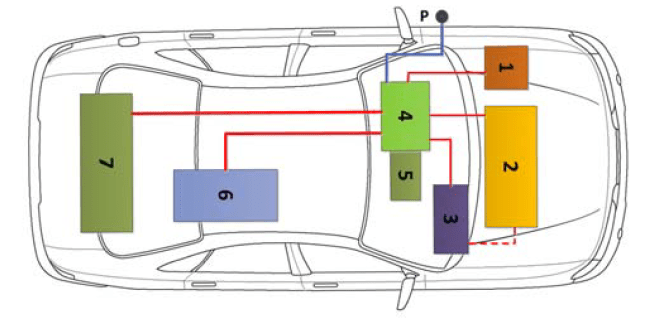
After analysis of 48V systems, author developed the concept of an extended electrical installation which integrates the 12V and 48V systems. The solution is shown in Fig.3.
The main component of the system is the Energy Distribution Control Unit (4) connected to the bidirectional DC/DC converter (5). The energy sources are lithium-ion batteries (7), 12V lead-acid battery (1) and supercapacitors (6). Additionally it is possible to charge the battery system using an alternator (3) driven by petrol engine (2). Energy Distribution
Control Unit functions:
• integration of 12V and 48V systems, • DC/DC converter control, • battery charge level calculation • diagnostics of battery systems, • battery charging process control, • charging interface (Plug-in), • supervision of circuit overload protection using eFuse and regular fuses (redundancy of over current protection), • cell balancing (active and passive balancers), • diagnostics of electrical circuits and components.
This concept can be applied to electric and hybrid cars. In electric vehicles, the motor operates as load, but it is also possible to work in a generator mode. In vehicles with petrol engines the alternator works as a source of electric energy. This concept includes cooperation with the efficient lithiumion cells that during operation require a balancing process. Implementing these features allows to integrate BMS (Battery Management System) with Energy Distribution Controller.
The concept of integrating electrical systems involves the use of conventional lead-acid battery, it is a relatively cheap type of power source and can supply components at low ambient temperatures. Typical process is petrol motor start up (high current efficiency at low temperatures). Components such as electric turbochargers require additional power sources to supply large amount of power in a short time. Author in his concept predicted the possibility of using supercapacitor batteries that could supply energy to selected components. The concept of this system includes the use of additional optional power sources. Example is electric retarder that allows energy recovery from braking. An additional source of energy are also the solar panels that can be used in cars operating in warm climates. The integration of these energy source allows solar batteries to be charged.
The Central Energy Distribution Controller advantages:
• ability to integrate multiple energy sources, • effective protection of electrical circuits against surges and short circuits, • possibility to apply concept in electric and hybrid vehicles • redundancy in energy sources • diagnostics and active measurement of electrical circuits
Disadvantages of Central Energy Distribution Controller:
• cost of electrical system expansion, • electric system complication (power sources, electrical components, assembly elements).
In the next part of this article author will describe the integration of this Central Energy Distribution System with Power Rail.
Fig. 3. Concept of power sources decentralization (detailed description in the text)
Concept of Central Power Rail
The concept of 12V/48V installation includes Central Distribution Controller described in the previous chapter is an evolutionary solution that will improve the electrical systems in modern vehicles. It can be stated that this concept enforces application of Central Power Rail. This solution limits the number of wires and harnesses, weight of complete electric system will be also reduced. The concept developed by the author integrates the central data bus with Power Rail. The rail integrates three or more conductors (+48V, +12V, GND) which are developed for distribution of energy to the receivers.
Power Rail reduces the energy losses. Special contacts with large contact surface can directly power electrical components and equipment. The Central Power Distribution Controller allows the rail to protection against overvoltage’s and short-circuits (eFuse integration). Author’s concept allows to integrate the Power Rail with the data bus. Thanks to this solution number of transmission wires and harnesses will be limited. Integration of Power Rail and lithium-ion batteries and can deliver more energy to electric receivers located in vehicle.
Fig. 4. Power rail integration with Central Energy Distribution System – author’s conception:
1) Lead-acid battery, 2) Petrol engine, 3) Alternator, 4) Energy Distribution Control Unit, 5) Bidirectional DC/DC converter, 6) Supercapacitors, 7) Lithium-ion batteries, P) Plug-in connector
Conclusion
This article shows that electrical installations in modern vehicles need to be optimized. Measurement of energy consumption confirms that new solutions in power distribution shall be implemented in hybrid and electric cars. Concept of Central Power Controller developed by author of this article is good solution because this ECU (Electronic Control Unit) can integrate many functions and limits the number of wires and harnesses. Power Rail implementation optimizes energy distribution system and extends the data transfer system.
Implementation of Energy Distribution Control Unit concept will be described in next article after creating of Central Power Controller prototype. The effectiveness analysis of the new proposed solution will be done after laboratory tests and measurement sessions.
REFERENCES
[1] German Electrical and Electronic Manufacturers Association, 48-Volt Electrical Systems – A Key Technology Paving to the Road to Electric Mobility, Die Elektroindustrie, Frankfurt 2016, [2] Kuypers M., Application of 48 Volt for Mild Hybrid Vehicles and High-Power Loads, SAE Technical Paper 2014-01-1790, January 2014, [2] Druhm O., Die Spannung steigt, Zukunftige Bordnetzarchitekturen mit 48V, Automobil Elektronik 09- 10/2017, October 2017, [3] Ernst M., Heuermann M., Die wichtigsten Bordnetz-Trends, Elektronik Automotive Sonderheft Bordnetz, September 2014, [4] Vollmer A., 48-V-Mildhybrid, Automobil Elektronik 05-06/2016, [5] Babiel G., Bordnetze Und Powermanagment. Thermische Modellbildung fur elektrische Und elektronische Bauelemente, Springer Vieweg, Dortmund 2013, [6] Babiel G., Elektrische Antriebe in der Fahrzeugtechnik, Springer Vieweg, Dortmund 2017, [7] Reif K., Batterien, Bordnetze und Vernetzung, Springer-Verlag, Wiesbaden 2010, [8] Meyer G., Advanced Microsystems for Automotive Applications, Springer, Berlin 2011.
Author: mgr inż. Bartłomiej Tworek, Politechnika Śląska, Instytut Elektrotechniki i Informatyki, Zakład Maszyn Elektrycznych i Inżynierii Elektrycznej w Transporcie, ul. Akademicka 10, 44-100 Gliwice, E-mail: bartlomiej.tworek@polsl.pl
Source & Publisher Item Identifier: PRZEGLĄD ELEKTROTECHNICZNY, ISSN 0033-2097, R. 94 NR 6/2018. doi:10.15199/48.2018.06.30
Published by Electrotek Concepts, Inc., PQSoft Case Study: Distribution System Harmonic Evaluation, Document ID: PQS1013, Date: October 15, 2010.
Abstract: This case study presents a utility distribution system harmonic analysis evaluation. The simulations were completed using the SuperHarm program. The analysis included frequency response and harmonic distortion simulations for a 13.2 kV substation and several industrial customers with power factor correction capacitor banks. The mitigation alterative included a shunt passive harmonic filter which reduced voltage distortion levels below the specified limitations.
INTRODUCTION
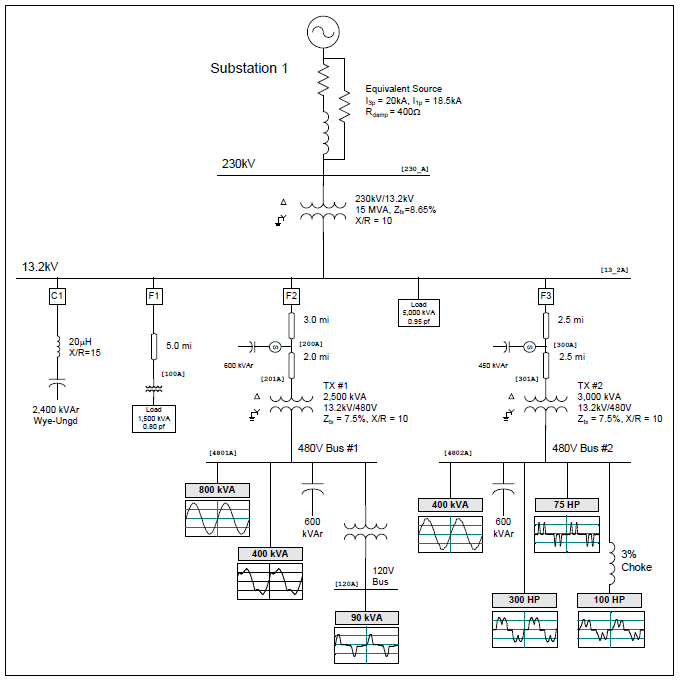
A distribution system harmonic analysis case study was completed for the system shown in Figure 1. The 13.2 kV utility substation included a 15 MVA, 230 kV/13.2 kV step-down transformer and a number of distribution feeders that supplied several industrial customers. There was a 2,400 kVAr, 13.2 kV capacitor bank at the substation bus and 600 kVAr and 450 kVAr capacitor banks on the two distribution feeders. The customer loads included 600 kVAr, 480 V power factor correction capacitor banks and a variety of nonlinear devices. The case study was completed using the SuperHarm® program. The accuracy of the simulation model was verified using three-phase and single-line-to-ground fault currents and other steady-state quantities.
Figure 1 – Illustration of Oneline Diagram for Distribution Harmonic Evaluation
SIMULATION RESULTS
Relevant utility system and customer data for the case included:
Substation capacitor bank rating: 2,400 kVAr Short-circuit capacity at the 13.2 kV bus: 168 MVA (ISC = 7.326 kA) Substation load: 5,000 kVA, 0.95 pf Feeder load: 1,500 kVA, 0.80 pf Feeder capacitor bank ratings: 450 kVAr, 600 kVAr Customer capacitor bank rating: 600 kVAr Miscellaneous linear load: 800 kVA Fluorescent lighting (ITHD = 21.7%): 400 kVA DC drive (ITHD = 35.3%): 300 hp PWM ASD (no choke – ITHD = 130.8%): 75 hp PWM ASD (with 3% choke – ITHD = 45.1%): 100 hp Switch mode power supplies (ITHD = 77.2%): 90 kVA
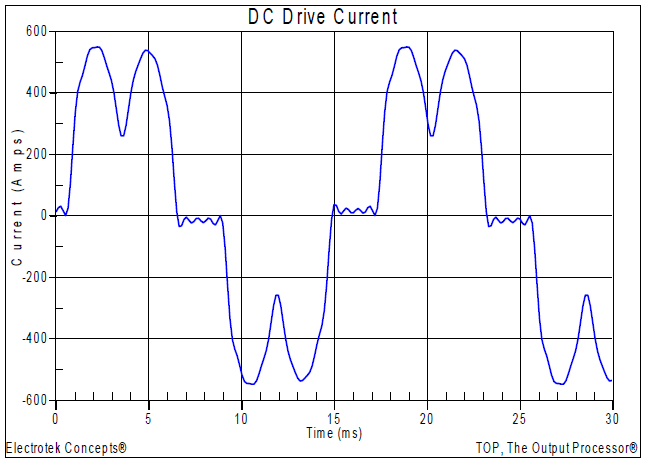
Figure 2 shows a representative simulated nonlinear load model current waveform (single phase) for the 300 hp dc drive operating at 75% power factor. The current had a fundamental frequency value of 343 A, an rms value of 363 A, and a THD value of 35.3%. The simulated waveform shown in Figure 2 was created using an inverse DFT with 256 points per cycle. The nonlinear load characteristics were determined using field measurements at the customer facilities.
Figure 2 – Customer dc Drive Current Waveform
Figure 3 shows the impedance vs. frequency simulation result with the 2,400 kVAr, 13.2 kV substation capacitor bank in service (Case 7b). The base-case result with no utility or customer capacitor banks in service (Case 7a) is also shown on the graph so the two conditions can be easily compared. The simulated parallel resonance due to the addition of the shunt capacitor bank was 504 Hz (8.4th harmonic). A simple expression may be used to validate this result:
In addition, the simulated steady-state voltage rise with the 2,400 kVAr, 13.2 kV capacitor bank in service was 1.4%. This value may be validated using the following expression:
where: hr = parallel resonant frequency (x fundamental) ΔV = steady-state voltage rise (per-unit) MVA3Φ = three-phase short circuit capacity (MVA = √313.2 kV7.3kA≈168MVA) MVAr3Φ = three-phase capacitor bank rating (MVAr)
Figure 3 – Illustration of Frequency Response with Substation Capacitor Bank In-Service
Figure 4 shows the impedance vs. frequency characteristic simulation results for the following system conditions:
– Case 7a: No utility or customer capacitor banks in-service – Case 7b: 2,400 kVAr, 13.2 kV substation bus capacitor bank in-service – Case 7c: 2,400 kVAr, 13.2 kV substation bus, 600 kVAr feeder #2, and 450 kVAr feeder #3 capacitor banks in-service – Case 7d: 2,400 kVAr, 13.2 kV substation bus, 600 kVAr feeder #2, 450 kVAr feeder 3, and both 600 kVAr, 480 V customer capacitor banks in-service
The results show that the frequency response characteristic was very dependent on the status of the utility and customer capacitor banks. The addition of the two 13.2 kV distribution feeder capacitor banks moved the parallel resonance from the 8.4th harmonic to the 6.7th harmonic (Case 7c), while the addition of the two customer low voltage capacitor banks moved the parallel resonance to the 4.6th harmonic (Case 7d). The condition also resulted in a second parallel resonance near the 9.2nd harmonic. The addition of the other capacitor banks also created new parallel resonances at harmonics between the 12th and 24th.
The simulation results illustrate the fact that the frequency response characteristic was far more complex with multiple capacitor banks in-service than the trivial base-case with just one capacitor bank in-service (Case 7b).
Figure 4 – Illustration of Frequency Response with Multiple Capacitor Banks In-Service
Table 1 summarizes the results for the four corresponding harmonic distortion simulations. The table includes the simulated voltage distortion (VTHD) levels at five buses for the four different operating conditions previously summarized in Figure 4. The voltage distortion at the customer #2 low voltage bus exceeded the commonly applied 5% limitation for the case with the 600 kVAr, 480 V power factor capacitor bank in-service (Case 7d). In addition, the voltage distortion at the 450 kVAr, 13.2 kV capacitor bank location on feeder #2 was very close to exceeding the 5% limitation.
Figure 5 shows the corresponding secondary bus voltage waveform that was created using an inverse DFT with 256 points per cycle.
Table 1 – Summary of the Simulated Voltage Distortion Results
Case Number
13.2 kV Bus
13.2 kV Feeder #2
13.2 kV Feeder #3
480 V Bus #1
480 V Bus #2
7a
0.45%
0.53%
2.09%
1.28%
4.44%
7b
0.73%
0.85%
2.01%
1.48%
4.31%
7c
1.17%
2.67%
2.99%
2.83%
4.87%
7d
1.21%
1.62%
4.87%
2.92%
9.43%
.
For the customer with the 3,000 kVA, 7.5% impedance transformer and the 600 kVAr power factor correction capacitor bank, the parallel resonant frequency on the secondary bus may be approximated using the following expression:
where: hr = parallel resonant frequency (x fundamental) XC = capacitor bank reactance (Ω) XSC = system short circuit reactance (Ω) MVA3Φ = three-phase short circuit capacity (MVA) MVAr3Φ = three-phase capacitor bank rating (MVAr) kVAtx = three-phase transformer rating (kVA) kVAr3Φ = three-phase capacitor bank rating (kVAr) Ztx% = transformer reactance (%)
Figure 5 – Illustration of 480 Volt Bus Voltage
Due the excessive voltage distortion levels at the low voltage bus, customer #2 decided to reconfigure their 600 kVAr capacitor bank as a 4.7th harmonic filter. Figure 6 shows the basic configuration of the harmonic filter, while Figure 7 summarizes the filter component and duty calculations.
When mitigation of harmonic distortion is required, one of the options is to apply a filter at the source of harmonics, or at a location where the harmonic currents can be effectively removed from the system. The most cost effective filter is generally a single-tuned passive filter and this will be true for the majority of cases. Filters should be carefully designed to avoid unexpected interactions with the system.
Passive filters are made of inductive, capacitive, and resistive elements. They are relatively inexpensive compared with other means for eliminating harmonic distortion, but they have the disadvantage of potentially adverse interactions with the power system. They are employed either to shunt the harmonic currents off the line or to block their flow between parts of the system by tuning the elements to create a resonance at a selected harmonic frequency.
Filters are generally tuned slightly below the harmonic frequency of concern. This method allows for tolerances in the filter components and prevents the filter from acting as a direct short circuit for the offending harmonic current. It also minimizes the possibility of dangerous harmonic resonance should the system parameters change and cause the tuning frequency to shift slightly higher.
Figure 6 – Illustration of a Low Voltage Single-Tuned Notch Filter Configuration
Table 2 summarizes the results for the additional case evaluating the 600 kVAr, 4.7th harmonic filter bank at the customer #2 bus. The corresponding frequency response characteristic is shown in Figure 8. The voltage distortion level at the low voltage bus was reduced from 9.43% to 2.18% with the addition of the harmonic filter. In addition, the voltage distortion at the 450 kVAr, 13.2 kV capacitor bank location on feeder #2 was reduced from 4.87% to 1.29%. This result illustrates the advantage of the passive harmonic filter by diverting a majority of the harmonic current from flowing onto the utility system.
Figure 8 shows the impedance vs. frequency simulation results with the customer #2 600 kVAr power factor correction capacitor bank reconfigured as a 4.7th harmonic filter (Case 7e). Due to the excessive component duty requirements, the low voltage capacitor bank units that were used in the harmonic filter were rated at 600 V for application on the 480 V bus. The harmonic filter component calculations are summarized in Figure 7.
Table 2 – Summary of the Simulated Voltage Distortion with a Harmonic Filter
Case Number
13.2 kV Bus
13.2 kV Feeder #2
13.2 kV Feeder #3
480 V Bus #1
480 V Bus #2
7a
0.45%
0.53%
2.09%
1.28%
4.44%
7d
1.21%
1.62%
4.87%
2.92%
9.43%
7e
0.33%
1.11%
1.29%
1.82%
2.18%
.
Figure 7 – Customer Low Voltage Filter Design Calculations
Figure 8 – Illustration of Frequency Response with a Low Voltage Filter Bank
The significant design calculations for the harmonic filter summarized in Figure 7 are shown below. The actual fundamental frequency compensation provided by a derated capacitor bank was determined using
Because the filter draws more fundamental current than the capacitor bank alone, the supplied fundamental frequency compensation may be determined using:
where: hrnew = resulting (new) parallel resonant frequency (x fundamental) hfilter = harmonic filter tuning frequency (x fundamental) XSC = system short circuit reactance (Ω) Xfilter = reactance of series filter reactor (Ω)
Passive filters should always be placed on a bus where the short-circuit impedance (XSC) can be expected to remain relatively constant. While the notch frequency is determined by the filter tuning, and will remain fixed, the new parallel resonance will move as the system short circuit impedance varies. For example, one common problem occurs in factories that have standby generation for emergencies. The parallel resonant frequency for running with standby generation alone is generally much lower than when interconnected with the utility. This may shift the parallel resonance down into a harmonic where successful operation is impossible. Filters often have to be removed for standby operation because of this. Filters must also be designed with the capacity of the bus in mind. The temptation is to rate the current-carrying capability based solely on the load that is producing the harmonic. However, even a small amount of background voltage distortion on a very strong bus may impose severe duty on the filter.
SUMMARY
This case study summarized a utility distribution system harmonic analysis evaluation. The analysis included frequency response and harmonic distortion simulations for a 13.2 kV substation and several industrial customers with power factor correction capacitor banks. The mitigation alterative applied included a shunt passive harmonic filter which reduced voltage distortion levels below the specified limitations.
REFERENCES
1. IEEE Recommended Practice for Monitoring Electric Power Quality,” IEEE Std. 1159-1995, IEEE, October 1995, ISBN: 1-55937-549-3. 2.R.C. Dugan, M.F. McGranaghan, S. Santoso, H.W. Beaty, “Electrical Power Systems Quality,” McGraw-Hill Companies, Inc., November 2002, ISBN 0-07-138622-X.
RELATED STANDARDS IEEE Std. 1159, IEEE Std. 519
GLOSSARY AND ACRONYMS ASD: Adjustable-Speed Drive CF: Crest Factor DPF: Displacement Power Factor PF: Power Factor PWM: Pulse Width Modulation THD: Total Harmonic Distortion TPF: True Power Factor
Published by Artur J. MORADEWICZ, Instytut Elektrotechniki
Abstract. The element of infrastructure that provides a connection between an electric vehicle (EV) and a depleted battery and electric source that will charge/discharge these batteries is the Electric Vehicle Service Equipment (EVSE). Recently, the interest of electric vehicles and their charging infrastructure has been the subject of extensive research and development in the world. The infrastructure for charging electric vehicles (EV) will be a key factor in ensuring a smooth transition from conventional mobility to e-mobility. The paper focuses the present charging standards and concept for future EV charging solution. The article touches the problem associated with bidirectional EV chargers which open the way for V2G technology and stationary or dynamic contactless inductive charging which open the way for automated driving EV technology. (Pokładowe i zewnętrzne ładowarki pojazdów elektrycznych).
Streszczenie. Element infrastruktury zapewniający połączenie między pojazdem elektrycznym (EV) a baterią i źródłem elektrycznym, które ładuje / rozładowuje te akumulatory, to sprzęt do obsługi pojazdów elektrycznych (EVSE). Ostatnio zainteresowanie pojazdami elektrycznymi i infrastrukturą ich ładowania jest przedmiotem intensywnych badań oraz rozwoju na świecie. Infrastruktura do ładowania pojazdów elektrycznych (EV) będzie wkrótce kluczowym czynnikiem zapewniającym płynne przejście od konwencjonalnej mobilności do e-mobilności. Artykuł skupia się na obecnych standardach ładowania i koncepcji przyszłego rozwiązania ładowania akumulatorów EV. Porusza również problem dwukierunkowych ładowarek EV, które otwierają drogę technologii V2G oraz stacjonarnego lub dynamicznego bezstykowego ładowania indukcyjnego, które otwiera drogę dla zautomatyzowanej technologii zasilania EV w czasie jazdy.
Słowa kluczowe: osprzęt elektryczny do obsługi pojazdów, ładowanie pojazdów elektrycznych, dwukierunkowe ładowarki EV, stacjonarne / dynamiczne bezstykowe ładowanie indukcyjne. Keywords: Electric Vehicle Service Equipment (EVSE), charging electric vehicles, bidirectional EV chargers, stationary / dynamic contactless inductive charging.
Introduction
The interest in electric vehicles and their charging systems is in the focus of not only large automotive companies, but also start-ups and energy companies that want to diversify their production. On 7th June 2016, Deputy Prime Minister of Poland, Mateusz Morawiecki, announced that the Council of Ministers will prepare an Electromobility Development Plan for Poland. The Electromobility Development Plan is to become one of the pillars of the Responsible Development Plan. It is expected to create conditions for the development of manufacturing and spreading of electric vehicles. The Ministry of Energy assumes that there will be 1 million electric vehicles on Polish roads by 2025. It will be the key component of the National Framework for the Deployment of Alternative Fuels Infrastructure that Member States are required to prepare under the Directive 2014/94/EU and notify to the European Commission by 18 November 2016. However, despite government support and significant progress in EV technology, there are still limitations to their massive use. These include, above all: -high price of electric cars (about 30-50% higher than its equivalent with an internal combustion engine), still small range based on one battery charging, long battery charging time, lack of developed battery charging infrastructure. Many of these problems help to solve advanced and modern power electronics. Therefore, the power electronics system has broadly entered electromobility in the area that can be broadly divided into three specific departments: the power station charging system architecture (in particular ultra-fast charging), battery charger systems themselves, and regulated electric drives with AC motors.
The solid-state transformer
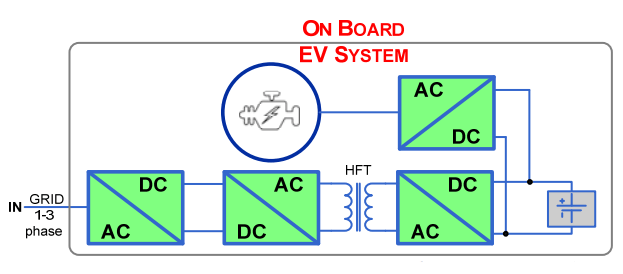
The element of infrastructure of EV chargers that provides a connection between an electric vehicle (EV) and a depleted battery and electric source, very often implemented as energy transformers in the SST arrangement [1]. The structure of solid-state transformer (Fig. 1) in many variants, we can find in many different EV chargers. The solid-state transformer (SST) has been regarded as one of the several most emerging technologies. The basic idea of the SST is to achieve the voltage transformation at high-frequency, therefore to potentially reduce the volume and weight compared to the traditional power transformer. The 50/60-Hz ac voltage is transformed to a high frequency of tens of kilohertz, by high frequency converter, then this high-frequency voltage through the high frequency transformer is transferred to secondary side to secondary side high frequency converter [2], similarly to contactless energy transfer systems. This significantly decreased volume and weight, and finally, shaped back into the desired 50/60-Hz voltage to feed the load. This is the basic idea of SST which can be denoted HVAC/LVAC (high voltage AC/low voltage AC). Usually SST transformer is realized in more complex form HVAC/HVDC/LVDC/LVAC (high voltage AC/high voltage DC/low voltage DC/low voltage AC), in which many attractive features may be potentially achieved.
The most advanced applications of SST are units which can replace traditional transformers in electrical grids. These systems are ideally suited to became building elements of Smart Grids, because they can realize:
• bidirectional power flow • change of power parameters – voltage and frequency regulation • optimized energy distribution based on communications between operator and customers • transformation of power either to AC or DC form • replacement of mechanical switches with transistors enables fast operator reaction to the disturbances and faults in energetic grid
Besides this main field of application there are many others:
• Electric car chargers (in particular modern chargers, this structure can be used in wired and wireless chargers), • Interfaces of renewable sources of energy • Active filters, • Passive power compensators, • Frequency transformers for electric motors, • Interfaces of local energy storage.
Currently, these structures are developed in Electrotechnical Institute mainly in terms of their application in EV chargers in various configurations, on-board chargers, external chargers as well as contactless chargers.
Fig. 1. Basic structure of level 2 charger with SST, power range up to 3kW
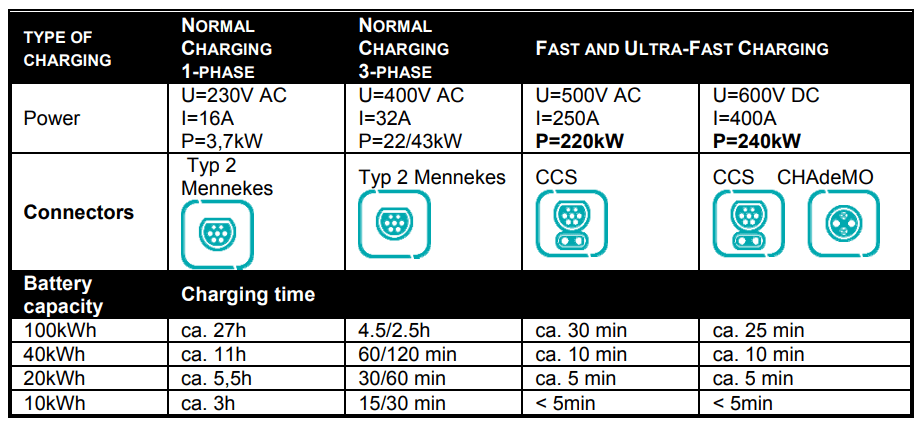
Table 1. The classification and associated parameters and types of currently used slots in the terminals wired chargers.
.
Stationary Off and On board chargers
The electrical equipment, which is required for connecting electric vehicles, and more specifically the electric vehicle battery to a power source is varied. The basic variation is the type of source: power from an alternating current (AC) or direct current (DC) source that will supply energy to the vehicle battery. Another internal division of these devices is their division due to the power of the charger, there are three levels:
AC Charging: Level 1: 120V single phase, 2kW and below Level 2: 208-240V, single phase, up to 20kW Level 3: undefined, single or three phase DC Charging: Level 1: 200–450V, 20kW and below Level 2: 200-450V, 20 to 80kW Level 3: 200-450V, above 80kW
The infrastructure for charging electric vehicles, its costs, availability and performance are very important factors that directly affect the smoothness of the transition to electromobility and have a wider application.
There are different variations of charging technology for electric vehicles, standards, requirements, different technological approaches and different charging levels (both in terms of power and time). Table 1 shows the classification and associated parameters and types of currently used slots in the terminals wired chargers [1, 8-11].
Fig. 2. Basic structure of level 2 or 3 on board system with battery management and driving system.
The basic features of the off board chargers is generally higher kW transfer and included more sophisticated BMS systems, additionally: managing battery heating, communications to building/home/grid energy management systems, demand charges, removes weight from vehicle, the higher the energy transfer rate, the higher the required EVSE / vehicle conductivity.
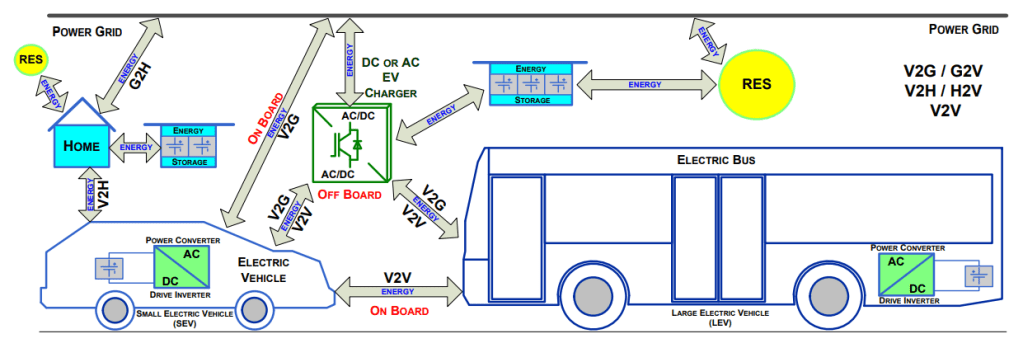
The basic features of the on board chargers is generally lower kW transfer and less concern about battery heating, BMS is managed by on board rectifier (Fig. 2). The on board chargers adds weight to vehicle. An important feature of electric vehicle chargers is if they are 2-directional, and if the energy stored in the vehicle’s battery can be transferred to the power grid, external energy storage or to another electric vehicle (Fig. 3). Vehicle to Grid (V2G) is a concept that has already been extensively described in the professional literature before EV began to appear in greater numbers on the streets of our cities. Now, however, when they are and will be more and more of them, the right cooperation EVSE and EV can become a distributed energy resource (DER) on a much larger scale and with greater significance. [3-6]. This market is just emerging, however, taking into account the number of electric vehicles and the energy stored in their batteries, will have a significant impact on system services in the power grid.
This is because the number of parked vehicles is always greater than those in motion / used. And that electric vehicles have the storage of electricity, it creates room for another and their new use. Energy storage for electric vehicles can be used by home users or large structures function as part of the power system.
Contactless chargers integrated with propulsion system
Inductive charging, also known as Inductive Power Transfer (IPT), Contactless Power Supply (CPS), Wireless Power Transfer (WPT) or Contactless Energy Transfer (CET), it is still a new technology on the market that allows users to charge PEV batteries without using a cable connection [7, 12-13]. This system consists of, among others, a charging pad (the primary side of the system installed at the power point) and the receiving pad (secondary side installed under the vehicle). Energy is transferred through a flagstone, asphalt layer, non-metallic material, water, and others.
It should be emphasized that a significant contribution to the research and development of contactless power supply systems has a sector directly related to the development of science and its applications in industry. The Electrotechnical Institute (IEL) in Warsaw has developed the 50kW contactless energy transfer (CET) system to charge large EV battery (Fig. 4). There are now working on a hybrid system combining CET system with the propulsion system. This technology, despite the initial fears, provides impressive energy transfer efficiency even for larger air gaps between the transmitter and the PEV load receiver. The successful development, implementation of wireless technology and its economical and comfortable operation is another step of its more general and broader application. Currently, work is underway on the possibility of wireless charging in the roadway (currently in separate lanes) as a method of continuous charging of the vehicle’s battery during its use on the road. Effective implementation of this technology is of particular importance to reduce the size of the battery in the vehicle, both vehicles type PEV and HEV. This explains the interest in this subject. The contactless charger of an electric vehicle is an on-board charger, thus increasing the weight of the vehicle, however, because of the numerous advantages, enjoys great interest.
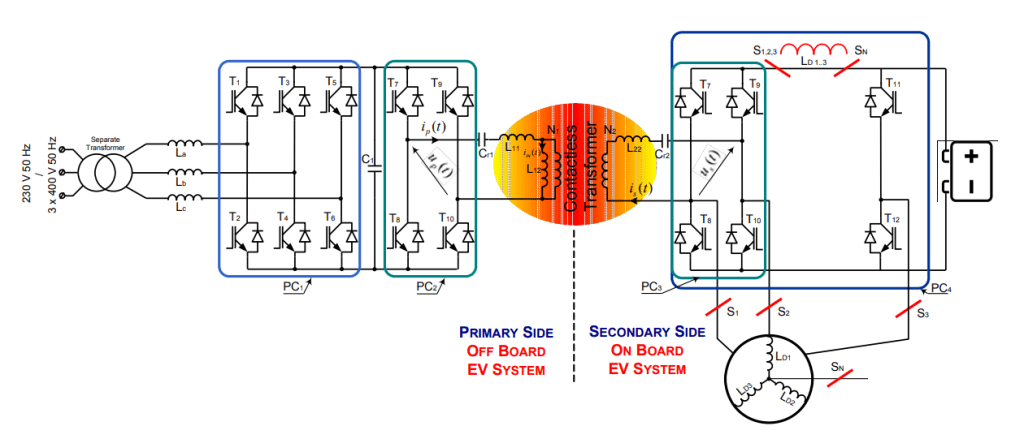
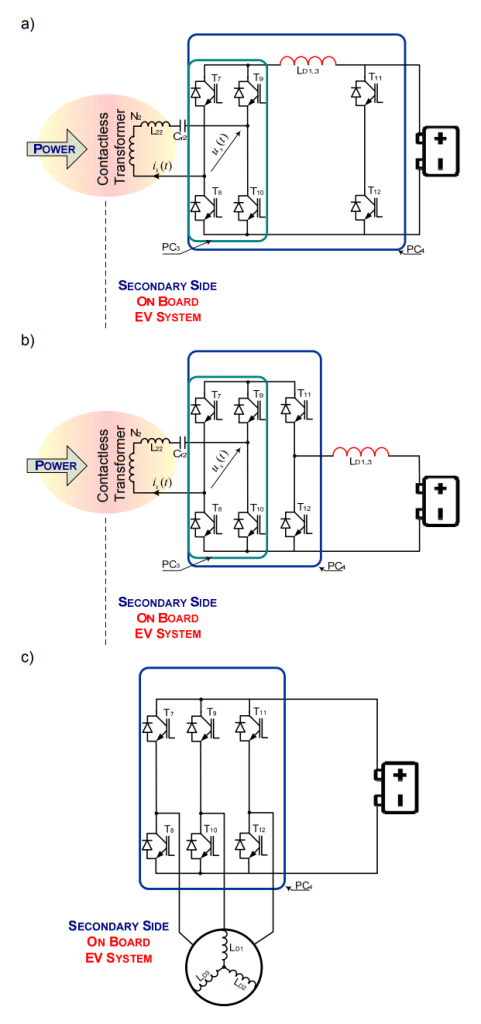
Figure 4 presents a contactless energy transfer system, whose secondary side converter is integrated with the drive inverter. The topology has supply port from single or three-phase AC source, connected by active rectifier converter PC1 as of-board part of the system. On the opposite side is the second port – energy storage as the power battery of electric vehicle. Electric motor is the third port of this concept circuit topology. The circuit should be build on the modern SiC transistors. The additional mechanical / power electronic connectors S1, 2, 3, N are required, in order to reconfigure the circuit, and switch-ON desirable operating mode. By means of appropriate configuration of the switches S1, 2, 3, N, the stator winding of the electric motor LD1, D2, D3 is disconnected or added to the circuit of the system. The topology has three operating modes that are charging and recharging mode and driving mode, PC4 converter is working. In charging and recharging operating mode converters PC2 and PC2 can operate like DAB converter. Each mode works independently. This power system should be designed to turn on or off automatically. The proposed circuit structure has two important advantages: one is galvanic insulation, the other a more convenient to use power system. The disadvantage is the more complex structure of the system due to the required additional switches. On the other hand reduce the weight of the contactless power supply system installed on board of the vehicles. The possible configurations of the structure of the system on the secondary side are shown in Figure 5. These are selected options of configuration that in the target system will depend on the type and power of the electric motor used, as well as on power electronic converters installed on the vehicle.
Fig. 3 Vehicle to Grid and Vehicle to Vehicle system multi combination topology.
Fig. 4. The structure of contactless energy transfer system topology connected to the grid and integrated with EV driving system.
Fig. 5. The structure of secondary side – possible system configurations.
Conclusions
It should be emphasized that there is currently no single applicable standard of charging used, there are commonly many types of chargers with different parameters. The easiest way to charge electric vehicles is to use an additional built-in AC charger, which is an AC / DC converter with galvanic isolation. This type of solution is often used, but only as low-power chargers. The high-capacity on-board charger would significantly increase the weight of the vehicle and limit the usable space. For this reason, the built-in AC charger is usually limited to approximately 20 kW of charging power in commercial electric vehicles. An integrated charger using a combination of drive inverter and drive motor winding for charging EV batteries also increases the total weight of the vehicle, however, it gives the user much more comfort and safety of use. Currently, IEL works on reconfigular converters PC3, PC4 and their use in electric vehicles are carried out.
This work was financed from the project: TECHMATSTRATEG1/347452/1/NCBR/2017
REFERENCES
[1] “Electric Vehicle Charging Technology Analysis And Standards”, FSEC Report Number: FSEC-CR-1996-15, [2] Xu She, Alex Q. Huang, and Rolando Burgos. “Review of Solid-State Transformer Technologies and Their Application in Power Distribution Systems”, IEEE Journal of Emerging and Selected Topics in Power Electronics, 2013 [3] Y. Fan, W. Zhu, Z. Xue, L. Zhang, Z. Zou, “A Multi-Function Conversion Technique for Vehicle-to-Grid Applications”, Energies 2015, 8, 7638-7653; doi:10.3390/en8087638, [4] M. Kesler, M. C. Kisacikoglu, L. M. Tolbert, “Vehicle-to-Grid Reactive Power Operation Using Plug-In Electric Vehicle Bidirectional Offboard Charger”, IEEE Transactions on Industrial Electronics, vol. 61, no. 12, 2014, [5] G. Buja, M. Bertoluzzo, C.Fontana, “Reactive Power Compensation Capabilities of V2G-Enabled Electric Vehicles”, IEEE Transactions on Power Electronics, vol. 32, no. 12, 2017, [6] M. Yilmaz, P. T. Krein, “Review of Battery Charger Topologies, Charging Power Levels, and Infrastructure for Plug-In Electric and Hybrid Vehicles”, IEEE Transactions on Power Electronics, vol. 28, no. 5, 2012, [7] G. R. C. Mouli, P. Venugopal, P. Bauer, “Future of Electric Vehicle Charging”, 19th International Symposium POWER ELECTRONICS Ee2017, October 19-21, 2017, Novi Sad, Serbia, [8] SAE Standard J1772, “SAE Electric Vehicle and Plug-in Hybrid Electric Vehicle Conductive Charge Coupler,” 2010. [9] SAE Hybrid Committee, “SAE Charging Configurations and Ratings Terminology,” 2011. [10] “Standard IEC 62196 – Plugs, socket-outlets, vehicle connectors and vehicle inlets – Conductive charging of electric vehicles – Part 1, 2, 3” [11] “Standard IEC 61851 – Electric vehicle conductive charging system – Part 1, 21, 22, 23, 24” [12] Gautham Ram Chandra Mouli, Prasanth Venugopal, Pavol Bauer. “Future of electric vehicle charging”, 2017 International Symposium on Power Electronics (Ee), 2017 [13] Gan Jinhao, Wang Hui, Wang Tengxin, Wang Yubin. “An integrated topology for on-board charger and driven of electric vehicle”, IEEE International Conference on Industrial Technology (ICIT), 2017.
Author: Dr Eng. Artur Jan Moradewicz, Electrotechnical Institute, 28 Pozaryskiego St., 04-703 Warsaw, E-mail: a.moradewicz@iel.waw.pl;
Source & Publisher Item Identifier: PRZEGLĄD ELEKTROTECHNICZNY, ISSN 0033-2097, R. 95 NR 2/2019. doi:10.15199/48.2019.02.30
Published by Krzysztof ZAGRAJEK, Konrad WRÓBLEWSKI(1), Piotr BICZEL(2), Łukasz SOSNOWSKI(3), Warsaw University of Technology, Institute of Electrical Power Engineering (1); Institute of Theory of Electrical Engineering, Measurement and Information Systems (2) ; Innogy Stoen Operator (3)
Abstract. The paper presents the problems of operating a fast charging station for electric vehicles in a collecting point of electric vehicle (EV) car sharing innogyGO! Authors presented measurements of the parameters of the power quality in operational conditions, and also proposed a number of tests that should be carried out to investigate the impact of EV charging on the distribution grid. Each of the analysed tests is a reflection of the real demand for charging vehicles by the end-users.
Streszczenie. W artykule przedstawiono problematykę pracy stacji szybkiego ładowania pojazdów elektrycznych działających w punkcie zbiorczym wypożyczalni pojazdów elektrycznych (EV) innogyGO!. Zaprezentowano pomiary parametrów jakości energii elektrycznej w warunkach operacyjnych, a także zaproponowano szereg testów jakie należy przeprowadzić przy badaniu wpływu ładowania EV na sieć dystrybucyjną. Każdy z analizowanych testów jest odzwierciedleniem rzeczywistych potrzeb ładowania pojazdów przez użytkowników.(Eksploatacja stacji szybkiego ładowania pojazdów elektrycznych w Warszawie – Studium przypadku punktu zbiorczego innogyGO!).
Keywords: electric vehicles, electric vehicles charging stations, e-car sharing, distribution grid operation, power quality Słowa kluczowe: pojazdy elektryczne, stacje ładowania pojazdów elektrycznych, wypożyczalnie samochodów elektrycznych, praca sieci dystrybucyjnej, jakość energii elektrycznej.
Introduction
Nowadays, the policies of governmental organisations are aimed at ensuring the development of sustainable public transport [1,2]. Under current legislation, EU member states are obliged to create a National Framework for the Development of Electromobility [3].The development of electromobility means that in the coming years, it will be a lot of tasks for distribution system operators (DSO), in terms of ensuring the adequacy of grid infrastructure [4,5]. There will be a rapid increase in the number of electric vehicles (EV) and therefore lot of challenges within creating market and technical conditions for the purchase of private battery electric vehicles (BEV), but also support and implementation of electric vehicle car sharing (EVCS). Solutions for EVCS are widely known in Europe, including Poland [6,7]. They do not always have to be based on classic passenger cars, but also on innovative concepts [8]. However, it is important to maximise the mobility of users, i.e. to allow the user to leave the vehicles at their destination (one-way Electric Vehicle car sharing). In Poland, such programmes can be used both in Warsaw (innogyGO) and in Wrocław (Vozilla) [9,10]. The best known European solution was the rental of small electric vehicles in Paris – Autolib. Unfortunately, due to financial reasons, the project was terminated [8].
Popularization of EV requires the use of appropriate incentives to purchase them. In 2019, the Polish government introduced regulations enabling these vehicles to drive on bus lanes and allowed them to park free of charge in paid parking zones, as well as prepared financial support mechanisms. Currently, these are 30% of the purchase price of EV, but not more than 8700 euros. Unfortunately, the drawback of this mechanism is the maximum purchase price of EV, which is 29,000 euros, which means that only a few cars are within the set price limit. Analysing the world literature it can be observed that the amount of the subsidy in Poland is at a comparable level to other countries at the beginning of the process of popularization of EV, however, there were no limits on the price of electric vehicles [11].
Regardless of the incentives, the number of electric vehicles in Poland is significantly increasing. Fig. 1 shows the increase in the number of EV vehicles in 2019, while Fig. 2 shows the number of vehicles newly registered in the first half of 2019 divided into EV models.
Fig. 1. Number of electric vehicles in Poland from April to October 2019 – based on [12]
As shown in Figure 2, more than half of the new electric vehicles registered in H1 2019 belong to the innogyGO electric vehicle car sharing company. Their fleet currently consists of BMW i3 and i3s. The charging of these vehicles can take place in public charging stations, but also in special parks where these vehicles are collected.
Fig. 2. New registrations of BEV electric vehicles at the end of H1 of 2019 – based on [12,13]
The aim of this paper is to examine the impact of fast charging of EV vehicles, held at the e-car sharing point, on the power quality parameters in a heavily urbanised area. Therefore, 5 tests were defined, during which power quality measurements were performed. The methodology of such tests was also developed in order to improve their accuracy.
Description of the electric grid in the studied area
The Warsaw energy network, due to its metropolitan nature, is characterized by a very high demand for power per unit of area. In densely built-up districts, especially of an office and service character, this density exceeds the value of 12MW / km2. This necessitates the construction of a dense network with a large number of stations and short lines with high capacity. The distances between the stations are small, the average distance between stations outside the city centre is 4 – 5 km, and in the city centre about 1 – 1.5 km. New HV/MV stations are built as indoor ones, with transformers with a capacity range of 25 – 63MVA installed. This allows a significant reduction in the size of the terrain and the volume occupied by the stations.
The urban nature of Innogy Stoen Operator`s area of operation, as well as the provisions of local spatial development plans meant that new lines are built as cable. In practice, these requirements apply to all voltage lines. Existing overhead lines can be upgraded leaving their overhead character if this is not the case in conflict with the current local plan (which is increasingly rare) and that is why most overall modernizations are planned as cable lines. Such kind of line – in addition to reducing the size of the area needed and reducing transmission losses – also have an important movement feature. Their bandwidth to a small extent – unlike overhead lines – it depends on the time of year. This is extremely important in today’s reality in which the summer peak power is comparable with the powers of winter peaks. Cable lines avoid the resulting problem from a decrease in the line capacity as the ambient temperature increases.
Saturation of Warsaw’s districts with a cable grid according to fig. no 3 reflects the urban characteristics of the city. Most cable lines are laid in the oldest districts, in the city centre and directly adjacent areas, i.e. Śródmieście, Ochota, Wola, Mokotów, Praga Południe, Żoliborz, Praga Północ, Targówek and Bemowo. The peripheral districts, characterized by younger buildings created in the last thirty years, have a less compact MV cable network. However, these are areas that will continue to develop intensively due to the continuous increase in the number of Warsaw residents. One should also take into account overhead lines, which practically no longer exist in the city centre, however in districts such as Wawer or Białołęka they constitute over a dozen or more percent of the total MV network, and still perform the function of distribution networks. In the near future, systematic cabling of overhead lines is planned, which will contribute to increasing the density of the cable network also in the outskirts of Warsaw.
Fig. 3. The degree of MV network cabling in Warsaw area – length of cable lines [km] per 1 km2 of district area
Methodology of research
Measurements of the operating parameters of the charging station were carried out on 18.10.2019 at the innogyGO! EVSE located at 3 Eliza Orzeszkowa Street in Warsaw. They were run from 12:21 to 13:56, during which 5 tests were conducted. The object of the tests was a charging station PRE Edward Biel EVB max DC, which parameters are presented in the table 1. The vehicle used during the tests was a standard BMW i3 belonging to the fleet of electric vehicle car sharing company, whose technical data is presented in the table 2. The measurements were recorded using a power analyser Hioki 3198 with an interval of 1 second. The figure 4 shows the timeline with the tests performed.
Table 1. The parameters of PRE Edward Biel max DC charging station
Parameter
PRE Edward Biel max DC
Rated input voltage
230/400 V
Rated insulation voltage
500/690 V
Rated frequency
50 Hz
Surge voltage withstanding
8 kV
DC charging power
50 kW
DC output voltage:
50 ÷ 500 V DC
DC output current:
0 ÷ 125 A
Efficiency of DC systems:
95%
.
Table 2. The technical data of BMW i3 [14]
Parameter
Technical Data
Type of electric motor
Synchronous AC
Power of the electric motor
125 kW
Battery type
Lithium-ion battery
Battery voltage
360 V
Battery capacity
42 kWh
Range
260 ÷ 280 km
Energy consumption
0,11÷ 0,15 kWh/km
.
Fig. 4. Timeline of conducted tests
As shown in Fig. 4, the first step was to prepare the measuring station so that the measurements could be made at the output of the charging station on the AC side. The single line diagram of the measurement system is shown in the figure 5. The first test (Test 0) concerned the verification of the conditions of operation of the DSO grid. As a result, a benchmark for further analyses was obtained. During Test 0, the work of the charging station was also checked in the no-load condition and also during the process of synchronization with the vehicle. The next measure performed was Test 1, i.e. 10-minute charging of an electric vehicle. The aim of this research is to check the impact of short charging on the DSO grid, which could represent the charging of EV during short break in travel. The vehicle had a deeply discharged battery, i.e. its State of Charge (SOC) was very low and amounted to 3%. The next test (Test 2) was to perform a regular charging of the electric vehicle, i.e. from the state of SOC = 25% to 85%. This represents a typical charging that can take place while staying at a workplace, shopping mall or P&R parking lot. The electrical parameters of the charging station were then checked for compliance during a sudden power outage (Test 3). In the first part of this test, the power supply was switched off by means of an emergency button and then, after about 2 minutes, the power supply was switched on again. Therefore, it was possible to simulate a situation in which the power lines could be damaged or a sudden loss of voltage could occur, and then the power supply from the DSO was restored. The last test (Test 4) was to check the operating parameters of the charging station when trying to charge the vehicle to its maximum charge before a long journey, i.e. charging it to SOC = 100%. According to the available knowledge, this charging process should be in Constant Voltage (CV) mode, as opposed to 25% to 85% in Constant Current (CC) mode [15].
Fig. 5. Single line diagram of LV substation at Orzeszkowa Street
The following parameters were analysed during the tests:
• Phase voltages and currents; • Power factor cosφ; • Total harmonic distortion of voltage and current
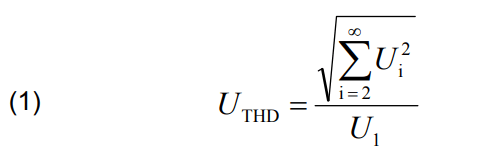
(4) THD = √Σnk=2 U2k / U1
• Long-term and short-term flickering nuisance; • State of charge of EV battery (reading from the on-board compute
Results
The tests were carried out on 18.10.2019 from 12:21:10 to 13:56:08. The BMW i3, with an initial SOC of 3%, was used for the tests. The figure 6 shows the EV charging profile with the SOC level recorded. Based on the fig.6, the registered charging process seems to be typical (Level 2) for a DC fast charging station. The maximum charging power was 33 kW. This means that the charger has a load limit of 66% of the rated power (50 kW). The charging process lasted 1 hour 30 minutes, with about 55% of the time when the battery level (SOC) increased from 3% to 85%. The last charging phase, the so-called constant voltage (CV) charging, took about 40 minutes. At the end, the SOC level was 100%, which means that the EV was fully charged. The second phase is characterized by a decreasing current, and thus charging power, with increasing SOC.
Fig. 6. Measurements of charging power and SOC of EV during whole test
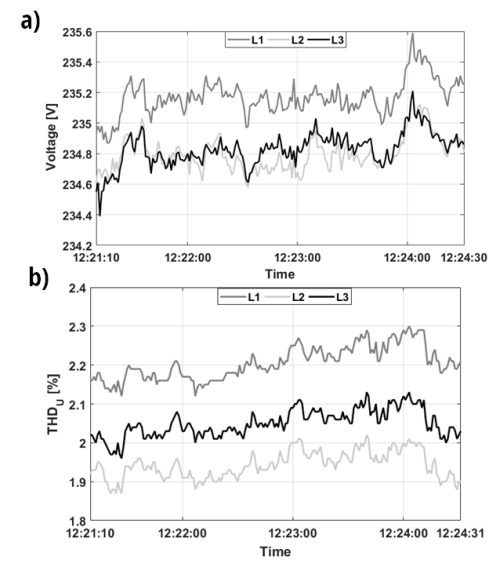
The first part of the research, i.e. Test 0, concerned the study of the operating conditions of the DSO grid, in the case when the EVB max DC charger was working in no-load state. Figure 7 shows selected measurements recorded during the test. As can be seen from the figure 7, the operation of the no-load charger does not interfere with the operation of the power grid. The recorded values of the voltage total harmonic distortion (THDU) slightly exceed 2% (despite recording measurements with 1-second interval). It should be expected that the recorded values of the aforementioned coefficient may come from the distribution network to which 5 EVB max DC chargers have been connected in its immediate vicinity. Due to the proximity of the DSO MV substation, the measured values of the phase voltage are slightly higher than the rated ones.
Fig. 7. Test 0 – Measurements of phase voltage (a) and THDU (b)
The second part of the measurements, i.e. Test 1, concerned the study of the impact of short-term charging on the DSO grid, as well as the observation of the increase in the level of SoC in the EV vehicle. The test lasted 10 minutes and the exemplary measurement values are shown in Figure 8. Based on Fig. 8a it was confirmed that the charger has a capacitive character. During a 30 kW charge, the reactive power generation was a maximum of 8 kVar. This means that the station operated with the power factor within the range of cosφ = 0.96 – 0.99, so in accordance with the applicable polish regulations [16]. Based on Figure 8b, it can be observed that during the 10-minute charging of the EV, the phase voltage limit values were not exceeded (recorded values of 235 V). The THDU (Fig. 8c) recorded during this test, as well as the harmonic voltage spectrum, allow to state that the limits forced by Polish law were not exceeded [16].
Fig. 8. Test 1 – Measurements of reactive power (a), phase voltage (b) and THDU (c)
The next part of the test (Test 2) was to perform a typical charging of an electric vehicle from the level of battery charge of SoC = 23.5% to the level of SoC = 85%. The test started at 12:35:01 and lasted till 13:16:00. Chosen measurement values are shown in Fig. 9. Based on Fig. 9a it can be observed that in the period from 13:09 to 13:16 the value of reactive power generation and thus the power factor cosφ slightly decreases (from 8 kVar to 5.5 kVar). However, it can be stated that these are transition states, resulting from the synchronization of the power electronic systems, and the device still maintains the capacitive character of the work. Based on fig. 9b it can be stated that the obtained values of phase voltages during the whole time of Test 2 were at the level of 235 V. These values are similar to those obtained in previous tests. Similar results were also obtained for the voltage total harmonic distortion analysis (Fig. 9c).
Fig. 9. Test 2 – Measurements of reactive power (a), phase voltage (b) and THDU (c)
The aim of the next test (Test 3) was to check the impact of a sudden disruption of the charging station’s power supply on the occurrence of potential violations of power quality parameters. Test 3 consisted of two parts – switching off the power to the charging station by using the emergency button and then, after a few minutes, reenergizing the power supply. In the case of the first part, the 6-second interval (13:16:22 ÷ 13:16:27), in which the process of switching off the power supply took place, was analysed. The analysed section contains the operating status of the charger just before switching off the voltage (2 sec.), the moment of switching off the voltage, as well as the status after switching off the power supply (3 sec.). In the case of the second part, the 5 second interval (13:17:55 ÷ 13:17:59), during which the power supply to the charging station was restored, was analysed. Fig. 10 shows the Total harmonic distortion of voltage and current during switching off and on the charging station. In Fig. 10a it can be read that during the dynamic state voltage disturbances occurred (introduction of higher harmonics). Interestingly, the phenomenon was recorded only for phase L3. Probably the recorded disturbances could have originated from the devices of the charging station’s auxiliaries. During the analysis of the current total harmonic distortion (THDI) (Fig. 10b), values of several hundred percent were observed. This is probably a transitional state of gradually disconnected power electronic devices. As in the case of part 1 of Test 3, high values of the THDI factor were observed (Fig. 10d). THDU values do not exceed the limit values (Fig. 10c), i.e. they are within the ranges defined in the EN 50160 Standard [17]. It should be noted that the existing regulations refer only to 10-minute measurements, and the conducted measurement were recorded with a 1-second interval.
Fig. 10. Test 3 – Measurements of THDU during switch off (a), THDI during switch off (b), THDU during switch on (c) and THDI during switch on (d)
The last test carried out (Test 4) involved charging the EV vehicle to reach the battery charge level, according to the readings from the on-board computer, SOC= 100%. Test 4 was performed from 13:18:00 to 13:56:08. The measurements were started when the BMW i3 on-board computer showed SOC= 85%. Fig. 11 shows the selected parameters recorded during Test 4.
Fig. 11. Test 4 – Measurements of reactive power (a), phase voltage (b) and THDU (c)
Figures 6 and 11a show that the EV charging in Test 4 is done mostly in constant voltage mode (CV). A significant decrease in the charging power was observed in the last phase of the test when the SOC reaches about 90% (according to the on-board computer). This is close to 80% of the rated capacity of the battery, which would confirm the change in the charging mode – from constant current (CC) to Constant voltage (CV). Moreover, it should be noted that the process of charging from the level of SOC = 90% to the level of SOC = 100% took more than 30 minutes. This confirms the theoretical assumptions of the charging mode of lithium-ion batteries in constant voltage (CV) mode [15]. Based on Fig. 11a, it can be observed that during battery charging, the charging power consumption is gradually reduced with a constant level of reactive power. As a result, the power factor while charging the battery to the maximum level gradually decreased. After 13 minutes of charging it was only cosφ = -0.8, after 27 minutes cosφ = -0.4, to reach cosφ ≈ -0.25 at the end of charging, after 35 minutes from the beginning of the test. The values of phase voltages during the reduction of the charging power increase from 235 V to 236.5 V (Fig. 11b). The THDU values for all three phases oscillate around 2% (Fig. 11c).
Conclusion and discussion
The paper presents the results of measurements in operational conditions of the fast charging station of electric vehicles operating in the collecting point of electric vehicles car sharing company – innogyGO! Based on them it can be stated that there were no significant violations of the limit values in the field of power quality parameters. The values of phase voltages as well as the THDU factor did not differ from those in the EN 50160 standard. From the obtained measurement results it can be noticed that the control of the THDI factor, especially in dynamic states, will be a big concern. The measurements confirmed that EVs are being charged according to theoretical assumptions, which will allow easier planning of network traffic through DSOs. Nevertheless, the process of implementing electromobility in the municipal power grid is a huge challenge for the Distribution System Operators.
The inclusion of vehicle charging systems in the distribution grid and ensuring continuity of supply to customers also imposes on distribution system operators a number of new challenges related to the expansion of the network as well as providing consumers with energy supplies in a continuous manner and with appropriate parameters. Another task for the DSO resulting from the implementation of vehicle charging stations in the low voltage grid is the need for dynamic reconfiguration of the power network. Making the right switching decisions requires the use of Smart Grid technology, including the collection of remotely transmitted data and their analysis.
The dynamic development of vehicle charging systems will not be possible without progress in the construction of charging stations adapted for two-way energy flow, but also will not be possible without changing the habits of electric vehicle users and changes in legislation correlated with this phenomenon.
REFERENCES
[1] Croce A., Musolino G., Rindone C., Vitetta A., Sustainable mobility and energy resources: A quantitative assessment of transport services with electrical vehicles, Renewable and Sustainable Energy Reviews, 113 (2019), no. 109236 [2] Letnik T., Marksel M., Luppino G., Bardi A., Božičnik S., Review of policies and measures for sustainable and energy efficient urban transport, Energy, 163(2018), pp. 245-257 [3] Directive 2014/94/EU — deploying the EU’s alternative fuels infrastructure [4] Ma T., Mohammed O., Optimal Charging of Plug-in Electric Vehicles for a Car-Park Infrastructure, IEEE Transactions on Industry Applications, 50 (2014), no. 4, pp. 2323-2330 [5] Khan W., Ahman F., Alam M., Fast EV charging station integration with grid ensuring optimal and quality power exchange, Engineering Science and Technology, an International Journal, 22 (2019), no.1, pp. 143-152 [6] Firnkorn J., Muller M., Free-floating electric carsharing-fleets in smart cities: The dawning of a post-private car era in urban environments?, Environmental Science & Policy, 45 (2015), pp.30-40 [7] Pieriegud J., Zawieska J., Mobility-as-a-service – global trends and implementation potential in urban areas in Poland, Transport Economics and Logistics, 79 (2018), pp. 39-51. [8] Mounce R., Nelson J., On the potential for one-way electric vehicle car-sharing in future mobility systems, Transportation Research Part A, 120 (2019), pp. 17–30 [9] InnogyGO e-car sharing, [online], https://innogygo.pl/pl [access:17.12.2019] [10] Vozilla e-car sharing, [online], https://www.vozilla.pl/ [access:17.12.2019] [11] Palmer K., Tate J., Wadud Z., Nellthrop J.,Total cost of ownership and market share for hybrid and electric vehicles in the UK, US and Japan, Applied Energy, 209 (2018), pp. 108–119 [12] Polish Alternative Fuels Association, Electromobility meter in Poland (in Polish), [online], http://pspa.com.pl/aktualnosci [access: 17.12.2019] [13] Samar, Results of sales of electric cars in Poland in the first half of 2019 (in Polish), [online], https://www.samar.pl/__/3/3.a/104111/3.sc/11/Firmyratuj%C4%85-sprzeda%C5%BC autelektrycznych-.html?locale=pl_PL [access: 17.12.2019] [14] Technical data of BMW i3, [online], https://www.bmw.pl/pl/allmodels/bmw-i/i3/2013/at-a-glance.html, [access: 17.12.2019] [15] Jiang L., Li Y., Huang Y. et al., Optimization of multi-stage constant current charging pattern based on Taguchi method for Li-Ion battery, Applied Energy, 2019, (article in press), https://doi.org/10.1016/j.apenergy.2019.114148. [16] Regulation of the Minister of Economy on detailed conditions for the operation of the power system (in Polish), Journal of Laws No. 93, item 623 [17] European Standard EN 50160:2010 Voltage characteristics of electricity supplied by public distribution systems
Authors: mgr inż. Krzysztof Zagrajek, Politechnika Warszawska, Instytut Elektroenergetyki, ul. Koszykowa 75, 00-662, Warszawa, E-mail: krzysztof.zagrajek@ien.pw.edu.pl; mgr inż. Łukasz Sosnowski, innogy Stoen Operator, ul. Piękna 46 00-672 Warszawa, E- mail:lukasz.sosnowski@innogy.com; dr hab. inż. Piotr Biczel Instytut Elektrotechniki Teoretycznej i Systemów Informacyjno-Pomiarowych ul. Koszykowa 75 00-662 Warszawa; inż. Konrad Wróblewski, Politechnika Warszawska, Instytut Elektroenergetyki, ul. Koszykowa 75, 00-662, Warszawa, E- mail: konradw@post.com;
Source & Publisher Item Identifier: PRZEGLĄD ELEKTROTECHNICZNY, ISSN 0033-2097, R. 96 NR 5/2020
Published by Sampsa KUPARI, Metropolia, Helsinki University of Applied Sciences
Abstract: The electrical vehicle form a huge load (and occasionally a generator as well) that is not resistive but possibly of nonlinear character. This may have an effect on distribution network power quality and possibly disturb seriously other consumers. If this is not taken care of before expansion of electrical vehicles boom, serious damage may occur.
Streszczenie. Ładowanie akumulatorów samochodów o napędzie elektrycznym stworzy bardzo duże obciążenie o nieliniowym charakterze, co może oddziaływać na jakość energii w sieci oraz stanowić poważnie zagrożenie dla innych odbiorców energii. Analiza tego zagadnienia przed powszechnym wprowadzaniem pojazdów o napędzi elektrycznym pozwoli uniknąć szeregu poważnych problemów w przyszłości (Wpływ wprowadzenia pojazdów o napędzie elektrycznym na jakość energii w sieciach rozdzielczych).
Keywords: Power Quality, THD, rectifier, harmonic Słowa kluczowe: Jakość energii, THD, prostownik, harmoniczne
Introduction
Demand on electrical vehicles will definitely increase in the future in order to reduce CO2-emissions and increase the use of renewable energy as well. Fossil energy sources will peter out and gasoline will get more and more expensive before it’s getting to end. If a moderate prized battery will be introduced, the amount of electrical vehicles will explode. The huge amount of electric cars includes big energy recourse and beside of charging it may be used to feed electricity in the network as well. Impacts to network power quality will be quite similar in both cases concerning harmonic but voltages drops will turn out to be voltage surges in some cases. It is possible that EN 50160 [1] limits will not always be met because of this trend.
Load size
Rectifiers can be dimensioned in different ways, but probable basics for dimensioning will be size of feeding fuse. Probably the maximum power will be utilized when charging vehicles because then the charging time will be shortest. However in many cases maximum is one phase supply with 10 A fuse. Therefore maximum charging power is 2.3 kW. If car is driven averagely 50 km a day, it needs roughly 10 kWh, which yields to four hour charging time. There are a big amount of uncertainties but assuming that 40 % of cars may be plugged between 4 pm and 10 pm to network. If, using Finland, as example this roughly yields with it’s 2,12 million passenger cars to maximum power of P = 2.000 MW when assuming statistically all cars are not loaded simultaneously. Annual peak power is roughly Pm = 15.000 MW, so this can be considered as a remarkable increase. However, this peak power normally occurs in winter mornings, so the need of power plant capacity is not increased accordingly. If designed intelligently, these vehicles can be used to feed network as well. Both cases are problematic because of the character of load being not resistive but non-sinusoidal. Load represents roughly 15 % of maximum load. Hence load may be considerably higher in other countries.
Load character
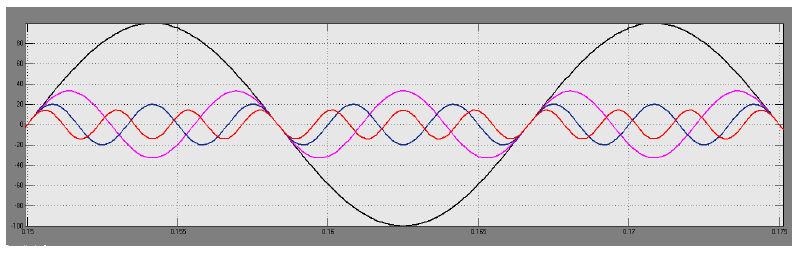
It is not known yet which kind of charges will be assembled to future electrical vehicles. Here two different types are studied to find limits which can be reached [2]. Harmonics of voltage and current are shown in table 1 as well currents in table 2. Current includes a big amount of harmonic currents but is typical of semiconductor devices. Harmonics of voltages are of illustrative character only, while these figures will depend on supply network properties too [2].
Fig. 1. Charging current of example vehicle A and corresponding voltage of supply
Table 1. Harmonics at supply voltage
u1 [%]
u3 [%]
u5 [%]
u7 [%]
uTHD [%]
100
2,1
1,0
0,7
2,1
.
Table 2. Harmonics at supply current
i1 [%]
i3 [%]
i5 [%]
i7 [%]
iTHD [%]
100
79,5
48,0
19,0
95,0
.
Other charger properties (vehicle B) are shown on figure 2.
Fig.2. Charging current of example vehicle B and corresponding voltage of supply
Network harmonics
A small amount of cars to be charged do not disturb network as seen on table 1, where harmonic content is remarkably lower than accepted by standard EN 50160. But when a greater amount of chargers will be plugged impact will be bigger. Basic frequency voltage will of course have some sag as with resistive load, too. But harmonic currents will flow to network and they meet network impedance Xi (resistance neglected here). That is considered linear with frequency which yields that capacitor banks are not connected. In some cases they may cause resonances and simulation numerical values shown later might be remarkably higher. If introducing Un = 20 kV supply with short circuit current Ik = 5 kA, we can define network impedance on secondary Un = 400 V side to be XQ1 = 0,4 mΩ, Sn = 1000 kVA impedance typically has XT1= 8,8 mΩ. Totally impedance on frequency f1 = 50 Hz can be considered to be X1 = 9,2mΩ. A simulation of load degree of 50 % is studied with results shown in table 3.
Table 3. Harmonics at transformer secondary
i
Ii [A]
Xi [mΩ]
Ui [V]
1
721,7
9,2
6,6
3
685,6
27,6
18,9
5
346,4
46,0
15,9
7
137,1
64,0
8,8
.
This will cause total harmonic content
.
which gives UTHD = 11, 4 %, that is far too high comparing to standard EN 50160, where THD is defined to be at maximum 8,0 %. Individual values at f3 = 150 Hz and f5 = 250 Hz values are too high even the load is only 50 % of transformer’s nominal value. Percentages are shown in Table 4. High amount of third harmonic caused a big circulating current in Dy-coupled transformer’s windings and additional warming [3].
Table 4.Harmonics at transformer secondary
i
Ui [A]
Ui [mΩ]
UENi [V]
1
6,6
2,9
–
3
18,9
8,2
3,0
5
15,9
6,9
6,0
7
8,8
3,8
5,0
.
Effects on voltage distortions are presented in picture 3, where transformer secondary voltage at half load is presented.
Fig.3. MathCadvoltage presentation of simulated values for 50 % loading of transformer with nonlinear load
These values are too high to be accepted. Therefore maximum loading of transformer could roughly be 30 % of nominal and that would cause quite high harmonic content, too.
Transformer loading
Beyond harmonic content loading of network component is essential too. Using semiconductor loads nominal loading can’t be reached, but it is lower. Transformer loading can be approximated as well [3]:
.
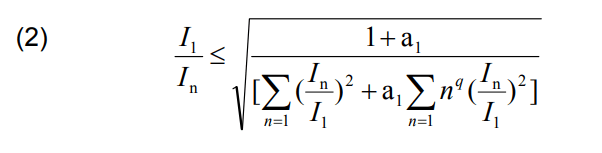
Constant “a” stands for skin effect and “q” for corresponding increase of resistance. Constant “a” values are known to some degree, but values for “q” are unluckily not generally available. Hence use of this formula is not exact, but it gives some approximations. This normally yields that the active power of transformer nominal may be at highest roughly 75 %. This means that network component will be higher and life-cycle of them shorter.
Financial value of these effects is not easy to define, but it is not negligible. However, transformer secondary power quality begin to be at standard maximum roughly at 30 % loading supposing no other nonlinear load is coupled simultaneously. Even this may lead to problems for other users.
These problems can be solved to some degree by harmonic filtering, but it can be considered as a quite expensive act. And need of reactive power is minimal with these rectifiers, so power factor may become strongly capacitive and it may be a technical problem and in many cases tariffs may cause excessive bills for users. Active harmonic filtering is technically a better solution, but investment cost is considerably higher. Normal power factor correction is not possible even if necessary, if transformer secondary is used for electrical vehicle charging.
Rectifier properties
Simulations before have been calculated using typical rectifier that represents practically the worst case. If applying the other type that is much more close to sinusoidal character effect to power quality is much smaller. Future is unknown but using these two variations it may be concluded that using very basic type of rectifier, effects on power quality may be very serious and cause difficulties in power distribution and especially by consumers.
Conclusions
Number of electrical vehicles will increase greatly in the future. This will cause need of distribution network strengthening, but if using simple rectifiers when charging cars it may lead to serious problems in power distribution and for consumers. Solving this problem in distribution network is possible but expensive. If using more complicated rectifiers, these problems can be avoided to great degree. This is possible only if these requirements are considered in standards. Hence it is important that future standards in this area will handle these questions in the way problems will be avoided.
REFERENCES
[1] Standard EN 50160: 2009: Voltage Characteristics in Public Distribution Systems [2] Pöllänen Minna: „Power Quality in Charging Elecric car” BSc thesis, Metropolia University of Applied SciencesHelsinki, Finland, 2011. [3] Dugan, McGranaghan, Beaty: 1996:Electrical Power System Quality, McGraw-Hill
Author: msc, ee, eur.eng Sampsa Kupari, Metropolia University of Applied Sciences in Helsinki, Albertinkatu 40-42, 00180 Helsinki, Finland, E-mail: sampsa.kupari@metropolia.fi
Source & Publisher Item Identifier: PRZEGLĄD ELEKTROTECHNICZNY (Electrical Review), ISSN 0033-2097, R. 88 NR 6/2012
Published by Alexander ABRAMOVITZ1, Volodymyr YASKIV2 , Keyue SMEDLEY3, Sami Shamoon College of Engineering (1), Ternopil Ivan Puluj National Technical University (2), University of California (3)
Abstract. Generation and transfer of electrical energy can severely degrade the environment. The necessity of joint research in the field of high-frequency power converters with power factor correction to protect the environment from the electromagnetic pollution was discussed. Current state of law and research in several countries was presented. Passive and active correctors and the idea of new topology for power factor correction were described.
Streszczenie. Działalność człowieka na polu wytwarzania energii elektrycznej powoduje znaczącą degradację środowiska naturalnego. Główny przedmiot zainteresowania przedstawiony w artykule dotyczy analizy wpływu współczynnika mocy na efektywność transferu energii elektrycznej od wytwórcy do końcowego odbiorcy. Przedstawiono stan prac legislacyjnych oraz badawczych w różnych krajach ze szczególnym uwzględnieniem Ukrainy. Opisano dwa typy korektorów, pasywny i aktywny oraz główne założenia dotyczące nowej, projektowanej topologii korektorów współczynnika mocy. (Korekcja współczynnika mocy jako właściwy krok w kierunku bezpieczniejszego środowiska).
Keywords: Power Converter, Power Factor Correction , High-Frequency Magnetic Amplifier, One-Cycle Control. Słowa kluczowe: przetworniki energii, korekcha współczynnika mocy, wzmacniacz magnetyczny.
Introduction and background
Today it is widely recognized that human activities make a strong environmental impact. Safe existence and well being of mankind and other life on our planet depend on quality, reliability and efficiency of our power systems. Pollution of coal and nuclear power generation plants is a major threat to the environment. Along with improving the efficiency of power generation and distribution systems the power consumption practices should be improved as well. Consumers are an essential part of any power system and play a major role in the game. Proper use of power and energy is consumers’ liability.
Electronic systems are the fastest growing electrical energy consumer market. IT and Telecom systems are found everywhere in military installations, industrial plants, office environment and every household. Most of electronic systems relay on the utility for power. Though the power consumption of a single electronic appliance is quite low, the accumulative effect of electronic appliances makes a profound impact on the grid. It is estimated that about half of power generated in US is processed by some kind of electronic system. As a matter of fact, simple rectifier stages of the old generation electronic power supplies, industrial phase controlled rectifiers and even the fluorescent lighting are main contributors to the harmonic pollution of the utility. Harmonic currents injected into the utility cause high frequency interference problems, increased conduction losses and increase transformer core losses. Harmonics may also cause resonance and increased failure rate of capacitors due to isolation breakdown. These factors decrease the reliability and efficiency of power distribution system.
An extreme case of power quality failure is the notorious New York outage of 2003 when a major power outage struck simultaneously across dozens of cities in the eastern United States and Canada costing millions in damages. However, less damaging power quality disturbances may appear daily. Some of more common utility disturbance types of are the sags, swells, surges and interruptions. In our age, electrical and electronic equipment and especially IT and Telecom systems play an ever-growing role in governing of our society. Once a utility disturbance causes a mis-operation of the IT equipment, our society relies on in our daily lives, it can take a heavy toll on our personal as well as our business life. In extreme cases power quality failure can disrupt the civil order causing severe damages.
Power Factor (PF) is a measure of how efficiently electrical power is consumed. While the ideal PF is unity, in reality power factor of highly inductive or nonlinear loads is about 0.7 or even less. For these reasons, recent regulations in US and EU have made Power Factor Correctors (PFC) a mandatory utility interface stage of next generation power supplies. The task of an ideal PFC is to draw pure sinusoidal line current in phase with the line voltage as well as automatically regulate and protect the output. An ideal PFC system should operate with a unity power factor drawing no harmonic line current. As a result, the power generation plants and distribution systems can operate with lower rms currents, higher efficiency and, therefore, with fewer emissions and lower pollution footprint. Furthermore, a power supply with the PFC interface can tolerate and ride through sags, swells and surges and provide reliable power to operate the IT and Telecom equipment. PFC is also expected to provide protection functions as well as some hold-up time sufficient for systems’ emergency data save and shut down during line voltage interruptions.
Hence, low power quality practices have a destabilizing environmental and economical effects whereas, high quality/low harmonic power consumption is beneficial to the environment and secure wellbeing of our society. To combat the issues of power quality, the industry requires new technological solutions. Scientists and researchers around the world are engaged in research of new theoretical approaches to PFC problem. Existing high quality power supplies attain their characteristics by rather complicated schemes. These are high-tech feedback systems which are costly to build. And, due to the sheer numbers of IT or Telecom consumers, power quality comes at a considerable cost. Commercial industries are striving to be competitive and thus are eager for better products. Hence, more research effort is required to develop simple, cheaper and reliable technological solutions which can provide good performance at affordable cost.
State of the art of the topic
a) Current State of the Technology
According to the operating principles PFC’s can be classified as passive or active [1, 2].
Passive PFC relay on heavy filtering of the input current. The main advantage is that there is no pre-regulator stage. Such an approach can provide reasonably good quality current, very low EMI and also good reliability.
However, the passive elements of the filter are oversized and excessively bulky.
Active PFCs are designed around high frequency converters. Good quality of the input current is obtained by a pre-regulator stage, whereas, the second stage provides tight output voltage regulation. The two-stage schemes offer several advantages: sinusoidal line current and compliance with IEEE regulations; good performance under widely varying universal line voltage; isolation can be provided by the output stage; hold-up time can be provided by a proper choice of the first stage capacitor; easier design of the second stage. The main disadvantages of the two stage PFCs are: cascade connected scheme lowers the overall efficiency; overall increased size, weight and cost.
According to the shape of the input current Active PFC’s may be further classified in two major groups: PFC with sinusoidal current and PFC with a near-sinusoidal input current.
Actually, IEEE regulations does not require an absolute zero harmonic content and unity power factor as these objectives would be very difficult to achieve. To be practical, both IEEE 519 and IEC 1000-3-2, permit a certain amount of distortion in the line current. Accordingly, several simple schemes of one stage PFC with reduced component count and a single control loop were proposed in literature. Mainly for low power range applications.
Some other PFCs with the near-sinusoidal current operate in the discontinuous conduction mode (DCM). As in DCM some converter topologies draw input current which shape crudely follows the line voltage. The practical meaning of this is that the input current may not be actively controlled and only a single voltage control loop is required. However, the near sinusoidal line current translates as some amount of distortion. This type of PFC is also limited by regulations to low power level. Moreover, due to relatively high input current ripple the EMI filter size, cost and weight are relatively large.
PFCs with active current shaping can achieve much better quality of the input current. This means lower distortion. These PFCs are generally designed using Boost converter in the continuous conduction mode. Boost power stage is perhaps the most popular converter used in a single phase PFCs due to its simplicity, low part count and inherent ability to generate a sinusoidal input current. However, when operated from the line voltage, the Boost converter generates high output voltage with significant output ripple. The high output voltage increases the switching losses of the semiconductor devices and penalizes the efficiency especially in low power applications. Snubbers can be used to improve the efficiency but also increase the circuits’ complexity. Additional disadvantage of the Boost converter is the lack of isolation and inability to provide multiple outputs. These features make the Boost converter incompatible with the needs of IT and Telecom systems. As mentioned, the standard practice is to overcome these deficiencies is by introduction of an additional downstream converter/s. The resulting cascade connection of several power stages reduces the overall power supply efficiency whereas, the cost, weight, volume and heat dissipation are increased.
Clearly, the existent practices have to be improved and the quest for better technological solutions continues.
b) Current Status of Environmental Awareness and Research Activities in Participating Countries
US being the home for many world top universities take the leading role in research and development in the area of advanced power electronics and PFC. In general US public has a high sense of environmental awareness. Consequently, stringent power quality regulations were introduced in US and EU. US and EU industries comply with the regulations on power quality and cooperate to introduce the newest PFC systems available. One of the more advanced research centers on power factor correction systems is University of California, Irvine, Power Electronics Laboratory (UCIPEL). UCIPEL is a world leading center with years of industry oriented research experience and dozens of scientific publications in the area of AC-DC conversion.
Perhaps due to the communist legacy and social turbulence of post communism era Ukraine has low environmental awareness. Ukrainian legislators still see the environmental issues as matters of low priority and little attention is given to the power quality problems. Ukrainian industries are striving for survival and lack the will and the capital to invest in power quality. Regretfully, at present, Ukraine has no power quality regulations. However, as a future forecast, Ukraine industry will have no other choice but to renovate and join the world trend. Realizing the future trend, Power Electronic Laboratory of Ternopil State Ivan Pul’uj Technical University is joining PFC research to establish this new research field in Ukraine. TSIPTU has an extensive experience with magamp circuits [3-6] which are an interesting alternative technology for PFC applications.
Israeli high learning institutions follow the power quality trend dictated by the US and EU. Power electronics research groups in major Israeli research universities are actively engaged in PFC research [7-10]. Israeli industry also endorsed the IEEE power quality regulations and is catching up on their implementation. Power Electronic Laboratory of Sami Shamoon College of Engineering has over a decade of experience in research and development of high power factor interface circuits.
Justification of the project
It has been long recognized that power generation system is a key component of national security of any country. Power quality and proper power consumption also deserve to be recognized as factors of national security. Power quality directly affects the stability and reliability of power generation and distribution systems on which ordinary citizens, business and government of our society depends on in daily life. Power quality has an effect on amount of polluting emissions from power plants and, as a result, affects the environment, public health, and quality of life. Hence, issues of power quality have a far reaching economical and social influence. Technologies that increase power quality and reliability, contribute to safer environment, better public health, better public productivity and economical development. Secure economical wellbeing insures civil rest, political stability and help promoting world peace.
Organization of the project and implementation of the results
The joint research venture launches a study of a single stage PFC topology which can provide high quality utility interface, multiple isolated outputs and large voltage stepdown as usually required by IT and Telecom systems. With an appropriate control scheme, the proposed converter can achieve both a sinusoidal input current and a constant regulated output voltage suitable for powering modern electronic systems.
The objectives of the proposed research are to form an international research team to promote the power quality and energy efficiency issues and to extend the existing knowledge on PFC systems. The aim of the joint research is to develop a simple, reliable, and cost effective power converter for IT and Telecom systems and to implement a viable prototype to be put into practice by commercial industries. The joint venture will also set the stage for international cooperation and provide training to international researchers via joint research activities and offer a wide public report of the technological advances.
This project is aimed to provide cheaper, economically viable solution to increase the power quality and, thus, reliability of IT and Telecom systems. The project is intended to design of a state of the art power converter with high quality input and output characteristics; prototyping of the proposed converter; testing and experimental verification of the proposed approach.
The innovation offered by this project is the incorporation of a utility interface stage and the output regulator stage into a single power stage. The new technological principle allows attaining several important features, usually provided by two cascade stages, by a single stage. In comparison with traditional technologies, the proposed converter possesses several advantages: high quality input characteristics with low harmonic content; universal line voltage input; multiple regulated output voltages compatible with the power demands of the IT and Telecom systems; high overall efficiency of the proposed converter is expected; robust power stage and control circuitry; circuit simplicity and overall reduced cost of power supply; low manufacture cost can facilitate wider use of high quality utility interface systems.
The PFC control circuits are implemented by a One Cycle Controller (OCC) [11-14]. OCC objectives are to draw the sinusoidal current from the source and keep the PFC output voltage at the predetermined DC level. The control circuit is comprised of an integrator with reset, a clock, two comparators, and two flip/flops along with a few linear and logical components to form current selection circuit, region selection circuit, and drive signal distributor. No multipliers, DSP, or software is necessary, resulting in a simple and reliable solution.
Compared to other control methods, the OCC-based current compensator is a very simple circuit. OCC is capable of obtaining fast dynamic response because the inner current control loop is embedded in the PWM modulator, which has a dynamic response at the speed of switching cycles. Consequently, the operation at wide line frequency range 0–2 kHz is achievable with low total harmonic distortion in the line current.
University of California, Irvine, Power Electronics Laboratory (UCIPEL) will provide project management, technical advisory, training, research facility and testing equipment for the project. UCIPEL will also provide education and research training of researchers from Israel and Ukraine. In addition, UCIPEL will also be responsable of prototyping and testing of the converter. Ukraine, Ternopil State Ivan Pul’uj Technical University, will perform design and implementation of the magnetic amplifier regulator part, construction of the experimental prototype and conduct the prototype testing. Israel, Sami Shamoon Colege, will perform comprehensive theoretical and simulation study of the proposed topology; design of the Power Factor Corrector stage and Control circuitry and assist in the experimental testing of the prototype converter.
UCIPEL has an extensive record of products been licensed and commercialized by industries. UCIPEL will take action to make sure that the final implementation of the research result passes many rigid industrial standards such as IEC, FCC, UL tests. With the required certifications obtained the research product can be easily adopted by commercial partners.
The investigators team will present the research results and detailed report of the prototype performance to the scientific community and to the industry by joint publication in a scientific journal and presentation at international conferences.
REFERENCES
[1] O. García, J. A. Cobos, R. Prieto, P. Alou, J. Uceda, “Single phase power factor correction: a survey”, Transactions on Power Electronics, Vol. 18, no 3, May 2003, pp. 749- 755. [2] C. Qiao, K. Smedley, “A Topology Survey of Single-Stage Power Factor Corrector with a Boost Type Input Current-Shaper”, Transactions on Power Electronics, Vol. 16, no 3, May 2001, pp. 360- 368. [3] Yaskiv V.I. The New Methods of Switch Mode Power Supply Designing for Computer Facilities / In: Proc. of the International Workshop on Intelligent Data Asquisition and Advanced Computing Systems: Technology and Applications (IDAACS’2001), Resort Center FOROS, Foros, Crimea, Ukraine, Guly 1-4, 2001, p. 87-90. [4] Volodymyr Yaskiv. Using of High-Frequency Magnetic Amplifier in Switch Mode DC Power Supplies // Proceedings of the 35th Annual IEEE Power Electronic Specialists Conference (PESC’04), Aachen, Germany, 2004, p. 1658-1662. [5] Yaskiv V. Design Methods of Switch Mode Power Supplies // Tutorial 10 on 26-th Interna-tional Energy Conference (INTELEC), Hyatt Regency Chicago, Illinois, USA, 2004, 40 pp. [6] Yaskiv V. I., Yurchenko M.M. Methods of power converters designing with high level of the load current on based of high-frequency magnetic amplifiers // Journal of Institute of an Electrodynamics“Technical Electrodynamics”, Special issue “Power electronic and power efficiency”, part 2, 2006, p. 3-6. [7] A. Abramovitz, “Effect of the Ripple Current on Power Factor of CRM Boost APFC”, Journal of Circuits, Systems and Computers, Vol. 17, No. 3, 2008, pp. 389–398. [8] A. Abramovitz, “Steady State Characteristics of the Off-Duty Cycle Controlled APFC with no Input Voltage Sensing“, International Review of Electrical Engineering, Dec. 2007. [9] A. Abramovitz and S. Ben-Yaakov, “Investigation of an Alternative APFC Control with no Sensing of Line Voltage Based on a Triangular Modulation Carrier”, APEC08, Austin, Texas, Feb. (2008). [10] A. Abramovitz, S. Ben-Yaakov, “Simplified Static and Dynamic Models of the 3-loop Active Power Factor Correction System,” EPE-97, pp. 1354-1359, (1997). [11] L. Zheren, K. Smedley, M. Yunhong, “Time quantity one-cycle control for power-factor correctors. IEEE Transactions on Power Electronics, vol.12, no.2, March 1997, pp. 369-75. Publisher: IEEE, USA. [12] Z. Lai and K. Smedley, “A General PWM Modulator and Its Applications,” IEEE Transactions on Circuits and Systems I: Fundamental Theory and Applications, April 1998, vol.45, (no.4):386-96. [13] Z. Lai and K. Smedley, “A family of continuous-conduction-mode power-factor-correction controllers based on the general pulse-width modulator,” IEEE Trans. Power Electron., vol.13, no.3, pp.501–510, May 1998. [14] K. Smedley and T. Jin, “One-cycle control and its applications in power quality control and renewable power generation,” in Proc. Power Eng. Soc. General Meeting, 2005, Jun. 2005, pp. 1258–1266.
Authors: Dr. Alexander Abramovitz, Assisting Professor, Department of Electrical and Electronics Engineering, Sami Shamoon College of Engineering, Beer-Sheva, Israel. Presently he is a visiting Researcher to the Department of Electrical and Computer Engineering University of California, Irvine, USA, alabr@hotmail.com; Dr. Volodymyr Yaskiv, Head of the Departement of Radiotechnical systems, Ternopil Ivan Puluj National Technical University, Ruska Street, 56, 46001, Ternopil, Ukraine, yaskiv@yahoo.com; Prof. Keyue Ma Smedley, Ph.D., IEEE Fellow Professor, Department of Electrical and Computer Engineering University of California, Irvine, CA 92697-2625, USA, smedley@uci.edu
Source & Publisher Item Identifier: PRZEGLĄD ELEKTROTECHNICZNY, ISSN 0033-2097, R. 89 NR 3a/2013
Published by Electrotek Concepts, Inc., PQSoft Case Study: Distribution Substation Harmonic Measurement Data Evaluation, Document ID: PQS1016, Date: October 15, 2010.
Abstract: This case study presents a distribution harmonic data analysis for a substation monitoring location for a three-month period. The utility substation included a step-down transformer and a number of distribution feeders that supplied a mix of residential and commercial customers. One of the feeders had a switched 600 kVAr capacitor bank that was being used for power factor correction and voltage control. The analysis included trends of the rms voltage and statistical summaries of the voltage and current distortion values.
INTRODUCTION
A distribution substation harmonic measurement analysis case study was completed for the 12.47 kV utility system shown in Figure 1. The utility substation included a 30 MVA, 161 kV/12.47 kV step-down transformer and a number of distribution feeders that supplied a mix of residential and commercial customers. In addition, one of the feeders had a switched 600 kVAr capacitor bank that was being used for power factor correction and voltage control.
The three-month monitoring period was from January 1, 2009 thru March 31, 2009. The power quality instrument used to complete the harmonic measurements was the Dranetz-BMI Encore SeriesTM. The instrument samples voltage at 256 points-per-cycle, current at 128 point-per-cycle, and follows the IEC 61000-4-3 method for characterizing harmonic measurement data. This involves analysis of continuous 200msec samples and storing aggregated 10-minute minimum, average, and maximum trend data. The measurement and statistical analysis was completed using the PQView® program.
Figure 1 – Illustration of Oneline Diagram for Harmonic Measurement Data Evaluation
SIMULATION RESULTS
Figure 2 shows the measured rms voltage regulation trend on the 12.47 kV substation bus during the three-month monitoring period. One pole-mounted 600 kVAr distribution feeder capacitor bank was switched on-and-off each day using time clock controls in an attempt to maintain a relatively constant voltage profile. Statistical analysis of the 25,520 individual steady-state measurements yielded a minimum rms voltage of 12.427 kV, an average voltage of 13.022 kV, and a maximum voltage of 13.499 kV. In addition, the CP95 value was 13.277 kV (106.5% of nominal). CP95 refers to the cumulative probability, 95th percentile of a value. Figure 3 shows the measured substation voltage distortion (VTHD) trend during the three-month monitoring period.
Figure 2 – Measured Substation Bus Voltage Trend
Figure 3 – Measured Substation Voltage Distortion Trend
Figure 4 shows the corresponding voltage distortion histogram. Statistical analysis of the measurement data yielded a minimum distortion of 1.01%, an average distortion of 1.71%, and a maximum distortion 2.99%. The CP95 value was 2.24%. The measured voltage distortion was below the IEEE Std. 519 limit of 5%
Figure 4 – Measured Substation Voltage Distortion Histogram
Figure 5 and Figure 6 show the measured current distortion trend and histogram during the three-month monitoring period. Statistical analysis yielded a minimum distortion of 2.61%, an average distortion of 7.34%, and a maximum distortion 16.19%. The CP95 value was 11.01%.
Figure 7 and Figure 8 show the measured substation harmonic current trend and histogram in amperes. The trend also shows the IEEE Std. 519 total demand distortion (TDD) current limit, which was determined to be approximately 60 A. The short-circuit capacity at the 12.47 kV substation bus was 340 MVA and the average maximum demand load was approximately 16 MVA. That resulted in a short-circuit ratio of 21.3, which resulted in a TDD limit of 8% (using the 2nd row of the current limit table in IEEE Std.519). Converting the TDD percent limit to amperes yielded a value of approximately 60 A (740.8 A * 0.08 = 59.3 A), which was also shown on Figure 7.
Statistical analysis yielded a minimum rms harmonic current of 30.83 A, an average current of 50.17 A, and a maximum current of 80.23 A. The CP95 value was 65.07 A, which meant that the harmonic current exceeded the IEEE Std. 519 limit for the three-month measurement period.
Figure 5 – Measured Substation Current Distortion Trend
Figure 6 – Measured Substation Current Distortion Histogram
Figure 7 – Measured Substation Current Trend with Standards Limit Overlay
Figure 8 – Measured Substation Current Histogram
Figure 9 shows the measured substation 13th harmonic current trend in amperes. The top portion of the figure shows the entire three-month monitoring period, while the bottom portion of the figure shows a one-week snapshot. The one-week view of the 13th harmonic current highlights the change in the feeder resonance condition each time the 600 kVAr capacitor bank was switched.
Figure 9 – Measured Substation 13th Harmonic Current Trend
Figure 10 shows the statistical summary of total harmonic voltage distortion (VTHD) and number of individual harmonics for the three-month monitoring period. The analysis showed that the predominate harmonics for the measured substation bus voltages were the 3rd, 5th, 7th, and 9th. The measured values were below the IEEE Std. 519 voltage distortion limits, which were 5% THD and 3% for any individual harmonic.
The statistical summary in Figure 10 corresponds to the voltage distortion measurement data previously shown in Figure 4 (voltage distortion histogram). Statistical analysis of the measurement data yielded a CP05 of 1.24%, an average distortion of 1.71%, and CP95 value of 2.24%, which corresponded to the first column of results in Figure 10.
Figure 11 shows the corresponding statistical summary of total harmonic current distortion and number of individual harmonics for the three-month monitoring period. The analysis showed that the predominate harmonics for the measured substation currents were the 3rd, 5th, 7th, and 9th. The base current for the statistics summary was 740.8 A, which was the load current used for the IEEE Std. 519 evaluation.
The statistical summary in Figure 11 corresponds to the harmonic current data previously shown in Figure Statistical analysis yielded a CP05 value of 36.50 A (4.93%), an average current of 50.17 A (6.77%), and a CP95 value of 65.07 A (8.78%), which corresponded to the first column of results in Figure 11. Analysis of the measurement results showed that the harmonic current exceeded the IEEE Std. 519 TDD limit during the three-month measurement period.
Figure 10 – Measured Statistical Summary of Voltage Distortion and Harmonics
Figure 11 – Measured Statistical Summary of Current Distortion and Harmonics
Figure 12 shows one sample calculated harmonic current waveform from the measured harmonic spectrum data. The waveform was created using an inverse DFT with 256 points per cycle. The fundamental frequency current value was 499 A, the rms current value was 502 A, and the current distortion was 10.1%.
Figure 12 – Example Calculated Substation Current Waveform
Figure 13 and Figure 14 show the steady-state analysis histograms and cumulative probability curves for the measured substation bus voltage distortion and substation current for the three-month monitoring period.
Figure 13 – Measured Substation Voltage Distortion Histogram
Figure 14 – Measured Substation Current Distortion Histogram
SUMMARY
This case study presents a distribution substation harmonic data analysis for a 12.47 kV monitoring location for a three-month period. The utility substation included a 161 kV/12.47 kV step-down transformer and a number of distribution feeders that supplied a mix of residential and commercial customers. In addition, one of the feeders had a switched 600 kVAr capacitor bank that was being used for power factor correction and voltage control.
The analysis included trends of the rms voltage and statistical summaries of the voltage and current distortion values. The results of the analysis showed that the harmonic voltage distortion levels were below the IEEE Std. 519 voltage limits, however, a number of the current measurements exceeded the respective current limits. Switching of the pole-mounted 600 kVAr capacitor bank caused a resonance condition that increased the harmonic voltage and current distortion levels.
Mitigation alternatives for reducing harmonic distortion levels include methods for modifying the power system to reduce or eliminate the harmonic resonances that can cause very high current or voltage distortion levels. For example, a passive shunt harmonic filter may be added to the utility or customer system to divert the troublesome harmonic currents off the system and into the filter.
In addition, the rating of power factor correction capacitor banks may be changed to shift the harmonic resonance frequency and reduce the resulting voltage distortion levels. This is often one of the least expensive options for both utilities and their customers. Voltage regulation and power factor correction considerations should be evaluated before changing capacitor bank ratings.
Power factor correction capacitor banks may be moved to a point on the system with a different short-circuit impedance or higher losses. This is also an option for utilities when a new capacitor bank causes telephone interference because moving the capacitor bank to another branch of the feeder may very well resolve the problem. This is frequently not an option for industrial facilities because the capacitor bank cannot be moved far enough away electrically to make a significant difference.
Finally, the power factor correction capacitor bank may be completely removed. For a customer, this may mean that they accept somewhat higher losses, lower voltages, and perhaps a power factor penalty from the utility. If technically feasible, this may occasionally be the best economic choice.
REFERENCES
1.IEEE Recommended Practice for Monitoring Electric Power Quality,” IEEE Std. 1159-1995, IEEE, October 1995, ISBN: 1-55937-549-3.
2.IEEE Recommended Practices and Requirements for Harmonic Control in Electrical Power Systems, IEEE Std. 519-1992, IEEE, ISBN: 1-5593-7239-7.
3.R.C. Dugan, M.F. McGranaghan, S. Santoso, H.W. Beaty, “Electrical Power Systems Quality,” McGraw-Hill Companies, Inc., November 2002, ISBN 0-07-138622-X.
RELATED STANDARDS IEEE Std. 1159, IEEE Std. 519
GLOSSARY AND ACRONYMS ASD: Adjustable-Speed Drive DPF: Displacement Power Factor PF: Power Factor PWM: Pulse Width Modulation THD: Total Harmonic Distortion TPF: True Power Factor
Published by Konrad SOBOLEWSKI, Warsaw University of Technology
Abstract. The paper describes the numerical model of a typical lightning protection system (LPS). This model was used to get information’s about lightning current distributions as an effect of direct lightning strike to this protection system. To perform this task was chosen software MATLAB/SIMULINK. With this tool Author build numerical model of a real LPS structure and using simulations obtained results as current values in every conductor of LPS. Next step of this investigations was use this results for calculating magnetic field strength inside the object. To do this task Author wrote in MATLAB environment the script program for calculating one and presenting results.
Streszczenie. Artykuł opisuje model numeryczny typowej instalacji odgromowej (LPS). Model ten został wykorzystany do uzyskania informacji o rozpływie prądu piorunowego w wyniku bezpośredniego trafienia w tę instalację. Do wykonania tego zadania zostało wykorzystane środowisko MATLAB/SIMULINK. Utworzony został model numeryczny instalacji, a w jej wyniku uzyskane zostały dane o rozpływach czasowych prądu piorunowego w poszczególnych jej segmentach. Kolejnym krokiem analiz było użycie tych danych do obliczenia pola magnetycznego wewnątrz konstrukcji, co zostało wykonane również z użyciem środowiska MATLAB. (Analiza symulacyjna rozpływu prądu piorunowego w instalacji odgromowej typowego obiektu).
Keywords: lightning protection, simulations, magnetic field distribution. Słowa kluczowe: ochrona odgromowa, symulacje, rozkład pola magnetycznego
Introduction
One of the most dangerous exposure for electrical and electronic equipment supplied from the low voltage network are cloud to ground atmospheric discharges. Their parameters are described with very high energy reaches megajoules, very short current pulse rise times measured in microseconds and large peak values of lightning current discharge getting a hundreds kiloampers. All together may lead to a serious threat to the electronic infrastructure, especially in the case of a direct lightning hit to the object, but also indirectly through the generation of electromagnetic fields (called LEMP, what means Lightning Electro Magnetic Pulse [2, 5]) that could affect their work or induce currents and voltages disturbed connected devices.
To minimize the probability of interference with work of sensitive equipment is recommended to create protective installation, such as external lightning protection system (LPS, what means Lightning Protection System) and completing it with inner installation of overvoltage protection. While this second installation was described in a previous article [1], so this article presents an analysis of external installation.
Model of external lightning protection systems (LPS)
In the case of direct lightning strike at air terminal of the external lightning protection system comes to lightning current distribution in dissipating conductors connected to the grounding system [3]. Part of the lightning current is dissipated to the ground, while other part is transferred through the equipotential bonding system to internal installation provide to overvoltages. But this is not the only source of danger, because the circulating current is characterized by a high values (hundreds kA) and high steepness of the front (microseconds), which creates magnetic field with considerable values, which may induces voltages disturbed internal installations. Therefore, given the ever lower levels of resistance electric devices, is essential to have knowledge about the areas inside the building in which potentially can occur magnetic field which value exceeds the immunity level of the working in this place devices.
For this purpose, as the first stage of simulation has been made numerical model of the real lightning protection system determined object, which was a detached building with an outer dimension of 38 x 20 x 8 meters (Fig. 1). This building consisted of three parts – the middle of a pitched roof and two annexes with a flat roof structure. It was equipped with an external lightning protection system made according to the standard PN-EN 62305-3 [3].
Fig. 1. The plan of the lightning protection system considered object (top view).
The building was equipped with rim earth electrode of static resistance 6,24 Ω, calculated with equation 1 [6].
(1) R = ( ρ / 2.π.L ) ln ( 5,53 . L2/ h . d ) = 6,24 [Ω]
where: ρ – earth resistivity, L – total length of earthing system, h – burial deep of earthing system, d – diameter of earthing system material.
Because in this experiment was used lightning discharge model with rise time 10 µs was needed to recalculate static resistance to surge resistance value. It was done using equation 2 [7] and this value was taken for simulations.
(2) RU = ( 1 / G . le ); G = (3,14 / ρ ) . ( 1 /ln L/r); le = 1,3 . √( T1.ρ )
where: G – conductivity earthing system, L – total length of earthing system, r – radius of earthing system material, T1 – current surge rise time (in µs), ρ – earth resistivity, le – effective length of earthing system
In many cases, after made this type of installation and eventual noted of compliance it with the standard [3], this phase of work is considered as closed. Unfortunately, you may find that such taken arrangement of down conductors may lead to creation in the building danger zones with relatively high values of magnetic field where should not work sensitive electronic equipment, or this zone should be additionally protected for example by shielding.
To find information about lightning current distribution in the lightning protection system was developed simulation model in MATLAB/SIMULINK. Each fragment of installation has been recalculated to the RL parameters and in such form modeled. Knowing the material type used to made the protection installation and its dimensions could be used two simple formulas to make this conversion:
(3) R = ρ.l / s
where: ρ – LPS material resistivity, l – length of the conductor, s – cross section of the conductor.
(4) L = 0,0046 . l . log (1,47 . l) /d
where: l – length of the conductor, d – diameter of the conductor.
As the result was built the model shown in Figure 2.
Fig. 2. Simulation model of lightning protection system.
To the end one of the modelled air terminal has been fed current surge impulse with the shape of 10/350 µs and 100 kA peak (Fig. 3).
Fig. 3. The shape of the current surge fed to LPS.
This shape is described by recommended in the national standards [2] equation:
(5) i = ( Im / k ) . (( t / τ1 )10 / 1 + ( t / τ1 )10 ) . exp ( –t / τ2 )
where: Im – current peak value, k – peak current value correction factor, t – time, τ1 – rise time factor, τ2 – time to half peak value on tail factor.
As a result of the simulation have been obtained time signals of currents in the individual fragments (segments) of the lightning protection system.
Calculations of the magnetic fields
Based on the obtained during simulation maximum values of currents distributed in the lightning protection system can be calculated distribution of magnetic field intensity inside the LPS structure. To simplify the calculation information about construction of the facility (i.e. walls) and the phenomenon of shielding and reflection of waves were not used. The whole calculations was performed in MATLAB environment using a script written especially for this purpose. Calculation algorithm consisted in the fact that the entire area comprising the object was digitized with the required accuracy and converted to the three-dimensional arrays. Then for each point was calculated the sum of fields from each section of the LPS system, through which flows a partial lightning current. To calculate the model was used equations follow the law of flow [4].
(6) H = I / 4.π.h (cosα1 – cosα2)
where: I – maximum current value, h – distance between field source conductor and calculated point, α1, α2 – angle between vectors created by conductor, begin of the conductor and calculated point and end of the conductor and calculated point.
Sample results obtained from the calculations were collected on Fig. 4.
Fig. 4. Sample sections of magnetic field distribution inside LPS structure (A/m, for different heights of sections). Sections at: a) 2 m, b) 6 m, c) 8 m, d) 10 m.
As you may notice from the set of sample results, indeed inside the building appear zones with values of magnetic field strength higher than in other places (the warmer color means the higher value of magnetic field strength – legend on the right side each section). The maximum calculated value exceeds 60 kA/m in the direct neighborhood (within a dozen centimeters) of each of the down conductors, with the average field strength value around 10 kA/m inside the structure. Although in formal terms LPS installation is done correctly, but installing sensitive electronics devices in this specified zones without additional protection is exposed it on malfunction or even destruction.
Summary and conclusions
Using the capabilities of modern computers with software such MATLAB/SIMULINK and theoretical knowledge supported by practical engineering, we are able to verify (optimize) the effectiveness of designed external lightning protection system. Undoubtedly distribution of lightning current through the elements of the LPS depends on the location of lightning hit (in which air terminal), but also on proper connections of the conductors, length of grounding conductors and type of grounding system.
In the analyzed example distribution of lightning current through LPS was asymmetric (in the closer to discharge place part of the LPS were observed higher values than in the further), which may led to a situation where in certain areas of the object arose magnetic field strength greater than in others. With this knowledge we are able to redesign LPS shape or modify the place of installations sensitive electronic inside the object, or introduce additional protective constructions, such as shielding, additional down conductors or equipotential connections. Regardless of further proceedings external lightning protection system have to be complement with an internal surge protection installation.
REFERENCES
[1] Sobolewski K., „Badania symulacyjne normatywnego układu ochrony przepięciowej urządzeń elektrycznych niskiego napięcia”, Przegląd Elektrotechniczny, Warszawa 2010 [2] PN-EN 62305-1: Ochrona odgromowa – Część 1: Zasady ogólne [3] PN-EN 62305-3: Ochrona odgromowa – Część 3: Uszkodzenia fizyczne obiektów i zagrożenie życia [4] Rawa H., „Podstawy elektromagnetyzmu”, OWPW, Warszawa 1996 [5] Flisowski Z., „Technika wysokich napięć”, WNT, Warszawa 1988 [6] Wołkowiński K., „Uziemienia urządzeń elektroenergetycznych”, WNT Warszawa 1967 r. [7] Łoboda M., „Uziemienia w urządzeniach wysokiego napięcia”, OW PW, Warszawa 1990
Author: dr inż. Konrad Sobolewski, Warsaw University of Technology, Instytut Elektrotechniki Teoretycznej i Systemów Informacyjno-Pomiarowych, Zakład Wysokich Napięć i Kompatybilności Elektromagnetycznej, ul. Koszykowa 75, Warszawa, Poland, e-mail: konrad.sobolewski@ee.pw.edu.pl
Source & Publisher Item Identifier: PRZEGLĄD ELEKTROTECHNICZNY, ISSN 0033-2097, R. 89 NR 2a/2013
Published by Hadeed Ahmed Sher, Khaled E. Addoweesh and Yasin Khan
1. Introduction
Industrial revolution has transformed the whole life with advanced technological improvements. The major contribution in the industrial revolution is due to the availability of electrical power that is distributed through electrical utilities around the world. The concept of power quality in this context is emerging as a “Basic Right” of user for safety as well as for uninterrupted working of their equipment. The electricity users whether domestic or industrial, need power, free from glitches, distortions, flicker, noise and outages. The utility desires that the users use good quality equipment so that they do not produce power quality threats for the system. The use of power electronic based devices in this industrial world has saved bounties in term of fuel and power savings, but on the other hand has created problems due to the generation of harmonics. Both commercial and domestic users use the devices with power electronics based switching that draw harmonic current. This current is a dominant factor in producing the harmonically polluted voltages. The “Basic Right” of the user is to have a clean power supply, whereas the demand of utility is to have good quality instrument/equipment. This makes power quality a point of common interest for both the users as well as the utility. Harmonics being a hot topic within power quality domain has been an area of discussion since decades and several design standards have been devised and published by various international organizations and institutions for maintaining a harmonically free power supply. In a wider scenario, the harmonically free environment means that the harmonics generated by the devices and its presence in the system is confined in the allowable limits so that they do not cause any damage to the power system components including the transformers, insulators, switch-gears etc. The deregulation of power systems is forcing the utilities to purge the harmonics at the very end of their generation before it comes to the main streamline and becomes a possible cause of system un-stability. The possible three stage scheme for harmonics control is
• Identification of harmonics sources • Measurement of harmonics level • Possible purging techniques
To follow the above scheme the power utilities have R&D sections that are involved in continuous research to keep the harmonics levels within the allowed limits. Power frequency harmonics problems that have been a constant area of research are:
• Power factor correction in harmonically polluted environment • Failure of insulation co-ordination system • Waveform distortion • De-rating of transformer, cables, switch-gears and power factor correction capacitors
The above mentioned research challenges are coped with the help of regulatory bodies that are focused much on designing and implementing the standards for harmonics control. Engineering consortiums like IEEE, IET, and IEC have designed standards that describe the allowable limits for harmonics. The estimation, measurement, analysis and purging techniques of harmonics are an important stress area that needs a firm grip of power quality engineers. Nowadays, apart from the traditional methods like Y-Δ connection for 3rd harmonic suppression, modern methods based on artificial intelligence techniques aids the utility engineers to suppress and purge the harmonics in a better fashion. The modern approaches include:
• Fuzzy logic based active harmonics filters • Wavelet techniques for analysis of waveforms • Sophisticated PWM techniques for switching of power electronics switches
The focus of this chapter is to explain all the possible sources of harmonics generation, identification of harmonics, their measurement level as well as their purging/suppression techniques. This chapter will be helpful to all electrical engineers in general and the utility engineers in particular.
2. What are harmonics?
In electrical power engineering the term harmonics refers to a sinusoidal waveform that is a multiple of the frequency of system. Therefore, the frequency which is three times the fundamental is known as third harmonics; five times the fundamental is fifth harmonic; and so on. The harmonics of a system can be defined generally using the eq. 1
fh = hfac (1)
Where fh is the hth harmonic and fac is the fundamental frequency of system. Harmonics follow an inverse law in the sense that greater the harmonic level of a particular harmonic frequency, the lower is its amplitude as shown in Fig.1. Therefore, usually in power line harmonics higher order harmonics are not given much importance. The vital and the most troublesome harmonics are thus 3rd, 5th, 7th, 9th, 11th and 13th. The general expression of harmonics waveforms is given in eq. 2
Vn = Vmsin(nωt) (2)
Where, Vm is the rms voltage of any particular frequency (harmonic or power line). The harmonics that are odd multiples of fundamental frequency are known as Odd harmonics and those that are even multiples of fundamental frequency are termed as Even harmonics. The frequencies that are in between the odd and even harmonics are called interharmonics.
Although, the ideal demand for any power utility is to have sinusoidal currents and voltages in AC system, this is not for all time promising, the currents and voltages with complex waveforms do occur in practice. Thus any complex waveform generated by such devices is a mixture of fundamental and the harmonics. Therefore, the voltage across a harmonically polluted system can be expressed numerically in eq. 3,
Harmonic components are also termed as positive, negative and zero sequence. In this case the harmonics that changes with the fundamental are called positive and those that have phasor direction opposite with the fundamental are called negative sequence components. The zero components do not take any affect from the fundamental and is considered neutral in its behavior. Phasor direction is pretty much important in case of motors. Positive sequence component tends to drive the motor in proper direction. Whereas the negative sequence component decreases the useful torque. The 7th, 13th, 19th etc. are positive sequence components. The negative sequence components are 5th, 11th, 17th and so on. The zero component harmonics are 3rd, 9th, 15th etc. As the amplitude of harmonics decreases with the increase in harmonic order therefore, in power systems the utilities are more concerned about the harmonics up to 11th order only.
3. Harmonics generation
In most of the cases the harmonics in voltage is a direct product of current harmonics. Therefore, the current harmonics is the actual cause of harmonics generation. Power line harmonics are generated when a load draws a non-linear current from a sinusoidal voltage. Nowadays all computers use Switch Mode Power Supplies (SMPS) that convert utility AC voltage to regulate low voltage DC for internal electronics. These power supplies have higher efficiency as compared to linear power supplies and have some other advantages too. But being based on switching principle, these non-linear power supplies draw current in high amplitude short pulses. These pulses are rich in harmonics and produce voltage drop across system impedance. Thus, it creates many small voltage sources in series with the main AC source as shown in Fig.2. Here in Fig.2 I3 refers to the third harmonic component of the current drawn by the non-linear load, I5 is the fifth harmonic component of the load current and so on. R shows the distributed resistance of the line and the voltage sources are shown to elaborate the factor explained above. Therefore, these short current pulses create significant distortion in the electrical current and voltage wave shape. This distortion in shape is referred as a harmonic distortion and its measurement is carried out in term of Total Harmonic Distortion (THD). This distortion travels back into the power source and can affect other equipment connected to the same source. Any SMPS equipment installed anywhere in the system have an inherent property to generate continuous distortion of the power source that puts an extra load on the utility system and the components installed in it. Harmonics are also produced by electric drives and DC-DC converters installed in industrial setups. Uninterrupted Power Supply (UPS) and Compact Fluorescent Lamp (CFL) are also a prominent source of harmonics in a system. Usually high odd harmonics results from a power electronics converter. In summary, the harmonics are produced in an electrical network by [2, 16, 26, 42]
• Rectifiers • Use of iron core in power transformers • Welding equipment • Variable speed drives • Periodic switching of voltage and currents • AC generators by non-sinusoidal air gap, flux distribution or tooth ripple • Switching devices like SMPS, UPS and CFL
It is worth mentioning here that voltage harmonics can emerge directly due to an AC generator, due to a non-sinusoidal air gap, flux distribution, or to tooth ripple, which is caused by the effect of the slots, which house the windings. In large supply systems, the greatest care is taken to ensure a sinusoidal output from the generator, but even in this case any non-linearity in the circuit will give rise to harmonics in the current waveform. Harmonics can also be generated due to the iron cores in the transformers. Such transformer cores have a non-linear B-H curve [37].
Figure 2. Voltage distortion due to non-linear current
4. Problems associated with harmonics
Harmonically polluted system has many threats for its stability. It not only hampers the power quality (PQ) but when a current is rich in harmonics, is drawn by some device, it overloads the system. For example third harmonic current has a property that unlike other harmonic component it adds up into the neutral wire of the system. This results in false tripping of circuit breaker. It also affects the insulation of the neutral cable. Overloading of the cables due to harmonically polluted current increases the losses associated with the wires. It should also be kept in mind that only the power from fundamental component is the useful power, rest all are losses. These additional losses make the power factor poor that results in more power losses. The overall summarized effects of harmonics in the power system include the following [9, 18, 39]
• Harmonic frequencies can cause resonant condition when combined with power factor correction capacitors • Increased losses in system elements including transformers and generating plants • Ageing of insulation • Interruption in communication system • False tripping of circuit breakers • Large currents in neutral wires
The distribution transformers have a Δ-Y connection. In case of a highly third harmonic current the current that is trapped in the neutral conductor creates heat that increases the heat inside the transformer. This may lead to the reduced life and de-rating of transformer. The different types of harmonic have their own impact on power system. For instance let us consider the 3rd harmonic. Contrary to the balanced three phase system where the sum of all the three phases is zero in a neutral system, the third harmonic of all the three phases is identical. So it adds up in the neutral wire. The same is applicable on triple-n harmonics (odd multiples of 3 times the fundamental like 9th, 15th etc.). These harmonic currents are the main cause of false tripping and failure of earth fault protection relay. They also produce heat in the neutral wire thus a system needs a thicker neutral wire if it has third harmonic pollution in it. If a motor is supplied a voltage waveform with third harmonic content in it, it will only develop additional losses, as the useful power comes only from the fundamental component.
5. Harmonics monitoring standards
The identification of harmonics as a problem in AC power networks, has forced the utilities and regulatory authorities to devise the standards for harmonics monitoring and evaluation. The standards for harmonic control thus address both the consumers and the utility. Therefore, if the customer is not abiding by the regulations and is creating voltage distortion at the point of common coupling the utility can penalize him/her. Various renowned engineering institutes like IEEE, IEC and IET have devised laws to limit the injection of harmonic content in the grid. These standards are mostly helpful to achieve a user friendly healthy power quality system. IEEE standards are widely cited for their capability to address all the regions in the world. There are more than 1000 IEEE standards on electrical engineering fields. IEEE standards on power quality, however, are our main inspiration here. IEEE standard on harmonic control in electrical power system was published in 1992 and it covers all aspects related to harmonics [7]. It defines the maximum harmonics distortion up to 5 % on voltage levels ≤ 69kV. However, as the voltage levels are increased the allowable limits for harmonics in this standard are decreased to 1.5 % on all voltages ≥ 161 kV. It is also worth mentioning that individual voltage distortion starts from 3 % and ends at 1.0 % for voltage levels of ≤ 69kV and ≥ 161 kV respectively. Besides the standards that are designed keeping in view the global requirements, regional authorities devise their own standards according to their load profile and climatic conditions. Most of the standards are made according to the regional requirements of the country whereas few are based on the global needs and requirements. In Saudi Arabia there exists a regulatory body that defines the permissible limits and standard operational procedures for electricity transmission, distribution and generation. This body is known as electricity and cogeneration regulatory authority [38]. Apart from devising standards they also follow some standards defined by UAE power distribution companies. One such standard defined by Saudi Electric Company (SEC) in 2007 and is known as “Saudi Grid Code”. Harmonics limit set by the Saudi authorities is almost the same as IEEE standard but with a bit flexible limit of 3% THD for all networks operating within the range of 22kV-400kV [35, 38]. Table 1 compares the IEEE standard, the Abu Dhabi distribution company and the SEC standard for the harmonics limit in the electric network. It is interesting to mention that IEEE standard for controlling harmonics is silent for the conditions where a system is polluted with interharmonics (non-integer frequencies of fundamental frequency). For such conditions power utilities use IEC standard number 61000-2-2 .The IEC also defines the categories for different electronic devices in standard number 61000-3-2. These devices are then subjected to different allowable limits of THD. For example, class A has all three phase balanced equipment, non-portable tools, audio equipment, dimmers for only incandescent lamp. The limit for class A is varied according to the harmonic order. So for devices of class A the maximum allowable harmonic current is 1.08 A for 2nd, 2.3A for 3rd, 0.43A for 4th, 1.14A for 5th harmonics. The beauty of this IEC standard is that it also caters for power factor. For example all devices of class C (lighting equipment other than the incandescent lamp dimmer) have 3rd harmonic current limit as a function of circuit power factor.
Table 1. Comparison of Harmonic Standards [7, 35, 38]
SEC Standard
Abu Dhabi Distribution Company
IEEE Limits
Harmonics
THD limit is 5% for 400 V system, and 4% and 3% for 6.6- 20kV and 22kV- 400kV respectively
THD limit is 5% for 400 V system, and 4% and 3% for 6.6- 20kV and 22kV-400kV respectively
5% for all voltage levels below 69kV and 3% for all voltages above 161 kV
.
The modern systems based on artificial intelligent techniques like Fuzzy logic, ANFIS and CI based computations are reducing the difficulty of data mining that helps in redesigning the standards for power quality harmonics [24, 25]. In developed countries like Australia, Canada, USA the power distribution companies are already partially shifted to smart grid and they are using sophisticated sensors and measuring instruments. In terms of smart grid environment these sensors will help in mitigating the problems by predicting them in advance. Smart grid, by taking intelligent measurements and by the aid of sophisticated algorithms will be able to predict the PQ problems like harmonics, fault current in advance. It is pertinent to mention that the power quality monitoring using the on-going 3G technologies has been implemented by Chinese researchers. They used module of GPRS that is capable of analyzing the real time data and its algorithm makes it intelligent enough to get the desired PQ information [22].
6. Harmonics measurement
The real challenge in a harmonically polluted environment is to understand and designate the best point for measuring the harmonics. Nowadays the revolution in electronics has messed up the AC system so much that almost every user in a utility is a contributor to the harmonics current. Furthermore, the load profile in any domestic area varies from hour to hour within a day. So in order to cope with the energy demand and to improve the power factor, utilities need to switch on and off the power factor correction capacitors. This periodic and non-uniform switching also creates harmonics in the system. The load information in an area although, provide some basic information about the order of harmonic present in a system. Such information is very useful as it gives a bird eye view of harmonic content. But for the exact identification of the harmonics it is necessary to synthesize the distorted waveform using the power quality analyzer or using some digital oscilloscope for Fast Fourier Transform (FFT). For example Fig.3 shows a general synthesis of the current drawn by a controlled rectifier. Once identified, the level and type of harmonics (3rd, 5th etc.) the steps to mitigation can be devised. It should be kept in mind that proper measurement is the key for the proper designing of harmonic filters. But the harmonics level may differ at different points of measurement in a system. Therefore, utilities need to be very precise in identifying the correct point for harmonic measurement in a system. Among the standards, it is IEEE standard 519-1992 that outlines the operational procedures for carrying out the harmonic measurements. This standard however does not state any restriction regarding the integration duration of the measurement equipment with the system. It however, restricts the utility to maintain a log for monthly records of maximum demand [5]. Various devices are used in support with each other to carry out the harmonic measurements in a system. These include the following
• Power Quality Analyser • Instrument transformers based transducers (CT and PT)
Figure 3. Typical line current of a controlled converter [26]
Various renowned companies are designing and producing excellent PQ analyzers. These include FLUKE, AEMC, HIOKI, DRANETZ and ELSPEC. These companies design single phase and three phase PQ analyzers that are capable of measuring all the dominant harmonic frequencies. The equipment that is used for harmonic measurement is also bound to some limitations for proper harmonic measurement. This limitation is technical in nature as for accurate measurement of all harmonic currents below the 65th harmonic, the sampling frequency should be at least twice the desired input bandwidth or 8k samples per second in this case, to cover 50Hz and 60Hz systems [5]. Mostly, the PQ analyzers are supplied along with the CT based probes but depending on the voltage and current ratings a designer can choose the CT and PT with wide operating frequency range and low distortion. The distance of equipment with the transducer is also very important in measuring harmonics. If the distance is long then noise can affect the measurement therefore properly shielded cables like coaxial cable or fiber optic cables are highly recommended by the experts [5]. In short, the measurement of harmonics should be made on Point of Common Coupling (PCC) or at the point where non-linear load is attached. This includes industrial sites in special as they are the core contributors in injecting harmonic currents in the system.
7. Harmonics purging techniques
Techniques have been designed and tested to tackle this power quality issue since the problem is identified by the researchers. There are several techniques in the literature that addresses the mitigation of harmonics. All these techniques can be classified under the umbrella of following
i. Passive harmonic filter ii. Active harmonic filter iii. Hybrid harmonic filter iv. Switching techniques
7.1. Passive harmonic filters
Passive filter techniques are among the oldest and perhaps the most widely used techniques for filtering the power line harmonics. Besides the harmonics reduction passive filters can be used for the optimization of apparent power in a power network. They are made of passive elements like resistors, capacitors and inductors. Use of such filters needs large capacitors and inductors thus making the overall filter heavier in weight and expensive in cost. These filters are fixed and once installed they become part of the network and they need to be redesigned to get different filtering frequencies. They are considered best for three phase four wire network [18]. They are mostly the low pass filter that is tuned to desired frequencies. Giacoletto and Park presented an analysis on reducing the line current harmonics due to personal computer power supplies [10]. Their work suggested that the use of such filters is good for harmonics reduction but this will increase the reactive component of line current. Various kind of passive filter techniques are given below [18, 19].
i. Series passive filters ii. Shunt passive filters iii. Low pass filters or line LC trap filters iv. Phase shifting transformers
7.1.1. Series passive filters
Series passive filters are kinds of passive filters that have a parallel LC filter in series with the supply and the load. Series passive filter shown in Fig.4 are considered good for single phase applications and specially to mitigate the third harmonics. However, they can be tuned to other frequencies also. They do not produce resonance and offer high impedance to the frequencies they are tuned to. These filters must be designed such that they can carry full load current. These filters are maintenance free and can be designed to significantly high power values up to MVARs [4]. Comparing to the solutions that employ rotating parts like synchronous condensers they need lesser maintenance.
Figure 4. Passive Series Filter [18]
7.1.2. Shunt passive filters
These type of filters are also based on passive elements and offer good results for filtering out odd harmonics especially the 3rd, 5th and 7th. Some researchers have named them as single tuned filters, second order damped filters and C type damped filters [3]. As all these filters come in shunt with the line they fall under the cover of shunt passive filters, as shown in Fig.5. Increasing the order of harmonics makes the filter more efficient in working but it reduces the ease in designing. They provide low impedance to the frequencies they are tuned for. Since they are connected in shunt therefore they are designed to carry only harmonic current [18]. Their nature of being in shunt makes them a load itself to the supply side and can carry 30-50% load current if they are feeding a set of electric drives [13]. Economic aspects reveal that shunt filters are always economical than the series filters due to the fact that they need to be designed only on the harmonic currents. Therefore they need comparatively smaller size of L and C, thereby reducing the cost. Furthermore, they are not designed with respect to the rated voltage, thus makes the components lesser costly than the series filters [33]. However, these types of filters can create resonant conditions in the circuit.
Figure 5. Different order type shunt filters [3]
7.1.3. Low pass filter
Low pass filters are widely used for mitigation of all type of harmonic frequencies above the threshold frequency. They can be used only on nonlinear loads. They do not pose any threats to the system by creating resonant conditions. They improve power factor but they must be designed such that they are capable of carrying full load current. Some researchers have referred them as line LC trap filters [19]. These filters block the unwanted harmonics and allow a certain range of frequencies to pass. However, very fine designing is required as far as the cut off frequency is concerned.
7.1.4. Phase shifting transformers
The nasty harmonics in power system are mostly odd harmonics. One way to block them is to use phase shifting transformers. It takes harmonics of same kind from several sources in a network and shifts them alternately to 180° degrees and then combine them thus resulting in cancelation. We have classified them under passive filters as transformer resembles an inductive network. The use of phase shifting transformers has produced considerable success in suppressing harmonics in multilevel hybrid converters [34]. S. H. H. Sadeghi et.al. designed an algorithm that based on the harmonic profile incorporates the phase shift of transformers in large industrial setups like steel industry [36].
7.2. Active harmonic filters
In an Active Power Filter (APF) we use power electronics to introduce current components to remove harmonic distortions produced by the non-linear load. Figure 6 shows the basic concept of an active filter [27]. They detect the harmonic components in the line and then produce and inject an inverting signal of the detected wave in the system [27]. The two driving forces in research of APF are the control algorithm for current and load current analysis method [23]. Active harmonic filters are mostly used for low-voltage networks due to the limitation posed by the required rating on power converter [21].
Figure 6. Conceptual demonstration of Active filter [27]
They are used even in aircraft power system for harmonic elimination [6]. Same like passive filters they are classified with respect to the connection method and are given below [40].
i. Series active filters ii. Shunt active filters
Since, it uses power electronic based components therefore in literature a lot of work has been done on the control of active filters.
7.2.1. Series active filter
The series filter is connected in series with the ac distribution network as show in Fig.7 [33]. It serves to offset harmonic distortions caused by the load as well as that present in the AC system. These types of active filters are connected in series with load using a matching transformer. They inject voltage as a component and can be regarded as a controlled voltage source [33]. The drawback is that they only cater for voltage harmonics and in case of short circuit at load the matching transformer has to bear it [31].
7.2.2. Shunt active filter
The parallel filter is connected in parallel with the AC distribution network. Parallel filters are also known as shunt filters and offset the harmonic distortions caused by the non linear load. They work on the same principal of active filters but they are connected in parallel as stated that is they act as a current source in parallel with load [21]. They use high computational capabilities to detect the harmonics in line.
Figure 7. Series active filters [33]
Mostly microprocessor or micro-controller based sensors are used to estimate harmonic contents and to decide the control logic. Power semiconductor devices are used especially the IGBT. Some researchers claim that before the advent of IGBTs active filters were seldom use due to overshoot in budget [11]. However, despite of their usefulness shunt active filters have many drawbacks. Practically they need a large rated PWM inverter with quick response against system parameters changes. If the system has passive filters attached somewhere, as in case of hybrid filters then the injected currents may circulate in them [28].
7.3. Hybrid harmonic filters
These types of filters combine the passive and active filters. They contain the advantages of active filters and lack the disadvantages of passive and active filters. They use low cost high power passive filters to reduce the cost of power converters in active filters that is why they are now very much popular in industry. Hybrid filters are immune to the system impedance, thus harmonic compensation is done in an efficient manner and they do not produce the resonance with system impedance [29]. The control techniques used for these types of filters are based on instantaneous control, on p-q theory and id-iq. K.N.M.Hasan et.al. presented a comparative study among the p-q and id-iq techniques and concluded that in case of voltage distortions the id-iq method provides slightly better results [12]. They are usually combined in the following ways [21]
i. Passive series active series hybrid filters ii. Passive series active shunt hybrid filters iii. Passive shunt active series hybrid filters iv. Passive shunt active shunt hybrid filters
7.3.1. Passive series active series hybrid filters
These type of hybrid filters have both kind of filters connected in series with the load as shown in Fig.8 and are considered good for diode rectifiers feeding a capacitive load [32]
7.3.2. Passive series active shunt hybrid filters
This breed of hybrid filter has passive part in series with load and active filter in parallel. AdilM. Al-Zamil et al. proposed such type of filters in their paper and used the high power capability. of passive filter by placing them in series with the load. They used an active filter with space vector pulse with modulation (SVPWM) and implemented it on micro-controller. They used only line current sensors to compute all the parameters required for reference current generation. Their proposed system worked satisfactorily up to the 33rd harmonic and the results shown are based on a system with line reactance of 0.13 pu. In their system the bandwidth required for active filter is relatively less due to the passive filter that takes care of the rising and falling edges of load current. They proposed that while designing hybrid system the line filter L and capacitance C of active filter needs a compromise in selection depending on the acceptable level of switching frequency ripple current and minimum acceptable ripple voltage [1].
7.3.3. Passive shunt active shunt hybrid filters
These types of filters have both the passive and active filters connected in shunt with the load as shown in Fig.9 [21]. In a comparative study J.Turunen et al. claimed that they require smallest transformation ratio of coupling transformer as a result they need a fairly high power rating for a small load and in case of high power loads the problem of dc link control results in poor current filtering [43].
7.3.4. Passive shunt active series hybrid filters
As its name implies it is a kind of hybrid filter that has an active filter in series and a passive filter in shunt as shown in Fig.10. J. Turunen et al. in a comparative study stated that this breed of hybrid filter utilizes very small transformation ratio therefore for same rating of load their power rating required is large compared to the load [43].
Figure 8. Passive series active series hybrid filters [32]
Figure 9. Passive shunt active shunt hybrid filters [21]
Figure 10. Active series passive shunt hybrid filters [29]
7.4. Switching techniques
Besides using the method of installing filters, power electronics is so versatile that up to some extent harmonics can be eliminated using switching techniques. These techniques may vary from the increasing the pulse number to advance algorithm based Pulse Width Modulation (PWM). The most widely used sine triangle PWM was proposed in 1964. Later in 1982 Space Vector PWM (SVPWM) was proposed [20]. PWM is a magical technique of switching that gives unique results by varying the associated parameters like modulation index, switching frequency and the modulation ratio. The frequency modulation ratio ‘m’ if taken as odd automatically removes even harmonics [17, 26]. Here the increase in switching frequency reduces the current harmonics but this makes the switching losses too much. Furthermore, we cannot keep on increasing switching frequency because this imposes the EMC problems [15]. D.G.Holmes et al. presented an analysis for carrier based PWM and claimed that it is possible to use some analytical solutions to pin point the harmonic cancelation using different modulation techniques. Sideband harmonics can be eliminated if the designer uses natural or asymmetric regular sampled PWM [14]. The output can be improved by playing with the modulation index. One specialized type of PWM is called Selective Harmonic Elimination (SHE) PWM or the programmed harmonic elimination scheme. This technique is based on Fourier analysis of phase to ground voltage. It is basically a combination of square wave switching and the PWM. Here proper switching angles selection makes the target harmonic component zero [26, 30]. In SHE technique a minimum of 0.5 modulation index is possible [41]. But even the best SHE left the system with some unfiltered harmonics. J. Pontt et al. presented a technique of treating the unfiltered harmonics due to the SHE PWM. They stated that if we use SHE PWM for elimination of 11th and 13th harmonics for 12 pulse configuration then the harmonics of order 23th, 25th, 35th and 37th are one that play vital role in defining the voltage distortions. They proposed the use of three level active front end converters. They suggested a modulation index of 0.8-0.98 to mitigate the harmonics of order 23rd, 25th and 35th, 37th [30]. With some modifications researchers have shown that SHE PWM can be used at very low switching frequency of 350 Hz. Javier Napoles et al. presented this technique and give it a new name of Selective Harmonic Mitigation (SHM) PWM. They used seven switching states and results makes the selective harmonics equal to zero [8]. This is excellent since in SHE PWM the selective harmonic need not to be zero. It is sufficient in conventional PWM to bring it under the allowable limit. Siriroj Sirisukprasert et al. presented an optimal harmonic reduction technique by varying the nature of output stepped waveforms and varied the modulation indexes. They tested their proposed technique on multilevel inverters that are better than the two level conventional inverters. They excluded the very narrow and very wide pulses from the switching waveform. Unlike SHE PWM as discussed above they ensured the minimum turn on and turn off by switching their power switches only once a cycle. Contrary to traditional SHE PWM, in this case the modulation index can vary till 0.1. The output is a stepped waveform for different stages they classify the production of modulation index as high, low and medium and the real point of interest is that for all these three classes of modulation indexes the switching is once per cycle per switch [41]. Some researchers used trapezoidal PWM method for harmonic control. This kind of PWM is based on unipolar PWM switching. Here a trapezoidal waveform is compared with a triangular waveform and the resulting PWM is supplied to the power switches. Like other harmonic elimination techniques in PWM based techniques researchers have proposed the use of AI based techniques including FL and ANN.
8. Conclusion
This chapter summarizes one of the major power quality problems that is the reason of many power system disturbances in an electrical network. The possible sources of harmonics are discussed along with their effects on distribution system components including the transformers, switch gears and the protection system. The regulatory standards for the limitation of harmonics and their measurement techniques are also presented here. The purging techniques of harmonics are also presented and various kind of harmonic filters are briefly presented. To strengthen the knowledge base, this chapter has also discussed the control of harmonics using PWM techniques. By this chapter we have attempted to gather the technical information in this field. A thorough understanding of harmonics will provide the utility engineers a framework that is often required in the solution of research work related to harmonics.
Author details Hadeed Ahmed Sher* and Khaled E Addoweesh Department of Electrical Engineering, King Saud University, Riyadh, Saudi Arabia
Yasin Khan Department of Electrical Engineering, King Saud University, Riyadh, Saudi Arabia Saudi Aramco Chair in Electrical Power, Department of Electrical Engineering, King Saud University, Riyadh
9. References
[1] A.M. Al-Zamil and D.A. Torrey. “A passive series, active shunt filters for high power applications”. Power Electronics, IEEE Transactions on, 16(1):101–109, 2001. [2] S.J.Chapman. “Electric machinery fundamentals”. McGraw-Hill Science/ Engineering/Math, 2005. [3] C.J. Chou, C.W. Liu, J.Y. Lee, and K.D. Lee. “Optimal planning of large passiveharmonic filters set at high voltage level”. Power System IEEE Transactions on, 15(1):433–441, 2000. [4] JC Das. “Passive filters-potentialities and limitations”. In Pulp and Paper Industry Technical Conference, 2003. Conference Record of the 2003 Annual, pages 187–197. IEEE, 2003. [5] F. De la Rosa and Engnetbase. “Harmonics and power systems”. Taylor&Francis, 2006. [6] A. Eid, M. Abdel-Salam, H. El-Kishky, and T. El-Mohandes. “Active power filters for harmonic cancellation in conventional and advanced aircraft electric power systems.” Electric Power Systems Research, 79(1):80–88, 2009. [7] I. F II. “IEEE recommended practices and requirements for harmonic control in electrical power systems”. 1993. [8] L.G. Franquelo, J. Napoles, R.C.P. Guisado, J.I. Leon, and M.A. Aguirre. “A flexible selective harmonic mitigation technique to meet grid codes in three-level PWM converters”. Industrial Electronics, IEEE Transactions on, 54(6):3022–3029, 2007. [9] E.F. Fuchs and M.A.S. Masoum. “Power quality in power systems and electrical machines” .Academic Press, 2008. [10] LJ Giacoletto and GL Park. “Harmonic filtering in power applications”. In Industrial and Commercial Power Systems Technical Conference, 1989, Conference Record., pages 123–128. IEEE, 1989. [11] C.A. Gougler and JR Johnson. “Parallel active harmonic filters: economical viable technology”. In Power Engineering Society 1999 Winter Meeting, IEEE, volume 2, pages 1142–1146. IEEE. [12] K.N.M. Hasan and M.F. Romlie. “Comparative study on combined series active and shunt passive power filter using two different control methods”. In Intelligent and Advanced Systems, 2007. ICIAS 2007. International Conference on, pages 928–933. IEEE, 2007. [13] F.L. Hoadley. “Curb the disturbance”. Industry Applications Magazine, IEEE, 14(5):25–33,2008. [14] D.G. Holmes and B.P. McGrath. “Opportunities for harmonic cancellation with carrier-based PWM for a two-level and multilevel cascaded inverters.” Industry Applications, IEEE Transactions on, 37(2):574–582, 2001. [15] J. Holtz. “Pulse width modulation-A survey.” Industrial Electronics, IEEE Transactions on, 39(5):410–420, 1992. [16] H.Rashid. “Power Electronics Circutis Devices and Applications”. Prentice Hall Int. Ed.,1993. [17] I.B. Huang and W.S. Lin. “Harmonic reduction in inverters by use of sinusoidal pulsewidth modulation.” Industrial Electronics and Control Instrumentation, IEEE Transactions on, (3):201–207, 1980. [18] J. David Irwin. “The industrial electronics handbook”. CRC, 1997. [19] D. Kampen, N. Parspour, U. Probst, and U. Thiel. “Comparative evaluation of passive harmonic mitigating techniques for six pulse rectifiers” In Optimization of Electrical and Electronic Equipment, 2008. OPTIM 2008. 11th International Conference on, pages 219–225. IEEE, 2008. [20] M.P. Ka´zmierkowski and R. Krishnan. “Control in power electronics: selected problems.” Academic Pr, 2002. [21] B.R. Lin, B.R. Yang, and H.R. Tsai. “Analysis and operation of hybrid active filter for harmonic elimination”. Electric Power Systems Research, 62(3):191–200, 2002. [22] D. LU, H. ZHANG, and C. WANG. “Research on the reliable data transfer based on udp” [j]. Computer Engineering, 22, 2003. [23] L. Marconi, F. Ronchi, and A. Tilli. “Robust nonlinear control of shunt active filters for harmonic current compensation”. Automatica, 43(2):252–263, 2007. [24] W.G. Morsi and ME El-Hawary. “A new fuzzy-based representative quality power factor for unbalanced three-phase systems with non-sinusoidal situations” Power Delivery, IEEE Transactions on, 23(4):2426–2438, 2008. [25] S. Nath and P. Sinha. “Measurement of power quality under non-sinusoidal condition using wavelet and fuzzy logic”. In Power Systems, 2009. ICPS’09. International Conference on, pages 1–6. IEEE,2009. [26] N. Mohan,T. Undeland and W. P. Robbins. “Power Electronics Converters, Applications and Design” Wiley India, 2006. [27] N. Pecharanin, M. Sone, and H. Mitsui. “An application of neural network for harmonic detection in active filter”. In Neural Networks, 1994. IEEE World Congress on Computational Intelligence., 1994 IEEE International Conference on, volume 6, pages 3756–3760. IEEE, 1994. [28] F.Z. Peng, H. Akagi, and A. Nabae. “A new approach to harmonic compensation in power systems-a combined system of shunt passive and series active filters”. Industry Applications, IEEE Transactions on, 26(6):983–990, 1990. [29] F.Z. Peng, H. Akagi, and A. Nabae. “Compensation characteristics of the combined system of shunt passive and series active filters”. Industry Applications, IEEE Transactions on, 29(1):144–152, 1993. [30] J. Pontt, J. Rodriguez, R. Huerta, and J. Pavez. “A mitigation method for non-eliminated harmonics of SHE PWM three-level multipulse three-phase active front end converter.” In Industrial Electronics, 2003. ISIE’03. 2003 IEEE International Symposium on, volume 1, pages 258–263. IEEE, 2003. [31] NA Rahim, S. Mekhilef, and I. Zahrul. “A single-phase active power filter for harmonic compensation”. In Industrial Technology, 2005. ICIT 2005. IEEE International Conference on, pages 1075–1079. IEEE, 2005. [32] S. Rahmani, K. Al-Haddad, and F. Fnaiech. “A hybrid structure of series active and passive filters to achieving power quality criteria”. In Systems, Man and Cybernetics, 2002 IEEE International Conference on, volume 3, pages 6–pp. IEEE, 2002. [33] M.H. Rashid. “Power electronics handbook”. Academic Pr, 2001. [34] C. Rech and JR Pinheiro. “Line current harmonics reduction in hybrid multilevel converters using phase-shifting transformers”. In Power Electronics Specialists Conference, 2004. PESC04. 2004 IEEE 35th Annual, volume 4, pages 2565–2571. IEEE, 2004. [35] Regulation, supervision bureau for the water, and electricity sector of the Emirate of Abu Dhabi. “Limits for harmonics in the electricity supply system”. 2005. [36] SHH Sadeghi, SM Kouhsari, and A. Der Minassians. “The effects of transformers phaseshifts on harmonic penetration calculation in a steel mill plant”. In Harmonics and Quality of Power, 2000. Proceedings. Ninth International Conference on, volume 3, pages 868–873. IEEE, 2000. [37] C. Sankaran. “Power quality”. CRC, 2002. [38] SEC. “The Saudi Arabian grid code”, 2007. [39] J. Shepherd, A.H. Morton, and L.F. Spence. “Higher electrical engineering.” Pitman Pub.,1975. [40] B. Singh, K. Al-Haddad, and A. Chandra. “A review of active filters for power quality improvement”. Industrial Electronics, IEEE Transactions on, 46(5):960–971, 1999. [41] S. Sirisukprasert, J.S. Lai, and T.H. Liu. “Optimum harmonic reduction with a wide range of modulation indexes for multilevel converters”. Industrial Electronics, IEEE Transactions on, 49(4):875–881, 2002. [42] W. Theodore et al. “Electrical Machines, Drives And Power Systems” 6/E. Pearson Education India, 2007. [43] J. Turunen, M. Salo, and H. Tuusa. “Comparison of three series hybrid active power filter topologies” In Harmonics and Quality of Power, 2004. 11th International Conference on, pages 324–329. IEEE, 2004.
Published by Tomáš SNIEGOŇ, Jiří GURECKY, Department of Electrical Power Engineering, VŠB – TU Ostrava
Abstract. This article focuses on industrial grids with frequency inverters and evaluation of the earth fault and its localization. In the first part the system of localization of the earth fault, industrial grids with frequency inverters and typical application in industry are described. The feedback effect of frequency inverters on the supply network is specified too. The second part of the article aims at the description of practical measuring of the earth fault on the testing panel. The third part deals with the summary of measuring and that of the experience with industrial grids and localization of the earth fault. The summary is included in the last part as well.
Streszczenie. Artykuł ten przedstawia sieci przemysłowe z falownikami i lokalizację doziemienia w sieci z izolowanym punktem neutralnym. W pierwszej części opisany jest system lokalizacyjny doziemienia, sieci przemysłowe z falownikami i typowa aplikacja w przemyśle. Przedstawiono również wpływ falowników na sieć zasilającą. Druga część artykułu dotyczy opisu zrealizowanych pomiarów doziemień z wykorzystaniem panelu testowego. W trzeciej części streszczono pomiary, przedstawiono doświadczenia wynikające z pracy z sieciami przemysłowymi i z systemem lokalizacji doziemienia. (Sieci przemysłowe z falownikami I lokalizacją doziemienia)
Keywords: industrial grids, frequency inverters, earth fault, isolated neutral system IT, earth fault localization. Słowa kluczowe: sieci przemysłowe, falowniki, doziemienie, sieć o izolowanym punkcie neutralnym IT, lokalizacja doziemień
Introduction
Industrial grids are re-deformed by used devices (for example frequency inverters and others). There are devices sensitive to the quality of the mains too. The earth fault causes a large overvoltage. Therefore the earth fault should be monitored .The speed of evaluation of the earth fault can influence correction of errors and thus can effect continuity of the production process. In the article the industrial grids with frequency inverters, the system of localization of the earth fault and several measurements made on the test network model will be described.
The earth fault in industrial conditions
The LV grid with isolated neutral system IT in industrial conditions undoubtedly has many benefits that contribute to the continuity of the production process and to the minimization of the power system failure. On the other hand, in practice the negative effects associated with the operation of these networks also have to be solved. In this article the attention is focused on the problems caused by earth faults and on the question how to localize the earth fault in the shortest possible time. Nowadays, the protection systems of the insulated conditions are used. The protector is able to evaluate both the earth fault and the worsened state of insulation. At the same time the outcome of the evaluation is signaled in the control room with the permanent service. If the network is not too extensive, the operation and manufacturing process enables to disconnect the terminals. Otherwise, there is a problem to find the place of the failure.
The earth fault in the IT grid
In the isolated networks, under the conductive connection of the one phase to the earth, the short-circuit will not happen but there will be so called earth fault. According to the size of the contact resistance in the place of earth fault, the following can be categorized:
a) Resistance earth fault – the value of the contact resistance is of the order of several hundreds of ohms b) Metal and arc-earth fault – the value of the contact resistance is only a few ohms, usually negligible According to the duration of the mentioned states, the following can be classified:
a) Fast-acting earth fault – up to 0.5 seconds b) Short-term earth fault – up to 5 minutes c) Intermittent earth fault – fast-acting and short-term earth fault repeated several times d) Permanent earth connection – until its removal it usually takes several hours [1]
The duration of earth fault is an important parameter which has a major impact on the successful identification and localization of a failure condition. We can come across various modes of the electrical equipment operation, from the continuous operation of the fan and pump drives to the instantaneously switched drives, for example. According to the daily operation of the track, the drives of the rules appeared on the block stool reach about 20, 000 operating cycles per 24 hours. Identification and localization of the earth fault has to reflect these facts [3].
Industrial grids with frequency inverters
Nowadays, frequency inverters are used in many applications. This is caused by automation of production. Frequency inverters enable to change frequency and voltage, limit the current and others for better regulation of the drive. Inverters have a good power factor but harmonic distortion load the power system. High energy costs force companies to use regenerative converters in some applications. All this can affect the quality of the mains.
Typical application in the industry
Typical industrial applications are conveyers in rolling mills (see fig. 1). Frequency inverters are currently used on conveyors and many other devices. Frequency inverters load the power system by harmonic distortion. These factors have the effect on the evaluation and localization of the earth fault. DC link of frequency inverter has an influence on the assessment too. Times comparison of evaluation of the earth fault between invertors and standard devices is included in this article. Distortion of the mains can be observed in the picture below (fig. 2). On the other hand, the possibility of limiting current with frequency inverter reduces the distortion of the mains at the start and reverse of the drive. As depicted in the pictures below, the time of the drive operation is very short. The drive operates on the nominal values only few second. Distortion parameters of the grid and short operate time of the drive make working conditions difficult for localization devices of the earth fault. Waveform of the current, speed and frequency of the conveyor are shown in the picture (see fig. 3)
Fig.1. Wiring diagram of the conveyors
Fig.2. Distortion of the mains
Fig.3. Waveform of the current, speed and frequency
Testing and measuring of the earth fault location system on the model
In order to more detail testing of the system, the test model was created. The test model enables to try different settings and configurations to evaluate whether the change has or has not the impact on the speed and on the accuracy of the earth fault evaluation. It would not be possible to try this type of testing with the real network without the significant intervention into the production process. In the measuring circuit there are four measuring transformers, one at the inlet and the other three at the outlets into the individual motors. These transformers are connected to a positioning device. In case the protector of the isolated state finds the fault, the localization system will start to evaluate the location of the fault [4].
Fig.4. Testing panel
For testing purpose the components below were used:
There have been many measurements and tests with the device IRDH575 and EDS460 which should have evaluated sensitivity, accuracy, reliability and speed of the identification and localization of the earth fault. As the description of all these tests would be too extensive the article will be focused on a few examples.
Test focused on the speed of evaluation of the earth fault and its localization
Earth fault was simulated on the drive switching by the frequency inverter, without added leakage capacity. Fifty measurements were carried out; the times were written into the tables and then statistically analyzed. For illustration the table of the outcomes of twenty measurements is included in this article (see table 1).
Table 1. Measured times of identification and earth fault localization
Measuring n.
IRDH [s]
EDS [s]
1.
18,6
33,4
2.
24,2
39,2
3.
6,6
33,2
4.
4,4
19,2
5.
5,2
20,2
6.
11,6
26,4
7.
23,4
38,2
8.
7,6
22,4
9.
5,6
27,8
10.
6,8
28,8
11.
7,2
22,4
12.
9,6
24,6
13.
19,6
34,4
14.
13,2
28,2
15.
12
32,6
16.
9,2
24,4
17.
3,4
18,2
18.
5,2
25,8
19.
8,6
29,2
20.
5,6
20,6
.
The test evaluating the effect of stray capacitance In this case the earth fault was simulated on the drive switched by the frequency inverter, under the condition of added stray capacitance into the circuit. For illustration the table with the results of twenty measurements is given in this article (see table 2). The value of the stray capacitance was set at 4 µF, which is the value that corresponds to the medium-large cable network. Value of the capacitance can be determined as mentioned below:
– By calculation of the capacity of individual cables [2]
.
where: C – capacitance, l – length, h – distance, r – radius, ε0 – electric constant, εr – matter constant
– By measuring
To verify whether the value 4µF corresponds to the values in the real network, the measurements of the network were taken.
Table 2. Measured times of identification and earth fault localization with leakage capacitance
Measuring n.
IRDH [s]
EDS [s]
1.
13
29,8
2.
11
32
3.
16,2
37
4.
9,2
24
5.
9,8
24,8
6.
16,2
31,2
7.
15,5
30,2
8.
27
41,8
9.
24,8
39,8
10.
14
34,6
11.
18,8
39,4
12.
14,4
29,2
13.
10,8
25,8
14.
19,4
40,2
15.
8,6
23,4
16.
14,2
29,2
17.
30,2
45,2
18.
10
25
19.
12,8
27,8
20.
7
21,8
.
Results of the measurements and tests
In the following table, comparison and summarization of measuring with and without the leakage capacitance in the circuit can be found (see table 3,4). The leakage capacitance is an essential factor for speed of identification and localization of the earth fault.
For illustration the times of identification and localization of the earth fault with leakage capacitance is included in the graph below (see fig. 5). For comparison the times simulated on the drive switched by the power contactor and the frequency inverter are given. [5]
Table 3. Comparison of the measuring with frequency inverters
Without cap.
Without cap.
With cap.
With cap.
IRHD [s]
EDS [s]
IRHD [s]
EDS [s]
Average
10,5
26,9
14,8
31,4
Minimum
3,2
18,2
6,2
21
Maximum
24,2
41,4
30,2
46,6
.
Table 4. Comparison of measuring with the power contactor
Without cap.
Without cap.
With cap.
With cap.
IRHD [s]
EDS [s]
IRHD [s]
EDS [s]
Average
3,1
18,7
8,4
24,9
Minimum
2
13,8
2,4
18,2
Maximum
4,2
24,2
14,4
46,6
.
Fig.5. The graph describing time of the earth fault evaluation and its localization with leakage capacitance
Conclusion
In all cases the localization system of the earth fault evaluated and localized the earth fault properly. In no case the “false evaluation” was reached, it means that system would evaluate the earth fault which would not be activated. As we can see, times between the power contactor and the frequency inverter are different. Average times of frequency inverter are approximately 8 seconds longer. From fig.3 the conclusion can be drawn that operating times of some devices (the conveyor in this case) are short. That has the effect on evaluation of the earth fault. Therefore successive measurements with other localization systems are necessary. The results of the analysis will then be applied to a real-life industrial environment to order to verify them. It will be interesting to compare measurements on the testing panel and those in the real grid.
REFERENCES
[1] Trojánek Z., Hájek J., Kvasnica P., Přechodové jevy v elektrizačních soustavách. SNTL 1987 [2] Hofheinz W., Protective Measures with Insulation Monitoring. VDE Verlag 2006 [3] Sniegoň T., Gurecký J., „Negative effects of the earth fault in insolated neutral system IT/500V on rolling mill for rail plant.” Sborník konference EPE, VUT Brno, 2010, vol. 11., p. 173-176 [4] Sniegoň T., Gurecký J., „Identification and localization of the earth fault in insolated Neutral system IT/500V in industrial environment.” Sborník konference EPE, 2011 [5] Sniegoň T., Gurecký J., Messerschmidt M., „System of localization of the earth fault in 500V/IT grids in industry.” Sborník konference EPE, 2012
Authors: Ing. Tomáš Sniegoň, Třinecké železárny, a.s., TřinecStaré město, Průmyslová 1000, 73970 Třinec, E-mail: tomas.sniegon@trz.cz, Department of Electrical Power Engineering, VŠB TU Ostrava Doc.Dr.Ing.Jiří GureckýE-mail: jiri.gurecky@vsb.cz, Department of Electrical Power Engineering, VŠB – TU Ostrava
Source & Publisher Item Identifier: PRZEGLĄD ELEKTROTECHNICZNY, ISSN 0033-2097, R. 89 NR 5/2013