Influence of HV LC Filter on Lightning Overvoltages in Gas-Insulated Switchgear Substations

Published by Marcin SZEWCZYK, Tomasz KUCZEK, Mariusz STOSUR, Wojciech PIASECKI, Marek FLORKOWSKI, Marek FULCZYK, ABB Corporate Research Center in Krakow, Poland


Abstract. In the present paper simulations of the propagation of lightning overvoltages in a typical HV GIS substation are presented. The influence of HV LC filter on maximum overvoltages peak values was analyzed. Additionally, an improvement to the surge protection by using a HV filtering element introduced at the connecting point between the GIS substation and the transmission line has been proposed.

Streszczenie. W artykule przedstawiono symulacje wyładowań atmosferycznych i propagacji fali przepięciowej w typowej stacji GIS wysokiego napięcia. Zaprezentowano możliwość zapewnienia dodatkowej ochrony przeciwprzepięciowej poprzez ograniczenie maksymalnej wartości przepięć za pomocą wysokonapięciowego filtra w miejscu połączenia przesyłowej linii napowietrznej ze stacją GIS. (Wpływ filtra LC wysokiego napięcia na ograniczenie przepięć piorunowych w stacjach gazowych typu GIS)

Keywords: insulation coordination, GIS, substation, lightning overvoltages, LC low pass filter, modeling, ATP/EMTP.
Słowa kluczowe: koordynacja izolacji, stacja GIS, przepięcia piorunowe, LC filtr dolno-przepustowy, modelowanie, ATP/EMTP.

Introduction

Studies of power systems involving lightning surge phenomena are performed to design transmission lines and substations as well as for the insulation coordination of power system equipment. Lightning overvoltages are generated by a current stroke to a tower structure, which results in complex surge phenomena propagating throughout the transmission lines and substations. An overvoltage is a voltage wave which is superimposed on the rated voltage of the network. It is characterized by: the magnitude (in kV), the rise time (in μs) and the rate of rise called steepness (in kV/μs). Overvoltages which can disturb electrical installations and loads can have lightning or switching origin.

GIS substations are protected against switching and lightning overvoltages by means of surge arresters. The protective levels of the arresters are selected so that the overvoltages appearing at the protected elements are lower than the corresponding insulation coordination levels.

In insulation coordination practice an assumption is made that in all cases an air insulated surge arrester (AIS) is obligatory, and is installed at the gantry of the substation. A GIS surge arrester, installed at the transformer terminal, is also required.

Due to the fact that lightning phenomenon is by nature high frequency, special modeling approaches have to be applied. This paper describes modeling principles of frequency dependent elements using the ATP/EMTP software package. A typical system consisting of a high voltage transmission line and a 400 kV GIS substation has been modeled. Lightning phenomena including both direct stroke and back-flash stroke have been simulated for HV LC filter working conditions in order to evaluate key factors influencing the maximum overvoltage peak values.

Models of studied system

An incoming 23 km overhead transmission line was represented by a frequency dependent JMarti model. It was implemented in the ATP/EMTP software with the Line/Cable Constants subroutine [1].

Two parallel lines with conductors per bundle were introduced, as presented in Figure 1. During the lightning strike an overvoltage wave is generated, which propagates and deflects at any point of discontinuity. For this reason it is important to model 5 separate spans of overhead line (400 m each) counting from the portal tower (gantry). A propagating surge wave can be also deflected from the tower base, thus the tower footing resistance (TFR) was implemented as a constant value of resistance equal to 20 Ω. The tower structure (Fig.1) was represented by means of a lossless distributed parameter line, which consists of a surge impedance equal to 172 Ω, a wave propagation speed of 290 m/μs and an associated height. The portal tower (Fig. 1) surge impedance value was equal to 70 Ω [1,4-5].

Fig.1. Tower and gantry structure layouts for 400 kV system

The HV cable that interconnects the GIS substation with the overhead transmission line has a length equal to 5 km, whereas the cable between GIS substation and power transformer is 0.2 km long. Both cables were modeled as frequency dependent elements with Line/Cable Constants subroutine [1-2]. A flat formation with 0.3 m spacing between each cable and 1 m vertical depth position were used. Its arrangement and basic parameters are presented in Figure 2 and Table 1.

Table 1. HV cable data [5]

ParameterValue
conductor cross section2500 mm2
XLPE insulation thickness25.8 mm
XLPE relative permittivity2.5
overall diameter146 mm
.
Fig.2. HV cable arrangement

Due to the high frequency nature of the lightning phenomenon, various pieces of substation equipment were modeled as appropriate phase-to-ground capacitances Cp-g [pF] and surge impedances Z [Ω] with associated length L [m] and wave propagation speed v [m/μs]. Values used in the analyses are given in Table 2.

Table 2. Substation apparatus data [5]

ApparatusParameters
GIS busbarsZ = 60 Ω, v = 290 m/μs
310 MVA transformer
400 kV terminals
2000 pF
circuit breaker50 pF
GIS spacer15 pF
.
Fig.3. Voltage-current characteristics at 8/20 μs current impulse for surge arresters; a) air insulated (AIS), b) gas insulated (GIS)

For the overvoltage mitigation purposes both air and gas insulated surge arresters are installed in a substation. In the model they are represented by nonlinear U-I characteristics at 8/20 μs current surge, as presented in Figure 3. Lead lengths and phase-to-ground capacitances have been added, 1 μH/m and 25 pF respectively.

The insulators are represented by the Leader Progression Model. This model considers an equivalent leader, which propagates along the insulator. Back-flash occurs when the leader length reaches length of the insulator gap (assumed to 4.5 m) in specific time equal to that of real leaders. The leader velocity and its propagation are described by a formula (1) given by [4]:

.

where: K – constant [m2/([kV]2· s)], E0 – average gradient voltage [kV/m], u(t) – voltage across the gap [kV], g – gap length [m], L – leader length [m].

Studies

The studied 400 kV network consists of two parallel incoming transmission lines, a GIS substation and HV cables that interconnect the GIS substation with overhead lines (5 km) and the GIS substation with power transformer (0.2 km). An air insulated surge arrester is installed at the portal tower, whereas gas insulated surge arresters are connected at the GIS substation and HV terminals of 310 MVA transformer (Fig.4). A new solution has also been introduced. It was proposed to install a passive overvoltage mitigating device at the portal tower (Fig.4), comprising a high voltage LC low-pass filter [6].

Fig.4. General network overview

Lightning strokes occurring at the overhead transmission lines incoming at the 400 kV GIS substation have been simulated by means of CIGRE wave shape [2]. Two different scenarios and lightning current magnitudes were used:

– direct stroke to the phase wire with 30 kA current,
– stroke to shield wire causing back-flash across the insulator chain to the phase wire with 200 kA current.

For each case maximum overvoltage peak values have been calculated and compared to the Basic Insulation Level (BIL) of 1425 kV [3-4].

ATP/EMTP simulation results

The objective of these studies was to analyze the influence of HV LC filter on overvoltages in a typical power network consisting of an overhead line (OHL), cables and GIS substation as well as to select such parameters, which are the most appropriate for mitigation of Fast Transients in a GIS substation.

Table 3. Scope of work

Overvoltage mitigation deviceRun 1 – Fig.6Run 2 – Fig. 7
AIS surge arresterconnectedconnected
LC filterconnectednot connected
GIS surge arrester at substation entrancenot connectedconnected
GIS surge arrester at substation exitnot connectedconnected
GIS surge arrester at Transformer HV terminalsnot connectedconnected
.

The parameter optimization analysis was performed for a typical 400 kV GIS substation in which the HV filter has been applied in order to mitigate Fast Transients caused by lightning strokes. The HV LC filter has been located between overhead line (OHL) and HV cables that interconnect a GIS substation (Fig.4). For each of the above cases, voltages in three points were observed: at the transformer terminal (TRAFO), the GIS entrance (GIS IN) and the GIS exit (GIS OUT). A detailed scope of work was presented in Table 3.

The ATP/EMTP model of the 400 kV power network and GIS substation involved in the simulations is shown in Figure 5.

Fig.5. Typical 400 kV GIS substation model implemented to ATP/EMTP software (corresponding to Figure 4)

The Fast Transients analyses were performed in order to check the effectiveness of the HV LC filter at suppressing the overvoltages that occurred during lightning strokes [7]. The following scenarios with respect to the scope of work from Table 3 have been considered:

• BF Tower 2 – back-flash at tower 2,
• BT Tower 3 – back-flash at tower 3,
• DS 50 m – direct stroke 50 m from tower 1,
• DS 300 m – direct stroke 300 m from tower 1.

The maximum overvoltage peak values for the simulated cases are summarized in Figure 6 (run 1). For comparison, results for normal cases in system (without HV LC filter) are given in Figure 7 (run 2).

Fig.6. Fast Transient overvoltages maximum values at the three locations (TRAFO, GIS IN, GIS OUT), for worst cases (Tab. 3) – without GIS surge arresters in system, LC filter connected
Fig.7. Fast Transient overvoltages maximum values at the three locations (TRAFO, GIS IN, GIS OUT), for normal cases – AIS and GIS surge arresters in system, without LC filter

Overvoltages have been calculated at the three points of consideration and for different surge arresters combinations as presented in Table 3 with reference to diagram illustrated in Figure 5.

Calculated ATP/EMTP simulation waveforms are presented in Figures 8 to 13.

Fig.8. Overvoltage waveform at transformer HV terminals, back-flash at tower 2
Fig.9. Overvoltage waveform at GIS entrance, back-flash at tower 2
Fig.10. Overvoltage waveform at GIS exit, back-flash at tower 2
Fig.11. Overvoltage waveform at transformer HV terminals GIS exit, direct stroke, 50 m from tower 1
Fig.12. Overvoltage waveform at GIS entrance, direct stroke, 50 m from tower 1
Fig.13. Overvoltage waveform at GIS exit, direct stroke, 50 m from tower 1

It has been determined that in the system studied, it is potentially possible to omit the installation of GIS surge arresters in the power system. When only the GIS surge arresters within the GIS substation are omitted (i.e. when the only surge arresters are: the AIS SA at the gantry and the GIS SA at the transformer terminal), the overvoltages are below the insulation coordination level (80% of BIL) (Fig.6). Hence, the GIS surge arresters within the GIS substation of interest are optional.

For further reduction of the overvoltages and for improving the insulation coordination margin, a HV LC filter can be applied. The reduction is substantial for direct strokes, for which the insulation coordination level is exceeded when only the AIS surge arrester at the gantry is applied. In this case the insulation coordination margin can be achieved by adding the GIS surge arrester at the transformer terminal. The proposed additional solution is a passive element consisting of a line trap main coil (L) and a coupling capacitor (C). It has been proven that the proposed filter provides sufficient insulation coordination margins.

Conclusions

The Insulation Coordination study for a typical system consisting of 400 kV GIS substation interconnected by a HV cables has been performed using the ATP/EMTP software. Back-flash and direct stroke scenarios for lightning overvoltage analyses were studied. The overvoltages have been calculated at essential points of the substation: at the transformer HV terminal, substation entrance and substation exit.

An alternative solution to the use of an additional GIS surge arrester has been proposed. The passive element consisting of a line trap main coil and a coupling capacitor installed at the portal tower have been introduced. It should be noted that when the HV LC filter was installed the lightning overvoltages were kept below the BIL, especially in the worst cases where all GIS surge arresters in the power system were not installed. Hence it is suggested to use the solution proposed as an additional transient mitigation device.

REFERENCES

[1] Dommel H.W., Electromagnetic Transients Program, Reference Manual (EMTP) Theory Book, BPA, Portland, Oregon, (1986)
[2] CIGRE WG33.0, Guide to procedure for estimating the lightning performance of transmission lines, CIGRE brochure 63, Oct. (1991)
[3] IEC 60071-1:2006, Insulation co-ordination – Part 1: Definitions, principles and rules
[4] Andrew R. Hileman, Insulation Coordination for Power Systems, CRC Press Taylor and Francis Group, New York, (1999)
[5] IEEE Fast Front Transients Task Force, Modeling Guidelines for Fast Front Transients, IEEE Transactions on Power Delivery, Vol. 11, pp. 493-506, Jan. 1996
[6] S tosur M. et al., Impact of high voltage GIS substation configuration on lightning overvoltages, NIWE-11 Conference, Sept. (2011) (a copy in print for Electrical Review)
[7] IEC 60099-4:2009, Surge arresters – Part 4: Metal-oxide surge arresters without gaps for a.c. systems


Authors:
Marcin Szewczyk, Ph.D. Eng. E-mail: marcin.szewczyk@pl.abb.com;
Tomasz Kuczek, M.Sc. Eng. E-mail: tomasz.kuczek@pl.abb.com;
Mariusz Stosur, Ph.D. Eng. E-mail: mariusz.stosur@pl.abb.com;
Wojciech Piasecki, Ph.D. Eng. E-mail: wojciech.piasecki@pl.abb.com;
Marek Florkowski, D.Sc. Eng. E-mail: marek.florkowski@pl.abb.com;
Marek Fulczyk, Ph.D. Eng. E-mail: marek.fulczyk@pl.abb.com;
ABB Corporate Research Center, Starowiślna 13A Str., 31-038 Kraków, Poland;


Source & Publisher Item Identifier: PRZEGLĄD ELEKTROTECHNICZNY (Electrical Review), ISSN 0033-2097, R. 88 NR 5a/2012

Roof Integrated Grid Connected PV Systems Capacity in Gran Canaria Island

Published by Norberto ANGULO1, Antonio PULIDO1, Felipe DÍAZ1, Fabián DÉNIZ1, Expedito SÁNCHEZ1, Rafael SÁNCHEZ2, Universidad de Las Palmas de Gran Canaria (1), Mancomunidad del Sureste de Gran Canaria (2)


Abstract. The main aim of this paper is to determine the photovoltaic capacity of Gran Canaria Island, part of the Canary Islands, an archipelago with high levels of solar irradiation. The method: an individual research focused on each municipality of the island, calculating the energy to be produced by each of them, separately. From the analysis, it can be concluded that the best option for PV in the island is the building integrated systems, especially the roof integrated ones.

Streszczenie. Celem pracy jest określenie możliwości fotowoltaicznych wispy Gran Canaria w archipelago wysp Kanaryjskich o bardzo dużym nasłonecznieniu. W konkluzji stwierdzono że najlepszym rozwiązaniem jest budowa zintegrowanego systemu dachowego. (Dachowy zintegrowany system fotowoltaiczny na wyspach Kanaryjskich)

Keywords: Solar energy; Distributed Generation; Roof Integrated PV Systems.
Słowa kluczowe: energia słoneczna, system c=dachowy.

Introduction

The enviable geographical location of the Canary Islands is characterized by high levels of solar irradiation; making the archipelago a suitable region to host photovoltaic systems. However, the current implantation of this systems on land is unviable due to the limitations of the territory (7529 km2), the high rates of population (2.100.000 inhabitants, January 2010), and the abundance of protected areas (46% of the surface). Therefore, the future of photovoltaic energy within the Canary Islands in general; and within the island of Gran Canaria in particular; comes along with the construction of photovoltaic systems on top of the buildings, connected to the main network. Each building would host low power systems, what, in addition, would allow the decentralization of the electricity generation; and the consequent improvement of the current power system, increasing its output.

PV in Spain in general and in the Canary Islands in particular begins to be implemented in a serious way since 2004 as a result of the emergence of a regulatory framework providing a bonus for the generation through renewable energy sources (RD 436/2004).

One year later, the Spanish Government launched a detailed plan for introducing renewable energy generation systems. This plan, known as “Plan de Energías Renovables” (PER), set the expected numbers of the photovoltaic energy in Spain: 400 MW installed for 2010, and therefore, 363 MW to be installed within a period of 5 years (2005-2010). This plan specified as well the scheduled installed power in Canarias for 2010, 17,24MW; what meant the installation of 16,04MW within 5 years, a 93% of the total power.

The Canary Islands Government, in order to adapt its energy policy to the dictates of the Spanish Government, in 2006 created the “Plan Energético de Canarias” also known as PECAN. It tried to make possible, the installation of power in the Archipelago through renewable energy to reduce the dependence on fossil fuels in the power system from 99.9% in 2006 to 74% in2015 achieving a demand coverage of 30% by 2015 through renewable energy. European directives advise on coverage of 22% of demand in that period, so the PECAN lead the Canary Islands to a state of sustainability above the European expectations. Furthermore, the emplacement of these power systems on buildings’ roofs lead to a decentralization of the electricity generation that satisfies the European objectives referred to the new electricity distribution models.

The in-situ generation leads to an important reduction of electrical losses in conductors. To conclude, taking into account this type of renewable energy helps the region to succeed in the achievement of a state of sustainable development and technological advance.

Analysis of a grid connected PV System

This research is based on the Liu and Jordan updated method [1].

The method involves calculating the values of both direct and diffuse irradiation, using for this purpose some approximated expressions for the specific latitude of Gran Canaria Island. The diffuse irradiation can be obtained by using the following formula:

(1) kT = RGH / REH

Where kT is the clearness index, defined as the ratio of the measured total horizontal solar radiation to the corresponding diffuse horizontal radiation; RGH is the total horizontal solar radiation, REH is the extra-terrestrial horizontal radiation.

To obtain the direct irradiation:

(2) RNH = RGH – RDH

RNH is the direct horizontal irradiation, being RDH the diffuse horizontal irradiation.

This method allows calculating the direct and diffuse irradiation over inclined surfaces (RNI and RDI) using RGH as the only input required data.

The different values are obtained empirically from the measurement stations of the “Instituto Tecnológico de Canarias” (ITC) in Gran Canaria Island. In this case, there are seven stations all around the island.

A. PV system study for static structures.

Static structure PV systems are those which orientation and inclination cannot be changed. Systems installed in the northern hemisphere should be south oriented. However, the inclination depends on latitude. The analysis of the best inclination for Gran Canaria Island has produced the results observed in Fig. 1.

Concluding, the best inclination for PV systems in Gran Canaria Island is south oriented 20º. This way the maximum PV performance is achieved, though 5º variations of the inclination lead to 1% variations of the output. Therefore, the inclination is not really a key parameter when sizing the PV system; variations of 5º in orientation imply 10-15% variation of the energy production. There is no room to doubt of the importance that the PV system design has.

Fig. 1. Irradiation as a function of inclination and months of the year

Apart from these parameters, the losses in the facility due to dirt and other effects should be taken into account when designing a PV power plant. These losses can be easily calculated as described by the “Instituto para la Diversificación y Ahorro de la Energía” (IDAE). The losses produced by the different factors, for a grid connected PV system (static structure), are around the 9%. Therefore, the solar collecting varies according to Fig. 2.

Fig. 2. Collecting losses for static systems
Fig. 3. Electric production for a PV system

The variation of power generation during the day gives us the possibility to design the PV system according to the existing current demand of energy. As a result, a view of the diary demand curve provided by Red Eléctrica de España (REE) helps concluding that PV generation cannot satisfy the energy demand of the island by itself. The PV energy production runs only from 6 a.m. to 7 p.m. remaining the systems out of use the rest of the day. During this interval of time, still the 74,3% of the average monthly demand can be satisfied. The distribution of produced energy is shown in Fig. 3.

B. PV system study with solar tracker (2x).

The use of a solar tracker (double axis), leads to an increase of the power production. These installations are designed so that both, inclination and orientation vary depending on the solar time, date and latitude.

The use of PV systems with solar tracker should be emphasized due to these two meaningful advantages:

Firstly, this system produces an average of 48% more than the static structure; the comparison between both systems is reflected in Fig. 4.

Fig. 4. Solar collecting with solar tracker and static systems

Second, the solar collecting losses due to dirt and other effects are reduced approximately a 3% [1, 2].

Fig. 5. Collecting losses with solar tracker

According to these advantages, this type of PV systems should be profitable enough to be installed on every roof.

The installation of PV power plants with solar tracker requires a great initial capital outlay. Property developers and owners are not willing to pay that. On the other hand, maintenance costs and space are important items to take into account. The use of the roofs for the installations should generally have no cost; however a great part of the roofs surface should be used for this kind of power plants, what often leads to a waste of the roofs usable space.

C. Solar hours for calculating the electric power production.

The solar hours are computed [3], in order to estimate the electric power generation.

Table 1. Solar hours to calculate the electric production

MUNICIPALITYSolar hours.
Estatic systems
Solar hours.
Solar supporter
Aldea de San Nicolás2095,1173093,913
Santa Lucía de Tirajana2042,6072995,287
Mogán1876,9132694,666
San Bartolomé de Tirajana1862,2672662,571
Galdar1855,6942654,169
Las Palmas GC1682,6432349,002
Santa Brígida1656,1082305,416
Telde2043,992998,454
Ingenio2043,4362997,179
Agüimes2043,3172996,862
Agaete1855,0842652,541
Guia1855,452653,515
Arucas1835,7272586,501
Firgas1816,012609,256
Teror1656,312305,843
Valleseco1656,2092305,63
San Mateo1656,0072305,204
Valsequillo1793,5812547,955
Tejeda1607,5352204,312
Moya1855,3282653,19
Artenara2000,2022921,648
.
Maximum power to be installed in Gran Canaria Island

According to the previous researches [4, 5]; along with the determined maximum surface of PV panels; the maximum installable power can be calculated for each municipality. The chart below includes the results.

Table 2. Possible installed power and energy generated

MUNICIPALITYP SFCRinstalled (MW)E SFCRgenerated (GWh/year)
Aldea93,6196,10
Santa Lucía6581344,04
Mogán388728,24
San Bartolomé14002607,17
Gáldar132244,95
Las Palmas GC29604980,62
Santa Brígida5997,71
Telde10042052,17
Ingenio323660,03
Agüimes6561340,42
Agaete73135,42
Guía111205,95
Firgas3666,09
Arucas292530,27
Teror87144,10
Valleseco3151,34
San Mateo2134,78
Valsequillo5293,27
Tejeda1320,90
Moya61113,18
Artenara1326,00
TOTAL8463,615672,75
.
Fig. 6. Installed power distribution by municipalities
Fig. 7. Generated energy by municipalities
Conclusions

An economic study about roof integrated PV power plants concludes that these facilities are viable. The estimated payback period is 16 years. This study is focused on Gran Canaria Island as a whole. However, any change in the regulation may turn these facilities into an unviable business.

With regard to the photovoltaic capacity in Gran Canaria Island, it has to be said that to install a photovoltaic field of such dimensions is not feasible from a technical standpoint, given the low-power system in which we are involved and the consequences of instability that this kind of generation can produce. In addition, 8464 MW exceeds PECAN and PER prospects.

Assuming the viability of this system, thereby obviating all technical and legal restrictions, the role that PV can develop in today’s society contributes to improve the power system performance.

The rate of installed power and produced energy is drawn in Figure 6 and 7.

REFERENCES

[1] Lorenzo E., Electricidad Solar. Ingeniería de los Sistemas Fotovoltaicos. Ed. Madrid-Universidad Politécnica de Madrid-Sevilla-Progensa (1994)
[2] Manual de Energía Solar Fotovoltaica. Ed. Madrid- IDEA. (1993)
[3] A lcor E. , Instalaciones Solares Fotovoltaicas. Ed. Progensa,
[4] Díaz F., Valido D., Déniz F., Cruz J., Hernández G. , Roof integrated photovoltaic generation possibilities in Gran Canaria (Canary Islands), 19th European Photovoltaic Solar Energy Conference and Exhibition (2004)
[5] Díaz F., Déniz F., Val i do D., Cruz J . , Photovoltaic generation in Gran Canaria (Canary Islands): Energy and environmental incidence. Great Wall World Renewable Energy Forum and Exhibition (GWREF2006) (2006)
[6] Fernández J.M. , Compendio de energía solar: Fotovoltaica, Térmica y Termoeléctrica. Ed. Progensa
[7] Gar c ía M., Manual de Mantenimiento de Instalaciones Fotovoltaicas Conectadas a Red. (2010)


Authors: Dr eng. Norberto Angulo, E-mail: nangulo@die.ulpgc.es; eng. Antonio Pulido, E-mail: apulido@die.ulpgc.es; eng. Felipe Díaz, E-mail: fdiaz@die.ulpgc.es; dr eng. Fabián Déniz, E-mail: fdeniz@die.ulpgc.es; eng. Expedito Sánchez, E-mail: expe.sanchez@gmail.com; Dept. Ingeniería Eléctrica, Universidad de Las Palmas de Gran Canaria, 35017 Las Palmas de Gran Canaria, eng. Rafael Sánchez, Mancomunidad del Sureste de Gran Canaria, 35118 Las Palmas de Gran Canaria, E-mail: mancomunidad@surestegc.org.


Source & Publisher Item Identifier: PRZEGLĄD ELEKTROTECHNICZNY (Electrical Review), ISSN 0033-2097, R. 88 NR 1a/2012

Temporary Overvoltage and Grounding Transformer Analysis

Published by Electrotek Concepts, Inc., PQSoft Case Study: Temporary Overvoltage and Grounding Transformer Analysis, Document ID: PQS1203, Date: January 25, 2012.


Abstract: This case study presents the results for a wind plant temporary overvoltage (TOV) and grounding transformer transient analysis. The case study investigated the potential for excessive temporary overvoltages during single-phase faults on a 34.5 kV wind plant collector circuit. The results show that the application of properly rated grounding transformers can reduce the resulting temporary overvoltage levels on the collector circuit below the surge arresters capability.

INTRODUCTION

A wind plant temporary overvoltage (TOV) and grounding transformer transient analysis case study was completed for the system shown in Figure 1. The case study investigated the potential for excessive temporary overvoltages during single-phase faults on a collector circuit. The power conditioning mitigation alternative of grounding transformers was also evaluated. The simulations were completed using the PSCAD® transient program. A transient model was created to simulate a wind plant collector circuit and the resulting temporary overvoltages during single-phase faults.

Figure 1 – Illustration of Oneline Diagram for Temporary Overvoltage Analysis
SIMULATION ANALYSIS

The simulation model included a 138 kV wind plant substation and a 6-mile transmission line supplying a 50 MVA, 138/34.5/13.8 kV substation transformer. One 34.5 kV collector circuit with thirteen 1.8 MW Type 4 full conversion wind turbine generators was included in the model. This resulted in a wind production of 23.4 MW (412 A @ 0.95 power factor) for the collector circuit. The model was designed so resulting temporary and transient overvoltages on the collector circuit during fault conditions could be determined. The accuracy of the simulation model at 60 Hz was determined using simulated fault current magnitudes and other steady-state quantities, such as cable line charging (MVAr) and feeder load flow values (MW & MVAr). The representation of the system short-circuit equivalent at the 138 kV source substation, under assumed normal system conditions, included:

Three-phase (I) fault current: 17,500 A @ -85.0° (4183 MVA)
Single-line-to-ground (IφG) fault current: 20,000 A @ -85.0° (4780 MVA)

These values were converted to ohms for the PSCAD representation, which included a three-phase voltage source with positive and zero sequence impedances. The 6.0 mile, 138 kV transmission line was modeled using the following data:

Length: 6.0 mi
Positive sequence impedance (Z1): 0.11660 +j0.68140 Ω/mi
Zero sequence impedance (Z0): 0.40245 +j2.72030 Ω/mi
Positive sequence line charging (XC1): 0.168142 MΩ-mi
Zero sequence line charging (XC0): 0.296228 MΩ-mi

The coupled π-section model in PSCAD was used to model the transmission line. That assured accurate representation of both the series impedances, as well as the line charging characteristics of the transmission line.

The substation transformer was modeled in PSCAD using the classical three-phase, three winding transformer model. The nameplate impedance data for the substation transformer included:

%Z1 @ 50 MVA, 138/34.5/13.8 kV% R% X
Primary – Secondary (H-X)0.3208.50
Primary – Tertiary (H-Y)0.40010.00
Secondary – Tertiary (X-Y)0.0204.00
%Z0 @ 50 MVA, 138/34.5/13.8 kV% R% X
Primary – Secondary (H-X)0.3208.00
Primary – Tertiary (H-Y)0.4009.00
Secondary – Tertiary (X-Y)0.0203.50

The 34.5 kV collector circuit cable sections were included in the transient model using the following impedance data:

Conductor: 500 kcmil AL
Length: 2,000 feet
Positive sequence impedance (Z1): 0.0499 +j0.0553 Ω/1000’
Zero sequence impedance (Z0): 0.1508 +j0.0599 Ω/1000’
Line charging (B/2): 11.5 μmhos/1000’

It was assumed that positive and zero sequence line charging values were the same. The coupled π-section model was used to model each cable section. That assured accurate representation of both the series impedances, as well as the line charging of the collector system cables.

The wind turbine generators were doubly-fed induction machines, which for the purposes of this case study, were modeled using a three-phase voltage source with 0.20 per-unit subtransient impedance with an X/R ratio of 25. This assumption resulted in a fault current to rated current ratio (IF/IFL) of 5.0 per-unit. The turbine generator data included:

Active Power Rating: 1.8 MW
Power Factor: 0.95 per-unit
Rated Voltage: 690 V
Subtransient Reactance (X”): 0.2 per-unit
X/R Ratio: 25

The PSCAD representation included the respective three-phase voltage source (e.g., 690 V) and positive sequence impedance. The phase angle of the voltage source was adjusted to achieve the desired load flow for each turbine (1.8 MW) and collector circuit (e.g., ~23.4 MW). The turbine transformers were modeled using the three-phase, two-winding transformer model. The turbine pad-mounted step-up transformer data included:

Three Phase Rating: 1,900 kVA
Secondary Voltage: 690 V (grounded-wye)
Primary Voltage: 34.5 kV (grounded-wye)
Nameplate Impedance: 9.0% (X/R Ratio = 12)

The collector circuit grounding transformer was modeled using the three-phase, two winding transformer model. The transformer data included:

Three Phase Rating: 1,500 – 2,000 kVA
Secondary Voltage: 480 V (delta)
Primary Voltage: 34.5 kV (grounded-wye)
Nameplate Impedance: 5.75% (X/R Ratio = 7.5)

The equivalent voltage source magnitude at the 138 kV substation source bus was increased somewhat so the resulting 34.5 kV bus voltage would be approximately 1.0 per unit for the basecase operating condition of having all 13 turbines in service.
Case 1 included the collector circuit and all 13 wind turbine generators. The phase angle for the equivalent turbine models was adjusted to achieve the desired load flow for each turbine (~1.8 MW) and collector circuit (e.g., ~23.4 MW). Case 1 did not include any surge arresters, faults, or circuit breaker operations. It was completed to assure that the desired steady-state voltages and power flow quantities were achieved before the fault cases were completed.
The steady-state 34.5 kV bus voltage (in per-unit) is shown in Figure 2. The simulation results for Case 1 included:

138 kV RMS Primary Bus Voltage: 139.4 kV (1.01 per-unit)
34.5 kV RMS Secondary Bus Voltage: 34.6 kV (1.00 per-unit)
Transformer Secondary RMS Current: 399.4 A (564.8 amps peak)
Transformer Secondary Active Power: 23.4 MW
Transformer Secondary Reactive Power: -4.8 MVAr
Transformer Secondary Apparent Power: 23.9 MVA
Transformer Secondary Power Factor: 0.98
Collector Circuit #1 Active Power: 23.4 MW

Figure 2 – Simulated 34.5 kV Bus Voltage for Case 1

Case 2 included a single-line-to-ground fault on the collector circuit with 13 wind turbines in service. The case included the following sequence of events:

1) 0.00 Seconds – Begin case with all circuit breakers closed (no MOVs or grounding transformers)
2) 0.20 Seconds – Initiate single-phase-to-ground (Phase A) fault on collector circuit near bus
3) 0.30 Seconds – Open 34.5 kV collector circuit breaker (6 cycles – fault remains on circuit)
4) 0.60 Seconds – End case

The case basically simulates the isolation of the collector circuit by opening the circuit breaker with a single-phase fault still on the ungrounded collector circuit. This produces six cycles of fault current from the 138 kV source and 13×1.8 MW turbines supplying the fault after the circuit breaker opens. The corresponding three-phase rms (I) fault current for Case 2 was 1,399 amps with 13 turbines.

The 34.5 kV collector circuit voltages for Case 2 are shown in Figure 3. The waveform shows the effect of the single-phase-to-ground (Phase A) fault at 0.2 seconds and the circuit breaker opening at 0.3 seconds. After the initial oscillatory transients have dissipated, the peak fundamental frequency temporary overvoltage on the healthy phase (Phase C) is 49.518 kV, which is 1.76 per-unit (49.518 / (34.5*sqrt(2)/sqrt(3)). This value is somewhat higher than the theoretical value of 1.73 per-unit, which is primarily due to the capacitance of the collector circuit.

The single-line-to-ground fault current supplied from the turbines is approximately 23 amps, with no additional grounding source on the system after the collector circuit breaker opens. This means that the ratio of single-line-to-ground current to three-phase current (IφG/I) is approximately 0.02 for Case 2, which means that the system is not effectively grounded. Effectively grounded systems require an IφG/I ratio greater than 60%.

Figure 3 – Simulated Collector Circuit Voltages for Case 2

Case 3 included a 1,500 kVA grounding transformer connected to the collector circuit. The 34.5 kV collector circuit voltages for Case 3 are shown in Figure 4. The peak temporary overvoltage on the healthy phase was 36.525 kV (1.30 per-unit) for Case 3. That compares with a value of 1.76 per-unit for Case 2.

The simulated single-line-to-ground fault current supplied from the turbines for Case 3 was 798 amps with the 1,500 kVA grounding transformer in-service after the collector circuit breaker opens. This means that the ratio of single-line-to-ground current to three phase current (IφG/I) is approximately 0.57 (798 / 1399). A ratio of 0.6 is required for a system to be considered to be effectively grounded.

Figure 4 – Simulated Collector Circuit Voltages for Case 3

Case 4 included a 2,000 kVA grounding transformer connected to the collector circuit near the substation bus. The 34.5 kV collector circuit voltages for Case 4 are shown in Figure 5. The peak temporary overvoltage on the healthy phase was 34.435 kV (1.22 per-unit) for Case 4.

The simulated single-line-to-ground fault current supplied from the turbines for Case 3 was 946 amps with the 2,000 kVA grounding transformer in-service after the collector circuit breaker opens. This means that the ratio of single-line-to-ground current to three phase current (IφG/I) is approximately 0.68 (946 / 1399). A ratio of 0.6 is required for a system to be considered to be effectively grounded.

Figure 5 – Simulated Collector Circuit Voltages for Case 4

The simulation results summarizing the effectiveness of the various grounding transformer ratings for the collector circuit are shown in Table 1. The simulation results show that the temporary overvoltages are greater than 1.73 per-unit without any grounding transformers and that a 2,000 kVA grounding transformer is required to achieve an effectively grounded system.

Table 1 – Temporary Overvoltage Results and Grounding Transformer Ratings

Case
Number
Fault Location
and Type
TOV Vpk
(kV) (per-unit)
Gnd Tx Rating
(kVA)
IφG/I
Ratio
21φ @ Circuit #149.518 (1.76)00.02
31φ @ Circuit #136.525 (1.30)1,5000.57
41φ @ Circuit #134.435 (1.22)2,0000.68
Notes: I = 1399 amps IφG/I ≥ 0.6 for effectively grounded system. 1.0 per-unit = 28.169 kV

The simulation results showed that even with a grounded-wye/grounded-wye turbine transformer connection, excessive temporary overvoltages were still present during the single-phase faults on the isolated collector circuit. This is due to the fact that the turbine generators are ungrounded and therefore do not provide zero sequence fault currents. There is a common misconception that the grounded-wye/grounded-wye turbine transformer connection provides a ground source for collector circuits that become isolated from the substation bus.

SUMMARY

This case study presented a wind plant temporary overvoltage and grounding transformer transient analysis case study. The case study investigated the potential for excessive temporary overvoltages during single-phase faults on a 34.5 kV wind plant collector circuit. The results show that the application of properly rated grounding transformers can reduce the resulting temporary overvoltage levels on the collector circuit below the surge arresters capability.

Mitigation of temporary overvoltages in wind plants allows surge arresters to be applied that provide adequate surge protection margins for equipment while reducing the risk of arrester failure. Surge arresters are applied to a power system based on the line-to-ground voltages under normal and abnormal operating conditions. During ground-fault conditions, the line-to-ground voltages can increase to 1.73 per-unit or higher on isolated collector circuits. Therefore, the successful application of surge arresters is quite dependent on the effectiveness of the system grounding.

The application of grounding transformers will reduce the zero sequence impedance of the system and the resulting temporary overvoltages. In other words, an effectively grounded system allows the use of lower rated surge arresters that provide better transient surge protection. In general, effectively grounded systems limit the resulting temporary overvoltages to less than 1.25 per-unit.

An MOV surge arrester should not be considered as a means for reducing temporary overvoltages, but rather the arrester must be able to survive the temporary overvoltage level during the single-phase fault on the isolated collector system. The temporary overvoltage capability that is provided by the arrester manufacturer defines the magnitude and duration of the sinusoidal fundamental frequency voltage that can be applied to the arrester without causing failure.

REFERENCES

  1. IEEE Recommended Practice for Grounding of Industrial and Commercial Power Systems, IEEE
    Std. 142 (IEEE Green Book), IEEE, November 2007, ISBN: 0738156392.
  2. IEEE Recommended Practice for Monitoring Electric Power Quality,” IEEE Std. 1159-1995, IEEE,
    October 1995, ISBN: 1-55937-549-3.
  3. IEEE Recommended Practices and Requirements for Harmonic Control in Electrical Power
    Systems, IEEE Std. 519-1992, IEEE, ISBN: 1-5593-7239-7.

RELATED STANDARDS
IEEE Std. 142

GLOSSARY AND ACRONYMS
DFT Discreet Fourier Transform
PCC Point of Common Coupling
TDD Total Demand Distortion
TOV Temporary Overvoltage

Diagram of Daily Consumption of Electricity, Houses Appliances, Distribution them into Categories by Importance of Electricity Supply

Published by Petr ZÁVADA1, Karel SOKANSKÝ1, VSB – Technical University of Ostrava (1)


Abstract. Today, the development of power generation from renewable sources is an effort to maximize the share of total energy consumption. Big source of energy in solar and wind power plants are mostly connected to the distribution network and supply the energy only if it produces (solar power station produced during the day and wind power station produced when is a wind acceptable). For this reason, the energy from these sources are not available for all day and must be taken from other power station (atomic power plant, coal-fired power plant). Our project is designed the source of power which is combined solar power plane, wind power plane and batteries so that electrical energy will be supplied during the all day. The article deals with the study of power consumption of electricity of family house. These houses can be in less occupied areas with their own heating systems. Next step is distribution of household appliances into several categories by the most importance electrical power supplying.

Streszczenie. Aktualny rozwój produkcji energii elektrycznej ze źródeł odnawialnych powoduje starania o mozliwie największy udział tej energii w stosunku do całkowitego jej zużycia. Wielkie źródła energii z elektrowni słonecznych bądź wiatrowych są w większości przyłączone do sieci dystrybucyjnej i dostarczają enegię wtedy, kiedy ją produkują (elektrownie słoneczne w ciągu dnia a wiatrowe przy odpowiedniej sile wiatru). Powoduje to, że energia z tych źródeł nie jest dostępna stale a w czasie, kiedy nie jest produkowana koniecznym jest jej zastąpienie z innych źródeł. Projekt SGS jest propozycją żródła energii, które jest połączeniem baterii słonecznych, elektrowni wiatrowej i akumulatorów tak, aby była możliwa dostawa energii o stałej wartości podczas całego dnia. Artykuł zawiera studium zużycia energii elektrycznej w grupie docelowej (domy na terenie z niższą gęstością zaludnienia z własnym ogrzewaniem za pomocą paliw stałych), czyli w zasadzie przeciętnego domu jednorodyinnego dla sześciu osób a także podział domowych urządzeń elektrycznych na kilka kategorii według priorytetów dostaw energii elektrycznej. (Harmonogram zużycia dziennego energii elektrycznej, urządzenia elektryczne i ich kategoryzacja ze względu na ważność).

Keywords: solar power plane, wind power plane, batteries, power consumption, power supplying.
Słowa kluczowe: elektrownia słoneczna, elektrownia wiatrowa, akumulator, zużycie energii w domu, priorytet dostawy energii.

Introduction

Supply of energy in batteries for immediate consumption is limited and it is the necessary recharge. It can be by using with renewable sources as solar panels and wind turbines. The combination of these two sources are chosen so that the production of sufficient energy to recharge throughout the year. This means that in the summer months primarily relies on solar collectors and in winter months (more windy) production with wind power.

Using batteries as a power supply recharging by solar and wind power

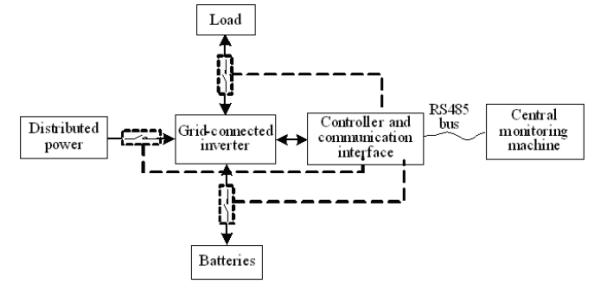
On figure 1 is a block diagram of the proposed project. As a source for batteries recharging, which have a capacity 300Ah and 120 V output voltage, is wind power energy and solar panels. Wind power has 12 kW output power and solar panels has 2 kW output power. For recharging batteries is also possibility used distribution network as is on block diagram (picture 1). Batteries are able to supply the theoretical performance 36 kWh.

Fig. 1 Block diagram with wind power station, solar power station and batteries
Description of the examined family house

To determine the daily diagram of consumption has been selected family house in which permanently 5 people life. Researched family house is built on the outskirts of the village. The house has a solid fuel boiler for heating and hot water. Used home appliances in the house with their consumption are listed in Table 1.

Fig. 2 Map with point of house place

Site build house, the average wind speed at 100 meters above the ground is between 25-50 m/s (figure 3) and average total annual solar radiation is 944-972 KWh/m2 (figure 4).

Fig. 3 Map with resulting field of average speed of wind at 100 meters above the ground
Fig. 4 Maps with average total annual solar radiation
Measurement of daily chart selected house

Family home was measured starting from April 17, 2010 11:01:00 April 25 and ending 2010 4:41:00 p.m. Measurement was carried out using apparatus MDS10 and the results were evaluated in program MDS10 and in program Excel. Measurement voltage range was set to 230 V and current range was set to 30 A. Statistical analysis of measurement and evaluation of the individual days (only all day long measurement) are shown in Figures 5 and 6.

Fig. 5. Statistical processing of current and voltage. On the vertical axis shows the percentage frequency of occurrence in the horizontal axis and voltage (230 V) and current (30 A) as a percentage.

In the statistical processing can be seen that the currents move in areas over 130%. These values are due to error in measurement.

Fig. 6. The average consumption of each day for measurement and for each stage separately

The following table there are each household appliances with their average consumption. At next columns there are power consumption per day and per year and average length of working in one day. Appliances are divided into three priorities, where the first priority involves appliances that are permanently in operation and are necessary for safety. The lower rows of the table are given priority for individual consumption and for separately priority consumption.

Table 1: Domestic Appliances and setting priorities:

.

All appliances are single phase and their total power is 10300 W. If we consider an ideal situation, so the voltage is 230 V to the total consumption of all appliances is about 45 Ah. With a 300 Ah battery power is possible to operate all appliances 6.7 hours. If we consider only the first priority it will be 92 hours.

Conclusion

According to the daily chart, the current consumption in all phases of moving most of the day from 0% to 10% of the set current range (30 A), which is approximately up to 3 A. In this case, the unit lasted about 33 hours. The simplified calculations are not considered losses in individual blocks and are also considered the current charging rechargeable batteries, solar and wind power.

Acknowledgement

This article was created under poject SP/201073, “Využití hybridních obnovitelných zdrojů elektrické energie”

REFERENCES

[1] Murtinger, K., Beranovský, J., Tomeš, M.: Fotovoltaika – elektřina ze Slunce 1. vydání, ERA, 2007
[2] Hradílek, Z. Elektroenergetika distribučních a průmyslových zařízení,VŠB-TU Ostrava, MONTANEX a.s., 2008
[3] Větrná mapa. ČSVE: Česká společnost pro větrnou energii [online]. 19.03.2009, [cit. 30.05.2010]. Dostupný z WWW: <http://www.csve.cz/clanky/detail/35&gt;


Authors: Ing. Petr Závada, E-mail: petr.zavada@vsb.cz; prof. Ing Karel Sokanský, CSc. E-mail: karel.sokansky@vsb.cz. VŠB-TU Ostrava, Department of Electrical Power Engineering – 410, 17. listopadu 15, 708 33, Ostrava – Poruba, Czech Republic,


Source & Publisher Item Identifier: PRZEGLĄD ELEKTROTECHNICZNY (Electrical Review), ISSN 0033-2097, R. 87 NR 7/2011

General Requirements for a Smart Grid Architecture – Remarks on Standards for Implementation

Published by Anna PAMUŁA, University of Lodz


Abstract. The paper presents importance of standardization and potential standards relevant for Smart Grid implementation mainly focused on ICT standards. Short overview of current work performed by different bodies round the world is presented. The paper presents some recommendation based on the SEESGEN-ICT EU project and reports prepared by JWG (Joint Working Group) and NERC (North American reliability Corporation).

Streszczenie. W artykule omówiono problematykę procesu standaryzacji w architekturach Elektroenergetycznych Sieci Inteligentnych – głównie standardów związanych z obszarem ICT. Zaprezentowano krótki opis efektów prac prowadzonych przez organizacje zajmujące się standaryzacją oraz rekomendacje projektów z tego zakresu. (Problematyka procesu standaryzacji w architekturach Elektroenergetycznych Sieci Inteligentnych)

Keywords: Smart Grids, ICT standards.
Słowa kluczowe: Inteligentne sieci, architektura Smart Grid, standardy, ICT

Introduction

A great number of different projects run all over the world focuses on use cases and general requirements for a Smart Grid reference architecture. The architecture of this new distributed system with the fully interactive infrastructure must be designed and validated with wide implementation of standards. The process of developing standards for Smart Grid is a very big challenge. The great number of different stakeholders (producers, consumers, ICT suppliers), short time before reaching 20-20-20 targets to reduce carbon emissions and to secure the energy supply makes this task more difficult. For Smart Grid, it is not just important to change or establish an individual standard but to adapt the organization and processes for standardization[1].

The ICT has a significant role to play in changing current energy systems and energy consumers habits into a new green economy and lifestyle. Traditional Grid SCADA with some additional automation systems are used for monitoring energy production transmission and distribution of the energy. SCADA system is a crucial component in traditional utility/energy sector. But this hierarchical system is not prepared for massive DER and RES intrusion. Those system are not design and not prepared for supporting new business aggregators, integrators and more active customer behaviors. Future Smart Grid demands new ICT solutions. The future Smart Grids will consists of 3 interacting infrastructures [2]:

− Automation, control and management systems of the physical energy infrastructure management systems;
− Business Management Systems;
− Other Information Management Systems (ICT).

The new information management system should be design implemented and maintained in a way that supports new business opportunities for different stakeholders ensuring [2]:

− Balancing Intermittent production,
− Meeting social goals of Energy Efficiency,
− Meeting customer requirements,
− Meeting economic goals,
− Managing interactions with SCADA systems.

European Smart Grid standardization work

The European Commission Directorate-General (DG) for Energy by the group of mandated Experts Group has created a Smart Grid Task Force that highlighted the importance of standards for as one of the most successful Smart Grids deployment factor. The main idea of European Future Smart Grids provides development of communications, metering and new business systems on each level of energy market as basic element of energy efficiency. To fulfill this vision a set of proven technical solutions, shared technical standards and protocols ready to use in with different type of equipment installed in the power Grid should be established. For the ICT solutions standardization is the most important frame that allows to connect devices from different producers to the Smart Grid with the best quality and proper price. Standards allows to achieve such a elements like: interoperability, defining data models, protocols, communications and information exchange, improving security, safety of the new products and systems.

Report prepared by European Technology Platform SmartGrids: Strategic Deployment Document (SDD), released in April 2010, Deployment Priority #4 IC emphasis the importance of ICT as a instrument of new business and new stakeholders coordination.

The most important for wide Smart Grid deployment is industry support. For that reason European Strategic Energy Technology Plan (SET-Plan) was established in The European Electricity Grid Initiative (EEGI) published detailed roadmap for implementation of Smart Grids 2010-2018. In November 2009 a Smart Grid Task Force was established to advise the Commission on the policy/regulatory directions. It is run by Commission’s Directorate General for Energy Policy (DG ENER) in collaboration of with 6 Directorates and about 25 European associations.

To facilitate the technical level the European Commission issued in 2009 mandated of European standardization organizations CEN, CENELEC and ETSI to cooperate in development of open system architecture. They have formed a Joint Working Group and the result of their work is presented in the report of standardization requirements for European vision.

Smart Grid standardization work

A lot of activities can be noticed around the world. Such a bodies like ISO, IEC, 3GPP and some national comities has done a lot of work that need to be considered because of their influence to the European standardization work. The work done in the area of international standardization can be find in IEC roadmap (the standards from IEC TC 57 Seamless Integration Architecture [3] (IEC TR62357 seems to be the most important), for the European standardization a lot work was published by Smart Grids Task Force (EG1 report on services and functionalities, EG2 report on data handling, security and protection). All standards defined by China are very important and must carefully examined, because it is the main producer of the Grid and home equipment and infrastructure.

The table below presents short survey of some important standards work done by different bodies.

Table 1. The result of standardization bodies work based on [1]

OrganisationWork results
European Standarization Mandate M/441 and Smart Meter Coordination GroupStandards as a voluntary technical specifications and general technical rules for products and systems on the market. 6 aspects of Smart metering considered and examined (support of the functions depends on the country): reading and transmission of measurements, two-way communication between meter and market participant, support of various tariff models and payment systems, remote deactivation and start/finish supply, communication with of he house devices, support of display of data in real time
German Standarization Roadmap E- Energy/Smart GridA position paper on the German Smart Grid Standarization that provides recommendation for necessary fields of action, international cooperation and strategy. Research done showed that a lot of standard already exists. Recommendation: existing standards like IEC TC 57 should be used and be the started point for further work mainly for cooperation. System approach should consider also other media and other domains
IEC Strategic Group 3 “Smart Grid Report”A roadmap for standards and recommendation. Over 100 standards were identified described and prioritized. 12 application areas and 6 general topics were examined. 44 recommendations prepared. IEC TC 57 recommended as a basic. Now working on Mapping Tool to support Smart Grid project managers.
NIST Interoperability FrameworkA phase plan intended to accelerate identification of standard. Description of an abstract reference model and identification of 80 essential standards, 14 key areas and gaps for a new standards identified. The work refers to North America standards like ASHRAE and IEEE.
Japanese Industrial Standards CommitteeStandards as a fundamental element in the achievement of interoperability. A report published in 2010 established a roadmap to internalization standardization for Smart Grid. 7 main fields of business were identified an 26 priority actions areas assigned. Special core aspects of Japanese economy were identified.
The state Grid Corporation of China- SGCC FrameworkSmart Grid standardization roadmap defined Defines 8 domains, 26 technical fields and 92 series of standards.

As it can be seen a lot of work was done, but still there is a strong need for European Standardization Organizations (ESOs) to coordinate their effort to put into effect their work to market.

ICT standardization

Typical Power Grid is a centralized network coordinated by traditional Power utilities.

Power companies are not willing to lose control of the Grid and are not eager to use more communication and open technology. Firstly because of the service level is not yet justified, secondly – the are not enough service guarantee from communication companies. What is more it is still not clarified who is responsible for outages and maintenance. Traditional SCADA systems includes several protocols like: Modbus RTU, RP-570, Profibus and Conitel (vendor specific solutions). In more modern systems they were replaced by open standard protocols like DNP3 (Distributed Network Protocol), mainly applied in North America, and IEC sets of protocols developed under the IEC TC57. It obvious that the industry is now moving to nonproprietary protocols.

In many countries regulatory aspects of Smart Grids are not fully clarified and taking under consideration European Union they differ in members law. The lack of regulations ensuring that investment in new ICT will not lead to losses can be seen as one of the most important factor of slower deployment. It is necessary for the business to work under stable clear rules.

In new intelligent Grid many different stakeholders have to receive and exchange data. Consumers and businesses can make decision only if they receive a proper and actual information offered in Smart Grids by ICT solutions. For this purpose a complex, proven ICT architecture is needed.

So far there is no a clearly defined communication architecture or the transition plan needed that will meet the requirements of the modern Grid to achieve. Vendors who supply sensors, IEDs, DER, and other end-use devices are hesitating to invest in these products until universal standards are adopted [2.] Mature solutions are able to optimize and upgrade the current power systems and reduce CO2 emission. For mature solutions preparation of guide of development presenting standards is a key issue.

Many European project consider the importance of ICT in Smart Grids. One of them is SEESGEN-ICT (Supporting Energy Efficiency in Smart GENeration Grids through ICT 2009 – 2010). Research done by project team confirmed that the IEC 60870-5 and DNP3 based protocols are gradually being replaced by more modern IEC standards based on TCP/IP. New globally accepted IEC standards are IEC 61850 and Common Information Model (IEC 61968 and IEC 61970). It was also highlighted that Common Information Model (IEC International Electrotechnical Model 61970/61968) is recommended standard for the exchange of data between systems. The model consists of two standards IEC 61970 and IEC 61968 with universal elements such as dictionaries, interfaces and data models. UML (Unified Modelling Language) is used for model design. Also new standards for communication with distributed energy resources are based on IEC 61850 and CIM principles. IEC 61850 is based on the latest version of the Manufacturing Message Specification MMS (ISO 9506). IEC 61850 and CIM are also being harmonized [2].

Most presented solutions consider AMI (Advanced Meter Infrastructure) and embedded control devices connected to the local network as a main parts of the infrastructure. In Europe OPENmeter project is addressed to prepare solutions in this area.

Web Technologies [2]

Internet technology based on its protocols and service oriented architecture are nowadays solutions for a new business models.

Future Smart Grid coordination must be considered as management of the resources (action and data for matching supply-demand) and setting up SLA (Service Level Agreements) between all energy market stakeholders. SEESGEN-ICT recommends IEC TC 57 Seamless Integration reference Architecture – IEC TR 62357 for intra grid application management.

It must be noticed that different Smart Grid solutions typically have different IT components. As reports of SEESGEN-ICT Project shows using standard components and platforms in creating new applications in a cost effective way as well as using SLA functionality can make real cloud computing solutions. The SEESGEN-ICT project group has tested Platform as a Service using terminology of Cloud Computing and suggest Infrastructure as a Services solutions towards Smart grid as a Service.

Recommended architecture for models that do not demand real time response is XML web services. It must be noticed that it is not suitable for process control and monitoring. The project experience shows that XML structure[2]:

− leverages several standards to enable data transfer between applications on remote computers allowing,
− technologies and tools (web servers, libraries, APIs, etc) leverage the evolving security standards, user authentication, data transfers, data states and a lot more,
− applications programmers can rapidly build and deploy XML web services using existing tools and frameworks
− XML web services provide that all-important independence from any hardware or software platform.

Following limitations of XML were also considered:

− limitation of transfer OPC data seamlessly from one computer to another using a “standard” interface. Implementations show that the transfer either suffer from extremely high bandwidth or suffer a slow update rate;
− XML messages are very large in comparison to similar DCOM messages that carry the same information, and their sheer size makes them difficult to transport en masse.
− more, the origins of XML as a document format with little to no boundaries in terms of element size or depth that are accessible outside a post-processing / parsing context make it less than optimal for the use as a data exchange format and protocol due in large part to the inability to reliably stream-process, filter and monitor its contents in real-time.

The various standards that are available currently at the distribution Grid level have been explained in many works. The scheme and description of standards can be found in [4]. The scheme presenting use of standards can be also find in [5].

Necessary steps and prioritization of actions recommended by JWG report[1]

Joint Working Group is working on report that provides overview of standards and current activities that are the c step o fulfill the European vision of Smart Grid (based on the Smart Grids Task Force of the European Commission initiatives). The survey was done to prepare a list of existing dictionaries standards sources of definitions according to roadmap structure covering following groups:

− general architecture and concept of the Smart Grid,
− communication,
− information security,
− system aspects and crosscutting issues,
− generation transmission and distribution,
− Smart metering,
− industry energy management,
− in house automation,
− market and actors.

The report shows current status of standardization in cross-cutting and domain-specific topics, gives some detailed recommendations and shows a list of gaps for groups of cross cutting problems (reference architecture, data communication interface, Smart Grid information security, others), domain specific topics (generation, transmission, distribution, Smart metering, industry, home and building) market and actors (roles and responsibilities, recommendation to European Standardization Organizations).

The reports defined 6 major recommendation for further European standardization work:

  1. further works with adequate bodies and groups of stakeholders based on identified gaps with possibilities to consider more topics like energy storage and security supply,
  2. process of standardization must be based on existing international work but also has to support European produces,
  3. Increasing the implementation of currently proven solutions and existing mature domain communication with further standardization of interfaces;
  4. concentration on generic standards that are flexible for new R&D development and market needs,
  5. creating of a single repository for Smart Grid use cases to start detail work on standards,
  6. setting the processes to fit the lack of maturity of many Smart Grid applications.

As the most important further activities JWG report highlights:

− a prioritization of the identified gaps and recommendations based on defined set of criteria,
− developing complete and flexible European reference architecture,
− creating European Smart Grid use cases to start a continuous process o identifying gaps in standards.

Necessary steps and prioritization of standards actions recommended by NERC report

NERC report is devoted to its Reliability Standards. One of the main recommendation is to enhance NERC reliability standards according to continuous Smart Grid evaluation. The necessity to support coordination among relevant SDO (Standard Development Organizations) and activities like NIST Priority Action Plan to harmonize are strongly highlighted. Report shows some area of importance for this work. As one of the example time synchronization of PMU(Phasor Measurement Units) in real time and differences and overlaps between IEEE C37.118 and IEC 61850 is described. Regarding Cyber Security NERC report noticed that the there is number of existing standards for example set of NISTR 7628 documents that work properly while using separately, but when they are using merged together may be in conflict with each other. Therefore recommendations and maps included in NISTR 7628 must be applied. Future work with Canadian Legislative, Regulatory and standards setting bodies for ensuring coordinated and harmonized standards [6].

Summary

The success of rapid Smart Grids deployment rely on proper integration of real-time application and monitoring, advanced communication enabling bidirectional energy and information flow in reliable, efficient and secure way from generation source via aggregators to end users. Smart Grids technologies change the existing distribution systems what demands new tools and new techniques based on proven standards.

As the paper shows a lot of work was done, but further coordination of standard bodies to increase harmonization in standard development is necessary. Fulfilling the gaps and overlaps described in presented reports must be a first step of this work. The solutions for overcoming lack of standardization can be wide use of open standards and non proprietary solutions. Open standard guarantee interoperability between different vendors devices and can be used in provider-independed platforms.

One of the biggest barrier in Smart Grids deployment is insufficient cyber security. To provide to consumer energy in reliable and effective way the integrity of distribution control command is essential. For the safety-critical applications of adaptive protection and reconfiguration integrity of outage data is significant. Must be also noticed that some consumers are not willing to show their energy consumption habits. For that reasons cyber security standards should be included in ICT solutions. To ensure reliability of the system cyber security must be seen as one of the most important Smart Grids deployment factor.

Transformation, replacement, upgrading and transitions of technologies used for SCADA systems towards standard open protocols such as EIC 61850 might take time to be globally adapted. Security, integrity and information protection related to network and information management can be implemented by proper use and embedding of VPN solutions.

REFERENCES

[1] JWG-Smart-Grid-report_V1-0_2010-12-17-all-figures.pdf
[2] SEESGEN-ICT http://seesgen-ict.erse-web.it
[3] IEC Smart Grid Standardization Roadmap, by SMB Smart Grid Strategic Group (SG3) June 2010; Edition 1.0 http://www.iec.ch/SmartGrid/downloads/sg3_roadmap.pdf
[4] De Craemer K. , Deconinck G., Analysis of state-ofthe-art Smart metering communication standards, IEEE Benelux Young Researchers Symposium 2010 in Electrical Power Engineering, Leuven, Belgium, March 29-30, 2010;
[5] Matusiak B.E., Pamuła A., Zieliński J. S., Narzędzia ICT w sterowaniu zachowaniem klienta w inteligentnych sieciach energetycznych, w Komputerowo Zintegrowane Zarządzanie pod red. R. Knosali, Oficyna Wydawnicza Polskiego Towarzystwa Zarządzania Produkcją, Opole 2011, Tom II, str. 88-97
[6] Reliability Consideration from the Integration of Smart Grid


Author: dr Anna Pamuła, Katedra Informatyki, Uniwersytet Łódzki, ul. Matejki 22/26 90-928 Łódź, E-mail: apamula@wzmail.uni.lodz.pl


11th International Scientific Conference FORECASTING IN ELECTRIC POWER ENGINEERING Development Planning, Operation, Maintaining and Management in Power Engineering

PE 2011
Wisła, 14-16 September 2011

Institute of Electric Power Engineering of Czestochowa University of Technology under the patronage of Rector of Czestochowa University of Technology in the last twenty years has organized, in a close cooperation with eminent scientific and technical organizations, a cyclic scientific conference, whose scope are the current issues from a broad field of electric power engineering. The stimulus for setting up this event was the energy crisis, which influenced Poland in Then the first Domestic Symposium “Forecasting in Electric Power Engineering” under the auspices of Commission for Power Engineering, Silesian Branch of Polish Academy of Sciences was organized. Starting with 1996, a small audience symposium has evolved into a biennial domestic conference and since 2008 the conference has gained the status of an international event, where the issues and dilemmas concerning not only Polish electric power engineering, but also those pertaining to EU countries, are discussed. The representatives of EU countries take an active role in the plenary talks. Within the framework of the 11th International Scientific Conference, the Program Committee of the Conference “Forecasting in Electric Power Engineering PE 2011” has decided to organize the event in the form of a plenary session, where the invited papers shall be presented, as well as in the form of thematic panels, covering following issues:

Forecasting in electric power engineering
Planning of power system development
Selected problems of power engineering (maintenance, measurements and control, management in power engineering)

During the proceedings we take into consideration the forecasting problems for the electricity market, software useful for the power engineering, issues of the integration with the European Union and the role of distribution utilities, power plants and others enterprises in economic transformations


Source & Publisher Item Identifier: PRZEGLĄD ELEKTROTECHNICZNY (Electrical Review), ISSN 0033-2097, R. 87 NR 9a/2011

Lightning Transient Overvoltage Evaluation

Published by Electrotek Concepts, Inc., PQSoft Case Study: Lightning Transient Overvoltage Evaluation, Document ID: PQS1205, Date: January 26, 2012.


Abstract: This case study presents a wind plant substation lightning transient overvoltage evaluation. A high-frequency transient model was created to simulate the lightning transients and resulting overvoltages and arrester energy duties. A high-frequency model was required to accurately represent the lightning phenomena. MOV surge arresters were evaluated as the power conditioning alternative.

INTRODUCTION

A wind plant substation lightning transient overvoltage evaluation case study was completed for the system shown in Figure 1. The case study investigated the potential for severe high-frequency transient overvoltages on substation transformer primary and secondary buses during lightning strikes on the terminating transmission line and wind collector circuit bus. The power conditioning mitigation alternative of MOV surge arresters was also evaluated.

The simulations for the case study were completed using the PSCAD® program. A high frequency transient model was created to simulate the lightning transients and resulting overvoltages and arrester energy duties. A high-frequency model was required to accurately represent the very high lightning transient frequencies. The lightning surge was assumed to be a current source (e.g., 10 kA) with a very fast rise time (e.g., 8×20 μsec).

Figure 1 – Illustration of Oneline Diagram for Lightning Transient Analysis
SIMULATION RESULTS

For wind plants, the principal risk to equipment insulation is impulsive transients caused by lightning. Lightning transients may enter a substation by various means, including coupling through the substation power transformer from exposed high-voltage transmission lines and direct or indirect strikes to open air equipment.

For the lightning simulations, it was assumed that the wind farm substation is shielded against direct strokes and that a 10kA surge enters the substation due to a lightning flash terminating on the overhead shield wire or structure with a subsequent flashover (a.k.a., back flashover) to a phase conductor or by a lightning flash terminating on the phase conductor due to a shielding failure.

Back flashover is a flashover of insulation resulting from a lightning stroke to part of a network or electrical installation that is normally at ground potential. When back flashover occurs, a portion of the surge current will be transferred to the phase conductors through the arc across the insulator strings. Often, the back flashover causes a temporary phase-to -ground fault that must be cleared by circuit breakers.

The high-frequency transient simulation model included a 138kV wind plant substation and a 6-mile transmission line supplying a 50 MVA, 138/34.5/13.8kV substation transformer. The representation of the system short-circuit equivalent at the 138kV source substation included:

Three-phase (I) fault current: 17,500 A @ -85.0° (4183 MVA)
Single-line-to-ground (IφG) fault current: 20,000 A @ -85.0° (4780 MVA)

These values were converted to ohms for the PSCAD representation, which included a three-phase voltage source with positive and zero sequence impedances and a 420Ω damping resistor.

The 6.0 mile, 138kV transmission line was modeled using the following data:

Length: 6.0 mi
Phase Conductor: 795 kcmil (Tern) 45/7 ACSR (OD = 1.063”, RDC=0.114Ω/mi)
Ground Conductor: 3/8″ EHS (OD = 0.385”, RDC=5.550Ω/mi)
Tower Configuration: TAN-1
Ground Resistivity: 100 Ω•m

The traveling wave frequency dependent phase model in PSCAD was used to represent the transmission line. The frequency dependent phase model is basically a distributed RLC traveling wave model, which incorporates the frequency dependence of all parameters. This model represents the frequency dependence of internal transformation matrices.

The program calculates the line constants for the transmission line before each simulation begins. The 60 Hz impedance values from the line constants output were compared with the transmission line impedances to assure that the line was modeled correctly. The calculated surge impedance of the transmission line was approximately 420Ω. A portion of the line constants output includes:

.

A 110kV (88kVMCOV) station class MOV surge arrester was modeled at the transmission line termination point. The ratings for the arrester included:

Rated Voltage (Duty Cycle): 110 kV
Maximum Continuous Operating Voltage (MCOV): 88 kV
Maximum Energy Discharge Capability: 9.8 kJ/kVrated MCOV
Maximum Energy Discharge Capability: 862.4 kJ
10 kA, 8×20 μsec Discharge Voltage: 274 kV (2.43 per-unit)

A 27kV (22kVMCOV) station class MOV surge arrester was modeled on the secondary winding of the substation transformer. The ratings for the arrester included:

Rated Voltage (Duty Cycle): 27 kV
Maximum Continuous Operating Voltage (MCOV): 22 kV
Maximum Energy Discharge Capability: 9.8 kJ/kVrated MCOV
Maximum Energy Discharge Capability: 215.6 kJ
10 kA, 8×20 μsec Discharge Voltage: 64.8 kV (2.30 per-unit)

A traditional inductive transformer model generally looks like an open circuit to the very high frequency lightning transient. The 60 Hz transformer model can be improved by adding capacitances between windings and from the windings to ground. This type of model will act as a capacitive voltage divider to transfer a portion of the surge from the primary to the secondary windings. The bushing and winding capacitance values included in the model were Chg = 8ηF, Clg = 8ηF, and Chl = 12ηF.

Other substation equipment, such as circuit breakers and instrument transformers, were represented by their stray capacitances to ground. Typical stray capacitance values of substation equipment are provided in Annex B of IEEE Std. C37.011. The values used in the simulation model included:

Effective Capacitance (High-Side of Transformer) 15,000 ρF
Effective Capacitance (Low-Side of Transformer) 3,000 ρF

The high-frequency transient simulation model was based on the substation oneline diagram and other information, such as the 138kV transmission line specifications. The steady-state voltage at the 138kV substation bus was 1.05 per-unit prior to the transient event. For the worst-case analysis, it was assumed that all of the 34.5kV collector circuit breakers would be open during the simulations. Two lightning surges were simulated; one on the terminals of the 138 kV transmission line entering the substation and the other on the 34.5kV bus on the transformer secondary.

Case 1 involved a lightning strike to one of the terminals of the 138kV transmission line entering the substation. The specification of the current waveform was a 10kA magnitude, with an 8×20μsec characteristic (Phase A). The lightning surge current waveform is shown in Figure 2.

Figure 3 shows the simulated transformer primary voltage for Case 1. The peak transient voltage was 272.323kV (2.42 per-unit). Figure 4 shows the corresponding transformer secondary voltage. The peak transient voltage was 56.437kV.

The peak current for 88kVMCOV arrester on the transmission line terminal (transformer primary) was 9.3 kA and the maximum arrester energy was 51.8kJ, which is approximately 6.0% of the assumed arrester energy capability of 862.4kJ. The simulated protective margin for the 550kV BIL rating for the transformer primary winding was determined using:

.

The protective ratio for the transformer primary winding was 2.02 (550kV BIL / 272.323kV). An adequate margin has a ratio greater than 1.20 (see IEEE Std. 1313.2).

Figure 2 – Illustration of the Simulated Lighting Surge Current Waveform
Figure 3 – Simulated Transformer Primary Voltage for Case 1
Figure 4 – Simulated Transformer Secondary Voltage for Case 1

Case 2 involved a lightning strike to the 34.5kV bus (transformer secondary winding). The specification of the lighting surge current waveform (see Figure 2) was a 10kA magnitude, with an 8×20μsec characteristic.

Figure 5 shows the simulated transformer secondary voltage for Case 2. The peak transient voltage was 64.719kV (2.29 per-unit). Figure 6 shows the corresponding transformer primary voltage. The peak transient voltage was 31.042kV.

The peak current for 22kVMCOV arrester was 9.9kA and the maximum arrester energy was 13.6kJ, which was approximately 6.3% of the assumed arrester energy capability of 215.6 kJ.

The simulated protective margin for the assumed 200kV BIL rating of the transformer secondary winding was determined using:

.

The protective ratio for the transformer primary winding was 3.09 (200kV BIL / 64.719kV). An adequate margin has a ratio greater than 1.20 (see IEEE Std. 1313.2).

Figure 5 – Simulated Transformer Secondary Voltage for Case 2
Figure 6 – Simulated Transformer Primary Voltage for Case 2
SUMMARY

This case study summarized a wind plant substation lightning transient overvoltage evaluation. A high-frequency transient model was created to simulate the lightning transients and resulting overvoltages and arrester energy duties. A high-frequency model was required to accurately represent the lightning phenomena. MOV surge arresters were evaluated as the power conditioning alternative.

REFERENCES

  1. IEEE Guide for the Application of Insulation Coordination, IEEE Std. 1313.2-1999, IEEE, October 1999, ISBN: 0-7381-1761-7.
  2. IEEE Application Guide for Transient Recovery Voltage for AC High Voltage Circuit Breakers Rated on a Symmetrical Current Basis, IEEE Std. C37.011-1994, IEEE, ISBN: 1-55937-467-5.
  3. Electrical Transients in Power Systems, Allan Greenwood, Wiley-Interscience; Second Edition, April 18, 1991, ISBN: 0471620580.
  4. R.C. Dugan, M.F. McGranaghan, S. Santoso, H.W. Beaty, Electrical Power Systems Quality, McGraw-Hill Companies, Inc., November 2002, ISBN 0-07-138622-X.

RELATED STANDARDS
IEEE Std. 1313.2

GLOSSARY AND ACRONYMS
CF: Crest Factor
DPF: Displacement Power Factor
PF: Power Factor
PWM: Pulse Width Modulation
THD: Total Harmonic Distortion
TPF: True Power Factor

The Trouble With Capacitors Part 2

Published by R. Fehr, P.E., Engineering Consultant, Jan 1, 2004


Here’s how to reduce the effect of capacitor switching on your power system

Last month’s article discussed exactly what happens when electric utilities switch shunt capacitors: power system components are exposed to transient voltages and currents produced by energizing and de-energizing these devices. Those transients may be short-lived, but they have high peak values and frequencies much greater than the power system fundamental frequency. Now it’s time to investigate the effects these transients have on your power system.

Negative effects aplenty. When an electric utility or end-user energizes a shunt capacitor, the high-frequency switching transients produce overvoltages on the capacitor bus. These overvoltages may be significant enough to cause arrester operation or even equipment failure. However, these overvoltages aren’t always localized. Since the transients have a frequency much higher than the power system frequency, the system behaves much differently when subjected to these high frequencies than it does with the normal power system frequency.

Transient high voltages can often show up a considerable distance from the capacitor bus due to resonance-like conditions caused by the switching transients. Fast transient overvoltages, which occur as the transients pass through transformers and are magnified due to capacitive coupling, are symptomatic of this condition. Open-circuited lines also contribute to overvoltage conditions by reflecting the traveling transient voltage waveform back to the source, where it can add to the standing voltage waveforms and produce high-voltage surges.

De-energizing a shunt capacitor can also cause power quality problems due to the transient overvoltages produced by re-ignitions and restrikes during the current interruption process. Because of the increased probability of excessive arcing in the switching device during current interruption, the likelihood of switching device failure increases significantly during the de-energization process.

In both the energizing and de-energizing cases, equipment very near or at significant distances from the capacitor location will be subject to voltage stresses that could result in insulation failure. Surge arrester operation and failure are also more likely to occur during capacitor switching than under steady-state conditions.

High-frequency transients at the capacitor location often introduce electrical noise into control circuits, which can lead to equipment misoperation. Even nuisance tripping or damage to devices is possible. A ground potential rise during the transient period can cause system protection misoperation and even pose a safety hazard to personnel working nearby if grounding is inadequate. These effects are potentially serious and must be counteracted in some way.

Double trouble. To further complicate the situation, two or more capacitor banks located close to one another make the situation worse. These negative effects of the transient become extremely severe in the vicinity of the capacitors for several reasons.

The transients produced when a shunt capacitor is energized in the vicinity of an already-energized shunt capacitor are much more severe than those produced when a single isolated capacitor is switched. It’s very important to understand this phenomenon, which is called back-to-back switching, to avoid the negative consequences.

The zero voltage that occurs at the moment of contact closure when the second capacitor is energized makes it appear to the system as a short circuit. This apparent momentary short circuit will cause any energized capacitor nearby to discharge into the second capacitor. In addition, the two capacitors in parallel appear as a larger equivalent capacitance rather than one capacitor alone, making the inrush current magnitude much larger than for a single capacitor. The inductance of the system between the two capacitors, Leq, is the quantity that limits the inrush current. Back-to-back induction can be found with the following equation:

.

This higher inrush current has a frequency much higher than the inrush current for a single capacitor. Both the magnitude and the frequency of the inrush current during back-to-back switching are typically an order of magnitude larger than those seen when energizing a single capacitor. The frequency of the inrush current can be hundreds of times greater than the power system frequency, fs, as shown in the equation below:

.

Reducing the effects of capacitor switching. You can use one of several methods to reduce the problems associated with capacitor switching, including equipping circuit breakers with pre-insertion resistors, outfitting circuit switchers with pre-insertion reactors, or tightly controlling the point on the waveform when the capacitors are actually switched.

Pre-insertion resistors. One technique involves breaking the switching operation into a multi-step process and inserting a temporary impedance into the circuit during one of the steps. This approach breaks one large transient into two or more smaller ones. Circuit breakers can be built with internal pre-insertion resistors to reduce the magnitude of switching transients. These resistors, typically in the 100-ohm to 400-ohm range for single, extra-high voltage (EHV) capacitors, are in series with the interrupter when the contacts close, but remain in the circuit just long enough to damp the transients, usually for ½ to 1 cycle. After that time, they’re shorted out with a make-before-break connection between the resistor contacts and the main contacts, and remain out of the circuit until the next time the breaker is closed. This process is shown schematically in Fig. 1.

Fig. 1 – Pre-insertion resistors

Pre-insertion resistors add both complexity and cost to a breaker. They’re also another item that requires scheduled maintenance. While pre-insertion resistors reduce transients during capacitor energization, they’re not used when the capacitor is de-energized, so those transients go unabated during that form of switching.

Pre-insertion reactors. Circuit switchers can be outfitted with pre-insertion reactors to reduce transients when closing into capacitive loads. These reactors, which are small air-core inductors typically in the 10-millihenry to 40-millihenry range, are mounted externally on the switcher. When the switcher closes, a spring-loaded contact blade swipes over a reactor contact, energizing the reactor in series with the capacitor when it touches the reactor contact. The reactor remains in the circuit while the blade swipes across the reactor contact, usually for about seven to 12 cycles, depending on the system voltage. The blade keeps moving past the end of the reactor contact, at which point a make-before-break connection is made with the main contact. The blade comes to rest on the main contacts, which keeps the capacitor in the circuit, but bypasses the reactor. The brief period while the reactor is in series with the capacitor is sufficient to dampen the energization transients.

Schematically, this process is identical to the pre-insertion resistor switching process shown in Fig. 1. While less expensive and probably more reliable than pre-insertion resistors, pre-insertion reactors are complicated, require careful alignment and adjustments, and are rather exciting to watch as they arc and spark when operated.

Point-on-wave switching. In the ’80s, a different approach to managing capacitor switching transients began to emerge. Instead of electrically modifying the system with resistors or reactors to reduce the effect of the switching transients, engineers left the system as is but addressed the transients themselves. By precisely controlling where on the voltage waveform the contacts touch, it’s possible to greatly reduce the magnitudes of the switching transients. This approach, called controlled switching or point-on-wave switching, is used extensively throughout the world not only for switching capacitors, but also for switching shunt reactors, energizing transformers, and even switching transmission lines.

Here’s how it works. As the voltage difference across an open circuit breaker increases during closing, the dielectric strength of the gap between the open contacts decays. It’s possible to measure a breaker’s pre-strike voltage in relation to the time of contact touch. Graphing these measurements approximates a line whose slope represents the rate of decay of dielectric strength (RDDS). For a breaker to be a suitable capacitor-switching device, its RDDS must exceed the rate of the system voltage change. Fig. 2 shows the acceptable RDDS region.

Fig. 2 – Acceptable RDDS region

Ideally, the capacitor should be energized when the voltage across the breaker contacts is zero to minimize switching transients. Consider the zero crossing on the voltage waveform, which is our point-on-wave “target” for contact touch. Fig. 3 on page 22 shows a green shaded region that depicts the range of mechanical scatter for a particular circuit breaker. The purple shaded region shows the range of dielectric scatter for the same circuit breaker (Sidebar below). Since the scatters are additive, contact touch can occur anywhere along the black portion of the voltage waveform.

Fig. 3 – Point-on-wave “target” for contact touch

This possible contact touch time window is skewed considerably to the left of the target, indicating a high probability of circuit completion prior to the zero voltage crossing. Early completion of the circuit will result in pre-striking, which will produce severe transients. This situation can be avoided by slightly retarding the point-on-wave target to just after the zero crossing, as shown in Fig. 4. This delay increases the probability of contact touch at the zero crossing.

Fig. 4 – Point-on-wave target to just after the zero crossing

Another benefit of controlled switching is, unlike the transient mitigation methods discussed earlier, you can use it for capacitor de-energization. The precise timing of each pole is controlled by a microprocessor. The software controlling the timing can be adaptive to adjust for physical and environmental variables, thereby reducing some of the uncertainties represented by scatter. Over the years that controlled switching has been used, the control methods have become much more sophisticated than those used by the first controllers.

Controlled switching is complicated greatly by the mechanical limitations of the circuit breaker. Even with contact speeds in excess of 10 m/sec, transient recovery voltage characteristics of some circuit breakers aren’t adequate for some capacitor switching applications. Mechanical and dielectric scatter can lead to a switching performance that’s considerably less than optimum performance. One way to avoid these problems is to replace the mechanical circuit breaker with a solid-state switching device.

Solid-state electronics don’t solve all the challenges involved with controlled switching. In fact, they tend to exchange one set of problems for another. They do, however, appear to be a viable technology for capacitor switching, particularly at low and medium voltages. Solid-state switching eliminates mechanical scatter, reduces dielectric scatter, and can almost do away with inrush and the associated harmonics during capacitor switching.

Because the current leads the voltage by 90°, the anode-to-cathode voltage of the switching device is reverse-biased for ¼ of the cycle while the current direction is from anode to cathode. This means that self-commutating devices like thyristors must be provided with a gating signal through the full 360° to ensure full conduction. Semiconductor switches used in capacitive switching applications must also endure high peak inverse voltages (PIVs) in excess of 3.5 times the line-to-line voltage. This is because the charge trapped in the capacitor when the switch commutates off holds the absolute value of the capacitor voltage at peak while the system voltage continues to oscillate. This condition exposes the switch to full peak-to-peak voltage, which is 2.83 times the rms voltage. When you allow for tolerances in system voltage and a reasonable safety factor, this PIV requirement can exceed 3.5 times the line-to-line voltage. These requirements lead to high cost components and implementation challenges at the higher voltages. However, as power electronics continue to evolve, these challenges are sure to be conquered.


Fehr is an independent engineering consultant located in Clearwater, Fla.

Sidebar: Circuit Breaker Mechanics

The stored energy system that moves the movable contact when the breaker’s trip or close coil is energized is made up of springs or hydraulic components. The spring has a spring “constant” that determines the contact velocity that will be attained upon opening. However, this spring constant tends to vary slightly with the spring’s temperature, age, and the amount of time it was in its compressed state. The performance of the hydraulic system also varies somewhat with temperature, pressure, and the condition of the hydraulic fluid. These variables lead to slightly different operating characteristics each time the breaker operates. Upon statistical analysis of these variables, it’s possible to determine a probabilistic distribution of operating speed. This range of mechanical performance is called mechanical scatter.

Likewise, the insulating medium that surrounds the contacts, usually sulfur hexafluoride gas (SF6) or a vacuum chamber for modern medium- and high-voltage breakers, tends to have slightly different electrical properties under different operating conditions. The number of operations performed by the interrupter, the purity of the dielectric medium, the pressure in the interrupter, and temperature of the dielectric medium are the major variables that affect the electrical properties of the dielectric. More importantly, the condition, namely the surface roughness, of the interrupter contacts and the surrounding dielectric materials, such as gas porting nozzles, influence the electric field distribution within the interrupter. It’s also possible to statistically analyze these variables and develop a dielectric scatter. Smooth contact surfaces and clean porting nozzles are vital for successful capacitor switching.

The Trouble With Capacitors Part 1

Published by R. Fehr, P.E., Engineering Consultant, Dec 1, 2003


Although shunt capacitors offer several advantages at all voltage levels, those advantages come at a price. Not only must you purchase, install, and maintain capacitor equipment, you must be able to switch it in and out of service to get the most from the system. When load levels are high, a shunt capacitor system is beneficial. When the load drops off, however, the capacitor can do more harm than good. An excess of capacitance in service can lead to higher than desired voltages, excessively leading power factors, and resonance phenomena.

This is why many capacitor banks are designed with switching mechanisms that allow you to connect them to and disconnect them from the system as needed, sometimes even as often as several times a day. While this may seem like a simple proposition, it can lead to problems because switching a capacitor bank is different than switching a normal load. To understand this difference, we first need to understand how an electric circuit is energized and interrupted.

Fig. 1 – Switching a ‘normal’ load

Switching a ‘normal’ load. Energizing a load begins with a switching device in the open position. When the switch is closed, the load is connected to the rest of the energized system and whatever voltage magnitude exists on the switch’s source side will be applied across the load at the instant of contact touch. If the load is a pure resistance, this isn’t a problem. The voltage across the resistance (shown in blue in Fig. 1 above) will give rise to a current flow (shown in red) according to Ohm’s Law.

Fig. 1 also shows the switch closing just as the voltage waveform crosses zero. This is the preferred time of closing. If the switch closes at any other time, the voltage and current waveforms on the load side of the switch will experience a sudden “jump” or discontinuity. The rapidly rising voltage and current during this transient period adversely affects the system’s power quality. (Part 2 of this article, which will appear in next month’s issue, will explore this phenomenon in detail.)

Now let’s look at how a resistive load is de-energized. Prior to de-energization, the voltage and current waveforms are in phase. At some point, the switch contacts will begin to separate. It’s not physically possible to fully separate the contacts instantaneously because of the inertia associated with the contact masses that must be accelerated. One electrical cycle at 60 Hz has a period of about 16.7 msec. Most mechanical and hydraulic operators will take several electrical cycles to transition the contacts from closed to fully open. This operation, which is slow in electrical terms, will be the root cause of a serious problem.

When the switch contacts begin to open, the dielectric strength of the gap between the contacts is low, since the separation distance of the contacts is small. As the separation distance grows, so does the dielectric strength of the gap. After the voltage waveform crosses zero, its magnitude begins to grow. This voltage that builds across the separating contacts is called the recovery voltage. It may grow more quickly than the dielectric strength across the parting contacts, so current will re-establish through an arc between the contacts.

As the switch contacts continue to separate, the dielectric strength of the gap will quickly exceed the recovery voltage. When the dielectric recovery of the switching device grows more quickly than the system recovery voltage, the arc will extinguish when the current waveform next crosses zero, the current will stop flowing, and the circuit will be successfully interrupted.

Fig. 2 – De-energizing process graphically

Most switching devices are designed to safely dissipate the energy of the arc. A small transient disturbance will occur to the voltage waveform during the arcing, but this short-lived perturbation is usually insignificant. Fig. 2 shows the de-energizing process graphically.

Switching a capacitive load

If the load contains inductance or capacitance, the situation is quite different. The laws of
physics state that neither the current flow through an inductor nor the voltage across a capacitor can change instantaneously. In reality, some inductance and some capacitance are present in all circuits, although the values may be very small.

Fig. 3 – Graphically, energizing a capacitor: expected response and actual response

So, what happens when the switch is closed to energize an inductive or capacitive load? In the case of a capacitive load, the current waveform leads the voltage waveform by 90°. If the switch contacts close as the voltage waveform crosses zero, the current would have to instantaneously jump to its maximum value at that time, giving what’s referred to as the “expected response” (Fig. 3). But an instantaneous change in current isn’t physically possible, so instead a very fast — but not instantaneous — change in current that overshoots the maximum value takes place. The peak current inrush magnitude, as defined in the following equation, is a function of the rated capacitor current and the strength of the system to which the capacitor is connected, quantified by the available short-circuit current.

.

The differential equation that describes this case has a solution that contains an exponentially damped sinusoid. This transient decay occurs at a frequency much higher than the power system frequency, typically in the kilohertz range. This frequency is determined by the same parameters that defined the peak inrush current and is described by the equation below.

.

As the current rapidly increases, the voltage rapidly decreases, following Ohm’s Law. The voltage and current waveforms oscillate, or ring, at a frequency much higher than the power system frequency. After a short period of time, the waveforms then settle down to their steady-state values, as expected. Graphically, energizing a capacitor looks like the “actual response” labeled in Fig. 3.

Fig. 4 – De-energizing a capacitive load

De-energizing a capacitive load poses even more challenges. Because the current waveform leads the voltage waveform by 90°, the current is interrupted very close to its zero crossing when the voltage is at its maximum absolute value. Looking at Fig. 4 on page 20, the initial current interruption occurs at the y-axis. At that time, both the system voltage and the voltage on the capacitor are at their maximum negative values. As the contacts open, the charge that maintains the capacitor voltage is trapped in the capacitor, thus keeping the capacitor voltage constant at its maximum negative value. The capacitor voltage is shown as a dashed black line in Fig. 4. According to IEEE Standards 18-2002 and 1036-1992, the trapped charge in a power capacitor must dissipate such that the voltage on the capacitor is no more than 50V 5 min. after de-energization. This voltage decay is very slow compared to the timeframe discussed in this article, so it’s necessary to consider capacitor voltage while de-energized to be constant, as shown by the horizontal dashed black line in Fig. 4.

As the contacts in this example continue to separate — a process that will take about three electrical cycles or 50 msec at 60 Hz — the dielectric strength of the gap between them increases in a fairly linear fashion, as shown by the solid black line in Fig. 4. But the voltage difference across the contacts, which is the difference between the sinusoidal system voltage and the constant capacitor voltage, increases more quickly. At the restrike point the voltage across the parting contacts exceeds the dielectric strength of the gap between the contacts. This will cause an insulation breakdown, which will result in an arc that re-establishes current flow. This re-establishment of current flow occurs after a quarter of a cycle of initial interruption in the example. Thus, this re-establishment of current flow is called a “restrike.” Had the restrike occurred in less than a quarter of a cycle after initial interruption, it would have been called a “re-ignition.”

When the current is re-established, it becomes a high-frequency, exponentially decaying sinusoid. The high-frequency current oscillations give rise to high-frequency voltage fluctuations, similar to that of the capacitor energization case. Resistance present in the system quickly damps these oscillations.

At the next current zero, the arc will be interrupted again, but this time the contacts will be farther apart than during the first interruption attempt, thereby providing a greater dielectric strength between the parting contacts. At the second interruption attempt in the example, the dielectric strength between the parting contacts, which are still at less than half of their ultimate separation distance apart, will slightly exceed the voltage difference across the opening contacts. This will allow a successful current interruption. In some cases, a second restrike would occur at this point, and successful interruption would have to wait until the third attempt.

A capacitive switching device must be designed to endure the thermal stresses caused by the re-ignitions and restrikes. Some circuit breakers fail to meet this level of performance. This is why switching devices used for capacitor switching must be designed specifically for that application. In many cases, such devices have a higher transient recovery voltage rating than general-use circuit breakers. This makes the slope of the solid black lines labeled “dielectric strength between contacts” in Fig. 4 steeper, which reduces the probability of re-ignitions and restrikes.

Part 2 of this article will examine the detrimental effects capacitor switching has on the rest of the system and discuss the methods of minimizing them.


Fehr is an independent engineering consultant located in Clearwater, Fla.

Sidebar: Why We Use Capacitors

Capacitors have many uses in electric power systems. When used as sources of reactive power they’re connected line-to-neutral, or in shunt. These shunt capacitors, which are often called “power factor correction capacitors,” are used at all voltage levels.

At the transmission and subtransmission levels (above 34.5kV), shunt capacitors increase the power transfer capability of a transmission system without requiring new lines. Due to the high cost, long lead-time, and problems associated with transmission line construction, utilities use high-voltage capacitors today more frequently than ever.

High-voltage shunt capacitors also support the transmission system voltage, which is often necessary when the transmission grid is pushed to and perhaps beyond its design limits as a result of open access to the grid and decreased capital spending on network upgrades. Since the capacitors produce reactive power (VARs), generators no longer need to produce as much, enabling them to operate at higher power factors and produce more real power (watts). Also, fewer VARs transported through the transmission system not only frees additional capacity on the lines for watts, but also reduces system losses by reducing the total current flowing on the lines.

Shunt capacitors also slightly increase transmission bus operating voltages. As the transmission voltage increases, less current is necessary to supply a typical load, so transmission losses decrease again.

Utilities use shunt capacitors at distribution and utilization voltages to provide reactive power near the inductive loads that require it. This reduces the total current flowing on the distribution feeder, which improves the voltage profile along the feeder, frees additional feeder capacity, and reduces losses. In fact, substation transformers experience lower loadings when utilities install sufficient capacitors on the distribution system. The reduced loadings not only improve contingency switching options on the distribution system, but also extend equipment life and defer expensive additions to the system.

Voltage Magnification and Nuisance Tripping during Capacitor Bank Switching

Published by Electrotek Concepts, Inc., PQSoft Case Study: Voltage Magnification and Nuisance Tripping during Capacitor Bank Switching, Document ID: PQS0902, Date: October 15, 2009.


Abstract: The application of utility capacitor banks has long been accepted as a necessary step in the efficient design of utility power systems. In addition, capacitor switching is generally considered a normal operation for a utility system and the transients associated with these operations are generally not a problem for utility equipment. These low frequency transients, however, can cause problems for low voltage power electronic-based loads.

Adjustable-speed drives are susceptible to dc link overvoltage trips caused by utility capacitor switching. In general, an increase in input inductance (choke or isolation transformer) will reduce the possibility of nuisance tripping. However, if the customer has power factor correction capacitors on the same bus, it may be necessary to take additional remedial actions. This case study investigates the potential for voltage magnification and nuisance tripping during utility capacitor bank switching on a 24kV distribution system.

INTRODUCTION AND MODEL DEVELOPMENT

The potential for voltage magnification and nuisance tripping during utility capacitor bank switching was studied for the system shown in Figure 1. The accuracy of the system model was verified using three-phase and single-line-to-ground fault currents and other steady-state quantities, such as capacitor bank inrush and rated current and voltage rise.

Figure 1 – Oneline Diagram for the Capacitor Bank Switching Case Study

Voltage magnification occurs when the transient oscillation initiated by the energization of a utility capacitor bank excites a series resonance formed by a step-down transformer and power factor correction capacitor bank on the utility’s or customer’s lower voltage system. The result is a higher overvoltage magnitude at the lower voltage bus. Previous research has indicated that the worst magnified transient occurs when the following conditions are met:

  1. The rating of the switched capacitor bank is significantly larger (>10) than the lower voltage power factor correction bank (e.g., 16.2 MVAr vs. 300 kVAr).
  2. The energizing frequency of the utility capacitor bank is close to the series resonant frequency formed by the step-down transformer and the lower voltage capacitor bank.
  3. There is relatively little damping (resistive load) provided by the lower voltage load (typical industrial plant configuration – primarily motor load).

Nuisance tripping refers to the undesired shutdown of a customer’s adjustable-speed drive or other power-electronic-based process device due to a transient overvoltage on the device’s dc bus. Very often, this overvoltage is caused by utility transmission or distribution capacitor bank energization. Considering the fact that many distribution banks are time clock controlled, it is easy to see how this event can occur on a regular basis, thereby causing numerous process interruptions for the customer.

The nuisance tripping event consists of an overvoltage trip due to a dc bus overvoltage on voltage-source inverter drives. Typically, for the protection of the dc capacitor and inverter components, the dc bus voltage is monitored and the drive tripped when it exceeds a preset level. This level is typically around 780 volts (for 480 volt applications), which is only 120% of the nominal dc voltage. It is important to note that nuisance tripping can occur even if the customer does not have power factor correction capacitor banks.

An adjustable-speed drive system consists of three basic components and a control system as illustrated in Figure 2. The rectifier converts the three-phase ac input to a dc voltage, and an inverter circuit utilizes the dc signal to produce a variable magnitude, variable frequency ac voltage, that is used to control the speed of an ac motor.

Figure 2 – Adjustable-speed Drive Simulation Model
SIMULATION RESULTS

Energizing a shunt capacitor bank from a predominantly inductive source creates an oscillatory transient that can approach twice the normal system peak voltage (Vpk). The characteristic frequency (fs) of this transient is given by the following expression:

fs = 1 / 2π√(Ls ∗ C) fsystem ∗ √(Xc / Xs) = fsystem ∗ √(MVAsc / MVAr) = fsystem ∗ √(1 / ΔV)

where:
fs = characteristic frequency (Hz)
Ls = positive sequence source inductance (H)
C = capacitance of bank (F)
fsystem = system frequency (50 or 60 Hz)
Xs = positive sequence source impedance (Ω)
Xc = capacitive reactance of bank (Ω)
MVAsc = three-phase short circuit capacity (MVA)
MVAr = three-phase capacitor bank rating (MVAr)
ΔV = steady-state voltage rise (per-unit)

The energizing frequency for the 16.2 MVAr, 24kV (74.60μF) distribution capacitor bank with a source strength (I) of 16.85 kA (2.18mH) may be approximated using the following expression:

fs = fsystem ∗ √(MVAsc / MVAr) = 60 ∗ √(700.44 / 16.2) =394.5Hz

where:

MVAsc = √3 ∗ 24kV*16.85kA = 700.44MVA

The steady-state voltage rise for this case may be approximated using the following expression:

ΔV = (MVAr / MVAsc) ∗ 100 = (16.2 / 700.44) ∗ 100 = 2.3%

Finally, the peak inrush current (Ipk) (refer to Figure 3) may be approximated using the following expression:

Ipk = Vpk / √(Ls / C) = 24kV * (√2 / √3) / √(2.18mH / 74.60μF) = 3625A

where:
Vpk = peak system voltage (line-to-ground)
Ls = positive sequence source inductance (H)
C = capacitance of bank (F)

Figure 3 – Inrush Current during Capacitor Bank Energization

It is important to note that the peak inrush current is estimated without including resistance in the calculation, and in general, actual and simulated values are somewhat lower. The peak simulated inrush current for the 16.2 MVAr capacitor bank was 3273 amps (90% of calculated value).

The maximum transient overvoltage (refer to Figure 4) at the 24kV substation bus when energizing the 16.2 MVAr capacitor bank was 1.66 per-unit. Typical overvoltage magnitude levels range from 1.3 to 1.8 per-unit for larger substation capacitor banks. The maximum transient overvoltage (refer to Figure 5) at the 4.16kV bus was 1.34 per-unit so voltage magnification did not occur for this system.

Figure 4 – Substation Bus Voltage during Capacitor Bank Energization
Figure 5 – 4.16kV Bus Voltage during Capacitor Bank Energization

Figure 6 shows the resulting dc voltage on the 10 hp adjustable-speed drive in the customer facility. The peak transient voltage is 808 volts, which is somewhat higher than the assumed trip level of 780 volts, so it is assumed that the drive will trip for this case.

Figure 6 – ASD dc Link Voltage during Capacitor Bank Energization

The effectiveness of synchronous closing control on the substation capacitor bank switch was evaluated in a series of cases that varied the timing error from an ideal voltage zero closing. Synchronous closing is independent contact closing of each phase near a voltage zero. Previous analysis has indicated that a closing consistency of ±1.0msec provides overvoltage control comparable to properly rated pre-insertion resistors.

Figure 7 shows the resulting 24kV bus voltage for the worst-case synchronous closing control case with a +1.0msec error. The maximum transient overvoltage is reduced from 1.66 per-unit to 1.09 per-unit.

Figure 7 – Substation Bus Voltage with Synchronous Closing Control

Figure 8 shows the resulting dc link voltage for the adjustable-speed drive for the synchronous closing control case with a +1.0msec error. The dc overvoltage is reduced from 808 volts to 748 volts, so it is assumed that the drive will not trip for this case.

Figure 8 – ASD dc Link Voltage with Synchronous Closing Control

A pre-insertion resistance provides a means for reducing the transient currents and voltages associated with the energization of a shunt capacitor bank. The impedance is shorted-out (bypassed) shortly after the initial transient dissipates, thereby causing a second transient event. The insertion transient typically lasts for less than one cycle of the system frequency. The performance of pre-insertion impedance is evaluated using both the insertion and bypass transient magnitudes, as well as the capability to dissipate the energy associated with the event, and repeat the event on a regular basis.

Pre-insertion resistors and high-loss pre-insertion inductors are one of the most effective means for controlling capacitor bank energizing transients. The optimum resistor value for controlling capacitor bank energizing transients depends primarily on the capacitor bank rating and the source strength. It should be approximately equal to the surge impedance (Zs) formed by the capacitor bank and source:

Roptimum √(Ls / C)

where:
Ls = positive sequence source inductance (H)
C = capacitance of bank (F)

The optimum resistor rating for the 16.2 MVAr, 24kV (74.60μF) substation capacitor bank with a source strength (I) of 16.85 kA (2.18mH) may be approximated using the following expression:

Roptimum √(2.18mH / 74.60μF) = 5.4Ω

A 6.4Ω resistor was chosen for the simulation because it is available commercially. Figure 9 shows the resulting 24kV bus voltage for the 6.4Ω pre-insertion resistor case. The maximum transient overvoltage is reduced from 1.66 per-unit to 1.12 per-unit.

Figure 9 – Substation Bus Voltage with Pre-insertion Resistor

Figure 10 shows the resulting dc link voltage for the adjustable-speed drive for the 6.4Ω pre-insertion resistor case. The dc overvoltage is reduced from 808 volts to 710 volts, so it is assumed that the drive will not trip for this case.

Figure 10 – ASD dc Link Voltage with Pre-insertion Resistor

The most effective methods for eliminating nuisance tripping are to reduce the energizing transient overvoltage, or to isolate the drives from the system with series inductors, often referred to as chokes. The additional series inductance of the choke will reduce the transient magnitude at the input to the drive and the associated current surge into the dc link filter capacitor, thereby limiting the dc overvoltage.

While determining the precise inductor rating for a particular application may require a detailed computer simulation study, a more common approach involves the widespread application of a standard 3% value. The 3% rating is based upon the drive kVA rating and is usually sufficient for most applications where voltage magnification is not also a concern. Generally, the choke is specified in %X and hp. However, the inductance of the choke may be approximated using the following relationship. A 3% choke for the customer’s 10 hp drive would have the following inductance:

.

where:
fsystem = system fundamental frequency (50 or 60 Hz)
X = inductive reactance of ac choke (%)
kVφφ = system rms phase-to-phase voltage (kV)
hp = Horsepower rating of the drive (hp)

Figure 11 shows the resulting dc link voltage for the adjustable-speed drive with a 3% choke applied to the ac terminals. The dc overvoltage is reduced from 808 volts to 736 volts, so it is assumed that the drive will not trip for this case.

Figure 11 – ASD dc Link Voltage with a 3% Choke
SUMMARY

Observations and conclusions for this case study include:

1. The devices and equipment being applied on the power system are more sensitive to power quality variations than equipment applied in the past. New equipment includes microprocessor-based controls and power-electronic devices that are sensitive to many types of disturbances. Controls can be affected, resulting in nuisance tripping or misoperation as part of an important process, or actual device failure can occur.

2.Capacitor bank switch selection and configuration will generally depend on switch capabilities (e.g., short circuit interrupting and capacitance switching ratings), mitigation device selection (e.g., pre-insertion vs. synchronous closing), site considerations, and an economic evaluation.

3.Inrush currents during energization should be below rated breaker/switch capabilities.

4.Transient overvoltages related to voltage magnification at lower voltage buses were found to be below arrester protective levels for the simulated system. However, these transients may exceed levels that could cause nuisance tripping of adjustable-speed drives.

5.Transient overvoltages associated with energization of the 24kV capacitor bank can be significantly reduced with the application of synchronous closing control or pre-insertion resistors. In addition, the resulting overvoltages at distribution capacitor banks and lower voltage customer locations were also reduced, thereby significantly reducing the probability of localized customer problems due to sensitive equipment or low voltage power factor correction.

REFERENCES

G. Hensley, T. Singh, M. Samotyj, M. McGranaghan, and T. Grebe, Impact of Utility Switched Capacitors on Customer Systems Part II – Adjustable Speed Drive Concerns, IEEE Transactions PWRD, pp. 1623-1628, October, 1991.

G. Hensley, T. Singh, M. Samotyj, M. McGranaghan, and R. Zavadil, Impact of Utility Switched Capacitors on Customer Systems – Magnification at Low Voltage Capacitors, IEEE Transactions PWRD, pp. 862-868, April, 1992.

Electrotek Concepts, Inc., Evaluation of Distribution Capacitor Switching Concerns, Final Report, EPRI TR-107332, October 1997.


RELATED STANDARDS
IEEE Std. 1036-1992

GLOSSARY AND ACRONYMS
ASD: Adjustable-Speed Drive
PWM: Pulse Width Modulation
MOV: Metal Oxide Varistor
TVSS: Transient Voltage Surge Suppressors

Overhead Line Fault Section Positioning System Based on Wireless Sensor Network

Published by Ai-hua Dong, Xinlin Geng, Yi Yang, Ying Su, Mengyao Li, Henan Polytechnic University


Abstract. This paper introduces overhead line fault detection and location system as the core of industrial control computer. The combination of software and hardware, the methods of current rate of change and zero current detection are used, and so the accuracy of short circuit fault detection is improved. The features of ground phase voltage drop and the 5th harmonic current are integrated. Zigbee wireless chips are used to make into independent signal transmission system. The system has been put into operation, running in good condition.

Streszczenie. W artykule przedstawiono system detekcji i lokalizacji awarii w sieci napowietrznej do implementacji w komputerze przemysłowym. W metodzie brana jest pod uwagę m. in. wielkość zmian prądu oraz obecność prądu kolejności zerowej, co poprawiło dokładność wykrywania awarii. Zastosowano także bezprzewodowe łącze Zigbee w celu zwiększenia niezależności przesyłu sygnałów w systemie. Badania potwierdziły poprawność działania. (System lokalizacji awarii w sieciach napowietrznych z zastosowaniem sieci czujników bezprzewodowych).

Keywords: overhead lines; short-circuit fault; ground fault; online detection.
Słowa kluczowe: linie napowietrzne, zwarcie, zwarcie doziemne, detekcja online.

Introduction

As an important part of the transmission and distribution, high-voltage overhead lines often produce grounding, short circuit fault due to various reasons [1], brought great risks to the user’s safety of production. In addition, the electric power generated devastating by the strong short-circuit current, so early detection and cut off short circuit promptly, the protection equipment and switch itself can be avoided to withstand huge thermal shock and electric power , it has great significant for stable operation of the power system[2]. Currently, the line fault indicator is the main equipment for the point of failure detection and location, but the fault indicator only has fault flop function, does not has the functions of launch automatically and transfer. Also some of the existing line fault location system [3], line fault segmentation positions through the fault indicator, and the transmission using the GSM/GPRS network communication [4], multi-launch mode. Each emission point is equivalent to a mobile phone running, high operating costs, not suitable for long-distance power lines. To this end, we use the new self into an independent transmission system, ZigBee wireless transmitter module, based on the existing line fault detection method, and fault detection and signal transmission circuit as a whole, in order to achieve reliable transmission of the fault signal detection, signal, while at the same time to reduce system operating costs. The system has been installed in a supply line in our country, has good application prospects.

Basically composition of the system

The composition of the system is shown in Fig.1. Detection and launchers mounted on the transmission line towers, including the fault detection circuit and signal transmission circuit[5], signal detection and short-circuit fault, ground fault discrimination done by the fault detection circuit and the results of the distinguish is sent to the wireless transmitter circuit. In order to save the launch of nodes, we choose the model of JN5139-Z01-M01, high-power ZigBee wireless communication module. Its basic performance: operating frequency of 2.4GHz, compatible with IEEE802.15.4 and ZigBee protocol, in the broad environment, up to 1 km communication distance; transmit power: +2.5 dBm, the emission current is less than 37mA. Each detection and launching devices set the address code, the failure of segmentation positioning can be achieved according to the address code. ZigBee wireless communication module in the device, to form an independent wireless transmission network by itself. The fault signal is transported to the substation transceiver, step by step and relay, and then the signals are received through a wired transceiver and send to the substation Industrial Control Computer (ICC), ICC be used to analyze and deal with these fault information. When failure occurs, it can achieve the audible alarm, and display, save or print the fault type and fault location, and provide the basis for the investigation of line fault and analyze the cause of the malfunction. Substation ICC will send fault information to the transceiver, through the GPRS network; the line maintenance will get the fault information by personnel phone and be notified to carry out line maintenance. In this way, taking less communication network resources communication network resources, savings in operating costs, while achieving a rapid troubleshooting and timely maintenance on the line to reduce outage time and improve the reliability of power supply system. And if necessary, the ICC of the substation can be Networked with the monitoring host of the production scheduling system through the network cable and the production scheduling system may at any time to display, print and store test data, so that the production scheduling staff can keep abreast of the operation of the line. In addition, the system also has the self-test function of the signal transmission. The ICC periodically inspects each point through response mode by the software program. It can timely comprehend the status of each device in such a way, in order to detect problems in time to ensure reliable operation of the system of signal transmission.

Fig.1. System composition
The principle of fault detection

A. Short-circuit fault detection principle

In order to improve the reliability of the short circuit fault detection, the system selects the short-circuit fault detection technology, based on current rate of change [6]. Its hardware circuit is shown in Fig.2. In which, the CT is a small current transformer, used to implement the sampling of the line current. Here selection of the open-type current transformer in order to facilitate installation.

Fig.2. Short circuit fault detection circuit schematic diagram

The resistance R of the resistor in parallel across the current transformer used to transform the current signal into a voltage signal. Through the diode VD rectifier and filtering capacitor C1, the AC voltage signal Change into a DC voltage signal, and then the resistance of R1, R2 partial pressure are then given to the LM393 comparator inverting input and the inverting input, the comparator is used to achieve short-circuit fault discrimination. Short-circuit fault discrimination as follows: As resistor R1 and R2 are equal, the voltage of noninverting input V+=2V-, the voltage of noninverting input is higher than the inverting input, according to the principle of the comparator the output of the comparator is high potential. When the measured line produce short-circuit fault, the current will suddenly increase, corresponding to the DC voltage signal will also suddenly increase, However, due to the termination of the noninverting input is connected a capacitor and the inverting input is not connected capacitor. Thus, when the voltage mutation occurs, the potential of inverting input terminal rise faster than the noninverting input terminal potential, causing the inverting input of the potential is higher than the noninverting terminal potential. According to the principle known of the comparator, the voltage output UOUT is low.

B. Ground fault detection principle

At present, the main method of the existing single-phase ground fault detection are [7]: zero sequence current method, capacitive current method, the first half-wave method, the fifth harmonic method and the signal injection method. When the lines of a phase to ground fault, the phase voltage will be reduced, so that the three-phase voltage will be asymmetric, usually there will be inductive load grid, line current will be distorted, produce large amounts of high-order harmonic current, appears 3, 5, 7 …… harmonics. However, since the 6 ~ 66kV distribution network belongs to the neutral point non-effectively grounded system [8]. Therefore, the third harmonic current can not be through the grid, other harmonic components accounted for a small proportion, so the 5th harmonic is the most obvious.

Fig.3. 5th harmonic current detection schematic diagram

Because of this, we use the fifth harmonic current method, by detecting the line current; extract the 5th harmonic component, depending on the size of the 5th harmonic current to determine the ground fault. Detection circuit is shown in Fig.3. First, the line current is measured with a special open-type current transformer, separated the 5 harmonic by selective circuit, and then changed into a DC voltage signal by the rectifier circuit, the final outputted by the comparator circuit. There may be some higher harmonic current in the normal circuit due to the presence of nonlinear load in the circuit line. Therefore, the comparative output is used in here. According to the predicted values of the 5 harmonic current in the normal, the baseline value of the comparator is to be determined. When 5 harmonic current is greater than or equal to the reference value of the comparator, the output is high potential. It can be judged to be ground fault; otherwise, the output is low, it is nonground fault. In addition, to further improve the reliability of the ground fault detection [9], we also detect circuit phase voltage, the same as one of the necessary conditions to determine the ground fault. When the line voltage decreases, while the 5th harmonic current detection circuit outputs a high potential at this time determined to ground fault, the other cases are non-ground fault.

Installation and application

After multiple simulations detection circuit to meet the requirements, then to product the PCB, weld the component, assemble. The system is installed in a line site in Henan, run in November 2009. The total length of the installation of line about three kilometers, the line voltage rating of 6kV load current of 300A. The power supply system is the neutral point ungrounded system. According to the situation of the distance range, were selected seven detection points. The whole line to install a total of 21 fault detection devices, each test point (A, B, C) to install three detection devices. The average distance between the two detection points is about 450 meters. Detection devices onsite installation and application picture is shown in Fig.4. The host part is placed in the control room, which mainly include: industrial control micro-computers, wireless receiver, monitors, etc…The main part of the wireless receiver device is a ZigBee wireless communication module, whose role is to receive the detection signal through the wireless transmitter step by step .

Fig.4. Detection device installing picture

The IPC gets the data wired, analyzes and processes them. Taking Kingview 6.51 software as development platform [10], the monitoring program and display with many functions are designed, such as communication, fault display, the database stores, SMS messages, etc. Home page of the picture is shown in Fig. 5.

Fig.5. Picture page

It contains seven conversion interfaces. It contains seven conversion interfaces. Where the first three are the screens of fault display, the remaining four screens are the alarm of history, database, SMS sending and exit button. The main function of the control host as follows: (1) Fault display function. Fault display is divided into graphical display and the report shows. (2) Database function. When the system detects a failure, the relevant fault information is stored in the corresponding database. Classification to query in a database, according to the time or the type of the fault, can also generate reports, print at any time or at the setting-time. Database is also directly connected with Excel to save the information in the form of Excel tables, user-friendly; (3) SMS sending. When a fault occurs, first generate the corresponding fault information, there are time, location, fault type, and then the fault information will be sent directly to maintenance personnel mobile phones with the TC35T SMS sending module connected to the computer interface, in order to deal with failure, shorten the time of failure blackout.

Conclusions

The results of the system operation show that, The results of the system operation show that the accuracy rate of the short circuit fault detection close to 100% and accuracy rate of the ground fault detection up to 80%, and can achieve reliable transmission by relay and step, and the running costs of the system is significantly reduced, to achieve the desired goal. The safety and reliability of the power supply system becoming more demanding, urgent need for reliable fault detection and location devices. The system can be timely detection of line faults, quickly find the failures, fast processing, and rapid restoration of electricity, to reduce the outage frequency and outage time, it has great significance to improve the safety and reliability of power supply. Therefore, this technology has good prospects for promotion and application.

Acknowledgements

The work described in this paper is financially supported by science and technology innovation project of Henan Coal chemical industry group. Also, the corresponding author wishes to thank Reviewers for their useful comments and suggestions.

REFERENCES

[1] LI X, YI Z, WANG H. Study on Fault Locating for 10kV Distribution System [J]. Hubei Electric Power, 2011(35):26-28.
[2] LI Y,LU J P, LI J. Fault Location Based on On-line Computation of the Transmission LineDistributedParameters[J]. High Voltage Engineering, 2001,33(11):185-189.
[3] LIU S D,ZHENG Y,YANG F M. Line fault fast localization based on GIS fault indicator[J]. Distribution & Utilization, 2006, 23(6):33-35.
[4] ZHANG P Z, ZHAO W B. Design of Short Circuit and Earthling Fault Indicator Based on GPRS[J]. Low Voltage Apparatus, 2008(10):38-41.
[5] XU R M. An Automation Location System of Distribution Line Fault Based on Fault Indicator [J]. Electrical Equipment, 2005, 6(10):66-67.
[6] FENG R H, FENG M L, KONG J S. Short Circuit Protection Method Based on the Current Rate of Change [J]. Coal Mine Machinery, 2008, 29(5):171-173
[7] SUN Z H, HOU Y M. Analysis on the Detection Principle of Single-phase Ground Fault Indicator [J]. Distribution & Utilization, 2004, 21(5):30-32.
[8] GUO J H, TAN W P. Summary on fault location principle in power system [J]. Relay, 2006(3):76-81.
[9] YE D.A Practical Improvement of Faulted Circuit Indicator in Distribution Network [J]. Electrotechnical Application,2008,27(5):62-65.
[10] XIE M. Design of Remote Monitoring System of Parallel Connection and Collective Selective Control Elevators [J]. Techniques of Automation and Applications, 2010, 29(11):42-44


Authors: prof. Ai-hua Dong, Henan Polytechnic University, School of Electrical Engineering and Automation, Jiaozuo, E-mail: dah@hpu.edu.cn; Xinlin Geng, Henan Polytechnic University, School of Electrical Engineering and Automation, Jiaozuo, Email: 13523187211@163.com;Yi Yang,Henan Polytechnic University, School of Electrical Engineering and Automation, Jiaozuo, E-mail: yangyi@hpu.edu.cn; Ying Su, Henan Polytechnic University, School of Electrical Engineering and Automation, Jiaozuo, E-mail: 815360759@qq.com; Mengyao Li, Henan Polytechnic University, School of Electrical Engineering and Automation, Jiaozuo, E-mail: 136681953@qq.com.


Source & Publisher Item Identifier: PRZEGLĄD ELEKTROTECHNICZNY, ISSN 0033-2097, R. 89 NR 3b/2013