Phase-to-Phase Transients at Transformer Terminations During Utility Capacitor Switching

Published by Electrotek Concepts, Inc., PQSoft Case Study: Phase-to-Phase Transients at Transformer Terminations During Utility Capacitor Switching, Document ID: PQS0603, Date: January 1, 2006.


Abstract: There are a number of important transient related concerns when transmission capacitor banks are applied. These concerns include insulation withstand level, switchgear capabilities, energy duties of protective devices, and system harmonic considerations. The considerations should also be extended to include distribution systems and sensitive customer equipment. This case study presents a summary of the model development and simulations results for a phase-to-phase transients at transformer terminations evaluation.

INTRODUCTION

Energizing a shunt capacitor bank can subject three-phase transformers to excessive phase-to-phase and/or high frequency transients. The basic circuit configuration of concern consists of a three-phase transformer at one terminal of a radial line and a switched capacitor bank at the other terminal. The high phase-to-phase voltages are a result of traveling wave reflections at the transformer termination. It is possible to obtain transients approaching twice the peak system voltage on two phases with opposite polarity, resulting in a phase-to-phase transient of approximately four times the normal peak phase-to-ground voltage. These transients can easily exceed the phase-to-phase withstand capability of three phase transformers.

Figure 1 illustrates the simplified circuit used to investigate phase-to-phase transient voltages. Transient voltage problems at transformer terminations occur primarily with a delta primary winding fed radially from a capacitor location.

Figure 1 – Oneline Diagram for Analysis of Phase-to-Phase Overvoltages

Xs = ( 1152/100 ) ∗ 0.05 = 6.6125Ω, Ls = 17.54mH

Xc = ( 1152/54 ) = 244.907Ω, C = 10.83μF 

The transient voltages that can occur must be evaluated with respect to the transformer phase-to-phase insulation withstand capability. The IEEE Trial Use Standard (IEEE Std. 262B) for transformers specifies a phase-to-phase switching surge insulation level for transformers at 345kV and above. For transformers on 345kV systems, the recommended switching surge insulation level is 1050kV or 3.73 per-unit. No guidelines exist for lower voltage transformers. A worst-case assumption would be that the phase-to-phase insulation level is equal to the phase-to-ground insulation level.

MODEL DEVELOPMENT

The study of utility capacitor switching events frequently requires the use of sophisticated digital simulation tools. Simulations provide a convenient means to characterize transient events, determine resulting power quality problems, and evaluate possible mitigation methods. Quite often, they are performed in conjunction with system monitoring for verification of models and identification of important power quality concerns. The complexity of the models required for the simulations depends on the system characteristics and the transient event under investigation.

There are a number of important system variables that influence the phase-to-phase transient voltage magnitude that can occur at a transformer termination during capacitor switching. They include:

Source characteristic: The source characteristic at the switched capacitor bank includes the short circuit capacity and the number of transmission lines entering the substation.

Switched capacitor ratings: As with varying the source impedance, varying the switched capacitor ratings changes the frequency of oscillation that occurs when the capacitor is energized.

Radial line length: The length of the transmission line between the capacitor bank and the transformer is important because it determines the length of time (and frequency) it takes a traveling wave to traverse the line.

Transformer location along radial line: The highest traveling wave overvoltages during capacitor switching generally occur at radial line terminations. However, there are often a number of transformers tapped off the radial circuit. Usually, transformers along most of the line can be exposed to phase-to-phase transient voltages which may be excessive in terms of the transformer insulation.

Surge arresters: Surge arresters located at the transformer can help protect the transformer from excessive phase-to-phase transients. The maximum phase-to-phase transient is equal to twice the arrester protective level when arresters are connected line-to-ground.

The phase-to-phase withstand strength of transformers on the system will depend on a number of factors; including transformer type, BIL rating, and construction. A worst-case assumption regarding the phase-to-phase withstand is that it is equal to the transformer phase-to-ground withstand level (which is determined directly by the BIL rating). This assumption is reasonable for delta-wye transformers used to supply distribution substations. It is likely that autotransformers will have greater phase-to-phase insulation strength because there are no windings connected directly across the phases.

The transmission line was represented using the following data (see Figure 2):

Voltage: 115 kV
Length: 100 miles
Tower: Double Circuit Steel

Phase Conductor:
1750 AA/61 (Jessamine)
O.D. = 1.525″
Rdc = 0.0523 Ω/mi

Ground Conductor:
3 #6 Alumoweld
O.D. = 0.349″
Rdc = 3.4468 Ω/mi
Earth resistivity = 55.28 Ω-meters

Figure 2 – Transmission Tower Configuration

The transformer was modeled using the following data:

Rating: 12/16/20 MVA
Voltage: 115/13.2 kV
Connection: Delta / Wye-Gnd
Test Report Data:
Load loss watts: 45228 (three-phase)
No load loss watts: 16682 (three-phase)
Exciting current: 0.446% @ 100% voltage
Impedance: 6.83% @ 12 MVA
SIMULATION RESULTS

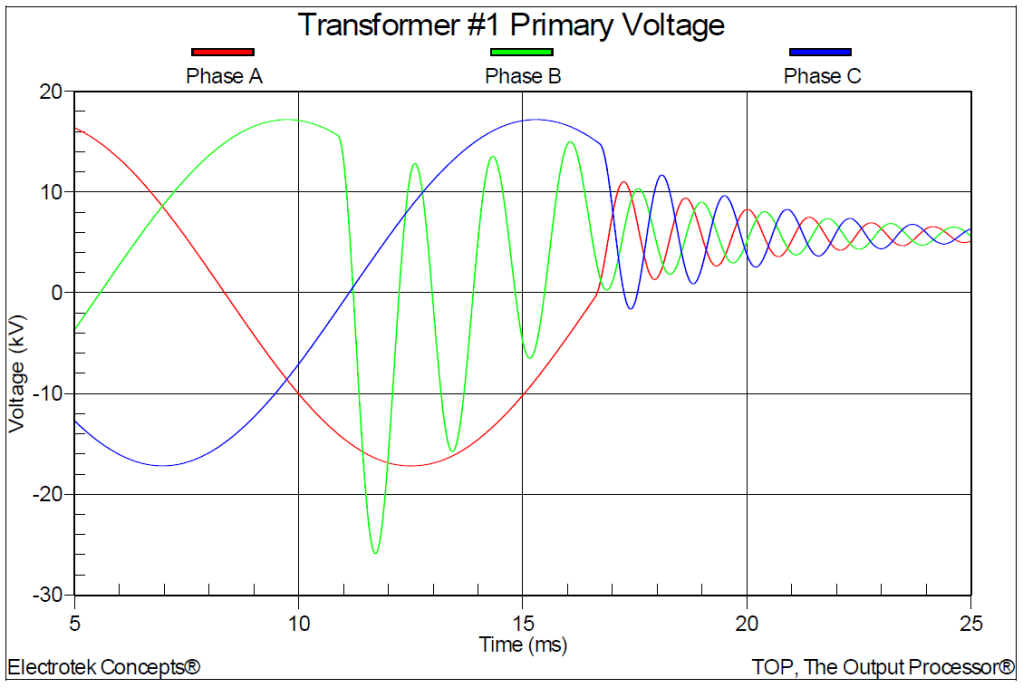
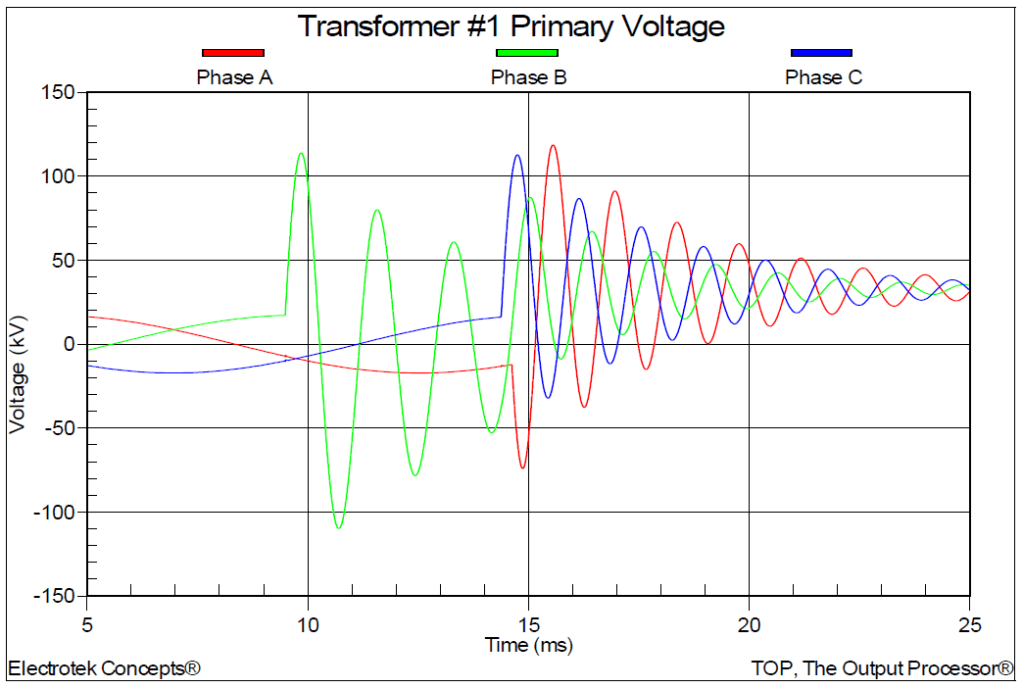
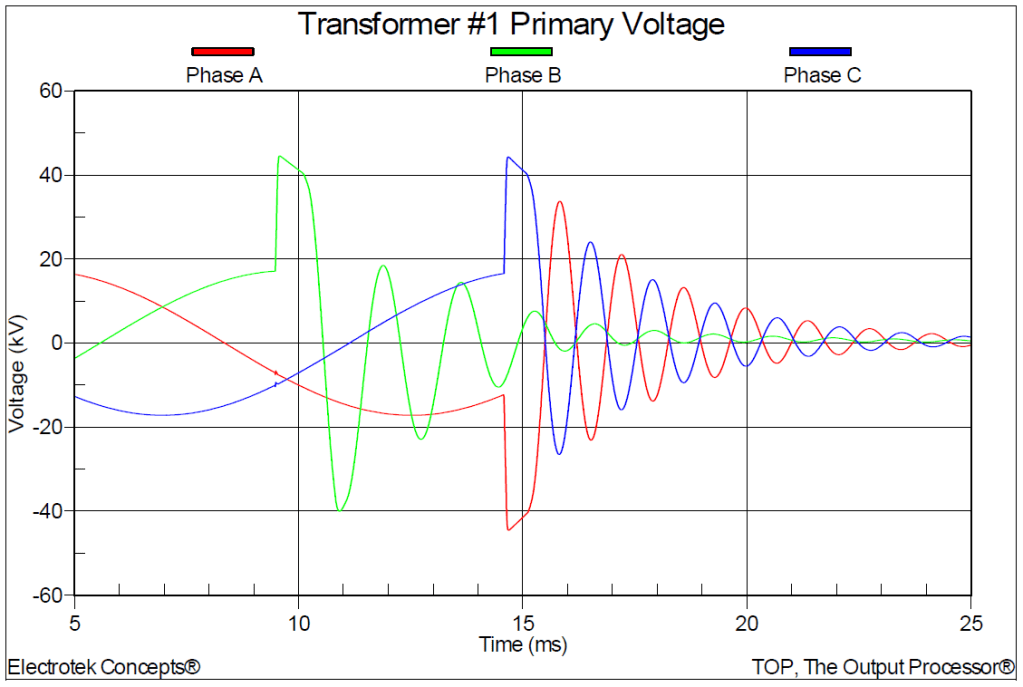
Figure 3, Figure 4, and Figure 5 illustrate the bus and transformer voltages (phase-to-ground and phase-to-phase) during energization of the 54 MVAr, 115kV capacitor bank with no MOV arresters in service. The energizing frequency for the capacitor bank is:

f = 1/2πLC = 1/2π(17.6mH∗10.8μF) = 365Hz

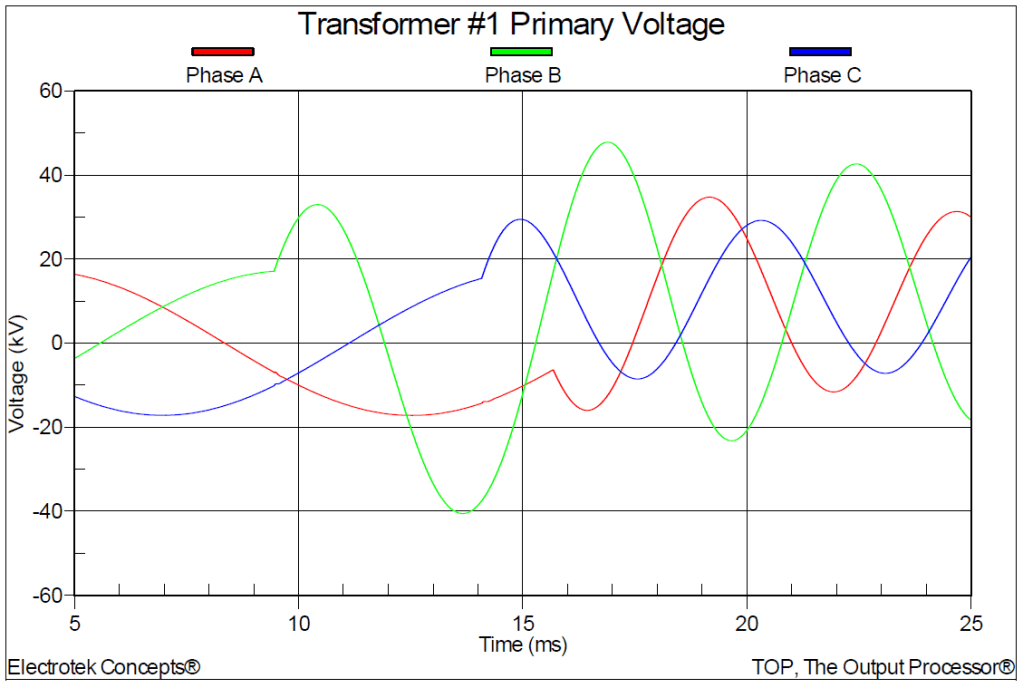
Figure 6 and Figure 7 show the transformer voltages (phase-to-ground and phase-to-phase) with a 90kV MOV in service on the transformer primary (connected phase-to-ground). The maximum phase-to-ground voltage was 1.78 per-unit and the maximum phase-to-phase was 3.57 per-unit

Figure 3 – 115kV Bus (phase-to-ground) Voltage during Energization of the 54MVAr Capacitor Bank

Note: 1pu = 115kV ∗ 2/3

Figure 4 – Transformer Primary (phase-to-ground) Voltage during Energization of the 54MVAr Bank
Figure 5 – Transformer Primary (phase-to-phase) Voltage during Energization of the 54MVAr Bank
Figure 6 – Transformer Primary (phase-to-ground) Voltage with 90kV MOV on Transformer Primary
Figure 7 – Transformer Primary (phase-to-phase) Voltage with 90kV MOV on Transformer Primary
SUMMARY

Energizing a shunt capacitor bank can cause excessive phase-to-phase transients on transformers. The high phase-to-phase voltages are a result of traveling wave reflections at the transformer termination. It is possible to obtain transients approaching twice the peak system voltage on two phases with opposite polarity, resulting in a phase-to-phase transient of approximately four times the normal peak phase-to-ground voltage. These transients can exceed the phase-to-phase withstand capability of three phase transformers. MOV arresters and other overvoltage control methods (e.g., synchronous closing control, pre-insertion resistors/inductors, etc.) may be applied to reduce the magnitudes of the switching transients.

REFERENCES

  1. IEEE Standard 1032-1992, Guide for the Application of Shunt Power Capacitors, ISBN 1-55937-257-5.
  2. S. Mikhail and M. McGranaghan, Evaluation of Switching Concerns Associated with 345 kV Shunt Capacitor Applications, IEEE Transactions PAS, Vol. 106, No. 4, pp. 221-230, April, 1986.
  3. T.E. Grebe, Technologies for Transient Voltage Control During Switching of Transmission and Distribution Capacitor Banks, 1995 International Conference on Power Systems Transients, September 3-7, 1195, Lisbon, Portugal.

RELATED STANDARDS
IEEE Std. 262B

GLOSSARY AND ACRONYMS
BIL: Basic Impulse Level
BSL: Basic Switching Impulse Insulation Level
MOV: Metal Oxide Varistor

Electrical System

Published by Bureau of Energy Efficiency


Syllabus

Electrical system: Electricity billing, Electrical load management and maximum demand control, Power factor improvement and its benefit, Selection and location of capacitors, Performance assessment of PF capacitors, Distribution and transformer losses.

1.1 Introduction to Electric Power Supply Systems

Electric power supply system in a country comprises of generating units that produce electricity; high voltage transmission lines that transport electricity over long distances; distribution lines that deliver the electricity to consumers; substations that connect the pieces to each other; and energy control centers to coordinate the operation of the components.

The Figure 1.1 shows a simple electric supply system with transmission and distribution network and linkages from electricity sources to end-user.

Figure 1.1 Typical Electric Power Supply Systems

Power Generation Plant

The fossil fuels such as coal, oil and natural gas, nuclear energy, and falling water (hydel) are commonly used energy sources in the power generating plant. A wide and growing variety of unconventional generation technologies and fuels have also been developed, including cogeneration, solar energy, wind generators, and waste materials.

About 70 % of power generating capacity in India is from coal based thermal power plants. The principle of coal-fired power generation plant is shown in Figure 1.2. Energy stored in the coal is converted in to electricity in thermal power plant. Coal is pulverized to the consistency of talcum powder. Then powdered coal is blown into the water wall boiler where it is burned at temperature higher than 1300°C. The heat in the combustion gas is transferred into steam. This high-pressure steam is used to run the steam turbine to spin. Finally turbine rotates the generator to produce electricity.

Figure 1.2 Principle of Thermal Power Generation
In India, for the coal based power plants, the overall efficiency ranges from 28% to 35% depending upon the size, operational practices and capacity utilization. Where fuels are the source of generation, a common term used is the “HEAT RATE” which reflects the efficiency of generation. “HEAT RATE” is the heat input in kilo Calories or kilo Joules, for generating ‘one’ kilo Watt-hour of electrical output. One kilo Watt hour of electrical energy being equivalent to 860 kilo Calories of thermal energy or 3600 kilo Joules of thermal energy. The “HEAT RATE” expresses in inverse the efficiency of power generation.

Transmission and Distribution Lines

The power plants typically produce 50 cycle/second (Hertz), alternating-current (AC) electricity with voltages between 11kV and 33kV. At the power plant site, the 3-phase voltage is stepped up to a higher voltage for transmission on cables strung on cross-country towers.

Image: High Voltage Transmission Lines 

High voltage (HV) and extra high voltage (EHV) transmission is the next stage from power plant to transport A.C. power over long distances at voltages like; 220 kV & 400 kV. Where transmission is over 1000 kM, high voltage direct current transmission is also favoured to minimize the losses.

Sub-transmission network at 132 kV, 110 kV, 66 kV or 33 kV constitutes the next link towards the end user. Distribution at 11 kV / 6.6 kV / 3.3 kV constitutes the last link to the consumer, who is connected directly or through transformers depending upon the drawl level of service. The transmission and distribution network include sub-stations, lines and distribution transformers. High voltage transmission is used so that smaller, more economical wire sizes can be employed to carry the lower current and to reduce losses. Sub-stations, containing step-down transformers, reduce the voltage for distribution to industrial users. The voltage is further reduced for commercial facilities. Electricity must be generated, as and when it is needed since electricity cannot be stored virtually in the system.

There is no difference between a transmission line and a distribution line except for the voltage level and power handling capability. Transmission lines are usually capable of transmitting large quantities of electric energy over great distances. They operate at high voltages. Distribution lines carry limited quantities of power over shorter distances.

Voltage drops in line are in relation to the resistance and reactance of line, length and the current drawn. For the same quantity of power handled, lower the voltage, higher the current drawn and higher the voltage drop. The current drawn is inversely proportional to the voltage level for the same quantity of power handled.

The power loss in line is proportional to resistance and square of current. (i.e. PLOSS=I2R). Higher voltage transmission and distribution thus would help to minimize line voltage drop in the ratio of voltages, and the line power loss in the ratio of square of voltages. For instance, if distribution of power is raised from 11 kV to 33 kV, the voltage drop would be lower by a factor 1/3 and the line loss would be lower by a factor (1/3)2 i.e., 1/9. Lower voltage transmission and distribution also calls for bigger size conductor on account of current handling capacity needed.

Cascade Efficiency

The primary function of transmission and distribution equipment is to transfer power economically and reliably from one location to another.

Conductors in the form of wires and cables strung on towers and poles carry the high voltage, AC electric current. A large number of copper or aluminum conductors are used to form the transmission path. The resistance of the long-distance transmission conductors is to be minimized. Energy loss in transmission lines is wasted in the form of I2R losses.

Capacitors are used to correct power factor by causing the current to lead the voltage. When the AC currents are kept in phase with the voltage, operating efficiency of the system is maintained at a high level.

Circuit-interrupting devices are switches, relays, circuit breakers, and fuses. Each of these devices is designed to carry and interrupt certain levels of current. Making and breaking the current carrying conductors in the transmission path with a minimum of arcing is one of the most important characteristics of this device. Relays sense abnormal voltages, currents, and frequency and operate to protect the system.

Transformers are placed at strategic locations throughout the system to minimize power losses in the T&D system. They are used to change the voltage level from low-to-high in step-up transformers and from high-to-low in step-down units.

The power source to end user energy efficiency link is a key factor, which influences the energy input at the source of supply. If we consider the electricity flow from generation to the user in terms of cascade energy efficiency, typical cascade efficiency profile from generation to 11 – 33 kV user industry will be as below:

.

The cascade efficiency in the T&D system from output of the power plant to the end use is 87% (i.e. 0.995 x 0.99 x 0.975 x 0.96 x 0.995 x 0.95 = 87%)

Industrial End User

At the industrial end user premises, again the plant network elements like transformers at receiving sub-station, switchgear, lines and cables, load-break switches, capacitors cause losses, which affect the input-received energy. However the losses in such systems are meager and unavoidable.

A typical plant single line diagram of electrical distribution system is shown in Figure 1.3

Figure 1.3 Electrical Distribution System-Single Line Diagram

ONE Unit saved = TWO Units Generated

After power generation at the plant it is transmitted and distributed over a wide network. The standard technical losses are around 17 % in India (Efficiency = 83%). But the figures for many of the states show T & D losses ranging from 17 – 50 %. All these may not constitute technical losses, since un-metered and pilferage are also accounted in this loss.

When the power reaches the industry, it meets the transformer. The energy efficiency of the transformer is generally very high. Next, it goes to the motor through internal plant distribution network. A typical distribution network efficiency including transformer is 95% and motor efficiency is about 90%. Another 30 % (Efficiency =70%)is lost in the mechanical system which includes coupling/ drive train, a driven equipment such as pump and flow control valves/throttling etc. Thus the overall energy efficiency becomes 50%. (0.83 x 0.95x 0.9 x 0.70 = 0.50, i.e. 50% efficiency)

Hence one unit saved in the end user is equivalent to two units generated in the power plant. (1Unit / 0.5Eff = 2 Units)

1.2 Electricity Billing

The electricity billing by utilities for medium & large enterprises, in High Tension (HT) category, is often done on two-part tariff structure, i.e. one part for capacity (or demand) drawn and the second part for actual energy drawn during the billing cycle. Capacity or demand is in kVA (apparent power) or kW terms. The reactive energy (i.e.) kVArh drawn by the service is also recorded and billed for in some utilities, because this would affect the load on the utility. Accordingly, utility charges for maximum demand, active energy and reactive power drawn (as reflected by the power factor) in its billing structure. In addition, other fixed and variable expenses are also levied.

The tariff structure generally includes the following components:

a) Maximum demand Charges
These charges relate to maximum demand registered during month/billing period and corresponding rate of utility.
b) Energy Charges
These charges relate to energy (kilowatt hours) consumed during month / billing period and corresponding rates, often levied in slabs of use rates. Some utilities now charge on the basis of apparent energy (kVAh), which is a vector sum of kWh and kVArh.
c) Power factor penalty or bonus rates, as levied by most utilities, are to contain reactive power drawn from grid.
d) Fuel cost adjustment charges as levied by some utilities are to adjust the increasing fuel
expenses over a base reference value.
e) Electricity duty charges levied w.r.t units consumed.
f) Meter rentals
g) Lighting and fan power consumption is often at higher rates, levied sometimes on slab
basis or on actual metering basis.
h) Time Of Day (TOD) rates like peak and non-peak hours are also prevalent in tariff
structure provisions of some utilities.
i) Penalty for exceeding contract demand
j) Surcharge if metering is at LT side in some of the utilities

Analysis of utility bill data and monitoring its trends helps energy manager to identify ways for electricity bill reduction through available provisions in tariff framework, apart from energy budgeting.

The utility employs an electromagnetic or electronic trivector meter, for billing purposes. The minimum outputs from the electromagnetic meters are

• Maximum demand registered during the month, which is measured in preset time intervals (say of 30 minute duration) and this is reset at the end of every billing cycle.
• Active energy in kWh during billing cycle
• Reactive energy in kVArh during billing cycle and
• Apparent energy in kVAh during billing cycle

It is important to note that while maximum demand is recorded, it is not the instantaneous demand drawn, as is often misunderstood, but the time integrated demand over the predefined recording cycle.

As example, in an industry, if the drawl over a recording cycle of 30 minutes is :

2500 kVA for 4 minutes
3600 kVA for 12 minutes
4100 kVA for 6 minutes
3800 kVA for 8 minutes

The MD recorder will be computing MD as:

(2500 x 4) + (3600 x 12) + (4100 x 6) + (3800 x 8) / 30 = 3606.7 kVA

The month’s maximum demand will be the highest among such demand values recorded over the month. The meter registers only if the value exceeds the previous maximum demand value and thus, even if, average maximum demand is low, the industry / facility has to pay for the maximum demand charges for the highest value registered during the month, even if it occurs for just one recording cycle duration i.e., 30 minutes during whole of the month. A typical demand curve is shown in Figure 1.4.

Figure 1.4 Demand Curve

As can be seen from the Figure 1.4 above the demand varies from time to time. The demand is measured over predetermined time interval and averaged out for that interval as shown by the horizontal dotted line.

Of late most electricity boards have changed over from conventional electromechanical trivector meters to electronic meters, which have some excellent provisions that can help the utility as well as the industry. These provisions include:

• Substantial memory for logging and recording all relevant events
• High accuracy up to 0.2 class
• Amenability to time of day tariffs
• Tamper detection /recording
• Measurement of harmonics and Total Harmonic Distortion (THD)
• Long service life due to absence of moving parts
• Amenability for remote data access/downloads

Trend analysis of purchased electricity and cost components can help the industry to identify key result areas for bill reduction within the utility tariff available framework along the following lines.

TABLE 1.1 PURCHASED ELECTRICAL ENERGY TREND

.
1.3 Electrical Load Management and Maximum Demand Control

Need for Electrical Load Management

In a macro perspective, the growth in the electricity use and diversity of end use segments in time of use has led to shortfalls in capacity to meet demand. As capacity addition is costly and only a long time prospect, better load management at user end helps to minimize peak demands on the utility infrastructure as well as better utilization of power plant capacities.

The utilities (State Electricity Boards) use power tariff structure to influence end user in better load management through measures like time of use tariffs, penalties on exceeding allowed maximum demand, night tariff concessions etc. Load management is a powerful means of efficiency improvement both for end user as well as utility.

As the demand charges constitute a considerable portion of the electricity bill, from user angle too there is a need for integrated load management to effectively control the maximum demand.

Step By Step Approach for Maximum Demand Control

1.Load Curve Generation

Presenting the load demand of a consumer against time of the day is known as a ‘load curve’. If it is plotted for the 24 hours of a single day, it is known as an ‘hourly load curve’ and if daily demands plotted over a month, it is called daily load curves. A typical hourly load curve for an engineering industry is shown in Figure 1.5. These types of curves are useful in predicting patterns of drawl, peaks and valleys and energy use trend in a section or in an industry or in a distribution network as the case may be.

Figure 1.5 Maximum Demand
(Daily Load Curve, Hourly kVA)

2.Rescheduling of Loads

Rescheduling of large electric loads and equipment operations, in different shifts can be planned and implemented to minimize the simultaneous maximum demand. For this purpose, it is advisable to prepare an operation flow chart and a process chart. Analyzing these charts and with an integrated approach, it would be possible to reschedule the operations and running equipment in such a way as to improve the load factor which in turn reduces the maximum demand.

3.Storage of Products/in process material/ process utilities like refrigeration

It is possible to reduce the maximum demand by building up storage capacity of products/ materials, water, chilled water / hot water, using electricity during off peak periods. Off peak hour operations also help to save energy due to favorable conditions such as lower ambient temperature etc.

Example: Ice bank system is used in milk & dairy industry. Ice is made in lean period and used in peak load period and thus maximum demand is reduced.

4.Shedding of Non-Essential Loads

When the maximum demand tends to reach preset limit, shedding some of non-essential loads temporarily can help to reduce it. It is possible to install direct demand monitoring systems, which will switch off non-essential loads when a preset demand is reached. Simple systems give an alarm, and the loads are shed manually. Sophisticated microprocessor controlled systems are also available, which provide a wide variety of control options like:

■ Accurate prediction of demand
■ Graphical display of present load, available load, demand limit
■ Visual and audible alarm
■ Automatic load shedding in a predetermined sequence
■ Automatic restoration of load
■ Recording and metering

5.Operation of Captive Generation and Diesel Generation Sets

When diesel generation sets are used to supplement the power supplied by the electric utilities, it is advisable to connect the D.G. sets for durations when demand reaches the peak value. This would reduce the load demand to a considerable extent and minimize the demand charges.

6.Reactive Power Compensation

The maximum demand can also be reduced at the plant level by using capacitor banks and maintaining the optimum power factor. Capacitor banks are available with microprocessor based control systems. These systems switch on and off the capacitor banks to maintain the desired Power factor of system and optimize maximum demand thereby.

1.4 Power Factor Improvement and Benefits

Power factor Basics

In all industrial electrical distribution systems, the major loads are resistive and inductive. Resistive loads are incandescent lighting and resistance heating. In case of pure resistive loads, the voltage (V), current (I), resistance (R) relations are linearly related, i.e.

V = I x R and Power (kW) = V x I

Typical inductive loads are A.C. Motors, induction furnaces, transformers and ballast-type lighting. Inductive loads require two kinds of power: a) active (or working) power to perform the work and b) reactive power to create and maintain electro-magnetic fields.

Active power is measured in kW (Kilo Watts). Reactive power is measured in kVAr (Kilo Volt-Amperes Reactive).

The vector sum of the active power and reactive power make up the total (or apparent) power used. This is the power generated by the SEBs for the user to perform a given amount of work. Total Power is measured in kVA (Kilo Volts-Amperes) (See Figure 1.6).

Figure 1.6 kW, kVAr and kVA Vector

The active power (shaft power required or true power required) in kW and the reactive power required (kVAr) are 90° apart vectorically in a pure inductive circuit i.e., reactive power kVAr lagging the active kW. The vector sum of the two is called the apparent power or kVA, as illustrated above and the kVA reflects the actual electrical load on distribution system.

The ratio of kW to kVA is called the power factor, which is always less than or equal to unity. Theoretically, when electric utilities supply power, if all loads have unity power factor, maximum power can be transferred for the same distribution system capacity. However, as the loads are inductive in nature, with the power factor ranging from 0.2 to 0.9, the electrical distribution network is stressed for capacity at low power factors.

Improving Power Factor

The solution to improve the power factor is to add power factor correction capacitors (see Figure 1.7) to the plant power distribution system. They act as reactive power generators, and provide the needed reactive power to accomplish kW of work. This reduces the amount of reactive power, and thus total power, generated by the utilities.

Figure 1.7 Capacitors

Example:

Achemical industry had installed a 1500 kVAtransformer. The initial demand of the plant was 1160 kVA with power factor of 0.70. The % loading of transformer was about 78% (1160/1500 = 77.3%). To improve the power factor and to avoid the penalty, the unit had added about 410 kVAr in motor load end. This improved the power factor to 0.89, and reduced the required kVA to 913, which is the vector sum of kW and kVAr (see Figure 1.8).

Figure 1.8 Power factor before and after Improvement

After improvement the plant had avoided penalty and the 1500 kVA transformer now loaded only to 60% of capacity. This will allow the addition of more load in the future to be supplied by the transformer.

The advantages of PF improvement by capacitor addition

a) Reactive component of the network is reduced and so also the total current in the system from the source end.
b) I2R power losses are reduced in the system because of reduction in current.
c) Voltage level at the load end is increased.
d) kVA loading on the source generators as also on the transformers and lines upto the capacitors reduces giving capacity relief. A high power factor can help in utilising the full capacity of your electrical system.

Cost benefits of PF improvement

While costs of PF improvement are in terms of investment needs for capacitor addition the benefits to be quantified for feasibility analysis are:

a) Reduced kVA (Maximum demand) charges in utility bill
b) Reduced distribution losses (KWH) within the plant network
c) Better voltage at motor terminals and improved performance of motors
d) A high power factor eliminates penalty charges imposed when operating with a low power factor
e) Investment on system facilities such as transformers, cables, switchgears etc for delivering load is reduced.

Selection and location of capacitors
Direct relation for capacitor sizing.

kVAr Rating = kW [tan ϕ1 – tan ϕ2]

where kVAr rating is the size of the capacitor needed, kW is the average power drawn, tan ϕ1 is the trigonometric ratio for the present power factor, and tan ϕ2 is the trigonometric ratio for the desired PF

ϕ1 = Existing (Cos-1 PF1) and ϕ2 = Improved (Cos-1 PF2)

Alternatively the Table 1.2 can be used for capacitor sizing.

The figures given in table are the multiplication factors which are to be multiplied with the input power (kW) to give the kVAr of capacitance required to improve present power factor to a new desired power factor.

Example:

The utility bill shows an average power factor of 0.72 with an average KW of 627. How much kVAr is required to improve the power factor to .95 ?

Using formula

Cos ϕ1 = 0.72 , tan ϕ1 = 0.963
Cos ϕ2 = 0.95 , tan ϕ2 = 0.329

kVAr required = P ( tanϕ1 – tanϕ2 ) = 627 (0.964 – 0.329) = 398 kVAr

Using table (see Table 1.2)

1) Locate 0.72 (original power factor) in column (1).
2) Read across desired power factor to 0.95 column. We find 0.635 multiplier
3) Multiply 627 (average kW) by 0.635 = 398 kVAr.
4) Install 400 kVAr to improve power factor to 95%.

TABLE 1.2 MULTIPLIERS TO DETERMINE CAPACITOR kVAr REQUIREMENTS FOR POWER FACTOR CORRECTION

.

Location of Capacitors

The primary purpose of capacitors is to reduce the maximum demand. Additional benefits are derived by capacitor location. The Figure 1.9 indicates typical capacitor locations. Maximum benefit of capacitors is derived by locating them as close as possible to the load. At this location, its kVAr are confined to the smallest possible segment, decreasing the load current. This, in turn, will reduce power losses of the system substantially. Power losses are proportional to the square of the current. When power losses are reduced, voltage at the motor increases; thus, motor performance also increases.

Locations C1A, C1B and C1C of Figure 1.9 indicate three different arrangements at the load. Note that in all three locations extra switches are not required, since the capacitor is either switched with the motor starter or the breaker before the starter. Case C1A is recommended for new installation, since the maximum benefit is derived and the size of the motor thermal protector is reduced. In Case C1B, as in Case C1A, the capacitor is energized only when the motor is in operation. Case C1B is recommended in cases where the installation already exists and the thermal protector does not need to be re-sized. In position C1C, the capacitor is permanently connected to the circuit but does not require a separate switch, since capacitor can be disconnected by the breaker before the starter.

Figure 1.9: Power Distribution Diagram Illustrating Capacitor Locations

It should be noted that the rating of the capacitor should not be greater than the no-load magnetizing kVAr of the motor. If this condition exists, damaging over voltage or transient torques can occur. This is why most motor manufacturers specify maximum capacitor ratings to be applied to specific motors.

The next preference for capacitor locations as illustrated by Figure 1.9 is at locations C2 and C3. In these locations, a breaker or switch will be required. Location C4 requires a high voltage breaker. The advantage of locating capacitors at power centres or feeders is that they can be grouped together. When several motors are running intermittently, the capacitors are permitted to be on line all the time, reducing the total power regardless of load.

From energy efficiency point of view, capacitor location at receiving substation only helps the utility in loss reduction. Locating capacitors at tail end will help to reduce loss reduction within the plants distribution network as well and directly benefit the user by reduced consumption. Reduction in the distribution loss % in kWh when tail end power factor is raised from PF1 to a new power factor PF2, will be proportional to

[ 1 – (PF1 / PF2)2 ] x 100

Capacitors for Other Loads

The other types of load requiring capacitor application include induction furnaces, induction heaters and arc welding transformers etc. The capacitors are normally supplied with control gear for the application of induction furnaces and induction heating furnaces. The PF of arc furnaces experiences a wide variation over melting cycle as it changes from 0.7 at starting to 0.9 at the end of the cycle. Power factor for welding transformers is corrected by connecting capacitors across the primary winding of the transformers, as the normal PF would be in the range of 0.35.

Performance Assessment of Power Factor Capacitors

Voltage effects: Ideally capacitor voltage rating is to match the supply voltage. If the supply voltage is lower, the reactive kVAr produced will be the ratio V12 /V22 where V1 is the actual supply voltage, V2 is the rated voltage.

On the other hand, if the supply voltage exceeds rated voltage, the life of the capacitor is adversely affected.

Material of capacitors: Power factor capacitors are available in various types by dielectric material used as; paper/ polypropylene etc. The watt loss per kVAr as well as life vary with respect to the choice of the dielectric material and hence is a factor to be considered while selection.

Connections: Shunt capacitor connections are adopted for almost all industry/ end user applications, while series capacitors are adopted for voltage boosting in distribution networks.

Operational performance of capacitors: This can be made by monitoring capacitor charging current vis- a- vis the rated charging current. Capacity of fused elements can be replenished as per requirements. Portable analyzers can be used for measuring kVAr delivered as well as charging current. Capacitors consume 0.2 to 6.0 Watt per kVAr, which is negligible in comparison to benefits.

Some checks that need to be adopted in use of capacitors are :

i) Nameplates can be misleading with respect to ratings. It is good to check by charging currents.
ii) Capacitor boxes may contain only insulated compound and insulated terminals with no capacitor elements inside.
iii) Capacitors for single phase motor starting and those used for lighting circuits for voltage boost, are not power factor capacitor units and these cannot withstand power system conditions.

1.5 Transformers

A transformer can accept energy at one voltage and deliver it at another voltage. This permits electrical energy to be generated at relatively low voltages and transmitted at high voltages and low currents, thus reducing line losses and voltage drop (see Figure 1.10).

Transformers consist of two or more coils that are electrically insulated, but magnetically linked. The primary coil is connected to the power source and the secondary coil connects to the load. The turn’s ratio is the ratio between the number of turns on the secondary to the turns on the primary (See Figure 1.11).

The secondary voltage is equal to the primary voltage times the turn’s ratio. Ampere-turns are calculated by multiplying the current in the coil times the number of turns. Primary ampere-turns are equal to secondary ampere-turns. Voltage regulation of a transformer is the percent increase in voltage from full load to no load.

Figure 1.10 View of a Transformer

Types of Transformers

Transformers are classified as two categories: power transformers and distribution transformers.

Power transformers are used in transmission network of higher voltages, deployed for step up and step down transformer application (400 kV, 200 kV, 110 kV, 66 kV, 33kV)

Distribution transformers are used for lower voltage distribution networks as a means to end user connectivity. (11kV, 6.6 kV, 3.3 kV, 440V, 230V)

Figure 1.11 Transformer Coil

Rating of Transformer

Rating of the transformer is calculated based on the connected load and applying the diversity factor on the connected load, applicable to the particular industry and arrive at the kVA rating of the Transformer. Diversity factor is defined as the ratio of overall maximum demand of the plant to the sum of individual maximum demand of various equipment. Diversity factor varies from industry to industry and depends on various factors such as individual loads, load factor and future expansion needs of the plant. Diversity factor will always be less than one.

Location of Transformer

Location of the transformer is very important as far as distribution loss is concerned. Transformer receives HT voltage from the grid and steps it down to the required voltage. Transformers should be placed close to the load centre, considering other features like optimisation needs for centralised control, operational flexibility etc. This will bring down the distribution loss in cables.

Transformer Losses and Efficiency

The efficiency varies anywhere between 96 to 99 percent. The efficiency of the transformers not only depends on the design, but also, on the effective operating load.

Transformer losses consist of two parts: No-load loss and Load loss

1.No-load loss (also called core loss) is the power consumed to sustain the magnetic field in the transformer’s steel core. Core loss occurs whenever the transformer is energized; core loss does not vary with load. Core losses are caused by two factors: hysteresis and eddy current losses. Hysteresis loss is that energy lost by reversing the magnetic field in the core as the magnetizing AC rises and falls and reverses direction. Eddy current loss is a result of induced currents circulating in the core.

2.Load loss (also called copper loss) is associated with full-load current flow in the transformer windings. Copper loss is power lost in the primary and secondary windings of a transformer due to the ohmic resistance of the windings. Copper loss varies with the square of the load current. (P = I2R).

Transformer losses as a percentage of load is given in the Figure 1.12.

Figure 1.12 Transformer loss vs %Load

For a given transformer, the manufacturer can supply values for no-load loss, PNO-LOAD, and load loss, PLOAD. The total transformer loss, PTOTAL, at any load level can then be calculated from:

PTOTAL = PNO-LOAD + (% Load/100)2 x PLOAD

Where transformer loading is known, the actual transformers loss at given load can be computed as:

= No load loss + (kVA Load / Rated kVA)2 x (full load loss)

Voltage Fluctuation Control

A control of voltage in a transformer is important due to frequent changes in supply voltage level. Whenever the supply voltage is less than the optimal value, there is a chance of nuisance tripping of voltage sensitive devices. The voltage regulation in transformers is done by altering the voltage transformation ratio with the help of tapping. There are two methods of tap changing facility available: Off-circuit tap changer and On-load tap changer.

Off-circuit tap changer

It is a device fitted in the transformer, which is used to vary the voltage transformation ratio. Here the voltage levels can be varied only after isolating the primary voltage of the transformer.

On load tap changer (OLTC)

The voltage levels can be varied without isolating the connected load to the transformer. To minimise the magnetisation losses and to reduce the nuisance tripping of the plant, the main transformer (the transformer that receives supply from the grid) should be provided with On Load Tap Changing facility at design stage. The down stream distribution transformers can be provided with off-circuit tap changer.

The On-load gear can be put in auto mode or manually depending on the requirement. OLTC can be arranged for transformers of size 250 kVA onwards. However, the necessity of OLTC below 1000 kVA can be considered after calculating the cost economics.

Parallel Operation of Transformers

The design of Power Control Centre (PCC) and Motor Control Centre (MCC) of any new plant should have the provision of operating two or more transformers in parallel. Additional switchgears and bus couplers should be provided at design stage.

Whenever two transformers are operating in parallel, both should be technically identical in all aspects and more importantly should have the same impedance level. This will minimise the circulating current between transformers.

Where the load is fluctuating in nature, it is preferable to have more than one transformer running in parallel, so that the load can be optimised by sharing the load between transformers. The transformers can be operated close to the maximum efficiency range by this operation.

1.6 System Distribution Losses

In an electrical system often the constant no load losses and the variable load losses are to be assessed alongside, over long reference duration, towards energy loss estimation.

Identifying and calculating the sum of the individual contributing loss components is a challenging one, requiring extensive experience and knowledge of all the factors impacting the operating efficiencies of each of these components.

For example the cable losses in any industrial plant will be up to 6 percent depending on the size and complexity of the distribution system. Note that all of these are current dependent, and can be readily mitigated by any technique that reduces facility current load. Various losses in distribution equipment is given in the Table1.3.

In system distribution loss optimization, the various options available include:

■ Relocating transformers and sub-stations near to load centers
■ Re-routing and re-conductoring such feeders and lines where the losses / voltage drops are higher.
■ Power factor improvement by incorporating capacitors at load end.
■ Optimum loading of transformers in the system.
■Opting for lower resistance All Aluminum Alloy Conductors (AAAC) in place of conventional Aluminum Cored Steel Reinforced (ACSR) lines
Minimizing losses due to weak links in distribution network such as jumpers, loose contacts, old brittle conductors.

TABLE 1.3 LOSSES IN ELECTRICAL DISTRIBUTION EQUIPMENT

.
1.7 Harmonics

In any alternating current network, flow of current depends upon the voltage applied and the impedance (resistance to AC) provided by elements like resistances, reactances of inductive and capacitive nature. As the value of impedance in above devices is constant, they are called linear whereby the voltage and current relation is of linear nature.

However in real life situation, various devices like diodes, silicon controlled rectifiers, PWM systems, thyristors, voltage & current chopping saturated core reactors, induction & arc furnaces are also deployed for various requirements and due to their varying impedance characteristic, these NON LINEAR devices cause distortion in voltage and current waveforms which is of increasing concern in recent times. Harmonics occurs as spikes at intervals which are multiples of the mains (supply) frequency and these distort the pure sine wave form of the supply voltage & current.

Harmonics are multiples of the fundamental frequency of an electrical power system. If, for example, the fundamental frequency is 50 Hz, then the 5th harmonic is five times that frequency, or 250 Hz. Likewise, the 7th harmonic is seven times the fundamental or 350 Hz, and so on for higher order harmonics.

Harmonics can be discussed in terms of current or voltage. A 5th harmonic current is simply a current flowing at 250 Hz on a 50 Hz system. The 5th harmonic current flowing through the system impedance creates a 5th harmonic voltage. Total Harmonic Distortion (THD) expresses the amount of harmonics. The following is the formula for calculating the THD for current:

.

When harmonic currents flow in a power system, they are known as “poor power quality” or “dirty power”. Other causes of poor power quality include transients such as voltage spikes, surges, sags, and ringing. Because they repeat every cycle, harmonics are regarded as a steady-state cause of poor power quality.

When expressed as a percentage of fundamental voltage THD is given by,

.

where V1 is the fundamental frequency voltage and Vn is nth harmonic voltage component.

Major Causes Of Harmonics

Devices that draw non-sinusoidal currents when a sinusoidal voltage is applied create harmonics. Frequently these are devices that convert AC to DC. Some of these devices are listed below:

Electronic Switching Power Converters

• Computers, Uninterruptible power supplies (UPS), Solid-state rectifiers
• Electronic process control equipment, PLC’s, etc
• Electronic lighting ballasts, including light dimmer
• Reduced voltage motor controllers

Arcing Devices

• Discharge lighting, e.g. Fluorescent, Sodium and Mercury vapor
• Arc furnaces, Welding equipment, Electrical traction system

Ferromagnetic Devices

• Transformers operating near saturation level
• Magnetic ballasts (Saturated Iron core)
• Induction heating equipment, Chokes, Motors

Appliances

• TV sets, air conditioners, washing machines, microwave ovens
• Fax machines, photocopiers, printers

These devices use power electronics like SCRs, diodes, and thyristors, which are a growing percentage of the load in industrial power systems. The majority use a 6-pulse converter. Most loads which produce harmonics, do so as a steady-state phenomenon. A snapshot reading of an operating load that is suspected to be non-linear can determine if it is producing harmonics. Normally each load would manifest a specific harmonic spectrum.

Many problems can arise from harmonic currents in a power system. Some problems are easy to detect; others exist and persist because harmonics are not suspected. Higher RMS current and voltage in the system are caused by harmonic currents, which can result in any of the problems listed below:

  1. Blinking of Incandescent Lights – Transformer Saturation
  2. Capacitor Failure – Harmonic Resonance
  3. Circuit Breakers Tripping – Inductive Heating and Overload
  4. Conductor Failure – Inductive Heating
  5. Electronic Equipment Shutting down – Voltage Distortion
  6. Flickering of Fluorescent Lights – Transformer Saturation
  7. Fuses Blowing for No Apparent Reason – Inductive Heating and Overload
  8. Motor Failures (overheating) – Voltage Drop
  9. Neutral Conductor and Terminal Failures – Additive Triplen Currents
  10. Electromagnetic Load Failures – Inductive Heating
  11. Overheating of Metal Enclosures – Inductive Heating
  12. Power Interference on Voice Communication – Harmonic Noise
  13. Transformer Failures – Inductive Heating

Overcoming Harmonics

Tuned Harmonic filters consisting of a capacitor bank and reactor in series are designed and adopted for suppressing harmonics, by providing low impedance path for harmonic component.

The Harmonic filters connected suitably near the equipment generating harmonics help to reduce THD to acceptable limits. In present Indian context where no Electro Magnetic Compatibility regulations exist as a application of Harmonic filters is very relevant for industries having diesel power generation sets and co-generation units.

1.8 Analysis of Electrical Power Systems

An analysis of an electrical power system may uncover energy waste, fire hazards, and equipment failure. Facility /energy managers increasingly find that reliability-centered maintenance can save money, energy, and downtime (see Table 1.4).

TABLE 1.4 TROUBLE SHOOTING OF ELECTRICAL POWER SYSTEMS

.

REFERENCES

1.Technology Menu on Energy Efficiency – NPC
2.NPC In-house Case Studies
3.Electrical energy conservation modules of AIP-NPC, Chennai

Higher Harmonics Compensation in Grid-Connected PWM Converters for Renewable Energy Interface and Active Filtering

Published by Szymon PIASECKI1, Marek JASIŃSKI1, Krzysztof RAFAŁ1, Marek KORZENIEWSKI 2, Aritz MILICUA3, Politechnika Warszawska, Instytut Sterowania i Elektroniki Przemysłowej (1), Politechnika Białostocka, Katedra Energoelektroniki i Napędów Elektrycznych (2), Uniwersytet w Mondragon, Wydział Elektryczny (3)


Abstract. The paper presents overview of high-order harmonics compensation methods applied for control of grid-connected converter. Two harmonic compensation methods are presented. One based on band-pass filers cooperating with Direct Power Control with Space Vector Modulation (DPC-SVM) is dedicated for renewable energy interface. Second method based on resonant controllers applied in Voltage Oriented Control (VOC) adds an active filtering function to PWM rectifier. Simulation and preliminary experimental results for these two methods are presented.

Streszczenie. Artykuł prezentuje wybrane metody kompensacji wyższych harmonicznych. Pierwszą bazującą na filtrach cyfrowych przedstawiono w aplikacji, w bezpośrednim sterowaniu mocy z modulacją wektorową (DPC-SVM) przekształtnikiem sieciowym. Drugą bazującą na regulatorach rezonansowych przedstawiono w sterowaniu napięciowo zorientowanym (VOC) jako funkcję aktywnej filtracji sterowanego prostownika sieciowego. Na zakończenie przedstawiono wstępne wyniki badań symulacyjnych i eksperymentalnych. (Kompensacja wyższych harmonicznych w sieciowym przekształtniku PWM)

Keywords: grid-connected converter, harmonic distortion, harmonic compensation, power quality, active filters
Słowa kluczowe: przekształtnik sieciowy, odkształcenie wyższymi harmonicznymi, kompensacja harmonicznych, jakość energii, filtry aktywne

Introduction

Nowadays there are many issues closed in the general term “Power Quality”. Electrical networks become larger every year, a huge number of different electrical devices fulfilling different standards are being connected to the grid. Equipment becomes more advanced, complicated and in fact more sensitive to quality of power supply. On the other hand, loads connected to the common network contain a lot of power electronic devices like power switches, UPS systems etc. – they can work with higher efficiency and speed, but also generate disturbances (higher harmonics). Fifteen years ago voltage distortion by high-order harmonics was marginal and almost unknown phenomenon for ordinary customers. Now it becomes very serious problem. Because number of nonlinear loads is growing, the line distortion by high order harmonics is constantly growing. High order harmonic distortion generates losses, causes overheating of many electrical devices and cuts down their predicted operation time even on 75%. Also it generates standstills and this increases costs. Therefore there is a growing interest in methods to compensate for higher harmonics

The following sections describe problem of higher harmonics compensation in PWM grid-connected converters. A brief description of power quality standards in context of higher harmonics compensation is given. Two methods dedicated for different applications are presented. Also, simulation models and results are presented. Finally two experimental setups are described and experimental verification results are given.

Fig. 1 Typical applications of grid-connected converters. a) AC-DCAC Converter. b) AC-DC Converter.
Power Quality Standards in context of harmonic distortion

Basic standard which defines quality of electrical energy is European Standard 50160 set in 1994. This standard describes electrical energy as a product and gives main characteristics of the voltage in public low-voltage and medium-voltage networks under normal operating conditions. Main characteristic of voltage harmonic distortion at the customer’s supply terminals are as follows – for harmonic distortion voltage components up to order 25, specific values are given which shall not be exceeded during 95% of the 10-minute average obtained in one week. The THD (Total Harmonic Distortion) factor shall not exceed 8% during 95% of the week [1].

Other important standards which describe power quality are: IEEE Standards, like IEEE 519-1992, IEEE SCC-22: Power Quality Standards Coordinating Committee, IEEE 1159: Monitoring Electric Power Quality etc. and General IEC power quality standards, like IEC 61000-4-11, IEC 61000-4-34 or IEC 61000-4-30.

Power Quality in Grid-Connected Converters

There are two major applications of grid-connected converters:

  • in electrical drives (Fig. 1a).
  • as interface for renewable energy source (Fig. 1b).

Most of conventional rectifiers are based on diode and thyristor bridges, being source of harmonic distortion. Most serious of generated harmonics are 5th, 7th, 11th and 13th. Conventional compensation method is installation of passive filters based on LC elements tuned to particular frequency. This method is relatively easy to implement, however, there are few disadvantages as problems with resonance, size and price of passive elements, dependency on temperature and frequency, etc. To avoid these problems a power electronic solution – active filter have been developed. It includes grid-connected PWM converter, injecting only higher harmonic current compensating the load current. In this way current drawn from the grid remains sinusoidal. This function can be included not only in the active filters, but also in STATCOM devices or modern electrical drives based on PWM rectifiers [2].

Grid interfacing converters are also influenced by supply voltage quality. Conventional control algorithms are designed to operate with pure sinusoidal voltage, higher harmonics in voltage usually cause distortion of current injected to the grid. This is of great importance, particularly in converters interfacing renewable energy sources. Most of European countries with high penetration of renewable energy have their own standards concerning quality of power injected to the grid by renewable sources, called “grid codes” [3], [4]. Imposed harmonic limits are usually much more strict than ES50160 limits.

Proposed Harmonic Compensation Methods

Conventional control methods like VOC and DPC-SVM are designed to control only fundamental component of current. For higher harmonics compensation additional control loops have to be introduced, as shown in Fig. 2. Higher-order harmonics compensation block is a module of main control algorithm. It can be optionally used and modified. Among another methods proposed in literature, two most interesting were chosen and studied [5].

First includes band-pass filters based method in multiple rotating reference frames. This method has been applied to compensate influence of higher harmonics on grid interfacing converter based on DPC-SVM control.

Second examined method uses resonant controllers to include active filter functionality to PWM converter. Cooperating with Dual Vector Current Control it can compensate for higher harmonics and asymmetry of other loads.

Fig. 2. Proposed Harmonic Compensation Module.
Direct Power Control with Space Vector Modulation and Harmonic Compensation

In Fig. 3 the block diagram of DPC-SVM (Direct Power Control with Space Vector Modulation) is presented. DPCSVM is a control algorithm mostly used in applications of converters which need bi-directional energy flow, like Renewable Energy Sources or bi-directional power flow drives. This method gives very good dynamic and static performance. Used Space Vector Modulator assure constant switching frequency and reduce switching loses. Active and reactive power are used as control variables instead of the line currents controlled in VOC scheme. Active and reactive power is controlled in close-loop using PI controller. Outer control loop with additional PI controller is DC-link voltage control loop. This solution gives possibility to manually set reference DC-link voltage. Output of this control loop multiplied by DC-link voltage module is a reference for an active power controller. Reactive power reference is set to 0. However, it should be pointed that in RES referenced reactive power should be controlled in respect to the line voltage quality improvements. To achieve synchronization of generated energy with the grid, even when supplying voltage is distorted Phase Locked Loop (PLL) control algorithm was used.

Fig. 3. Block diagram of Direct Power Control with Space Vector Modulation (DPC-SVM).

To improve control algorithm active filter based on bandpass filters was implemented. Block diagram of this method is presented in Fig. 4. In this method measured currents are transformed into multiple rotating reference. Reference frames rotate synchronously with multiplication of grid voltage (5th, 7th etc.). Each frame is dedicated for one harmonic which will be compensated. In this case 5th and 7th harmonics are compensated. Each high-order harmonic is filtered out by band-pass filter. The filtered current waveforms give information about considered higher harmonics amplitudes. After filtration process signals are again transformed into stationary reference frame and summed up. Output signals from Harmonic Compensator are added to the main reference voltages for SVM.

Fig. 4. Harmonic Compensation based on band-pass filters [1].
Dual Vector Current Controller with Active Filtering

Second investigated control algorithm of the grid-connected converter is based on modified VOC algorithm, namely Dual Vector Current Controller [6]. Block diagram of this method is presented in Fig. 5. In this control method positive and negative sequence of the line current are controlled separately.

Fig.5. Block diagram of Dual Vector Current Controller – DVCC [7].

This solution gives very good dynamic and stable operation of the system during asymmetrical grid voltage. Current references are calculated based on power references [2], [8] – active power, which is given by DC Link controller and reactive power which is set manually, this gives possibility for the system to work as a reactive power compensator. Here also to synchronize with line voltage Phase Locked Loop algorithm was employed.

For this control algorithm active filter based on resonant PI controllers was implemented. This solution is presented in Fig. 6. After high-pass filtration actual grid current is transformed into Synchronous Reference Frame. After transformations 5th and 7th harmonics become 6th harmonic component and both can be compensated by single controller, which makes this method very efficient.

Fig. 6. Harmonic Compensation based on Resonant Controllers.

Resonant controller is a second order transfer function designed to have very high gain at particular frequency. In presented system two controllers were implemented at 300Hz and 600Hz, compensating for most dangerous harmonics generated by diode and thyristor rectifiers.

Simulation model

Proposed control structures were implemented and checked in simulation studies. Simulation models were build in Synopsys Saber and Matlab Simulink packages. Saber is a multi-domain modeling and simulation environment with very advanced libraries and background for power electronic systems. In used simulation model basic control algorithm was implemented in Mast programming language which is programming tool in this simulation package. Model contains following subsystems: line model, which gives possibility to create distortions like dips or high-order harmonics, converter model, measurements system model, DC-link load model and finally control block model [7], [9]. Dual Vector Current Controller with digital harmonic filtration based on resonant controllers simulation model was created in Matlab Simulink. Matlab Simulink is nowadays one of the most popular used simulation and computation software which also has very strong backward for power electronics simulations. Base simulation model was created using Simulink platform with standard power electronics elements. Model contains following subsystems: line (grid) model, main DVCC control algorithm, coordinate systems transformations blocks, power system and Phased Locked Loop algorithm.

Simulation results

In this subsection selected simulation results are presented. First part presents results for digital filter module based on band-pass filters with DPC-SVM control method.

a) Band-pass filters in DPC-SVM algorithm

Fig. 7. Simulated grid voltage waveform and spectrum.

Fig. 7 presents line voltage distorted by 10% of 5th harmonic. Result of this distortion for operation of the converter is shown in Fig. 8, where line currents during standard operation of the converter without any compensation algorithm.

Fig. 8. Grid current waveform and spectrum under distorted voltage.

Fig. 9 presents the same conditions (voltage distorted by 10% of 5th harmonic) but with harmonic compensation algorithm. It can be observed that current harmonic content is significantly reduced.

Fig. 9. Grid current waveform and spectrum with harmonic compensation.
Fig. 10. Simulated response to the load step with harmonic compensator based on band-pass filter.

Fig. 10 presents dynamic state during step change of the load under distorted line voltage (10% of 5th harmonic), harmonic distortion is meaningly compensated. This results present good dynamic and stability of digital filter based on band-pass filters.

b) Resonant controllers

In this part simulation results for active filter based on resonant PI controllers with DVCC control method are presented. In Fig. 11 steady-state of the harmonic compensator is presented.

Fig. 11. Harmonic compensator based on resonant controllers in steady state – simulation result. (a) – distortion generated by nonlinear load connected to the system, (b) – non-linear load’s current spectrum, (c) – line currents compensated by active filter, (d) – line current spectrum.
Fig. 12. Harmonic compensator based on resonant controllers in dynamic state – simulation result.

In this case a diode-bridge rectifier which generates harmonic distortion with 5th, 7th, 11th and 13th harmonics is connected to the Point of Common Coupling (PCC). Despite of voltage distortion currents are sinusoidal, high-order harmonics are compensated.

Fig. 12 presents currents during step change of the load for the same conditions as presented above (voltage distorted by 5th, 7th, 11th and 13th harmonics).

This preliminary simulation results show possibilities of proposed control structures to compensation of higher-order harmonic distortion. Both control strategies give satisfactory simulation results and both will be studied and developed in further research. All simulation tests have been verified by experimental tests.

Laboratory setup

For experimental verification two experimental platform were used. DVCC with digital implemented filter module based on resonant controllers was implemented on test bench in University of Mondragon, Spain Fig.13 presents experimental platform for DVCC tests. This setup consist of: serially produced Semicron’s AC-DC converter and DSP/RISC dSpace 1103 card. To generate grid voltage disturbances Chroma Progrmmable AC Source was used.

Fig. 13. Experimental platform in University of Mondragon.
Fig. 14. Experimental platform. 1 – main view of the platform, 2 – 7.5kW, and 5kW AC-DC-AC Converters, 3 – dSpace 1103’s interface, 4 – screen from ControlDesk, used dSpace 1103 developers software.

DPC-SVM with digital filter module based on band-pass filter was implemented in test bench which was built in Warsaw University of Technology. Experimental platform is shown in Fig. 14. To generate grid voltage disturbances California Instruments iX Series programmable AC voltage source was used. Experimental platform contains following elements: PC with dSpace 1103 card, dSpace connector panel, 2 pairs of industrial AC-DC-AC converters (2x Danfoss 5 kW and 2x Twerd 7.5 kW), L-filter, current and voltage measurements, isolation transformer. Some preliminary experimental results are presented below.

Experimental results

In this part preliminary experimental results are presented. In Fig. 15 line currents during stable operation of the AC-DC line side converter with DPC-SVM control algorithm. Supplying line voltage is distorted by 10% of 5th harmonic, currents generated by the converter are distorted.

Fig. 15. Grid currents waveforms and spectrum with standard DPC-SVM control without harmonic compensation during steady state, grid voltages distorted by 10% of 5th harmonics – experimental result.

In Fig. 16 functionality of an digital filter module based on resonant PI controllers are presented. Line voltage is distorted by 5th, 7th, 11th and 13th harmonics generated by diode-bridge rectifier connected to the grid. Fig. 16 presents grid current waveforms and its spectrum without and with digital filter module compensated.

Fig. 16. Harmonic compensator based on resonant controllers in steady state – experimental result.

Results show ability of the filter to compensate high-order harmonics, current waveforms are sinusoidal and THD is decreased.

Fig 17 presents behavior of an digital filter module during step change of the load, grid voltage distortion is the same like in example above. Also in this case digital filter module is able to compensate high-order harmonics generated by non linear load.

Fig. 17. Harmonic compensator based on resonant controllers in dynamic state – experimental result.

Table 1. Experimental platform parameters.

.
Summary and Conclusions

This paper presents two different solutions for digital filter modules. Both of them give active filtering functionality of line-side AC-DC converter. In presented solution digital filter module is a optional functionality implemented in two different control methods for line side converter – DPC-SVM (Direct Power Control with Space Vector Modulation) and DVCC (Dual Vector Current Controller). Both presented strategies give satisfactory results, higher-order harmonic distortions are significantly compensated. These applications are dedicated for Renewable Energy Sources (RES) and will be developed and tested in focus on RES power quality improvements. However, it is necessary to increase functionality of laboratory setup in focus on research with efficiency and robustness improvements.

This work was partly supported by the National Center for Research and Development, Poland, developing grant no. N R01 0014 06/2009.

This work has been partly supported by the European Union in the framework of European Social Fund through the Warsaw University of Technology Development Programme, realized by Center for Advanced Studies.

REFERENCES

[1] PN-EN 50160 ” Parametry napięcia zasilającego w publicznych sieciach rozdzielczych.”
[2] M. P. Kaźmierkowski, M. Jasinski, Hans Ch. Sorensen , „Ocean Waves Energy Converter – Wave Dragon MW”, Przegląd Elektrotechniczny, ISSN 0033-2097, r. 84 Nr 2/2008, str. 8-13.
[3] V. Ajodhia, B. Franken „Regulation of Voltage Quality” Kema Consulting
[4] Rozporządzenie ministra gospodarki z dnia 4 maja 2007 r.” W sprawie szczegółowych warunków funkcjonowania systemu elektroenergetycznego”
[5] S. Piasecki, M. Jasinski, A. Milicua, „Brief view on Control of Grid-Interfacing AC-DC-AC Converter and Active Filter under Unbalanced and Distorted Voltage Conditions”, International Journal for Computation and Mathematics in Electrical and Electronic Engineering (COMPEL) on EVER’09, Emerald, in volume 30, no. 1, 2011, pp. 351-373.
[6] Milicua A. , Piaseck i S., Bobrowska M., Rafał K., Abad G., Coordinated Control for Grid Connected Power Electronic Converters Under the Presence of Voltage Dips and Harmonics, EPE Conference 2009
[7] H. Song, K. Nam, “Dual current control scheme for PWM converter under unbalanced input voltage conditions”, IEEE Transactions on Industrial Electronics, Vol. 46, No.5, October 1999, p.953-959
[8] Kazmierkowski M.P., Krishnan R., Blaabjerg F., “Control in Power Electronics Selected Problems,” Academic Press, 2002.
[9] Song H. S., Nam K., “Dual current control scheme for PWM converter under unbalanced input voltage conditions”. IEEE Trans. Indus. Elect, Vol. 46, No. 5, pp. 953-959, Oct. 1999.


Autorzy: mgr inż. Szymon Piasecki, dr inż. Marek Jasiński, mgr inż. Krzysztof Rafał Politechnika Warszawska, Instytut Sterowania i Elektroniki Przemysłowej, ul. Koszykowa 75a, 00-662 Warszawa, E-mail: piasecks@ee.pw.edu.pl, mja@isep.pw.edu.pl, dr inż. Marek Korzeniewski, Politechnika Białostocka, Katedra Energoelektroniki i Napędów Elektrycznych ul. Wiejska 45d, 15-351 Białystok, E-mail: m.korzeniewski@pb.edu.pl, Aritz Milicua, Uniwersytet w Mondragon, Wydział Elektryczny.


Source & Publisher Item Identifier: PRZEGLĄD ELEKTROTECHNICZNY (Electrical Review), ISSN 0033-2097, R. 87 NR 6/2011 

Energy Efficient Distribution Transformers

Published by Mariusz NAJGEBAUER, Krzysztof CHWASTEK, Jan SZCZYGŁOWSKI,
Institute of Power Engineering, Częstochowa University of Technology


Abstract. The paper presented the possibilities of improvement in properties of electric distribution transformers through the use of new soft magnetic materials, mainly amorphous alloys, as transformer cores. The properties of amorphous were compared to conventional electrical steel sheets. Economic and pro-ecological advantages resulting from application of amorphous distribution transformers in electric power systems were considered.

Streszczenie. W pracy przedstawiono możliwości poprawy właściwości transformatorów rozdzielczych poprzez zastosowanie w nich rdzeni z nowych materiałów magnetycznych, głównie stopów amorficznych. Właściwości stopów amorficznych zostały porównane z właściwościami blach elektrotechnicznych. Przeanalizowano ekonomiczne i proekologiczne korzyści wynikające z wykorzystania transformatorów rozdzielczych z rdzeniami amorficznych w systemach elektroenergetycznych. (Możliwości poprawy właściwości transformatorów rozdzielczych)

Keywords: distribution transformers, energy savings, investment profitability, environment protection.
Słowa kluczowe: transformatory rozdzielcze, oszczędność energii, opłacalność inwestycji, ochrona środowiska.

Introduction

Distribution transformers are units of electric power systems, in which electricity is transformed form the voltage level 1 – 50 kV to the voltage level 120 V + 1 kV, in dependence on consumers’ needs. Energy efficiency of distribution transformers is very high, typically ranging between 96% and 99%. However, due to a large number of distribution transformers in electric power system and their long lifetime (30 – 40 years), even small improvement in the efficiency of these units could result in significant energy savings [1]. These issues are important both from economic and ecological viewpoints.

Increase of energy efficiency of distribution transformers could be obtained reducing three types of transformer losses:

– no-load loss (iron or core loss) can be reduced by improvement in design and assembling processes or in magnetic properties of material core,
– load loss (copper loss) can be reduced increasing the cross-section of the windings,
– cooling loss can be reduced by decrease of other types of transformer losses [1].

Further increase in transformer efficiency is possible to reach by replacement silicon steel cores with new types of magnetic core materials, e.g. amorphous ribbons.

Amorphous materials were developed in the seventies of the last century. These materials are produced by rapid solidification of a liquid alloy, what gives specific magnetic properties, especially very low energy loss. However, these materials have quite low saturation induction and they are thermal unstable. Production technology and properties of amorphous materials were described in detail in earlier authors’ papers [2-8]. The properties of amorphous alloy and commonly used silicon steel are compared in Table 1.

Table 1. Chosen properties of transformer core materials [9]

.
Construction of amorphous transformers

Amorphous cores are usually produced as wounded, one-side cutting ones, due to mechanical properties of amorphous ribbons. This solution ensures the correct location of air gaps inside a core and simplifies electric windings assembling as well [2,7,11]. Amorphous transformers are produced as 1-phase or 3-phase units, with 3-limbs or 5-limbs core construction [2,7,9]. The capacity of currently produced amorphous transformers is limited up to 10 MVA [1]. The construction of an oil immersed type amorphous transformer produced by Hitachi Corporation, which is representative for this kind of transformers, is presented in Figure 1.

Fig.1. 3-phase amorphous transformer (1000 kVA, 6 kV/210 V, 60 Hz): 1 – 3 limbs core, 2 – coil, 3/4 – primary/secondary bushing, 5 – tank [9]

The cross-section of amorphous cores is larger in comparision to silicon steel ones, due to lower saturation induction of amorphous ribbons. It results in the increase of transformer dimensions and weight. Dimensions and weight of silicon steel core and amorphous core transformers are compared in Table 2.

Table 2. Transformer dimensions and weight [9]

SiT – 3-phase silicon steel core transformer, 1000 kVA, AMT – 3- phase amorphous core transformer, 1000 kVA *with relation to SiT
Energy savings and economic profits of amorphous transformers

No-load loss of amorphous core transformers is very low comparing to conventional transformers with silicon steel core. It results from very low energy loss of amorphous ribbons and also its small thickness, what significant reduces eddy currents flow. The reduction of no-load loss in amorphous transformers is estimated at 70% – 80% [2-14]. The following Tables 3-6 present the reduction of energy loss in amorphous transformers, produced by different companies.

Table 3. Energy loss in silicon steel and amorphous transformers, 6,6 kV/210 V, 60 Hz, produced by Hitachi Co. [9]

*reduction of no-load loss

Table 4. Energy loss in silicon steel and amorphous transformers, produced by ABB Group [15]

*reduction of no-load loss

Table 5. Energy loss in silicon steel and amorphous transformers, produced by Transformateurs Ferranti -Packard Ltée [16]

*reduction of no-load loss

Table 6. Comparison of no-load loss in silicon steel (SiT) and amorphous transformers (AMT) [17]

*reduction of no-load loss with relation to SiT (in-service)
**reduction of no-load loss with relation to SiT (best)

It is estimated, that currently over 83 million distribution transformers operate in six biggest economies in the world, including 3,6 million units in UE-25 countries [18,19]. Thus, a worldwide potential of energy savings, through the use of amorphous transformers instead of the conventional ones seems to be significant. There are a lot of estimations of energy savings, worked out by transformer producers, government and non-government institutions, as European Commission [20], US Department of Energy [21], European Copper Institute [18,19], with Leonardo ENERGY and ProPHET (Promotion Partnership for High Efficiency Transformers). The estimations of annual transformer loss and potential energy savings for six biggest economies are given in Table 7.

Table 7. Annual transformer loss and potential energy saving through the use of amorphous transformers [21]

.

It is obvious that energy savings in transformers give economic profits. The Cost Saving Effect (CSE) could be calculated from a simple relation

.

where: CPSiT/AMT – cost of annual loss in silicon steel or amorphous transformer in [USD/year], given by

.

where: NLL – no-load loss [W], LL – load loss [W], LF – load factor, ECh – electric charge in [USD/kWh] [9].

For a typical 3-phase 100 kVA transformer, e.g. listed in Table 3, under the assumption ECh = 0,01 USD/kWh and LF = 0,5 [9], it was obtained from calculations that CPSiT = 1 144,81 USD/year and CPAMT = 811,81 USD/year. Thus, CSE in case of a single amorphous transformer is equal to 333,20 USD/year (own calculation, based on [9]). Considering a large number of distribution transformers, the potential Cost Saving Effect through the use of amorphous units is estimated at billions of US dollars each year.

The economic analysis of the investment in amorphous transformer technology could be based at Total Owning Cost (TOC). The TOC coefficient encompasses the initial cost of the transformer and the future cost of the no-load and load losses over its lifetime [10]. Amorphous transformers are 30 – 50% more expensive than silicon steel ones [10,22]. Nevertheless, the significant reduction of no-load loss in amorphous transformers provides TOC benefit over transformer lifetime, what is presented in Figure 2. It indicates the amorphous transformers as better solution.

Fig.2. Diagram of Total Owning Cost [10]

The calculation of the TOC factor for the typical 500 kVA and 1000 kVA silicon steel and amorphous distribution transformers are presented in Table 8.

Table 8. The calculation of the TOC factor for silicon steel and amorphous transformers [own calculation, basing on 11]

.
.

Ecological profits of amorphous transformers Wider application of amorphous transformers in electric power systems gives not only energy savings and economic profits. This process has also ecological aspects. Significant energy savings result in decrease of fuel consumption in power plants, what reduces the emission of greenhouse gases. This issue is important form social considerations and for economic policy, because it simplifies the fulfilment of the international agreements of environment protection.

The Reduction Effect of CO2 emissions (RECO2) could be calculated form the following relation

.

where: ECO2_SiT/AMT – annual CO2 emissions of silicon steel or amorphous transformer in [t/year], given by

.

where: ECCO2 – CO2 emission coefficient [kg/kWh] [9].

In case of 100 kVA transformer and for the emission coefficient ECCO2 = 0,555 kg/kWh, the reduction of CO2 emissions is equal to RECO2 = 8,9 t/year [9]. The potential reduction of greenhouse gas emissions through the use of high efficiency amorphous transformers is given in Table 9.

Table 9. Environmental impact of amorphous transformers [11,18]

*estimation of Leonardo ENERGY (European Copper Institute)
**estimation of US Environmental Protection Agency
Conclusions

High efficiency distribution transformers with amorphous core become more and more popular. At present, there are more than 1,5 million amorphous transformers operating worldwide. Each year, 10% – 15% of new transformer sales in USA and Japan are amorphous ones [22]. The increasing number of amorphous transformers results both from energy savings and reduction of greenhouse gas emission. Only in the countries of European Union, annual energy savings are estimated at 18,5 TWh, corresponding to 1€ billion saving in operating cost. The energy savings are equivalent to the annual production of three nuclear power stations (1 000 MW) or eleven fossil fuel power units (350 MW) [1].

The energy savings from amorphous transformers have a great influence on the scope of electricity production and consumption. Thereby, this issue should be considered in forecasting models applied in electric power engineering.

REFERENCES

[1] Targosz R., Energy efficient distribution transformers, Brochure of Leonardo ENERGY, 2009, 4s. http://www.leonardoenergy.org
[2] Najgebauer M., Chwastek K., Szczygłowski J., Modern soft magnetic materials in “environment-friendly” transformers cores, Przegląd Elektrotechniczny, 12 (2003), 930-932
[3] Chwastek K., Najgebauer M., Szczygłowski J., Proecological aspects of progress in soft magnetic technology and its effect on power engineering, Technology & Economy in Industrial Reconversion, ISI Pierrard, HEC du Luxemburg, Virton, Belgia, 2004, 66-70
[4] Najgebauer M., Szczygłowski J., Pro-ecological aspects of soft magnetic materials applications in power transformers, The Challenges for Reconversion: Innovation-Sustainability-Knowledge Management, ISI Pierrard, HEC du Luxemburg, Virton, Belgia, 2006, 157-165
[5] Najgebauer M., Szczygłowski J., Nowoczesne tendencje rozwojowe w inżynierii materiałów magnetycznych, VI Semi-narium Naukowe WZEE’2006, Lublin, 2006, 41-50
[6] Szczygłowski J., Progress in Soft Magnetic Materials for Industrial Applications, Proceedings of IVth International Scientific Symposium „Elektroenergetika 2007”, Słowacja, 2007, 350-354
[7] Najgebauer M., Szczygłowski J., Transformatory energetyczne z rdzeniami amorficznymi, Przegląd Elektrotechniczny, 12 (2007), 108-111
[8] Chwastek K., Najgebauer M., Szczygłowski J., Wilczyński W., Modern core materials for efficient power distribution transformers, Przegląd Elektrotechniczny, 3 (2009), 133-135
[9] Hitachi amorphous transformers, Brochure of Hitachi Industrial Equipment Systems Co., Ltd., 2008, http://www.hitachi-metals.co.jp/e
[10] http://www.metglas.com
[11] DeCristofaro N., Amorphous metal in electric power distribution applications, MRS Bulletin, 23 (1998), 50-66
[12] Junyi L., The development of amorphous distribution transformers in China, Proceedings of International Conference TEAMT’2004, 2004, 313-318
[13] Hasegawa R., Energy efficiency of amorphous metal based transformers, Proceedings of International Conference TEAMT’2004, 2004, 219-223
[14] Shibata E., Pursuit of higher efficiency of transformers in Japan, Proceedings of International Conference TEAMT’2004, 2004, 300-304
[15] The transformer with low losses. The amorphous metal transformer, Brochure of Asea Brown Boveri, http://www.abb.com
[16] Schulz R., Alexandrov N., Tétreault J., Simoneau R., Roberge R., Development and application of amorphous core-distribution transformers in Québec, Journal of Materials and Engineering and Performance, 4 (1995), 430-434
[17] Hasegawa R., Present status of amorphous soft magnetic alloys, Journal of Magnetism and Magnetic Materials, 215-216 (2000), 240- 245445
[18] Targosz R. (edit.), The potential for global energy savings from high efficiency distribution transformers, Brochure of European Copper Institute, Belgium, 2005
[19] Targosz R., Topalis F.V., Energy efficiency of distribution transformers in Europe, Proceedings of 9th International Conference on Electrical Power Quality and Utilisation, Barcelona, 9-11.10.2007, 2007, 5s.
[20] The scope for energy saving in the EU through the use energy efficient electricity distribution transformers, Brochure of European Commission, Belgium, 1999
[21] Hasegawa R., Azuma D., Impacts of amorphous metalbased transformers on energy efficiency and environment, Journal of Magnetism and Magnetic Materials, 20 (2008), 2451-2456
[22] Frau J., Gutierrez J., Energy efficient distribution transformers in Spain: new trends, Proceedings of 19th International Conference on Electricity Distribution CIRED2007, Vienna, 21-24.5.2007, 2007, 4s.


Autors: dr inż. Mariusz Najgebauer, dr inż. Krzysztof Chwastek, dr hab. inż. Jan Szczygłowski, prof. PCz., Institute of Power Engineering, Częstochowa University of Technology, al. Armii Krajowej 17, 42-200 Częstochowa, Poland e-mail: najgebauer@el.pcz.czest.pl, krzych@el.pcz.czest.pl, jszczyg@el.pcz.czest.pl


Source & Publisher Item Identifier: PRZEGLĄD ELEKTROTECHNICZNY (Electrical Review), ISSN 0033-2097, R. 87 NR 2/2011

Impact of Capacitor Bank Outrush Reactors on Circuit Breaker Transient Recovery Voltages

Published by Electrotek Concepts, Inc., PQSoft Case Study: Impact of Capacitor Bank Outrush Reactors on Circuit Breaker Transient Recovery Voltages, Document ID: PQS0906, Date: October 15, 2009.


Abstract: Current limiting outrush reactors are often installed with utility transmission capacitor banks. These reactors limit the high-magnitude, high-frequency currents that flow when the capacitor bank discharges into a nearby fault. While an outrush reactor reduces the magnitude and frequency of the current during close-in faults, it may cause excessive transient recovery voltages (TRVs) for the capacitor bank circuit breaker due to the very high frequency component of the recovery voltage associated with the reactor. Excessive TRVs may cause the capacitor bank circuit breaker to fail to clear during certain fault conditions. An engineering study was completed to evaluate the TRVs for various capacitor bank circuit breaker operations, system contingencies, and mitigation alternatives. This case study presents a summary of the model development and simulations completed during the outrush reactor TRV study.

INTRODUCTION

Due to the concern for excessive transient recovery voltages (TRVs) during capacitor bank circuit breaker operations, an engineering study was performed to determine the impact of capacitor bank outrush reactors on circuit breaker transient recovery voltages. The study evaluated the concerns and possible solutions, including adding various amount of capacitance to reduce the rate-of-rise of the recovery voltage.

The analysis of high-frequency transient recovery voltages frequently requires the use of sophisticated digital simulation programs. Simulations provide a convenient means to characterize transient events, determine resulting problems, and evaluate possible mitigation alternatives. Occasionally, they are performed in conjunction with system monitoring for verification of models and identification of important power system problems. The complexity of the models required for the simulations generally depends on the system characteristics and the transient phenomena under investigation. The transient analysis for the engineering study was performed using the PSCAD/EMTDC Program (Version 4.2).

STUDY METHODOLOGY

The transient recovery voltage evaluation for various fault conditions was based on the methods provided in IEEE Std. C37.06, IEEE Std. C37.04, and IEEE Std. C37.011. This involved analysis of the most severe conditions, including the clearing of three-phase and single-line-to-ground faults at the capacitor bank circuit breaker and outrush reactor terminals when the system voltage is at a maximum.

The study included normal cases where the system operates with all circuit breakers and lines in service and various contingencies representing different operating conditions. For each case, three-phase ungrounded, three-phase grounded, and single-line-to-ground faults were evaluated.

The transient recovery voltage is the voltage across the terminals of a pole of circuit breaker following current zero when interrupting faults. Transient recovery voltage waveshapes can be oscillatory, exponential, cosine-exponential or combinations of these forms. Transient recovery voltages due to short-line faults (SLFs) are characterized by triangular-shaped waveshapes and a very steep initial rate-of-rise. The triangular shape of the recovery voltage arises from positive and negative reflections of the traveling waves that oscillate between the open circuit breaker and the fault. Due to the short distance involved, the initial rate-of-rise of the recovery voltage (RRRV) can be very steep.

According to IEEE Std. C37.011, the most severe oscillatory or exponential recovery voltages tend to occur across the first pole to open of a circuit breaker interrupting a three-phase ungrounded symmetrical fault at its terminal when the system voltage is at a maximum. When the transient recovery voltage performance meets the withstand criteria when subjected to the fault condition mentioned above, a short-line fault evaluation is not necessary. This is because short-line fault transient recovery voltage capability is higher than that of a three-phase ungrounded fault.

For conditions where the simulated transient recovery voltage exceeded the withstand capability of the circuit breaker, the mitigation option of added capacitance was also evaluated.

MODEL DEVELOPMENT

The model development process included steps for data collection, data approximation, data simplification, and model verification.

The TRV system model was based on short-circuit data that consisted of positive and zero sequence impedance data in the ASPEN Oneliner format. The study area included the substation and the adjacent system (see Figure 1). The boundary of the study area was represented with equivalent sources and transfer impedances such that the electrical representation of the study area (at 60 Hz) was nearly identical to the original representation.

Figure 1 – System Model for the 138kV TRV Study

In the study, all transmission lines were represented with a frequency dependent line model to account for traveling wave phenomena. Generating units were represented with ideal sources behind sub-transient impedances. The accuracy of the transient model was verified by comparing three-phase and single-line-to-ground fault currents at all buses. A subset of the fault cases is summarized in Table 1.

Table 1 – Steady-State Fault Simulations Completed for Model Verification

.

The model represented a reduction of the entire system to determine the system equivalents and corresponding fault levels. It should be noted that the corresponding PSCAD model did not include mutual coupling between transmission lines. In addition, typical X/R ratio values were used where the short-circuit model did not include resistance (e.g., lines, transformers, etc.), and relatively large transfer impedances were ignored. Considering these factors, accuracy within 3% was considered acceptable for the 60 Hz short-circuit model verification.

Circuit Breaker Data

The circuit breaker ratings and transient recovery voltage data included:

Rated Maximum Voltage: 145 kV
Rated Continuous Current: 3000 A
Rated Short-Circuit Current: 40 kA
Rated Interrupting Time: 3 Cycles
Line Charging: 160 A
Isolated Bank Switching: 315 A
Back-to-Back Switching: 315 A

Table 2 – Rated TRV Capability of 145kV, 3000 A, 40kA Breaker

.

The waveshape of the exponential component E1 for terminal faults below 30% of the breaker rating is 1-cosine. Based on Table 2 and the discussion in Section 5.9 of IEEE Std. C37.04-1999, the TRV limit envelopes were derived and graphically represented using a MATLAB program. Figure 2 shows the TRV envelopes (or withstand capabilities) for several fault levels. Capability envelopes when interrupting fault currents below 30% of its rated short-circuit current have a waveshape of 1-cosine, while for fault currents above 30% of breaker rating, the waveshape has an exponential-cosine form.

Figure 2 – TRV Withstand Capability for a 145kV, 3000 A, 40kA Breaker

Capacitance Values for Substation Equipment

Equivalent values of capacitance for substation equipment were based on the typical capacitance ranges provided in Annex B of IEEE Std. C37.011-1994. Three equivalent capacitance values (minimum, maximum, and average) were determined. Table 3 shows an example of the collection of typical capacitance values for each bus section in the substation. The minimum values of equivalent capacitance were used throughout the simulation process for both normal and contingency cases.

Table 3 – Typical Capacitance Values Based on Annex B of IEEE Std. C37.011-1994

.

Outrush Reactor Model

An outrush reactor was installed with the 138 kV capacitor bank to provide substation circuit breaker protection in the event of reclosing into a close-in fault. The reactor rating of 1.88 mH was based on the 145 kV general-purpose circuit breaker limitation (Ipk*f < 2×10⁷) in IEEE Std. C37.06-2000.

As shown in Figure 3, the 1.88 mH outrush reactor was modeled as a lumped inductance in parallel with a 51.5 ρF capacitance (value provided by the reactor manufacturer). This results in a natural frequency for the reactor of approximately 511 kHz:

.

where:
f is the natural frequency of the reactor (Hz)
L is the inductance of the reactor (H)
C is the capacitance of the reactor (F)

Also in parallel with the reactor were the minimum equivalent capacitance values of the connected equipment, including 25 ρF to represent an open circuit breaker, 300 ρF to represent two CTs, and 38 ρF to represent 15 feet of 138 kV bus. Therefore, the total equivalent capacitance included in the simulation model was 363 ρF. This capacitance added to the outrush reactor capacitance yields 414.5 ρF and results in a transient recovery voltage frequency of approximately 180 kHz:

.

Finally, a variable resistor was also connected in parallel with the reactor to represent the typical damping associated with the outrush reactor.

Figure 3 – Outrush Reactor Model

Basecase Model Development

Figure 4 shows a portion of the overall PSCAD circuit model used to determine the prospective transient recovery voltage withstand capabilities for the 138 kV capacitor bank circuit breaker when clearing various faults at the terminals of the outrush reactor under normal and contingency conditions. Transient recovery voltage, peak current interrupted, and the percentage of interrupted current (based on the short-time rating for the circuit breaker) was observed for each simulation case. Prospective transient recovery voltage waveshapes were then compared to their related capabilities by using a user-developed MATLAB program to graph the output from each PSCAD simulation case with an overlay of the transient recovery voltage envelope capability.

Figure 4 – Circuit for Applying Various Faults at the Outrush Reactor Terminals

Transient Recovery Voltage Evaluation Criteria and Simulation Cases

The outrush reactor limited fault creates a high frequency transient recovery voltage that the related ANSI/IEEE standards do not specifically address. For this study, the focus was on determining, and then reducing the reactor side component of the transient recovery voltage to meet the known ANSI/IEEE specified short-line fault capability for the 145 kV, 40 kA capacitor bank circuit breaker.

Criteria for the transient recovery voltage evaluation were based on IEEE Std. C37.011-1994, which states that evaluations should be conducted for three-phase ungrounded faults at the circuit breaker terminals when the system voltage is at maximum. The maximum voltage is 1.05 per-unit of the nominal voltage. The transient recovery voltage evaluation for the capacitor bank circuit breaker at the capacitor bank substation considered the following conditions:

  • during the clearing of a three-phase ungrounded symmetrical fault at the circuit breaker terminal when the system voltage is at the maximum (1.05 per-unit).
  • during the clearing of a single-line-to-ground fault at the circuit breaker terminal when the system voltage is at the maximum (1.05 per-unit).
  • during the clearing of a three-phase-ungrounded fault at the outrush reactor terminal.
  • during the clearing of a three-phase-to-ground fault at the outrush reactor terminal.
  • during the clearing of a single-line-to-ground fault at the outrush reactor terminal.

For conditions where the simulated transient recovery voltage exceeded the circuit breaker’s withstand capability, the mitigation option of added capacitance was evaluated. This included cases for various standard capacitance ratings, including 1,500 ρF, 2,500 ρF, 5,000 ρF, 7,500 ρF, and 10,000 ρF. Relevant transient recovery voltage and mitigation cases were repeated for a number of other outrush reactor ratings, such as 3.68 mH, 1.88 mH, 0.94 mH, 0.90 mH, and 0.20 mH. These cases were completed to determine the relationship between the reactor rating and the severity of the capacitor bank circuit breaker recovery voltages. Similarly, cases were completed to determine if a circuit breaker with a higher short circuit rating affected the results.

Finally, a number of transient recovery voltage and mitigation cases were repeated under several contingency conditions, such as the removal of the substation’s 345 kV/115 kV transformer.

SIMULATION RESULTS

The transient recovery voltage evaluation included both three-phase and single-line-to-ground faults at the outrush reactor terminals.

Reactor Terminal Faults

The simulation results for the various reactor terminal fault clearing cases were summarized in tables similar to Table 4. The table shows the respective case identifier, the fault type, the capacitance values, the peak current that the circuit breaker interrupted, this peak current as a percentage of the rated value (40 kA), the peak transient recovery voltage in kV, and a note to report whether the transient recovery voltage was within the circuit breaker’s capability envelope. A “YES*” note signifies that the transient recovery voltage waveshape slightly exceeded the transient recovery voltage capability for the first 10-50 μsec, but it met the transient recovery voltage short-line fault capability. A “NO” note signifies that the waveshape did not meet the transient recovery voltage capability limit.

Figure 5 and Figure 6 show several examples of the simulation results for the outrush reactor terminal fault clearing cases summarized in Table 4. Figure 5 shows the recovery voltage for the capacitor bank circuit breaker for Case C1 and Figure 6 shows the results for Case D1. Each graph includes the corresponding circuit breaker withstand capability.

Table 4 – TRV Evaluation of Reactor Faults

.
Figure 5 – TRV Withstand Capability for Case C1
Figure 6 – TRV Withstand Capability for Case D1

Evaluating Effectiveness of Added Capacitance

A number of cases were completed to evaluate resulting transient recovery voltages for the capacitor bank circuit breaker when clearing faults at the outrush reactor terminal under normal conditions with additional capacitances added at the reactor terminals.

The ratings of the additional capacitances simulated included standard ratings available from several manufacturers, including 1,500 ρF, 2,500 ρF, 5,000 ρF, 7,500 ρF, and 10,000 ρF. The additional capacitance adds to the outrush reactor and other equipment capacitances. For example, adding a 1,500 ρF capacitance results in a total capacitance of 1914.5 ρF and a transient recovery voltage frequency of approximately 84 kHz.

Figure 7 and Figure 8 show examples of the simulation results for a single-line-to-ground fault on the outrush reactor terminal. Figure 7 shows the recovery voltage for the capacitor bank circuit breaker with 1,500 ρF added and Figure 8 shows the results with 5,000 ρF added.

Figure 7 – TRV Withstand Capability for Case D1 with 1,500pF Added (Case E1)
Figure 8 – TRV Withstand Capability for Case D1 with 5,000pF Added (Case E3)

Evaluating Outrush Reactor Rating

Cases were completed to evaluate resulting transient recovery voltages for the capacitor bank circuit breaker when clearing faults at the outrush reactor terminal for a number of different reactor ratings, including 0.20 mH, 0.90 mH, 0.94 mH, and 3.68 mH.

Figure 9, and Figure 10 show examples of the simulation results for a single-line-to-ground fault on the outrush reactor terminal. Figure 9 shows the recovery voltage for the capacitor bank circuit breaker with a 3.68 mH reactor rating (no additional capacitance) and Figure 10 shows the results with a 3.68 mH reactor rating and a 10,000 ρF capacitance.

Figure 9 – TRV Withstand Capability for a 3.68mH Reactor
Figure 10 – TRV Withstand Capability for a 3.68mH Reactor with 10,000pF Added
SUMMARY

The engineering study included an evaluation of the transient recovery voltage performance of a 145 kV capacitor bank circuit breaker in a 138 kV substation. A number of observations and conclusions included:

1.The simulated transient recovery voltages exceeded the short-line fault capability limits when clearing three-phase ungrounded, three-phase grounded, and single-line-to-ground faults at the reactor terminals. This is because the recovery voltage severity is worsened by the very high frequency component of the transient voltage on the reactor side of the circuit breaker.

2.One method for improving this condition is with the application of an additional capacitance to ground between the circuit breaker and the outrush reactor. This capacitance reduces the severity of the transient recovery voltage. Standard capacitance ratings, including 1,500 ρF, 2,500 ρF, 5,000 ρF, 7,500 ρF, and 10,000 ρF, were simulated. The simulations indicated that the 5,000 ρF capacitance was the minimum standard capacitance rating that would reduce the recovery voltage to within the beaker’s capability for all of the cases.

3.The effect of outrush reactor rating on resulting transient recovery voltages was evaluated for the ratings 0.20 mH, 0.90 mH, 0.94 mH, and 3.68 mH. Only the 0.20 mH reactor rating had a transient recovery voltage waveshape that did not exceed the related short-line fault capability limit. A 10,000 ρF capacitance was required to reduce the recovery voltage to within the circuit beaker’s short-line fault capability for the 3.68 mH reactor rating.

4.Supplemental cases were completed to evaluate several contingency operating conditions. The severity of the transient recovery voltages was not changed significantly because the characteristic was dominated by the very high frequency component of the transient voltage on the reactor side of the circuit breaker.

REFERENCES

  1. PSCAD, Version 4.0.2 Professional, http://www.pscad.com.
  2. IEEE AC High Voltage Circuit Breakers Rated on a Symmetrical Current Basis – Preferred Ratings and Related Required Capabilities, IEEE Standard C37.06, May, 2000.
  3. IEEE Standard Rating Structure for AC High-Voltage Circuit Breakers, IEEE Standard C37.04, June, 1999.
  4. IEEE Application Guide for Transient Recovery Voltage for AC High Voltage Circuit Breakers Rated on a Symmetrical Current Basis, IEEE Standard C37.011, September, 1994.

RELATED STANDARDS
IEEE Std. C37.06, IEEE Std. C37.04, IEEE Std. C37.011

Stolen Electricity or Gas Meter?

Published by CallMePower | Selectra LLC


Has your electricity or gas meter been stolen? Find out here what to do if your meter has been snitched.

Why are meters stolen?

Electric meters contain electronic components which can be sold on the black market. Copper, an expensive metal with high conductivity, is usually present in electricity meters, although in small quantities. Gas meters may contain other parts of scrap metal which could be sold, although probably not at a great profit.

Meters can also be stolen in order for them to be installed elsewhere. The meter thief will install the stolen meter to a new location, so that the electricity used at that location is measured by the stolen meter. Every month, when the utility company’s technician comes to make a meter reading, the thief will replace the stolen meter with the original meter, to avoid suspicion. Indeed, the technician can identify the meter, and verifies it belongs to the correct address. This way, the electricity used will be counted by the stolen meter, and not the original meter.

Image: CallMePower | Selectra LLC – Meter theft
How are meters stolen?
Image: CallMePower | Selectra LLC – Stolen meter

Picture of 2 stolen electricity meters. On the left, only the central part of the meter has been taken, on the right, the whole box has been taken.

Meters are stolen by disconnecting all incoming and outgoing electrical cables (or pipes, for gas meters), and taking the box which contains all the meter parts. It can either be done in a clean manner, if the thief wishes to re-use the meter, or in a sloppy manner, by ripping the meter off the wall, usually for those only wishing to sell the scrap metal of the meter.

How to get your meter back?

First, you must report the meter theft. Call the outages phone number of your utility company, and and report the theft. If you have the meter number, give it to them. If not, your exact address and apartment number will suffice. A technician will be sent to inspect your meter location. If your meter has indeed been stolen, the technician will issue an order to replace it shortly. The delay for your meter to be replaced can vary depending on the utility company.

Other problems related to electricity theft

Without physically having your electricity meter stolen, you can still have electricity stolen from you. The wiring system in or around the meter can be tampered with, in order for surrounding inhabitants to use electricity, which will still be charged to your bill.

Image: CallMePower | Selectra LLC – Electricity theft meter tampering

The meter is tampered with: extra wires are added to the meter. The electricity used through these added wires will be charged to the meter.

Updated on 11/11/2021


Source URL: https://callmepower.com/useful-information/stolen-meter

Wire Wrapping for Low Current Monitoring

Published by Veris Industries, Veris Application Note VN35 – Wire Wrapping for Low Current Monitoring.


.

The information provided herein is intended to supplement the knowledge required of an electrician trained in high voltage installations. There is no intent to foresee all possible variables in individual situations, nor to provide all training needed to perform these tasks. The installer is ultimately responsible to assure that a particular installation will be and remain safe and operable under the specific conditions encountered.

Introduction

Some conductors carry loads below the rating of standard current sensors. To monitor these conductors, employ a simple wire-wrapping technique to amplify the current sensor’s input.

Wrap the monitored conductor through the center hole and around the sensor body to produce multiple turns through the iris. This increases the current measured by the transducer.

The controller must then be programmed to account for this wrapping. For example, if the conductor passes through the sensor iris four times, the controller must divide the sensor reading by four to calculate the actual current in the conductor.

Wiring Example

In the example below, the sensor has a minimum current rating of 0.75A. The current in the conductor is only 0.2A. The conductor is therefore wrapped through the sensor’s iris 4 times.

sensor output / # of loops = conductor current

0.8A / 4 = 0.2A

.

Source URL: https://www.veris.com/ASSETS/DOCUMENTS/CMS/EN/Static_Documents/Application%20Notes/vn35.pdf

High Voltage Test Transformers, Construction, Design and Their Application in HV Testing System

Published by Bogdan TUŁODZIECKI, Electric Apparatuses Factory Zwarpol Ltd. in Warsaw


Abstract. In this article were described the most frequently used constructions of high voltage test transformers. There were presented defects, advantages and application of describing constructions. There were described how to design high voltage test transformers and what is important during their design. On the basis of measurements of selected high voltage test transformers were verified correctness of computational methods. During analysis of results were presented constructors’ problems connected with a design and making a product.

Streszczenie. W artykule opisano najczęściej produkowane konstrukcje transformatorów probierczych. Podano wady, zalety i zastosowanie opisanych konstrukcji. Opisano jak należy projektować i na co należy zwrócić uwagę przy projektowaniu. Na podstawie pomiarów wybranych transformatorów probierczych zweryfikowano poprawność metod obliczeniowych. Dodatkowo analizując wyniki przedstawiono problemy z jakimi napotyka się konstruktor podczas projektowania i wykonywania wyrobu. (Transformatory probiercze, budowa, projektowanie i ich zastosowanie w układach probierczych)

Keywords: high voltage test transformers, high voltage testing systems, strength of primary isolation, withstand tests
Słowa kluczowe: transformator probierczy, układ probierczy, wytrzymałość izolacji pierwotnej, próby wytrzymałościowe

1.Introduction

High voltage test transformers are single-phase solution of transformers, which have to raise supply voltage to required value to make a dielectric withstand test of liquid or solid insulation. The strength of primary insulation, minimum value of short-circuit voltage and increasing transformer voltage ratio to level when value of secondary voltage (high voltage), reducing of voltage drop on load by power rating, it wouldn’t smaller than set value is very important in high voltage test transformers. It is essential to calculate voltage and angular errors to adequate increasing of transformer voltage ratio of high voltage test transformer and describing its voltage of short circuit. Accuracy of transformation of voltage isn’t a desirable quantity. Value of secondary voltage in high voltage testing systems is determined by rodman branch or voltage high divider, so it isn’t necessary to command of nominal transformer voltage ratio. Calculation of parameters of high voltage test transformers isn’t easy. High voltage test transformers sometimes equip with branch or branches made on secondary winding for the sake of adapting of transformer to examination of isolation with different levels of voltages and different values of power of load. In this case one kind of coil wire can’t wind secondary winding. Besides, some high voltage test transformers have two primary windings, which are link/wired in series or parallel to change its nominal transformer voltage ratio. Calculation of parameters of these high voltage test transformers is more complicated than transformers with one primary winding. High voltage test transformers are characterized by many variety of solutions on different level of complexity.

In this article the author focus his attention concentrate on High voltage test transformers made by Zwarpol Factory Ltd., where he has been working. He describe their construction, design and application in high voltage testing systems.

2.Construction

High voltage test transformers find application in high voltage testing systems to make dielectric withstand tests of specified kind of isolation, so they are subject to different criterion of selection. Because of constructional limitations of high voltage test transformers following from maximal levels of test voltages, a type of test voltages (facial or interfacial) and maximal mechanical structural strength, there aren’t produce one type high voltage test transformers.

We can make following constructions for the sake of the way of location of windings on a core:

a) when a coil or primary coils (low voltage) and a secondary coil (high voltage) are on one column of magnetic core. The secondary coil is located on a coil or primary coils. The beginning of the secondary coil and an earth electrode of core are connected and taken out from transformer to ground (Fig. 1a). This type of high voltage test transformers is the most popular, because it’s easy to define their parameters and make them.

Fig. 1 Interior of high voltage test transformer with construction describing in a and b points.

b) when a coil or primary coils and a secondary coil are on the central column of jacket coat core. The secondary coil is located on a coil or primary coils. The beginning of the secondary coil and an earth electrode of core are connected and taken out from transformer to ground (Fig. 1b).

This solution is applied in mobile high voltage testing system, where transformer must be more mechanical resistant. This type of high voltage test transformer is marked by smaller leakage of magnetic flux than construction in point a.

c) when primary and secondary coil are split into half and located on two columns of magnetic core (Fig. 2). Coils are located in this way, that secondary coils are put on every primary coils. The beginning of the secondary coil and an earth electrode of core are taken out from transformer to ground. Primary coils are connected parallel, whereas secondary coils are connected in series. In this way we can receive half test voltage on every secondary coils. This construction is characterized by the smallest leakage of magnetic flux. Material consumption of winding is also smaller than it is in construction describing in a and b points. Unfortunately, the problem is assurance right level of primary isolation between both secondary coils, because the beginning and the end of coils, which are connected in series are located very near each other. The next problem is assurance right level of primary isolation between primary and secondary coils, because there is a half test voltage between them.

Fig. 2 Interior of high voltage test transformer with construction describing in point c.

d) when is only one primary winding and many secondary windings. A primary coil is put on column of plain-frame magnetic core, while secondary coils which are connected in series are put on a primary coil. This solution in high voltage test transformer is especially applied to receive test voltage on both poles displaced about 180 (Fig. 3).

Fig. 3 Interior of high voltage test transformer with construction describing in point d.

e) cascade, where binding coils are put on two columns of magnetic core. Secondary winding is put on binding coils. Primary winding or windings (law voltage) are put on a bottom secondary coil of first grade cascade. Coupling winding is put on a top secondary coil of second grade cascade in case of two or multicore cascade solution. Coupling coils are put on secondary coils in next grades of cascade. Because a core has potential of half primary voltage of every grades of cascade, so binding coils have to have the same potential as core. For this reason they are connected parallel with each other and in the same place as core. The end of bottom secondary coil and the beginning of top secondary coil are connected with each other and with core to have the same potential of core. The end of top secondary coil and the beginning of bottom secondary coil of next grade of cascade are connected with each other and connecting parallel windings (Fig. 4). High voltage test transformers with cascade construction are made when it’s impossible to make a high voltage test transformer with construction describing in point ‘a’ as regards dimensions or strength of primary isolation.

Fig. 4 Interior of step-up cascade with one core, two-stage transformer.

We can make following constructions for the sake of the way of making primary isolation:
a) with paper-oil primary isolation
b) with polypropylene foil and gas SF6 primary isolation
c) with resinous primary isolation
d) with silicon – estrofol foil primary isolation
e) with mix primary isolation

Selection of kind of isolation of high voltage test transformers is dependent on maximum closed-circuit voltage. The most often applied primary isolation is paper-oil isolation or polypropylene foil with gas SF6. In narrow range of test voltage is applied resinous primary isolation or silicon – estrofol foil primary isolation. The way of making of primary isolation is dependent on closed-circuit voltage at which the high voltage test transformer is made. The higher the closed-circuit voltage of transformer the more complicated execution of primary isolation.

3.Design

When we design a new High voltage test transformer we must take note of its application in high voltage testing system, which determine the main construction parameters.

Depending on use in high voltage test transformers we can distinguish following parameters:
a) rated frequency
b) primary voltage
c) secondary voltage
d) secondary voltage with short-time rating
e) short-circuit voltage
f) voltage branch measure
g) voltage branch of high voltage
h) continuous power rating
i) short-time power rating
j) primary continuous rated current
k) primary short-time rated current

For example if high voltage testing system on output should have high sinusoidal variable voltage at power-line frequency and additionally possibility to install rectifier we can design a high voltage test transformer on power-line frequency 50Hz. But if high voltage testing system on output should have rectified voltage permanently it isn’t economical solution to design high voltage test transformer on power-line frequency 50Hz. In this situation it should be design on much higher frequency than power-line frequency.

If we take the duration of the high-voltage test in a laboratory into consideration it can turn out that design of high voltage test transformer on continuous power isn’t necessary and we can design it depending on the required maximum duration of test on short-time rating.

When we define the parameters on which the high voltage test transformer have to be design we can make calculations of

a) a core and windings
b) parameters of substitute diagram
c) voltage and angle errors

Some of the most common computational schemes of high voltage test transformers are represented in Fig. 5. The values appointed by figure 1 on computational schemes are related to primary side of high voltage test transformer (law voltage), while figure 2 are related to secondary side of high voltage test transformer (high voltage)

Fig. 5 The computational scheme of High Voltage Test Transformer a) with one primary winding; b) with two primary windings connecting in series; c) with two primary windings connecting parallel; d) with secondary winding with a branch of high voltage.

The way of making of calculation of parameters is very similar to calculations of parameters of single-phase instrument transformers [1]; [2] so it will not be described in the article. Voltage and angle errors in case of high voltage test transformers are necessary to redimensioning transformer voltage ratio. In this situation at full active or short-time fictitious load we can get maximum value of test voltage on which the transformer was designed. At errors it was been possible to define. The value of short-circuit voltage of transformer we can also calculate on the basis of errors.

The results of calculations and measurements of parameters of three high voltage test transformers analytically designed on basis of literature [1] and [2] are following.:

a) high voltage test transformers at continuous power 2kVA, supply voltage 230V, test voltage 25kV and frequency 50Hz
b) high voltage test transformers at continuous power 1,1kVA, supply voltage 260V, test voltage 41kV and frequency 50Hz
c) high voltage test transformers at continuous power 10kVA, supply voltage 250V, test voltage 100kV and frequency 50Hz

In the first stage of verification of analytic method were measured the resistances of windings of finished transformers. The results of calculate and measurement are in the Schedule 1.

Schedule 1. Windings resistance

.

The next steps was executed idle run and on her basis was calculated effective value current IFE and passive value current Iμ no-load current I0. The results of calculate and measurement are in the Schedule 2.

Schedule 2. Effective value IFe and passive value Iμ no-load value current I0.

.

Large divergence of results for TP 1,1kVA and TP 10kVA can be connected with applied of steering screens, adjusting strengths of main isolation, which initiate additional capacity after side of winding of high voltage and also that in case of testing transformers with large voltage ratio, parallel and private windings capacity make up additional reactive load to transformer. It is hard to get idle run in case of high voltage transformers.

The next steps of verification of analytic results was been realization fault test to calculate short-circuit voltage and total reactance of both winding imported into primary side. Results for two testing transformers are in the Schedule 3.

Schedule 3. Value from fault test for two testing transformer.

.
4.Application

High voltage test transformers have following use:

a) in a complete high voltage testing systems to test of solid dielectric:
• high voltage indicator (high voltage testing systems in Fig. 7 and high voltage testing station in Fig. 6a)
• insulating stick (high voltage testing systems in Fig. 7 and high voltage testing station in Fig. 6b)
• rubber blanket (high voltage testing systems in Fig. 7 and high voltage testing station in Fig. 6c)

b) in high voltage testing systems to test of dielectric isolation in solid high voltage (Fig. 7b)
c) in testing device to test of dielectric isolation energetic cables by alternating or state high voltage (Fig. 8a)
d) in testing device to test of liquid dielectric isolation for example insulating oil (Fig. 8b)
e) in testing device to test dielectric isolation of dielectric gloves and dielectric shoes (Fig. 8c)

Fig. 6 High voltage testing station: a) to test high voltage indicator; b) to test insulating stick; c) to test rubber blanket
Fig. 7 High voltage testing systems to test dielectric isolation: a) alternating voltage with power line frequency; b) solid voltage
Fig. 8 Testing devices to test : a) of dielectric isolation energetic cables; b) of liquid dielectric isolation; c) of dielectric gloves and dielectric shoes
5.Conclusions

In this article were described the most frequently used constructions of high voltage test transformers. There were presented defects, advantages and limitations selected constructions of high voltage test transformers. In the article become specified parameters on which high voltage test transformer can be design with a reason of their choice. Analyzing results of prototypes of high voltage test transformers was verified correctness of computational method. Additionally comparison of results of calculations with results from measurements was used as a representation of problems which constructor encounters during design and checking of correctness of finished transformer. It is not easy to design the high voltage test transformers. Making allowance for economics factors, it is important to choose the cheapest construction of high voltage test transformer being on border of possibility of her realization. There are very important the parameters, which are characteristic for the construction because they can be essential for high voltage testing system. Knowledge of the construction of high voltage test transformers, their design and use in high voltage testing system gives the solution of the most adjustment transformer in respect of parameters and prices.

REFERENCES

[1] R. Nowicz, Voltage instrument transformers. Classic, special and unconventional Monographs of Technical University of Lodz, Lodz 2002. (in Polish)
[2] W. Starczakow, Instrument transformers, PWT, Warsaw 1959. (in Polish)
[3] E. Leśniewska, The Use of 3D Electric Field Analysis and the Analytical Approach for Improvement of a Combined Instrument Transformer Insulation System, IEEE Transactions on Magnetics, vol.38, no 2, March 2002, pp. 1233-1236
[4] E. Leśniewska, Improvement of the Electric Strength of an Insulation System of a Medium Voltage Instrument Transformer Using Field Analysis, Computer Engineering in Applied Electromagnetism, Springer 2005, Great Britain, pp.143-148
[5] Z. Flisowski, High voltage engineering, WNT, Warsaw 2009.
[6] J. Wodziński High voltage engineering of tests and measurements, PWN, Warsaw 1997


Author: mgr inż. Bogdan Tułodziecki, Fabryka aparatów elektrycznych Zwarpol Sp. z o. o. w Warszawie, ul. Żegańska 1, 04-713 Warszawa, e-mail: Bogdan.tulodziecki@zwarpol.com


Source & Publisher Item Identifier: PRZEGLĄD ELEKTROTECHNICZNY (Electrical Review), ISSN 0033-2097, R. 87 NR 1/2011

Nuisance Tripping of Sensitive Customer Power Electronic Equipment

Published by Electrotek Concepts, Inc., PQSoft Case Study: Nuisance Tripping of Sensitive Customer Power Electronic Equipment, Document ID: PQS1011, Date: October 15, 2010.


Abstract: This case study presents an investigation of nuisance tripping of sensitive customer power-electronic equipment during utility capacitor bank switching. The simulations for the analysis were completed using the PSCAD program. The power conditioning solutions included utility switches with pre-insertion resistors and customer series chokes. Both mitigation alternatives prevented the customer sensitive power- electronic equipment from tripping during the power quality events.

INTRODUCTION

A nuisance tripping of sensitive customer power-electronic equipment case study was completed for the system shown in Figure 1. The case study investigated the potential for tripping of customer power-electronic equipment during switching of a utility distribution capacitor bank. Several power conditioning mitigation alternatives, including utility switches with pre-insertion resistors and customer series reactors/chokes, were evaluated using computer simulations.

Figure 1 – Illustration of Oneline Diagram for Sensitive Equipment Evaluation
SIMULATION RESULTS

The simulations for the case study were completed using the PSCAD program. The accuracy of the simulation model was verified using three-phase and single-line-to-ground fault currents and other steady-state quantities, such as steady-state voltage rise. The circuit consisted of a 115 kV utility substation supplying a 30 MVA, 115 kV/13.2 kV step-down transformer. Three customers were also included in the simulation model to evaluate the effect of different types of power electronic loads. The customers included two 1,000 kVA, 13.2 kV/480 V step-down transformers supplying HVAC loads and one 100 kVA, 13.2 kV/415V step-down transformer supplying switch-mode power supply (SMPS) loads.

Utility capacitor bank switching is a normal system operation and the resulting transient voltages and currents are usually not a problem for utility equipment. However, there is a possibility that these low frequency transients can cause severe secondary transients if a customer has power factor capacitor banks or result in nuisance tripping of power electronic-based devices, such as adjustable-speed drives. Capacitor bank energizing is just one of the many switching events that can cause transients on a utility system. However, due to their regularity and impact on power system equipment, they quite often receive special consideration.

Power quality problems related to utility capacitor bank switching include customer equipment damage or failure, nuisance tripping of adjustable-speed drives or other process equipment, transient voltage surge suppressor failure, and computer network problems.

Energizing a shunt capacitor bank from a predominantly inductive source creates an oscillatory transient that can approach twice the normal system peak voltage (Vpk). The characteristic frequency (fs) of this transient is given by the following expression:

.

where:
fs = characteristic frequency (Hz)
Ls = positive sequence source inductance (H)
C = capacitance of bank (F)
fsystem = system frequency (50 or 60 Hz)
Xs = positive sequence source impedance (Ω)
Xc = capacitive reactance of bank (Ω)
MVAsc = three-phase short circuit capacity (MVA)
MVAr = three-phase capacitor bank rating (MVAr)
ΔV = steady-state voltage rise (per-unit)

The characteristic energizing frequency for the simulated 7,200 kVAr, 13.2 kV distribution capacitor bank with a source strength of about 320 MVA may be approximated using the following expression:

.

The steady-state voltage rise for this case may be approximated using the following expression:

.

Relating the characteristic frequency of the capacitor bank energizing transient (fs) to a steady-state voltage rise (ΔV) design range provides a simple way of quickly determining the expected frequency range for utility capacitor bank switching. For example, a 60 Hz system with a design range of 1.0% to 2.5% would correspond to characteristic frequency range of 380 to 600 Hz. For a shunt capacitor bank on a utility bus, feeder/cable capacitance and other nearby capacitor banks cause the energizing transient to have more than one natural frequency. However, for the first order approximation, this equation can still be used to determine the dominant frequency.

Because capacitor voltage cannot change instantaneously (remembering that i(t)=Cdv/dt), energization of a capacitor bank results in an immediate drop in system voltage toward zero, followed by an oscillating transient voltage superimposed on the fundamental frequency waveform. The peak voltage magnitude depends on the instantaneous system voltage at the instant of energization and can approach twice the normal system voltage. For a practical capacitor bank energization without trapped charge, system losses, loads, and other system capacitances cause the transient magnitude to be less than the theoretical 2.0 per-unit. Typical magnitude levels range from 1.3 to 1.5 per-unit and typical transient frequencies generally fall in the range from 300 to 1000 Hz. Figure 2 illustrates an example measured distribution system capacitor bank energizing transient.

Figure 2 – Example of a Distribution Capacitor Bank Energizing Transient Voltage Waveform

Nuisance tripping refers to the undesired shutdown of a customer’s adjustable-speed drive or other power-electronic-based process device due to a transient overvoltage on the device’s dc bus. Very often, this overvoltage is caused by utility transmission or distribution capacitor bank energization. Considering the fact that many distribution banks are time clock controlled, it is easy to see how this event can occur on a regular basis, thereby causing numerous process interruptions for customers.

An adjustable-speed drive system consists of three basic components and a control system as illustrated in Figure 3. The rectifier converts the three-phase ac input to a dc voltage, and an inverter circuit utilizes the dc signal to produce a variable magnitude, variable frequency ac voltage, that is used to control the speed of an ac motor. A dc motor drive differs from this configuration in that the rectifier is used to control the motor directly.

The nuisance-tripping event consists of an overvoltage trip due to a dc bus overvoltage on voltage-source inverter drives (e.g., pulse-width modulated inverter). Typically, for the protection of the dc capacitor and inverter components, the dc bus voltage is monitored and the drive tripped when it exceeds a preset level. This level is typically around 780 V (for 480 V applications), which is only 120% of the nominal dc voltage. The potential for nuisance tripping is primarily dependent on the switched capacitor bank rating, overvoltage controls for the switched bank, the dc bus capacitor rating, and the inductance between the two capacitors. It is important to note that nuisance tripping can occur even if the customer does not have power factor correction capacitor banks.

Figure 3 – Illustration of Adjustable-Speed Drive Circuit Components

The initial simulation (Case 5a) involved the basecase condition of energizing the 7,200 kVAr, 13.2 kV distribution substation capacitor bank with no mitigation added on either the utility or customer systems. Figure 4 shows the resulting three-phase voltages at the 13.2 kV substation bus. The maximum transient overvoltage was 1.86 per-unit and the simulated steady-state voltage rise was 2.14%, which compares reasonably well with the calculated value of 2.25%.

Figure 5 shows the dc link voltages for the two customer HVAC adjustable-speed drives. The maximum dc link voltage was 912 V for the 10 hp drive with no choke and 760 V for the 15 hp drive with a 1.5% choke. The assumed trip level was 780 V. In addition, there were no utility or customer MOV arresters included in the model.

Figure 4 – Illustration of Substation Bus Voltage during Capacitor Bank Switching
Figure 5 – Illustration of HVAC dc Link Voltages during Capacitor Bank Switching

Figure 6 shows the ac current for the worst phase of the customer SMPS loads. The maximum ac current was approximately 62 A during the utility capacitor switching event. Excessive surge currents for secondary power supply loads may cause rectifier diodes, transistors, filter capacitors, MOVs, main fuses, and other components to fail.

Figure 6 – Illustration of SMPS ac Current during Capacitor Bank Switching

The most effective methods for eliminating nuisance tripping are to reduce the energizing transient overvoltage, or to isolate the drives from the power system with series inductors, often referred to as chokes. The additional series inductance of the choke will reduce the transient magnitude at the input to the drive and the associated current surge into the dc link filter capacitor, thereby limiting the dc overvoltage.

A capacitor bank switch with a pre-insertion resistance provides a means for reducing the transient currents and voltages associated with the energization of a shunt capacitor bank. The impedance is shorted-out (bypassed) shortly after the initial transient dissipates, thereby causing a second transient event. The insertion transient typically lasts for less than one cycle of the system frequency. The performance of pre-insertion impedance is evaluated using both the insertion and bypass transient magnitudes, as well as the capability to dissipate the energy associated with the event, and repeat the event on a regular basis. Pre-insertion resistors and high-loss pre-insertion inductors are one of the most effective means for controlling capacitor bank energizing transients. The optimum resistor value for controlling capacitor bank energizing transients depends primarily on the capacitor bank rating and the source strength. It should be approximately equal to the surge impedance formed by the capacitor bank and source.

The second simulation (Case 5b) involved an evaluation of the utility mitigation alternative of using a capacitor bank switch equipped with a pre-insertion resistor. A standard pre – insertion resistor rating of 6.4Ω was chosen for the simulation because it was commercially available for a 15 kV class capacitor bank switch.

Figure 7 shows the resulting three-phase voltages at the 13.2 kV substation bus. The maximum transient overvoltage was reduced from 1.86 per-unit to 1.20 per-unit with the pre-insertion resistor. Figure 8 shows the dc link voltages for the two customer HVAC adjustable-speed drives for the pre-insertion case. The maximum dc link voltage was 720 V for the 10 hp drive with no choke and 644 V for the 15 hp drive with a 1.5% choke. Therefore, it was assumed that neither customer adjustable-speed drive would trip for this case. Figure 9 shows the ac current for the worst phase of the customer SMPS loads. The maximum ac current was reduced from 62 A to 30 A for the pre-insertion resistor case.

A commonly applied customer mitigation alterative is an inductive choke, which provides additional impedance in a circuit in much the same manner that an isolation transformer does, but at a much-reduced cost. They are often applied to the front-end of adjustable- speed drives to protect the drives from nuisance tripping caused by capacitor bank switching and other normal power system switching operations. Some motor drives have been found to be sensitive to overvoltages as minor as 1.2 per-unit. Inductive chokes limit these overvoltages to below the trip setting of the drive. They are generally rated as a 3% impedance, based on the drive kilowatt (or hp) rating. Some drive manufacturers now produce drives with chokes as part of their standard design. Chokes also help prevent voltage notching, caused by power electronic switching, from disturbing other equipment. They can limit notching to the drive side of the inductive choke.

Figure 7 – Illustration of Substation Bus Voltage with a Pre-Insertion Resistor
Figure 8 – Illustration of HVAC dc Link Voltages with a Pre-Insertion Resistor
Figure 9 – Illustration of SMPS ac Current with a Pre-Insertion Resistor

The final two simulations (Case 5c and Case 5d) involved an evaluation of the customer mitigation alternative of two different choke ratings that were added to the 10 hp adjustable-speed drive. The inductance rating for a choke that is specified in %X and hp may be approximated using:

.

where:
fsystem = system fundamental frequency (50 or 60 Hz)
X = inductive reactance of ac choke (%)
kVφφ = system rms phase-to-phase voltage (kV)
hp = horsepower rating of the drive (hp)

Figure 10 shows the resulting simulated current waveforms highlighting the effect of adding a 3% choke to the 10 hp drive. The steady-state current distortion (ITHD) for the case with no additional choke was 77.8%. Adding a 1.5% choke reduced the current distortion to 45.9%, while adding a 3.0% choke reduced the current distortion to 36.8%. In addition, the 3% choke reduced the magnitude of the transient inrush current into the drive from approximately 344 A to 100 A.

Figure 10 – Illustration of HVAC dc Link Currents for Two Choke Ratings

Figure 11 shows the resulting dc link voltages for the customer 10 hp adjustable-speed drive for the various simulated choke ratings (Case 5a, Case 5c, and Case 5d). The maximum dc link voltage was 912 V for the 10 hp drive with no added choke. The maximum dc link voltage was reduced from 912 V to 760 V with a 1.5% choke and to 725 V with a 3.0% choke. Since the assumed trip level was 780 V, the customer drive did not trip after the addition of the either the 1.5% or 3.0% choke.

Figure 11 – Illustration of HVAC dc Link Voltages with Various Choke Ratings
SUMMARY

This case study investigated nuisance tripping of sensitive customer power-electronic equipment during utility capacitor bank switching. The power conditioning solutions that were evaluated included utility switches with pre-insertion resistors and customer series chokes. Both mitigation alternatives prevented the customer sensitive power-electronic equipment from tripping during the power quality events.

REFERENCES

1.IEEE Recommended Practice for Monitoring Electric Power Quality,” IEEE Std. 1159-1995, IEEE, October 1995, ISBN: 1-55937-549-3.

2.IEEE Recommended Practice for Emergency & Standby Power Systems for Industrial & Commercial Applications (IEEE Orange Book, Std. 446-1995), IEEE, ISBN: 1559375981.

3.R.C. Dugan, M.F. McGranaghan, S. Santoso, H.W. Beaty, “Electrical Power Systems Quality,” McGraw-Hill Companies, Inc., November 2002, ISBN 0-07-138622-X.


RELATED STANDARDS
IEEE Std. 1159, IEEE Std. 1100, IEEE Std. 446, ANSI Std. C84.1

GLOSSARY AND ACRONYMS
ASD: Adjustable-Speed Drive
CF: Crest Factor
DPF: Displacement Power Factor
PF: Power Factor
PWM: Pulse Width Modulation
THD: Total Harmonic Distortion
TPF: True Power Factor

Power Quality Monitoring Provides Additional Value

Published by Mark Wojdan, P.E., Date: Aug. 23, 2018.

Hydro Ottawa’s central power quality program improves asset reliability while generally lowering operating and maintenance expenses.


Many utilities have experienced how labor intensive it is to retrieve and compare power quality (PQ) data from numerous devices and systems, no matter the infrastructure in place. Delays and inefficiencies in data analysis impede the early detection and investigation of electricity system faults. In turn, these failures in productivity and performance gaps increase the risk of costly repairs, major asset replacements and prolonged network outages.

To mitigate these issues, the revenue metering program in Canada’s National Capital Region was expanded to include PQ monitoring in 2002. As a recently amalgamated utility with more than 300,000 residential and commercial customers in a service territory of 1116 sq km (431 sq miles), Hydro Ottawa Ltd. began to record long-term statistics on voltage sags and harmonic distortion at key distribution substations.

PQ Monitoring

In 2004, Hydro Ottawa installed PQView, a proprietary central PQ monitoring and analysis system. PQView integrates PQ-related disturbance and steady-state measurement data, site characteristics and event information generated from multiple monitors, relays, recorders and other instruments. Equipped with automated analytical and reporting tools, the system has been instrumental in helping Hydro Ottawa to better understand, predict and respond to all electricity events occurring on the distribution network.

Image: T&DWorld (tdworld.com) – Fig.1. Damaged Tap Changer

Over a period of 10 years, Hydro Ottawa expanded its PQ system to more than 125 monitoring locations, including all 8.3-kV, 13.2-kV, 27.6-kV and 44-kV substation bus bars. Measuring bus voltage and current, these PQ monitors are installed on the secondary side of the substation transformer.

Most of the data is downloaded from the monitors to PQView using broadband communications (Ethernet) through the corporate network. Although some data is still being downloaded by modem, the PQ monitors remain accessible to other computers at Hydro Ottawa through fiber-optic wide-area-network connections.

Fault Location
Image: T&DWorld (tdworld.com) – Fig.2. Fault Event Waveforms

In 2014, PQView was augmented with FaultPoint, an automatic fault location system (AFLS) module that identifies fault causes, problem conditions and fault locations with greater accuracy. Email notifications are issued by the control center, which — together with the estimated fault location maps that are available online within five minutes — enables Hydro Ottawa’s field crews to identify the fault location and repair equipment more quickly than previously possible.

The AFLS module incorporates the use of measurements from PQ monitors, distribution circuit models, SCADA operations, and Hydro Ottawa’s geographic information system (GIS). Measurements recorded at the distribution substations are downloaded automatically and incorporated into PQView. These measurements are then used to calculate the circuit reactance from the distribution substation to the fault. The calculations are based on phasor measurements derived from the voltage and current values. They also include calibration constants based on previous fault measurements and known locations.

The result of these calculations is an estimated reactance to fault (XTF). The XTF values are compared to line models that estimate the positive-sequence and zero-sequence reactance between the distribution substation and circuit structures. The calculated fault locations then can be viewed using PQView’s web application (PQWeb), enabling the estimated locations to be displayed on single-line circuit diagrams overlaid on Esri or Microsoft maps.

Most of the distribution substations on Hydro Ottawa’s distribution network are designed with four medium-voltage bus bars, each supplying four medium-voltage feeders. The bus bar voltage and current from each distribution transformer are monitored by a single Schneider Electric ION PQ and revenue meter.

Measurements by the PQ monitors are triggered using high and low root-mean-square (rms) voltage thresholds. When a voltage sag is detected (less than 90% of nominal voltage) or voltage swell is detected (more than 110% of nominal voltage), the monitor is triggered to record samples of the voltage and current waveforms, including the rms.

These measurements are downloaded by PQView and passed through a fault characterizer, which looks for the signatures of permanent faults, incipient sub-cycle faults, magnetizing transformer inrush currents, phase imbalance and more. If a measurement shows a fault lasting more than one cycle (longer than 16.677 msec), then the estimated reactance values to the fault are derived from its waveform samples.

Hydro Ottawa’s PQ monitors are configured to record voltage and current waveform samples at a rate of 128 points per 60-Hz cycle, with typically five cycles of pre-trigger and 10 or more cycles of post-trigger data. The PQ monitors communicate with a server through a broadband Ethernet connection, so the fault measurements can be downloaded from the monitors to PQView within minutes.

Storing Circuit Models
Image: T&DWorld (tdworld.com) – Fig.3. Outdoor ION Meter Cabinet

The distribution network circuit models are stored in Eaton Industries CYMDIST databases, which are extracted from Hydro Ottawa’s GIS. These models provide the geospatial coordinates for the nodes that comprise the line segments of medium-voltage distribution feeders in a Lambert conformal conic projection system. The coordinates are converted to the World Geodetic System (WGS84) so maps can be displayed as overlays in standard GIS software systems.

The circuit models include the underground cable and overhead line conductor characteristics used in different circuit sections. They also include positive-sequence and zero-sequence impedance characteristics. The number of phases for each circuit section is stored as well as whether the medium-voltage feeder is an underground cable or overhead line conductor. In addition, the cumulative impedance for each underground cable and overhead line conductor section of each medium-voltage circuit is stored in the PQView database.

Integrating Data
Image: T&DWorld (tdworld.com) – Fig.4. FaultPoint

Once the data is downloaded from the distribution substation, it only takes a few minutes for the waveforms and other data from the PQ monitors to be integrated automatically into PQView. The measurements can be queried from the PQView database and analyzed directly using workstation computer applications or indirectly through intranet web applications. For example, analysis of voltage characteristics and zero-sequence current characteristics may indicate a single-phase fault has occurred. Other line voltage characteristics can be examined that indicate a two-phase or three-phase fault has occurred. Harmonic content, waveform shape and event duration also are used to identify events, such as magnetizing current inrush events. Zero-sequence and negative-sequence current content is used to search for other overcurrent events that are not faults but otherwise noteworthy for automatic notification.

A single measurement may be classified as more than one type of fault. This means FaultPoint can identify single-phase faults that evolve into multiphase faults. For example, the system can identify the start and end of each stage of a fault that begins as a transformer energizing transient but degrades into a fault condition.

On the Hydro Ottawa intranet, several applications also can provide system operators and engineering teams with estimated fault locations, including the use of satellite imagery. Multiple estimated locations also are possible whenever a feeder is interconnected or has multiple branch paths.

Fault Circuit Indicators
Image: T&DWorld (tdworld.com) – Fig.5. FaultPoint Map

As part of Hydro Ottawa’s network modernization, fault circuit indicators (FCIs) have been installed and polled by its SCADA system. The status of each FCI is stored in an OSIsoft PI System, which serves the role of SCADA historian.

As each fault measurement is downloaded, imported and identified, a query on the historian system is completed to determine if any circuit breaker positions or FCIs have changed status. If a status change is correlated with the fault recording, then there is more information to help pinpoint which feeder and feeder branch is the most likely location to have experienced the fault outage.

Distribution network operators use the estimated location of faults along with FCI data to assist in the interpretation of events that can occur on the network. This enables a prompt response in the mobilization of fault repair field crews to restore supplies quickly.

Early Detection
Image: T&DWorld (tdworld.com)

Since 2010, Hydro Ottawa has experienced six onload tap-changer failures on its power transformers. In all cases, final catastrophic failure of these tap-changers, and potentially the transformer, was averted through the detection of early equipment failure in PQView.

Although zero-current disturbances and high distortions in voltage and current waveforms were observed in some cases, Hydro Ottawa discovered voltage flicker was the predominant parameter used to predict tap-changer failures.

For enhanced vigilance to protect against this form of catastrophic failure, Hydro Ottawa plans to augment PQView with automatic microprocessor relay integration, outage management system integration and automated reporting for the International Electrotechnical Commission (IEC) and IEEE standards compliance.

Central PQ System Benefits
Image: T&DWorld (tdworld.com)

For Hydro Ottawa and other users of full-time PQ monitoring solutions, the ability to import time-sensitive power monitoring data from many sources and have it readily available in a central PQ monitoring and analytics system offers the following benefits:

Protection for valuable assets. Finding and identifying the source of anomalies as quickly as possible provides a valuable insight in the understanding of, and response to, events on the distribution network. Well-integrated tools and systems can detect the imminent failure of capital intensive transformers, tap-changers and capacitor banks, enabling them to be taken out of service and repaired prior to catastrophic failure.

Reduced outages and downtime. Eliminating the catastrophic failure of major components can reduce the number and frequency of outages. Timely access to event data can help the utility to pinpoint the location of faults quickly, reduce the time it takes to troubleshoot outages and improve restoration times.

Optimized predictive maintenance. Being able to detect and investigate problems within minutes not only prevents damage but also reduces asset wear and tear as well as extends asset life cycles.

Robust compliance. Monitoring PQ indices will enable both customers and energy providers to measure performance against industry standards, such as IEEE, IEC and CSA, and determine if remedial action is required.

Ongoing customer service improvements. Full-time monitoring will capture most electrical events that can impact a customer’s supply. This enables system operators to respond swiftly by isolating the tap-changers from service.

Electrical system awareness. Engineers and others will be more informed about events impacting customers, thereby reducing the time and resources required to improve service and reliability.

Summary
Image: T&DWorld (tdworld.com)

The proper integration of multiple databases and tools is key to a fully optimized, full-time power monitoring solution. It empowers utilities, generators and large users with better protection and control over the entire distribution network. The AFLS has proven to be dependable, resulting in improved asset reliability. The system has demonstrated tremendous value, being of benefit to the utility, especially when dealing with underground cable faults in busy city streets.

As system operators and operations engineers become more familiar with the AFLS, Hydro Ottawa can expect significant benefits. One benefit is a reduction in the time it takes to locate and repair faults, resulting in fewer operating and maintenance expenses. Another benefit is a reduction in outage duration, thereby reducing the customer average interruption frequency index.

Acknowledgement

The authors of this article wish to thank Gary Macleod of CPS – Current Power Services for all his support and the technical information he provided in the preparation of this article.


Authors

Mark Wojdan (markwojdan@hydroottawa.com), P.E., is supervisor of engineering programs and major projects at Hydro Ottawa Ltd. His responsibilities have included implementing maintenance programs for the distribution system, capacity planning and running the distribution system through best practices in asset management. He holds BSEE and MSEE degrees from the University of Waterloo, Canada.

Daniel Sabin (dsabin@electrotek.com) is a principal engineer with Electrotek Concepts Inc. and a software architect for the PQView and FaultPoint software systems. He was Hydro Ottawa’s consultant for this project. Previously, he was a project manager and research engineer with the Electric Power Research Institute. Sabin holds a BSEE degree from Worcester Polytechnic Institute and a MSEE degree from Rensselaer Polytechnic Institute. He is a registered professional engineer, an IEEE Fellow, and the current chair of the Transmission & Distribution Committee of the IEEE Power & Energy Society.

Sidebar

Hydro Ottawa

Hydro Ottawa is the third largest distribution utility in Ontario, Canada, responsible for distributing electricity to customers in the city of Ottawa and the village of Casselman. The customer class is primarily residential and commercial, with some industrial load.

Image: T&DWorld (tdworld.com) – Sidebar Table

The utility has invested in smart grid devices, including automated reclosers, automated pad-mounted sectionalizers, automated switchgear, supervisory control and data acquisition, fault circuit indicators, smart residential metering, and integrated revenue and power quality monitors.


Source URL: https://www.tdworld.com/grid-innovations/asset-management-service/article/20971579/power-quality-monitoring-provides-additional-value