Improvement of Energy Quality through the Application of BtB STATCOM in a Power System

Published by 1. Kheira BELHACEL1, 2. Mohamed BOUDIAF2, 3. Mohamed MOUDJAHED3, 4. Abderrahmane BERKANI4, L2GEGI Laboratory, Electrical Engineering Department, Ibn Khaldoun University, Tiaret, Algeria (1, 3, 4). LAADI Laboratory, Electrical Engineering Department, ZIANE Achour University, Djelfa, Algeria (2)


Abstract. Currently and in the last few years, the subject of integrating FACTS in a power system will have more importance within industrial scientific research. This is mainly due to the liberalization of the electricity sector and the development of power electronics. Very often, the quality of electrical transmission is restricted by constraints of voltage setting and the maximum transmissible power of the lines. These constraints can be overcome by the creation of new lines. However, creating new lines is not always possible for various reasons. The implementation of FACTS devices and more particularly of the BtB STATCOM system constitute an alternative to the creation of new lines. It can lead to the strengthening of the power system and the improvement of the energy quality. It is this solution that we have examined in this work which shows that the BtB STATCOM device improves, in steady state conditions, the performances of a power system such as the reduction of voltage drops and power losses in the electrical transmission lines.

Streszczenie. Obecnie iw ostatnich latach temat integracji FACTS w systemie elektroenergetycznym będzie miał coraz większe znaczenie w przemysłowych badaniach naukowych. Wynika to głównie z liberalizacji sektora elektroenergetycznego i rozwoju energoelektroniki. Bardzo często jakość przesyłu energii elektrycznej jest ograniczona ograniczeniami nastawy napięcia i maksymalnej dopuszczalnej mocy linii. Te ograniczenia można przezwyciężyć, tworząc nowe linie. Jednak tworzenie nowych linii nie zawsze jest możliwe z różnych powodów. Wdrożenie urządzeń FACTS, aw szczególności systemu BtB STATCOM, stanowi alternatywę dla tworzenia nowych linii. Może prowadzić do wzmocnienia systemu elektroenergetycznego i poprawy jakości energii. Właśnie to rozwiązanie, które zbadaliśmy w niniejszej pracy, pokazuje, że urządzenie BtB STATCOM poprawia w warunkach stanu ustalonego działanie systemu elektroenergetycznego, takie jak redukcja spadków napięć i strat mocy w liniach elektroenergetycznych. (Poprawa jakości energii poprzez zastosowanie BtB STATCOM w systemie elektroenergetycznym)

Keywords: FACTS Devices, BtB STATCOM, Power System, Electrical Network, Energy quality, Electrical Transmission.
Słowa kluczowe: FACTS Urządzenia, BtB STATCOM, System elektroenergetyczny, Sieć elektryczna, Jakość energii, Przesył elektryczny.

Introduction

Independent of the structure of a power system, the power flows throughout the electrical network are largely distributed as a function of transmission line impedance, then a transmission line with low impedance enables larger power flows through it than does a transmission line with high impedance. The problems of network operation are as many as they are varied. Both large and small power disturbances can cause power system instability. Failure to control power flows can lead to high power losses in transmission lines and violation of limit voltage constraints. If no solution is found to these problems, a risk of tripping the cascade network exists and can lead to a black out [1, 2, 3].

Conventional network control means such as adjustable transformers, additional capacitors and inductors, etc. sometimes turn out to be too slow and insufficient to respond effectively to power disturbances. This constraint can be overcome by the use of devices based on power electronics. They are faster regulation devices. FACTS (Flexible Alternative Current Transmission Systems) devices are part of these tools. The FACTS concept brings together all the power electronics-based devices that improve the operation of the electrical network. With their ability to modify the apparent characteristics of the lines, the FACTS are able to increase the capacity of the network as a whole by controlling the transits of both active and reactive power [4, 5].

Depending on the connection of FACTS to the electrical networks, the FACTS can be classified in three types : the series type such as Static Synchronous Series Compensator (SSSC) and Thyristor Controlled Series Capacitor (TCSC), the parallel type such as Static Synchronous Compensator (STATCOM) and Static Var Compensator (SVC), the hybrid type such as Unified Power Flow Controller (UPFC).

We are interested, in this work, in a parallel type of FACTS called Back-to-Back STATCOM (BtB STATCOM) and its action on a power system [1, 6, 7]. The BtB STATCOM is composed of a rectifier station and an inverter station which are joined back-to-back. The converters can use either conventional thyristors or the new generation of semiconductor devices such as gate turn-off thyristors (GTOs) or insulated gate bipolar transistors (IGBTs) [3, 8, 9]. The main aim of this paper is to analyze the impact of a BtB STATCOM on a power system.

Structure and Modeling of BtB STATCOM

The simplest BtB STATCOM consist of two back-toback DC-to-AC converters (the one as rectifier and the other as inverter), which are connected as shown in figure 1.The transmission regions i and j are connected through parallel coupling transformers T and the BtB STATCOM. The dc terminals of the converters are connected together via a common dc link.

With this BtB STATCOM, in addition to providing shunt reactive compensation and active power regulation, any converter can be controlled to supply real power to the common dc link from its own transmission line [1, 10].

Fig.1. Configuration of BtB STATCOM

Fig.2. Equivalent circuit of BtB STATCOM [11, 12]

The equivalent circuit of the BtB STATCOM is shown in figure 2.

The inverter and rectifier converter are represented by voltage sources Vsh1 and Vsh2 respectively. The shunt impedance is modeled by: Zshi=rshi+jLshiω (i=1 or 2).
By performing Park transformation, the AC current transmission can be described by the following equations.

.

(ish = ish1 and V = Vi) for rectifier, (ish = ish2 and V = Vj ) for inverter.

BtB STATCOM regulation

Decoupled control system has been employed to achieve simultaneous control of the inverter bus voltage and the DC link capacitor voltage in the 1st region. The rectifier converter of the BtB STATCOM provides simultaneous control of real power and AC voltage (or reactive power) in the 2nd region.

The power flow control is then achieved by using properly designed controllers to force the line currents to follow their references. It is desired to obtain a fast response with minimal interaction between the real and reactive power together with a strong damping of the resonance frequency. according to equations (1) and (2), the interaction between the current loops is caused by the ωLsh coupling term. Decoupling is achieved by feeding back this term and subtracting [13, 14, 15].

The figure 3 shows the diagram of this decoupling system.

Fig.3. PI decoupling system

The principle of this control strategy is to convert the measured three phase currents and voltages into d-q values and then to calculate the current references and measured voltages. Taking into account equations (4) and (5), we obtain below the equations (6) and (7). The superscript defines the reference quantities. The principle of this control strategy is to convert the measured three phase currents and voltages into d-q values and then to calculate the current references and measured voltages. Taking into account equations (4) and (5), we obtain below the equations (6) and (7). The superscript defines the reference quantities.

.

The network equation is given by:

.

The figure 4 shows the model control.

Fig.4. PI Control for dc voltage

.

The global diagram of control circuits for BtB STATCOM is given in the figure 5.

Fig.5. Block diagram control of BtB STATCOM

Presentation of the power system test

The power system test of the figure 6 is a Single Machine Infinite Bus (SMIB). It is made of a generator connected to an electrical network through a transformer T. The data of the system is given in the Appendix.

Fig.6. Power system test

Insertion of STATCOM on the power system

The BtB STATCOM is installed on line 2-3 (side of bus 2) as shown in the figure 7 to force the power flow in the desired direction.

Fig.7. Configuration of the power system equipped with a BtB STATCOM

We examine the effect of BtB STATCOM on the power system in the steady state condition in order to assess its performance. The power system’s behavior is also studied when the generator is equipped of the conventional regulator. We study the influence of changing BtB STATCOM setpoints on the electrical and dynamic characteristics of the power system stability electrical in small disturbance condition.

The static behavior of the power system is examined in the absence and in the presence of BtB STATCOM. The maximum admissible power transit for each line Pmax is 300 MW. We give in all simulation scenarios:

– For load C1: Active power =1000 MW and reactive power = 0MVAR,

– For load C2: Active power = variable value and reactive power = 0MVAR.

Power system simulation without BtB statcom

The following figure 8 shows the initial state of network voltages and load flows. For this configuration, the active power losses are equal to 2.3MW. We remark a nonuniform distribution of energy on the transmission lines: weak power flow on the lines 2-3 and 2-4, but the line 3-4 is more loaded.

The results shown in the figure 9 below are obtained for load C2=500MW. The figure 9 shows that there is an imbalance in the power flow and an increase in active power losses which reach 6.35MW. The power flow of the line 3-4 reachs 379.2MW which is greater than the maximum admissible power transit 300MW. Then the line 3- 4 is overloaded

Fig.8. Power flow test (Active power of load C2 = 300MW)

Fig.9. Power flow test (Active power of load C2 = 500MW)

Power system simulation with BtB STATCOM

The BtB STATCOM is installed in the power system as shown in the figures 10, 11 and 12. The voltage references and the voltage of dc link are:

V1ref = 1 pu = 230kV,
V2ref = 1pu = 230 kV,
Udc = 1 pu = 82kV.

Figure 10 shows the static behavior of the network under the following conditions: Load C2 = 300MW and PBtBSTATCOM=0MW. Note the active power transit on line 2-3 respects the order of the command P23 = P1ref = 0MW.

Consequently the load flow of line 2-4 decreases from 63,29MW to 3,122MW. Likewise, the two voltages in the two alternating sides of BtB STATCOM respect the voltage commands V1 = Vref1 = 1pu and V2 = Vref2 = 1pu. So, the STATCOM system is a capable controller to modify the transit of electrical power: Charging or discharging power lines.

Figure 11 shows the static behavior of the network under the following conditions: Load C2 = 300MW and PBtBSTATCOM=200MW. We note that the active power transmitted through line 2-3 always follows the setpoint P32=PBtBSTATCOM = 200MW, even for voltage references V1=Vref1=1pu and V2=Vref2=1pu. We also note an acceptable balance in the power flow that explains the beneficial effect of STATCOM in controlling power system. BtB STATCOM injects reactive powers into the two alternating sides to ensure the regulation of voltages V1 and V2.

Fig.10. Power flow test for: Active power of load C2=300MW and PBtBSTATCOM=0MW

Fig.11. Power flow test for: Active power of load C2=300MW and PBtBSTATCOM=200MW

Fig.12. Power flow test for: Active power of load C2=500MW and PBtBSTATCOM=200MW

Figure 12 shows the static behavior of the network under the following conditions : Load C2 = 500MW and PBtBSTATCOM=200MW.

It can be seen that all the characteristics controlled by BtB STATCOM (V1, V2, P23) respect the command (Fig. 12). By comparing figures 12 and 9, we find the major capacity of BtB STATCOM to ensure the protection of power lines against overloads:

– Improvement of power transit in the 3 power transmission lines,

– Make the power P34 to a value (284,5MW) inferior than 300 MW (Pmax), – Voltage regulation by reactive injection to the electricity network.

Power system characteristics with BtB STATCOM

The figures 13 to 17 show the behavior of the characteristics of the generator (rotor speed, load angle, electrical power responses and voltage generator) when the system is equipped with classical regulation and BtB STATCOM.

The parameters conditions are:

.

In the following figures, the red curve is for the reference and the blue curve is for the response. We observe maintaining stability and synchronism of the power system after each variation of the reference Psh1ref with slight transient disturbances.

Fig.13. Speed variation of generator (pu)

Fig.14. Load angle variation of generator (pu)

Fig.15. Active power variation of generator (pu)

Fig.16. Voltage variation of generator (pu)

BtB STATCOM control characteristics

The figures 17, 18 and 19 show the behaviors of active power, the alternating voltage magnitude and the reactive power on the inverter side. The characteristics behaviors attest to the good performance of the used configuration of the inverter. Indeed, each response follows the order with slight disturbances at each variation of the setpoint. The progressive variation of the active power makes it possible to avoid dangerous transient peaks.

Fig.17. Active power variation of inverter (pu)

Fig.18. Voltage variation in the AC bus of inverter (pu)

Fig.19. Reactive power variation of inverter (pu)

The figures 20, 21, 22 and 23 show the behaviors of the dc bus voltage, the AC voltage magnitude, the reactive power and the active power on the rectifier side. We can note also the good performance of the used configuration of the rectifier. Each characteristic response respects the order of the command with slight disturbances at each variation of the setpoint. The variation of the active power of the rectifier is confused with the active power of the inverter.

Fig.20. Voltage variation of dc Bus (pu)

Fig.21. Voltage variation in the AC bus rectifier (pu)

Fig.22. Reactive power variation of rectifier (pu)

Fig.23. Active power variation of rectifier (pu)

Conclusion

This paper has covered the topic of power flow models of FACTS controllers and assessed their role in wide network applications. We examined the behavior of the power system test in static state conditions when the power system operates without and with BtB STATCOM. The simulation results indicate that, by employing BtB STATCOM in the weakest bus of the system, the loading margin can be greatly increased. The results also show the effectiveness of BtB STATCOM in enhancing the load flow of the power system test. The transient mode analysis proves that the impact of setpoint variation at BtB STATCOM on the characteristics of the power system is considerably negligible. Then, a small disturbance is noted. These considerations make that a BtB STATCOM is a very powerful tool by its efficiency in the control of a power system.

APPENDIX

Table 1. System data

.
Bloc diagram for a representation of voltage regulation

Bloc diagram for a representation of speed regulation

Table 2. Nomenclature

.

Table 3. Symbols

.
.

REFERENCES

[1] Enrique Acha, Claudio R. Fuerte-Esquivel, Hugo AmbrizPe´rez, Ce´sar Angeles-Camacho, “FACTS Modelling and Simulation in Power Networks”, BOOK Wiley Editorial Offices : Copyright # 2004 John Wiley & Sons Ltd, The Atrium, Southern Gate, Chichester, West Sussex PO19 8SQ, England.
[2] Ruslan Ufa, Alexandr Gusev, Ahmed A. Zaki Diab, Aleksey Suvorov, Nikolay Ruban, Mikhail Andreev, Alisher Askarov, Vladimir Rudnik, Omer Abdalla, Ziad M. Ali, Ahmed Ibrahim, Raef Aboelsaud, “Analysis of application of back-to-back HVDC system in Tomsk electric power system”, Energy Reports, 6 (2020), 438-444. https://doi.org/10.1016/j.egyr.2020.01.017
[3] Ahmet M. Vural, Kamil C. Bayindir., “Transient stability improvement using quasi-multi pulse BTB-STATCOM”, Advances in Energy Research, 2 (2014), No. 1, 47-59. http://www.techno- press.org/fulltext/j_eri/eri2_1/eri0201005.pdf
[4] Yeshitela Shiferaw Maru, K. Padma, “The Optimal Power Flow Solution by Optimal Location of STATCOM Device using AHP Method”, International Journal of Innovative Technology and Exploring Engineering (IJITEE), 9 (2020), Issue. 4, 2561- 2569. DOI: 10.35940/ijitee.D1944.029420
[5] Dr R. Ilango, T. Santhosh kumar, S. Sathiesh kumar, “Load Flow & Transient Stability Analysis For IEEE 5 Bus System Using UPFC”, INTERNATIONAL JOURNAL OF SCIENTIFIC & TECHNOLOGY RESEARCH Vol. 9, Issue. 4, April 2020, pp. 1349-1352. http://www.ijstr.org/final-print/apr2020/Load-Flow-TransientStability-Analysis-Forieee-5-Bus-System-Using-Upfc.pdf
[6] IMDADULLAH, SYED MUHAMMAD AMRR , M. S. JAMIL ASGHAR, IMTIAZ ASHRAF 1, MOHAMMAD MERAJ, “A Comprehensive Review of Power Flow Controllers in Interconnected Power System Networks”, IEEE Access, 8 (2020), 18036- 18063. DOI: 10.1109/ACCESS.2020.2968461
[7] Aditya Chorghade, Vandana A. Kulkarni (Deodhar), “FACTS Devices for Reactive Power Compensation and Power Flow Control – Recent Trends”, 2020 International Conference on Industry 4.0 Technology (I4Tech) Vishwakarma Institute of Technology, Pune, India. Feb 13-15, 2020, 217-221. https://ieeexplore.ieee.org/document/9102640
[8] Young Ok Lee, Hyun Jae Kang, Youngseong Han, and Chung Choo Chung, “A Nonlinear Control for a BTB STATCOM System with Asymmetrically Structured Converters”, 2011 IEEE TRONDHEIM POWERTECH CONFERENCE, JUNE 19–23, TRONDHEIM, NORWAY. https://ieeexplore.ieee.org/document/6019219
[9] Jelena Stojkovi´c , Aleksandra Leki´c, Predrag Stefanov, “Adaptive Control of HVDC Links for Frequency Stability Enhancement in Low-Inertia Systems”, Energies, 13 (2020), Issue. 23, 1-20. https://doi.org/10.3390/en13236162
[10] Alcalá, J.; Cárdenas, V.; Espinoza, J.; Durán, M., “Investigation on the limitation of the BTB-VSC converter to control the active and reactive power flow”, Electric Power Systems Research,143 (2017), 149–162. https://doi.org/10.1016/j.epsr.2016.09.012
[11] Zeng, L.; Yao,W.; Zeng, Q.; Li, D.; Fang, J.; Ai, X.;Wen, J.; He, H., “Design and real-time implementation of data-driven adaptive wide-area damping controller for back-to-back VSCHVDC”, Int. J. Electr. Power Energy Syst. 109 (2019), 558–574. https://doi.org/10.1016/j.ijepes.2019.02.024
[12] MOHAMADREZA BARADAR, “Modeling of Multi Terminal HVDC Systems in Power Flow and Optimal Power Flow Formulations”, PHD Thesis, KTH School of Electrical Engineering, SE-100 44 Stockholm, SWEDEN 2013. http://www.diva-portal.org/smash/get/diva2:588780/FULLTEXT0.pdf
[13] Yunfeng Li; Guangfu Tang; Ting An; Hui Pang; Puyu Wang; Jie Yang; Yanan Wu; Zhiyuan He, “Power compensation control for interconnection of weak power systems by VSC-HVDC”, IEEE Transactions on Power Delivery,32 (2017), No. 4, 1964–1974. DOI: 10.1109/TPWRD.2016.2602890
[14] Wang Xiang, Ruizhang Yang, Chang Lin, Jiapei Zhou, Jinyu Wen, Weixing Lin, “A Cascaded Converter Interfacing Long Distance HVDC and Back-to-Back HVDC Systems”, IEEE Journal of Emerging and Selected Topics in Power Electronics, 8 (2020), Issue. 4, 4109 – 4121. DOI: 10.1109/JESTPE.2019.2913915
[15] Yinbiao Shu, Senior, Guangfu Tang, Hui Pang, “A Back-to-back VSC-HVDC System of Yu-E Power Transmission Lines to Improve Cross-region Capacity”, CSEE JOURNAL OF POWER AND ENERGY SYSTEMS, 6 (2020), No. 1, 64-71. DOI: 10.17775/CSEEJPES.2018.01280


Authors: Kheira BELHACEL, Laboratory of Energy Engineering and Computer Engineering (L2GEGI), Department of Electrical Engineering, Faculty of Applied Sciences, University of Tiaret, BP 78 Size Zarroura, Tiaret 14000, Algeria, E-mail: belhacelelt@yahoo.fr
Dr Mohamed BOUDIAF, Laboratory of Applied Automation and Industrial Diagnostics (L2GEGI), Department of Electrical Engineering, Faculty of Sciences and Technology, University of Djelfa, BP 3117, Moudjbara Road, Djelfa 17000, Algeria, E-mail: boudhiaf_mohamed@yahoo.fr
Prof Mohamed MOUDJAHED, Laboratory of Energy Engineering and Computer Engineering (L2GEGI), Department of Electrical Engineering, Faculty of Applied Sciences, University of Tiaret, BP 78 Size Zarroura, Tiaret 14000, Algeria, E-mail: moudjahedm@yahoo.fr
Dr Abderrahmane BERKANI, Laboratory of Energy Engineering and Computer Engineering (L2GEGI), Department of Electrical Engineering, Faculty of Applied Sciences, University of Tiaret, BP 78 Size Zarroura, Tiaret 14000, Algeria, E-mail: abderrahmane.berkani@univ-tiaret.dz


Source & Publisher Item Identifier: PRZEGLĄD ELEKTROTECHNICZNY, ISSN 0033-2097, R. 98 NR 7/2022. doi:10.15199/48.2022.07.27

A Simple LED Lamp with a Stable Luminous Flux Supplied from 230V AC and Free rom Inrush Current

Published by Jacek CHĘCIŃSKI, Zdzisław FILUS, Silesian University of Technology, Department of Electronics, Electrical Engineering and Microelectronics


Abstract. Modern replacements for 230V AC lamps with the bases E14 and E27 are mainly based on LEDs. Today the efforts of their designers are concentrated, in particular, on elimination of detrimental effects associated with the flicker characteristic of the LED lamps supplied from the 230 VAC grid. This paper presents a simple supply circuit of a converter-less LED lamp supplied from the 230 VAC grid which features a stable luminous flux and no inrush current at turn-on. The design criteria are based on ensuring the conformance to the legally binding EMC regulations.

Streszczenie. Współczesne zamienniki żarówek z trzonkami E14 i E27 oparte są głównie na diodach LED. Obecnie wysiłki projektantów tych lamp ukierunkowane są, w szczególności, na eliminację negatywnych zjawisk związanych z migotaniem lamp LED zasilanych z sieci 230 VAC. W pracy opisano prosty układ bezprzetwornicowej lampy LED ze stabilnym strumieniem światła zasilanej z sieci 230 VAC bez udaru prądu podczas załączania. Kryteria projektowe zostały oparte na zapewnieniu zgodności z uregulowaniami dotyczącymi kompatybilności elektromagnetycznej. (Prosta lampa LED ze stabilnym strumieniem świetlnym zasilana z sieci 230 VAC bez udaru prądu podczas załączania).

Keywords: SSL, LED lamp, inrush current, stability of the luminous flux
Słowa kluczowe: SSL, lampa LED, udar prądu, stabilność strumienia świetlnego

Introduction

In order to use LED lamps as replacements for ordinary bulbs with the bases E14 and E27 their designers must solve a number of problems. The most important of them concern the capability of fitting the electronic circuit into a relatively small space inside the lamp and ensuring its proper operation at an elevated temperature. Modern LEDs are characterized by a very high luminous efficacy (over 160 lm/W) and a high energetic efficiency (reaching 40%), which is understood as a ratio of the power of the emitted electromagnetic wave (in the visible light range) to the supplied electric power. To ensure the equivalent luminous flux of LED lamps which are considered as replacements for ordinary bulbs whose rated power was usually within the range 10–150 W, it should be expected that the required power of LED lamps will be included, roughly, between 2 W and 20 W. If we consider the efficiency of LEDs solely, we must assume that at least 60% of the electric power drawn by the lamp from the grid will be converted to heat. In addition, the efficiency of the supply system and aging of LEDs will also contribute to the temperature rise in the lamp, so while designing a heat sink for an LED lamp it is reasonable to assume that the whole electric power drawn by the lamp may be converted to heat. In practice, the internal temperature of 10–15 W LED lamps, whose shape is expected to imitate the old incandescent lamps, may often exceed 100°C. Due to that some problems may arise concerning the use of electronic components. Although individual electronic components and modern LEDs may operate above 100°C (with decreased durability, remaining, however, at an acceptable level), such excessive temperatures may make impossible proper operation of advanced integrated circuits (e.g. drivers for switching converters), electrolytic capacitors and cored inductive components.

Each electronic product that is to be offered on the consumer market of the European Union must conform to the respective legally binding regulations. In the case of LED replacements for tungsten lamps the most difficult task of their designers is to comply with the Electromagnetic Compatibility (EMC) Directive. In the standard harmonized with this directive [1] the allowed levels of radioelectric disturbance emissions are specified together with the acceptable limits for harmonic components present in the supply current drawn from the 230 VAC grid. To meet the requirements stated in the standard, less or more complicated EMI (Electro-Magnetic Interference) filters have to be usually used together with the chokes correcting the waveform of the supply current. It should be noticed that the requirements of the standard differ depending on the type of equipment (e.g. lighting equipment) and the active power drawn by the equipment from the 230 VAC grid.

The supply circuits used in LED lamps (replacements for conventional 230 VAC bulbs) can be basically divided into three categories. In the first category the 230 VAC line voltage is rectified and after smoothening the ripple with a capacitor it feeds a DC/DC converter operated at a high frequency [2]. Due to the principle of operation, based on commutation of voltage and current, they must include RFI (Radio Frequency Interference) filters. The second group includes designs without any switching converters in which a few tens of series connected LEDs or the so called COB (Chip On Board) modules are used, whose total operating voltage is usually within a range 150–250 VDC [2]. Such lamps also include electrolytic capacitors to reduce the ripple of the rectified 230 VAC voltage and simple current regulators to stabilize the current flowing through the LEDs. LED lamps from the third group do not include any electrolytic capacitors. They are sometimes referred to as lamps with sequential supply. The idea of their operation is based on using a few strings of LEDs which become gradually connected in series to the previously conducting ones as the rectified line voltage increases and then, as the supply voltage decreases, they are turned off in reverse order [3, 4]. The current supplying the LED strings being connected in sequence is usually shaped as a staircase waveform in order to resemble a sine wave. The most important advantages of this solution are: a close to 1 value of the Power Factor (PF), high luminous efficacy of the lamp, fairly simple design and high durability (the lamp does not include electrolytic capacitors whose lifetime at high temperatures is a few times shorter than the lifetime of LEDs). On the other hand, the essential disadvantage of such lamps, resulting directly from their principle of operation, is high variability of the generated luminous flux, known as flicker. Due to that these lamps are not recommended for general lighting applications but many efforts are made to reduce this flicker [5,6].

Today, the lamps which are the most widely available on the market as replacements for conventional bulbs are the LED lamps from the second group discussed above. Stability of the luminous flux produced by these lamps is dependent on the capacitance of the electrolytic capacitor at the output of the 230 VAC rectifier. To minimize flicker and stroboscopic effects, this capacitance should be possibly large and chosen with a decent surplus in order to counteract its reduction resulting from operation at a high temperature. However, by increasing this capacitance it may become more difficult to satisfy the restrictive requirements of the standards harmonized with the EMC Directive which describe the acceptable waveform of the supply current or the allowed limits for harmonic components. A large value of this capacitance contributes also to excessive current surges at start-up of the lighting installation. This is especially a serious problem when many lamps are being turned on at the same time. Figure 1 shows the waveform of the supply current drawn by a 13 W LED lamp (equivalent to a 100 W incandescent bulb) from the moment of its turn-on.

Fig.1. Waveform of the supply current of a 13 W LED lamp from the moment of its turn-on (as voltage across a series 1Ω resistor)

The initial peak value of the current, which is a few dozen times greater than in steady-state operation, causes problems difficult to solve by designers of lighting installations. The amplitude of the inrush current can greatly change depending on the current value of the line voltage at the very moment of turning the lamp on. Because of that current surge the contacts of switches and contactors become burnt much faster. Therefore, it is necessary to use slow circuit breakers for overcurrent protection of lighting installations or to choose their current rating greater than resulting from the power balance. Another problem appears when LED lamps are used for emergency lighting to illuminate escape routes, where the voltage 230 VAC is obtained from DC/AC converters supplied from batteries. A rectifier with a large filtering electrolytic capacitor is the worst type of load for DC/AC converters. Large amplitudes of the inrush current disturb the start-up of the converter and due to a greatly non-linear load distortions of the sinusoidal voltage appear which are difficult to eliminate [7].

Requirements concerning the waveform of the supply current for devices connected to the 230 VAC grid

The acceptable distortions (allowed limits for harmonic components) of the supply current drawn by a load connected to a single-phase power grid have been specified in regulations concerning electromagnetic compatibility. According to the standard PN-EN IEC 61000- 3-2 [1] LED lamps are classified as loads belonging to the very restrictive Class C. However, in Section 7.4.3 of the standard less restrictive requirements are specified for lighting equipment with the power rating not exceeding 25 W. Lamps with the power between 5 and 25 W must conform to at least one of the three specified sets of requirements. The easiest to comply with and the most often chosen by designers is the second set [1], according to which the third harmonic of the supply current must no exceed 86% of the fundamental current and the fifth is limited to 61%. In addition, the waveform of the input current must reach 5% of its peak value before or at 60° (t ≈ 3.33 ms for a 50 Hz line voltage), reach the peak value before or at 65° (t ≈ 3.61 ms) and not fall below 5% of the peak value before 90° (t = 5 ms). The angle values are referenced to any zero crossing of the fundamental supply voltage. The 5% current threshold is referenced to the highest absolute peak value which appears in the measurement window and phase measurements are made in the cycle which includes this absolute peak value. It should be noted that the criteria described above were specified a few dozen years ago and initially they referred to discharge lighting equipment only (mainly compact fluorescent lamps – CFL).

In turn, the third set of requirements was introduced fairly recently, so it is very likely that the lamps complying with these requirements will be allowed to be commercially offered for the longest time. In this group of requirements the total harmonic distortion THD of the supply current must not exceed 70%, and the allowed limits for the harmonics, expressed as a percentage of the fundamental current, are: the second – 5%, the third – 35%, the fifth – 25%, the seventh – 30%, the ninth and eleventh – 20% [1]. As for today, the standard PN-EN IEC 61000-3-2 does not specify any limits on distortion of the supply current for lamps with a rated power less than 5 W.

A modified method of supplying LED lamps

Figure 2a shows the circuit diagram of the proposed modification of the supply circuit for LED modules.

Fig.2. Simplified circuit diagram of a modified LED lamp (a) and the waveforms of current and voltage explaining its operation (b)

Instead of a choke shaping the waveform of the supply current (according to the second set of requirements specified in Section 7.4.3 of the standard [1]) an IC current regulator is used. In this case the waveform of the supply current becomes rectangular (Fig. 2b) and its amplitude is independent of both the capacitance and the amount of charge in the electrolytic capacitor, which filters the voltage waveform across a string of LEDs connected in series. The proposed solution completely eliminates harmful current surges when the lamp is being turned on. What is more, as it is possible to use electrolytic capacitors with much higher capacitance, the luminous flux generated by the lamp can be much better stabilized.

Although the presented circuit seems to be a very simple and obvious solution, it is not used by manufacturers or, at least, the authors of this paper have not been able to find a similar solution on the consumer market. Manufacturers often refrain from modifying their established products in order not to bear the costs of tests and acquiring the necessary certificates for a new product. In most cases, the input circuits of LED lamps offered on the market have been based on solutions transferred from CFLs. The compliance of these solutions with the standard PN-EN IEC 61000-3-2 has been declared on the basis of satisfying by them the second set of requirements presented in Section 7.4.3. For the proposed circuit it would be more appropriate to consider the conformance with the third set of requirements rather than the second one. The rectangular waveform of the supply current can be very easily decomposed into harmonic components and, then, refer their amplitudes to the maximum levels indicated in the standard. Apart from that, the third set of requirements has been introduced to the standard most recently, so it is justified to expect that it will remain in force with no modifications for the longest time.

The waveform i(t) of the supply current drawn by an LED lamp from the 230 VAC grid can be represented by the Fourier series with A0 = 0:

.

The Fourier coefficients are dependent on the moments tON and tOFF at which the current i(t) reaches its amplitude (±IA) and drops to zero, respectively, in each half-period of the sinusoidal supply voltage 230 VAC. If the capacitance C of the filtering capacitor is sufficiently large to ensure that the peak-to-peak ripple will be much smaller than the average voltage across the capacitor, we may assume that the waveform i(t) is close to symmetry and tOFFT/2tON (where T = 20 ms). The value of tON is dependent on the currents IA and IB adjusted in both regulators and can be found from the charge balance for the capacitor:

.

The coefficients Ak and Bk result from the equations:

.

The coefficients Bk obtained from (5) are zero for even harmonics (k = 2N, where N is a natural number), whereas odd harmonics (k = 2N – 1) are given by the following:

.

for k = 1, 3, 5, 7, 9, 11 …
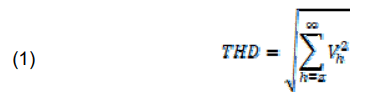
The coefficient THD can be found from (7):

.

where IRMS is the RMS value of the supply current and I1 is the RMS value of its first harmonic. Figure 3 shows the percentage THD and normalized amplitudes of harmonics |Bk/B1| as functions of tON.

Fig.3. Amplitudes of harmonics of the supply current in the modified version of the LED lamp as a function of tON (a) and the range of tON which guarantees the conformance to the third set of requirements specified in Section 7.4.3 of the standard [1]

Analyzing the above plots we can notice that the third set of requirements from Section 7.4.3 of the standard [1] will be satisfied by the circuit from Fig. 2a, if the moment tON is smaller than 2.53 ms. In [8] it has been shown that in order to obtain high efficiency of an LED lamp with a single string of diodes, which is fed with a rectangular current waveform from Fig. 2b, the value of tON should be possibly high. In the case that we consider here it should be close to 2.53 ms with some margin necessary to allow for the spread of parameters of the used components, the temperature effects and the allowed variation of the grid voltage 230 VAC.

If we assume that the regulators IA and IB operate properly with a negligible voltage drop across them and the RMS value of the line voltage is 230 V, the total power drawn by the lamp and the power transferred to the LEDs with the series current regulator IB are given by (8) and (9):

.

The determination of the optimum length of the LED string is more critical here than for lamps without the filtering capacitor [8]. This length (number of diodes) should be smaller than the exact value resulting from the conduction voltage of a string for a given value of tON:

.

First of all, we should prevent the situation where the decrease in the voltage across C will cause a change in the current IB (the capacitance should be preferably large). Such a situation will not cause any significant change in the waveform of the supply current and the requirements specified in Section 7.4.3 of the standard [1] may remain satisfied. However, in the previously stable luminous flux a variable component will appear, increasing considerably an important parameter known as Percent Flicker [5, 6]. To prevent that, the number of LEDs initially calculated as a maximum number from (10) should be decreased by taking into account voltage drops across the current regulators IA and IB (the minimum values necessary for correct operation), the permissible reduction of the 230 VAC grid voltage (-10% according to the binding standard [9]), the effect of temperature on the forward voltage drop for the LEDs used in the lamp (ΔUF/ΔT) and the ripple voltage across the capacitor.

Summary

The main objective of this paper has been to prove that a simple solution of the supply circuit of LED lamps used as replacements for conventional 230 VAC bulbs (Fig. 2a), which is different from the commonly used ones, has a number of advantages. First of all, the conformance to the binding EMC standard [1], according to Section 7.4.3, has been based on the third set of requirements rather than on the less rigorous second one. The most important advantage is the possibility of using a large filtering capacitor thanks to which a stable luminous flux is guaranteed in a simple way. What is more, the inrush current is eliminated when the lamp is being turned on (Fig. 4).

Fig.4. Waveform of the supply current of a 13 W modified LED lamp from the moment of its turn-on (as voltage across a series 1Ω resistor)

The calculations and plots of harmonics contents have been verified by measurements. It should be noted that the calculations were carried out for an ideal rectangular waveform of the supply current (Fig. 2b), which is a worse case than the real one. In a real circuit it is easier to satisfy the requirements of the standard, because the slopes of the edges in the supply current waveform are finite thanks to which the amplitudes of higher harmonics are reduced. There is also no need to excessively reduce the variable component of the luminous flux. Percent Flicker equal to about 5–10% will satisfy even the rigorous requirements of the future standards referring to lighting installations that are expected to come in force soon (e.g. [6]) and is imperceptible by the human eye. The measured values of Percent Flicker for various sources of light available on the market have been shown in [10].

Finally, we should mention another effect resulting from the proposed method of supplying LED lamps. As the current charging the capacitor is limited by the regulator IA, the lamp will be turned on with some delay. After connecting the supply the capacitor needs a few periods of the line voltage until it becomes charged with a relatively small current IA to the voltage at which the string of LEDs can be turned on. This delay, which is dependent on the capacitance C and the current IA, will never be longer than just a few hundred milliseconds, so it should not be considered by any means as a disadvantage.

The results presented in this contribution are an outcome of statutory activities of the Department of Electronics, Electrical Engineering and Microelectronics

REFERENCES

[1] Standard EN IEC 61000-3-2:2019 Electromagnetic Compatibility (EMC) – Part 3-2: Limits for harmonic current emissions (equipment input current ≤ 16 A per phase)
[2] Li S., Tan S-C., Lee C-K., A Survey, Classification, and Critical Review of Light-Emitting Diode Drivers, IEEE Transactions on Power Electronics, 31 (2016), n.2, 1503-1515
[3] Ning N., Chen W.B., Yu D.J., Feng C.Y., Wang C.B., Selfadaptive load technology for multiple-string LED drivers, Electronics Letters, 49 (2013), n.18, 1170-1171
[4] Kim J., Lee J., Park S., A soft self-commutating method using minimum control circuitry for multiple-string LED drivers, Proceedings IEEE International Solid-State Circuits Conference, San Francisco, USA, 2013
[5] Gao Y., Li L., Mok P.K.T., An AC input switching-converter-free LED driver with low-frequency-flicker reduction, IEEE Journal of Solid-State Circuits, 52 (2017), n.5, 1424-1434
[6] Castro I., Vazquez A., Arias M., Lamar D.G., Hernando M.M., Sebastian J., A review on flicker-free ac-dc LED drivers for single-phase and three-phase ac power grids, IEEE Transactions on Power Electronics, 34 (2019), n.10, 10035-10057
[7] Rymarski Z., The analysis of output voltage distortion minimization in the 3-phase VSI for the nonlinear rectifier ROCO load, Przegląd Elektrotechniczny, 85 (2009), n.4, 127-132
[8] Filus Z., Checinski J., Some remarks on design of LED lamps and their AC direct drivers, Elektronika ir Elektrotechnika, 25 (2019), n.3, 39-42
[9] Standard PN-EN 60038:2012 CENELEC STANDARD VOLTAGES
[10] Chęciński J., Filus Z., Stabilność strumienia światła lamp LED zasilanych z sieci 230 VAC, Przegląd Elektrotechniczny, 94 (2018), nr.8, 5-8


Authors: Jacek Chęciński, PhD, Zdzisław Filus, PhD, DSc, prof. SUT, Silesian University of Technology, Department of Electronics, Electrical Engineering and Microelectronics, ul. Akademicka 16, 44-100 Gliwice E-mails: jacek.checinski@polsl.pl, zdzislaw.filus@polsl.pl


Source & Publisher Item Identifier: PRZEGLĄD ELEKTROTECHNICZNY, ISSN 0033-2097, R. 97 NR 2/2021. doi:10.15199/48.2021.02.08

Improving the Operation Characteristics of Non-Insulated Overhead Power Lines

Published by 1. Oleksandr KOZLOVSKYI1, 2. Dmitro TRUSHAKOV1, 3. Oleksandr SAVCHENKO2, 4. Serhiy RENDZINYAK3, 5. Vasyl KORUD3, Central Ukrainian National Technical University (1), Kharkiv Petro Vasylenko National Technical University of Agriculture (2), Lviv Polytechnic National University (3)
ORCID: 1.0000-0001-6885-5994; 2.0000-0003-0326-2383, 3.0000-0002-6401-0852, 4.0000-0003-4544-4871, 5.0000-0002-1289-3534


Abstract. Methods of protection of wires of overhead power lines of group “anti-icing” are analyzed. The expediency of applying the winding method of protection of wires of overhead lines in operation for a long time is shown. Based on numerical simulations of the hydrodynamic problem, the degree of influence of the protective coating on the wind load of the wire is analyzed. The research results showed a decrease in the modified wire’s drag coefficient with increasing wind speed.

Streszczenie. Przeanalizowano metody ochrony przewodów linii napowietrznych z grupy „przeciwoblodzeniowa”. Pokazano celowość zastosowania metody uzwojenia do ochrony przewodów linii napowietrznych eksploatowanych od dłuższego czasu. Wykorzystując symulacje numeryczne zagadnienia hydrodynamicznego analizowany jest stopień wpływu powłoki ochronnej na obciążenie żyły kabla wiatrem. Wyniki badań wykazały spadek współczynnika rezystancji zmodyfikowanej żyły wraz ze wzrostem prędkości wiatru. (Poprawa charakterystyk pracy nieizolowanych napowietrznych linii elektroenergetycznych)

Keywords: overhead power line, wind load, drag coefficient, numerical simulation.
Słowa kluczowe: linia napowietrzna, obciążenie wiatrem, współczynnik oporu, symulacja numeryczna.

Introduction

In 2020, the power distribution system of Ukraine included more than 330 000 km of overhead power transmission lines (OHTL) with a voltage of 6-35 kV [1]. The vast majority of these lines were built using all aluminium conductors (AAC) and aluminium conductor steel reinforced (ACSR) grades A and AC (European analogs, respectively, A and A/S [2]). These wires are a rope-like structure obtained by twisting individual cylindrical wires around the central one. Experience of operation of such OHTLs has shown their reduced reliability to extreme environmental influences, particularly wind and ice-wind loads. That is primarily due to the design features of the wire, due to which it has a greater drag coefficient under certain conditions than the cylinder of equivalent diameter, and its shape contributes to the accumulation of ice-frost deposits, which leads to increased mechanical loads on the OHTL.

In the 1980s, to eliminate the drawbacks of AAC and ACSR wires, the development of protected wires type SAX has begun in Finland. Today, the SAX system includes wires insulated with cross-linked polyethylene, the necessary linear armature, lightning protection, and vibration protection devices. Implementing the SAX system allowed to increase the reliability of overhead lines by reducing the adhesion of ice-frost deposits to the polymer insulation of the wire, reducing the drag coefficient, and eliminating the possibility of interphase shortcut circuits due to touching of wires and tree branches.

Today, Ukrainian manufacturers also manufacture shielded wires of type SIP-3 for 6-35 kV overhead lines, but they have not yet become widespread in the power grid. This situation appears because of high initial capital costs for the construction of new OHTLs; for example, only the most protected wires have about 1.5 times higher cost than wires of types AAC, ACSR. At the same time, a significant part of the overhead lines of 6-35 kV distribution networks have exhausted their normal service life but are in operation due to a lack of resources for their reconstruction and replacement. Therefore, there is a need to develop specific ways to improve the design of transmission line wires of distribution networks in operation.

Review of publications

All known methods of protection of OHTL wires from ice loads are divided into two large groups: “de-icing” (DI) and “anti-icing” (AI) [3].

The methods of the DI group consist in the OHTL wire release from ice-frost deposits when the values of mechanical loads on their linear elements close to the critical ones are reached. Typically, these goals bases on using the melting process of ice by artificial short-circuit currents. However, this method has not been widely used in the distribution networks of electricity companies. First of all, this happens because of the electrical equipment operation at melting ice process in modes close to the faulty ones. It can occur in some cases of forced technological breaks or interruptions in electricity supply to consumers, with the need to attract additional investment, for example, specialized equipment needed to adapt the power system with the OHTL [4, 5], as well as in the absence of a guarantee in the success of a particular smelting. In general, the power system consists of both components with lumped parameters and components with distributed parameters. Modelling the state of such a system requires the development of complex algorithms, for example, based on diakoptic approaches, and the use of modern software [6]. Thus, the methods of DI group are of little use for distribution networks that have a significant service life.

The methods of AI group AI are designed to wholly or partially prevent the formation of ice-frost deposits on the wire of the OHTL by creating a protective coating on it. Among these methods, the most common is a subgroup of so-called passive methods, i.e. those based on creating protective coatings that do not require an external source of energy for their work. The technology of applying a protective coating on the wire can be classified as follows: plasma spraying, extrusion, dyeing (lubricating), and winding [7-11].

Plasma spraying methods [7] and extrusion can be implemented only in production conditions and dyeing and winding [8-11] in the field conditions.

The painting method consists of applying unique chemical compounds to the wire through pneumatic spraying, lubrication, immersion, etc. The protective coatings created in this way can reduce the adhesion of water and ice droplets to the wire, and enter into an exothermic reaction with water droplets with intense heat release.

The main reasons that have interfered with the widespread implementation of these technologies in electric distribution networks are:

– a limited number of working cycles of “freezing-melting” of chemical compounds, and hence the need to reapply them before the start of the ice season;

– high-quality application of some protective coatings requires multi-stage preparation of the wire surface, which is difficult to implement in the field;

– the effectiveness of many protective coatings is reduced due to their interaction with natural or technogenic pollutants.

By shell methods, a rigid protective shell on the transmission line conductors is created, which has hydro-icephobic properties or promotes self-cleaning of the wire from ice-frost deposits during wet growth. A variant of the shell method is winding, consisting of a spiral winding on the surface of the tape wire, which performs a protective function [8-11].

The main advantage of the winding method is the possibility of its implementation on overhead transmission lines during operation. Technical implementation of this method can achieve lower costs by using robots based on Line-Scout technology [12].

Creating a protective shell on the surface of the wire will change its aerodynamic drag and hence change the wind load on the overhead transmission line in general. Many theoretical, laboratory and field studies were conducted to assess the influence of roughness on the drag coefficient of the OHTL wire form. As a result, new types of wires with reduced aerodynamic drag were developed [13-15]. However, they are designed for high and ultra-high voltage overhead transmission lines. Therefore, the problem of estimating the change in the load on the modified OHTL wire of the distribution power networks from wind is actual till now.

Basic researching principles

To more effectively solve the stated goal, the problem of determining the influence in wind load on the modified wire was divided into two more straightforward tasks:

1) determination of the drag coefficient CD of the modified wire;

2) assessment of the change in load P from wind pressure on the modified wire.

Wires of grades A (AC) are a rope-like structure consisting of one or more layers of wires spirally wound around the central core. The adjacent wires inside one winding touch each other at two diametrically opposite points. It is a peculiarity of the wires of these types. As a result, the outer contour of the wire consists of the sum of the upper arcs of the upper winding wires (Fig. 1, a). Therefore, the transmission line wire has a complex geometric shape, so the study of CD changes should be carried out by computer simulation.

Fig.1. General type of prototypes: a) AC-50/8 wire; b) modified wire

Statement of the first problem

Homogeneous air flow with a constant velocity v is fed perpendicular to the longitudinal axis of the sample. The flow rate of the test samples is such that the Mach number is M << 1. It is necessary to determine the drag coefficient of the shape of each test sample (Fig. 1) when changing the airflow rate in the range from 6 m/s to 35 m/s; to equate the calculated values of the component of the coefficient of aerodynamic drag along the axis x for a circular cylinder with the data of physical experiments.

The hydrodynamic problem was solved by numerical simulation in the Fluent software module of the ANSYS software package. The motion of the fluid is described by the Reynolds-Averaged Navier-Stokes (RANS) equations [16].

The following assumptions were made during the simulation:

– air is an incompressible, viscous liquid;

– fluid regime is turbulent;

– point contact between the ends of the arcs of the envelope curve of the wire AC-50/8 is replaced by arcs of fixed size;

– the shell of the modified wire is solid and has a thickness of 0.5 mm;

– the circular cylinder’s diameter is equal to the diameter of the wire AC-50/8: dc = dw = 9.6 mm;

– the effect of the sample length on the CD is neglected;

– the flow is directed perpendicular to the wire and the arc segment of the modified wire (Fig. 2, b, c).

The solution to this problem is performed in a two-dimensional flat formulation, so appropriate profiles were pre-built for each prototype.

The wire profile is based on a section of steel aluminum wire AC-50/8 (Fig. 2), which has been in operation for more than 15 years. A section usage made it possible to determine the actual height of the arcs of the wire leading round. Due to the deformation of the wires during the retraction of the wire under operation conditions, their contact points were shifted from the center of the wire by an average length of 0.26 mm.

Fig.2. Wire of the AC-50/8 type: a) section; b, c) 2D models of profiles

The modified wire profile is obtained by connecting the vertices of the rounding arcs with segments, followed by the displacement of the resulting hexagon with smoothed angles at a distance of 0.5 mm from its center.

Fig.3. Calculation domain and boundary conditions

The computational domain of the model was developed considering the experience of conducting similar numerical

experiments [15, 17, 18] and is presented in Fig. 3. The distance from the test sample to the sidewalls of the domain was assumed to be equal to 25dw. The area occupied by the test sample was excluded from the calculation.

In numerical modeling, the accuracy of calculating the drag coefficient CD of the shape of the sample is determined by the correctness of the choice of turbulence model and construction quality of the calculation grid.

In solving the problem, the Spalart-Allmaras model (SA) was chosen to consider fluid turbulence [16].

The Spalart-Allmaras model is a relatively simple one-parameter model that describes the entire flow region, including the boundary regions. It gives good results for moderately complex flows in the boundary layer under a pressure gradient in external aerodynamics problems. Its features are fairly good stability, reliability, and relatively low requirements for computing resources.

The chosen turbulence model is sensitive to the details of the calculation grid, especially in the boundary layer area. Therefore, the thickness of the first layer of elements (cells) of the grid significantly impacts the accuracy of calculations. To save computing resources, curved structured (regular) grids were used. Their quality was controlled by the dimensionless parameter of the near-wall layer y+, which was in the range of y+ ≤ 1.0, according to the recommendations presented in [16]. Thus, grid sets were created for the profile of each prototype. The obtained sets of grids were also checked for regularity by increasing their frequency until the grid convergence of the mathematical problem solution was achieved.

Solvers of the second order of accuracy were chosen to solve the model equations.

The following initial and boundary conditions were set during the simulation:

– pressure and speed communication scheme: coupled;

– the test sample is stationary during the flow;

– flow temperature (air), ta = 273.16°K;

– flow density, ρt=0 = 1.293 kg/m3;

– input condition: inlet (velocity), vx = {6, 10, 15, 20, 25, 30, 35} m/s;

– output condition: pressure outlet, pG = 0 Pa;

– condition on the surface of the sample: wall.

The drag coefficient of the shape of the samples is calculated by the well-known expression:

.

where: F is the total force acting in the direction of flow on the test sample, N; ρ is air density, kg/m3; v is air velocity, m/s; S is the characteristic area of the sample perpendicular to the airflow, m2; φ is the angle between the direction of wind flow and the surface of the wire, under the condition of the task φ = 90°, so sin φ = 1.

The numerical experiment was performed for sections: the circular cylinder with a diameter of 9.6 mm; the wire was of AC-50/8 type; modifications of the wire AC-50/8* with a wall thickness of the protective coating equal to 0.5 mm.

The mathematical model setup was performed by determining the aerodynamic characteristics of the circular cylinder and comparing the obtained results with the data defined from physical experiments, the results of which are given in [19, 20].

All prototypes: the cylinder, the overhead line wire, the hexagon with rounded faces (modernized wire) are inconveniently streamlined bodies, forming a large separation area with back-circulating flows due to a significant increase of pressure (Fig. 4, Fig. 5) [21]. The Reynolds number (Re) for all samples under selected conditions is in the range of 4.3ꞏ103-4.0ꞏ104.

Fig.4. Speed distribution in the cross-section of the wire of AC-50/8 type (v = 25 m/s)

Fig.5. Speed distribution in the cross-section of the modified wire of AC-50/8* type (v = 25 m/s)

The wrapping structure of the AC-50/8 wire in the cross-section was obtained based on the developed numerical model is presented in Fig. 4. On its front part, the zone of stagnation with zero speed is formed. On the bow, the pressure distribution corresponds to the theoretical pressure distribution when flowing through the flow of a non-viscous liquid. On the reverse side, there is a large area of separation with reverse circulation. In the depressions between the wires of the wire are formed reverse flows of low speed. The change in flow structure leads to a significant decrease in pressure. The main flow separation is observed in the upper part of the wire. At breakpoints in the depressions, reverse currents of low velocity not more than 1 m/s are formed.

In Fig. 5 the distribution of speed in the cross-section of the wire AC-50/8* is given. Compared to the AC-50/8 wire, which has six wires in the upper twist, the modified wire has no small circulation zones between the individual wires. Although it also has discrete vortices that distort mainstream flow lines. They have slightly less power. Two stagnant zones are formed on the sides of the modified wire (bottom and top), leading to flow separation.

Fig.6. Dependence CD = f(v) of the experimental samples

The change in the drag coefficients of the mold for all test specimens depending on the flow velocity is presented in Fig. 6. For the cylinder, this parameter is nonlinear and tends to local growing. Absolute error between the calculated value of the drag coefficient of a smooth cylinder shape according to the developed model and the experimental data presented in [13] varies between 3-8%.

The peculiarity of the wire of the OHTL of the conventional design is that its phenomenon of the drag crisis corresponds to smaller values of the Reynolds number than for a smooth cylinder of equivalent diameter. In this case, the obtained calculated data differ significantly from the experimental ones, so there is no decline in the obtained dependence of the CD = f(v) in the speed range 11-15 m/s (Fig. 6). The calculated values of the drag coefficient for the AC-50/8 wire at the Reynolds number above the transition number are in the range of 0.97-0.985 (Fig. 6), which are close to the results of experimental studies presented in [13] (CD = 0.98-1.0) and to the generally accepted normative value of 1.2 for maximum wind loads [22]. The drag curve of the shape of the modified wire changes linearly and is descending.

Statement of the second problem

Standard and modified wires of the overhead transmission line of failure class of 2KB type [22] of the distribution network are under load because of the wind pressure. It is necessary to determine the change in wind load when replacing the standard wire with a modified one in the range of wind speeds from 6 m/s to 27 m/s.

In the general case, the wind load on the wire can be determined from (1):

.

Then the change in wind load on the wire will be

.

or in expanded form

.

where indices 1, 2 are concerning, respectively, to the parameters of standard and modified wire; ΔS is the increase in the characteristic area of the wire due to the creation of a protective sheath of the wire ΔS = S2S1.

It follows from (2) that the reduction of the wind load on the wire can be achieved by reducing the roughness of its surface (CD1 > CD2) and the use of the minimum allowable wall thickness of the protective coating (ΔS → min).

The dependence of the change in load on the wire from the airflow flow calculated using the formula (2) is presented in Fig. 7.

Fig.7. Dependence of change of wind load on the wire from wind speed

Discussion

Analysis of the obtained data of the numerical experiment (Fig. 7) shows that the creation of a protective coating on the wire AC-50/8 changes the wind load on it in the range from –7.0% to +2.5%, so at wind speeds from 15 up to 25 m/s it decreases, and at higher speed begins to increase. This negative load change can be offset by optimizing the protective coating profile. It is expected that with increasing wire diameter to be modified, the effect from a decrease of CD will increase and can be increased to 30% after the point of drag crisis (wind speed range 25-40 m/s) [13].

Further research aims to determine the critical wall thickness of the protective coating (critical diameter of the modified wire), that is, the value of the thickness of the protective sheath of the wire, to which the wind load on its does not increase.

Conclusions

1. The expediency of using the winding method in creating passive protective coatings on uninsulated wires of the OHTL, which are in operation based on LineScout technology, is substantiated.

2. It is established that due to the change of the aerodynamic profile of the standard wire AC-50/8 after its modification, the coefficient of resistance of the form decreases with increasing wind speed.

3. It is established that the creation of a protective coating on the wire AC-50/8 using the winding method at low wind speeds (up to ≈25 m/s) is decreased the wind load on it to 7.0%. At high wind speeds (25-35 m/s), on the contrary, it is increasing to 2.5%. So, this method is sufficiently effective for overhead lines in operation.

REFERENCES

[1] Performance report of Energy and Utilities the National Regulatory Commission in 2019 the year (2020, May 27). Retrieved from https://www.nerc.gov.ua/data/filearch/Catalog3/Richnyi_zvit_N KREKP_2019.pdf
[2] IEC 61089, “Round wire concentric lay overhead electrical stranded conductors,” Published 1991, 65 p.
[3] Farzaneh, M., Atmospheric Icing of Power Networks, Springer Netherlands, 2014, 381 p.
[4] O l e k s a n d r А . S a v c h e n k o , О l e k s a n d r О . M i r o s h n y k , S t a n i s l a v V . D y u b k o , T a r a s S h c h u r , P a w e ł K o m a d a , K a n a t M u s s a b e k o v , Justification of ice melting capacity on 6-10 kV OPL distributing power networks based on fuzzy modeling, Przegląd Elektrotechniczny, 95 (2019), nr 5, 106-109, doi: 10.15199/48.2019.05.26
[5] K o z l o v s k y i , O . , T r u s h a k o v , D . , R e n d z i n y a k , S . , Temperature influence of load current of overhead electrical distribution networks in difficult weather conditions, Acta Technica CSAV (Ceskoslovensk Akademie Ved), 63(2018), No. 5, 701-708
[6] S t a k h i v , P . , R e n d z i n y a k , S . , H o h o l y u k , O . , Modeling of electric power systems based on diakoptic approach and parallel algorithms in modern computer tools, Przegląd Elektrotechniczny, 86 (2010), nr 1, 115-117
[7] Pat. 3276280 Japan, ICI5 H01 B 7/28, H 01 B 7/34. Snow and ice sticking reducing / light and heat shielding type coated power transmission line / Toyoda Minoru, Tomizawa Nobuo, Matsumoto Kiyoshi and et.; applicants and owners KANSAI Electric Power Co; Soko Seiren KK; Mitsubishi Heavy IND Ltd. No JP19910276280; fil. 30.10.1991; pub. 16.4.1993.
[8] H i g u c h i N . , Snow Accumulation Prevention Methods, Hokkaido Electric Power, 1972.
[9] V . N . S e d u n o v , A . V . N a c h a l o v , N . G . T s a r a n o v , e t c . , Proposals for the use of fluoroplastic surface coatings to reduce the mass of ice-frost deposits on wires and lightning protection cables, Electro, 2005, No. 5, 46-48 (in Russian)
[10] Pat. 138930 Ukraine, H02G 7/16 (2006.01). Method of forming anti-icing coating on uninsulated wires and lightning protection cables of overhead power transmission line / O. A. Kozlovskyi; applicants and owners Central Ukrainian National Technical University; fil. 03.06.2019; pub. 10.12.2019 (in Ukrainian)
[11] K o z l o v s k y i , O , T e l i u t a R . , Improvement of design of the Non-insulated wires of the operating overhead power lines, Visnyk Kharkivsʹkoho natsionalʹnoho tekhnichnoho universytetu silʹsʹkoho hospodarstva imeni Petra Vasylenka, 2019, issue 201, 21-22
[12] N . P o u l i o t , P . R i c h a r d a n d S . M o n t a m b a u l t , LineScout Technology Opens the Way to Robotic Inspection and Maintenance of High-Voltage Power Lines, IEEE Power and Energy Technology Systems Journal, March 2015, Vol. 2, No. 1, pp. 1-11, doi: 10.1109/JPETS.2015.2395388
[13] N a o s h i K i k u c h i , Y u t a k a M a t s u z a k i , H i d e o B a n s e , T a k a o K a n e k o , A k i h i r o Y u k i n o a n d H i r o t a k a I s h i d a , Development of Conductors with Reduced Wind Drag and Wind Noise for Overhead Power Transmission Lines, Furukawa Review, 2002, No. 21, 50-55
[14] D o n g Q i n g L i , Z h e n L i , Z h e n L i u , L o n g L i u , C h a n g L o n g Y a n g , We i F a n , L u Y u Y a n g a n d J i a J u n S i , Application Research on Drag Reduced Conductors for Electric Power Transmission Lines in Strong Wind Areas, Proc. of 2016 International Conference on Electronic, Information and Computer Engineering, ICEICE 2016, 26-27 April 2016, Vol. 448, March 2016, Article number 01093, doi: 10.1051/matecconf/20164401093
[15] C h a o M . , J u n Z . , M i n g n i a n W . , Y a o j u n M . , Large Eddy Simulation of Flow over a New Type of Low-Wind- Pressure Conductor Using WALE Model, Proc. of 2019 16th International Bhurban Conference on Applied Sciences and Technology, IBCAST 2019, 8-12 January 2019, 13 March 2019, pp. 811-815, Article number 8667236, doi: 10.1109/IBCAST.2019.8667236
[16] ANSYS Fluent User’s Guide R.19.2, ANSYS Inc., Canonsburg, PA, August 2018.
[17] R a v i n d r a n , M a g e s h R . , Computational Study for Analysis of the Potential for Drag Reduction for Flow around a Circular Cylinder and Cactus-Shaped Cylinders, Journal of Mechanical and Civil Engineering, 2015, 13-24
[18] H y u n A . S o n , S u n g s u L e e a n d J o o y o n g L e e , Numerical Analysis of Drag Force Acting on 2D Cylinder Immersed in Accelerated Flow, Water, Vol. 12, No. 6, 2020, A.N. 1970, doi: 10.3390/w12061790
[19] M i l t o n v a n D y k e , An Album of Fluid Motion, Moscow, Mir, 1986,184 p. (in Russian)
[20] R o n a l d L . P a n t o n , Incompressible flow, 4th Edition, Wiley, 2013, 912 p.
[21] C . D e m a r t i n o , F . R i c c i a r d e l l i , Aerodynamics of nominally circular cylinders: A review of experimental results for Civil Engineering applications, Engineering Structures, 137 (2017), 76-114, doi: 10.1016/j.engstruct.2017.01.023
[22] Regulations of arrangement of electrical installations, Kharkiv, Fort, 2017, 760 p. (in Ukrainian)


Authors: assoc. prof. Oleksandr Kozlovskyi, Central Ukrainian National Technical University, pr. Universytetskyi 8, 25006 Kropyvnytskyi, Ukraine, E-mail: kozlovskyioa@gmail.com; Assoc. prof. Dmitro Trushakov, Central Ukrainian National Technical University, pr. Universytetskyi 8, 25006 Kropyvnytskyi, Ukraine, Email: dmitro.trushakov@gmail.com; assoc. prof. Oleksandr Savchenko, Kharkiv Petro Vasylenko National Technical University of Agriculture, ul. Alchevskih 44, 61002 Kharkiv, Ukraine, E-mail: savoa@khntusg.info; D.Sc., prof. Serhiy Rendzinyak, Lviv Polytechnic National University, ul. Bandery 12, 79013 Lviv, Ukraine, E-mail: serhii.y.rendziniak@lpnu.ua; assoc. prof. Vasyl Korud, Lviv Polytechnic National University, ul. Bandery 12, 79013 Lviv, Ukraine, E-mail: vasyl.i.korud@lpnu.ua.


Source & Publisher Item Identifier: PRZEGLĄD ELEKTROTECHNICZNY, ISSN 0033-2097, R. 98 NR 2/2022. doi:10.15199/48.2022.02.06

The Latest Superconducting Short Current Limiters – Review of Selected Solutions

Published by 1. Joanna KOZIEŁ1, 2. Damian GNAT1, 3.Michał MAJKA1, 4.Yerbol Turgynebekov2,
Lublin University of Technology, Department of Electrical Engineering and Electrotechnologies, Faculty of Electrical Engineering and Computer Science(1) Taraz State University after M.Kh.Dulaty, Kazakhstan(2)
ORCID: 1.0000-0003-1682-2589, 3.0000-0002-7153-040X


Abstract. In the article after the introduction, containing the idea and principle of operation of the SFCL, selected prototypes and scientific projects (Korean and Russian) of superconducting short-circuit current limiters were described due to the dynamic development of the latest technologies and 2G HTS tapes used to build superconducting short-circuit current limiters. The article presents the construction of selected superconducting short-circuit current limiters (Korean) – SFCL 500V / 50A, and the Russian superconducting current limiter 220kV / 50kA, also the R-SFCL 10kV / 1.8kA superconducting current limiter is described. The article contains information on a SFCL with electric drive.

Streszczenie. W artykule po wstępie zawierającym ideę i zasadę działania SFCL, opisano wybrane prototypy i projekty naukowe (koreański i rosyjski) nadprzewodnikowych ograniczników prądu zwarcia ze względu na dynamiczny rozwój najnowszych technologii i taśm 2G HTS, stosowanych do budowy nadprzewodnikowych ograniczników prądu zwarcia. W artykule przedstawiono budowę wybranych nadprzewodnikowych ograniczników prądu zwarcia (koreański) – SFCL 500V/50A, oraz rosyjski nadprzewodnikowy ogranicznik prądu 220kV/50kA, opisano również nadprzewodnikowy ogranicznik prądu R-SFCL 10kV/1,8kA. Zawarto w artykule informacje odnośnie SFCL z napędem elektrycznym.(Najnowsze nadprzewodnikowe ograniczniki prądu zwarcia – przegląd wybranych rozwiązań).

Słowa kluczowe: nadprzewodnikowe ograniczniki prądu zwarcia, rezystancyjny SFCL, YBCO, RBS.
Keywords: superconducting fault current limiter, resistive SFCL, YBCO, RBS,

Introduction

Superconducting fault current limiters (SFCL) limit the surge current and the periodic component of the fault current. As a result, not only the thermal effects are reduced, but also the dynamic effects of the fault current on the devices in the network. The use of superconducting fault current limiters allows to limit the fault currents exceeding the rated currents 10 ÷ 20 times, to values not greater than 3 ÷ 6 times the rated current [1], [2], [3].

The dynamic effects of the fault currents and the values of the accompanying mechanical forces are greatest when the fault current reaches its first maximum after a fault, i.e. within 0.005s at a frequency of 50Hz. If the fault circuit is interrupted or we increase its impedance very quickly, i.e. in a time much shorter than 0.005s, the dynamic forces will not reach their first maximum, protecting the system and the power devices working in it against excessive stresses and damage [4], [5], [6].

Fig.1. Concept of operation of a superconducting current limiter [1]

During normal operating conditions of the power system, a superconducting fault current limiter containing a nonlinear element should not generate losses or their value should be minimal, while the impedance value should oscillate around zero. An SFCL protects the secured circuit against thermal and dynamic effects of the emergency current flow, introducing a high impedance into it when the permissible safe value of the current in the circuit is exceeded [1], [18]. The SFCL operation time is almost instantaneous, the emergency current amplitude does not reach the first, most dangerous maximum. After the failure of the emergency current, the limiter quickly returns to its original state characterised by a negligibly low impedance [8].

Korean superconducting fault current limiter SI-SFCL 500V/50A

In South Korea, research and an experimental project on a superconducting current limiters is conducted by the Korea Electric Power Corporation [7], [8]. The saturated iron-core superconducting fault current limiter (SI-SFCL) can significantly reduce the fault current and the load on circuit breakers in DC networks.

The main assumption of the project was to build a limiter with which it would be possible to achieve a fault current limitation of 70%.

Fig.2. Structure of SI-SFCL [7],[8]

There are three main parts in the composition of the SI-SFCL: one magnetic iron core, a copper primary coil (CPC) and a superconducting secondary coil (SSC). Simulation tests confirming the properties were performed with a 3D simulation model using the Finite Element Method. Based on the results of simulation tests, a design of the SI-SFCL on a laboratory scale was developed, intended to work in a DC power supply system of 500V, 50A. In the research experiment, the performance characteristics of each winding and the characteristics of fault current limitation by the SI-SFCL were analysed. The structure of the SI-SFCL is shown in Figure 2. The surge arrester has two coils and a magnetic core. The CPC secondary coil is made of copper and connected to a DC power system, while the SSC primary coil is made of a superconducting material connected to a DC voltage source.

The CPC and SSC generate magnetic fields in opposite directions [7], [8]. Technical data of the limiter are presented in Table 1.

Table 1. Specifications of the lab-scale SI-SFCL [7],[8]

.

While designing the core of the limiter, efforts were made to minimise the losses in the core, including eddy currents and hysteresis losses during fault current limitation. Such losses in the core cause high reluctance in the magnetic path, losses of magnetic field and energy, reduce the effect of the limiter on the fault currents. The core is made of thin laminated silicon steel which has high permeability and can reduce unwanted losses. The resistivity of the silicon steel is high and the steel laminates used are insulated from each other by a thin layer of Kapton tape, thus increasing the overall resistance of the iron core to prevent eddy current flow. 50PN470 silicon steel was used to build the core. The structure of the SI-SFCL is shown in Fig. 3 [7], [8].

Fig.3. Design of SI-SFCL [7],[8]

Russian superconducting fault current limiter 220 kV/50 kA

Another superconducting fault current limiter is the Russian 220kV/50kA limiter. The city of Moscow in Russia today has a population of 12.6 million. Between 2000 and 2019, energy consumption increased by over 59%. Reliable electricity supplies are a prerequisite for the city’s development.

The situation in Moscow is specific, because apart from the rapid increase in electricity consumption there is a short distance between the electricity producer and consumer, as many power plants are located in the city. The Moscow energy company has installed a resistive superconducting fault current limiter in its substation (220 kV class with a fault current limiting capacity of 50 kA) to verify the effectiveness of the SFCL.

Fig.4. a) Front , b) top view of the 220 kV SFCL at the substation in Moscow [9]

The superconducting fault current limiter was installed in a series with the 12 km long 220 kV cable line, which connects the western and south-western part of the municipal network and ends at gas-insulated switchgears with a switching capacity of 50 kA at Mnevniki and 63 kA at Ochakovo [9].

Table 2. Technical parameters of the limiter 220kV/50kA [9]

.

Research on the superconducting current limiter project started in 2015 and was carried out in three main stages: the engineering phase was completed in 2016, the procurement phase was finished in 2016-2018, and the construction phase was carried out in 2018 and 2019 (Fig. 4). The first launch and experimental tests were performed at the end of 2019 [9].

The superconducting fault current limiter consists of three external single-phase apparatus with a reservoir (hereinafter referred to as “phases”, Fig. 4) and a cooling system, which is located in a separate building with the dimensions of 7x14x10m3. The area occupied by the three phases of the surge arrester is similar to the area occupied by three air chokes (Fig. 4 b). The main technical data of the limiter are presented in Table 2 [9], [10].

Each of the SFCL limiter phases consists of a cryostat, high-voltage busbars and a set of superconductors (Fig. 5). The superconductor assembly consists of a set of current-limiting modules connected to high-voltage shields (corona rings).

Fig.5. The scheme of 220 kV SFCL phase [9]

The corona rings help to evenly distribute the electric field inside the device, and the second-generation high-temperature superconducting tape serves as a switching resistor [9].

Fig.6. Cooling system for 220 kV/50 kA [9],[10]

The SFCL cryostats were double-walled tanks with vacuum insulation. The walls were made of stainless steel to withstand the internal pressure. Each cryostat was leak tested with helium up to 15 bar. The special feature of these cryostats are two hatches removable from both sides, enabling maintenance, connection and disconnection of superconducting assemblies from the sleeves and other technical activities. The diameter of the holes was limited to 0.5 meters, which allowed access to the interior of the cryostat with a reasonable level of engineering difficulty. Each phase of the SFCL was equipped with its own cooling subsystem. The diagram of the limiter’s cooling system is shown in Figure 6 [9]. The cooling subsystem consists of a pressure builder, a Turbo-Brayton NeoKelvin cryochamber (rated cooling capacity 2kW at 70K, built by Taiyo Nippon Sanso), a circulation pump (Cryozone) and a pipe (Nexans) for transporting liquid nitrogen. Redundancy is ensured by bypassing the separate phases: even if one subsystem fails, the SFCL remains fully operational.

Superconducting fault current limiter R-SFCL 10 kV/1.8 kA

The project of a resistive superconducting fault current limiter 10 kV/1.8 kA was developed in Karlsruhe, Germany, on the basis of projects [11], [12]. The simulation tests of the R-SFCL application were based on the German medium voltage grid (Fig. 7) [13].

Fig.7. Medium-voltage network topology in Germany with superconducting R-SFCL current limiter installed [13]

Table 3 presents the detailed parameters of the MV network fragment, which was tested with the use of the RSFCL superconducting current limiter [13].

Table 3. Parameters of medium voltage electrical network [15]

.

In the construction of the R-SFCL 10 kV/1.8 kA superconducting fault current limiter, the YBCO coil design was used in accordance with the ENSYSTROB design [11], [12]. The limiter consists of 25 coils connected in a series. Each coil consists of YBCO (Super Power SF12100) superconducting tapes and a stainless steel shunt resistor switched on in parallel. The superconducting coil is made of six tapes arranged in an anti-parallel arrangement. By designing the coils from six parallel tapes, the critical current IC R-SFCL reaches 1.8 kA (Ic for each tape is approximately 300 A).

Table 4. Performance of superconducting R-SFCL[13]

.

The SC winding of the limiter is cooled in liquid nitrogen at the temperature of 77 K. The main parameters of the R-SFCL subjected to simulation tests are presented in Table 4 [13].

Superconducting limiter for electrically powered aircraft

A very interesting design solution is the SFCL used in electrically powered aircraft [14]. The power of the system consists of three main units, including the aircraft’s electric propulsion system (EPAS), the main DC bus, and other receivers. The electric system consists of turbines, HTS generators, HTS cables and a superconducting fault current limiter [14], [15].

Fig.8. Schematic of electric propulsion in an electric aircraft using superconducting devices [14]

Together with the circuit break, the SFCL protects the system power against possible high fault current to maintain a high standard of safety in electric aircraft [14], [16].

All the bifilar coil designs to date have been dominated by the BCP design, where the inner and outer windings are connected in parallel. The result is a high current loss and a greater heat load for the cryogenic cooling system. In order to reduce losses and improve the ability to limit fault currents, a helical bifilar coil has been proposed, in which the inner and outer windings are connected in a series so that they conduct the same currents (reduction of the voltage difference between the turns near the terminals compared to the BCP type), and it will also guarantee an equal current distribution in the windings [17].

Fig.9. a) Scheme of bifilar coil with parallel connected windings BCP, b) Scheme of bifilar coil with series connected windings BCS [17]

Summary

The progress in this area compared to previous years is increasing and promising. Currently, work on limiters is carried out in many institutes and research centres. Due to its technical parameters, simple structure and efficiency of limiting the fault current, the main direction of development of the superconducting fault current limiter is the resistive type. Resistive SFCLs are used in electric aircraft due to advantages such as: compactness, lightness and high reliability [1], [16]. Resistive SFCLs are configured as bifilar type to obtain non-inductive or low-inductance structures. This is very beneficial for power systems by avoiding poor voltage regulation and degraded power quality.

LITERATURE

[1] Kozieł J., Analiza wpływu impedancji uzwojenia wtórnego na parametry nadprzewodnikowych ograniczników prądu typu transformatorowego, Przegląd Elektrotechniczny, 2016, vol.92, no. 12, p.77-80, DOI: 10.15199/48.2016.12.20.
[2] Kozieł J., The influence of magnetic coupling factor k on value of impedance limiting fault current, Przegląd Elektrotechniczny, 2009, vol.85, no 5, p.200-203.
[3] Komarzyniec G. et al, Analysis of the current distribution in layers of a second generation superconducting tapes, Przegląd Elektrotechniczny, 2019, vol.95, no.1, p.65-68. DOI: 10.15199/48.2019.01.17.
[4] Kozak J, et al, Experimental Results of a 15 kV, 140A Superconducting Fault Current Limiter, IEEE Transactions on Applied Superconductivity, vol: 27, Issue: 4, 2017, Article Number: 5600504, DOI: 10.1109/TASC.2017.2651120.
[5] Gnat D., Aktualny stan badań nadprzewodnikowych ograniczników
prądu zwarcia, Praca magisterska, Politechnika Lubelska, 2021.
[6] Janowski J. et al. Superconducting Winding for Inductive Type SFCL Made of HTS Tape With Increased Resistivity, IEEE Transactions on Applied Superconductivity, Volume: 19, Issue: 3, 2009, Page(s): 1884 – 1887, DOI: 10.1109/TASC.2009.2018068.
[7] Dao V.Q., et al, Design and Performance Analysis of a Saturated Iron-Core Superconducting Fault Current Limiter for DC Power Systems, Energies, 2020, 13, 6090; DOI:10.3390/en13226090.
[8] Dao V.Q.; et al, Experimental Study on the Current Limiting Characteristics of a Saturated Iron-Core Superconducting Fault Current Limiter in DC Power Systems”, IEEE Transactions on Applied Supercond., vol. 31, No. 5, AUGUST 2021.
[9] Moyzykh M. et al, First Russian 220 kV superconducting fault current limiter (SFCL) for application in city grid, SuperOx, Nauchny t. 20, no.2, 117246, Moskwa, 2021.
[10] Moyzykh M. et al, Superconducting Fault Current Limiter for Moscow 220 kV City Grid, EUCAS, 2017
[11] Elschner S. et al, ENSYSTROB—Resistive fault current limiter based on coated conductors for medium voltage application, IEEE Trans. Appl. Supercond., t. 21, no. 3, p. 1209–1212, 2011.
[12] Elschner S. et al, ENSYSTROB—Design, manufacturing and test of a 3- phase resistive fault current limiter based on coated conductors for medium voltage application, Phys. C Supercond., t. 1, p. 1–7, 2012.
[13] de Sousa W.T.B., et al, Deployment of a Resistive Superconducting Fault Current Limiter for Improvement of Voltage Quality and Transient Recovery Voltage, IEEE Trans. Appl. Supercond., t. 31, no. 1,2021.
[14] Song W., et al, A Novel Helical Superconducting Fault Current Limiter for Electric Propulsion Aircraft , IEEE Trans. Transport. Electrify., t. 7, no. 1, 2021.
[15] Alafnan H., et al, Analysing faults and SFCL response in electric aircraft, Proc. 14th Eur. Conf. Appl. Supercond. (EUCAS), p.1–11, 2020.
[16] Morandi A., State of the art of superconducting fault current limiters and their application to the electric power system, Phys. C, Supercond., t. 484, p. 242–247, 2013.
[17] W. Song et al, Experimental and numerical transport AC losses in a four-strand Roebel cable bifilar stack, Supercond. Sci. Technol., t. 31, no. 11, 2018.
[18] Komarzyniec G. et al, The calculation of the inrush current peak value of superconducting transformers, 2015 Selected Problems of Electrical Engineering and Electronics, WZEE 201527 January 2016 Article number 7394042Selected Problems of Electrical Engineering and Electronics, WZEE 2015, Kielce, 17 September 2015 – 19 September 2015,
[19] Michałowska J. et al, Monitoring of the Specific Absorption Rate in Terms of Electromagnetic Hazards, Journal of Ecological Engineering, vol. 21, issue. 1, 2020 , https://doi.org/10.12911/22998993/112878,
[20] Michałowska J. et al, Monitoring the Risk of the Electric Component Imposed on a Pilot During Light Aircraft Operations in a High – Frequency Electromagnetic Field, Sensors, vol.10. no. 24, 2019, DOI: 10.3390/s19245537,
[21] Michałowska J.et al, Prediction of the parameters of magnetic field of CNC machine tools, Przegląd Elektrotechniczny.- 2019, vol. 95, no 1, p. 134-136, doi:10.15199/48.2019.01.34.


Authors: dr inż. Joanna Kozieł, Department of Electrical Engineering and Electrotechnologies, Faculty of Electrical Engineering and Computer Science, Nadbystrzycka 38A, 20-618 Lublin, e-mail: j.koziel@pollub.pl,mgr inż. Damian Gnat, Department of Electrical Engineering and Electrotechnologies, Faculty of Electrical Engineering and Computer Science, Nadbystrzycka 38A, 20-618 Lublin, e-mail: damian.gnat@pollub.edu.pl, dr hab. inż. Michał Majka, LUT Professor, Department of Electrical Engineering and Electrotechnologies, Faculty of Electrical Engineering and Computer Science, Nadbystrzycka 38A, 20-618 Lublin, e-mail: m.majka@pollub.pl mgr inż. Yerbol Turgynebekov, M. Kh. Dulaty Taraz State University, Kazakhstan, e-mail: bosik90@mail.ru


Source & Publisher Item Identifier: PRZEGLĄD ELEKTROTECHNICZNY, ISSN 0033-2097, R. 98 NR 2/2022. doi:10.15199/48.2022.02.36

Performance Comparison of Harmonic Filters in an Industrial Power System for Harmonic Distortion Reduction

Published by 1. Estifanos Dagnew Mitiku1, 2. Gebrie Teshome Aduye2, 3. S. Abdul Rahman3, 4. Mahilet Mentesinot Abuhay4, Electrical & Computer Engineering Department, Institute of Technology, University of Gondar, Ethiopia (1, 2, 3), Industrial Engineering Department, Institute of Technology, University of Gondar, Ethiopia (4) ORCID. 1. 0000-0002-6613-3979, 2. 0000-0003-1184-9184, 3. 0000-0003-0134-8028, 4. 0000-0001-7554-8562


Abstract: The paper presents performance comparison of harmonic filters for the reduction of harmonic distortion in an industrial power system, i.e., National Tobacco Enterprise, an industry found in Ethiopia. The performance comparison is done for single tuned, double tuned, high pass and Ctype harmonic filter. As a result, the double tuned harmonic filter provides a better performance than the other type of filters by giving a reduced Total Harmonic Distortion for the voltage and current waveforms. MATLAB/SIMULINK simulation results are presented for validating the analysis.

Streszczenie. W artykule przedstawiono porównanie wydajności filtrów harmonicznych do redukcji zniekształceń harmonicznych w przemysłowym systemie elektroenergetycznym, tj. National Tobacco Enterprise, przemysł znajdujący się w Etiopii. Porównanie wydajności jest dokonywane dla pojedynczego strojonego, podwójnie strojonego, górnoprzepustowego i typu C filtra harmonicznego. W rezultacie podwójnie dostrojony filtr harmonicznych zapewnia lepszą wydajność niż inne typy filtrów, zapewniając zmniejszone całkowite zniekształcenie harmoniczne dla przebiegów napięcia i prądu. Przedstawiono wyniki symulacji MATLAB/SIMULINK w celu weryfikacji analizy. (Porównanie wydajności filtrów harmonicznych w przemysłowym systemie zasilania w celu redukcji zniekształceń harmonicznych)

Keywords: Harmonic Filters, Harmonic Distortion, Total Harmonic Distortion, MATLAB/SIMULINK.
Słowa kluczowe: fitr, harmoniczne, THD

Introduction

Power quality (PQ) is an issue to both utilities and electricity consumers at all levels of usage. One of the PQ problems is harmonics which is a sinusoidal component of a periodic wave or quantity having a frequency that is an integral multiple of the fundamental frequency, i.e., 50Hz or 60Hz [1]. Harmonic voltages occur as a result of current harmonics, which are created and drawn by non linear electronic loads, injected to the supply system [2]. National Tobacco Enterprise (NTE) is one of the largest industries which are located in Ethiopia, supplied through a 15kV feeder emanating from the nearby substation. It has two, 630KVA transformers that supply power to linear and nonlinear loads. The non-linear loads cause harmonic distortion resulted in loss of data, overheating or damage to sensitive equipment and overloading of capacitor banks. As a result, single tuned, double tuned, high pass and c-type harmonic filters are employed independently for the reduction of harmonic filters and their performance is compared. The paper in [3], present how to suppress distortions by using the non-linearity current index to determine the shunt single-tuned passive filter compensator value. The paper in [4], describes design of passive filter to reduce the harmonics emitted by power electronic devices in a hybrid, micro-grid network with nonlinear load, energy storage, wind turbine and solar cell. The paper in [5], presents selection of tuning and quality factor to design a single-tuned passive harmonic filter. The paper in [6], describes the effect of single tuned harmonic filter on grid connected PV system and its impact on harmonics and power factor. The paper in [7], aims to design a single tuned filter and testing it in simple model using ETA P to analyze harmonics variation of the harmonic filter in a power system. The study in [8], discusses the use of single tuned passive filters in reducing harmonics in the plastics processing industry. The focus of the paper in [9], was to study the performance of single tuned passive harmonic filter by manipulating the Q-factor in the design. Various types of damped double tuned filters are designed for different nonlinear loads for harmonic reduction has been discussed in [10]. A new method of designing double-tuned filter is proposed based on resonance frequency, by using the relationship that the impedance of double-tuned filter and two parallel single tuned filters is equal and the resonance frequency of single tuned filter is the zero of the impedance of double-tuned filter is presented in [11]. The paper in [12], presents a double tuned passive filter was designed with the parameters of two parallel single tuned passive filters and the results are simulated using MATLAB/SIMULINK software. The paper in [13], presents PQ improvement based on high pass filter for a nonlinear RL-load connected to a single phase ac supply which can simultaneously improve the PQ and control the reactive power requirement of the load. The study in [14], uses passive harmonic filter to mitigate the harmonic voltage distortion in a power system that contained the roughing mill (RM) and finishing mill (FM) electric motor drives. The paper in [15], presents the design of two passive filters to reduce the current harmonics produced by nonlinear loads in industrial power system using MATLAB /Simulink software. The research work in [16], consists of harmonic simulation based on optimal design of C-type filter using Proteus software and hardware implementation with C-type filter and second order high-pass filter. The paper in [17], presents the new C-type high harmonic power filter design process to reduce the total harmonic distortion in an industrial power supply system. The article in [18], presents a method for selecting the elements of a C-type filter working with a conventional LC-type filter for compensating reactive power and filtering out higher harmonics generated by arc furnaces and ladle furnaces. The performance of a single tuned filter and C-type filter is compared in [19], to reduce harmonic content in an electric power distribution network system in the cement industry. To mitigate the other types of PQ problems different techniques have been applied [20]–[27].

From the above literature survey it could be observed that single tuned, double tuned, high pass and c-type harmonic filters were applied independently for the mitigation of harmonic distortion. In this paper, performance comparison of single tuned, double tuned, high pass and c-type harmonic filters in industrial power systems for harmonic distortion reduction is analysed and the THD value of each of the harmonic filters is used for comparison.

Harmonic distortion measurement at the industry

To assess the level of harmonic distortion in the industry power system, monitoring has to be performed at the service entrance points of the industry at the Points of Common Coupling (PCC), the tapping point on the 15kV feeders. However, as the distance and line impedance, from PCC to the primary of the transformer is negligible, the primaries are taken as PCC as shown in figure 1 [2].

Fig.1. Monitoring location and point of common coupling.

The harmonic distortion in the industry is measured while all the machines are working at the same time, to observe the cumulative characteristics of the industrial loads and data collection is accomplished through direct measurement. Having made suitable analysis, the collected data are computed and compared with acceptable values set by standards of IEEE recommended practice for harmonic control [28]. Table 1: Current distortion limits for general distribution systems (120V to 69 000V) [2].Fig. 1: Monitoring location and point of common coupling. The harmonic distortion in the industry is measured while all the machines are working at the same time, to observe the cumulative characteristics of the industrial loads and data collection is accomplished through direct measurement. Having made suitable analysis, the collected data are computed and compared with acceptable values set by standards of IEEE recommended practice for harmonic control [28].

Table 1. Current distortion limits for general distribution systems (120V to 69 000V) [2].

.

Short circuit current and rated current of 15kV feeder at the PCC are averaged to be 10kA and 1000A respectively, which gives ISC/IL ratio in the range of <20. Then, the TDD values of the current harmonics should not exceed 5% at the PCC. The requirement of the utility to provide good quality of voltage is listed in table 2.

Table 2. Voltage distortion limits [2].

.

The maximum voltage and current harmonic contents of the industry when it works at full load are shown in table 3.

Table 3. Maximum voltage and current harmonics level at NTE

.

It is observed from the recorded data that the dominant harmonic currents are the 5th and 7th harmonics and the total current THD value for the three phases is 18.10%, 18.33% and 18.44%, respectively at the PCC which is beyond the IEEE standards, i.e., 5%. Since the current THD values are beyond the standard values, single tuned, double tuned, high pass and c-type harmonic filters with their designed parameters are applied to reduce the harmonic distortion and their performance is compared based on the current THD percentage values when each of the harmonic filters are applied.

Principle of operation

The circuit used for the reduction of harmonic distortion is shown in figure 2. It consists of switches, single tuned, double tuned, high pass and c-type harmonic filters and the load. Due to the non-linear loads of the industrial power system, as harmonic currents are injected to the system the voltage and current waveforms are distorted. Harmonic filters with their designed values and respective switches are applied independently to compare the performance of the harmonic filters and they are switched ON and switched OFF to reduce the harmonic distortion. At first, the single tuned filter switch is ON while the other switches are OFF. Then, the high pass filter switch is ON while the other switches are OFF. Next, the double tuned filter switch is ON while the other switches are OFF. Finally, the C-type filter switch is ON while the other switches are OFF. For simplicity, only one phase is considered out of the three phases as power is taken from the same phase to mitigate the harmonic distortion to show the control circuit.

Fig.2. Control Circuit to show harmonic filters application

Simulation Results

The harmonic distortions have been simulated using MATLAB/SIMULINK software. The harmonic filters such as single tuned, double tuned, high pass and c-type filters are simulated with the designed values in order to compare their performance in the reduction of harmonic distortion occurred in the industrial power system due to non linear loads. The voltage and current waveforms both from the source side and the load side before and after applying the harmonic filters are presented below for comparison. The industry has non-linear loads which are supplied by the utility from the nearby substation and non-linear loads draw harmonic currents of a distorted waveform. The simulation is performed with the designed values of the harmonic filters with a nominal line to line voltage of 400V, operating frequency of 50Hz, nominal reactive power of 50KVAR, quality factor of 7 and the tuning frequency is set for the 5th and 7th harmonics.

The voltage and current waveforms before applying the harmonic filters is shown in figure 3.

Fig.3. Voltage and Current Waveforms without harmonic filters

Fig.4. FFT of the harmonic current before filtering

The industry has non-linear loads which are supplied by the utility and these loads draw a distorted harmonic voltage and current waveform as shown in figure 3 and from the Fast Fourier Transform (FFT) analysis as shown in figure 4 the THD value is 18.33%, which is above the IEEE standard acceptable limit, i.e. 5% for this study. Therefore, to reduce the harmonic distortion, single tuned, double tuned, high pass and c-type harmonic filters are designed and placed at the appropriate location at the industrial power system; consequently, the harmonic distortion is reduced and their performance is compared.

Single Tuned Harmonic Filter
Fig.5. Voltage and Current Waveforms with single tuned filters

Fig.6. FFT of the harmonic current with single tuned filter

High Pass Harmonic Filter
Fig.7. Voltage and Current Waveforms of high pass filter

Fig.8. FFT of the harmonic current using high pass filter

Double Tuned Harmonic Filter
Fig.9. Voltage and Current Waveforms of double tuned filter

Fig.10. FFT of the harmonic current using double tuned filter

C-Type Harmonic Filter
Fig.11. Voltage and Current Waveforms with c-type filters

Fig.12. FFT of the harmonic current using c-type filter

Conclusion

In this paper, performance comparison of harmonic filters in an industrial power system for harmonic distortion reduction is studied. The harmonic distortion drawn by the industry non-linear loads provides a THD value of 18.33%. And when single tuned harmonic filter is applied the THD is reduced to 5.08%. Whereas, the application of high pass harmonic filter gives a THD of 5.09%. A double tuned harmonic filter provides 4.00% THD value. Finally, using c-type harmonic filters 4.68% THD value is obtained. As a result, from the simulation results and FFT analysis, it is observed that the double tuned harmonic filter gives a better performance than the single tuned, high pass and c-type harmonic filters in reducing the harmonic distortions to the acceptable magnitude set by IEEE standards, i.e. less than 5% for this study and it is recommended for the industry to use the double tuned harmonic filter at the secondary of the transformer to get rid of additional heating, false tripping and equipment malfunction due to harmonics which causes production loss to the industry.

REFERENCES

[1] IEEE, IEEE 1159 1995 Recommended practice for monitoriong electric power quality. 1995.
[2] W. Are et al., ‘Electrical Power Systems Quality , Second Edition’.
[3] M. S. Almutairi and S. Hadjiloucas, ‘Harmonics Mitigation Based on the Minimization of Non-Linearity Current in a Power System’, 2019.
[4] A. Bagheri and M. Alizadeh, ‘Designing a Passive Filter for Reducing Harmonic Distortion in the Hybrid Micro-grid Including Wind Turbine , Solar Cell and Nonlinear Load’, no.12, pp. 10–13, 2019.
[5] Y. Cho, H. Cha, Y. Cho, and H. Cha, ‘Single-tuned Passive Harmonic Filter Design Considering Variances of Tuning and Quality Factor Single-tuned Passive Harmonic Filter Design Considering Variances of Tuning and Quality Factor’, vol. 8972, 2014.
[6] R. Dua and A. Agrawal, ‘Impact Of Single Tuned Filter on Grid Connected PV System’, vol. 08, no. 06, pp. 213–217, 2019.
[7] M. Awadalla, M. Orner, and A. Mohamed, ‘Single-tuned filter design for harmonic mitigation and optimization with capacitor banks Single-tuned Filter Design for Harmonic Mitigation and Optimization with Capacitor Banks’, no. September 2015, 2019.
[8] I. O. P. C. Series and M. Science, ‘Harmonic reduction by using single-tuned passive filter in plastic processing industry Harmonic reduction by using single-tuned passive filter in plastic processing industry’, 2018.
[9] Y. K. Haur, T. J. Son, L. K. Yun, W. Jee, and K. Raymond, ‘Design of Single-Tuned Passive Harmonic Filter to Meet Ieee-519 Standard By Means of Quality-Factor Manipulations’, vol. 29, no. 1, pp. 1364–1379, 2020.
[10] K. R. Cheepati, S. Ali, and A. Rangampet, ‘Overview of Double Tuned Harmonic Filters in Improving Power Quality under Non Linear Load Conditions’, vol. 10, no. 7, pp. 11–26, 2017.
[11] H. E. Yi-hong and S. U. Heng, ‘A New Method of Designing Double-tuned Filter’, no. Iccsee, pp. 206–209, 2013.
[12] K. R. Cheepati, S. Ali, and S. K. M, ‘Performance Analysis of Double Tuned Passive Filter for Power Quality’, vol. 9, no. 7, pp. 3295–3305, 2016.
[13] P. Control and G. Mishra, ‘Design of Passive High Pass Filter for Hybrid Active Power Filter Applications Department of Electrical Engineering National Institute of Technology Design of Passive High Pass Filter for Hybrid Active Power Filter Applications’.
[14] B. Park, J. Lee, H. Yoo, and G. Jang, ‘Harmonic Mitigation Using Passive Harmonic Filters : Case Study in a Steel Mill Power System’, 2021.
[15] Z. A. Memon, M. A. Uqaili, and M. A. Unar, ‘Harmonics Mitigation of Industrial Power System Using Passive Filters’, no. July, 2016.
[16] I. A. Shah and R. K. Ali, ‘Design of a C-type Passive Filter for Reducing Harmonic Distortion and Reactive Power Compensation’, vol. 4, no. 12, pp. 38–47, 2016.
[17] R. Klempka, ‘A New Method for the C-Type Passive Filter Design’, no. 7, pp. 277–281, 2012.
[18] A. Furnaces, ‘Selection of C-Type Filters for Reactive Power Compensation and Filtration of Higher Harmonics’, 2020.
[19] A. Muchtar and W. M. Muttaqin, ‘Comparison between single tuned filter and c-type filter performance on the electric power distribution network Comparison between single tuned filter and c-type filter performance on the electric power distribution network’, 2019.
[20] S. A. Rahman, ‘Direct Converter Based DVR to Mitigate Single Phase Outage’, no. September 2019, 2021.
[21] A. Rahman, ‘Mitigation of Voltage Sag , Swell and Outage without Converter’, no. October 2019, 2021.
[22] S. A. Rahman, S. B. Mule, E. D. Mitiku, G. T. Aduye, and C. Gopinath, ‘Highest Voltage Sag and Swell Compensation using Single Phase Matrix Converter with Four Controlled Switches’, no. 4, pp. 134–138, 2021.
[23] C. Reads, ‘Realization of Single Phase Matrix Converter Using 4 Controlled Switches’, no. October 2019, 2021.
[24] S. A. Rahman and G. Teshome, ‘Maximum voltage sag compensation using direct converter by modulating the carrier signal’, vol. 10, no. 4, pp. 3936–3941, 2020.
[25] S. A. Rahman and E. Dagnew, ‘Voltage sag compensation using direct converter based DVR by modulating the error signal’, vol. 19, no. 2, pp. 608–616, 2020.
[26] S. A. Rahman, E. D. Mitiku, S. B. Mule, G. T. Aduye, M. A. Huluka, and S. Mesfin, ‘Voltage Sag Mitigation Using Direct Converter Based DVR without Error Signal’, no. 12, pp. 34–37, 2021.
[27] S. A. Rahman, S. Birhan, E. D. Mitiku, G. T. Aduye, and P. Somasundaram, ‘A Novel DVR Topology to Compensate Voltage Swell, Sag, and Single-Phase Outage’, vol. 17, no. 4, pp. 1–10, 2021.
[28] C. R. C. P. Llc, Power quality © 2002. 2002.


Authors: Lecturer, Mr. Estifanos Dagnew Mitiku, Department of Electrical & Computer Engineering, Institute of Technology, University of Gondar, Gondar, Ethiopia, Email: est7eced@gmail.com; Lecturer, Mr. Gebrie Teshome Aduye, Department of Electrical & Computer Engineering, Institute of Technology, University of Gondar, Gondar, Ethiopia, Email: gebrie.415@gmail.com; Associate Professor, Dr. Abdul Rahman, Department of Electrical & Computer Engineering, Institute of Technology, University of Gondar, Gondar, Ethiopia, Email: msajce.abdulrahman@gmail.com; Lecturer, Mrs. Mahilet Mentesinot Abuhay, Department of Industrial Engineering, Institute of Technology, University of Gondar, Ethiopia, Email: mahiletme@gmail.com.


Source & Publisher Item Identifier: PRZEGLĄD ELEKTROTECHNICZNY, ISSN 0033-2097, R. 98 NR 3/2022. doi:10.15199/48.2022.03.12

Test Stand for Testing and Diagnostics of Medium Voltage Vacuum Interrupters

Published by Paweł WĘGIEREK, Michał LECH, Lublin University of Technology, Faculty of Electrical Engineering and Computer Science


Abstract. The article presents the detailed construction and capabilities of a research station for the diagnosis and testing of vacuum interrupters used in medium voltage electrical switching devices. The correct functioning of the stand has been confirmed by conducting a number of tests on the electrical strength of the MV switchgear vacuum interrupter type HVKR 24/400.

Streszczenie. W artykule przedstawiono szczegółową budowę oraz możliwości stanowiska badawczego służącego do diagnostyki oraz badań komór próżniowych wykorzystywanych w elektroenergetycznej aparaturze łączeniowej średniego napięcia. Poprawność funkcjonowania stanowiska potwierdzono przeprowadzając szereg badań wytrzymałości elektrycznej próżniowej komory rozłącznikowej SN typu HVKR 24/400. (Stanowisko badawcze przeznaczone do badań i diagnostyki komór próżniowych średniego napięcia).

Keywords: vacuum interrupters, vacuum diagnostics, dielectric strength, vacuum switchgears
Słowa kluczowe: komory próżniowe, diagnostyka próżni, wytrzymałość elektryczna, próżniowa aparatura łączeniowa

Introduction

Power engineering is a field of economy developing at a surprisingly fast pace. Many factors influence this process. One of them is the constantly growing number of new electricity consumers, and thus increasing the power required in areas that have not been urbanized before. According to the Transmission System Development Plan, by 2030 [1] the total net electricity demand in 2040 will be 204.2 TWh with 159.9 TWh in 2020.

Another factor in the development of the Polish power industry is its current technical condition (Fig. 1). Outdated elements of the power infrastructure force the investments of power companies related to various types of modernizations [2, 3]. A particular problem is visible in the area of high and medium voltage overhead lines, over 75% of which were built more than 25 years ago [4]. MV power lines are one of the most important elements of the distribution system for both technical and economic reasons [5].

Fig.1. Age structure of selected elements of the polish power system [4]

Another factor enforcing the dynamic development of the power industry is a number of legal requirements imposing on power companies to improve their power supply conditions and to move away from equipment using environmentally harmful greenhouse gases [6-11].

The above factors show that there is a strong need to develop new solutions among power equipment, mainly medium voltage. Many companies and scientific entities have faced this problem and developed pro-ecological equipment, using vacuum as an insulating medium.

One of such devices is the innovative EKTOS vacuum switch disconnector, which is the final result of the project entitled: “Development and implementation of an innovative closed cased overhead vacuum switch disconnector dedicated to intelligent medium voltage networks”, carried out by the Lublin University of Technology in consortium with EKTO Sp. z o.o. from Białystok as part of the activities of the National Research and Development Centre. This device is addressed to Distribution System Operators (DSOs) who want to improve the reliability of electricity supply in the areas they manage through investments in new technologies [12].

Methods for diagnosing vacuum conditions

Equipment such as contactors, switches and disconnectors with installed vacuum interrupters are commonly used in the power industry. The ever-increasing number of such devices is directly related to the need for an effective diagnosis of the state of vacuum inside them. A number of existing diagnostic methods are used for this purpose to assess the proper functioning of medium voltage vacuum extinguishing interrupters in terms of dielectric strength. Examples of vacuum interrupters used in switchgear are shown in Figure 2.

Fig.2. Examples of vacuum interrupters used in switchgear [13]

The basic ones include: the Pening method and the Magnetron method [14, 15]. They consist of placing the tested chamber in a magnetic (strongly axial) field, and then applying a DC voltage of 10 ÷ 20kV to open contacts. According to the gas breakdown mechanism, due to the electric field created due to the applied voltage, electrons are emitted from the cathode moving towards the anode. Placing the chamber under test in the magnetic field changes the path of electrons motion into a spiral one, thanks to which the number of collisions with atoms and molecules of residual gas increases. The mentioned methods consist in recording the current of electron emission, which results from the collision ionization occurring in the chamber. In order to assess the vacuum condition, the characteristics determined for the new vacuum chamber must be known for further comparison.

Another method of diagnosing the state of vacuum is the static AC ignition voltage method [14, 16]. It consists in measuring the value of the jump voltage and then comparing it with the Pashen curve for a given chamber.

The static DC ignition voltage method, which is relatively simple, can also be used to check the correct operation of vacuum chambers. It consists in applying a certain voltage value to the chamber in the open state and then measuring the current value in the chamber and comparing it with the maximum allowable value [14, 17].

In high-frequency test systems, a frequently used method of diagnosing the vacuum condition is the method of AC current switching capability [14, 18], consisting in determining the ability to switch off the AC current, which clearly decreases at certain pressure values.

The Fowler-Nordheim dependence is often used for vacuum chamber tests [14, 19]. This method was called the emission current test method [14, 20]. The use of this method requires appropriate testing equipment, allowing the application of high DC voltage to the chamber, as well as measuring equipment enabling the measurement of currents at the microampere level.

A similar method to the one described above is the test method for emission currents with HF current surges [14, 17]. It consists in forcing a high current value of the frequency exceeding 1 kHz to flow through the chamber, which smoothes the contact surfaces of the chamber being diagnosed.

An interesting method of diagnosing the vacuum condition is the measurement of X-ray radiation [14, 18, 20]. The analysis uses the fact of proportionality of its intensity to the emission current. This method is characterized by a significant defect, consisting of interference from background radiation, which is greater than the radiation of the chamber under operating conditions, so that the results can be significantly disturbed.

Another method consists in measuring the arc voltage at direct current of 10A (DC arc voltage method) [14, 20]. This voltage increases its value while extinguishing the electric arc, while it decreases its value while developing new cathode spots associated with, among others with residual gas in the chamber. The higher the value of the peak voltage, the lower the pressure in the tested chamber.

The method based on measuring the value of the voltage initiating the micro-discharge and the voltage initiating the emission current, called the Vd/Ve method, uses the dependence about the inverse of these voltages in relation to the pressure inside the chamber [14, 21].

For vacuum chambers with external access to their screen, a method of measuring the screen potential can be used to assess the vacuum. It uses the phenomenon of changing the chamber screen potential under the influence of emitted electrons from the chamber contacts [14, 22].

Another method is the method of switching off low induction current, which consists in applying overvoltage impulses to the chamber’s contacts and using the phenomenon of power surges [14, 22].

The method of switching off capacitive current is implemented by breaking the circuit in which the capacitive current flows in the oscillating system [14, 22]. Then, the value of voltage appearing at the terminals of the tested chamber is used to assess the state of the vacuum.

There is also a diagnostic method of vacuum chambers based on the measurement of partial discharges that appear in the chamber during operation. However, the effectiveness of this method is visible at high pressures, which indicate complete leakage of the chamber [14, 22].

Test stand

This test stand for the diagnosis and testing of vacuum interrupters used in medium-voltage switchgear has been designed and manufactured on the basis of a stable, mobile construction with a special platform used for the foundation of the vacuum pump set (Fig. 2). Inside the stand there is space for mounting the research object – medium voltage vacuum interrupter. The desire for a comprehensive study of the electrical strength of the vacuum interrupter is associated with the need to be able to change the contact distance in the appropriate range and with appropriate accuracy. In this test stand it was realized by mounting an extraction screw with a 1 mm pitch thread. Thanks to this, with the use of an appropriate reference scale, it is possible to set the inter-contact distance with the accuracy of 0.1 mm.

Fig.2. View of the test stand together with the method of test object assembly

Power supply to the test stand is provided by means of YHAKXS 1x120mm2 power cable terminated with an angular connector head enabling quick and convenient connection of power supply to the test stand. The test set consists of three main elements: high voltage transformer, capacitive measuring divider and control panel (Fig. 3).

Fig.3 Test set with control panel

The nominal parameters of the kit are shown in Table 1. The schematic diagram of the complete test stand is shown in Figure 4.

An important element of the test stand is a vacuum set to obtain the appropriate pressure inside the vacuum interrupter to be tested. This is done by a set consisting of a turbomolecular and rotary vacuum pump operating at a capacity of 90 l/s.

Table 1. Rated parameters of the test set

.
Fig.4. Block diagram of a complete test bench for testing and diagnostics of medium voltage vacuum interrupters

Research facility

In order to verify the correct operation of the test stand, a test object was installed in it, which is the HVKR 24/400 vacuum disconnector interrupter (Fig. 5). Interrupters of this type are used in three-pole medium-voltage switch disconnectors operating in overhead power networks. Rated parameters of the interrupter are shown in Table 2.

Fig.5 Test facility: HVKR 24/400 vacuum interrupter

Table 2. Rated parameters of the HVKR 24/400 chamber

.

The above vacuum interrupter consists of two poles: mobile and fixed, with contacts made of a mixture of tungsten and copper at a ratio of 70% tungsten to 30% copper. An inseparable element of the interrupter is an elastic bellows enabling the movement of the moving pole, as well as a condensation screen catching conductive particles which, if deposited on the interrupter casing, would deteriorate its operating parameters.

Verification of the correctness of the position

Using the test stand described in this article, it is possible to diagnose the vacuum condition of the selected switch extinguishing interrupter. It is necessary to know its reference electrical strength characteristics and then to compare it with the obtained test results.

Verification of the correctness of operation of this method, called as a static AC ignition voltage method, was carried out in laboratory conditions for the contact distance in the range of 1 ÷ 5 mm for pressure from 4×10⁻⁴ ÷ 1.2×10³ Pa. The test results are presented in Figures 6 and 7.

Fig.6 Relationship of breakdown voltage Ud as a function of pressure p inside the vacuum interrupter under test

Fig. 7. The relation of the voltage breakdown Ud as a function of the contact distance d

When analysing the above characteristics, attention should be paid to the pressure range in which the dielectric strength of the inter-contact interval of the vacuum interrupter under test is kept constant (Figure 6). This creates a certain safety zone which guarantees the reliable operation of a given device with respect to the electrical strength of the vacuum interrupter installed in it. This situation occurs below a pressure of . 5×100 Pa. The recorded breakthrough voltages in this zone are listed in Table 3.

As the pressure in the tested interrupter increases, a sharp drop in strength is visible. Figure 7 shows the dependence of the breakthrough voltage of the tested vacuum interrupter on the contact distance for selected interrupter pressure values. For pressures between 8,0×10⁻⁴ ÷ 5.3×10⁻¹ Pa, the breakthrough voltage increases with the increase in the inter-contact distance. When the interrupter is further aerated, the characteristics are flattened. From the pressure value equal to 6.7×100 Pa, the contact distance did not influence the dielectric strength of the electrical interruption. A vacuum interrupter to be diagnosed, for which the measured value of dielectric strength would be within this range, would be diagnosed as defective.

Table 3. Values of breakthrough voltages recorded in the safety zone of the vacuum interrupter under test

.
Summary

The test stand presented in this article provides an opportunity to diagnose standard vacuum interrupters used in medium-voltage switchgear as well as to test them for improvement of operational parameters.

In order to verify the correct operation of the presented test stand, a number of tests were performed and graphical relationships between the selected parameters were obtained. On the basis of the obtained test results, it can be concluded that the stand described in the article was properly designed and made, and thus it is possible to use the static AC ignition voltage method.

The nearest research works will concern the improvement of electric parameters of vacuum interrupters by increasing the electrical strength of the inter-contact break, as well as limiting the negative effects related to the burning process of the electric arc of the inter-electrode space. The research will be supported by modern computer software enabling professional simulation of physical phenomena taking place in vacuum interrupters used in modern medium voltage electrical apparatus.

This work was supported by The National Centre for Research and Development and co-financed from the European Union funds under the Smart Growth Operational Programme (grant # POIR.04.01.04-00-0130/16).

LITERATURE

[1] Development plan for meeting current electricity demand for 2021-2030, Konstancin – Jeziorna, 2020
[2] Łukasik Z., Kozyra J., Kuśmińska-Fijałkowska A.: Monitoring of low voltage grids with the use of SAIDI indexes, Przegląd Elektrotechniczny, 10/2017, p.141-145
[3] Marzecki J.: Modernization and development directions of low and medium voltage rural network, Przegląd Elektrotechniczny, 2/2019, p. 67-70
[4] Power engineering, distribution and transmission, Polish Power Transmission and Distribution Associaton’s Report, Poznań, 2017
[5] Chojnacki A. Ł.: Comparative analysis of indicators and reliability properties of medium voltage overhead and cable power lines, Przegląd Elektrotechniczny, 11/2019, p. 26-30
[6] Konarski M., Węgierek P.: The use of Power restoration systems for automation of medium voltage distribution grid, Przegląd Elektrotechniczny, 7/2018, p. 167-172
[7] Montreal Protocol on Substances that Deplete the Ozone Layer, Montreal, 1987
[8] Kyoto Protocol to the UN Framework Convention on Climate Change, Kyoto, 1997
[9] Regulation (EU) No 517/2014 of the European Parliament and of the Council of 16 April 2014 on fluorinated greenhouse gases
[10] Quality Regulation 2018 – 2025 for Distribution System Operators
[11] Ordinance of the Minister of Economy of 4 May 2007 on detailed conditions of the power system operation
[12] Węgierek P., Staszak S., Pastuszak J.: EKTOS – innovative medium voltage outdoor vacuum disconnector in a closed housing dedicated to the network smart grids, Wiadomości Elektrotechniczne, 11/2019, p. 21-25
[13] http://www.repo.itr.org.pl/energetyka/vc.html, access:18.06.2020r.
[14] Chmielak W.: Review of methods of diagnostics of the vacuum in vacuum circuit breakers, Przegląd Elektrotechniczny, 2/2014, p.213-216
[15] Kuhl W., Schilling W., Schlenk W.: Messung des lnnendruckes in Vakuumschaltróhr, Vakuum-Technik 34. Jahrgang . Heft 2/85 Seite 34 bis 38
[16] Damstra G. C.: Pressure Estimation in Vacuum Circuit Breakers, IEEE ‘Trans. on Dielectrics and Electrical Insulation Vol. 2 No.2, April 1995
[17] Frontzek F.R., Konig D.: Measurement of Emission Currents Immediately After Arc Polishing of Contacts, IEEE Trans. on EI, vol. 28,No. 4, 1993, p. 700-705
[18] Frontzek F.R., Konig D., Methods for internal pressure diagnostic of vacuum circuit breakers, IEEE 18th ISDEIV – Eindhoven-1998, p. 467-472
[19] Kamarol M., Ohtsuka S., Hikita M., Saitou H., Sakaki M.: Determination of Gas Pressure in Vacuum Interrupter Based on Partial Discharge, IEEE Transactions on Dielectrics and Electrical Insulation Vol. 14, No. 3; June 2007, p. 593 – 596
[20] Walczak K., Janiszewski J., Mościcka-Grzesiak H.: Evaluation of internal pressure of vacuum interrupters based on dynamics changes of electron field emission current and X-radiation HV, Eng. Symp. Aug. 1999
[21] Ziyu Z., Shuheng D., Xiuchen J., Naixiang M., Liwen L., Huansheng S., Chongfang L.: Measurement of Internal Pressure of Vacuum Tubes by Micro-discharge and Emission Current XXIII-rd ISDEIV – Bucharest – 2008
[22] Damstra G.C., Merck W.F.H., Bos P.J., Bouwmeester C.E.: Diagnostic Methods for Vacuum State Estimation, IEEE 18th ISDEIV-Eindhoven-1998, p. 443-446


Authors: dr hab. inż. Paweł Węgierek, profesor uczelni, mgr inż. Michał Lech, Politechnika Lubelska, Wydział Elektrotechniki i Informatyki, ul. Nadbystrzycka 38A, 20-618 Lublin, E-mail: p.wegierek@pollub.pl, m.lech@pollub.pl.


Source & Publisher Item Identifier: PRZEGLĄD ELEKTROTECHNICZNY, ISSN 0033-2097, R. 97 NR 2/2021. doi:10.15199/48.2021.02.36

A Statistical Analysis of Wind Speed Probabilistic Distributions for the Wind Power Assessment in Different Regions

Published by 1. Yuly Bay, 2. Nikolay Ruban, 3. Mikhail Andreev, 4. Alexandr Gusev, Tomsk Polytechnic University. ORCID. 1. 0000-0001-9928-408X, 2. 0000-0003-1396-9104, 3. 0000-0002-6420-4374, 4. 0000-0003-0814-2356


Abstract. The penetration of renewable energy sources (RES) into the electricity supply is gaining popularity all over the world, including countries that have large oil and gas reserves, since only the development of alternative energy will help avoid regression and take a green path development, reducing the damage to the environment. According to estimates of the International Energy Agency (IEA), the capacity of RES units built in China in 2016 was 34 GW, and Australia is one of the world leaders in the photovoltaic power plants installation, the share of which in the Australian electricity production exceeds 3%. It should be noted, that the final power generation capacity and stability are stochastic (probabilistic) in nature. Unlike the classical type generator, the output RES characteristics depend on the geographical features of the installation area, the season, and prevailing winds. Risks associated with inaccurate knowledge of the cumulative distribution function (CDF) describing these sources, as well as environmental uncertainties, are the reasons why it is more difficult for distribution network operators (DNO) to take RES into account in the power balance calculations. The wind speed CDF clarification can provide significant assistance in predicting the RES power production.

Streszczenie. Według szacunków Międzynarodowej Agencji Energetycznej (IEA) moc jednostek OZE wybudowanych w Chinach w 2016 roku wyniosła 34 GW, a Australia jest jednym ze światowych liderów w instalacji elektrowni fotowoltaicznych, której udział w australijskiej produkcji energii elektrycznej przekracza 3%. Należy zauważyć, że końcowa moc i stabilność wytwarzania energii ma charakter stochastyczny (probabilistyczny). W przeciwieństwie do generatora typu klasycznego, charakterystyka wyjściowa OZE zależy od cech geograficznych obszaru instalacji, pory roku i dominujących wiatrów. Ryzyko związane z niedokładną znajomością skumulowanej funkcji dystrybucji (CDF) opisującej te źródła, a także niepewności środowiskowe powodują, że operatorom sieci dystrybucyjnych (DNO) trudniej jest uwzględnić OZE w obliczeniach bilansu mocy. Wyjaśnienie prędkości wiatru CDF może zapewnić znaczącą pomoc w przewidywaniu produkcji energii z OZE. (Analiza statystyczna rozkładów probabilistycznych prędkości wiatru do oceny energetyki wiatrowej w różnych regionach)

Keywords: power system, wind speed time series, probability density function, cumulative distribution function.
Słowa kluczowe: energetyka wiatrowa, rozkład statystyczny.

Introduction

The structure and principles of power system management are becoming more and more complicated. Over the past 15 years due to the insufficient capacity of traditional generation sources, in most developed countries, for reasons of ensuring energy, environmental safety, etc., preference is given to RES, which is being actively introduced in China, Europe and the United States, and the total generated capacity is approximately 2195 GW. Due to this, the total RES capacity is expanding, which leads to an increase in power system stochastic processes.

In the classical cases, the electrical power system (EPS) is a «vertically» arranged system, where a number of operating factors and controlled variables are clearly defined and set within a specific way, established by the DNO [1]. However, in cases of renewable generation penetration, especially in large amount, there is a problem of discrepancy between the generated capacity and the electricity demand. Poor predictability associated with the current wind flow strength, which does not coincide in time with the required capacity, leads to mode dispatching problems. The RES, unlike traditional generators, restructuring EPS into a «vertical-horizontal» one [2], adding uncertainties in management that require further research and forecasting.

The ability and accuracy of forecasting is limited by the statistical information quality or methods of its processing. For example, in these works [3], deterministic methods were used to predict power generation, in order to represent RES as classical. In the articles [4], the probability distribution functions were selected for the input and output characteristics by the statistical analysis methods and testing by goodness of fit criteria. There are also studies devoted to the investigation of the power system units probabilistic characteristics, such as the expected value and standard deviation, the calculation of which contributes to the calculation of the optimal RES implementation capacity in order not to loss of steady state and transient stability.

The wind speed probability distribution approximation

The distribution law choice depends on many factors, including the specifics of the problem. To determine the estimated wind speeds of low frequency (dependence on the wind rose chart [5]), the maximum wind speeds possible in a particular area [6]), the main requirement is a reliable coincidence of empirical and theoretical distributions in the high-value range. The approximation itself as applied to the wind speed distribution was initially widely used for statistical extrapolation of the maximum wind speeds [7]. Subsequently, the approximation of the wind speed distribution by the Weibull and Weibull-Goodrich laws has become one of the most widely used [8]. Along with this law, the normal distribution law is often used, but a large sample size is required to reliably estimate the distribution parameters.

There are papers [9] that claim that the probability distribution is also well described by the lognormal distribution. The laws that can be used for modelling the wind speed, as well as their parameters, are given in the Table 1.

Table 1. Expressions of statistical distributions

.

where k – shape parameter, c – scale parameter, Г – gamma function, α,β,η – parameters of distributions, – normal distribution

The form of the distribution law also depends on the set of observations. In such situations, the distributions of the criteria statistics are often unknown, which is a frequent source of incorrect conclusions.

For optimal research, it is necessary to use several methods to determine the possible distribution law, even before using the goodness of fit criteria. Several well-known methods have been used to determine the various distributions parameters, out of which the method of moments, the graphical method, and the maximum likelihood method. In the case of using the graphical method, it has the advantage of simplicity, however, the accuracy of the input parameters estimating can be insufficient [10]. The likelihood method, on the contrary, has good accuracy, but to achieve it, it is required to use iterative methods [11]. The method of moments equates a certain number of statistical moments of the sample with the corresponding population moments [12]. The use of these methods (at least the maximum likelihood method and method of moments) usually implies that there is an assumption of the possible probability laws that are available in the wind time series. However, in the case of considering the unexplored wind time series, it is more logical to use the graphical or brute force method [13], with subsequent evaluation by several goodness of fit criteria.

The goodness of fit tests

The suitability of the chosen theoretical distribution for describing the empirical probability of a given meteorological argument is verified using the goodness of fit criteria. In this article, we will use Pearson’s chi-squared test [14] and Kolmogorov-Smirnov Goodness-of-Fit Test [15, 16], since the first of them is very sensitive to the dissimilarity of the values edges, the second allows us to more accurately assess the differences in the central regions.

Applying both criteria (with a given 5% significance level), the selected theoretical distribution function can be safely used for indirect calculations. For the measure of the difference between the theoretical and empirical distributions, Pearson takes the value X2 determined by the formula:

.

where n – the sample size, mi – the relative frequencies of the empirical distribution, pi – the corresponding theoretical probability densities, k – the gradations number.

Kolmogorov proposed another goodness of fit criteria, which, in contrast to the Pearson criterion, is based on a comparison of experimental and theoretical distributions integral laws.

As a measure of difference, A. N. Kolmogorov-Smirnov test uses the value:

.

where n – the sample size, D – corresponds to the upper bound (the largest value of the difference between the considered and the original sample) |F*(xi) – F(xi)| = δ(xi).

Input wind time series data

For the experiments, three samples of wind time series data with unknown CDF were taken. The sample size is between 9000 and 200000 volumes, depending on the example. The first sample (Fig. 1a) was taken from one of the graphical method experiments to study Weibul’s law parameters, and was randomly generated. The second time series is taken from the small-scale wind turbine power curve study (Fig. 1b) [17]. The third sample (Fig. 1c) is taken from the wind hourly NUTS 2 time series array [18].

Fig.1. Wind time series data

Fig.2. Extracted wind data CDFs

Based on the information provided, preliminary conclusions can be made about the wind values repeatability, maximum observed and average (mean) values. It should be noted, that in this case, all samples are not tied to particular months, but represent the full input data set for all the time [19]. The parameters that can be obtained before calculating the extracted CDF are shown in Table 2.

Table 2. Wind time series parameters

.

Before the process of finding a fitting CDF and checking it with the goodness of fit criteria, it is necessary to process the input wind data. To do this, we extract the unique values occurring in the wind time series, find the number of occurrences of each unique wind speed value, get the total number of measurements and get the cumulated frequency at the finish (Fig. 2).

A graphical analysis of wind speed CDFs

In order to determine the optimal PDLs, we need to estimate the shape and scale parameter of the curves. Using extracted wind data CDFs, we generate the corresponding PDs. According to the obtained PDs, using the graphical method in conjunction with additional ones, all parameters of possible PDLs are determined, to which the studied wind time series may belong. An example is shown in Fig. 3 for the first data array (a). All parameters of possible distributions are given in Table 3.

Fig.3. A graphical wind data analysis

Fig. 3 shows eight PDFs, namely the Gumbel, Exponential, Gamma, Logonormal, Normal, Rayleigh, Uniform, and Weibull, fitted to the wind speed values. Graphically it can be observed that Logonormal PDF gives the best match. The Gamma, Rayleigh and Weibull distributions match the histogram to a lesser degree, and the remaining distributions provide the worst fits.

Similarly, these eight PDFs were also fitted to other two wind series data and it was observed that the Logonormal, Gamma, Weibull, and Rayleigh the best ones for further analyses.

The most widely used distribution of the selected laws is the Weibull distribution. It is easy to use and accurate for most wind conditions that may occur in research. The Rayleigh distribution is a simplified version of the Weibull distribution, characterized by its simplicity due to the use of only one parameter, which negatively affects the quality of the obtained characteristics, and it is not so often suitable. Gamma and lognormal distributions are also two-parameter, they are less common in wind descriptions, but they can be much better suited for a several wind time series [20] (depending on the wind samples specific values repeatability).

Table 3. Wind time series obtained distribution parameters

.
Fig.4. Obtained wind data CDFs

After that, the wind time series is checked using the Pearson’s chi-squared test and Kolmogorov-Smirnov Goodness-of-Fit test according to the laws selected above. For the first sample data, the Weibull distribution meets the goodness-of-fit criteria (Fig. 4a). The second one corresponds to the Rayleigh distribution (Fig. 4b).

For the third sample, the Gambel distribution and the normal distribution were the closest, but neither of them fully satisfied the Kolmogorov test. This may be due to the small number of distribution laws considered, which were proposed in the article, or to the complexity of the original law (multiparameter, multimodal distribution, etc.).

Thus, we can conclude that the tools for finding the probabilistic characteristics of the wind time series presented in this article are extensive, but not always sufficient for the most accurate description of complex laws. For some cases, it may be necessary to use more sophisticated and advanced methods to obtain reliable probabilistic parameters.

Conclusion

The study of the wind speeds CDF was based on real and accurate measurements of these values at three obviously different sites. The results showed that it was possible to fully determine the probabilistic characteristics corresponding to the goodness-of-fit criteria for two of them. Thus, for some investigated wind time series, it will be necessary to expand the initial list of possible CDFs.

The implemented capabilities for modeling the distribution from random variables allow us to model the CDF and PD for the RES active and reactive power of various configurations based on the specific territory wind models.

Acknowledgment – The work was supported by Ministry of Science and Higher Education of Russian Federation, according to the research project № МК-5320.2021.4.

REFERENCES

[1] Zhang, J., M. Cheng, and X. Cai. (2012). Short-Term Wind Speed Prediction Based on Grey System Theory Model in the Region of China. Przeglad Elektrotechniczny, 88 (7a), 67-71.
[2] Strzelczyk, F. (2009). Renewable energy sources in power system. Przeglad Elektrotechniczny, 85 (9), 340-349.
[3] Karaki, S.H., Chedid, R.B., Ramadan R. (1999). Probabilistic performance assessment of autonomous solar–wind energy conversion systems, IEEE Trans Energy Conversion, 14 (3), 766–772.
[4] Kruangpradit P., Tayati W. (1996). Hybrid renewable energy system development in Thailand, Renewable Energy, 8 (1–4), 514–517.
[5] Sohoni, V., Gupta, Sh., Nema, R. (2016). A comparative analysis of wind speed probability distributions for wind power assessment of four sites. Turkish Journal of Electrical Engineering & Computer Sciences, 24, 4724-4735.
[6] Giraldo, J., Castrillon, J., Granada-Echeverri, M. (2014). Stochastic AC Optimal Power Flow Considering the Probabilistic Behavior of the Wind, Loads and Line Parameters. Ingeniería e Investigación, 15, 529-538
[7] Soroudi, A., Aien M., Ehsan, M. (2012). A Probabilistic
Modeling of Photo Voltaic Modules and Wind Power Generation Impact on Distribution Networks. IEEE Systems Journal, 6 (2), 254-259.
[8] Malska, W. and D. Mazur. (2017). Analysis of the Impact of Wind Speed for Power Generation on the Example of Wind Farm. Przeglad Elektrotechniczny, 93 (4), 54-57.
[9] Akyuz, H., Gamgam, H. (2017). Statistical Analysis of Wind Speed Data with Weibull, Lognormal and Gamma Distributions. Cumhuriyet Science Journal, 38, 68-76.
[10] Ross, R. (1994). Graphical Methods for Plotting and Evaluating Weibull Distributed Data. Proceedings of the 4th Int. Conf. Properties and Applications of Dielectric Materials,1, 250 – 253.
[11] Cousineau, D., Brown, S., Heathcote, A. (2004). Fitting distributions using maximum likelihood: Methods and packages, Behavior Research Methods, Instruments, & Computers,36, 742–756.
[12] Prem, Ch., Siraj, A., Vilas, W. (2018). Study of different parameters estimation methods of Weibull distribution to determine wind power density using ground based Doppler SODAR instrument. Alexandria Engineering Journal, 57 (4), 2299-2311.
[13] Dongbum, K., Kyungnam, K., Jongchul H. (2018). Comparative Study of Different Methods for Estimating Weibull Parameters: A Case Study on Jeju Island, South Korea. Energies, 11 (2), 1-19.
[14] Seyit, A., Akdağ, A., D. (2009). A new method to estimate Weibull parameters for wind energy applications. Energy Conversion and Management, 50 (7), 1761-1766.
[15] Çelik, H., Yilmaz, V. (2008). A Statistical Approach to Estimate the Wind Speed Distribution: The Case of Gelibolu Region. Doğuş Üniversitesi Dergisi, 9 (1), 122-132.
[16] Bielecki, S. (2017). Reactive Power Demand – Verification of a Hypothesis of Normal Distribution Values). Przeglad Elektrotechniczny, 93 (9), 20-23.
[17] Loic, Q., Clement, J., Christian. E. (2014). Measuring the Power Curve of a Small-scale Wind Turbine: A Practical Example. Conference Proceedings Paper – Energies “Whither Energy Conversion? Present Trends, Current Problems and Realistic Future Solutions”, pp. 1-11.
[18] González-Aparicio, I., Monforti, F., Volker, P., Zucker, A., Careri, F., Huld, T., Badger, J. (2017). Simulating European Wind Power Generation Applying Statistical Downscaling to Reanalysis Data. Applied Energy, 199, 155-168.
[19] Rosas, P. A. C., Nielsen, A. H., Bindner, H. W., Sørensen, P. E., Lindahl, S. O. R., Nielsen, J. E. & Pedersen, J. K. (2004). Dynamic Influences of Wind Power on The Power System, Technical University of Denmark, Denmark, Forskningscenter Risoe.
[20] Lingfeng, W., Chanan, S., Andrew, K. (2010). Wind Power Systems: Applications of Computational Intelligence, Springer-Verlag Berlin Heidelberg.


Authors: Assistant of Division for Power and Electrical ngineering, Yuly Bay, Tomsk Polytechnic University, 30, Lenin Avenue, Tomsk, Russia, E-mail: nodius@tpu.ru; Associate professor of Division for Power and Electrical Engineering, Nikolay Ruban, Tomsk Polytechnic University, 30, Lenin Avenue, Tomsk, Russia, E-mail: rubanny@tpu.ru; Associate professor of Division for Power and Electrical Engineering, Mikhail Andreev, Tomsk Polytechnic University, 30, Lenin Avenue, Tomsk, Russia, E-mail: andreevmv@tpu.ru; Professor of Division for Power and Electrical Engineering, Aleksandr Gusev, Tomsk Polytechnic University, 30, Lenin Avenue, Tomsk, Russia, E-mail: gusev_as@tpu.ru.


Source & Publisher Item Identifier: PRZEGLĄD ELEKTROTECHNICZNY, ISSN 0033-2097, R. 97 NR 12/2021. doi:10.15199/48.2021.12.14

Frequency Resolution Improvements in Induction Motor Fault Diagnosis : Experimental Validation

Published by Ameur Fethi AIMER1, Ahmed Hamida BOUDINAR2, Mohamed Amine KHODJA2, Azeddine BENDIABDELLAH2, University of Saida. Algeria (1), University of Sciences and Technology of Oran. Algeria (2) ORCID: 1. 0000-0003-4933-109X


Abstract. Induction machines are enjoying growing interest mainly due to their robustness, their weight to power ratio and their manufacturing cost. However, several faults affect the reliability of these machines. In order to identify these defects, the power spectral density, based on the Periodogram technique is used for its simplicity and its short computing time. However, it is limited in frequency resolution in cases of low motor slip (harmonic close to the fundamental), in the case of very noisy signals (false alarms) and in the detection of incipient faults (low amplitude harmonics) which makes the diagnosis inefficient. To improve the frequency resolution of the spectral analysis, we highlight in this paper the impact of the choice of the weighting windows in order to have a reliable diagnosis of induction motor’s rotor faults. The experimental results will then show the properties of each window to improve the frequency resolution and thus correct the Periodogram’s limits.

Streszczenie. Maszyny indukcyjne cieszą się coraz większym zainteresowaniem głównie ze względu na ich solidność, stosunek masy do mocy oraz koszt wykonania. Jednak kilka usterek wpływa na niezawodność tych maszyn. W celu identyfikacji tych defektów wykorzystuje się gęstość widmową mocy, opartą na technice Periodogram, ze względu na jej prostotę i krótki czas obliczeń. Jest jednak ograniczona w rozdzielczości częstotliwości w przypadkach niskiego poślizgu silnika (harmoniczna zbliżona do podstawowej), w przypadku bardzo zaszumionych sygnałów (fałszywe alarmy) oraz w wykrywaniu początkowych usterek (harmoniczne o niskiej amplitudzie), co sprawia, że diagnoza jest nieskuteczna . Aby poprawić rozdzielczość częstotliwościową analizy spektralnej, w niniejszym artykule zwracamy uwagę na wpływ doboru okien ważenia na wiarygodną diagnozę uszkodzeń wirnika silnika indukcyjnego. Wyniki eksperymentalne pokażą następnie właściwości każdego okna, aby poprawić rozdzielczość częstotliwości, a tym samym skorygować granice Periodogramu. (Poprawa rozdzielczości częstotliwości w diagnostyce usterek silnika indukcyjnego: walidacja eksperymentalna)

Keywords: Induction motor; Fault diagnosis; Broken rotor bars; Frequency resolution.
Słowa kluczowe: silnik indukcyjny, diagnostyka, uszkodzenie prętów

Introduction

Nowadays, induction motor is widely used in most electric drives applications, especially at constant speed. Advances in power electronics associated with modern control techniques have led to the consideration of variable speed applications, which were previously limited exclusively to DC motors and synchronous motors. Thus, faced with this growing interest, a general reflection is naturally directed towards the detection of faults and the monitoring of induction machines state. There are several techniques in fault diagnosis; vibration analysis being the most widely used method [1], [2], [3]. This method is mainly used for the detection of mechanical faults.

Motor current signature analysis or MCSA has been used more and more in recent years. Its peculiarity is that the stator current spectrum carries information on almost all of the electrical and mechanical faults that can affect the induction motor [4], [5], [6]. Spectral analysis based on signal processing has been used in recent years in the diagnosis and monitoring of induction machines faults [7]. This technique is well suited to the fault diagnosis insofar as many phenomena result in the appearance of sideband frequencies directly related to the speed of rotation of the motor.

Based on the calculation of the Fourier transform (FT), the power spectral density (PSD) is a widely used tool in research and industry associated with the analysis of stator current [8]. This is justified by the simplicity and the low cost of the current sensors and the harmonic content of the stator current. However, this technique has several drawbacks linked to the problem of frequency resolution. Indeed, the calculation of FT introduces a smoothing effect as well as a negative effect. These effects result in the appearance of sideband lobes in the stator current spectrum [9] and therefore reduce the clarity of the analysis.

When analyzing a signal, it is interested to have a main lobe as narrow as possible and side lobe amplitudes as low as possible, both advantages are impossible to achieve simultaneously. Because of this resolution problem, the PSD find difficulties in detecting faults when harmonic are near to the fundamental (in the case of a low motor slip), of false alarms (in the case of highly noisy signals) and for harmonics of low amplitude (case of incipient faults detection ).

Within this objective, this paper focuses on the choice criteria through experimental tests of the window weights and the impacts of this choice on the detection and localization of induction motor’s rotor faults.

Stator current analysis

The spectral analysis of the stator current knows a growing interest these last years, because of the quantity of information contained in its spectrum on most of the faults which can appear on an induction machine. It is interesting to note that, as in the case of the vibratory analysis, the spectral components of the fault continue to increase with time by the increase of the fault severity [6]. The broken rotor bars faults of the induction motor are considered among the most commonly studied faults because of their simplicity of implementation. This fault induces changes in the spectral components of the stator current and thus generates the appearance of new sideband frequencies in the current spectrum relating to the broken rotor bars fault [7].

Indeed, broken rotor bars give rise to a sequence of sidebands frequencies given by:

.

where: fs is the supply frequency and fc the sideband frequencies associated with the broken rotor bars fault, s is the motor slip and k = 1, 2, 3…

When analyzing the stator current, it is just possible to evaluate the general condition of the rotor. If there are broken rotor bars in various parts of the rotor, the current analysis is not able to provide information on the configuration of non-contiguous broken bars. For example, the frequency component does not exist if broken bars are electrically π/2 radians away from each other.

It should be noted that some experimental studies have demonstrated that both the skewing and non-insulation of rotor bars lead to a reduction of broken rotor bars harmonic components.

Power Spectral Density Calculation

Fourier Transform

The Fourier transform (FT) is a powerful mathematical tool used to extract useful information from a signal in the frequency domain. It is a nonparametric method, which lends itself well to the analysis of stationary phenomena. The FT is given by the following relation [9-10]:

.

where FTx(f) is called the Fourier Transform of the signal x(t), represented in our case by the stator current signal of the induction motor. Of course, it is impossible to analyze the signal over an infinite period. It is therefore necessary to truncate the signal prior to digital processing.

Truncation operation

The signal to be processed must be limited in time, this is said to be truncated. Mathematically, this amounts to do the following operation:

.

where: x(t): is the measured signal; xT(t): is the signal to be processed; ΠT: is the rectangular window; T: is the time length of the window.

However, this truncation operation introduces negative effects on the signal spectrum. Indeed, these effects also known as side lobes appear during this operation. These side lobes result from the brutal impact of truncation of the signal that comes to replace it by zero outside the support of the rectangular window ΠT. These effects reduce the analysis accuracy.

Weighting windows

To resolve the truncation operation effects, we use the weighting windows ωT(t). This implies that the weighted signal xp(t) is processed instead the truncated signal xT(t).

The new signal is given by :

.

While performing a fault diagnosis operation based on peaks detection, it is more suitable to have a main lobe as narrow as possible and side lobe amplitudes very low to avoid false alarms. Unfortunately, it is almost impossible to have both properties in the same time. Thus, the weighting windows are chosen based on the nature of the processed where: signal and the searched compromise.

Table 1. Weighting windows description

.

Table 1 gives the main weighting windows used with a compact support. Therefore, we consider the main lobe width at -3dB defined by the parameter L for the frequency resolution Δf, and the amplitude of the highest side lobe given by the parameter A. These windows are shown in Fig. 1 [11].

Fig.1. Representation of the weighting windows

Discrete Fourier Transform

To determine the Fourier transform of a signal using a digital computer, the number of frequencies obtained is limited due to the limited computing power of the computer. It is therefore necessary to substitute the continuous variable f by a discrete variable.

The operation dedicated to the frequency discretization is based on the replacement of the continuous frequency f by the discrete frequency kΔf (where k is an integer). The obtained frequencies are known as frequencies components of the DFT (Discrete Fourier Transform). Since the FT of a digital signal should be periodic with Fe period, the frequency resolution is given for N samples by the following equation:

.

where: Δf : Frequency resolution; ; Fe : Sampling frequency; N : Number of samples (with which we calculate the DFT).

The frequency discretization is than defined by a sampling operation in the spectral domain. Numerically, the DFT is expressed by:

.

FFT Algorithm

The Fast Fourier Transform, also known as FFT is an algorithm based on fast calculation of the DFT proposed by J.W. Colley and J.W. Tuckey in 1965. The FFT algorithm uses a number of points NTF equal to a power of 2, which results in a computing time gain compared to a classic calculation using the DFT, this gain in time is given by the following equation [11]:

.

If the number of points obtained after the acquisition step is not a power of 2, the record length of the signal is completed with zeros in order to use the FFT algorithm; this procedure is called as the zero padding procedure or the zeros extension step.

Power spectrum

Finally, we define the power spectral density (PSD) as the square modulus of the Fourier Transform. The PSD is independent of the signal phase. In addition, it is always real and positive; it is given by [12]:

.
Experimental tests

The experimental tests presented in this paper are carried out by the DIAGNOSIS group at the LDEE laboratory at the University of Sciences and Technology of Oran, Algeria. The motor used in these practical tests is a three-phase squirrel cage induction motor coupled to a Direct Current generator used as a load. The parameters of the induction motor are given in the appendix.

In this paper, we deal with the broken rotor bar diagnosis issue; this fault is created artificially in our tests. The measurement chain includes three hall-effect current sensors, an anti-aliasing filter, a tachometer and an acquisition card. Finally, a computer is used to process the acquired signals. this test bench is shown in Fig. 2.

The motor operating modes used to validate the diagnosis procedure are:

– Healthy engine operation.
– Motor operating with 01 broken bar at a motor slip of 4.06%.
– Motor operating with 01 broken bar at a motor slip of 2.13%

Fig.2. Experimental setup description

Interpretation and discussion

Figure 3 shows the estimation of the power spectral density PSD using the periodogram in the case of 1 broken rotor bar. For this purpose, the spectral analysis is carried out using the four weighting windows studied in this paper. According to eq. (1), the rotor bars fault is located on both side of the fundamental at a particular frequency. For this test, the motor slip is 4.06% which gives a sideband frequency signatures around 45.94Hz and 54.06Hz for k=1. This frequency signature is repeated for the values of k=2,3…etc. Indeed, the parameter k represents the multiplicity of the fault frequency signatures on the spectrum.

Fig.3. Stator current PSD with various weighting windows for 1 broken rotor bar and a motor slip of 4.06 %

Fig.4. Stator current PSD with various weighting windows for 1 broken rotor bar and a motor slip of 2.13 %

For the rectangular window, the frequencies are barely detectable. Whereas for the other windows, the detection of these frequencies is easier. It should be noted that the Hanning window is distinguished by a larger main lobe compared to the Hamming and Gaussian windows. On the other hand, this same Hanning window gives the sideband frequencies with the greatest amplitude.

For the last test shown in Fig. 4, the power spectral density PSD per Periodogram of the stator current in the case of 1 broken rotor bar is highlighted. In this test, the motor slip is equal to 2.13% which gives sideband frequencies close to the fundamental. These frequencies calculated using eq. (1) are located around 47.87Hz and 52.13 from either side of the fundamental. For this low value of the motor slip, the sideband frequencies of the broken rotor fault are too close to the fundamental.

Under these conditions, localization using the rectangular window is almost impossible due to the position of the sideband frequencies regarding the fundamental. For the Hamming and Gaussian windows, the localization is difficult and less obvious compared to the Hanning window. Indeed, the Hamming and Gaussian windows offer a narrow main lobe and therefore are best suited for cases of low motor slip.

Finally, the Hanning window is more suitable in the case of incipient faults, given the large amplitude of the side lobes.

Conclusion

This paper investigates the influence of the weighting windows choice on the frequency resolution of the stator current spectrum. In this aim, we present three weighting windows used to resolve the resolution problems due to the rectangular window use. Indeed, a proper choice of the weighting window is necessary to study critical cases that may arise (e.g. case of low motor slip and incipient faults).

To assess each window, we take into consideration the study of fault diagnosis of broken rotor bars and its identification using the power spectral density spectrum. Through the study of each window, we searched a compromise between a narrow main lobe width and side lobes amplitude. This compromise was clearly shown by the experimental results presented in this paper. It has been observed that the Hanning window gave side lobes of low amplitude but the main lobe is wider.

Furthermore, windows Gaussian and Hamming offer the possibility of having a narrow main lobe but the side lobes has more amplitude than that obtained with the Hanning.

Finally, we can say that the Hanning window is recommended for the diagnosis of incipient faults and the Hamming window or Gaussian window is more appropriate in the case of faults too close to the fundamental. The next step will be devoted to the development of an adaptive process composed of several weighting windows. This process will be achieved using Artificial Intelligence.

Appendix. Induction motor parameters

.

REFERENCES

[1] H. Henao, G.A. Capolino, M.F. Cabanas, F.Fiippetti, C. Bruzzese, E. Strangas, R. Pusca, J. Estima, M. Riera-Guasp, S.H. Kia, Trends in fault diagnosis for electric machines: A review of diagnostic methods. IEEE Industrial Electronics Magazines, June 2014
[2] W. Li, C.K. Meshefske, Detection of induction motor faults: a comparison of stator current, vibration and acoustic methods, Journal of Vibration and Control, vol. 12, pp. 165-188. 2006
[3] B. Liang, S.D. Iwnicki, A.D. Ball, Asymmetrical stator and rotor faulty detection using vibration, phase current and transient speed analysis, Mechanical Systems and Signal Processing, Elsevier, vol. 17, pp. 857-869. 2003
[4] A.F. Aïmer, A.H. Boudinar, N. Benouzza, A. Bendiabdellah, Simulation and Experimental Study of Induction Motor Broken Rotor Bars Fault Diagnosis using Stator Current Spectrogram, In Proc. of IEEE 3rd International Conference on Control, Engineering & Information Technology (CEIT), Tlemcen, Algeria. 25-27 May 2015.
[5] A. H. Bonnett and C. Yung, Increased Efficiency Versus Increased Reliability, Industry Applications Magazine, IEEE, vol. 14, pp. 29-36, 2008
[6] M. M. Rahman, M. N. Uddin, Online Unbalanced Rotor Fault Detection of an IM Drive Based on Both Time and Frequency Domain Analyses, IEEE Transactions on Industry Applications, vol. 53, no. 4, pp. 4087-4096, July-Aug. 2017
[7] M.E.H. Benbouzid, M. Viera, C. Theys, Induction motors’ faults detection and localization using stator current advanced signal processing techniques, IEEE Trans. on Power Electronics, vol. 14, pp. 14-22, January 1999
[8] M.E.H. Benbouzid, A review of induction motors signature analysis as a medium for faults detection, IEEE Trans. on Industry Electronics, vol. 47, pp. 984-993, October 2000
[9] F. Filippetti, A. Bellini and G. A. Capolino, Condition monitoring and diagnosis of rotor faults in induction machines: State of art and future perspectives, IEEE Workshop on Electrical Machines Design Control and Diagnosis (WEMDCD), Paris, 2013
[10] A. Bendiabdellah, A.H. Boudinar, N. Benouzza, M. Khodja, The enhancements of broken bar fault detection in induction motors. In Proc. of Intl Aegean Conference on Electrical Machines & Power Electronics (ACEMP), Intl Conference on Optimization of Electrical & Electronic Equipment (OPTIM) & Intl Symposium on Advanced Electromechanical Motion Systems (ELECTROMOTION), Side, Turkey, 02-04 Sep. 2015
[11] A.F. Aimer, A.H. Boudinar, M.A. Khodja, A. Bendiabdellah, Assessment of windowing effect on the frequency resolution of the stator current PSD for induction motor broken rotor bars diagnosis, IEEE 1st International Conference on Innovative Research in Applied Science, Engineering and Technology IRASET, Meknes, Marocco 16-19 Apr. 2020
[12] M.B. Koura, A.h.Boudinar, A. Bendiabdellah, A.F. Aimer, Z. Gherabi, Rotor faults diagnosis by adjustable window, Przeglad Elektrotechniczny Journal. March 2021. Vol. 97, Issue 3. pp.123-129


Authors: Dr. Ameur Fethi AIMER, Diagnosis Group-LDEE Laboratory. University of Saida, Algeria. Email: fethi.aimer@yahoo.fr Prof. Ahmed Hamida BOUDINAR, Diagnosis Group-LDEE Laboratory. USTO-Oran, Algeria. Dr. Mohamed Amine KHODJA, Diagnosis Group-LDEE Laboratory. USTO-Oran, Algeria. Prof. Azeddine BENDIABDELLAH, Diagnosis Group-LDEE Laboratory. USTO-Oran, Algeria.


Source & Publisher Item Identifier: PRZEGLĄD ELEKTROTECHNICZNY, ISSN 0033-2097, R. 97 NR 11/2021. doi:10.15199/48.2021.11.12

Simplified Formula for the Load Losses of Active Power in Power Lines taking into Account Temperature

Published by Stanislav S. GIRSHIN, Oleg V. KROPOTIN, Vladislav M. TROTSENKO, Aleksandr O. SHEPELEV, Elena V. PETROVA, Vladimir N. GORYUNOV, Omsk State Technical University, Omsk, Russia


Abstract. The use of a simplified formula for calculation of active power losses in transmission lines taking into account the temperature in the stationary thermal regime is considered. The results of the comparison of losses calculated using a simplified formula and based on the solution of the full heat balance equation for wires of various types are presented. The dependences of the calculating errors on the load current with and without solar radiation are constructed and analyzed.

Streszczeni. W artykule rozważa się korzystanie z uproszczonej formuły do obliczania strat mocy czynnej w linii z uwzględnieniem temperatury w trybie stacjonarnym cieplnym. Straty oblicza się według uproszczonego wzoru i w oparciu o równania bilansu cieplnego dla przewodów różnych typów. Zbudowane są i analizowane zależności błędów obliczeń od prądu obciążenia z promieniowania słonecznego i bez niego. Uproszczone zależności do obliczania strat mocy czynnej w linii z uwzględnieniem temperatury

Keywords: bare and insulated wires, energy losses, temperature.
Słowa kluczowe: gołe i izolowane przewody, straty energii, temperatura.

Introduction

Load losses of energy in power lines account for about 85% of the total losses in the lines and about 55% of the total losses in the electrical networks of Russia. Improving the efficiency of power transmission imposes rather high demands on the accuracy of the calculation of losses. This in turn leads to the necessity of taking into account all the main factors determining the amount of losses. One of these factors is the temperature dependence of active resistance [1-3].

The papers in the field of accounting for the temperature of wires in the calculation of energy losses in electrical networks are rather popular nowadays [4-8]. However, the relevant methods are not widespread, in addition to the standards presented in [9-10]. For example, modern programs for calculating energy losses usually take into account only the dependence of active resistances on the ambient temperature, but not heating by current. The main reason for this is that a fairly large amount of additional input data is required to accurately calculate the temperature.

The problem can be formulated as follows: it is required to develop such methods for calculating energy losses, which would take into account both the ambient temperature and the heating of the wires by the load currents, but would require a minimum amount of source data.

In this article, a simplified formula for heat loss is compared with more complex methods.

Basic equations and formulas

In the established thermal mode, the surface temperature of the insulated wire Θsur can be calculated by the equation of heat balance per unit length of the line [5]:

.

where ΔP0 = I2r0 is active power losses in the wire with linear resistance r0. reduced to 0 ºC [kW/km]; I is current [A]; α is temperature coefficient of resistance [ºC-1]; Θsur and Θenv is the surface temperature of the wire and the environment temperature [ºC]; dcon is wire diameter [m]; Sins is linear thermal insulation resistance [(ºC·m)/W]; αinv is heat transfer coefficient by forced convection [W/(m2·К)]; εп is wire surface blackness ratio for infrared radiation; C0 = 5,67·10-8 [W/(m2·K4)] is black body radiation constant; Tsur and Tenv are absolute temperatures of the surface of the wire and the environment [K]; As is absorption capacity of the wire surface of solar radiation; qs is solar radiation flux density on the wire [W/m2].

Equation (1) is written under the assumption that the temperature gradient in the conductor is zero. Then the temperature of the conductor wire is related to the temperature of its surface by a simple ratio:

.

where ΔP is active power losses, which is the left (and right) part of equation (1).

In equation (1), the losses in the left part are written as a function of the surface temperature of the wire (in order to eliminate the temperature of the core). It is easy to show that the relation:

.

is equivalent to a formula:

.

Bare wire can be considered as a special case when Sins = 0. In the absence of isolation, the heat balance equation takes the form [5]:

.

The above formulas allow us to determine the temperature of the wire and the losses of active power taking into account the heating. The main drawback of this approach is that a large number of additional source data is needed: the parameters Θenv, Sins, αinv, εп, As, qs. The greatest problem is the heat transfer coefficient and solar radiation, which are determined by the whole set of meteorological conditions and vary not only in time but also along the route of each line (in particular, αinv and qs depend on the azimuth of the wire axis).

The main idea of the simplification of the task is the linearization of equations (1) and (5) as follows:

.

where R0 is active resistance of the wire at 0 ºC [Ω]; A is the constant coefficient which determines the intensity of heat transfer from the wire to the environment.

Equation (6) is considered fair for both bare and insulated wires. Calculation per phase and per unit length in this case does not make sense anymore, therefore equation (6) is written for the three-phase line, and the resistance R0 is reduced to the actual length. Thus, the left side of equation (6) represents the power loss in the entire line.

Having resolved (6) with respect to the temperature of the wire and substituting the result in the left side of the equation, we obtain the final formula for the losses in the line taking into account heating:

.

The numerator in this expression is the losses reduced to the environment temperature, and the denominator takes into account the increase in losses due to heating of the wires with a load current.

The coefficient A is determined by equation (6) at the maximum allowable current Iall:

.

where Θall is maximum wire temperature [ºC]; Θenv1 is the temperature of the environment to which the maximum allowable current is reduced [ºC].

It can be seen that formulas (7) and (8) require a much smaller amount of source data compared to equations (1) and (5). Only the ambient temperature is required out of the entire set of meteorological parameters.

Comparative analysis

The results of comparison of the temperature of the wire and the power losses in the line, calculated by the simplified equations (6)-(8) and by the full models (1), (2), (5) are given below. The following objects were chosen as comparison objects:

bare wires of standard construction AS-240/32; high voltage insulated wires SIP-3 1×95 (analogue SAX); high temperature bare wires ACCR-405-T16.

In all cases, a three-phase wiring system is considered. The parameters of the wires and cooling conditions are presented in Table 1.

The heat transfer coefficient, thermal insulation resistance and the flux density of solar radiation were determined by the following formulas [5], [6]:

.

The maximum value of direct solar radiation at the earth’s surface is about 1000 W/m2. However, this value cannot be used to calculate energy losses, since direct solar radiation has an annual and daily rate, decreasing to zero at night. Therefore, the averaged value was used in the calculations, for which, in the first approximation, half the maximum was taken, that is qs,dir = 500 W/m2.

Table 1. Source data for calculations

.

Scattered radiation also has an annual and daily rate. The data allow to accept as a typical value qs,diff = 100 W/m2.

The shading coefficient ksh shows how much of the total line length is, on average, illuminated by the sun during daytime hours. The value of ksh = 0.7 is chosen taking into account the fact that the main part of the existing lines passes at sufficiently large distances from high structures. For lines of 110 kV and above, we should expect even higher values of the shading coefficient, since the supports have a greater height, and the main part of the lines passes in uninhabited areas. However, for 10 kV lines located near communications, the shadow coefficient may, on the contrary, be lower.

The angle between the axis of the wire and the direction of sunlight φs is assumed to be 45º as the average value between zero and 90º. In reality, it is determined by the average azimuth of the wire and the latitude of the terrain.

Tables 2-5 and Fig. 1-5 show the results of loss and temperature comparison for the wires under study. Tables 2-4 are built under the following conditions:

• environment temperature is minus 20 ºC;
• allowable currents are calculated on the basis of equations (1), (2) or (5) with the data presented in Table 1, but excluding solar radiation.

The low air temperature is chosen due to the fact that this corresponds to the expansion of the operating temperature range of the wires. As a result, the differences between exact and simplified methods become more pronounced.

The data in Table 5 were obtained with the reference value of the allowable current, taking into account the correction factor for the ambient temperature. The temperature of the environment is at a minimum level of -5 ºC, included in the table of correction factors.

Table 2. The results of the comparison of power losses and temperature of the wires AS-240/32 with the calculated allowable current

.

Table 3. The results of the comparison of power losses and temperature of the wires SIP-3 1 × 95 at the calculated allowable current

.

Table 4. The results of the comparison of power losses and temperature of the wires ACCR-405-T16 at the calculated allowable current

.

Table 5. The results of the comparison of power losses and temperature of the wires AS-240/32 at reference allowable current

.

The load current I is expressed in fractions of the allowable current. The subscript “sign” for temperature and active power losses indicates the exact value calculated by equations (1), (2) and (5). The subscript “simp” corresponds to the simplified formulas (6) – (8). For the external temperature of the insulated wire, the additional index is not indicated, since the external temperature can only be calculated from the full model. Each Table also shows the relative errors in calculating the power losses εΔP using the simplified formulas compared with the full formula (1), (2) or (5), and the absolute errors in calculating the temperature of the wire εΘ using the same methods:

.
Fig.1. Dependences of active power losses on the load current for the AS-240/32 wires at the calculated allowable current without solar radiation

Fig.2. Dependences of active power losses on the load current for the ACCR-405-T16 wires at the calculated allowable current with solar radiation

Fig.3. Dependences of active power losses on the load current for the AS-240/32 wires at the reference allowable current without solar radiation

Fig.4. Calculating errors of power losses by simplified formulas at the calculated allowable current without solar radiation

Fig.5. Calculating errors of power losses by simplified formulas at the calculated allowable current with solar radiation

It can be seen that the simplified formula gives the greatest accuracy for the wires AS-240/32 at the calculated allowable current. The dependences of power losses on the load current without solar radiation, constructed according to exact and simplified formulas, are practically the same on the scale of Figure 1. The calculating error for insulated wires slightly increases, but this increase is not significant. From a practical point of view, the error in calculating losses by simplified formulas becomes significant only for ACCR wires, where it can exceed 5%. The dependence of the calculating error on the type of wire is due to the increase in the operating temperature range: for the AS wires, with received data, it is 90 ºC, for SIP – 110 ºC, and for ACCR – 230 ºC.

The error in calculating power losses is conditionally systematic: the simplified method gives lower values of temperature and power losses compared to exact equations. However, a constant component of the error cannot be determined without taking into account solar radiation, since the error becomes zero at the allowable current and at zero.

Solar radiation at the accepted values of its intensity leads to additional heating of wires by 4-7ºC and to an increase in active power loss by about 2% (Tables 2-4). As a result, the difference between the exact and simplified methods increases with the appearance of the constant component of the error.

When using the calculated allowable current, the dependences of the calculating error on the load current have a clearly defined maximum both with and without solar radiation. The maximum points are highlighted in Fig. 4 and 5 with the abscissa and ordinate indicated. For all cases, the peaks are observed roughly in the same area – about 75-80% of the allowable current. At lower currents, the calculating errors are reduced due to the fact that the temperature of the wires decreases and the thermal change in resistance becomes less significant. The decrease in errors with increasing current over 80% of the allowable one is due to the fact that the coefficient A in the simplified formula is chosen from the condition of equality of the losses at the allowable current according to the exact and simplified methods. Therefore, with an allowable current, the error approximately corresponds to the constant component due to solar heating, and without solar radiation, this error is zero.

The considered laws are fully valid only for the case when the allowable current is calculated on the basis of the full heat balance equation. If the reference value of the allowable current is used in the calculations, which is not quite consistent with all the actual cooling conditions, the calculating error increases significantly when the simplified formula is used (Table 5, Fig. 3). Since the reference values of allowable currents are almost always less than the actual ones, the simplified formula in this case, on the contrary, gives overestimated values of the power losses. Corresponding errors may exceed 10%.

Conclusion

The results of the comparison of the accurate and simplified methods for calculating the active power losses in power lines taking into account the temperature allow us to draw the following conclusions:

1. In standard bare AS wires, as well as in insulated SIP-3 wires, the calculating error of losses by the simplified method does not exceed 3.2% compared to exact equations. The calculating error of losses in these wires becomes less than 1% in the absence of solar radiation.

2. Solar radiation increases the losses by about 2% regardless of the load. This should be considered the maximum estimate, since the conditions adopted in the calculations roughly correspond to the maximum possible average annual solar radiation. Consequently, this factor has almost no effect on the effectiveness of the measures to reduce energy losses and, therefore, in almost all cases can be excluded from the calculations.

3. In high-temperature wires, the calculating error may slightly exceed 5%; this is observed in the load range of about 70-90% of the allowable current.

These conclusions are valid for the stationary thermal regime and provided that the allowable current used in the simplified formulas fully corresponds to the exact equation of thermal balance. Reducing the accuracy with which the allowable current is set, leads to a significant increase in the calculating error of the losses (to about 10% in the AS wires).

The developed technique can be used for calculation and reduction of the energy losses in AS and SIP wires, as well as in most cases in wires of increased capacity. It allows taking into account the dependence of the resistance on temperature and at the same time avoiding the cumbersome calculations typical for solving the equations of thermal balance. The simplified formula for power losses has a clear physical meaning and requires only two additional data as compared to calculations without taking temperature into account: the allowable current and the environment temperature.

REFERENCES

[1] D. Douglass, “Weather-dependent versus static thermal line ratings [power overhead lines]”, Power Delivery IEEE Transactions on, vol. 3, no. 2, pp. 742-753, Apr. 1988.
[2] V.T. Morgan, “Effect of elevated temoerature operation on the tensile strengthof overhead conductors”, Power Delivery IEEE Transactions on, vol. 11, no. 1, pp. 345-352, Jan. 1996.
[3] S.L. Chen, W. Z. Black, H. W. Loard, “High-temperature ampacity model for overhead conductors”, Power Delivery IEEE Transactions on, vol. 17, no. 4, pp. 1136-1141, Oct. 2002.
[4] S.S. Girshin, A. A. Bubenchikov, T. V. Bubenchikova, V. N. Goryunov and D. S. Osipov, “Mathematical model of electric energy losses calculating in crosslinked four-wire polyethylene insulated (XLPE) aerial bundled cables,” 2016 ELEKTRO, Strbske Pleso, 2016, pp. 294-298. DOI: 10.1109/ELEKTRO.2016.7512084.
[5] H. Kocot, P. Kubek “The analysis of radial temperature gradient in bare stranded conductors,”Przegląd Elektrotechniczny, vol.10, pp. 132–135, 2017. DOI: 10.15199/48.2017.10.31.
[6] S.S., Girshin, A.A.Y, Bigun, E.V., Ivanova, E.V., Petrova, V.N., Goryunov, A.O., Shepelev The grid element temperature considering when selecting measures to reduce energy losses on the example of reactive power compensation // Przeglad Elektrotechniczny. 2018. No. 8. P. 101-104. DOI 10.15199/48.2018.08.24.
[7] J., Teh, I., Cotton Critical span identification model for dynamic thermal rating system placement // IET Generation, Transmission & Distribution. 2015. Vol. 9, Iss. 16, pp. 2644-2652. DOI: 10.1049/iet-gtd.2015.0601.
[8] Goryunov V.N., Girshin S.S., Kuznetsov E.A. [and etc.] A mathematical model of steady-state thermal regime of insulated overhead line conductors // EEEIC 2016 – International Conference on Environment and Electrical Engineering 16. 2016. С. 7555481.
[9] “Std 738”, Standard for calculating the current temperature of bare overhead conductors, 2006.
[10] “Thermal behaviour of overhead conductors”, Aug. 2002.


Authors: Stanislav S. Girshin, e-mail: stansg@mail.ru: Oleg V. Kropotin, e-mail: kropotin@mail.ru.; Vladislav M. Trotsenko, e-mail: troch_93@mail.ru; Aleksandr O. Shepelev, e-mail: alexshepelev93@gmail.com; Elena V. Petrova, e-mail: kpk@esppedu.ru; Vladimir N. Goryunov, e-mail: vladimirgoryunov2016@yandex.ru. Correspondence author e-mail: alexshepelev93@gmail.com


Source & Publisher Item Identifier: PRZEGLĄD ELEKTROTECHNICZNY, ISSN 0033-2097, R. 95 NR 7/2019. doi:10.15199/48.2019.07.10

Estimation of Capacitors Stray Inductance by the Analysis of Overdamped Discharge Current Curves

Published by Ivan KOSTIUKOV, National Technical University “Kharkiv Polytechnic Institute”, Department of Electrical Insulation and Cable Engineering, Ukraine


Abstract. This paper gives a description of measurement method which can be used in practice of carrying out measurement of stray inductance of tested capacitive object with the unknown value of electrical capacitance. Stray inductance is determined by means of analysis of previously smoothed by the least squares method curves of discharge current caused by overdamped discharge of tested capacitive object. An example of practical implementation and the analysis of factors that affect the accuracy of proposed method are also given.

Streszczenie. W artykule opisano metodę pomiarową, która może być zastosowana w praktyce do pomiaru indukcyjności rozproszonej badanego obiektu pojemnościowego przy nieznanej wartości pojemności. Indukcyjność rozproszoną wyznacza się na podstawie analizy wygładzonych wcześniej metodą najmniejszych kwadratów krzywych prądu wyładowania wywołanego rozładowaniem badanego obiektu pojemnościowego. (Oszacowanie indukcyjności rozproszonej kondensatorów na podstawie analizy prądów rozładowania)

Keywords: correlation coefficient, dielectric permittivity, insulation testing, voltage drop.
Słowa kluczowe: indukcyjność roz[proszona, kondensator, prąd rozładowania

Introduction

The value of electrical capacitance is among various other factors that can cause a significant impact on technical performance of high voltage equipment, which is used in electrical engineering. Due to the dependence on the value of relative dielectric permittivity, this characteristic of electrical insulation is quite sensitive to the presence of humidity [1]. Therefore, the values of electrical capacitance and dielectric permittivity can be efficiently used in various practical applications which require the assessment of quality of electrical insulation [2-4]. Besides, the value of electrical capacitance is among other factors that influence the value of power losses in insulation of electrical equipment [5]. In practice the problem of electrical capacitance measurement can be solved by applying various technical solutions. Numerous methods of measurement are based on the applying of AC bridges, for example Schering bridge [6]. Another wide spread approach for electrical capacitance measurement implies the determination of time constant of the discharge process [7]. Some other research, focused on electrical capacitance and impedance measurement, have been concentrated on the development of measurement techniques based on the applying of quasi-balanced circuits [8], schemes with phase detectors [9], measurement schemes which imply the applying of various techniques for digital signal processing [10], applying of impedance–to-voltage converters [11], as well as specialized integrated circuit AD5933 [12].

In majority of cases the analysis of technical performance of measurement schemes is carried out under the assumption of negligible impact of parasitic parameters of tested object on their technical performance. However, in case if it is necessary to carry out the assessment of technical state of electrical insulation which operates in high voltage equipment, the presence of some inevitable stray inductance of tested object often can lead to certain difficulties in physical interpretation of the obtained results. Despite the efforts devoted to solving the problem of stray inductance mitigation, it affects some regimes of operations even for such almost entirely capacitive objects as various types of electrical capacitors [13-15] and capacitive voltage dividers [16]. Mentioned difficulties are caused by the fact that the inevitable stray inductance of tested object in some regimes of measurement can cause the increasing of measured values of electrical capacitance with the increasing of frequency of applied voltage. As the increasing of frequency of applied voltage usually leads to more or less distinct decreasing of relative dielectric permittivity, depending on specific types of polarization valid for a particular dielectric material, such increasing of electrical capacitance complicates physical interpretation of the obtained results of measurement. The increasing of electrical capacitance usually becomes more significant in case when frequency of applied voltage approaches the resonant frequency of tested object, i.e. with the increasing of frequency of applied voltage. Besides mentioned difficulties in physical interpretation of obtained results of electrical capacitance measurements, it is obvious that the presence of stray inductance inevitably causes certain difficulties in the assessment of the dielectric dissipation factor. In case of negligible stray inductance of tested object and parallel equivalent scheme of tested capacitive object with power losses the value of dissipation factor can be determined according to the usual relation:

.

where: ω is the value of angular frequency of applied voltage, Cp, Rp are the values of electrical capacitance of tested object and shunt resistance caused by power losses. As it can be concluded from (1), possible inaccuracy of carried out measurements of Cp, Rp caused by the presence of stray inductance results in inaccuracy of dissipation factor measurements. Consequently, the presence of some stray inductance of tested capacitive object can distort the results of measurements and causes misconceptions about the technical state of tested object. Therefore, for practical applications it is necessary to develop methods of measurements which can be used in order to carry out the assessment of stray inductance of tested capacitive object.

The problem of stray inductance estimation is actual not only in issues that concern the assessment of quality of electrical insulation, but also for other practical applications of electrical engineering, such as the formation of high values of current pulses with specified requirements to their time dependence. The inductance of the discharge circuit affects time dependence of current pulses [17] and, therefore, this time dependence is also affected by the additional contribution caused by the stray inductance of storage capacitor.

The objective of this paper is the elaboration of method for the estimation of stray inductance of tested capacitive object, based on the analysis of transients in electrical circuits that occur due to the overdamped discharge of tested capacitance.

Illustration of the affect of stray inductance on the accuracy of electrical capacitance measurement

Fig. 1 presents the results of carried out measurements of electrical capacitance of a batch of high voltage pulse capacitors with nominal value of capacitance equal to 140 μF and operating voltage equal to 5 kV. All measurements have been carried out by applying series equivalent scheme of tested capacitor with power losses and by means of using digital DE-5000 RLC meter.

Fig.1. Results of electrical capacitance measurements of a batch of high voltage capacitors for two different frequencies

Fig.2 represents the increment of electrical capacitance caused by the increasing of frequency of applied voltage from 100 Hz to 1000 Hz.

Fig.2. The increasing of electrical capacitance caused by the increasing of frequency of applied voltage from 100 Hz to 1000 Hz

From Fig.2 it can be seen that the increasing of frequency of applied voltage leads to previously mentioned increasing of electrical capacitance, which can be noticed for any of tested high voltage capacitors. It is obvious that for the case of unknown values of stray inductance of tested capacitor, shunt resistance, caused by dielectric power losses, and also for the unknown value of electrical capacitance, which can be affected by the presence of moisture, such increasing of electrical capacitance complicates physical interpretation of obtained results of measurements, as it contradicts the admissible dependence of the relative dielectric permittivity on frequency of applied voltage.

Materials and methods

Elaborated method for the estimation of stray inductance is based on the analysis of discharge current curves for the overdamped discharge regime of tested capacitive object. All discharge processes have been considered for the case of the equivalent scheme of the discharge circuit presented on Fig. 3, which is pretty typical for example in practice of modelling discharge processes in generators of pulse currents with high voltage pulse capacitors.

As it can be seen from Fig. 1, the presence of parasitic parameters of tested object L1 and R1 disenables the direct measurements of voltage on an unknown capacitance.

However, in practice it is possible to measure the value of voltage drop on the outputs of current to voltage converter, represented by resistance R2 on Fig. 2. Assuming negligible inductance of discharge circuit L2, this voltage can be represented as a sum of voltages on the unknown electrical capacitance, stray inductance and resistance, caused by power losses in tested object:

.

where UC1(t), UR1(t) and UL1(t) respectively denote the values of voltage drop on the unknown capacitance, power loss resistance of tested object and stray inductance of tested object.

Fig.3. Equivalent scheme for the discharge circuit: C1 represents the value of unknown electrical capacitance, R1 denotes the value of resistance caused by power losses in tested object, L1 is the value of stray inductance of tested object, L2 is the value of inductance of the discharge circuit, R2 represents electrical resistance which is used in order to adjust the discharge regime and also used as a current-to-voltage converter.

In this case it is necessary to consider two cases that correspond to different ratios between the values of R2 and R1.The first case corresponds to the insignificant resistance caused by power losses in tested object. In this simplest case it is possible to assume that the value of voltage on R2 in each moment of transient is equal to the sum of voltages on capacitance and stray inductance. In this case it is possible to neglect with the value of voltage on R1 and the value of voltage on the output of current-to-voltage converter UCONV1 can be written as:

.

The second case corresponds to the significant value of the internal resistance R1. In this case in is necessary to carry out measurements of R1 and make appropriate processing of obtained oscillograms in order to obtain the array of data which is determined only by the values of voltage drop on stray inductance and measured capacitance. In this case the value of voltage on the output of current-to-voltage converter UCONV2 can be written as:

.

Hence, in both cases processed time dependence of voltage is determined by the value of voltage drop on measured capacitance and stray inductance. In order to carry out measurement of stray inductance it is necessary to distinguish the exact contribution of each of these components to their sum, which is available for measurements.

Separation of component of voltage drop on stray inductance of tested object from the component of voltage drop on the unknown capacitance can be carried out by considering the relation which determines correlational relationships between signals.

.

where ρ denotes the value of correlation coefficient, uC(t) and uL(t) respectively denote time dependencies of voltage on measured capacitance and stray inductance. The upper boundary of integration b corresponds to the instant of transient termination, while the lower boundary of integration a1 varies in a range of values that correspond to time interval from the beginning of transient to the value of Tc, which can be determined according to:

.

where h denotes time duration between two samples of analyzed signal, n is arbitrarily selected integer number.

Subsequent analysis and calculations according to (5) will be carried out by using the following relations (7-9) for the discharge current [18]:

.

where U0 is the initial value of voltage on measured capacitance and α1, α2 can be determined by using the following relations: where U0 is the initial value of voltage on measured capacitance and α1, α2 can be determined by using the following relations:

.

where L is the total inductance of the discharge circuit, R is total value of resistance of the discharge circuit that includes both values of R1 and R2:

.

Further analysis also will be carried out for the case when the parameters of the discharge circuit satisfy the relation which allows to consider that |α1| << |α2|. Fig. 4 presents the results of carried out according to (5) calculations. All calculations have been carried out for the value of C1 equal to 4.7·10-6 F and L1 + L2 equal to 15·10-2 H.

Fig.4. Correlation coefficient determined for variable lower boundary of integration

As it can be seen from Fig. 4, the increasing of lower boundary of integration leads to the increasing of ρ, which reaches 1 and stays invariable for higher values of a1. Such tendency becomes more distinct with the increasing of resistance of the discharge circuit. For the region with ρ equal to 1 it is rather difficult to distinguish the exact contribution of voltage drop on stray inductance and capacitance to their sum, which is available for measurements. However, for the value of ρ equal to 0 such separation can be carried out by using the orthogonality of analyzed signals. In order to carry out such separation of components of voltage drop, (4) should be written in the following form:

.

The value of stray inductance, similalry to the values of voltage drop on these elements of equivalent scheme on Fig. 3, can be determined by means of multiplying (11) on time derivative taken from time dependence of the discharge current and by making integration from previously determined according to (5) value of the lower boundary of integration a1, which corresponds to zero value of (5), to the value of b, which corresponds to the moment of transient termination. In this case it can be noticed that due to the absence of correlation between the corresponding time dependencies of voltage drop the second term in the right side of (11) is equal to 0. Consequently, in this case (11) can be reduced to the following relation:

.

By taking into consideration (12), the value of stray inductance can be determined as:

.

As the absence of correlation between time dependencies of voltage drop on stray inductance and measured capacitance is essential for making calculations according to (13), comprehensive description of proposed method should include the analysis of conditions for which the value of calculated according to (5) correlation coefficient is equal to zero. The upper boundary of integration b in (5) corresponds to the moment of transient termination and, therefore, antiderivative function for the numerator of (5) is equal to zero for the moment of time b. Consequently, it is sufficient to carry out such analysis only for time dependence of antiderivative function in the numerator of (5). This antiderivative function can be written in the following form:

.

where D(t) can be determined by the following relation:

.

It is necessary to emphasize that all the results of calculations presented on Fig. 4 have been carried out for the values of voltage drop on electrical capacitance (uC(t)) and stray inductance (uL(t)) of tested object. However, due to the presence of parasitic parameters L1 and R1 of capacitive object the exact value of voltage on capacitance which is used in (5) is unavailable for direct measurements. The same problem is valid for the value of voltage drop on stray inductance. Therefore, both time dependencies of voltage drop, which are necessary for carrying out calculations according to (5), are unavailable for direct measurements. Nevertheless, it can be shown that for practical calculations it is sufficient to carry out the assessment of lower boundary of integration a1, that corresponds to zero value of (5), without taking into consideration the exact values of voltage drop on stray inductance and by processing only experimentally obtained curves of the discharge current. As time dependence of the discharge current is available for direct measurements, the determination of the lower boundary of integration a1 can be carried out by the analysis of antiderivative, determined for the result of multiplication of time derivative for the discharge current and antiderivative for the discharge current. This antiderivative function can be determined according to (16):

.

As it can be noticed, (15) and (16) have different denominators. Nevertheless, mentioned difference does not affect the accuracy of a1 determination, as for both cases of F1(t) and F2(t) the value of a1 will be obtained as a root of the following relation:

.

Consequently, instead of determination of a1 by applying the root of determined according to (14) function F1(t), which implies the applying of values of voltage on stray inductance and capacitance which are unavailable for direct measurements, the value of a1 can be efficiently determined by finding the root of F2(t).

Calculation of stray inductance according to (13) requires the determination of time derivative for the discharge current. Therefore, it should be taken into consideration that in case of processing of digital signals by means of various numeric methods, for example by the finite differences method, even small perturbations in sampled signal will result in a pretty significant perturbations in calculated time derivative. Therefore, in practice it is preferable to process previously smoothed curves by applying the least squares method with the help of the following relation:

.

where A, B, C, D are coefficients, determined by means of applying the least squares method. Therefore, for smoothed by the least squares waveform of the discharge current previously mentioned antiderivative determined for the result of multiplication of time derivative for the discharge current and antiderivative for the discharge current can be written as:

.

where D1(t) and D2(t) can be determined according to (20, 21):

.

By taking into consideration (19), the relation for a1, for the case of processing curves of current previously smoothed by the least squares, can be written according to:

.

As the values of coefficients A, B, C and D are derived after the processing of experimentally obtained curves of discharge current, in further analysis (22) will be used for the experimental determination of a1,

The results of practical implementation of described method

The described method for electrical capacitance measurement was substantiated by the analysis of discharge current curve that arises due to the overdamped discharge of 4.737 μF polypropylene capacitor. Stray inductance of tested object was imitated by series connection of a cylindrical air core coil to the tested capacitor. Equivalent parameters of the discharge circuit which have been used for the substantiation of described method are presented in Table 1.

Table 1. Parameters of the discharge circuit

.

Fig. 5 presents measured and smoothed by the least squares method waveform of the discharge current, which was analysed in order to carry out calculation of stray inductance according to (13).

Fig.5. Time dependence of discharge current

The results of processing of presented on Fig. 5 curve of the discharge current are presented in Table 2.

Table 2. The results of processing curve of the discharge current

.

The comparison of presented in Table 2 results of calculations with the value of stray inductance presented in Table 1 shows that presented approach for processing curves of discharge current allowed to attain the sufficient level of accuracy, as the discrepancy between the presented in Table 1 value of stray inductance and estimated according to (14) and presented in Table 2 value of stray inductance was 140·10-6 Hn with a relative error of estimation equal to 11%. Among other various factors, in this case the inaccuracy of estimation could have been caused by a not very properly adjusted regime of capacitors discharge. For the parameters of discharge circuit presented in Table 1 calculated according to (8, 9) complex coefficients α1 and α2 indicate that the regime of capacitors discharge was underdamped, though it was pretty close to overdamped, as indicates time dependence of the discharge current presented on Fig. 5

Remarks on some factors that affect the accuracy of described method

The accuracy of the described method, obviously, is affected by the accuracy of determination of the lower boundary of integration a1, for which (5) is equal to zero. This conclusion arises due to the fact that the relation for stray inductance (13) was obtained under the assumption that time dependence of voltage drop on stray inductance is orthogonal to time dependence of voltage drop on electrical capacitance, which is valid only for certain value of a1. Therefore, it is necessary to emphasis opposite requirements that arise to the value of R2 from the point of view of more accurate determination of the lower boundary of integration a1, and more accurate determination of total resistance of the discharge circuit R, which is used in (13). In practice the value of R1, obviously, is affected by its possible more or less distinct frequency dependence. For overdamped discharge of tested capacitance C1 curves of the discharge current can be characterized by spectral density distributed in a pretty broad range of frequencies Therefore, it is quite difficult to accurately assess the exact value of the resistance R1 caused by power losses in conductive parts of tested capacitive object. In practice the most efficient way to eliminate the influence of R1 on accuracy of measurements is the increasing of R2, as insignificant values of R1 in comparison with R2 allow not to take this value into the consideration. However, as it can be distinctly seen from data on Fig. 4 this very requirement leads to the decreasing of the lower boundary of integration a1 for which (5) is equal to zero, and, therefore, causes additional difficulties for accurate determination of a1. The accuracy of stray inductance estimation can be also affected by time the dependencies of inductive elements on the equivalent scheme on Fig. 2 that can arise due to the impact of skin-effect. Such time dependencies have not been taken into consideration in proposed method of processing curves of the discharge current, as all relations have been obtained under the assumption of invariable in time parameters of the equivalent scheme on Fig. 3. As switching elements affect time dependence of the discharge current, special attention should be paid to the proper selection of switching elements of the discharge circuit The distortion of current curve can degrade the accuracy of determination of a1 and, therefore, can lead to additional inaccuracy in measurements of stray inductance.

Conclusions

Described method for the estimation of stray inductance is based on the analysis of discharge current curves for overdamped discharge of tested capacitive object. As due to the presence of parasitic parameters the value of voltage on tested capacitance is unavailable for direct measurements, analyzed curves are derived from the value of voltage drop on the output of current-to-voltage converter. This value is equal to the sum of voltages on stray inductance and electrical capacitance. Separation of mentioned components of voltage drop is achieved by the determination of zero value of correlation coefficient between time dependencies of time derivative and primitive function for discharge current. An example of practical implementation of the described method has shown a sufficient for some applications level of accuracy.

REFERENCES

[1] Ozaki T. , I to N. , Nakamura S, Kawai J Changes in capacitance and dielectric dissipation factor of water-treed XLPE with applied voltage, Electrical Engineering in Japan, 144 (2003), No. 1, 12-20.
[2] Fothergi l l J.C., L iu T., Dodd S.J., Dissado L.A., Nilsson U.H. The measurement of very low conductivity and dielectric loss in XLPE cables: a possible method to detect degradation due to thermal aging IEEE Transactions on Dielectrics and Electrical Insulation, 18 (2011), No. 5, 1544-1553.
[3] Zaengl W.S. Dielectric spectroscopy in time and frequency domain for HV power equipment, part 1: Theoretical Considerations, IEEE Electrical Insulation Magazine, 19 (2003), No. 5, 5-19
[4] Younsi K., Neti P., Shah M., Yingneng Zhou J., Krahn J., Weeber K. Online capacitance and dissipation factor monitoring of AC motor stator insulation, IEEE Transactions on Dielectrics and Electrical Insulation, 17 (2010), No. 5, 1441-1452
[5] Kropotin O., Tkachenko V., Shepelev A., Petrova E., Goryunov V., Bigun A. Mathematical model of XLPE insulated cable power line with underground installation, Przegląd Elektrotechniczny, 95 (2019), No. 6, 77-80
[6] Bera S.C., Chattopadhyay S. A modified Shering bridge for measurement of the dielectric parameters of a material and the capacitance of a capacitive transducer, Measurement, 33 (2003), No. 1, 3-7
[7] Rathore T.S. A novel backlash circuit and scheme for capacitance measurement IETE Technical Review, (1984), No.1, 110
[8] Roj J., C ichy A. Method of measurement of capacitance and dielectric loss factor using artificial neural networks, Measurement Science Review, 15 (2015), No. 3, 127-131
[9] Raven M.S. , Raven D. New approaches to the direct measurement of capacitance, Electrocomponent Science and Technology, 4 (1977), No. 1, 37-42
[10] Ramos P.M. , Janei ro F. M. , Radi l T. Comparison of impedance measurements in a DSP using ellipse-fit and seven parameter sine-fit algorithms, Measurement, 42, (2009), No. 9, 1370-1379.
[11] Shijie Sun, Lijun Xu, Zhang Cao, Hai l i Zhou and Wuqiang Yang. A high-speed electrical impedance measurement circuit based on information-filtering demodulation, Measurement Science and Technology, 25 (2014), No. 7, 075010,
[12] Chabowski K., Piasecki T., Dzierka A. Simple wide frequency range impedance meter based on AD5933 integrated circuit, Metrology and Measurement Systems, 22 (2015), No. 1, 13-24,
[13] Siami S., Daude N., Joubert Ch., Merle P. Minimization of the stray inductance in metalized capacitors: Connections and winding geometry dependence, The European Physical Journal Applied Physics, 4 (1998), No. 1, 37-43
[14] Ingal ls M. , Kent G. Monolithic capacitors as transmission lines, IEEE Transactions on Microwave Theory and Techniques, MTT-35 (1987), No. 11, 964-970
[15] Joubert Ch., Beroual A ., Rojat G. Magnetic field and current distribution in metalized capacitors, Journal of Applied Physics, 76 (1994), No. 9, 37-43
[16] Wong, C.S . Effect of stray inductance on capacitive voltage divider, IEEE Journal of Applied Physics, 56 (1986), No. 2, 673-675
[17] Patry I., Nicola M., Marinescu C., Vladoi L., Nitu M. , C. Achievement of current pulses of high amplitude using a voltage pulse generator, Annals of the University of Crainova, Electrical Engineering series, 43 (2019), No. 1, 71-78.
[18] Neiman L .R. , Demi r chjan K.S. Theoretical foundations of electrical engineering, Part 1, Leningrad, 1959.(in Russisn)


Author: PhD Ivan Kostiukov, National Technical University “Kharkiv Polytechnic Institute”, 2, Department of Electrical Insulation and Cable Engineering Kyrpychova str.,61002, Kharkiv, Ukraine E-mail: iakostiukow@gmail.com.


Source & Publisher Item Identifier: PRZEGLĄD ELEKTROTECHNICZNY, ISSN 0033-2097, R. 97 NR 4/2021. doi:10.15199/48.2021.04.32