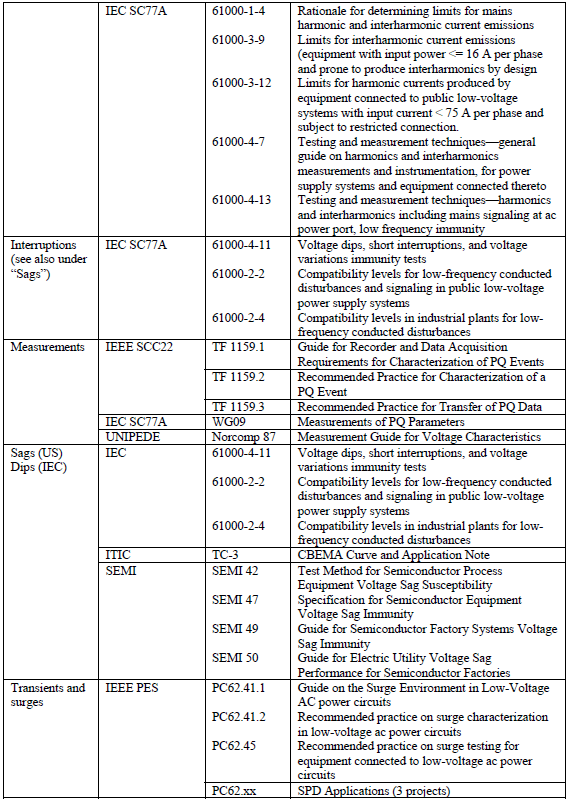
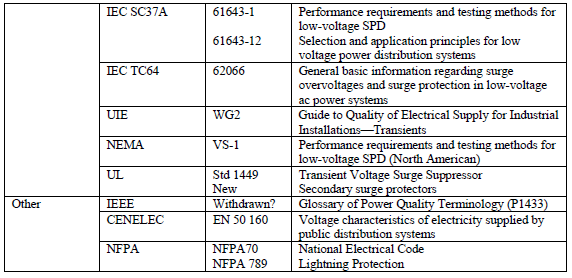
Power Quality Work at the International Electrotechnical Commission

Published by Franyois Martzloff, National Institute of Standards and Technology*, Gaithersburg MD 20899 USA

*Electricity Division, Electronics and Electrical Engineering Laboratory, Technology Administration, US. Department of Commerce.

Abstract

The paper presents an update, including a brief historical background, on the work to be undertaken at the International Electrotechnical Commission (IEC) to address power quality issues. To be useful, this work must take into consideration the three principal stakeholders, namely the producers of electric power, the manufacturers of equipment that use electric power, and the users of that equipment. Other stakeholders include manufacturers of power quality monitors, manufacturers of line conditioners, and power quality consultants. At this time there are some differences of perceptions on how the work can be accomplished to best serve the interests of all stakeholders. Nevertheless, there is no disagreement on the first goal to be reached, which is to catalyze development of compatible, comparable, and consistent results in the measurement of power quality parameters.

Introduction

In a landmark 1996 decision, the Committee of Action of the IEC approved a recommendation to undertake work on power quality issues as part of the scope of Technical Committee TC77 on Electromagnetic Compatibility (EMC). This decision, recommended by an Ad Hoc Group composed of power quality experts from ten countries, marks an expansion of the scope that will then reach beyond the purely technical issues generally addressed by the EMC community. Power quality and EMC share many concerns, to the point that each has at some time been described as being a subset of the other. In addition to this fundamental aspect, other issues permeate any discussion of power quality. It would be more accurate to draw a multi-dimension diagram with many overlaps (see Figure 1). The Ad Hoc Group considered three areas of contributions which an IEC Power Quality Group could make, complementing the work currently done by existing working groups or project teams of TC77:

  • Bringing order to the present chaos of uncoordinated methods of monitoring power quality
  • Proposing a classification of power quality levels describing what end-users can expect
  • Building bridges among producers and users of electric power, and equipment manufacturers

Concerns have surfaced that undertaking such work might ultimately result in the development and imposition of standards on the quality of “electricity as a product” and create an adversarial relationship, where for the moment the emphasis is on cooperation. There is a need to reduce these concerns by defining more clearly the objectives and work program of this new IEC activity.

Power quality issues involve overlapping stakeholders’ interests or technical aspects in many domains. In this figure, four domains are represented as planes in an exploded view, showing how for each domain, developing a Power Quality (PQ) document will involve overlapping topics and draw upon the interests and expertise of the stakeholders. A successful development will integrate all topics in each domain, and consolidate all domains into one entity. (Note how the artist has provided registration pegs on the planes so that the re-assembly will be a good fit !)

Figure 1 – The many dimensions of power quality issues

Power Quality in Other Organizations

The term “Power Quality” first appeared in the U.S. literature in the late seventies 1,2,3 ,used at first by the computer-user community in a somewhat negative context, as it seemed to be associated with anecdotes or complaints of malfunctions attributed – correctly or incorrectly – to “poor power quality.” At the beginning, there was a tendency to look for a culprit, the users blaming the electric power being supplied to them, and the electric power supplier blaming insufficient immunity of the equipment to unavoidable disturbances.

Even when a solution was indeed in sight, there remained among some stakeholders some reluctance to assume the cost of correction, and attempt to pass it on to the other stakeholder(s). The “boundary” of the stakeholders was often defined as the revenue meter, as if electrons would change their behavior when going through the current coil of the meter.

Technically sound and economically viable solutions will depend on the cooperation of three principal stakeholders:

  • Producers of electric power;
  • Manufacturers of equipment that uses electric power;
  • Users of equipment that uses electric power.

Perhaps not immediately obvious, but three other important stakeholders in correcting power quality problems are:

  • Manufacturers of power quality monitoring instruments;
  • Manufacturers of line conditioning equipment;
  • Consultants called upon to solve power quality problems.

Considerable progress has been made since the early days in bringing the parties together to seek mutually satisfactory solutions rather than hunt for culprits. The PQA conferences held in the last several years are a good indication of this change of mood and mode. We now hear the word “interface” more often than the word “boundary” suggesting that disputes are being replaced by constructive dialog. The term and concept of “System Compatibility” have also become more visible 4,5,6,7 , with the goals of the utilities defined as making their customers satisfied and helping customers to be more competitive, rather than merely supplying them with electric power.

Many electric utilities have instituted power quality programs in their customer services, some as a defensive or reactive step, others as a proactive and marketing strategy. Engineering societies have also focused on practical, application-oriented power quality issues, while initially the standards activities were slow in reacting to the growing interest in those issues. Since then, several organizations have established power quality programs for developing standards or contributing to the development of standards, including the Canadian Electricity Association (CEA)8, the European Committee for Electrotechnical Standardization (CENELEC)9, the Electric Power Research Institute (EPRI)10, the Institute of Electrical and Electronics Engineers (IEEE)11, and the International Union of Producers and Distributors of Electrical Energy (UNIPEDE)12. All of these organizations have allocated substantial resources to address power quality issues.

One of these issues in particular is the incompatibility found when attempting to analyze and compare the results of power quality surveys based on different definitions or measurement methods 13, 14, 15. This incompatibility is rooted on different definitions of disturbances, and hence different algorithms in the software of power quality monitoring instruments. Eliminating these incompatibilities is one of the prime motivations for the proposed IEC work that will first focus on measurement methods.

Power Quality vs. Voltage Quality

At the risk of oversimplification, one can identify two different approaches to addressing power quality issues on the two sides of the Atlantic Ocean. In Europe, attention seems to have focused on the “voltage quality” while in North America, the concerns fell under a broader umbrella of “power quality.” While the difference may seem to be a mere linguistic subtlety between the U.K. English which is the official English of the IEC and the U.S. English which is the unofficial English of the IEEE, the words also reflect a difference in perspective. In French, the second official language of the IEC, one finds the label of “qualité  de la tension” (tension = voltage), reflecting the emphasis on voltage. Perhaps as a result of this difference of perceptions, the few existing bilingual IEC documents on the subject have not yet provided a satisfactory equivalent in the two languages

An anecdote can best illustrate this subtle perspective difference: in what the U.S. community would recognize as a power quality pamphlet influenced by the European Community, the untranslatable caption of a cartoon from Electricite de France, “Bien vivre avec sa fension” (Figure 2) proposes the double-entendre of learning to live with “tension” – understood as the blood pressure of the end-user, or “tension” – understood as the system voltage. Hopefully, there will not be a triple-entendre where the word “tension” would refer to a sag, or to strained relations among the three principal stakeholders, resulting from concerns over the forthcoming IEC work on power quality issues. The caption of Figure 2 is an attempt at providing in the power quality context a culturally-equivalent rendition of the French for an English-speaking audience.

Figure 2 – Live long and prosper with your power quality

Somewhat in contrast with the emphasis on voltage -but certainly not in conflict – the U.S. perspective has included more than just supply voltage in the power quality issues. An often-cited statement in power quality articles is ” … 83% of the alleged power quality problems are actually end-user wiring problems” and one article even shows a screwdriver as “the primary tool for solving power quality problems.” This broad perspective is also illustrated by an IEEE standard, part of the ZEEE Color Books series, on powering and grounding for sensitive loads ” which is clearly related to power quality issues.

Satisfactory Operation vs. Voltage Quality

During the proceedings of the IEC Ad-Hoc Group meeting held in April 1996, interesting discussions took place among the participants on their respective proposals for a definition of power quality – a necessary prerequisite to undertaking work on the subject. A compromise consensus emerged so that the group would be able to present a recommendation for action where the terms would be defined. One of the proposals had emphasized the voltage parameters, while another proposal had related power quality to satisfactory operation of the user’s equipment. The resulting definition, cited below, still reflects these two points of view:

Power Quality – Set of parameters defining the properties of the power supply as delivered to the user in normal operating conditions in terms of continuity of supply and characteristics of voltage (symmetry, frequency, magnitude, waveform).

Note I: Power Quality expresses the users’ satisfaction with the supply of electricity. Power
Quality is good if electricity supply is within statutory and any contractual limits, and there are no complaints from users, and vice-versa it is bad if the power supply is outside of limits and there are complaints from users.

Note 2: Power Quality depends not only on the supply but can be strongly affected by the users’ selection of equipment and installation practices.

It will be one of the tasks (challenges?) of the group working on the forthcoming documents to allocate appropriate attention to the two points of view rather than to consider them as mutually exclusive.

Forthcoming IEC Work on Power Quality

The approach now being considered by the IEC is to initially limit power quality work to measurement methods, and perhaps even to a narrower limit of characterization of voltage parameters. Starting with measurement methods certainly is a necessity to get the work under way and ensure that all parties speak the same language when discussing power quality parameters. However, stopping there, useful as it may be to catalyze compatible dialog between producer and consumer of electric energy (power) will not be sufficient to fulfill the expectations of equipment users. From all the fuss about power quality being addressed at the IEC, they expect that more satisfactory operation of their equipment will be facilitated by the commitment of resources now envisaged by contributors to the IEC process, and that objective and reliable guidance will be found in the new documents.

As mentioned in the Introduction, an Ad-Hoc Group of representatives from several national or international organizations and committees developed a recommendation to begin work on power quality, starting first on measurement methods. This priority is a recognition of the present uncoordinated efforts among dedicated, but isolated, organizations which have produced incompatible or contradictory results among power quality surveys conducted by different organizations. The decision by the IEC Committee of Action to accept the recommendation developed by the Ad-Hoc Group has now cleared the way for New Work Item Proposals (NWIP), the method used by the IEC to launch the development of new documents, to be submitted to the IEC National Committees for approval.

As of the writing of this paper two NWP proposals have been circulated. One, originating from the French National Committee, has the title “Measurement Guide for Voltage Characteristics” while the other, submitted by the U.S. National Committee, has the title “Power Quality Measurements” again reflecting the difference in perspective. The French proposal somewhat mirrors the UNIPEDE12 approach while the U.S. proposal includes all the topics listed by the Ad-Hoc Group as well as a reference to the IEEE Standard 115916. The French proposal concentrates on low-frequency disturbance characterization, including power frequency, voltage magnitude, voltage fluctuations, voltage dips, harmonic voltages, and signaling voltages, but downplays transient overvoltages (surges). It also makes several references to “Compliance with EN 5016011 which might be seen as leading to mandatory clauses. The US. proposal includes a comprehensive list of disturbances, suggests tutorial clauses on definitions and origins of disturbances, and even the possibility of providing some tutorial material on remedial or preventive actions. Both proposals follow the Committee of Action decision that Technical Committee TC77 should be the principal responsible committee for this work, in coordination with Technical Committee TC8 (Standard voltages, current ratings and frequencies).

The officers of TC77 are on record as recommending that the two proposed projects be merged into a single project since it is clear that both proposals share the same goal of developing compatible, comparable, and consistent results in the measurement of power quality parameters. The responses from the National Committees will not be compiled before late June 1997, but some responses will be known by the time of presentation of this paper. Hopefully, the responses will be positive and the paper presentation will include an update on the project planning.

Conclusions

  • The first step has been taken at the IEC to start working on the development of documents addressing power quality issues.
  • The challenge will now be to proceed diligently to satisfy the needs of end-users and not have the work stalled by the difficulties of reaching consensus among many stakeholders.
  • The decision to start with measurement methods will enable development of a common language and build a working relationship among the participants which should promote continuing progress toward technically sound and cost effective solutions for the problems perceived – correctly or incorrectly – as power quality problems encountered by end-users in the equipment operation

Acknowledgments

Support for developing this paper, as well as support for participating in the related IEC work, was provided by the author’s agency, by EPRI, by Delmarva Power, and by Pacific Gas & Electric. Gerald FitzPatrick and Thomas Key provided helpful comments on the draft.

References

  1. Key, T.S., “Diagnosing Power-Quality Related Computer Problems,” IEEE Transactions LA-15 No.4, July 1979.
  2. Goldstein, M. and Speranza, P.D., “The Quality of U.S. Commercial AC Power,” Intelec Conference Proceedings, 1982, pp 28-33.
  3. Clemmensen, J.M. and Ferraro, R.J., “The Emerging Problem of Electric Power Quality,” Public
    Utilities Fortnightly,
    November 28, 1985, Arlington VA.
  4. Gruzs, T., Key, T.S., Sitzlar, H.E., and Lai, J.S., “Compatibility at the Utility Interface: The UC
    Concept Applied to Surge-Protection Systems,” Proceeding, PQA ’91.
  5. Martzloff, F.D., “Performance Criteria for System Compatibility,” Proceeding, IEEE APEC
    Conference
    , 1992, pp 287-292.
  6. Key, T.S., Sitzlar, H.E., and Moncrief, W., “Electrical System Compatibility Applied to End-use
    Equipment Characterization Projects,” Proceedings, PQA ’92.
  7. Key, T.S., Dorr, D.S., Hughes, M.B., and Stanislawski, J., “Matching Electronic Appliances to their Electrical Environments,” Proceedings, PQA ’95.
  8. CEA 220 D 71 1 – Power Quality Measurement Protocol – Guide to Performing Power Quality
    Surveys
    , Canadian Electricity Association, May 1996.
  9. EN 50 160 ” Voltage Characteristics of Electricity Supplied by Public Distribution Systems,
    November 1994.
  10. EPRI, Signature – A quarterly newsletter on power quality issues.
  11. IEEE Std 1 100- 1992 “Recommended Practice for Powering and Grounding Electronic Equipment“.
  12. UNIPEDE “Measurement Guide for Voltage Characteristics,” May 1996.
  13. Martzloff, F.D. and Gruzs, T.M., “Power Quality Site Surveys: Facts, Fiction, and Fallacies,” IEEE Transactions IAS Vol24 No.6, November/December 1988, pp 1005- 1018.
  14. Dorr, D.S., “Point of Utilization Power Quality Study Results,” IEEE Transactions IA-3 1 , No.4,
    July/August 1995.
  15. Martzloff, F.D., “Surge Recordings that Make Sense: Shifting focus from voltage to current
    measurements,” Proceedings, ROMA ’96 EMC Symposium, September 1996.
  16. IEEE Std 1159- 1995 “Recommended Practice for Monitoring Electric Power Quality

Bruce’s Laws of PQ Problem Solving

Published by Bruce Lonie, President, POWERetc Corporation, 3350 Scott Blvd., Bldg 55 Unit 1 Santa Clara, CA 95054 USA, (408) 540-3199 | m (408) 666-6500, Email: BruceL@POWERetc.com | Website: www.POWERetc.com

1.Do the simple things first.

2.There is always more than one problem. There are always more than one or two problems, keep looking and you will find them.

3.The problem investigation is like peeling the layers of an onion. When you peel away the last layer the onion is gone… and so is the problem.

4.Fix the problems as you find them… if you can.

5.The customer (aka client) NEVER tells you the whole story. Every time you talk with them you learn another nugget of knowledge.

6.Never believe someone else’s measurements or test results. Worst case, you verify the readings and that the test results are correct.

7.Be nice to everyone, you never know who will provide you with an important clue.

8. If it is happening in the electrical environment you can figure out a way to measure it.

9.Substitute technology (multiple monitors) for time… it speeds up the investigative process and provides more and better-quality data for analysis. Labor (time) is the most expensive cost component of an investigation, equipment (technology) is relatively inexpensive. Use equipment with remote communications capabilities to save labor.

10.You are NOT allowed to repeal any of the basic laws of physics.

11.Ohm’s Law and Kirchhoff’s Law solve most problems…use them wisely.

“Dare to be different”*…it’s more fun!

*William “Bill” Lear, 1965

Origins of EOS in Manufacturing Environment and Its Classification

Published by Vladimir Kraz, 3M Company, 3601-A Caldwell Dr., Soquel, CA 95073, Tel. 408-202-9454 FAX 206-350-7458 Email: vladimir.kraz@gmail.com

Abstract

EOS (Electric Overstress) is a serious threat to defect-free manufacturing, long-term product reliability and interruption-free manufacturing process. This paper summarizes the sources of EOS, its impact on production and suggests classification of EOS occurrences into models in a similar fashion to ESD Events.

Introduction

EOS, or Electric Overstress, in general is an occurrence of overvoltage or overcurrent to a device. EOS in its broadest definition includes electrostatic discharges, or ESD Events. However, more narrow and more widely used definition of EOS limits overvoltage and overcurrent occurrences to differentiate it from ESD Events. There are several important properties that separate EOS and ESD occurrences:

Table 1. Comparison between ESD and EOS Events

ESD EventEOS Event
ESD Event is caused by a rapid discharge of
accumulated electrical charge. Once this accumulated charge is consumed, ESD Event can no longer manifest itself.
EOS Event is caused by voltage and/or currents associated with operation of equipment or with power generating equipment
ESD Event lasts typically nanoseconds – the time necessary to dissipate accumulated chargesEOS Event can last as long as the originating signal exists. There is no inherent limitation on its duration
SD Event is characterized by a specific waveform. While the waveforms of different models of ESD Events (CDM, HBM, MM and others) certainly differ in appearance, in general their properties include rapid rising edge (within few nanoseconds) and an asymptotic rear edge lasting typically less than 100nSEOS Event can technically have any physically possible waveform – the sources of EOS are often unpredictable. There are some major categories, however, which would be described further in the text
ESD Events are nonperiodic and non-repeatable – accumulation of charges cannot be guaranteed or accurately predictedEOS Events are often (not
always) periodic and
repeatable

Effect of EOS on Devices

The effects on the device from an ESD Event and an EOS Event can be quite different. At a risk of oversimplification, an ESD Event could be compared with emptying a cup of water on a floor. There is a resulting small puddle, but once the content of a cup (i.e. charge) is gone, there is no more water coming and the water damage is thus limited. An EOS event could be compared with an open faucet. However little water it may drip in comparison with the sudden flow of water from the cup, with time this trickle may flood the entire floor and cause significant damage. Duration of a typical ESD Event is several magnitudes less than duration of most EOS Events, therefore this comparison “holds water.”

A most typical semiconductor device can be damaged by an ESD Event of magnitude of anywhere from 100V to 250V CDM (of course, the overall damage level is much wider). EOS-induced damage, however, occurs at much lower levels. IPC-A-610 and IPC-7711, the standards used by PCB Assembly plants to control quality of electronic assemblies, recommend that the EOS levels should be kept below 0.5V and in the case of sensitive assemblies – below 0.3V (IPC-A-610 Acceptability of Electronic Assemblies)1. Why there is such discrepancy in damage voltage levels? This has to do with the waveforms of the exposure, not just with the absolute EOS voltage levels. Similar discrepancy exists between different ESD discharge models – the same device may be damaged by 2000V HBM model, while being sensitive only to 100V CDM model discharge.

According to 2, one of the mechanisms of damage due to EOS is thermal runaway from Joule heating (excessive current). This is also systemic to ESD Events as well. While overheating due to ESD requires significant current injection over very short period of time, to achieve similar effect a smaller current that would last significantly longer would suffice. An ESD Event that lasts a few nanoseconds may generate similar amount of heat as a much smaller EOS Event that would last thousands or even millions times longer – microseconds or milliseconds.

To the author’s knowledge, at the present there is no established correlation yet available between the levels of damage due to ESD and the ones due to EOS. This paper recommends that such relationship is examined by the experts in the industry and, if possible, a correlation is established for the benefits of the industry.

Other Effects of EOS

Besides direct damage to the devices, undesirable voltage in tools may affect tools’ normal operation, extending from erratic operation and tool’s lock-up to altering test results during IC test and board test. Especially, high-frequency noise can be a significant contributor to parametric errors for low-voltage devices and circuits. This paper (EMI Issues in the Manufacturing Environment)3 outlines possible consequences of excessive noise in the environment.

Types of EOS in Manufacturing Environment

There is a large variety of types of EOS occurrences in a typical production environment. This paper outlines the most common types and provides brief description of their properties and their most likely origins.

Mains-Caused EOS (AC 50/60Hz) Voltage Induction

Since most of equipment operates on power from mains, it is not surprising that mains’ artifacts can be present in some tools. Poor wiring schemes, lack of adequate grounding and ground loops are all contributors to that. Yan and Gaertner4 show AC voltages up to 2.3V in wire bonding tools. The data from this paper clearly shows the strong relationship between ground impedance and the AC voltage – the higher the ground impedance, the higher the resulting AC voltage. Several questions arise: how did this voltage end up there and whether this voltage offers any danger to the components given that the impedance is high enough to be perceived to limit resulting current to just few microamperes.

Figure 1 shows one way how AC voltage can be induced into the tool. A source of AC voltage VAC which can be any object that is connected to the mains, or simply the wire carrying mains voltage, is coupled via capacitive coupling or some resistive leakage to the point of our interest VB. For capacitive coupling the source and the target simply have to be reasonably close to each other and have sufficient mutual surface areas to form a capacitor. Resistive coupling is simply parasitic leakage via imperfect insulation. RL is connection of the part of the tool of interest to us to ground.

Not trying to complicate this paper with formulae, it should be obvious to the reader that the smaller the ground impedance RL, the smaller voltage VB would be observed. This confirms the paramount need to keep ground impedance the lowest possible. It should be noted that it is nearly impossible to determine with finality all the leakage paths in real-life situations, so any calculations would result only in estimates.

Figure 1. Induction of AC Voltage

Neutral/Ground Reversal

It is an unfortunate occurrence when neutral and ground wires in the tool or in the outlet itself are reversed. In author’s experience this happens even in the best-run facilities anywhere in the world. To complicate the matters, conventional testers such as ubiquitous three-light checker obtainable from hardware stores cannot test for this situation.

Figure 2. Live and Neutral

As seen in Figure 2, every wire has finite impedance, therefore the voltage on the end of the load connected to neutral wire is not zero. The higher the current consumption and the smaller the gage of the wire, the higher the voltage on the neutral end of the load. If the neutral end of the load is connected to ground wire by mistake, then the ground at that point would be under voltage. In such scheme, the ground end of the power cable is then connected to the neutral at the power outlet further adding to the problem and complicating the situation. Since the current consumption in most tools is seldom continuous – it peaks whenever a motor or other actuator starts – the parasitic EOS voltage on ground may be present only during these times, further complicating diagnosis.

Figure 3. DC Current Return Via Chassis

Current Induction

Strong currents, would they be in wires connected to the motors and other current consumers in the tool or within the motors, heaters and other devices, generate magnetic fields which, in turn can produce currents and voltages in largely accidental loops within the same tools. These currents and voltages are more difficult to analyze since engineers and technicians who service the tools seldom use magnetic field sensors for the mains frequencies, however such tools are widely available and are recommended to use in conjunction with time-domain instruments, such as an oscilloscope. Conventional magnetic field meters may not be fast enough to register transient currents on start-up.

DC-Caused EOS

Many tools utilize a number of DC-powered motors (including stepper motors), solenoids, electronic circuits and other current consumers. In many cases one of the power terminals (mostly the negative one) is grounded and the ground ends up being the return path for the current. No matter how large the cross-section of the tool chassis is, its resistance is not zero. Low-voltage DC motors and alike can consume significant current, especially during start-ups. Figure 3 depicts a typical situation. A negative terminal of DC power supply is normally grounded to a chassis and the return current from motor as shown is done via the chassis as well. Chassis resistance is finite, therefore there will be a difference in potentials between the point of connection of the motor and “real” ground. If a device resting on such chassis comes in contact with the properly-grounded object, it will be subjected to this potential differential resulting in EOS.

High-Frequency Noise (EMI)

This subject was covered in details in 5. To summarize, high-frequency signals are usually parasitic in nature (exception to that is outlined below) and are result of transient signals generated by operation of such equipment as stepper and variable-frequency motors, solenoids, relays and alike. The higher the power consumption of such device, the stronger the EMI signal. Figure 4 shows typical signal on ground generated by EMI. As seen, it is anything but continuous waveform. When assessing EMI signals for possibility of EOS, it is imperative that the instruments with ability to capture the peak signal are used. In author’s experience, it is not uncommon to encounter spikes of up to 20V on ground and in power lines.

There are cases, however, when the predominant signal in cables and wires is continuous waveform. This occurs in places where RFID is used to keep track of products in process. Passive RFID tags require strong magnetic field to power them up which results in strong induced signals into anything resembling a conductive loop, which is not difficult to find in production tools. Resulting voltage at frequencies typically 13.56MHz then propagates through wires throughout the facility.

Figure 4. Typical EMI Waveform on Ground

Ground Bounce

Figure 5. Ground Bounce

This phenomenon deserves special considerations for high frequency signals. Though mostly attributed to ICs and PCB layout issues, ground bounce is a significant factor for the factory-scale signals. This paper by Phil King, Agilent Technologies6 provides adequate background of the phenomenon of ground bounce. In short, when ground wire has substantial impedance at high frequencies, current passing through this wire from noise generating equipment to ground produces voltage across this wire thus floating what was supposed to be ground of the tool – see Figure 5. According to calculations in this paper 7 (V. Kraz, P. Gagnon, How Good is Your Ground) this voltage may reach several volts. The example below shows the case of long grounding wire. Inductance of a straight wire at high frequencies can be calculated as

where

L – inductance in mH
r – radius wire, cm
d – length of wire, cm

A common 10m (30 feet) ground run of 12 gage solid wire has self-inductance at high frequencies of


A 1-mA current at 100 MHz would create a voltage on this length of wire of

V = 2π x 100 x 106 x 17.36 x 10-6 x 0.001 = 10.9 V

This should trigger considerations for proper grounding scheme.

Sources of EOS in Production

Now that we discussed what phenomenon can cause EOS exposure, let’s examine some of the practical sources of EOS in real-life production environment and match them to the physical phenomenon which is manifested in each case. Only very few of such sources are outlined in this paper due to limitation of the scope.

Soldering Irons

The tip of soldering iron touches the most sensitive electric components, therefore it is under the most scrutiny for EOS exposure. Some standards (MIL-STD-2000) require the tip of soldering iron to produce no more than 2mV of signal, which is quite unrealistic in most environments. Papers such as this one8 were written on the subject. Lets take a look why would a tip of soldering iron have voltage to begin with.

Bad Grounding Loss of Ground

If a soldering iron loses ground, the tip of the iron can have any voltage up to ½ of the supply voltage to the iron. The voltage due to ground loss is usually AC 50/60 Hz. DC voltage on the tip would be contributed to other phenomena, usually caused by defective power supply in the iron itself. In the very best case the voltage at the tip of the iron due to loss of ground would be equal to voltage on neutral which, as discussed before, is not zero and is typically several volts of AC. Loss of ground can occur within soldering irons themselves or in power outlets. Raytheon9 reported in 2005 massive failure of ground in
power outlets which led to EOS and resulting damage in sensitive circuit. Reversal of ground and neutral also leads to excessive voltage at the tip.

Noise on Ground

Whatever signal is present on ground, it will be present on tip of the iron. Noise on ground can be quite high as it was discussed before. When the voltage on the tip is measured with a multimeter or an off-the-shelf iron checker, it will easily miss high-frequency signals and especially spikes that are so typical in the production environment. It is imperative to be able to measure voltage with instruments that are capable of measuring high-frequency spikes. A high-speed digital oscilloscope or a dedicated meter with high-frequency capabilities should be used.

Noise on Power Line

Noise is propagated not only via ground but via power lines as well. Transformers and power supplies converting mains voltage to 24V or alike are usually transparent to high-frequency spikes which end up on the soldering iron tip. The effect is similar to being caused by noise on ground and the signal should be measured in similar fashion as above. Power line filters can help to reduce this noise.

Switching Spikes

It is rumored, but not yet confirmed, that switching of the heater during temperature control may generate spikes similar to the ones from other sources. No evidence to this
or contrary to this was yet collected and the readers are encouraged to experiment in order to either confirm or discard this speculation. Keeping in mind that such signals would be transient in nature, instruments capable of capturing such signals should be used.

Tip Oxidation

Signal on the tip can be induced by capacitive coupling from AC voltage sources from the heater element. Normally, if the tip is well-grounded, the induced voltage on it would be too negligible to measure. However, if the tip of the iron is oxidized and the contact with ground is lost, the tip may have some voltage on it depending on the construction of the iron and heating element.

Power Tools

Such power tools as electric screwdrivers commonly used in electronic assembly may not always have good grounding of the tips during rotation. Grounding via ball-bearings during rotation is a non-working concept since the lubricant in the bearing is insulative. In addition, some mains-powered screwdrivers may not have dedicated grounding since they may be using double insulation to satisfy safety requirements. Resulting voltage on the tip of the screwdriver may be quite high. Author observed 107V AC on the tip of the screwdriver used in assembly of mobile phones in 220V region.

Even the screwdrivers used in equipment for such sensitive process as assembly of disk drives can generate significant voltage. As described in 4 voltage induced into screwdriver’ ground wire by simply its being routed in the same bundle as the wires to stepper motor generating significant spikes.

Power Supply Commutation

This is most important during the IC test and magnetic head test. When an IC is placed in the IC socket, the socket is usually not powered. This paper10 describes the spikes and the transients during powering up the IC during the test. IC failures during IC test are often contributed to such transients. Such transients are hard to capture since they occur only at the moment of commutation and also because access to the test points in the IC handlers is often obscured.

One of the effects of power supply spikes is latch-up. In simple words, latch-up is a phenomenon when a signal outside of power rails of the device transforms the device into a p-n-p-n thyristor structure and the device experiences a runaway current which is liable to overheat the device and to damage it. When a device, such as an IC, fails the test, it is not necessarily the ESD-related damage somewhere in the process. The damage may have had occurred right here in the beginning of the test.

Classification of EOS Events

As seen, there is a plethora of different types of EOS Events in production environment. Due to increasing awareness of EOS exposure and increasing importance of managing EOS, This author recommends that EOS Events are characterized in several general models similar to ESD Event models, such as CDM, MM, HBM, CBM and alike. Such characterization will lead to standardization of tests and to setting requirements to the process and the tools that can be established and verified. Device sensitivity to EOS can also be classified into the “brackets” that can be tested and compared between different companies and laboratories.

Author suggests the following basic types of EOS exposure and associated sources of EOS:

Table 2. Suggested EOS Event Models

EOS Event ModelEOS Exposure Example
Continuous ACSoldering iron with lost/poor ground
Continuous DCDC soldering irons, tools
Long Transient Pulse (milliseconds)Transient signals due to AC commutation
Short Transient Pulse (microseconds)Transient signals due to EMI on ground
Transient Pulse due to DC commutationPower supply commutation in IC handlers and alike

At this point the author is reluctant to provide more descriptive classification in hope to collect input from the experts in the industry in order to tap into collective expertise and to gather better classification categories.

References

  1. IPC-A-610 Acceptability of Electronic Assemblies. (n.d.). IPC.
  2. Craig Hillman, PhD, Temperature Dependence of Electrical Overstress
  3. EMI Issues in the Manufacturing Environment, V. Kraz, Conformity, January 2007
  4. Alternative Method to Verify The Quality of Equipment Grounding, Yan, Gaertner, proceeds of 2005 EOS/ESD Symposium
  5. EOS Exposure of Magnetic Heads and Assemblies in Automated Manufacturing, Vladimir Kraz, Patsawat Tachamaneekorn, Dutharuthai Napombejara
  6. Ground Bounce Basics and Best Practices, Phil King, Agilent Technologies
  7. How Good Is Your Ground?, V. Kraz, P. Gagnon, Evaluation Engineering, May 2006
  8. EOS Analysis of Soldering Iron Tip Voltage, Baumgartner, G.; Smith, J.S., EOS/ESD Symposium, 1998
  9. EOS from Soldering Irons Connected to Faulty 120VAC Receptacles, W. Farwell et.al., Raytheon Corporation. Presented at 2005 EOS/ESD Symposium
  10. Carlos H. Diaz, Hewlett Packard, Automation of electrical overstress characterization for semiconductor devices

Placement and Sizing Optimization for DER Based on Single Phase Wind Turbine Generator in Distribution System Using HPSO

Published by

  • Miss Panaya Sudta, Customer Relation Division, Provincial Electricity Authority, Email: nica_pny@hotmail.com
  • Prof. Weerakorn Ongsakul, Energy Field of Study (FoS) of SERD, Asian Institute of Technology, Email: ongsakul@gmail.com
  • Mr.Patiphan Thupphae, Energy Field of Study (FoS) of SERD, Asian Institute of Technology, Email: sunpatiparn@gmail.com
  • Mr. Wichian Khumwong, Customer Relation Division, Provincial Electricity Authority, Email: wichian.k@gmail.comcom

Published in PEACON & INNOVATION 2018 “PEA4.0 : Road to Digital Utility” 24th-25th September, 2018. Centra Government Complex Hotel & Convention Centre Chaeng Watthana Chaeng Watthana, Bangkok

Abstract

Nowadays the rapid evolution of power systems leads electricity system transfer from centralized fossil fuel to decentralized distributed generation (DG). The distributed generation based on single phase wind turbine generator placement and sizing problem is formulated as a nonlinear integer optimization problem. Single phase wind turbine installation in distribution systems is beneficial and requires optimal placement and sizing of this DER. However, the addition of single phase wind turbine can cause power quality problems such as over voltage levels and increasing of harmonic waveform. Hence, single phase wind turbine should be optimally located and rated taking the presence of power into account.

The goal is to minimize the overall cost of total real power losses and maintain voltage level and power quality. The optimal single-phase wind turbine placement and sizing problem is tackled by H-particle swarm optimization (HPSO). To include the presence of real power, the developed HPSO is integrated with power distribution system. The modified IEEE 13-bus three phase unbalanced radial network is used to validate effectiveness. This case study is implemented on MATLAB. The results present the necessity of including harmonics in optimal single-phase wind turbine placement and sizing to avoid any possible problems that occur with power quality issue.

Key words: Single-phase wind turbine, microgenerator, HPSO, optimization tools

1. Introduction

In epochal years, the infrastructure of a distribution systems is extensively expanding that facing the pressure to integrate the distributed generation (DER) based such as solar rooftop PV, electric vehicle (EV), and single-phase wind generation, which are commonly penetrated in distribution systems in order to support governments policies. Consideration in the term of utility power system these penetration of DER helps reduce real power losses, release system capacity, and improve voltage profile. The achieving such benefits among other benefits depends on the most appropriate method to manage these the installation of DER, which in this paper focus on single-phase wind turbine generator.

In addition, along with voltage drops and real power loss, the growing of electricity demand requires upgrading the distribution system infrastructure, when electric loads are increasing, the voltage profile tends to decrease with the dispersion feeder being below the acceptable operating limit. The installation of distributed generation based on single-phase wind generators can help to enhance performance of utility electric power distribution systems.

However, the use of harmonic devices on the controller part of this type of DER in the widespread distribution system create the unexpected harmonic distortion throughout the system. Harmonics causes overheating due to excessive wear and and tear of electrical equipment. The integration of single-phase wind generator without considering harmonic sources in the system may lead to an increase in the total harmonic distortion because of the reflection between the control devices and the components in the system. Distorted radial distribution systems are inherently unbalance in several reason. Firstly, distribution supply both single and three phase loads through distribution transformers. Secondly, phases of transmission lines are unequally loaded. Lastly, overhead lines in distribution systems are not transposed not the same as transmission systems.

From the previous experimental the developed heuristic models, varying according to local search engine ranking of the best global single-phase wind generator, which makes the cost of losing all power to the actual performance of the DG decreases [1]. The purpose is to reduce the actual cost of power loss and the efficiency of the evaporator capacitor while observing the practical limitations. The result shows that the neglect of the presence of a harmonic source may Carpinelli et al. Correct the position of the capacitor and scale the problem in such a way that the overall cost decreases. [2].

In this paper use the same method of the problem of scaling solar rooftop PV, which is best defined as an integer programming problem is not linear, with no limitation as limitation is the rms. The voltage of the bus and the deviation of the total harmonics. One source speculated that the station utility. The heuristic algorithm, based on local variability, offers to overcome the prohibitive computational time associated with considering every potential capacitor size in a given repetition. Yan contributes to Harmonic loading in distribution systems [3].

Hybrid dynamic evolution algorithms have been developed to determine the position and the capacitance in the distorted delivery system well. Sensitivity tests were conducted prior to the optimization process to monitor the buses for reactive energy compensation. Costs related to the cost of actual power loss, spinning capacitors, and harmonic distortion. Use the estimated energy flow method and the linear harmonic flow method to calculate the cost functions at fundamental and harmonic frequencies.

Therefore, to study the effects of single-phase wind generator location and size on the increasing number of harmonic distortions, a harmonic power flow algorithm was integrated with the particle swarm optimization algorithm to calculate the harmonic related terms. These terms were the harmonic bus voltages, harmonic real power losses, and total harmonic distortions. The total real power loss and the cost of the real power loss and shunt capacitor installation were considered as objectives of the optimal DG based on single-phase wind generator locational and sizing problem.

The findings of this research indicate that the inclusion of single-phase wind generator in power distribution systems without harmonics consideration may cause a serious harmonic distortion problem, where the objective functions were subject to inequality and equality constraints. The inequality constraints were those associated with limits on bus voltages, total harmonic distortions (THD), and the total number and size of single-phase wind generator to be installed and thus, the equality constraints were the nonlinear electric power flow equations.

2. Problem Formulation

2.1 Optimal placement and sizing formulation

The main purpose of installing the capacitors in an electrical distribution system is to reduce the total power loss and also improve the voltage level in a system. The formulation of total power losses utilized in this study as the constraint parameters for the optimization solution is given in equation (1).


where, m and Nl is the feeder number and total number of feeder, respectively. In the market, the size of the single-phase wind generators is given in fixed size. In this study, a complete size of single-phase wind turbine is designed based on the combination of several generators with smallest size of rated power. Single-phase wind turbine installation cost is chosen proportional to the size of the generators. The size of the generators to be installed at the selected destination is limited to the maximum size of rated power load [4]. Where the available generator size given in Table 1. The most optimal placement and the size of the installed are referred to the cost of total power loss as expressed in equation (2).


Table 1. Available discrete single-phase wind turbine generator sizes

ModelRated Power (kW)Swept area sq. mRotor Radius
CF20201356.55
Gaia-Wind 133-11kW111336.5
CF1515925.4
Westwind 20 kW20825.2
Evoco 109.55744.85
Aircon 10s9.8453.8
Xzeres 442SR10413.6
Bergey Excel 1010383.5

where, Ks is the cost coefficient for power losses ($/kW) and j is the number of selected buses required for the single-phase wind generators installation. The objective function from equation (2) is bounded by a number of constraints which are the allowable minimum and maximum voltage limit and limitation of generator size specified at each bus.

Thus, the inequality constraints considered in this study can be described as follows.


where:

  • Vlower bound of bus voltage limits;
  • Vmax upper bound of bus voltage limits;
  • |Vi| rms value of the bus voltage and defined by

However, the minimum constraint of inductive reactive power for this study is set to zero to provide wide selection of generators sizing. The PSO technique developed for this case study will execute equations (3), (4), (5), and (6) at every computational iteration. The global best solution will not be update unless the objective function, is improved or reduced and this condition is described in equation (7).


where, k is the number of computational iteration.

2.2 Particle Swarm Optimization Technique

Particle Swarm Optimization was introduced by R. Eberhart and J, Kennedy, inspired by social behavior of bird flocking or fish schooling. It is a part of modern heuristic optimization algorithm, it work on population or group in which individuals called particles move to reach the optimal solution in the multidimensional search space. It works with direct real valued numbers, which eliminates the need to do binary conversion of a classical canonical genetic algorithm. The number of particles in the group is Np. The initial population of a PSO algorithm is randomly generated within the control variables bounds. Each particle adjusts its position through its present velocity, previous positions and the positions of its neighbors. Each particle updates its position based upon its own best position, global best position among particles and its previous velocity vector according to the following equations:


where:

  • vik+1 velocity of ith particle at (k +1)th iteration
  • w inertia weight of the particle
  • vik the velocity of ith particle at kth iteration
  • c1, c2 acceleration constants.
  • r1, r2 randomly generated number between [0, 1]
  • pbest i the best position of the ith particle obtained based upon its own experience
  • gbest global best position of the particle in the population
  • xik+1 position of ith particle at (k +1)th iteration
  • xik the position of ith particle at kth iteration
  • X constriction factor. It may help insure convergence. Suitable selection of inertia weight provides good balance between global and local explorations.

3. Methodology

3.1 Construction of distribution system simulation

In this study, circuitry-based commercial software has been chosen to develop IEEE 13-bus three-phase unbalanced radial distribution system. The model was designed by taking into account several important electrical components such as the three-phase load, distribution line, buses, incoming source and measurement blocks. The load flow simulation is performed which will provide the measurement in a time domain response at a steady state condition.

In Figure 1, the IEEE 13-bus three-phase unbalanced distribution system is embodied with the total real and reactive power of 3676.50 kW and 2560.90kVar, respectively. The system is considered to be unbalanced since there are several buses connected with only single or two-phase load. The sampling time of simulation is set as 50μs and 50 Hz is set for the frequency. The system is operating at the nominal voltage of 4.16 kV accept at bus 634 where the voltage is step down to 480 V.

3.2 OPF single-phase wind generator with HPS

Figure 1. IEEE 13-Bus Three Phase Unbalanced Distribution System

To consider harmonics, the total harmonic distortion (THD) limit at each bus is included as the optimization constraints to ensure that the harmonic distortion levels at all bus are within the allowable limits. Results of the harmonic power flow (HPF) subroutine is integrated with the PSO algorithm to determine the harmonic real power losses, and total harmonic distortions. The PSO-HPF based algorithm that incorporate HPF with HPSO algorithm show as the flow chart in Figure 2.

Figure 2. Optimal single-phase wind generator placement and sizing using HPSO technique

The procedure of PSO algorithm implemented in this study to obtain the optimal value of the objective function is discussed as follows:

  1. Perform a three-phase unbalanced load flow solution for the original system (without the single-phase wind generator placement) to obtain the total power loss and other required data.
  2. Start the developed PSO algorithm by generating a swarm of the particles randomly in the feasible region of the search space. As previously mentioned in section, each particle is associated with two vectors, the position vector and velocity vector.
  3. The position vector of each particle represents a potential solution to the problem at hand. The feasible swarm is passed to the RDPF subroutine as initial guess to minimize power mismatch equations.
  4. Each particle recalls its best position associated with the best fitness value (e.g. the real power loss). Each particle records the best position achieved by the entire swarm.
  5. Update process of particles’ positions results in continuous values of particles’ positions and made discretization of particles’ position vectors.
  6. Feasible check the particles to ensure that no particle flies outside the feasible region.

4. Results and Discussion

The algorithm of PSO technique and a case study of IEEE 13 bus three-phase unbalanced distribution model were developed in MATLAB. The HPSO is executed for 10 times with 100 iterations of optimization process is specified for each time.

With the presence of harmonics, two different cases investigate the impact of single-phase wind generators installation on the voltage profiles, total harmonic distortions, total real power losses, and total cost are considered.

  • Case 1 represents the system without total harmonics consideration after single-phase generator installation.
  • Case 2 represents the system with harmonics consideration after single-phase generator installation.

Table 2. Available discrete single-phase wind turbine generator sizes


The maximum number of iterations was taken as 100 for the tuning process of each parameter. It was found that the PSO algorithm was less sensitive to its parameters when the problem dimension was small (the problem dimension was single-phase wind generators). However, the larger the problem dimension is, the more sensitive the PSO algorithm becomes. The solution of the optimal solar rooftop PV placement and sizing problem using developed PSObased algorithm was able to find optimal locations and that overall cost was minimized. The simulation results for initial case, cases 1, and 2 is reported in Table I. Based on Tables II execution gives the best solution with respect to the best total cost considered as its objective function.

The convergence characteristics of the developed PSO-HPF-based approach for cases 1 and 2 in the optimal placement and sizing of solar rooftop PV problem with the total cost being the objective with HPSO consideration is depicted in Figure 3.

Figure 3.

4. Conclusion

In this paper, the single-phase wind generator placement and sizing problem was formulated as a constrained nonlinear integer programming problem with both locations and ratings of single-phase wind generator is discrete. The constraints considered were of two types: equality and inequality. The equality constraints were the nonlinear power flow
equations. The developed PSO-HPF-based algorithm was tested on an unbalanced 13-bus test system to calculate the optimal locations and sizes of single-phase wind generator taking harmonics into account.

Reference

[1] Y. Baghzouz and S. Ertem, “Shunt capacitor sizing for radial distribution feeders with distorted substation voltages,” IEEE Trans. Power Del., vol. 5, pp. 650–657, Apr. 1990.
[2] “Systems with harmonic distortion,” in Proc. IASTED Int. Conf. Power and Energy Systems, May 13–15, 2002, pp. 352-353.
[3] G. Carpinelli, P. Varilone,“Capacitor placement in three-phase distribution systems with nonlinear and unbalanced loads,” Proc. Inst. Elect. Eng., Gen., Transm. Distrib., vol. 152, pp.47–52, 2005.
[4] A. Eajal, S. Member, and L. Fellow, “Unbalanced Distribution Systems with Harmonics considered Using PSO,” vol. 25, pp. 1734–1741, 2010.
[5] P. Sudta “Optimal DG Based on Solar Rooftop PV Placement and Sizing in Unbalanced Distribution Systems with Harmonics Consider Using PSO” PEACON2017

The Smart on-field Meter Accuracy Investigation System for PEA 4.0

Published by

  • Mr.Chitchai Srithapon, Customer Service Division, Provincial Electricity Authority, Email: chichai.sri@pea.co.th
  • Mr.Pichai Thaniwan, Customer Service Division, Provincial Electricity Authority, Email: phichi.tha08@gmail.com
  • Mr.Weerachat Khuleedee, Customer Service Division, Provincial Electricity Authority, Email: weerachat_ee35@hotmail.com
  • Mr.Wacharapong Rakapong, Information System Division, Provincial Electricity Authority, Email: nidpea@gmail.com

Published in PEACON & INNOVATION 2018 “PEA4.0 : Road to Digital Utility” 24th– 25th September, 2018. Centra Government Complex Hotel & Convention Centre Chaeng Watthana Chaeng Watthana, Bangkok

Abstract

According to the service standard policy by the Energy Regulatory Commission (ERC) of Thailand in 2016, made all of electricity utilities have to verify meter accuracy of all residential customer meter to make sure all meters measure reading is precision in accuracy class of 2.5% for every 3 years. Today, Provincial Electricity Authority (PEA) has the existing residential customer kWh meters about 17 million, where it required many work task and high budgets to achieve this mission. Therefore, PEA team had developed the on field meter accuracy testing system to be able to perform operating faster and make a cost saving.

The proposed smart system was designed to complete with a new meter tester feature and new software implementation on both internet web service and smart phone application. The implementation of this mobile workforce has showed that the meter accuracy investigation in field site capacity per day increased by 67.6% and could save testing investigation cost about 38.9% when compare with the traditional method.

Key words: Innovative, kWh meter accuracy, mobile workforce.

1. Introduction

Currently, the electrical industry structure in Thailand is the enhanced single buyer model, the Electricity Generating Authority of Thailand (EGAT) is a producer of electricity for power transmission and is the sole purchaser of electricity from private power plants and buys electricity from abroad, then will distribute electricity through the transmission system to the Provincial Electricity Authority (PEA) and Metropolitan Electricity Authority (MEA). By the Energy Regulatory Commission (ERC) of Thailand is responsible for overseeing the overall electricity tariff structure.

PEA who is the biggest power utility in Thailand, supervise power distribution and electricity energy retail system for most provinces areas of Thailand, except only for Bangkok metropolis, Nonthaburi and Samutprakarn province that responsible by the MEA. PEA is the state owned enterprise of Thailand, which is the owners of the power transmission lines, power substation, distribution system, mini hydro power plant and kWh meters. The description of PEA importance data is show in Table 1.

Table 1. PEA Importance data [1]

DescriptionData
Power line (circuit-km)
H.V. Transmission Line 12,258
M.V. Distribution Line 308,958
L.V. Distribution Line462,786
Number of power substation544
Number of Customers19.35 million
Total Sales of Electricity (kWh)132,399 million
Total Assets (Baht)398,305 million
Year revenue (Baht)463,747 million

According to the service standard policy by the Energy Regulatory Commission (ERC) of Thailand in 2016 [2], made all of electricity utilities have to verify accuracy of all residential customer meters to make sure its reading accuracy is in class 2.5% for every 3 years. Today, PEA has the existing residential customer meters about 17 million meters and most of them are electromechanical meter type. The number of new meter in first 3 years installing that was verified accuracy by factory test has about 3 million and the installed meter with more 15 years old that will be planned to replace by new meter has about 2 million per year. That means the number of meter that PEA have to verify meter accuracy under ERC policy about 4 million meters per year. The operation cost of meter accuracy testing separate by operating method is shown in Table 2. The operation cost of meter accuracy testing in laboratory is about 540 million THB per year and for on field meter testing about 240 million THB per year. Therefore, it is reasonable to do meter accuracy testing job in the field site.

Table 2. Operation cost of meter accuracy testing by method

MethodLaboratory TestOn Field Test
Number of meters testing per year4,000,0004,000,000
Testing cost/meter135 THB60 THB
Total cost/year540 million THB240 million THB

In this paper, we first describe the on-field meter accuracy testing methodology in Section 2. In Section 3, the new system implementation result is presented. In Section 4, the paper is briefly concluded.

2. On-Field Meter Accuracy Testing Methodology

The traditional methodology of on field meter accuracy investigating for residential customer meter in PEA is worked with a standard clamp on meter and testing results was recorded in hard paper form [3],[4]. In the case of a customer kWh meter no load current that mean no any energy reading in that time, to can do a meter accuracy testing it need to unplug the power cord in customer load side and reconnect with the dummy load such as a light bulb or a heater coil. That it made this method has a long time for meter testing and may interrupt electricity usage of customer. The working capacity for on field meter testing by the traditional method is about 30 meter per day, where it was required many technician staff and high budgets to achieve this mission. Therefore, PEA team has proposed the new system for on field meter accuracy investigation that can be able to perform operating faster and benefit to the operation cost saving.

The smart on-field meter accuracy investigation system was developed to be able perform faster on field meter testing and to keep the testing results in to digital file (paperless), that could be saved much more operation cost in this work. This smart system is designed to complete with an innovative meter tester and the new software applications on both internet webpage service and the smart mobile phone application. The diagram of the smart on field meter accuracy investigating system for PEA 4.0 is shown in Figure 1.

Figure 1. The diagram of smart on field meter accuracy investigation system for PEA 4.0

2.1. The Innovative Meter Tester

This innovative meter tester is named as “GDL”, it was designed for 1P2W meter testing. It was completed with an internal current source, to make the kWh meter reading (rotating) in case of no customer demand current. This smart meter tester was calibrated with standard meter tester (accuracy class 0.1%) at instrument calibration laboratoy in Meter division, PEA and had passed accuracy qualification in class 0.5%. GDL also was built in the Bluetooth communication module to sent the testing result to a smart mobile phone. This smart tester also can be used to measure the electricity consumption parameters such as voltage, load current and demand power in during meter testing. After completed testing, it will be displayed the testing result on its LCD display monitor and sent the testing data to a smart mobile phone or smart mobile tablet. The system diagram of GDL is shown in Figure 2.

Figure 2. The system diagram of GDL

The meter tester will measure the voltage and currents waveform from kWh meter under testing through the ADE7953 IC chip [5]. This IC chip is use to measure power and energy parameter and the example of active energy error reading as a percentage by this IC chip is shown in Figure 3. The accuracy testing by this method is to compare the energy measurement between the GDL reading and a kWh meter reading in the same period testing.

Figure 3. Current Channel B Active Energy Error as a Percentage of Reading (Temperature = 25°C) over Power Factor with Internal Reference, Integrator On

The error as a percentage calculation of a kWh meter accuracy testing is derived by equation (1) and (2).

Where:

  • % error is the accuracy of kWh meter under tested.
  • Whmeter is energy (Watt-hour) reading from meter.
  • WhGDL is energy (Watt-hour) measure by GDL tester.
  • GDLerror is %error offset of GDL form calibration laboratory.
  • Ncycle is the number of testing cycle.
  • Revmeter is constant value of kWh meter reading.

2.2. Software Applications Development

This smart system is operated via online system with software applications that used to interface with the PEA smart customer service system (SCS). The software applications were developed on both internet webpage service and smart mobile phone application. The webpage application use for on field kWh meter testing in job planning, generate working order, testing result recording and test data reporting.

The example of internet webpage application is shown in Figure 4.

Figure 4. The example of webpage application for on field meter investigating system

The mobile application was design to use in field site that can be download meter information from the PEA-SCS system such as customer name, supplier and installation date etc. A smart phone can be communicated with GDL by Bluetooth signal to receive the test result and then record data in mobile memory. Ones it has internet signal maybe from Wi-Fi system or GSM signal, it will can be uploaded the testing data into database server. This application also has the meter locator finding function by interface with the data from PEA Geographical Information System (PEA-GIS) where keep the x-y location of the customer meter and can be sent back the current meter location into the GIS database. The example of mobile application for this smart on field meter accuracy investigating system is shown in Figure 5.

Figure 5. The example of mobile application for the smart on field meter investigation system

3. System Implementation

The smart on-field meter accuracy investigation system has deployed in Northeastern regional of PEA since August 2017. The example of system implementation in the field site is shown in Figure 6.

Figure 6. The example of new system implementation in field site

The data of meter accuracy testing result by 4 months system implemented with 140,000 meters sample data is shown in Table 3. The result is shown the new innovative meter tester can be detected the failed kWh meter that reading accuracy out of class 2.5% in distribution network. By the failures rate is about 0.46% which those failed meter were confirmed testing in PEA meter testing laboratory with a same result.

Table 3. On field meter accuracy investigating data


The result of working performance based on number of on field meter testing capacity per day is shown in Table 4. Data shows the new smart system for on field meter accuracy investigating can be tested accuracy about 50 meters per day, while in the traditional system can be done about 30 meters per day. That means this new smart system developing can be performed operating performance improvement about 67.6% when compare with the traditional system.

Table 4. On field meter testing capacity


For the operation cost comparison between the new propose system and the traditional system is shown the operation cost by new system is lower than the traditional method about 38.9%. Where it can be saved the PEA operation cost budgets for on field meter accuracy testing for 4 million meters in yearly target about 210 million THB.

4. Conclusion

This mobile workforce system for on field meter accuracy investigating in PEA, that consist of the innovative meter tester and the new software applications on both internet webpage service and a smart phone application. The innovative meter tester was designed for 1P2W meter testing, which completed with an internal current source for testing a kWh meter in case of no customer load current. The new software application is used for job planning, working order generated and testing reporting. The developed smart phone application can be communicated with the meter tester by Bluetooth signal to receive the testing result. And then it will be uploaded the testing data to the PEA database server by internet protocol.

The new system implementation has been shown the on field meter accuracy testing working efficiency improvement, by increase the on field meter testing capacity per day about 67.6% and can be saved the operation cost about 38.9% when compare with the
traditional methodology. The other advantages of this new smart system is benefited for distribution system improvement such as the voltage from meter testing can be used to monitor voltage quality in network area. The mobile phone position (x-y) in a same position of tested meter will be used to correct a meter location in PEA’s Geography Information System (PEA-GIS) and the meter accuracy testing data also keep in digital database server that it is very useful for another data analytic application in the future.

Acknowledgment

The author would like to thank the support team for this project implementation in Northeastern regional. And this the innovative meter tester development was supported by Provincial Electricity Authority innovative funds in 2017.

References

[1] Provincial Electricity Authority (PEA), “PEA Annual report 2017”, Bangkok, Thailand, 2018,
[2] Energy Regulatory Commission (ERC), Thailand, “Power Purchase Agreement (Small power users) in accordance with the standard of electrical service contracts, 2017”, pages 11-13., 2017.
[3] Provincial Electricity Authority (PEA), “PEA Regulations on Meter Metrology Practices,” pages 89-90, 2015.
[4] Provincial Electricity Authority (PEA), “Electrical Equipment Specification No: RTES-136/2539, a class 0.5 standardized meter, is available for single phase test “, page 4, 1996.
[5] ANALOG DEVICE, “ADE7953 Data Sheet,” MA, USA, 2011.

Dran-View 7 Software

Unlock the Power of Your Dranetz!

Published by Dranetz

Our instruments are great, but Dran-View 7 software makes them better! Much more than just a viewer, Dran-View adds value to any power survey.  Used by tens of thousands of power professionals, Dran-View is included with most of our portable instrument packages, including HDPQ and DranXperT:

  • Easily see recorded trends & event details
  • Live remote HDPQ access
  • Zoom & pan into data of interest
  • Rescue kit – correct setup mistakes
  • Report writer – create professional reports
  • Add notes, photos, annotations to surveys
  • Export data to csv & other formats
  • Advanced data analytics & computations
  • Import PQDIF & Comtrade data

Dran-View 7 Training

Want to see and hear more about Dran-View 7? Our Webcast page now has 13 Dran-View training videos covering basic, intermediate and advanced topics. Learn everything ranging from the basics of opening files, viewing data and navigation to advanced topics such as harmonic computations and creating your own math channels.

Power Quality Issues at Utilities Serving Rural Areas and Smaller Towns

Published by Dr. Sioe T. Mak, Power Quality Specialist and Steven E. Spencer , President – CEO, ADVANTAGE ENGINEERING, Inc.

769 Spirit of St. Louis Blvd., Chesterfield, MO. 63005, USA, Tel. 314-530-0470, Fax. 314-530-0670, E-mail ae@inlink.com

ABSTRACT

Many small and medium size industries and very large farming operations move into rural areas and small towns equipped with the latest technologies in motor drives, power electronics for process control, welding apparatus, etc. They generate non-linear loads and create unique power quality problems. The fairly low capacity medium voltage substations serving these loads also aggravate these problems. Numerous complaints about light flicker, poor voltages, early equipment failures are on the rise and in many instances it requires good electric detective work to determine the source or main culprit of the power
quality problem.

A data acquisition tool with specially designed multifunctional application software was successfully used by the authors in the field investigation to identify the causes of the problems mentioned above. A brief description of the functional capabilities of the data acquisition unit will be presented.

Some important case studies and a listing of commonly encountered problems will also be presented in the paper. Some hidden problems will also be identified. Suggestions to improve existing power quality standards, definitions of tolerable limits, test laboratories, etc. will also be discussed.

GENERAL INTRODUCTION AND ASSESSMENT OF POWER QUALITY ISSUES

Several years of investigative work at hundreds of sites at many electric utilities reveal a multitude of problems, which can be classified as power quality problems. They can be broadly divided into several categories.

  • Problems generated by the electric utility causing problems at the customers’ premises.
  • Problems generated by a customer causing problems to other customers.
  • Problems generated by a customer causing problems to his own equipment.

On the electric utility side many of the problems seemed to be related to voltage regulation, capacitor banks placements and sizings, line design, transformer sizings, etc. The electric utility is assumed to generate 60 Hz power with some uneven harmonic components due to transformer magnetizing currents only.

At the customer’s side most of the problems are generated by electric welders, rectifiers and variable speed drives, switching power supplies, motors and motor starters, broken or poorly connected equipment, heavy unbalance loading, inadequately designed low voltage network, etc.

The natures of the problems are voltage distortions, transients, voltage sag or swell and voltage unbalance. On many occasions customers blame the utility or another customer for the cause of their problems.

During the past 15 years, a dramatic increase in problems caused by high harmonics was observed and seems to be worsening as time goes on. Thus far we only see the tip of the iceberg.

In the newly deregulated environment, the mandatory requirement to serve a load to a customer inside the utilities’ service territory is slowly disappearing. Instead, the retail wheeling concept allows utilities and customers to sell and buy power based on competitive pricing like any
other commodities.

Utilities are also thinking of imposing limits of voltage distortions that customers’ loads generate. The customer will be responsible for improving their load power factor. In order to survive, electric utilities have to improve customer services. If at one time the utilities served the role of reliable power provider only, new types of appliances and equipment generating new types of electric phenomena literally force the utility to expand customer services into areas that they are not too comfortable with. Also unique for the smaller utilities serving smaller towns and rural areas is the explosive growth of small to medium size industries and commercial institutions in their service territories. To meet the increased demand it is necessary to upgrade the distribution network.

To avoid finger pointing when a problem arises, it is necessary to identify the source and the cause of the problem and who is suffering from the problem. This requires a certain degree of expertise and the availability of monitoring and analytical tools that are easy to operate. Upgrading of substations, the distribution network and operating tools are unavoidable and costly. This burden has to be shared with the customers. Will the customer accept this without improvements in services?

There is also a strong need for more comprehensive standards for power quality that utility engineers can utilize directly. Harmonic pollution limits have to be defined which can be used to implement operating policies such as penalizing the customer that generates the pollution, sharing the costs of installation upgrades, consulting, etc.

TYPICAL POWER QUALITY PROBLEMS AND CASE STUDIES

Several cases of power quality problems are listed below and some detailed case studies are also presented in later chapters. These actual cases illustrate the confusions and misconceptions that typically occurred when customers experienced problems.

A cookie baking company has microprocessor based process control equipment that kept aborting its operation. The initial suspicion was that the utilities’ feeder conductors and transformer size are not adequate to handle the load and leading to occasional short-term voltage sags. A more in depth investigation showed something different. The transmission substation that belongs to the investor owned utility from which the smaller utility buys power, had many instantaneous circuit breaker trippings and reclosings. During a period of one month 11 of such operations were detected. The solution was to switch the feeder to another source.

At a cooperative farm maintenance office building the complaint was that once the fluorescent lights go out it is very difficult to restart the lights again. The first thought in peoples’ minds was that there was a power quality problem. It turned out that the old fluorescent lights had been replaced by new quick start ones. But the old style ballast was not replaced.

At a manufacturing plant voltage unbalance was observed. The distribution transformer tap setting was low and to boost the low voltage, a three-phase autotransformer was used. One phase was used to supply power to the adjacent main office. The load at the office was large enough to cause unbalance at the plant. Because of the unbalance, motor starting times were longer causing visible nuisance light flickers.

A new motel repeatedly experienced damage to the window cooling and heating units of the individual rooms. The story we received seemed to give the impression that many of the window units were destroyed. The electric utility was blamed for the cause of the problems by not providing overvoltage protection. A careful investigation revealed that the extent of the damage was only at the electronic control board. The electronic circuitry does not have any surge protection. Each time the window unit was repaired, the same type of electronic control board was used for replacement. Hence the same type of problems keep on recurring.

These few examples clearly show that in some cases what is perceived as a power quality problem may have nothing to do with power quality supplied by the utility. Yet it is also necessary to perform a field investigation to determine the cause of the problem and thereby eliminate finger pointing.

This leads to the subject of instrumentation for measurement and monitoring [3]. Most data acquisition units available in the market are expensive and in many cases highly specialized in terms of their functionality and quite often require a high degree of expertise to operate. In order to do site investigation, the data acquisition should be easy to operate and without too much typing of specific commands or looking into multilevel menus. It should be capable to do a quick assessment about the quality of power. The ability to do long-term monitoring is also necessary. Also, anyone should be able to use a set of simple instructions to collect specific data that lends itself for detailed analysis by an expert. The device has to be a multi-channel voltage and current measuring unit, a device for very short-term and long-term monitoring and also capable to take large amounts of raw data for detailed analysis. Supporting software tools, easily expandable and flexible for on site analysis and report generation should be an integral part of the device. Advantage Engineering practically has to design its own unique data acquisition unit to facilitate the field investigation that covers a very broad range of types of problems.

The next chapter presents several interesting field studies in greater details.

CASE STUDIES

A Case of Tree Trimming

A medium power television station recently suffered occasional outages. The engineer in charge of the television station blamed a farm equipment repair shop as the main culprit of the outages. This repair shop is fed from the same medium voltage feeder as the television station and is located about one mile away from the station. After our investigation, the following was found:

  • A single-phase undervoltage relay at the television station was connected to phase VAN only.
  • An interview with the television engineer revealed that the undervoltage relay tripped during periods of high winds preceding a thunderstorm.
  • The outage periods had no correlation with the working hours of the repair shop.
  • Studying the voltage waveform and its harmonic content at the electric service entrance point of the repair shop revealed nothing unusual that can cause power quality problems.

After patrolling the feeder it was found that phase VAN was very close to the branches of several poplar trees. A wind gust can easily cause the branches to whiplash and touch
the feeder conductor of phase VAN. The solution was for the utility to do tree trimming. It was recommended to increase the undervoltage relay time delay by a small amount.

A Case of Voltage Distortion, Swell and Sag

The medium voltage network of a small town is served by a 34.5 kV subtransmission line. During working day hours, fluorescent lights flickered, speed variations of cooling fans of computers and electronic devices emitted very low frequency audio noises, some uninterrupting power supplies for banks of computers switched in and out, etc.

A harmonic analysis performed on the voltage waveforms at different locations in town revealed a slight increase of the 5th harmonic compared to what one normally observed.
The Total Harmonic Distortion was well below the norm of 2.5% [1]. The RMS voltage monitoring device did not indicate swell or sag of the voltage beyond the normally tolerated range. The first assessment of the situation was that somewhere in the network, a sequence of short duration nonlinear loads might be the culprit.

A data acquisition unit was used to collect voltage data at a sampling rate of 25 kHz at the moment when light flicker was observed. To extract burst type phenomena from the voltage waveform a type of comb filter was applied to the voltage sampled data. The filter equation is as follows:

Equation (1):

R ( j ) = S ( j ) – S ( j + mN )

S ( j ) is the jth sample point of the voltage.
S ( j + mN ) is the (j + mN)th sample point of the voltage.
M is an integer.
N is the equivalent of a period of the fundamental of the voltage waveform.
R ( j ) is the residue

The residue obtained by choosing m = 4 by sweeping the values of j between 1 and a few hundred thousands were quite revealing. Sampled set of values for the residue in relation to the voltage waveform is shown in Figure 1. The comb filter filters out the steady state fundamental harmonic and all its integer multiples and the dc component of the voltage. A short duration swell of the voltage and all kinds of transient spikes are visible on the lower waveform in Figure 1. The upper waveform shows some non-integer harmonics and transient spikes. A plot of the variations of the RMS voltage on a cycle by cycle basis using equation (2) and simultaneously plotting the peak voltage using the same time scale is shown in Figure 2.

Figure 1: Voltage waveforms and Residue plot vs time

While the peak values vary quite a bit, the RMS values of the voltage seem to be constant. A hump visible on the peak value plot lasted close to 0.75 seconds. The short transients are caused by an interruption of arcs. The noninteger harmonics are in general transient oscillations and is a network response to load discontinuities. It was also observed that sag and swell of the voltage occurred lasting for a few cycles only. This type of phenomena indicated that a limited short circuit has occurred.

Figure 2: Relative changes of Peak Voltage and its RMS value on a cycle by cycle basis

Taking all this combination of observed phenomena, the type of load had to have a lot of arcing followed by limited short-circuits. The conclusion was that an electric welding plant generated all the perturbations on the voltage waveform.

Later verifications indeed proved that it was a medium size manufacturing plant that operated a number of large electric welding equipment. This plant was served directly by the 34.5 kV subtransmission that also provided power to the small town.

A Case of Unbalanced Voltages

To save on conductors, some branches of the medium voltage distribution circuits use only two phase wires and a neutral. Figure 3 shows the step-down transformer to the service level voltage. It uses an Open Y – Open Delta configuration. One of the Open Delta windings has a grounded center tap connected to a grounded neutral wire. The line to line voltage has a nominal voltage of 240 V and the line to neutral voltages are 120 V and is primarily intended for light single-phase loads. This particular configuration is adequate for serving moderate size farming operations where 3 phase motors are used for blowers and small pumps.

Figure 3: Open-Wye Connection

The situation that was encountered occurred at a farm that throughout the years has grown from a relatively small operation into a fair size farming business. The repeated complaint was that some of the fairly large grain drying blower motors kept tripping the breaker after starting. An electrician decided to change the setting of the thermal trip delay by increasing it an additional 20 Amps. The time delay before the breaker tripped was indeed increased but it did not really solve the problem. A conducted field investigation revealed that fairly large single phase heating loads are connected to the 120 V sources and causes large voltage drops in one of the transformer windings. Voltage measurements showed that VAB = 232 V, VBC = 237 V and VCA= 169 V. The phasor diagram is depicted below in Figure 4.

Figure 4: Unbalance Phasor Diagram

The degree of unbalance can be calculated using the following formula (3) where x = VAB/VCA and y = VBC/VCA. By inserting the values of the measured line to line voltages into the equation, the ratio of the negative sequence voltage with respect to the positive sequence voltage is found to be equal to about 20 % [7]. This unbalance generates negative sequence fields rotating at twice the positive sequence rotational speed in the opposite direction. It not only creates negative torques, which increases the slip, but it also generates additional motor heating of the iron. Because of the increase of slip, the induction motor operating current increases and this may be the cause of thermal tripping of the motor breaker.


The obvious solution is to balance the voltages by balancing the loads and to meet the required demand; the 2 phase medium voltage branch circuit has to be upgraded to a 3 phase branch circuit. At the same time all large singlephase loads have to be distributed over all three phases.

The Forgotten Capacitor Bank.

A medium voltage feeder serving a mix of residential and industrial customers has several capacitor banks along the feeder, not only for power factor correction but also for voltage control. It was hoped that by maintaining good voltages along the feeder there will be an increase of revenue. The capacitors were sized for summer loading when the load was high. The intention was to switch out some of the capacitor banks selectively during the fall when the load is much lighter. For some reason, all the capacitors remained connected when the fall season arrived. The line voltage went up to almost the allowed upper limit and caused all the distribution transformers on the feeder to go into the saturation region. The net effect was to cause all the uneven harmonics to increase. The additional voltage drop due to the high harmonic currents were sufficient to cause the feeder voltage to be heavily distorted. High precision motor drives that relied on accurate determination of the thyristor firing angles started to show erratic speeds. Many of the precision motor drives do not use the actual angle measured from the actual voltage zero crossing to determine the thyristor firing angle. Instead, it uses the voltage threshold level based on a pure 60 Hz sine wave to infer the firing angle magnitude. Referring to Figure 5 for illustration, the angular correction αo = arcsin (ΔV). For an angular setting of do the actual thyristor firing angle is (αo + δo). If the voltage is distorted then an error creeps in. The angular correction αo is now smaller. The harmonic distortion of the fundamental wave shifts the calculated angle with respect to the true voltage zero crossing and hence creates an error in angle measurements.

The obvious solution was to switch off some of the capacitor banks.

Figure 5

THE HIDDEN PROBLEMS

Accuracy of Energy Metering

Many papers have been written on the effects of harmonic distortion on energy metering. Even though the power quality standards tried to define the limits of distortion, there is still a need to standardize distortions for both currents and voltages, which can be used to calibrate energy meters. [4-6] There is a massive number of literature discussing this matter which is impossible to list in this paper. A few relevant ones are listed in the REFERENCE section.

This problem is becoming more acute with the influx of personal desk computers, quick start fluorescent lamps, energy saving lamps and thyristor controlled variable speed drives. They all generate non-linear load currents. In many cases the distorted load currents are large enough to cause voltage distortions at the metering points. Some of the smaller utilities are not aware about these customer generated power quality problems, especially if they do not cause problems to other customers. The loss of revenue due to errors in revenue metering is even less known. Even if the electric utility is aware about this problem, there is no place it can turn to for help in calibrating the meters for distorted waveforms.

Unbalance voltages

Unbalance in 3-phase systems not only causes problems with 3-phase rotating machines, but also with reactive power metering. A shortening of motor life due to operation under unbalance voltage conditions maybe more prevalent than what one dares to admit. Unfortunately no statistical data are available which correlates motor life to the degree of unbalance of the voltages. Combined with lower voltages, the problem becomes even worst. In areas with explosive growths, sometimes load growth was not followed by improvements of the distribution network. A changeover from a two-phase plus neutral to a three-phase system on the heavily loaded laterals are expensive. Each load site also requires an additional transformer and load balancing. It requires time to implement, not only by the electric utility but also by the energy user.

Effects of Harmonics

The effects of harmonics on motors/generators, transformers, power cables, capacitors, electronic equipment, metering, etc. are well documented. IEEE Std 519-1992 describes in general the harmful effects of these harmonics on the equipment. [1]. It also recommends practices for harmonic control and also set some limiting values for the harmonics not to exceed. Unfortunately no good standards of distortion for voltages, currents and phase angles commonly agreed to be used for calibration of different types of metering devices, for assessing incremental temperature rise in motors, etc. are available at this moment.

Some commercial customers and the electric utility serving these customers were not aware that harmonics were generated by the customers’ equipment themselves. These harmonics also cause damage to other equipment. An example was that of a high power television transmitter station. The transmitter tubes requires rectified dc voltages. The filter that came with the high voltage 6 phase rectifiers was never installed because it was deemed unnecessary by the installer of the television station. The distorted ac voltages were also used to operate the cooling pump motors and according to the station engineer, these pump motors have to be replaced after several months of operation. As a matter of fact he has several of these motors in stock for quick replacements of the damaged motors.

The accuracy of the energy metering was also questionable and the electric utility remained unaware about some revenue losses due to customer generated harmonics.

STANDARDS ISSUE

One of the most commonly encountered problems is the lack of standards on how much distortion a device can generate under operating conditions. A single equipment installed in a plant may cause insignificant amount of distortion. But when many of them are installed and in operation, the net total effects can be a problem for the plant and the individual device itself. The electric utility is only concerned about spillover effects that will harm other customers. If spillover is detected, it is difficult to get a measure of damage it may cause. It is even more difficult to express the damage in terms of dollars, especially when there is a need to institute a policy of penalizing the customer, which is the source of the harmonic pollution.

The incremental losses in the system due to harmonics, the loss in revenue, the reduced life of certain equipment, etc. though written about extensively in many professional magazines cannot be quantified and available methods remain elusive.

The currently available standards, excellent as they are in their own rights, are difficult to read and understand by most practicing engineers at the smaller utilities. What makes matters worse is the fact that the available power quality monitoring devices seemed to be designed for experts only.

There are no off the shelf energy meters that provide correction factors when operated under distorted voltage and current conditions. This is due to the fact that no standard for distortions exists that are accepted by the industry. Hence calibration standards cannot be started.

CONCLUSIONS

Our findings tell us that power quality problems are on the increase. We have indicated the variety of causes that lead to power quality problems. Some of them lend themselves to quick and low cost fixes. Others involve heavy capital investments by the electric utility as well as by the energy user. The electrical power industry may have to start something similar to Environmental Protection Agency in the USA. Policies have to be based on good and comprehensive standards defining limits of allowed unbalance and harmonic pollution. Also a method has to be devised for policing compliance and a measure for penalizing the guilty party needs to be developed. There may be also a need for some type of arbitration board to resolve the finger pointing issues.

Revenue metering is also affected by voltage and current distortions. Standards and calibration laboratories have to be developed for calibration of revenue meters.

There is also a need for life testing standards for equipment subjected to three phase unbalance voltages and voltage distortions.

Because of the highly competitive environment that deregulation has caused, the electric utilities are not only electric power providers but they also have to become service providers.

REFERENCES

[1] IEEE Standard 519-1992, “Recommended Practices and Requirements for Harmonic Control in Electrical Power Systems”, IEEE, New York, NY, 1993.

[2] IEEE Working Group on Nonsinusoidal Situations, “Practical Definitions for Powers in Systems with Nonsinusoidal Waveforms and Unbalanced Loads: A Discussion”, IEEE Trans. on Power Delivery, Vol. 11, No. 1, Jan. 1996, pp. 79-101.

[3] IEEE Standard 1159-1995, “IEEE Recommended Practice for Monitoring Electric Power Quality”, IEEE, New York, 1995.

[4] IEEE Working Group on Distribution Voltage Quality, “Guide on Service to Equipment Sensitive to Momentary Voltage Disturbances”, P1250/D4, Jan. 3, 1992.

[5] Y. Baghzouz, O. T. Tan, “Harmonic Analysis of Induction Watthour Meter Performance”, IEEE Trans. Power App. Syst., Vol. PAS-104, pp. 965- 969, Feb. 1985.

[6] R. Arseneau, P. S. Filipski, “Application of a Three Phase Nonsinusoidal Calibration System for Testing Energy and Demand Meters under Simulated Field Conditions”, IEEE Trans. on Power Delivery, Vol. PWRD-3 No. 2, July 1988, pp. 874-879.

[7] Westinghouse Electric Corporation, Electric Utility Engineering Reference Book-Distribution Systems, Vol. 3.