Published by Electrotek Concepts, Inc., PQSoft Case Study: Voltage Sag Study – Application of a Static Transfer Switch, Document ID: PQS0317, Date: July 18, 2003.
Abstract: The purpose of this case study is to determine the feasibility of reducing process equipment disruptions due to utility voltage sags at a large industrial facility. The facility consists of many injection molding machines, resulting in an industrial process that is extremely sensitive to distribution voltage variations. The case study investigates various distribution system modifications to determine the most effective and efficient means for providing the level of power quality necessary for proper plant operation.
INTRODUCTION
The purpose of this study is to determine the feasibility of reducing process equipment disruptions due to utility voltage sags at a large industrial facility. The study focuses on necessary modifications to the utility distribution system.
The plant manufactures plastic cases for automobile batteries and is served by 480-V, three-phase, four-wire. The plastics plant operates 24/7, peaks at about 1000 kW, and has an annual electricity cost of approximately $347,000. The customer has not reported the magnitude of dollar losses associated with voltage sags, nor have they provided log information about the number of disturbances suffered and the specific equipment affected. In addition, the customer has insisted that the voltage sag problem be solved on the utility system, rather than inside the plant. The manufacturer says they are not unwilling to modify the existing injection molding machines to provide selective ride-through, nor does it want to bear the expense of providing ride-through equipment capable of protecting entire machines.
Customer Equipment and Utility Supply Description
Injection Molding Machines
The plant operates 19 injection molding machines and two automatic assemblers. Each machine consists of an ac hydraulic pump motor, a dc extruder motor, and electronic controls and robotics. The total connected molding machine load is about 2000 kW. Plant billing demand is about 1000 kW, but is soon to increase with the addition of ten machines. The plant is highly automated and requires only 7 operating personnel. The few operators make for difficult recovery when production upsets occur. The typical voltage sag disrupts the computer controls serving robotics and causes drop-out of magnetic contactors for the hydraulic pumps.
Summary
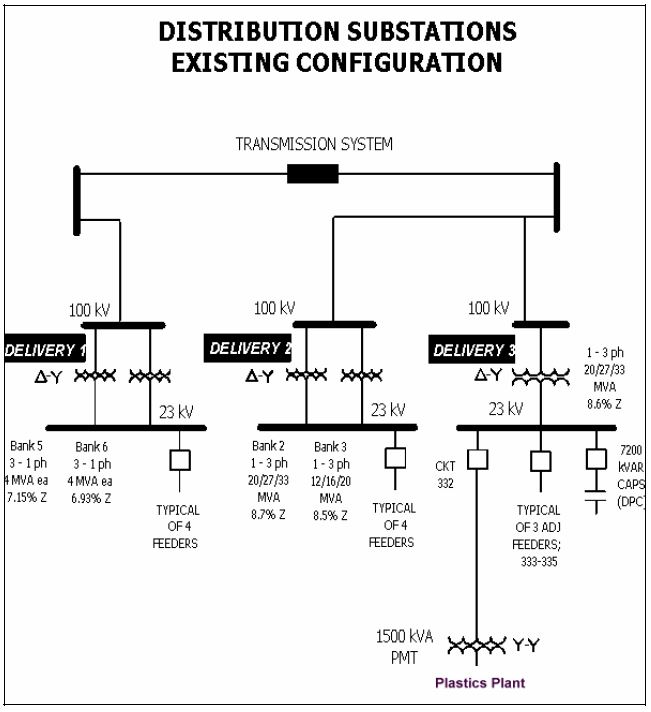
The plant is served from Delivery #3 (Del#3), a transmission-to-distribution substation. The substation is fed from the local utility’s 100 kV transmission system. The plant’s 23 kV feeder is designated as Circuit 332 and is shown schematically in Figure 1. Del#3 also serves three other 23 kV distribution feeders, 333, 334, and 335. The local utility operates two similar points-of-delivery, designated as Delivery #1 (Del#1) and Delivery #2 (Del#2). Circuit #112, from Del#1, is being considered as the source of an alternate 23 kV feed to the plant because it will be extended to the vicinity of the customer’s site to accommodate system improvement and load growth requirements.
Figure 1 Existing Utility’s Electrical Distribution System
The city should expect one to two feeder breaker operations per month per feeder on its 23 kV distribution system. Based on Electrotek’s experience, this level of activity is typical for overhead distribution systems with multiple feeders per substation with the kind of animal, vegetation and lightning exposure which exists in the area. Standard construction, multiple feeder per substation, overhead distribution circuits are not designed to provide the type of performance required by sensitive industrial customers like the one here.
Utility-Side Solution to Voltage Sag Disturbances
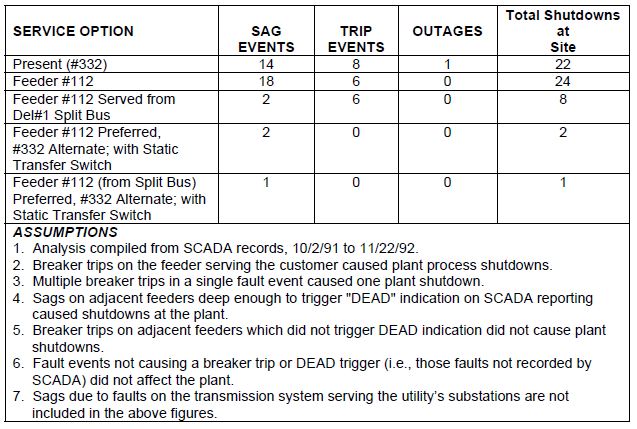
Table 1 summarizes the utility-side options for reducing voltage sag interruptions at the plant. The table is arranged with the present service (Feeder #332 out of Del#3) listed first, and the other service options listed in order of decreasing interruptions at the customer’s site. This table is based upon the utility’s SCADA information and utilizes several assumptions (outlined in Table 1). The most important of these assumptions is that the table is based on one test year of interruption data. Fault data in other years may be considerably different. The table also does not include sags due to faults on the transmission system.
Table 1 Utility-Side Options for Improving Service at the Customer’s Site
Table 1
Recommended Solution — Dual Feed and Static Transfer Switch
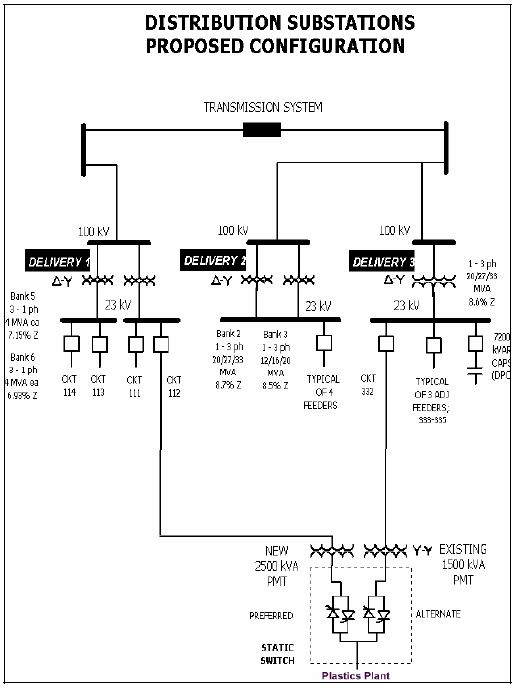
Electrotek recommends that the utility install a dual-feed service to the plant which includes an electronic static transfer switch, as shown schematically in Figure 2. This service will dramatically reduce the number of interruptions to the plant, and can be integrated into the utility’s load growth plans to relieve some of the installed cost of the system. Preliminary estimates indicate that the new service can be installed for about $300,000, not including the costs to extend Circuit #112 to the site.
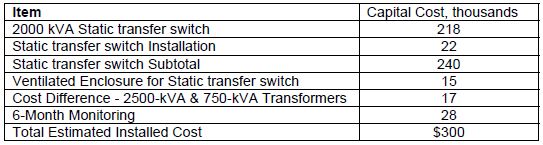
Table 2 shows a breakdown of the estimated costs.
Table 2 Breakdown of Costs to Install Static Transfer Switch and Monitor Performance
Table 2
Figure 2 Proposed Dual-Feed Service to Plant with Static Transfer Switch
Operating costs for the static transfer switch are expected to be minimal. The manufacturer lists the switch efficiency at 99.5%. Power losses in the switch therefore will add less than $5000 to the customer’s annual billing. Similar static transfer switch installations have not been air conditioned, so the additional energy costs related to the switch will be limited to ventilation fan operation. The electronic components require little maintenance.
Static Transfer Switch
The electronic static transfer switch consists of silicon-controlled rectifiers (SCR’s) which can quickly disconnect sensitive loads from a preferred source, and re-connect the loads to an un-faulted alternate source. At the plant, the preferred source would be the new 2500 kVA padmount transformer served from Circuit #112, while the alternate source would be the existing service. The static transfer switch can transfer to the alternate source in approximately ¼ to ½ cycles.
The static transfer switch will transfer to the alternate source under the following conditions:
Source undervoltage (less than about 80% on any single phase);
Source overvoltage (greater than 110%);
Loss of continuity in source-side SCR (SCR failure);
Blown fuse in source;
Manual signal.
It is designed to transfer back to the preferred source when:
The preferred source is in-phase;
The preferred source is within 10% of nominal voltage for greater than 2 sec (adjustable);
Operator switch is in “automatic” position;
The transfer to alternate was not caused by an SCR failure.
Electrotek expects that the switch will alleviate the majority of voltage sags which cause an adverse impact to plastics plant. The plant will still be susceptible to deep sags on the utility’s transmission system, distribution system faults which affect Del#1 and Del#3 simultaneously, and failures in the static transfer switch itself. These occasions are expected to be rare.
SUMMARY
Electrotek recommends that the utility combine planned system improvements with modifications in its service to the plastics plant to lessen the plant’s exposure to voltage sags. The proposed project would include splitting the Del#1 23 kV bus, extending Circuit #112 to the customer’s site, installing a new 2500 kVA transformer to accommodate additional load growth within the customer’s facility, and installing an electronic static transfer switch capable of transferring the plant load to Circuit #332 during interruptions and voltage sags on Circuit #112. Electrotek estimates that the static transfer switch will add approximately $300,000 to the system improvement project.
Modifications to a utility system which benefit a single customer are generally paid for by that customer. Normal utility practice is to apply additional facilities charges to the customer’s monthly electric bill to cover the cost of the improvements. These monthly charges generally equal 1.0% to 2.0% of the installed cost of the improvements and apply indefinitely. The utility uses a plan which applies a monthly charge of 1.7%. The additional facilities charge under this plan would add less than 10% to the customer’s projected monthly billing after the expansion.
The plastics manufacturer could realize a significant reduction in economic losses associated with voltage sags by accepting the static transfer switch solution. These savings could be applied against the additional facilities charges. In addition, the customer’s load growth may qualify the plant to receive an economic development incentive rate. The incentive rate savings, by utility calculations, could exceed $150,000 over the next five years. These savings would also lessen the impact of the facilities charges.
REFERENCES
Static Transfer Switch Primer, EPRI, Palo Alto, CA, 1998, TR-111697. Banerjee, B., Smith, J., The Static Transfer Switch: Current Technologies, Operation, and System Requirements, PQA ’99, Charlotte, North Carolina, May 1999.
GLOSSARY AND ACRONYMS Voltage Sag: A decrease to between 0.1 and 0.9 pu in rms voltage or current at the power frequency for durations from 0.5 cycles to 1 minute.
IEEE Task Force on Harmonics Modeling and Simulation
Published by A. Testa, M. F. Akram, R. Burch, G. Carpinelli, G. Chang, V. Dinavahi, C. Hatziadoniu, W. M. Grady, E. Gunther, M. Halpin, P. Lehn, Y. Liu, R. Langella, M. Lowenstein, A. Medina, T. Ortmeyer, S. Ranade, P. Ribeiro, N. Watson, J. Wikston, and W. Xu
Published in IEEE TRANSACTIONS ON POWER DELIVERY, VOL. 22, NO. 4, OCTOBER 2007
Abstract—Some of the most remarkable issues related to interharmonic theory and modeling are presented. Starting from the basic definitions and concepts, attention is first devoted to interharmonic sources. Then, the interharmonic assessment is considered with particular attention to the problem of the frequency resolution and of the computational burden associated with the analysis of periodic steady-state waveforms. Finally, modeling of different kinds of interharmonic sources and the extension of the classical models developed for power system harmonic analysis to include interharmonics are discussed. Numerical results for the issues presented are given with references to case studies constituted by popular schemes of adjustable speed drives.
Index Terms—Discrete Fourier transform (DFT), frequency resolution, harmonic analysis, interharmonics.
I. INTRODUCTION
HARMONICS are spectral components at frequencies that are integer multiples of the ac system fundamental frequency. Interharmonics are spectral components at frequencies that are not integer multiples of the system fundamental frequency. Besides the typical problems caused by harmonics such as overheating and useful life reduction, interharmonics create some new problems, such as subsynchronous oscillations, voltage fluctuations, and light flicker, even for low-amplitude levels.
Interharmonics can be observed in an increasing number of loads in addition to harmonics. These loads include static frequency converters, cycloconverters, subsynchronous converter cascades, adjustable speed drives for induction or synchronous motors, arc furnaces, and all loads not pulsating synchronously with the fundamental power system frequency [1], [2].
As for interharmonic limits, the first proposal of standards was in fixing a very lowvalue (i.e., 0.2%) for interharmonic voltages of weekly 95th percentile short time values at low frequencies. Such a low-value limit would guarantee compliance of interharmonic voltage distortion with lighting systems, induction motors, thyristor apparatus, and remote control systems. Due to measurement difficulties the alternative solution, still under discussion, is: 1) to limit individual interharmonic component voltage distortion to less than 1%, 3%, or 5% (depending on voltage level) from 0 Hz up to 3 kHz, exactly as for harmonics; 2) to adopt limits correlated with a short-term flicker severity value, Pst, equal to 1.0, to be checked by IEC flickermeter for frequencies at which these limits are more restrictive than those previously evidenced; and 3) to develop appropriate limits for equipment and system effects, such as generator mechanical systems, signaling and communication systems, and filters, on a case-by-case basis with using specific knowledge of the supply system and connected user loads. Therefore, different limits are necessary for different ranges of frequency and two kinds of measurements (i.e., interharmonic components and light flicker) are simultaneously needed.
The presence of interharmonic components strongly increases difficulties in modeling and measuring the distorted waveforms. This is mainly due to: 1) the very low values of interests of interharmonics (about one order of quantity less than for harmonics), 2) the variability of their frequencies and amplitudes, 3) the variability of the waveform periodicity, and 4) the great sensitivity to the spectral leakage phenomenon.
In this paper, some of the most remarkable issues related to interharmonic theory and modeling are presented. Starting from the basic definitions and concepts, attention is firstly devoted to interharmonic sources. Then, the interharmonic assessment is considered with particular attention to the problems of the frequency resolution and of the computational burden associated with the analysis of periodic steady-state waveforms. Finally, modeling of different kinds of interharmonic sources and the extension of the classical models developed for power system harmonic analysis to include interharmonics are discussed. Numerical results for the issues presented are given with reference to case studies constituted by popular schemes of adjustable speed drives.
II. CONCEPT AND SOURCES OF POWER SYSTEM INTERHARMONICS
Nonlinear and switched loads and sources can cause distortions of the normal sinusoidal current and voltage waveforms in an ac power system. This waveform distortion may be characterized by a series of sinusoidal components at harmonic frequencies and of sinusoidal components at nonharmonic frequencies. In this section, basic definitions and concepts associated with the analysis of periodic steady-state waveforms containing components at nonharmonic frequencies, that are called interharmonics, are discussed.
A. Mathematical Basis
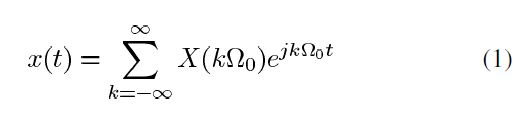
The harmonic concept is based on Fourier analysis whose motivation is to reconstruct nonsinusoidal periodical waveshape by a series of sinusoidal components. If x(t) is a continuous periodical signal with period of T and it satisfies Dirichlet condition, one can represent it by a Fourier series of
where Ω0 = 2π/T is called fundamental angular frequency and X(kΩ0) is the Fourier coefficient at the kth harmonic which is determined by
This implies that a nonsinusoidal periodical signal can be separated into a series of sinusoidal components with frequencies, which are integer multiples of the fundamental frequency. It is noted that, for the Fourier series, both the time- and frequency- domain signals have infinite length.
In order to implement Fourier analysis in computer, the signal in both time and frequency domains is discrete and has finite length. Discrete Fourier transform (DFT) is then introduced. Assume that x(t) is sampled with a rate of N points per cycle, i.e., Ts = T/N . The corresponding DFT will be
where ωk = (2π/TsN)k = (2π/T)k, X(ωk) is the so-called spectrum of x(n). Here x(n) is assumed to be one cycle of a periodical signal. In other words, the signal is supposed to precisely repeat itself for every N point. The angular frequency resolution of the spectrum is determined by the length of the signal as
Thus, if T is selected as one period of x(n), the outcome spectrum will only show components that are integer multiples of the fundamental frequency, which are defined as harmonics. However, if the data length is selected as p1 cycles (p1 > 1 and is an integer) of the fundamental, the frequency resolution will change as
This implies that once we use more than one fundamental cycle to perform DFT. It also becomes possible to obtain components at frequencies that are not integer multiples of the fundamental. These noninteger order components, according to the IEC definition, are called interharmonics.
For example, if we select five 60-Hz cycles for Fourier transform, the frequency resolution will be Δf = 60/5 = 12 Hz, then it will be possible to get bins at frequencies of 12 Hz, 24 Hz, 36 Hz …. These components, whatever the cause is, are defined as interharmonics.
There are various causes that could lead to the previously defined interharmonic components. One example is a signal that actually contains in the frequency domain a component whose frequency is noninteger multiples of the fundamental frequency. If the sampling window is selected properly so that there are exactly integer cycles of that component in the window, one can observe it at the right frequency. These are genuine interharmonics. For example, if a signal that consists of two frequencies is given by x(t) = sin(2π*60t) + 0.5sin(2π*90t), the 90 Hz component lies between the fundamental frequency and the 2nd harmonic and is a genuine interharmonic. The signal will repeat itself every two 60 Hz cycles (i.e., 33.4 ms). Therefore, if we perform DFT on this signal with a window size of 33.4 ms, the aforementioned assumption for DFT, the windowed waveform repeating itself, can be satisfied. The frequency resolution will be 60/2 = 30 Hz; consequently, one can find the 60 Hz component at the 3rd bin and the 90 Hz at the 4th bin, as shown in Fig. 1(a). This is the case of genuine interharmonics. The spectrum represents the actual signal components.
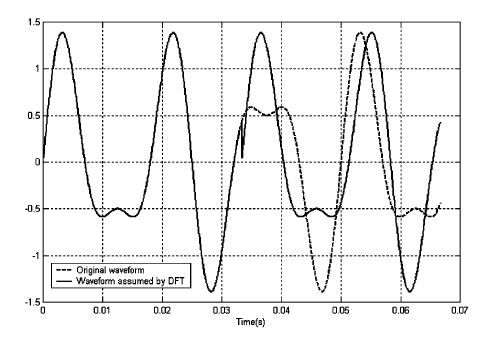
There are cases, however, where the interharmonic components are produced by the picket-fence effect of the DFT, due to sampling the signal spectral leakage. For instance, if the frequency of the noninteger harmonic component is changed to 100 Hz in last example and the selected rectangular window size is still 33.4 ms, the window will contain 3.33 cycles of the 100 Hz component. Since DFT assumes the windowed waveform will repeat itself outside the window, the repetition of the 100 Hz component is therefore incomplete. The waveform “seen” by the DFT is different from the actual waveform, as shown in Fig. 2. This leads to the creation of a main interharmonic component at 90 Hz with a low amplitude but similar to that of the genuine interharmonic at 100 Hz, and further additional spectral components as evidenced in Fig. 1(b) being not genuine due to the spectral leakage effect. Of course, the entity of these nongenuine interharmonic components strictly depends on the spectral characteristics of the window adopted (for instance, Hanning) to weight the signals and, thus, an opportune choice can reduce the spectral leakage effects (see Section III for more details).
Fig. 2. Effect of noninteger cycle truncations.
B. Genuine Interharmonic Sources
There are some types of loads that indeed introduce interharmonics. This section will list some examples and discuss the relationship between interharmonic frequencies and load characteristics.
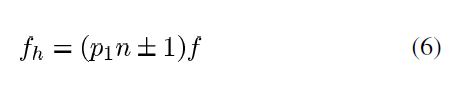
1) Double Conversion Systems: In general, power electronic equipment that connects two ac systems with different frequencies through a dc link can be an interharmonic source. Variable speed drives, HVDC, and other static frequency converters are typical examples of this class of sources. Their common features are that they contain an ac/dc rectifier and a dc/ac inverter, the rectifier and inverter are coupled through a reactor or a capacitor called dc link. If the reactor or the capacitor has infinite value, there will be no ripples on the dc side, and consequently the ideal rectifier will only generate characteristic harmonics of
where p1 is the pulse number of the rectifier, n is an integer, and f is the power frequency.
In practical cases, however, the dc-side has finite reactor or capacitor values and, consequently, ripples at dc side are inevitable. When a rectifier’s dc link current is not ideally flat, its ac side will be modulated by the dc ripple and interharmonics could be produced. For example, for a 6-pulse rectifier, its characteristic frequencies are 60Hz, 300 Hz, 420 Hz, 660 Hz, 780 Hz…. If its dc side has a ripple of , the ac side current will be modulated as 60 ± 177 Hz, 300 ± 177 Hz, 420 ± 177 Hz, 660 ± 177 Hz…. These are interharmonic components.
For general cases, the dc-side ripple frequency can contain a series of components determined by the inverter type: current (CSI) or voltage (VSI) source inverters [3]. In CSI converters, the dc side ripple frequency depends on the pulse number, the control method, and the inverter output frequency. If the pulse number of the inverter p2 is and the output frequency is f0, the dc ripple will contain frequencies of
where is n an integer number.
TABLE I VALUES OF PARAMETERS j AND r FOR DIFFERENT m CHOICES
In VSI converters, more complex formulas are needed to determine the dc ripple generated by the inverter. In the case of synchronous PWM modulation strategy, the harmonic frequencies generated by the inverter are evaluated as
with j and r are integers depending on the modulation ratio, mf, as reported in Table I. The dependency of mf is related to the switching strategy adopted.
In both cases of CSI and VSI converters, the frequencies generated by inverters, as indicates in (7) and (8), will modulate with the rectifier’s characteristic harmonics of (6) and generate the supply-side frequencies of
that are interharmonics of f as long fr as is asynchronous with f.
In Fig. 3, the current interharmonics absorbed by a CSI drive adopting a load commutated inverter (LCI) for f = 50 Hz and f0 = 40 Hz are reported. In Fig. 4, the current interharmonics absorbed by a VSI drive operated with synchronous PWM modulation for f = 50 Hz, mf= 9 and f0= 40 Hz are reported. 2) Cycloconverters: The current spectral components introduced by cycloconverter are a particular case of those of other double stage converter systems and are thoroughly documented in [4] as
where p1 pulse number of the rectifier section; p2 pulse number of the output section; mfintegers; f power frequency; f0 output frequency of the cycloconverter.
Fig. 3. LCI drive supply system current interharmonics for fo = 40Hz, amplitudes in percentage of 230A versus interharmonic frequency
Fig. 4. PWM drive supply system current interharmonics, amplitudes in percentage of 248A versus interharmonic frequency.
For n = 0 and m = 0, 1, 2,…, values of fi are all harmonics of f, generated by the dc component of the rectifier modulation. For n ≠ 0, m = 0, 1, 2,… and p2nf0 = kf , with k being an integer, the fivalues are all harmonics of f, generated by the double modulation operated by the output section and rectifier section at the output frequency of f0. For n ≠ 0, m = 0, 1, 2,… and p2nfo≠kf, with k being an integer, the fi values are all noninteger multiples of , which are interharmonics and are generated by the double modulation operated by the output section and rectifier section on the output frequency, f0.
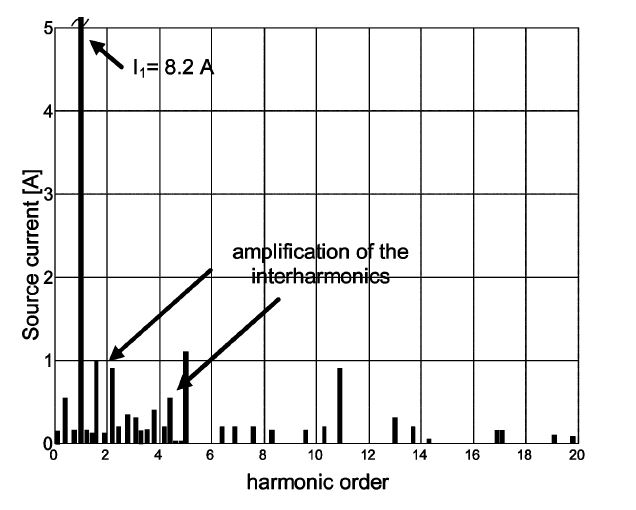
Intuitively, it is not difficult to understand the interharmonic injections by a cycloconverter, since it directly connects two systems at different frequencies. In Fig. 5, the source current spectrum absorbed by a cycloconverter working at 5 Hz in the presence of passive filters is reported [5].
Fig. 5. Source current spectrum absorbed by a cycloconverter working at 5 Hz in the presence of passive filters.
3) Time-Varying Loads: Another major group of interharmonic sources are the time-varying loads, including both regularly and irregularly fluctuating loads.
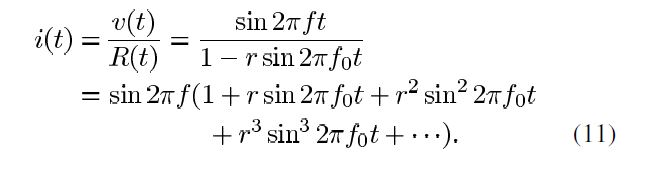
Typical examples of regularly fluctuating loads, which cause sinusoidal and square modulated signals, are welder machines, laser printers, and devices with integral cycle control. For such loads, the frequency at which the load varies will determine the frequencies of interharmonics. Assuming the system voltage is v(t) = sin2πft and a load has a characteristic of R(t) = 1-rsin2πf0t, where r < 1 and f0 is the load varying frequency, then the load current is
Further mathematical operation on (11) can show i(t) that contains interharmonic components of f ± f0, f ± 2f0, f ± 3f0, …, etc. As a result, interharmonics will be seen in the current spectrum as long as is asynchronous with . In more realistic situations, the load is modulated by means of square wave modulating functions and consequently the spectrum is richer in interharmonic components. In Fig. 6 an example of current absorbed by a laser printer is reported [6].
Fig. 6. Current absorbed by a laser printer. (a) Time waveform. (b) Frequency spectrum.
Typical examples of irregularly fluctuating loads are arc furnaces. The time-varying and nonlinear behavior of the arc generates in both current spectra with several spectral components, including harmonics and interharmonics, which are difficult to model analytically.
In the case of ac arc furnaces, significant interharmonics are concentrated around the power system frequency. The dc arc furnaces can be characterized by a significant presence of interharmonics around the harmonics of the ac/dc converters. In practice, the ac side of the ac/dc converter is modulated by the dc ripple which depends on the dc arc behavior and on the ac/dc converter control system. Since the arc behavior is “chaotic,” the interharmonics generated by arc furnaces are characterized by constantly changing chaotic frequencies.
.
Finally, with reference to a window in which the frequency variation can be neglected (see also Section III), the current spectra of an ac and a dc arc furnace are shown in Fig. 7.
Fig. 7. Arc furnace current spectra. (a) AC arc furnace in a 60-Hz system. (b) DC arc furnace in a 50-Hz system.
4) Wind Turbines: Regarding power generation, wind turbines may play an important role for producing voltage interharmonics. In this case, the origin of interharmonics is essentially mechanical. In particular, during the continuous operation of the fixed-speed wind turbines, wind variations and the tower shadow effect result in power fluctuations and, hence, in line voltage interharmonics. Fig. 8 reports the mechanical torque, M, from the wind turbine (solid line) and the electrical torque, Me, (dotted line) from a wind generator obtained in [7]. Fig. 9 reports, in logarithmic axes, the output voltage spectrum which results rich of interharmonics around the fundamental frequency as a consequence of the mechanical torque oscillations shown Fig. 8. The results are obtained from both the time-domain model (solid line) and the frequency-domain model (circled line) described in [7].
Fig. 8. Mechanical torque from a fixed speed wind turbine (solid line) and corresponding electrical torque (dotted line) from the generator.
Fig. 9. Comparison of voltage spectrum obtained for wind turbines of Fig. 8 from the time-domain model (solid line) and frequency-domain model (circled line) in logarithmic axes.
5) Unexpected Sources: A nonlinear load or network component by itself is not able to generate interharmonics. For instance, a simple rectifier or reactive power static generators when it reacts to the interharmonic components present in the supply voltage, only absorbing interharmonic currents. Some interharmonic current components are at the same frequencies of the voltage and some are at frequencies determined by the modulation operated by the nonlinear load on the original voltage interharmonic frequencies. Therefore, these components become sources of new interharmonic frequencies when interharmonic supply voltages are present. Simple case studies have demonstrated high sensitivity (more than two times of the 50 Hz value) at specific frequency couples (voltage and current) corresponding in the example of Fig. 10, reported in [8], to intersections (20 Hz, 20 Hz), (20 Hz, 120 Hz), (120 Hz, 20 Hz), (120 Hz, 120 Hz). It means that the 20 Hz (or the 120 Hz) voltage interharmonic produces high current interharmonics both at 20 and 120 Hz.
Fig. 10. Interharmonic current spectrum absorbed by a rectifier supplied by a 50-Hz voltage with a 1% interharmonic at 120 Hz.
III. INTERHARMONICS ASSESSMENT
A practical assessment of interharmonics involves various aspects and presents some difficulties. One of the main difficulties is due to spectral leakage phenomenon and picket-fence effect of the DFT already mentioned in Section II-A. Therefore, techniques for the interharmonics assessment [9] are of primary interest and it is useful to develop some basic considerations.
An ideal technique should ensure that all nonzero bins refer to genuine interharmonics or harmonics: this means obtaining conditions in which the sampling window is effectively synchronized with all the signal frequency components.
When the frequencies of genuine interharmonics present in the signal are known a priori, it is possible to introduce the Fourier fundamental frequency, fF, as the greatest common divisor of all the frequency components contained in the signal. Then, the signal is sampled with windows of duration being an integer multiple of the corresponding Fourier fundamental period, Tf = fF. In practical cases, it may happen that fF reaches a very small value with corresponding enormous Tf. A simple example can help to understand the aforementioned difficulties and to introduce some practical solutions adopted: a signal composed by two tones, one harmonic, at 50.00 Hz, and the other interharmonic, at 34.50 Hz, is considered, as shown in Fig. 11(a).
Fig. 11. Signal with an interharmonic at 34.5 Hz. (a) Actual spectrum versus frequency. (b) as for (a) versus harmonic of 0.5 Hz order. (c) as for (b) with a frequency resolution of 1 Hz. (d) as for (b) with a frequency resolution of 5 Hz
The Fourier fundamental frequency is, of course, equal to 0.50 Hz [Fig. 11(b)] and the interharmonic appears as the 69th harmonic of it. The corresponding fundamental period is of 2 s so, assuming a sampling frequency of 5 kHz, needed to manage frequency components until 2.5 kHz, the enormous value of 10000 samples should be processed. Moreover, during such a long period of time, in real systems, the signal components (harmonic and interharmonic) may vary their amplitudes, frequencies and phase angles.
Reducing the frequency resolution to 1 Hz [Fig. 11(c)], four main spectral lines at 33 Hz, 34 Hz, 35 Hz and 36 Hz (black lines) appear in the spectrum instead of the original component (gray line). In spite of a still high computational burden (TF = 1 s) , the energy of the original interharmonic component is spilled in different bins and the information about the exact interharmonic amplitude, frequency and phase angle is lost (or difficult to obtain).
The IEC Standard 61000-4-7 [10] and the under-revised IEEE 519 fix the frequency resolution of the spectral analysis at 5 Hz as a trade-off between accuracy and computational burden reduction. The effects on the signal of Fig. 11(a) are reported in Fig. 11(d) and are similar to those illustrated in Fig. 11(c); they are managed with the grouping technique described in the following part of this section.
Comparing Fig. 9, it is possible to observe as the frequency resolution adopted affects the representation of the actual interharmonic component.
Other important signal processing aspects are reported in the standards that suggest:
1) DFT performed over a rectangular time window of exactly ten cycles for 50 Hz systems or exactly twelve cycles for 60 Hz systems, which is approximately 200 ms in either case; 2) phase-locked loop or other line frequency synchronization techniques to reduce the errors due to the spectral leakage effects due to the desynchronization of fundamental and harmonics [9].
Furthermore, the remarkable concept of harmonic and interharmonic groups and subgroups is introduced. In particular, the subgrouping concept is illustrated in Fig. 12 with reference to the 7th, 7.5th and 8th order subgroups. The amplitude, Cn+0.5-200-ms, of the interharmonic subgroup of order n + 0.5 is defined as the root mean square (rms) value of all the interharmonic components between adjacent harmonic subgroups.
Fig. 12. IEC subgrouping of “bins” for harmonics and for interharmonics.
The standard approach is attractive for compliance with monitoring and compatibility testing, since compatibility levels can be fixed on the basis of the energy of the specified interharmonic groups or subgroups rather than relying on the measurement of specific tones. It is also possible to improve its accuracy by means of Hanning windowing as illustrated in [3] of [11].
Regarding high-resolution methods, recently in [11] different proposals of both DFT-based and Prony-based advanced methods have been recalled and compared to each other; both approaches succeed in estimating the exact interharmonic frequency. These techniques, together with time-frequency techniques [12], are of crucial importance for accurate analysis when time-varying or chaotic signals appear in the system.
IV. MODELING INTERHARMONIC SOURCES
The interharmonic currents generated by nonlinear devices are more affected by the waveforms and peak values of supply voltages and by the supplied load operating point than harmonic currents. Further on the current magnitude and phase angle, this aspect regards also the current frequency. Therefore, it is desirable to represent the devices with their actual nonlinear v – i characteristics in distortion studies, instead of as voltage independent harmonic current sources. Depending on the source characteristics, comprehensive models for interharmonic sources are summarized as follows.
• Low-power analogue electronic simulators consisting of a number of scale model converters and model power system components, such as high Q-factor chokes, low magnetizing current transformers, capacitors, and small 6-pulsethyristor bridges.
• Time-domain models that can refer in principle to very general schemes, taking into account any kind of nonideal conditions as background distortion, unbalances, magnetic material saturation, and firing asymmetries.
• Frequency-domain models based on the modulation theory extended for double stage converters, which constitute very fast to solve models, flexible and characterized by accuracy determined by the accuracy of the modulation functions utilized.
• A hybrid of previously described models. In the following for the different kinds of sources referred to Section II-B, specific information on the different models proposed in the relevant literature is reported.
A. Double-Stage Converters
A great effort has been made in modeling HVDC links and high-power adjustable speed drives based on line-commutated converters [2], [13]–[18]. An important aspect of the problem is related to the modeling of ac/dc/ac conversion systems in order to achieve a detailed description and computational efficiency. Various models are available to obtain the ac and the dc absorbed currents: experimental analog, time- and frequency- domain models [15]. Each of them is characterized by different degrees of complexity in representing the converters, the dc link, and the ac supply systems. In most cases, frequency-domain models operate with different degrees of complexity by using the modulation function approach and do not require heavy computational efforts and are very quick in execution [13]–[21].
On the other hand, less attention has been devoted to different systems such as ASD using PWM inverters. This is partly due to the assumption that the dc capacitor completely eliminates the interaction between the two converters [22], [23]. In other words, the generation of interharmonics for an HVDC and the high-power ASD has been modeled and analyzed in depth [24], while the interharmonics produced by PWM ASD are considered negligible [23], whichever is the drive power or the operating point for a given drive. However, a more detailed analysis for PWM ASD has been recently developed in [25].
B. Cycloconverters
In [26], an electromagnetic transient simulation program with a graphical interface of a cycloconverter including a detailed three-phase transformer model with nonlinear magnetizing characteristic was presented. In [27], a three-phase bridge cycloconverter for a traction load is modeled. The simulation results from an ideal model (i.e., no losses, no resistance in the thyristors, no inductance in the load, and ideal current source load) are compared with Pspice simulation results and actual measurements. The Pspice model contains high-order models for the thyristors and an RL load model with load dynamics.
C. Time-Varying Loads
Regarding regularly fluctuating loads, in [28], the impact of switching strategies on PQ for integral cycle controllers is considered. The load current is evaluated as a time-domain product of a modulating signal and a 60 Hz sine wave. The modulating signal is taken as the addition of a series of phase shifted square functions, representing the integer number of cycles “on” and the integer number of cycles “off” that constitute the period of the resulting modulated wave. The 60 Hz current is that obtained for ac circuit in the steady-state conditions in a continuous duty. For irregularly fluctuating loads, as described in [29], several models have been proposed in the relevant literature for ac arc furnace modeling. In the next the models that appear most suitable for interharmonic assessment are considered.
In [30] ac arc furnaces are represented by voltage generators. The simulation of arc operation is realized by varying the amplitude of the voltage generator that can provide, besides the fundamental voltage, harmonics, as well as interharmonics produced by the arc. In [31] and [32] the electric ac arc is simulated by a proper resistance used to describe both the nonlinear voltage-current characteristic of the arc and its changes with time. The choice of the time-varying nonlinear resistance is effective in order to produce voltage distortions and fluctuations at frequencies and typical levels of actual ac arc furnaces. In [33] a voltage-current characteristic based on Mayr’s model is proposed. This arc model incorporates the most significant aspects of the physical mechanisms of the arc. In [34] and [35] power or energy balance models are used to represent the arc in time or frequency domain while in [36] a hybrid model, based on fictitious diodes and dc voltage sources, is used for inclusion in a harmonic power flow.
Further ac arc models proposed in the literature are based on stochastic or adaptive models [31], [37]–[40] which employ a band-limited white noise generator to simulate arc length/resistance, a voltage source model, and a resistance model. DC arc models are proposed in [41] and [42] where the typical voltage-current characteristic tuning requires significant analyses of on-site measurements. Another example of dc arc furnace model is reported in [43] where the dc arc is modeled as a resistance randomly varying at periodical manner. Recently, the electrical fluctuations in the arc furnace voltage have been proven to be chaotic in nature, hence some chaos-based models have been applied to simulate ac and dc arc furnaces [44]–[47].
D. Wind Turbines
As is well known, the oscillatory components of the mechanical torque in wind turbines produce the voltages interharmonic components that can cause the Light Flicker. These oscillations have stochastic as well as deterministic origin because they are produced mainly by wind variations and the tower shadow effect. Comprehensive modeling is needed requiring modeling of wind input, that includes both stochastic and deterministic effects, and mechanical elements further on the electrical elements. General modeling aspects of wind turbines are reported in [48]. References [49] and [50] also predict the flicker level and interharmonics produced by a wind turbine when connected to the power grid and various generator models in time domain are used. In [7], a fast and accurate method in the frequency domain is proposed and a comparison of the results obtained by different approaches, as shown in Fig. 9 of Section II, is reported.
E. Unexpected Sources
In [51], the couplings among interharmonic supply voltages and absorbed currents are modeled by means of so-called “frequency coupling matrices” obtained with a circular convolution method, starting from the converter switching functions. The absolute values of the matrix elements in positions (i , j) measure the sensitivity of the th current component to the jth supplying voltage component, assuming that the operating point of the system is not modified.
The result reported highlights that conversion systems exhibit greater frequency coupling at interharmonic frequencies than at harmonic frequencies. Therefore, modeling of traditional nonlinear loads cannot miss interharmonic consideration.
V. EXTENDING POWER SYSTEM HARMONIC ANALYSIS
According to the assessment procedures introduced in Section IV, the introduction of a base frequency of the frequency- domain analysis allows transforming the problem of modeling harmonics and interharmonics of the system frequency (50 or 60 Hz) into that of modeling harmonics of the base frequency (i.e., 5 Hz). This allows, in principle, to adopt each kind of technique proposed for harmonic penetration studies, also in the presence of interharmonics. This section describes the problems difficulties and cares to be adopted in the presence of interharmonics.
Nodal harmonic and interharmonic voltages are the result of harmonic and interharmonic current injection in nodes and propagation through the network. The current injection depends itself on the voltage supply. For the harmonic and interharmonic distortion analysis in electrical power systems, it is recommended that the methods adopted to evaluate the current injection are as comprehensive as possible, because they have to be able to model nonideal conditions such as ac-side imperfections (supply voltage distortion and unbalance, supply system impedance unbalance, transformer magnetic saturation, etc.). Simplified methods, that do not take into account the nonideal conditions, may lead to erroneous numerical results for the actual behavior of the system.
To include interharmonics in distortion models means to start from the critical analysis of classical models for harmonics to extend such models when possible [52]. Particular attention must be devoted to the problems of the frequency resolution and of the computational burden. As for components such as cables, overhead lines, and capacitors banks, specific models are not required. Those models developed for harmonic studies can be easily applied.
As for electromechanical components, in particular, transformers and induction motors, are characterized by the need of specific models for interharmonics, mainly for subharmonics, which have to be still developed. Basic results are reported in [29] and [53]. It seems that their modeling will require the use of accurate time-domain approaches.
A. Classical Methods for Harmonic Analysis
The methods referred to in the relevant literature for harmonic penetration studies can be classified as
a) direct current injection; b) harmonic power flow; c) iterative harmonic analysis; d) experimental analog modeling of the whole system; e) time-domain modeling of the whole system.
The first three methods have the common characteristic of representing and solving the ac system equations in the frequency domain. Models b) and c) are both iterative and, in particular, model b) uses a Newton–Raphson algorithm while model c) uses a Gauss–Seidel algorithm. A combination of both types of algorithms have also been proposed. The direct injection method is able to take into account unbalances but not interactions between converters. The harmonic power flow is able to take into account the interaction between converters, and in its most recent formulation, which takes into account unbalances and other nonideal conditions. The iterative harmonic analysis is able to take into account both the unbalance and the interaction between converters and also other nonideal conditions. Convergence problems may arise for methods b) and c); solutions to such problems have been proposed, as described in [52], for both models.
The remaining two models, d) and e), analyze each system component or subsystem by means of equivalent circuits in the time domain. The low-power analogue models or time-domain models may obtain in principle any desired level of details. Practical difficulties limit the use of the first of these methods to the case of a small system size, while references to the second category with new approaches seem to offer interesting perspectives [29].
B. Extension to Include Interharmonics
In principle, it is very easy to include interharmonics in the classical model by the main concept of the Fourier fundamental periods, developed in Section IV. At the end of the analyses on the voltage e(t), it is very easy to recognize as harmonics the signal components, whose frequencies are integer multiples of the system fundamental frequency, and as interharmonics as the other components.
In practice, the following considerations apply [52].
• the extension of low-power analog models and of time-domain models does not suffer from specific problems but practical difficulties limit the use of these models to cases of small system size as is typical also for the case of conventional harmonic analysis;
• the extension of the direct injection method is easy to obtain but gives, as typical for this kind of method, inaccurate results;
• the extension of the harmonic power flow seems possible but very difficult as a consequence of the difficulties which arise in modeling nonlinear loads in the frequency domain when interharmonics are present;
• the extension of the iterative harmonic analysis is complex if one wants to use analytical expressions to model the nonlinear loads while, if time-domain simulations are used, only computational effort problems remain and this method can be utilized, obtaining high accuracy results. Some more details about the extension of the methods are reported in the Appendix.
C. Computational Burden
Extending all classical models to include interharmonics implies taking into account a larger number of frequency components and referring to a larger waveform periodicity interval.
Let us consider the case in which a fixed resolution frequency ff is introduced (see Section III). Both harmonic and interharmonic frequencies are integer multiples of the resolution frequency. Therefore, all of the components can be treated as harmonics of ff. Give a maximum frequency of interest, fmaxand the number of components of interest, Nihmax, which is equal to the ratio between fmax and ff. Compared with the maximum number of components when only harmonics are present, it is easy to demonstrate that it is equal to amplified by the factor of f / ff , where is the system fundamental frequency. For instance, if fmax = 2500 Hz, ff = 5 Hz, and f = 50 Hz, it means that = 500 while = 50.
Similar considerations apply to the periodicity interval, which is of great importance for time-domain simulations. It also results in amplification by the same factor of f / ff . With the same conditions as the previous example, the minimum time interval to be simulated in the presence of interharmonics, once reaching steady-state conditions, is equal to 200 ms instead of 20 ms. Comparisons among different models in the presence of interharmonics give the same results that are well known for the same models in the absence of interharmonics.
VI. CASE STUDIES
Two case studies referred to two popular schemes of adjustable speed drives (ASDs) are reported in this section. Methodologies previously described are used to obtain the results reported.
A. LCI ASD
Several numerical experiments are reported in [54] to test some of the methods described in Section V-B. The results obtained by the well-known EMTP are utilized as a reference to verify the accuracy obtained by a direct method and by an iterative method.
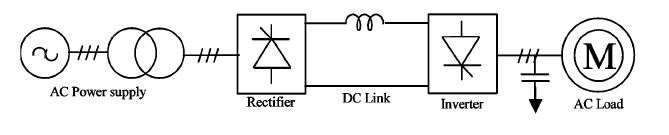
The results obtained for the LCI drive for asynchronous motors, as depicted in Fig. 13, are reported.
Fig. 13. Typical scheme of an LCI asynchronous motor drive.
TABLE II PARAMETERS FOR THE LCI ASD
The system parameters are listed in Table II. The system was simulated for output frequency values varying from 17.5 to 50 Hz with a resolution of 0.5 Hz [54]–[56].
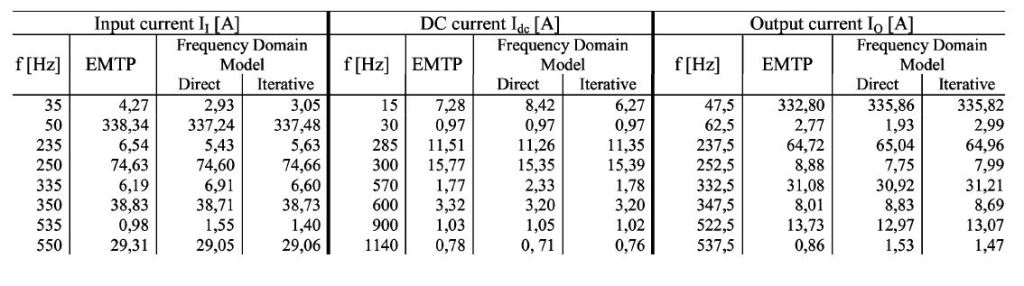
TABLE III CURRENTS FOR ASD-A OF TABLE II WITH FM = 47.5 Hz
Table III reports the currents for an output frequency of 47.5 Hz with αR = 41.4° and αI = 120.2° . The inverter output current is also reported due to the great interest recently devoted to the negative effects of interharmonics, mainly at low frequency, in terms of the reduction of asynchronous motor expected life [57]. The errors of both frequency-domain models are acceptable and the highest values appear at specified interharmonic frequencies and in correspondence of low-amplitude values. The iterative analysis effects, in terms of accuracy, are always present but never relevant as a consequence of the noncriticality of the operating point considered.
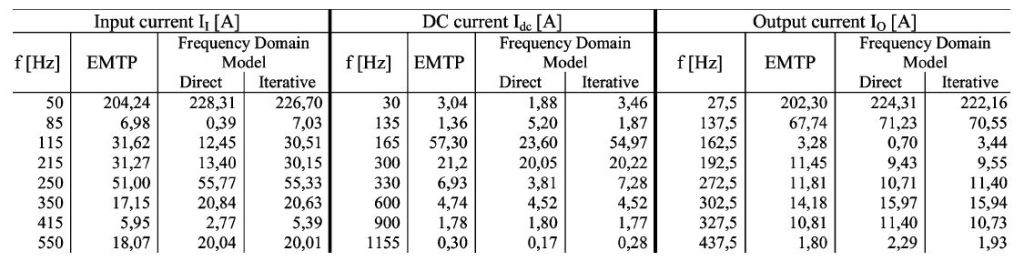
TABLE IV CURRENTS FOR ADS-A OF TABLE II WITH fo = 47.5 Hz
Table IV reports the currents for the output frequency of 27.5 Hz, with αR = 66.6° and αI = 122.7°. The errors are not acceptable for the direct method at least for all interharmonic components. This is due to the value of the output frequency, which causes strong interactions between the converter and the output impedance. The iterative analysis succeeds in improving the accuracy and makes the errors acceptable. Moreover, in [54] it is shown that interharmonic components are evaluated with relevant errors by direct method in a wide range of motor frequencies (from about 21 to 37.5 Hz); the iterative analysis always solves the problem.
TABLE V SIMULATION AND LABORATORY TEST CONDITIONS
B. PWM ASD
In [58], analytical solutions of harmonic/interharmonic characteristics of the VSI-fed ASD shown in Fig. 14 are compared with time-domain simulation results obtained by the use of Simulink. Laboratory tests for validation of the solutions are also conducted: the test setup, which consists of the ideal three-phase ac source, a VSI-fed ASD, an induction motor, an electrodynamometer module, and a LabView-based data-acquisition/monitoring computer system and the experimental conditions considered are fully described in [58]. Table V reports simulations and laboratory test conditions.
Fig. 14. Schematic diagram of the PWM VSI-fed adjustable speed drive.
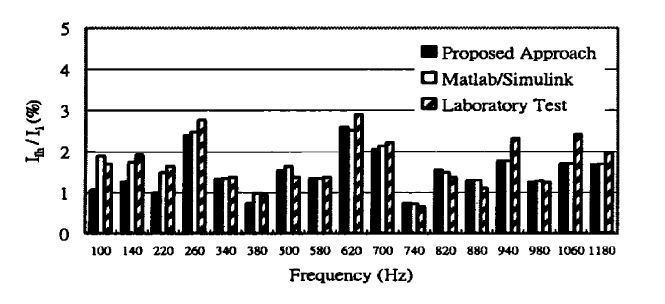
In Figs. 15 and 16, the results that are indicated are the harmonic and interharmonic spectra of the ASD input current with respect to the motor operating frequency of 40 Hz. It is possible to observe that the solutions obtained by the approach proposed in [58] are in good agreement with those obtained by using the time-domain simulation tool and by laboratory tests.
Fig. 15. Harmonic spectra of the ASD input current with induction motor operating frequency of 40 Hz at a full-load power level.
Fig. 16. Interharmonic spectra of the ASD input current with induction motor operating frequency of 40 Hz at a full-load power level.
C. Computational Burden
As recalled in Sections III and V-C, the computational burden of numerical simulations in the presence of interharmonics is strongly influenced by the choice of the frequency resolution to be adopted. Moreover, the choice of the specific modeling technique to use plays an important role.
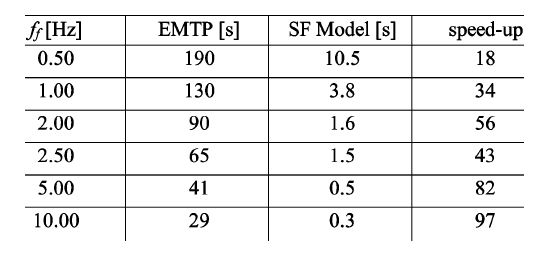
TABLE VI LCI DRIVES: EXECUTION TIMES AND SPEED-UP VERSUS ff VALUES
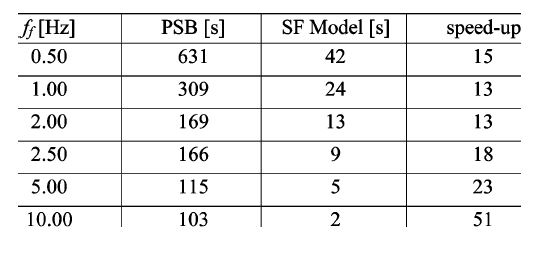
TABLE VII PWM DRIVES: EXECUTION TIMES AND SPEED–UP VERSUS ff VALUES
Tables VI and VII report the results in terms of execution times and “speedup” with reference to two case studies (an LCI drive and a PWM inverter drive) reported in [56], for different values of the frequency resolution ff . The solution methods considered are:
• time-domain simulations [Electromagnetic Transient Program (EMTP) and power system blockset (PSB)]
• Models based on switching function approach [55], SF Model, that combine models described in Section IV-A for ASD and the iterative method principle described in Section VIII-B.
Reference is made to a 1.7 GHz PC. The times reported in both tables do not take into account the final DFT application to time-domain waveforms and the speedup is defined as the ratio between time-domain and SF models simulation times. It is worthwhile underlining that time-domain simulations suffer from the need of waiting for the end of the unavoidable transient stage affecting the beginning of the simulation [56].
Looking at Tables VI and VII, it is evident that:
whichever is the model, execution times sensibly increase as ff decreases;
SF models are always sensibly faster than time-domain modeling;
the speedup reaches very high values and varies with ff .
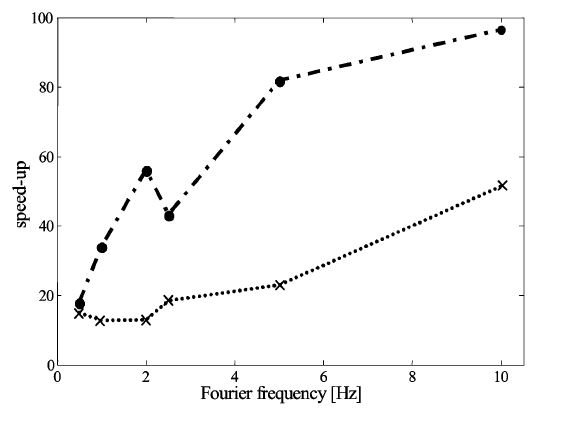
Finally, Fig. 17 shows that the reduction of the calculation time when the Fourier fundamental frequency increases is more sensible for the models than for the time-domain simulator, which seems to be due to the absence of transient stages in the models.
Fig. 17. Speedup versus Fourier frequency for different case-studies: LCI drive –·–• PWM drives···x
VII. CONCLUSIONS
Some of the most remarkable issues related to interharmonic theory and modeling have been presented. Starting from the basic definitions and concepts, attention has been firstly devoted to interharmonic sources. Then, the interharmonic assessment has been considered with particular attention to the problem of the frequency resolution and of the computational burden associated with the analysis of periodic steady-state waveforms. Finally, modeling of different kind of interharmonic sources and the extension of the classical models developed for power system harmonic analysis to include interharmonics have been discussed. Numerical results for the issues presented have been given with referring to case studies constituted by popular schemes of adjustable speed drives.
APPENDIX
A) Direct Current Injection: The direct injection method is the simplest method because the evaluation of current harmonics for each load is independent from the evaluation of the ac system voltage harmonics. The method, in its typical form, is based on the following steps.
Step 1) The execution of a conventional load-flow study to obtain all bus voltages with assuming converter busses are load buses. Step 2) An estimation of the converter currents at each harmonic using bus voltages from step 1) by means of time-domain simulations, analytical models, or experimental measurements. Step 3) The calculation of the bus admittance matrix, Yh, at each frequency of interest. Step 4) The use of expression, Ih = YhVh, to calculate the vector of voltage harmonics, Vh, ∀h.
In order to take into account the presence of interharmonics, the following additional factors are necessary. a) To foresee all the interharmonic frequencies, fi, that will be present in the frequency range of interest. b) During Step 2) to estimate the synchronous motor drive currents at each harmonic and interharmonic frequencies by means of an appropriate frequency-domain experimental analogue or a time-domain model as discussed in [1] of [52] or by analyzing available field measurements. c) During Step 3) for each interharmonic frequency, fi, of interests to calculate the corresponding bus admittance matrix, Yi, starting from the ac system knowledge or, if this is not possible, by interpolation of the known harmonic admittance matrix values. d) During Step 4), the evaluation of the vector of voltage interharmonics Vi using the expression Ii = YiVi for each interharmonic frequency, fi, of interests.
It is important to note that it is not necessary to modify the converter model adopted in step 2), because this method does not account for supply harmonic and interharmonic distortion in modeling the converters.
In conclusion, no particular difficulties arise in extending the direct injection method to take into account interharmonics. The direct injection method presents the well-known advantages of speed, extendibility to unbalanced cases and the absence of divergence phenomena. Disadvantages are the poor accuracy and the impossibility of taking into account interaction between converters.
B) Iterative Harmonic Analysis: The iterative harmonic analysis is a method based on a Gauss–Seidel algorithm. It can be summarized by the following fundamental steps.
Step 1) Input information is obtained on system component characteristics and ac system impedances. Then, initial conditions are evaluated by means of an ac/dc three-phase power-flow for each node supplying a converter. Step 2) Starting from the voltage waveforms at the converter terminals, the current waveform i(t)over one cycle under steady-state conditions is estimated for each converter. Step 3) The steady-state time-domain current waveforms previously obtained for each converter are subject to a FFT in order to obtain the vector, Ih, of their harmonic current components. Step 4) The current harmonics Ih, obtained in 3) are utilized to perform steady-state harmonic analyses of the ac system by means of the harmonic impedances of the ac system to obtain the corresponding updated vector, Vh, of voltage harmonics at the converter busses.
Steps 2)–4) are repeated until convergence is achieved. That is, until the voltage harmonics do not change significantly compared to those obtained in the previous iteration.
In greater detail, Step 2) requires for each converter the solution of analytical models proposed in [12]–[24] of [52] or, as an alternative, a time-domain simulation in [5], [16], and [25] of [52]. In a recent version proposed in [14] of [52], the algorithm described has been modified to include in the iteration process the three-phase load-flow stage to take into account the fundamental power variations produced by the converters.
Extension: In order to take into account also the presence of the interharmonics, the following additional factors are necessary.
a) To foresee all the interharmonic frequencies, fi, that will be present in the frequency range of interest. b) To calculate for each interharmonic frequency, fi, of interest the corresponding bus admittance matrix Yi. c) To substitute Step 2) by Steps 2)’ for conventional converters and 2)” for the synchronous motor drive. d) To start Step 2)’ from the voltage waveforms at the conventional converter terminals and estimates the current waveforms i(t) over an appropriate number of system fundamental frequency cycles to obtain an entire Fourier’s fundamental frequency cycle under steady-state conditions for each converter. e) Step 2)” starts from the voltage waveform at the synchronous motor drive terminals and estimates the current waveforms over an entire Fourier’s fundamental frequency cycle under steady-state conditions for each synchronous motor drive. f) During the Step 4), to add the evaluation of the vector voltage interharmonics Vi using the expression, Ii = YiVi, for each interharmonic of interest.
It is worthwhile underlining that the foreseen of all the interharmonic frequencies present in the frequency range of interest is necessary to fix the frequency to be used in the ac analysis part. This can be done by means of theoretical studies, such as those reported in [3], or, in absence of enough information on the system under study, choosing a fixed frequency cycle based on engineering considerations (see also Section III).
In 2)’ analytical models can be, in principle, utilized extending the current waveforms construction proposed in [12] of [52] to the entire Fourier’s fundamental cycle. Such solution seems suitable but, to the author knowledge, it has not been experimented. In step 2)” new synchronous motor drive analytical models should be utilized. To the authors’ knowledge, they are not yet available and seem to be difficult to obtain. To perform some first experiments, about the iterative harmonic analysis model extension, it is possible to adopt time-domain simulations for both 2)’ and 2)” steps, sacrificing the computational method efficiency.
In conclusion, some difficulties arise in extending the iterative harmonic analysis model to take into account also interharmonic distortion, particularly the use of the time-domain model for solving the nonlinear loads at each iteration. The iterative harmonic analysis model presents the well-known advantages of comprehensive modeling, which accounts for distortion and unbalance, impedance resonances, interaction between converters and other non ideal conditions. It presents the disadvantages of convergence problems that can be overcome by means of appropriate techniques (please see [5], [15]–[17] of [52]).
C) Multifrequency Power Flow: The three main constituent parts of a multifrequency power flow are
1) a three-phase ac/dc power flow at the fundamental frequency [59]; 2) a three-phase harmonic flow model of the linear part of the power system with multiended harmonic sources [4]. 3) a harmonic domain representation of the individual nonlinear components [60].
These three components need to be solved simultaneously using the Newton method. The full Jacobian matrix, with no decoupling to reduce the number of converter mismatch equation evaluations by reducing the number of iterations to convergence, is utilized. A unified power flow and harmonic solution in Cartesian coordinates is more efficient than the one in polar coordinates.
Extension: In order to solve for interharmonic frequencies, the base frequency of the harmonic domain is reduced to the highest common denominator of the frequencies of all the harmonic and interharmonic frequencies.
Interharmonics can be accommodated efficiently by means of an adaptive technique complemented by interpolation between integer frequencies [61]. A large proportion of the harmonics and interharmonics are below a certain threshold. Thus, by solving only for the significant frequencies the solution time can be substantially reduced.
To avoid updating the Jacobian at every iteration, during the first two iterations, the current and voltages frequency components produced by the converters from their distorted inputs are combined at their respective busses. These combined contributions are then limited with a tolerance level, and sparse lists are formed. These lists are used to form the solution variables, mismatch arrays, and a Jacobian to update only the selected frequencies. It is found that after two of such iterations, all of the significant frequencies have been selected and that the solution arrays can then be held constant for the remainder of the solution. From then on, the Jacobian is only recalculated and redecomposed, if the rate of convergence drops below a specified level.
The computational burden of the converter model is reduced by using basic modulation theory to the six-pulse converter, to predict what frequencies are going to be generated from the terminal frequencies, and consequently only do the convolution for those frequencies.
ACKNOWLEDGMENT
The authors would like to acknowledge the following members for their major contributions: A. Testa (editor), G. Carpinelli, G. Chang (Chair, Co-editor), V. Dinavahi, R. Langella, T. Ortmeyer, and W. Xu.
REFERENCES [1] Interharmonic in Power System IEEE Interharmonic Task Force, Cigré 36.05/CIRED2, WG2/UIEPQ/CC02 Voltage Quality Working Group [Online]. Available: http://grouper.ieee.org/groups/harmonic/iharm/docs/. [2] R. Yacamini, “Power system harmonics. Iv. Interharmonics,” Power Eng. J., vol. 10, no. 4, pp. 185–193, Aug. 1996. [3] F. D. Rosa, R. Langella, A. Sollazzo, and A. Testa, “On the interharmonic components generated by adjustable speed drives,” IEEE Trans. Power Del., vol. 20, no. 4, pp. 2535–2543, Oct. 2005. [4] J. Arrillaga and N. R. Watson, Power System Harmonics, 2nd ed. New York: Wiley, 2004. [5] D. Basic, V. S. Ramsden, and P. K. Muttik, “Performance of combined power filters in harmonic compensation of high-power cycloconverter drives,” in Proc. 7th Int. Conf. Power Electronics and Variable Speed Drives, Sep. 1998, pp. 674–679. [6] D. Gallo, R. Langella, and A. Testa, “Desynchronized processing technique for harmonic and interharmonic analysis,” IEEE Trans. Power Del., vol. 19, no. 3, pp. 993–1001, Jul. 2004. [7] C. Vilar, J. Usaola, and H. Amaris, “Frequency domain approach to wind turbines for flicker analysis,” IEEE Trans. Energy Convers., vol.18, no. 2, pp. 335–341, Jun. 2003. [8] R. Carbone, A. L. Schiavo, P. Marino, and A. Testa, “Frequency coupling matrixes for multi stage conversion system analysis,” Eur. Trans. Elect. Power, vol. 12, no. 1, pp. 17–24, Jan./Feb. 2002. [9] D. Gallo, R. Langella, and A. Testa, “Interharmonic measurement in IEC framework,” presented at the IEEE Summer Power Meeting, Chicago, IL, Jul. 2002. [10] General Guide on Harmonics and Interharmonics Measurements, for Power Supply Systems and Equipment Connected Thereto, IEC Std. 61000-4-7, 2002. [11] A. Bracale, G. Carpinelli, R. Langella, and A. Testa, “On some advanced methods for waveform distortion assessment in presence of interharmonics,” in Proc. IEEE Power Eng. Soc. General Meeting, Montreal, QC, Canada, Jun. 2006. [12] A. Bracale, G. Carpinelli, Z. Leonowicz, T. Lobos, and J. Rezmer, “Measurement of IEC groups and subgroups using advanced spectrum estimation methods,” in Proc. Instrumentation and Measurement Technology Conf., Sorrento, Italy, Apr. 2006. [13] M. B. Rifai, T. H. Ortmeyer, and W. J. McQuilan, “Evaluation of current interharmonics from AC drives,” IEEE Trans. Power Del., vol. 15, no. 3, pp. 1094–1098, Jul. 2000. [14] L. Hu and R. E. Morrison, “The use of modulation theory to calculate the harmonic distortion in HVDC systems operating on an unbalanced supply,” IEEE Trans. Power Syst., vol. 12, no. 2, pp. 973–980, May 1997. [15] A. R. Wood and J. Arillaga, “The frequency dependent impedance of an HVDC converter,” IEEE Trans. Power Del., vol. 10, no. 3, pp. 1635–1641, Jul. 1995. [16] B. C. Smith, N. R. Watson, A. R. Wood, and J. Arillaga, “Harmonic tensor linearization of HVDC converters,” IEEE Trans. Power Del., vol. 13, no. 4, pp. 1244–1250, Oct. 1998. [17] B. C. Smith, N. R. Watson, A. R. Wood, and J. Arillaga, “Steady state model of the AC/DC converter in the harmonic domain,” Proc. Inst. Elect. Eng., Gen., Transm. Distrib., vol. 142, no. 2, pp. 109–118, Mar. 1995. [18] R. Yacamini and J. C. de Oliveira, “Harmonics in multiple converter systems: A generalised approach,” Proc. Inst. Elect. Eng., Gen., Transm. Distrib., vol. 127, no. 2, pp. 96–106, Mar. 1980. [19] E. V. Person, “Calculation of transfer functions in grid-controlled converter systems,” Proc. Inst. Elect. Eng., vol. 117, no. 5, pp. 989–997, May 1970. [20] Y. Jiang and A. Ekstrom, “General analysis of harmonic transfer through converters,” IEEE Trans. Power Electron., vol. 12, no. 2, pp. 287–293, Mar. 1997. [21] P. Marino, C. Picardi, and A. Russo, “AC characteristics in AC/DC/DC conversion,” Proc. Inst. Elect. Eng., Elect. Power Appl., vol. 130, no. 3, pp. 201–206, May 1983. [22] L. Hu and R. Yacamini, “Calculation of harmonics and interharmonics in HVDC schemes with low DC side impedance,” Proc. Inst. Elect. Eng., Gen., Transm. Distrib., vol. 140, no. 6, pp. 469–475, Nov. 1993. [23] L. Hu and R. Yacamini, IEEE Trans. Power Electron., vol. 7, no. 3, pp. 514–525, Jul. 1992. [24] R. Carbone, D. Menniti, R. E. Morrison, E. Delaney, and A. Testa, “Harmonic and interharmonic distortion in current source type inverter drives,” IEEE Trans. Power Del., vol. 10, no. 3, pp. 1576–1583, Jul. 1995. [25] R. Carbone, F. D. Rosa, R. Langella, A. Sollazzo, and A. Testa, “Modelling of AC/DC/AC conversion systems with PWM inverter,” presented at the IEEE Summer Power Meeting, Chicago, IL, Jul. 2002. [26] Z. Wang and Y. Liu, “Modeling and simulation of a cycloconverter drive system for harmonic studies,” IEEE Trans. Ind. Electron., vol. 47, no. 3, pp. 533–541, Jun. 2000. [27] Y. Liu, G. T. Heydt, and R. F. Chu, “The power quality impact of cycloconverter control strategies,” IEEE Trans. Power Del., vol. 20, no. 2, pt. 2, pp. 1711–1718, Apr. 2005. [28] Y. N. Chang, G. T. Heydt, and Y. Liu, “The impact of switching strategies on power quality for integral cycle controllers,” IEEE Trans. Power Del., vol. 18, no. 3, pp. 1073–1078, Jul. 2003. [29] “Modeling devices with nonlinear voltage-current characteristics for harmonic studies,” IEEE Trans. Power Del., vol. 19, no. 4, pp. 1802–1811, Oct. 2004. [30] M. Loggini, G. C. Montanari, L. Pitti, E. Tironi, and D. Zaninelli, “The effect of series inductors for flicker reduction in electric power systems supplying arc furnaces,” in Proc. IEEE Ind. Appl. Soc. Annual Meeting, Toronto, ON, Canada, Oct. 1993, pp. 1496–1503. [31] G. C. Montanari, M. Loggini, A. Cavallini, L. Pitti, and D. Zaninelli, “Arc-furnace model for the study of flicker compensation in electrical networks,” IEEE Trans. Power Del., vol. 9, no. 4, pp. 2026–2036, Oct. 1994. [32] A. Cavallini, G. C. Montanari, L. Pitti, and D. Zaninelli, “ATP simulation for arc furnace flicker investigation,” Eur. Trans. Elect. Power, vol. 5, no. 3, pp. 165–172, May/Jun. 1995. [33] A. E. Emanuel and J. A. Orr, “An improved method of simulation of the arc voltage-current characteristic,” in Proc. 9th Int. Conf. Harmonics and Quality of Power, Orlando, FL, Oct. 2000, pp. 148–154. [34] E. Acha, A. Semlyen, and N. Rajakovic, “A harmonic domain computational package for nonlinear problems and its application to electric arcs,” IEEE Trans. Power Del., vol. 5, no. 3, pp. 1390–1397, Jul. 1990. [35] A. Medina and N. Garcia, “Newton methods for the fast computation of the periodic steady-state solution of systems with nonlinear and timevarying components,” in Proc. IEEE Power Eng. Soc. Summer Meeting, Edmonton, AB, Canada, Jul. 1999, vol. 2, pp. 664–669. [36] L. F. Beites, J. Mayordomo, A. Hernandez, and R. Asensi, “Harmonics, interharmonics and unbalances of arc furnaces: A new frequency domain approach,” IEEE Trans. Power Del., vol. 16, no. 4, pp. 661–668, Oct. 2001. [37] T. Zheng and E. B. Makram, “An adaptive arc furnace model,” IEEE Trans. Power Del., vol. 15, no. 3, pp. 931–939, Jul. 2000. [38] S. Varadan, E. B. Makram, and A. A. Girgis, “A new time domain voltage source model for an arc furnace using EMTP,” IEEE Trans. Power Del., vol. 11, no. 3, pp. 1685–1690, Jul. 1996. [39] R. Collantes-Bellido and T. Gomez, “Identification and modeling of a three-phase arc furnace for voltage disturbance simulation,” IEEE Trans. Power Del., vol. 12, no. 4, pp. 1812–1817, Oct. 1997. [40] H. M. Petersen, R. G. Koch, P. H. Swart, and R. v. Heerden, “Modeling arc furnace flicker and investigating compensation techniques,” in Proc. IEEE Ind. Appl. Soc. Annual Meeting, 1995, vol. 2, pp. 1733–1740. [41] I. Aprelkof, A. Novitskiy, H. Schau, and D. Stade, “Mathematical simulation of DC arc furnace operation in electric power systems,” in Proce. 8th Int. Conf. Harmonics and Quality of Power, Athens, Greece, Oct. 1998, pp. 1086–1091. [42] D. Stade, H. Schau, and S. Prinz, “Influence of the current control loops of DC arc furnaces on voltage fluctuations and harmonics in the HV power supply system,” in Proc. 9th Int. Conf. Harmonics and Quality of Power, Orlando, FL, Oct. 2000, vol. 3, pp. 821–827. [43] G. R. Slemon, “Equivalent circuit for transformers and induction machines including nonlinear effects,” Proc. Inst. Elect. Eng., vol. 100, pt. IV, pp. 129–143, 1953. [44] E. O’Neill-Carrillo, G. T. Heydt, E. J. Kostelich, S. S. Venkata, and A. Sundaram, “Nonlinear deterministic modeling of highly varying loads,” IEEE Trans. Power Del., vol. 14, no. 2, pp. 537–542, Apr. 1999. [45] O. Ozgun and A. Abur, “Flicker study using a novel arc furnace model,” IEEE Trans. Power Del., vol. 17, no. 4, pp. 1158–1163, Oct. 2002. [46] G. Carpinelli, F. Iacovone, A. Russo, P. Verde, and D. Zaninelli, “DC arc furnaces: Comparison of arc models to evaluate waveform distortion and voltage fluctuations,” in Proc. 33rd North American Power Symp., pp. 574–580. [47] G. Carpinelli, F. Iacovone, A. Russo, P.Varilone, and P.Verde, “Chaosbased modeling of DC arc furnaces for power quality issues,” IEEE Trans. Power Del., vol. 19, no. 4, pp. 1869–1876, Oct. 2004. [48] T. Petru and T. Thiringer, “Modeling of wind turbines for power system studies,” IEEE Trans. Power Syst., vol. 17, no. 4, pp. 1132–1139, Nov. 2002. [49] Z. Saad-Soud and N. Jenkins, “Models for predicting flicker induced by large wind turbines,” IEEE Trans. Energy Convers., vol. 14, no. 3, pp. 743–748, Sep. 1999. [50] Z. Saad-Soud and N. Jenkins, “Simple wind farm dynamic model,” Proc. Inst. Elect. Eng., Gen. Transm. Distrib., vol. 142, no. 5, Sep. 1995. [51] R. Carbone, A. L. Schiavo, P. Marino, and A. Testa, “Frequency coupling matrixes for multi stage conversion system analysis,” Eur. Trans. Elect. Power, vol. 12, no. 1, pp. 17–24, Jan./Feb. 2002. [52] R. Carbone, D. Menniti, R. E. Morrison, and A. Testa, “Harmonic and interharmonic distortion modeling in multiconverter system,” IEEE Trans. Power Del., vol. 10, no. 3, pp. 1685–1692, Jul. 1995. [53] A. Semlyen and A. Medina, “Computation of the periodic steady state in systems with nonlinear components using a hybrid time and frequency domain methodology,” IEEE Trans. Power Syst., vol. 10, no. 3, pp. 1498–1504, Aug. 1995. [54] R. Carbone, F. D. Rosa, R. Langella, and A. Testa, “A new approach to model AC/DC/AC conversion systems,” IEEE Trans. Power Del., vol. 20, no. 3, pp. 2227–2234, Jul. 2005. [55] F. D. Rosa, R. Langella, A. Sollazzo, and A. Testa, “Waveform distortion caused by high power adjustable speed drives, part I: High computational efficiency models,” Eur. Trans. Elect. Power, vol. 13, no. 6, pp. 347–354, Nov./Dec. 2003. [56] D. Castaldo, F. D. Rosa, R. Langella, A. Sollazzo, and A. Testa, “Waveform distortion caused by high power adjustable speed drives, part II: Probabilistic analysis,” Eur. Trans. Elect. Power, vol. 13, no. 6, pp. 355–363, Nov./Dec. 2003. [57] J. P. G. d. Abreu and A. E. Emanuel, “Induction motor thermal aging caused by voltage distortion and imbalance: Loss of useful life and its estimated cost,” IEEE Trans. Ind. Appl., vol. 38, no. 1, pp. 12–20, Jan./Feb. 2002. [58] G. W. Chang and S. K. Chen, “An analytical approach for characterizing harmonic and interharmonic currents generated by VSI-fed adjustable speed drives,” IEEE Trans. Power Del., vol. 20, no. 4, pp. 2585–2593, Oct. 2005. [59] B. J. Harker and J. Arrillaga, “Three-phase AC/DC load flow,” Proc. Inst. Elect. Eng. , vol. 126, no. 12, pp. 1275–1281, 1979. [60] J. Arrillaga, B. C. Smith, N. R.Watson, and A. R.Wood, Power System Harmonic Analysis. New York: Wiley, 1997. [61] G. N. Bathurst, J. Arrillaga, and N. R.Watson, “Adaptative frequencyselection method for a Newton solution of harmonics and interharmonics,” Proc. Inst. Elect. Eng., Gen., Transm. Distrib., vol. 142, no. 2, pp. 126–130, Mar. 2000.
Manuscript received March 28, 2006; revised October 13, 2006. The Task Force on Harmonics Modeling and Simulation is with the Harmonics Working Group, Power Quality Subcommittee, IEEE Power Engineering Society T&D Committee. Paper no. TPWRD-00168-2006. The authors are with the IEEE Task Force on Harmonics Modeling and Simulation (e-mail: alfredo.testa@ieee.org; wchang@ee.ccu.edu.tw). Color versions of one or more of the figures in this paper are available online at http://ieeexplore.ieee.org. Digital Object Identifier 10.1109/TPWRD.2007.905505
Published by Electrotek Concepts, Inc., PQSoft Case Study: Voltage Sags and Their Impact on Industrial Customers, Document ID: PQS0509, Date: September 30, 2005.
Abstract: This case study describes the impact of voltage sags on a utility and one industrial customer. Several utility measures are presented to minimize the customer’s exposure to voltage sags. However, these measures cannot completely eliminate the impact of voltage sags on sensitive equipment.
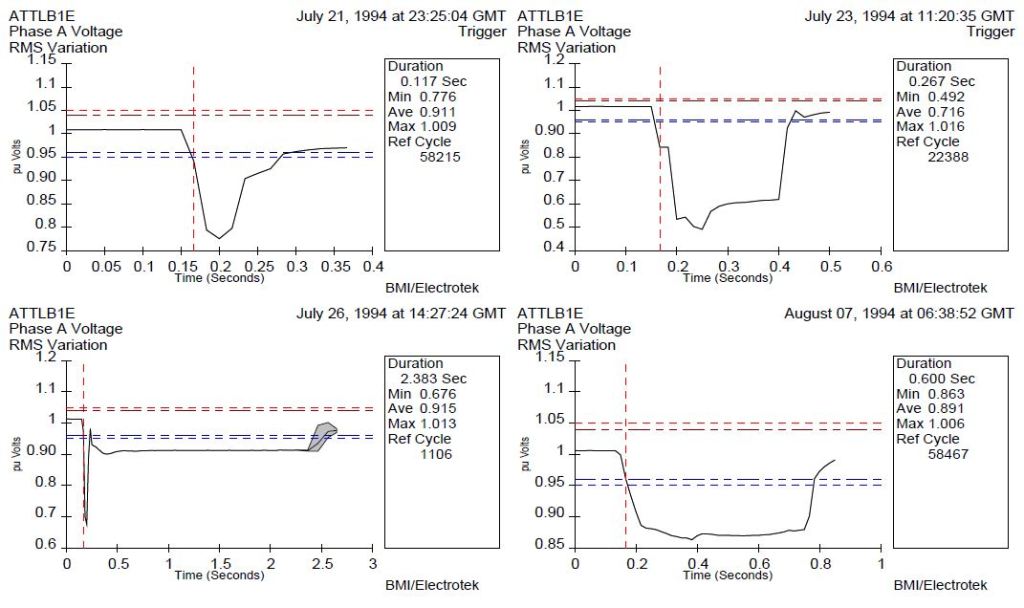
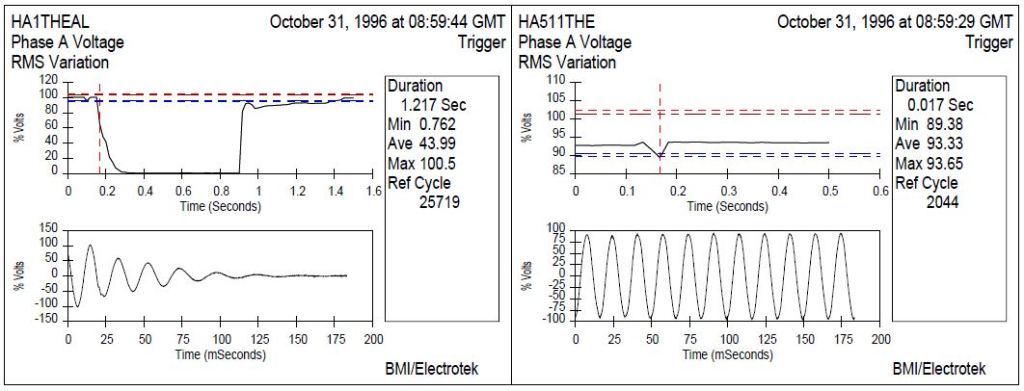
A case study is presented in this paper that includes measurement results that were used to characterize the voltage sags experienced on the utility system and in the industrial facility. As part of this case study, simulation results used to develop “area of vulnerability curves” for the industrial facility, mitigation equipment that was employed to improve the sensitive equipment’s ride-through capability, and the lessons learned from the systems approach analysis are included.
INTRODUCTION
In 1991, facility engineers started to monitor power quality. It did not take long to correlate equipment shutdowns and failures with incidents of lightning storms in the surrounding region. Distressed by the frequency of voltage sag occurrences and wishing to avoid an overwhelming capital expenditure in power conditioning equipment, the facility approached their electric utility for assistance.
In response to the customer’s request, the utility initiated a study of the electrical supply to the facility. The utility study concluded that the occurrences of voltage sags at the facility were indeed greater than normal. To remedy the problem, the facility and the utility took a unique team approach that deviated from traditional customer-utility relationships. In a cooperative effort between the customer and utility it was decided to apply a system approach to the facility’s power quality. In the system approach, the facility’s power distribution was evaluated from the point of generation through the point of use. The system approach involved several simultaneous efforts. These efforts and associated responsibilities included
The evaluation of transmission line routing to the facility by the utility.
The evaluation of tower and shield wire integrity and resistance by the utility.
An evaluation of equipment sensitivity to voltage sags by the facility.
An identification of truly critical equipment by the facility.
More extensive and detailed monitoring by the facility and the utility.
An important part of the project was to identify specific voltage sag events and relate these events to equipment failures. To enhance the existing monitoring capability of the facility, the utility invited the facility to become a participating site in a nation-wide study of utility power quality. Participation in the study increased the facility’s monitoring capability to a total of 10 highly sensitive power quality monitors. Using these monitors, the facility recorded seven voltage sags in a one-year period. Lightning caused six of the seven voltage sags and five of the six sags resulted in equipment failures. Monitoring equipment allowed accurate plots to be made of voltage sag duration and magnitude. None of the lightning events caused a total loss of power to the facility. In fact, the worst sag lasted for 267 milliseconds and dropped the line voltage by 69%. Armed with this data it became clear that any remedial power conditioning equipment would have to maintain line voltage for only a very short duration.
Utility Enhancements
After reviewing the outage reports from the utility, it was determined that the feeders serving the facility were experiencing abnormally high fault rates compared to the system average during lightning storms. To alleviate this problem, the utility changed the way in which their system was supplied.
The utility changed their operations which resulted in very little double circuit feed (4 miles) to the industrial facility. By feeding the facility with two separate lines, the faults due to lightning strokes were reduced. The utility also used counterpoise to help eliminate the voltage sags and interruptions due to lightning flashovers.
Monitoring Results
A monitoring project was conducted where three locations inside the industrial facility were monitored for power quality disturbances. Figure 2 shows the locations of the monitors within the facility. Two of the monitors were installed on the 480 volts system while the third monitor was installed at the 13.8kV bus. The duration of this monitoring project was from June 1992 through December 1993.
Although the monitors installed can monitor for various power quality disturbances, only RMS variations (sags and swells), interruptions, and outages will be considered.
A typical voltage sag measured in the facility is illustrated in Figure 1. This voltage sag was measured at the 13.8kV bus. The voltage sag illustrated in Figure 1 lasted approximately 16 cycles and the sag magnitude was 0.29 per-unit.
Figure 1 – Typical Voltage Sag Measured at the 13.8kV Monitoring Site
Figure 2 illustrates all the RMS variations that were recorded at the facility (all three monitors, all phases) during the monitoring period. Figure 2 is known as a magnitude-duration scatter plot. It also incorporates information from the computer business equipment manufacturer’s association (CBEMA) curve. This curve is typical design curve for power conscious computer manufacturers and represents the design goals of a wide variety of electronic apparatus and computer manufacturers. [4]
By using the design goals of IEEE/ANSI 446-1987 [4] for evaluation purposes, then 62 of these events, 61 below and one above CBEMA, would have caused problems with equipment at the facility. However, the equipment within the facility is not all electronic or computer equipment and this CBEMA plot overlay is intended only as reference.
Figure 2 – Magnitude-Duration Scatter Plot for all the Monitors in the Facility (1992-1993)
Customer Enhancements
As part of this case study, several measures to improve sensitive equipment ride-through capability were considered. Through past experience, the industrial customer had investigated the use of a battery backed UPS for their critical loads. In fact, they had installed approximately 125 kVA of UPS back up in their facility. However, due to the nature of the loads in the facility and their disparity, it was decided to investigate a different technology for supplying ride-through protection.
One such technology was the written pole motor-generator set (MG set). This technology provides 100 % output voltage to the rated load for up to 15 seconds with a zero voltage on the input [10]. This technology was decided on for several reasons:
From the monitoring results, it can be seen that the average duration of voltage sags experienced at the facility were approximately 8 cycles (0.133 mS).
Although the MG sets come in 15 kVA and 35 kVA units, they can be paralleled to achieve virtually any rating.
Maintenance on UPSs is more critical, expensive, and time consuming than on the MG sets.
Other critical loads are backed by UPS; however, a majority of other critical loads are motor based and therefore, the inertia inherent in motors was a significant advantage.
After deciding on the technology to be used, the size or rating of the equipment was determined. To accomplish this, a thorough survey of the plant was conducted and the total critical load was determined. The total critical load in the plant was determined to be 13 kVA.
With the amount of critical load to be fed from the MG set (13 kVA) and future expansion of the facility in mind, a 35 kVA MG set was selected. The MG was installed and all critical load was supplied via the MG set. After the installation of the MG set, it was discovered that the MG set performed better than expected. The MG set was capable of supplying the 13 kVA of load for approximately 28 seconds after total loss of power [2].
Customer Sensitivity
Through the use of the monitors installed in the facility, the customer has determined their sensitivity level to voltage variations. Figure 3 illustrates the customer’s sensitivity level along with the more recognized CBEMA levels. As can be seen from Figure 3, the facility’s voltage tolerance is more sensitive than the limits set forth by IEEE Std. 446, better known as the CBEMA limits.
Figure 3 – Facility and CBEMA Voltage Tolerance
There were four events during 1994 that would have caused misoperation of process critical equipment. Although the output of a MG set was not monitored, the customer has determined that these events would have caused problems at the facility without the use of MG sets. All the events were a result of thunder and lightning activity.
Figure 4 – Four Severe Events Measured at Customer Site
SUMMARY
A majority of the problems experienced at the industrial facility were lightning induced. The utility took all the measures possible to them to eliminate or reduce the voltage sags caused by lightning as listed below:
Performed simulations to determine the effects of lightning on the transmission system.
Performed simulations to determine fault levels at several locations throughout the transmission system.
Installed counterpoise on lines with high footing resistance.
Re-sectionalized the circuit feeding the facility to limit exposure to double circuit flashovers.
Implemented a monitoring program to characterize the nature of voltage sags affecting the facility.
Kept a log of all activity on the transmission system serving the customer.
As part of this study, the customer was asked to perform several tasks:
Take simple site survey of their facility to out-line what equipment was critical to their operation.
Install more sophisticated monitors than they had already installed. This enabled the characterization of the voltage sags experienced at the facility.
Keep a log of disturbances that adversely affected the critical equipment within the facility.
Re-configure the circuits feeding their sensitive equipment. Feed all sensitive loads from one circuit. This helped in the design of a protection scheme with the MG sets.
Purchase and install MG set to serve their critical load.
By having the utility work with the customer and using a system approach to solving the problems encountered at the customer facility, a mitigation technology and system was quickly and efficiently developed and employed.
REFERENCES
IEEE Std. 1159 “Recommended Practice for Monitoring Electric Power Quality,”.
G. E. Beam, et al, “Power Quality Case Studies Voltage Sags The Impact on the Utility and Industrial Customers”, Conference Record of the 1993 PQA Conference, pp 5-1:1 – 5-1:7, San Diego, CA, 1993.
D. D. Sabin, et al, “Preliminary Results from the EPRI Distribution Power Quality Project.” Proceedings: PQA ‘94 Conference, Amsterdam, Netherlands, October 1994.
IEEE/ANSI Std. 446-1987. IEEE Orange Book, “Recommended Practice for Emergency and Standby Power Systems for Industrial and Commercial Applications.”
IEEE Std. 1346, “Electric Power System Compatibility with Industrial Process Equipment,”
IEEE Recommended Practice for Powering and Grounding Sensitive Electronic Equipment, IEEE std. 1100-1992, pg. 47, 1992.
D. S. Dorr, “Power Interruption Study Discloses Frequency and Impact”, Power Quality Magazine, Vol. 3, No 5, pp. 8-10, 1992.
B. M. Hughes, “Distribution Customer Power Quality Experience”, Conference Record of the 1991 IEEE Industry Applications Society Annual Meeting, pp. 1556-1563, 1991.
M. F. McGranaghan, D. R. Mueller, M.J. Samotyj “Voltage Sags in Industrial Systems”, IEEE Transactions on Industry Applications, Vol. 29, No. 2 March/April 1993.
Precise Power Corporation, The Precise Power “Written Pole” Motor, 1993.
L.V. Bewley, Traveling Waves on Transmission Systems”, Dover Publications, Inc., New York, 1951.
Larry E. Conrad, Chairman, “Proposed Chapter 9 for Providing Voltage Sags (Dips) in Revision to IEEE Std. 493, the Gold Book”, PSI Energy, Plainfield ID, 1993.
EPRI Innovator RP2935-78.
GLOSSARY AND ACRONYMS CBEMA: Computer Business Equipment Manufacturer’s Association
Published by Electrotek Concepts, Inc., PQSoft Case Study: Voltage Sag Study for a Distribution System Customer, Document ID: PQS0308, Date: February 4, 2003.
Abstract: Voltage variations, such as voltage sags and momentary interruptions are two of the most important power quality concerns for customers. Customers understand that interruptions cannot be completely prevented on the power system. However, they are less tolerant when their equipment mis-operates due to momentary disturbances which can be much more frequent than complete outages. Voltage variations and interruptions are inevitable on the power system. The most important of these variations occur during fault conditions on the power system.
This case presents the results of analysis of voltage sags caused by utility faults and their impact on a distribution system customer.
INTRODUCTION
Voltage variations, such as voltage sags and momentary interruptions are two of the most important power quality concerns for customers. Customers understand that interruptions cannot be completely prevented on the power system. However, they are less tolerant when their equipment misoperates due to momentary disturbances that can be much more frequent than complete outages. These conditions are characterized by short duration changes in the rms voltage magnitude supplied to the customer. The impact to the customer depends on the voltage magnitude during the disturbance, the duration of the disturbance, and the sensitivity of the customer equipment.
Voltage variations and interruptions are inevitable on the power system. The most important of these variations occur during fault conditions on the power system. Since it is impossible to completely eliminate the occurrence of faults, there will always by voltage variations to contend with. Power quality complaints occur either when the customer has equipment that is very sensitive to these voltage sags and is critical to the overall process or when the frequency of occurrence of the interruptions or sags is interpreted as being unacceptable.
On the utility system, protective systems are designed to limit damage caused by unusual events like faults or lightning strikes, and to localize the impact of such events to the smallest number of customers. This is accomplished with overcurrent protection devices, such as reclosers, sectionalizers, and fuses.
VOLTAGE SAG EVALUATION PROCEDURE
The most general approach to voltage sag analysis (illustrated in Figure 1) would characterize the system voltage sag performance by analyzing the fault performance on both the transmission and distribution systems. Computer calculations, using a short circuit analysis program, can be used to determine voltages around the system for any fault location. These calculations can be used to define an area of vulnerability for a particular customer. The likelihood of a fault can then be calculated from past fault records of the area, or from the fault performance of similar locations.
Voltage sags and momentary interruptions are often the most costly power quality variations affecting industrial and commercial customers. Faults over a wide area of the power system can affect the operation of a facility that has sensitive equipment. Faults can occur on the transmission system or on the distribution system. For most facilities, both cases need to be evaluated to estimate the overall performance expected. For facilities that are supplied directly from the transmission level, only transmission faults usually need to be considered.
Figure 1 – Voltage Sag Evaluation Procedure
Transmission System Performance
A significant number of end users are affected by faults on the transmission system. Therefore, one component of the total voltage sag performance at the end user location can be determined by the fault performance of the supplying transmission system. If the end user is supplied at a distribution level, the distribution system fault performance must also be evaluated. A standardized procedure may be used to determine the expected voltage sag performance at a selected bus on the system:
Build a transmission line fault performance table: This table includes the historical performance information or expected performance for each line section in terms of number of faults expected per year for both single line-to-ground and three phase faults. Usually, single line-to-ground faults will be the most common.
Calculate the area of vulnerability: Perform short circuit simulations to determine the voltage sag severity at selected system locations for fault locations throughout the transmission system. This will identify the fault locations that can cause a sag below a specified threshold. The total circuit miles of possible fault locations that can cause a sag severe enough to cause misoperation of end user equipment is known as the area of vulnerability for that equipment.
Calculate expected number of voltage sags that will cause equipment misoperation: Convert the area of vulnerability data to actual expected events per month at the specified location. This is done using the area of vulnerability and the expected performance for three phase and single line-to-ground faults over that area. Summing up the expected number of faults on each line section within the area of vulnerability will give the total expected number of events that can cause equipment misoperation. This will usually be expressed as events per month or events per year.
Calculate expected number of momentary interruptions: The momentary interruption performance for a customer due to transmission system faults should be calculated if the customer is supplied as a tap from a switched transmission line. In this case, the expected number of momentary interruptions per year due to transmission events is the expected number of faults on that line. This should be calculated separately from the voltage sag performance.
Calculate the expected performance for different equipment sensitivity levels: This will give the end user information that can be used to help develop equipment specifications or to select equipment protection. The information can be presented as a histogram, or as a continuous curve of expected number of voltage sags vs. the sag severity. Equipment susceptibility levels may be determined from manufacturer data or testing.
End users that are supplied at distribution voltages will be impacted by faults on the distribution system as well as faults on the transmission system. Usually distribution end users must be concerned about both momentary interruptions and voltage sags caused by distribution faults and protective device operations.
The voltage sag performance data for the transmission and distribution systems will define the expected number of events of a specified severity that can be expected at the end user facility. This information must be evaluated with respect to the actual equipment sensitivity to determine the number of disruptions to the process or operation that can be expected per month or per year.
Voltage Sag Study
Figure 2 illustrates the oneline used the distribution system voltage sag study. The case illustrates the method for determining the three-phase and single-line-to-ground faults on a radial distribution feeder. Table 1 and Table 2 illustrate the data and output files for the system (equivalent @ bus 100).
Fault Current and Sag Magnitude Calculation
The first step in completing the study is to gather the positive and zero sequence impedance information and then convert each of these impedances to a common base (i.e. % @ 100 MVA). Often, this step will not be required since most utilities continuously maintain a datafile that represents their entire system, as well as equivalent impedances representing neighboring systems.
Figure 2 – Oneline for Short Circuit Case for the Voltage Sag Study
Table 1 – Data File for the Short Circuit Case
Table 1
Table 2 – Output File for the Short Circuit Case
Table 2
The impedance at the fault point is represented by the summation of the source, transformer, and distribution line. Table 3 summarizes the calculation.
Table 3 – Data Conversion for the Short Circuit Case
Table 3
The impedance at the customer location (customer #1) is converted to ohms using the base impedance:
This corresponds to a 7.4% voltage sag for all other customers connected to the 115kV bus. The 34.5kV bus voltage for the three-phase fault is approximated using:
This corresponds to an 83.2% voltage sag for all customers connected to the 34.5kV bus.
Determining Fault Probability
The most frequent cause of voltage sags at a large industrial plant is lightning. Lightning is weather related, and the weather can be extremely variable from one season to another or one year to another. But over longer periods of time, weather will more closely follow certain patterns. Activities such as those by the National Lightning Detection Network are establishing the amount of lightning strokes a given area will receive over longer periods of time. The results of this work report on ground flash density (Ng) for all areas of the country. The ground flash density is a measure of lightning stokes to ground per square km per year. It is more accurate than the previously used isokeraunic level in determining the expected lightning performance of transmission lines. Isokeraunic level is the number of days per year lightning is heard, and must be multiplied by a proportionality factor to convert it to ground flash density. Utilizing geometry of the transmission lines, BIL levels of the insulators, and ground flash density, the expected number of faults per mile of line per year can be calculated. Table 4 provides the fault performance for the distribution customer.
Determining Area of Vulnerability Characteristic A number of short circuit simulations are performed to determine the voltage sag severity at a selected system location for fault locations throughout the transmission and distribution systems. This will identify the fault locations that can cause a sag below a specified threshold. The total circuit miles of possible fault locations that can cause a sag severe enough to cause misoperation of end user equipment is known as the area of vulnerability for that equipment. These calculations must include the effects of transformer and load connections as illustrated earlier. Table 4 shows the fault locations (single line-to-ground faults) that can cause voltage sags below 85% at the customer’s facility.
Table 4 – Area of Vulnerability Data
Table 4
Determining Equipment Sensitivity
The customer’s facility is supplied by three-phase 480 volt feeders. The loads, and their respective sensitivities, can be categorized by type and connection to the power system:
− Motors, heating elements, and other three-phase loads can be connected directly to the 480 volt feeders: Sensitivity: 50% voltage > 1 cycle − Adjustable-speed drives and other power electronic devices that use three-phase power will be connected directly to the 480 volt feeders, or through an isolation transformer. Sensitivity: 85% voltage > 3 cycles − Lighting often utilizes single-phase 277 volt connections from phase-to-neutral, or may use 480 volt or 120 volt single-phase connections. Sensitivity: 70% voltage > 2 cycles − Control devices such as computers, contactors, and programmable logic controllers utilize 480/120 volt single phase transformers for 120 volt control. Sensitivity: 80% voltage > 3 cycle
The voltages experienced during a voltage sag condition will depend on the equipment connection. Some single-phase loads will be unaffected and other single-phase loads may drop out, even though their sensitivities to voltage sags may be identical. Different categories of equipment and even different brands of equipment within a category (e.g., two different models of adjustable speed drives) have significantly different sensitivities to voltage sags. In addition, it is important to recognize that the entire process in an industrial plant can depend on the sensitivity of a single piece of equipment. The overall process involves controls, drives, motor contactors, robotics, etc. that are all integral to the plant operation. This can also make it difficult to identify the sensitive piece of equipment after the entire process shuts down.
Determining the Number of Customer Events
The number of actual events that will impact the customer may be determined using the following steps:
Calculate the area of vulnerability table. Perform short circuit simulations to determine the voltage sag severity at a selected system location for fault locations throughout the transmission system. This will identify the fault locations that can cause a sag below a specified threshold. The total circuit miles of possible fault locations that can cause a sag severe enough to cause misoperation of end user equipment is known as the area of vulnerability for that equipment. These calculations must include the effects of transformer and load connections.
Calculate the expected number of voltage sags at equipment sensitivity levels. Convert the area of vulnerability data to actual expected events per month at the specified location. This is done using the area of vulnerability and the expected performance for three-phase and single line-to-ground faults over that area. Summing up the expected number of faults on each line section within the area of vulnerability will give the total expected number of events that can cause equipment misoperation. This will usually be expressed as events per month or events per year. illustrates a method for summarizing the results.
Calculate the expected number of momentary interruptions. The momentary interruption performance for a customer due to transmission system faults should be calculated even if the customer is supplied from a transmission line. In that case, the expected number of momentary interruptions per year due to transmission events is the expected number of faults on that particular line. This should be calculated separately from the voltage sag performance.
Calculate the expected performance for various equipment sensitivity levels. This will give the customer information that can be used to help develop equipment specifications. The information can be presented as a histogram, as illustrated in Figure 3.
Table 5 – Expected Sag Performance
Location: Customer #2 Performance Calculation for a Threshold of: 85%
Table 5
Therefore, if the customer has equipment that is affected by voltage sags of 85% and below, there should be on the average 28.9 events per year caused by single line-to-ground faults on the transmission system. The expected voltage sag performance for different values of voltage sag severity is shown in Figure 3.
Figure 3 – Voltage Sag Performance
Evaluating Solutions
There are three levels of possible solutions to voltage sag and momentary interruption problems:
Power System Design: Faults on the power system are the ultimate cause of both momentary interruptions and voltage sags. Any measures taken to reduce the likelihood of a fault will help reduce the incidence of sags and interruptions to customers. These measures can include using underground circuits, tree trimming, and increased application of surge arresters for lightning protection on distribution circuits. On transmission circuits where lightning may be the most prevalent cause of faults, reducing tower footing resistances is one of the measures that can improve the lightning performance of lines.
Equipment Design: It is possible to make the equipment being used in customer facilities less sensitive to voltage sags and momentary interruptions. Clocks and controls with low power requirements can be protected with a small battery or large capacitor to provide ride through capability. Motor control relays and contactors can be selected with less sensitive voltage sag thresholds. Controls can be set less sensitive to voltage sags unless the actual process requires an extremely tight voltage tolerance. This solution requires coordination with equipment manufacturers but the trend seems to be in the direction of increased ride through capability.
Power Conditioning Equipment: This option involves the addition of power conditioning equipment at the individual loads that are sensitive to voltage sags and/or interruptions. The power conditioning requirements depend on the types of voltage sags that can be expected and the possible durations of interruptions.
SUMMARY
This case presents a general approach for voltage sag analysis by characterizing the system voltage sag performance due to faults on the utility system. Computer calculations, using a short circuit analysis program, can be used to determine voltages around the system for any fault location. These calculations can be used to define an area of vulnerability for a particular customer. This information, used in conjunction with equipment sensitivity, can be used to estimate the number of times a device will trip off-line each year.
REFERENCES
Electrical Distribution-System Protection, Third Edition, Cooper Power Systems, Pittsburgh, PA, 1990. The Impact of Voltage Sags on Industrial Plant Loads, J. Lamoree, J.C. Smith, P. Vinett, T Duffy, and M. Klein, Proceedings of the First International Conference on Power Quality (PQA ’91), Paris, France, October, 1991. Voltage Sag Analysis – Case Studies, J. Lamoree, D. Mueller, P. Vinett, and W. Jones, Proceedings of 1993 IEEE I&CPS Conference, St. Petersburg, Florida. Industrial and Commercial Power System Analysis – Brown Book, IEEE Standard 399-1990.
Published by Electrotek Concepts, Inc., PQSoft Case Study: Voltage Sag Protection Using a Micro-SMES Device, Document ID: PQS0508, Date: September 30, 2005.
Abstract: This case study describes the use of a micro superconducting magnetic energy storage (micro-SMES) device to improve power quality at a large semiconductor manufacturing facility by providing short term back-up power during utility system voltage sags and interruptions. This facility has critical electronic chip testing loads that are very sensitive to voltage variations. An explanation of why the micro-SMES was chosen instead of other technologies will be presented along with a brief overview of the technology as well as performance.
INTRODUCTION
Voltage sags and momentary power interruptions are probably the most important power quality problems affecting industrial and large commercial customers. These events are usually associated with a fault somewhere on the supplying power system. Actual interruptions occur when the fault is on the circuit supplying the customer. Voltage sags are much more common since they can be associated with faults remote from the customer. Even voltage sags lasting only 4-5 cycles can cause a wide range of sensitive customer equipment to drop out.
A large semiconductor facility was experiencing equipment tripouts caused by voltage sags at one of their buildings. This building was fed from a 13.2 kV distribution circuit. There were 17 voltage sags causing a loss of load in their sensitive tester room during a 12 month period. Of those 17 events, 4 were on the 115 kV system and 13 were on the 13.2 kV distribution system. These events resulted in significant man-hours of lost productivity. Therefore, some type of ride-through device was needed to protect these loads. For this particular case, a micro-SMES device was installed.
CHIP TESTER SENSITIVITY
Electronic chip testers are very sensitive to voltage variations, and because of the complexity involved, often require 30 minutes or more to restart. In addition, the chips involved in the testing process can be damaged, and several days later, internal electronic circuit boards in the testers may fail. A chip tester consists of a collection of electronic loads, printers, computers, monitors, etc. If any one component of the total package goes down, the entire testing process is disrupted. The chip testers can be 50 kVA and larger in size.
The 17 voltage sags mentioned above ranged in magnitude from 14-100% below nominal. The testers typically dropped out if the voltage fell below 85% of nominal. The following figure is a summary of all the disturbances recorded during that time period. As can be seen from the figure, most voltage sags recorded fell very close to the trip setting of the chip testers (80-85%) and are less than 100 cycles in duration.
Figure 1 – Summary of Voltage Sag Events at Chip Tester Location
WHY USE A MICRO-SMES?
The micro-SMES was chosen as the ride through device to protect the tester loads for several reasons. The customer liked the mobile capability of the micro-SMES unit. The entire unit fits in a 48′ semi-trailer and can easily be moved to other sites. The chip testers have been moved in the past, and the possibility exists that they could be moved in the future.
Another reason the micro-SMES was chosen over other ride through devices such as uninterruptible power supplies (UPSs) was its small space requirement. An equivalent rated UPS would have required much more physical space than the micro-SMES, and a costly addition to the building would have been required in order to house the UPS’s batteries.
MICRO-SMES OPERATING PRINCIPLES
Micro-SMES devices utilize a superconducting magnet (Figure 2) to store energy in the same way a UPS uses batteries to store energy. The main advantage of the MICRO-SMES is the greatly reduced physical space needed for the magnet as compared to batteries. There are also a lot less electrical connections involved with MICRO-SMESs as compared to UPSs so the reliability should be greater and the maintenance requirements less. Initial MICRO-SMES designs have been tested in several locations with favorable results. The projected future costs of an MICRO-SMES should be competitive with UPSs.
Figure 2 – Micro-SMES One-Line
When a voltage sag or momentary interruption occurs, the tester loads are isolated from the utility system with a fast-acting solid-state switch. The isolation switch can operate in less than a quarter-cycle, and opens when the utility supply falls below a pre-set value which, for this case, is 93%. Once opened, the tester loads receive their power from the two inverters, which in turn draw on the energy stored in the magnet. The dc current in the magnet is then redirected by the voltage regulator (GTO switch opens) and flows across the capacitor bank of the inverter. When the voltage on the capacitor bank reaches a pre-set level, the GTO switch recloses. The inverters convert this energy to ac power for the tester loads, which lowers the voltage on the capacitor, which then triggers the reopening of the GTO switch. When utility power returns to normal, the tester loads are resynchronized for 100 msec, after which, the isolation switch recloses.
MICRO-SMES PERFORMANCE
During the one year test program, the micro-SMES device operated successfully 34 times without any problems. Figure 3 shows measurements from the input and output of the device. The measurements show a voltage sag down to 74% of nominal voltage on the input and the corresponding output voltage of the micro-SMES.
Figure 3 – Example Input/Output Waveforms
SUMMARY
The utility has addressed the power quality needs of an extremely important customer by using a state of the art superconducting storage system to provide short term back-up power to sensitive tester loads. The micro-SMES has already proven its effectiveness by enabling the protected tester loads to ride through several voltage sags, while unprotected loads have tripped.
REFERENCES
Lamoree, J., Smith, J. C., Vinett, P., Duffy, T., and Klein, M., “The Impact of Voltage Sags on Industrial Plant Loads.” Paper presented at the First International Conference on Power Quality: End-Use Applications and Perspectives, Paris, France, October 14-16, 1991.
Lamoree, J., “How Utility Faults Impact Sensitive Customer Loads,” Electrical World Magazine, April, 1992.
RELATED STANDARDS IEEE Std. 1159
GLOSSARY AND ACRONYMS SMES: Superconducting Magnetic Energy Storage
Published by A. El Mofty K. Youssef, Alexandria Electricity Company , Alexandria – Egypt
SUMMARY
Power quality has become an increasing concern to Alexandria Electricity Company (AEC) for the last few years. Problems involving the quality of voltage to the customers are always an important point.
The increased concern of power quality has resulted in measuring power quality variations and characteristic disturbances for different industrial categories. The devices and equipments used in industry include microprocessor-based controls and electric devices that are sensitive to many types of electrical disturbances besides to actual interruptions.
Degradation of power quality is usually caused by load switching, system faults, motor starting, load variations, nonlinear loads, and intermittent loads and arc furnaces . Such disturbances give rise to surges, dips, harmonic distortions, interruptions, flicker and signalling voltages. AEC has already an extensive monitoring plan to help characterize system performance on a continuous basis . An important AEC quality problem service is the power disturbance log. This log is designed to help identify the causes of the equipment malfunction. The information in the log are date, time, list of equipment affected, length of outage and weather conditions. Accurate information will provide valuable clues towards a solution. A log helps to systematically and quickly uncover important information .
The paper presents analysis of the real time industrial electrical disturbances, power disturbance log and some suggestions to minimize or prevent inconveniences caused by power disturbances.
Three logs are designed to help identify the causes of the equipment malfunction, The data can be collected by using these logs. The data from the log can be used to identify any pattern. It is important to consider any recent changes in the factory at the time of the problem.
Log sheets are distributed to customers of AEC and the outcomes are summarized in this paper .
It has been found out that poor grounding and improper wiring give rise to internal problems. The check of wiring and measuring of earthing resistance are carried out The survey includes monitoring and analysis at the supply side and at 15 customer loads. The customers represent different industrial loads and are classified into metal, chemical, textile and food.
The dominating power quality disturbances are surges, dips and harmonics.
The worst dip has a depth of 97.02% that means 2.92% remaining voltage .
The measured voltage surges are almost between 5% and 10% in less than 20 ms . For the above mentioned cases the remedy was done by adjusting the tap changer of the distribution transformer. A few number of voltage surges are greater than 10% in less than 20 ms. In textile firm voltage surge suppressor was installed at one subbranch. The voltage profile before and after installing the surge suppressor are presented.
The full line of uninterruptible power system (UPS) and its power management software was installed in chemical firm to protect sensitive electronic equipment against power problems even in the most critical circumstances.
The electrical parameter profiles before and after installing UPS are presented . Good results have been obtained and power quality has been remarkably improved.
Tuned filter is available to isolate problem area and to mitigate the effects of harmonics. It is installed at textile firm .
Voltage dips and surges can cause light flicker .
AEC is awaring the new customers by this fact: “ THE MOST EFFECTIVE AND SUCCESSFUL METHOD OF PREVENTATION QUALITY DISTURBANCES IS TO ANTICIPATE AND ELEMENATE THEVVVVVU PROBLEMS DURING DESIGN ,CONSTRUCTION AND INSTALLATION “ and assist them to achieve that .
ABSTRACT
Power quality has become an increasing concern to Alexandria Electricity Company (AEC) for the last few years.
The increased concern of power quality has resulted in measuring power quality variations and characteristic disturbances for different industrial categories. The devices and equipments used in industry include microprocessor-based controls and electric devices that are sensitive to many types of electrical disturbances besides to actual interruptions.
Power quality disturbances are usually caused by load switching, system faults, motor starting, load variations, nonlinear loads, and intermittent loads and arc furnaces . These cause many electrical disturbances like surge, dip, harmonic distortions, interruptions, flicker and signaling voltages.
AEC has already an extensive monitoring plan to help characterize system performance on a continuous basis . An important AEC quality problem service is the power disturbance log. This log is designed to help identify the causes of the equipment malfunction. The information in the log are date, time, list of equipment affected, length of outage and weather conditions. Accurate information will provide valuable clues towards a solution. A log helps to systematically and quickly uncover important information.
The paper presents analysis of the real time industrial electrical disturbances, power disturbance log and some suggestions to minimize or prevent inconveniences caused by power disturbances.
The survey includes monitoring and analysis at the supply side and at 15 customer loads. The customers represent different industrial loads and are classified into metal, chemical, textile and food. By the use of protective devices some remedies are implemented against disturbances. Voltage profile before and after implementation is recorded
POWER QUALITY STANDARDS
The specific characteristics of supply voltage have been defined in standards, which are used to determine the level of quality with reference to : frequency, voltage level , wave shape and symmetry of the three phase voltage.
The IEEE 519-1992, IEEE 1159-1995 describe the compatibility level required by equipment connected to the network, as well as the limits of emissions from the devices, table (1) summarized the definition of disturbances. If these limits values are exceeded, the polluter may be requested to provide for corrective action.
Table (1) Power Quality Disturbances
POWER QUALITY STEPS
Power quality problems are pinpointed through four steps; Investigation, determination, analysis and prevention.
Investigation: A thorough investigation can help identify many power quality problems. Three logs are designed to help identify the causes of the equipment malfunction, shown in Log (1), Log (2) and Log (3). The data can be collected by using these Logs. The data from the log can be used to identify any pattern. It is important to consider any recent changes in the consumer network at the time of the problem. Log sheets are distributed to customers of AEC and the outcomes are summarized in table ( 2 ). The poor grounding and improper wiring are the main internal problems. According to reference [1] the ground resistance in small distribution substations, the usually acceptable range is from 1 to 5 ohm depending on local conditions .The check of wiring and measuring of earthing resistance are carried out and recorded in table ( 2 ) .
The dominated anomalies recorded from manufacturing system Log are :
Damage of printed circuit board .
Stop of pumps .
Brownout without any production interruption.
Stop of one or two lines of production .
Failure of PC monitors.
Microprocessor Lock-up
Table (2) Electrical disturbance Log and measured value of ER
Determinations: Requires monitoring and survey of the power supply to the affected loads. The objectives of the survey were to determine the power quality on AC supply at some industrial sites. The results would serve as a baseline against which future surveys could be compared to determine trends. Also the survey was intended to provide a statistically valid set of data reflecting the number and types of electrical disturbances. The survey includes monitoring at 15 industrial customer sites at their 380 volt service supply panels. These monitoring are carried out by MEMOBOX 800 energy and disturbance analyzers.
The measurement period is 7 days and 10 minutes intervals.Table ( 3 ) & ( 4 ) summarize measurement results of power quality disturbance in 15 case studies .
Electrical disturbance Log_1
Electrical disturbance Log_2
Electrical disturbance Log_3
Table (3) Results of power quality measurement
Table (4) Result of power quality measurement
Analysis and preventation: Following data collection, analysis of both recorded information and outcomes logs is necessary to chose the correct mitigation .Table ( 5 ) focus on the disturbances in each case study and the suggested mitigation Table ( 5 ) Disturbances and suggested mitigation for case studies .
Table ( 5 ) Disturbances and suggested mitigation for case studies .
1 – Case studies Te ( 2 ) ,Pa ( 2 ) , Ch ( 2 )
The voltage dips are the most important power quality problems affecting many types of industrial end-user. As industrial processes have become more automated, the equipment has become increasingly sensitive to these dips.
The voltage dips are caused by a remote fault somewhere on the power system, or caused by motor start inside the plant . Also large voltage deviations within the customers premises due to internal connection and wiring . The nominal service voltage for case studies is 3×380 / 220 V. Fig ( 1 ) represents the scatter plot of dips for 15 case studies, table ( 6 ) summarizes the characteristic of dips , number and values.
The worst dip has a depth of 97.02% ( about 213.6 V ) that means 2.92% ( about 6.4 V ) remaining voltage .
Table (6) voltage dips measurement
Even with a single line to ground fault on the primary of distribution transformer ( Delta Star vector group ), the voltage dip at the customer bus will be no lower than 33% normal value Vca[ 2 ] . Therefore from table ( 6 ) according to the value of voltage dips both motor starts and faults are responsible for causing the dips . With respect to voltage dips caused by up to 50 HP motor starts, the suggested recommendation is to install power conditioners. And for large voltage deviations within the customer’s network, must be taken into consideration by customers . In Te (2) , for example, the description of measured voltage dips are :
No. of dips
Voltage dip%
Duration ms
203
10% : 15%
< 20 ms
1
15% : 30%
< 20 ms
1
15% : 30%
20 < 100 ms
That means only one dip is out of standard. In general , mitigation is carried out by installing power conditioners or voltage regulators. The power conditioner typically include voltage regulator , surge protective device and shield insolation transformer.
The voltage surges ( swells ) are caused by switching off a large load ( sudden load decrease ) . In Te(1) , Te(2) , Fo(1) , Fo(2) , Ch(3) the measured voltage surges are almost between 5% and 10% in less than 20 ms . For the above mentioned cases the remedy was done by adjusting the tap changer of the distribution transformer. A few number of voltage surges are greater than 10% in less than 20 ms. In Te(2) voltage surge suppressor was installed at one subbranch . Fig.(2) represents the voltage profile before and after installing the surge suppressor.
3 – Case study Ch ( 1 )
The Ch (1) firm has very sensitive electric equipments to power variation . The firm includes PC computers , large lazer printers , central air conditioners and telephone switching equipment. The full line of uninterruptible power system ( UPS ) and its power management software was installed to protect sensitive electronic equipment against power problems even in the most critical circumstances. This U36 SURWHFWV against all power problems failure, dip, transient , harmonic , and flicker ,
It’s specification is:
rating : 40kw input voltage : 380 ± 20% output voltage tolerance : ± 1%
Fig ( 3 ) shows the electrical parameter profiles before and after installing UPS . It is a good result , and the power became clean that can be key to successful operation
4 – Case study Te ( 2 )
When customers introduce harmonics into the power system, they can cause power quality problems for themselves and for other neighboring customers. Tuned filter is available to isolate problem area and to mitigate the effects of harmonics. Table (7) compromise between the electrical parameters before and after installing the filter.
Table (7) case study Te (2) before and after installing filter
5 – Case studies Me (2), Me (3), Ma (1), Ma (2) :
Flicker is a small amplitude change on voltage levels occurring at frequencies less than 25 HZ . Voltage dips and surges can cause light flicker . A voltage dip of 0.25 to 0.5% will cause a voltage flicker [ 3 ] .
It is a problem produced by industrial end – users that mostly affects residential and commercial end – users . to overcome flicker problems caused by it, it is necessary to install control equipment like static VAR system, that is generally expensive.
Fig ( 4 ) shows the long term flicker ( Plt ) profiles for Me ( 3 ) and Ma ( 2 ) as example .
Conclusion
Power quality is very important to operation of production processes. Power quality disturbances are often complicated due to interaction between various electrical equipment and systems both inside and outside different facilities.
Knowing the reasons of these disturbances is the way to the prevention of quality deterioration. There is a variety of ways to provide the needed power quality level, and the simplest and most economical method should be selected. The first and most common step in diagnosing quality disturbance is to begin having operation personal disturbance Logs. It will point directly to the problem or at least close to the possibilities . Then the monitoring can be focused and an effective troubleshooting strategies can be developed Therefore the analysis and solution will be carried out . The paper overviews analysis of real time industrial power quality disturbances. Recently , AEC is going ahead to extensive survey for power quality disturbances for large number of customers.
Also , AEC is awaring the new customers by this fact: “THE MOST EFFECTIVE AND SUCCESSFUL METHOD OF PREVENTATION QUALITY DISTURBANCES IS TO ANTICIPATE AND ELEMENAT THE PROBLEMS DURING DESIGN , CONSTRUCTION AND INSTALLATION “ and assist them to achieve that.
Fig (1) scatter plot of dips for 15 case studies
Fig ( 2 ) Voltage variation before ( A ) and after ( B ) installing surge suppressor
Fig ( 3 ) Electrical parameters before ( A ) and after ( B ) installing UPS
Fig ( 4 ) Plt profiles for Me ( 3 ) and Ma ( 2 )
References :
[1] IEEE Guide For Safety in AC substation Grounding ANSI / IEEE Std 80-1986 . [2] Effects of voltage sags in process industry applications . http:// http://www.pgnet.electrotek.com/ [3] Range of objectionable voltage flicker http:// http://www.burbank-utilities.com/
Published by Electrotek Concepts, Inc., PQSoft Case Study: Municipal Elevator Study – Improving Elevator Performance, Document ID: PQS0507, Date: September 30, 2005.
Abstract: In the past, system-wide voltage reductions and other voltage anomalies have caused unreliable elevator operation for some Municipal Utility customers. Municipal Utility’s Customer Service Department received many complaints from customers with elevators despite the fact that the voltage reductions were within standard guidelines and accepted practice. Investigation into these complaints resulted in the need for a more thorough research into the sensitivity of typical elevator systems.
Elevator shutdown due to system design and operation of elevator and drive system controls is the key problem experienced by the customers. It was believed that sustained voltage reduction for system load relief, rms variations because of feeder faults, and utility capacitor switching were among the voltage anomalies that have an effect on reliable elevator operation.
INTRODUCTION
System-wide voltage reductions on May 20-21, 1996 coincided with problems reported by some Municipal Utility customers. The 5% reduction on the 20th and the 8% reduction on the 21st resulted in over 100 complaints recorded by the Customer Service Department. Sixty-four of the customer complaints described erratic or unreliable elevator operation during these system-wide voltage reductions. The most important problem experienced by customers during the system-wide voltage reductions was complete elevator shutdown. As a result, Municipal Utility initiated a project to evaluate elevator operation because the voltage supplied during the system-wide voltage reductions was still above the service voltage recommended by American National Standard C84.1 (Electrical Power Systems and Equipment – Voltage Ratings – 60Hz). Several case studies were performed as part of the project to identify and correct the problems that customers experienced.
The project has identified voltage sags, inadequacy of service, and conversion to local rectification as causes for unreliable elevator operation. The study has also found that modernized elevators may experience erratic operation when supplied by an emergency generator, or the generator itself may experience erratic operation. Finally, the study found hydraulic elevators to be a special case and a potential cause of problems for other elevators and building electrical equipment.
VOLTAGE SAGS
The distribution system in the municipal customer service area is dynamic, yet reliable. In other words, it rarely experiences an interruption of power. Municipal Utility monitors the power quality of the supply network with Dranetz-BMI 8010 PQNodes (PQNodes). During the time of this study, 33 PQNodes were installed throughout the municipal’s system. The PQNodes were installed in 32 different locations.
The PQNodes recorded both steady state and transient data. This information was used in conjunction with input from customers to show correlation between power system events and erratic elevator operation. The PQNodes monitored both 208/120 volt systems and 480/277 volt systems in the municipal’s service area.
Municipal Utility assumed that the nominal voltages measured by the PQNodes were 125 and 277 volts. The PQNodes were setup to capture voltage sags of 0.90 per-unit (90%) and below. Voltages equal to or less than 112.5 volts on a 120 volt system and equal to or less than 249.3 volts on a 277 volt system were recorded as an event – a voltage sag or interruption. The PQNodes were also setup to capture voltage swells and transients of 1.10 per-unit and above. Voltages equal to or greater than 137.5 volts on a 120 volt system and equal to or greater than 304.7 volts on a 277 volt system were recorded as an event.
For the period from 1/1/94 to 1/22/98, 2,737 events were recorded. These events occurred on 718 different days. The events were compiled to show the number of events that were recorded and the magnitude and duration of these events. Figure 1 shows the voltage sags and interruptions that are less than 60 cycles in duration. The voltage sags that are included in Figure 1 account for 96% of all of the events recorded in the municipal customer service area from 1/1/94 to 1/22/98.
Figure 1 – Magnitude, Duration, and Count of RMS Events
Voltage sags are one obvious cause of erratic elevator operation. The effects of voltage sags on industrial customers are well documented. Voltage sags at industrial sites are usually discussed with respect to the processes that the voltage sag interrupts and the product that is damaged or lost. The elevator is similar to an industrial process and the effect that the voltage sag has on the process depends on the installed elevator equipment and the point in the process that the elevator is at when the voltage sag occurs.
Voltage sags affect commercial customers in many ways. Voltage sags can result in downed computers and lost data, failure of broadcast and communication, blinking lights, and erratic elevator operation.
Customer feedback has provided information about how commercial customers are affected by the voltage sags that occur in the municipal customer service area. Figure 2 shows the relative number of customer complaints documented with respect to lighting, computers, air conditioning equipment, elevators, and other electrical equipment during events in the municipal customer service area. The values for the different types of equipment are relative to the 1,864 blinking light complaints.
Figure 2 also shows that abnormal elevator operation is not perceived as a problem nearly as often as the problem of blinking lights or abnormal operation of other electrical equipment. For the period of the study, elevator problems were reported 204 times.
Figure 2 – Relative Number of Complaints about Lighting and Equipment
Case studies showed that the elevator controls were more sensitive to voltage sags than the power conversion equipment. Since voltage sags are short duration events (reduction in rms voltage lasting between 0.5 cycles and 1 minute), the impact that voltage sags have on elevator operation is defined best by how the elevator passengers perceived the process of moving between floors. An elevator with good ride-through characteristics may not give the passengers any indication that a voltage sag had occurred. Another elevator may stop if the voltage sag is severe enough or long enough, but it resets itself and resumes operation when system voltage returns to normal. This would be perceived as erratic operation and an annoyance to the passengers because they reached their destination though there was a “glitch” in the process. However, some elevators must be manually reset after a voltage sag interrupts operation. This inability to automatically continue operation may result in the entrapment of passengers (and be perceived as much more than an annoyance).
Elevator controls that are required to be reset after being interrupted by a voltage sag should be replaced or retrofitted to allow the elevator to continue normal operation after the voltage sag. Another option for controls of this type is to protect the controls from the adverse effects of the voltage sag by installing power conditioning equipment.
INADEQUATE SERVICE
Inadequate service refers to the situation where a building has a load (kVA) demand greater than the designed service from the Municipal Utility. This situation results from the growth of the building’s base load without an upgrade in the service. System-Wide Voltage Reductions and Excessive Voltage Drop in Building Electrical System are included as sub-categories under the heading because they all ultimately affect the utilization voltage at the elevators.
System-Wide Voltage Reductions
System-wide voltage reductions on May 20 and 21, 1996, coincided with elevator problems reported by some Municipal Utility customers. The 5% reduction on the 20th and the 8% reduction on the 21st resulted in over 64 elevator complaints recorded by the Customer Service Department. An evaluation of the events, steady-state voltage, and customer reports for these two days showed that reliable elevator operation during a voltage reduction depends on service adequacy and acceptable voltage drop within the building’s electrical distribution system.
Figure 3 shows the steady-state voltage for one network for May 20-21, 1996. The chart also shows the times when elevator problems were reported to the Customer Service Department. The “Xs” shown on the X-axis represent recorded elevator problems.
Figure 3 – Network ‘A’ Steady State Voltage and Reported Elevator Problems
Figure 3 shows that there were no voltage sags recorded in Network ‘A’ during this period, yet there were seven reports of elevator problems on May 21. The reports coincided with the 8% voltage reduction that was in effect for a short time in the middle of the day.
Figure 4 (see ANSI C84.1) shows the standard nominal system voltages and voltage ranges. Figure 4 shows that the Range A lower value is 114 volts on a 120 volt base, the Range B (Contingency) service voltage is as low as 110 volts. The average voltage supplied by Municipal Utility during the 8% voltage reduction was 114 volts. The recorded network voltage and the customer feedback indicate that voltage reductions contribute to conditions that adversely affect reliable elevator operation.
Figure 4 – ANSI C84.1 Standard Nominal System Voltages and Voltage Ranges
Case studies were performed to characterize the typical elevator utilization voltage. The case studies often showed that the building service was inadequate for the building load or that the voltage drop from the service entrance to the elevator machine rooms was excessive.
Excessive Voltage Drop in Building Electrical System
Case studies have shown that the voltage drop within some building electrical systems does not allow for reliable elevator operation for all of Municipal Utility’s operating contingencies. Some of the worst cases do not allow for normal service voltage variations. Figure 5 shows one of the worst examples of system voltage drop.
Figure 5 – Building ‘B’ Service Entrance and Elevator Room Voltage
The chart shows the minimum service entrance and elevator room voltages for a 6-day period. Figure 5 shows that the utilization voltage at this site can be almost 10 volts lower than the voltage at the service entrance. These measurements show why this customer experienced erratic elevator operation even during Municipal Utility’s normal operating contingencies. Municipal Utility recommended that this customer upgrade their existing feeders or install additional feeders and divide the elevator load.
The National Fire Protection Association’s National Electrical Code (NFPA 70) provides examples of elevator feeder circuit design in Chapter 9. The procedure that NFPA 70 outlines should be revisited each time feeder or branch load is changed or increased. NFPA 70 recommends that the voltage drop for the feeder and branch circuit does not exceed 5% (6 volts on a 120 volt system). It is also important to take into account the voltage drop associated with other circuit components like transformers and reactors when evaluating the elevator utilization voltage.
CONVERSION TO LOCAL RECTIFICATION
The first step in converting a customer’s dc supply from the dc grid to local rectification is to determine what dc loads the customer actually has. The customer should collect elevator motor nameplate data and record the type of elevators that are being supplied (e.g., basement drum, overhead traction, geared or gearless, hydraulic, etc.). This step is necessary to ensure that the rectifier is large enough to supply the existing load. The starting current of most elevator machines is 1½ to 3 times the nameplate current. Some hydraulic elevator installations utilize dc motors. The starting current of a dc hydraulic elevator can be 7 to 10 times the nameplate current of the motor. The dc hydraulic elevator should not be assumed a trivial portion of the dc load because of the starting current.
Regeneration
Most elevators will regenerate power as a traction machine is operating an overhauling load. Regeneration occurs to some extent when the elevator car is slowed and brought to a stop.
Measurements have shown that a good rule-of-thumb is to assume that a dc elevator will regenerate up to 20% of its nameplate current.
The lack of connected dc load can prevent regenerated power from being absorbed and will result in the buildup of dc voltage. In some cases, this increase in voltage caused an increase in elevator speed and erratic operation of elevator controls. In the worst case, the voltage increased to the point of motor insulation failure and the failure of control components. It is critical that there is always sufficient load connected to the dc system to consume regenerated power.
A regeneration circuit should be installed with the local rectifier. In most cases, the specified regeneration circuit should be capable of absorbing the power regenerated by the largest motor in the supplied group, or it should be equal to 10% of the rectifier rating, whichever is larger. Regeneration circuits are typically load resistors that are always connected to the dc system or they are placed on line when the dc voltage reaches a set value.
Regeneration circuits made up of resistors that are always online are inefficient, costly, and can be physically large. Regeneration circuits that are placed online as required are typically smaller, less expensive to purchase and less costly to operate over the long term than fixed resistor banks.
Controlled Versus Uncontrolled Rectifiers
Customers have options when purchasing and installing local rectifiers. One of these options is to install a controlled rectifier instead of an uncontrolled rectifier. Controlled rectifiers may appear to offer the customer some flexibility that an uncontrolled rectifier does not, but the controlled rectifier supplies dc voltage that is not always as smooth as the voltage supplied by an uncontrolled rectifier.
In one case, a customer experienced erratic elevator operation after a controlled rectifier was installed to supply dc power to the elevators in their building. Investigation of the erratic operation showed that the ripple that was present in the output of the controlled rectifier was causing various dc relays to operate improperly.
Figure 6 shows the output of a traditional uncontrolled rectifier and Figure 7 shows the output of a controlled rectifier.
Figure 6 – Uncontrolled Rectifier Output
Figure 7 – Controlled Rectifier Output
This customer solved their erratic control problems by filtering and smoothing the supply voltage to the elevator controls.
EMERGENCY GENERATORS
Elevator operation (particularly modernized elevators) on emergency generators presents problems that many customers have not considered. The emergency generator is a much weaker source (lower available short-circuit current) than the normal Municipal Utility supply. The building power system is much more dynamic with emergency generators supplying power. In addition, harmonic voltage distortion is typically higher and voltage regulation is generally poorer with emergency generators supplying power. Most of the problems associated with elevator operation on emergency generators are often related to elevator modernizations and electronic drives and regeneration.
Modernizations and Harmonic Distortion
Modernizing older elevator machines to electronic drives provides the customer with many benefits. Unfortunately, some modernizations introduce new power quality-related concerns. Harmonic distortion can cause erratic operation of generator controls and regulators and can adversely affect the operation of other emergency loads.
There are no fixed rules for supplying electronic elevator loads with generators. Each application needs to be evaluated as a unique case. Measurements, testing, and simulations are useful tools in determining the impact that electronic drive operation can have on emergency generator operation.
Some solutions and recommendations from different case studies include:
De-sensitize generator controls using isolation transformers or filters.
Install a harmonic filter at a common emergency bus to lower the total harmonic voltage distortion on the emergency power system.
Install filters at the harmonic producing loads.
Configure the elevator controls, when possible, to limit the number of elevators that can operate at any time.
Remove unnecessary elevators from the emergency power system.
Modernizations and Regeneration
Electronic drives are not only efficient at converting power for use by the elevator motor they are efficient at regenerating power during overhauling conditions. Motor-generators absorb some of the regenerated power and do not present the regeneration problems that an electronic drive can.
The Institute of Electrical and Electronics Engineers Standard 241-1990, “Recommended Practice for Electric Power Systems in Commercial Buildings,” (IEEE Gray Book) provides the following calculations for determining the regenerated power for variable voltage gearless machines:
Running full-load down = Approximately 40% of running full load up at a 40% negative power factor.
Stopping full-load down = Approximately 50% of starting full load up at a 50% negative power factor.
There are many different opinions about sizing, or over sizing, generators to reliably handle regenerated power. It is generally not recommended to use regenerated power as a criterion for sizing emergency generators. When an emergency generator is supplying loads capable of regeneration, a regeneration circuit should be sized and installed to absorb the regenerated power. Regeneration circuits should be an integral part of new generator installations and regeneration circuits can be easily installed at existing generator sites.
HYDRAULIC ELEVATORS
Case studies that involve hydraulic elevators tend to be classic cases of voltage sags due to motor starting. The starting characteristics of hydraulic elevator motors are similar to other pump motors. Hydraulic elevators are often used in low rise and freight applications where their simplicity and low maintenance costs more than compensate for their slow speed. The controls are rarely more sophisticated than an across-the-line motor starter with start, stop and jog capability. The starting current of a hydraulic elevator is approximately seven to ten times the nameplate current of the motor.
The high starting current of a hydraulic elevator can aggravate the power quality problems that exist in any commercial building. Hydraulic elevator starting can cause a noticeable disturbance in a commercial building during periods of peak load.
Customers can minimize the adverse affects of hydraulic elevator starting by ensuring that the building service is adequate and that the feeder and branch circuit supplying the elevator(s) is adequate. Sometimes circuits can be reconfigured to isolate sensitive loads from the circuit that supplies the hydraulic elevator. Some customers are able to limit the use of hydraulic elevators to times off peak and outside the working hours of building tenants. In addition, some new products have become available that are well suited to minimizing the voltage sag created by motor starting.
SUMMARY
Several case studies were performed at commercial sites as part of a project to identify and correct the problems experienced with elevator operation. The case studies identified voltage sags, inadequacy of service, and conversion to local rectification as causes for unreliable elevator operation. The case studies also showed that modernized elevators may experience erratic operation when supplied by an emergency generator, or the generator itself may experience erratic operation. Finally, the study has also found hydraulic elevators to be a special case and a potential cause of problems for other elevators and building electrical equipment.
The elevator is similar to an industrial process and the effect that the voltage sag has on the process depends on the installed elevator equipment and the point in the process that the elevator is at when the voltage sag occurs. Case studies showed that elevator controls were more sensitive to voltage sags than the power conversion equipment. Elevators that ride through a voltage sag or can automatically resume normal operation after a voltage sag are preferable to elevators that must be manually reset. Elevator systems that must be manually reset are more likely to entrap passengers.
Reliable elevator operation during a voltage reduction depends on service adequacy and acceptable voltage drop within the building’s electrical distribution system. Case studies have shown that the voltage drop within some building electrical systems does not allow for reliable elevator operation for all of Municipal Utility’s operating contingencies. Some of the worst cases do not allow for normal service voltage variations.
Most elevators will regenerate power as a traction machine is operating an overhauling load. The lack of connected dc load can prevent regenerated power from being absorbed and will result in the buildup of dc voltage. It is critical that there is always sufficient load connected to the dc system to consume regenerated power. A regeneration circuit should be an integral part of any local rectifier installation where regenerated power is a concern. Regeneration circuits should also be an integral part of emergency power systems where emergency generators supply regenerative elevator loads.
Harmonic distortion can cause erratic operation of generator controls and regulators and can adversely affect the operation of other emergency loads. Measurements, testing, and simulations are useful tools in determining the impact that electronic drive operation can have on emergency generator operation.
The high starting current of a hydraulic elevator can aggravate the power quality problems that exist in any commercial building. Customers can minimize the adverse affects of hydraulic elevator starting by ensuring that the building service is adequate and that the feeder and branch circuit supplying the elevator(s) is adequate.
Commercial customers need to consider the impact that additional load has on building power system service and reliability. It can be beneficial to have a third party evaluate the elevator modernization with respect to the power system.
REFERENCES
American Society of Mechanical Engineers Safety Code for Elevators and Escalators. (ASME A17.1-1996). Institute of Electrical and Electronics Engineers standard 241-1990 –“Recommended Practice for Electric Power Systems in Commercial Buildings.” (IEEE Gray Book). National Fire Protection Association’s National Electrical Code. (NFPA 70). National Electrical Manufacturers Association’s standards publication #MG 1-1993. (NEMA MG1). American National Standard C84.1-1995 – “Electrical Power Systems and Equipment – Voltage Ratings (60Hz).” (ANSI C84.1). Institute of Electrical and Electronics Engineers Standard 242-1986 –“Protection and Coordination for Industrial and Commercial Power Systems.” (IEEE Buff Book). P.J. Welch, “Elevator Guidelines for Emergency Generators,” Elevator World, March 1998.
RELATED STANDARDS ANSI Std. C84.1 NFPA 70 National Electric Code ANSI/IEEE Std. 141 Industrial Electric Power Systems ANSI/IEEE Std. 241 Commercial Electric Power Systems ANSI/IEEE Std. 399 Industrial & Commercial Power System Analysis ANSI/IEEE Std. 446 Industrial & Commercial Power System Emergency Power ANSI/IEEE Std.493 Industrial & Commercial Power System Reliability
Published by Electrotek Concepts, Inc., PQSoft Case Study: MG Set Provides Voltage Sag Support Voltage Sag Ride-Through, Document ID: PQS0412, Date: December 31, 2004.
Abstract: Today’s high-tech computer and multi-media equipment require “clean” electric power protected against normal split-second voltage variations. A technology that has recently received much attention for providing this ride-through is the written-pole motor-generator set.
The written-pole motor generator, also known as the Roesel Motor Generator (RMG®) is a continuous-duty device, which provides essential electrical loads with a continuous source of clean, regulated, and isolated 60-cycle power. When a loss or variation of input utility power occurs, the Roesel Motor-Generator is designed to supply constant frequency 60 cycle power within a specified voltage range for a minimum of 15 seconds with full rated load on the unit. At reduced loads it will supply power for up to 45 seconds.
INTRODUCTION
For many years it has been the goal of utilities to supply their customers with the “best” power possible. The utility involved in this case study has implemented many research and development projects over the years to achieve this goal. These projects are used as demonstration projects that evaluate new technologies and their feasibility in solving power related issues for utility customers.
This case study describes one demonstration project that the utility implemented in an effort to supply two customers with uninterruptible power. Two sites were selected based on their sensitivity to voltage variations. One site is located in downtown Manhattan, New York and the other site is located in Westchester County, New York.
Site Selection
Manhattan Location
Customers served from the underground network in Manhattan will rarely if ever see a service interruption. The building selected for the project is one of the few buildings in the world to offer satellite accessibility, single- and multi-mode fiber optics, high-speed category 5 copper wire, and video conferencing facilities. Due to the critical nature of the tenant’s operations within this building, power quality is an important concern. A five-transformer 125/216-volt spot network supplies the building’s electrical service.
Westchester Location
A second location was selected to take part in the demonstration project. This location serves as a headquarters building for a large corporation with critical computer loads. The building’s electrical service is supplied via an automatic loop scheme on the 13.4 kV distribution feeder. The feeder supplies a pad-mounted transformer whose secondary voltage is 277/480 volts. Due to system operating procedures, this location experienced interruptions on occasion.
Building managers at both locations wanted to ensure that the customers in their facilities would never experience any interruptions. Con Edison engineers performed a study to determine the best approach to supplying uninterruptible power to this customer. This paper presents the approach used and the findings of the study performed by Con Edison.
Site Characterization
As part of the research project, the utility installed monitoring equipment to characterize the power quality at the Manhattan and Westchester locations. The monitors were configured to capture events ranging from normal capacitor switching transients to more severe long duration voltage variations and in the rare case, interruptions. The event type of most concern for this project was voltage variations and therefore, will be the only event type discussed.
After approximately three years of monitoring at both locations, the utility was able to accurately characterize the voltage variations that occurred at both facilities. Information on the magnitude and duration of voltage variations was summarized for each monitoring location.
Manhattan Location
Figure 1 illustrates the monthly sag rate that can be expected for the network involved in the project. No interruptions were recorded on the network during the monitoring period. As seen in Figure 1, 50% of the events have a sag depth of less than 25% of nominal. The monitoring instruments were configured to record voltage variations outside the limits of 90% to 110% of nominal.
Figure 1 – Sag and interruption rate and duration histogram for measurements taken on the input of the RMG at the Manhattan facility.
Another concern is the duration of the event. Figure 1 also illustrates the sag and interruption rate duration histogram for the Manhattan facility. The duration of approximately 98% of the events was less than 20 cycles (333 mS) with the majority of the events lasting between 6 and 20 cycles as illustrated in Figure 1.
Westchester Location
Figure 2 illustrates the sag and interruption rate for the input to the RMG on the radial distribution feeder. Notice that the interruption rate has increased from zero for an underground network to approximately 1 per 30 days for the radial feeder. A majority of these interruptions are of the momentary type, and are due to recloser operations on the supply feeder.
Figure 2 – Sag and interruption rate and duration histogram for measurements taken on the input to the RMG fed from a radial feeder at the Westchester facility.
Figure 2 illustrates the duration of the same measured. A majority of the events measured on the input to the RMG were between 1 and 2 seconds. Approximately 95% of the events were less than 2 seconds in duration.
Both locations proved to be acceptable for the installation and demonstration of the written-pole RMG technology. The written-pole RMG is capable of providing ride-through for up to 15 seconds at full load. As can be seen from the data, the majority of voltage sags and momentary interruptions are less than 100 cycles (1.6667 seconds) in duration.
Using the measurement information, the utility determined that both customers could benefit from the installation of the RMGs. Given the fact the RMGs could supply 15 seconds of ride-through for a complete loss of power and that 98% of the events experienced by the customers lasted less than 15 seconds, the RMG would be a good choice for voltage sag and interruption protection.
Ride-Through Performance
After the installation of the RMGs, Con Edison continued to monitor at both locations. This data would be used to verify that the RMGs operated as expected during voltage sag and interruptions.
Manhattan Location
On January 28, 1997, the network feeding the Manhattan location experienced a voltage sag where the voltage dropped 52% below the nominal 125 volts rms for 11 cycles (0.183 seconds) to 48.4%. Under normal conditions this event was severe enough to cause unprotected office and computer equipment to drop off-line, causing loss of data. Figure 3 illustrates the input and output voltages of the RMG during the voltage sag.
Figure 3 – Input and output voltage of the RMG serving the Manhattan facility during a voltage on January 28, 1997.
As seen from the measurements, the RMG provided 100% voltage ride-through for the connected load during the utility event.
Westchester Location
On October 31, 1996, the feeder that serves the Westchester facility experienced an interruption. The event lasted for approximately 1.2 seconds and the voltage on the input of the RMG went to zero (as expected with an interruption). Figure 4 illustrates the input and output voltages of the RMG during the interruption
Figure 4 – Input and output voltage of the RMG serving the Westchester facility during an interruption on October 31, 1996.
As seen from the measurements, the RMG provided 100% voltage ride-through for the connected load during the utility event.
SUMMARY
Power quality can be improved by using RMGs at customer locations. Due to the design of the utility’s system, a large percentage of power quality events experienced by customers are less than 100 cycles in duration. Since the written pole motor generator system is designed to provide 15 seconds of energy storage under full load conditions, it is an appropriate technology to evaluate for use by customers within the utility’s service territory. For sustained interruptions, the written-pole RMGs can be integrated with a backup emergency generator to provide a seamless transfer to the protected load.
The demonstration project has shown that critical customer loads may be successfully protected by the written-pole RMGs from misoperation due to these power quality events. The project has also identified several areas of concern, including voltage oscillations, which will be investigated as the project continues forward.
Installation and ongoing evaluation at the two sites has also allowed for documentation of critical issues to be considered during system specification, installation, startup and operation. These will be documented in an application guideline, which will be completed as part of this project.
REFERENCES
Sinicola, Frank, “To Attract High-Tech Tenants, Give Them High-Quality Power”, Electrical World, October 1996.
Braz, Aubrey, Peter Hofmann, Ralph Mauro, Christopher J. Melhorn, “An Evaluation of Energy Storage Techniques for Improving Ride-Through Capability for Sensitive Customers on Underground Networks”, PQA 95 Conference, New York, New York, May 8 – 11, 1995.
Melhorn, Christopher J., Peter Hofmann, Aubrey Braz, Marek Samotyj, “Characterization of Power Quality Problems Associated with Large Commercial Customers Served from Large Underground Distribution Network Systems”, 1994 IEEE IAS Industrial and Commercial Power Systems Conference Record, Irvine, California, May 1994.
M. F. McGranaghan, D. R. Mueller, M.J. Samotyj “Voltage Sags in Industrial Systems”, IEEE Transactions on Industry Applications, Vol. 29, No. 2 March/April 1993.
Larry E. Conrad, Chairman, “Proposed Chapter 9 for Providing Voltage Sags (Dips) in Revision to IEEE Std. 493, the Gold Book”, PSI Energy, Plainfield ID, 1993.
ANSI/IEEE Standard 446-1987, IEEE Recommended Practice for Emergency and Standby Power Systems for Industrial and Commercial Applications, Institute of Electrical and Electronics Engineers, 1987.
“To attract high-tech tenants, give them high-quality power”, Electrical World, October 1996.
Published by Electrotek Concepts, Inc., PQSoft Case Study: Improving Equipment Ride Through Voltage Sag Evaluation, Document ID: PQS0405, Date: June 30, 2004.
Abstract: Voltage variations, such as voltage sags and momentary interruptions are two of the most important power quality concerns for customers. Customers understand that interruptions cannot be completely prevented on the power system. However, they are less tolerant when their equipment mis-operates due to momentary disturbances which can be much more frequent than complete outages. Voltage variations and interruptions are inevitable on the power system. The most important of these variations occur during fault conditions on the power system.
This case presents the results of measurements and analysis of the impact of voltage sags on a process controller.
PROBLEM STATEMENT
A semiconductor manufacturer was experiencing problems with large motors tripping off-line during voltage sag conditions. If enough motors trip off-line, the entire manufacturing process can be disrupted resulting in significant lost revenue.
PLANT VOLTAGE DURING FAULT
The voltage sags were being caused by faults on the utility’s distribution system. These faults were caused by tree limbs, squirrels, accidents, etc. These faults caused a short circuit at the fault location and resulted in depressed voltages during the fault and until protective devices operated to clear the fault.
A BMI 8010 power quality disturbance analyzer was placed at the plant service entrance to record the power quality. Figure 1 is an example of a voltage sag measured at the plant that resulted in dropout of the motors.
Figure 1 – Plant Voltage during Fault
EVALUATING EQUIPMENT SENSITIVITY
A process controller was thought to be causing the motors to trip off-line. A voltage sag simulator was used to test the ride through capability of the temperature controller for voltage sags from 0.5-1000 cycles in duration. The controller was found to very sensitive to voltage sags, tripping at approximately 80% of nominal voltage regardless of duration (Figure 2). The controller was found to be more sensitive than the CBEMA (Computer and Business Equipment Manufacturers Association) curve for sags up to approximately 40 cycles in duration.
Figure 2 – Process Controller Ride-Through Capability
DETERMINING A SOLUTION
A ferroresonant or constant voltage transformer (CVT) was obtained to determine if it could improve the ride through capability of the temperature controller. CVTs work similar to a transformer being excited high on its saturation curve, so that the output voltage is not significantly affected by input voltage variations. CVTs are especially attractive for loads with relatively low power requirements and are constant. The process controller, now powered through a 120 VA CVT, was tested again. Voltage sags up to 1000 cycles in duration and down to 30% of nominal voltage did not affect the controller (Figure 3).
Figure 3 – Improved Ride-Through with CVT
To obtain ride through down to about 50% of nominal voltage, the CVT must be oversized, to approximately twice the size of the protected load. The output voltage of a CVT collapses to zero during a complete outage.
The disturbance analyzer was used to determine the performance characteristics of the CVT. Figure 4 shows a voltage sag recorded at the CVT input. No disturbance was triggered on the CVT output. Figure 5 shows the corresponding 24-hour strip chart for the CVT input and CVT output. The input strip chart clearly shows the voltage sag, while the output was very clean.
Figure 4 – Measured Voltage Sag at Input of CVT
Figure 5 – CVT Input and Output Strip Charts
Note: The dashed line in Figure 4 indicates the trigger point of the event and does not correspond to the dashed line in Figure 5. The event illustrated in Figure 4 can be seen just to the left of the dashed line in Figure 5.
Summary
Voltage variations, such as voltage sags and momentary interruptions are two of the most important power quality concerns for customers. Customers generally understand that interruptions cannot be completely prevented on the power system. However, they are less tolerant when their equipment mis-operates due to momentary disturbances that can be much more frequent than complete outages. These conditions are characterized by short duration changes in the rms voltage magnitude supplied to the customer. The impact to the customer depends on the voltage magnitude during the disturbance, the duration of the disturbance, and the sensitivity of the customer equipment.
Voltage variations and interruptions are inevitable on the power system. The most important of these variations occur during fault conditions on the power system. Since it is impossible to completely eliminate the occurrence of faults, there will always be voltage variations to contend with. Power quality complaints occur either when the customer has equipment that is very sensitive to these voltage sags and is critical to the overall process or when the frequency of occurrence of the interruptions or sags is interpreted as being unacceptable.
REFERENCES
M. McGranaghan, D. Mueller and M. Samotyj, “Voltage Sags in Industrial Systems,” IEEE Transactions on Industry Applications, Vol. 29, No. 2, March/April 1993.
J. Lamoree, J.C. Smith, P. Vinett, T. Duffy, M. Klein, “The Impact of Voltage Sags on Industrial Plant Loads,” First International Conference on Power Quality, PQA’91, Paris, France.
G. Beam, E.G Dolack, C. J. Melhorn, V. Misiewicz, M. Samotyj, “Power Quality Case Studies, Voltage Sags: The Impact on the Utility and Industrial Customers,” Third International Conference on Power Quality, PQA ’93, San Diego, CA, Nov 1993.
RELATED STANDARDS IEEE Standard 1159
GLOSSARY AND ACRONYMS CVT: Constant Voltage Transformer CBEMA: Computer and Business Equipment Manufacturers Association
Published by Electrotek Concepts, Inc., PQSoft Case Study: General Reference – Modeling for Voltage Variation Analysis, Document ID: PQS0307, Date: February 4, 2003.
Abstract: Voltage variations, such as voltage sags and momentary interruptions are two of the most important power quality concerns for customers. Voltage variations and interruptions are inevitable on the power system. The most important of these variations occur during fault conditions on the power system. Since it is impossible to completely eliminate the occurrence of faults, there will always by voltage variations to contend with.
The document provides an overview of system modeling for voltage variation studies.
INTRODUCTION
Voltage variations, such as voltage sags and momentary interruptions are two of the most important power quality concerns for customers. Customers understand that interruptions cannot be completely prevented on the power system. However, they are less tolerant when their equipment misoperates due to momentary disturbances that can be much more frequent than complete outages. These conditions are characterized by short duration changes in the rms voltage magnitude supplied to the customer. The impact to the customer depends on the voltage magnitude during the disturbance, the duration of the disturbance, and the sensitivity of the customer equipment.
Voltage variations and interruptions are inevitable on the power system. The most important of these variations occur during fault conditions on the power system. Since it is impossible to completely eliminate the occurrence of faults, there will always by voltage variations to contend with. This chapter describes some of the concerns associated with short duration voltage sags and interruptions. Voltage swells can also be associated with fault conditions but these short duration overvoltages are usually not severe and problems are uncommon.
Power quality complaints occur either when the customer has equipment that is very sensitive to these voltage sags and is critical to the overall process or when the frequency of occurrence of the interruptions or sags is interpreted as being unacceptable. On the utility system, protective systems are designed to limit damage caused by unusual events like faults or lightning strikes, and to localize the impact of such events to the smallest number of customers. This is accomplished with overcurrent protection devices, such as reclosers, sectionalizers, and fuses.
MODELING FOR VOLTAGE VARIATION ANALYSIS
Analysis Methods
Load Flow Programs – Load flow is the terminology used to describe the analysis of the flow of power from one or more sources to loads consuming energy. When the system is radial, power flows directly to the load. However, most systems today are more complex and contain a network of parallel and series paths over which power can flow.
Computer programs used to solve load flows are divided into two types – static and dynamic (real time). Most load flow studies for system analysis are based on static network conditions. Real time load flows are primarily used for optimization of generation, VAr control, dispatch, losses, and tie line control.
A load flow solution gives the power flow in all branches for a given set of operating conditions. It represents a steady state in which the influential parameters are in balance and a solution has been found. A load flow study is a collection of such solutions made when certain equipment parameters are set at different values.
A variety of system conditions can be evaluated, including contingency conditions, such as the loss of a transmission line, generator, transformer, or load. This type of analysis will often identify conditions that may cause equipment problems. In addition, analysis of this type is very useful for determining the optimum size and location of transmission and distribution capacitor banks. Digital computer programs are used extensively in load flow studies due to the complexity of the calculations involved.
Typical load flow program input and output data is provided in the following example.
Typical load flow program input and output data
Short Circuit Programs – A power system short circuit analysis can be performed to determine any of the following:
Calculation of system fault current duties (first cycle ratings, withstand ratings)
Selection and setting of protective devices
Evaluation of current flows for various system faults
Determination of bus voltages for various system faults
In general, short circuit programs use symmetrical component analysis techniques, thereby allowing the investigation of unsymmetrical faults and mutual coupling. Digital computer programs using symmetrical components are especially useful for simulating large complex networked systems.
Typical short circuit program input and output data is provided in the following example.
Typical short circuit program input and output data_1
Typical short circuit program input and output data_2
Study Procedure
The following is a suggested procedure for using a short circuit simulation program to perform fault studies:
Identify Study Objectives. The objectives will dictate the modeling requirements and the variables to be investigated.
Develop System Model. The extent of the system model depends on the objectives of the study. Very often, however, utilities maintain short circuit data files for the entire system.
Draw Connection Diagram and Label Buses. The bus labels will be used in the data file for identification.
Calculate Impedance of Component Models. Impedance for power system elements are determined and converted to a common base (i.e. % @ 100 MVA).
Run Solution Cases. The type of fault to be investigated must be determined before completing this step. Often, three-phase and single-line-to-ground faults are selected for protective relay settings. However, it may be desirable to simulate a fault involving unbalanced conditions.
Estimate Expected Results. This can be done from previous studies, from the literature, or from hand calculations. It is important to know what to expect from the simulation so that major problems can be identified quickly.
Sensitivity Analysis for Important Variables. Important variables from the simulation should be evaluated to determine their impact on results. These could include source strength, transformer size, line length, operating conditions, etc.
Solution Evaluation. Possible solutions include utility and customer options (power conditioning), as well as manufacturing design enhancements. Simulations and economic considerations are evaluated on a case-by-case basis to determine the option solution.
Computer Solution and Component Models
Variations in the fundamental frequency voltage can be evaluated with conventional analysis tools. Power flow programs provide system voltages as a function of load levels on the system. Fault programs (short circuit analysis) can calculate system voltage profiles during fault conditions for analysis of voltage sag concerns.
Analysis of large networks, such as those found in utility transmission and distribution systems, requires the use of computers and specialized programs. Hand calculations are suitable for estimating the characteristics of very simple circuits, but accurate calculation of voltage, power flows, or short-circuit currents throughout a utility system would be impractical without the use of a simulation program. Unlike power system transient analysis (using a program like the EMTP), options for fundamental frequency simulations are abundant. Many vendors provide short circuit and load flow programs and a number of utilities have even written their own simulation tools. In addition, due to the large number of system configurations and study types possible, no standards exist for specific models for all circumstances. One factor that may need to be addressed during a voltage variation study is model reduction (system simplification). All power system models will include some level of system reduction, such as equivalent impedance for a neighboring utility, however, no specific rules exist for an optimum method. Several factors that affect system reduction include:
model development and simulation time (not a significant factor)
limitations of the simulation program (i.e. number of busses)
problem definition
accuracy of system equivalents (it is the user’s responsibility to verify the model after each reduction)
Program documentation should be utilized for guidance on component modeling and simulation rules.
Voltage Sag Evaluations
The most general approach to voltage sag analysis (illustrated in Figure 1) would characterize the system voltage sag performance by analyzing the fault performance on both the transmission system and the distribution system. Computer calculations, using a short circuit analysis program, can be used to determine voltages around the system for any fault location. These calculations can be used to define an “area of vulnerability” for a particular customer. The likelihood of a fault can then be calculated from past fault records of the area, or from the fault performance of similar locations. Voltage sags and momentary interruptions are often the most costly power quality variations affecting industrial and commercial customers. Faults over a wide area of the power system can affect the operation of a facility that has sensitive equipment. Faults can occur on the transmission system or on the distribution system. For most facilities, both cases need to be evaluated to estimate the overall performance expected. For facilities that are supplied directly from the transmission level, only transmission faults usually need to be considered.
Figure 1 – Voltage Sag Evaluation Procedure
REFERENCES
Electrical Distribution-System Protection, Third Edition, Cooper Power Systems, Pittsburgh, PA, 1990.
The Impact of Voltage Sags on Industrial Plant Loads, J. Lamoree, J.C. Smith, P. Vinett, T Duffy, and M. Klein, Proceedings of the First International Conference on Power Quality (PQA ’91), Paris, France, October, 1991.
Voltage Sag Analysis – Case Studies, J. Lamoree, D. Mueller, P. Vinett, and W. Jones, Proceedings of 1993 IEEE I&CPS Conference, St. Petersburg, Florida.
Industrial and Commercial Power System Analysis – Brown Book, IEEE Standard 399-1990.
GLOSSARY AND ACRONYMS ASD: Adjustable-Speed Drive CT: Current Transformer EMTP: Electromagnetic Transients Program HVAC: High-Voltage Air Conditioning MOV: Metal Oxide Varistor PF: Power Factor PWM: Pulse Width Modulation TVSS: Transient Voltage Surge Suppressors