Published by Wojciech SZOKA, Szymon BANASZAK, Konstanty M. GAWRYLCZYK Zachodniopomorski Uniwersytet Technologiczny w Szczecinie, Katedra Elektrotechnologii i Diagnostyki, Poland
Abstract. Transformers are the main element of the power system. Their reliable operation affects the efficiency of energy supply. Each transformer should be subjected to periodic diagnostic tests. Frequency response analysis (FRA) is a non-destructive diagnostic method that detects deformations in windings. The paper presents research on the influence of the measuring setup on the efficiency of detecting various windings deformations in the transformer, which showed that the capacitive interwinding test setup is more sensitive than standard end-to-end test setup.
Streszczenie. Głównym elementem systemu elektroenergetycznego są transformatory. Ich niezawodna praca wpływa na jakość dostaw energii. Każdy transformator powinien być poddawany okresowym badaniom diagnostycznym. Analiza odpowiedzi częstotliwościowej (FRA) jest bezinwazyjną metodą do wykrywania odkształceń uzwojeń. W pracy przedstawiono badania wpływu układu pomiarowego na efektywność wykrywania różnych deformacji uzwojeń w transformatorze. Badania przeprowadzone w układzie międzyuzwojeniowym pojemnościowym wykazują skuteczność wykrywania deformacji lepszą niż w standardowym układzie pomiędzy końcami uzwojenia. (Zalety konfiguracji międzyuzwojeniowej pojemnościowej w diagnostyce uzwojeń transformatorów metodą FRA).
Keywords: Transformer, Frequency Response Analysis, FRA, windings. Słowa kluczowe: Transformator, analiza odpowiedzi częstotliwościowej, FRA, uzwojenia.
Introduction
The windings of the power transformers are exposed to dynamic forces resulting from external short-circuits or overvoltages, which can lead to radial or axial deformations, and result in short-circuits between the turns. Periodic diagnostic tests can detect a defect or damage in the active part early enough to be able to schedule a replacement or repair of the unit before failure occurs [1].
One of transformers diagnostic methods is frequency response analysis (FRA). This method compares the low voltage sinusoidal signal of the variable frequency supplied at one end of the winding and recorded at the other end of the winding or the opposite voltage side. Comparison of wide frequency range signals allows detecting even the smallest changes in the electrical parameters of the active part of the transformer [2].
It is important that assessment of the technical condition of the transformer was reliable and gave a clear interpretation of the results. The paper presents comparison of four test setups efficiency in detection of various deformations in winding.
Measurements setups
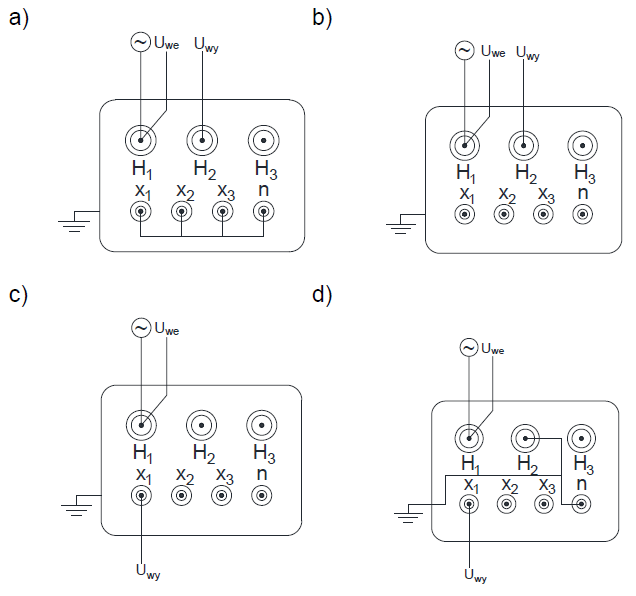
The FRA method uses four basic measuring configurations proposed by standard IEC 60076-18 [3, 4], which are end-to-end open, end-to-end shorted, capacitive interwinding and inductive interwinding. The most common measurements setup is end-to-end open configuration (Fig. 1a). The end-to-end open setup is performed on single phase winding with signal applied to one end and the response measured on the other side, with secondary winding left open [5]. The second test setup – end-to-end shorted (Fig. 1b) – removes the influence of magnetic circuit. This configuration can be used to investigate windings when there is a suspicion of damage in the core or to eliminate the uncertainty associated with the residual magnetization of the core. The end-to-end shorted measurement is performed almost the same as in open setup but in these configuration secondary windings are shorted. Practical experiences show that this test is not able to detect any additional cases of faults that are already detected by end-to-end open setup, so it can be omitted.
The capacitive inter-winding configuration (Fig. 1c) is based on applying the signal to one end of the HV winding and measurement taken on the end of LV winding of the same phase, with other ends of windings left open. Its results show the effect of construction of each winding and their mutual influence. All faults in the active part are related to capacitance changes, that are easily detected in this test setup.
The fourth measurement configuration is inductive interwinding test (Fig. 1d), which is similar to the capacitive interwinding test with the difference that the ends of the tested windings are shorted and grounded. This setup shows inductive correlation between windings, however in case of many deformations windings inductances are not changed and the values changes of local mutual inductances are too small to show detectable differences.
Fig. 1. FRA measurements setups: a) end-to-end open, b) end-to-end shorted, c) interwinding capacitive, d) interwinding inductive
Tests with controlled deformations introduced into windings
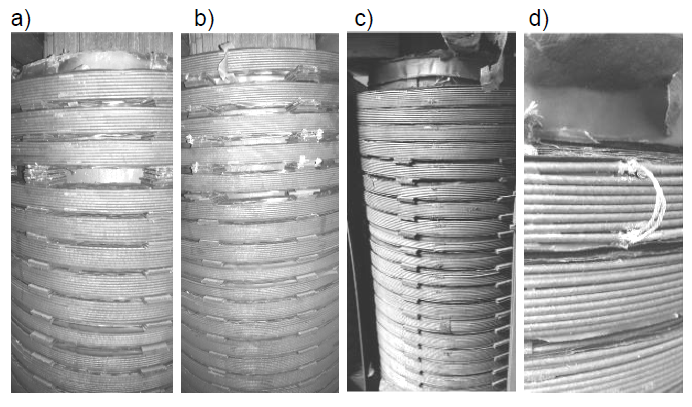
Measurement setups were compared on the basis of research carried out on a real transformer 15/0.4 kV, 800 kVA, in which controlled deformations were introduced into the winding. The first deformation (Fig. 2a) was axial shift of the whole discs by 6 mm and 12 mm starting from the first coil and ending on the fifth. The gap was increased always only between one pair of discs. The second deformation (Fig. 2b) was similar to the previous one, however the gap between discs was introduced in the same way for several discs at the same time. In other words winding was expanded by 6 mm, from first to fourth disc. The third deformation (Fig. 2c) was based on removing the original spacers between discs and lowering them one after another starting from the top to the fifth. The fourth deformation (Fig. 2d) simulated short-circuits between turns. At first there were shorted two adjacent turns in the first coil, then the whole disc was shorted, and finally two adjacent discs.
Fig. 2. Types of introduced deformations: a, b) axial expansion, c) axial lowering, d) short-circuit
To eliminate, as much as possible, the unintended deformations caused by introduction of faults into winding, after each deformation and series of tests, the windings were restored to their original state to make a new reference measurement. The comparison of reference measurements recorded between subsequent deformations showed only slight differences.
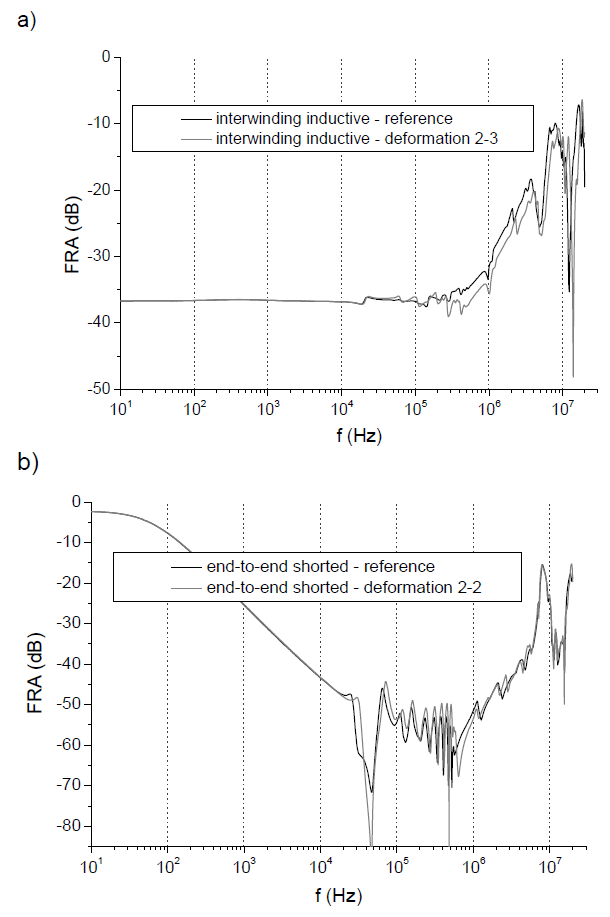
Fig. 3. Comparison of results obtained for selected deformations in setups: a) inductive interwinding, b) end-to-end shorted
Comparison of test setups efficiency
The analysis of results in all four tests showed, that only two of them give useful information on the condition of the winding. The first of them is end-to-end open (E2E), recommended as the standard and the only setup by IEC standard [3, 4]. The second is capacitive interwinding (IntCap), that clearly shows changes done in the winding geometry, usually differently and in wider frequency ranges than end-to-end open. Fig. 3 presents results of two test configuration that do not give significant changes in FRA curves after introducing deformations: end-to-end shorted and interwinding inductive. In the rest of the paper these two will not be discussed anymore. The end-to-end shorted test setup has removed low frequency range, while the rest of frequency spectrum is similar to end-to-end open, while inductive interwinding shows changes much smaller than capacitive test.
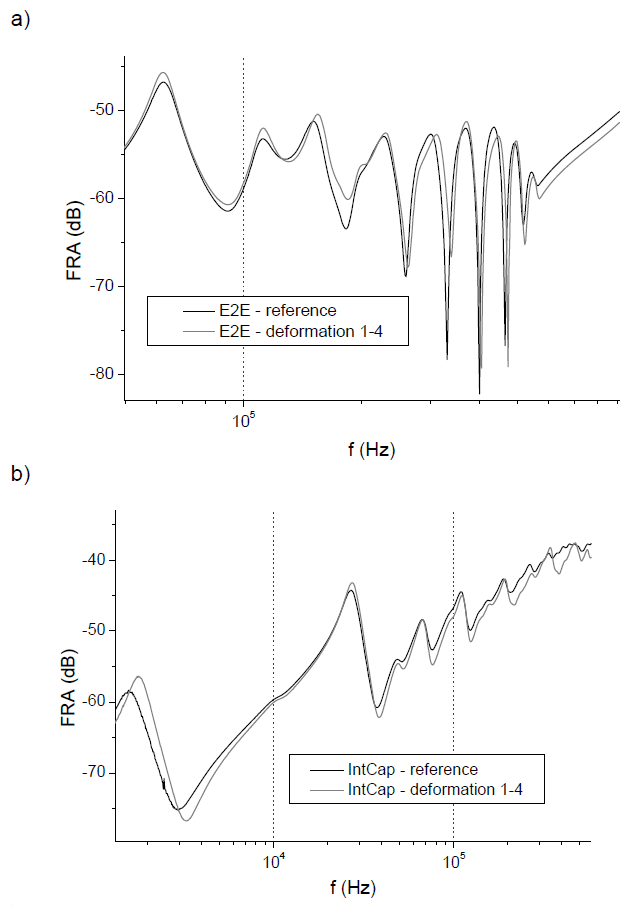
The following graphs present effect of four deformations introduced into windings on FRA curve shape. Only zoomed ranges are given on graphs and chosen results for each deformation to keep presentation clear. The first pair of graphs (Fig. 4) shows the influence of the first deformation (presented on Fig. 2a).
Fig. 4. Effect of deformation 1-4 on FRA curves for: a) E2E, b) IntCap test setups
It can be seen that both test setups give clear results, the influence of shifted discs is obvious and appears in frequency range expected for such size of tested transformer. However, the character of changes is quite different. In the case of E2E results all changes are in narrower frequency range and show mainly damping shifts. For IntCap results changes are visible in wide frequency range and show also frequency shifts of resonances. Especially interesting is capacitive influence of deformation in lower frequencies (below 104 Hz), which is the effect of shorter distance between winding and the core. In this case IntCap test setup is more sensitive to deformation.
The second deformation was also based on extension of winding, but for several discs at the same time (spring like).
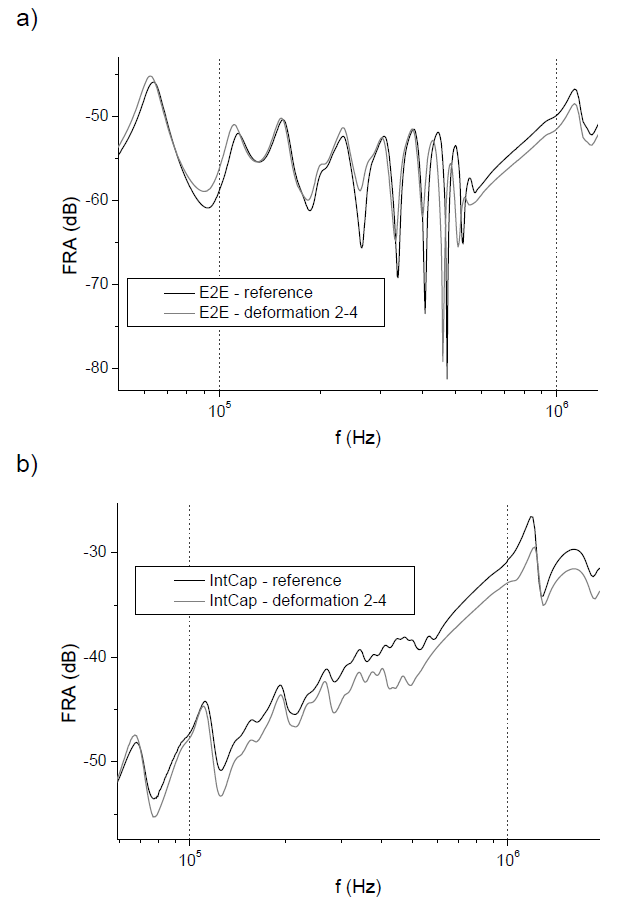
Results are given on Fig. 5.
Fig. 5. Effect of deformation 2-4 on FRA curves for: a) E2E, b) IntCap test setups
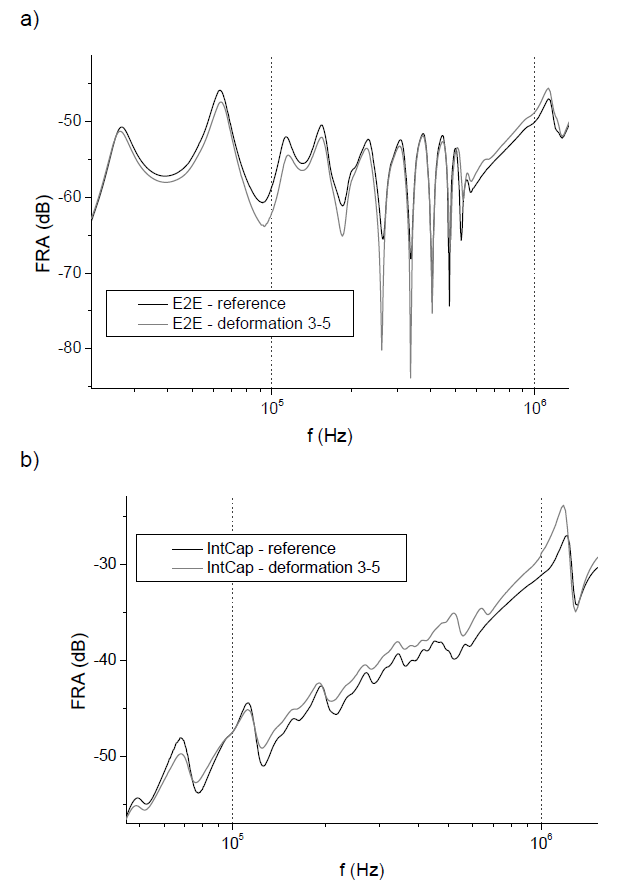
Fig. 6. Effect of deformation 3-5 on FRA curves for: a) E2E, b) IntCap test setups
It can be seen that both test setups give changes in the similar frequency ranges. E2E curve is locally shifted along damping scale, while IntCap has a clear damping change in the whole presented frequency range. The maximum damping shift is similar – approx. 3-5 dB – but it is more visible in the case of IntCap test setup.
The third example of the deformation is given on Fig. 6 and represents lost spacers between discs (winding shrinkage). Similarly to the previous case both test systems give results having comparable changes after shrinking the winding. In E2E measurements there can be observed very large change of resonances damping (10-15 dB), while for IntCap results changes are again visible continuously in the whole presented frequency range.
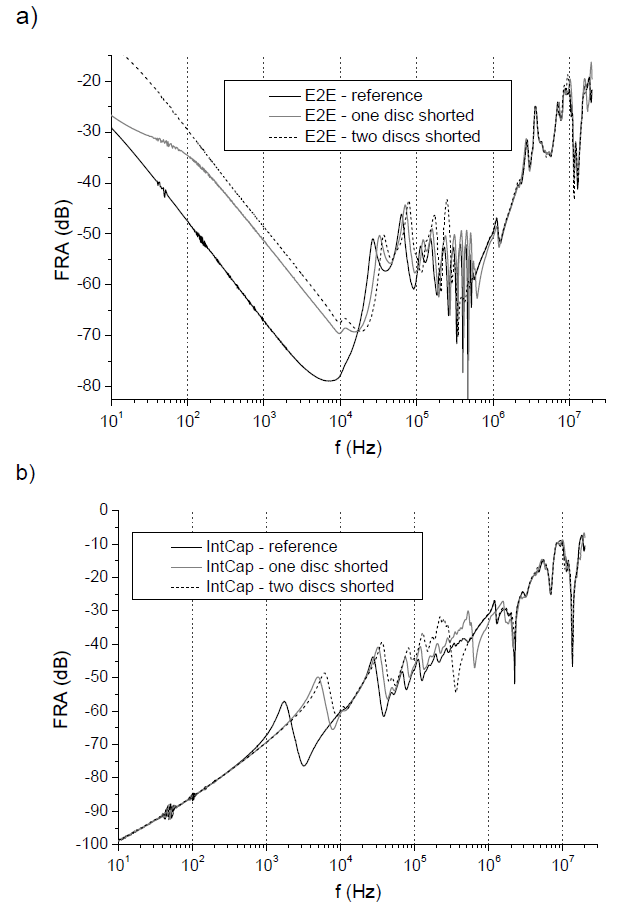
The last fault introduced into tested winding are short-circuits of various scale. The examples of recorded frequency responses are presented on Fig. 7.
Fig. 7. Frequency response in configuration a) end-to-end open, b) capacitive interwinding test at fourth deformation
Shortcircuits in both test setups are easy to detect. The end-to-end open configuration has very good detection properties for short circuits between windings in low frequency range. Conducted tests in the capacitive interwinding test show the shifts resonances related to magnetic circuit (103-104 Hz) in the frequency domain and changes in transfer function along with increasing winding damage. Shortcircuits influence in both cases can be observed over a wide frequency range.
Conclusions
The research has shown the influence of the measuring system on detection and interpretation of introduced windings deformations. The most common configuration is end-to-end open, all introduced deformations are easy to detect and visible over a wide range of frequencies. This configuration is the basis for FRA testing and should be used for each case, it also recommended by IEC standard.
Capacitive interwinding tests show good detection efficiency over a wide frequency range. In presented results it showed even better sensitivity than E2E test setup. Changes in FRA curves are larger and visible in wider frequency range. Measurements carried out in this configuration should be made along with end-to-end open tests.
End-to-end shorted and inductive interwinding test setups have shown poor detection of deformation. The inductive interwinding test setup shows the effect of introduced faults in a very narrow frequency band which makes it difficult to observe and diagnose it. Elimination of the core response in end-to-end shorted setup affects the effectiveness of fault detection and interpretation, the received data on the transformer’s technical condition are incomplete.
In industrial practice there are usually measured two test setups: end-to-end open and end-to-end shorted. It is well knows and was proved in this paper that the second one is of no use. Instead there should be used interwinding capacitive test setup, which gives completely different response, based on capacitive interaction between two windings.
Two suggested test setups: end-to-end open and interwinding capacitive give together a very good dataset for further analysis. Some information on winding geometry can be obtained only from IntCap test setup.
FRA results are still hard to interpret, especially for cases without earlier measurement data. The application of E2E and IntCap test setups in the analysis will improve diagnosis quality. Authors are working on the method of concurrent interpretation of results coming from these two test setups.
REFERENCES
[1] Banaszak S., Ocena stanu mechanicznego części aktywnej transformatorów metodą analizy odpowiedzi częstotliwościowej, Wydawnictwo Uczelniane ZUT w Szczecinie, 2016 [2] Fairouz M., Yousof M., Ekanayake C., Frequency response analysis to investigate deformation of transformer winding, IEEE Transactions of Dielectrics and Electrical Insulation, vol. 22 (2015), no. 4, pp. 2359–2367 [3] IEC 60076-18:2012, Power transformers – Part 18: Measurement of frequency response, International standard. [4] Banaszak S., Analiza odpowiedzi częstotliwościowej uzwojeń transformatorów w świetle zaleceń projektu normy IEC 60076-18, Pomiary Automatyka Kontrola, 57 (2011), nr 4, s. 413-416 [5] IEEE Guide for the Application and Interpretation of Frequency Response Analysis for Oil-Immersed Transformers, IEEE Std C57.149-2012, (2013), pp. 1-72.
Authors: M.Sc. Wojciech Szoka, West Pomeranian University of Technology, Department of Electrotechnology and Diagnostics, al. Piastów 17, 70-310 Szczecin, Poland, e-mail: wojciech.szoka@zut.edu.pl, D.Sc. Szymon Banaszak, West Pomeranian University of Technology, Department of Electrotechnology and Diagnostics, al. Piastów 17, 70-310 Szczecin, Poland, prof. Konstanty M. Gawrylczyk, West Pomeranian University of Technology, Department of Electrotechnology and Diagnostics, al. Piastów 17, 70-310 Szczecin, Poland
Source & Publisher Item Identifier: PRZEGLĄD ELEKTROTECHNICZNY, ISSN 0033-2097, R. 94 NR 7/2018. doi:10.15199/48.2018.07.10
Published by João T. L. S. CAMPOS1,2, Huilman S. SANCA1, Flavio B. COSTA3, Benemar A. de SOUZA1, Universidade Federal de Campina Grande (1), Universidade Potiguar (2), Universidade Federal do Rio Grande do Norte (3)
Abstract. In power systems, the over-current protection scheme and, optionally with directional function, and distance function are the main protection used, principally, where the power flow is on both sides as in distribution system with distributed generation (DG), for example. However, with the increasing of DG penetration in the distribution system, these protections can not be secure and impacts in the coordination of the protection are caused due to the power flow is on both sides. Therefore, new types of protection as distance protection are candidates to solve the coordination problem in the distribution system with DG. In this paper, is proposed an application of the distance protection in the distribution system with DG, and several cases of faults and the impacts on the distance protection are evaluated in presence of DG. In the simulation and analysis of faults were varied the fault inception angle, fault type, fault resistance, and fault location. The correct and bad trips are analyzed to evaluate the distance relay performance. The distance relay used in the distribution system with DG had good performance in all simulation cases. Besides, the better performance of the distance protection proves which may be used in distribution systems with DG.
Streszczenie. W systemach energetycznych zabezpieczenie przed przeciążeniem prądowym (opcjonalnie wraz z funkcją kierunku i odległości) jest główną metoda zabezpieczenia, szczególnie gdy moc może być przekazywana w dwóch kierunkach. W artykule zaproponowano nowy typ zabezpieczenia uwzględniający funkcje odległości. Uwzględniono też możliwość wykrywania błędów i możliwość określania ich położenia. Analiza zabezpieczeń uwzględniających funkcje odległości w rozproszonych systemach wytwarzania energii.
Keywords: Distributed Generation, Distance Protection, Distribution System, Protection Scheme, Faults. Słowa kluczowe: rozproszone systemy energetyczne, zabezpieczenia, wykrywanie błędów
Introduction
Traditionally, the distribution systems are designed to bring the electricity from substations to loads, in a one direction power flow. For this reason, the protection system was designed with the assumption that the distribution system is single source and radial [1]. Fuses and instantaneous overcurrent relays are used for radial systems with one direction flow [2]. These devices are coordinated in a way that ensures correct identification and isolation of the faulted section. [3].
With the increase of the electricity consumption, more power plants and transmission lines are needed. However, the restriction to construct new power plants and transmission lines is high, since these projects have high costs and they have the society opposition. These issues are mitigated with the usage of distributed generation (DG). The DG, which are small generating units installed next to the centers of consumption, has gained strength due to the deregulation of the energy market, distribution system operation benefits, and due to environmental issues [4–6]. New technologies applied to DG increase the diversity of energy sources, reducing dependence on fossil fuels [7].
With the penetration of DG in the distribution system, a new paradigm of protection arises, specially in protection coordination [8–11] due to the power flow being on both sides, turning the distribution system in a meshed power system. The protection used in meshed power systems (transmission lines) is usually the distance and differential protection [12]. Distance protection is the main protection in transmission lines due to several factors such as easy coordination, directionality, and only depends on line impedance [13]. This type of protection is present in several manufacturers relays used in the protection of transmission lines [14–16] and it is a consolidated technology [17].
Despite distance protection being a mature technology used in transmission line protection, several new applications are proposed in literature, such as usage in HVDC lines [18, 19], protection of lines with the presence of flexible AC transmission system (FACTS) with controllers [20], protection of UHV lines [21], protection of high voltage lines in the presence of wind power generator [22].
Regarding distance protection applications in distributed system with DG, in [23], distance protection is applied in an 11 kV power system with minor adaptions, where distance protection proves to be faster and less sensitive to source impedance than the traditional protection, even in the presence of DG. In [24], the distance protection is applied in a distributed system with DG, where distance protection does not have any major problems in the presence of DG. In addition, the advantages of distance protection over the already implanted schemes are shown. The aforementioned papers prove distance protection can be used in distribution systems with DG. However, more studies are needed, because the transient regime of the faults is not taken into account, neither the relay trip speed. These issues affect the distance protection performance and they can prevent their usage.
In this paper, is proposed an analysis and application of the distance protection in a 33 kV distribution system with DG of 30 MVA, where several fault simulations are simulated varying the fault resistance, inception angle, and location. Moreover, since the power system is modeled using an EMTP like program (Simulink), the system dynamic operation, and the effects of the transient regime in the power system are taken into account.
The results show that the distance protection is suitable for distribution systems with DG, and the DG does not influence the performance of the distance relay. The distance relay performance was the same in both cases (with and without DG) proving that distance protection only depends on the line impedance.
Phasor Estimation
Phasor estimation algorithms need to filter all the harmonics, and the DC exponential decay component. They cannot be affected by off-nominal frequencies, and they need a unity gain for the 60 Hz frequency [25].
The requirements for filtering harmonics and unity gain for the 60 Hz frequency are easily achieved by based discrete Fourier algorithms. However, the discrete Fourier algorithm does not filter the DC exponential decay component and it does not overcome the off-nominal frequencies problem, resulting in additional mathematical manipulations of Fourier algorithm.
An example of mathematical manipulations of Fourier algorithm is the modified cosine filter [26]. This algorithm is simple and it is not affected by the DC exponential decay. However, a fixed frequency is assumed.
This problem can be overcome with additional algorithms that estimate frequency.
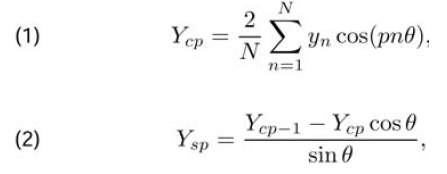
The modified cosine filter estimates the phasor, as follows:
.
where Ycpand Ysp are the Fourier series coefficients, N is the samples per cycle, θ = 2π/N, ynis the sampled signal.
Distance Protection
Distance protection is suitable for distributed systems with DG because it only depends on the measured impedance between the relay and the protection zone. The general torque equation for distance protection is given by [27]:
.
where IR and VR are, respectively, the currents and voltages measured by the relay.
The relay will operate when ℛ(SopS*op)>0, where Sop is the operation torque and Spol is the polarization torque. All the distance characteristics can be designed through the change of the k1,…, k4 variables, as summarized in Table 1.
Table 1. k values for each distance characteristic.
.
The polarization voltage affects the mho dynamic behavior which depends on the system steady-state, and source impedance ratio [28]. The mho can be self, cross, positive sequence polarized, and many more types of polarization in order to operate properly. For three-phase faults or faults nearly the relay, the polarization voltage can be zero. For these situations, memory voltage is needed.
An example of memory polarization is the IIR filter proposed by [29]. For example, the polarization voltage of the relay A phase-ground unit is given by:
.
where Va1 is the positive symmetrical voltage and Va1mem is the memory positive symmetrical voltage.
Similarly to the mho relay, the directional relay uses different polarization to operate. For example, the relay can use the zero and negative current as polarization. The choice of polarization influence in the general performance of the relay. For ground-phase units, the relay can use the zero and negative current as polarization, whereas the directional relay phase units only use the negative current.
Electric Network Modeling
The main characteristics of modeling the electrical system (Fig. 1)and the synchronous machine and control (Fig.2) used as a source of DG are presented in this section. The modeling and implementation of network components were simulated in the Smulink SimPowerSystem Matlab program [30].
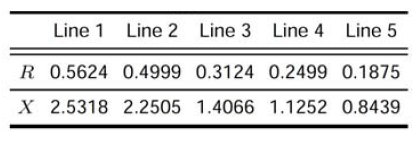
The test power system used presented in Fig. 1 [31] is a 132 kV transmission line Thevenin equivalent connected to a transformer 132/33 kV in delta/wye-ground. The 33 kV distribution system is composed by 5 equivalent RL branches, Table 2. This distribution system is connected to a synchronous generator of 30 MVA, DG, by a transformer 33/6.9 kV in delta/wye-ground.
Fig.1. Electric power system applied.
Table 2. Line data, values in (Ω)
.
The load model dependent of the voltage used in the system [32,33] are represented by:
.
where P is the active power consumed by the load, P0 is the load active nominal power, Q is the reactive power consumed by the load, Q0 is the load reactive nominal power, V is the load nodal voltage, V0 is the load nominal voltage, np is an exponent that indicating the behavior of the load active power in relation to the nodal voltage variation, nq is an exponent that indicating the behavior of the load reactive power in relation to the nodal voltage variation. These values are presented in Table 3.
Table 3. Definition of electrical load types.
.
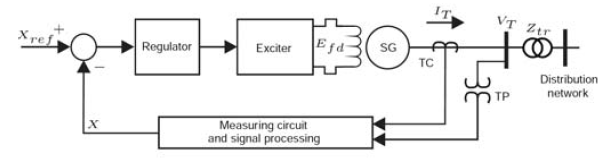
The synchronous generator excitation system connected in the distribution networks is usually made to control the terminal voltage. For synchronous generators connected to the distribution networks, generally, there are two forms of control that may be employed: constant voltage or reactive constant power [34]. A general scheme for the synchronous generator excitation system is depicted in Fig. 2, which consists in circuits of measuring and signals processing, a regulator system and an exciter system, where Efd is the voltage of exciter field.
Fig.2. Control and exciter of synchronous generator scheme
The model used for the synchronous generator excitation system is the IEEE type 1, was based on the model existent in the SimPowerSystem library [30].
Performance Assessment of the Distance Protection in Distribution System with DG
The power system diagrams with and without DG are depicted, respectively, in Fig. 3, and 4. In order to apply faults along the protected line, the line 1 is split in three RL branches, allowing faults with in 33% of the line length . Several faults in different locations of the power system, varying the ground resistance (Rg), phase resistance (Rab, Rbc, and Rac), and fault inception angle were simulated according to Table 4.
Fig.3. Power system with DG.
Fig.4. Power system without DG.
Table 4. Simulated Faults.
.
The fault simulations were simulated in various locations namely, in each bus of the system, and between each RL branch of the Line 1. The relay protection zone is defined to be between bus 2 and bus 3. In the protection zone, a total of 64 faults were simulated with and without DG according to Table 4. In outside of protection zone, a total of 48 faults were simulated without DG and a total of 64 faults were simulated with DG according to Table 4.
Fault Analysis
Several faults applied in the power system are analyzed according to the tripping time, and relay efficiency, comparing the results with and without DG in the system. Also, the distance protection capabilities of coordination are discussed.
The Fig. 5(a) and 5(b) depict an AG fault with and without DG simulated between L1−1 and L1−2 branch’s with a 0.0001 Ω impedance inside the protection zone. When the DG is presented, the trajectory impedance converges to a lower impedance value. This behavior can lead to a misoperation of distance protection, since the estimated impedance is near the operation distance characteristic.
Fig.5. Fault simulated between L1−1and L1−2branch’s’ with a 0.0001 Ω impedance inside the protection zone without DG.
Fig. 6(a) and 6(b) depict an AG fault with and without DG simulated in bus 4 with a 0.0001 Ω impedance located outside the protection zone. When the DG is presented, the trajectory impedance is influenced.
In Table 5, the mho and quadrilateral distance protection trips performed outside protection zone of the power system without DG are summarized. Only for ABC faults the distance protection relay has maloperations. These maloperations occurred in the equivalent power system bus 1.
Table 5. Mho and quadrilateral results outside protection zone without DG.
.
Fig.6. AG fault without DG simulated in bus 4 with a 0.0001 Ω impedance located outside the protection zone.
Table 6. Mho and quadrilateral results outside protection zone without DG.
.
In Table 6, the mho and quadrilateral distance protection trips performed outside protection zone of the power system with DG are summarized. Only for ABC faults, the distance protection relay has maloperations. These maloperations occurred in the equivalent power system bus 1. However, com- paring the Tables 5 and 6, the distance protection achieves the same results.
In Table 7, the mho and quadrilateral distance protection trips performed in the protection zone of the power system without DG are summarized. For AG faults, the mho and quadrilateral distance relay have tripped for all simulated situations. However, for the other fault types the mho and quadrilateral distance relays do not trip for the branch 2-4, but this is not a major problem because it is assured the coordination.
Table 7. Mho and quadrilateral results in protection zone without DG.
.
In Table 8, the mho and quadrilateral distance protection trips performed in the protection zone of the power system with DG are summarized. For AG faults, the mho and quadrilateral distance relay have tripped for all simulated situations. However, for the other fault types the mho and quadrilateral distance relay do not trip for the branch 2-4. Comparing the results between Tables 7 and 8, the mho and quadrilateral distance relay are not affected by the DG. In addition, the trip times are different with and without DG. In the presence of DG, the trip time is faster due to the measured impedance in the distribution system is lower. In conclusion, distance relays are good candidates to protect systems with DG penetration.
Table 8. Mho and quadrilateral results in protection zone with DG.
.
Conclusion
In this paper, distance protection applied in a distributed system with and without DG was presented. The distance mho and quadrilateral characteristics were used. The mho relay is composed with reactance and directional characteristics, and fault type supervision. Also, the quadrilateral re- lay is composed with two lateral blinders, reactance and directional characteristics, and fault type supervision. Several faults were simulated in the power systems varying the fault inception angle, location, fault type and fault resistance.
The distance protection presented good results and actuates properly for almost all the simulated faults. The distance protection performance was almost identical in the power system with and without DG in the simulated faults, demonstrating that can be a suitable solution to replace the overcurrent relays in distributed systems. However, the DG inclusion in the power system provoked, in faults situation, an impedance trajectory closest to the relay trip zone. In conclusion, the usage of distance protection can be a solution to solve the problems introduced by distributed generation.
REFERENCES
[1] S. M. Brahma, “Fault location in power distribution system with penetration of distributed generation,” IEEE Transactions on Power Delivery, vol. 26, no. 3, pp. 1545–1553, Jul. 2011. [2] R. Chabanloo, H. Abyaneh, A. Agheli, and H. Rastegar, “Overcurrent relays coordination considering transient behaviour of fault current limiter and distributed generation in distribution power network,” IET Generation Transmission and Distribution, vol. 5, no. 9, pp. 903–911, Nov. 2011. [3] P. Anderson, Power System Protection, ser. IEEE Press Power Engineering Series. McGraw-Hill, 1999. [Online]. Available: http://books.google.com.br/books?id=eP9qQgAACAAJ [4] F. C. L. Trindade, K. V. do Nascimento, and J. C. M. Vieira, “Investigation on voltage sags caused by dg anti-islanding protection,” IEEE Transactions on Power Delivery, vol. 28, no. 2, pp. 972–980, Apr. 2013. [5] J. Gomez, J. Vaschetti, C. Coyos, and C. Ibarlucea, “Distributed generation: impact on protections and power quality,” IEEE (Revista IEEE America Latina) Latin America Transactions, vol. 11, no. 1, pp. 460–465, Feb. 2013. [6] P. D. Lezhniuk, I. O. Hunko, S. V. Kravchuk, P. Komada, K. Gromaszek, A. Mussabekova, N. Askarova, and A. Arman, “The influence of distributed power sources on active power loss in the microgrid,” Przeglad Elektrotechniczny, vol. 93, no. 03, pp. 107–112, March 2017. [7] J. Gomez and M. Morcos, “Coordination of voltage sag and overcurrent protection in dg systems,” IEEE Transactions on Power Delivery, vol. 20, no. 1, pp. 214–218, Jan. 2005. [8] F. Viawan and M. Reza, “The impact of synchronous distributed generation on voltage dip and overcurrent protection coordination,” in Future Power Systems, 2005 International Conference on, Nov 2005, pp. 6 pp.–6. [9] S. Brahma, “Fault location in power distribution system with penetration of distributed generation,” Power Delivery, IEEE Transactions on, vol. 26, no. 3, pp. 1545–1553, July 2011. [10] J. Silva, H. Funmilayo, and K. Butler-Purry, “Impact of distributed generation on the ieee 34 node radial test feeder with overcurrent protection,” in Power Symposium, 2007. NAPS ’07. 39th North American, Sept 2007, pp. 49–57. [11] R. Chabanloo, H. Abyaneh, A. Agheli, and H. Rastegar, “Overcurrent relays coordination considering transient behaviour of fault current limiter and distributed generation in distribution power network,” Generation, Transmission Distribution, IET, vol.5, no. 9, pp. 903–911, September 2011. [12] W. Elmore, Protective Relaying: Theory and Applications, ser. No Series. Marcel Dekker, 2004. [Online]. Available: http://books.google.com.br/books?id=1Jqhpd-rhoUC [13] G. Ziegler, Numerical distance protection : principles and application / Gerhard Ziegler ; [editor, Siemens AG]. Munich : Publicis MCD, 1999, includes bibliographical references (p. 306-311) and index. [14] REL300 Relay System, V2.71 ed., ABB Power T& D Company Inc., 4 1996. [15] D30 Line Distance Protection System Instruction Manual, GE Energy, 4 2012. [16] SIPROTEC Distance Protection 7SA522, Siemens AG, 2 2011. [17] C. Mason, The art and science of protective relaying, ser. General Electric series. Wiley, 1956. [Online]. Available: http://books.google.com.br/books?id=jedSAAAAMAAJ [18] J. Suonan, J. Zhang, Z. Jiao, L. Yang, and G. Song, “Distance protection for hvdc transmission lines considering frequency dependent parameters,” Power Delivery, IEEE Transactions on, vol. 28, no. 2, pp. 723–732, April 2013. [19] L. He, C.-C. Liu, A. Pitto, and D. Cirio, “Distance protection of ac grid with hvdc-connected offshore wind generators,” Power Delivery, IEEE Transactions on, vol. 29, no. 2, pp. 493–501, April 2014. [20] F. Albasri, T. Sidhu, and R. Varma, “Performance comparison of distance protection schemes for shunt-facts compensated transmission lines,” Power Delivery, IEEE Transactions on, vol. 22, no. 4, pp. 2116–2125, Oct 2007. [21] Z. Xu, S. Huang, L. Ran, J. Liu, Y. Qin, Q. Yang, and J. He, “A distance protection relay for a 1000-kv uhv transmission line,” Power Delivery, IEEE Transactions on, vol. 23, no. 4, pp. 1795–1804, Oct 2008. [22] A. Hooshyar, M. Azzouz, and E. El-Saadany, “Distance protection of lines connected to induction generator-based wind farms during balanced faults,” Sustainable Energy, IEEE Transactions on, vol. 5, no. 4, pp. 1193–1203, Oct 2014. [23] I. Chilvers, N. Jenkins, and C. P, “Distance relaying of 11 kv circuits to increase the installed capacity of distributed generation,” Generation, Transmission and Distribution, IEE Proceedings-, vol. 152, no. 1, pp. 40–46, Jan 2005. [24] A. Sinclair, D. Finney, D. Martin, and P. Sharma, “Distance protection in distribution systems: How it assists with integrating distributed resources,” in Rural Electric Power Conference (REPC), 2013 IEEE, April 2013, pp. B3–1–B3–12. [25] E. O. S. III and J. Roberts, ÂS¸ Distance Relay Element Design, ÂTˇ proceedings of the 47th Annual Texas A&M Conference for Protective Relay Engineers, College Station, TX, Apr. 1993. [Online]. Available: http://www.selinc.com/techpprs.htm [26] D. G. Hart, D. Novosel, and R. A. Smith, “Modified cosine filters,” November 2000. [Online]. Available: http://www.freepatentsonline.com/6154687.html [27] B. Kasztenny and D. Finney, “Fundamentals of distance protection,” in Protective Relay Engineers, 2008 61st Annual Conference for, april 2008, pp. 1 –34. [28] J. Roberts, A. Guzman, and E. O. Schweitzer, Z=V/I Does Not Make a Distance Relay. 20th Annual Western Protective Relay Conference, Spokane, WA, Oct. 1993. [29] E. O. Schweitzer III, Distance relay using a polarizing voltage, August 1992, no. 5140492. [Online]. Available: http://www.freepatentsonline.com/5140492.html [30] Hydro-Québec, SimPowerSystemT M , User’s Guide (Second Generation. MathWorks disponível em: http://www.mathworks.com, 2013. [31] D. Salles, W. Freitas, J. C. M. Vieira, and W. Xu, “Nondetection index of anti-islanding passive protection of synchronous distributed generators,” IEEE Transaction on Power Delivery, vol. 27, no. 3, pp. 1509 –1518, Jul. 2012. [32] P. Kundur, Power System Stability and Control, 1st ed. McGraw-Hill Inc, 1994. [33] IEEE-Standard, “Institute of electrial and electronics engineers standard: Ieee recommended practice for excitation system models for power system stability studies,” Standar Board, 2005. [34] N. Jenkins, R. Allan, P. Crossley, D. Kirschen, and G. Strbac, Embedded Generation, first edition ed. London: IEEE. (IET Power and Energy Series 31), 2000.
Authors: João Tiago Laureiro Souza Campos, Po- tiguar University (UnP), Department of Electrical Engineer- ing, Lagoa Nova, 59.056-000, Natal – RN – Brazil, email: j.campos893@gmail.com. Huilman Sanca Sanca, Federal University of Campina Grande (UFCG), Department of Electrical Engineering, Bodocongó, 58.429-900, Campina Grande – PB – Brazil, email: huilman.sanca@gmail.com. Flávio Bezerra Costa, Federal University of Rio Grande do Norte (UFRN), School of Science and Technology, Lagoa Nova, 59.078-970, Natal – RN – Brazil., email: flaviocosta@ect.ufrn.br. Benemar Alencar de Souza, Federal University of Camp- ina Grande (UFCG), Department of Electrical Engineering, Electrical Engineering and Informatics Centre, Bodocongó, 58.429-900, Campina Grande – PB – Brazil, email: benemar@dee.ufcg.edu.br.
Source & Publisher Item Identifier: PRZEGLĄD ELEKTROTECHNICZNY, ISSN 0033-2097, R. 94 NR 3/2018. doi:10.15199/48.2018.03.03
Published by Waldemar ZIOMEK, PTI Manitoba Inc., Winnipeg, MB, Canada
Abstract. When the primary and secondary voltages are obtained from the same winding, or from two windings which are galvanically connected, such a transformer is called an autotransformer. The paper will focus on fundamentals, design and applications of autotransformers of core-type design. The selected problems of insulating system will be discussed (e.g. end fed vs center fed HV lead bring out, stresses in the end insulation). Examples of the lightning impulse voltage distributions for different winding arrangements will be shown. Operational overvoltages will be also discussed.
Streszczenie. Transformator, w którym napięcie pierwotne i wtórne są pobierane z jednego uzwojenia lub z dwóch uzwojeń galwanicznie połączonych ze sobą, jest nazwany autotransformatorem. Artykuł omawia podstawy, konstrukcje i zastosowanie autotransformatorów o budowie rdzeniowej. Omówione zostaną wybrane zagadnienia układu izolacyjnego (np. porównanie różnych sposobów wyprowadzeń przewodu liniowego WN, naprężenia w izolacji końców uzwojeń). Przykładowe rozkłady napieć udarowych będą także omówione. Tytuł: Autotransformatory międzysystemowe
Keywords: power transformer, autotransformer, transient voltages, high voltage insulation Słowa kluczowe: transformator mocy, autotransformator, przepięcia, izolacja wysokonapięciowa
Introduction
The autotransformers were implemented in power systems more than 100 years ago and numerous works were dedicated to their theory and operation [1, 2, 3]. This paper is an attempt to give a very general overview of the autotransformers, comparing their features to two-winding transformers and discussing selected aspects of their design and operation.
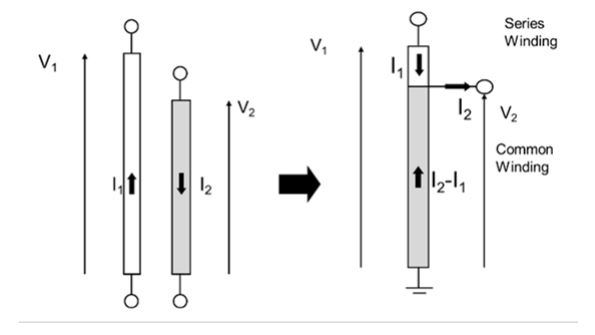
When the primary and secondary voltages are obtained from the same winding, or from two windings which are galvanically connected, such a transformer is called an autotransformer (see Fig.1). Another way of defining an autotransformer is that the primary and secondary circuits of a transformer have a winding or its part in common.
Fig.1. A two-winding transformer vs. an autotransformer
The winding which is shared by both primary and secondary sides is called a common winding (CV), with one terminal connected to secondary voltage, V2, and second terminal in neutral, while the winding connected between the primary voltage, V1, and the secondary voltage, V2, is called a series winding (SV). In reality these two windings are separated and wound concentrically over each other to increase the withstand to short circuit forces. The voltage across the series winding is equal to a difference of primary and secondary voltages, V2-V1, while the current through the common winding is equal to a difference of secondary and primary currents, I2-I1.
In a two-circuit transformer the power rating S (kVA or MVA output), being a product of voltage and current of primary or secondary winding as follows:
.
In the autotransformer one may distinguish two types of power rating: (i) rated power, i.e. nameplate power or MVA output and (ii) the equivalent power. The equivalent power, SEQ, sometimes called a built power, or transformed power, equal to a product of the voltage and current of the series or common winding, is given as:
.
The ratio, r, of the equivalent power to the rated power of an autotransformer is then equal to:
.
In a two-winding transformer all power S is transformed from the primary to the secondary side, in an autotransformer only a fraction of the total power is transformed (i.e. SEQ), the rest of power is flowing directly from the primary lines to the secondary lines without transformation. Generally, the percentage of power transformation is the same as the percentage voltage transformation. It means that if the autotransformer boosts the voltage by 10%, it actually transforms only 10% of the power output, supplied to the load. And, since the size of a unit is proportional to the power that it transforms, the equivalent transformer rating of the autotransformer will be only 10% of the power rating.
In general – due to relationships shown above – autotransformers are superior to two-winding transformers in following aspects:
All these effects are most pronounced with primary and secondary voltages being close to each other and are lesser for higher transformer voltage ratios.
However, there are some aspects which require special attention such as: (i) a common winding is also connected to high voltage line (typically with BIL equal or greater than 550 kV) therefore a complex end insulation system is required (i.e. with stress rings, moulded caps and collars, moulded lead insulation), (ii) a low leakage impedance results in very high short circuit forces and stresses.
Applications of autotransformers in the power transmission system
Most typically the autotransformer is used as a system tie unit, connecting pairs of different high voltage transmission systems, e.g. 500kV and 345kV, 500kV and 230kV etc.
Depending on the systems’ requirements, the following functional options may be employed:
Voltage variation: the units without on-load voltage variation (equipped only with de-energized tap changers, DTC), or the units with on-load tap changers (LTC’s);
Number of circuits: two-circuit (HV and LV) or three-circuits (HV, LV and TV) where the tertiary winding may be used as stabilizing winding, station service source, reactive power compensation connection, etc.
Single-phase or three phase: if the physical size of the unit – especially for transportation – allows for it, the three-phase units are most economical, while for highest system voltages – typically 500 kV and 765 kV – and high power ratings the design of three-phase units is not practical, the bank of single-phase units are used; single-phase units are also better option, if rapid replacement of the failed unit is critical, as storing and replacement of single-phase units is easier and less expensive than that of three-phase units.
Voltage variation schemes and winding arrangements
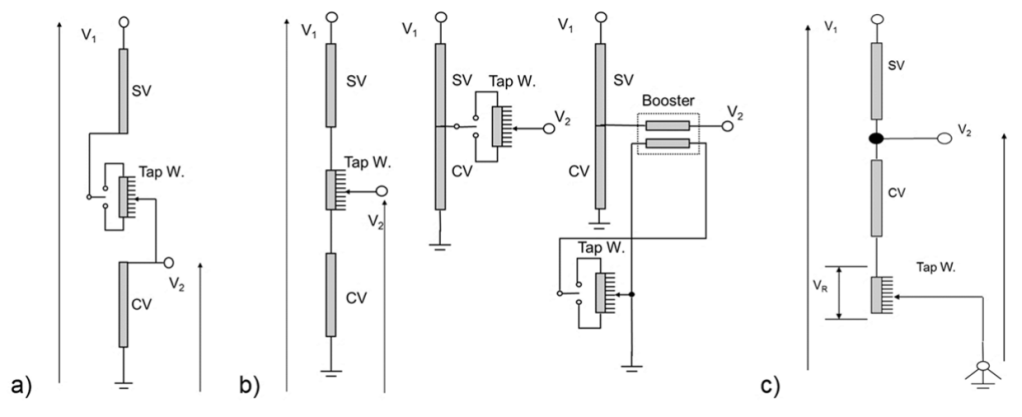
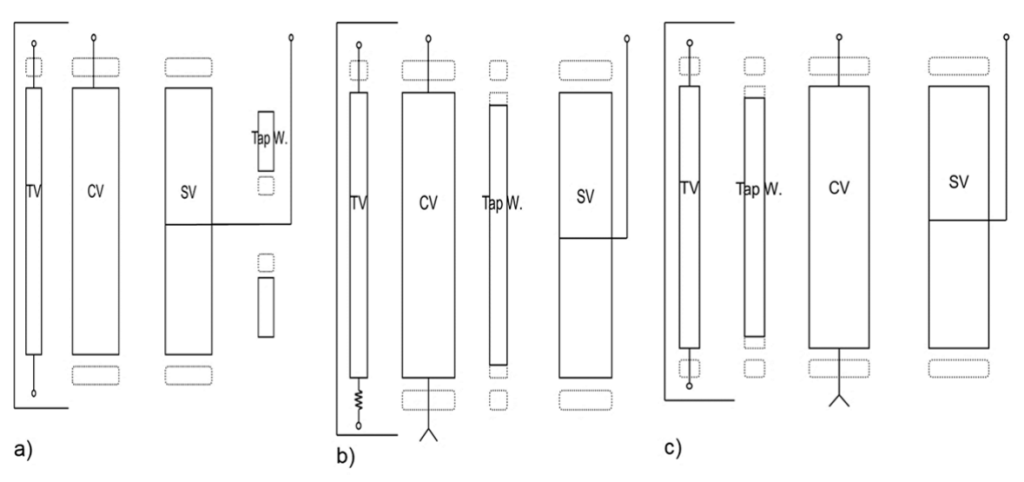
For the autotransformers with on-load tap changers the following voltage variation schemes are used (see Fig.2):
• voltage variation in HV circuit (Fig.2a), • voltage variation in LV circuit: potentiometer style, forked auto or indirect variation with a booster (Fig.2b), • voltage variation in neutral (Fig.2c).
These voltage variation schemes are realized with different winding arrangements shown in Fig.3. Depending on the performance characteristics – impedance swing, the test and operation voltages, number of circuits and impedance between them – a number of winding arrangements is available to achieve optimal performance. In Figure 3 selected three-circuit layouts are presented. These layouts would be similar for two-circuit units, just without a TV winding.
Placement of LTC winding will have influence on the magnetic field distribution, the impedance between circuit, impedance swing, and transient voltage distribution.
A good discussion on tap windings in autotransformers is given in [4]. Here are a few key points from this work related to DTC and LTC taps and their impact on the core flux density and output voltage, as an autotransformer’s output voltage changes, depending on the input voltage fluctuations and/or on the changes in regulation (voltage drop) due to the load variations. The function of the LTC taps is to keep the output voltage constant at all times by compensating for these fluctuations. It is a normal practice to specify LTC taps either on HV side (in series winding) or on LV side (in common winding or in LV line).
1. DTC taps
DTC taps are generally located in the HV (series winding). The DTC tap position is set prior to energizing the autotransformer. During operation of the autotransformer, the DTC taps will neither compensate for fluctuations of the HV system voltage nor will they compensate for regulation due to load fluctuations. This is the main reason to extend the LTC tap range and not to specify the DTC taps.
2. LTC taps in series winding
(a) Step-down operation
When LTC is varied to compensate for input voltage fluctuations then the taps will act as constant flux taps. When LTC is varied to compensate for regulation due to fluctuations in load then the taps will act as variable flux taps.
(b) Step-up operation
When LTC is varied to compensate for regulation due to fluctuations in load then the taps will act as constant flux taps. When LTC is varied to compensate for fluctuations in input voltage then the taps will act as variable flux taps.
3. LTC in common winding (neutral)
Either for step-down operation or for step-up operation and also either to compensate for input voltage fluctuations or to compensate for regulation due to fluctuations in load, the taps will act as variable flux taps.
Fig.2. Voltage variation schemes with LTC placed in: a) HV circuit, b) LV circuit, c) neutral
Fig.3. Typical winding arrangements with different location of tap winding: a) LTC in HV, b) LTC in LV, c) LTC in neutral
Fig.4. Magnetic field distribution between main windings of a two-winding unit and an autotransformer; due to lower current in LV winding the resulting amp-turns, stray flux is lower than in a two-winding unit by factor r and reactance, after scaling to voltage V1 is lower by factor r2
4. LTC in LV line
(a) Step-down operation
When LTC is varied to compensate for regulation due to fluctuations in load then the taps will act as constant flux taps. When LTC is varied to compensate for fluctuations in input voltage then the taps will act as variable flux taps.
(b) step-down operation
When LTC is varied to compensate for regulation due to fluctuations in load then the taps will act as constant flux taps. When LTC is varied to compensate for fluctuations in input voltage then the taps will act as variable flux taps. When the variable flux is occurring, the transformer core may be driven close or into the saturation and the magnetizing current and corresponding reactive power will increase significantly.
Magnetic field distributions and impedance swing
The basic magnetic field distribution in a two-winding transformer compared to that of an autotransformer is shown in Figure 4.
Depending on location of the tap winding – in LV or HV circuit – and the power flow, i.e. step-up or step-down operation, the distributions of stray flux will be different. For LTC placed in HV circuit, the highest stray flux is generated for all LTC taps in circuit (full raise), while for LTC in LV circuit the stray flux is the highest at lowest tap position (full buck)
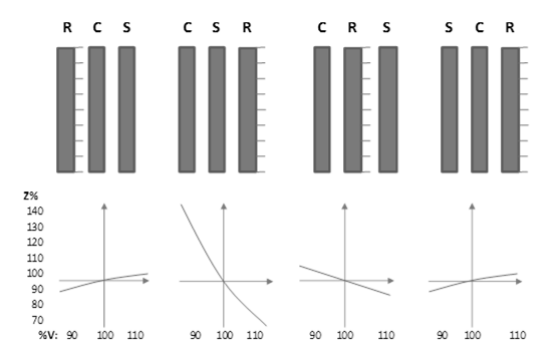
Fig.5. Impedance slope for LTC in neutral and HV variation
The stray flux distribution diagrams can be prepared for all possible winding arrangements. In engineering practice this is routinely done for every design using computer programs calculating the exact field distribution using analytical methods (e.g. Rabin’s procedure to solve Bessel’s equations) or numerical field solvers (e.g. FEM).
Position of the LTC winding in the circuit and in the geometry of an autotransformer will lead to different impedance values at different tap positions. As example some possible impedance swings, i.e. dependence of impedance on the voltage are shown in Figure 5.
High voltage problems
As the autotransformers are typically connected to two high voltage networks, both HV and LV terminals of the unit will experience high values of operational and transient voltages. The stresses developing inside the autotransformer depend on many factors, such as terminal voltages, the winding geometry, the HV lead connection, grounding of the unit and a system, etc.
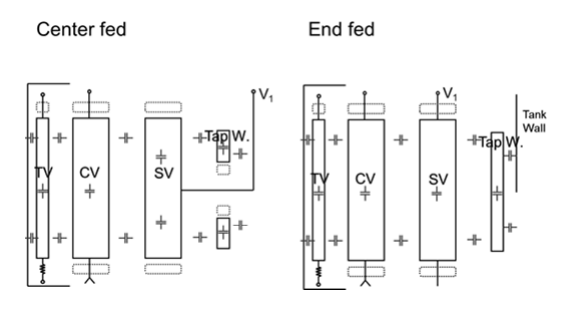
Schematically, the designer is analyzing the autotransformer winding through the system on internal capacitances and inductances (see Fig. 6 for examples of the capacitance systems).
Fig.6. The examples of capacitances within and between windings for center fed and end fed designs
Comparing the way of routing the HV line lead, i.e. the end fed design and the center fed design (Fig.6) one may state that a center fed design reduces significantly the stresses in the winding end insulation. Also, the highest stress will occur in the center of the height between SV and CV windings, in concentric insulation system, which is favourable when compared to that in the end insulation.
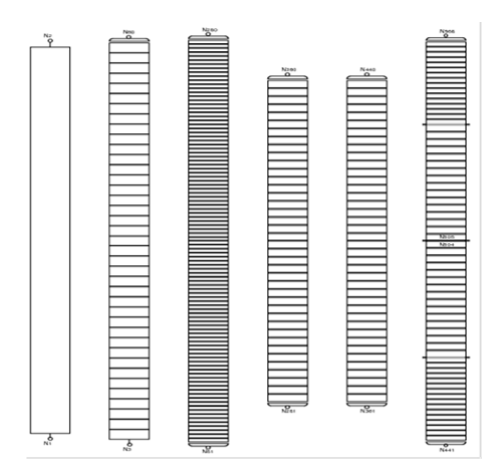
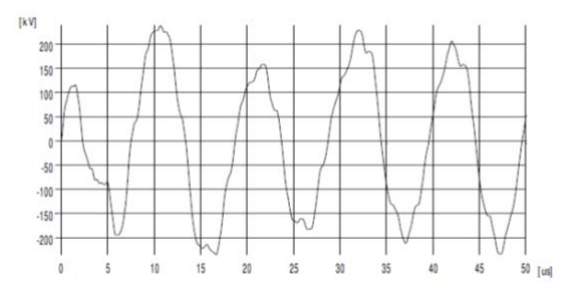
In order to study the development of transient stresses inside the autotransformer in details, the complex LCR network needs to be analyzed – this is typically done by using a specialized transient voltage program, e.g. [7, 8, 9]. Firstly, the winding geometry needs to be converted into the system of nodes with LCR components placed between the nodes, corresponding to series capacitances within windings and the parallel capacitances between windings and between windings and grounded parts (tank, core) – see Figure 7. Such a system of nodes is then connected to the voltage or current source, with remaining terminals connected to each other, grounded or floating, depending on the actual connections. With this model the time dependent oscillatory voltages may be calculated for any pair of nodes. As example, see Figure 8 the voltage developing between the TV winding and the core shield while the LI FW voltage of 900 kV is applied to LV terminal.
The industry accepted withstand curves – so called Weidmann curves – are based on the ac applied voltage withstand. The transient voltage needs to be converted then to an equivalent ac voltage. This is well known problem, solved in many ways, e.g. by using corresponding BIL levels based on laboratory research, e.g. [10], or through numerical integration of the waveshapes. After converting the transient voltages to the equivalent ac voltages, the field stress analysis is performed using a harmonic field solver (using FEM, BEM, or similar method), e.g. [11]. In the electric field the designer needs to identify critical stresses as follows:
(i) highest point stress at insulated or noninsulated electrode,
(ii) highest strike in oil gap along selected critical lines, i.e. magnitude of the field intensity as a function of a gap length, Em(x),
(iii) highest creep stresses, i.e. tangential component of the field, Et(x). Next, these stresses are compared to the design limits: the maximum value for the point stress and next, the Em and Et stress curves after averaging procedure are compared to the Weidmann strike and creep criteria curves [11, 12]. As the autotransformers have a complex geometry of windings when compared to that of the power transformer or a GSU, this analysis needs to be repeated for all terminal excitations at all tap combinations.
Transient voltage control
The excessive transient voltages entering the autotransformers need to be controlled to prevent the failure of winding, tap changer or internal/external transformer insulation.
Fig.7. Model with nodes between RLC elements are placed for transformer analysis of 500 kV class autotransformer; Layout of windings: Core shield –TV-CV- two-layer LTC-SV;
The winding stresses are controlled by using different winding types with different methods of controlling the series capacitance, e.g. interleaved, counter-shielded or with electrostatic shields. The electrostatic shields may be grounded (if placed at the core, or TV winding) or connected to the LV line.
Very effective in reducing transient overvoltages are internal varistors (ZnO disks) – these devices are active only during LI-type transients (i.e. they do not operate during switching surges) as they reduce the transient voltage to low level, protecting LTC or tap winding.
Fig.8. The transferred surge between TV and core shield while impulsing LV with 900 kV LI
Operational overvoltages in autotransformers
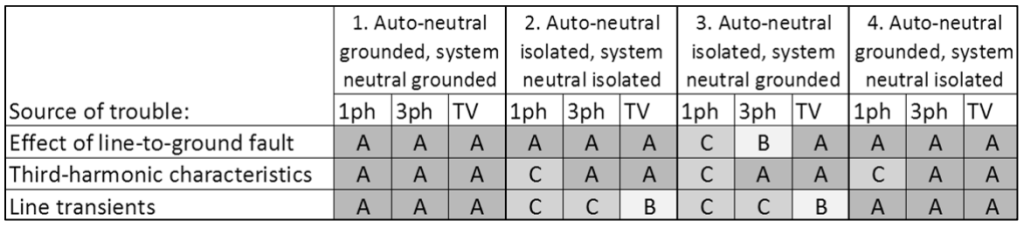
Numerous dangerous overvoltages may appear in the autotransformers, primarily caused by: (i) single line-tog-round (SLG) faults, (ii) specific characteristics of third-harmonic type problems, and (iii) system transients [3]. The overall effect of these causes is heavily dependent on the transformer and system grounding methods, if any. Here, four combinations of the transformer and system’s neutrals grounded and/or isolated are briefly discussed and summarized in Table I.
In case of autotransformers, the system transients (lightning strokes, switching transients or rapid SLG faults) impinging on the HV terminals will concentrate mostly within the SV winding and through inductive and capacitive coupling transfer to CV winding, inducing high potentials in this winding. If the transformer neutral is not grounded these overvoltages in CV winding will occur as the voltage between the transformer neutral and the ground, often exceeding the rating of the neutral, called transient inversion.
Table 1. Classification of operational overvoltages in autotransformers
.
Notes and explanations: A – satisfactory conditions B – moderately safe conditions C – dangerous conditions 1ph – single-phase autotransformer 3ph – three-phase autotransformer with three-legged core TV – autotransformer with delta-connected tertiary winding (more details in [3])
1. Transformer neutral grounded, system neutral grounded
This is the optimal condition for a transformer operation, safe under low-frequency transients even for the single-phase units. SLG fault on the primary side will short-circuit the generator and cause the collapse of the voltage at the transformer, but no short circuit current will flow through the transformer. Third-harmonic voltages are reduced to negligible values, because third-harmonic currents can flow through lines and generators and return through the ground.
2. Transformer neutral isolated, system neutral isolated
This is typically a satisfactory condition for SLG faults, however the transient inversion may develop in the neutral. Single-phase units should be equipped with a TV winding and three-phase units may be protected with the surge arrestors (between the neutral and ground) against transient inversion.
3. Transformer neutral isolated, system neutral grounded
Transient inversion is highly probable, similarly as in case 2 above and needs to be taken into account. The SLG fault on one of HV lines will elevate the voltage to ground on the LV windings of unfaulted lines due to trip of zero potential from isolated neutral to grounded HV line.
4. Transformer neutral grounded, system neutral isolated
The single-phase units without TV windings a susceptible to third-harmonic phenomena and should be avoided. Three-phase core-type units and single-phase units with TV winding can operate safely in this condition. For all autotransformers without TV winding (except three-phase, three-legged units), high third-harmonic voltages may be induced by a resonance between the third-harmonic magnetizing reactance of a transformer and a capacitance of transmission line. Therefore, a delta-connected TV winding is necessary to circulate the required third-harmonic magnetizing current and prevent the resonance.
REFERENCES
[1] Mini, J. et al “Performance of Auto Transformers with Tertiaries Under Short-Circuit Conditions”, AIEE Trans., 1923 [2] Farry, O.T. “Autotransformers for Power Systems”, AIEE Trans., 1954 [3] Blume, L.F. et al, “Transformer Engineering – A treatise on the theory, operation, and Application of Transformers”, John Wiley & Sons, Inc, New York, 1951 [4] Kalicki, T. and Sankar, V. “Taps in autotransformers” – presentation given during IEEE Transformers Committee meeting in Toronto, Canada, Oct. 25, 2010 available on Transformers Committee website: http://www.transformerscommittee.org/ [5] Alexander, G.W., McNutt, W.J. “EHV Application of Autotransformers”, IEEE Trans.on PAS, 1967 [6] Wilson, W. “Phase-Phase Switching Surges on 500-kV Transformer-Terminated Lines, Part II: Switching from LowVoltage Terminals”, IEEE Trans. PAS , 1970 [7] Degeneff, R.C. “A General Method For Determining Resonances In Transformer Windings”, IEEE Trans. PAS, 1977 [8] Seitlinger, W.P. et al “ Investigations of an EHV autotransformer tested with open and arrester terminated terminals”, IEEE Trans. Power Delivery, Vol. 11, No. 1, January 1996 [9] “Electrical Transient Interaction between Transformers and the Power System”, Cigre Technical Brochure 577, 2014 [10] Okabe, S., Takami, J. “Evaluation of Breakdown Characteristics of Oil-immersed Transformers under Nonstandard Lightning Impulse Waveforms – Method for Converting Non-standard Lightning Impulse Waveforms into Standard Lightning Impulse Waveforms”, IEEE Trans. DEI, 2008 [11] Ziomek, W., Vijayan, K., Boyd, D., Kuby, K., Franchek, M., “High Voltage Power Transformer Insulation Design”, IEEE Electrical Insulation Conference Record, Annapolis, MD, USA, 2011 [12] Ziomek, W “Autotransformers”, Doble Life of a Transformer seminar, 2015
Published by Paweł SZMITKOWSKI1, Sylwia ZAKRZEWSKA1, Agnieszka GIL2, Paweł ŚWIDERSKI1 Siedlce University, Social Science and Security Institute (1), Siedlce University, Institute of Mathematics and Physics (2)
Abstract. The Polish energy infrastructure is very diverse, both in terms of the distribution of power plants in particular regions of the country, as well as the fuels used in them, or the energy production technologies. The greatest problem of the Polish power industry is the age of its elements, and thus their sensitivity to threats. Despite numerous efforts in their modernization, there are concerns about the possibility of ensuring the continuity of electricity supply, especially in the face of the constantly growing demand for it.
Streszczenie. Polska infrastruktura energetyczna jest bardzo zróżnicowana, zarówno pod względem rozmieszczenia elektrowni w poszczególnych obszarach kraju, jak również wykorzystywanych w nich paliwach, czy stosowanych technologiach produkcji energii. Największym problemem polskiej energetyki jest wiek jej elementów, a co za tym idzie ich wrażliwość na zagrożenia. Mimo licznych starań w zakresie ich modernizacji, rodzą się obawy o możliwość zapewnienia ciągłości dostaw energii elektrycznej, szczególnie w obliczu permanentnie rosnącego popytu na nią (Potencjał polskich elektrowni – perspektywy i zagrożenia).
Keywords: electro-energy, power plants in Poland, production capacity, energy capabilities Słowa kluczowe: elektroenergetyka, elektrownie w Polsce, moce wytwórcze, potencjał energetyczny
Introduction
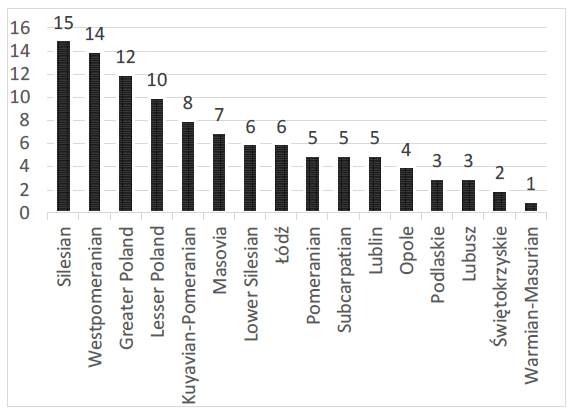
The characteristics of the power plants capabilities in Poland and their sensitivity to possible failures can be carried out on the basis of several main criteria. These include: date of creation, fuel used for energy production, possessed production capacities, total contribution to the energy market, and modernization and refurbishment. In order of a comprehensive description, which will reflect both, the situation in a national scale, as well as present the specific features of the power supply system for individual voivodships, the characteristics will be based both, on aggregated data and divided into individual regional systems.
Polish electrical capabilities in 2016
In the scope of the production capabilities of the Polish energy system, according to the Energy Regulatory Office (ERO), the volume of gross domestic electricity production in 2017 stood at a higher level than in the previous year and amounted to 165 852 GWh (increase by 1.98%). In the same period, the gross domestic electricity consumption had level of 168 139 GWh and increased almost 2.13% compared to 2016. The rate of growth of domestic electricity consumption was lower than the GDP growth in 2017, which according to preliminary estimates of the Central Statistical Office gained 4.6%.
The installed capacity in the National Power System (NPS) amounted to 43 421 MW, and the capacity of 43 332 MW. It is an increase of 4.9% and 5% in relation to 2016. The average annual power demand was 22 979.7 MW, with a maximum demand of 26 230.6 MW, which means respectively an increase of 2.2% and 2.7% compared to 2016 [1]. It is worth mentioning that the highest power demand in the history of the NPS occurred on 28.02.2018 at 18:30 and was equal 26 448 MW, while the lowest energy consumption in 2018 was recorded on 24.06 at 4:45, being equal 12 211 MW [2].
It is worth mentioning that the reduction of the network loss rate in transmission and distribution of energy would contribute to a significant improvement in energy efficiency [3]. It is important to increase the level of integration of environmental aspects in the issue of improving energy efficiency [4].
In order to make a more detailed analysis of the elements of the power system in Poland, it is worth considering its structure in each voivodships. The data presented below comes from the websites of individual power plants and is the result of disscussions with the management staff.
Energy potential in regions of Poland Lower Silesia Voivodship
The Lower Silesian Voivodship is currently supplied by six power plants. They are fed with coal (Czechnica and Elektrociepłownia Zawidawie Heat and Power Plant, part of the Zespół Elektrociepłowni Wrocławskich KOGENERACJA S.A.), coal and biomass (Wrocław, Turów), as well as hydropower system (Pilichowice, Oława). Electricity production in this area ranges from 1488.8 MW (3.62% of domestic production), generated by the Turów Power Plant, created in 1962, up to 0.58 MW (0.001% of domestic production), produced by the company built in 1993 Oława hydropower plant. The oldest in the voivodship is Elektrociepłownia Wrocław (1901), and the most interesting from a historical point of view is the Pilchowice hydropower plant (1912). The design of the first of them began at the end of the XIX century, and the construction of the power plant itself lasted about a year. In the last months of the Second World War, it was destroyed in 60% due to the actions of the Soviet troops, but soon it was rebuilt and modernized to work as a combined heat and power plant [5]. The construction of the second of them was part of the implementation of the West Sudeten anti-flood program, which was simultaneously electrifing this area. Works related to the construction of an artificial dam reservoir, railway line and power plant were made only by the strength of human muscles. Emperor Wilhelm II made the opening ceremony of the dam, arriving there by train. The last installation in this area was established in 1993 and it is Mała Elektrownia Wodna Oława II, while in 1999 Zespół Elektrociepłowni Wrocławskich KOGENERACJA SA was created, including Elektrociepłownie Wrocław, Czechnica and Zawidawie, from the beginning of the XX century.
The modernization carried out in relation to the existing energy infrastructure covers mainly the ongoing repairs after the breakdowns, adaptation of the objects to environmental protection standards, development of heating units and (in one case) the creation of new hydroelectric turbines (2004 in Oława).
Kuyavian-Pomeranian Voivodeship
There are nine power plants installed in the Kuyavian- Pomeranian Voivodeship. Four of them are hydroelectric, coal, biomass and fuel oil, solar energy (Czernikowo), fuel oil (Toruń), and even energy produced from citizens wastes.
The highest amount of power is produced by the Bydgoszcz S.A. Power Plant set up in 1929, being equal 252,4 MW of energy (0.6% of domestic production). The smallest contribution in the production has the hydropower plant Mewat built in 1906 in Czersk Polski (0.945 MW – 0.002% of domestic production). The power plants in this regions was constructed at the beginning of the XX century, as well as in the ‘70s, ‘80s of XX century and the beginning of the XXI century. The oldest one has 116 years (hydroelectric power plant Smukała in Bydgoszcz, 1902) and the youngest 3 years (Photovoltaic farm Czernichowo and Zakład Termiczny Przemysłu Odpadów Komunalnych – Heat and power plant in Bydgoszcz, both from 2015).
The modernization and repairs carried out mainly in order to the repair of defects and the development and reconstruction of the infrastructure in Czersk Polski. In the years 2000-2005, the Kujawska Power Plant on the Mill Island was modernized. Recently, the refurbishment of the Włocławek power plant (2015) here carried out, and in 2017, a new heat and power plant in Toruń has been opened.
Lublin Voivodship
Five power plants are located in the Lublin province. Two of them are fed with coal (Lublin-Megatem, Świdnik), while the remaining ones are powered by the wind (Lubartów), high-methane natural gas and coal (Lublin- Wrotków) and solar energy (Bordziłówka). The largest contribution in energy production comes from the Lublin- Wrotków built in 1973 (235MW – 0.56% of domestic production), while the smallest from a photovoltaic power plant built in 2014 in Bordziłówka (1.4 MW – 0.003% of domestic production). In this case, the oldest power plant is 68 years old (Elektrownia w Świdniku, 1950) and the youngest 3 years old (Lubartów Wind Farm, 2015). It is one of three voivodships, next to the Kuyavian-Pomeranian and Greater Poland voivodships, having the youngest power plants in Poland.
Modernizations made in power plants were related to the development, aimed at increas of energy production. They were implemented gradually from the 1960s. The last of them were carried out in 2002 (Lublin-Wrotków) and in 2016 (Lublin-Megatem).
Lubusz Voivodship
At present, only three power plants operate here, and their age ranges from 79 to 4 years. These are Gorzów Heat and Power Plant built in 1939, Zielona Góra Heat and Power Plant established in 1974 and Gubin power plant from 2014. The first one is fed with nitrogen-rich natural gas and hard coal and produces 243.3 MW of energy (0.58% of domestic production). The second one as a fuel uses nitrogen-rich gas and light fuel oil and produces 198 MW of energy (0.47% of domestic production). The third one uses solar energy and produces 1.5 MW of electric power (0.003% of domestic production).
The modernizations implemented so far covered only the development of Gorzów power plant and fusion in 2010 with Zakład Energetyczny Gorzów.
Lodzkie Voivodship
The Lodz Region is supplied in energy by six power plants. The fuel used by them is coal (Bełchatów, Zgierz), wind energy (Łowicz, Kamieńsk), coal (Zduńska Wola) and coal, biomass and gas (Łódź). The Bełchatów Power Plant, built in 1975, produces the greatest amount of energy (5 472 MW – 13.21% of domestic production). The smallest, working from 2007, wind farm in Łowicz (0.5 MW – 0.001% of domestic production). A large contribution in domestic energy production is generated by power plants from the 1970s and 1990s. But there is also the oldest, a 111-yearold installation, which is Veolia Energia Łódź (1907) and the youngest wind power plants in Łowicz and Kamieńsk, built in 2007. The first power plant in Łódź was the established by German Electric Lighting Association, which in 1906 started construction works, and at the end of the following year launched the functioning of the professional power industry in this city. Two world wars contributed to significant damage and deportation of power plants to Germany. Strenuous work undertaken after 1945 allowed for the restoration of the power plant to work, as well as the commissioning of a combined heat and power plant. Currently, the electric power available at Veolia Energy Lodz is 403.85 MW [6].
Repairs and modernization of the power plant in this area consisted of development and the ongoing maintenance repairs. The expansion was made only at the Łódź cogeneration plant, where in the 1970s the new block of the combined heat and power plant and at the Boruta power plant in Zgierz were added, where in 2002-2003 a second series of carburizing in the oblique bridge was created. In addition, stations 110/15/6 and a fluid-particle system were modernized there (2001-2002), and current repairs were carried out in relation to other power plants.
Lesser Poland Voivodeship
Ten power plants are currently operating in the province. They are powered by coal (Kraków, Trzebinia, Skawina), water energy (Czchów, Kraków (2 waterways), Niedzica, Rożnów), coal and biomass (Andrychów) and solar energy (Wierzchosławice). The highest amount of power (546 MW – 1.31% of domestic production) is generated by the Siersza power plant built in 1958 in Trzebinia. The smallest is produced by the Wierzchosławice photovoltaic power plant (1 MW – 0.002% of domestic production), which is the youngest power plant in the Lesser Poland Voivodship built on 2011. The oldest power plant – the Rożnów power plant, launched in 1941, has been operating continuously for 77 years. The construction of the dam and the power station located in its center began in 1935, and the reservoir was completely filled in 1943. As a result of damming Lake Rożnowskie was created [7]. Other power plants are from the 1940s (1 power plant), ’50s (5 power plants), ‘60s (1 power plant) and ‘70s (1 power plant).
According to the available data, the repairs and upgrades made in the most cases were just service repairs. Only in Elektrociepłownia Kraków another chimney was built.
Masovia Voivodship
Electricity in the Masovia Voivodship is currently produced by seven power plants, fired by coal (Kozienice, Warsaw-Siekierki, Warsaw-Żerań, Warsaw-Pruszków), coal and biomass (Ostrołęka) and water energy (Dębe, Goryń). The largest energy producer in the voivodship is Kozienice power plant established in 1968, which produces 2673 MW of energy (6.45% of total domestic production). The second in terms of production level is Ostrołęka power plant, which produces 681 MW of energy (1.64% of domestic production). The smallest amount of energy is produced by the youngest hydroelectric power plant Goryń, built in 2011 (0.08 MW). The remaining power plants come from the ‘50s and ‘70s of the XX century, including the oldest of them, a power plant in Warsaw’s Żerań established in 1954.
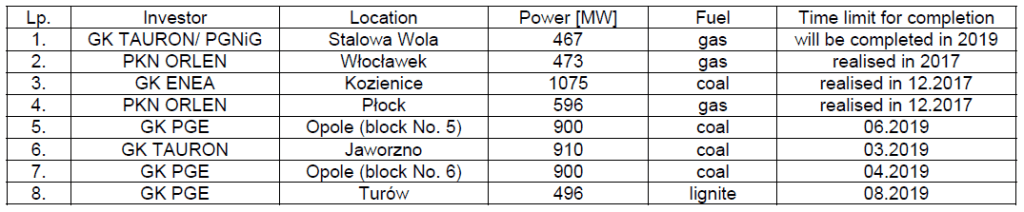
Renovation and modernization of individual power plants indicates mainly replacement of boilers, with successive new units (Kozienice 1979 – 500 MW), installation of flue gas desulphurisation systems and modernization of electrical systems. It is also planned, which should be emphasized, that in 2018 the power unit in the Ostrołęka power plant (with the capacity of about 1000 MW) and in Kozienice Power Plant (with the capacity of 1075 MW) will be opened.
Opole Voivodship
In the Opole Voivodeship, four power plants are installed, powered by coal (Opole), water energy (Kędzierzyn Koźle) and wind energy (Lipniki, Pągów). The largest energy producer is Opole power plant, which was created in 1975 and has a capacity of 1532 MW (3.7% of domestic production). The smallest power producer is Lipniki Wind Farm from 2011 (30.75 MW – 0.07% of domestic production). The oldest in the voivodship is Blachownia power plant in Kędzierzyn Koźle, which was built in 1975. The youngest, of course, are power plants using renewable energy sources, located in the aforementioned Lipniki and Pągów, from 2011 and 2012, respectively.
Renovation and modernization of the power plants in this province consisted of the modification of control systems, the construction of new blocks, and waste disposal systems, as well as their utilization. Ash produced as a result of this process is used as an element of a mixture used for road construction. The largest and, at the same time, the most important extension covered the Opole power plant, where in 2014-2017 two new blocks were created, increasing its capacity to 3300 MW. The Lipniki Wind Farm is also developed and till 2020 will reach 800 MW.
Subcarpathia Voivodeship
In the Subcarpathia Voivodeship there are currently five power plants. With coal and biomass used for production (Stalowa Wola), gas (Rzeszów), gas and coal (Mielec), water energy (Solina-Myczkowce) and solar energy (Cieszanów). The largest producer is the oldest in the voivodship built in 1939 the Stalowa Wola power plant (300 MW – 0.72% of domestic production). A significant contribution in the production of energy is also possessed by the Solina-Myczkowce hydroelectric power plants built in 1961 (200 MW – 0.48% of domestic production). Traditionally, the smallest and the youngest energy producer is the Cieszanów power plant from 2014 (2 MW – 0.004% of national production). The three remaining power plants operating in the province are also quite young, as they were built in the ‘90s of the XX century.
Renovation and modernization of power plants in this voivodship consisted primarily in the replacement of turbines, boilers and the ongoing operational repairs [8].
Podlaskie Voivodeship
In the Podlaskie Voivodship, the power infrastructure used for energy production includes three power plants. These are Białystok power plant built in 1910, powered by coal and biomass, the Wiżajny Wind Farm and the photovoltaic power plant in Kolno, opened in 2014. The first one, built by the Germans and destroyed by them after the First World War, then became a public property [9]. Later modernizations equipped it with the current capacity of 530 MW (1.28% of domestic production). The remaining two power plants produce 1.8 MW of energy, or 0.004% of domestic production.
Modernizations were conducted only in Białystok power plant and included its gradual extension. The last stage was completed in 1991.
Pomeranian Voivodeship
Currently, there are five power plants in the province, supplied with coal and biomass (Gdańsk and Gdynia), wind energy (Swarzewo), water energy (Żarnowiec), gas (Władysławowo), and solar energy (Przejazdowo). The largest amount of energy is produced in Żarnowiec hydroelectric power plant (3600 MW – 8.69% of domestic production) built in 1983 and the smallest in photovoltaic power plant Przejazdowo (1.64 MW – 0.003% of domestic production) from 2014. There is also located one of the oldest power plants in the country, Ołowianka Power Station. In 1896, the city authorities decided to build it, and the project was implemented by a German company. It operates from 1898. Warfare led to its significant damage, but soon it was restored and expanded. In 1996, a decision was made to turn off Ołowianka and two other oldest power plants in the region (Gdynia I Power Plant from 1936 and Gdynia II Heat and Power Plant from 1942), and their functions were taken over by the Gdańsk Heat and Power Station since 1970 and since 1974 heat and power plant Gdynia III. In 1998, the historical Ołowianka building was transformed into the Polish Baltic Philharmony named of Fryderyk Chopin in Gdańsk [10]. An interesting object located in this area is also the power plant in Władysławowo, whose source of power is gas, which is a by-product of the process of extracting oil from the Pomerania B3 deposit. The process of energy production using this technology takes place in two stages. Initially, the gas supplied from the platform is subjected to the separation of heavy hydrocarbon fractions. The product of this process is propane-butane liquid gas, natural gas condensate and dry gas. Then dry gas is used to produce electricity and heat [11].
Silesian Voivodeship
There are fifteen power plants in the province of Silesia. This is due to the relatively easy access to the most common fuel used to generate electricity, which is coal. Thus, eleven of the plants operating here are supplied with coal (Bytom, Bielsko-Biała, Chorzów, Rybnik, Dąbrowa Górnicza, Jaworzno, Katowice, Będzin, and Zabrze). Others use coal and biomass (Łaziska, Radlin, Tychy) and water (Międzybrodzie Bialskie). The largest amount of electricity is generated by Rybnik power plant built in 1972-1974 (1775 MW – about 4.3% of domestic production). The least is the Katowice-Szopienice combined heat and power plant (3 MW – 0.007% of domestic production). The oldest power plant in Zabrze, the oldest in the province, but also in the country, is 122 years old. For the first time, the current flowed from there to the residents in December 1897, in the period when Zabrze did not yet possess city rights. After the wartime destruction and plundering, the power plant was rebuilt and now a modern multi-fuel heat and power plant is being built in its vicinity to produce ecological heat and energy [12]. The newest EC Nowa Heat and Power Plant in Dąbrowa Górnicza was built in 2001 and supplies with energy Huta Katowice. The remaining power plants were built at the end of the XIX and the beginning of the XX century. These include: Chorzów Heat and Power Plant, built by a German company in 1898 and equipped with a huge 840 kW power [13], Jaworzno Power Plant, also created in 1898 to illuminate the mine [14], Elektrociepłownia Będzin, was established in 1913 to satisfy the growing demand for electricity of the inhabitants of Sosnowiec [15], Łaziska Power Plant, established in 1918 as part of the Hindenburg Plan, aimed at saving Germany from defeat in the First World War [16] and the Szombierki Heat and Power Plant, which was established in 1920, called the industrial cathedral because of the similarity to a castle, which at that time also had defensive functions [17]. In the 1950s, three power plants were built, in the 1960s – one, in the 1970s – three, in the ‘80s – one, ’90s – one and at the beginning of the XXI century – one.
The repairs and modernizations carried out in them included the development and construction of new turbine sets, replacement of boilers and the construction of flue gas desulphurisation equipment. Even in the case of the oldest heat and power plant in Zabrze, modernization and development took place in the inter-war period, and after the Second World War, only its reconstruction took place.
Świętokrzyskie Voivodeship
Two coal and biomass-fired power plants are currently installed in the Świętokrzyskie Voivodeship. These are the Połaniec power plant built in 1979-1983 with a significant contribution in the national energy production (1882 MW, or 5% of domestic production), and in 1987 the Kielce power plant, producing only 316 MW of energy (0.76% of domestic production).
Modernization works carried out in both facilities included modification of exhaust gas cleaning systems, construction of new blocks and a chimney [18].
Warmian-Masurian Voivodeship
Only one coal-fired power plant is located in Elbląg. It started its activity in 1928 and until the outbreak of World War II it was one of the largest power plants on the Coast. It’s operation was resumed already in 1946, and in the 1960s, it was modernized and transformed into a combined heat and power plant [19]. The currently installed capacity is 74 MW, thus representing 0.1% of the domestic energy production.
Its modernizations were carried out many times in the ‘30s, ‘40s, ‘50s and ‘60s of the XX century. They resulted in an increase in power from 18 MW to the current nominal value.
Greater Poland Voivodeship
It is one of the three provinces with the largest number of power plants. Currently, there are 12 of them, and as a fuel for energy production they use coal (Zespół Elektrowni Konin-Pątnów, Pątnów II, Poznań-Garbary, Kalisz- Piwonice), coal and biomass (Turek, Konin-Adamów, Konin, Poznań), wind power (Nowy Tomyśl, Ostrów Wielkopolski, Margonin), solar energy (Ostrzeszów) and coal and mazut (Poznań-Karolin). The highest power was fitted out in 1958. The Pątnów-Adamów-Konin Power Plant (2512 MW – 6.06% of domestic production), the smallest, 2 MW, of course has the youngest, photovoltaic power plant in Ostrzeszów built in 2015 (0.004% of domestic production). A significant part of the energy infrastructure in this area is from the 1950s, 1960s and 1970s. The individual power stations are from the 1930s (Elektrociepłownia Kalisz- Piwonice, launched in 1932 and currently adapted to the ecological production of energy from biomass combustion [20]), 4 were put into service at the beginning of the 21st century, while the oldest, Poznań-Garbary Heat and Power Plant is from 1929. Currently, its production functions were taken over by Poznań-Karolin power plant, while the power plant itself, located in an attractive part of the city, was sold to a private investor, and on its premises, according to conjecture, a new residential district will be created.
The renovation and modernization of energy infrastructure carried out so far was mainly aimed at development and modernizing of existing systems [21].
Westpomeranian Voivodeship
In the Westpomeranian Region, fourteen power plants currently produce electricity, nine of them use wind power (Cisowo – 2 farms: Cisowo I and Cisowo II, Jarogniew- Mołtowo, Karścino, Wartkowo, Zagórze, Kukinia, Stramnica, Tychowo, Tymień). The remaining ones are powered by water energy (Żydowo), coal (Zespół Elektrowni Dolna Odra, Szczecin-Pomorzany), coal and biomass (Nowe Czarnowo) and biomass (Szczecin). The largest energy producer is the Dolna Odra Power Plant complex built in 1976 (1564.7 MW – 3.77% of domestic production). The smallest power was provided by the Stramnica wind farm established in 2011 (4.6 MW – 0.01% of domestic production). Most of the energy infrastructure was built at the turn of the XX and XXI centuries. Few power plants are from the 1970s and even from the 1940s, and the oldest 102-year-old power plant in Szczecin began its work in 1916. The decision to build it was made in 1911, and in 2012 it was equipped in Poland’s largest fluid bed boiler with a stationary bubble bed for biomass combustion, which allows for generating 440 000 MWh of energy and 1 900 000 GJ of heat during the year, at the expense of 550 000 tonnes of biomass. The last installation in this area was built in 2013 and it is the Kukinia Wind Farm.
Modernizations and renovations carried out so far concerned current repairs and development of the power plant. In this case, it is justified due to the relatively low age of most of them.
Summary
The energy security of the country is the state of enabling current coverage and prospective customers’ demand for energy in a technically and economically justified manner, with maintaining the protection requirements environment, at the same time [22]. responsibility for ensuring safety rests with the President of ERO, who monitors the operation of the PPS in the field of security of electricity supply on the basis of the provision resulting from art. 23 sec. 2 point 20f of the Energy Law Act, based on information from the National Power System operation – elaborated and transmitted daily by the transmission system operator [23].
Fig. 1. Number of power plants fed with particular types of fuels
Summing up, based on the gathered data, it should be noted that there are 129 conventional power plants in the national energy system with sub-units of different power, various age and power sources. Accordingly, 33 of them (25.58%) use coal as fuel, 17 (13.17%) coal and biomass, 20 (15.50%) water, 15 (11.62%) wind, 1 (0.77%) gas, 2 (1.55%) coal and gas, 25 (19.37%) solar energy. In other cases (10%), power plants are fueled by a combination of fuels (Fig. 1). These include the following groups:
• coal, biomass and gas; • coal and mazout; • coal, biomass and fuel oil; • municipal waste; • fuel oil; • gas and coal; • had coal; • biomass; • coal and natural gas
The age of the power plants operating in Poland starts at the end of the XIX century (1896) until 2015. The main fuel used in power plants from the years 1950-1980 of the last century is coal. It is worth emphasizing that Chojnacka and Chojnacki (2018) [24] predict that the percentage of hard and brown coal used in the electricity production will continue to grow. However, newer power plants increasingly base their production on alternative, including renewable energy sources.
The number of power plants in individual voivodships is as follows (Fig. 2):
Fig. 2. The number of power plants in individual voivodships
It should be noted that in the case of two leading voivodships (in terms of the number of power plants), one of them is dominated by traditional coal-fired power plants: Silesian Voivodship, while in the latter, power plants using renewable energy sources, mainly wind and water dominate: West Pomeranian Voivodeship. The region also has the latest infrastructure for generating energy from renewable energy sources, from the years 1999-2013. It is satisfactory that most of the currently operating power plants (20), were created in the 2000s. It is caused by significant socio-economic development, which generates a constantly growing demand for electricity. In the ‘90s, ‘80s and ‘70s of the XX century, 10, 4 and 16 power plants were built, respectively. Therefore, we use energy generated by only 50 power plants whose age does not exceed 50 years. The remaining 79 power plants were established at the end of the XIX century and in the first half of the XX century, which means that their age reaches even over 120 years. In the 1950s of the XX century. 15 of them were built, in the years ’40s – 2. The power plant from the ’30s are 5, from the ‘20s – 4, and from the beginning of the XX century 10. Figure 3 shows the age structure (the age of the oldest element of a given power plant) in a comparison with the production capacity. According to GUS data the highest installed power in 2017 was registered in the Silesian voivodship (Fig. 4).
Fig. 3. The year when the oldest element of the power plant was created in comparison with the production capacity
Fig. 4 The installed power in 2017 in all types of power plants in sixteen voivodships according to GUS Source: based on http://www.stat.gov.pl.
Table 1: List of new generation capacities of conventional units
In the scope of repairs and modernization works related to the current operation of the power plant dominate. As emphasized by Marcewicz, Partyka i Mazur (2016) [25], Polish power industry still needs investments for deep modernization, because a significant percentage of electricity generating equipment (almost 45%) is more than 30 years old. Of course, there are cases of significant renovations and development of infrastructure, however, they are sporadic, and the fact of their occurrence has been signaled above. Usually, repairs and modernizations concerned:
• construction and extension of turbine sets; • construction or replacement of flue gas desulphurisation systems; • replacement or installation of boilers; • construction or replacement of chimneys.
It should be noted here that until 2018, producers declared the construction of new power sources of 10.5 GW (cost PLN 54 billion) and modernization of existing sources (about PLN 12 billion) [26] (Table 1).
Because It is estimated that about 90% of European city residents are exposed to the air in contaminated air: dust, nitrogen dioxide, ozone, benzopyrene [27], it is also worth paying attention to the increase of the contribution of energy from renewable sources. In comparative studies from 2005 to 2017, in power plants using biogas, biomass, solar radiation, wind and hydro-energy as fuel, the production progress is clearly visible. What is more, considering electricity consumers requiring increased delivery reliability, high reliability power supply systems are used [28].
The greatest development can be observed in the relation to wind farms, where the production increase is about 5775 MW. The second are biomass-fired power plants, whose production increased by approximately 1182 MW. The third are power plant using biogas as fuel. The increase in energy production in this case is equal to 206 MW. The next place is occupied by hydropower plants. The last ones are solar power plants, in which energy production was initiated in 2009 and increased in less than 10 years from 0.001 MW to 107.748 MW. In detail, the above data are illustrated by Figure 5.
Authors: dr Paweł Szmitkowski, Uniwersytet Przyrodniczo- Humanistyczny w Siedlcach, Instytut Nauk Społecznych i Bezpieczeństwa, ul. Konarskiego 2, 08-110 Siedlce, E-mail: szmitek@op.pl; mgr Sylwia Zakrzewska, Uniwersytet Przyrodniczo- Humanistyczny w Siedlcach, Instytut Nauk Społecznych i Bezpieczeństwa, ul. Konarskiego 2, 08-110 Siedlce, E-mail: sylwia.zakrzewska01@gmail.com; dr Agnieszka Gil, Uniwersytet Przyrodniczo-Humanistyczny w Siedlcach, Instytut Matematyki i Fizyki, ul. Konarskiego 2, 08-110 Siedlce, E-mail: gila@uph.edu.pl; mgr Paweł Świderski, Uniwersytet Przyrodniczo-Humanistyczny w Siedlcach, Instytut Nauk Społecznych i Bezpieczeństwa, ul. Konarskiego 2, 08-110 Siedlce, E-mail:pswiderek@wp.pl
Source & Publisher Item Identifier: PRZEGLĄD ELEKTROTECHNICZNY, ISSN 0033-2097, R. 95 NR 5/2019. doi:10.15199/48.2019.05.44
Published by Sabrije OSMANAJ1, Bukurie HOXHA2, Rexhep SELIMAJ2* 1Faculty of Electrical and Computer Engineering, , 2Faculty of Mechanical Engineering, University of Pristina, Republic of Kosovo
Abstract. In Kosovo, 97% of energy is generated from lignite-fired power plants. Apart from the energy generation, the combustion process emits around 8000 ktCO2/yr and 1.5 Mt of ash in the form of the fly and bottom ash. In Kosovo there is no MWh power generated from wind energy, i.e. this energy source is not utilized. Here, a proposed project for one location in Kosovo has been analysed in detail with the aim of installing the thirteen wind generators. The wind farm has successfully passed the testing period as foreseen by law. The wind farm is located near to Kamenica region. The wind measurements are carried out by the potential investor, wind speed at the installed site gives very promising wind data. In this issue, we have given different of power given in different highness of the wind turbine. After all, we conclude that based on the average wind speed from a wind turbine (60 m highness) we will have 1015.371kW which turns out to be satisfactory when it is multiplied by the number of turbines to be placed (thirteen) equal to 13,199 MWh, that will significantly reduce energy consumption from fossil fuels.
Streszczenie. Przedstawiono projekt farmy wiatrowej zlokalizowanej w Kosowie (w miejscowości Kamenica) wykorzystującej trzynaście generatorów. Analizowano wwpływ wysokości trubin wiatrowych – wybrano wysokość 60 m. Uzyskano moc rzędu 1015 kW. System trzynastu turbin generuje energię rzędu 13 MWh. Analiza eksperymentalna danych na przykładzie farmy wiatrowej w Kosowie
Keywords: Energy, Wind turbines, Wind Efficiency, Electric Power, Renewable Energy. Słowa kluczowe: trubina wiatrowa, energia odnwaiualna, farma wiatrowa
Introduction
We have been harnessing the wind’s energy [1, 2] for hundreds of years. From old Holland to farms in the United States, windmills have been used for pumping water or grinding grain. Today, the windmill’s modern equivalent – a wind turbine – can use the wind’s energy to generate electricity.
Wind turbines [3, 4, 5], like windmills, are mounted on a tower to capture the most energy. At 30 meters or more aboveground, they can take advantage of the faster and less turbulent wind. Turbines catch the wind’s energy with their propeller-like blades. Usually, two or three blades are mounted on a shaft to form a rotor.
A blade acts much like an airplane wing. When the wind blows, a pocket of low-pressure air forms on the downwind side of the blade. The low-pressure air pocket then pulls the blade toward it, causing the rotor to turn. This is called lift. The force of the lift is actually much stronger than the wind’s force against the front side of the blade, which is called drag. The combination of lift and drag causes the rotor to spin like a propeller, and the turning shaft spins a generator to make electricity.
Wind turbines can be used as stand-alone applications, or they can be connected to a utility power grid [6, 7, 8] or even combined with a photovoltaic (solar cell) system. For utility-scale sources of wind energy, a large number of wind turbines are usually built close together to form a wind plant. Several electricity providers today use wind plants to supply power to their customers.
Stand-alone wind turbines are typically used for water pumping or communications. However, homeowners, farmers, and ranchers in windy areas can also use wind turbines as a way to cut their electric bills.
Small wind systems also have potential as distributed energy resources. Distributed energy resources refer to a variety of small, modular power-generating technologies that can be combined to improve the operation of the electricity delivery system.
A wind farm is a group of wind turbines in the same location used for the production of electric power. A large wind farm [9, 10, 11] may consist of several hundred individual wind turbines, and cover an extended area of hundreds of square miles. A wind farm may also be located offshore.
The turbines in a wind farm are connected so the electricity can travel from the wind farm to the power grid. Once wind energy is on the main power grid, electric utilities or power operators will deliver the electricity where it is needed. Smaller transmission lines called distribution lines will collect the electricity generated at the wind project site and transport it to larger “network” transmission lines where the electricity can travel across long distances to the locations where it is needed, when finally the smaller “distribution lines” deliver electricity directly to your town and home.
To calculate the amount of energy obtained from a turbine located at the aforementioned location, the analytical path is used, recognizing the strength of the wind and the mechanical strength obtained from it.
Accelerated and sustainable economic development of Kosovo will substantially depend on the implementation of adequate economic and structural policies and reforms which will ensure rational utilization of natural and human resources in Kosovo [12, 13]. The government of Kosovo (GoK) has designated the energy sector as one of the key standing pillars of sustainable economic and social development of the country. Restructuring of the energy sector to attract private investment and developing new power generation capacities – based on rational utilization of abundant lignite resources – to cover increasing domestic demand for electricity and also to export, which are two priority goals of the GoK. These goals are also the cornerstones of this Strategy.
Security of supply, promotion of investments in the sector, preserving of the environment and further Development of the energy market are the main strategic goals of the new European strategy for the EU energy sector. A number of important objectives derive from these goals, including the so-called 20% – 20% – 20%.
Kosovo aims for EU integration as early as possible. This will require also the implementation of the objectives of the EU plan 20-20-20 for the energy sector requiring member countries that by 2020.
Reduce green gas emissions by 20%, Increase renewable energy share of final energy consumption to 20, and improve energy efficiency by 20%. The energy sector in Kosovo will require significant investment, both financial, and in terms of capacity support, irrespective of what energy plan is pursued.
A critical component of any sustainable development strategy for Kosovo is the continued transparent dialog between donors and the national government, particularly because international resources will be needed under any pro-growth, pro-environment agenda in Kosovo and the region. One power plant aside, the rest of the energy gap in Kosovo can easily be met from renewable energy sources, as their potential is substantial. Unfortunately, the policymaking has been in a mindset of lignite coal only and it has been falsely stated that Kosovo does not have renewable energy potential. However, by 2013 when National Renewable Energy Action Plan (NREAP) was adopted, it turned out that Kosovo had great deal more renewables’ potential than previously thought. Yet, even NREAP has left much of the renewable utilization capacity out and this must be addressed.
On the other hand, though it is not yet published, a study by Deutsche Gesellschaft für Internationale Zusammenarbeit (GIZ) concludes that Kosovo has wind potential of as much as 300 MW. Kosovo does not have a wind atlas or similar sources that could be used for advancing the use of wind energy. Thus, the wind energy potentials shown in this study are based on already conducted studies, respectively probable specific analyzes that have been carried out, and they are presented on the map (figure 1).
Fig.1. Places in Kosovo (42.6026° N, 20.9030° E) where wind energy can be used
The energy source from wind is still a new field for Kosovo, as the wind was previously used only for mechanical work (e.g. windmills). Nowadays, in particular, wind energy is one of the fastest growing, cost-effective, lightweight, high efficiency and the environmentally accepted mean of electric power generation. Kitka (latitude: 42° 39′ 56″ (42.6656°) north, longitude: 21° 39′ 36″ (21.66°) east) is a mountain within Kosovo and is nearby to Lisacka and Hurugljica. In Kitka is planned to install 13 wind turbines but our study will help in the most accurate implementation of wind turbines so in this paper is compared the power of one of them in different highness: 84m, 80m, 60m, 40m, which is installed in Kitka mountain, in Kosovo.
Fig.2. Windrose of Kamenica near Kitka
Wind Data
Wind data average monthly wind speed and annual [in m/sec] as measured by the potential investors are presented in Table 1 and Table 2 for months from May to December. It is, therefore, necessary to measure the wind data ate the exact location where wind generators [14, 15, 16] are going to be installed.
Table 1. Wind data for Kitka between May to December 2016
.
Those data are very useful for us taking into account that we have metering data for different height of erection of wind turbines. To use as much wind power, wind turbines should have large rotor diameters and be placed in an area with high wind speeds. Wind turbines are designed to start working at wind speeds between 3 and 5 m/s. Also, the turbine is designed to stop working at high wind speeds (about 25 m/s), so that there is no damage to the turbine itself and the turbine environment.
In figure 3, given graphic descriptions for wind data at different altitudes.
Table 2. The average speed of the year based on the data of wind for months MAY – DECEMBER
.
Research Method and Results
To use wind as a source of energy, the first element that is needed to know is wind speed. Power output given by the ‘Amperax’ wind turbine is calculated by using the producer diagram given in the figure below. The wind turbine is measured by the power curve and CP curves. The power curve is the relation between the power out and the average speed of the wind turbine which is presented in figure.4.
Fig.3. Change of air density to altitude
Fig.4. Power curve
Figure 5, Shows how this wind turbine farm consisting of 13 will be realized.
Fig.5. Wind turbine station in Kitka
As we show in the Table 1, the air density for 84m, 80m, 60m, 40m, altitudes is nearly same, so in the all of the study cases, we give it 1.22 kg/m3.
In the laboratory conditions given by producer the power of those wind turbines is nearly 3000kW, but in real conditions, those results below, we can see the difference of them, and rapport of those powers in laboratory conditions or maximum power and the real power [11], based on air power give us the performance of switch the wind power into electricity. Thus, it has been found out that same turbine with same installed capacity gives the different outcome.
The measurement is done for 4th cases including different altitudes: 84m, 80m, 60m, 40m.
1st case -the average wind speed per year is 6.671, Based on the installed capacity the efficiency is calculated as below:
.
CBetz– maximum of wind energy that can use by blades of turbine (16/27). ρ – air density A – Turbine area w – Wind speed
.
2nd case -the average wind speed per year is 6.642 m/s,
.
3rd case -the average wind speed per year is 6.44 m/s, Based on the installed capacity the efficiency is calculated as below:
.
4th case -the average wind speed per year is 5.92 m/s,
.
In figure 6, are explain the graphic results from those analytical expressions which describe the wind energy for a specified area.
When we considering the generation of electricity from such a wind turbine during one day, taking into account the fact that the optimum working time will be 12 hours per day, we will have the following results:
Figure 7, graphically illustrates the relationship between power efficiency and energy produced by a turbine set in these conditions if it is considered that the optimal turbine operation during a day will be accomplished for 12 hours during the day.
Fig.6. Comparision the analytical results for different altitudes where wind turbines can be placed
Fig.7. Relationships between energy, power, and efficiency gave by one wind turbine in those conditions
Results and discussions
From the above calculations, it can be seen that at higher altitudes the speed, as well as the power generated by the turbines, will be greater, for power of 1130.450 kW (the 1st case) maximum efficiency can be 37.60%, while for the 2nd case where the different altitude is 4m, the generated power is 1113.945 kW, thus for 16.505 kW.
In a 3rd case which is thought to be the average height, the power generated is 1015.371 kW, with an optimum efficiency from 33.84%, and the last case studied presents the case with the lowest power and efficiency achieved.
Taking into account the amount of energy needed to produce in Kosovo that is brought to a maximum of 710 MW, it can be seen that when the project in the word will achieve the installation of all thirteen wind turbines then referring to the case with suitable for the cost as well as the environmental effects (3rd case) it can be seen that taking into account the power of a wind turbine installed in that place of 1015.371kW, which force on the number of turbines of 13 will be equal to 13.199 MW which will to significantly mitigate energy consumption from fossil fuels.
Conclusion
This paper analyzes and measurements are made for wind speeds in a Kamenica region called Kitka, as a potential for wind power exploitation. We can conclude that when the turbine is most upper from the earth the power produced is the biggest and the efficiency too. In the end we can see that the most energy is produced when the wind turbine is upper of the earth but performing of turbine in this highness consider a lot of risk for the people or animals around this place, so the best way to put them is the highness of 60 m, and the important of this is that the power about of 1.01 MW (which was planned) is when the wind speed is upper than 6.44m/s.
REFERENCES
[1] Burton, Tony, et al. Wind energy handbook. John Wiley & Sons, 2011. [2] Manwell, James F., Jon G. McGowan, and Anthony L. Rogers. Wind energy explained: theory, design, and application. John Wiley & Sons, 2010. [3] Eggleston, David M., and Forrest Stoddard. “Wind turbine engineering design.” (1987). [4] Arulampalam, Atputharajah, et al. “Power quality and stability improvement of a wind farm using STATCOM supported with hybrid battery energy storage.” IEE Proceedings-Generation, Transmission and Distribution 153.6 (2006): 701-710. [5] Ahmad, Nadeem Tareq. “Improving Electrical Power Grid of Jordan and Control the Voltage of Wind Turbines Using Smart Grid Techniques.” International Journal of Applied Power Engineering (IJAPE) 2.1 (2013): 39-44. [6] Vidhya, B., and K. N. Srinivas. “Small Scale Wind Generation System: Part I–Experimental Verification of Flux Reversal Generator Block.” International Journal of Applied Power Engineering (IJAPE) 6.1 (2017). [7] Markovski, Blagoja, et al. “Transient performance of interconnected wind turbine grounding systems.” Przegląd Elektrotechniczny 91.6 (2015): 72-75. [8]Marek, G. A. Ł. A. “Praca Turbin wiatrowych w systemie elektroenergetycznym oraz ich wpływ na jakość energii elektrycznej.” (2017). [9] Bhongade, Sandeep, and B. Tyagi. “Participation of Renewable Energy Sources in Restructured Power System.” International Journal of Applied Power Engineering (IJAPE) 2.1 (2013): 1-14. [10] Marek, G. A. Ł. A. “Ocena wpływu pracy turbiny wiatrowej FL MD 77 na jakość energii elektrycznej w węźle przyłączenia w sieci dystrybucyjnej średniego napięcia.” (2015). [11] Jąderko, Andrzej. “Badania symulacyjne układu sterowania turbiną wiatrową z generatorem indukcyjnym.” Przegląd Elektrotechniczny 91.12 (2015): 110-113. [12] Dragusha, Bedri, Blerim Rexha, and Ilir Limani. “Analyzing Wind Data of the First Wind Farm in Kosovo.” Int. J. of Thermal & Environmental Engineering 2.2 (2011): 61-67. [13] Qafleshi, Mevlan, Driton R. Kryeziu, and Lulezime Aliko. “Potential of Wind Energy in Albania and Kosovo: Equity Payback and GHG Reduction of Wind Turbine Installation.” International Journal of Renewable Energy Development 4.1 (2015): 11. [14] Halinka, Adrian, Piotr Rzepka, and Mateusz Szablicki. “State identification of MV power network with wind power generation operating under manual and automatic voltage control in HV/MV substation. ” Przegląd Elektrotechniczny 91.6 (2015): 126-128. [15] GAJEWSKI, Piotr, and Krzysztof PIEŃKOWSKI. “Direct Torque Control and Direct Power Control of wind turbine system with PMSG.” Przegląd Elektrotechniczny 92.10 (2016): 249-253. [16] Sathiyanarayanan, J. S., and A. S. Kumar. “Power quality improvement wind energy system using cascaded multilevel inverter.” International Journal of Renewable Energy Development 2.1 (2013): 35.
Authors: prof. asoc. dr. Sabrije Osmanaj, Faculty of Electrical and Computer Engineering, University of Prishtina, street “Sunny Hill”, nn, 10 000, Prishtina, e-mail: sabrije.osmanaj@uni-pr.edu; Bukurie Hoxha, Faculty of Mechanical Engineering, University of Prishtina, email: bukuriehoxha15@gmail.com; *corresponding author: prof. asoc. dr. Rexhep Selimaj, Faculty of Mechanical Engineering, University of Prishtina, email: rexhep.selimaj@uni-pr.edu.
Source & Publisher Item Identifier: PRZEGLĄD ELEKTROTECHNICZNY, ISSN 0033-2097, R. 94 NR 7/2018. doi:10.15199/48.2018.07.05
Pubsliehd by Jacek GUMIELA1, Dariusz SZTAFROWSKI1 Politechnika Wrocławska, Katedra Energoelektryki (1)
Abstract. To minimize interference with the environment it is important to make every effort already at the design stage to spare the trouble associated with additional investment later on. Due to the value of land in urban areas, it is beneficial to take necessary measures to reduce the width of the impact zone and optimize the management of these lands. Possible variants of this assumption were analysed on the example of the existing 110 kV line.
Streszczenie. W celu ograniczenia natężenia pola elektrycznego w środowisku warto już na etapie projektowania obiektów elektroenergetycznych dołożyć wszelkich starań minimalizujących uciążliwość nowej inwestycji. W odpowiednich aktach prawnych zostały określone graniczne wartości m.in. pola elektrycznego co determinuje szerokość tzw. pasa technologicznego oraz ograniczenia w zagospodarowaniu sąsiadujących terenów. Na przykładzie istniejącej linii 110 kV poddano analizie możliwe warianty realizacji tego założenia.(Zastosowanie dodatkowych uziemionych przewodów w napowietrznych liniach elektroenergetycznych WN w celu ograniczenia natężenia pola elektrycznego generowanego przez przewody fazowe).
Słowa kluczowe: pole elektryczne, symulacje cyfrowe, metoda elementów skończonych, bezpieczeństwo środowiska. Keywords: electric fields, digital simulations, finite elements method, safe of environment
Introduction
Electric power lines are the source of electromagnetic field which, for safety reasons, should not exceed the values set out in relevant legislation [1]. In the design phase of new infrastructure these objects are located far from human settlements. However, there is often intensive development near existing overhead power lines. The impact zone designed according to the old criteria that are not in effect today may no longer meet the current permissible values of electric field intensity at various locations inhabited by people. Reconstruction of the power line in order to remove the conflict is, for many reasons, not always feasible. Such alteration may also be very expensive [2]. For this reason, power grid operators increasingly turn to the use of additional wires at the potential of the earth in order to shape the spatial distribution of the electric field and thus limit its value in the areas of interest [3,4].
Fig.1. 110 kV lines with insulators placed between the live line and an additional grounded shielding line
Near Wałbrzych, a technical solution was implemented that involves additional shielding conductors located below the lowest working overhead lines at a sufficient distance to provide electrical insulation. Typical 110 kV long-rod insulators were used for the installation of shielding conductors (model: LP75 / 31). The shielding cables are galvanically connected to both support structures, which, regardless of the electrical induction, provides the potential of the earth along the entire length of the additional conductor (Fig. 1). As can be seen, under the overhead line there are residential and commercial buildings, causing permanent exposure of the residents to the electromagnetic field generated by the working overhead power line. The solution used in the span reduces the electrical component of the electromagnetic field. Investigation of the effects of the use of such a method of altering the field distribution is particularly interesting with regard to limiting the maximum field strength and the width of the impact area underneath the overhead line where the electric field strength would otherwise exceed 1 kV/m [5]. Distribution of the electric field was calculated for the two cases:
• Typical 110 kV overhead line variant without the shielding cables (Fig. 2a) • Actual 110 kV overhead line variant with shielding cables (Fig. 2b)
Technical specifications of the 110 kV line:
• AFL-6 240mm2 working wire (tension=90MPa, g=0.0336, d=21.7mm) • overhead ground wire type O/FL 70mm2 (tension=120MPa, g=0.077, d=11mm) • B2 type pylon • Length of the span L=140m • sag of overhead working wire f=1.03m • length of insulator HI=1.8m type LP75/31
The figure (Fig. 2a) shows the overhead straight-line support pylon type B2 of the overhead line 110 kV and the basic geometrical dimensions of the support structures and the location of additional grounded shielding wires (Fig. 2b). Computational identification of the electric field distribution was performed at the centre of the span, i.e., where the distance of the phase conductors from the ground is the smallest, for a distance of up to 25m to the either side of the overhead line. It is known to be the most unfavourable case in which, for a given span, the intensity of the electrical field generated by the power line reaches the highest values. Among the commonly used methods to determine the distribution of the electric field in the surroundings of various power infrastructure facilities, the authors focused on the use of the finite element method, which by its nature gives an approximate solution, but allows for the computational identification of objects of any atypical structure and/or geometry [6].
Fig.2. The B2 type pylon of the 110 kV overhead line (a) and the same type of pylon with added insulators for attaching additional grounded shielding wires reducing the electrical component marked in gray (b)
Analysis of distribution of the electric fields
At the height of h=2m above the ground level the electric field intensity determined on the basis of digital simulations does not exceed 1 kV/m at any point. Therefore, according to the Regulation of the Polish Minister of Environment [1] it is possible for people to remain in the area for extended periods of time. As shown in the figure (Fig. 3), screening shielding further improves the effect, causing a decrease in the field intensity at each point of the tested area.
Fig.3. Distribution of electric field strength generated by the 110 kV overhead line determined numerically at h=2 m above the ground. Red color shows the distribution of the electric field values without shielding, and blue color with additional shielding wire
As the overhead lines run directly above the residential building, it is worth checking whether the occupants of higher floors or open terraces are not exposed to an electric field exceeding 1 kV/m. The results of the second digital simulation of the electric field distribution at the height of the ridge h=8m are presented in the figure (Fig. 4). As can be seen if no additional grounded wires were attached under the two lower working lines of the overhead line, the resulting electric field intensity would slightly exceed the permissible value at E=1.36kV/m.
With the grounded shielding cables, the intensity of the electric field was reduced considerably at the height of h=8m below the limit value [1] at a maximum of E=0.89 kV/m.
Fig.4. Distribution of electric field strength generated by the 110 kV overhead line determined numerically at h=8 m above the ground. Red color shows the distribution of the electric field values without shielding, and blue color with additional shielding wire
Analysis of the electric field intensity in between the additional grounded wires and the lowest phase wires shows a significant change in the electric field intensity.
This is the expected effect as the entire drop of the potential from the full potential of the phase conductor to zero ground potential must then occur over a much shorter distance than in the case of power line with no additional earthed shielding conductors. For this reason, the capacitance to earth of the line increases, which in turn directly affects the amount of transmission losses occurring during the transport of energy [5].
Fig.5. Distribution of electric field strength generated by the 110 kV overhead line determined numerically at h=14 m above the ground. Red color shows the distribution of the electric field values without shielding, and blue color with additional shielding wire
In addition, it is easy to see that in the considered space the use of additional shielding conductors located below the lower phase conductors has little effect on the spatial distribution of electric field intensity as well as on the maximum values that are significant and may exceed E = 12 kV/m.
Fig.6. Distribution of electric field strength generated by the 110 kV overhead line determined numerically at h=22 m above the ground. Red color shows the distribution of the electric field values without shielding, and blue color with additional shielding wire
For the heights above the overhead ground wire, the electric field distributions for the both 110 kV overhead line span designs do not differ significantly. The overhead ground wire introduces the ground zero potential to the analysed system, and thus changes the distribution of electric field lines. Due its location, the overhead ground wire strongly influences the value of electric field intensity in the height range above the overhead line support structures.
Table 1. Intensity of electric fields calculated for selected heights for power line without shielding wires.
.
Table 1 shows the maximum intensity of electric fields and the width of terrain (in meter) where the electric fields intensity is greater than 1 kV/m calculated for selected heights for power line without shielding wires.
Table 2. Intensity of electric fields calculated for selected heights for power line with shielding wires.
.
Table 2 shows the maximum intensity of electric fields and the width of terrain (in meter) where the electric fields intensity is greater than 1 kV/m calculated for selected highs for power line with shielding wires.
Conclusions
1. The use of additional grounded components located between the working cables and the ground allows the reduction of the resultant electric field recorded in the tested strip perpendicular to the axis of the power line calculated for the height of 2m.
2. The use of additional grounded components located between the working cables and the ground causes a strong local variation in the distribution of electric field lines in this height range. This may be related to the increase of the capacitance to earth of the overhead line and, consequently, to the increase in transmission losses in the section affected by the use of additional shielding cables.
3. Planned geometrical configuration of the work wires and grounded wires allows to shape the resultant distribution of the electric field generated by the overhead power line.
REFERENCES
[1] Rozporządzenie Ministra Środowiska z dnia 30 października 2003 r. „W sprawie dopuszczalnych poziomów pól elektromagnetycznych w środowisku oraz sposobów sprawdzania dotrzymania tych poziomów”, Dziennik Ustaw nr 192, poz. 1883, 2003. [2] Szuba M. [i inni], „Linie i stacje elektroenergetyczne w środowisku człowieka” (Wydanie 4), Biuro Konsultingowo- Menadżerskie EKO-MARK, Warszawa 2008. [3] Zeńczak M., „Analiza pola elektrycznego i magnetycznego wokół linii elektroenergetycznych i wybranych urządzeń elektroenergetycznych”, Napędy i Sterowanie Nr 9 2001. [4] Zeńczak M., “Estimation of electric and magnetic field intensities under power transmission lines in real country conditions”, Przegląd Elektrotechniczny Nr 7 2008. [5] Zeńczak M., “Analiza technicznych problemów związanych z dozymetrią pól elektromagnetycznych o częstotliwości przemysłowej”, Prace Naukowe Politechniki Szczecińskiej, Szczecin 1998. [6] Sadiku M. NO, “Numerical techniques in electromagnetics”, Second Edition, CRC Press, LLC Boca Raton London, New York, Washington 2001.
Authors: mgr. inż. Jacek Gumiela, Politechnika Wrocławska, Katedra Energoelektryki, ul. Wybrzeże Wyspiańskiego 27, 50-370 Wrocław, E-mail: jacek.gumiela@pwr.edu.pl; dr Dariusz Sztafrowski, Katedra Energoelektryki, ul. Wybrzeże Wyspiańskiego 27, 50-370 Wrocław, E-mail: dariusz.sztafrowski@pwr.edu.pl.
Source & Publisher Item Identifier: PRZEGLĄD ELEKTROTECHNICZNY, ISSN 0033-2097, R. 94 NR 3/2018. doi:10.15199/48.2018.03.32
Published by Michał KONARSKI, Paweł WĘGIEREK, Lublin University of Technology, Faculty of Electrical Engineering and Computer Science, Lublin, Poland
Abstract. The article presents assumptions, characteristics and conclusions of functional tests of a pilot implementation of a power restoration system in one of the Distribution System Operators. The main objective of conducted and described tests was to verify scenarios realized by the automation system during the real and controlled short-circuit tests inside a medium voltage overhead distribution grid. The tests were carried out using a remotely controlled circuit breaker that was used to simulate single phase ground faults at various points of a analyzed grid.
Streszczenie. W artykule przedstawiono założenia, charakterystykę i wnioski z prób funkcjonalnych pilotażowego wdrożenia systemu odbudowy zasilania na terenie jednego z Operatorów Systemu Dystrybucyjnego. Głównym celem przeprowadzonych i opisanych prób była weryfikacja realizowanych przez automatykę scenariuszy podczas rzeczywistych, kontrolowanych prób zwarciowych w głębi napowietrznej sieci średniego napięcia. Próby przeprowadzone zostały przy użyciu zdalnie sterowanego wyłącznika, za pomocą którego zasymulowano jednofazowe zwarcia doziemne w różnych punktach objętej wdrożeniem sieci. (Wykorzystanie systemów odbudowy zasilania w procesie automatyzacji pracy sieci dystrybucyjnej średniego napięcia)
Keywords: smart grid, grid automation, power system restoration, FDIR. Słowa kluczowe: sieć inteligenta, automatyzacja pracy sieci, systemy odbudowy zasilania, FDIR.
Introduction
Growing quality and continuity requirements of energy customers and a quality regulation model introduced by the Energy Regulatory Office require from the Distribution System Operators (DSOs) to constantly develop their grids to improve the power supply reliability. The new model of regulation was introduced to reduce the values of reliability indices in Poland which, despite increased investments, still significantly deviate from the European average. The quality regulation model assumes that the following indicators will have a direct impact on the DSOs regulated revenue:
• SAIDI – System Average Interruption Duration Index, covering faults over 3 minutes, measured in minutes per customer, • SAIFI – System Average Interruption Frequency Index, covering faults over 3 minutes, measured in the number of breaks per customer, • Time of realization of customer grid connection, measured in calendar days per connected customer, • Time of measurement and billing data transmission, measured in calendar days per customer
The SAIDI and SAIFI indices are the most important indicators for managing existing power grid infrastructure. Achieving the requirements in this field also seems to be the biggest challenge of the new regulation model. According to the quality regulation, the distribution companies are required to reduce SAIDI and SAIFI by 50% to year 2020, at the base year 2015 [1,2]. An important factor affecting fault duration is the time necessary for fault detection and appropriate grid reconfiguration. After the occurrence of grid disturbance (short-circuit or earth fault) it is generally possible to make an appropriate switching, resulting in the maximum reduction of the number of consumers without power supply. Properly fast actions in this area have a direct impact on SAIDI – by maximum reduction of fault duration for customers who can be supplied by grid reconfiguration, as well as SAIFI – by reducing fault duration for these customers below 3 minutes thus it is not included in the index value. These activities have been realized so far by the dispatching service which, especially in extensive failures cases, required each time a long-term analysis and numerous switching, often executed manually by the electricity emergency service. Investment programs carried out in recent years, related to remotely controlled switches implementation and equipping them with protections relays and fault indicators, enabled to use them for a completely new task – a distribution grid automation in disturbance states through the use of power restoration systems called FDIR (Fault Detection, Isolation and Restoration), recognized as one of the most important components of the Smart Grid [3]. The significance of activities in the medium voltage grid is underlined by the fact that it is currently the main source (about 75-80%) of all unplanned interruptions, which makes it the main area for improving reliability of power supply [4].
Medium voltage distribution grid automation
Automation and monitoring have been recognized as key elements of the Smart Grid concept in the medium voltage (MV) distribution grid. The idea of grid automation involves remote control and monitoring to selected switches inside the MV grid and automating the processes previously performed by dispatchers and the electricity emergency service. Activities taken in this aspect are aimed at implementation or supporting following processes and functions [5]:
• switching automation, • safe use of existing power grid infrastructure during normal and fault conditions, • grid development planning, • optimal power-flow calculation, • power grid losses optimization, • short-circuit power calculation, • voltage regulation, • optimization of sectional switches locations, • selection of connection points for additional energy sources
One of the main objectives of intelligent distribution grid implementation is to improve reliability of power supply for electricity consumers. The key element of power reliability is switching automation combined with faults detection and localization. The implementation of automation idea requires a common installation of remotely controlled switches with short-circuit and earth fault detection and equipping them with a reliable communication system with a dispatch center. The ability to quickly grid reconfiguration and isolation of its damaged part has been recognized as the key functionality of an intelligent MV grid. The significance of the discussed issue was also noticed by distribution companies which in investment strategies place special emphasis on MV automation process.
Isolation of a damaged grid part can be realized by area control (from MV substation level), local automation (reclosers) or central remote control from SCADA level. The central control enables the use of more complex switching algorithms and gives the dispatcher greater possibilities of quick intervention. The disadvantage of central control is the need to use an extensive communication system and its sensitivity to transmission quality and various errors. The implementation of a smart distribution grid is possible only by the use of a central monitoring and control system, enabling complex control and data analysis functions.
The main purpose of central-level remote control is to isolate the damaged part of the grid and ensure electricity to the largest possible number of consumers. There are three levels of automation that accomplish this task [5]:
• Level 1 – manual control by the dispatcher; • Level 2 – control by the dispatcher with the switching sequence proposal; • Level 3 – full automatic control and switching (without human intervention).
All mentioned control levels assume short-circuit detection systems in remote controlled switches and the use of obtained information in isolation process. The first level assumes that switching decision are made by the dispatcher on the basis of measurement system information (load current values and shot-circuit current flow) as well as his own knowledge about the grid. The second level essentially means a complete switching automation system, devoid of a control feedback only. When the system detects fault in a MV grid, a switch sequence proposal is generated, but the decision which switching will be made, still remains dispatcher’s responsibility. The third level of automation, in which switching operations are performed automatically without dispatcher’s participation (through a dedicated SCADA module), ensures maximum improvement of power reliability indices and should be finally implemented in the dispatching system.
A complete and reliable system of automatic isolation should have the following characteristics [5]:
• Autonomy – automation system, after detecting fault in the MV power line, will issue an appropriate warning for the dispatcher and perform switching operations, restoring power to the maximum possible number of recipients, and then will generate a report for the dispatcher;
• Safety – automation system cannot perform switching that will endanger people’s life and health (e.g. electricity emergency services working on power grid electrical devices);
• Adaptability – any change in grid configuration (such as switching execution on the dispatcher’s command or as a result of protection relays operation) automatically adjusts the automation system to the new conditions. Lack of communication with object devices also causes a change of system configuration;
• Scalability – the ability to expand the system, i.e. adding more modules and devices as well as implementing automation system in new areas of the grid.
The scope of information necessary for correct operation of such automation system includes [5]:
• information about a ground fault or phase-to-phase fault occurrence – the source of this data are fault indicators installed in switching points and measuring systems equipped with fault detection algorithm,
• MV switches status (open, closed, blocked or earthed), • state of communication with remotely controlled switches, • disengaging of remote control in switch actuator, • actual and maximum load current of particular power lines,
• information about works carried out on power grid electrical devices. This information should be obtained in general from the dispatching system as well as other cooperating systems.
Power restoration systems
In response to the presented requirements and growing demand for automation solutions, the leading SCADA suppliers offered DSOs a completely new product – Fault Detection, Isolation and Restoration (FDIR) systems. These systems enable a completely autonomous reconfiguration of a power grid after a fault, maximally limiting the range and duration of power supply interruptions.
A FDIR power restoration system realized its functionalities in the following steps:
1) Fault Detection (FD) based on information about shortcircuit current flow obtained from protection relays and fault indicators,
2) Isolation (I) of damaged power grid sections by switching them off using remotely controlled switches,
3) Restoration (R) of power supply to the largest possible number of recipients by power grid reconfiguration.
All presented steps should be realized in less than 3 minutes – the range of long or very long break is minimized, which results in effective reduction of SAIDI and SAIFI reliability indices.
FDIR works through close cooperation of switches actuators, protection relays and other power grid devices, communicated with a SCADA dispatching system. The power restoration module is an IT tool, integrated with SCADA. To properly integrate power grid devices with FDIR automation and ensure its effectiveness, the following conditions must be met:
• Installation of an appropriate number of remotely controlled switches inside the MV distribution power grid. Depending on the needs, it can be reclosers with protection relays, load break switches (with or without sectionalizer function) and indoor substations with short-circuit indicators.
• Correct calculation of relays and indicators settings and its correct gradation with digital protections in substations.
• Reliable and preferably redundant communication system between SCADA and power grid devices. The bilateral data and commands should be sent quickly and confidently within several seconds.
For proper operation of the automation algorithm it is necessary to obtain certain, reliable and consistent information from fault indicators in load breakers and protection relays in reclosers and substations. Special requirements apply to the fault indicators – they should meet the following conditions:
• realized at least current measurements (3xI0) – for insulated and resistor-earthed power grids,
• realized both current and voltage measurements (3xI0, 3xU0) – recommended for a compensated grid,
• enable separate detection and signalization of earth and phase-to-phase faults, • have an appropriately wide and precise range of settings (especially for earth faults),
• have a built-in disturbance recorder, available remotely via a high-speed engineering link to analyze indications and activations.
It should be noted that these assumptions do not meet electromagnetic field indicators – their indications reliability is at only 50-60% which is definitely not enough for FDIR needs. In the case of incorrect fault indication or incorrect automatic operation, FDIR will incorrectly calculate fault area and control sequence for power grid reconfiguration. Due to inconsistent information about short-circuit current flow, errors in switching devices (such as switch position error, low gas pressure, battery discharge or communication error) or because of local or remote blockades, the automation stops its operation. The use of advanced logic functions and algorithms, that supervise the correctness of location, isolation and restoration of a power supply, ensures high system security. In order to ensure the safety of people and devices during operation, FDIR takes into account a number of information received from SCADA, such as ongoing grid works, installed earthing systems, split bridging and damages, preventing dangerous switching operations.
Currently, there are two different approaches to the implementation of FDIR power restoration systems – the first one, based on previously developed and approved scenarios, and the second, in which the control sequences are each time calculated by the system algorithm for an actual grid topology and parameters. Both methods are characterized by different advantages and disadvantages and the choice of the optimal solution depends on grid characteristic and individual requirements and preferences of the power system operator. However, both solutions enable fully autonomous system operation, both response to the requirements of a smart distribution grid and both may contribute to the reduction of SAIDI and SAIFI reliability indices. In the Polish distribution system, the leaders in pilot implementations of both FDIR types are Mikronika with the FDIR module dedicated to its SYNDIS RV SCADA and Apator Elkomtech with the FDIR system designed to work with its WindEx SCADA [6,7,8,9].
Assumptions and characteristics of implemented FDIR automation
Described in the article pilot implementation of the FDIR power restoration system covers 6 overhead medium voltage lines supplied from two sources – 5 lines from a HV/MV substation and 1 line from a MV/MV substation. The automation system consist of a total of 13 single and multi-switch points inside the MV overhead distribution grid. The implemented FDIR system includes:
• substations circuit breakers with protection relays, • recloser with protection relay, • load break switches with fault indicators, • load break switches without fault indicators, • sectional load break switches.
The topology of the analyzed MV overhead power grid is shown in Figure 1.
Fig. 1. The topology of the analyzed medium voltage overhead distribution grid
The described FDIR automation operates on the basis of previously developed and approved scenarios, which starts after a fault occurrence and activation of a protection relay in a substation supply field. A SCADA implemented algorithm should automatically:
• Locate the fault, • Isolate a damaged line section from the supply side in off-load conditions, • Isolate a damaged line section from the other sides, • Restore power to non-damaged line sections from others lines, most often using sectional switches.
The stage of scenarios creating allows to exact verification of system operating and switching possibilities. Depending on the existing grid infrastructure, it is also possible to realize alternative scenarios. A selected automation scenario checked during functional tests is presented below. The scenario covered FDIR operation in the MV line no. 2 area, and a fault occurs between switches L-2.2 and L-2.3. The normal grid operation was assumed – line supplying from the B-2 line bay in the HV/MV substation and opened both sectional switches S-1 and S-2. The grid topology and the assumed fault location are shown in Figure 2.
Fig. 2. The normal power grid state and the assumed fault location
The first automation step is to find the fault location. It is possible through activation of fault indicators at the L-2.1 and L-2.2 switches. On the basis of the information from indicators, FDIR locates the fault location on the line section behind the L-2.2 load switch. Simultaneously with the fault indicators, the protection relay in the B-2 line bay is activated and, after the set time, the circuit breaker is turned off. All recipients supplied from the line no. 2 are deprived of power supply. The grid status after switching off the circuit breaker is shown in Figure 3.
Fig. 3. Grid operation after protection activating and switching off the B-2 circuit breaker
The next automation step is the isolation of the fault location. Due to the lack of a fault indicator in the L-2.3 load break switch, FDIR is unable to clearly determine where the fault occurred – on the line section between the L-2.2 and L-2.3 switches or behind the L-2.3 switch. In this situation, the only possibility of more precise fault location is to open the L-2.3 load switch in off-load conditions, and then to switch on the line to the test (Fig. 4).
Fig. 4. Grid operation after opening the L-2.3 load switch and line switching on by the B-2 circuit breaker
Due to a fault location between the L-2.2 and L-2.3 switches, the opening of the L-2.3 load switch does not isolate the fault and line switching on causes a repeated short-circuit current flow. The fault indicators and the substation protection relay are activated again. Again, after the set time, the line is switched off by the B-2 circuit breaker. Despite the fault is not isolate, the test line switching on clearly defined the fault location between the L-2.2 and L-2.3 switches. Thanks to this, FDIR can properly isolate the fault by opening the L-2.2 load switch. The damaged line section is isolated from both sides (Fig. 5).
Fig. 5. Grid operation after line switching on by the B-2 circuit breaker and opening the L-2.2 load switch
The last automation step is to restore power to the largest possible number of recipients. In the assumed scenario, this happens in two stages. In the first one, by switching on the B-2 circuit breaker, the power is restored to the recipients connected to the line no. 2 between the substation and the L-2.2 load switch. In the second one, by closing the S-1 sectional switch (or S-2 in the alternative scenario), the power supply is restored to the recipients connected to line no. 2 behind the L-2.3 load switch. These recipients are powered respectively from the line no. 1 (in the basic scenario) or from line no. 3 (in the alternative scenario). The restoration of power supply is the last step of system operation, followed by automation blocking on the analyzed line. The effect of FDIR operation is reduction of the failure effects only to the grid section between the L-2.2 and L-2.3 switches (Fig. 6). For recipients connected to other grid sections, the power is automatically restored in less than 3 minutes, significantly reducing the impact of the failure on the SAIDI and SAIFI indices.
Fig. 6. Grid operation after line switching on by the B-2 circuit breaker and closing the S-1 sectional switch
Functional tests of FDIR automation
The main objective of FDIR automation functional tests was to check the proper automation operation and, in particular, realization of relevant, approved scenarios. Functional tests were preceded by a comprehensive check of remote controlled switches. The check purpose was to ensure reliable operation of switches, protection relays and fault indicators, stable radio communication channel and proper cooperation of all system components. The check included:
• Radio communication level, • Proper functioning of the switch (with remote maneuvers), • Settings of fault indicators and protection relays, • Activations of indicators and relays operations in case of short-circuit and earth fault in individual phases.
Conducting a comprehensive check of switching points made possible to properly prepare the grid to carry out the real functional tests, checking the automation operation with the assumed scenarios. During testing, the MV grid covered by the automation operated in the normal conditions. In order to simulate the fault conditions, triggering automation operation, controlled single-phase earth faults were made at selected grid points using a grounding switch. As a grounding switch it was used a small oil volume circuit breaker, enabling switching on and off short-circuit currents. The connection of the earthing switch to an overhead MV line was made by a portable earthing device, which was mounted directly from the ground. The grounding of the second circuit breaker terminal was made by connected copper grounding rods. The target value of earthing resistance during short-circuit tests has been set at 100 Ω. In order to ensure the safety of the earthing switch staff, the switch has been equipped with a remote control actuator. For this purpose, a dedicated, PC-connected radio communication data concentrator was used. The scheme of the earthing switch stand is shown in Figure 7.
Fig. 7. The scheme of the earthing switch stand
Short-circuit tests were carried out in the following steps:
1) Preparation for testing by switching off the MV overhead line section and opening the low voltage switch in the transformer station.
2) Connection of the earthing switch in load-free state (in open position) to one of the phases of the disconnected MV line and realization of functional earthing of the earthing switch second terminal.
3) Switching on the MV overhead line section – voltage is providing to the open earthing switch.
4) Switching on the earthing switch on earth fault – short-circuit current flows and the FDIR automation starts working.
5) Verifying the correctness of the switching made by FDIR – the system realizes automatic fault isolation in load-free state and automatic power restoration for undamaged line section according to the scenario.
6) After isolation of the earthed line: opening the earthing switch, removing the portable earthing device as well as functional earthing, switching on the isolated line section, closing the low voltage switch in the transformer station.
The presented functional tests were performed for each of the grid areas covered by the FDIR automation (6 locations), allowing checking the correctness of scenarios realization. Although the functional tests were preceded by simulations and devices checking, during the trials there were abnormalities in the system operation, related mainly to inadequate settings of relays and indicators aa well as with too long information flow time between actuators and SCADA. After eliminating the abnormalities sources, shortcircuit tests were carried out again, this time with a fully positive result – for each of the grid areas, the automation worked properly, according to the assumed scenarios. During the functional tests, total fault detection, isolation and reconfiguration times were achieved below the required 3 minutes, so the interruptions for customers connected to the undamaged line section were not included in SAIDI and SAIFI reliability indices, thus meeting the main objective of the described implementation.
Conclusions
1) The quality regulation model introduced by the Energy Regulatory Office require Distribution System Operators to significantly reduce the SAIDI and SAIFI reliability indices (by 50% by 2020).
2) The main area to improve the power supply reliability is a medium voltage distribution grid, which currently is the main source (about 75-80%) of all unplanned interruptions.
3) The key factor affecting the length of power supply interruptions is a time needed for fault location and adequate grid reconfiguration.
4) Reducing the time to restore power in undamaged grid sections below 3 minutes allows the maximum reduction of SAIDI and SAIFI indices.
5) These requirements are met by the FDIR power restoration systems which enable fully autonomous fault location, isolation of damaged grid sections and grid reconfiguration in order to restore power to the largest possible number of recipients.
6) The conditions for effective automation are the installation of a sufficiently high number of remotely controlled switches inside the MV grid, correct determination and adjustment of settings of protection relays and fault indicators as well as reliable communication system with SCADA.
7) The algorithm of the implemented FDIR system uses previously agreed and verified scenarios, which allows accurate planning of automation operating.
8) The implementation of the FDIR automation in the analyzed grid was successfully completed – during the functional tests, for each area, the automation system realized the assumed scenarios.
9) Short-circuit tests were necessary to verify the correctness of the system operation and to remove abnormalities in the settings of protection relays and fault indicators as well as problems in communication between power grid devices and SCADA.
REFERENCES
[1] Urząd Regulacji Energetyki, Regulacja Jakościowa w latach 2016-2020 dla Operatorów Systemów Dystrybucyjnych, Warszawa, Poland (2015) [2] Marzecki J., Drab M., Regulacja jakościowa – sposób na poprawę niezawodności sieci dystrybucyjnych, Przegląd Elektrotechniczny, 93 (2017), no. 5, 12-16 [3] Babs A., Automatyzacja sieci rozdzielczych jako podstawowy element sieci inteligentnych, Automatyka – Elektryka – Zakłócenia, 4 (2013), no. 2, 22-28 [4] Kornatka M., Prognozowanie kluczowych wskaźników efektywnościowych w modelu regulacji jakościowej, Przegląd Elektrotechniczny, 93 (2017), no. 3, 48-51 [5] Kubacki S., Świderski J., Tarasiuk M., Kompleksowa automatyzacja i monitorowanie sieci SN kluczowym elementem poprawy niezawodności i ciągłości dostaw energii, Acta Energetica, 10 (2012), no. 1, 57-63 [6] Apator Elekomtech SA, FDIR – System odbudowy zasilania SN, Available at: http://www.elkomtech.com.pl, accessed on 03 April 2018 [7] Mikronika SA, FDIR – moduł programowy w systemie DMS SCADA SYNDIS RV, Available at: http://www.mikronika.pl, accessed on 03 April 2018 [8] Mikronika SA, Systemy zdalnego nadzoru od Mikroniki, Urządzenia dla Energetyki, (2016), no. 8, 2-6 [9] Kalusiński K., Karbowski J., Systemy odbudowy zasilania w sieciach dystrybucyjnych SN, proceedings of Konferencja Technologie w Energetyce, 27-29 April 2016, 26-35
Authors: dr hab. inż. Paweł Węgierek, prof. PL, mgr inż. Michał Konarski, Lublin University of Technology, Department of Electrical Devices and High Voltages Technologies, Nadbystrzycka 38A, 20-618 Lublin, Poland, E-mail: p.wegierek@pollub.pl, m.konarski@pollub.pl
Source & Publisher Item Identifier: PRZEGLĄD ELEKTROTECHNICZNY, ISSN 0033-2097, R. 94 NR 7/2018. doi:10.15199/48.2018.07.42
Published by Munther Naif Thiab1, nmunther2@gmail.com, Kaleid waleed abid2, kaleidwaleedabid@gmail.com, Muhideen Abbas Hasan3, muhyabass@gmail.com, 1, College of Engineering, University of Anbar, Iraq. 2, Renewable Energy Research Center / University of Anbar. Iraq. 3, Al-Dour Technical Institute, Northern Technical University, Iraq.
Abstract: Voltage and current harmonics arise in the presence of nonlinear loads in the major supply. Moreover, the presence of harmonics is associated with several problems such as cables overheating, induction motor vibration and overheating, as well as augmented losses in the transformers. This study analyzes the particular effects of harmonics on a 1-KVA transformer. The harmonics signal was generated on the transformer by using a frequency oscillator, while the total harmonic distortion, crest factor, and K-factor were investigated using a power analyzer (Fluke-435). The results are analyzed and compared for different orders of harmonics. The results are analyzed and compared for different orders of harmonics, especially with regard to the total harmonic distortion (THD) and k-factor, present standards like IEEE 519 provide a technique to limit the ability of an existing power transformer matter to non-linear load flows based on conservative assumptions.
Keywords: Harmonics, k-factor; Power analyzer (Fluke-435); Total harmonics distortion; non-linear an unbalanced load.
1. Introduction
Over the years, harmonic current and voltage distortions have been studied and mitigated by power system engineers [1, 2]. Given the increasing number of devices that contribute to the generation of harmonics such as diodes, power transistors, and rectifiers, we conjecture that power electronic loads will be vital components of power at all stages. This is due to their influence on controllability and effectiveness of power loads, which is evident from the observable increase in the level of harmonics and power network distortions [3].
Transformers are regarded as critical components in power systems. In single-phase transformers, the measurement of the iron and copper losses is significant, specifically for transformers that feed nonlinear loads. Power losses due to increased harmonic distortions and abnormal increases in the transformer temperature can be attributed to core stray magnetic losses, losses in the windings, and eddy currents. Thus, harmonics can have a detrimental effect on the power factor of capacitors when fitted and hence, resonance must be avoided in the supply inductance. Moreover, in the presence of harmonics, there is an approximate increase in the eddy current with the square of the current and as such, eddy current presents the most concern among the sources of current losses in transformers. This necessitates the determination of the harmonic spectrum of load currents prior to the estimation of excess losses [2, 4].
In the power systems, the use of nonlinear loads can often lead to reduction in the service life of a transformer because of the possible influence of increased heat losses. Therefore, certain conditions ought to be met before analyzing the performance of a transformer, such as a knowledge of the load mix, the total harmonic distortion (THD), and the details of the content of the load current harmonics. Two factors that contribute to the additional heating observed in a transformer, these are the design principles of the transformer and the load current harmonics [2].
The conversion of a 3-phase supply into 1 or 2 single-phase supplies is usually done using special transformers such as Scott and Le-Blanc transformers or V–V transformers. These are the transformers commonly used in electric locomotive traction systems. Previous studies have investigated the annulment of harmonics in such transformers. In [5, 6], researchers showed that when 2 harmonic-generating loads are connected to single-phase transformers on each side, the generated harmonics by the loads tend to annul each other at the transformers’ primary sides. The study further opined that the degree of annulment is determined by the type of transformer and the order of the harmonic[7].
In [8], researchers reduced harmonics in series-connected converters by introducing an averaging inductor in a series-connected converter to simplify the process of pulse multiplication. The novelty of this method was realized in a 3-thyristor switching circuit scheme that can support the operation of a 12-pulse double bridge at 36 pulses. Simulation studies validated the theoretical work, with the exception of a few modifications that are required to apply the proposed method for higher pulse operation.
As regards transient and harmonic analysis in electrical networks, companion harmonic circuit models (CHCMs), which deploy an exact periodic steady state initialization method, have been proposed [9]. The suggested CHCMs are based on the application of the trapezoidal integration principle to the differential equations of electric elements in the presence of dynamic harmonics. The CHCM technique was applied in a simple network with transformer saturation-generated harmonics. The CHCMs offered a direct way of estimating the harmonics’ steady state and transient response in an electrical system.
In this work, we study the effect of harmonics on a 1-KVA transformer to investigate the relationship between the order of the harmonics and the effect on the operating efficiency of the transformer.
2. Forms of Harmonics
The effect of harmonics is usually manifested in the form of irregular current or voltage (current harmonics) or voltage (voltage harmonics) waveforms. Bridge rectifier circuits usually produce current harmonics which it affects the electrical equipment that supplies harmonic current to either the conductors or the transformers. Third order harmonics have received significant research attention, which have led to the development of electrical systems that feed single phase loads which allow the neutral conductor to draw excessive current[13]. On the other hand, components of electrical devices are vulnerable to voltage harmonics that arise when current harmonics succeed in creating sags in the voltage supply. When current is drawn by a device, a voltage drop is generated that is required for the current to flow. An example of such phenomenon is the dip in voltage observed when switching-on a table saw or a hair dryer, which is manifested by the sudden dimming of lightbulbs [14]. The magnitude of the sag is influenced by multiple factors including the impedance of the transformer and the diameter of the wire. It is widely accepted that voltage harmonics are caused by current harmonics; however, the intensity of voltage harmonics depends on the ‘stiffness of the systems’ impedance during electrical distribution’. The relationship between current distortion and voltage distortion can be elucidated through the example of the common light bulb. The current THD of the low-cost light bulb may be about 75%, which implies that harmonic current accounts for 75% of the total current drawn by the bulb. The effect of light bulbs on other home devices is low because it creates a relatively small sag in the voltage supply to the house despite the fact that the current drawn by it comprises 75% harmonics. This effect can be better observed using a voltage analyzer, where the THD voltage is observed to be below 1% [15].
Figure 1 illustrates the effect of harmonics on the shape of the waveform. The upper row (left and right) shows the fundamental frequency, which comprises two circle waves ( 4πf0 ). The third subplot in this figure (left side of second row) represents the second harmonics (2f0), while the right side represents the third harmonics (3f0). The effect of these harmonics on the main waveform is shown in the last subplots (subplot 5 and 6). From these subplots, it can be seen that the third harmonics has a relatively larger effect on the shape of the signal waveform. Thus, third harmonics contributes more significantly to the fluctuation than second harmonics. Figure (2) illustrates the effect of fourth and fifth harmonics on the waveform. It can be observed that the odd harmonics still have a greater effect on the complex waveform shape. Therefore, odd harmonics (5, 7, 9, etc.) have a more pronounced effect on the shape of the waveform than even harmonics (2, 4, 6, etc.).
Figure 1. Effects of second and third harmonic on the waveform
Figure 2. Effects of fourth and fifth harmonic on the waveform
3. Harmonics reduction
In general, the effect of harmonics can be mitigated by selecting equipment with low THD currents, thereby reducing the effective THD voltage. However, in the case that the use of equipment with low THD current is prohibitive, alternative options exists such as the addition of line chokes or isolation transformers to reduce the harmonic currents. Moreover, current distortions, which have a pronounced effect on the voltage waveform, can be reduced by using a tuned capacitor. In addition, the system load distribution can be redesigned such that the total system impedance is reduced [15, 16]. Several solutions have been proposed for reducing the effects of harmonics, and are as follows
1) Reduction of current harmonics • Through the addition of line chokes to the harmonics producing equipment. • Through the addition of an isolation transformer to the harmonics producing equipment. • Through the use of a 12- pulse or 18-pulse rectifying circuit instead of 6-pulse rectifying circuit.
2) Reduction of voltage harmonics • Through the addition of a tuned capacitor bank to the source of current harmonics. • Through optimization of transformer size and impedance.
3) Through the use of cost-effective and energy-efficient phase-shifting transformers, which are highly reliable passive devices that can control harmonics regardless of the load level served
Effect of harmonics on transformer losses In general, transformers are designed to have minimum losses in both sinusoidal currents and rated voltage. However, in recent years, the load current is no longer sinusoidal because of the increase in the number of nonlinear loads. Thus, the presence of the nonsinusoidal currents leads to in extra losses and increase in transformer temperature [7]. There are several ways of estimating harmonic load content, such as the use of the crest-factor, percent of THD, and the K-Factor, which can be used to determine the extra heat generated by nonsinusoidal loads. The crest factor(CF) expresses the ratio of the waveform peak value to the true RMS value [6, 8], and is represented as follows.
.
where Imax = peak value of the current waveform; Irms = true value of the current RMS. Percentage THD expresses the ratio the root-mean-square (RMS) of harmonic currents to the corresponding RMS value of the fundamental frequency [10-12].
.
The last relation in equations (2,3,4,5) are for the determination of the extra harmonic currents and voltages to the total RMS values.
The K-factor, which is defined as the sum of squares of the harmonic current per unit multiplied by the square of the harmonic value, is also a widely used method.
.
Here, Ih(pu) indicates the harmonic current per unit based on the magnitude of the fundamental current, and h represents the harmonic number [11,17].
The Non-linear loads which source harmonics are DC-AC inverters, magnetic devices, and rotating machines. Many motors that are used in industrial applications are composed of magnetic materials and are controlled by a changing flux and magnetic field. This increasing a back electromotive force (EMF) and conventional contributes to a form of THD known as voltage distortion (THDv) The inclusive load loss be able to be scheduled as [11, 18].
.
Where, REC-R is the equivalent resistance corresponding to the eddy-current loss, RDC is Winding DC resistance, PDC is the winding eddy-current loss, and fh is The Individual harmonic.
Small DC modules (up to the peak (rms) of the transformer excitation current at rated voltage (Vrms) are predictable to have no outcome on the load carrying capability of a transformer specified by this optional practice. Higher DC components may unfavorably affect transformer proficiency and should be avoided [19]-[20]. In observation, it is significant to use the existent harmonic current values sooner than for calculated values theoretically [20].
5. EXPERIMENTAL SETUP
In this section, we present the results of a practical experiment conducted in this study to determine THD of a 1-KVA single-phase transformer. The experiment was performed using the devices listed in Table 1. The detailed used in the experiment are shown in Figure 3. A variable frequency supplier (N700E) was used for generating the 3rd, 5th, and 7th harmonic frequency on the transformer, while 600-W variable resistors were used for controlling the supplied voltage at different frequencies on the transformer.
Table 1. Components used in the experiment
.
Figure 3. Components for the practical circuit
5.1 Discussion and Results
This section discusses the effects of harmonics on the 1-KVA single phase transformer. Figure (4) gives the harmonics effects in table forms. The upper figures represent the harmonics in Ampere, Volt, and Watt from left to right, respectively. In the first table, THDf = 266 and 157.9 for line (L1) and neutral (N), respectively; however, this value reduces as the harmonics increases to 250 Hz and 350 Hz, as shown in Figures 5 and 6. The corresponding values of THDf (250 Hz) = 202.6, and THDf (350 Hz) = 195.5. The values of THDf also decreased for neutral lines in the same tables, i.e., THDf = 157.9 at 150 Hz, THDf = 117.7 at 250 Hz, and THDf = 116.2 at 350 Hz. The other values in the tables represent the values of odd harmonics from H3 to H15. The values of harmonic percentages, expressed in Volts and Watt, are also shown in the same figures. The subplots in the bottom right of Figure. illustrate the harmonic effects as a function of Volts/Amps/Hertz. The harmonic percentage decreases as the applied frequency increases, as shown in Figures 4, 5, and 6). From the same subplots, the crest factor was constant at 1.4 because of the use of variable resistors for controlling the applied currents and voltages on the transformer; this implies that currents Imax and Irms were constant in equation (1). The subplots at the bottom-center of figures represent the main signal of 230 V (source voltage) in addition to the applied harmonics voltage of 23 V in the neutral line. From this figure, it is clear that the fluctuation in the shape of the signal is due to the effect of the applied harmonic signal on the transformer.
The other subplots (bottom-center) in the same figures represent the effect of harmonics on the signal shape (5th and 7th harmonics). Finally, the last subplots (bottom-left) represent the harmonic effects on the current waveform. In these subplots, the fluctuation was observed to be for the 3rd harmonics than the other values at 5th and 7th harmonics. This observation can be as expected because the amplitude of harmonics decreases as the order increases.
Figure 4. Harmonic Effects at 150 Hz
Figure 5. Harmonic Effects at 250 Hz
Figure 6. Harmonic Effects at 350 Hz
5.2 Effects of harmonics at different frequencies and K-Factor
THD and K-factor can also be determined using the power quality analyzer (Fluke-435B). Figures 7, 8 and 9 show the amplitude of harmonics in the neutral line for the given current waveform. From the first two figures, THD and K-factor decreased as the frequency of the simulated harmonics increased. In Figure 9, THD decreased from 110.2% to 79.5%, while K-factor decreased from 42.2 to 18.2. In Figure 8, THD increases as a function of the corresponding value because the reading was taken in a high harmonics environment in the lab during the testing time, which was in addition to the already injected harmonics using the variable frequency supplier (N700E). From Figure 7, it is evident that the amplitude of harmonics decreases as the frequency on the x-axis increases. An amplitude of harmonics above 30% implies that the order of harmonics is less than 13, while a THD amplitude of less than 20% implies that the order of the harmonics is more than 17.
Figures 10, 11, and 12 illustrate the harmonic effects in neutral line for voltage waveform. From these figures, it is evident that THD and K-factor decrease as the frequency increases from 150 Hz to 350 Hz. Moreover, we can see that the maximum amplitude of harmonics lies at the odd integer of the fundamental frequency. Percentage THD in Figure 10 has an amplitude above 20% when the order of harmonics is below 31. Note that the values of harmonics are very high in Figure 10 for line voltage.
Figures 13, 14, and 15 show THD values for the voltage waveform in the neutral line. THD decreased from 40.9% at 150 Hz to 35.3% at 250 Hz, and subsequently reduced to 31.2% at 350Hz.
Figure 7. Harmonics amplitude at 150 Hz in the neutral line (NL) for current waveform (CV)
Figure 8. Harmonics amplitude at 250 Hz in the NL for CV
Figure 9. Harmonics amplitude at 350 Hz in the NL for CV
Figure 10. Harmonics amplitude at 150 Hz in the Line harmonics (LH) for CV
Figure 11. Harmonics amplitude at 250 Hz in the LH for CV
Figure 12. Harmonics amplitude at 350 Hz in the LH for CV
Figure 13. Harmonics amplitude at 150 Hz in the Neutral Line harmonics (NLH), volt
Figure 14. Harmonics amplitude at 250 Hz in the NLH, volt
Figure 15. Harmonics amplitude at 350 Hz in the NLH, volt
6. Conclusions
The distortions produced in current and voltage waveforms due to nonlinear loads can often lead to several issues in an electrical distribution system. In this study, the harmonic signals at the 3rd, 5th, and 7th order were simulated using a variable frequency supplier (N700E) by injecting the harmonics frequency on the load in a 1-KVA transformer. The results showed that the harmonics had pronounced effects on the current and voltage waveforms. Moreover, the maximum harmonics percentage occurred at the 3rd order and decreased at higher orders. The results also showed that the crest factor and K-factor decreased as the harmonics order increased.
*Corresponding Author: Munther Naif Thiab, Email id : nmunther2@gmail.com Article History: Received: Aug 15, 2018, Revised: Sep 10, 2018, Accepted: Oct 04, 2018
References
[1] A. Cataliotti et al., “Metrological performances of voltage and current instrument transformers in harmonics measurements,” in 2018 IEEE International Instrumentation and Measurement Technology Conference (I2MTC), 2018: IEEE. [2] D. Ismail, H. Syafruddin, A. Rosnazri, M. Z. Samila, and A. H. Haziah, “The effects of harmonic components on transformer losses of sinusoidal source supplying non-linear loads,” American Journal of Applied Sciences, vol. 3, no. 12, pp. 2131-2133, 2006. [3] S. PURUSHOTHAMAN ” ,DESIGN AND ANALYSIS OF ELIMINATION OF HARMONICS USING WIND ENERGY CONVERSION SYSTEMS,” Journal of Theoretical & Applied Information Technology, vol. 61, no. 3, 2014. [4] S. Saodah, “Investigation of Transformer Losses and Temperature Rise,” Electrotehnica, Electronica, Automatica, vol. 66, no. 2, pp. 37-44, 2018. [5] R. M. Patil, M. Nagaraj, and P. Venkataramu, “Harmonic Elimination System (HES) using a novel type of Pulse Width Modulation (PWM) scheme in Matlab-Simulink environment,” in Signal Processing, Communication, Power and Embedded System (SCOPES), 2016 International Conference on, 2016, pp. 40-47: IEEE. [6] H. E. Mazin and W. Xu, “Harmonic cancellation characteristics of specially connected transformers,” Electric Power Systems Research, vol. 79 ,no. 12, pp. 1689-1697, 2009. [7] L. UMASANKAR and N. KALAIARASI, “IDENTIFICATION OF INRUSH CURRENT AND INTERNAL FAULT CURRENTS IN A TRANSFORMER USING SELF ORGANIZING MAPS,” Journal of Theoretical & Applied Information Technology, vol. 58, no. 2, 2013. [8] K. Xu, K. Meah, and A. S. Ula, “A novel method for reducing harmonics in series-connected rectifiers,” Electric Power Systems Research, vol. 78, no. 7, pp. 1256-1264, 2008. [9] H. García, M. Madrigal, and J. Rico, “The use of companion harmonic circuit models for transient analysis and periodic steady state initialization in electrical networks with nonlinearities,” Electric Power Systems Research, vol. 93, pp. 46-53, 2012. [10] S. Sadati, A. Tahani, B. Darvishi, and M. Dargahi, “Comparison of distribution transformer losses and capacity under linear and harmonic loads,” in Power and Energy Conference, 2008. PECon 2008. IEEE 2nd International, 2008, pp. 1265-1269: IEEE. [11] N. Kotaiah and K. C. Sekhar, “INTEGRATION OF DISTRIBUTED GENERATION TO UPQC WITH UNIT VECTOR THEORY,” Journal of Theoretical & Applied Information Technology, vol. 95, no. 3, 2017. [12] Alfredo Basulto Espinosa, “ESTIMATION OF SUBSTATION TRANSFORMER LOSSES UNDER NON-LINEAR AN UNBALANCED LOAD CURRENT,” CONGRESO ALTAE Conference. 2017. [13] Thinh Dao, Bao Toan Phung, ” Effects of voltage harmonic on losses and temperature rise in distribution transformers,” IET Generation, Transmission & Distribution Journal,2017. [14] Julio G. Mayordomo , Luis F. Beites, Ángel Carbonero, Xavier Yang, ,and Wilsun Xu,” An Analytical Procedure for Calculating Harmonics of Three-Phase Uncontrolled Rectifiers Under Nonideal Conditions,” IEEE TRANSACTIONS ON POWER DELIVERY, VOL. 30, NO. 1, FEBRUARY 2015. [15] J. Zheng, “Transformer ac winding resistance and derating when supplying harmonic-rich current,” Michigan Technological University, 2000. [16] R.A. Barr, V.J. Gosbell,”Power system harmonic voltage limits for the future,” International Conference on Harmonics and Quality of Power (ICHQP),2014. [17] Mahrous A. Taher, Salah Kamel, and Ziad M. Ali,” K-Factor and Transformer Losses Calculations under Harmonics,” Eighteenth International Middle East Power Systems Conference (MEPCON), 2016. [18] H. García, M. Madrigal, J.J. Rico, ” The use of companionharmonic circuit models for transient analysis and periodicsteady state initialization in electrical networks withnonlinearities”, Electric Power Systems Research, volume 93, 46–53,2012. [19] Task Force on Harmonics Modeling and Simulation, “Modeling devices with nonlinear voltage-current characteristics for harmonic studies”, IEEE Transactions on Power Delivery, Vol. 19, pp. 1802-1811, 2004. [20] Dr. Abla GADO, Eng. Hassan ABO GAD, Eng. Salah RADWAN, “EFFECT OF TYPES OF LOADS IN RATING OF TRANSFORMERS SUPPLYING HARMONIC-RICH LOADS”, 21st International Conference on Electricity Distribution Frankfurt,2011.
Published by Andrzej LANGE1, Marian PASKO2 University of Warmia and Mazury, Department of Electrical and Power Engineering, Electronics and Automation (1), Silesian University of Technology, Institute of Electrical Engineering and Computer Science (2)
Abstract. This paper presents the results of a five-year study of a 1 MW photovoltaic power station in the Warmia and Mazury Province. The research involved measurements of active energy, currents, voltages, active, reactive and apparent power and higher harmonics of currents and voltages. The operation of this plant was analysed in terms of electricity produced and active power generated to the power grid in individual years, months and days. The analysis concerning the impact of the plant on the power grid in terms of the quality of electricity supplied included the results of three-day measurements of not only active, reactive and apparent power, but also of higher harmonics of currents generated to power grids on the low-voltage side, the results of which were recorded every second.
Streszczenie. W artykule przedstawiono wyniki pięcioletnich badań elektrowni fotowoltaicznej o mocy 1 MW z województwa warmińskomazurskiego. W czasie badań zmierzono energię czynną, prądy, napięcia, moce czynne, bierne i pozorne oraz wyższe harmoniczne prądów I napięć. Dokonano analizy pracy tej elektrowni pod względem produkowanej energii elektrycznej oraz mocy czynnej generowanej do sieci elektroenergetycznej w poszczególnych latach, miesiącach i dniach. Do analizy oddziaływania elektrowni na sieć elektroenergetyczną pod względem jakości dostarczanej energii elektrycznej przedstawiono wyniki trzydniowych pomiarów nie tylko mocy czynnej, biernej i pozornej, ale również wyższych harmonicznych prądów generowanych do sieci elektroenergetycznych po stronie niskiego napięcia, których wyniki rejestrowane były co 1 sekundę. (Wybrane aspekty pracy elektrowni fotowoltaicznej w systemie elektroenergetycznym).
Keywords: electrical power quality, higher harmonics of voltages and currents, active and reactive power, photovoltaic power plant. Słowa kluczowe: parametry jakości energii elektrycznej, wyższe harmoniczne napięć i prądów, moc czynna i bierna, elektrownia fotowoltaiczna
Introduction
Depleting conventional energy resources such as hard coal, lignite, oil, natural gas and radioactive elements, as well as the effects of pollutions emitted from these sources, force mankind to use renewable sources of electricity. Renewable energy sources include: hydropower, solar power [1], wind power, geothermal energy, sea currents, tidal and wave energy, biofuel, biomass, biogas and ocean thermal energy. The recent Act on Renewable Energy Sources [2] has stopped the construction of new wind and water power plants. Consequently, the production from photovoltaic (PV) panels has remained for electricity generation using renewable energy sources [3, 4]. Power stations based on photovoltaic panels do not provide a fixed and rigid source of electricity, since the value of energy generated depends on solar radiation, which in our climatic conditions is not constant and is subject to dynamic changes [5, 6].
Characteristics of a photovoltaic power station
To describe the effect of the photovoltaic power station on the quality of electricity and its effectiveness, a 1 MW power station located in the Warmia and Mazury Province was selected. The power station is connected to the MV power grid by a 3×XRUHAKXS 120/50 mm2 cable line. The power station area featured a MV/LV container station with a SN = 1000 kVA transformer and MV and LV switchboards. 2×YAKY 3×240+120 mm2 cables from the LV switchboard connect six AC switchboards to which 46 three-phase SYMO 20.0-3-M inverters with rated power PN = 20 kW are connected. The inverter data are presented in Table 1. Each of the 43 inverters was connected to 88 monocrystalline photovoltaic panels, PN = 250 W, the parameters of which are presented in Table 2. Three inverters were connected to 72 monocrystalline photovoltaic panels. Panels were installed at the 30° angle. The total number of panels was 4000 and the total power installed in PV panels was 1000 kW. The rated power of a PV panel is specified in Standard Test Conditions (STC) i.e. at the sunlight intensity of 1000 W/m2 , 1.5 G AM spectrum and cell temperature of 25°C. Connecting 88 PV panels to the 20 kW inverter results in 22 kW in the PV panels, therefore each inverter is overloaded by 10%. The total power of the installed inverters is 920 kW.
Table 1. Basic data of a SYMO 20.0-3-M inverter
.
Table 2. Basic data of a SFE.MF-6-250 PV panel
.
Measurement results
The measurements were performed from the moment the power station was commissioned in May 2015 to the end of 2019. The analysis included measurement results for currents, voltages, electricity, active, reactive and apparent power, and higher harmonics of currents and voltages on the MV and LV sides of the transformer.
As results from the PV panel data, the power of the panel and its voltage increases along with a decrease in temperature (Fig. 1 and Fig. 2). This is of crucial importance on colder days of the power plant operations, when sunlight intensity is lower. At that time, the higher power of the panel resulting from lower temperature partially compensates for the lower intensity of solar radiation. However, the current generated by the PV panel decreases with a decrease in temperature (Fig. 3). The value of radiation intensity has a significant effect on the value of the current generated by a PV panel (Fig. 4). The lower the radiation intensity, the lower the current generated by the photovoltaic panel. The same applies to the power generated by the panel (Fig. 5). This is of crucial importance for determining the rated power of the power station. The Energy Law Act [7], the Act on Renewable Energy Sources [2, 8] and the Construction Law Act [9] do not explicitly define the rated power of a photovoltaic power station. Those legal acts include a reference to “installed power of electrical plant of a renewable energy source” – a photovoltaic cell using solar radiation energy. Therefore, it should be presumed that the legislator had in mind the rated power of PV panels. It has not been precisely described which parameters are used to determine this power. When applying for a building permit and related agreements and decisions (e.g. Environmental Decision, Zoning Conditions, sale of electricity from renewable energy sources at the auction of the Energy Regulatory Office –URE), the authorities (e.g. the Energy Regulatory Office) literally define the rated power of a photovoltaic power station as the sum of the power of PV panels specified in the manufacturer’s documentation. They do not go into details concerning the specificity of the panel operation. They treat this source of energy just like other sources, e.g. synchronous generators in conventional power stations, wind farms or hydroelectric power stations. Also, grid connection conditions are issued based on the same data, although the active power supplied to the power grid is not only determined by photovoltaic panels but also by the power of the inverters. If we connect 2 MW in PV panels to inverters of the total power 1 MW, the maximum power supplied to the grid will still be 1 MW. Based on the issued administrative decisions, the investor applies for the grid connection conditions. At this moment, it is the value provided in previous decisions that are submitted in the application. In order to avoid a costly and time-consuming environmental impact assessment required under the Acts [10, 11] and the Regulation [12], photovoltaic power stations up to 1 MW are designed and constructed.
Fig.1. The value of active power generated by a SFE.MF-6-250 PV panel as a function of PV cell temperature
Fig.2. RMS rated voltage UMPP at the Maximum Power Point (MPP) and RMS open circuit voltage UOC of a PV panel as a function of PV cell temperature
Fig.3. RMS rated current IMPP at the Maximum Power Point (MPP) and RMS short circuit current UOC of a SFE.MF-6-250 PV panel as a function of PV cell temperature
Fig.4. RMS current of a PV panel as a function of a SFE.MF-6-250 PV cell voltage for various irradiance levels
Fig.5. Sample diagrams of changes in power values of a PV panel as a function of voltage for different irradiance levels.
As results from the measurements performed (Fig. 6), the power station did not reach the rated value of active power either of the installed PV panels or the installed inverters in any of the months. According to legal regulations described above, the rated power of the power station is 1 MW. However, within five years of its operation, it never reached this value. In some hours, it reached the value of 900 kW, and its maximum value was 910 kW. With the connection power and the installed power of 1 MW in the power system, it lost about 100 kW, i.e. 10% of the connection power. Given the poorly developed MW power grid outside cities where these plants are being built (due to, e.g. lower land purchase costs) and the resulting shortage of network transmission capacity, each additional kilowatt of available power should be reasonably managed. Therefore, the regulations ought to be changed or made more accurate so as there are no “idle” generation capacities in the system. Figure 6 also shows high dependency of the active power generated to the grid on the season. This relationship is even more clearly demonstrated in the diagram of the average value (median) of active energy generated during one day by a photovoltaic power station (Fig. 7). In months with poorer insolation, the average value of energy provided in one day can be several times lower than in summer months. The highest value is achieved in May, when the sun shines at a large angle and a day is long, and the average air temperature is lower than in summer months such as: June, July or August. On the other hand, August has more sunny days on average than July and lower air temperatures. Figure 8 presents the values of energy generated by the PV power station in individual months of the year.
Fig.6. The value of maximum active power (15 min. interval) generated by the PV power station in individual months of the year (five-year maximum values)
Fig.7. The value of average, median, maximum and minimum active energy generated in one day by the PV power station in individual months of the year (five-year values)
Fig.8. The value of active energy generated by the PV power station in individual months
The value of energy generated in winter months, i.e. November, December, January and February, does not exceed 20% of the value of energy generated in summer months. The power station was commissioned on 21 May 2015, therefore the value of energy generated in this month was much lower than in other years. Most energy generated by the power station falls for the months of April, May, June, July, August and September. Figure 9 presents the variations of the active power values generated during the entire day by the PV power plant on selected sunny days and in individual months. Three winter months (November, December and January) clearly stand out here. In these months, active power generated to the grid is significantly lower than in other months. Even in February, March or October, on a sunny day, power generated to the power grid is only slightly lower than in May or June. At the peak of generated power, differences do not exceed 20%. The peak of the power station operation on sunny days reaching above 700 kW in summer months is recorded for maximum up to five hours a day. As results from the analysis conducted, since the time of its construction, the power station operated above 700 kW for 727 hours, i.e. 30 days out of 1686 days, which accounts for 1.80% of the entire period. In order to reduce the grid connection power, electricity storage in the form of batteries should be used to store energy in the generation peaks and to release it in the peaks of power system requirements or in hours when the electricity is most expensive. The power of such a battery would amount to about 740 kWh and the inverter power – about 200 kW. At that time, 300 kW of available connection power would be obtained, i.e. about 1/3 of the present value. Table 3 presents the values of energy generated by the power station in individual years. On average, the power station produced about 880 MWh yearly (taking into account its commissioning on 21 May 2015).
Table 3. Energy generated by the PV power station in individual years
.
Fig.9. Variations of active power generated on one entire day by the PV power station on selected sunny days in individual months (the coolest and the sunniest days in the five-year period, in which the highest active energy was obtained)
In order to investigate more precisely the effect of the PV power station on the power grid, electricity quality parameters were measured in the power station on the low voltage side, using the power quality analyser HIOKI 3196 at a 1 s interval. As results from voltage measurements on the LV side (Fig. 10), voltage increases during the day when inverters operate. Active power generated to the grid measured on the LV side (Fig. 11) is characterized by identical variability as the power measured at the MV side (Fig. 9). The negative sign of active power on the LV side (Fig. 11) results from the fact that the measurement was carried out in the same way as for the electricity receiver. As follows from the measurement of reactive power of the fundamental harmonic (Fig. 12) at the time when the panels do not operate (at night) inverters receive capacitive reactive power, and when the PV panels operate, they receive inductive reactive power and capacitive reactive power [14, 15, 16, 17, 18]. This is also confirmed by the measurement of the power factor (Fig. 13). The capacitive reactive power load of the fundamental harmonic during the time when the panels do not operate may be caused by the power consumption by cables supplying the inverters and the capacitive character of the PN semiconductor connectors in the photovoltaic panel.
Fig.10. Variations of RMS voltage on the LV side of the PV power station
Fig.11. Variations of active power generated within three days by the PV power station
Fig.12. Variations of reactive power value of the fundamental harmonic generated within three days by the PV power station
Fig.13. Variations of the power factor of the load drawn for three days by the PV power station
The measurement of higher harmonics of currents (relative values related to the first harmonic) generated by the power plant on the LV side shows that during the operation of PV panels (Fig. 14 and Fig. 15), the content of individual harmonics does not exceed 1%. The situation changes with lower values of currents generated to the grid (Fig. 16) and when the PV panels do not operate, i.e. at night. However, the values of individual harmonics in the load current (Fig. 17) do not exceed 40 A when inverters are in operation, and 1 A when inverters do not operate. During the start-up of the inverters, individual harmonics reach the values up to 100%, THDI (Fig. 18) even to 500%, and TiHDI to 100% (Fig. 19). At night, the values of some harmonics exceed 10%. This situation is caused by a very low value of the active component of current and its significant deformation. Inverters have a negative effect on voltage deformation in the low voltage grid to which they are connected (Fig. 20 and Fig. 21). The values of individual harmonics in the supply voltage do not exceed the permissible values specified in the standard [13] and the total content of higher harmonics in the supply voltage (Fig. 20).
Fig.14. Variations of higher harmonics of currents generated by the PV power station on the LV side
Fig.15. Variations of higher harmonics of currents generated by the PV power station during the start-up on the LV side
Fig.16. Variations of the RMS current on the LV side of the PV power station
Fig.17. Variations of higher harmonics of currents generated by the PV power station on the LV side
Fig.18. Variations of the content of higher harmonics of THDIcurrents generated by the PV power station on the LV side
Fig.19. Variations of the content of higher harmonics of TiHDIcurrents generated by the PV power station on the LV side
Fig.20. Variations of higher harmonics of voltages on the LV side
Fig.21. Variations of the content of higher harmonics of voltages on the LV side
Remarks and conclusions
The measurements conducted and the analysis of results lead to the following conclusions:
– The photovoltaic power station is characterized by a very high dependence of the active power supplied to the power grid on the season. In November, December, January and February, the power station supplies to the grid only 20% of the energy supplied in summer months (Fig. 7).
– At the latitude of 53° 46′, the photovoltaic power station never reached its rated power (Fig. 6). On some days and hours (12-13), the power plant reached 90% of its rated power, i.e. the power of the PV panels installed.
– The 1 MW power station at our latitude generates about 880 MWh of electricity during a year (Table 3).
– A significant amount of energy generated during the year by the PV power plant originates from the months from April to September (Fig. 7 and Fig. 8),
– The power station draws a very low reactive power of the fundamental harmonic, amounting to 2% of the apparent power (Fig. 12).
– At the time when panels do not generate power, reactive capacitive power is drawn from the grid, and when PV panels operate, reactive inductive and capacitive power of the fundamental harmonic is drawn from the grid. The power ratio changes at that time very dynamically (Fig. 13).
– The power plant generates low values of higher harmonics during operation (Fig. 14, Fig. 15, Fig. 17, Fig. 18 and Fig. 19), not exceeding 40 A (1%) for individual harmonics. However, during the start-up of the power station, when the operating current (Fig. 16) is low, the power station generates to the grid very high values reaching up to 100% for individual harmonics of currents, and the total harmonic distortion in the load current is even up to 500%. At night, inverters collect (generate) to the grid capacitive current of the content of higher harmonics reaching up to 15%.
– Inverters have a very negative effect on the low voltage power supply network (Fig. 20) distorting the network voltage from about 1% (when they do not operate) to about (2-3)% on average during the inverter operation, and in the peaks, the content of higher harmonics reaches even (6- 8)%. A distorsion of THDI current consumed by a photovoltaic power station at the start of inverters or at night (when inverters do not work) (Fig. 17 and 18) is manifested by an increase in the content of higher harmonics of THDU supply voltage (Fig. 21 and 22). “Spikes” in currents (Fig. 17) caused by an increase in the higher harmonics value of currents appear, at the same time, in the form of “spikes” (value increase) in higher harmonics of voltages (Fig. 20) and in THDU (Fig. 21).
LITERATURE
[1] Jastrzębska G.: Ogniwa słoneczne. Budowa, technologia i zastosowanie [Solar cells. Construction, technology and application], Wydawnictwa Komunikacji i Łączności, Warszawa, 2014 [2] The Act amending the Renewable Energy Sources Act and Some Other Acts of 7 June 2018, Dz.U. 2018 item 1276 [3] Sztymelski K.: Analiza uzysków rzeczywistej instalacji PV typu on-grid o mocy 2 kWp. Porównanie z symulacjami [An analysis of yields of a real 2 kWp PV on-grid plant. Comparison to simulations], XLI SPETO 2018 Conference, 91-92 [4] Piotrowski P.: Analysis of variable selection in the task of forecasting ultra-short-term production of electricity in solar systems, Electrotechnical Review. R. 90, No. 4 2014, 5-9 [5] Mazur. D., Żabiński T.: Prognozowanie wytwarzania energii z odnawialnych źródeł energii [Forecasting energy production from renewable energy sources], XLII SPETO 2019 Conference, 69-70 [6] Dobrzycki A, Ambrozik P.: Analiza wpływu elektrowni fotowoltaicznej na sieć elektroenergetyczną [An analysis of the effect of the photovoltaic power station on the power grid], Poznań University of Technology Academic Journal, No. 89, 2017, 321-333 [7] The Energy Law Act of 10 April 1997. Dz. U. 1997 No. 54 item 348 as amended [8] The Renewable Energy Sources Act of 20 February 2015. Dz. U. 2015 item 478 as amended [9] The Construction Law Act of 7 July 1994. Dz. U. 2019 item 1186 [10] The Environmental Protection Law Act of 27 April 2001. Dz. U. 2001 No. 62 item 627 [11] The Act on Providing Information about the Environment and its Protection, Public Participation in the Environmental Protection and on Environmental Impact Assessment of 3 October 2008. Dz. U. 2008 No. 199 item 1227 [12] The Regulation of the Council of Ministers of 10 September 2019 on projects which may significantly affect the environment. Dz. U. 2019 item 1839 [13] PN-EN 50160: 1998. Supply Voltage Parameters of Public Distribution Grids [14] Goergens P., Potratz F., Godde M., Schnettler A.: Determination of the Potencjal to Provide Reactive Power from Distribution Grids to the Transmission Grid Using Optimal Power Flow. IEEE 50th International Universities Power Engineering Conference (UPEC), 1-4 Sept. 2015, 1-6 [15] Turitsyn K., Sulc P., Backhaus S., Chertkov M.: Options for Control of Reactive Power by Distributed Photovoltaic Generators. Proc. IEEE, Vol. 9, No. 6, Jun. 2011, 1063-1073 [16] Kundu S., Backhaus S., Hiskens I.: Distributed Control of Reactive Power from Photovoltaics Inverters. IEEE International Symposium on Circuits and Systems (ISCAS2013), 2013, 149-252 [17] Maknouninejad A., Kutkut N., Batarseh I.: Analysis and Control of PV Inverters Operating in VAR Mode at Night. IEEE Conference ISGT, 2011, 1-5 [18] Sarkar M., Meegahapola L., Datta M.: Reactive Power Management in Renewable Rich Power Grids: A Review of Grid-Codes, Renwable Generators, Support Devices, Control Strategies and Optimization Algorithms. IEEE Access, Vol.6, 2018, 41458-41489
Authors: dr inż. Andrzej Lange, University of Warmia and Mazury, Department of Electrotechnology, Power Industry, Electronic and Automation, ul. Oczapowskiego 11, 10-736 Olsztyn, e-mail: andrzej.lange@uwm.edu.pl prof. dr hab. inż. Marian Pasko, Silesian University of Technology, Institute of Electrotechnology and Computer Science, ul. Akademicka 10, 44-100 Gliwice, e-mail: marian.pasko@polsl.pl;
Source & Publisher Item Identifier: PRZEGLĄD ELEKTROTECHNICZNY, ISSN 0033-2097, R. 96 NR 5/2020. doi:10.15199/48.2020.05.05
Published by Lorenzo Mari, EE Power – Technical Articles: Substation Shielding Methods for Lightning Strikes, December 04, 2020.
This article explains different substation shielding techniques used to reduce the chance of and damage from direct lightning strikes.
Direct lightning strikes to transmission lines or substations may damage the electrical equipment and threaten any nearby personnel.
This article focuses on the current lightning interception methods that engineers use to protect substation equipment and people from lightning flashes. Note that this article specifically looks at protection from direct strikes.
Substation Characteristics
Substations typically consist of:
• Incoming and outgoing overhead lines • Buses • Circuit breakers • Switches • Transformers (power, current, and potential) • Auxiliary equipment (such as carrier-current capacitors) • Buildings
Steel structures support the line terminations, buses, and switches. The steel structures, circuit breakers, and power transformers lay on concrete foundations buried below grade.
Such substations should be protected from direct lightning strikes and from traveling waves arriving through the overhead lines. The purpose of grounding for lightning protection is to provide a secure and certain path for conducting lightning surges to Earth, protecting people and facilities.
Lightning Interception Methods
The main methods to protect substations from direct lightning strikes are:
• Protective angle and protective zone • Electro-geometrical • Rolling sphere • Mesh
Let’s look at each of these methods in detail.
The Protective Angle and Protective Zone Method
Employed for shielding power lines and substations for many years, the protective angle and protective zone method gives reasonable protection. Until recently, it was the method recommended by lightning protection standards.
The method consists of shielding by overhead ground wires, masts, or rods (Franklin’s rods). The ground wires run over the substation so that all equipment lies in the protected zone. The ground wire’s protective angle is between a vertical line through the ground wire and a diagonal line connecting the ground wire and the object to protect, as shown in Figure 1.
Figure 1. Ground wire’s protective angle α.
The ground wire’s protective zone is the volume between the base plane cbc and the diagonal planes ac, extending from the ground wire to the object’s plane. Figure 2 shows a cross-section of this volume.
Figure 2. Cross-section of the ground wire’s protective zone.
From Figure 2, the protective ratio is k=ky/y and the protective angle is α = tanˉ¹k.
Likewise, Figure 3 shows a cross-section of the protective zone for a mast or rod of height = y. In this case, we say that there is a protective cone around the mast or rod. As before, the protective ratio is k=ky/y and the protective angle is α = tanˉ¹k.
Figure 3. Cross-section of a mast or rod protective cone.
Over the years, many researchers have worked to determine the best figures for the protective ratio and the protective angle. Table 1 shows typical values still employed.
Table 1. Typical Value Employed for Protective Ratio and Angle
.
The designers allow a reduction of the angle as the protective device – ground wire, mast, or rod – height increases because those angles may be inadequate for tall structures.
The size, shape, and quantity of objects to protect establish the total number of grounding wires, masts, or rods to install. Protective devices should be sufficient to cover the entire substation, including the apparatus outside and on the main structure’s top. The overlapping of the protective zones decreases the likelihood of direct impacts (Figure 4).
Figure 4. Overhead ground wires protect the substation.
The grounded steel structure is enough to shield the buses and apparatus below it when there are no objects to protect above the substation’s top.
In small substations, masts or rods erected at the corners or columns shield the buses and apparatus falling within their protective cones (Figure 5). Another arrangement employs self-sustaining masts inside and next to the substation.
Figure 5. Vertical masts protect the substation.
The ground wires, masts, and rods must be connected to the substation’s grounding electrode and the overhead lines’ counterpoise system if any.
The ground wires of the incoming and outgoing overhead lines should terminate at the top of the substation’s steel structure — this might require steel columns extending above the main structure. For unshielded lines, the recommendation is running a ground wire for a distance of at least 1 km to reduce the magnitude of the lightning surges entering through the lines.
The Electro-Geometrical Method (EGM)
In the early 1970s, the electro-geometrical method was used to shield power lines from lightning. Later on (around 1976), its use was broadened to include substations.
The striking distance is a crucial concept for understanding the electro-geometrical method.
According to the stepping mechanism’s prestrike theory, before the stepped leader reaches the ground, a discharge similar to the leader rises from the ground to meet it. After the stepped leader establishes a ground connection, a power return strike moves up the ionized channel prepared by the leader.
The EGM theory states that when the stepped leader reaches a critical distance from a grounded structure where the average potential gradient in the gap between the leader tip and the grounded structure is equal to the streamer’s potential gradient, the gap breaks down, attracting the lightning flash to the grounded structure. This critical distance is the striking distance.
In the case of taller structures, the striking distance is the interval from the leader tip to the structure when a streamer is initiating on it.
The first element on a grounded structure within striking distance will be the point of the strike of the lightning flash. The striking distance depends on the return strike peak current; the higher the strike’s current, the greater the striking distance and vice versa.
An important concept is that the shielding system design assumes a strike current of magnitude I1. The resultant shielding might not protect the objects for strike currents I2 < I1 with a shorter striking distance, but will likely guard the items for strike currents I3 > I1 with a more considerable striking distance.
The substation’s shielding intercepts strikes of magnitude I1 or higher. Then, the substation insulation must withstand the resulting voltages, without flashover, when strikes with currents less than I1 in magnitude penetrate the shielding. Setting the design strike current by considering what the system insulation can withstand ensures that the substation will be protected when impacted by strikes with the lower current.
Not all the strikes with peak currents less than I1 will defy the shielding and strike the structures. Depending on the location of the stepped leaders, the shielding will capture some of these strikes.
The Rolling Sphere Method
The rolling sphere method is a derivative of the electro-geometrical method. It uses a fictitious sphere of radius S to locate the lightning protection devices on structures. The term rolling sphere derives from Ralph H. Lee’s studies in the USA (1977) for shielding buildings and industrial plants.
The method starting point is the existence of a spherical volume with a radius equal to the striking distance, positioned around the stepped leader’s tip. The stepped leader will attach to the first point of a grounded structure entering this volume.
The sphere should touch only the protection system elements when it is rolled around the protected structure. Where the sphere touches the equipment or buildings in the substation, lightning strikes are a hazard. In the space between the sphere and ground, lightning is improbable.
Figure 6 shows a tall structure and a rolling sphere of radius S. All points touched by the sphere are unprotected, which shows us that the roof and sections of the walls require shielding.
Figure 6. Sphere rolling over a tall structure.
Figure 7 shows the same sphere with a lower structure. Here, only the roof requires shielding.
Figure 7. Sphere rolling over a low structure.
In a substation, the sphere rolls up and over ground wires, masts, rods, fences, and any grounded metallic object to be protected (Figure 8).
Figure 8. Principle of the rolling sphere method with multiple shielding electrodes. Image from IEEE Std 998.
Figure 9 shows a sphere of arbitrary radius rotating over equipment and a mast in a substation section. Notice the unprotected portions of equipment inside the sphere.
Figure 9. Sphere rolling over equipment and a mast in a substation uncovers unprotected spots. Image based on Verdolin Solutions.
If we recall that the sphere radius – the striking distance – depends on the projected return strike peak current, and that there is less protection for lower currents, the shielding of structures sensitive to lightning strikes should use small currents and small sphere radius as design criteria.
The rolling sphere method allows us to determine the protective cone and the equivalent protective angle of a mast or rod. Figure 10 shows the protective cone (the shaded region wraps around the device) and the equivalent protective angle for two vertical masts using a sphere with a 20m radius. Note that the protective cone and angle figures depend on the device’s height for a constant sphere radius.
Figure 10. Protective cones and angles resulting from the rolling sphere method. (a) Low mast (b) tall mast.
The rolling sphere method applies equally to flat surfaces, sharp points, edges, and corners. This condition is the method’s drawback because field observations on buildings show that most strikes finish on sharp points or projecting corners. Research indicates that the connection of lightning strikes to the structures depends on the prospective return strike peak current and the structure’s geometry. This limitation in the method may cause errors under some circumstances.
The Mesh Method
The only way to make a structure lightning-proof is by enclosing it in grounded metal (Faraday cage), but this solution is not practical. The mesh method consists of enclosing the structure within a conducting mesh, attaining a practical Faraday cage. This method is useful for shielding a substation’s buildings, like the control room.
The method locates a mesh of wires on the top or at a certain distance from the building’s roof and provides down conductors for connection to the grounding electrodes. The cell size and the separation between down conductors depend on the protection level required. Most lightning currents go through the wires and grounding electrodes close to the impact point.
Figure 11. Wire mesh on the top of a building. Image based on Aplicaciones Tecnológicas.
The rolling sphere method confirms the cell dimensions for different levels of protection. Figure 12 shows that, according to the rolling sphere method, lightning can strike the building with the mesh resting directly on the roof. Thus, it is better to allow some clearance between the mesh and the building top.
Figure 12. Raising the wire mesh increases the building’s protection.
A Review of Substation Shielding
The protection of a substation against direct lightning strikes consists of providing secure conducting paths to carry the lightning currents to the ground without damaging equipment and jeopardizing personnel.
The oldest and most straightforward method is the protective angle and protective zone. It uses the protective angle for the location of grounding wires, masts, and rods. The angle α describes an inclined line that limits the protective zone. The structures located within the protective zone are significantly safe from lightning strikes.
In the case of a ground wire, the protective angle results in inclined plane surfaces below which all objects have protection against the lightning strikes. For masts or rods, the protective angle generates a conical surface protecting items below it.
The protection may not be complete if the equipment is beyond the device’s protective zone. Some of the strikes may hit the equipment or people rather than the protective device in such cases.
The protective angle and protective zone concept is rather old-fashioned, and methods have evolved to make protection more accurate. One of these methods is the rolling sphere.
In this method, a sphere is rolled over the protecting structure, and the areas which the sphere cannot touch are within the protective zone. The radius of the sphere depends on the striking distance. The striking distance is the length over which the lightning strike’s final breakdown to ground or a grounded object occurs. Higher levels of protection are achieved when the design of the protection system is based on a sphere of reduced radius.
Currently, the rolling sphere method is widely accepted.
A horizontal conductor network is often used as a protective system on structures with a flat roof, as a means of achieving an effect similar to that of a Faraday cage. This technique is the mesh method. The mesh method places the conductors on the building’s roof and connects them to the ground through down conductors that offer a short conducting path to the earth. The mesh provides multiple ways for the lightning current to flow to the ground.
Author: Lorenzo Mari holds a Master of Science degree in Electric Power Engineering from Rensselaer Polytechnic Institute (RPI). He has been a university professor since 1982, teaching topics as electric circuit analysis, electric machinery, power system analysis, and power system grounding. As such, he has written many articles to be used by students as learning tools. He also created five courses to be taught to electrical engineers in career development programs, i.e., Electrical Installations in Hazardous Locations, National Electrical Code, Electric Machinery, Power and Electronic Grounding Systems and Electric Power Substations Design. As a professional engineer, Mari has written dozens of technical specifications and other documents regarding electrical equipment and installations for major oil, gas and petrochemical capital projects. He has been EPCC Project Manager for some large oil, gas & petrochemical capital projects where he wrote many managerial documents commonly used in this kind of works.