Published by Michal IVANČÁK, Michal KOLCUN, Zsolt ČONKA, Dušan MEDVED, Technical University of Košice, Slovakia
Abstract. Intelligent networks are a broad topic these days, so new possibilities need to be explored in this area. This article describes network modelling through software that replaces mathematical computation, facilitates and speeds up this process. The model draws data from real distribution system conditions from the average village in Slovakia. This model also tests its reliability as well as the impact of various attributes such as prediction.
Streszczenie. Inteligentne sieci są istotnym, aktualnym tematem, dlatego należy badać nowe możliwości w tej dziedzinie. W artykule opisano modelowanie sieci za pomocą oprogramowania, które zastępuje obliczenia matematyczne, ułatwiając i przyspieszając proces analizy. Model bazuje na rzeczywistych danych systemu dystrybucyjnego średniej miejscowości na Słowacji. Model ten analizuje również jego niezawodność a także wpływ różnych aspektów, takich jak prognozowanie. (Modelowanie mikrosieci jako podstawy do opracowania modelu inteligentnej sieci).
In these days “Smart” is as a very popular term. It usually refers to different products with an increasing degree of computing power. Smart products such as smart phone, smart TV or other smart electronics with a variety of features and applications are now very popular. Electricity is currently a strategic “raw material” and its importance in the future years is clearly growing. For this reason, increasing emphasis is placed on the stability, safety and security of the electricity supply to end customers. Therefore, the computerization is increasingly being introduced into the electricity system during the time. Very popular is also the new term “Smart Grid”.
Despite the high popularity of this term, it is not always clear what is meant by it. Smart Grid is often referred to as the network of the future, a network capable of providing a high proportion of distributed production. During the time Smart Grid has almost attracted the attribute of a magic wand able to solve all the problems associated with renewable energy sources connected to the distribution network while reducing the final price of electricity for customers. Among the many definitions available, Fereidon P. Sioshansi’s statement is the most interesting and he interprets the term Smart Grid as follows: “Smart Grid is the best thing we can, but we do not know what it is.”
The many of projects, articles and publications focus on theme of Smart Grid, as well as foreign and domestic conferences. Despite the great popularity, there is a wide inconsistency in the definition of this term. Nevertheless, Smart Grid is often referred also to as the network capable of using more renewable energy sources and distributed production than the current network.
Comprehension of the current Smart Grid network is rather difficult and from costs perspective expensive. It is a long-term process that binds capital over many years. Therefore, it requires a strong commitment from all stakeholders. In addition, it is still not fully verified how the individual technologies within Smart Grid will work together. However, this process of redevelopment is already running, and many countries are launching various pilot projects to demonstrate the feasibility and benefits of this technology.
Implementation of the smart grid
Smart Grid networks have the following features and benefits over classic networks. The biggest difference is the different network topology due to the inclusion of distributed production that causes different energy flow directions. The change is also thanks to the new technologies, two-way communication and the presence of active elements and sensors throughout the system, self-monitoring as well as rapid detection and localization of failures.
Thanks to new technologies, higher reliability, better security, greater convenience for customers and higher efficiency in the use of electricity are expected. Intelligent systems also envisage semi-automatic renewal and autoregeneration as well as adaptive protection and isolation of a potential problem. Customers are thus provided with the integration and provision of new services.
From the distribution point of view, it is the use of centralized resources along with decentralized resources.
Decentralized sources of small capacities deployed across Europe are in line with the European Union’s commitment and commitment to increase its share of renewable energy production to 20% by 2020. A high degree of automation in distribution and transmission systems is expected to reduce system losses and the associated increase in ecology, economy and operational efficiency as well as support for scattered production along with the development and research of new management methods.
Fig.1. Comparation of the today’s grid and the smart grid
Modelling microgrid using Matlab- Simulink software
Modelling is a very good method for making designs thanks to computer calculating performance, especially taking in account complexity of the environment. Of course, in the background of every software there is a set of mathematical formulas that we can use to make modifications more efficiently while changing a constant. So it is not necessary to repeat the entire calculation.
The necessary part of creating an electrical network is adequate preparation which is needed to ensure that the network’s functionality is properly verified to avoid unnecessary investment costs. Without suitable training it would not even be possible. At the same time, the software tools create the right conditions for laboratory testing as well as back-up verification of the functionality of the already implemented project. The basis of the modelling must be precise as possible in order to ensure the accuracy of the results is also close as possible to the reality.
Simulink is a MATLAB extension for simulation and modelling of dynamic systems. It provides the user with the ability to quickly and easily create dynamic system models in the form of block diagrams. Models can be described by equations or can be assembled from blocks representing real system elements. Besides models of physical systems, it is possible to model also control system algorithms including their automatic tuning, signal processing systems, communication and image processing.
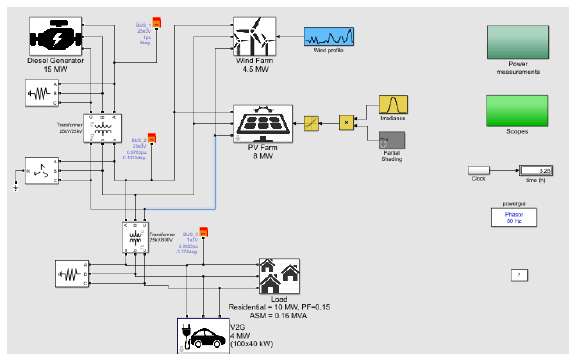
This example shows a vehicle-to-grid system used to regulate the frequency on a microgrid when events occur during a full day. The phasor mode of SimscapeTM Power SystemsTM allows a fast simulation of a 24 h scenario.
Fig.2. Model of micro grid in Matlab – Simulink
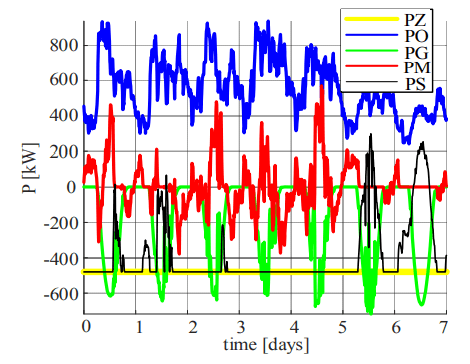
The microgrid is divided into four important parts: A diesel generator, acting as the base power generator; A PV farm combined with a wind farm, to produce renewable energy; a vehicle to grid system installed next to the last part of the topology which is the load of the grid. The size of the microgrid represents approximately a community of a thousand households during a low consumption day in spring or fall. There are 100 electric vehicles in the base model which means that there is a 1:10 ratio between the cars and the households. This is a possible scenario in a foreseeable future.
Diesel Generator
The diesel generator balances the power consumed and the power produced. We can determine the frequency deviation of the grid by looking at the rotor speed of its synchronous machine.
Renewable Energy
In this microgrid are two sources of renewable energy:
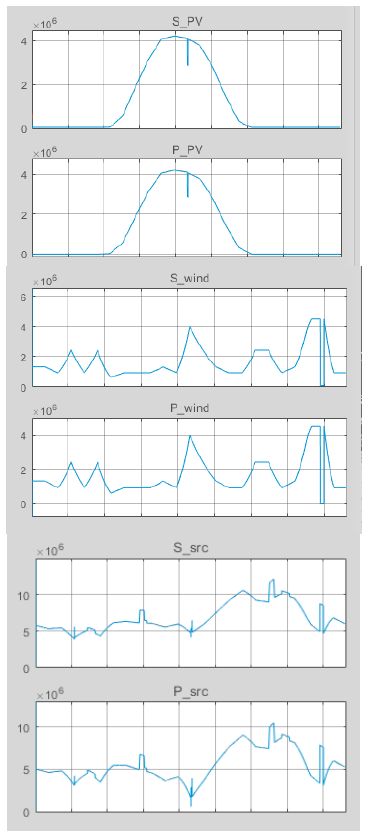
1. The photovoltaic power plant produces 3 energy factors: the size of the area covered by the photovoltaic power plant, the efficiency of solar panels and irradiation data.
2. The simplified model of a wind farm produces electricity after a linear relationship with the wind. When the wind reaches the nominal value, the wind farm produces nominal power. The wind power plant emerges from the grid when the wind speed exceeds the maximum wind speed until the wind returns to its nominal value.
Fig.3. Comparison of the apparent and active power of a photovoltaic power plant, a wind power plant and a diesel generator.
Vehicle-to-Grid
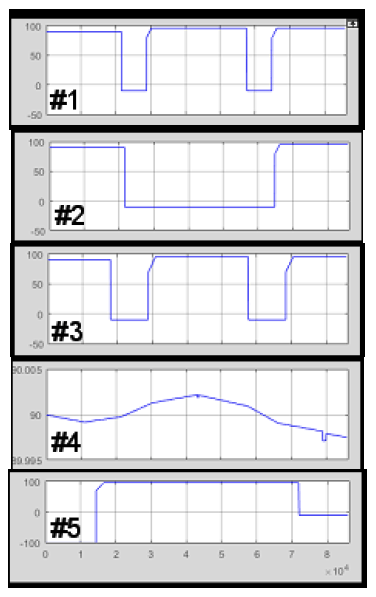
The V2G has two functions: Controls the charge of the batteries connected to it and uses the available power to regulate the grid when an event occurs during the day. The block implements five different car-user profiles:
Profile #1: People going to work with a possibility to charge their car at work. Profile #2: People going to work with no possibility to charge their car at work. Profile #3: People going to work with a possibility to charge their car at work but with a longer ride Profile #4: People staying at home. Profile #5: People working on a night shift.
Load
The load consists of a residential load and an asynchronous machine that is used to express the impact of an industrial inductive load (such as a ventilation system) on a microgrid. Residential load monitors the consumption profile with a given power factor. The asynchronous machine is controlled by a square relationship between rotor speed and mechanical torque.
Fig.4. Comparison of electric vehicle charging/discharging profiles
Simulation
Run the model and observe the various range signals inside of it. It is possible to monitor rotor speed behaviour in the range above the model.
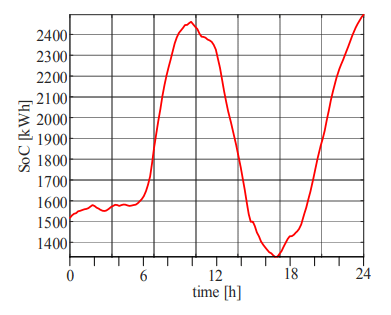
Click on the Scopes and Power measurements subsystem to access information from different nodes. The charging status of each vehicle profile is also available in this subsystem. Negative charge state means the car is on the road or not connected.
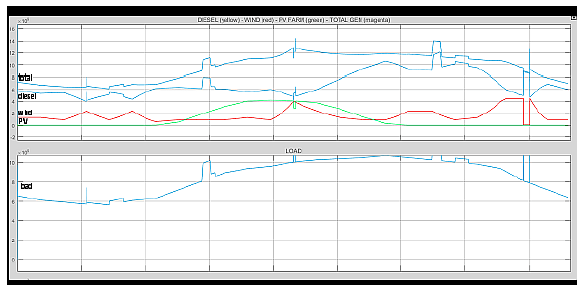
Fig. 5. Processes of production performance (upper graph) and consumption (lower graph)
Scenario
Simulation takes 24 hours. The intensity of sunlight is controlled by the normal distribution where the highest intensity is reached at noon. The wind changes significantly during the day and has several peaks and minima. Residential load has a typical formula similar to normal household consumption. It is low during the day, increases to the peak during the evening and decreases slowly at night. Three events affect network frequency during the day:
– the start of the asynchronous machine in the third hour – a partial cloudiness at midday affecting the production of solar energy – a wind farms cut off in 22 hours when the wind exceeds the permitted maximum permitted wind energy
Conclusion
This article describes a simulation that includes power sources (a 15 MW diesel generator, a photovoltaic and wind power plant with outputs of 8 and 4.5 MW), electricity consumption (with a maximum of around 10 MW) and a model of electric vehicle charging as reserve electricity in case of network drops or surpluses. The system also includes unpredictable sources that in combination with the diesel generator and the electric car system keep the network running.
Because of the model is the off-grid system it is not connected to a larger system, it depends on the reliable operation of the largest source. The base is a diesel generator that is not dependent on wind and solar power but provides the maximum space for energy from renewable energy sources. Several measurements have been performed within the model, demonstrating the functionality of the model and its stability under the given conditions. On a given model, it would still be appropriate to monitor the quality of electrical energy, especially the frequency, since large frequency fluctuations have an undue influence on the functionality of the elements in the network.
Acknowledgement This work was supported by the Ministry of Education, Science, Research and Sport of the Slovak Republic and the Slovak Academy of Sciences under the contract No. VEGA 1/0372/18.
REFERENCES
[1] Sioshansi F. P. et al., Smart Grid: Integrating Renewable, Distributed & Efficient Energy, 510 (Academic Press, 2011) [2] Volčko V., Smart Grid: Vplyv na prevádzku, bezpečnosť a stabilitu elektrizačnej sústavy, (2015), http://www.fei.stuba.sk/docs//2015/autoreferaty/Volcko_autoref.pdf [3] Borlase S., Smart Grids: Infrastructure, Technology and Solutions, 577, (CRC, 2013) [4] Momoh J., Smart Grid: Fundamentals of Design and Analysis, 216, (IEEE P., 2012) [5] Liptai P. et al., Check measurements of magnetic flux density: Equipment design and the determination of the confidence interval for EFA 300 measuring devices, Measurement. Vol.111, p. 51-59 (2017) [6] Mikita M. et al., Sizing optimization of PV-battery hybrid for public lighting system Acta Electrotechnica et Informatica. Vol.16, no. 2 p. 25-28 (2016) [7] Špes M. et al., Possibilities of increasing transmission capacity overhead lines, Acta Electrotechnica et Informatica. Vol. 16, no.3, p. 20-25 (2016). [8] Špes M. et al., Verification of the distance protection relay operation, Zeszyty Naukowe Politechniki Rzeszowskiej: Elektrotechnika. Vol. 25, no. 1, p. 15-25 (2017). [9] Petráš J. et al., Human interfaces used for smart electric installation control, Elektroenergetika 2017. – Košice: TU, 2017 p. 94-98. (2017) [10] Kanálik M., Computation of harmonic flows in three-phase systems, Acta Electrotechnica et Informatica. Vol. 7, no. 3, p.41-45 (2007). [11] Z. Čonka, M. Kolcun: Impact of TCSC on the Transient Stability In: Acta Electrotechnica et Informatica. Vol. 13, no. 2 (2013), p. 50-54. – ISSN 1335-8243 Available on internet http://www.versita.com/aei. [12] Mathworks, Documentation of using Matlab, https://www.mathworks.com/
Authors: Ing. Michal Ivančák, Technical University of Košice, Faculty of Electrical Engineering and Informatics, Department of Electric Power Engineering, Mäsiarska 74, 04001 Košice, Slovakia, E-mail: michal.ivancak@tuke.sk; Dr.h.c. prof. Ing. Michal Kolcun, PhD. Technical University of Košice, Department of Electric Power Engineering, Mäsiarska 74, 04001 Košice, Slovakia E-mail: michal.kolcun@tuke.sk; Ing. Zsolt Čonka, PhD. Technical University of Košice, Department of Electric Power Engineering, Mäsiarska 74, 04001 Košice, Slovakia E-mail: zsolt.conka@tuke.sk; Ing. Dušan Medveď, PhD. Technical University of Košice, Department of Electric Power Engineering, Mäsiarska 74, 04001 Košice, Slovakia E-mail: dusan.medved@tuke.sk. The correspondence address is: michal.ivancak@tuke.sk.
Source & Publisher Item Identifier: PRZEGLĄD ELEKTROTECHNICZNY, ISSN 0033-2097, R. 95 NR 8/2019. doi:10.15199/48.2019.08.11
Published by Iva PAVLOVA-MARCINIAK, Czestochowa University of Technology, Institute of Power Engineering
Abstract. The paper presents the analysis of modern nuclear energy development possibilities in Poland, which is considered as an ecological energy source. As the demand for electrical energy is constantly growing the use of such energy sources in one of the ways to meet the requirements of the Paris Agreement, adopted at COP (Conference of Parties) 21, 2015. The agreement obliges the countries around the world to develop a low carbon dioxide emission economy in order to stop the global temperature rise at 2°C and preferably at 1.5°C.
Streszczenie. Artykuł przedstawia wyniki analizy możliwości rozwoju współczesnej energetyki jądrowej w Polsce, zaliczanej do ekologicznych źródeł energii. Wykorzystanie takich źródeł do produkcji energii elektrycznej, której zapotrzebowanie stale rośnie, jest jednym ze sposobów na spełnienie postanowień porozumienia paryskiego, przyjętego na COP 21 w 2015 r. Umowa zobowiązuje państwa na całym świecie do opracowania niskiego poziomu emisji dwutlenku węgla, aby wzrost temperatury na ziemi nie przekraczał 2°C, a najlepiej 1.5°C. (Zastosowanie elektrowni jądrowych w Polsce – sposób na spełnienie założeń Paryskiego Porozumienia).
Keywords: clean energy, nuclear reactor, biological protection, COP (Conference of Parties). Słowa kluczowe: czysta energia, reaktor jądrowy, ochrona biologiczna, COP.
Introduction
The atmosphere pollution resulting from industrial development, especially in the second half of the foregone century, led to the series of greenhouse gas emission reduction agreements in the second half of the 90s, including the Kioto Protocol, December 1997. However the protocol came into power after its approval by 55 countries, including Poland, that is on February 16th 2005. It was never approved by China and USA, world’s largest polluters. The Kioto Protocol was valid until 2012. Despite that no subsequent agreement was made on any of the UN COPs (United Nations Conference of Parties) preceding the expiration date: from UN COP 14 (Poznan, Poland, 2008) to COP 17 (Durban, RSA, 2011) [1].
Conferences of Parties (COPs)
On December 12th, 2015, on COP 21 in Paris the world climate agreement was established by the representatives of almost 200 countries. Its main target is to stop the global warming way below 2°C, preferably 1.5°C [2]. The Paris Agreement gives the world a chance for a balanced development. In contrast to the Kioto Protocol the efforts for CO2 and other greenhouse gases content reduction is done simultaneously in two ways: by the reduction of their emission due to new technologies as well as their capture by forests. The Paris Agreement is the first international agreement that obliges all countries among the world to act for climate protection. Polish prime minister, Beata Szydlo, signed the agreement on October 7th, 2016.
By the time of the next COP 22 the agreement was adopted by: China, USA, Brazil, Canada, Mexico, and following EU countries: Poland, Austria, France, Germany, Hungary, Malta, Portugal and Slovakia. The fact that Poland was among few EU countries that adopted the act allowed for its standalone representation on COP 22 that took place in Marrakesh (Morocco), October 7th-18th 2016. Poland actively participated in the Parties to the Paris Agreement (CMA) negotiations. It especially praised the postulate to incorporate forest absorption as the way to reduce the CO2 content in the atmosphere as that solution has several additional positive effects. Over long terms it improves the quality of water, air, soil, protects the biodiversity as well as prevents animal migration.
The consecutive COP 23 took place in Bonn (Germany) on November 6th-17th, 2017 – after the election in the USA and Donald Trump taking up the position of the president. He announced that this country will withdraw from the Paris Agreement. The USA is responsible for 16% of the worlds total CO2 emission. As the result the international actions for CO2 emission reduction and climate protection require to be changed. Without strong leadership and forcing CO2 reduction regulations to reluctant countries no major advancement towards climate protection can be made and deep consequences of the climate change that we observe cannot be prevented. It especially applies to the People’s Republic of China, the worlds largest polluter (27.3%) and India (6.8%) which emission rates dynamically increase. From 2005 to 2015 The CO2 emission was reduced respectively: Poland by 0.6%, Germany 0.9%, by the whole European Union by 2% and USA by 1.1%. On the other hand over the same 10 year timespan the Chinese emissions increased by 4.2% and Indians by 6.8%. The COP 23 proceedings were finished by highest level meeting of CMA (Conference of Parties to the Paris Agreement), and CMP (13th Conference of Parties to the Kioto Protocol). The subsequent COP 24 will take place in Katowice (Poland) in 2018.
Smog and normative documents
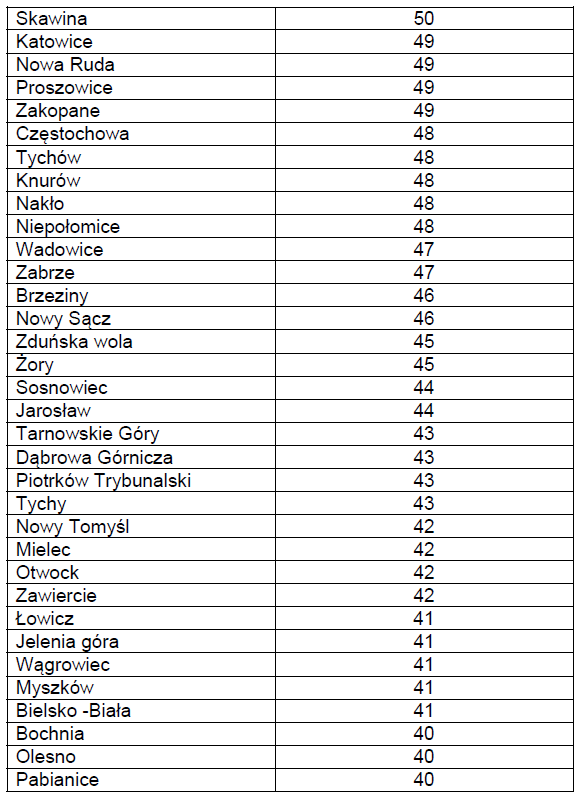
The World Health Organization (WHO) report presented on May 2016 states, that contrary to popular opinion not Cracow, but Zywiec is the Polish city that has the most polluted air (see table 1) [3]. According to European Environment Agency (EEA) Polish Silesia and Malopolskie Province territories are the most polluted areas in Europe (see Figure 1) [4]. Even one in five lung cancer cases in Poland can be caused by smog.
Table 1. The most smog-polluted cities of Poland [3]
.
.
Fig. 1. Areas where daily PM10 concentration limit was exceeded (highlighted in red) [4]
Smog, due to high concentration of aggressive chemical factors pose a great health threat to humans and animals. It can cause circulatory system diseases, asthma, increased risk of cancer and can directly cause death due to chronic obstructive pulmonary disease (COPD). It also causes plant diseases and causes construction materials deterioration. The main particle matter PM10 (particles smaller than 10 mikrons) sources are the industry, traffic, domestic heating systems and agriculture.
On December 2015 the European Commission decided to submit Poland to the Court of Justice of the European Union (CJEU) due to persistent high level of particle matter content in the air which caused major concern for the public health. The case was eventually registered in CJEU in June 2016. In. 2017 the European Commission punished Bulgaria for exceeding the pollution norms and rebuked Poland.
Polish nuclear power engineering
Polish power engineering is mainly based on coal. 80% of the energy is produced by conventional power plants. Despite the fact that renewable sources already supply a significant part of the energy they may be not enough to fulfill the requirements of Paris Agreement and EU power engineering policy. The development of nuclear power engineering may resolve both the problem of growing demand for electric energy as well as significantly reduce the CO2 and other greenhouse gases emissions.
In the early 1980s the construction of the first Polish nuclear power plant in Żarnowiec was started. The construction works were quite advanced, however, in 1986 the Chernobyl disaster happened. The construction works were ceased. According to then in force Atomic Law if the construction work of the nuclear power plant had been suspended for a year or above it had to be canceled. The Council of Ministers adopted the relevant law on December 17th, 1990. The date of deconstruction works beginning was set for December 31st, 1992. As the result of neglecting the education about the nuclear energy after the cancellation of Żarnowiec Nuclear Plant it was implicitly assumed that there will be no return to that technology.
The Chernobyl nuclear power plant failure from April 26th, 1986 was classified according to the International Nuclear and Radiological Event Scale (INES) as the catastrophe with the highest, 7 point score.
Fig.2. INES scale according to IAEA [5]
The INES scale was created by International Atomic Energy Agency (IAEA) experts to evaluate emergency events in nuclear installations in order to provide unambiguous messages to the public. Currently it is applied by over 60 countries, including Poland.
The next serious accident, classified as 6 out of 7 in INES scale, took place on March 11th, 2011 in Japanese nuclear power plant Fukushima I. As the result of the strongest earthquake ever registered in Japan, 8.8 Richter score, the secondary 10 m high tsunami wave was generated. The wave hit the power plant located at the Pacific Ocean coast, disabling the emergency cooling systems in all 4 active Boiling Water Reactors (BWR), causing cores meltdowns. The BWR even after emergency shutdown generates some heat due to spontaneous fission reaction and it needs to be dissipated. Those are old generation reactors, the first one of that type was activated in 1971.
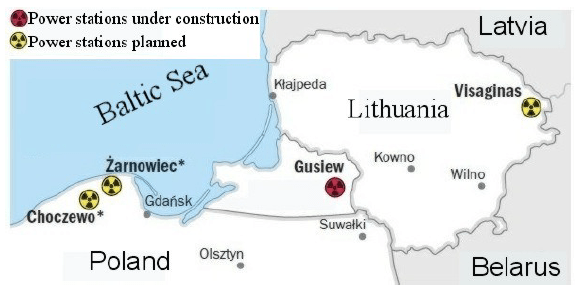
After new generation of nuclear power plant reactors was designed and put into production the nuclear energy had its renaissance. In Poland after a series of discussions on January 13th, 2009 the Council of Ministers decided to start the new Polish Nuclear Power Engineering Program. A series of amendments was made for radiological protection, and personnel training laws, as well as several normative documents were adopted. The amended nuclear law came into force on July 1st, 2011 and on September 2014 its last updates were published in the Journal of Laws. However, up until now neither the location nor the technology for new nuclear power plant was chosen (see Fig. 3).
Fig.3. The proposed nuclear power plant locations in Poland [5]
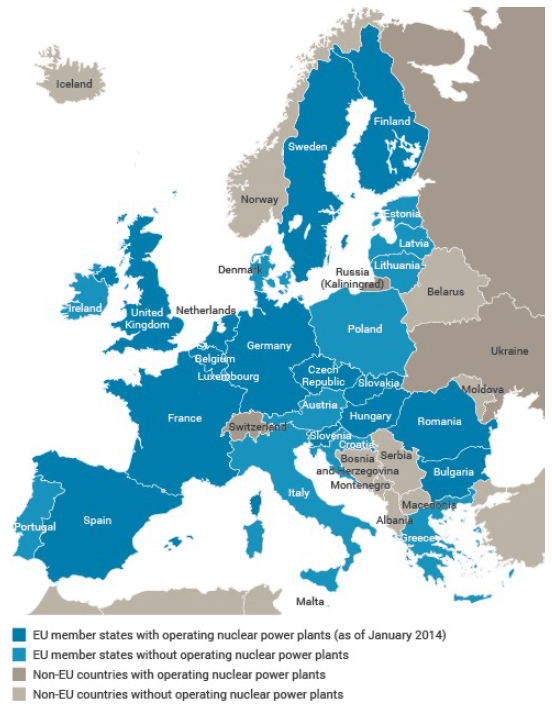
Fig.4. Nuclear Power in the European Union [7]
The cost of constructing the 3 GW (2x 1500 MW) nuclear power plant according to present prices is estimated at about 50 – 60 billions PLN. The government assesses that for the same price 3 conventional, coal fed power units can be built. However there is a tendency for CO2 emission charges to rise and can reach 40 – 50 billion PLN per year in the near future. Poland needs the final decision for building a nuclear power plant as the power demand in 2030 is estimated at 10 GW. If just the economical and safety factors are considered the conventional coal power units still unambiguously win but if the environmental requirements are included the nuclear power plants take over the lead.
Among the EU countries only Austria and Poland does not have nuclear power plants (see fig. 4) [6]. Over 20 years ago, on July 9th, 1997 the Austrian parliament voted for the country to stay antinuclear. The Austrian constitution was updated with the prohibition of the nuclear power plant construction as well as nuclear materials storage and transport to, from and through the territory of the country.
The III and III+ generation reactors
The European Pressurised Reactor (EPR) is a modern Pressurized Water Reactor (PWR) with 2 coolant loops, categorized as so called generation III+. It was designed as a the counterpart for the previous generation Pressurised Water Reactor (PWR). The new Russian power plant design VVER 1500/1600 by Rosatom meets the generation III+ requirements as well [8]. For technical parameter see table 2.
Table 2. The parameters of generation III and III+ reactor power units [8,9,10]
.
For generation III and III+ nuclear power plants one of the safety and reliability measures is the availability factor (AF). It is described as the percentage of time during which the power plant is able to produce full power over certain period of time. High AF value means that effective operation plan is being used that minimizes the unplanned shutdowns and optimizes the planned ones. In modern nuclear power plants average AF values of nearly 90% were reached [10]. Modern technologies also allow the minimize the radiation doses for the personnel. New nuclear power plant technologies were designed according to so – called “in depth security” rule. that is designing the processes with huge safety margins. Special mandatory systems prevent excessive deviations of the process parameters from their nominal values and if so happens they stop the failure growth and limit the affected area to the power plant itself. The radiation safety is implemented on the design stage. The fuel material. in which remain the 99.9% of fission byproducts. is encased in fuel material jackets made of Zirconium (Zr) – very tough and resistant to temperatures of order of thousand Celsius degrees [10].
All power plant systems undergo a regular maintenance schedule among the whole operational time (50-60 years) [8. 9. 10]. The safety features implemented in generation III reactors ensure the personnel safety even in case of serious accidents. including core meltdown followed by exothermic reaction of zirconium jackets with water and hydrogen extraction [10]:
.
where: Q – released thermal energy.
Power plants with PWR or EPR reactors can be equipped with a system in their secondary water loop that enables them to output not only the electrical energy (PG) but heat energy (QG) as well. the same way as it is done in conventional power plants. That solution increases the efficiency of the unit as a whole and thanks to central heating the end users pollute the environment less during the heating period. The efficiency of the power plant equipped with such system can be obtained from the formula:
.
where: ηel.b – gross efficiency of the unit. Q̇G – heat Energy stream for district heating. PG – gross electrical power on the generator output. Ḃu– fuel mass. Wd – stipulated heating value of the fuel.
Nuclear power engineering and the Paris Agreement
On COP 18 in Doha. Quatar. 2012. in which participated 17 thousand representatives of 194 countries. the representatives of the International Atomic Energy Agency (IAEA) were invited. The nuclear energy expert. Alan McDonald presented a report of the agency. titled: “Climate Change and Nuclear Power”. in which the nuclear energy was classified as clean energy [11].
The renewable energy source are still very expensive to operate. The Carbon Capture and Storage (CCS) technology. which introduces storing CO2 in the underground tanks. is in the early stage. Most of the renewable energy sources random to large extent. On this background the nuclear energy’s biggest advantages are its reliability and no CO2 emissions.
Countries with already developed network of nuclear plants fulfill the Climate Package and 3×20 Program assumptions with ease. as the nuclear power usually covers a huge percentage of energy demand. That refers particularly to France. where nuclear power plants produce almost 80% (77.7%) of the energy. At the advantage is also Slovakia (54%). Belgium (54%). Hungary (43.3%) Czech Republic and Bulgaria (33% in each case). Some of these countries develop or plan new nuclear power units. that incorporate new technologies.
On the contrary Germany fulfills the program of shutting down all nuclear reactors by the end of 2022. France adopted and fulfills the program for reducing the percentage of nuclear power to 50% in 2025. The government of Belgium adopted the program for shutting down all nuclear reactors by 2025. as their age will reach 40 year. Switzerland also plans to retreat from nuclear power with a plan to shut down their first nuclear power plant in 2019 and the last one in 2034.
Until 2030 the IAEA prognoses that the combined power of the nuclear power plants on the world will reach 400 GW in minimal and 699 GW in maximal variant. However after the Fukushima accident the IAEA prognoses for 2030. both minimal and maximal are being lower every year [12. 13]
Conclusion
1. The Kioto Protocol expired in 2012 but due to series of failed attempts on all the UN conferences from COP 14 to COP 20 no new agreement was made. On December 2015 on COP 21 in Paris. participated by the representatives from almost 200 countries. the new global climate agreement was signed. Its goal is to stop the global temperature increase significantly below 2°C. Participating countries would endeavor in the second half of the 21st century to balance the greenhouse gases emissions with their removal. including their absorption due to afforestation.
. At COP 18 in Doha. Quatar in 2012 the nuclear power expert. Alan McDonald presented a International Atomic Energy Agency (IAEA) report in which nuclear energy was classified as clean energy.
3. New generation III and III+ nuclear reactor designs enables to reach very high availability factor of 90% for nuclear power plants as well as very high safety.
4. After nuclear power engineering renaissance a series of negotiations was made and on January 13th. 2009 the Polish Council of Ministers decided to start new Polish Nuclear Energy program. The amended Atomic Law came into force on June 1st . 2011. On September 2014 its final updates were published.
5. For Poland when only economical and safety factors are considered the conventional. coal fed power units unambiguously win. However when the climate protection requirements of the Paris Agreement are considered too the nuclear power units take over the lead.
Author: Dr inż. Iva Pavlova-Marciniak. Politechnika Częstochowska. Instytut Elektroenergetyki. Al. Armii Krajowej 17. 42-200 Częstochowa, E-mail: iva@el.pcz.czest.pl
Source & Publisher Item Identifier: PRZEGLĄD ELEKTROTECHNICZNY, ISSN 0033-2097, R. 95 NR 8/2019. doi:10.15199/48.2019.08.02
Published by Alex Roderick, EE Power – Technical Articles: Safety Standards for Testing Instruments, November 24, 2021.
IEC standards reduce safety hazards that can occur from unpredictable circumstances when using electrical test equipment such as test instruments and meters.
The International Electrotechnical Commission (IEC) is an organization that develops international safety standards for electrical equipment. The IEC standards reduce safety hazards that can occur from unpredictable circumstances when using electrical test equipment such as test instruments and meters. For example, voltage surges on a power distribution system can cause a safety hazard when a test instrument is being used in an electrical system.
A voltage surge is a higher‐than‐normal voltage that temporarily exists on one or more power lines. Voltage surges vary in voltage amount and time present on the power lines. One type of voltage surge is a transient voltage. A transient voltage (voltage spike) is a temporary, undesirable voltage in an electrical circuit. Transient voltages typically last for a very short time, but they are large in magnitude and quite erratic. Transient voltages are caused by unfiltered electric equipment, lightning strike, capacitor bank, or generators being switched ON and OFF.
It is possible for transient voltages to reach several thousand volts. On a 120 V power line, a transient voltage can reach 1000 V (1 kV) or higher. High transient voltages occur close to a lightning strike or when large loads are disconnected (see Figure 1). For example, when a large motor (100 HP) is turned OFF, a transient voltage moves down the power distribution system. When a test instrument or meter is connected to a point along with the system in which a high transient voltage is present, an arc can be created inside the meter. An arc can lead to a high-current short in the electrical distribution system even after the original high transient voltage has gone. A high‐current short can turn into an arc blast.
Figure 1. Transient voltages can lead to electrical shocks and/or damage to test equipment and meters
An arc blast is a type of explosion that happens when the air around electrical equipment becomes ionized and conductive. The amount of current drawn and the potential damage caused depends on the specific location of the arc blast in the power distribution system. All electrical distribution systems have current limits determined by fuses and circuit breakers located along the system. The current rating (size) of the fuses and circuit breakers decreases further away from the main distribution panel. The further away from the main distribution panel, the less likely a high transient voltage is to cause damage.
Caution
Other than a laser, an electric arc is the hottest heat source in existence. Electric arcs are capable of producing temperatures up to 10,000°F. Temperatures of such intensity are capable of producing serious burns at distances up to 20′ and can be fatal at distances up to 8′.
CAT Ratings
IEC standard 1010 classifies the applications in which test instruments may be used into four overvoltage installation categories (Category I – Category IV). The four categories are typically abbreviated as CAT I, CAT II, CAT III, and CAT IV. The CAT ratings determine what magnitude of transient voltage a test instrument or other electrical appliance can withstand when used on a power distribution system. For example, a test instrument or other electrical measurement tool specified for use in a CAT III installation must withstand a 6000 V transient (2 ms rise time with a 50 ms, 50% duration) voltage without resulting in a hazard. When a test instrument or other meter is operated on voltages above 600 V, the test instrument must be capable of withstanding an 8000 V transient voltage. Also, a test instrument or meter that is designed to withstand a transient voltage can be damaged, but the transient cannot result in a hazard to the technician or the facility. To protect technicians from transient voltages, protection must be built into all test equipment.
Safety standards such as IEC 61010‐1 2nd edition, the harmonized North America standard, and the UL standard 61010‐1 vary but are closely matched. The requirements of the standards are used to rate test equipment for minimizing hazards such as shock, fire, and arc blast, among other concerns. A test instrument designed to these standards offers a high level of protection. A measurement category rating such as CAT III or CAT IV indicates acceptable usage on three‐phase permanently installed loads and three-phase distribution panels in a building or facility. All exposed electrical installations and the power panels of a facility are considered high‐voltage areas. Measurement categories such as CAT III and CAT IV ratings are important criteria for test instruments and meters used in industrial applications (see Figure 2).
Figure 2. The IEC 1010 standard defines the applications in which test instruments and meters can be used according to the four categories.
Power distribution systems are divided into categories based on the magnitude of transient voltage that test instruments must withstand when used on the power distribution system. Dangerous high‐energy transient voltages such as a lightning strike are attenuated (lessened) or dampened as the transient travels through the impedance (AC resistance) of the system and system grounds. Within an IEC 1010 standard category, a higher voltage rating denotes a higher transient voltage withstanding rating. For example, a CAT III‐1000 V (steady‐state) rated test instrument has better protection compared to a CAT III‐600 V (steady‐state) rated test instrument. Between categories, a higher voltage rating (steady‐state) might not provide higher transient voltage protection. For example, a CAT III‐600 V test instrument has better transient protection compared to a CAT II‐600 V test instrument. A test instrument must be chosen based on the IEC overvoltage installation category first and voltage second.
Independent Testing Organizations
National, state, and local standards and codes are used in order to protect people and property from electrical hazards. A code is a standard regulation or minimum requirement. A standard is a recognized reference or practice. Codes and standards ensure that electrical equipment is built and installed safely, and every effort is made to protect people from electrical shock. The IEC sets standards but does not test or inspect for code and standard compliance.
A test instrument with a symbol and listing number of an independent testing lab such as Underwriters Laboratories Inc.®(UL), Canadian Standards Association (CSA), or other recognized testing organization indicates compliance with the standards of the organization. A manufacturer can claim to “design to” a standard with no independent verification. To be UL listed or CSA certified, a manufacturer must employ the services of an approved agency to test a product’s compliance with a standard (see Table 1). For example, UL 3111‐1 or CSA C22.2 No. 1010.1‐92 indicates that the IEC 1010 standard is met.
Recognized Testing Laboratories (RTLs) And Standards Organizations
Table 1. Test instruments have symbols listing the nationally recognized testing laboratories and standards organizations that the meters are in compliance with.
Caution
Before using any electrical test instruments or meters, always refer to the user’s manual for proper operating procedures, safety precautions, and technical limits. Conditions can change quickly as voltage, and current levels vary in individual circuits
Author: Alex earned a master’s degree in electrical engineering with major emphasis in Power Systems from California State University, Sacramento, USA, with distinction. He is a seasoned Power Systems expert specializing in system protection, wide-area monitoring, and system stability. Currently, he is working as a Senior Electrical Engineer at a leading power transmission company.
Published by Mohammad Abu Sarhan, Andrzej Bien´, Szymon Barczentewicz, Rana Hassan, AGH University of Science and Technology
Abstract. In Jordan, there are many extensive challenges that the country faces against the national economy growth. This is mainly because Jordan has limited primary energy resources and imports more than 90% of natural gas and crude oil from neighboring countries which negatively affect its economy. However, the geographical location of Jordan is one of the benefits that make the country rich in renewable energy resources particularly solar and wind energy resources. Therefore, to fulfill the high growth of electricity demand in the coming years; Jordan is working on increasing the contribution percentage of renewable energy resources in the total energy mix. In this paper, the status of the electricity supply system and renewable energy resources in Jordan are discussed. Furthermore, the investigation of implementing the prospect scenario of increasing the share of electric generation from renewable energy resources shows that the generated power from solar and wind are significantly enhancing the national economy growth.
Streszczenie. W Jordanii istnieje wyzwan wpływaj ˛ ´ acych na rozwój gospodarczy tego kraju. Jednym z takich wyzwan jest brak pierwotnych ´ ´ zródeł energii, co zmusza kraj do importu 90% energii, tj. ropy i gazu, od krajów osciennych. Geografia Jordanii pozwala jednak na du ´ zy rozwój energetyki ˙ odnawialnej, w szczególnosci energetyki opartej na energii sło ´ nca i wiatru. Wa ´ znym elementem zapewnienia poda ˙ zy na rosn ˛ ˙ acy popyt na energi ˛e jest wi ˛ec rozwój energetyki odnawialnej. W artykule omawiany jest obecny stan energetyki Jordanii oraz omawiany jest rozwój energetyki odnawialnej w miksie energetycznym tego kraju.(Przegl ˛ad systemu energetycznego oraz sektor energii odnawialnej w Jordanie)
Keywords: Electric Energy, Renewable Energy, Solar Energy, Wind Energy Słowa kluczowe: Energia elektryczna, odnawialne ´zródła energii, energia słoneczna, energia wiatrowa
1. Introduction
Globally, the demand of electric energy is growing rapidly year by year. In addition, the price of oil and pollution, that caused by the burning process of fossil fuels, are increased clearly. The depletion of oil source supply is possible. Hence, the study of using other alternatives like using renewable energy resources such as solar and wind energy to generate the electric power gets more attention.
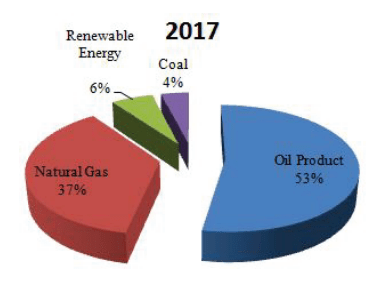
Jordan is a country that located on the northern Arabian Peninsula and covers an area of 89,342 km2. Jordan has a cool weather in winter and a semi-dry in summer. One of the challenges that the energy sector faces in Jordan is the rapid growth of energy demand, and the other is the country has limited local resources to fulfill the required demand [1]. Around 94% of Jordans total primary energy supply is covered by natural gas and crude oil/petroleum products while less than 6% is represented by renewable energy in 2017 as shown in (Fig. 1). Because Jordan has a shortage in local natural gas and traditional crude oil resources, Jordan imports more than 90% of that resources form borders countries [2]. Therefore, the countrys national economy has significantly affected by importing crude oil and natural gas.
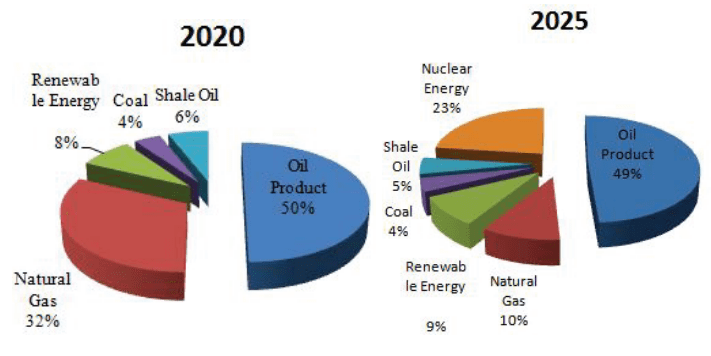
Jordan witness high growth of energy demand. For instance, in (2008-2020) the growth of electricity demand is 7.4% which shows that the additional generated capacity needed up to 2020 is 4000 MW, an average of 300 MW per year. While, the growth of primary energy demand is 5.5% for the same period, hence the expected demand for primary energy amount is 15 million tons of oil equivalent in 2020 compared to 7.5 million tons of oil equivalent in 2008 [3]. On the other side, Jordan’s population had observed a rapid increase in the recent years especially due to the conflicts that neighboring countries suffer and leaded to a high rate of refugee waves immigrate to the country [4]. These challenges increase the added pressure on the electricity system in Jordan in the upcoming years. To fulfill the high growth of electricity demand in near future, the government of Jordan has launched some strategies related to energy to improve the involvement of renewable energy resources to the national power source supply. By 2020 and 2025, the contribution of renewable energy resources to the total energy mix can reach to 8and 9% respectively, including various wind and solar projects specifically 300-600 MW of solar energy projects and 600-1000 MW of wind energy projects [2] as presented in (Fig. 2). In addition, the government has established a legal plan to minimize the energy consumption using energy efficiency measures by allocating a special budget that supports renewable energy and energy efficiency projects.
In this paper, the development of electricity supply system in Jordan is discussed. Furthermore, the possible scenario of implementing renewable energy resources including solar energy and wind energy resources to the national electricity system is investigated. The analysis of this scenario is carried out based on economical, social and environmental aspects.
Fig.1. Energy Mix in Jordan for 2017
Fig.2. Energy Mix in Jordan for 2020 and 2025
2. Energy Sector in Jordan
The energy sector in Jordan is under umbrella of both Ministry of Energy and Mineral Resources (MEMR) and Energy and Mineral Regulatory Commission (EMRC). The main function of this ministry which was established in 1984 is to develop general policies, to monitors its implementation to achieve the security of a sustainable energy supply, to fix tariffs, and to legalize all activates with an influence on energy. Furthermore, MEMR has some responsibilities to define new strategies and projects to promote renewable energy resources such as solar and wind energy resources [5]. While, the main role of EMRC is to grant licenses and permits to companies working in the energy sector, monitor and verify the compliance of licenses, determine the electric tariff, and to participate in setting slandered specification and technical rules related the energy sector facilities and equipments [6].
2.1. Electricity Sector in Jordan
The electricity system in Jordan includes four major divisions: power supply generation, power supply transmission, power supply distribution, and renewable energy resources. The four majors divisions which are shown in (Fig. 3) are briefly clarified below:
2.1.1. Electricity Generation Sector
The generation sector is the sector who is involved in generating the electricity from power plants to be provided to the transmission girds. The responsible companies who are in charge of this sector are as below:
• Central Electricity Generation Company (CEGCO)
CEGCO has been privatized in 2007, 60% of government shares have been sold to Dubai Capital Company (51%) and Social Security Institution (9%). The generation capacity owned by CEGCO is around 1555 MW which covers a 49% of total installed capacity in Jordan. The power plants that are owned and operated by CEGCO are distributed in different location in Jordan. These power plants are: Aqaba Thermal Power Station, Al Rihab Gas Station, and Risha Gas Power Plant [7].
• Amman East Power Company (AES Jordan)
AES Jordan is located east of Amman with a 400 MW capacity produced by both dual fuel natural gas and oil fired. AES Jordan covers almost 8% of the electricity demand in Jordan. This combined cycle power plant was built and operated as a public private project (IPP1). As well as, it owns and operates Levant Power Plant (IPP4) which was built mainly to be operated during the peaking time. Levant Power Plant is a tri-fuel engine technology that located on the same location of AES Jordan [8].
• Qatranah Power Company (QPCO)
QPCO is a 373 MW power plant that is located in Al Qatranah about 90 km south of Amman. This power plant was constructed by a consortium of Korea Electric Power Corporation (80%) and Xenel Industries Ltd (20%) in 2008 as Al Qatrana IPP. The output produced power of this plant is totally sold to Jordan National Electric Power Company (NEPCO) under the obligations of Jordanian Government in term of financial issues [9]
• Samra Electricity Power Company (SEPCO)
The total capacity of SEPCO is 1175 MW which approximately covers 40% of Jordan’s load demand. The electric power is generated using various technologies of conventional energy resources. SEPCO is totally a state owned company [6].
• Amman Asia Electric Power Company (AAEPC)
AAEPC is a power plant with 573 MW installed capacity and located in Al Manakher around 30 km from Amman. The plant was built, owned, and operated using natural gas and heavy fuel oil by a consortium of Korea Electric Power Corporation (60%), Mitsubishi Corporation (35%), and Wartsila Development & Financial Services (5%). The plant was installed in 2015 to achieve the goal of energy self-sufficiency by reducing the import of Egyptian gas [10].
• Attarat Power Company (APCO)
Attarat Power Plant is the first project that produces electricity using the direct burning of oil shale with a capacity of 460 MW that covers 15% of the load demand in Jordan in 2020. The construction work of this project has started in 2017 by a partnership between Guangdong Yudean Group (45%), YTL POWER (45%), and Eesti Energia (10%) [11].
• Jordan Biogas Company
The main objective of this project which is located in Ruseifa near to the capital city Amman is to reduce the problems associated to environmental pollution. The plant was built to convert around 27 million cubic meters of biogas into 48 GW of electric capacity annually [12].
• Zarqa Power Company (Acwa)
This plant was built to substitutes Hussein Thermal Power Station that is located in the industrial zone of Zarqa city and was deactivated in 2015. The generated power capacity of this plant is 485 MW using combined cycle gas fired leading to minimize the emissions and fuel consumption per MWh of the generated power. The main goal of this project is to achieve the strategy of nation energy 2025 by increasing the local power generation by 40% by 2020 [13].
2.1.2. Electricity Transmission Sector
The transmission sector in Jordan is 100% owned and operated only by National Power Company (NEPCO). The main role of this company includes but not limited to different tasks such as transmission lines construction and maintenance, development and planning of transmission stations, and buying power energy from various suppliers to sell it to distribution companies. The transmission network and the National Control Center are fully owned by NEPCO which consists of 10023 MVA major substations and 132 kV and above high voltage transmission lines with total length of 4121 km-circuit [7].
2.1.3. Electricity Distribution Sector
The main role of distribution sector in Jordan is to distribute the power source that needed by end consumers including industrial, commercial, and residential end consumers. The responsible companies of this sector are presented below:
• Jordan Electric Power Company (JEPCO)
JEPCO is responsible for distributing about 66% of the total consumed power in Jordan. The electric power is distributed by JEPCO to locations that extend from Wadi Al-Dleil in the north to Theiban in the south and from Mowager in the east to Al-aghwar in the west [14].
• Irbid District Distribution Company (IDECO)
IDECO is responsible for distributing the electric power to 25% of the geographical area in Jordan. The electric power is distributed by IDECO covering a total area of 23,000 km2 in the north of the country including Mafraq, Jerash, Ajloun, and Irbid [15].
• Electricity Distribution Company (EDCO)
EDCO is responsible for distributing the electric power to various geographic locations in Jordan particularly the southern districts of the country. The areas that get the power source by EDCO in Jordan are specifically Zarqa, Tafilah, Karak, Maan, and Aqaba [16].
2.1.4. Renewable Energy Sector
The companies are responsible for generating electric power using renewable energy resources either solar energy or wind energy in Jordan are 29 companies in total. Specifically, there are 7 wind energy companies and 22 solar energy companies are involved in this sector in Jordan [3] According to the main structure of the electricity sector in Jordan which was presented above, the electricity demand in Jordan for a certain periods is discussed below.
Fig.3. Frame of Electricity Sector in Jordan
2.1.5. Electricity Demand for the period 2015-2025
The electricity demand has been increased greatly year by year in Jordan. For instance, the annual growth rate for the peak load between 2015 and 2025 is approximately 5.5% and the annual growth rate for the generated electric power for the same period is around 5.3% [17]. Table 1 shows the increasing amount for both peak load and generated electric power between 2015 and 2025.
Table 1. Electricity demand for the period 2015-2025
.
3. Renewable Energy Resources in Jordan
The market of renewable energy resources is recently growing in Jordan. Increasing the contribution of renewable energy to the future energy mix has become a key policy priority in Jordan. This is because Jordan aims to diversify its economy against a backdrop of increasing local energy demand.
The geographical location of Jordan makes the country has a clear richness in renewable energy resources especially solar and wind energy resources. Jordan is located within the region that is known as a region of the Sun Belt which is located between latitudes 25 north and 25 south; therefore the area is exposed to a high average direct solar radiation during 316 days per year at an average of 8 hours per day. Regarding wind energy resource, Many areas in Jordan are characterized by wind speeds ranging from 7-8.5 m/s which is a suitable speed to construct wind plants that generate electricity among the country.
3.1. Solar Energy Resource
The most essential parameter for calculating the energy yield and assessing the performance of photovoltaic energy technologies is based on the average daily/yearly sum of global horizontal irradiation (GHI). Based on the average daily/yearly sum of global horizontal irradiation, Jordan is classified into five special areas with different amount of exposed solar irradiation as shown in Table. 2 [18].
Table 2. Average daily/yearly sum of global horizontal irradiation
.
In Jordan, the PV system is implemented as kW rating systems which are installed on roofs or as MW rating systems which are installed as power plants. For low kW rating systems, the electricity amount which can potentially obtained over an average year can be evaluated for all regions based on the assumption that the net efficiency for PV modules that used all over the country is 15%. Based on that, the Eastern region has the highest electricity production potential (0.85 – 0.92 TWh/a) compared to other regions and the Western region has the lowest electricity generation potential (0.21 – 0.23 TWh/a) among all regions. The total generated power potential for all regions is (2.69 – 3.25 TWh/a) as presented in Table. 3. Consequently, for MW rating systems, the Eastern region has the highest electricity generation potential (356 – 398 TWh/a) and the Northern region has the lowest electricity generation potential (3 – 4 TWh/a). The total generated power potential for all regions is (465 – 508 TWh/a) as presented in Table. 4.
Table 3. Potential of electricity generated by low kW rating systems
.
Regarding photovoltaic (PV) systems, the distribution of solar radiation is relatively uniform in Jordan which makes this technology to be proper for electricity generation in Jordan. In addition, in rural and desert areas PV technology is proper for off-grid power production in power plants. The capacity of power production from off-grid PV systems can reach to 1000 kW peak in these areas, where the produced power by PV technology is used for different applications such as houses lighting, water pumping, and other activities. Furthermore, many projects of on-grid PV plants have been constructed among the country with total capacity reach to around 200 MW are located in and near to southern region of the country. About 11 projects have been established in Maan region, the most important of which is Shams Maan Power Generation Project with 52.5 MW total capacity and provide 1% of Jordan electricity current generation [19]. Other project also have been built in different locations such as AlMafraq station (50 MW), Al-Quweira plant project (103 MW), Al-Risha solar power plant (50 MW), and Al-Baynunah solar power plant which is located east of Amman (200 MW).
Table 4. Potential of electricity generated by high MW rating systems
.
While regarding solar thermal systems, the implementation of concentrated solar power (CSP) by domestic loads has increased in Jordan. Approximately 20% of households are using solar water heaters on their roofs. Furthermore, a round 30% of households get solar water heaters on their roofs by 2020. The first CSP project and solar desalination plant have launched by the government with around 300 MW – 600 MW installed capacity in Aqaba by 2020.
3.2. Wind Energy Resource
In Jordan, the resources of wind energy are plentiful to provide a significant amount of power capacity that covers the country needs if effectively invested. The energy yield calculation and assessment of wind energy technologies depend on an important factor which is the yearly average wind speed of the country. Jordan can be divided into five territories based on the annual average wind speed at 50 m height above the ground [18]. The first territory, which is the most capable place to construct wind farms, has a yearly average speed exceeds 7.5 m/s at 50 m height above the ground. This territory is exactly located in the North ( Al-Ibrahemia and Hofa), and in the South (Fujeij). The second territory has a yearly average wind speed varies between 6.5 to 7.6 m/s at the aforementioned height. The third territory represents around 30% of Jordan and has a wind speed varies between 5.5 to 6.5 m/s. While the fourth territory represents around 45% of Jordan and has a wind speed varies between 4.5 to 5.5 m/s. The last territory has a wind speed varies between 3.5 to 4.5 m/s.
The main use of wind energy in Jordan is for electricity production. There is various wind energy projects have been constructed in Jordan since 1980s in different parts in the country. One of these projects was established as a small grid-connected wind farms with a total capacity of 320 kW in Al-Ibrahimyya region in the northern part of the country. That project was applied by a corporation between the government and the Danish firm Tellus. The other project, which also was established in 80s, was a hybrid solar-wind power plant generates electricity with a capacity of 40 kW of two wind energy converters, 10 kW peak PV systems, 330 kWh of storage batteries, and 65 kW of a backup diesel generator for a remote village in southern Jordan in Jurf El-Darawish. In 1996, a large wind turbine farm was built in northern Jordan in Hofa consisting of five wind turbines of 225 kW each, and with annual total output of 2.5 GWh. Furthermore, various projects have been planned by MEMR to get benefit from the available wind energy specifically Al-Mafraq project (100-150 MW), Maan project (100-150 MW), Wadi-Araba (40-50 MW), Al-Tafelah project (150-200 MW), Al-Fujaij project (70 MW), and Al-Kamshah project (40 MW) [18].
Table 5. Potential of electricity generated by wind mills
.
In addition, water pumping in remote villages using mechanical and electrical wind power plants is extremely applied in Jordan. Around twenty pumping stations that are used to pump water using mechanical wind mills are made locally. As well as, there is some effort to manufacture the electrical wind turbines particularly the blades and towers locally.
Based on, the yearly generated electricity which can be evaluated for all regions as presented in Table. 5. The total electricity generation potential in Jordan is in a range between 25.5 and 34.3 TW h/a. The highest contribution can be obtained from the region of 5.5 – 6.5 m/s wind velocity with 15.1 – 21.4 TW h/a and the lowest share is obtained in the region with a wind speed between 7.5 and 8.5 m/s with 3.8 – 4.5 TW h/a.
3.3. Other Renewable Energy Resource
There are many prospective to use biogas from solid waste to generate electricity in Jordan. One of the projects that use municipal solid waste (MSW) through biogas technology was built in 2011 with a total capacity of 1 MW. In 2008, the project capacity has been expanded to around 4 MW. Jordan is planning to provide about 40-50 MW waste energy power projects by 2020 [20].
Hydropower resource is considered very limited in Jordan. In the whole country, there is only two hydropower projects have been accomplished. The first project is King Talal Dam which has 7 MW total installed capacity and the annual generated power is around 25 GWh. The other project is executed at Aqaba Power Station by installing 6 MW hydropower turbines to be used in the cooling cycle of the station. Based on several studies, after accomplishing the proposed project of the Red and Dead Seas Canal, extra hydro resources potential of 400-800 MW could be utilized.
There are only some small geothermal projects that are used for the purposes of aquaculture in Jordan. In the Dead Sea rift valley, there are some low and medium geothermal waters have been found by the Jordanian Authority of Natural Resources. The technical and economical potential of using geothermal energy in electricity production have been assessed by various studies. Based on the results, a further deep drilling is needed to judge on the feasibility of these kind of projects.
4. Accomplishments of Energy Sector in Jordan
The energy sector is considered one of the most vital sectors in Jordan due to its great impact on sustainable development. This sector has made great achievements during the last period despite the great challenges it faces from the lack of local sources of energy and its dependence on imports. Jordan imported about 93% of its total energy needs in 2018 compared to 97% in 2014.
Over the past years, a clear policy has been adopted in the energy sector that mainly aims to achieve energy security through diversification of imported energy sources, the development of traditional and renewable local energy sources and their exploitation, the orientation towards sustainable energy and the adoption of a policy of liberalizing energy markets, including oil products market, creating opportunities for the private sector and encouraging it to invest in infrastructure projects for the energy sector, as well as strengthening regional energy linkage projects and maximizing their utilization and improving energy consumption efficiency in all sectors. These are complementary policies whose axes have been implemented within clear and specific work programs and mechanisms.
Table 6. Analysis of economical, social, and environmental variables
.
4.1. Accomplishment of Electricity Sector
Work continued to strengthen and develop the Jordanian electrical system to cope with electrical loads and to accommodate new conventional and renewable electric power stations. Perhaps one of the most important achievements in this field is the establishment of the Green Corridor project that connects Ma’an with Qatrana electrically, which raised the capacity of transmitting electricity from south to central Jordan from 500 to 1400 megawatts. Work has also been completed on the delivery of electricity to all consumers through the development of distribution networks until the size of the electricity coverage became 99% in all regions of Jordan and the rural electrification program played an important role in this field.
Work also continued to complete Jordan’s electric connection with neighboring countries and to strengthen the existing interconnection lines. As the electric energy exchange with Egypt continued, the Jordanian electrical network has been greatly stabilized. Various memorandums of understanding were signed to link Jordan and Egypt electrically with Gulf countries. There will also be agreement with the Saudi side regarding the electrical tie transmission lines especially after it has been proven effective for both sides.
4.2. Accomplishment of Renewable Energy Sector
A legislative and procedural base has been successfully built by The Ministry of Energy and Mineral Resources in the field of renewable energy, which has led to a noticeable increase in the percentage of renewable energy participation in the energy mix, either through signing a number of energy purchase agreements necessary to establish renewable energy projects according to the direct supply system or through the use of solar energy to cover the consumption of different sectors, which jumped the contribution of renewable energy (solar and wind) in the electric energy mix to more than 1130 megawatts until the year 2020.
This brought about a good economic movement in the local investment sector, as this greatly contributed to creating hundreds of direct and indirect job opportunities, as well as stimulating support work from different sectors, which brought about a developmental movement in the areas where projects are built.
In the same context, the Ministry established in early 2015 the Renewable Energy and Energy Rationalization Fund to work on implementing many projects that include various sectors. The Ministry worked on implementing the Rural Fils project to promote the use of renewable energy and reduce electricity costs in remote areas by providing these areas with solar energy systems to generate electricity with a capacity of 2 kilowatts for each house according to specific conditions set for this purpose.
In parallel, the government approved in April of 2018 the National Plan for Energy Conservation (2018-2020), as the Ministry is working on implementing it in cooperation with partners, which is an important strategic step that includes the implementation of parallel sector plans that are consistent with renewable energy plans and include all ministries, public and private institutions. The plan aims to improve energy efficiency to reach 20% of energy consumed by 2020 while reducing greenhouse gas emissions, in line with the global trend to reduce greenhouse gas emissions.
5. Challenges of Energy Sector in Jordan
Despite the great achievements made by the energy sector during the past years, the sector has faced and still faces many challenges, the most important of which can be summarized as follows:
5.1. Challenges of Electricity Sector
Over the past decades, the electric power sector in Jordan has been characterized by the stability of its technical performance, as the electrical system is one of the best electrical systems in the region and works within the best technical standards, but the sector has started to suffer in the past years from huge financial challenges, the most prominent of which is the financial challenge it faces The National Electric Power Company, after its debt accumulated to exceed 5 billion dinars, due to the Egyptian gas cutoff between 2011- 2015 and the resort to using other types of fuel in light of a significant increase in oil prices at the time and the costs were not reversed on consumers.
5.2. Challenges of Renewable Energy Sector
The Jordanian power grid currently has a limited capacity which only stands at 3200 MW. This limitation causes the grid not to accept a large capacity; it only can receive another extra 500 MW. Therefore, many proposals to construct various renewable energy power projects have been rejected by the government to avoid any overstress on the current grid.
However, in order to boost the renewable energy projects in Jordan the government received some loans and grants from different donors to expand the capacity of the state grid by 1000 MW. In addition, Jordan received around 310 million US dollar grant from Chinas Hanergy firm during the World Economic Forum to expand the grid capacity which will allow more renewable energy project to be built in Jordan.
One of the important issues for Jordan plans is to expand the national electricity grid to increase the number of renewable energy projects and to execute the country strategy.
6. The Proposed Scenario for the Energy Sector until 2030
The analysis which are included in this scenario focus on increasing reliance on local energy sources, reducing greenhouse gas emission, and improving energy efficiency to get the highest possible efficiency percentage, taking into account the energy sector obligations towards the contracts and agreements concluded.
This scenario has been proposed based on various factors, including the economic, social and environmental impacts to achieve the strategy’s objectives of diversifying energy sources and their forms as presented in Table. 6, increasing the contribution of local energy sources specially natural gas, oil shale, and renewable energy to the overall energy mix until 2030 to reach 25%, 8%, and 14% respectively, in addition to increasing energy efficiency in all sectors.
The following things must be considered during the assumptions of this scenario: the electric power source is keeping generated using natural gas and renewable energy resources, continuing work to increase the participation of renewable energy projects in covering Jordan’s electrical energy needs, to increase from 2,400 MW in 2020 to 3,200 MW in 2030 as shown in (Fig. 4), and installing more storage system projects in the electrical network (batteries) to avoid any cut off of power source that is generated from renewable energy projects and to maintain the network stability.
Fig. 4. Energy Mix Contribution in Electricity Generation for 2030
Furthermore, the natural gas sources have to be diversified by taking some points into accounts such as developing the production process in the Risha gas field, and attracting international companies to invest in the field of conventional and unconventional gas exploration in open areas for exploration to cover Jordan needs of natural gas from the currently available resources that cover Jordan needs until 2030. Also, the use of natural gas in various sectors has to be supported to replace oil products in order to reduce emissions; this can be facilitated by constructing the distribution networks of natural gas in major cities.
The crude oil resources also have to be diversified by attracting more international companies to invest in the field of oil shale exploration and its distillation in open areas for exploration.
7. Conclusion
Jordan imports more than 90% of natural gas and traditional crude oil resources from neighboring countries which significantly affect the country national economy growth badly. On the other hand, the growth of energy demand is increasing in the coming years in Jordan due to various economical, social, and environmental reasons which will have a great effect on the electricity system year by year. The government of Jordan has launched several strategies that can help to enhance the implementation of renewable energy projects to support the national power source supply to be capable to fulfill the high growth of electricity demand in the future. As well as, a legal plan has been established by the government to reduce the energy consumption by integrating a proper budget allocation for supporting renewable energy and energy efficient projects among the country. Therefore, it has been noticed that the renewable energy resources market is growing gradually in Jordan. Also, the contribution of renewable energy to the future energy mix is increasing greatly to expand the national economy against any possible risks of increasing local energy demand which will bring a significant positive economic progress in the local investment sector either by declining the percentage of energy import or creating more job opportunities among the region.
Authors: Ph.D. Mohammad Abu Sarhan, dr hab. inz. Andrzej Bien, dr in ´ z. Szymon Barczentewicz, Ph.D. Rana Hassan, Department of Power Electronics and Energy Control System, Faculty of Electrical Engineering, Automatics, Computer Science and Biomedical Engineering, AGH University of Science and Technology, aleja Adama Mickiewicza 30, 30-059 Kraków, Poland, email: sarhan@agh.edu.pl
Source & Publisher Item Identifier: PRZEGL ˛ AD ELEKTROTECHNICZNY, ISSN 0033-2097, R. 97 NR 9/2021. doi:10.15199/48.2021.09.25
Published by Ahmed Sheikh, EE Power – Technical Articles: Transformer Maintenance: Planning for Failure, September 26, 2023.
This article examines transformer maintenance, including simple checks involving temperature and sound that indicate potential issues, maintenance procedures for energized and de-energized dry transformers, and assessments for energized liquid-cooled transformers.
Because transformers are so reliable and most of their components are hidden, the symptoms of premature failure can go unnoticed.
Except for voltage transients and short circuits, all the causes of insulation failure can be detected with a proper maintenance program and testing. Transformer failure can usually be predicted, allowing for planned repair or replacement. Emergency repair or replacement is infinitely more expensive and results in production loss.
Simple Steps to Routine Transformer Maintenance
Routine maintenance is critical to long transformer life and involves some basic steps.
For smaller encapsulated transformers, regularly cleaning the transformer enclosure is important to prevent a buildup of dust and dirt that will impede heat transfer. Keep the area around the transformer free of obstructions that will limit the movement of cooling air and ensure that the ambient temperature is not too high.
Sound and Temperature Checks
A routine inspection of transformer enclosure temperature and noise can indicate problems in any size transformer. Warning signs of possible problems will be an increase in the transformer enclosure temperature that does not result from increased load. Remember that the top of the transformer enclosure should not be more than 149ºF above the ambient – hot enough to be uncomfortable but not too hot to touch. On larger transformers, check for hot spots on the transformer enclosure; they may indicate localized overheating because of poor cooling, arcing in liquid-filled units, or possible shorted windings.
The sound of the transformer is a simple indicator of transformer problems. All transformers will make noise, resulting from the core expanding and contracting with the constantly changing magnetic field. When the noise level changes or there is some other noticeable difference in the sound’s quality, it may result from windings or core laminations that have become loose and are moving. This movement will eventually result in cracking of the insulation and failure. Changes in noise may also indicate that the blocking holding the windings in place has become loose; the blocking will rub on the windings and damage the insulation if not tightened. Repairing these problems will not be possible at all with encapsulated transformers and, in the case of large transformers, are best left to skilled technicians.
Energized Dry Transformer Checks
With large transformers, regular maintenance checks and tests are required to discover potential problems before they become disastrous. The tests depend on the type of transformer cooling and can be broken into tests performed when the transformer is energized and not energized. All energized checks and tests require appropriate safety precautions and awareness of possible arc fault conditions that may be present.
Large dry transformers are supplied with temperature gauges showing the windings’ temperature. Regular records of winding temperature, load, and time will not only indicate any overheating but provide a profile of transformer loading over time—both indicators of transformer life expectancy. Any winding temperature readings should also include a record of ambient temperature, which affects the amount of heat transfer from the transformer. If cooling fans are installed, their operation should also be checked regularly.
Visual checks of the transformer windings, if they are visible, will indicate any excessive buildup of dust and dirt and signs of arcing. As mentioned earlier, sound checks are also important indicators of possible problems.
De-energized Dry Transformer Tests
Dry transformers should be de-energized regularly when possible to perform tests on the components within the transformer. While this may be challenging to accomplish because the transformer may provide the only power to a facility, it is critical to avoiding emergency loss of power through early detection of possible trouble.
Dry transformer tests should include insulation resistance testing with a megohmmeter output voltage of 500 or 1,000 volts. To perform these tests, the transformer must be isolated from the supply and the load. Any ground connections to the transformer neutral must also be disconnected. Resistance measurements from the conductor to insulation and conductor to ground should be greater than 1,000 megohms for the high-voltage winding and greater than 100 megohms for the secondary winding.
A turns ratio test should also be performed with a suitable tester. The test will indicate if the ratio of turns is within the acceptable limits and indicate the existence of shorted windings that could fail because of localized overheating.
A visual inspection of blocking and connections should ensure all are tight and secure. Thoroughly cleaning all winding surfaces and connections should be part of any work done when the transformer is de-energized.
Energized Liquid-Cooled Transformer Checks
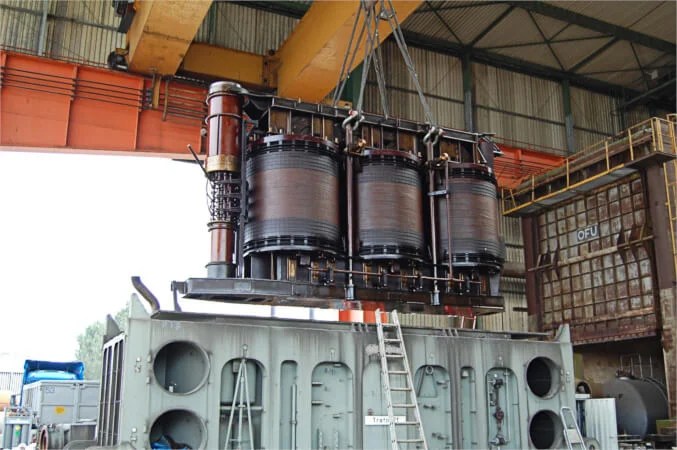
Repairing any potential problems in a liquid-filled transformer will require the transformer be de-energized and the liquid drained to access the transformer’s interior. This is usually done in a transformer repair shop and requires much time to disconnect, transport, and repair the unit. Early detection of problems through energized transformer checks will minimize disruption of service.
The liquid-cooled transformer will also have temperature gauges to indicate liquid temperatures within the tank; there may also be pressure or level gauges. Readings of the gauges should be made and recorded regularly. The tank of a liquid-filled transformer should have a slight positive pressure; this will help to keep moisture and contaminants from entering the tank and affecting the oil. If the pressure is not positive, it may indicate a leak in a gasket or some other type of seal—a condition that will require a shutdown to repair. If the pressure is too high, it may indicate a buildup of gas within the transformer, which may be caused by some type of combustion within the transformer, or it may result from liquid overheating. The liquid-level gauge can indicate possible leaks. The level of the liquid depends on the liquid temperature, so both values should be recorded simultaneously.
Samples of transformer cooling oil should be taken regularly and analyzed by a laboratory. The analysis indicates the conditions inside the transformer without draining the oil from the tank and is critical in a liquid-filled transformer maintenance program. Table 1 lists the types of tests and the conditions they are testing for.
Table 1. Transformer Oil Tests
.
The Importance of Comprehensive Transformer Maintenance
The significance of comprehensive transformer maintenance cannot be overstated. Transformers are vital for our electrical infrastructure, ensuring a smooth power flow across various systems. Regular and thorough maintenance is crucial to prolong their operational life, enhance efficiency, and mitigate the risk of unexpected failures. By conducting routine checks, addressing potential issues early on, and staying updated with the latest industry standards, we ensure the safety of electrical systems and contribute to reliable and uninterrupted power supply. Ultimately, comprehensive transformer maintenance, including a thorough inspection, testing, and adherence to prescribed guidelines, ensures an electrical network equipped to power daily operations effectively.
Author: Ahmed Sheikh is an electrical engineer with over eight years of progressive experience in power systems and renewable energy. He enjoys reading industry magazines to stay updated with the latest technologies and trends.
Published by Marcin JANUSZEWSKI, Ryszard KOWALIK, Karol KUREK, Emil BARTOSIEWICZ, Adam SMOLARCZYK, Désiré D. RASOLOMAMPIONONA, Warsaw University of Technology, Electrical Power Engineering Institute
Abstract. This article describes the comparison of test results of distance protection functions (ANSI 21) implemented in protective relays of various manufacturers dedicated to HV and EHV lines protection. A special emphasis has been placed on determining the operating times of distance protection functions based on quadrilateral and circular characteristics.The research was conducted using classical methods based on the use of software provided by the manufacturer of microprocessor-based tester and the use of simulation programs.
Streszczenie. W artykule opisano porównanie wyników badań funkcji zabezpieczeń odległościowych (ANSI 21) zaimplementowanych w przekaźnikach zabezpieczeniowych różnych producentów przeznaczonych do ochrony linii WN i NN. Szczególny nacisk położono na wyznaczenie czasów zadziałania funkcji zabezpieczeń odległościowych na podstawie charakterystyk czworokątnych i kołowych. Badania prowadzono metodami klasycznymi w oparciu o oprogramowanie dostarczone przez producenta testera mikroprocesorowego oraz programy symulacyjne. Badania funkcji zabezpieczeń odległościowych (ANSI 21) zaimplementowanych w przekaźnikach zabezpieczeniowych różnych producentów przeznaczonych do ochrony linii WN i NN
Keywords: HV line protection, EHV line protection, quadrilateral characteristic, mhO characteristic, circular characteristic, distance protection. Słowa kluczowe: Zabezpieczenie linii WN, Zabezpieczenie linii NN, charakterystyka czworoboczna, charakterystyka MHO, charakterystyka kołowa, zabezpieczenie odległościowe.
Introduction
Detecting and elimination of short circuits occurring in power system is the main task of power protection systems, crucial for the stability and reliability of the power system. The time for short-circuit elimination consists of protection trip times, the delays introduced by the auxiliary relays and the time required for the disconnection of the circuit breaker contacts and the breakdown of the short-circuit current. HV/EHV lines are protected from the effects of short circuits by using i.e. two distance protection devices with different operating principles (mandatory solution for EHV lines protection in Polish National Power System). The main advantages of distance protection are the operation speed, i.e. the short time calculated from the moment when the short-circuit occurs until the instant at which a signal is received at the CB coil, and the selectivity – the ability to precisely isolate the impaired network fragment.
The Polish transmission system operator uses distance functions with only polygonal characteristics for both types of faults (phase-to-phase and earth fault). This is due to the fact that for earth and phase-to-phase faults, resistance ranges can be easily formed, which enables detuning from: transition impedance (resistance) and load. However, the obtained operating times of polygonal characteristics, especially for older constructions (results from 2006 are shown in Tab. 1), clearly show that the devices with mhO characteristics used at that time allow for operating times significantly below 20 ms (e.g. P443 relay), which is their great advantage.
In addition to older solutions, there were limitations in the distance function settings, such that after selecting the polygonal characteristic for phase-to-phase faults, the same characteristic in terms of shape was also used for earth faults. It was the same with the mho characteristics. If two protections are used to protect the line and they have the option of selecting the operating characteristics, one may attempt to set the polygonal characteristics in one of them and mhO in the other. The differences in the operating times between the polygonal and mhO characteristics are particularly visible for phase-to-phase faults and amounted to several ms, therefore, if it is possible to set the mhO characteristics in one of the protections, it should be done. Phase-to-phase faults are more dangerous for the system because they can lead to a loss of stability faster and in such situations we mainly care about the fast operation of the relay. Setting the polygonal characteristic in the second relay enables easy adjustment to the transition impedance and safe elimination of less dangerous earth faults.
The quoted results of tests of older versions of protection devices and the reflections resulting from them resulted in an attempt to answer the questions whether also in the case of modern protection devices and their distance functions: – there are the mentioned differences in the times of operation of the distance function with polygonal and mho characteristics, it is a good idea to set the mhO characteristics for phase-to-phase faults and polygonal faults for earth faults, and whether the choice of characteristics is possible in all devices of this type. Additionally, while performing a set of tests, an attempt was made to indicate which relays offer better operating times and when and for which conditions it is worth using a different way of setting the distance function.
Tab. 1. Average operating times for the relays tested in IEN until 2006 (polygonal characteristics)
.
Modeling and testing of distance relays is widely reported in the literature. Quite a big number of models has been developed by manufacturers and used by utility engineers to investigate new designs and test existing relays. Marttila presented a study [1], in which mhO elements of distance relays were modeled for studying the effect of the type of polarization on the directionality of the relays and for verifying the performance of the relays during specific operating conditions. Kennedy et al. [2] presented other models which were used for developing an improved method for testing voltage polarized mhO relays [1][2] and yet another study [8] developed a state-space model of an electromechanical distance relay for studying the transient behavior of the relay.
In order to ensure directional integrity for close-up faults, distance relays measure phase to ground or phase to phase impedance by including into the polarizing voltage a signal derived from another phase or phases during the fault (cross polarization), or from the pre-fault voltage (memory polarization), or some combination of both. This method is explained in detailed in [1][7]. The effect of these additional polarizing signals when used in a typical phase comparator solution is to expand the trip characteristic into the third quadrant of the impedance plane for forward faults and to close it down to a small circle in the first quadrant (not including the origin) for reverse faults.
In the sixties Phaff and von Buzay [4] in Switzerland and Wedepohl [5] in England published papers on the expanding nature of the cross and quadrature polarized mhO distance relays. In the seventies manufacturers recommended to conduct field testing at the relay set point and stated that it was sufficient and testing for the expanded polar characteristic was generally not encouraged. Anyway a few other protection teams have demonstrated that testing at the relay set point does not prove that all the relay components are functioning correctly. There are two other complementary methods: the first method [6] treats the relay characteristic as an unknown, calculates and applies a series of test voltages and currents until the characteristic is found to a desired accuracy. The second method [7] treats the relay characteristic as a known and determines a set of voltages and currents to match the characteristic. In the middle of eighties Peng et al. has presented a study [8], where a state-space model of an electromechanical distance relay was developed for studying the transient behavior of the relay.
Another aspect on which an attention should be paid is the encroachment issue. For forward faults the reactive reach is maintained at the original set point but the resistive reach increases with increase in source impedance. Distance elements of protective relays must be selected and configured in such a way that they will provide sufficient resistive reach to ensure correct operation when a fault is inside of the designed zone of protection [9][10]. The resistance of the arc has to be taken into consideration. It is affected my many factors, such as the distance between the phases and the extension of the arc by wind. To avoid an encroachment into the outer tripping zone usually the third zone – and an undesirable tripping, there are several countermeasures state of the art like characteristic shape shifting (e.g. forward offset of mhO characteristic) or adding restrictive areas in the R-X-impedance plane as a so called load blinder[11][12]. At the same time the characteristic should have a shape and settings that make it narrow enough so that the dynamically changing load impedance does not enter inside the characteristic. A careful choice of the amount of additional polarization is to be made when the protected line contains series compensation. According to Marttila [13] it cannot be assumed that the compensation will always be in circuit and the polarization setting is unlikely to suit both the fully series compensation configuration and the configuration without series compensation at all.
With the advent of numerical relays, the operation of which is based on calculation of impedance from the fundamental phasor voltage and current estimates, many new impedance characteristics can be implemented [14]. The shape and placement of operating zones in the impedance plane can be chosen with much greater freedom than in the past when the relay designer was limited to simple combinations of straight lines and circular arcs [15].
Certain limitations of the mhO circle can be overcome with the introduction of static and numerical relays. It is common to consider that quadrilateral characteristics are better to deal with ground faults on short lines in particular. A lot of authors consider that quadrilateral characteristic is most preferred when protecting short transmission lines as this provides substantial resistive coverage and arc compensation than the traditional circular characteristics [16].
Reducing the time of protection activation (pick-up time) is one of the possible ways to shorten the time needed to eliminate the short circuit. In order to check the possibility of pick-up time reduction, comparison tests of P443, REL670, 7SA522 and D60 relays equipped with two types of distance protection characteristics – quadrilateral and mhO were performed.
The comparison of relay operating times was aimed at answering one question: is there any advantage in changing the quadrilateral characteristics commonly used in distance protections of the Polish National Power System into mhO characteristics? Will this change in the case of one of the protections used can lead to any reduction of the protection operation time? The technical documentation of the relays [17]-[20] says that the principle of operation of mhO characteristics is based on the use of phase comparators, while the quadrilateral characteristics – on the use of amplitude comparators.
Description of the Analyzed Devices
In order to check the possibility of lowering the distance relay trip time, several devices of leading manufacturers were tested. It was necessary to equip the relays with the two types of previously discussed characteristics. The tests aimed to compare the operating times of distance functions based on phase comparators (mhO characteristics) and amplitude comparators (quadrilateral characteristics). Preliminary assumptions were to conduct tests under identical conditions for both characteristic types and each relay individually. This allowed comparing operating times and finding an answer, if could there be an advantage of using another type of characteristic for the given operating conditions. In addition, the tests were designed to determine the dependency between the type of fault, its location, and the length of the protected line.
Standard testing methods for distance relays, using the CMC microprocessor tester and for example Omicron’s Advanced Distance module, are perfect for conducting tests that are compatible with [21] or performing operational tests of under-impedance relays. In general, it does not matter whether the relay has active quadrilateral or mhO characteristics. The results are reproducible and can be used to determine the characteristics of the various proposals of solutions. However, by analyzing the resulting test waveforms generated by the Advanced Distance module, it must be stated that they do not reflect the actual currents and voltages that occur during short circuits. It follows that the resulting operating times are characteristic for the given conditions of operation. Of course, performing such tests is purposeful and allows determining the relay characteristics, but in specific cases may not reflect the full potential of the device.
Since distance functions or, in general, their operation algorithms take into account real-world phenomena, they should be tested using real-wave simulators and short-circuits in power systems [22][23]. It is also necessary to preserve the appropriate short-circuit time – so that the tested relay has the ability to determine its initial parameters. This type of test allows obtaining complete data on the possible behavior of the relay under the conditions it was designed by the manufacturer.
Bearing in mind the issues mentioned above, it was decided to check the relay operation times in several stages of analysis.
The CMC256plus tester and Omicron’s Advanced Distance module were used in the first stage of tests to verify the correct zone settings for 220 kV and 400 kV lines and two 5 km and 160 km lengths. Correct operation of the relays for the selected line voltage level, various line lengths, different operating characteristics and each type of fault has been confirmed. While performing this type of test, the operating times were not checked, and only the correctness of the range was determined.
In the second stage of the tests the operating times of the ANSI 21 and 21N distance functions were checked. The CMC-156 tester and the Advanced Distance module were used for this purpose. Each test consisted in forcing the appropriate voltages and currents simulating the short-circuit currents corresponding to the test points described on the impedance plane. The tests included both mhO characteristics (Fig. 1, Fig. 2) and polygons (Fig. 3, Fig. 4). The tests were performed for the general circuit shown in Fig. 8. All types of faults were checked for all zones, taking into account the line length and the voltage level. It should be noted that each zone was set according to the range of the first zone, fixed for the given line length.
Fig. 1. Test points for the mhO characteristics for the Advanced Distance module, 10% tuning, full characteristics
Fig. 2. Test points for the mhO characteristics for the Advanced Distance module, 10% tuning, short circuit near the short circuit angle
Fig. 3. Test points for the quadrilateral characteristics for the Advanced Distance module, 10% tuning, full characteristics
Fig. 4. Test points for the quadrilateral characteristics for the Advanced Distance module, 10% tuning, Short circuit near the short circuit angle
For each type of characteristics two sets of tests were performed. The first one covered the area of the full zone – except that the measurement points were shifted by 10% from the zone boundary (Fig. 1 and Fig. 3). In the second case, the test area was limited so that the measuring points were near the line short circuit angle (Fig. 2, Fig. 4). Thanks to such demarcation of the test areas, it was possible to see that, in the case of short circuits near the short circuit angle, the average elimination times are shorter than the elimination time for the full area. All tests using the Advanced Distance module were performed using a constant current set to 2In.
In the third stage of the tests, the PSCAD/EMTDC software was used in order to reproduce more accurately the conditions and phenomena occurring in power systems during short circuits. A simulation model consisting of two equivalent subsystems, connected by a 400 kV or 220 kV transmission line, was created. A simplified scheme of the system is shown in Figure 7. It allows simulating a short circuit at any point of the line and exporting to COMTRADE format waveforms of the simulated voltages and currents observed at the two ends of the line under test. The use of this type of simulation in opposition to the Advanced Distance test allows for better representation of phenomena occurring in a real power system. A series of simulations were prepared, covering two lengths of the test line (short line – 5 km and long line – 160 km, for two voltage levels) and all types of earth and phase faults. Short circuits are simulated at different distances from where the relay was installed. In addition, the simulations were carried out with the initial load at the level of 50% and 150% of rated load.
Fig. 5. System model used for testing purposes
All types of tests in the third stage were carried out with the OMICRON CMC 256plus tester. Each of the tests consisted in simultaneously inducing corresponding voltages and currents, simulating short-circuit currents measured at the relay point R1 (Figure 5). This was achieved by using the AdvancedTransPlay module included in the Test Universe package. It allows importing a set of waveforms and currents from the COMTRADE format, assigning them to the corresponding test outputs, and then synchronizing them to the analog inputs of the relay – according to the measurement circuit shown in Figure 6.
Fig. 6. Test system used for P443 relay test
Test Results Stage I – Confirmation of the Correctness of Zone Setting
While performing this type of test, the operating times were not checked, and only the correctness of the area range was determined. Obtaining results has confirmed the correctness of the settings made and allows moving to the next stage of the tests. Correct operation tested relays has been confirmed by the results.
Some sample results of P443 relay operation are shown in Fig. 7 and Fig. 8. Similar tests were performed for the remaining relays, for each line voltage level (220 kV and 400 kV), different line lengths (5 km and 160 km) and all types of short circuits. All types of tests were performed using Omicron’s Advanced Distance module and fixed current mode Iz = 2In.
Fig. 7. Test points for checking the correct zone settings and operation of protection with quadrilateral characteristics, intended to protect against ground faults a 160 km long 220 kV overhead line using a P443 relay
Stage II – Classic Tests for the Full Zone Area and for Short-circuits around the Short-circuit angles
Short circuits occurring in the full area of the zone and short circuit near the line short circuit angle were simulated using Omicron’s Advanced Distance module (in constant current mode). According to previous information, the tests were carried out for 400 kV and 200 kV lines, the lengths of which are 5 km (short line) and 160 km (long line). Operating time were compared for two types of distance function characteristics : mhO and quadrilateral. In the case of using these outputs are also checked. This allowed determining the benefits of using high speed digital outputs.
Aggregated test results for the P443 relay are shown in tab. 2. They are the average results obtained for zone 1 and the other zones. The analysis of obtained results has shown that distance protection with mhO characteristics seems working better for the P443 relay. The difference is particularly noticeable in operating time for long lines, in case two-phase and three-phase short-circuits are simulated. The protection using a phase comparator works in these conditions even faster by about 5 6 milliseconds. For tests in the full coverage area, the P443 with mhO characteristics is much faster for short lines. For long lines, the switching times are shorter in case of distance function with quadrilateral characteristics. In the case the short-circuit is near the short-circuit angle, we can count on fault elimination times significantly below 20 ms for the P443 relay.
The tests for the P443 relay were carried out using two types of binary outputs. One of them is the Highbreak digital outputs, which significantly shortens the overall trip time by an average of 4 milliseconds. This time is constant independent of the test conditions. Results shown in tab. 2 refers to the times obtained using Highbreak high-speed outputs.
Similar results have been obtained for the relay 7SA522. The analysis of the obtained results makes come out to the conclusions that there is an advantage in the speed of mhO protection characteristics over the quadrilateral ones. The analysis of the obtained operating times in an area close to the line short-circuit angle leads to the conclusion that the difference is greater for two-phase and three-phase faults for a long line and the time differences range from about 2.5 to even 10 milliseconds.
Fig. 8. Test points for checking the correct zone settings and operation of protection with mhO characteristics, intended to protect against ground faults a 5 km long 220 kV overhead line using a P443 relay
Stage III – Simulation Tests
A simulation model consisting of two equivalent subsystems (Figure 7) connected by a transmission line of rated voltage of 400 kV or 220 kV was built in order to conduct a few simulation tests for the third stage of the analysis. This model allowed simulating a short circuit at any point of the line and exporting (to the COMTRADE format) the waveforms of the simulated voltages and currents observed at the two ends of the line under test. For the tests described, a set of currents and voltages coming from one end of line (R1) was used. If compared to the tests performed with the Advanced Distance module, the simulations conducted are characterized by a better reproduction of the phenomena occurring in the real power system, and allow the testing of operating times of fast distance protections with algorithms adapted to the transition phenomena occurring in power systems during short-circuits. Thanks to the classic Test Universe (Advance Distance) software and CMC tester, currents and voltages that consider only the values of the first harmonic, with alternating currents and voltages are induced. This can introduce some significant delays in distance protection performance that do not occur when testing these protections with near real-life waveforms.
Tab. 2. Summary of average P443 protection operating times, for tests of full characteristics and tests near the short-circuit angle
.
Tab. 3. Summary of average P443 protection trip times for simulation tests
.
Bearing this in mind, a series of simulations were prepared, covering two lengths of the analyzed line (a short line of 5 km and a long line of 160 km) and all types of earth and phase faults. The operating time of a given function was measured from the occurrence of a short-circuit to the occurrence of a logic signal indicating the pick-up of the distance function.
P443 relay simulation tests, the results of which are shown in tab. 3, did not show any significant difference in the time gained between the quadrilateral characteristics and mhO. The device operated at a similar speed, both for 0,5In and 1,5In. preload currents. It should be noted that the resulting operating times are very good and do not normally exceed 20 ms – no matter if the short circuits were single-phase or phase-to-phase.
The results of the simulation tests of the relay 7SA522 (not displayed here for the sake of room) allow to assert that the 7SA522 relay works well in conditions very close to real ones. It should be noted that for this test variant the difference in response time for both the quadrilateral characteristics and mhO disappears. The relay maintains short operating times for both 0,5In and 1,5In loads. Line to earth, phase-to-phase and three phase fault elimination times are similar.
In general, the results of relay simulation tests allow to assert that the relays get much shorter times in near real conditions. In addition, for phase-to-phase faults, a further reduction in response time is observed with an increase in the initial load current.
Conclusions
Any way to accelerate the operation of transmission line protection helps to increase the security of the power system. Results obtained during protective device analysis carried out in the laboratory of the Institute of Electrical Power Engineering, Warsaw University of Technology allow to state that the use of commonly known mhO characteristics can significantly influence the short-circuit elimination times and their use should be considered in the currently installed distance protection systems. It is important to define the goals that we face when designing protection systems and the conditions of their operation. Based on the tests carried out, it is possible to select the appropriate operating characteristics of the equipment to achieve the shortest possible short-circuit elimination times for the existing conditions while ensuring high reliability.
In addition, given that the 220 kV and 400 kV transmission lines are protected by, for example, two under-impedance protections, it is worth considering the setting in one of them a distance protection based on mhO zones dedicated to the rapid elimination of phase-to-phase faults, as this may result in significantly better short-circuit elimination times during this type of fault.
Faster operation of the protection automation can be particularly important for the elimination of phase-to-phase faults in power lines forwarding the energy from the power plant, where fast operation of protective systems may be required in case of contingency. In other cases (single-phase short-circuits or other short-circuits in transmission lines) the use of quadrilateral characteristics seems more appropriate because of the possibility of easier shaping of the resistance ranges of particular zones.
In addition, it should be noted that in modern distance protection rapid action in first zones is usually assisted by additional algorithms that consider the specific characteristics of short circuits that are not mapped by the basic functions of the microprocessor testers. Therefore, especially during the testing of distance protection operating times, in addition to classical tests, some tests that characterize actual short-circuits should be performed. Only such information gives a full picture of the capabilities of a given relay.
REFERENCES
[1] R. J. Marttila, “Directional Characteristics of Distance Relay Mho Elements- Parts I and II”, IEEE Transactions, Vol. PAS-100, No.1, January 1981, p96. [2] Kennedy, W.O. et al., “Five years experience with a new method of testing cross and quadrature polarized relays: part I, results and obrservations”, IEEE Trans. On power delivery, Vol. 3, July 1988, pp 880-886. [3] Kennedy, W.O. et al.,, “Five years experience with a new method of testing cross and quadrature polarized relays—Part II: Three case studies”, IEEE Trans. on Power Delivery, vol. 3, no. 3, pp. 887–893, July 1988. [4] C.J.R. Phaff and K. von Buzay, “Circle Diagrams of Directional Impedance Relays.”, Brown Boveri Review vol. 49 pp 173-189, 1962. [5] L.M. Wedepohl, “Polarized Mho Distance Relays – A New Approach to the Analysis of Practical Characteristics.” Proceedings of IEE vol. 112 No. 3 pp 525-535 March 1969. [6] G.W. Swift, L.M. Wedepohl, A.W. de Groot, N-J Morphy, and J. Mohd-Jarjis, “An Automated Testing System for Distance Relays.”, IEEE Transactions on Power Apparatus and Systems Vol. PAS-96, pp. 1376-1383 July/August 1977. [7] W.O. Kennedy, “Field Testing of Polarized Mho Distance Relays Under Unbalanced Fault Conditions.”, CEA Transactions of the Engineering and Operating Division vol. 20 part 4 Paper No. 81-SP-157, 1981. [8] Z. Peng, M. S. Li, G. V. Wu, T. C. Cheng, and T. S. Ning, “A dynamic state space model of a MHO distance relay”, IEEE Trans. on Power Apparatus and Systems, vol. PAS-104, no. 12, pp. 3558–3564, 1985. [9] A. P. Apostolov; D. Tholomier; S. H. Richards, “Distance protection and dynamic loading of transmission lines”, IEEE Power Engineering Society General Meeting, Year: 2004, Pages: 100 – 105 Vol.1. [10] D. Tholomier; S. Richards; A. Apostolov, “Advanced distance protection applications for dynamic loading and out-of step condition”, 2007 iREP Symposium – Bulk Power System Dynamics and Control – VII. Revitalizing Operational Reliability, Year: 2007. [11] S. H. Richards; D. A. Keeling; A. P. Apostolov, “The next challenge: distance protection designed for ease of application”, 2004 Eighth IEE International Conference on Developments in Power System Protection, Year: 2004, Volume: 2, Pages: 788 – 791 Vol.2 [12] J. Schindler; J. Jaeger, “Advanced load blinding of distance protection relays based on physical grid limitations”, 2016 IEEE Power and Energy Society General Meeting (PESGM), Year: 2016 [13] R.J. Marttila, “Performance of distance relay mho elements on MOV protected series compensated lines”, paper no. 91 SM 362-4 PWRD, PES Summer meeting, San Diego, July 1991. [14] McLaren, P.G., Swift, G.S., Neufeld, A., Dirks, E.N., Zhang, Z., Haywood, R., “Open systems relaying.”, Paper No. 93 SM 376-4-PWRD, IEEE PES Summer Meeting, Vancouver, July 1993. [15] Mathews, P., Nellist, B.D., ”Generalised Circle Diagrams and their Application to Protective Gear”, AIEE Transactions] Power Apparatus and Systems, No. 2, February 1964, p. 165. [16] J. Holbach, V. Vadlamani, and Y. Lu, “Issues and Solutions in Setting a Quadrilateral Distance Characteristic”, proceedings of the 61st Annual Conference for Protective Relay Engineers, College Station, TX, April 2008. [17] MiCOM P443 and P446 Fast Multifunction Distance Protection P44y/EN M/C32+C42 CONTAINS Software Update: 57 K (P44y/EN AD/C42) Technical Manual: 55 K (P44y/EN M/C32) Software Version 55/57 Hardware Suffix K – Technical Manual http://www.schneider-electric.com. [18] D60 Line Distance Protection System UR Series Instruction Manual D60 Revision: 7.1x. [19] Line distance protection REL670 Technical reference manual. [20] SIPROTEC 4 Distance Protection 7SA522 V4.74 and higher Manual (http://w3.siemens.com/smartgrid/global/en/products-systems-solutions/protection/distance-protection/pages/7sa522.aspx ) . [21] PN-EN 60255—121:2014-10 – Przekaźniki pomiarowe i urządzenia zabezpieczeniowe — Część 121: Wymagania funkcjonalne dotyczące zabezpieczeń odległościowych (Polish Standard PN-EN 60255—121:2014-10 Measurement relays and protection devices – Part II – Functional requirements for distance protection) [22] A. Smolarczyk, R. Kowalik, E. Bartosiewicz, “Closed-loop testing method for protective relays with use of MATLAB/Simulink software”, The IET 12th International Conference on Developments in Power System Protection (DPSP) 2014, 31 March – 3 April 2014, Copenhagen, Denmark, ISSN ISBN: 978-1-84919-813-4, pp. 1-6, The Institution of Engineering and Technology (IET). [23] A. Smolarczyk, R. Kowalik, E. Bartosiewicz, “A Simple Real-Time Simulator for Protection Devices Testing”, IEEE International Energy Conference (ENERGYCON), pp. 793-799, Dubrovnik, Croatia, MAY 13-16, 2014.
Authors: dr inż. Marcin Januszewski, Politechnika Warszawska, Instytut Elektroenergetyki, ul. Koszykowa 75, 00-662 Warszawa, E-mail: Marcin.Januszewski@ien.pw.edu.pl; mgr inż. Karol Kurek, Politechnika Warszawska, Instytut Elektroenergetyki, ul. Koszykowa 75, 00-662 Warszawa, E-mail: Karol.Kurek@ien.pw.edu.pl; dr hab. inż. Ryszard Kowalik, Politechnika Warszawska, Instytut Elektroenergetyki, ul. Koszykowa 75, 00-662 Warszawa, E-mail: Ryszard.Kowalik@ien.pw.edu.pl; Emil.Bartosiewicz@pse.pl, Polskie Sieci Elektroenergetyczne S.A. ul. Warszawska 165 05-520 Konstancin-Jeziorna; dr hab. Inż. Adam Smolarczyk, Politechnika Warszawska, Instytut Elektroenergetyki, ul. Koszykowa 75, 00-662 Warszawa, E-mail: Adam.Smolarczyk@ien.pw.edu.pl; prof. dr hab. Inż. Desire Rasolomampionona, Politechnika Warszawska, Instytut Elektroenergetyki, ul. Koszykowa 75, 00-662 Warszawa, E-mail: Desire.Rasolomampionona@ien.pw.edu.pl;
Source & Publisher Item Identifier: PRZEGLĄD ELEKTROTECHNICZNY, ISSN 0033-2097, R. 96 NR 11/2020. doi:10.15199/48.2020.11.43
Published by Jan ZAWILAK, Maciej GWOŹDZIEWICZ, Department of Electrical Machines, Drives and Measurements, Wroclaw University of Science and Technology, Wroclaw, Poland
Abstract. This paper deals with issues relating to the start-up of AC motors with high load torque, presenting the results of measurements of current, voltage and power during the start-up of the following three types of motors: an asynchronous motor synchronized with a resistance starter, an asynchronous motor synchronizing with an eddy current starter, and a line start permanent magnet synchronous motor (LSPMSM). The measurement results, show that it is possible to use the direct start-up of a synchronous motor with permanent magnets and thereby eliminate external start-up systems.
Streszczenie. W pracy przedstawiono zagadnienia związane z rozruchem silników prądu przemiennego w układach o dużym momencie obciążenia. Pokazano wyniki pomiarów prądu, napięcia i mocy podczas rozruchu trzech typów silników: asynchronicznego synchronizowanego z rozrusznikiem rezystorowym, asynchronicznego synchronizowanego z rozrusznikiem elektromagnetycznym, synchronicznego wzbudzanego magnesami trwałymi. Na podstawie wyników pomiarów stwierdzono, że można zastosować bezpośredni rozruch silnika synchronicznego z magnesami trwałymi i wyeliminować zewnętrzne układy rozruchowe. Rozruch silników prądu przemiennego w układach o dużym momencie obciążenia
Keywords: electric machines, synchronous motors, permanent magnets, moment of inertia, start-up Słowa kluczowe: maszyny elektryczne, silniki synchroniczne, magnesy stałe, moment bezwładności, rozruchy
Introduction
The copper ore extracted from mines has a copper content of approx. 0.96 – 2.5%. As a result of many complicated and energy-consuming technological processes (sifting, crushing, grinding, flotation, compaction and drying), a concentrate with a copper content of. about 25% is obtained. The concentrate is delivered to a smelter, where it is subjected to the processes of melting, converting and refining. The final products include, inter alia, electro refined cathodes with a 99.99% copper content. In addition, other metal elements (gold, silver, molybdenum) are recovered from ore deposits [2, 3, 5].
In the technological processes of copper ore enrichment, approximately 660 GWh of electricity is consumed annually, while the demand for this energy by electric drive systems amounts to about 95%. Electricity charges constitute approx. 30% of the value of production costs.
This is why it is important to look for innovative technical solutions which aim to save electricity. High-power, continuous-operation electric drive systems, in the case of which even a small increase in efficiency results in a large reduction in operating costs, are of particular importance. Ore grinding systems belong to such drives. They use more than half of the total electricity consumed by processing plants.
The drive systems of mills are characterized by very high inertia and difficult start-up (high resistive torque), especially when the mill is filled with muck. SAS type motors (Asynchronous Motor Synchronized, in Polish: Silnik Asynchroniczny Synchronizowany, with a rotor band winding and slip rings) to which a starting device (a three phase resistor or an electromagnetic device (the so-called eddy current starter)) is connected, are used in such drives. During start-up, the best features of the ring induction motor are exploited. In order to improve the operational parameters (mainly the power factor and efficiency), the rotor winding after start-up is supplied with constant current, and after synchronization the motor works as a synchronous motor [4, 6, 8].
The authors made an attempt to build a new AC motor which meets the demanding starting requirements and has a simplified start-up system – preferably a direct start-up using a direct connection to the power supply [1, 9, 10]. An SMH type synchronous motor excited by permanent magnets with a double squirrel cage rotor was proposed [7]. The motor is started by connecting the stator winding directly to the supply voltage. The two-pole winding generates sub-synchronous speed starting torque and the magnetic field of the permanent magnets synchronizes the motor.
The paper compares the start-ups of systems in which the mills are driven by the following 630 kW rated motors:
• an SAS type motor with a resistor starter, • an SAS type motor with an electromagnetic (eddy current) starter, • a synchronous motor excited with permanent SMH type magnets.
Start up of the SAS type Motor
The specifications of the SAS type motor are summarized in Table 1 and its view is presented in Figure 1.
Table 1. Specifications of the SAS 1832T type motor
.
A. Start-up of the SAS type motor with a resistor starter
Figures 2, 3 and 4 show, respectively, the stator starting current waveforms, the supply voltage (illustrating the voltage drop in the network) and the (active, reactive and apparent) power consumed by the SAS type motor with a four-stage resistor starter.
Fig.1. View of the asynchronous SAS type motor
Fig.2. Time waveforms of the effective values of the stator phase currents during the start-up of the SAS type motor with a four-stage resistor starter
Fig.3. Time waveforms of the effective value of phase-to-phase voltages during the start-up of the SAS-type motor with a resistor starter
Fig.4. Time waveforms of active, reactive and apparent power values during the start-up of the SAS type motor with a resistor starter
B. Start-up of the SAS type motor with an eddy current starter
Table 2 summarizes the basic specifications of the Wirleg-630 starter.
Table 2. Specifications of the eddy current starter
.
Figures 5, 6 and 7 show, respectively, the stator starting current waveforms, the supply voltage (illustrating the voltage drop in the network) and the (active, reactive and apparent) power consumed by the SAS type motor with the eddy current starter.
Fig.5. Time waveforms of the effective values of the stator phase currents during the start-up of the SAS type motor with the eddy current starter
Fig.6. Time waveforms of the effective value of phase-to-phase voltages during the start-up of the SAS-type motor with the eddy current starter
Fig.7. Time waveforms of active, reactive and apparent power values during the start-up of the SAS type motor with the eddy current starter
Start-up of the synchronous motor exited with permanent magnets
The basic specifications of the synchronous motor excited with permanent magnets are presented in Table 3 and its view is shown in Figure 8.
Table 3. Specifications of the synchronous motor with permanent magnets type SMH
.
This motor is designed for start-up through a direct connection to the network voltage.
Figures 8, 9, 9a, 10, 11 and 11a show, respectively, the stator starting current waveforms, the supply voltage (illustrating the voltage drop the network) and the (active, reactive and apparent) power consumed by the SMH type motor excited with permanent magnets.
Fig.8. View of the synchronous motor with permanent SMH type magnets
Fig.9. Time waveforms of the effective values of the stator phase currents during the direct start-up of the motor with permanent magnets
Fig.9a. Time waveforms of the values of the stator instantaneous phase currents during the direct start-up of the motor with permanent magnets
Fig.10. Time waveforms of the effective value of phase-to-phase voltages during the direct start-up of the motor with permanent magnets
Fig.11. Time waveforms of the value of active power during the direct start-up of the motor with permanent magnets
Conclusions
Table 4 shows the most important electrical quantities for the three analysed start-ups for the highest stator current value.
On the basis of the measurements and the analysis of the results, carried out for the most important process of the operation of the motors which drive mills, it can be concluded that it is possible to use synchronous motors excited with permanent magnets instead of SAS motors. When synchronous motors with permanent magnets are used, the following effects are achieved:
• an increase in efficiency, which is constant for a large range of load changes, • reactive energy compensation, and a constant maximum power factor, • the elimination of the start-up system, • the elimination of the excitation system, •the use of the construction with the safety level of IP 54 reduces the failure rate of the motors, owing to the protection of the winding against flooding with process water, • a reduction in the operating costs due to the elimination of the excitation system, the brushes, the slip rings and the drying of the windings, • the minimization of motor maintenance operations, • the simplicity of the drive power and control systems.
Table 4. The most important electrical quantities during the start-up of the analysed motors for the highest stator current value
.
REFERENCES
[1] Knypinski L., Jedryczka C., Demenko A., Influence of The Shape of Squirrel-Cage Bars on The Dimensions of Permanent Magnets in an Optimized Line-Start Permanent Magnet Synchronous Motor, XVII International Symposium on Electromagnetic Fields in Mechatronics, Electrical and Electronic Engineering (ISEF 2015), Valencia, Spain, 10-12 September 2015 [2] Pacholski E., Iskierski L., Analysis of the impact of the start-up method of propulsion motors on the parameters of the power network. Zeszyty Problemowe – Maszyny Elektryczne, No.2/2013 [3] Widak K., Analysis of the working synchronous motors that drive Mills, Diploma Project, 2017 [4] Ustun O.; Bayram Kara D., Evaluation of Spoke Type IPM Synchronous Motors for IE4 Efficiency Class, XIII International Conference on Electrical Machines (ICEM), 2018 [5] Zawilak J., Zawilak T., Energy-saving, high-power synchronous motors excited with permanent magnets, Przeglad Elektrotechniczny, R. 91, No 10, 2015 [6] Tian M., Wang X., Li G., Line-start permanent magnet synchronous motor starting capability improvement using polechanging method, IEEE 11th Conference on Industrial Electronics and Applications (ICIEA), 2016 [7] Zawilak T., Zawilak J., Patent. Polska, nr 218489. “Rotor of a synchronous motor with permanent magnets “: H02K 1/27. Patent application. No. P 394666 dated 26/04/2011 / Wroclaw University of Science and Technology, 2011 [8] Zawilak T., Utilizing the deep bar effect in direct on line start of permanent magnet machines, Przegląd Elektrotechniczny, R. 89, No. 2b, pp. 177-179, 2013 [9] Dinh B. M., Tien H. M., Maximum efficiency design of line start permanent magnet synchronous motor, IEEE International Conference on Sustainable Energy Technologies (ICSET), 2016 [10] Knypinski L., Application of Bat Algorithm in the optimal design of line-start permanent magnet synchronous motor, 18th International Symposium on Electromagnetic Fields in Mechatronics, Electrical and Electronic Engineering (ISEF) Book of Abstracts, 2017
Source & Publisher Item Identifier: PRZEGLĄD ELEKTROTECHNICZNY, ISSN 0033-2097, R. 95 NR 6/2019. doi:10.15199/48.2019.06.27
Published by Yuriy SAYENKO1, Ryszard PAWEŁEK2, Andrii MOLCHAN1, Ewa DYKA2, Pryazovskyi State Technical University (1) Lodz University of Technology, Institute of Electrical Power Engineering (2)
Abstract. The article presents results of experimental studies of power quality indicators conducted at the wind farm with 52 DFIG wind turbines with a unit capacity of 3.8 MW by General Electric connected to 150 kV network. The way how the research has been prepared and the research algorithm by Metrel MI 2885 power quality analyzer are described. The analysis of changes in Total Harmonic Distortion (THD) voltage and current has been performed. Frequency spectra and maximum values of particular voltage and current harmonics are presented. Short-term abnormal THD of the current curve have been recorded. Wind power plant simulation model and simulated turbulent wind flow for further studies of wind turbines EMC with distribution network are presented.
Streszczenie. W artykule przedstawiono wyniki badań eksperymentalnych wskaźników jakości energii przeprowadzonych w farmie wiatrowej, zawierającej 52 turbiny wiatrowe DFIG o mocy jednostkowej 3,8 MW firmy General Electric, przyłączonej do sieci 150 kV. Opisano sposób przygotowania badań i algorytm działania analizatora jakości energii Metrel MI 2885 wykorzystanego w pomiarach. Przeprowadzano analizę zmian współczynnika odkształcenia (THD) napięcia i prądu. Przedstawiono widma częstotliwościowe i wartości maksymalne poszczególnych harmonicznych napięcia i prądu. widma krzywych prądowych Zidentyfikowano występujące w stanach zakłóceniowych krótkotrwałe, ale znaczne wzrosty wartości THD w przebiegach rądu. Przedstawiono model symulacyjny elektrowni wiatrowej i przykładowy symulowany przebieg zmian prędkości wiatru do dalszych badań parametrów EMC turbin wiatrowych współpracujących z siecią dystrybucyjną. (Badania jakości energii w Przymorskiej elektrowni wiatrowej).
Keywords: wind farms, DFIG wind turbine, EMC, power quality, voltage distortion Słowa kluczowe: farmy wiatrowe, turbiny wiatrowe typu DFIG, EMC, odkształcenie napięcia
Introduction
When coping with various tasks of designing, operating and reconstructing electrical networks, questions have arisen of ensuring electromagnetic compatibility. One of the aspects of electromagnetic compatibility problems is the occurrence of nonlinear voltage distortions or nonsinusoidal modes.
This issue is in Ukraine most relevant nowadays in designing networks with distributed generation of electric energy from wind power plants. This is due to the fact that the share of electric energy generated by wind power plants in the electric network over the past 5 years has grown from 0.3% to 2.15%, and the installed capacity of the Ukraine wind energy sector at the end of 2019 reached 1,170 MW. Only last year 637.1 MW was commissioned in Ukraine, which means almost 10-fold growth compared to 2018 – 67.8 MW [1].
The problem of electromagnetic compatibility of wind turbines with a distribution network today is not fully understood [2-7]. Basically, research is being conducted into questions of the appearance and influence of higher harmonics generated by wind turbines [8-12]. However, the study of harmonic components occurrence does not take into account the wind flow turbulence effect on the currents and voltages amplitude spectra. Among other pressing problems in distributed generation networks, there is the issue of identifying sources of distortion and assessing their contribution to the deterioration of electricity quality at the point of assessment [13].
In addition, the issues of interharmonics components appearance and distribution in electric networks with distributed generation as a result of wind power stations in general and wind turbines separately operation have not been sufficiently studied.
Measurement procedure
For the correct analysis of the complex processes of wind turbines impact on power system from the point of view of electromagnetic compatibility and power quality in a common network, it is necessary to carry out not only theoretical, but also experimental researches of the system. To solve the problem of analyzing the harmonic distortion spreading in systems with wind turbines with adjustable speed with partial frequency conversion, a number of experimental studies were carried out at an existing wind farm, connected to a common network.
For experimental studies, the Primorsky wind power station was chosen, which is located near Borisovka, Zaporizhzhya region in Ukraine. The wind farm includes 52 wind turbines with a total installed power of 200 MW. The site is divided into two groups: Primorskaya-1 (PS-1) and Primorskaya-2 (PS-2). Each of the two groups is equipped with 26 wind turbines and two 150/35/10 kV transformer substations with 50 MVA each for the transfer of energy to the power system.
At the power plant, GE 3.8-130 wind turbines manufactured by General Electric with a unit capacity of 3.8 MW were installed. The principle of their operation is based on the wind turbine type C electrical part construction with adjustable speed with partial frequency conversion. The concept is based on a doubly fed induction generator (DFIG), which allows the adjustment of the wind turbine speed in the range of ± 30% of the generator synchronous speed. The main parameters of GE 3.8-130 DFIG wind turbine are given in table 1.
For the reliability of power quality indicators assessment, Metrel MI 2885 Master Q4 power quality analyzer is used, which refers to class S and fully complies with the IEC 61000-4-30 power quality standard [14].
The analyzer includes a number of measuring functions, namely: analysis of harmonics and interharmonics up to the 50th harmonic, total harmonic distortion, analysis of power quality according to EN 50160 [15]. The device also has two main registration modes: “General registration” and “Signal form registration” [16].
At the Primorsky wind power station, a series of power quality indicators measurements at the 150 kV and 35 kV voltage with 30 to 56 hours total duration with the power quality analyzer Metrel MI2885 were carried out, at the connection point of 13 wind turbines on PS-2 substation.
The following issues were resolved during the measurements of power quality indicators:
– determination of wind turbines impact levels with adjustable speed with partial frequency conversion on the power quality when connected to a common network;
– obtaining information on the actual level of higher harmonics and interharmonics in the AC three-phase network to which the wind farm is connected;
– determination of the influence levels of time-varying wind flow at the distortion level of sinusoidal current and voltage curves of the network.
Table 1. The main parameters of the studied system
.
Fig.1. Algorithm of experimental research
Due to the fact that during the measurements it was not possible to connect the device directly to the primary circuits, it was decided to carry out measurements in the secondary circuits, taking the required values from measuring current and voltage transformers of busbars 150 kV and 35 kV. The algorithm for preparing and conducting experimental research is shown in Figure 1.
To connect the analyzer, some standard accessories of Master Q4 instrument were used such as measuring probes for voltage measurement with a “crocodile” type clamp and flexible current clamps Smart A 1227 for direct measurement of currents with the selected measuring range of 30 A (3 A ÷ 60 A).
Measurements were performed according to the 3- phase 4-wire scheme in the “general recording” mode in autumn and winter under different weather conditions with the minimum possible registration interval Δt = 1 s. It should be noted that the device provides approximately 3 readings per second in the continuous sampling mode, measurements in all channels were performed simultaneously [16].
Fig.2. Table amplitudes of higher harmonics of phase voltage
Fig.3. Harmonic spectrum of output voltages and currents
Fig.4. Interharmonic spectrum of output voltages and currents
Fig.5. Output voltage and current curve
The following values were registered in the “general registration” mode: voltage, current, frequency, power, energy, 50 harmonics and 50 interharmonics of current and voltage, asymmetry, voltage deviation. The measurement results were recorded by the device and exported to a PC using the Metrel PowerView software.
Data can be presented in a tabular form (Fig. 2) or in a graphical form (Fig. 3-4). Figure 5 shows the voltage and current curves that correspond to the spectra shown in Figures 3-4.
Collection of measurement data
During a series of experimental research at 150 kV and 35 kV of the Primorsky wind power station, data arrays were obtained with the wind turbine operation parameters values. This allowed analyzing the curve distortion of output currents and voltages generated in the distribution network by wind turbines with adjustable speed with partial frequency conversion. For example, table 2 provides information on the experimental studies recording intervals.
Table 2. Intervals of experimental studies
.
During the period of experimental research in December, in 150 kV network, overvoltage’s in generation mode were recorded, which exceeded 10 % limits allowed by the standards [15-16] and reached maximum values of 96.39 kV at 3rd, 96.96 kV at 5th and 96.72 kV at 6th research interval (Fig. 6-8, a). The currents for the period of experimental research were in a wide range from 3 to 120 A.
During the period of experimental research in February, the 35 kV voltage were within the norm from 19.7 to 20.8 kV. However, 35 kV voltage dip on the 9th interval at 00:42 was recorded, which reached 17.7 kV and associated with voltage regulation of transformer (Fig. 10a). The currents for the period of experimental research were in a wide range from 230 to 740 A.
Analysis of the experimental results
In figures 6-8 (b) and 10b shows graphs of 150 kV and 35 kV voltage and currents total harmonic distortion changes for the previously considered intervals of experimental research respectively. The maximum values of 150 kV and 35 kV voltage total harmonic distortion, recorded during the measurements, reached 1.6% and 2.0% respectively. The maximum values of total harmonic distortion recorded during the measurements are given in table 3.
Table 3. The maximum values of voltage THD
.
According to the standards [15-16], the allowable value of total harmonic distortion of the voltage curve in high voltage networks is 3% [17], and in medium and low voltage networks is 8% [15, 17]. Thus, the level of voltage curve distortion at both 150 kV and 35 kV was within acceptable limits.
Despite the fact that during the measurements, sufficiently large values of total harmonic distortion of the current curve were recorded, which reached more than 38% for 150 kV and 5% for 35 kV, the standard maximum permissible values of this indicator of the quality of power are not standardized [15, 17]. The indicated peaks of total harmonic distortion of the current curve correspond to the minimum values of the phase currents. However, with large values of total harmonic distortion of the sinusoidal current curve, significant additional losses of power and voltage can occur in the elements of the power supply system, which can lead to the need to use various filtering instruments of higher harmonics.
Also, a short-term abnormal total harmonic distortion of the current curve was recorded, the value of which reached 240, 530 and even 1400%. These short-term bursts can be caused by changes in the operating mode of wind turbines that occur relatively frequently, or by sudden changes in load. They can cause a negative effect on the insulation of electrical equipment, they increase a risk of resonance phenomena leading to a failure of electrical equipment, primarily capacitor banks, impair the operation of communication systems, measuring equipment, electronic meters, microprocessor protection modules with programmable logic controllers, etc. [20]. The above factors may be the reason for the application of measures to increase noise immunity in the network with wind turbines.
Fig.6. Graphs of 150 kV voltages and currents on 3 interval (a) and the corresponding graphs of voltages and currents THD (b)
Fig.7. Graphs of 150 kV voltages and currents on 6 interval (a) and the corresponding graphs of voltages and currents THD (b)
Fig.8. Graphs of 150 kV voltages and currents on 6 interval and the corresponding graphs of voltages and currents THD
Fig.9. Example of 150 kV individual harmonic voltage (a) and current (b) values
In Fig. 9 and Fig. 11 shows examples of output voltage curves harmonic spectra for the previously considered measurement intervals. The graphs show that the voltage curve contains peak third, fifth and seventh canonical harmonics, which can reach 0.9%, 0.8% and 1.0% at 150 kV and 0.5%, 0.4% and 0.55%, respectively, at 35 kV. The eleventh, thirteenth, fifteenth, and seventeenth harmonics at 35 kV, which are in the range of 0.1-0.3%, are also significant.
Figure – Graphs of 150 kV voltages and currents on 6 interval
In turn, the amplitude-frequency spectrum of the current curve contains one peak value, namely the 3rd harmonic, the value of which can reach more than 1.7%. The 5th, 7th harmonics and the DC component of the current at 150 kV and the 5th, 7th, 11th, 13th, 15th, 17th, 19th harmonics and the DC component are essentials current at 35 kV, which are in the range of 0.1-0.2%.
Fig. 10. Graphs of 35 kV voltages and currents on 3 interval (a) and the corresponding graphs of voltages and currents THD (b)
Fig. 11. Example of 35 kV individual harmonic voltage (a) and current (b) values
In addition, after conducting and analyzing numerous researches, we can conclude that the amplitudes of higher harmonics and interharmonics significantly depend on the rate of change of wind and its dispersion.
Figure 12 shows active and reactive power graphs corresponding to the previously considered measurement interval for 35 kV voltage. On the considered interval, with an average wind speed of 5.5 m/s, the active power varied in the range from 4.4 to 9.9 MW, which is approximately half of the rated power. As can be seen from the graph, the active power fluctuates significantly over time, which is caused by wind flow fluctuations. At the same time, the reactive power in the considered measurement interval varied from 0.7 to 3.8 MVar, and a sharp drop from 3.51 to 0.65 MVar in reactive power was recorded, which is associated with the transformer voltage regulation.
Fig. 12. Active and reactive power changes in 35 kV network on 9th interval
Comparative analysis of modeling characteristics and real experiment
For further research of the electromagnetic compatibility of wind turbines with the distribution network, in particular the impact of turbulent wind flow on harmonic distortions propagation in electrical networks, a wind farm simulation model was developed. For this purpose, a random character of a turbulent wind flow with specified characteristics was simulated and a wind power plant simulation model was developed [19], which is 13 wind turbines of the DFIG type with adjustable speed with partial frequency conversion. An example of a wind farm model and a simulated wind flow change curve are presented in Figure 13 and Figure 14, respectively.
The simulation allows to track the operation of the system taking into account the turbulent wind flow fluctuations. To confirm the correctness of the wind farm simulation, it is necessary to conduct a comparative analysis of the characteristics obtained as a result of modeling and a real experiment.
Fig.13. Wind flow change curve
For example, Figure 15 presents the amplitude frequency spectrum of the phase A input voltage, obtained by modeling a wind farm with adjustable speed with partial frequency conversion, at an average wind speed v =10 m/s, the damping coefficient of the correlation function of turbulent wind flow α = 0.7, the standard deviation of the turbulent wind flow σ = 2.36 m/s.
Fig.14. Wind power plant simulation model
Fig.15. Amplitude-frequency spectrum of wind turbines output voltage, determined by simulation
Conclusion
1. According to the results of measurements in Primorsky wind power plant electrical network, the level of sinusoidal voltage curve distortion at both 150 kV and 35 kV is within acceptable limits according to the standard.
2. The amplitude-frequency spectrum of the voltage curve contains a significant harmonics total value above the 50th order, which exceeds the individual harmonics peak value.
3. Taking into account the presence of harmonics above the 50th in the spectrum of the voltage curve, it is recommended to use low-pass filters after the 50th harmonic.
4. A study of the DFIG-type wind turbines operation under operating conditions at an existing wind farm confirmed the correctness of adjustable speed wind turbine with partial frequency conversion simulation model for analyzing the harmonic distortions propagation in electric networks. The experimental research shows that the computational error is not more than 15%.
5. A wind farm simulation model allows to conduct a harmonic analysis of the wind turbine operation with adjustable speed with partial frequency conversion taking into account the turbulent wind flow influence on the wind turbines electromagnetic compatibility with distribution network.
REFERENCES
[1] Wind energy sector of Ukraine 2019 // Ukrainian wind energy association. Link: http://uwea.com.ua/uploads/ docs/uwea_ 2019_ua_preview.pdf [2] Pawełek R., Wasiak I., Influence of frequency converters on power quality in power station ancillary services network. Part 1 – Monitoring in real network, Przegląd Elektrotechniczny, 90 (2014), no. 1, 24-28 [3] Wasiak I., Pawelek R.; Mienski R., Energy storage application in low-voltage microgrids for energy management and power quality improvement, IET Generation, Transmission & Distribution, 2014, no.8, 463–472 [4] Małaczek M., Wasiak I., Forming a microgrid to islanded operation as a mean to improve quality of supply in low voltage networks with distributed generation, Proceedings of International Conference on Harmonics and Quality of Power, ICHQP. 2018, 1-6 [5] Denysiuk S., Analysis and optimization of energy processes in dispersed electric power systems. Tech. electrodynamics. 2016. no.4, 62–64 [6] Denysiuk S., Horenko D., Artemiev M. and Tarhonskyi V., Evaluation of exchange processes in local systems with flexible generation. IEEE 6th international conference on energy smart systems, 2019, 233-238 [7] Tugay D., Kolontaevsky Yu., Kotelevets S., Savchuk Ye. Solar power plant operation modeling in Smart Grid electricity supply system, Lighting and electricity, 50 (2017), no. 3, 16–24 [8] Duong M., Le K., Grimaccia F., Leva S., Mussetta M. and Zich R., Comparison of power quality in different grid-integrated wind turbines, IEEE 16th International Conference on Harmonics and Quality of Power, 2014, 669-673 [9] Gholami M., Fathi S., Milimonfared J., Chen Z. and Deng F., The effect of turbulence and wake on the power fluctuation in the wind warms, ICEE 2017, 2017, 1148-1153 [10]Pawelek R., Wasiak I., Assessment of power quality at the point of coupling of wind power plant with the electrical power system, Przegląd Elektrotechniczny, 88 (2012), no. 2, 82-85 [11] Denysiuk S., Gorenko D., Analysis of metabolic processes during the parallel operation of two three-phase wind turbines, Renewable energy, 53 (2018), no. 2, 46–56 [12] Bialas H., Pawełek R., Wasiak I., Possibilities of islanding operation of wind power plants, Przegląd Elektrotechniczny, 96 (2020), no. 3, 47-50 [13] Sayenko Y., Kalyuzhniy D., Bolgov V., Kütt L., Mathematical model for assessment of voltage disturbing sources in networks with distributed power generation, Przegląd Elektrotechniczny, 95 (2019), no. 3, 49-53 [14] IEC EN 61000-4-30: Electromagnetic compatibility (EMC), Part 4-30: Testing and measurement techniques – Power quality measurement methods, 2015 [15] EN 50160: Voltage Characteristics of electricity supplied by public distribution networks, 2010 [16] Metrel, Master Q4 MI 2885 Instruction manual. Version 8.1.0 [17] Rozporządzenie Ministra Gospodarki z dnia 4 maja 2007 r. w sprawie szczegółowych warunków funkcjonowania systemu elektroenergetycznego, Dz.U Nr 93, poz. 623 [18] Zhezhelenko I., Sayenko Y., Baranenko T., Pawelek R., Engineering Methods of Evaluation of Additional Power Losses in Electric Power Networks at Non-Sinusoidal Conditions, Przeglad Elektrotechniczny, 90 (2014), no. 7, 226-229 [19] Sayenko Y., Molchan A., Analysis of wind turbine impacts on power quality taking into account the variable nature of wind flow, 2019 IEEE International Conference on Modern Electrical and Energy Systems (MEES), 2019, 9-13
Authors: prof., Ph.D., D.Sc., Eng., Yuriy Sayenko, Pryazovskyi State Technical University, Department of Industrial Electrical Power Supply, Ukraine, 87555, Mariupol, 7 Universytets’ka, E-mail: yls62@i.ua; Dr Ryszard Pawełek, Lodz University of Technology, Institute of Electrical Power Engineering, 18/22 Stefanowskiego str., 90- 924 Lodz, E-mail: ryszard.pawelek@p.lodz.pl; Ph.D. student., Andrii Molchan, Pryazovskyi State Technical University, Department of Industrial Electrical Power Supply, Ukraine, 87555, Mariupol, 7 Universytets’ka, E-mail: molchan_a_v@pstu.edu; Dr Ewa Dyka, Lodz University of Technology, Institute of Electrical Power Engineering, 18/22 Stefanowskiego str., 90-924 Lodz, E-mail: ewa.dyka@p.lodz.pl
Source & Publisher Item Identifier: PRZEGLĄD ELEKTROTECHNICZNY, ISSN 0033-2097, R. 97 NR 3/2021. doi:10.15199/48.2021.03.32
Published by 1.Dominika KACZOROWSKA, 2.Przemysław JANIK, 3.Łukasz JASIŃSKI, 4.Jacek REZMER, 5.Vishnu SURESH, Wroclaw University of Science and Technology ORCID: 1. 0000-0002-2312-2903; 2. 0000-0001-5300-7845; 3. 0000-0002-7484-9424; 4. 0000-0002-2822-7595; 5. 0000-0003-2891-9206
Abstract. This paper discusses power flow control algorithm in a microgrid with battery energy storage system. Depending on the state of charge of the storage and the power difference between generation and load, the storage operates in charge or discharge modes adjusting the instantaneous power. The goal is to obtain exchange power changes with the distribution system according to a pre-set curve. The system is simulated in MATLAB. The results show the effectiveness of the proposed control algorithm.
Streszczenie. W artykule zaproponowano algorytm sterowania przepływem mocy w mikrosieci z akumulatorowym zasobnikiem energii. W zależności od stanu naładowania magazynu i różnicy mocy między generacją a obciążeniem, zasobnik operuje w trybach ładowania lub rozładowywania dostosowując moc chwilową. Celem jest uzyskanie zmian mocy wymiany z systemem nadrzędnym według zadanej krzywej. Mikrosieć jest symulowana w środowisku MATLAB. Wyniki pokazują skuteczność proponowanego algorytmu sterowania. (Algorytm sterowania przepływem mocy w mikrosieci z magazynem energii)
Keywords: microgrid, energy storage system, control algorithm. Słowa kluczowe: mikrosieć, system magazynowania energii, algorytm sterowania.
Introduction
Regulations on the functioning of the electricity market must consider the features related directly to the way how power system operates. It is necessary to constantly balance supply and demand and ensure reliable operation of the power system. The assumptions made so far about the inability to directly store electricity have implied limited flexibility in energy production. This is currently changing, among others, thanks to the introduction of microgrids [1].
The aim of power flow control can be achieved in the global electricity market, as well as, in a local technical market. The goals of the energy market, where active energy is traded (quantity, price, time, place of delivery) may differ from the aims of the technical market, where local regulatory system services, necessary for proper system operation, are traded. The development of distributed generation DG and microgrids with battery energy storage systems BES is an important element of the transformations in modern power systems [2]. The main element of the presented research results was the development of a strategy for energy storage in BES. That is why experimental and simulation studies of BES performance in the microgrid for various concepts of power flow control allow verification of assumptions, parameters and algorithms in use [3,4].
The paper describes the principles of developed scenarios of power flow control, and the results of conducted research based on measurements made in the real network. Based on recorded generation and load data, numerical simulations were performed.
Microgrid
The goals of power flow control in microgrids are most often directly related to the economic aspects [5,6]. Control algorithms switch to storage mode when low energy prices are forecasted and to discharge mode during electricity prices peaks. However, technical issues cannot be overlooked by implementation of proposed solutions into a particular microgrid. For example, the voltage levels in the network nodes must absolutely be within the range specified in the standards, and the values of currents in the lines and in the transformer windings must not exceed the permissible limits. The issues of energy storage operation, such as safety and robustness are also important. The performance of a microgrid and its interaction with the power system can be studied by means of power flow analysis. Simulation of power flow control is carried out at the initial stages of design work using the DC current power flow method, i.e. considering only changes in active power. This approach is often used in an initial state of microgrid development, helping to determine global assumptions and reduce the influence of uncertain initial data [7,8].
The proposed microgrid model related to a real system consist of a battery energy storage BES, a photovoltaic generator PV, and local loads (Fig. 1). The battery energy storage comprises a converter enabling control of charging and discharging power. The microgrid is connected to the distribution system ensuring energy balance. The measurements were conducted in the key nodes of the system, which allowed to determine the changeability of e.g. voltages, currents, power and power quality indices.
Fig.1. Microgrid system. PG – generator power, PO – load power, PS –power from the distribution system, PM –BES power
A load profile was determined for local customers and a generation profile of a PV generator. Both based on longterm measurements at nodes of a real microgrid. Resampling method and median filtration were used to determine averaged power values over ten-minute intervals. As a result, a database of synchronized power generation and load data was obtained, further used in long- and short-term simulations.
Determining the BES characteristics is a basic issue related to power flow control in charging and discharging modes. The relations between the maximum charging power PM/discharging power and the SoC of the storage unit is given by the manufacturer. The conducted research assumed a typical, real characteristics of the BES, comprising lithium-ion batteries and control by a battery management system BMS (Fig. 2). The shape of the characteristics depends on the technical limitations of the batteries, technology, operating temperature, degree of wear, and the particular control method of BMS [9]. Moreover, the operator can influence the shape of the characteristic within certain limits, e.g. by preferring quick charging or discharging in a specific SoC range. This way the efficiency of the storage may be optimized, its lifetime prolonged and safety increased.
Fig.2. Dependence of the maximum charging and discharging power of the storage on its state of charge SoC
Scenario
The right strategy of energy storage control in the BES helps to optimize the operation of the microgrid. Despite the simple layout of the microgrid, the selection of a right control scenario is far from obvious and choosing the right variant allows to optimize the operation of the system. The proposed scenario assumes control of the PM power of the storage in such a way that the exchange power between the microgrid and the PS distribution grid is at a predetermined upper level, given as PZ. The algorithm is deterministic and at each step determines the charging and discharging power of the BES taking into account the restrictions resulting from the characteristics of the storage and the forecast of the loads PO and the power of generation PG.
Fig.3. Algorithm for power flow control in the microgrid.: PG – generation power , PO – power of loads, PS –distribution system power, PM – storage power, PML – allowed storage charging power, PMR – allowed storage discharging power, EM – storage power, PZ – predefined exchange power.
In general, the proposed algorithm aims at leveling the peaks and valleys of exchange power between the microgrid and the distribution system PS. In an ideal case, with optimally selected parameters of the storage and generation, this power curve can follow a predefined shape, e.g. it can be constant. The scheme of operation of the proposed algorithm is shown in Fig. 3. When the demand of local consumers for power exceeds the PZ setpoint, it is covered by the local PG generation.
When this power is not enough, the storage is discharged in accordance to the BES characteristic. If the power is still not sufficient, the distribution system PS is used and the exchange power exceeds the set PZ value. In the event that the PG generation exceeds the power of the PO loads, the surplus energy is directed to the BES or to the distribution system so as to maintain the PS power at the set PZ level. The algorithm allows both, loading and unloading of the storage with the energy exchanged between the microgrid and the distribution system.
Results of simulations
The simulation results should assess the microgrid performance under a set of given parameters for the storage unit, including storage capacity, maximum charging and discharging power, shape of the charging characteristics. Assuming one algorithm of power flow control, which should be unchanged during tests. Moreover, it is important to determine, which variant of the microgrid optimally cooperates with the distribution grid.
In the real system controlling the PM charging and discharging power, the forecast of PG generation power and power consumed by local PO loads is used. Depending on the needs, to ensure an energy balance, power is also exchanged with the distribution system PS. In the conducted simulations, the forecasts were replaced by active power measurement data generated by the real PV plant and measurements [10] of active power consumed by local loads of the tested network. The calculations were performed with the planned energy storage connected to the microgrid.
The research was carried out for short-term, daily forecasts, which are usually related to the energy market, and for long-term, weekly forecasts, mainly related to the analysis of microgrid behaviour at variable daily generation from renewable energy sources. The storage charging and discharging power is set by the proposed scenario based on the current generation power and the load demand.
In the figures presenting the power changes in individual nodes of the microgrid, the principle was adopted that the generation power has a negative sign and the load power has a positive sign. Following the same principle, both the storage energy and the distribution system supplying energy to the microgrid work with negative power like a generator, while the storage and the distribution network when consuming energy from the microgrid work with positive power sign as does the load.
The simulations were performed according to the microgrid diagram shown in Fig. 1. The charging and discharging power of the storage unit were calculated following the algorithm shown in Fig. 3. The power transferred or taken from the distribution system results from the power balance and was calculated using Matpower, which is a Matlab toolbox dedicated to power flow analysis. The schematic workflow is presented next:
>Start > load the measurement data PG, PO > load the storage unit characteristics > load the shape of the power exchange level with the grid > load the matrix containing microgrid data > for (each of the values of the PG and PO vectors) > calculate PML, PMR according to storage unit > characteristics > calculations based on control scenario and matpower > save EM, PS > end > power flow charts >Stop
Storage unit simulations with a maximum power of 1 MW and a capacity of 3 MWh were carried out. The storage characteristics are shown in Fig. 2. Fig. 4 shows the results of the simulation of microgrid operation in the case of PV generation with 0.7 MW nominal power and variable local load power in the range from 0.3 MW to 0.9 MW. The data was recorded in a real network on August 1, 2018. The scenario of PM BES power control assumes equalization of the exchange power level with the distribution network PS at a constant PZ level of 0.35 MW. As shown in the simulation, the distribution system treats the microgrid as a load with constant power equal to 0.35 MW due to the use of a storage with selected parameters and a control algorithm. Not only are load peaks levelled, but also the exchange power PS level is much lower than the power of local loads
Fig.4. Simulation results of the microgrid at a given exchange power PZ 0.35 MW; exchange power with the distribution grid PS; power of loads PO; generation power PG; energy storage capacity PM.
Fig.5. SoC changes during daily microgrid operation simulation with a given exchange power PZ = 0.35 MW
Figure 5 shows the change in state of charge of the BES during the daily work of the microgrid. It can be seen that the storage does not work in the whole range of its capacity. This can be an advantage because the BES is not deeply discharged, which significantly increases the battery life period. Performed simulations also allow to verify the required capacity of the BES. The example shown in Fig. 6 assumes a variable power level PZ throughout the day. The BES power control scenario tries to match the exchange power level with the distribution network to the set curve defined within the PZ 0.2 – 0.5 MW. The proposed approach is aimed at attempting to use a control algorithm that considers both, economic and technical conditions. The PZ curve is a required daily plan for changing the power of PS exchange between systems and may correspond to, e.g. forecasted changes in energy prices on the market. The parameters of the BES, power generation and load are identical to the previous example.
Fig.6. The results of the simulation of the microgrids operation at a given exchange power level PZ in the form of a variable time function; exchange power PS with the distribution network; power of loads PO; generation power PG, BES power PM.
Fig.7. Changes in the charge level SoC of the storage unit during the daily operation of the microgrid simulated for a variable exchange power PZ.
Figure 7 shows the change in state of charge of the energy storage unit during the daily operation of the microgrid for the simulation as in Fig. 6. The results of calculations confirm the effectiveness of the scenario for the control of BES power. The exchange power with the distribution system accepts the variability assumed by the algorithm. The results may be relevant in cases where strict control of power changes between systems is required, e.g. for economic reasons. Daily analyzes are also aimed at determining the correct operation of the proposed scenario of energy storage control due to detailed technical aspects. These include voltage and current parameters and power quality indices. It is expected that the largest voltage changes will occur at the BES connection point. The size and dynamics of changes will depend on the power variations. Limiting the value of voltage changes can be achieved by appropriate corrections to the BES control, e.g. by adjusting the shape of the charging/discharging characteristic.
The conducted weekly simulations can be used to check the immunity of the selected scenario of power flow control in the microgrid to generation and load forecasting errors.
Another aspect of the analysis may include checking the correctness of the selection of the BES or generator parameters for the selected location of a planned microgrid.
Fig.8. Results of the simulation of the operation of the microgrid without a BES; exchange power over the distribution grid PS; power of loads PO; generation power PG; energy storage power PM = 0
Fig.9. Simulation results of the microgrid at a given exchange power level PZ 0.45 MW; exchange power over the distribution grid PS; power of loads PO; generation power PG, energy storage power PM.
Figure 8 it presents the work of a microgrid without an energy storage unit. The local generation from a photovoltaic source is used by the local load, but as the evening load peaks fall out when the generation is not working, the differences between the peaks and valleys of the load deepen. The situation is radically changed by the use of an energy storage unit in this location, as shown in Fig. 9.
Conclusion
Thanks to the appropriate control of the energy flow in the microgrid including battery energy storage system and the photovoltaic power plant connected to the distribution grid, it is possible to achieve the optimal state of the system’s operation in view of the selected technical issues. However, the applied power flow control scenario allows to regulate the power of the energy storage unit in such a way that the exchange power between the microgrid and the distribution network is at a set level. Therefore, it not only allows the execution of technical objectives, but also other objectives, resulting, for example, from economic conditions.
The real experimental network was used for the research. However, the applied scenario makes it possible to control the power flow not only for the presented photovoltaic plant and battery energy storage but also for other types of power plants and energy storage systems. This makes the proposed method flexible to solve a wide range of microgrid power flow control problems, resulting from both technical and economic conditions.
The applied scenario allows not only to control the operation of the microgrid based on the forecasts, but can also be used in the planning phase of the microgrid, for example to verify the performance of the microgrid under certain conditions. A different example of using a scenario in the planning process could be to see how the parameters or type of energy storage unit affects microgrid operation. Equally, it is possible to see what impact a change in nominal power and power plant type would have.
The results obtained may answer the questions as to how far the adopted control concept can be used in the technical market to help in energy balancing and support management of system.
REFERENCES
[1] Rigo-Mariani R., Sareni B., Roboam X., Integrated Optimal Design of a Smart Microgrid With Storage, IEEE Transactions on Smart Grid, vol. 8, no. 4, July 2017, 1762 – 1770 [2] Nguyen A., Crow M., Curtis A., Elmore Optimal Sizing of a Vanadium Redox Battery System for Microgrid Systems, IEEE Transactions on Sustainable Energy, vol. 6, no. 3, July 2015, 729-737 [3] Venayagamoorthy G.K., Sharma R.K., Gautam P.K., Ahmadi A., Dynamic Energy Management System for a Smart Microgrid, IEEE Transactions on Neural Networks and Learning Systems, 2016, vol. 27, issue 8, 1643 – 1656 [4] Ke Jia, Yiru Chen, Tianshu Bi, Yaoqi Lin, Thomas D., Sumner M., Historical-Data-Based Energy Management in a Microgrid With a Hybrid Energy Storage System, IEEE Transactions on Industrial Informatics, vol. 13, no. 5, October 2017, 2597-2605 [5] Xu H., Meng Z., Wang Y., Economic dispatching of microgrid considering renewable energy uncertainty and demand side response, Energy Reports 2020, vol. 6, 196–204 [6] Gao J., Chen J., Cai Y., Zeng S., Peng K., A two-stage Microgrid cost optimization considering distribution network loss and voltage deviation, Energy Reports 2020, vol.6, 263-267 [7] Ringkjøb, H.-K.; Haugan, P.M.; Solbrekke, I.M., A review of modelling tools for energy and electricity systems with large shares of variable renewables., Renew. Sustain. Energy Rev. 2018, vol. 13, no. 96, 440–459 [8] Zhang C., Chen H., Shi K., Qiu M., Hua D., Ngan H., An Interval Power Flow Analysis Through Optimizing Scenarios Method, IEEE Transactions on Smart Grid 2018, vol.9, 5217-5226 [9] Chen S., Zhao Z., Gu X., The Research on Characteristics of Li-NiMnCo Lithium-Ion Batteries in Electric Vehicles, Journal of Energy 2020, vol. 2020, 1-10 [10] Suresh V., Janik P., Rezmer J., Leonowicz Z., Forecasting solar PV output using convolutional neural networks with a sliding window algorithm, Energies 2020, vol.13, no. 3, art. 723, 1-15
Authors: dr inż. Dominika Kaczorowska, Wrocław University of Science and Technology, 27 Wybrzeże Wyspiańskiego st., 50-370 Wrocław, E-mail: Dominika.Kaczorowska@pwr.edu.pl; dr hab. inż. Przemysław Janik, Wrocław University of Science and Technology, 27 Wybrzeże Wyspiańskiego st., 50-370 Wrocław, E-mail: Przemyslaw.Janik@pwr.edu.pl; mgr inż. Łukasz Jasiński, Wrocław University of Science and Technology, 27 Wyb. Wyspiańskiego st., 50-370 Wrocław, E-mail: Lukasz.Jasinski@pwr.edu.pl; dr hab. inż. Jacek Rezmer, Wrocław University of Science and Technology, 27 Wybrzeże Wyspiańskiego st., 50-370 Wrocław, E-mail: Jacek.Rezmer@pwr.edu.pl; mgr inż. Vishnu Suresh, Wrocław University of Science and Technology, 27 Wyb. Wyspiańskiego st., 50-370 Wrocław, E-mail: Vishnu.Suresh@pwr.edu.pl.
Source & Publisher Item Identifier: PRZEGLĄD ELEKTROTECHNICZNY, ISSN 0033-2097, R. 97 NR 7/2021. doi:10.15199/48.2021.07.23
Published by H. X. Araujo1 , M. D. B. Melo1, I. R. S. Casella2 and C. E. Capovilla2, Universidade Federal do Tocantins (UFT) (1), Universidade Federal do ABC (UFABC)(2),
Abstract. In this work, a low cost EMC – Electromagnetic Compatibility pre-compliance board, based on the conducted emission technique, is proposed as an option to analyze electronic devices used in telecommunications and smart grid network enviroments. In general, as the IC is the major responsible of unintentional emissions and coupling, some specific pre-compliance setup tests are employed to analyze these detrimental effects to the system as a whole. Therefore, an EMC Pre-Compliance Board was designed and built to operate from 150 KHz to 30 MHz. Simulated and experimental results are compared to validate the test setup.
Streszczenie. W pracy przedstawiono prosty układ umożliwiający testowanie i poprawę elektrokompatybilności urządzeń telekomunikacyjnych I wyposażenia sieci smart grid. Układ pracuje w zakresie częstotliwości 150 kHz – 30 MHz. Prosty układ dopasowujący EMC do urządzęń telekomunikacyjnych I sieci smart grid.
Keywords: EMC. EMI, conducted emission, telecommunications systems, smart grid. Słowa kluczowe: elektrokompatybilność, sieci smart grid.
Introduction
Due to the increase of the microelectronic and embedded electronic systems, in the last years, every electronic device must be submitted to rigorous EMC test, and their entries in the market are directly related to it responses on these test. However, only in the late 70s that the problems related to EMC – Electromagnetic Compatibility became of public knowledge, in general, due to the problems presented by TVs, communication devices, audio and video displays, among many other applications [1]. Some approaches were designed to support the precompliance tests (EMC/EMI/EMS) setups, which are not designed to replace the well-known compliance equipments (anechoic chamber, stirring chamber, blue test chamber, etc) but, it gives a previously information about the device behavior [2]. All of them have consolidated standards and regulations.
On the other hand, the Smart Grid technology has become a subject of study [3], due the necessity of power quality and energy efficiency. However, the smartness of the grids is provided by electronics, which are in general the major responsible of unintentional emissions. Basically, as far as the smart grid control is developed with microelectronic components, the conducted emission levels from a household appliance should be carefully analysed, in order to guarantee the correct operation of the network. Moreover, the grid behavior must also be certified in order to ensure the correct operation of the devices connected to it in terms of electromagnetic compatibility.
In this work, the conducted emission levels from the household appliance are observed in order to ensure the correct operation of the devices connected to grid in terms of EMC. The obtained results were compared to the regulatory standard and it can be observed that most of the devices are out of it, thus compromising the performance of the grid as a whole. The test setup, was performed in accordance to CISPR and FCC – Federal Communications Commission, agency in charge of standardization of radio communications and cable in the U.S. The preliminary results were compared to CISPR 14-1[4] and CISPR 22 [5], depending on the class of the household appliance DUT.
EMC Conducted Method
The electrical power grids were developed using relatively few AC plants (50 or 60 Hz with very high-power), AC or DC interconnected, with many substations to attend residential or low-power industrial demands, as can be seen in Fig. 1. The Smart Grids (SG) are an evolution of the electrical power grids and are based on a more efficient employment of the generation, transmission, and distribution infrastructure. Its use is mandatory in order to manage the relationship between demand and power supply to avoid contingencies in the electrical system [6].
In this way, it is necessary to develop a whole telecommunications framework for a successful smart grid implementation. Inherently, its characteristic needs a strong interaction, composed by communication networks, realtime monitoring, and data management [7]. So, nowadays its integration is transforming the whole electrical energy scenario.
Therefore, the conducted emission levels from the household appliance are observed in order to ensure the correct operation of the devices connected to grid in terms of EMC. The electromagnetic interference – EMI is the process in which electromagnetic energy is transmitted from one electronic device to another via radiated or conducted emission or both. On the other hand, the electromagnetic susceptibility – EMS deals with devices sensitive to interference from other devices. Thus, the EMC tests usually comprise both EMI and EMS measurement of the same electronic device. In Fig. 1 is shown the coverage of the electromagnetic compatibility. Therefore, several EMC tests platforms were designed to evaluate the performance of electronic circuits and devices aimed at preventing problems related to interference or immunity within an electromagnetic environment. Among the most common and robust EMC platform, is the Anechoic Chamber [8], which for several years has been the main method of evaluating the electromagnetic behavior of antennas, electronic devices, vehicles and even airplanes. However, the high value required for their construction and maintenance, and the complexity of its operating system, makes infeasible its acquisition for the analysis of small electronic devices. Therefore, other methods less complex and costly show good results related to the interference and immunity analysis known as pre-compliance test.
Different approaches assist the pre-compliance test, which are governed by their own standards and rules. These setups include the TEM/GTEM cells, magnetic loop, magnetic probe, Workbench Faraday Cage, OATS – Open Area Test Site, 1/150 Ω conducted, LISN – Line Impedance Stabilization Network, among others.
The pre-compliance setup tests, at the level of electronic systems are defined by the standards CISPR 25/2002 (special international committee on radio interference) for spurious emissions, and the ISO-11452 for interference susceptibility measurements. Thus, two major standards have been defined, with a first one for radiated and conducted emission and the second one for immunity RF test.
By definition, the conducted interference is that in which occurs undesirable transfer of electromagnetic energy along a conductor through disturbances between the phase line and the ground power supply, and is governed by the standard IEC 61967-4. There are several tools and methodologies to perform conducted tests, and the frequency range normally used is 150 KHz – 30 MHz, except in military applications that eventually require the extension band.
The most common method used for this type of analysis is the LISN, also known by AMN – Artificial Mains Network, which works through the AC power supply of the device to be analyzed. In spite of the minimum frequency of the conducted emission tests is normally around 150 KHz, by the power switching held by the LISN is possible to achieve a minimum frequencies around 9 kHz. The advantages of using the LISN in conducted tests are mainly related to the fact that it provides electromagnetic insulation against the external environment and characterize the impedance of the DUT – device under test. However, its cost may be a limiting factor.
Other method widely used in performing conducted interferences measurements is the 1/150 Ω, where is possible to measure the noise current in each driven pin of the DUT. The basic model consists of the presence of a low value resistance in series with the output pin of the DUT. Therefore, it is possible to measure the voltage across the known resistor and then determine the noise current. Based on the fact that most IC emission problems arise through the noise that is carried out by the pins of the IC, this method presents itself as a good indicator. However, for each DUT and application the equivalent circuit must be adapted and adjusted.
Conducted Compliance Board
To evaluate the conducted emission provided by a laptop, an electromagnetic compatibility pre-compliance board using resistors, capacitors and inductors was designed and built. The schematic of the designed circuit is shown in Fig. 2. The series inductance avoids that the noise coming from the device under test becomes into the grid, being directed to the 1KΩ resistor on which the measurement is made using the spectrum analyzer. Any present noises on the line are misappropriated by the 1 μF capacitor placed in parallel with the network, thereby not not affecting the measurement.
To perform the simulations, the Multisim Software was employed. The board was designed to operate at 127 V and 60 Hz, the classical Brazilian standard. To obtain the impedance variation of the circuit as a function of the frequency, the AC analyses and the equivalent impedance were needed. In Fig. 3, is shown the EPCB unconnected and connected to a DUT and its impedance variation as a function of the frequency which tends to 50 Ω.
Fig.2. Characteristic impedance.
The test setup, as shown in Fig. 4, was performed in accordance to CISPR and FCC – Federal Communications Commission, agency in charge of standardization of radio communications and cable in the U.S. The test equipment used was a BK Precision Series 2650A spectrum analyzer, a certified FCC class B laptop, which served as the DUT and the EPCB. In Fig. 5, is shown the conducted emission scan of the fully configured, certified, class B laptop. To compare the response provided by the EPCB, a measurement with a commercial LISN was also done. Both results are compared to the CISPR and FCC standards. From the obtained results, is possible to observe the good agreement of this low cost pre-compliance test. As the laptop is certified, it was expected that the radiated emission levels must satisfied the standards. However, there are resonances around 30 MHz, which can be caused by disturbances, provided by battery charger, connections between the motherboard and peripherals devices or even due to the heating. Meanwhile, is important to emphasize that these resonances levels are minimal, and could also be inserted by the test platform.
Fig.3. Conducted emission test setup.
Results
All the measurements was performed using the precompliance board shown in Fig. 1. The electronic devices are plugged in the compliance board, which is plugged at the electric power grid.
The obtained results for the electric heater, vacuum cleaner, blu-ray, sattelite TV decoder, blender and hairdryer were compared to the CISPR 14-1 standard, Figs 4 and 5, which refers to the conducted emissions allowed level, for household appliance devices. In the other hand, the router, wireless telephone, LED and tube TV, personal laptop and the printer were compared to the CISPR 22 standard, Figs 6, 7 and 8. Basically, as far as the smart grid control is developed with microelectronic components, the conducted emission levels from the household appliance should be carefully observed, in order to guarantee the correct operation of the network.
It can be easily observed from the obtained results, most of the analyzed appliances are out of the standards. Therefore, without any solution to prevent the undesirable emissions, the grid performance will certainly be compromised.
Fig.4. Conducted emission measurement results of vacuum cleaner and heater compared to the CISPR standard.
Fig.5. Conducted emission measurement results of blu-ray and decoder compared to the CISPR standard
Fig.6. Conducted emission measurement results of blender and hair dryer compared to the CISPR standard.
Fig.7. Conducted emission measurement results of router and telephone compared to the CISPR standard.
Fig.8. Conducted emission measurement results of LED TV and tube TV compared to the CISPR standard.
Conclusions
The voltage and current in distribution lines are often corrupted by transient, distortions and other disorders, that come from natural sources such as lightning and also by the operation of electrical and electronic devices. These interferences are conducted over long distances and then coupled to other equipments connected to the grid.
Therefore, in this work, an EMC Pre-Compliance Board was designed and built to operate from 150 KHz to 30 MHz. It was shown the development of the proposed device since the design, simulations and experimental measurements. Besides that, the conducted emission levels from some household appliance are observed in order to ensure the correct operation of the devices connected to grid in terms of electromagnetic compatibility.
The obtained results were compared to the regulatory standard and it can be observed that most of the devices are out of it, thus compromising the performance of the grid as a whole.
Acknoledgement The authors would like to thank Rogers Corporation and UFT – Universidade Federal do Tocantins – Novos Pesquisadores Program for the partial financial support.
REFERENCES
[1] A. Gunnar, K. Dursun, B. G. Hauge and B. Bremdal, Establishing Sustainable and Reliable Smart Grids, Applied Measurements for Power Systems (AMPS), 2013 IEEE International Workshop on., Aachen, Germany, 2013. [2] Montrose, M. I. e E. M. Nakauchi, Testing for EMC Compliance, New York, 2004. [3] F. R. L. Silva, L. R. Ribeiro, L. P. Dias, W. J. Santos, C. E. Capovilla, and H. X. Araujo, The Design and Implementation of an EMC Pre-Compliance Board, Progress In Electromagnetics Research Symposium Proceedings, Stockholm, Sweden, 2013. [4] CISPR14-1 ed 5.1, Electromagnetic Compatibility – Requirements for household appliances, electric tools and similar apparatus – Part 1: Emission. International Electrotechnical Commission, 2009. [5] CISPR22 ed 6.0, Information technology equipment – Radio disturbance characteristics – Limits and methods of measurement. International Electrotechnical Commission, 2008. [6] V. C. Gungor, D. Sahin, T. Kocak, S. Ergut, C. Buccella, C. Cecati, and G. P. Hancke “A Survey on Smart Grid Potential Applications and Communication Requirements” IEEE Transactions on Industrial Informatics, vol. 9, n. 1, Feb. 2013. [7] Y. Yan, Y. Qian, H. Sharif, and D. Tipper, “A survey on smart grid communication infrastructures: Motivations, requirements and challenges,” IEEE Commun. Surveys & Tutorials, vol. PP, no. 99, pp. 1–16. [8] Z. X. Ji Chen and Z. Chen, “Low Frequency Modeling for Electromagnetic Analysis of a Arbitrary Anechoic Chambers”, IEEE International Symposium on Electromagnetic Compatibility, 2016.
Authors: Prof. H. X. Araujo, Universidade Federal Tocantins, Av: NS 15 ALC NO 14, 109 Norte – 77001-090, Palmas – TO, Brazil email: hxaraujo@uft.edu.br Prof. M.D. B. Melo, Universidade Federal Tocantins, Av: NS 15 ALC NO 14, 109 Norte – 77001-090, Palmas – TO, Brazil email: maxwellmelo@uft.edu.br Prof. I. R. S. Casella, Universidade Federal do ABC, Rua Santa Adélia, 166 – 09.210-170, Santo André -SP, Brazil email: carlos.capovilla@ufabc.edu.br Prof. C. E. Capovilla, Universidade Federal do ABC, Rua Santa Adélia, 166 – 09.210-170, Santo André -SP, Brazil email: ivan.casella@ufabc.edu.br
Source & Publisher Item Identifier: PRZEGLĄD ELEKTROTECHNICZNY, ISSN 0033-2097, R. 93 NR 3/2017. doi:10.15199/48.2017.03.62