Published by Pacific Crest Transformers, 300 West Antelope Road – Medford, Oregon 97503 Tel : (541) 826 – 2113 Fax : (541) 826 – 8847. March, 2015.
Transformers serving heavy nonlinear loads are subject to increased winding temperatures due to the harmonic currents generated by those loads. This overheating can result in a shortened service life for the transformer. For example, operating a transformer at 10 degrees C above its insulation rated class will cause approximately a 50% reduction in the life of the transformer. If the over temperature gets high enough or lasts long enough, the insulation with fail which in turn will result in a transformer failure. K-factor rated transformers are designed to compensate for the presence of harmonic loading thereby preventing excess heating.
The definition for the K-factor as provided by the IEE Std. C57.110-2008 (IEEE Recommended Practice for Establishing Transformer Capacity When Supplying Nonsinusoidal Load Currents) states:
“A rating optionally applied to a transformer indicating its suitability for use with loads that draw non-sinusoidal currents.
where
Ih(pu) = the rms current at harmonic “h” (per unit of rated rms load current); h = the harmonic order.”
Confused? – The object of this paper is to demystify the subject thereby providing a basic understanding as to the impact of K-factor on transformer design and operation.
Although transformers are inherently very efficient, there are losses associated with their design and loading. These losses are made up of core, winding (I2R), and eddy currents. Although core loss and winding loss values are largely constant and directly dependent on the quality and amount of material used, eddy currents can vary depending on load profiles.
In a transformer, the primary windings induce voltage in the secondary windings through an expanding and contracting magnetic field. Eddy currents are stray currents of electricity that are created by induction in conductors. These counter-electromotive forces (emf) are induced in opposition to the original field thereby creating opposition to current flow (resistance) which translates to losses.
Eddy current losses are expressed as a percentage of the transformer’s normal winding (I2R) as determined by Ohms law. They are a phenomena that increase in severity as the frequency of the current increases.
In an electrical power system, harmonics are current and voltage with frequencies that are integer multiples of the fundamental power frequency. That is, in a power system with a fundamental frequency of 60Hz, the second harmonic is 120Hz, the third harmonic is 180Hz, and so on. Harmonics have no useful purpose, yet contribute to losses and lower system efficiency. Harmonics return over the neutral and are dissipated as heat in connecting cables and transformers. These frequencies are referred to as non-sinusoidal loads. The presence of non-sinusoidal harmonic content in the current waveform will have the effect of increasing eddy current losses in the transformer leading to “harmonic distortion” of the fundamental power frequency waveform.
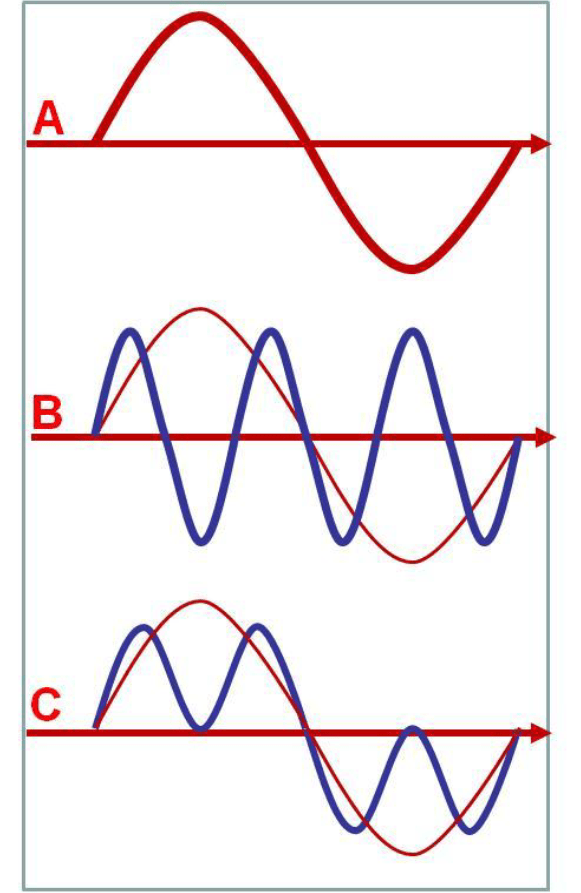
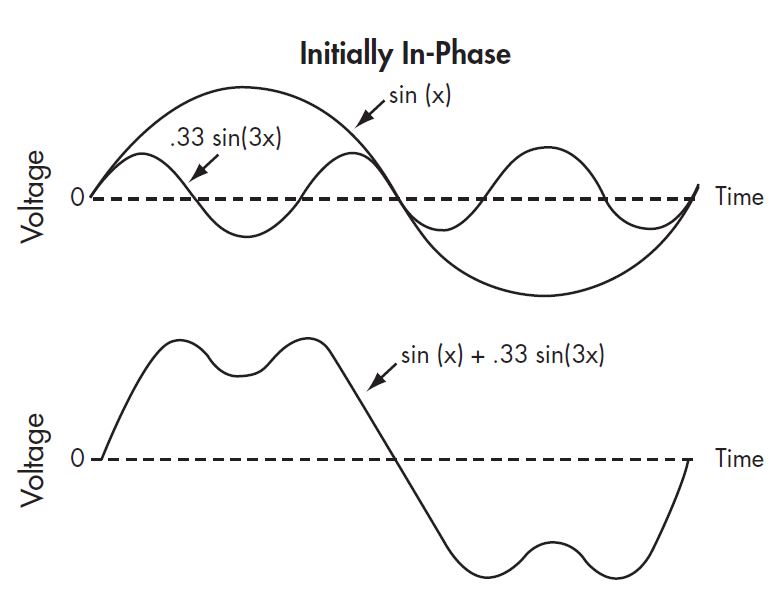
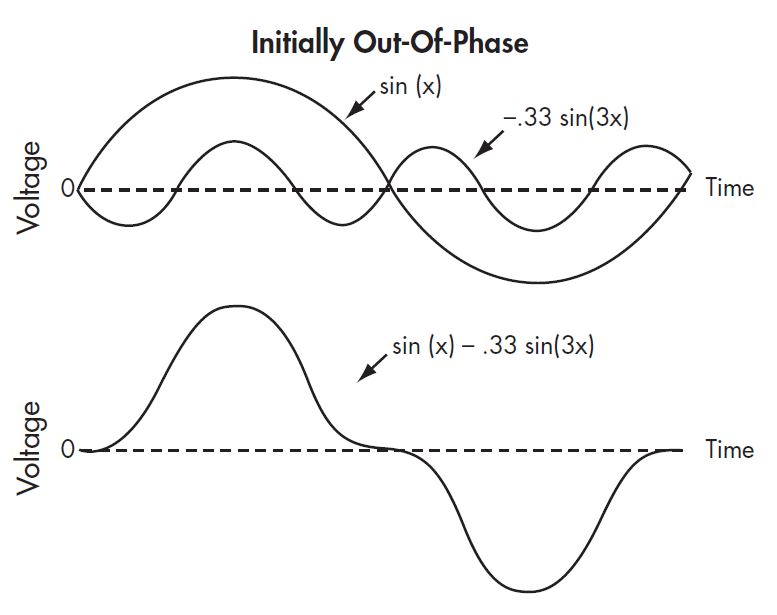
In the image to the right “A” depicts a single 60Hz cycle waveform (fundamental power frequency). “B” represents a 3rd harmonic (180Hz) waveform. The resultant waveform as shown in “C” provides an example as to the impact that the harmonic load may have on the fundamental waveform. Although the example depicts an unlikely 3rd harmonic magnitude, it provides a graphic depiction as to the impact that non-sinusoidal content can have on the fundamental waveform. The magnitude of the distortion is dependent on the number and magnitude of the total harmonic load profile.
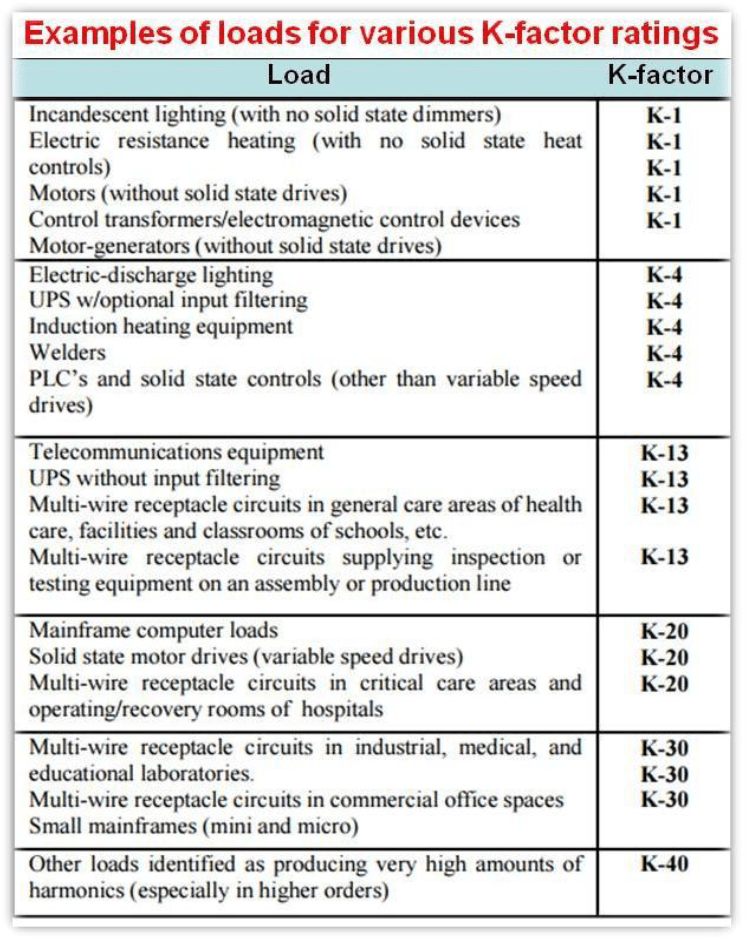
The table to the right provides an example of environments in which various K-factor rated transformers would be used. A transformer “K-factor” rating conveys its ability to manage varying degrees of nonlinear loads without exceeding the rated temperature rise limits. For any given nonlinear load, if the harmonic current components are known, the K-factor can be calculated and compared to the transformer’s nameplate K-factor. As long as the load K-factor is equal to or less than the transformer’s rated K-factor, the transformer does not need to be de-rated. The higher the K-factor, the more non-linear loads the transformer can handle. The actual formula to determine K-factor takes into account the frequency and current intensity of each individual harmonic.
The identification, measurement, and determination of the presence of non-sinusoidal frequency loads is essential in determining the impact on a transformer load. ANSI/IEEE C57.110, is the guide for determining the heating effects of nonlinear loads. It developed an equation for calculating these heating effects. By squaring the frequency and the per-unit current and multiplying them together, the guide arrived at a number without a designation. Originally it was going to be called C for “constant”, but was decided against because of possible confusion with “centigrade”. The letter K for “Konstant” was selected and Underwriters Laboratory used this designation in the original submission of a low voltage dry type transformer. K since became the standard measure of the ability of a transformer to withstand nonlinear loads.
The K-factor is a number derived from a numerical calculation based on the summation of harmonic currents generated by the non-linear load. The higher the K-factor, the more significant the harmonic current content.
Standard K-factor transformers come in K-factors of 4, 9, 13, 20, 30, 40, and 50. After K-factor load calculations are made, a transformer rated equal to or higher than the result is specified. It is more economical to purchase a K- factor transformer than to use a de-rated oversized transformer.
As a “rule of thumb”:
0% electronic, 100% electrical – standard (K-1 rated) transformer
“electronic” = Nonlinear Loads “electrical” = Inductive and Resistive Loads
K-factor rated transformers are preferred over oversized (de-rated) conventional transformers because they are designed to supply nonlinear loads, are equipped with 200% rated neutral bus, and are likely to be smaller and less expensive. Disadvantages of an over-sized standard transformer may include the requirement for a higher short-circuit rating on circuit breakers and a higher inrush current. De-rating a standard transformer is only a temporary fix that often translates into lower efficiency operation.
To calculate the K-factor, multiply the square of the percentage of harmonic current by the square of the harmonic order and add the results. For example, if a load is 60% of the fundamental, 65% of the third harmonic, 30% of the fifth harmonic, and 35% of the seventh harmonic, the resulting K-factor would be 12.3
In this example, a transformer with a K-factor of 13 should be specified. The K-factor rating defines the transformer’s ability to withstand odd-harmonic currents while operating within its insulation class. When the K-factor is unknown, a transformer may be selected by using the above “Examples…” table as a guide.
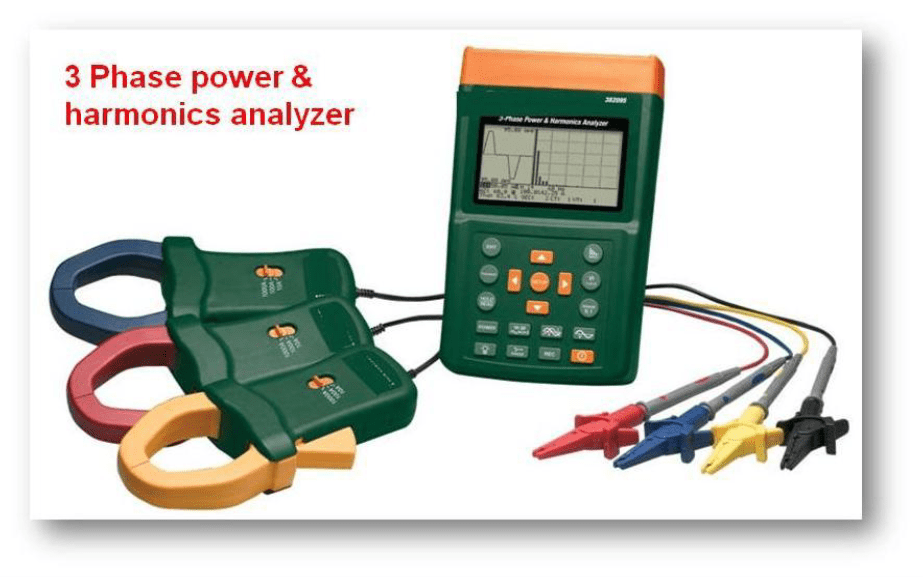
For existing installations, one can validate the K-factor load by using a 3 phase analyzer such as pictured below.
3-phase power analyzer
Such a device can also be used to check the impact of adding additional load devices on K-factor loading so as to insure that the existing transformer can be used.
So, what changes must be made to a transformer design in order to accommodate the additional losses caused by non-sinusoidal loads? The most notable is that the capacity of the transformer neutral is increased a minimum of 200% of the transformer kva rating. This is to accommodate the presence of triplen harmonics. The triplen harmonics are defined as the odd multiples of the 3rd harmonic (ex. 3rd, 9th, 15th, 21st etc.). Triplen harmonics are of particular concern because they are zero sequence harmonics, unlike the fundamental, which is positive sequence. The consequence of this fact is that the magnitude of these currents on the 3 phases are additive in the neutral which if not accommodated for, can lead to significant heating.
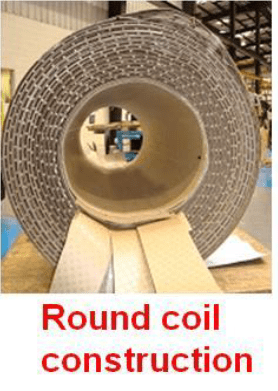
For K-factor rated transformers, PCT routinely utilizes round coil construction with cruciform cores which allow for 360 degree cooling ducts. This approach minimizes the potential for localized heating within the coils since the cooling fluid flows freely throughout the core/coil assembly.
With the additional loss requirements identified via the K-factor rating, additional cooling radiators may be added to insure that while delivering nameplate capacity, the temperature limit will not be exceeded. In extreme cases (K-20 and above), winding conductor current densities and/or core material flux densities may be adjusted.
Pacific Crest Transformers: Providing innovative solutions for today’s complex challenges
Published by Electrotek Concepts, Inc., PQSoft Case Study: Electric Arc Furnace Flicker and Harmonic Control, Document ID: PQS0314, Date: April 16, 2003.
Abstract: A steel manufacturer plans to construct an electric arc furnace-based steel making facility using a thin slab casting machine directly coupled to a hot strip rolling mill. The planned melt shop contains two dc electric arc furnaces (EAF) and will supply two ladle metallurgy furnaces (LMF) which will feed two thin slab casting machines. Concerns are raised with regards to voltage flicker and harmonic distortion levels associated with the proposed steel plant. The main objectives of this study are to evaluate the need for a Static-var Compensator (SVC) to control voltage fluctuations and to develop a minimum harmonic filter design that will provide required reactive compensation for the plant loads and will control harmonic levels to meet IEEE Std. 519 limits.
INTRODUCTION
This case study presents the results of an engineering study evaluating concerns for flicker and harmonic distortion levels associated with a proposed steel plant. The steel manufacturer plans to construct an electric arc furnace-based steel making facility using a thin slab casting machine directly coupled to a hot strip rolling mill. The planned melt shop contains two dc electric arc furnaces (EAF) and will supply two ladle metallurgy furnaces (LMF) which will feed two thin slab casting machines.
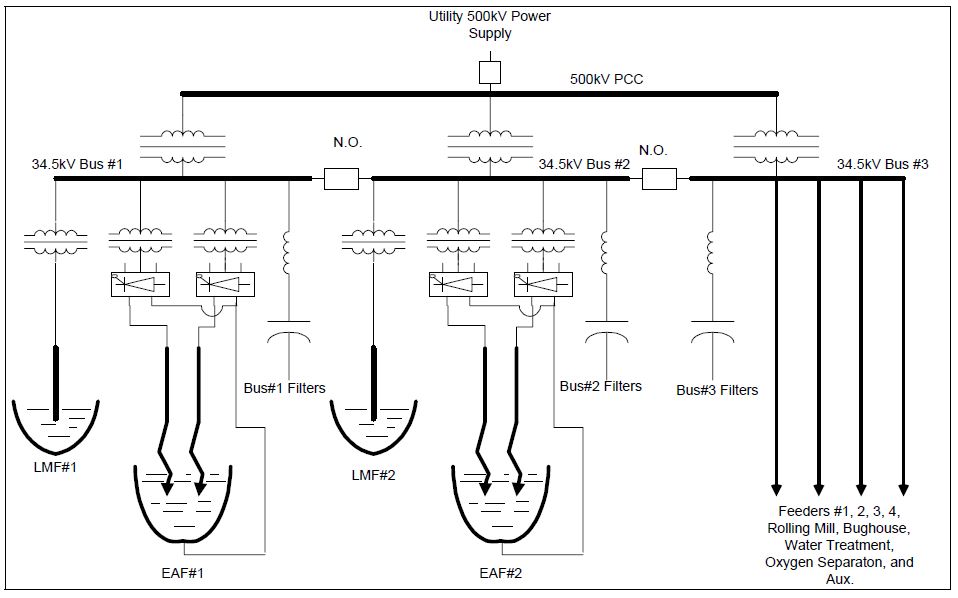
The steel plant will be supplied by a utility from its 500kV transmission system. The available short-circuit capacity from the utility will be 25,000A, 21,600 MVA; 19233A, 16,648 MVA; and 12,940A, 11,205 MVA respectively under different utility operation conditions. The steel plant’s electric power system will consist of a 500kV to 34.5kV substation. The substation 34.5kV bus is sectionalized. Sections 1 and 2 supply the melt shop, each has an 80 MW dual electrode dc arc furnace (EAF) and a 15 MW ac ladle furnace (LMF). Section 3 of the 34.5kV bus supplies a distribution system for the rolling mill. The auxiliary system of the steel plant will contain various types of air compressors, water pumps, ac drives and cycloconverters. A diagram of the overall facility represented for the study is provided in Figure 1. For simplicity, details of the system connection have not been shown. Multi-stage harmonic filters on each of the 34.5kV buses are indicated using a single filter symbol.
The steel manufacturer intends to operate this system with a minimum installation of reactive power compensation and harmonic filtering. The major concerns associated with operating the steel plant, as far as utility power quality is concerned, are harmonic distortion, flicker (voltage fluctuations), and transients caused by switching on the utility system or by switching a filter bank in the steel plant.
Operation of electric arc furnaces introduces random variations in the demand of the real and reactive power from the utility supply system. Due to the nonlinear characteristics of an electric arc furnace, the furnace current will be rich with harmonics. An installation of a static var compensator (SVC) at the steel plant will help to reduce the level of the system voltage fluctuations. However, the SVC operation can also generate harmonics. In addition to the arc furnaces, adjustable speed drives and cycloconverters used in the plant will also generate harmonics. The combined effects of all these harmonic producing loads will determine the levels of voltage and current distortion at the point of common coupling (PCC) between the utility and the steel plant. The filter designs developed in this study are based on the combined impacts of all the nonlinear loads in the facility.
The main objectives of this study are to evaluate the need for an SVC to control voltage fluctuations and to develop a minimum harmonic filter design that will provide required reactive compensation for the plant loads and will control harmonic levels to meet IEEE Std. 519 limits at the 500kV PCC.
Approach
Electrotek developed a complete steel manufacturer power supply system model for the evaluation using the Electromagnetic Transient Program (EMTP). The model includes all important system components from the 500kV utility power supply to the 480V steel plant power systems. The model is used to characterize the harmonics generated by the nonlinear loads in the facility (arc furnaces, ladle furnace, cycloconverter, ac drives, etc.). The model also includes a dynamic representation of the arc characteristics to permit evaluation of voltage fluctuations at the PCC with the utility supply system.
Circuit components such as power transformers, arc furnaces, cycloconverters, ac drives, SVC system as well as capacitor or harmonic filter banks are represented in the system model using data modules developed by Electrotek. If future evaluations are needed or if there are any system changes, this modularized approach for the model implementation will make additional simulations much easier.
The EMTP model is used directly for the evaluation of flicker concerns but it is inefficient for the many cases required for filter (each case requires many hours to run). Therefore, a steady state system representation is developed using Electrotek’s SuperHarm® program for harmonic evaluations. This SuperHarm model is used for the filter design task using frequency domain simulations. The program allows evaluation of response to the whole range of frequencies generated by the steel plant nonlinear loads (integer and non-integer harmonics).
VOLTAGE FLUCTUATION EVALUATION
There are two kinds of power changes associated with the melt shop operation. First, at each stage of the melt, the furnace demands different levels of active heating power. The furnace operating voltage and current settings are correspondingly changed during the heating cycle to meet with a designed furnace load profile. This type of change happens several times per melting cycle. Corresponding to each of these input power adjustments, disturbances in the system voltage occur. However, these power level adjustments do not result in the voltage flicker investigated here.
The voltage fluctuations of interest are those associated with uncontrollable variations of the dc arc length. These variations are highly random, and occur much more frequently than the power level adjustments described above. The greatest change in arc length occurs during initial scrap meltdown, with variations in equivalent arc resistance diminishing as the melt progresses. Different types of scrap exhibit different arc variation profiles.
The flicker study examines the following questions:
What flicker level can be expected on the 500kV PCC bus with no reactive compensation or other mitigation?
Does two-furnace operation double the flicker level of single-furnace operation? What is the worst case scenario?
Is a SVC necessary for flicker control? If yes, what is the minimum size needed to reduce 500kV flicker magnitude to an acceptable level?
Summary of Flicker Evaluation Cases
The source strength at the 500kV PCC varies with on-line generation. The multiple system configurations can be reduced to three approximate capacity levels, as shown below:
Table 1 – Possible Utility Supply System Strength at 500kV PCC Bus
Source Strength
Short-Circuit Strength (MVA) at 500kV PCC
Short-Circuit Isc (Amps) at 500kV PCC
Weak
11206
12940
Normal
16648
19223
Strong
21650
25000
Results of the EMTP voltage flicker simulations are summarized in Table 2 and Table 3.
As expected, comparing the first and fourth case in the table shows that a 100Mvar capacitor at the melt shop 34.5kV bus has only a slight impact on the voltage flicker at 34.5kV and basically no impact on flicker at 500kV. The reason is that, compared with the utility supply source, the current loop impedance of the compensation circuit is fairly high, especially at flicker frequencies. As a result, even with the local var supply, the major portion of the fluctuation in reactive power is delivered from the utility system. The capacitor compensation is mainly for melt shop power factor correction.
The table also summarizes flicker levels with an SVC consisting of a 100Mvar TCR and 95Mvar of fixed tuned filter banks. It is shown that the SVC effectively reduces flicker at both 34.5kV and 500kV.
Only a weak system was considered for single furnace operation. In all single furnace cases, the maximum instantaneous voltage flicker magnitude is less than 0.3% of system line-to-ground voltage. The dominant frequency of the flicker voltage is around 4 Hz. Voltage fluctuations at this level should not cause any problem.
Table 2 – Maximum Instantaneous Voltage Flicker for Single Furnace Operation
Case
Conditions
MW
Max ΔV/V at 34.5kV (1000*%)
Max ΔV/V at 500kV (1000*%)
80 MW
Weak Source, a single furnace, No compensation
80.3
2400
300
80CAP
Weak Source, a single furnace, With 95Mvar cap./filter
80.3
2500
300
80TCR
Weak Source, a single furnace, With 65 Mvar cap./filter and 100Mvar TCR
80.3
1350
200
For the two furnace cases, the maximum instantaneous voltage flicker at 34.5kV reached 5% and 500kV flicker reached 0.6% with two furnace operation on a weak source.
Table 3 – Maximum Instantaneous Voltage Flicker for Double-Furnace Operation
Case
Conditions
MW
Max ΔV/V at 34.5kV (1000*%)
Max ΔV/V at 500kV (1000*%)
2-80MW
Weak Source, two furnaces, no compensation
2*80.3
5000
600
2-80TCR
Weak Source, two furnaces, With 95Mvar cap./filter and 100Mvar TCR on each furnace bus
2*80.3
1500
300
2-80MW2
Normal Source, two furnaces, no compensation
2*80.3
4000
380
Typical Waveforms from Simulation
Simulations with normal source strength showed that an SVC is not needed to control flicker. It was not necessary to analyze the strong source condition, since flicker level would be even lower. However, the weak source condition was analyzed to obtain the worst case flicker level.
Two sets of flicker simulation waveforms are shown below. The first set shows single furnace operation on a weak system with the balancing control between two rectifiers activated. The second set two furnace operation on a normal system with fully independent rectifier operation (i.e., balancing control disabled). No reactive power compensation was assumed for these simulations.
Single Furnace, Weak Source Condition
This case simulated a single dual-electrode dc arc furnace operating on a weak supply with no reactive compensation. An average melting power of 80.3 MW was specified by setting the rectifier dc bus voltage reference to 535 V and the electrode dc current reference to 75 kA/electrode.
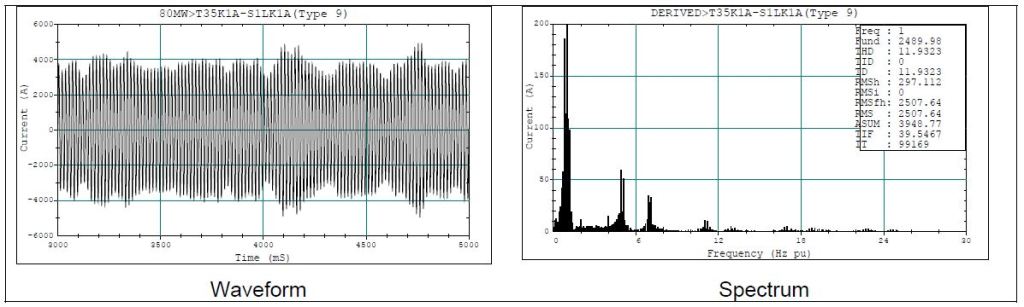
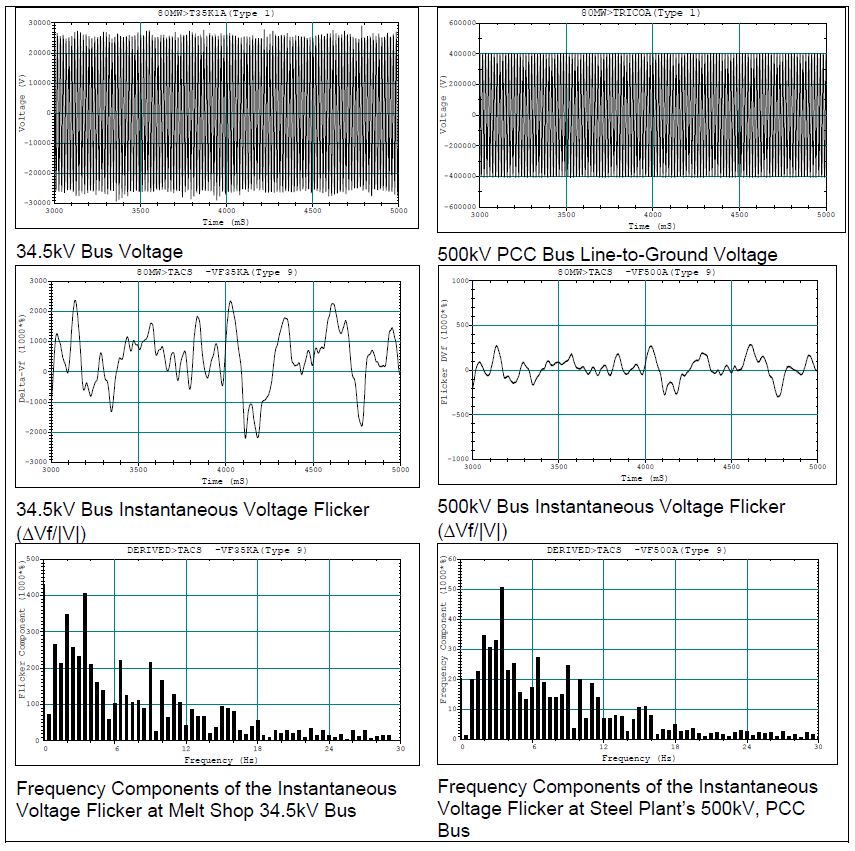
For this single furnace case, the maximum instantaneous flicker reached 2.5% at 34.5kV bus and 0.3% at the 500kV PCC. Flicker voltage frequency content ranged from 1 to 15 Hz, with great concentration at about 4 Hz.
Figure 2 shows the waveform and spectrum of the total current injection into the 34.5kV side of the 150 MVA melt shop supply transformer.
Figure 2 – Single Furnace 34.5kV Current Injection
Voltage variations at 34.5kV and at 500kV were evaluated, with flicker at 500kV being the more important with regard to the need for an SVC.
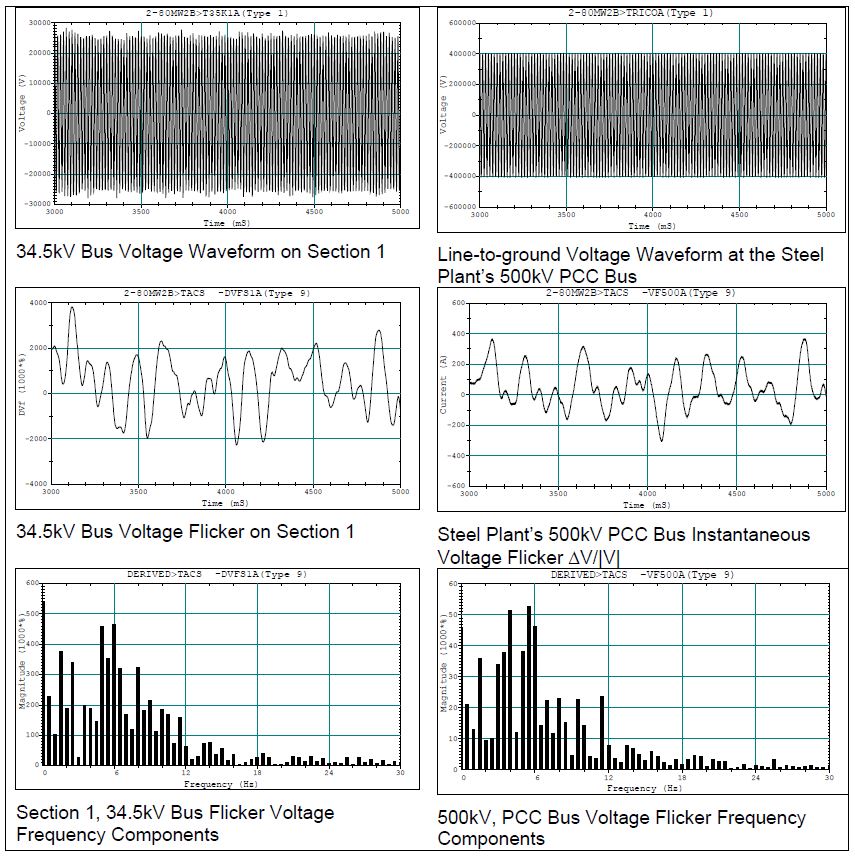
Line-ground voltage, instantaneous flicker voltage, and flicker voltage frequency content waveforms at 500kV and 34.5kV are shown in Figure 3.
Figure 3 – Single Furnace Voltage Waveforms and Spectrum
Two Furnaces, Normal Source Conditions
This case simulates two-furnace operation with normal source strength. The furnace melting power settings and other system conditions are the same as those given in Case 80 MW, but the balancing control circuit was disabled to obtain independent operation of the two six pulse rectifiers for each furnace. This is the normal procedure for the initial portion of the melt. Therefore, this case should represent worst case conditions with two furnaces operating in the initial melt period. Electrical quantities for this case are shown in Figure 4 and Figure 5.
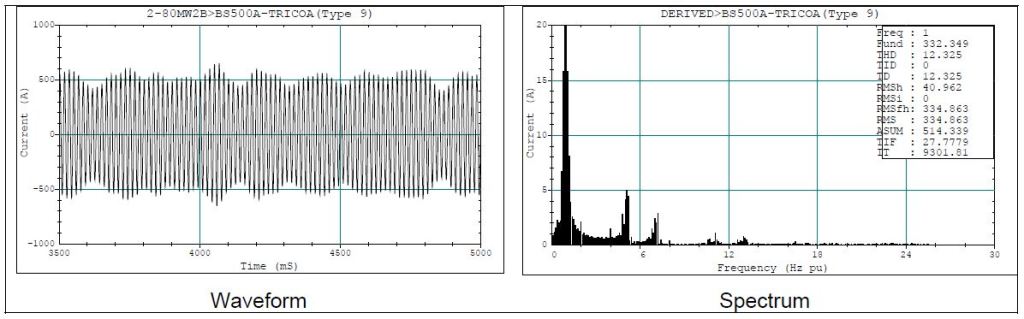
Two furnace operation with normal source strength produced a maximum flicker of 3.8% at 34.5kV and 0.37% at 500kV. Flicker voltage frequency content was found to be different than that for single furnace operation. The dominant frequency in this case is close to 6 Hz with the spectrum spread from 2 to 12 Hz. In general, 500kV voltage flicker of this magnitude should not create problems for the other customers on the utility transmission system.
Figure 4 shows the waveform and spectrum of the total current injection into the 500kV transmission system.
Figure 4 – Double Furnace 500kV Current Injection
Voltage variations at 34.5kV and at 500kV were evaluated, with flicker at 500kV being the more important with regard to the need for an SVC.
Figure 5 – Double Furnace Voltage Waveforms and Spectrum
Harmonic Filter Design
Filter Options Evaluated
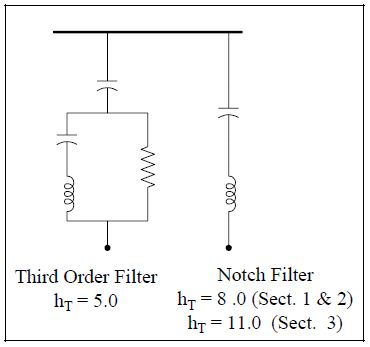
Four different filter options were considered and presented to the utility. The first option was a classic filter design with individual tuned branches at the 2nd, 3rd, 4th, 5th, 7th, and 11th harmonics (Sections 1 and 2). This results in a very expensive design because many branches require damping resistors to avoid high impedance parallel resonances that could excite non-integer harmonic components. Options 2 and 3 both involve the third order filter tuned to the fifth harmonic with a damping resistor to prevent resonance problems. In option 2, a 2nd harmonic filter was included on Section 1 and a 3rd harmonic filter on Section 3 to provide some reduction of these non-characteristic harmonics at the 500kV PCC.
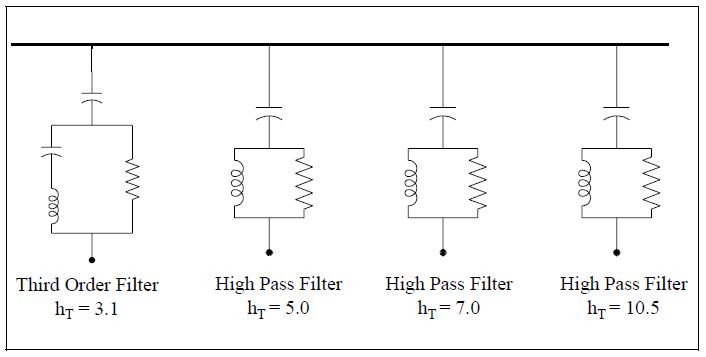
Option 4 consists of a third order filter tuned near the third harmonic to provide damping at the lower order components. Tuned branches are included at the 5th, 7th, and 11th (actually 10.5) to control the characteristic harmonics of the dc furnaces operating in the independent 6-pulse control mode. The filter on Section 3 is the same as option 3. While this configuration has excellent characteristics, the additional cost may not be warranted.
The first two options were reviewed at a meeting with the customer and it was decided to focus on Options 3 and 4. These are illustrated in Figure 6 and Figure 7, respectively. Option 3 is the simplest of the configurations evaluated and is the configuration recommended for the facility.
Figure 6 – Filter Option 3, Sections 1, 2 and 3.
Figure 7 – Filter Option 4, Sections 1 and 2 Only (section 3 is the same as option 3).
Frequency Response Characteristics
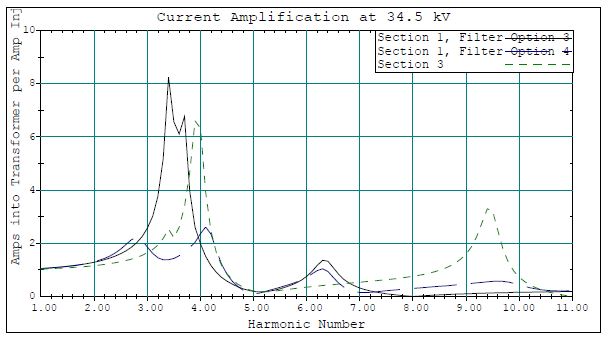
The frequency response is illustrated as a measure of the current amplification that can be expected as a function frequency. Figure 8 shows the current amplification as a function of frequency for both filter designs being considered. The frequency response at Section 1 and Section 2 are the same so only Section 1 is provided. Both filter options use the same design for Section 3 so only one frequency response curve is included for Section 3.
Figure 8 – Current Amplification vs. Frequency at 34.5kV buses
Comparing the response for options 3 and 4 shows that the additional branches and damping in option 4 provide significant reduction of the current magnification between the third and fourth harmonics. However, the performance actually at the third and fourth harmonics is very similar (actually better at the fourth harmonic for option 3). The interharmonics between the third and the fourth are much lower than the maximum values most of the time and the maximum magnification is less than 10 for the proposed design. The damping provided by the recommended design (option 3) is sufficient to prevent problems at the interharmonic frequencies.
Expected Harmonic Levels
Expected voltage and current harmonic distortion levels are evaluated for both filter options 3 and 4. Typical maximum levels are calculated using the worst case spectrums with the following harmonics included: 5, 7, 11, 13, 17, 19, 23, and 25. Short time maximums are calculated using all of the harmonic components. These levels should occur for only a very small percentage of the time since the non-characteristic harmonics are all considered at their worst case values simultaneously.
34.5kV Voltage Distortion Levels
Voltage distortion levels at the 500kV level resulting from the steel plant operation will be extremely low due to the low impedance of the 500kV system. It is more important to consider voltage distortion levels at the 34.5kV sections, where they can affect all of the steel plant loads. Table 4 gives the expected voltage distortion levels at the individual sections. The typical maximum values are well within the IEEE Std. 519 guidelines and the short time values should not cause any problems.
Table 4 – Expected Voltage Distortion levels at 34.5kV Sections
Section
34.5kV Bus VTHD
Option 3
Option 4
1,2
Typical Maximum
3.5%
3.4%
1,2
Short Time
5.6%
6.5%
3
1.9%
1.9%
Harmonic Current Levels at the PCC
The harmonic current levels are evaluated at the 500kV PCC. These are based on the combination of harmonic currents from all three 34.5kV sections. The expected harmonic current levels are compared with the limits outlined in IEEE Std. 519. For the characteristic harmonics (5, 7, 11, 13, etc.), the actual limits are used. For non-characteristic harmonics, 150% of the limits are used for comparison because IEEE Std. 519 allows the specified levels to be exceeded by this amount for up to one hour per day.
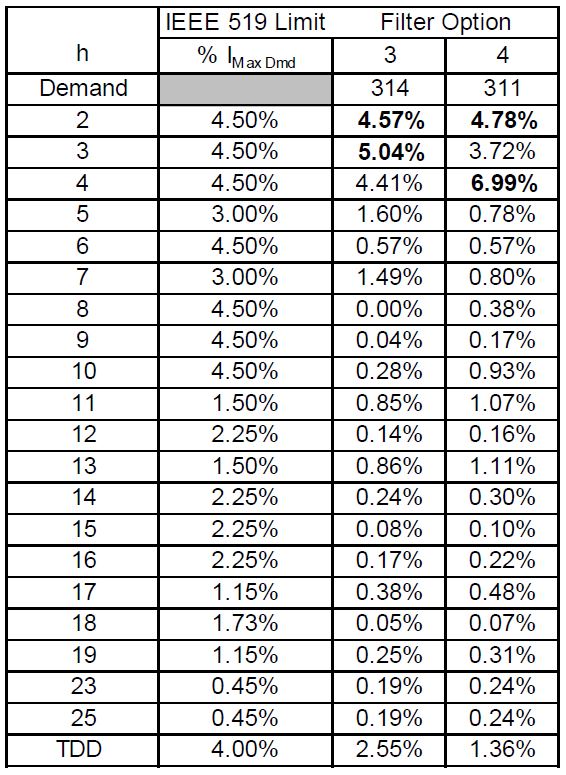
The following table shows a compares the expected harmonic current levels at the PCC with the IEEE Std. 519 limits for both filter options 3 and 4. Note that all harmonic currents are expressed in percent of a calculated demand current (first row of the table). This estimated demand current includes the effect of the filter-provided reactive compensation.
Note that even the 150% limits at the second, third, and fourth harmonics could be exceeded (depending on the filter option). However, the furnace harmonic characteristics provided for these components are considered to be conservative and the summation effects assumed for these non-characteristic harmonics should be very rare (furnaces on sections 1 and 2 both generating high non-characteristic harmonics at the same instant). It is expected that the actual maximum harmonic current levels at these harmonic orders will be well within the 150% limits.
The following table shows a comparison of expected harmonic currents at the 500kV PCC with IEEE Std. 519 limits (harmonic levels expressed in % of average maximum demand current, including the effect of reactive power compensation).
Table comparison of expected harmonic currents at the 500kV PCC with IEEE Std. 519 limits
EMTP Simulated Harmonic Injection at 500kV PCC Bus
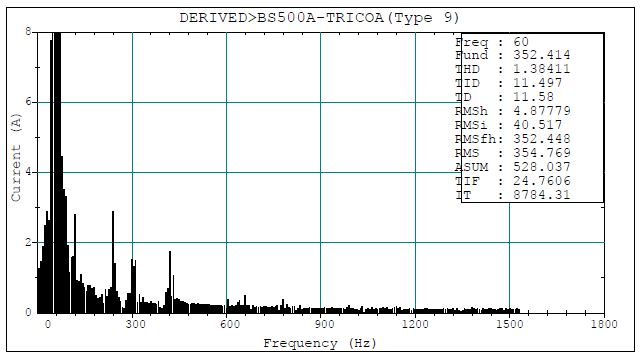
EMTP simulations are used to verify the results of the harmonic investigation. The simulation presented here is for a two-stage filter configuration similar to Option 3. With these filters connected, the current injected into the 500kV PCC bus is shown in Figure 9. The THD of this current is about 1.4%.
Figure 9 – Frequency Spectrum of the 500kV Supply Current with Filter Option #3
SUMMARY
Flicker
Simulations show that with the normal supply, without reactive power compensation, the maximum instantaneous flicker level at the 500kV bus is around 0.4% when two dc arc furnaces are in operation. The maximum instantaneous flicker is the maximum percentage value of the fluctuation voltage on the system line-to-ground peak voltage base, within a sampling time window of 2 seconds. In other words, this 0.4% means that all frequency components of the voltage flicker are smaller than 0.4% of system nominal peak voltage. Usually, this level of flicker does not cause problems. The flicker at the steel plant 34.5kV furnace supply buses is about 4%. However, only the furnace loads are connected on these buses and these loads can withstand relatively high voltage fluctuations. Based on these results, an SVC is not required to control flicker levels. Strong source conditions will result in even lower flicker levels.
Under weak source conditions and both furnaces operating simultaneously, the maximum instantaneous flicker level reached 0.6% at the 500kV PCC bus and reached 5% at the 34.5kV furnace supply buses inside the steel plant. The simulation shows that the frequency spectra of the instantaneous flicker range from 0.5 to 30 Hz, with a great concentration within the 2 to 10 Hz range. This level of flicker, especially with these frequency components in the most sensitive range, has the potential to cause problems. If the steel manufacturer plans to operate both furnaces simultaneously with this weak source condition, installation of an SVC is recommended.
If a 95 MVAr SVC (95 MVAr tuned filter bank + 100 MVAr TCR) is installed on each 34.5kV furnace supply bus in the steel mill, with the same weak source supply, the maximum instantaneous voltage levels at the 500kV PCC bus and at the 34.5kV buses can be reduced to 0.3% and 1.5% respectively.
Reactive Power Compensation and Harmonic Filtering
The reactive power compensation is sized with consideration of a required +0.95 to -0.95 average displacement power factor within a 30-consecutive minutes metering period. The total capacitive compensation needed at each 34.5kV furnace supply bus is determined based on the steel furnace melting cycle MW load profile. The rolling mill 34.5kV bus reactive power compensation requirement is estimated based on load conditions provided by the steel manufacturer and the rolling schedules supplied by Siemens. It is estimated that approximately 65 MVAr of compensation is needed at each 34.5kV furnace supply bus and 38 MVAr is needed on the rolling mill bus. The reactive compensation requirements are used as the starting point for sizing harmonic filters. It is assumed that the filters will be installed without an SVC.
A number of different filtering options were evaluated. The filter performance evaluation and energy duty requirements for damping resistors were mainly based on the supplied ac ladle furnace, dc arc furnace and rolling mill harmonic generation characteristics. A two-stage filter combining a 3rd order filter with non-power frequency damping resistor and a tuned 2nd order filter is the recommended configuration.
REFERENCES
IEEE Std. 519-1992, “IEEE Recommended Practices and Requirements for Harmonic Control in Electrical Power Systems.”
RELATED STANDARDS IEEE Std. 519, “IEEE Recommended Practices and Requirements for Harmonic Control in Electrical Power Systems.”
GLOSSARY AND ACRONYMS EMTP: Electromagnetic Transient Program PCC: Point of Common Coupling SVC: Static-Var Compensator TACS: Transient Analysis of Control Systems TCR: Thyristor Controlled Rectifier THD: Total Harmonic Distortion Voltage Flicker: Observable changes in light as a result of voltage fluctuations
Published by CEA Technologies Inc. (CEATI), POWER QUALITY Energy Efficiency Reference Guide, Chapter 5 – Where to Go For Help.
Web Resources
IEEE Standards Information
Home of the IEEE standards; in particular 446; 519; 1100 (“The Emerald Book”, considered the key IEEE reference on power quality); 1159; 1250 and 1346.
Copper.org
A site by the Copper Development Organization responsible for promoting the use of copper; check out the reference primer on power quality.
Power Standards Laboratory
A web site from principal, Alex McEachern, about voltage sags.
Underwriters Laboratories, Inc.
A good power quality reference is UL Standard 1449, second edition that describes performance specifications for surge protection devices.
Power Quality Guidelines for Energy Efficient Device Application
This guidebook has three primary objectives:
To improve guidelines for minimizing any undesirable power quality impacts of energy saving technologies;
To provide an understanding of the energy savings potential of power quality related technologies; and,
To provide guidelines for evaluating “black box” technologies.
Semiconductor Equipment Materials International
SEMI F47, Specification for Semiconductor Processing Equipment Voltage Sag Immunity, is available from SEMI.
International SEMATECH Technology Transfers
This web site is by Sematech, a consortium of semiconductor manufacturers and tool manufacturers. It contains the report, “Guide for the Design of Semiconductor Equipment to Meet Voltage Sag Immunity Standards.”
IEC Standards Information
Information about types of disturbance, emission and immunity, etc., as well as the different IEC Standards can be found at: http://www.iec.ch/zone/emc/whatis.htm
CAN/CSA-C61000-2-2-04 Electromagnetic Compatibility (EMC) – Part 2-2:Environment Compatibility Levels for Low Frequency Conducted Disturbances and Signaling in Public Low-Voltage Power Supply Systems.”
CAN/CSA-CEI/IEC 61000-2-8-04 Electromagnetic Compatibility (EMC) – Part 2-8: Environment Voltage Dips and Short Interruptions on Public Electric Power Supply Systems with Statistical Measurement Results.
CAN/CSA-C61000-3-3-06 Electromagnetic Compatibility (EMC) – Part 3-3: Limits Limitation of Voltage Changes, Voltage Fluctuations and Flicker in Public Low-Voltage Supply Systems, for Equipment with Rated Current <= 16 A per Phase and Not Subject to Conditional Connection.
CAN/CSA C61000-3-6-04 Electromagnetic Compatibility (EMC) – Part 3: Limits Section 6: Assessment of Emission Limits for Distorting Loads in MV and HV Power Systems – Basic EMC Publication.
CAN/CSA-C61000-3-7-04 Electromagnetic Compatibility (EMC) – Part 3: Limits Section 7: Assessment of Emission Limits for Fluctuating Loads in MV and HV Power Systems – Basic EMC Publication.
CAN/CSA-CEI/IEC 61000-4-11-05 Electromagnetic Compatibility (EMC) – Part 4-11: Testing and Measurement Techniques – Voltage Dips, Short Interruptions and Voltage Variations Immunity Tests.
CAN/CSA-CEI/IEC 61000-4-34-06 Electromagnetic Compatibility (EMC) – Part 4-34: Testing and Measurement Techniques – Voltage Dips, Short Interruptions and Voltage Variations Immunity Tests for Equipment with Input Current More Th an 16 A per Phase.
CAN/CSA-C61000-3-11-06 Electromagnetic Compatibility (EMC) – Part 3-11:Limits Limitation of Voltage Changes, Voltage Fluctuations and Flicker in Public Low-Voltage Supply Systems – Equipment with Rated Current <= 75 A and Subject to Conditional Connection.
CEATI Reference Documents
• T984700 5103 Canadian Power Quality Survey 2000
• T034700 5120 Review of Flicker Measurement of the CEA DPQ Survey 2000
• T014700 5113 Sag, Swell and Short Interruption Evaluation from the Canada PQ Survey 2000
• T044700 5123 Power Quality Impact Assessment of Distributed Wind Generation
• T044700 5126 Customer Power Factor Correction Capacitor Application Guide
• T014700 5110 An Automated Method for Assessment of Harmonics From Non-Linear Loads and Distributed Generators
• T004700 5108 Techniques to Assess Harmonic Distortions for Systems with Distributed Harmonic Sources
• T984700 5102 The Impact of the Electromagnetic Compatibility (EMC) Concept of Power Quality in The North American Electricity Industry
• T024700 5115 Solutions to PQ Disturbance Problems of Sensitive Equipment
• T024700 5114 Establishing Power Quality Guidelines
Published by Electrotek Concepts, Inc., PQSoft Case Study: Electric Arc Furnace Modeling for Voltage Flicker Evaluation, Document ID: PQS0313, Date: April 16, 2003.
Abstract: A steel manufacturer is planning to add a second arc furnace to their existing facility. Concerns are raised as to whether the additional furnace will cause levels of voltage flicker that might possibly affect neighboring loads. A complete time-domain model of the existing and proposed arc furnace along with a flicker meter are developed in EMTP and the results gathered are used to evaluate system changes that will be needed prior to installation of the second furnace.
INTRODUCTION
Background
A steel manufacturer has a steel making facility supplied from a 230kV switchyard. This facility currently operates a single arc furnace and a rolling mill. The steel manufacturer plans to start up a second furnace and the utility has agreed to make a number of system changes to improve the supply to the facility. The changes will be made at the 230kV switchyard that supplies the plant.
These changes are needed to meet the 230kV circuit breaker rating limitations and to improve system performance.
The steel manufacturer is fed from the 230kV switchyard through a 2.5 mile 230kV transmission line. Currently, there is one 57 MW ac furnace in operation at the steel mill. However, plans are to start the second 57 MW furnace in the near future. Flicker measurements were performed previously with the stronger system and one furnace in operation. RMS flicker levels were in the range 0.2-0.3%. With both furnaces operating and the reduced short circuit capacity, there is a significant concern that flicker levels could be objectionable for other customers supplied from this part of the transmission system. The study is designed to evaluate expected flicker levels with the planned system configuration and the possibility of both furnaces operating simultaneously.
Approach
Evaluation of arc furnace flicker requires an accurate representation for the arc furnace loads. The major difficulty in the furnace modeling is to accurately characterize the electric arc. Even in the same stage of a melting cycle, the arcing voltage and the equivalent arc resistance may change significantly, ranging from a momentary open circuit status to a momentary short circuit status. This arcing variation depends closely on the materials to be melted and is highly random in nature. It has been found that this arcing change does not obey any uniform distribution.
In this case study, arc furnace loads are represented using Transient Analysis of Control Systems (TACS) modeling capability of the Electromagnetic Transients Program (EMTP). A variable arc length is characterized using the band limited white noise method. Consequently, the equivalent arc resistance varies continuously as a random function of time. With the incorporated electrode lifting and lowering controls, an average arc voltage and the furnace heating power are controlled by a preset furnace operation voltage.
Electrotek used different bandpass filters and random signal magnitude functions to characterize ac arcing resistance. A trial and error method was used to determine properties of the bandpass filters and magnitude functions for the arc characterization. In this study, the flicker is evaluated against different conditions (system supply strength), with either a single furnace operation or two furnace operation.
In order to perform a sensitivity analysis, an EMTP TACS flicker meter module was developed. This EMTP TACS flicker meter module reads a simulated voltage waveform at a specified system location during each time step of the simulation, performs the flicker calculation, and outputs instantaneous voltage flicker (DV(t)/|V|) as a part of simulation results.
Simplified Flicker Evaluation Procedures
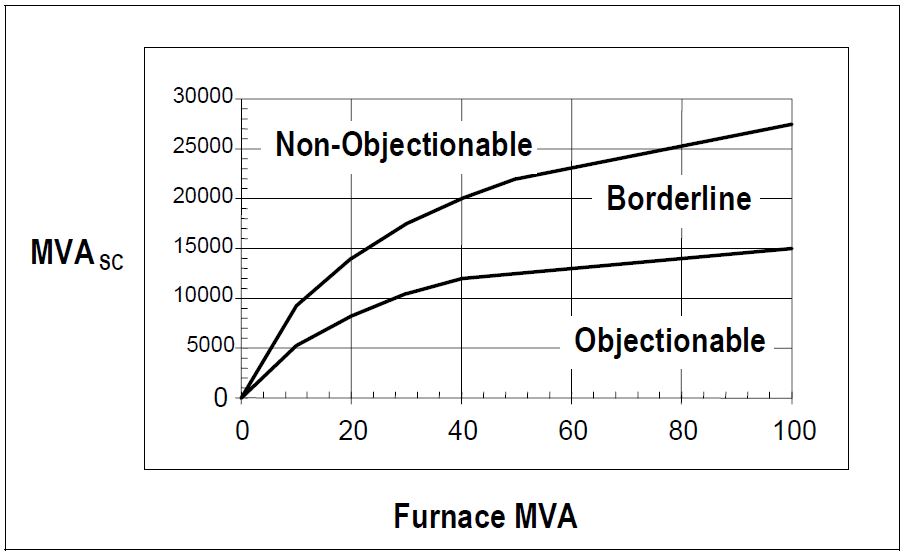
Empirical results from other arc furnace installations can be used as an initial check of possible flicker concerns at the steel manufacturing facility. gives curves developed from a number of different arc furnace measurements around the world. The curves show where flicker is likely to be a problem in terms of the short circuit capacity at the point of common coupling. The curves are only applicable for single furnace operation. However, an equivalent flicker level for multiple furnaces can be estimated using the following relationship:
Pst is the short term flicker severity output from a flickermeter according to the IEC standards. For two furnaces of the same size, the flicker level with both furnaces operating should be about 26% greater than the flicker level for one furnace.
Figure 1 – Empirical Curves Illustrating Short Circuit Capacity and Flicker
Applying the curves of Figure 1 to the steel manufacturing configuration, we can estimate that a single furnace operation (approx. 80 MVA) will become objectionable at a short circuit capacity of about 14000 MVA and may be noticeable with a short circuit capacity as high as 25000 MVA. Previous measurements and actual experience at a short circuit level of 21576 MVA have shown no problem.
With two furnaces (equivalent size of 80×1.4=112 MVA), objectionable flicker can be expected for a short circuit capacity of about 16000 MVA (extrapolation). The expected short circuit capacities at the 230kV switchyard after system modifications will be somewhat less than this value, indicating potential problems.
EMTP MODEL DESCRIPTION
Steel Manufacturer Power Supply System
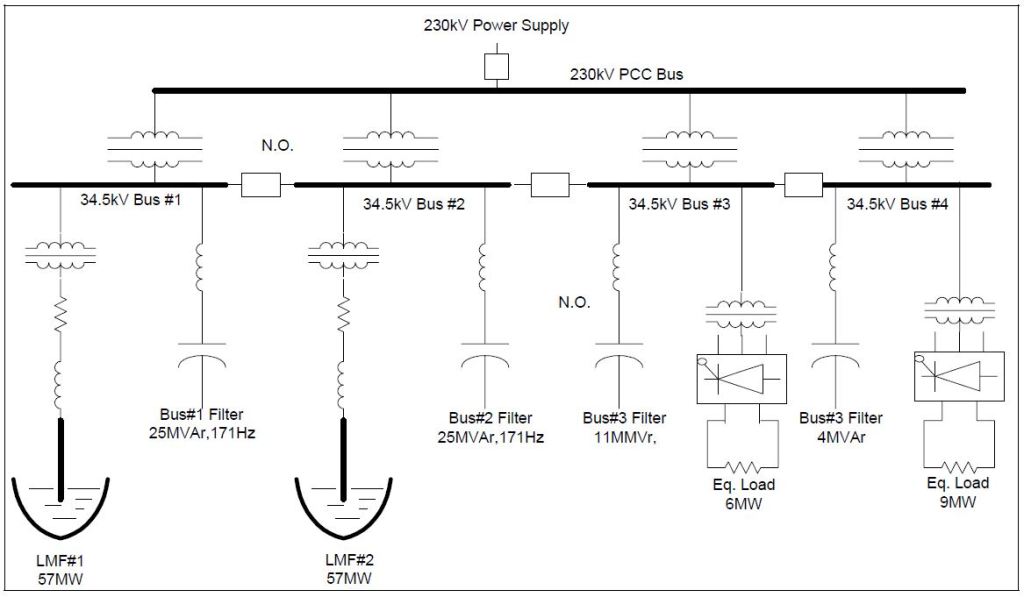
The steel manufacturer is supplied by the utility system from a 230kV switchyard through a 2.5 mile 230 kV transmission line. The steel mill loads consist mainly of two 57 MW ac arc furnaces and the rolling mill. The power circuit of the steel mill is schematically shown in the oneline diagram given in Figure 2.
Figure 2 – Steel Manufacturer Power Supply System Oneline
Two 60 MVA, 230/34.5kV, Delta-Wye, power transformers are used to supply the melt shop that includes two 57 MW ac arc furnaces. Each of these furnaces has its own 60 MVA, 33kV/728-240V, delta-Wye step-down transformer and a 34.5kV, 25 MVAr harmonic filter. The filter is tuned at 171 Hz. The melt shop auxiliary and rolling mill is supplied separately by two 20 MVA, 230/34.5kV transformers with the same winding connections. The major loads of these transformers are SCR-based dc drives supplied at either 500V or 600V. For simplification, these drives are grouped according to their supply voltages and are equivalently represented in the EMTP model by one 6 MW and one 9 MW drive as shown below. The drives are assumed to be operated at 30 degree firing angle. The 4 MVAr and 11 MVAr power factor correction/ harmonic filter units are connected at 34.5kV buses as shown.
EMTP Component Models
Important components of the system model are described in this section. This section focuses on the models for the arc furnaces and the controls, as well as the metering for flicker.
AC Arc Furnace Model For an ac arc, three variation rules were applied.
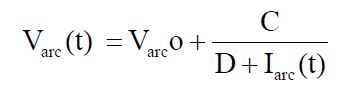
The first cause of variations is associated with the 120 Hz current zero crossings. For a constant arc length, the arc voltage Varc(t) changes with the magnitude of the instantaneous current, Iarc(t). For a positive half cycle of the arc current, the arc voltage can be expressed by:
where
Varco – a constant, unit length arc voltage threshold when iarc(t) increase C – a constant, in unit of Watts, C=Cp when di/dt >0 and C=Cn when di/dt <0 D – a constant, in unit of Amp, D=Dp when di/dt >0 and D=Dn when di/dt<0
The voltage shape for the negative half cycle is symmetrical to the positive half cycle with respect to the origin. This is a deterministic rule mainly responsible for characteristic harmonic distortion.
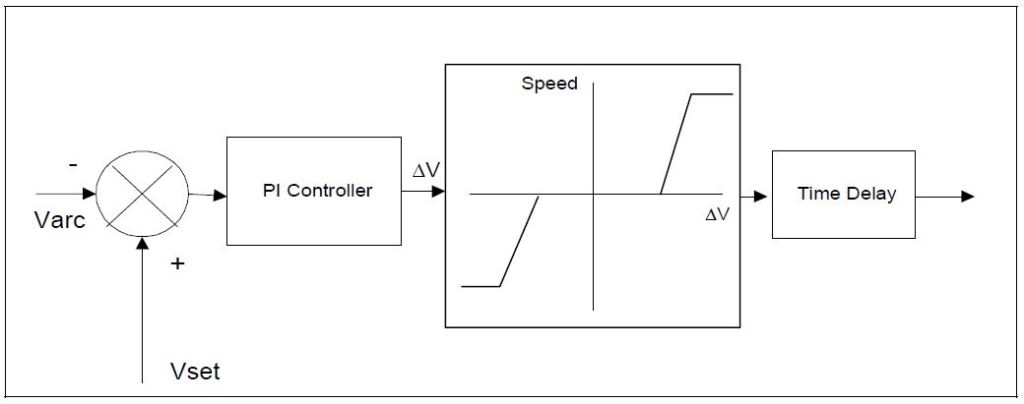
The second rule affecting the furnace arc is electrode lifting and lowering control. It is also referred to as electrode voltage regulation. The principle of ac voltage regulation is shown in Figure 3.
Figure 3 – DC Arc Voltage Control
With a constant voltage across a unit length of arc, a desired total arc voltage is adjusted by changing the length of the arc. An appropriate operation voltage is obtained by lifting or lowering the movable positive electrode with respect to the fixed negative electrode. As a result, the distance between the tips of the electrodes changes, resulting in a different range of arcing voltage variation. At different melting stages, the furnace heating power is adjusted by changing the arc voltage. With constant supply system impedance, this voltage change results in arc current change and arc power change. A long arc operation tends to give a high operation power factor. A short arc operation results in a low power factor.
The third rule applied is a random time variation of the arc length. For any given ac furnace arc voltage setting and distance between the tips of the electrodes, the actual arc length changes randomly with time. The factors which directly affect this random change include the physical distance between the tip of the electrode and the materials to be melted, characteristics of the materials, status of melting, and many others related to furnace design and operation conditions. As a result, the magnitude of these random changes can be dramatic; ranging from a bolted short circuit to an open circuit.
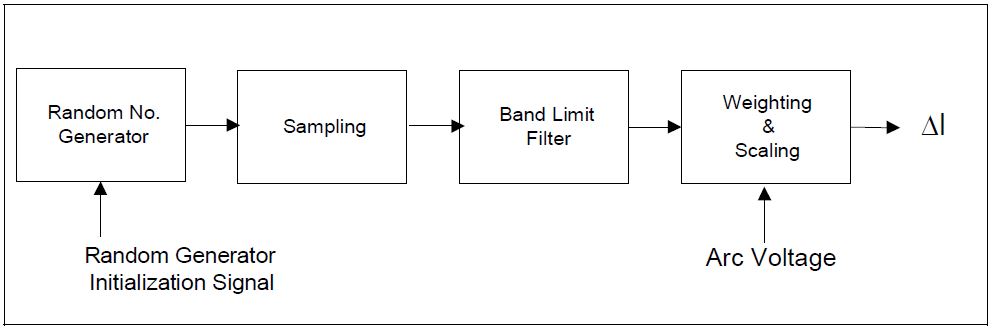
Based on the results of many studies over several decades, it is now commonly believed that the variations of an electrical arc do not obey any standard distribution rule. Namely, the arc length changes in a completely random fashion. To properly represent such a random arc change, in this study, a band-limited white noise method is used. The principle of this method is shown in Figure 4.
Figure 4 – TACS Representation of Random Variation of Arc Length
The procedure to model the random variation portion of the arc length consists of four steps:
Generate a random number between 0 and 1 at each simulation time step
Set up an appropriate sampling scheme so that the time step effects on the generated random signal are removed
Process the sampled random signal through a bandpass filter so that only signals within a considered frequency range are able to pass to the next processing stage. A typical range of frequencies characteristic of the arc variations is 4 Hz to 14 Hz.
Apply proper scaling and weighting functions which characterize the different disturbance magnitude at different melting stages. In this stage, a preset dc arc voltage is used as an input to the weighting function.
The effective arc length obtained through this procedure can be expressed by
L=Lo*(1-ΔL)
where Lo is the desired arc length calculated by the electrode regulation control logic for a given dc voltage setting value.
With all the above factors considered, the arc voltage can be structured as Va=kVao(Ia)
where Vao is the arc voltage corresponding to the reference length, Lo. Coefficient k is the ratio of the threshold arc voltage corresponding to a length L, Vat(L), to that relevant to the reference length, Vat(Lo).
Since the relationship between threshold voltage and arc length can be expressed as Vat=A+B*L
then, k is given by k=Vat(L)/Vat(Lo)=(A+BL)/(A+BLo)
where L is the arc length in cm, A is a constant taking into account the sum of anode and cathode voltage drops (40 volts), and B represents the voltage drop per unit arc length (10 volts/cm).
With the random nature included, k is k(t) = (A+BL(t))/(A+BLo(t)) = 1-Br(t)Lo(t)/(A+B*Lo(t))
where r(t) is a random number generated at time=t with magnitude ranging from 0 to 1 These furnace characteristics are implemented in EMTP TACS.
Power Meter Module
The power meter module is developed to read out active power, reactive power, apparent power, along with displacement and true power factor directly at a desired monitoring location of the simulated system. The metering module is for a 60 Hz system. Single phase circuit quantities are calculated first. Three phase quantities are obtained by taking an average of the three phases.
Flicker Meter Module
A voltage flicker calculation module was developed for this study using EMTP TACS capabilities. The method used to separate voltage flicker from its 60 Hz carrier voltage is outlined in Section 6 of the CEA research Report: “Contract NO 042 T 178, Analysis of Flicker from Arc Furnaces.” This reported study was completed in 1983 by Ontario Hydro. In this report, instantaneous voltage flicker is obtained through a signal processing procedure of four steps:
Voltage signal full-wave rectification
120 Hz notch filter
30 Hz low-pass filter
DC voltage buckoff
In the module developed for this study, a minor modification on this procedure was made. As a result, the actual signal processing is illustrated in Figure 5.
Figure 5 – Flowchart for Instantaneous Voltage Flicker Calculation
FLICKER ANALYSIS
Summary of System Conditions Studied
Simulations were performed for a variety of different system conditions and furnace operating conditions. The objective is to evaluate the range of flicker variations that are likely and the sensitivity of these variations to the possible system configurations and the arc furnace operation.
There were three different power supply alternatives simulated. The various system conditions in combination with the possible arc furnace operating conditions resulted in twelve cases for the study (3 system options times two source strengths defining the range for each option times two different furnace operating conditions).
Summary of Expected Flicker Levels
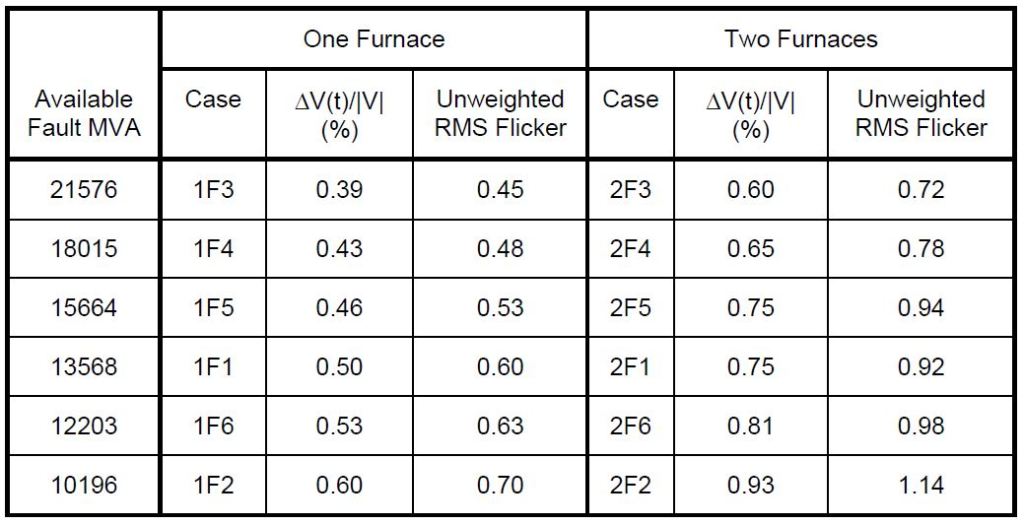
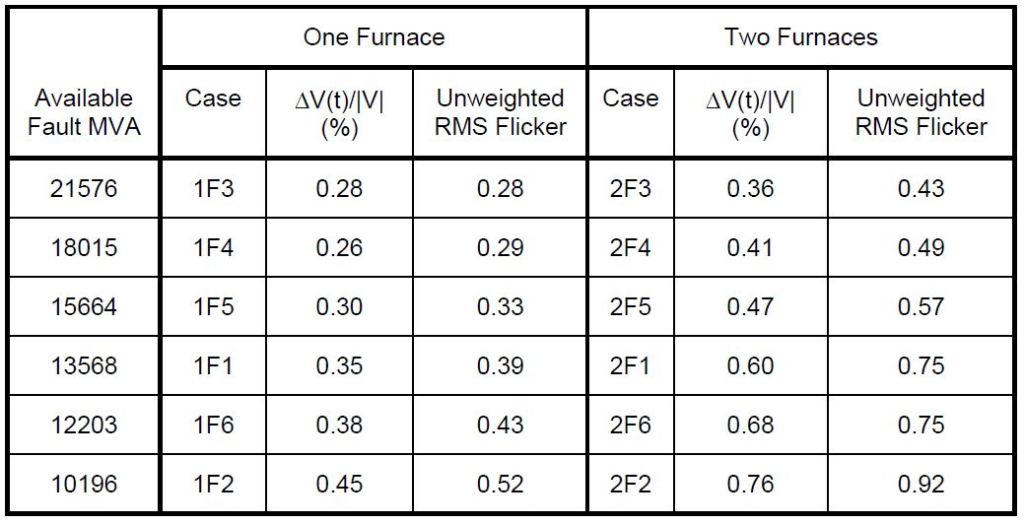
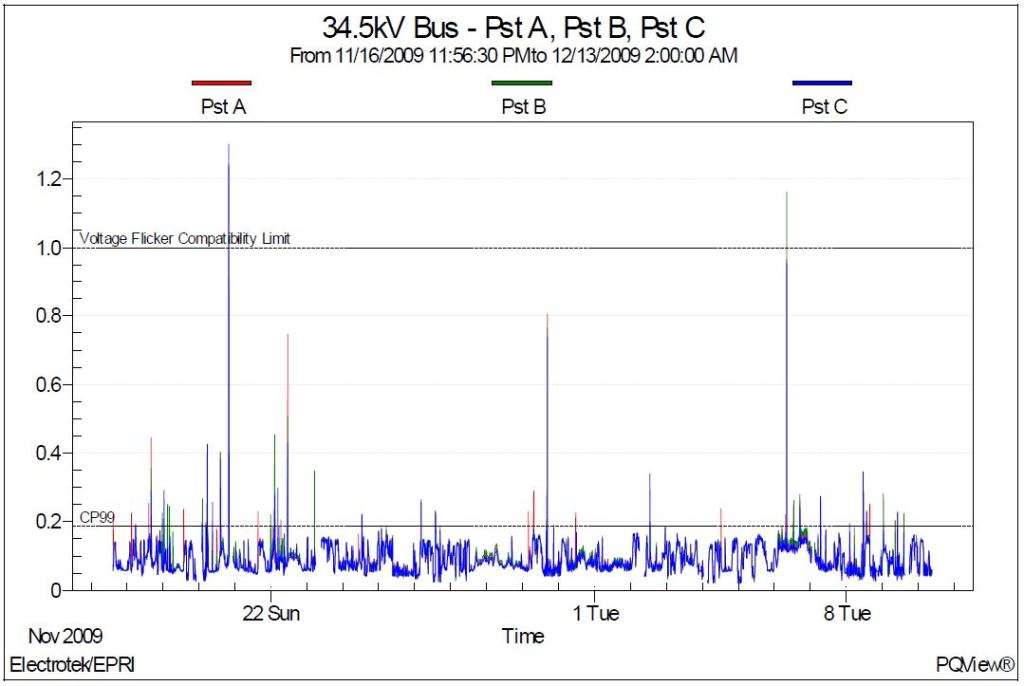
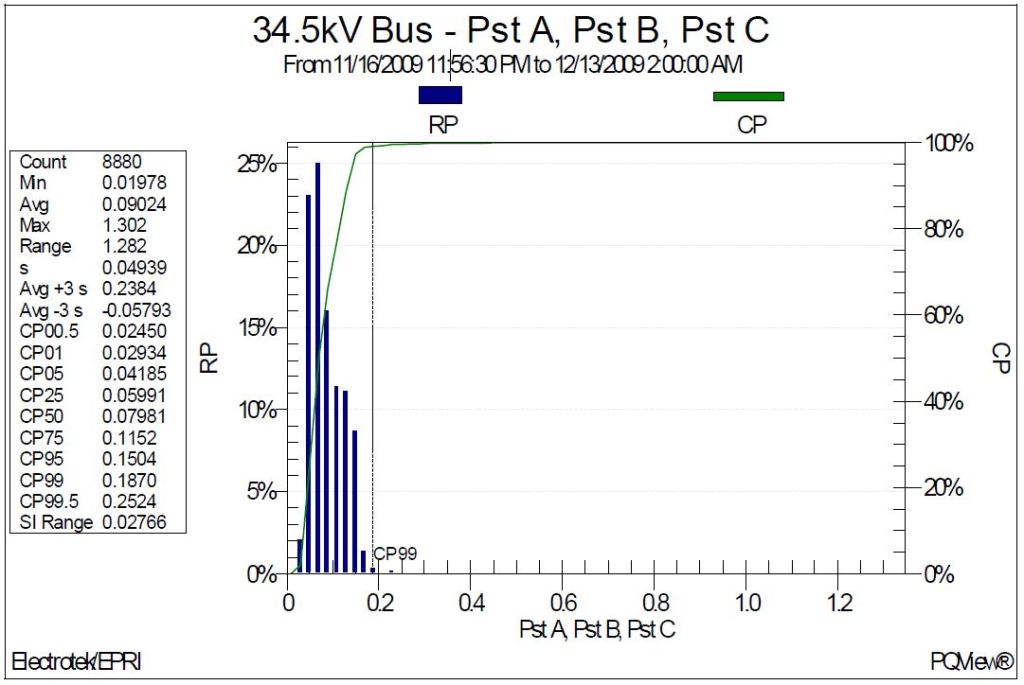
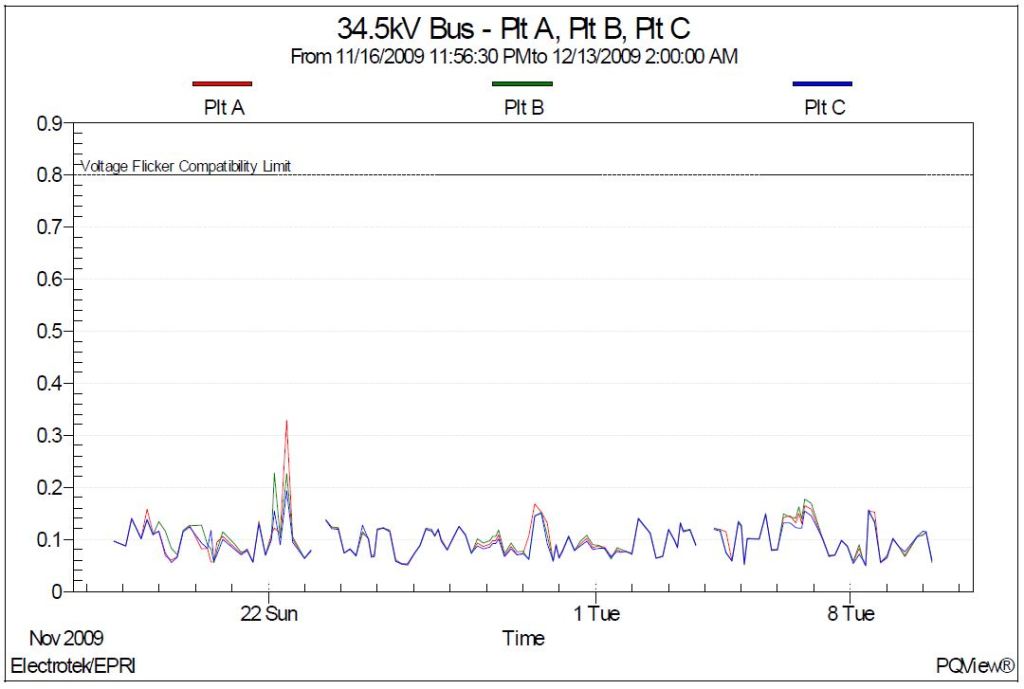
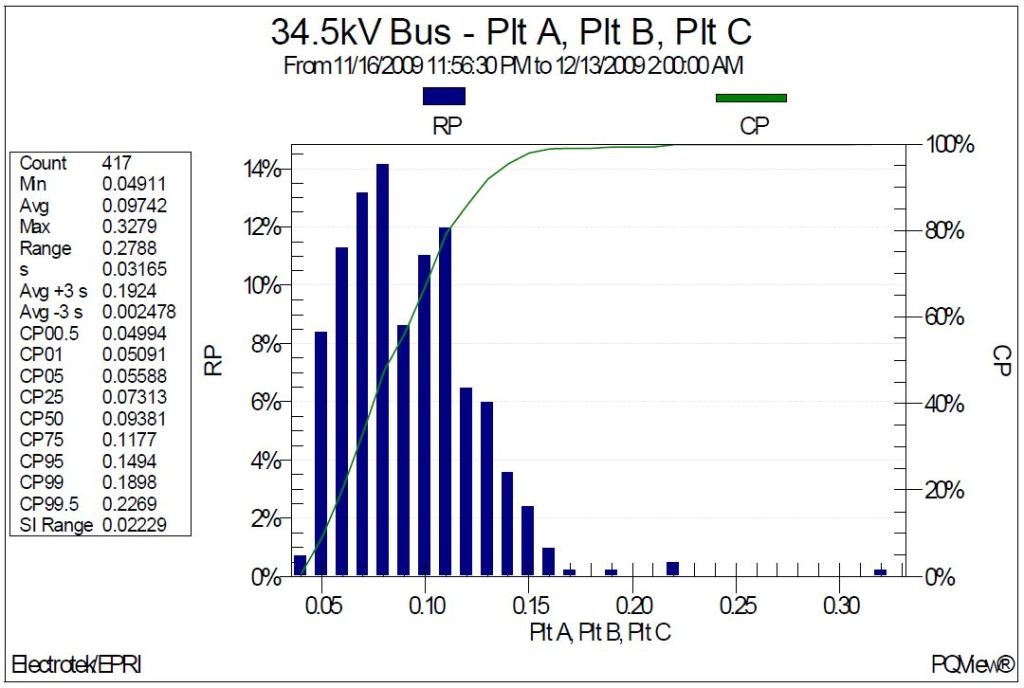
Summaries of the cases are provided in Table 1 and Table 2. These tables include the maximum magnitudes of the instantaneous flicker, using the ΔV/V (peak) and rms flicker calculation methods. Previous measurements at the steel manufacturing facility (without the new line) showed un-weighted rms flicker levels in the range 0.25-0.30 %. The results in Table 2 show good agreement with these measurement results. The simulations include a 2-second window with arc variations designed to represent the worst part of the melt cycle. Therefore, the cases with two arc furnaces operating simultaneously are actually simulating two furnaces operating in the initial melt period when the arc is the most unstable.
The percentage values given in the summary tables for the ΔV/V values are in percent of the peak line-to-ground voltage. That is, they represent the maximum deviation in the fluctuation divided by the nominal peak line-to-ground voltage. The unweighted rms values are based on a 30 Hz reference frequency and are rms values expressed in percent of the nominal rms line-to-ground voltage. The rms calculation is based on a sliding window with a period equal to about 33 msec over the two seconds of the voltage fluctuation waveform. The maximum rms value over this time period is presented in the tables.
Table 1 – Summary of Flicker Simulation Results at the 230kV Customer Bus
Table 2 – Summary of Flicker Simulation Results at the 230kV Utility Switchyard
With primary components in the range 1-10 Hz, a flicker level less than 0.5% is generally considered to be acceptable. The results at the 230kV switchyard indicate that flicker levels are acceptable for one furnace operation almost all the way down to the worst case short circuit level simulated. The flicker levels are higher at the steel manufacturer’s 230kV bus but there are no other customers supplied from this point at the present time.
For two-furnace operation, the worst case rms flicker levels are acceptable as long as the short circuit level at the 230kV switchyard is about 16000 MVA. Lower short circuit capacities at the 230kV switchyard could result in objectionable flicker levels for worst case furnace operating conditions (two furnaces in the initial bore down period of the melt).
The increase in flicker levels due to the second furnace ranged from 50-70%. This is somewhat higher than the 40% often quoted but this is probably due to the conservative nature of these cases where worst case conditions are simulated for both furnaces at the same time. This comparison is based on the ratio of maximum values for the 2-second period. A comparison of the average values over the same period will give less conservative results.
Typical Waveforms of Interest
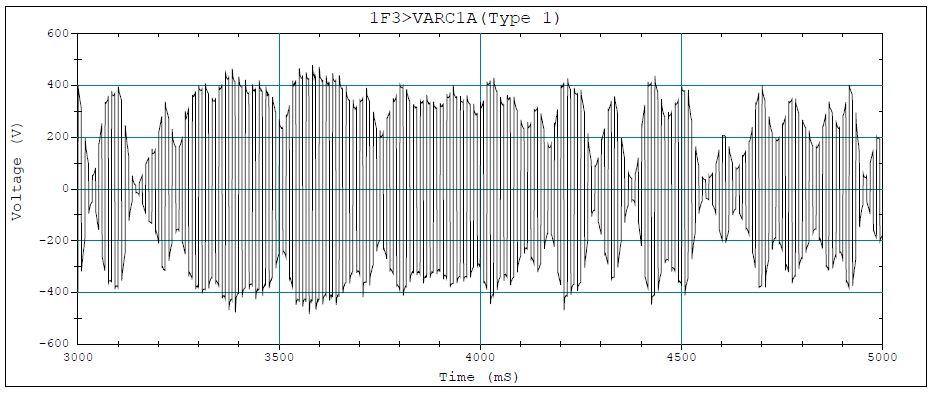
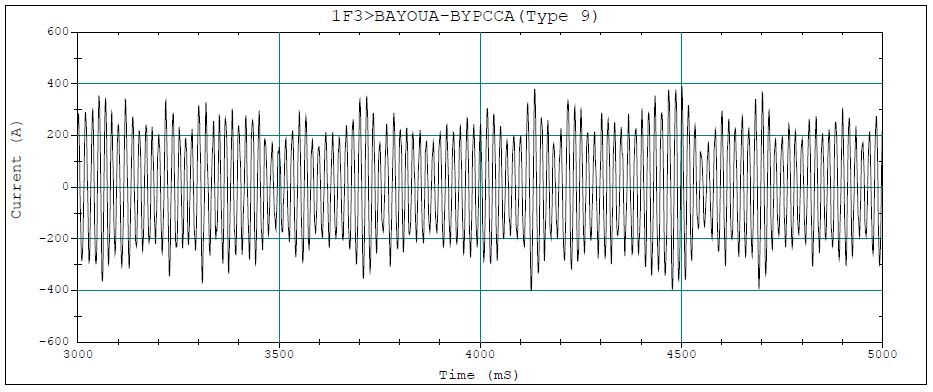
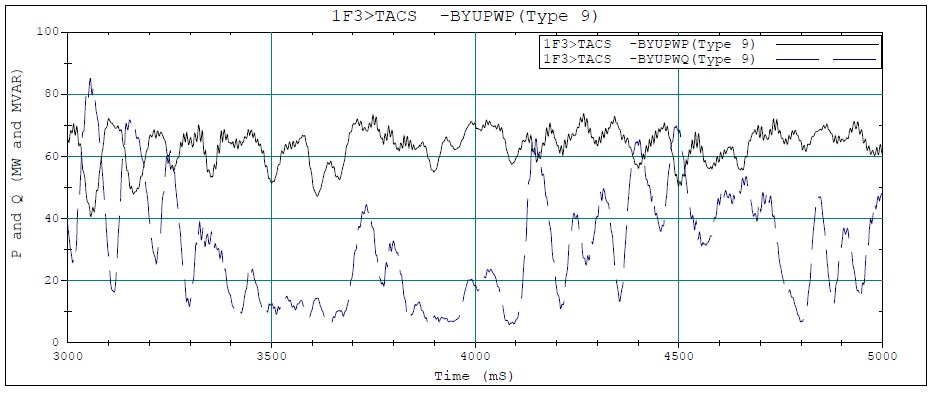
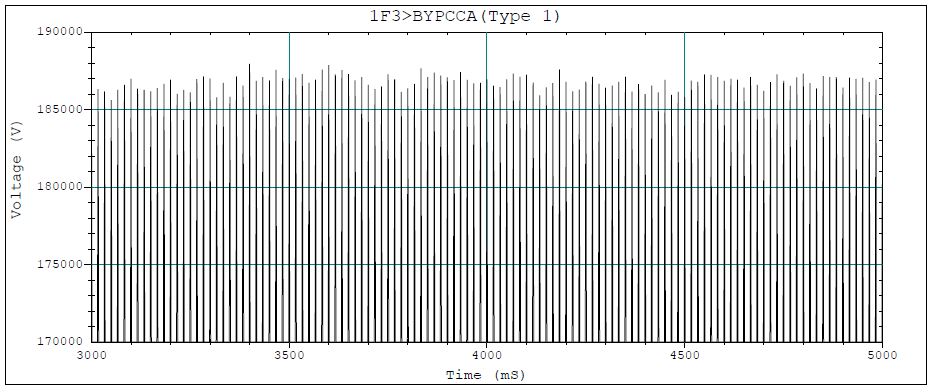
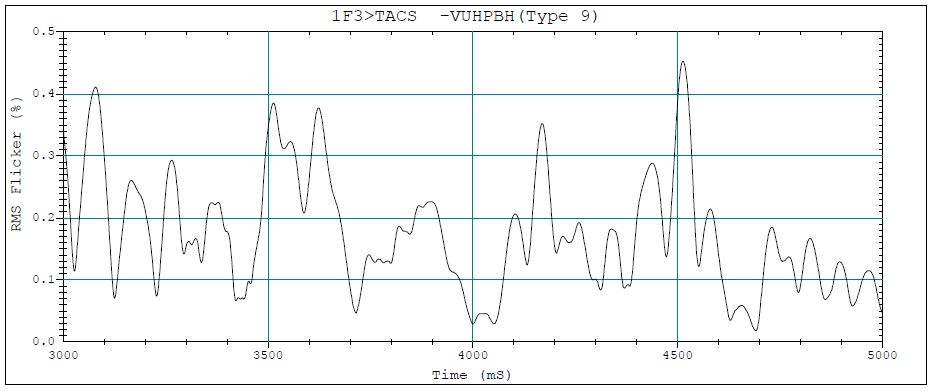
This section provides example waveforms of Case 1F3 illustrating the simulations and the results.
A few observations are worth noting from these waveforms.
The instantaneous and rms flicker plots show significant variations. The maximum value can be significantly higher than a value averaged over a 1 or 2 second period. The maximum flicker values have been used for evaluation in this study. This should be considered a conservative approach.
The frequency spectrum of the flicker is concentrated in the range 1-12 Hz but it is difficult to pick out a dominant frequency. This means that the simplified calculation approaches for sine waves and square waves cannot be applied at all for these waveforms. The concentration below 12 Hz is typical of arc furnace variations without a static var system. These variations are in the range that has the most potential to cause complaints.
The frequency spectrum of the flicker shifts somewhat with two furnaces operating. In this case, the dominant components are in the range 8-12 Hz, rather than the 1-5 Hz range for one furnace. However, this is still in the range that can cause problems.
Figure 6 – Arc Voltage Waveform
Figure 7 – Current Waveform at Steel Manufacturer 230kV Supply
Figure 8 – Steel Manufacturer Active and Reactive Power in MW and MVAr
Figure 9 – Steel Manufacturer 230kV Voltage Fluctuation (Magnified)
Figure 10 – Steel Manufacturer 230kV Instantaneous Voltage Flicker ΔV/|V| [in 1000 times Percentage Value]
Figure 11 – Frequency Spectrum of Steel Manufacturer 230kV Instantaneous Voltage Flicker
Figure 12 – Steel Manufacturer 230kV RMS Flicker
SUMMARY
An EMTP-based arc furnace model was developed for evaluation of flicker concerns associated with supplying a steel manufacturer as they go to two furnace operation and as system changes are implemented that will affect the short circuit capacity at the 230kV substation supplying the plant. The model includes a dynamic arc representation which is designed to be characteristic of the most dynamic stages of the arc furnace melting cycle (worst flicker conditions). The flicker calculations with this model were found to have excellent agreement with previous flicker measurements with one furnace operating and a short circuit capacity of 21576 MVA at the substation. Flicker simulations were then performed to evaluate a variety of different possible system strengths with both one and two furnace operation.
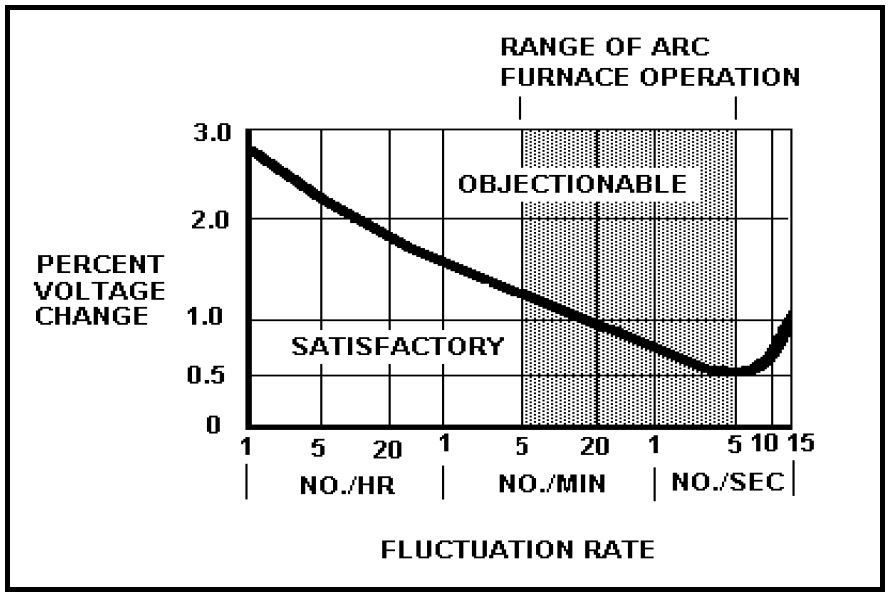
The primary flicker measure used for this study is the unweighted rms value of the fluctuation envelope, expressed as a percentage of the rms line-to-ground voltage magnitude. It is desirable to keep this unweighted rms flicker level below 0.5% based on the fact that arc furnace fluctuations are usually in the most sensitive region defined on the flicker curve.
Figure 13 – Flicker Sensitivity Curve
(shows supply voltage variations, ΔV, in percent and the rate of their occurrence).
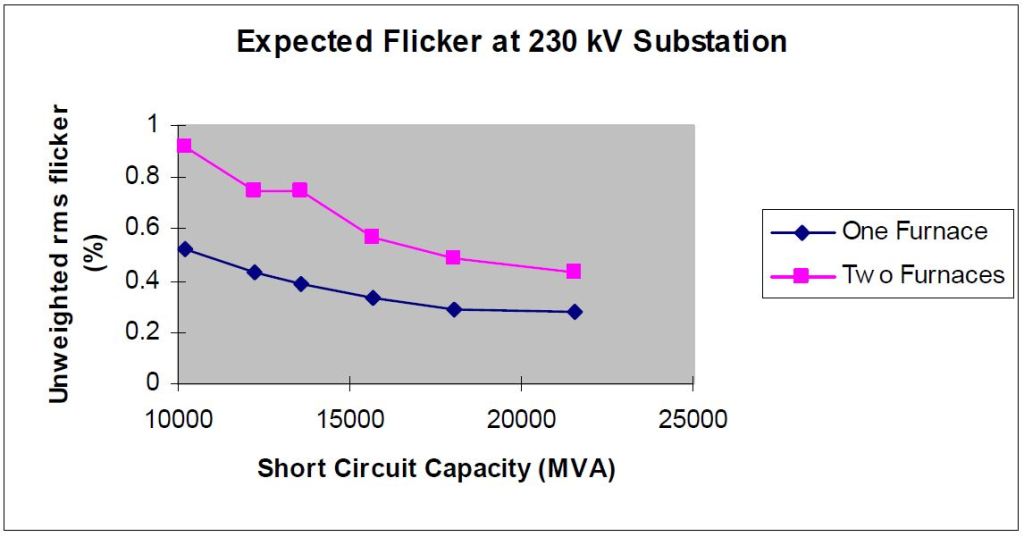
The Figure 14 shows the variations of the unweighted rms flicker with the short circuit capacity at the utility substation for both one and two furnace operation. Flicker should not be a problem at the substation for one furnace operation all the way down to the minimum short circuit capacity possible (10196 MVA). However, with two furnaces operating simultaneously in the most dynamic portion of the melt cycle, flicker levels can be expected to increase substantially. It should be noted that these should be considered worst case flicker levels, such as the level that will not be exceeded more than 0.1% of the time.
Figure 14 – Expected Flicker at 230kV Substation
Another important result of the simulations is the frequency spectrum of the flicker. With only one furnace operating, the frequency components of the flicker are spread over the range 1-12 Hz with some concentration in the range below 5 Hz. This agrees quite well with the previous measurement results where all the dominant components were below 5 Hz. This frequency spectrum becomes more concentrated in the range 8-12 Hz with two furnace operation. The higher frequency components with two furnace operation may provide some benefit because the weighting associated with the perception of flicker results in slightly higher allowable levels above 10 Hz (see flicker sensitivity curve above).
Accounting for the higher frequency components in the flicker with two furnaces operating, unweighted rms flicker levels up to about 0.7% should not cause complaints. With these criteria, flicker complaints should not be expected with two furnace operation unless the short circuit capacity is less than about 13000 MVA.
Based on these observations, it is suggested that the two furnace operation be permitted and monitoring be performed to evaluate actual flicker levels over time. These flicker levels can be correlated with any customer complaints in the area. If any problems are encountered, two possible approaches can be adopted to resolve the problem:
A static var system can be installed. Two different static var systems could be installed on the two furnace buses or the buses could be tied together and a single SVC installation designed. The single SVC installation would be much more economical. The size required is estimated to be about 85 MVAr.
The furnace operation procedures can be modified to prevent synchronizing of the melt cycles. If the two furnaces are not in the initial melt stage or are not loading scrap into the melt at the same time (this happens 2-3 times per melt cycle), there should not be any flicker problem associated with the two furnace operation. Some staggering of the melt cycles is probably beneficial from a production point of view anyway. If this approach is feasible, it would seem to be the preferred solution.
RELATED STANDARDS IEEE Std. 519, “IEEE Recommended Practices and Requirements for Harmonic Control in Electrical Power Systems.”
GLOSSARY AND ACRONYMS EMTP: Electromagnetic Transient Program PCC: Point of Common Coupling SVC: Static-Var Compensator TACS: Transient Analysis of Control Systems TCR: Thyristor Controlled Rectifier THD: Total Harmonic Distortion Voltage Flicker: Observable changes in light as a result of voltage fluctuations
Published by CEA Technologies Inc. (CEATI), POWER QUALITY Energy Efficiency Reference Guide, Chapter 4 – Solving and Mitigating Electrical Power Problems.
4.1 Identifying the Root Cause and Assessing Symptoms
Power quality technologists employ technical instrumentation. This instrumentation can range from simple digital multi-metering through to sophisticated waveform analysis instruments. True power quality monitoring requires full-time monitoring so that steady state effects can be trended and infrequent events can be captured as they occur. A variety of electronic meters are now available for permanent monitoring that offer numerous features at moderate prices. A trained PQ specialist can also employ a portable instrument, or groups of instruments, to diagnose power quality for fixed periods of time. It should be emphasized that power quality monitoring is a highly technical and potentially dangerous skill; even many trained electricians are completely unfamiliar with the details of how power quality measurement is properly carried out.
Do not attempt to undertake a power quality measurement exercise without the help of a professional practitioner in the field.
One of the first things that should be carried out before monitoring begins is a check of the effectiveness, safety and operational characteristics of the wiring in the facility. This will ensure that problems like bad grounding, poor terminations and improperly connected loads are not masking other problems or are, in fact, not mistaken for other types of issues.
Some of the elements that might be tracked by a PQ professional are:
RMS (Root – Mean – Square) Measurements
Average Measurements
Peak Measurements
Harmonic Analysis
Power Line Event Logging
4.2 Improving Site Conditions
Consideration of disturbance sources external to the facility should only be considered after the internal electrical environment has been thoroughly checked.
4.2.1 Mitigating Effects
The key elements to mitigate power quality problems are:
Proper grounding and wiring
Effective mitigating equipment (if required)
4.2.2 Mitigating Equipment
A wide variety of products are available that can help to mitigate power line disturbances. Care should be taken to properly select effective mitigating equipment. Improper application of these products may cause new power quality problems due to unforeseen incompatibilities. Before selecting a product, the customer should have a good understanding of the cause of the problem, as well as the characteristics of the available equipment. A properly functioning system may be adversely affected by change in the electrical environment, as in a change of load in the facility. Therefore, mitigating equipment that was once effective may fail to protect sensitive equipment after such a change has occurred. When selecting equipment that has an operational heat loss, as indicated by an efficiency rating, provision should be made for adequate cooling of the equipment, especially if it is to be located in a computer room.
4.2.1.1 Dedicated Circuits
A dedicated circuit is a single circuit with one load. It is a relatively inexpensive distribution technique that can reduce load interaction. The ability of a dedicated circuit to solve power quality problems depends on its location, impedance, and other factors. To achieve the lowest possible impedance, theoretically, the load of the circuit should be as close as possible to the building service entrance. However, this could aggravate the situation if transients are a problem, since they could travel more freely through the system. For improved operation of the circuit, the neutral and the ground wires should be the same size as the current-carrying conductor.
Tips and Cautions
Dedicated circuits will solve local problems only. Properly installed dedicated circuits obviate the need for isolated grounding circuits.
4.2.1.2 Surge Protective Devices (SPDs; also known asTransient Voltage Surge Suppressors, TVSS)
SPDs are energy diverters that pass the energy contained in a transient to the ground. There are a variety of designs available including gas discharge tubes, line clamps made of semiconducting material, and hybrid designs which may contain linear inductive or capacitive components. It is important to note that transient suppressors do not provide voltage regulation or isolation.
4.2.1.3 Lightning Arresters
The lightning arrester is designed to remove large overvoltages and associated high energy levels. This is accomplished during an overvoltage by short-circuiting the line to ground in what is referred to as a crowbar effect of energy diversion. The conduction of energy to ground will cease when the current drops to zero. The response time for this technology is relatively slow. These products are used as primary arresters on main power feeders.
4.2.1.4 End-User SPDs
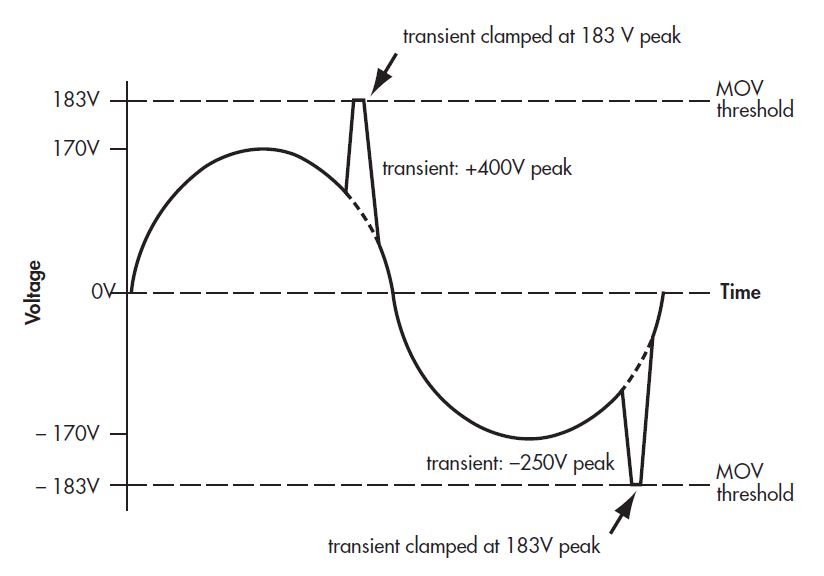
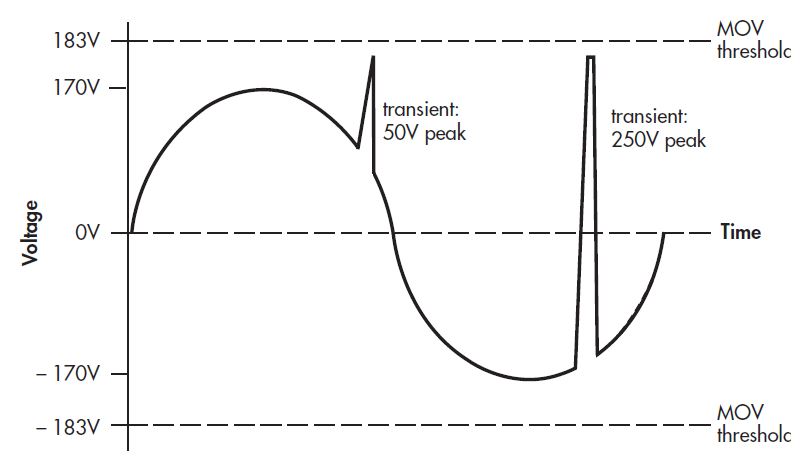
Faster-acting SPDs that use Metal Oxide Varistors (MOVs), or silicon avalanche diodes (SADs) can be used for lower-voltage transient attenuation. They act by clamping line voltage to a specific value and conducting any excess impulse energy to ground, regardless of frequency. The energy shunting capability of a line clamp is expressed by its joule rating, which determines the amount of energy the device can handle. It is important to realize that these units are only as good as the ground wiring that they are connected to; routing transient energy to ground may result in the mis-operation of some devices. In addition, they are quite susceptible to longer duration overvoltages, which can lead to catastrophic component failure. Silicon avalanche diodes operate on lower voltages, handle less power, but tend to act faster than MOVs, and are often used in communication systems for these reasons. Due to the clamping nature of a surge suppressor, it cannot remove voltage irregularities that occur within the sine wave envelope but do not exceed the limiting threshold.
Figure 25: Effect of Line Clamp on Transient Voltages, 120 Volt System
Figure 26: Example of Impulses Not Clamped
4.2.1.5 Power Line Filters
Filter design is a complex topic and needs to be properly addressed by a qualified power quality practitioner.
Linear Passive Filter
Design and Operation
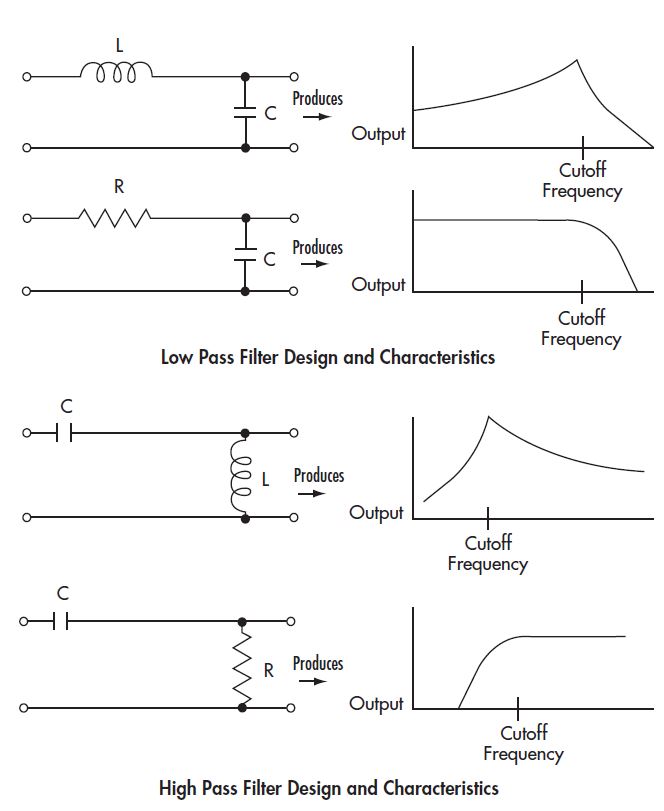
A linear filter is composed of linear components, such as inductors and capacitors. It passes the basic power frequency (60 Hz) and attenuates other frequencies which are in the form of electrical noise and harmonics. Some filters are tuned circuits, which means they address a small range of frequencies. Examples of filters that are not tuned are the simple low pass filter, and the simple high pass filter.
Uses
Simple low pass filters attenuate high frequencies, and have the general characteristics most desired in filters for improved power quality and noise attenuation. Simple high pass filters attenuate low frequencies. Tuned shunt filters are not used for general power quality applications. Special designs are used to attenuate harmonics. A shunt connected tuned filter, which consists of an inductor, a capacitor and a resistor, is tuned to eliminate a specific harmonic order by providing a low impedance to the harmonic frequency and shunting the harmonic energy to ground. A number of these filters may be arranged in stages, with each stage selectively filtering a given harmonic frequency.
Figure 27: Examples of Untuned Filters
Examples of Harmonic Filters
Equipment which is either sensitive to electrical noise, or which creates it, is often designed with linear filters for protection of equipment. For instance, all power supplies contain electrical filters. For harmonics, multi-staged shunt filters are most effective for mitigation of lower order harmonics.
Disadvantages
Common mode noise is not necessarily eliminated by the use of linear filters.
Low pass series filters are seldom used for harmonic attenuation since they must be rated for full line current making them relatively expensive.
Shunt filters applied at individual loads can often be overloaded by harmonics produced by nearby loads or even at other customer sites.
4.2.1.6 Isolation Transformers
Design and Operation
Isolation transformers consist of two coils (primary and secondary) intentionally coupled together, on a magnetic core. They have two primary functions:
a) They provide isolation between two circuits, by converting electrical energy to magnetic energy and back to electrical energy, thus acting as a new power source. b) They provide a level of common mode shielding between two circuits.
Since the ability of a transformer to pass high frequency noise varies directly with capacitance, isolation transformers should be designed to minimize the coupling capacitance between primary and secondary sides, while increasing the coupling to ground. Isolation transformers have no direct current path between primary and secondary windings. This feature is not characteristic of an auto-transformer, and therefore an autotransformer cannot be used as an isolation transformer. Unshielded isolation transformers can only attenuate low frequency common mode noise. High frequency normal mode noise can be attenuated by specially designed and shielded isolation transformers, although it is not frequently required (consult with your electrical system expert).
Advantages
Isolation transformers are used to attenuate common mode noise.
They provide a new neutral to ground reference point.
They can be used to break ground loops.
Isolation transformers can reduce higher order harmonics, but will not eliminate harmonic distortion or prevent notching.
Isolation transformers may be combined with other equipment such as transient suppressors and circuit breakers to form complex circuits known as Power Distribution Units (PDUs).
Only high quality shielded isolation transformers should be used in critical applications.
Disadvantages
No voltage regulation or ride-through capabilities are available.
Poorly designed isolation transformers may produce harmonics.
The ability of an enhanced isolation transformer to attenuate normal mode noise varies, depending on the load.
4.2.1.7 Line Voltage Regulators
Design and Operation
A line voltage regulator is a device that maintains a relatively constant voltage output within a specified range, regardless of input voltage variations. Some kinds of line voltage regulators can regulate, but not “condition”, the power. They are less frequently used, and include the ferroresonant transformer, the tap switching transformer, the variable ratio transformer, the magnetically coupled voltage regulator, the induction regulator and the saturable reactor. The ferroresonant transformer and tap switcher are discussed in more detail within this section. Auto-transformers are frequently used in voltage regulation devices. If an auto-transformer is used as the variable circuit element, it develops a variable voltage which is added to the incoming AC line voltage. A sample of the input voltage is rectified, filtered and compared to a DC reference voltage. The difference is then used to off set the input voltage change. Auto-transformers are also used in Silicon Controlled Rectifier regulators. In this case, the primary voltage of the autotransformer is varied by phase control.
Uses
These products regulate voltage to protect against momentary and transient disturbances, within a certain range. Their response time is typically one cycle. Regulators are already built into some sensitive equipment. Most regulators that are built into equipment, however, are DC regulators.
Disadvantages
Voltage regulators do not have noise suppression capabilities.
Those with switching power supplies actually create noise in the input line.
4.2.1.8 Ferroresonant Transformers
In contrast to a typical isolation transformer, the ferroresonant transformer is designed to operate at saturation. The ferroresonant transformer provides the same functions as the shielded isolation transformer, but also provides instantaneous, continual voltage regulation, as well as ride-through capabilities. A ferroresonant transformer has a relatively simple design, and no moving parts; however this mitigation device was designed for older, linear electrical loads. A ferroresonant transformer is often incompatible with modern electronic loads and should be used with caution on high demand loads. Ferroresonant transformers usually have higher operating temperatures that can lead to very warm equipment enclosure temperatures. It is therefore recommended that these transformers be safely guarded from accidental contact by personnel.
4.2.1.9 Tap Switching Transformers
Design and Operation
An electronic tap switching transformer, or tap switcher, regulates output voltage by changing the ratio of primary windings to secondary windings in response to fluctuations in input voltage or load. This is accomplished with solid state switches (SCRs or TRIACS) which select the appropriate taps to compensate for the fluctuations. Voltage is regulated not continuously, but in steps. Switching occurs when line voltage passes through zero, so transients are not created.
The tap switcher can react in one or two cycles.
Either peak or RMS voltage detectors may be used.
Taps may either be on the primary or secondary side.
Uses
Where voltage fluctuation is the primary concern.
Disadvantages
Voltage output changes are not continuous. Better voltage continuity is achieved by using more taps.
If auto-transformers are used, no isolation is provided.
4.2.1.10 Power Conditioners
Devices marketed as power conditioners are often combinations of the above-mentioned mitigation devices. They often contain transient voltage surge suppression, noise filters, and isolation transformers or voltage regulators. Careful consideration of product specifications and the intended use are required in order to determine if they will be effective.
4.2.1.11 UPS Systems
“UPS” means uninterruptible power supply. A UPS system contains a component that stores energy which can be used during power interruptions. UPSs are available in a wide range, from basic battery backup to units that can supply power for days. UPS systems can be on-line or off -line (standby). Typically, the on-line systems provide greater protection and cost more. These systems may be either rotary or static. Rotary systems employ rotating machines; static systems use solid state components.
A UPS does not necessarily provide protection against high energy impulses.
A properly selected UPS system is the only product, other than a generating unit, that can protect critical loads against power interruptions exceeding 0.5 seconds and which can provide active regulated power.
Some inexpensive UPS systems with low power ratings produce a square wave output, causing some loads to malfunction. This characteristic is particularly true for standby UPS systems. The problem can be avoided by selecting a UPS system with a synthesized sine wave.
Disagreement often arises as to the preferred type of system, rotary or static. Rotary systems are often criticized for the regular maintenance they require, whereas static systems are criticized for the frequency of failed components. It should be pointed out that regular maintenance and parts replacement of rotary systems helps to prevent component failures, whereas static systems can run for a significant period of time without maintenance before failure with minimal downtime. No matter what system is selected, the user should expect that some type of maintenance or replacement will eventually be required. Multiple UPS systems can be used for redundancy in critical applications. They can be arranged in parallel, in which case they normally share loads, or in isolation, so that each UPS supplies a specific load under normal operation.
Large UPS systems (>100 kVA) typically employ inverters and wet-cell batteries, which require ventilation. Care should be taken to locate these items in protected, ventilated areas. Regardless of where the system is situated, the room should be relatively free of dust, and the temperature maintained near 25°C for optimum battery life and performance. More recently designed small UPS systems (<100 kVA) employ sealed batteries, which emit no hydrogen gas, and transistorized inverters, which are very quiet. Th e batteries are mounted in a cabinet, and the whole system can be placed in a computer room. Care should be taken to ensure that adequate battery life is available for these systems.
Battery Design and Selection
A battery is an electrochemical device that converts stored chemical energy into electrical energy.
Recharge time is typically 8-10 times the discharge time. When selecting a UPS battery, the cell size, cell life, required voltage, reliability, weight/space and manufacturer’s warranty should be considered. It is also important to note that battery discharge time as a function of load is not a linear relationship. Two basic types of batteries that are used for UPS systems are lead acid and Valve Regulated Lead Acid (VRLA). Carefully consider the minimum amount of battery time that is necessary in order to reduce capital and maintenance costs in the system.
Rotary UPS
A state-of-the-art, on-line rotary UPS is one of the most effective but more costly types of UPS systems. Although a number of designs are available, they include motor-generators with battery backups and fly-wheel systems.
4.2.1.12 Isolated Grounding Outlets
An isolated ground (IG) outlet as recognized by Electrical Codes is a receptacle, orange in colour or with an orange triangle and marked “Isolated Ground”, that is wired as an individual branch circuit outlet. This outlet has a separate green or green/yellow wire along with the normal uninsulated ground wire that runs continuously from the ground conductor terminal to the first panelboard where it is connected to the ground bus. Bonding of the conduit, boxes, etc. of the circuit is accomplished by ordinary means, i.e., conduit or a separate ground wire. The two grounds are connected only at the panelboard.
Many years ago, this arrangement was implemented to reduce common-mode noise problems. Common-mode noise is better attenuated at each device in the system and is in fact effectively filtered at the input of modern electronic devices.
The IEEE Emerald Book states that:
“This type of equipment grounding configuration is only intended to be used for reducing common-mode electrical noise on the electronic load equipment circuit as described in the NEC. It has no other purpose and its effects are variable and controversial.”
Isolated grounding receptacles are no longer recommended for installation in any situation. The effects they are supposed to solve can be more easily and cheaply mitigated with robust electrical system design.
4.2.3 Preventative Measures
4.2.3.1 Distribution System Considerations for Sensitive Loads
The quality of the power supplying sensitive loads is very heavily influenced by other loads within a customer’s facility. If there are “heavy” loads such as motors or heating, ventilating and air conditioning systems being supplied, voltage drops and electrical noise can be generated causing power quality problems for sensitive loads such as computer loads. As an illustration, consider the following distribution system supplying both motor loads and sensitive electronic loads. In this case the sensitive loads are fed from phase to neutral, and motors are fed phase to phase.
Figure 28: Motor and Sensitive Loads Supplied from the Same Feeder
If the feeder has a resistance of 0.075 ohms, during a motor start the voltage drop along the feeder is:
V = IR= 160A x 0.075 Ω = 12V
Voltage at the sensitive loads is 120 -12 =108V Voltage at the motors is 208 – (√ 3 x 12) =187V
If the motor is a 10 HP motor, it will draw an inrush current in the order of 160 A for a short period of time when starting.
The impedance of the feeders to the distribution panel supplying the motor and sensitive loads will cause a voltage drop of 12 volts or more while the motor is starting. Because of this voltage drop the sensitive loads will be supplied with only 108 volts for a short period of time. Unless the sensitive loads have an adequate amount of stored energy to ride through the voltage sag, they may malfunction. In addition, the current drawn for the first one or two cycles of the motor start, while the stator is magnetizing, is 2 to 3 times higher than the normal starting current. This will lead to only 84 V feeding the sensitive loads during this time.
If the motor load and the sensitive loads are supplied from separate feeders then the voltage drop does not occur in the feeder supplying the sensitive loads.
Figure 29: Motor and Computer Loads Supplied from Separate Feeder
An even better approach is to effectively create a new supply system for the sensitive loads by using a transformer in addition to a separate feeder.
Figure 30: Isolation Transformer Added to Computer Feeder Supply
A transformer establishes a separately derived power source. The transformer can be of the step-down type to reduce the supply voltage to the utilization voltage of the equipment or an isolation transformer if the supply voltage is already at the appropriate voltage.
Typical voltages for computer equipment are 120 volts single phase and 120/208 volts three-phase wye. If the sensitive loads are susceptible to some form of RFI (radio frequency interference), the transformer may utilize a shield that isolates electrical and magnetic noise coupling from the primary to the secondary of the transformer. This shield is connected to ground. The neutral on the secondary of the transformer must be connected to ground per the applicable Code in your jurisdiction.
4.2.4 High Frequency Grounding Considerations
Equipment grounding and the grounding of the electrical distribution system provide a low impedance path to ground for low frequencies (mainly 60 Hz and up to the 11th harmonic). Computers and microprocessor controlled equipment operate at high frequencies (in the 100s of MHz for control devices and well into the GHz region for IT and communications equipment).
IT equipment transfers data between various pieces of equipment at very high frequencies utilizing low signal levels. In the past, where these signal levels were referenced to the local ground system, they were susceptible to electrical noise and interference. Examples of the types of interfaces that suffered from noise coupling problems were the RS-232 interface and the Centronics printer interface. Grounded interconnection standards like these have been largely superceded by isolated and higher speed connections like Ethernet, fibre optics and USB. Where older analog communications systems and digital interface standards are still used, these types of equipment need an effective means of grounding for both low and high frequencies. A more effective approach is to eliminate all ground-referenced communication interfaces in a facility with newer, higher speed and noise immune interfaces.
Effects of Frequency on Conductors
Wiring systems used within a building generally have low impedance at low frequency, but as the frequency increases the impedance increases. “Real” wiring can be modeled by a wire with resistance and inductance and stray capacitance to ground distributed along its length.
For a grounding conductor to be effective at high frequencies it must be short to minimize the effects of stray capacitance and distributed inductance along its length. A rule of thumb is that the conductor should be shorter than 1/20th of the wavelength at that frequency. This means a length shorter than 1.4 m at 10 MHz. The single point, parallel path ground, which makes for a good equipment ground, is a less reliable high frequency signal ground.
In order to satisfy both equipment grounding and signal grounding requirements, a hybrid system should be employed. This system is a combination of the parallel path ground combined with a multipoint ground for good high frequency performance.
One such method, described in IEEE 1100-1999, The Emerald Book, is a signal reference structure.
Figure 31: Equivalent Circuit of a Wire
Signal Reference Structure
A ground plane is a conducting surface that has low impedance over a range of frequencies. The ideal situation would be to have all communications equipment located on a ground plane so that short connections could be made from the equipment to the plane.
While it is usually not practical to have a true ground plane, an effective alternative is a grid of conductors spaced on regular intervals, bonded at their intersections on the subfloor of a room’s raised floor, where it exists. This is called a Signal Reference Grid (SRG). In the absence of a raised floor, the bonded interconnection of equipment racks and trays at regular intervals also creates a SRG effect.
Figure 32: Signal Reference Structure or Grid
The grid is grounded to the electrical system ground at the point where the supply enters the room. All powered equipment is also grounded at this point making the equipment grounding a single point system.
Equipment is bonded to the reference grid via short conductors creating a low impedance path to ground for high frequencies. This hybrid system satisfies both equipment and high frequency grounding requirements and complies with the Electrical Safety Code. It creates a more stable and robust environment for all equipment connected to it in the event of a voltage transient or system fault impacting the electrical system.
4.3 Troubleshooting and Predictive Tips
4.3.1 Tips
Distribution Wiring and Grounding
Check that the electrical contractor is reputable, and practices proper grounding and wiring techniques. The electrical installation should be tested with instruments to determine compliance to Codes and equipment requirements. Have all wiring inspected.
Electrically separate highly sensitive loads from other loads. This may involve using separate buses, or separate distribution transformers. Th e Code generally does not allow separate AC services to be used in a facility.
Ensure that all equipment is CSA certified for safety reasons. Before purchasing mitigating equipment, ensure that all distribution and grounding problems have been identified and corrected. Then identify any problems that require mitigating equipment.
Ensure that all components of interconnected IT equipment are bonded to the same grounding system.
For the purposes of signal grounding, never assume that two physically separated points of a ground system will be at the same potential. Use isolation techniques or current transmitters for physically separated equipment.
If significant changes have been made in an electrical system, and a low voltage condition exists, notify the utility.
Mitigating Equipment
Ensure that overvoltage protection exists at the powerline entrance to the building and at other susceptible points
When purchasing electrical products, ensure that they will effectively perform the functions that are required, and cause minimal degradation of the power system. It is a good idea to request a demonstration of the equipment within the plant, when possible, especially for mitigating equipment.
Following installation of mitigating equipment, verify that the problem is solved.
Always identify any equipment sensitivity requirements, such as sensitivity to voltage fluctuations, in specifications.
Consider the interaction between mitigating equipment and the load. For instance, if the mitigating equipment has a high impedance, and the load has high inrush current (due, perhaps, to the starting of large motors), a voltage sag could result
The noise suppression capabilities of some products may be specified in terms of peak attenuation, which may not be appropriate for some applications. In addition, it is important to know the conditions under which the attenuation was measured.
Proper installation of electrical equipment is very important and yet often overlooked. For example, many ferroresonant transformers and power conditioners are improperly installed due to incorrectly sized primary conductors or breakers.
Equipment Ratings
The purchaser should check if quoted equipment capabilities apply to units operating at no load, partial load or full load.
All electrical equipment should be properly sized. Products may be sized by power, in volt amps (VA), or by maximum current rating in amps. To determine proper sizing, the following steps should be taken:
Determine the load operating voltage, current, and/or VA from the nameplate rating.
Sum all individual VA ratings of the loads. To obtain an estimate of the power consumed by the load, which is the real power in watts, calculate: Real Power = VA x Power Factor.
Many nameplate ratings assume a power factor of unity. If this is not a good assumption, factor this in. Some units are rated in Primary Power ratings. If this is the case then the sum of all secondary loads will have to be divided by the efficiency of the unit in order to obtain the Primary Power rating. It is especially important to obtain the power requirements for sensitive loads from the manufacturer.
Best Practices
Reduce the number of disturbance sources.
Maintain a malfunction log.
Customers should be aware of the level of harmonics they are producing. If a customer is exceeding the acceptable limits of the distribution system, they may be required to shut down their facility.
To minimize problems related to voltage sags use reduced voltage starters on motors
If installing an isolation transformer, ensure that the ground on the secondary side is properly connected.
Above all, know and understand the technology of mitigating equipment before applying it.
4.3.2 Troubleshooting
If an electrical end-user suspects that a power quality problem exists in his facility, there are a number of steps that may be taken to troubleshoot the problem. The key is a process of elimination. Reputable consultants may be contacted by the customer to assist the process:
Define the type of disturbance, frequency of occurrence and magnitude of the problem.
Determine which power conductors — hot, neutral or ground — have problems; this is critical, since some mitigation techniques only address problems with a specific conductor. For grounding problems, the source of the problem must be fixed; no mitigating equipment will provide a solution.
Check wiring for loose connections.
Check that proposed solutions actually work and follow-up.
Published by Electrotek Concepts, Inc., PQSoft Case Study: Wind Plant Voltage Flicker Data Analysis, Document ID: PQS1202, Date: January 26, 2012.
Abstract: This case study presents the results for a wind plant voltage flicker data analysis. The characteristics of voltage flicker are mainly determined by load characteristics and the short-circuit capacity. The wind plant substation supplied 65 wind turbine generators and the power quality monitor was connected to the 34.5 kV transformer secondary winding, which was considered the point of common coupling (PCC) for the voltage flicker harmonic analysis.
INTRODUCTION
A wind plant voltage flicker data analysis case study was completed for the 34.5 kV wind plant substation shown in Figure 1.
Figure 1 – Illustration of Oneline Diagram for Voltage Flicker Data Analysis
The wind plant substation was supplied from a 230 kV transmission line and included a 180 MVA, 230/34.5/13.8 kV step-down transformer with a number of 34.5 kV collector circuits supplying 65 2.3 MW (690 V secondary) wind turbine generators. The monitor was connected at the 34.5 kV transformer secondary, which was considered the point of common coupling (PCC) for the analysis.
The twenty-four day monitoring period was from November 16, 2009 through December 13, 2009. The power quality instrument used to complete the voltage flicker measurements was a Dranetz Power Xplorer PX5. The instrument samples voltage and current at 256 points-per-cycle, and follows the IEC 61000-4-15 method for characterizing voltage flicker data. The sampling rate also allows characterization of low to medium frequency oscillatory transients and harmonics through the 63rd harmonic. The voltage flicker measurement and statistical analysis was completed using the PQView® program.
MEASUREMENT DATA ANALYSIS
Error! Reference source not found. shows the measured 34.5 kV substation bus voltage during the twenty-four day monitoring period. Statistical analysis of the 61,901 individual steady-state voltage measurements yielded an average value of 20.141 kV, a maximum value of 20.502 kV, a CP95 value of 20.399 kV, and a CP99 value of 20.445 kV (1.03 per-unit).
Figure 2 – Measured Substation vs. Voltage Trend
IEEE Std. 1453 and IEC 61000-2-2 include specifications for measurement of voltage flicker and recommended compatibility levels. The standards recommend a compatibility level of Pst= 1.0 for power systems met by 99% of the measured values (CP99) with a minimum assessment period of one week. Table 1 shows the voltage flicker compatibility levels for Pst and Plt for low voltage and medium voltage systems.
Table 1 – Flicker Compatibility Levels for Medium Voltage Systems
Flicker Quantity
Compatibility Levels (CP99)
Pst
1.0
Plt
0.8
The envelope of the 60 Hz variations is defined as the flicker signal, Vf, and its rms magnitude is expressed as a percent of the fundamental. Voltage flicker appears as a modulation of the fundamental frequency (similar to amplitude modulation of an am radio signal). Therefore, it is easiest to define a magnitude for voltage flicker as the rms magnitude of the modulation signal. This can be obtained by demodulating the waveform to remove the fundamental frequency and then measuring the magnitude of the modulation components. A magnitude that is as low as 0.5% can sometimes result in perceptible light flicker if the frequencies are in the range of 1-5 Hz.
The voltage flicker severity is dependent on factors such as the turbine/transformer ratings, distances from substations, and the power system source strength. Flicker mitigation alternatives include increasing the source strength and power electronic-based mitigation equipment, such as static var compensators.
Figure 3 shows the measured short-term voltage flicker Pst trend at the 34.5 kV substation bus during the twenty-four day monitoring period. Figure 4 shows the corresponding voltage flicker histogram. Statistical analysis of the 8,880 individual flicker measurements yielded a CP50 value of 0.08, a CP95 value of 0.15, and a CP99 value of 0.19. The results show that the CP99 compatibility limit of 1.0 is not exceeded.
Figure 5 shows the measured long-term voltage flicker Plt trend at the 34.5 kV substation bus during the twenty-four day monitoring period. Figure 6 shows the corresponding voltage flicker histogram. Statistical analysis of the 417 individual flicker measurements yielded a CP50 value of 0.09, a CP95 value of 0.15, and a CP99 value of 0.19. The results show that the CP99 compatibility limit of 0.8 is not exceeded.
This case study summarizes a wind plant voltage flicker data analysis. The characteristics of voltage flicker are mainly determined by load characteristics and the short-circuit capacity. The measurement results showed that both the short-term (Pst) and long-term (Plt) voltage flicker measured at the 34.5 kV wind plant substation bus did not exceed the respective CP99 compatibility limits.
REFERENCES
IEEE Recommended Practice for Measurement and Limits of Voltage Fluctuations and Associated Light Flicker on AC Power Systems, IEEE Std. 1453-2004, IEEE, 2005, ISBN: 0- 7381-4482-7.
IEEE Recommended Practice for Monitoring Electric Power Quality, IEEE Std. 1159-1995, IEEE, October 1995, ISBN: 1-55937-549-3.
IEEE Recommended Practices and Requirements for Harmonic Control in Electrical Power Systems, IEEE Std. 519-1992, IEEE, ISBN: 1-5593-7239-7.
RELATED STANDARDS IEEE Std. 1453
GLOSSARY AND ACRONYMS DFT: Discreet Fourier Transform PCC: Point of Common Coupling TDD: Total Demand Distortion THD: Total Harmonic Distortion
Published by CEA Technologies Inc. (CEATI), POWER QUALITY Energy Efficiency Reference Guide, Chapter 3 – Power Quality Problems.
3.1 How Power Quality Problems Develop
Three elements are needed to produce a problematic power line disturbance:
A source
A coupling channel
A receptor
If a receptor that is adversely affected by a power line deviation is not present, no power quality problem is experienced.
Figure 12: Elements of a Power Quality Problem
The primary coupling methods are:
Conductive coupling A disturbance is conducted through the power lines into the equipment.
Coupling through common impedance Occurs when currents from two different circuits flow through common impedance such as a common ground. The voltage drop across the impedance for each circuit is influenced by the other.
Inductive and Capacitive Coupling Radiated electromagnetic fields (EMF) occur during the operation of arc welders, intermittent switching of contacts, lightning and/or by intentional radiation from broadcast antennas and radar transmitters. When the EMF couples through the air it does so either capacitively or inductively. If it leads to the improper operation of equipment it is known as Electromagnetic Interference (EMI) or Radio Frequency Interference (RFI). Unshielded power cables can act like receiving antennas.
Once a disturbance is coupled into a system as a voltage deviation it can be transported to a receptor in two basic ways:
1) A normal or transverse mode disturbance is an unwanted potential difference between two current carrying circuit conductors. In a single-phase circuit it occurs between the phase or “hot” conductor and the neutral conductor.
2) A common mode disturbance is an unwanted potential difference between all of the current-carrying conductors and the grounding conductor. Common mode disturbances include impulses and EMI/RFI noise with respect to ground.
The switch mode power supplies in computers and ancillary equipment can also be a source of power quality problems.
The severity of any power line disturbance depends on the relative change in magnitude of the voltage, the duration and the repetition rate of the disturbance, as well as the nature of the electrical load it is impacting.
3.2 Power Quality Disturbances
The IEEE has provided a comprehensive summary of the types and classes of disturbances that can affect electrical power. The classifications are based on length of time, magnitude of voltage disturbance and the frequency of occurrence. These classifications are shown in the previous table.
3.3 Load Sensitivity: Electrical Loads that are Affected by Poor Power Quality
3.3.1 Digital Electronics
Digital electronics, computers and other microprocessor based equipment may be more sensitive to power line disturbances than other electrical equipment depending on the quality of their power supply and how they are interconnected. The circuits in this equipment operate on direct current (DC) power. The source is an internal DC power supply which converts, or rectifies, the AC power supplied by the utility to the various DC voltage levels required. A computer power supply is a static converter of power. Variations in the AC power supply can therefore cause power quality anomalies in computers.
The Computer Business Equipment Manufacturers Association Curve (CBEMA, now called the ITIC Curve) published in the IEEE Orange Book is intended to illustrate a suggested computer susceptibility profile to line voltage variations. The ITIC curve is based on generalized assumptions, is not an industry standard and is not intended for system design purposes. No ITIC member company is known to have made any claim for product performance or disclaimer for non-performance for their products when operated within or outside the curve. The ITIC curve should not be mistakenly used as a utility power supply performance curve.
Figure 13: Computer Susceptibility Profile to Line Voltage Variations and Disturbances – The ITIC Curve
The susceptibility profile implies that computers can tolerate slow variations from -13% to + 5.8%, and greater amplitude disturbances can be tolerated as their durations become shorter. In fact, many computers can run indefinitely at 80% of their nominal supply voltage; however, such operation does lead to premature wear of the power supply.
While the operating characteristics of computer peripherals may at one time have been more dependent on the types of power supply designs and components used, generalizations that infer that computers are highly sensitive to small deviations in power quality are no longer true.
There is also no validity in the contention that, as the operating speed of a computer increases, so does its sensitivity to voltage variations. IT equipment sensitivity is due to the manner in which its power supply components interact with the supplied AC power.
3.3.2 Lighting
There are three major effects of voltage deviations on lighting:
Reduced lifespan
Change of intensity or output (voltage flicker)
Short deviations leading to lighting shutdown and long turn-on times
For incandescent lights the product life varies inversely with applied voltage, and light output increases with applied voltage. In High Intensity Discharge (HID) lighting systems, product life varies inversely with number of starts, light output increases with applied voltage and restart may take considerable time. Fluorescent lighting systems are more forgiving of voltage deviations due to the nature of electronic ballasts. Ballasts may overheat with high applied voltage and these lights are usually less susceptible to flicker.
Information on lighting is available from the companion “lighting reference guide” that can be easily found through the various internet web search engines.
3.3.3 Motors
Voltages above the motor’s rated value, as well as voltage phase imbalance, can cause increased starting current and motor heating. Reduced voltages cause increased full-load temperatures and reduced starting torques.
3.4 Types and Sources of Power Quality Problems
3.4.1 Transients, Short Duration and Long Duration Variations
A general class of power quality variations (summarized in the following charts) are instantaneous variations. Th ese are subdivided as:
Transients (Impulsive and Oscillatory; up to 50 ms)
Short-Duration (0.5 cycles to 1 minute)
Long-Duration (>1 minute but not a steady state phenomenon)
Generally, instantaneous variations are unplanned, short-term effects that may originate on the utility line or from within a facility. Due to the nature and number of events that are covered by this class of power quality problem, a summary chart has been provided to highlight the key types of variation.
Power Line Disturbances Summary
Power Line Disturbances Summary (1 of 4)
Power Line Disturbances Summary (2 of 4)
Power Line Disturbances Summary (3 of 4)
Power Line Disturbances Summary (4 of 4)
3.4.2 Steady State Disturbances
3.4.2.1 Waveform Distortion and Harmonics
Harmonics are currents and voltages with frequencies that are whole-number multiples of the fundamental power line frequency (which is 60 Hz in North America). Harmonics distort the supplied 60 Hz voltage and current waveforms from their normal sinusoidal shapes.
Each harmonic is expressed in terms of its order. For example, the second, third, and fourth order harmonics have frequencies of 120 Hz, 180 Hz, and 240 Hz, respectively. As order, and therefore frequency, of the harmonics increases, the magnitude normally decreases. Therefore, lower order harmonics, usually the fifth and seventh, have the most effect on the power system. Due to the nature of power conversion techniques, odd numbered harmonics are usually the only frequencies of concern when dealing with harmonic problems. The presence of low levels of even harmonics in a system requires expert mitigation advice from a power quality professional.
The effect of a given harmonic on the power system can be seen by superimposing the harmonic on the fundamental waveform, to obtain a composite:
Figure 14: Superposition of Harmonic on Fundamental: Initially In-Phase
In this example, the two waveforms begin in-phase with each other, and produce a distorted waveform with a flattened top. The composite waveform can be changed by adding the same harmonic, initially out-of-phase with the fundamental, to obtain a peaked effect:
Figure 15: Superposition of Harmonic on Fundamental: Initially Out-of-Phase
Harmonics can be differentiated from transients on the basis that transients are not periodic and are not steady state phenomena.
Production and Transmission
Most harmonics result from the operation of customer loads, at residential, commercial and industrial facilities.
Figure 16: Main Sources of Harmonics
Harmonics are caused by any device or equipment which has nonlinear voltage-current characteristics. For example, they are produced in electrical systems by solid state power converters such as rectifiers that conduct the current in only a portion of each cycle. Silicon Controlled Rectifiers (SCRs) or thyristors are examples of this type of power conversion device.
The levels of harmonic current flowing across the system impedance (which varies with frequency) determine the harmonic voltage distortion levels.
Figure 17: Harmonics Produced by Three-Phase Controlled Loads
(Reproduced with Permission of Basic Measuring Instruments, from “Handbook of Power Signatures”, A. McEachern,1988)
Aside from solid state power converters, loads may also produce harmonics if they have nonlinear characteristics, meaning that the impedance of the device changes with the applied voltage. Examples include saturated transformers and gaseous discharge lighting, such as fluorescent, mercury arc and high pressure sodium lights.
As harmonic currents flow through the electrical system, they may distort the voltage seen by other electrical equipment. Since the system impedances are usually low (except during resonance), the magnitudes of the voltage harmonics, and the extent of voltage distortion are usually lower than that for the corresponding current distortion. Harmonics represent a steady state problem, since they are present as long as the harmonic generating equipment is in operation.
Third harmonic currents are usually most apparent in the neutral line. Th ese occur due to the operation of single-phase nonlinear loads, such as power supplies for electronic equipment, computers and lighting equipment.
As lighting equipment has been a cause of many neutral problems adequate precaution must be taken to mitigate the harmonic emission of lighting equipment, in particular in case of re-lamping. Th ese harmonic currents occur due to the operation of single-phase nonlinear loads, such as power supplies for electronic equipment and computers. The third harmonic produced on each phase by these loads adds in the neutral. In some cases, the neutral current can be larger than the phase currents due to these third harmonics.
Effects of Harmonics
In many cases, harmonics will not have detrimental effects on equipment operation. If the harmonics are very severe, however, or if loads are highly sensitive, a number of problems may arise. The addition of power factor correction capacitors to harmonic producing loads can worsen the situation, if they have parallel resonance with the inductance of the power system. This results in amplifying the harmonic currents producing high harmonic voltages.
Harmonics may show up at distant points from their source, thus causing problems for neighbouring electrical end-users, as well as for the utility. In flowing through the utility supply source impedance, harmonic currents produce distortion in the utility feeder voltage.
Figure 18: Harmonic Effects on Equipment
In addition to electrical conduction, harmonics can be coupled inductively or capacitively, thus causing interference on analog telecommunication systems. For example, humming on telephones can be caused by induced harmonic distortion.
A power harmonic analysis can be used to compare distortion levels against limits of acceptable distortion. In addition, the operation of some solid state devices will produce a notched effect on the voltage waveform.
Harmonic Prevention and Reduction
It is very important when designing an electrical system, or retrofitting an existing one, to take as many precautions as necessary to minimize possible harmonic problems. This requires advanced planning and, potentially, additional capital. The complete electrical environment must be considered.
Filters
Harmonic filters can be used to reduce the amplitude of one or more harmonic currents or voltages. Filters may either be used to protect specific pieces of equipment, or to eliminate harmonics at the source. Since harmonic filters are relatively large, space requirements may have to be budgeted for. In some situations, improperly tuned filters may shift the resonant frequencies close to the characteristic harmonics of the source. The current of the high harmonics could excite the resonant circuit and produce excessive voltages and attract high oscillating harmonic currents from elsewhere in the system.
Capacitors
Harmonic amplification due to resonance associated with capacitor banks can be prevented by using converters with high pulse numbers, such as twelve pulse units, thereby reducing high-amplitude low order harmonics. A similar effect occurs with pulse width modulated converters.
Method
Advantages
Disadvantages
Change the size of the capacitor bank to shift the resonant point away from the major harmonic
• relatively low incremental cost • ease of tuning
• vulnerable to power system changes
Place an inductor in series with the capacitor bank, and tune their series resonance below the major harmonics
• better ability to minimize harmonics • flexibility for changing load conditions
• series inductor increases the fundamental frequency voltage of the capacitor; therefore, a higher rated capacitor may be required
Telephone Line Interference
Telephone interference can be reduced by the aforementioned prevention and reduction methods, by rerouting the telephone lines, improved shielding and balance of telephone cables, compatible grounding of telephone cables, or by reducing the harmonic levels on the power line. The degree of telephone interference can be expressed in terms of the Telephone Interference Factor (TIF).
Harmonic Study
Single calculation of resonant frequencies, transient network analysis, and digital simulation are among the techniques available today to perform harmonic studies. These tools could be used to accurately model the power network, the harmonic sources, and perform the harmonic analysis in the same manner as traditional load flow, short circuit and transient stability studies are conducted. Experienced consultants may be approached to conduct or assist in a harmonic study.
Equipment Specifications
Consider the effect on your power system when ordering harmonic producing equipment. Large projects may require a pre-installation harmonic study. Be prepared for filtering requirements if necessary to ensure compatibility with the power system. If a harmonic filter is required, a description of the power system should be considered in its design, including:
Fault level at the service entrance
Rating and impedance of transformers between the service entrance and the input to the power conditioning equipment
Details of all capacitor banks in the facility.
Where a choice is available, consider using equipment with low harmonic emission characteristics. This should be explicitly stated in the manufacturer’s literature. Where Variable Speed Drives (VSDs) will be deployed, active front end designs generate lower harmonic levels and have a power factor close to unity. Variable Speed Drives are also the same equipment as Adjustable Speed Drives (ASDs); Variable Frequency Drives (VFDs); Adjustable Frequency Drives (AFDs), etc.
3.4.2.2 Flicker
Flicker is the impact a voltage fluctuation has on the luminous intensity of lamps and fluorescent tubes such that they are perceived to ‘flicker’ when viewed by the human eye. The level at which it becomes irritating is a function of both the magnitude of the voltage change and how often it occurs. A voltage flicker curve indicates the acceptable magnitude and frequency of voltage fluctuations on a distribution system. Flicker is caused by rapidly changing loads such as arc furnaces, electrical welders, and the starting and stopping of motors.
Figure 19: Flicker Curve IEEE 519-1992
3.4.3 Distribution and Wiring Problems
Many power quality problems are due to improper or ineffective electrical distribution wiring and/or grounding within the customer’s site.
Grounding and distribution problems can result from the following:
Improper application of grounding electrodes or mistakenly devising alternate “grounds” or grounding systems
High impedances in the neutral current return path or fault current return path
Excessive levels of current in the grounding system, due to wiring errors or equipment malfunction
It must be realized that although mitigating equipment when properly applied will resolve voltage quality problems, it will do nothing to resolve wiring or grounding problems. It is essential that the site distribution and grounding system be designed and installed properly and in accordance with the applicable Electrical Safety Code to ensure the safety of personnel and proper equipment operation. All electrical equipment used must be approved by the applicable authority, such as the CSA or UL, or inspected by the local authority in order to ensure that regulatory minimum safety standards have been achieved.
3.4.3.1 Fault Protection in Utility Distribution Systems
Faults resulting in overvoltages and over-currents may occur in the utility system, typically due to lightning, construction, accidents, high winds, icing, tree contact or animal intervention with wires.4 These faults are normally detected by over-current relays which initiate the operation of fault clearing by equipment.
Faults may be classified as temporary or permanent. Temporary faults may be caused by momentary contact with tree limbs, lightning flashover, and animal contact. Permanent faults are those which result in repairs, maintenance or equipment replacement before voltage can be restored. Protection and control equipment automatically disconnects the faulted portion of a system to minimize the number of customers affected.
The utility distribution system includes a number of devices such as circuit breakers, automatic circuit re-closers and fused cutouts which clear faults. Automatic re-closers and re-closing breakers restore power immediately after temporary faults. Fused cutouts that have operated must have their fuse replaced before power can be restored. Th ese protective devices can reduce the number of customers affected by a fault, reduce the duration of power interruptions resulting from temporary faults and assist in locating a fault, thereby decreasing the length of interruptions.
Automatic reclosers and reclosing breakers open a circuit on over-current to prevent any further current flow, and reclose it after a short period of time. If a fault does not disappear after one reclosure operation, additional opening/reclosing cycles can occur.
4 – A worst case event of tree contact with utility lines contributing to power problems took place on August 15, 2003. See “U.S.- Canada Power System Outage Task Force Final Report on the August 14, 2003 Blackout in the United States and Canada: Causes and Recommendations,” April 2004.
Figure 20: Example of a Repetitive Reclosure Operation
Normally a few seconds are required to clear a fault and energize the appropriate circuitry for a reclosure. The reclosing interval for a recloser is the open circuit time between an automatic opening and the succeeding automatic reclosure. In the above diagram, three intervals of duration ‘t’ are indicated. Some hydraulic reclosers may be able to provide instantaneous (0.5 seconds) or four second reclosing intervals. In addition to these reclosers, circuit breakers at substations, on the secondary or distribution side, are equipped with timers which allow a range of reclosing times to be selected. A commonly available range is 0.2 to 2 seconds.
Figure 21: Effect of Multiple Reclosure Operation on Voltage
(Reproduced with Permission of Basic Measuring Instruments, from “Handbook of Power Signatures”, A. McEachern,1988)
Figure 22: Reclosing Interval for Hydraulic and Electrical Control Types (“t1” 1st reclosing operation etc.)
When a solid fault on a feeder is cleared, the voltage at the fault point declines to near zero instantaneously. However, the time constant in the detection circuitry results in the graph above. In this figure, small voltage rises indicate when reclosure was attempted unsuccessfully due to the persistence of the fault. If a fault persists, the recloser or breaker may lock open, or a fuse or sectionalizer will operate. An autoreclosure on one feeder that is faulted can produce a disturbance that travels on neighbouring feeders.
Customers frequently mistake the effects of a temporary (0.5s – 2s) interruption, such as the loss of time-keeping abilities of digital clocks, as evidence of a sustained power interruption. The fact that most High Intensity Discharge (HID) lighting, which is frequently used in industrial settings, can take 10-20 minutes to come back on after a fault has cleared is a further example of an apparent power supply problem that actually represents normal operation of the utility distribution network. The lengthy period of time before light is restored results from the characteristics of the lighting system. Although special HID systems are available that eliminate this problem, they do not represent the majority that are currently used.
3.4.4 Voltage Unbalance
A voltage unbalance is a condition in a three-phase system in which the measured r.m.s. values of the phase voltages or the phase angles between consecutive phases are not all equal. Voltage unbalance is a significant concern for users that have poorly distributed loads and impedance mismatches. An excessive level of voltage unbalance can have serious impacts on induction motors, leading to large inefficiencies causing over-heating and winding failure. Excessive losses in the motor may cause over-current protection systems to operate. Although induction motors are designed to accept a small level of unbalance they have to be derated if the voltage unbalance is 2% or higher. If an induction motor is oversized, then some protection is built into its operation although the motor does not operate at the best efficiency and power factor. Voltage unbalance may also have an impact on AC variable speed drive systems unless the DC output of the drive rectifier is well filtered.
There are two major sources of voltage unbalance:
1) the unbalance of load currents, which can be controlled by making sure load currents are balanced to within 10% 2) high impedance or open neutrals, which represent a major wiring fault that needs to be corrected by your electrician.
3.5 Relative Frequency of Occurrence
Frequently, the source of a disturbance originates within a customer’s plant or building. Some pre-existing data studies conducted in the United States indicate that as many as 90% of the origins of power quality problems originate within a customer’s or a neighbour’s facility. Many of these disturbances are due to the use of disturbance producing equipment, improper wiring and grounding, or the misapplication of mitigating equipment.
Some disturbances are caused by normal utility operations such as fault clearing, capacitor switching, and line switching. Although fewer in number than those generated within a facility, these events can cause great difficulty for customers that have equipment incompatible with these normal operations.
Figure 23: Relative Occurrence of Disturbances to Power Systems Supplying Computers
Source: Goldstein and Speranza, “The Quality of U.S. Commercial AC Power”; Proceedings of INTELEC Conference, 1982.
In 1991 and 2000, the Canadian Electrical Association undertook major studies of power quality in Canada – the National Power Quality Survey . Utilities from across the country performed monitoring at hundreds of sites. By comparing primary and secondary metered sites, the survey concluded that the average power quality provided by Canadian utilities is very good, and the average quality experienced by customers is good.
There are considerable differences in the state of power quality between sites or locations. This is because of the large number of factors involved, such as customer equipment and wiring practices, the effects of neighbouring customers, geography and weather conditions. Sites that have a small independent power source, or one utility transformer that supplies a number of users, such as strip malls and large buildings, are particularly prone to power quality problems. This is because both disturbing and sensitive loads share the same power supply. In addition, the individual loads can represent a very large proportion of the total amount of electricity supplied to the building, so that changes in voltage can be very significant when one of these loads is turned on or off . Frequently, customers unknowingly cause their own power quality problems by operating disturbance-producing process equipment in the same vicinity as electronic control devices.
From 1992 to 1995, the Electrical Power Research Institute (EPRI) collected data at 300 sites in the U.S. to assess utility power quality at the distribution level. A report* indicated that sites experienced an average of 9 voltage sag or interruption events per year. In addition, the data indicated that voltage THD (Total Harmonic Distortion) peaked during late afternoon and evening periods. For residential feeders this data is consistent with past experience, since this is where harmonic sources such as television sets are the predominant load on the system.
Figure 24: Individual Voltage Harmonic Statistics 222 EPRI DPQ Sites from 6/1/93 to 6/1/94
(Reproduced with Permission of EPRI, from * “Preliminary Results For Eighteen Months of Monitoring from the EPRI Distribution Power Quality Project”, D. Sabin, T. Grebe, A. Sundaram, 1994)
3.6 Related Topics
3.6.1 Electromagnetic Compatibility (EMC)
Electromagnetic compatibility is the term given to the measure and creation of electrical equipment that has both its susceptibility and transmission of electromagnetic noise reduced. The amount of reduction may be regulated by government rule or may be required to meet a certain operational requirement.
Areas of EMC that may overlap with power quality are:
Extremely Low Frequency (ELF) magnetic field interference from power lines (solved by distance, field cancellation or shielding techniques)
Radiated noise from electronic devices (usually solved with filtering or shielding)
Radiated noise from power wires (solved with rerouting, shielding or filtering)
Generation of harmonics by electrical loads (solved with filtering or re-design of the circuitry).
3.7 Three Power Quality Case Studies
3.7.1 Case Study: Meter, Monitor & Manage: A proactive response to power quality
The site in question is located in a multi-story office tower. The top four floors of the building have been designated as a “Business Recovery Center” (BRC) of a large financial institution. The function of the center is to provide backup, mirror and support services for the company’s business units. If a natural or operational disaster occurred, many of the business functions could be temporarily routed to this center. As a result, the BRC contains a significant concentration of computing resources that need to be available at any time. Workstation computing requirements are based on the actual working systems used by line personnel.
Disaster and recovery planning must allow for unforeseen events. Even the best disaster planner will realize that some events contain the seeds for others; some problems are cascading in nature and this requires adaptability on the part of the recovery center. At this location, electrical capacity has been designed to allow for increased loading from extra workstations and servers that may be brought to the site subsequent to the on-set of a recovery situation and added to the existing complement of business equipment. This could result in system over-loading at some points in the distribution network. In the modern context of loading, harmonic currents need special attention, thus a real time monitoring system was requested to provide harmonic and true loading of the center’s distribution grid.
As was pointed out to the BRC personnel and engineering staff , for only a small additional cost, a total power quality monitoring system could be installed that would provide building envelope information along with distribution point data within the envelope. The BRC utilizes a 600 V base building distribution system. BRC business equipment transformers are fed from one of two bus risers, while mechanical equipment is fed from a separate 600 V bus duct. In the event of a total loss of utility power these bus ducts can be fed by two diesel generators that have an extended operating capability.
The following requirements were developed both from BRC requests and expert input from the various stakeholders:
Each dry-type transformer in the BRC was to be monitored in order to provide current and harmonic loading, current and voltage distortion, voltage unbalance, and neutral current readings in real time
Power quality meters to provide transient, sag/swell and waveform deviation graphs and statistics
Power quality thresholds must be programmable and accessible
Energy monitoring must provide an aggregated table of consumption criteria with graphs on a monthly basis
All meters must be fully networked utilizing open standards networking architectures and protocols
One of the key decisions that was made at this site on the basis of data viewed from the power quality component of the meters was with regard to Uninterruptible Power Supplies (UPS). Two issues arose that lead to cost savings. The first of these concerned the need for a large on-site UPS system which was advocated by some. While servers require the ride-through of the UPS, management determined that the impact of transfer switching, while annoying for some is acceptable and that most workstations did not need the protection of 0.5 – 2s of ride through afforded by the UPS. Data from monthly generator tests revealed however that transfer switch wave shape anomalies were impacting the servers, leading to some network anomalies. Th e UPSs in use at the site were of a hybrid type that allowed transient and switching noise to pass through the UPS. UPSs were also subjected to excessive battery wear. Based on waveform data captured during testing, a decision was made to switch to an on-line UPS design and to institute a networked UPS management system.
Within 8 months of operation, an increased voltage unbalance was noted on a non-K-rated dry-type transformer. Normally this would indicate a high impedance neutral to ground bond which, if left undetected, would lead to overheating and equipment failure. A check of the meter revealed however that the neutral to ground bond on the meter was loose. Upon tightening this connection the voltage unbalance indication was corrected on the operator display.
This site’s experience with the monitoring system has been beneficial in the following ways:
Data is presented to management that allows new insight into equipment utilization
Information is available at all times that can defi ne load factors for key processes
Reporting is available that shows the size, shape and duration of building envelope power quality anomalies.
The money invested in the monitoring system has generated great returns in terms of the impact power quality data has had on equipment purchase and utilization since installation.
3.7.2 Case Study: High Demand Load in an Aircraft Assembly Facility
A pulsed laser system used by an aircraft manufacturer was used to number and identify wires on each and every plane manufactured. The unit was malfunctioning and would stop operating for short durations. The cost to the operation involved downtime of staff and equipment but, more importantly, inconsistent wire marking presented a massive safety liability.
The machine operated at 20 Hz supplied from a standard 120V, 60 Hz single phase branch circuit. The system relied on an effective transfer of peak power from the power supply to the laser. Anything less than the peak power during pulse operations resulted in reduced laser intensity with a consequent lack of quality in the process. Further investigation revealed that the quality of voltage at the site was distorted by 4.5%, and that the peaks of the voltage waveform were flattening out.
A second point of concern occurred when the laser unit was powered up. There was a large current inrush that led to a voltage notch and a drop in peak voltage. This is an impedance interaction: essentially the source is unable to provide the kind of current the load is asking for.
Moving beyond the start-up phase to a period when the laser was being “fired”, the voltage flat-topping was more obvious and the loss of peak voltage was chronic and severe. The peak power delivered to the laser was over 25% less than what was required. Product marking during this cycle was substandard.
Facility electricians were instructed to wire up a temporary source close to the laser load which had a lower impedance and higher capacity. Th is solution provided a healthier situation for the internal workings of the power supply, since capacitors reach full charge and more power was available for the laser.
Why was the capacity of the source increased? Nominally the unit operated on a 20 A breaker at 120 V giving us a rough capacity rating of 2400 VA. The system required large charging currents to power its laser, and therefore a source of 50 A at 120V, 6000 VA, was needed. It is not unusual to have to up-size source requirements considerably for loads of this type.
3.7.3 Case Study C: Motor Drive and Transformer Incompatibility in a Commercial Building
This case study looks at a commercial office building which utilizes two banks of AC motors with variable speed drives (VSDs) to control Heating, Ventilating and Air Conditioning (HVAC) functions. Each of the banks is serviced by its own 45 kVA transformer; the only loads on these transformers are the AC drives. The figure below shows a rather innocuous looking snapshot. Th e variable speed drives are rather like large switch mode power supplies which demand peak current after reaching peak voltage.
Power quality experience tells one that a concentration of electronic, single phase loads leads to a 3rd harmonic neutral current. The neutral current in this case is shown in the second figure and can be seen to be primarily composed of 180 Hz. current, peaking above 150 Amps.
The major problem at this site was the intense heating in the service transformers. The problem became especially acute when tenants on the second floor complained about the smell of smoke from the transformers below them. The transformers were doing a fi ne job of providing isolation from the third harmonic; the problem was that they were not the right size for the electronic load. In order to provide a complete analysis of a transformer with regard to IEEE 519 harmonics guidelines, some calculations from the name-plate of the transformer needed to be performed.
What was discovered was that the load on the transformers was at least 5 kVA over their nominal de-rated capacity which accounted for the severe heating. Both transformers were operating just above their maximum designed temperatures which will lead to premature insulation failure. What is not shown here, and was required to obtain the results is the raw data analysis from the power quality instrument that obtained the RMS and peak currents.
The solution for this site was new K-rated transformers for each drive bank. Given the isolated nature of the drives and the low neutral to ground voltage, there was no need for phase shifting transformers or special neutral current limiting devices.
Published by Mariano Sanz, Member, IEEE, Andrés Llombart, Member, IEEE, Ángel Antonio Bayod and Joaquín Mur, Student Member, IEEE
Abstract— A new system for studying power quality (PQ) in wind turbines (WT) has been designed using a data acquisition board (DAQ), LabVIEW programming software and a portable PC. The system has been installed at wind turbines and at the power substation of a wind farm. Collected raw data are processed to get the main parameters of the system, power spectrum and dynamic response. The information obtained is completed with the data from a supply network analyser and from a data logger at the meteorological station.
Index Terms— wind energy, power quality, virtual instrument, LabView.
I. INTRODUCTION
Increasing penetration of wind energy in the supply grid makes necessary to study the power quality of the generated energy, regarding mainly three factors:
a) Voltage fluctuations and presence of harmonics in the net, due to wind gusts and due to non-natural wind oscillations caused by the presence of the tower [1]. b) Stability problems at the wind turbines due to faults in the grid [2, 3] (short circuits, lightning surges, manoeuvres, etc.), as well as the ones due to the great variability of the wind [4]. c) Wind power forecasting and optimum economical operation [5].
International Standard IEC 61400-21 has been developed to define and specify the measurement to quantify PQ of a grid connected turbine [6]. There are also available drafts of standard for characterization of PQ as IEEE P1159.1 [7] and IEC 61000-4-30 [8].
Most of the available supply network analysers do not allow neither recording of signals at high sampling rate for a long period nor complex calculus with the scanned data, needed in these studies. To achieve the samples, the Electrical Engineering Department of the University of Zaragoza has developed a measurement system that scans data from current and voltage measurement transformers. There are some sensors placed at the wind turbine speed of blades and generator, blade pitch– and at a meteorological tower [9]. The main system, composed by a portable PC, a DAQ and a signal conditioning board, is housed in a steel case to reduce interferences from nearby power systems [10].
The measuring system is completed with an additional flicker meter, that is not yet implemented in this system [11, 12], and the data logger of the meteorological station. The measures of voltage, current and harmonics have been tested in the Laboratory of Metrology of our Department.
II. THE MEASUREMENT SYSTEM
The measurement system has been installed in two wind farms with wind turbines in the 600 kW class, owned by CEASA and located in Borja and Remolinos (Zaragoza, Spain). Both farms have wound rotor asynchronous generators; Borja generators have an external variable resistor connected to their rotor (VRIG) while Remolinos ones utilise doubly fed induction generators (DFIG).
The installation located in Remolinos is composed by three systems placed at two wind turbines and at the power substation, as shown in Fig. 1. The wind velocity is taken from the meteorological station, since the measures from the anemometers placed at the rear side of the nacelle (down stream) are very noisy.
Fig. 1: Arrangement of the meteorological tower, the substation and the wind turbines.
Signals that come from the top and from the ground of the wind turbines, enter the case as it is shown in Fig. 2. Measuring transformers have been used to acquire instantaneous voltage [13] and current waveforms [14]. The current transformers are of split core and voltage output (readable directly by the acquisition board). These transformers are easy of install, but they are up-to-now the main contribution to uncertainty of this system and they should be substituted.
Fig. 2: Schematic of the signals taken at the wind turbines.
Generator and turbine speed are measured with inductive sensors (in some WT an encoder has also been used). Signals from WT sensors are isolated and transmitted by current loop.
Wind speed is measured by means of an anemometer at meteorological tower. Propeller and cup anemometers have been employed. Propeller anemometer has quicker response, but oscillating movement of wind vane can introduce errors in turbulent winds. Other anemometers are feasible (sonic, laser, hot wire, SODAR, etc) and some of them have more precision, but they aren’t so reliable for this application and they can require temperature, humidity and pressure compensation [15, 16, 17, 18, 19].
Wind is probably the main parameter of a WT farm. However, its spatial and temporal variability make it hard to grasp. Complex orography, close obstacles as buildings or other WT, shear and tower shadow effects can affect notably to air stream that a turbine experiences [20]. Most anemometers give a punctual measure whereas it is preferable to obtain an spatial average over the swept area of a wind turbine, or even for our application, over the whole wind farm.
Nevertheless, this problem affects mainly to the estimation of economic viability of a feasible wind farm or to the control of variable speed or variable pitch WT. In order to decide whether connect at low winds or disconnect at high winds, control typically uses a cup anemometer and a wind vane placed downstream on top of the nacelle (this measure is very noisy due to turbulence, but if it is low-pass filtered, it gives enough information for this task). An option largely implemented for blade or speed control in WT is to estimate actual average wind speed from generated power and angular speed.
Due to the difficulties to get a meaningful measure of wind, it is advisable, for power quality analysis, to centre on electrical parameters of the farm instead of the wind [21].
In the first prototype, output from anemometer sensors were transmitted via current loop (4-20 mA) to the main system, where it was measured. This transmission system introduced low delay in the system (about 0,2 ms delay while time constant of typical wind sensors are around 0,5 s) and it was preferable for the study of gust. Slow varying signals, as temperature, pressure and humidity were recorded independently in a data logger. However, it resulted later that, in the analysis performed, few information was lost if all meteorological signals were centralized in the meteorological data logger. Then, data was transmitted online via EIA 485 periodically, to the computer, where they were synchronised with DAQ data. This approach makes the system more flexible and expandable.
Power supplied by DFIG is the sum of stator and rotor power. Two separated low voltage windings are utilised (see Fig. 3). Therefore, electrical measurements must be doubled since it is not typically suitable measuring high voltage inside the WT. Actually, the transformer ratio and the 690 V winding voltage has been used to compute it in 230 V, since high frequency distortion at 230 V would have required higher sampling rate or analog filtering to achieve the desired precision. Even in field measurements, some ‘True RMS’ multimeters showed 17% deviation due to inverter switching.
Fig. 3: Measurement point for voltage and current in DFIG.
In VRIG located in Borja (Zaragoza, Spain), the rotor returns no power and therefore measurements are simpler. However, two current measurements are performed: stator current without capacitor compensation and total current (both in 690 V). This has allowed studying the connection and disconnection of capacitor banks installed in those WT.
Moreover, substation parameters are measured at voltage and current transformers and they served to study the effect of a number of turbines in the point of common coupling (PCC). On one hand, the effect of starting, stopping and power oscillations (due mainly to tower shadow and wind shear) is more easily studied locally at a single WT. On the other hand, the global effect of all WT should be analysed at the output of the wind farm (statistical dispersion of events and partial compensation of fluctuations play a key role in the overall behaviour of the system) [22].
III. ACQUISITION AND ANALYSIS SOFTWARE
A set of computer programs has been designed to match the requirements of several types of analysis. The system has been used in several locations, so when the acquisition program is started, it asks the user the measuring location to adjust the system configuration.
Integrating period has been adjusted depending on the type of analysis. Wind gust response and starting and stopping cases need recording current and voltage waveforms with a high sampling rate (3.000 Hz minimum according to IEC 61400-21 and from 1.600 to 6.400 Hz for 50 Hz grid according to IEEE P1159.1, depending on the PQ event), whereas power curve from manufacturer is calculated based on 10 minutes average, according to IEC 61400-12 [23]. The acquisition software can work in two modes:
Digital oscilloscope recorder. The system stores the waveform of all inputs. Afterwards, data are stored in CD-ROM and numeric treatment is computed without time constraints (for example, calculus of values in each period of waveform). This is quite useful to study start up and shutdown transients as well as some effects of wind gusts. The disadvantage of this mode is the low autonomy due to the high amount of raw data stored (this problem can be reduced selecting only sets of data of interest and using compressed storage format).
Network power supply analyser with built-in data-logger. Only main parameters of the system are computed in each interval and stored in a text file. The parameters considered are voltage and current RMS value, power (active and reactive), power factor, harmonics, wind speed, generator speed and blade pitch.
Sampling rate is the same in most cases (in the first prototypes, limited mainly by the hardware), but the way data are processed and stored varies. For example, when the computer is recording the waveform continuously, it needs about 1 Gb of hard disk every hour at a sampling rate of 6 kHz per channel. When a long recording period is necessary, the computer calculates average values of meteorological and electric parameters over an adjustable period (for example, every second or every 1/6 s) and the data are stored in a text file readable directly from a spreadsheet or a C program. Data are periodically downloaded with a portable CD-ROM recorder or swapping the hard disk drive where data is stored.
Signals had been registered in the first prototype with a portable computer –Pentium 133 type– with a PCMCIA acquisition board –DAQCard 700 from NI – and running Lab- VIEW 4.0 and MS-Windows 95. Later prototypes consisted of 1 GHz Pentium III ATX PC with PCI 6034-E PCI acquisition board running LabVIEW 6.0 and MS-Windows 98.
Even if LabVIEW has a wide range of analysis subroutines, some care must be taken to assess the required precision and, particularly, time constraints. In the first prototype, analysis of a sample took more time than acquiring it. Therefore, it was necessary to lose some gaps of signal between two analysed waveforms (i.e. measuring windows were nor adjacent neither overlapping). The increase of speed of computers and of the FFT algorithms of new versions of LabVIEW make it possible now to process data continuously, without loosing data between two consecutive measurements and perform additional measures.
All the electric parameters should be calculated based in a whole number of cycles, especially if the number of cycles in each measurement is low [24]. The grid frequency is slightly variable and the scanning rate can be set only in some fixed values that in turn they depend on the DAQ configuration [25]. This leads to a disadvantage computing frequency spectrums, since DFT should be used instead of faster FFT. It is possible to compute 2N FFT with Hanning window to minimize the effect of spectral leakage [26]. LabVIEW built-in algorithm (based in Hanning + FFT) has shown indeed good performance with non-integer number of cycles if initial frequency estimation is given (it will be shown in next section).
Future developments will consist of distributed measurement systems spread over selected points of electric grid and may run Linux. The main problems faced by this approach are to get a reliable and economic communication, specially where GSM is not available, as well as the treatment of the delays and the limited bandwidth.
IV. NUMERICAL ESTIMATION OF UNCERTAINTY
A theoretical uncertainty estimation of the system is possible, but the use of non-linear algorithms makes difficult to find analytical expressions of uncertainty propagation. In such cases, a numerical simulation can be carried out to obtain the evaluation of combined uncertainty.
We have performed a Monte Carlo simulation with the aim of testing the behaviour of the algorithms used to estimate uncertainty of the electrical parameters. Meteorological parameters are not considered in this point because their uncertainty can be obtained from specifications of sensors (main source of uncertainty) and data logger.
DAQ standard uncertainty related to offset, gain, quantization, noise, linearity, settling time, cross talk, temperature drift and stability can be derived from technical specifications. Transformers can be characterised by its transformer ratio error, phase error and linearity.
According to the ISO guide, GUM [27], each input deviation is modelled by a rectangular probability distribution. The sources of uncertainty of this system have been divided in four classes and their value have been estimated from data of DAQ and transformers specification (type B evaluation) [28]. For operation within ± 1ºC of the DAQ self-calibration temperature and gain equal to 1, we obtain the following values.
I. Offset and its temperature drift: completely correlated input quantities (constant, in absolute value, in each synthesized sample). uI = 864 μV at DAQ output.
II. Gain error, its temperature drift and stability: completely correlated input quantities (constant in relative value, urel = u(x)/|x|, in each synthesized sample). uII = 0.14% for V; uII = 1% for I. This value is the root sum square of transformer ratio error, DAQ gain error, gain temperature coefficient and long term stability.
III. Quantization, noise, linearity, time jitter, settling time and cross talk: not correlated input quantities (simulated as uniform noise in synthesized sample). uIII = 0.004 V for voltage; uIII = 0.0046 V for current, at DAQ output. This value is the root sum square of transformer linearity error and DAQ quantization, noise and nonlinearity.
IV. Phase error due to sequential A/D conversion of the input channels (simulated as a interchannel delay due to sequential scanning). Phase error of transformers can also be added here to the simulation (it has been not introduced in the simulation due to lack of data from manufacturer, but this mainly affects to power measurement).
Fig. 4: Uncertainty estimation diagram.
Two measuring algorithms have been compared. One is based on FFT as it is shipped with LabVIEW. Its frequency guess input is taken from last measure since frequency is slow varying in grid-connected systems. Other alternative is to compute values by direct application of RMS and Fourier definitions (stated below classical algorithm). RMS is computed as root square sum of values and harmonics are computed dot multiplying the signal by sine-cosine functions (neither windowing nor 2N number of samples are required).
The first step in classical algorithm is estimate frequency from zero crossing of voltage to neutral, averaged on tree phases. To avoid wrong detections, a butter worth band-pass filter was applied forward and backwards and extremes of the signal were removed. In addition, an adjusted 5-point line gave the estimate of zero crossing and finally zero crossing is accepted if estimate is around the centre of the interval. This algorithm was validated in open field. Based in the estimated frequency, RMS values were easily computed based in an integer number of cycles (starting at 45º of the signal for best sensitivity). Phases were calculated based in time lag between zero crossing. Harmonics were computed dot multiplying the original signal with a sine and a cosine function of the corresponding multiple order of grid frequency. This allows to avoid FFT burden of obtain 2N number of samples and it was quicker in previous versions of LabVIEW. It is possible to use a table of pre-calculated sine and cosine to speed up (frequency is the same in all phases and for V and I and it has a narrow margin of variation) but this would increase uncertainty in long samples.
In LabVIEW versions prior to 6.0, classical algorithm was quicker than FFT. In contrast, Hanning +FFT algorithm run now approximately at same speed than classical. Classical version is quicker when less than 20 harmonics or no harmonics are computed, but it slows down with increasing number of harmonics calculated, in contrast with FFT. Hanning FFT is generally more precise than classical, but it is more sensitive to noise (when a real signal is applied, uncertainties are similar). DFT algorithm is about 50 % slower and simulation has shown that its uncertainty is similar to Hanning +FFT.
Table 1: Uncertainty estimation from simulation
V. ANALYSIS OF DATA
The fundamental variables of wind turbines have been related to generator speed, pitch, electrical power and wind speed and the information given by the manufacturer has been checked. As a sample, some figures will be shown next.
Voltage and current distortion can be easily viewed in low voltage at WT starting or stopping [29]. Connection of a capacitor bank is shown in Fig. 5, where waveforms of 563 V (690√2/√3) of amplitude are tree phase to neutral voltage waveforms. Current of R phase the smaller waveform experience ninth harmonic resonance for one grid cycle (similar behaviour is found in rest of phases).
Fig. 5: Connection of a capacitor bank, measured at a WT.
Nevertheless, the effect of switching operations in WT are notably decreased at PCC due to higher short-circuit power, use of electronics and non simultaneous connection o disconnection [30]. Measurements have shown that simultaneous switching of more than three WT are unlikely to happen in this farm of 18 WT and complex orography.
Distortion levels are bigger in DFIG due to the rotor converter, which commutes at 8 kHz. High order harmonics and interharmonics appear when the rotor converter is operating. High frequency harmonics are largely filtered by WT and substation transformers. Currents in neutral conductor are responsible of a 3rd harmonic in phase-to-neutral voltage. Nevertheless, this harmonic is blocked due to Dy11 connection of the transformer. Current harmonics are lower than voltage ones, even in DFIG, due to the high inductance of filter choke and transformer. Current harmonics are only important during switching operation, especially during starting and stopping events that occurs mainly around 4 or 5 m/s wind speeds. Fig. 6 displays current harmonic residue versus wind speed (thin lines represent the limit containing 62 % of measures). Harmonic residue has been used instead of THD – total harmonic distortion since, during switching operations, RMS value of distortion is comparable to fundamental component.
Power at WT shows fluctuations in power corresponding to blade passing the tower approximately 1,54 Hz and its submultiples half (0,75 Hz) and whole (0,5 Hz) revolution– (similar results have been found in Borja substation and in the WT). Fig. 7 shows the averaged spectrum of the generated power at Remolinos substation [31, 32, 33]. Nevertheless, mean fluctuation is small compared to the nominal power of the farm due to partial cancellation of oscillation. The mean values (average of module) of oscillation showed in Fig. 7 for a wind farm of 11,2 MW at 8-10 m/s are 1122 W at 1,54 Hz, 500 W at 0,74 Hz and 1400 W at 0,5 Hz.
Fig. 6: Current harmonic residue at a substation versus wind speeds in meteorological tower.
Fig. 7: PSD (module averaged) of generated power at substation with wind speed around 8-10 m/s.
In a time-frequency SFFT analysis of a WT shown in Fig. 8 we could see that maximum fluctuations occur at connexion of WT and in second place, at connexion of a capacitor bank. Good results are achieved using Hanning window (256 samples minimum) and overlapping (50 % minimum). Winger-Ville distribution and S-Transform have been tested and discarded for this application due to the presence of a wide spread of components [34, 35].
Fig. 8: Spectrogram of generated power at a WT start-up.
VI. CONCLUSIONS
A new portable measuring system has been designed to meet the requirements for PQ analysis of wind energy. It makes possible to record hours of non-stopping waveforms at a high sampling rate or, alternatively, to operate as a data logger.
The uncertainty of a measuring algorithm based in FFT and other based in direct application of RMS and harmonic definitions have been compared through Monte-Carlo simulation. Data from simulation show that the main source of uncertainty is the transformers and uncertainty from algorithm is negligible.
REFERENCES
[1] Hansen, K.S., Larsen, G. (1999) “Cut-in Note: Database on wind characteristics”, Wind Engineering, 23(3), 177-181. Available: http://www.winddata.com/ [2] J.R. Ubeda, M.A.R. Rodríguez García, “Reliability and production assessment of wind energy production connected to the electric network supply” IEE Proc.-Gener. Transm. distrib.. Vol. 146, Nº 2, March 1999, pp 169-175. [3] R. Criado, J. Soto, J.M. Rodríguez, et al. “Analysis and control strategies of wind energy in the Spanish power system” International Conference on Large High Voltage Electric Systems, CIGRÉ. 2000. [4] C.L. Masters, J. Mutale, G. Strbac, S. Curcic and N. Jenkins, “Statistical evaluation of voltages in distribution systems with embedded wind generation”. IEE Proc.-Gener. Transm. Distrib. Vol. 147, Nº 4, July 2000, pp. 207-212. [5] T. S. Nielsen, A. Joensen, H. Madsen, L. Landberg, G. Giebel. “A New Reference for Wind Power Forecasting”, Wind Energy, 1, 25-45. September 1998. [6] Wind Turbine Generator Systems–Part 21: Measurement and assessment of power quality characteristics of grid connected wind turbines, IEC61400-21. [7] Guide for recorder and data acquisition requirements for characterization of power quality events, IEEE Standard P1159.1, draft. Available: http://grouper.ieee.org/groups/ 1159/1/keypts.html. [8] Electromagnetic Compatibility (EMC)–Part 4: Testing and measurement techniques. Power quality measurement methods 61000-4-30, Draft version. [9] A. Cuerva. “Some aspects on wind turbines monitoring. General considerations and loads on horizontal wind turbines”. Informes Técnicos Ciemat. 1996. [10] J. Balcells, F. Daura, R. Esparza, R. Pallás. “Interferencias Electromagnéticas en Sistemas Electrónicos”. Marcombo. 1991. [11] Electromagnetic Compatibility (EMC)–Part 3: Limits–Section 3: Limitation of Voltage Fluctuations and Flicker in Low- Voltage Supply Systems, IEC-EN 61000-3-3, 1994. [12] S. Caldara, S. Nuccio, C. Spataro. “A Virtual Instrument for Measurement of Flicker”, IEEE Trans. Instr. Meas., Vol. 47, pp. 1155-1158. October 1998. [13] Instrument transformers – Part 2 : Inductive voltage transformers, IEC 60044-2 Ed. 1.1 Consolidated Edition, Nov 2000. [14] Instrument transformers – Part 1: Current transformers IEC 60044-1, Dec1996. [15] A. Albers, H. Klug, D. Westermann, “Cup Anemometry in Wind Engineering, Struggle for Improvement”, DEWI Magazin Nr. 18, Feb 2001. http://www.dewi.de/dewi/magazin/ 18/04.pdf [16] A. Albers, H. Klug, D. Westermann, “Outdoor Comparison of Cup Anemometers”, DEWI Magazin Nr. 17, August 2000, available at http://www.dewi.de/ dewi/magazin/17/02.pdf [17] Ammonit, “Wind Measurement for accurate energy predictions”. Available: http://www.ammonit.de/knowhow.html [18] International Energy Agency: Expert Group Study on Recommended Practices for Wind Turbine Testing and Evaluation, Wind Speed Measurement and Use of Cup Anemometry, 1999. [19] H. Mellinghoff, A. Albers, H. Klug, “SODAR Measurements in Complex Terrain”, DEWI Magazin Nr. 17, August 2000. Available: http://www.dewi.de/ dewi/magazin/17/03.pdf [20] D. A. Spera, “Wind Turbine technology”. ASME Press, 1994. Chapter 8: Characteristics of the Wind. [21] F. Santjer, G. J. Gerdes, R. Klosse. “Power Quality Measurements at Wind Turbines”. Power Quality, June 1997 proceedings, pp 283-292 [22] G. McNerney, R. Richardson, “The statistical smoothing of power delivered to utilities by multiple wind turbines,” IEEE Transactions on Energy Conversion, Vol. 7, No. 4, pp. 644- 647, Dec. 1992. [23] Wind turbine generator systems – Part 12: Wind turbine power performance testing., IEC 61400-12, Feb 1998. [24] A. V. Oppenheim, R. W. Schafer. “Discrete-time signal processing”. Ed. Prentice-Hall, 1989. [25] “DAQCard™-700 User Manual”. National Instruments. 1996. [26] Electromagnetic Compatibility (EMC)–Part 4, Section 7: General guide on harmonics and interharmonics measurements and instrumentation, for power supply system and equipment connected thereto, IEC-EN 61000-4-7, Aug 2002. [27] ISO – Guide to the expression of uncertainty in measurement, 1995. [28] S. Caldara, S. Nuccio, C. Spataro. “Measurement Uncertainty Estimation of a Virtual Instrument”, IMTC 2000. Proceedings of the 17th IEEE, pp 1506 -1511 vol.3. [29] Torbjörn Thiringer. “Power Quality Measurements Performed on a Low-Voltage Grid Equipped with Two Wind Turbines”. IEEE Trans. on En. Conv.. Vol. 11, No. 3, pp. 601-606. 1996. [30] Heier, Siegfried. “Grid integration of wind energy conversion systems”. John Wiley & Sons Ltd. [31] N. Visbøll, A. L. Pinegin, T. Fischer, J. Bugge. “Analysis of Advantages of the Double Supply Machine With Variable Rotation Speed Application in Wind Energy Converters”. DEWI Magazin Nr. 11, August 1997. Available: http://www.dewi.de/ dewi/magazin/11/08.pdf [32] A. Feijoo, J. Cidras. “Analysis of mechanical power fluctuations in asynchronous WECS”. IEEE Transactions on Energy Conversion, Vol. 14, No. 3, pp. 284-291. Sept. 1999. [33] E. Bossanyi, Z. Saad-Saoud and N. Jenkins. Prediction of Flicker Produced by Wind Turbines. Wind Energy 1, pp 35-51. 1998. [34] Igor Djurovic, Ljubisa Stankovic. “A Virtual Instrument for Time-Frequency Analysis” IEEE Trans. on Instr. Meas. Vol. 48, No. 6, pp. 1086-1092. 1999. [35] Tomasz P. Zielinski. “Joint Time-Frequency Resolution of Signal Analysis Using Gabor Transform” IEEE Trans. on Instr. Meas. Vol. 50, No. 5, pp. 1436-1444. 2001.
Manuscript received May 5, 2000. This work was supported in part by Department of Education and Culture of Aragón (B134/98 grant) and by Compañía Eólica Aragonesa S.A. (CEASA).
The authors are with CIRCE Foundation and the Electrical Department of Electrical Engineering, Zaragoza University, Spain (e-mail: joako@posta.unizar.es; msanz@posta.unizar.es, llombart@posta.unizar.es, aabayod@posta.unizar.es).
Published by Electrotek Concepts, Inc., PQSoft Case Study: Substation Voltage Flicker Data Analysis, Document ID: PQS1208, Date: June 4, 2012.
Abstract: This case study presents a substation arc furnace flicker measurement data evaluation. The characteristics of voltage flicker are mainly determined by load characteristics and the short-circuit capacity. The analysis included a helpful index for comparing voltage flicker measured at a source and at a remote substation. The measurement results showed that the three-phase voltage flicker Pst measured at the 138kV Steel Mill Substation and the three other substations exceeded the CP99 compatibility limit. Mitigation alternatives for excessive voltage flicker may include a synchronous compensator (STATCOM).
SUBSTATION VOLTAGE FLICKER DATA ANALYSIS CASE STUDY
A substation arc furnace voltage flicker measurement data evaluation case study was completed for the system shown in Figure 1. Voltage flicker is a power quality problem caused by large time-varying loads like electric arc furnaces. The steel mill facility included an arc furnace and STATCOM supplied from a utility substation that included one 80 MVA, 138kV/13.8kV transformer. A static synchronous compensator (STATCOM) is a regulating device based on a power-electronic voltage-source converter that can act as either a source or sink of reactive power and therefore be used for mitigating voltage flicker.
The monitoring period was from May 21, 2010 thru November 4, 2010. The power quality instruments used to complete the voltage flicker and power quality measurements were the Dranetz Encore SeriesTM and Dranetz PowerXplorer PX5. The instruments sample voltage and current at 256 points-per-cycle, and follow the IEC 61000-4-15 method for characterizing voltage flicker data. The sampling rate also allows characterization of low to-medium frequency oscillatory transients and harmonics thru the 63rd. The measurement and statistical analysis was completed using the PQView® program.
Figure 1 – Illustration of Oneline Diagram for Substation Voltage Flicker Data Evaluation
Any load that has important time variations, especially in the reactive component, can cause voltage flicker. The term flicker is derived from the impact of varying voltage magnitudes on lighting intensity. Loads that can exhibit continuous, rapid variations in the load current magnitude can cause voltage variations referred to as flicker. Arc furnaces are the most common cause of voltage flicker on utility transmission and distribution systems. Other sources of voltage flicker include motor starting, welders, rolling mill drives, main winders, electric saws and hammers, cranes, and elevators. In general, loads with a high rate-of-change of power with respect to the short-circuit capacity at the point of connection are all possible sources of voltage flicker.
The envelope of the 60 Hz variations is defined as the flicker signal, Vf, and its rms magnitude is expressed as a percent of the fundamental. Voltage flicker appears as a modulation of the fundamental frequency (similar to amplitude modulation of an am radio signal). Therefore, it is easiest to define a magnitude for voltage flicker as the rms magnitude of the modulation signal. This can be obtained by demodulating the waveform to remove the fundamental frequency and then measuring the magnitude of the modulation components. A magnitude that is as low as 0.5% can sometimes result in perceptible light flicker if the frequencies are in the range of 1-5 Hz.
Voltage flicker is measured with respect to sensitivity of the human eye. IEC 61000-4-15 defines the methodology and specifications of instrumentation for measuring voltage flicker. This standard includes a method for describing the potential for visible light flicker through voltage measurements. The measurement method simulates the lamp/eye/brain transfer function and produces a fundamental metric called short-term flicker sensation (Pst). This value is normalized to 1.0 to represent the level of voltage fluctuations sufficient to cause noticeable flicker to 50 percent of a sample observing group. Another measure called long-term flicker sensation (Plt) is sometimes used for verifying compliance with compatibility levels established by standards bodies and used in utility power contracts. This value is a longer-term average of Pst samples.
Figure 2 shows a representative voltage and current waveform measured at the point of common coupling (PCC) 138kV transformer primary in the Steel Mill Substation. The fundamental frequency phase-to-ground voltage was 81.657kV (1.03 per-unit), the rms voltage was 81.703kV, and the total harmonic voltage distortion (VTHD) was 1.86%. The fundamental frequency current was 208.8 A, the rms current was 251.7 A, and the current distortion (ITHD) was 33.16%.
Figure 2 – Steel Mill Substation Representative Voltage and Current Waveforms
IEEE Std. 1453 and IEC 61000-2-2 include specifications for measurement of voltage flicker and recommended compatibility levels. The standards recommend a compatibility level of Pst=1.0 for power systems met by 99% of the measured values (CP99). Figure 3 shows the three-phase voltage flicker Pst histogram measured at the 138kV Steel Mill Substation for the entire monitoring period. Statistical analysis of the 66,486 individual steady-state measurements yielded a CP50 value of 0.97, a CP95 value of 1.90, and a CP99 value of 2.19. The results show that the CP99 compatibility limit of 1.0 is exceeded. Note that CP95 refers to the cumulative probability, 95th percentile of a value.
Figure 3 – Steel Mill Substation Histogram of Voltage Flicker Values
A useful index for comparing voltage flicker measured at a source and at a remote substation is the “flicker transfer factor”. The flicker transfer factor is the ratio of the voltage flicker measured at the remote bus against the flicker at the source:
TPstAB = PstB / PstA
A voltage flicker transfer factor of 1.0 would mean that the remote substation bus has the same amount of voltage flicker as produced by the source of the disturbance; while a flicker transfer factor of 0.5 means that the remote substation bus sees the flicker diminished by half the value. Typically, flicker transfer factors are less than 1.0 because network impedances and generation sources tend to stiffen the system, while distribution loads also tend to lessen the effect.
Figure 4 shows the three-phase voltage flicker Pst histograms measured at the 138kV Steel Mill Substation and at Substation #2. The results for the Steel Mill Substation included a CP50 of 0.75, a CP95 value of 1.69, and a CP99 value of 1.95. The results for Substation #2 included a CP50 of 0.56, a CP95 value of 1.26, and a CP99 value of 1.47.
Figure 4 – Steel Mill Substation and Substation 2 Voltage Flicker Values
The voltage flicker transfer factors for Substation #2 include:
Location
CP50
CP95
CP99
Steel Mill Substation
0.75
1.69
1.95
Substation #2
0.56
1.26
1.47
Flicker Transfer Factor
0.75
0.75
0.75
The CP99 flicker transfer factor of 0.75 indicates that Substation #2 sees 75% of the flicker produced by the arc furnace at the Steel Mill Substation.
Figure 5 shows the three-phase voltage flicker Pst histograms measured at the 138kV Steel Mill Substation and at Substation #3. The results for the Steel Mill Substation included a CP50 of 1.12, a CP95 value of 2.01, and a CP99 value of 2.33. The results for Substation #3 included a CP50 of 0.85, a CP95 value of 1.53, and a CP99 value of 1.81.
Figure 5 – Steel Mill Substation and Substation 3 Voltage Flicker Values
The voltage flicker transfer factors for Substation #3 include:
Location
CP50
CP95
CP99
Steel Mill Substation
1.12
2.01
2.33
Substation #3
0.85
1.53
1.81
Flicker Transfer Factor
0.76
0.76
0.78
The CP99 flicker transfer factor of 0.78 indicates that Substation #3 sees 78% of the flicker produced by the arc furnace at the Steel Mill Substation.
Figure 6 shows the three-phase voltage flicker Pst histograms measured at the 138kV Steel Mill Substation and at Substation #1. The results for the Steel Mill Substation included a CP50 of 1.06, a CP95 value of 2.03, and a CP99 value of 2.29. The results for Substation #1 included a CP50 of 0.56, a CP95 value of 1.05, and a CP99 value of 1.21.
Figure 6 – Steel Mill Substation and Substation 1 Voltage Flicker Values
The voltage flicker transfer factors for Substation #1 include:
Location
CP50
CP95
CP99
Steel Mill Substation
1.06
2.03
2.29
Substation #1
0.56
1.05
1.21
Flicker Transfer Factor
0.53
0.52
0.53
The CP99 flicker transfer factor of 0.78 indicates that Substation #1 sees 53% of the flicker produced by the arc furnace at the Steel Mill Substation.
Table 1 shows a summary of relevant terms and indices related to power quality problems on utility and customer power systems.
Table 1 – Power Quality Related Equations and Indices
SUMMARY
This case study summarized a substation arc furnace flicker measurement data evaluation. The characteristics of voltage flicker are mainly determined by load characteristics and the short-circuit capacity.
The analysis included a helpful index for comparing voltage flicker measured at a source and at a remote substation. Flicker transfer factor is the ratio of the voltage flicker measured at the remote bus against the flicker at the source bus. Flicker transfer factors are often less than 1.0 because network impedances and generation sources tend to stiffen the system, while distribution loads also tend to lessen the effect.
The measurement results showed that the three-phase voltage flicker Pst measured at the 138kV Steel Mill Substation and the three other substations exceeded the CP99 compatibility limit. Mitigation alternatives for excessive voltage flicker may include a synchronous compensator (STATCOM).
REFERENCES
IEEE Recommended Practice for Measurement and Limits of Voltage Fluctuations and Associated Light Flicker on AC Power Systems, IEEE Std. 1453-2004, IEEE, 2005, ISBN: 0- 7381-4482-7.
IEEE Recommended Practice for Monitoring Electric Power Quality, IEEE Std. 1159-1995, IEEE, October 1995, ISBN: 1-55937-549-3.
IEEE Recommended Practices and Requirements for Harmonic Control in Electrical Power Systems, IEEE Std. 519-1992, IEEE, ISBN: 1-5593-7239-7.
RELATED STANDARDS IEEE Std. 1453
GLOSSARY AND ACRONYMS DFT: Discreet Fourier Transform PCC: Point of Common Coupling TDD: Total Demand Distortion THD: Total Harmonic Distortion
Published by CEA Technologies Inc. (CEATI), POWER QUALITY Energy Efficiency Reference Guide, Chapter 2 – Understanding Power Quality Concepts.
2.1 The Electrical Distribution System
One of the keys to understanding power quality is to understand how electrical power arrives at the socket, and why distribution is such a critical issue.
Electrical power is derived from generation stations that convert another form of energy (coal, nuclear, oil, gas, water motion, wind power, etc.) to electricity. From the generator, the electricity is transmitted over long distances at high voltage through the bulk transmission system.
Power is taken from the bulk transmission system and is transmitted regionally via the regional supply system. Power is distributed locally through the distribution system and local utilities. The voltage of the distribution system is reduced to the appropriate level and supplied to the customer’s service entrance.
Figure 3: Electrical Transmission and Distribution
2.1.1 Voltage Levels and Configurations
The power supplied to the customer by the utility will be either single-phase or three phase power. Single-phase power is usually supplied to residences, farms, small office and small commercial buildings. The typical voltage level for single-phase power is 120/240 V (volts).
Figure 4: 120/240 V Single-phase Service
Three-phase power is usually supplied to large farms, as well as commercial and industrial customers.
Figure 5: Typical 208 V Three-phase Wye Connected Service
Typical voltage levels for three phase power supply are 120 V/208 V, 277 V/480 V (in the United States and Canada) or 347 V/600 V (in Canada).
Rotating equipment such as large motors and other large equipment require three-phase power to operate, but many loads require only single-phase power. Single-phase power is obtained from a three-phase system by connecting the load between two phases or from one phase to a neutral conductor.
Different connection schemes result in different voltage levels being obtained.
Figure 6: Grounded Wye Connection
2.1.2 Site Distribution
Electrical power enters the customer’s premises via the service entrance and then passes through the billing meter to the panel board (also referred to as the “fuse box”, “breaker panel”, etc.). In most residential or commercial installations electrical circuits will be run from this panel board.
Figure 7: Typical Residential Service
In larger distribution systems this power panel board will supply other panel boards which, in turn, supply circuits.
Figure 8: Service with Branch Panel Boards
A transformer is used if a different voltage or isolation from the rest of the distribution system is required. The transformer effectively creates a new power supply system (called a separately derived power source) and a new grounding point on the neutral.
Figure 9: Typical Transformer Installation
2.2 Basic Power Quality Concepts
2.2.1 Grounding and Bonding
Grounding
Grounding is one of the most important aspects of an electrical distribution system but often the least understood. Your Electrical Code sets out the legal requirements in your jurisdiction for safety standards in electrical installations. For instance, the Code may specify requirements in the following areas:
(a) The protection of life from the danger of electric shock, and property from damage by bonding to ground non-current carrying metal systems; (b) The limiting of voltage on a circuit when exposed to higher voltages than that for which it is designed; (c) The limiting of ac circuit voltage-to-ground to a fixed level on interior wiring systems; (d) Instructions for facilitating the operation of electricalapparatus (e) Limits to the voltage on a circuit that is exposed to lightning.
In order to serve Code requirements, effective grounding that systematically connects the electrical system and its loads to earth is required.
Connecting to earth provides protection to the electrical system and equipment from superimposed voltages from lightning and contact with higher voltage systems. Limiting over voltage with respect to the earth during system faults and upsets provides for a more predictable and safer electrical system. The earth ground also helps prevent the build-up of potentially dangerous static charge in a facility.
The grounding electrode is most commonly a continuous electrically conductive underground water pipe running from the premises. Where this is not available the Electrical Codes describe other acceptable grounding electrodes.
Grounding resistances as low as reasonably achievable will reduce voltage rise during system upsets and therefore provide improved protection to personnel that may be in the vicinity.
Connection of the electrical distribution system to the grounding electrode occurs at the service entrance. The neutral of the distribution system is connected to ground at the service entrance. The neutral and ground are also connected together at the secondary of transformers in the distribution system. Connection of the neutral and ground wires at any other points in the system, either intentionally or unintentionally, is both unsafe (i.e., it is an Electrical Code violation) and a power quality problem.
Equipment Bonding
Equipment bonding effectively interconnects all non-current carrying conductive surfaces such as equipment enclosures, raceways and conduits to the system ground. The purpose of equipment bonding is:
1) To minimize voltages on electrical equipment, thus providing protection from shock and electrocution to personnel that may contact the equipment. 2) To provide a low impedance path of ample current-carrying capability to ensure the rapid operation of over-current devices under fault conditions.
Figure 10: Equipment without Proper Equipment Bonding
Figure 11: Equipment with Proper Equipment Bonding
If the equipment were properly bonded and grounded the equipment enclosure would present no shock hazard and the ground fault current would effectively operate the over current device.