Published by Lorenzo Mari, EE Power – Technical Articles: How to Improve Resistance to Ground, September 25, 2020.
Learn about the methods used to lower the resistance of a grounding electrode
When the soil resistivity is high, and the resistance to ground exceeds the required values, specific techniques are useful to decrease it. This article evaluates various methods for reducing the resistance of a grounding electrode.
There are several types of grounding electrodes, ranging from very simple to very complex, and the National Electrical Code (The NEC) requires particular methods be used.
For this exercise, we choose the most widely-used electrode type: a single ground rod. It is a long metal rod, usually copper bonded to steel, galvanized iron, or stainless steel.
Ground rods come in 240 cm (8 ft) and 300 cm (10 ft) lengths, and three diameters: 1.270 cm (1/2 in), 1.588 cm (5/8 in), and 1.905 cm (3/4 in).
The NEC requires a minimum length of 240 cm (8 ft) for rod and pipe electrodes. A measure of 240 cm is typical in residential installations and 300 cm in industrial and commercial power systems. As a rule, do not cut ground rods.
We’ll pick a length of 300 cm and the three diameters.
To calculate the theoretical resistance to ground, we’ll use the formulas developed by Herbert Bristol Dwight, an American-Canadian Electrical Engineer, and published in AIEE Transactions in December 1936.
Basic Methods to Reduce the Resistance to the Ground
If the resistance of a grounding rod is not low enough, several methods may improve it.
Increase the rod diameter, Increase the length of the rod, Use multiple rods, Treat the soil to reduce its resistivity,
To compute the resistance to ground of one rod, we use the following Dwight’s formula
.
where
R = Resistance to ground ρ = soil resistivity L = rod length a = rod radius
Note in the following paragraphs that, while standard rod thicknesses are diameters (d), Dwight’s formulas use the radius (a = d/2).
1. Increase the Rod Thickness
Let’s assume we bury a standard ground rod with L = 300 cm, and d = 1.270 cm, in soil with ρ = 10,000 Ω·cm. Using Dwight´s formula, the computed resistance is 35 Ω.
The NEC requires a supplemental electrode when the resistance to ground of a single rod exceeds 25 Ω. So, we decide to use a larger diameter rod to reduce the resistance rather than bonding supplemental electrodes. Table 1 shows the results with the three standard diameters.
Table 1 Effect of rod diameter
.
Analyzing Table 1, the minimum resistance obtained is 33 Ω, requiring a supplemental electrode.
Figure 1 shows the resistance values of the three rods in percentage of the resistance of the narrower rod.
Figure 1. Effect of rod diameter
If the soil resistivity varies, so does the ground resistance. The percentages will remain constant.
We conclude from this analysis that the rod diameter has no significant effect on the resistance to ground. The selection of a rod with a larger diameter comes only from mechanical considerations, as the rods will likely be buried using both manual and pneumatic hammers.
2. Increase the Rod’s Length
Next, let’s examine the effect of increasing the length of the grounding rod. The ground rods can be stacked and joined with a specially designed clamp to lengthen them deeper into the earth. We have chosen the larger diameter rods so that they are easier to drive into the ground.
Table 2 summarizes the effect of piling one, two, three, and four rods. As expected, driving grounding rods more deeply into the ground decreases their resistance.
Table 2 Effect of the rod’s length
.
Figure 2 shows the impact of lengthening the grounding rod, in percentage of the resistance of the shorter length. Notice the highest resistance reduction occurs when adding the first rod. Attaching more rods creates a gradually smaller percentage of reduction in resistance.
Figure 2 Effect of the rod’s length
A more in-depth analysis of Table 2 and Figure 2 allows us to establish a rule of thumb: doubling the rod’s length reduces the resistance by around 45%.
The rod driven 300 cm down has a resistance of 33 Ω, but driven 600 cm down has a resistance of 18 Ω. Applying the 45 % rule:
33 Ω ∙ 0.45 = 14.85 Ω reduction.
Then, 33 Ω – 14.85 Ω ≈ 18 Ω.
Another example show moving from from 600 cm to 1,200 cm.
From Table 2, the rod driven 600 cm down has a resistance of 18 Ω, and driven 1,200 cm down has a resistance of 10 Ω.
18 Ω ∙ 0.45 = 8.1 Ω reduction.
Then, 18 Ω – 8.1 Ω ≈ 10 Ω.
The last column of Table 2, % Reduction, should not be confused with this rule of thumb, as those percentages always refer to the shortest rod.
Dwight’s formula assumes a homogeneous soil, that is, of constant resistivity. In real life, these soils are very rare. Then, when burying the rods, we will find several layers with different resistivities. If the resistivities of the lower strata are lower than at the surface, the resistance results of the grounding electrode will be lower than those calculated in this exercise. The opposite will happen if we find higher resistivity strata.
The lower strata are usually more humid, which implies less resistivity. But this is not a fixed rule. Therefore, it is essential to make resistivity measurements and develop a soil model before designing the grounding electrode.
Furthermore, in times of low temperatures, the upper layers can freeze, taking the resistivity to infinity. The section of the ground rod in the frozen layer increases the electrode’s resistance.
3. Use of Multiple Rods
Another method to reduce the resistance to ground is to add multiple rods. In this exercise, we’ll use two rods and Dwight’s equation
.
where
s = spacing with rod dimensions: L = 300 cm, and d = 1.588 cm.
The NEC requires a minimum spacing of 180 cm (6 ft).
Table 3 summarizes the resistances of two rods for five spacing values, and Figure 3 shows the resistances in percentage of the resistance for just one rod.
Table 3 Effect of rod separation
.
Two rods driven into the ground provide parallel paths, but the rule for two resistances in parallel does not apply, i.e., the resultant resistance is not one-half of one of them.
Figure 3 Effect of rod spacing
Examining Table 3 and Figure 3, we see that the resistance decreases as the spacing increases, with a reduction from 41.61 % to 48.48 %. It is important to note that at the first spacing value, there is a large decrease in resistance, but further reductions are much smaller.
These results demonstrate that the resistance decreases as the spacing increases, hence the recommendation to space the rods further apart than the length of their immersion.
4. Treat the Soil to Decrease its Resistivity
When it is not possible to drive the grounding rods deeper, due to rocks or other causes, and adding rods does not achieve a reduction in ground resistance, chemical soil treatment is an excellent alternative.
The chemical treatment method modifies the nature of the soil around the electrodes. It takes advantage of the fact that the layers closest to the electrodes account for the highest portion of the resistance to ground. Thus, the replacement of a small volume of the original soil with one or more chemicals achieves a considerable reduction in resistance to earth.
If we use Dwight’s formula for a single grounding rod to compute the variation in resistance as a function of soil resistivity, keeping the length and radius of the rod constant, the formula reduces to
R = k∙ ρ
Thus, resistance is directly proportional to soil resistivity. This is an important result, because it demonstrates that soil resistivity strongly influences overall resistance.
Table 4 and Figure 4 show the reduction in resistance as soil resistivity decreases.
Magnesium sulfate is common because of its low cost, low resistivity, and low corrosivity. Potassium nitrate and sodium chloride are very corrosive.
This method requires maintenance by adding chemicals periodically.
The local authorities may prohibit the use of chemicals if they believe that the compounds could leach into nearby areas and cause problems.
Other useful products include:
• Charcoal • Bentonite (Natural clay)
A Review of Improving Resistance
Sometimes the resistance to the ground of an electrode turns out to be excessively high. There are several simple methods to reduce this resistance.
The most effective methods are to increase the depth of the electrode, place several electrodes, and perform a chemical treatment to the soil near the electrodes. Increasing the diameter of the ground rod does not result in a significant reduction in resistance to ground.
The best solution depends on the particular case. The chemical treatment method should be used with caution due to the potential problems of corrosion and environmental contamination.
This exercise involves a very simple grounding electrode. The conclusions, however, also apply to more complex electrodes.
Author: Lorenzo Mari holds a Master of Science degree in Electric Power Engineering from Rensselaer Polytechnic Institute (RPI). He has been a university professor since 1982, teaching topics as electric circuit analysis, electric machinery, power system analysis, and power system grounding. As such, he has written many articles to be used by students as learning tools. He also created five courses to be taught to electrical engineers in career development programs, i.e., Electrical Installations in Hazardous Locations, National Electrical Code, Electric Machinery, Power and Electronic Grounding Systems and Electric Power Substations Design. As a professional engineer, Mari has written dozens of technical specifications and other documents regarding electrical equipment and installations for major oil, gas and petrochemical capital projects. He has been EPCC Project Manager for some large oil, gas & petrochemical capital projects where he wrote many managerial documents commonly used in this kind of works.
Published by Electrical Installation Wiki, Chapter M. Power harmonics management – Essential indicators of harmonic distortion and measurement principles
A number of indicators are used to quantify and evaluate the harmonic distortion in current and voltage waveforms, namely:
• Power factor • Crest factor • Harmonic spectrum • R.m.s. value
These indicators are indispensable in determining any necessary corrective action.
Harmonic distortion indicators – Power factor
The power factor λ is the ratio of the active power P (kW) to the apparent power S (kVA).
The Power Factor must not be mixed-up with the Displacement Power Factor (cos φ), relative to fundamental signals only.
As the apparent power is calculated from the r.m.s. values, the Power Factor integrates voltage and current distortion.
When the voltage is sinusoidal or virtually sinusoidal (THDu ~ 0), it may be said that the active power is only a function of the fundamental current. Then:
Figure M6 shows a graph of λ/cosφ as a function of THDi, for THDu ~ 0.
Fig. M6 – Variation of λ/cosφ as a function of THDi, for THDu ~ 0
Harmonic distortion indicators – Crest factor
The crest factor is the ratio between the value of the peak current or voltage(IM or UM) and its r.m.s. value.
• For a sinusoidal signal, the crest factor is therefore equal to √2. • For a non-sinusoidal signal, the crest factor can be either greater than or less than √2.
The crest factor for the current drawn by non-linear loads is commonly much higher than √2. It is generally between 1.5 and 2 and can even reach 5 in critical cases.
A high crest factor signals high current peaks which, when detected by protection devices, can cause nuisance tripping
Examples:
Figure M7 represents the current absorbed by a compact fluorescent lamp.
Fig. M8 – Typical voltage waveform in case of high impedance line supplying non-linear loads
Harmonic spectrum
The harmonic spectrum is the representation of the amplitude of each harmonic order with respect to its frequency.
Figure M9 shows an example of harmonic spectrum for a rectangular signal.
Each type of device causing harmonics draws a particular form of current, with a particular harmonic content. This characteristic can be displayed by using the harmonic spectrum.
Fig. M9 – Harmonic spectrum for a rectangular signal U(t)
R.m.s. values
The r.m.s. value of voltage and current can be calculated as a function of the r.m.s. value of the various harmonic components:
.
Usefulness of the various indicators of Harmonic distortion
THDu is an indicator of the distortion of the voltage wave.
Below are given indicative values of THDu and the corresponding consequences in an installation:
• ≤ 5%: normal situation, no risk of malfunctions, • 5 to 8%: significant harmonic distortion, some malfunctions are possible, • ≥ 8%: major harmonic distortion, malfunctions are probable. In-depth analysis and the installation of mitigation devices are required.
THDi is an indicator of the distortion of the current wave.
The current distortion can be different in the different parts of an installation. The origin of possible disturbances can be detected by measuring the THDi of different circuits.
Below are given indicative values of THDi and the corresponding phenomena for a whole installation:
• ≤ 10%: normal situation, no risk of malfunctions, • 10 to 50%: significant harmonic distortion with a risk of temperature rise and the resulting need to oversize cables and sources, • ≥ 50%: major harmonic distortion, malfunctions are probable. In-depth analysis and the installation of mitigation devices are required.
Power factor λ is used to determine the rating for the different devices of the installation.
Crest factor is used to characterise the aptitude of a generator (or UPS) to supply high instantaneous currents. For example, computer equipment draws highly distorted current for which the crest factor can reach 3 to 5.
Harmonic spectrum provides a different representation of electrical signals and can be used to evaluate their distortion.
Author: This Electrical Installation Wiki is a collaborative platform, brought to you by Schneider Electric: our experts are continuously improving its content, collaboration is also open to all.
The Electrical Installation Guide (wiki) has been written for electrical professionals who must design safe and energy efficient electrical installation, in compliance with international standards such as the IEC 60364.
Published by Arif Nur AFANDI1,2,3, Irham FADLIKA1, Langlang GUMILAR1, Takeshi HIYAMA4
1Electrical Engineering, Universitas Negeri Malang, Malang, Indonesia 2Center for Advanced Materials for Renewable Energy, Universitas Negeri Malang, Malang, Indonesia 3Smart Power and Advanced Energy Systems Research Center, Batu, Jawa Timur, Indonesia 4The IROAST, Kumamoto University, Kumamoto, Japan
Abstract. Based on current developments related to the application of technology and the growth of load demand, power system structure (PSS) has grown into a large, intelligent network by integrating many new systems. At present, many classical systems are being modernized and developed towards smart systems to various technical performances while providing continuously energy from the generating sites to serve load centres as end energy users. On the other hand, protection and attention to the environment and renewable energy sources also affect the power system operation which is intended to reduce emissions and include green energy sources. Furthermore, these works explore an assessment of operations on local interconnection system topologies which are installed captive power plants. These studies are used to develop and evaluate the performance, where solar power plants are also installed as sources of energy suppliers. In this study, operating assessments are approached using a power flow study (PFS) to define structural performance expanded through several scenarios. In addition, the procedure for obtaining optimal conditions is also facilitated by using the Takagi Method (TM) and Thunderstorm Algorithm (TA) for PFS hybrid structures considered an integrated renewable energy source (IRES). Based on the technical scenario set, the results show that the applied scenarios have different performances. In addition, this study also provides various implications. IRES has affected system performance. PSS contributes to the part that is committed to covering the burden. TM and TA can be applied to the hybrid PFS structure.
Streszczenie. W artykule przedstawiono metodę PFS (power flow study) do optymalizacji struktury lokalnej sieci zasilającej z zainstalowanymi źródłami fotowoltaicznymi. Zastosowano też metodę Takagi i algorytm burzowy do optymalizacji sieci z różnymi scenariuszami. . Analiza pracy lokalnej sieci z uwzględnieniem własnych źródeł energii i możliwości rozbudowy
Keywords: operation, performance, power flow, structure. Słowa kluczowe: lokalna sieć zasilająca, własne (captive) źródła energii
Introduction
In principle, the power system (PS) is related to the process of converting primary energy sources and consumers as users of converted energy. So far, the energy conversion process has been carried out with applied technology which is now able to convert natural resources into a type of energy that can be used through a series of certain processes in the generating unit. On the other hand, power systems are prepared with various levels of electricity network services to form interconnection networks that connect generating units and load centers. In general, an integrated network power system (INPS) is widely used to integrate all sections [1], [2]. At present, INPS is a large network and consists of complex integrated companies and operators to control operations [3]–[6]. In general, this system is used to maintain the availability and adequacy of sustainable energy as long as customers use utilities [7]–[11]. In addition, this network is also used to combine all generating units located close to various primary energy sources. In addition, this network is also connected to the load center at different distances for power delivery.
Nowadays, the INPS is displayed by integrating a local power grid (LPG) to increase the guarantee of performances [12]–[15]. On the other hand, LPG continues to look for applied technologies as well as acceptable for the operation. Technically, LPG is operated in the classification structure which is used to supply power demands in accordance with the connections at backbone systems [2]. In particular, customers are growing faster with increasing power demand, thus, it is requiring a different generation system area with the addition of a power plant. To cover this condition, the power balance must be acceptable for energy producers and users with a reasonable low cost [16]–[19]. Increased PS operation that is guaranteed based on LPG performance is an important aspect of the level of system deviation, so as not to experience blackouts. One of the most sensitive problems of this condition is identified using shift factors and uninterrupted conditions. The most critical aspect of this other situation is related to the severity of the PS presented in generator outages, loading of transmission lines, and the magnitude of bus voltage drop.
Moreover, the operation is carried out sustainably and continuously to maintain quality and performance under the technical constraints and environmental conditions by maintaining the quality of daily operations. In addition, operations need to give double attention to dealing with complex operational problems and to include high requirements [20], [21]. INPS is also monitored and controlled in steady and transient conditions, as well as to define the power system performance (PSP) [11], [22], [23]. In addition, the contingency problem is also recognized by the power flow study (PFS) to immediately overcome the impact of faulted lines, including connected or disconnected connections, integrated and host load generators, and load changes. In detail, the system should be identified in technical indicators and it needs to maintain regularly on normal and fault conditions.
Presently, many approaches have been proposed and have been implemented to measure technical performances, including INPS and LPG. In line with the development of infrastructure and services, demand for expenses is growing in line with the availability of the produced power and the capacity of the INPS network, although load growth is faster than the provision of power plants. Therefore, the provision of power will face the possibility of exploring primary energy sources as an alternative energy source. Regarding the protection of the environment and non-fossil energy sources, renewable energy is an energy source that is an opportunity to be developed and this implementation depends on the technological readiness currently applied [19], [21], [24]– [27]. In this case, an integrated renewable energy source (IRES) is involved in the power system which is performed in an assessment of the operation of INPS, as part of the system development.
Operating
Performances In general, the assessment is used to identify system conditions throughout technical performances evaluation using operational indicator for determining the operating status under all requirements, as in previous research studies [28], [29]. Many PFS techniques have been proposed and applied to evaluate INPS and LPG. The most popular approach which widely applied is a Newton Raphson Method (NRM) and it has applied to various technical problems for power system calculations [30], [31]. Recently, PFS become an important review for presenting the performance of the electricity network. The basic equation for PFS is built in its entirety and comes from the nodal analysis equation for PSP. In detail, each bus in PS is classified into three types of load buses, bus generators, and swing buses [26], [30], [32].
In detail, the load bus referred to in the P-Q bus is defined as a bus where real and reactive power is determined and determined, while the bus voltage will be calculated and is the result of system conditions. In addition, many methods have been proposed and applied to find the optimal PFS solution as a description of the system performance is evaluated. In this study, PFS will be combined with the Thunderstorm Algorithm (TA) and the Takagi Method (TM). The structure and intelligent TA agents are discussed fully in previous works while TM effectiveness for PFS is also reported clearly in [25], [33], [34].
Fig.1. The SUMPG backbone connection
Recently, the use of fossil fuels is faced with environmental requirements and also meets the requirements of safety, reliability, and quality. In addition, commercially available energy storage systems are currently not technically or economically feasible for mass energy storage that includes the IRES [24], [26], [32], [35]. From this economic perspective, renewable energy sources become competitive icons in terms of costs compared to fossil-based energy sources [18], [25], [32], [34], [36]. This inclusion is an opportunity for PSP as part of a combination of energy supply. Based on the IRES, PFS is approached by using power injection into the system where the captive power plant (CPP) is also injected into the system.
Moreover, this PFS is used to determine steady-state performance in certain power plants from CPP-based on developed solar power plants. Therefore, PFS is designed to determine technical performance, for example, voltage, current, power loss, real power, and reactive power included in the system under the limits and requirements for the given load conditions [11], [26], [31], [37]. This assessment is very important in LPG role plays [31], [38]. Many PFS techniques are introduced to implement and assess power system performances.
In these studies, NRM is facilitated by using TM and TA to complete LPG assessments. To cover LPG interactions, the power system infrastructure development (PSID) is a very important part of exploring [1], [39]. In fact, the power system performance has presented the system in many voltage levels which are gained in indicators as well as parameters for operating status. PSID is imposed to expand the classical system from the State University of Malang Power Grid (SUMPG). In detail, SUMPG is illustrated in Figure 1. Operationally, this system is connected to the main Java Bali Power Grid (JBPG) network connected in the Malang Raya City Power Grid (MRCPG) which is established using 150 kV. In this electricity network, MRCPG supplies to Malang Regency, Malang City, and Batu City for the main areas. All cities are linked in a 150 kV system as interconnecting backbones through several other network systems of 70 kV, 20 kV and 220 V. Regarding JBPG, MRCPG is operated in two ways namely to export and import energy which is the main source of point connections. Refer to the interconnection of JBPG and MRCPG, SUMPG is supplied using 20 kV for existing local networks distributed to several main load centers. Now, SUMPG is growing and is facing increasing loads as end-energy users and is indicating that it needs infrastructure improvements and new opportunities in the main power supply system. This system also requires a backbone level of improvement to maintain performances. In these works, SUMPG is designed for the 70 kV expansion system.
Power Grid Development
As mentioned before that the PS is constructed simply in a line networking for energy productions and energy users, which is now becomes a large network and it is presented in INPS to cover the LPG area. Recently, The PSID meets a demand growth during the operating time. Moreover, an additional generating capacity, power line strengthening, and system expansion are major issues which are should be covered for the existing condition in high reliabilities. In this study, SUMPG is expanded in several additional load blocks as given in Figure 3 and designed in Figure 2.
Fig.2. Local power grid development concept of the SUMPG
According to Figure 2 and Figure 3, the SUMPG topology is developed based on two sub-systems which were approached using a 16 bus system, where three energy suppliers are applied as available resources. In detail, this system is also arranged using 17 lines; 9 load buses, and 2 solar energy centers. This topology is modified from an old structure designed based on an existing system, which is presented as a square type on the bottom side of Figure 3. Specifically, SUMPG is LPG from MRCPG which is connected to JBPG at 150 kV. In detail, the load block is concentrated on the selected 20 kV bus to integrate local load connections. This load is given in Table 1 for Ring 1 and Ring 2. In total, LPG has 15.55 MVA which is covered in 14,949 kW and 7,100 kVar.
Fig.3. Ring connecting development of the SUMPG
Table 1. Partial loads of the sub-systems
.
In particular, LPG is rearranged using a double area for Ring 1 and Ring 2, while CPP is installed in certain buses which have been determined based on the ratio of reality. Refer to the 20 kV backbone system, Ring 1 is developed to modify the radial system into a mesh form of the system. This type is redesigned from the original topology which includes all incoming electricity networks. Ring 1 integrates all load buses in partial locations. Future developments and potential sources are required to be plotted in Ring 2. Ring 2 is developed from Ring 1 by completing the IRES at the specified location for the CPP. In these locations, the CPP is presented as a solar power plant (SPP) installed on Bus 6 and Bus 9.In general, PSID is built using several electrical connection lines which are used to place two buses. This connection is also used to search for distributed power plants that are installed tightly in the load center [19], [40], [41]. In addition, the inclusion of CPP presented in SPP ensures a decrease in dependence on fossil fuels. SPP integration should contribute to the commitment of the electricity production unit. This SPP contribution also increases energy reserves and system capabilities [42], [43].
Assessing Procedures
As illustrated in Figure 2 and Figure 3, the LPG structure is divided into two areas, namely Ring 1 and Ring 2. SPP is installed in selected potential buses, where it is related to the IRES area which is designed based on the potential primary energy. In this work, the system is assessed in several case studies related to technical requirements and environmental constraints. In detail, this assessment is included in several operating scenarios, namely normal operation (NO), Ring 1 operation (R1O), Ring 2 operation (R2O). In normal operation, the system presents both rings without IRES. Ring 1 operations are focused on the circle shape of the topology structure with an open loop for Ring 2. Ring 2 operations are carried out by releasing Ring 1 so that it forms a radial type with an open circle shape as being the topology structure. By considering the disruption to the electricity network, the assessment is designed to state certain disturbances that have an impact on the breakdown of the electricity grid line. Furthermore, the termination of power production is displayed by means of operation off as it is now, that is the power grid 1 off (G1off), the power grid 2 off (G2off), and the power grid 3 off (G3off).
Fig. 4. Procedures of the power grid evaluation
In particular, the assessment procedure for evaluating the system is shown in Figure 4. This figure illustrates all the steps to find out the optimal performance based on NO, R1O, R2O, G1off, G2off, and G3off. In addition, TM is applied to the PSP by applying PFS, as detailed in [33], [44]. In this study, the implementation of TM is referred to the previous work [45], [46]. Technically, PFS is limited by several requirements. Power delivery is also constrained using technical limits for the export-import (Exim) system. In these works, TA refers to procedures and hierarchies as detailed in [25], [32]. In addition, the performance of TA and TM is not explored in these works but it is concerned in the PSP through LPG link to SUMPGS for these studies. Computationally, TA and TM performance is only used in the entire process.
Results and Discussions
In this section, this work is intended to assess PSP based on the development of topological structures and to advance the electricity system in the development of SUMPG. This system is developed in a 20 kV system as well as the operating system of its formation. This evaluation is inline with previous works [31], [38], [47], [48]. In this work, LPG is expanded in the 16 bus system model, which includes local buses designed for load blocks in Ring 1 and Ring 2. Regarding the operational scheme, PFS is analyzed using NRM, where NRM is prepared using TM and TA. From the process, the optimal results of the process are presented in normal operation, Conditions of G1off, G2off, and G3off.
In addition, Table 2, Table 3, Table 4, and Table 5 show results of the evaluation subjected the LPG. These results are given for measuring performances in several parameters that corresponded to the power grid expansion. Another results are illustrated in Figure 5 related to demands which are presented based on the scenario.
Table 2. System performances of the ring assessment scenario
.
Table 3. Power flow performances of the ring assessment scenario
.
Fig.5. Total power load under partial scenarios
Fig.6. Total generated power under partial scenarios
Fig.7. Total power loss under partial scenarios
Fig.8. Power delivery on the lines
Fig.9. Voltage drops of interconnected lines
Fig.10. The active power loss of the interconnected lines
Focused on the power production, Figure 6 gives information for partial contributions in the operation while the power loss is depicted in Figure 7. In addition, the system also has different performance, as well as every assessment applied to the system model reflecting to normal R1O, R2O, and other schemes. In general, the Exim is presented in Table 3 and Table 6 for the power delivery between each pair of buses. This table also shows a charging map for each load block. Furthermore, power delivery, voltage drop, loss are given in Figure 8, Figure 9, and Figure 10.
Table 4. System performances of the grid assessment scenario
.
Table 5. Power flow performances of the grid assessment scenario
.
Refer to Figure 8, Figure 9, and Figure 10, it can be seen that each power delivery has different characteristics and profiles. According to Exim tracking, the highest power transaction is partially generated by the G3off operation, as illustrated in Figure 8. This characteristic is also supported by Table 5 where power delivery includes 27.48 MW and 15.68 Mvar for tracking Exim 14 or the line B8 to B11. Typically, LPG provides the power around 38.48 MW and 22.05 Mvar to meet load demand at 38.32 MW and 21.84 Mvar. Other contributions are given in Table 2, Table 3, and Table 4 for all scenarios, respectively. Regarding the system performance, the voltage drop is explained in Figure 2 and Table 4. In particular, the highest decrease occurred the line B2 to B8 for all types of valuations. This condition is in line with power loss as illustrated in Figure 10, which occurs in Exim 2 which is the highest power loss.
Conclusions
This paper presents the development of a local electricity network based on operational assessment of system performances, where the local system is expanded using the 16 bus model approach and integrating potential energy resources. On the other hand, the study also refers to loading systems designed through load center blocks. Furthermore, these works show that solar power plants affect to the power production and have an effect on system performances. Each scheme has different implications on results. TM and TA have the opportunity to be applied to the evaluation of power flow. For future work, uncovering the computational structure and power transactions is recommended
Acknowledgment
The authors gratefully acknowledge the support of Universitas Negeri Malang, Malang, Indonesia, for the PNBP Research Gran
REFERENCES
[1] Z. Q. Bo, X. N. Lin, Q. P. Wang, Y. H. Yi, and F. Q. Zhou, “Developments of power system protection and control,” Prot Control Mod Power Syst, vol. 1, no. 1, p. 7, Dec. 2016. [2] P. Cuffe and A. Keane, “Visualizing the Electrical Structure of Power Systems,” IEEE Systems Journal, vol. 11, no. 3, pp. 1810–1821, Sep. 2017. [3] A. N. Afandi, “Solving Combined Economic and Emission Dispatch Using Harvest Season Artificial Bee Colony Algorithm Considering Food Source Placements and Modified Rates,” International journal on electrical engineering and informatics, vol. Vol. 6, p. 267, Jul. 2014. [4] N. S. da Silva, A. Simões Costa, K. A. Clements, and E. Andreoli, “Simultaneous estimation of state variables and network topology for power system real-time modeling,” Electric Power Systems Research, vol. 133, pp. 338–346, Apr. 2016. [5] M. Aien, A. Hajebrahimi, and M. Fotuhi-Firuzabad, “A comprehensive review on uncertainty modeling techniques in power system studies,” Renewable and Sustainable Energy Reviews, vol. 57, pp. 1077–1089, May 2016. [6] A. N. Afandi and H. Miyauchi, “Improved artificial bee colony algorithm considering harvest season for computing economic dispatch on power system,” IEEJ Trans Elec Electron Eng, vol. 9, no. 3, pp. 251–257, May 2014. [7] S. Hr. A. Kaboli, J. Selvaraj, and N. A. Rahim, “Long-term electric energy consumption forecasting via artificial cooperative search algorithm,” Energy, vol. 115, pp. 857–871, Nov. 2016. [8] B. Zakeri and S. Syri, “Electrical energy storage systems: A comparative life cycle cost analysis,” Renewable and Sustainable Energy Reviews, vol. 42, pp. 569–596, Feb. 2015. [9] A. N. Afandi, “Weighting Factor Scenarios for Assessing the Financial Balance of Pollutant Productions and Fuel Consumptions on the Power System Operation,” Wseas Transactions On Business And Economics, vol. 14, 2017. [10] A. N. Afandi, I. Fadlika, and Y. Sulistyorini, “Solution of dynamic economic dispatch considered dynamic penalty factor,” in 2016 3rd Conference on Power Engineering and Renewable Energy (ICPERE), 2016, pp. 241–246. [11] A. N. Afandi et al., “Designed Operating Approach of Economic Dispatch for Java Bali Power Grid Areas Considered Wind Energy and Pollutant Emission Optimized Using Thunderstorm Algorithm Based on Forward Cloud Charge Mechanism,” International Review of Electrical Engineering (IREE), vol. 13, p. 59, Feb. 2018. [12] J. Geeganage, U. D. Annakkage, T. Weekes, and B. A. Archer, “Application of Energy-Based Power System Features for Dynamic Security Assessment,” IEEE Transactions on Power Systems, vol. 30, no. 4, pp. 1957– 1965, Jul. 2015. [13] A. N. Afandi, “Optimal scheduling power generations using HSABC algorithm considered a new penalty factor approach,” in The 2nd IEEE Conference on Power Engineering and Renewable Energy (ICPERE) 2014, 2014, pp. 13–18. [14] F. Luo et al., “Advanced Pattern Discovery-based Fuzzy Classification Method for Power System Dynamic Security Assessment,” IEEE Transactions on Industrial Informatics, vol. 11, no. 2, pp. 416–426, Apr. 2015. [15] H. Gharavi, M. M. Ardehali, and S. Ghanbari-Tichi, “Imperial competitive algorithm optimization of fuzzy multi-objective design of a hybrid green power system with considerations for economics, reliability, and environmental emissions,” Renewable Energy, vol. 78, pp. 427–437, Jun. 2015. [16] A. N. Afandi and Y. Sulistyorini, “Thunderstorm Algorithm for Determining Unit Commitment in Power System Operation,” Journal of Engineering and Technological Sciences, vol. 48,no. 6, pp. 743–752, Dec. 2016. [17] M. Pandit, L. Srivastava, and M. Sharma, “Environmental economic dispatch in multi-area power system employing improved differential evolution with fuzzy selection,” Applied Soft Computing, vol. 28, pp. 498–510, Mar. 2015. [18] A. N. Afandi, Optimal Solution of the EPED Problem Considering Space Areas of HSABC on the Power System Operation, vol. 7. 2015. [19] N. Tutkun, O. Can, and A. N. Afandi, “Low cost operation of an off-grid wind-PV system electrifying residential homes through combinatorial optimization by the RCGA,” in 2017 5th International Conference on Electrical, Electronics and Information Engineering (ICEEIE), 2017, pp. 38–42. [20] V. M. More and V. K. Chandrakar, “Power system performances improvement by using static synchronous series compensator,” in 2016 2nd International Conference on Advances in Electrical, Electronics, Information, Communication and Bio-Informatics (AEEICB), 2016, pp. 198–201. [21] A. N. Afandi, Y. Sulistyorini, H. Miyauchi, G. Fujita, X. Z. Gao, and M. El-Shimy, “The Penetration of Pollutant Productions on Dynamic Generated Power Operations Optimized Using a Novel Evolutionary Algorithm,” International Journal on Advanced Science, Engineering and Information Technology, vol. 7, no. 5, pp. 1825–1831, Oct. 2017. [22] G. Lammert et al., “Impact of fault ride-through and dynamic reactive power support of photovoltaic systems on short-term voltage stability,” in 2017 IEEE Manchester PowerTech, 2017, pp. 1–6. [23] Z. Liu and Z. Zhang, “Quantifying transient stability of generators by basin stability and Kuramoto-like models,” in 2017 North American Power Symposium (NAPS), 2017, pp. 1–6. [24] A. Ganapathy, G. Soman, G. M. VM, and R. Lekshamana, “Online Energy Audit and Renewable Energy Management System,” in 2016 International Conference on Computing Communication Control and automation (ICCUBEA), 2016, pp. 1–6. [25] A. N. Afandi, “Thunderstorm Algorithm for Assessing Thermal Power Plants of the Integrated Power System Operation with an Environmental Requirement,” International Journal of Engineering and Technology, vol. 8, pp. 1102–1111, Apr. 2016. [26] M. EL-Shimy, N. Mostafa, A. N. Afandi, A. M. Sharaf, and M. A. Attia, “Impact of load models on the static and dynamic performances of grid-connected wind power plants: A comparative analysis,” Mathematics and Computers in Simulation, Feb. 2018. [27] D. Arengga, W. Agustin, Y. Rahmawati, S. Sendari, and A. N. Afandi, “SPEKTRA fast and smart software for renewable energy management,” IOP Conf. Ser.: Earth Environ. Sci., vol. 105, no. 1, p. 012077, Jan. 2018. [28] W. Liu, R. Cheng, Y. Xu, and Z. Liu, “Fast reliability evaluation method for composite power system based on the improved EDA and double cross linked list,” Transmission Distribution IET Generation, vol. 11, no. 15, pp. 3835–3842, 2017. [29] S. Zhao and C. Singh, “A reliability evaluation method for line switching operations in power systems,” in 2016 Power Systems Computation Conference (PSCC), 2016, pp. 1–7. [30] S. Chatterjee and S. Mandal, “A novel comparison of gaussseidel and newton- raphson methods for load flow analysis,” in 2017 International Conference on Power and Embedded Drive Control (ICPEDC), 2017, pp. 1–7. [31] J.-J. Deng and H.-D. Chiang, “Convergence Region of Newton Iterative Power Flow Method: Numerical Studies,” Journal of Applied Mathematics, 2013. [Online]. Available: https://www.hindawi.com/journals/jam/2013/509496/.%5BAccessed: 18-Mar-2018]. [32] A. N. Afandi, Y. Sulistyorini, G. Fujita, N. P. Khai, and N. Tutkun, “Renewable energy inclusion on economic power optimization using thunderstorm algorithm,” in 2017 4th International Conference on Electrical Engineering, Computer Science and Informatics (EECSI), 2017, pp. 1–6. [33] H. M. Hasanien and S. M. Muyeen, “A Taguchi Approach for Optimum Design of Proportional-Integral Controllers in Cascaded Control Scheme,” IEEE Transactions on Power Systems, vol. 28, pp. 1636–1644, May 2013. [34] A. N. Afandi and Y. Sulistyorini, “Thunderstorm Algorithm for Determining Unit Commitment in Power System Operation,” Journal of Engineering and Technological Sciences, vol. 48, no. 6, pp. 743–752, Dec. 2016. [35] M. El-Shimy, M. A. Attia, N. Mostafa, and A. N. Afandi, “Performance of grid-connected wind power plants as affected by load models: A comparative study,” in 2017 5th International Conference on Electrical, Electronics and Information Engineering (ICEEIE), 2017, pp. 1–8. [36] A. N. Afandi, I. Fadlika, and A. Andoko, “Comparing Performances of Evolutionary Algorithms on the Emission Dispatch and Economic Dispatch Problem,” TELKOMNIKA (Telecommunication Computing Electronics and Control), vol. 13, no. 4, pp. 1187–1193, Dec. 2015. [37] M. A. Elizondo, F. K. Tuffner, and K. P. Schneider, “Three-Phase Unbalanced Transient Dynamics and Powerflow for Modeling Distribution Systems With Synchronous Machines,” IEEE Transactions on Power Systems, vol. 31, no. 1, pp. 105–115, Jan. 2016. [38] Z. Ren, K. Wang, W. Li, L. Jin, and Y. Dai, “Probabilistic Power Flow Analysis of Power Systems Incorporating Tidal Current Generation,” IEEE Transactions on Sustainable Energy, vol. 8, no. 3, pp. 1195–1203, Jul. 2017. [39] X. Luo, J. Wang, M. Dooner, and J. Clarke, “Overview of current development in electrical energy storage technologies and the application potential in power system operation,” Applied Energy, vol. 137, pp. 511–536, Jan. 2015. [40] Y. Menchafou, H. E. Markhi, M. Zahri, and M. Habibi, “Impact of distributed generation integration in electric power distribution systems on fault location methods,” in 2015 3rd International Renewable and Sustainable Energy Conference (IRSEC), 2015, pp. 1–5. [41] F. S. Abu-Mouti and M. E. El-Hawary, “Optimal Distributed Generation Allocation and Sizing in Distribution Systems via Artificial Bee Colony Algorithm,” IEEE Transactions on Power Delivery, vol. 26, no. 4, pp. 2090–2101, Oct. 2011. [42] N. Gupta, A. Swarnkar, and K. R. Niazi, “Distribution network reconfiguration for power quality and reliability improvement using Genetic Algorithms,” International Journal of Electrical Power & Energy Systems, vol. 54, pp. 664–671, Jan. 2014. [43] A. Mohamed Imran and M. Kowsalya, “A new power system reconfiguration scheme for power loss minimization and voltage profile enhancement using Fireworks Algorithm,” International Journal of Electrical Power & Energy Systems, vol. 62, pp. 312–322, Nov. 2014. [44] S. R. Karnik, A. B. Raju, and M. S. Raviprakasha, “Genetic Algorithm Based Robust Power System Stabilizer Design Using Taguchi Principle,” in 2008 First International Conference on Emerging Trends in Engineering and Technology, 2008, pp. 887–892. [45] “Taguchi’s method for probabilistic three-phase power flow of unbalanced distribution systems with correlated Wind and Photovoltaic Generation Systems – ScienceDirect.” [Online]. Available: https://www.sciencedirect.com/science/article/pii/S096014811731011X. [Accessed: 11-Apr-2018]. [46] “Improving the quality of an optimal power flow solution by Taguchi method – ScienceDirect.” [Online].Available:https://www.sciencedirect.com/science/article/pii/014206159591406A. [Accessed: 11-Apr-2018]. [47] T. Kulworawanichpong, “Simplified Newton–Raphson power flow solution method,” International Journal of Electrical Power & Energy Systems, vol. 32, no. 6, pp. 551–558, Jul. 2010. [48] R. Muzzammel, M. Ahsan, and W. Ahmad, “Non-linear analytic approaches of power flow analysis and voltage profile improvement,” in 2015 Power Generation System and Renewable Energy Technologies (PGSRET), 2015, pp. 1–7.
Published by Electrotek Concepts, Inc., PQSoft Case Study: Industrial Harmonic Filter Design, Document ID: PQS0504, Date: June 30, 2005.
Abstract: The industrial harmonic problem can be solved using a comprehensive approach including site surveys, harmonic measurements, and computer simulations.
Simple calculations are used to determine the system resonant frequencies and then the preliminary model development is completed. Initial estimates of voltage distortion levels are made based on the level of harmonic current injection and the frequency response characteristic.
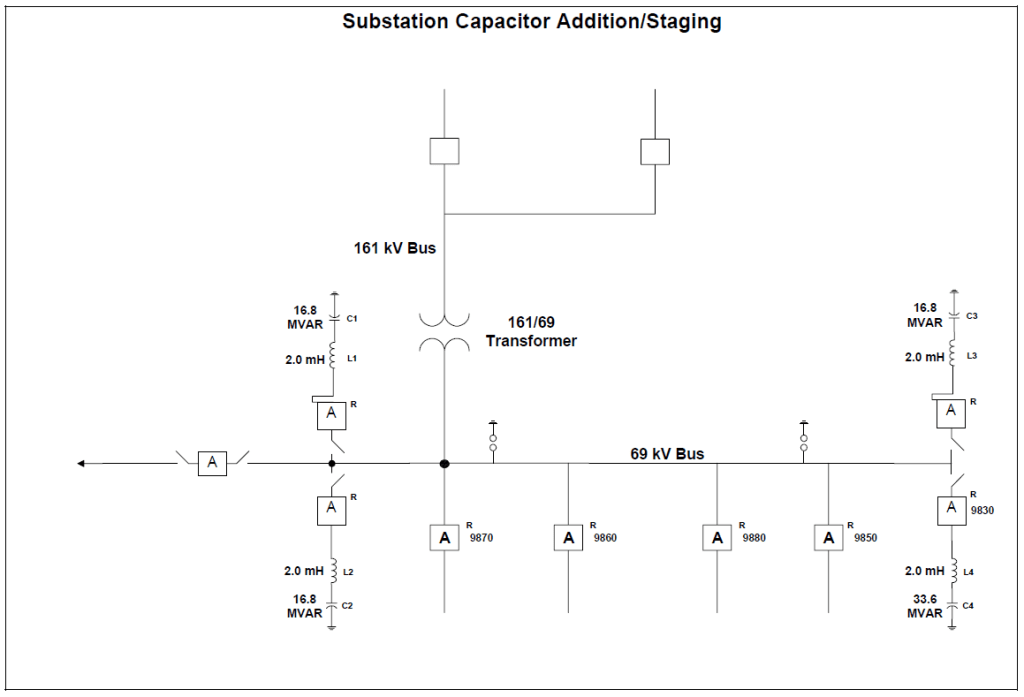
This case study presents the configuration of low voltage power factor correction capacitors as harmonic filters to improve poor power factor and reduce excessive voltage distortion levels.
PROBLEM STATEMENT
The plastics manufacturer (refer to power factor correction case) is now experiencing equipment problems, such as several capacitor bank fuses blowing, and a capacitor can failure. The plant engineer believes that the problem may be related to harmonics. He measures the following bus voltage waveform (Figure 1):
Figure 1 – Bus Voltage Waveform
Harmonic Evaluations
The industrial harmonic problem can be solved using a comprehensive approach including site surveys, harmonic measurements, and computer simulations. One general procedure used for a harmonic analysis study consists of the following steps:
− Preliminary analysis / model development − Harmonic measurements − Perform computer simulations − Determine impact on equipment − Evaluate harmonics with respect to limits − Develop solutions (including filter design)
Simple calculations are used to determine the system resonant frequencies and then the preliminary model development is completed. Initial estimates of voltage distortion levels are made based on the level of harmonic current injection and the frequency response characteristic.
Model Development and Drive Characteristic
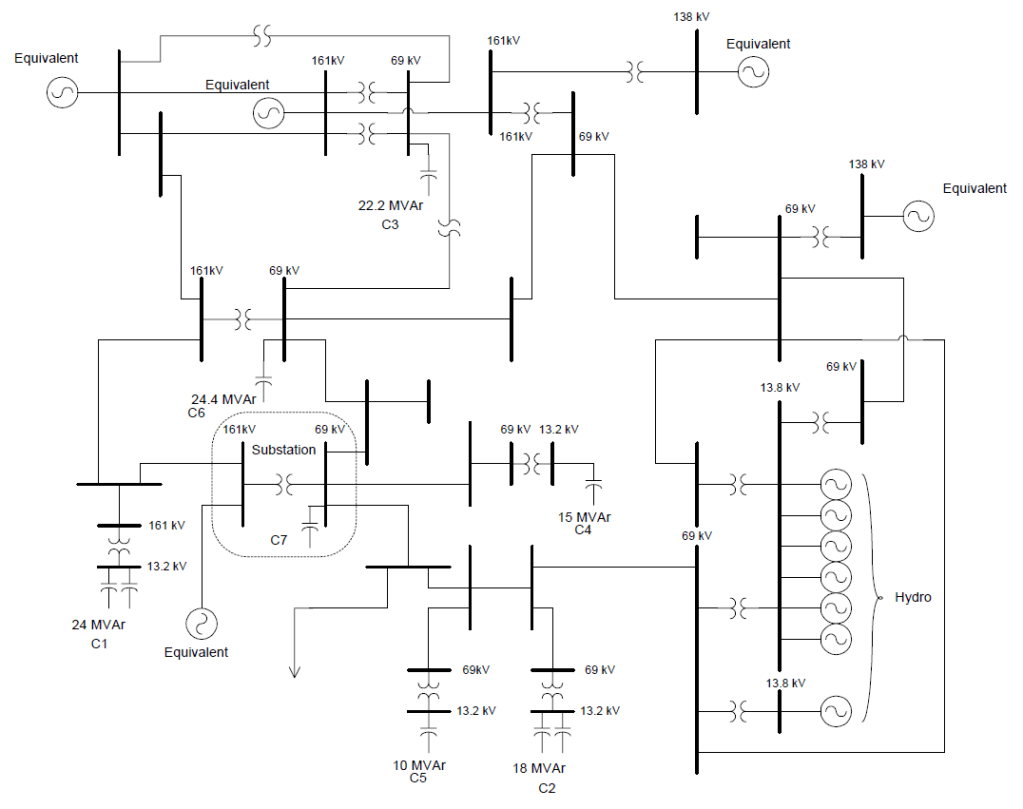
A simplified model, as illustrated in Figure 2, can be developed for the initial analysis. Harmonic measurements of the ASD indicated the following characteristic:
Drive rating: 500 HP Drive voltage: 480 V Fundamental Current: 600 A
Harmonic Number
% of Fundamental
Amps
5
28
168
7
12
72
11
7
42
13
4
24
THD:
31.5%
.
Figure 2 – Simplified Model for Harmonic Analysis
Voltage Distortion and Harmonic Resonance Calculation
Hand calculations can be used to determine the voltage distortion level without capacitors. This value is then compared with measured quantity to determine the accuracy of the preliminary model.
The customer has added 500kVAr of power factor correction at the 480 volt bus. The addition of a capacitor bank creates a parallel resonance condition. The parallel resonance occurs at the frequency where the shunt capacitive reactance is equal to the inductive source reactance and can be expressed in terms of the 60 Hz values as follows:
h = 1 /(2π√(LsC)) = √(Xc/Xs) ≈ √(100*kVAtx)/(kVArcap * Ztx(%))
This simple relationship provides an excellent first check to see whether or not harmonics are likely to be a problem. Almost all harmonic distortion problems occur when this parallel resonance moves close to the 5th or 7th harmonic, since these are the largest harmonic current components in loads like ASDs. However, the 11th and 13th harmonics can also be a problem when ASDs (PWM type) are a large percentage of the total load.
For the 500 kVAr power factor correction capacitor bank installation, the harmonic resonance is very near the 7th harmonic.
h ≈ √(100*kVAtx)/(kVArcap * Ztx(%)) = √(100*1500)/(500*6.0) = 7.08
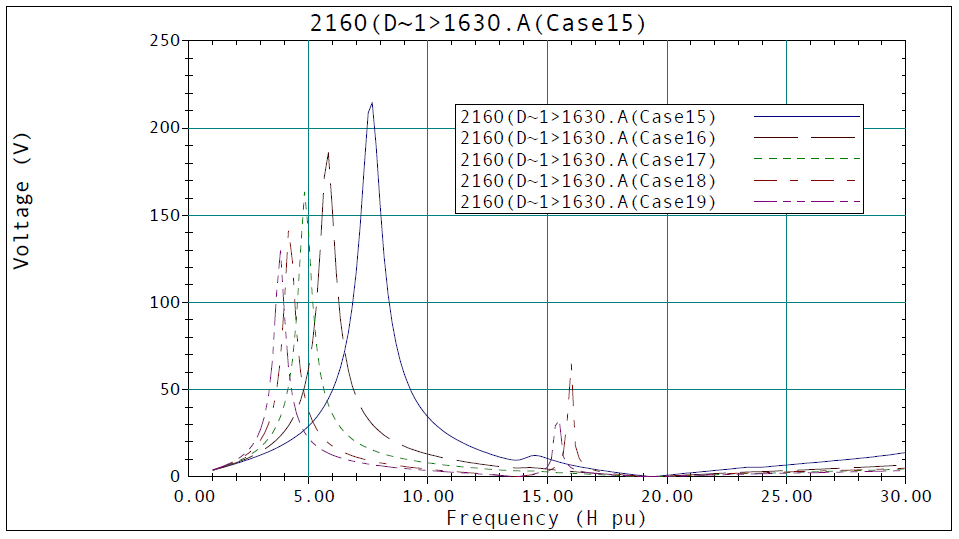
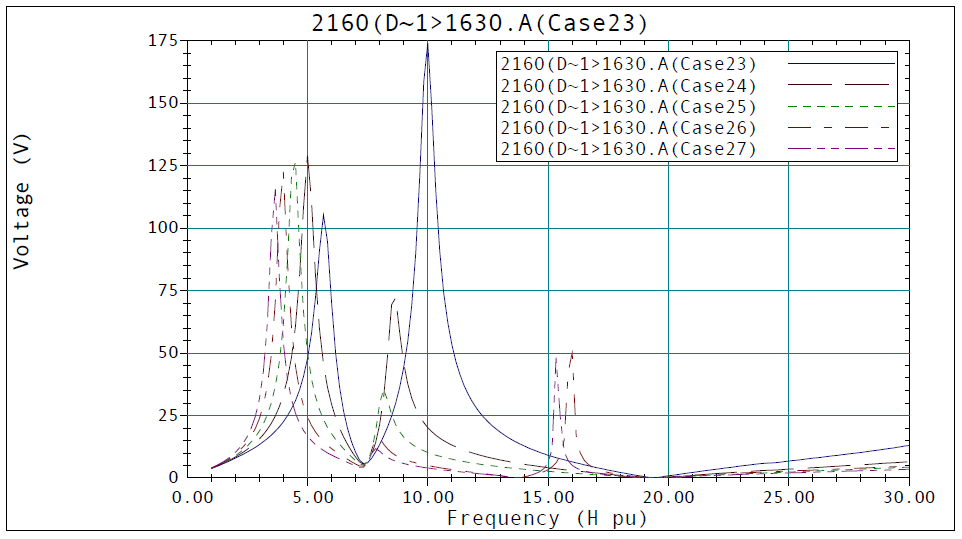
The frequency response characteristic, determined from computer simulation, is illustrated in Figure 3.
The addition of the 500kVAr power factor correction capacitor increases the voltage distortion to 11.5% (determined from computer simulation).
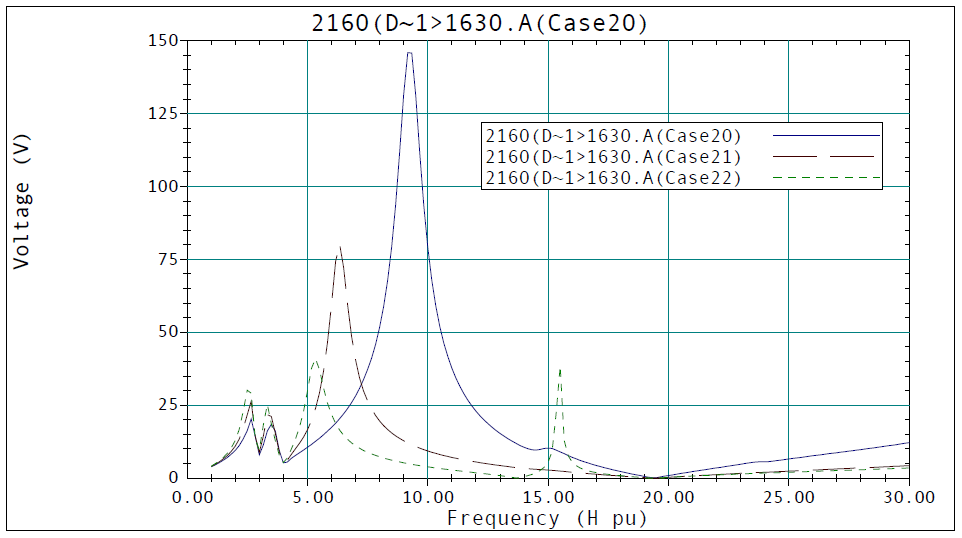
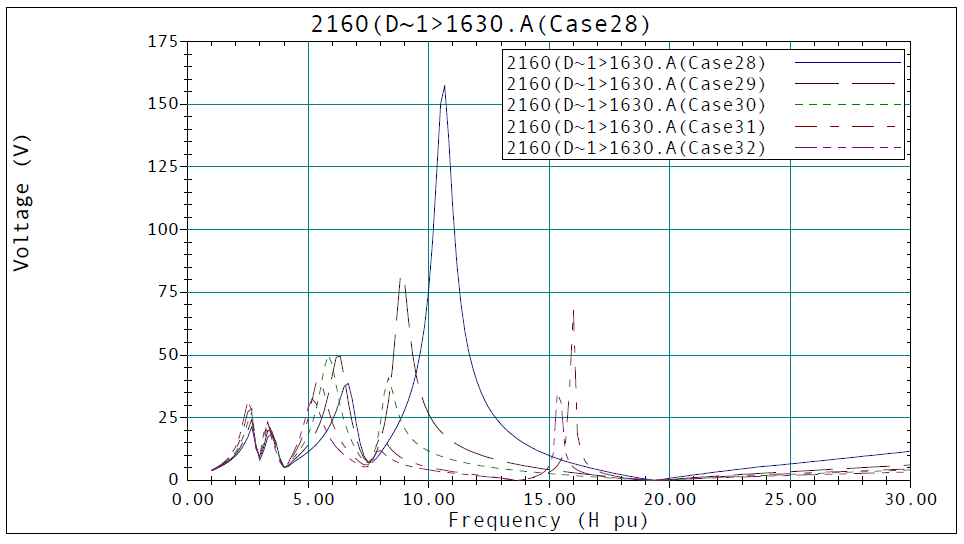
The initial solution to the problem would appear to be the installation of a 7th harmonic filter. This would create a low impedance condition and reduce the 7th harmonic voltage distortion. However, the installation of the 7th harmonic filter create a new parallel resonance very near the 5th harmonic. Recalling the current spectrum for the ASD, the 5th harmonic component was higher than the 7th (168A vs. 72A), therefore the voltage distortion will actually increase. Figure 4 illustrates the simulated frequency response characteristic for this condition.
Figure 3 – Frequency Response Characteristic
Figure 4 – Frequency Response with a 7th Harmonic Filter
The installation of the 7th harmonic filter increased the voltage distortion to 16.2% (determined by simulation). The proper solution to the problem is the addition of a 5th harmonic filter. Configuration of the power factor correction capacitor as a 5th harmonic filter reduced the voltage distortion to 3.2% (determined by simulation). In general, it is best to apply harmonic filters at the lowest generated harmonic frequency. The filter configuration for this case is illustrates in Figure 5.
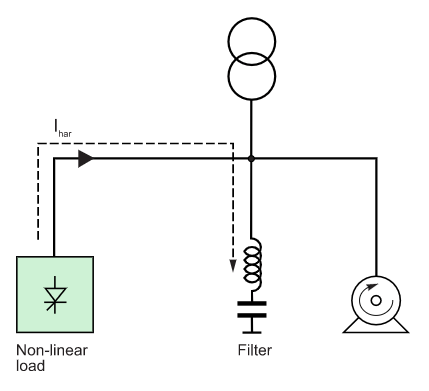
Figure 5 – 5th Harmonic Filter Configuration
Filter Design Methodology
The harmonic filter, illustrated in Figure 5, provides a low impedance path for harmonic currents, thereby minimizing harmonic voltage distortion problems. The filter is tuned slightly below the harmonic frequency of concern. This method allows for tolerances in the filter components and prevents the filter from acting as a short circuit for the offending harmonic current. This allows the filter to perform its function of providing low impedance at the harmonic frequency while helping to reduce the duty on the filter components.
The general method for applying filters is as follows:
− Apply one single-tuned shunt filter first, and design it for the lowest generated frequency. − Determine the voltage distortion level at the low voltage bus. The commonly applied limit of 5% was introduced in IEEE Std 519-1992. − Vary the filter elements according to the specified tolerances and check its effectiveness. − Check the frequency response characteristic to verify that the newly created parallel resonance is not close to a harmonic frequency. − If necessary, investigate the need for several filters, such as 5th and 7th.
SUMMARY
The industrial harmonic problem can be solved using a comprehensive approach including site surveys, harmonic measurements, and computer simulations.
Simple calculations are used to determine the system resonant frequencies and then the preliminary model development is completed. Initial estimates of voltage distortion levels are made based on the level of harmonic current injection and the frequency response characteristic.
A harmonic filter provides a low impedance path for harmonic currents, thereby minimizing harmonic voltage distortion problems.
REFERENCES
IEEE Recommended Practice for Electric Power Distribution for Industrial Plants (IEEE Red Book, Std 141-1986), October 1986, IEEE, ISBN: 0471856878 IEEE Recommended Practice for Industrial and Commercial Power Systems Analysis (IEEE Brown Book, Std 399-1990), December 1990, IEEE, ISBN: 1559370440 IEEE Recommended Practice for Protection and Coordination of Industrial and Commercial Power Systems, March 1988, IEEE, ISBN: 0471853925
RELATED STANDARDS IEEE Std. 519-1992 IEEE Std. 1036-1992
GLOSSARY AND ACRONYMS ASD: Adjustable-Speed Drive CF: Crest Factor DPF: Displacement Power Factor PF: Power Factor PWM: Pulse Width Modulation THD: Total Harmonic Distortion TPF: True Power Factor
Published by Alex Roderick, EE Power – Technical Articles: System and Equipment Grounding Safety, August 15, 2021.
Grounding is used to provide a safe path for a fault current to flow.
Grounding is an integral part of any properly operating electrical system. In residence, grounding protects the occupants by providing a safe pathway for unwanted electricity that might otherwise create a hazard. Electricity always takes the easiest flow path to earth. A ground is a low-resistance conducting connection between electrical circuits, equipment, and the earth.
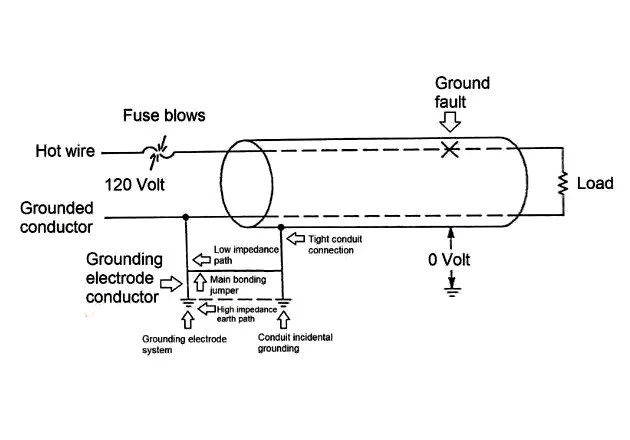
Grounding is used to provide a safe path for a fault current to flow. A complete ground path must be maintained when installing switches, light fixtures, appliances, and receptacles. In a properly grounded system, the unwanted current flow blows fuses or trips circuit breakers. Once a fuse is blown or a circuit breaker is tripped, the circuit is open, and no additional current will flow.
Grounding is usually done at two levels: system grounding and equipment grounding. The system ground is a special circuit designed to protect the entire distribution system of a residence. Equipment ground is essentially a circuit designed to protect individual components of an electrical system. Grounded conductors are used to providing a path to the ground for system and equipment grounds.
A grounded conductor is one that has been grounded on purpose. Grounded conductors are typically identified with green or green and yellow markings and may be installed as bare conductors.
System Grounding
The primary function of system grounding is to protect the service entrance wiring and the circuits connected to it. There are several methods of grounding an entire system. The two most popular methods used for grounding an electrical system are electrode grounding and water pipe grounding (see Figure 1). Other grounding methods use a concrete-encased electrode or a ground ring, both of which are less common in residential wiring systems.
Figure 1. System grounding methods include the use of an electrode ground, water pipe ground, concrete-encased electrode, or ground ring. Image courtesy of NI
Electrode Grounding
An electrode is a long metal rod used for grounding that makes contact with the earth. When no satisfactory grounding electrode is readily available, the common practice is to drive one or more metal rods (connected in parallel) into the ground. The electrode and circuit must provide a flow path to the earth with less than 25Ω of resistance.
Water Pipe Grounding
A water pipe ground uses the underground metal pipe that supplies a residence with water and is typically the best electrical ground for a residential electrical system. Water pipes work well as grounds because the large surface area of the pipe is in contact with the earth, as it connects the municipal water main to the water distribution system in residence. This large surface area reduces resistance and allows any unwanted electricity to easily pass through the pipe to the earth. When a water pipe is used for grounding, the water pipe run must never be interrupted by a plastic fitting or have an open section of plumbing. Water meters are a source of an open ground circuit when removed. To provide protection when a water meter is removed, a shunt (or meter bonding wire) must be permanently installed. A shunt is a permanent conductor placed across a water meter to provide a continuous flow path for ground current.
All internal piping systems capable of becoming energized must be bonded and connected. A bonding conductor is a reliable conductor that ensures the electrical conductivity between two metal parts that must be connected electrically. The term “grounding conductor” no longer appears by itself in the NEC. Instead, conductors are referred to by their function, such as “grounding electrode conductor,” “bonding conductor,” or “equipment grounding conductor.”
Equipment Grounding
Equipment grounding’s main purpose is to protect individual electrical devices. Equipment grounding safely grounds any devices or appliances attached to an electrical system or plugged into receptacles inside a home. For example, when a refrigerator has not been properly grounded, the electrical current caused by a short will seek the easiest path to earth. Unfortunately, the human body is an electrical conductor and allows current to reach the earth by traveling through the body (electric shock). Proper equipment grounding protects the body by harmlessly conducting unwanted electricity to the ground (see Figure 2).
Figure 2. Equipment grounding’s main purpose is to protect individual electrical devices. Image courtesy of VFC
Grounding Small Appliances
Small appliances are easily incorporated into a grounded system. Most small electrical appliances are designed with three-prong grounded plugs that match a standard three-prong grounded receptacle (see Figure 3). The U-shaped blade of the plug and the U-shaped hole in the receptacle are the ground connections. The U-shaped blade of a plug is longer than the current-carrying blades. The added length ensures a strong ground connection while the plug is being inserted or removed from a receptacle. The ground wire is connected to all receptacles and metal boxes to provide a continuous pathway for short-circuit current. The ground wire may be connected to each box using a pigtail, screw, or ground clip.
Figure 3. Small appliances are easily incorporated into a grounded system, as most small electrical appliances are designed with three-prong grounded plugs that match standard three-prong grounded receptacles. Image courtesy of APOGEE
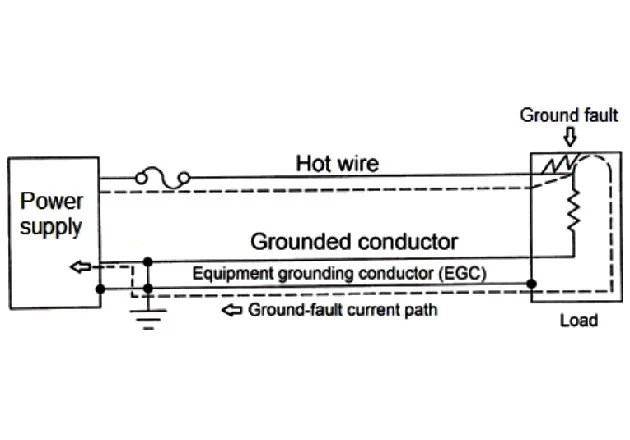
Note: According to the NEC, an equipment grounding conductor (EGC) provides a ground-fault current path and connects the non-current-carrying metal parts of the equipment together and to the system ground and/or grounding electrode in order to establish a direct path to earth.
Author: Alex earned a master’s degree in electrical engineering with major emphasis in Power Systems from California State University, Sacramento, USA, with distinction. He is a seasoned Power Systems expert specializing in system protection, wide-area monitoring, and system stability. Currently, he is working as a Senior Electrical Engineer at a leading power transmission company.
Published by Electrical Installation Wiki, Chapter M. Power harmonics management – Definition and origin of harmonics
Definition of Harmonics
The presence of harmonics in electrical systems means that current and voltage are distorted and deviate from sinusoidal waveforms.
Harmonic currents are caused by non-linear loads connected to the distribution system. A load is said to be non-linear when the current it draws does not have the same waveform as the supply voltage. The flow of harmonic currents through system impedances in turn creates voltage harmonics, which distort the supply voltage.
On Figure M1 are presented typical current waveforms for single-phase (top) and three-phase non-linear loads (bottom).
Fig. M1 – Examples of distorted current waveforms
The Fourier theorem states that all non-sinusoidal periodic functions can be represented as the sum of terms (i.e. a series) made up of:
• A sinusoidal term at the fundamental frequency, • Sinusoidal terms (harmonics) whose frequencies are whole multiples of the fundamental frequency, • A DC component, where applicable.
The harmonic of order h (commonly referred to as simply the hth harmonic) in a signal is the sinusoidal component with a frequency that is h times the fundamental frequency.
The equation for the harmonic expansion of a periodic function y (t) is presented below:
.
where:
• Y0: value of the DC component, generally zero and considered as such hereinafter, • Yh: r.m.s. value of the harmonic of order h, • ω: angular frequency of the fundamental frequency, • φh: displacement of the harmonic component at t = 0.
Figure M2 shows an example of a current wave affected by harmonic distortion on a 50Hz electrical distribution system. The distorted signal is the sum of a number of superimposed harmonics:
• The value of the fundamental frequency (or first order harmonic) is 50 Hz, • The 3rd order harmonic has a frequency of 150 Hz, • The 5th order harmonic has a frequency of 250 Hz, • Etc…
Fig. M2 – Example of a current containing harmonics and expansion of the overall current into its harmonic orders 1 (fundamental), 3, 5, 7 and 9
Individual harmonic component (or harmonic component of order h)
The individual harmonic component is defined as the percentage of harmonics for order h with respect to the fundamental. Particularly:
.
Total Harmonic Distortion (THD)
The Total Harmonic Distortion (THD) is an indicator of the distortion of a signal. It is widely used in Electrical Engineering and Harmonic management in particular.
For a signal y, the THD is defined as:
.
THD is the ratio of the r.m.s. value of all the harmonic components of the signal y, to the fundamental Y1.
H is generally taken equal to 50, but can be limited in most cases to 25.
Note that THD can exceed 1 and is generally expressed as a percentage.
Current or voltage THD
For current harmonics the equation is:
.
By introducing the total r.m.s value of the current:
.
we obtain the following relation:
.
equivalent to:
.
Example: for THDi = 40%, we get:
.
For voltage harmonics, the equation is:
.
Origin of Harmonics
Harmonic currents
Equipment comprising power electronics circuits are typical non-linear loads and generate harmonic currents. Such loads are increasingly frequent in all industrial, commercial and residential installations and their percentage in overall electrical consumption is growing steadily.
Examples include:
• Industrial equipment (welding machines, arc and induction furnaces, battery chargers), • Variable Speed Drives for AC or DC motors[1], • Uninterruptible Power Supplies, • Office equipment (PCs, printers, servers, etc.), • Household appliances (TV sets, microwave ovens, fluorescent lighting, light dimmers).
Harmonic voltages
In order to understand the origin of harmonic voltages, let’s consider the simplified diagram on Fig. M3.
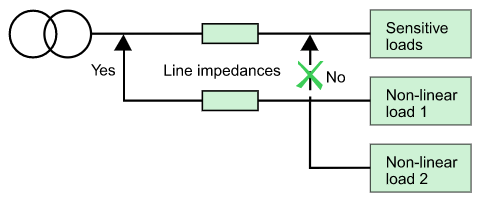
Fig. M3 – Single-line diagram showing the impedance of the supply circuit for a non-linear load
The reactance of a conductor increases as a function of the frequency of the current flowing through the conductor. For each harmonic current (order h), there is therefore an impedance Zh in the supply circuit.
The total system can be split into different circuits:
• One circuit representing the flow of current at the fundamental frequency, • One circuit representing the flow of harmonic currents.
Fig. M4 – Split of circuit into fundamental and harmonic circuits
When the harmonic current of order h flows through impedance Zh, it creates a harmonic voltage Uh, where Uh = Zh x Ih (by Ohm’s law).
The voltage at point B is therefore distorted. All devices supplied via point B receive a distorted voltage.
For a given harmonic current, the voltage distortion is proportional to the impedance in the distribution network.
Flow of harmonic currents in distribution networks
The non-linear loads can be considered to inject the harmonic currents upstream into the distribution network, towards the source. The harmonic currents generated by the different loads sum up at the busbar level creating the harmonic distortion.
Because of the different technologies of loads, harmonic currents of the same order are generally not in phase. This diversity effect results in a partial summation.
Fig. M5 – Flow of harmonic currents in a distribution network
Author: This Electrical Installation Wiki is a collaborative platform, brought to you by Schneider Electric: our experts are continuously improving its content, collaboration is also open to all.
The Electrical Installation Guide (wiki) has been written for electrical professionals who must design safe and energy efficient electrical installation, in compliance with international standards such as the IEC 60364.
Published by Lorenzo Mari, EE Power – Technical Articles: Single-point and multi-point Signal Grounding, April 16, 2021.
A grounding arrangement must be designed and implemented adequately for the electronic equipment’s proper performance
Introduction
The main categories for grounding electronic equipment are:
• Safety ground (AC and DC power ground) prevents shocks and fire hazards from the breakdown of components or wiring.
• Signal ground reduces noise resulting from electromagnetic fields, common impedances, or other interference coupling forms.
This article emphasizes typical methods employed for signal grounding.
In general, the electronic types of equipment have different circuits and systems, each having its grounding terminal. The method to interconnect these grounding points is fundamental to eliminate electromagnetic interference. Due consideration to the impedances introduced by the grounding conductors is of paramount importance.
Electrical Communications and Noise
Communication is the process of information transmission between two devices. An electrical communication system attains this function primarily through the use of electric devices and phenomena.
While transmitting electrical signals, specific unintended and undesirable effects take place. Broadly speaking, “noise” is any unintentional alteration of the signal shape. However, it is possible to distinguish three primary contaminants: distortion, interference, and noise.
Distortion changes the signal because of the system’s non-linear response to the desired signal. Turning off the signal disappears distortion.
Interference contaminates the desired signal due to extraneous signals — usually human-made — producing undesirable responses in a circuit or system. A circuit may respond to an undesired signal when the frequency of the undesired signal is within the operating frequency range of the circuit.
Noise is an electrical signal – random and unpredictable – from natural causes, external and internal to the system. Adding noise to a signal may partially obscure or destroy it. While distortion and interference also contaminate the signal, the uniqueness of noise is that, theoretically, it cannot be eradicated – posing a fundamental problem in electrical communications.
Common-mode Noise
Many ground system problems come from common impedance coupling.
When two or more electronic circuits share the same ground path, they also share the ground’s impedance, granting a noise coupling mechanism – the common-mode noise.
Figure 1 shows a typical circuit using two signal wires and a common return current path. The source and load impedances connected to load 1 are Z1S and Z1L. Those related to load 2 are Z2S and Z2L.
The current I=I1+I2 flowing through the common-ground impedance Z causes a voltage Vc that undesirably affects the voltage across ZL1 and ZL2. Note that the current flowing through one load affects the voltage across the other load.
Figure 1. Two signal wires with a common return current path.
Ground Plane
It is common to think of signal grounding as providing an equipotential point or plane used as a reference potential for a circuit or system. A ground plane is a sheet of metal connected to the ground. Ideally, every point on the ground plane should be at the ground potential.
In electrical technology, a plane is a surface on which every point is at the same voltage. A plane can be a sheet of metal, as shown in Figure 2.
Figure 2. Ideally, every two points on a ground plane should be at the same potential.
Figure 3. Ground plane.
But practical grounds are not equipotential. When the current looks for a low impedance path to return to the source, it generates a voltage difference along the path it flows through. Then, there will be minute voltage variations even in a small plane. The equipotential plane is an ideal target.
As shown in Figure 4, we sometimes employ a ring of conductors as a ground plane.
Figure 4. A ring of conductors used as a ground plane.
Typical Signal Grounding Configurations
When the objective is to reduce noise, several methods are available to interconnect the grounding points of various circuits in the same equipment or some equipment located in the same area.
The signal grounding configurations must be weighed concerning dimensions and frequency.
The typical signal grounding configurations are:
• Single-point
a. Series connection (Common ground or daisy chain) b. Parallel connection
• Multi-point • Hybrid
Single-point Grounding Configuration
Figure 5 shows a common ground or daisy chain configuration.
Figure 5. Common ground system.
This configuration is a series connection of the individual circuit grounds. The voltages at points a, b, and c are cumulative, being c the highest and the lowest.
The above equations clearly show the interaction between the circuits. When the ground currents flowing in the common paths are low or absent, the reference potential is essentially the same in all subsystems or equipment. Place the most critical stage closer to the ground point.
Avoid the series connection, especially when working with high frequencies since the rapid switching generates relatively high current impulses. Also, with circuits operating with very different energy levels – power and control – since the power equipment’s high energy impulses may couple to the control signals.
Despite being susceptible to common-mode noise and being the least effective noise mitigation method, this technique is widespread because it is economical and straightforward.
The parallel connection eliminates the common impedances in grounding circuits by connecting them to the same point, as shown in Figure 6.
Figure 6. Parallel connection.
The parallel connection is the most suitable at low frequencies because there is no cross-coupling between the ground currents from different circuits, and voltages at points a, b, and c depend on each circuit’s current and impedance.
• Va=I1∙Z1 • Vb=I2∙Z2 • Vc=I3∙Z3
This configuration mitigates common-mode noise but is mechanically bulky and costly, requiring a lot of wire in an extensive system.
The wire inductance increases the ground impedance at high frequencies, reaching very high values under resonant conditions when the wire length coincides with odd multiples of a quarter wavelength (λ). The ground path should be shorter than 1/20 of the maximum frequency’s wavelength to prevent resonance effects.
Multi-point Grounding Configuration
The multi-point grounding configuration connects multiple circuits to a ground plane. Unlike the previous arrangement, where the ground connection is at a single point, it is here at several points distributed on a ground plane.
Figure 7 shows circuits connected to the closest ground plane, usually the chassis. A chassis ground connects to an electrical or electronic system’s metal frame – the enclosure containing the components in place.
Figure 7. Multi-point configuration.
The ground paths from each circuit to the ground plane should be short to reduce the impedance and avoid resonance.
This method reduces the individual circuits’ impedance by using short conductors and a low impedance ground plane – due to its low inductance. The ground plane’s low impedance lessens the common-mode effect.
Employ single-point grounding at frequencies below 1 MHz. Above 10 MHz, multi-point grounding is best. Use single-point grounding between 1 MHz and 10 MHz, keeping the ground paths shorter than 1/20λ.
MIL standards recommend a maximum of 300 kHz for single-point grounding and multi-point grounding afterward.
Hybrid Grounding Configuration
The practice calls for combinations of single-point and multi-point methods for cost reasons and seeking a reasonable behavior to deal with noise.
Different frequencies see unlike configurations in a hybrid ground. Figure 8 is a typical hybrid ground configuration. The capacitive reactance – Xc=1/ωC – decreases as frequency increases, then the low frequencies see a series connection while the high frequencies see the multi-point ground.
Figure 8. Hybrid configuration (with capacitors).
The opposite effect occurs substituting the capacitors with inductors. Since Xl=ωL , the lower frequencies see a low reactance – multi-point – while the higher frequencies see a high reactance – series connection. This arrangement is practical to keep a single-point configuration while connecting the safety ground required by the National Electric Code. Inductors provide low reactance for the power frequency while signals see a high reactance. Figure 9 shows such a connection.
Figure 9. Hybrid configuration (with inductors).
An Overview of Signal Grounding
Noise is an undesirable electrical signal which contaminates an original – desired – signal. Noise can be external or internal to the electronic equipment.
An adequately designed grounding arrangement can reduce noise.
A ground plane is a conductive surface connected to the ground. Theoretically, every point on the ground plane should have the same potential. The ground plane may be a solid metal sheet or a set of conductors forming a ring or a grid.
The typical signal grounding arrangements are single-point (series and parallel connections), multi-point, and hybrid.
The series configuration employs a series connection of the individual circuit grounds in a daisy chain manner.
All the ground terminals connect to the same point in the parallel connection, eliminating the common impedances.
The multi-point system uses a ground plane to which the circuits connect separately.
Hybrid systems behave differently at low and high frequencies. Depending on the frequency and the use of capacitors or inductors, they can act as single-point or multi-point.
Author: Lorenzo Mari holds a Master of Science degree in Electric Power Engineering from Rensselaer Polytechnic Institute (RPI). He has been a university professor since 1982, teaching topics as electric circuit analysis, electric machinery, power system analysis, and power system grounding. As such, he has written many articles to be used by students as learning tools. He also created five courses to be taught to electrical engineers in career development programs, i.e., Electrical Installations in Hazardous Locations, National Electrical Code, Electric Machinery, Power and Electronic Grounding Systems and Electric Power Substations Design. As a professional engineer, Mari has written dozens of technical specifications and other documents regarding electrical equipment and installations for major oil, gas and petrochemical capital projects. He has been EPCC Project Manager for some large oil, gas & petrochemical capital projects where he wrote many managerial documents commonly used in this kind of works.
Published by Marek GAŁA, Andrzej JĄDERKO, Czestochowa University of Technology, Faculty of Electrical Engineering
Abstract. The paper offers a characteristic of a photovoltaic (PV) system with the function UPS, equipped with energy storage AQUION ENERGY Battery 25 kWh and a system for monitoring and management of energy flow. Results and their analysis is presented for energy quality measurements carried out at a point of connecting the PV system to the power grid, collected over the period of one week.
Streszczenie. W artykule przedstawiono charakterystykę systemu fotowoltaicznego z funkcją UPS, wyposażonego w magazyn energii AQUION ENERGY Battery 25 kWh oraz system monitorowania i zarządzania przepływem energii. Przedstawiono wybrane wyniki oraz analizę pomiarów jakości energii elektrycznej przeprowadzonych w węźle przyłączenia systemu PV do sieci elektroenergetycznej w reprezentatywnym, tygodniowym okresie badania (Ocena wpływu systemu fotowoltaicznego na jakość energii w sieci dystrybucyjnej).
Keywords: photovoltaic systems; power quality; energy storage Słowa kluczowe: systemy fotowoltaiczne, jakość energii elektrycznej, magazynowanie energii
Introduction
Price of electricity constantly raises and at the same time the technology of manufacturing efficient photovoltaic panels is becoming increasingly advanced. There are many PV systems available on the market, many of which can also be used by energy consumers, who intend to supply excess of energy to the distribution grid, which is now free of charge and does not require any special permission – all that has to be done is to register a connection with the distribution company. Moreover, it is possible to obtain funds from special programs for financing investment in renewable energy sources. All this explains high demand for PV systems equipped with inverters, control and protection systems. As of the end of May 2018, it is estimated that the power of all PV systems in Poland is about 300 MW, but it can reach 1.2 GW by the end of 2020 [1].
PV systems utilizing solar energy are one of the renewable energy sources (RES) to which article 2 point 22 of Act [11] applies. Act [11] enumerates the following categories of RES: microgeneration plants of total power up to 40 kW, connected to the power grid of voltage lower than 110 kV or of combined thermal power up to 120 kW; small generation plants of power 40 kW – 200 kW, connected to the power grid of voltage lower than 110 kV or of combined thermal power 120 kW – 600 kW. In accordance with article 7a clause 1 of Energy Law Act [10] generation plants and all related devices have to meet technological and exploitation standards in order to be connected to the grid. The standards ensure safety of the power system, which has to be protected against potential damage caused by faulty operation of a generation plant, and they also ensure that the energy quality parameters at the connection point are met.
A fast increase in the number of microgeneration plants can cause significant problems in distribution networks, including deterioration of energy quality. To prevent this, particular distribution companies issue detailed instructions, e.g. [2] [3], complying with general standards and regulations [4, 5, 9] specifying conditions that have to be met by microgeneration plants and small generation plants connected to the grid.
If the amount of electrical energy generated by a prosumer exceeds own consumption, the excess energy can be introduced to the power grid and counted at the ratio of 1 to 0.7 in the case of a plant over 10 kW or at the ratio 1 to 0.8 in the case of a plant below 10 kW – as stipulated in article 4, clause 1 of Act [11]. The prosumer can also include energy storage in their system, thereby optimizing the consumption of self-generated energy.
In what follows, this paper presents characteristics of a PV system with an energy storage. It also offers selected results of measurements of the quality of energy generated by this plant, supplying energy to devices connected into separate circuits.
Characteristics of the PV system
The PV system consists of 76 solar panels, each of power 250 Wp. They are connected to a three-phase photovoltaic inverter Goodwe type GW 17K-DT of nominal power 17.0 kW, capable of working with 20% overload and having efficiency up to 98.2%. The inverter is equipped with two MPPT modules and a switch disconnector. The PV system is also equipped with protection elements, including a protection device Ziehl controlling voltage and frequency, type UFR1001E.
The output circuits of the PV system are connected to three single-phase inverters Victron Energy, type MultiPlus 48/5000/70, working in a three-phase layout and equipped with microprocessor battery charge controllers, with adaptive charging and with continuous energy supply to AC receivers (function UPS). The first inverter mounted at phase L1 plays the role of Master, and the other two work as Followers. The inverters MultiPlus 48/5000/70 are presented in figure 1. The inverters MultiPlus collaborate with energy storage AQUION ENERGY Battery 25 kWh, type M110-LS83. The whole system is controlled by panel Color Control GX by Victron Energy, having access to the Internet and providing support for Victron Remote Management. Registered users and administrators have remote access to the system from PCs and mobile devices. The panel controls the charging of the energy storage, monitors current energy consumption, power obtained from the PV system as well as power supplied to and consumed from the grid. The PV system together with panel Color Control GX ensure that the energy storage is always fully charged, that the receiving circuit is supplied without interruptions and that excess energy from the PV system is directed to the energy storage to be used for own consumption. The energy storage is additionally monitored by Aquion Energy BMS-200 Battery Monitoring System.
Figure 2 presents AQUION ENERGY Battery 25 kWh type M110-LS83, and figure 3 provides an example of a screen view obtained from Victron Remote Management, with information on the flow of energy generated by the PV system.
Fig. 1. View of three PV inverters type MultiPlus 48/5000/70
Fig. 2. AQUION ENERGY Battery 25 kWh type M110-LS83
Fig. 3. A screen view of panel Color Control GX, responsible for managing the operation of a PV system with energy storage
Measurements of the quality of energy generated by the PV system
Apart from detailed technological specifications and criteria concerning connecting microgeneration plants to the power grid, issued by distribution companies (e.g. [3]), of vital importance is the assessment of the influence the plant exerts on energy quality parameters at the node where the plant is connected to the grid (Point of Common Coupling – PCC). It is therefore required that devices being component parts of PV systems are certified for compliance with current standards and directives issued by research institutions.
Compliance of a PV system with requirements and standards concerning energy quality at PCC as described in [3, 4, 5, 9] can be verified on the basis of measurements carried out as specified in e.g. [6, 7, 8, 9]. Such measurements include voltage deviation and variation, voltage imbalance, harmonics and interharmonics, flicker, commutation noise and signal transmission noise.
Below are presented selected results of measurements of energy quality parameters, concerning energy generated by a PV system with energy storage, supplying power to separate circuits in an object. The measurements were carried out at PCC where the PV system with energy storage is connected to the internal grid. The measurements utilized an energy quality analyzer PQ-Box 200, satisfying the standard [8] for class A. The testing took place in summer, during peaks of power generated by the system.
The results presented in this paper include power parameters and energy quality parameters, with the measurements performed during the period of one week. The data aggregation time was tA= 600 s.
Figure 4 presents the rms values of current. The maximal rms value of current was Imax = 17.2 A, and the maximal rms value of current for the aggregation time tA = 0.2 s was Imax 0.2s = 21.4 A. Load asymmetry was also attested, occurring due to the operation of many singlephase appliances in the receiving circuits of the object.
Fig. 4. RMS values of current IL1, IL2, IL3 at the connection node of the PV system
Fig. 5 presents the curve of active powers PL1, PL2, PL3 registered during the week period of observation.
Fig. 5. Active powers PL1, PL2, PL3 at the connection node of the PV system
Resultant active powers transmitted to the grid were obtained under real conditions, taking into account the charging of the energy storage and the operation of receivers in the circuits supplied by the PV system. They were PL1 min = -3.74 kW, PL2 min= -4.14 kW, PL3 min = -4.04 kW (Fig. 5). The three-phase power was Pmin = -11.67 kW. The maximum power consumed from the power grid was Pmax = 4.43 kW.
No significant voltage deformation, nor correlation between such deformation and the level of power generation by the PV system was observed at PCC under scrutiny. The values of the THD factors for voltage were in the interval THD U ∈ 〈1.87, 3.11〉% and satisfied the relevant standards [4, 9]. Figure 6 presents the values of instantaneous current registered at the power Pmin = -11.67 kW.
Fig. 6. Instantaneous currents for the case Pmin = -11.67 kW
The assessment of higher current harmonics content was performed in accordance with the standard [5] and requirements specified in [3]. To this end, the value of short-circuit factor was determined for the PCC
.
on the basis of short-circuit power SkPCCat the PCC and apparent power SEmax that can be achieved by the plant, obtaining RkPCC = 33. Besides, the value of the reference current Iref, i.e. the rated continuous current of the PV system, was obtained on the basis of measurements. Then the rms value of the fundamental of the reference current I1 ref was determined. Taking into account the measured rms values of higher current harmonics, the factors THD I and PWHD I were calculated:
.
The relative values of the higher current harmonics of the order n = 2,…,40 were found and referred to the fundamental I1 ref. No significant change in the degree of current deformation was found to be dependent on the variation of power generated by the PV system – figure. 7. The steep increases in THD I up to 12.89% visible in figure 7 were caused by current received by nonlinear sources of light, switched on during nighttime and supplied from the phase L2 circuit. Figure 8 presents relative values of current harmonics determined at Pmin. As these values indicate, the phase currents are deformed only to a slight extent. The harmonics of the order n = 3, 5, 7, 9 are dominant.
Fig. 7. Values of factors THD IL1, THD IL2, THD IL3 at the connection node of the PV system
Fig. 8. Relative spectrum of current harmonics for Pmin
Table 1 presents the maximal values of current harmonics with reference to I1 ref. Table 2 presents maximal values of the factors THD I and PWHD I.
Table 1. Relative values of the main current harmonics compared to the limits specified in [6]
.
Table 2. THD and PWHD factors of current compared to the limits specified in [6]
.
It can be observed that the values of factors THD I and PWHD I do not exceed the limit – cf. Table 2. On the other hand, the content of the 9. and 13. harmonics is relatively slightly exceeded in phase L2, due to nonlinear light sources supplied from the output circuits of the PV system – cf. Table 1.
Figure 9 presents the voltage coefficient curve. The values of the voltage unbalance factor were within the interval 0.09% to 0.43%, i.e. much below the limit of 2%. The value of rms voltage likewise varies within the limits.
Fig. 9. Voltage asymmetry coefficient αU
Figures 10 and 11 present the variation of the indices Pst and Plt respectively. The occurrence of limit values of the indices Pst = 1.0 and Plt = 0.65 was attested only once and only in one of the phases during the weekly period of testing.
Fig. 10. Indices of short-term flicker severity Pst L1, Pst L2,Pst L3 at the connection node of the PV system
Fig. 11. Indices of long-term flicker severity Plt L1, Plt L2, Plt L3 at the connection node of the PV system
Conclusions
PV system equipped with energy storage and an advanced system for monitoring and managing energy flow offers a way to utilize energy for one’s own consumption, at the same time ensuring continuous supply. As this study indicates, the system under scrutiny does not cause deterioration of energy quality beyond the admissible limit. Thus, despite a single occurrence of limit values of indices Pst and Plt defined in [3], electric energy in the node investigated in this study met all quality requirements specified in [4, 9].
REFERENCES
[1] Photovoltaic market in Poland. Institute of Renewable Energy (Rynek fotowoltaiki w Polsce. Instytut Energetyki Odnawialnej), Warsaw, June 2018. [2] Instructions for Distribution Network Traffic and Exploitation applicable since 01.01.2014, TAURON Dystrybucja S.A. (Instrukcja Ruchu i Eksploatacji Sieci Dystrybucyjnej TAURON Dystrybucja S.A. obowiązująca od dnia 01.01.2014 r.). [3] Connection criteria and technical requirements for microgeneration plants and small-scale generation plants connected to the LV distribution network (Kryteria przyłączania oraz wymagania techniczne dla mikroinstalacji i małych instalacji przyłączanych do sieci dystrybucyjnej niskiego napięcia) TAURON Dystrybucja S.A., Krakow, July 18, 2016. [4] EN 50160: Voltage characteristics of electricity supplied by public distribution system. [5] IEC 61000-3-12:2011 Electromagnetic compatibility (EMC) – Part 3-12: Limits – Limits for harmonic currents produced by equipment connected to public low-voltage systems with input current >16 A and ≤ 75 A per phase. [6] IEC 61000-4-7:2002+A1:2008 Electromagnetic compatibility (EMC) – Part 4-7: Testing and measurement techniques – General guide on harmonics and interharmonics measurements and instrumentation, for power supply systems and equipment connected thereto. [7] IEC 61000-4-15:2010 Electromagnetic compatibility (EMC) – Part 4-15: Testing and measurement techniques – Flickermeter – Functional and design specifications. [8] IEC 61000-4-30:2015 Electromagnetic compatibility (EMC) – Part 4-30: Testing and measurement techniques – Power quality measurement methods. [9] The Ministry of Economy ordinance on the detailed conditions of the power system operation, Journal of Laws of 2007, no, 93, item 623 with later amendments (Rozporządzenie Ministra Gospodarki z dnia 4 maja 2007 r. w sprawie szczegółowych warunków funkcjonowania systemu elektroenergetycznego, Dz. U. z 2007 r., nr 93, poz. 623 z późn. zm.). [10] Act on Power Law of 10 April 1997, Journal of Laws of 1997 no 54, item 348, with later amendments (Ustawa z dnia 10 kwietnia 1997 r. Prawo energetyczne, Dz. U. z 1997 r., nr 54, poz. 348 z późn. zm.). [11] Act on Renewable Energy Sources of 20 February 2015, Journal of Laws of 2015, item 478 (Ustawa z dnia 20 lutego 2015 r. o odnawialnych źródłach energii (Dz. U. z 2015 r., poz. 478).
Authors: dr inż. Marek Gała, Politechnika Częstochowska, Wydział Elektryczny, 42-200 Częstochowa, Al. Armii Krajowej 17, e-mail: m.gala@el.pcz.czest.pl dr inż. Andrzej Jąderko, Politechnika Częstochowska, Wydział Elektryczny, Al. Armii Krajowej 17, 42-200 Częstochowa, e-mail: aj@el.pcz.czest.pl
Source & Publisher Item Identifier: PRZEGLĄD ELEKTROTECHNICZNY, ISSN 0033-2097, R. 94 NR 12/2018. doi:10.15199/48.2018.12.35
Published by Electrical Installation Wiki, Chapter M. Power harmonics management – Detect and eliminate harmonics: why?
Harmonic Disturbances
Harmonics flowing in distribution networks represent disturbances in the flow of electricity. The quality of electrical power is deteriorated, and the efficiency of the system is decreased.
Here are the main risks linked to harmonics:
• Overload of distribution networks due to the increase of r.m.s. currents, • Overload of neutral conductors, which current can exceed the phase currents, • Overload, vibration and premature ageing of generators, transformers and motors as well as increased transformer hum, • Overload and premature ageing of Power Factor Correction capacitors, • Distortion of the supply voltage that can disturb sensitive loads, • Disturbance in communication networks and telephone lines.
Economic Impact of Disturbances
All these disturbances have an economic impact:
• Premature ageing of equipment means it must be replaced sooner, unless oversized right from the start,
• Overload on the distribution network means higher equipment rating, increased subscribed power level for the industrial customer, and increased power losses,
• Unexpected current distortion can lead to nuisance tripping and production halt.
A Necessary Concern for the Design and Management of Electrical Installations
Harmonics are the result of the always expanding number of power electronic devices. They have become abundant today because of their capabilities for precise process control and energy saving benefits. Typical examples are Variable Speed Drives in the Industry, and Compact Fluorescent Lamps in commercial and residential areas.
International standards have been published in order to help the designers of equipment and installations. Harmonic emission limits have been set, so that no unexpected and negative impact of harmonics should be encountered. In parallel to a better understanding of effects, solutions have been developed by the Industry.
Harmonic consideration is now a full part of the design of electrical installations.
Author: This Electrical Installation Wiki is a collaborative platform, brought to you by Schneider Electric: our experts are continuously improving its content, collaboration is also open to all.
The Electrical Installation Guide (wiki) has been written for electrical professionals who must design safe and energy efficient electrical installation, in compliance with international standards such as the IEC 60364.
Published by Alex Roderick, EE Power – Technical Articles Reactors in a Power System, May 03, 2021.
This article highlights two common types of reactors which are the dry-type and the oil-immersed.
In an AC circuit, reactance is the opposition to current flow. A reactor, also known as a line reactor, is a coil wired in series between two points in a power system to minimize inrush current, voltage notching effects, and voltage spikes. Reactors may be tapped so that the voltage across them can be changed to compensate for a change in the load that the motor is starting. Reactors are rated by the ohms of impedance that they provide at a given frequency and current. Reactors may also be rated by the I2R loss across the device at a certain frequency at a rated current.
Two common types of reactors are the dry-type and the oil-immersed. The dry-type is open and relies on the air to circulate and dissipate the heat. Dry-type reactors are common in low-voltage applications.
Oil-immersed reactors are common in high-voltage applications. Oil-immersed reactors are placed in tanks and require a magnetic shield to prevent eddy currents from circulating in the tank. The shield is made from laminated steel sheets like the transformer core and motor stators.
Reactors may be used as line or load reactors (see Figure 1). Line reactors are used when low line impedance allows high inrush current, when power factor correction capacitors are used, or when a motor drive causes notching. Load reactors are installed at the output of a motor drive. Load reactors help eliminate voltage spikes or reflected wave noise by slowing down the rate of change in the drive output voltage. However, load reactors have a tendency to overheat due to the harmonic content of the output waveform from the motor drive. The reactor must be designed to reduce the harmonic distortion.
Figure 1. Reactors are used as line or load reactors. Image courtesy of Transcoil
Inrush Current
Many electrical devices draw high currents at startup or have very low impedance to the flow of current. For example, electric motors typically draw many times their full-load current during startup. This inrush current can cause voltage sags that trip out other equipment. Many full-voltage motor starters use reactors to increase the impedance and limit the inrush current. Large capacitor banks used to correct for low power factor have very low impedance when the capacitor bank is first switched ON, and the capacitors begin charging. Low impedance means that the flow of current is very high. A reactor can be added in series to increase the reactance. The increased reactance increases the impedance and reduces the inrush current (see Figure 2).
Figure 2. Line reactors are used to reduce inrush current. Image courtesy of Schneider Electric
Reduced Notching
To reduce notching, the source of the notching needs to be isolated or buffered from other equipment that uses the same power distribution system. Creating a voltage divider is a relatively simple way to minimize notching. See Figure 3. When impedance in the form of a reactor is added in series with an SCR controller, the notch voltage is distributed across the new impedance and the impedance already existing in the feeder lines. The added impedance reduces the notch depth and widens the notch width. Experience has shown that the reactor should have about 3% impedance to reduce the notch depth by about 50%. This is enough to eliminate the extra zero crossovers that cause problems. Higher impedance may cause problems with sensitive equipment because the wider notch may be seen as a loss of voltage. Lower impedance may not reduce the notch depth enough to eliminate the problems.
Figure 3. A reactor can be added in series with an SCR power source to reduce notching.
Note
Transients on a line can cause electronic equipment to generate errors. Digital electronic circuits operate on low-level digital signals that can be corrupted by a false signal induced by the transient voltage.
Saturable-Core Reactors
When an iron core is saturated, substantially all the magnetic domains are aligned with the applied magnetic field. Further increases in the applied magnetic field do not result in increases in magnetic flux. Therefore, there is no increase in the voltage induced in opposition to the change in current. In other words, an inductor loses its ability to oppose changes in current when its core becomes saturated.
A saturable-core reactor is an inductor whose inductance is regulated by a magnetic field produced by a second winding wound around the same iron core as the primary winding. The “power” winding of a saturable-core reactor is the winding carrying the AC load current. The “control” winding of a saturable-core reactor is the winding carrying the DC control current. The control winding is carrying DC strong enough to create a magnetic field that saturates the core.
An increase in DC through the control winding produces an increased magnetic flux in the reactor core. An increase in the magnetic flux moves the reactor core closer to saturation and decreases the inductance of the power winding. A decrease in inductance in the power winding increases the current delivered to the load through the power winding. Therefore, a saturable-core reactor can be used as an amplifier where a relatively small DC through a control winding can control a relatively large AC through the power winding.
In actual practice, a saturable-core reactor consists of two pairs of windings (see Figure 4). The small dots near the saturable-core reactor coils indicate polarity. The power windings are in phase with each other, and the control windings are out of phase with each other. This allows the saturable-core reactor to saturate the core equally in both positive and negative alternations of the AC cycle.
Figure 4. Saturable-core reactors can use a small direct current as a way to control a large alternating current in a power circuit.
Saturable-core reactors were very popular in the plating industry before the advent of DC drives to control the current in the plating solution. In the case of a plater, the part being plated is the load. If no DC is flowing in the control coil, then the IR drop will be controlled by the amount of current in the reactor. With DC current in the control coil, the DC flux will flow in the core and limit the amount of AC flux in the core. Lower AC flux means less reactance and less impedance to the circuit current. Large amounts of AC current can be controlled by a small amount of DC current. This control is very linear and very reliable. Saturable-core reactors have fallen out of use in this type of application because the cost to build a reactor is much higher than building a DC drive.
Note
Saturable-core reactor power supplies used at high power levels are extremely reliable devices because there are no moving parts.
Chokes
A choke, also known as a line choke, is a reactor that is used to limit current to AC or DC drives in the event of short circuits inside the drive. When large short-circuit currents are drawn from the source, the choke starts to build a counter-voltage, and the voltage available to the drive is reduced. The reduced voltage causes the instantaneous electronic trip (IET) circuit to trip the drive off-line to avoid damage. Chokes have large conductors with fewer turns and offer low impedance to the line into the drive.
A common-mode choke is a reactor that reduces common-mode noise current produced by rapid motor drive or device switching (see Figure 5). Load current flows through one winding of the common-mode choke to the load and then flows through the other winding away from the load. This results in two opposite magnetomotive forces that cancel and result in zero inductance. With a common-mode noise, the currents flowing through the two windings of the common-mode choke are in the same direction. Hence, in-phase flux created in each of the windings will add together rather than being canceled as in the case of a differential noise component. This will result in a magnetomotive force that opposes the flow of the common-mode noise.
These common-mode components will flow to the ground as shown in Figure 5. The net result is that a common-mode choke allows the load current to flow almost unimpeded while blocking the flow of common-mode noise current.
Figure 5. Common-mode chokes are used to reduce the severity of drive-induced common-mode noise. Image Courtesy of Power Systems Design
Common-mode chokes are often used to reduce drive-induced common-mode noise. A common-mode choke provides high inductance to oppose common-mode noise currents generated during drive switching. The magnitude and rise time of the noise current are reduced to the point where they are below the noise threshold of affected equipment.
Resonance
Capacitor banks are often used to correct low-power-factor situations. In systems with large amounts of capacitance used to correct power factor, high-voltage distortion can cause resonance at system harmonic frequencies. This results in series-or parallel-resonant currents, which can be very damaging to the electrical system.
Figure 6. A reactor in series with a variable-speed motor drive shifts the resonance frequency away from any harmonics on the line.
Adding a reactor to the incoming power line to the motor drives is a common technique for minimizing the impact of motor drives on other loads in the electrical system (see Figure 6). The added reactance ahead of a motor drive alters the resonance frequency and decreases the amount of distortion in the motor drive’s input current.
Author: Alex earned a master’s degree in electrical engineering with major emphasis in Power Systems from California State University, Sacramento, USA, with distinction. He is a seasoned Power Systems expert specializing in system protection, wide-area monitoring, and system stability. Currently, he is working as a Senior Electrical Engineer at a leading power transmission company.