PQView 4brings you a smooth interface for viewing PQDIF and COMTRADE files, along with a wealthof other power quality monitoring and analytical capabilities. But what if you’re in a pinch and only need the file viewer?
PQDiffractor is a PQDIF and COMTRADE viewer written byElectrotek Concepts, Inc.for viewing, browsing, diagnosing, and converting PQDIF files and COMTRADE files, and is a free software download from our website.
That’s right. It’s free.
Read binary PQDIF Files using specifications from IEEE Std 1159.3-2003
Read ASCII or binary COMTRADE Files using specifications from IEEE Std C37.111-1991 or C37.111-1999
View lists of data source records in each PQDIF file
View lists of analog and digital channels from COMTRADE configuration files
Create interactive charts from PQDIF observations with channels of any quantity type
View samples from analog COMTRADE waveforms and digital status channels
Export displayed observations to Microsoft Excel as CSV files
To read more about PQDIF and COMTRADE, and to view a full list of PQDiffractor’s capabilities, visit our website, at electrotek.com/pqdiffractor/
Sean Elphick, Senior Member, IEEE University of Wollongong, elpho@uow.edu.au Philip Ciufo, Senior Member, IEEE University of Wollongong, ciufo@uow.edu.au Sarath Perera, Member, IEEE, University of Wollongong, sarath@uow.edu.au
Publication Details
S. Elphick, P. Ciufo & S. Perera, “Laboratory investigation of the input current characteristics of modern domestic appliances for varying supply voltage conditions,” in 14th International Conference on Harmonics and Quality of Power, ICHQP 2010, 2010, pp. 1-7.
Abstract – The past decade has seen major changes to the appliances which comprise the domestic load. Appliances which may have been considered to be passive loads are now supplied through power electronic front ends. These new loads are known sources of power quality disturbances, predominately harmonic currents. While examinations have been made of the electrical behaviour of first generation electronic appliances, there is little literature dealing with the performance of more modern loads. Understanding the behaviour of modern loads is essential if accurate models of equipment connected to the power system are to be developed. This paper examines the input current characteristics of a number of modern domestic appliances. This includes an analysis under undistorted rated voltage input conditions along with examination of the impact that varying input voltage conditions has on appliance input currents. Characterisation of the appliance input current is achieved through a laboratory testing regime using a programmable power source.
On the whole, it can be noted that many modern appliances have input current performance which is better in terms of harmonic content compared to older appliances with power electronic front ends. With respect to variation of the input voltage, it has been found that harmonic distortion has a larger impact on the input current of appliances than variations in fundamental voltage magnitude.
Index Terms—Harmonics, Input Current, Domestic Appliances, Power Quality
I. INTRODUCTION
The past decade has seen major changes in the individual appliances which comprise the domestic load. Appliances such as whitegoods and lighting which may once have been considered as considered passive loads are now supplied by power electronics. In addition, many electronic appliances have also evolved over time. Examples of evolving technology include air conditioners where direct on-line types have progressed to first generation inverter types and finally to modern inverter driven systems. Another obvious example is televisions where CRT technology has been replaced with plasma and LCD. Recent years have also seen major changes to the lighting load. Many countries have banned the sale of traditional incandescent light globes as a demand reduction strategy. At present, the only viable alternative to the incandescent lamp is the compact fluorescent lamp (CFL).
The modern domestic load also contains a range of appliances which had relatively low penetration levels 10 – 15 years ago. Examples of these appliances include personal computers and DVD players.
Fig. 1. Traditional SMPS Block Diagram [1]
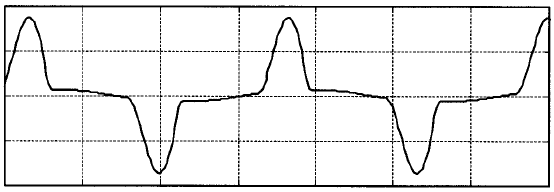
Fig. 2. Traditional SMPS Input Current Waveform [1]
Modern electronic appliances almost universally use a switch-mode power supply (SMPS). These have a number of advantages and the most notable is the ability to operate over a wider range of input voltage magnitudes. The block diagram of a typical SMPS is shown in Fig 1. The characteristic ac side current waveform of a SMPS, when supplied with a sinusoidal input voltage from a strong supply, is shown in Fig 2.
The current harmonic spectrum for the waveform in Fig. 2 is shown in Fig 3. The harmonic spectrum is dominated by high magnitudes of low order odd harmonics such as 3rd, 5th and 7th which decay rapidly with frequency. 3rd harmonic is always the dominant harmonic order.
Fig. 3. Traditional SMPS Input Current Harmonic Spectrum [1]
Studies presented in [2] and [3] describe the impact of changes in input voltage supply characteristics on the input current characteristics of appliances supplied by SMPS. However, these studies are now quite dated. While the basic SMPS topology shown in Fig 1 has been in existence for many years there is evidence to suggest that developments have been made to the design of appliances supplied by SMPS. These changes have been made in order to improve the ac side harmonic current performance of the appliances [4].
The study presented in [5] is more recent. However, it is limited to investigating the impact of ac supply voltage waveform distortion levels on ac side supply current THD levels. The work presented in this paper complements and expands on the work presented in [5]. An examination of the impact of the variations in both the magnitude and distortion level of the input voltage on the input current characteristics of a number of modern domestic electronic appliances is made. A range of input current parameters are studied including RMS current, displacement power factor, total harmonic current and individual harmonic current orders. The investigations have been performed using a 30 kVA programmable source combined with power quality measurement instrumentation. The programmable source used has output voltage distortion levels of less than 1% THD when supplying sinusoidal voltage waveforms. The power quality instrumentation used is a Hioki 3196 power quality analyser which is a IEC61000-4-30 [6] Class A compliant instrument.
II. APPLIANCES TESTED
A range of common domestic appliances has been tested. Selection of the appliances to be tested was based on a combination of appliance penetration levels as well as power usage magnitude. The appliances tested are likely to be found in a majority of homes or represent appliances which have large power demand and as such may have larger impact on the electricity distribution network. Small appliances such as mobile phone chargers have not been included in testing. The appliances tested are:
15 W CFL Lighting. Three different CFLs were examined.
Televisions (TVs). Three technologies; CRT, plasma and LCD. The CRT is a 51cm model while the plasma and LCD are 32 inch models.
3.3 kW split system Inverter Air Conditioner.
2.4 GHz Personal Computer (PC).
17 inch LCD Computer Monitor.
DVD player.
III. TEST SCHEDULES
Each appliance was subjected to a range of tests to determine performance under varying input voltage conditions which were selected based on levels that are likely to be experienced on Australian low voltage (230V/400V) electricity distribution networks. Each appliance was subjected to five distinct tests. Each test involved application of different input voltage magnitudes or waveform distortion levels. The first three tests were designed to examine the operation at undistorted voltage magnitudes representing the range of operating conditions encountered on a distribution network under normal conditions. The second two tests were designed to assess the impact that harmonic distortion of the input voltage waveform had on appliance input current. Two test waveforms have been developed to facilitate this. The levels of harmonic distortion on the two harmonic test waveforms were selected to represent feasible harmonic magnitudes and phase angles likely to be encountered on Australian low voltage networks [7]. Each of the harmonic test waveforms applied to the appliances have a fundamental voltage of 230 V.
Table 1 details the specific magnitudes used for each harmonic test waveform while Fig 4 shows the actual waveforms. The characteristics of the test waveforms were established using data from the Australian Long Term Power Quality Survey [7] as well as a number of field measurements. These measurements indicate that voltage THD levels will be less than 3.67% at 95% of sites with the dominant harmonic order being the 5th. Other harmonic orders which make significant contributions are low order such as 3rd and 7th. Higher order harmonics have been noted to be generally small in magnitude. Other field studies have shown that most supply voltage waveforms exhibit a flat top characteristic. This allows basic determination of the phase angle of the harmonic voltages. Such flattening can be shown to be caused by a 3rd harmonic component which has a phase angle of close to 0 degrees with respect to the fundamental and a 5th harmonic component which has a phase angle close to 180 degrees with respect to the fundamental. Field monitoring confirms these observations. Field monitoring also shows 7th harmonic phase angles close to 50 degrees. Harmonic test waveforms 1 and 2 have THD levels of 3.3% and 4.7% respectively.
TABLE 1: HARMONIC TEST WAVEFORM DETAILS
Fig. 4.Harmonic Test Waveforms
IV. CHARACTERISTICS AT NOMINAL VOLTAGE
In this section of the paper, the performance of each device is examined when supplied at 230 V (Australian LV nominal voltage) with no additional waveform distortion. The following key aspects are examined for each device:
Input Current Waveform
Displacement Power Factor (DPF)
Current Total Harmonic Distortion (ITHD)
Harmonic Current Spectrum
A. CFLs
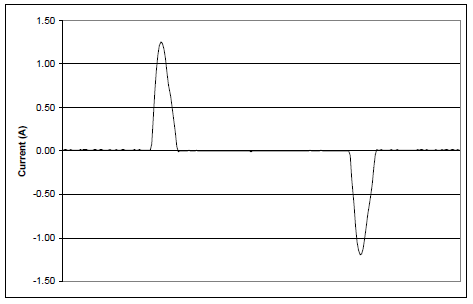
The CFL is a well known non-linear load [8] and [9]. In [8] it is shown that there can be significant differences in the performance of CFLs depending on the front end input circuitry. With a view to examine the differences in CFL performance, three types are examined here. These CFLs are representative of the range of lamps available. Two of the types are widely available models. The third type is known as a high power factor CFL and contains components designed to improve the harmonic content of the input current, that is, to correct the true power factor. Fig 5 shows the input current waveforms for the three CFLs tested. It can be seen that there is significant variation in the input current waveforms across the three CFL samples. The high power factor CFL, i.e. sample 3 in Fig. 5, is seen to have a more sinusoidal input current than the other two CFLs that are characterised by extremely peaky input current waveforms. It is also of note that the CFL input current waveform is quite different to that of the simple SMPS current waveform as shown in Fig 1.
Fig. 5. CFL Input Current Waveforms
The waveforms shown in Fig 5 for CFL samples 1 and 2 indicate that their input current waveforms are rich in harmonics. The harmonic spectrum for each of the 3 CFLs tested is shown in Fig 6. Only odd order harmonics are shown as even order harmonic components were found to be negligible.
Fig. 6. CFL Input Current Harmonic Spectra
Fig 6 shows that CFL Samples 1 and 2 are characterised by relatively large low order harmonic components. Of particular interest is the current harmonic spectrum of CFL sample 1 which shows significant harmonic current harmonic components up to the 49th (the limit of measurement). This is highly atypical of the harmonic spectra of equipment supplied by a SMPS and indicates that some CFL types may have unexpected harmonic behaviour not exhibited by other domestic loads.
B. Televisions (TVs)
Television (TV) technology has undergone significant changes over the past ten years with the traditional CRT TV making way for newer technologies such as plasma and LCD. These new technologies have provided the capability for much larger screen sizes but at the expense of higher power demand. Three TV technologies, i.e. CRT, plasma and LCD have been examined. The input current waveforms for these devices are shown in Fig 7.
Fig. 7. TV Input Current Waveform
Studies such as [10] have shown that TV load can be attributed to significant harmonic levels on distribution networks. With the increased power rating of modern TVs it has been assumed that harmonic current levels would also be higher than seen for CRT TVs. However, the waveforms shown in Fig 7 indicate that this may not be the case. The waveforms for the plasma and LCD TVs are considerably more sinusoidal than that of the CRT TV. Fig 8, which shows the harmonic spectra of the TVs tested, clearly indicates that the newer TV technologies (Plasma and LCD) lead to considerably smaller harmonic current components than the CRT TV in spite of their higher power demand.
Fig. 8.TV Input Current Harmonic Spectra
C. Inverter Air Conditioner
First generation inverter air conditioners have been observed to be highly non-linear loads. When these air conditioners were introduced, there were serious concerns regarding the impact of these devices on distribution network harmonic levels [11]. First generation inverter air conditioners displayed current waveforms and harmonic components typical of a SMPS. However, the air conditioner power demand is likely to be much greater than that of any other electronic device in the domestic load and hence leading to concerns on large current harmonic components.
A 3.3 kW inverter air conditioner from a large international manufacturer has been examined. The nearly sinusoidal input current waveform for this device is shown in Fig 9. This is surprising given the peaky and harmonic rich waveforms of older style inverter air conditioners. This indicates that manufacturers of modern air conditioners have developed input circuitry which mitigates the input current distortion of first generation air conditioners.
Fig. 9.Inverter Air Conditioner Input Current Waveform
D. Personal Computer (PC)
Penetration levels of personal computers (PCs) in domestic residences has grown from negligible levels in 1994 [12] to 87% in 2008 [13]. The PC examined here is a desktop Pentium 4, 2.4 GHz Intel processor model. Fig 10 shows the input current waveform for the PC. The waveform is characteristic of a basic SMPS. Fig 11 which shows the current harmonic spectrum of the PC for odd order harmonics also displays harmonic components characteristics of the traditional SMPS. It can be seen that significant levels of harmonic current are observed for harmonic orders up to the 23rd, however, unlike the CFL, harmonic components are negligible beyond this point.
Fig. 10. PC Input Current Waveform
Fig. 11.PC Input Current Harmonic Spectrum
Monitors for PCs are now almost exclusively LCD types as opposed to CRT. The monitor tested here is a 17 inch model manufactured by an international supplier. The input current waveform and harmonic spectrum as shown in Figs 12 and 13 respectively indicate that the LCD monitor has characteristics similar to the personal computer and characteristics of a simple SMPS.
Fig. 12. 17 inch LCD Monitor Input Current Waveform
Fig. 13.LCD Monitor Input Current Harmonic Spectrum
F. DVD Player
The DVD player tested showed an input current waveform and input current harmonic spectrum similar to that observed for the LCD monitor and characteristic of a SMPS. As the results are similar to those seen for the personal computer and LCD monitor, graphs of input current waveform and harmonic spectrum are not shown here.
V. IMPACT OF VARIATION OF INPUT VOLTAGE
The impact of variations in the input voltage on the input currents of each of the appliances tested is examined in this section. Understanding the implications of variation to the input current of appliance due to changes in the input voltage is essential for complete understanding of the manner in which appliances may impact on the electricity distribution system. An accurate understanding of appliance behaviour under changing input voltage conditions is also essential if accurate appliance models are to be developed for simulation.
Four tests have been designed to assess the impact of variations in input voltage on appliance input current behaviour. The first two tests examine appliance behaviour at the upper and lower limits of the Australian low voltage range. The first of these tests involved supplying the appliances at 253 V RMS which is at the upper limit of the range and the second involved supplying the appliances with 207 V RMS which is at the lower limit of the range. The remaining tests involved supplying the appliances with distorted input voltages.
In order to easily identify the difference between values obtained for each test and the results obtained using the undistorted nominal value (230 V RMS), the data in each table in this section of the paper is expressed as a percentage of the values obtained when the nominal voltage was applied. For example, a value of 100% means that the value obtained for the test was equal to the value obtained when the appliance was supplied with an undistiorted voltage of 230V RMS.
A. Impact of Varying Input Voltage Magnitude
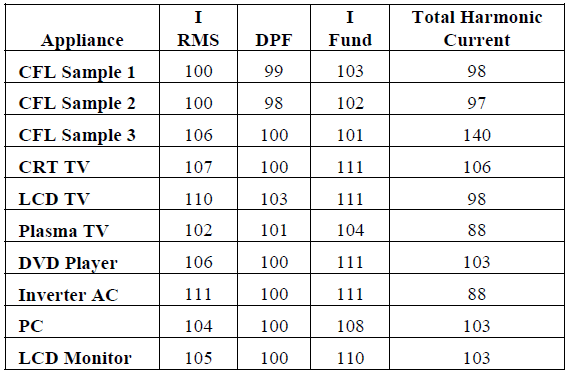
Table 2 shows the results of the first test (supply at 253 V RMS) for RMS current (I RMS), displacement power factor (DPF), fundamental current (I Fund) and the total harmonic current.
TABLE 2: VARIATION IN I RMS, DPF, I FUND AND TOTAL HARMONIC CURRENT -253 V RMS INPUT VOLTAGE
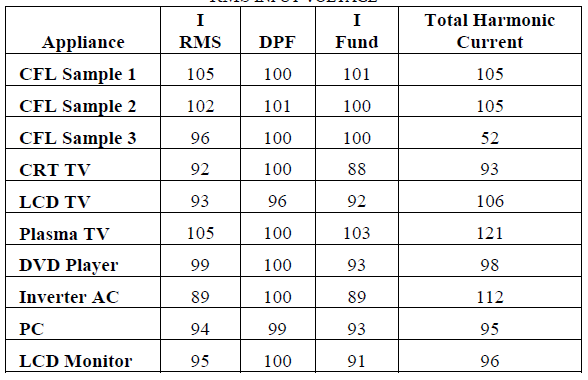
Table 3 shows the same data as in Table 2 for the second voltage magnitude test (supply at 207 V RMS).
TABLE 3: VARIATION IN I RMS, DPF, I FUND AND TOTAL HARMONIC – 207 V RMS INPUT VOLTAGE
The data in Tables 2 and 3 indicate that the behaviour of the RMS current, displacement power factor and fundamental current is relatively insensitive to changes in the supply voltage magnitude. Results for total harmonic current are more varied. CFL Sample 3, the plasma TV and the inverter air conditioner show considerable variation in total harmonic current for one or both of the voltage magnitude tests. It is notable that the CFL, plasma TV and air conditioner appear to have electronics on the input which aim to mitigate current waveform distortion. It may be postulated that these circuits are more sensitive to changes in input supply voltage than more simple devices such as the SMPS of the PC.
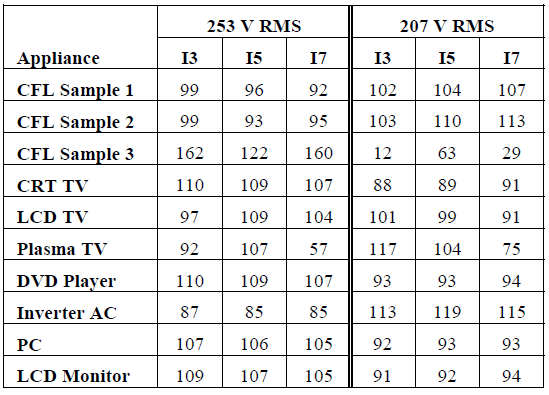
An examination has also been made of the impact of varying the input voltage magnitude on selected individual harmonic current orders. For the purposes of this study, the harmonic orders investigated are 3rd, 5th and 7th which are the dominant harmonic orders which prevail in low voltage networks. The results of this investigation are shown in Table 4.
TABLE 4: VARIATION IN INDIVIDUAL CURRENT HARMONIC ORDERS – 253 AND 207 V RMS INPUT VOLTAGE
Table 4 shows that there is considerably more variation in individual harmonic current components than was observed for the current parameters shown in Table 4. Those appliances which showed the greatest variation in total harmonic current are also seen to have the most extreme variation in individual harmonic current components. The foremost of these is CFL Sample 3 where low order current harmonic behaviour shows extreme sensitivity to the input voltage magnitude.
B. Impact of Varying Input Voltage Distortion Level
Two tests were performed to asses the impact of distorted input voltages on the input current of the appliances. These tests involved the application of the two harmonic test waveforms described in Section III. The fundamental voltage applied for both waveforms was 230 V. Tables 5 and 6 illustrate the values of a range of basic parameters for the 2 voltage distortion tests.
TABLE 5: VARIATION IN I RMS, DPF, I FUND AND TOTAL HARMONIC CURRENT – HARMONIC TEST WAVEFORM 1
Table 5 indicates that there is little variation in the displacement power factor and fundamental current when the appliances are supplied with harmonic test waveform 1. However, there is considerable variation seen for RMS current and total harmonic current. Further, the variations seen here are much greater than those observed in the previous section where input voltage magnitude was varied. This indicates that appliance behaviour is more sensitive to changes in input voltage distortion as opposed to changes in input voltage magnitude.
TABLE 6: VARIATION IN I RMS, DPF, I FUND AND TOTAL HARMONIC CURRENT – HARMONIC TEST WAVEFORM 2
Similar results are observed in Table 6 to those seen in Table 5. Variation in displacement power factor and fundamental current is modest, however, variations in RMS current and total harmonic current are significant.
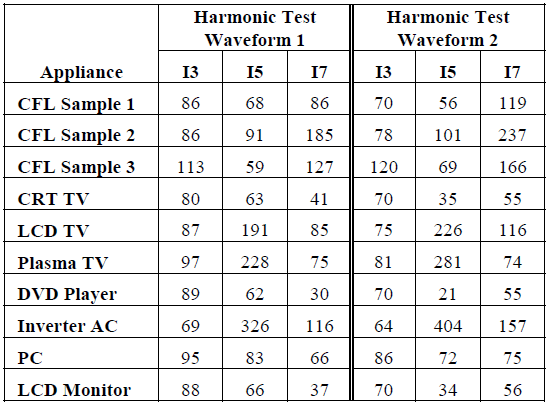
Table 7 shows the variation in low order individual harmonic current orders when harmonic test waveforms 1 and 2 are used to supply the appliances. It can be seen that there is considerable variation in all harmonic orders for most appliances.
TABLE 7: VARIATION IN INDIVIDUAL CURRENT HARMONIC ORDERS – HARMONIC TEST WAVEFORM1 AND 2
VI. CONCLUSIONS
This paper has presented typical supply current waveforms for a number of modern domestic appliances. It has also examined the impact of variations in supply voltage have on the input current behaviour of a range of modern domestic appliances. In practice it is unlikely that appliances connected to electricity networks will be supplied at undistorted nominal voltage levels. Understanding how appliances behave when subjected to input voltages which are realistic is essential for understanding the behaviour of devices connected to the electricity network for the purposes of network planning, modelling and analysis.
The investigations undertaken in this paper indicate that the basic input current characteristics of the appliances tested are relatively insensitive to changes in the magnitude of an undistorted supply voltage. Variation of low order individual harmonics between the nominal voltage case and a raised or lowered voltage case were found to be significantly larger than basic quantities such as RMS current or fundamental current. However, for most appliances, the variation was relatively small.
Investigations completed using distorted input voltages indicated that the input current characteristics of most devices were highly sensitive to distortion in the input voltage. Harmonic distortion on the input voltage was found to have a much greater impact on the input current of each appliance than was the case for changes in undistorted supply voltage magnitude.
VII. REFERENCES
[1] Roger C. Dugan, Mark F. McGranaghan, Surya Santoso, H. Wayne Beaty, “Electrical Power Systems Quality”, Second Ed, McGraw-Hill, NY, 2003 [2] A. Mansoor, W. M. Grady, R. S. Thallam, M. T. Doyle, S. D. Krein, M. J. Samotyj, “Effect of Supply Voltage Harmonics on the Input Current of Single-Phase Diode Bridge Rectifier Loads”, IEEE Transactions on Power Delivery, Vol. 10, No. 3, July 1995, Page(s): 1416 – 1422 [3] Michael J. Ouellette, Réjean Arseneau, “The Effects of Undervoltage on the Performance of Compact Fluorescent Systems”, IEEE Industry Applications Society Annual Meeting, 4 – 9 Oct 1992, Vol.2 Page(s):1872 – 1879 [4] Sean Elphick, Phil Ciufo, Sarath Perera, “Supply Current Characteristics of Modern Domestic Loads”, Proc. AUPEC 09, 27th – 30th September 2009, Adelaide, Australia, Paper PP086 [5] Matthew Rylander, W. Mack Grady, and Martin Narendorf, Jr., “Experimental Apparatus, Testing Results, and Interpretation of the Impact of Voltage Distortion on the Current Distortion of Typical Single-Phase Loads”, IEEE Transactions on Power Delivery, Vol. 24, No. 2, April 2009, Page(s): 844 – 851 [6] IEC61000-4-30, “Electromagnetic Compatibility (EMC) –Part 4-30: Testing and Measurement Techniques – Power Quality Measurement Methods, IEC Standard, 2003. [7] Australian Long Term Power Quality Survey Reports, Confidential reports to participants, 2002 – 2010 [8] Neville R. Watson, Tas Scott and Stephen Hirsch, “Compact Fluorescent Lamps (CFL) – Implications for Distribution Networks”, 83rd Annual EESA Conference and Exhibition, Electricity 2007, Melbourne, Australia, 15 – 17 Aug 2007 [9] M. H. Sadek, A. A. Abbas, M. A. El-Sharkawy, Hussein M. Mashaly, “Impact of Using Compact Fluorescent Lamps on Power Quality”, ICEEC ’04, International Conference on Electrical, Electronic and Computer Engineering, 5-7 Sept. 2004 Page(s):941 – 946 [10] N. Browne, S. Perera, P. F. Ribeiro, “Harmonic Levels and Television Events”, 2007 IEEE Power Engineering Society General Meeting, 24-28 June 2007, Page(s):1 – 6 [11] D. Essah, E. Feiste, R. O’Connell, R. G. Hoft, G. Brownfield, “Harmonic Effects of Variable Speed Air Conditioners on a Single-Phase Lateral and on the Distribution Feeders in a Typical Power System I”, 9th Annual Applied Power Electronic Conference and Exposition, APEC’94, 13-17 Feb, 1994, vol.2, Page(s):622 – 627 [12] “Australian Social Trends”, Australian Bureau of Statistics, Document 4102.0, 2006, Page(s) 191 – 195 [13] “Energy Use in the Australian Residential Sector 1986 – 2020”, Australian Government Department of the Environment, Water, Heritage and the Arts, 2008
VIII. BIOGRAPHIES
Sean Elphick graduated from the University of Wollongong with a BE (Elec)(Hons) degree in 2002. He commenced employment with the Integral Energy Power Quality Centre in 2003. Initially employed to work on a Strategic Partnerships with Industry – Research and Training Scheme (SPIRT) project dealing with power quality monitoring and reporting techniques. His current activities include delivery of the Long Term National Power Quality Survey, a first of its type in Australia as well as various other power quality related research and consulting projects.
Philip Ciufo (M’1990, SM’2007) graduated from the University of Wollongong with a B.E. (Hons) in Electrical Engineering in 1990 whilst also completing an Industry Cadetship. In 1991 he joined the University as Research Associate where he worked on several research projects and provided engineering support to many of the research programs within the School of Electrical Computer and Telecommunications Engineering. He obtained an M.E. (Hons) in Electrical Engineering 1993. He joined the academic staff of the University after completing his Ph.D. in 2002. The title of his thesis was “Magnetic Modelling and Sensorless Control of the Synchronous Reluctance Machine”. Dr Ciufo has had various stints in industry as an Electrical Engineer and returned to academia in 2007. His research interests include Modelling and Analysis of Power Distribution Systems, Distribution Automation, Modelling and Analysis of ac Machines, Power System Harmonics and Power System Reliability.
Sarath Perera (M’1995) received the B.Sc.(Eng.) degree in power from the University of Moratuwa, Sri Lanka, in 1974, the M.Eng.Sc. degree from the University of New South Wales in 1978, and the Ph.D. degree from the University of Wollongong in 1988. He was a Lecturer for twelve years with the University of Moratuwa. Currently he is an Associate Professor with the University of Wollongong and is the Technical Director of the Integral Energy Power Quality and Reliability Centre. His research interests are in power quality.
Reza Arghandeh & Alexandra von Meier, Member IEEE, CIEE, EECS Dept, University of California, Berkeley, Berkeley, CA, USA. Email: arghandeh@berkeley.ed
Robert Broadwater, Senior Member IEEE, ECE Dept Virginia Tech, Blacksburg, VA, USA
Abstract — This paper analyzes impacts and interactions of harmonics from multiple sources, especially distributed energy resources, on distribution networks. We propose a new index, the Phasor Harmonic Index (PHI), that considers both harmonic source magnitude and phase angle, while other commonly used harmonic indices are based solely on magnitude of waveforms. The use of such an index becomes feasible and practical through emerging monitoring technologies like micro-Synchrophasors in distribution networks that help measure and visualize voltage and current phase angles along with their magnitudes. A very detailed model of a distribution network is also needed for the harmonic interaction assessment in this paper.
Index Terms— Distribution Networks, Distributed Renewable Resources, Harmonics, Power Quality, Synchrophasor.
Nomenclatures—
Vh
Voltage magnitude for frequency order h
Ih
Current magnitude for frequency order h
VTotal
Total value for voltage magnitude
ITotal
Total value for current magnitude
VhPh
Phasor form of voltage for frequency order h
IhPh
Phasor form of current for frequency order h
θh
Harmonic current phase angle
φh
Harmonic voltage phase angle
h
Harmonic frequency order
IhP
In-phase current for frequency order h
IhQ
In-quadrature current for frequency order h
VhP
In-phase voltage for frequency order h
VhQ
In-quadrature voltage for frequency order h
THDV
Voltage Total Harmonic Distortion
THDI
Current Total Harmonic Distortion
PHI-V
Phasor Harmonics Index- Voltage
PHI-I
Phasor Harmonics Index – Current
I. INTRODUCTION
Harmonics originating from increasingly prevalent nonlinear, power electronic-based loads as well as inverters associated with distributed energy resources (DER) create concerns for distribution network operators. Such harmonics (i.e., multiples of the 50- or 60-Hz fundamental a.c. frequency) can propagate and distort voltage and current waveforms in different parts of distribution networks, resulting in undesirable heating and energy losses (and potentially equipment malfunctions). Harmonics generated by different sources can also interact to either increase or decrease the effects of harmonics, not unlike the familiar constructive or destructive interference of propagating waves[1].
In general, the harmonic impact on power systems is a well researched topic. Harmonic measurement and filtering in power systems are discussed in [2]. However, existing research mostly considers harmonics as a local phenomenon with local effects [3]. Some papers focus on DER harmonics [4, 5], and some specifically on harmonic filter design for DER units [6, 7]. However, the proposed solutions are local approaches for controlling each inverter. Less literature investigates the impact of harmonic propagation in distribution networks. Harmonic distortion in different distribution transformer types is analyzed in [8], and [9] conducts a sensitivity analysis to find vulnerable buses in distribution networks. However, the authors use the Thévenin equivalent model at each bus instead of the full topological model of the circuit. The impact of aggregated harmonics from DER units in distribution networks is shown in [10], but using single-phase equivalent line models without considering multi-phase line models.
This paper investigates a phasor-based harmonic assessment method to understand the interactions of multiple harmonic sources. The analysis benefits from the detailed imbalanced and asymmetrical distribution network model employed. This model has large numbers of single phase, and multi-phase loads for more realistic harmonic propagation simulations, a level of detail not addressed in the previous harmonic analysis literature. Thus, we can effectively study how DER inverters or other sources may interact to either decrease or increase harmonic distortion throughout the distribution network.
In terms of harmonic distortion quantization, the Total Harmonic Distortion (THD) is the most common index in standards and literature [11, 12]. However, THD is based only on the magnitude of the distorted waveforms. In this paper a new index is proposed called the Phasor Harmonic Index (PHI). The PHI incorporates both magnitude and phase angle information in evaluating distorted waveforms resulting from the phasor-based interaction of multiple harmonic sources. The phasor-based harmonic assessment in this paper is inspired by the micro-Synchrophasor (μPMU) measurement technology in whose development two of the authors are involved [13, 14]. The μPMU is the GPS enabled time synchronized phasor measurement devices that can measure voltage and current signals till 50th harmonic order.
The paper is organized as follows: Section 2 discusses harmonics assessment framework; Section 3 presents simulations and results, and Section 4 offers concluding remarks.
II. HARMONIC ASSESSMENT FRAMEWORK
A. Integrated System Model for Distribution Networks
An Integrated System Model (ISM) is used for distribution network harmonic analysis. Geographical information, component characteristics, load measurements, and supply measurements are included in the model [15, 16]. The ISM model offers a graph-based, edge-edge topology iterator framework that facilitates fast computation times for power flow and other calculations on the large scale networks [17]. The [18] provides further explanation about ISM modeling.
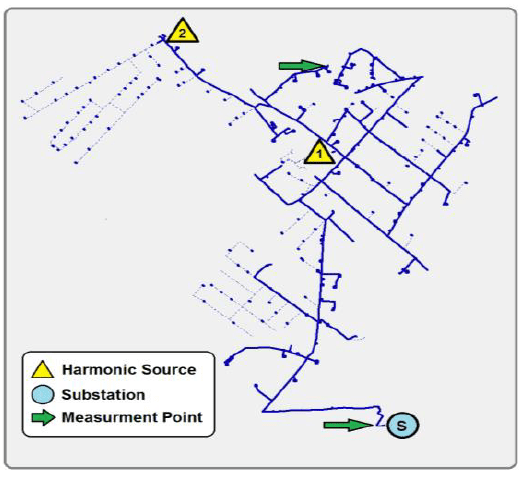
This analysis employs an actual circuit model, as shown in Figure 1. The circuit is 13.2 kV with 329 residential and commercial customers. The model contains unbalanced, single phase and multi-phase loads, and includes distribution transformers and secondary distribution. The two harmonic sources studied are indicated with triangular symbols. The harmonic calculations are presented at two points indicated by arrows in Figure 1. The first point is the substation, and the second point is at the secondary of a distribution transformer located between the two harmonic sources.
B. Metrics for Vectorial Harmonics Assessments
The summation of harmonic components results in distorted current and voltage waveforms. The most common index used for measuring harmonics in standards and literature is Total Harmonic Distortion (THD) [12]. THD includes the contribution of the magnitude of each harmonic component as given by
where THDI and THDV are THD values for current and voltage, respectively. I1 and V1 are the current and voltage rms values for the fundamental frequency. The definition of THD is addressed in IEEE-519, IEEE-1547, IEC-610000, and EN50160 and other standards for power quality [19, 20].
In some standards, the conventional definition of power factor is modified to account for the contribution of higher frequencies [12], which tend to contribute to total current and thus apparent power, but not to the net transfer of average (real) power. This modified power factor, which no longer assumes a sinusoidal waveform, is called Total Power factor (TPF).
Equation (3) shows the relationship between TPF and THD [21]:
where δ1 is the angle between voltage and current at the fundamental frequency. Note that the THD indices are based solely on the magnitude of harmonic components, and the only phase angle difference considered is that between the fundamental voltage and current vectors.
Figure 1.Distribution Network ISM model for Harmonic Assessment.
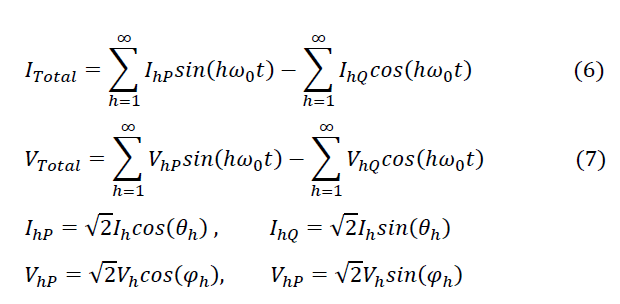
Thus the most common indices for harmonic analysis do not account for the phase angles of the harmonic components in harmonic distortion assessment. However, the phase angle of the harmonic waveforms do have an impact on the total distorted current or voltage waveforms. To help quantify the distortion caused by multiple harmonic source interactions, there is a need to consider phase angles of current and voltage waveforms for all frequency orders. The orthogonal form of sinusoidal voltage and current waveforms can be written as:
In (6) and (7), total current and voltage are separated into two in-phase and in-quadrature components. This waveform separation method is similar to some apparent power calculation methods for nonsinusoidal apparent power calculation in [22]. Equations (4) and (5) are rewritten as follows:
The terms IhP and VhP are called in-phase current and voltage components; IhQ and VhQ are called in-quadrature current and voltage components. In some references, in-phase components are called active and in-quadrature components are called non-active components [23].
In this paper, with help of equations (6) and (7), the Phasor Harmonic Index (PHI) is proposed. The PHI is obtained by dividing the summation of in-phase harmonic components by the algebraic sum of harmonic waveform magnitudes as follows:
where PHI-I and PHI-V are Phasor Harmonics Index for current and voltage waveforms, respectively.
The harmonic assessment algorithm first uses power flow analysis to calculate the fundamental voltage and current waveforms. Then, the circuit is modified to represent the next higher frequency to be analyzed. The circuit modifications involve revising the network component impedances and the harmonic current injections for the harmonic order to be analyzed. Next the power flow runs to determine the harmonic current and voltage emissions in the circuit for the given harmonic order. This type of analysis is continued until all harmonic orders to be analyzed are completed.
Harmonics are affected by configuration, impedance, and loading of conductors, transformers, and other circuit components[24]. Figure 2 illustrates the flow of the harmonic assessment algorithm. The “Power Flow Data Storage” stores fundamental and higher order harmonic power flow results that are used to calculate harmonic assessment indices. In the work here, hmax is 11 and only the odd harmonic orders are taken into account, since these typically dominate.
III. SIMULATIONS AND HARMONICS ANALYSES
A. Assumptions
The research objective is the study of harmonic impacts, apart from whatever technology created the harmonic source. We consider two 3-phase harmonic sources in the distribution network, with equal magnitude on all phases. The harmonic magnitudes are based on test data from actual DER inverters in the field as shown in Table I [15]. The dominant current and voltage harmonic observed through the simulation are of the 3rd, 5th, 7th, 9th and 11th orders. Harmonics of higher orders are neglected due to their small values.
TABLE I.HARMONIC SOURCE MAGNITUDES FROM FIELD TEST DATA [21]
Frq Order
3rd
5th
7th
9th
11th
Current (p.u %)
2.83
0.52
0.84
0.21
0.03
B. Phase Angle Impacts on Harmonic Interactions
In systems with multiple harmonic sources, the harmonic distortion interactions are impacted by the vectorial characteristics of the injected harmonic currents. The impact of each harmonic source’s phase angle is investigated in this section. For sensitivity analysis purposes, harmonic source phase angles vary as follows: (0°, 15°, 30°, 45°, 60°, 75°, 90°). These angle steps are added to the phase angle sequences for each frequency order [12]. When varying the phase angles of the harmonic sources, the magnitudes of both harmonic sources are maintained as given in Table I.
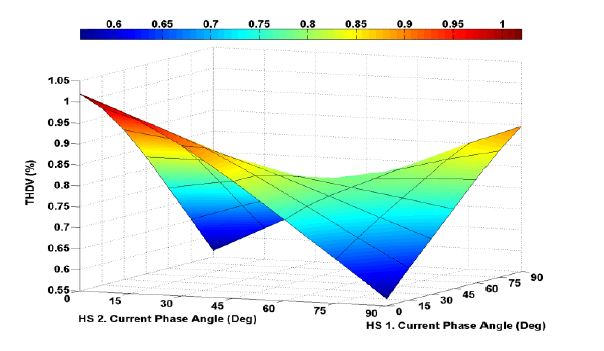
Figure 3.THDV for phase B as a function of harmonic source 1 (HS1) and harmonic source 2 (HS2) phase angles at substation
We begin by considering the THDV at the substation, obtained by vector summation of harmonic contributions from the two sources, on a single phase (say, B). Figure 3 illustrates THDV at the substation for different combinations of harmonic phase angles at their sources. The THDV surface shapes are similar to the hyperbolic geometrical functions. In this case, the extreme points for three phases occur in 0º, 45º, and 90º phase angles for each harmonic source. Figures 4 shows the analogous THDI surfaces for current in phase B at the substation against phase angles variation over both harmonic sources. There are two near zero points, the harmonic sources cancel out each other and cause the minimum current harmonic distortion, (90º, 0º) and (0º , 90º). This possibility of cancellation is an important observation for multi-source harmonic analysis.
Figure 4.THDI for phase B as a function of harmonic source 1 (HS1) and harmonic source 2 (HS2) phase angles at substation
Figure 5.PHI-V for phase B as a function of harmonic source 1 (HS1) and harmonic source 2 (HS2) phase angles at substation
The presented THD sensitivity analysis shows the harmonic sources’ critical angles for voltage and current distortion. However, the difference of THD trajectory for voltage and current make it difficult to find the most critical phase angles for harmonic distortion in substations. Figure 5 shows the proposed Index of PHI-V as defined in (9). Because of the contribution of the phase angle in the PHI numerator, PHI contains more information than THD. The PHI values are smaller or equal to 1, because of the “Triangle Inequality” property in a vector space.
C. Mutual Coupling Impact and Phasor-Based Harmonics
In this section, harmonic sources attached to one phase are analyzed to determine their impact on other phases. The single phase harmonic sources are located at the same place as the three-phase harmonic, and THDV and THDI are again calculated at the substation. With harmonic current injections in only one phase, THDV and THDI indices for the other phases are almost zero. However, mutual couplings do cause distortion in coupled voltage and current waveforms, but these are not reflected in the THDV and THDI indices. The PHI-I index does provide non-zero harmonic distortion values for coupled phases. In Figure 6, the PHI-I values for different phase angles (0° to 90°) of both harmonic sources are classified as a data set presented in the form of a box plot. The box plots show minimum, maximum, mean, and median values of PHI-I calculated for all phases caused by injected harmonics on phase B.
Figure 6.Box plot for PHI-I values with different harmonic source phase angles for the harmonic source injections in only phase B.
These types of sensitivity analyses are not possible with THDV and THDI indices because of the extremely small values of THD in the coupled phases that do not contain the harmonic source.
D. Phasor-Based Harmonics at Customer Level
To demonstrate the harmonic distortion at different locations on the circuit, harmonic calculations are conducted at a customer load (on the secondary side of a distribution transformer). The customer side measurement point is located between the harmonic sources, as illustrated in Figure 1.
Figure 7.THDV substation vs. customer load point for phase A
Figure 7 compares THDV values at the substation and at the customer load, and Figure 8 presents the THDI values at the substation and at the customer load. It shows the substation experiences more distortion in current than the customer load, while the customer load is exposed to higher harmonic voltage distortion. This result can be understood by considering comparative impedances. Since the impedance looking back into the substation is much smaller than the customer load impedance, a higher portion of harmonic currents flow to the substation than to the customer site. Therefore, the substation has more THDI. The voltage distortion, however, is larger at the customer load. Voltage is the product of impedance and current. The customer load impedance is much larger than the impedance of the path to the substation. The current through the load side is less, but the product of current and impedance for the customer side is higher than for the substation side. Therefore, more voltage distortion is realized at the customer side.
Figure 8.THDI substation vs. customer load point for phase A
IV. CONCLUSIONS AND REMARKS
This paper investigates a phasor-based method for assessing interactions of multiple harmonic sources in distribution systems. We offer the following observations and conclusions:
1) The new proposed Phasor Harmonic Index, PHI, incorporates more information than the commonly used THDV and THDI indices. PHI considers the phase angles of the distorted voltage and current waveforms in quantifying harmonic content, because phase angle plays a significant role in the interactions between harmonic sources.
2) Phase angles of harmonic sources have complex impacts on the overall harmonic distortion. In some cases, phase angle variations of different harmonic sources result in reduced harmonic impacts. However, phase angle variations that increase harmonic distortion need to be understood.
3) THDV and THDI values are not designed to assess the impact of a single-phase harmonic source on other phases. However, the mutual coupling creates harmonic propagation in all phases. The proposed PHI-I index is helpful in quantifying harmonic distortion in all phases with single-phase harmonic sources present.
4) Harmonic impacts on customer loads and at the substation are evaluated and compared. THD observations show more current distortion at the substation, but more voltage distortion at the customer load. In harmonic studies and in harmonic measurements, harmonic values should be considered throughout the circuit.
REFERENCES
[1] R. Arghandeh, A. Onen, J. Jung, and R. P. Broadwater, “Harmonic interactions of multiple distributed energy resources in power distribution networks,” Electric Power Systems Research, vol. 105, pp. 124-133, 12// 2013. [2] A. Marzoughi, H. Imaneini, and A. Moeini, “An optimal selective harmonic mitigation technique for high power converters,” International Journal of Electrical Power & Energy Systems, vol. 49, pp. 34-39, 2013. [3] D. Salles, J. Chen, W. Xu, W. Freitas, and H. E. Mazin, “Assessing the Collective Harmonic Impact of Modern Residential Loads—Part I: Methodology,” Power Delivery, IEEE Transactions on, vol. 27, pp. 1937-1946, 2012. [4] M. Farhoodnea, A. Mohamed, and H. Shareef, “A new method for determining multiple harmonic source locations in a power distribution system,” in Power and Energy (PECon), 2010 IEEE International Conference on, 2010, pp. 146-150. [5] H. E. Mazin, X. Wilsun, and H. Biao, “Determining the Harmonic Impacts of Multiple Harmonic-Producing Loads,” Power Delivery, IEEE Transactions on, vol. 26, pp. 1187-1195, 2011. [6] X. Wang, F. Blaabjerg, and Z. Chen, “Synthesis of Variable Harmonic Impedance in Inverter-Interfaced Distributed Generation Unit for Harmonic Damping Throughout a Distribution Network,” Industry Applications, IEEE Transactions on, vol. 48, pp. 1407-1417, 2012. [7] P. HESKES and J. DUARTE, “Harmonic reduction as ancillary service by inverters for distributed energy resources (DER) in electricity distribution networks,” in Proc. CIRED, 2007, pp. 1-4. [8] A. Mansoor, “Lower order harmonic cancellation: impact of low voltage network topology,” in Power Engineering Society 1999 Winter Meeting, IEEE, 1999, pp. 1106-1109 vol.2. [9] A. Mau Teng and V. M. Jovica, “Planning Approaches for the Strategic Placement of Passive Harmonic Filters in Radial Distribution Networks,” Power Delivery, IEEE Transactions on, vol. 22, pp. 347-353, 2007. [10] J. H. R. Enslin and P. J. M. Heskes, “Harmonic interaction between a large number of distributed power inverters and the distribution network,” Power Electronics, IEEE Transactions on, vol. 19, pp. 1586-1593, 2004. [11] “IEEE Recommended Practices and Requirements for Harmonic Control in Electrical Power Systems,” IEEE Std 519-1992, p. 0_1, 1993. [12] F. C. De La Rosa, Harmonics And Power Systems: CRC Press INC, 2006. [13] A. von Meier, D. Culler, A. McEachen, and R. Arghandeh, “Micro- Synchrophasors for Distribution Systems,” in 5th IEEE Innovative Smart Grid Technologies Conference (ISGT2014), 2014, pp. 1-5. [14] A. von Meier and R. Arghandeh, “Chapter 34 – Every Moment Counts: Synchrophasors for Distribution Networks with Variable Resources,” in Renewable Energy Integration, L. E. Jones, Ed., ed Boston: Academic Press, 2014, pp. 429-438. [15] R. Arghandeh and R. Broadwater, “Distributed Energy Storage Control for Optimal Adoption of Solar Energy in Residential Networks,” in American Society of Mechanical Engineers Power Conference 2012, (ASME Power2012), Anaheim, CA, USA, 2012, p. 8. [16] J. Jung, Y. Cho, D. Cheng, A. Onen, R. Arghandeh, M. Dilek, et al., “Monte Carlo analysis of Plug-in Hybrid Vehicles and Distributed Energy Resource growth with residential energy storage in Michigan,” Applied Energy, vol. 108, pp. 218-235, 2013. [17] D. Cheng, D. Zhu, R. P. Broadwater, and S. Lee, “A graph trace based reliability analysis of electric power systems with timevarying loads and dependent failures,” Electric Power Systems Research, vol. 79, pp. 1321-1328, 2009. [18] A. Onen, D. Cheng, R. Arghandeh, J. Jung, J. Woyak, M. Dilek, et al., “Smart Model Based Coordinated Control Based on Feeder Losses, Energy Consumption, and Voltage Violations,” Electric Power Components and Systems, vol. 41, pp. 1686-1696, 2013. [19] B. S. I. Staff, Guide for the Application of the European Standard En 50160: B S I Standards, 2004. [20] I. E. Commission, IEC 61000-3-6: Electromagnetic compatibility (EMC) – limits – assessment of emission limits for distorting loads in MV and HV power systems – basic EMC publication, 1996. [21] L. Cividino, “Power factor, harmonic distortion; causes, effects and considerations,” in Telecommunications Energy Conference, 1992. INTELEC ’92., 14th International, 1992, pp. 506-513. [22] A. E. Emanuel, “Powers in nonsinusoidal situations-a review of definitions and physical meaning,” Power Delivery, IEEE Transactions on, vol. 5, pp. 1377-1389, 1990. [23] A. E. Emanuel, Power definitions and the physical mechanism of power flow vol. 22: Wiley-IEEE Press, 2011. Figure 8. THDI substation vs. customer load point for phase A [24] R. Arghandeh, A. Onen, J. Jung, D. Cheng, R. P. Broadwater, and V. Centeno, “Phasor-based assessment for harmonic sources in distribution networks,” Electric Power Systems Research, vol. 116, pp. 94-105, 11// 2014.
Published by Mark McGranaghan, Electrotek Concepts, Inc. Electrical Contractor Magazine, Power Quality for the Electrical Contractor Course
Introduction
Power quality has always been important. However, for many years the equation defining power quality was very simple:
POWER QUALITY = RELIABILITY
Customer loads were linear in nature. When a sinusoidal voltage was supplied to them, they drew a sinusoidal current. They typically fell into the categories of lighting, heating, and motors. In general, they were not very sensitive to momentary variations in the supply voltage, such as transients and voltage sags. The loads were not connected together in networks so grounding issues other than safety were not very critical. Two major changes in the characteristics of customer loads and systems have completely changed the nature of the power quality equation
1.The first is the sensitivity of the loads themselves. The devices and equipment being applied in industrial and commercial facilities are more sensitive to power quality variations than equipment applied in the past. New equipment includes microprocessor-based controls and power electronics devices that are sensitive to many types of disturbances besides actual interruptions. Controls can be affected by momentary voltage sags or relatively minor transient voltages, resulting in nuisance tripping or misoperation of an important process.
2. The second is the fact that these sensitive loads are interconnected in extensive networks and automated processes. This makes the whole system as sensitive as the most sensitive device and increases the problem by requiring a good zero potential ground reference for the entire system.
These changes in the load characteristics have created a growing market for power conditioning equipment that can protect the loads from the wide variety of power quality variations that can cause problems. In order to apply power conditioning equipment effectively, customers must become experts in the types of power quality variations, their causes, their possible impacts, and the solutions available to mitigate them. Since some of the causes are on the utility system, the utility must also understand the full range of these problems.
The power quality problems don’t always come from the utility system either. Most of the transient voltages in a facility are caused by switching operations within the facility. Wiring and grounding problems increase susceptibility to problems. Power electronics equipment, such as adjustable speed drives, result in a continuous string of transients (notching) as well as steady state harmonic distortion that can cause heating in other loads within the facility.
What are We Doing to Understand the Problems?
Understanding the problems associated with power quality variations is the first step towards developing standards and the optimum approach to solutions. Understanding means being able to relate the causes of power quality variations to impacts on equipment and processes within customer facilities. This requires an understanding of the utility power system, the customer electrical system, and the equipment characteristics.
There are a number of significant research efforts under way to help improve the understanding of power quality problems. There are three important categories for these investigations:
1.Monitoring. Utilities and customers are both doing more and more monitoring of power quality. This monitoring is being performed on the power system and within customer facilities. The Electric Power Research Institute (EPRI) is sponsoring a multi-year project to monitor power quality on distribution systems around the country with 24 host utilities (Figure 1). Some of these utilities are extending the monitoring to include customer facilities so that they can relate events and variations on the distribution system with problems in the customer plant.
Figure 1. Participants in the EPRI-Sponsored Distribution Power Quality Monitoring Project
2.Case Studies. Case studies are a way of characterizing power quality concerns for individual customers and systems. There are numerous case studies being performed by utilities, their customers, and EPRI. When the results of all these case studies are shared and combined, the results illustrate important general characteristics of power quality concerns for different kinds of customers and equipment. The solutions implemented in particular case studies can be patterns for more general solutions to power quality problems.
3.Analytical Tools. The results of monitoring efforts and case studies are being used to improve analytical models for simulating system disturbances. There are Users Groups for harmonic analysis and transient analysis that can provide guidance in evaluating problems and the range of possible solutions. The advantage of the simulation approach is that it allows evaluations of systems and conditions that may not yet actually exist (e.g. future expansion plans).
The Role of Standards
Power quality problems ultimately impact the end user. However, there are many other parties involved in creating, propagating, and solving power quality problems (Figure 2). Power quality standards must provide guidelines, recommendations, and limits to help assure compatibility between end use equipment and the system where it is applied. The standards affect all of the parties shown in Figure 2.
Figure 2. Players That Influence End-Use Power Quality
There is active interest in this country as well as the rest of the world to establish power quality standards to deal with these problems. The international standards development organization is the IEC. The IEC has defined a category of standards called Electromagnetic Compatibility (EMC) Standards that deal with power quality issues. They fall into the following six categories:
1.General. These provide definitions, terminology, etc. (IEC 1000-1-x)
2.Environment. Characteristics of the environment where equipment will be applied (1000-2-x).
3.Limits. Emission limits define the allowable levels of disturbances that can be caused by equipment connected to the power system. These standards were formerly the IEC 555 series but now are numbered 1000-3-x. For instance, IEC 555-2 has now become IEC 1000-3-2.
4.Testing and Measurement Techniques. These provide detailed guidelines for measurement equipment and test procedures to assure compliance with the other parts of the standards (1000-4-x).
5.Installation and Mitigation Guidelines. These are designed to provide guidance in application of equipment, such as filters, power conditioning equipment, surge suppressors, etc., to solve power quality problems (1000-5-x).
6.Generic and Product Standards. These will define immunity levels required for equipment in general categories or for specific types of equipment (1000-6-x). This is a very impressive breakdown and organization for power quality standards development. Unfortunately, very few of these standards have actually been written and those that have been drafted are controversial. For instance, it took almost ten years to get IEC 1000-2-2 (IEC 555-2) approved and there are still questions about when it will be implemented.
These IEC standards are generally adopted by the European Community (CENELEC) and become requirements for equipment sold in Europe. Their application in the rest of the world varies and very few of them are adopted outright in the United States.
Power Quality Standards in the US
In the United States, standards are developed by the IEEE, ANSI, and equipment manufacturer organizations, such as NEMA. We also have safety-related standards, like the National Electrical Code. We have very few standards that define requirements for specific equipment. Our standards tend to be more application oriented, like IEEE 519-1992, which provides recommendations to limit harmonic distortion levels on the overall power system.
IEEE has formed a Standards Coordinating Committee (SCC-22) that has the job of coordinating standards activities regarding power quality from all the different organizations doing development. Table 1 provides a listing of existing standards and standards under development related to power quality.
Table 1. Listing of Important Power Quality Standards
Organization
Std.
Title/Scope
ANSI/IEEE
141
Industrial Electric Power Systems
142
Industrial & Commercial Power System Grounding
241
Commercial Electric Power Systems
242
Industrial & Commercial Power System Protection
399
Industrial & Commercial Power System Analysis
446
Industrial & Commercial Power System Emergency Power
493
Industrial & Commercial Power System Reliability
518
Control of Noise in Electronic Controls
519
Harmonics in Power Systems
602
Industrial & Commercial Power Systems in Health Facilities
739
Energy Conservation in Industrial Power Systems
929
Interconnection Practices for Photovoltaic Systems
1001
Interfacing Dispersed Storage and Generation
1035
Test Procedures for Interconnecting Static Power Converters
1050
Grounding of Power Station Instrumentation & Control
ANSI
C62
Guides & Standards on Surge Protection
C84.1
Voltage Ratings for Power Systems & Equipment
C37
Guides and Standards for Relaying & Overcurrent Protection
C57.110
Transformer Derating for Supplying Nonlinear Loads
IEEE
P487
Wire Line Communication Protection in Power Stations
1100
Powering and Grounding Sensitive Equipment
P1159
Monitoring and Definition of Electric Power Quality
P1250
Guide on Equipment Sensitive to Momentary Voltage Disturbances
P1346
Guide on Compatibility for ASDs and Process Controllers
NEMA
UPS
Uninterruptible Power Supply Specification
NFPA
70
National Electric Code
75
Protection of Electronic Computer Data Processing Equipment
78
Lightning Protection Code for Buildings
NIST
94
Electric Power for ADP Installations
SP678
Overview of Power Quality and Sensitive Electrical Equipment
UL
1449
Standards for Safety of Transient Voltage Surge Suppressors
There has been a general fear on the part of the utility industry to create any standards that define the level of power quality required of the supply system. This fear is slowly being broken down as utilities realize the need to define the base level of power quality in order to be able to offer any kind of differentiated service for those customers that require a higher performance level.
It is worthwhile to look at the current state of standards development related to each important type of power quality problem.
Standards for Steady State Voltage Regulation and Unbalance
There is no such thing as steady state on the power system. Loads are continually changing and the power system is continually adjusting to these changes. All of these changes and adjustments result in voltage variations that are referred to as long duration voltage variations. These can be undervoltages or overvoltages, depending on the specific circuit conditions. Characteristics of the steady state voltage are best expressed with long duration profiles and statistics. Important characteristics include the voltage magnitude and unbalance. According to the latest draft of IEEE P1159, IEEE Recommended Practice for Monitoring Power Quality, long duration variations are considered to be present when the limits are exceeded for greater than 1 minute. Harmonic distortion is also a characteristic of the steady state voltage but this characteristic is treated separately because it does not involve variations in the fundamental frequency component of the voltage.
Figure 4.Example 24 hour voltage profile illustrating long duration voltage variations.
Most end use equipment is not very sensitive to these voltage variations, as long as they are within reasonable limits. ANSI C84.1-1989 specifies the steady state voltage tolerances expected on a power system. It recommends that equipment be designed to operate with acceptable performance under extreme steady state conditions of +6% and -13% of nominal 120/240 volt system voltage. Protective devices may operate to remove the equipment from service outside of this range. Figure 5 illustrates the major requirements of the standard. Two ranges of permissible voltages are provided. Range A is for normal conditions. Range B is for short duration or unusual system conditions. The service voltage is the voltage at the end user service entrance. The utilization voltage is the voltage at the actual end use equipment, allowing for voltage drop across facility wiring.
Figure 5.ANSI C84.1-1989 steady state voltage limits (Notes: (a) these shaded portions do not apply to circuits supplying lighting loads, (b) this shaded portion of the range does not apply to 120-600 volt system
The most recent version of this standard (1989) includes recommended limits for voltage unbalance on the power system. Unbalance is a steady state quantity defined as the maximum deviation from the average of the three phase voltages or currents, divided by the average of the three phase voltages or currents, expressed in percent. Unbalance can also be quantified using symmetrical components. The ratio of the negative sequence component to the positive sequence component is used to specify the percent unbalance.
The primary source of voltage unbalance less than two percent is unbalanced single phase loads on a three-phase circuit. Voltage unbalance can also be the result of capacitor bank anomalies, such as a blown fuse on one phase of a three-phase bank. Severe voltage unbalance (greater than 5%) can result from single-phasing conditions.
Voltage unbalance is most important for three phase motor loads. ANSI C84.1-1989 recommends that the maximum voltage unbalance measured at the meter under no load conditions should be 3%. Unbalance greater than this can result in significant motor heating and failure if there are not unbalance protection circuits to protect the motor.
Standards for Harmonics
Harmonic distortion of the voltage and current results from the operation of nonlinear loads and devices on the power system. The nonlinear loads that cause harmonics can often be represented as current sources of harmonics. The system voltage appears stiff to individual loads and the loads draw distorted current waveforms. Table 2 illustrates some example current waveforms for different types of nonlinear loads. The weighting factors indicated in the table are being proposed in the Guide for Applying Harmonic Limits on the Power System (Draft 2) for preliminary evaluation of harmonic producing loads in a facility.
Table 2.Example current waveforms for various nonlinear loads.
Harmonic voltage distortion results from the interaction of these harmonic currents with the system impedance. The harmonic standard, IEEE 519-1992, IEEE Recommended Practices and Requirements for Harmonic Control in Electrical Power Systems, has proposed two way responsibility for controlling harmonic levels on the power system. End users must limit the harmonic currents injected onto the power system. The power supplier will control the harmonic voltage distortion by making sure system resonant conditions do not cause excessive magnification of the harmonic levels.
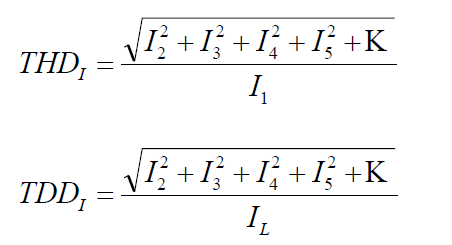
Harmonic distortion levels can be characterized by the complete harmonic spectrum with magnitudes and phase angles of each individual harmonic component. It is also common to use a single quantity, the Total Harmonic Distortion, as a measure of the magnitude of harmonic distortion. For currents, the distortion values must be referred to a constant base (e.g. the rated load current or demand current) rather than the fundamental component. This provides a constant reference while the fundamental can vary over a wide range.
Harmonic evaluations are often going to involve a combination of measurements and analysis (possibly simulations). It is important to understand that harmonics are a continuous phenomena, rather than a disturbance (like a transient). Because harmonics are continuous, they are best characterized by measurements over time so that the time variations (Figure 6) and the statistical characteristics (Figure 7) can be determined. These characteristics describing the harmonic variations over time should be determined along with snapshots of the actual waveforms and harmonic spectrums at particular operating points.
Figure 6. Harmonic variations with time.
Figure 7. Statistical representation of harmonic variations with time.
Harmonic Evaluations on the Utility System
Harmonic evaluations on the utility system involve procedures to make sure that the quality of the voltage supplied to all customers is acceptable. IEEE 519-1992 provides guidelines for acceptable levels of voltage distortion on the utility system (Table 3). Note that recommended limits are provided for the maximum individual harmonic component and for the Total Harmonic Distortion (THD).
Table 3. Recommended Voltage Distortion Limits for General Systems.
Bus Voltage
Maximum Individual Harmonic Component (%)
Maximum THD (%)
69 kV and below
3.0%
5.0%
115 kV to 161 kV
1.5%
2.5%
Above 161 kV
1.0%
1.5%
These voltage distortion limits apply at the point of common coupling, which will be on the medium voltage system for most industrial and commercial customers (Figure 8). This allows for higher voltage distortion levels within the customer facility. Most end use equipment is not affected by voltage distortion levels below 8%. In fact, the compatibility level for voltage distortion on LV and MV systems specified in IEC 1000-2-2 is 8% (this is the voltage distortion level that should be exceeded less than 5% of the time).
Harmonic Evaluations for End Use Facilities
Most harmonic problems occur at the end user level, rather than on the utility supply system. Most nonlinear devices are located within end user facilities and the highest voltage distortion levels occur close to the sources of harmonics. The most significant problems occur when an end user has nonlinear loads and also has power factor correction capacitors that result in resonance conditions.
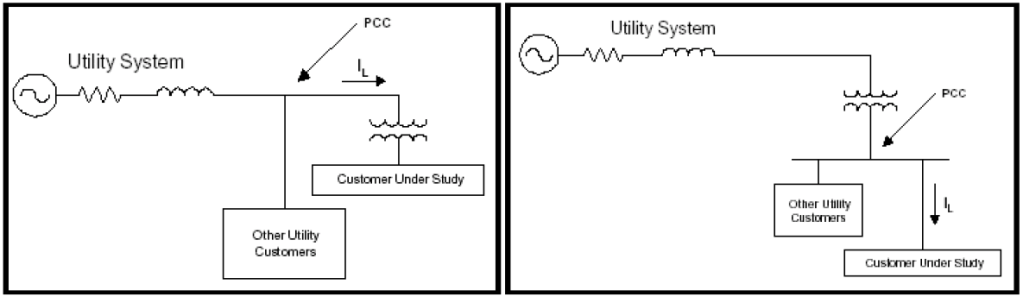
IEEE 519-1992 was developed to evaluate harmonic voltages and currents at a point of common coupling (pcc) between the end user and the utility supply system. The PCC is the location where another customer can be served from the system. The standard allows for the same procedure to be applied by the customer at other locations within a facility but different current limit values could apply in these cases.
The PCC can be located at either the primary or the secondary of a supply transformer depending on whether or not multiple customers are supplied from the transformer (Figure 8). The harmonic current limits for the PCC are summarized in Table 4.
Figure 8.Selection of the PCC where other customers can be supplied.
Using this approach, harmonic limits for individual loads are not specified. The limits for an individual load, such an adjustable speed drive, depend on the impact of that load on the harmonic levels for the whole facility. This is different from the approach taken in IEC 1000-3-2 (formerly IEC 555-2) where limits for individual loads less than 16 Amps are specified. The IEEE 519 approach provides more flexibility in identifying the most economical location to limit the harmonics.
Table 4. Harmonic Current Limits for Individual End Users from IEEE 519-1992.
HARMONIC CURRENT DISTORTION LIMITS IN % OF IL
v ≤ 69kV
ISC/IL
h < 11
11 ≤h < 17
17 ≤h < 23
23 ≤h < 35
35 ≤h
TDD
<20
4.0
2.0
1.5
0.6
0.3
5.0
20-50
7.0
3.5
2.5
1.0
0.5
8.0
50-100
10.0
4.5
4.0
1.5
0.7
12.0
100-1000
12.0
5.5
5.0
2.0
1.0
15.0
>1000
15.0
7.0
6.0
2.5
1.4
20.0
v ≤ 69kV
69kV < v≤ 161kV
ISC/IL
h < 11
11 ≤h < 17
17 ≤h < 23
23 ≤h < 35
35 ≤h
TDD
<20*
2.0
1.0
0.75
0.3
0.15
2.5
20-50
3.5
1.75
1.25
0.5
0.25
4.0
50-100
5.0
2.25
2.0
1.25
0.35
6.0
100-1000
6.0
2.75
2.5
1.0
0.5
7.5
>1000
7.5
3.5
3.0
1.25
0.7
10.0
69kV < v≤ 161kV
v > 161kV
ISC/IL
h < 11
11 ≤h < 17
17 ≤h < 23
23 ≤h < 35
35 ≤h
TDD
<50
2.0
1.0
0.75
0.3
0.15
2.5
≥50
3.0
1.75
1.25
0.5
0.25
4.0
v > 161kV
Notes to current distortion limits:
ISC is the short circuit current at the point of common coupling. IL is the maximum demand load current (fundamental frequency component) at the point of common coupling. It can be calculated as the average of the maximum monthly demand currents for the previous 12 months or it may have to be estimated.
*All power generation equipment applications are limited to these values of current distortion regardless of the actual short circuit ratio ISC/IL.
The tables of individual harmonic component limits apply to the odd harmonic components.
Even harmonic components are limited to 25% of the limits in the tables.
Current distortion which results in a dc offset is not allowed.
Total Demand Distortion (TDD) is defined as:
where: In = magnitude of individual harmonic components (rms amps) n = harmonic order IL = maximum demand load current (rms amps) defined above
If the harmonic producing loads consist of power converters with pulse number (q) higher than six, the limits indicated in the table are increased by a factor equal to
provided that the magnitudes of the noncharacteristic harmonics are less than 25% of the limits specified in the table.
Evaluating Impacts of Harmonic Currents on Transformer Heating
Transformer heating is one of the primary concerns associated with harmonic current distortion levels in a facility. ANSI/IEEE Standard C57 series states that a transformer can only be expected to carry its rated current if the current distortion is less than 5%. If the current distortion exceeds this value, then some amount of derating is required. ANSI/IEEE Standard C57.110 provides calculation procedures that can be used to evaluate the required derating as a function of the expected current harmonic spectrum and the transformer design. The primary cause of the concern is that the transformers can be overheated by distorted load currents that cause higher eddy current losses inside the transformer than were anticipated by the designer.
The required transformer derating is calculated based on the additional heating that can be expected for a specific harmonic current spectrum and the eddy current loss factor for the transformer. The derating is expressed as the per unit value of a particular distorted current that will cause the same heating as the rated sinusoidal current.
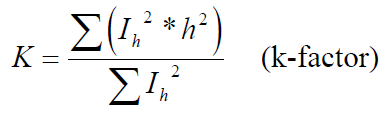
It has become popular to express this derating in terms of the k-factor of the load current waveform that the transformer must supply. It is possible to buy transformers with a k factor rating that can be used without derating for current waveforms that have k-factors up to the k-factor rating of the transformer.
where:
PEC-R = eddy current loss factor h = harmonic number Ih = harmonic current
The most common application where transformer derating for harmonics is needed involves a 480/208 volt stepdown transformer where a significant percentage of the load is single phase electronic equipment (e.g. PCs). A typical current waveform, k-factor, and transformer derating as a function of the transformer eddy current loss factor is given in Figure 11.
Figure 11. Transformer derating for supplying single phase electronic loads as a function of the transformer eddy current loss factor.
Evaluating Neutral Conductor Loading due to Harmonics
Single phase nonlinear loads can have significant harmonic components at triplen frequencies (3, 9, 15, etc.). When these loads are combined in a three phase circuit, the triplen harmonics show up as zero sequence components. That means they add in the neutral. If there are 10 amps of third harmonic on each phase in the three phase circuit, the neutral current will include 30 amps of third harmonic.
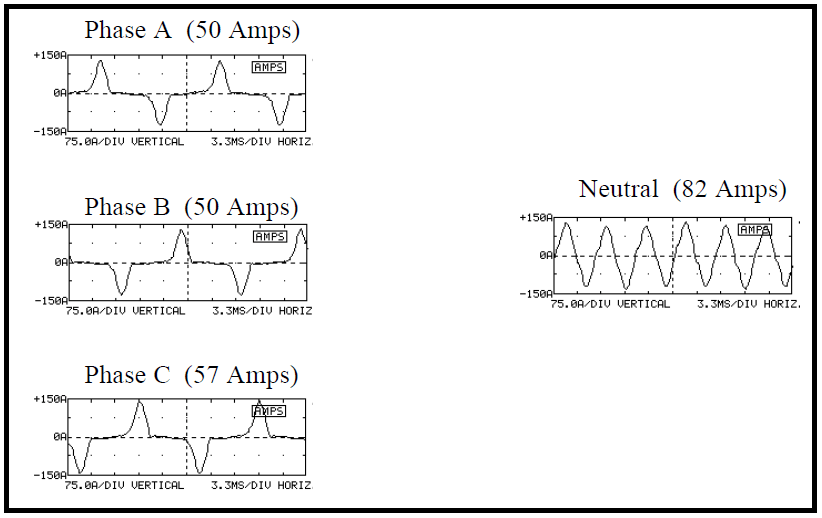
For this reason, neutral currents in 120/208 circuits in many commercial buildings are actually higher than the phase currents. The neutral currents are dominated by third harmonic components from single phase electronic loads, like PCs. They can be as high as 173% of the rms phase currents (Figure 12 is an example of measured waveforms illustrating this condition). Neutral currents can also be a concern on distribution systems that supply single phase customers or three phase customers with wye-grounded/wye grounded transformers.
Unfortunately, there are no standards limiting the harmonics from these single phase loads (IEC 1000-3-2 provides limits for the European Community) and there are no requirements that the neutral conductors in these facilities be made larger to handle the higher current magnitudes. This is a problem that the building designer and facility electrical engineer must be aware of to make sure that neutral circuits are not overloaded.
Figure 12.Phase currents and neutral current for a circuit dominated by single phase electronic loads.
Standards for Voltage Fluctuations (Flicker)
Voltage fluctuations are systematic variations of the voltage envelope or a series of random voltage changes, the magnitude of which does not normally exceed the voltage ranges specified by ANSI C84.1. These fluctuations are often referred to as flicker. They are characterized by the magnitude of the voltage changes and the frequency with which they occur. A plot of the rms voltage magnitude vs. time can be used to illustrate the variations.
The most important impact of these fluctuations is that they cause variations in the light output of various lighting sources. Sensitivity curves have been developed for incandescent lighting that show how the voltage fluctuations can cause unacceptable variations in the light output (Figure 13), but there is no one curve that is universally applied as a standard. In a survey of electric utility practices, it was found that the GE flicker curve published in 1951 is the most popular curve used to apply limits.
Figure 13.Flicker sensitivity curve.
In the IEC standards, a much more rigorous approach is used for flicker evaluations. IEC 868 provides a detailed specification for the flickermeter which must be used to characterize flicker levels. This instrument provides an output which is per unitized to 1.0 for the level of flicker that should be noticeable with a 40 Watt bulb on a 220 volt supply. Unfortunately, light bulbs on 120 volt systems behave differently (larger filaments) so the output of the flickermeter must be adjusted for use in this country. IEC 1000-3-3 (formerly IEC 555-3) also provides limits for individual appliances in terms of the voltage fluctuations that can be caused.
Voltage fluctuations are caused by changing load characteristics. Arc furnaces, motor starting, sawmills, and arc welding are typical sources of voltage fluctuations. Controlling the fluctuations can be very difficult. Some of these loads, such as arc furnaces, are continually varying at a rate that requires compensation with very fast response. This can be accomplished with continuously varying compensation, such as a static var system. Other power electronics-based technologies with real time control (active series voltage regulator) are under development.
Standards for Voltage Sags and Interruptions
Voltage sags fall in the category of short duration voltage variations. According to IEEE P1159 and IEC definitions, these include variations in the fundamental frequency voltage that last less than one minute. These variations are best characterized by plots of the rms voltage vs time (Figure 14) but it is often sufficient to describe them by a voltage magnitude and a duration that the voltage is outside of specified thresholds. It is usually not necessary to have detailed waveform plots since the rms voltage magnitude is of primary interest. The voltage variations can be a momentary low voltage (voltage sag), high voltage (voltage swell), or loss of voltage (interruption).
Voltage sags are typically caused by a fault somewhere on the power system. The voltage sag occurs over a significant area while the fault is actually on the system. As soon as a fault is cleared by a protective device, voltage returns to normal on most parts of the system, except the specific line or section that is actually faulted. The typical duration for a transmission system fault is about six cycles. Distribution system faults can have significantly longer durations, depending on the protection philosophy. The voltage magnitude during the fault will depend on the distance from the fault, the type of fault, and the system characteristics.
Figure 14.Voltage sag that could cause equipment misoperation. It is caused by a remote transmission line fault condition on the power system
Characterizing equipment sensitivity to voltage sags
Voltage sags are the most important power quality variation affecting many types of industrial customers. As industrial processes have become more automated, the equipment has become increasingly sensitive to these momentary undervoltages. If a single piece of equipment in the process is affected by the voltage sag, the entire process can be interrupted.
Since we characterize the voltage sags with a magnitude and duration, it is useful to describe equipment sensitivity in the same manner. This is done with a magnitude/duration plot (Figure 15). The Computer and Business Electronics Manufacturers Association (CBEMA) was the first to use this concept to describe equipment sensitivity. They came up with the “CBEMA curve” that has become the benchmark for describing equipment susceptibility. The curve is reproduced in IEEE Standard 446 (The Orange Book). Unfortunately, equipment doesn’t behave according to the CBEMA curve. Some equipment is less sensitive and some equipment, like the ASD in Figure 15, is much more sensitive. A working group in IEEE (IEEE P1346) is currently working on guidelines for compatibility of industrial process equipment.
Figure 15.Example of equipment sensitivity to voltage sags. Characterizing system
Characterizing system performance
End users can evaluate the economics of power conditioning equipment if they have information describing the expected system voltage sag performance. A chart like the one in Figure 16 can be used in conjunction with equipment sensitivity characteristics to estimate the number of times the process will be interrupted and the associated costs. There are currently no standards describing how to provide this information to customers.
Figure 16. Example of expected voltage sag performance at a customer location.
What can customers expect in terms of the number of voltage sags per year? This number changes from year to year and is dependent on many factors which are specific to the customer location (lightning flash density, feeder lengths, animals, trees, etc.). However, it is possible to develop some average numbers that provide a benchmark for comparison. The Distribution Power Quality Monitoring project sponsored by the Electric Power Research Institute is characterizing average performance on distribution systems across the country. The results in Figure 17 represent one year of monitoring at 24 different utilities, as reported in a paper presented at the PQA 94 conference in Amsterdam.
Figure 17.Voltage sag and momentary interruption performance for a distribution system sites in the United States (preliminary results from EPRI DPQ project).
The results presented in Figure 17 are very important because they begin to define the baseline power quality that can be expected at a typical distribution feeder supply point. Customers can use this information to help define the voltage variations that their equipment must be able to withstand. It is useful to illustrate the use of the information with an example:
Assume that we want to know how many voltage sags occur per year where the voltage goes below 70% of nominal voltage at a typical distribution system supply point. The data on the plot is for the average of all feeder sites in the project (the feeder mean in the table). Using the cumulative probability line and the right side axis, we can see that 40% of the events resulted in sags below 70%. The total number of events per year (including interruptions) is given in the table as 74.63. Therefore, the number of sags below 40% (including interruptions) will be 40% of 74.63, or about 30 events per year.
Standards for Transient Voltages and Surge Suppression
The term transients is normally used to refer to fast changes in the system voltage or current. Transients are disturbances, rather than steady state variations such as harmonic distortion or voltage unbalance. Disturbances can be measured by triggering on the abnormality involved. For transients, this could be the peak magnitude, the rate of rise, or just the change in the waveform from one cycle to the next. Transients can be divided into two subcategories, impulsive transients and oscillatory transients, depending on the characteristics.
Transients are normally characterized by the actual waveform, although summary descriptors can also be developed (peak magnitude, primary frequency, rate-of-rise, etc.). Figure 18 gives a capacitor switching transient waveform. This is one of the most important transients that is initiated on the utility supply system and can affect the operation of end user equipment. Other important causes of transient voltages include lightning surges and switching operations within a facility.
Figure 18. Capacitor Switching Transient
Transient problems are solved by controlling the transient at the source, changing the characteristics of the system affecting the transient or by protecting equipment so that it is not impacted. For instance, capacitor switching transients can be controlled at the source by closing the breaker contacts close to a voltage zero crossing. Magnification of the transient can be avoided by not using low voltage capacitors within the end user facilities. The actual equipment can be protected with filters or surge arresters.
ANSI/IEEE C62.41-1991
The most well-known standard in the field of transient overvoltage protection is ANSI/IEEE C62.41-1991, IEEE Guide for Surge Voltages in Low Voltage AC Power Circuits. This standard defines the transient environment that equipment may see and provides specific test waveforms that can be used for equipment withstand testing. The transient environment is a function of the equipment or surge suppressor location within a facility:
Category A: Anything on the load side of a wall socket outlet.
Category B: Distribution system of the building.
Category C: Outside the building or on the supply side of the main distribution board for the building.
Test waveforms are probably the most important contribution of C62.41. The standard recommends five different surge waveforms: two as basic waveforms and three as supplementary waveforms. The listing of these five types of waveforms is not meant to imply that all equipment should be tested with respect to all five waveforms. The supplementary waveforms are “less common in most environments and may be included when sufficient evidence is available to warrant their use.” These are the waveforms:
1.2/50 – 8/20 microsecond Combination Wave (Basic Wave). Traditionally, the 1.2/50 us voltage waveform was used for testing the basic insulation level (BIL) of insulation which is approximately an open circuit until the insulation fails. The 8/20 us current waveform was used to inject large currents into surge protective devices. Since both the open circuit voltage and the short circuit current are different aspects of the same phenomenon, such as an overstress caused by indirect lightning, it is reasonable to combine them into a single waveform.
0.5 usec – 100 kHz Ring Wave. This is a decaying oscillatory wave with an initial rise time of 0.5 usec. Different characteristics are specified for Category A and Category B environments. The short circuit current waveform for the 100 kHz ring wave is not specified. It is suggested that the 100 kHz ring wave is an appropriate test waveform for electronic equipment that operates in a building, but not for surge protective devices.
10/1000 microsecond Unidirectional Wave (Supplementary Wave). This waveform has an extended tail in order to test insulation which may be sensitive to the duration of the transient. Some transformer insulation falls in this category.
5 kHz Ring Wave (Supplementary Wave). This waveform is designed to represent a class of transients that can occur associated with switching of capacitors or coupling of capacitor switching transients into the LV environment.
Electrical Fast Transient (Supplementary Wave). This waveform and the coupling to the mains are specified in IEC 801-4. The EFT is only intended for testing electronic equipment for susceptibility to upset by showering arcs from using a mechanical switch in series with an inductive load. Since the energy levels are so low, this waveform is generally not required for surge protective devices.
UL 1449
Underwriters Laboratories is a nonprofit company in the USA that tests electrical and electronic apparatus for safety and flammability. UL defines requirements for transient voltage surge suppressors in their standard 1449. Two classes are defined for tests:
1.permanently connected (C62.41 Category B)
2.cord-connected or direct plug-in (C62.41 Category B or A)
An important part of the UL 1449 certification is the assignment of a “transient suppression voltage rating“. UL 1449 uses the combination wave described in C62.41 for testing permanently connected SPDs with a peak short circuit current of 3 kA. For the cord connected and direct plug-in SPDs, the peak short circuit current is only 0.5 kA. All SPDs are tested only with surge waveforms that have a peak open-circuit voltage of 6 kV. The average of 6 test measurements of clamping voltage is rounded to the next higher standard rating from the following list:
This suppression rating was intended as a guide to selecting SPDs for insulation coordination (as in IEC 664) and not protection of electronic equipment, which is why there are no voltages below 330 Volts in the list of standard values.
What Still Needs to be Done?
In the area of standards, we need to develop guidelines for system performance. These performance standards should include at least:
Interruptions (including momentary)
Voltage sags
Steady state voltage regulation
Voltage unbalance (negative sequence)
Harmonic distortion in the voltage
Transient voltages
The EPRI DPQ Project will provide an excellent statistical database that may be the basis for developing some of these standards. In turn, equipment manufacturers must be able to provide information describing the sensitivity of their equipment to these variations. With information on typical system performance based on historical and calculated data along with information on equipment sensitivity, customers will be able to perform economic evaluations of power conditioning alternatives.
Ongoing monitoring efforts and case studies will provide the information to characterize system performance and to understand the susceptibility of different types of customer systems. Monitoring of power quality should become a more standard part of the overall system monitoring (both at the utility level and the customer level). These monitoring efforts should be coordinated between the utility and the customer with emphasis on remote monitoring and data collection systems with more automated data analysis capabilities.
Analytical tools will also benefit from the increased level of monitoring and characterization. Models should be improved and the tools themselves should become easier to use.
The overall focus needs to be on economics using a systems approach (Figure 19). We need to develop tools that can help find the optimum system design including power conditioning for sensitive equipment. The alternatives should include improved immunity at the equipment level, power conditioning at the equipment level, power conditioning at more centralized locations within the customer system, and measures to improve performance on the utility system.
Figure 19.Economic Evaluation of Alternatives for Power Quality Improvement
Standards Organizations
Table 5.Important Standards Organizations
Organization
Types of Standards
Address
ANSI
Steady state voltage ratings (ANSI C84.1) All IEC documents also available
American National Standards Institute 11 West 42nd Street, 13th Floor New York, NY 10036 (212) 302-1286
CBEMA
Equipment guides
Computer & Business Equip. Mfctrs. Assoc. 1250 Eye St. NW Washington DC 20005 (202) 737-8888
EPRI
Signature newsletter on PQ standards
Electric Power Research Institute Attn: Marek Samotyj 3112 Hillview Ave. Palo Alto, CA 94304 (415) 855-2980
IEEE
Standards Bearer Standards Catalog Individual standards IAS Color Book Series
Institute of Electrical & Electronic Eng. 445 Hoes Lane Piscataway, NJ 08855-1331 (908) 562-3833
NEMA
Equipment standards
National Electrical Manufacturers Assoc. 2101 L Street NW Washington DC 20037 (202) 457-8474
NFPA
Lightning protection National Electrical Code
National Fire Protection Assoc. 1 Batterymarch Park Quincy, MA 02269-0101 (800) 344-3555
NIST
General information on all standards
National Center for Standards and Cert. National Institute of Standards and Tech. Gaithersburg, MD 20899 (301) 975-4037
UL
Safety standards for equipment
Underwriters Laboratories 333 Pfingsten Rd. Northbrook IL 60062-2096 (708) 272-8800
Summary of Trends
Ongoing standards development should help make all parties more aware of power quality concerns and provide better tools and techniques for developing the optimum solutions to problems. Some important trends that should result include:
1.End-Use Equipment. Equipment must become less sensitive to power quality variations. As we understand the economics involved, the immunity characteristics of the equipment will become part of the purchase decision making process. When this happens, manufacturers will consider it important enough to improve the immunity. In the long run, the most economical place to solve most power quality problems will be in the end-use equipment itself.
2.Customers. Customers will have a better understanding of power quality concerns and will include these concerns in their facility designs. The electrical system layout will consider the power conditioning requirements of sensitive and critical equipment. Power conditioning options will be part of the design stage. Power factor correction and harmonic control will be considered together.
3.Utilities. Utilities will be able to provide more detailed information to customers regarding the expected system performance as it may affect customer loads. The utility may also offer alternatives for higher levels of performance that may involve additional investment on the supply system or working with the customer to implement power conditioning options within the customer system.
These trends seem inevitable. However, getting there may be a long road and will require continued and improved coordination between utilities, their customers, and equipment manufacturers. The coordination is usually achieved through the development of standards that all parties consider acceptable
Dranetz is pleased to announce the addition of Flex CT’sto DranXperT.
DranXperT is a low cost, 3-phase power & energy logger for use in virtually any power logging application. With the addition of Flex CT’s, DranXperT now offers the widest range of CT choices on the market.
DranXperT’s capabilities includes:
High accurate power & energy logging
Web browser enabled
RMS PQ Disturbance detector to 1 cycle
Automatic wiring verifitcation
7hr battery
An exceptional value!
DranXperT includes free (unlicensed) Dran-View XP software that only works with DranXperT. For users of our full Dran-View Pro & Enterprise software, DranXperT support is included at no additional charge. Use one software with all of your portable Dranetz instruments!
Check out DranXperT or click the Contact Us button below for more information.
PQView is much more than a power quality data browser. It is also a powerful data concentrator for any sized monitoring system. PQView’s PQ Data Manager System (PQDMS) offers seamless integration to meters from many popular manufacturers.
Support for generic file formats such as PQDIF and COMTRADE is also available, but these files are usually only available daily from meters, with the primary benefit being for historical purposes. Conversely, the smooth meter integration of PQViewenables system operators to proactively monitor and raise the alarm on operational issues detected by their metering in the dynamically changing network. Traditional SCADA systems are good at gathering lots of generic data, but they have very limited PQ data capabilities. This reactive approach is usually limited only to COMTRADE and PQDIF files. Why settle for less?
Click hereto contact our team and inquire about PQView 4.
If you’re already a user,click here to download PQView 4.17 today!
Presented at the 2005 IEEE IAS Pulp and Paper Industry Conference in Appleton, WI.
Abstract
IEEE Std 519-1992 is a useful document for understanding harmonics and applying harmonic limits in power systems. Despite many years of good use there is still some confusion about how to apply certain aspects of the standard. This paper discusses some of those, as well as related issues that are helpful in working with harmonic limits. There is considerable debate as to precisely how some elements of IEEE Std 519-1992 should be interpreted. This paper presents the authors’ views on some of the more ambiguous elements of the standard and on the application of harmonic limits in general.
Key Words: Harmonics, harmonic limits, IEEE Std 519-1992, point of common coupling (PCC), total demand distortion (TDD).
I. Introduction
Harmonics are a concern because they can cause excessive heating and pulsating and reduced torque in motors and generators; increased heating and voltage stress in capacitors; and misoperation in electronics, switchgear and relaying. In short, harmonics can lead to reduced equipment life if a system is designed without consideration for harmonics and if equipment is not properly rated and applied.
It is therefore useful to measure and limit harmonics in electric power systems. IEEE Std 519-1992, IEEE Recommended Practices and Requirements for Harmonic Control in Electric Power Systems (IEEE 519) [1], provides a basis for limiting harmonics. This document does an excellent job of defining the limits but there are some application issues that require the reader to use his or her judgment.
One very basic distinction when discussing harmonics is whether the harmonics in question are voltage harmonics or current harmonics. It is the authors’ experience that many people do not clarify this when discussing harmonics. For example, people will talk about total harmonic distortion, in percent, without specifying voltage or current.
Generally speaking, power systems have low source impedance and well-regulated voltage. They can tolerate significant disruptions outside of steady 60 Hz loading, including harmonic currents, without causing significant voltage distortion. For a given amount of harmonic current flow, the resulting voltage distortion will be relatively small (excepting harmonic resonance situations). Therefore, when someone mentions harmonic levels well in excess of 5% he is probably talking about current harmonics.
Harmonics add in a root-sum-square (square root of the sum of the squares of different frequency components) fashion. This means that 100 A of 60 Hz current combined with 20 A of 5th harmonic current (300 Hz) adds up to 102 ARMS, not 120 A. Unless harmonics are very high, the RMS current is likely to be very close to the 60 Hz fundamental current. This is especially true for voltages because the voltage harmonic distortion is almost always less than the current distortion. It is useful to talk about harmonics in terms of percent of fundamental to get an understanding of the relative harmonic levels in a system. When working with the limits discussed in this paper and when performing harmonic analysis studies, however, it is generally more useful to receive harmonic information in actual quantities, volts or amperes at different frequencies.
II. Harmonic Limits
A. Voltage and Current Harmonic Limits According to IEEE 519, harmonic voltage distortion on power systems 69 kV and below is limited to 5.0% total harmonic distortion (THD) with each individual harmonic limited to 3%. The current harmonic limits vary based on the short circuit strength of the system they are being injected into. Essentially, the more the system is able to handle harmonic currents, the more the customer is allowed to inject.
Table 1.Voltage Distortion LimitsIEEE Std 519-1992 Harmonic Voltage Limits
Bus Voltage at PCC
Individual Voltage Distortion (%)
Total Voltage Distortion THD (%)
69 kV and below
3.0
5.0
69.001 kV through 161 kV
1.5
2.5
161.001 kV and above
1.0
1.5
IEEE Std 519-1992 Harmonic Voltage Limits
NOTE: High-voltage systems can have up to 2.0% THD where the cause is an HVDC terminal that will attenuate by the time it is tapped for a user.
Table 2. Current Distortion Limits for General Distribution Systems (120 V Through 69000 V)IEEE Std 519-1992 Harmonic Current Limits
Maximum Harmonic Current Distortion in Percent of IL
Individual Harmonic Order (Odd Harmonics)
ISC/IL
<11
11≤h<17
17≤h<23
23≤h<35
35≤h
TDD
<20*
4.0
2.0
1.5
0.6
0.3
5.0
20<50
7.0
3.5
2.5
1.0
0.5
8.0
50<100
10.0
4.5
4.0
1.5
0.7
12.0
100<1000
12.0
5.5
5.0
2.0
1.0
15.0
>1000
15.0
7.0
6.0
2.5
1.4
20.0
IEEE Std 519-1992 Harmonic Current Limits
Even harmonics are limited to 25% of the odd harmonic limits above.
Current distortions that result in a dc offset, e.g. half-wave converters, are not allowed.
*All power generation equipment is limited to these values of current distortion, regardless of actual Isc/IL.
Where
Isc = maximum short-circuit current at PCC.
IL = maximum demand load current (fundamental frequency component) at PCC.
TDD = Total demand distortion (RSS), harmonic current distortion in % of maximum demand load current (15 or 30 min demand).
PCC = Point of common coupling.
Table 1 shows the IEEE 519 harmonic voltage limits while Table 2 shows the harmonic current limits.
The harmonic current limits specify the maximum amount of harmonic current that the customer can inject into the utility system. The utility is responsible for providing a clean (low distortion) voltage to the customer. The utility can only be fairly judged, however, when the customer meets the harmonic current limits. Otherwise, the customer may be guilty of causing the voltage distortion himself. The intent of IEEE 519 is stated in its Forward:
This recommended practice recognizes the responsibility that users have not to degrade the voltage of the utility serving other users by requiring nonlinear currents from the utility. It also recognizes the responsibility of the utilities to provide users with close to a sine wave of voltage.
Section 10.2 of IEEE 519 goes on to say:
The philosophy of developing harmonic limits in this recommended practice is to
Limit the harmonic injection from individual customers so that they will not cause unacceptable voltage distortion levels for normal system characteristics
Limit the overall harmonic distortion of the system voltage supplied by the utility
These limits are intended to be applied at the point of common coupling (PCC) between the customer and the utility. Within the customer’s facility these limits do not apply but they are still useful guides for judging harmonic levels within the customer’s facility. Issues associated with the application of these limits comprise the rest of this paper.
Figure 1.Point of Common Coupling From IEEE 519A Applications Guide (Draft)
III. Point of Common Coupling (PCC)
A. Definition
The PCC is one of the most misunderstood parts of IEEE 519. The IEEE working group [2] that is revising IEEE 519 has clarified the definition of the PCC as follows:
The Point of Common Coupling (PCC) with the consumer/utility interface is the closest point on the utility side of the customer’s service where another utility customer is or could be supplied. The ownership of any apparatus such as a transformer that the utility might provide in the customers system is immaterial to the definition of the PCC. Note: This definition has been approved by the 519 Working Group.
This clarification is necessary because Section 10.1 of the present IEEE 519 states:
The recommendation described in this document attempts to reduce the harmonic effects at any point in the entire system by establishing limits on certain harmonic indices (currents and voltages) at the point of common coupling (PCC), a point of metering, or any point as long as both the utility and the consumer can either access the point for direct measurement of the harmonic indices meaningful to both or can estimate the harmonic indices at point of interference (POI) through mutually agreeable methods. Within an industrial plant, the PCC is the point between the nonlinear load and other loads.
This paragraph allows one to assess the harmonic limits practically anywhere. There is nothing wrong with that as long as both parties agree. But it does not square with the intent of the standard as given in the Forward (quoted earlier).
Based on the quote from Section 10.1 of IEEE 519, some people prefer to define the PCC (or multiple PCCs) at a point (or points) internal to the customer’s system. This implies that harmonic limits must be met internally, in the customer’s system. Many consultants, for example, use this statement to try to force manufacturers of nonlinear loads (drives, rectifiers, etc.) to adhere to the IEEE 519 limits for a single load. This can result in significant costs for end users and was never the intent of the standard.
The goal of applying the harmonic limits specified in IEEE 519 is to prevent one customer from causing harmonic problems for another customer or for the utility. If you have high harmonics within your own system you are only hurting yourself, but not necessarily violating IEEE 519.
Certainly it might be a very good idea to voluntarily limit harmonics within your own system in order to avoid operational problems, perhaps to the levels specified in IEEE 519, but IEEE 519 only applies to the point where you can affect your neighbor, the PCC. Only if you have multiple feeds from the utility would you have multiple PCCs. The PCC is the only point where you must meet the IEEE 519 limits, if IEEE 519 is incorporated into the contract or applicable rate (IEEE 519 is a Recommended Practice).
B. PCC Application Advice
In practice this means that the true PCC will most often be at the medium voltage primary of the transformer serving the customer, regardless of transformer ownership or metering location. In the real world, of course, it is often only practical to perform measurements on the transformer secondary. System modeling would be required to calculate the resulting voltage distortion on the transformer primary, although the current percentages would transform straight through. Use the Isc/IL ratio on the transformer primary when deciding which row of limits apply. In the majority of cases, all but the balanced triplen harmonic currents will appear on both sides of the transformer simply scaled by the transformer ratio.
The vast majority of the time measurements on the transformer secondary are sufficient to determine whether there is a harmonics problem so it is not necessary to use the precise PCC definition. But we should keep in mind that we are simply doing what we can out of convenience, not what we would do in a perfect world where we could measure anywhere safely and easily. If there is a dispute between a utility and a customer about IEEE 519 harmonic levels, it may then be necessary to measure and/or calculate harmonics at the true PCC.
IV. ISC/IL Ratio
As shown in Table 2 and mentioned briefly earlier in this paper, the harmonic limits that apply to a particular customer depend on the ISC/IL ratio at that customer’s point of common coupling with the utility. As defined in IEEE 519, ISC is the “maximum short-circuit current at PCC.” This should be a three-phase bolted fault current. IL is the “maximum demand load current (fundamental frequency component) at PCC.” This is a current calculated from the maximum billing (e.g. 15 or 30 minute) demand, not an instantaneous peak—a very important distinction.
This ratio shows the relative impact that a given customer can have on the utility. A customer with a small demand relative to the short circuit current available cannot cause much disruption to the utility system. Thus such a customer is allowed higher harmonic current limits. Conversely, a large customer (high IL) relative to the available fault current faces stricter limits.
Without knowing specific information about a utility’s system (Isc, in order to calculate the Isc/IL ratio) the row of harmonic current limits that applies cannot be determined. Sometimes the utility provides the three-phase short circuit MVA (MVASC). In this case it may be more convenient to calculate the MVASC/MVAL ratio. This value is the same as the Isc/IL ratio.
In actual power systems the short circuit current can vary depending on system configuration and utility generators in service. For the purposes of determining which harmonic limits apply the maximum short circuit current is used, just as in a short circuit study. When performing harmonic analysis studies, however, it is often better to use a lower estimate of available short circuit current in order to obtain a more conservative result (higher calculated harmonic voltage distortion).
There are situations that can significantly change the Isc/IL ratio. One common situation is operating under backup generator power, where the Isc/IL ratio would be much lower than during utility operation. The IEEE 519 limits would not strictly apply because there is no interconnection with the utility and other customers. Even so IEEE 519 would still provide guidance on how the harmonic currents should be limited within the customer’s system to avoid harmonic problems.
Figure 2.Load Served by Utility Source Voltage Distortion (THDV) = 2.3%
Figure 3.Load Served by Backup Generator Voltage Distortion (THDV) = 5.7%
Figures 2 and 3 show the same load when served by utility power and by a backup generator. Notice the significant increase in voltage distortion when served by the generator, which is typically a much weaker (lower short circuit current) source than the utility.
V. Total Demand Distortion
A. Definition
Another misunderstood part of the IEEE 519 standard is the term total demand distortion, or TDD. From Table 2, above, “Total demand distortion (RSS), harmonic current distortion in % of maximum demand load current (15 or 30 min demand).” (RSS is the root-sum-square, or square root of the sum of individual harmonic components squared.) The term TDD is very much like the total harmonic distortion, or THD. In these examples, THD and TDD are calculated in terms of current.
I1, I2, I3, et cetera are harmonic currents, in amperes. I1 refers to the fundamental frequency current, most commonly 60 Hz in North America. I2 refers to the second harmonic, or the current at twice the fundamental frequency (120 Hz, if the fundamental is 60 Hz). And so on.
IL is defined as the “maximum demand load current (fundamental frequency component) at PCC.” This would be the maximum current averaged over a demand interval (e.g. 15 or 30 minutes) for a given customer.
The two definitions are very much alike. The only difference is the denominator. The THD calculation compares the measured harmonics with the measured fundamental current. The TDD calculation compares the measured harmonics with the maximum demand current.
Similarly, the individual harmonic current limits are not given in terms of percent of fundamental (as is typical of most harmonic measurements) at a given point of time. The current limits are given in terms of, “Maximum Harmonic Current Distortion in Percent of IL.”
Note that commercially available instruments measure THD and individual harmonics in percent of I1.
IL will almost always be greater than I1 for harmonic measurement purposes. I1 may momentarily exceed IL but if so higher harmonic limits would apply. IEEE 519 states that the harmonic current limits “should be used as system design values for the ‘worst case’ for normal operation (conditions lasting longer than one hour). For shorter periods, during start-ups or unusual conditions, the limits may be exceeded by 50%.” [1] If there is a condition lasting longer than an hour, then a new IL has also been reached. Therefore the TDD and percent of IL measurements will almost always be less than the THD and percent of I1 measurements.
In a new installation (or proposed load addition) the demand current (or increase in demand current) may not be not known. This leads to some difficulty when estimating harmonics. Without knowing what the actual demand current will be once a facility is operational it is not possible to know with certainty which row of harmonic current limits apply. Therefore, the engineer should strive for an accurate estimate of the maximum demand current. If this is not possible, the transformer full load current is sometimes used to approximate the maximum demand current.
The difference between THD and TDD (and between harmonics as a percent of I1 and IL) is important because it prevents a user from being unfairly penalized for harmonics during periods of light load. During periods of light load it can appear that harmonic levels have increased in terms of percent even though the actual harmonic currents in amperes have stayed the same or decreased. Let us look at a numerical example to illustrate this difference.
B. Assumptions for Example Calculations
Our example plant has two distinct manufacturing areas, one with some harmonic load and another with only linear load. The portion of the plant with the harmonic load draws 1000 A at 60 Hz (I1), 140 A at 300 Hz (I5), and 70 A at 420 Hz (I7). The portion of the plant with only linear load draws 1000 A at 60 Hz (I1). See Figure 4 for a simple sketch of the example power system.
Let us assume that these currents are on the secondary of a 12470-480 V transformer. The PCC is on the primary of the transformer, and the three-phase short circuit MVA (MVASC) on the primary is 50 MVA (information provided by the utility). It is often more convenient to determine the ISC/IL ratio by calculating the MVASC/MVAL ratio. The two ratios are the same and determining the MVA ratio is often a bit easier. In this case the load MVA is 1.66, yielding a MVASC/MVAL ratio of 30.1. This means that the second row of harmonic current limits apply (limiting TDD to 8% and individual harmonics below the 11th to 7% or less).
Let us also assume that currents at the same frequency may be simply added (no cancellation due to phase angle/power factor differences).
C. Example 1: Plant at Full Load
With both portions of the plant running we would have a total of 2000 A at 60 Hz (I1), 140 A at 300 Hz (I5), and 70 A at 420 Hz (I7). Assuming this is the plant’s maximum load (averaged over the demand interval), we would calculate the demand current, IL, to be 2000 A (maximum demand, fundamental frequency component) This would result in the following calculations:
I5 as a percent of I1 would be 140/2000, or 7.0%. I5 as a percent of IL would also be 140/2000, or 7.0%.
In this case, the harmonic current limits for both TDD and individual harmonics as a percent of IL are barely met. The limits would also be met if we were using THD and individual harmonics as a percent of I1. The latter are what harmonic measurement instruments commonly report.
D. Example 2: Plant at Partial Load
In this case, only the harmonic portion of the plant is running. We therefore only have 1000 A at 60 Hz. However, the demand current, IL, previously calculated does not change. This would result in the following calculations:
I5 as a percent of I1 would be 140/1000, or 14.0%. I5 as a percent of IL would be 140/2000, or 7.0%.
In this case, the harmonic current limits for both TDD and individual harmonics as a percent of IL are barely met. However, the limits would not be met if we were using THD and individual harmonics as a percent of I1. The numbers as a percent of I1, rather than IL, can go up rather dramatically depending on which loads within a plant are on at any given time. But the plant should not be penalized in this case because it is not injecting any more harmonic current into the utility system in Measurement 2 than it is during Measurement 1.
Figure 4.Example Power System with Linear and Harmonic Loads
E. TDD Application Advice
All of the above means that there is a certain amount of post-processing of harmonic measurement data that is necessary to properly assess compliance with IEEE 519 current limits. This means that in most cases when we compare measured harmonic current data (THD, not TDD; individual harmonics in percent of I1, not in percent of IL) to IEEE 519 limits we are not doing an apples-to-apples comparison.
To ensure that we have valid harmonic measurements we want to make sure that all harmonic loads are operating normally during the measurements, of course. In addition to that, to ensure that the THD measurements (and all individual harmonic measurements calculated as a percent of I1) closely match the TDD measurements (and all individual harmonic measurements calculated as a percent of IL) we also want to make sure that our measurements are taken at a time when all of the linear loads are operating normally.
As with the PCC discussion, there is what you would want to do in a perfect world and what you can actually do in the real world. In the real world we do not often need to convert the THD and percent of I1 measurements to TDD and percent of IL measurements. The majority of the time, the THD and percent of I1 measurements are sufficient. If the THD and percent of I1 measurements meet the IEEE 519 limits then the TDD and percent of IL measurements will, by definition, also meet the limits (since IL is greater than I1, the TDD and percent of IL measurements will always be less than or equal to the THD and percent of I1 measurements). If the limits are greatly exceeded when the measurements are taken at or near full load, then there is also no need to convert to TDD. If the numbers are close, you probably want to err on the side of caution and reduce the harmonics anyway.
Like the PCC, we should keep in mind that we are simply doing what we can out of convenience (THD, percent of I1), not what we would do in a perfect world (TDD, percent of IL) if we had the time to do post processing of measurement data. If there is a dispute between a utility and a customer, it may then be necessary to do the post processing required for an apples-to-apples comparison with the IEEE 519 harmonic current limits.
Table 3. 18-Pulse Clean Power Drive Current Measurements, Various Speeds (All Values in Amperes Except as Specified in Percent, Nominal IL = 225 A)
Harmonic
30 Hz
40 Hz
50 Hz
60 Hz
THD (% of I1)
26.7 %
14.1 %
9.1 %
5.9 %
TDD (% of IL)
3.6 %
4.1 %
4.5 %
4.8 %
All Harmonics
8.2
9.2
10.1
10.8
RMS
31.9
65.8
110.7
183.1
1 (fundamental)
30.8
65.2
110.3
182.3
2
0.1
0.4
1.2
0.9
3
3.1
3.8
3.9
3.9
5
5.4
6.1
6.8
8.3
7
5.1
5.1
4.9
4.3
11
0.2
0.2
0.5
1.2
13
0.4
0.8
1.0
1.2
17
1.5
2.0
2.1
2.1
19
0.8
1.7
2.5
2.5
23
0.3
0.4
0.4
0.3
25
0.3
0.4
0.7
0.7
29
0.0
0.1
0.1
0.3
31
0.2
0.1
0.2
0.3
35
0.1
0.2
0.3
0.4
37
0.2
0.3
0.4
0.5
18-Pulse Clean Power Drive Current Measurements, Various Speeds (All Values in Amperes Except as Specified in Percent, Nominal IL = 225 A)
F. Amperes Versus Percent—Drive Example
Discussing harmonics in terms of percent of fundamental is useful to understand relative harmonic levels. When doing harmonic measurements, studies, and limit assessments it is more useful to talk in terms of actual quantities: volts and amperes at each harmonic frequency of interest.
One example that illustrates this difference is the operation of a variable frequency drive (VFD). VFDs produce current harmonics due to the way they draw current from the source. Common sixpulse drives produce 5th, 7th, 11th, 13th, 17th, 19th harmonics, and so forth. 12-pulse and 18-pulse drives incorporate designs that largely cancel certain lower order characteristic harmonics.
Some consultants, when they write a harmonic specification for an installation with drives, require verification measurements to ensure that the drives are working as expected. They also require that these measurements cover a variety of operating parameters, including varying the drive load. In the case of a pumping station, reducing the load means reducing the output frequency of the drive. The thinking behind this is that as the drive load decreases, the harmonics increase.
Table 3 shows measurements on an 18-pulse drive during such a verification measurement. The drive was operated at various output frequencies and the harmonics were measured. We are not comparing these measurements with any harmonic limits because this drive is just one part of a larger system. These measurements are presented to show how the drive harmonics vary with drive output frequency.
The data show that while the 60 Hz source current goes down significantly with output frequency the harmonic currents are not reduced that much. This makes it appear as though the drives are injecting more harmonics if one only looks at the harmonics as a percentage of 60 Hz current (THD, rather than TDD). Harmonics, in amperes, actually decrease as the output frequency is reduced, but one would not know that by only looking at the THD or individual harmonics that are calculated as a percent of decreasing fundamental current (I1).
This is why the harmonic current limits are written in terms of percent of full load current, IL (TDD), not percent of momentary fundamental current, I1 (THD). Setting limits as a percent of fundamental would mean that the harmonic limits get more strict at periods of light load, even though less harmonic current is being injected. These limits also show that, in general, full load drive operation is the worst case condition to analyze in harmonic studies and measurements. Studies and measurements at partial load are usually not worth the effort.
VI. Harmonic Limit Enforcement
As a practical matter, utilities do not often rigorously investigate or enforce the current limits unless problems are occurring somewhere in the distribution system. It is common to perform measurements at a facility with harmonic producing loads and find harmonic current levels that are technically in excess of IEEE 519 current limits, without seeing any operational problems.
If problems are occurring, they will usually show up in excessive voltage distortion. It is possible to have one or several customers exceed IEEE 519 current limits without causing system problems if the utility system is lightly loaded or if there are a number of other customers that are below their harmonic current injection limits.
Sometimes harmonic problems seem to begin when a new customer connects to a utility system and this customer gets blamed for all the harmonic problems. In truth, that new customer is often not the source of all the problems, just the “straw that broke the camel’s back” and pushed the existing harmonic levels just a bit higher. Even though the problems seemed to start when that customer came on-line, the blame lies with all the harmonic producing customers on the system.
System changes, whether on the utility system or within a customer’s facility, can also cause harmonic levels to rise. For example, the addition of power factor correction capacitors can change the harmonic resonance point of a power system and amplify injected harmonic currents, resulting in excessive voltage distortion. A discussion of this topic is beyond the scope of this paper.
VII. Conclusion
It is useful to measure and limit harmonics in electric power systems in order to avoid operational problems and equipment deterioration. IEEE Std 519-1992 defines harmonic limits, but there is some confusion as to how these limits are to be applied. Care should be taken to specify whether the harmonics in question are voltage or current harmonics and whether they are in actual quantities (volts or amperes) or in percent, in which case it should be further specified whether they are in percent of I1 (most common) or IL (as during a rigorous limits assessment).
The general intent of IEEE 519 is to limit harmonic current from individual customers and to limit distortion of the system voltage provided by utilities. Customers should not cause excessive harmonic currents to flow and utilities should provide a nearly sinusoidal voltage. The ISC/IL ratio must be known in order to determine which row of harmonic current limits apply.
One point of confusion in IEEE 519 is the Point of Common Coupling, or PCC. The PCC is the point where another customer can be served, regardless of metering location or equipment (transformer) ownership. The goal of applying the harmonic limits specified in IEEE 519 is to prevent one customer from causing harmonic problems for another customer or for the utility. The IEEE 519 limits may still be used as a guide within a customer’s facility to minimize harmonic problems.
Another point of confusion in IEEE 519 is the distinction between total demand distortion (TDD) and total harmonic distortion (THD). The difference between the two is that TDD expresses harmonics as a percent of maximum demand load current (IL) and THD expresses harmonics as a percent of fundamental (60 Hz) current (I1) at the time of the measurement. Individual harmonic currents should also be expressed as a percent of IL before being compared to the harmonic limits in IEEE 519.
The difference between THD and TDD (and between harmonics as a percent of I1 and IL) is important because it prevents a user from being unfairly penalized for harmonics during periods of light load. Some loads, such as drives, have higher THD at light load, even though they are drawing less total harmonic current in amperes and thus causing less harmonic voltage distortion. It is not always practical or necessary to either measure at the true PCC or convert THD values to TDD. Knowing how the IEEE 519 limits should be assessed, when possible, allows an engineer to determine whether his or her approach is good enough for the job at hand.
The authors gratefully acknowledge the contributions of Ed Reid of Qual-Tech Engineers, Ron Simpson of General Electric, and Bill Vilcheck of Eaton Electrical. All made valuable comments and suggestions during the review process that improved the quality of this paper.
Authors’ Biographies
Thomas M. Blooming, P.E. (S ’89, M ’94, SM ’05) is a Senior Product Engineer with Eaton Electrical. Tom received a B.S. in Electrical Engineering from Marquette University, an M.Eng. in Electric Power Engineering from Rensselaer Polytechnic Institute, and an M.B.A. from Keller Graduate School of Management. Tom works in the Power Factor Correction Group of Eaton Electrical (Power Quality Division). He handles application issues related to power factor correction capacitor banks, harmonic filters, static-switched capacitor banks, and active harmonic filters, as well as many power quality-related questions. Tom formerly worked in the Cutler-Hammer Engineering Services & Systems (CHESS) group and provided clients with electric power engineering expertise, focusing in the areas of power quality and reliability. Tom has performed numerous measurements and studies. He has published technical papers and taught engineering workshops and training seminars on power quality issues.
Daniel J. Carnovale, P.E. is the Power Quality Solutions Manager at Eaton Electrical. Dan is responsible for developing strategies and tools for reliability and productivity solutions across the Electrical Group’s 8 equipment divisions and Engineering Services group. Dan has developed and teaches CEU certified, technical seminars on Power Systems and Power System Analysis. He has conducted several hundred Power Quality site investigations for commercial, industrial and utility power systems: evaluating PQ issues and applying solutions. Dan worked for Westinghouse Engineering Services and ABB Power T&D. He received his B.S. Degree in Electrical Engineering from Gannon University and his M.S. Degree in Power Systems from Rensselaer Polytechnic University. He is a registered Professional Engineer in the states of Pennsylvania, California and Alaska.