Published by Cacilda de Jesus Ribeiro1; André Pereira Marques2,3; Cláudio Henrique Bezerra Azevedo2; Denise Cascão PoliSouza1; Bernardo Pinheiro Alvarenga1; Reinaldo Gonçalves Nogueira1
1School of Electrical and Computer Engineering, Federal University of Goiás, Goiânia, GO, Brazil, 2CELG Distribuição, Goiânia, GO, Brazil, 3Federal Institute of Education, Science and Technology of Goiás, Goiânia, GO, Brazil
Abstract – Power transformers play a fundamental role in electrical power systems, in addition to representing significant investments involved in the implementation of these systems. To reduce the costs associated with a transformer’s life cycle and to guarantee its reliability and durability, it is essential to monitor its operating conditions, its insulation system, and the working conditions of its accessories and other components. Therefore, the aim of this work is to study the faults and defects that occurred in 34.5 kV, 69 kV, 138 kV, and 230 kV oil-immersed power transformers of the electrical system and the insulation system of CELG, a major electric energy concessionaire in the state of Goiás, Brazil. The results of this study, i.e., the efficacy of the predictive technique for maintenance over the last 28 years (from 1979 to 2007), the characterization of faults anddefects during this period, and the presentation of proposals for improvements in the predictive technique, aimed at reducing the number of stoppages in the electric power supply system, are expected to contribute to the body of knowledge in this field.
I. INTRODUCTION
A power transformer is one of the most important and costly devices in electrical systems. Its importance is attributed directly to the continuity of power supply, since its loss through failure or defect means a supply stoppage. This is a large piece of equipment whose substitution is expensive and involves a lengthy process.
Research for new technologies and new predictive maintenance techniques has greatly contributed to reduce supply stoppages, thereby ensuring improved reliability of energy supply. Several studies highlight the importance of optimizing maintenance processes and diagnoses of substation equipment such as transformers [1].
In this context, the purpose of this research was to study faults and defects that occurred in 34.5 kV, 69 kV, 138 kV and 230 kV power transformers immersed in mineral oil for a period of 28 years at the electric power concessionaire CELG, which supplies over two million consumers distributed in 237 municipalities with a population of approximately four million in the state of Goiás, Brazil.
A defect is considered an anomaly in a device that can cause it to operate irregularly and/or below its nominal capacity. If not corrected in time, this defect can evolve, leading to failure of the equipment and its removal from service [2].
A fault is an anomaly in a piece of equipment that inevitably causes stoppage of its operation, forcing its removal from service [2].
As it is used here, the term “stoppage” indicates that the service of a piece of equipment was interrupted, i.e., it was removed from operation due to a defect or fault. The word “transformers” also refers to autotransformers.
II. POWER TRANSFORMERS
The present work was developed based on:
• the identification of the main parts of power transformers, which were analyzed and divided into blocks of components, as shown in Fig. 1; and
• The characterization and analysis of faults and defects detected in these devices, resulting from stoppages and/or interventions which they underwent.
Fig.1. Subdivision of a power transformer into blocks
III. STOPPAGES IN THE ELECTRIC POWER SYSTEM DUE TO TRANSFORMER DEFECTS AND FAULTS
A. Number of Stoppages of the Devices
In this study, 549 service stoppages were recorded from December 1979 to May 2007, involving 255 three-phase transformers or three-phase transformer banks, and several of these devices showed more than one stoppage.
Table I summarizes the number of devices, with their respective ranges of nominal output power and by nominal voltage.
Table I Number of Devices by Range of Nominal Three-Phase Output Power and by Nominal Voltage
.
Of the transformer service stoppages in the period considered in this work, a certain number were due to faults and other defects, as indicated in Table II, reaching a total of 549 stoppages in this period of 28 years.
Table II Number of Transformer Stoppages
.
It should be noted that this study took into account the devices that were removed definitively from operation as well as those that were purchased over the 28-year period of this study. It is estimated that 10% of the devices under study are part of the total number of transformers that belong to the system’s technical reserve over these years.
B. Number of Transformer Stoppages versus Damaged Components
Fig. 2 shows the percentage of transformer stoppages versus damaged components in the period of 1979 to 2007, without considering stoppages caused by the protection system and by human error. In this study, it was found that the components most affected were windings (34%), bushings (14%), onload tap changers, OLTC, (10%), and de-energized tap changers, DTC (10%). The item “unidentified component” (11%) refers to components which lack reliable records for several reasons.
The insulation system of the transformers in question is composed of mineral oil and solid insulation (cellulose, varnish or polyester), although most of it consists of oil-paper. It was found that the stoppages due solely to problems in the insulation oil accounted for only 4% of the number of stoppages during the 28 years analyzed here. The degradation of a transformer’s insulation system is usually the main parameter that causes electrical faults in these devices.
Fig.2. Number of transformer stoppages versus components
The aging of oil-paper insulation in a transformer depends on aging of both the paper and the oil. The assessment of the remaining life of a transformer is the desired result of diagnostic procedures. A popular belief is that the life of the insulation paper determines the transformer’s service life [3]. Thus, when factors of transformer insulation degradation such as water, oxygen, the products of decomposition in the oil and temperature are monitored and controlled continuously, there is decrease in the degradation of the insulation system, which means less risk of electrical faults [4]. CELG carries out systematic physicochemical testing and analyses of dissolved gases to control and monitor the insulating oil of its transformers, which is the reason for the low percentage of problems involving insulating oil in its devices (4%).
C. Transformer Failure Rates Over Time
As stated above, service stoppages can be caused by both defects and faults. The difference between them is that interventions to correct equipment defects can be programmed, unlike faults, which are generally emergencies in the electrical sector. It is therefore essential to know the individual transformer failure rates.
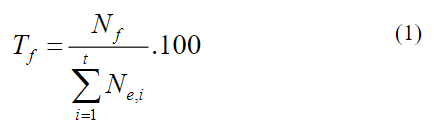
Fig. 3 shows the transformer failure rates in the CELG system per year and class of voltage, without considering the failures resulting from the protection system and from human error. In view of these results, and as can be seen in Figure 3, although failure rates of up to 9% were recorded (1992, 138 kV), the overall rates for the entire 28-year period are quite acceptable. These rates are listed in Table 3, and were calculated using (1).
.
where: Tf : failure rate in the period under consideration [%] Nf : number of failures in the period under consideration Ne,i : number of devices existing in each year i considered t : number of years of the period considered
Fig.3. Transformer failure rates over time
Analyzed quantitatively, the slightly higher rates of the 138 kV and 230 kV transformers are justified by the smaller number of devices of these classes of voltage.
Table III lists the failure rates of 34.5 kV, 69 kV, 138 kV and 230 kV transformers that occurred in the period under study, without considering the reserve equipment (estimated at 10% of the total number of power transformers).
Table III Transformer Failure Rates for the Period of 1979 to 2007
.
As can be seen, the transformers failure rates of CELG’s system are relatively low, which is explained by the use of predictive techniques at this concessionaire. The company’s maintenance engineering sector, which strives to ensure a continuous supply of electric power by reducing the failure rate, has sought new predictive techniques, with emphasis on the detection of partial discharges in transformers by the acoustic method.
IV. PREDICTIVE TECHNIQUES
The well-known dissolved gas analysis (DGA) technique in insulating oil is sensitive to some types of incipient faults (defects). To quantify the efficiency of this technique in detecting such defects in CELG’s equipment, a comparison was made of the total number of transformer stoppages that could have been detected by the DGA predictive technique and the stoppages effectively detected by this technique. This comparison revealed that the technique provided an efficiency of approximately 75%. However, sampling of transformer oil for DGA testing is done periodically, according to the chromatography software program CELG uses and to the specificity of each device. Thus, between one sampling and the next, the device may undergo impacts from atmospheric discharges, external short circuits, and adverse operating conditions, which may trigger or accelerate incipient faults and cause the device to fail before the next sampling, masking the efficiency of the chromatography system. It is therefore understood that the efficiency of the DGA technique, per se, is higher than 75%. In addition to DGA, another predictive technique that could be used to increase the monitoring efficiency of the state of transformer insulation is the detection of partial discharges (PDs). The DGA method has only low sensitivity for detecting partial discharges [5]. This may sometimes lead to inaccuracy in analytical methods, which may lead to errors by the person analyzing test results. Furthermore, the DGA technique does not allow for the identification of the site of an incipient fault, making it difficult to locate it, especially if its intensity is low. Particularly interesting is the use of a noninvasive method such as the acoustic PD detection method, which allows for monitoring of the evolution of PDs even while the device is in operation.
Throughout its operation, a power transformer has to withstand numerous stresses that generally result in the degradation of the oil-paper insulation system by decomposition of the paper and/or oxidation of the oil.
Degradation reduces the quality of this insulation. Partial discharges can lead to winding breakdowns, and may cause accelerated aging. PDs must be inferred in order to build an early warning system. In this context, PDs serve as an important measuring parameter for on-line monitoring [6].
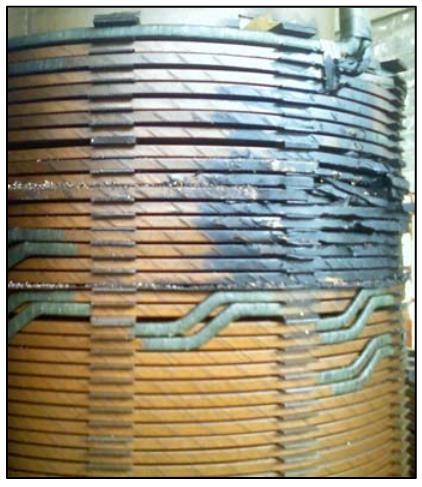
To illustrate the above, the photograph in Fig. 4 depicts the failure of a 20 MVA power transformer with a nominal voltage of 69 kV/34.5 kV, showing damage sustained by a large extent of the winding.
Fig.4. Damaged winding
Systematic equipment monitoring by the DGA technique showed a slight increase in gases, however without providing a warning about the need to remove this device from service, ultimately leading to its damage by short-circuiting between the spirals.
As can be seen in Fig. 5, the short circuit caused dislocation of the winding due to an electrodynamic overload.
Fig.5. Dislocated winding
This fault could have been avoided by PD detection, preventing the defect from developing into a short circuit between spirals and, hence, failure of equipment. This indicates the need for integrating predictive maintenance techniques in order to improve diagnostic quality and ascertain the state of transformer insulation systems.
This paper therefore presents a proposal for improving predictive techniques through the implementation of a set of techniques, highlighting the combination of DGA with the detection of partial discharges by the acoustic emission method [7], which allows PD activity to be pinpointed in the equipment without requiring its shutdown.
V. CONCLUSIONS
Although the failures rates and the number of stoppages that occurred during the period under study were relatively low, it is important to implement other predictive techniques that are sensitive to incipient faults in power transformers – especially in terms of problems involving windings, bushings and tap changers, which, taken together, account for 68% of the events in components of these devices – in order to further improve the performance quality indicators reported here. Among these techniques, this paper highlights the measurement of partial discharges by the acoustic emission method, which could be allied to the DGA method, a technique well-known in the energy sector, thereby increasing the maintenance efficiency and quality of electric power supply.
ACKNOWLEDGMENTS
This work was carried out in collaboration with the Maintenance Engineering Division of CELG Distribuição, CELG D, and the Federal University of Goiás School of Electrical and Computer Engineering (EEEC/UFG) through a partnership in an R&D Project – ANEEL.
REFERENCES
[1] M. WANG; A.J. VANDERMAR; K.D. SRIVASTAVA, “Review of Condition Assessment of Power Transformers in Service”, Proceedings of 2002 IEEE Electrical Insulation Magazine, Canada, November/December, v.18, n.6, pp.12-25, 2002. [2] J. LAPWORTH, “Transformers reliability surveys”, Journal Electra, Cigré, n.227, August, pp.10-14, 2006. [3] I. Höhlein and A. J. Kachler, “Aging of cellulose at transformer service temperatures. Part 2. Influence of moisture and temperature on degree of polymerization and formation of furanic compounds in free-breathing systems”, IEEE Electrical Insulation Magazine, vol.21, Sept.-Oct., pp. 20-24, 2005 [4] A.P. MARQUES, “Eficiência energética e vida útil de transformadores de distribuição imersos em óleo mineral isolante” (Energy efficiency and service life of distribution transformers immersed in insulating mineral oil), Master’s Dissertation – School of Electrical and Computer Engineering, Federal University of Goiás, Goiânia, 2004. [5] Associação Brasileira de Normas Técnicas (Brazilian Technical Standards Association), Técnicas de ensaios elétricos de alta tensão – medição de descargas parciais, NBR-6940 (High-voltage electrical testing techniques – measurement of partial discharges, NBR-6940), Brazil, 1981. [6] C. Yonghong; et al., “Study of On-line Monitoring Method of Partial Discharge for Power Transformers Based on RFCT and Microstrip Antenna”, Proceedings of the 2005 Electrical Insulation Conference, Indianapolis, USA, October, pp.103-107, 2005. [7] Institute of Electrical and Electronic Engineers – IEEE Std., COLE, P.T., “Location of Partial Discharges and Diagnostics of Power Transformers using Acoustic Methods”, Proceedings of 1997 IEEE Diagnostic Methods for Power Transformers Conference”, London, 1997.
Published by Joe Doughney and Lilly Vang, Consulting-Specifying Engineer, Electrical Articles: Electrical grounding and bonding per NEC, December 9, 2020.
Understanding correct grounding and bonding design and construction is crucial for proper electrical system operation and personnel safety
Learning Objectives
• Learn the proper electrical grounding terminologies. • Understand National Electrical Code grounding and bonding requirements for solidly grounded alternating current low-voltage systems (below 1,000 volts). •Prevent common grounding and bonding design and construction errors.
Electrical grounding and bonding is one of the many misunderstood topics of discussion in the design and construction industry. There are two main reasons for understanding grounding and applying the correct design for grounding and bonding: safety and correct operation of sensitive electronic equipment.
NFPA 70: National Electrical Code Article 250 covers the minimum requirements for grounding and bonding and, although the NEC lists requirements to abide by, it should not be taken as a design manual. Some terms and requirements discussed may be true for the European standards, however, the intent of this article is to clarify grounding and bonding design seen in the United States.
Grounding and bonding requirements
Article 250 is a complex portion of the NEC and covers many different types of systems: grounded systems (less than 50 volts, 50 to 1,000 volts and greater than 1,000 volts), ungrounded systems, systems greater than 1,000 volts, impedance grounded neutral systems, direct current systems, separately derived systems and grounding of instrument and meters/relays. The intent of this article is to discuss the requirements of solidly grounded, alternating current electrical systems less than 1,000 volts.
Grounding and bonding practices are important and required per NEC because when done properly, it will protect personnel from electrical shock hazards and ensure electrical system operation. These practices perform the following functions:
• Keeps equipment enclosures and other normal metal parts stable and therefore, safe to touch. • Limits unintended voltage on the electrical system imposed by lightning, line surges or unintentional contact with higher-voltage lines. • Bonds electrical equipment together to establish a low impedance path (effective ground-fault current path) from the fault location back to supply source to facilitate the operation of overcurrent devices. • Establishes a stable voltage to ground during operation, including short circuits. • Keeps electromagnetic interferences from causing misoperation. • Prevents objectionable current.
The requirements for grounding and bonding begin at the service. The NEC requires the grounded conductor(s) to be routed with the ungrounded conductors to the service entrance equipment and it shall connect to the grounded conductor(s) terminal or bus. The grounded service conductor is required to be connected to a grounding electrode conductor at each service. The main bonding jumper shall connect the grounded conductor to equipment-grounding conductors and the service entrance enclosure via the grounded conductor’s terminal or bus.
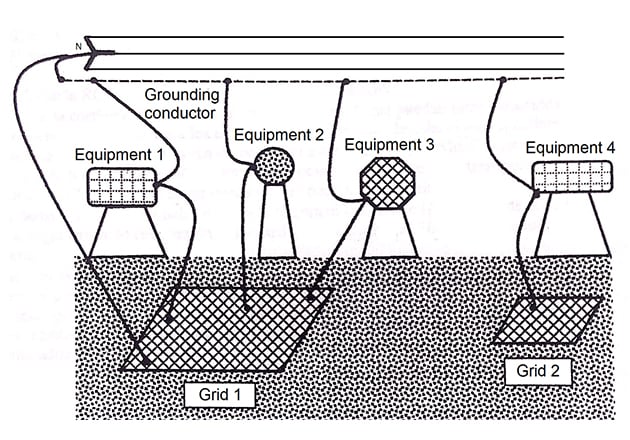
The GEC shall be used to connect the EGCs, the service equipment enclosures and where the system is grounded, the grounded service conductor to the grounding electrodes. Figure 1 details the grounding system connections.
The minimum sizes of the grounded conductor, EGC and GEC are determined based on NEC Table 250.102(C)(1), Table 250.122 and Table 250.66, respectively. The sizes for the main bonding jumpers, supply side bonding jumpers and system bonding jumpers can also be sized from Table 250.102(C)(1).
Although the grounded conductor is connected on the supply side, it shall not be connected to the EGCs or reconnected to ground on the load side of the service disconnection means except as otherwise permitted in the 2017 NEC Article 250.142(B).
Common errors
There are a few errors commonly seen in design or during construction due to a lack of understanding or misconception concerning grounding, bonding and the NEC Article 250. A few commonly seen errors are:
Error 1: Using the wrong tables for EGC, grounded conductor or GEC.
The sizing methods detailed in the NEC are the minimum requirements and it may not be adequate for the scope and size of the project. Large available short-circuit currents may require larger conductor sizes than the minimum NEC requirements.
The EGC should be sized per Table 250.122. A full-sized EGC is required to prevent overloading and possible burnout of the conductor if a ground fault occurs along one of the parallel branches. The EGC is sized in accordance with Table 250.122 based on the rating of the overcurrent protective device upstream that protects the conductors routed with the EGC.
However, the sizes for EGC in Table 250.122 does not account for voltage drop. Therefore, ungrounded conductors shall be sized while taking into account the voltage drop and per 250.122(B), the EGC shall be increased in size proportionately to the upsized ungrounded conductors. For example, given a 480-volt branch feeder circuit breaker rated 150 amperes, the EGC shall be sized 6 AWG copper or 4 AWG aluminum for a voltage drop of at most 3%.
The grounded conductor at the service should be sized in accordance with Table 250.102(C)(1), based on the size of largest ungrounded conductor or equivalent area for parallel conductors. This table can also be used to size the main bonding jumper, system bonding jumper and supply-side bonding jumper for AC systems. As stated in the notes of Table 250.102(C)(1), for ungrounded conductors larger than 1,100 kcmil copper or 1,750 kcmil aluminum, the conductor shall have an area not less than 12.5% of the area of the largest ungrounded supply conductor or equivalent area for parallel supply conductors. If the ungrounded conductors are installed in parallel in two or more sets, the grounded conductor shall also be installed in parallel.
For parallel sets, the equivalent size of the largest ungrounded supply conductor(s) shall be determined by the largest sum of the areas of the corresponding conductors of each set. For example, given that the electrical service is supplied by five sets of 500 kcmil copper conductors, the grounded conductor required in each set shall be 350 kcmil copper. The total equivalent area of the parallel supply conductors in each set is 2,500 kcmil (five times 500 kcmil given five parallel ungrounded conductors). Because the equivalent area is above 1,100 kcmil for copper, the grounded conductor(s) shall have an area not less than 12.5%. This is an area of roughly 312.5 kcmil, which according to Table 8 of Chapter 9 in the 2017 NEC, is 350 kcmil copper.
The GEC should be sized per Table 250.66. The notes at the bottom of Table 250.66 needs to be considered if there are multiple service entrance conductors or no service entrance conductors. Given the number of service entrance conductors, the size is determined either by the largest ungrounded service-entrance conductor or the equivalent area for parallel conductors. The size of the GEC is also dependent on the material of the conductor and its connection to specified electrodes in Article 250.66(A) through (C). The allowed materials are copper, aluminum, copper-clad aluminum and items allowable in Article 250.68(C).
For example, given that the electrical service is supplied by one set of 500 kcmil copper conductors, the GEC per Table 250.66 shall be 1/0 AWG copper. The location for GEC installation is at the service, at each building or structure where supplied by a feeder(s) or branch circuit(s) or at a separately derived system.
To reiterate, the GEC is the connection of the system grounded conductor or the equipment to a grounding electrode or to a point on the grounding electrode system. This leads on to error No. 2, errors in the grounding electrode system, which is commonly seen in design and construction.
Error 2: Meeting only bare minimum NEC requirements for grounding electrode system that may not satisfy project scope.
The grounding electrode system is made up of grounding electrodes that are present at each building or structure served that are bonded together. The items that qualify as a grounding electrode are detailed in Article 250.52, which includes concrete-encased electrode, ground ring encircling the building or structure, rod and pipe electrodes, plate electrodes and other listed electrodes. The NEC details the minimum requirements but not necessarily the design or construction requirement that allows for a functional system depending on the project scope.
These are the commonly seen issues in grounding electrode system that follows the NEC, but does not satisfy project scope:
Not installing a third grounding electrode. The NEC requires a minimum of two grounding electrodes, unless one electrode has a resistance to earth less than 25 ohms. However, commonly in construction, the ground resistance is not measured again after a supplemental grounding electrode is installed. Therefore, the ground resistance of 25 ohms is not confirmed as having been met. Per the NEC, two electrodes would meet code, but this doesn’t guarantee a low electrode-to-earth resistance. Including a grounding ring with multiple grounding electrodes is considered a best practice to ensure low resistance. Also, specifications should also require ground resistance measurements to be taken after grounding electrode system is installed to determine if additional electrodes are required.
Allowing 25 ohms ground resistance because it is allowed by code.
The NEC only requires 25 ohms ground resistance; however, the industry recognizes a lower resistance value may be more desirable. International Electrical Testing Association ATS-201313 recommends 5 ohms or less for large industrial systems.
Installing grounding electrodes (in particular, rods) 6 feet apart because that is the minimum separation required by code.
Each ground rod has its own zone of influence as shown in Figure 2. The optimal spacing between rods should be twice the length of the ground rod. When the zones overlap, the net resistance of each rod increase, thus making the ground system less effective.
There are many considerations that need to be taken into account when designing and installing grounding electrode systems. These are:
Size of service.
Types of loads that will be connected.
Soils: the resistivity is affected by salt, moisture, temperature and depth.
While considering all of the above factors, some of the best practices seen in the industry are using ground rings around buildings, ground triangles at smaller services, exothermic welds for concealed or buried connections and ground rods and installing ground testing/inspection wells that allow easy access for ground resistance testing.
Error 3: Bonding grounded conductor (neutral) to ground bar at multiple locations.
Per Article 250.142, the neutral to ground connection is allowed on the supply side or within the enclosure of the AC service disconnecting means. This connection is also allowed at separately derived systems. If the grounded conductor is grounded again on the load side of the service, the connection between the grounded conductor and the EGC on the load side of the service places the EGC in a parallel circuit path with the grounded conductor.
Another issue that can arise out of multiple bonding locations is the risk the grounded conductor being disconnected on the line side of the service. This could cause the EGC and all conductive parts connected to it to become energized because the conductive path back to the source that would normally allow the overcurrent device to trip is not connected. In this case, the potential to ground of any exposed metal parts can be raised to line voltage, which can result in arcing and severe shock hazard.
Error 4: Grounding and bonding design for separately derived systems.
One common error in grounding and bonding design is the grounding of generators and whether a three- or four-pole automatic transfer switch is used with a four-wire power system. Grounding a separately derived system is detailed in Article 250.30. The error in grounding and bonding design for separately derived systems stems from understanding the definition of a separately derived system. As shown in Figure 3, a system is considered separately derived when the system does not have a direct electrical connection to the other supply system grounded conductor (neutral), other than through the bonding and equipment grounding conductor.
The generator also requires to be directly connected to ground when it is considered a separately derived system as shown below. If a four-pole ATS is used and the neutral is switched, the generator or secondary backup source becomes a separately derived system. It should be noted that a three-pole ATS can be used with a four-wire generator and also be considered a separately derived system if the electrical distribution system is a three-wire system. In this situation, the generator neutral would be connected to ground, but a grounded (neutral) conductor would not be brought to the ATS.
Grounding and bonding definitions
There are many requirements in NFPA 70: National Electrical Code Article 250. A common reason for confusion mainly stems from not understanding the proper definitions. Therefore, the first step to understanding Article 250 is understanding the terminology within the NEC. Below are some terms taken from the 2017 edition of NEC Article 100 and clarifications for mentioned terms.
Bonded (bonding): Connected to establish electrical continuity and conductivity. Bonding is not to be confused with grounding. Two pieces of equipment bonded together does not necessarily mean both pieces of equipment are grounded. However, it assures that the metallic parts of the bonded equipment can form an electrically conductive path for electrical continuity.
Bonding jumper, supply side: A conductor installed on the supply side of a service or within a service equipment enclosure(s) or for a separately derived system that ensures the required electrical conductivity between metal parts required to be electrically connected.
Bonding jumper, system: The connection between the grounded circuit conductor and the supply-side bonding jumper or the equipment grounding conductor or both, at a separately derived system.
Bonding conductor or jumper: A reliable conductor to ensure the required electrical conductivity between metal parts required to be electrically connected.
Bonding jumper, main: The connection between the grounded circuit conductor and the equipment grounding conductor at the service.
Effective ground-fault current path: An intentionally constructed, low-impedance electrically conductive path designed and intended to carry current under ground-fault conditions from the point of a ground fault on a wiring system to the electrical supply source and that facilitates the operation of the overcurrent protective device or ground-fault detectors. The earth is not considered as an effective ground-fault current path.
Equipment grounding conductor: The conductive path(s) that provides a ground-fault current path and connects normally noncurrent-carrying metal parts of equipment together and to the system grounded conductor or to the grounding electrode conductor or both.
Ground: The earth.
Grounded conductor: A system or circuit conductor that is intentionally grounded (I.e., neutral conductor).
Grounding electrode: A conducting object through which a direct connection to earth is established. Common grounding electrodes include rods, plates, pipes, ground rings, metal in-ground support structures and concrete-encased electrodes. All grounding electrodes at each building or structure shall be bonded together to form the grounding electrode system.
Grounding electrode conductor: A conductor used to connect the system grounded conductor or the equipment to a grounding electrode or to a point on the grounding electrode system.
Ground-fault current path: An electrically conductive path from the point of a ground fault on a wiring system through normally noncurrent-carrying conductors, equipment or the earth to the electrical supply source. Examples of ground-fault current paths are any combination of equipment grounding conductors, metallic raceways and electrical equipment.
Grounded (grounding): Connected (connecting) to ground or to a conductive body that extends the ground connection. Grounding is not to be confused with bonding. Equipment may be bonded together, but it is not considered grounded unless it is connected back to the ground.
Grounded, solidly: Connected to ground without inserting any resistor or impedance device.
Neutral conductor: The conductor connected to the neutral point of a system that is intended to carry current under normal conditions.
Neutral point: The common point on a wye-connection in a polyphase system or midpoint on a single-phase, three-wire system or midpoint of a single-phase portion of a three-phase delta system or a midpoint of a three-wire, direct-current system.
Service: The conductors and equipment for delivering electric energy from the serving utility to the wiring system of the premises served.
Service equipment: The necessary equipment, usually consisting of a circuit breaker or switch and fuses and their accessories, located near the point of entrance of supply conductors to a building or other structure or an otherwise defined area and intended to constitute the main control and means of cutoff of the supply.
Authors: Joe Doughney is an electrical engineer with CDM Smith, where he focuses on design and analysis of electrical power systems. Lilly Vang is an electrical engineer with CDM Smith. She focuses on electrical power system design and power system studies.
Published by Alex Roderick, EE Power – Technical Articles: Utility Power Transmission and Distribution Systems, October 16, 2021.
Electrical power used in residential, commercial, and industrial buildings is typically generated by a utility at a central point and transmitted and distributed to where it is required through the utility power transmission and distribution system.
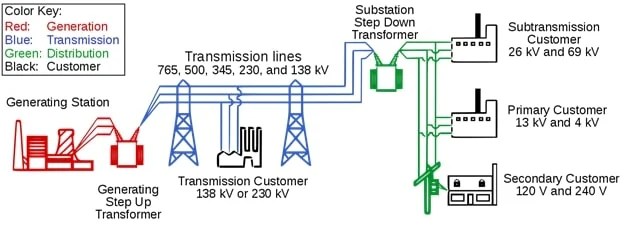
A utility power transmission and distribution system controls, protects, transforms, and regulates electrical power so it can be safely delivered to the user. The utility power transmission and distribution system begins at the point of power production and normally ends at a building metered service entrance point, which is where the building distribution system begins. A utility power transmission and distribution system consists of transmission substations (step-up transformers), transmission lines, distribution substations (step-down transformers), and distribution lines (see Figure 1).
Figure 1.A utility power transmission and distribution system consists of transmission substations (step-up trans-formers), transmission lines, distribution substations (step-down transformers), and distribution lines.
Transmission Substations
A transmission substation is an outdoor facility located along with a utility system that is used to change voltage levels, provide a central place for system switching, monitoring, protection, and redistribute power. Transmission substations normally operate at high voltage (HV), 69 kV to 345 kV, and extra-high voltage (EHV), the voltage over 345 kV. Transmission substations are also used to make changes in the size and number of lines sent out from the station.
Transformers
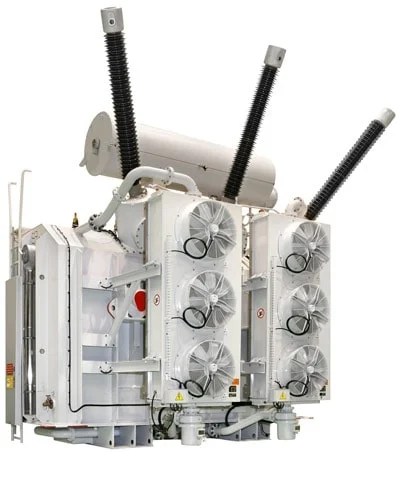
The transformer is an electrical device that changes the voltage from one level to another by using electromagnetism. In electrical distribution systems, transformers are used to safely and efficiently increase or decrease voltage. Although a transformer can be used to increase or decrease voltage, transformers cannot be used to increase or decrease the amount of power available. Except for some minor power loss caused primarily by heat loss, the amount of power entering a transformer is the same amount of power leaving the transformer. Transformers allow utilities to distribute large amounts of power at a reasonable cost (see Figure 2). Transformers are rated in kVA, which specifies their power output capability.
Figure 2. Transformers are used in electrical distribution systems to safely and efficiently increase or decrease voltage to allow utilities to distribute large amounts of power at a reasonable cost. Image Courtesy of GE
The main advantage of increasing voltage and reducing current is that power may be transmitted through small gauge conductors, which reduces the cost of power lines. For this reason, the generated voltages are stepped up to high levels for distribution across large distances and then stepped down to meet user requirements. Though both current and voltage can be stepped down or up, when it comes to transformers, the terms “step up” and “step down” always refer to voltage.
Transmission Lines
A transmission line is an aerial conductor that carries large amounts of electrical power at high voltages over long distances. To be safe, transmission lines must be positioned far enough apart. The transmission voltage level is determined by the required transmission distance as well as the amount of power carried. A larger transmission voltage is chosen when dealing with longer distances or larger transmitted power levels (see Figure 3).
Figure 3. Transmission voltage increases with distance or transmitted power
There is a wide variety of transmission line voltages, ranging from a few kilovolts to hundreds of kilovolts. Transmission-line voltage is stepped up to allow large amounts of power to be transmitted using smaller conductors. Since conductor sizes are based on the amount of current they can safely carry without overheating, low current levels can be carried over small size conductors. The amount of current changes inversely with the amount of voltage for a given power level (see Table 1).
Power, Voltage, and Current Relationship
Table1. The amount of current changes inversely with the amount of voltage for a given power level.
In addition, increasing the transmitted voltage lowers the power losses between the utility generator and the final delivery point. Doubling the transmitted voltage can reduce the power loss by up to 75%. Because transmitting power at high voltages reduces the required size and weight of the conductors, the poles and towers that support the conductors can be smaller and spaced farther apart. Therefore, greater transmitted voltages allow for smaller conductor sizes, higher power transmission, and lower construction and material costs.
Utility generators that output three-phase power have high-voltage distribution lines arranged in groups of three. In addition to the power lines, a neutral/ground conductor is also routed with the power lines. The neutral/ground conductor is routed on top of power lines and used as a grounding wire to help dissipate lightning strikes. The neutral/ground conductor is grounded at every power pole and at the transmission and distribution substations. The voltage on the power lines is stepped up and down many times before it reaches the end-user.
Distribution Substations
A distribution substation is fundamentally an outdoor facility that is located near the point of electrical service use and is used to adjust voltage levels, provide a central place for system monitoring, switching, and protection, and redistribute power. Distribution substations take high transmitted voltages and reduce the voltage for further distribution. Transmission substations operate at higher voltages, whereas distribution substations operate at lower voltages. The output voltages of distribution substations typically range from 12 kV to 13.8 kV.
Distribution substations provide a location along the distribution system near the end-user to easily test the system, adjust voltage output, add new lines, disconnect lines, and redirect power during distribution system problems such as power outages caused by lightning strikes. See Figure 5. Distribution substations take the incoming power and, after changing the voltage level, produce multiple outputs with different voltages on each line.
Figure 4. Distribution substations provide a convenient place along with the distribution system for maintenance, checks, and line adjustments. Image courtesy of OSHA
Distribution Lines
Distribution lines are used to carry electrical power from a distribution substation to the building service entrance. Distribution lines connect parts of the system together and are often run in multiple lines so that electrical power can be switched to meet changing power requirements and switched between different utilities. The term “grid” is used to describe the network of interconnected transmission and distribution lines.
Author: Alex earned a master’s degree in electrical engineering with major emphasis in Power Systems from California State University, Sacramento, USA, with distinction. He is a seasoned Power Systems expert specializing in system protection, wide-area monitoring, and system stability. Currently, he is working as a Senior Electrical Engineer at a leading power transmission company.
Published by Wojciech GIS1, Zdzisław KORDEL2, Maciej MENES1, Motor Transport Institute (1), The University of Gdańsk (2)
Abstract. The paper describes external environmental costs of road transport. Article presents also an assessment of the so-called reduction. “Marginal costs” such as the cost of fuel emissions, noise and greenhouse gas emissions, by the introduction into service, in the real perspective of 2020, electric cars. European project eMAP is described, in which are involved the authors of this article. The project is related to the assessment of demand and supply, in perspective 2030, of electric cars: Battery Electric Vehicles (BEV), Plug-in hybrid electric vehicles (PHEV), Range extended electric vehicles (REEV) and Fuel cell hydrogen vehicles (FCHV). The analysis will be carried out for the EU countries, in particular for Finland, Germany and Poland and eastern EU countries.
Streszczenie. W artykule odniesiono się do środowiskowych kosztów zewnętrznych związanych z eksploatacją samochodów osobowych. Dokonano w tym zakresie oceny redukcji tzw. „kosztów uniknionych” tj. kosztów emisji zanieczyszczeń z paliw, hałasu I emisji gazów cieplarnianych przez wprowadzenie do eksploatacji, w realnej perspektywie 2020 roku, w kraju elektrycznych samochodów osobowych. Przedstawiono też Europejski Projekt eMAP w którego realizację zaangażowane są ze strony polskiej, autorzy niniejszego artykułu. Projekt związany jest z oceną popytu i podaży, w perspektywie 2030 roku, osobowych samochodów elektrycznych Bartery Electric Vehicles (BEV), Plug-in hybrid electric vehicles (PHEV), Range extended electric vehicles (REEV) and Fuel cell hydrogen vehicles (FCHV) w krajach UE, w tym w szczególności Finlandii, Niemczech i Polsce oraz w krajach wschodnich UE. Samochody o napędzie elektrycznym a koszty zewnętrzne transportu samochodowego.
Słowa kluczowe: samochody elektryczne, koszty eksploatacji Keywords: electrical cars, costs of transport
Introduction
Every human activity directed at the environment, both positive and negative, brings with it the need to cover the cost of protecting it, as well as environmental losses, mainly economic ones, caused by that activity. It is, admittedly, quite idealistic statement because present economic activity and that in the future is largely contradictory with this environmental ideology. It is well known [1] that the negative impact of economic activity on the environment often eludes the market self-regulation mechanisms. Indeed, if some elements of the ecosystem, as a free good, have a market price equal zero, the use of them, either by the consumer or by the manufacturer is an uncontrollable phenomenon. Therefore, the active policy is required from each state to protect the environment.
In general it can be said that human activity causes external effects, which are apparent in cases where different entities use common resources, for which ownership has not been clearly defined. Areas that bear the effects of transport activities outside the transport market can be classified into three groups [2]:
– non-renewable resources / natural environment and non-productive human capital, – public production and consumption, – private production and consumption.
The man’s use of all elements of the ecosystems with the market price equal to zero, has certain negative social and economic consequences, whose end, according to marginalistic theory comes only when the marginal productivity and usability of these elements becomes negative. Polish example can be cited in which about 25% of the country territory is covered by the Natura 2000 program, which with the orthodox approach to the issue of environmental protection would mean that not a single kilometre of motorway or expressway should be built, so there will be no issue of final marginal costs.
In addition, one must admit that the costs of natural environment protection are nowadays quite fashionable issue, and its value increases at a time when the budgets of the Member States of the European Union begin to look for sources of financial incomes. This can be seen, in particular, in Polish realities, where the introduction of high fees in the e-toll system bears no reflection on the quality of a transport infrastructure. It must also be noted that the rates for the use of road infrastructure in Poland should be taking into account at the financial capabilities of the Polish road transport companies and the state financial system, and should not be related to the rates in other EU Member States, especially those from the Euro zone.
One of the most important human economic activity adversely affecting the environment is transport, widely described in the White Papers of the European Union.
External costs of the road transport
In the expert literature produces various definitions of external costs. One must admit that some of them are very general and the others contain an attempt to formulate some concrete facts, which are to be the determinant of these external costs. It can also be said that the concept of external costs is very general and relates more to the philosophy of economic functioning of modern economic market than to a specific market.
Now, taking into account the company, one can say that acting in a particular economic environment, both closer and further, its financial situation is mainly due to the impact of external costs such as: fuel, tires, tolls and insurance, as well as large investments appearing in the development of energy industry. These instruments have a major impact on the cost of the company, and will also influence the financial possibilities of introducing electric vehicles.
Use of the term – “external costs of transport” can be, according to the authors, used only in the consideration of environmental issues at the macroeconomic level. These considerations, in the consequence, will be reflected in the costs of the enterprises because only they are capable of generating these costs, trying to cover them with their activities by one hundred percent. It seems, therefore, that in talking about the external costs in transport one should, taking into account the basic economic unit, which the enterprise is, distinguish two categories of costs:
– external costs resulting from the principles and rules of operation of businesses on the market, – environmental protection costs associated with the operation of transport.
This division seems to be logical from the point of view of economic calculation in the enterprise. The functioning of enterprises is based on the influence of the external instruments and these are, as mentioned earlier, dependent on the impact of the closer or further surroundings. It’s obvious. Less obvious becomes the impact of environmental protection costs on the level of costs in the company because this level is often dependent on the general mood of environmental protection activists in Europe.
Ecological intention to reduce greenhouse gas emissions in the European Union may be a good one, but insoluble in the short term. It should also be taken into account that not only road transport is the emitter of carbon dioxide, but also all the economic sectors and supply chains that use electricity from coal. It is easy to say that, to a large extent, I do not produce, electricity from coal and I just only import it. It is after all a kind of hypocrisy that has taken root in the European Commission. This raises the question, if one needs to reduce carbon emissions, who should bear the costs if it, the state or the enterprises? Of course, if these costs will be covered by the state, it will still have to pass these costs on the electricity users, because the state is an abstract being with the real budget. So if it is to be the companies, in what amount, and depending on what the indicators? It should be recalled that the Polish road transport companies already pay an environmental levy, whose rates are annually determined by the Marshal Offices. This problem will be completely resolved in the future when humanity will produce electricity from sources not emitting carbon dioxide.
A.Tylutki and J.Wronka [4] state that the external costs of transport are the costs connected with negative for the environment and human life consequences of the activities of transport: air, water and soil pollution, noise emissions, traffic accidents, ground reclaiming and road congestion. While D.M. Newberry classified external traffic effects as [5]:
– costs associated with traffic congestion, – costs associated with the deterioration of the technical condition of roads, – costs associated with environmental pollution, – the external effects of accidents.
These external effects are particularly evident in urban areas, because of their network of road infrastructure are the most intensively used, and spatial density is the highest [6].
In general, one can say that the external transport costs are the costs that are and will be covered by the general public and businesses today and in the future. It is possible to single out here, first of all, the costs associated with the impact of transport, such as: air, soil, water pollution, noise, climate changes, accidents, reclaim of land, landscape degradation and the time lost in traffic jams / congestion /. These costs can generally be called the social costs of transport. These should also include all the expenses to be incurred on a modern energy infrastructure that allows the future use of electric cars.
External costs of transport can not be precisely calculated, and their levels can be the result of a consensus between businesses and economic policy of the state. It was only in 2011, that the research subject of the European Commission under the name COFRET (Carbon Footprint of Freight Transport) began, which is to show the impact of carbon dioxide emissions on the costs of supply chain and thus the companies [7]. The fact is that the transport does not pay the full social costs, including the environmental ones, which may lead to disturbances of the competition on the transport market. It should be noted though, that this is not the fault of transport. Well, at the moment when you the state became a participant in the market / excluding demand, supply and price / it takes on the responsibility for the effective functioning of the socio-economic market. This means that pushing environmental protection policy it must be responsible for the level of environmental costs in the situation when it shifts them entirely onto the companies. It can be assumed that as a result of distorted price mechanism, the absence of the full environmental protection costs / the transport does not fully bears these costs, but one has to take into account the fact that other sectors of the economy should be involved in covering these costs, if only the chemical one/.
External environmental costs of road transport
The air pollution is today one of the very serious environmental problems. Needless to say, that the emission of these pollutants adversely affects the quality and length of human life, disturbs the balance of ecosystems and causes also irreversible socio-economic consequences for the future of humanity. It is worth to mention here a worldwide debate on the issue of climate change in the Earth where it is assumed that, so-called, greenhouse effect of the climate change, is caused by carbon dioxide [8]. It is assumed that the main culprit of this emission – 25% is transport, out of which from 80 to 90% of the road transport. The EU policy on reducing exhausts emissions assumes that by the 2030, member states are expected to reduce carbon dioxide emissions by 20%, and by the 2050 – by (80 – 95)% [9].
In Poland, the biggest environmental problems creates the large scale of road transport activities. In the period 2000 – 2008 there was an increase of emissions from the road transport sector, classified as greenhouse gases, i.e. carbon dioxide, by 37.7%, methane by 23.1% and nitrous oxide emissions by 38.3% [10, 11].
In Poland, for example, the cost of the negative impact of transport on the environment represent approximately 28 – 29% of the external costs of transport, including [10, 11]:
– costs of air pollution, about 11%, – costs of climate change, around 5%, – costs of noise, about 11%, – other environmental costs, about 1 – 2%.
The remaining 71% of the external costs of transport are the effects of human and material transport accidents [10], [11]. In total, it is estimated that the external transport costs are now equivalent to 6% of GDP and are not included in the accounting [10, 11].
It is estimated that the individual domestic motorism will have the largest share in the passenger transport, increasing demand in 2020 by 26 – 35% compared to 2009 and by 36 – 54% in 2030 [10, 11].
The European Commission’s vision of an integrated strategy of the European transport sector development until 2050, assumes a reduction, by at least 60% till the 2050 of the greenhouse gases emissions from the transport sector compared to 1990 level, through a transition to alternative and “green” propulsion technologies in vehicles and the creation of a Single (Uniform) European Transport Area. By 2030 the greenhouse gas emissions are to be reduced in this sector by about 20% compared with the level in 2008 [10, 11, 12].
The direction is and, as it can be assumed, will be the electrification of vehicles. It is expected that the share of electric vehicles equipped with rechargeable batteries in the new cars market, sales will increase from 1 – 2% in 2020 to 11 – 30% in 2030. For the hybrid vehicles with plug in charging, the share is expected to be about 2% in 2020 and 5 – 20% by the 2030 [10, 11]. According to the European Commission’s strategy, by the 2030 there will be eliminated 50% of vehicles from the public transport with conventional internal combustion engines, and by 2050 they will not be present in European cities [10, 11]. In Poland, the above course of action in terms of electrification of vehicles, also seems to be inevitable.
To estimate the external environmental costs of road transport (passenger cars only) in Poland, by the 2020 it was assumed that in the absence of active government policy in relation to the road transport sector, in 2020 there will be, in operation, approximately 25,000 electric cars. This will be only 0.12% of the total number of passenger cars, forecast at 20.9 million [13]. The expected increase in the activity of government policy resulting from the provisions of the “EU White Paper” of 2011 [12], on the impact of the road transport sector on the environment, may contribute to an increase in the number of electric cars in the country, to about 100,000 in 2020.
The impending time to introduce stricter pollution charges for polluting the environment in 2020 may result in a sharp increase in the interest, as part of the transport policy, in the change of passenger cars fleet structure, particularly in terms of increasing the share of vehicles powered by alternative fuels, which would increase the number of electric vehicles to around 300,000.
It can be assumed that during the analysed period there will be drastically tightened rules on the technical condition of passenger cars in operation, which in turn will shorten the life time limit for the operating cars to, e.g. about 10 years old, and the eliminated cars, with environment-friendly government policy, can be replaced by electric cars.
With a projected increase of the national fleet of electric cars to 300,000, it justifies a claim that the benefits, known as “avoidable costs” will be reached, that would have occurred in the operation of passenger cars powered by internal combustion engines.
To perform a economic simulation accounting of the amount of “avoidable costs”, the category of external costs not occurring in the case of electric passenger cars, was included, namely [14-17]:
– unit cost per of air pollution (PM (PM10 and PM2.5) NOx, NMVOC, SO2, i.e. 0.0256 PLN / paskm, – unit cost of noise, i.e. 0.0235 PLN / paskm, – unit cost of climate change (cost of greenhouse gases emission, such as CO2, CH4 and N2O) i.e. 0,0370 PLN/pas-km, which together makes up the environmental external costs in 2012.
It was assumed that in Polish realities of 2020 the electric passenger cars will replace mainly carriage conducted by passenger cars with combustion engines in urban and suburban traffic in the proportion of 50% -50% for every mentioned traffic area. The authors are of the opinion that in 2020 electric passenger cars will not be used in the significant numbers.
In order to calculate abovementioned unit costs for 2012 the output cost data was used, from the available literature, and first of all, [14-17], taking into account both the relationship of GDP for the EU-27 countries and Poland, as well as the annual inflation rates. It was assumed that:
– average annual passenger car mileage – 15 thousand km, – average number of people travelling in a passenger car – 1.5.
With the above assumptions, the “avoidable costs” for 300,000 electric cars will reach in 2020 (adjusted for inflation) about 844 million PLN, it would be about 2% of the cost of air pollution, noise, climate change, caused by the passenger cars fleet in 2020. These are tangible sums for the national economy.
It should be born in mind that equally important, in the introduction of electric cars to be used, are intangible benefits associated with improving the health of urban residents, where the concentrations of both pollutants and noise intensity is relatively high. It can be estimated that the spending on health care related to a group of “civilisation” diseases, (air passages, allergies, etc.) would be reduced by about 20%.
Technical progress forces a change in thinking and actions of those responsible for the policy in relation to the entire national economy, including the road transport sector, which will cause the increase in the number of electric cars. It is obvious that now this figure, for 2020, may be determined only by the estimates.
It should also be borne in mind that technological progress will create gradual decrease in the purchase prices of electric cars, which will cause the increase in the number of their potential buyers.
The European eMAP project as a support in the evaluation of external environmental costs of the road transport
The advantage of the electric drive is a zero carbon dioxide emission from the vehicle itself. A very important problem are the limitations in the energy storage by batteries [11]. Important are also determinants of the implementation of an integrated system e- mobility, both in the European Union, as well as in Poland.
Studies on the possibilities of implementing electric vehicles appear in a number of international projects and programs, for example, [18-23]. One such European project currently implemented in the framework of the ERA – NET Plus Electromobility + is a European eMAP project (Electromobility – scenario based Market potential Assessment and Policy options) carried out with the participation of the Motor Transport Institute and the authors of this article.
The main objective of the eMAP European Project (2012-2015; total budget: app. 1.24 mio. Euro) is to analyse feasible deployment paths of electric vehicles for the time horizon until 2025-2030. This will be done using a scenario based market model which specifies consumer demand and market supply of electromobility [24].
Socio-economic impacts of deployment of electromobility on greenhouse gas emissions, local emissions, transport costs, energy supply safety and technological change in industry and economy will be evaluated under various scenarios. Political supporting actions and strategies of electric vehicles will be identified and their impacts on the deployment paths analyzed and evaluated. In the end, recommendations for optimized political strategies will be derived [24].
The regional scope of the project focuses on Europe, most importantly the three partner countries Finland, Germany, and Poland. These vehicle markets will be analyzed in detail with regard to demand structure and supply of electric vehicles and necessary infrastructures for example in mega cities (Berlin), major cities (Cologne, Helsinki) and dense populated areas (Rhein/Ruhr, Warsaw) [24].
The main objectives of the eMAP project are [24]:
– to identify the main characteristics of drivers and pinpoint impediments on side of the customers and the suppliers of electromobility, – to quantify the demand for electric vehicles given different scenarios, – to quantify supply of electric vehicles in different market segments, – to make a forecast of development paths of electromobility based on scenarios, – to make a thorough socio-economic evaluation of the deployment path of electric vehicles given the different scenario outcomes, – to determine and evaluate measures and strategies to increase speed of the adaption of electric vehicles, – to provide policy options and recommendations for optimized deployment programs.
Partners of eMAP are: Federal Highway Research Institute (BAST), Institute for Transport Economics/University of Cologne (UOC), Institute of applied social sciences (INFAS), German Aerospace Centre (DLR), Institute of Vehicle Concepts, Technical Research Centre of Finland (VTT) and Motor Transport Institute (ITS).
In the focus of the project are vehicle concepts which use only electrical energy or use electrical energy in addition to petroleum fuel or gas. The considered power train concepts include Battery electric vehicles (BEV), Fuel cell hydrogen vehicles (FCHV), Plug-in hybrid electric vehicles (PHEV) and Range extended electric vehicles (REEV)) are included which can be driven with electricity alone [25].
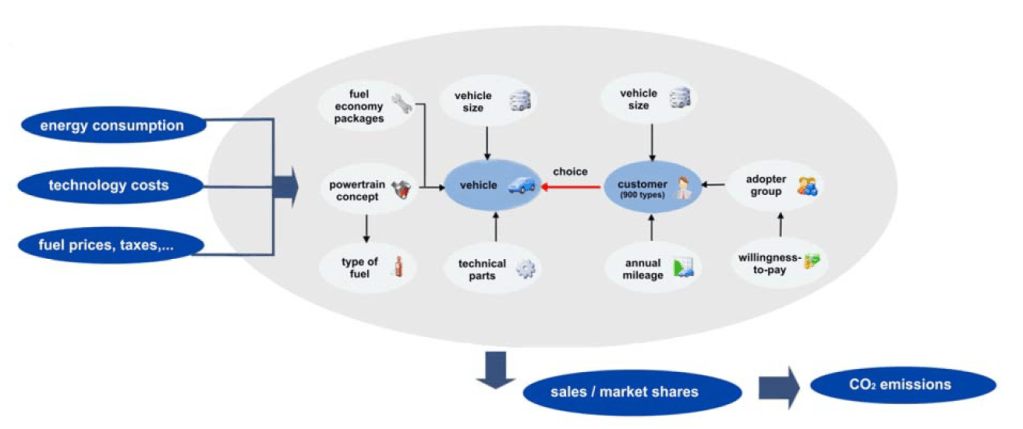
In general, electric vehicle demand decisions of customers will depend on the relative attractiveness of electric vehicles compared to vehicle types with conventional power train concepts (Fig.1). Differences in comfort and flexibility of usage of EV will play an important role in this respect. Also the higher upfront costs, but lower running costs of EV mainly caused by relatively low electricity costs and relatively high efficiency of batteries and motors are feeding into the decision making process of customers [25].
Beside comfort, upfront and running costs, attractiveness of electromobility for consumers depends for Plug-in vehicles on availability of charging and service stations. Therefore, also the availability of infrastructure for electromobility for loading and service, including the integration of electric vehicle storage capacity into the electricity grid has to be integrated in the demand analysis [25].
Market supply and the market introduction of further variants and models of EV will depend on technological developments, economies of scale, learning curve effects etc. The structure and volume of market supply of EV will be addressed by trend analysis of observable vehicle market trends in Finland, Germany, and Poland. In addition, expert interviews of the automotive stakeholders will be used to forecast technological development of components, and time, volume, and type of market introduction of EV [25].
Fig.1. Influence of various factors on the choice of the electric car
For the German passenger car market several forecasting studies based on scenarios were done. For example : AT Kearny, Bain & Company, McKinsey, Boston Consulting Group, Roland Berger. The Fraunhofer study provides a scenario model based on comprehensive desktop analysis of vehicle usage patterns which is then used to derive demand potential of electric vehicles in Germany [26]. The following two models are also based on comprehensive analysis of consumer and vehicle data to derive demand potential and vehicle cost development [25]:
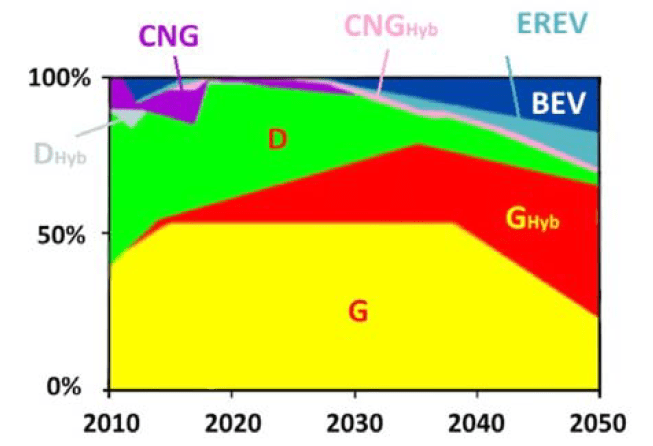
– The Institute of vehicle concepts (DLR) has developed a computer based scenario model (VECTOR21 (Fig.2)) to predict market shares of new power train concepts (HEV, BEV FCV etc.) for Germany between 2010 and 2030,
– With focus on battery electric vehicles (BEV) (16 kW, 24kW) the Institute for Transport Economics (UOC model), which will support the work of the project coordinator BAST as a subcontractor, has done a market forecast for the time horizon 2015 – 2020 for Germany.
Fig. 2. An example of VECTOR21 model – run result for the new vehicle fleet in Germany
Abbreviations: CNG (Compressed Natural Gas) – car running on Compressed Natural Gas, DHyb (Diesel hybrid) – hybrid car with a self ignition engine, CNGHyb (Compressed Natural Gas, hybrid) – hybrid car with an engine running on Compressed Natural Gas, G (gasoline) – car running on petrol, GHyb (Gasoline hybrid) – hybrid car with a spark ignition engine, D (diesel) – car running on diesel oil, BEV (Battery Electric Vehicle), EREV (Extended Range Electric Vehicle)
The eMAP project will use especially the VECTOR21 model, but will also follow the UOC-model and the Fraunhofer study as a starting point for a scenario model on deployment of electromobility. The eMAP project will make progress in the following directions [25]:
– The conclusions of the VECTOR21 model are restricted to the German passenger car market. On a contrary, in the eMAP project a transnational approach is used. Scenario based forecasts will be done for three national markets: Finland, Germany, and Poland, but also for the remaining part of EU-27,
– In the VECTOR21 model and also in the UOC-model the customer purchase decision is modelled with focus on the vehicle market. However, a more comprehensive approach for consumer decision making will be provided in eMAP. Because electromobility opens new possibilities for modal split, especially in urban travelling, the decision making process has to be broadened. Therefore, the stepwise process of consumer decision making already shown in the VECTOR21 model will be further enlarged by an additional step of modelling mobility decisions about travelling modes,
– The scope of the supporting political actions considered in the framework conditions will be broadened. In the studies analyses about financial incentives dominate. However, beside financial support, also different research funding schemes, infrastructure investments, special e.g. priority rules for EV, and information and awareness campaigns for electromobility have to be included.
The Institute for Transport Economics (UOC) has done a socio-economic assessment of electromobility. The assessment is based on the forecast of market volume of BEV (24 kW) and City-BEV (16 kW) for Germany for the time horizon 2015 – 2020. The assessment comprises impacts of electromobility on local (noise, PM, NOx) and global emissions (CO2) which are transferred to monetary benefits by using environmental damage cost-unit rates [25].
The eMAP project with regard to socio-economic impact evaluation will be based on the UOC-model, but enlarges the assessment further in the following directions [25]:
– A socio-assessment is done for Finland, Germany, Poland, and also for the remaining part of EU-27,
– The shift to electromobility has strong effects for fuel based tax income, and thus on the public budgets. Therefore based on the scenario results of fleet penetration of EV a financial analysis will be done. A financial analysis covers monetary transfer payments and tax revenues which are not considered in the cost benefit analysis,
– A usual cost-benefit assessment is restricted to an assessment of impacts which can be expressed in monetary values like transport costs changes and environmental benefits. Therefore, structural effects of the deployment of electromobility for employment, less dependency from crude oil, competitiveness of automotive industry etc. are not part of the cost-benefit assessment. To make a thorough assessment of the impacts the shift to electromobility will have on society a broader approach is used integrating monetary, quantitative and qualitative effects in the assessment. This is done by a multi-criteria analysis.
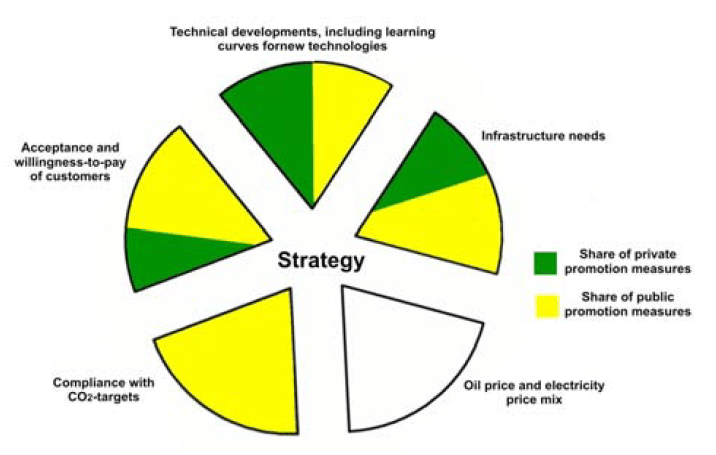
Fig.3. Share of public and private promotion measures in strategy for promotion of EV
Conclusion
The European Union is conducting research studies to identify opportunities for tackling the problem of carbon dioxide emissions from cars in favour of gradual entry into service of electric cars. This is a very complex problem due to the issues such as.:
– production capacity of the energy industry, – technical infrastructure for charging batteries, – technical capabilities to produce a new generation of batteries, – servicing electric cars, – level of costs of operating electric cars.
It should be stressed that solving these problems will be associated with a significant financial expenditures, which will fall to the external costs of transport, and their levels will be one of the decisive application factors for the modern electric vehicles. On the other hand “avoided costs” incurred by the replacement of conventional vehicles powered by internal combustion engines with these vehicles will not be meaningless.
REFERENCES
[1] Winiarski B., Polityka gospodarcza, Wydawnictwo PWN, Warszawa 2006,308 [2] Pawłowska G., Zewnętrzne koszty transportu. Wydawnictwo Uniwersytetu Gdańskiego, Gdańsk 2000, 17 [3] http://ec.europa.eu [4] Tylutki A., Wronka J., Znaczenie kosztów zewnętrznych dla polityki transportowej, Przegląd Komunikacyjny 1995, nr.8 [5] Kowalewski M., Oszczędności kosztów zanieczyszczania środowiska w analizach kosztów i korzyści ex ante i ex post inwestycji drogowych. Transport a Unia Europejska. Zeszyty Naukowe Uniwersytetu Gdańskiego nr 33/2006,196 [6] Shefer D., Rietveld P., Congestion and safety on highways: Towards an analitycal model. Urban Studies 1997, nr 34, s.679-693, za: M.Kowalewski, oszczędności kosztów zanieczyszczenia środowiska, 198 [7] http://www.cofret-project.eu [8] Deklaracja drugiego Szczytu Ziemi z inspiracji ONZ, Johanesburg 2002 [9] Skiner I., Van Essen H., Smokers R., Hill., EU Transport GHG: Routes to 2050. June 2010 [10] Strategia Rozwoju Transportu do 2020 roku (z perspektywą do 2030 roku). Projekt. Ministerstwo Infrastruktury, marzec 2011 roku [11] Uwarunkowania wdrożenia zintegrowanego systemu e – mobilności w Polsce. Ministerstwo Gospodarki, czerwiec 2012 roku [12] Biała Księga. Plan utworzenia jednolitego europejskiego obszaru transportu – dążenie do osiągnięcia konkurencyjnego i zasobooszczędnego systemu transportu. KOM(2011) 144 wersja ostateczna [13] Waśkiewicz J., Chłopek Z., Pawlak P.: Prognozy eksperckie zmian aktywności sektora transportu drogowego. Praca ITS Nr.7200/ZBE. Instytut Transportu Samochodowego, Warszawa,12 października 2012 r. [14] Niebieska Księga. Analiza kosztów i korzyści projektów inwestycyjnych w sektorze transportu. Publikacja wsparta ze środków pomocowych UE w ramach projektu Phare PL 2002/000 – 580.01.08 [15] Jaspers. Niebieska Księga. Nowe wydanie, grudzień 2008 [16] Maibach M., Schreyer C. Sutter D., Van Esssen H., P., Boon B., H., Smokers R., Schroten A., Doll C., Pawlowska B., Bak M.: Handbook on estimation of external costs in the transport sector. Version 1.1. Report Delft, February 2008 [17] Van Essen H., Schroten A., Otten M., Sutter D., Schreyer Ch., Zandanella R., Doll C.: External Costs of Transport in Europe. Update Study for 2008. Report Delft, November 2011 [18] ScelecTRA. Electromobility+ – Launching seminar, September 13th 2012 [19] EV-STEP. Electromobility+ – Launching seminar, September 13th 2012 [20] DEFINE. Electromobility+ – Launching seminar, September 13th 2012 [21] SELECT. Electromobility+ – Launching seminar, September 13th 2012 [22] COMPETT. Electromobility+ – Launching seminar, September 13th 2012 [23] E-FACTS. Electromobility+ – Launching seminar, September 13th 2012 [24] http://www.project-emap.eu [25] Application Form for eMAP project [26] Biere D., Dallinger D., Wietschel M., Ökonomische Analyse der Ernstnutzer von Elektrofahrzeugen, Zeitschrift für Energiewissenschaft, S: 173-181, 02, 2009
Authors: Professor Ph.D. Zdzisław Kordel, Uniwerytet Gdański, ul Bażyńskiego 1a 80 – 952 Gdańsk, E- mail: ZdzislawKordel@wp.pl, DEng. Wojciech Gis, Instytut Transportu Samochodowego, ul.Jagiellońska 80, 03-301 Warszawa, E-mail: wojciech.gis@its.waw.pl; MA Maciej Menes, Instytut Transportu Samochodowego, ul.Jagiellońska 80, 03-301 Warszawa, E-mail: maciej.menes@its.waw.pl
Source & Publisher Item Identifier: PRZEGLĄD ELEKTROTECHNICZNY, ISSN 0033-2097, R. 89 NR 10/2013
Published by Alex Roderick, EE Power – Technical Articles: An Introduction to Harmonics, May 06, 2021.
This article will provide a basic introduction of harmonics in power engineering.
A harmonic is a current or voltage component at a frequency that is an integer (whole number) multiple (2nd, 3rd, 4th, etc.) of the fundamental frequency. For example, when the power supply is 60 Hz AC, the first harmonic (60 Hz) is the fundamental frequency. Other multiples of the fundamental harmonic are the second harmonic (120 Hz), third harmonic (180 Hz), fourth harmonic (240 Hz), etc. When these harmonics are present in a circuit, the resulting waveform consists of the sum of the fundamental and the higher harmonics at every instant. See Figure 1. The result is a distorted waveform from the contribution of the harmonics.
Figure 1. Harmonics are multiples of the fundamental waveform. Image courtesy of SALICRU
Note:
High-frequency harmonics can shorten the operating life or cause the failure of electrical equipment.
The basic design of most electrical distribution equipment assumes that the current and voltage waveforms of the circuit will be sinusoidal. In power distribution systems, there are different types of nonlinear components that draw current disproportionately with respect to the source voltage. This causes non-sinusoidal current waveforms that contain harmonic components. For example, the equipment that draws current in pulses for only a portion of the cycle will cause harmonic components.
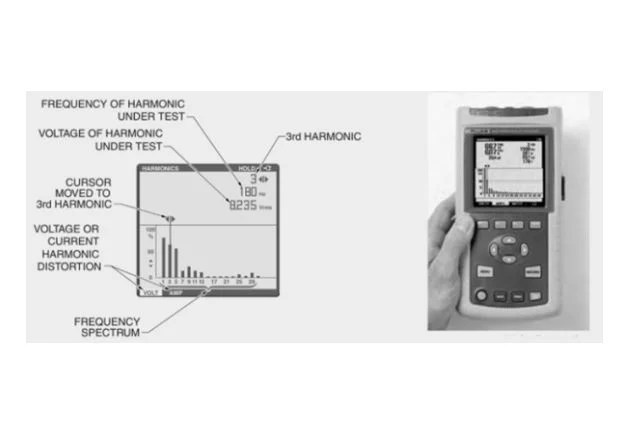
Knowledge of harmonics present on a power line is important for working on any power distribution system. When evaluating power quality, the incoming power, types (linear and nonlinear) and the number of loads, and equipment used in the distribution system must all be tested. A power quality meter can be used to measure the amount of voltage and current harmonics on a line. The amount of each harmonic present on the line and related information are indicated by numeric data and the frequency spectrum on the graphic display of the power quality meter. See Figure 2.
Figure 2. A power quality meter can be used to indicate the presence and magnitude of harmonics.
Odd-and Even-Numbered Harmonics
Odd harmonics are odd multiples (3rd, 5th, 7th, etc.) of the fundamental. They add together and increase their effect. Loads that draw odd harmonics have increased resistance (I2R) losses and eddy current losses in transformers. If the harmonics are significant, a transformer must be derated to prevent overheating.
Even harmonics are even multiples (2nd, 4th, 6th, etc.) of the fundamental. Even harmonics are generally fairly small because most non-linear loads in power systems produce odd harmonics and even harmonics tend to cancel each other. If even harmonics are present, this fact may be used as a troubleshooting tool. They generally indicate that a DC current may be present in the secondary winding of the transformer. The DC offset is typically caused by half-wave rectification due to a failed rectifier.
On alternate half-cycles, a DC offset may cause a transformer to become saturated and draw exceedingly high currents, causing the primary to burn out. The transformer core can experience a strong vibration and a very loud noise as a result of these issues. Generally, a DC offset of more than 1% of the rated current can cause problems.
Triplen Harmonics
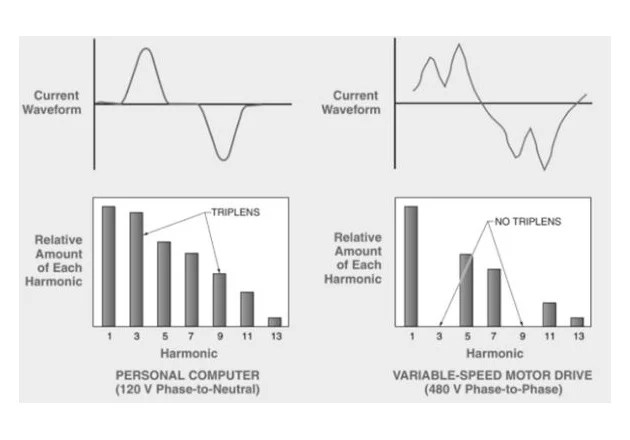
Triplen harmonics (triplens) are odd multiples of the third harmonic (3rd, 9th, 15th, etc.). Only single-phase loads generate triplen harmonics. Three-phase loads do not generate triplen harmonics. Triplen harmonics can cause problems such as overloading of neutral conductors, telephone interference, and transformer overheating. Special types of transformers are used to reduce triplen harmonics.
Single-phase electronic loads connected phase-to-neutral, such as 120V office circuits or 277V lighting circuits, generate third harmonics with decreasing amounts of the higher odd harmonics.
Three-phase electronic loads connected phase-to-phase, such as 208V power supplies or 480 V variable-speed motor drives, do not generate the triplen harmonics, but they do generate significant levels of the other higher-level harmonics. See Figure 3.
Figure 3. Triplen harmonics are generated by circuits wired phase-to-neutral.
Third Harmonic
Single-phase electronic loads generate third harmonics in addition to smaller amounts of higher odd harmonics. Only the triplen harmonics contribute to the high neutral currents problem. The 9th, 15th, and higher triplen harmonics have a relatively lower current level and distort the neutral current just marginally. Hence, they do not have a noticeable impact on the actual rms neutral current.
Since the higher harmonics are relatively smaller, the third harmonic, as a percentage of total rms current, multiplied by three, is a fairly good estimate of the percent neutral current that results from three identical non-linear single-phase loads. Thus, the neutral current is at about 100% of the fundamental phase current when the third harmonic is at 331⁄3% of the fundamental phase current.
Harmonic Sequence
The harmonic sequence is the phasor rotation of the harmonic with respect to the fundamental (60 Hz) frequency. The order in which waveforms from each phase (A, B, and C) cross zero is referred to as phasor rotation. Phasor rotation is simplified by using lines and arrows instead of waveforms to show phase relationships. See Figure 4. The harmonic phase sequence is critical because it determines how the harmonic affects the operation of loads and components like conductors in a power distribution system.
Figure 4. Phasor rotation of Positive, Negative, and Zero Sequence Harmonics
Positive Sequence
Positive sequence harmonics (1st, 4th, 7th, etc.) have the same phase sequence as the fundamental harmonic. Positive sequence harmonics cause additional heat in transformers, conductors, circuit breakers, and panels in a power distribution system. A positive sequence harmonic rotates in the same direction as the fundamental in an induction motor.
Negative Sequence
Negative sequence harmonics (2nd, 5th, 8th, etc.) have the opposite phase sequence compared to the fundamental harmonic. Like positive sequence harmonics, negative sequence harmonics cause additional heat in power distribution system components such as transformers, conductors, circuit breakers, and panels. A negative sequence harmonic rotates in the opposite direction from the fundamental in an induction motor. The reverse rotation is not enough to cause the motor to reverse direction, but it does reduce the forward torque of the motor. The reduced torque causes a higher motor current to be drawn and results in excessive heating.
Zero Sequence
Zero sequence harmonics (3rd, 6th, 9th, etc.) do not produce a rotating field in either direction. However, zero-sequence harmonics do cause component and system heating. Zero sequence harmonics do not cancel but can add together in the neutral conductor of 3-phase, 4-wire systems. Single-phase appliances that use rectifier power supplies, including computers, fluorescent lighting with electronic ballasts, and other common electronic devices, contribute significantly to current on neutral wires.
Author: Alex earned a master’s degree in electrical engineering with major emphasis in Power Systems from California State University, Sacramento, USA, with distinction. He is a seasoned Power Systems expert specializing in system protection, wide-area monitoring, and system stability. Currently, he is working as a Senior Electrical Engineer at a leading power transmission company.
This was originally posted on Elements. Sign up to the free mailing list to get beautiful visualizations on natural resource megatrends in your email every week.
Awareness around climate change is shaping the future of the global economy in several ways.
Governments are planning how to reduce emissions, investors are scrutinizing companies’ environmental performance, and consumers are becoming conscious of their carbon footprints. But no matter the stakeholder, energy generation and consumption from fossil fuels is one of the biggest contributors to emissions.
Therefore, renewable energy sources have never been more top-of-mind than they are today.
The Five Types of Renewable Energy
Renewable energy technologies harness the power of the sun, wind, and heat from the Earth’s core, and then transforms it into usable forms of energy like heat, electricity, and fuel.
The above infographic uses data from Lazard, Ember, and other sources to outline everything you need to know about the five key types of renewable energy:
Energy Source
% of 2021 Global Electricity Generation
Avg. levelized cost of energy per MWh
Hydro
15.3%
$64
Wind
6.6%
$38
Solar
3.7%
$36
Biomass
2.3%
$114
Geothermal
<1%
$75
Editor’s note: We have excluded nuclear from the mix here, because although it is often defined as a sustainable energy source, it is not technically renewable (i.e. there are finite amounts of uranium).
Though often out of the limelight, hydro is the largest renewable electricity source, followed by wind and then solar.
Together, the five main sources combined for roughly 28% of global electricity generation in 2021, with wind and solar collectively breaking the 10% share barrier for the first time.
The levelized cost of energy (LCOE) measures the lifetime costs of a new utility-scale plant divided by total electricity generation. The LCOE of solar and wind is almost one-fifth that of coal ($167/MWh), meaning that new solar and wind plants are now much cheaper to build and operate than new coal plants over a longer time horizon.
With this in mind, here’s a closer look at the five types of renewable energy and how they work.
1. Wind
Wind turbines use large rotor blades, mounted at tall heights on both land and sea, to capture the kinetic energy created by wind.
When wind flows across the blade, the air pressure on one side of the blade decreases, pulling it down with a force described as the lift. The difference in air pressure across the two sides causes the blades to rotate, spinning the rotor.
The rotor is connected to a turbine generator, which spins to convert the wind’s kinetic energy into electricity.
2. Solar (Photovoltaic)
Solar technologies capture light or electromagnetic radiation from the sun and convert it into electricity.
Photovoltaic (PV) solar cells contain a semiconductor wafer, positive on one side and negative on the other, forming an electric field. When light hits the cell, the semiconductor absorbs the sunlight and transfers the energy in the form of electrons. These electrons are captured by the electric field in the form of an electric current.
A solar system’s ability to generate electricity depends on the semiconductor material, along with environmental conditions like heat, dirt, and shade.
3. Geothermal
Geothermal energy originates straight from the Earth’s core—heat from the core boils underground reservoirs of water, known as geothermal resources.
Geothermal plants typically use wells to pump hot water from geothermal resources and convert it into steam for a turbine generator. The extracted water and steam can then be reinjected, making it a renewable energy source.
4. Hydropower
Similar to wind turbines, hydropower plants channel the kinetic energy from flowing water into electricity by using a turbine generator.
Hydro plants are typically situated near bodies of water and use diversion structures like dams to change the flow of water. Power generation depends on the volume and change in elevation or head of the flowing water.
Greater water volumes and higher heads produce more energy and electricity, and vice versa.
5. Biomass
Humans have likely used energy from biomass or bioenergy for heat ever since our ancestors learned how to build fires.
Biomass—organic material like wood, dry leaves, and agricultural waste—is typically burned but considered renewable because it can be regrown or replenished. Burning biomass in a boiler produces high-pressure steam, which rotates a turbine generator to produce electricity.
Biomass is also converted into liquid or gaseous fuels for transportation. However, emissions from biomass vary with the material combusted and are often higher than other clean sources.
When Will Renewable Energy Take Over?
Despite the recent growth of renewables, fossil fuels still dominate the global energy mix.
Most countries are in the early stages of the energy transition, and only a handful get significant portions of their electricity from clean sources. However, the ongoing decade might see even more growth than recent record-breaking years.
The IEA forecasts that, by 2026, global renewable electricity capacity is set to grow by 60% from 2020 levels to over 4,800 gigawatts—equal to the current power output of fossil fuels and nuclear combined. So, regardless of when renewables will take over, it’s clear that the global energy economy will continue changing.
Author: Govind graduated from the University of British Columbia with a Bachelor of International Economics before joining Visual Capitalist as a Writer. He is focused on trends in commodities, mining, and energy but occasionally strays into other topic areas. Govind is an avid coffee drinker and loves a flat white.
Published by Tomasz KUCZEK, Marek FLORKOWSKI, ABB Corporate Research Center in Krakow, Poland
Abstract. Gas Insulated Substations (GIS) are broadly used for transmission and distribution of electric power. Due to the interactions with a network and various environmental phenomena like lightning the GIS are subjected to the Very Fast Transients (VFT). Such VFT can be also created within GIS mainly by the disconnector operations. Paper will present an approach towards modeling of transient phenomena in GIS. The simulation of transients in exemplary high voltage power supply substation will be shown.
Streszczenie. Stacje izolowane gazem SF6 (GIS) są szeroko wykorzystywane w elektroenergetycznych systemach przesyłowych i dystrybucyjnych. W wyniku zjawisk przejściowych takich jak operacje łączeniowe oraz wyładowania atmosferyczne, stacje GIS narażone są na występowanie przepięć bardzo szybko zmiennych. Artykuł przedstawi zasady modelowania zjawisk przejściowych w stacjach GIS oraz przykładową analizę przepięć generowanych poprzez operowanie odłącznikiem. (Modelowanie przepięć w stacjach elektroenergetycznych izolowanych gazem SF6)
Keywords: very fast transients overvoltages, switching, GIS substation, disconnector, EMTP/ATP modeling, simulation Słowa kluczowe: szybkozmienne zjawiska przepięciowe, stacja izolowana gazem SF6, odłącznik, EMTP/ATP modelowanie, symulacja
Introduction
The Very Fast Transients (VFT) in power systems cover a frequency range from 100 kHz up to hundreds of MHz [1, 2]. VFT are an effect of GIS disconnector opening or closing, as well as other events such as operation of a circuit breakers or grounding switches. An electromagnetic wave is generated, which propagates along the busbars and substation apparatus. Due to the fact that in can be multiple times reflected at joints between substation equipment, its maximum overvoltage peak values can reach significant levels. Their magnitude is in the range of 1.5 to 2.0 p.u. of the line-to-neutral voltage crest, but they can also reach values as high as 2.5 p.u. to 3 p.u. in case of ultra high voltage systems. These values are generally below the Basic Insulation Level (BIL), but VFT can speed up insulations aging and degradation processes due to their frequent occurrences.
The fact of VFT occurrence in high voltage power systems forces to study them in an analytical manner. It is important to recognize its possible maximum overvoltage peak values in order to determine if those are below acceptable insulation levels.
This paper presents a state of the art modeling principles for this kind of phenomena. Also exemplary 380 kV GIS substation have been analyzed. Overvoltage waveforms during GIS disconnector closing operation have been calculated along with their maximum peak values. All simulations have been performed using ATPDraw 5.6p6 software package.
VFT phenomenon description
During the closing or opening operation of the disconnector in adjacent bay of GIS substation (Fig. 1) an electric arc occurs multiple times between the contacts. These so called re-strikes and pre-strikes are a result of the relatively slow speed of disconnector contacts moving. Sparks occurrence result in generation of overvoltage wave, which propagates along the substations. Its propagation is characterized by multiple reflections at substation equipment joints, which leads to high overvoltage peak values. It also has to be pointed out, that after the disconnector opening operation, the capacitive trapped charge voltage remains on the disconnector load side. It is being discharged very slowly through the GIS spacers and other equipment. However, during reclosing of the disconnector this voltage can have a significant influence on generated overvoltages. The typical value of trapped charge voltage can be expected in the range of 0.3 ÷ 0.6 p.u. Nonetheless, for Insulation Co-ordination studies it is always required to analyze the worst case working conditions for specific network. Thus, it should be assumed, that the trapped charge voltage is equal to -1 p.u. of nominal system voltage, whereas the cosine source side voltage is equal to +1 p.u. It also has to be assumed that the studied system is running at its highest power frequency nominal voltage. It results then in significant potential difference between contacts during the spark occurrence, which leads to generation of most severe overvoltages.
Fig.1. VFT generation principle – disconnector operating in the GIS substation: US – voltage at disconnector source side, UL – voltage at disconnector load side
The switching and lightning overvoltages are a typical concern in high voltage power systems. Switching oscillations inside the GIS substations (Very Fast Transients) are characterized by a very high rise times, which results in the fact that in studied range of frequencies surge arresters are visible mainly as a phase to ground capacitance. Their nominal voltage-current nonlinear characteristics does not have significant influence on overvoltages suppression.
It has to be also said, that necessity of VFT analysis comes out of the fact, that the ratio of nominal system voltage and Switching Impulse Withstand Level (SIWL) is significantly less for ultra high voltage system than for medium voltage systems for instance. Comparison between nominal system ratings and acceptable switching overvoltage levels have been summarized in Table 1 [3, 5].
Table 1. Comparison of ratio between highest system voltages and their maximum switching impulse acceptable levels
.
As it is clearly visible in Table 1, the ratio between peak values of acceptable switching overvoltage and highest power frequency voltage for systems at 24 kV is equal to 7.40 p.u., whereas for ultra high voltages like for 765 kV is equal to 2.48 p.u. As it was stated before, overvoltages generated during Very Fast Transients phenomenon can reach peak values as high as 2.0 ÷ 3.0 p.u. Since this is very close to the maximum acceptable levels, the analysis of VFT overvoltages, quantity and frequency is very important.
Modeling principles for VFT
Very Fast Transients are characterized by rise times in the range of 4-100 ns. Thus, it has to be modeled as an appropriate distributed and lumped elements. The travelling nature of VFT forces one to use appropriate values of surge impedances with associated wave propagation speed and element length as well as phase-to-ground capacitances [4]. Detailed description have been presented in Table 2.
Table 2. GIS substation equipment modeling data for VFT
.
Special attention was paid to the power transformer modeling. It was represented by means of inductance, resistance and capacitance of HV bushings as well as capacitance of HV side windings. Parameters are evaluated from the frequency response analysis of the transformer. Typical values and used model have been presented in Figure 2.
Fig.2. High frequency model of the HV transformer side; CD – HV side windings capacitance, CE, R1, L1 – capacitance, resistance and inductance of HV bushings
During the GIS disconnector closing operation, the voltage breakdown takes about 4 ns. The modeling of this event is made in EMTP/ATP with an exponentially decreasing resistance r from very high value to zero with a time constant equal to τ = 0.6·10-9 s, which results from disconnector capacitance and arc fixed resistance. The nonlinear arc resistance during closing event is implemented with use of MODELS language in EMTP/ATP according to formula (1):
.
where: τ – time constant.
This non-linear resistance is in series with a fixed resistance of 0.5 Ω, which represents the spark resistance after voltage breakdown.
For the worst case operating conditions, the damping of the Very Fast Transients, which occurs due to ohmic losses inside the GIS substation and mostly due to transition of the surge from inside to the outside earthing system at the bushing should not be considered.
Exemplary VFT analysis of 380 kV GIS substation
A typical 380 kV GIS substation has been considered for the VFT analysis. A single line diagram of part of the substation has been presented in Figure 3. It consists of 280 MVA power transformer that is energized through overhead transmission line interconnected to the substation with HV cable.
Singular switching operation (closing) of the disconnector have been simulated in EMTP/ATP software. As it is visible in Figure 3, circuit breaker CB2 is open during entire process of disconnector closing event, whereas circuit breakers CB1 and CB3 are closed and provide current path, which have been marked with dashed line. For the worst case operating conditions it has been assumed, that system is working at maximum allowed power frequency voltage (420 kV) and at the switching time instant source side voltage is at its maximum (+1 p.u.).
Overvoltage waveforms have been obtained at following locations (according to Fig. 3):
• disconnector load side – position (1), • disconnector source side – position (2), • transformer HV terminals – position (3), • GIS-cable termination – position (4).
During the calculations, maximum overvoltage peak values have been obtained and compared to the Switching Impulse Withstand Voltage (SIWL) that is equal 1050 kV for 380 kV systems [5]. The nominal voltage in per units have been calculated according to formula (2):
.
As it was discussed above, value of trapped charge voltage UTC at disconnector load side may have significant influence on generated overvoltages. Thus, two values of this voltage have been considered:
• case 1: UTC= -0.5 p.u. = -171.45 kVpeak • case 2: UTC = -1 p.u. = -342.9 kVpeak
Simulation results
As it was described, the disconnector closing event was modeled as an exponentially decreasing resistance. For this study, this operation was issued at the time instant of t = 10 μs. The nonlinear resistance decreases from very high value to 0.5 Ω in about 4 ns (Fig 4). This behavior is independent from value of trapped charge voltage, thus it is the same for both cases with -1 p.u. and -0.5 p.u.
Fig.4. Disconnector nonlinear resistance during closing event
For each waveform, maximum overvoltage peak value have been obtained in kilovolts as well as in per units. Also percentage ∆% difference between both scenarios have been calculated, according to formula (3):
.
where: UC1, UC2 – calculated voltages at case 1 and case 2.
Summarized results for both analyzed scenarios have been presented in Table 3.
Table 3. Simulation results summary
.
As it has been presented in Table 3, the highest overvoltage peak value occurred at the operated disconnector terminals and is equal to 655 kV, which reaches level of almost 2 p.u. It can be also observed, that overvoltage magnitude decreased during propagation through the entire GIS substation. At the transformer terminals its peak value is equal to 551 kV, whereas at GIS extraction point it decreased to 464 kV. Once the overvoltage wave extracts out of the GIS, it is very quickly dumped on substation overhead connections and high voltage cables. Such behavior is visible for both analyzed cases, that is with -0.5 p.u. and -1 p.u. of trapped charge voltage at disconnector load side. However, as it have been expected, calculated maximum overvoltage peak values are significantly lower with smaller trapped charge. Calculated voltage difference is in the range of 8.0 – 12.2 % and it is an obvious reason why during the typical insulation coordination studies all of the analyzes should be performed with -1 p.u. of assumed trapped charge voltage.
All reported values are well below maximum acceptable level of 1050 kV (Switching Impulse Withstand Level). During the insulation coordination processes it is necessary, to have all overvoltages below the safety margin of 80 % of SIWL, that is below 840 kV. As it is clearly visible in Table 3, all reported values are within acceptable limits.
Calculated overvoltage waveforms at specific locations of studied GIS substation have been illustrated in figures 5 to 8 for case 1 and in figures 9 to 12 for case 2.
Fig.5. VFT overvoltage waveforms, voltage at disconnector load side, trapped charge voltage UTC = -0.5 p.u.
Fig.6. VFT overvoltage waveforms, voltage at disconnector source side, trapped charge voltage UTC= -0.5 p.u.
Fig.7. VFT overvoltage waveforms, voltage at transformer HV terminals, trapped charge voltage UTC = -0.5 p.u.
Fig.8. VFT overvoltage waveforms, voltage at GIS-cable termination, trapped charge voltage UTC = -0.5 p.u.
Fig.9. VFT overvoltage waveforms, voltage at disconnector load side, trapped charge voltage UTC = -1 p.u.
Fig.10. VFT overvoltage waveforms, voltage at disconnector source side, trapped charge voltage UTC= -1 p.u.
Fig.11. VFT overvoltage waveforms, voltage at transformer HV terminals, trapped charge voltage UTC = -1 p.u.
Fig.12. VFT overvoltage waveforms, voltage at GIS-cable termination, trapped charge voltage UTC = -1 p.u.
As it is visible in all figures representing VFT overvoltage waveforms, disconnector have been closed at time instant of t = 10 μs. All overvoltage waveforms are characterized by multiple wave reflections resulting with very high frequencies in the range of 6 MHz to 10 MHz. In figures 5 and 9 it can be observed, that the disconnector load side is preloaded with trapped charge equal to -0.5 p.u. and -1 p.u. respectively. In figures 8 and 11, where voltage waveform at transformer HV terminals have been represented, one can observe, that the overvoltage wave is delayed in time of 300 ns from the assumed disconnector closing time instant of 10 μs. This can be explained with the fact, that overvoltage wave propagates along entire GIS substation from the operated disconnector up to the transformer. Since this distance is equal to 86 m wave propagation speed can be easily calculated to 286 m/μs, which corresponds very well with assumed value of 290 m/μs. These values differ due to the presence of GIS equipment capacitances that smooth the overvoltage wave.
Conclusions
It has been presented, that with a detailed analysis and use of appropriate tools and modeling techniques, it is possible to evaluate maximum overvoltage peak values resulting from GIS disconnector closing operation. It is necessary to check if overvoltages are below maximum acceptable level of 80 % of Switching Impulse Withstand Level. It has been calculated, that maximum overvoltage peak value occurs at operated disconnector, however reported values are below the maximum acceptable levels. Based on studied cases with two different values of trapped charge it can be concluded, that during typical insulation coordination studies, for the worst case conditions it should be assumed, that trapped charge voltage at disconnector load side is equal to -1 p.u. As it has been presented, maximum overvoltage peak values can reach values up to 2.0 p.u. in this particular case. However, it has to be added, that phenomenon of Very Fast Transients propagation inside the GIS substations is very complex and complicated. Its analysis has to be performed with special attention to a specified substation layout, busbars lengths and cable or transformer connections and terminations.
REFERENCES
[1] CIGRE Working Group 33/13.09, Monograph on GIS Very Fast Transients, 1989 [2] Furgał J.: Analysis of Overvotlage Risk of the Insulation of a Transformer Protected by Use of Lightning and Surge Arresters, Wydawnictwa AGH, Kraków, 2003, ISSN 0867-6631 [3] Andrew R. Hileman: Insulation Coordination for Power Systems, CRC Press Taylor and Francis Group, New York 1999 [4] IEEE Working Group on Modeling and Analysis of System Transients Using Digital Programs: Modeling and Analysis Guidelines for Very Fast Transients, IEEE Transactions on Power Delivery, Vol. 11, No. 4, October 1996, p. 2028 – 2035 [5] IEC 60071-1:2006, Insulation co-ordination – Part 1: Definitions, principles and rules
Authors: Tomasz Kuczek, MSc. Eng., E-mail: tomasz.kuczeki@pl.abb.com, Marek Florkowski, D.Sc. Eng., E-mail: marek.florkowski@pl.abb.com, ABB Corporate Research Center, Starowiślna 13A., 31-038 Kraków, Poland
Source & Publisher Item Identifier: PRZEGLĄD ELEKTROTECHNICZNY (Electrical Review), ISSN 0033-2097, R. 88 NR 4a/2012
Published by Lorenzo Mari, EE Power – Technical Articles: The Basics of Substation Grounding: Parts of the Grounding System, October 02, 2020.
Learn about the main parts of a substation grounding system
One of the vital aspects of the protection of people and equipment in electrical substations is the provision of an adequate grounding system. The grounding system interconnects the equipment neutrals, equipment housings, lightning masts, surge arresters, overhead ground wires, and metallic structures, placing them at earth’s potential.
The subject of grounding systems in substations made up of a network of conductors interconnecting the metallic parts of equipment and structures, and an arrangement of buried conductors providing an electrical connection to the earth, has long been studied..
Many workers involved in the various applications of electricity — lighting, electromechanical conversion, telecommunications, process control, information technology, biomedical equipment, and more — do not have a keen understanding of the purpose and design procedures of a grounding network.
The objective of this article, rather than presenting procedures to design a grounding grid, is to create discussion surrounding the need for and purpose of a grounding system. With these elements clearly defined, it will be possible to understand the design procedures with due analysis to each particular case.
The Need for a Grounding System in the Substation
The matter of grounding systems in substations is vital. The main functions of a grounding system are:
• Provide the neutrals of generators, transformers, capacitors, and reactors a connection to the earth
• Offer a low impedance path to the earth for the currents coming from ground faults, lightning rods, surge arresters, gaps, and related devices
• Limit the potential differences that appear between the substation metallic objects or structures, and the ground potential rise (GPR), due to the flow of ground currents; they may pose a danger to equipment and personnel
• Improve the operation of the protective relay scheme to clear ground faults
• Increase the reliability and availability of the electrical system
• Allow the grounding of de-energized equipment during maintenance
Parts of the Substation’s Grounding System
Substation safety requires the grounding and bonding of all exposed metal parts. The metallic structures, generators, transformer tanks, circuit breakers, switchboards, switches, metal walkways, steelwork of buildings, fences, instrument transformer secondaries, capacitors, lightning arresters, surge arresters, and reactors must be grounded. With proper grounding, things that are touching or standing on the ground nearby to any of this equipment will not receive a shock if an electric conductor arcs to or comes in contact with them.
A substation grounding system has two well-defined parts — the grounding network and the connection to the earth.
The Grounding Network
The grounding network contains the conductors responsible for offering a low impedance path between the equipment frames or metallic structures and the connection to the earth. This network should have high reliability because the breaking of a ground connection can cause safe equipment to become dangerous.
The usual practice is connecting the equipment frames and metallic structures individually to the ground electrode–with copper conductors or straps–to:
• Minimize the number of equipment disengaged from the ground when, by accident, one of the connections breaks
• Circulate the ground-fault current through a predetermined circuit. If the ground-fault current flows through random paths, there is a risk that they lack the thermal capacity and mechanical strength to carry the current, risking people, damaging equipment, and causing fires
Figure 1 shows a typical grounding network. In the illustration, each piece of equipment has two links — to the earth and the grounding conductor.
Figure 1 Grounding network. Image courtesy of Prof. J. H. Briceño.
The two links provide dependable circuits for the return of ground-fault current. The connection to the grounding conductor is optional; it lessens the risk when the connection to earth does not guarantee proper surface potential gradients. When used, most of the fault current will return through the conductor, reducing the potential gradients on the surface of the ground.
The equipment 4, located at another substation, has a separate connection to the earth. By using the grounding conductor, the ground connections of the two substations work in parallel; this is generally beneficial as it reduces the return of current through the ground, lessening the surface potential gradients.
Without the grounding conductor, all ground-fault current from equipment 4 will return through the earth. The connection to the earth in both substations should have low impedance, so that the ground-fault current magnitude will be large enough to activate the overcurrent protection system, clearing the fault, and the generated surface potential gradients will be safe.
Equipment frames and steel structures may be used as a path to earth if their conductivity–including the joints–is equivalent to the required conductor or strap. Examples are the connection of surge arresters to the transformer tank and the overhead ground wires and lightning masts–extending upward from the top– attached to the substation steel structure.
The following are recommendations for the design and construction of the grounding network:
• Compute the magnitude and duration of the most severe ground-fault current to select the size of the conductors, straps, and connectors. The conductors, straps, and connectors must have sufficient thermal and mechanical capacity to resist fusing and withstand the electromechanical stresses produced during failure–for the time that the protection scheme will allow the current to flow. Additionally, they should not lose their electrical properties over time.
• Avoid creating random loops or circuits for the return of ground-fault current. Do this by attaching each piece of equipment to the earth or the ground conductor
• Minimize the separation between the grounding conductors and their associated phase conductors, to reduce the ground-circuit reactance
• Analyze the return paths of the ground-fault current when there is associated equipment located in another substation, with a separate connection to the earth. It could happen that some return paths cannot carry the ground-fault current, such as cable shield and armor
• Extend the grounding network to all island structures within the substation
The Connection to the Earth
There are three main methods to connect a substation grounding network to the earth:
• Radial • Ring • Grid
The radial system consists of one or more grounding electrodes with connections to each device in the substation. It is the most economical, but the least satisfactory because, when a ground fault occurs, it produces enormous surface potential gradients.
The ring system consists of a conductor placed around the area occupied by the substation equipment and structures and connected to each one by short links. It is an economical and efficient system that reduces the significant distances of the radial system. The surface potential gradients decrease because the ground-fault current travels through several prearranged paths.
The grid system is usual. It consists of a grid of horizontally arranged copper conductors, embedded a little below grade, and connected to the substation equipment and metallic structures; grounding rods can be added to reach layers of lower resistivity at a greater depth. This system is the most effective but also the most expensive.
The Grid System
The primary purpose of a grounding grid is to equalize the potential gradients above the grid, protecting people and equipment.
Under ground-fault conditions, the portion of the fault current flowing from the earth to the grid or vice versa triggers a rise of the ground potential above the grid–with respect to remote earth. This event is the ground potential rise. Numerically, the ground potential rise is equal to the product of the grid resistance times the maximum grid current.
If the people inside and around the substation can tolerate the ground potential rise, the grounding grid is safe.
Assuming a 2 Ω ground resistance, a 5,000 A ground-fault current — which might be more — would cause a ground potential rise of 10,000 V during the ground fault. This voltage drop could injure people and damage equipment in the substation. Frequently, getting a low resistance is difficult; for this reason, it is not practical to design only for a safe ground potential ground on the substation, mainly when comprising large ground-fault currents.
The grid is capable of controlling the surface potential gradients at each point inside the substation. Although the grid will not reduce the grounding resistance by much, all the surfaces will have nearly the same potential as the equipment and metallic structures.
In almost no substation can a single grounding electrode have the necessary conductivity and thermal capacity to handle the ground-fault current. But if several electrodes are installed and connected to metallic structures, to equipment housings, and the neutrals of electrical machines, the result will be a grounding grid. By burying the grid in a good resistivity soil, a suitable grounding system can be obtained.
The grounding grid should cover as much ground as possible in the substation, including an area outside the fence. The conductors will be laid in parallel, trying to maintain a uniform spacing along the rows of equipment and structures in the substation. This arrangement will simplify the connections.
The length of conductor, spacings, and the total area of the grid, to achieve acceptable surface potential gradients, will depend on the particular context of the substation.
Places with a high concentration of fault currents, such as the neutrals of generators, power transformers, and grounding transformers, are critical, requiring reinforcements such as more conductors and larger sizes. In areas frequented by operators, it is customary the use of grounding mats. Grounding mats are solid metallic plates or metal gratings, placed above the grounding grid, where workers place their feet when operating equipment. This practice will keep the potential gradients low in those spots.
A Review of the Parts of the Grounding System
The subject of grounding electrical substations is under continuous research.
Many workers in the electrical area have insufficient knowledge about substation grounding, even though this is of vital importance since the safety of people and equipment depends on it.
A substation grounding system has two main parts: the grounding network and the connection to the earth. The grounding network bonds all equipment frames and metallic structures in the substation, while the connection to the earth is the interface between the electrical system and the earth.
There are three methods to connect a substation to the earth: radial, ring, and grid.
The grid is the most effective system, although the most expensive. It is a lattice of copper conductors placed below grade and connected to the substation frame and equipment.
The grid equalizes the surface potential gradients, protecting people and equipment.
Author: Lorenzo Mari holds a Master of Science degree in Electric Power Engineering from Rensselaer Polytechnic Institute (RPI). He has been a university professor since 1982, teaching topics as electric circuit analysis, electric machinery, power system analysis, and power system grounding. As such, he has written many articles to be used by students as learning tools. He also created five courses to be taught to electrical engineers in career development programs, i.e., Electrical Installations in Hazardous Locations, National Electrical Code, Electric Machinery, Power and Electronic Grounding Systems and Electric Power Substations Design. As a professional engineer, Mari has written dozens of technical specifications and other documents regarding electrical equipment and installations for major oil, gas and petrochemical capital projects. He has been EPCC Project Manager for some large oil, gas & petrochemical capital projects where he wrote many managerial documents commonly used in this kind of works.
Published by Anushree Ramanath, EE Power – Technical Articles: Microgrid Operations and Applications, August 01, 2021.
In this article, we’ll learn about microgrids, their operations, and applications in electrical utilities and various organizations.
Today’s world relies on an uninterrupted electricity supply. A microgrid is a local energy grid with the capability of controlling its components [1]. This translates into the fact that a microgrid can disconnect itself from the traditional grid under disturbances such as faults and operate independently. This is a boon in scenarios including power outages due to severe storms or other environmental conditions, aging infrastructure, or pressure due to increased costs which might otherwise lead to severe uncertainty in power generation and distribution.
A traditional grid helps connect several residential buildings, businesses, and other critical infrastructure with the sources of power. This enables the users to utilize multiple appliances and electronic systems. However, it is evident that all of this is completely interdependent and failure in one of the interconnected system components affects it in its entirety. In such a scenario, a microgrid comes in handy as it can operate as a standalone system, although it is typically connected to the main grid. This is extremely helpful in times of crisis, like power outages or storms. Depending on the resources used to form it, microgrids can run indefinitely.
Microgrids are typically close to the place where there is a need for sustained power. This builds on the proximity and resiliency of its use [2]. The proximity of the microgrid facilitates the reduction of losses incurred during the transmission of energy and the cost of installing power networks. Since redundant distributed energy resources (DERs) are part of the microgrid, improved energy resiliency is delivered. Microgrids can be developed in several topologies and sizes to power a single facility or a vast area. Remote microgrids can provide power to critical services and communities that are housed away from the utility networks.
Understanding the Operation of a Microgrid
A microgrid connects to the main grid at a point of common coupling (PoCC) that maintains the voltage at the same level as the utility grid unless there is some issue with the main grid or any other reason to disconnect from it. The design can also be such that a switch can separate the microgrid from the main grid automatically or manually so that it can function independently as an island. This is illustrated in Figure 1. The core components of a microgrid include a power source, power management system, intelligent controls and energy storage system [3].
Figure 1: Operation of a microgrid [4]
Microgrid control is all about sharing power among multiple energy sources while maintaining stability. The control hierarchy includes primary or inner control embedded in the microgrid along with secondary and tertiary controls designed for interfacing with the main grid and communication purposes, as illustrated in Figure 2. Primary control is local to the microgrid. Secondary and tertiary control aspects form the central control system, requiring communication and limiting flexibility while adding complexity and additional costs. It is a plug-and-play type that enables autonomous primary control with very minimal or no secondary and tertiary control.
Figure 2. Control hierarchies.
he simulation of microgrids can be accomplished using the hardware-in-the-loop technique. The individual units employed for power generation can be modeled adequately. The power or control interface can be simulated using a simulator, while the rest of the system can be simulated in real-time [5]. Physical systems can be simulated with localized controls and additional system-level secondary and tertiary controls to emulate the complete microgrid behavior. This effort helps understand the behavior of the overall system along with the system architecture.
Microgrid Applications
Several organizations are shifting towards hosting microgrids to lower the possible risks while improving operational performance [6]. This is possible as microgrids transfer the control to users and help them achieve energy independence. Traditionally, microgrids have been employed in remote locations that cannot be connected to the central power grid and serve critical infrastructure. However, due to the recent advancements in technology and increased usage of renewable energy sources, microgrids have become more accessible and economically feasible.
Microgrids can be employed in organizations that intend to lower their energy cost, require huge amounts of reliable energy, and for those that pursue sustainability [6]. These are accomplished because when power is generated in-house, the lowest cost fuel sources can be employed for power generation, and costs due to power outages can be effectively eliminated. Connecting to the utility grid versus relying on a microgrid provides economic security while giving a handle to curb the costs incurred due to power quality issues. Also, since microgrids strategically integrate renewable and non-renewable energy sources, variations due to weather conditions and time-of-the-day based availability concerns can be handled effectively.
Author: Anushree Ramanath is a seasoned engineering professional skilled in system-level design, building hardware, coding, firmware, industry-oriented research, software architecture, modeling, and simulations. She received a Ph.D. in Electrical and Computer Engineering from the University of Minnesota Twin Cities with a focus on power and controls. She loves experiencing different cultures through languages, food, or travel while indulging in a variety of fine arts.
Published by Andrzej LANGE1, Marian PASKO2, University of Warmia and Mazury, Department of Electrical, Power, Electronic and Control Engineering (1), Silesian University of Technology, Institute of Electrical Engineering and Computer Science (2)
Abstract. This article presents the consequences of exchanging older metal cutting machines for new ones in terms of electrical energy consumption and quality of consumed electrical energy.
Streszczenie. W artykule przedstawiono konsekwencje w zakresie energochłonności oraz jakości pobieranej energii elektrycznej wymiany starych maszyn do cięcia metalu na nowe. Zmniejszanie zużycia energi w procesie produkcji i parametry opisujące jakość energii
Słowa kluczowe: parametry jakości energii elektrycznej, wyższe harmoniczne napięć i prądów, moc bierna, filtry pasywne. Keywords: electrical energy quality, higher harmonics of voltages and currents, reactive power, passive filters.
Introduction
In industrial plants, devices of various energy consumption levels are used in technological processes. Older devices are often powered with internal elements of machines directly from the network, thus consuming much more energy than newer machines powering internal systems through electronic devices. Not only does it pertain to welding machines [1,2] and lighting [3, 4], but also to machines producing polymer layers. Replacing older devices with new, modern machines significantly reduces the consumption of electrical power but worsens the parameters characterising the quality of electrical power [5,6]. This results from the fact that the power electronics systems of these devices generate higher harmonic powers to the electrical power network and consume capacity reactive power or, alternatively, inductive and capacitive reactive power for the basic harmonics.
Characteristics of the measurement system
To illustrate the influence of modern production devices on the quality of electrical power and energy consumption levels in the production process, machines for cutting reinforcement bars were used for comparison. For analysis of the operation of these devices, measurements for two steel cutting machines were performed:
– Older type steel cutting machines of the METAX GE2 type, year of manufacture 1992; – Modern-type steel cutting machines of the METAX GXN3 type with an energy-saving drive, year of manufacture 2018;
To analyse the energy consumption level and the quality of energy consumed by the machines, measurements with a HIOKI 3196 type power supply quality analyser were performed. During device operation, current, voltages and power were measured to determine energy consumption levels along with higher harmonic currents and voltages in the power supply point. Both machines had the same technological parameters.
Measurements of electrical parameters of the machines
The current function for the current running through the older type METAX GE2 machine is presented in Fig. 1. It deviates little from the classical sinusoid shape. Thus, the percentage value of specific harmonics is very slow, and the total harmonic distortion THDi does not exceed 3% with the coefficient of total interharmonic distortions TiHDi being ca. 1.2% (Fig. 2.) The current consumed by the modern METAX GXN3 machine is highly distorted (Fig. 3), which translates into a significant content of specific higher harmonics and total harmonic distortion of the higher harmonics THDi (Figs. 4 and 5). The new machine consumes, on average, higher harmonics of 25% for the 5th harmonic, 20% for the 7th and 11th harmonics and 15% for the 13th harmonic. The average total harmonic distortion coefficient for higher harmonics THDi is ca. 50% (Fig. 4). The maximum percentage values of higher harmonics in machine supply current are presented in Fig. 5. These values are significantly higher than the average values as the 3rd harmonic reaches 80% and the total harmonic distortion exceeded 120%.
Fig.1. The current function for LV current consumed by the older METAX GE2 machine.
Fig.2. Percentage of higher harmonics and THD for the LV current consumed from the network in respective phases by the older METAX GE2 machine.
Fig.3. The current function for LV current consumed by the newer METAX GXN3 machine with an energy-saving drive.
Fig.4. Percentage of mean values of higher harmonics and THDi for the LV current consumed from the network in respective phases by the newer METAX GXN3 machine.
Fig.5. Percentage of maximum values of higher harmonics and THDi for the LV current consumed from the network in respective phases by a newer METAX GXN3 machine.
During operation, the newer machine consumes on average ca. four times lower current effective value (Fig. 6) and consumes on average ca. four times lower active power (Fig. 7) than the olde rtype machine. This is because the newer machine switches off during idle run and switches on for only a few seconds (Figs. 8 and 9). The engine of the older machine was not switched off during pauses in cutting metal rods, but it kept operating on idle run, thus the machine kept consuming active power and current with high values of the inductive components (Fig.10). The value of reactive power of the basic harmonics is constant for the older machine and is of an inductive character. In the new machine, the reactive power of the harmonic consumed from the network changes dynamically and takes both positive and negative values. During engine operation, when active power reaches high values, the reactive inductive power of the basic harmonic is consumed from the network. When the engine is switched off (no active power is consumed) and only the power electronics converter is operated, the capacitive reactive power of the basic harmonic is then consumed from the network. This results from loading capacitors located between the rectifier and the inverter of the converter circuit. During pauses in the operation of the drive, only a small effective current value is consumed from the network with a small content of specific higher harmonics (Figs. 11 and 12).
Fig.6. Average effective values of currents consumed by older and newer machines
Fig.7. Average value of active power of the basic harmonics consumed by older and newer machines
Fig.8. Variability in effective values of the current consumed by older and newer machines in specific phases.
Fig.9. Variability in active power consumed by both machines in specific phases.
Fig.10. Variability in the reactive power of the basic harmonics consumed by both machines in specific phases.
Fig.11. Variability in content of higher harmonics for the LV current consumed from the network in respective phases by the newer METAX GXN3 machine.
Fig.12. Variability in active power consumed by both machines in specific phases.
Their value does not exceed 20% for the specific harmonics and 40% for THDi. The values of specific harmonics increase significantly when the engine is activated, reaching 70% for the 5th harmonic and 50% for the 7th harmonic. The total value of the higher harmonic in the current powering the machine then reaches 120%. In similar operating conditions with the older machine, the content of higher harmonics in the feeding current did not exceed 8% (Fig. 12).
The use of the newer machine for steel cutting entails higher dynamics of changes in power coefficient (Fig. 13).
Fig.13. Variability of PF power coefficient consumed by both machines in specific phases.
With the older machine, the PF power coefficient kept varying between 0.4 and 0.9 with inductive character. With the new machine, the PF coefficient varies between -1 and 1. With such great variation, not only in the value of the PF coefficient but also in the changes from inductive to capacitive character and the other way round, both being very dynamic, significant problems emerge in compensation of the reactive power of the basic harmonics. For such devices it is not sufficient to use automatically adjusted batteries of condensers controlled by contactors. The contactor reaction time would be too slow for such quick changes in the reactive power of the basic harmonic. The change in the character of the reactive power of the basic harmonic represents yet another problem. For such dynamic changes, either an active filter needs to be used that would not only filter higher harmonics of current, but it would also compensate the reactive power of the basic harmonic [7, 8, 9] or a passive filter could be used that would activate specific elements through thyristor power supply systems of the compensation systems. In the case of a passive filter for compensation, not only should condensers be used for compensation of reactive inductive power, but also chokes for compensation of capacitive reactive power. Two solutions may be used. The first system (Fig. 14) includes a choke activated by a contactor with a parallel battery of condensers activating specific elements through a thyristor switch. The choke should have a value that guarantees the reactive power compensation capacity of the basic harmonic during an idle run of the inverter (the engine is not in operation), as the capacitive reactive power of the basic harmonic is consumed from the network. Batteries of condensers should have such a power that during engine operation they would be capable of compensating not only the reactive power of the basic harmonic sourced by the throttled but also through the engine power system. When the inverter is in idle condition, only the throttle is powered and the condenser batteries are switched off. Once the engine is activated and inductive reactive power of the basic harmonic is sourced from the network and the thyristor switches activate specific elements in follow-up mode to keep the desired power coefficient.
Fig.14. Passive filter compensation system with LC filtration units activated by thyristor switches.
The second system (SVC) consists of a throttle activated by the thyristor switch and condenser activated by the contactor of the switch (Fig. 15). In this solution, it is the condenser that is permanently connected to the network and the throttle controlling the thyristor activation angle adjusts the reactive power of the basic harmonic supplied to the network. The condenser power should be adapted to the maximum values of the inductive reactive power of the basic harmonic consumed by the engine drive system during its operation. The throttle should be selected in such a way so as to compensate only the reactive power of the basic harmonic generated by the condenser.
Because active filters are costly, it is possible to use a hybrid system, i.e. a combination of an active filter with a passive filter [10, 11]. Such a solution decreases the power of the active filter with the power needed for compensation of the reactive power. In such a case, the active filter is used for filtering higher harmonics and the passive filter is used for compensation of reactive power of the basic harmonic. At the same time, the passive filter would also compensate higher harmonics, thus supporting the active filter. In particular, it would filter the lower harmonics, i.e. those to which the passive filter would be tuned. The active filter can also support the passive filter by compensating the reactive power of the basic harmonic.
Fig.15. Passive filter compensation system with LC filtration units activated by a contactor with a throttle activated by thyristor switches (SVC).
The use of a modern control system for the metal cutting machine also reduces the occurrence of current surges at the moment of connecting the older machine to the network. In a classical activation system, a high start-up current would be generated which would cause voltage drops in the network in the case of large engines. In the new machine, the start-up current is smooth (Fig. 16) with no overcurrents occurring. The drive machine is also switched off in a smooth manner (Fig. 17). The start-up time for such an engine is ca. three periods. It is thus impossible to use a classical (contactor) reactive power compensation system because the time needed for compensation is too short.
Fig.16. The current function for LV current at the start-up of the newer METAX GXN3 machine.
Fig.17. The current function for the LV current at the switch-off of the newer METAX GXN3 machine.
Remarks and conclusions
Replacing the older machines with modern ones with electronic power system causes:
– the consumption of distorted current (Fig. 2) which is connected with generating higher current harmonics and feeding them into the network (Fig. 4).
– the consumption from the feeding network of an average effective current of significantly lower value (Fig. 5),
– reducing the consumption of active power (Fig. 6) and reactive power of the basic harmonic (Fig. 6) and, in consequence, reduces the consumption of electrical power from 13.36 kWh to 3.02 kWh per hour of machine operation.
– a reduction in current effective value during machine idle run (Fig. 8), – the consumption of both inductive reactive power and capacitive power from the network in stand-by mode (Fig. 9),
– an increase in the speed of changes in the value of reactive power of the basic harmonic with a simultaneous change in the character of the circuit from inductive to capacitive (Fig. 9) which results in the necessity of using follow-up inductive reactive power compensation during machine compensation and compensation of capacitive reactive power in standby mode,
– an increase in higher harmonics in the supply voltage as a result of consuming higher harmonic currents and the possibility of occurrence of current resonances.
LITERATURE
[1] Lange A., Pasko M.: The influence of modern welding devices on the quality of electrical power and power consumption levels (in Polish). Przegląd Elektrotechniczny, R. 93 (2017) no 3, 152-155 [2] 2.Orłowicz A. W., Trytek A.: Study of arc and melting efficiency in GTAW process. Archives of Foundry, 2003, Volume 3, Book 8, pp.131-140 [3] Lange A., Pasko M.: The effects of LED light sources on the parameters defining the quality of electricity. ITM Web of Conferences, Volume 19, 01006 (2018) [4] Wandachowicz K., Taisner M.: Diode lamps and modules powered with alternating current (in Polish). Poznan University of Technology Academic Journals. No.92. 2017. pp.117-122 [5] EN 50160: 1998. Parameters of supply voltage in public power distribution networks [6] Power law of 25 September 2012. Journal of Laws, item 1059, vol. 1 [7] Pasko M., Buła D, Dębowski K., Grabowski D., Maciążek M.: Selected methods for improving operating conditions of threephase systems working in the presence of current and voltage deformation Pt. 1.,Pt. 2. Arch. Electr. Eng. 2018 vol. 67 no. 3, pp. 591-602, pp.603-616 [8] Grabowski D., Maciążek M, Pasko M., Piwowar A. Timeinvariant and time-varying filters versus neural approach applied to DC component estimation in control algorithms of active power filters. Appl. Math. Comput. 2018 vol. 319, s. 203-217 [9] Buła D., Pasko M. Stability analysis of hybrid active power filter, Bull. Pol. Acad. Sci., Tech. Sci. 2014 vol. 62 no. 2, s. 279-286 [10] Akagi H.: Active Harmonic Filters. Proceedings of the IEEE, Vol.93, No. 12, 2005, pp.2128-2141 [11] Shitsukane Aggrey Shisiali ,Mathews Ondiek Amuti: Power Quality Improvement using Hybrid Filters. International Journal for Research in Electronics & Communication Engineering, November 2016
Authors: dr inż. Andrzej Lange, University of Warmia and Mazury, Department of Electrotechnology, Power Industry, Electronic and Automation, ul. Oczapowskiego 11, 10-736 Olsztyn, e-mail: andrzej.lange@uwm.edu.pl prof. dr hab. inż. Marian Pasko, Silesian University of Technology, Institute of Electrotechnology and Computer Science, ul. Akademicka 10, 44-100 Gliwice, e-mail: marian.pasko@polsl.pl;
Source & Publisher Item Identifier: PRZEGLĄD ELEKTROTECHNICZNY, ISSN 0033-2097, R. 96 NR 2/2020. doi:10.15199/48.2020.02.03