Published by Mirus International Inc., [2010-01-08] MIRUS-FAQ001-B2, FAQ’s Harmonic Mitigating Transformers, 31 Sun Pac Blvd., Brampton, Ontario, Canada. L6S 5P6.
As voltage becomes more and more distorted, it will begin to have a negative effect on the connected equipment. A flat-topped voltage waveform can affect a switch-mode power supply (SMPS) in at least 2 major ways:
A reduced peak voltage will translate to a lower DC bus voltage in the SMPS. Input current to the SMPS will increase because the computer or other electronic load still requires the same amount of power. Increased I2R losses in the SMPS accelerate the aging of its components.
Power disturbance ride-through capability is reduced since the reduced peak voltage means the large filter capacitor on the DC bus of the SMPS will be able to store much less energy.
Figure 9-1: How voltage flat-topping affects DC bus voltage and equipment over-heating
When an SMPS is supplied by a voltage waveform with a flattened peak (red trace in Figure 9.1) rather than a nearly pure sinusoidal voltage (blue trace), the DC bus voltage is reduced proportionately (red trace). With a lower DC bus voltage, the SMPS will need to draw more current in order to deliver the same amount of power required by the load (I = P/V). This increase in current will result in increased component heating from higher I2R losses and a reduced life expectancy of the components due to their higher operating temperature. For example, a 10% decrease in peak voltage (from 169V to 153V) will increase the SMPS line current by about 11% which will in turn increase the I2R portion of the SMPS losses by about 23%. The correlation of SMPS failures with increased voltage distortion is usually subtle because equipment aging takes time to accumulate.
The first purpose of the large filter capacitor on the DC bus of an SMPS is to reduce the voltage ripple. The second purpose is to support its electronic load during a power disturbance that produces a momentary power interruption or major power dip. Since a typical SMPS is capable of operating for short periods at voltage levels as low as 70%, we can calculate the reduction in ride-through time if the initial voltage stored in the capacitor is below its rated peak voltage. For instance, if the peak voltage supplied to the SMPS is flat-topped by 30%, the ride-through capability is essentially zero and the I2R losses are twice those present at rated peak voltage.
Figure 9-2: How voltage flat-topping affects equipment ride-through capability
With the correct initial peak voltage, the stored energy in the capacitor will often provide several cycles of ride-through capability before its voltage is reduced to 70% of nominal. This is dramatically reduced however, when the SMPS supply voltage is flat-topped because the energy stored in the capacitor is proportional to the square of the voltage. Figure 9-2 shows how a 10% reduction in the peak voltage supplied to computer equipment will reduce the power dip ride-through time by about 37%. Without the correct peak voltage, the smoothing capacitor in the SMPS will not be fully charged. Initially lower stored energy means that the capacitor will support the load for a much shorter period during a power interruption. When voltage flat-topping becomes severe enough, brief power interruptions such as those characterized by the lights flickering, will begin to affect equipment that would otherwise be unaffected.
In order to ensure reliable operation of power electronic equipment as well as other equipment on the power system, it is important to simultaneously maintain the correct level of both RMS voltage and peak voltage. This can best be achieved by using harmonic mitigation equipment that minimizes voltage distortion throughout the system by removing the harmonic currents from interacting with the upstream supply and distribution equipment.
Harmonics and Harmonic Mitigating Transformers (HMT’s) Questions and Answers
This document has been written to provide answers to the more frequently asked questions we have received regarding harmonics and the Harmonic Mitigating Transformer technology used to address them. This information will be of interest to both those experienced in harmonic mitigation techniques and those new to the problem of harmonics. For additional information visit our Website at www.mirusinternational.com.
Published by Xitron Technologies, Manufacturers of Engineering and Production Test Equipment, An ISO 9001:2000 registered company, AN102 Application Note.
AN102 Application Note
In today’s industrial workplace, the proliferation of solid state devices (lighting ballasts, motor drives and controls, communications equipment, and other DC-powered loads) has created a major problem for specifying engineers, contractors and building owners. The non-linear nature of their switched-mode power supplies generate harmonic currents that cause transformers and system neutrals to overheat and destroy themselves.
What is K-Factor?
K-factor is a weighting of the harmonic load currents according to their effects on transformer heating, as derived from ANSI/IEEE C57.110. A K-factor of 1.0 indicates a linear load (no harmonics). The higher the K-factor, the greater the harmonic heating effects.
When a non-linear load is supplied from a transformer, it is sometimes necessary to derate the transformer capacity to avoid overheating and subsequent insulation failure.
The reason for this is that the increased eddy currents caused by the harmonics increase transformer losses and thus generate additional heat. Also, the RMS load current could be much higher than the kVA rating of the load would indicate. Hence, a transformer rated for the expected load will have insufficient capacity.
The K-Factor is used by transformer manufacturers and their customers to adjust the load rating as a function of the harmonic currents caused by the load(s).
Generally, only substation transformer manufacturers specify K-factor load de-rating for their products. So, for K-factors higher than 1, the maximum transformer load is de-rated.
Some manufacturers, who produce both transformers and products like motors or ballasts, are sensitive to measuring K-factor since they know that poor K-factors of ballasts and motors will de-rate the maximum load their transformers can carry. From the customer’s viewpoint, K-factor must be established in order to calculate the size of the transformer that is needed. In other words, if a company with many offices were to install poor quality electronic ballasts having a poor K-factor, a larger transformer would be needed than is apparent from the overall power consumption calculation.
K-Factor Calculation
The K-factor is a number derived from a numerical calculation based on the summation of harmonic currents generated by the non-linear load. The higher the K-factor, the more significant the harmonic current content
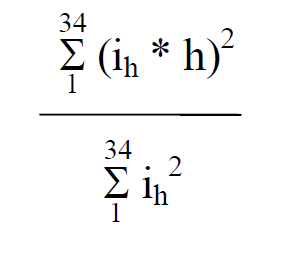
The algorithm used to compute K-factor is:
where h is the harmonic #
Details of the calculation method can be found in IEEE Standard 1100-1992.
So, the higher harmonics are heavily weighted. As an example, a current signal having a 10% 3rd, 5% 5th, and 3% 7th harmonic content, would have a K-factor of 1.18. From manufacturers specifications, one can read the load de-rating that has to be applied for this K-factor.
K-Factor Transformers
Underwriters laboratory (UL) recognized the potential safety hazards associated with using standard transformers with nonlinear loads and developed a rating system to indicate the capability of a transformer to handle harmonic loads. The ratings are described in UL1561 and are known as transformer K-factors.
K-factor transformers are designed to reduce the heating effects of harmonic currents created by loads like those in the table below. The K-factor rating is an index of the transformer’s ability to withstand harmonic content while operating within the temperature limits of its insulating system.
Load
K-Factor
Electric discharge lighting
K-4
UPS with optional input filtering
K-4
Welders
K-4
Induction heating equipment
K-4
PLCs and solid state controls (other than variable speed drives)
K-4
Telecommunications equipment (e.g. PBX)
K-13
UPS without input filtering
K-13
Multiwire receptacle circuits in general care areas of health care facilities and classrooms of schools, etc.
K-13
Multiwire receptacle circuits supplying inspection or testing equipment on an assembly or production line
K-13
Mainframe computer loads
K-20
Solid state motor drives (variable speed drives)
K-20
Multiwire receptacle circuits in critical care areas and operating/recovery rooms of hospitals
K-20
Table 1. Typical Load K-Factors
To help get around the problem of successfully applying derating factors to conventional transformers, the K-factor is used by transformer designers to develop transformers made especially for non-linear loads and the extra heating caused by the harmonic currents. Transformers come in basic K-factors such as 4, 9,13, 20, 30, 40, and 50.
The strategy is to calculate the K-factor for your load and then specify a transformer with a K-factor of an equal or higher value. In this way, the transformer can be sized to the load without derating. The advantage of using a K-factor transformer is that it is usually more economical than using a derated, oversized transformer.
9770-A Carroll Centre Road, San Diego, CA 92126 • Tel: (858) 530-8099 • Fax (858) 530-8077 • sales@xitrontech.com • support@xitrontech.com
Affinity Energy – Infographic: Understanding the Impacts of Power Quality.
Power Quality Infographic by Schneider Electric
Understanding power quality issues
$15 billion is the annual cost of power quality issues. $130,000 are the potential costs for downtime in lost revenue for facilities. For mission critical facilities, that translates to $14,000 to $6.5 million every hour. It takes 17 hours for plants to restart after shutdown. You do the math.
Did you know that 80% of power quality problems originate on the customer’s side of the meter or originate from within a facility?
Did you know the 3-6% of manufacturing sales money is spent to correct PQ problems?
Did you know 50% of mission-critical power outages attribute to power quality issues?
Typical power quality symptoms include:
Flickering and blinking lights
Transformer issues, such as noise, extra hot, or premature failure
Panels, neutral wiring, and other distribution equipment running hot
Printed circuit board failures in drives, PLCs, industrial PC, etc.
Breaker trip and drive shutdown
Premature motor failure and unexpected equipment shutdown
Contactors dropping out
Poor network communications
Higher utility bills
Poor power factor
Low system capcity
Types of power quality issues include:
RMS voltage variations (sags, swells, interruptions)
M.P.Donsión, & J.M. Rodríguez, Department of Electrical Engineering, University of Vigo, Campus of Lagoas Marcosende, 36310 Vigo (Spain), Email: donsion@vigo.es
J.A. Güemes2, Department of Electrical Engineering, University of Basque Country (Spain)
Abstract. Flexible AC transmission systems or FACTS are devices which allow the flexible and dynamic control of power systems. This paper is aimed toward the benefits of utilizing FACTS devices with the purpose of improving the operation of an electrical power system.
Introduction
Power quality is an issue that is becoming increasingly important to electricity consumers at all levels of usage. Sensitive equipment and non-linear loads are commonplace in both the industrial and the domestic environment, because of this a hightened awareness of power quality is developing. The sources of problems that can disturb the power quality are: power electronic devices, arcing devices, load switching, large motor starting, embedded generation, sensitive equipment, storm and environment related damage, network equipment and design.
The solution to improve the energy quality (PQ-Power Quality) at the load side is of great important when the production processes get more complicated and require a bigger liability level, which includes aims like to provide energy without interruption, without harmonic distortion and with tension regulation between very narrow margins. The devices that can fulfil these requirements are the Custom Power; a concept that we could include among the FACTS, but that is different to them because of their final use. In fact the topologies that they employ are identical to the ones in the FACTS devices with little modifications and adaptations to tension levels, therefore they are most oriented to be used in distribution networks of low and medium tension, sometimes replacing the active filters.
Recent developments in electrical power systems such as deregulation, open access, and cogeneration are creating scenarios of transmission congestion and forced outages. Addition of new transmission lines is an almost impossible solution due to environmental and other considerations, and developing new approaches to Power System Operation and Control is the need of the hour for overload relief and efficient and reliable operation. Flexible AC Transmission Systems (FACTS), with the underlying concept of independent control of active and reactive power flows, offer an attractive alternative for achieving the objectives.
The use of static power converters in electricity networks has the potential of increasing the capacity of transmission of the electric lines and improving the supply quality of the electric energy. The devices used to achieve this, are the FACTS (Flexible Alternating Current Transmission Systems). The FACTS technology has a collection of controllers, that can be used individually or co-ordinated with other controls installed in the network, thus permitting to profit better of the network’s characteristics of control.
The FACTS controllers offer a great opportunity to regulate the transmission of alternating current (AC), increasing or diminishing the power flow in specific lines and responding almost instantaneously to the stability problems. The potential of this technology is based on the possibility of controlling the route of the power flow and the ability of connecting networks that are not adequately interconnected, giving the possibility of trading energy between distant agents.
Flexible Alternating Current Transmission System (FACTS) is a static equipment used for the AC transmission of electrical energy. It is meant to enhance controllability and increase power transfer capability. It is generally a power electronics based device.
FACTS is defined by the IEEE as “a power electronic based system and other static equipment that provide control of one or more AC transmission system and increase the capacity of power transfer.”
The FACTS devices can be divided in three groups, dependent on their switching technology: mechanically switched (such as phase shifting transformers), thyristor switched or fast switched, using IGBTs [4]. While some types of FACTS, such as the phase shifting transformer (PST) and the static var compensator (SVC) are already well known and used in power systems, new developments in power electronics and control have extended the application range of FACTS. Furthermore, intermittent renewable energy sources and increasing international power flows provide new applications for FACTS. The additional flexibility and controllability of FACTS allow to mitigate the problems associated with the unreliable of supply issues of renewable. SVCs and STATCOM devices are well suited to provide ancillary services (such as voltage control) to the grid and fault ride through capabilities which standard wind farms cannot provide ¡Error! No se encuentra el origen de la referencia.. Furthermore, FACTS reduce oscillations in the grid, which is especially interesting when dealing with the stochastic behavior of renewable.
In a liberalized market, the added value of FACTS, and especially power flow controlling devices, is the ability to control flow paths and therefore the ability to resolve congestions and optimally utilizing available grid infrastructure ¡Error! No se encuentra el origen de la referencia., ¡Error! No se encuentra el origen de la referencia.. Although FACTS devices are currently quite expensive, it is expected that with a growing utilization and experience, prices will drop considerably.
Benefits of utilizing FACTS devices
The benefits of utilizing FACTS devices in electrical transmission systems can be summarized as follows [1]:
Better utilization of existing transmission system assets
Increased transmission system reliability and availability
Increased dynamic and transient grid stability and reduction of loop flows
Increased quality of supply for sensitive industries
Environmental benefits Better utilization of existing transmission system assets
In many countries, increasing the energy transfer capacity and controlling the load flow of transmission lines are of vital importance, especially in de-regulated markets, where the locations of generation and the bulk load centers can change rapidly. Frequently, adding new transmission lines to meet increasing electricity demand is limited by economical and environmental constraints. FACTS devices help to meet these requirements with the existing transmission systems.
Classification
There are different classifications for the FACTS devices:
Depending on the type of connection to the network FACTS devices can differentiate four categories
serial controllers
derivation controllers
serial to serial controllers
serial-derivation controllers
Depending on technological features, the FACTS devices can divided into two generations
first generation: used thyristors with ignition controlled by gate(SCR).
second generation: semiconductors with ignition and extinction controlled by gate (GTO´s , MCTS , IGBTS , IGCTS , etc).
These two classifications are independent, existing for example, devices of a group of the first classification that can belong to various groups of the second classification.
The main difference between first and second generation devices is the capacity to generate reactive power and to interchange active power.
The first generation FACTS devices work like passive elements using impedance or tap changer transformers controlled by thyristors. The second generation FACTS devices work like angle and module controlled voltage sources and without inertia, based in converters, employing electronic tension sources(three-phase inverters, auto-switched voltage sources, synchronous voltage sources, voltage source control) fast proportioned and controllable and static synchronous voltage and current sources.
Table 1. Two generations of the FACTS devices [2]
First Generation
FACTS devices
Attributes of control
Static Var Compensator, SVC (TCR,TCS,TRS)
Voltage control and stability, compensation of VAR´s. muffling of oscillations
Thyristor Controlled Series Compensations (TCSC,TSSC)
Current control, muffling of oscillations, transitory, dynamics and of voltage stability, limitation of fault current
Thyristor Controlled Reactor Series (TCSR,TSSC)
Current control, muffling of oscillations, transitory, dynamics and of voltage stability, limitation of fault current
Control of active power, muffling of oscillations, transitory, dynamics and of voltage stability
Thyristor Controlled Voltage Regulator (TCVR)
Control of reactive power, voltage control, muffling of oscillations, transitory, dynamics and voltage stability
Thyristor Controlled Voltage Limited(TCVL)
Limits of transitory and dynamic voltage
First Generation – FACTS devices
Second Generation
FACTS devices
Attributes of control
Synchronous Static Compensator (STATCOM without storage)
Voltage control, compensation of VAR´s, muffling of oscillations, stability of voltage
Synchronous Static Compensator (STATCOM with storage)
Voltage control and stability, compensation of VAR´s, muffling of oscillations, transitory, dynamics and of tension stability
Static Synchronous Series Compensator (STATCOM without storage)
Current control, muffling of oscillations, transitory, dynamics and of voltage stability, limitation of fault current
Static Synchronous Series Compensator (STATCOM with storage)
Current control, muffling of oscillations, transitory, dynamics and of voltage stability
Unified Power Flow Controller (UPFC)
Control of active and reactive power, voltage control, compensation of VAR´s, muffling of oscillations, transitory, dynamics and of voltage stability, limitation of fault current
Interline Power
Control of reactive power, voltage
Flow Controller (IPFC) or Back to Back (BtB)
control, muffling of oscillations, transitory, dynamics and of voltage stability
Second Generation – FACTS devices
FACTS in Electrical Power Systems
The concept of FACTS devices was presented in 1979, but the practical implementation and development of new analytical procedures are still in evolution. One of the objectives of the paper is to present the state-of-the-art technology and analysis of FACTS devices. Since the field demonstration of the world’s first UPFC in 1998, another FACTS controller, namely Sent Transformer (ST), has been proposed. In contrast to the UPFC, which uses a large number of solid-state switching devices, the ST uses time-tested components, such as transformer and load tap changers, but provides the same independent active and reactive power flow control as the UPFC at a much lower cost.
The FACTS devices are installed on electric power (high voltage AC) transmission lines to stabilize and regulate power flow for the dynamic control of voltage impedance and phase angle. Power lines protected by FACTS devices can support greater current because anomalies—frequency excursions, voltage drop, phase mismatch, malformed wave shape, power spikes, etc.—that would otherwise cause breakers to trip are removed or greatly reduced by FACTS conditioning.
A FACTS device can also limit the amount of current that flows on a line by effectively increasing the line’s impedance. This enables a much greater degree of flow control than provided by a switch or breaker. In particular, when current applied to a FACTS-protected line is greater than the device will allow, the power merely flows elsewhere rather than tripping a breaker, and power continues to flow on the protected line.
Essentially, lines can be run closer to their theoretical capacities when they are protected by FACTS devices. For a large line, that can mean substantial additional power. High voltage, high-power FACTS devices are building-sized and expensive, but they are lower cost and have less impact per added unit of electric power than new transmission lines. This is the essential benefit of operating standalone FACTS devices on individual lines.
FACTS devices offer an additional benefit: consider an interconnected network where two identical lines are carrying power, one at 50% of its capacity (for this example assume that capacity refers to the line’s operational limit under local conditions), the other at 99%. Assume that any additional load will be supplied equally through the two lines and that there is sufficient generating capacity to support the additional load being considered. Under these conditions additional load can be supplied only up to the limit of either line, and since one is at 99%, the system can support only about twice the remaining 1% (half of the additional power would go to each line). Additional power would cause the 99% line’s protective breakers to trip, at which point all power would attempt to pass through the remaining line, which would then also trip; the generators, being disconnected from their loads, would shut down, and the system would go dark.
However, if the line at 99% were held there by a FACTS device, any added power would go through the 50% line while power continued to flow in the 99% line at its original level. The capacity of this network considered as a whole would be increased by 25%, over and above the stabilizing and regulating benefits provided by the FACTS device. Note that this benefit cannot be recognized by analyzing just the FACTS device and its assigned branch, but only by considering the entire network. For a system that often operates in this sort of unbalanced state, FACTS devices can provide substantial additional capacity simply by forcing more of the network to carry the level of power it was designed to carry.
This idea leads to a new mode of operation: FACTS Devices can also direct power to less utilized parts of the transmission network, effectively increasing the capacity of the network, in addition to their customary standalone roles. Because optimum flow for the network as a whole cannot be achieved by considering only single branches, FACTS devices can perform this function only in cooperation with one another, so in this report such devices are referred to as Cooperating FACTS devices, or CFDs.
In practice, however, the additional communication required of CFDs opens the potential for subverting the operation of a cooperative system. This report considers both the operational and security aspects of CFDs operating in an electric power system network.
Installing FACTS devices factors
There are three factors to be considered before installing a FACTS devices:
The type of device
The capacity required
The location that optimize the functioning ofthe device
Of these three factors, the last one is of great importance, because the desired effect and the proper features of the system depend of the location of FACTS.
Steps for the identification of FACTS Projects:
The first step should always be to conduct a detailed network study to investigate the critical conditions of a grid or grids’ connections. These conditions could include: risks of voltage problems or even voltage collapse, undesired power flows, as well as the potential for power swings or subsynchronous resonances;
For a stable grid, the optimized utilization of the transmission lines– e.g. increasing the energy transfer capability – could be investigated;
If there is a potential for improving the transmission system, either through enhanced stability or energy transfer capability, the appropriate FACTS device and its required rating can be determined;
Based on this technical information, an economical study can be performed to compare costs of FACTS devices or conventional solutions with the achievable benefits.
Types of network connection
1.Serial controllers Can consist of a variable impedance as a condenser, coil, etc or a variable electronics based source at a fundamental frequency. The principle of operation of all serial controllers is to inject a serial tension to the line. A variable impedance multiplied by the current that flows through it represents the serial tension. While the tension is in quadrature with the line current the serial controller only consumes reactive power; any other phase angle represents management of active power. A typical controller is Serial Synchronous Static Compensator (SSSC).
2.Controllers in derivation. As it happens with the serial controller, the controller in derivation can consist of a variable impedance, variable source or a combination of both. The operation principle of all controllers in derivation is to inject current to the system in the point of connection. Available impedance connected to the line tension causes variable current flow, representing an injection of current to the line. While the injected current is in quadrature with the line tension, the controller in derivation only consumes reactive power; any other phase angle represents management of active power. A typical controller is Synchronous Static Compensator (STATCOM).
3.Serial-serial Controllers. This type of controllers can be a combination of coordinated serial controllers in a multiline transmission system. Or can also be an unified controller in which the serial controllers provide serial reactive compensation for each line also transferring active power between lines through the link of power. The active power transmission capacity that present a unified serial. controller or line feed power controller (also called BtB), makes possible the active and reactive power flow balance and makes the use of transmission bigger. In this case the term “unified” means that the DC terminals of the converters of all the controllers are connected to achieve a transfer of active power between each other. A typical controller is the Interline Power Flow Compensator (IPFC).
4.Serial-derivation Controllers. This device can be a combination of serial and derivations controllers separated, coordinately controlled or a unified power flow controller with serial and derivation elements. The principle of operation of the serial-derivation controllers is to inject current to the system through the component in derivation of the controller, and serial tension with the line utilizing the serial component. When the serial and derivation controllers are unified, they can have an exchange of active power between them through their link. A typical controller is Unified Power Flow Controller (UPFC), witch incorporating function of a filtering and conditioning, becomes a Universal Power Line Conditioner (UPLC).
Applications and technical benefits of FACTS
Table 2 describe the technical benefits of the principal FACTS devices. For each problem the conventional solution (e.g. shunt reactor or shunt capacitor) also can be used. For dynamic applications of FACTS in addressing problems in transient stability, dampening, post contingency voltage control and voltage stability. FACTS devices are required when there is a need to respond to dynamic (fast-changing) network conditions. The conventional solutions are normally less expensive than FACTS devices – but limited in their dynamic behavior. It is the task of the planners to identify the most economic solution.
Table2. Technical benefits of the main FACTS devices
Technical benefits of the main FACTS devices
The Unified Power Flow Controller (UPFC)
The UPFC may be seen to consist of two VSCs sharing a common capacitor on their DC side and a unified control system.
Figure 1. Simplified schematic representation of the UPFC
On Figure 1 we can see two back-to-back voltage source converters (VSCs), with one VSC connected to the AC network using a shunt transformer and the second connected to the AC network using a series transformer.
While operating both inverters as a UPFC, the exchanged power at the terminals of each inverter can be imaginary as well as real.
The mathematical UPFC model has been derived with the aim of being able to study the relations between the electrical transmission system and UPFC in steady and transient conditions.
Figure 2. Equivalent circuit of the UPFC
The active power demanded by the series converter is drawn by the shunt converter from the AC network and supplied to bus m through the DC link. The output voltage of the series converter is added to the nodal voltage, at say bus k, to boost the nodal voltage at bus m. The voltage magnitude of the output voltage VcR provides voltage regulation, and the phase angle δcR determine the mode of power flow control.
In addition to providing a supporting role in the active power exchange that takes place between the series converter and the AC system, the shunt converter may also generate or absorb reactive power in order to provide independent voltage magnitude regulation at its point of connection with the AC system.
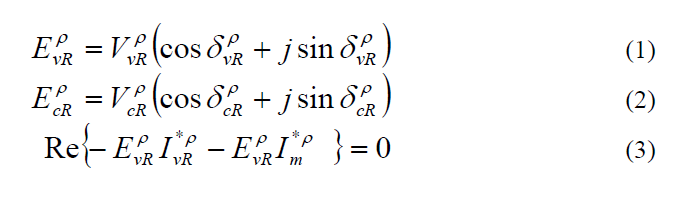
The UPFC equivalent circuit shown in Figure 3 consists of a shunt-connected voltage source, a series-connected voltage source, and an active power constraint equation, which links the two voltage sources. The two voltage sources are connected to the AC system through inductive reactances representing the VSC transformers. In a three-phase UPFC, suitable expressions for the two voltage sources and constraint equation would be:
Where ρ indicates phase quantities, a, b, and c.
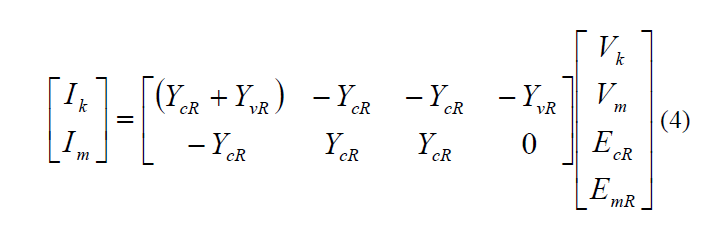
Based on the equivalent circuit shown in the Figure 2, and assuming three-phase parameters, the following transfer admittance equation can be written:
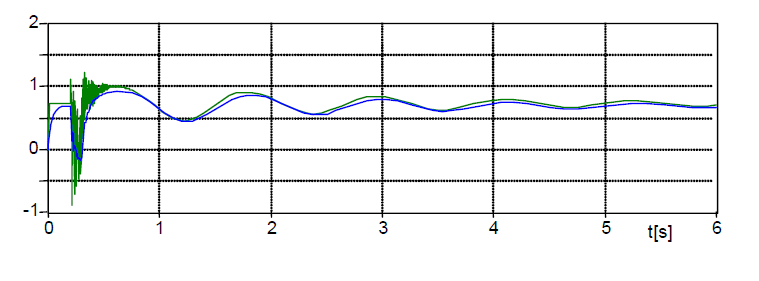
Figure 3. Generator active power (stable). Short circuit duration= 100 msec
Figure 4. Generator active power (instable). Short circuit duration=200 msec
Conclusion
Flexible Alternating-Current Transmission Systems (FACTS) is a recent technological development in electrical power systems. It builds on the great many advances achieved in high-current, high-power semiconductor device technology, digital control and signals gained with the commissioning and operation of high-voltage direct-current (HVDC) links and static VAR compensator (SVC) systems, over many decades, may have provided the driving force for searching deeper into the use of emerging power electronic equipment and techniques [5]. Due to the, every time higher requirements of the liability and quality of the electricity the implantation of devices capable of guaranteeing these requirements will keep increasing.
FACTS devices are improving the operation of an electric power system. The influences of such devices on steady state variables (voltage levels, transmission losses, and generating costs) are very remarkable. The benefit for each type of FACTS can be associated with its particularities and properties. They control the interrelated parameters that rule the operation of the transmission systems, including the serial impedance, the derivation impedance, the current, the voltage, the phase angle and the muffling of oscillations to different frequencies under the nominal frequency.
References
K. Habur, D. O’Leary “FACTS-Flexible Alternating Current Transmission Systems. For Cost Effective and Reliable Transmission of Electrical Energy”, Siemens, 2004.
M. Gómez, O. Abarrategui, I. Zamora “FACT devices in Distributed Generation”, International Conference on Renewable Energies and Power Quality (ICREPQ’06). Palma de Mallorca (Spain), April 2006.
E. Acha “FACTS: A Modern Tool For Flexible Power Systems Interconnections”. 9th Spanish Portuguese Congress on Electrical Engineering (9CHLIE), Marbella, Spain, June 2005.
S. Cole, D. Van Hertem, L. Meeus and R. Belmans. “The influence of renewables and international trade on investment decisions in the grid of the future”. ICREPQ’06, Palma de Mallorca, Spain, April 2006.
E. Acha, C.R. Fuerte-Esquivel, H. Ambriz-Pérez, C. Angeles-Camacho. “FACTS. Modelling and Simulation in Power Networks”. John Wiley & Sons Ltd, 2004.
E.Gholipour, S.Saadate. “Improvement of transient stability of power systems by using UPFC”, ICREPQ’03, Vigo 2003 (Spain).
Published by Carelabs (Carelabz), Website: carelabz.com
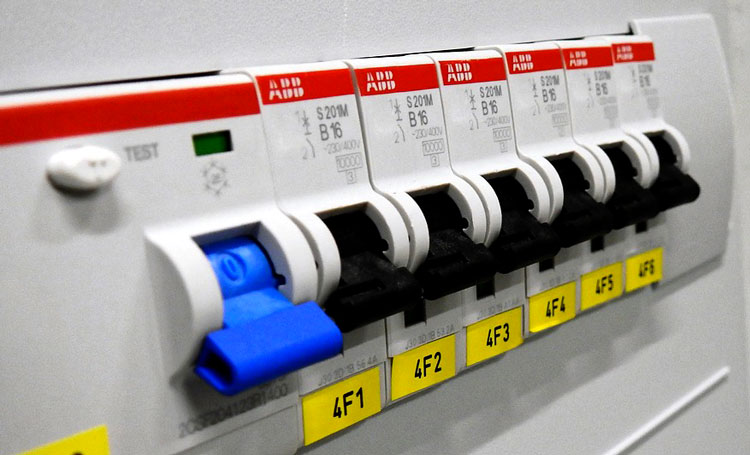
Image: Carelabz – Circuit Breakers
Circuit Breaker Testing is utilised to test the operation of each switching systems and the programming of the entire tripping structure. Circuit Breaker Testing is essential to ensure the safe and reliable performance of this key link in the power asset chain. Circuit breakers perform three main tasks:
They should conduct the current as efficiently as achievable, when closed.
When open, they must insulate the contacts from one another as effectively as possible.
In the event of a malfunction, they must disconnect the fault current as quickly and reliably as possible, thereby protecting all subsequent equipment.
Performing circuit breaker testing is more challenging with comparison to other electrical components like transformer as the short circuit current is greater. In the US market and regions of frequent earthquakes, the most popular high-voltage circuit breakers are “dead tank” units, whereas in central Europe “live tank” breakers are standard. Elsewhere both circuit breaker types are obtainable.
Why is Testing Circuit Breaker Important?
A circuit breaker might stay idle years, but if a malfunction occurs it has to detach fault currents of huge kiloamps gradually within a few milliseconds. Major errors that happen on circuit breakers are incorrect behavior, short circuits in the coils, damage/wear to the mechanical connections or the insulation material. Therefore, circuit breakers need to be regularly and carefully tested. Circuit breakers perform a vital role in protecting expensive equipment from damage through faults i.e. connecting and disconnecting the electrical power in a reliable way; this requires proving their reliability with on field tests during installation and with regular maintenance tests during its lifetime to prevent costly failures and problems that could even compromising the safety of the substation. Testing the performance of your circuit breakers regularly is therefore an essential and cost-effective part of any maintenance strategy. Circuit breaker testing particularly concentrates on obtaining motion and time values on the units. However, our testing solutions have revolutionized circuit breaker testing. Performing the tests without use of the station battery greatly increases safety throughout the testing process.
What are the Steps in Circuit Breaker Testing?
Type Tests of circuit breaker
Type tests are organised with the aim of proving the abilities and making sure the rated characteristic of the circuit breaker are exact. Such tests are conducted in the specially built testing laboratory.
Mechanical Test– It is mechanical ability type test involving the repeated opening and closing of the breaker. A circuit breaker must close and open at proper speed and do its allocated job and function without any failure.
Thermal Test– Thermal tests are carried out to check the thermal behavior of the circuit breakers. Due to the streaming of rated current through its pole in a rated condition, the breaker under test undergoes steady-state temperature rises. The temperature rise for rated current should not exceed 40° for current less than 800A normal current and 50° for normal value of current 800A and above.
Dielectric Test– These tests are performed to check power frequency and impulse voltage withstand capacity. Power frequency tests are kept on a new circuit breaker; the test voltage changes with a circuit breaker rated voltage. In impulse tests, impulse voltage of particular value is employed to the breaker. For outdoor circuit dry and wet tests are conducted.
Short -Circuit Test– Circuit breakers are subjected to sudden short-circuits in short-circuit test laboratories, and oscillograms are taken to know the behaviour of the circuit breakers at the time of switching in, during contact breaking and after the arc extinction. The oscillograms are studied with particular reference to the making and breaking currents, both symmetrical and asymmetrical restriking voltages, and switchgear is sometimes tested at rated conditions.
Routine Tests of a Circuit Breaker
Routine tests are done as per references of standards of Indian Engineering Service and Indian Standards. These tests are performed on the manufacturers’ premises. Routine tests confirm the proper functioning of the circuit breaker. The routine tests confirm the proper functioning of the circuit breaker. Routine testing doesn’t necessarily include complex gear in order to ensure that a circuit breaker is functional. Some guidelines and recommendations for these tests include routine maintenance and verifying that that circuit breaker performance is in line with manufacture’s calibration curves. It is crucial that these tests are performed under stable conditions at suitable temperature so that there are no variations in the data. Some of the tests are listed below.
Preventative Maintenance of Circuit Breaker, Inspection, and Testing
Preventative maintenance depend operating conditions for circuit breakers. Primary inspections of CB (circuit breakers) will look at particulate matter that’s contaminating the inner workings of the CB. Accumulation of particulates can generally be disposed of by flipping the lathe on the breaker “Off” and “On” switch to clear away the accumulated dust
Circuit Breaker Trip Test
By analysing the current consumed by the trip coil during the circuit breaker’s operation, it is possible to determine whether there are mechanical or electrical issues present. In many cases, such issues can be localised to aid in finding the root cause. Optionally, monitoring the tripping supply’s voltage during the operation can detect issues arising with tripping batteries.
Insulation Resistance Test
For individual breaker resistance testing, load and line conductors should be preferably disconnected. If not detached the test values will also involve the characteristics of the connected circuit. Resistance testing is crucial for verifying that the insulating material which makes up the molded cases breakers are performing correctly. In order to test for insulation resistance, an instrument known as a megger is used. A megger instrument applies a known DC voltage to a given wire for a given period of time in order to test the resistance within the insulation on that particular wire or winding. It is vital that voltage is employed as the resistance checked with an ohmmeter may differ when there are no report of potential differences. It should also be noted that if you apply a voltage that is too high for that insulation to withstand, then you could potentially damage the insulation.
Connection Tests
Connection testing is important to make sure that an appropriate electrical connection is available and to recognise traces of overheating denoted by colour difference. It is important that electrical connections are properly installed to the CB to prevent and reduce overheating.
Contact Resistance Test
Normal wear and tear of contacts within the CB emerges after extended usage. An easy method to identify traces of weakening within the circuit breaker is to quantify the resistance across every pole of the breaker. Indications of abnormal conditions within the CB such as erosion and contamination of contacts are evident if there are excessive millivolt drops across the breaker. The contact resistance test is important in finding out if or not a circuit breaker is still apt for functioning.
Overload Tripping Test
Overload tripping components of CBs can be tested by inputting 300% of the breaker rating into each pole of the circuit breaker to determine that it will open automatically. The motive of this is to make sure that the circuit breaker will operate or not. Refer to NETA standards for trip times that are acceptable for the overload tripping test. When trying to find out tripping characteristics, it is advisable to consult with manufacturer’s manuals.
Instantaneous Magnetic Tripping
In routine tests, it is relevant to find out that the magnetic feature is functional and will trip the circuit breaker instead of finding the precise value at which the instantaneous magnetic feature functions.
How Testing of Circuit Breaker is Performed?
Different circuit breaker test equipment are used to check the operation and condition of circuit breakers on the power systems. How to test a circuit breaker involves many different test techniques and type of testers. This will define how to test a circuit breaker through different testing tools to be applied to check the equipment under a range of conditions or operation types. Discover how to test a circuit breaker with the different test sets that you can need.
Testing with Different Equipment:
To consider how to test a circuit breaker, it is required a deep knowledge of the breaker itself:
How it works
Its tolerances,
Reference values of previous tests,
Initial values with which to compare the actual results, sometimes defined by a rated timing graph,
Established settings or initial features given by manufacturer
In this sense, how to test a circuit breaker becomes a trending analysis since test results are not always definitive but have meaning just when compared to previous data or results.
Testing with Circuit Breaker Analyzer
The timing tests of the different open and close operations of the breaker is an efficient way of how to test a circuit breaker, analyzing not only the trip times but also the essential synchronism of the poles in the different operations. This define how to test a circuit breaker through different simulations of its operation, which can be directly commanded from the circuit breaker analyzer, or initiated by an external signal, checking the opening or closing time of each pole, in single or combined operations, and checking the possible difference between poles or mismatch time which may lead to a dangerous lack of synchronism. How to test a circuit breaker with a circuit breaker analyzer depends also on the type of possible problems to be confirmed, which leads to check other features such as the possible bouncing, the proper performance of the pre-insertion resistances, the coils condition, and the mechanical analysis through contact travel speed and acceleration data with the use of the appropriate transducers.
Testing with a Micro-ohmmeter
Circuit breakers generally bear a huge value of current. Greater contact resistance cause greater losses, low current carrying capability and threatening hot spots in the breaker, so that the resistance testing with micro-ohmmeters are other way of how to test a circuit breaker for identifying and avoiding upcoming issues. How to test a circuit breaker with a micro-ohmmeter requires also reliable measurements and a wide injection range with high power that enables for longer test leads, less connections problems, and more accurate measurements.
Testing with a High Current Primary Injection Tester
The analysis of the tripping time characteristics of LV circuit breakers and molded-case circuit breakers is performed using high current injection, as the way to check the entire functionality. How to test a circuit breaker of this type depends on its maximum rated current, the trip protection settings and the inverse curve types which will define the overload and short-circuit trip pickup levels and time delays; all these features must be checked with the appropriate primary injection test set with the capacity to simulate the corresponding high current faults required and capture the answer of the breaker. A system which be easily upgraded in power capacity enables how to test a circuit breaker in the different possible situations and range of breakers; how to test a circuit breaker of this kind also needs a bendable design of the test set to fruitfully attain the certain large current job, and a design that create possible to position it nearer to the breaker, and so decreasing the power needed with smaller test leads; this is the case of the Raptor System, a modular and flexible primary injection system which easily and quickly adapts its power capacity to the several high currents ratings of the different circuit breakers.
Benefits of Circuit Breaker Testing
Quick and easy to perform on site
Circuits can be tested on or off load
Tests performance of whole tripping cycle
Tests overall timing of tripping system
Identifies need for maintenance
Part of a comprehensive diagnostic maintenance program
Published by Mirus International Inc., [2010-01-08] MIRUS-FAQ001-B2, FAQ’s Harmonic Mitigating Transformers, 31 Sun Pac Blvd., Brampton, Ontario, Canada. L6S 5P6.
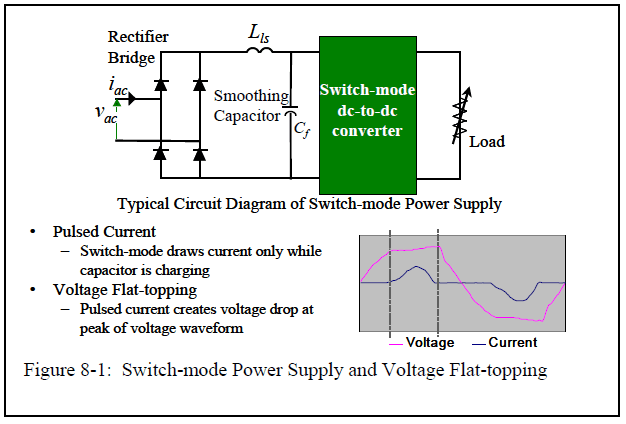
The switch-mode power supply (SMPS), used in most digital electronic equipment, is an excellent example of a non-linear load. Because it draws current in non-sinusoidal pulses, the SMPS is a significant generator of harmonic currents. When found in high densities multiple SMPS can be a major contributor to voltage distortion. Figure 8-1 shows how the pulsed current consumed by a single-phase SMPS will produce voltage distortion in the form of flat-topping. Since current is consumed only at the peak of the voltage waveform (to charge the smoothing capacitor), voltage drop due to system impedance will also occur only at the peak of the voltage waveform. A flattened voltage peak will reduce the DC bus voltage of the SMPS, reduce its power disturbance ride-through capability, and increase both its current draw and I2R losses.
Figure 8-1: Switch-mode Power Supply and Voltage Flat-topping
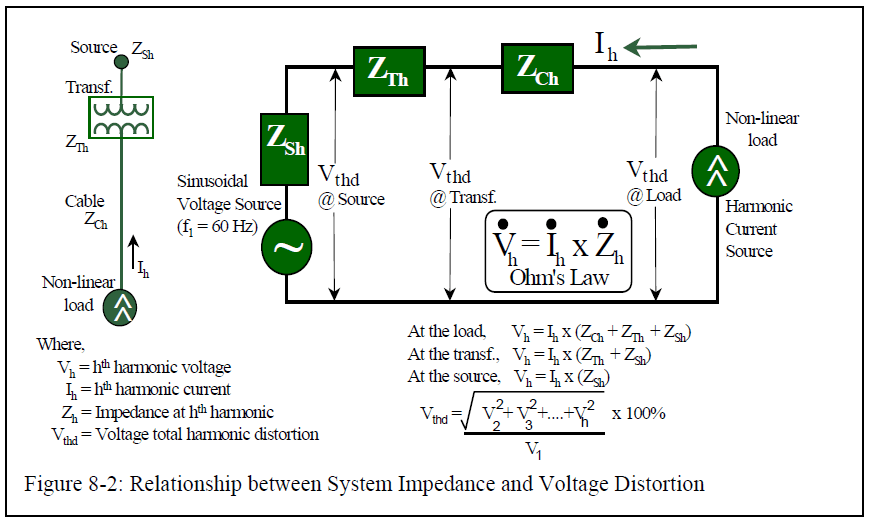
Another way to analyze the operation of the system with non-linear loads is to calculate the effect of each individual harmonic current as it flows through the various impedances of the distribution system. Fourier analysis tells us that the 2-pulse current drawn by the SMPS rectifier has a fundamental frequency component plus all of the odd harmonics (3rd, 5th, 7th, 9th, 11th, etc.) When modeling the distribution system, we can think of each SMPS as a generator of harmonic currents. Each harmonic current injected into the power system by a non-linear load will flow through the system impedance, resulting in a voltage drop at that harmonic frequency. The amount of voltage drop follows Ohm’s Law (Vh = Ih x Zh) where:
Vh = voltage at harmonic number h Ih = amplitude of current harmonic h Zh = impedance of the system to harmonic h.
Figure 8-2 shows the relationship between system impedance and the voltage and current distortion components at several points in a typical power system.
We can calculate the RMS value of the voltage or current distortion if we know the RMS values of all of the components. Parseval’s Theorem tells us that the RMS value of a waveform is equal to the square root of the sum of the squares of the RMS values of the fundamental component and all of the harmonic components of the waveform.
Figure 8-2: Relationship between System Impedance and Voltage Distortion
The fundamental is not a distortion component, so the RMS value of the distortion is just the square root of the sum of the squares of the harmonic components. Usually this is expressed as percentage of the value of the fundamental component and is called the Total Harmonic Distortion, or THD.
Voltage total harmonic distortion (Vthd) is calculated as:
Similarly, current total harmonic distortion is calculated as:
Voltage distortion then is a function of both the system impedance and the amount of harmonic current in the system. The higher the system impedance (ie. long cable runs, high impedance transformers, the use of diesel generators or other weak sources) the higher the voltage distortion.
In Figure 8-2, we see that voltage distortion is greatest at the loads themselves, since the harmonic currents are subjected to the full system impedance (cables, transformer and source) at that point. This is a characteristic most often misunderstood. It means that even if voltage distortion levels are low at the service entrance, they can be unacceptably high at the loads themselves. It also emphasizes the importance of keeping system impedances relatively low when servicing non-linear loads.
Voltage distortion can be minimized by removing the harmonic currents (Ih) and/or lowering the system impedance (Zh) to the harmonics.
Harmonics and Harmonic Mitigating Transformers (HMT’s) Questions and Answers
This document has been written to provide answers to the more frequently asked questions we have received regarding harmonics and the Harmonic Mitigating Transformer technology used to address them. This information will be of interest to both those experienced in harmonic mitigation techniques and those new to the problem of harmonics. For additional information visit our Website at www.mirusinternational.com.
Published by Dranetz Technologies, Inc., Application Note
.
Introduction
IEEE Std. 519-2014, IEEE Recommended Practice and Requirements for Harmonic Control in Electric Power Systems is the most current recommended practice from the IEEE related to harmonics measurement and compliance. Although the recommended practices from the IEEE are usually only followed in North America, IEEE 519-2014 is used in Latin America, Asia, India and other parts of the world. As a result, there is a lot of interest in IEEE 519 2014 and how it is applied.
IEEE 519-2014 includes the harmonic measurement techniques of the widely used IEC 61000-4-7. IEEE 519-2014 adds two additional parameters, along with new requirements for statistics reporting for harmonic compliance. Therefore, instruments that only measure to IEC 61000-4-7 are missing required capabilities.
The Dranetz HDPQ Plus and SP are among the few instruments that fully comply with the measurement and reporting requirements of IEEE 519-2014. This application note focuses on the requirements of IEEE 519-2014 and how they apply to Dranetz instruments.
IEEE Harmonic Measurement Standards
The original IEEE 519-1992 recommended practice included descriptive information about harmonics and harmonic compliance limits. However, instrument measurement methods were not defined. The result was different manufacturers used different harmonic measurement techniques that produced different and inconsistent results.
IEEE 519-2014 addresses this by referencing the harmonic measurement techniques of IEC 61000-4-7. IEC 61000-4-7, and the broader IEC 61000-4-30 power quality measurement standard are well established, and have been adopted around the world. IEEE 519- 2014 states “…any instrument used should comply with the specifications of IEC 61000-4-7 and IEC 61000-4-30.” As a global supplier of power quality monitoring products, Dranetz products have complied with both of these standards since their inception in the early 2000’s.
IEC 61000-4-7 defines a harmonic measurement window width of 200ms, which is 12 cycles at 60Hz and 10 cycles at 50Hz. Each (DFT, Discrete Fourier Transform) harmonic analysis uses this 200ms window of data for its computations and this window is the smallest resolution for harmonic measurements in the Dranetz HDPQ family. Harmonic analysis is based on the evaluation of continuous 200ms windows without gaps.
Continuous 200ms windows without gaps
New Parameters for IEEE 519-2014
For statistical analysis, IEEE 519-2014 adds two parameters to the measurement methods of IEC 61000-4-7: Very Short Time Harmonics and Short Time Harmonics. It is important to note that these two new parameters are unique to IEEE 519-2014 and are not part of IEC 61000-4-7. This means that an instrument measuring to IEC 61000-4-7 does not necessarily comply with IEEE 519-2014.
Very short time harmonics are assessed over a 3- second interval and include 15 consecutive 200ms (12/10 cycle) windows. Without going into the specific details, harmonic components are aggregated over this interval and are then used for statistical evaluation.
Short time harmonics are assessed over a 10-minute interval and are an aggregation of 200 consecutive very short time values. Short time harmonics are aggregated over the required (10 minute) interval and then used for statistical evaluation.
IEEE 519-2014 Harmonic Statistical Evaluation
IEEE 519-2014 states that very short time harmonics should be accumulated over a one day period and the 99th percentile values should be calculated for each individual harmonic to the 50th each day. Short time harmonics should be accumulated over a one week period, and the 95th and 99th percentile values should be calculated for each individual harmonic to the 50th each week.
IEEE 519-2014 also includes recommended harmonic limits measured at the PCC (Point of Common Coupling). The intent is to manage the harmonics at the interface point between utility system owners and end users, so the specified limits apply only at the PCC and not for individual loads.
For voltage harmonics, the recommended limits for individual harmonics and VTHD are specified at various bus voltages measured at the PCC. Acceptable limits are based on the bus voltage, with higher bus voltages having lower acceptable limits (they are farther away from the harmonic generating loads).
Similarly, recommended limits for individual current harmonics are specified at several different bus voltage levels at the PCC, but TDD (Total Demand Distortion) is referenced and not ITHD. This means that TDD must also be computed by the instrument which is not part of IEC 61000-4-7. Current harmonics measured at higher bus voltage levels have lower acceptable limits (they are farther away from the harmonic generating loads).
The actual compliance limits are outside of the scope of this application note, so see section 5 of IEEE 519- 2014 for more details.
Dranetz HDPQ Plus & SP IEEE 519-2014 Reports
Although Dranetz products have measured harmonics to IEC 61000-4-7 for many years, IEEE 519-2014 adds the two new harmonic measurement parameters and new statistical evaluation requirements. The only Dranetz portable product that can fulfill these requirements are the Dranetz HDPQ Plus & SP family.
The Dranetz HDPQ Plus & SP have built in harmonic statistics reports that include very short time and short time harmonics. The report produces pass/fail daily and weekly voltage and current harmonic compliance in full accordance with IEEE 519-2014.
To view the report, press the Harmonics StatisticsReport button in the View Data page.
You will then see a list of daily and weekly harmonic statistic reports over the month 31 days, with each indicating pass or fail. There will be one very short time 99th percentile report for each day, and two short time reports for each week (one for the 99th percentile and the other for the 95th percentile).
Harmonics Statistics
Simply select a report in the list and press OPEN to view the details of the compliance for each harmonic to the 50th.
Harmonic Statistics Details
Dran-View 7 software also includes IEEE 519-2014 harmonic compliance reporting that uses the statistical data compiled by the HDPQ Plus & SP instruments (only).
Summary
IEEE 519-2014 is a significant update to the original version from 1992. In addition to specifying new harmonic measurement parameters and compliance limits, IEEE 519-2014 includes the harmonic measurement techniques of the globally accepted IEC 61000-4-7 harmonic standard.
The Dranetz HDPQ Plus & SP family are among the few products available that fully conform to both the measurement and compliance reporting requirements of IEEE 519-2014.
Published by Prof Jan Desmet, Hogeschool West-Vlaanderen, Email: jan.desmet@howest.be & Prof Angelo Baggini, Università di Bergamo, Email: angelo.baggini@unibg.it, June 2003
Source: Leonardo Power Quality Initiative (LPQI) Power Quality Application Guide Harmonics Neutral Sizing in Harmonic Rich Installations 3.5.1
Introduction
This section discusses the sizing of neutral conductors in the presence of power quality problems such as ‘triple-N’ – that is, currents with a harmonic order that is a multiple of three current harmonics. This issue is particularly important in low voltage systems where harmonic pollution by single phase loads is an increasingly serious problem. Triple-N harmonic currents add arithmetically in the neutral conductor rather then summing to zero as do balanced fundamental and other harmonic currents. The result is neutral currents that are often significantly higher, typically up to 170%, than the phase currents.
The sizing of conductors is governed by IEC Standard 60364, Part 5-52: Selection and Erection of Electrical Equipment – Wiring Systems. This Standard includes rules and recommendations for sizing conductors according to the current required by the load, the type of cable insulation and the installation method and conditions. Some normative rules are provided for sizing the neutral in the presence of harmonics, together with informative guidance in Annex D. National standards follow IEC 60364 closely but there is a significant time lag, so most national standards still do not deal with the neutral sizing issue in a comprehensive way. Since few installers and designers have easy access to the IEC standards, relying only on their national codes, they must depend on their own knowledge and experience when sizing neutral conductors. This application note is intended to clarify the issues involved and present the IEC guidance to a wider audience.
Theoretical background
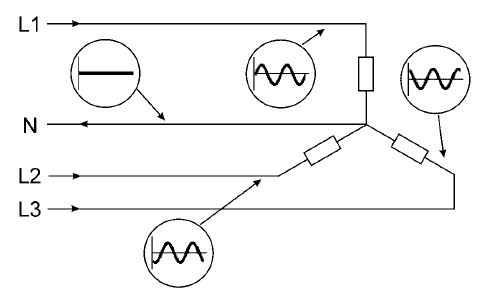
In a star-connected three-phase system, the current in the neutral conductor is the vector sum of the three line currents. With a balanced sinusoidal three-phase system of currents, this sum is zero at any point in time and the neutral current is therefore zero (Figure 1).
Figure 1 – With a balanced three-phase load the neutral current is zero
In a three-phase power system feeding linear single-phase loads the current in the neutral conductor is rarely zero because the load on each phase is different. Typically the difference is small and is in any case far lower than the line currents (Figure 2).
Figure 2 – With an unbalanced three-phase load the neutral current is not zero, but it is smaller than the phase current
Where non-linear loads are being supplied, even when the load is well balanced across the phases, there is likely to be substantial current in the neutral conductor. With non sinusoidal currents, the sum of the three line currents, even with the same rms value, may be different from zero. For example, currents with equal rms values and square shape will result in a significant neutral current (Figure 3).
Figure 3 – With a non-linear three-phase load the neutral current is not zero and can also be larger than the phase current because of homopolar harmonics
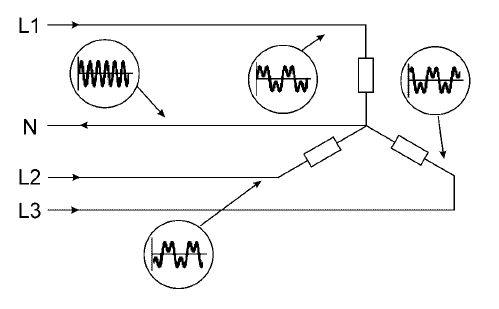
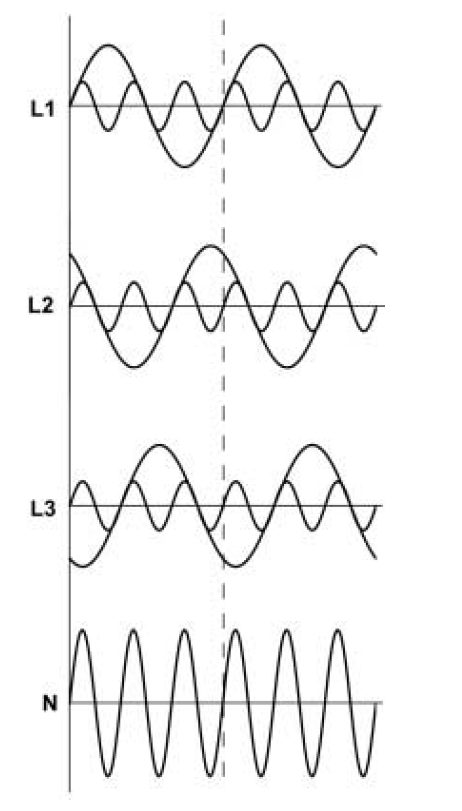
In fact, the third harmonic components (and all other harmonics where the order is a multiple of three – the sixth, ninth, etc.) of the line currents are all in phase with each other (i.e. they are homopolar components), so they sum arithmetically rather than cancelling by vector addition (see Figure 4).
Figure 4 – Third harmonic currents in the neutral conductor
The neutral current amplitude may exceed the phase current in amplitude at the supply frequency due to the third harmonic.
The requirements of the Standard
IEC 60364-5-52:2001, ‘Electrical Installations in Buildings – Part 5-52: Selection and Erection of Electrical Equipment – Wiring Systems’, is concerned with the safe installation of circuits from the point of view of installation techniques and conductor sizing. The installation method frequently affects the thermal conditions in which the cable operates and so affects the cable carrying capacity of the conductor or circuit. Where cables of several circuits are installed in the same conduit, trunk or void, the current carrying capacity of each cable is reduced because of the mutual heating effect. In other words, the current carrying capacity of a cable is determined by the amount of heat generated by the current flowing and the amount of heat that can be lost from the cable by convection. Together, these determine the working temperature of the cable which, of course, must not exceed that appropriate to the insulation material, 70 °C for thermoplastic insulation (such as PVC) or 90 °C for thermosetting insulation (such as XLPE). The ratings and adjustment factors given in the Standard are based on practical tests and theoretical calculations based on typical conditions and need to be modified in the light of known installation conditions. Since the presence of triple-N harmonics in the neutral conductor results in higher heat generation, cable size selection must make allowance for this.
Reference to sizing the neutral conductor in case of non-sinusoidal currents can be found in IEC 60364-5-524. Clause 524.2 indicates that the neutral conductor shall have at least the same section as the phase conductors:
in two-conductor single-phase circuits and for all conductor cross-sections
in multi-phase circuits and in three conductor single-phase1 circuits when the cross-section of the phase conductors is equal to or less than 16 mm2 for copper or 25 mm2 for aluminium.
1 i.e. a centre tapped single phase supply where the centre point is neutral.
Clause 524.3 states that, for other multi-phase circuits, the neutral conductor may have a reduced crosssection if all the following conditions are met:
the maximum expected current, including harmonics, if any, in the neutral conductor during normal service is not greater than the current carrying capacity of the reduced cross sectional area of the neutral
the neutral conductor is protected against overcurrent
the size of the neutral is at least 16mm2 in copper or 25mm2 in aluminium.
These clauses are normative – in other words they provide regulations that must be followed in order to comply with the Standard. However, complying with these clauses requires knowledge of the type and number of loads that will be in use after the installation is put into service – unfortunately, this information is rarely available. The Standard also includes an informative annex – information provided to help the designer in the form of guidance and recommendation rather than regulation – that provides a methodology for sizing cables correctly.
This section presents this guidance with the addition of worked examples and some observations regarding de-rating in shared ducts and the effects of voltage drops.
Guidance from the Standard
The functioning of an electrical component or conductor can be significantly influenced by disturbances to the system, the supply, or the load. Of all of the electromagnetic disturbances that affect energy cables, the presence of current harmonics is one of the most important. The effects of this phenomenon can lead to overload of both phase and neutral conductors. Here, attention is focused on the sizing of the neutral conductor.
It should be noted that the current rating tables given in the Standard make many assumptions and it is the responsibility of the designer to recognise when these assumptions are not valid and make appropriate corrections. The most important assumption is that, in a four or five core cable, only three cores carry current; in other words, the load is assumed to be balanced and linear. In the situation where the load is unbalanced but linear the unbalance current flows in the neutral, but is offset by the fact that at least one phase conductor is carrying less load. Assuming that no phase conductor is overloaded, the total Joule loss in the cable is not excessive. When the load is non-linear there is a neutral current contributing to thermal loss as well as the full effect of the three line currents.
Under the conditions of current distortion described in paragraph 1.2, heat dissipation in the conductor due to the Joule effect is larger compared to the ideal linear load conditions, and the line capacity is therefore reduced. In addition, neutral conductors, often previously undersized with respect to the phase conductors in existing buildings (paragraph 1.3), can be overloaded even without the neutral current exceeding the rated phase current.
It is impossible to determine the neutral current in absolute terms unless the real or theoretical waveform of the load currents is known. However, as an approximation, the neutral current can be 1.61 times the phase current in the case of loads such as computers, but can reach the value of 1.73 times the phase current in the worst conditions with controlled rectifiers at high control angles, i.e. low DC voltages (α ≥ 60°).
The simplest way to solve the problem is to apply appropriate corrective coefficients to the cable current carrying capacity. Annex D of IEC Standard 60364-5-52 also gives a methodology for determining the appropriate derating factor. For simplicity, the approach assumes that:
the system is three-phase and balanced
the only significant harmonic not being cancelled in the neutral is the third one (i.e. the other triple-N harmonics have relatively low magnitudes and other harmonics are approximately balanced and sum to zero) and,
the cable is 4 or 5 core with a neutral core of the same material the same cross-section as the phase conductors.
In the strictest sense, calculation of the current harmonic effects should also take account of skin effect, which will reduce capacity as a function of the conductor size but, as a first approximation, it can be neglected.
To calculate the capacity of a cable with four or five conductors where the current in the neutral conductor is due to harmonics, multiply the standard current carrying capacity of the cable by the correction factor.
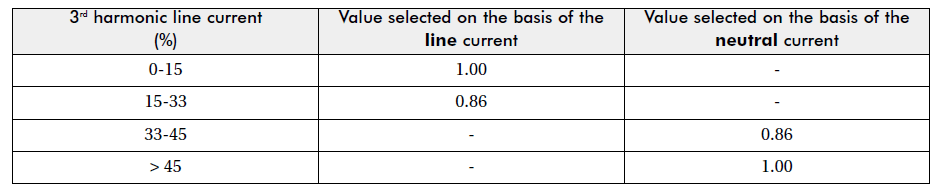
For phase currents containing 15% or less triple-N harmonics, the standard does not suggest any increase in neutral cross-section. Under these circumstances, the neutral current might be expected to be up to 45% of the phase current, and an increase of about 6% in heat generation compared to the normal cable rating. This excess is normally tolerable except in situations where the cable is installed in areas with poor ventilation or where there are other sources of heat nearby. An additional safety margin may be desirable in, for example, confined spaces.
For phase currents containing 15% to 33% triple-N components, the neutral current may be expected to be similar to the phase current and the cable must be de-rated by a factor of 0.86. In other words, for a current of 20 A, a cable capable of carrying 24 A would be selected.
Where the triple-N component of the phase currents exceeds 33% the cable rating should be determined based on the neutral current. For phase currents containing from 33% up to 45% triple-N harmonics, the cable size is determined by the neutral current, but de-rated by a factor of 0.86. At 45% triple-N current the cable is rated for the neutral current, i.e.135% of the phase current, derated by 0.86.
For even higher triple-N components, for example the typical worst case of 57%, the cable size is determined solely by the neutral current. There is no need for a correction factor because the phase conductors are now oversized.
Since the data for the reduction factors has been calculated on the basis of the third harmonic current value only, higher order triple-N harmonics at a higher level than 10% would further reduce the acceptable current. The situation described can be particularly critical when the neutral is used in common by several circuits (where this is permitted by local regulation).
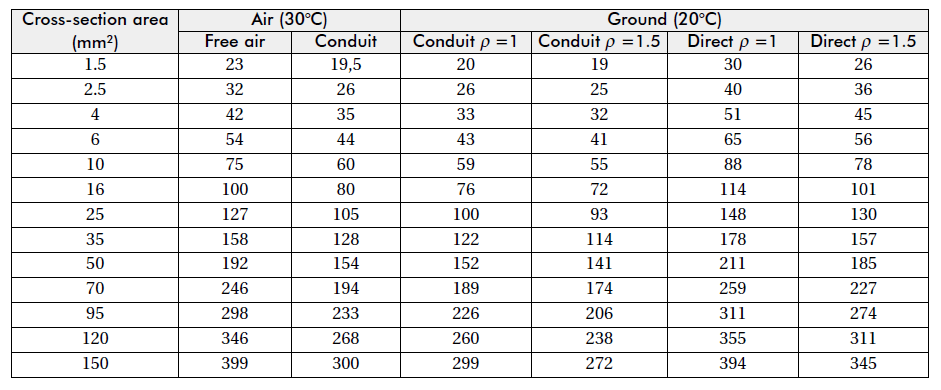
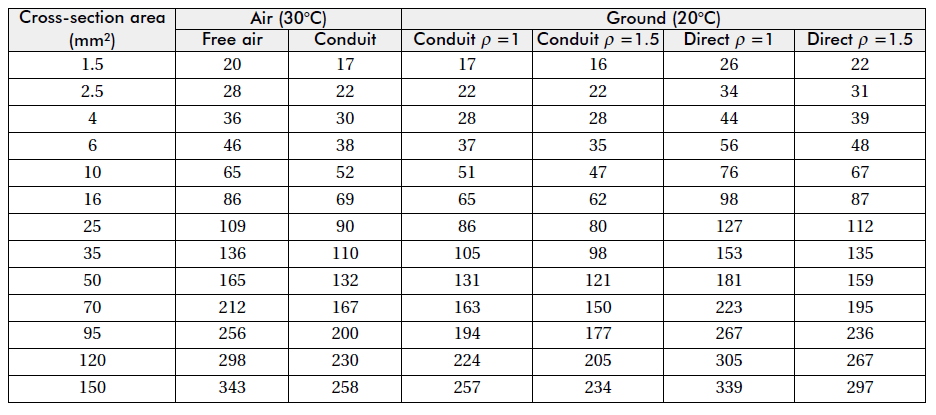
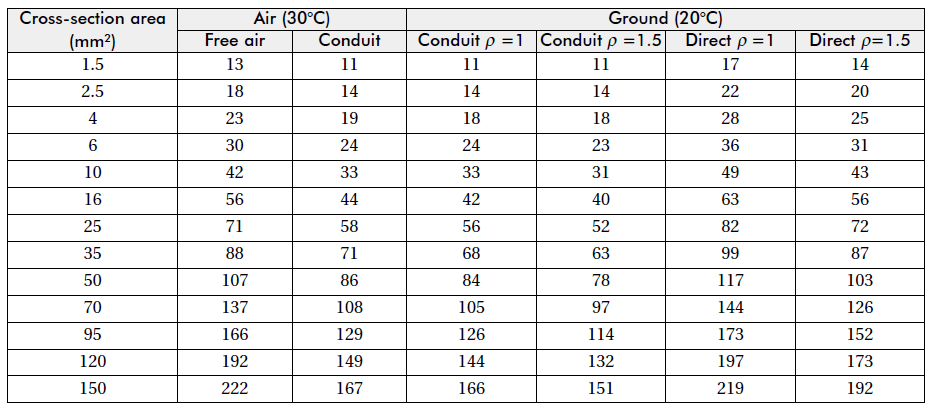
Tables 2 to 5 show how the current rating changes with and without 3rd harmonic currents. The current ratings are calculated according to the IEC 60364-5-523 Standard. The ratings listed are for a 4 core 0.6/1kV cable with thermosetting (90 °C) insulation.
When using single core cables the choice of the neutral and phase conductor cross sections becomes independent. On the other hand the mutual thermal interaction is more difficult to model analytically because of the varying relative positions.
The most direct way to proceed is independent sizing of the neutral conductor, always bearing in mind that the thermal performance and the reactance of the circuit depends on the relative positions of the conductors. Additional factors that should be taken into account include:
When the cable is grouped with other cables, the greater current flowing in it (i.e. the harmonic current in the neutral) produces more heat so there is an effect on other cables. This must be taken into account by using enhanced grouping factors.
Table 2 – Current rating (A) with 3rd harmonic up to 15% (0.6/1kV 4 cores, 90 °C)
Table 3 – Current rating (A) with 3rd harmonic up to 33% (0.6/1kV 4 cores, 90 °C)
Table 4 – Current rating (A) with 3rd harmonic equal to 45% (0.6/1kV 4 cores, 90 °C)
Table 5 – Current rating (A) with 3rd harmonic equal to 60% (0.6/1kV 4 cores, 90 °C)
The voltage drop in the neutral caused by all triple-N harmonics becomes harmonic voltage distortions on all phases of the supply. This may require a further increase in neutral cross-section for long cable runs.
Particular attention has to be given to armoured or metal-screened cables. The contribution of harmonics to eddy currents in the screen or armour may be considerable. Therefore, whenever a load current distortion is expected, the neutral conductor should never have a cross-section smaller than the corresponding phase conductors. The same holds, of course, for all accessories of the neutral circuit.
When the design dimensions of the neutral circuit increases beyond that of the corresponding phase components, as can happen even in standard electrical systems, it is difficult if not impossible to find suitable commercial components available that are capable of correctly integrating into the system. The only suitable alternative is to limit the load or to size for the largest cross-section. Protection should, of course, be sized correctly for the smaller cross-section of the phase conductor.
For final circuits, separate neutrals for each line and separate circuits for each distorting load should be planned. This also ensures the best possible electromagnetic independence among both disturbing and susceptible elements. The use of the best possible balance of the loads avoids further contributions to the neutral current due to unbalance. The above considerations are just as important and applicable for large cross-section cables as they are to modest cross-section cables. They can also be applied, at least as a good approximation level, to busbars.
Numerical example
Consider the following example: a three-phase circuit with a 39 A load rating to be installed using a 4-core PVC (70 °C) insulated cable laid directly onto the wall. In the absence of harmonics, it is common practice to use a copper conductor cable with a 6 mm2 cross-section with a capacity of 41 A.
With 20% of the third harmonic, applying a 0.86 reduction factor, the equivalent load current is:
39.0 / 0.86 = 45 A
for which a cable with a 10mm2 cross-section would be necessary.
With a third harmonic equal to 40%, the cable section should be chosen according to the neutral current equal to:
39 × 0.4 ×3 = 46.8 A
and applying a 0.86 reduction factor a rated current:
46.8 / 0.86 = 54.4 A
so a cable with a 10 mm2 section is also suitable for this load. With 50% of third harmonic, the cable section to be chosen still depends on the neutral current:
39 × 0.5 × 3 = 58.5 A
requiring a 16 mm2 cable. (In this case the reduction factor is equal to 1.)
Conclusions
The discussion in this paper has pointed out how common design solutions, valid without power quality problems, become meaningless when the theoretical hypotheses upon which they are based are not fulfilled. In this instance, the assumption that voltages and currents have ideal waveforms is not valid.
In the case of neutral conductor sizing, common ‘old’ practice would advise the choice of a cross-sectional area smaller or equal to that of the corresponding phase conductors and the use of a scheme with the neutral shared among more lines. On the other hand, a correct consideration of the electromagnetic effects occurring with non-linear loads requires the selection of a neutral conductor with a cross-section larger than, or equal to, that of the corresponding phase conductors and based on the real current that is flowing in it. The use of a separate neutral conductor for each line (previously mandatory in some countries) is also required. The numerical example shows that the problem can arise on both important sections of a plant and on the final circuits of any electrical system.
References
[1] P Chizzolini, P L Noferi: Ottimizzazione degli interventi sulla rete di distribuzione mirati al miglioramento della continuita’ del servizio elettrico. LXXXVII Riunione AEI, Firenze 1986. [2] N Korponay, R Minkner: Analysis of the new IEC drafts for 185 (44-1) and 186 (44-2) instruments transformers in relation to the requirements of modern protection systems – Journée d’ études: Les transformateurs de mesure E2-20 SEE novembre 1989. [3] T M Gruzs: “A survey of neutral currents in three-phase computer power systems”, IEEE Transaction on industry applications, vol. 26, n° 4 July/August 1990. [4] IEC 364-5-52 – Electrical Installations in Buildings – Part 5-52: Selection and Erection of Electrical Equipment – Wiring Systems.
Published by Carelabs (Carelabz), Website: carelabz.com
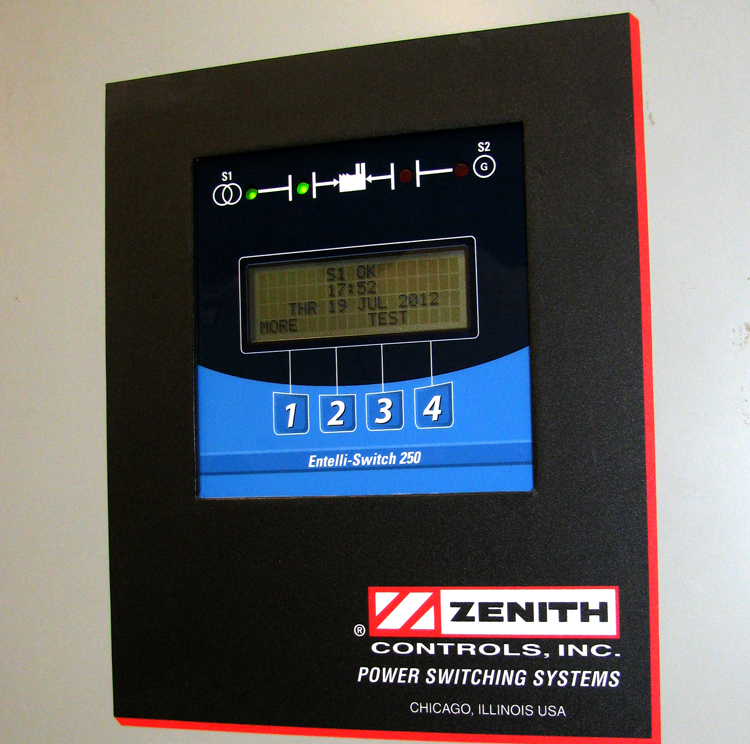
Image: Carelabz – Zenith Controls, Inc. power switching systems
A transfer switch’s main job is to redistribute power from a grid to a backup source of power. The control panel system of a transfer switch is what makes the unit automatic in nature. Power failures can be detected immediately with the help of automatic transfer switch (ATS) and the shift to generator power from utility power is smooth.
The control panel’s job is to detect a power failure and initiate procedures to start the new or used generator’s engine. Once the used or new generator reaches the right frequency or voltage, the control system will signal to change to generator from the normal source of power.
The Automatic Transfer Switch (ATS) is a critical piece of equipment that alternates the origin or the source of power, typically between your utility power and backup power, ensuring your system’s ability to stay online. It is inherently important in making sure that this part of your emergency system is working properly. Also, because this part of your system is usually relatively complicated in nature, they are rarely examined or tested after the ATS has left its manufacturing facility.
Why Testing of Automatic Transfer Switch Important?
It is important to determine if your ATS is within manufacturers terms in the course of a planned examination, to eliminate the risk of determining this when an unpredicted outage occurs, and you are incapable to switch your system to its secondary power.
Occasional testing of your ATS guarantees that your emergency system is dependable. Carelabs is manufacturing facilities, power plants, and industrial businesses first choice when it comes to the electrical testing of ATS’s. Our technicians and engineers are skilled on emergency systems, specifically transfer switches. With our staff’s abundant experience and training in the field contributes as a definite recipe for success.
What is Done During Automatic Transfer Switch Testing?
Few of the steps in ATS testing incudes:
Contact to pole resistance test,
Settings and operations verifications
Control device Examinations
Manufacturer’s standards and specifications checks
Calibration services
Tap connections resistance measurements
Verifying engine start sequence
Time delay and retransfer functions checks
Mechanical parts inspections
Anchorage and groundings review for impairment or damage
Corresponding parts are properly lubricated and clean of debris or contaminants and many steps more.
Automatic Transfer Switch Tests Includes mainly three steps. The visual inspection, the electrical tests and the operational or functional tests:
Visual and Mechanical Inspection
Verify mechanical and physical.
Verify alignment, anchorage, required clearances and grounding.
Verify the unit is clean.
Verify appropriate lubrication on moving current-carrying parts and sliding surfaces.
Verify that manual transfer warnings are attached and visible.
Perform manual transfer operation.
Check positive mechanical interlocking amid alternate and normal sources.
Electrical Tests
With respect to ground execute insulation resistance tests on control wiring entirely.
Perform a contact/pole-resistance test.
Verify settings and operation of control devices.
Calibrate and set all relays and timers.
Check phasing, phase rotation and synchronized function as needed.
Perform automatic transfer tests:
Simulate loss of normal power.
Return to normal power.
Simulate loss of emergency power.
Simulate all forms of single-phase conditions.
Verify correct operation and timing of the following functions
Normal source voltage-sensing relays.
Engine start sequence.
Time delay upon transfer.
Alternate source voltage-sensing relays.
Automatic transfer operation.
Interlocks and limit switch function.
Time delay and retransfer upon normal power restoration.
Engine cool down and shutdown feature.
NFPA 110 has the following rules stated in terms of Automatic Transfer Switch testing
Operational Inspection and Testing.
EPSSs, including all components, should be exercised under load at least monthly and inspected weekly.
If the generator set is used for peak load shaving or for standby power, such use should be recorded and should be allowed to be replaced for scheduled functioning and testing of the generator set.
Transfer switches shall be operated monthly.
The periodic test of a transfer switch should constitute of electrically functioning the transfer switch till the alternate position from the standard position and returning.
How is Automatic Transfer Switch Testing Performed?
General Inspection
The inspection work should be conducted externally and internally on the transfer switch.
External Inspection
The transfer switch should be kept in good condition by performing a weekly overall examination of the unit. This inspection must consist of inspecting for signs of excessive heat, vibration damage, any level of deterioration, any leakage or contamination.
Any accumulations of dirt or dust must be removed. Dirt, dust and any other contaminants should always be removed from the outside and inside with a vacuum cleaner, dry cloth or brush. One should not use compressed air to blow away contaminants and dirt. This can result in debris being lodged in components resulting in damage to the switch.
If the inspection exposes damaged or loose components contact a trained professional to perform the repair work.
Any worn, broken or missing external sections must be substituted with manufacturer’s recommended components.
Contact the local authorized distributor or dealer for the specific part number to order.
Internal Inspection
All power sources must be turned OFF afore any internal inspection.
Verify to see if any external glitches found have disturbed internal components, while opening the switch door.
A trained service technician must be called to perform any service work. If any of the following conditions are detected:
Dirt, dust, moisture and other contaminants accumulating on the surfaces of the unit and components
Any signs of corrosion
Loose, missing or broken components
Deterioration of wiring or insulation due to cuts, abrasion or wear
Indications of overheating due such as melted plastic, discolored metal or burning odor
Any other evidence of damage, wear or malfunction of the transfer switch and its components
Only a trained technician must carry out internal service work and inspection on a standby system that doesn’t permit power interruption in the course of required inspection.
Inspections beyond visual inspections
When inspections are internal or more than just a visual inspection by the operator, they should be performed by an authorized distributor or dealer under a scheduled preventative maintenance agreement.
Have an approved dealer or distributor replace or repair all damaged internal parts with the manufacturer’s suggested components.
Disabling the Generator Set
Accidental starting can lead to severe injury and even death
Safety measure must be acquired chosen to prevent the generator set starting in the course of maintenance by a remote start/stop switch, an ATS, or another remote start engine command.
Afore operating on the generator set or any of its attached parts, like the transfer switch, detach the generator set as follows:
Move the generator master switch to the OFF-position
Disconnect the power to the battery charger
Remove battery cables starting with the negative (-) lead first
Transfer Switch Automatic Control System Testing
The transfer switch automatic control system should be tested monthly. The test should verify the following:
The necessary sequence of functioning happens when the load shifts to the emergency source which results in primary source failure
Verify indicator LEDs on the transfer switch operates properly
Watch and eavesdrop for any unnecessary vibration or noise in the course of operation
Finish the test once the switch transfers the load to the standby source and check the foreseen sequence of operations happening as the transfer switch shifts the load to the primary power source and signals the generator set to turn OFF later or after a cool down period.
Check if the time delay in the OFF position works while load is transferred to the standby source and transferred back to the favored source, in the case of systems with programmed time transitions.
Functional Test
The transfer switch functional tests comprise of electrical and manual tests. A manual operator handle is provided with the transfer switch for maintenance purposes only. Before it is operated electrically, manual operation of the switch must be checked.
A usual method of an automatic transfer switch functional test for a standby generator is explained below:
To begin the test, close the normal source circuit breaker. The switch controller will light up the available LED when right voltage is sensed. If the source 1 stages the automatic transfer switch mechanism, the LED at source 1 will turn on. Verify the phase to phase voltages at the utility line terminals.
Start the engine generator after closing the alternate source breaker. The S2 (Alternate) Available LED will illuminate when correct voltage and frequency levels are sensed. Turn OFF the engine generator after both sources have been validated and place the generator’s start control in the automatic position.
Replicate a utility failure by opening the Source 1 i.e. the normal side breaker. The delay to engine start timer begins its timing cycle. After the timer has completed its timing cycle, the engine start contacts close to start the generator.
When generator frequency and voltage touch the fixed reinstate points the Source 2 available LED lights up. Simultaneously, the delay to generator timer begins its timing cycle. When the time delay is completed the ATS will transfer to Generator, the S1 position LED goes off, and the S2 position LED illuminates. Systems shall transfer in no less than 10 seconds where failure of the equipment to perform could result in loss of human life or serious injuries.
Reclose the Source 1 breaker to re transfer to the normal source. The delay to utility timer begins its timing cycle. When the timer has completed its timing cycle, the ATS will transfer. The S2 position LED goes off, and the S1 position LED illuminates.
The delay engine stop timer will begin its timing cycle. The generator runs unloaded for the duration of this timing cycle. The generator will Turn OFF, once the timer finishes its timing cycle, The S2 Available LED goes off. A minimum time delay of 5 minutes should be provided for unloaded running of the EPS prior to shutdown to allow for engine cool down (NFPA 110). The minimum 5-minute delay is not required on small air-cooled prime movers 15 kW or less.
Precautions
Inspection and Cleaning Before doing any work on the transfer switch, de-energize all sources of power.
The switch must be checked for any moisture, dirt or dust and must be vacuumed or wiped with a soft brush or dry cloth.
DO NOT use a blower since debris may become lodged in the electrical and mechanical components and cause damage.
Any surface deposits must be removed with a clean cloth.