Published by Mirus International Inc., [2010-01-08] MIRUS-FAQ001-B2, FAQ’s Harmonic Mitigating Transformers, 31 Sun Pac Blvd., Brampton, Ontario, Canada. L6S 5P6.
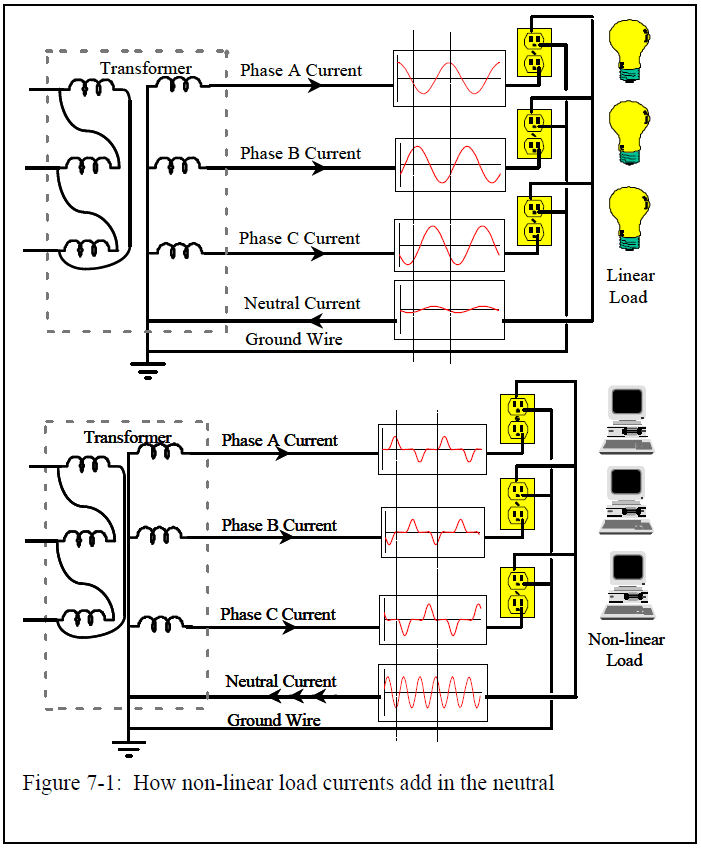
Figure 7-1 shows how the sinusoidal currents on the phases of a 3-phase, 4-wire system with linear loads sum to return on the neutral conductor. The 120° phase shift between the sinusoidal load currents causes their vector sum to be quite small. In fact it will be zero if the linear loads are perfectly balanced.
Examining the dashed vertical lines in Figure 7-1 clearly demonstrates that the instantaneous sum of the currents in the three phases taken at any moment will also be zero if the linear loads are perfectly balanced. If they are not, then there will be a small residual neutral current as shown.
Figure 7-1: How non-linear load currents add in the neutral
With linear loads, the neutral conductor can be the same size as the phase conductors because the neutral current will not be larger than the highest phase current. Unfortunately, this is definitely not true for non-linear phase-to-neutral loads.
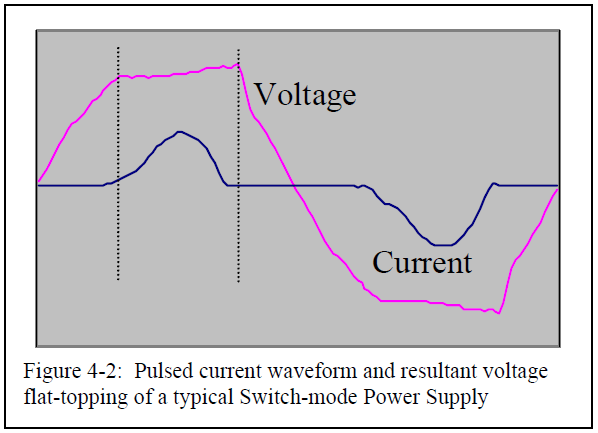
120VAC non-linear loads like the SMPS used in computers and in monitors draw current in two distinct pulses per cycle. Because each pulse is narrow (less than 60 degrees), the currents in the second and third phases are zero when the current pulse is occurring in the first phase. Hence no cancellation can occur in the neutral conductor and each pulse of current on a phase becomes a pulse of current on the neutral.
Even if the phase currents of the SMPS loads are perfectly balanced in RMS amperes, the RMS value of the neutral current can be as much as √3 times the RMS value of the phase current because there are 3 times as many pulses of current in the neutral than in any one phase. If the phase current pulses do overlap because they exceed 60 degrees in width, then there will be some cancellation so that the neutral current will be less than √3 times the phase current. Overlapped or not, because there are 3 times as many pulses in the neutral than in a phase, the predominant component of the neutral current will be the 3rd harmonic (180Hz for a 60Hz system). This is evident in the waveforms of Figure 7-1 since the linear current completes only 2 cycles in the same time period that the non-linear neutral current completes 6 cycles or 3 times the fundamental.
Often, in new construction this situation is addressed by simply doubling the neutral conductor ampacity. In existing facilities however, it is most often very difficult and too costly to implement this solution, therefore an alternate method is usually necessary.
Harmonics and Harmonic Mitigating Transformers (HMT’s) Questions and Answers
This document has been written to provide answers to the more frequently asked questions we have received regarding harmonics and the Harmonic Mitigating Transformer technology used to address them. This information will be of interest to both those experienced in harmonic mitigation techniques and those new to the problem of harmonics. For additional information visit our Website at www.mirusinternational.com.
Published by Jürgen Blum, Product Manager, Power Quality, A. Eberle GmbH & Co. KG
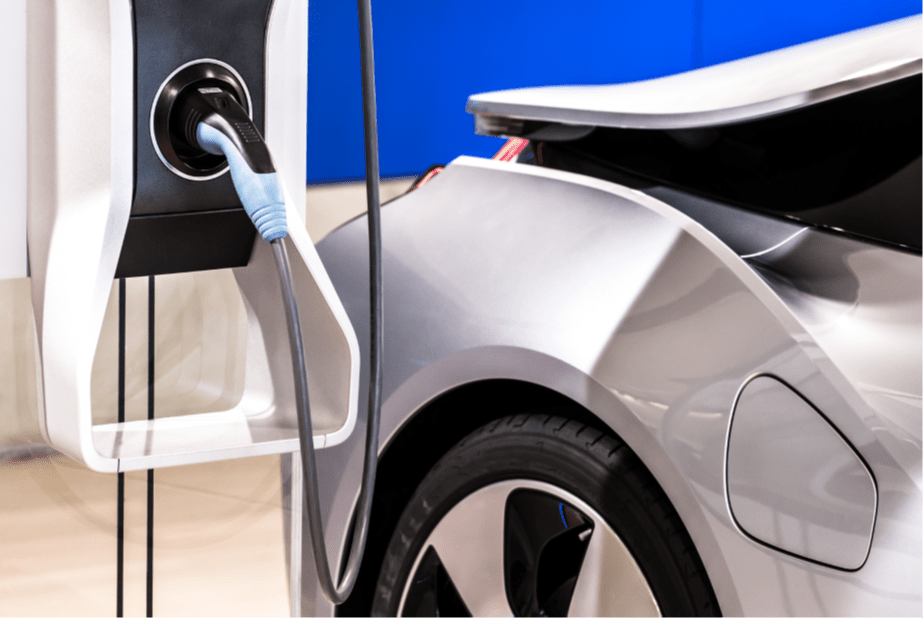
Image: A. Eberle (EV Charger – Electric Car Charger)
In the first part of the measurement campaign of 2016, various electric vehicles were evaluated in terms of their charging behavior and their loading effects on the power grid. The evaluation covered from DC up to the 50th harmonic or supraharmonics up to 20 kHz. As some electric vehicles use a chopper frequency much higher than 20 kHz, another measurement campaign was started at the University of Applied Sciences Bingen in September 2017 to measure the emissions ranging up to 150 kHz. In addition, the mutual interference between the different vehicles and between the electric vehicle and a solar inverter was investigated at the University of Applied Sciences Bingen.
Basis of the evaluation of the loading effects
The IEC 61851-21-1 standard (Electric vehicle on-board charger EMC requirements for conductive connection to AC/DC supply) will apply to electric vehicles in the future. This standard has already received the status of FDIS and will be published shortly.
At this time, the limits for current harmonics as given by IEC 61000-3-2 (Class A) up to 16 A and IEC 61000-3-12 (asymmetrical devices, Rsce = 33) for 16 A up to 75 A apply to electric vehicles. These same compatibility levels are also used in IEC 61851-21-1. There are limits up to the 40th current harmonic (2 kHz) and compatibility levels from 150 kHz to 30 MHz. There are no limits now on the emitted interference from electric vehicles in the frequency range from 2.5 kHz to 150 kHz. This range is also not regulated for the public power grid using compatibility levels. However, there are efforts underway now in the standards committee aimed at closing this gap as quickly as possible using compatibility levels.
There are many examples today of the mutual interference between different electronic devices. For example, the frequency converter of a CNC machine emits an interference level > 2.5 kHz into the power grid and a kitchen appliance malfunctions, or a solar inverter can automatically switch touch-dimmer lamps on and off. Who is responsible for this problem?
Is the kitchen appliance improperly equipped for interference resistance or is the CNC machine causing too large an interference level in the power grid at its connection? There can only be a fair regulation with the forthcoming limits for this frequency range. The interference can be remedied at both ends. Install a power filter on the device experiencing interference or reduce the emitted interference at its origin. Different customers always ask the question, „Who has to pay for it?“
The current draft of IEC 61000-2-2 (Compatibility levels for the public power grid) defined limits for the following ranges:
Frequency range (kHz) at 50 Hz
Compatibility level (%)
2 kHz to 3 kHz
1,4 %
3 kHz to 9 kHz
1,4 to 0,65 % Logarithmic drop-off with logarithmically increasing frequency
Frequency range (kHz)
Compatibility level (dBμV)
9 kHz to 30 kHz
129 to 122 dBμV Linear drop-off with the logarithm of the frequency from 9 to 30 kHz
The range of 30 kHz to 150 kHz is being prepared; compatibility levels are being added in real time.
In the standard, intentional emissions, for example, PLC signals for communication, are distinguished from nonintentional emissions.
Power utilities make use of a power line signal in the frequency range up to 148 kHz for signal transmission over the power grid. So that this signal can be detected unambiguously by the receiver, there must be a gap between the nonintentional emission from the power electronics, such as that caused by electric vehicles, and the PLC signal. Consequently, two limit curves are given in the standard.
Voltage (mV)
dBμV
1000 mV
120 dB
100 mV
100 dB
10 mV
80 dB
Sample table – conversion from volts to dB/μV
Measuring technology
Today, there are not many power quality measurement devices for permanent, uninterrupted monitoring of frequencies from DC to 150 kHz. This comes from the fact that there are no specifications as to how to evaluate in the future standard-compliant levels > 2.5 kHz to 150 kHz.
The measuring procedure for the frequency range from 2 kHz to 9 kHz is described in the standard for harmonics, IEC 61000- 4-7 in the informative Annex B. In this case, a grouping procedure for frequency bands of 200 Hz is used.
For the range > 9 kHz to 150 kHz, there is a suggestion in the Annex to IEC 61000-4-30, Ed. 3. Here, a grouping procedure for bands of 2 kHz is suggested. The final measuring procedure will only be specified in a few years in the future Edition 4 of IEC 61000-4-30. The frequency bands of 200 Hz or 2 kHz are under discussion. While a 200 Hz frequency band provides greater resolution in the spectrum, 10 times the quantity of data is measured than with a 2 kHz frequency band. Because of this, each procedure has advantages and disadvantages.
The PQ Box 300 from the A. Eberle company was used for the measurement campaign at the University of Applied Sciences Bingen. The power quality network analyzer measures frequencies from DC to 170 kHz with high accuracy. The grouping procedure of the measurement device can be configured for either 200 Hz or 2 kHz frequency bands. In this way, the different measurement results coming from the different grouping procedures can be verified.
For charging the various electric vehicles, a charging station with a type 2 charging plug and various 32 A CEE outlets and single-phase outlets was available.
The charging station was connected to the power grid of the University and uses a 25 mm² cable. The short-circuit performance at the charging station is about 2.5 MVA. A single phase 5 kW inverter is connected at a distance of about 10 m. The distance, that is the length of the cable connections, between the electric vehicles connected to the charging station, was usually 10 m, 2 times a standard charging cable of 5 m.
Measurement results
The following electric vehicles were evaluated:
Renault Zoe, Nissan Leaf, BMW i3, Audi e-tron, VW Golf GTE, Ford Focus e-lectric, Mitsubishi Outlander and the Tesla Model 90D.
Measurements were performed in the following configurations:
The electric vehicle alone to the power grid
The electric vehicle in parallel with other electric vehicles
The electric vehicle in parallel with the solar inverter of the University
The chopper frequencies of the vehicles measured were between 8 kHz and a maximum of 50 kHz for the different manufacturers.
In addition, there were large differences in the levels of the switching frequencies for the various vehicles. These were between 2 volts for vehicles with poor filtering and high interference levels as well as values that were undetectable by measurement in vehicles with an extremely low interference level.
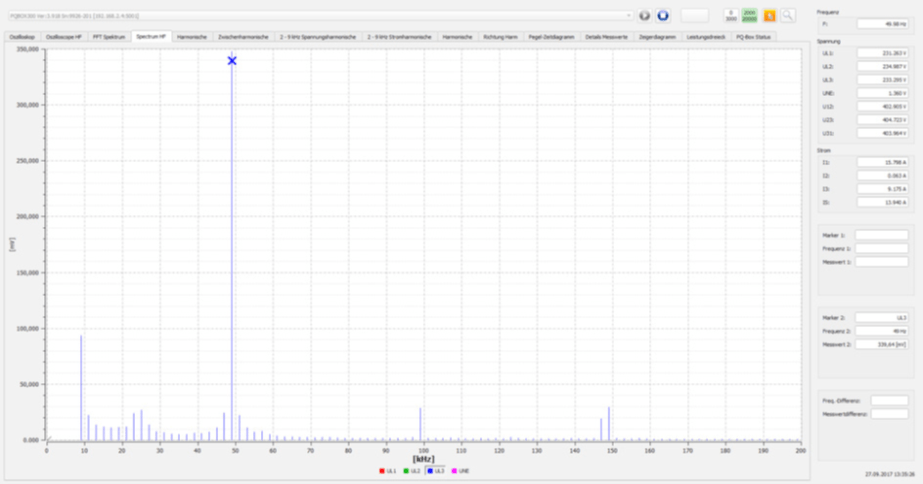
Fig. 1: Electric vehicle with a 50 kHz chopper frequency; shown with 2 kHz frequency bands
Fig. 1 depicts the voltage using 2 kHz frequency bands up to 170 kHz A chopper frequency of 50 kHz can clearly be seen on an electric vehicle. The harmonics of 100 kHz (2 x 50 kHz) and 150 kHz (3 x 50 kHz) can also be seen.
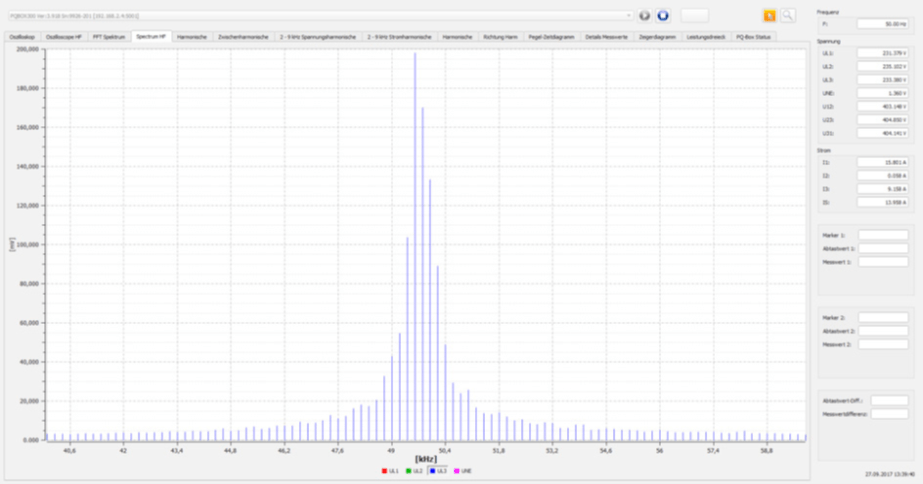
The measuring procedure must be clearly defined for future evaluations of the compatibility levels of electric vehicles or other power electronics connected to the power grid. For example, if you compare the measurement results of 5 Hz, 200 Hz or 2 kHz frequency bands with one another, it is obvious that the results for level can differ substantially from one another. A broader frequency band of 2 kHz usually yields a larger measurement result than a narrow 200 Hz band for the same interference signal in the power grid (see Fig. 1 and Fig. 2 for comparison). With a broad frequency band, several spectral lines are quadratically added to one measurement value.
Fig. 2: Electric vehicle with a 50 kHz chopper frequency; shown using 200 Hz frequency bands
Fig. 2 shows the identical 50 kHz loading effect as the electric vehicle shown in Fig. 1. In each case, only the grouping procedure was switched in the measurement device from 2 kHz bands to 200 Hz bands.
Mutual interference between electric vehicles
During the measurement campaign, different electric vehicles were also charged in parallel to be able to evaluate the mutual interference between the vehicles.
Connection configuration 1: Electric vehicle No. 1 on the power grid alone
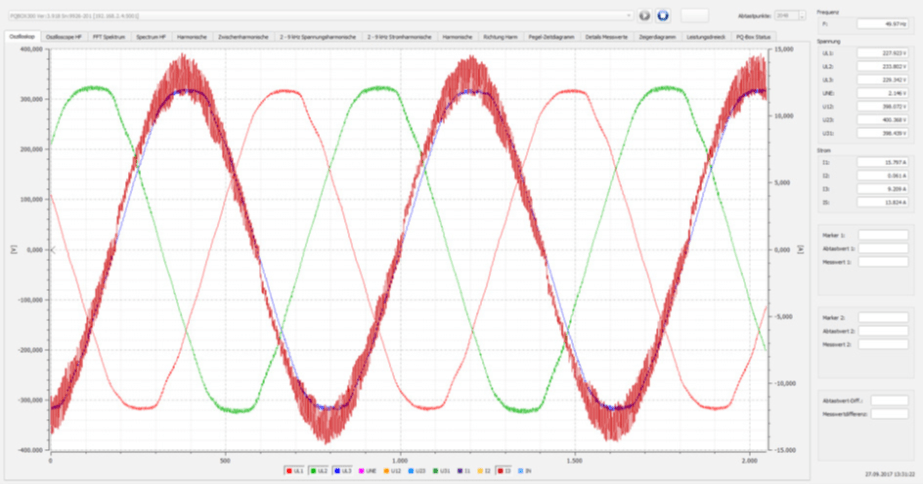
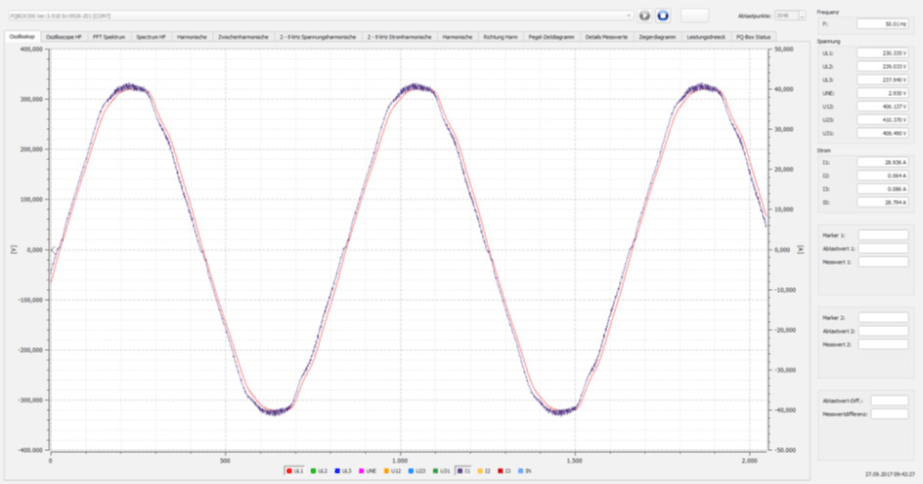
The vehicle is charged using one phase (C). In the figure, you can see the voltages A, B, C and the charging current C for the electric vehicle. No pronounced loading effects can be seen on the current. The switching frequency of this vehicle was 50 kHz.
Fig. 3: Electric vehicle No. 1 connected to the outlet alone
Connection configuration 2: Electric vehicle No. 1 is connected to the outlet and electric vehicle No. 2 in connected in parallel to the charging station using the type 2 plug.
The following Fig. 4 shows a clear change in the current consumption of electric vehicle No. 1 due to the loading effects from electric vehicle No. 2. The RMS value is virtually unchanged but there are large peaks in the charging current at the switching frequency of vehicle No. 2.
Vehicle No. 1 is connected to the power grid acting as an interference sink for the supraharmonics of the adjacent vehicle. In this example, a 10 kHz switching frequency can barely be seen in the voltage but is very pronounced in the current.
There are reports from practical use that sporadic interruptions in charging may occur if various different electric vehicles are charged in parallel.
Fig. 4: Electric vehicles No. 1 and No. 2 connected in parallel to the charging station and the outlet
Additional striking features
Almost all vehicles using single-phase charging used phase A. Only one vehicle used phase C for single-phase charging. This can later become a real problem by overloading phase A in the power grid with a greater number of vehicles in a supply power grid.
In addition, a large power grid imbalance occurs at the stub-end feeders. Even some vehicles, which were charged in the beginning using 3 phases, switched automatically toward the end to single-phase charging. This charging then usually used phase A.
In the engineering guides for connecting customer systems to the low-voltage grid of power utilities (VDE-AR 4100), the maximum connection power for single-phase loads is limited to <= 4.6 kVA. Electrical loads or generation systems 4.6 kVA must be connected using three phases. As a result, some of the electric vehicles from the measurement campaign may not be operated at a maximum connection power of up to 7.2 kVA.
Example: Electric vehicle with a single-phase charging current of 30 A on phase A
Fig. 5: Electric vehicle, single-phase charging at 6.9 kVA
Audible disturbance effects and summation with electric vehicles having the same switching frequency
One electric vehicle with a pronounced switching frequency of 10 kHz was clearly audible for the human ear in this frequency range during the charging process. Two vehicles of the same type were charged in parallel. The summation of the switching frequency in the power grid as well as the audible disturbance were evaluated.
As the switching frequency of both vehicles is not precisely 10 kHz but rather varies around 10 kHz, the level of the power grid loading effect fluctuates between a minimum of 1 V and a maximum of 2 V. One vehicle alone with a constant loading effect was about 1.4 V. As a result, both switching frequencies could add over time or also partially offset depending on the instantaneous phase difference of the frequencies.
If you stood exactly in the middle between the two vehicles during charging, you could hear the volume of the perceptible whistle change. In one case from practice, some vehicles from the same manufacturer caused a disturbance in an office building adjacent to several charging stations. This disturbance was so loud that the windows on the lower floor of the building could no longer be opened during office hours (reason: noise pollution).
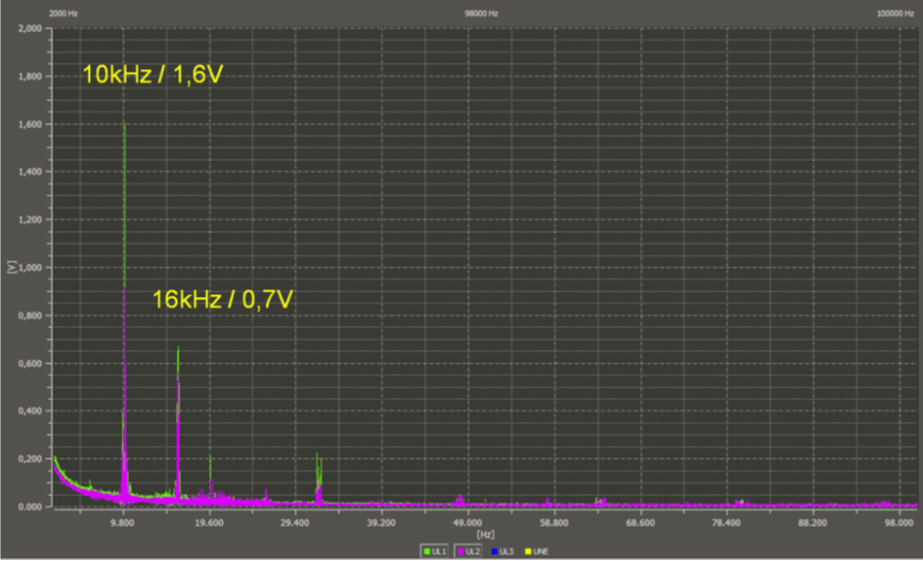
Fig. 6: Chopper frequency of 2 electric vehicles of the same type and the photovoltaic inverter
Fig. 6 shows the 10 kHz chopper frequency of two electric vehicles of the same type and the 16 kHz of the solar power plant at the University of Applied Sciences Bingen. This amplitude of the switching frequency for both electric vehicles fluctuated in the measurement values between 1 V and 2 V at a frequency of about 0.5 Hz.
Mutual interference between electric vehicles and the solar inverter
The following figure shows the initial power grid load with an inverter and a solar power plant. You can see the chopper frequency of 16 kHz and its harmonics at 32 kHz, 48 kHz, and so on.
Fig. 7: Chopper frequency of the photovoltaic inverter
Fig. 8: Chopper frequency of the photovoltaic inverter and one electric vehicle
Now, an electric vehicle is connected to the charging station. You can now clearly see the 10 kHz switching frequency of the vehicle with 1.6 V in the power grid. The 16 kHz level of the solar inverter was, however, reduced by 50% from 1.4 V to 0.7 V.
Summary
Electric vehicles and modern power electronics may generate loading effects on the power grid far above 2.5 kHz. In the future, there will be compatibility levels for the public power grid for these frequencies. The measuring procedure for this is not been defined at this time. The PQ Box 300 from A. Eberle measures the range up to 170 kHz as a continuous measuring task. The measurement device can be set to frequency bands of 200 Hz or 2 kHz. This feature makes it ready for future changes to the standards. In addition, it is possible to select a different measuring procedure than for the parallel online measurement for recording.
Example: Continuous measurement of the 2 kHz bands and, in parallel, 200 Hz bands for online monitoring of a load. The network analyzer uses a continuous measuring procedure as the basis for calculating the FFT analysis.
VFD motor controls have become very popular for both retrofits and in new applications. They offer increased energy efficiency, potential for less motor wear, lower startup currents and more. Potential disadvantageous include producing harmonics and damaged motors if they are not controlled properly.
VFD’s use a Pulse Width Modulated (PWM) voltage for more precise control of the motor to meet the dynamic needs of the application. The varying voltage frequency of the VFD presents problems for most PQ analyzers, but not the Dranetz HDPQ family.
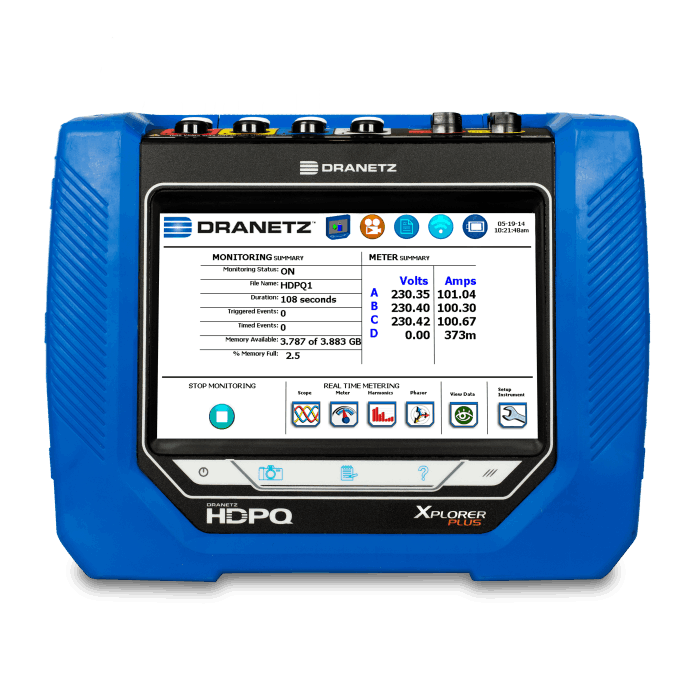
HDPQ® Power Quality Analyzers – Dranetz HDPQ ® Xplorer Plus
Eight channels, 4 voltage & 4 current (Colored Cables & Connector Panel)
Most PQ analyzers can only measure a stable 50/60Hz voltage source. The Dranetz HDPQ family can also synchronize to the current which is very beneficial for use in VFD and other applications.
PQ analyzer VFD testing applications include troubleshooting problems with controls, evaluating efficiency, harmonics, maintenance, and more. The Dranetz HDPQ family is ideally suited for VFD and many other related applications.
Configuring an HDPQ for VFD applications is simple – see application note (below).
Dranetz HDPQ Family VFD Output Measurements
Application Note
INTRODUCTION
Most power monitoring instruments synchronize their measurements to a stable 50/60Hz voltage source. The reason is to get accurate readings between the voltage and current phases. This is fine for the majority of applications, including when measuring the input of a Variable Frequency Drive (VFD), but poses a problem when attempting to measure the output of a VFD – by design, the VFD output voltage frequency varies, making it difficult for the power monitor to synchronize.
Unlike most power monitors, the Dranetz HDPQ product family can also synchronize to the current which is very beneficial for use in VFD and other applications. The instruments default to synchronizing to the voltage, but can be easily changed to synchronize to the current. Doing so involves a simple setup change, and this Application Note describes the required setting.
WHY MEASURE THE POWER AND POWER OF A VFD?
Many VFD monitoring applications are at the VFD’s input to measure the power consumption, harmonics, and power line fluctuations. Being at the VFD input, a stable 50/60Hz voltage source is available for power monitor synchronization. However, when evaluating VFD efficiency, susceptibility to PQ issues, and troubleshooting issues with the controlled outputs, it is necessary to measure at the VFD’s output, which does not have a stable 50/60Hz voltage output. Significant errors will result when using most power monitors.
It turns out that the VFD output current has a stable 50/60Hz frequency. See the snapshots below – the top is the voltage and the bottom is the current.
VFD output snapshot – the top is the voltage and the bottom is the current
DRANETZ HDPQ SETUP
The required current synchronization setting is located in the Nominal & Frequency tab of the Dranetz HDPQ Wizard setup. The Sync Channel setting defaults to Channel A Volts, but as shown below, when measuring the output of a VFD, select Channel A Amps as the sync channel instead. This is the only setting change that is required, and all other settings are as usual.
Sync Channel setting – measuring the output of a VFD, select Channel A Amps as the sync channel instead.
Website: Dranetz.com , Call 1-800-372-6832 (US and Canada) or +1-732-287-3680 (International)
Published by Carelabs (Carelabz), Website: carelabz.com
Image: Carelabz – Contact Resistance
What is Contact Resistance
Contact resistance is the resistance to current flow, due to surface conditions and other causes, when contacts are touching one another (in the closed condition of the device). This can occur between contacts of:
Breakers
Contactors
Relays
Switches
Connectors
Other switching devices
Contact resistance testing also known as Ductor testing, measures the resistance of electrical connections – terminations, joints, connectors, busbar sections or cable connections and so on. These can be connections between any two conductors, for example, cable connections or busbar sections. The instrument which is used to perform the ductor test is called an Ohmmeter, and since its function is to perform the ductor test, the ohmmeter is also known as a ductor tester.
The ductor tester can be found in many variations such as Micro, Mega and Milli- Ohmmeters, static resistance tester or DLRO which stands for Digital Low Resistance Ohm Meter. Is used to measure resistance in different applications of electrical testing. This tester consists of a DC ammeter and a few other components. The test measures the resistance at the micro- or milli-ohm level and is used primarily to verify that electrical connections are made properly, and can detect the following problems:
Loose connections
Adequate tension on bolted joints
Eroded contact surfaces
Contaminated or corroded contacts
The term contact resistance refers to the contribution to the total resistance of a system which can be attributed to the contacting interfaces of electrical leads and connections as opposed to the intrinsic resistance, which is an inherent property, independent of the measurement method. This effect is often described by the term Electrical Contact Resistance or ECR and may vary with time, most often decreasing, in a process known as resistance creep. The idea of potential drop on the injection electrode was introduced by William Shockley to explain the difference between the experimental results and the model of gradual channel approximation. In addition to the term ECR, “Interface resistance”, “transitional resistance”, or just simply “correction term” are also used. The term “parasitic resistance” has been used as a more general term, where it is usually still assumed that the contact resistance has a major contribution.
Why You Need Contact Resistance Test?
The contacts in the circuit breaker needs to checked periodically to ensure that the breaker is healthy and functional. Poorly maintained or damaged contacts can cause arcing, loosing phase, and even fire.
This test is especially important for contacts that carry large amounts of current (e.g. switchgear busbars) because higher contact resistance can lead to lower current carrying capacity and higher losses. Ductor testing is usually performed using a micro/milli-ohmmeter or low ohmmeter.
Measurement of the contact resistance helps in identification of fretting corrosion of contacts, and allows contact corrosion to be diagnosed and prevented. Increase in contact resistance can cause a high-voltage drop in the system, and that needs to be controlled.
What is Done During Contact Resistance Testing?
The two common checks conducted on the contacts of a circuit breaker are the visual inspection check and the contact resistance check.
The Visual inspection check involves examining the contacts of the circuit breaker for any pitting marks due to arcing and worn or deformed contacts.
The second check is the contact resistance measurement. This involves injecting a fixed current, usually around 100A, 200A and 300 A through the contacts and measuring the voltage drop across it. This test is done with a special contact resistance measuring instrument. Then, using Ohm’s law, the resistance value is calculated. The resistance value needs to be compared with the value given by the manufacturer. The value should also be compared with previous records.
Both these tests need to be done together. As there are cases of contacts having good contact resistance yet being in a damaged conditions. Thus, for a contact to be certified healthy, it needs to have a good contact resistance and should clear the visual inspection test.
Ductor Tester
There are two types of ductor testers in general:
Series Type Ohmmeter has 4 resistors, internal battery voltage – E, and output terminals, A and B. When connected the A and B terminals with the R1 and R2 resistors, the battery forms a simple series circuit.
Shunt Type Ohmmeter, used for measuring small values of current resistance. When the A and B terminals are closed, the needle reads zero because the current flows only through the resistor RX. When these two terminals are opened, there is no current flowing through the RX resistor, thus the reading on the ductor tester is marked as infinite.
How We Conduct Contact Resistance Test?
Test Criteria
The criteria for evaluating the contact resistance of electrical connections largely depends on the type of connection (e.g. bolted, soldered, clamped, welded, etc.), the metallic contact surface area, the contact pressure, etc.. These will differ by equipment and manufacturer and there is no code or standard that mandates minimum contact resistances. As such, manufacturer recommendations need to be consulted. For example, manufacturers sometimes quote a maximum contact resistance of 10 micro-ohms for large bolted busbar joints.
Contact resistance measurement and its application domain are fairly extensive.
Electrical Connections
The electric connections of circuits have various ways and means, such as connected by welding, by pressing, by plug in and blot tightly and so on. If you want to know the quality of a connector and its conduction characteristic, you just need to measure its contact resistance. The contact resistance was often applied in quality testing of switches, relays and PCB pads.
At the aspect of the machinery assembly, the contact resistance of metals contact surface can be used in estimating the reliability and tightness of the machinery assembly. The contact resistance is associated with the conduction characteristic of contact surface. The larger area and the less impurity of the pair metals surface is, the better conductivity and the lower resistance are, and vice versa.
By the ways of measuring contact resistance we can qualitatively analyse the reliability and tightness of the machinery assembly. This technique has been already applied in quality test of the shield assembly for EMC. Measurement methods for different application are not the same. For example, in the case of measuring contact resistance of high-power switches and relays, high current should be used, a pair of contact, things just like the condition what is actually happening in working status. In the case of a dry circuit connector, the test current should be low to prevent the joint to be melted by heat, (the current less than 100mA).
Machinery Assembly
In the case of testing the machinery assembly quality, the different test circuits should be selected according to the different structures. There are two kinds of structure, the loop structure is close, and the non-loop structure is open. Their measurement methods are different completely.
How to Measure the Contact Resistance which Includes in a Loop Circuit, but no Changing the Circuit?
A new method will solve it. This method is very useful for measuring contact resistance in complicated machinery assembles. The contact resistance is defined as the ratio the voltage across the contact to the current flown through a closed pair of contacts. It accorded with Ohm’s law. There is an interface between the metal 1 and metal 2. The current, I, which coming from the current source flows through this interface, can be read from a current meter. And then the voltage drop across the interface can be read from a voltage meter as, U. Then the contact resistance value, Rx, can be calculated by.
Rx = U / I
Because the contact resistance changes with environment and the current pass through, the condition for measurement should be close as the condition in use. The four-terminal measurement technique and eliminating thermally EMFs technique must be used in accurate measurement. This indirect measurement method can be applied in measuring contact resistance or loop resistance. It needs three test points, three steps and three formulas. This method had been approved correct, and can also be used in calibrating the loop- resistor standard.
Typical Method for Contact Resistance Test
The four-wire (Kelvin) DC voltage drop is the typical method used by micro-ohmmeters for the contact resistance test, which ensures more accurate measurements by eliminating the own contact resistance and resistance of test leads.
The contact resistance test is performed using two current connections for the injection, and two potential leads for the voltage drop measurement; the voltage cables must be connected as closer as possible to the connection to be tested, and always inside the circuit formed by the connected current leads.
From the measurement of the voltage drop, the microprocessor controlled micro-ohmmeters calculate the contact resistance, while eliminates the possible errors due to thermal EMF effects in the connections (thermal EMFs are small thermocouple voltages which are generated when two different metals are joined together) they will be added to the total voltage drop measured, and will introduce errors into the contact resistance test if they are not subtracted from the measurement through different methods (reversal of polarity and averaging, directly measuring of thermal EMFs magnitude, etc.)
If low resistance readings are obtained when testing the breaker contact resistance using a low current, then it is recommended to re-test the contacts at a higher current. Why would we benefit using a higher current? A higher current will have the ability to overcome connection issues and oxidation on terminals, where a lower current may produce false (higher) readings under these conditions.
It is very important in the contact resistance test to maintain consistent measurement conditions, to be able to compare with previous and future results for trending analysis. Therefore, when taking periodic measurements, the contact resistance test must be performed in the same position, with the same test leads (always with the calibrated cables supplied by the manufacturer), and in the same conditions, to be able to know when a joint, connection, weld or device will become unsafe.
Conclusion
Measurements of thermal conductivity are also subject to contact resistance, with particular significance in heat transport through granular media. Similarly, a drop in hydrostatic pressure (analogous to electrical voltage) occurs when fluid flow transitions from one channel to another.
Contact resistance tests provide information about how healthy the contacts are and their ability to handle their rated current.
The maximum contact resistance should be verified against manufacturers’ specifications. Rated current should not be exceeded and testing at 10% of the rated current is recommended.
The minimum DC test current should be used according to manufactures specification; however, the IEC and ANSI recommended levels are: 50 A IEC 60694 100 A ANSI.
Published by Michael Daish, Summit Technology, Inc, Walnut Creek, CA
Introduction
Our modern technological world depends on systems and processes that require 24 x 7 x 365 operation. When their electrical infrastructures need maintenance it must inevitably be performed on live circuits. This article discusses a procedure to keep workers safe when performing “hot work”. NFPA 70E Article 130 FPN.2 discusses the justification for live work on “continuous processes” for “performing diagnostics”. Examples include start-up tests and trouble-shooting, verifying voltage quality, measuring circuit current loading capacity, and energy consumption studies. Here’s how to best to deal with the practical implications of complying with CSA and NFPA safety regulations to ensure success:
Document the Testing
An Electrical Hot Work Approval Form (EHWAF) must be completed first. It is a work plan with a step by step job description for installing and removing test equipment. The EHWAF must declare safety boundaries; the Restricted Approach Boundary, and the Prohibited Approach Boundary. No worker shall cross the Prohibited Approach Boundary – meaning no live work can be done beyond this boundary. The region between the Restricted Approach Boundary and the Prohibited Approach Boundary is where PPE (Personal Protective Equipment) is mandatory. The form requires approval, usually by the facility owner (or manager) who approves and grants permission to perform live work, and authorizes designated workers. The form keeps safety awareness uppermost in workers minds, and warns others of the proposed work.
Equip For Safety
CSA Z462 and NFPA 70E requirements are in force for the protection of electrical workers. Arc flash hazard labels indicating arc flash hazard severity and the required protective equipment should be present at the testing location. If no label exists a qualified engineer must assess what workers need to wear until a complete Arc Flash study is arranged. The following table is a guide:
Table: Arc Flash study
[1] Layering generally gives more protection than the sum total of the ATPV values of the individual garments being layered. However, this needs tested for each specific garment being layered and thus is never explicitly included in layered calculations, Nomex fabric and layering FR clothing grants you some extra protection. [2] Hard hat w/arc rated face shield + hearing protection + safety glasses (UV rated) + insulating gloves w/leather protectors + leather shoes. [3] Sock Balaclava [4] Arc rated (25 cal) arc flash hood and 25 cal flash suit. [5] Arc rated (40 cal) arc flash hood and 40 cal flash suit.
Best practices endorse the “buddy system” i.e. having another worker to assist, confirm the steps being taken, and be close by in case of a mishap. In addition to the PPE above hard hats are required with amber-tinted face shields that will protect against blasts and radiation that can damage corneas. Hearing protection should not be overlooked either as blasts generate high pressures that can rupture eardrums. Safety boots need to be chosen carefully for electrical insulation, and using rubber floor mats is a prudent precaution. PPE also applies to the selection of tools so the meter or test instrument must be chosen with the appropriate CAT safety rating.
Hot Testing
The following procedure from the EHWAF describes the steps to be followed when installing and removing a power monitor.
Steps to be followed installing power monitor
Steps to be followed when removing power monitor
Before connecting the test meter, an initial inspection should note the condition of the panel, conductors, debris, and obstacles that would interfere with safety. A thermographic scan with an IR camera will indicate hot spots due to loose or deteriorated connections that may cause flash-overs if disturbed. The presence of ozone odor may warrant an ultrasound test to locate corona discharges. Before any testing an assessment needs to be made to rectify potentially unsafe conditions.
Distance is Safety
Fact: Workers dislike wearing claustrophobic PPE. Vision is restricted by face shields, while thick gloves limit tactile feel and manipulation of tools. Plus, it gets hot inside those suits – workers want relief! Thankfully, wireless technology has come to their aid. A new generation of monitoring instruments now incorporate wireless technology (Wi-Fi or Bluetooth) to allow testing remotely, up to 25 feet, from a notebook PC, Netbook, PDA etc. Hoods, visors, and gloves can be removed allowing measurements and testing to be performed from a safe distance.
Safely perform testing via wireless from a laptop or an inexpensive Netbook PC.
Verify the Data
Verify the data integrity before leaving the site and make sure useful data has been captured by the monitor. If it hasn’t, it may be due to incorrect set-up, incorrect connections, or the monitor got disturbed and lost its connections during the test. To avoid wasted studies doublecheck the connections before monitoring by viewing a phasor diagram; errors become apparent immediately. The more intelligent meters automatically check connection errors and inform the user of missing signals or incorrect phase rotation errors.
To verify the data it may not be necessary to always remove the panel covers. Sometimes enough RF leakage occurs at gaps in panels, so data transfer is possible with panel covers closed. If the panel is tightly sealed no wireless signal escapes, covers must be removed requiring PPE. Before leaving the site view the data on the notebook PC to make sure the downloaded data is good. A report can be generated on the PC to display log graphs and events. If the data looks good then the deinstallation of the meter can proceed and the tech can rest assured sufficient useful data has been captured for subsequent analysis.
Conclusion: A Safer, Better, User-Experience
Electrical testing on live circuits must comply with CSA and NFPA safety requirements. By establishing a process, via a set of properly planned procedures as suggested above, testing can be performed on live circuits in complete safety. Working on live circuits in PPE is daunting and uncomfortable. Using test instruments with wireless communications for remote control provides workers with welcome relief from wearing safety gear for long periods. With wireless-enabled test tools, workers are safer, more comfortable, and thus more productive. Thanks to PowerCET Corporation for assistance with this article (www.powercet.com).
Published by Mirus International Inc., [2010-01-08] MIRUS-FAQ001-B2, FAQ’s Harmonic Mitigating Transformers, 31 Sun Pac Blvd., Brampton, Ontario, Canada. L6S 5P6.
Most power systems can accommodate a certain level of harmonic currents but will experience problems when they become a significant component of the overall load. As these higher frequency harmonic currents flow through the power system, they can create problems such as:
Overheating of electrical distribution equipment, such as cables, transformers, standby generators, etc.
Overheating of rotating equipment, such as electric motors
High voltages and circulating currents caused by harmonic resonance
Equipment malfunctions due to excessive voltage distortion
Increased internal losses in connected equipment resulting in component failure and shortened lifespan
False operation of protection equipment
Metering errors
Lower system power factor preventing effective utilization
Voltage regulator problems on diesel generators
Inability of automatic transfer switches to operate in closed transition
Harmonics overheat equipment by several means. For example, in electric machines and transformers, harmonic currents cause additional power losses by (i) increasing the eddy currents that flow in their laminated cores, (ii) through increased leakage currents across insulation and (iii) by producing skin effect in conductors.
The incidence of hot transformers and neutral conductors has been especially common. Even under less than full load conditions, a transformer can run surprisingly hot. One of the reasons is its winding configuration. The overwhelming majority of distribution transformers are DELTA primary, GROUNDED WYE secondary. The delta winding has some undesirable characteristics when significant amounts of 3rd harmonic (and other zero sequence currents) are present on the load side. These harmonics return along the neutral conductor and are trapped in the primary DELTA winding where they circulate causing significant extra heating. They do not flow through to the primary system, but they also are NOT cancelled (Figure 6-1).
Figure 6-1: Zero sequence currents trapped in the transformer’s delta winding
Since additional heating will reduce the life-span of a transformer, it must either be derated (not operated at its full nameplate rating), built to tolerate this additional heating (K-rated transformer) or designed to prevent the primary side circulating currents from being induced (harmonic mitigating transformer). A guide for derating has been proposed by CBEMA (Computer and Business Equipment Manufacturers Association) with the intent to provide users the ability to protect existing transformers which service non-linear loads. The relationship is as follows:
Since many of today’s multimeters can measure both peak and TRUE-RMS current, the derating factor can be quickly calculated. When a transformer feeds personal computers and other electronic equipment, typical values range from 0.5 to 0.7 meaning that the transformer should be loaded no more than 50 – 70% of its nameplate full-load rating to prevent damage due to premature aging.
The fact that harmonic currents create voltage distortion as they flow through the power system’s impedance makes their impact even more serious. It is voltage distortion, not current distortion, that will affect the connected equipment on the power system.
Harmonics and Harmonic Mitigating Transformers (HMT’s) Questions and Answers
This document has been written to provide answers to the more frequently asked questions we have received regarding harmonics and the Harmonic Mitigating Transformer technology used to address them. This information will be of interest to both those experienced in harmonic mitigation techniques and those new to the problem of harmonics. For additional information visit our Website at www.mirusinternational.com.
Data centers, hospitals, mission critical and other facilities rely on standby power. This is often generators that are ready to carry the load if there is an interruption in the primary power source. Such facilities often have UPS systems for a seamless transition to standby power, and to carry the load on battery (or other source) should the standby power fail to come online.
Commissioning, testing, and troubleshooting such facilities often involves step load cycling, power source transitions and other testing. Technicians follow strict procedures specified by the designers and device manufacturers to ensure that the entire power system works seamlessly as designed throughout its range of operation.
Dranetz portable PQ meters have been the ‘go to’ products for years for generator and mission critical testing. The Dranetz HDPQ Guide and Xplorer Plus/SP products continue this legacy and are uniquely qualified for the task.
This application note describes the benefits, unique capabilities, and configurations of the Dranetz HDPQ family for these critical applications.
DRANETZ HDPQ & DRAN-VIEW 7 ADVANTAGES
The Dranetz HDPQ Guide & Xplorer PQ analyzers are ideally suited for critical systems testing. Both offer high resolution measurements, advanced waveshape change triggering, and a large recording buffer that are unmatched in the industry. These capabilities are essential in capturing the data required for these applications. Note that the HDPQ Visa has a much smaller recording buffer and is less optimal for these applications.
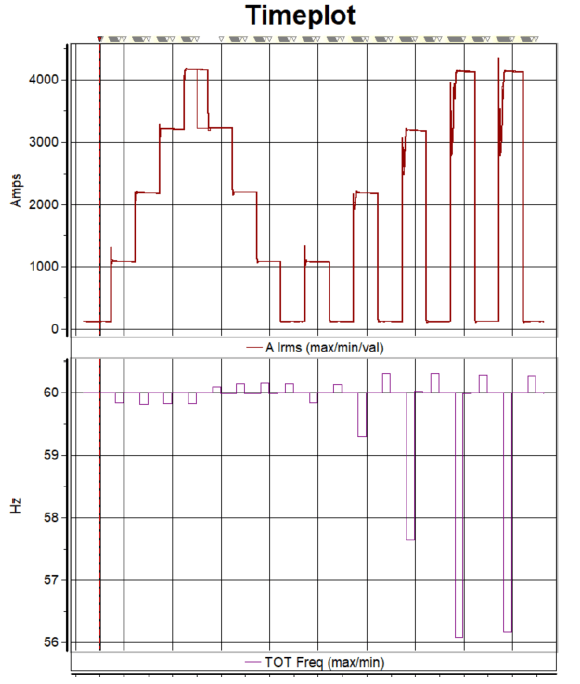
Another key component is Dran-View 7 Enterprise (DV7E) software. DV7E turns your recorded data into actionable information. DV7E not only provides convenient tools for data analysis and reporting, but also includes advanced capabilities that add value to recorded data. Case in point – DV7E easily computes cycle-by cycle frequency which is critical in evaluating the response of the power system during the tests (see below).
Figure 1.Generator frequency step load response
KEY DRANETZ HDPQ CAPABILITIES
Triggering
Step load testing is common in these applications. As indicated in the diagram above, a load bank is used to simulate the load to evaluate the response of the power system. The loads will often be stepped incrementally up and then back down from 0% to 100% in 25% increments. There is usually a pause between steps to see the response of the power system.
‘Impulse’ tests are also conducted stepping from 0% to 25% to 0%, 0% to 50% to 0%, etc. throughout the capacity range. Again, pausing between steps.
Load stepping presents some unique triggering challenges for the PQ analyzer to record the required data. To capture each step the meter must detect incremental changes in current on a cycle-by cycle basis. Most meters are limited to only HI or LO RMS trigger limits and many are not capable of inspecting each cycle as required. At best , most meters may only capture one load step and not the incremental stepping required by this application.
The Dranetz HDPQ family overcomes this by using innovative waveshape deviation triggers that are available for both voltage and current. Waveshape triggers work in parallel with other instrument triggers to continually inspect every digitized sample point of each cycle looking for positive or negative changes in amplitude from the same data point of the previous cycle.
Figure 2. Dranetz HDPQ family V&I waveshape deviation triggering
This capability is key to detecting cycle-by-cycle changes in voltage or current for applications such as negative transients, harmonics, system noise, and the impulse/step changes of this application.
Figure 3. HDPQ current waveshape deviation trigger
As shown above, a positive step load switch changed the AC waveshape, creating a waveshape trigger that started data recording to memory. A negative waveform change would work the same. The HDPQ analyzer is always ready to record the next step change – all in parallel with the traditional HI/LO RMS, transient and other triggering available.
Note that the voltage trigger settings for this application can use the same waveshape triggers if needed, or the traditional RMS sag/dip, swell triggers.
Recording Buffer
Step load testing requires a large recording buffer. The reason is to capture the state of the power system before, during and after the step transition. The Dranetz HDPQ Guide & Xplorer analyzers can record up to 10K cycles for each triggered cycle-by-cycle PQ event. This capability is available for sags/dips, swells, transients, and the waveshape triggers used in this application.
The recording duration for each load step is application dependent but is typically around 5 seconds. We recommend doubling the minimum recording requirement, if possible, to account for unexpected situations such as skews in test timing, to capture unexpected system issues, etc.
As an example, if the application requires 5 seconds of recording per step, we recommend doubling to 10 seconds. This is a post-trigger setting of 600 cycles @60Hz, 500 cycles @50Hz. We also recommend a 30 cycle pre-trigger setting which is 0.5 seconds @60Hz, 0.6 seconds @50Hz. The pre-trigger will additionally capture the state of the system before the step load change. See the example below.
Figure 4. Dranetz HDPQ step load trigger example
BENEFITS OF DRAN-VIEW 7
By using the above-mentioned triggers & settings you will capture the data necessary to evaluate the performance of the power system during the step load and other testing. However, there’s an important missing parameter that’s not available directly from most PQ analyzers, including the Dranetz HDPQ – cycle-by-cycle frequency for each step load change.
Why?
Most reputable PQ analyzers like the Dranetz HDPQ family measure in accordance with international PQ standards, the most common being IEC 61000-4-30. The Dranetz HDPQ family is IEC 61000-4-30 Class A Ed 3 complaint and is laboratory tested to ensure compliance. IEC 61000-4-30 has strict measurement requirements that includes frequency which is to be averaged over a period of time. This is ideal for most applications, but not for this application that requires frequency to be measured on each cycle continually for the duration of the recording.
Dran-View 7 Enterprise (only) can post process recorded waveform data to compute many additional parameters not available directly from the PQ analyzer. For this application, in just a few clicks, the DV7E Harmonics & Timeplot Calculator can quickly compute the frequency of every cycle recorded by the HDPQ analyzer.
Cycle-by-cycle frequency is then available for trending, analysis and reporting alongside the data from the HDPQ analyzer. It can even be stored in the DV7E database.
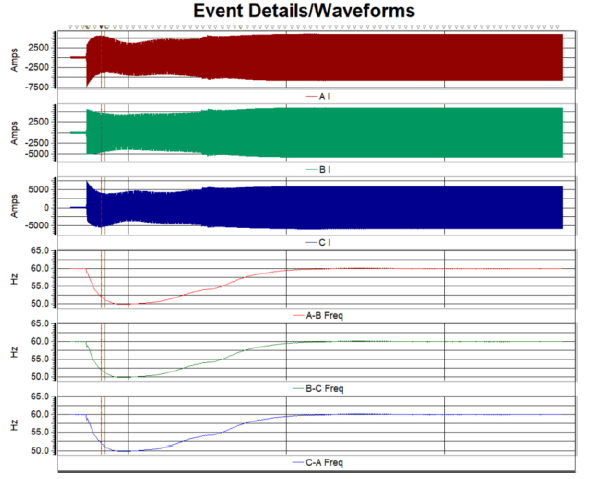
Figure 6. Dran-View 7 Enterprise cycle-by-cycle frequency computation
As shown above, the frequency response of the step load changes to the system can be easily seen alongside the current recorded directly by the HDPQ.
CONFIGURING THE INSTRUMENT FOR YOUR SURVEY
Actual instrument configurations can vary by application and are beyond the scope of this application note. Also, we covered the most important parameters to enable, but your application may require others.
If you are unfamiliar with the Dranetz HDPQ configurations, Dranetz has a series of recorded presentations available on our web site that focus on product applications and operational training, including this application. Please follow the link below and search for the application training titled ‘Dranetz HDPQ UPS, Generator & Mission Critical Testing’. This video expands on the information here, provides step by step HDPQ & DV7E configuration instructions, as well as demonstrations.
Published by Carelabs (Carelabz), Website: carelabz.com
Image: Carelabz
Residual Current Device offer a level of personal protection that ordinary fuses and circuit-breakers cannot provide. Residual Current Devices, or RCDs. are safety switches that prevent people from getting electrocuted in homes and businesses. The device monitors the flow of electricity as it enters a property from the main distribution panel. A surge of electricity, or an imbalance of electrical power, can cause injury or death. If an imbalance in electricity is detected, the switch automatically cuts off the electricity. The installation of at least two RCD Safety Switches in a building allows the electrical circuits to be evenly divided. That increases safety two-fold by preventing electrocution, and allowing some lights and power to remain on in the building.
Residual Current Devices are designed to protect against the risks of electrocution and fire caused by earth faults. For example, if you cut through the cable when mowing the lawn and accidentally touched the exposed live wires or a faulty appliance overheats causing electric current to flow to earth. RCD’s are very sensitive and will activate within 10 to 30 milliseconds stopping the flow of electricity.
Types of Residual Current Device
There are various types of RCDs that can be used to make sure you are always as safe as possible.
Fixed RCDs
These are installed in the consumer unit (fuse box) and can provide protection to individual or groups of circuits. A fixed RCD provides the highest level of protection as it protects all the wiring and the sockets on a circuit, and any connected appliances.
Socket-Outlet RCDs
These are special socket-outlets with an RCD built into them which can be used in place of a standard socket-outlet. This type of RCD provides protection only to the person in contact with equipment, including its lead, plugged into the special socket-outlet.
Portable RCDs
These plug into any standard socket-outlet. An appliance can then be plugged into the RCD. They are useful when neither fixed nor socket-outlet RCDs are available but, as with socket-outlet RCDs, they provide protection only to the person in contact with the equipment, including its lead, plugged into the portable RCD. Portable RCDs are plugged into a fixed socket and are suitable for monitoring appliances in high-risk areas such as workshops, outdoor areas or damp locations. They should be used where RCD protection is not already provided or is unknown.
What RCD Testing Regulations Apply?
RCD Regulations UAE indicate that the company must have at least two residual current devices connected to the main switchboard. However, compliance regulations could vary based on the size of the building and the current flowing to each section of it. If regulations aren’t followed, the company could incur a fine of a decent amount.
Are Residual Current Devices Reliable?
We’ve found that fixed RCDs are about 97% reliable. This improves if they are tested regularly. If you have fixed RCD protection, it will reduce the risk of electric shock to you and your family. It can also protect your home against the risk of fire caused by faulty wiring or appliances.
Remember – Although RCD protection reduces the risk of death or injury from electric shock it does not reduce the need to be careful. Have your wiring checked at least once every 10 years to ensure the safety of you, your family and your home. If you find a fault with your wiring, or an appliance, stop using it immediately and contact a registered electrician.
Don’t forget to test – You should test all fixed and socket RCDs about every three months. Manufacturers recommend that portable RCDs are tested every time you use them.
How Often Should RCD Testing Occur?
RCD testing has to be completed every three months, and documented, to remain in compliance. There is a test button on the device that has to be pressed to determine if the switch is working correctly. It is working properly if the power goes off. If the power does not go off, an electrician has to be called to re-test the switch, repair it, or replace it. It is strongly recommended that all homeowners, even those not selling the property have the devices installed for safety. The cost of installing residual current devices is nominal, especially compared to the safety of family members. In order to remain compliant to the standard, you will need to comply with the above test intervals in the section above.
One of the most common problems that we see in our country is that everyone is busy and it’s very easy to miss these dates and not be compliant with the standards. We can help you by taking care of this responsibility for you. The Carelabs team will send reminders of your RCD renewal coming due, several weeks before the renewal is due, to ensure you are always compliant at your premises.
How Much will RCD Protection Cost?
A plug-in RCD can cost as little as $30 . A fixed RCD will cost more, but will provide a greater degree of protection to help keep your family and working environment safe. Installation costs will vary, so we recommend getting several quotes before proceeding.
Why Test Residual Current Devices?
Some electrical appliances and old wiring may have a normal small amount of earth leakage which can trip a RCD. Earth leakage increases with each additional electrical appliance that is plugged in, and if RCD keeps tripping out it may be an overloaded circuit. Any faults we recommend that you have your wiring and appliances checked by an electrician to ascertain the fault if a RCD keeps tripping.
The majority of electrical fatalities could have been prevented by the use of a properly installed RCD, and regular testing to ensure they are working correctly. RCD’s also protect against fire caused by faults in appliance, tools and wiring. If these faults go undetected they could cause a fire or personal injury. RCD’s provide a means of early fault detection.
Thermal Scanners is able to carry out all your RCD Testing requirements and upon completion, issues you with a Comprehensive Report and Compliance Certificate. If maintained correctly an RCD can not only help to prevent fire due to appliance or wiring faults, they save lives. Thermal Scanners help clients to ensure their RCD’s are compliant and tested in line with the UAE Standards.
What is Done During Testing of RCD?
RCDs must be tested. The requirements are stated in the following Regulations:
The effectiveness of the RCD must be verified by a test simulating an appropriate fault condition and independent of any test facility, or test button, incorporated in the device (Regulation 713-13-01)
Where an RCD of 30mA provides supplementary protection the operating time must not exceed 40 ms at a residual current of 5 I∆n. (Regulation 412-06-02 refers)
Tests are made on the load side of the RCD between the phase conductor of the protected circuit and the associated cpc. Any load or appliances should be disconnected prior to testing. RCD test instruments require a few milliamperes to operate; this is normally obtained from the phase and neutral of the circuit under test. When testing a three-phase RCD protecting a three-wire circuit, the instrument’s neutral is required to be connected to earth. This means that the test current will be increased by the instrument supply current and will cause some devices to operate during the 50% test, possibly indicating an incorrect operating time. Under this circumstance it is necessary to check the operating parameters of the RCD with the manufacturer before failing the RCD.
The RCD Testing Requirements indicate that a manager is required to test each device every three months. To conduct these tests, they must present the test button found on the residual current device. The RCD Testing results determine if the device is worked correctly. After each test, the manager must reset the device by pressing the appropriate button.
If at any time the test indicates that it isn’t operating properly, the manager must order a new device and shut down power to the location. They must tag and lock the device in the location in which it is used. This notifies workers of an existing issue and prevents them from using any connections running to it.
How are Residual Current Devices Tested?
The wiring regulations require the residual device providing additional protection to disconnect within 40 milliseconds when tested at 5 times the current they are designed to operate within normal circumstances. This is something electricians test using calibrated equipment and not something the homeowner can do. It is one of the tests carried out during an electrical inspection and confirms if the RCD would disconnect in the necessary time to prevent shock. Other tests confirm the device(s) are not oversensitive that would leave you without power unnecessarily. If you are not sure when the rcds within your installation have been tested, get in touch to make an appointment for me to test them for you. When RCD tests are carried out, it will trip the RCD and disconnect the circuit that it protects, so any electrical equipment will need to be turned off prior to RCD Testing being carried out.
Each RCD Test only takes approximately 5 minutes for each RCD. We suggest that RCD Testing is carried out after hours, before the office opens, or you will need to advise your staff that the power will be disrupted for each circuit, and that there computers will need to be turned off.
All electrical equipment needs to be turned off when RCD Testing is carried out.
Operating Time Test
Performed by an electrician, this test measures how long the RCD takes to trip, indicating whether it is fast enough be effective.
Push-button Test on RCDs
The push-button test is to ensure that the RCD will trip when there is an earth leakage, and break the electrical circuit protecting the individual from suffering an electric shock, or electrocution. When you press the test button, and the RCD has detected an imbalance, the on/off switch will jump to the “off” position. The test button will only test the RCD if an electricity supply is connected. This test should be performed daily or before each time you use the RCD – whichever is the longer. However it is not particularly accurate and should never be relied on as a reliable assessment of the RCD working correctly. The “trip time” test using the “applied current” method is a far more accurate means of testing RCDs and is a required test under AS/NZS 3760.
Trip time test
It measures the actual trip time and must be performed with equipment able to measure this to within +/- 8 ms (0.008 of a second).This is a simple test that can be performed by the user, to determine that the RCD’s tripping mechanism is working.
Portable RCDs
Portable RCDs requires the use of an isolation transformer to carry out operating time test.
Follow these simple steps to ensure your RCDs are operating correctly:
Plug a small lamp into a power point and make sure it works. Leave it turned on.
Make sure that electricity is connected to the property and the main switch is in the “on” position. The lamp should be on.
Turn off all electronic equipment (computers and televisions) etc.
Push the test button on each RCD. Do not hold your finger on the test button. The RCD should operate (turn off). If it does not operate, it must be checked by an electrical contractor.
After pushing the test button and the RCDs have turned off check that the small lamp is now off. Also check that all the lights and power points do not operate. To do this, plug the small lamp into all the power points and turn the power point on. If the lamp turns on, a licensed electrical contractor must be engaged to correct the wiring.
When finished testing, turn the RCDs back on and check that the lamp works when plugged into a power point.
Who can Carry out the Testing of an Residual Current Device?
Clause 62C of the OHS Amendment (RCD) Regulation 2011 requires that RCDs are push button test that can be carried out by a person that has been instructed on how to use the built-in test push button and second test involves testing the operational performance of the RCD that measures the tripping time and tripping current. This type of testing needs to be carried out by a person who is trained in the use of an RCD tester. This could be a person that has been trained to use an RCD tester or an electrically qualified person such as an electrician. For some test activities where it may be necessary to access the supply distribution switchboard the testing could only be carried out by a licensed electrician. Further guidance on RCD testing methods can be found in the Standard AS/NZS 3760 In-service inspection and testing of electrical equipment.
Recording the Results of Residual Current Device Testing
The owner of the RCD must keep records of RCD testing, except for the daily push button testing of portable RCDs. The OHS Regulation requires that a record is made and kept of all inspections, tests and maintenance carried out on electrical equipment. The employer is to ensure that the following information is recorded in relation to RCD testing,
The name of the person who carried out the RCD test
The date on which or the dates over which, the RCD test was carried out
The result or outcome of the RCD test, and
The date by which the next RCD test must be carried out
Records can consist of documents, logbooks, asset registers or a computerised database. They should be located conveniently so that managers, employees and employee representatives can access the information. Carelabs inspectors have the right to examine the records of employers, which are required to be kept by the OHS Regulation.
Benefits of Residual Current Device Testing
A tested RCD can help put your mind at ease when it comes to the safety of your workers. RCD testing performed by a qualified professional can ensure that your RCDs have no faults in them and can be relied upon to function when needed. Some other benefits of RCD testing are:
Published by A. de Almeida, L. Moreira, J. Delgado, ISR – Department of Electrical and Computer Engineering, University of Coimbra, Pólo II, 3030-290 Coimbra (Portugal),
Abstract: In this paper, the main Power Quality (PQ) problems are presented with their associated causes and consequences. The economic impacts associated with PQ are characterized. Finally, some solutions to mitigate the PQ problems are presented.
Key words: Power Quality, Power Quality problems, Power Quality costs, Power Quality solutions.
1.Introduction
Power Quality (PQ) related issues are of most concern nowadays. The widespread use of electronic equipment, such as information technology equipment, power electronics such as adjustable speed drives (ASD), programmable logic controllers (PLC), energy-efficient lighting, led to a complete change of electric loads nature. These loads are simultaneously the major causers and the major victims of power quality problems. Due to their non linearity, all these loads cause disturbances in the voltage waveform.
Along with technology advance, the organization of the worldwide economy has evolved towards globalisation and the profit margins of many activities tend to decrease. The increased sensitivity of the vast majority of processes (industrial, services and even residential) to PQ problems turns the availability of electric power with quality a crucial factor for competitiveness in every activity sector. The most critical areas are the continuous process industry and the information technology services. When a disturbance occurs, huge financial losses may happen, with the consequent loss of productivity and competitiveness.
Although many efforts have been taken by utilities, some consumers require a level of PQ higher than the level provided by modern electric networks. This implies that some measures must be taken in order to achieve higher levels of Power Quality.
2. Types of Power Quality Problems
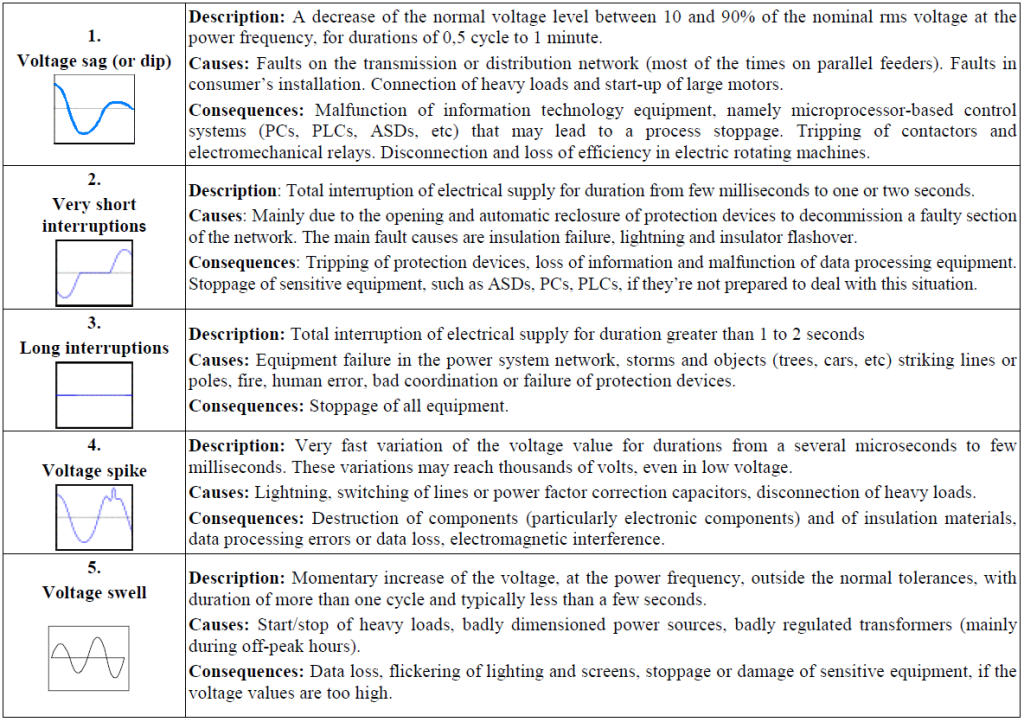
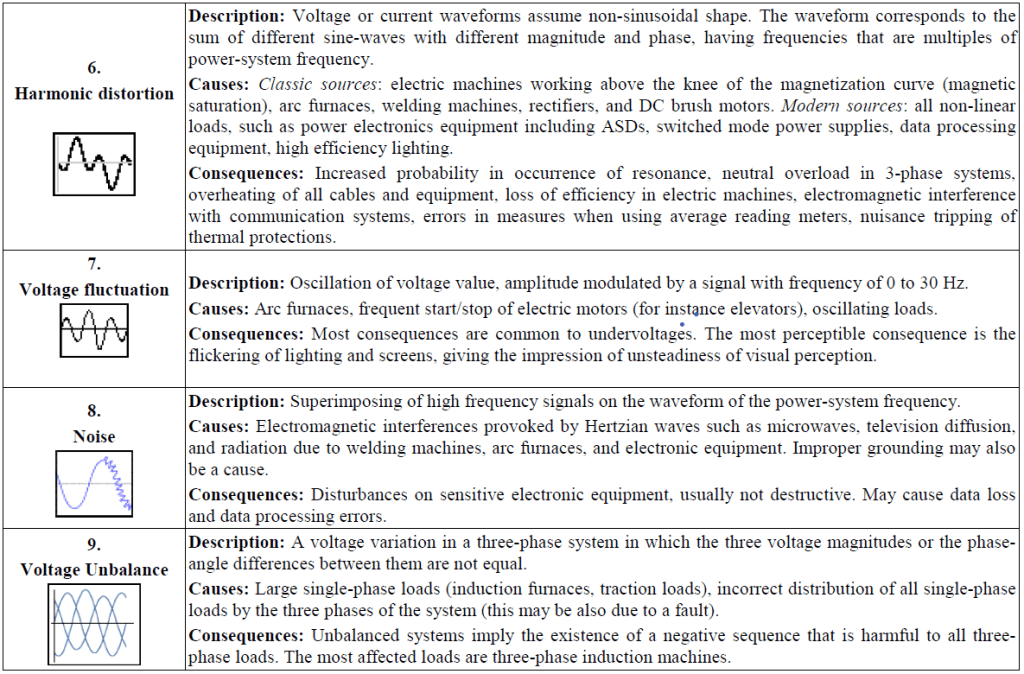
The most common types of Power Quality problems are presented in Table I.
3. Power Quality Characterization
Even the most advanced transmission and distribution systems are not able to provide electrical energy with the desired level of reliability for the proper functioning of the loads in modern society. Modern T&D (transmission and distribution) systems are projected for 99,9 to 99,99% availability. This value is highly dependant of redundancy level of the network, which is different according to the geographical location and the voltage level (availability is higher at the HV network). In some remote sites, availability of T&D systems may be as low as 99%. Even with a 99,99% level there is an equivalent interruption time of 52 minutes per year.
The most demanding processes in the modern digital economy need electrical energy with 99.9999999% availability (9-nines reliability) to function properly.
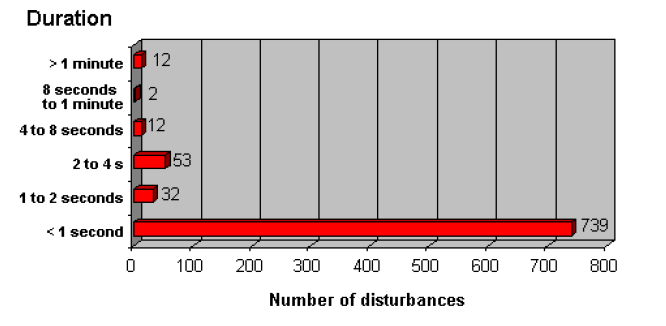
Between 1992 and 1997, EPRI carried out a study in the US to characterize the average duration of disturbances. The result for a typical site, during the 6-year period is presented below.
Fig. 1 – Typical distribution of PQ disturbances by its duration for a typical facility in 6 years (1992-97) in the US [2].
Table I – Most common Power Quality problems [ 1], [4]
Table I – Most common Power Quality problems [ 1], [4]
As it can be seen in Fig. 1., the vast majority of the disturbances registered (about 87%) lasted less than 1 second and only 12 have duration greater than 1 minute. It is clear that not all these disturbances cause equipment malfunctioning, but many types of sensitive equipment may be affected.
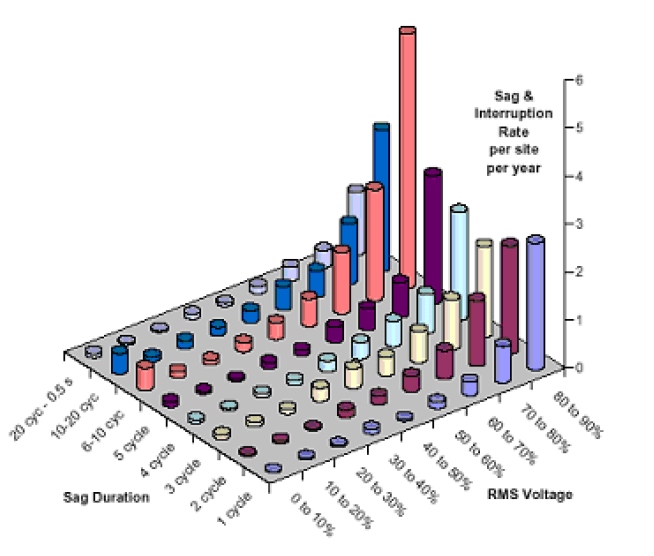
Another study of EPRI was undertaken, between 1993 and 1999, in order to characterize the PQ on Low Voltage (LV) distribution networks. This study concluded that 92% of disturbances in PQ were voltage sags with amplitude drops up to 50% and duration below 2 seconds. Fig. 2 shows the typical distribution of sags under 0.5 seconds and micro-interruptions.
Fig. 2 – Distribution of sag and micro-interruption in LV networks in US [3].
The situation in developed countries of Europe is very similar to the one observed in the US. Fig. 3 shows the characterization of PQ in an industrial area of the center of Portugal by monitoring of the supply in the period February 2002-January 2003.
Fig. 3 – Characterization of electrical energy supply disturbances in an industrial facility in Portugal.
4. Costs of Power Quality Problems
The costs of PQ problems are highly dependant of several factors, mainly the business area of activity. Other factors, like the sensitivity of the equipment used in the facilities and market conditions, among other, also influence the costs of PQ problems.
A. Power Quality Costs Evaluation
The costs related to a PQ disturbance can be divided in:
1) Direct costs. The costs that can be directly attributable to the disturbance. These costs include the damage in the equipment, loss of production, loss of raw material, salary costs during non-productive period and restart costs. Sometimes, during the non-productive period some savings are achieved, such as energy savings, which must be subtracted to the costs. Some disturbances do not imply production stoppage, but may have other costs associated, such as reduction of equipment efficiency and reduction of equipment lifetime.
2) Indirect costs. These costs are very hard to evaluate. Due to some disturbances and nonproductive periods, one company may not be able to accomplish the deadlines for some deliveries and loose future orders. Investments to prevent power quality problems may be considered an indirect cost.
3) Non-material inconvenience. Some inconveniences due to power disturbance cannot be expressed in money, such as not listening to the radio or watch TV. The only way to account these inconveniences is to establish an amount of money that the consumer is willing to pay to avoid this inconvenience [4], [5].
B. Estimates on Power Quality Costs
Several studies have been made to evaluate the costs of PQ problems for consumers. The assessment of an accurate value is nearly impossible; so all these studies are based on estimates. Some of these studies are presented below.
1) Business Week (1991). PQ costs were estimated on 26,000 million USD per year in the United States. 2) EPRI (1994). This study pointed 400,000 million USD per year for PQ costs in the United States. 3) US Department of Energy (1995). PQ costs were estimated on 150,000 million USD per year for United States. 4) Fortune Magazine (1998). Stated that PQ costs were around 10,000 million USD per year in United States. 5) E Source (2001). A study comprising continuous process industries, financial services and food processing in the United States, estimated the average annual costs of PQ problems on 60,000 to 80,000 USD per installation. 6) PQ costs in EU (2001). Overall PQ costs in industry and commerce, in European Union, are estimated in 10,000 million EUR per year [6].
The estimates of the various studies differ a lot, but all point to a common factor: the PQ costs are enormous.
C. Costs of Momentary Interruptions
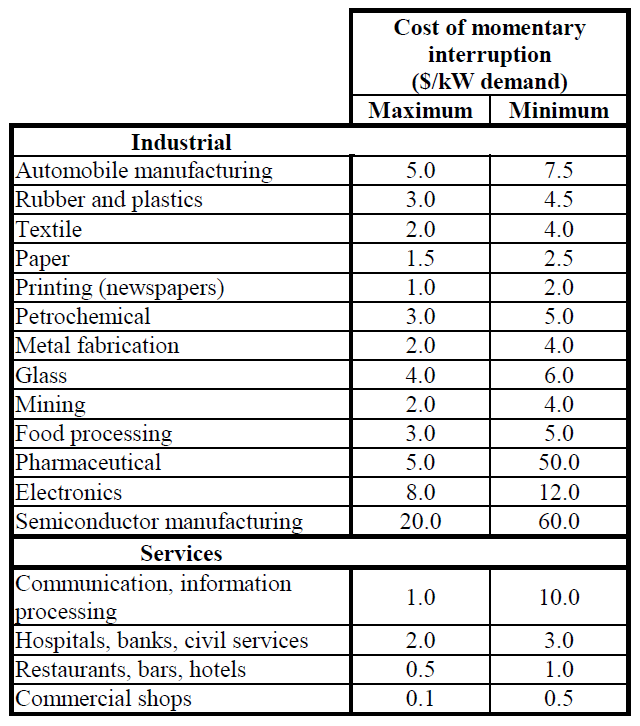
An interruption is the PQ problem with the most perceivable impact on facilities. Table II summarizes the typical costs of momentary interruptions (1 minute) for different types of consumers. The costs presented are without major investments in technologies to achieve ride-through capabilities to cope with the interruption. These values are based on published services and Electrotek Concepts experiences with individual studies [5].
Table II – Typical costs of momentary interruptions (1 minute, in $/kW demand, for different types of industrial and services facilities.
Table II – Typical costs of momentary interruptions (1 minute, in $/kW demand, for different types of industrial and services facilities.
As it can be seen, the industrial sector is the most affected by interruptions, especially the continuous process industry. In the services sector, communication and information processing is the most affected business area.
The costs of interruptions are also function of its duration. Fig. 4 depicts the costs of interruptions against its duration.
Fig. 4 – Costs of interruptions as function its duration [5].
5. Solutions for PQ Problems
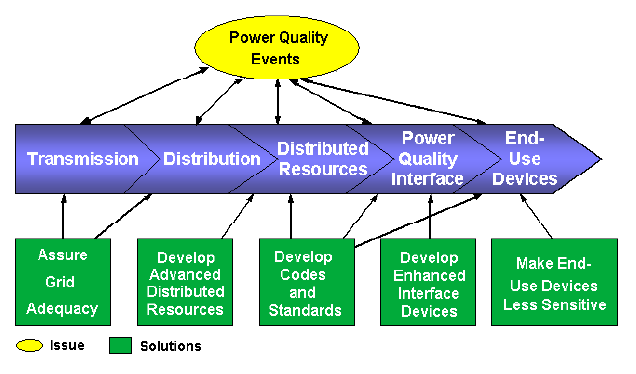
The mitigation of PQ problems may take place at different levels: transmission, distribution and the end use equipment. As seen in Fig. 5, several measures can be taken at these levels.
Fig. 5 – Solutions for digital power [7]
6. Grid Adequacy
Many PQ problems have origin in the transmission or distribution grid. Thus, a proper transmission and distribution grid, with adequate planning and maintenance, is essential to minimize the occurrence of PQ problems.
7. Distributed Resources – Energy Storage Systems
Interest in the use of distributed energy resources (DER) has increased substantially over the last few years because of their potential to provide increased reliability. These resources include distributed generation and energy storage systems.
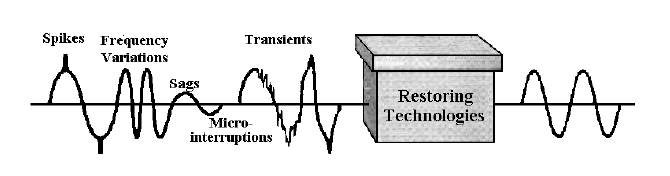
Energy storage systems, also known as restoring technologies, are used to provide the electric loads with ride-through capability in poor PQ environment.
Fig. 6 – Restoring technologies principle [1].
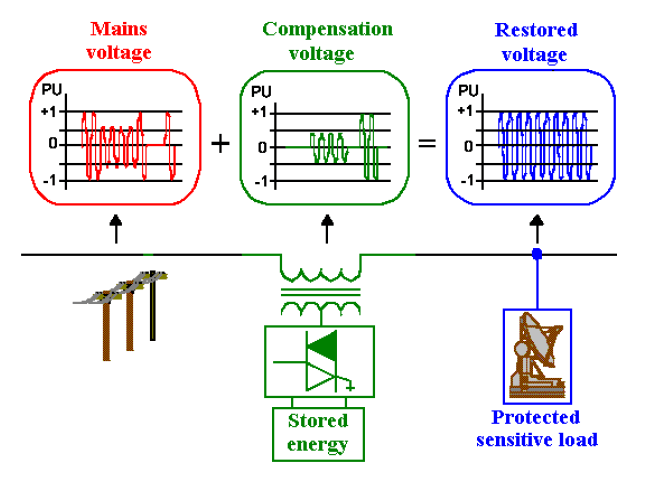
Recent technological advances in power electronics and storage technologies are turning the restoring technologies one of the premium solutions to mitigate PQ problems.
Fig. 7 – Working principle of an energy storage system.
The first energy storage technology used in the field of PQ, yet the most used today, is electrochemical battery. Although new technologies, such as flywheels, supercapacitors and superconducting magnetic energy storage (SMES) present many advantages, electrochemical batteries still rule due to their low price and mature technology.
A. Flywheels
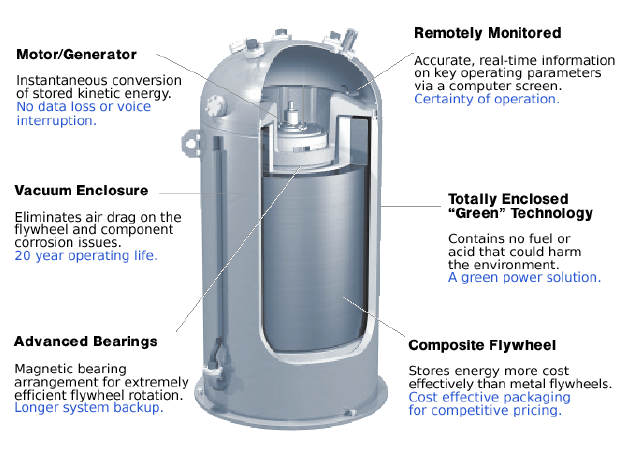
A flywheel is an electromechanical device that couples a rotating electric machine (motor/generator) with a rotating mass to store energy for short durations. The motor/generator draws power provided by the grid to keep the rotor of the flywheel spinning. During a power disturbance, the kinetic energy stored in the rotor is transformed to DC electric energy by the generator, and the energy is delivered at a constant frequency and voltage through an inverter and a control system. Fig. 8 depicts the scheme of a flywheel, where the major advantages of this system are explained.
Fig. 8 – Flywheel [http://www.beaconpower.com]
Traditional flywheel rotors are usually constructed of steel and are limited to a spin rate of a few thousand revolutions per minute (RPM). Advanced flywheels constructed from carbon fibre materials and magnetic bearings can spin in vacuum at speeds up to 40,000 to 60,000 RPM. The stored energy is proportional to the moment of inertia and to the square of the rotational speed. High speed flywheels can store much more energy than the conventional flywheels.
The flywheel provides power during a period between the loss of utility supplied power and either the return of utility power or the start of a back-up power system (i.e., diesel generator). Flywheels typically provide 1-100 seconds of ride-through time, and back-up generators are able to get online within 5-20 seconds.
B. Supercapacitors
Supercapacitors (also known as ultracapacitors) are DC energy sources and must be interfaced to the electric grid with a static power conditioner, providing energy output at the grid frequency. A supercapacitor provides power during short duration interruptions or voltage sags.
Medium size supercapacitors (1 MJoule) are commercially available to implement ride through capability in small electronic equipment, but large supercapacitors are still in development, but may soon become a viable component of the energy storage field.
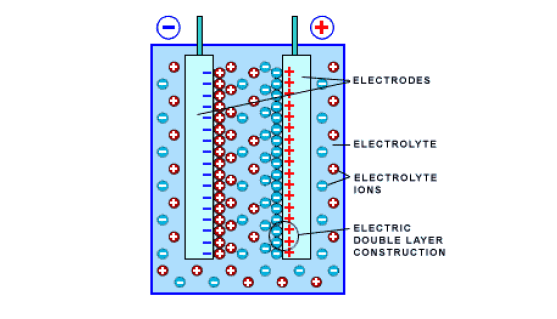
Fig. 9 – Electric double layer supercapacitor [http://www.esmacap.com]
Capacitance is very large because the distance between the plates is very small (several angstroms), and because the area of conductor surface (for instance of the activated carbon) reaches 1500-2000 m2/g (16000-21500 ft2/g). Thus, the energy stored by such capacitors may reach 50-60 J/g [8].
C. SMES
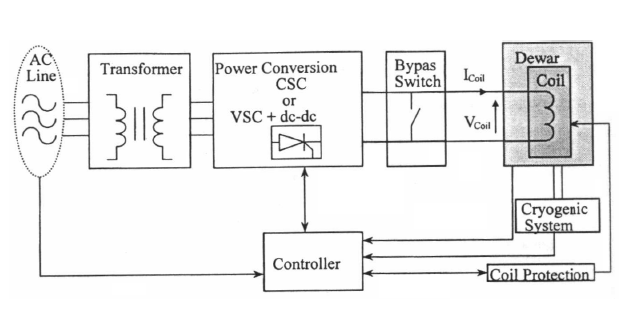
A magnetic field is created by circulating a DC current in a closed coil of superconducting wire. The path of the coil circulating current can be opened with a solid-state switch, which is modulated on and off. Due to the high inductance of the coil, when the switch is off (open), the magnetic coil behaves as a current source and will force current into the power converter which will charge to some voltage level. Proper modulation of the solid-state switch can hold the voltage within the proper operating range of the inverter, which converts the DC voltage into AC power.
Fig. 10 – SMES system [9].
Low temperature SMES cooled by liquid helium is commercially available. High temperature SMES cooled by liquid nitrogen is still in the development stage and may become a viable commercial energy storage source in the future due to its potentially lower costs.
SMES systems are large and generally used for short durations, such as utility switching events.
D. Comparison of Storage Systems
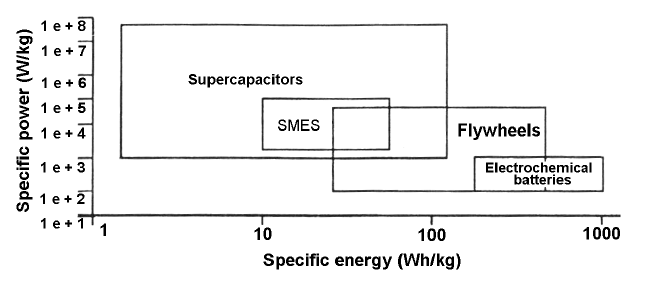
Fig. 11 shows a comparison of the different storage technology in terms of specific power and specific energy.
Fig. 11 – Specific power versus specific energy ranges for storage technologies [9].
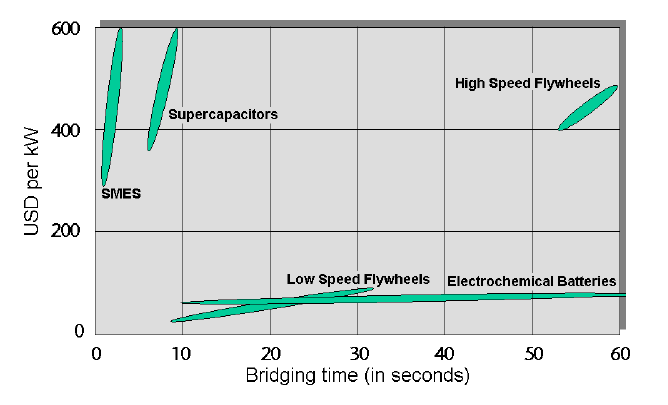
Fig. 12 shows the specific costs of energy storage devices.
Fig. 12 – Specific costs of energy storage devices [10].
The high speed flywheel is in about the same cost range as the SMES and supercapacitors and about 5 times more expensive than a low speed flywheel due to its more complicated design and limited power rating. Electrochemical battery has a high degree of mature and a simple design. Below a storage time of 25 seconds the low speed flywheel can be more cost effective than the battery.
8. Distributed Resources – Distributed Generation
Distributed Generation (DG) units can be used to provide clean power to critical loads, isolating them from disturbances with origin in the grid. DG units can also be used as backup generators to assure energy supply to critical loads during sustained outages. Additionally DG units can be used for load management purposed to decrease the peak demand.
At present, reciprocating engine is the prevalent technology in DG market, but with technology advancements, other technologies are becoming more attractive, such as microturbines or fuel cells (Table III).
Table III – Evolution of DG technologies.
Table III – Evolution of DG technologies.
If DG units are to be used as back-up generation, a storage unit must be used to provide energy to the loads during the period between the origin of the disturbance and the start-up of the emergency generator.
The most common solution is the combination of electrochemical batteries UPS and a diesel genset. At present, the integration of a flywheel and a diesel genset in a single unit is also becoming a popular solution, offered by many manufacturers.
Fig. 13 – Scheme of a continuous power system, using a flywheel and a diesel genset [www.geindustrialsystems.com].
Fig. 14 – Dynamic UPS, by Hitec Power Protection, bv. [http://www.hitec-ups.com].
9. Enhanced Interface Devices
Besides energy storage systems and DG, some other devices may be used to solve PQ problems. Using proper interface devices, one can isolate the loads from disturbances deriving from the grid.
A. Dynamic Voltage Restorer
A dynamic voltage restorer (DVR) acts like a voltage source connected in series with the load. The working principle of the most common DVRs is similar to Fig. 7. The output voltage of the DVR is kept approximately constant voltage at the load terminals by using a step-up transformer and/or stored energy to inject active and reactive power in the output supply trough a voltage converter.
B. Transient Voltage Surge suppressors (TVSS)
Transient voltage surge suppressors are used as interface between the power source and sensitive loads, so that the transient voltage is clamped by the TVSS before it reaches the load. TVSSs usually contain a component with a nonlinear resistance (a metal oxide varistor or a zener diode) that limits excessive line voltage and conduct any excess impulse energy to ground.
C. Constant Voltage Transformers
Constant voltage transformers (CVT) were one of the first PQ solutions used to mitigate the effects of voltage sags and transients. To maintain the voltage constant, they use two principles that are normally avoided: resonance and core saturation.
Fig. 15 – Constant voltage transformer.
When the resonance occurs, the current will increase to a point that causes the saturation of the magnetic core of the transformer. If the magnetic core is saturated, then the magnetic flux will remain roughly constant and the transformer will produce an approximately constant voltage output.
If not properly used, a CVT will originate more PQ problems than the ones mitigated. It can produce transients, harmonics (voltage wave clipped on the top and sides) and it is inefficient (about 80% at full load). Its application is becoming uncommon due to technological advances in other areas.
D. Noise Filters
Noise filters are used to avoid unwanted frequency current or voltage signals (noise) from reaching sensitive equipment. This can be accomplished by using a combination of capacitors and inductances that creates a low impedance path to the fundamental frequency and high impedance to higher frequencies, that is, a low-pass filter. They should be used when noise with frequency in the kHz range is considerable.
E. Isolation Transformers
Isolation transformers are used to isolate sensitive loads from transients and noise deriving from the mains. In some cases (Delta-Wye connection) isolation transformers keep harmonic currents generated by loads from getting upstream the transformer. The particularity of isolation transformers is a grounded shield made of nonmagnetic foil located between the primary and the secondary. Any noise or transient that come from the source in transmitted through the capacitance between the primary and the shield and on to the ground and does not reach the load.
Fig. 16 – Isolation transformer.
F. Static VAR Compensators
Static VAR compensators (SVR) use a combination of capacitors and reactors to regulate the voltage quickly. Solid-state switches control the insertion of the capacitors and reactors at the right magnitude to prevent the voltage from fluctuating. The main application of SVR is the voltage regulation in high voltage and the elimination of flicker caused by large loads (such as induction furnaces).
G. Harmonic Filters
Harmonic filters are used to reduce undesirable harmonics. They can be divided in two groups: passive filters and active filters.
Fig. 17 – Harmonic filters [11].
Passive filters (Fig. 17 left) consist in a low impedance path to the frequencies of the harmonics to be attenuated using passive components (inductors, capacitors and resistors). Several passive filters connected in parallel may be necessary to eliminate several harmonic components. If the system varies (change of harmonic components), passive filters may become ineffective and cause resonance.
Active filters (Fig. 17 right) analyse the current consumed by the load and create a current that cancel the harmonic current generated by the loads. Active filters were expensive in the past, but they are now becoming cost effective compensating for unknown or changing harmonics.
10. Develop Codes and Standards
Some measures have been taken to regulate the minimum PQ level that utilities have to provide to consumers and the immunity level that equipment should have to operate properly when the power supplied is within the standards.
One major step in this direction was taken with the CBEMA curve (Fig 18), created by the Computer and Business Equipment Manufacturer’s Association. This standard specifies the minimum withstanding capability of computer equipment to voltage sags, microinterruptions and overvoltages.
Fig. 18 – CBEMA curve.
Fig. 19 – ITIC curve
This curve, although substituted recently by ITIC (Information Technology Industry Council) curve (Fig. 19), is still a reference in the area of PQ. When the voltage is within the limits determined by the shaded zone, the equipment should function normally. When the voltage is comprised on the zone below the permitted zone, the equipments may malfunction or stop. When the voltage is comprised in the upper prohibited zone, besides equipment malfunction, damage on the equipment may occur.
Other standardization organizations (IEC, CENELEC, IEEE, etc) have developed a set of standards with the same purposes. In Europe, the most relevant standards in PQ are the EN 50160 (by CENELEC) and IEC 61000.
Table IV – Most important parameters defined by European Norm 50160:2001.
Table IV – Most important parameters defined by European Norm 50160:2001.
11. Make End-use Devices Less Sensitive
Designing the equipment to be less sensitive to disturbances is usually the most cost effective measure to prevent PQ problems. Some manufacturers of end-use equipment are now recognising this problem, but the competitive market means that manufacturers should reduce costs and only respond to customers’ requirements. The exception is the ASD market, where manufacturers are actively promoting products with enhanced ride-through capabilities.
Adding a capacitor with a larger capacity to power supplies, using cables with larger neutral conductors, derating transformers and adjusting undervoltage relays, are measures that could be taken by manufacturers to reduce the sensitivity of equipment to PQ problems.
12. Conclusions
The availability of electric power with high quality is crucial for the running of the modern society. If some sectors are satisfied with the quality of the power provided by utilities, some others are more demanding.
To avoid the huge losses related to PQ problems, the most demanding consumers must take action to prevent the problems. Among the various measures, selection of less sensitive equipment can play an important role. When even the most robust equipment is affected, then other measures must be taken, such as installation of restoring technologies, distributed generation or an interface device to prevent PQ problems.
References
[1] J. Delgado, “Gestão da Qualidade Total Aplicada ao Sector do Fornecimento da Energia Eléctrica”, Thesis submitted to fulfilment of the requirements for the degree of PhD. in Electrotechnical Engineering, Coimbra, September 2002. [2] “The Two Seconds Problem”, American Superconductor and EPRI Research, March 1998. [3] EPRI Power Delivery Group, “The Future of Power Delivery in the 21st Century”, 1999. [4] M. Bollen, “Understanding Power Quality Problems – Voltage Sags and Interruptions”, IEEE Press Series on Power Engineering – John Wiley and Sons, Piscataway, USA (2000). [5] M. McGranaghan, “Costs of Interruptions”, in proceedings of the Power Quality 2002 Conference, Rosemont, Illinois, pp 1-8, October 2002.. [6] D. Chapman, “Costs of Poor Power Quality”, Power Quality Application Guide – Copper Development Association, March 2001. [7] EPRI, “Creating the Electricity Infrastructure for a Digital Society”, UIE-2000 Conference, Lisbon, 1-3, November 2000. [8] http://www.esma-cap.com [9] P. Ribeiro, B. Johnson, M. Crow, A. Arsoy, Y. Liu, “Energy Storage Systems for Advanced Power Applications”, Proceedings of the IEEE, vol 89, no.12, December 2001. [10] H. Darrelmann, “Comparison of Alternative Short Time Storage Systems”, Piller, GmbH, Osterode, Germany. [11] P. Ferracci, “ Power Quality”, Schneider Electric Cahier Technique no. 199, September 2000.
Published by Mirus International Inc., [2010-01-08] MIRUS-FAQ001-B2, FAQ’s Harmonic Mitigating Transformers, 31 Sun Pac Blvd., Brampton, Ontario, Canada. L6S 5P6.
What is an SMPS and how does it generate harmonics?
The Switch-mode Power Supply (SMPS) is found in most power electronics today. Its reduced size and weight, better energy efficiency and lower cost make it far superior to the power supply technology it replaced.
Electronic devices need power supplies to convert the 120VAC receptacle voltage to the low voltage DC levels that they require. Older generation power supplies used large and heavy 60 Hz step-down transformers to convert the AC input voltage to lower values before rectification. The SMPS avoids the heavy 60 Hz step-down transformer by directly rectifying the 120VAC using an input diode bridge (Figure 4-1). The rectified voltage is then converted to lower voltages by much smaller and lighter switch-mode dc-to-dc converters using tiny transformers that operate at very high frequency. Consequently the SMPS is very small and light.
Figure 4-1: Typical circuit diagram of Switch-mode Power Supply
The SMPS is not without its downside, however. The operation of the diode bridge and accompanying smoothing capacitor is very non-linear in nature. That is, it draws current in non-sinusoidal pulses at the peak of the voltage waveform (see Figure 4-2). This non-sinusoidal current waveform is very rich in harmonic currents.
Figure 4-2: Pulsed current waveform and resultant voltage flat-topping of a typical Switch-mode Power Supply
Because the SMPS has become the standard computer power supply, they are found in large quantities in commercial buildings. Acting together, the multitude of SMPS units can badly distort what started out as a sine wave voltage waveform.
Twice per cycle every SMPS draws a pulse of current to recharge its capacitor to the peak value of the supply voltage. Between voltage peaks the capacitor discharges to support the load and the SMPS does not draw current from the utility. The supply voltage peak is flattened by the instantaneous voltage drops throughout the distribution system caused by the simultaneous current pulses drawn by the multiple SMPS units. The expected sine wave with a peak of 120 x √2 = 169.4V instead starts to resemble a square wave. The flattened voltage waveform contains a lowered fundamental voltage component plus 3rd, 5th, 7th, 9th and higher voltage harmonics.
Harmonics and Harmonic Mitigating Transformers (HMT’s) Questions and Answers
This document has been written to provide answers to the more frequently asked questions we have received regarding harmonics and the Harmonic Mitigating Transformer technology used to address them. This information will be of interest to both those experienced in harmonic mitigation techniques and those new to the problem of harmonics. For additional information visit our Website at www.mirusinternational.com.