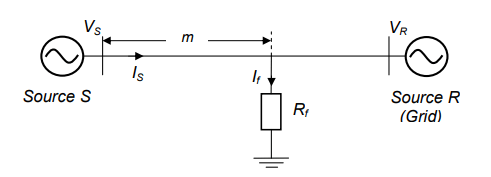
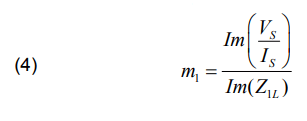
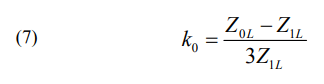
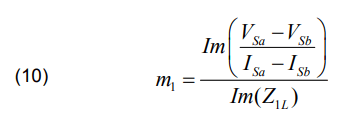
Abstract. Transformer harmonic current derating metrics; Harmonic Loss Factor, K-Factor, and Factor K are introduced, and used to calculate derating factors for dry and oil-filled type transformers.
Introduction
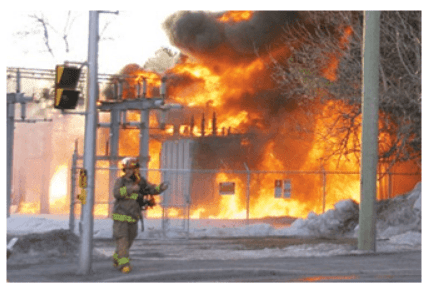
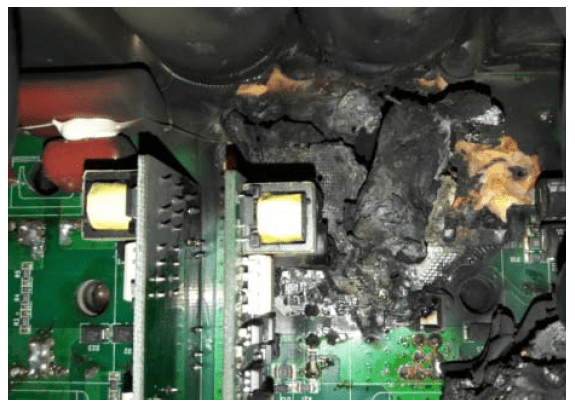
The introduction of Switched Mode Power Supplies (SMPS) in office equipment and LED lighting, Variable Frequency/Speed Drives (VF/SDs) to operate induction motors, and inverters that change DC, from photovoltaic cells, to Mains Frequency AC to drive Mains Frequency equipment or even feed upstream into the power grid are just some examples of how electronics are helping to increase efficiency in power usage. One drawback is their non-linear nature, which can yield significant voltage and current harmonic content both at the input and output, if not appropriately filtered. Harmonics on supply lines feed upstream into transformers, causing higher than expected heating and ageing. Excessive heating could lead to catastrophic outcomes (Picture 1). This work introduces three metrics; Harmonic Loss Factor, K Factor, and Factor K; developed to assess the impact of current harmonic heating of transformers.
Picture 1. Transformer on Fire
Transformer losses
The IEEE Standard C57.110-1986 [1] is developed to limit transformer temperature rise due to non-sinusoidal load currents [2]; it describes the load losses and a method to calculate load reduction required, so as to not exceed rated losses given the harmonic spectra of the load current.
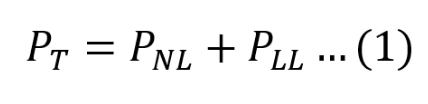
Total transformer loss PT(1) is the sum of no-load loss (excitation loss) PNLand load loss (impedance loss) PLL.
.
It is assumed in the proceeding work that the voltage harmonic distortion does not significantly increase the excitation loss, leaving the load loss the dominating source of loss at rated load. The load loss consists of copper loss, P (also referred to as I2R) and stray losses PSL. Stray loss is due to stray electromagnetic flux in the winding, core, core clamps, magnetic shields, enclosure, or tank walls [1]. The stray losses can be decomposed into eddy current losses in the winding PEC and other stray losses POSL (2).
.
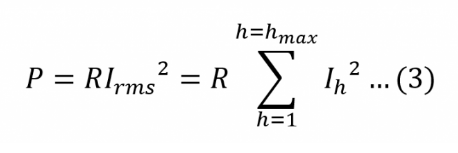
The copper loss is given by (3) and where the RMS current is decomposed into its harmonic content.
.
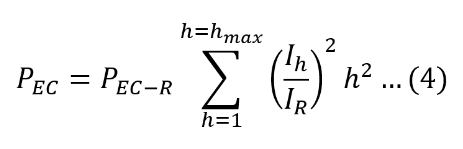
Winding eddy current loss in the power frequency spectrum is proportional to the square of both the load current magnitude and its frequency; and can cause excessive heating and abnormal temperature rise in the presence of non-sinusoidal load current.
.
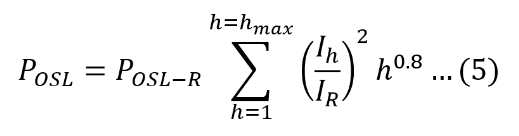
It is found that other stray loss increases with the square of the current magnitude and by a harmonic exponent factor no greater than 0.8 [3].
.
PEC-R and POSL-R are losses under rated conditions, and where IR and is the rated current.
K-Factor
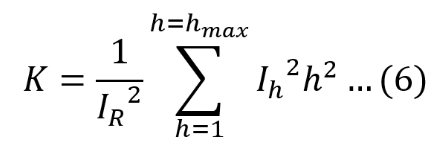
Underwriters Laboratories (UL) developed a metric called the K-factor [4], (6), a rating optionally applied to a dry-type transformer indicating its suitability for use with loads that draw non-sinusoidal currents and weights the harmonic currents according to their effect on transformer heating. The K-factor requires the rated current of the transformer.
.
The K-factor is used to specify a class of transformers capable of serving non-sinusoidal loads. K-factor rating of a transformer e.g. (4, 9, 13, 20, 30, 40 or 50) is an indication of the amount of harmonic current the transformer is capable of handling without overheating. The measured K-factor of the load must be below the K-factor rating of the transformer.
When comparing (4) and (6), the K-factor provides a measure of the ratio of the winding eddy current loss PEC to the eddy current loss under rated conditions PEC-R and therefore, a K-factor greater than unity indicates heating exceeding the rated operating conditions of the transformer. A standard transformer that is designed for linear loads is said to have a K-factor of unity.
Harmonic Loss Factor
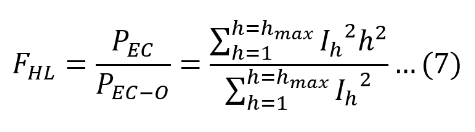
Harmonic loss factor FHL is defined in (7) as the ratio of the total winding eddy current losses due to the harmonics, PEC, to the winding eddy current losses at operating current and power frequency, as if no harmonic currents existed, PEC-O [1].
.
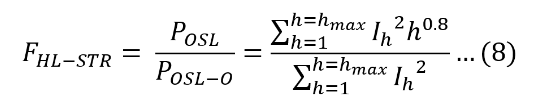
Similarly, the harmonic loss factor for other stray loss FHL-STR is calculated using (8) but not critical in estimating the derating in dry-type transformers [3].
.
Note: is other stray losses at operating current and power frequency, as if no harmonic currents existed.
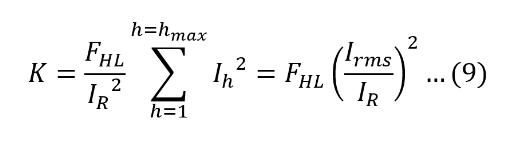
The K-factor and harmonic loss factor are related using (9).
.
From (9), the K-factor and FHL are equal only when the RMS current value is equal to the rated current of the transformer. Under normal operating conditions the RMS current value should be less than the rated current and so the K-factor is less than FHL .
Derating
The maximum amount of harmonic load current that a standard transformer can deliver without exceeding rated operating conditions is given by (10) [5]. Imax (pu) is also used as a derating factor.
.
For dry-type transformers POSL-R (pu) is zero and (10) reduces to (11).
.
From (11) no derating is required whenFHL is unity. Equation (11), rewritten in terms of K-factor will yield the same value of derating. The UL standard [4] prescribes another method for derating dry-type transformers using K-factor.
Factor K
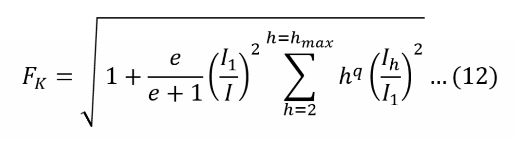
Another method used to derate a standard oil-filled transformer to harmonic load is referred to as Factor K [6] and given in (12).
.
e is the eddy current loss due to sinusoidal current at the fundamental frequency, divided by the loss due to DC current equal to the RMS current of the sinusoidal current value, both at reference temperature. The exponent q is dependent on the type of windings and on the frequency. As a guide, q is set to 1.7 for transformers with round or rectangular wire in both low and high voltage windings and to 1.5 for transformers having low voltage foil windings. The derating factor is given by 1/FK.
Worked example
A VSD is connected to a transformer rated at 200A. The input current spectrum to the VSD resembles that of a six-pulse rectifier and normalised to 104.1A RMS. The rated eddy current loss PEC-R , e and q are set to 10%, 0.1 and 1.7 respectively. The transformer harmonic derating metrics are calculated using equations (6), (7), (8) and (12). Equations (11) and (12) are used to calculate the derating of dry-type and oil-filled type transformers respectively.
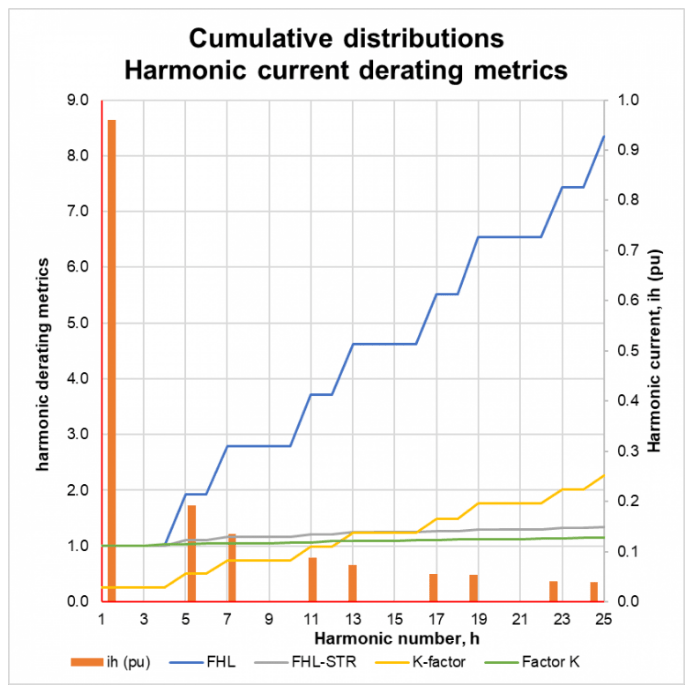
Figure 1. Transformer harmonic derating metrics
The maximum harmonic number is limited to 25 as provided in the IEEE Standard C57.110-1998 [3]. It is noteworthy that the skin effect becomes more pronounced with frequency and eddy-current loss is smaller than predicted; values are conservative in particular above the 19th harmonic [3].
In Figure 1 at each harmonic number, the harmonic derating metrics are calculated considering contributions of harmonics up to and including the harmonic number; and as expected the metrics increase in value with increasing harmonic number. The values at the 25th harmonic for FHL , K-factor, FHL-STR and Factor K are 8.35, 2.26, 1.34, and 1.15 respectively.
Figure 2. Derating – dry and oil type transformers
In Figure 2 the derating factors for dry-type and oil-filled type transformers are 77.4% and 87.2% respectively with equivalent operating currents of 155A and 174A.
References
[1] IEEE C57.110-1986, “IEEE Recommended Practice for Establishing Transformer Capability When Supplying Nonsinusoidal Load Currents”. [2] M.A.S. Masoum, P.S. Moses, A.S. Masoum, “Derating of Asymmetric Three-Phase Transformers Serving Unbalanced Nonlinear Loads”, IEEE Transactions on Power Delivery, Vol. 23, No. 4, October 2008, pp. 2033-2041. [3] IEEE C57.110-1998, “IEEE Recommended Practice for Establishing Transformer Capability When Supplying Nonsinusoidal Load Currents”. [4] UL-1561-1994, “Dry-Type General Purpose and Power Transformers”. [5] S.B. Sadati, A. Tahani, M. Jafari, M. Dargahi, “Derating of Transformers under non-sinusoidal Loads”, International Conference on Optimization of Electrical and Electronic Equipment, Brasov, Romania, pp. 263-268, 2008. [6] EN50464-3: 2007, “Three-phase oil-immersed distribution transformers 50Hz, from 50kVA to 2500kVA with highest voltage for equipment not exceeding 36kV – Part 3: Determination of the power rating of a transformer loaded with non-sinusoidal currents”, April 2007.
Published by Lidiya Kovernikova, Melentiev Energy Systems Institute of the Siberian Branch of the Russian Academy of Sciences, Irkutsk, Russian Federation. Email: kovernikova@isem.irk.ru
Abstract. The power quality in Russian electrical networks does not meet the requirements of regulatory documents. Big problems occur in all areas of people’s lives for this reason. Economic damage is one of the serious consequences. In the context of digitalization of the economy, the requirements for the power quality are increasing, because digital electrical equipment requires high power quality. The paper presents the history of solving the problem of the power quality in Russia, including three periods – before the adoption of the Federal Law “On Electric Power Industry”, after its adoption and after the adoption of the resolution of the Russian Government on the creation of a digital economy. Examples of the consequences of low power quality. To achieve a high level of power quality, it is proposed to create a power quality management system that meets the requirements of the emerging intelligent electrical power systems and digital economy
1 Introduction
Electrical energy is used in all spheres of people’s lives. In the Decree of the Government of the Russian Federation No. 1013 of August 13, 1997 “On approval of the list of goods subject to mandatory certification and the list of works and services subject to mandatory certification” [1] it was recognized as a product. Electrical energy is characterized by the coincidence in time of the processes of production, transmission, distribution, variable mode of consumption and can be converted into other types of energy. It cannot be returned to the seller if the quality is poor. The concept of product quality can be applied to electrical energy. State standard GOST 15467-79 [2] defines the concept of product quality as a set of product properties that determine its suitability to meet needs in accordance with its intended purpose.
The paper “On the issue of the power quality” was published in the journal “Elektrichestvo” in 1968 [3]. It was devoted to the state standard for the power quality, which was developed in our country. This standard was the first standard for the power quality in the world – GOST 13109-67 [4]. The author of the article wrote: “Electric energy has found application in modern society in all spheres of human activity. Therefore, its quality directly affects the living conditions and activities of people. The power quality affects also the technical and economic performance of individual devices and power supply systems as a whole. By improving the power quality, these indicators can be increased, and by worsening, they can be reduced”.
Currently, the current state standard for the power quality is GOST 32144-2013 [5]. Poor power quality causes additional losses of power and energy in electrical networks, damage and reduction in service life of electrical equipment, decreased productivity of technological equipment of industrial enterprises, and economic damage [6-10].
The power quality in Russian electrical networks does not meet the requirements of GOST 32144-2013 [11]. The indicators δU(-) и δU(+) (positive and negative deviations of the voltage value), KU и KU(n) (indicators characterizing the distortion of the sinusoidal shape of the voltage curve), K2U (indicator assessing the degree of asymmetry of the three-phase voltage) exceed the norms GOST 32144-2013 [5].
Currently, the Russian economy is undergoing a digital transformation, as a result of which the amount of electronic equipment is increasing [12, 13]. Electronic equipment requires high power quality, but by consuming non-sinusoidal current, it introduces distortions into the electrical network. Federal authorities have been actively discussing the low power quality in Russian electrical networks and have been adopting legislative documents [14-18] over the past few years to reduce the economic damage caused by the low power quality. Economic damage was minimally estimated at $25 billion in 2008 [19]. The paper presents proposals for solving the problem of power quality in the Russian electric power industry, which should become mandatory elements of the power quality management system.
2 History of the issue of power quality in Russia
The power quality has been studied for many years. The nature of the attitude towards the power quality can be divided into three periods: the first – until 2003, which ended with the adoption of the Federal Law “On Electric Power Industry” in 2003 [20]; the second – from 2003 to 2017, ending with the approval of the Russian Digital Economy program in 2017 [14]. The third period began in 2017.
The first period is characterized by active work in the field of power quality. Before the adoption of the Federal Law “On Electric Power Industry” [20], it was believed that the parameters of the modes of electric power systems should ensure the economical operation of both energy supply organizations and consumers, which is determined by the power quality, ensures the reliability of electrical equipment, and its functioning in accordance with its intended purpose. Numerous studies conducted to assess the impact on electrical equipment of deviations in voltage and frequency, voltage curve shape, and voltage symmetry from nominal values have confirmed the negative impact of low power quality on electrical equipment. For example, in [21] the results of studies of the influence of non-sinusoidal voltage on a power transformer are presented, in [22] of asymmetrical and non-sinusoidal voltage on asynchronous motors, which showed the negative impact of non-sinusoidal and asymmetrical voltages on electrical equipment. As a result, the world’s first state standard for the power quality was developed and put into effect on January 1, 1968 – GOST 13109-67 [4]. The author [3] noted, that “the release of a state standard for the power quality will not only lead to an increase in the technical and economic indicators of energy systems, but will also increase our interest and attention to providing optimal solutions – both during design and in operating conditions”. Work in the area of power quality continued. In 1989, on January 1, 1989, a new GOST 13109-87 [23] was put into effect, replacing GOST 13109-67, and in 1999, on January 1, GOST 13109-97 [24] was put into effect. In addition to standards, regulatory and technical documents were put into effect [25-29], which made it possible to create an economic mechanism for managing the quality of electrical energy. The “Rules” [27, 28] made it possible to determine the culprit of the distortion of the power quality, its contribution to the distortion, the degree of influence of the consumer on the power quality as a result of comparison with the permissible calculated contribution, an assessment of the excess of the actual contribution of the consumer to the distortion of the power quality relative to acceptable control contribution. If the culprit for the deterioration in the power quality was the energy supply organization, then a discount on the electricity tariff was provided for the consumer; if the culprit was the consumer, then a surcharge on the tariff.
The amounts of discounts and allowances were calculated taking into account [29]. The conditions formulated in the “Rules” were included in contracts for the use of electrical energy. Work on the creation of instruments for measuring the power quality continued. If the power quality indicators during measurements in electrical networks exceeded the regulatory values of the state standard, then issues of power quality between energy supply organizations and consumers were resolved in the courts. For example, employees of the Institute Energy Systems (ISEM SB RAS) took part as experts in the arbitration trial, which considered the claims of “Amurenergo” against the Trans-Baikal Railway for violation of the contract regarding the power quality [30].
The second period is associated with the adoption in 2003 of the Federal Law “On Electric Power Industry” [20], according to which the Unified Energy System of Russia was divided into a large number of entities that independently decided whether to deal with the power quality or not. This provision stemmed from the fact that the Law “On Electric Power Industry”, the Civil Code [31], the Federal Law “On the Protection of Consumer Rights” [32] contained provisions on the need to ensure the required power quality and responsibility for it, but mandatory quality requirements electricity have not been established at the legislative level. State standards were considered documents of voluntary application. The “Rules,” which were essentially an economic mechanism for managing the power quality, were abolished. During the second period, the power quality deteriorated. In the monograph [11], written based on the materials of the section “Power quality” of the conference “Russian Energy in the 21st Century. Innovative development and management”, held in 2015, it was noted that violations of the requirements of GOST 32144-2013 in Russian energy systems are widespread and systematic. Despite the current situation, experts in the field of power quality have developed many new standards, including in order to harmonize the requirements for the power quality in Russian regulatory documents with international ones. The method for determining the source of distortion in the power quality and its contribution along the directions of flow of negative and zero sequences electrical energy and the n-th harmonic component electrical energy and their values was developed and approved in 2014 [33]. The development of technical means that normalize the power quality [34-36], instruments for monitoring and analyzing the power quality [37] continued. The concept of a smart electric power system with an active-adaptive network was developed in 2011 [38]. It proposed to consider the reliability of electricity supply and the power quality “as a service (product), taking into account the reasonable costs of the electric grid company to maintain electric networks at a level that ensures adequate reliability and power quality, and the likely damage to the consumer at a certain level of reliability.” Consumers were given the opportunity to choose the level of reliability and power quality. The concept noted “problems in legal, regulatory and technical support for the quality of power supply at the energy system-consumer border”, the lack of “clear responsibility of power grid companies for ensuring the quality of power supply and responsibility of consumers for the negative impact on the quality of power supply”, virtual absence of centralized control of the power quality. A new period in the development of industrial production and changes in all spheres of society began in 2017, which required a new attitude to the power quality, since the digital economy requires high digital power quality.
Government Decree No. 2425 [15], confirming the 1997 Government Decree [1] on mandatory certification of electrical energy for compliance with the requirements of GOST 32144-2013, was adopted in 2021. The section on legislative regulation of energy efficiency and energy saving of the Expert Council under the State Duma Committee on Energy in 2022 proposed Rosseti PJSC to hold a seminar on amending the Federal Law “On Electric Power Industry” [16]. One of the changes confirms the requirements for the power quality and the obligation to comply with them by electricity industry entities and consumers. The Law on Amendments to the Federal Law “On Electric Power Industry” was adopted in 2022 [17]. The changes took effect in 2023 on January 1 [18].
3 Examples of the consequences of poor power quality
Non-sinusoidal voltage in electrical networks is a pressing problem nowadays [11], as it was many years ago. It was noted in [7] that the occurrence of harmonic components of voltages in electrical networks is the most important problem of electromagnetic compatibility, caused by the development of new technologies using electronic converters that consume non-sinusoidal current from the network. At the same time, electronic automatic control systems and electronic devices are sensitive to non-sinusoidal voltage, and their operation is disrupted [39].
Harmonic components of currents create additional power and energy losses in electrical networks and electrical equipment of networks and consumers. An assessment of active energy losses of the fundamental frequency and additional losses caused by current harmonics in a 110 kV line during the day is given in [11]. Additional losses of electrical energy amounted to 13.1% of the main losses of electrical energy. In addition to harmonics, electrical net-works contain interharmonics, i.e. components with frequencies that are not multiples of the fundamental frequency. In [40] it is noted that their influence on the electrical network may be greater than the influence of harmonics. Electrical networks also contain supraharmonics, the frequency of which is a multiple of the fundamental frequency, but above 2 kHz. The authors of [41] determined additional active power losses in a 20 kV cable line at supraharmonics in the frequency range from 2 to 9 kHz. Additional power losses due to supraharmonics exceeded 10% of power losses caused by current harmonics. Asynchronous motors have been widely used in the past and are still in use to-day. If the power quality is low, their service life is reduced. They are damaged and fail, which has been confirmed by the practice of their operation for many years. At the processing plant of one of the mines in the Transbaikalia region, the asynchronous motor of the mill failed due to the poor power quality [10]. Nowadays [11], as many years ago [42], the source of distortion in the power quality in Transbaikalia is the electrified railway. The asynchronous motor bearings were damage three times in 2014. The cause of the damage was three-phase voltage asymmetry, which caused vibration and, therefore, accelerated wear of the bearings. Information on permissible vibration levels for an asynchronous motor is given in [43]. In accordance with [44], depending on the vibration speed, an asynchronous motor can be in three modes, in one of them – for a limited time, since voltage asymmetry increases the vibration speed of an asynchronous motor, then with voltage asymmetry, the asynchronous motor must operate for a limited time. The authors of [45] noted that when voltage unbalance occurs, bearings can suffer mechanical damage and that voltage unbalance consistently exceeding 2% can lead to damage to an asynchronous motor. The result of poor quality power supply to the enrichment plant during operation from 2014 to 2017 was the loss of working time due to interruptions in power supply and poor power quality, amounting to 333 hours, which led to economic damage of 239631 thousand rubles. In 2018, due to the poor power quality, electronic equipment failed at the “BAIKALSEA Company” water bottling plant in Irkutsk: Ethernet switch, uninterruptible power supply, optical module.
4 Proposals for solving problems with the power quality in Russian electrical networks
One of the tasks of managing the functioning of electrical power systems is the task of ensuring the standard power quality. It can be solved using a set of organizational, technical and economic measures that will represent a system for managing the power quality. Taking into account the experience of previous years, it should include:
• government agency for managing the power quality;
• complex of legislative documents regulating the rights and responsibilities of producers, suppliers and consumers of electrical energy;
• complex of regulatory and technical documents;
• complex of regulatory requirements for standard design of electrical power systems, taking into account ensuring the quality of electrical energy;
• economic mechanism for managing the power quality;
• technical means to ensure the power quality;
• system for continuous monitoring of power quality indicators in electrical networks;
• software tools that allow, based on the results of periodic monitoring or continuous monitoring of mode parameters and indicators of the power quality, to solve problems of analysis, assessment, and forecasting of the power quality in various modes;
• software tools for selecting technical devices to ensure the standard power quality in electrical networks.
4.1 About the government agency dealing with the power quality
The State Energy Supervision (Gosenergonadzor) under the Ministry of Fuel and Energy of the Russian Federation, which dealt with the power quality, was created by Decree of the Government of the Russian Federation No. 938 of 08/12/98 [46, 47]. The main task of Gosenergonadzor was to supervise the rational and efficient use of electrical energy. Gosenergonadzor included structural units for managing energy supervision of the central office of the Ministry of Fuel and Energy, regional departments and departments in the subjects of the country. Gosenergonadzor authorities were engaged in inspection of enterprises and electrical networks in terms of the power quality. Gosenergonadzor was abolished in 2003 after the adoption of the Law “On Electric Power Industry”. Supervision over the power quality was transferred to Rostechnadzor, whose functions were significantly reduced. At present, when electronic equipment is being introduced not only in the electric power industry, but also in the country’s economy, it is necessary to create a government agency that will ensure the digital power quality and the efficient use of electrical energy.
4.2 A complex of legislative and legal documents on the power quality
The need to maintain the power quality in accordance with GOST 32144-2013 is indicated in three legislative documents. Article 38 of the Law “On Electric Power Industry” [18] notes that power industry entities supplying electrical energy to consumers “are responsible to consumers of electrical energy for the reliability of supplying them with electrical energy and its quality in accordance with the requirements of this Federal Law and other manda-tory requirements”. Article 542 of the Civil Code [31] states that “the quality of the supplied energy must comply with the requirements established in accordance with the legislation of the Russian Federation, including mandatory rules, or stipulated by the energy supply contract”. Government Decree No. 442 “On the functioning of retail mar-kets for electrical energy, full and (or) partial limitation of the mode of consumption of electrical energy” [48] states that “all subjects of the electric power industry supplying electric energy to consumers, when fulfilling their obliga-tions under contracts on the wholesale and retail markets must ensure the power quality”. In practice, reliability obligations are sometimes violated, and the power quality is not fulfilled [10, 49]. In [11] it is noted that the reason for this is the lack of methods for determining the amount of civil liability for violation of requirements for the power quality. It is necessary to develop legal documents on the responsibility of consumers whose electrical equipment introduces distortions into the electrical network, and as a result, the power quality deteriorates. A document is re-quired on the liability of consumers who distort the power quality to the energy supply organization for the damage caused.
4.3 A complex of regulatory and technical documents on the power quality
Regulatory and technical documents include regulations, standards, rules, and methods. In accordance with the Federal Law “On Technical Regulation” No. 184-FL as amended in 2002 and 2021 [50, 51], a technical regulation is a document that establishes mandatory requirements for the application and execution of technical regulation objects (products), i.e. has the status of law. In the latest edition of the Law “On Technical Regulation”, technical regulations can be adopted by decree of the President of the Russian Federation, or by decree of the Government of the Russian Federation. Currently in force is the Technical Regulation of the Customs Union “Electromagnetic Compatibility of Technical Equipment” [52], in which changes in voltage characteristics taken into account by GOST 32144-2013 when assessing the power quality are considered only as electromagnetic interference, including voltage deviation, frequency deviation, nonsinusoidal voltage, etc. When assessing the power quality, the levels of electromagnetic interference are assessed – the values of frequency and voltage deviations, the degree of distortion of the volt-age curve shape, etc. Issues of power quality are not presented in [52]. Since “the power quality determines the degree of danger of this product for the life and health of citizens, property and the natural environment” [11], it is necessary to develop technical regulations that establish mandatory requirements for the power quality and forms of mandatory confirmation of compliance with these requirements. This was discussed in Federal Law No. 184-FL “On Technical Regulation” as amended in 2002 [50].
There are a large number of standards in the field of power quality. Many of them are developed on the basis of international ones. To develop regulatory and technical support in the field of electrical energy quality, it is necessary to improve existing standards, taking into account the accumulated experience of their application, as well as the development of a regulatory document establishing indicators and standards for networks with voltages above 220 kV. It is necessary to develop standards for the emission into the supply network of harmonic currents, negative sequence currents by distorting consumers, interharmonics of voltage and current, and for permissible modes of abruptly variable loads that cause voltage fluctuations at the point of connection of the consumer to the supply net-work. At present, the issue of the amount of payment for electrical energy taking into account its quality has not been resolved. An attempt to introduce discounts (surcharges) to tariffs when the power quality deteriorated was made in the 90-s of the last century in the developed “Rules” [27, 28] and “Price List” [29]. In [11], it is proposed to include in the energy supply contract conditions on the obligation of the energy supplying organization to pay a penalty for the supply of electrical energy that does not meet the established requirements. To do this, it is necessary to develop guidelines for determining the size of the penalty, which takes into account the reduction in the service life of devices, equipment, and the costs of consumers for installing special equipment to improve the power quality. It is also necessary to develop a methodology for assessing economic damage when supplying consumers with poor power quality.
4.4 A complex of regulatory requirements for standard design of electrical power systems
Currently, when designing electrical networks in Russia, voltage deviations at network nodes are considered. Non-sinusoidality, asymmetry, fluctuations and voltage dips are analyzed only when special work is carried out for areas with low power quality. This is due to the lack of information on the power quality indicators in electrical networks of different voltages and guidelines for their calculation, the unregulated distribution of responsibility between the subjects of the electric power industry for the implementation of measures to improve the power quality based on the design results. Failure to take into account the power quality when designing electrical power facilities leads to its deterioration during the development of the power system when connecting distorting consumers or equipment of electrical networks, for example, of static capacitor banks. When a static capacitor bank is turned on in an electrical network with a non-sinusoidal voltage, the amplitudes of voltage and current harmonics increase due to its resonance with the network at harmonic frequencies [52].
Regulatory design requirements must provide answers to many questions:
• what replacement circuits for elements of electrical power systems should be used when calculating indicators of the power quality,
• what operating modes of the electrical network and loads should be considered when analyzing indicators of the power quality and developing measures to improve the power quality,
• how to distribute measures to improve the power quality between several consumers and the electric grid company.
It is necessary to develop standard methods for calculating indicators of the power quality in electrical networks, characterizing the distortion of sinusoidality and symmetry, voltage fluctuations and dips, selecting parameters and installation locations for devices to ensure the power quality, assessing the economic effect of installing technical means to normalize the power quality.
4.5 Economic mechanism for managing the power quality
At the end of the last century, an economic mechanism for managing the power quality already was created in our country. It included “Rules for connecting consumers to a general purpose network according to the conditions affecting the power quality” [27], “Rules for applying discounts and surcharges to tariffs for the quality of electricity” [28], Price list “Tariffs for electric and thermal energy [29]. In [54] it was noted that “The Rules incorporated everything that was allowed by the existing means of measuring the power quality at that time”. In 2014, a technique was developed for determining the source of distortion in the power quality [33] in the direction of power flows of the fundamental frequency and distorting powers caused by nonsinusoidality and asymmetry of currents and voltages. When directing distorting power from the network to the load (P+), the source of distortion is the electrical network; when directing distorting power from the load to the network (P-), the source of distortion is the load. Currently, the magnitudes and directions of distorting powers can be determined using instruments for measuring power quality indicators [55]. The technique can be used to develop an economic mechanism for managing the power quality.
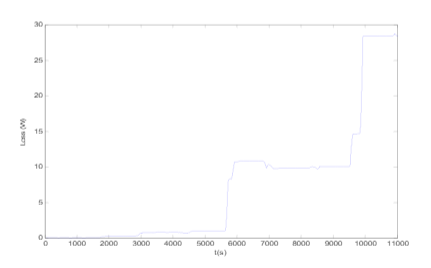
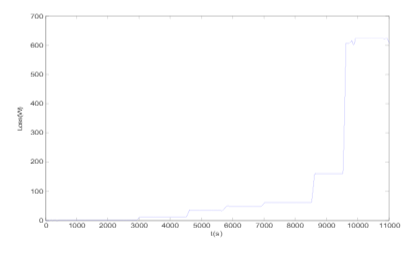
As an example, in Fig. 1 and 2 show graphs of active powers directed from the network to the load (P+) and from the load to the network (P-) at the point of transmission of electrical energy under the power supply contract
Fig.1. Active power from the network to the load.
Fig.2. Active power from the load to the network.
The figures show the moment of failure of the asynchronous motor (AM) of the mill of the processing plant, which was discussed above. A device for measuring power quality indicators “Resurs” [57] measured active powers. Graph in Fig. 2 shows that the active power supplied from the load to the network is zero.
It is necessary to develop an economic mechanism for managing the power quality, taking into account the capabilities of modern instruments for measuring indicators of the power quality and a methodology for determining the contribution of the distorting consumer to the distortion of the power quality.
4.6 Technical means to ensure the power quality
The concept of a smart power grid proposes 22 technical devices for normalizing the power quality in electrical networks [38]. The devices are divided into four groups depending on the method of connection to the electrical network: transverse, longitudinal, longitudinal-transverse devices, devices for combining electrical power systems and filters. Of the devices presented in the concept, a small number are used in electrical networks. The most commonly used of them are capacitor banks, controlled shunt reactors with magnetization, and passive harmonic filters. Currently, new effective technical means are being used and developed to comprehensively solve problems of electrical energy quality. Among them are active filter-balancing devices of the shunt type (transverse) and the serial type (longitudinal) [56]. They generate reactive power to reduce voltage sags, make the voltage symmetrical, and filter harmonics in a dynamic mode when the harmonics of the distortion source change rapidly. Modified magnetization-controlled shunt reactors are presented in [57]. They do not have a negative impact on the quality of electrical energy, unlike previously produced and used magnetization controlled shunt reactors. A pilot project of a converter device is presented in [58]. It is an active filter for installation in electrical networks of 10-220 kV in order to reduce asymmetry and non-sinusoidality of currents and voltages, stabilize voltage, reduce dips and voltage fluctuations. To solve problems with the power quality using special technical means, it is necessary to create and use standard devices of various capacities that compensate for the asymmetry and non-sinusoidality of currents and voltages in electrical networks of all voltages.
4.7 Periodic control and monitoring of power quality indicators
Period control and monitoring of the power quality is carried out in accordance with the current GOST 33073– 2014 [59]. Periodic control includes certification and arbitration tests of electrical energy, inspection supervision of certified electrical energy, control during the implementation of state control and supervision of consumer complaints, implementation of the energy supply contract in terms of the power quality, etc. Periodic measurements of power quality indicators in electrical networks have the disadvantage that events that cause a decrease in the power quality occur not only during the measurements. Therefore, the creation of a system for continuous monitoring of power quality indicators in the Russian electric power system is an actual task. Information received from the system for monitoring power quality indicators can be used to solve the following problems:
• assessment of the current state of the power quality when checking the compliance of measured indicators with established requirements in regulatory documents, energy supply contracts, etc.;
• obtaining information about the power quality in case of consumer complaints;
• providing information on the power quality to consumers when they connect and taking it into account when concluding energy supply contracts;
• assessment of the impact of low power quality on the service life of electrical equipment of consumers and power grid companies, generating electrical equipment, power and energy losses in asymmetrical and nonsinusoidal modes;
• selection and development of measures and technical means to normalize the power quality;
• assessment of the impact of distributed generation and new types of consumer electrical equipment on the power quality;
• planning the development of electrical networks, possible changes in the network structure, connection of consumers;
• forecasting, using special software, the power quality in various operating modes of electrical distribution networks and power supply systems;
• obtaining information about trends in the electrical network and individual areas in the field of power quality.
With the help of information received from the power quality monitoring system, in addition to the listed problems, many others can be solved. It is difficult to confirm the connection between consumer damage and poor power quality if, at the time of disruption of the enterprise’s technological process, during equipment failure, or for a long time before that, measurements of power quality indicators were not carried out. Currently, there are electricity meters that, in addition to commercial metering of electrical energy, record indicators of its quality. Such meters must have an event log with the date and time of voltage deviation from the norm, no voltage or voltage below a specified threshold in each phase, recording the time of voltage loss and restoration, etc. It is necessary to formalize the need to install a system for commercial metering of electrical energy with control of all indicators of the power quality at the initiative of the consumer or the electric grid company.
5 Conclusion
In Russia, it is necessary to create a system for managing the power quality in smart power systems in order to provide the digital economy with the proper power quality. To create a full-fledged power quality management system, it is necessary, first of all, to develop a concept for power quality management, taking into account the positive experience of previous years.
The research was carried out under State Assignment Project (No. FWEU-2021-0001) of the Fundamental Research Program of Russian Federation 2021-2030.
References
1. “On approval of the list of goods subject to mandatory certification and the list of works and services subject to mandatory certification,” Decree of the Government of the Russian Federation No.1013 of August 13, 1997.(in Russian) 2. Product quality management. Basic concepts. Terms and Definitions. GOST 15467-79. Moscow: Standardinform, 2009. (in Russian) 3. N.A. Melnikov, “On the issue of the power quality,” Elektrichestvo, no. 5, pp. 1-6. 1968. 4. Electric Power. Standards for power quality indicators at its receivers connected to generalpurpose electrical networks. GOST 13109-67. Moscow: Publishing house of standards, 1985. (in Russian) 5. Electric power. Electromagnetic compatibility of technical means. Quality regulation of electric power in general-purpose electric power supply systems. GOST 32144–2013, Moscow: Standardinform, 2014. (in Russian) 6. A.K. Shidlovsky, A.K. Kuznetsov, Improving the power quality in electrical networks. Kyiv: Nauk. Dumka, 1985, 268 p. (in Russian) 7. J. Arrilaga, D. Bradley, P. Bodger, Power System Harmonics: Translated from the English, Moscow: Energoatomizdat, 1990, 320 p. (in Russian) 8. I.I. Kartashev, E.N. Zuev, Power quality in power supply systems. Ways to control and ensure it. M: Izdatelstwo MEI, 2001, 120 p. (in Russian) 9. I.V. Zhezhelenko, Higher harmonics in power supply systems of industrial enterprises. M: Energoatomizdat, 2010, 375 p. (in Russian) 10. O.V. Zapanov, L.I. Kovernikova, “On the power quality supplied to joint stock company “Aleksandrovsky mine””. https://www.e3sconferences.org/artcles /e3sconf/abs/2020/69/e3sconf_energy12020_07012/e3sconf_energy212020_07012.html. 11. L.I. Kovernikova, V.V. Sudnova, R.G. Shamonov et al., Power quality: current state, outstanding issues, and proposals to their solutions. Novosibirsk: Nauka, 2017, 219 p. (in Russian) 12. V.E. Vorotnitsky, Yu.I. Morzhin, “Digital transformation of the Russian energy sector is systemic task of the fourth industrial revolution”, Energiya Yedinoy seti, no. 6(42), pp. 12-21. 2018. (in Russian) 13. Putin: “The formation of a digital economy is a matter of national security of the Russian Federation.” https://tass.ru/ekonomika/438941114. (in Russian) 14. “On approval of the Digital Economy of the Russian Federation program,” Government Order of the Russian Federation No. 1632-q of July 28, 2017. (in Russian) 15. Government Decree of the Russian Federation No.2425 of December 23, 2021. (in Russian) 16. Decision of the State Duma Committee on Energy No. 3.25-5/22 of April 6, 2022. Letter to the General Director of PJSC “Rosseti” A.V. Ryumin No. C70A-4/25 of February 15, 2022. (in Russian) 17. “On Amendments to the Federal Law “On Electric Power Industry” and Certain Legislative Acts of the Russian Federation”, Federal Law No. 174-FL. (in Russian) 18. “On Electric Power Industry”, Federal Law of the Russian Federation No. 35-FL of January 1, 2023. (in Russian) 19. L.N. Dobrusin, “Investments in the Russian electric power industry and a program to increase their efficiency”, in Proceedings of the VI All-Russian Energy Forum “Russian Fuel and Energy Complex in the 21-st Century”, 1-4 April 2008, Moscow. Final materials. (in Russian) 20. “On Electric Power Industry,” Federal Law of the Russian Federation No. 35-FL of March 26, 2003. (in Russian) 21. E.A. Mankin, “Eddy current losses in transformer windings with non-sinusoidal current.” Elektrichestvo, no. 12, pp. 48-52. 1955. (in Russian) 22. A.I. Tserazov, N.I. Yakimenko, “Information materials No. 70. Study of the influence of voltage asymmetry and non-sinusoidality on the operation of asynchronous motors”, Moscow: Gosenergoizdat, 1963, 120 p. (in Russian) 23. Electric Power. Requirements for the power quality in general purpose electrical networks. GOST 13109-87. Moscow: Publishing house of standards, 1988. (in Russian) 24. Electric Power. Electromagnetic compatibility of technical equipment. Standards for the power quality in general-purpose electrical networks. GOST 13109-97. Moscow: Standartinform, 1998. (in Russian) 25. “On the rules for certification of electrical equipment”, Resolution of the State Standard of the Russian Federation No. 36 of July 16, 1999. (in Russian) 26. “On introducing changes and additions to the Nomenclature of products and services (works), in respect of which the legislative acts of the Russian Federation provide for their mandatory certification,” Resolution of the State Standard of the Russian Federation No. 74 of August 14, 2001. (in Russian) 27. “Rules for connecting consumers to a general purpose network according to the conditions for influencing the quality of electricity,” Promyshlennaya energetika, no. 8, pp. 45-48. 1991. (in Russian) 28. “Rules for applying discounts and surcharges to tariffs for the quality of electricity,” Promyshlennaya energetika, no. 8, pp. 49-51. 1991. (in Russian) 29. “Tariffs for electric and thermal energy”, Price list No. 09-01. 1991. (in Russian) 30. Forensic electrical examination in case No. A78- 1996/03-С1-26/48 of the Arbitration Court of the Chita Region. (in Russian) 31. Civil Code of the Russian Federation of October 21, No. 14-FL. 1994. (Of July 3, 2016). (in Russian) 32. “On the Protection of Consumer Rights,” Federal Law of the Russian Federation of 02/07/1992 No.2300–1. (Of 07/03/2016). (in Russian) 33. “Methodology for determining the source (direction to the source) of distortions in power quality parameters/approved,” Deputy Chairman of the Board – Chief Engineer of JSC FGC UES Dikim V.P., of November 20, 2014. Included in the Federal Information Fund for Ensuring the Uniformity of Measurements under No. FR.1.34.2015.20724. (in Russian) 34. G. M. Mustafa, S.I. Gusev, “Experience in using active filter-compensating devices of shunt and serial type in electrical networks,” in Proc. of the International Scientific and Practical Conference “Electric Energy Quality Management”, Moscow, 2016, pp. 67-77. (in Russian) 35. A.I. Nenakhov, S.I. Gamazin, “Application of a low-power StatCom device in a system with an asymmetric load,” Promyshlennaya energetika, no.1, pp. 30-36. 2017. (in Russian) 36. G.M. Mustafa, S.I. Gusev, “Features of the use of modular multi-level converters for normalizing voltage quality indicators of the electrical network,” Elektroenergiya. Peredacha i raspredeleniye, no. 4(49), pp. 58-65. 2018. (in Russian) 37. E.V. Ilyashenko, Yu.V. Kolyuzhko, “Measuring instruments for monitoring and analyzing the quality of electrical energy,” in Proc. of the International Scientific and Practical Conference “Electric Energy Quality Management”, Moscow, 2016, pp. 134-143. (in Russian) 38. “Report on the agreement “Development of the Concept of an intelligent electric power system with an active-adaptive network” Agreement No. I-11-11/10,” Open Joint Stock Company “STC Electric Power Industry”, Moscow, 2011. (in Russian) 39. R. Hartungi, L. Jiang, “Investigation of power quality in health care facility”, in Proc. of the International Conference on Renewable Energies and Power Quality, Granada, Spain, 23-25 March, 2010. 40. I.V. Zhezhelenko, Yu. L. Saenko, T. K. Baranenko, “Selected issues of non-sinusoidal modes in electrical networks of enterprises,” Moscow: Energoatomizdat, 2007. 297 p. (in Russian) 41. A. Novitskiy, S. Schlegel, D. Westermann, “Estimation of Power Losses caused by Supraharmonics,” Energy Systems Research, vol. 6, no. 4, pp. 28-36. 2020. 42. S.P. Gladkikh, L.I. Kovernikova, A.V. Kostin et al., “Higher harmonics in connection nodes of traction substations (on the example of the East Siberian Railway)”, Irkutsk: ISEM SB RAS, 2002. 59 p. (in Russian) 43. G. R. Bossio, C. H. De Angelo, Donolo P. D. et al., “Effects of voltage unbalance on IM power, torque and vibrations”, In Proc. of the 2009 IEEE International Symposium on Diagnostics for Electric Machines, Power Electronics and Drives, Cargese, France, 2009. 44. Mechanical vibration ‒ Evaluation of machine vibration by measurements on non-rotating parts. Part I. General guidelines, ISO 10816-1:1995, International Standards Organization. 1995. 45. “Economic Framework for Power Quality,” Technical Brochure CIGRE, no. 467. 2011. 46. “In Glavgosenergonadzor of the Russian Federation,” Promyshlennaya energetika, no. 6, p. (in Russian) 47. “Regulations on state energy supervision in the Russian Federation,” Promyshlennaya energetika, no. 6, pp. 50-52. 1999. (in Russian) 48. “On the functioning of retail electricity markets, complete and (or) partial restrictions on the consumption of electrical energy,” Decree of the Government of the Russian Federation No. 442 of May 4, 2012. (in Russian) 49. “A state of emergency was introduced in the Mogochinsky district due to the failure of 17 engines and a pump in boiler houses”, URL: https://www.rosteplo.ru/ news/2017/12/12/1513024429-rejim-chs-vveli-v-mogochinskomrajone-iz-za-sboya-17 01.03.2022). (in Russian) 50. “On Technical Regulation,” Federal Law No. 184- FL of December 27, 2002. (in Russian) 51. “On Technical Regulation,” Federal Law No. 184- FL of December 23, 2021. (in Russian) 52. “Electromagnetic Compatibility,” Technical Regulations of the Customs Union TRTS 020/2011, Approved by decision of the Customs Union Commission No. 879 of December 9, 2011. (in Russian) 53. R.G. Shamonov, “Assessment of the influence of banks of static capacitors on the higher harmonic components of voltage in main electrical networks,” Energiya yedinoy set, no. 2 (19), pp. 22-29. 2015. 54. “In Glavgosenergonadzor of the USSR Ministry of Energy,” Promyshlennaya energetika, no. 11, p. 52. 1990. 55. “Measuring instruments,” Research and production association “Energotekhnika,”https://www.entp.ru/.(in Russian) 56. G.M. Mustafa, S.I. Gusev, A.M. Ershov et al., “Calculation of the power of an active filterbalancing device for normalizing the voltage on the buses of the 220 kV Skovorodino substation”, Elektricheskiye stantsii, no. 3, pp. 46-53. 2015. (in Russian) 57. A.M. Bryantsev, M.A. Bryantsev, M.A. Makarova, “Modified series of controlled shunt reactors and reactive power sources,” Elektroenergiya. Peredacha i raspredeleniye, no. 4 (49), pp. 94-100. 2018. (in Russian) 58. R.G. Shamonov, N.A. Alekseev, A.M. Matinyan, A.V. Antonov, “Experience and prospects for using a high-voltage active filter of the MPU series to improve the power quality,” Elektroenergiya. Peredacha i raspredeleniye, no. 2 (65), pp. 76-82. 2021. (in Russian) 59. Electric Energy. Electromagnetic compatibility of technical equipment. Control and monitoring of the power quality in general purpose power supply systems. GOST 33073-2014, Moscow: Standardinform, 2014(in Russian)
Source & Publisher Item Identifier: E3S Web Conf. Volume461, 2023Rudenko International Conference “Methodological Problems in Reliability Study of Large Energy Systems“ (RSES 2023). https://doi.org/10.1051/e3sconf/202346101046
Published by Saktanong WONGCHAROEN1, Sansak DEEON1, Narong MUNGKUNG2, Pathumwan Institute of Technology, Thailand (1), King Mongkut’s University of Technology Thonburi, Thailand (2)
Abstract. This research presented an electronic load circuit for electrical safety by using a serial mode comparator as a protection device against surges caused by electrical power lacking stability and quality. The application of comparators in detecting overvoltage and driving electronic load is possible because of a transistor which is a simple device for failure prevention used in the circuit design. The properties of the circuit can be set. Relation management for failures which might occur in the electrical system is done through SPDs for surge protection. The electronic load is used as a device to reduce swell. The experiment showed that the electronic load circuit could work according to the design, without any failure, and was efficient. The let-through voltage which came to the load did not reach the level at which electrical devices and electronics would get the failure. The circuit could work without interruption. Moreover, the results from the Failure Modes and Effects Analysis (FMEA) showed that they met the specified standards.
Streszczenie. W pracy przedstawiono układ obciążenia obwodu elektrycznego/elektronicznego zabezpieczający obwód przed uszkodzeniem powodowanym przez brak stabilności zasilania. Układ wykorzystuje szeregowo połączenie komparatorów reagujących na przepięcia. Eksperymenty wykazały skuteczne działanie obwodu. Zastosowanie obwodu z szeregowo połączonymi komparatorami do zabezpieczania układów elektrycznych przed przepięciami.
Keywords: Electronic load, Comparators, Swell voltage, Failure modes and effects analysis (FMEA). Słowa kluczowe: przepięcia, zabezpieczenia, komparatory.
Introduction
Development of a country requires modern technology to drive the growth of the nation in terms of economic value. The electricity and electronics industries have played a significant role in enabling such progress and creating innovations for other industries. There are many important parts of many products such as electrical devices, electrical power devices, automotive electronics, medical tools, smart agriculture, sensors, communication devices, and energy management systems. As the age of Industry 4.0 approaches, electrical devices have been used by people with greater frequency for their convenience. With artificial intelligence from electronics technology, many electrical devices have become smarter. Further, technology has also advanced, resulting in quicker speeds for their response. Changes in the electrical systems which supply technologies might lead to the problem of electricity quality in the future. A question might arise from the voltage, current and frequency rate from the normal state, as specified in IEEE Std. 1159 [1], which might be natural phenomena, electrical failure, device switching, incorrect grounding, or others [2], as shown in Fig. 1
Fig.1. Failure in an electronic device caused by the swell
These problems will not only cause failure in the electrical system and electrical devices in terms of quality, but also put users in danger. There are two types of issues regarding surge: 1) Overvoltage for a short period, which is caused by lightning. There are many prevention devices according to IEEE Std. C62.41, such as GDT and MOV. Although there are many protection devices, some electrical and electronic devices still experience failure, as shown in Fig. 1. This problem with swell has not been solved successfully in all cases 2) Failures in the electrical system in each region of Thailand are different. As such, they need to be analysed to improve the quality of electrical power based on actual events.
This paper presents a way to reduce the failures that occur in electrical and electronic devices which are connected to the electrical system and caused by the swell. The electronic load is used as a device to reduce such failure, while a comparator circuit is used to detect the level of swell for comparison with the reference level of swell. The comparator circuit contains a transistor [3-6]. To make a comparison, the window is designed to detect different levels of voltage [7]. It is connected in a serial mode [8,9] so that it can work for safety.
Relationships of Surge Protection Device
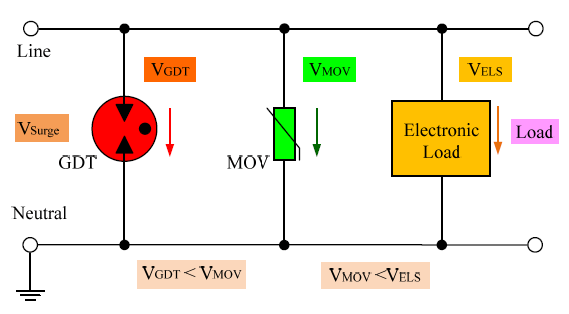
To manage the relationships of surge protection device (SPD) [10,11], it is essential to consider the relationships in terms of reception, limitation or absorption of energy in each device. That is, GDT at the first end must be able to suppress the power (VGDT) caused by lightning to transfer to a MOV device next to the VMOV to decrease the level so there is no failure in accordance with the IEEE Std C62.41 [12,13]. If the overvoltage cannot be suppressed or it decreases below the working condition, a swell protection device with electronic load can still reduce it so that the voltage VELS is at a safe level for electrical and electronic devices. The devices also work smoothly. The relationship management for the surge protection device can be shown in Fig. 2.
Fig.2. Management of relationships for the surge protection device
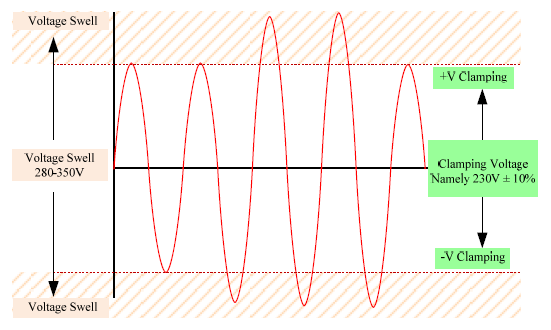
The majority of electrical devices are designed to work with 230 VAC. If there is a failure in the electrical system, in this case, overvoltage (230VAC±10%) [14], the electrical device might malfunction or experience failure to the point that repair is not possible [15].
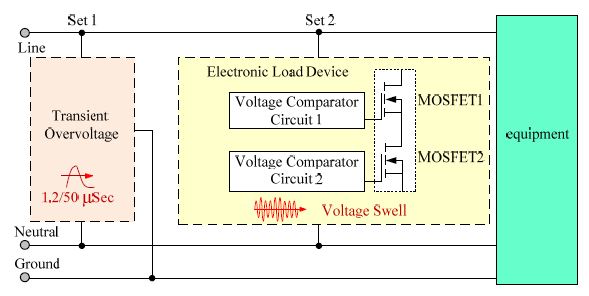
Fig.3. Block diagram of the surge protection device
Fig. 3 shows the block diagram of the surge protection device for AC. Inside the surge protection device, there are two kinds of operation. First, the surge protection device consists of GDT and MOV devices with the fastest response time to control the let-through voltage so that it is manageable. Second, a swell suppressor consists of electronic load to control the clamping voltage to remain in the standard range.
Swell voltage comparator detector
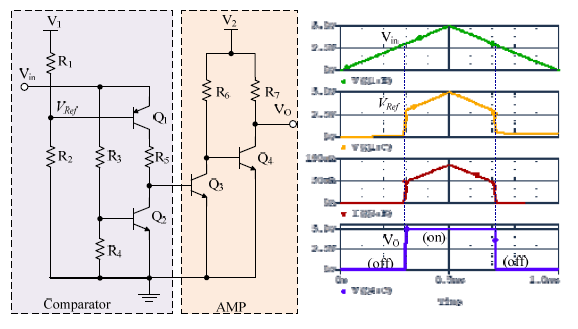
A comparator has been designed with transistors to compare the voltages, as shown in Fig. 4.
Fig.4. Comparator circuit
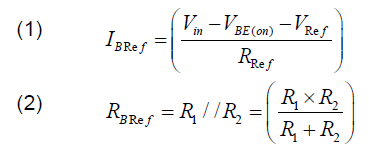
A comparator circuit without feedback consists of 2 transistors [5-7]. Transistor Q1 provides the comparator with the function of amplification for input signal, as shown in Equations (1) and (2).
.
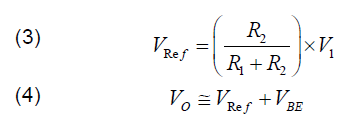
VO is set so that the reference voltage can be used as VRef. The reference voltage is calculated from resistance R1 and R2 in the format of voltage divider circuit, as shown in Equation (3) with the clamping voltage at VBE of Q1, as shown in Equation (4).
.
To use a comparator with no feedback, a circuit can be added to increase the output signal so that the output signal can be logically set as 0 (off) or 1 (on). Transistors Q4 will work as a switch to provide bias to the transistors to stay in a cut-off mode and the same status as an open circuit. The bias will then be supplied to the transistors to be in a saturation mode, the same status as a closed circuit, as shown in Equation (5). A large amount of current will pass through the transistors, and the output voltage will have the same value as 0, as shown in Equation (6).
.
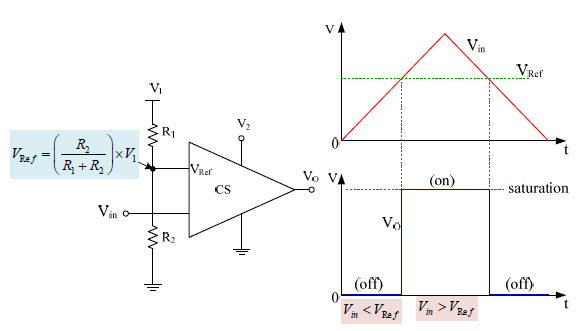
When the voltage Vin is less than the reference voltage VRef, the output signal of the comparator will be 0V. When the voltage Vin is higher than the reference voltage VRef, the output voltage of the comparator will be similar to V2, as shown in Fig. 5
Fig.5. Comparator with increased output signal
Block diagram of a comparator
The comparator circuit with increased output signal circuit can be illustrated as a block diagram similar to opamp, as shown in Fig. 6.
Fig. 6. Block diagram of a comparator
To design comparators, there is only one reference voltage. The output voltage is set to calculate resistance values R1 and R2 as voltage divider circuit. When Vin < VRef, the the output voltage will be the same as the voltage put to V2. When Vin > VRef, the output voltage will be 0.
Two-level comparator circuit
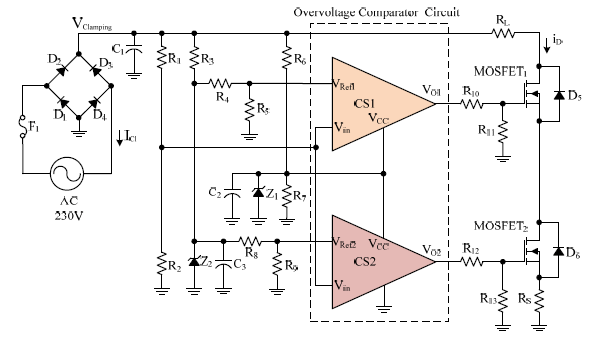
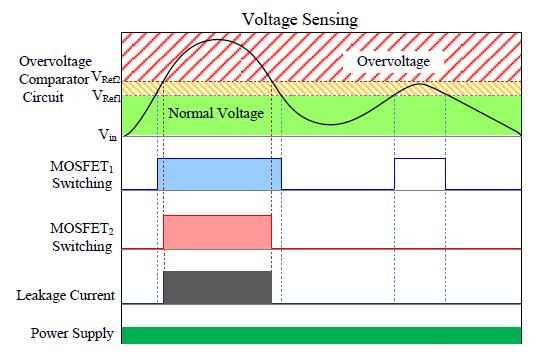
In the two-level comparator circuit for electronic load in a serial mode, there must be comparator CS1 and CS2 to detect the voltage level. When the input voltage Vin is the same as the reference voltage VRef1, there will be output signal VO1 to make MOSFET1 turn ON [16]. When the voltage Vin is higher and becomes the same as the reference voltage VRef2 , the output signal VO2 of CS2 will make MOSFET2 turn ON, resulting in the current IO passing through both MOSFETs in a serial mode. When the input voltage Vin decreases and becomes the same as the reference voltage VRef2, the output of the comparator CS2 will be 0, making MOSFET2 turn OFF. When the voltage Vin decreases and becomes the same as the reference voltage VRef1, the output of the comparator CS1 will be 0, making MOSFET1 turn OFF. When there is no electricity IO, the electronic load stops working, as shown in Fig. 7. T1 and T2 are shown in Equation (7).
.
Fig.7. Two-level comparator circuit
The principle of the surge protection device The electronic load circuit to reduce swell voltage in the low voltage electrical system has been designed with the voltage RMS, which is higher than the standard level (namely 230V±10%). The circuit has been designed in parallel without considering the electrical load current. When there is overvoltage in the system, comparators CS1 and CS2 will detect the voltage level to drive the electronic load in a serial mode [9], as shown in Fig. 8.
Fig.8. Electronic load alongside comparator
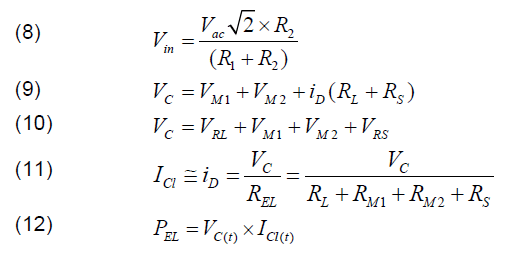
When voltage Vin reaches the specified level, as shown in Equation (5), there will be output signals VO1 and VO2 in order to drive the electronic load by overvoltage in the system. The electronic load circuit will take the current (Leakage Current :ICl) and control the clamping voltage (Clamping Voltage : VClamping or VC) to be in a suitable range, as shown in Equations (6) and (7). MOSFET will act as a receptor of overvoltage as another load in the system, as shown in Equations (8)-(12) [15-16].
.
Fig.9. Signals of electronic load circuit with a comparator
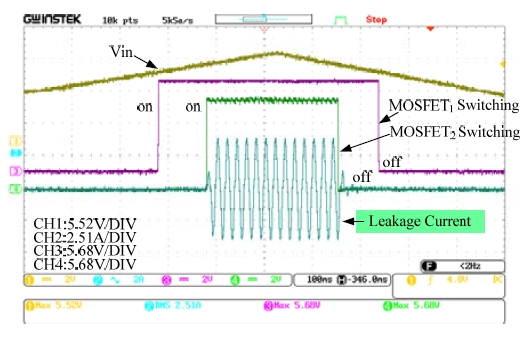
According to Fig. 9, the electronic load circuit alongside a comparator to detect swell has been set regarding the reference voltage for VRef1 and VRef2. When there is overvoltage, comparator CS1 will make MOSFET1 turn ON. When there is overvoltage remaining, comparator WCS2 will turn ON, resulting in leakage current passing through MOSFET2 for the entire circuit. Overvoltage will be reduced in the form of electrical waves, as shown in Fig. 10.
Fig.10. Waves of the comparator and electrical current passing through the electronic load
The electronic load circuit has been designed for safety by using comparators in a serial mode. The failure and possible effects have been analysed with the comparator circuit in accordance with the safety principles to ensure that the electronic load circuit with comparators works reliably without any critical failures. There were two sets of devices for testing: a surge protection device and a swell suppressor.
Safety analysis of comparator
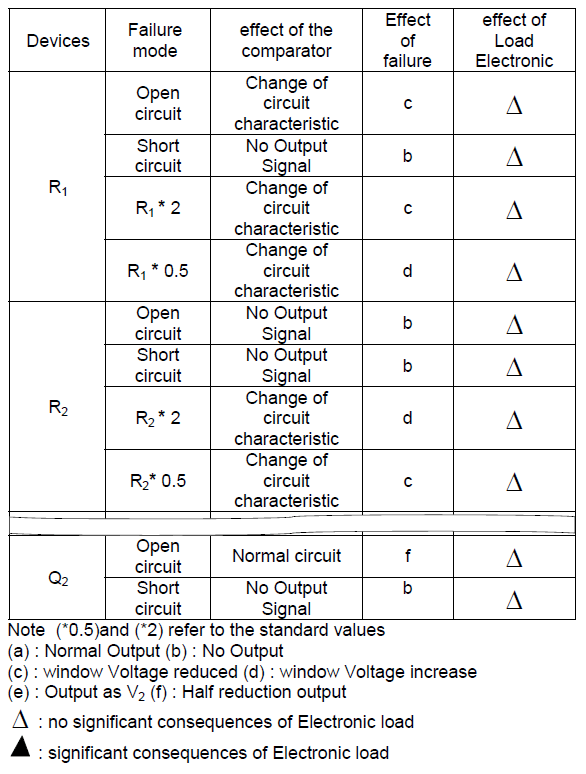
To analyse the type of failure and possible effects, the method called Failure Modes and Effects Analysis (or FMEA) [17] has been used to identify the failure in safety of the electronic load circuit in order to prevent collapse. The analytical principle has been set in IEC 61496-1 [18]. The results of the analysis can confirm that when there is a failure in the electronic load, the system will show Fail-Safe status [19]. Further, the system must not cause any failure, as shown in Table 1.
Table 1. FMEA of the developed comparator
.
Test results of the surge protection device
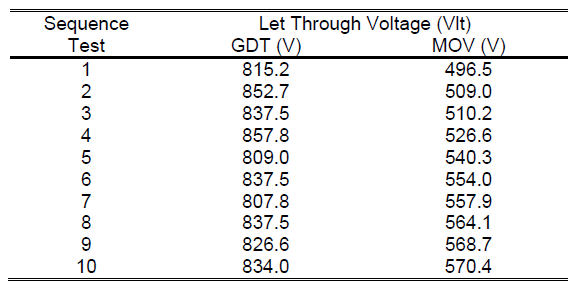
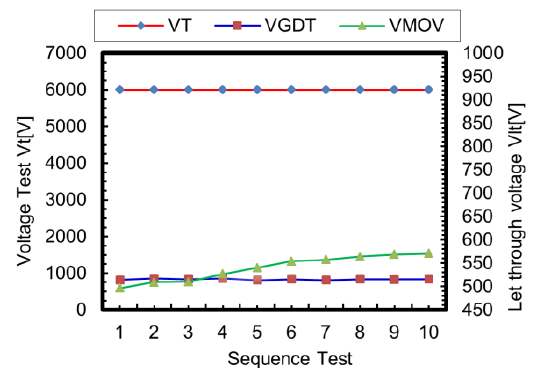
The circuit has been set up to test SPDS GDT and MOV. Test waves have been added in accordance with the standards IEEE [12,13] and IEC 20 at 6,000V and the oscilloscope has been used to measure the letthrough voltage (Vlt) at the output. The results were recorded in Table 2.
Table 2. Test results for the surge protection device
.
Fig.11. Graphic of the relationship between voltage test and let through voltage through GDT and MOV
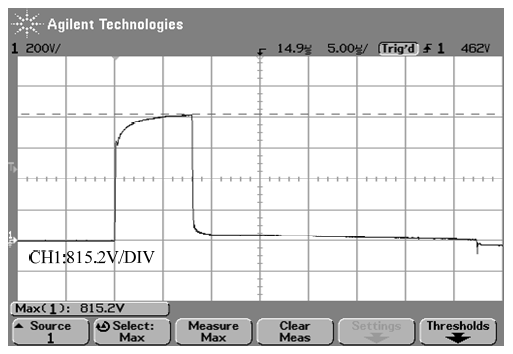
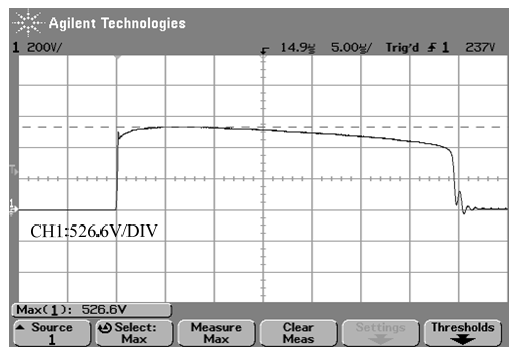
According to Fig. 11, there is a relationship between the voltage test at 6,000V and let-through voltage through surge protection devices GDT and MOV. The output signal waves for the surge protection devices GDT and MOV are shown in Figs. 12 and 13.
Fig.12. Output signal waves for the surge protection device GDT at 6,000V
Fig.13. Output signal waves for the surge protection device MOV at 6,000V
Test results from the swell suppressor
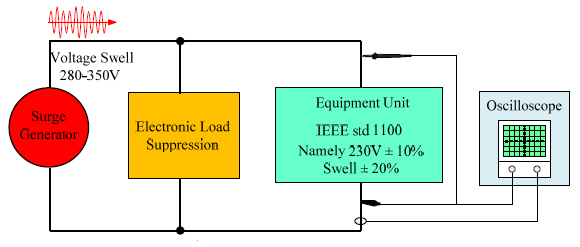
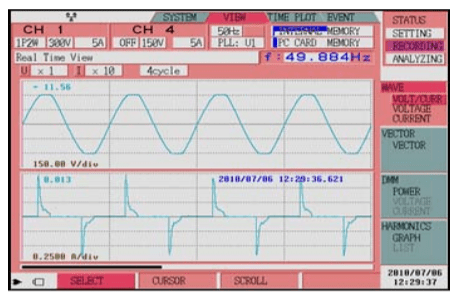
To test the swell suppressor, the electronic load has been added to suppress the swell, as shown in Fig. 14. The swell waves are shown in Fig. 15.
Fig.14. Circuit to test the electronic load in the swell suppressor
Fig.15. Swell waves
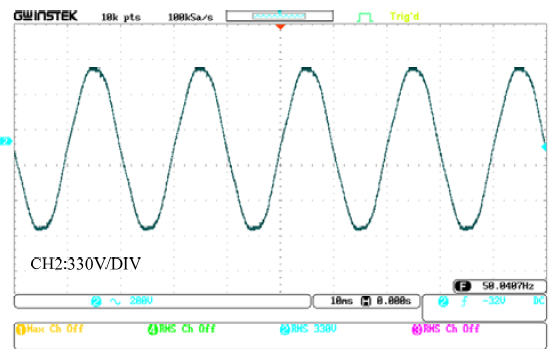
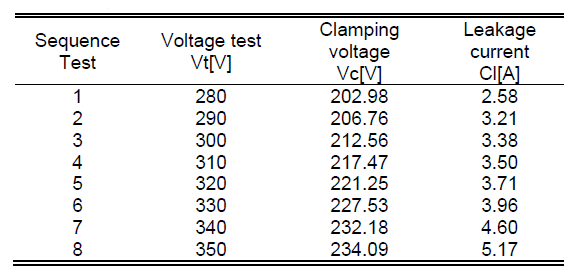
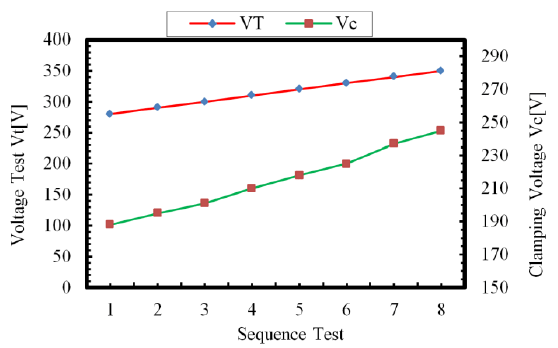
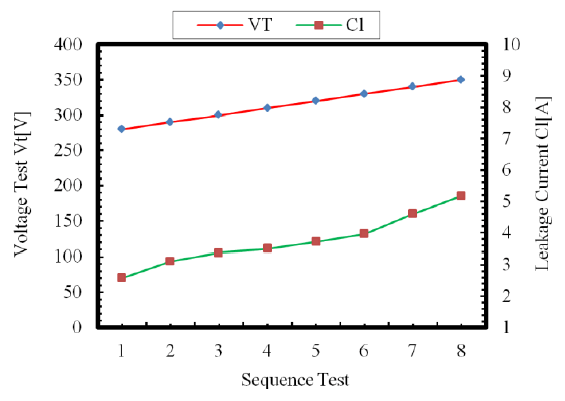
After the setup, AC voltage was added with 280V-350V at 50 Hz. The overvoltage test waves are shown in Fig. 16, and the oscilloscope has been used to measure the electrical current and clamping voltage at the output. The data was recorded in Table 3.
Fig.16. Test waves at 330V
Table 3. Test results for the electronic load in the swell suppressor
.
Fig.17. Graphic relationship between voltage test and clamping test
Fig.18. Graphic relationship between voltage test and clamping test
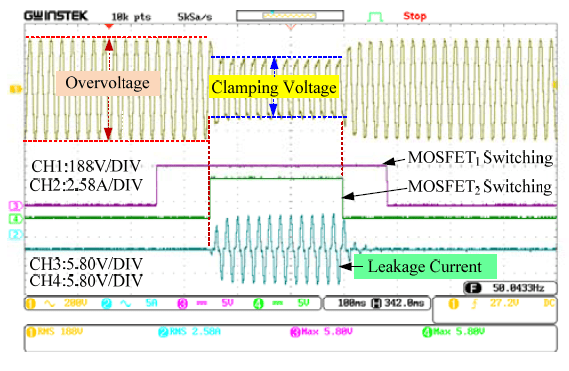
Fig.19. Output signal waves for the electronic load in the swell suppressor
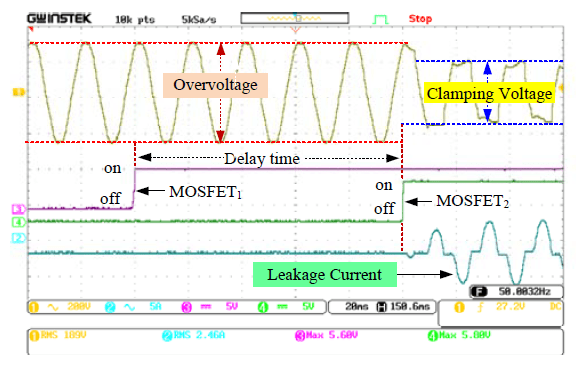
According to Fig. 19, the signal waves of the electronic load and the let-through voltage at the output of the electronic load are shown. CH1 is the swell waves. When there is an output signal, the comparator works at CH3. CH4 is the wave for electronic load in the let-through voltage at CH2. When the signal waves are magnified, there is delay time to detect any failure caused by the overvoltage, resulting in the safety of the electronic load, as shown in Fig. 20.
Fig.20. Output signal waves of the electronic load and comparator
Conclusion
This research paper presents an electronic load circuit for safety by using comparators in a serial mode as a surge protection device for a low-voltage electrical system. When the quality of the electrical system is inadequate, it might cause failures in electrical and electrical appliances. The design has been organised to consider the potential failures to electrical and electronic devices by managing the relationships between surge protection devices (SPDs) to suppress overvoltage in the magnetic field caused by lightning. To design the electronic load circuit, comparators were used to detect overvoltage. Transistors were used in the design of the comparators and devices were used by the principle alongside the analysis from the computer software as well as the actual devices. The results in the previous section show that they accord to the design. The developed electronic load can accurately work out a failsafe status. The test results from the Failure Modes and Effects Analysis (FMEA) were according to the standards IEC 61496-1. In this paper, there were 2 types of surge protection devices assessed, with the results as follows: 1) Test results from the surge protection devices were in accordance with the designed experiment and as expected. The surge protection devices could suppress overvoltage from the magnetic field caused by lightning when signal waves complying with the IEEE C62.41 at 6,000V (1.2/50µS) were used. The let-through voltage was low and acceptable. 2) Test results from the swell suppressor followed the designed experiment and were as expected. The electronic load could suppress overvoltage when it was over the standards, resulting in the clamping voltage to remain at an acceptable level.
REFERENCES
[1] IEEE Std 1159-2009, IEEE Recommended Practice for Monitoring Electric Power Quality, 2009. [2] J. Kaniewski, “Transformator hybrydowy z dwubiegunowym przekształtnikiem AC/AC bez magazynu energii DC,” Przegląd Elektrotechniczny, ISSN 0033-2097, 94 (2018), nr 5, 80-85. [3] C.-S. Plesa, B. Dimitriu, M. Neag, “Design Options for Current Limit and Power Limit Circuit Protections for LDOs,” Advances in Electrical and Computer Engineering Vol.19, no.1, pp.57-62, 2019. [4] E. J. Wade and D. S. Davidson, “Application of Transistors to Safety Circuits,” IRE Transactions on Nuclear Science, vol. 5, issue 2, pp. 44–46, Aug. 1958. [5] K. Futsuhara, and M. Mukaidono, “A Realization of Fail-safe Sensor Using Electromagnetic Induction,” IEEE Conference on Precision Electromagnetic Measurements CPEM, Ibaraki, Japan, pp. 99-100,1988. [6] K. Futsuhara, and M. Mukaidono, “Application of Window Comparator to Majority Operation,” IEEE 19th International Symposium on Multiple-Valued Logic, Guangzhou, China, pp. 114-121, 1989. [7] M. Sakai, M. Kato, K Futsuhara, and M. Mukaidono, “Application of Fail-safe Multiple-valued Logic to Control of Power Press,” IEEE 22nd International Symposium on Multiple-Valued Logic, Sendai, Japan, pp. 271-350, 1992. [8] C. Summatta, S. Deeon, “Simple Anti Capacitor Open-circuit Self-oscillation in a CMOS Schmitt trigger-invertor Oscillator circuit for a Fail-safe Relay Drive,” PRZEGLĄD ELEKTROTECHNICZNY, Vol.3, no. 23, pp.97-100, 2019. [9] C. Summatta, W. Khamsen, A. Pilikeaw, S. Deeon, “Design and Simulation of Relay Drive Circuit for Safe Operation Order,” Proceedings of the 2nd International Conference on Mathematics, Engineering and Industrial Applications 2016 (ICoMEIA 2016), pp.. 030031-1–030031-8, 2016. [10] P. Hasse, “Overvoltage Protection of Low Voltage Systems,” 2nd Edition, IEE Power and Energy Series 33, The Institution of Electrical Engineers, London, pp. 127-204, 2000. [11] V. Radulovic, S. Mujovic, Z. Miljanic, “Characteristics of Overvoltage Protection with Cascade Application of Surge Protective Devices in Low-Voltage AC Power Circuits,” Advances in Electrical and Computer Engineering ,Vol.15, no.3, pp.153-160, 2015. [12] IEEE Recommended Practice on Surge Voltage in Low-Voltage AC Power Circuit, IEEE Std. C62.41-1991, February, 1991. [13] IEEE Guide on the Surge Environment in Low-Voltage (1000 V and Less) AC Power Circuits, IEEE Std C62.41.1-2002, April 2003. [14] IEEE Recommended Practice for Powering and Grounding Electronic Equipment. IEEE Std 1100-2005, December 2005 [15] N. Mungkung, S. Wongcharoen, C. Sukkongwari, and S. Arunrungrasmi, “Design of AC Electronics Load Surge Protection,” in International Journal of Electrical, Computer, and Systems Engineering, Vol. 1, no. 2, pp. 126-131, ISSN 1307-5179, 2007. [16] D.-L. Dang, S. Guichard, M. Urbain, S. Raël,“Characterization and modeling of 1200V–100A N–channel 4H-SiC MOSFET,” 2016 Symposium de Genie Electrique, Grenoble, France, hal-01361697, Jun 2016. [17] S. Deeon, Y. Hirao and K. Futsuhara, “A Fail-safe Counter and its Application to Low-speed Detection”, Transactions of Reliability Engineering Association of Japan, Vol.33, no.3, pp.135-144, 2011. [18] Safety of machinery-Electro-sensitive protective equipment-Part 1: General requirements and tests, IEC 61496-1 Standard, April 2012. [19] S. Deeon, Y. Hirao, K. Tanaka, “A Relay Drive Circuit for a Safe Operation Order and its Fail-safe Measures”, The Journal of Reliability Engineering Association of Japan, Vol.34, no.7, pp. 489-500, 2012. [20] IEC 6100-4-5, Electromagnetic Compatibility (EMC)- Part 4-5: Testing and measurement techniques, Surge immunity test, May 2014.
Authors: Mr. saktanong wongcharoen, E-mail: saktanong.w@gmail.com; Dr. Sansak Deeon, E-mail: sdeeon2013@gmail.com. Department of Electrical Engineering, Pathumwan Institute of Technology, 833 Rama1 Wangmai District, Bangkok, Thailand; Dr. Narong Mungkung, E-mail: narong_kmutt@yahoo.com Department of Electrical Technology Education, King Mongkut’s University of Technology Thonburi, 126 Pracha Uthit Rd., Bang Mod, Thung Khru, Bangkok, Thailand.
Source & Publisher Item Identifier: PRZEGLĄD ELEKTROTECHNICZNY, ISSN 0033-2097, R. 96 NR 4/2020. doi:10.15199/48.2020.04.03
Published by Anna ZIELIŃSKA AGH University of Science and Technology, Faculty of Electrical Engineering, Automatics, Computer Science and Biomedical Engineering. ORCID. 0000-0002-2889-1488
Abstract: The article describes the advantages and possibilities of using blockchain in various areas and sectors of the economy related to electricity trade and trading. The aim of the article is to present the components of blockchain technology that can be used in the settlement of the energy trade process, and to discuss the use of solutions based on blockchain technology that can be used in the electromobility sector and the production of energy from distributed sources. Based on literature studies, the focus was on the implementation of solutions based on blockchain technology in the process of billing electric vehicle charging and billing energy in the areas of energy clusters. The paper also specifies forecasts for the further development of the use of blockchain, electromobility and photovoltaic synergies.
Streszczenie: W artykule opisano zalety oraz możliwości zastosowania blockchain w różnych obszarach i sektorach gospodarki związanej z handlem i obrotem energią elektryczną. Celem artykułu jest przedstawienie składowych elementów technologii blockchain możliwych do wykorzystania przy rozliczeniu procesu handlu energią, oraz omówienie użycia rozwiązań bazujących na technologii blockchain możliwych do wykorzystania w sektorze elektromobilności i produkcji energii ze źródeł rozproszonych. Opierając się na studiach literaturowych, skoncentrowano się na implementacji rozwiązań bazujących na technologii blockchain w procesie rozliczania ładowania pojazdów elektrycznych i rozliczanie energii w obszarach klastrów energii. W pracy określono również prognozy dalszego rozwoju wykorzystania synergii środowiska blockchain, elektromobilność i fotowoltaiki. (Możliwości wykorzystania technologii blockchain w obszarze rozliczeń handlu energią elektryczną)
Keywords: electric vehicle, blockchain, blockchain technology, photovoltaic, electromobility, development of electromobility, energy trade Słowa kluczowe: samochód elektryczny, blockchain, technoogia blockchain, fotowoltaiki, elektromobilność, rozwój elektromobilności, handel energią
Introduction
Electricity is a commodity that is traded in a competitive energy market. Like any other commodity, electricity has to be produced, then sold and delivered to end users, i.e. individual customers, companies and institutions. Processes in the field of energy usually take place with the participation of network system operators and intermediaries who enable the satisfaction of electricity needs of entities interested in purchasing energy to be met, these processes involve thousands of people, computer systems, clearing platforms and banks. The article focuses on the possibility of using the blockchain environment in billing related to electricity. This is the architecture of storing information in a way that guarantees the invariability of historical data. Blockchain is a decentralized (no central management unit) and distributed database or transaction or event log that functions as a growing one-way list of records called blocks that have links to previous blocks created using cryptographic functions and timestamps. Architecture stores data (here: the amount of electricity, accounting entries) encoded with cryptographic algorithms [1], operating according to predetermined rules, i.e. smart contracts, i.e. a set of rules for the operation (protocol) of a given digital contract, its automatic verification (reaching a consensus), enforcing negotiations or legal documentation of its important events in accordance with the terms of the contract.
The combination of these two fields of science and technology, i.e. issues related to electricity and blockchain, creates the possibility of a new synergy between electrical engineering and IT industries. The connection of blockchain technology with works related to production, distribution, settlement, balancing and electricity flows are not only in the trends of global development, but also constitute a point of mutual support. Electricity management, readings of energy parameters, power values, effective values of voltage and intensity are terms related to the implementation of an effective policy of using electricity, and like many others, they are permanently inscribed in the essence of electromobility and the renewable energy market. Thus, it occupies such an important place in terms of development in the field of electrical engineering.
There are already many advantages and possibilities of using blockchain in various areas and sectors of the economy related to electricity trade and trading. Based on literature studies, the focus was on the implementation of solutions based on blockchain technology in the process of charging electric vehicles and defining forecasts for further development of the use of blockchain and electromobility synergies, as well as on the possibility of combining blockchain and the renewable energy sector (RES) on example of photovoltaics.
Fig.1. Selected blockchain functionalities
Electromobility and blockchain
Observing the electricity market and the growing market of electric vehicles (EV), you can see how great changes are taking place in them. The number of electric cars is growing every year, they are also getting cheaper and therefore more and more accessible to drivers (Fig. 1.). At the end of December 2020, the number of registered electric cars (the Polish market) is 18875 units. Out of the total number of EVs, 10041 were electric-powered cars (BEV, Battery Electric Vehicle), and 8834 were powered by plug-in hybrid electric vehicles (PHEV, Plug-in Hybrid Electric Vehicle). Comparing the two previous years, it is promising that the number of cars in 2018 has doubled compared to 2019 and increased by 140% compared to The market of charging points is also developing. More and more often, EV chargers can be found at petrol stations, shopping malls and cultural facilities (Fig. 2). While at the end of 2019, at the stations of the 16 largest charging networks, slightly more than 900 electric cars could use simultaneously, at the end of 2020 it was already more than 1500 (an increase by 65%). The plans of the 16 largest networks predict that in December 2021, more than 4200 electric cars will be able to connect to their chargers at the same time. According to these plans, the number of locations where the car can be recharged will increase from just over 600 at the end of 2020 to over 1800 by the end of 2021 [2] (Fig.2., Fig.3.).
Fig.2. Increase in the number of electric vehicles in Poland [2]
Fig.3. Charging points for electric vehicles in Poland [2]
It is in this sector of the market, i.e. electromobility, that blockchain sees the possibility of using its solutions with an advantage over the current standards. The certainty of the provisions is guaranteed by the aforementioned smart contract, i.e. computer code containing a set of business rules agreed by the parties concluding the contract, run on the blockchain. The smart contract is saved on the blockchain, so it cannot be changed or canceled. When pre-agreed conditions are met, the contract is automatically and irrevocably performed. This mechanism involves digital assets and at least two parties to the transaction. This is exactly what happens during the charging process of an electric vehicle. When the vehicle is connected to the charger, the EV user, by agreeing to the charging conditions (including the energy price), initiates an intelligent contact. Usually, in addition to cash, payment for such a process also involves e.g. tokens, tokens related to the process and available on the market (or vouchers), which used in the process generate e.g. a reduction in the price of energy available in the charger. The entire process in terms of the flow of electricity, both to the EV user and to the charger in the power grid, is saved in blocks and billed according to the rules adopted in the contract. With the possibility of eliminating the central trust entity, each party has maximum certainty about the data and payment flows carried out in the process.
Such electric vehicle charging processes, taking place with the use of a charging station equipped with a billing system based on the operation of the smart contract idea, gains confidence in the correctness of the entire process and the possibility of saving it in terms of energy and finance in blocks. Such a record guarantees the invariability of data, transparency of the process and transparency of financial settlements, thus providing credibility of the record for both sides of the process.
When looking at the possibility of using blockchain in the area of electromobility, we are talking not only about the data of the charging process itself (i.e. the amount of electricity consumed, its technical parameters or finances), an important essence of blockchain is also the process called Initial Coin Offering (ICO). ICO is a method of raising capital by issuing cryptocurrencies or tokens in order to finance a venture. The entity organizing the collection (Investor) presents its plans and assumptions in a document called the White Paper, which is also a standard contract, and in return offers tokens that give appropriate rights in the form of, for example, priority to goods or services provided by the issuer, or allow investors to participate in profits from the project, or give voting rights to the entity entitled to the token. When talking about electromobility, a great idea to use this form of capital accumulation is the willingness to collect funds for the construction of EV charging points. This type of modeling is presented, among others in [3], which presents a mathematical model and assumptions for the idea of using blockchain to improve the pace of development of the electric vehicle and charging points market.
According to sources [4, 5, 6, 7], there are many possibilities to describe and develop blockchain technology and smart contracts. However, it should be remembered that they are a frequent topic of scientific discussions conducted by computer scientists. It is about the mechanisms of codes and algorithms, therefore, due to the dynamic nature of these applications, smart contracts must be much more flexible, responsive and controllable. The security aspect is discussed many times, which unfortunately has a negative impact on the development of smart contracts – that is why legislative issues are so important.
A work combining with the above-mentioned and at the same time having a common element of electricity trading is work [8] in which a model of local energy trading using the peer-to-peer (P2P) service among plug-in hybrid electric vehicles (PHEV) is proposed in smart networks. This model responds to the electricity grid demand by providing incentives for discharging PHEVs in order to balance local electricity demand. In addition, the work also deals with the security of such transactions. The numerical results based on an actual Texas map indicate that the dual-auction mechanism can achieve maximization of local-social welfare while protecting the privacy of PHEV vehicles.
The use of information recording in blockchain technology in the charging process is also a response to the growing popularity of electric vehicles and their alleged negative impact on the power grid. According to electricity companies and scientific sources [9], the growing popularity of electrification of private vehicles may have a significant impact on the operation of the system, especially on distribution networks, if the charging of electric vehicles (EV) is not properly managed. According to the source [10], blockchain can be used to manage the smart charging technique for EV. By using a fuzzy logic controller described as a smart contract, it is possible to manage the charging process of an electric vehicle in such a way as to maximize the benefits for the electricity supplier and owner of the electric vehicle. The benefit for the utility company is to mitigate the impact of EV charging on the distribution grid by shifting EV charging to off-peak period, while the benefit for EV owners is low-cost EV charging, i.e. proper energy trading management. The controller regulates and controls the EV charging power depending on the electricity price signal provided by the energy company and the state of charge of the EV battery. Using the model of the described controller, it has been shown in the paper that the proposed method of intelligent charging reduces the impact of charging electric vehicles on the distribution network in comparison with uncontrolled charging.
Citing the smart contract described in the above part of the article, it can be concluded that, at least in some cases, smart contracts may create binding rights and obligations for their parties. The mechanism best suited to describe the creation of a smart contract seems to be analogous to the vendor’s machine, in which the declaration of will is clearly expressed in the performance of contractual obligations – it is in this context that the mechanism for selling electricity as part of EV charging is implemented. Smart contracts are an example of new types of technology-based contractual practices that companies and policymakers should start preparing well in advance. However, due to the relative immaturity of smart contract technology, the number of current real-world applications is still quite limited. The evolution of digital platforms requires an approach combined with technology, perspectives, economics and law.
Photovoltaics and blockchain
In the case described above, as in many other projects of this type, energy from renewable energy sources is used. Moreover, it can be seen that an increasingly important role in the decentralized energy market is trading in ever smaller amounts of energy. Domestic solar power plants account for about 80% installed capacity in Polish photovoltaics. At the end of July 2021, the photovoltaic photo power in Poland is robusta 5626,4MW. This means an increase of 210,6% compared to July 2020. During the whole of July 2021, the power of photovoltaic installations increased by almost 270MW. 30990 new PV installations were built, which is over 99% all RES installations built in July 2021. The average size of PV installations is 10,1 kW.
It is worth recalling that electricity has been supplemented (power plant) with RES with a share of 27,4 percent. (14,5 GW). The aforementioned renewable energy photovoltaics ranks second (after wind farms) with over 38%. at location [11].
So it can be seen that the Polish society willingly decide to opt for photovoltaics because it is ecological and allows savings in electricity costs, it can be seen from the development prospects (Fig.4.). Integrated with devices such as a heat pump, energy storage or an electric car charging station, it allows you to create a self-sufficient energy ecosystem that is friendly to the environment and the home budget. And that is why there is also a place for blockchain-based solutions here. The possibility of using smart contracts to conduct transparent and properly secured energy exchange transactions, precisely with the participation of the owners of photovoltaic installations (or home energy storage), becomes a new market for this type of synergy of both technologies. The benefits for the energy system and the operators managing it, in the case of IT solutions based on the idea of blockchain, are increased flexibility and network security. As we can see and as reported by the data, the energy system is becoming more and more dependent on variable generation, which creates a need for flexibility ensuring the right balance between energy demand and supply. Solutions in the form of applications based on blockchain solutions are the possibility of using the basic assumptions of such a system developed by the financial sector. We are talking about decentralized storage of data increasing security, making payments, concluding and verifying transactions, digitizing contracts, and the aforementioned lack of intermediaries in decentralized business models.
Fig.4. The perspective of the development of photovoltaic installations in Poland [12].
The first energy concerns, ie Vattenfall in the Netherlands, operators in the German market, as well as on the Polish market, such as Tauron and Energa and PGNiG, are already taking steps to launch this type of decentralized energy trade. Considering that the owners of the photovoltaic installation are small market participants with energy storage (electric car), the implementation of such projects and solutions in blockchain technology seems to be of key importance for the development and opportunities of combining these industries.
Energy clusters and blockchain
Continuing the synergy of the concepts of blockchain and electricity trading, it is also worth referring to energy clusters. Clusters are, in short, installations of renewable energy sources that will be or are owned by the community, they are accounted for among members of the community who decide how to carry out production and share revenues. From the very beginning, the concept of energy clusters, with the support of the Ministry of Energy, has aroused great interest and doubts as to its practical implementation. The most obvious are the methods of settlement, responsibility for network management, demand balancing, quality of supply, including network losses, downtime, voltage. Nevertheless, the combination of environments in this area shows that it is possible to use blockchain technology to provide a functional application layer for electricity trading and an information and marketing campaign, thus enabling the implementation of an energy cluster as an effective shareholder in the energy market [13]. The cooperation of energy and electromobility can also facilitate and make collective investments in photovoltaic installations mounted on buildings easier and more attractive. Their inhabitants (cluster) would be co-owners of these installations and they would be able to earn money by selling surplus electricity. The software used is to carry out transactions optimally, for example deciding whether it is more profitable to consume the energy produced at a given moment, including charging an electric car or energy storage, or to sell it to the grid. This type of housing estate based on the idea of a cluster is to be built in the Australian city of Perth. The estate will consist of 10 blocks that are to be energy self-sufficient. This is to be made possible by a microgrid built especially for the needs of this investment, based on photovoltaic power plants and energy storage. In this way, the residents of the new housing estate are to use only locally produced renewable energy. Its surplus will be stored in energy storage, and a system based on transaction records in the blockchain technology will be responsible for the optimization of energy consumption, exchange and sale.
Conclusion
Blockchain technology is increasingly permeating everyday life. The fields of application of state-of-the-art technology range from banking to transaction hedging, mortgage tracking and commodity trading, ie energy. At the heart of the technology is a smart contract, which has the potential to revolutionize the way individuals and companies securely deal with each other.
When talking about the prediction of the development of blockchain technology, there are several main sectors and application areas in which blockchain is a place for gathering information. Accounting for the electric vehicle charging process and keeping a complete record of the transaction value are just some of the things to do. The charging process through the increasing number of EVs will effectively lead to new solutions in this field. By using a smart contract, i.e. a smart contract regulating all the conditions of the ongoing process, cryptocurrencies as a means of payment and a blockchain financial element, i.e. Initial Coin Offering (ICO) as a tool to obtain funds for the development and expansion of charging points, the use of blockchain becomes an alternative to the standard process of expansion of charging points and settlement of the EV charging process [4].
Anticipating the direction of development, it can be stated that instead of a clearly defined single use case, smart contracts and blockchain technology can be used in many cases related to energy trade, which are characterized by very different goals and circumstances, starting from the development of electromobility, the expansion of distributed sources installations and the creation of of them energy clusters.
Summarizing the possibilities of using blockchain in the electricity trading sector, there are several main application areas, including:
• settlement of utilities, i.e. electricity, gas, water, etc., • permanent information carrier, • planning and control of energy supplies, • electronic documentation of transactions, • title deeds, theft prevention, • counteracting “duplicated factoring” frauds, • decentralized distribution of digital content, • interbank payments and settlements, • Robotic Process Automation (RPA)
Electricity as a product for the charging of electric vehicles is also a question about its source. The use of renewable energy sources for the charging process is another milestone for the development of distributed sources, and even greater for electromobility and blockchain, which, thanks to the essence of its operation, can effectively track all stages of the charging process using energy from renewable sources. Photovoltaics, which is so much in the increase in installed capacity, is ideally suited for cooperation with the charging process for EV, and with blockchain as a place for the settlement of the process. The use of electricity from solar radiation perfectly harmonizes with the EV charging process. This way of combining technologies gives the possibility to believe that it is in this direction that the development of the aforementioned technological and economic sectors should be looked for.
REFERENCES
[1] https://pl.wikipedia.org/wiki/Blockchain (dostęp: 31.06.2021) [2] https://www.rynekelektryczny.pl/infrastruktura-ladowaniapojazdow-elektrycznych/ (dostęp: 07.08.2021) [3] Zielińska A., Model for settlement electric vehicles charging and financing infrastructure for charging them with the support of blockchain environment . Przegląd Elektrotechniczny, ISSN 0033-2097. — 2019 R. 95 nr 12, s. 237–241. [4] Zielińska A., Application possibilities of blockchain technology in the energy. ISSN 2267-1242. — 2020 vol. 154 art. no. 07003, s. 1–6. [5] Bhabendu, K. M., Soumyashree S. P., Debasish J., An Overview of Smart Contract and Use Cases in Blockchain Technology. 2018 9th International Conference on Computing, Communication and Networking Technologies, 2019, doi:10.1109/ICCCNT.2018.8494045. [6] Laarabi, M., Maach, A., Senhaji Hafid A., Smart contracts and over-enforcement: Analytical considerations on Smart Contracts as Legal Contracts. 2020 1st International Conference on Innovative Research in Applied Science, Engineering and Technology (IRASET), doi:10.1109/IRASET48871.2020.9092138. [7] https://blockbasenetwork.medium.com/why-smart-contractsmatter-1495518b8c39 (dostęp: 10.12.2020) [8] Li, Z., Kang, J., Yu, R., Ye, D., Deng, Q., Zhang, Y., Consortium Blockchain for Secure Energy Trading in Industrial Internet of Things. IEEE Transactions on Industrial Informatics, pp. 1–1, 2017. [9] Kasprzyk, L., Pietracho. R., Bednarek. K., Analysis of the impact of electric vehicles on the power grid, E3S Web of Conferences. 2018, vol. 44, doi:10.1051/e3sconf/20184400065 [10] https://www.rynekelektryczny.pl/moc-zainstalowanafotowoltaiki-w-polsce/ (dostęp: 20.09.2021) [11] Nour, M., Said, S. M., Ali, A., Farkas, C., Smart Charging of Electric Vehicles According to Electricity Price. 2019 International Conference on Innovative Trends in Computer Engineering (ITCE), 2019, doi:10.1109/ITCE.2019.8646425. [12] https://ieo.pl/pl/aktualnosci/1525-aktualizacja-prognozyrozwoju-krajowego-rynku-fotowoltaiki-do -2025-roku (dostęp: 22.09.2021) [13] Mataczyńska, E., Blockchain Technology Impact on the Energy Market Model. Energy Policy Studies. 2017, iss. 1(1), pp. 3-15.
Author: mgr inż. Anna Zielińska, AGH University of Science and Technology, Faculty of Electrical Engineering, Automatics, Computer Science and Biomedical Engineering, e-mail: azielinska@agh.edu.pl;
Source & Publisher Item Identifier: PRZEGLĄD ELEKTROTECHNICZNY, ISSN 0033-2097, R. 97 NR 12/2021. doi:10.15199/48.2021.12.32
Published by M. Jawad Ghorbani, H. Mokhtari**, Dept. of CSEE, West Virginia University, Morgantown, WV, USA, ** Dept. of EE, Sharif University of Technology, Tehran, Iran.
ABSTRACT – This paper investigates the harmonic distortion and losses in power distribution systems due to the dramatic increase of nonlinear loads. This paper tries to determine the amount of the harmonics generated by nonlinear loads in residential, commercial and office loads in distribution feeders and estimates the energy losses due to these harmonics. Norton equivalent modeling technique has been used to model the nonlinear loads. The presented harmonic Norton equivalent models of the end user appliances are accurately obtained based on the experimental data taken from the laboratory measurements. A 20 kV/400V distribution feeder is simulated to analyze the impact of nonlinear loads on feeder harmonic distortion level and losses. The model follows a “bottom-up” approach, starting from end users appliances Norton equivalent model and then modeling residential, commercial and office loads. Two new indices are introduced by the authors to quantize the effect of each nonlinear appliance on the power quality of a distribution feeder and loads are ranked based on these new defined indices. The simulation results show that harmonic distortion in distribution systems can increase power losses up to 20%.
Keyword: Harmonic Distortion, Loss Estimation, Non-linear Loads, Norton Equivalent Model, Power Quality
1. INTRODUCTION
In recent years, the use of nonlinear electronic loads such as compact fluorescent lamps (CFLs), computers, televisions, etc. has increased significantly. Nonlinear loads inject harmonic currents into distribution systems. When a combination of linear and nonlinear loads is fed from a sinusoidal supply, the total supply current will contain harmonics. The injected harmonic currents and the resulted harmonic voltages can cause power quality problems and affect the performance of the consumers connected to the electric power network [1].
Excessive heat in equipment, components aging and capacity decrease, malfunction of protection and measurement devices, lower power factor and consequently reducing power system efficiency due to the increasing losses are some main effects of harmonics in power distribution systems. Harmonic distortions also increase the monetary costs in power systems by increasing energy losses, premature aging or de-rating of electrical equipment [2]. The energy loss due to harmonics caused by a large number of nonlinear loads used in different power system sectors can be estimated. The difference between the generated power and the consumed power us considered as the energy loss. However, energy losses in distribution networks are generally estimated rather than measured, because of inadequate metering in these networks and also due to high cost of data collection. Moreover, power system distribution loss estimation methods are reliable ways to determine the technical losses.
This work uses an accurate Norton equivalent model for 20 kV/400V feeders to estimate distribution network losses. In that model, residential, commercial and office load types are modeled using their appliances models by the process of synthesis. Then a feeder model is obtained by aggregating different residential, commercial and office load models.
The appliances are modeled by Norton equivalent technique. To obtain the Norton equivalent model of an appliance, measurement results under different operation conditions are required. Thus, voltage and current waveforms for more than 32 nonlinear appliances are measured using a power quality analyzer set. The Norton model parameters for each appliance are calculated using the measurements results under different operating conditions. More details about Norton equivalent model of appliances and loads is presented in [3-5]. The authors have also introduced new indices to quantize each appliance impact on the power quality in power distribution systems. The proposed indices take the harmonic distortion caused by each load, their rms current value and daily operation time into account.
This paper is organized as follows. In Section 3, harmonic power formulation for nonlinear loads is introduced. In Section 4, characteristics of some nonlinear appliances are presented and harmonic characteristics of different appliances are described. In Section 5, obtaining a Norton model for a nonlinear load based on the measurement data is discussed. In section 6, different appliances models are presented. Loads effect on power quality using the new introduced indexes is discussed in section 8. The losses due to nonlinear loads in a sample 20 kV/400 V feeder are simulated and analyzed in section 9. Finally, the conclusions are summarized in Section 10.
2. RELATED WORKS
Accurate loss estimation plays an important role in determining the share of technical and commercial losses in the total loss. Researchers have tried to estimate the losses in distribution systems by different methods. Some works have used the simplified feeder models and curve fitting approaches to estimate the losses [6-10]. A comprehensive loss estimation method using detailed feeder and load models in a load-flow program is presented in [11]. A combination of statistical and load-flow methods is used to find various types of losses in a sample power system in [12]. Simulation of distribution feeders with load data estimated from typical customer loads is performed in [13]. Ref. [14] applies some approximations to power flow equations in order to estimate the losses under variations in power system components. A fuzzy-based clustering method of losses and fuzzy regression technique and neural network technique for modeling the losses are obtained in [15, 16]. It is difficult to guarantee the reliability of the simplified, statistical and approximate models. The drawback of the fuzzy based methods is that they don’t consider the power system dynamics.
3. HARMONIC POWER FORMULATIONS
If a signal contains harmonics, the Individual Harmonic Distortion (IHD) for any harmonic order is defined as:
.
Where Ih/Vh is the current/voltage harmonic of order h, and I1/V1 is the fundamental current/voltage component. Nonetheless, for determining the level of harmonic content in an alternating signal, the term “Total Harmonic Distortion” (THD) of the current and voltage signals are widely used. The current and voltage THD of a harmonic polluted waveform can be expressed as:
.
Where I and V are the current and voltage rms values. The separation of the rms current and voltage into fundamental and harmonic terms resolves the apparent power in the following manner [16].
.
Where S1 is the fundamental apparent power. The presence of harmonics causes the presence of a new type of non-fundamental apparent power (SN) which is resolved in the following three distinctive terms [17]:
.
In practical power systems, THDI > THDV , and SN can be computed using the following expression:
.
Power factor is not only affected by the phase displacement between voltage and current waveforms. The existence of non-fundamental apparent power (SN) also affects the power factor. Power factor will decrease in presence of harmonics and consequently distortion power (non-fundamental apparent power, SN). In the case of presence of harmonics, power factor is composed of two factors, Displacement Power Factor (pfdisp) and Distortion Power Factor (pfdist).
.
Where p is the real power. Nonlinear loads can be considered as harmonic real power sources that inject harmonic real power into the distribution system which is the product of the harmonic voltage and current of the same orders. Although this power is much smaller than the fundamental real power, the presence of the distortion power caused by harmonics will result in increased losses in the utility supply system.
In the presence of harmonics, the loss would be as shown in Eq.17. Therefore, it can be seen that a significant increase in loss of the utility will occur in the presence of harmonic distortions. For example, with a THDI=40%, the loss would be increased by 16%. For a three-phase three-wire utility, the total losses are shown in Eq.18.
.
Where Ip is the phase current of the balanced network and In is the neutral line current. The harmonic losses are:
.
Where Iah, Ibh, and Ich are the harmonic h currents in phase A, B and C respectively, INh is the hth harmonic of the neutral current, and Rp and Rn are the phase and neutral resistances.
The loss in the neutral wire can be considerable and may result in overloading due to 1) the unbalanced loads and 2) the zero-sequence currents [11].
4. NONLINEAR LOADS CHARACTERISTICS
This section presents the measurement results for some common residential and commercial appliances. The measurements consist of current and voltage THD’s, load rms current, power factor, and active and reactive powers. All the measurements are done using a HIOKI 9624 power quality analyzer. The ac current waveform of a 4W CFL as a nonlinear load is shown in the Figure 1. In Figure 2, the harmonic spectra are shown for three different brands of CFLs. Table 1 shows the electrical parameters for some linear and nonlinear appliances which are usually used in residential, commercial and office load types. Active, reactive powers and also non-fundamental apparent power (SN), which has a nonzero value for nonlinear loads, are calculated for each appliance.
Fortunately, for many appliances the harmonic real power is much smaller that the fundamental real power. But, the harmonic current increases the apparent power (S), increasing the power losses. In this work, the power factor for all appliances is also measured and the effect of displacement and distortion factors on the total power factor is investigated. What follows is a summary of the measurements of the some appliances.
5. NORTON EQUIVALENT MODEL
To obtain a Norton model for a nonlinear load, the circuit shown in Figure 3 can be used [12, 13]. In this circuit, the supply side is represented by the Thevenin equivalent while the nonlinear load side is represented by its Norton equivalent. To calculate the Norton model parameters, the measurement of voltage (Vh) and current (Ih) spectra at two different operating conditions of the supply system are needed. The change in the supply system operating condition can for example be obtained by switching a shunt capacitor, a parallel transformer, shunt impedance or some other changes that cause a change in the supply system harmonic impedance [12, 13].
Figure 1. Measured Current and Voltage Waveform for a 4W CFL
Figure 2. Normalized Magnitude [%] Spectra Comparison for 3 different CFLs
Table 1. Measurement results for some appliances
.
However, such changes in the supply system will not yield unique parameters for the Norton model, and the Model parameters are dependent on the amount of change. This makes the accuracy of the model debatable. In [13], it is shown that the Norton model parameters which are obtained by changing the supply voltage are more accurate and valid for a wider range of voltage variations. Also, changing the supply voltage, beside its simplicity, does not require switching large capacitors or impedances which may cause some problems for network components.
As Figure 3 shows, when the supply voltage varies, harmonic voltage Vh and harmonic current Ih will change, and IN,h, finds a path which consists of a parallel combination of ZN,h, and the supply system impedance. With the assumption of no change in the operating conditions of the nonlinear load, it can be seen from Figure 3 that Ih,1 and Ih,2 can be expressed as:
.
The harmonic Norton impedance current IZN,h, before and after the change can be expressed as:
.
Figure 3. Norton Model of Load-Side and Thevenin Equivalent of Supply System [11]
By substituting Eqs. (3) and (4) into Eqs. (1) and (2) and solving for ZN,h, and IN,h, the following formulas are achieved [13]:
.
Where Vh,1 and Ih,1 are the harmonic voltage and current measurements before the change in the operating condition, and Vh,2 and Ih,2 are the measurements after the change.
These equations are complex and the phase angles should be measured precisely. In the following section, a Norton model is developed for some commonly used appliances.
6. RESIDENTIAL, COMMERCIAL AND OFFICE LOADS NORTON EQUIVALENT MODEL
In this section, a model for residential, commercial and office loads is developed by aggregating their corresponding appliances models. To develop the Norton model for each appliance at least two measurements at different operating condition of the supply system are needed. More details about how to achieve the Norton equivalent model parameters using measurement results is described in previous sections and [16-20].
Norton equivalent model parameters consist of ZN and IN for each harmonic order. The Norton equivalent model is developed for each harmonic order separately, and the complete Norton equivalent model is obtained by combining these models. The Norton model parameters for different residential loads are given in Table 3.
In this work, more than two different operating conditions are considered to obtain better modeling results. The measurements are performed at more than two hundred different operating conditions of the supply voltage. The obtained Norton equivalent current and impedances values at different operating conditions converge to specific value which makes the results more reliable. After modeling each appliance, residential, commercial and office loads Norton equivalent model are achieved by aggregating their corresponding appliances Norton equivalent models. A feeder Norton equivalent model will then be obtained by aggregating corresponding residential, commercial and office load Norton equivalent models
7. SIMULATION OF A 20 KV DISTRIBUTION FEEDER
This section analyses the characteristics of a sample distribution network feeder modeled by Norton equivalent technique. This feeder model is obtained by aggregating the Norton equivalent model of all end user appliances for all type types of loads i.e. residential, commercial and office loads. A simple schematic for a 3-phase balanced distribution network is shown in Figure 4. As Figure 4 shows, the sample feeder feeds 3 different loads (residential, commercial, office). The total feeder load is equal to the sum of all 3 loads. In this section, a sample office load model and its characteristics are specifically investigated, and then simulation results for a feeder consisting of residential, commercial and office loads are presented.
Using the models for each appliance, an estimation of the power quality of an office load can be obtained. It is assumed that the office load consists of 2 PCs, 2 CFLs and 2 fans with slow and fast rates. The loads turn on one by one. Figs. 5 and 6 show the rms current and the THD of the office load. The points of turning on or off for each appliance are specified in Figure 5. The Total Harmonic Distortion (THD) of the office load depends on its appliances THD and their rms current value. As Figs. 5 and 6 show, the THD decreases as the accumulative load currents increases. To model a distribution feeder, it is assumed that a 20 kV feeder feeds residential, commercial and office loads. Each load type appliances are described in Table 2. The appliances turn on one by one, and finally, all of the appliances are in service. The effect of each appliance on the feeder THD is dependent on each appliance THD and its current rms value.
Table 2. Simulated residential, commercial and office load appliances
.
Figure 4. Schematic of a sample 20kv/400v feeder
Table 3. Norton Model Parameters for Residential appliances (A, Ω)
.
Figure 5. Simulated office load rms current
Figure 6. THD trend for a simulated office load
8. NONLINEAR LOADS RANKING BASED ON TWO NEW POWER QUALITY INDICES
In this section, two new indices are introduced to determine the impact of each appliance on a feeder power quality. The first index indicates the contribution of each load in the feeder THD. This index is defined in Eq. (1). Where THDK is total harmonic distortion of load k and Irms,K is its current rms value. As described in (1), THDC indicates the contribution of each load in the feeder THD in presence of other loads. Assuming that all loads in Table 2 are in service, the THDC index for each appliance can be calculated. The results are shown in Table 4. As shown in Table 4, the Split air conditioner has the most destructive effect in comparison with the other loads. Although, the THD of the Split air conditioner is not more than that of the other loads, it has a worse effect on power quality than others.
THDC is a useful index to classify loads based on their effects on power quality, but it is evident that appliances operating time during the day is also a very important factor and should be considered in the calculations. Therefore, a new index (Eq.2) which takes into account the daily operation time for each appliance is defined,
.
Where tkis the appliance operating time per day. In Table 5, loads are ranked based on the new index value. As shown in Table 5, the new loads ranking based on THDST index is different with that when the loads ranking based on THDC index. According to the new ranking, appliances with longer operating time per day have higher ranks. For example, long operation time of a computer causes a higher rank based on THDST index as compared to the ranking by THDC index.
9. POWER LOSS SIMULATIONS IN A DISTRIBUTION FEEDER
In this section, losses in a distribution feeder are simulated using the equations introduced in section 3. The schematic diagram of the simulated feeder shown in Figure 4 contains two impedances for the transmission lines (Z1 and Z2). Figure 7 shows the losses due to Z1 impedance for an office load and Figure 8 shows losses due to Z2 impedance when feeding residential, commercial and office loads. The peak value of the feeder loss is when all the appliances are on. Z1 and Z2 are considered resistive with values of 1 ohm. Total loss in Z1 and Z2 impedances for the simulated feeder is shown in Figure 9. As Figure 9 shows, the loss trend copes with the aggregated loads rms current. The total amount of losses in this sample feeder reaches maximum 1100 W. The amount of losses versus the total feeder load is plotted in Figure 10.
Losses due to transmission lines impedance for the simulated power network can be up to 18% of the total feeder power and this amount of loss means a considerable cost for distribution networks that can not be neglected. Share of nonlinear loads and their harmonics in causing loss of power in distribution networks could be obtained by the Eq 16. Based on the simulation results, the average Total Harmonic Distortion (THD) of the simulated power distribution feeder with the loads mentioned in Table 2, can be considered to be 50%, this means 20% of total loss is caused by harmonics in the simulated feeder.
10. CONCLUSIONS
In this paper, a comprehensive investigation has been done to determine the impacts of harmonic distortions on power system distribution networks. The study uses the Norton equivalent model of different appliances to model a distribution feeder. The individual models are obtained by analyzing loads measurement results.
Different load type models are found by aggregating the Norton equivalent model of their individual appliances. Two new indices are introduced to quantize the impact of each appliance in causing harmonic distortions in a distribution feeder. These indices consider not only the THD into account, but also the current rms value and the loads operation duration per day.
A distribution feeder is simulated using residential, commercial and office Norton load models. The losses in a transmission line are estimated, and the effect of harmonics on causing extra losses is discussed. The results are reasonably accurate, since the Norton equivalent models are precise and obtained based on the real world measurement results. The results show that the losses can be up to 18% of the feeder power usage while the share of harmonics in causing these losses is dependent to the THD of the feeder current.
Table 4. Loads Ranking Based On THDC Index
.
Table 5. Loads Ranking Based On THDST THDST Index
.
Figure 7. Losses due to Z1 impedance for an office load
Figure 8. Losses due to Z2 impedance when feeding three loads
Figure 9. Total losses in Z1 and Z2 impedances
Figure 10. Real power loss versus total feeder’s real power
REFERENCES
[1] Hunter, I., “Power quality issues-a distribution company perspective”, Power Engineering Journal, Vol. 15, No. 2, 2001. [2] M Shafiee Rad, M. Kazerooni, M. Jawad Ghorbany, H. Mokhtari, “Analysis of the grid harmonics and their impacts on distribution transformers”, 2012 IEEE Power and Energy Conference at Illinois (PECI), 2012. [3] Thunberg, E. and Söder, L., “A Norton Approach to Distribution Network Modeling for Harmonic Studies”, IEEE Trans. Power Delivery, Vol.14, No.1, pp. 272-277, January, 1999. [4] Thunberg, E. and Söder, L., “On the Performance of a Distribution Network Harmonic Norton Model”, ICHQP 2000, Florida, USA, 01-04 October, 2000. [5] Abdelkader, S., Abdel-Rahman, M.H., “A Norton equivalent model for nonlinear loads”, LESCOPE conference, Halifax, Canada, July, 2001. [6] F. H. Buller and C. A. Woodrow, “Load factor equivalent hour’s values compared,” Electric. World, Jul. 1928. [7] H. F. Hoebel, “Cost of electric distribution losses,” Electr. Light and Power, Mar. 1959. [8] M.W. Gustafson, J. S. Baylor, and S. S. Mulnix, “Equivalent hours loss factor revisited,” IEEE Trans. Power Syst., vol. 3, no. 4, pp. 1502–1507, Nov. 1988. [9] M.W. Gustafson, “Demand, energy and marginal electric system losses,” IEEE Trans. Power App. Syst., vol. PAS-102, no. 9, pp. 3189–3195, Sep. 1983. [10] M.W. Gustafson and J. S. Baylor, “Approximating the system losses equation,” IEEE Trans. Power Syst., vol. 4, no. 3, pp. 850–855, Aug. 1989. [11] D. I. H. Sun, S. Abe, R. R. Shoults, M. S. Chen, P. Eichenberger, and D. Ferris, “Calculation of energy losses in a distribution system,” IEEE Trans. Power App. Syst., vol. PAS-99, no. 4, Jul./Aug. 1980. [12] R. Céspedes, H. Durán, H. Hernández, and A. Rodríguez, “Assessment of electrical energy losses in the Colombian power system,” IEEE Trans. Power App. Syst., vol. PAS-102, no. 11, pp. 3509–3515, Nov. 1983. [13] C. S. Chen, M. Y. Cho, and Y.W. Chen, “Development of simplified loss models for distribution system analysis,” IEEE Trans. Power Del., vol. 9, no. 3, pp. 1545–1551, Jul. 1994. [14] O.M. Mikic, “Variance Based Energy Loss Comptation in LV Distribution Networks”. IEEE Trans. Power Syst., vol. 22, no. 1, pp. 179-187, Feb. 2007. [15] C.S.Chen, C.H.Lin, “Development of Distribution Feeder Loss Models by Artificial Neural Networks”, IEEE Conference, 2005, Taiwan. [16] Y.-Y. Hong and Z.-T. Chao, “Development of energy loss formula for distribution systems using FCN algorithm and cluster-wise fuzzy regression,” IEEE Trans. Power Del., vol. 17, no. 3, Jul. 2002. [17] IEEE Standard Definitions for the Measurement of Electric Power Quantities Under Sinusoidal, Nonsinusoidal, Balanced, or Unbalanced Conditions,” IEEE Std 1459-2010, vol., no., pp.1,50, March 19, 2010. [18 ]Balci, M.E., Ozturk, D., Karacasu, O., Hocaoglu, M.H., “Experimental Verification of Harmonic Load Models”, UPEC conference, Padova, September, 2008. [19] Jing Yong, Liang Chen, Nassif, A.B., Wilsun Xu, “A Frequency-Domain Model for Compact Fluorescent Lamps”, IEEE Trans. Power Delivery, Vol.25, No.2, pp. 1182-1189, April, 2010. [20] M.J.Ghorbani, H.Mokhtari,”Residential load modeling by Norton Equivalent Model of household loads”, APPEEC 2011, China, 2011
Corresponding Author: M. Jawad Ghorbani, Departement of Computer and Electrical Engineering, West Virginia University, Morgantown, WV, 26505, USA Email: mghorban@mix.wvu.edu
Source & Publisher Item Identifier: International Journal of Electrical and Computer Engineering (IJECE) Vol. 5, No. 1, February 2015, pp. 166~174 ISSN: 2088-8708
Published by Omorogiuwa Eseosa and Ashiathah Ikposhi, Electrical/Electronic Engineering, Faculty of Engineering University of Port Harcourt, Rivers State, Nigeria.
Abstract – The complexity of electric power networks from generation, transmission and distribution stations in modern times has resulted to generation of big and more complex data that requires more technical and mathematical analysis because it deals with monitoring, supervisory control and data acquisition all in real time. This has necessitated the need for more accurate analysis and predictions in power systems studies especially under transient, uncertainty or emergency conditions without interference of humans. This is necessary so as to minimize errors with the aim targeted towards improving the overall performance and the need to use more technical but very intelligent predictive tools has become very relevant. Machine learning (ML) is a powerful tool which can be utilized to make accurate predictions about the future nature of data based on past experiences. ML algorithms operate by building a model (mathematical or pictorial) from input examples to make data driven predictions or decisions for the future. ML can be used in conjunction with big data to build effective predictive systems or to solve complex data analytic problems. Electricity generation forecasting systems that could predict the amount of power required at a rate close to the electricity consumption have been proposed in several works. This study seeks to review machine learning applications to power system studies. This paper reviewed applications of ML tools in power systems studies.
Keywords: Machine Learning; Big Data; Data Analytic; Power systems
1. Introduction
The electric power system is one of the most complex systems ever built by mankind. Economy and security of supply are among the factors to be managed for the successful operation of the network. Simply put, the security of a power system is descriptive of the power system’s capability to ensure the continuity of supply within the likelihood of a diversity of disturbances (variations in consumer demand, internal failures, external perturbations like lightning, storms, etc.). Security is usually achieved through two complementary strategies [1]. Preventive control and emergency control. The former is carried out by human operators in order to maintain the system in a state where it can withstand disturbances while the latter acts automatically after a disturbance has occurred in order to minimize its consequences. Since disturbances are intrinsically random, preventive control is essentially aimed at balancing the economic cost of normal operation against the risk of instability/insecurity. On the other hand, emergency control is aimed at reducing the severity of instabilities. Worthy of note is the fact that due to increased competitive pressure in the electricity industry and the possibilities offered by modern communication and computing technologies, the trend in power systems is to rely more on emergency control. One of the challenges in the design of emergency controls is defining appropriate criteria against which a prediction in real time whether a system is in the process of losing stability or not can be done. This implies the selection of appropriate real-time measurements (among a multitude of possible ones) and combining these in order to formulate detection rules. Emergency controls design process essentially relies on numerical simulation of the power system under various conditions likely to drive it towards instability. Due to the rapidly growing amounts of computing power, techniques such as the Monte-Carlo sampling method can be used to achieve screening of very large samples (several thousands) of large-scale simulations, yielding large data bases of simulation results. These data can then be exploited using automatic learning such as machine learning with a view to extracting useful information.
2. Literature review
An efficient forecasting system for the generation of electricity based on machine learning with big data has been proposed by [2]. In the study, it is shown that there is a direct correlation between the quantity of power generated and the quantity of resources (such as coal, gas, nuclear, petroleum, oil, and renewable energy) that is used to generate electricity. Studies show that predicting power generation could be used in providing vague information about power demand and probably the need to increase the quantity to be imported from neighbouring countries. The prediction is challenging as a result of the accuracy requirement. The prediction is even more cumbersome when the data sets are enormous and have high noise and high volatility. Several forecasting methods using different types of ML algorithms have been proposed to deal with electricity forecasting problems. These algorithms include Fuzzy Neural Networks (FNN), Gray Algorithm (GA), Gray Markov Model (GMM), and Support Vector Regression (SVR) [2]. It has been investigated that these models have shown impressive results in terms of forecasting. The large penetration of renewable energy resources (RES) such as wind and solar types has increased the uncertainty of generation and has increased forecasting of power generation in order to allocate resources that produce the power as well as the estimation of the quantity to be imported from neighbouring areas. This is of altmost importance. In [3], it has been reported that power transformers are one of the most expensive and critical equipment in a power network and consequently, it is necessary to develop effective techniques for the monitoring and diagnosing of the transformer insulation system. Furthermore it was put forth that in recent years, a number of techniques such as Dissolved Gas Analysis (DGA), Polarization and Depolarization Currents (PDC) measurements, and Frequency Domain Spectroscopy (FDS) have been adopted across utilities for transformer diagnosis. However, there are still considerable challenges remaining in correlating measured data to actual transformer insulation condition. The study developed Machine Learning (ML) algorithms namely; Self-Organising Maps (SOM) and Support Vector Machines (SVM) for automatically analysing measurement data and making diagnosis on transformer insulation systems. The key advantages of these algorithms is their capability of acquiring the knowledge of underlying statistical dependency between archived data and the conditions of corresponding transformers and making use of such knowledge to assist in transformer insulation diagnosis. In [4], ML based power transformer lifetime prediction is proposed. It is reported that the prediction of the remaining life of high voltage power transformers is important for energy companies because of the need for planning maintenance and capital expenditures. ML models were used for the analysis of the transformers as well as for predicting lifetime of the transformers. It is demonstrated that the integration of ML models with experimental models improved transformer lifetime estimation. A parametric lifetime model is used to predict the lifetime distribution of the individual transformers. A statistical procedure is developed for computing the remaining life of individual transformers currently in use. By using ML algorithms, the power transformer loss values are delivered to the end users via email or any other means of communication before damage to the transformers can occur. In so doing, end users can be alerted about the remaining lifetime of the transformer in a bid to avoid failure of the transformer by providing proper maintenance in advance. In [5], a new type of reinforcement learning algorithm known as “fitted Q iteration” is considered for the design of some intelligent agents for power system control. The main characteristic of the algorithm is to formulate the reinforcement learning problem as a sequence of standard supervised learning problems. It is reported that “fitted Q iteration” has the potential to address real world power system control problems due to its ability to generalize information. Two problems were identified to be used in circumventing the problems associated with the use of “fitted Q algorithm”. Encouraging simulation results are obtained from a strategy intended to control in real-time a Thyristor-Controlled Series Capacitor (TCSC) installed in a 4-machine power system. In [6], it is reported that modern power systems with deeper penetration of renewable energy generation as well as higher level of demand side participation is faced with increasing degrees of complexities and uncertainties. It is also reported that reliable operation of the grid calls for improved techniques in system modelling, assessment, and decision. While it is now possible for system operators to have access to fine-grained electricity data through the use of smart meters and advanced sensing technologies, there is an urgent need for efficient and near-real time algorithms to analyse and make better use of these available data. Recent advances in machine learning (ML) algorithms especially the giant leaps in deep learning makes ML a good tool for solving a series of data driven problems in power systems. For instance, ML methods such as Recurrent Neural Networks (RNN) can find straight forward applications in wind, solar power and building load forecasting. ML has been applied to power grid outage detection. High Voltage Alternating Current (HVAC) control and grid protection policy formulation problems can also solved using ML approaches. In [7], it is reported that increased use of renewable energy liberalization of energy markets and most importantly the integration of various monitoring, measuring, and communication infrastructure into modern power system networks offers the opportunity for building a resilient and efficient power grid network at various voltage levels. Also of concern are various threats of instability and insecurity in the form of cyber-attacks, voltage instability, power quality (PQ) disturbances amongst others to the complex networks. Furthermore, ML techniques such as Artificial Neural Networks (ANNs), Decision Trees (DTs), and Support Vector Machines (SVMs) have been used in effective decision-making and control actions in the secure and stable operations of the power system. The paper presents a comprehensive review of the most recent studies where machine learning technologies (MLTs) were developed for power system security and stability especially in cyber-attack detection, PQ disturbance studies, and dynamic security assessment studies. The aim of the study is to highlight the methodologies, achievements, and more importantly the limitations in the classifier design, data set, and test systems employed in reviewed publications. A brief review of Reinforcement Learning (RL) and Deep Reinforcement Learning (DRL) approaches to transient stability assessment is also presented. The research gap highlighted states that despite the enormous accomplishments in terms of power system investigations in the areas of security and stability studies, a number of challenges still remain unresolved. The prediction and detection accuracy of MLTs are known to depend majorly on the quality and quantity of the data set and test systems employed. However, sometimes due to the non-availability and inadequacy of realistic power systems, data from real power stations and field devices, scholars and researchers have been restricted to the use of simulated data sets and the development of scalable test beds which have shown inconsistency in predictions and classification. Apart from the number of input data sets, another important factor that is peculiar to ML applications is the tuning of the parameters. The rigorous events performed in tuning the parameters so as to achieve the desired results means MLTs approaches require a high level of expert interaction. Also, MLTs approaches can sometimes be time-consuming. Furthermore, most articles in the literatures usually assume that PMU data are complete, accurate and available for online use. In practice, the measurements may not always be available due to jamming, malfunctioning, and attacks. Finally, it was suggested that future research work on MLT based approach to power system security and stability studies should focus on detailed validation of the approaches using large-scale test systems which have similar characteristics as modern power systems. In [8], it was found that modern power systems required real time monitoring and fast control to be protected from faults on power transmission lines. As the Smart Grid becomes a reality, the installation of high-quality sensors such as remote terminal units, phasors measurement units, smart meters and other measuring devices tend to generate considerable amount of heterogeneous data required for the operational control and performance analysis of the grid. Conventional time-domain techniques had a tendency to be inefficient from the computational point of view and had a possibility of not meeting real-time application specification. However, with the aid of ML algorithms it is possible to learn without directly programming the data and once exposed to new data, can respond independently. ML approaches such as Artificial Neural Networks (ANNs), Decision Trees (DTs), Deep Learning Models (DLM) etc. are capable of providing interesting information on safety in power systems. The paper proposed a classification and detection of faults in power systems based on machine learning. The study gave a list of ML techniques for fault classification.
These are enumerated;
• Support Vector Machine • Bayesian Learner • Sequential Minimal Optimization • Logistic Regression • Decision Tree • K. Nearest Neighbour
In [9], four powerful and popular ML techniques (Bagging Classifier, Boosting Classifier, Radial Basis Function Classifier (RBF), Naïve Bayes Classifier (NBC)) for identifying and locating faults over a 600 km long power transmission line was introduced. In the paper, eleven (11) faults are found to be detected, predicted, and located. The results from the experiment suggest that RBF, Bagging Classifier, and NBC techniques could be used for fault type prediction as high prediction accuracy is achieved. For fault location prediction experiment, the attained prediction results were not as accurate as in the case of fault type prediction. However, the RBF, NBC and the Bagging Classifier achieved the highest prediction accuracy. Finally, it was reported that ML techniques could be used for identifying the transmission line faults. Results for location prediction accuracy may need to be improved upon in order to achieve precise fault location. In [10], comprehensive review of fault detection, classification, and location in transmission lines is presented. Before introducing methods used for fault detection, classification, and location an overview of feature extraction methods was presented. The ground work for fault identification algorithms, various transforms, along with dimensionality reduction techniques was discussed. Newly developed ideas and their comparisons with some noteworthy aspects regarding fault detection were also discussed. It is presented that ML methods are widely employed by researchers for fault type classifications. However, in addition to Support Vector Machines (SVM), Fuzzy Inference System (FIS), Artificial Neural Networks (ANNs), Decision Trees (DT), Deep Learning based algorithms such Convolutional Neural Networks (CNN) and Restricted Boltzmann Machine Learning (RBML) are recommended for fault classification. Fault location finding algorithms were discussed alongside Artificial Intelligence (AI)-based methods. Deep learning methods were recommended for future fault location finding methods due to increased involvement of communication and computation in transmission systems. In [11], the focus was on detecting, classifying, and locating faults in a power system using Artificial Neural Networks (ANNs). Feed-forward Neural Networks were employed and trained with back propagation algorithms. The WSCC 9 bus test system was modelled in MATLAB/SIMULINK and used to validate the proposed fault detection system. Results from the simulation indicate that ANNs can be used for detecting, classifying and locating faults. Also, results showed that ANNs could relatively detect, locate, and classify faults even for places it was not trained for. Depending on the type of fault, networks with different number of neurons in the hidden layer can be used. Single phase-to-ground fault can be detected and located with the smallest number of neurons in the hidden layer using only five (5) Networks for the detection, location, and classification of two-phase and two-phase-to-ground fault require a minimum of 10 neurons in the hidden layer. Three-phase faults require neural networks with 30 to 35 neurons in the hidden layer. It was reported that further increase in neurons in the hidden layer did not lead to an improvement in the results. In [12], it is reported that driven by the large amounts of data involved, the application of deep learning frameworks was extended to performing automatic disturbance classification. In order to achieve this, a set of measurements from several Phasors Measurement Units (PMUs) installed in low voltage sections of an interconnected system was used from which representative patterns are extracted so as to endow a classifier of knowledge related to system disturbances. In particular, the strategies adopted consists of the application of MultiLayer Perceptron (MLP), Deep Belief Networks and Convolutional Neural Networks (CNN), the latter having outperformed the others in terms of classification accuracy. Additionally, these architectures were implemented in both the CPU and the GPU to ascertain the resulting gains in speed. In [13], the application of ANNs for the detection and classification of faults on a three-phase transmission line system is presented. The method developed utilizes both the three-phase voltages as well as three-phase currents as inputs to the neural network. The inputs were normalized with respect to their pre-fault values respectively. The results obtained were for line-to-ground faults only. The ANNs studies adopted in this work used the back propagation neural network architecture. The simulation results obtained prove that satisfactory performance was achieved by all the proposed neural networks and are practically implementable. The importance of choosing the most appropriate ANN configuration in order to get the best performance is emphasised in the study.
The following important conclusions that can be drawn from the research are;
• ANNs are a reliable and effective method for an electrical power system transmission line fault classification and detection in view of the increasing dynamic connectivity of the modern electrical power transmission systems.
• The performance of an ANN should be analysed properly. (In particular, a neural network structure and learning algorithm should be analysed properly before choosing it for a practical application).
• Back propagation neural networks deliver good performance when trained with large training data sets which is easily available in power systems.
In [14], a method based on a combination of wavelet singular value and Fuzzy Logic (FL) is presented for fault detection and fault classification in power transmission systems. The results show that the proposed indices for FL are sensitive to variations. The method is robust to parameter variations such as fault type, fault inception location, fault resistance and power angle and can properly detect faults. The proposed algorithm has proven to be a convenient and rapid method for fault detection and fault classification in different conditions and is able to detect and classify faults and determine a healthy phase from a faulty phase in less than 10ms after fault inception. In [15], a reliable scheme for the detection, classification, and location of faults on transmission lines is developed. The scheme combines the feature extraction capability of the discrete wave transform (DWT) and the intelligent classification capability of the AdaptiveNeuro Fuzzy Inference System (ANFIS). The developed DWT-ANFIS model is tested and the results compared with Impedance-ANFIS model. Faults are detected within 8ms that is less than one complete cycle from fault inception to prevent equipment damage and prolonged power outage. In [16], a wavelet transform-based approach to detect and classify different shunt faults that may occur in transmission lines is presented. The algorithm is based mainly on calculating the RMS values of the wavelet coefficients of current signals at both ends of the transmission lines over a moving window length of half cycle. The current signals are analysed with “dB4” wavelet to obtain detail coefficients and compared with threshold values to detect and classify the faults. To illustrate the effectiveness of the proposed technique, extensive simulations using PSCAD/EMTDC and MATLAB have been carried out for different types faults considering wide variations of resistances, inception angle, and loading levels. The study proposes that the techniques investigated are well suited for implementation in digital distance protection schemes. In [17], an endeavour aimed at the automation of power system fault identification using information conveyed by the wavelet analysis of power system transients is proposed. Probabilistic Neural Network (PNN) is also used in the study. The focus of the study is on the identification simple power system faults. Also performed was a wavelet transform of the transient disturbance caused as a result of the occurrence of a fault. The detail coefficient for each type of simple fault is characteristic in nature. PNN was used in distinguishing the detailed coefficients and hence the fault. The application of wavelet transform to determine the type of fault and its automation incorporating PNN could achieve an accuracy of 100% for all type of faults. Back propagation algorithm was limited in distinguishing the entire phase-to-ground and double line-to-ground fault. In [18], the study says that transmission line relaying involves three major tasks.
These three tasks must be done as fast and as accurate as possible so as to de-energize the faulted line. Against this background and others, the study proposed a novel method for transmission line fault detection and classification using oscillographic data. The fault detection and its clearing were determined based on a set of rules obtained from the current waveform analysis in time and wavelet domains. The method is able to single out faults from other power quality disturbances such as voltage sags and oscillatory transients which are common in power system operation. An artificial neural network (ANN) classifies the fault from the current and voltage waveform pattern recognition in the time domain. It is reported that the method was used for fault detection and classification from real oscillographic data of a Brazilian utility company with excellent results obtained. In [19], the focus of the paper was on developing a single artificial neural network (ANN) to detect and classify a fault on Nigeria’s 33 kV electric power transmission lines. The study employed a feed-forward artificial neural network with back propagation algorithm in developing a fault detector-classifier. Simulation results have been provided to demonstrate the efficiency of the developed intelligent systems for fault detection and classification on 33 kV lines. The performance of the detector-classifier is evaluated using the mean square error (MSE) and the confusion matrix. The system achieved an acceptable MSE of 0.00004279 and an accuracy of 95.7% showing that the performance of the developed intelligent system is satisfactory. In comparison with other systems in the literature concerning Nigeria’s transmission lines, the developed system in this work is adjudged to be better. In [20], the focus of the study was on discussing the possibility of using deep learning architecture using convolutional neural network (CNN) for real-time power system fault classification. The work studied fault classification only and not about localization and was aimed at classifying power system voltage signal samples in real-time and determining whether it belong to faulted or non-faulted state. The data is produced by simulating a simple two-bus power system with three-phase balanced load. The voltage signal is measured at the beginning of the line between the two buses while the fault occurs at half of the line length between the two buses. In the first step, wavelet transform is used to extract the fault harmonics using dB4 daubechies mother wavelets. A sample window of fixed size is slid over the wavelet detail at decomposition level 4 which seems to be a suitable choice. After normalization, the generated training samples are fed into the convolutional neural network (CNN) for learning procedure. The CNN learns fault features of the power system through training by faulted and non-faulted samples to finally classify samples from a test set. In conclusion, it was shown that CNNs could successfully learn power system fault’s features and classify those correctly. For certain training scenarios (only faulted test samples) a per phase testing accuracy of over 85% is achieved. This has been validated by a simulation of a two-bus power system with balanced load. In [21], it was reported that in consideration of machine learning applications, it has become easier to handle complex power system challenges. The traditional techniques are not computationally promising solutions since they are limited in capacity to manage the massive amounts of data (including chunks of heterogeneous datasets) coming from measurement units such as smart meters, and phasors measurement units (PMUs). The study said there was in existence several advanced, efficient, and intelligent learning algorithms that have been developed to improve the accuracy of solutions to many real-world problems in a diversity of areas such as voltage stability, power flow management, rotor system diagnosis to mention a few. The study indicates that supervised machine learning classifications are more in use compared to other methods. What this means is that classification algorithms yield more benefits to problems than others. The study concludes by saying that it can be inferred that by applying machine learning to electrical engineering problems, difficult issues are not only simplified but also results secured are also reliable and precise. In [22], Machine learning (ML) techniques for power system security assessment is presented. It is reported that modern electricity grids continue to be vulnerable to large scale blackouts. It is also reported that as all states leading to large scale blackouts are unique, there is no algorithm to identify pre-emergency states. Moreover, numerical conventional methods are computationally expensive which makes it difficult for them to be used for online security assessment. Machine learning techniques with their pattern recognition, learning capabilities, and high-speed identification of potential breach of security boundaries can offer an alternative approach. The study put forth that during the last 10 years, events in the North American continent, in Europe, and in Asia has clearly demonstrated an increasing likelihood of large blackouts. This indicates that the security monitoring and control of power systems need to be improved. The paper presents a novel method for online security assessment using machine learning techniques. Multiple machine learning techniques such as Artificial Neural Networks (ANNs), Support Vector Machines (SVM), Decision Trees (DTs) are first trained online using the resampling cross validation method. Resampling the training samples allows to know when a poor choice of values of the machine learning tuning parameters is being made. The best model of the ML technique is selected based on its performance. For the online application, the final of the best of the best ML is used as the candidate technique with the best performance. If required the final ML is checked and updated in order to account for new changing system states as accurately as possible. The results obtained in the work showed that the proposed approach can identify potentially dangerous states with high accuracy, and if required the final ML model can produce an alarm for triggering emergency and protection systems. In [23], an exploration of how Reinforcement Learning (RL) as applied to the control of power systems is presented. Also presented is a description of some challenges in power system control as well as how some of those challenges can be overcome using RL techniques. The difficulties associated with application of RL methods to power system control as well as the strategies to overcome them are also presented. Two RL modes are considered.
• The online mode in which interaction occurs with the real power system. • The offline mode in which interaction occurs with a simulation of the model of the real power system.
Two case studies made on a 4-machine power system model are presented where in the first case, the design of a dynamic brake controller by means of RL algorithms used in the offline mode is considered. The second case concerns RL methods used in the online mode when applied to control a thyristor-controlled series capacitor aimed at damping power system oscillations. The RL methods can reveal themselves to be an interesting tool for power system agents’ design for reasons enumerated;
• RL methods do not make any strong assumptions on the system dynamics. In particular they can cope with partial information, nonlinear and stochastic behaviours. They can therefore be applied to the design of many practical types of control schemes.
• This method learn closed loop control laws which is ascertained to be robust. This aspect is important notably when the real power system is faced with situations that were not accounted for in the simulation model.
• RL methods open avenues to adaptive control since the RL driven agents learn continuously and can adapt to changing operating conditions.
• The method can be used in combination with traditional control methods to improve performances.
In [24], it was presented that power system protection includes the process of identifying and correcting faults before fault currents cause damage to utility equipment or customer property. In distribution systems where the number of measurements is increasing, there is an opportunity to improve upon fault classification techniques. Fault classification using machine learning (ML) techniques and quarter-cycle signatures is presented. Separate voltage and current-based feature vectors are defined using multi-resolution analysis are input to a two-stage classifier. The classifier is trained and tested on experimental fault data using a Reconfigurable Distribution Automation and Control software/hardware laboratory. Results show Non-linear and even Non-contiguous decision regions on a fault plane using a phase voltagebased feature. An accurate classifier for determining the grounding status of multiphase faults using a neutral currentbased feature. In [25], the focus is on the concept of using reinforcement learning to control the power system’s unit commitment and economic dispatch problem. The idea of reinforcement learning strives to present an ever-optimal system even when there are load fluctuations. This is done by training the agent (system) thereby enriching its knowledge base which ensures that even without manual intervention, all the available resources are judiciously used. Also, the agent learns to reach the long-term objective of minimizing cost by autonomous optimization. A model-free reinforcement learning method called “Q Learning” is used to find the cost at various loadings and is compared with the conventional priority list method and the performance improvement due to Q learning is proved. For future directions, it was presented that single agent reinforcement learning can be extended to multi-agent reinforcement learning to accommodate other types of renewable energy resources such as solar and wind along with thermal units. In [26], an active machine learning (ML) technique for monitoring the voltage stability in transmission systems is presented. It is shown that ML algorithms may be used to supplement the traditional simulation approach. However, they suffer from difficulties associated with online ML model update and offline training data preparation. An active learning solution to enhance existing ML applications by actively interacting with the online prediction and offline training processes is presented. The method identifies operating points where ML predictions based on power system measurements contradict with actual system conditions. By creating the training set around the identified operating points, it is possible to improve the capability of ML tools to predict future power system states. The method also accelerates the offline training process by reducing the amounts of simulations on a detailed power system model around operating points where correct predictions are made. Experiments show a significant advantage in relation to the training time, prediction time, and number of measurements that need to be queried to attain high prediction accuracy. In [27], a summary of artificial intelligence (AI) and its increasingly widespread application control is presented. Compared with traditional technologies, AI technologies possess obvious advantages. The application of intelligent technology in electrical automation control systems can reflect the basic characteristics of high precision, high efficiency, and high coordination. The application of AI while achieving automatic control can greatly improve the operating efficiency quality of the control system. Intelligent control can also realize optimal allocation of resources, reduce resource cost investment, improve the economic benefits of related companies, and promote the sustainable development of a nation’s electrical industry. In [28], the study addresses the on-going work of the application of machine learning (ML) to the dynamic security assessment of power systems. It lists several methods which have been applied to the Greek power system.
The results from the application of the ML methods show the accuracy and versatility of the methods. RBFNN and SVM perform not only classification of the system states but also regression and gives an estimation of the security criterion (voltage and/or frequency) value. This is very important as it can be used as a measure of the security margin of the system. Decision Trees on the other hand provide explicit rules to the system operator while inverse reading of the rules can also establish load shedding schemes when the safety of the system is jeopardized. The advantage of the SOM in comparison to the offline supervised learning methods is that its construction is independent of the security criterion applied. This means that when the classification criterion is change, the only modification required is the straightforward recalculation of the security indices for each of the map’s node. On the contrary, a change in the classification would require the reconstruction of any of the offline supervised learning methods. The advantage of the online learning method such as PNN is that it can deal with changes in the structure of the power system without the need to completely retrain the PNN. In [29], it is presented that with increasing complexity, uncertainty, and data dimensions in power systems, conventional methods often meet with bottlenecks when trying to solve decision and control problems. Data-driven methods aimed at solving the decision and control problems are currently being extensively studied. Deep Reinforcement Learning (DRL) is one of such data driven methods and is regarded as real artificial intelligence (AI). DRL is a combination of deep learning (DL) and reinforcement learning (RL). DRL has achieved rapid development in solving sequential decision-making problems around theoretical, methodological, and experimental fields. In particular, DL obtains an objects attributes or characteristics from the environment while RL makes decisions with regards to the control strategies according to the information. Therefore, DRL can solve problems in large, high dimensional states, and action spaces. As power systems evolve, to reflect the smart grid, there is in existence new challenges such as the integration of renewable energy and liberalization of the electricity market which offer difficulties to traditional techniques trying to solve problems in these areas. AI methods such as DRL can solve problems arising from these. In [30], a new control architecture for future power distribution system protective relay setting is envisioned. With increased penetration of distributed energy resources, at the end-user level, it has been recognized as a key engineering challenge to redesign the protective relays in the future distribution system. Conceptually, these protective relays are the discrete ON/OFF control devices at the end of each branch and node in a power network. The key technical difficulty lies in how to set up the relay control logic so that the protection could successfully differentiate heavy loads and faulty operating conditions. The study proposes a new nested reinforcement learning approach to take advantage of the structural properties of distribution networks and develop a new set of training methods for tuning protective relays.
3. Machine learning
Machine learning is the study of computer algorithms that improve automatically with time through experience by the use of data obtained for the study of interest. These algorithms are used to build a model (mathematical, pictorial etc.) based on sample data known as “training data” in order to make predictions or decisions without being explicitly programmed to do so (i.e. it can easily be adopted to solve a particular task). Machine learning involves computer learning from data provided so that they can carry out certain specific tasks. For simple task assigned to computers, it is possible to programme algorithms notifying the machine on how to execute all steps required to solve the problems at hand; On the computer’s part no learning is needed. For more advanced tasks, it can be challenging for a human to manually create the needed algorithms. In practice, it can turn out to be more effective to help the machine develop its own algorithm rather than having human programmers specify every needed step. Machine learning (ML) is a subfield of artificial intelligence which deals with the study of algorithms which learn from past experiences. The goal of machine learning is to give the attribute of intelligence to computers and ultimately machines. Machine learning involves computers discovering how to carry out tasks without being explicitly programmed to do so. It involves computers learning from data provided so that they can carry out certain task. For simple tasks assigned to computers, it is possible to programme algorithms telling the machines how To solve the problem at hand. On the computer’s part no learning is needed. For more advanced tasks, it can be challenging for a human designer to manually create the needed algorithms. In practice it can be more effective to help the machine develop its own algorithm rather than having human programmers specify every needed step. Machine learning has overlapping similarities with expert systems in which a computer system emulates the decision-making ability of a human expert. Expert systems are designed to solve complex problems by reasoning through bodies of knowledge. An expert system is composed of two subsystems: the inference engine and the knowledge base. The knowledge base represents facts and rules. The inference engine applies the rules to the known facts to determine new facts.
3.1. Classification of machine learning algorithms
Machine learning techniques are conventionally divided into three broad categories depending on the nature of the “signal” of “feedback” available to the learning system. These techniques are;
3.2. Supervised learning
Supervised learning algorithms build a mathematical model of a set of data that contains both the input and the desired outputs given by a “teacher”. The data is known as the training data, and consists of a set of training examples [31]. Each training example has one or more inputs and the desired outputs, also known as the “supervisory” signal. In the mathematical model, each training example is represented by an array or vector, sometimes called a feature vector, and the training data is represented by a matrix. Through iterative optimization of an objective function, supervised learning algorithms learn a function that can be used to predict the output associated with new inputs. An optimal function will allow the algorithm to correctly determine the outputs for inputs that were not part of the training data. An algorithm that improves the accuracy of its output or predictions over time is said to have learned to perform that task. Types of supervised learning algorithms include active learning, classification, and regression.
3.3. Unsupervised learning
Unsupervised learning algorithms take a set of data that contains only inputs and find structure in the data like grouping or clustering of data points. The algorithms therefore learn from test data that has not been labelled, classified, or categorized. Instead of responding to feedback, unsupervised learning algorithms identify commonalities in the data and react based on the presence or absence of such commonalities in each new piece of data.
3.4. Semi-supervised learning
Semi-supervised learning falls between unsupervised (without any labelled training data) and supervised learning (with completely labelled training data). It has been found that unlabelled when used in conjunction with a small amount of labelled data, can produce a considerable improvement in learning accuracy.
3.5. Reinforcement learning
This is an area of ML concerned with how software agents ought to take actions in an environment so as to maximize some notion of cumulative reward. In ML, the environment is typically represented as a Markov Decision Process (MDP). Reinforcement learning algorithms do not assume knowledge of an exact mathematical model of the MDP and are used when exact models are infeasible.
4. Models
These models provide a mathematical framework for learning. A model is human derived and is based on human observation and experiences. Figure 1 shows a single neuron model. Different models have different mathematical and pictorial representations.
Figure 1. Model of a Single Neuron [11]
Performing ML endeavour involves creating a model, which is trained on some training data and then can process additional data to make predictions. Some of these models include;
• Artificial Neural Network: it is also called neural networks (NNs) as it is based on nodes connections that models the neurons used to transmit signals to other neurons formed in the same manner. This signal is inform of real numbers as input and the output is then computed as a non-linear function summing up its inputs.
• Decision Trees: it is a tool that supports decision making using the model that tree-like in nature.it considers consequences of taking certain decision while putting certain factors such as cost of resources and utility as well as possibilities of outcome of events and summarily shows an algorithm that gives statements that are conditional.
• Support Vector Machine: This is a kind of computer algorithm that learns using examples to assign labels to objects and it has been successfully applied in solving some technical problems in the areas of power systems studies [32]. In other words, it can be defined as a formulated mathematical algorithm for maximizing a specific mathematical expression as a function of a given set of collected data. Sequential Minimal Optimization is an optimization tool for training support vector machine which requires a very large optimization programme.
• Regression Analysis: This consist of a set of machine learning methods that enables prediction of an output variable based on the values of one or more predictor variable(s).it is termed machine learning because its task is to give an estimated value based on certain predictive features. It use test sets to validate its accuracy of prediction.
• Bayesian Network: It is defined as a probabilistic graphical model consisting of two parts (structure and parameters).the structure part is known as the directed acyclic graph for dependent and independent conditional expressions. Probability is used to represent all uncertainties within the model and it used to obtain the posterior probabilities based as well as additional recent information.
• Genetic Algorithms: It is a stochastic search algorithms that has found vast applications in the area of ML to power systems studies.it has cross over, mutation and fitness selection as its three components.it is used to obtain solutions required for optimization and search problems through inspiration obtained biologically with respect to these three components.
• Deep Learning: This is a sub-set of ML and it is mathematically a complex improvement of ML algorithm.it analyse data logically and then draws intelligent conclusion the way humans will make. This is achieved through supervised or unsupervised training pattern and it uses layer structure to achieve this.it is worthy of note that with the current high cloud computing and transfer learning ability of ML, the training time is now very fast and more accurate.
• K. Nearest Neighbour (KNN): It is used for analysing large data, thus it can accommodate very large training data. In KNN, a set of variable characterise each data point.it is an algorithm developed to store all cases of existing variables and then make appropriate classification based on similarities of the previous cases. Its advantage is that no assumption is about the data used, thus making the final results obtained to be very accurate.
5. Conclusion
The applications of ML to power system studies are increasing as the size and complexities of the system continue to expand. This review as considered various ML strategies as they apply to power systems studies including the critical identification of their knowledge gaps as investigated by each researcher. Moreso, ML techniques models and algorithms as well as their applications to various sectors of the power network (generation, transmission and distribution) were reviewed. Various subdivisions of ML which include supervised, unsupervised and reinforcement learning have been discussed alongside their associated algorithms as applied to power system problems. Furthermore, advantages and disadvantages of some ML techniques were also considered. Various models used to achieve ML was also considered. These include Artificial Neural Network (ANN), Decision Tree, Support Vector Machine, Regression Analysis, Bayesian Network (BN), Genetic Algorithm (GA), Deep Learning (DL) and the K-Nearest neighbour(KNN).
Compliance with ethical standards Disclosure of conflict of interest – No conflict of interest.
References
[1] P Geurts, L Wehenkel. Early Prediction of Electric Power System Blackout by Temporal Machine Learning, A.A.A.I Technical Report, WS-98-07. 1998. [2] MA Rahman, A Ismailpour, J Zhao. Machine Learning with Big Data: An Efficient Electricity Generation Forecasting System, Published in Big Data Research. 2016; 5: 9-15. [3] H Ma, TK Saha, C Ekanayake. Machine Learning Techniques for Power Transformer Diagnosis. 1-6. [4] G Pooja, M Preethi, B Jeevabavatharani, IG Hemanandhini. Power Transformer Lifetime Prediction Through Machine Learning, Published in the International Journal of Creative Research Thoughts. 2020; 8(7): 1667-1670. [5] D Ernst, M Glavic, P Geurts, L Wehenkel. Approximate Value Iteration in the Reinforcement Learning Context: Application to Electric Power System Control”, Published in the International Journal of Emerging Electric Power System. 2005; 3(1): 1066, 1-35. [6] Y Chen, Y Tan, D Deka. Is Machine Learning in Power Systems Vulnerable?”, Published in the 2018 IEEE International Conference on Communications, Control and Computing Technologies for Smart Grids. 2018. [7] OA Alimi, K Ouhada, AM Abu-Mahfouz. A Review of Machine Learning Approaches to Power System Security and Stability, Published in IEEE Access. 8: 113512-113531. [8] D Baskar, P Selvam. Machine Learning Framework For Power System Fault Detection and Classification, Published in the International Journal of Scientific and Technological Research. 2020; 9(2). [9] AN Hassan, PSP Eboule, B Twala. The Use of Machine Learning Techniques to Classify Power Transmission Line Fault Types and Location”, Published in the 2017 International Conference on Optimization of Electrical and Electronics Equipment. 2017; 221-226. [10] A Raza, A Benrabah, T Alquthami, M Akmal. A Review of Fault Diagnosing Methods in Power Transmission Systems”, Published in the Journal of applied Sciences. 2020; 10: 1-27. [11] A Karic, T Konjic, A Jahic. Power System Fault Detection, Classification, and Location Using Artificial Neural Networks”, Published in the International Symposium on Advanced Electrical Power Systems. [12] PEA Cardoso. Deep Learning Applied to PMU Data in Power Systems, Master of Engineering Thesis Submitted to the Department of Electrical & Computer Engineering, Faculty of Engineering, University of Porto. [13] M Jamil, SK Karma, R Singh. Fault Detection and Classification in Electrical Power Transmission System Using Artificial Neural Network”, Published in Springer Open Journal. 2015; 1-13. [14] M Nayeripour, AH Rajaei, MM Ghanbarian, M Deghani. Fault Detection and Classification in Transmission Lines Based on a Combination of Wavelet Singular Values and Fuzzy Logic”, Published in the Cumhuriyet University Faculty of Science, Science Journal. 2015; 36: 69-82. [15] FO Ogban, KM Udofia, CN Kalu. Fault Detection, Classification and Location on 132 kV Transmission Line Based on DWT and ANFIS”, Published in the Journal of Multidisciplinary Engineering Science and Technology. 2020; 7(6): 12367-12376. [16] S Chakraborty, S Singh, A Bhalla, P Saxena, R Padarla. Wavelet Transform Based Fault Detection and Classification in Transmission Lines, Published in the International Journal of Research in Engineering and Applied Sciences. 2012; 2(5): 67-74. [17] KH Kashyap, UJ Shenoy. Classification of Power System Faults Using Wavelet Transforms and Probabilistic Neural Networks. [18] KM Silva, BA Silva, NSD Brito. Fault Detection and Classification in Transmission Lines Based on Wavelet Transform and Artificial Neural Networks, Published in the IEEE Transactions on Power Delivery. 21(4). [19] PO Mbamaluikem, AA Awelewa, IA Samuel. An Artificial Neural Network-Based Intelligent Fault Classification System for the 33 kV Nigerian Transmission Line, Published in the International Journal of Applied Engineering Research. 2018; 13(2): 1274-1285. [20] F Rudin, L Guo-Jie, K Wang. An Algorithm for Power System Fault Analysis Based on Convolutional Deep Learning Neural Networks, Published in the International Journal of All Research Education and Scientific Methods. 2017; 5(9): 11-18. [21] SM Miraftabzadeh, M Pasetti. A Survey of Machine Learning Applications for Power System Analytics. 2019. [22] NV Tomin, VG Kurbatsky, DN Sidorov, AV Zhukov. Machine Learning Techniques for Power System Security Assessment, Published in IFAC-Papers Online. 2016; 49-12: 445-450. [23] D Ernst, M Glavic, L Wehenkel. Power System Stability Control: Reinforcement Learning Framework, Published in the IEEE Transaction on Power Systems. 2004; 1-9. [24] NS Coleman, C Schegan, KN Miu. A Study of Power Distribution System Fault Classification with Machine Learning Techniques, Proceedings at the 2015 North American Power Symposium. 2015. [25] L Raju, RS Milton, S Suresh, S Sankar. Reinforcement Learning in Adaptive Control of Power System Generation”, Published in Procedia Computer Science. 2015; 46: 202-209. [26] V Mulbasa, C Zheng, C Po-Chen, T Popovic, M Kezunovic. Voltage Stability Prediction Using Active Machine Learning. Proceedings from the IEEE transactions on Smart Grids. 2017; 1-8. [27] C Jiang, X Xiong, T Zhu, J Cao, J Yu. Research on Application of Artificial Inteligence Technology in Electrical Automation Control, Published in the Journal of Physics. 2020; 1-6. [28] EM Voumvoulakis, AE Gavoyiannis, ND Hatziargyriou. Application of Machine Learning on Power System Dynamic Security Assessment, Proceedings from 14th International Conference on Intelligent System Applications to Power System, ISAP. 2007; 118-123. [29] Z Zhang, D Zhang, RC Qiu. Deep Reinforcement Learning for Power System Applications: An Overview, Published in the CSEE Journal of Power and Energy Systems. 2020; 6(1): 213-225. [30] D Wu, Y Zheng, Q Qian.Nested Reinforcement Learning-Based Control for Protective Relays in Power Distribution Systems, Proceedings from the 2019 IEEE 58th Conference on Decision and Control. 2019; 1925-1930. [31] https://en.wikipedia.org/wiki/Machine_learning. [32] WS. Noble What is a Support Vector Machine, National Publishing Group. 2006.
Source & Publisher Item Identifier: Open Access Research Journal of Engineering and Technology, 2021, 01(01), 021–031. Publication history: Received on 15 February 2021; revised on 16 March 2021; accepted on 20 March 2021. Article DOI: https://doi.org/10.53022/oarjet.2021.1.1.0101
Published by Dirk A. J. van der Bank, and Kyle Lass, Energize, July 2018
The practical implications of obtaining power quality (PQ) grid-code compliance for category C photovoltaic (PV) renewable power plants (RPP) are described in this article. Successful harmonic mitigation was implemented via means of the installation of active harmonic filters (AHF) at low voltage (400V) level; these connected at the respective points of common coupling (PCC) at medium voltage bus levels via step-up transformers.
Regulations and standards
The introduction and connectivity of utility scale renewable energy plants in South Africa onto the national distribution grid went along with the enforcement of technical requirements, -regulations and -standards for all the relevant stakeholders. Broadly spoken, these are a combination of existing local NRS and the National Energy Regulator of South Africa (NERSA) specifications and codes, as well as internationally developed IEC and Cigre specifications, standards and recommended best practices. These documents provide rule and guidance with respect to the PQ requirement at PCC level (mainly harmonic content-, flicker content- and voltage unbalance content), as well as strict requirements towards suitable PQ measurement and the recording equipment itself.
Prospective RPP operators are each issued with a unique Quality of Supply (QoS) specification set (as part of their specific Distribution Connection and Use-of-System Agreement (DCUOSA)). This relates to the maximum RPP contribution to existing background disturbances on the grid, specific for the geographically positioned RPP and PCC. (Determined due to applicable network impedance scan, bus voltage levels, etc.) Proof of QoS compliance is the onus of the RPP once plant construction is completed, and only thereafter may the RPP be granted the right to continued infeed into the national grid.
Challenges for the case study RPP plants
For this case study, two PV plants situated in South Africa were considered for compliancy towards contractual grid code quality of supply. Both were classified as category C plants, therefor obliged to perform full QoS performance verifications. Several technical challenges were experienced; which include the following:
PCC bus shared at MV level
An infrequently implemented feature of these two plants is the plant infeed connection to grid at MV levels (11 kV and 22 kV respectively); the connection busses in both cases are also shared with other users/customers at MV level. Measurements at the PCC (the contractual evaluation point) therefor included potential adverse PQ contribution from these foreign users; this contribution is not dampened via any additional impedance element (i.e. a MV/HV transformer) as typically the case for RPPs where the PCC is at HV (132 kV) level. A representative high level single line distribution diagram (SLD) is presented in Fig. 1.
Fig.1. High level SLD of reference PV plants
Grid code compliance studies therefor required either a means of separation in the PQ recordings of the PV-plant only from those of all other shared PCC users, (this to prove PV-only contribution to the grid), or otherwise the provision for adequate mitigation to cater for contribution of all connections at the PCC.
Constant variation in the harmonic spectrum
Extended PQ recordings of the PV plants under typical operations revealed excessive harmonic content at varying frequencies. For example, harmonic content during early morning and evenings (start-up and shutdown periods) proved to be very different from the harmonic recordings during full operation (midday) periods. This phenomenon is largely influenced by the characteristics of the PV string invertors’ functionality and control setup. Likewise, influences of cloud activity gave rise to yet another set of characteristic harmonic content. This is demonstrated in Fig. 2; the left side of the graph represent a day with varying cloud coverage, while the right-hand side is typical of a ‘normal’ open sky day period. Harmonic current for the orders 17th, 19th, 23rd and 25th are shown; these just so happen to be the offending harmonic orders due for mitigation. Such variation in harmonic content characteristics dictates special attention with respect to the suitable alternative technologies for effective mitigation.
Fig.2. Current harmonic behavior over a day period with cloud activity versus open sky conditions
Mitigation solution
Amongst the alternative harmonic mitigation options for these reference case PV plants, an active harmonic filter (AHF) solution technology was opted for. Such a solution is based on the real-time measurement of harmonic content and the then very fast (within 1ms) generation and injection of cancelling harmonic current. A typical example of the injected waveform can be seen in Fig. 3; for the reference sites this compensation signal was implemented at a single injection point for the complete plant at 400V level, therefor also mandating the installation of a singular suitable size step-up transformer as can be seen in Fig 4. Special design of the active filter needed to occur to ensure the impedance of the transformer did not negatively affect the compensation.
Fig.3. Operation principle of Active Harmonic Filters
Fig.4. Typical installation of Low Voltage Active Harmonic filters
Fig.5. Network integration of the AHF solution
The active filters installed were of three level switching topology which can be seen in Fig. 6; this topology allows for much greater resolution on the measurements and compensation of the harmonics. The higher capacity in turn allows for compensation of much higher harmonic orders. Three level topology also has reduced losses and there is lower stress on the DC-link capacitor. These were all factors that allowed for the compensation of the harmonics required by the reference plants.
Fig.6. Three Level compensation topology
Renewable Plant existing compliance
As the AHFs are installed after the plant is operational there were existing compliance specifications that should not be interfered with. These include the reactive power flow of the plant and network resonance with the grid (Fig 7). The AHF equipment manufacturer was able to provide a solution whereby the filter is able to compensate both harmonics and 50Hz reactive power simultaneously should it be necessary to reduce the impact of the step-up transformer in the filter circuit. The implementation of the solution also aided in the reduction of resonance (Fig 8) with the grid with the added impedance to the system. This should be checked prior to the installation by the filter designer in conjunction with the plant owner’s engineer.
Fig.7. Network impedance plot before implementation of AHF
Fig.8. Network impedance plot after implementation of AHF
Filter configuration
It is common practice for OEMs to provide AHFs in predetermined unit sizes (e.g. 50 A or 100 A sizes). Where higher levels of compensation are required, multiple units can be configured in parallel (where all units are targeting all offending harmonic frequencies), or individual AHF units may each be directed at specific offending harmonic order(s) only. In practice, the playoff of these different combinations in weighing up redundancy with broadband mitigation advantages are important considerations in the final filter control-setup configuration. It is noteworthy that a thorough knowledge of network characteristics (which can only be obtained from prolonged actual recordings) plays a major role in the above decisions. Such knowledge also allows for optimized mitigation in the sense that compensation is only required up the levels of safely being within the allowable set limits for most eventualities (i.e. it is normally not necessary to eliminate all off the harmonic content).
Transformer design parameters
It would be appreciated that the transformer duty requirements for the above include satisfactory harmonic current transfer duty. In contrast to a normal distribution transformer which is primarily earmarked for 50 Hz duty, this application calls for either suitable K-factor rated (preferable) and/or other specific means of allowing for heat generation due to skineffect current distribution in the internal transformer conductors.
Summation CT’s requirements
Following onto the above paragraphs, the correct selection of CTs (and summation CTs) are paramount to satisfactorily performance of the AHFs. Frequency response, burden, transfer ratios and physical sizes are all to be carefully considered.
Environmental conditions
From an environmental perspective, the ambient temperatures at the reference sites prove to be a challenge for reliable operation of electronic equipment; recorded temperatures over extended periods (many months) were found to regularly in the region of between 40-45°C. This relates to special demands on electronic components’ protection mechanisms, including cooling and heat flow design aspects of equipment containers.
Extensive recordings at other reference plants included relevant data at harmonic orders far beyond the regulatory requirements of only up to the 50th harmonic order. (The actual recordings were performed up to the 512th harmonic order). Fig. 9 for example provides insight into harmonic content between the 60th and 70th harmonic orders; voltage recordings (in %) at the PCC bus and current recordings (in Ampere) from the feeder line where the PV plant taps into the PCC bus. The poor correlation of voltage to current content above the 50th is indicative of the likelihood that this is background (i.e. grid related) or non-PV plant related harmonic content. (This particular recording over about an hour period was taken under stable PV plant operational conditions.)
Fig.9. Voltage (in %) and current (in A) harmonic content at reference case study PV plant, at PCC bus, PV feeder.
Being outside the scope of regulation requirements, and indeed outside the capability of most commercially available PQ recorders, this higher (50th +) order harmonic content therefor very seldom gets noticed, let alone acted on. The authors of this article had the privileged of being actively involved in the very detailed and high-resolution recording exercises at numerous and widespread grid connection locations (including more than two dozen renewable plants grid connection studies), and this phenomenon was witnessed at several geographical places across the country. It is therefor proposed that regulators also be sensitised to this growing phenomenon (of the above 50th harmonic pollution of the grid), and the possible implications (if any) of such for nearby consumers also to be considered in future regulatory matter.
Summary
This article summarises some of the challenges which may be experienced in the process of obtaining QoS compliance towards grid code connectivity for utility scale renewable plants in South Africa. The use of active harmonic filters (AHF) proved to be a viable solution to adequately mitigate the constantly varying nature of offending harmonic orders up to (at least) the 35th harmonic order. It furthermore highlights the fact that the harmonic content beyond the 50th harmonic order (i.e. outside the scope of current regulatory codes) is increasing evident on the South African national grid; the future implications thereof perhaps not fully realised yet.
References
[1] Grid Connection Code for Renewable Power Plants (RPPs) connected to the Electricity Transmission System (TS) or the Distribution System (DS) in South Africa, Version 2.9, July 2016.
Published by Karol ANISEROWICZ, Politechnika Białostocka, Wydział Elektryczny ORCID: 0000-0001-8895-3954
Abstract. The paper presents a comparison of results of determining the lightning current flow in the shield wires of a high voltage line, using the model of lightning in the form of a lumped current generator and the antenna model, which takes the electromagnetic coupling into account. The usability of these two models is discussed.
Streszczenie. Przedstawiono porównanie wyników wyznaczenia rozpływu prądu piorunowego w linkach odgromowych linii wysokiego napięcia, z użyciem modelu pioruna w postaci skupionego generatora prądowego oraz modelu antenowego, uwzględniającego sprzężenie elektromagnetyczne. Przedyskutowano użyteczność tych dwóch modeli. (Porównanie dwóch koncepcji modelowania uderzenia pioruna w linię napowietrzną).
Numerical or experimental simulations of currents caused by direct lightning strikes into various structures need significant effort during modeling so as to get an acceptable approximation to the real phenomenon. One of the problems to be solved is the model of the lightning itself [1]. A model of a long lightning channel (up to several kilometers) should be applied. However, this causes substantial increase of computer effort necessary for numerical simulations. Considerable difficulties are met also when constructing a sufficiently tall experimental stand. In practice, only very costly rocket-triggered lightning experiments give credible results [2].
Lumped surge generators are used in many studies for modeling the lightning current. Disregarding the impact of the electromagnetic field accompanying the long lightning channel can lead to errors that may be unacceptably large [3]-[5]. Nevertheless, lumped generators are in use for estimation of lightning threat in specific cases, e.g., [6]-[7].
Despite the criticism found in the literature [3]-[5], a question may be asked whether using lumped generators for calculations or experiments can lead to tolerable approximations to reality in some selected cases.
In this paper, an answer to this question is given, using a simplified model of an overhead transmission line (Fig. 1). A comparison of calculations of lightning currents in the transmission line is done using two different models of lightning. The first model simulates an experimental setup with a lumped current generator (Fig. 2a). The second one takes into account the length of the lightning channel (Fig. 2b), thus reproducing the electromagnetic coupling to the analyzed structure.
Numerical Model
The assumed overhead line dimensions are close to those applied in Poland for 110 kV lines. Only towers and shield wires (lightning protection wires) are taken into account. The AC wires are not modeled (Fig. 1b). The ground and all the wires are assumed to be perfectly conducting. The model of the line and two analyzed models of lightning are presented in Figure 2. Assume that lightning strikes the line in the middle. Only fragments of the models, close to the point hit by lightning are shown.
Calculations were performed in the frequency domain using the Method of Moments (AWAS-2 computer code [8]). The AWAS-2 code uses the polynomial approximation of current distribution along the segments, up to the order of 9.
The transformation to the time domain was done using the Discrete Fourier Transform [4]. 2048 spectrum samples were taken into account, with interval Δf = 1 kHz.
The models with the lumped current generator (Fig. 2a) and with the lightning antenna-theory model [4], [9] (Fig. 2b) consist of 362 and 511 segments, respectively.
The dimensions of the line model are as follows:
‐ towers – height of 25 m, radius of 1 m; ‐ line section length (distance between towers) – 250 m; ‐ length of segments of shielding wires – 50 m; wire radius – 5.5 mm (cross section of 95 mm2); ‐ line total length – 15 km (60 sections); ‐ lightning channel model – a vertical antenna of height of 7525 m, radius 5 cm, divided into segments of length of 50 m, the RL load uniformly distributed along the channel, Rd = 1 Ω/m, Ld= 4.5 µH/m [4].
Fig.1. The overhead high voltage line (a) and its simplified model concerning only towers and shield wires (b)
Fig.2. Fragments of two analyzed models of the line, segments close to the middle of the line, one side
The double-exponential lightning current waveform of 30 kA, 2/50 µs is assumed (Fig. 3). These values are within the typical ranges of the current parameters of the lightning first negative downward strokes [10]-[11]. The source of the lightning current is located in segment no. 362 (Fig. 1).
Fig.3. Assumed lightning waveform (a) and its spectrum (b)
Results in the time domain
The current waveforms caused by the lumped current generator and by the long lightning channel, calculated in segments no. 1, 2, 14 and 32, are compared in Figs. 4, 6, 8 and 10, respectively. The corresponding waveforms can be considered approximately similar to one another only in Fig. 4, which presents the current in the tower being struck by lightning. The differences between waveforms presented in Figs. 6, 8 and 10 are unacceptably large.
The resonances of the structure are predicted by both analyzed models. The damped oscillations visible in the plots are related to the loop formed by the shielding wire (of length of 250 m), two neighboring towers (of height of 25 m) and their underground image. Hence, the corresponding wave length can be approximated as
.
The frequency of the first resonance can be estimated as f = c/λ = 500 kHz (see also Figs. 5, 7, 9 and 11). The period of the oscillations T = 1/f = 2 µs. The envelopes of the decreasing oscillations presented in Fig. 8 at t > 45 µs and in Fig. 10 at t > 70 µs have their period of 25 µs.
These envelopes are visible in current waveforms caused both by the lumped generator and by the model of the long lightning channel. This period is related to a wavelength of 7.5 km, which equals the distance from the central point being struck by lightning to the line end.
Results in the frequency domain
The reason for the noticeable waveform differences can be deduced from Figs. 5, 7, 9 and 11, where the frequency domain characteristics are shown. The presented moduli of the current transmittances are defined as
.
where Is is the current in segment s, and Il – the lightning current (in segment no. 362 – Fig. 2).
The transmittances may be considered comparable only in segment no. 1 (Fig. 5). The relative difference between the plots is about 10% in Fig. 5. The higher the segment number the larger the differences between the transmittance moduli at low frequencies. Those differences can be of several orders of magnitude (Figs. 9 and 11). Note that the major part of the lightning energy is also concentrated in that frequency band (Fig. 3b).
Fig.4. Current waveforms calculated in segment no. 1
Fig.5. Current transmittance moduli calculated in segment no. 1
Fig.6. Current waveforms calculated in segment no. 2
Fig.7. Current transmittance moduli calculated in segment no. 2
Fig.8. Current waveforms calculated in segment no. 14
Fig.9. Current transmittance moduli calculated in segment no. 14
Fig.10. Current waveforms calculated in segment no. 32
Fig.11. Current transmittance moduli calculated in segment no. 32
Conclusion
Due to the relatively large line section length, the analysis of the lightning threat of the tower directly hit by lightning (segment no. 1) may be considered acceptable without taking the radiation of the lightning channel into account. The use of the lumped current generator leads to an acceptable overestimation there (~10%). This is because the major part of the lightning current flows down the tower being hit.
Main resonant frequencies are correctly predicted by both models.
However, if one wants to analyze currents in the shield wires and in the subsequent towers, then the electromagnetic coupling between the long lightning channel and the analyzed structure cannot be neglected because of inconsistency of the results produced by the use of the lumped current generator.
This work was realized in the Bialystok University of Technology, Poland, and supported by the Polish Ministry of Education and Science under Rector’s Project WZ/WEIA/1/2020.
REFERENCES
[1] Cooray V., An introduction to lightning, Springer, (2015) [2] Rakov V.A., A review of triggered lightning experiments, in Proc. 30 Int. Conf. Lightning Protection, Invited Lecture L3, Cagliari (2010) [3] Cristina S., Orlandi A., Lightning channel’s influence on currents and electromagnetic fields in a building struck by lightning, in Proc. IEEE Int. Symp. Electromagn. Compat., (1990), 338-342 [4] Aniserowicz K., Analysis of electromagnetic compatibility problems in extensive objects under lightning threat (monograph, in Polish, http://pbc.biaman.pl/dlibra), Białystok, (2005) [5] Aniserowicz K., Analysis of features of selected models for simulation of lightning threat, in Proc. Int. Symp. and Exhibit. Electromagn. Compat. EMC Europe (2016), Wrocław, 339-342. [6] Metwally I.A., Heidler F.H., Zischank W.J., Magnetic fields and loop voltages inside reduced and full-scale structures produced by direct lightning strikes, IEEE Trans. Electromagn. Compat., 48 (2), (2006), 414-426. [7] Masłowski G., Rakov V.A., Wyderka S., Ziemba R., Karnas G., Filik K., Current impulses in the lightning protection system of a test house in Poland, IEEE Trans. Electromagn. Compat., 57 (3), (2015), 425-433. [8] Djordjevic A.R., Bazdar M.B., Petrovic V.V., Olcan D.I., Sarkar T.K., Harrington R.F., AWAS 2.0 for Windows: Analysis of Wire Antennas and Scatterers, Artech House, (2002) [9] Rakov V.A., Uman M.A., Review and evaluation of lightning return stroke models including some aspects of their application, IEEE Trans. Electromagn. Compat., 40 (4), (1998), 403-426 [10] Uman M.A., Natural lightning, IEEE Trans. Industry Apps, 30 (3), (1994), 785-790 [11] Working Group C4.407, Lightning parameters for engineering applications, CIGRE report 549, (2013)
Author: dr hab. inż. Karol Aniserowicz, prof. uczelni, Politechnika Białostocka, Wydział Elektryczny, ul. Wiejska 45D, 15-351 Białystok, E-mail: k.aniserowicz@pb.edu.pl.
Source & Publisher Item Identifier: PRZEGLĄD ELEKTROTECHNICZNY, ISSN 0033-2097, R. 97 NR 12/2021. doi:10.15199/48.2021.12.17
Published by Samira SEGHIR, Tahar BOUTHIBA, Université des Sciences et de la Technologie d’Oran Mohamed BOUDIAF, USTO-MB, Faculté de Génie Electrique, Laboratoire LGEO, BP 1505 El M’Naouer, 31000 Oran, Alegria
Abstract. A distance protection relay plays a major role in faults detection in the electric transmission line. The fault resistance has an effect on the fault location line and therefore the operation of a distance protection relay is not reliable. When a fault occurs in a transmission line, the current increases and the fault must immediately to be located and eliminated. Many methods have been used. In this work, a new method of compensation is proposed based on the fault impedance calculation to correct the performance of the distance relay. We use the Mho distance relay characteristics to protect the high voltage transmission lines by digital technology. The MATLAB software is used for modeling the relay characteristics. The aim of this article is to compare the results obtained by our proposed method with the traditional and resistance compensation methods.
Streszczenie. Przedstawiono nową metode obliczania impedancji spowodowanej uszkodzeniem w celu określenia lokalizacji tego błędu. Wykorzystano charakterystykę przekaźnika typu Mho do ochrony linii wysokiego napięcia metoda cyfrową. Porównano metodę z tradycyjną metoda bazującą na analizie rezystancji. (Metoda analizy impedancji w zastosowaniu do zabezpieczeń linii wysokiego napięcia)
Keywords: Transmission line protection, Fault location, Distance relay correction, Mho relay. Słowa kluczowe: uszkodzenia linii wysokiego napięcia, lokalizacja uszkodzeń, analiza impedancji
Introduction
When the electrical fault occurs in transmission line, the distance protection is a main objective for the electrical network stability. The development of high-speed protection systems must meet these requirements.
The distance protection relay is designed to operate only for faults occurring in transmission line [1], [2], [3]. The distance relay calculate the impedance of the line permanently from the values of voltages and currents measured by the measurement transformers. This relay is based in percentages of impedances, which allowing locate the fault current and eliminate it.
When an electric fault appears on the line, an electric arc occurs, its resistance influences to locate this fault and may cause mal operation of the distance relay [4], [5].
Currently, the most used method of overhead line fault location is to determine the apparent reactance of the line during the time that the fault current is flowing and to convert the Ohmic result into a distance based on the parameters of the line [6], [7]. It is widely recognized that this method is subject to errors when the fault resistance is high and the line is fed from both ends.
Many compensation methods based on fault resistance calculation are used [4], [8]. An adaptive distance relaying scheme is used to eliminate the effect of fault resistance on distance relay zone reach. The fault resistance is calculated by using simple equation considering contribution from remote terminal current and equivalent sequence network [9], [10]. In [11] a compensation method based on fault resistance calculation is presented. The fault resistance calculation is based on monitoring the active power at the relay point.
In this paper, using a new proposed technique, the fault location in high voltage transmission line will be improved by decreasing the error caused by the arc resistance. This technique measure the correct value of impedance during the electrical fault by compensating the fault resistance effect. The proposed method corrects the line impedance from the distance relay to the fault point. We are going to apply this technique using the simple reactance method and the Takagi method. The obtained results of the developed algorithm is compared with the algorithm designed for standard and other proposed algorithm are included and discussed.
Principle and characteristic of mho distance relay
The mho relay measure the values of voltages and currents and permanently calculate the line impedance. It compare this impedance with the known impedance of the line, if it is inferior to the latter, a fault is detected. The relay give the order to the circuit breaker to open (see Figure 1).
Fig.1. Mho distance relay principle.
The fault voltage Vs and fault current Is allows to measure the electric fault distance. In practice, the electric fault is not 100% located, due to the measurement errors, transformations errors, imprecision of the line impedance and the fault resistance.
The characteristic of the mho distance relay is a circular characteristic (see Figure 2).
Fig.2. Mho Relay characteristic
The line is divided into 3 zones where the 1st zone covers 80% of the line impedance, the 2nd zone covers 120% and the 3rd zone covers 150% with the assignment of a time delay to each zone. The electrical fault is eliminated after t1 if it occurs in zone 1, after t2 in zone 2 and after t3 in zone 3 (see Figure 3).
Fig.3. Division of distance protection zones.
Fault location methods
There are many methods for locating faults occurring at a distance m in a transmission line [6], [7]. In this work, we assume that the current and voltage waves are sinusoidal after the fault. The signals are filtered and sampled. Two proposed methods, based on the use of measurements of the fundamental component of current and voltage signals at one end of the line, source S (see Figure 4).
Fig.4. Fault in transmission line at a distance m.
From Figure 4, we can write the following equation:
.
where Z1L, Rf, Is, Vs, If and m, are respectively the positive line impedance, fault arc resistance, current at source S, voltage at source S, fault current and fault location.
The value of the impedance Zapp measured from the source S can be determined by dividing the equation (1) by the measured current IS.
.
Fault location simple reactance method
To minimize the effect of RfIf term, we take only the imaginary part of Zapp . Equation (2) can be written as follows [1], [6]:
.
The fault location m1 using reactance method is expressed as follows:
.
A. Single-phase-to-ground fault
If the fault is considered in phase (a) with ground, the source current IS is given by the following expression:
.
The residual current IR is given by
.
where ISa , ISb , ISc are respectively the current of phase (a), phase (b) and phase (c).
The ground factor k0 is given by:
.
where Z0L is the zero sequence line impedance.
The calculation of fault location m1 is expressed as follows:
.
where VSa , VSb and VSc are respectively the simple voltage of phase (a), phase (b) and phase (c).
B. Phase-to-phase fault
If the fault is considered in phase (a) with phase (b), the fault location m1 is expressed by:
.
C. Three-phase fault
The fault location m1 is given by
.
Fault location Takagi method
The method requires pre-fault and fault data [7]. It improves upon the simple reactance method by reducing load flow effect and minimize the fault resistance effect.
We note that:
.
where ISf and IS are respectively the current fault at source S and the pre-current at source S.
Multiply both sides of equation (1) by the complex conjugate of ΔIS and take the imaginary part we give:
.
If the system is homogeneous, the angle of Is is the same as the angle of If . The calculation of fault location m2 using proposed method is expressed by:
.
A. Single-phase-to-ground fault
If the fault is considered in phase (a) with ground, the fault location m2 using proposed method is expressed as follows:
.
B. Phase-to-phase fault
If the fault is considered in phase (a) with phase (b), the fault location m2 is given by:
.
C. Three-phase fault
The fault location m2 can be written as follows:
.
Apparent impedance see by the conventional relay
The apparent impedance see by the conventional relay is expressed by:
.
The resistance and reactance see by the relay are:
.
where RArelay and XArelay are respectively the resistance and reactance calculated by the conventional numerical relay.
The resistance compensation method
This part presents the technics applied to compensate the fault resistance effect on the accuracy of impedance measurement. The process begins with determining the fault location during the occurrence of fault. The most used technique to locate the fault in a transmission line is a technique based on the impedance calculated from the measured currents and voltages.
We have presented previously the proposed method to locate the fault in transmission line.
When the fault is localized, the relay calculate the fault resistance. The next step is to compensate the effect of this resistance in Mho distance relay. We first measure the apparent impedance at the relay point by using Equation (17). The measured apparent resistance Rapp and reactance Xappare the real and imaginary values of impedance Zapp , respectively.
In order to compensate the apparent resistance Rapp , it will be subtracted with the fault resistance Rfault1 as shown in equation (21). The estimated fault resistance Rfault1, the compensated apparent resistance Rcomp1 and the compensated reactance Xcomp1 are given using the fault location m1 using fault location reactance method by the following expressions:
.
The resistance and reactance see by the relay are:
.
where R1relay and X1relay are respectively the resistance and reactance calculated by the relay using the reactance method.
The compensation is only on the resistance using the resistance method.
Proposed distance protection correction
This part presents the technic applied to compensate fault resistance and fault reactance effect on the accuracy of impedance measurement. The compensation is proposed on the resistance and the reactance using Takagi method.
In order to compensate the apparent resistance Rapp it will be subtracted with the fault resistance Rfault2 to obtain Rcamp2 as shown in equation (26) using fault location m2 calculated by Takagi method in equations (14) and (15).
The compensated reactance Xcamp2 as shown in equation (27), is calculated by using the fault location m2 .
The estimated fault resistance Rfault2 , the compensated apparent resistance Rcamp2and the compensated reactance Xcamp2 are given using the proposed method by:
.
The resistance and reactance see by the relay are:
.
where R2relay and X2relay are respectively the resistance and reactance calculated by the relay using the proposed method.
Here, the compensation of resistance and reactance is used.
Simulation
The simulation and the protection algorithm were performed using the MATLAB software. The study network is carried out for two transmission lines with 400 kV double fed. The proposed transmission line to protect is 100 km and the adjacent line is also of 100 km. Source S and source R, are with resistance of 2.5 Ω and reactance of 9.42 Ω. The voltage phase of source S and source R, are respectively 0° and 20°. The circuit is presented in Figure 5.
The following Table 1 contains the parameters of the transmission lines.
Table 1. The parameters of the transmission lines
.
The zones of protection of the relay are defined at 80% of line 1 as zone 1, 100% of line 1 and 20% of line 2 as zone 2 and 100% of line 1 and 50% of line 2 as zone 3.
The faults were applied at several distances in the line from relay location with 20 Ω fault resistance (Rf). The first fault is applied at 70 km of the line situate in zone 1, the second in zone 2, is applied at 108 km of the line situate and the third is applied at 135 km of the line situate in zone 3.
Fig.5. Matlab / Simulink view of transmission line.
Results and discussion
The results obtained are represented in the following for the two methods which we used two most frequent faults; single-phase fault and phase-to-phase fault.
A. Single-phase-to-ground fault
Figure 6 represents the results obtained by the relay for a single phase fault in zone 1. We can see that the fault resistance affects the distance protection (the fault is seen in zone 3), the relay cannot make a correct decision.
Fig.6. Fault applied at 70 km from relay location (in zone 1)
In this case, we can apply the compensation method for the correction of the distance protection, this method makes the distance relay more selective and instantaneous.
Figure 6 shows the result obtained by the relay when applied the resistance compensation method. We can see the fault is seen in zone 2 by the relay, the relay cannot make a correct decision. When applied the proposed method, we can see that the fault is seen in zone 1 by the relay and the relay make a correct decision. The proposed method can select the zone fault as indicated in Figure 6 and the fault is detected in zone 1. The final impedance values are shown in the Table 2.
Table 2. The final impedance values for a fault in zone 1
.
Figure 7 represents the results obtained by the relay for a single phase fault in zone 2. We can see that the fault resistance affects the distance protection (the fault is seen over zone 3), the relay cannot make a correct decision.
Figure 7 shows the result obtained by the relay when applied the resistance compensation method. We can see the fault is seen in zone 3 by the relay, the relay cannot make a correct decision. When applied the proposed method, we can see that the fault is seen in zone 2 by the relay and the relay make a correct decision. The final impedance values are shown in the Table 3.
Table 3. The final impedance values for a fault in zone 2
.
Fig.7. Fault applied at 108 km from relay location (in zone 2)
The proposed method can select the zone fault as indicated in Figure 7 and the fault is detected in zone 2.
Figure 8 represents the results obtained by the relay for a single phase fault in zone 3. We can see that the fault resistance affects the distance protection (the fault is seen over zone 3), the relay cannot make a correct decision.
Figure 8 shows the result obtained by the relay when applied the resistance compensation method. We can see the fault is seen over zone 3 by the relay, the relay cannot make a correct decision. When applied the proposed method, we can see that the fault is seen in zone 3 by the relay and the relay make a correct decision. The proposed method can select the zone fault as indicated in Figure 8 and the fault is detected in zone 3.
Fig.8. Fault applied at 135 km from relay location (in zone 3).
The final impedance values are shown in the Table 4.
Table 4. The final impedance values for a fault in zone 3
.
B. Phase-to-phase fault
Figure 9 represents the results obtained by the relay for a double phase fault in zone 1. We can see that the fault resistance affects the distance protection (the fault is seen in zone 2), the relay cannot make a correct decision.
In this case, we can apply the compensation method for the correction of the distance protection, this method makes the distance relay more selective and instantaneous.
Figure 9 shows the result obtained by the relay when applied the resistance compensation method. We can see the fault is seen in zone 2 by the relay, the relay cannot make a correct decision. When applied the proposed method, we can see that the fault is seen in zone 1 by the relay and the relay make a correct decision. The proposed method can select the zone fault as indicated in Figure 9 and the fault is detected in zone 1.
Fig.9. Fault applied at 70 km from relay location (in zone 1)
The final impedance values are shown in the Table 5.
Table 5. The final impedance values for a fault in zone 1
.
Figure 10 represents the results obtained by the relay for a double phase fault in zone 2.
Fig.10. Fault applied at 108 km from relay location (in zone 2)
We can see that the fault resistance affects the distance protection (the fault is seen over zone 3), the relay cannot make a correct decision.
Figure 10 shows the result obtained by the relay when applied the resistance compensation method. We can see the fault is seen in zone 3 by the relay, the relay cannot make a correct decision. When applied the proposed method, we can see that the fault is seen in zone 2 by the relay and the relay make a correct decision. The proposed method can select the zone fault as indicated in Figure 10 and the fault is detected in zone 2. The final impedance values are shown in the Table 6.
Table 6. The final impedance values for a fault in zone 2
.
Fig.11. Fault applied at 135 km from relay location (in zone 3)
The final impedance values are shown in the Table 7.
Table 7. The final impedance values for a fault in zone 3
.
Figure 11 represents the results obtained by the relay for a double phase fault in zone 3. We can see that the fault resistance affects the distance protection (the fault is seen over zone 3), the relay cannot make a correct decision.
Figure 11 shows the result obtained by the relay when applied the resistance compensation method. We can see the fault is seen over zone 3 by the relay, the relay cannot make a correct decision. When applied the proposed method, we can see that the fault is seen in zone 3 by the relay and the relay make a correct decision. The proposed method can select the zone fault as indicated in Figure 11 and the fault is detected in zone 3.
Conclusion
In case of arc fault, the operation of the distance protection relay is examined. It shows that if an arc fault occurs at the end of each zone, for example zone 1, the distance relay will take the error on the fault location and see the fault in the second or the third zone, so that the relay cannot work selectively and instantaneously. We proposed a method to correct the distance protection relay. This method gives good results and makes distance protection more selective and instantaneous compared with traditional and resistance compensation methods.
REFERENCES
[1] Ziegler G., Numerical Distance Protection-Principles and Applications, 4th updated and enlarged edition, Publicis Publishing, 2011. [2] Adam BACHMATIUK, Jan IŻYKOWSKI “Distance protection performance under inter-circuit faults on double-circuit transmission line,” PRZEGLĄD ELEKTROTECHNICZNY, ISSN 0033-2097, R. 89 NR 1a/2013, pp. 7-11. [3] Justyna HERLENDER, Krzysztof SOLAK, Jan IŻYKOWSKI, “Impedance-Differential Protective Algorithm for Double-Circuit Transmission Lines,” PRZEGLĄD ELEKTROTECHNICZNY, ISSN 0033-2097, R. 95 NR 11/2019, pp. 240-244. [4] D. L. Waikar, S. Elangovan, and A. C. Liew, “Fault impedance estimation algorithm for digital distance relaying,” IEEE Trans. Power Del., vol. 9, no. 3, pp. 1375–1383, Jul. 1994. [5] S. Horowitz and A. Phadke, Power System Relaying. Baldock, Hertfordshire, U.K.: Research Studies Press, 1995. [6] Murari Mohan Saha, Jan Izykowski and Eugeniusz Rosolowski, “Fault Location on Power Networks”, Springer London Ltd, 2009. [7] T. Takagi, Y. Yamakoshi, M. Yamaura, R. Kondou, and T. Matsushima, “Development of a New Type Fault Locator Using the One-Terminal Voltage and Current Data,” IEEE Transactions on Power Apparatus and Systems, Vol. PAS-101, No. 8, August 1982, pp. 2892-2898. [8] André Darós Filomena, Rodrigo Hartstein Salim, Mariana Resener, and Arturo Suman Bretas,” Ground Distance Relaying With Fault-Resistance Compensation for Unbalanced Systems,” IEEE Trans. Power Del., VOL. 23, NO. 3, July 2008, pp. 1319-1326. [9] Muhd Hafizi Idris, Mohd Saufi Ahmad, Ahmad Zaidi Abdullah, Surya Hardi, “Adaptive Mho Type Distance Relaying Scheme with Fault Resistance Compensation,” 7th International Power Engineering and Optimization Conference (PEOCO2013), Langkawi, Malaysia. 3-4 June 2013, pp. 208-212. [10] H. Seyedi L. Behroozi, “New distance relay compensation algorithm for double-circuit transmission line protection,” IET Gener. Transm. Distrib. , 2011, Vol. 5, Issue 10, pp. 1011–1018. [11] M. M. Eissa “Ground Distance Relay Compensation Based on Fault Resistance Calculation,” IEEE Trans. Power Del., VOL.21, NO. 4, October 2006, pp. 1830-1835.
Authors: Samira Seghir was born in Algiers, Algeria, on August, 9, 1991. PhD at University of Sciences and Technology of Oran, Algeria. Faculty of Electrical Engineering, Oran Electrical Engineering Laboratory (LGEO). His scientific interests include the fault location in transmission line, dynamic arc fault simulation and numerical relay for transmission line protection, E-mail: seghirsamira3@gmail.com.
Tahar Bouthiba is currently Professor of electrical engineering and a lecturer at the University of Science and Technology of Oran city, Algeria. His research interests include computer relaying and control switching using digital techniques and artificial intelligence, E-mail: tbouthiba@yahoo.com
Source & Publisher Item Identifier: PRZEGLĄD ELEKTROTECHNICZNY, ISSN 0033-2097, R. 97 NR 1/2021. doi:10.15199/48.2021.01.04
Published by Janusz TYKOCKI1, Yong YUE2, Andrzej JORDAN3, The State College of Computer Science and Business Administration in Łomża (1), University of Bedfordshire (2), Visiting professor at University of Bedfordshire (UK), The State College of Computer Science and Business Administration in Łomża (3)
Abstract. The paper presents the distribution of temperature field in high voltage cables, 64/110 kV, (2XS (FL)) with copper conductor, depending on the depth of their arrangement in the soil and the soil thermal conductivity. Used to simulate the professional program NISA / Heat Transfer in the calculation using the finite element method (FEM).
Streszczenie. W pracy przedstawiono analizę rozkładu pola temperatury w kablach wysokiego napięcia 64/110 kV, (2XS(FL)) z żyłą miedzianą, w zależności od głębokości ich ułożenia w ziemi i wartości przewodności cieplnej gruntu. Do symulacji zastosowano profesjonalny program NISA/Heat Transfer wykorzystujący w obliczeniach metodę elementów skończonych (MES). (Analiza pola temperaturowego w układach kablowych 110 kV).
Keywords: thermal field, maximum temperature, 110 kV cables, FEM. Słowa kluczowe: pole temperaturowe, temperatura dopuszczalna, kable 110 kV, MES.
Introduction
Overhead high voltage lines, which have been used to provide electrical energy supply, are currently often replaced by underground cable lines. The change is dictated by the requirements of spreading urbanization as well as by environmental needs: it is often necessary to transfer electric energy through the areas of national and natural landscape parks, watersheds, military areas, airports, etc.
The principal factor which limits the amount of energy possible to transfer by means of three-phase cable systems is temperature of the main conductor. The distribution of thermal field in underground cable systems is reliant on many determinants, among them being: distance from the surface of the ground, soil’s humidity and thermal conductivity, air temperature and wind velocity over the surface of the ground. Maximum temperature in the core of the cable should not exceed the allowed value given by the manufacturer (900 C in the case considered in this paper).
Structure of high voltage power cables
High voltage power cables are characterized by a special structure. The conductive core is shielded by protective insulation layers, and by a screening metal band grounded on one or both ends of the cable that, in certain cases, forms an additional source of heat, generating between 10% and 30% of the heat loss value in the main conductor. Figure 1 presents the exact structure of a high voltage power cable with copper conductor.
Fig.1. Structure of a 110 kV high voltage power cable with copper conductor
Cables using cross-linked polyethylene (XLPE) insulation were introduced in the beginning of the 1960s for the medium voltage range. Also, since 1971 the use of XLPE insulation has been widespread in 123 kV lines. Currently 500 kV cables are manufactured and successfully employed in the power industry.
The XLPE insulation is formed by a single-layer of uniform dielectric material made of cross-linked polyethylene (XLPE). The base material, i .e. polyethylene (PE), is a hydrocarbon having the form of a molecular chain which, due to its non-polar structure, exhibits excellent dielectric properties. The cross-linked structure is obtained through extrusion.
Over the compacted copper or aluminum strands, the inner conductive layer is placed. The layer is manufactured in a single technological process with the insulation and the external conductive layers covering it. The copper wire screen layer is produced by spreading over the waterproof coating that expands in a longitudinal direction and, in the case of potential sheath damages, prevents penetration of water into the inner layers. As for the outer sheath, it is made of anti-abrasive polyethylene. Overall, the cross-wise water-resistance of the cable is achieved by placing a coated aluminum band under the outer sheath, permanently conjoined with the polyethylene coating.
In approximately stable electrical and dielectric conditions, the increased heat resistance translates into the greater current carrying capacity in the full-time operation mode as well as in the case of short circuit.
• Lower loss factor tan δ = 4×10⁻⁴ • Relative permittivity εr = 2,4 (and as a consequence lower working capacity) • Smaller weight • Smaller bend radius • Ease of handling during the arrangement • Straightforward assembly of accessories • No requirement for maintenance service.
Underground arrangement of cables
Running cable lines underground demands taking certain precautions against mechanical damages, rodents, or, in general, unintentional human actions that may occur during earthworks. That is why the cables are placed in concrete conduits filled with air.
In the following part the paper presents results of calculations concerning the distribution of thermal field in high voltage power cables, placed underground in different geometrical arrangements depending on soil’s thermal conductivity, distance from the surface of the ground, etc.
Climatic influences on the soil temperature
Distribution of temperatures within the earth’s crust is very diversified. The fundamental parameter characterizing thermal field of the Earth is geothermal gradient. It determines the temperature increase rate with the increasing unit of depth in the Earth’s interior, below neutral thermal zone. The inverse parameter geothermal degree specifies the number of meters into the Earth’s interior with which the temperature increases by 1oC [1], and its value is contained within a broad range. In particular, the most extreme values noted were in Budapest (15m/1oC) and in Republic of South Africa (144m/1oC). The value of geothermal gradient depends on such factors as the depth of igneous rocks deposits, thermal conductivity of rocks, tectonics, natural topography, volcanic, radioactive and geochemical activity, as well as certain hydro geologic processes.
Temperature distribution in the soil is a resultant of:
• Climatic influences depending on the climate zone, and weather influences (air temperature and humidity, solar radiation intensity, precipitation, wind) (fig.2). • Ground surface type (e.g. bare ground with no vegetation, grass, concrete, snow layer). • Structure and physical properties of the soil (density, permeability, thermal conductivity) (fig. 2).
Fig.2. Annual temperature fluctuations 1.5 m below the surface of the ground (grass yard, parking lot) [2]
Heat equation
Distribution of non-stationary thermal field for an underground cable can be described with the heat equation [3]
where: g(M)=j2ρ [W/m3] is the efficiency of spatial heat sources j [A/m2] is the current density in the core, ρ [Ωm] is the electrical resistivity of the wire (i .e. copper), λ [W/mK] is the thermal conductivity of the wire, insulation layers, and soil, whereas κ [m2/s] is the diffusion coefficient. Stationary thermal field T(x,y) of high voltage power cables placed underground, assuming a homogeneous and isotropic environment, in a two-dimensional system and specified conditions is described by the equation [3]:
.
This article discusses stationary thermal field T(x,y) of the system presented in figure 3, modeled by the equation (2). For the purpose of analysis of the stationary field, the following boundary conditions were assumed:
.
• On the lower horizontal line the temperature value of 8oC • On the upper horizontal line the heat transfer conditions, where variables are wind velocity and temperature of air above the surface of the ground • On the side lines the homogeneous second-type boundary condition.
Numerical model of the cable
The selection of suitable power cable, together with other relevant parameters, was based on technical specification provided by Tele-Fonika Kable S.A .:
• A2XS(FL)2Y2Y-GC-FR 1x2000RMS/210 64/110 (123)= kV IEC 60840 • Long-term current carrying capacity I = 940 A • Maximum allowed core temperature: 90oC • Heat conductivity of copper λcu = 360 W/mK (the following value is assumed in professional literature 395-401 W/mK) • Heat conductivity of polyethylene λXLPE = 0,3 W/mK • Electrical resistivity of copper ƍcu = 1,75×10⁻⁸ Ωm • Heat conductivity of the soil in which the cables were placed: λz between 0,2 W/mK and 1,2 W/mK • Convective heat transmission coefficient for the stagnant air over the surface of the ground ε = 16,6 W/m2K
Tables 1-3 show the boundary conditions and air temperature, assumed in analysis of the cable systems.
Table 1. Boundary conditions
.
It must be pointed out that the boundary condition shown in Table 1 (+8oC) refers to the depth of 8 m contrary to the temperature of +20oC which occurs at the depth of 1.5m as presented in Figure 2.
Figure 3 presents the numerical model of the analyzed system for typical boundary conditions (table 1), assuming the heat conductivity of the soil λ = 1 W /m K.
Fig.3. Numerical model of the system
Fig.4. Changes in the temperature of the core of the underground cable placed at various depths (1 to 8 m), taking into account different values of soil’s heat conductivity (0,22 to 1,2 W /mK).
Analysis of temperature distribution in the core, screen and on the surface of the cable for various distances from the surface of the ground and different values of soil’s heat conductivity
Figure 4 illustrates dependencies between the temperature of cable core and the heat conductivity of the soil. Considerable differences can be noted in the temperature of the core with the soil conductivity λz taking different values up to 0,8 W/mK.
Figure 5 considers thermal changes in the core (Tc), screen (Tsc), and on the surface of the cable (Tsr), with the constant heat conductivity of the soil λz equal 1,0 W /mK at variable depths from 1 m to 40 m under the surface of the ground. It can be seen that below 10 m underground the temperature of the core becomes stable (fig. 5).
Fig.5. Analysis of temperature distribution in the core of the cable placed underground at various depths (1-40 m) and λz =1,0 W /mK
Fig.6. Distribution of temperature in the soil and in the analyzed system (boundary conditions contained in table 1).
Fig.7. Distribution of temperature in the soil and the maximum temperature of the core (boundary conditions contained in table 1)
Analysis of temperature distribution in the core of the cable for different air temperatures and with different distance from the surface of the ground
The results of the calculations for different boundary conditions are discussed above.
Fig.8. Distribution of temperature in the soil and in the analyzed system (for the boundary conditions contained in table 2)
Fig.9. Distribution of temperature in the soil and the maximum temperature of the core (boundary conditions contained in table 2)
Fig.10. Distribution of temperature in the soil and in the analyzed system (boundary conditions contained in table 3)
Fig.11. Distribution of temperature in the soil and the maximum temperature of the core (boundary conditions contained in table 3)
Moving to the temperature field distribution, figure 6 and figure 7 show the temperature in the analyzed system. In this case the core receives the highest value equal to 32.5oC. With these assumptions (table 2), the distribution of thermal field is illustrated in figure 8 and figure 9. In the discussed case, the temperature of the core dropped to 29,6oC.
The final result presented in Figures 10 and 11 shows the temperature in the main core equal to 27,3oC for the air temperature of -35oC.
Results concerning the investigation with the ground surface temperatures equal +35oC, 0oC, and -35oC, illustrating the dependence between the distance of the cable from the surface in the range of 1 m and 40 m and the temperature of the cable (preserving the other boundary conditions) are shown in figures 12-14.
Fig.12. Temperature of the cable core for different outside temperatures depending on the depth underground
Fig.13. Temperature of the cable screen for different outside temperatures depending on the depth underground
Fig.14. Temperature of the cable surface for different outside temperatures depending on the depth underground
Table 2. The boundary conditions for air temperature 0oC
.
Table 3. The boundary conditions for air temperature -35oC
.
Conclusion
In the effect of the conducted computer simulation and the ensuing analysis of temperature distribution in the considered system depending on its distance from the surface of the ground and the heat conductivity of the soil the following conclusions can be drawn:
• heat conductivity of the soil has a significant impact on the temperature of the cable core – even up to the value of 0,8 W/mK
• temperature of the core stabilizes below the distance of 10 m underground
• thermal divergences between the core, screen, and the surface of the cable for given boundary conditions are constant and equal to 6oC and 2oC respectively, their values also stabilizes below 10 m underground
REFERENCES
[1] Geological Institute (in Polish) http://www.pgi.gov.pl/ [2] Heating systems (in Polish) http://systemyogrzewania.pl/ [3] Kącki E. Partial differential equations in problems WNT, 995 [4] Cranes Software, Inc http://www.nisasoftware.com [5] Kacejko L., Karwat Cz., Wójcik H.: Laboratory techniques for high voltages (in Polish), WPL Lublin 2010 [6] Szpor S.: The technique of high voltages, WNT Warszawa 1967 [7] Flisowski Z.: The technique of high voltages, WNT 1998 [8] Gacek Z.: High-voltage isolation technology, WPS Gliwice 1996 [9] Khajavi M., Zenger W., Desing and commissioning of a 230 kV cross linked. Polyethylene insulated cable system, JICABLE 2003, Paris, paper A .1.1 [10] Toya A., Kobashi K., Okuyoma Y., Sakuma S., Higher stress desingned XLPE insulated cable in Japan, General Session CIGRE 2004, paper B1-111 [11] Suzuki A., Nakamura S., Tanaka H., Installation of the world’s first 500 kV XLPE cable with intermediate joints, Furukawa Review, (2000), n.19, 116-122 [12] Rakowska A., Recent advances in the field of high voltage cables. The use of copper wires in cables for voltages of 110 kV and higher, XII Scientific Conference – Technical power cable lines and outdoor Kable 2005 (in Polish), Zakopane paper 73-86 [13] Granadino R., Plans J., Schell F., Undergrounding the first 400 kV transmission line in Spain using 2500 mm2 XLPE cables, JICABLE (2003),Paris, A.1.2 [14] Jones S.L., Bucea G., Jinno A., 330 kV cable system for the MetroGrid project in Sydney Australia, CIGRE General Session (2004), paper B1-302 [15] Luton M., Anders G., Braun J-M., Downes J., Real time monitoring of power cables by fibre optic technologies tests , applications and outlook, JICABLE (2003), Paris A.16 [16] Royer C., Awad R., Boyer P.,Choquette M., Ferland P., Gignac R., Parapal J.L., A new generation of optimised 120 kV cable system at Hydro-Quebec JICABLE (2003), Paris, A.2.3 [17] Kobayashi S., Tanaka S., Suetsuhu M., Development of Factory Expanded Cold-Shrinkable Joint for EHV XLPE Cables, JICABLE (2003), Paris, A.5.1 [18] Mokański W., Mikołajczyk J., High voltage cable systems, XII Scientific Conference – Technical power cable lines and outdoor Kable 2005 (in Polish), Zakopane paper 105-112 [19] Rakowska A., Cable or aerial line – not just a technical dilemma, II National Conference on Electricity in rural areas, (in Polish) ETW 2004 Jachranka 2004, paper 59-70 [20] Rakowska A., Criteria for verifying the quality of cross-linked polyethylene insulation for use as power cables, Poznań (2000) [21] Beghin V., Geerts G., Liemans D., Double 150 kV link, 32 km long, in Belgium: design and construction, CIGRE Session 2004 B1-305
Autorzy: Janusz Tykocki, The State College of Computer Science and Business Administration in Łomża, http://www.pwsip.edu.pl, ul. Akademicka 14, 18-400 Łomża, E-mail: jtykocki@pwsip.edu.pl Yog Yue, University of Bedfordshire, e-mail: Yong.Yue@beds.ac.uk Andrzej Jordan, Visiting professor at University of Bedfordshire(UK) The State College of Computer Science and Business Administration in Łomża, http://www.pwsip.edu.pl, ul. Akademicka 14, 18-400 Łomża, E-mail: ajordan@pwsip.edu.pl
Source & Publisher Item Identifier: PRZEGLĄD ELEKTROTECHNICZNY (Electrical Review), ISSN 0033-2097, R. 88 NR 6/2012.