Harmonics Data Analysis with Dran-View 7 (DV7) Enterprise Software

PQT

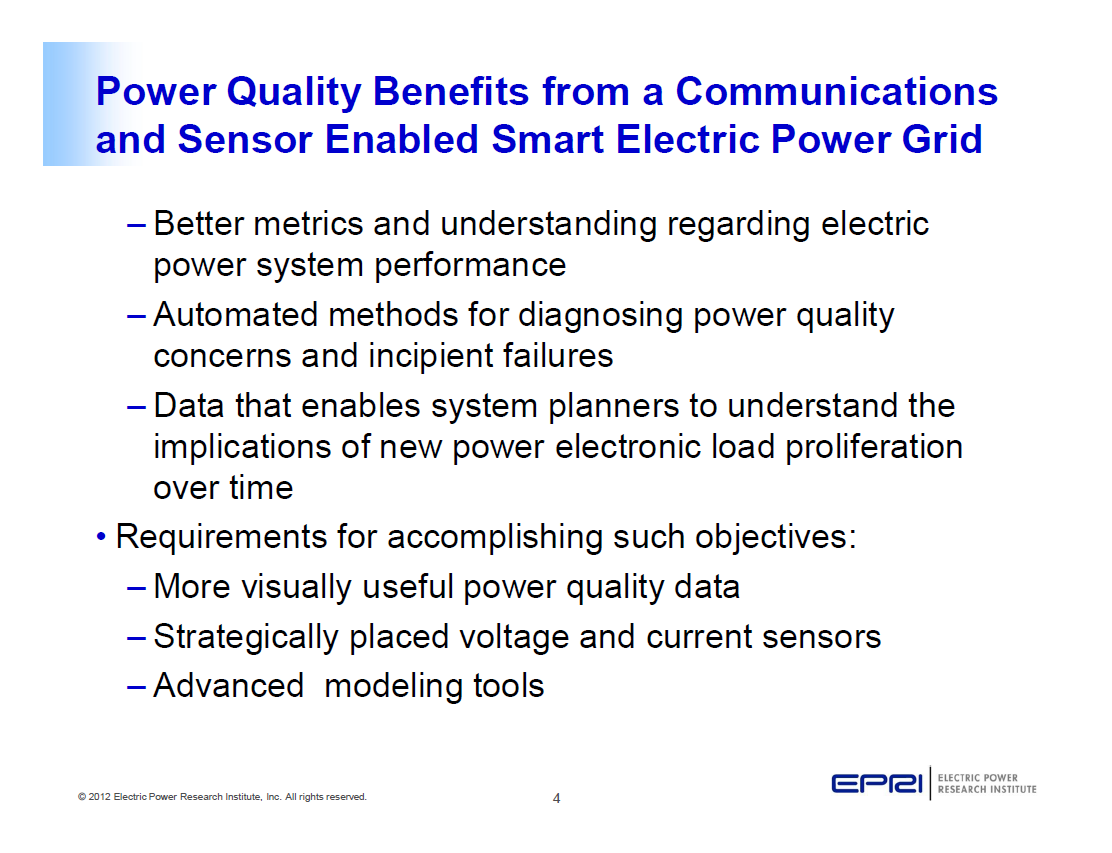
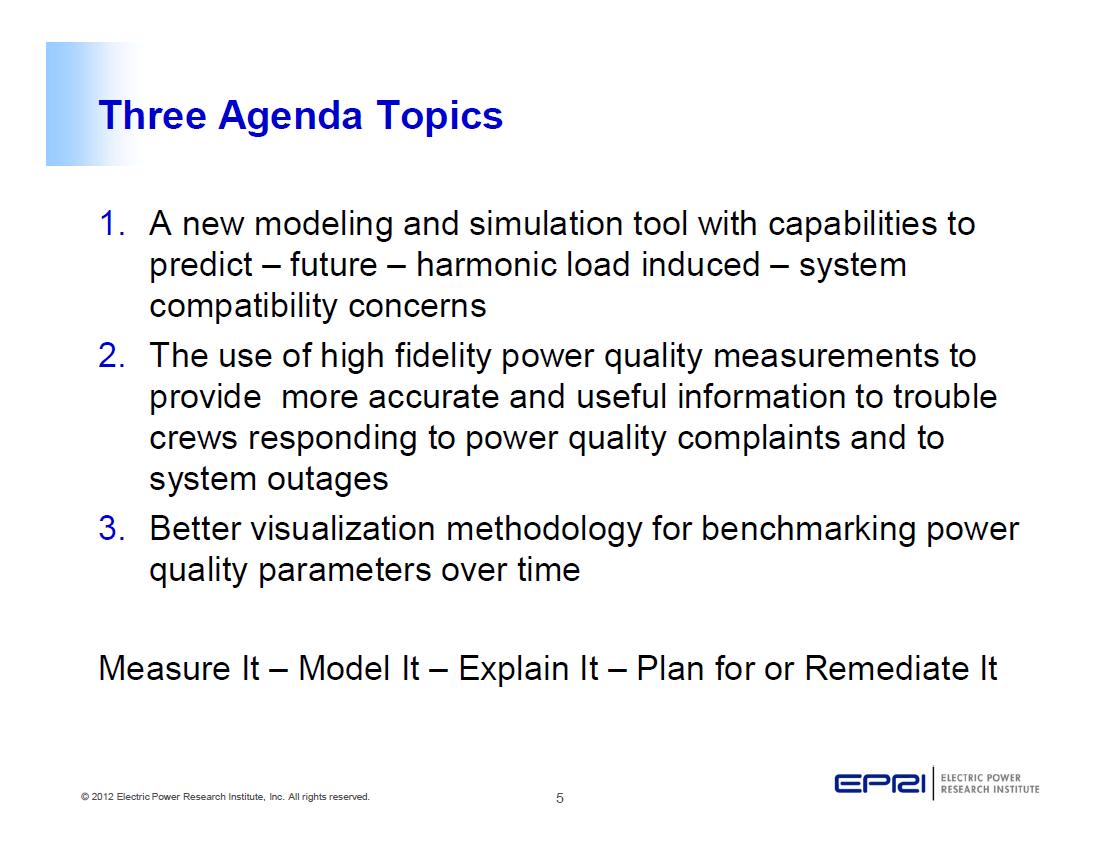
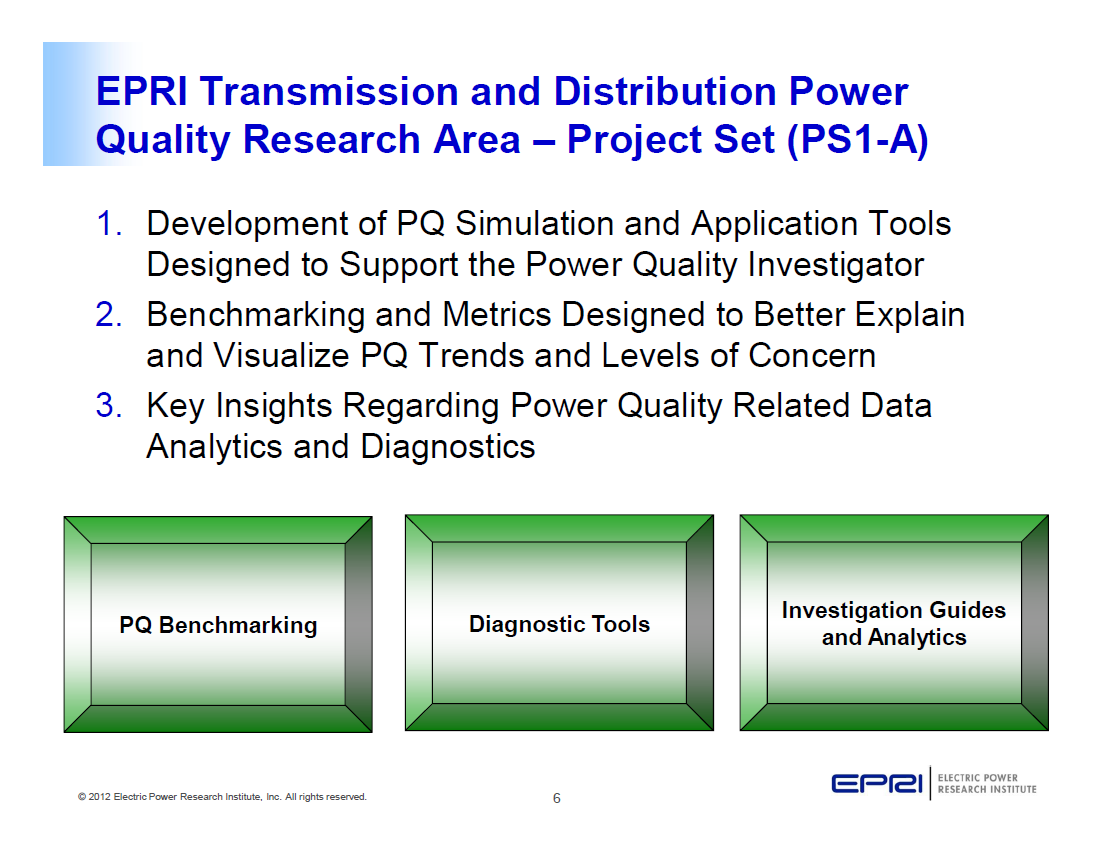
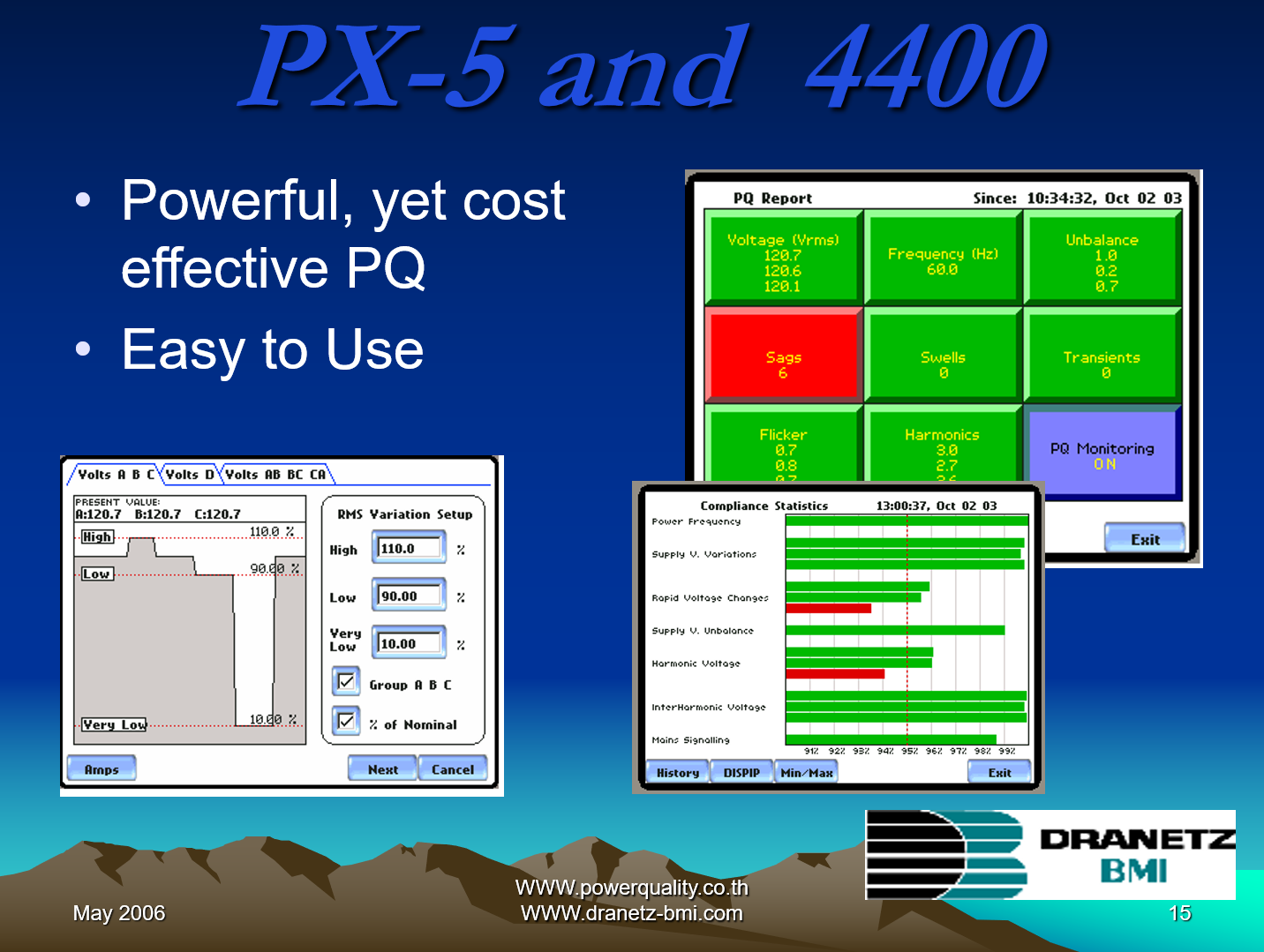
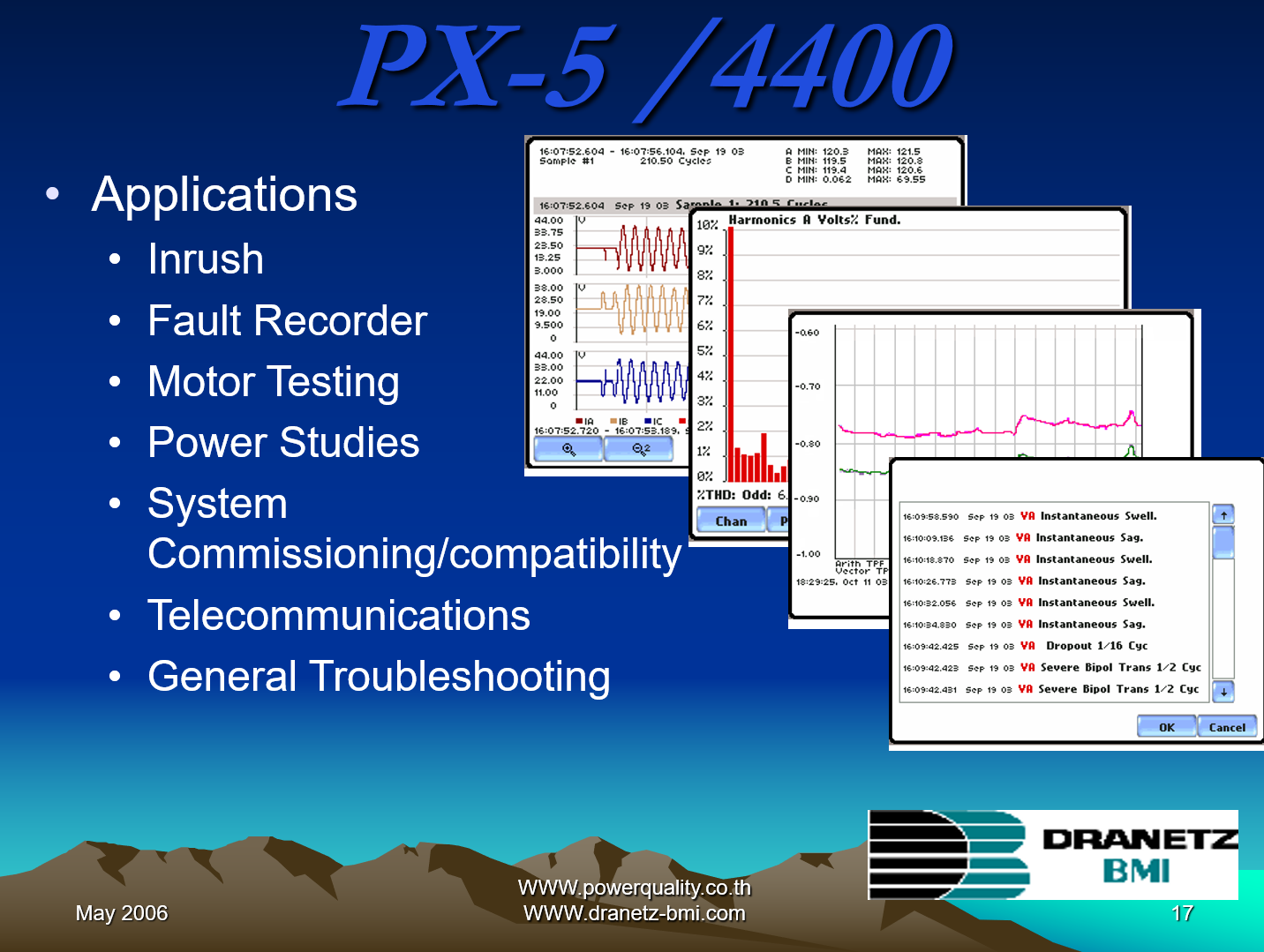
To do advanced harmonic analysis using the postprocessing capability of Dran-View 7 (DV7) Enterprise.

dv7

Note: Use the waveform capture on periodic basis to collect the most useful data but not necessary for normal PQ activity and reports.

The steps below give a few examples.

Step 1. Open the data file of the site of interest and select Voltage or current or both graphs. Change graph label for clarity.

Step 2. Select insert from the tool bar and the tables followed by Statistics.

figure2 - dv7

Step 3. Double click on the statistics box. It will bring up the following selection box.

figure3

To adjust the time period for the statistics, simply zoom or unzoom the graph of the data and the statistics are reported on the time of the graph.


Step 4. Follow the instructions to move statistics box to the graph you want.

figure4

figure5


Step 5. Add data labels for clarity, save graph with camera icon

camera icon

or report writer can automatically insert this graph in the report.

report writer icon


Power Quality & Quality of Supply A Global Continuously Developing Engineering Challenge

Published by Terry Chandler, A Power Quality Practitioner ™ for +30 years,

Director of Engineering Power Quality Thailand LTD/Power Quality Inc. USA,

Consultant for Dranetz Corporation USA (Asia business Unit General Manager)

Contact TerryC@powerquality.org

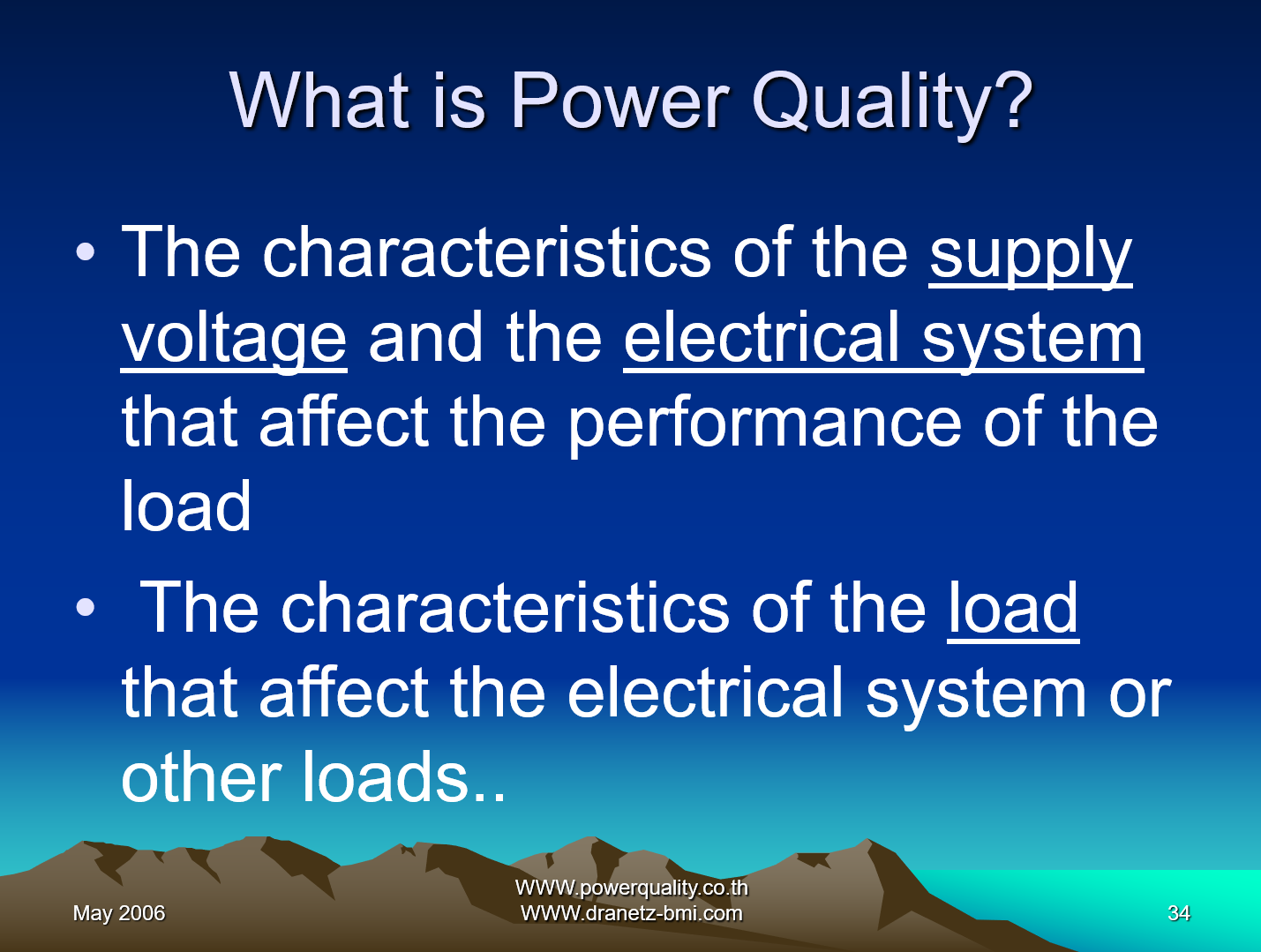
What is Power Quality (PQ)?

  • The characteristics of the supply voltage and the electrical system that affect the performance of the load.
  • The characteristics of the load that affect the electrical supply system and/or other loads. (TerryC. 1992)

What is Quality of Supply (QOS)?

  • The characteristics of the supply voltage that affect the performance of the load.
  • The characteristics of the electrical distribution system that affects the electrical loads. (Transformer size and distance to the loads)

Power Quality Definition?

  • There are many more definitions from IEC, IEEE, Various PQ engineers and experts.
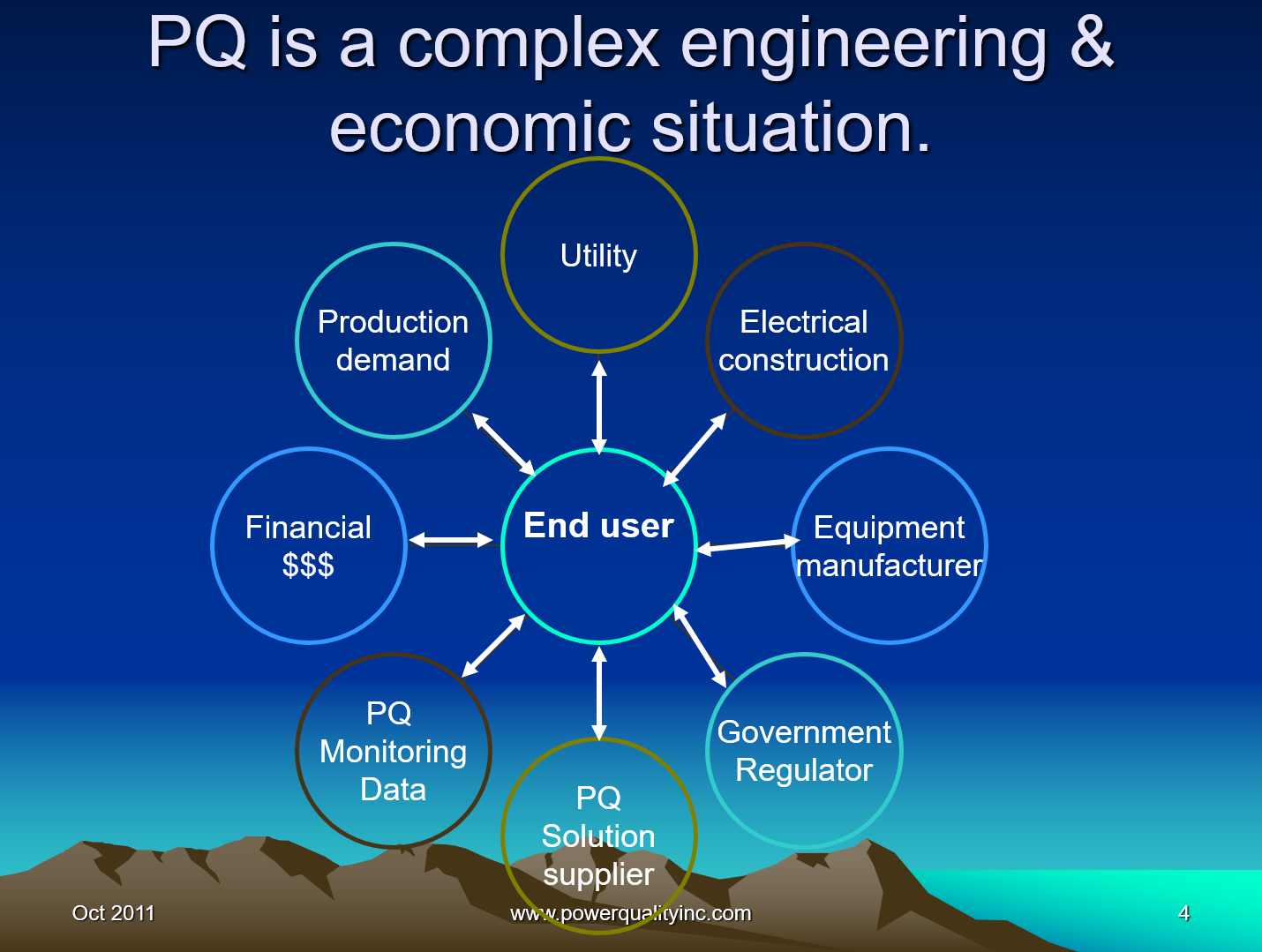
  • PQ is a complex engineering & economic situation that is constantly changing due to technology and political environment changes. (TerryC. 2006)

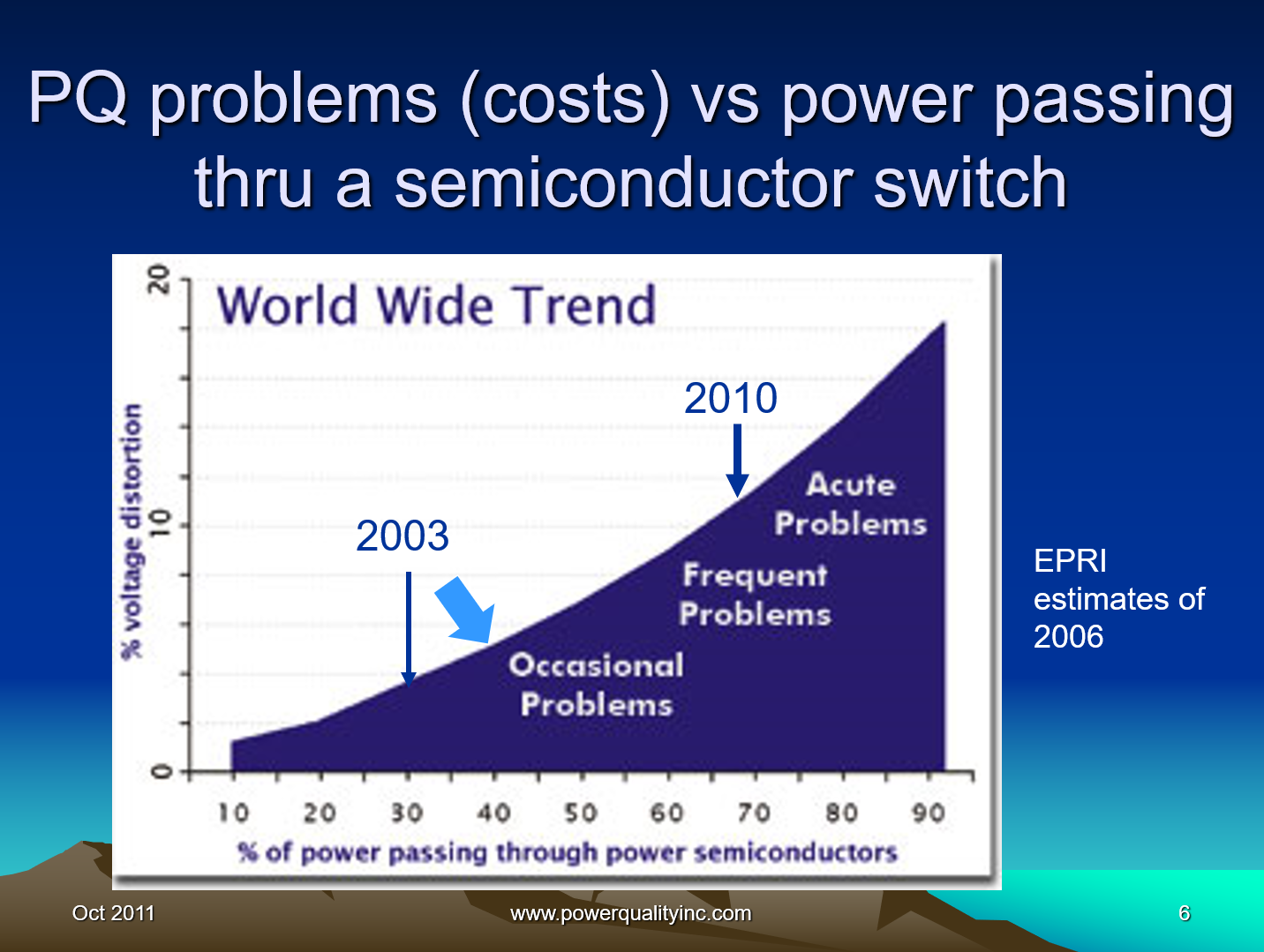
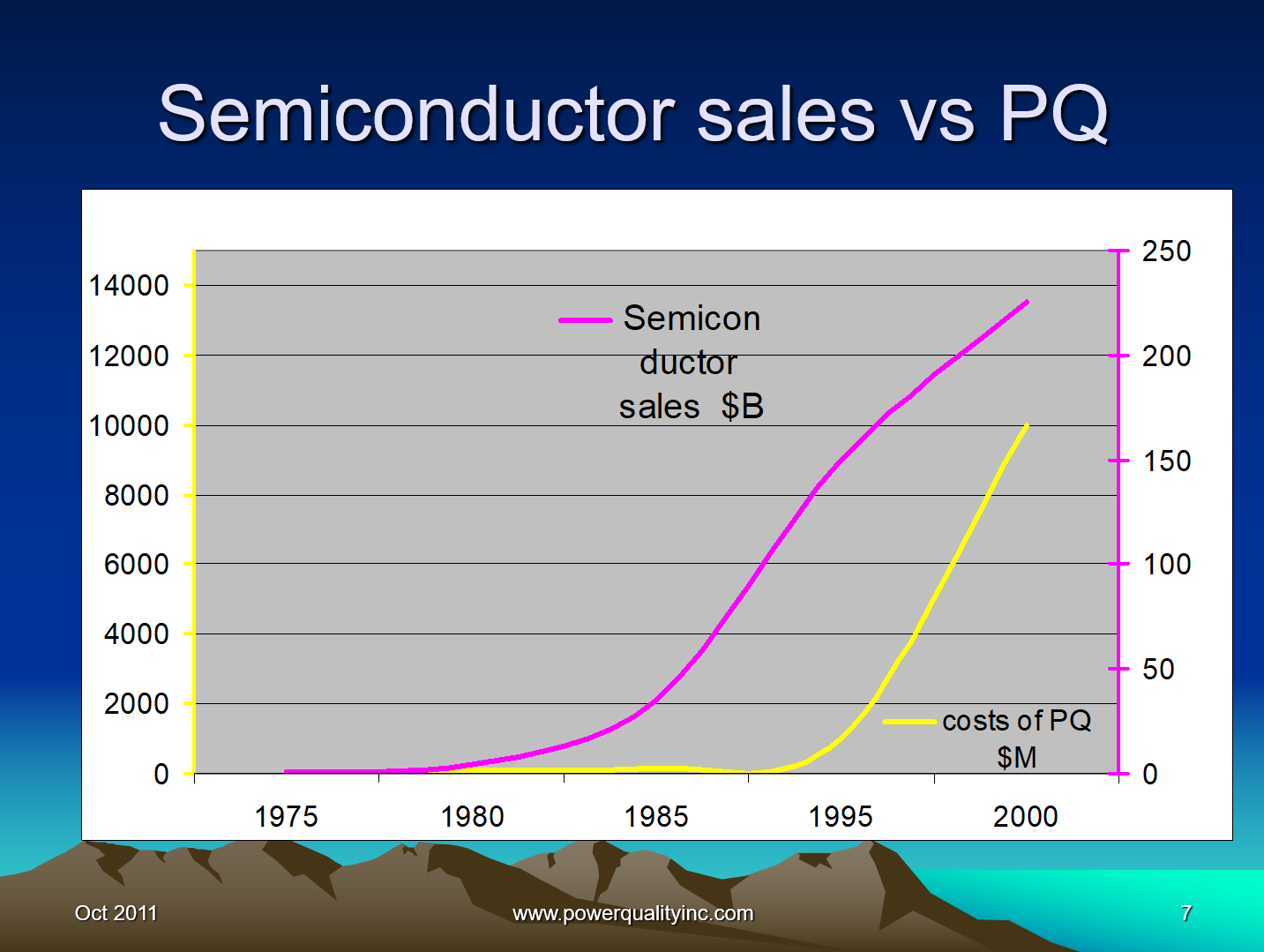
PQ problems (costs) vs Power passing thru a semiconductor switch

figure1

Semiconductor Sales vs PQ

figure2

Power Reliability vs Power Quality

  • Power Reliability is the presence of voltage at the meter point.
  • Power Quality is the value of the voltage (and other PQ parameters) as a percent of nominal at the meter. – Mr. Phil Sarikas, Intel Corporation 4/97

Quality of Supply Parameters (Utility)

  • RMS voltage, Sags (dips) and Surges (swells) – Disturbances
  • Voltage transients (slow, medium, and fast)
    • Lightning and switching transients that damage sensitive electronic loads
  • Sinewave – wave shape-harmonics – System losses
  • Voltage imbalance – phase differences – System losses
  • Flicker- small periodic voltage variations at frequencies lower than ½ fundamental-The only parameter that affects people directly
  • Frequency Variations
  • Power Factor? System losses

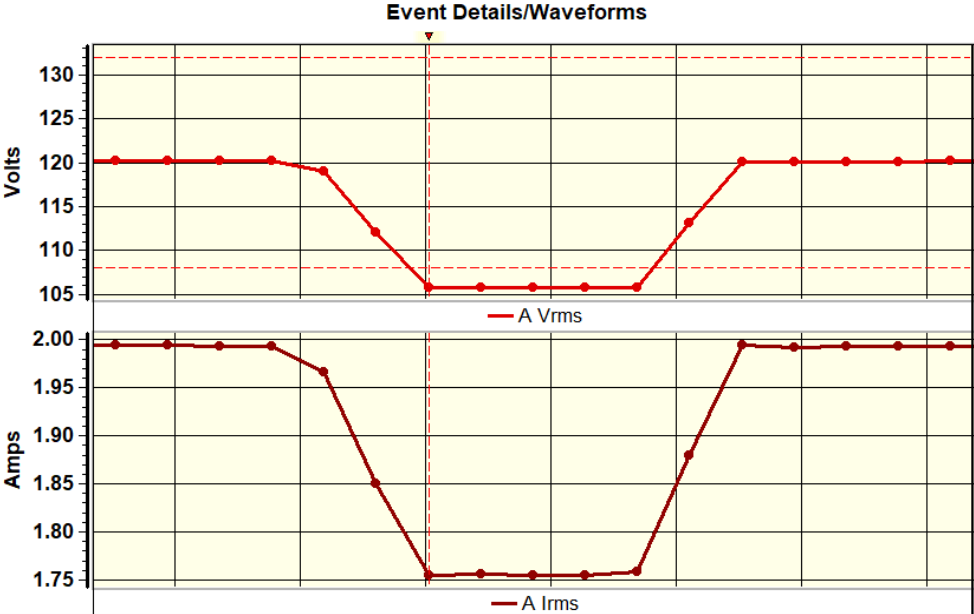
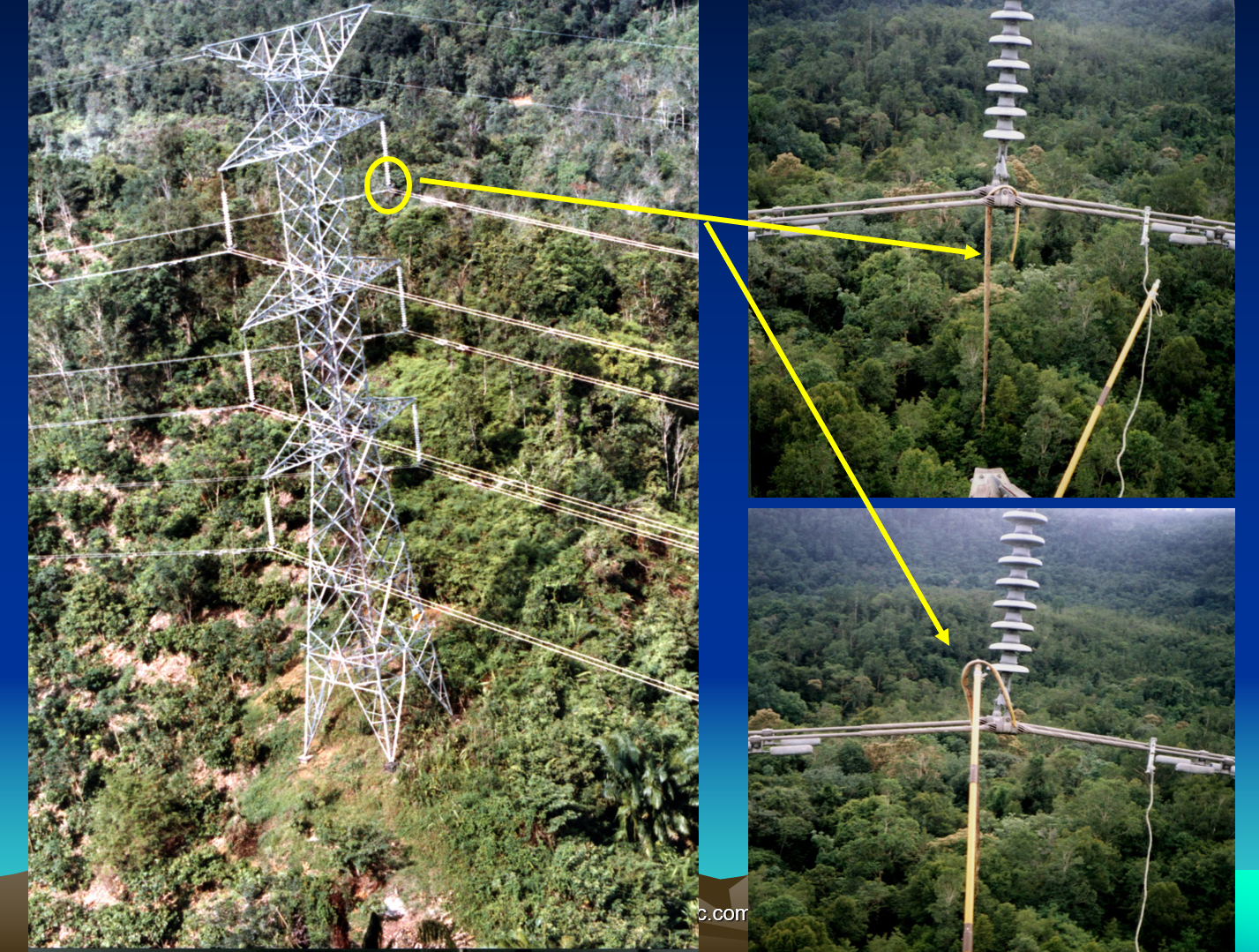
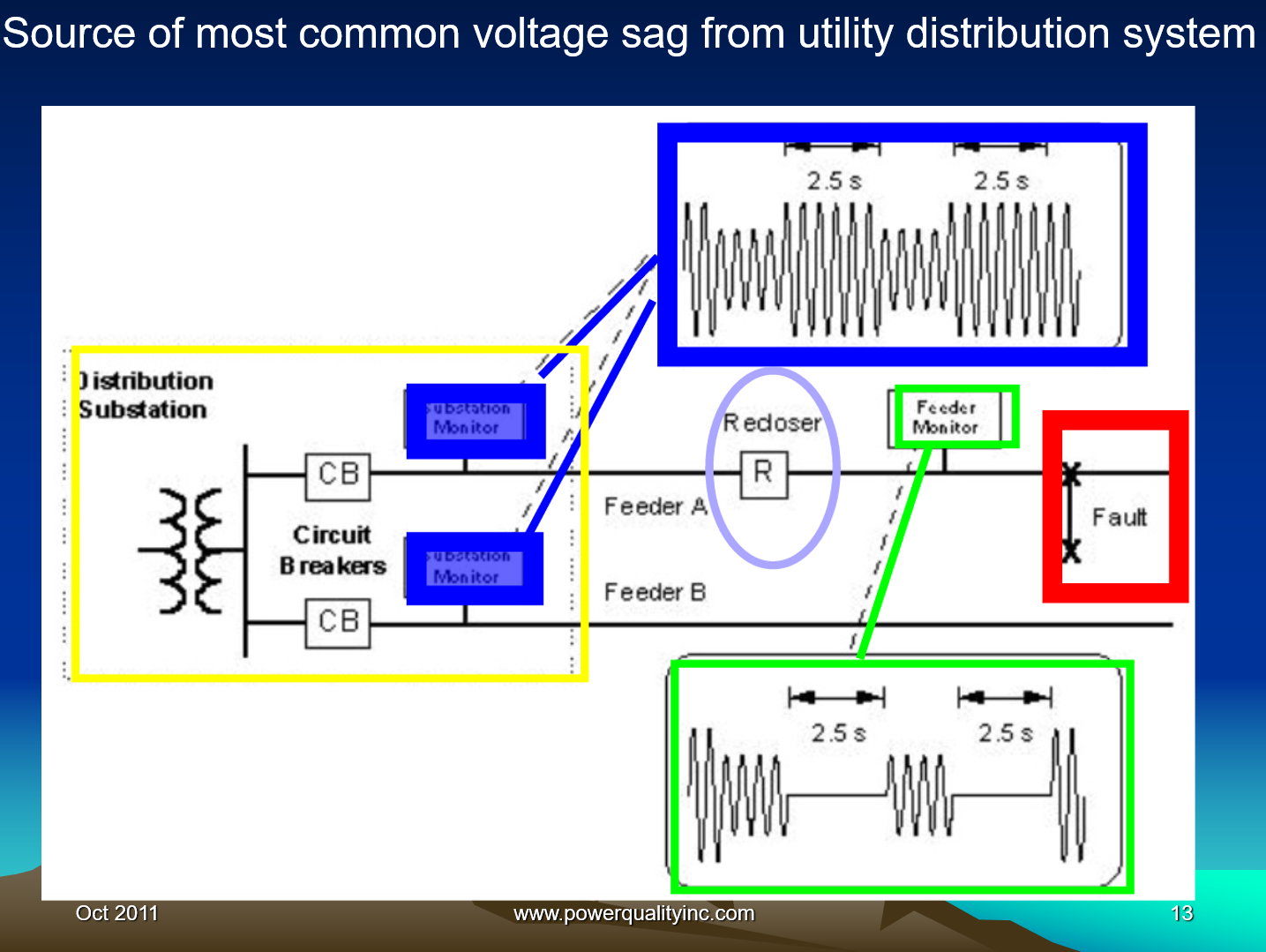
Source of most common voltage sag from utility distribution system or transmission or generation

figure3

A fault on transmission system

figure4

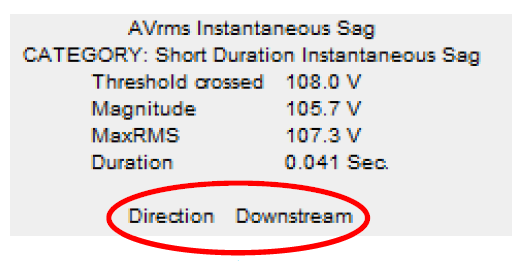
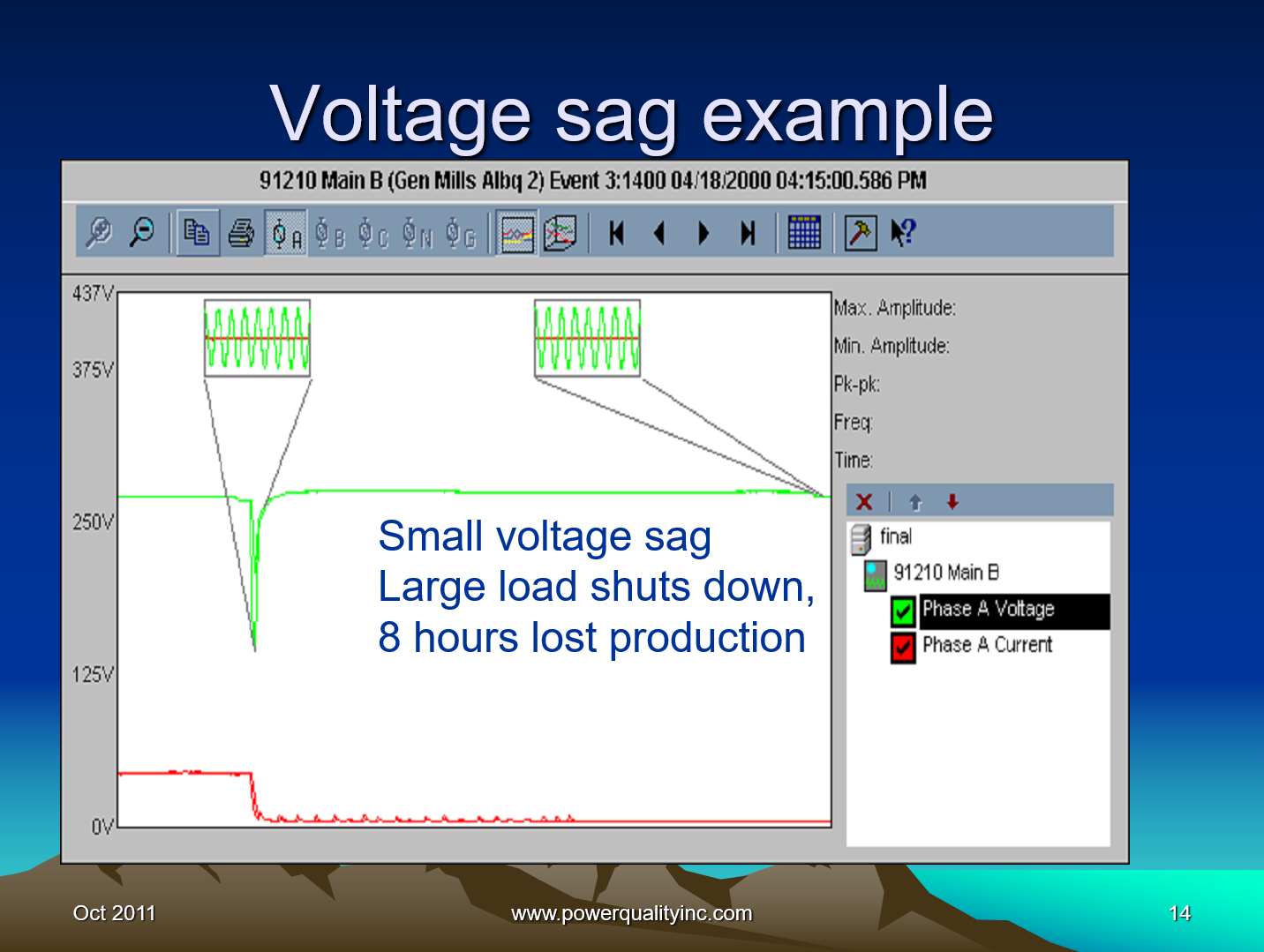
Voltage Sag Example (QOS)

figure5

Power Quality Parameters User Side

  • RMS voltage, Sag (dips) and surges (swells)
  • Voltages transients (slow, fast, and extremely fast)
  • Sinewave – wave shape – harmonics (Voltage and current)
  • Voltage imbalance (phase imbalance) (Voltage and current)
  • Flicker- small periodic voltage variations at frequencies lower than ½ fundamental. (current)
    • The only parameter that affects people directly
  • Internal electrical system design and construction.
  • Grounding /Earthing internal. (Ground loops and current in the ground conductor.
  • Waveshapes, Harmonics, Interharmonics (current)

Source of the PQ issues?

In PQI’s 30 years of experience and data shows:

  • 80% of the PQ issues are on the customer side of the meter.
  • 80% of the $ losses are caused by the 20% of the PQ issues from the utility side of the meter.
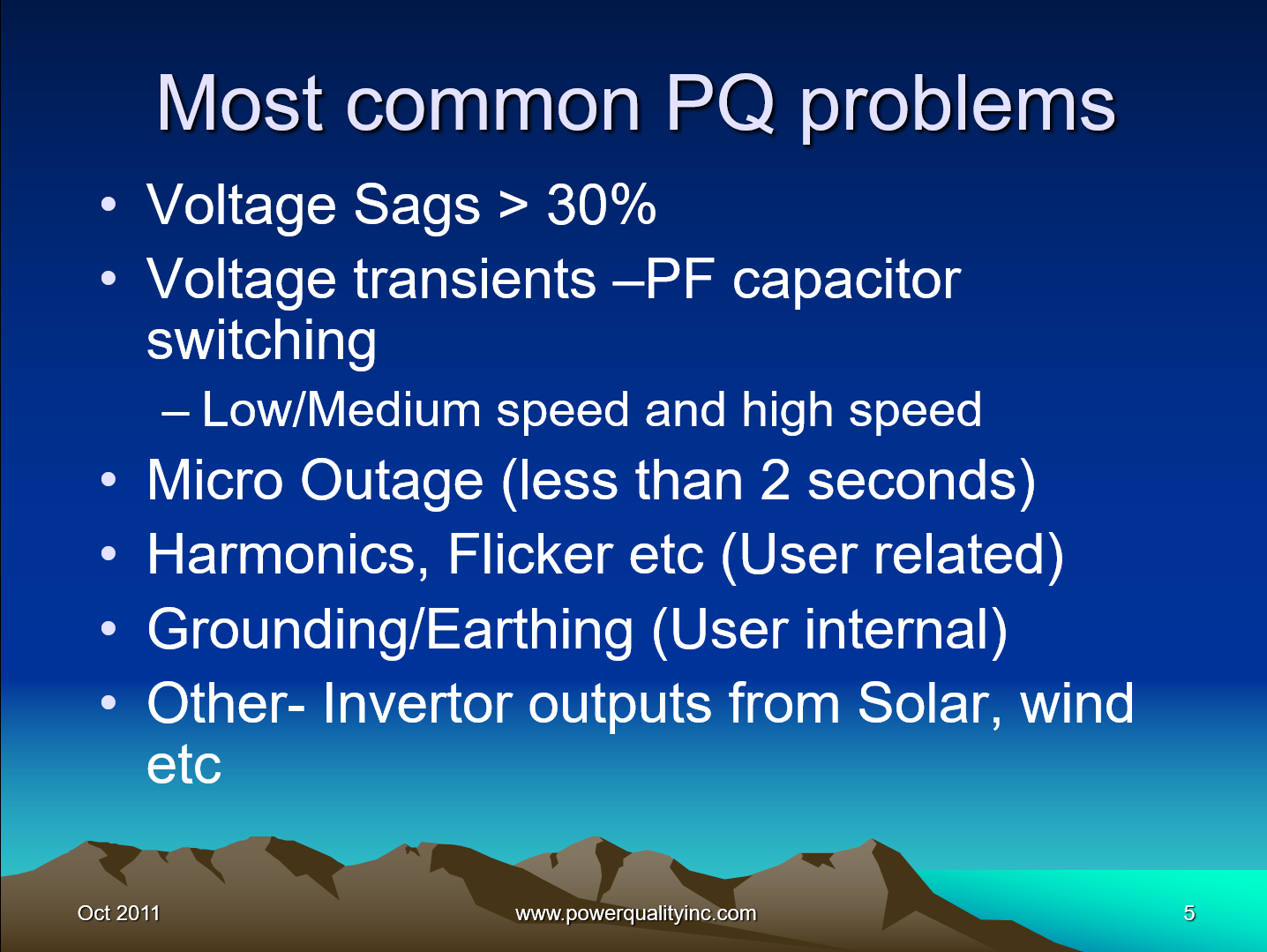
  • Majority of the issues from utility are voltage sags/short outages, flicker and harmonics caused by other loads.
  • Voltage transients include decaying ringwaves (PF cap switching)
  • Flicker usually caused by steel mill loads but now maybe from wind turbines

Power Quality is a constantly changing situation of varying loads, varying generation types, varying weather.

  • For the first 20 years it was the loads changing in sensitivity to normal electrical distribution operations.
  • Loads changing from incandescent lamps and motors to new technologies and Invertor (VFD,VSD’s) motor drives
  • Generation changing from rotary to invertor-based renewables.
  • Remote generation
  • Harmonics causing losses
  • Government influence/mandates of SmartGrid

Influence on Power Quality due to drive for more energy efficient loads.

  • Lighting technology
    • Incandescent bulbs to Compact Fluorescent to LED
  • Motor Control technology
    • Voltage control to SCR control to High Power Switching
  • Power Switching technology for heating

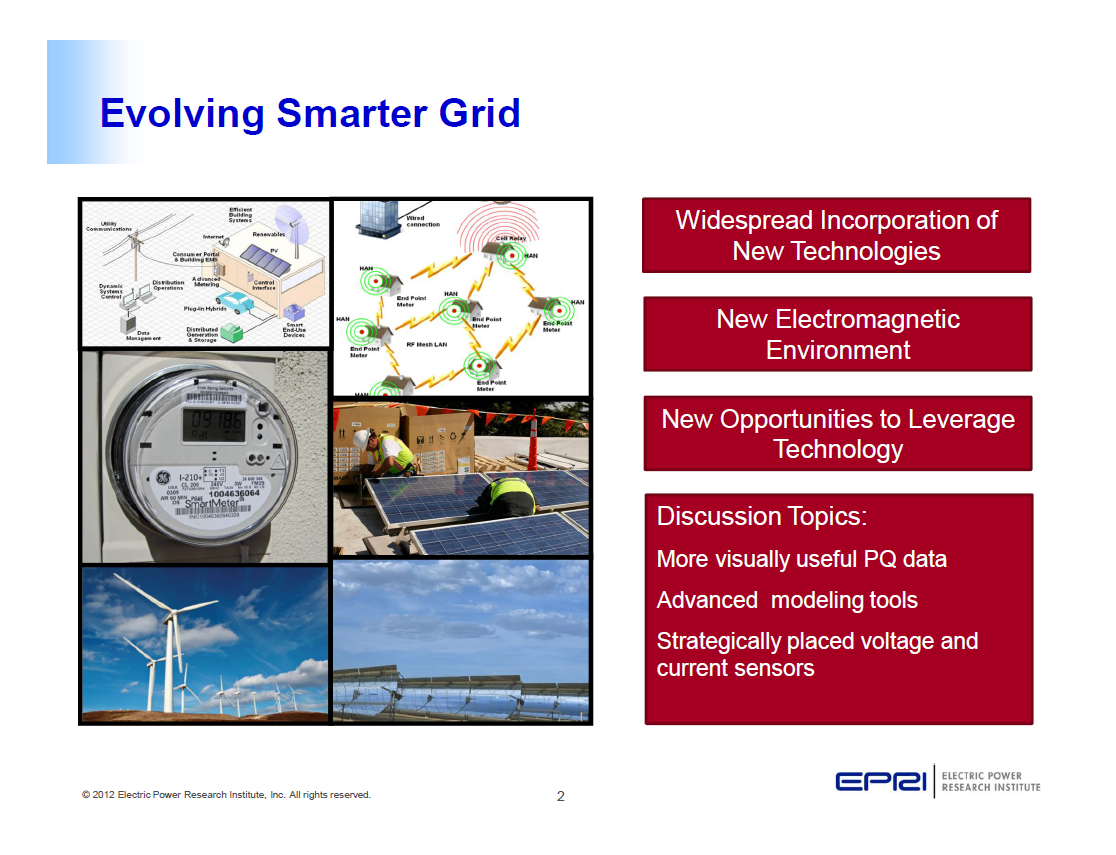
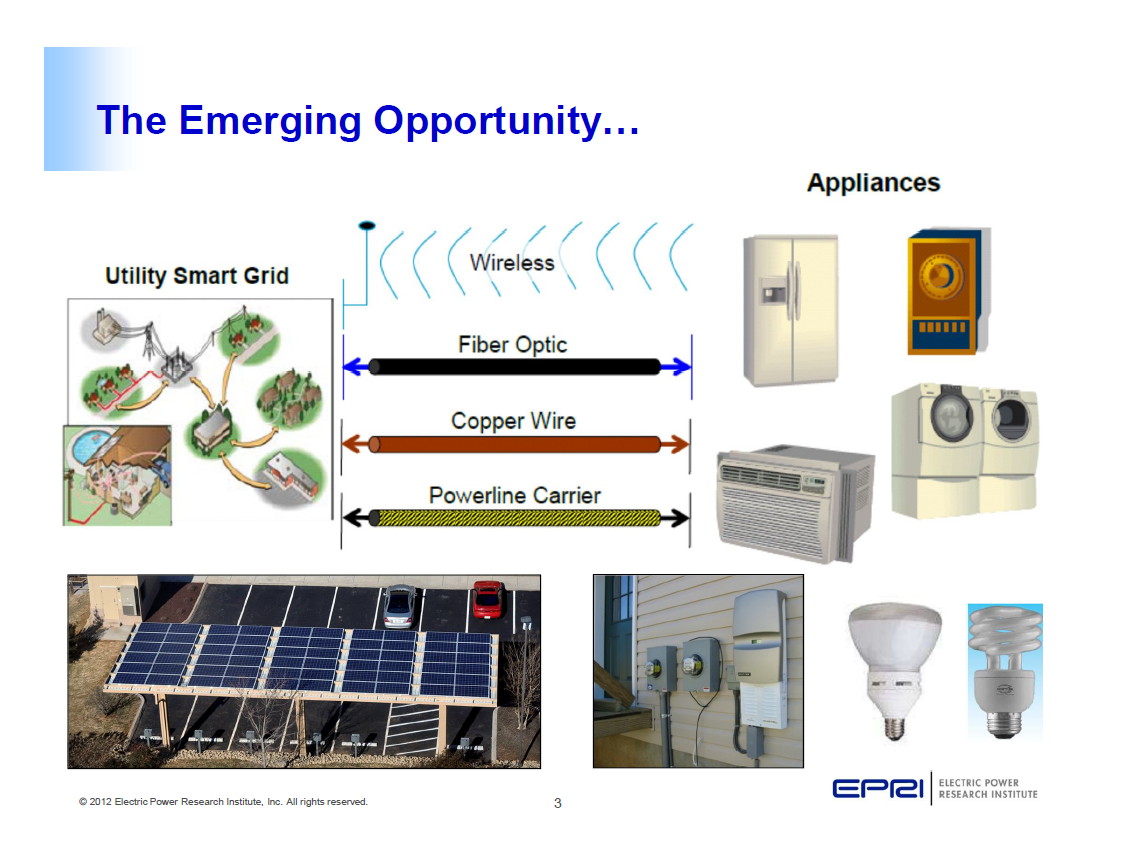
Today Power Quality is more about data/information. (SmartGrid)

  • SmartGrid ( 7,250,000 results from a Google search)
  • A SmartGrid is an electrical grid which includes a variety of operational and energy measures including smart meters, smart appliances, renewable energy resources, and energy efficiency resources.
  • What does Power Quality have to do with SmartGrid?

Data Integrated by Power Quality Monitoring System at Con Edison

  • Transmission Feeders
    • Digital Fault Recorders
  • Area Substation Transformers
    • Power Quality Monitors
    • Event Correlation with SCADA Breaker Operations
  • Network Distribution Feeders
    • Digital Relays
    • Event Correlation with SCADA Breaker Operations
  • Area Substation Capacitors
    • Indirect: PQ Monitors
    • Direct: Some Digital Relays
  • Secondary Networks
    • Power Quality Monitors
  • Unit Substation Transformers
    • Power Quality Monitoring
    • Phasor Measurement Sensors during Network Intermesh
    • Station Battery Sensors
  • Long Island City Smart Meters
    • Energy and Power Quality Data Logs
  • High Tension Remote Monitoring
    • Power and power quality monitoring
  • Distribution and Transmission SCADA
    • Automatic momentary interruption analysis and correction with IEDs

figure6

Energy Efficiency and Power Quality

  • There is a worldwide movement to increase the energy efficiency of loads.
  • According to the International Energy Association, electric motors consume 45 percent of the total energy in the world. Lighting energy consumption is a distant second at 19 percent. https://www.iea.org/
  • Energy efficiency is the one energy resource all countries possess in abundance.

Global Impact of Energy Efficiency

figure7

Electrical Energy Efficiency

  • Same amount of work in the same amount of time with less Kilowatts. (KWhr)

Load Categories

  • Industrial
    • Motors, lighting, building envelope, electronics
  • Commercial
    • Lighting, building envelope, electronics
  • Consumer
    • Appliances, lighting, building envelope
  • Government

Parameters of Electrical Usage

  • Voltage stability
  • Voltage imbalance
  • Amps to determine load characteristics
  • Watts, KW, KWhr
  • Power Factor
  • Maximum demand
  • Time of day usage
  • Economic losses and return on investment require data $$$$$

The Basics of Energy Savings

  • Motors
    • VFD/VSD reduce the energy not needed once the load is started
    • Improve the control by electronic switching
  • Lighting
    • Change in technologies
      • Incandescent – Fluorescent – LED – specialty
  • Electronic loads
    • Increased integration of semiconductors
  • Temperature
    • Insulation, control, and technology

The Relationship Electricity usage to Power Quality Situations (parameters)

  • As energy efficiency of loads increases (decreases), it changes the sensitivity to PQ parameters and increases (decreases) the generation of harmonics

figure8

Computer Power Supplies (AC to DC)

  • Linear power supplies change to Switch mode.
    • Voltage operating range went from +/- 5% to universal voltage 90vac to 240vac
    • More sensitive to transients
    • Generate more harmonics
  • Next generation
    • PF corrected
    • Lower Ithd but at higher order harmonics

figure9

Lighting (22%)

  • Incandescent lights to solid state ballast fluorescent lights
    • Sensitivity to voltage reduced
    • Increase in harmonics
  • Next, LED lights
    • Decrease in harmonics
    • Decrease sensitivity to Voltage?

figure10

figure11figure12

Lamp Efficiency Comparison and PQ Sensitivity

Light Dimmers

  • Lowers power used
  • Increases Harmonics
  • Sensitive to voltage transients
  • Sensitive to voltage sags
    • Light blinks

Solid State Lights (SSL)

  • Significant energy savings
  • Sensitive to voltage transients
  • AC to DC converter generates harmonics

figure13

Motors

  • 70% of electrical load (Industrial) 45% of global load
  • High Efficiency motors
  • Electronic controls for existing motors
    • Variable Speed Drives (VFD)
    • Variable Frequency Drives (VSD)
    • Soft start

High Efficiency Motors

figure16

Add VFD (VSD) to Motors

  • Variable speed drives
    • Sensitive
      • Sags
      • Phase shifts
      • Transients
      • Imbalance
  • Generates harmonics

How a VFD or VSD works?

figure17

Drivers for Change in PQ and Efficiency

  • Cost savings
  • Improving control over processes
  • Energy efficiency (Green World)
  • Reduce size and weight of equipment by lowering power consumption
  • Advances in technology
    • Semiconductor
    • Materials of all types
      • Insulation and conductors

Conclusions

  • Power Quality and Energy efficiency are linked by the changing technologies
  • The Changing technologies are a global situation.
    • The only constant is the varying rate of change!
  • Effective engineering depends on global information and technical resources
  • I have been an IEEE member for more than 30 years! It is a global organization that has provides consistent and valuable resource data for wide variety of electrical subjects

Albert Einstein Quotes

Accuracy of Harmonic Voltage Measurements in the Frequency Range up to 5kHz using Conventional Instrument Transformers

Published by

21st International Conference on Electricity Distribution, Frankfurt, 6-9 June 2011 (Paper 0917)

Abstract

The measurement of harmonic currents and voltages is a key issue e.g. for the assessment of voltage quality or the compliance verification for generating installations. Except for voltage measurements in LV networks the adaption of the primary signal to the input ranges of the power quality instrument needs instrument transformers. The accuracy of these transformers above the nominal frequency is usually not known and not defined by the appropriate standards up to now.

The main intention of the paper is to present the accuracy of conventional instrument transformers at higher frequencies for voltage levels up to 330kV and to attract attention of network operators, equipment manufacturers and regulators to possible influences on the harmonic measurements.

A short introduction is followed by a description of the measurement system and methodology. Next the measurements of the frequency dependent transformer ratio and frequency dependent phase angle difference for about 100 voltage transformers (VTs) are discussed in detail. For all analyses the frequency ranges from 50Hz up to 5kHz is considered. A final summary of the results should give first guidance to all interested parties on how to treat with voltage harmonic measurement accuracy in MV, HV and EHV networks.

Introduction

The number of sources of low as well as high order harmonics in distribution and transmission grids increases continuously (e.g. wind parks, HVDC links, …). It is very important that all involved parties know the current situation on the system. Hence network operators, customers and regulators carry out more and more power quality measurements including harmonics in all voltage levels from LV to EHV. IEC 61000-4-30 defines methods

and accuracies for the measurement instruments itself, but explicitly excludes the accuracy of instrument transformers. It is therefore not possible to specify an overall accuracy for such harmonic measurements. First research of the authors was focused on the frequency dependent behavior of instrument transformer ratio for MV voltage transformers [1]. A few publications exist for VTs for higher voltage levels [e.g. 2]. The factors with influence to the frequency behavior of instrument transformers, namely VTs, are detailed discussed in [1]. In general, these influences can be divided into 3 categories:

1. construction-specific (e.g. rated primary value)

2. operational-specific (e.g. burden)

3. test signal-specific (e.g. test-waveform)

The construction-specific characteristics have the most significant influence on the frequency behavior of VTs. It mainly defines the capacitances and inductances, which are responsible for the resonance effects within the instrument transformer. The following design-specific characteristics are discussed and analyzed in the paper:

1. voltage level

2. basic design (cast resin, gas insulated, or oil insulated, capacitive)

3. single or combined transformer

It should be pointed out that VTs with nearly same properties may still vary in their frequency characteristics due to different designs of constructions, housings and other parameters, like rated power or number of secondary windings. Due to its importance for power quality assessment according to standards and it’s more critical behavior the paper is focused on VTs (single-pole). First results for MVCTs and HV-CTs show no significant resonance effects in the frequency range up to 5 kHz.

Measurement System

In conclusion of the results from former research the measurement system was adapted to handle not only MVVTs but also VTs built for voltage levels up to 400 kV. Several test setups where discussed in [1]. For an extensive test setup a multi-frequent test signal consisting of a fundamental sine component at rated primary voltage and a second, swept sine component of smaller amplitude was used. A simplified setup using only a swept single frequent sine of small amplitude showed only insignificant differences compared to the extensive setup (cf. to [1] for more details). Therefore the simplified setup as shown in Fig. 1 is used for the measurements. Its main advantage compared to the extensive setup is its mobility, which was mandatory for the project, especially for the measurement of HV and EHV voltage transformers. The test signal is provided by a single-phase voltage source at voltages up to 280V (RMS) and frequencies up to 5 kHz. The voltage source is controlled by an external signal generator. For data acquisition an ADC-board with simultaneous sampling channels at sampling rates up to 2MS/s is used.

figure1

Basic schema of measurement system.

Figure 1

Measurement Methodology

As mentioned before a single-frequent sweep of sine signals of different frequency is used for the measurements. Each sweep starts at a predefined frequency. The frequency is stepwise increased up to 5 kHz. The step size changes adaptively. By this adaptive step control even small resonances are measured with a sufficient frequency resolution while measurement time is optimized (about 2-3 minutes per VT). Minimum step size is 5Hz. For each frequency primary voltage Upri (green plot in Fig.2) and secondary voltage Usec (red plot in Fig. 2) are measured simultaneously. Finally, the normalized transformer ratio is calculated (blue plot in Fig. 2) that allows better comparison between different transformers:


math1

The calculation of the phase angle difference is based on the following equation:

math2

ϕpri is always 0° due to the synchronization of the measurement to the positive zero crossing of primary voltage Upri.

figure2

Figure 2

Depending on the value of the ratio nr(f) three different ranges (I, II, III – cf. Fig. 2) have to be distinguished.

table1

Evaluation Methodology

Fig. 3 shows the plots of normalized ratio nr(f) for 3 different VTs, namely a 66-kV-VT (green), a 110-kV combined transformer (blue) and a 220-kV-VT (red). All VTs are inductive, oil-paper insulated and for outdoor use. Fig. 4 shows the corresponding phase angle difference Δϕ(f) respectively. All measurements were carried out without burden. Based on the figures the behavior of frequency dependency can be discussed in more detail:

1. Resonance frequency and resonant rise of the first resonance differ significantly due to the diverse design of VTs.

2. For frequencies higher than the first resonance accurate measurements are very difficult. A correction based on the transfer characteristic is not easily possible due to the high sensitivity of the characteristic in this range from lots of influencing factors (cf. [1]).

3. Characterizing the frequency response of a VT based on the resonance frequency only is not sufficient, because deviation from rated transformer ratio at nominal frequency starts usually at much lower frequencies.

4. Depending on the design the first resonance can be a parallel one (Maximum) or a series one (Minimum). Therefore both cases (conservative or critical) according to Tab. 1 may be possible below the first resonance.

5. Large phase angle differences are always related to the resonances. The higher the resonant rise, the higher the phase angle difference. For narrow resonances with high resonance rise (larger than 3) the phase angle difference can significantly exceed 90°.

6. For resonance conditions where a maximum is followed by a minimum (case II acc. to Tab. 1) phase angle difference becomes positive. If minimum is followed by a maximum, the phase angle difference becomes negative.

figure3

Figure 3

figure4

Figure 4

As an appropriate way to quantify the accuracy of a VT the paper uses different thresholds for transformer ratio accuracy and phase angle accuracy.

table2

For each of the thresholds the corresponding critical frequency (fcrit) is calculated. In order to compensate possible differences that may result from the low excitation, in this paper the difference |nr(f)-nr(fN)| is related to the measured ratio at nominal frequency instead of the rated (name plate) transformer ratio. Fig. 5 shows exemplarily the plot of transformer ratio accuracy Δnr(f) with marked thresholds.

figure5

Figure 5

Measurement Results

The critical frequencies fcrit for transformer ratio accuracy Δnr(f) = 1 % are shown in Fig. 6. While rated primary voltage can be read from the figure directly, the different design of the transformer is highlighted by a symbol acc. to table 3.

table3

figure6

Figure 6

a) Main general findings:

1. The critical frequency up to the point where accurate measurements are possible decreases with voltage level.

2. Even for VTs with same primary voltage the critical frequency fcrit can vary in wide ranges due to the different design. The specification of a single fcrit only per voltage level is not adequate.

b) Some specific findings:

1. Block-design VTs (+) are usually used up to 35kV. The critical frequency varies in a wide range from fcrit ≈ 3500Hz for 10-kV-VTs down to fcrit ≈ 600Hz for 35-kV-VTs.

2. The accuracy of capacitive VTs (*) is guaranteed within a very small frequency range around the nominal frequency only. These VTs are not suitable for harmonic measurements in standard cases.

3. For 66-kV-GIS VTs (􀀍) the critical frequency is about 500Hz higher compared to the inductive outdoor VTs (O) of same voltage level.

4. 110-kV combined transformers (x) show in most cases a better performance compared to the inductive outdoor VTs (O) for same voltage level.

5. No significant difference exists between inductive outdoor type (O) for 110kV and 220kV. Both are suitable for measurements up to the fcrit ≈ 500Hz (10th harmonic).

In the new 3rd edition of EN 50160 (ratified in 03/2010) the application range is extended from MV networks (Un ≤ 35 kV) to HV networks (Un ≤ 150 kV). Fig. 6 shows that harmonics up to the 25th order can be measured with sufficient accuracy in MV networks up to 20 kV. Only THD accuracy may fail under certain circumstances. Fig. 7 shows that the situation is much more difficult for HV networks. Only the 66-kV-GIS-VTs fulfill all requirements acc. to EN 50160 at a 1-%-transformer ratio accuracy. Measurements in 110-kV-networks may already have an unacceptable error at 9th harmonic. With 110-kVcombined transformers in most cases the error doesn’t exceed 5%. Most international standards related to harmonics in MV, HV and EHV networks (e.g. IEC 61000-3-6 or IEC 61000-2-12) cover the frequency range up to 2.5kHz (50th harmonic) for individual harmonics as well as THD. This requirement is also included in Fig. 7. Fig. 8 shows the transformer ratio accuracy and phase angle accuracy for all analyzed 110-kV-VTs in one diagram. For the chosen phase angle accuracy thresholds the critical frequency fcrit for the transformer ratio accuracy is in virtually all cases lower than fcrit for phase angle accuracy. This means if a certain VT has transformer ratio accuracy better than 1 % its phase angle accuracy is always better than 1° and so on.

figure7

Figure 7

figure8

Figure 8

Conclusion

The paper is a contribution to the discussion on the accuracy of harmonic measurements using standard VTs, especially at higher voltage levels. It should be defined reasonable accuracy classes for HV and EHV voltage transformers. The influence of transformer ratio accuracy on the harmonic measurements according to actual standards (e.g. EN 50160) was verified. It shows that attention has to be taken to the interpretation of such measurements, especially at voltage levels above 20kV. This is of special importance if regulatory rules should be introduced in future dealing with harmonics. Only instrument transformers of two different manufacturers were analyzed in the project. Due to the high sensitivity of the frequency dependent behavior from transformer design the results may be different to other manufacturers.

Finally, the paper should give impulses for the ongoing standardization work. Adding requirements for frequency dependent behavior of instrument transformers to future standards can improve the quality of harmonic measurements significantly in long-term. As short-term solution for the network distributors that carry out measurements in HV and EHV networks at least the frequency dependent transformer ratio of the used VTs should be known.

Reference

[1] M. Klatt, J. Meyer, M. Elst, P. Schegner, 2010, “Frequency Responses of MV voltage transformers in the range of 50 Hz to 10 kHz”, International Conference on Harmonics and Quality of Power (ICHQP), IEEE, Bergamo (Italy) [2] H. Seljeseth, E.A. Saethre, T. Ohnstad, I. Lien, 1998, “Voltage transformer frequency response. Measuring harmonics in Norwegian 300kV and 132kV power systems” Proceedings 8th International Conference on Harmonics and Quality of Power, p. 820 – 824, vol. 2.

IEC Characterize Events Overview

image_1

Application note for the Dranetz automatic characterizer in HDPQ portable instruments.

Overview

The RMS variation characterizer analyzes cyclic records saved in the database and determines which of those records constitute an event based on a selected criterion. The result is a database record that contains the description of the event, detail of the event, and indices to the cyclic records in the database.

Characterizer Types

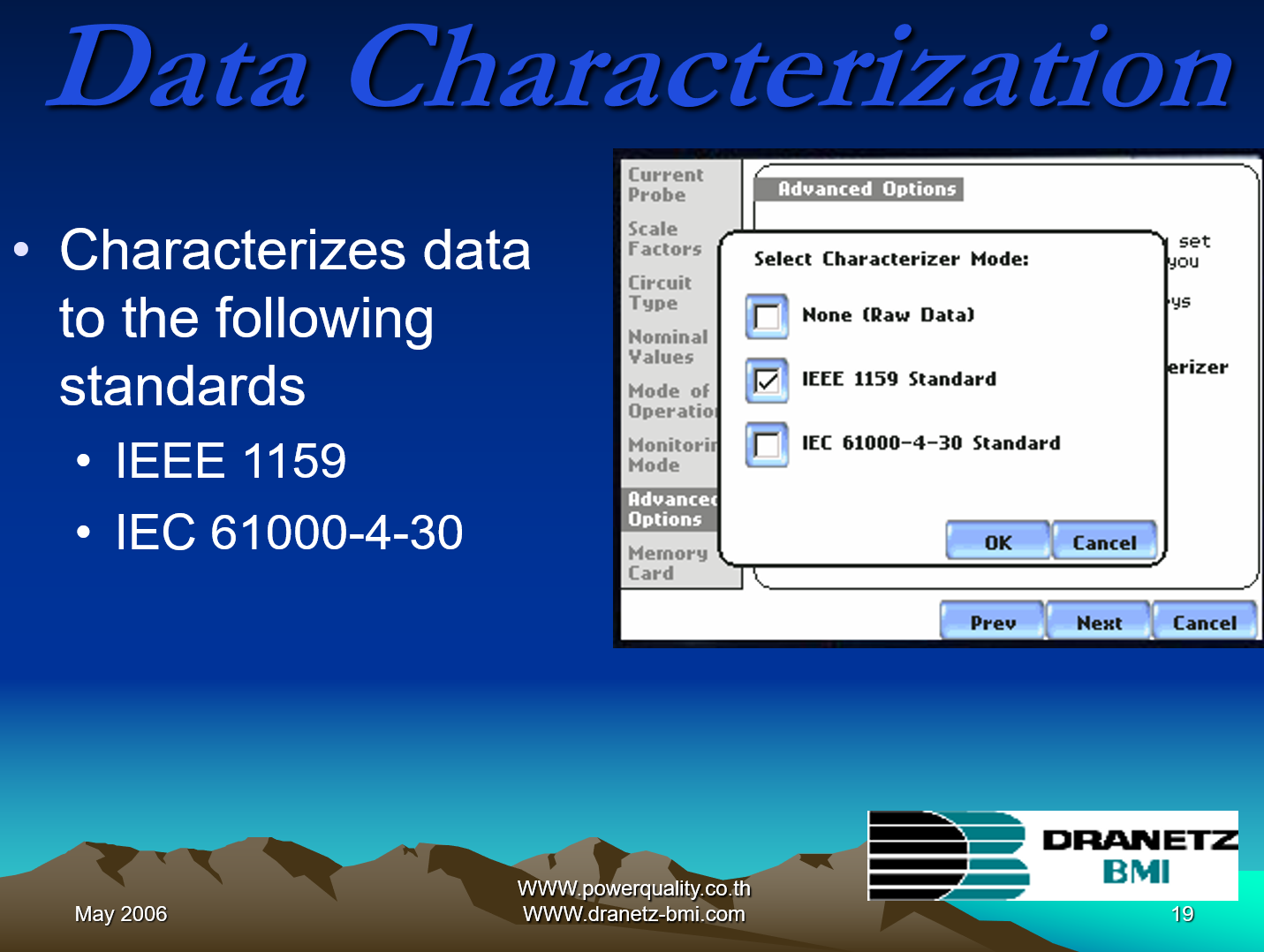
IEEE 1159 characterizer

RMS variations are characterized based on the IEEE 1159 Categories and Typical Characteristics of Power System Electromagnetic Phenomena. The table below summarizes the relationships between categories, duration, and magnitude:

Category Typical duration Typical Voltage Magnitude
Short Duration Variations
Instantaneous
Sag 0.5 – 30 cycles 0.1 – 0.9 pu
Swell 0.5 – 30 cycles 1.1 – 1.8 pu
Momentary
Interruption 0.5 cycles – 3 sec < 0.1 pu
Sag 30 cycles – 3 sec 0.1 – 0.9 pu
Swell 30 cycles – 3 sec 1.1 – 1.4 pu
Temporary
Interruption 3 sec – 1 min < 0.1 pu
Sag 3 sec – 1 min 0.1 – 0.9 pu
Swell 3 sec – 1 min 1.1 – 1.2 pu
Long Duration Variations
Interruption, Sustained > 1 minute 0.0 pu
Undervoltages > 1 minute 0.8 – 0.9 pu
Overvoltages > 1 minute 1.1 – 1.2 pu

IEC 61000-4-30 characterizer

RMS variations are characterized based on the IEC 61000-4-30 standard. Unlike the IEEE 1159 standard, the requirement does not consider the relationship between the magnitude and duration. The table below summarizes the requirement of the standard.

Category Typical duration Typical Voltage Magnitude
Interruption >=1 cycle 0.01 pu
Dip >=1 cycle 0.9 pu
Swell >=1 cycle 1.1 pu

Generic characterizer

Contiguous cycles recorded in the database are grouped together and called a data aggregate. Min and max values are calculated through the group and saved with the record. This mode is used when the selected preset is inrush or fault recorder.

Characterizer Engine

The RMS variation characterizer goes through the database periodically to analyze newly acquired data for events. It runs in the background routine where the other housekeeping routines are located. Whenever the instrument is idle, the 5-second ISR sets a flag to signal the characterizer to run. Once the flag is set, the characterizer will start from the last database index from the previous run up to the last index in the database.

Aggregated Events

The characterizer was intuitively designed to allow data characterization in groups. Aggregating channels in an event illustrates a fault as a system instead of independently treating each phase in a multi-phase system as a separate entity.

Channels are grouped according to the selected circuit type. In a three-phase circuit for instance, channels Va, Vb, and Vc are grouped together. A fault on more than one phase will result an aggregate event. For example, a sag occurred on phases A and B. The sag on phase A lasted for 30 cycles, 50 cycles for phase B. The result will be an aggregated event that has a total duration of 50 cycles.

An event starts when any channels in the group is out of limit and ends until all channels in the group are in limit. The group mask simply indicates which phases are grouped together. Split phase for example has two groups. Volts A and B (0x0003), and Amps A and B (0x0030).

When an event is in progress, the state of any channels in the group might change that will alter the category where the event should fall in. A sag for example might become an interruption. When this occurs, the characterizer will save the sag event, reset the start indices and counters, and wait for the interruption to come back in limit.

There are priorities when determining the state of an aggregated event based on severity. The highest is interruption, next is sag, then swell. Take for example an event on three-phase system that has a swell on derived channels A and B, and a sag on channel C. The aggregator will characterize the event as sag because of its priority, and the phenomena that the sag caused an unbalance to the system pulling the neutral that caused a swell on the other phases. Another example is an interruption on one phase and sag on the other phases. The characterizer will characterize the aggregated event as interruption because of priority through severity.

After finding an event, the characterizer will pass the search result to the categorizer. From the raw result, the categorizer will populate the necessary details of the event.

The IEEE and IEC characterizer use the same categorizer. Parameters that are not required by the IEC standard are still populated. The display screen decides whether the extra information is displayed based on the selected characterizer mode.

Brief Overview of the transient characterizer

Type – type of transient. Can be one of the following:

  • Unipolar Transient – One impulse in any direction.
  • Bipolar Transient – Two impulses in opposite directions.
  • Oscillatory Transient – at least three cycles of “visual” oscillation.
  • Arcing – Like oscillatory, but random. It follows a general envelope of the sine wave, that is, the values do not go to zero.
  • Multiple Zero Crossing – Impulse goes through the zero crossing.
  • Notching – Impulses are negative and regularly spaced.
  • Dropout – Starts with a sharp edge but goes to zero.
  • Switch On – Start at zero and then has a sharp edge.
  • Switch off – Starts at normal, has a sharp edge and goes to zero.
  • Phase shift – Change in phase of fundamental frequency.
  • DC – If DC (unipolar) is present for more than one full cycle.
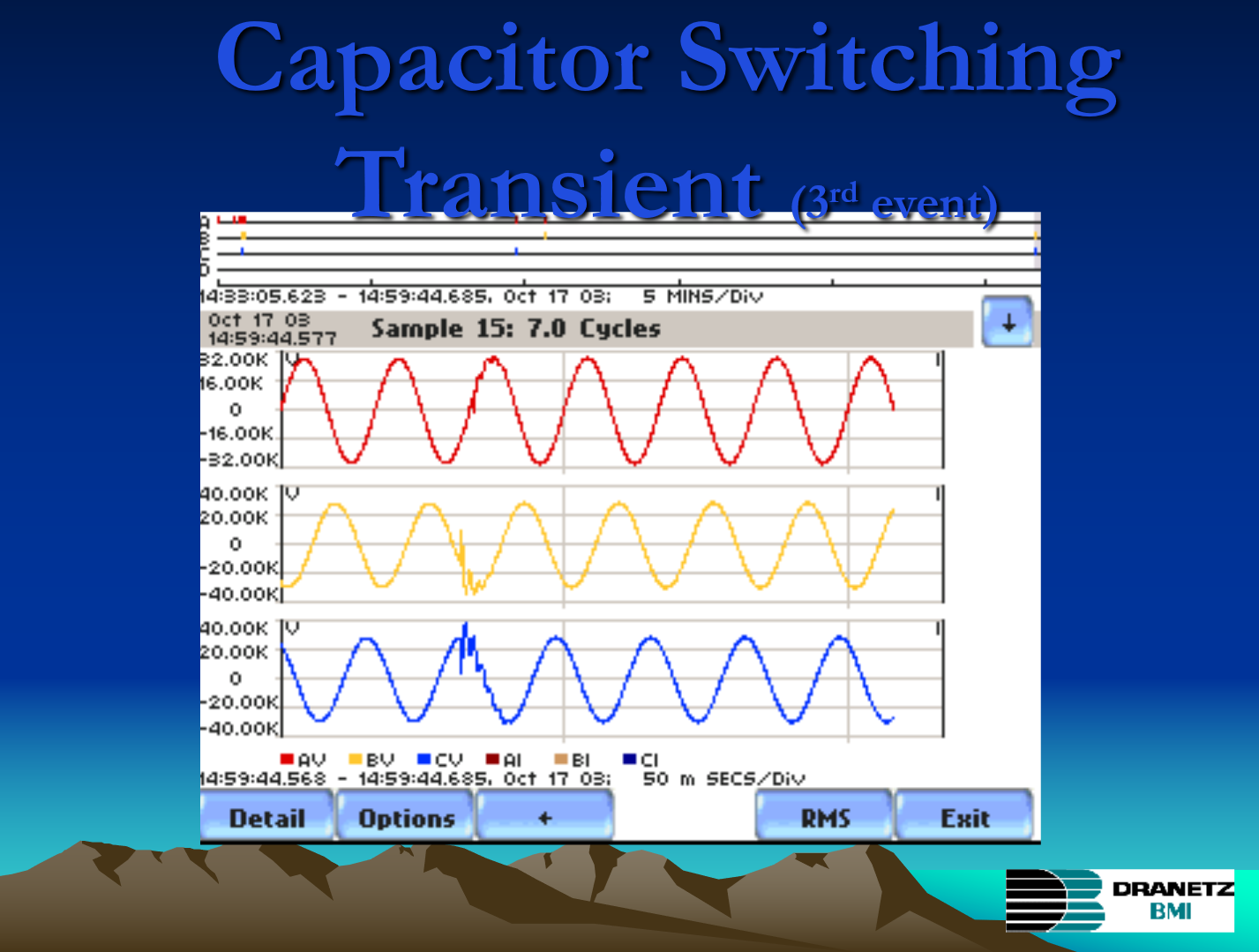
  • Cap Switch – A special case of oscillation with initial negative direction followed by positive impulse reaching from 1.2 to 1.8 times the normal peak. Oscillation frequency is 400 to 2kHz.
  • Flat top – Flattened Top.
  • Peak Limit – Set if peak exceeds the user threshold.
  • Amplitude Change – Smooth changes in amplitude.
  • Miscellaneous – Set if any of the transient does not fall to any of the above categories.

Duration – In case of multiple hits, the width of the disturbance is measured from the start of the first to the end of the last. The reported notch width is the worst case. Duration can be any of the following:

  • Impulse
  • Notch
  • Multiple notch
  • Eight cycle
  • Multiple eight cycle
  • Quarter cycle
  • Multiple quarter cycle
  • Half cycle (+/- 10%)
  • Full cycle (+/- 10%)

Severity – Describes the severity of the transient based on the amplitude of the peak. Severity can be mild, moderate or severe.

Input – The input where the transient was detected.

Summary DB Record – Points to the related summary record in the database.

First Impulse Direction – Describes the direction of the transient, either positive or negative. Positive direction adds energy to the wave, that is, it heads away from the zero crossing. Negative on the other hand, subtracts energy from the wave. It heads towards the zero crossing.

Start Offset – Offset to be added to the timestamp for location of the start of the transient.

Point on Wave in Degrees – Phase degrees that corresponds to the main timestamp – the start of the wave sample set.

Microseconds per degree – Period in microseconds per degree in the waveform.

Width – Width of the entire transient in microseconds.

Offset to 50% – Offset to start of impulse at 50% width.

Width at 50% – Width of impulse at 50% width.

Amplitude at 50% – Actual signed amplitude at 50% width.

Offset to 10% – Offset to start of impulse where it exceeds 10%.

Rise time from 10% to 90% – Rise time in microseconds.

Amplitude at 10% – Actual signed amplitude at 10%.

Amplitude at 90% – Actual signed amplitude at 90%.

Offset to max peak – offset in microseconds.

Peak Value – Signed peak value in the whole run.

Peak Value Adjacent – uses adjacent peaks.

Worst peak-to-peak Value – worst peak-to-peak deviation in the whole run.

Zero Crossing Oscillating frequency – measured oscillating frequency in hertz.

Peak Oscillating Frequency – highest measured oscillating frequency in hertz.

The transient characterizer produces a record that contains the above information. High frequency and low frequency transients use the same database record. Some parameters are not populated for the low frequency, depending on the classification of the event.
Contact: info@powerquality.co.th

The Challenges of Harmonic Measurements to Identify the Source of Harmonic Distortion in a Network

Published by Terry Chandler, A Power Quality Practitioner ™ for 30 years, Director of Engineering Power Quality Thailand LTD/Power Quality Inc. USA,Consultant for Dranetz Corporation USA (Asia business unit General manager)


image_1

Harmonics defined by multiple standards around the world.

  • IEC 61000-4-7 Class I defines harmonics and how to measure them.
  • IEEE 519-2014 defines harmonic limits.
  • This paper is focused on the measurement technique, the accuracy of the measurement and identifying the source of the harmonics in a repeatable, industry recognized method.

Why do we need to measure harmonics?

  • Some local regulations require documented harmonic levels and maximum allowable harmonics
    • Many countries/states/city/electric utilities have these regulations
  • Electrical system issues related to harmonics:
    • Overheating transformers
    • Overheating neutrals
    • Power Factor Capacitor failures
    • Notching in the sinewave causes high frequency interference
    • Mystery breaker tripping
    • Transformer or panel audible noise
    • Unexplained electrical system interference and operations.
    • Low Power Factor

Measurement techniques are documented in detail by IEC 61000-4-30 class A Edition 3

  • IEC 61000-4-7 Class I standard (harmonics standard referenced)
  • All modern PQ meters that are rated Class A measure harmonics to this standard.
  • The instruments digitize the waveform and execute a FFT to calculate the harmonic values of THD and individual harmonics values The Harmonics FFT algorithm is specified exactly in the standard
  • Harmonics are calculated on 10/12 cycle samples and must be GAPLESS. (Some instruments state 99.9% gapless??)

Harmonic Current Flow

harmonic current flow_figure1
Figure 1: Distorted – current induced voltage distortion.
harmonic current flow_figure2
Figure 2

Harmonic Load Current

thd_cal

Impedance:

The AC circuit equivalent of resistance in DC circuits. Impedance is the opposition to AC current flow made up of the available circuit elements of resistance, capacitive reactance, and inductive reactance. Each AC current frequency (harmonic) may be subject to a different impedance in the circuit. – Mike Lowenstein is president of Harmonics Ltd., Monroe, Conn. 
harmonic load current
Figure 3

Voltage Distortion (result of current)

voltage distortion
Figure 4

Note : the distorted current is constant the voltage distortion changes based on the Measurement point.
Harmonic Flow on Feeders
Normal path:

harmonic flow on feeders

Figure 5: Harmonic currents tend to flow from the harmonic source (nonlinear load) into the utility source because it is the lowest impedance.

Flow Path Altered by Capacitor – II

  • Adding a capacitor causes current to flow in abnormal paths
harmonic flow on feeders2
Figure 6

Monitoring for Harmonic Studies

  • How long to monitor
  • What to monitor “voltage, current and power harmonics”
  • Where to monitor
  • Monitoring during a test

Monitoring Duration

  • The only constant in harmonics is the varying rate of change
    • Monthly
    • Weekly
    • Daily
    • Hourly
    • By the minute
    • By the second
    • By the cycle
  • Data is needed for the amount of time it takes to clearly define the harmonic situation under ALL conditions.

How many simultaneous monitoring points? It depends on the situation and loads.

monitoring points
Figure 7


Is voltage distortion from the voltage or the current?

data with weak correlation
Figure 8: Harmonic voltage and current trend – data with weak correlation

data with strong correlation
Figure 9: Harmonic and current trend – data with strong correlation.
The variations are useful time is in seconds!!

Harmonic Power Flow

  • Which direction is the harmonic power flowing? from the source to the load, or, from the load to the source?
  • A controversial topic, the most commonly accepted practice is to measure the harmonic watts. The phase angle, or the relationship between the voltage and current for a particular harmonic. (note: NOT THD!)
  • The same rules that would be applied to a pure sine wave of voltage and current (which has only a fundamental frequency component) would be applied here.

Harmonic current flow?

  • Why is harmonic current flow is always indicated as from the non-linear load/s end  towards the source end (“backwards” from normal load current flow) ?
  • Jbartos (Electrical) 20 Apr 01
    The nonlinear load is a source of harmonics. If electrical equivalent circuits are drawn, one for each harmonic frequency, the different frequency sources (harmonic frequency sources) will be located at the nonlinear load location and the harmonic currents will be flowing from it.
    • This assumes a perfect source with no harmonic distortion!! In the real world of electrical networks, the source is not perfect. – Terry C.

Measuring Harmonic Power Flow Low Voltage (Direct Connection)

PQ meter capabilities (measure the phase angle of harmonic voltage and current?)
  • Sampling frequency
  • (# of samples per cycle divided 2)
  • Voltage resolution (What is the minimum voltage a meter can make with defined accuracy?)
  • For example, if the 9th harmonic voltage is .1% of the 230v fundamental then actual voltage will be 0.23 Vrms. Most PQ meters minimum accuracy specification is 1vrms or 10 Vrms or a % of full scale at low levels.
  • Current resolution of the meter. Specification is typically +/- 0.1% reading +/- 0.05% of full scale. So, with a full scale of 100.00 amps of 50 Hz current and a 9th harmonic of .1 %, the current value of the 9th harmonic would be 0.1 amp. But the measurement accuracy would be +/- (.05X10=.5amps!!)
  •  Low voltage 10 amp

    – Frequency response
    – Low current accuracy (typical 10% to 90% rated)

CT’s – TR2510A

tr2510a
tr2510a table


Measuring Harmonic Power Flow (in a transmission or distribution system)

  • PQ meter capabilities (can it determine the phase angle of harmonic voltage and current?)
    • Sample frequency, Voltage resolution, Current resolution
  • PT
    • Frequency response
    • Voltage output resolution relative to instrument
  • HV/Medium CT
    • Frequency response
    • Output current magnitude
  • Low voltage CT
    • Frequency response
    • Output current magnitude

Typical PQ meter Voltage Accuracy

  • Permanently installed (D-BMI 61K)
  • 0 – 600V, 1000Vpk, AC/DC coupled
    • RMS: 512 Samples/cycle, +/- 0.1% Reading, +/-0.05%FS, over 7KHz bandwidth
    • IEC61000-4-30 Class A compliant
    • Harmonics: IEC61000-4-7
    • Flicker: IEC61000-4-15
    • PQ: IEEE1159, IEEE519

PQ meter Current Accuracy (voltage input without I to V transducer)

  • Range: 0 – 1.5V, DC coupled (AC/DC)
    • RMS:  512 Samples/Cycle, +/- 0.1% Reading, +/-0.05%FS, 3KHz bandwidth
    • IEC61000-4-30 Class A compliant
    • Harmonics: IEC61000-4-7
    • Flicker: IEC61000-4-15
    • PQ: IEEE1159, IEEE519

Medium Voltage or HV Voltage and Current Transducers

  • Voltage transducers
    • PT Potential Transformers (inductive)
    • CVT Capacitive voltage transducer
    • Resistive divider
  • Current transducers
    • Inductive
    • Fiber optic

Voltage Transducers (PT or VT)

  • Required to reduce the voltage level to safe to connect meter.
  • CVT (Capacitive coupled)
  • Inductive Transformer
  • Resistor divider

Frequency Response Transformer Type PT (Typical?)

frequency reponse tx type pt
Figure 10

Transducer Output Value at Harmonic Frequencies

Example:

  • VTHD Voltage Distortion of 2% at 110kV

Assume 50% of the THD is the 5th harmonic (1% 5th harmonic) 1 % of 110kV = 1.1kV of the 5th harmonic (250 hertz) / PT ratio 110kV to 100V divide by 1000.

Actual 5th harmonic voltage presented to instrument is 1.1 volt.

If 7th Voltage harmonic is 0.1% then 110/1000 = 0.1VAC is presented to voltage channel.

If 9th voltage harmonic is 0.01% .010 VAC is presented to the voltage channel.

Voltage channels are typically specified from 1 or 10vrms to 600v or 1000vrms.

VT Errors at Range of Frequencies

vt errors at range of freq
Figure 11: Transmission errors with various different inductive instrument transformer types.

Errors in Inductive Voltage Transformers PTs

errors in inductive voltage tx pt
Figure 12: Amplitude and phase errors of an inductive voltage transformer at various different frequencies.

HV/MV Inductive Current Transducers

  • Accuracy and frequency response
hv_mv inductive current transducers
Figure 13: Amplitude errors in an inductive current transformer at various different frequencies.

Secondary Current Transducer

  • Accuracy varies with frequency.
  • Frequency response is not linear.
  • Precision measurement of very low levels of harmonic power is limited by phase angle error of CT.
  • Example, if primary current is 50% of full load. CT secondary current would be 50% of 1 or 5 amps. (0.5 or 2.5 amps). If 5th harmonic current is 1%, = 0.005 amps or 0.025 amps. Clamp on CT minimum rated current is 0.1 amp.

Is it possible to identify the harmonic source on distribution substation buss? YES! But it’s not easy and it is expensive.

  • What is needed:
    • PQ instruments on the buss CT and PT that can record the V harmonics, I harmonics with phase angles and periodically record the 10 cycle sample waveforms of at least 128 samples per cycle.
    • PQ instruments on each feeder that is a significant load. (IE greater than 5%)
    • Software that can post process the data to align the time stamps, calculate all harmonic parameters including power from the waveform samples.
    • PQ engineering training to analyze the data.
    • Patience!

Conclusions

  • Monitoring and evaluating harmonics in electrical system is a complex task due to complexity of the measurements and interaction of the various loads.
  • Determining the source of the harmonics on the transmission or medium voltage grid has additional complexity of the voltage and current transducers.
  • With detailed simultaneous measurements of all feeders, PQ engineering and software it is possible to deduce the source of harmonics on a substation bus bar.
  • The only constant in harmonics is the varying rate of change!

Contact the author TerryC@powerquality.co.th

If you can’t explain it to a 6th grader, you don’t understand it yourself ~ Albert Einstein

Energy Usage Report for A Small Office Facility

Published by Thaweesak Aranchot, Electrical Engineer, Power Quality (Thailand) Co., Ltd.

Plan

  • Measure actual usage of each load for recording a consumption. Then determine a way to reduce the usage without impacting a business efficiency
  • Investigate the actual data comparing with Electricity bill

Introduction

  • The energy consumption at PQT was studied to determine\how much energy was used, where it is being used, and how much it costs.
  • Dranetz HDPQ Xplorer was setup for monitoring the usage at the main board of small office facility. EP1 was setup for determining an individual load.
  • Then investigate an energy usage and compare with a MEA electricity bill to determine the exact energy usage and cost.

Loads of the Building

Figure 1:

  • A main of air Conditioner is set as 25 degree.
  • Operate continuously 9 hours.
  • The usage is 18.8 kWh on working day

figure1Figure 1

Figure 2:

A trend plot is showing a usage of two 36-watt fluorescent lamps in an hour.

18W x 12 – Consumed à 2.94 kWh/Day

36W x 4 – Consumed à 3.83 kWh/Day

Total = 6.77 kWh/Day

figure2

figure2-2

Figure 2

Figure 3:

  • A full day used 1.29 kWh without opening a door.
  • The usage will be 1.77 kWh per day if disturbs refrigerator operating.

figure3Figure 3

Figure 4:

  • Water pump usage is operated for part time.
  • Trend plot displays an hour usage of a water pump.

figure4Figure 4

Blue area is operating area

Green area is non-operating area

Figure 5:

  • Office equipment: computer, router, printer, and CCTV.
  • Illustration is a consumption of Printer
  • Consumption is 2.35 kWh per Day

figure5

Figure 5

Blue area is operating area

Green area is non-operating area

A Consumption for Working Day

Load consumption of a working day in Percentage.

Average consumption is 30 kWh per day.

pie_chart

Figure 6:

  • Trend plot is displaying a business day usage for all loads in the office.
  • A business day usage is 31.3 kWh for per day

figure6Figure 6

Figure 7:  Working day usage between middle of December to middle of January.

figure7

Figure 7 – Working day consumption

A Consumption for Non-Working day

Display a single day usage for Non- Working day (Figure 8)

  • A day off usage is about 8 kWh
  • There are kinds of load that always run all times such as CCTV, security lights, router, refrigerator.


figure8

Figure 8

Figure 9: Non-working day usage between December 2018 to January 2019

figure9Figure 9

Total Consumption (Figure 10)

  • Electricity bill displays monthly usage during December 14, 2018 and January 14, 2019.
  • Total cost is 3,323.54 THB including vat, service charge and FT factor.


figure10

Figure 10

Solutions: How can we save cost of electricity?

Saving cost, we could reduce electricity of the main load for example:

  • Air conditioner: Typically, higher temperature can be able to reduce energy usage by decreasing 10% of usage. (Table below)

table

  • Clean an air filter regularly for saving 10% of the air conditioner consumption.
  • Reduce an operation time of air conditioner for an hour that can be able to reduce 10 % of Air conditioner usage. (Credit: Analysist energy management book for small and medium business, December 2012, Ministry of Energy, Thailand.)
  • Install an insulation on wall or ceiling to reduce temperature inside that allow the air conditioner work less than high temperature. (Credit: Department of Energy, United State of America.)

We could reduce electricity of load for example, Lighting:

  • Fluorescent lamp can be replaced with LED lamp to reduce energy usage.
  • A LED lamp costs 400 THB and owner will get back in 12.7 month.