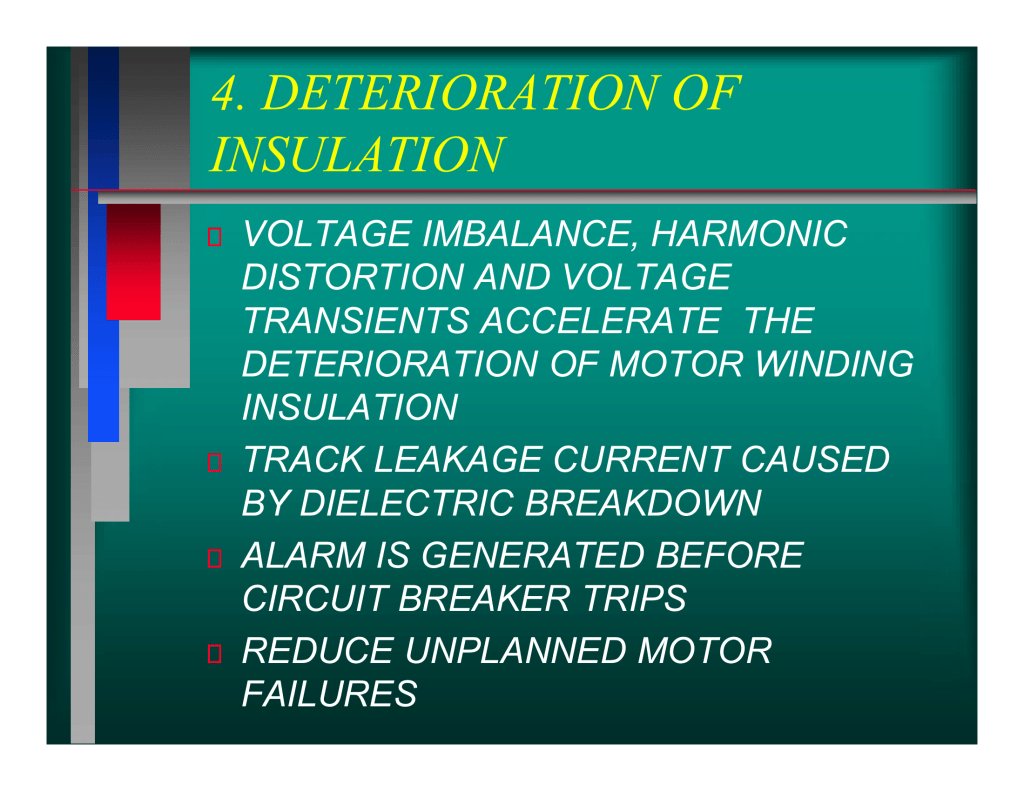
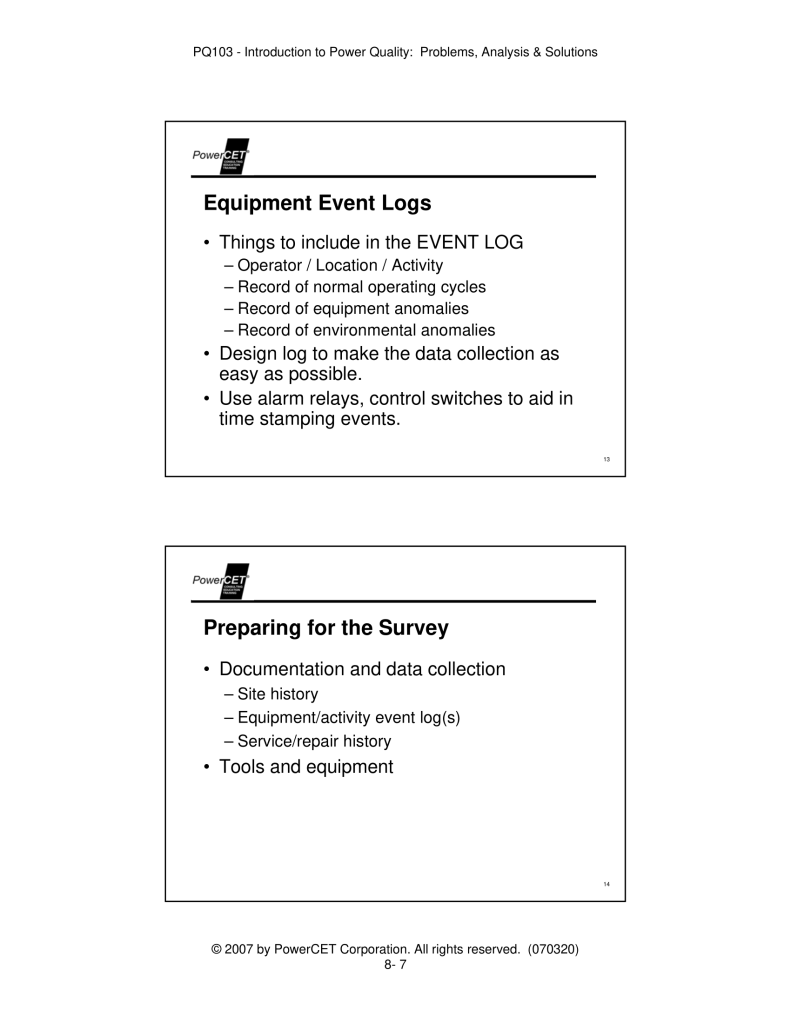
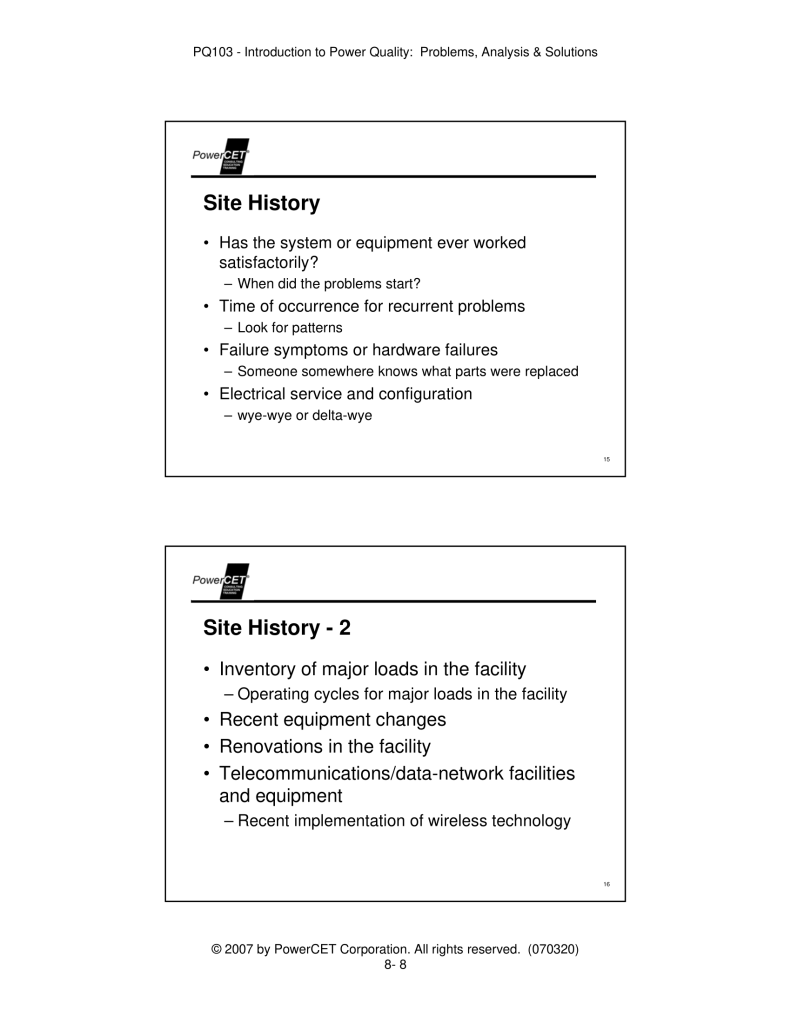
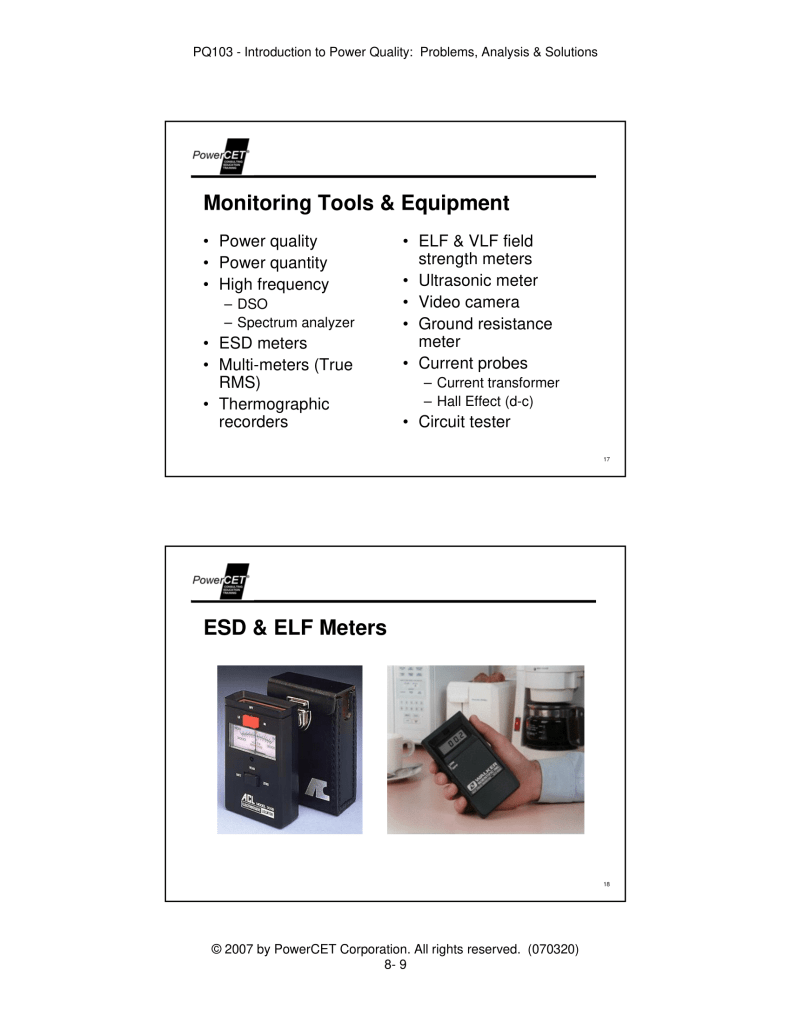
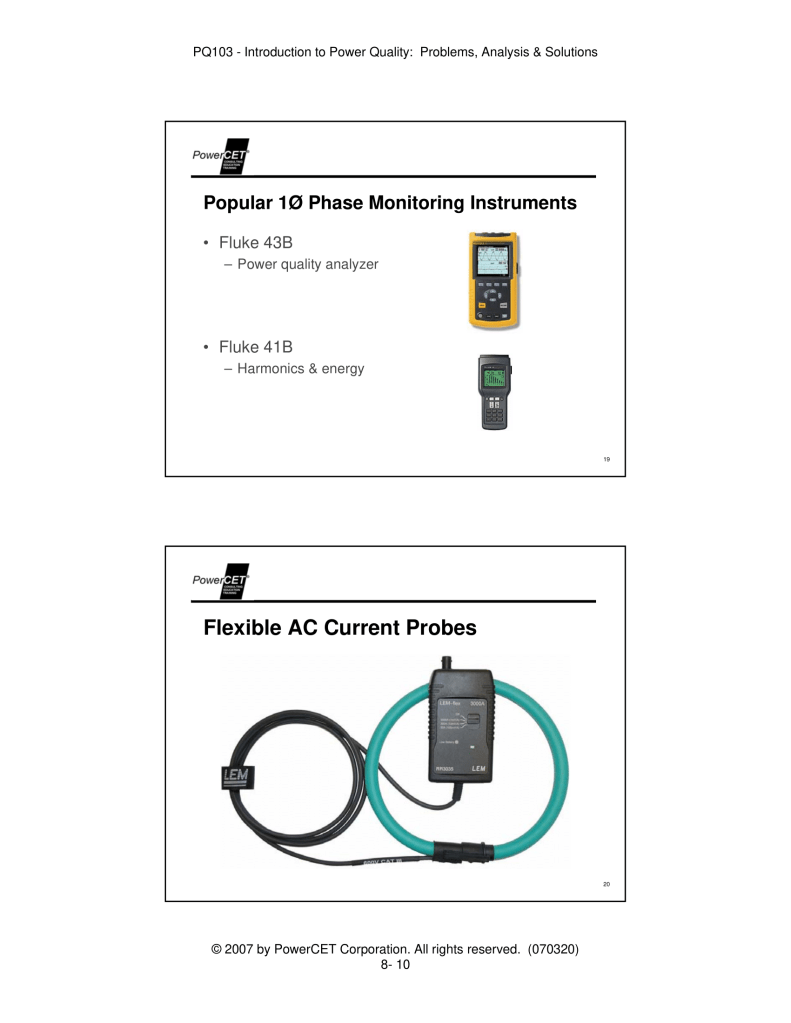
A Lightning Arrester, Surge arrester or Line arrester is a device used on electrical power systems and telecommunications systems to protect the insulation and conductors of the system from the damaging effects of lightning. The typical Lightning Arrester has a high-voltage terminal and a ground terminal. When a lightning surge (or switching surge) travels along the power line to the Arrester, the current from the surge is diverted through the Arrestor, in most cases to the earth.
Without good earth connections, even the most sophisticated of building lightning protection installations will be ineffective. However, the only way to ensure that the earth connections really are good is to test them. If protection fails or is absent, lightning that strikes the electrical system introduces thousands of kilo Volts that may damage the transmission lines, and can also cause severe damage to transformers and other electrical or electronic devices.
What is a Lightning Arrester/Surge Arrester?
Surge arresters are devices that help prevent damage to apparatus due to high voltages. The arrester provides a low-impedance path to ground for the current from a lightning strike or transient voltage and then restores to a normal operating conditions. A surge arrester may be compared to a relief valve on a boiler or hot water heater. It will release high pressure until a normal operating condition is reached. When the pressure is returned to normal, the safety valve is ready for the next operation. When a high voltage (greater than the normal line voltage) exists on the line, the arrester immediately furnishes a path to ground and thus limits and drains off the excess voltage. The arrester must provide this relief and then prevent any further flow of current to ground. The arrester has two functions, it must provide a point in the circuit at which an over-voltage pulse can pass to ground and second, to prevent any follow-up current from flowing to ground.
Various types of surge voltages can occur in electrical and electronic systems. They differ mainly with respect to their duration and amplitude. Depending on the cause, a surge voltage can last a few hundred microseconds, hours or even days. The amplitude can range from a few millivolts to some ten thousand volts. Lightning strikes are a special cause of surge voltages. Direct and indirect strikes can result not only in high surge voltage amplitudes, but also particularly high and sometimes long current flows, which then have very serious effects.
Types of Lightning Arrester
Rod gap arrester
Sphere gap arrester
Horn gap arrester
Multi gap arrester
Electrolyte type arrester
Metal-oxide lightning arrester
Maintenance of Lightning Arrester
Cleaning the outside of the arrester housing.
The line should be de-energized before handling the arrester.
The earth connection should be checked periodically.
To record the readings of the surge counter.
The line lead is securely fastened to the line conductor and arrester.
The ground lead is securely fastened to the arrester terminal and ground.
Why Lightning Arrester Testing is Done?
If protection fails or is absent, lightning that strikes the electrical system introduces 1000 of kilo Volts that may damage the transmission lines, and can also cause severe damage to transformers and other electrical or electronic devices. Lightning-produced extreme voltage spikes in incoming power lines can also damage electrical home appliances that’s why it is damn crucial to check the integrity of Lightning Arrester.
A direct lightning strike in the building can cause following damages:
Impact on health or loss of life.
Loss of technical services for the public.
Loss of irreplaceable objects of cultural significance.
Financial losses.
Lightning arrester testing should be scheduled as follows:
Explosion-protected, physical structures should undergo a visual check every 6 months.
The electrical test of the installations should be carried out once a year.
For systems with strict requirements in terms of safety technology, for example, the legislator can prescribe a comprehensive check. This can be necessary if there has been a lightning strike within a certain radius of the respective system.
Comprehensive testing in critical situations relates to physical structures that contain sensitive systems or systems with a large number of persons.
Lightning protective devices are developed, tested, and classified according to their own international series of product standards and they have defined protection functions and performance parameters to make them suitable for use in corresponding protection concepts.
Thus to achieve high system availability, system operators must regularly inspect and maintain their electrical system. This is stipulated by legislators, supervisory authorities or professional associations based on the respective system type. Regular testing and maintenance of lightning protection systems (external and internal lightning protection) is also required according to lightning protection standard IEC 62305-3.
Specialist knowledge is required in order to carry out professional testing of lightning protection systems. For this reason, this test must be carried out by a lightning protection expert, like Carelabs.
Inspecting the SPDs (Surge Protective Devices) is also part of this. The standard also demands that maintenance is properly documented.
New Developments in Lightning Arrester Testing Field
New developments, presently achieved for distribution range, foresee the replacement of the conventional porcelain housing with a polymeric one, allowing to improve the mechanical characteristics and the failure mode behaviour. Furthermore special applications for surge arresters, such as protection of gas insulated substations and prevention of lightning faults in transmissions lines, are now taken into consideration by several utilities. The evolution of surge arrester construction technologies and application requires a continuous revision of relevant standards and testing techniques. CESI has been actively involved in testing surge arresters since the 1960s, through the development and setting up of testing facilities and the participation to the major technical and standardization bodies. The paper analyses the most important aspects relevant to surge arrester testing, based on the most recent experience developed in CESI. Particular attention is focused on the short circuit test techniques to address the failure mode and on the ageing test procedures to investigate the long term performance of surge arresters.
What is Done During Lightning Arrester Testing?
Protective measures against lightning strike events are stipulated in lightning protection standard IEC 62305. Other standards in the series are IEC 61643-11, BS6651, IEC 61643-21 and IEC 61643-31. Over twelve years, the protection system will test under all seasonal conditions – these can significantly affect performance due to changes in resistance and other characteristics. Following tests can be conducted:
Resistance testing
Continuity testing
Ground or soil resistivity testing
Visual inspection
How do We Conduct Lightning Arrester Testing?
Various tests carried out for surge arrestor testing are following:
Visual Inspection of Lightning Arrester
Visual inspection an installation should take into account the following key points and observations recorded in the detailed inspection report:
Inspections should repeat at fixed intervals, not exceeding 12 months. If the intervals fixed at 11 months, the system will inspect throughout every season of the year over 11 years.
The mechanical condition of all conductors, bonds, joints and earth electrodes should check and any observations noted.
If a part is unable to inspect, this should note.
The bonding of any recently installed/added services should check.
Thermal Image Testing (Infrared Testing) of lightning Arrester
The reason thermal imaging can assess the health of a surge arrester is because these components dissipate very little energy during steady state operation and seldom exhibit a temperatures much above ambient. Even the largest MOV arresters, e.g. 4 to 5 meters in height, dissipate less than 50 watts. With an arrester of that length, this does not create a visible temperature rise and makes any effort to measure temperature gradient above ambient a challenge.
The benefits of thermal imaging are significant:
Speed of data collection. Indeed, there is no faster way at present to tell if an arrester is near end-of-life than a scan of its temperature.
Accuracy from a distance is also excellent, especially if using a long-range camera lens.
The risk that an arrester is in the process of failing without also generating some heat is very low. At the same time, if an arrester is damaged by lightning strike or switching surge only days after its last thermal scan, it may well fail before the next scheduled scan. This potential for failure between successive scans is perhaps the only major negative of thermal imaging.
Power Factor Testing of Lightning Arrestor
Power factor testing is extremely sensitive to weather conditions. Tests is conducted in favourable conditions whenever possible. Measurements on surge arresters are always performed at the same or recommended test voltage since nonlinear elements may be built into an arrester.
Except for the specific purpose of investigation surface leakage, the exposed insulation surface of an arrester is kept clean and dry to prevent leakage from influencing the measurements. Extreme care is taken when handling arresters suspected of being damaged, since dangerously high gas pressures can build up within a sealed unit. The test mode and the number of tests performed will depend on the number of arresters in the stack. After performing tests, the test results are recorded on a test form.
For all power factor testing, the more information recorded at the time of testing will ensure the best comparison of results at the next routine test. Test data should be compared to factory or nameplate data if available. If no data is available, compare the test results to prior tests on the same arrester and results of similar tests on similar arresters. The following additional information should be recorded on the test form.
Record all the nameplate information of the arrester.
Identify each set of readings with the arrester serial number.
Note any special or unusual test connections or conditions.
Record actual test voltage, current, watts, power factor and capacitance. Correct the current and watts to a standard test voltage 2.5kV or 10kV.
Surge arresters are often rated on the basis of watts loss. To obtain the equivalent 10 kV watts loss from a measurement of capacitance and power factor, perform the following calculations if the test set does not display the results.
Watts loss = CpF x %DF x 377 x 10-6 (for 60 Hz)
Watts loss = CpF x %DF x 314 x 10-6 (for 50 Hz)
Where: CpF = capacitance in picofarads %DF = percent dissipation (power factor) ß Record ambient temperature and relative humidity and a general indication of weather conditions at the time of the test.
Fall of Potential Testing Method of Lightning Arrester
Fall of Potential method involves the electrode under test; two reference electrodes, a set of leads and four-pole test meter.
This method, however, is only practical if the electrode to test is located near to virgin ground where test electrodes can drive. In reality, in town and city centres, this is very often not the case. Presence of buried services and pipes may also influence the test current and the last test value may be corrupted as a result of these external influences. Reference electrodes is set away from such potential disturbances. Where practical conditions dictate that the ‘Fall of Potential’ method cannot be used, the ‘Dead/Known Earth’ method is really the only practical alternative.
Dead Earth Testing Method of Lighting Arrester
The ‘dead earth’ could be any low-resistance earth not directly or unexpectedly connected to the earth under test. A connection made from a suitable earth to the test meter, which is in turn connected to the electrode under test will show the lightning protection system acting as the known ‘dead/known’ earth.
A reading is then taken and the ohmic value achieved is effectively the series resistance of the electrode under test and the dead earth.
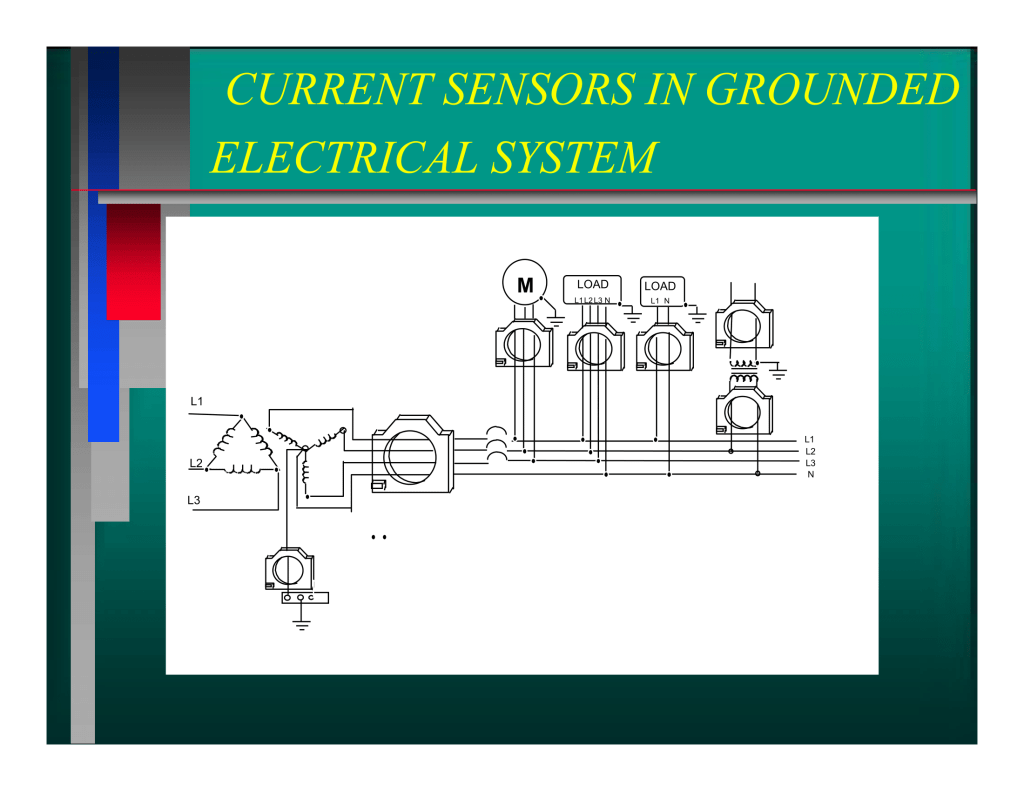
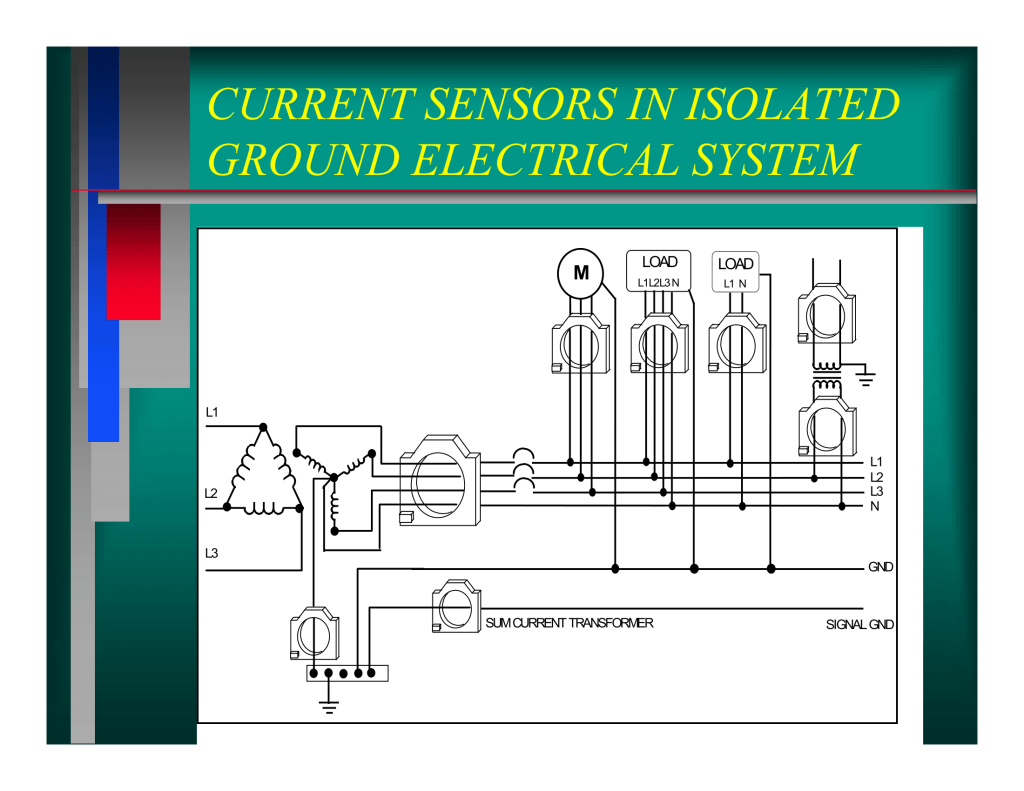
Leakage Electricity of Lightning Arrester
The Leakage Electricity Monitors are used to measure the Leakage Current of Surge Arrester, and in case of high leakage current Surge Arrester is replaced.
The power loss can be checked by several methods given below:
Using a voltage signal as reference.
Compensating the capacitive element by using a voltage signal.
Capacitive compensation by combining the leakage current of the three phases.
Third order harmonic analysis.
Direct determination of the power losses.
Third order harmonic analysis with compensation for harmonics in the voltage.
Other usual tests carried out on Lightning arrestors are harmonic tests, hipot test and insulation resistance test.
Benefits of Lightning Arrester Testing
Lightning protection testing would make sure that all structures, key electrical and electronic installations are safe from the effect of lightning strike.
The financial benefits are determined as follows: how does the total annual cost for a lightning protection system compare to the costs of potential damage without a protection system? The cost evaluation is based on the expenditures for the planning, assembly, and maintenance of the lightning protection system.
Statistics show the UK alone subjected to around two million strikes per year and, to make sure your lightning protection system is functional when called upon, bearing in mind you have no way of determining when that any maintenance work should be carried out with suitable expediency.
In the hands of experienced engineers, proper testing and maintenance of lightning protection systems can become a routine, but very necessary, part of a comprehensive safety programme. At the very least the consequences of not taking a thorough approach could incur unnecessary costs but, given the destructive potential of a lightning strike, those consequences could be much worse.
All lightning protection systems and static earthen systems must inspect and test by skilled person using calibrated test equipment. Complete lightning protection testing would make sure that all structures, key electrical and electronic installations are safe from the effect of lightning strike.
Pavel Štěpán, Technical University of Liberec – CZE, Email: Pavel.Stepan@tul.cz
Leoš Kukačka, Technical University of Liberec – CZE, Email: Leos.Kukacka@tul.cz
Jan Kraus, Technical University of Liberec – CZE, Email: Jan.Kraus@tul.cz
CIRED 23rd International Conference on Electricity Distribution, Lyon, 15-18 June 2015. Paper 1077.
ABSTRACT
The paper is concerned with specific problems of flicker meter implementation in class A and class S power quality analyzers according to the most recent IEC standards, for class F1 and F3 respectively as defined in IEC 61000-4-15 ed.2.0. Test results of designed prototypes are included and compared with our previous implementations. We have focused to introduce the fully compliant correct flicker meters and understand the minimal requirements for such implementation.
INTRODUCTION
Voltage fluctuations are one of the many areas defining the complete power quality monitoring. One of the parameters indicating the voltage fluctuation is flicker. Flicker specification comes from observations of a subjective unpleasant sensation of flashing lights by human eye and brain [1]. Evaluation of the flicker as a power quality index focuses on voltage fluctuations of low frequency from 0.5 to about 35 Hz.
Flicker became observed and monitored because already at voltage fluctuation only a few tenths of a percent causes unpleasant changes in the perception of the light radiation of different light sources and thus adversely affect the human body [2]. Because the human eye is extremely sensitive to flicker voltage, change must be kept within very strict limits. Flickering in power systems is caused by transients (large changes in power consumption) or usage of nonlinear arc furnaces, welding machines etc. (harmonic distortion generally).
The paper follows an implementation of class F1 flicker- meter developed on our own modular ARTIQ platform. This device represents a modular PQ-Analyzer with common low cost 32-bit ARM micro-controller and high quality 16/24-bit AD convertor. We compare this implementation with our previous IEC 61000-4-15 ed.1 [3] flicker meter with simpler analog hardware in a PQ-B analyzer and with more recent class F3 flicker meters (PQ-S1and PQ-S2).
Implementation of flicker-meter is performed according to the standard IEC 61000-4-15 ed. 2.0 [4]. Paper highlights some pitfalls of calculating flicker in a general power quality analyzer. Some partial development achievements were already published in [5].
Hardware Characteristics
The main calculation unit of PQ-A analyzer is ARM STM32 microcontroller, which includes dedicated floating point unit. This makes the floating point calculations much faster and thus it can perform advanced mathematical operations faster. Voltage signals in PQ-A are sampled using a 24-bit sigma-delta AD converter with sampling rate of 256+ samples per period. PQ-B use 16-bit AD converter and PQ-S1 and PQ-S2 use internal 12bit AD converter implemented in microcontroller.
IMPLEMENTATION
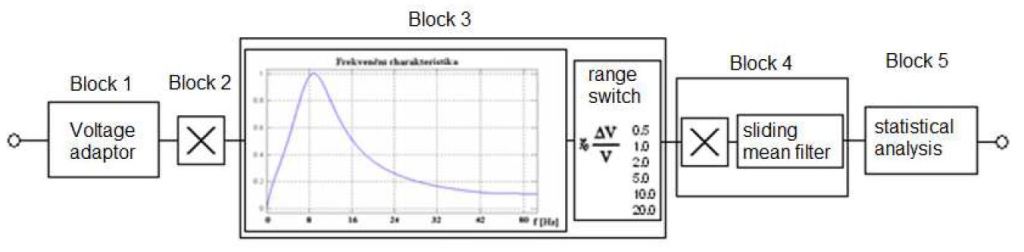
Implementation of flicker calculation is performed in accordance with IEC 610 00-4-15 Edition 2.0. This chapter describes problems with calculation in the analyzer and also used solutions. The scheme of a flicker meter is shown in Figure 1.
The figure depicts a schematic of the measuring and processing system. It consists of five blocks. The first block normalizes the level of the signal in order to achieve comparable results for various effective values of measured voltage. Purpose of the second block is to recover the voltage fluctuation by squaring the input voltage. Third block comprises several filters in order to remove the second harmonic (present due to squaring the signal) and weight the signal to simulate the human brain sensation and perception. T he fourth block squares the signal and applies an averaging filter. The blocks 2 – 4 simulate the perception sequence: lamp –> human eye –> human brain. The fifth block performs statistical analysis of the measurement.
Figure 1: Block diagram of flicker-meter
Our Solution
An AD converter on our platform samples the input signal at 14 kS/s on a 50 Hz network. Our previous experiments have shown that a lower sampling rate is actually optimal to reduce the overall computational load of the controller. For this reason it is recommended to perform resampling. In our solution the output sampling rate of 400 kS/s has been used.
The exact sampling rate is varying and dependent (phase locked) on the measured frequency of the fundamental harmonic component of signal. Such sampling method is needed for the correct operation of the power quality analyzer. But for evaluation of the flicker indices it is not suitable and without appropriate resampling one can introduce significant errors to the result. The resampling process is therefore a complicated process. Solving this problem will be described in further detail elsewhere.
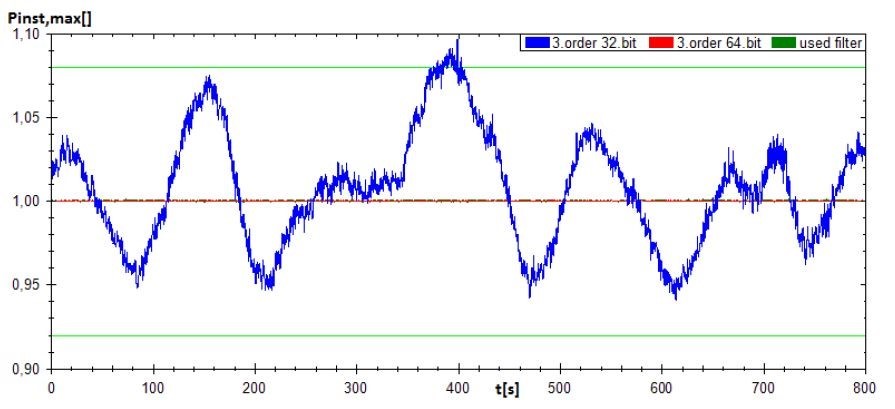
First the digital signal from AD converter is squared and then is resampled to lower sampling rate but before resampling it needs to be filtered with a low-pass filter to prevent aliasing. For filtering it would be appropriate to use higher-order IIR filter (at least 5thor der). This filter is extremely susceptible on calculation accuracy and the 32-bit floating point arithmetic proved insufficient. Also the 64-bit/double precision could not have been used as on the platform as its calculation was too slow (approximately 10x slower). This problem was solved by a combination of four simpler 2n d order filters. Comparison of 3rd order filter computed using 32-bit values and 64-bit values and combination of simpler filters are shown in the Figure 2. It shows curve of the maximum current flickering Pinst in time with voltage fluctuations of 0.25% and a modulation frequency of 8.8Hz. In this setting should be Pinst, max = 1 ± 8 %. After the filtering, signal can be resampled to 40 0 kS/s for further processing without a significant aliasing effect.
Figure 2: Comparison of filters
Resampled signal is normalized in order to achieve comparable results for various effective values of measured voltage.
Next step is series of filters, squaring signal and averaging filter defined in [4] and described in previous section. Last step is statistical analysis. It is also constructed by [4] and there is used 220 (380 for PQ-A analyzer) classifiers with levels given by expression: Level = 0.004 x worder where w = 1.07 (1.04 for PQ-A).
THE MEASURED RESULTS
This chapter describes the measured results of the flicker meter tests given in [4]. The measurement was performed on the new ARTIQ (PQ-A), PQ-S1 and PQ-S2 hardware platforms. Results for an outdated PQ-B platform designed according to [3] are also given. Pinst,max for PQ-B was taken from [6]. Some tests from the standard ([4] ch. 6.4, 6.7 and 6.9) could not be performed because the testing signals required could not be generated by our FLUKE 61000A signal generator.
Used Symbols
Pst – short-term flicker severity
Pinst – instantaneous flicker sensation
Pinst,max – peak value of the instantaneous flicker sensation
Pinst measured during the observation period
Tshort – short time interval for Pst evaluation (10 minutes)
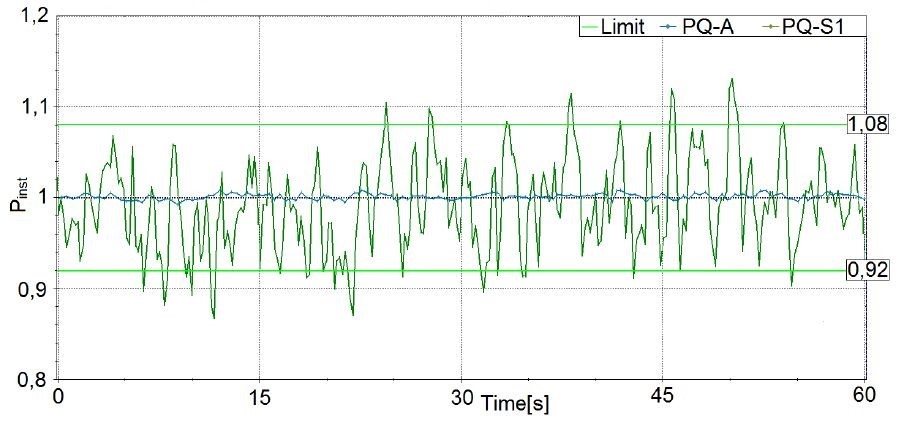
In the tests, Pinst,max or Pst is measured. The first quantity is easily corrupted by noise coming from the used AD converters. Figure 3 shows temporal evaluation of Pinst,max for ARTIQ and PQ-S1 devices. The input signal was 230 V with its amplitude varying by 0.25 % with frequency 8.8 Hz ([4], table 1). For this kind of signal, Pinst,max should equal to 1 ± 8 %. Figure 3 reveals that high end devices perform with much lower noise than PQ-S1. Because of high noise level, the values of Pinst,max are locally averaged in the figure.
Figure 3: Pinst depending on the time
The noise however, due to averaging and statistical evaluation, does not influence Pst. This means that the device can be used conveniently to measure this quantity.
Sinusoidal voltage changes ([4], ch. 6.2)
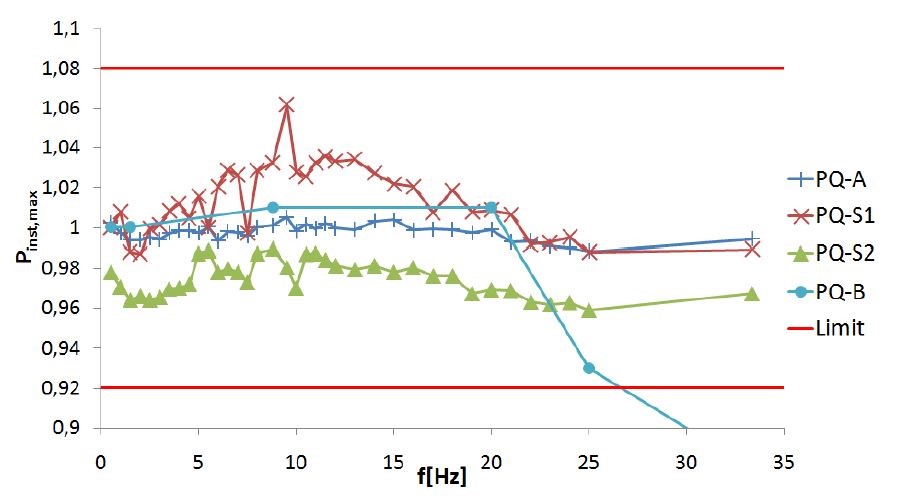
This test verifies the overall response of the measuring chain from input signal to output Pinst for the input signal with a sinusoidal voltage fluctuation. In this test the value Pinst,max = 1,00 ± 8 % should be achieved. Figure 4 shows that the new solution fully complies for all measured frequencies. The obsolete flicker meter PQ-B fails this test for the highest frequency. The test also reveals outstanding performance of the ARTIQ platform.
Figure 4: Sinusoidal voltage changes
Rectangular voltage changes ([4], ch. 6.2)
This test is similar to the previous one, only the rectangular voltage fluctuation is used as an input signal. Figure 5 shows compliance with the required limits of the new solution and failure of the obsolete implementation PQ-B for higher frequencies.
Figure 5: Rectangular voltage changes
Bandwidth test using harmonic and interharmonic side band modulation ([4], ch. 6.6)
In this test the input signal is composed from a fundamental harmonic, a higher harmonic and an inter harmonic whose difference in frequency is 10 Hz (e.g. 140 and 150 Hz) and is thus detected in the frequency range of the meter. Measured Pinst,max should be equal to 1.00 ± 8 %.
Figure 6 shows that only the high end PQ-A platform fully conformed the test within a wide range of frequencies up to 6750Hz. PQ-S1 complied only in range up to 450 Hz and PQ-S2 only below 250 Hz. High frequency attenuation is caused by analogue antialiasing filter. The impact of the filter gain is amplified by double squaring of the signal. Thus 50 % filter attenuation results in 93.75 % attenuation of expected Pinst . PQ-B platform completely failed the harmonic test. However, this test is not required for class F3 devices according to [4].
Figure 6: Bandwidth test using harmonic and inter-harmonic
Rectangular voltage changes and performance testing ([4], ch. 6.3)
In this test the total response for rectangular voltage fluctuations is measured. Also the overall range of the flicker meter is determined. The input signal is sinusoidal with a rectangular voltage fluctuation ([4], table 5). The fluctuations magnitude is multiplied by the k-factor. Range of the meter is determined by such value of k, for which the achieved accuracy is Pst ± 5 % or 0.05 (whichever is greater). Figure 7 summarizes results of this test for all PQ analyzers.
The first graph shows summary of the PQ-A analyzer used as a leading implementation in our evaluations. It achieved great results high above the required flicker range. Thanks to this performance the ARTIQ range of flicker meter is declared as 0 – 20 Pst. This device meets the requirements for class F1 according to [4] as well as the class A according to [7]. The graph shows that in measuring small flicker affects the use of better AD converters.
The second graph shows the results for the device PQ-S1. Achieved measuring range is 0.2 20, worse accuracy for smaller values is mostly caused by the noise of used analog components.
Next graph shows the results for the device PQ-S2. That reached a little better result and reached the range of 0.1 – 20. It also shows that the accuracy of the third phase is significantly worse than the first two phases yet still compliant. This is probably due to the design of hardware and will be addressed in its future edition.
The last graph shows the results of the PQ-B device. It still gives acceptable results for small values but it does not meet limits for higher values. Values for 1CPM are caused by the use of a shorter averaging in block 1 of the measurement chain. The contrary, smaller values for 4000CPM (33,3Hz) are caused by the use of inaccurate evaluating filter that attenuates frequencies over 30Hz. These weaknesses, however, in an earlier version of the standard [2] were not reflected, because at that revision the test required only the lower frequencies. So this instrument is complaint only according to the version 1.0 of the IEC flicker standard and will need an update for the actual version.
Figure 7: Rectangular voltage changes and performance testing.
CONCLUSION
The tests indicate that a sufficiently accurate result can be achieved in all the performed tests with both high end hardware platform (ARTIQ) and with several low-end, low-cost platforms. Results of ARTIQ comply with all limits required by the ed.2.0 of the IEC flicker standard for the highest class F1. Tested PQ-S were sufficient for class F3 requirements. Results from all the tests were also significantly better than our previous implementation of a flicker meter which failed some of the newly required tests. Some of the tests given by [4] could not have been performed for this report as the signal generator used in the experiments cannot provide the necessary signals. Results for the ARTIQ platform were surprisingly good, especially the frequency range and measurement range test.
Even better results might still be achieved by optimizing the statistical analysis block. This does not fall in the scope of this paper, though. Also, it is possible to improve results for lower values by subtracting the noise that would be determined during calibration. The platform is also overall sufficient for implementation of other flicker and RVC related evaluations. In the following work we plan to use it also for evaluation of flickering of LED lights supplied by both AC and DC power supplies.
ACKNOWLEDGEMENT
This work is co-financed from the student grant TUL 78000 Progressive mechatronics, control and measurement systems with application of advanced simulation methods. Authors would also like to thanks for support and for instruments provided by the KMB systems company.
REFERENCES
[1] J.A. Pomilio, S.M. Deckman, “Flicker Effect Produced by Harmonic Modulation”, International Conference on Harmonics and Quality of Power ICHQP 98, Athens, Greece, 1998 [2] S.M. Berman, D.S. Greenhouse, I.L. Bailey, R.D. Clear, T.W. Raasch, “Human Electroretinogram Responses to Video Displays, Fluorescent Lighting and other High-Frequency Sources”, Optometry and Vision Science, p. 645-662, 1991 [3] ČSN EN 61000-4-15 ed.1, Elektromagnetická kompatibilita (EMC) – Část 4: Zkušební a měřicí technika Oddíl 15: Měřič blikání – Specifikace funkce a dimenzování [4] ČSN EN 61000-4-15 ed.2, Electromagnetic compatibility (EMC) – part 4 Testing and measuring devices – Flickermeter – Specification, functions and dimensioning [5] P. Štěpán, M. Novák, 2014, “Implementation changes of a flicker meter in accordance to standard 61000-4-15 ED.2”, In. proc. KOPES 2014, pg. 118-123 [6] Jan Šlezingr, Jiří Drápela, 2011, “Preliminary results of selected flicker meters tests for compliance with second edition of IEC 61000-4-15”, Proceedings of the 12th International Scientific Conference Electric Power Engineering, Ostrava [7] IEC 61000-4-30 ed. 2.0, 2008, Electromagnetic compatibility (EMC) – Part 4-30: Testing and measurement techniques – Power quality measurement methods, IEC
Published by Dranetz™ Technologies, Inc., Case Study, Website: dranetz.com.
This case study was submitted by Ing. Leopoldo Martínez Basulto, Dranetz México.
INTRODUCTION
Harmonics are an important PQ issue today. Variable Frequency Drives (VFD), Uninterruptible Power Systems (UPS), computers, LED lighting, electronic ballasts, etc. are widely used in all kinds of facilities. It is well known that such devices can cause many problems at end user’s installations and utility networks, such as: Voltage distortion, damaged capacitor banks, tripping breakers, blown fuses, overheating of cables and transformers, damage to PLC’s and sensitive electronic loads, etc.
DESCRIPTION
Variable Frequency Dives are becoming very popular in controlling AC motors for industrial and commercial applications. They provide speed control for processes such as ventilators, pumps, air compressors, elevators, etc. at substantial energy savings. However, VFD’s generate significant harmonic currents depending upon the power electronics technology used (number of pulses, SCR, thyristors, etc.). In many cases, they exceed IEEE-519 recommendations and cause some of the problems mentioned above. Also, Pulse Width Modulated (PWM) drives can cause additional problems in AC motors, such as premature bearing wear and short-circuits in windings due to spikes from modulation if the motor is not designed for this condition.
In many applications, harmonic mitigation techniques are required, along with proper power monitoring instrumentation to measure the harmonics spectrum and waveforms. This can be essential in assuring such solutions meet customer requirements. Passive filters have proven their effectiveness at reasonable prices.
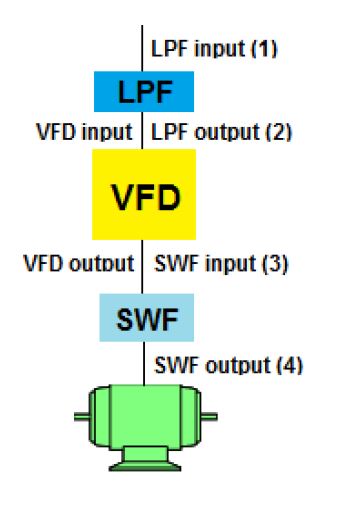
This case study is a customer witness and performance test carried out at the laboratory of a manufacturer of two passive filters to be supplied. The test is conducted with a 460V, 100HP AC motor with a 6-pulse PWM VFD. One Low Pass Filter (LPF) is installed at the input of the VFD (load side), and one Sine Wave Filter (SWF) is installed at the output of the VFD (motor side).
Figure 1: Low Pass Filter and Sine Wave Filter Locations
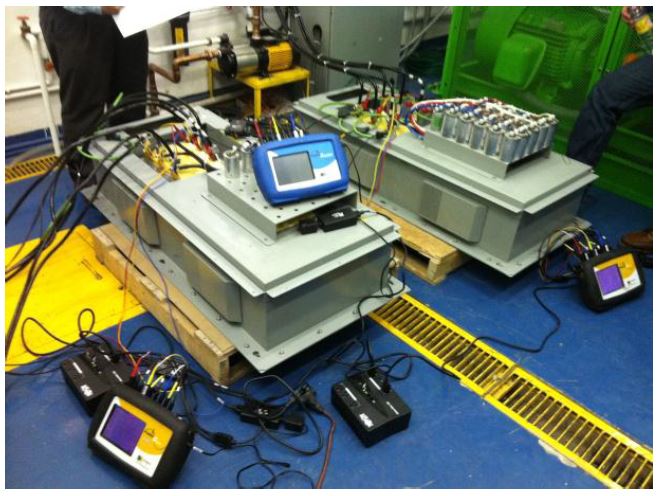
Four Dranetz PowerXplorer and PowerVisa Power Quality analyzers were used to measure the effectiveness of the filters, monitoring the points shown in Figure 1 above: Low Pass Filter Input, Low Pass Filter Output, Sine Wave Filter Input, and Sine Wave Filter Output.
Figure 2: Test In Progress
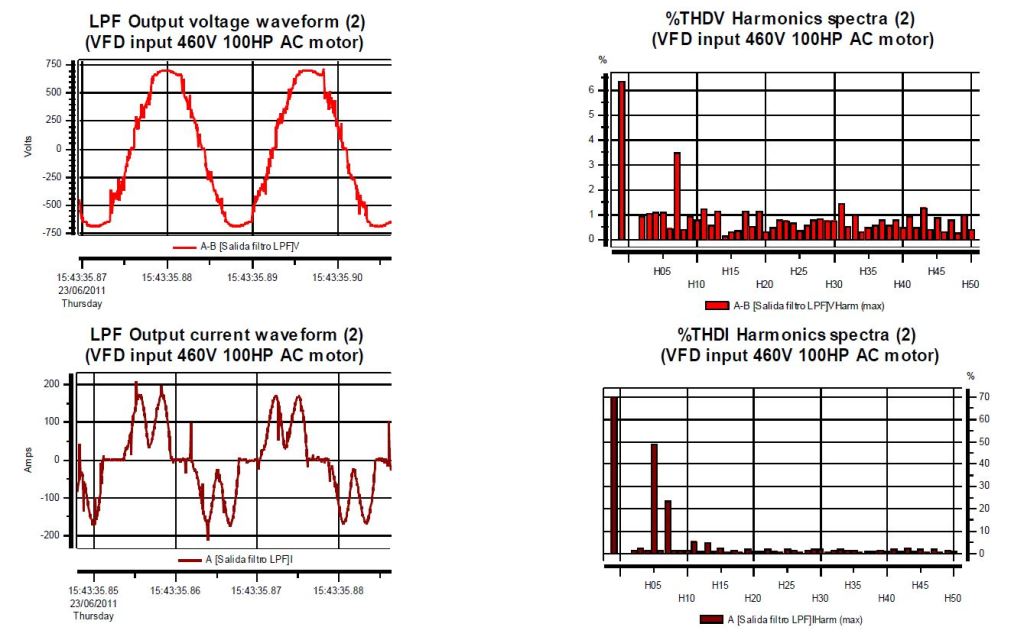
Below are waveshapes captured during the test:
LPF Output (No Harmonics Filtering)
LPF Input (Harmonics Filtering)
SWF Input (VFD Output Terminals)
SWF Output (Moto Terminals)
CONCLUSIONS:
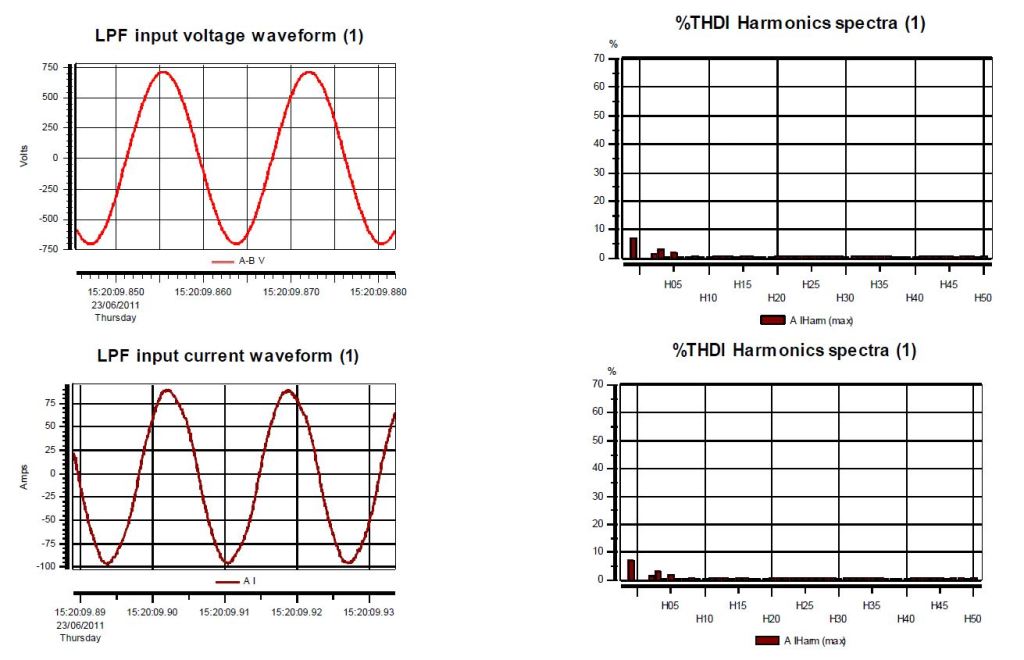
LPF (low pass filter) reduced VTHD from 6.3% to 1.5% and ITHD from 70% to 6%. Corresponding waveforms were also improved as well.
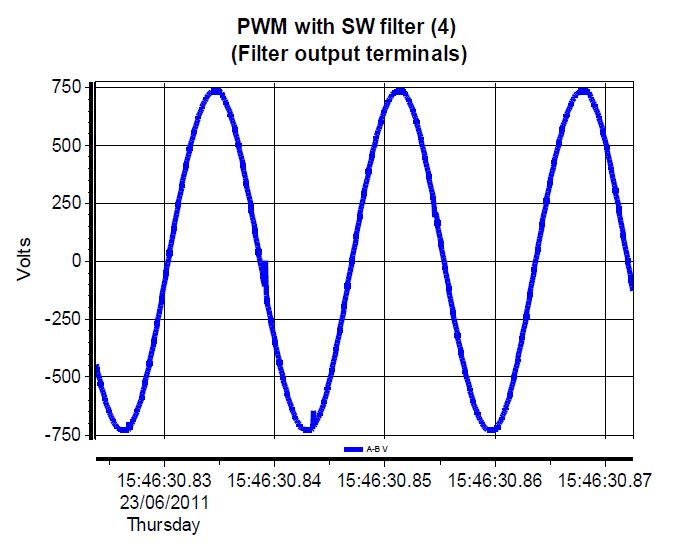
SWF (Sine wave filter) effectively improved the voltage waveform at the 100HP AC motor terminals (as shown).
Dranetz Power Quality analyzers advanced capabilities were essential in measuring not only at VFD line side, but also measuring and capturing the PWM waveforms High frequency pulses at VFD output)!
The customer was very satisfied, not only with the filtering results, but with the Dranetz PQ analyzers. He said: “With other manufacturers like Fluke, one PQ instrument and one oscilloscope are required to be able to perform VFD & filtering tests, which implies more cost about instrumentation.”
The filter customer decided to buy one PowerGuide portable instrument from Arteche Inelap, an authorized Dranetz distributor in Mexico who is fully committed to Dranetz products.
DRANETZ HAS PROVEN ONCE AGAIN TO BE THE LEADER IN TECHNOLOGY AND “STATE OF THE ART” IN THE PQ BUSINESS!
Published by Joseph Seymour, Schneider Electric – Data Center Science Center White Paper 18 Rev 1.
Executive Summary
Many of the mysteries of equipment failure, downtime, software and data corruption, are the result of a problematic supply of power. There is also a common problem with describing power problems in a standard way. This white paper will describe the most common types of power disturbances, what can cause them, what they can do to your critical equipment, and how to safeguard your equipment, using the IEEE standards for describing power quality problems.
Introduction
Our technological world has become deeply dependent upon the continuous availability of electrical power. In most countries, commercial power is made available via nationwide grids, interconnecting numerous generating stations to the loads. The grid must supply basic national needs of residential, lighting, heating, refrigeration, air conditioning, and transportation as well as critical supply to governmental, industrial, financial, commercial, medical and communications communities. Commercial power literally enables today’s modern world to function at its busy pace. Sophisticated technology has reached deeply into our homes and careers, and with the advent of e-commerce is continually changing the way we interact with the rest of the world.
Intelligent technology demands power that is free of interruption or disturbance. The consequences of large-scale power incidents are well documented. A recent study in the USA has shown that industrial and digital business firms are losing $45.7 billion per year due to power interruptions.1 Across all business sectors, an estimated $104 billion to $164 billion is lost due to interruptions with another $15 billion to $24 billion due to all other power quality problems. In industrial automatic processing, whole production lines can go out of control, creating hazardous situations for onsite personnel and expensive material waste. Loss of processing in a large financial corporation can cost thousands of unrecoverable dollars per minute of downtime, as well as many hours of recovery time to follow. Program and data corruption caused by a power interruption can create problems for software recovery operations that may take weeks to resolve.
Many power problems originate in the commercial power grid, which, with its thousands of miles of transmission lines, is subject to weather conditions such as hurricanes, lightning storms, snow, ice, and flooding along with equipment failure, traffic accidents and major switching operations. Also, power problems affecting today’s technological equipment are often generated locally within a facility from any number of situations, such as local construction, heavy startup loads, faulty distribution components, and even typical background electrical noise.
Agreeing on common terms is a first step in dealing with power disturbances
Widespread use of electronics in everything from home electronics to the control of massive and costly industrial processes has raised the awareness of power quality. Power quality, or more specifically, a power quality disturbance, is generally defined as any change in power (voltage, current, or frequency) that interferes with the normal operation of electrical equipment.
The study of power quality, and ways to control it, is a concern for electric utilities, large industrial companies, businesses, and even home users. The study has intensified as equipment has become increasingly sensitive to even minute changes in the power supply voltage, current, and frequency. Unfortunately, different terminology has been used to describe many of the existing power disturbances, which creates confusion and makes it more difficult to effectively discuss, study, and make changes to today’s power quality problems. The Institute of Electrical and Electronics Engineers (IEEE) has attempted to address this problem by developing a standard that includes definitions of power disturbances.
The standard (IEEE Standard 1159-1995, “IEEE Recommended Practice for Monitoring Electrical Power Quality”) describes many power quality problems, of which this paper will discuss the most common.
1Electric Power Research Institute, The Cost of Power Disturbances to Industrial & Digital Economy Companies, copyright 2001
How do we look at power?
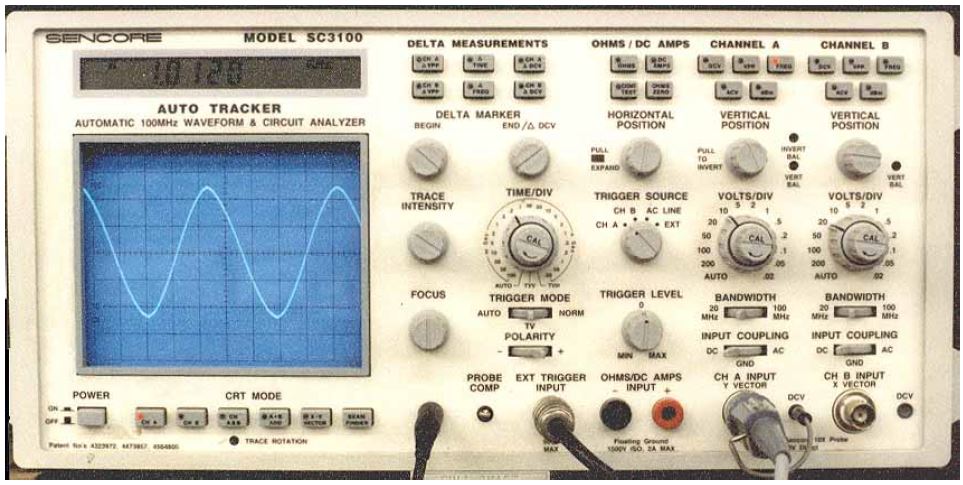
Electricity at the wall outlet is an electromagnetic phenomenon. Commercial power is provided as alternating current (AC), a silent, seemingly limitless source of energy that can be generated at power stations, boosted by transformers, and delivered over hundreds of miles to any location in the region. Seeing what this energy is doing in small slices of time can provide an understanding of how important simple, smooth ac power is to reliable operation of the sophisticated systems that we are dependent upon. An oscilloscope allows us to see what this energy looks like. In a perfect world, commercial ac power appears as a smooth, symmetrical sine wave, varying at either 50 or 60 cycles every second (Hertz – Hz) depending on which part of the world you’re in. Figure 1 shows what an average AC sine wave would appear like on an oscilloscope.
Figure 1 – Oscilloscope image of a sine wave
The sinusoidal wave shape shown above represents a voltage changing from a positive value to a negative value, 60 times per second. When this flowing wave shape changes size, shape, symmetry, frequency, or develops notches, impulses, ringing, or drops to zero (however briefly), there is a power disturbance. Simple drawings representative of changes in the above ideal sine wave shape will be shown throughout this paper for the seven categories of power quality disturbances that will be discussed.
As stated, there has been some ambiguity throughout the electrical industry and businesses community in the use of terminology to describe various power disturbances. For example, the term “surge” is seen by one sector of the industry to mean a momentary increase in voltage as would be typically caused by a large load being switched off. On the other hand, usage of the term “surge” can also be seen as a transient voltage lasting from microseconds to only a few milliseconds with very high peak values. These latter are usually associated with lightning strikes and switching events creating sparks or arcing between contacts.
The IEEE Standard 1100-1999 has addressed the problem of ambiguity in terminology, and has recommended that many terms in common usage not be used in professional reports and references because of their inability to accurately describe the nature of the problem. IEEE Standard 1159-1995 also addresses this problem with the goal of providing consistent terminology for power quality reporting from the professional community. Some of these ambiguous terms are as follows:
Blackout
Brownout
Bump
Power surge
Clean power
Surge
Outage
Blink
Dirty power
Frequency shift
Glitch
Spike
Power surge
Raw power
Raw utility power
Wink
Being able to talk effectively about power, such as knowing the difference between an interruption, and an oscillatory transient, could make a huge difference when making purchase decisions for power correction devices. A communication mistake can have expensive consequences when the wrong power correction device is purchased for your needs, which includes downtime, lost wages, or even equipment damage.
This IEEE defined power quality disturbances shown in this paper have been organized into seven categories based on wave shape:
Transients
Interruptions
Sag / Undervoltage
Swell / Overvoltage
Waveform distortion
Voltage fluctuations
Frequency variations
This paper will conform to these categories and include graphics, which should clarify the differences between individual power quality disturbances.
1.Transients
Potentially the most damaging type of power disturbance, transients fall into two subcategories:
Impulsive
Oscillatory
Impulsive
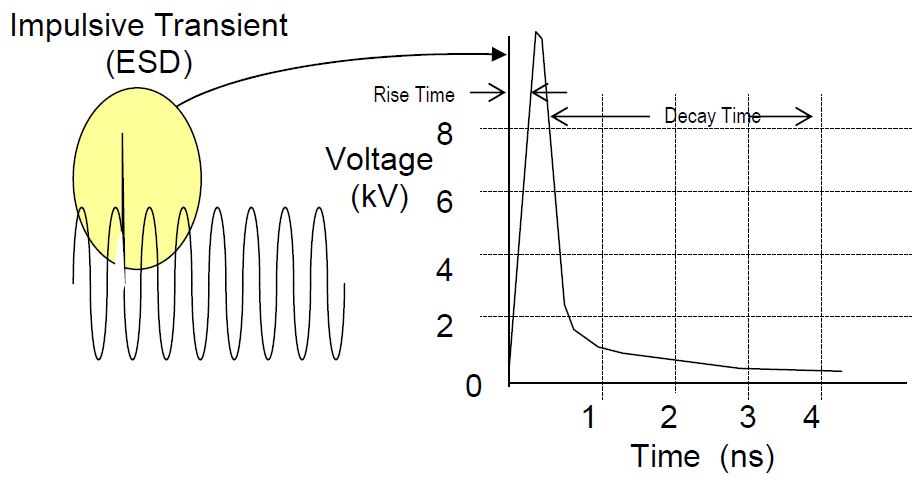
Impulsive transients are sudden high peak events that raise the voltage and/or current levels in either a positive or a negative direction. These types of events can be categorized further by the speed at which they occur (fast, medium, and slow). Impulsive transients can be very fast events (5 nanoseconds [ns] rise time from steady state to the peak of the impulse) of short-term duration (less than 50 ns).
One example of a positive impulsive transient caused by electrostatic discharge (ESD) event is illustrated in Figure 2.
Figure 2 – Positive impulsive transient
The impulsive transient is what most people are referring to when they say they have experienced a surge or a spike. Many different terms, such as bump, glitch, power surge, and spike have been used to describe impulsive transients.
Causes of impulsive transients include lightning, poor grounding, the switching of inductive loads, utility fault clearing, and Electrostatic Discharge (ESD). The results can range from the loss (or corruption) of data, to physical damage of equipment. Of these causes, lightning is probably the most damaging.
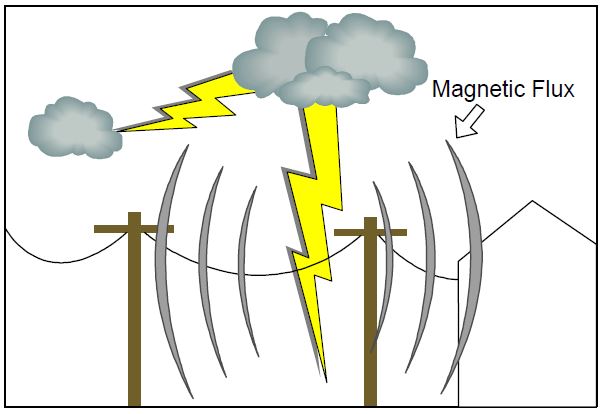
The problem with lightning is easily recognized after witnessing an electrical storm. The amount of energy that it takes to light up the night sky can certainly destroy sensitive equipment. Moreover, it doesn’t take a direct lightning strike to cause damage. The electromagnetic fields, Figure 3, created by lightning can cause much of the potential damage by inducing current onto nearby conductive structures.
Figure 3 – Magnetic field created by lightning strike
Two of the most viable protection methods when it comes to impulsive transients pertain to the elimination of potential ESD, and the use of surge suppression devices (popularly referred to as transient voltage surge suppressors: TVSS, or surge protective device: SPD)
While ESD can arc off of your finger with no damage to you, beyond a slight surprise, it is more than enough to cause an entire computer motherboard to stop dead and to never function again. In data centers, printed circuit board manufacturing facilities or any similar environment where PCBs are exposed to human handling, it is important to dissipate the potential for ESD. For example, almost any proper data center environment involves conditioning of the air in the room. Conditioning the air does not just cool the air to help remove heat from data center equipment, but also adjusts the amount of moisture in the air. Keeping the humidity in the air between 40 – 55% humidity will decrease the potential for ESD to occur. You’ve probably experienced how humidity affects ESD potential if you’ve ever been through a winter (when the air is very dry) when a few drags of your socks across the carpet cause a tremendous arc to jump from your finger unexpectedly to the doorknob you were reaching for, or expectedly if you were aiming for someone’s ear. Another thing you will see in PCB environments, such as you would see in any small computer repair business, is equipment to keep the human body grounded. This equipment includes wrist straps, antistatic mats and desktops, and antistatic footwear. Most of this equipment is connected to a wire, which leads to the ground of the facility, which keeps people safe from electric shock and also dissipates possible ESD to ground.
SPDs have been used for many years. These devices are still in use today on utility systems, as well as devices for large facilities and data centers, as well as everyday small business and home use; their performance improving with advances in metal oxide varistor (MOV) technology. MOVs allow for a consistent suppression of impulsive transients, swells, and other high voltage conditions, and can be combined with thermal tripping devices such as circuit breakers, thermistors, as well as other components such as gas tubes and thyristors. In some cases SPD circuits are built into the electrical devices themselves, such as computer power supplies with built in suppression abilities. More commonly, they are used in standalone surge suppression devices, or included with UPSs to provide surge suppression and emergency battery power should in interruption occur (or when power levels are outside the boundaries of nominal, or safe, power conditions).
Cascading SPDs and UPS devices, is the most effective method of protection against power disturbances, for electronic equipment. Using this technique, an SPD device is placed at the service entrance and is sized to dissipate much of the energy from any incoming transient. Subsequent devices at the electrical sub-panel and at the sensitive equipment itself clamp the voltage to a level that doesn’t damage or disturb the equipment. Particular attention must be paid to sizing both the voltage rating and the energy dissipation rating of these devices and coordinating the devices for effective operation. Also, attention should be paid to how effective the surge suppression device is in the event that the MOV reaches the point of failure. While an MOV is consistent in its surge suppression abilities over time, it does still degrade with usage, or can fail if its rate of effective suppression ability is exceeded. It is important that if the MOV does reach the point where it is no longer useful, that the SPD have the ability to break the circuit, and prevent any damaging power anomaly from reaching the equipment it is protecting. For more information on this topic see White Paper 85, Data Line Transient Protection.
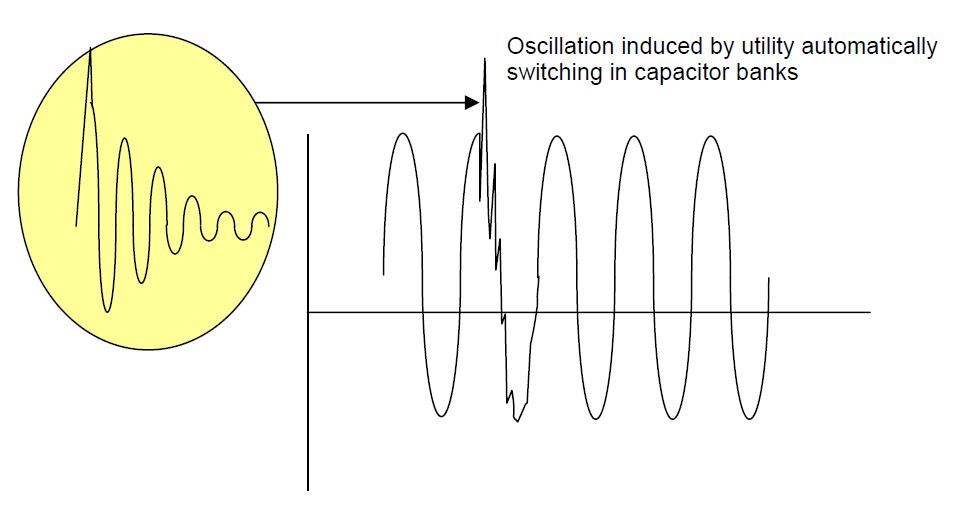
An oscillatory transient is a sudden change in the steady-state condition of a signal’s voltage, current, or both, at both the positive and negative signal limits, oscillating at the natural system frequency. In simple terms, the transient causes the power signal to alternately swell and then shrink, very rapidly. Oscillatory transients usually decay to zero within a cycle (a decaying oscillation).
These transients occur when you turn off an inductive or capacitive load, such as a motor or capacitor bank. An oscillatory transient results because the load resists the change. This is similar to what happens when you suddenly turn off a rapidly flowing faucet and hear a hammering noise in the pipes. The flowing water resists the change, and the fluid equivalent of an oscillatory transient occurs.
For example, upon turning off a spinning motor, it acts briefly as a generator as it powers down, thereby producing electricity and sending it through the electrical distribution. A long electrical distribution system can act like an oscillator when power is switched on or off, because all circuits have some inherent inductance and distributed capacitance that briefly energizes in a decaying form.
When oscillatory transients appear on an energized circuit, usually because of utility switching operations (especially when capacitor banks are automatically switched into the system), they can be quite disruptive to electronic equipment. Figure 4 shows a typical low frequency Oscillatory Transient attributable to capacitor banks being energized.
Figure 4 – Oscillatory transient
The most recognized problem associated with capacitor switching and its oscillatory transient is the tripping of adjustable speed drives (ASDs). The relatively slow transient causes a rise in the dc link voltage (the voltage that controls the activation of the ASD), which causes the drive to trip off-line with an indication of overvoltage.
A common solution to capacitor tripping is the installation of line reactors or chokes that dampen the oscillatory transient to a manageable level. These reactors can be installed ahead of the drive or on the dc link and are available as a standard feature or as an option on most ASDs. (Note – ASD devices will be discussed further in the interruptions section below.)
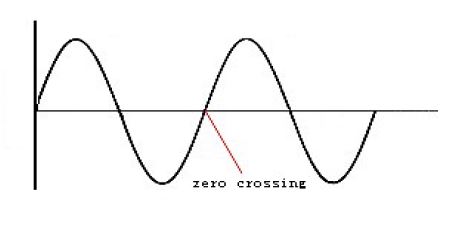
Another rising solution to capacitor switching transient problems is the zero crossing switch. When a sine wave’s arc descends and reaches the zero level (before it becomes negative), this is known as the zero crossing as shown in Figure 5. A transient caused by capacitor switching will have a greater magnitude the farther the switching occurs away from the zero crossing timing of the sine wave. A zero crossing switch solves this problem by monitoring the sine wave to make sure that capacitor switching occurs as close as possible to the zero crossing timing of the sine wave.
Figure 5 – Zero crossing
Of course UPS and SPD systems are also very effective at reducing the harm that oscillatory transients can do, especially between common data processing equipment such as computers in a network. However, SPD and UPS devices can sometimes not prevent the intersystem occurrences of oscillatory transients that a zero crossing switch and/or choke type device can prevent on specialized equipment, such as manufacturing floor machinery and their control systems.
2.Interruptions
An interruption (Figure 6) is defined as the complete loss of supply voltage or load current. Depending on its duration, an interruption is categorized as instantaneous, momentary, temporary, or sustained. Duration range for interruption types are as follows:
Instantaneous: 0.5 to 30 cycles Momentary: 30 cycles to 2 seconds Temporary: 2 seconds to 2 minutes Sustained: greater than 2 minutes
Figure 6 – Momentary interruption
The causes of interruptions can vary, but are usually the result of some type of electrical supply grid damage, such as lightning strikes, animals, trees, vehicle accidents, destructive weather (high winds, heavy snow or ice on lines, etc.), equipment failure, or a basic circuit breaker tripping. While the utility infrastructure is designed to automatically compensate for many of these problems, it is not infallible.
One of the more common examples of what can cause an interruption in commercial power systems are utility protective devices, such as automatic circuit reclosers. Reclosers determine the length of time of most interruptions, depending on the nature of the fault. Reclosers are devices used by utility companies to sense the rise in current from a short circuit in the utility infrastructure, and to shut off the supply power when this occurs. The recloser will, after a set time bring power back on line, in an attempt to burn off the material creating the short circuit (This material is often a tree limb, or small animal trapped between the line and ground).
You’ve probably experienced an interruption if you have ever seen all the power in your house go out (all lights and electronics), just to have everything come back on a few minutes later while you’re breaking out the candles. Of course, having the power go out in your house, even if it lasts all night, may be only an inconvenience, but for businesses it can also cause great expense.
An interruption, whether it is instantaneous, momentary, temporary, or sustained, can cause disruption, damage, and downtime, from the home user up to the industrial user. A home, or small business computer user, could lose valuable data when information is corrupted from loss of power to their equipment. Probably more detrimental is the loss that the industrial customer can sustain because of interruptions. Many Industrial processes count on the constant motion of certain mechanical components. When these components shutdown suddenly from an interruption, it can cause equipment damage, ruination of product, as well as the cost associated with downtime, cleanup, and restart. For example, when an Industrial customer, producing yarn, experiences a momentary interruption, it can cause the yarn extrusion process to “break out,” resulting in excessive waste and downtime. Yarn must be extruded at a certain speed and consistency for the end product to be of the quality and type expected. The off-spec yarn must be cleaned out of the spinning machine and the thread lines re-strung. As you can imagine this takes a great effort, and creates huge downtime. Also, there is waste due to a certain amount of ruined yarn.
Solutions to help against interruptions vary, both in effectiveness and cost. The first effort should go into eliminating or reducing the likelihood of potential problems. Good design and maintenance of utility systems are, of course, essential. This also applies to the industrial customer’s system design, which is often as extensive and vulnerable as the utility system.
Once the potential for problems is reduced, additional equipment or design methods are needed to allow the customer’s equipment or process to ride-through (remain at constant operation during power quality disturbances), or to restart after (and during) unavoidable interruptions. The most common mitigating devices employed are the uninterruptible power supply (UPS), motor generator, and the use of system design techniques that take advantage of redundant systems and energy storage. When the power goes out, these forms of alternative power can take over. Anyone who has owned a laptop has seen an example of this. When the laptop is plugged in it is powered from the wall receptacle and a trickle of energy is passed to the laptops internal battery to charge it. When the laptop is unplugged the battery instantly takes over providing continued power to the laptop. Recent advances in switch technology have allowed for standby energy storage systems to be utilized in less than a half cycle.
The term “sustained interruption,” describes a situation in a commercial utility system where automatic protective devices, because of the nature of the fault, cannot bring power back online, and manual intervention is required. This terminology more accurately describes the situation, rather than the commonly used term “outage”. The term “outage” actually refers to the state of a component in the system that has failed to function as expected (IEEE Std 100-1992).
It’s probably safe to say that you are experiencing a sustained interruption if the power has been off for more than two minutes, and you see utility trucks appear shortly after to repair utility lines outside.
3.Sag / undervoltage
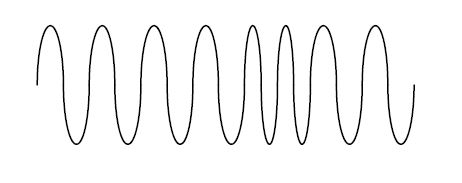
A sag (Figure 7) is a reduction of AC voltage at a given frequency for the duration of 0.5 cycles to 1 minute’s time. Sags are usually caused by system faults, and are also often the result of switching on loads with heavy startup currents.
Figure 7 – Sag
Common causes of sags include starting large loads (such as one might see when they first start up a large air conditioning unit) and remote fault clearing performed by utility equipment. Similarly, the starting of large motors inside an industrial facility can result in significant voltage drop (sag). A motor can draw six times its normal running current, or more, while starting. Creating a large and sudden electrical load such as this will likely cause a significant voltage drop to the rest of the circuit it resides on. Imagine someone turning on all the water in your house while you’re in the shower. The water would probably run cold and the water pressure would drop. Of course, to solve this problem, you might have a second water heater that is dedicated to the shower. The same holds true for circuits with large startup loads that create a large inrush current draw.
While it may be the most effective solution, adding a dedicated circuit for large startup loads may not always be practical or economical, especially if a whole facility has a myriad of large startup loads. Other solutions to large starting loads include alternative power starting sources that do not load the rest of the electrical infrastructure at motor startup such as, reduced-voltage starters, with either autotransformers, or star-delta configurations. A solid-state type of soft starter is also available and is effective at reducing the voltage sag at motor start-up. Most recently, adjustable speed drives (ASDs), which vary the speed of a motor in accordance with the load (along with other uses), have been used to control the industrial process more efficiently and economically, and as an additional benefit, addresses the problem of large motor starting.
As mentioned in the Interruptions section, the attempt of the utility infrastructure to clear remote faults can cause problems for end users. When this problem is more evident it is seen as an interruption. However, it can also manifest itself as a sag for problems that are cleared more quickly or that are momentarily recurring. Some of the same techniques that were used to address interruptions can be utilized to address voltage sags: UPS equipment, motor generators, and system design techniques. However, sometimes the damage being caused by sags is not apparent until the results are seen over time (damaged equipment, data corruption, errors in industrial processing).
While still in its infant stage, some utilities now provide sag analysis of industrial processes as a value-added service to their customers. A sag analysis can now be performed to determine at what sag levels equipment can and cannot operate. As studies are conducted and these weak points are identified, information is being collected, analyzed, and reported to equipment manufacturers so that they can improve the ride-through capability of their equipment.
Undervoltage
Undervoltages (Figure 8) are the result of long-term problems that create sags. The term “brownout” has been commonly used to describe this problem, and has been superseded by the term undervoltage. Brownout is ambiguous in that it also refers to commercial power delivery strategy during periods of extended high demand. Undervoltages can create overheating in motors, and can lead to the failure of non-linear loads such as computer power supplies. The solution for sags also applies to undervoltages. However, a UPS with the ability to adjust voltage using an inverter first before using battery power will prevent the need to replace UPS batteries as often. More importantly, if an undervoltage remains constant, it may be a sign of a serious equipment fault, configuration problem, or that the utility supply needs to be addressed.
Figure 8 – Undervoltage
4.Swell / overvoltage
A swell (Figure 9) is the reverse form of a sag, having an increase in AC voltage for a duration of 0.5 cycles to 1 minute’s time. For swells, high-impedance neutral connections, sudden (especially large) load reductions, and a single-phase fault on a three-phase system are common sources.
Figure 9 – Swell
The result can be data errors, flickering of lights, degradation of electrical contacts, semiconductor damage in electronics, and insulation degradation. Power line conditioners, UPS systems, and ferroresonant “control” transformers are common solutions.
Much like sags, swells may not be apparent until their results are seen. Having UPS and/or power conditioning devices that also monitor and log incoming power events will help to measure when, and how often, these events occur.
Overvoltage
Overvoltages (Figure 10) can be the result of long-term problems that create swells. An overvoltage can be thought of as an extended swell. Overvoltages are also common in areas where supply transformer tap settings are set incorrectly and loads have been reduced. This is common in seasonal regions where communities reduce in power usage during off-season and the output set for the high usage part of the season is still being supplied even though the power need is much smaller. It’s like putting your thumb over the end of a garden hose. The pressure increases because the hole where the water comes out has been made smaller, even though the amount of water coming out of the hose remains the same. Overvoltage conditions can create high current draw and cause the unnecessary tripping of downstream circuit breakers, as well as overheating and putting stress on equipment.
Figure 10 – Overvoltage
Since an overvoltage is really just a constant swell, the same UPS or conditioning equipment that works for swells will work for overvoltages. However, if the incoming power is constantly in an overvoltage condition, then the utility power to your facility may need correction as well. The same symptoms for swells also apply to overvoltages. Since overvoltages can be more constant, excess heat may be an outward indication of an overvoltage. Equipment (under normal environmental conditions and usage), which normally produces a certain amount of heat, may suddenly increase in heat output because of the stress caused by an overvoltage. This may be detrimental in a tightly packed data center environment. Heat and its effect on today’s data centers, with their many tightly packed blade server type environments, is of great concern to the IT community.
5.Waveform distortion
There are five primary types of waveform distortion:
DC offset
Harmonics
Interharmonics
Notching
Noise
DC offset
Direct current (DC) can be induced into an AC distribution system, often due to failure of rectifiers within the many AC to DC conversion technologies that have proliferated modern equipment. DC can traverse the ac power system and add unwanted current to devices already operating at their rated level. Overheating and saturation of transformers can be the result of circulating DC currents. When a transformer saturates, it not only gets hot, but also is unable to deliver full power to the load, and the subsequent waveform distortion can create further instability in electronic load equipment. A DC offset is illustrated in Figure 11.
Figure 11 – DC offset
Harmonics
Harmonic distortion (Figure 12) is the corruption of the fundamental sine wave at frequencies that are multiples of the fundamental. (e.g., 180 Hz is the third harmonic of a 60 Hz fundamental frequency; 3 X 60 = 180).
Symptoms of harmonic problems include overheated transformers, neutral conductors, and other electrical distribution equipment, as well as the tripping of circuit breakers and loss of synchronization on timing circuits that are dependent upon a clean sine wave trigger at the zero crossover point.
Harmonic distortion has been a significant problem with IT equipment in the past, due to the nature of switch-mode power supplies (SMPS). These non-linear loads, and many other capacitive designs, instead of drawing current over each full half cycle, “sip” power at each positive and negative peak of the voltage wave. The return current, because it is only shortterm, (approximately 1/3 of a cycle) combines on the neutral with all other returns from SMPS using each of the three phases in the typical distribution system. Instead of subtracting, the pulsed neutral currents add together, creating very high neutral currents, at a theoretical maximum of 1.73 times the maximum phase current. An overloaded neutral can lead to extremely high voltages on the legs of the distribution power, leading to heavy damage to attached equipment. At the same time, the load for these multiple SMPS is drawn at the very peaks of each voltage half-cycle, which has often led to transformer saturation and consequent overheating. Other loads contributing to this problem are variable speed motor drives, lighting ballasts and large legacy UPS systems. Methods used to mitigate this problem have included over-sizing the neutral conductors, installing K-rated transformers, and harmonic filters.
Spurred on by the remarkable expansion of the IT industry over the last decade, power supply design for IT equipment has been upgraded via international standards. One major change compensates for electrical infrastructure stresses caused, in the recent past, by large clusters of IT equipment power supplies contributing to excessive harmonic currents within a facility. Many new IT equipment power supplies have been designed with power-factor corrected power supplies operating as linear, non-harmonic loads. These power supplies do not produce the waste current of harmonics.
Figure 12 – Typical harmonic waveform distortion
Interharmonics
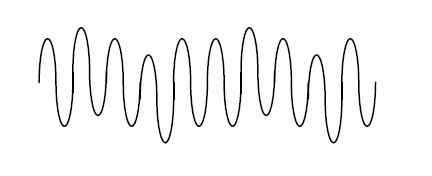
Interharmonics (Figure 13) are a type of waveform distortion that are usually the result of a signal imposed on the supply voltage by electrical equipment such as static frequency converters, induction motors and arcing devices. Cycloconverters (which control large linear motors used in rolling mill, cement, and mining equipment), create some of the most significant interharmonic supply power problems. These devices transform the supply voltage into an AC voltage of a frequency lower or higher than that of the supply frequency.
The most noticeable effect of interharmonics is visual flickering of displays and incandescent lights, as well as causing possible heat and communication interference.
Figure 13 – Interharmonic waveform distortion
Solutions to interharmonics include filters, UPS systems, and line conditioners.
Notching
Notching (Figure 14) is a periodic voltage disturbance caused by electronic devices, such as variable speed drives, light dimmers and arc welders under normal operation. This problem could be described as a transient impulse problem, but because the notches are periodic over each ½ cycle, notching is considered a waveform distortion problem. The usual consequences of notching are system halts, data loss, and data transmission problems.
Figure 14 – Notching
One solution to notching is to move the load away from the equipment causing the problem (if possible). UPSs and filter equipment are also viable solutions to notching if equipment cannot be relocated.
Noise
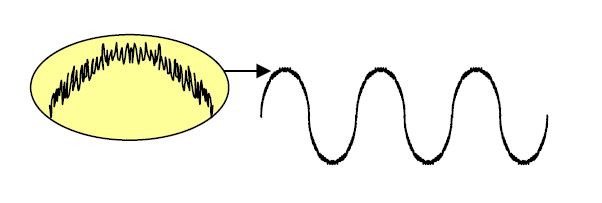
Noise (Figure 15) is unwanted voltage or current superimposed on the power system voltage or current waveform. Noise can be generated by power electronic devices, control circuits, arc welders, switching power supplies, radio transmitters and so on. Poorly grounded sites make the system more susceptible to noise. Noise can cause technical equipment problems such as data errors, equipment malfunction, long-term component failure, hard disk failure, and distorted video displays.
Figure 15 – Noise
There are many different approaches to controlling noise and sometimes it is necessary to use several different techniques together to achieve the required result. Some methods are:
• Isolate the load via a UPS • Install a grounded, shielded isolation transformer • Relocate the load away from the interference source • Install noise filters • Cable shielding
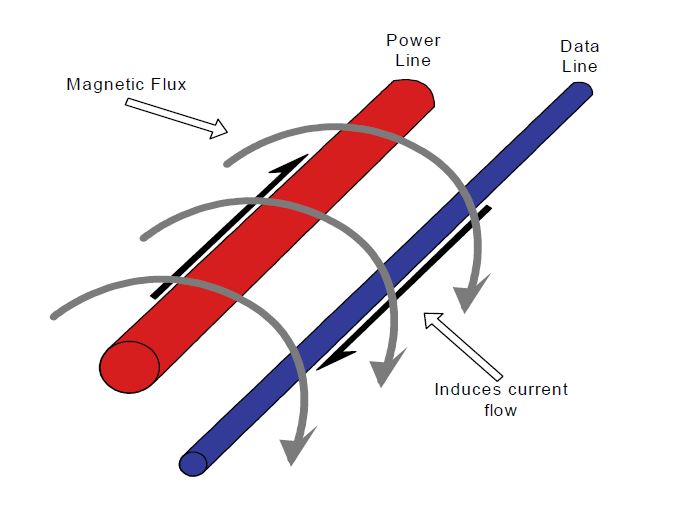
Data corruption is one of the most common results of noise. EMI (Electromagnetic Interference) and RFI (Radio Frequency Interference) can create inductance (induced current and voltage) on systems that carry data as shown in Figure 16. Since the data is traveling in digital format (ones and zeros that are represented by a voltage, or lack of voltage), excess voltage above data operating levels can make the appearance of data that does not belong or the opposite. A classic example of noise created by inductance is when network cabling is run through a drop ceiling past fluorescent lighting. Fluorescent lighting produces significant EMI, which if in close proximity to network cabling can cause erroneous data. This can also commonly happen when network cabling is run in close proximity to high capacity power lines. Bundles of power lines often end up running in tandem with network cabling in raised floor data centers, and this increases the chances of noise.
Figure 16 – Induction
The solution to this particular problem involves moving data carrying devices and/or cabling away from the source of EMI/RFI, or to provide additional shielding for the data devices and/or their cabling to reduce, or nullify, the effects of the EMI/RFI.
6.Voltage fluctuations
Since voltage fluctuations are fundamentally different from the rest of the waveform anomalies, they are placed in their own category. A voltage fluctuation (Figure 17) is a systematic variation of the voltage waveform or a series of random voltage changes, of small dimensions, namely 95 to 105% of nominal at a low frequency, generally below 25 Hz.
Figure 17 – Voltage fluctuations
Any load exhibiting significant current variations can cause voltage fluctuations. Arc furnaces are the most common cause of voltage fluctuation on the transmission and distribution system. One symptom of this problem is flickering of incandescent lamps. Removing the offending load, relocating the sensitive equipment, or installing power line conditioning or UPS devices, are methods to resolve this problem.
7.Frequency variations
Frequency variation (Figure 18) is extremely rare in stable utility power systems, especially systems interconnected via a power grid. Where sites have dedicated standby generators or poor power infrastructure, frequency variation is more common especially if the generator is heavily loaded. IT equipment is frequency tolerant, and generally not affected by minor shifts in local generator frequency. What would be affected would be any motor device or sensitive device that relies on steady regular cycling of power over time. Frequency variations may cause a motor to run faster or slower to match the frequency of the input power. This would cause the motor to run inefficiently and/or lead to added heat and degradation of the motor through increased motor speed and/or additional current draw.
Figure 18 – Frequency variations
To correct this problem, all generated power sources and other power sources causing the frequency variation should be assessed, then repaired, corrected, or replaced.
Voltage imbalance
A voltage imbalance is not a type of waveform distortion. However, because it is essential to be aware of voltage imbalances when assessing power quality problems, it merits discussion in this paper.
Simply put, a voltage imbalance (as the name implies) is when supplied voltages are not equal. While these problems can be caused by external utility supply, the common source of voltage imbalances is internal, and caused by facility loads. More specifically, this is known to occur in three phase power distribution systems where one of the legs is supplying power to single phase equipment, while the system is also supplying power to three phase loads.
In general these imbalances show as heating, especially with solid state motors. Greater imbalances may cause excessive heat to motor components, and the intermittent failure of motor controllers.
A quick way to assess the state of voltage imbalance is to take the difference between the highest and the lowest voltages of the three supply voltages. This number should not exceed 4% of the lowest supply voltage. Below is an example of this quick way to get a simple assessment of the voltage imbalance in a system.
Example: First supply voltage: 220 V Second supply voltage: 225 V Third supply voltage: 230 V Lowest voltage: 220 V
4% of 220 V = 8.8 V Difference between highest and lowest voltage: 10 V 10 V > 8.8 V – imbalance is too great!
Correcting voltage imbalances involves reconfiguring loads, or having utility changes made to the incoming voltages (if the imbalance is not being caused by internal loads).
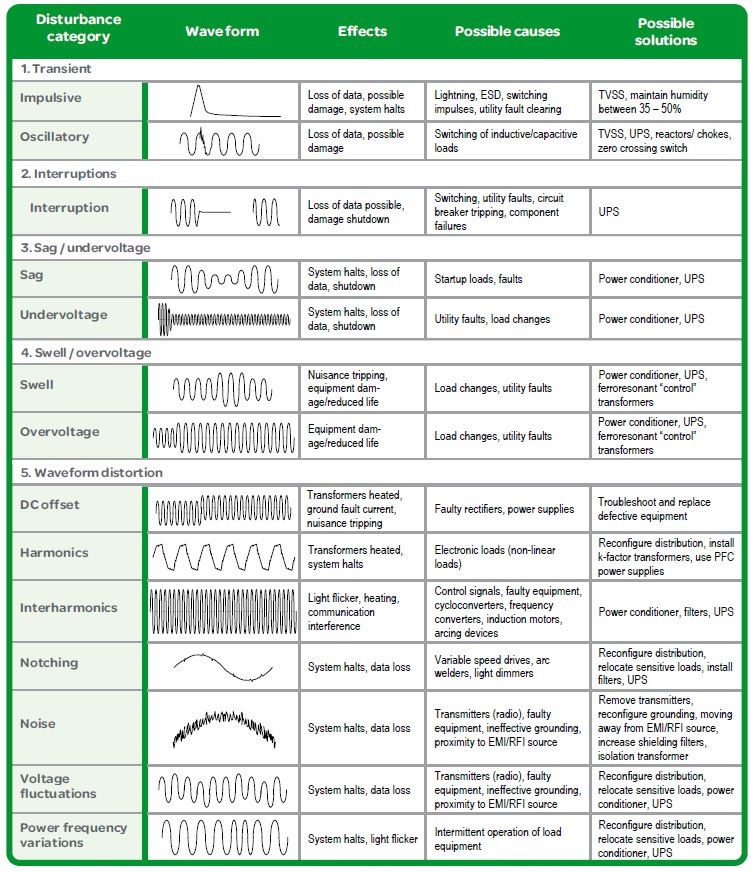
Table 1 summarizes the power disturbances discussed and provides possible solutions to mitigate the effects that these problems can have on business operations.
Table 1 – Summary of disturbances with solutions
Conclusion
The widespread use of electronics has raised the awareness of power quality and its affect on the critical electrical equipment that businesses use. Our world is increasingly run by small microprocessors that are sensitive to even small electrical fluctuations. These microprocessors can control blazingly fast automated robotic assembly and packaging line systems that cannot afford downtime. Economical solutions are available to limit, or eliminate, the affects of power quality disturbances. However, in order for the industry to communicate and understand power disturbances and how to prevent them, common terms and definitions are needed to describe the different phenomena. This paper has attempted to define and illustrate power quality disturbances as outlined in IEEE Standard 1159-1995, IEEE Recommended Practice for Monitoring Electrical Power Quality.
Reducing equipment downtime and production expense, therefore increasing profit, is the goal of any size business. Communicating by understanding the electrical environment, and equipment’s susceptibility to power quality disturbances, will help in the discovery of better methods to achieve business goals and dreams.
References
• IEEE Recommended Practice for Monitoring Electric Power Quality, IEEE Std. 1159- 1995. • Ron A. Adams, Power Quality: A Utility Perspective, AEE Technical Conference Paper, October, 1996. • Wayne L. Stebbins, Power Distortion: A User’s Perspective on the Selection and Application of Mitigation Equipment and Techniques, IEEE Textile Industry Technical Conference Paper, May, 1996. • IEEE Recommended Practice for Powering and Grounding Sensitive Electronic Equipment (IEEE Green Book), IEEE Std. 1100-1992. • Electric Power Research Institute / Duke Power Company, Power Quality for Electrical Contractors course, November, 1996. • Square D, Reduced Voltage Starting of Low Voltage, Three-Phase Squirrel-Cage Induction Motors Technical Overview, Product Data Bulletin 8600PD9201, June 1992
About the author
Joseph Seymour is the lead Claim Analyst at Schneider Electric Claims Department in West Kingston, RI. He evaluates and inspects damages caused by catastrophic transient events, and adjudicates customer claims filed in accordance with the Schneider Electric Equipment Protection Policy.
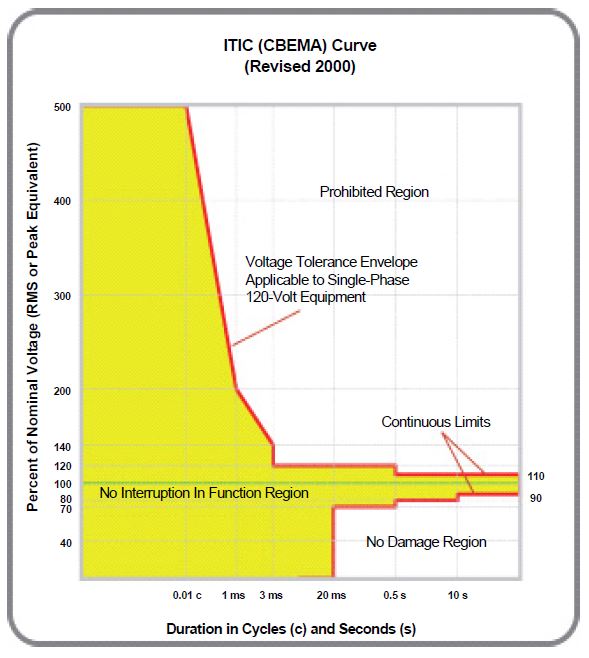
Now that the various power disturbances have been identified and described, it is necessary to understand what modern equipment will tolerate. Not all power disturbances affect modern equipment. There is an acceptable range of ac voltage variation and disturbance that modern equipment power supplies will tolerate over short periods of time.
Most technological equipment runs on low voltage dc supplied by lightweight, tolerant Switch-Mode Power Supplies (SMPS) converting nominal ac power into positive and negative dc voltage. Power supplies provide the most effective barrier between sensitive electronic components and the raw energy of ac supply voltage with its associated background noise.
Specifications from IEC 61000-4-11, an international standard, define limits on the magnitude and duration of voltage disturbances that are acceptable to an SMPS load. Similarly, an Application Note commonly referred to throughout the industry as the CBEMA curve, originally developed by the Computer and Business Manufacturer’s Association, illustrates a performance curve designed for minimal tolerance of power disturbances in single-phase IT equipment power supplies. The Information Technology Industry Council (ITIC, formerly CBEMA) has recently refined the original curve as shown in Figure A1. The curve and this application note are available at http://www.itic.org/clientuploads/Oct2000Curve.pdf
CIRED 23rd International Conference on Electricity Distribution, Lyon, 15-18 June 2015. Paper 0372.
ABSTRACT
Energiewende changes the structure of power supply networks from traditional supply structures to decentralized structures. The measurement of power quality has to be adapted to these changes. This article shows the requirements for reliable electric power supply which complies with normative power quality. The utilities plans the development of their networks such that they have at their disposal a power supply system which is adequately dimensioned for the projected tasks, and which allows secure, efficient and environmentally compatible operation and economical system use at an adequate quality of supply. [1]. New international standards and further development of existing standards are already released or are under way to reach this goal.
CHANGES IN THE POWER SYSTEM STRUCTURE
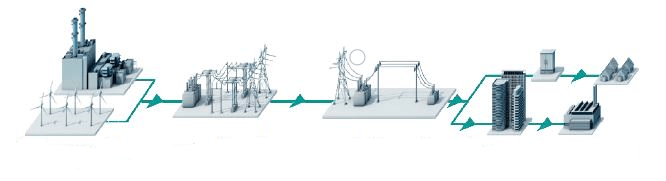
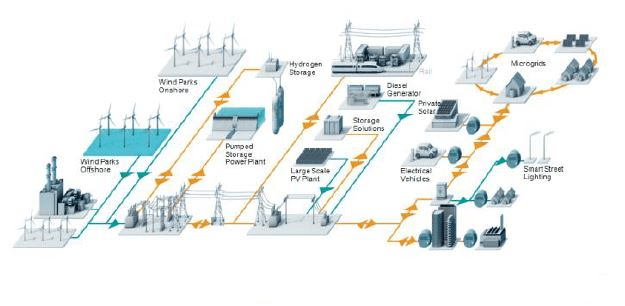
The implementation of the energiewende fosters serious changes in the structure and operation of the power supply system. The classical power supply structure generation transmission-distribution-consumer (Figure 1) with centralized generation and an unidirectional power flow is changing to distributed and bidirectional network structures (Figure 2).
Figure 1 – Centralized and unidirectional power system structure
Figure 2 – Distributed and bidirectional power system structure
The deployment of more and more distributed renewable energy sources with their fluctuating power infeed are having an increased negative impact on the power supply system. But customers (private households and small scale industry) and with even higher requirements industry are expecting a proper supply of electrical power with a certain level of high power quality. They are expecting a power supply with only a minimum number of incidents with only very short duration of power interruptions.
The new circumstances and challenges combined with increasing complexity leads to the following problems:
Fluctuating power infeed from renewable sources:
at the upper voltage levels (wind parks),
at low voltage level (small PV installations),
Changing energy flow direction, incl. energy transmission in higher voltage levels.
Decreasing short-circuit power and with that decreasing power system ruggedness and elasticity.
Infeed of harmonics at all voltage levels, caused by inverters and non-linear loads.
Voltage and currents peaks in distribution network.
Unbalance, particularly on the low voltage level.
By area-wide utilization of electronic voltage inverters a negative influence on the supply quality has to be considered particularly for harmonics. It is expected that the energiewende will have further influences on the supply quality, whereby in this paper only the aspects voltage quality and continuity of supply are considered. Generally the number of short dips and interruptions has increased over the last few years however there is no official registration of these disturbances by the regulators. Only unplanned interruptions which last longer than three minutes are considered in the system average interruption duration index (SAIDI). The SAIDI (System Average Interruption Duration Index) is an indicator for the supply quality in a electrical power supply system. Industries with their modern processes and sensitive technical equipment are reacting even to short interruptions in the millisecond area very sensitive. These developments must be taken into account for the measurement of power quality.
NEW REQUIREMENTS TO THE MEASUREMENT OF POWER QUALITY
Tendencies in international standardization
At present, the new requirements for the measurement of power quality are taken into account during the revision of existing standards as well as new standards. The standard IEC 62586-1 Ed. 1 [2] specifies the requirements for instruments for the measurement of power quality (Power Quality Instruments – PQI) and provides a common system of references in order to facilitate their selection, comparison and evaluation. This standard specifies a classification based on product performance, environment and safety. This product standard is specifying product and performance requirements for instruments whose functions are including the measurement, recording and possibly the monitoring of power quality parameters in power supply systems, whereby the measuring methods (class A or class S) are defined in IEC 61000-4-30.
The IEC 62586-2 Ed. 2 [3] is a standard specifying functional and uncertainty tests intended to verify the compliance of a product to class A and class S measurement methods defined in IEC 61000-4-30. IEC 62586-2 therefore complements IEC 61000-4-30. This standard may also be utilized by other product standards (e.g. digital fault recorders, revenue meters, MV or HV protection relays) specifying devices embedding class A or class S power quality functions.
The edition 3 of IEC 61000-4-30 [4] defines new measurement methods for rapid voltage changes and conducted emissions in the 2 kHz to 150 kHz range (informative) as well as the recording of currents for analysis of power quality limit violations.
Limits and thresholds which are specified in the technical specification IEC/DTS 62749 Ed.1 [5] are exceeding the power quality limits defined in EN 50160.
Requirements to the location of power quality measurements
The increasing complexity of the power system structure requires the gapless measurement and recording of voltage and currents characteristics for conformance evaluation at more locations. Measurements at the classical point of connection between supplier and customer are not sufficient enough, because decentralized generation are connected and alternating power flows over all power network levels and in customer systems are existing. Applications like the direction detection of harmonious/interharmonics and Flicker are becoming more important.
Requirements to PQ measurement methods and PQ evaluation
The implementation of IEC 61000-4-30 class A method guarantees comparable measurements of instruments provided by different manufacturers by a defined measurement method and gapless recording of power quality characteristics of the power supply. The evidence of compliance to defined emission limits at the point of connection between public network and customer as well as the analysis of problems (limit violation, decreasing tendencies of characteristics) and the derivations of measures for improvement are possible.
New measurement methods (IEC 61000-4-30) and new specifications (IEC/DTS 62749) are considering the circumstances risen be the change of the power supply network structures.
Additionally to the classical characteristics of voltage quality (power frequency, magnitude of the supply voltage, voltage unbalance, voltage harmonics and interharmonics, flicker and mains signalling voltages) and to the continuity of supply measurement (dips, swells, interruption) in edition 3 of IEC 61000-4-30 new characteristics (measurement method for rapid voltage changes (normative) and for conducted emissions in the frequency range between 2 kHz and 150 kHz (informative)) and the measurement of currents and current characteristics (without regulatory evaluation) are taken into account.
The measurement of load profiles which are sometimes very fluctuating due to the energiewende can be used to determine the utilization of the electrical power grid (Figure 3).
Figure 3 – Typical load profile change in a transformer station in a rural area (LEW-Verteilnetz GmbH) from 2003 to 2011
Requirements to measurement devices
The compliance with relevant product standards (IEC 62586-1/-2) and the implementation of standardized measurement methods lead to a manufacturer independent comparability of instruments for the end user thus increases transparency and guarantees future–proof investment.
The use of standard data formats and interfaces for data exchange is another advantage for customers. This approach is actually incorporated in the communication standard IEC 61850. The IEC/TR 61850-90-17 [6] describes the modeling and data exchange between power quality instruments and network control, power automation or SCADA systems.
POWER QUALITY MEASUREMENT IN PRACTICE
Power quality instruments, which were developed and/or certified according to standardized measurement methods and product standards, are (gapless) measuring and recording
the continuity of power supply and
voltage/current characteristics
at the point of delivery. Measurements and records are suitable for the following customer applications:
Support the network operator in network management of power supply system,
Simulation of different network states and network faults.
2. Fast detection of continuity of power supply
Detection of voltage events (dips, swells, interruptions, rapid voltage changes) in real-time (time resolution: ½ cycle),
Network operators can quickly react on disturbing situations and can initiate immediate remediation measures.
3. Power Quality compliance reports: data base analysis
Regular report on the voltage quality characteristics, statistical assessment over certain observation intervals,
Supervision of the voltage quality at the point of delivery as a quality assessment between energy supply company and their customers with their related contractual obligation
Analysis of voltage events and voltage quality disturbances
Information of customers whose plants or processes are delicate compared with limiting values of the voltage quality,
As a basis to derive information about the necessity and the dimensioning of optimization measures of existing nets as well or for future network expansions.
Power Quality reports
Voltage characteristics are derived from continuous records with defined observation intervals (day or week) as well as from detected voltage events. The standard EN 50160 Voltage characteristics of electricity supplied by “public distribution networks” is a European standard which specifies and defines main characteristics of the voltage at the point of connection under normal operating conditions. Technical Specification IEC/DTS 62749 Assessment of power quality – Characteristics of electricity supplied by public networks extends the set of limits defined in EN 50160 and takes current trends additionally into account. Table 1 shows the coverage of limits for voltage characteristics for low voltage, medium voltage and high voltage networks (LV, MV, HV).
Table 1 – Definition of limits in EN 50160 and IEC/DTS 62749 Ed. 1
Recording of voltage events
A voltage event will be recorded with the concerning voltage value (minimum for dip and interruption or maximum for swell) together with the corresponding duration of the event (see Figure 4).
Figure 4 – Voltage dip with limits (90 %, 110 %, 5 %) and additional record of ½ cycle voltage values
A complete voltage event description acc. IEC/DTS 62749 is given in Table 2.
Table 2– Example of single event assessment acc. IEC/DTS 62749
Event attribution
Detailed Characterization
Location
BlnW5, 230 V
Time stamp
2013-07-18 17:23:15,39
Capturing threshold
90 %
Residual voltage
55,3 %
Time duration
247 ms
RMS trend
see figure 4
Fault record
see figure 5
Table 2- Example of single event assessment acc. IEC/DTS 62749
Figure 5 – An example showing information of single event assessment: voltage dip with record of ½-cycle RMS values and fault record
Rapid Voltage Changes (RVC)
The installation of renewable energy sources may lead to critical network situations:
E.g. calm wind and cloudy sky combined with high network load or
Low network load at a simultaneous high infeed of photovoltaic and wind energy.
Also in these cases the permitted voltage band (±10 % of the nominal voltage) has to be guaranteed.
Rapid voltage changes are defined as the changes of the effective value of the voltage magnitude of a stationary value to another stationary value within the tolerance band of ±10 % from Udin or Un.
E.g. rapid voltage changes arise from the attempt of motors or switching operations in the net particularly in nets with a low short-circuit power. You e.g. have an effect on consumers by brightness change of lamps; however RVCs are not periodical events as opposed to Flicker.
Rapid voltage changes are characterized by voltage change ΔUss (new steady state voltage magnitude), the maximum deviation ΔUmax and the event duration T (see Figure 6). ΔUmax has to be smaller than ±10 % of Udin or Un, otherwise the event becomes a voltage dip or swell classification.
Figure 6 – Characteristics of rapid voltage changes
It is recommended to count rapid voltage changes per hour or per day or both. In this context the standard IEC/DTS 62749 Ed.1 recommends values between 3 % and 5 % of Udin (LV) or Un (MV, HV).
SUMMARY
The energiewende and the increasing infeed of distributed renewable sources require a reorganization of the electrical power network. A continuous assessment of the power quality by a gapless monitoring must be carried out by default and on a long-run and mustn’t be carried out only in the case of need.
Within the last few years there were many activities in the international standardization on the field of the measurement of the power quality (measurement methods and product standard for Power Quality instrument – PQI), the specification of limit values for power quality characteristics and the standardization of communications protocols as well as the data interchange formats (IEC 61850). This represents a basis for and future-proof power quality instruments and systems.
REFERENCES
[1] Transmission Code 2007: Network and System Rules of the German Transmission System Operators, Verband der Netzbetreiber – VDN – e.V. beim VDEW, August 2007 [2] IEC 62586-1, Ed. 1.0, Power quality measurement in power supply systems – Part 1: Power quality instruments (PQI) [3] IEC 62586-2, Ed. 1.0, Power quality measurement in power supply systems – Part 2: Functional tests and uncertainty requirements [4] IEC 61000-4-30 Ed. 3.0: Electromagnetic compatibility (EMC) – Part 4-30: Testing and measurement techniques – Power quality measurement methods [5] IEC/DTS 62749 Ed.1: Assessment of power quality – Characteristics of electricity supplied by public networks [6] IEC/TR 61850-90-17: Using IEC 61850 to transmit power quality data
Every circuit must be tested to make sure that the actual loop impedance does not exceed that specified for the protective device concerned. Because of the severity of coming into contact with an electrical fault, having your electrical installations and power points tested for earth fault loop impedance is crucial. Your systems are valuable and circuitry needs to be maintained for the durability and functionality of your business. In most homes, basic shock protection is done by organising an earthing circuit with automatic switches in the indoor wiring circuits. This quickly cuts off supply to an earthing circuit where a fault occurs and touch voltage exceeds an acceptable limit.
According to the current national safety standards, you are required to conduct loop impedance test on your premises to ensure the safety of all guests and employees. The electrical earth of all your electrical installations and power points has to be tested to discover any faults within your electric circuit. Having a functional earth return circuit will allow the detection of circuit faults and facilitate a reaction from your MCB (miniature circuit breaker). Carelabs technician will detect the resistance level in your earth return circuit and notify you if it is at the wrong level – it needs to be low enough to allow the circuit breaker to function correctly. Carelabs will inspect and test your electrical wiring and by asking us to test you are protecting both your employees and your liability. It is important to adhere to national legislation to avoid harsh penalties.
The required values of impedance and time will change dependent upon the type of installation (TN/TT etc.) and the type of protection, whether it be a miniature circuit breaker (MCB), cartridge fuse or re-wireable fuse for example. The fault current can either be in the Line-Neutral or Line-Earth circuit, so there is a need to confirm the loop impedance of each
What is Done During Earth Fault Loop Impedance Testing?
It is generally accepted that, where the measured earth fault loop impedance of a circuit is not greater than 80% of the relevant limit specified in BS 7671, the impedance can be expected to be sufficiently low under earth fault conditions to meet the relevant limit specified in BS 7671, and for the protective device to automatically disconnect within the time specified.
Proper protection against electric shock hazards is given when the TT wiring system complies with:
Ra x Ia <50,
Where “Ra” is the sum of the resistances of earth bars and protective conductors and “Ia” is the maximum current of the protection system. Ra multiplied by Ia should not be more than 50 V, i.e. the maximum voltage one can touch will not exceed 50 V in the event of an earth fault.
A fault loop impedance test is done between the active conductor and the earth. To test the loop impedance our technician will use an earth loop impedence tester which is plugged into the power socket (GPO) to take a reading.
Our highly-trained staff are fully mobile and offer earth loop impedance test services across the nation.
How do We Conduct Earth Fault Loop Impedence Test?
It is recommended that the External earth loop impedance (Ze) test be done first. This test, done at the distribution board, gives the loop impedance of the circuit, excluding the installation. The system loop impedance test (Zs), which includes the circuit tested in the Ze test as well as including the installation resistance, must be done next.
AC impedance of a circuit may be different from its DC resistance – particularly for circuits rated at over 100 A – the fault loop impedance is thus measured using the same frequency as the nominal mains frequency (50 Hz).
The Ze earth fault loop impedance measurement is made on the supply side of the distribution board and the main means of earthing, with the main switch open and all circuits isolated. The means of earthing will be isolated from the installation’s earthing system (earth rods) bonding during the test. The Ze measurement will confirm the earth fault loop impedance as the sum of the resistances.
External Earth Fault Loop test sequence:
Step 1: Use an Earth Fault Loop Tester or select the Earth Fault Loop Test option on a multifunctional tester such as the Megger 1553.
Step 2: Test on the incoming side of the installation. Connect one test lead to the Line terminal, the second test lead to the Neutral terminal and the third (usually green) test lead to the incoming Earth conductor.
Step 3: Press the TEST button. The measurement should be a low reading ohm value.
Do not forget to record this value of `Ze` on the Electrical Installation Certificate.
Having obtained the `Ze` value for the installation, the value of `Zs` can be easily calculated for every circuit.
The maximum measured earth fault loop impedance (Zs) values recorded should be compatible with the Ze + R1 + R2 value of each circuit, irrespective of the requirements of the respective protective device(s). Test results measured using low current tests are not recorded on schedules of test results, it is preferable to record the Zs values calculated from individual test results i.e.
The formula for determining Zs:
Zs = Ze + (R1+R2)
Zs – earth fault loop impedance of the circuit tested
Ze – earth fault loop impedance external to the supply
(R1+R2) – Sum of the resistance of Line and Earth for the tested circuit.
Where Ze is derived from a high current test and R1 + R2 obtained during continuity testing of the circuits. The type of test results recorded and the test method used will be indicated in the appropriate remarks column of the test results schedule.
The Zs earth fault loop impedance is tested at the furthest point of each circuit. In most cases the circuit breaker needs to be bridged out. The total earth fault loop impedance is measured by plugging a loop tester into a socket outlet, or in some cases with an external earth probe. The value of the earth fault loop impedance is the sum of the resistances. When using an external earth probe, the earth fault loop impedance is measured by touching an external probe directly to an earth bar, collector and connection point of an earth bar. The same measurement can be done by touching the earth probe to exposed, conductive parts of equipment in the circuits and exposed metal parts.
The Earth Fault Loop Test Sequence:
Step 1: Locate the furthest point on the circuit to be tested (such as the furthest socket)
Step 2: With the appropriate Earth Fault Loop Tester, connect the test leads to the Line, Neutral and Earth terminals.
Step 3: Measure and write down the test results on the Schedule Of Test Results.
If the circuit is RCD protected than you will have to select the “No trip” function of the Megger 1553 to avoid nuisance tripping of the RCD. If your tester does not have this option then you will have to link out the RCD.
Having obtained the value of Zs for every circuit, you will be expected to verify that these values are within the accepted limits described by BS 7671.
Loop Impedance Tests Methods
As it stands today, most contractors will use one of 5 different test techniques when loop impedance testing:
2-wire high current test
2-wire “No-Trip” dc saturation test (Obsolete)
3-wire “No-Trip” test
2-wire “No-Trip” test
4-wire grid impedance test
2-wire high current test
This is the traditional loop impedance test. Using a test current of up to 20 A and a simple 2 wire connection, it is by and large the fastest, most accurate test available on a day to day basis. Most standard loop impedance testers will incorporate this type of test. Because of the relatively high test current, the readings are not generally influenced by external factors and will return repeatable, stable readings in most scenarios.
2-wire “No-Trip” dc saturation test
A DC test current was injected in to the circuit prior to carrying out a standard 2 wire high current test. The aim of this DC test was to saturate the monitoring coil within the RCD, allowing enough time for the high current AC test to be carried out. However, due to the increase in electronic RCDs, this method now has limited applications
3-wire “No-Trip” test
This test method overcame the need to by-pass even the new electronic protection devices by utilising a low current Line-Earth test current, whilst still returning a degree of accuracy. Not having to by-pass the RCD/RCBO obviously introduced a time saving factor. In addition, by having the requirement of connecting to Line, Neutral and Earth, the testers were now able to confirm the presence of all three as well as indicate if there was a reverse polarity at the test point and, due to the limited test current, there was no issue with tripping the MCB.
2-wire “No Trip” test
They allow testing most RCDs and RCBOs without having to bypass them. With no neutral connection required, they maintain a true 2-handed operation, but will no longer indicate reverse polarity or warn of a missing neutral. Although the physical test time is similar to that of the 3-wire method, the time saving of not having to bypass the RCD still makes for a more efficient test.
4-wire grid impedance test
The test uses a 4 wire Kelvin connection, negating internal lead and contact resistance; such is the accuracy of the test. With test currents up to 1000 A, measurements down as low as 10 MOhm can be accurately made. Consequently, there is no “No-Trip” option with this test method. With specific applications being measurement in sub-station/switch room environments, this tester gives the test engineer the ability to take accurate readings.
A circuit protected by an RCD will need special attention, because the earth-fault loop test will draw current from the phase which returns through the protective system. Thus testing of circuits protected by RCDs has presented instrument manufacturers’ with difficulties in providing test results similar to that of the testing of non-RCD protected circuits, without tripping the RCDs during the tests. Therefore, any RCDs must be bypassed by short circuiting connections before earth-fault loop tests are carried out. It is, of course, of the greatest importance to ensure that such connections are removed after testing.
At Carelabs we use an earth loop impedance tester that will not trip out the circuits RCD that we are testing. Our team will conduct all tests and inspections according to the current safety standards. Testing is mandatory for the safety of all employees. Get tested today to make sure your workplace is safe – we’re here to assist with all your compliance requirements
Since the test result is dependent on the supply voltage, small variations will affect the reading. Thus, the test should be repeated several times to ensure consistent results. Anyone on site must avoid shock hazard while establishing contact and while doing the test. When buying a loop tester ask for distribution board test leads so that Ze and Zs measurements can be done.
Impedence value:
Earth Fault Loop Impedance Testing and Recording Earth fault loop impedance testing is carried out on a completed electrical installation to check compliance with BS 7671 (IET Wiring Regulations) with regard to fault protection and is normally carried out as follows:
With a test current of approximately 23A where circuits are protected by overcurrent devices such as fuses or circuit breakers only; or
With a test current of approximately 15mA, to prevent unwanted tripping where circuits are protected by 30mA or other RCDs.
Typically test results for high current (23A) tests in the range 0.1Ω to 1.0Ω are largely stable with a resolution of 0.01Ω. For low current (15mA) tests the resolution was 0.1Ω, but attempts to decrease this to 0.01Ω have been largely unsuccessful in providing the same stable results for readings of less than 1.0Ω.
A recent study by one of the UK leading instrument manufacturers using instruments from seven different manufacturers under controlled conditions found significant discrepancies in the instrument readings. Further investigation revealed that the problem appeared to be mainly with the low test currents, caused by variations in power supply quality created by voltage magnitude, transients, harmonics etc. Similar tests carried out using a stabilized power supply with a clean 50Hz waveform produced more consistent results. It should however, be noted that these discrepancies, usually in the order of 1.0Ω or less, are not significant in terms of the correct operation of an RCD.
After testing is complete, we will give you a retest date (for your next earth loop impedance test) that complies with the national standards. When the time comes, our team will notify you of the retest. All results will be documented in a detailed report that is supplied to each client. Within this report, your equipment will be assigned either a pass or a fail. This document will be kept on file should you need to access it in the future for compliance verification. We provide a wide range of inspection and testing services to clients so that you can secure your entire workplace in one visit. After you’ve had your impedance test, we can provide you other inspection services too. With such a wide variety of services, there’s no reason to go elsewhere for your safety testing requirements.
Earth fault loop impedance testing is a way of insuring that you have made an electrically safe ground connection having a suitably low residual resistance. Earth loop impedance testing is essential since if a live conductor is accidentally connected to an earth conductor in a faulty appliance or circuit, the resulting short-circuit current to earth can easily be high enough to cause electric shock or generate enough heat to start a fire. Normally, the fuse will blow or another circuit protection device will trip, but a situation may arise where the actual short-circuit current in a faulty installation is of insufficient level and the protection device would thus take too long to activate. The delay can be disastrous for life and property. It is therefore necessary to know if the impedance of the path that any fault current would take is low enough to allow sufficient current to flow in the event of a fault and that any installed protective device will operate within a safe time limit.
Written by Ian Wallace, Chief Engineer, Power Quality Solutions, TCI® Technical Paper.
Introduction
IEEE Std 519-2014 is a newly published revision to the IEEE Recommended Practice and Requirements for Harmonic Control in Electric Power Systems. It supersedes the IEEE Std 519-1992 revision.
The overarching goal of the 2014 revision is the same as the 1992 version; to define the specific and separate responsibilities for each participant – utilities and users – to maintain the voltage THD within acceptable limits at the Point of Common Coupling (PCC) between the utility and the user, and protect the user and utility equipment from the negative impact of harmonics. The separate individual responsibilities are:
• User – limit harmonic currents at the PCC to prescribed levels • Utility – limit voltage distortion at the PCC to prescribed levels by maintaining system impedance as necessary
To determine if your systems are compliant with IEEE 519-2014, use the HarmonicGuard® Solution Center at hgsc.transcoil.com.
Main Updates and Changes that may affect you
Applying Harmonic Limits at the PCC between Utility and User
The 2014 version re-emphasizes and clarifies IEEE Std 519, as written, is to be applied at the PCC – the point of common coupling between the utility and the user.
The size reduction of the document and the removal of conflicting material aids tremendously in clarifying:
• The standard is designed to be applied at the PCC • The PCC is the point of common coupling between the utility and user
Current THD Limits at the PCC
A change was made to the Current Distortion Limits table to document what has been practiced in the field for many years – limiting the assessment of harmonic currents up to a maximum of the 50th harmonic. This is accomplished by clearly stating in Table 2 of IEEE Std 519-2014; the maximum individual harmonic range is 35th≤h≤50th.
Voltage THD Limits at the PCC
Table 11-1 Voltage Distortion Limits in the 1992 version was updated (Table 1 in the 2014 version) with the addition of a new voltage range and limits.
A new lower PCC voltage range of V≤1.0kV was defined with higher allowable harmonic voltage limits: Individual Harmonic at 5% and Total Harmonic Distortion at 8%. These limits are higher than the next highest voltage range 1.0kV<V≤69kV.
High Frequency Current Allowance in Low Current Distortion Systems
IEEE 519-2014 provides for an allowance of higher high-order harmonic current limits at a PCC that has low lower-order harmonics. The allowance is applied to Table 2, Current Distortion Limits, if a prescribed minimum performance level is met. For example, if a power system with Isc/IL<20 has 5th and 7th harmonic currents at <1% then all other harmonic limits in Table 2 may be exceeded up to a factor of 1.4 and still be in compliance.
Measurements
The IEEE Std 519-2014 version more clearly defines the statistical measurement levels for determining compliance. The new measurement methods will be especially useful for power systems with large amounts of cyclical loads or a power system with varying loads and distortion levels.
As described in more detail in the standard, the three statically based limit bands are:
Daily 99th percentile harmonic currents should be less than 2 times the Current Distortion limits in Table 2
Weekly 99th percentile harmonic currents should be less than 1.5 times the Current Distortion limits in Table 2
Weekly 95th percentile harmonic currents should be less than 1.0 times the Current Distortion limits in Table 2
Format Changes
The 2014 revision is a vastly simplified document compared to the 1992 version. A significant amount of educational material on generation and measurement of harmonics was either deleted or moved from the main body of the document into the appendices. For example, some of the sections that were removed include:
Section 4 – Harmonic Generation: typical converters that produced harmonics
Section 5 – System Response Characteristics: details on power system resonance and interaction with converters and power factor correction capacitors
Section 6 – Effects of Harmonics including impacts on transformers, capacitors and meters
Section 7 – Reactive Power Compensation and Harmonic Control: Typical passive filter circuits
Sections 8 & 9 – Mathematic techniques to address THD calculations and measurements
Sections or information from the 1992 version that were moved to the 2014 version’s appendices and simplified are:
Interharmonics and flicker
Telephone Influence Factor (TIF)
Notch depth for limits SCR rectifiers
Additional key sections from the 1992 version that have been consolidated and made more concise:
Section 9 – Measurements of harmonics
Section 10 – Harmonic voltage current limits
Section 11 – Addressing harmonic voltage limits
Interested parties may refer back to the 1992 version for educational details when needed.
IEEE Societies
The IEEE Std 519-1992 was a product of and collaboration between two IEEE Societies:
• Transmission and Distribution Committee of the IEEE Power and Engineering Society • Static Power Converter Committee of the IEEE Industry Applications Society
The IEEE Std 519-2014 document is a product of one IEEE Society, The Transmission and Distribution Committee of the IEEE Power and Energy Society.
Conclusions
IEEE Std 519-2014 is a newly published revision to the IEEE Recommended Practice and Requirements for Harmonic Control in Electric Power Systems. It supersedes the revision IEEE Std 519-1992. This document summarizes key changes and updates made in this latest version.
[1] “IEEE Recommended Practices and Requirements for Harmonic Control in Electrical Power Systems”, IEEE Std. 519-1992. [2] “IEEE Recommended Practices and Requirements for Harmonic Control in Electrical Power Systems”, IEEE Std. 519-2014.
Published by PowerCET® Corporation, Course: PQ103, 2007. Introduction to Power Quality: Problems, Analysis & Solutions – Planning & Performing a Power Quality Survey.