Published by Saheed Lekan GBADAMOSI1,2, Nnamdi I. NWULU1, Center for Cyber Physical Food, Energy and Water Systems, University of Johannesburg, Auckland Park 2006, South Africa (1), Department of Electrical and Electronic Engineering, Bowen University Iwo, Osun State, Nigeria (2)
ORCID: 0000-0001-7398-813
Abstract. This study examines the use of Ethereum-based smart contracts to facilitate peer-to-peer energy trading in decentralized marketplaces. Energy traders submit bids and offers to smart contracts, which oversee the transaction process. Additionally, another smart contract helps energy merchants source energy from prosumers to meet their supply obligations. This research validates the efficiency of smart contracts in managing transactions within decentralized energy sources using a real-world electricity market scenario.
Streszczenie. W tym badaniu zbadano zastosowanie inteligentnych kontraktów opartych na Ethereum w celu ułatwienia handlu energią typu peerto-peer na zdecentralizowanych rynkach. Handlowcy energią składają oferty i oferty do inteligentnych kontraktów, które nadzorują proces transakcyjny. Dodatkowo kolejna inteligentna umowa pomaga sprzedawcom energii pozyskiwać energię od prosumentów w celu wywiązania się z obowiązków w zakresie dostaw. Badanie to potwierdza skuteczność inteligentnych kontraktów w zarządzaniu transakcjami w ramach zdecentralizowanych źródeł energii z wykorzystaniem rzeczywistego scenariusza rynku energii elektrycznej. (Symulowany handel energią typu peer-to-peer z obsługą blockchain na rynku)
Keywords: Blockchain, decentralized, peer-to-peer energy trading, electricity marketplace
Słowa kluczowe: Blockchain, zdecentralizowany handel energią typu peer-to-peer, rynek energii elektrycznej
Introduction
More than 80% of the world’s electricity has traditionally been generated from carbon fuels, which, until recently, served as the primary method of producing energy [1]. Nonetheless, these non-renewable sources have inflicted considerable harm on the environment, compelling the integration of renewable energies into conventional energy systems. The adoption of renewable energy sources is significantly impacting the energy trade within the sector [2]- [8]. Conventional centralized systems are typically employed for power transactions, but this approach comes with drawbacks such as costly transactions, inefficient administration, as well as the risks of hacking, censorship, and privacy concerns [9]-[11][5]. Peer-to-peer (P2P) energy trading, an emerging energy management technology, has evolved to empower prosumers in sharing their surplus electricity. This innovative approach not only enables the exchange of energy among peers but also transforms how consumers harness their energy resources [11][12]. Furthermore, it unlocks fresh opportunities within power system markets. P2P electricity markets hold the potential to grant users the freedom to select their preferred source of electric energy, including investments in locally generated renewable sources [2][13]. By utilizing P2P energy trading techniques, consumers have the flexibility to function as either buyers or sellers independently of the main grid. Furthermore, P2P energy trading offers participants the advantage of procuring electricity from the open market at a lower cost compared to traditional utility charges, thus promoting broader access to clean energy [14]. This is particularly beneficial for participants who may not have the means to generate their own electricity. However, it’s worth noting that some of the existing P2P energy trading systems rely on centralized, conventional technology, which carries the potential risk of compromising data privacy and exhibiting less-than-ideal transactional behavior [15][16]. To address these concerns, the adoption of blockchain technology is being explored as a means to implement open and secure P2P transactions.
There is a widespread belief that blockchain technology has the ability to usher in the next digital revolution, with effects that could rival those of the Internet. It has the capacity to decentralize power within systems, affording every participant an equal opportunity, sometimes without the need for centralized control of information. This fosters transparency by making information accessible to all. In recent years, the adoption of blockchain technology has surged across virtually all industries, with a notable emphasis on its application in the energy sector. By harnessing blockchain technology, the traditionally centralized energy market, often controlled by a handful of major corporations, has the potential to evolve into a more democratic, decentralized landscape driven by microgrids [17][18]. P2P energy trading facilitated by blockchain empowers prosumers to directly sell their surplus electricity to neighbouring customers, eliminating intermediaries and fostering profitable transactions [19][20]. This approach allows customers to access electricity at a reduced perkilowatt-hour (kWh) cost and show their preference for renewable energy, all without necessarily investing in the system themselves. Simultaneously, prosumers can benefit by generating higher earnings compared to conventional feed-in tariffs. In a dynamic market that offers advantages to both prosumers and consumers, auctions for renewable energy can serve an additional purpose of storing untraded electricity through battery storage systems [21]. This more cost-effective infrastructure enhances market efficiency, benefiting network providers and electricity retailers. Blockchain-based systems further enhance security and anonymity for both prosumers and consumers, eliminating the necessity for intermediary amongst the markets [22]. The execution of smart contracts facilitates energy trading, enabling real-time matching of energy supply and demand among agents with complementary energy demand profiles.
With an increasing number of industries embracing blockchain technology and adapting their business models, the potential of blockchain in P2P energy market has garnered significant attention. The blockchain revolution is paving the way for the anticipation of a smart grid, fostering accelerated innovation. However, it’s essential to acknowledge that the system is currently in the proof-ofconcept and assumption stages, making it challenging to fully exploit its potential in P2P energy trading at this juncture [23][24]. Ongoing discussions persist regarding the performance, scalability, and interoperability challenges associated with blockchain technology. Implementing blockchain on a large scale remains complex due to the inability of separate blockchain networks to seamlessly link and communicate with each other, potentially leading to interoperability issues [25]. These challenges have the potential to hinder the scalability of blockchain technology. Therefore, the objective of this study is to establish a model for a peer-to-peer energy trading marketplace, leveraging blockchain technology to ensure trust, anonymity, transparency, and auditability in interactions between energy prosumers and consumers. The main contribution of this paper is as follows:
• develop a system module that empowers prosumers to generate energy offers along with pricing details.
• develop a system module that allows users to transfer tokens to the primary smart contract and initiate energy requests.
• employ the primary smart address to be able to transfer tokens to the various prosumers after the transferred energy has been verified.
• assess the module’s overall performance across various scenarios
The remains of this paper consist of the following: literature review detailing the blockchain and smart contract concepts is introduced in Section 2. Section 3 outlined the proposed trading mechanism adopted for smart contracts. The implementation of the smart contract using different scenarios is illustrated in Section 4. The simulated results obtained are discussed in Section 5 and the paper is formally concluded in Section 6.
Literature Review
Both the academic and business communities are increasingly focusing on peer-to-peer energy trading. We commence by conducting an in-depth examination of prior scholarly research in this domain, alongside ongoing blockchain-based energy marketplace initiatives. Subsequently, we delve into research related to the Hyperledger Fabric and Ethereum blockchains. In reference [26], prosumers within the market are depicted as part of a generalized aggregative game. Additionally, the author proposes a distributed market-clearing mechanism that leverages a generalized Nash equilibrium to guarantee convergence towards a strategically stable and economically advantageous system. Reference [27] offers a comprehensive and in-depth analysis of the design, challenges, and potential of the peer-to-peer market. Reference [28] investigates the potential advantages of integrating game and auction theoretical models within peer-to-peer (P2P) energy trading contexts. Reference [29] introduces a demand-side management strategy aimed at reducing the peak-to-average ratio. This strategy employs blockchain technology to ensure the confidentiality of trading profiles. Reference [30] presents an energy sharing architecture managed by a central energy sharing agent, which does not incorporate bidding capabilities. Based on prosumers’ local photovoltaic (PV) generation capacity, the agent makes decisions to either purchase or sell energy from them. In Reference [31] suggest a Stackelberg game strategy utilizing a consortium blockchain to eliminate the need for trusted intermediaries in credit-based peer-to-peer (P2P) energy trading systems. Reference [32] encompasses a literature review and an exploration of business case studies related to blockchain solutions within the energy sector. This study identified various technological challenges associated with such solutions. Another review study centered on the challenges encountered by peer-to-peer (P2P) microgrids relying on blockchain technology. In [33], a comprehensive description of blockchain technology is provided within the context of various energy trading scenarios. These scenarios encompass business-to-business, non-profit support, and peer-to-peer trading. Reference [34] features a concise analysis of blockchain and distributed ledger technology. This study involved internal workshops and a series of interviews aimed at identifying potential opportunities and challenges in this field. The peer-to-peer (P2P) market detailed in Reference [35], operates under the control of a central agent. This agent possesses access to all local resources and assumes responsibility for determining the supply, demand, and pricing. In [36], the inquiry grid is divided into microgrids to facilitate multi-level trading. At the inter-microgrid trade level, any surplus or deficit in energy resulting from intra-microgrid transactions is then traded.
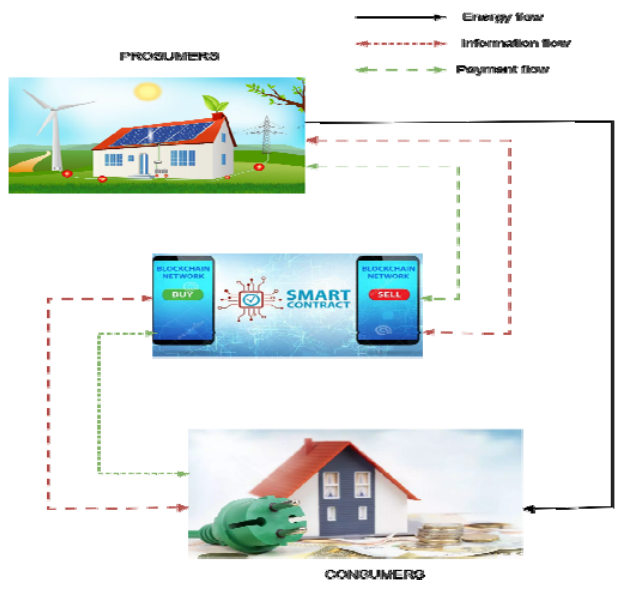
This study presents an innovative smart contractpowered framework in which network participants contribute spinning energy to address energy deficits resulting from providers failing to meet their commitments. Smart contracts are deployed for P2P energy trading system, which utilizes the computerized transaction protocol called blockchain technology, it serves as a mechanism for establishing agreements. The contract terms as an integral part of the transactions are automatically carried by this protocol. This is used as an auction mechanism designed to connect the sellers with buyers. Fig.1 presents smart contract mechanism for energy trading in marketplace. The contract gathers bids and offers from both buyers and sellers and employs an auction system to pair them. Buyers submit bids along with their corresponding funds, while sellers exclusively present proposals to the contract. The smart contract acts as a custodian for the funds and compensates sellers for the energy they deliver, thereby enforcing fairness amongst the participants. The foundational rule for smart contracts was initially introduced in [37] by authors who amalgamated game theory principles with an automated demand response model. In Reference [38] smart contracts are employed to facilitate data sharing between consumers and prosumers, while also enabling each market participant to independently handle their bill payments. In reference [39], a privacy-preserving module is proposed for constructing smart contracts designed for energy trading. This module effectively safeguards against privacy breaches in the context of nearby energy transactions. In Ref. [40], an innovative distributed double auction mechanism is employed for electricity trading within a peer-to-peer market. This process seamlessly integrates peer-to-peer communication, payment transactions, and information exchange through the utilization of smart contracts. Ref. [41] generates smart contract by the grid operator for individual users, enabling them to manage both payments and energy consumption effectively.
Trading mechanisms proposed for smart contracts.
This section outlines the process undertaken to create an energy trading model among different participants using a smart contract deployed on an Ethereum-based Integrated Development Environment (IDE). Additionally, a function-based algorithm is included to guide the step-by-step development of the smart contract. Within the Remix IDE, mock Ethereum wallet accounts are generated for users. One significant advantage of these environments is that the initiator receives simulated tokens, enabling them to conduct blockchain-related development tasks such as testing and deploying smart contracts. The Remix IDE is a robust open-source tool that allows users to write Solidity contracts directly within a web browser. It is written in JavaScript and can be utilized both online and locally on a desktop. This comprehensive IDE encompasses essential features such as smart contract testing, debugging, and deployment capabilities.
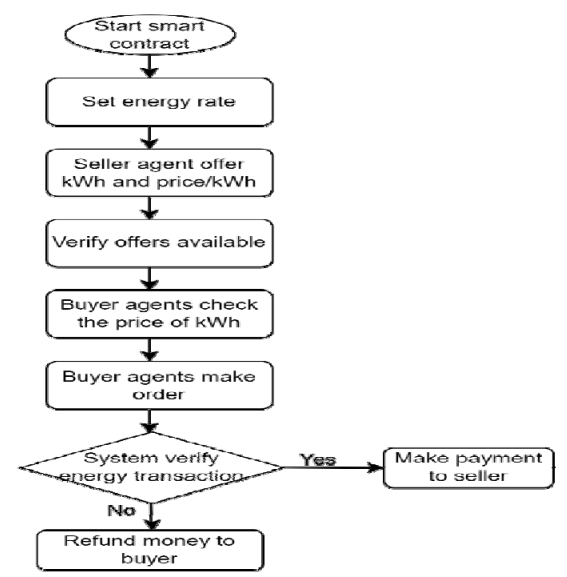
Smart contracts are pivotal in the realm of blockchain, particularly in the context of energy sector. To facilitate electricity trading through blockchain, it is imperative to design integrated transactions and short-term balancing contracts using smart contracts. These contracts serve as the foundation for secure and transparent energy trading. Transaction data is encrypted within these contracts, while cash flows are transacted using the cryptocurrency, Ether. The evolving smart contract comprises functions with varying levels of access for participants. Fig. 2 depicts the flowchart illustrating the algorithm for the smart contract. The functions comprising the smart contract are detailed in Algorithm 1. Key functions were restricted to access only by the administrator’s account address, whereas other functions were freely accessible to others. The summary of the flowchart is given below:
• Function 1 is exclusively invoked during the contract deployment process. Its primary purpose is to assign the contract deployer’s account address to a variable. This stored variable is subsequently employed to regulate access permissions for specific functions on the blockchain.
• Function 2 is executed exclusively by the contract deployer. Its goal is to figure out how much one ether is worth in dollars.
• Function 3 is invoked by the sellers to submit their energy offers in kilowatt-hours (kWh) along with the corresponding price for each unit in US dollars per kWh.
• Function 4 is used to validate the sellers’ offers, and the data is organized and stored in ascending order based on the cost.
• Function 5 is accessed by the buyers to review the cost of the energy they intend to purchase, specified in US dollars per kWh.
• Function 6 is utilized by the buyers to place an order and initiate payment directly to the contract.
• Function 7 is invoked by the administrator to process payments to the buyers once the energy transfer has been confirmed
Algorithm
Function 1: constructor
// Runs during contract deployment and stores the
deployer’s address in a variable called “admin.”
Function 2: setRate
input: price of Ether in USD
require: function deployer = admin
rate = Ether value
Function 3: offers
input: Seller’s energy in kWh; Energy price in USD.
Store in ‘Seller’ mapping
Function 4: verifiedOffers
input: account address of Sellers; Sellers’ energy quantity;
Sellers’ Price of Energy
require: Seller’s Energy Quantity and Energy Price in
match, for all user addresses.
occupy a new mapping ‘vSellers’ with the newly ordered
user addresses
delete data from ‘Seller’ mapping.
Function 5: checkMarketPrice
require: The price of energy needed by Buyers in ether
input: Buyers bid in kWh;
Function 6: makeMarketOrder
Input: Value of ether of Buyers’ needed energy
Function 7: payMarketOrder
require: function deployer = admin
for each Seller in array
pay Seller
end for
Smart contract implementation
Inspired by the research conducted by Debin Fang in 2012, this study focuses on energy prosumers willing to share their surplus energy with fellow residents in a smart community. We explore two scenarios:
• Scenario 1: Prosumers’ supply surpasses consumers’ demand.
• Scenario 2: Consumers’ demand exceeds the available supply.
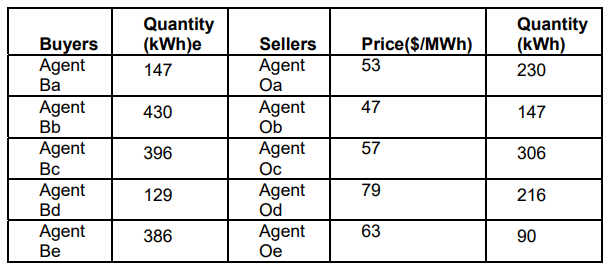
For both Scenario 1 and Scenario 2, we consider five groups of prosumers and five consumers. The offers and bids are generated randomly, with quantities ranging from 50 to 500 kilowatt-hours (kWh) and prices falling within the USD 40 to USD 90 range. Tables 1 and 2 present the information on the offers and bids for sellers (prosumers) and buyers (consumers) with regards to quantity and price. The data provided above serves as a comprehensive dataset for assessing the smart contract’s logic and checking the accuracy of refunds and reimbursements made to the parties concerned.
Table 1. Information on offer/bid for Prosumers and Consumers (Scenario 1)
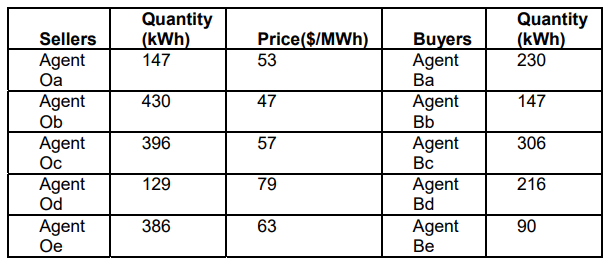
Table 2. Information on offer/bid for Prosumers and Consumers (Scenario 2)
Results and discussion
In this section, the results in respect of the implementation of smart contract for P2P electricity trading procedure based on the case studies are presented. A matching procedure between the sellers and the purchasers is established.
Figure 3 illustrates the submission of bids and offers by Buyer agents and Seller agents. In addition, it visualizes the procedure for matching within the smart contract. Both buyer agents and seller agents submit the information for their bids and offers to the contract. Once authenticated, the bids are organized in ascending order based on their cost.
The resulting ordered lists are as follows: Seller agents – D, E, C, A and B; Buyer agents – A, B, C, D, and E. Subsequently, the matching of Seller agents and Buyer agents commences. This matching process initiates at the top of the sorted lists, with Seller agent B offering 230 units of their energy at their specified price to Buyer agent A. The matching process continues until all the buyers’ bids are fulfilled, concluding when Seller agent E is matched with Buyer agent E. As observed in Figure 3, the offered energies are allocated simultaneously to the bidding buyers, meaning a single Seller can distribute energy to multiple Buyers. For example, Seller agent B shares energy with Buyer agents A, B, and C.
Figure 4 illustrates the flow pattern of funds among the participants in the study. Buyers transfer their funds to the smart contract when placing their bids. The smart contract can securely hold these tokens (funds) until predefined conditions are satisfied. Payments are disbursed from the smart contract to successful sellers, while buyers who are either fully or partially unsuccessful receive corresponding refunds. Notably, in this scenario, Sellers B, A, C, and D have received payments from the contract.
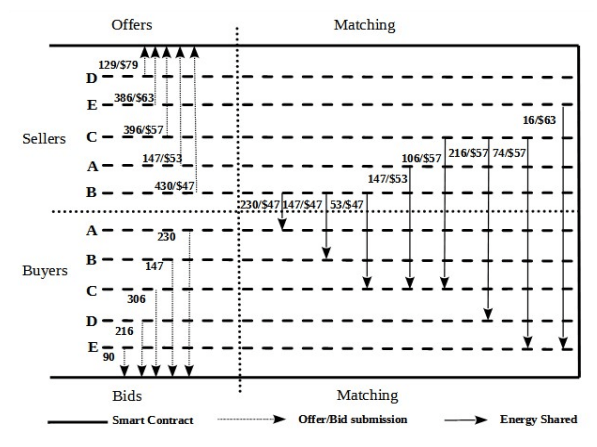
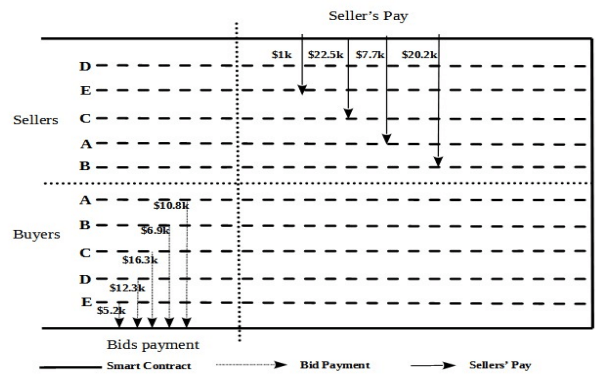
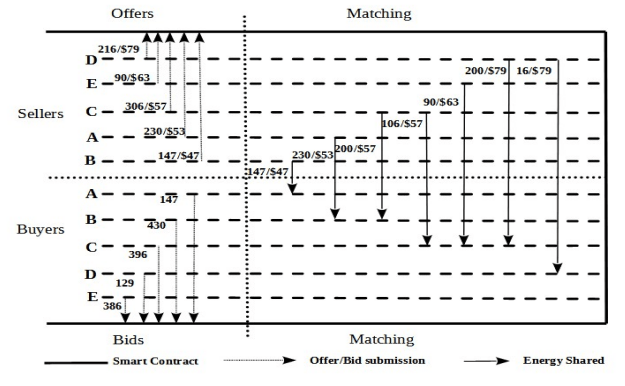
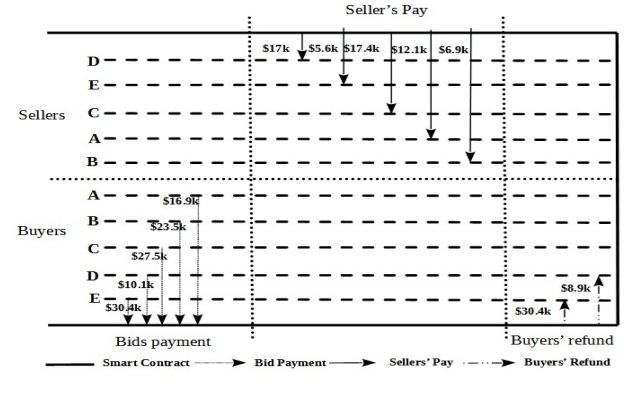
Figure 5 simulates a scenario in which the number of bids surpasses the available offers. Much like in Figure 3, both seller agents and buyer agents submit the information of their offers and bids to the smart contract for necessary action. These offers are then sorted in ascending order based on their cost and subsequently matched with the bids. Notably, Buyer agent D received a quantity of energy less than what they had bid for, and Buyer agent E did not receive any energy at all. The offers were fully allocated during the matching process between Seller agent D and Buyer agent D. Figure 6 illustrates the transactions procedure involve made between smart contract and the participants. Notably, refunds were issued to buyers who were either partially successful or entirely unsuccessful in their bids.
Conclusion
In the realm of future smart grids, one intriguing concept involves peer-to-peer energy trading, enabling direct exchanges between energy consumers and producers within local electrical networks. This project harnesses blockchain technology to conceptualize and simulate a peer-to-peer (P2P) energy trading marketplace tailored for energy prosumers and consumers, characterized by flexible demand and storage capabilities.
This study explores two distinct scenarios involving diverse groups of sellers and buyers. It effectively demonstrates that, owing to the inherent features and integrity of smart contracts, the transactions are securely stored and resistant to counterfeiting or tampering. The model was crafted using the Solidity programming language and rigorously tested through the Ethereum-based Remix IDE. Furthermore, a flowchart-based algorithm was employed to elucidate the model’s functionality. After the implementation, a peer-to-peer (P2P) energy trading marketplace model has been established, facilitating secure and authentic energy transactions among various energy stakeholders.
REFERENCES
[1] S. L. Gbadamosi and N. I. Nwulu, “A multi-period composite generation and transmission expansion planning model incorporating renewable energy sources and demand response,” Sustain. Energy Technol. Assessments, vol. 39, no. October 2019, p. 100726, 2020, doi: 10.1016/j.seta.2020.100726.
[2] P. Wongthongtham, D. Marrable, B. Abu-Salih, X. Liu, and G. Morrison, “Blockchain-enabled Peer-to-Peer energy trading,” Comput. Electr. Eng., vol. 94, no. September 2020, p. 107299, 2021, doi: 10.1016/j.compeleceng.2021.107299.
[3] M. Moniruzzaman, A. Yassine, and R. Benlamri, “Blockchain and cooperative game theory for peer-to-peer energy trading in smart grids,” Int. J. Electr. Power Energy Syst., vol. 151, no. March, p. 109111, 2023, doi: 10.1016/j.ijepes.2023.109111.
[4] S. L. Gbadamosi and N. I. Nwulu, “A comparative analysis of generation and transmission expansion planning models for power loss minimization,” Sustain. Energy, Grids Networks, vol. 26, p. 100456, 2021, doi: 10.1016/j.segan.2021.100456.
[5] S.L. Gbadamosi, N.I. Nwulu. Harmonic estimation on a transmission system with large-scale renewable energy sources, Przeglad Elektrotechniczny, ISSN 0033-2097, R. 97 NR 4/2021.
[6] N.I. Nwulu, M. Fahrioglu. Investigating a ranking of loads in avoiding potential power system outages, Przeglad Elektrotechniczny, Volume 88, Issue 11 A, 2012.
[7] J. Jasper, Albert Aruldoss. Differential evolution with random scale factor for economic dispatch considering prohibited operating zones, PRZEGLĄD ELEKTROTECHNICZNY, ISSN 0033-2097, R. 89 NR 5/2013.
[8] Rajan, K. Dhayalini , S. Sathiyamoorthy, Genetic Algorithm for the coordination of wind thermal dispatch, PRZEGLĄD ELEKTROTECHNICZNY, ISSN 0033-2097, R. 90 NR 4/2014.
[9] H. Bouzeboudja, M. Maamri , M. Tandjaoui, The Use of Grey Wolf Optimizer (GWO) for Solving the Economic Dispatch Problems based on Renewable Energy in Algeria A case study of “Naama Site”, PRZEGLĄD ELEKTROTECHNICZNY, ISSN 0033-2097, R. 95 NR 6/2019.
[10] W. Khamsen, C. Takeang, Hybrid of Lamda and Bee Colony Optimization for Solving Economic Dispatch, PRZEGLĄD ELEKTROTECHNICZNY, ISSN 0033-2097, R. 92 NR 9/2016.
[11] A. Esmat, M. de Vos, Y. Ghiassi-Farrokhfal, P. Palensky, and D. Epema, “A novel decentralized platform for peer-to-peer energy trading market with blockchain technology,” Appl. Energy, vol. 282, no. PA, p. 116123, 2021, doi: 10.1016/j.apenergy.2020.116123.
[12] M. Afzal et al., “Role of blockchain technology in transactive energy market: A review,” Sustain. Energy Technol. Assessments, vol. 53, no. PC, p. 102646, 2022, doi: 10.1016/j.seta.2022.102646.
[13] H. Sahebi, M. Khodoomi, M. Seif, M. S. Pishvaee, and T. Hanne, “The benefits of peer-to-peer renewable energy trading and battery storage backup for local grid,” J. Energy Storage, vol. 63, no. March, p. 106970, 2023, doi: 10.1016/j.est.2023.106970.
[14] H. R. Bokkisam and M. P. Selvan, “Effective community energy management through transactive energy marketplace,” Comput. Electr. Eng., vol. 93, no. September 2020, p. 107312, 2021, doi: 10.1016/j.compeleceng.2021.107312.
[15] A. Dorri, F. Luo, S. Karumba, S. Kanhere, R. Jurdak, and Z. Y. Dong, “Temporary immutability: A removable blockchain solution for prosumer-side energy trading,” J. Netw. Comput. Appl., vol. 180, no. January, p. 103018, 2021, doi: 10.1016/j.jnca.2021.103018.
[16] Y. T. Lei, C. Q. Ma, N. Mirza, Y. S. Ren, S. W. Narayan, and X. Q. Chen, “A renewable energy microgrids trading management platform based on permissioned blockchain,” Energy Econ., vol. 115, no. March, p. 106375, 2022, doi: 10.1016/j.eneco.2022.106375.
[17] X. Wang, Y. Liu, R. Ma, Y. Su, and T. Ma, “Blockchain enabled smart community for bilateral energy transaction,” Int. J. Electr. Power Energy Syst., vol. 148, no. July 2022, p. 108997, 2023, doi: 10.1016/j.ijepes.2023.108997.
[18] L. Xu and B. Wang, “Peer-to-peer electricity trading considering voltage-constrained adjustment and loss allocation in blockchain-enabled distribution network,” Int. J. Electr. Power Energy Syst., vol. 152, no. March, p. 109204, 2023, doi: 10.1016/j.ijepes.2023.109204.
[19] M. Mehdinejad, H. Shayanfar, and B. Mohammadi-Ivatloo, “Decentralized blockchain-based peer-to-peer energy-backed token trading for active prosumers,” Energy, vol. 244, p. 122713, 2022, doi: 10.1016/j.energy.2021.122713.
[20] W. Hua, J. Jiang, H. Sun, and J. Wu, “A blockchain based peer-to-peer trading framework integrating energy and carbon markets,” Appl. Energy, vol. 279, no. September, p. 115539, 2020, doi: 10.1016/j.apenergy.2020.115539.
[21] L. Wu, W. Lu, Z. Peng, and C. Webster, “A blockchain nonfungible token-enabled ‘passport’ for construction waste material cross-jurisdictional trading,” Autom. Constr., vol. 149, no. February, p. 104783, 2023, doi: 10.1016/j.autcon.2023.104783.
[22] V. F. Yu, T. H. A. Le, and J. N. D. Gupta, “Sustainable microgrid design with peer-to-peer energy trading involving government subsidies and uncertainties,” Renew. Energy, vol. 206, no. February, pp. 658–675, 2023, doi: 10.1016/j.renene.2023.02.003.
[23] B. R. Park, M. H. Chung, and J. W. Moon, “Becoming a building suitable for participation in peer-to-peer energy trading,” Sustain. Cities Soc., vol. 76, no. July 2021, p. 103436, 2022, doi: 10.1016/j.scs.2021.103436.
[24] C. Zhang, T. Yang, and Y. Wang, “Peer-to-Peer energy trading in a microgrid based on iterative double auction and blockchain,” Sustain. Energy, Grids Networks, vol. 27, p. 100524, 2021, doi: 10.1016/j.segan.2021.100524.
[25] C. Liu, Z. Wang, M. Yu, H. Gao, and W. Wang, “Optimal peerto-peer energy trading for buildings based on data envelopment analysis,” Energy Reports, vol. 9, pp. 4604–4616, 2023, doi: 10.1016/j.egyr.2023.03.078.
[26] Belgioioso G, Ananduta W, Grammatico S, Ocampo-Martinez C. Operationally safe peer-to-peer energy trading in distribution grids: A game-theoretic market-clearing mechanism. IEEE Trans Smart Grid 2022.
[27] Cali U, Çakir O. Energy policy instruments for distributed ledger technology empowered peer-to-peer local energy markets. IEEE Access 2019; 7:82888–900.
[28] Tushar W, Yuen C, Mohsenian-Rad H, Saha T, Poor HV, Wood KL. Transforming energy networks via peer-to-peer energy trading: The potential of game-theoretic approaches. IEEE Signal Process Mag 2018;35(4):90–111.
[29] Noor S, Yang W, Guo M, van Dam KH, Wang X. Energy demand side management within micro-grid networks enhanced by blockchain. Appl Energy 2018; 228:1385–98.
[30] Liu N, Yu X, Wang C, Li C, Ma L, Lei J. Energy-sharing model with price-based demand response for microgrids of peer-topeer prosumers. IEEE Trans Power Syst 2017;32(5):3569–83.
[31] Li Z, Kang J, Yu R, Ye D, Deng Q, Zhang Y. Consortium blockchain for secure energy trading in industrial internet of things. IEEE Trans Ind Inf 2017; 14(8):3690–700.
[32] Andoni M, Robu V, Flynn D, Abram S, Geach D, Jenkins D, et al. Blockchain technology in the energy sector: A systematic review of challenges and opportunities. Renew Sustain Energy Rev 2019; 100:143–74.
[33] Chitchyan, R. and J. Murkin, Review of blockchain technology and its expectations: case of the energy sector. arXiv preprint arXiv:1803.03567, 2018.
[34] Deshpande A, Stewart K, Lepetit L, Gunashekar S. Distributed ledger technologies/blockchain: challenges, opportunities and the prospects for standards. Overview report The British Standards Institution (BSI); 2017.
[35] Morstyn T, McCulloch MD. Multiclass energy management for peer-to-peer energy trading driven by prosumer preferences. IEEE Trans Power Syst 2018;34(5):4005–14.
[36] U. Damisa, N. I. Nwulu, and P. Siano, “Towards BlockchainBased Energy Trading: A Smart Contract Implementation of Energy Double Auction and Spinning Reserve Trading,” Energies, vol. 15, no. 11, 2022, doi: 10.3390/en15114084.
[37] Yang X, Wang G, He H, Lu J, Zhang Y. Automated demand response framework in ELNs: Decentralized scheduling and smart contract. IEEE Trans Syst Man Cybern: Syst 2019.
[38] Cutsem OV, Dac DH, Boudou P, Kayal M. Cooperative energy management of a community of smart buildings: A blockchain approach. Int J Electr Power Energy Syst 2020; 117:105643. http://dx.doi.org/10.1016/j.ijepes.2019.105643.
[39] Gai K, Wu Y, Zhu L, Qiu M, Shen M. Privacy-preserving energy trading using consortium blockchain in smart grid. IEEE Trans Ind Inf 2019;15(6):3548–58. http://dx.doi.org/10.1109/TII.2019.2893433.
[40] Hayes B, Thakur S, Breslin J. Co-simulation of electricity distribution networks and peer to peer energy trading platforms. Int J Electr Power Energy Syst 2020; 115:105419. http://dx.doi.org/10.1016/j.ijepes.2019.105419.
[41] Fan M, Zhang X. Consortium blockchain based data aggregation and regulation mechanism for smart grid. IEEE Access 2019; 7:35929–40.
Authors: Dr. Saheed Lekan Gbadamosi, Dept. of Electrical & Electronics Engineering Science, University of Johannesburg, Johannesburg, Auckland Park Campus, South Africa. E-mail: gbadamosiadeolu@gmail.com; Prof. Nnamdi. I Nwulu, Dept. of Electrical & Electronics Engineering Science, University of Johannesburg, Johannesburg, Auckland Park Campus, South Africa. E-mail: nnwulu@uj.ac.za
Source & Publisher Item Identifier: PRZEGLĄD ELEKTROTECHNICZNY, ISSN 0033-2097, R. 100 NR 5/2024. doi:10.15199/48.2024.05.38

