Published by Sri SUWASTI, Yiyin KLISTAFANI, Muhammad Ruswandi DJALAL, State Polytechnic of Ujung Pandang
Abstract. The objective of this research is to develop a water cylinder filling pump integrated with a hybrid solar and grid (PLN) system. The performance of the pump is calculated to enable a comparative analysis with the energy and economic aspects of PLN and solar panels. The methodology involves a literature study to explore relevant topics, followed by the design phase, encompassing the fundamental aspects of tool design, manufacturing, and assembly of tool components. Subsequently, testing and data collection are executed, and the obtained data undergoes analysis. The research findings reveal the success of the water cylinder filling pump design, with average efficiencies for PLN, solar panels, and the hybrid system measuring 7.22%, 2.17%, and 4.70%, respectively. This substantiates the conclusion that the use of solar panels can provide energy savings and reduce PLN electricity costs on a small scale, rendering it suitable for household use.
Streszczenie, . Celem tego przedsięwzięcia jest opracowanie pompy do napełniania zbiorników wodą zintegrowanej z hybrydowym systemem fotowoltaicznym i sieciowym (PLN). Dodatkowo obliczana jest wydajność pompy, aby umożliwić analizę porównawczą z aspektami energetycznymi i ekonomicznymi złotówki i paneli słonecznych. Metodologia obejmuje badanie literatury w celu zbadania odpowiednich tematów, po którym następuje faza projektowania obejmująca podstawowe aspekty projektowania narzędzi, produkcji i montażu elementów narzędzi. Następnie przeprowadzane są badania i zbieranie danych, a uzyskane dane poddawane są analizie. Wyniki badań wykazały sukces konstrukcji pompy do napełniania zbiorników wodą, której średnia sprawność w przeliczeniu na złotówkę, paneli słonecznych i układu hybrydowego wyniosła odpowiednio 7,22%, 2,17% i 4,70%. Uzasadnia to wniosek, że zastosowanie paneli fotowoltaicznych może w małej skali zapewnić oszczędność energii i obniżyć złotówkowe koszty energii elektrycznej, czyniąc ją przydatną do użytku domowego. (Zastosowanie pompy wodnej do napełniania rurą wodną w hybrydowym układzie energii słonecznej i zł)
Keywords: Water Tube Filling Pump, Hybrid System, Solar and PLN
Słowa kluczowe: Pompa do napełniania rurką wodną, system hybrydowy, PLN
1. Introduction
The world is currently facing two detrimental challenges, namely the energy crisis and environmental pollution because the main energy resource used is fossil fuels [1, 2]. The increasing use of fossil fuels has a negative impact on the environment in the form of particulate emissions (dust, lead) and gases (CO, CO2, NO2) which can cause health problems for humans and damage to the environment [3, 4]. The main energy sources are classified into two groups, namely Conventional Energy, namely energy taken from sources that are only available in limited quantities on Earth and cannot be regenerated and Renewable Energy, namely energy produced from natural sources such as the sun, wind and water that can be produced again [5, 6].
As time goes by, the increasing population of Indonesia allows energy use to increase as well. Energy needs in society are the spearhead of various sectors of human life such as agriculture, education, health, transportation and the economy [7]. Solar energy is one of the forms of energy currently being actively developed by the Indonesian government. As a tropical country, Indonesia has significant solar energy potential [8, 9]. At present, solar cells are used for daily needs such as water heaters, water pumps, cooling, and sterilization [10].
Solar-powered water heaters represent the latest and highly innovative technology in water heating applications. This type is significantly more effective and efficient in terms of cost, performance, and energy savings [11]. Unlike electric heating, which incurs monthly costs and is highly dependent on non-renewable natural resources, solar water heaters harness abundant sunlight, making them a sustainable and renewable energy solution [12, 13].
A dispenser is a household appliance that utilizes electricity to heat the heating element and operate the cooling machine [14, 15]. Dispensers are categorized into two types based on the placement of the gallon: the upper gallon system (upper gallon) and the bottom gallon system (lower gallon). In the bottom gallon system type dispenser, a pump is incorporated to facilitate the drainage of water from the gallon to the water tube in the dispenser. This pump operates using electrical energy, with the electricity sourced from PLN or conventional energy sources.
In a previous study titled ‘Design and Construction of a Continuous Water Heater with a Hybrid Solar and Gas System’ [16, 17], hybrid solar energy was employed in conjunction with conventional energy in the form of LPG gas. However, this approach had some drawbacks, such as requiring a significant amount of space due to the device’s width, manual water entry into the heating tank, and dependence on conventional gas, the price of which is currently soaring and challenging to replace regularly. A hybrid system is a power plant that incorporates more than one type of generator, combining various renewable and non-renewable energy sources. In light of these considerations, the author aims to develop a design for a solar energy water heater that will be hybridized with PLN, offering a more sustainable and efficient solution.
Building on this background, the author proposes the development of a Water Tube Filling Pump with a Hybrid System of Solar Energy and PLN. The objective of this initiative is to manufacture a solar energy and PLN hybrid system water cylinder filling pump and to assess its performance. Additionally, the research includes an analysis of the energy and economic comparison between solar energy and PLN.
2. Research Methods
2.1. Assembly and Manufacturing
Procedures for crafting and assembling solar panel frames and integrating the PLN (grid) system are outlined as follows:
1) Prepare all necessary tools and materials.
2) Construct a frame to serve as support for the solar panels.
3) Install essential components, including the solar charge controller, battery, Low Voltage Disconnect (LVD), and relay.
4) Establish a terminal at the solar panel output to facilitate the replacement of the voltage source used in the dispenser with direct voltage from the solar panel. This eases the connection of the solar panel to the dispenser pump.
5) Integrate an inverter to convert DC current to AC, ensuring the electric current is compatible with the dispenser.
6) Incorporate an Automatic Transfer Switch (ATS) to enable an automatic switch between the solar cell and PLN as the power source.
2.2. Equipment Testing Procedures
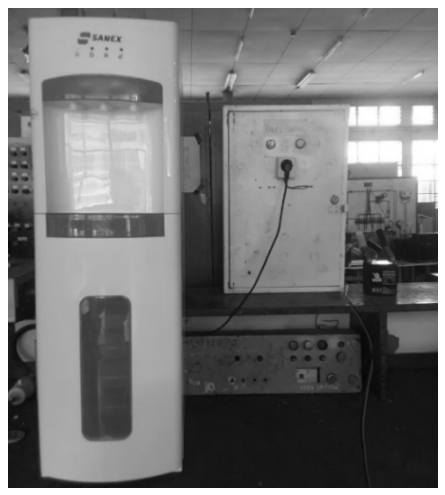
After completing the design and construction process (refer to Figure 1), the subsequent phase involves tool testing and data collection for the Solar and PLN Hybrid System Water Tube Filling Pump. The testing process follows a systematic approach:
1) Prepare tools and materials.
2) Assemble the solar panels and other equipment according to the circuit drawing.
3) For PLN sources (10.50 to 11.40 WITA):
• Record PLN voltage and current.
• Measure Power Factor or cos phi PLN.
• Record voltage and current of the dispenser pump.
4) For solar cells (12.00 to 12.50 WITA):
• Record solar radiation intensity.
• Record panel output voltage and current.
• Record voltage and current of the dispenser pump every 10 minutes.
5) Hybrid system data collection (13.00 to 13.20 WITA for solar cells, 13.30 to 13.50 WITA for PLN):
• Repeat steps 4 for solar cells and steps 3 for PLN.
6) Record all measurement results in the observation table.
7) Analyze the measurement results.
8) Draw conclusions based on the hybrid system testing.
9) Declare the testing process complete.
3. Results and Discussion
Testing is divided into several parts:
1) Testing using PLN
2) Testing using a solar cell
3) Hybrid solar cell and PLN testing
3.1. Solar Cell
Figure 3 depicts the relationship between the average input power of solar panels over time. The graph trend demonstrates fluctuations, attributed to changes in the intensity of solar radiation or variations in weather conditions. The maximum average input power of solar panels is recorded at 12:00, reaching 489.645 Watts, while the minimum value occurs at 12:40, with an average input power of 318.87 Watts.
3.2. PLN
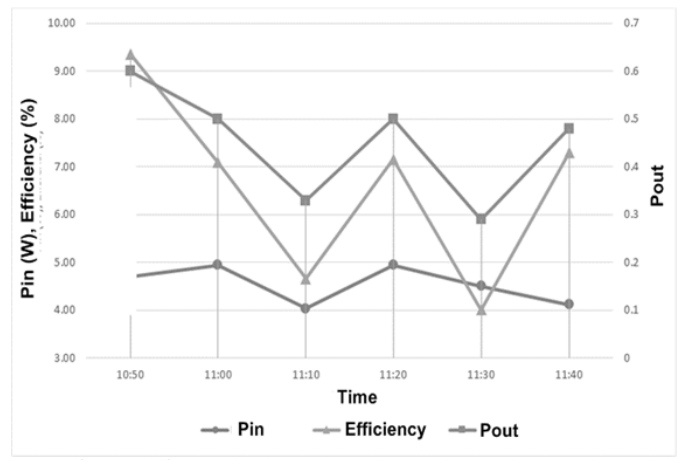
Figure 2 illustrates the fluctuating relationship over time between average input power, output power, and PLN efficiency. Notably, the average maximum input power peaks at 11:20, reaching 4.947 Watts, while the minimum value is recorded at 11:10 with a value of 4.039 Watts. Similarly, the average maximum output power is observed at 10:50, with a value of 0.6 Watts, and the minimum occurs at 11:30, registering at 0.29 Watts. Regarding PLN efficiency, the highest average efficiency is noted at 10:50, reaching 9.35%, while the lowest value is recorded at 11:30, measuring 4.01%.
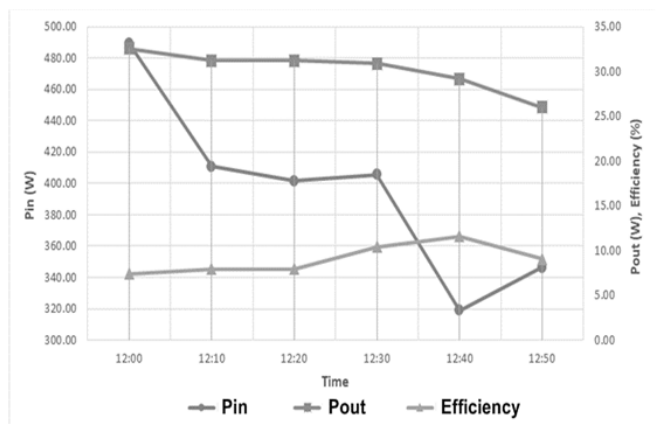
Additionally, the figure illustrates the relationship between the average panel output power over time, showcasing a decreasing trend in the output power of solar panels over time. The maximum average pump input power is observed at 12:00, with a value of 32.58 Watts, while the minimum value occurs at 12:50, registering an average output power of 26.04 Watts.
Furthermore, the figure presents the relationship between the average efficiency of solar panels and time. The efficiency tends to increase initially and then decreases in the latest data. The highest average solar panel efficiency is noted at 12:30, reaching 11.58%, while the minimum value occurs at 12:00, with an average efficiency of 7.42%.
3.3. Hybrid
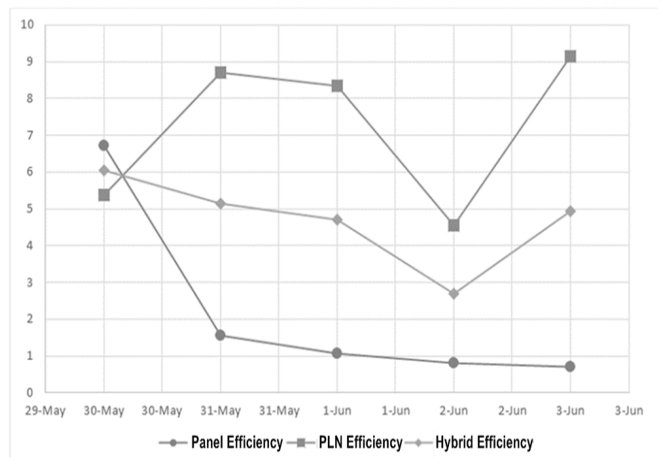
Figure 4 illustrates the fluctuating relationship over time for average efficiency, showcasing variations in both increasing and decreasing trends. Notably, the average maximum solar panel efficiency was observed on May 30, reaching 6.72%, while the minimum value occurred on June 3, registering at 0.71%.
Similarly, the average maximum PLN efficiency was recorded on June 3, with a value of 9.13%, while the minimum value occurred on June 2, measuring 4.56%. Additionally, the figure presents the average hybrid efficiency of solar energy and PLN, with the maximum occurring on May 30 at 6.05% and the minimum on June 2 at 2.68%.
4. Conclusion
Through the foundational stages of design, assembly, manufacturing, and testing, results were obtained for a water cylinder filling pump integrated with a hybrid system of solar energy and PLN. The efficiency of solar panels proved to be influenced by the intensity of the sun and weather conditions, while the efficiency of PLN was affected by current, voltage, and power factor (cos phi).
The highest recorded hybrid efficiency reached 6.05%, with the solar panel efficiency at 6.72% and PLN efficiency at 5.38%. Conversely, the lowest hybrid efficiency was 2.68%, corresponding to a solar panel efficiency of 0.80% and PLN efficiency of 4.56%.
The testing of the water cylinder filling pump with this hybrid system demonstrated success in saving PLN energy, with a reduction of 0.00083 kWh, leading to PLN electricity cost savings of Rp.1,20.
Acknowledgments: Thank you to the Center for Research and Community Service at the State Polytechnic of Ujung Pandang and all parties who have assisted in carrying out this research activity.
REFERENCES
[1] V. S. Arutyunov and G. V. Lisichkin, “Energy resources of the 21st century: Problems and forecasts. Can renewable energy sources replace fossil fuels,” Russian Chemical Reviews, vol. 86, no. 8, p. 777, 2017.
[2] A. Kalair, N. Abas, M. S. Saleem, A. R. Kalair, and N. Khan, “Role of energy storage systems in energy transition from fossil fuels to renewables,” Energy Storage, vol. 3, no. 1, p. e135, 2021.
[3] F. Martins, C. Felgueiras, M. Smitkova, and N. Caetano, “Analysis of fossil fuel energy consumption and environmental impacts in European countries,” Energies, vol. 12, no. 6, p. 964, 2019.
[4] A. Hassan, S. Z. Ilyas, A. Jalil, and Z. Ullah, “Monetization of the environmental damage caused by fossil fuels,” Environmental Science and Pollution Research, vol. 28, pp.21204-21211, 2021.
[5] R. V. Petrescu, R. Aversa, A. Apicella, S. Kozaitis, T. AbuLebdeh, and F. I. Petrescu, “Management of Renewable Energies and Environmental Protection,” American Journal of Engineering and Applied Sciences, vol. 10, no. 4, pp. 919-948, 2017.
[6] A. Olabi et al., “Large-vscale hydrogen production and storage technologies: Current status and future directions,” International Journal of Hydrogen Energy, vol. 46, no. 45, pp. 23498-23528, 2021.
[7] S.-Y. Pan, M. Gao, H. Kim, K. J. Shah, S.-L. Pei, and P.-C. Chiang, “Advances and challenges in sustainable tourism toward a green economy,” Science of the total environment, vol. 635, pp. 452-469, 2018.
[8] F. Firman, N. H. Said, and M. R. Djalal, “Characteristic Analysis of Solar Panels on Clay and Ceramic Roof Tiles,” International Review of Mechanical Engineering (IREME), vol. 16, no. 3, 2022, doi: 10.15866/ireme.v16i3.20004.
[9] M. Saini, M. R. Djalal, M. Azhar, and G. E. Patrix, “Modeling and implementing a load management system for a solar home system based on Fuzzy Logic,” 2023, Fuzzy Logic; Load; Management; Modeling; Solar Home System; vol. 27, no. 2, p. 10, 2023-04-27 2023, doi: 10.22441/sinergi.2023.2.014.
[10] A. Pandey et al., “Solar Energy Utilization Techniques, Policies, Potentials, Progresses, Challenges and Recommendations in ASEAN Countries,” Sustainability, vol. 14, no. 18, p. 11193, 2022.
[11] S. F. Ahmed et al., “Recent progress in solar water heaters and solar collectors: A comprehensive review,” Thermal Science and Engineering Progress, vol. 25, p. 100981, 2021.
[12] M. J. B. Kabeyi and O. A. Olanrewaju, “Sustainable energy transition for renewable and low carbon grid electricity generation and supply,” Frontiers in Energy research, vol. 9, p. 1032, 2022.
[13] R. Rostami, S. M. Khoshnava, H. Lamit, D. Streimikiene, and A. Mardani, “An overview of Afghanistan’s trends toward renewable and sustainable energies,” Renewable and Sustainable Energy Reviews, vol. 76, pp. 1440-1464, 2017.
[14] A. Ramprasad and S. Banerjee, “Design and Analysis of Air Conditioning Cum Water Dispenser System,” International Journal of Mechanical Engineering and Technology, vol. 6, no. 10, pp. 202-216, 2015.
[15] T. Gadelkareem, A. EldeinHussin, G. Hennes, and A. ElEhwany, “Stirling cycle for hot and cold drinking water dispenser,” International Journal of Refrigeration, vol. 99, pp. 126-137, 2019.
[16] R. Pakku Atto and L. l. Jefryanto, “Design and Construction of a Continuous Water Heater Hybrid System with Solar and Gas Energy,” Diploma 3, Conversion Energi Engineering, State Polytechnic of Ujung Pandang, Makassar, 2022.
[17] S. Suwasti and M. R. Djalal, “Design of Continuous Water nHeater Hybrid Solar And Gas System,” Przeglad Elektrotechniczny, vol. 99, no. 7, 2023.
Authors: Sri Suwasti, Yiyin Klistafani, Muhammad Ruswandi Djalal, Departement of Mechanical Engineering, State Poytechnic of Ujung Pandang, Emails: sri_suwasti@poliupg.ac.id, yiyin_klistafani@poliupg.ac.id, wandi@poliupg.ac.id.
Source & Publisher Item Identifier: PRZEGLĄD ELEKTROTECHNICZNY, ISSN 0033-2097, R. 100 NR 7/2024. doi:10.15199/48.2024.07.11

