Published by 1. Ilham RAHIMLI1, 2. Aliashraf BAKHTIYAROV2, 3. Gulshan ABDULLAYEVA3, 4. Sona RZAYEVA4, Azerbaijan State Oil and Industry University (1, 2, 3, 4)
ORCID: 1. 0009-0006-1976-4475; 3. 0000-0003-0168-9623; 4.0009.0006.6439.5699
Abstract. Due to the fact that high-voltage equipment solutions involve large capital investments, they are very important areas based on the scientific, technical and applied sectors. The most correct and accurate solution of these questions is always taken into account as an urgent problem. In many cases, along with scientific and technical problems in this direction, other problems also become relevant. The purpose of this work: as an example, the question was raised about the alteration of the neutral modes of 10-35 kV networks in order to increase power and maintain accuracy in the development of distribution systems. Research method: Such questions lead to a situation related to the replacement of the network, the operation system of machines and equipment, the introduction and manufacture of thousands of 10-35 kV transformers during reconstruction. And these issues become technical and economic problems of national importance, which are necessary for production and are considered important for solution. Results: The choice of one or another neutral grounding mode is extremely effective when it is necessary to operate the network for a long time with a single-phase ground fault. The need for long-term network maintenance in the event of such a failure arises only if backup is not available. At this time, the effective use of an arcing reactor is possible only in symmetrical networks that change without changing the configuration.
Streszczenie. Ze względu na to, że rozwiązania w zakresie urządzeń wysokiego napięcia wiążą się z dużymi inwestycjami kapitałowymi, są to bardzo ważne obszary oparte na sektorach naukowym, technicznym i stosowanym. Najbardziej poprawne i dokładne rozwiązanie tych pytań jest zawsze brane pod uwagę jako pilny problem. W wielu przypadkach wraz z problemami naukowymi i technicznymi w tym kierunku istotne stają się także inne problemy. Cel pracy: jako przykład postawiono pytanie o przebudowę trybów neutralnych sieci 10-35 kV w celu zwiększenia mocy i zachowania dokładności w rozwoju systemów dystrybucyjnych. Metoda badawcza: Takie pytania prowadzą do sytuacji związanej z wymianą sieci, systemu pracy maszyn i urządzeń, wprowadzeniem i produkcją tysięcy transformatorów 10-35 kV podczas przebudowy. Kwestie te stają się problemami technicznymi i ekonomicznymi o znaczeniu krajowym, niezbędnymi do produkcji i uważanymi za ważne do rozwiązania. Wyniki: Wybór jednego lub drugiego trybu uziemienia neutralnego jest niezwykle skuteczny, gdy konieczna jest długotrwała eksploatacja sieci z jednofazowym zwarciem doziemnym. Konieczność długoterminowej konserwacji sieci w przypadku takiej awarii pojawia się tylko w przypadku braku możliwości wykonania kopii zapasowej. W tej chwili efektywne wykorzystanie reaktora łukowego jest możliwe tylko w sieciach symetrycznych, które zmieniają się bez zmiany konfiguracji. (Procesy łączeniowe zachodzące w sieciach elektrycznych 10-35 kV)
Keywords: network; neutral; transformer; reactor; resistor.
Słowa kluczowe: sieć; neutralny; transformator; reaktor; rezystor.
Introduction
In connection with the town-planning works, which have recently changed, such problems as the replacement of overhead power lines (OHPL) with cable lines are also on the agenda. On the other hand, it may take some time, the replacement of 10-35 kV oil circuit breakers with newer vacuum and contact circuit breakers is a problem in independent countries, because Solving these problems requires a large budget.
The above structures and modes related to the neutral, in networks up to 35 kV phase-to-phase voltage, and in networks up to 110 kV and more, require attention and design due to the degree of insulation, which takes up more space. The number of such scientific and technical issues and the exact scope of the problems under consideration are quite wide. In each period of solving such problems, there was a special form of approximation and corresponding regulations based on these directions.
Formulation of the problem
Insulating materials used in electrical networks must be designed for appropriate degrees of insulation against excessive switching voltages based on the rated voltages. The main purpose of electro-physical procedures and electro-chemical differences in insulation is to increase the electric field strength (EFI), heat and moisture.
Degrees of isolation and how they work in real devices depend on many factors. Insulation management consists in comparing it with the voltages acting on it and the characteristics of the protective equipment. For this reason, they use voltages at which the switching overvoltage has reached the limit level and, like atmospheric overvoltage pulses, they use control voltages. It should also be noted that the degree and coordination of insulation in networks up to 330 kV are mainly used for atmospheric and switching overvoltages.
The number of requirements for the reliable functioning of insulation in real situations reaches 50. This range includes phenomena caused by the state of the open atmosphere, chemical aggressive conditions, solar and atomic radiation, the accumulation of hidden defects present in the insulation in the closed state, mechanical and thermal effects.
All this is based on the analysis of the neutral operation mode in 10-35 kV networks, the study of the issues of neutral grounding, relay protection in case of short circuits, arc winding (reactor), etc.
The solution of the problem
Neutral isolated systems or in the form of resistorgrounding, in high voltage networks up to 35 kV, circuits are used in which reactors equipped with inductive arc extinguishing windings are connected to the neutral. For this reason, and also because of the spontaneous tripping of the earth fault, it is possible to reduce capacitance currents in designated situations, so arc breaker windings are used. The capacitive currents that arise when the inductive reactances Ls of the considered windings are connected to the resistor are generally reduced to zero.
In lines with direct grounding of neutrals of 110 kV and higher, as a result of a single-phase short circuit, the voltages of healthy phases do not exceed l.3Uf. This mode passes in a short time and does not cause any fear. However, opening the circuit breakers at the line ends with a delay of 1 second results in one-way supply and overvoltages in the phases. The main reason for the higher voltage is the accumulation of its voltage in an unbalanced system during a single-phase short circuit in healthy phases.
Thus, the 10-35 kV neutral grounding mode affects a number of technical reasons implemented in the network. In networks with medium voltage (rated voltage 69 kV according to foreign classification), four neutral grounding modes are used.
Looking at the worldwide operation of medium voltage networks, it can be seen that in most countries of the world the method of earthing through the winding of the resistor and the arc circuit breaker prevails.
In medium voltage networks 3-69 kV in Europe, North and South America, as well as Australia, the isolated neutral mode is used very rarely. Medium voltage networks 3-69kV operate mainly according to the grounding method through the arc breaker winding or resistor.
When a single-phase short circuit occurs, the arc breaker winding creates an inductive electric current at the fault location. In this case, the final electric current in the damaged place becomes equal to zero, and there is no need to turn off the initial short circuit that occurred in the network.
A low voltage (500V) shunt resistor is connected to the secondary 500V arc winding power circuit using a special contactor. This technical solution has a number of advantages:
– eliminating the need to extinguish a single-phase short circuit and simultaneously deprive the consumer of electrical energy;
– weak electric current at the damage site (no more than 1-2 A);
– elimination of single-phase short circuits themselves (mainly in overhead power lines); – possibility of using automatic relay protection that prevents short circuits;
– eliminating cases of damage to instrument transformers due to ferroresonance phenomena.
Figure 1 shows a block diagram of a technical solution for the neutral grounding mode through an arc suppression coil together with a shunt low-voltage resistor in 10-35 kV networks.
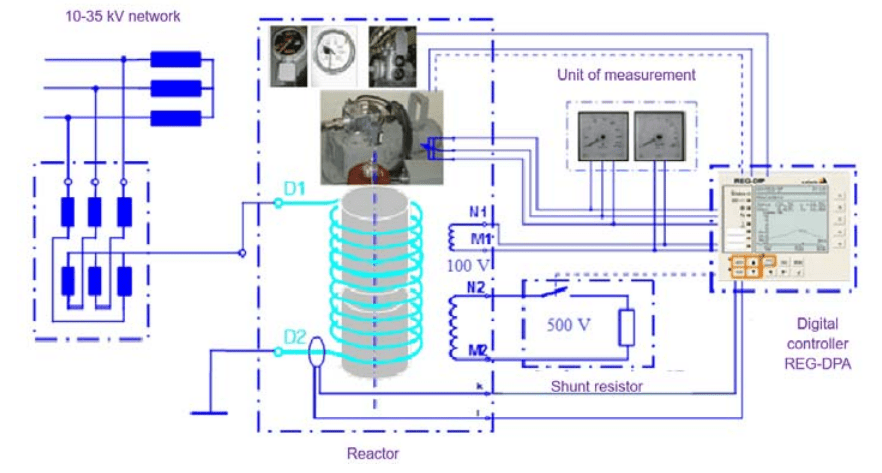
In existing electrical networks with a voltage of 10-35 kV, which have a neutral grounding mode through an arc extinguisher, but do not have a shunt resistor, there are a number of problems when creating protection against short circuits. In such networks, both simple current protection devices (ANSI code 51G) and directional current protection devices (ANSI code 67N) can be used.
Simple current protective devices (ANSI code 51G) cannot be used because the arc suppression coil reduces the fault current (3I0) caused by a single-phase fault to zero. Directional protective devices (ANSI code 67N) cannot be used because the direction of current in faulted and unfaulted feeders is the same. In damaged feeders, inductive electrical energy flows from the busbars, equal to the electrical energy of the feeder due to its volume, and electrical energy flows towards the busbars from undamaged feeders.
In 10-35 kV networks, the neutral grounding mode through a shunted low-voltage resistor and an arc circuit breaker winding connected to a 500 V secondary power winding creates special opportunities for organizing selective short-circuit protection both due to simple current limiters (ANSI code 51G) and due to directional current limiting devices (ANSI code 67N).
Neutral grounding through a high-frequency resistor: in this mode of neutral grounding, the power of the final electric current (active current + capacitive current) of the short circuit does not exceed 10A. As a rule, tripping of a single-phase neutral short circuit in this earthing mode is not required at all.
Neutral grounding through a low-frequency resistor: in this neutral grounding mode, the power of the final electric current (active current + capacitive current) of the short circuit exceeds 10 A. As a rule, in this mode, the single-phase final current exceeds 10A, that is, reaches tens or hundreds of A, which , in turn, requires the disconnection of a single-phase short circuit.
If the short circuit is permanent and the reactor has a certain time loop determined by the REG-DPA regulator, then a shunt resistor is connected (the time is from one to three seconds). The reactor’s REG-DPA digital controller drives a 500V shunt resistor contactor, and the contactor is connected to the second 500V power wave of the reactor.
Cases of damage to voltage transformers after grounding the neutral through NER-3000-182-40.5 resistors at 35kV substations have decreased. Tests carried out by Karelenergo specialists in a 35-kV network showed that after the elimination of a single-phase short circuit in a network with a grounded neutral through a resistor, the ferroresonance process is no longer observed [1].
A non-stationary arc process in the voltage range of 10-35 kV is a fairly common accident in power lines. The single-phase arcing process is followed by a flashing arc. Since these networks are often implemented at much shorter distances, these circuits are considered as circuits with collected parameters. Since the short circuit system is calculated using integral differential equations, attention should be paid to the boundary and initial conditions necessary to solve these problems.
Before expressing my own opinion on the areas of application of various neutral earthing systems in medium voltage networks, I would like to dwell on the following generally accepted and fairly well-known provisions.
The isolated neutral mode has the following advantage the low current generated by single-phase short circuits to earth. And this contributes to the following reasons:
• Increasing standby currents (single-phase short circuits of short circuits account for 90% of the total number of short circuits);
• reducing the requirements for grounding installations, determined by the conditions of electrical safety in case of single-phase short circuits to ground. But this mode also has some drawbacks (compared to effectively grounded neutral mode). This should include the following:
• ferroresonance phenomena as a result of a short-term SPE;
• Arc overvoltages associated with the formation of an alternating arc during an SFL and leading to a transition from a single-phase to a two- and three-phase short circuit;
• the complexity of building selective protection against SGF with isolated power supply and insufficient performance, which is absent in networks of various modes and configurations.
The advantages of isolated networks in many cases include its ability to continue to work with a single-phase short circuit, which literally increases the power supply to consumers. Practice shows that in most cases single-phase short circuits due to faults in the network quickly (and in most cases instantly) switch to two- and three-phase short circuits (see, for example, [4]), and the damaged line is still turned off [2].
At present, uninterrupted power supply is ensured mainly by a device with two-way supply and ASR (automatic start of the reserve).
Grounding through an arcing reactor allows, in certain cases, to reduce the short-circuit current to the ground before it is turned off, that is, to eliminate arc overvoltages. This, in turn, reduces the number of transitions from a single-phase earth fault to a two- and three-phase fault. Reducing the current of a single-phase earth fault improves the electrical safety conditions at the place of the fault, although it does not completely eliminate the possibility of electric shock in overhead line networks.
Disadvantages of grounding through arc quenching reactors (AQR):
• the need to symmetrize the network to a phase voltage of 0.75% (in networks with overhead lines, the degree of asymmetry is always at least 1-2%, and in twocircuit overhead lines it can normally reach 5-7%; according to the Rules for Technical Operation, in some cases, the neutral bias voltage can reach 30% of the phase voltage);
• complexity and high cost of automatic installation systems for automatic control systems (reactors with a mechanical installation are practically not operated); the inability to install a wide range, which is required for branched city networks with a frequently changing configuration compared to a supply substation;
• Almost complete absence of selective protection against single-phase short circuit n for the network with neutral grounding through automatic control system. With regard to the last drawback, it can be argued that the disconnection of a damaged connection with good capacitive current compensation is not absolute. Accepting this objection, one can only argue that the use of an arcing reactor is a way to maintain the emergency mode of a single-phase short circuit. However, it should be noted that this method is not cheap [2]. Neutral grounding through a resistor has a number of advantages, confirmed by world practice and experience:
• complete elimination of ferroresonance phenomena.
• reducing the degree of arc voltages and eliminating the transition of a single-phase earth fault to a two- and three-phase fault.
• the possibility of building a simple selective protection against single-phase earth faults. The following disadvantages can be attributed to resistive neutral grounding:
• increase in earth fault current (maximum 40%);
• heating of equipment at the substation (30-400 kW resistor). These shortcomings are of relatively minor importance for the following reasons:
• Short-circuit currents in networks with neutral grounding are thousands and tens of thousands of amperes; in networks of 10-35 kV, double short circuits to the ground lead to currents of hundreds and thousands of amperes. Networks in such conditions are successfully operated, and against this background, an increase in the current of a single-phase earth fault from 10 A to 14 A or even from 200A to 280A does not change the situation.
• The disadvantage caused by the heating of the resistor during a single-phase earth fault is more significant. But for other equipment, the allowable temperatures, determined by the rules for electrical installations and reaching 200- 300℃ in emergency modes, allow you to design a resistor that heats up only to temperatures that are below the specified limits [4]. Installing such a resistor on the battery virtually eliminates the issue of fire hazard.
Generator voltage networks are basically DC bus bridges. It is impossible to selectively turn off any field during a ground fault; it is necessary to turn off the generator itself as a result of generating an accurate voltage in zero sequence. Short-term operation of the generator before shutdown in low current conditions is possible with an isolated neutral. With a capacitance current of more than 5A, the insulation can be seriously damaged. For this reason, it is advisable to use an arcing reactor [5].
Auxiliary networks of power plants have a branched configuration, in contrast to generator voltage networks. This allows a single-phase earth fault to selectively trip the fault. Since these networks are carried out by cable lines, their degree of symmetry is sufficient for the use of an arcing reactor.
It is possible to use an isolated current in low-capacity currents, but in this case, a computational check of the network will be required in case of occurrence of ferro resonant phenomena. If such events are threatened, it is recommended to ground the neutral through a resistor. Long-term operation of the network during the EEO is less feasible, since such networks have a sufficient amount of backup facilities.
Selective disconnection of a faulty connection with relay protection is possible by grounding the neutral through a resistor.
If the decision is made to continue the operation of the network in time, single-phase earth fault at high-capacity currents, the best option (with accurate installation) is to use an arcing reactor. High current selective single-phase earth fault tripping with relay protection is well accepted when earthing the neutral through a resistor [3].
Based on the above ideas, we will try to determine the areas of effective application of various neutral grounding modes in medium voltage networks. These fields are reflected in the table depending on the type of network and the required parameters. In the first column – the classification of networks according to their configuration and features of operation, related to the methods of grounding the neutral. Table 1 shows the recommended neutral conditions for medium voltage networks [6, 7].
Table 1. Recommended neutral modes of medium voltage networks
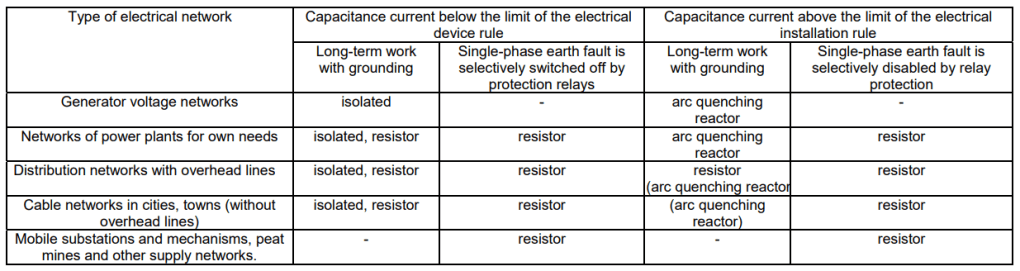
Distribution networks with overhead lines are usually not symmetrical. At low currents, as in the previous case, it is possible to use an isolated neutral in the absence of prerequisites for the occurrence of ferroresonance phenomena. Changing the configuration and size of the network from an operational point of view can lead to the creation of such preconditions. At this time, it is also possible to increase the limits of the capacitance current. For this reason, the best and most versatile solution for such networks is to ground the neutral through a resistor. The introduction of an arc quenching reactor is problematic due to the existing asymmetry and a large range of changes in the capacitance current. As practice shows, arc-quenching reactors installed in such networks practically do not work anywhere.
There is a problem of short-term shutdowns of overhead lines in distribution overhead networks feeding oil and gas fields. This problem is due to the self-ignition technology of pump motors not working well enough. Therefore, such networks without fail work with the preservation of grounding. The use of an arc-suppression reactor in such cases is advisable only from the point of view of improving electrical safety conditions in case of a single-phase ground fault. And this requires accurate compensation of the capacitive current. During short circuits in overhead lines, arc processes, as a rule, do not occur.
Cable networks in cities and towns (without highvoltage lines) are symmetrical enough for the use of arcsuppression reactors, but, unlike power plant auxiliary networks, they have a constantly and significantly changing configuration, which requires a large installation range. The situation is aggravated by the fact that the supply substations and distribution networks of the city, where the arc extinguishing reactor is installed, in many cases have different, including operational and dispatching subordination. This requires the obligatory installation of a broadband arc quenching reactor. For this reason, a universal method for such networks is to ground the neutral through a resistor, which is also confirmed by extensive world experience.
Mobile substations and mechanisms, peat mines, mines and other supply networks clearly require the shutdown of a thermoelectric generator with relay protection. The neutral grounding mode through a resistor is the only reasonable mode, especially in the case of an extensive network.
In conclusion, it should be noted that the main point in determining the grounding mode of the network neutral is the decision to selectively disable or maintain the single-phase ground fault mode for a long time. While maintaining a single-phase earth fault, a choice can be made between all the neutral modes specified in the rules for electrical installations, taking into account the ideas presented in the current article [4]. If a single-phase earth fault is to be selectively switched off by relay protection, then the neutral earthing solution through a resistor is preferable.
Conclusions
The choice of one or another neutral grounding mode is extremely effective when it is necessary to operate the network for a long time with a single-phase ground fault. The need for long-term network maintenance in the event of such a failure arises only if backup is not available. At this time, the effective use of an arcing reactor is possible only in symmetrical networks that change without changing the configuration. In other cases, an isolated neutral predominates, and in some cases grounded through a resistor.
When disconnecting a connection with a single-phase closure by relay protection, in all cases it is preferable to ground the neutral through a resistor. Such an integrated solution eliminates all the disadvantages inherent in networks with insulation and compensated neutral, and brings medium voltage networks to a high level of electrical safety inherent in networks of 110 kV and above.
REFERENCES
[1] S.V.Rzayeva, N.S.Mammadov, N.A.Ganiyeva (2023) ”Overvoltages during Single-Phase Earth Fault in NeutralIzolated Networks (1035)kV”. Journal of Energy Research and Reviews. Volume 13, Issue 1, pp 7-13, 2023/ DOI: 10.9734/JENRR/2023/v13i1253
[2] S.V. Rzayeva, N.S. Mammadov, N.A. Ganiyeva (2022) “Neutral grounding mode in the 6-35 kv network through an arcing reactor and organization of relay protection against single-phase ground faults”. Deutsche internationale Zeitschrift für zeitgenössische Wissenschaft / German International Journal of Modern Science №42(22) pp.31-34
[3] Obabkov V.K. (2000) Multicriteria of the performance indicator of 6–35 kV networks and the problem of optimizing neutral grounding modes // Neutral grounding modes of 3–6–10–35 kV networks: Reports of the scientific and technical conference. – Novosibirsk, 2000. – pp. 33–41.
[4] https://archi-monarch.com/guidelines-for-electricalinstallation/
[5] Chernenko N.A. (2000) Accident rate and earth faults in electrical networks with a voltage of 35 and 110 kV// Modes of grounding the neutral of networks 3–6–10–35 kV: Reports of a scientific and technical conference. – Novosibirsk, 2000. – pp. 83–88.
[6] Piriyeva N.M., Rzayeva S.V., Mustafazadeh E.M. Evaluation of the application of various methods and equipment for protection from emergency voltage in 6-10 kv electric networks of oil production facilities // Интернаука: электрон.научн. журн. 2022. № 39(262). URL: https://internauka.org/journal/science/internauka/262 (дата обращения: 17.01.2024). DOI:10.32743/26870142.2022.39.262.346104
[7] Ahmedov E.; Rzayeva S.; Ganiyeva Nigar; Safiyev E.Improving the lightning resistance of high-voltage overhead power line Przeglad Elektrotechniczny . 2023, Vol. 2023 Issue 11, p121-126. 6p.
Source & Publisher Item Identifier: PRZEGLĄD ELEKTROTECHNICZNY, ISSN 0033-2097, R. 100 NR 8/2024. doi:10.15199/48.2024.08.32

