Published by 1. Idris KUSUMA1, 2. R. RULIYANTA2, 3. Diah WIDIASTUTI, 4. Mohammad FATHONI
Universitas Nasional (1, 2, 3), Institut Teknologi Budi Utomo (4)
ORCID: 1.0009-0006-1808-2229; 2.0000-0002-2439-330X; 4.0009.0006.6439.5699
Abstract. Even though the government of the Republic of Indonesia has banned the use of R22, it is still widely found in industry. The problem is that the industry is reluctant to replace the current R22 because it will result in high initial investment costs. This research investigates the use of catalytic refrigerants to overcome high costs. This research investigates the electrical efficiency of several types of refrigerants. Utilizing catalysts in refrigerants can reduce electrical energy consumption. The result is that the R22 refrigerant can reduce electrical energy by up to 32.02%; the R32 reaches an efficiency of 26.94%, while the R410A reaches 21.43%. The novelty given in this research is the significant investment required compared to the electrical efficiency value provided.
Streszczenie. Mimo że rząd Republiki Indonezji zakazał stosowania R22, jest on nadal szeroko stosowany w przemyśle. Problem polega na tym, że branża niechętnie wymienia obecny R22, ponieważ będzie to wiązać się z wysokimi początkowymi kosztami inwestycji. W badaniu tym zbadano zastosowanie katalitycznych czynników chłodniczych w celu przezwyciężenia wysokich kosztów. W badaniu tym badana jest wydajność elektryczna kilku rodzajów czynników chłodniczych. Stosowanie katalizatorów w czynnikach chłodniczych może zmniejszyć zużycie energii elektrycznej. W rezultacie czynnik chłodniczy R22 może zmniejszyć zużycie energii elektrycznej nawet o 32,02%; R32 osiąga wydajność 26,94%, natomiast R410A osiąga 21,43%. Nowością wynikającą z tych badań jest wymagana znaczna inwestycja w porównaniu z podaną wartością sprawności elektrycznej. (Optymalizacja oszczędności energii elektrycznej poprzez wykorzystanie katalizatorów chłodniczych w sprężarkach)
Keywords: Power Efficiency, Refrigerant, Catalyst, Air Conditioning.
Słowa kluczowe: Efektywność energetyczna, czynnik chłodniczy, katalizator, klimatyzacja.
Introduction
Indonesia is the largest country in the world, and the equator crosses it, so it has a tropical climate. Meanwhile, Indonesia’s AC (Air Conditioning) manufacturers are produced by sub-tropical countries such as Japan, Korea, and China. The rapid growth in using AC (air conditioning) equipment to overcome rising global temperatures has resulted in significant electrical energy consumption. As the main component in the refrigeration cycle, the AC compressor has a central role in determining the system’s overall efficiency [1], [2]. Developing energy-saving technology is crucial in responding to sustainability and energy efficiency [3]–[6]. The latest air conditioning technology uses inverters to save electricity [7], [8].
R22 is wholly prohibited from being used in 2030. On the other hand, the initial investment costs, or Capital Expenditure (CAPEX) for replacing the R22 refrigerant with another more environmentally friendly refrigerant type, are costly. This investment is considered an additional cost by the industry. Meanwhile, a cheaper Operating Expenditure (OPEC) is needed to run the company’s operations.
In recent years, using catalyst materials as supporting components in AC systems has become a promising research focus [9]–[12]. Catalyst materials can modify chemical reactions in the compressor, increasing the efficiency of the cooling process and, in turn, reducing electrical energy consumption [9]. Therefore, it is necessary to carry out in-depth research to evaluate and understand the impact of applying catalyst materials to AC compressors on saving electrical energy.
The problem behind this research is that in Indonesia, which has a tropical climate, almost 80% of energy consumption in a building is used for air conditioning systems. AC is the highest contributor to energy consumption for housing, offices, hospitals, shopping centres, and others [13], [14].
In this context, this research aims to investigate the potential of using catalyst materials in AC compressors as an innovative strategy to increase energy efficiency and reduce environmental impact. By better understanding the role of catalyst materials in optimizing the cooling cycle, this research can contribute to developing sustainable energysaving solutions in air conditioning technology.
Metode
Rising global temperatures resulting from climate change have increased demand for air conditioning (AC) equipment worldwide. While air conditioners provide thermal comfort to their users, their increased use has significantly impacted electrical energy consumption. The compressor is one of the main components in an AC system that is vital in determining energy efficiency. In recent decades, energy and environment research has focused on developing solutions to reduce energy consumption and environmental impacts. In this context, using catalyst materials in AC compressors has emerged as an attractive alternative to increase energy efficiency in the cooling cycle.
Refrigerant Catalysis is a process in which a substance called a catalyst accelerates the rate of a chemical reaction without undergoing permanent changes in its structure. In the context of AC compressors, catalysts change the chemical reaction mechanisms involved in the refrigeration cycle to increase the process’s efficiency. Catalysts reduce the activation energy required to reach a transition state in a chemical reaction. In AC compressors, catalysts can modify the molecules involved in air compression and cooling, increasing the reaction speed and reducing the energy required. Catalysts interact with molecules in chemical reactions through their active sites. In the context of AC compressors, catalyst materials can interact with air or refrigerant molecules, facilitating bond formation or structural changes that benefit energy efficiency.
Refrigerant Catalyst material’s ability to modify chemical reactions is expected to improve the performance of AC compressors. This catalyst material is relevant because it can optimize the cooling process, thereby reducing the need for electrical energy without sacrificing the quality of the resulting cooling [9]–[11]. Refrigerant vapour compression systems can use several liquids such as carbon dioxide, ammonia, hydrocarbons, and fluorinated molecules such as CFCs (chlorofluorocarbons), HFCs (hydrofluorocarbons), and HFOs (hydrofluoroolefins), [9].
Refrigerant fluids used today refer to environmentally friendly materials [15]. The type of refrigerant also varies greatly according to the type of compressor used [15]. Common environmentally friendly refrigerants include isobutane R600a, propane R290, propylene R1270, ethylene R1150, ethane R170, isopentane R601a, npentane R600, R23, R507, R134a, and others.
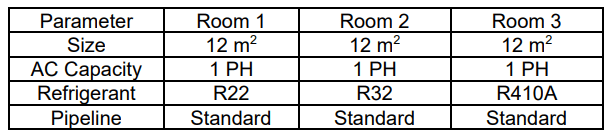
This research carried out measurements in an office building with three typical rooms. The measurement room area is 12 m2 with almost the same load. The indoor load is conditioned to be close to the same by using three different types of air conditioning. A Refrigerant Catalyst, or, for short, RC, is added to the refrigerant liquid for each room AC. Catalyst Refrigerant is an additive liquid that is mixed into the refrigerant. This liquid results from nanotechnology engineering [16]–[18]. Functions to make the cold point rise and be reached more quickly. The Catalyst Refrigerant added to the compressor is 10% of the refrigerant volume. The refrigerants used are R22, R32 and R410.
RC works by increasing the cold point of the refrigerant gas so that it can be reached more quickly and that electricity requirements (compressor cut-off time) can be reduced. RC can clean the evaporator pipes from the inside so that cold can flow easily. This condition can reduce the heat in the refrigerant gas so that the equipment lasts longer [9], [11]. Table 1 provides the specifications of the three types of measurements.
Table 1. Initial Measurement Conditions
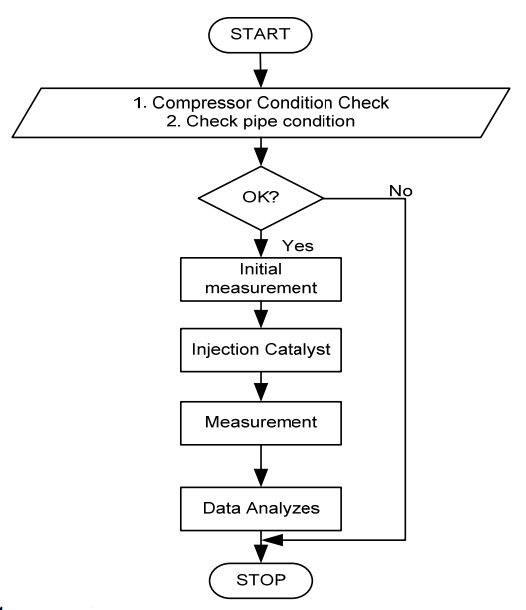
The stages in this research are given in Figure 1. Several conditions need to be considered before injecting the catalyst into the compressor. The first condition is the performance of the compressor itself. The compressor must be in good working condition and not damaged. Next, ensure that the pipe installation is in good condition. A leaking pipe will be very detrimental because the liquid gas in the compressor will run out. Next, initial measurements are carried out to measure the energy consumption of the AC unit. This research used a kWh meter to monitor initial energy consumption. After the initial measurement process, the catalyst liquid is added to the compressor. 10% of the refrigerant is removed, and the catalyst is injected [19], [20].
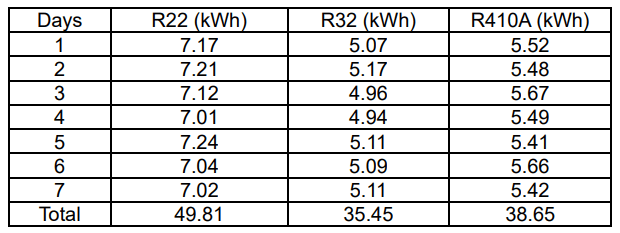
The electricity consumption of each type of AC was measured in the initial measurements. We made observations for seven days. The AC is operated daily for 10 hours between 09.00 to 17.00 WIB. Table 2 presents data from the observations made.
Table 2. Observation results in 8 hours per day before using the catalyst
Results and Discussion
The electricity consumption of each type of AC was measured in the initial measurements. We carried out observations for seven days simultaneously. The AC is operated daily for 10 hours between 09.00 to 17.00 WIB. Table 2 presents data from the observations made.
Table 3. Measurement of electricity consumption after adding the refrigerant catalyst for 10 hours
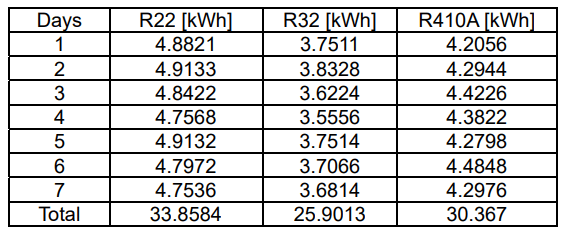
The different load conditions of each room influence the amount of electrical energy consumption in Table 2. We use the existing load in the room and do not carry out detailed room load measurements. This research purely measures refrigerant performance on electricity consumption only.
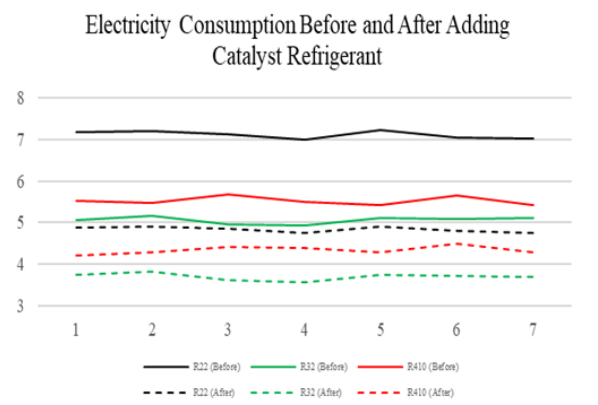
Based on Table 2, using R32 produces the best electricity consumption efficiency compared to other refrigerants. The R32 consumes an average of 0.63 kWh of electrical energy per hour, and the R410A consumes 0.69 kWh of electricity. Meanwhile, R22 refrigerant is 0.89 kWh per hour. Next, we plot the data in a graph in Figure 2. The X-axis is the number of research days, and the Y-axis is the energy consumption for 10 hours of operation.
Based on Table 1 and Table 2, a ratio of electricity consumption can be calculated before and after using the refrigerant catalyst, as shown in Figure 3.
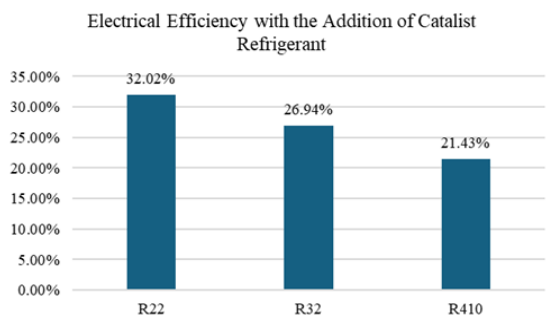
This research only looks at refrigerant catalyst’s electrical energy consumption. At the same time, the basics of catalysts and the effects and chemical reactions of refrigerant catalysts still need to be investigated. From Figure 3, using a refrigerant catalyst efficiently reduces electricity consumption, especially for the R22 type. The use of R22 is prohibited. After all, it threatens environmental sustainability because it can damage the ozone layer. Applying catalysts to cooling systems using R22 refrigerant can provide several benefits, including the potential to increase energy efficiency and reduce environmental impact. However, it should be noted that using R22 itself has been linked to environmental issues, mainly because R22 belongs to chlorofluorocarbon hydrocarbons (HCFCs), which can damage the ozone layer.
Refrigerant Catalyst use in R32 reached 26.94%. Meanwhile, the R410 needs better efficiency, around 21.43%. It is necessary to consider the application of a catalyst to this type of refrigerant because both have different and higher-pressure characteristics than R22. Safety factors need to be considered.
Catalysts can be sensitive to changes in operational conditions, such as temperature or pressure. This variability may require special maintenance and settings to ensure optimal performance. From a CAPEC (Capital Expenditure) perspective, catalyst technology development, production, and implementation can involve significant costs. Highquality catalysts or highly specialised catalyst technologies can increase the initial investment costs.
Meanwhile, from the OPEC (Operational Expenditure) side, catalysts can be sensitive to changes in operational conditions, such as temperature or pressure. This variability may require special maintenance and settings to ensure optimal performance. Some catalysts may experience deactivation or structural changes over time, which can affect the stability and service life of the catalyst. Regular maintenance or catalyst replacement may be required to maintain system performance. The addition of a catalyst can increase the overall system complexity. This action may require design changes or additional technology integration, which can complicate system management and maintenance.
Based on Figure 3, the CAPEX for using this catalytic refrigerant at R22 will be achieved in 3.12 months. The investment costs for the R32 refrigerant type will be completed in 3.5 months. Meanwhile, R410A will get a return on investment in 4.6 months. The results of this calculation are only based on electricity consumption efficiency calculations. Meanwhile, other factors, such as investment in installing AC pipes, should be considered. Investment in AC pipes is only made if the condition of the pipes is not suitable.
According to environmental considerations, catalysts may produce by-products or be exposed to certain pollutants that may reduce their performance over time. The catalyst may necessitate additional measures to combat pollution or catalyst regeneration. Some types of catalysts can contain ingredients that have environmental impacts. Therefore, developing environmentally friendly catalysts is essential to reduce potential negative consequences.
Conclusion
This research only focuses on investigating electricity consumption. Utilizing catalysts in refrigerants can reduce electrical energy consumption. The R22 refrigerant can reduce electrical energy by up to 32.02%; the R32 reaches an efficiency of 26.94%, while the R410A reaches 21.43%. The investment costs for the R32 refrigerant type will be achieved in 3.5 months. Meanwhile, R410A will get a return on investment in 4.6 months. The use of catalysts in R22 is expected to overcome environmental conservation issues. The use of a refrigerant catalyst depends on the piping conditions. When choosing a catalyst, it can be adjusted to a more environmentally friendly material that is not harmful when operated.
REFERENCES
[1] Y. Pan, “Review of energy saving technologies research in HVAC systems,” E3S Web Conf., vol. 438, p. 01006, 2023, doi: 10.1051/e3sconf/202343801006.
[2] J. Dadzie, I. Pratt, and J. Frimpong-Asante, “A review of sustainable technologies for energy efficient upgrade of existing buildings and systems,” IOP Conf. Ser. Earth Environ. Sci., vol. 1101, no. 2, 2022, doi: 10.1088/1755- 1315/1101/2/022028.
[3] DJEBKTE-KESDM, “Pedoman Investasi Efisiensi Energi,” p. xxviii, 2021.
[4] U. M. Sugeng and A. P. Agung, “Sistem Tata Udara Di Gedung Mina Bahari Iii Kantor Pusat Kementerian Kelautan Dan,” Presisi, vol. 23, no. 2, pp. 51–59, 2021.
[5] A. Zakiyah, A. Lomi, and F. Handoko, “Manajemen Energi Penggunaan Pendingin Udara Pada Gedung Perkantoran Universitas Islam Malang,” J. Teknol. Dan Manaj. Ind., vol. 4, no. 2, pp. 24–28, 2018, doi: 10.36040/jtmi.v4i2.241.
[6] A. Aziz, “Perangkat Pengkondisian Udara ( Air Conditioning ),” pp. 7–8, 2006.
[7] R. Ruliyanta et al., “A Comparative Case Study of Smart and Green Buildings and Their Impact on Power Quality,” no. September, pp. 1–5, 2023, doi: https://doi.org/10.1109/EECSI59885.2023.10295810.
[8] R. Ruliyanta, R. A. Suwodjo Kusumoputro, R. Nugroho, and E. R. Nugroho, “A Novel Green Building Energy Consumption Intensity: Study in Inalum Green Building,” 2022 IEEE Reg. 10 Symp., pp. 1–6, 2022, doi: 10.1109/tensymp54529.2022.9864532.
[9] R. M. Bellabarba, “Catalysts for modern fluorinated refrigerants,” J. Fluor. Chem., vol. 244, no. January, p. 109741, 2021, doi: 10.1016/j.jfluchem.2021.109741.
[10] B. C. Purnomo and M. Setiyo, “Karakteristik Sistem Refrigerasi Kompresi Uap Dengan Refrigerant Campuran Musicool 134 – Co2,” J. Teknol., vol. 9, no. 2, p. 57, 2017, doi: 10.24853/jurtek.9.2.57-64.
[11] I. G. Trukshin et al., “Synthesis of ozone-safe freons and methods for improving the Russian industrial catalyst for their production,” Catal. Ind., vol. 2, no. 4, pp. 307–314, 2010, doi: 10.1134/S2070050410040033.
[12] P. O. Sutrisna and G. P. Suryawan, “Potensi Penghematan Energi Kompresor melalui Replacement Kompresor Menuju Type AF OPC 55-10,” Bakti Sar., vol. 11, no. 02, pp. 81–87, 2022.
[13] R. Ruliyanta; Wismanto Setyadi, “PENDAMPINGAN PENGUKURAN PROFILE BEBAN LISTRIK,” J. Masy. Mandiri, vol. 7, no. 4, pp. 3880–3889, 2023, doi: https://doi.org/10.31764/jmm.v7i4.16480.
[14] Balai Besar Teknologi Konversi Energi B2TKE-BPPT, “Benchmarking Specific Energy Consumption Di Bangunan Komersial,” 2020, [Online]. Available: http://www.b2tke.bppt.go.id.
[15] Danfoss, “Refrigerant options now and in the future [White paper],” no. December, 2012, [Online]. Available: https://www.danfoss.com/media/7174/low-gwp-whitepaper.pdf.
[16] K. Mallikarjuna, K. HemachnadraReddy, and M. NagaRaju, “Experimental investigation on nano refrigeration using TiO2 CuO and Al2O3 as refrigerants,” Mater. Today Proc., no. xxxx, 2023, doi: 10.1016/j.matpr.2023.07.044.
[17] A. S. Majgaonkar, “Use of Nanoparticles In Refrigeration Systems : A Literature Review Paper * Corresponding Author,” Int. Compress. Eng. Refrig. Air Cond. High Perform. Build. Conf., pp. 1–10, 2016.
[18] Z. Said et al., “Nano-refrigerants and nano-lubricants in refrigeration: Synthesis, mechanisms, applications, and challenges,” Appl. Therm. Eng., vol. 233, no. July, p. 121211, 2023, doi: 10.1016/j.applthermaleng.2023.121211.
[19] S. M. Abegunde, K. S. Idowu, O. M. Adejuwon, and T. Adeyemi-Adejolu, “A review on the influence of chemical modification on the performance of adsorbents,” Resour. Environ. Sustain., vol. 1, no. July, p. 100001, 2020, doi:10.1016/j.resenv.2020.100001.
[20] M. Kassas, “Modeling and simulation of residential HVAC systems energy consumption,” Procedia Comput. Sci., vol. 52, no. 1, pp. 754–763, 2015, doi: 10.1016/j.procs.2015.05.123.
Authors: R. Ruliyanta, Department of Electrical Engineering, Universitas Nasional, Jl. Sawo Manila No. 61, Jakarta, 12520, Indonesia. Email: ruliyanto@civitas.unas.ac.id.
Source & Publisher Item Identifier: PRZEGLĄD ELEKTROTECHNICZNY, ISSN 0033-2097, R. 100 NR 10/2024. doi:10.15199/48.2024.10.63

