Published by Aleksander CHUDY, Department of Electrical Engineering and Electrotechnology, Faculty of Electrical Engineering and Computer Science Lublin University of Technology, ORCID: 0000-0002-3183-8450
Abstract. The case of study were 7 on-board EV chargers. The majority of current harmonics emission measurements during light-duty EVs charging took place in private garages of single-family houses in the Lublin Voivodeship between February and May 2022 and the remaining tests were carried out in Lublin University of Technology building and at the PGE Dystrybucja S.A. building in Lublin. The results show that 5 of the 7 EVs tested met the requirements of PN-EN 61000-3-2 and PN-EN 61000-3-12.
Streszczenie. Obiektem badań było 7 pokładowych ładowarek pojazdów elektrycznych. Większość pomiarów emisji harmonicznych prądu podczas ładowania samochodów elektrycznych przeprowadzono w prywatnych garażach domów jednorodzinnych w województwie lubelskim w okresie od lutego do maja 2022 r., a pozostałe testy przeprowadzono w budynku Politechniki Lubelskiej oraz przy budynku PGE Dystrybucja S.A. w Lublinie. Wyniki pokazują, że 5 z 7 badanych egzemplarzy pojazdów elektrycznych spełniło wymagania norm PN-EN 61000-3-2 i PN-EN 61000-3-12. (Emisja harmonicznych prądu ładowarek pokładowych pojazdów elektrycznych)
Keywords: electromobility, harmoniczne prądu, electric vehicle charging, power quality
Słowa kluczowe: elektromobilność, current harmonics, ładowanie pojazdów elektrycznych, jakość energii elektrycznej
Introduction
On-board electric vehicle (EV) chargers play a crucial role in providing EV owners with the ability to recharge their vehicles conveniently at home or in other locations. However, as the number of EVs on the road continues to rise, concerns regarding the impact of these chargers on the electrical grid have emerged. Electric vehicle integration into the power grid can have a significant impact on the power quality (PQ) parameters. According to many modelling and simulation research the increasing share of EVs in the road transport sector will result in increased peak demand, the presence of higher levels of voltage and current harmonics and other problems related to PQ parameters, which need to be identified and then eliminated or mitigated.
One of the most important aspects of on-board EV chargers that has drawn attention is their aforementioned current harmonic emission as these devices are non-linear loads. When an EV charger is connected to the power grid, it draws electric current to charge the vehicle’s battery. However, the interaction between the charger and the grid can result in the generation of harmonics, which are undesirable deviations from the standard sinusoidal waveform of the grid’s voltage and current.
To address these issues, PN-EN 61000-3-2 and PN-EN 61000-3-12 standards have been established to limit the current harmonic emissions of electrical and electronic equipment having a rated input current ≤ 16 A per phase and equipment connected to public low-voltage systems with input current > 16 A and ≤ 75 A per phase respectively. These regulations aim to assure charger-grid compatibility, decrease the detrimental impact of harmonics, and maintain the appropriate level of PQ parameters. Compliance with these criteria is critical for manufacturers to guarantee the safe and efficient operation of on-board EV chargers while reducing their effect on the electrical grid.
The aim of the research was to measure current harmonics emission of 7 on-board EV chargers and check their compatibility with PN-EN 61000-3-2 and PN-EN 61000-3-12 standards.
Methodology
The case of study were 7 on-board EV chargers. The majority of current harmonics emission measurements during light-duty EVs charging took place in private garages of single-family houses in the Lublin Voivodeship between February and May 2022 and the remaining tests were carried out in Lublin University of Technology building and at the PGE Dystrybucja S.A. building in Lublin (Fig 1). Depending on the availability of a given PQ analyser and the possibility of measuring with given current clamps, 2 PQ analysers were used for the tests: Sonel PQM-711 (IEC 61000-4-30 Class A; Sonel C-5A or Sonel F-2 current clamps) and Chauvin Arnoux 8336 (IEC 61000-4-30 Class B; Chauvin Arnoux MA193 or PAC93 current clamps). Due to the nature of the load, which are the EV chargers, the averaging time has been configured as short as possible to identify the start, momentary interruption or end of EV charging (10 cycles – 200 ms; nominal frequency of 50 Hz for Sonel PQM-711 and 1 s for Chauvin Arnoux 8336).
The average harmonic current for each EV was assessed against the PN EN 61000-3-2 and PN-EN 61000-3-12 limits even though EVs charged at 11 kW were not required to comply with the PN-EN 61000-3-2 standard. In the analysis the charging process was divided into two stages: constant current (CC) mode and constant voltage (CV) mode.
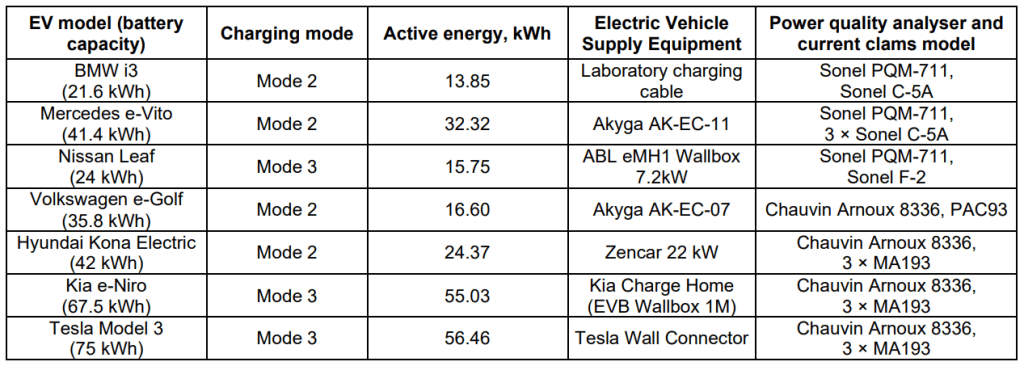
Table 1 presents technical specifications: EV model, charging mode, active energy consumed, Electric Vehicle Supply Equipment, PQ analysers and measuring clamps used.
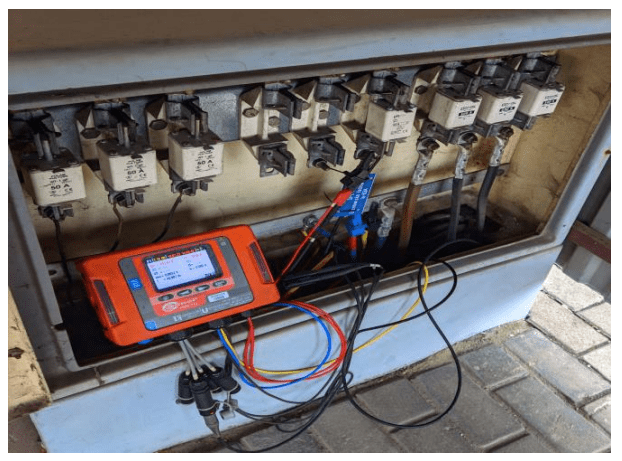
Table 1. Technical specifications: EV model, charging mode, active energy consumed, Electric Vehicle Supply Equipment, PQ analysers and measuring clamps used
Results and discussion
The owners of the four EVs refused to carry out a full charge, arguing with the advice given by the vehicle dealers that full charging in CV mode should take place occasionally, for example once a month, or when a long journey is planned. When the EVs were connected, the charging current values increased very quickly to the expected value (within 1-2 seconds). In the analysis of the current harmonic content, the values recorded approximately 10 seconds after the start of charging were taken into account. Table 2 presents the assessment of the compliance of the permissible harmonic current levels of on-board EV chargers with the PN-EN 61000-3-2 and PN-EN 61000-3-12 standards.
Table 2. Assessment of current harmonics emission of individual vehicles against PN-EN 61000-3-2 and PN-EN 61000-3-12
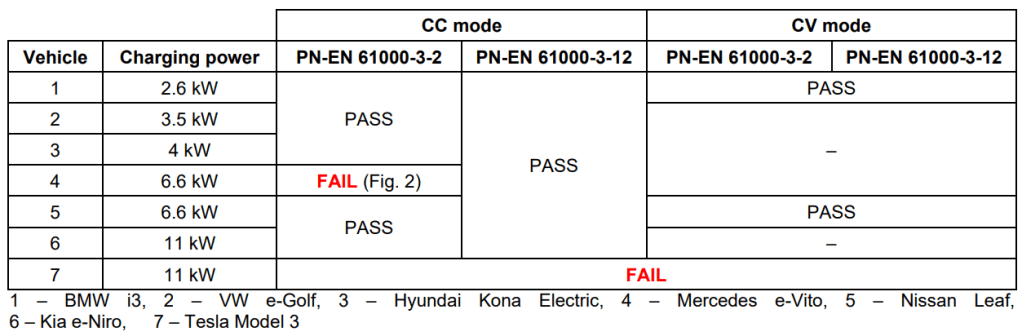
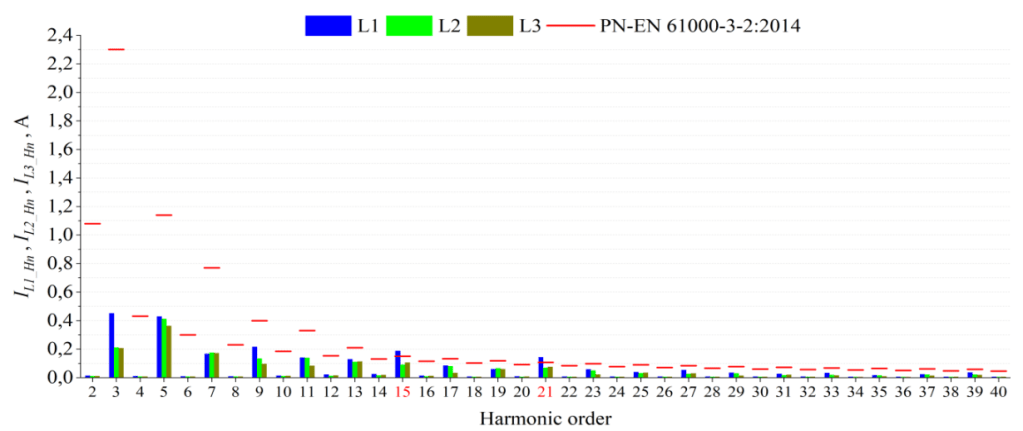
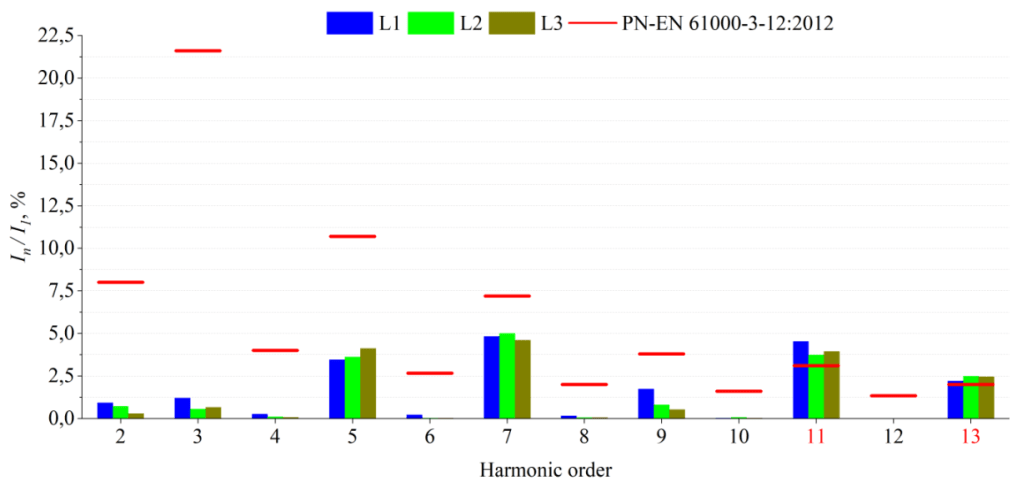
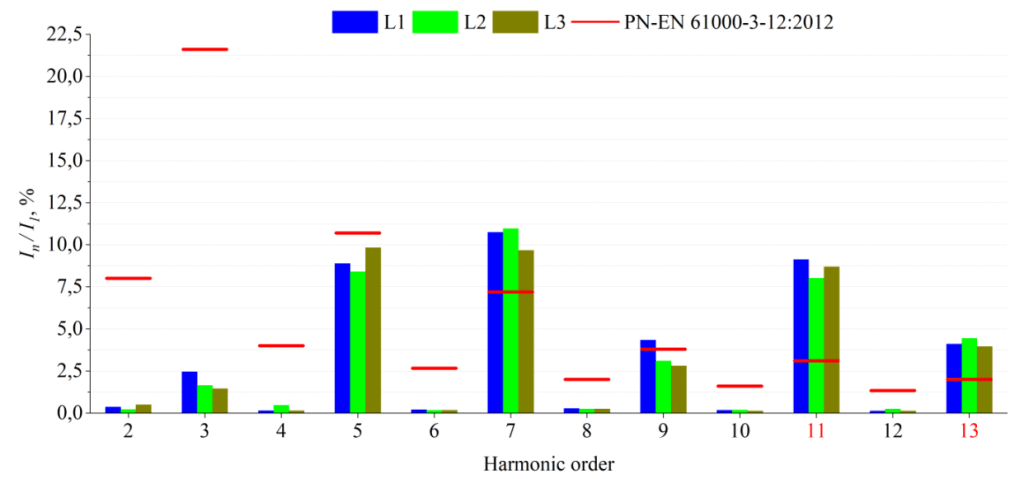
Mercedes e-Vito on-board charger (6.6 kW; < 16 A per phase) did not meet the requirements of PN EN 61000 3- 2:2014 due to excessive values of the 15th (0.19 A) and 21st (0.14 A) harmonics of the L1 phase voltage . The requirements of PN-EN 61000-3-2:2014 and PN-EN 61000-3-12:2012 were also not met for the Tesla Model 3 in both charging modes. In CC mode (Fig. 3.), the 11th (4.53% – L1, 3.74% – L2, 3.94% – L3) and 13th (2.21% – L1, 2.49% – L2, 2.46% – L3) harmonics were exceeded, while in the case of CV mode (Fig. 4.), the exceedances were for the 7th (10.75% – L1, 10.96% – L2, 9.67% – L3), 9th (4.35% – L1), 11th (9.12% – L1, 8.02% – L2, 8.69% – L3) and 13th (4.10% – L1, 4.45% – L2, 3.95% – L3) harmonics.
The THDI and PWHD values in each case analysed were in accordance with PN-EN 61000-3-12:2012 and ranged from 3.37 % (Kia e Niro, CC mode) to 17.71 % (Tesla Model 3, CV mode) and from 2.63 % (Nissan Leaf, CC mode) to 22.26 % (Tesla Model 3, CV mode), respectively. The values of these coefficients were significantly lower in CC mode, indicating a higher percentage of current harmonics in CV mode, for example, for the Tesla Model 3 the THDI value in CC mode was 8.20% and the PWHD value was 12.77 %.
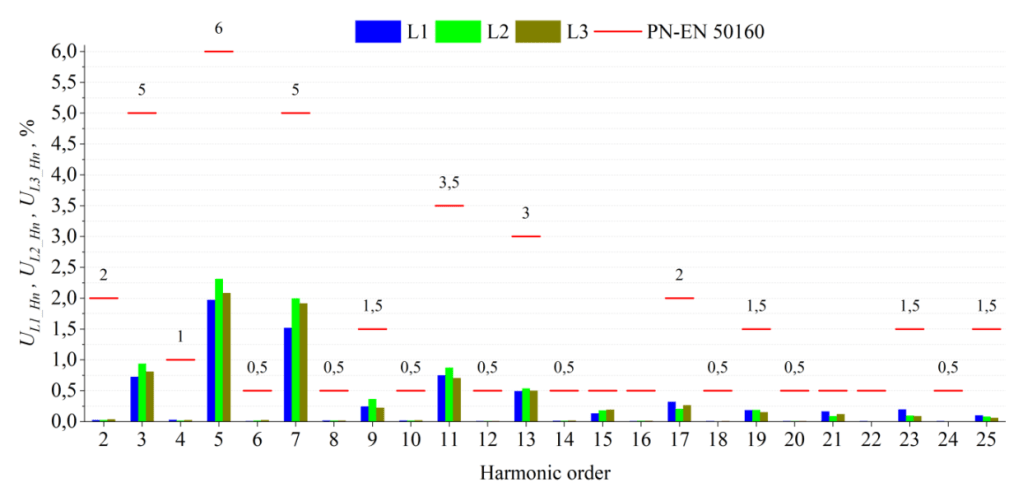
At each location, during EVs charging, the 95th percentile values of the voltage harmonics were well below the values allowed by PN-EN 50160:2010, however it should be noted that the rms values of the phase voltages and the values of the odd voltage harmonics (mostly up to the nineteenth order) measured before, during and after charging at the destinations did not comply with the requirements of PN-EN 61000-3-2:2014 and PN-EN 61000-3-12:2012 in each case analysed. The 95th percentile values of the dominant voltage harmonics were the highest at locations where Mercedes e Vito, Tesla Model 3 and Hyundai Kona Electric were being charged. Figure 5 presents the 95th percentile values of voltage harmonics averaged from all test locations.
Conclusions
An analysis of the harmonic content of current during the charging processes of light-duty EVs in CC mode showed that this stage lasts longer and occurs more frequently than charging in CV mode, so that multiple EVs are more likely to be charged simultaneously in this mode. The results of the measurements of the current harmonic from the charging systems of the seven EVs show that the tested Mercedes e-Vito does not meet the requirements of the PN-EN 61000-3-2:2014 standard in CC mode, while the Tesla Model 3 does not comply with the requirements of PN-EN 61000-3-2:2014 and PN-EN 61000-3-12:2012 standards in CC and CV modes. Charging in CV mode is characterised by a higher percentage of harmonic current, but the rms values of the harmonics are lower than when charging in CC mode.
The exceedances of voltage harmonics are interesting and raise two questions:
• Would non-compliance be observed if the rms values of the supply voltages and voltage harmonics were within the relevant limits?
• Could this mean that the requirements for the rms value of supply voltages and voltage harmonics are inadequate or the current harmonic limits need to be increased to reflect the increased emissions under higher background voltage harmonics present in real networks?
Based on the obtained results possible directions for further research are long-term studies of power quality parameters at a frequently used charging point to assess the content of current harmonics from different EVs and assessment of the impact of charging light-duty EVs on power quality parameters at the connection points of several charging stations operating simultaneously.
This work was supported by Lublin University of Technology grant no. FD-20/EE-2/403.
REFERENCES
[1] Khan W., Ahmad A., Ahmad F., Saad Alam M., A Comprehensive Review of Fast Charging Infrastructure for Electric Vehicles, Smart Science, 120 (2018), No 11, 1-15
[2] Chudy A., Mazurek P., Electromobility – the Importance of Power Quality and Environmental Sustainability, J. Ecol. Eng., 20 (2019), No 10, 15-23
[3] Nour M., Chaves-Ávila J. P., Magdy G., Sánchez-Miralles Á., Review of Positive and Negative Impacts of Electric Vehicles Charging on Electric Power Systems, Energies, 13 (2020), No 18
[4] Das H. S., Rahman M. M., Li S., Tan C. W., Electric vehicles standards, charging infrastructure, and impact on grid integration: A technological review, Renewable and Sustainable Energy Reviews, 120 (2020)
[5] Chudy A., Mazurek P., Ultra–fast charging of electric bus fleet and its impact on power quality parameters, Przegląd Elektrotechniczny, 1 (2023), No 1, 296-299
[6] Mazurek P., Chudy A., An Analysis of Electromagnetic Disturbances from an Electric Vehicle Charging Station, Energies, 15 (2022), No 1
[7] Chudy A., Hołyszko P., Mazurek P., Fast Charging of an Electric Bus Fleet and Its Impact on the Power Quality Based on On-Site Measurements, Energies, 15 (2022), No 15
[8] Kutt L., Saarijarvi E., Lehtonen M., Molder H., Niitsoo J., Electric vehicle charger load current harmonics variations due to supply voltage level differences – Case examples. In: 2014 International Symposium on Power Electronics, Electrical Drives, Automation and Motion (SPEEDAM); IEEE, (2014), 917-922
[9] Collin A. J., Xu X., Djokic S. Z., Moller F., Meyer J., Kutt L., Lehtonen M., Survey of harmonic emission of electrical vehicle chargers in the European market. In: 2016 International Symposium on Power Electronics, Electrical Drives, Automation and Motion (SPEEDAM); IEEE, (2016), 1208-1213
[10]Möller F., Meyer J., Klatt M., Lakenbrink C., Vasile P., Holder R., Impact Of High Penetration Of Battery Electric Vehicles On Power Quality In Central And Distributed Charging Infrastructure. In: CIRED 2021 – The 26th International Conference and Exhibition on Electricity Distribution; Institution of Engineering and Technology, (2021), 955-959
[11]Mariscotti A., Harmonic and Supraharmonic Emissions of Plug-In Electric Vehicle Chargers, Smart Cities, 5 (2022), No 2, 496-521
Author: mgr inż. Aleksander Chudy, Department of Electrical Engineering and Electrotechnologies, Lublin University of Technology, Nadbystrzycka Street 38A, 20-618 Lublin, e-mail: a.chudy@pollub.pl
Source & Publisher Item Identifier: PRZEGLĄD ELEKTROTECHNICZNY, ISSN 0033-2097, R. 101 NR 1/2025. doi:10.15199/48.2025.01.25

