Published by 1. Kheira MELOUK1, 2. Mohamed DELLA KRACHAI1, 3. Saidia DELLA KRACHAI2, Faculty of Electrical Engineering, Department of Automatics, University of Science and Technology of Oran. U.S.T.O.M.B (1), Spatial Development Center, Algeria (2)
ORCID: 1. 0000-0002-9300-649X; 2. 0000-0002-0899-8923; 3. 0000-0002-0710-1037
Abstract. This paper presents a model predictive control (MPC) technique applied to a DC-DC boost converter powered by a photovoltaic ( PV ) generator. The control objective is to ensure the maximum power point tracking (MPPT) using neural networks and achieve a stable output voltage under varying environmental conditions. Photovoltaic systems are highly dependent on solar irradiance and temperature, which affect their output characteristics. The proposed method leverages predictive control algorithms to anticipate system behaviour and adjust the converter’s duty cycle in real-time, thereby improving the system’s overall efficiency and response time compared to conventional control methods. Simulation results validate the effectiveness of the proposed control scheme in terms of response time, voltage regulation, and robustness against environmental changes.
Streszczenie. W artykule przedstawiono technikę modelowego sterowania predykcyjnego (MPC) zastosowaną w przetwornicy podwyższającej˙ napięcie DC-DC zasilanej z generatora fotowoltaicznego (PV). Celem sterowania jest zapewnienie śledzenia punktu maksymalnej mocy (MPPT) przy użyciu sieci neuronowych i osiągnięcie stabilnego napięcia wyjściowego w zmiennych warunkach środowiskowych. Systemy fotowoltaiczne są w dużym˙ stopniu zależne˙ od natężenia promieniowania słonecznego i temperatury, które wpływają na ich charakterystykę wyjściową. Proponowana metoda wykorzystuje algorytmy sterowania predykcyjnego do przewidywania zachowania systemu i dostosowywania cyklu pracy przekształtnika w czasie rzeczywistym, poprawiając w ten sposób ogólną wydajność systemu i czas reakcji w porównaniu z konwencjonalnymi metodami sterowania. Wyniki symulacji potwierdzają skuteczność proponowanego schematu sterowania pod względem czasu reakcji, regulacji napięcia i odporności na zmiany środowiskowe. (Poprawa wydajności konwertera podwyższającego zasilanego energią fotowoltaiczną przy użyciu sieci neuronowych i sterowania predykcyjnego modelem)
Keywords: Model predictive control, DC / DC boost converter, maximal power point tracking, artificial neural networks.
Słowa kluczowe: Modelowe sterowanie predykcyjne, konwerter podwyższający DC/DC, śledzenie punktu mocy maksymalnej, sztuczne sieci neuronowe.
Introduction
Photovoltaic (PV) energy has become a crucial element of modern renewable energy systems [1][2]. The intermittent nature of solar energy presents challenges in efficiently converting and controlling the power output of PV generators [1][2]. To extract maximum power from a PV array, it is essential to employ efficient control techniques that adapt to changing environmental conditions, such as irradiance and temperature. One widely used topology is the boost converter, which steps up the variable DC output from the PV generator to a higher, more usable level for energy storage or grid connection. Several MPPT algorithms have been proposed in literature, with P&O and IC being the most commonly implemented [1][2][3][4]. These methods, though simple and reliable, often fail to achieve satisfactory performance in rapidly changing environments. They suffer from oscillations around the MPP and slow dynamic response. Therefore, the efficiency of PV systems is critically determined by their ability to continuously operate at their maximum power point (MPP). The present paper explores the use of neural networks (NNs) for tracking the MPP [1][2]. Model Predictive Control (MPC) has emerged as an advanced technique that can handle system non-linearity and constraints more effectively [58]. MPC uses a dynamic model of the system to predict future behavior and adjusts the control input accordingly [8]. In this paper, we focus on implementing MPC for a boost converter powered by a PV system and demonstrate its superior performance over conventional approaches.
System modelling
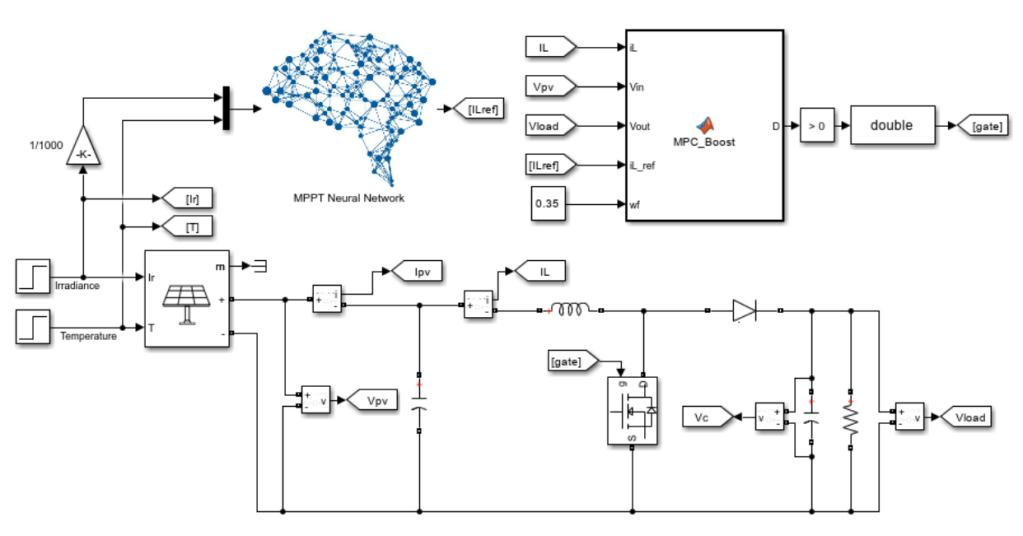
Figure 1 depicts the overall block diagram of the system. The system is composed of a photovoltaic module as a power source. A voltage step-up converter is connected to this generator in order to raise the input voltage to supply the load. The measurement of the system currents/voltages is carried out in order to control the duty cycle of the converter by the MPC technique, while ensuring transfer of the maximum power of the photovoltaic module by the use of neural networks.
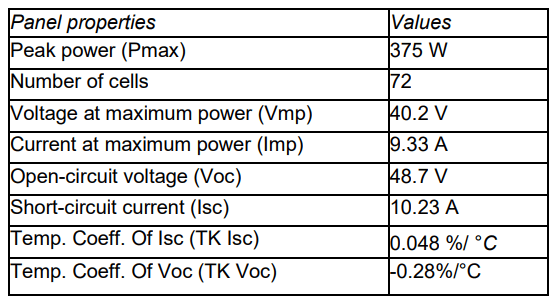
Table 1. PV module parameters
Photovoltaic generator
Electricity is generated by a photovoltaic (PV) panel that converts sunlight into electrical energy [1-3]. Table 1 provides the key parameters of the PV module used in this study. The current generated by a photovoltaic panel can be represented by this equation, which is based on the single-diode model of a solar cell [1]:
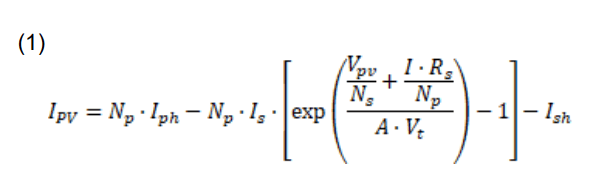
Where:
• IPV -Total current produced by the PV panel.
• NS– Number of cells connected in series in a module (increases the voltage).
• NP – Number of cells connected in parallel in a module (increases the current).
• Iph– Photocurrent (current produced by sunlight).
• Ish– is the current through the shunt resistor (Rsh).
• IS– Saturation current (current in the diode when reverse biased).
• VPV – Voltage across the PV panel.
• Rs– Series resistance.
• A– Diode ideality factor (a measure of how ideal the diode behaves).
• Vt– Thermal voltage (a function of temperature).
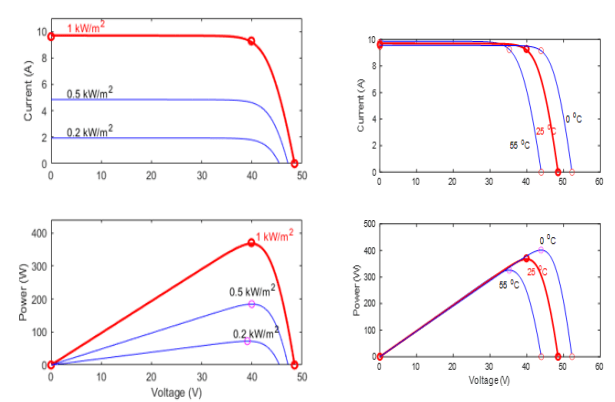
As illustrated in Figure 2, the generated current and voltage demonstrate a non-linear relationship, with the I-V curve. being divided into three distinct operating regions. On the left side of the curve, the PV module behaves as a constant current source, while on the right side, it operates in a constant voltage mode. Between these two operating modes lies the point of maximum power output, which corresponds to the highest efficiency.
Figure 2. left illustrates the effect of irradiance on the I-V and P-V characteristics. An increase in irradiance results in higher current and output power increases as well. As temperature increases, as shown in Figure 2.right, the current shows a small increase, but the voltage drops significantly indicating that higher temperatures negatively affect the overall performance of the PV panel.
Maximal power point tracking
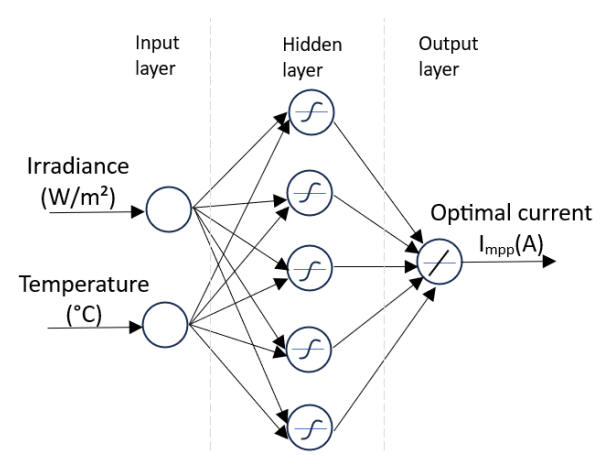
Neural networks are well-suited for dynamic environments where they can learn to map nonlinear relationships between inputs (e.g., irradiance and temperature) and the desired output (voltage, current or power). The neural network used for MPPT (figure 3) is a feedforward architecture with one hidden layer, optimized for real-time tracking of the maximal power [1-2]. Feed Forward neural network type is in this paper. It is designed as an interconnected layers. Each layer consists of a set of neurons. Increasing the number of layers and neurons in hidden layers leads to the best representation of non-linearities of the system, however, it exhibits complex computations, and therefore, hardware implementation constraints. The input layer consists of two neurons representing the irradiance one hidden layer with five (5) neurons which gives a satisfactory prediction.
The neural network is trained offline using data generated from the PV module under various irradiance and temperature conditions. Once trained, the neural network is deployed for real-time simulation, where it dynamically adjusts the duty cycle to maximize the output power. Supervised learning is employed to train the neural network. The training is performed using Levenberg-Marquardt algorithm, which minimizes the mean square error (MSE) between the predicted and actual MPP current. The training process is carried out using Levenberg Marquardt Algorithm. The database was partitioned as follows:
- Training data: 70% of dataset
- Validation data: 15% of dataset
- Testing data: 15% of dataset
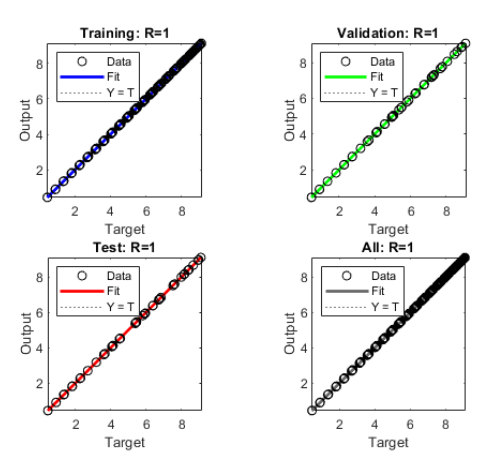
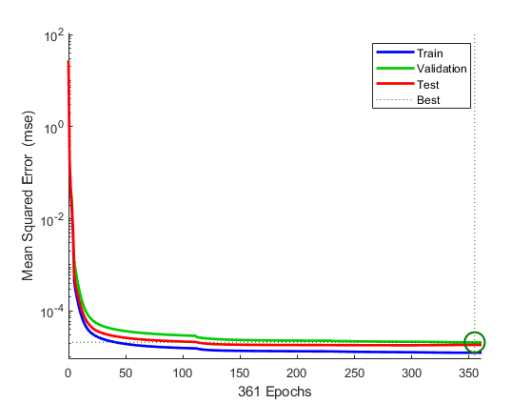
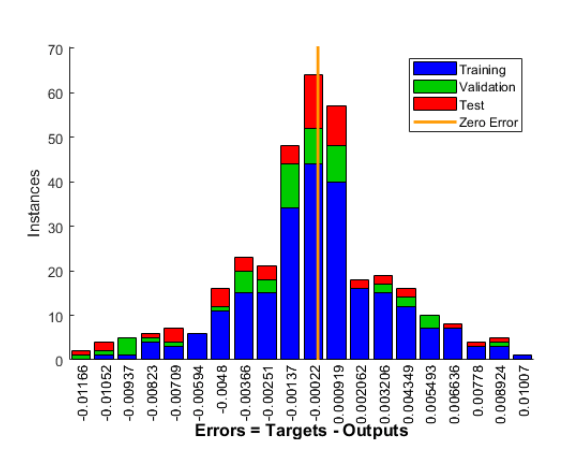
Network outputs (predicted values) are equal to the target values provided in the training, validation and testing phases. The performed fit exhibits a good approximation for all of the data sets. To provide a measure of how well the predictions of the model are compared to actual outcomes, correlation coefficient R is used as a tool. The regression plot in figure 4 displays the network predictions (output) with respect to responses (target) for the training, validation, and test sets. The tracking operation gives a satisfactory result for training, testing, and validation sets, and the R-value is 1.0 equal to the previously smallest validation error for six consecutive validation iterations. A plot of the training errors, validation errors, and test errors are shown in figure 5. It is observed that the final mean-square error is small, the test set and the validation set errors have similar behaviors, which concludes that no overfitting has occurred. To further investigate the distribution of errors in the model, figure 6 gives a plot of the error histogram. The error histogram plot looks fairly symmetric and the peak of the distribution lies exactly in the middle of the error’s interval indicating the absence of any bias.
Model predictive control
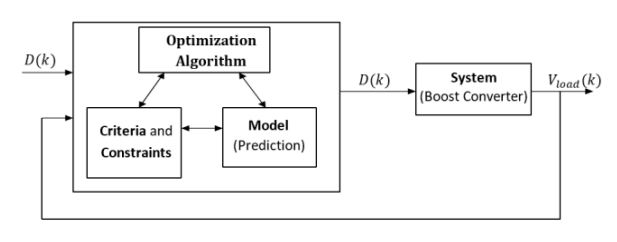
Predictive control involves using the system model to anticipate its future behavior while minimizing the cost function [8-10]. This approach requires solving a finite dimensional optimization problem at each sampling interval (figure 7) [4][8]. For the boost converter, MPC continuously predicts behaviors, which concludes that no overfitting has occurred. To further investigate the distribution of errors in the model, figure 6 gives a plot of the error histogram. The error histogram plot looks fairly symmetric and the peak of the distribution lies exactly in the middle of the error’s interval indicating the absence of any bias. for the total data set and shows a very satisfactory accuracy. Training finished when the validation error was larger than or the output voltage and current over this horizon and determines the optimal duty cycle D that minimizes a cost function subject to system constraints [6][8-12]. The predictive model of the boost converter is derived from its state-space representation. The state variables are the inductor current iL and the output voltage vC (or vload, as the output capacitor is parallel to the load), governed by the following equations [6-12]:
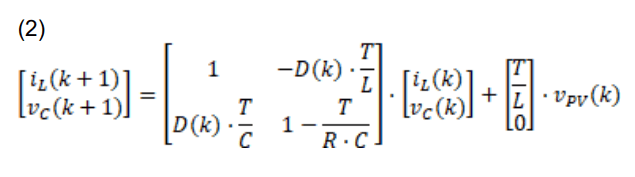
where L is the inductance and C is the capacitance of the boost converter. These equations are discretized for implementation in the MPC framework, and the future values of iL are predicted based on inductance current measurements and control inputs.
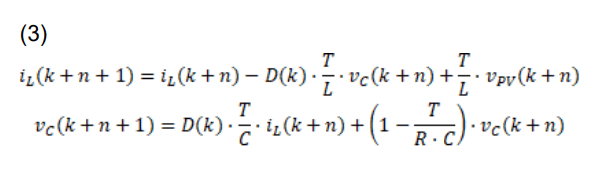
Taking into account the predictive control horizon over n samples, the prediction equations for the current iL and the voltage vC are provided as follows [6-8]:
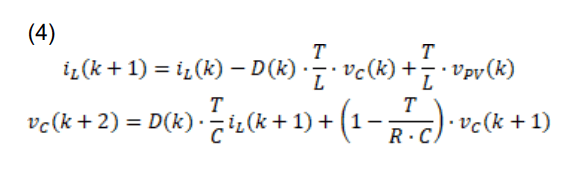
And the two-step prediction horizon is:
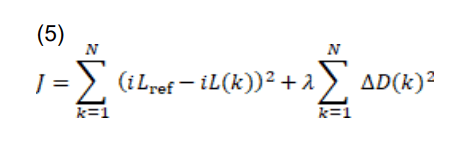
The typical cost function is defined as:
where:
- iLref : is the reference current (desired output),
- iL(k) : is the predicted inductance current at future step k,
- D(k): is the duty cycle,
- λ : is a weighting factor, and
- ∆D(k): is the change in duty cycle.
By minimizing J, the MPC algorithm ensures that the output voltage follows the reference as closely as possible, while avoiding large variations in the duty cycle, which could result in instability or excessive switching losses.
Simulation and Results
To validate the effectiveness of the proposed predictive control method, simulations were performed using MATLAB/Simulink. The parameters of the PV system and the boost converter were selected based on typical commercial photovoltaic module and converter components. Figure 8 shows the performance of the proposed control strategy under variable irradiance and temperature conditions. The MPC controller successfully tracked the maximum power point and maintained stable output voltage, demonstrating its robustness and fast response to irradiance and temperature changes.
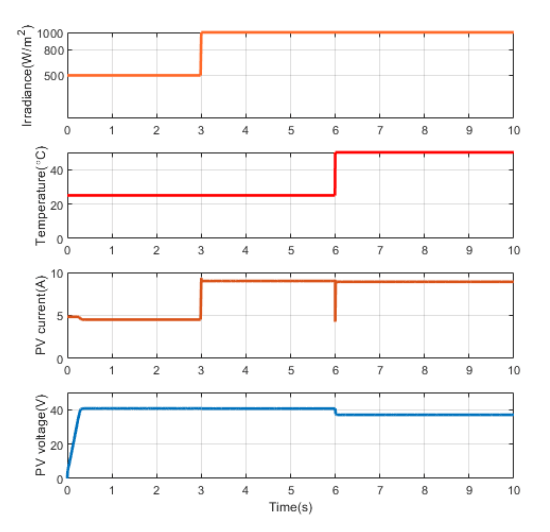
First, PV module is exposed to an irradiance of 500W/m2 and a temperature of 25◦C. The neural network estimates with high precision the maximal output current. Second, a change at 3s and 6s of irradiance and temperature respectively is injected to test the dynamic response of the system. It is observed that the tracking of maximal power is performed with a high accuracy.
The proposed MPC controller provided superior performance in terms of transient response, steady-state accuracy, and handling of non-linearities.
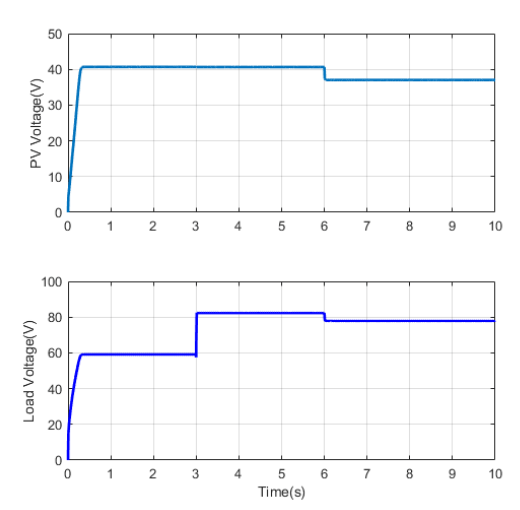
Figure 9 shows the voltage boosted (load voltage) from PV voltage. The combination of neural network and MPC controller was able to converge to the MPP much faster, while, maintaining the load voltage to the desired values with less oscillations.
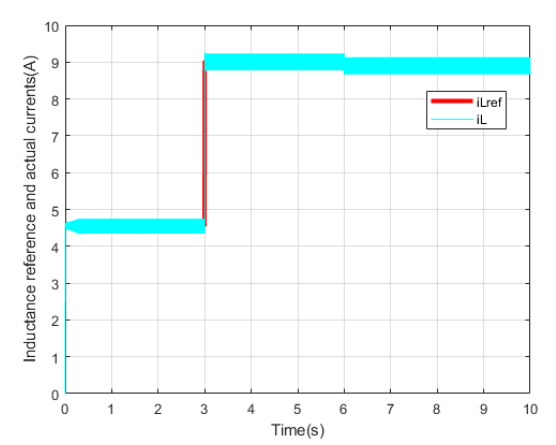
In figure 10, MPC controller was also able to drive the inductor current to its reference value, ensuring thus good dynamic response of the system.
Conclusion
This paper has demonstrated the feasibility and effectiveness of using neural networks for MPPT and MPC control in PV systems coupled with a boost converter. The integration of neural networks into MPPT allows for real-time learning and adaptability to changing environmental conditions, thus offering improved tracking speed and accuracy.
By leveraging the learning capabilities of neural networks, the controller is able to adapt quickly to changing environmental conditions. This results in faster convergence to the MPP, reduced power oscillations, and improved overall efficiency. On the other hand, MPC exhibited superior performance in terms of response time, accuracy, and robustness. Future work will focus on the implementation of MPC in hardware and investigating its performance in real-world scenarios.
REFERENCES
[1] Della Krachai. M, Melouk. k, Keddar. M: Investigating sineband hysteresis control of photovoltaic-grid connected inverter, International Journal of Power Electronics and Drive System (IJPEDS), 11(2), pp. 969 976, 2020.
[2] Della Krachai. S, Boudghene Stambouli. A, Della Krachai. M, Bekhti: Experimental investigation of artificial intelligence applied in MPPT techniques, International Journal of Power Electronics and Drive System (IJPEDS), 10(4), pp. 2138 2147 , 2019.
[3] KACIMI, Nora et al.: New improved hybrid MPPT based on neural network-model predictive control-kalman filter for photovoltaic system, Indonesian Journal of Electrical Engineering and Computer Science, 20(3), pp. 1230 1241, 2020.
[4] Ma, C., Li, N., Li, S.: Maximum Power Point Tracking for Photovoltaic System Using Model Predictive Control, Intelligent Computing for Sustainable Energy and Environment ICSEE (2013), pp. 515 525, 2013.
[5] Zhao, Y., An, A., Xu, Y. et al.: Model predictive control of gridconnected PV power generation system considering optimal MPPT control of PV modules, Prot Control Mod Power Syst, 6(32), pp. 2 12, 2021.
[6] M. B. Shadmand, X. Li, R. S. Balog and H. A. Rub: Model predictive control of grid-tied photovoltaic systems: Maximum power point tracking and decoupled power control, First Workshop on Smart Grid and Renewable Energy (SGRE), pp. 1 6 , 2015.
[7] Ahmed, M.; Harbi, I.; Kennel, R.; Rodríguez, J.; Abdelrahem, M.: Maximum Power Point Tracking-Based Model Predictive Control for Photovoltaic Systems: Investigation and New Perspective, Sensors, vol. 22, pp. 1 18, 2022.
[8] M. Metry, S. Bayhan, R. S. Balog and H. A. Rub: Model predictive control for PV maximum power point tracking of singlephase submultilevel inverter, IEEE Power and Energy Conference at Illinois (PECI), pp. 1 8, 2016.
[9] Irmak, E and Güler. N: A model predictive control based hybrid MPPT method for boost converters, International Journal of Electronics, vol. 107, no. 1, pp. 1 16, 2020.
[10] Ravi K. M., Jyoti P. M., Ashish A. D.: MPC-based DC microgrid integrated series active power filter for voltage quality improvement in distribution system, International Journal of Circuit Theory and Applications, vol. 51, no. 3, pp. 1349 1371 , 2022.
[11] Marahatta. A, Rajbhandari. Y,Shrestha. A, Phuyal. S, Thapa. A, Korba. P.: Diagnostic Model predictive control of DC/DC boost converter with reinforcement learning, Heliyon, vol. 83 , pp. 1 13, 2022.
[12] Sowparnika. G.C, Sivalingam. A, Thirumarimurugan. T: Modeling and Control of Renewable Source Boost Converter using Model Predictive Controller, International Journal of Computer Application, vol. 5, no. 7, pp. 2250 1797, 2015.
Authors: Dr. Melouk Kheira, Dr. Della Krachai Mohamed, Faculty Electrical Engineering, Department of Automatics, University of Science and Technology of Oran. U.S.T.O.M.B, PO. Box 1505 El Menaouer USTO, Oran, Algeria, email: kheira.melouk@univ-usto.dz, mohamed.dellakrachai@univ-usto.dz, Dr. Della Krachai Saidia, Spatial Development Center, Algeria email:saidia.dellakrachai@univ-usto.dz
Source & Publisher Item Identifier: PRZEGLĄD ELEKTROTECHNICZNY, ISSN 0033-2097, R. 101 NR 2/2025. doi:10.15199/48.2025.02.41

