Published by Jalal Ibrahimov1, Tural Aliyev2, Ilkin Marufov3, Nijat Mammadov4, Azerbaijan State Oil and Industry University ORCID: 3. 0000-0002-3143-0113; 4. 0000-0001-6555-3632
Abstract. The widespread use of electric automobiles will lead to significant changes in instantaneous consumption values and the mechanisms that govern this consumption. Electricity demand will increase sharply and there will be fluctuations in the networks. The only way to cope with this problem is to switch to smart networks. This article examines and economically analyses the method of switching from a vehicle to a network, which is considered to be used to solve the problem of fluctuations caused by the integration of renewable energy sources into the network. For this purpose, unlike other studies in the literature, a simulation study was conducted that took into account both the battery life of the car and the driver’s behavior. The research to be done in smart networks and renewable energy sources should not be accepted only for home consumers. In terms of competitiveness, industrial consumers need to choose devices that support smart grids when developing and planning their systems. Researches on energy quality and vehicle-to-grid (V2G) is very important in this regard. In addition to engineering objectives, electric automobiles should also be looked at from an economic point of view, such as the benefits and costs they can provide due to the level of vertical integration.
Streszczenie. Powszechne wykorzystanie samochodów elektrycznych doprowadzi do znaczących zmian w wartościach chwilowego zużycia energii i mechanizmach rządzących tym zużyciem. Zapotrzebowanie na energię elektryczną gwałtownie wzrośnie, a w sieciach wystąpią wahania. Jedynym sposobem poradzenia sobie z tym problemem jest przejście na sieci inteligentne. W artykule zbadano i poddano analizie ekonomicznej sposób przejścia z pojazdu do sieci, który uważa się za stosowany w celu rozwiązania problemu wahań spowodowanych włączeniem do sieci odnawialnych źródeł energii. W tym celu, w odróżnieniu od innych badań dostępnych w literaturze, przeprowadzono badanie symulacyjne, w którym uwzględniono zarówno czas pracy akumulatora samochodu, jak i zachowanie kierowcy. Badania, jakie należy przeprowadzić w zakresie inteligentnych sieci i odnawialnych źródeł energii, nie powinny być akceptowane jedynie w przypadku odbiorców domowych. Jeśli chodzi o konkurencyjność, konsumenci przemysłowi muszą wybierać urządzenia obsługujące inteligentne sieci podczas opracowywania i planowania swoich systemów. Badania nad jakością energii i pojazdem do sieci (V2G) są w tym względzie bardzo ważne. Oprócz celów inżynieryjnych na samochody elektryczne należy patrzeć także z ekonomicznego punktu widzenia, np. korzyści i kosztów, jakie mogą zapewnić ze względu na poziom integracji pionowej. (Rozwiązanie problemów związanych z integracją odnawialnych źródeł energii: integracja pojazdów elektrycznych z sieciami dystrybucyjnymi)
Keywords: Vehicle-to-Grid, energy management, electric vehicles, PV charging, renewable energy, distribution network, V2G
Słowa kluczowe: Vehicle-to-Grid, zarządzanie energią, pojazdy elektryczne, ładowanie PV, energia odnawialna, sieć dystrybucyjna, V2G
1.Introduction
Now the whole world is making a rapid transition to renewable energy. But renewable energy systems also have many negative aspects on the network. Generally, solar and wind are the first sources of renewable energy sources. However, these sources are variable, that is, if the wind blows and the sun shines in the air, electricity is generated. On the other hand, the demand in the electricity network is very variable for every hour of the day. Electricity demand is higher during the day, and lower at night than during the day. In this case, it is not always possible to rely on renewable energy plants due to weather conditions. These power plants must also be integrated into storage systems. There are many energy storage methods. But, of course, these methods cannot be applied everywhere due to regional and financial problems, so electric vehicles can be used as a storage tool.
The number of electric vehicles on the roads is increasing every day. Along with this increase, the demand for electricity will naturally increase. Every electric vehicle on the road needs electricity to be charged. Of course, this electricity also needs to be generated from clean energy sources. Therefore, electric vehicles can be used as a complement to renewable energy plants. It can feed the network when the demand for electric vehicles is full when it is full, and it can be stored in electric vehicles when the demand is low, and it can be renewed when the demand is low [1].
Today, the increase in the number of electric vehicles creates a real opportunity for grid balancing. This opportunity can be used to help balance the electrical system and manage local ecosystems by being managed with Vehicle-to-Grid (V2G) solutions. Vehicle to Grid is a system in which plug-in electric vehicles (EV) are connected to the energy grid by transmitting electricity back to the grid or by reducing the charging rates to realize demand-side services. The basic concept of vehicle-to grid demonstrated in the Figure 1.
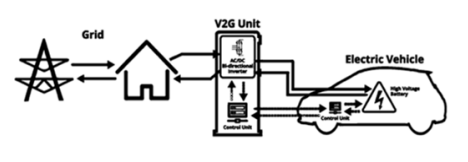
The Vehicle-to-Grid (V2G) system enhances electric vehicles’ storage capacity, enabling them to store or discharge electricity from renewable sources. This flexibility facilitates the integration of numerous renewable energy sources. However, additional studies are necessary to address the increased electricity consumption resulting from widespread V2G adoption. Countries need to prepare for this surge in demand. The escalating need for energy presents inevitable challenges on the production side. Renewable energy sources offer environmentally friendly solutions to augment production but come with their own set of issues. To efficiently provide services, networks must accurately estimate production volumes from alternative sources. Hybrid renewable energy applications serve as eco-friendly solutions designed for this purpose.
Post the Fukushima incident, there has been a rapid increase in the demand for alternative energy sources, with solar and wind energy being the most prevalent. However, reliability and cost pose challenges, influenced by seasonal conditions and high initial installation costs. The research aims to explore the integration of these sources into the network and assess the benefits of employing the Vehicle-to-Grid (V2G) method in conjunction with these renewables. An energy management system model combining V2G and various renewable sources has been developed and explored for different scenarios, highlighting the advantages V2G offers in renewable energy-dependent networks [2, 3].
2. Materials and methods
Vehicle-to-network power transmission. The V2G method is a new method developed in recent years. This method has many important mechanisms, such as meeting high energy demand or balancing the cost of generating electricity.
The number of electic automobiles in the transport system of many countries is growing rapidly. These cars must be connected to the mains to charge their high-capacity batteries. The problems that can arise from this type of simultaneous connection have been discussed. The fact that these cars were generally stationary during the day gave rise to the idea of using their batteries. V2G is a method that uses EA batteries to store energy and aims to create a distributed power source. Using this method, it seems possible to solve the problems of reliability of renewable energy sources in a cooperative way. V2G hybrids can be ancillary to renewable energy systems [4].
Mathematical model and computational method. The generating capacity of the network is determined by deducting the cost of production from the production of renewable energy sources and auxiliary sources. Quantity of production “P” at any “t” time calculated by:

Here: PG-grid production, PW-wind power generation, PS-solar power generation, PA-auxiliary production. The PC-parameter is used to indicate consumption. There are various methods for modeling wind energy, which is a variable production method. PW can be obtained using the Weibull probability distribution.
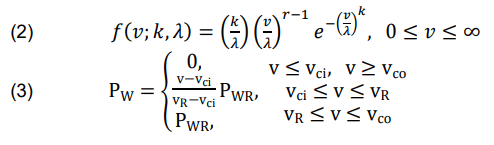
Here: v-wind speed, vci-wind speed at which the turbine isstarted, vco-wind speed at which the turbine is stopped, vR-wind speed at rated power. Other parameters include k: smoothing factor and λ-is a ratio used for scaling. The measured wind energy data can be approximated to the Weibull probability distribution. Different probability distributions can also be used for production and consumption data from solar energy. Instead of distributed methods, measured real data values from all sources can also be used. The contribution of backup sources varies depending on the source selected. If V2G is used, this structure is seen as a participatory system, and production capacity depends on two factors. These are; The SOC status of EA batteries and the probability of EA connecting to V2G (POP). There are several situations that affect the value of POP. The first is the importance and frequency of use of the car. The other is the motivation of vehicle owners to participate in the system. Incentive-based mechanisms can be used to increase the value of POP in an energy management system. As with DSM systems, rewards can increase the desire to participate. Presumably, unlike the POP value expressed in the range [0-1], the SOC value is expressed as a percentage (0: empty, 100: full).

A block diagram of a calculation method using a mathematical model is shown in Figure 2.
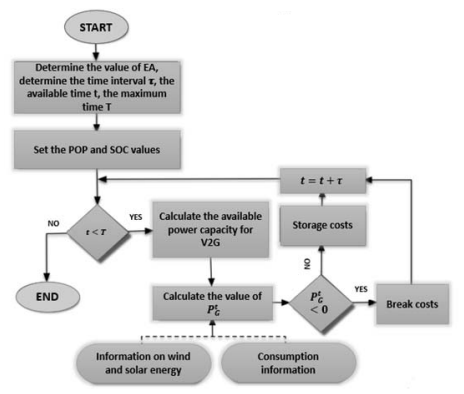
In the computational method, forecasting was used in the available energy capacity method to determine V2G production. This method first determines the probability of participation having the same value for all vehicles. If a different probability value is used for each vehicle, the computational complexity increases dramatically. Using the total participation probability, the share distribution can be simplified to the binomial distribution. Finally, the available energy capacity is calculated by grouping the vehicles into different groups. The SOC features of the EA are also taken into account in order to make a better assessment of the calculation method [5, 6, 7, 8].
Vehicle-to-network simulation research. In the simulation study, the POP and SOC values were taken as random values due to their uncertainties. Random POP and SOC values are given equally to each EA owner. Due to these values, the participation of vehicles in V2G is formed. The study examines three scenarios in which renewable energy sources contribute to the grid to varying degrees. Production profiles of energy sources were created using the total capacity values in Table 1 [9, 10].
Table 1. Sources used and total capacity values
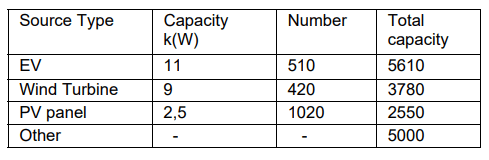
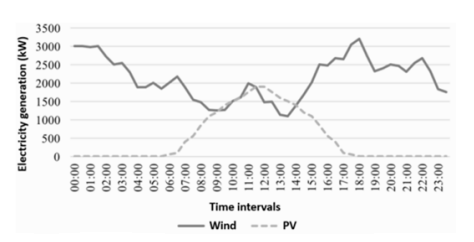
Figure 3 shows the daily production profiles of these sources. Production of PV panels peaks in the afternoon, and for the rest of the day, production is almost non-existent for some time. Similarly, wind energy production exhibits a non-permanent production behavior. It is not possible for the network to create a reliable power supply using only these two sources.
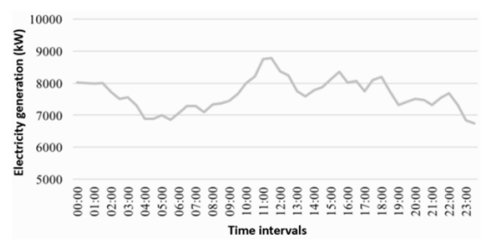
Figure 4 shows a description of the network’s total electricity generation for the day.
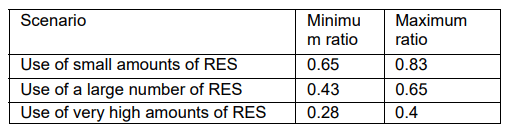
In many studies in the scientific literature, the probability of EA participating in V2G has been defined as a single value. Because such a hypothesis does not accurately reflect real life, each EA was given a separate opportunity to participate. The probabilities of V2G participation were determined by the intervals given in Table 2 and by scenario type.
Table 2. The probable value ranges for EA’s and V2G contributions
The parameters given in Table 3 are used to determine the production of renewable energy sources for different scenarios.
Table 3. Rates of reduction in production for different scenarios
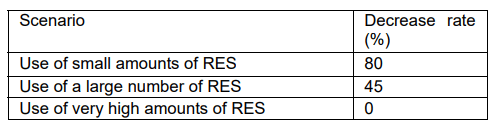
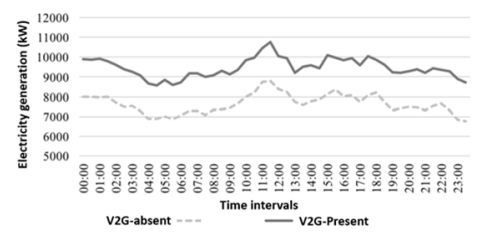
Use of small amounts of renewable energy sources. In this scenario, renewable energy sources are likely to be more limited. The reason for this restriction may be a seasonal condition or a temporary decrease in production. As a result, in such a scenario there is a maximum and stable requirement for V2G supply. The likelihood of EA participating in V2G has also been kept high for this purpose. Figure 5 shows the impact of V2G on the network in this scenario. A more balanced production profile was obtained using V2G.

Use of large amounts of renewable energy sources. In this scenario, the production of renewable energy sources is assumed to be higher than in the previous scenario. EA owners have an average motivation to participate in V2G, according to Table 2. When Figure 6 is examined, it is seen that V2G is able to balance the production profile of the network as in the previous scenario.
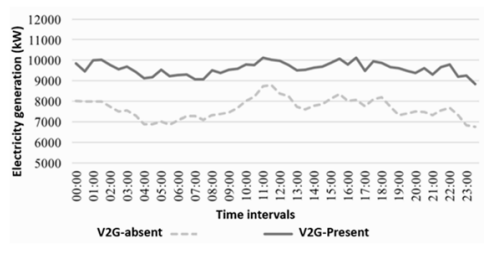
Use of very high amounts of renewable energy sources. In the third scenario, the contribution of energy from renewable energy sources to the grid is assumed to be very high. In such a situation, the desire to participate in V2G is kept low to avoid overproduction, and opportunities to participate are identified accordingly. As shown in Figure 7, the presence of a small amount of V2G further increased production. Due to the predominance of renewable energy sources, the network has a wavy production profile. The small contribution of V2G is very similar to the absence of V2G in the system [11, 12].
Economic analysis and evaluation. Production using fossil fuels is generally undesirable because it is harmful to the environment. However, based on the structure of public finance, production costs are extremely important for many countries. Initial investment and maintenance costs are not taken into account when comparing V2G and fossil fuel solutions. Because taking into account the initial investment costs gives V2G an unfair advantage. In fact, the electric automobiles that make up V2G’s initial investment cost is purchased by car owners, and maintenance costs are also paid by car owners. The costs of both production methods are compared in Table 4 [13].
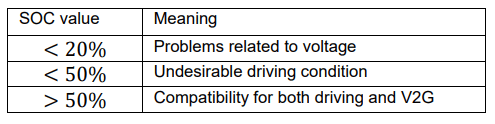
The most important cost area of V2G is the battery. The supply of these systems is limited by battery technology, battery health, and SOC. In order to avoid possible voltage problems, the SOC value in cars participating in the V2G system must be more than 20 percent. The main problem with the EA produced to date is that the driving distances of vehicles are not very long. No EA owner wants their car to be kept at a low SOC value by the V2G system and starts their journey that way. Therefore, in a V2G system, it is necessary to prevent SOC values from falling below 50 percent. However, this criterion may reduce the contribution of V2G to the system. Table 5 summarizes how SOC values should be interpreted for a V2G system [14].
Table 4. Comparison of the cost of fossil fuel production with V2G
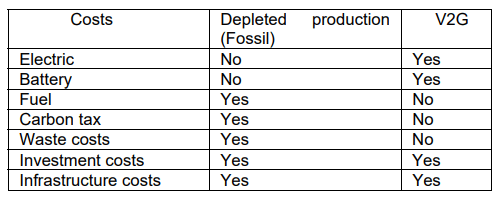
Table 5. Meaning of SOC values for V2G
EA batteries today consist of electrochemical layers. The batteries have various problems due to wear, overheating, charging, and discharging. Frequent charging and discharging processes accelerate deterioration. However, even without the V2G system, the car’s battery wears out and runs out. Only the additional effects of V2G on battery life should be considered. In addition, it has been observed that the charging and discharging process at lower average SOC values prolongs battery life. As a result, an intelligent power management system must drive the cars involved in V2G, taking into account the SOC values. This section provides an economic analysis of V2G hybrid renewable energy systems and explores V2G integration. V2G is an environmentally friendly solution that promises to maximize the benefits of a hybrid renewable energy system. Renewable energy sources, such as wind and solar energy, cannot provide uninterrupted production due to external conditions. V2G can be used to overcome this continuity problem in production. However, EA batteries in the V2G system must be subjected to charging and discharging processes that often reduce their life. Despite the additional cost of the battery, a V2G system is both more economical than residual fuel alternatives and less harmful to the environment. Another important factor that will affect the success of the V2G system is the participation of vehicle owners. In cases where motivation is low, participation can be increased by using an incentive-based mechanism [15].
3. Conclusion
The study realized for the three scenarios in which renewable energy sources contribute to the grid to varying degrees. Production profiles of energy sources were created using the total capacity values that given by authors. In the applied example, it is assumed that only wind and solar energy sources are used in the network. Results were obtained according to three situation that indicated in the body of article.
1. In the scenario of small amounts of renewable energy sources because of the restriction of a seasonal condition or a temporary decrease in production, there is a maximum and stable requirement for V2G supply. The likelihood of EA participating in V2G has also been kept high for this purpose. A more balanced production profile was obtained using V2G.
2. In the scenario of many renewable energy sources, the production is assumed to be higher than in the previous scenario. EA owners have an average motivation to participate in V2G. When simulation analyzed, it is seen that V2G is able to balance the production profile of the network as in the previous scenario.
3. In the third scenario, the contribution of energy from renewable energy sources to the grid is assumed to be very high. In such a situation, the desire to participate in V2G is kept low to avoid overproduction, and opportunities to participate are identified accordingly. Due to the predominance of renewable energy sources, the network has a wavy production profile. The small contribution of V2G is very similar to the absence of V2G in the system.
REFERENCES
[1] A. Panday and H. O. Bansal, “Green Transportation: Need, Technology and Challenges”, Int. J. Global Energy Issues, Inderscience publishers, Vol. 37, No. 5/6, pp. 304-318
[2] A. Briones, J. Francfort, P. Heitmann, M. Shey, S. Shey and J. Smart, “Vehicle-to-grid (V2G) power flow regulations and building codes review by the AVTA”, INL/EXT-12-26853, September 2012
[3] R. Sioshansi and P. Denholm, “The value of plug-in hybrid electric vehicles as grid resources”, Energy Journal, vol. 31, no.3, paper no. 01/2010
[4] A. B. Rolufs, “Kansas City Plug-In Electric Vehicle Demonstration Project”, Missouri Transportation Institute, Missouri university of science and engineering
[5] T. Morgan, “Smart grids and electric vehicles: Made for each other?”, Summit Int. Transport Forum, on Seamless Transport: Making Connections, Leipzig, Germany, discussion paper no. 2012-02, OECD 2-4 may 2012
[6] S. Morash, “Vehicle to grid: plugging in the electric vehicle”, Senior Capstone Projects, paper 200
[7] W. Kempton and V. Udo, Ken Huber, K. Komara, S. Letendre, S. Baker, D. Brunner and N. Pearre, “A test of vehicle-to-grid (V2G) for energy storage and frequency regulation in the PJM system”, nov. 2008
[8] S. Han, S. Han, K. Sezaki, Development of an optimal vehicleto-grid aggregator for frequency regulation, IEEE Trans. Smart Grid 1 (1) 65-72, 2010
[9] C. Quinn, D. Zimmerle, T.H. Bradley, The effect of communication architecture on the availability, reliability, and economics of plug-in hybrid electric vehicle-to-grid ancillary services, Journal of Power Sources 195 (5) 1500-1509, 2010
[10] M.A. Fasugba, P.T. Krein, Cost benefits and vehicle-to-grid regulation services of unidirectional charging of electric vehicles, in: Proc. IEEE Energy Conversion Congress and Exposition (ECCE 2011), Phoenix, USA, Sept. 17-22, pp. 827-834, 2011
[11] A. Papavasiliou, S.S. Oren, Supplying renewable energy to deferrable loads: Algorithms and economic analysis, in: Proc. IEEE Power and Energy Society General Meeting, Minneapolis, USA, pp. 1-8 July 25-29, 2010
[12] A. Millner, “Modeling lithium ion battery degradation in electric vehicles,” 2010 IEEE Conf. Innov. Technol. an Effic. Reliab. Electr. Supply, CITRES 2010, pp. 349–356, 2010
[13] M. Yilmaz and P. T. Krein, “Review of Battery Charger Topologies , Charging Power Levels , and Infrastructure for Plug-In Electric and Hybrid Vehicles,” vol. 28, no. 5, pp. 2151–2169, 2013
[14] D. P. Tuttle, R. L. Fares, R. Baldick, and M. E. Webber, “PlugIn Vehicle to Home (V2H) duration and power output capability,” 2013 IEEE Transp. Electrif. Conf. Expo, pp. 1–7, Jun. 2013
[15] “Global ev outlook: Understanding the electric vehicle landscape to 2020”,www.iea.org, 2017
Source & Publisher Item Identifier: PRZEGLĄD ELEKTROTECHNICZNY, ISSN 0033-2097, R. 100 NR 9/2024. doi:10.15199/48.2024.09.08
 Power Quality Blog