Published by Aliashraf BAKHTIYAROV1, Gulshan ABDULLAYEVA2, Hamid PIRIYEV3, Azerbaijan State Oil and Industry University ORCID: 2. 0000-0003-0168-9623; 3. 0009-0000-2992-6358
Abstract. In today’s world, when the role of renewable energy sources is becoming increasingly important in the context of combating climate change and reducing dependence on fossil fuels, wind energy occupies a leading position. Wind turbines are becoming an increasingly common and sought-after source of clean energy, and the generator, as a key component of these systems, is becoming critical. Selecting the right generator for a wind installation is a complex process that requires careful analysis and evaluation of many factors. After all, the generator not only converts the kinetic energy of the wind into electrical energy, but also affects the efficiency of the entire system, its reliability and operating costs. This article discusses the main electrical generators that are used in wind electric installations. Block diagrams of wind turbines based on these generators are given. The advantages and disadvantages of these generators are given.
Streszczenie. W dzisiejszym świecie, gdy rola odnawialnych źródeł energii staje się coraz ważniejsza w kontekście przeciwdziałania zmianom klimatycznym i zmniejszania zależności od paliw kopalnych, energetyka wiatrowa zajmuje wiodącą pozycję. Turbiny wiatrowe stają się coraz bardziej powszechnym i poszukiwanym źródłem czystej energii, a generator, jako kluczowy element tych systemów, staje się krytyczny. Wybór odpowiedniego generatora do instalacji wiatrowej to złożony proces, który wymaga dokładnej analizy i oceny wielu czynników. Przecież generator nie tylko zamienia energię kinetyczną wiatru na energię elektryczną, ale także wpływa na wydajność całego systemu, jego niezawodność i koszty eksploatacji. W artykule omówiono główne generatory elektryczne stosowane w elektrowniach wiatrowych. Podano schematy blokowe turbin wiatrowych bazujących na tych generatorach. Podano zalety i wady tych generatorów. (Analiza generatorów elektrycznych dla instalacji wiatrowych)
Keywords: wind electric installation, generator, output voltage frequency, inverter, rotational speed, doubly-fed machine, converter
Słowa kluczowe: instalacja elektryczna wiatrowa, generator, częstotliwość napięcia wyjściowego, falownik, prędkość obrotowa
1.Introduction
Currently, a large number of designs of wind turbines are known. They are mainly classified by the location of the axis of rotation of the wind wheel, by the speed of rotation of the wind wheel, by the type of drive (direct drive or through a gearbox), by the presence of an orientation system or its absence. A significant number of design options for wind turbines makes it possible to achieve the most optimal use of wind energy in relation to each particular installation case. However, you need to understand that the wind is inherently unstable: its flow constantly changes direction and speed. Thus, wind turbines have to operate in a wide range of rotation speeds.
From the general theory of electrical machines it is well known that the rotation speed of the generator rotor directly affects the main characteristics of electricity. Thus, rotating at different speeds, the generator produces voltage with variable parameters in amplitude, frequency and phase. The main problem of wind energy is the need to convert electricity with variable parameters into electricity with standard parameters when the direction and intensity of the wind flow changes. The problem of eliminating instability of the wind flow direction is solved by using an orientation system for wind turbines with a horizontal axis of rotation and using wind turbines with a vertical axis of rotation that are insensitive to the direction of the wind.
To stabilize the frequency of the output voltage, two technical solutions are possible. The first option is a mechanical impact directly on the speed of rotation of the wind wheel, which is technically possible, for example, by changing the angle of attack of the blade. This method is called pitch regulation. The second option is the electrical conversion of non-standard energy into standard energy. This is technically realized by including electronic generator excitation control systems and electronic output energy stabilization systems in wind turbines. But it is necessary to understand that the composition and architecture of these electronic systems directly depends on the type of generating device included in the wind power plant. Accordingly, the most important issue when creating a wind turbine is the choice of generator type. When choosing a generator for a wind turbine, it is necessary to take into account the technical characteristics of the installation itself, such as its power, installation height, wind speed in a given region, as well as terrain features. Different types of generators have their own characteristics and advantages, which must be adapted to the specific conditions of the project.
Also an important factor is the economic component of choosing a generator. Installation and maintenance costs, as well as potential energy efficiency, must be carefully analyzed in order to make an informed choice that fits the project budget and provides the optimal cost-benefit ratio. In this study, we will look at various types of wind turbine generators, their features, advantages and disadvantages, and also analyze their applicability in various operating conditions. Our goal is to provide engineers, designers and developers with useful information to help them make the right generator selection and ensure efficient operation of wind power plants [1-5].
2. Materials and methods
Of all types of electrical machines, traditionally there are several main types of generators that are used in wind turbines:
1) asynchronous generators
2) synchronous generators
3) two-speed asynchronous generator
4) asynchronized synchronous generator
Each type of generator has its own advantages and disadvantages. Therefore, we will consider each of them separately.
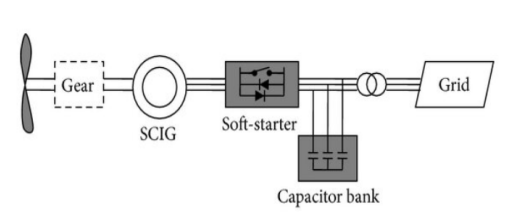
Asynchronous generator. These systems use squirrel cage asynchronous generators or induction generators that are directly connected to the network. The block diagram of a wind turbine based on an asynchronous generator is shown in Figure 1.
One of the disadvantages of this system is that the asynchronous generator does not have its own excitation source. Therefore, to operate, it needs to consume reactive power from the external network. Thus, when working directly with the network, this generator consumes reactive power from the network itself, which negatively affects such an important parameter as the network power factor (cos φ). To compensate for reactive power, as well as when operating in autonomous mode, wind turbines are equipped with capacitor banks, but they are quite expensive and unreliable. The second disadvantage is that the asynchronous generator operates only in certain winds, which ensure that the rotor speed exceeds the speed of rotation of the machine’s magnetic field. Asynchronous generators or induction generators with a wound rotor are also used (fig. 2), since the influence on the rotor circuit allows you to change the amount of slip [6-10].
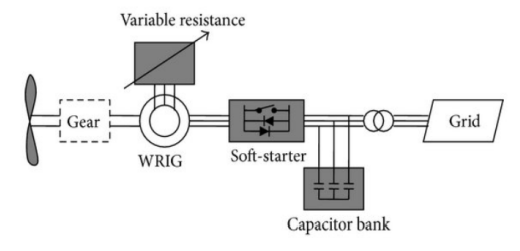
In this case, it is possible to operate in wider speed ranges. In Europe, this system was adopted as the basis for wind generators of low and medium power, but these disadvantages relate to the nature of the electric machine itself, which does not allow intensive development of this direction.
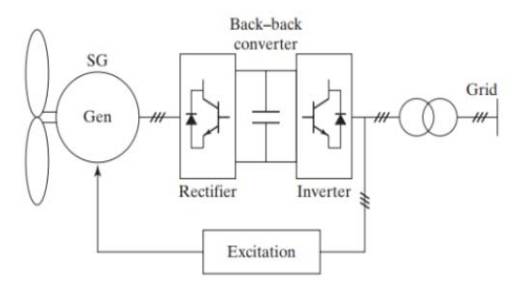
Synchronous generator. From the very beginning of the development of wind energy, the three-phase synchronous generator has been considered as one of the main types of generators. Its designs are available with electromagnetic excitation or permanent magnets. This allows you to achieve good weight and size characteristics. The main problem with this type of electric generators is that in order to generate alternating current of certain parameters it is necessary to maintain a constant rotor speed. In the case of electromagnetic excitation, it is possible to maintain the amplitude of the generated excitation in a certain interval by changing the excitation, which is regulated by the current of the excitation winding. However, to maintain a certain voltage frequency when the rotation speed changes, it is necessary to use additional devices. The block diagram of a wind turbine based on a synchronous generator is shown in Figure 3.
As can be seen from the diagram, this wind turbine, in addition to the turbine and the generator itself, includes an electronic frequency converter. This converter initially rectifies the generated voltage, and then inverts it into alternating voltage with the specified parameters. This type of wind generators is currently quite widely used in wind turbines of various capacities. However, in high-power wind turbines, synchronous generators are rarely used due to the limited capabilities of power electronics. In addition, a large number of conversion stages leads to a decrease in the overall efficiency of the generating system.
Two-speed asynchronous generator. A two-speed asynchronous generator is a generator that can operate at two different rotor speeds. This type of generator is especially useful in wind turbines, where the rotation speed of the wind wheel can vary significantly depending on the intensity of the wind. To ensure efficient operation of the generator at different rotor speeds, a system of two independent windings is used.
Advantages of using a two-speed asynchronous generator in wind energy:
1. Increased energy efficiency: The two-speed asynchronous generator allows you to increase the energy efficiency of a wind turbine by more efficiently using wind energy at different speeds.
2. Reduce control system costs: Since the two-speed asynchronous generator can independently adjust the rotor speed depending on the wind speed, it can reduce the need for expensive control systems.
3. Increased reliability: The use of a two-speed asynchronous generator can increase the reliability of a wind turbine by reducing the load on the equipment under variable wind speeds.
Technical aspects of the use of two-speed asynchronous generator (TSAG) in wind turbines:
1. Design and integration: The use of TSAG requires specialized design and integration into the wind turbine design. This includes developing the optimal control system, adapting the transmission and selecting the optimal generator configuration.
2. Rotation speed control: To ensure optimal operation of a wind turbine, it is necessary to develop a control system that can effectively adjust the rotor speed in accordance with changes in wind speed.
3. Grid integration: TSAG must be integrated into the existing electrical network with minimal losses and surge currents. This requires matching the generator parameters with the network parameters and using specialized devices for synchronization and protection [11-15].
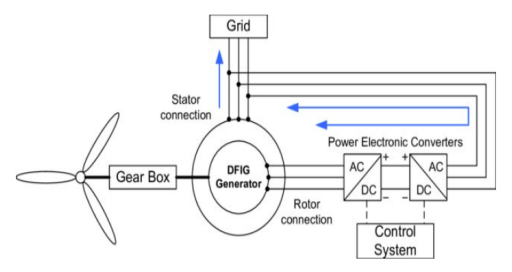
Asynchronized synchronous generator or doubly-fed machine. Recently, a doubly-fed induction generator or an asynchronized synchronous generator has gained particular popularity in wind turbines. By design, it is an asynchronous machine with a wound rotor. However, the method of connecting an asynchronized synchronous generator to the network is completely different. The stator winding is connected to the network directly, and the rotor winding is usually connected to the network through a frequency converter. The block diagram of a wind turbine based on this generator is shown in Figure 4.
This type of generator can operate in three operating modes:
1) pre-synchronous rotor rotation speed: electrical power with the required frequency is supplied from the network to the rotor, which accordingly creates an energy flow coming from the stator winding to the network;
2) synchronous rotor speed: a constant voltage is applied to the rotor winding, and it operates in synchronous generator mode;
3) supersynchronous rotor speed: similar to the operating mode at a rotation speed less than synchronous, but the direction of rotation of the rotor field is opposite [16-20].
This electric machine has the ability to generate electrical energy with constant parameters over a wide range of rotor speeds and the ability to control reactive power flows through the excitation circuit, through which less power passes, which accordingly affects the dimensions and cost of the electronic converter. These distinctive features make the doubly-fed machine the most attractive and efficient for use in wind turbines; as a result, by 2015, asynchronized synchronous generators already occupied about 85% of the installed capacity of wind generators. The disadvantage of this type of generator is the presence of a brush contact that requires time-consuming maintenance for supplying current to the rotor circuit.
Advantages of asynchronized synchronous generators (ASG) in wind turbines:
1. Smooth connection to the grid: These generators provide smooth connection to the grid, which reduces surge currents and increases the reliability of the wind turbine.
2. Resistance to Variable Wind Conditions: asynchronized synchronous generators allow for efficient operation in variable wind speeds, providing stable power output.
3. Hybrid Systems: ASG can be integrated into hybrid systems with other energy sources such as solar power or diesel generators, increasing system reliability and flexibility.
4. Enhanced Control: ASG enable different control strategies to be implemented to optimize wind turbine performance and reliability [20-25].
5. Efficiency: Asynchronized synchronous generators can be configured to provide high efficiency in converting wind energy to electrical energy.
Technical aspects of asynchronized synchronous generators application. Application of ASG in wind turbines requires specialized design and integration. This includes designing electrical circuits, selecting control systems, and testing and maintaining equipment. The key aspects are:
1) Design and Construction: ASG must be adapted to cope with varying wind speeds and changing loads. This requires optimization of design parameters such as stator and rotor windings, as well as material selection.
2) Control and Control: Developing control systems that can ensure optimal operation of the ASG under various operating conditions is an important aspect. This includes frequency and voltage control, as well as load monitoring and overload and short circuit protection.
3) Grid integration: ASG must be integrated into existing electrical networks with minimal losses and surge currents. This requires matching asynchronized synchronous generator parameters with network parameters and using specialized devices for synchronization and protection [25- 30].
3. Conclusion.
Of the many possible types of generators for wind power plants, the best are the two-speed asynchronous generator and the asynchronized synchronous generator (double-fed machine). The first ensures the operation of the wind turbine at low wind speeds. This will increase the production of electrical energy. Therefore, the use of this generator increases the energy efficiency and reliability of wind turbines. The second allows, without additional conversion stages, to directly generate standard energy when the rotor speed changes in a wide range from 0 to supersynchronous speed. As a result, high conversion efficiency is ensured. Moreover, this generator does not consume reactive energy from the network and can itself be a source of reactive power. The conversion occurs through the excitation circuit, which reduces the size and cost of electronic equipment.
REFERENCES
[1]. I.M. Marufov, N.S. Mammadov, K.M. Mukhtarova, N.A. Ganiyeva, G.A. Aliyeva “Calculation of main parameters of induction levitation device used in vertical axis wind generators”. International Journal on technical and Physical Problems of Engineering” (IJTPE), Issue 54, Volume 15, Number 1, pp. 184-189, March 2023
[2]. Boyle G. Renewable Energy (pp. 464), Oxford University Press, 2004
[3]. G.V.Mamedova, G.S.Kerimzade, N.M.Piriyeva Electromagnetic calculation of tension devices for winding wires of small cross sections IJTPE Journal, ISSUE 53.Volume 14. Number 4. December, 2022, (Serial № 0053-1404-1222), IJTPE – Issue 53-Vol 14 – № 4-Dec.2022- p.80-85.
[4]. Ilkin Marufov, Aynura Allahverdiyeva, Nijat Mammadov, “Study of application characteristics of cylindrical structure induction levitator in general and vertical axis wind turbines”, PRZEGLĄD ELEKTROTECHNICZNY, R. 99 NR 10/2023, pp.196-199
[5]. Nijat Mammadov, “Analysis of systems and methods of emergency braking of wind turbines”. International Science Journal of Engineering & Agriculture Vol. 2, № 2, pp. 147-152, Ukraine, April 2023
[6]. L.N. Kanov, “Mathematical Modeling of a Wind Power Plant with an Asynchronous Generator”, Power Engineering and Electromechanics, Vol. 2, No. 5, pp. 71-74, Ukraine, 2012.
[7]. T. Haidi, B. Cheddadi, “State of Wind Energy in the World: Evolution, Impacts and Perspectives”, International Journal on Technical and Physical Problem on Engineering (IJTPE), Issue 51, Vol. 14, No. 2, pp. 347-352, June 2022
[8]. N.A. Aliyev, E.N. Ahmadov, S.A. Khanahmadova, ”Improving efficiency of wind turbines with electromagnetic brakes”, IJTPE, Issue 55, Vol 15, No 2, pp. 37-43, June 2023
[9]. N.S. Mammadov, G.A. Aliyeva, “Energy efficiency improving of a wind electric installation using a thyristor switching system for stator winding of a two-speed asynchronous generator”, IJTPE, Isssue 55, Vol 15, No 2, pp. 285-290, June 2023
[10]. Nijat Mammadov, Ilkin Marufov, Saadat Shikhaliyeva, Gulnara Aliyeva, Saida Kerimova, “Research of methods power control of wind turbines”, PRZEGLAD ELEKTROTECHNICZNY, R. 100 NR 5/2024, pp. 236-239
[11]. Abdulkadyrov A.I. “A new principle of synchronization of an asynchronous motor” // Elektrotekhnika. 1998. No. 4. S. 17-20.
[12]. W. Cao, Y. Xie and Z. Tan “Wind Turbine Generator Technologies”, INTECH open science/open minds, pp-44. China, 2012 166 PRZEGLĄD ELEKTROTECHNICZNY, ISSN 0033-2097, R. 100 NR 9/2024
[13]. Gao L, Li B, Hong J. Effect of wind veer on wind turbine power generation. Phys Fluids. 2021; 33(1):01510. DOI:10.1063/5.0033826
[14]. Mammadov Nijat, “PROSPECTS FOR THE DEVELOPMENT OF RENEWABLE ENERGY SOURCES”, The 29th International scientific and practical conference “Modern scientific trends and youth development”(July 25–28, 2023) Warsaw, Poland. International Science Group. 2023. 244 p.
[15]. P.W Carlin. “The history and state of the art of variable-speed wind turbine technology”, Technical Report NREL/TP–500–28607, National Renewable Energy Laboratory, USA, 2001.
[16]. I.N. Rahimli, S.V. Rzayeva, E.E. Umudov, “DIRECTION OF ALTERNATIVE ENERGY”, Vestnik nauki, Issue 2, Vol. 61, №4, April 2023
[17]. Lukutin B.V. Energy-efficient controlled generators for wind power plants / B.V. Lukutin, E. B. Shandarova, A. I. Muravlev // Izvestiya vuzov. Ser. Electromechanics. – 2008. – No. 6. – P. 63–66.
[18]. Shevchenko V.V., Kulish Ya.R. Analysis of the possibility of using different types of generators for wind power plants, taking into account the power range // Bulletin of NTU “KhPI”. – 2013. -No. 65. – S. 107-117
[19]. Costa, A.M., Fraguela, F., Orosa, J.A., Pérez, J.A. A new procedure for wind energy systems maintenance design / Journal of Renewable and Sustainable Energy, 7(4),043129, 2015.
[20]. Mammadov N.S., Ganiyeva N.A., Aliyeva G.A. “Role of Renewable Energy Sources in the World”. Journal of Renewable Energy, Electrical, and Computer Engineering, No2, September 2022, pp. 63-67, https://ojs.unimal.ac.id/jreece/issue/view/359
[21]. Piriyeva N.M, Kerimzade G.S., “Mathematical model for the calculation of electrical devices based on induction levitators”, IJ TPE Journal, ISSUE 55. Volume 15 . Number 2, (Serial №0055-1502- 0623), IJTPE – june 2023. p.274-280.
[22]. Piriyeva N.M, Kerimzade G.S. “Electromagnetic efficiency in induction levitators and ways to improve it“ Przeglad Elektrotechniczny. R.99 NR 06/2023, Poland, pp.204-207
[23]. Piriyeva N.M, Kerimzade G.S.“Methods for increasing electromagnetic efficiency in induction levitator “Przeglad Elektrotechniczny. R.99 NR 10/2023, Poland, pp.192-196
[24]. Ilkin Marufov, Najiba Piriyeva, Nijat Mammadov, Shukufa Ismayilova, “Calculation of induction levitation vertical axis wind generator-turbine system parameters, levitation and influence loop”, Przegląd elektrotechniczny – 2024 – No.2 – pp.135-139
[25]. Piriyeva N.M., Ahmadli A.N. /Comparisons of electrical generators, used in wind electric installations / International scientific journal “BULLETIN OF SCIENCE. No. 1 (70) Volume 3. 2024 p.975-986
[26]. Pirieva N.M., Huseynov Z.F. /Characteristics of synchronous motors /. International scientific journal “Bulletin of Science” No.3 (60) Volume 4. P.241-246
[27]. N.M.Piriyeva “Fundamentals of the theory and calculation of the induction levitator of electrical devices” Journal Electricity, №7, pp. 68-75. Moscow 2022.
[28]. N.M.Piriyeva, G.S Kerimzade, G.V. Mamedova./Issues of design of electrical devices with levitation elements /. International Journal on “Technical and Physical Problems of Engineering” IJTPE Rumıniya Issue 56, Vol. 15 No 3. s.120-125
[29]. Najiba Piriyeva /Systematization of constructions of electrical devices with element of levitation/ TECHNICAL SCIENCES TECHNOLOGIES IN EDUCATION IN SCHOOLS AND UNIVERSITIES pp.304-308
[30]. Piriev G.S. /Calculation for electrical design of transformers/. Journal “Innovative Scientific Research”, Scientific Publishing Center Bulletin of Science, No. 9 Volume 4 (66) September 2023, pp. 328-334
Source & Publisher Item Identifier: PRZEGLĄD ELEKTROTECHNICZNY, ISSN 0033-2097, R. 100 NR 9/2024. doi:10.15199/48.2024.09.30
 Power Quality Blog