Published by Dranetz Technologies, Inc., Technical Documents – White Paper
INTRODUCTION
In addition to our energy metering products, most Dranetz Power Quality products can also compute and measure common energy parameters such as W, VA, VAR, PF, Demand, Energy, and more. The ability to measure energy in addition to PQ opens the door to many more applications, including energy only applications that can include electrical consumption.
When measuring electrical consumption for billing, revenue, meter verification, or other purposes, high accuracy is often required. When the metered data is used for billing purposes, a revenue certified/grade meter may be required by code or law. When a revenue certified meter is not required, a revenue accurate meter may meet the needs of the application. Such a meter has similar accuracies as a revenue certified meter, but without the laboratory testing and the certification itself.
This White Paper summarizes the most common standards used for revenue certified energy metering and how the accuracies and capabilities of current Dranetz products compare to these standards.
STANDARDS OVERVIEW
Revenue metering standards vary around the world, but usually fall under two standards bodies: ANSI and IEC. American National Standards Institute (ANSI) standards are mostly followed in North America, with the rest of the world following the standards of the International Electrotechnical Commission (IEC). Some countries have also developed their own metering standards using variations of the ANSI and IEC standards, while others have combined aspects of both worldwide standards.
Since each link in the measurement chain is important and needs to be accounted for, there are also standards for measurement transducers. Regardless of the standards body, the overall objective of the revenue metering standards are to define the performance requirements for meters and transducers, so that compliant meters consistently, accurately, repeatedly, and reliably measure in the intended application. The applicable standards cover the ranges of measurements, temperature changes, variations in Power Factor, and other aspects of accurately metering the electricity.
ANSI STANDARDS
The important ANSI standards for metering include ANSI C12.1-2008, ANSI C12.20-2010 and also ANSI C57.13- 2008 for current transducers. The ANSI metering standards define the accuracy of the combined meter and transducers, among many other items. ANSI C12.1-2008 specifies a maximum deviation of 1% to 2% depending on the current (amps) being measured and the Power Factor. A lower Power Factor allows for a higher deviation from the reference, as does a low or high current being measured within the current measurement range.
ANSI C12.20-2010 (references ANSI C12.1) is more stringent and defines 2 accuracy “Classes”: Class 0.2 and Class 0.5. Generally speaking, as their names imply, Class 0.2 meters are allowed up to a deviation of +/- 0.2% and Class 0.5 meters are allowed up to a deviation of +/- 0.5%. These maximum deviations are at a Power Factor of 1.0, and a lower Power Factor allows for a higher deviation from the reference. Again, this is for the entire measurement system, including CT’s. Please note that this is a simplification of the standard and there are many more aspects to complying with ANSI C12.20-2010 and passing certification tests.
IEC STANDARDS
The applicable IEC standards for electricity metering equipment are IEC 62053-21 and IEC 62053-22. These standards apply to metering applications of 600V or less and also reference IEC 60044-1 for current transformers. Similar to the ANSI specifications, IEC 62053-22 is a more stringent standard with higher accuracy requirements VS. IEC 62053-21.
IEC62053-21 defines two accuracy classes of 1.0 and 2. At a Power Factor of 1.0, Class 1.0 meters are allowed up to +/- 1% error limit and Class 2 meters are allowed up a +/- 2% error limit. Lower Power Factors allow for a higher error limit.
C12.22-2010, IEC 62053-22 defines accuracy classes of 0.5s and 0.2s for the entire measurement system including CT’s. At a Power Factor of 1.0, Class 0.2s meters are allowed up to +/- 0.2% error limit and Class 0.5s meters are allowed up a +/- 0.5% error limit. Lower Power Factors allow for a higher error limit.
REVENUE ACCURATE VS. REVENUE CERTIFIED/GRADE
Both the ANSI and IEC electricity metering standards have very stringent testing requirements that go well beyond the accuracy of the meter. Even though a meter may not be revenue certified by a laboratory, it may have the accuracies of such a meter and can be used in many applications that do not require certification, but do require measurements with similar accuracies.
DRANETZ PRODUCTS & REVENUE METERING
Dranetz does not presently manufacture or sell revenue certified/grade products, but most Dranetz products meet many of the accuracy requirements of revenue certification and can be considered to be revenue accurate.
The most important core requirement in the ANSI and IEC revenue meter standards is the accuracy of the meter. Both ANSI C12.20 and IEC 62053-22 have similar accuracy requirements that depend on the “class”. Class 0.2 instruments allow for a deviation of +/- 0.2% at a Power Factor of 1.0. Class 0.5 allows for a deviation of +/- 0.5% at a Power Factor of 1.0.
The tables below show how the Dranetz portable and permanent instruments compare to the accuracy requirements of the ANSI and IEC standards.
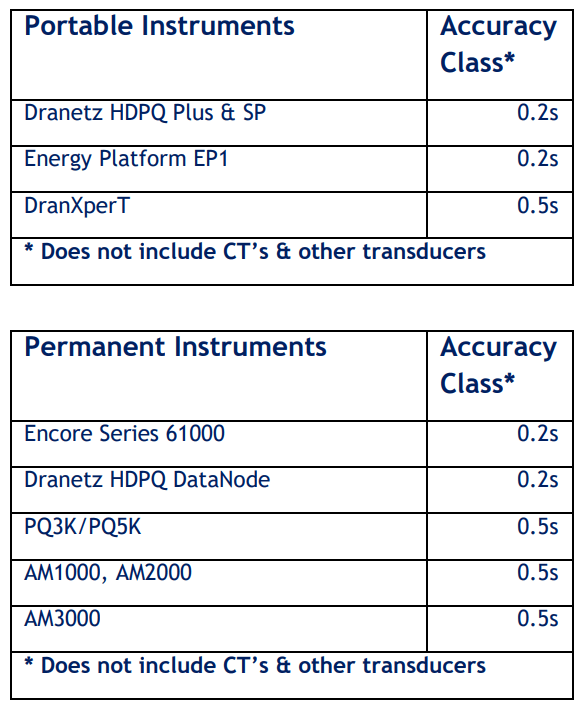
As noted in the tables above, CT’s and other transducers are not taken into account and can affect the accuracy of the measurements. A poorly chosen CT can negatively affect the measurements and greatly reduce the overall accuracy.
APPLICATIONS
There are many applications for revenue accurate instruments. These are usually applications where revenue certified/grade instruments are not required, but the accuracy of the measurements is still very important. Common applications are:
• Sub metering – Meter locations downstream
• Load management – Manage loads in a facility
• Check metering – Verify a fixed meter for accuracy
• Tennent metering – Meter tenant consumption
• Utility bill checking – Look for utility billing errors
Oftentimes, energy metering/monitoring is just one part of a larger power monitoring system that also includes Power Quality and other monitoring in one system. Many of the Dranetz meters referenced in the tables above also measure Power Quality, so the user has the benefit of one instrument serving multiple functions and applications.
CONCLUSION
As you can see, most of the instruments sold by Dranetz have revenue class accuracies. As a result, many customers around the world trust Dranetz products for their energy measurement needs when accuracy and dependability are required.
Dranetz Products: Dranetz HDPQ® Plus & SP Family
Website: Dranetz.com , Call 1-800-372-6832 (US and Canada) or +1-732-287-3680 (International)
Source URL: https://www.dranetz.com/wp-content/uploads/2020/10/Dranetz-Instruments-Revenue-Accurate-Grade-Q10-Rev-A.pdf
 Power Quality Blog