Published by Mustafa Hussein Ibrahim1, Muhammed A Ibrahim2, Salam Ibrahim khather3, University of Mosul (1), Ninevah University (2,3) ORCID: 1. 0000-0002-9950-6524, 2. 0000-0003-4818-1245, 3. 0000-0002-9082-2360
Abstract. The standalone solar photovoltaic system (SA-SPV) is an appealing alternative for carrying out the electrification process in rural regions through packages in lots of countries. The photovoltaic systems are always supplied with storage facilities that are backed with battery power for the usage of stored power in the course of the nighttime. Availability of bidirectional converter guarantees to improve the utility of those SA-SPV systems to generate, feed, and store power to nearby micro-grids. Additionally, the functioning of systems could be increased to optimized levels by reducing the power losses that are experienced at sub-system stages in the standalone solar photovoltaic system. The present research includes HOMER Pro for simulation of power performance (7 kWp) SA-SPV system mounted in poultry warehouse in Erbil, Iraq to estimate power losses cause for the stand-alone layout. The system is supplied with battery storage (18kWh) this is used for providing power for night hours poultry warehouse lights up to ≈ 7 hours/day. The outcomes of the simulation presented that once the SA-SPV is converted to a grid-connected system the system will deliver the light load up to ≈ 11 hours by combining a bi-directional converter. It also highlighted that the SPV system will produce an overall 9891 kWh/year on the site in which 4476 kWh is to be supplied to the nearby single-phase microgrid. It accounts for electricity loss if the system is kept to function as an SA-SPV layout.
Streszczenie. Samodzielny system fotowoltaiczny (SA-SPV) jest atrakcyjną alternatywą dla przeprowadzenia procesu elektryfikacji na obszarach wiejskich poprzez pakiety w wielu krajach. Systemy fotowoltaiczne są zawsze wyposażone w magazyny, które są zasilane z baterii do wykorzystania zmagazynowanej energii w nocy. Dostępność konwertera dwukierunkowego gwarantuje poprawę użyteczności tych systemów SA-SPV do generowania, zasilania i magazynowania energii w pobliskich mikrosieciach. Ponadto funkcjonowanie systemów można zwiększyć do zoptymalizowanego poziomu poprzez zmniejszenie strat mocy, które występują na etapach podsystemów w samodzielnym systemie fotowoltaicznym. Obecne badania obejmują HOMER Pro do symulacji wydajności energetycznej (7 kWp) systemu SA-SPV zamontowanego w magazynie drobiu w Erbil w Iraku w celu oszacowania przyczyn strat mocy dla układu wolnostojącego. System jest wyposażony w akumulator (18kWh), który służy do zasilania w godzinach nocnych magazyn drobiu świeci do ≈ 7 godzin dziennie. Wyniki symulacji wykazały, że po przekształceniu SA-SPV do systemu podłączonego do sieci system będzie dostarczał lekkie obciążenie do około 11 godzin dzięki połączeniu konwertera dwukierunkowego. Podkreślono również, że system SPV będzie wytwarzał łącznie 9891 kWh/rok w miejscu, w którym 4476 kWh ma być dostarczone do pobliskiej mikrosieci jednofazowej. Uwzględnia straty energii elektrycznej, jeśli system ma funkcjonować jako układ SA-SPV. (Modelowanie i analiza systemu SA-SPV z dwukierunkowym falownikiem do obciążenia oświetleniowego)
Keywords: Renewable, bi-directional converter, lighting load.
Słowa kluczowe: odnawialne źródła energii, przekształtnik dwukierunkowy,
Introduction
Renewable energy systems in many countries have become an important approach to electric power projects for rural and off-grid areas. As the investment of this type of energy may reach about 50% of global consumption by the year 2040 [1]. Solar PV systems are the most common power system that is used in both forms such as off-grid and on-grid mode, to meet the objectives of Renewable Energy Commitments targets (RPO). While SA-SPV systems can be used to electrify villages located far away from the grids, the grid-connected solar systems help achieve RPO goals in both urban and rural areas. Recently, bidirectional power inverters have become widespread, which provide solutions for engineers to upgrade installed solar systems from standalone setup to grid-connected SPV setup. The grid-connected photovoltaic system via a bidirectional inverter can achieve the benefits of both standalone and grid-connected systems at the same time. The intelligent software tools that simulate the power efficacy of renewable energy systems allow engineers to simulate SPV systems along with small hydro, wind turbines, and bioenergy generators, to develop hybrid power applications for implementation [2],[3]. Due to increased support from governments regarding proactive plans and policies, there are huge opportunities for business development in favor of SPV systems. [4]. The government of Iraq lately enrolled the Paris Climate Agreement, which goals to decrease global warming. The government has now instigated to assist the contribution of small and large customers to produce electricity from solar energy.[5]
In this article, we show the use of the HOMER Pro software program for simulation of the power efficacy of a (7 kWp) SA-SPV system in grid-connected form, which is mounted in a poultry warehouse in Erbil, Iraq, aiming to an estimation of power losses because of unidirectional inverter.
HOMER Simulation platform
The HOMER Pro is a micro smart grids software that is provided by HOMER Energy. It is based on worldwide protocols to maximize the microgrid design that is used in different sectors. It includes the implementation of Home Pro for power generation in villages and islands so that there is the availability of grid-connected military bases and campuses. Hybrid Optimization Model for Multiple Energy Resources (HOMER) has been developed by the National Renewable Energy Laboratory, USA, and distributed under the brand of HOMER. It is based on the use of three vital tools that are amalgamated together in one software product. It helps in executing engineering work side by side so that there is the creation of the systemized working platform. HOMER is also based on the use of a simulation model that is responsible for stimulating the viable system to all possible combinations. It helps in attaining valuable insights about the system that is under consideration. Additionally, HOMER is also responsible for stimulating the workings of a hybrid micro smart grid for a long duration such as one year along with considering time steps of 60 seconds to an hour.
SA-SPV specification
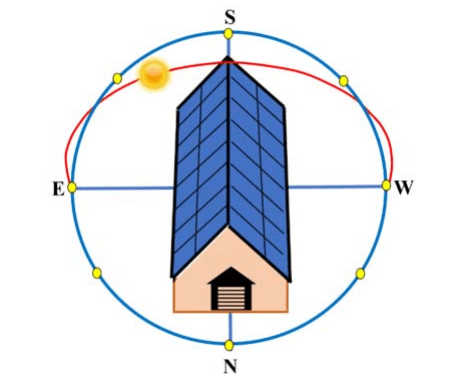
The standalone solar photovoltaic system (SA-SPV) simulated in this paper is a ceiling mounted SA-SPV system implemented in East-West mode, the first string at 90° azimuth (East) while second string at 270° (West) as shown in Fig.1, that’s in order to extend PSH time as possible, the system capacity is 7 kWp bifacial half cut modules, installed on a poultry house ceiling located in Erbil city, Iraq shown in Fig. 2. A BES of eighteen lithium-ion batteries (167 Ah – 6 V) is used to store the electricity produced during daylight to support the standalone mode system during the night. a unidirectional inverter (5 kW) works to convert the stored power into AC for lighting (2.5 kW) bulbs in the warehouse during the night for some time up to eleven hours a day.
The photovoltaic system is used for carrying out OFF-grid mode functions. The power that is generated from the system is delivered by the PV arrays. The power received is stored in Battery Energy Storage (BES) via Maximum Power Point Tracking charge controller (MPPT charger).

When the batteries are completely charged, the power supply to the batteries is disconnected by using the MPPT controller. It disconnects the delivery of energy to BES. At this point, when the power of the batteries is full through power by charging throughout the day, the extra energy produced can’t be used. The major reason behind it is that no more equipment besides batteries is connected to the system. Additionally, the system is well-equipped with the facilities of a self-timer that helps control the ON-OFF warehouse lights throughout night hours. Typically, the selftimer that is used in the system is responsible for setting a schedule for turning the warehouse lights ON at 7:00 P.M. and OFF at 6:00 A.M. through the night, the stored power of batteries is used to provide electricity. The process continues until the battery bank voltage goes down to the lower cut-off voltage value of46 v. Hence, the demand is covered with the help of the local grid. During day time, a major role is played by the MPPT controller in controlling the charge of the batteries. When the battery bank voltage reaches the upper cut-off voltage of. 58 V, it interrupts the charging current to the batteries. Therefore, the system can keep the Battery Bank (BES) voltage level coordinated between the upper and lower cut-off voltage that has been set by the operator.
Methods
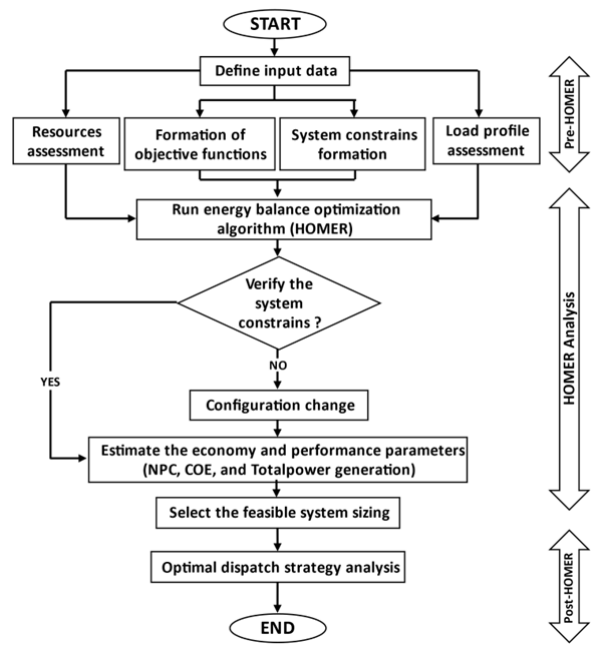
The HOMER Pro has been used to simulate the system performance, it is a micro-grid computer platform from HOMER Energy that is used for increasing the efficacy of is utilized for optimizing many microgrid designs that are located in different regions. It includes the use of the HOMER energy system in villages and islands so that utilities are provided to military bases, ON-grid campuses effectively. . Firstly, it was developed by National Renewable Energy Laboratory in the USA, and then the system was improved and disseminated through HOMER Energy LLC. HOMER includes a package of three robust tools in one software. It helps in executing industrial and financial work with each other to achieve the optimum goals of renewable energy systems. HOMER, in essence, is a simulation model. It focuses on simulating a feasible framework for all possible arrangements of all equipment that are to be taken into account. As a result, there is a simulation of the hybrid micro-grid working over one year, at a step time scale from (1 to 60) minutes which is set via moderator [6]. [6].Many scientific researchers had utilized HOMER for studying and analyzing [7],[8],[9] The simulation via HOMER required an extensive collection of data such as renewable resources data, energy storage layouts, control algorithms, and many power flow specifications as well economic restrictions. here is below a flowchart of the HOMER process shown in Fig. 3 which explain all the simulation steps in detail [10]:
HOMER evaluate the output power of the photovoltaic array using the following relation in equation (1):

where: fPV the derating factor percentage for the photovoltaic array, YPV the photovoltaic array rated capacity (The power production under STC), GT, STC the incident solar insolation at STC, GT the solar insolation incident on the PV array in the current time step, Tc, STC the temperature of the photovoltaic cell under STC, Tc the temperature of the photovoltaic cell at the current time step and αP the power temperature coefficient”. [10],[11]
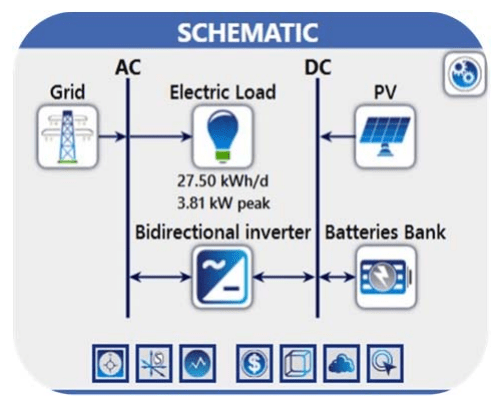
The simulation of Standalone SPV system The scheme in Fig. 4 shows the standalone solar photovoltaic system with a bi-directional inverter at the HOMER pro simulation platform, the unidirectional converter in the existing standalone system is replaced with a bi-directional converter. As a result, the main function of the system is to charge the battery full during the daytime. It helps BES to discharge power during the night until the power goes down to the lowest voltage of 46 V. In this aligned system, when the BES is charged and there is still surplus power, the additional power is supplied to the local grid. Therefore, the bi-directional converter is highly efficient in carrying out the charging and discharging of BES along with feeding power to the grid. It leads to optimized utilization of the existing capacity of the SA-SPV system. Technical data for subsystems utilized in the simulation are reported in Table 1. The system is optimized for a one year.
Table 1. Technical specification for subsystems utilized in the simulation
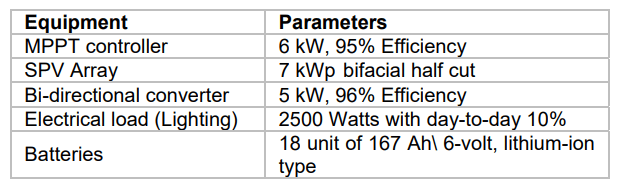
The solar Irradiance and temperature at the study location (Erbil – Iraq) for the whole year are fetched from the NREL laboratory database involved in HOMER software. The 2.5 kW load profile of lighting load is defined as “ON” time from (7 P.M – 6 A.M) every day. Also local grid has been prohibited from charging the battery and is available all year to backup the lights when BES is discharged and the voltage reaches to cutoff level.
Results and Discussion
The simulation results include a daily power output of PV system, power export to the local grid and provided to lighting load via bidirectional converter also power import from the local grid for lighting, during one year period. The simulation outcomes are explained as follows:
1. The output power of PV system
According to the NREL database, the Erbil site obtains an annual global horizontal irradiation (GHI) of 4.86 kWh/m2/day. The maximum average value of Global Horizontal Irradiation is available throughout June at 7.67 kWh/m2/day, while the minimum average value occurs throughout December at 2.18 kWh/m2 /day. The GHI is comparatively low throughout November, December, and January (cold season). The D-Map in Fig. 5 showing the solar photovoltaic system electricity generated per day, for one year, it shows the dis-partition of ‘energy penetration’ of the photo voltaic system each month. It is also seen that the ‘energy penetration’ of the SPV system shows differentiated outputs with 1.6 kWh/m2/day to 4.90 kWh/m2/day. The overall energy output of the photovoltaic system is recorded to be 9891 kWh/year. The ratio between photovoltaic energy produced and the average load delivered was 98%. It proves that the selected study area (Erbil) is useful for the implementation of solar photovoltaic systems.

2. Operation of bi-directional converter
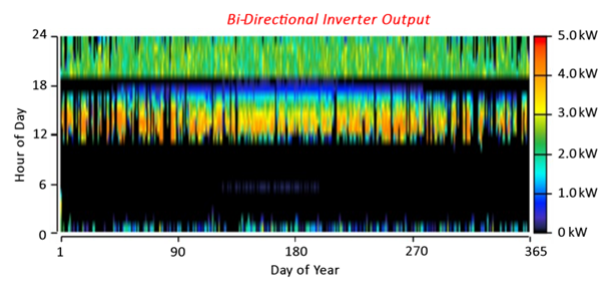
When the battery bank is completely charged, the two-way converter (bidirectional) supplies power to the local grid throughout the daytime. While during night time it will provide the required electricity to the warehouse lighting load. The output profile in Fig. 6. represents the D-Map of bi-directional inverter performance throughout the year. It can be seen that after the battery bank is completely charged. the bidirectional inverter feeds energy to the local grid on almost all days of a year. as well as provides energy to warehouse lighting load for all nights of the year, till the battery bank charge declines and reaching to the cut-off voltage which, according to the D-map lies between 1:30 A.M. to 2:30 A.M. Thereafter, the local grid provides electricity to the warehouse lighting load.
3. Local grid energy
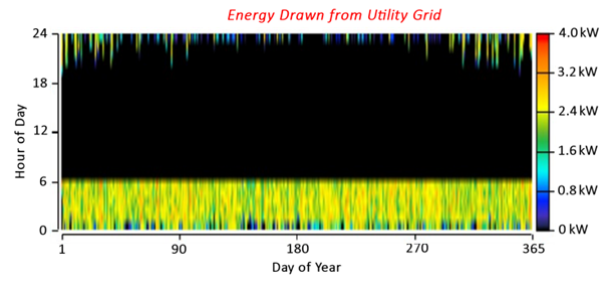
After the battery bank (BES) is fully discharged via reaching the cut-off voltage the local grid will feed the load with the necessary power. Fig. 7 represents the D-Map of local grid performance throughout the year. It is shown that warehouse lights draw electricity from the local grid from 1 A.M. to 6 A.M. It indicates that the BES power is not sufficient to provide electricity to warehouse lights all night
4. The contribution of BES and local grid
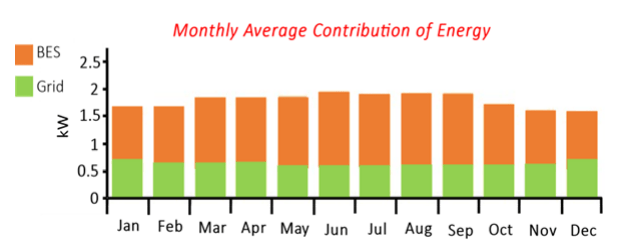
The overall energy supplied to the load is a sum of energy taken from the battery bank and local grid. Fig.8 represents the monthly contribution by the local grid and battery bank feeding warehouse lights during a year. The simulation results showed that annual energy contribution of the local grid represents 64 % while the battery bank is 36 % of the overall energy drawn via the lighting load.
5. SPV- Grid enhancement
It should be noted that the overall energy exported to the local grid via the SPV system is 4476 kWh/year, while the overall energy imported from the local grid is 5572 kWh/year. Fig. 9 shows monthly energy fed(export)& drawn(import) with the grid; the red curve represents the drawn energy while the green curve represents the fed energy.

It has been recorded that the energy exported to the local grid during the cold months is lower as compared to the energy that is imported from the local grid. Therefore, it can be said that the energy importing in local grids is more in the residual months in comparison to cold months. Furthermore, the maximum exporting energy to the grid happened in June while the minimum was in December and the maximum importing energy from the grid happened in December while the lowest was in February. It is important to point out, that the up-gradation of the solar converter from unidirectional new bi-directional converter, has provided a 4476 kWh/year to the local grid, which was considered as lost energy before system upgrading.
Conclusion
HOMER Pro is utilized for stimulating power efficacy of SA-SPV system that is based on the use of 5Kw Fronius bidirectional converter for one year. As per the simulation outcomes, the ratio of PV power production to the lights load consumption for this system has been recorded to be 98% at the study site. hence, the selected site is very suitable for the implementation of the SPV system for the generation of electric power. furthermore, the analysis result reports that there is an increased chance of bringing improvements in the power efficacy of the stand-alone SPV system by including a bidirectional converter. The upgrade of the prevailing photovoltaic system to bidirectional gridconnected photovoltaic system will extend the lighting time from 7 hr to 11 hr and provide the local grid with the excess PV energy, this energy would have been wasted energy without this upgrading of the inverter.
Acknowledgements – Authors are grateful to (Mosul university / college of science and Nineveh University / College of Electronics Engineering) for their provided facilities, which helped to enhance the quality of this work.
REFERENCES
[1] Kharrich M, Mohammed O, Kamel S, Selim A, Sultan H, Akherraz M, Jurado F. Development and implementation of a novel optimization algorithm for reliable and economic grid-independent hybrid power system. Applied Sciences (Switzerland). 2020; 10(18).
[2] Sen R, Subhes C. Off-grid electricity generation with renewable energy technologies in India: AN application of HOMER. Renewable Energy.2014; 62 (388).
[3] Prodromidis G, Coutelieris F. A comparative feasibility study of stand-alone and grid connected RES-based systems in several Greek Islands. Renewable Energy. 2011; 36 (1957).
[4] Hafez O,Bhattacharya K. Optimal planning and design of a renewable energy based supply system for microgrids. Renewable Energy. 2012; 2 (7).
[5] PARIS AGREEMENT Signature Ceremony . UNFCCC. 22 April 2016. Retrieved 22 April 2016.
[6] Murugaperumal K, Ajay P. Feasibility design and technoeconomic analysis of hybrid renewable energy system for rural electrification. Solar Energy. 2019; 188(38).
[7] Ibrahim MH, Ibrahim MA. The Optimum PV Panels Slope Angle for Standalone System: Case Study in Duhok, Iraq. IOP Conference Series: Materials Science and Engineering. 2021; 1076(1).
[8] Al-Hafidh M S, Ibrahem M H. Hybrid power system for residential load. 2013 International Conference on Electrical, Communication, Computer, Power, and Control Engineering (ICECCPCE), IEEE, 2013.
[9] Al-hafidh M S, Ibrahem M H. Zero Energy House in Iraq. International Journal of Inventive Engineering and Sciences. 2014; 2(7).
[10] Ibrahim M H, Ibrahim M A. Solar-Wind Hybrid Power System Analysis Using Homer for Duhok, Iraq. Przegląd Elektrotechniczny. 2021; 2021(9).
[11] Sofimieari I, Bin Mustafa M, Obite F. Modelling and analysis of a PV/wind/diesel hybrid standalone microgrid for rural electrification in Nigeria. Bulletin of Electrical Engineering and Informatics. 2019; 8(2302).
Authors: Mustafa Hussein Ibrahim, Depatment of New and Renewable Energy, College of Science, Mosul University, Iraq, Email: MustafaHussein@uomosul.edu.iq ; Muhammed A Ibrahim, Department of Systems and Control, College of Electronics Engineering, Ninevah University, Iraq, E-mail: muhammed.ibrahim@uoninevah.edu.iq ; Salam Ibrahim khather, Department of Systems and Control, College of Electronics Engineering, Ninevah University, Iraq, E-mail: salam.khather@uoninevah.edu.iq.
Source & Publisher Item Identifier: PRZEGLĄD ELEKTROTECHNICZNY, ISSN 0033-2097, R. 98 NR 5/2022. doi:10.15199/48.2022.05.23
 Power Quality Blog