Published by 1. Johan ADOLFSSON, Director, Unipower AB, ja@unipower.se, 2. Peter ANDERSSON, CEO, Unipower AB, psa@unipower.se, 3. Nilesh CHINTALWAR, GM, PCI Ltd, nilesh@prime-pci.in, 4. Shital SHAH, PCI Ltd, shitalshah@prime-pci.in
INTRODUCTION
In the vast majority of countries today there are regulations and standards implemented that specify the maximum level of harmonic content. Some countries implement the international IEC standards IEC 61000-2-2, IEC 61000-2- 12 and IEC 61000-3-6 whereas other make local adaptations and implement their own versions of the standard meeting the local requirements. In Europe the EN 50160 specifies the harmonic content regarding the Total Harmonic Distortion, THD and individual harmonics, but many countries in Europe also add their own specific requirements to it.
Common for most international and country specific standards is that not only the THD is monitored but also the individual harmonics up to the 40th or 50th harmonic depending on what standard being used.

Another important requirement is that the measuring equipment being used must comply to adequate measure equipment standards (like IEC 61000-4-30 Class A,S and IEC 6100-4-7Ed2) to assure that the measurement results are correct and normative. Without appropriate norm compliance two power quality meters can produce very different results even if connected in the same measure point.
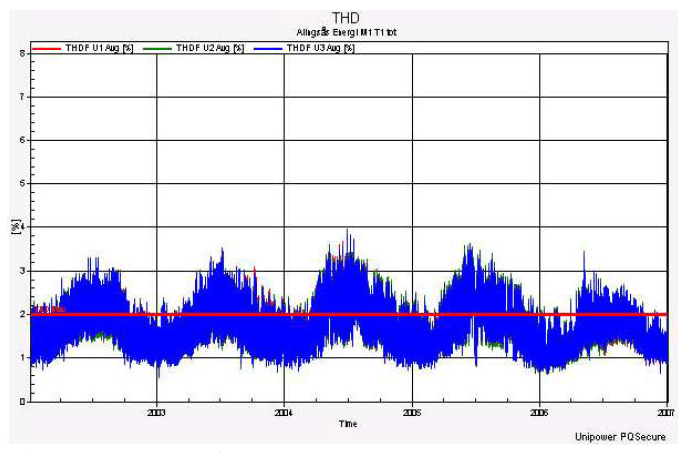
Modern power quality meters do not only measure THD and individual harmonics but also include additional harmonic parameters. The result is a complex set of adequate data that must be managed and handled in an effective and appropriate way if harmonic measurements are implemented in a larger scale. The trend of Harmonic measurements today is towards continuous monitoring with permanently installed meters. Long term monitoring of harmonics also provides effective means for planning. Example below shows 5 years of THD data. Seasonal fluctuations are present, but the long term trend is stable.
POWER HARMONICS DIRECTION
Modern PQ Monitors do often also measure the Harmonic Phase Angle, i.e. the phase angle between each voltage and current harmonic. For a standard three phase installation that mean additional 150 parameters in addition to the 300 individual voltage and current harmonics recorded.
The harmonics phase angle is raw data from which the so called power harmonics can be derived. If using a PQ meter like the UP2210 or Unilyzer 902 the power harmonics can be shown with direction (+/-) thereby facilitating the interpretation of the harmonic flow, i.e. search for the harmonic source and at the same time reducing the data storage capacity.
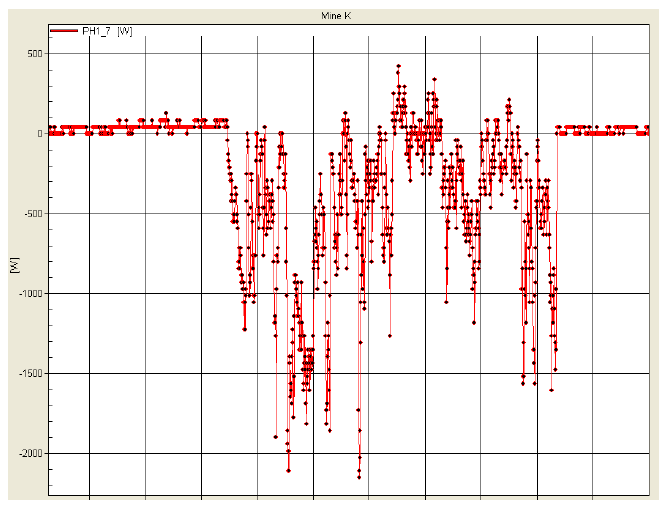
Negative indicates the source is downstream the measure point.
3SEC MAX HARMONICS
The harmonic limits in the standards are usually specified as the 10-min averages. There are however fluctuating harmonic loads today that are dangerous even though the duration is short. A new need for measuring the 3sec Maximum Harmonics has therefore arised. For such applications the PQ Meter continuously calculates 3sec harmonics, storing the Maximum value for each seleceted time period, normally 10-min, if IEC 61000-2-2, IEC 61000-2-12 or EN 510160 is being applied.
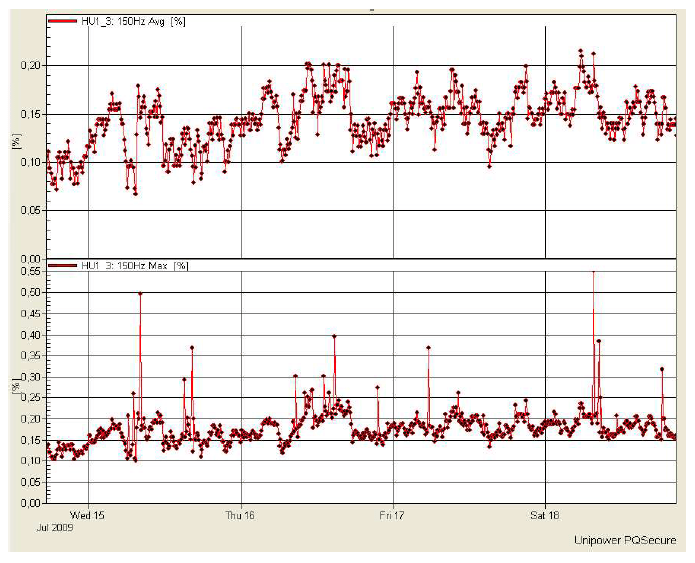
Today also the IEC 61000-3-6 specifies the need for measuring the 3sec Max Harmonics.
THE NEED FOR A HARMONIC INFORMATION MANAGEMENT SYSTEM
Harmonic measurements of today is no longer just THD measurements even though the number of THD parameters has increased (see below). As we have seen above up to approx 500 harmonic related parameters are to be calculated, stored and evaluated for each storage interval. In addition harmonic measurements are no longer just for troubleshooting purpose, but for contractual verification of the power supply and for preventive purposes.

The process of polling the data and making the in-depth data analysis is no longer efficient to make in a manual way when the number of measure points grow from just a few to hundreds and thousands of measure points in the transmission and distribution network. Neither is it a quality assured process. Instead a need for automatic handling of the harmonic data has arised. The characteristics of such a system are:
- Automatic polling of harmonic data into a central database.
- Data compression techniques for efficient transfer of data and data storage.
- Automatic report generation scheduled on a weekly basis to provide summary statistics
- Supervision of individual harmonic parameters with alarm functions
ON-LINE MONITORING OF INDIVIDUAL HARMONICS
In a mining industry in northern Europe a Harmonic Information Management System, Unipower PQ Secure, was implemented and on a normal basis the harmonic levels were within control. In January 12th, 2008 the system manager however received an email from the Harmonic Information Management System notifying that in one measure point the 7th individual harmonics were outside specified control limits according to IEC 61000-2-12. Still however the THD was reported being inside control limits.
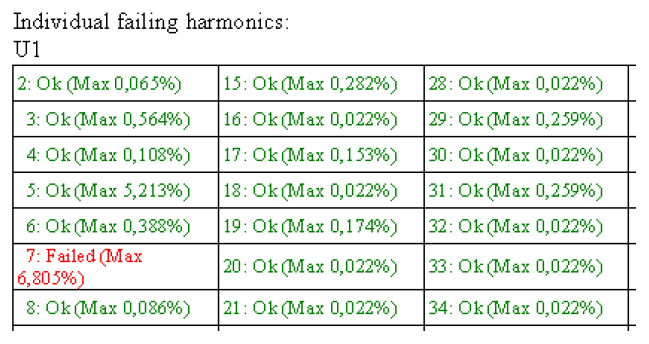
At site it could be concluded that one major filter had been disconnected by service personnel by mistake, and it could immediately be reconnected before any further damage and losses occurred.
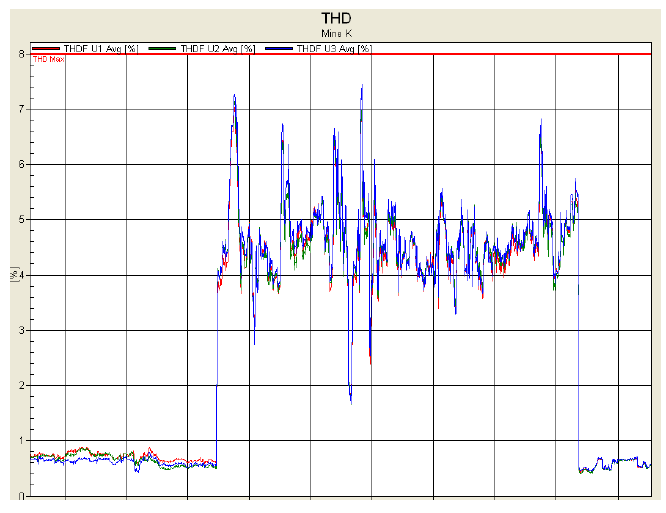
However the specified THD control limit is not violated. Without a Harmonic Information Management System in place monitoring the individual harmonics the filter would probably remained disconnected until the annual inspection or a possible failure occurred according to local management.
CONCLUSION
The international trend for Harmonic measurements is towards permanent supervision of harmonics in the transmission and distribution networks. The scale of implementation calls for an automated system for data gathering and automatic data analysis where both operators and authorities can receive scheduled weekly statistical information defining network status. Supervision and alarm functionality for all harmonic parameters also makes it possible to assure quality and keep harmonic levels in control in a preventive approach.
The challenge of tomorrow is not only to retrieve reliable and norm compliant harmonic data from the network, but also to manage this data in a reliable and cost effective way.
About Unipower: Unipower AB offers a wide range of products for Power Quality measurements and Smart Grid systems.
Originating from a Swedish ABB company in the mid 80’s, Unipower has developed a competitive edge within the field of Power Quality and Smart-Grid solutions. We focus on norm compliance equipment, with a special focus on the requirements for power generation, transmission and distribution.
Our product lines reach from traditional portable PQ analysers to fully integrated and automated Power Quality Management systems for continuous supervision of the energy supply.
Website: unipower.se
Unipower Portable – Unilyzer 900
• Its small size together with the IP65 protection and ruggedness makes Unilyzer 900 an ideal tool for all field measurements. It has no moving parts and has been tested in real, tough environments.
• The instrument complies with IEC 61000-4-30 Class A for Power Quality measurements, which guarantees highest reliability in every advice and conclusion.
• Its standard memory allows data to be stored for 3 months. In case of a power failure it has an internal battery backup keeping the instrument going.
Unipower Permanent – UP2210
• The UP-2210 unit works as an advanced power quality meter and at the same time as a fault recorder. All of the power quality parameters can be analyzed in accordance with voltage quality standards such as the EN 50160 or national regulations such as the Swedish EIFS. The UP-2210 unit captures both steady state disturbances (harmonics, flicker etc.) as well as rapid voltage changes (sag/swell events and fast transients). The nodes in the PQ Secure system consist of UP-2210 meters.
• Advanced 3-phase Power Quality and Transient Monitor
• The UP-2210 is a full-featured, norm-compliant power quality monitor capable of detecting any disturbances encountered in a network.

