Published by1. Kornelia A. BANASIK, 2. Andrzej Ł. CHOJNACKI, Kielce University of Technology, Chair of Power Engineering, Power Electronics and Electrical Machines
ORCID: 1. 0000-0002-6629-8650, 2. 0000-0002-9227-7538
Abstract. The duration of outages (restoration time) is a fundamental parameter characterizing the extent of failures, as well as the quality of organisation during their elimination. Its understanding allows for estimating the costs incurred by consumers and electric energy distributors. Besides technical and organizational factors, the weather conditions during repair works also influence its value. This paper presents a statistical analysis of the impact of weather conditions, represented by air temperature, wind speed, and daily precipitation, on the failure (restoration) time of medium voltage power lines. The econometric modelling method was used for this purpose.
Streszczenie. Czas trwania awarii (odnowy) jest podstawowym parametrem charakteryzującym rozległość awarii, a także jakość organizacji prac przy jej usuwaniu. Jego znajomość pozwala na oszacowanie kosztów ponoszonych przez odbiorców oraz dystrybutorów energii elektrycznej. Poza czynnikami technicznymi i organizacyjnymi na jego wartość mają wpływ także warunki atmosferyczne występujące w czasie wykonywania prac naprawczych. W referacie przedstawiona została analiza statystyczna wpływu warunków atmosferycznych, reprezentowanych przez temperaturę powietrza, prędkość wiatru oraz dobową sumę opadów, na czas trwania awarii (odnowy) linii elektroenergetycznych średniego napięcia. Wykorzystana została w tym celu metoda modelowania ekonometrycznego. (Wpływ czynników klimatycznych na czas odnowy linii elektroenergetycznych SN)
Keywords: electrical distribution networks, MV power lines, failures, failure duration, wind, precipitation, air temperature
Słowa kluczowe: elektroenergetyczne sieci dystrybucyjne, linie elektroenergetyczne SN, awarie, czas awarii, wiatr, opady atmosferyczne, temperatura powietrza
Introduction
The problem of ensuring continuity of electricity supply to consumers is a primary and most important issue for distribution companies. However, there are many phenomena and factors that contribute to the occurrence of failure states. These factors include primarily storms with atmospheric discharges, winds, soot, activities of third parties, and improper or incorrectly conducted operation. The presented factors belong to the group of external factors. In many cases, the factors causing failures are phenomena occurring within the power grid. These are the so-called internal factors. Among them are: switching surges and earth failures in networks with an isolated neutral point, fatigue phenomena (mechanical and electrical), aging phenomena, manufacturing and assembly defects, etc. [4, 5, 8, 9, 12].
The unreliability of power equipment results in losses incurred by consumers and electricity distributors. These are called reliability losses. Losses for industrial consumers mainly result from production not being carried out or being delayed, as well as from the destruction of raw materials used in production. In the case of municipal consumers, these losses include: losses due to forced inactivity (waste of time), material destruction losses (mainly food), and losses caused by deteriorating sanitary and health conditions. Losses for energy distributors result from the need to remove the occurred failure and the loss of profit for the duration of its occurrence [3, 9, 13].
The primary parameter determining the extent of a failure is the failure (restoration) duration ta. It is defined as the time from the moment the device failure occurs until its repair or replacement is completed, with the simultaneous restoration of the device’s power supply capability [9, 11, 13]. This parameter primarily provides a statistical picture of the quality of the failure removal organization and the extent of the damage.
Another parameter characterizing the reliability of power systems is the outage duration for consumers tp. This time is defined as the time from the moment the consumers lose power until it is restored with the simultaneous capability to provide the required power [13].
The device outage time due to a failure twa is the time from the moment the device is switched off (either automatically or by operation) due to its failure until the power is restored by the device after its repair. This time is not equivalent to the failure duration time because after the main cause of the failure is removed, the device may be energized despite still being in a failure state, provided that it can perform its functions completely or to a limited extent and does not pose a risk to operation. The final failure removal work is performed under voltage. During this time, even though the failure has not yet been removed, the device is no longer in a failure state. Furthermore, not every failure causes automatic device shutdown. In this case, the device in a failure state is not in an emergency shutdown state.
In the event of a failure, the losses incurred by consumers depend on the outage duration, while the losses incurred by distributors depend on the failure duration [3, 7]. Therefore, the distribution company should aim to minimize the outage duration for consumers by using backup or emergency power supplies and to minimize the failure duration through proper failure removal organization.
Factors that significantly hinder or even prevent failure removal (restoration) are weather conditions. Among the most significant are high and low air temperatures, high wind speeds, large daily rainfall totals, and lightning strikes [1, 2, 6].
In the event of lightning, storms, or hail, regulations prohibit work on electrical equipment. A similar situation occurs when wind speeds exceed 10 m/s. In such cases, all work at heights on power lines should be suspended [10]. Another factor preventing work on overhead lines is dense fog. The problem also arises when weather conditions are not clearly assessable. In such cases, it is best to refrain from unnecessary work until the weather conditions improve. In situations of urgent work that should be carried out immediately, the decision to start or refrain from work is made by the person leading the team or the foreman, after prior assessment of whether the work can be safely conducted in the existing weather conditions and in accordance with applicable regulations.
In this article, the authors presented the results of analyses regarding the impact of weather conditions, represented by air temperature, wind speed, and precipitation, on the duration of restoration (failure duration) of medium-voltage power lines. The method of modelling the relationship between failure duration of power system components and various environmental factors was discussed. The results obtained during many years of research for overhead power lines with bare conductors, overhead lines with partially insulated conductors, and underground cables, operated in national electricity distribution networks, were presented.
All the analyses were carried out at the level of significance α = 0.05.
The analyses presented in the article were based on data on failures that occurred over a period of 15 years in two electricity distribution companies in the country.
Modelling the Impact of air temperature, wind speed, and daily precipitation on the restoration time of medium-voltage power lines
Weather conditions in Poland and around the world are constantly changing. The range of temperatures occurring on Earth is very large. The maximum air temperature in the shade in an open space is around 60°C (the highest recorded is 56.7°C in Death Valley, USA). The lowest temperatures, on the other hand, can reach nearly -90°C (the lowest recorded is -89.2°C in Antarctica). The range of temperatures observed is obviously dependent on geographic latitude. The record temperatures recorded in Poland are -41.0°C (Siedlce) and 40.2°C (Prószków near Opole). Also, the range of wind speeds observed on Earth is very large. The maximum measured wind speed in a gust was over 110 m/s (113.33 m/s – Barrow Island, Australia). The highest officially recorded wind speed in a gust in Poland was 95.83 m/s (Meteorological station on Śnieżka). However, these are not record values. Much higher wind speeds are reached in tornadoes. The highest value on Earth, recorded by Doppler radar, was over 133.33 m/s (Oklahoma, USA), while in Poland, it was 102.50 m/s (near Lublin). The average annual wind speed in Poland is around 3-4 m/s. The highest wind speeds occur in late autumn, winter, and early spring. During these times, they are often accompanied by sub-zero air temperatures and heavy precipitation. Environmental conditions such as these are unfavourable and contribute to the occurrence of failures in electrical equipment (particularly overhead lines) as well as complicate the restoration process.
The world record for the highest daily precipitation was observed in Réunion, amounting to 1825 mm. In Poland, the record daily precipitation was observed at Hala Gąsiennicowa, reaching 300 mm.
It is important to note that various values of individual weather factors occur in different combinations with values of other weather factors. In many situations, it is the specific combination of these values that negatively or positively impacts electrical facilities and their operation. To determine the outage duration as a function of air temperature, wind speed, and daily precipitation t̅α = f (T, W, O) it is necessary to calculate the average values t̅αi = (Ti, Wi, Oi) for successive combinations of air temperature intervals Ti , wind speed Wi , and daily precipitation Oi .
Determining the empirical functions t̅α = f (T, W, O) does not fully address the problem of investigating the dependency of the restoration time on the considered atmospheric factors. It is also important to determine the functional form of these dependencies, i.e., to implement mathematical models.
Knowing the discrete values of the failure duration t̅α and the values of the environmental factors present during the restoration of electrical lines allows for the creation of a general multiple regression equation in the form:
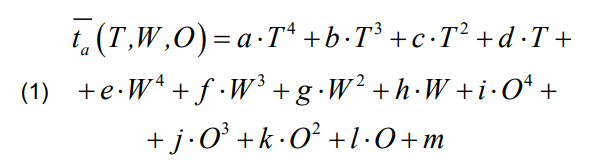
where: T – air temperature value [°C], W – wind speed value [m/s], O – daily precipitation sum value [mm], a, b, c, d, e, f, g, h, i, j, k, l, m – coefficients of the approximating function.
Preliminary studies have shown that the dependency of outage duration on individual environmental stressors can be approximated by a fourth-order polynomial. Since, in all cases, the coefficients of the approximation function obtained for an order higher than the fourth are close to zero, it was decided to approximate these dependencies with a polynomial of at most the fourth order. Therefore, the final general regression equation was adopted in the form (1).
To implement the above mathematical model, the econometric modelling method was used. For the individual medium-voltage lines, the functional form of the failure time was determined, and the theoretical models obtained were verified by assessing their conformity with empirical data. In the considered models, the intervals of climatic factors were analysed on the principle that each interval of a given factor was combined with each interval of every other factor. In total, 393,984 intervals were created. The number of combinations of intervals in which failures occurred, and thus non-zero values of the average failure (restoration) time, for the respective lines is as follows: bare overhead medium-voltage lines – 890 observations (over 15 years), semi-insulated overhead medium-voltage lines – 21 observations (over 13 years), and medium-voltage cable lines – 465 observations (over 15 years).
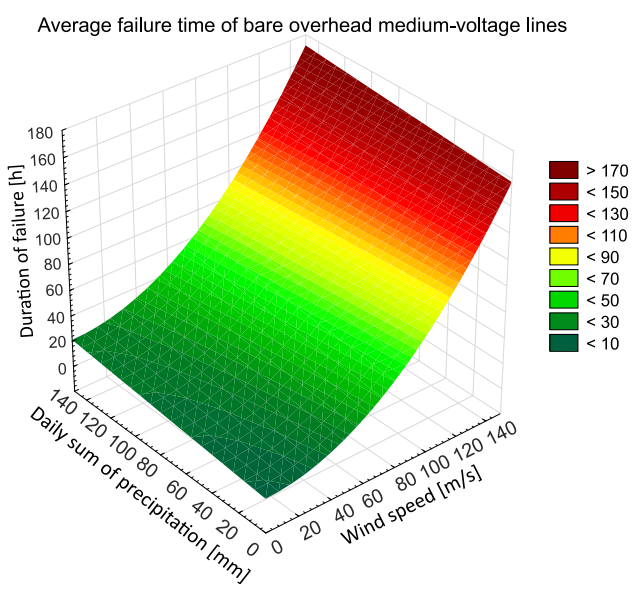
The failure time of bare overhead medium-voltage lines is determined by an econometric model given by:

To determine the quality of the model fit to empirical data, the following measures were used: multiple correlation coefficient, coefficient of determination, convergence coefficient, standard error of estimation, and the coefficient of random variability. Additionally, the F Fisher-Snedecor test was conducted. The results of this verification are shown in Table 1. As indicated by equation (2), the factor that most strongly influences the restoration time of bare overhead medium-voltage lines is wind speed.
The duration of restoration is proportional to the square of the wind speed. A slightly lesser influence is attributed to the daily sum of precipitation. In this case, it is a relationship in the first power. The influence of other atmospheric factors is so weak that they were rejected in the procedure of creating the econometric model. The theoretical variability of the failure duration for bare overhead medium-voltage lines is shown in Figure 1.
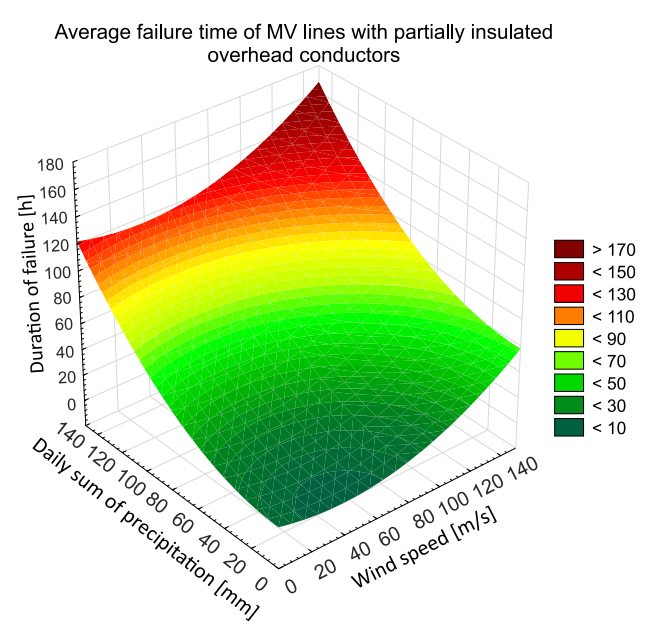
The duration of failure of medium-voltage overhead lines with partially insulated conductors is determined by an econometric model in the following form:

The results of the model verification are presented in Table 2.
As indicated by the relation (3), the factors that most strongly influence the duration of failure of medium-voltage lines with partially insulated conductors are precipitation and wind. The duration of failure (restoration) of these lines depends on the daily precipitation in the second power and the wind speed in the fourth power. The influence of other atmospheric factors is so weak that they were rejected in the procedure of creating the econometric model. The theoretical variability of the failure duration for overhead lines with partially insulated conductors is shown in Figure 2.
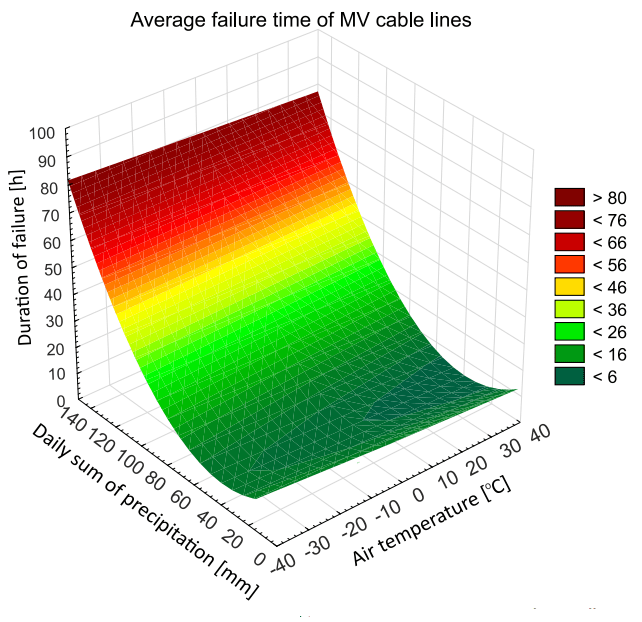
The duration of failure of MV cable lines is determined by an econometric model in the following form:

The results of the model verification are presented in Table 3.
As stated in equation (4), the factors that most strongly influence the restoration time of high-voltage cable lines are precipitation and ambient temperature. In this case, we observe a very strong influence of daily precipitation, on which the duration of recovery depends in the power of the fourth. The effect of ambient temperature in the first power is much smaller, but clearly noticeable. The influence of other atmospheric factors is so weak that they were rejected in the procedure of creating the econometric model. The theoretical variability of the duration of failure of MV cable lines is presented in Figure 3.
Conclusions
The article presents the results of an analysis regarding the influence of weather conditions, represented by air temperature, wind speed, and daily precipitation sum, on the restoration (failure) time of medium-voltage power lines. The analysis considered the independent effects of weather on uninsulated overhead lines, partially insulated overhead lines, and underground cable lines. As indicated by the relationships (2), (3), and (4), the factors that most strongly affect the restoration time of overhead lines are wind speed and daily precipitation sum, while for underground cables, it is the daily precipitation sum and air temperature. The influence of air temperature on the restoration time of overhead lines and wind speed on the restoration time of underground cables is relatively weak, leading to their exclusion during the econometric model creation process. The most significant factors affecting the restoration time of lines are: for uninsulated (bare) overhead lines – wind speed, and for partially insulated overhead lines and underground cable lines – the daily precipitation sum.
The developed mathematical models enable the calculation of the expected restoration time for medium-voltage power lines in the event of simultaneous influence of multiple atmospheric factors. As the analyses have shown, these models are quite simple to apply, and the results obtained using them largely correspond with the statistical data from electricity distribution companies. These models can be used in further reliability studies of power lines. The authors have already made initial attempts to use them in simulation algorithms based on Petri nets.
Table 1. Verification of the model of duration of failure of overhead lines with bare conductors
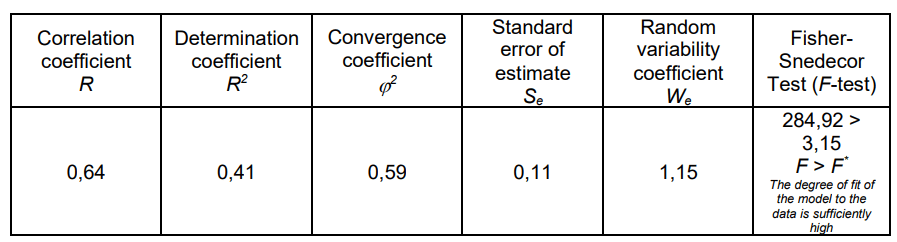
Table 2. Verification of the model of duration of failure of overhead lines with partially insulated conductors

Table 3. Verification of the model of duration of failure of cable lines

REFERENCES
[1] Banasik K., Chojnacki A. Ł., Gębczyk K., Grąkowski Ł., Influence of wind speed on the reliability of low-voltage overhead power lines, Progress in Applied Electrical Engineering (PAEE) – IEEE, czerwiec 2019
[2] Banasik . K. A., Analiza wpływu warunków atmosferycznych na niezawodność eksploatacji urządzeń i obiektów w elektroenergetycznych sieciach dystrybucyjnych. Praca doktorska. Kielce 2023
[3] Chojnacki A. Ł., Analiza skutków gospodarczych niedostarczenia energii elektrycznej do odbiorców indywidualnych. Wiadomości elektrotechniczne Nr 09/2009, s. 3-9
[4] Chojnacki A. Ł., Analysis of Seasonality and Causes of Equipment and Facility Failures in Electric Power Distribution Networks,. Przegląd elektrotechniczny, Nr 1/2023, s. 157 – 163
[5] Chojnacki A. Ł., Impact of ambient temperature on the failure intensity of overhead MV power lines. Przegląd elektrotechniczny Nr 10/2022, s. 307 – 311
[6] Chojnacki A. Ł., Kaźmierczyk A., Wpływ temperatury otoczenia na intensywność awarii stacji transformatoroworozdzielczych SN/nN, Logistyka Nr 6/2014, s. 2610-2618
[7] Chojnacki A. Ł., Świercz ewski Z. : Koszty strat u dystrybutorów energii elektrycznej spowodowane zawodnością stacji elektroenergetycznych SN/nN. Energetyka Nr 03/2010, s. 149-157
[8] Chojnacki A.Ł., Sezonowość oraz przyczyny uszkodzeń elektroenergetycznych sieci dystrybucyjnych. Elektro Info Nr 03/2023, s. 90 – 94
[9] Kowalski Z., Niezawodność zasilania odbiorców energii elektrycznej. Wydawnictwa Politechniki Łódzkiej, Łódź, 1992
[10]Rozporządzenie Ministra Infrastruktury z dnia 6 lutego 2003 r. w sprawie bezpieczeństwa i higieny pracy podczas wykonywania robót budowlanych (Dz.U. 2003 nr 47 poz. 401)
[11]Sozański J., Niezawodność i jakość pracy systemu elektroenergetycznego. WNT, Warszawa, 1990
[12]Sozański J., Niezawodność urządzeń i układów elektroenergetycznych, PWN, Warszawa 1974
[13]Sozański J., Niezawodność zasilania energią elektryczną. WNT, Warszawa, 1982
Authors: Dr. Eng. Kornelia Agnieszka Banasik, Dr. hab. Eng. Andrzej Ł. Chojnacki, prof. at PŚk, Kielce University of Technology, Faculty of Electrical Engineering, Automation and Computer Science, Department of Power Engineering, Energoelectronics and Electrical Machines, Aleja Tysiąclecia Państwa Polskiego 7, 25-314 Kielce, e-mail: k.banasik@tu.kielce.pl, a.chojnacki@tu.kielce.pl
Source & Publisher Item Identifier: PRZEGLĄD ELEKTROTECHNICZNY, ISSN 0033-2097, R. 101 NR 2/2025. doi:10.15199/48.2025.02.57

