Published by 1. Lenin Babu Chilakapati, 2. T Gowri Manohar, SVU College of Engineering, Sri Venkateswara University. ORCID: 1.0000-0001-9749-979X; 2.0000-0003-0441-6022
Abstract. Renewable energy technologies are becoming more and more common for generating electricity because they are environmentally friendly and can meet local electricity needs. They reduce network congestion and also lighten the load on conventional based power plants. Within the last few decades, grid-connected renewable energy systems have seen a rise in the significance of Power Quality issues, particularly as a result of the extensive usage of nonlinear electronics and the sporadic nature of these systems. With the emergence of power electronic converters through powerful control technology, renewable energy systems be interconnected to a large extent with the power grid or used as isolation systems in remote areas. Using additional competent control strategies can enhance not only improve the concert of these systems, but also calibre the quality of energy generated, distributed and used at the load side of Power System. Hence, this paper reviews various control strategies adopted for alleviation of power quality problems of renewable energy coordinated microgrid system and can be useful as research study for further research.
Streszczenie. Technologie energii odnawialnej stają się coraz bardziej powszechne w wytwarzaniu energii elektrycznej, ponieważ są przyjazne dla środowiska i mogą zaspokoić lokalne zapotrzebowanie na energię elektryczną. Zmniejszają przeciążenie sieci, a także zmniejszają obciążenie konwencjonalnych elektrowni. W ciągu ostatnich kilku dekad systemy energii odnawialnej podłączone do sieci odnotowały wzrost znaczenia kwestii jakości energii, szczególnie w wyniku szerokiego wykorzystania nieliniowej elektroniki i nieciągłego charakteru tych systemów. Wraz z pojawieniem się przetwornic energoelektronicznych dzięki zaawansowanej technologii sterowania, systemy energii odnawialnej mogą być w dużym stopniu połączone z siecią energetyczną lub wykorzystywane jako systemy izolacji w odległych obszarach. Zastosowanie dodatkowych kompetentnych strategii sterowania może nie tylko poprawić działanie tych systemów, ale także poprawić jakość energii wytwarzanej, dystrybuowanej i wykorzystywanej po stronie obciążenia Systemu Elektroenergetycznego. W związku z tym niniejszy artykuł zawiera przegląd różnych strategii sterowania przyjętych w celu złagodzenia problemów z jakością energii w skoordynowanym systemie mikrosieci energii odnawialnej i może być przydatny jako studium badawcze do dalszych badań. (Poprawa jakości energii w mikrosieciach za pomocą strategii sterowania adaptacyjnego: przegląd literatury)
Keywords: Power Quality, Microgrid, Power Converter Control, Renewable Energy.
Słowa kluczowe: Jakość energii, mikrosieci, sterowanie przetwornicą mocy, energia odnawialna.
1. Introduction
Now-a-days, some environmental issues arise due to carbon emissions from fossil fuel power plants, which cause environmental pollution and global warming. Alternatively, Renewable Energy (RE) based generating systems are regarded clean and cheap in comparison with conventional electricity generation. Various RE sources are Solar PV energy, Wind energy, Small Hydroelectric plants, Biogas, Geothermal energy, and Tidal and Wave energy. Of these resources, Solar PV and Wind energy systems hold the majority promise owing to the low cost of electricity production and the ability to track maximum power points over an ample range of wind and sunlight discrepancies [1]. Because of this, governments and some private firms are solicitude in increasing the production of energy from renewable sources by replacing production based on fossil fuels. By 2030, in compliance with the International Renewable Energy Agency, the worldwide plan for the integration of RE resources are of 36% of global energy demand and is expected to come from renewables [2]. Due to the unavailability and pollution of traditional energy resources, the integration of RE resources into the grid has completely changed the structure of modern power systems. Hence, the microgrid (MG) concept has attracted a lot of attention from system operators in order to improve operational efficiency and ensure a more reliable, sustainable and economical power system [3].
Microgrid can be considered an alternative to the consumption of traditional plants based on fossil fuels to reduce the energy supply deficit. It enables the benefits of efficient and sustainable energy supply, reduced carbon emissions, and delayed expansion of distribution infrastructure. A Microgrid has the ability to operate as a single system, and if there is a problem with the grid, it can be disconnected or independent from the main power system and reconnected to the grid when the problem is resolved [4]. One-off the core intention for the progress of the MG structure is the incursion of RE sources. Thus, the basic characteristic parts of MG have Dispersed Energy Resources (DER), consumers, and regulators, as depicted in the Fig.1. below. However, integrating renewable energy into the main grid becomes an exigent task due to the intermittency of energy sources nature and so adaptive control strategies are required for power converter control [5] as described in the following sections to improve Power Quality (PQ) in a microgrid.
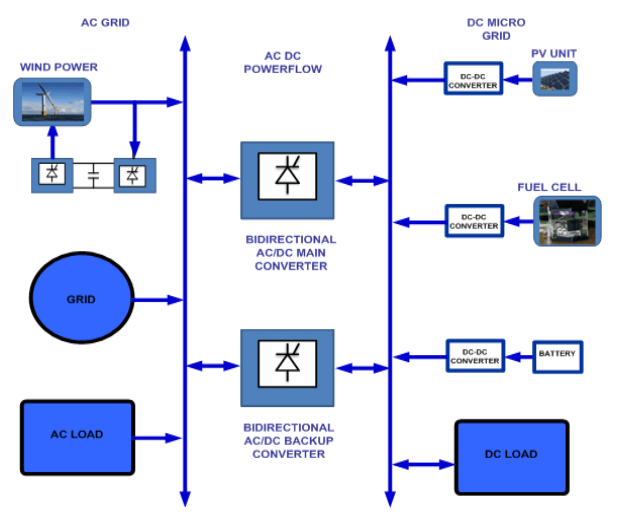
In this paper, an introduction is dealt in section-1, section-2 mention Power Quality issues, challenges and possible solutions in microgrid, section-3 explains the different power quality enhancing methods, section-4 describes power converter controller strategies for PQ issues and conclusion part in section-5.
2. Power Quality Issues in a Microgrid
The term “Power Quality” (PQ) in general refers to distribution bus voltage that remains nearly sinusoidal at rated amplitude and frequency. Furthermore, the energy made available to customers has got to be well-thought-out from a reliability viewpoint [6, 7]. The impact of power quality problems once microgrid connected to the main grid have concern due to the augmented penetration of nonlinear loads and distributed energy systems with power electronic converter (PEC) interfaces. Challenging problems of grid integration are related to power quality issues related to current harmonics and that of voltage like voltage sag/swell, voltage imbalances & distortions caused by grid failures; frequency fluctuations, energy optimal layout and system isolation in abnormal conditions [8]. Proper control of the RE resources connected power electronic converter is essential that ensures stable operation in a period of transients and changes in AC system parameters. Renewable energy must be controlled using PEC to meet load requirements in stand-alone system applications and meet grid codes in grid-tied mode. It is reported that the Islanded mode is more likely to experience disturbances, such as voltage distortions and unbalances, since load distribution is unbalanced and line impedance is very high compared to grid-connected mode. To filter harmonics and smother unbalances, PE interfaced converters (inverters) could be effectively controlled [9]. In the grid-connection mode, disturbances such as grid voltage imbalance and voltage drop are the most common problems. Power Quality and stability of the system can be achieved via suitable control techniques incorporated to the power converter control circuit. Due to these impacts, improvement of the power quality of electric systems becomes a mandatory requirement. Hence, power quality problems get remunerated in control strategies applied to the interfacing inverter as mentioned in following section.
2.1 PQ Challenges and Solutions in a Microgrid
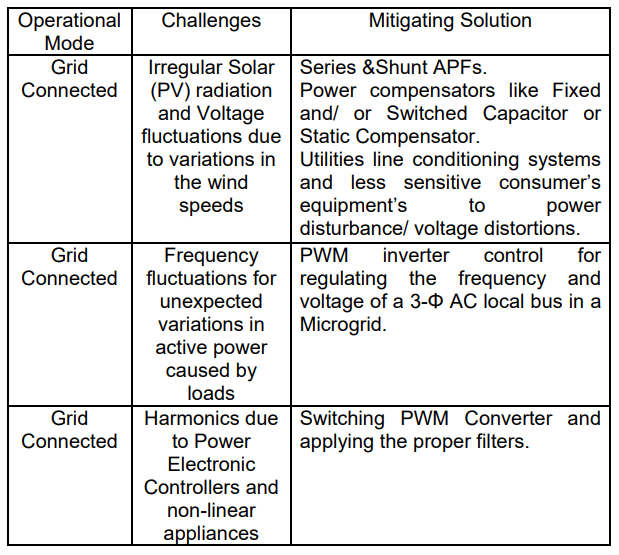
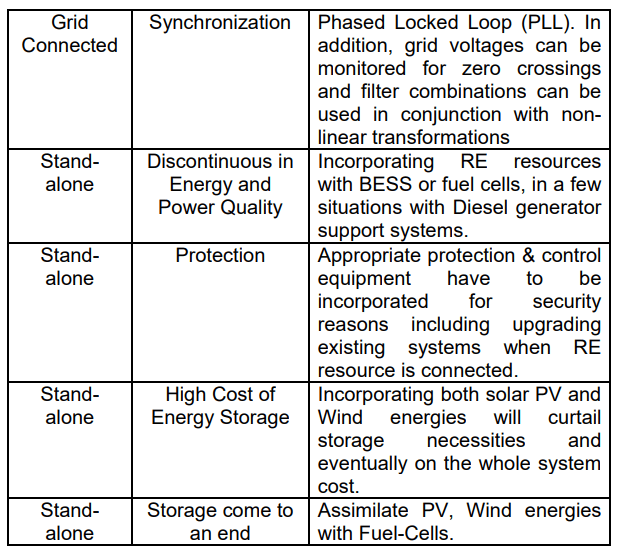
Now-a-days, some progressive technologies and techniques are being used continuously to develop and address the power quality challenges and their mitigation brought about by the incorporation of renewable energy in a microgrid [10]. Table 1. outlines the foremost challenges faced by grid-connected and islanded microgrid systems along with feasible remedies or mitigations.
Table 1. PQ Challenges and possible mitigating remedies in a microgrid [11]-[15]
3. Microgrid Power Quality
Currently, a major area of research in industry and academia is the network interaction of RE’s for improved system performance. In the incidence of non-linear loads, a microgrid powered by a RE’s integrated into the main grid generates harmonic currents that are in phase opposite to the reactive currents of the load [16]. Harmonic components are introduced by RE integration, which lowers the quality of the power at the point of common connection (PCC) into the network which must not exceed certain limits. The various measures have been carried out to enhance the quality RE resources generation, including that of the application of improved management strategies and the usage of various auxiliary equipment [17]. This section discusses controllers that encompass premeditated literature intended for mitigating power quality problems in a microgrid.
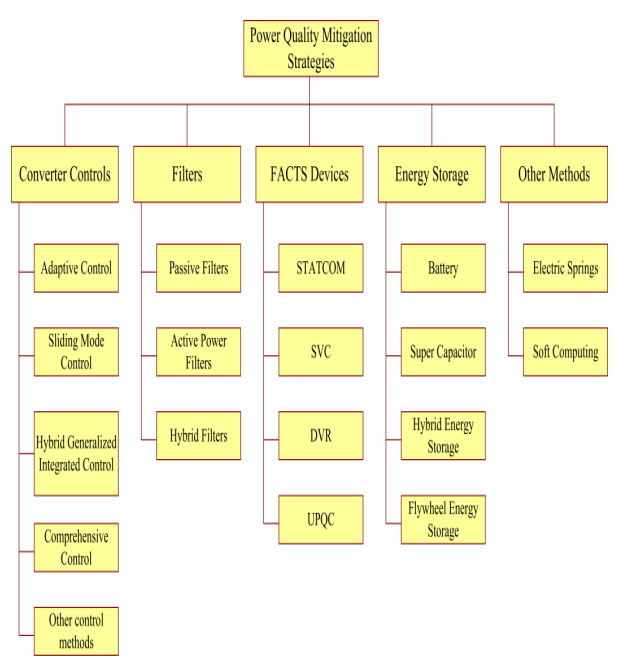
Power Electronics Converters are known to be the heart of the REs; these devices are responsible for injecting harmonics into the system. Various advanced methods of controlling inverters of RE systems for harmonic suppression are presented in [18]. The improvement of power quality with the use of filters or auxiliary equipment was suggested in [19] for hybrid PV/wind power plants. PQ issues namely power oscillations, harmonics, power factor, and voltage imbalances are significantly improved by FACTS controllers in highly RE perforated systems [20]. The power quality is improved by using a variety of energy storage devices, particularly for the purpose of power smoothing in RE systems discussed in [21, 22]. These include batteries, supercapacitors, and flywheel energy storage. Additionally, various techniques such as electric springs [23], soft computing-based approaches [24], and modular multilevel converters (MMC) are used in refining the power quality of RE systems [25]. The summary of the different strategies discussed in this section for improving the power quality of the system are as shown in Fig.2 below.
4. Controller Strategies for Power Quality Enhancement
This section provides an enhanced Islanded/grid connected converter control techniques using adaptive control to enhance performance and repress harmonics in a microgrid where local steady and dynamic AC/DC loads are also coupled to the point of common connector (PCC). Controllers for these microgrids must include fast transitions between grid-tied as well as islanded modes of operation to mitigate the effects of mains outages and reduce the impact of RE’s intermittency and compensate for the existence of harmonic or unbalanced loads, thereby improving microgrid power quality.
Hence, power quality problems get remunerated in control strategies applied to the interfacing inverter as shown in the Table 2. below.
Table 2. Different Power Converter Control Strategies
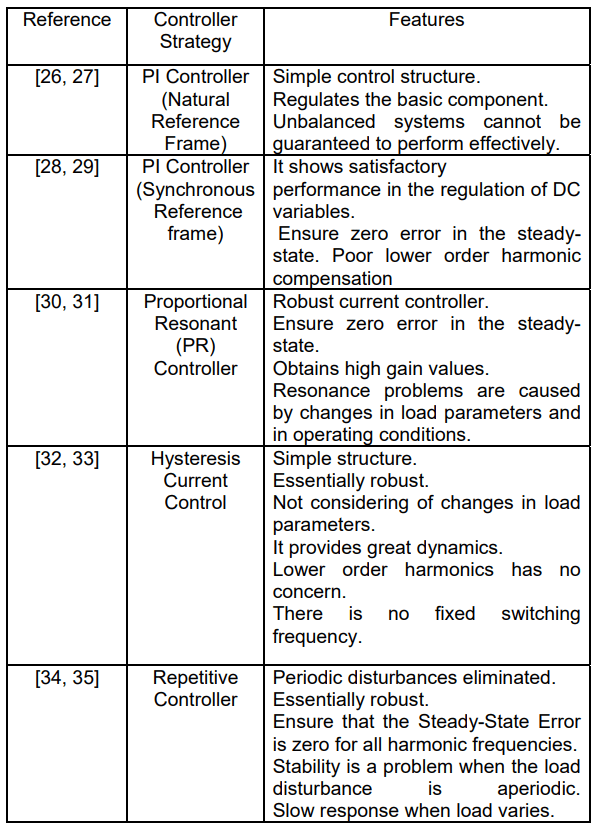
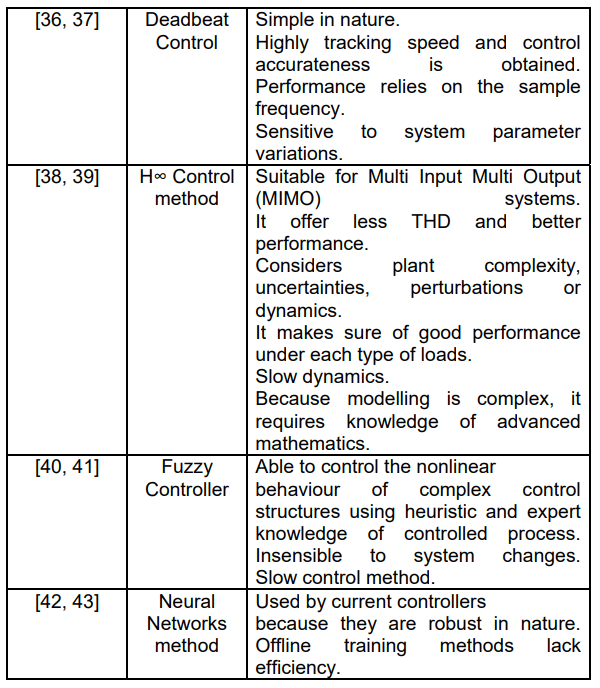
Table 2. lists some of the different features of distinct controller’s methods. Hence, from the above discussion it can be found that PI controller, Hysteresis Current control and Fuzzy method controllers are extensively used as the power converter controller strategies. Although, many deliberations are made in the studies on control methodologies in improving power quality of the microgrid systems, no single control technique can solve all power quality problems simultaneously. Therefore, future research will capable of focusing on the development of control techniques that meet the requirements and highly dependent on proper system modelling with the application of advanced control strategies such as optimization techniques [44, 45, 46] applied to the microgrid system controller design.
4.1 Power Quality Enhancement with Optimization/AI techniques
The goal of power quality in microgrids is solved using a variety of AI-based optimization strategies. Optimized linear and nonlinear models are suitable for grid connected as well as islanded modes of microgrid [47]. PSO is an intelligent computing technique that searches for the best parameter settings in real-time [48]. For the purpose of removing voltage harmonics in microgrid systems with numerous DG sources, a union of PSO based PWM and SPWM inverters was proposed in [49]. A concurrent self-tuning technique was described in [50] as the basis for an optimal control approach considering the criteria of Voltages, frequency regulation, and power-sharing in performance evaluation during microgrid operational mode changes and sudden load variations. With the intention of improving power quality in multi-bus microgrids, the authors [51] suggested an optimization technique with primary goal was to mark voltage regulation at specific buses. A controller with gains derived from system admittance and tuned via Ant-Lion Colony (ALC) algorithm was proposed in [52]. In [53], a PI controller with settings adjusted using a whale’s optimization algorithm (WOA) was suggested. The apparent controller regulates voltage and frequency within an autonomous microgrid that is powered by inverters.
The authors in [54] devised a control approach that uses the Grasshopper optimization technique to govern the optimal gains in the PI controller meant for power quality enhancement in photovoltaic-based microgrids running in the autonomous mode. A Slap Swarm Optimization (SSO) based PI controller was implemented in [55] for improving power quality under conditions of dynamic loads.
5. Conclusion
• This article provides a comprehensive review on various control strategies and state-of-art-tools utilized for extenuating power quality issues in a renewable energy coordinated microgrid.
• Different controllers and their control strategies that are intended for enhancing power quality are discussed with possible challenges and solutions thoroughly.
• Also, the study deals several optimization approaches for renewable energy resources interfacing power electronic converter in terms of power quality performance.
• Further studies are recommended in the usage of adaptive control techniques and hybrid optimization algorithms which results in better performance and efficacy in improving the power quality of a microgrid.
Acknowledgments – The authors uphold that the publishing of this paper does not involve any conflicts of interest. The authors also sincerely appreciate the editor and reviewers for their timely appreciated observations & suggestions.
REFERENCES
[1] Warner KJ, Jones GA, The 21st century coal question: China, India, development, and climate change, Atmosphere, 10 (2019),476. https://doi.org/10.3390/atmos10080476.
[2] REN21. 2023. Renewables 2023 Global Status Report Collection, Global Overview, https://www.ren21.net/reports/global-status-report/.
[3] Lopes, Joao AP, Andre G. Madureira, and Carlos Moreira. “A view of microgrids.” Advances in Energy Systems: The Large-scale Renewable Energy Integration Challenge, (2019), 149-166. https://doi.org/10.1002/9781119508311.ch9
[4] Hossain MA, Pota HR, Hossain MJ, Blaabjerg F., Evolution of microgrids with converter-interfaced generations: Challenges and opportunities, International Journal of Electrical Power & Energy Systems,109(2019),160–86. https://doi.org/10.1016/j.ijepes.2019.01.038.
[5] Vasilakis, Athanasios, Igyso Zafeiratou, Dimitris T. Lagos, and Nikos D. Hatziargyriou, “The evolution of research in microgrids control” IEEE Open Access Journal of Power and Energy, 7 (2020), 331-343. doi: 10.1109/OAJPE.2020.3030348.
[6] Dugan, Roger C. Electrical power system quality, The McGraw Hill Companies,, 2000.
[7] Langella, Roberto, and Alfredo Testa., IEEE standard definitions for the measurement of electric power quantities under sinusoidal, nonsinusoidal, balanced, or unbalanced conditions, In IEEE Non-Sinusoidal Situations Working Group, vol. 1. IEEE, 2010. https://hdl.handle.net/11591/158881
[8] Sankaran, C. Power quality, CRC press, 2017.
[9] Jadeja, Rajendrasinh, Amit Ved, Tapankumar Trivedi, and Gagandipsinh Khanduja., Control of power electronic converters in AC microgrid, Microgrid Architectures, Control and Protection Methods (2020), 329-355. https://doi.org/10.1007/978-3-030-23723-3_13.
[10] Alam, Md Shafiul, Fahad Saleh Al-Ismail, Aboubakr Salem, and Mohammad A. Abido., High-level penetration of renewable energy sources into grid utility: Challenges and solutions, IEEE Access, 8(2020),190277-190299. https://doi.org/10.1109/ACCESS.2020.3031481.
[11] IEEE Standards Board. IEEE Standard for Interconnecting Distributed Resources with Electric Power Systems, IEEE, (2003), 1547-2003.
[12] Mlilo N, Brown J, Ahfock T. Impact of intermittent renewable energy generation penetration on the power system networks – A review, Technol Econ Smart Grids Sustain Energy, 6 (2021), 25. https://doi.org/10.1007/s40866-021-00123-w.
[13] Photovoltaics, Dispersed Generation, and Energy Storage. IEEE application guide for IEEE Std 1547™, IEEE standard for interconnecting distributed resources with electric power systems, IEEE Std (2009), 1547-2. doi:10.1109/IEEESTD.2008.4816078.
[14] Liang X, Andalib -Bin- Karim C. Harmonics and mitigation techniques through advanced control in grid-connected renewable energy sources: a review, IEEE Trans on Ind Applicat,54(2018),3100–11. https://doi.org/10.1109/TIA.2018.2823680.
[15] Van den Broeck, Giel, Jeroen Stuyts, and Johan Driesen, A critical review of power quality standards and definitions applied to DC microgrids., Applied energy, 229 (2018), 281- 288.https://doi.org/10.1016/j.apenergy.2018.07.058
[16] Alam, Md Shafiul, Fahad Saleh Al-Ismail, Aboubakr Salem, and Mohammad A. Abido, High-level penetration of renewable energy sources into grid utility: Challenges and solutions, IEEE Access, 8 (2020), 190277-190299. DOI: 10.1109/ACCESS.2020.3031481.
[17] Bajaj, Mohit, and Amit Kumar Singh, Grid integrated renewable DG systems: A review of power quality challenges and state-of-the-art mitigation techniques, International Journal of Energy Research, 44, no. 1 (2020), 26-69. https://doi.org/10.1002/er.4847.
[18] Huang, Xin, Keyou Wang, Bo Fan, Qinmin Yang, Guojie Li, Da Xie, and Mariesa L. Crow, Robust current control of grid-tied inverters for renewable energy integration under non-ideal grid conditions, IEEE Trans on Sust Energy, 11, no. 1 (2019), 477-488. DOI: 10.1109/TSTE.2019.2895601
[19] Yacine Djeghader , Zouhir Boumous , Samira Boumous, Przegląd Elektrotechniczny, 99 (2023), nr 1, 124-128.
[20] Ahsene Boubakir, Imen Bahri, Nasserdine Boudjerda, Hassen Belila, Przegląd Elektrotechniczny, 98(2022), nr 10, 292-298.
[21] Barra, P. H. A., W. C. De Carvalho, T. S. Menezes, R. A. S. Fernandes, and D. V. Coury, A review on wind power smoothing using high-power energy storage systems, Renew and Sust Ener Rev, 137 (2021), 110455. https://doi.org/10.1016/j.rser.2020.110455
[22] Ruchika Ruchika, D.K. Jain, Przegląd Elektrotechniczny, 99(2023), nr 4, 70-76.
[23] Wang, Minghao, Yufei He, Xu Xu, Zhekang Dong, and Yu Lei., A review of AC and DC electric springs, IEEE Access, 9 (2021), 14398-14408. doi: 10.1109/ACCESS.2021.3051340.
[24] Pragathi, B., Deepak Kumar Nayak, and Ramesh Chandra Poonia, Mitigation of power quality issues for grid connected photo voltaic system using soft computing techniques, Journal of Interdisciplinary Mathematics, 23, no. 2 (2020), 631-637. https://doi.org/10.1080/09720502.2020.1731968
[25] T. M. Thamizh Thentral, R. Palanisamy, S. Usha, Pradeep Vishnuram, Mohit Bajaj, Naveen Kumar Sharma, Baseem Khan, Salah Kamel, The Improved Unified Power Quality Conditioner with the Modular Multilevel Converter for Power Quality Improvement, Intl Trans Elect Energ Syst, vol.2022, Article ID 4129314, 15 pages, 2022. https://doi.org/10.1155/2022/4129314.
[26] Pichan, Mohammad, Hasan Rastegar, and Mohammad Monfared, A new digital control of four-leg inverters in the natural reference frame for renewable energy–based distributed generation, Int Trans Elect Energ Sys, 29, no. 5 (2019), e2836. https://doi.org/10.1002/2050-7038.2836
[27] L. Nalla, M. K. Mishra and A. Ghosh, Sliding Mode Control of a Four-Leg Dynamic Voltage Restorer in a Natural Reference Frame, IEEE Journal of Emerging and Selected Topics in Industrial Electronics, vol. 4, no. 3 (2023), pp. 919-927. doi: 10.1109/JESTIE.2023.3282787.
[28] Djamel-Eddine Chaouch, Hocine Azzeddine, Ahmed Larbaoui, Zoubir Ahmed-Foitih, Przegląd Elektrotechniczny, 97(2021), nr7, 42-47
[29] Ahmad, Shameem, Saad Mekhilef, and Hazlie Mokhlis. “DQaxis synchronous reference frame based PQ control of grid connected AC microgrid.” In IEEE International Conference on Computing, Power and Communication Technologies (GUCON), IEEE, (2020), pp. 842-847. DOI: 10.1109/GUCON48875.2020.9231080
[30] Althobaiti, Ahmed, Nasim Ullah, Youcef Belkhier, Abdulrahman Jamal Babqi, Hend I. Alkhammash, and Asier Ibeas, Expert knowledge based proportional resonant controller for three phase inverter under abnormal grid conditions, International Journal of Green Energy, 20, no. 7 (2023), 767-783. https://doi.org/10.1080/15435075.2022.2107395
[31] Amini, Behnam, Reza Roshanfekr, Ahmad Hajipoor, and Seyyed Yousef Mousazadeh Mousavi, Interface converter control of distributed generation in microgrids using fractional proportional—Resonant controller, Electric Power Systems Research, 194 (2021), 107097. https://doi.org/10.1016/j.epsr.2021.107097
[32] G.Vijayshree , Srinivasan Sumathi, Przegląd Elektrotechniczny, 99(2023) nr 3, 142-147.
[33] Suresh Penagaluru, T G Manohar, Effective power quality improvement in PV grid by using adaptive hysteresis dynamic active power filter under different source voltage control strategies,IJEAT,9(2019),489–96. https://doi.org/10.35940/ijeat.C5537.109119.
[34] Ma W, Ouyang S., Control strategy for inverters in microgrid based on repetitive and state feedback control, International Journal of Electrical Power & Energy Systems, 111(2019), 447–58. https://doi.org/10.1016/j.ijepes.2019.04.002.
[35] K. Zhou, C. Tang, Y. Chen, B. Zhang and W. Lu, A Generic Multi-Frequency Repetitive Control Scheme for Power Converters, IEEE Trans Ind Electr, vol. 70, no. 12, (2023), pp.12680-12688. doi: 10.1109/TIE.2023.3239855.
[36] Elhassan, Garba, Shamsul Aizam Zulkifli, Solomon Zakwoi Iliya, Hassan Bevrani, Momoh Kabir, Ronald Jackson, Mubashir Hayat Khan, and Mohammed Ahmed, Deadbeat current control in grid-connected inverters: A comprehensive discussion, IEEE Access, 10 (2021), 3990-4014. DOI: 10.1109/ACCESS.2021.3138789
[37] Ramaiah, Satish, N. Lakshminarasamma, and Mahesh Kumar Mishra, An improved deadbeat direct power control for grid connected inverter system, In 2021 IEEE 12th International Symposium on Power Electronics for Distributed Generation Systems (PEDG), IEEE, (2021), pp. 1-6.
[38] Sedhom BE, Hatata AY, El-Saadawi MM, Abd-Raboh EE., Robust adaptive H-infinity based controller for islanded microgrid supplying non-linear and unbalanced loads, IET Smart Grid, 2(2019), 420–35. https://doi.org/10.1049/ietstg.2019.0024.
[39] Sedhom BE, El-Saadawi MM, Hatata AY, Abd-Raboh EE, A multistage H-infinity–based controller for adjusting voltage and frequency and improving power quality in islanded microgrids, Int Trans Electr Energ Syst, 30 (2020). https://doi.org/10.1002/2050-7038.12143.
[40] Mouloud Denai, Tayeb Allaoui, Morsil Sebaa, Amina Tamer, Rahal Ouared, Przegląd Elektrotechniczny, 98(2022), nr 12, 136-144
[41] Livia-de-Maria Soares, Fabio Araujo, Icaro Araujo, Mario Cavalcante, Przegląd Elektrotechniczny, 99 (2023), nr 2, 37-50
[42] Sudheer, K., Penagaluru, S., Prabaharan, N., Mitigation of Voltage Disturbances in Photovoltaic Fed Grid System Using Cascaded Soft Computing Controller, In: Gupta, A.R., Roy, N.K., Parida, S.K. (eds) Power Electronics and High Voltage in Smart Grid, Lecture Notes in Electrical Engineering, 817(2022), Springer, Singapore. https://doi.org/10.1007/978-981-16-7393-1_22
[43] Venkata Anjani Kumar G. and M. Damodar Reddy, PSO Trained Feed Forward Neural Network Based SAPF for Power Quality Enhancement in Distribution Networks, International Journal of Electrical and Electronic Engineering & Telecommunications, Vol. 12, No. 4(2023), pp. 279-287. Doi: 10.18178/ijeetc.12.4.279-287
[44] Resener, Mariana, Steffen Rebennack, Panos M. Pardalos, and Sérgio Haffner, eds. Handbook of optimization in electric power distribution systems, Berlin: Springer, 2020.
[45] Miret J, Balestrassi PP, Camacho A, Guzmán R, Castilla M., Optimal tuning of the control parameters of an inverter-based microgrid using the methodology of design of experiments, IET Power Electron, 13(2020), 3651–60. https://doi.org/10.1049/ietpel.2020.0225.
[46] Gao, Kaiye, Tianshi Wang, Chenjing Han, Jinhao Xie, Ye Ma, and Rui Peng, A review of optimization of microgrid operation, Energies, 14, no.10 (2021), 2842. https://doi.org/10.3390/en14102842
[47] Trivedi, Rohit, and Shafi Khadem, Implementation of artificial intelligence techniques in microgrid control environment: Current progress and future scopes, Energy and AI, 8 (2022), https://doi.org/10.1016/j.egyai.2022.100147
[48] Roslan MF, Al-Shetwi AQ, Hannan MA, Ker PJ, Zuhdi AWM., Particle swarm optimization algorithm-based PI inverter controller for a grid-connected PV system, PLoSONE, 15 (2020),e0243581.https://doi.org/10.1371/journal.pone.0243581.
[49] Keypour R, Adineh B, Khooban MH, Blaabjerg F, A new population-based optimization method for online minimization of voltage harmonics in islanded microgrids, IEEE Trans Circuits Syst II, 67 (2020), 1084–8. https://doi.org/10.1109/TCSII.2019.2927208.
[50] Castilla, M., de Vicuña, L.G., Miret, J., Control of Power Converters in AC Microgrids. In: Zambroni de Souza, A., Castilla, M. (eds) Microgrids Design and Implementation, (2019), p.139–70. Springer, Cham. https://doi.org/10.1007/978-3-319-98687-6_5
[51] Sindi, Hatem F., Sultan Alghamdi, Muhyaddin Rawa, Ahmed I. Omar, and Ahmed Hussain Elmetwaly, Robust control of adaptive power quality compensator in Multi-Microgrids for power quality enhancement using puzzle optimization algorithm, Ain Shams Engineering Journal, 14, no. 8 (2023), https://doi.org/10.1016/j.asej.2022.102047
[52] Amritha K, Rajagopal V, Raju KN, Arya SR, Ant lion algorithm for optimized controller gains for power quality enrichment of off-grid wind power harnessing units, Chin J Electr Eng, 6(2020), 85–97. https://doi.org/10.23919/CJEE.2020.000022.
[53] Qazi S, Mustafa M, Sultana U, Mirjat N, Soomro S, Rasheed N. Regulation of voltage and frequency in solid oxide fuel cellbased autonomous microgrids using the whale’s optimisation algorithm, Energies, 11(2018), 1318. https://doi.org/10.3390/en11051318.
[54] Jumani TA, Mustafa MW, Rasid MM, Mirjat NH, Leghari ZH,Saeed MS., Optimal voltage and frequency control of an islanded microgrid using grasshopper optimization algorithm, Energies, 11(2018), 3191. https://doi.org/10.3390/en11113191.
[55] Jumani T, Mustafa Mohd, Md. Rasid M, Anjum W, Ayub S. Salp swarm optimization algorithm-based controller for dynamic response and power quality enhancement of an islanded microgrid, Processes, 7(2019), 840. https://doi.org/10.3390/pr7110840.
Authors: Mr. Lenin Babu Chilakapati is a Research Scholar in the Department of Electrical and Electronics Engineering, S V University College of Engineering, Sri Venkateswara University, Tirupati, India. E-mail: ch.leninbabusvu@gmail.com and Dr. T.Gowri Manohar, Professor, Department of Electrical and Electronics Engineering, S V University College of Engineering, Sri Venkateswara University, Tirupati, India. E-mail: gowrimanohar.t@gmail.com
Source & Publisher Item Identifier: PRZEGLĄD ELEKTROTECHNICZNY, ISSN 0033-2097, R. 100 NR 3/2024. doi:10.15199/48.2024.03.21
 Power Quality Blog