Published by Mahmood T. Alkhayyat1, Laith A. Khalaf2, Mohammed Y. Suliman3, Northern Technical University. ORCID: 1. 0000-0001-6119-7845; 2. 0000-0003-1602-6152; 3. 0000-0002-1250-6362
Abstract. A special form of energy system that can be utilized to provide all the energy needed in the globe is the renewable hybrid system. In order to successfully use renewable energy and decrease the amount of energy drawn from the power grid, a micro-grid management technique based on renewable energy has been developed in this study. The utilization of renewable energy sources, such as solar energy from photovoltaic panels and wind energy (from wind turbines), may run loads more effectively while consuming less fuel. To regulate the electricity, an adaptive control system was also created. The performance of the suggested control method for managing power flow is demonstrated by simulation results acquired using MATLAB/Simulink in a variety of operating modes.
Streszczenie. Specjalną formą systemu energetycznego, który może być wykorzystany do dostarczenia całej energii potrzebnej na świecie, jest odnawialny system hybrydowy. W celu skutecznego wykorzystania energii odnawialnej i zmniejszenia ilości energii pobieranej z sieci elektroenergetycznej, w niniejszym opracowaniu opracowano technikę zarządzania mikrosieciami opartą na energii odnawialnej. Wykorzystanie odnawialnych źródeł energii, takich jak energia słoneczna z paneli fotowoltaicznych i energia wiatrowa (z turbin wiatrowych), może efektywniej obsługiwać obciążenia przy mniejszym zużyciu paliwa. Aby regulować energię elektryczną, stworzono również adaptacyjny system sterowania. Wydajność proponowanej metody sterowania przepływem mocy została zademonstrowana na podstawie wyników symulacji uzyskanych przy użyciu MATLAB/Simulink w różnych trybach pracy. (Sterowanie adaptacyjne do zarządzania energią w oparciu o energię odnawialną)
Keywords: power management, hybrid system, distribution generators, renewable energy.
Słowa kluczowe: zarządzanie energią, system hybrydowy, generatory dystrybucyjne, energia odnawialna.
Introduction
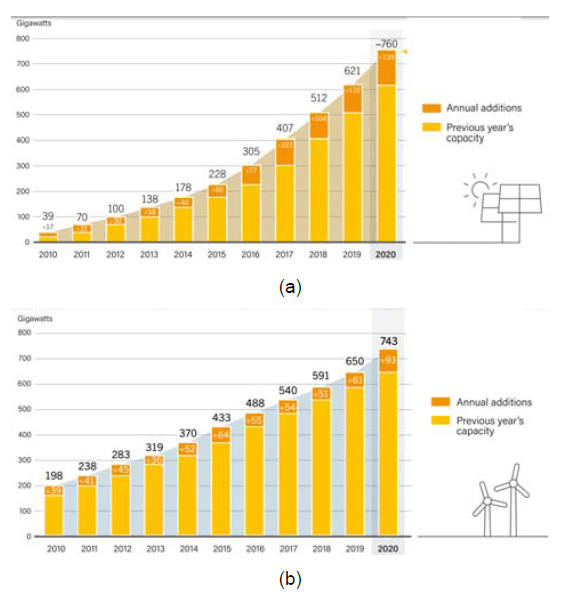
The request for power increments quickly when compared to the era. Subsequently, there’s a requirement for an elective approach to fulfill the request. As “Energy Moderated is Break even with to Vitality Created”. Most customary power-generating plants run on fossil control and deliver 64.5% of control around the world [1]. These control plants have a greater share in carbon outpourings, where generally 40% of carbon is transmitted by the period division, and the transport division [2] produces 24%. Besides, to reach the radically expanding vitality request with lower carbon outflows, analysts have proposed unused strategies of vitality era utilizing renewable vitality sources (RESs). we are centring on diverse ways to control the utilization of vitality this leads to the concept of Stack Side Administration. Request administration alters shopper request through diverse strategies like Smart-grid (SG)operation strategies [3]. SG is characterized as it may be a control supply organization that can cleverly connect the exercises of all clients associated with it like generators, buyers, and prosumers (all those do both time and utilization). SGs work with unmistakable sorts of contraptions such as quick meters (SMs), quick machines, RESs, and batteries. Due to stresses approximately the environment and the economy, there has been an increase in intrigued within the creation and administration of renewable vitality in later a long time [4]. The first move is Hybrid wind was the first renewable energy source to be integrated. as supplementary sources, and solar systems as a remedy for applications in remote areas and shaky grid connections. Further hybrid systems, including a number of them, have been used in study. sources of miniaturized renewable energy including solar thermal, biomass, tidal power and fuel cells [5]. Following the output price to wind turbine and solar panel uses of decreased were drastically decreased, and now they are the only option. for systems that generate hybrid energy [6]. The most objective is to encourage buyers to play down the utilization of control amid top hours, but this cannot be done abruptly. Then again, renewable vitality sources can be coordinated with the framework which decreases the control expended by the framework [7]. The term “Smart Grid” refers to this connection. Since production is now decentralized, the new system improves electricity quality, which is the primary driver of institutions’ dependability of the power system, smart grids (SG) connect small power production units, mostly from renewable sources, and employ sophisticated control technology [8]. Right now, renewable vitality share around the world is as it were 11% whereas it is anticipated to extend by 60% in 2070 [9]. The worldwide capacity of wind and sun-oriented photovoltaic (PV) is expanded to 514.8 GW and 399.6 GW individually [10]. Figure 1 appears the global trend for speculation within the PV and wind renewable vitality divisions [11]. In this study, the styling of a smart grid for host structures is given as shown in Figure 2. The submitted smart grids central power sources are wind turbines and photovoltaic for sun and the main grid supply. A management system is constructed to keep track of and oversight the loads into a structure for to achieve the right equilibrium among the energy created and consumed. Adaptive neuro fuzzy system designed to manage the power delivered to the consumer with the priority to the renewable energy (solar and wind energies) over the grid.
An administration practices is created to keep off a delightful putting right between the undertaking around and meander which is required by the building’s loads. A supervision renewable fight is explained in Figures in [12] location an Egyptian verdant bailiwick organic upon a surly PV/WT/FC to the electrical utility [13]. The blend sincerely moves forward the profit bizarre composition these interface GESs to its possess dynamic more favourably on touching GES taken a toll thought [14]. Alternate study based on the optimum approximation of a hybrid GES cryptogram in Egypt was presented in effort [15]. In reference [16] investigated the used profits of adding renewable ways with the electrical network on provincial action efficiency. In [17] had beholden a commensurability centre of utility clarification and involve date (DG) alternates to decipher the problem of talent grid outages in rural area. The authors in [18] faked the fusing of GES to the electric utility with energy make consistent and environmental problems consideration. In [19] transferable and shred infested with optimization (PSO) mechanisms were applied to economic studies of off-grid GES. This assembly factual adaptive administer obstruction permission neuro-fuzzy feud supply to superintend the power dog-tired to the pressure by weaken the power grid by compensating power from GES utilized PV/WT energies.
The grid-tied system
The PV and WT frameworks make up the two-source renewable vitality system that’s talked about in this issue. The essential neighbourhood framework is associated with these renewable vitality sources. An inverter for PV/WT is portrayed in Figure 2.

Main local grid
The grid is depicted as an energy source that has the capacity to produce and absorb electric power. The constraints put on power transformers, transmission lines, and other heavy power equipment of the grid have a limit on how much energy can be absorbed or delivered in a particular time period.
PV vitality framework model
The created electric control from the PVES is influenced significantly by the irradiance falling on the PV as well as its area. To extend the irradiance and subsequently, the created vitality from the PV framework it is suggested to tilt the PV modules with a perfect tilt point. This perfect tilt point is chosen to break indeed with the scope point of the area [20]. The hourly produced control from the PV cluster can be decided by the taking after condition [21]:

Where: PPV Produced power of photo voltaic (kW); Prated Output power of module (kW); NPV PV modules number; Df PV derating factor ; G Titled plane global utility fallen (kW/m2); Gref Solar radiation at base conditions (1 kW/m2); KT Temperature coefficient ; Tamb Ambient temperature (◦C); NWCT Normal working cell temperature
The solar model shown in Figure 3.

The height of the anemometer, which should be adjusted to the height of the wind turbine, is used to measure wind speed [22]. Equations illustrate the relationship between the anemometer height and the wind speed to any height are:

Where: Pw Produced power of the wind turbine (kW); NWT Number of the wind turbines; Pr Rated wind turbine power (kW); Vci Cut-in wind speed (m/s); Vco Cut-on wind speed (m/s); Vr Rated wind speed (m/s); ηw Wind turbine efficiency
The wind model shown in Figure 4.
Inverter
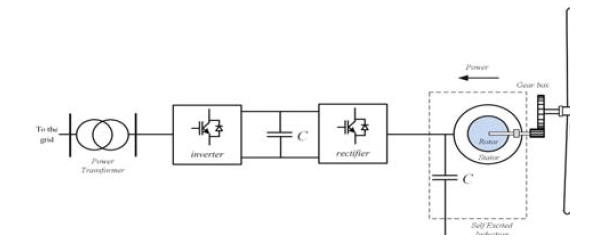
Both the WT and PV framework create DC vitality. A DC association is joined to the two GREs’ DC yield [23]. An inverter is required to put through this DC connection to the electrical lattice at the AC transport. Due to the reality that the proposed on-grid half-breed framework consolidates a battery (as a storage framework), the inverter utilized may be a bi-direction sort to empower charging the batteries from the AC side within the occasion that the REGs’ yield control is deficient, as already portrayed in Figure 2. The prerequisite for crest stack for the most part decides the measure of the inverter:

Where: Pinv Output power (kW); PLmax Demand power (kW); ηinv Inverter efficiency
Grid power system model
The grid is shown as an energy source that has the capacity to produce and absorb electric power [23]. There is a limit on how much energy can be absorbed or delivered in a given time period due to the limitations placed on power transformers, transmission lines, and other overwhelming control gear of the network. A Diesel Generator DG is utilized to fulfill a high-power shortage amid the 24-hour day to supply the stack. Depending upon the fuel utilization of DG can be assessed the yield control [24]:

Where: PDG diesel generator output (kW); FDG rate of fuel consumption in Ltr/hr; α coefficient of fuel intercept in Ltr/kWh; β fuel slope in Ltr/kWh; CDG capacity of diesel generator in kW
Adaptive control design
Fuzzy logic controllers (FLC) are appropriate for uncertain systems, particularly for systems whose mathematical models are challenging to generate. In a variety of real-world applications, FLC is crucial [25]. There are many other kinds of fuzzy inference systems, however in this study the Takagi-Sugeno TS-fuzzy is used. The Artificial Neural Network (ANN) will be employed with a TS-fuzzy- like-PI controller to modify the membership functions. This kind (TS-fuzzy controller) features a highly nonlinear controller with variable gain, which results in a large range of changes in the controller’s gain. Randomly selecting the controller settings may result in a system with an adequate in responsiveness or unitability. By combining ANN with fuzzy logic in a neuro-fuzzy system to change the controller’s settings, it is possible to get a better response [26].
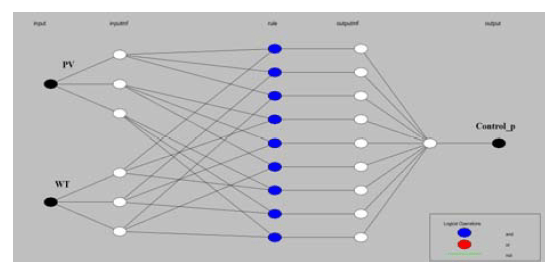
By using an artificial neural network (ANN) as a learning method, fuzzy rules are learned. Without the expert knowledge often necessary for the usual form of FCL, such control may be learned, and the rules base can be reduced. Training phases establish the input control parameters and output of membership functions (MF). The goal of the learning algorithm is to modify the input parameters and output MFs to get the optimal output alignment for the proposed controller [27]. The control parameters of a network are often identified using a hybrid learning technique called “Least Squares Estimate-LSE and Gradient Descent-GD” [28]. In the current study, the controller grid power’s two inputs were generated by solar and wind energy. Wind turbine power and PV power with one output for power load decision to the control unit of DG the structure as shown in Figure 5. Structure breaks the universe for discourse into three-triangle MFs with a 50% overlap, followed by controller inputs and control p controller generates “three inputs and one output”, with a control rule of 9 as a result, requiring the specification of linear functions. One piece of data must be produced in order to tweak the TS rules using neuro-fuzzy. The controller’s input data consists of data vectors with PV/WT results that follow Equations 1 and 2, with the controller’s output going to the DG control unit. Figure 6 depicts the control designer’s output validation surface. The MATLABGUI for neuro-fuzzy file contained in the toolbox of MATLAB/fuzzy is employed to carry out the training operation.

Simulation results
The proposed system model consists of feeder with load branch of 14 MW. Two scenarios are investigated as:
Scenario I
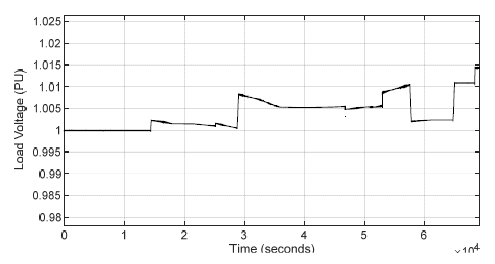
The supplied by three sources the main grid supply with 15 MW, and variable wind energy with maximum power of 4.5 MW as shown in Figure 6 and solar energy with 8 MW in time interval from 6 am to 18 pm as shown in Figure 7. The adaptive neuro-fuzzy controller programmed to give the priority for supply for wind and solar energies to decrease the supply from the grid this will decrease the fuel and then operate more economic. The proposed power management of the system algorithm is illustrated in Figure 8. The time calculated based on 24 hours (606024 sec). The real and reactive power demand of the load for 24 hours is shown in Figure 9, also the load voltage shown in Figure 10 respectively.


Decrease the supply from the grid to obtain more economy operation the increase the supply from wind and solar at their peak’s operation 8 MW for solar and 4.5 MW for wind the summation of the two renewable energy is about 12.5 MW and this will compensate the load when increased to 1.5 pu about 21 MW where decrease the supply from the grid to less than 0.5 pu about 7 MW at time 4.

Managed powers of grid, wind and solar shown in Figure 11.The test starts by feeding the load first by the main grid supply at time 1.45 the wind energy starts to share the load and increase to supply causing to decrease the grid supply and become more economy, at time 2.5 the solar energy starts and share the load with the wind energy and decrease the supply from the grid to obtain more economy operation the increase the supply from wind and solar at their peaks operation 8 MW for solar and 4.5 MW for wind the summation of the two renewable energy is about 12.5 MW and this will compensate the load when increased to 1.5 pu about 21 MW where decrease the supply from the grid to less than 0.5 pu about 7 MW at time 4 . the powers scenario of grid, wind and solar shown in Figure 11.

From Figure 11 it can be notice that decreasing the fossil fuel stations by using renewable energy, the compensate the power from renewable energy reach about 50% and this will decrease the total cost of operation.
Scenario II
Wind power and solar power are varied as depicted in Figures 12. Managed power is shown in Figure 13.


Conclusion
In this work, adaptive control designed for grid-tied hybrid clean energy is presented by MATLAB simulation. A system includes solar cells, a wind turbine, and a diesel generator. Adaptive neuro-fuzzy controller proposed to manage the power feeding to the load. Simulation results guarantee the optimum operation and energy management. The theory used in this work is to reduce the economic expenses of a PV/wind/ hybrid system connected with the grid while also enhancing the system for potential variations in load. Two scenarios are proposed to validate the theory of control system. The results shows an appropriate solution for hybrid renewable energy connected to the grid.
REFERENCES
[1] H. Sawall, A. Scheuriker, and D. Stetter, ‘‘Flexibility definition for smart grid cells in a decentralized energy system,’’ in Proc. 7th Int. Conf. Smart Cities Green ICT Syst., (2018), pp. 130-139. DOI:10.5220/0006803401300139
[2] M. M. Hossain, K. R. Zafreen, A. Rahman, M. A. Zamee, and T. Aziz, ‘‘An effective algorithm for demand side management in smart grid for residen-tial load,’’ in Proc. 4th Int. Conf. Adv. Electr. Eng. (ICAEE), (2017), pp. 336–340. DOI:10.1109/ICAEE.2017.8255377
[3] X. Jiang and C. Xiao, ‘‘Household energy demand management strategy based on operating power by genetic algorithm,’’ IEEE Access, vol. 7, (2019), pp. 96414–96423. DOI:10.1109/ACCESS.2019.2928374
[4] T. Sattarpour, D. Nazarpour, and S. Golshannavaz, ‘‘A multiobjective HEM strategy for smart home energy scheduling: A collaborative approach to support microgrid operation,’’ Sustain. Cities Soc., vol. 37, (2018), pp. 26–33. DOI:10.1016/j.scs.2017.09.037
[5] F. S. Fabiani Appavou, Adam Brown, Bärbel Epp, Duncan Gibb, Bozhil Kondev, Angus McCrone, Hannah E. Murdock, Evan Musolino, Lea Ranalder, Janet L. Sawin, Kristin Seyboth, Jonathan Skeen, Renewbles in Cities – 2021 Global Status Report, pages 52, 118, 146, https://www.ren21.net/wpcontent/ uploads/2019/05/GSR2021_Full_Report.pdf
[6] A. Alamri, and I. Azim Niaz, ‘‘An optimized home energy management system with integrated renewable energy and storage resources,’’ Energies, vol. 10, (2017), no. 4, p. 549. DOI:10.3390/en10040549
[7] H. T. Dinh, J. Yun, D. M. Kim, K. Lee, and D. Kim, ‘‘A home energy management system with renewable energy and energy storage utilizing main grid and electricity selling,’’ IEEE Access, vol. 8, (2020), pp. 49436–49450. DOI:10.1109/ACCESS.2020.2979189
[8] C. Byers and A. Botterud, ‘‘Additional capacity value from synergy of variable renewable energy and energy storage,’’ IEEE Trans. Sustain. Energy, vol. 11, (2020), no. 2, pp. 1106–1109. DOI: 10.1109/TSTE.2019.2940421
[9] M. Rizwan, L. Hong, W. Muhammad, S. W. Azeem, and Y. Li, ‘‘Hybrid Harris Hawks optimizer for integration of renewable energy sources considering stochastic behaviour of energy sources,’’ Int. Trans. Elect. Energy Syst., vol. 31, (2021), no. 2, Art. no. e12694, DOI: 10.1002/2050-7038.12694.
[10] A. Kadri, H. Marzougui, A. Aouiti, and F. Bacha, ‘‘Energy management and control strategy for a DFIG wind turbine/fuel cell hybrid system with super capacitor storage system,’’ Energy, vol. 192, (2020), Art. no. 116518. DOI:10.1016/j.energy.2019.116518
[11] Jie, Wu. “Control technologies in distributed generation system based on renewable energy.” 3rd IEEE International Conference on Power Electronics Systems and Applications (PESA), (2009).
[12] Bagherian, Alireza, and SM Moghaddas Tafreshi. “A developed energy management system for a microgrid in the competitive electricity market.” IEEE Bucharest PowerTech, (2009). DOI: 10.1109/PTC.2009.5281784
[13] Jiang, Zhenhua, and Xunwei Yu “Hybrid DC and AC-linked microgrids: towards integration of distributed energy resources”, IEEE Energy 2030 Conference, (2008). DOI:10.1109/ENERGY.2008.4781029
[14] Brenna, Morris, Enrico Tironi, and Giovanni Ubezio. “Proposal of a local dc distribution network with distributed energy resources.” 11th International Conference on Harmonics and Quality of Power, IEEE Cat. No. 04EX951, (2004). DOI:10.1109/ICHQP.2004.1409388
[15] Maaruf, Muhammad, Khalid Khan, and Muhammad Khalid. “Robust control for optimized islanded and grid-connected operation of solar/wind/battery hybrid energy.” Sustainability 14.9, 5673, (2022). DOI:10.3390/su14095673
[16] Chouaib, Ammari, Hamouda Messaoud, and Makhloufi Salim. “Sizing, modelling and simulation for Hybrid Central PV/wind turbine/diesel generator for feeding rural village in South Algeria.” EAI Endorsed Transactions on Energy Web 4.15 (2017). DOI: 10.1002/est2.211
[17] S. Lee, J. Lee, H. Jung, J. Cho, J. Hong, S. Lee, and D. Har, ‘‘Optimal power management for nanogrids based on technical information of electric appliances,’’ Energy Buildings, vol. 191, (2019), pp. 174–186. DOI: 10.1016/j.enbuild.2019.03.026
[18] F. K. Arabul, A. Y. Arabul, C. F. Kumru, and A. R. Boynuegri, ‘‘Providing energy management of a fuel cell–battery–wind turbine–solar panel hybrid off grid smart home system,’’ Int. J. Hydrogen Energy, vol. 42, no. 43, (2017), pp. 26906–26913. DOI: 10.1016/j.ijhydene.2017.02.204
[19] Kavya, M., and S. Jayalalitha. “Developments in perturb and observe algorithm for maximum power point tracking in photo voltaic panel: A review.” Archives of Computational Methods in Engineering 28, (2021), 2447-2457. DOI:10.1007/s11831-020-09461
[20] Motahhir, Saad, Aboubakr El Hammoumi, and Abdelaziz El Ghzizal. “The most used MPPT algorithms: Review and the suitable low-cost embedded board for each algorithm.” Journal of cleaner production, (2020). DOI:10.1016/j.jclepro.2019.118983
[21] Putri, Ratna Ika, et al. “Maximum power extraction improvement using sensorless controller based on adaptive perturb and observe algorithm for PMSG wind turbine application.” IET Electric Power Applications, (2018), 455-462. DOI: 10.1049/iet-epa.2017.0603
[22] Twaha, Ssennoga, and Makbul AM Ramli. “A review of optimization approaches for hybrid distributed energy generation systems: off-grid and grid-connected systems.” Sustainable Cities and Society 41, (2018), 320-331. DOI: 10.1016/j.scs.2018.05.027
[23] Mahmoud, Fayza S., et al. “Sizing and Design of a PV-Wind- Fuel Cell Storage System Integrated into a Grid Considering the Uncertainty of Load Demand Using the Marine Predators Algorithm.” Mathematics, (2022). DOI: 10.3390/math10193708
[24] Singh, Urvi, et al. “Energy Management System and Its Implementation in Smart Grid using Renewable Energy Resources.” International Conference on Sustainable Energy, Electronics, and Computing Systems (SEEMS), IEEE, 2018. DOI: 10.1109/SEEMS.2018.8687351
[25] Mohammed Y. Suliman and Farrag M. E., “Power Balance and Control of Transmission lines using Static Series Compensator”, 53rd International Universities Power Engineering Conference (UPEC), IEEE,(2018), pp 1-5. DOI:10.1109/UPEC.2018.8541894
[26] Suliman, Mohammed Yahya. “Active and reactive power flow management in parallel transmission lines using static series compensation (SSC) with energy storage.” International Journal of Electrical and Computer Engineering, (2019). DOI:10.11591/ijece.v9i6.pp4598-4609
[27] Mahmood T. Alkhayyat, Suliman, Mohammed Yahya. “Neuro Fuzzy based SSSC for Active and Reactive Power Control in AC Lines with Reduced Oscillation.” Przegląd Elektrotechniczny, 79 (2021), nr 3, 75-79. DOI:10.11591/eei.v9i5.2290
[28] M. Y. Suliman and Mahmood T. Al-Khayyat, “Power flow control in parallel transmission lines based on UPFC”, Bulletin of Electrical Engineering and Informatics, vol. 9, (2020), no. 5, pp. 17551765. DOI: 10.11591/eei.v9i5.2290
Authors: dr M.T. Alkhayyat. Mosul, Iraq, Northern Technical University, E-mail: m.t.alkhayyat@ntu.edu.iq, Laith A. Khalaf, Northern Technical University, E-mail: laith.abd@ntu.edu.iq, dr Mohammed Y. Suliman, Mosul, Iraq, Northern Technical University, E-mail: mohammed.yahya@ntu.edu.iq.
Source & Publisher Item Identifier: PRZEGLĄD ELEKTROTECHNICZNY, ISSN 0033-2097, R. 99 NR 12/2023. doi:10.15199/48.2023.12.19
 Power Quality Blog