Published by 1. Benalia Nadia1, 2. Ben Si Ali Nadia1, 3.Zerzouri Nora1, Badji Mokhtar Annaba University B.P 2300 Annaba Algeria. ORCID: 1. 0000-0003-4819-5313; 2. 0000-0001-7248-4823; 3. 0000-0003-1209-4617
Abstract. This paper presents the impact of a grid-connected photovoltaic (PV) generator with a wind turbine on dynamic voltage stability and maximum loading point by considering the PV-wind turbine penetration level and contingencies such as short circuits and load increases with PSAT toolbox under matlab. The IEEE 9-node test feeder is used as a test system. Test results show the maximum loading margin for voltage stability is improved at low PV-wind penetration levels of up to 10% and for 20% of the injections, the increase in λ is small, then it becomes constant for other injections. For each level of penetration of renewable energies, oscillation damping becomes more important after the elimination of the short circuit.
Streszczenie. W artykule przedstawiono wpływ podłączonego do sieci generatora fotowoltaicznego (PV) z turbiną wiatrową na dynamiczną stabilność napięcia i maksymalny punkt obciążenia, biorąc pod uwagę poziom penetracji PV-turbiny wiatrowej i zdarzenia awaryjne, takie jak zwarcia i wzrost obciążenia, za pomocą zestawu narzędzi PSAT w Matlab . 9-węzłowy podajnik testowy IEEE jest używany jako system testowy. Wyniki testów pokazują, że maksymalny margines obciążenia dla stabilności napięcia poprawia się przy niskich poziomach penetracji wiatru fotowoltaicznego do 10%, a dla 20% zastrzyków wzrost λ jest niewielki, a następnie staje się stały dla innych zastrzyków. Dla każdego poziomu penetracji energii odnawialnych tłumienie oscylacji nabiera większego znaczenia po wyeliminowaniu zwarcia. (Wpływ penetracji OZE na maksymalny punkt obciążenia i dynamiczną stabilność napięcia)
Keywords: Hybrid solar- wind turbine, voltage stabiliyt,PSAT, P-V curve.
Słowa kluczowe: Hybrydowa turbina fotowoltaiczno-wiatrowa, stabilizacja napięcia, Krzywa P-V, PSAT
Introduction
The power system should be operated so that voltage and power are within acceptable ranges [1]. This quest has led to the realization of alternative power generation methods that may be even cheaper than longstanding power generation techniques. One of the consequences of competitive electricity markets is the use of photovoltaic generators (PVGs) and wind turbines. Therefore, replacing conventional generation with large-scale renewable units has been one of the major aspects characterized by smart grids. But one of the major problems connected to solar and wind systems are their dependence on weather conditions [2–3]. Therefore, PV generation and wind turbines are growing rapidly around the world. Therefore, replacing conventional generation with large-scale renewable units has been one of the major aspects characterized by smart grids [4].
A methodology to evaluate the impact of wind generation on the voltage stability of a power system is presented in [5].
When connected to rural radial lines, solar PV systems have an electrical influence at the distribution level and have an impact on the voltage profile reviewed in [6].
When a power system is unable to sustain the voltage across all of its buses, causing a disturbance, voltage instability arises [7]. The limitations of network topology, system functioning, and the constitution of electrical system components are all factors that are progressively influencing the possibility of voltage instability and collapse [8].Integrating wind power plants created a new issue for system stability due to interactions between the control systems of wind power plants and conventional power plants [9], [10]. Additionally, the substitution of some of the generated power from conventional power plants with injected power from wind power plants can lead to a decrease in system damping and a reduction in system dynamic performance.
Under variable wind power plant power injection, dynamic and static voltage stabilities can be maintained [11].
Due to the inherent differences between PV units and conventional generators, these problems need to be carefully studied. Numerous studies and investigations have been conducted to optimize the performance of DG resources, reduce power loss, enhance the voltage profile, and enhance power quality characteristics.[12] outlines an approach for assessing how wind generation affects a power system’s voltage stability. [13] examines how small photovoltaic generators (SPVGs) affect the performance of distribution systems.
A power system has a state of voltage instability when a disturbance causes a progressive and uncontrollable decrease in voltage level [14]. These disturbances can be faults such as a short circuit on a transmission line, the loss of a generator, the loss of a load, the gain of a load, or the loss of a portion of the transmission network [12].
The integration of hybrid PV-WT systems into the grid can improve the reliability of renewable power generation to supply the load while minimizing the overall cost. The grid takes the excess renewable power generated and supplies power to loads when required. Recently, many studies have been conducted on the reliability of hybrid PV-WT systems.
It has been shown in numerous studies that the connection of hybrid PV and wind turbine power sources to the power distribution system changes the core characteristics of the system, including the static voltage stability and dynamic voltage stability. This study will focus on these two topics and present conclusions from an investigation into the impact of hybrid PV and wind turbines on the advantages mentioned using PSAT simulations and an IEEE 9-Bus power system.
Hybrid solar PV –Winds turbine System
A hybrid power system is one that combines two or more renewable energy sources (solar-thermal, wind, solar-photovoltaic, biomass, geothermal, hydropower, etc.) to provide electricity, heat, or both to consumers [13]. Renewable energies are weather-dependent and thus intermittent. He may be able to achieve a better overall supply model by integrating two or more generation sources and also including a form of energy storage. For isolated networks, the introduction of hybrid systems becomes a very attractive solution. The combination of both solar and wind energy sources can improve reliability, and their hybrid system becomes more economical to operate. The integration of hybrid solar and wind power systems into the grid can further improve the overall economy and reliability of renewable power generation to supply the grid’s load, similar to a stand-alone system. These sources can be operated either in private or grid-connected modes. The idea of wind and solar associated with a conventional system, though innovative, has caused more difficulties for planners and analysts due to the need to improve voltage stability and sustainability [15]. The effects of integrating large-scale PV on all aspects of the dynamic voltage stability of a power system have not yet been fully investigated. Dynamic voltage stability An oscillating situation is observed under changing circumstances or following a disturbance. After a new equilibrium point is reached and the power system is able to maintain stability, the oscillations will ultimately reduce. On the other side, an increase in oscillation magnitude indicates unstable conditions. Increasing power generation and load demand uncertainties frequently lead to oscillatory conditions. Therefore, static stability analysis is insufficient to accurately represent power system performance. To provide a thorough description of the dynamic behavior of the system, the dynamic response should be carefully examined. Simulations in the time domain are used here. Time integration techniques are used to solve a set of nonlinear equations that describe the components of the power system [16]. To maintain steady functioning of the power system, the maximum permissible critical clearance time must be determined using dynamic analysis [17, 18].
Voltage stability
Characteristics of a power system to remain in a state of equilibrium. Voltage instability is closely related to the maximum load margin of a transmission network. In present-day power systems, this may take place as a precursor to the traditional frequency instability problem. The main problem here is that the maximum loading of the transmission system is not a fixed quantity. Such quantity depends on the network topology, generation and load patterns, and the availability of VAR resources. All these factors can vary with time due to scheduled maintenance, unexpected disturbances, etc.
Voltage problems are expected when developing power systems and in the event of major system breakups. Voltage stability is a dynamic phenomenon, thus there should be an obvious need for dynamic voltage stability analysis. For the faster transient phenomena, dynamic simulations are necessary, but for the slower, longer-term phenomena, steady-state-based methods might suffice [10].
Simulation Results
All numerical studies were performed in PSAT, which is a MATLAB-based toolbox for power system studies. It includes power flow, continuation power flow (CPF), optimal power flow, small signal stability analysis, and time-domain simulation tools. This toolbox also provides a complete graphical interface and a SIMULINK-based one-line network editor.
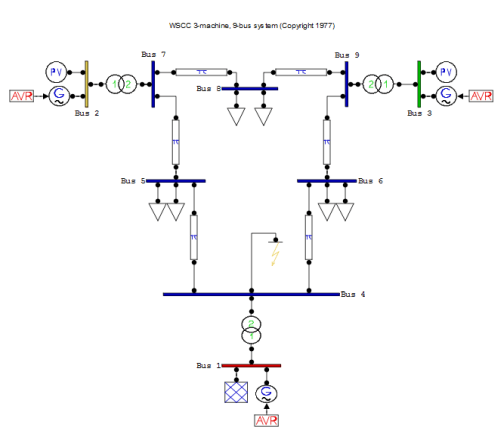
The test network is an IEEE 9-Bus test system consisting of nine buses and three generators with a total capacity of 519.5 MW and a total load of 330.618 MW.
Scenario 1: The 9-bus test system is in normal condition.
Scenario 2: 9-bus test system with increased load at every bus
Scenario 3: A nine-bus test system with a short circuit on bus 4.
Scenario 4: A 9-bus test system with a short circuit at bus 4 and increasing load at every PQ load bus.
Scenario 5: 9-bus test system with 10% PV-wind penetration
Scenario 6: A 9-bus test system with 20% PV-wind penetration
Scenario 7: A 9-bus test system with 30% PV-wind penetration
With a fault at bus 4 and a 100% load increase Fig. 1. The IEEE 9-Bus system is slightly customized to simulate the solar-wind hybrid system shown in Figure 5.
A three-phase balance fault is applied to bus 4 connected to the generation source in order to analyze the case of dynamic voltage stability. Because it is closest to the swing bus, the location of the fault is the most vulnerable point in the network. The fault is considered to occur at 0.1 s, and the duration is 264 ms.

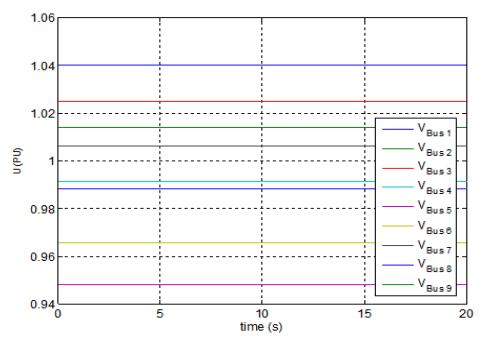
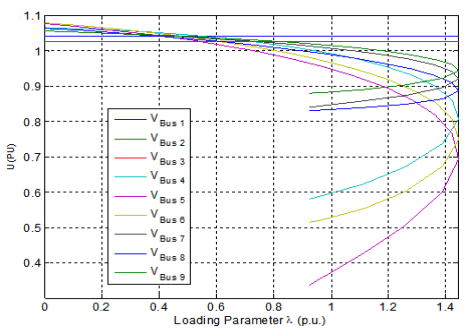
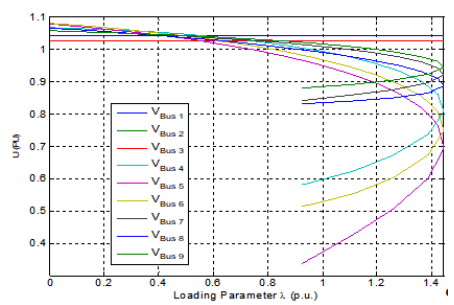
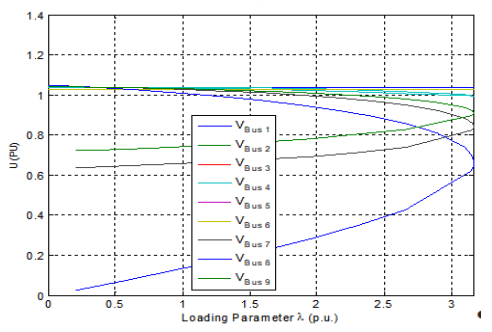
During normal operation the voltages are in the range of 0.99 to 1.04 Figure 2 but when a three phase fault occurred near bus 4 at t=0.1 sec , voltages drop and generators may go out of synchronism Figure 4. The increase in load is accompanied by a loss of voltage up to 0.95 Figure 6. The PV curve has nearly the same shape in normal and fault operation Figure 3, figure 5 and figure 7, but in case 3, the nose of the curve decreases from 2.5 to 1.5 p.u. The voltage profile shows a voltage drop during the fault figure 8 followed by oscillations after the fault has been cleared, which attenuate after a few seconds, and the PV curve figure 9, whose loading point lowers to 1.4, are both impacted simultaneously by the fault’s existence and the increase in load.



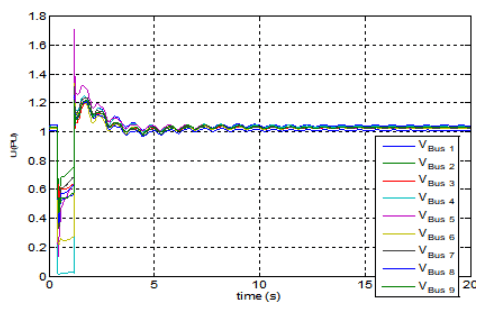
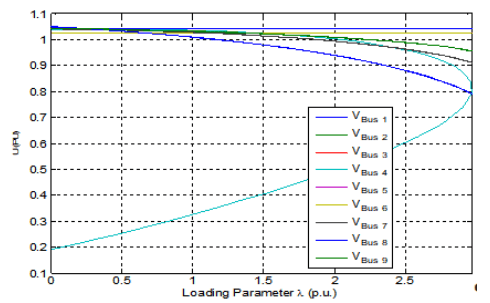


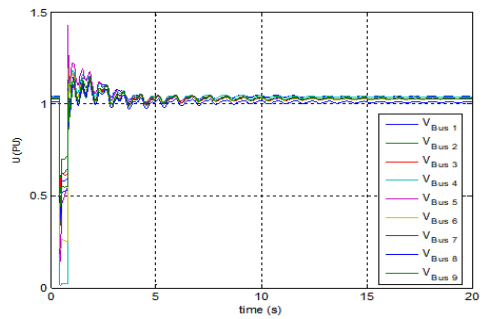
The wind turbine is installed at bus 6, and the photovoltaic system is at bus 5 Fig 16, for equal injections ranging from 33.06 MW to 99.18 MW, which represent 10%, 20%, and 30% of the total load, respectively.
The PV curves in Figures. 11, 13, and 15 and the voltage profile curves in Figures. 10, 12, and 14 show the effects of different PV-wind power penetration on the voltage profile and loading point of all buses with short circuits and heavy loads. The depth and duration of the voltage dip are the dip’s characteristics, with the exception of the duration, which is influenced by the level of penetration of the RES and decreases with each injection; however, the depth remains constant across all nodes depicted in Figures10, 12, and 14. The variation of λ is very important for a 10% injection; practically, it doubles; it goes from 1.5 to 3. For the second injection of 20%, the increase in λ is low, going from 3 to 3.1, and it does not change and remains the same for a 30% injection.

Conclusion
The impact of renewable energy integration on voltage dynamic stability is demonstrated by a reduction in the duration of the dip voltage, which is reduced by one-third for a 30% injection compared to case 4. The effect of the penetration level of the PV-wind turbines as first injection (10%) on the maximum loading point is very important. When compared to case 4, λ doubles. When the penetration level is increased to 20%, the maximum margin point increases very little, taking the value to 3.1 and not changing by 30%. The maximum margin point is sensitive only for low injections and then becomes constant.
REFERENCES
[1] J. G. Slootweg, W.L. Kling, Modeling and analyzing impacts of wind power on transient stability of power systems, Wind Energy vol. 25, n 6, 2001.
[2] Jauch C., Sørensen P., Norheim I., Rasmussen C. Simulation of the Impact of Wind Power on the Transient Fault Behavior of the Nordic Power System, Electric Power Systems Research, VOL: article in press, available online 24 March, 2006, p. 135-144.
[3] M. Hussein Ibrahim, M. A Ibrahim , Solar-Wind Hybrid Power System Analysis Using Homer for Duhok, Iraq, PRZEGLĄD ELEKTROTECHNICZNY, vol 9,2021.
[4] Y.Yusran, Y. Rahmani,I. Gunadin,S. M. SAID,S. Syafaruddin, Mesh grid power quality enhancement with synchronous distributed generation: optimal allocation planning using breeder genetic algorithm, PRZEGLĄD ELEKTROTECHNICZNY, vol 1, 2020.
[5] E. Vittal, M. O’Malley, and A. Keane, “A Steady-State Voltage Stability Analysis of Power Systems with High Penetrations of Wind”, IEEE Trans. On Power Systems, Vol. 25, No. I, Feb 2010.
[6] A. Canova, L. Giaccone, F. Spertino, and M. Tartaglia, “Electrical impact of photovoltaic plant in distributed network,” IEEE Trans. Ind. Appl., vol. 45, no. I, pp. 341-347, Jan. I Feb. 2009.
[7] A F Mohamad, M Sulaiman, A F Abdul, R Omar “ Voltage Instability Analysis for Electrical Power System Using Voltage Stability Margin and Modal Analysis” , 2016.
[8] C.Jamroen ,B. Piriyanont ,S. Dechanupaprittha, S „ Load shedding scheme based on voltage instability index using synchrophasor data”, International Electrical Engineering Congress (IEECON),2017.
[9] B. Qin, H. Li, X. Zhang, T. Ding, K. Ma, and S. Mei, “Quantitative short-term voltage stability analysis of power systems integrated with DFIG-based wind farms”, IET Gener. Transm. Distrib., Vol. 14, No. 19, pp. 4264–4272, 2020.
[10] S. Dadjo Tavakoli, E. Prieto-Araujo, E. Sánchez-Sánchez, and O. Gomis-Bellmunt, “Interaction assessment and stability analysis of the MMC-based VSC-HVDC link”, Energies, Vol. 13, No. 8, p. 2075, 2020.
[11] G. Lee, D. Kwon, and S. Moon, “DC Current and Voltage Droop Control Method of Hybrid HVDC Systems for an Offshore Wind Farm Connection to Enhance AC Voltage Stability”, IEEE Trans. Energy Convers., 2020.
[12] P. Kundur, J. Paserba,Definition and classification power system stability. IEEE Trans. on Power Systems.19, 2, pp.1387-1401,2004.
[13] J.B.V.Subrahmanyam, P.AlluvadaBandana, K.Bhanupriya C. Shashidhar “Renewable Energy Systems: Development and Perspectives of a Hybrid Solar-Wind System” , ETASR – Engineering, Technology & Applied Science Research Vol. 2, No.1,177-181,2012. ,Shashidhar “Renewable Energy Systems: Development and Perspectives of a Hybrid Solar-Wind System” , ETASR – Engineering, Technology & Applied Science Research Vol. 2, No. 1, 177-181,2012
[14] M. H. Mostafa, M. A. Elshahed, M. M. Elmarsfawy,” Power Flow Study and Voltage Stability Analysis for Radial System with Distributed Generation”, International Journal of Computer Applications (0975 – 8887) Volume 137 – No.9, March 2016.
[15] M. Rambabu , G. V. Nagesh Kumar , S. Sivanagaraju ,” Optimal Power Flow of Integrated Renewable Energy System using a Thyristor Controlled SeriesCompensator and a GreyWolf Algorithm” , Energies , 12, 2215; published 19 june 1-18 ,2019.
[16] B. S. England , A. T. Alouani, “Real time voltage stability prediction of smart grid areas using smart meters data and improved Thevenin estimates”, Int. J. Electr. Power Energy Syst., Vol. 122, p. 106189, 2020.
[17] E. A. Aleem, E. E. A. El-Zahab, M. Algablawy, Z. M. Ali, “An improved approach for robust control of dynamic voltage restorer and power quality enhancement using grasshopper optimization algorithm”, ISA Trans. Vol. 95, pp. 110–129, 2019.
[18] C. Mishra, R. Sen Biswas, A. Pal, and V. A. Centeno, “Critical clearing time sensitivity for inequality constrained systems”, IEEE Trans. Power Syst., Vol. 35, No. 2, pp. 1572–1583, 2019.
Authors: Nadia Benalia: was born in Algeria in 1970. She received engineering and DEA degrees from the school of engineering Mokhtar Annaba, Algeria. She received Phd degrees in 2011. email: benalianadia13@yahoo.com.
Nadia Ben Si Ali: was born in Algeria in 1971. She received engineering and DEA degrees from the school of engineering university of Badji Mokhtar Annaba, Algeria in 1994 and 1997 respectively. She received Phd degrees in 2016.Field of research is power electronics, electrical drives, solar renewable energy. e-mail: bensialin@yahoo.fr .
Nora Zerzouri is was born in Algeria in 1968. She received engineering and DEA degrees from the school of engineering university of Badji Mokhtar Annaba. She received Phd degrees in 2016. e-mail: nzerzouri@yahoo.fr
Source & Publisher Item Identifier: PRZEGLĄD ELEKTROTECHNICZNY, ISSN 0033-2097, R. 99 NR 9/2023. doi:10.15199/48.2023.09.20
 Power Quality Blog