Published by 1. Ali N. Hamoodi1, 2. Waseem Kh. Ibrahim2, 3. Aseel Thamer Ebrahem3, Northern Technical University (1), Northern Technical University (2), Northern Technical University (3)
ORCID: 1. 0000-0003-0991-3538; 2. 0000-0002-9126-7872; 3. 0000-0002-1090-0454
Abstract. A photovoltaic (PV) is a technical terminology that is used to generate electricity from sunlight. Solar energy is one of the solutions for solving the electricity needs in any area. Designing a grid-tie PV system based on real data is very important to utilize a great system. The case study was taken on a national thermal power corporation (NTPC) that lies at Gomti Nager in India. In this work, Newzealand mathematical calculation method is used to design a PV system and a comparison between conventional PV systems and nano PV systems is made. It has been concluded that the nano-PV system cost was lesser than the conventional PV system.
Streszczenie. Fotowoltaika (PV) to terminologia techniczna używana do wytwarzania energii elektrycznej ze światła słonecznego. Energia słoneczna jest jednym z rozwiązań pozwalających na zaspokojenie zapotrzebowania na energię elektryczną w dowolnym obszarze. Projektowanie sieciowego systemu fotowoltaicznego opartego na rzeczywistych danych jest bardzo ważne, aby wykorzystać świetny system. Studium przypadku dotyczyło krajowej korporacji energetycznej (NTPC), która znajduje się w Gomti Nager w Indiach. W tej pracy do zaprojektowania systemu fotowoltaicznego zastosowano matematyczną metodę obliczeń Newzealand i dokonano porównania między konwencjonalnymi systemami fotowoltaicznymi a nano systemami fotowoltaicznymi. Stwierdzono, że koszt systemu nano-PV był niższy niż w przypadku konwencjonalnego systemu PV. (Projekt systemu zasilania fotowoltaicznego: przypadek między dwoma różnymi typami modułów słonecznych)
Keywords: photovoltaic system, PV system design, conventional PV system, nano PV system, grid-tie. Słowa kluczowe: system fotowoltaiczny, nano PV system
Introduction
Generating electricity with consuming classical infinitives is steered to the evolution of (PV) systems [1]. These PV systems depended on sunlight for generating electricity. The efficiency of the traditional PV modules is lower than that of nano modules [2], [3]. In order to design a solar energy plant, some real conditions must be available: solar radiation, load profile, solar energy potential, and installation areas are needed; energy consumption amount in these areas represents the main factor in the design, also the load growth discretion is requested in order to enable the installed system works with good manner. These researcher projections are used for designing a solar system. The number of batteries and capacities used in the remote areas must have a little wasted energy. The fixture for declining cost of electric power and reliability in isolated regions in the world is the essential force driving the worldwide PV industry during the present time. Exemplary applications of PV that use today involve grid-tie PV systems for remote and cottages residences [4].
System Components
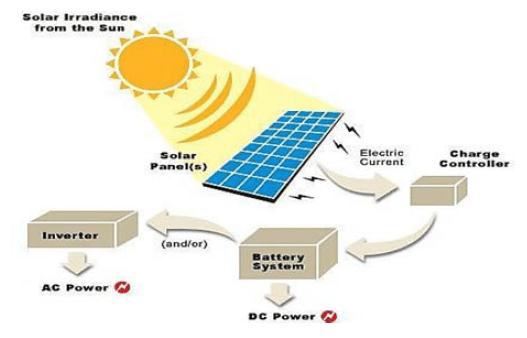
The functional and working needs designate components, which are included within the PV system [5]. The main components of the PV system as illustrated in Fig.1 are PV modules, MPPT-controller inverter, battery bank, and loads.
PV modules:
Fig.2. represents the picture of the SunPower 220W PV module.
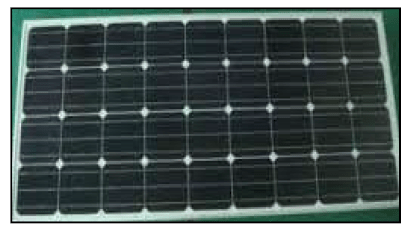
The specifications of SunPower 220W PV module are given in table1.
Table1. SunPower 220W PV module parameters.
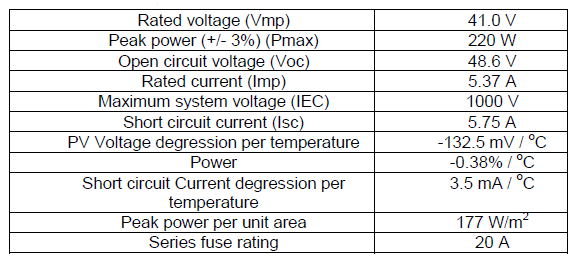
Electrical Data Measured under Standard Test Conditions (STC): Irradiance of 1000/m2, cell mass, and air temperature 25oC.
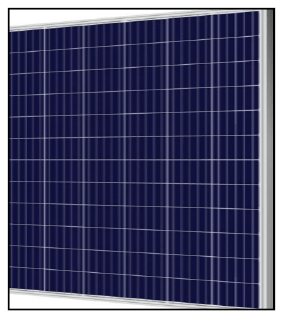
Fig.3. represents the picture of Renesola 220W PV module 156 series polycrystalline solar module. The specifications of Renesola 220W PV module are given in table2.
Table 2. Renesola 220W PV module parameters.
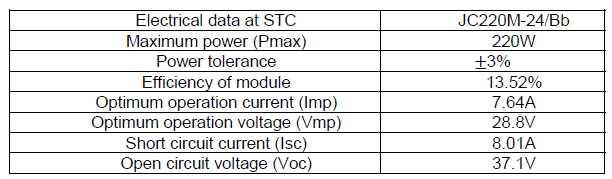
Values under standard test conditions STC (Irradiance 1000W/m2, Cell temperature 25oC, Air mass 1.5).
Battery type
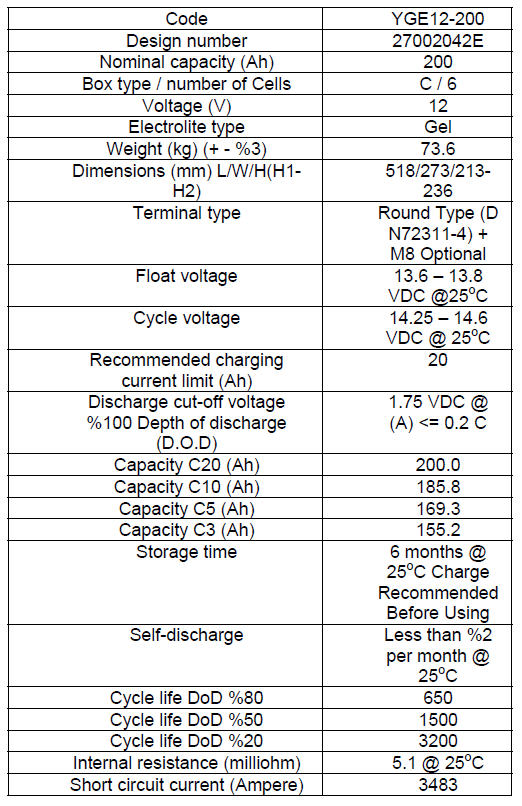
The battery type that used in this storage system is a 12V, 200Ah gel VRLA deep cycle. Fig. 4 represents the battery shape and its specifications are illustrated in table 3 [7]. Gel battery shows some discriminatory advantages, such as good recovery from deep discharge, high deep discharge capability, and super thermal stability even if this type of batteries are left discharged for 3 days, they will recover to 100% of capacity.
Table 3. Battery specifications
Inverter type
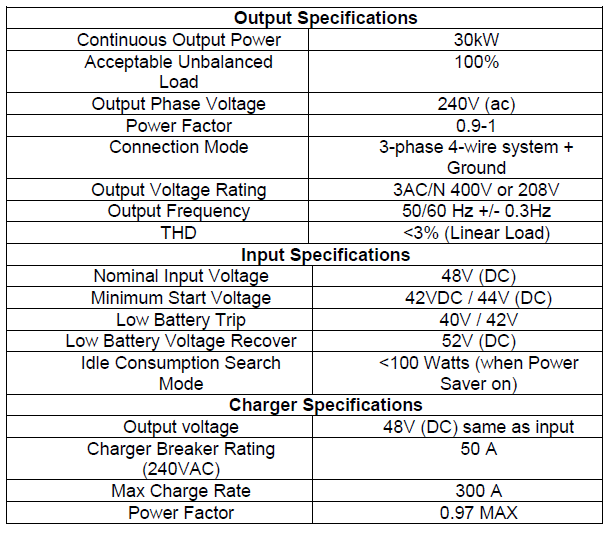
The inverter type that used is in this PV system is a 30kW model, in order to control DC to AC and connected with the grid (grid-tie).
The specifications of 30kW grid-tie three-phase inverter is given in table4.
Table 4. Three phase gird-tie 30kW inverter specifications
Array inclination
The position of PV modules usually facing the north in the southern hemisphere and the south in the northern hemisphere. Therefore, PV modules are fixed semper faces the sun at noon. In winter, an acuter angle tilting will increase the output while in summer the smaller angle will give more output.
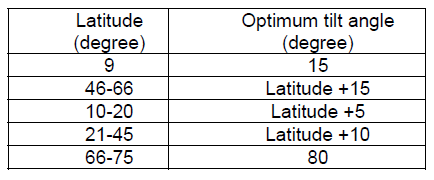
Table 5. Illustrates the optimum tilt angle at different latitude.
Table 5. Tilt angle of PV module
Designing and calculation of PV system (case study)
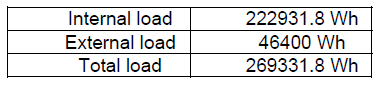
(NTPC) is a famous organization in the northern region of the country (India). The building called (NRHQ) of NTPC organization lie at Gomti Nagar. The total load of this building is given in table 6.
Table 6. Load of building
Flowchart and Methodology
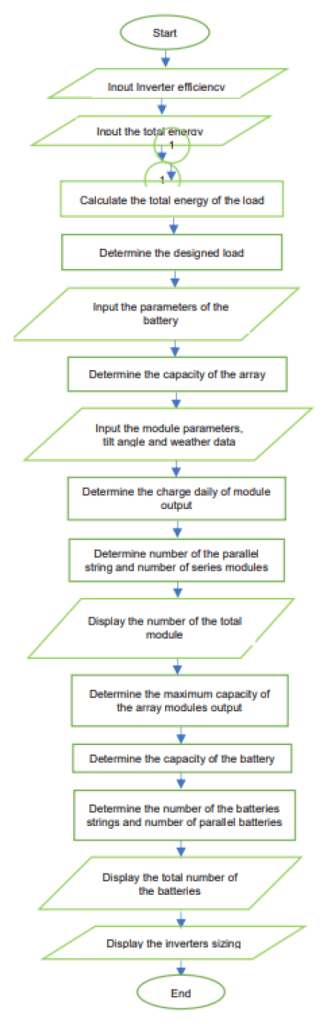
The mathematical procedures that used to design the solar PV system based Newzealand method is shown in Fig. 4.
Mathematical concept of solar PV system
In order to evaluate solar PV system, Newzealand design method has been used, a quick guide is used to calculate the total energy of any building, number of PV modules, number of batteries and inverter capacity. Solar PV systems come in a diversity of factors and a range of electricity generating capacities. At the first stage, the amount of total power that typically use and the number of hours of sunlight per day according to the location must be determined [9-17].
A- Conventional SunPower 200W PV module
PV sizing
Design load energy (Etotal)
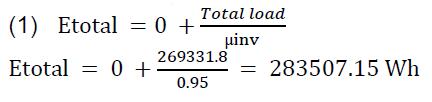
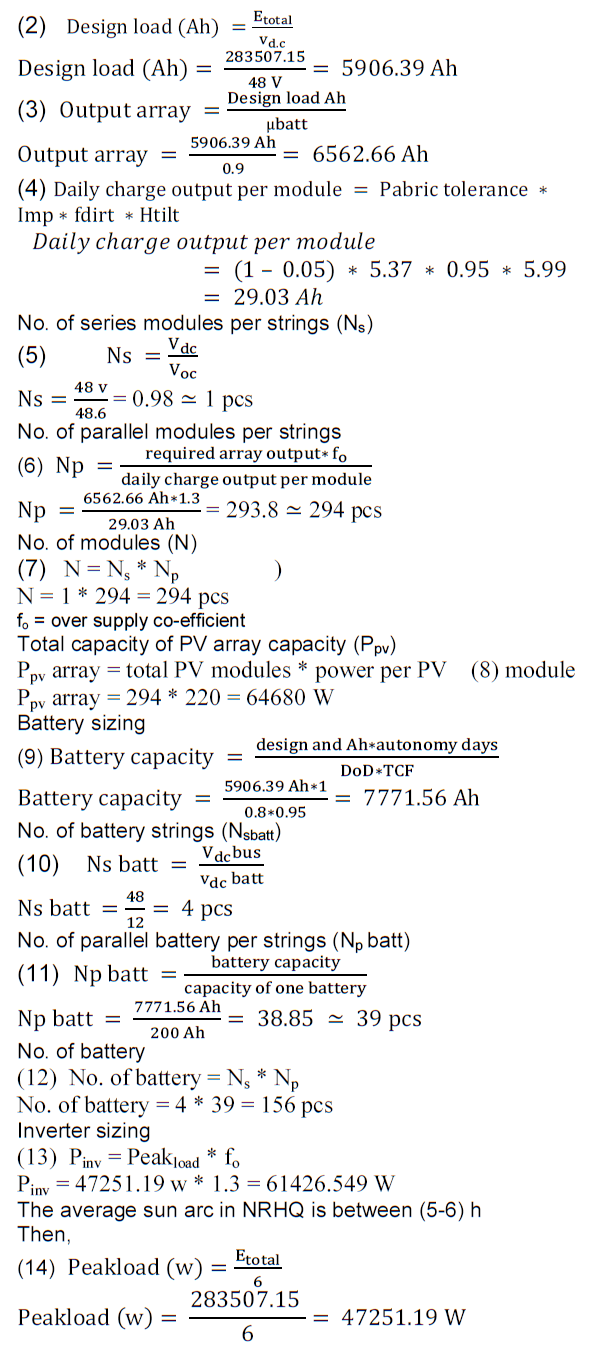
The elements of conventional PV system can be summarized as given in table 7.
Table7. Components of conventional PV system

B- Renesola polycrystalline solar module nano PV module (220W)
PV sizing
Design load energy (Etotal)
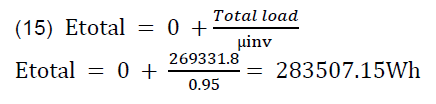
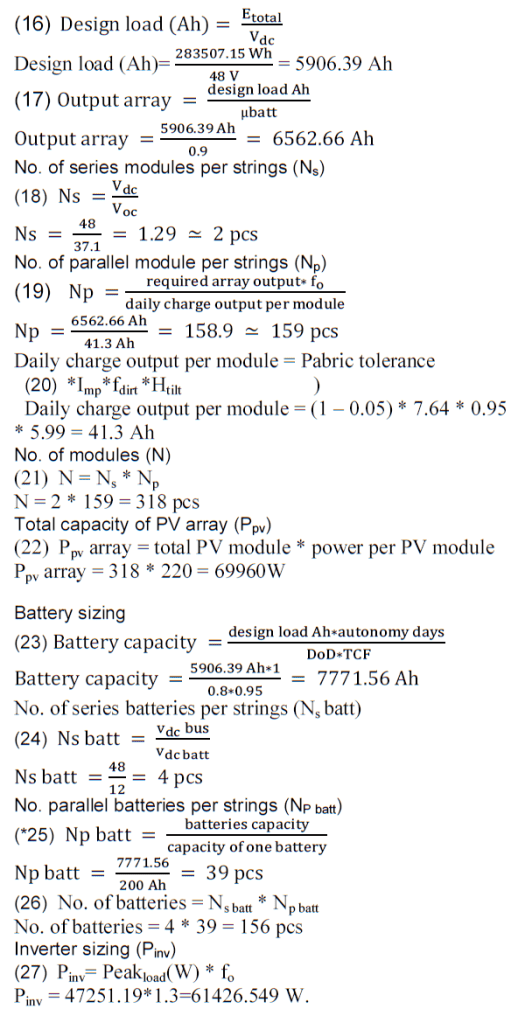
The elements of nano PV system can be summarized as given in table 8.
Table8. Components of Nano PV system

Conclusions
From the results, the number of nano PV modules are more than that the conventional PV modules, same batteries and inverter capacity for same grid-tie PV systems, Nano technology give mire efficiency working performance and low cost for same PV module power. The total cost for designing grid-tie nano PV system is more economical than that of conventional PV system due to less number of the battery bank, in spite of the increase number in PV modules but the batteries number have significant affect on the total cost. When the dirt factor and H tilt angle increases the number of parallel modules per string decrease. The capacity of the battery increases as the DoD decrease.
REFERENCES
1. M.N.Bandyopadhyay & O.P.Rahi, ”Non-Conventional Energy Sources”, Proceedings of All India Seminar on Power Systems: Recent Advances and Prospects in 21st Centure, AICTE, Jaipur, 17 February 2001, pp 1-3.
2. A. Dey, A. Tripathi, A Verma & A. Bandha, ”Analysis of Solar Photovoltaic (SPV) Systems for Residential Applicating”, National Journal of the IE(I), Vol. 87, May 06, pp 6-9.
3. Tracy Dahl, ”Photovoltaic Power Systems Technology”, White paper, http://www.polarpower.org, 2004, pp 1-33.
4. Angga Romana, Eko Adhi Setiawan & Icurnianto Joyonegoro, ”Comparison of Two Calculation Methods for Designing the Solar Electric Power System for Small Island”, E35 Web of Conference 67,02052 (2018), 3rd i-TREC 2018, pp 1-6.
5. http://www.sma.de/en/solutions/meduim-power-solutions/smasmart-home.html.
6. http://www.solarguru.com.au/PDFs/NG12-200.pdf.
7. https://www.yigitaku.com/wp-content/uploads/2018/07/12V-200Ah-Jel-Eng.pdf.
8. https://www.serveafri.com/products/60kw-solar-grid-tie-inverterthree-phase.
9. https://www.motherearthnews.com/renewable-energy/solarpower-systems-zmaz98onzraw.
10. Sarat Kumar Sahoo “Renewable and sustainable energy reviews solar photovoltaic energy progress in India: A review “, http://www.elsevier.com/locate/rser, Renewable and Sustainable Energy Reviews 59 (2016) 927–939.
11. Rupendra Pachauri, Om Prakash Mahela, Abhishek Sharma, Jianbo Bai, Yogesh K. Chauhan, Baseem Khan &Hassan Haes Alhelou, “Impact of Partial Shading on Various PV Array Configurations and Different Modeling Approaches: A Comprehensive Review”, DOI 10.1109/ACCESS.2020.3028473, IEEE Access.
12. Mohammed Yaqoot, Parag Diwan, Tara C. Kandpal, “Financial attractiveness of decentralized renewable energy systems – A case of the central Himalayan state of Uttarakhand in India”, Renewable Energy 101 (2017) 973e991.
13. Hamoodi SA, Hameed FI, Hamoodi AN. Pitch angle control of wind turbine using adaptive Fuzzy-PID controller. Mosul, Iraq: Northern Technical University (NTU), Engineering Technical College, EAI endorsed transactions on energy web; 2020 Jul.7. p. 1–8. 14.
14. Hamoodi SA, Hamoodi AN, Haydar GM. Automated Irrig Syst based soil moisture using arduino board. Bulletin of electrical engineering and informatics. Iraq: Northern Technical University (NTU), Engineering Technical College; 2020 June 3.p. 870–6.
15. Hamoodi AN, Hamoodi SA, Mohammed RA. Photovoltaic modeling and effecting of temperature and irradiation on I– Vand P–V characteristics. Northern Technical University (NTU),Engineering Technical College, Iraq. Int J Appl Eng Res India Publ. 2018;13(5):3123–7. http://www.ripublication.com.
16. Hamoodi AN, Hamoodi SA, Ibrahim MA. “Power factor correction of AC to DC converter using boost chopper.” Northern Technical University (NTU), Engineering Technical College, Iraq. J Eng Appl Sci. 2018;13(Special Issue 8):6440– 5.
17. Hamoodi AN, Hamoodi SA, Abdulla AG. “Photovoltaic-battery system tested under sun irradiance”. Northern Technical University (NTU), Engineering Technical College, Iraq. Lond J Eng Res. 2018;18(2):65–75.
Authors. Dr. Ali Nathim Hamoodi Northern Technical University (NTU)/Technical College of Engineering, Mosul-Iraq. Email: ali_n_hamoodi74@ntu.edu.iq.
Waseem Khalid Ibrahim Northern Technical University (NTU)/Technical College of Engineering, Mosul-Iraq. Email: waseem_kh82@ntu.edu.iq.
Aseel Thamer Ebrahem obtained her B.Sc. (2004) and M.Sc. (2014) in Computer Engineering Technology from Northern Technical University (NTU). Currently, she is working as assistant lecturer in Computer Engineering department, in Northern Technical University (NTU)/ Technical College of Engineering, Mosul-Iraq. Email: aseelthamer@ntu.edu.iq.
Source & Publisher Item Identifier: PRZEGLĄD ELEKTROTECHNICZNY, ISSN 0033-2097, R. 99 NR 2/2023. doi:10.15199/48.2023.02.65
 Power Quality Blog