Published by Sivaraman P, SMIEEE, PEng (India), Senior Power Systems Engineer Chennai, Tamil Nadu, India
We all know that Total Harmonic Distortion (THD) and Total Demand Distortion (TDD) are used to evaluate the presence of harmonics in the power system.
The “IEEE Std 1547-2018 IEEE Standard for Interconnection and Interoperability of Distributed Energy Resources with Associated Electric Power Systems Interfaces” and “IEEE Std 2800–2022 IEEE Standard for Interconnection and Interoperability of Inverter-Based Resources (IBRs) Interconnecting with Associated Transmission Electric Power Systems” provides another terminology called “Total Rated Harmonic Distortion (TRD)” for evaluating the presence of current harmonics in the Inverter Based Resources (IBR) plant or renewable power plants.
As per IEEE Std 1547-2018, TRD is defined as the total root-sum-square of the current distortion components (including harmonics and inter-harmonics) created by the DER unit expressed as a percentage of the DER rated current capacity (Irated).
As per IEEE Std 2800–2022, the non-fundamental frequency RMS current flowing (including harmonics, interharmonics, and noise) between the transmission system (TS) and the inverter-based resource (IBR) plant with respect to the rated RMS current capacity (Irated).
As per IEEE Std 1547-2018, the TRD can be calculated by using the below expression,
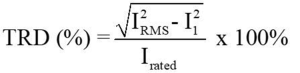
Where,
• I1 is the fundamental current as measured at the RPA
• Irated is the DER rated current capacity (transformed to the RPA when a transformer exists between the DER unit and the RPA)
• Irms is the root-mean-square of the DER current, inclusive of all frequency components, as measured at the RPA
As per IEEE Std 2800-2022, the TRD can be calculated by using the below expression,
Where,
• I1 is the fundamental-frequency current as measured at the RPA
• Irated is the IBR plant rated current capacity based on IBR plant MVA rating at the RPA
• Irms is the root-mean-square of the IBR plant current, inclusive of all frequency components up to 50th order, as measured at the RPA; measurement of harmonics to the 50th order requires meters compliant to IEC 61000-4-30 Class A
Note: RPA – Reference Point of Applicability. RPA shall be Point of Common Coupling (PCC) or any other location
Author: Sivaraman P, SMIEEE, PEng (India), Senior Power Systems Engineer Chennai, Tamil Nadu, India. LinkedIn Profile
Source URL: https://www.linkedin.com/feed/update/urn:li:activity:7081549632488538112/

