Published by 1. Jacek KUSZNIER, 2. Marcin SULKOWSKI, 3. Gabriela Druć, Bialystok University of Technology, Faculty of Electrical Engineering ORCID: 1. 0000-0001-8436-5717; 2. 0000-0002-3079-314X
Abstract. The issue of improving the energy efficiency of photovoltaic installations is very important due to the limited location options in public facilities. Therefore, this paper presents the possibilities of improving the efficiency of photovoltaic installations in such facilities using bifacial PV panels. An assessment of the energy yields and installation efficiency depending on the roofing used is made, together with an economic analysis of the effects of bifacial panels.
Streszczenie. Zagadnienie poprawy efektywności energetycznej w instalacjach fotowoltaicznych jest bardzo istotne ze względu na ograniczone możliwości lokalizacyjne w obiektach użyteczności publicznej. Dlatego też, w artykule przedstawiono możliwości poprawy wydajności instalacji fotowoltaicznych w tego typu obiektach przy zastosowaniu bifacjalnych paneli PV. Dokonano oceny uzysków energetycznych oraz wydajności instalacji w zależności od zastosowanego pokrycia dachowego wraz z analizą ekonomiczną skutków stosowania paneli bifacjalnych. (Poprawa uzysków energetycznych oraz wydajności instalacji PV przy wykorzystaniu paneli bifacjalnych w obiektach użyteczności publicznej).
Keywords: renewable energy sources, solar energy, PV panels, PV power plant.
Słowa kluczowe: odnawialne źródła energii, energia słoneczna, panele fotowoltaiczne, elektrownia fotowoltaiczna.
Introduction
Public buildings such as schools, kindergartens, etc. usually have similar geometry and are most often characterized by a flat roof. The issue of improving their energy efficiency can be achieved by using photovoltaic installations placed on the roof. Increasing the generation of photovoltaic power plants in limited roof space can be achieved by using bifacial modules. The effect of improving the efficiency of PV installations can be further increased by using roof coverings with a high reflectivity (albedo). This allows the investment payback period to be shortened, which is important for the investor.
Characteristics of bifacial photovoltaic panels
Bifacial photovoltaic modules, unlike monofacial ones, are characterized by double-sided absorption of solar radiation and conversion of it into electricity.
Bifacial technology assumes the use of solar radiation not only reaching directly, but also reflected and scattered to the greatest extent possible.
The largest share in energy production comes from radiation directly falling on the photovoltaic module. However, this is not the only type of radiation that affects the efficiency of a bifacial panel. Its double-sided nature uses not only the potential of sunlight scattered in the sky, but also the radiation reflected by the ground and the module’s surroundings.
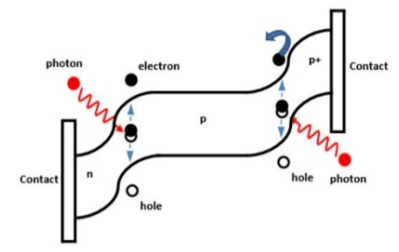
The internal structure of bifacial cells varies depending on the basic type of semiconductor [1-3]. The operation of a bifacial cell is shown in Fig. 1.
Changing the structure of the panels involves the introduction of additional parameters describing photovoltaic panels. In addition to the basic parameters characterizing traditional photovoltaic modules, these also include [4]:
– Bifacial Gain Energy
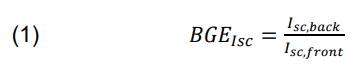
where: Isc,back – short-circuit current of the rear side of the module under STC conditions, Isc,front – short-circuit current of the front side of the module under STC conditions.
Practically, this is the value that determines the photon absorption capacity of the rear side of the bifacial module.
GE– irradiance value for measurements made using a lighting simulator [W/m2],

where: G0– irradiance of the radiation falling on the front side of the panel; Grear – irradiance of the radiation falling on the rear side of the panel
FFbi – filling factor of a double-sided cell

where: pFF – fill factor that does not take into account losses in series resistance, UOC,bi – open circuit voltage of a double-sided cell.
Radiation falling on bifacial PV panels
The production of electricity from photovoltaic sources is characterized by high variability, which results from the dependence on many environmental factors [5] and aging of PV panels [6]. Weather changes are very difficult to predict accurately [7]. It is easier to estimate the amount of energy that can be obtained over longer periods (e.g. monthly). The operating efficiency of photovoltaic power plants depends to the greatest extent on the used type of PV panels, their location, the used inverter and other system elements [8, 9].
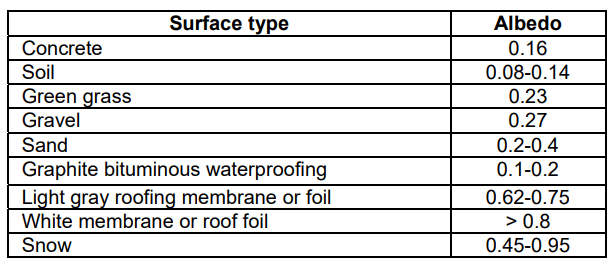
The amount of reflected radiation depends on the type of surface under the photovoltaic installation. The key parameter determining this phenomenon is the albedo coefficient (Table 1), which determines the ratio of the light reflected to the light incident on a given plane. The higher the value of the albedo coefficient, the more reflected rays reach the rear side of the bifacial module, which consequently leads to an increase in energy production by up to 30% compared to the monofacial module. A comparison of the power achieved by different types of photovoltaic installations is shown in Fig. 2.
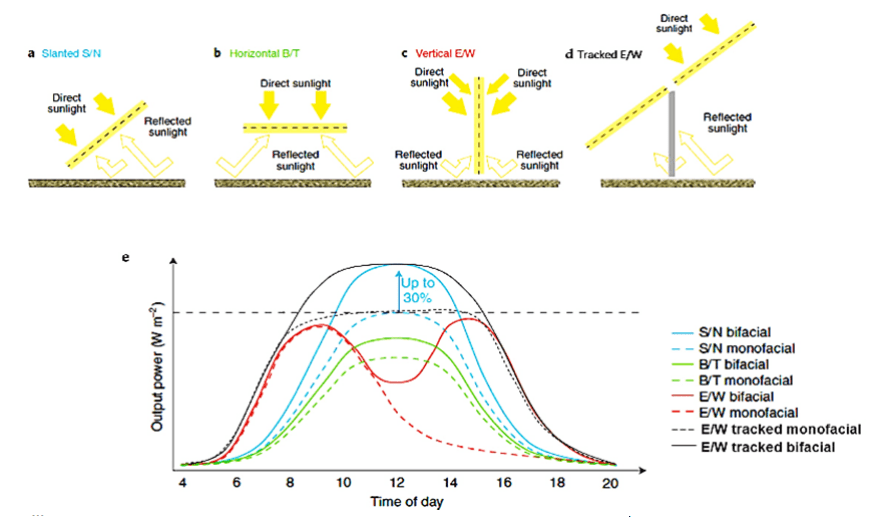
Table 1. Albedo coefficient of selected surfaces
Assumptions of the analysed PV installation
The analysed installation will be located on a building with a flat roof measuring 50×20 m and 10 m high. The roof area is 1,000 m2 . The geometry of the facility is typical for public utility facilities such as schools, kindergartens, etc. The building is located in north-eastern part of Poland in Bialystok, installation orientation to the south – azimuth 0°, module inclination angle is 15°, power of installation PV is 50 kW, inverter with power P=50 kW (type: Huawei – SUN2000-50KTL-M3). The installation will be mounted on a supporting construction with a ballast load adapted to the specific type of modules.
The variable elements in the analysis are the type of PV modules. The following will be compared in terms of energy yields:
– monofacial monocrystalline panel manufactured by Longi Solar, P= 500 Wp – catalogue no. LR5-66HIH500M,
– bifacial monocrystalline panel manufactured by Longi Sola, P= 500 Wp, catalogue no. LR5-66HBD-500M Bifacial.
Table 2. Parameters of PV panels [10-12]

Analysis of energy yields and efficiency of selected variants of PV installations in public facilities
The following variants will be analysed:
• Variant 1. Photovoltaic installation with monofacial modules on a standard structure and on a roof made of graphite bituminous waterproofing,
• Variant 2. Photovoltaic installation with bifacial modules on an elevated structure and on the roof made of graphite bituminous waterproofing (albedo = 0.2),
• Variant 3. Photovoltaic installation with bifacial modules on an elevated structure and on a roof made of green bituminous waterproofing (albedo = 0.45),
• Variant 4. Photovoltaic installation with bifacial modules on an elevated structure and on a roof made of grey bituminous waterproofing (albedo = 0.75),
• Variant 5. Photovoltaic installation with bifacial modules on an elevated structure and on a roof made of white membrane or roof foil (albedo = 0.95),
In all analysed variants, the power of photovoltaic installation was P= 50 kW. The installation includes 100 modules with a power of 500 W each. The system was divided into 5 strigs of 20 photovoltaic modules, taking into account the electrical input parameters of the inverter. The considerations assume that the installation power is limited to the value for which only notification to the DSO is required, without the need to change the connection capacity for typical public utility facilities. educational.
A 3D-model was created for all design situations, after by analysing the dimensions of the building and the number of modules and strings. The photovoltaic system was divided into 10 rows of 10 panels each. The rows were spaced 4 meters gap to minimize the shading of the panels. The prepared model allowed for the analysis of energy yields and system efficiency in all indicated design variants.
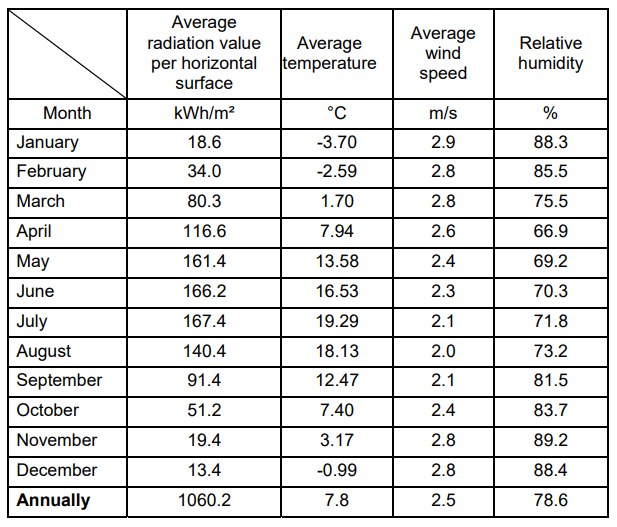
Meteorological data at the workplace of the analysed PV installation are presented in Table 3.
Table 3. Meteorological data
The results of the simulations of individual variants allowed for a detailed comparative analysis of energy yields and the efficiency of photovoltaic installations using monofacial and bifacial modules. The irradiation values on both sides of the PV modules depending on the surface albedo value are presented in Fig. 3
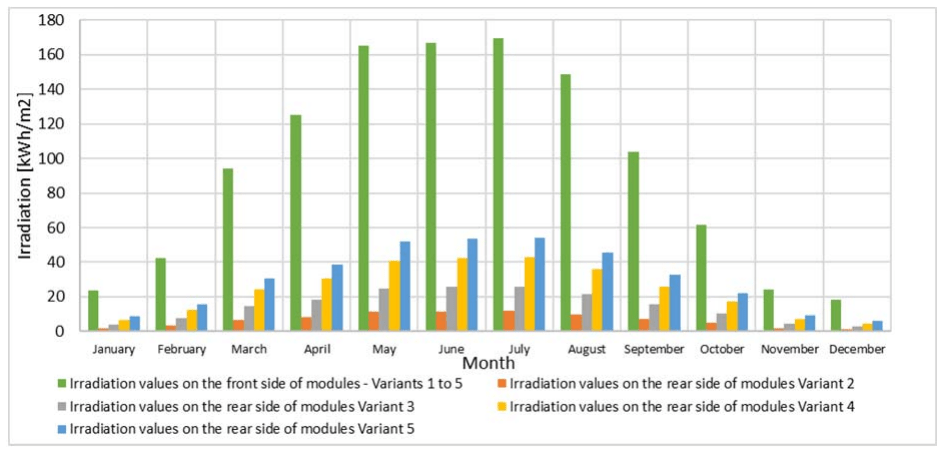
Green columns show the irradiation values on the surface of monofacial modules and on the front side of bifacial modules. The columns in the remaining colors show the irradiation value on the rear surface of bifacial modules in each variants. The most advantageous of the analysed variants allows for the introduced into grid additional energy in the amount of 9,824 kWh, i.e. 19% more in relation to the use of single-sided modules. The annual energy introduced into the grid of all analysed variants and percentage values in relation to the use of single-sided modules are presented in Fig. 5 and Fig. 6.
The key value of the analysis is the PR factor (Performance Ratio) of the efficiency of the tested photovoltaic installations. It is a general indicator for comparing systems: the higher its value- the more efficient the installation.

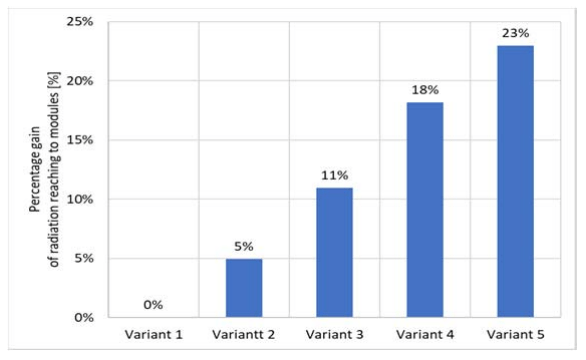
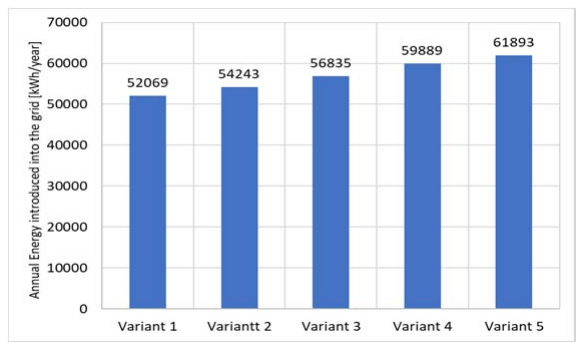


Table 4. Costs of constructing photovoltaic installations in the analysed variants

Important information is also the annual distribution of electricity forecast to be introduced into the power grid. Graphs of the energy forecast to be introduced into the power grid in the following months for all analysed variants are presented in Fig. 8.
The analysis shows that in the winter period (November – February) the amount of energy produced in the installations is very similar. This is the result of a small number of sunny days and a short period of exposure to the Sun. It is also necessary to take into account the possibility of snow cover, which eliminates the possibility of producing energy from the front of the PV modules, and at the same time increases the albedo value of the ground, which increases the amount of energy generated from the rear surface of the PV module. The advantage of using bifacial modules with the simultaneous use of roof coverings with a high albedo coefficient is most visible in the period from early spring to autumn. However, the basic criterion for selecting the type of installation should be economic analysis. Due to frequent changes in the methods of settling electricity from PV installations and unstable electricity prices, the payback period method was used for analysis.
The costs of implementing the PV installation in the analysed variants are presented in Table 4, but the costs do not include the costs of roofing, as it is assumed that roofing is included in the costs of the building. The total cost of installation using bifacial modules and a dedicated supporting structure is 7.75% higher than the base version with single-sided modules.
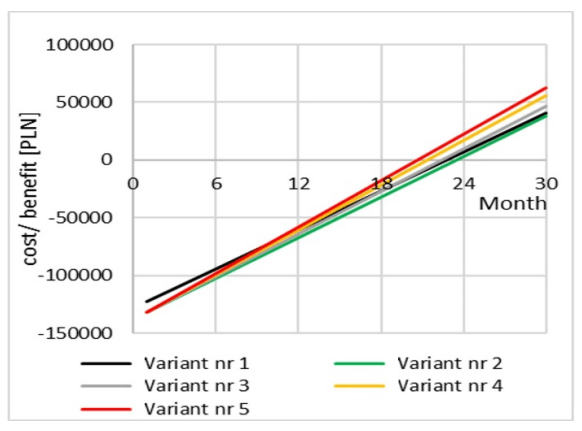
A graph showing the payback period for the installation in all design variants is shown in Figure 9, with the energy price per 1 kWh being PLN 1.3 for the purposes of the analysis.

Summary
A PV installation using bifacial panels requires a supporting structure that allows the panels to be raised to a higher height. Taking into account the higher price of bifacial panels, the cost of the entire 50 kW installation is 7.5% higher than the base variant. The payback period for monofacial and bifacial installations on graphite and green felt differs by only 1 month and is approximately 22.5 – 23.5 months. In the case of a roof slope with an albedo coefficient above 0.75, the payback time for a bifacial installation is 20.5 months. These values indicate that when it is possible to use roofing with a high albedo coefficient during the construction or renovation of a public utility facility, the installation of bifacial modules on a raised structure is most justified.
The benefits in terms of increasing energy generation reach approximately 20% and are highly dependent on the ground albedo. Installations with bifacial modules allow for the greatest additional yields when located on buildings with a flat roof, which corresponds to the typical geometry of public buildings. The use of bifacial modules also increases the possibilities in terms of how to arrange the modules. For example, positioning bifacial modules vertically in the east-west direction allows for the extension of the daily generation time, which allows for better adjustment to the recipient’s demand curve. Thanks to this, it is possible to achieve a higher level of self-consumption and reduce the size of the potentially needed energy storage.
Acknowledgment -Funding: This research was funded by the Bialystok University of Technology as part of the work WZ/WEIA/3/2023.
REFERENCES
[1] Chowdhury A. A., Design, Modeling, Fabrication & Characterization of Industrial Si Solar Cells, Published by ProQuest LLC (2017).
[2] Kopecek R.; Libal J., Bifacial Photovoltaics 2021: Status, Opportunities and Challenges. Energies 2021, 14, 2076. https://doi.org/10.3390/en14082076
[3] Kopecek R., Libal J., Towards large-scale deployment of bifacial photovoltaics. Nat Energy 3, 443–446 (2018). https://doi.org/10.1038/s41560-018-0178-0
[4] Kurz D., Lewandowski K., Szydłowska M., Analiza uzysku energii z fotowoltaicznych ogniw bifacjalnych. Część 1 – budowa i parametry ogniw bifacjalnych, Poznan University of Technology Academic Journals. Electrical Engineering, 2018, 215-223
[5] Kusznier J., Influence of Environmental Factors on the Intelligent Management of Photovoltaic and Wind Sections in a Hybrid Power Plant. Energies 2023, 16, 1716. https://doi.org/10.3390/en16041716
[6] Kusznier J., Wojtkowski W., “Impact of climatic conditions and solar exposure on the aging of PV panels,” 2019 15th Selected Issues of Electrical Engineering and Electronics (WZEE), Zakopane, Poland, 2019, pp. 1-6, doi: 10.1109/WZEE48932.2019.8979821.
[7] Drałus G.; Mazur D.; Kusznier J.; Drałus J., Application of Artificial Intelligence Algorithms in Multilayer Perceptron and Elman Networks to Predict Photovoltaic Power Plant Generation. Energies 2023, 16, 6697. https://doi.org/10.3390/en16186697
[8] Alhmoud L., Why Does the PV Solar Power Plant Operate Ineffectively? Energies 2023, 16, 4074. https://doi.org/10.3390/en16104074
[9] Rusănescu C.O.; Rusănescu M.; Istrate I.A.; Constantin G.A.; Begea M., The Effect of Dust Deposition on the Performance of Photovoltaic Panels. Energies 2023, 16, 6794. https://doi.org/10.3390/en16196794
[10] Jinko Solar, Transparent backsheet vs dual glass – Advantages and disadvantages, PV-tech website, 2020.
[11] LR5-66HIH-490~510M datasheet, en.longi-solar.com
[12] LR5-66HBD-475~500M datasheet, en.longi-solar.com
Authors: Jacek Kusznier, Faculty of Electrical Engineering, Bialystok University of Technology, Bialystok, Poland, E-mail: j.kusznier@pb.edu.pl.
Marcin Sulkowski, Faculty of Electrical Engineering, Bialystok University of Technology, Bialystok, Poland, E-mail: m.sullkowski@pb.edu.pl.
Gabriela Druć, Faculty of Electrical Engineering, Bialystok University of Technology, Bialystok, Poland
Source & Publisher Item Identifier: PRZEGLĄD ELEKTROTECHNICZNY, ISSN 0033-2097, R. 100 NR 7/2024. doi:10.15199/48.2024.07.36
 Power Quality Blog