Published by Adnan M Al-Smadi, Tariq M Alrjoub, Yarmouk University, Hijjawi Faculty for Engineering Technology, Jordan ORCID:000-0003-3796-6805X
Abstract. For the last several years, the demand for electricity in Jordan has increased. This increase is due to the change of climate conditions and high temperatures, which led to the increase of the use of air conditioning units. One important issue in energy consumption is the use of energy in street lighting. This paper aims to study and re-evaluate the current standard road lighting structures and schemes in Jordan within Jordanian recommendations. The study included a survey of the streets in those areas have shown that lighting units show heavy use of mercury lamps units.
Streszczenie. Od kilku lat zapotrzebowanie na energię elektryczną w Jordanii wzrosło. Wzrost ten wynika ze zmiany warunków klimatycznych oraz wysokich temperatur, które doprowadziły do wzrostu wykorzystania urządzeń klimatyzacyjnych. Istotną kwestią w zużyciu energii jest wykorzystanie energii w oświetleniu ulicznym. Celem tego artykułu jest zbadanie i ponowna ocena obecnych standardowych konstrukcji i systemów oświetlenia drogowego w Jordanii w świetle jordańskich zaleceń. W ramach badania dokonano przeglądu ulic na tych terenach, które wykazały, że w instalacjach oświetleniowych występuje duże zużycie lamp rtęciowych. (Rozważania dotyczące oszczędzania energii i wymiany lamp oświetlenia ulicznego na jordańskich drogach)
Keywords: Energy Savings, High Pressure Sodium (HPS) Lamps, Illuminance, Luminance, Luminous Intensity, Street Light Standards
Słowa kluczowe: Oszczędność energii, wysokoprężne lampy sodowe (HPS), natężenie oświetlenia, luminancja, natężenie światła,
1. Introduction
For the last several years, the demand for electricity in Jordan has increased. This increase is due to the change of climate conditions and high temperatures, which led to the increase of the use of air conditioning units [1]. One important issue in energy consumption is the use of energy in street lighting. The huge amount of energy and cost associated with street lighting has raised the need to investigate the cost issues [2, 3].
Energy efficiency and energy consumption for street lighting can be reduced by considering the replacement of the inefficient lamps such as high pressure mercury (HPM) lamps with more efficient high pressure sodium (HPS) lamps. The literature on high pressure sodium lamp is rich and remain attractive as it has high efficiency light sources [4]. New HPS lamps have been designed to replace existing HPM lamps for several types of HPM ballasts. Fokui et. al. [5] proposed an adoption of solar streetlights with enhanced energy management capabilities to replace the conventional lamps in lighting the streets in major cities.
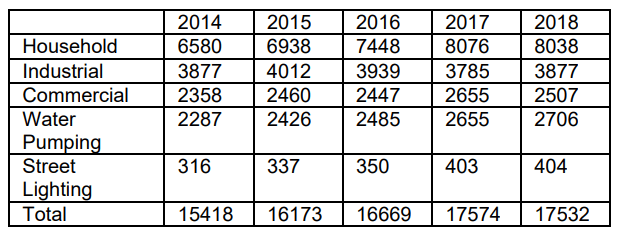
The Jordanian local energy resources are very limited. Due to lack of energy sources, Jordan depends on imports to fulfill its needs. Jordan currently imports more than 95% of the total energy consumed [6]. In 2017, the demand for electricity had increased up to 5%. Public street lights in Jordan constitute (2-3)% of the overall electricity consumption [1, 7]. Table 1 shows the sectoral distribution of electricity consumption in Gigawatt-hour (GWh) in Jordan during 2014-2018 [1]. Therefore, it is an important subject to study the possibilities of reducing the electricity consumed in lighting the streets. Studies concluded that street-lighting is an important factor of safety during the time of darkness [8].
In general, street-lighting systems can be measured using different techniques. However, the illumination technique is used mostly for this purpose because the data can be obtained more accurately than the other methods [9]. The Illumination method needs measurements data of illuminance values at desired locations on roadway.
Luminance is a term describes the measurement of the amount of light passing through an object. It indicates how much luminous intensity can be sensed by the human eye; i.e., the brightness of light emitted or reflected off a surface. On the other hand, illuminance is a term that describes the measurement of the amount of light (or light flux) that falls and spreads over a given surface at a certain distance from the light source [10].
Table 1. Sectoral distribution of electricity consumption (GWH) in Jordan during 2014-2018.
When the outdoor lighting is designed, the designer must consider several factors. One of these factors is the type of area such as residential street, roadway, parking lot, and pedestrians. Other factors include traffic lights, the amount and speed of traffic, and glare from oncoming traffic. These factors help determine which lighting category the area falls into. The category defines the amount of light and uniformity that the lighting installation must provide at all times. When the category has been determined, the pole heights, luminaire and lamp type must be chosen and a maintenance factor must be determined [11].
This paper aims to study and re-evaluate the current standard road lighting structures and schemes in Jordan within Jordanian recommendations. Several methods were used to reduce the power consumed in lighting different Jordanian roads in the areas of Greater Amman Municipality and Irbid. The study included a survey of the streets in those areas have shown that lighting units show heavy use of mercury lamps units. A comparison was made in lighting units for these roads.
The paper is organized as follows. In Section 2, street lighting system design considerations are discussed. Section 3 presents the methodology and illumination techniques. In Section 4, measurements and calculations of the illuminance of lighting units are presented. Section 5 presents the operational cost using the cost-discount method. Concluding remarks are presented in Section 6.
2. Street Lighting System Design Consideration
Street lighting system design is the design of street lighting such that people can travel safely when it gets dark on the road, and continue their travels to reach their destination. Street lighting schemes provide sufficient light during the night for people to see important objects required for traveling on the road. The design of street lighting is an important issue for several reasons such as reduce the risk of night-time accidents, discourage vandalism and crimes, and gives a sense of secured environment for habitation. Several studies showed that street lighting reduces crash rate during the night-time for an average of 35% [9].
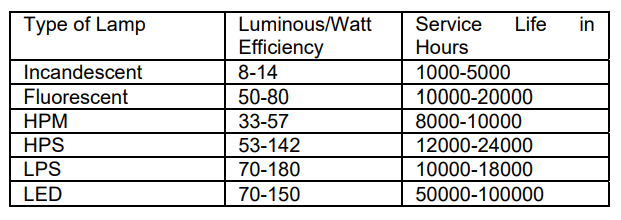
Street lighting can be classified based on the installation area as: lighting for subsidiary roads, lighting for traffic routes, and lighting for urban centers and public amenity areas [12]. In addition, they can be categorized according to the kind of lamp used such as: High Pressure Mercury (HPM), High Pressure Sodium (HPS) lamp, Low Pressure Sodium (LPS) lamp, High Intensity Discharge (HID) lamp, etc. Different types of lamps used in street lighting design are listed in Table 2 [12, 13].
Table 2. Light technology comparison based on luminous efficiency and lamp service life
3. Methodology
Illumination technique is used mostly for evaluating the street-lighting situation. Any illumination measurement technique needs to evaluate illuminance values at desired points. In order to proceed in this study, the following tools were necessary to be available: 1) Light Meter 2) Odometer which measures the distance 3) Computation device such as iPad or laptop.
The light meter is an important tool in is this system. The selection of the suitable light meter was based on the following criterion:
i) Portability: the system needs to be mobile.
ii) High accuracy: the system needs to have high precision specifically at low levels since the light-meter is required to evaluate illuminance levels of street-lighting at desired points.
iii) Connection to Computer: The light-meter should be able to communicate with the computation device to store, manage, and use the collected data. The illuminances of the lighting units were obtained using the DIALux lighting software [17].
In taking the measurements and performing the calculations, the output data of the street lighting study should include [15]:
1) Mounting height of the luminaire
2) Distance between adjacent poles (luminaires)
3) Luminaire overhang.
4) Luminaire tilt angle
In light measurement, one must distinguish between various quantities such as illuminance, luminance, luminous intensity, and luminous flux.
3.1 Luminous flux: it is a measure of the total amount of light emitted by a light source. The internationally standardized unit (SI) of luminous flux is the lumen (lm). It indicates how much light is emitted by light source in all directions. The lumens of a luminaire give information about the brightness of the luminaire
3.2 Illuminance: it is the total luminous flux incident on a surface, per unit area. It is a measure of the intensity of the incident light, wavelength-weighted by the luminosity function to correlate with human brightness perception [14]. The SI unit of illuminance is the lux (lx).
One lux (lx) = lm/m2
3.3 Luminous Intensity: it is a measure of the wavelength-weighted power emitted by a light source in a particular direction per unit solid angle. It describes the radiation of the emitted light in a certain direction. Therefore, it indicates how much the light is concentrated. The SI unit of luminous intensity is the candela (cd). The candela (cd) is the ratio of lumen to radiation angle (lm/sr). The radiation angle is measured by steradians (sr).
3.4 Luminance: it is a measure of the impression of brightness of a surface received by the human eye. It describes the amount of light that passes through or is emitted from a particular area, and falls within a given solid angle. The SI unit for luminance is candela per square meter (cd/m2).
4. Measurements and Calculations
In this study, several measurements were taken at different places with different parameters. Table 3 presents the illuminance of lighting units for street lighting using high pressure sodium (HPS) lamps of 250 W with pole height of 9 meters, boom length of 3 meters, and boom angle of 5 degrees. The illuminances of these lighting units were obtained using the DIALux lighting calculation software [20]. These measurements were taken for the Twin Central Installation type in Figure 1.
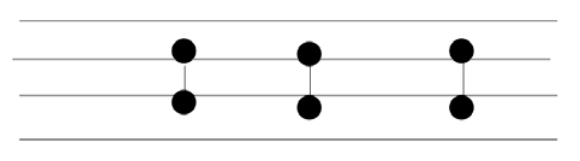
Table 3. The illuminance of lighting units for street lighting using HPS [250W, 9M, 3M, 5°].
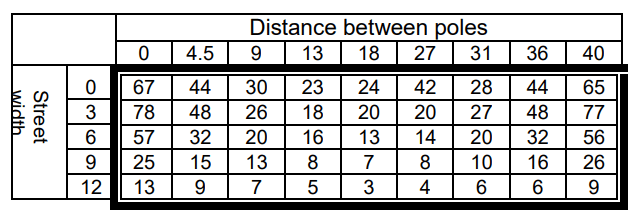
Table 4. The illuminance of lighting units for street lighting using HPS [250W, 12M, 3M, 5°].
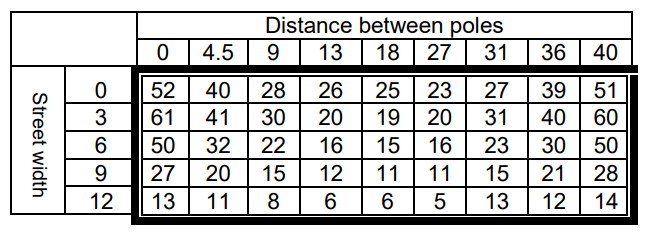
Measurements were repeated for the same values except for the height of the pole which becomes 12 meters. Table 4 presents the illuminance of lighting units for street lighting using HPS lamps of 250 W with pole height of 12 meters, boom length of 3 meters, and boom angle of 5 degrees.
5. Operational Cost Using the Cost-Discount Method
Cost-discount method is an economic analysis based on the result of the tests concerning the life time and the lamp lumen maintenance factor of electronic compact lamps. The method is applied in this research for the economic comparison of high pressure sodium (HPS) lamps in road lighting. In this study, total costs include the initial and maintenance costs within the same period.
The initial cost includes the cost of the equipment such as poles, bulbs, and related materials as well as the cost of evaluating the proposed lighting system.
The initial cost (Cin) is computed using the following equation [16].
(1) Cin = Np [Cp + Cb + K (Cl + M Cl.s. + Cwi) + Cwp]
where:
Np: is the number of poles along a considered road section,
Cp: price of the pole with the necessary equipment and accessories
Cb: price of a single or twin bracket,
K: number of luminaires per pole,
Cl: price of the luminaire,
M: number of bulbs per luminaire,
Cl.s: price of bulb,
Cwi: cost for the luminaire installation,
Cwp: cost for the post (pole) installation.
The annual electricity cost (Ce) can be calculated using the following equation:
(2) Ce = K NpCle
where: Cle: the yearly electricity cost per luminaire, which can be calculated using the following equation:
(3) Cle = M Pl T Cc
where: Pl: the power of the lamp (in kW), T: yearly lamp operation time (4000 h was used), Cc: electricity cost rate (0.052 JD/kWh was used).
Table 5 shows the parameters necessary to calculate initial cost and the annual electricity cost for different HPS powers; namely at 12-meter pole height, a boom angle of 5 degrees, 150W, 250W, and 400W.
The total cost is the sum of the initial cost (Cin) and the annual electricity cost (Ce) for the 10 years. That is
(4) Ctotal = Cin + Ce
Example: To calculate the total cost as shown in Equation (4), for 250W HPS lamp, Using
Equation 1 and Table 5
Cin = Np [Cp + Cb + K (Cl + M Cl.s + Cwi) + Cwp]
= 50[400+100+2(100+1(7) +10) + 200]
= 46700 JD
Using Equation 2 and Table 6
Ce = K NpCle = 2(50) (Cle)
Using Equation 3
Cle = M Pl T Cc = 1(0.275) (4000) (0.052) = 55 JD/luminaire
Now, Ce = K NpCle = 2(50)( 55)=5500 JD
The annual electricity cost (Ce) for the 10 years= 5500(10) = 55000 JD
Therefore, the total cost is
Ctotal = Cin + Ce
= 46700 + 55000
= 101700 JD
The same steps are taken to calculate the total cost in Equation (4), for 400W HPS lamp,
Ctotal = Cin + Ce = 141000
The cost analysis saving in going from 400 W HPS to 250W HPS is,
Saving = Ctotal(400W) – Ctotal(250W)
= 141000 – 101700 = 39300 JD
Percentage saving = (141000 – 101700) / 141000
= 27.8 %
Table 5. Parameters needed to calculate initial cost and the annual electricity cost.
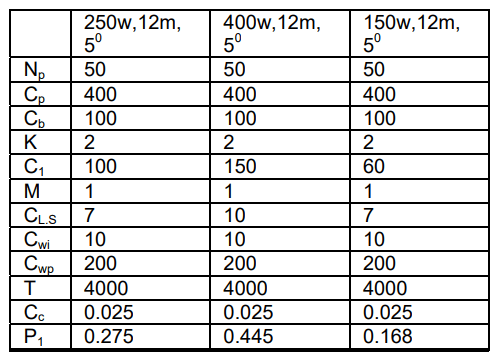
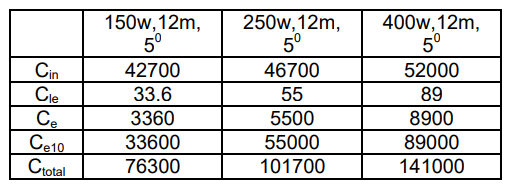
The operational costs (Cin), (Cle), (Ce), (Ce10), and (Ctotal), are shown in Table 6 for different levels of HPS powers; namely at 12-meter pole height, a boom angle of 5 degrees, 150W, 250W, and 400W.
Table 6. The operational costs (Cin), (Cle), (Ce), (Ce10), and (Ctotal) for different HPS and poles.
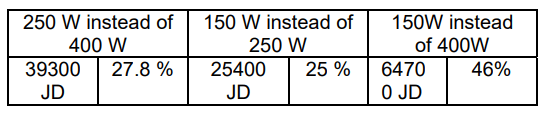
The cost analysis values for different HPS powers are calculated in the same manner as above and is shown in Table 7.
Table 7. The cost analysis saving for different HPS.
Notice that replacing Mercury street lighting unit (125W) with HPS unit (70W) in the road will save power 55W for each lighting unit. The reduction of the illumination level stays within the standards of the illuminance level of street lighting units.
In addition to the above reduction in power consumption, decreasing the street lighting units from 2 to 1 unit for each pole as shown in Figure 2, will reduce the power consumed to 50%. However, the illumination level will be reduced to (30-50)% which stays within the standards of the illuminance level of street lighting units.
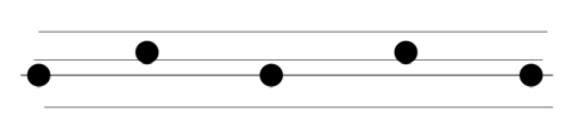
Furthermore, using LED street lighting units will save around 50% of the power consumption for other types of lighting units with operation hours of around 50000-100000. However, the initial cost is much larger than other types of lighting units.
6. Conclusion
This paper presented a study to reduce the energy consumption and demand for electricity circulating through the use of street lighting lamps in Jordan. Namely, the street lighting study was performed in the areas of the Greater Amman Municipality and Irbid. The study included a survey of the streets in those areas have shown that lighting units show heavy use of mercury lamps units.
The illuminance of lighting units for street lighting was measured for different high pressure sodium (HPS) lamps, different pole heights, different boom length, and different boom angle degrees. The illuminances of these lighting units were obtained using the DIALux lighting software. These measurements were taken for the Twin Central Installation. Table 3 shows an example of the measurements of illuminance of lighting units for street lighting using HPS lamps of 250 W with pole height of 9 meters, boom length of 3 meters, and boom angle of 5 degrees.
Several measurements with various parameters were taken and implemented in the cost analysis. Measurements were taken at different levels of HPS powers, different pole heights, and different boom angles. Table 6 shows an example of calculating the operational cost at 12-meter pole height, a boom angle of 5 degrees, and HPS powers of 150W, 250W, and 400W.
The Cost-discount method shows a very good reduction and saving in energy consumption. Table 7 presents the cost analysis saving for different HPS. As a result, replacing Mercury street lighting units with HPS units will have a considerable reduction in power consumption. However, the reduction of the illumination level stays within the standards of the illuminance level of street lighting units.
REFERENCES
[1] Annual Report 2019-2020, Jordanian Ministry of Energy and Mineral Resources, Jordan, 2020.
[2] A. Al-Smadi, Salam Salah, Areen Al-Momani, and Majd AlBataineh, “Intelligent Street Lighting Energy Saving System Based on Climate Conditions and vehicle’s Movements,” Jurnal Kejuruteraan (Journal of Engineering), vol. 33, no. 1, pp. 151-157, 2021.
[3] A. Al-Smadi, Salam Salah, Areen Al-Moomani, and Majd AlBataineh, “Street Lighting Energy-Saving System” 16th IEEE International Multi-Conference on Systems, Signals & Devices (SSD19), Istanbul, Turkey, pp. 763-766, March 21-24, 2019.
[4] Jan Mucko, “Properties of high-pressure sodium lamp by different supply methods”. Przeglad Elektrotechniczny, vol. 93, no.8, pp.155-158, 2017.
[5] Willy S.T. Fokui, Michael Saulo, and livingstone Ngoo, “Climate Change Mitigation in Cities by Adopting Solar Streetlights with Energy Management Capabilities: Case of Nairobi”, IEEE 21st Mediterranean Electrotechnical Conference, Palermo, Italy, 14-16 June 2022.
[6] United Nation, “Case Study on Policy Reforms to Promote Renewable Energy in Jordan”, Energy Section of the Economic and Social Commission for Western Asia (UN ESCWA), United Nations Publication issued by ESCWA, United Nations House, Beirut, Lebanon, 2018.
[7] Annual Report 2017, Jordanian Ministry of Energy and Mineral Resources, Jordan, 2017.
[8] Huaguo Zhou, Fatih Pirinccoglu, and Peter Hsu, “A New Roadway Lighting Measurement System,” Transportation Research Part C Emerging Technologies, vol. 17, no. 3, pp.274-284, 2009.
[9] Huaguo Zhou, Jiguang Zhao, Peter Hsu, and Pei-Sung Lin, “A New Method to Evaluate Roadway Lighting Systems and Its Safety Effects,” ITE 2010 Annual Meeting and Exhibit, Vancouver, BC, Canada, Volume: Paper Number – AB10H283, August 2010.
[10] Mehmet Kayakus and Ismail Serkan Unci, “Luminance and illuminance analysis of roads using image processing technique,” Przeglad Elektrotechniczny, vol. 86, no. 10, pp. 283-285, 2010.
[11] John Bullough, MS Rea, and Y Akashi, “Several views of metal halide and high pressure sodium lighting for outdoor applications.” Lighting Res. Technology, vol. 41, no. 4, pp. 297-320, 2009.
[12] The SLL Lighting Handbook, CIBSE, London, The Society of Light and Lighting, 2018.
[13] Rohaida Husin, Syed Abdul Mutalib Al Junid, Zulkifli Abd Majid, Zulkifli Othman, Khairul Khaizi Md Shariff, Hadzli Hashim, and Mohd Faisal Saari, “Automatic Street Lighting System for Energy Efficiency based on Low Cost Microcontroller”, International Journal of Simulation: Systems, Science and Technology, vol. 13, no.1, pp 29-34, 2012.
[14] Eric T. Donnell, Richard J. Porter, and Venkataraman N. Shankar, “A framework for estimating the safety effects of roadway lighting at intersections”. Safety Science, vol. 48, Issue10, pp. 1436-1444, 2010.
[15] Miomir Kostic, Lidija Djokic,Dejan Pojatar, Natasa StrbacHadzibegovic, “Technical and economic analysis of road lighting solutions based on mesopic vision”, Building and Environment, vol. 44, pp. 66-75, 2009.
[16] Topalis F, Kostic M, Radakovic Z. “Advantages and disadvantages of the use of compact fluorescent lamps with electronic control gear”. Lighting Research and Technology, vol.34, pp. 279–88, 2002.
[17] DIAL, DIAlux software user manual, Version 4.9, DIAL GmbH, Lüdenscheid, 16th Edition, 2011.
Authors: prof. dr Adnan M Al-Smadi, Yarmouk University, Hijjawi Faculty for Engineering Technology, Department of Electronics Engineering, Irbid, Jordan, E-Mail: smadi98@yu.edu.jo; Mr. Tariq M Al Rjoub, Yarmouk University, Hijjawi Faculty for Engineering Technology, Department of Electronics Engineering, Irbid, Jordan, E-Mail: tariq.rjoub1976@yahoo.com
Source & Publisher Item Identifier: PRZEGLĄD ELEKTROTECHNICZNY, ISSN 0033-2097, R. 100 NR 1/2024. doi:10.15199/48.2024.01.28
 Power Quality Blog