Published by 1. Sahapong SOMWONG1, 2. Kritsada PUANGSUWAN2,
Faculty of Engineering, Rajamangala University of Technology Srivijaya Songkhla, Thailand (1),
Faculty of Science and Industrial Technology, Prince of Songkla University, Surat Thani Campus, Surat Thani, Thailand (2) ORCID: (1) 0000-0002-2693-494X; (2) 0000-0003-1613-0611
Abstract. This paper reports the study to design and develop a system for controlling and displaying the status of electric energy usage in an office room by using web application. The study aimed to create innovation for saving the energy and enhancing the lifetime of electrical equipment. The system was designed to control electrical equipment via the website by receiving the value from the detector. According to the analytical results, the website showed the usage status of the office room, consisting of four sections: current detector status, temperature sensor, motion detector status, and LDR status. The operational status of all sections was analyzed. It showed the usage status online. The system could control three-phase electrical equipment through the website and the status was also shown on the control cabinet. The test results were evident that the system was able to be utilized to measure the energy consumption of the electrical equipment in the room. Furthermore, a three-phase air conditioning system showed the usage status of electrical equipment. The system was able to detect the motion, the temperature of the light and the system displayed the operational status on both the control cabinet and the website. The system allows multiple users to access and control the power through their smartphone. Designed by customizable GUI on website, the system is easy to install, control and monitor of electronic devices widely used in everyday life. It can store the data of electricity usage in the room for more than 365 days and the data can be exported as an excel file.
Streszczenie. Artykuł przedstawia badania mające na celu zaprojektowanie i wykonanie systemu kontroli i wyświetlania stanu zużycia energii elektrycznej w pomieszczeniu biurowym za pomocą aplikacji webowej. Badanie miało na celu stworzenie innowacji oszczędzających energię i wydłużających żywotność sprzętu elektrycznego. System został zaprojektowany do sterowania urządzeniami elektrycznymi za pośrednictwem strony internetowej poprzez odbieranie wartości z detektora. Zgodnie z wynikami analitycznymi strona internetowa pokazywała stan użytkowania pomieszczenia biurowego,składającego się z czterech sekcji:obecny detektor, czujnik temperatury, stan czujki ruchu i stan LDR. Przeanalizowano stan eksploatacyjny wszystkich odcinków. Pokazywał stan użytkowania online. System mógł sterować trójfazowymi urządzeniami elektrycznymi za pośrednictwem strony internetowej, a stan był również pokazywany na szafie sterowniczej. Wyniki testów wykazały, że system może być wykorzystany do pomiaru zużycia energii przez sprzęt elektryczny w pomieszczeniu. Ponadto trójfazowy system klimatyzacji pokazywał stan użytkowania sprzętu elektrycznego. System był w stanie wykryć ruch, temperaturę światła, a system wyświetlał stan pracy zarówno na szafie sterowniczej, jak i na stronie internetowej. System pozwala wielu użytkownikom na dostęp i kontrolę zasilania za pomocą smartfona. Zaprojektowany przez konfigurowalny graficzny interfejs użytkownika na stronie internetowej, system jest łatwy w instalacji, kontroli i monitorowaniu urządzeń elektronicznych szeroko stosowanych w życiu codziennym. Może przechowywać dane o zużyciu energii elektrycznej w pomieszczeniu przez ponad 365 dni, a dane można wyeksportować jako plik Excela. (Monitorowanie zużycia energi przy wykorzystaniu platformy IOT na smartfony)
Keywords: electrical control, energy monitoring, IoT platform, smart office.
Słowa kluczowe: sterowanie elektryczne, monitorowanie energii, Platforma IoT, inteligentne biuro.
Introduction
Currently, Thailand has modern technology to facilitate human beings and it is an important factor for the daily life of people of the country such as, communication, education, electrical appliance control [1]-[3]. There are many forms of controlling electrical appliances (Controlling electrical appliances are created and innovated in many forms). For example, the close control of electrical devices use a cable and then it evolved into a wireless remote control via radio waves [4]-[6]. However, these controls have distance and obstacle limitations (limitation in distance and some operational obstacles). After that (In the digital age), technology has been developed to be able to be controlled via the Internet [7], [8]. In general, the inspection of electricity requires a human inspector by checking the electricity meter. It may cause inconvenience to inspect in remote areas in the backcountry. It possibly causes delays and even errors. At present, researchers have developed systems to measure the use of electrical energy [9], there are the web-based control systems are applied in everyday life to facilitate human use [10]. It can display the results on the Internet systems and facilitate the monitoring systems of electric energy status quickly with simply, [11]-[13]. It can control various devices in your home residences, offices, or buildings from the website by using an application via smartphones [14]-[16].
The motion sensors are used to detect movement in order to control the on and off of the electrical equipment in the building to help save energy up to 30-40% [17]. However, researchers in [18] have come up with solutions to prevent wasting electricity in the home in a convenient and cost-effective way. He uses home automation real-time energy monitoring technology. The cost is calculated and the impact of long-term investment is discussed.
In this study, the concept of the system is to control and monitor the current consumption status of indoor electrical equipment through the website. It aims to check the usage status of electrical equipment. This system can measure current, voltage, power, temperature and usage status. It can transmit data to the microcontroller for processing, control and display the status on the website. The built-in system is used inside the building to check (monitor) the current consumption status of indoor electrical equipment through the website. In addition, this system checks the status of various devices and controls the electrical equipment within the building.
Design and implementation
The power consumption control and monitoring system using Internet of things (IoT) platform for smart office consists of four parts. The first is part of the energy measurement system for measuring movement and light with a detector. The second is the part of the driving system for single-phase and three-phase AC electrical devices. The third is the system to control and display on the website. The last is to process and send-receive the information as shown in Fig. 1. (the measurement system are shown in Fig. 1.) There are sensors (Sensors are installed/set to detect electrical energy, motion, and lighting in an office room.
Then, they send the data to the processing system to analyze the power consumption of the electrical equipment and to determine if there are people using them inside the room. The system can monitor the movement of people. The processing system is connected to the power drive system. This system can control both single-phase AC for room lighting and three-phase for air conditioner. The electrical energy and detector status measured by the meter will be sent to store data on the cloud and the usage status will be shown on the website. Therefore, the user can check the usage status of the office room. In addition, it can control ON/OFF the illumination system and air condition in the office room in case that there is no one in the room.

In the design of the control and display system, the system consists of three subsystems: 1) Three-phase power control system. 2) Detector sensor system, processing and transmitting data to the cloud system, and 3) Operating status display and manual control as shown in Figure 2.

Fig. 2 shows the three-phase power control system which is divided into three parts: (A) 3-phase electrical control system by controlling 2 air conditioner appliances, (B) the set of 3-phase power monitoring system, (C) the connectors for installation. The circuit breaker and a fuse for a 3-phase power system by controlling two electrical appliances and air conditioners. They contain sensors: temperature, humidity, current, voltage, power, motion, light, microprocessors, high current drive circuit and data transmission modules via the internet system. The part of status displays system of applications and manual control consists of two air conditioners working status indicators. Three-phase power system status indicator controls for both air conditioners.
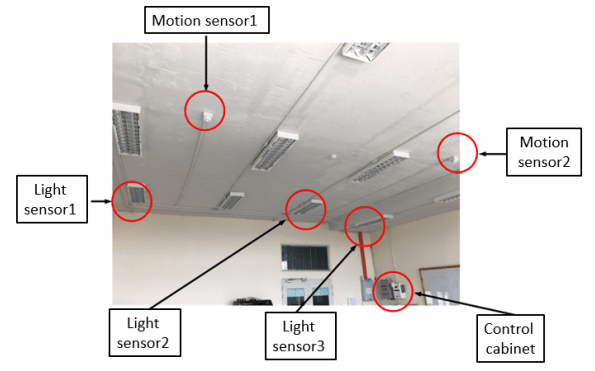
After the system design in Fig. 2, we developed the implementation of actual use. The system actually developed consists of two control cabinets as shown in Fig. 3. The cabinet A is a combination of three-phase power control system (number 1 in Fig. 2), including operating status display and manual control (number 3 in Fig. 2) in this cabinet. The cabinet B is a detector sensor system, processing and transmitting data to the cloud system. In addition, two motion detectors were installed on the ceiling of the office room, together with three light detectors in the office. The detectors were installed near the center lamp in each row of all three ones. Doing so is because each row can be switched on and off independently as shown in Fig. 4.

Dashboard design
This implementation is to design and develop a website window to show the cur-rent consumption status of electrical equipment, and also control as well as monitor the use of electrical equipment in the office room. They system control the status of electrical system (on-off function, including air conditioning in the room when there is nobody in the room as shown in Fig. 5.
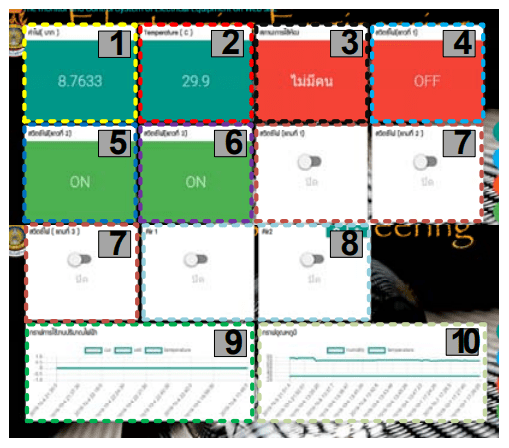
Fig. 5 presents the design of the webpage for the use status and the use control of equipment in the office room. The power consumption control is divided into 10 parts: 1) power charge indicator, 2) temperature indicator, 3) the use of office room, 4) lamp indicator in row 1, 5) lamp indicator in row 2, 6) lamp status indicator in row 3, 7) on/off control button of lamps in row 1 and 2, 8) on/off control button of air conditioner row 1 and 2, 9) electric quantity usage graph, and 10) room temperature graph.
Results and discussions
This section discusses the testing process which aims to test the operation of the electrical control system and monitor the operating for various electrical equipment within the office.
Electrical energy measurement
Based on the test of the electrical energy meter against the standard meter against 10 types of devices, the detector value is displayed on the calibration site of the standard meter. The electrical equipment (devices) as samplers of the study used for comparison is as follows: (A) 1 long light bulb, (B) 2 long light bulbs, (C) 1 stand fan, (D) 1 long light bulb and 1 stand fan, (E) long light bulb 2 tubes with 1 stand fan, (F) Panasonic hair dryer, (G) Panasonic hair dryer with 1 stand fan, (H) SHARP rice cooker, (I) SHARP rice cooker with 1 long lamp, and (J) Cooker SHARP rice with 1 stand fan. We compare the measured value from the detectors shown on the website. The current consumption measurements of each equipment group in the room, as the samples were tested. The electricity consumption of each equipment group on the website is shown in the Fig. 6 and Table 1.

The results shows that the current measurement in the office room with 10 types of test loads had an average tolerance of 0.652 V and 0.137 A. Table 1 shows, that the current measurement in the office room with 10 types of test loads had a mean absolute error (MAE) is 5.95%.
The temperature measurement in the office room started from turning off two air conditioners, then waited for two minutes before turned on both air conditioners. Temperature measurement was conducted every two minutes. The test results, indicate that the temperature measurements in 10 different office room had and an average error of 0.392 degrees Celsius as shown in Fig. 7.
Regarding the motion detection test in the office room, the test was implemented for two cases. One was the absence of people in the office room and the other case was when someone was in the room. The motion detection test took every five minutes to detect the motion and the results are shown in the Table 2.
Table 1. Electricity consumption of each group

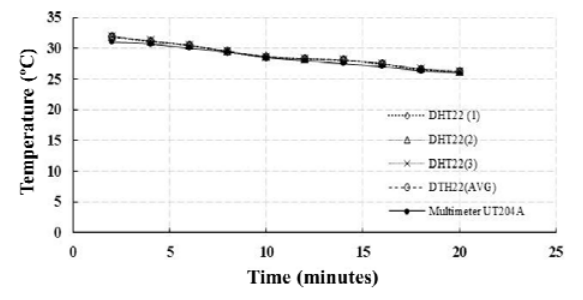
Table 2. Motion detection status
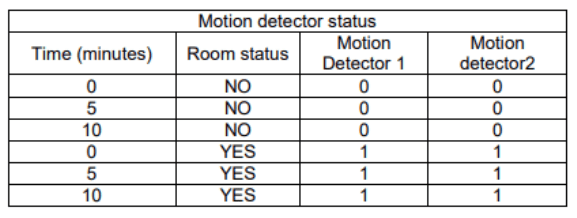
Table 2, shows that both motion detectors can detectors detect accurately in both case; that is, when there were people in the room and when there were anyone in the office room. For the light detection in the office room, five cases were studied. Firstly, bulbs in row 1 were turned on (A). Secondly, bulbs in row 2 were on (B). Third case was when bulbs in row 3 were on (C). Fourth case was when all bulbs in every row were turned on (D), and final case was when all bulbs in every row were off. The results of light detector status are shown in Table 3 and Fig. 8.
Table 3. Light detector test
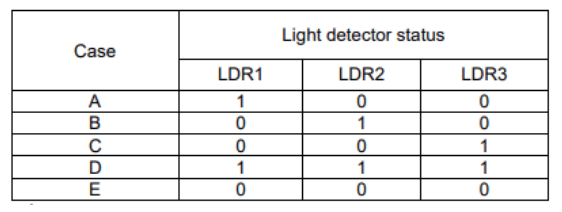
Fig. 8 shows that bulbs in row 1 were turned on and the status indicated “ON” on the website accurately. In Fig. 8 shows the status of the electrical equipment inside the room on the website page while the first row of lights in the room was turned on. The first row of lights is ON and will be green colored to make it easier for inspectors to check the status. Also on the web page the temperature values are displayed relative humidity. The power used at that time as well and also has data in graphs as shown in Figure 5, that show historical power consumption data for the inspector to use to analyze the energy consumption of various electrical equipment in the room easily.

Conclusions
The study aimed to develop the system for controlling and displaying the power consumption status of electrical equipment inside the office building on the website. It was that the system was efficient in working and it worked functionally and properly. It is evident that the system is able to measure the current, voltage, power in the electric power in the room. The system can monitor movement, control lighting and air conditioning, and then show the usage status. For the power consumption, the system can last for 365 days and it can be operated by a remote control. In addition, the system can function anywhere through internet connection via smartphones or computers. Furthermore, the system control the display of the usage status via standalone control cabinet even without the internet. Overall, the system is the protocol which can be further development for innovative ideas of the internet of things, particularly for life and living.
Acknowledgement – The research was supported by the Faculty of Engineering, Rajamangala University of Technology Srivijaya and the Faculty of Science and Industrial Technology, a Prince of Songkla University, Surat Thani Campus.
REFERENCES
[1] Mtshali P., & Khubisa F., A Smart Home Appliance Control System for Physically Disabled People, in Conference on Information Communications Technology and Society (ICTAS)., (Durban, South Africa), March 2019, 1-5, doi: 10.1109/ICTAS.2019.8703637
[2] Krishna I., & Lavanya K., Intelligent Home Automation System using BitVoicer, in International Conference on Intelligent Systems and Control (ISCO)., (Coimbatore, India), Jan. 2017, 14-20, doi: 10.1109/ISCO.2017.7855973.
[3] Jayaram A. (2016). An Internet of Things Framework for Automation and Remote Control of Home Appliances, International Journal of Innovative Research in Science, Engineering and Technology, 5(9), 17108-17115, doi: 10.15680/IJIRSET.2016.0509095.
[4] Pandharipande A., Caicedo D., & Khaimook K. (2014). Sensor-Driven Wireless Lighting Control: System Solutions and Services for Intelligent Buildings, in IEEE Sensors Journal, 14(2), 4207-4215, doi: 10.1109/JSEN.2014.2351775.
[5] Saeliw A., Hualkasin W., Puttinaovarat S., & Wang X. (2019). Smart Car Parking Mobile Application based on RFID and IoT, International Journal of Interactive Mobile Technologies (iJIM), 13(5), 4-14, doi.org/10.3991/ijim.v13i05.10096.
[6] Beqqal M. El., & Aziz M. (2018). Taxonomy on IoT Technologies for Designing Smart Systems, International Journal of Interactive Mobile Technologies (iJIM), 12(5), 182–191, doi.org/10.3991/ijim.v12i5.8831.
[7] Khan M., Silva B. N., & Han K. (2016). Internet of Things Based Energy Aware Smart Home Control System, in IEEE Access, 4(1), 7556-7566, doi:10.1109/ACCESS.2016.2621752.
[8] Wu F., Miao Z., & He C. (2016). Remote Monitoring System for Intelligent Slaughter Production Line Based on Internet of Things and Cloud Platform, 11th International Conference on Prognostics and System Health Management (PHM-2020 Jinan), 538-542, doi: 10.1109/PHM-Jinan48558.2020.00104.
[9] Jiménez Betancourt R.O., González López J.M., Barocio Espejo E., Concha Sánchez A., Villalvazo Laureano E., Sandoval Pérez S., & Contreras Aguilar L. (2020). IoT-Based Electricity Bill for Domestic Applications, Sensors, 20(21), 1-17, doi: 10.3390/s20216178.
[10] Ida Bagus Gede P., Nyoman S., & Made S. (2020). Application of IoT-Based System for Monitoring Energy Consumption, International Journal of Engineering and Emerging Technology, 5(2), 81-93.
[11] Shaikh P.S., & Kapare A.S. (2017). Smart Office Area Monitoring and Control Based on IoT, International Journal of Engineering Research in Computer Science and Engineering (IJERCSE), 4(4), 48-52.
[12] Motlagh N.H., Mohammadrezaei M., Hunt J., & Zakeri B. (2020). Internet of Things (IoT) and the Energy Sector, Energies, 13(2), 1-27, doi: 10.3390/en13020494.
[13] Rao S. A., & Kulkarni K. (2018). Smart Phone based Cost Effective Visitor Management System for Smart Offices, International Journal of Interactive Mobile Technologies (iJIM), 12(6), 112–123, doi.org/10.3991/ijim.v12i6.9476.
[14] Xiao H., Hu W., Zhou D., Deng Q., & Zhou H. (2019). Remote Monitoring and Control System for Domestic Electricity Consumption Based on WeChat Applet, in 2019 Chinese Control Conference (CCC), (Guangzhou, China), 5321-5326, doi: 10.23919/ChiCC.2019.8866512.
[15] Sooraj S.K., Sundaravel E., Shreesh B., & Sireesha K. (2020). IoT Smart Home Assistant for Physically Challenged and Elderly People, in 2020 International Conference Smart Electronics and Communication (ICOSEC), (Trichy, India), 809-814, doi: 10.1109/ICOSEC49089.2020.9215389.
[16] Kazmi S., Javaid N., Mughal M.J., Akbar M., Ahmed S. H., & Alrajeh N. (2019). Towards Optimization of Metaheuristic Algorithms for IoT Enabled Smart Homes Targeting Balanced Demand and Supply of Energy, in IEEE Access, 7(1), 24267-24281, doi: 10.1109/ACCESS.2017.2763624.
[17] Riyanto I., Margatama L., Hakim H., Martini M., & Hindarto D. E. (2018). Motion Sensor Application on Building Lighting Installation for Energy Saving and Carbon Reduction Joint Crediting Mechanism, in Apply System Innovation, 23(1), 1-7, doi:10.3390/asi1030023.
[18] Kamel H. Rahouma., Zeinab T. Gaber, Zeinab T. Gaber, Adel A.E. Mohamed, & Hussein S. AlHamd. (2018). Real Time Automation Systems for Home Electrical Energy Waste Reduction, in Egyptian Computer Science Journal, 45(2), 1-13, ISSN-1110-2586.
Corresponding Authors : Kritsada Puangsuwan, Faculty of Science and Industrial Technology, Prince of Songkla University Surat Thani Campus, 31 Moo 6, Makhamtia, Muang, Surat Thani 84000, Thailand, Email:kritsada.pu@psu.ac.th
Source & Publisher Item Identifier: PRZEGLĄD ELEKTROTECHNICZNY, ISSN 0033-2097, R. 99 NR 5/2023. doi:10.15199/48.2023.05.05
 Power Quality Blog