Published by Nessim Abderrahim BOURAHLA1, Mustapha BENGHANEM2, Hamid BOUZEBOUDJA2, Abed BOUADI2, Ali TAHRI2, Higher school of electrical and energy engineering of ran,’’ESGEE’’,Oran, Algeria (1), University of Science and Technology of Oran,’’USTO-MB’’, Oran, Algeria (2)
ORCID: 1. 0009-0001-1479-1355
Abstract. A notable shift towards incorporating decentralized energy resources into electrical grids is currently in progress. This article conducts an evaluation of the photovoltaic potential within USTO University’s parking area, followed by the integration of the generated photovoltaic energy into a planned photovoltaic microgrid set to be implemented at the University of Science and Technology of Oran (USTO) in Algeria. With a considerable expanse, the campus boasts an extensive outdoor parking area that serves both as a source for photovoltaic energy production and as a shelter for vehicles, shielding them from sun exposure. Functioning as an optimal solar location, The university provides a significant benefit for generating photovoltaic energy via a microgrid. The photovoltaic energy produced is scrutinized in this article, factoring in the total surface area of the outdoor parking on the campus, thereby determining the scale of the photovoltaic panel installation on the site.
Streszczenie.Obecnie postępuje zauważalna zmiana w kierunku włączania zdecentralizowanych zasobów energii do sieci elektrycznych. W artykule przeprowadzono ocenę potencjału fotowoltaicznego na terenie parkingu Uniwersytetu USTO, a następnie integrację wytworzonej energii fotowoltaicznej w planowanym mikrozestawie fotowoltaicznym, który będzie realizowany na Uniwersytecie Naukowo-Technologicznym w Oranie (USTO) w Algierii. Po znacznej rozbudowie kampus może poszczycić się rozległym zewnętrznym parkingiem, który służy zarówno jako źródło produkcji energii fotowoltaicznej, jak i jako schronienie dla pojazdów, chroniąc je przed działaniem promieni słonecznych. Działając jako optymalna lokalizacja słoneczna, uniwersytet zapewnia znaczne korzyści w zakresie wytwarzania energii fotowoltaicznej za pośrednictwem mikrosieci. W tym artykule wytworzona energia fotowoltaiczna jest analizowana z uwzględnieniem całkowitej powierzchni parkingu zewnętrznego na terenie kampusu, określając w ten sposób skalę instalacji paneli fotowoltaicznych na tym terenie. (Pojemność energetyczna ogniw fotowoltaicznych na potrzeby projektu parkingowego na Uniwersytecie USTO)
Keywords: Renewable energy, Hybrid power systems, Distributed energy,systems, Solar photovotaic, Micro-grid.
Słowa kluczowe: Energia odnawialna, Hybrydowe systemy elektroenergetyczne, Rozproszone systemy energetyczne.
Introduction
Energy constitutes a vital foundational element for the sustenance and progression of human society, intricately linked to national economies, the well-being of individuals, and the strategic competitiveness of nations [1], [2].
Nowadays, the accelerated modernization of nations has markedly heightened the requirement for electricity. Traditional energy sources like coal, diesel, and gas are incapable of fulfilling the energy demands and contribute to detrimental environmental impacts. Researchers are actively working towards a shift from the existing framework, relying on conventional energy resources, to infrastructures centered on renewable energy, addressing the escalating energy needs [3].
However, the widespread adoption of renewable energy sources brings forth various technical challenges, including constraints in fault ride-through capability, increased fault currents, reduced system inertia, and a decrease in generation reserves. The International Renewable Energy Agency foresees that 66% of the energy demand will be fulfilled by leveraging renewable energy sources [4].
Considering that both residential and industrial sectors represent significant consumers of electrical energy, the rise of decentralized electricity production seeks to address local energy demands to some extent. This involves harnessing indigenous natural resources such as wind and solar power for the production, distribution, and utilization of locally generated renewable energy. In contrast to the widespread use of wind power on a large scale, the expenses associated with generating a photovoltaic (PV) system are notably higher, necessitating a more significant financial subsidy to encourage customers to enhance the installation capacity of PV systems [5],[6],[7].
Microgrids are power networks designed to provide reliable energy to small consumers. These microgrids combine localized power sources (photovoltaic panels, fuel cells, micro turbines, small diesel generators),storage batteries, loads, and monitoring instruments to supervise and manage power flow. They can operate independently or operate by connecting directly to the distribution network. This concept is applicable across diverse environments, encompassing buildings, industrial zones, and rural communities [8].
Given its abundant reserves and heavy reliance on hydrocarbons, Algeria has recently initiated the exploration of renewable energy sources. Traditionally, the country’s economy has been heavily centered on oil and gas, constituting 98% of its export portfolio. Algeria holds significant potential in the field of renewable energy, and the nation is firmly dedicated to unlocking this potential. Currently, Algeria is home to 22 photovoltaic plants boasting a combined capacity of 350 MW. Algeria aspires to reach a 27% portion of green energy in its national electricity blend by 2030, indicating a significant rise from the current 2%. Endowed with an average of 3,500 hours of sunlight annually, Algeria is poised to emerge as a key player in solar energy production. Energy experts suggest that the Algerian Sahara presents the most advantageous investment/profitability ratio globally [9].
In line with the national policy for the development of renewable energy, instigated in 2011 and revised in 2015, a forthcoming solar energy venture boasting a capacity of 4,025 MW is on the horizon. Comprising three segments, each with a capacity of 1,350 MW, this solar power farm is a significant component of the broader renewable energy strategy. Additionally, the project includes plans for establishing an industrial facility dedicated to manufacturing components for photovoltaic systems. The strategic locations for the construction of six solar power plants in the South and Highlands regions have already been identified.
The implementation of these solar power plants is planned for cities including Ouargla, Bechar, El Oued, Biskra, Djelfa, and M’sila. In the Algerian context, renewable energy serves not only to meet future energy demands but also holds the promise of a lucrative economic venture, potentially encompassing the exportation of electricity to Europe. Government reports highlight an anticipated shortfall in national gas production to meet the country’s increasing needs. Statistics unveiled by the government in January 2018 indicate that the incorporation of renewable energies has the potential to save Algeria an estimated 300 billion cubic meters of natural gas [10].
In recent times, numerous investigations have been carried out in the realm of photovoltaic microgrids. Examples include the 5 MW solar photovoltaic power plant serving 25 sites in Oman, a 1 MWp photovoltaic power facility in Farafenni, Gambia, and a 1 MWp photovoltaic power plant in Osmaniye, Turkey. Additionally, a photovoltaic system with an installed capacity of 5 MWp for electricity generation at Colorado State University-Pueblo [11],[12],[13].
This article seeks to assess the practicality of implementing a solar photovoltaic parking system at USTO University in Oran, serves as the focal point for evaluating the feasibility of photovoltaic solar energy. ascertain the optimal quantity of solar panels needed for the parking facility, and, in conclusion, formulate key findings and recommendations.
The paper is organised as follows: The section 2 is dealing with Solar potential estimation in usto university of oran. The section 3 presents Sizing of the university’s photovoltaic system. The last section by proposing the energy balance of the university with the proposed photovoltaic system which represents the results and the discussion.
Solar potential estimation in usto university of oran
Renewable energies are at the heart of the energy and economic policies pursued by Algeria: by 2030, around 40% of the electricity production intended for Algerian consumption will be of renewable origin[14]. Algeria receives annually throughout its territory one of the largest sources of solar energy in the world. She amounts to approximately 5.2 million billion K/W/h/year [15].
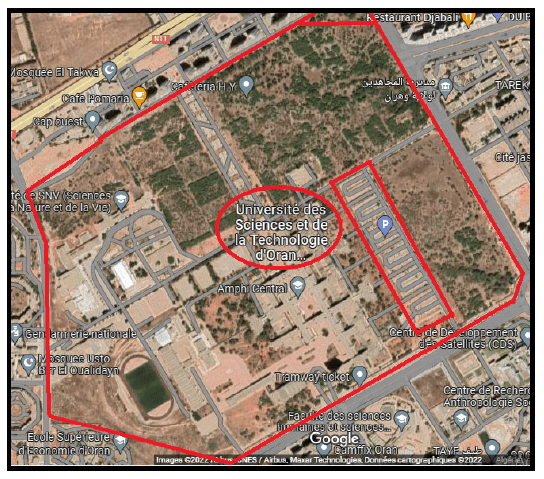
Oran, situated at 35.42° north and 0.38° west coordinates, lies on the southern coast of the Mediterranean basin and occupies a northwestern position within Algeria. In 1986, Oran launched the establishment of a university in Oran-East, subsequently recognized as the University of Sciences and Technology of Oran (USTO). (Figure 1)[16]. It is equipped with a large parking area, which holds great potential for the installation of photovoltaic panels (Figure 2).
PVGIS represents a remarkable simulation tool, offering the possibility to calculate the production of grid-connected photovoltaic systems in Africa for free. With its integrated Google Maps interface, it becomes very easy to obtain production data from a photovoltaic installation based on precise site sunshine data. Data on sunshine for this study were obtained for the year 2020, the software offers precise sunshine maps (irradiation in kWh/m²) and high definition temperatures[17]. The attributes of solar radiation variance at a given location are ascertained through direct measurement of solar radiation at that specific position. The maximum and minimum total solar radiation recorded in 2020 is shown in Figure 3. Note that June 2020 saw the highest monthly average solar radiation at 238.67 kwh/m2/month, while in December 2020 we saw that the average monthly solar radiation is the lowest at 77.65 kWh/m2/month.
Figure 4 displays the monthly average of daily irradiance measured hourly on a fixed plane for 2020. The peak and nadir of the monthly average total solar radiation are 960.07 W/m² and 700 W/m² respectively in 2020.
Figure 4 further illustrates that the monthly average global solar radiation values remain relatively consistent on a monthly and yearly basis. Consequently, the cumulative solar radiation measured for the year 2020 amounted to approximately 2.87 MWh/m2/year for the entire year.


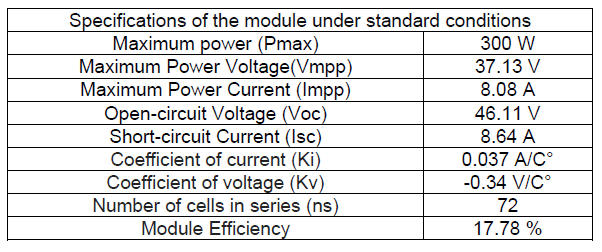
Sizing of the university’s photovoltaic system Generating electricity from a photovoltaic power plant in a specific area generally necessitates essential information, including global radiation, sunshine duration, and temperature readings. Thus, the daily measurement data for the city of Oran is detailed in Table 1. These figures reveal that the monthly average radiation level stands at 161.09 kWh/m2, while the annual average temperature reaches 19.09°C. Additionally, Oran boasts a substantial solar energy potential for electricity generation. To achieve specific power output at predetermined voltage and current levels, It is possible to arrange photovoltaic (PV) modules to form an array. In this configuration, 300 W peak PV modules equipped with monocrystalline silicon solar cells are used [18]. The data acquisition system and software tools used in this study are capable of importing weather data from various sources, as well as personalized data sets. This functionality facilitates the design and sizing of the photovoltaic installation on the university campus. Based on the detailed technical specifications provided in Table 2, one can infer the total capacity of the solar power plant, is 3724 solar modules with a total power of 1117 kWp.
The photovoltaic (PV) system will be deployed in the university parking lot (Figure 5), characterized by flat surfaces. Each photovoltaic panel will be inclined at 36°, representing the optimal angle throughout the year. The total covered surface area amounts to approximately 7230m2 spread across 6 parking zones.
Table 1. The values of daily average measurement

The daily curves depict variations in university consumption during winter and summer, showing a significant decrease during the weekend compared to weekdays, especially during the opening hours from 8 a.m. to 6 p.m. (Figure 6). A consistent baseline consumption of around 145 kW is observed even at night, attributed to lighting and standby devices. Energy demand for a winter day can reach nearly 960 kW, whereas in summer, it hovers around 740 kW.
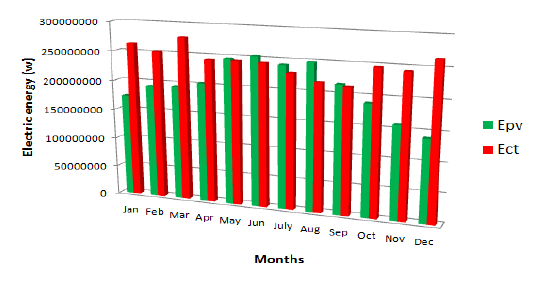
Throughout the year, there are significant peaks in daily power consumption during the winter months from January to March, as well as in the summer, particularly in June. There is a notable drop in consumption during the weekends, representing the lowest energy usage.


Table 2. Specifications of a photovoltaic module utilized
Results and discussion Energy balance of the university with the proposed photovoltaic system
The proposed photovoltaic system in the parking lot is integrated into the university’s electrical network. This network is powered by 10 kV from the main city grid and is managed by an internal energy center within the university. The electricity generated in this way supplies all 9 faculties of the university, each with specific energy requirements. Each faculty is equipped with an MV/LV transformer and various protection devices. The photovoltaic generator, comprised of solar panels installed across the 6 parking lots, will be configured to connect to each faculty through a power conversion stage (chopper and inverter). Implementing our system in this way helps reduce the electricity bill and ensures a degree of supply autonomy. The photovoltaic array comprises of a total of 3724 solar panels. According to our calculations, the electricity generated by these panels will be sufficient to meet the energy needs of all university installations while reducing demand on the electrical grid.
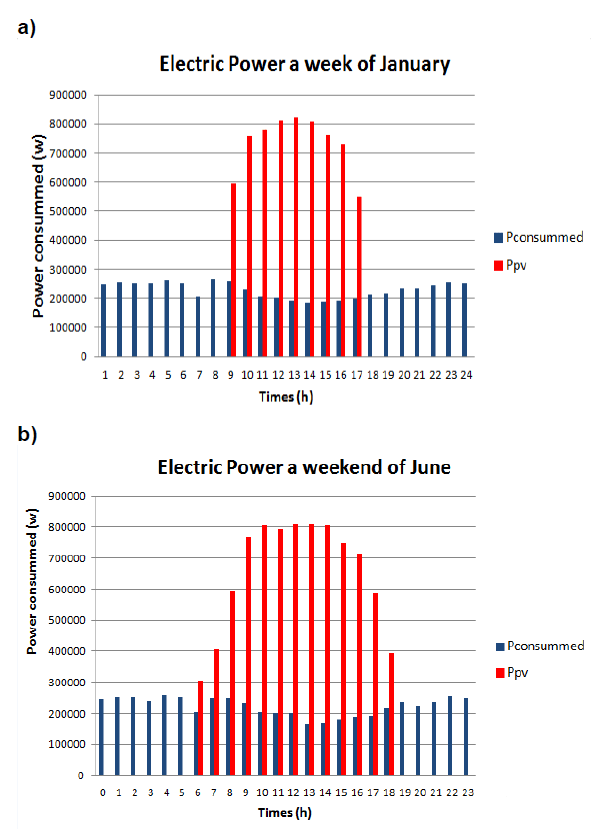

To emphasize this aspect, several graphs are presented, comparing consumption with the energy supplied by photovoltaic solar panels, to illustrate their contribution to campus consumption. Over the weekend, the electricity generated by the solar panels will be ample to cover daytime consumption. as demonstrated by Figures 7 and 8 depict the electrical energy provided by the solar panels for the rest of the week. It is noticeable that in winter, solar energy nearly covers the entire daytime consumption, except during peak periods when it will not suffice. In summer, solar energy fully covers daytime consumption. Therefore, demand from the electricity provider will be necessary especially during the night and during periods of high consumption, such as in winter when solar panel production is lower.
The information concerning the energy supplied by the photovoltaic panels and the energy consumed on campus is graphed for each month, as depicted in Figure 9. The inclusion of this photovoltaic energy will aid in diminishing the necessity for energy supplied by external providers. According to the figures provided in Figure 9, it can be deduced that photovoltaic production totals 2457 MWh for the entire year, while consumption amounts to 2934 MWh. In summary, the photovoltaic production’s contribution in our scenario constitutes 84% of the total, indicating a substantial impact on the financial aspect.
Conclusions
Photovoltaic solar energy is a clean and reliable energy source. The increasing demand for electricity in the market and the expansion of photovoltaic system production have led to a gradual decrease in the costs of this technology. The aim of this study is to compare the production of photovoltaic energy with the energy consumption on the USTO university. We illustrate in this paper that the university holds substantial solar potential owing to its considerable recorded solar radiation levels. Additionally, we evaluated the total solar power installed in the parking lots, which accounts for 84% of the total energy demand, amounting to 1117 kW. The generated photovoltaic energy will significantly reduce dependence on the electricity provider. This research has highlighted the following results:
The total measured solar radiation reaches approximately 2.87 MWh/m2/year over a full year, with the highest monthly average solar radiation reaching 238.67 kWh/m2/month and the lowest at 77.65 kWh/m2/month.
The total installed solar power installation amounts to 1117 kW, equivalent to 3724 photovoltaic panels. Daily university consumption can peak at 960 kW on a winter day and 740 kW on a summer day, with a minimum power demand of 145 kW during weekends.
The installed capacity of the photovoltaic panels amounts to 2457 MWh for the year, which is slightly lower than the university’s demand, estimated at 2934 MWh. This generated energy will almost entirely meet the demand and reduce dependence on the electricity supplier, aiming to minimize or eliminate the reliance on electricity supplied by them. Increasing the number of installed photovoltaic panels will be necessary to boost their production. Additionally, we can consider integrating other renewable energy sources to further reduce or even completely cease the purchase of electricity, and even enable the resale of surplus electricity production.
The produced photovoltaic solar energy is not sufficient to meet the entirety of the university’s demand. However, it can cover this demand during the day by reducing nonessential consumption, such as lighting. Additionally, it offers the advantage of being available in case of disruption to the electrical grid, such as a power outage. In the event of a nighttime power outage, the energy stored in batteries can be used to provide minimal lighting for security tasks. Another advantage is that during summer and weekends, photovoltaic production is higher due to the absence of students and academic activities at the university, allowing for the resale of excess production.
As a perspective, if we wish to enable the university to be self-sufficient in electrical energy, we can always expand our solar park by utilizing the various spaces available within our university, such as the rooftops of buildings and other parking areas available on campus.
REFERENCES
[1] R. A. Salam et al., “An overview on energy and development of energy integration in major South Asian countries: the building sector,” Energies, vol. 13, no. 21, p. 5776, 2020.
[2] F. Li, Z. Song, and W. Liu, “China’s energy consumption under the global economic crisis: Decomposition and sectoral analysis,” Energy Policy, vol. 64, pp. 193-202, 2014.
[3] G. K. Suman, J. M. Guerrero, and O. P. Roy, “Robust Frequency Control in Interconnected Microgrids: An H $ 2 $/H $ {\infty} $ Control Approach,” IEEE Systems Journal, vol. 16, no. 2, pp. 2044-2055, 2021.
[4] M. Taylor, “Energy subsidies: Evolution in the global energy transformation to 2050,” International Renewable Energy Agency, Abu Dhabi, pp. 10-14, 2020.
[5] J. Bebic, R. Walling, K. O’Brien, and B. Kroposki, “The sun also rises,” IEEE Power and Energy Magazine, vol. 7, no. 3, pp. 45-54, 2009.
[6] European Photovoltaic Industry Association, Solar Generation V-2008.[Online]. Available: http://www.greenpeace.org/raw/content/international/press/reports/solar-generation-v-2008.pdf
[7] C.-H. Lin, W.-L. Hsieh, C.-S. Chen, C.-T. Hsu, T.-T. Ku, and C.-T. Tsai, “Financial analysis of a large-scale photovoltaic system and its impact on distribution feeders,” IEEE Transactions on Industry Applications, vol. 47, no. 4, pp. 1884-1891, 2011.
[8] G. Basso, “Approche à base d’agents pour l’ingénierie et le contrôle de micro-réseaux,” Université de Technologie de Belfort-Montbeliard, 2013.
[9] article in a newspaper: “L’Algérie se lance dans un ambitieux projet de photovoltaïque”, march 2017, http://www.jeuneafrique.com/417368/societe/lalgerie-se-lanceambitieux-projet-de-photovoltaique/..
[10] article in a newspaper:” L’ALGÉRIE COMPTE DÉVELOPPER LES ÉNERGIES RENOUVELABLES” , april 2018 , http://lenergeek.com/2018/02/03/algerie-developper-energiesrenouvelables/
[11] B. Yaniktepe, O. Kara, and C. Ozalp, “Technoeconomic evaluation for an installed small-scale photovoltaic power plant,” International Journal of Photoenergy, vol. 2017, 2017.
[12] S. Sowe, N. Ketjoy, P. Thanarak, and T. Suriwong, “Technical and economic viability assessment of PV power plants for rural electrification in the Gambia,” Energy Procedia, vol. 52, pp.389-398, 2014.
[13] N. A. Bourahla, M. Benghanem, M. Doumbia, and H. Bouzeboudja, “The economic feasibility analysis of generated photovoltaic energy in the USTO campus,” Przeglad Elektrotechniczny, vol. 95, no. 5, pp. 147-152, 2019.
[14] N. Boubou, “Eau, environnement et énergies renouvelables: vers une gestion intégrée de l’eau en Algérie,” thèse de doctorat, 2015.
[15] M. MEKIDECHE, “Énergies renouvelables, quels bouquet énergétique pour l’Algérie,” NOOR, Revue trimestrielle du Groupe SONELGAZ, no. 7, 2008.
[16] Université des sciences et de la technologie d’Oran -Mohamed-Boudiaf, Histoire,https://fr.wikipedia.org/wiki/Universit%C3%A9_des_sciences_et_de_la_technologie_d’Oran_-_Mohamed-Boudiaf
[17] “Focus sur PVGIS : outil gratuit d’estimation de la production photovoltaïque dans le monde entier”, https://photovoltaiqueenergie.fr/logiciels-photovoltaique-en-ligne-production/87-logiciels-photovoltaiques/94-pvgis.html.
[18] Zytech Solar Solar Panel Spec Datasheet ZT300S ,https://EnergyPal.com/zytech-solar-solar-panels/zt300s
Authors: Dr. Nessim Abderrahim Bourahla, Higher school of electrical and energy engineering of oran,’’ESGEE ’’,Oran,Algeria ,Laboratory LDDEE, University of Science and Technology of Oran,’’USTOMB’’, El Mnaouar, BP 1505, Bir El Djir 31000, Oran,Algeria, E-mail: bourahla_nessimabderrahim@esgee-oran.dz;
Prof. Dr. Mustapha Benghanem, University of Science and Technology of Oran,’’USTO-MB’’, Oran,Algeria, Laboratory AVCIS, El Mnaouar, BP 1505, Bir El Djir 31000, Oran,Algeria, E-mail: mbenghanem69@yahoo.fr;
Prof. Dr. Hamid Bouzeboudja, Université des Sciences et de la Technologie d’Oran,’’USTO’’, Laboratoire LDDEE, El Mnaouar, BP 1505, Bir El Djir 31000, Oran,Algeria, E-mail: hbouzeboudja@yahoo.fr;
Prof. Dr. Abed Bouadi, Université des Sciences et de la Technologie d’Oran,’’USTO’’ , Laboratory LGIDD, University ahmed zabana of relizane, Barmadia 48000, Relizane, Algéria, E-mail: abed.bouadi@univ-usto.dz;
Prof. Dr. Ali Tahri, University of Science and Technology of Oran,’’USTO-MB’’, Laboratory LGEO, El Mnaouar, BP 1505, Bir El Djir 31000, Oran,Algeria, E-mail: ali.tahri@univ-usto.dz;
Source & Publisher Item Identifier: PRZEGLĄD ELEKTROTECHNICZNY, ISSN 0033-2097, R. 100 NR 12/2024. doi:10.15199/48.2024.12.06
 Power Quality Blog