Published by Jonny Carlsson, Unipower AB, http://www.unipower.se
Background
The main problem with transients in the electrical network is that a high voltage potential might break the isolation barrier in for example cables or other equipment in the electrical network. It may also harm semiconductors that are sensitive of high voltage.
A transient voltage is by definition short in time and typically consists of frequencies higher than 500Hz. Typically sources of transients are switching in the network and lightning. A capacitor switching usually consists of frequencies below 1kHz. Fast transients like lightning that occur in the electrical network become flattened because of dispersion in the grid.
The Transient Test Pulse
The typical transient test pulse that is used in testing equipment like cable joints and breakers are designed in a way that should correspond to the profile of a real lightning strike. The rise time for this pulse is 1.2us and the fall time is 50us.
Capturing Transients
With a transient of the lightning type the chance of missing the damaging top voltage is high if the sampling rate of the instrument is not high enough. A common practice is to use a sampling rate of 10 times the speed of the event that is recorded. In the case of catching a high frequency switching in the network or a lightning the sampling rate should be about 10Mhz in order not to miss the top voltage level.
Peak detectors versus High Speed Sampling
The disturbance in the picture below is sampled with a sampling speed of 1 MHz. The dots correspond to the sample points. The high amplitude is not captured in this case because no sampling is done at the highest point. The peak detector does not have this limitation; they will follow the signal to the highest point and store that value.

UP2210 and Unilyzer 902 Transient Detection
The power quality analyzers UP-2210 and Unilyzer 902 are equipped with transient analysis that is enhanced with peak detectors. A transient recorder usually samples the signal at discrete points. This means that you will know the actual input level only in the sample point. In order not to miss any information you will need to increase the sampling speed. Even with very high sampling speed the equipment will be ‘blind’ between sample points. With a high sampling speed the memory is rapidly consumed and in order to save memory only a fraction of the disturbance could be stored.
With the use of peak detectors we can solve all of this problems. The peak detector follows the signal all the time without missing any signal deviation. When the peak detector activates it will trap the highest (or lowest) value that occurred between the sampling points. This allows us to save memory without loosing any information of interest. Any transient with high potential that might harm the isolation will be registered.
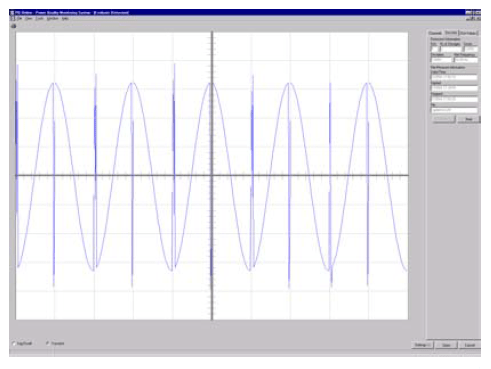
The UP-2210 and Unilyzer 902 has both positive and negative hardware peak detectors. The peak detectors have a response time less than 1us.
The example below is produced with an arbitrary generator that creates one transient point in the most positive part of the period and one transient is made in the most negative part of the period. The duration of each transient in this example is 1.2 us. All important transients is detected without high sampling rate.
About Unipower: Unipower AB offers a wide range of products for Power Quality measurements and Smart Grid systems.
Originating from a Swedish ABB company in the mid 80’s, Unipower has developed a competitive edge within the field of Power Quality and Smart-Grid solutions. We focus on norm compliance equipment, with a special focus on the requirements for power generation, transmission and distribution.
Our product lines reach from traditional portable PQ analysers to fully integrated and automated Power Quality Management systems for continuous supervision of the energy supply.
Website: unipower.se
Unipower Portable – Unilyzer 900
• Its small size together with the IP65 protection and ruggedness makes Unilyzer 900 an ideal tool for all field measurements. It has no moving parts and has been tested in real, tough environments.
• The instrument complies with IEC 61000-4-30 Class A for Power Quality measurements, which guarantees highest reliability in every advice and conclusion.
• Its standard memory allows data to be stored for 3 months. In case of a power failure it has an internal battery backup keeping the instrument going.
Unipower Permanent – UP2210
• The UP-2210 unit works as an advanced power quality meter and at the same time as a fault recorder. All of the power quality parameters can be analyzed in accordance with voltage quality standards such as the EN 50160 or national regulations such as the Swedish EIFS. The UP-2210 unit captures both steady state disturbances (harmonics, flicker etc.) as well as rapid voltage changes (sag/swell events and fast transients). The nodes in the PQ Secure system consist of UP-2210 meters.
• Advanced 3-phase Power Quality and Transient Monitor
• The UP-2210 is a full-featured, norm-compliant power quality monitor capable of detecting any disturbances encountered in a network.
 Power Quality Blog
Nice post 🎸🎸
LikeLike