Published by Wiesław MICZULSKI1, Oliwia PERS2, Uniwersytet Zielonogórski, Instytut Metrologii, Elektroniki i Informatyki (1), ETB Solution GmbH (2) ORCID: 1. 0000-0002-8175-0078; 2. 0000-0002-2962-5261
Abstract. The article presents the concept of an algorithm that optimizes energy management in a household. The algorithm optimizes the usage of the energy from a wind turbine and ensures the greatest possible comfort of using energy-efficient smart appliances by the user.
Streszczenie. W artykule przedstawiono koncepcję algorytmu optymalizującego zarządzanie energią w gospodarstwie domowym. Algorytm optymalizuje wykorzystanie energii z turbiny wiatrowej oraz zapewnia jak największy komfort korzystania z energooszczędnych inteligentnych urządzeń przez użytkownika. (Optymalizacja wykorzystania energii elektrycznej z turbiny wiatrowej w gospodarstwie domowym).
Keywords: energy management algorithm, renewable energy sources, smart appliances, wind turbine.
Słowa kluczowe: algorytm zarządzania energią, odnawialne źródła energii, inteligentne urządzenia, turbina wiatrowa
Introduction
The energy systems in many countries are developing rapidly in order to meet the increasing demand for electricity, as well as the expectations of energy consumers. Renewable energy sources (RES) are more and more often used as basic power sources also in households. The increase in renewable energy installations in Poland and Germany has occurred as a result of the implementation of appropriate financing projects for such investments. These solutions make it possible to reduce the high costs of electricity consumption from the grid. The projects promoting the financing of different types of renewable energy are being implemented in Poland and Germany.
The usage of solar and wind energy to generate electricity for households depends heavily on the weather conditions, the season and the time of day. This has a significant impact not only on the proper functioning of the electrical grid (EG) [1] but also the costs associated with energy consumption. It also has an impact on the proper management of the operation of devices in households. The work [2] presents an overview of the latest literature on energy management solutions in households.
The article presents the concept of an energy management algorithm (EMA) in a household. In the optimization process, EMA takes into account the power generated by the wind turbine (WT), which results in the reduction of energy consumption costs from EG. EMA also provides the greatest possible comfort for the user of the energy-efficient smart appliances. The choice of a WT has been determined by increased electricity production and economic considerations compared to a solar power plant [3]. The research results presented in this article are a continuation of previous research papers, the results of which are described in [4, 5].
Energy management algorithm
The goal of the EMA (Fig. 1) is to ensure that the power generated by WT (PWT) is used as much as possible to power smart household appliances. It will also reduce the cost of consumed energy from EG. In the process of optimization, EMA also provides the greatest possible comfort for the user to use smart appliances. For this purpose, it has been assumed that each of the appliances will be assigned a priority (pr) indicating which of them will be able to change power (PA) first, will be turned off or turned on with a specific time shift (ts).
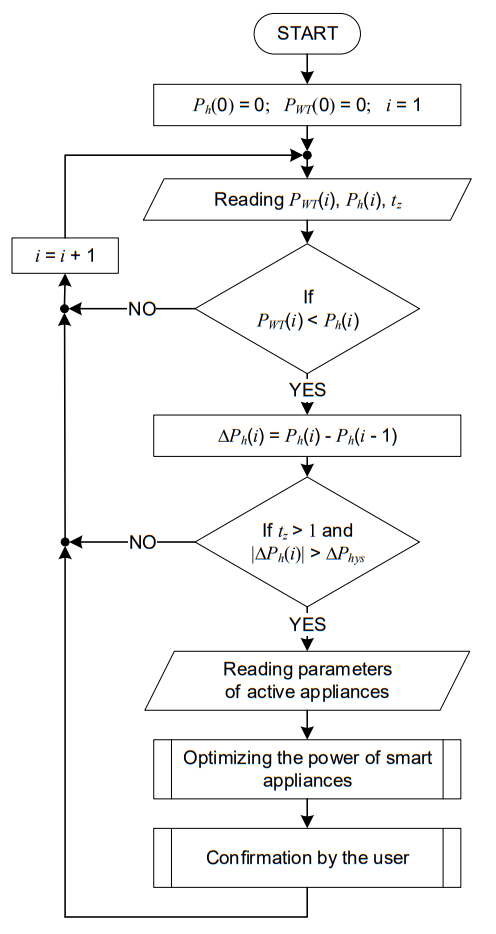
After reading the current PWT(i) value and the sum of power of the powered on appliances in a given iteration Ph(i) and the current tariff tz, the condition is checked

If condition (1) is not met, iteration (i) is terminated. This means that appliances that are turned on are powered only from the WT. However, failure to meet this condition will result in further EMA operation, i.e. the calculation of ∆Ph(i) according to the formula

In the next step of the iteration, the simultaneous fulfillment of the condition is checked

where: tz – tariff time zone, ∆Phys – accepted allowable value of changes |∆Ph(i)|, limiting the number of power changes of smart appliances (PA).
If condition (3) is not met, iteration (i) is terminated. However, if this condition is met, the sub-program “Optimizing the power of smart appliances” will be started, preceded by the reading of the current parameters of active appliances. For the optimization process, the GRASP (greedy randomized adaptive search procedure) heuristic algorithm [4, 6] has been used, in which the objective function takes into account: the current PWT values and power consumed from EG (PEG), current power values of individual appliances turned on (PA), remuneration (cWT) for 1 kWh transferred from WT to EG and the cost of 1 kWh from EG (cEG) determined for the relevant tariff, ts and pr values of active smart appliances and the total number of them in the household. Compared to [4], an additional condition has been introduced in the optimization process

where: (Ph_EMA) – value of the sum of the power of all appliances after optimization by EMA.
Condition (4) allows for a better adjustment of the power of appliances to the power generated by the WT at the expense of a small amount of energy taken from the EG, resulting from the adopted ∆P value.
As a result of the optimization process, the following decisions can be made in relation to a smart appliances:
– disagreement with its activation,
– its activation or shift of the activation time (ts),
– change of power value,
– its deactivation.
In the sub-program “Confirmation by the user” will be displayed information about the actions taken by the EMA in relation to the smart appliances. The user may knowingly allow or reject the proposed proposal. If the user does not react to the information displayed, the EMA will automatically consent to the implementation of the proposed proposal after the set time.
Characteristics of smart appliances in the household
In order to verify the functioning of the EMA algorithm, it has been assumed that the household would use energy efficient smart appliances, equipped with systems for measuring the power consumed by each appliances (PA) (e.g. [7]), and remotely controlled to change the power consumed, turn them off and time delay (ts) of their activation.
Table 1 presents a list of smart appliances installed in a sample household for which the values of PA, ts and pr have been defined. For each appliances turned off, shown in Table 1, PA = 0 kW has been assumed. The boiler has 3 heaters installed with the power of 1.5, 1.5 and 2 kW, which allow the EMA to set one of the following PA values: 1.5, 2, 3, 3.5 and 5 kW. The air conditioner also has the option to set the PA values: 2.2, 3 and 3.5 kW. Both of these appliances turn off automatically as a result of reaching the predetermined values of the output parameters.
Table 1. Parameters of smart appliances
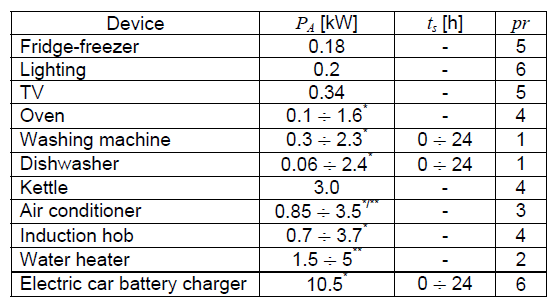
*PA – the power value depends on the individual control sub-program installed in the smart appliances.
**PA – the power value depends on the EMA decision.
It has been also assumed that the EMA can turn off appliances with pr equal to 2, 3 and 5. On the other hand, appliances with pr = 6 will not be turned off by the EMA. Each appliances will be turned on after obtaining approval from the EMA or as a result of an informed decision of the user. For washing machines and dishwashers, pr = 1 has been assumed, as these are appliances whose starting time can be shifted by the EMA to a very large extent. This will have a positive effect on the optimization process. The appliances with pr = 4 will be turned off automatically as a result of completing the program in progress. It has also been assumed that the electric car battery charger will be turned on in the night time zone. The battery charging time from 10% to 100% of its capacity is 9 hours and 40 min. The first phase of battery charging is carried out with a constant current value and lasts about 1.5 hours.
In order to manage the energy in the household, it has been proposed to build an intelligent network Home Area Networks (HAN), the diagram of which is shown in Figure 2. The basic element of this network is the energy management module (EMM) consisting of, among others, from a microcontroller with an installed EMA and a system for measuring the power generated by WT. It has been assumed that smart appliances (Tab. 1) in a household would be powered by energy generated by WT with a power of 15 kW [8]. When determining the power value of the wind turbine, the car battery charger has not been taken into account. This has been based on the assumption that the electric car battery would be charged during the night tariff, which is cheaper than the daily tariff. Also at this time, there is often a small number of household appliances turned on.
In the case of a lower production or a complete deficit of energy from the WT, it will be replenished with EG. EMA, by optimizing the usage of the energy from WT, and thus the energy costs, will accordingly reduce the energy consumed by smart appliances from EG. Smart appliances will be controlled via the HAN network. The amount of energy taken from the EG, as well as the amount of energy transferred to this grid as a result of the excess energy generated by the WT, will be measured by an smart meter (SM). The communication of the SM with EMM will also be carried out by HAN.

The results of simulation tests of the energy management algorithm
The conducted simulation tests have been aimed at checking the correctness of the developed EMA concept. In addition to the above assumptions, simulation tests have been conducted under the following additional assumptions:
– the household is located in Jena (Germany), with a strictly defined Time-of-Use (ToU) pricing program with two time zones (tz) [9]:
• tz = 1 from 0:00 to 6:00 and from 22:00 to 24:00 and the price for 1 kWh of energy (cEG_1) is 0.32 €,
• tz = 2 from 6:00 to 22:00 and the price for 1 kWh of energy (cEG_2) is 0.41 €,
– a recompense for 1 kWh of energy (cWT) transferred from WT to EG is equal to 0.092 € (applies to Jena) [10],
– ∆Phys = 0.2 kW,
– ∆P = 0.4 kW.
The simulation tests have been carried out for the period ofThe simulation tests have been carried out for the period of 1 day for a household equipped with appliances presented in Table 1. The time characteristics of these appliances have been determined on the basis of a database [11]. The results assessing the benefits of using EMA and WT for five analyzed cases are presented in Table 2.
In case 2, the EMA performed an energy optimization for tz = 2 by shifting the reported washing machine operation from 7:14 per hour 22:00 (tz = 1). At 9:06 there has been a notification that the dishwasher had started working. EMA proposed to move the operation of this appliances to the zone tz = 1 per hour. 23:00. The user did not agree to the algorithm proposal, as he had another launch in the plan. After this decision, the dishwasher has been turned on and finished its work at 9:37. At 10:09 there has been another application of the dishwasher for operation. In this case, the user agreed to move the dishwasher’s operation to 23:00. In cases 1 and 2, the same amount of energy was taken from the EG by all appliances. However, in the second case, the energy costs (Tab. 2) decreased by 1.16% (0.21 €) as a result of the operation of the EMA.
In case 3, the reduction in energy costs, compared to cases 1 and 2, has been only due to energy generation by the WT. The household profit was 6.60 €.
Table 2. Results of simulation tests for five cases

In case 4, the EMA used reduced the amount of energy consumed from the EG for tz = 2 by adjusting the total power of the appliances included (Ph_EMA) so that it is not greater than the PWT power by the adopted value of ∆P = 0.4 kW (Fig. 3).
Included the values of the quantities defined in the objective function, the EMA performed the following sequence of actions on the air conditioner: at 6:27 he was reported to work, but due to the low value of the power generated by the WT, it has not been turned on (Fig. 3). The consent of the EMA to turn on the air conditioner has been made at 6:42, but with PA = 2.2 kW taking condition (4) into account. At 6:47 the air conditioner turned off automatically. Later in the day, the EMA did not take any action on this appliance. In the case of the boiler, EMA performed from 6:45 to 7:32 activities to optimize Ph_EMA, so that according to condition (4), the determined value ∆P with respect to PWT changes is not exceeded. The sequence of EMA activities during this time period has been as follows: at 6:45 a boiler has been reported for operation and it has not been turned on as the air conditioner has been running at that time. After the air conditioner has been turned off automatically at 6:47 EMA turned on the boiler with PA = 2 kW and turned it off at 6:50 after turning on the kettle, which could have been turned on according to condition (4). At 6:53 the EMA turned on the boiler with PA = 3 kW, and at 6:58, according to the condition (4), it reduced its power to 2 kW. Failure to take into account the condition (4) in the algorithm would cause its reaction at 6:53 to not turning on the boiler with PA = 3 kW but with PA = 2 kW. Such action would extend the operation of the boiler. At 7:09 the EMA again increased the boiler capacity to 3 kW. After turning on the washing machine at 7:15 EMA reduced the boiler power to 1.5 kW, by 7:19 increased to 2 kW; and at 7:24 turned off the boiler due to the air conditioner being turned on. After the air conditioner turned off automatically, the boiler has been turned on again at 7:29 with PA = 3 kW and turned off at 7:32 due to the lower PWT power generation with the washing machine still running and the kettle turned on. The next action of the EMA has been at 14:06. When turning on the kettle, EMA reduced the boiler power from 5 kW to 2 kW, and after turning off the kettle at 14:09 the boiler power has been increased to 5 kW. At 14:13 the boiler has been turned off by the EMA because the air conditioner has been turned on and it turned off automatically at 14:20. The EMA then turned on the boiler with PA = 5 kW again, and after 1 minute it turned off automatically. At 16:16, with the air conditioner and the EMA kettle on, he changed the boiler power from 5 kW to 3 kW for a period of 1 minute. As a result of the above EMA actions, in case 4, the final profit for the household (Tab. 2) was higher than in case 3 by 3.93% (0.27 €).
In case 5 (Tab. 2), between 6:00 and 24:00 there has been a large power generation by WT (PWT > Ph) which resulted in no EMA operation for tz = 2. Moreover, a high profit (16.35 €) has been achieved in the analyzed household.

Summary
The obtained results from simulation studies shows that the developed EMA concept makes it possible to optimize the usage of the energy generated by WT, which transferred into the costs of energy used in the household. This effect has been obtained by introducing an additional condition (4) in the optimization process, ensuring the best possible usage of the power generated by WT (PWT) to power smart household appliances and improving the comfort of using these appliances by the user. The introduction of specific priority values for individual appliances in the optimization process also affects the achievement of the greatest possible user comfort in using the appliances.
An additional effect of EMA may be the educational function in terms of shaping the user behavior profile in terms of appropriate activation of household appliances when there is the energy generation from RES.
REFERENCES
[1] Powroźnik P., Szcześniak P., Turchan K., Krysik M., Koropiecki I., Piotrowski K., An Elastic Energy Management Algorithm in a Hierarchical Control System with Distributed Control Devices. Energies, 15 (2022), 4750, https://doi.org/10.3390/en15134750
[2] Shewale A., Mokhade A., Funde N., Bokde N.D., A Survey of Efficient Demand-Side Management Techniques for the Residential Appliance Scheduling Problem in Smart Homes, Energies, 15, (2022), 2863, https://doi.org/10.3390/en15082863
[3] Bątkiewicz-Pantuła M., Comparative analysis of production costs of electricity generated from various renewable energy sources, Przegląd Elektrotechniczny, 95 (2019), nr 2, 71-74
[4] Powroźnik P., Szulim R., Miczulski W., Piotrowski, K., Household Energy Management, Appl. Sci., 11 (2021), 1626. https://doi.org/10.3390/app11041626
[5] Powroźnik P., Szcześniak P., Piotrowski K., Elastic Energy Management Algorithm Using IoT Technology for Devices with Smart Appliance Functionality for Applications in Smart-Grid, Energies, 15 (2022), 109, https://doi.org/10.3390/en15010109
[6] Pitsoulisi L., Resende M.G., Greedy randomized adaptive search procedurę, in Handbook of Applied Optimization, Pardalosi P.M., Resende M.G., Oxford University Press: Oxford, UK, (2002), 168–181
[7] https://www.fibaro.com/en/products/wall-plug/
[8] http://www.s-und-w-energie.de
[9] https://www.stromauskunft.de/de/stadt/stromanbieter-injena.html
[10]Erneuerbare-EnergienGesetz,https://www.erneuerbareenergien.de/EE/Redaktion/DE/Standardartikel/FAQ/faq_eeg_2009.html
[11] http://archive.ics.uci.edu/ml/datasets/ElectricityLoadDiagrams20112014
Authors: D.Sc. Wiesław Miczulski, University of Zielona Góra, Institute of Metrology, Electronics and Computer Science, str. Prof. Szafrana 2, 65-965 Zielona Góra, E-mail: W.Miczulski@imei.uz.zgora.pl; M.Sc. Oliwia Pers, ETB Solution GmbH, Dessauer Straße 8, 06-886 Lutherstadt Wittenberg, E-mail: oliwia.pers@etb-solution.com.
Source & Publisher Item Identifier: PRZEGLĄD ELEKTROTECHNICZNY, ISSN 0033-2097, R. 98 NR 11/2022. doi:10.15199/48.2022.11.28
 Power Quality Blog
Nice post 🖼️🖼️
LikeLiked by 1 person