Published by Julian WOSIK1, Marcin HABRYCH2, Bogdan MIEDZIŃSKI2, Grzegorz DEBITA3, Andrzej FIRLIT4, Institute of Innovative Technologies EMAG (1), Wroclaw University of Science and Technology (2), General Tadeusz Kosciuszko Military University of Land Forces (3), AGH University of Science and Technology (4)
Abstract. The article explains the reason of a voltage instability in distribution networks basing on a long 110 kV unilaterally powered line as an example. Using appropriate equivalent models, the voltage variation at the end of the line was analyzed for both no-load and under various type of loading. To stabilize the voltage the authors considered the use of an active power filter (APF) that allows both compensation of passive current components as well as suppression of its higher harmonics contents. The conclusions have been formulated basing on measurements of appropriate tests carried out on the physical model of the long line when supply non-linear loads.
Streszczenie. Artykuł omawia przyczynę niestabilności napięcia, istotną w sieciach rozdzielczych, zasilanych jednostronnie, na przykładzie parametrów długiej linii 110 kV. Korzystając z prostych równoważnych modeli linii zarówno bez obciążenia, jak i dla różnego rodzaju obciążenia pokazano zmienność napięcia na końcu linii, korzystając z wykresów wektorowych. Aby zapewnić stabilizację tego napięcie, autorzy rozważali i zbadali celowość zastosowania aktywnego filtra mocy (APF) w miejsce dotychczas stosowanych środków technicznych. Umożliwia to on-line nie tylko kompensację składowych biernych prądu linii, ale zapewnia również tłumienie wyższych harmonicznych tego prądu. Wnioski sformułowano na podstawie wyników rozważań teoretycznych, potwierdzonych wynikami odpowiednich pomiarów, wykonanych na fizycznym modelu długiej linii, przy zasilaniu odbiorów nieliniowych. Poprawa stabilności napięciowej w rozdzielczej linii WN przy wykorzystaniu aktywnego filtra mocy.
Keywords: active power filter, electric energy quality, unilaterally powered HV distribution line, voltage stabilization.
Słowa kluczowe: aktywny filtr mocy, jakość energii elektrycznej, linia dystrybucyjna wysokiego napięcia zasilana jednostronnie, stabilizacja napięcia.
Introduction
Electricity provided to customers must be an appropriate quality of which such parameters as:
• supplying voltage value,
• frequency,
• continuity of supply (short-term and/or long-term interruption),
• high harmonics level,
• voltage fluctuations
are of prime importance.
All of them have a significant impact on the efficient use of electrical energy and on reliable and safe operation of powered loads. First of all, the stable voltage at the distribution point of the electric energy is the key parameter. The problem of ensuring and maintaining the voltage level to the extent compatible with the findings of the national regulator applies to both high-voltage transmission networks, distribution networks of high voltage (110 kV) and distribution networks as medium as well as low voltage. With the current flow are related so-called voltage losses (defined as the vector quantity of the voltage drop) that affect significantly currents distribution in the power system and result in its unbalanced states. Variation whereas, of the module (absolute value) of the voltage – named voltage drop – impacts directly the performance of any electrical load being supplied and influences, in turn, its operational characteristics. This second case is of significant importance in the electric power networks supplied unilaterally. It should be noted that in power systems one of the requirements is to maintain an appropriate margin for maintaining voltages above critical values. This is important from the point of view of voltage stability in order to prevent the risk of the so-called “voltage avalanche”. The solution proposed in the article may mitigate this effect.
The article analyses the possibility of stabilization of the voltage value at the end of the selected, 110 kV power line fed one side, as an example. The appropriate practical conclusions for effective use, in such cases, the active power filters (APF) [1-5] are formulated, as a result. It is compatible with Dynamic Voltage Restorer solutions [6,7].
The network model used for analysis
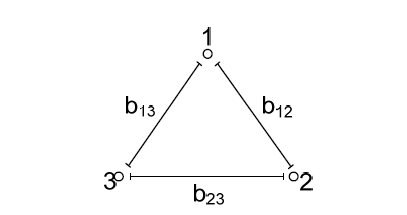
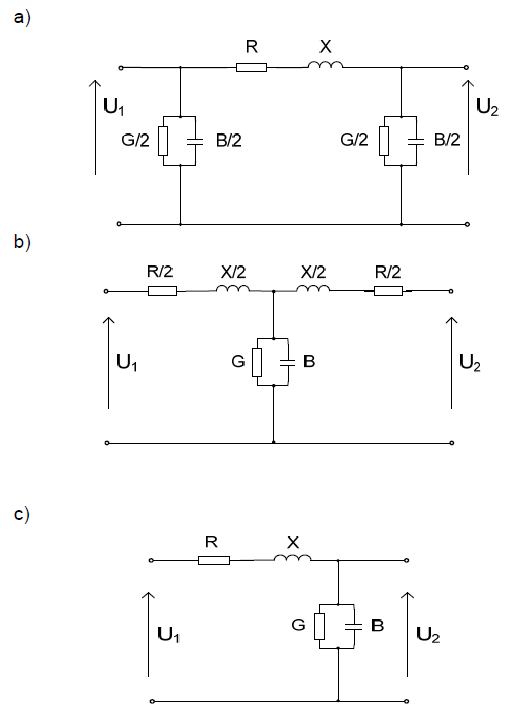
For the analysis was selected an unilaterally powered 110 kV network with a triangular arrangement of conductors (as in Fig.1). The electrical phenomena in any network are influenced, of course, by distributed line electrical parameters of both longitudinal (resistance, reactance) and transverse (conductance, susceptance). However, the analysis is usually carried out for simplicity based on one of selected equivalent model of lumped elements network type Π, T or Γ (Fig. 2) [8].
Electric models defined in per unit parameters are specified by the following relationships;
• resistance per unit R`:

where: l -length of the network [m], γ – conductivity [m-1Ω- 1mm-2], s – cross-section of the conductor [mm2];
• reactance per unit X’:

where:

bav – geometric mean distance between conductors [cm}

rs – average radius (equivalent) of the conductor [cm],
• conductance per unit G’:
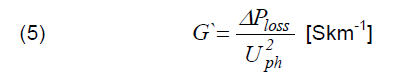
where: ΔPloss – corona losses [kW/km], Uph – phase voltage [kV],
• susceptance per unit B’:

where:
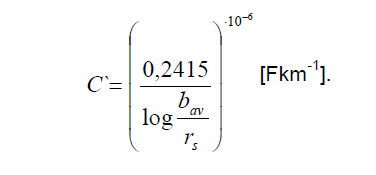
Because of the problem in determination of the accurate value of active power losses due to corona effect (related significantly to the weather conditions-with the deterioration in the weather they can increase approximately by about 4- times) in the further discussion this parameter is omitted. Whereas, the value related to the current line susceptance depends on the conductor cross-section and its average value according to [3] is respectively: 120 mm2-0.169 Akm-1, 185 mm2-0.176 Akm-1, 240 mm2-0.203 Akm-1, 525mm2– 0.211 Akm-1.
For analysis the Π type model has been selected. Note, however, that accuracy of the calculations depends on the type of equivalent line model taken under consideration [2,8].
Analysis of the voltage value variation in the distribution line of 110 kV supplied unilaterally
The voltage value and variation of its level at the end of the line powered unilaterally depend, of course, on the operation conditions (load). Therefore, the analysis considered both the work under loading and during the extreme case of a no-load state. Currents distribution under the no-load state is shown in Fig. 3, whereas, its vector diagram in Fig. 4 respectively.
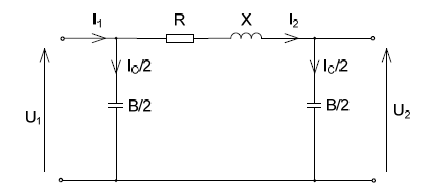
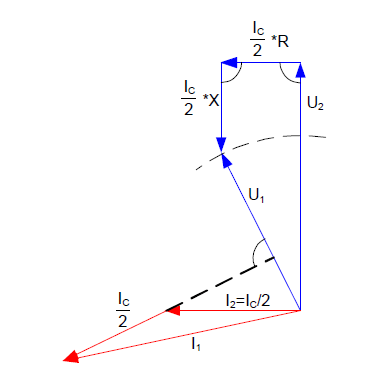
Similarly the current distribution and vector diagram for the line under load is illustrated in Fig.5. and Fig. 6.
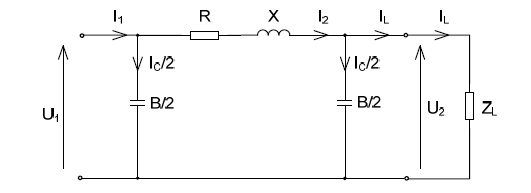
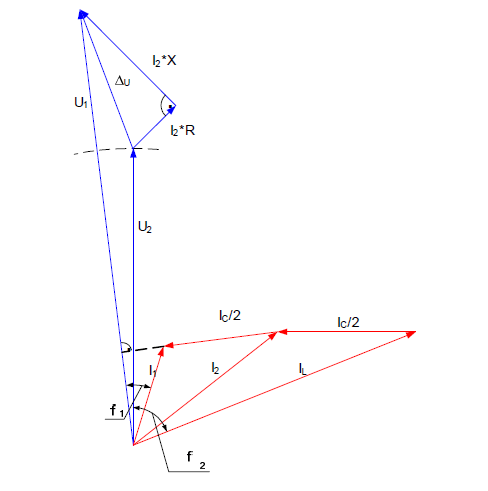
It should be noted that the capacitive currents Ic (Ic/2) posses constant values for the given line parameters whereas, the load current that depends on the nature (type) and the load value strongly influence the position of vectors of the voltage loss and voltage drop (vector shift) on the vector diagram. For the no-load state of the line the capacitive currents that flow in the network (so-called line charging currents) result in a voltage increase at the end of this line. On the contrary for loaded line, (with the most common load of the R, L type), there is seen an opposite effect, i.e. – the voltage value at the end of the line is decreased respectively (value of the voltage drop is dependent on the load and its character). Therefore, one can meet the following cases:
• the line capacitive current is greater than the inductive component of the load current; as a result I1 current is capacitive,
• the line capacitive current is equal to the inductive component of the load current (line is fully compensated); current I1 is of resistive nature,
• the line capacitive current is less than the inductive component of the load current; current I1 is therefore inductive. Hitherto conventional methods for stabilizing the voltage level at the end of the line are based on:
• on-line regulation of the transformation ratio of the power transformer supplying the line,
• compensation of the reactive component of the line current, by
– connection of sectionalized capacitor banks at the end of the line for the case of R, L line load type,
– connection of sectionalized reactors at the end of the line for the line load current of R,C nature.
These methods have significant drawbacks and disadvantages associated with inevitability of regulation of the transformation ratio under load and/or with changeovering the sectionalized reactors (capacitors) depending on the state and nature of network load conditions (extra, expensive high voltage switches are also needed). Additional problem in modern networks to overcome is the increased level of distorted current and voltage waveforms what is the effect of application of the so called “troublous” power loads (like electric arc furnaces) and/or non-linear (e.g. power converters).
Recommended way for the voltage stabilization
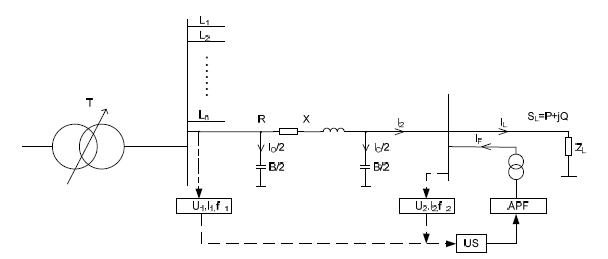
Nowadays, it is possible to stabilize the voltage level by means of the active power filter (APF) connected to the end of the line (on the market there is a large gamma of ever cheaper filters with different parameters both for low and medium voltage application). However, to be effective, for analysed application, the filter has to be controlled by an algorithm developed basing on the theory of the physical components of the current (CPC) [9-11]. It may, therefore depending on the adopted function, compensate for the reactive component of the load line current (inductive and/or capacitive), resulting in variation of the voltage drop due to longitudinal parameters of the line. This filter can also produce additional capacitive load current (state of overcompensation) enabling the voltage increase over the voltage loss respectively. It can also effectively suppress higher harmonics due to non-linear loads [4,9]. This proposal is illustrated in Fig. 7.
In order to confirm the applicability of the AFP for the stabilization of the voltage in the HV line the related study were carried out for the low voltage (500 V) physical line model which simplified electric scheme is presented in Fig.8a and Fig.9a respectively. Ability to generate, by the APF arrangement, currents of a different value, nature as well as waveforms was tested carefully under various line working conditions like inductive, capacitive (no-load state of the line ) and/or inductive non-linear loads respectively. Studies have proved the usefulness of the APF for this purpose, what can be seen also from selected examples of measured and recorded waveforms shown in Fig.8 and Fig.9. In either case the active filter effectively produces the corresponding current component (inductive and/or capacitive) whereas, maintaining the line voltage at an appropriate level. The current waveforms, seen in Fig.8c and Fig.9c were generated and measured – at point 2- for a three-phase physical model of the developed filter (APF) [12-15].
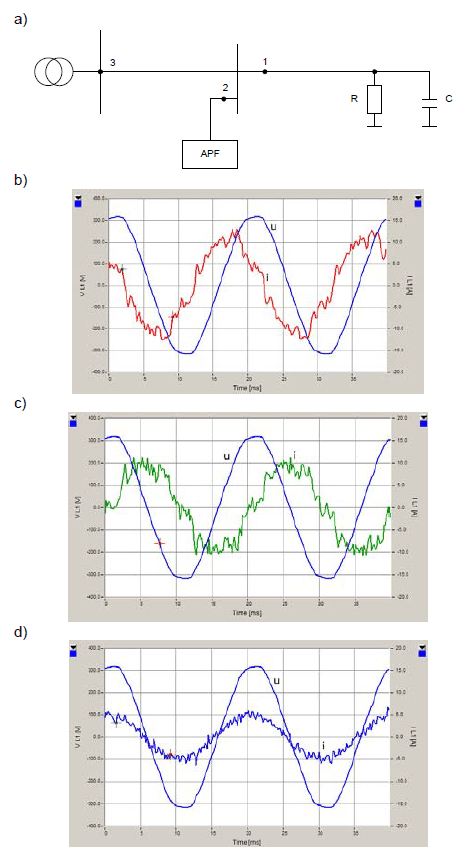
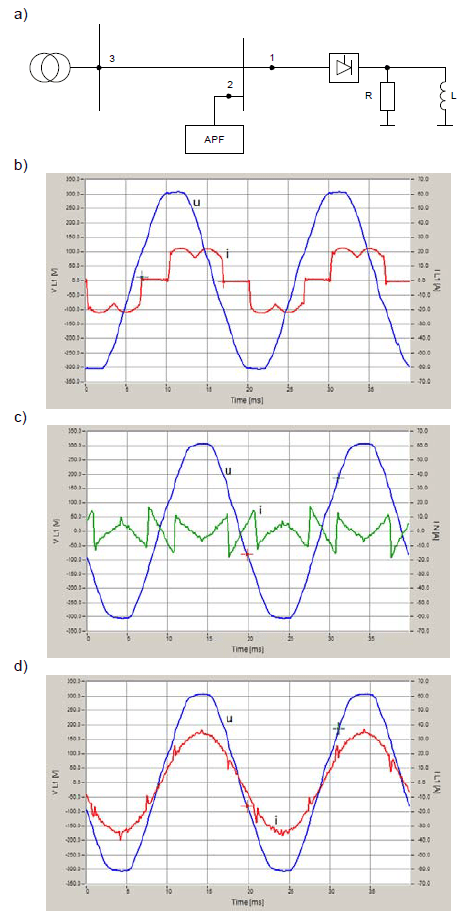
If the control algorithm of the AFP introduces an additional function that allows compensation of inductive and/or capacitive current component one obtains additional effect of the power factor improvement (defined by cosφ or tanφ) at the point of connection of the line to the supply source (see Fig.8d and Fig.9d). This positively affects the whole connected electric power system.
Conclusions
The use of the active power filter (APF) is an alternative, effective way to provide voltage stabilization at the end of unilaterally fed distribution line of a high voltage. This enables compensation of capacitive currents of the line under no-load state of operation and decreases as a result the voltage value (at the end of the line) to the rated level. Under inductive R, L type of load the compensation is also performed (including power-factor correction) however, increasing the voltage at the end of the line to the rated value. As a result, it eliminates the need for expensive circuit switches to changeover the sectionalized reactors or capacitor banks. Moreover, the voltage value is on-line controlled. An additional effect that results from the use of AFP for the voltage stabilization (in HV lines supplied unilaterally) is the effective limitation (elimination) of the current harmonics level in the line currents.
REFERENCES
[1] Power conductors for overhead lines of 110kV. Technical specification of Energa-Operator, 2013.
[2] Miller P., Wancerz M., Wpływ sposobu wyznaczania parametrów linii 110 kV na dokładność obliczeń sieciowych. Przeglad Elektrotechniczny, no 4 (2014), 189-192.
[3] National Electric Power System. PSE-SF.KSEI/2005 v1. http://www.pse.pl/uplouds
[4] Wosik J., Kalus M., Kozlowski A., Miedzinski B., Habrych M., The efficiency of reactive power compensation of high power nonlinear loads, Elektronika ir Elektrotechnika, vol. 19, no. 7, (2013), 29–32.
[5] Hou R., Liu J. W. Y., Xu D., Generalized design of shunt active power filter with output LCL filter, Elektronika ir Elektrotechnika, vol. 20, no. 5 (2014), 65–71.
[6] Woodley, N. H., Morgan, L., Sundaram, A. Experience with an inverter-based dynamic voltage restorer. IEEE Transactions on Power Delivery, 14(3) (1999), 1181-1186.
[7] Nielsen, J. G., Newman, M., Nielsen, H., Blaabjerg, F. Control and testing of a dynamic voltage restorer (DVR) at medium voltage level. IEEE Transactions on power electronics, 19(3) (2004). 806-813.
[8] Konczykowski S., Electrical Power Networks. WNT, Warszawa, 1971 (in polish).
[9] Habrych M., Wisniewski G., Miedzinski B., Wosik J., Kozlowski A., Possibility of load balancing in Middle Voltage network with the use of Active Power Filter, Elektronika ir Elektrotechnika, no.5 (2015), 19-23.
[10] Czarnecki, L. S. Orthogonal decomposition of the currents in a 3-phase nonlinear asymmetrical circuit with a nonsinusoidal voltage source. IEEE Transactions on Instrumentation and Measurement, 37(1), (1988), 30-34..
[11] Czarnecki L. S., Powers of asymetrical loads in therms of the CPC theory, Electrical Power Quality and Utilisation Journal, vol. 13, no 1 (2007), 97–103.
[12] Kamal R., Sharma K., Voltage regulation using FACTS devices. International Journal of Pure and Applied Mathematics, Vol. 119, no 16 (2018) 2207-2214.
[13] Pais M., Almedia M.E., Castro R., Voltage regulation in low voltage distribution networks with embedded photovoltaic microgeneration. International Conference on Renewable Energies and Power Quality (ICREPQ12), Santiago de Compostela, (2012).
[14] Zou Z. X., Zhou K., Wang Z., et al., Frequency-adaptive fractional order repetitive control of shunt active power filters, IEEE Trans. on Industrial Electronics, vol. 62, no. 3 (2015), 1659–1668.
[15] Kotsalos K., Decentralized voltage regulation in radial
medium voltage networks with high presence of distributed generation, Journal of Engineering, 3, (2017), 26-38.
Authors: dr inż. Julian Wosik, Instytut Technik Innowacyjnych EMAG, ul. Leopolda 31, 40-189 Katowice, dr hab. inż. Marcin Habrych, prof. uczelni, Politechnika Wrocławska, Katedra Energoelektryki, Wybrzeże Wyspiańskiego 27, 50-370 Wrocław, Email: marcin.habrych@pwr.edu.pl, prof. dr hab. inż. Bogdan Miedziński, Politechnika Wrocławska, Katedra Energoelektryki, Wybrzeże Wyspiańskiego 27, 50-370 Wrocław, E-mail: bogdan.miedzinski@pwr.edu.pl, dr inż. Grzegorz Debita, Akademia Wojsk Lądowych imienia generała Tadeusza Kościuszki, ul. Czajkowskiego 109, 51 – 147 Wrocław E-mail: grzegorz.debita@awl.edu.pl, dr inż. Andrzej Firlit, Akademia Górniczo-Hutnicza im. Stanisława Staszica w Krakowie, Katedra Energoelektroniki i Automatyki Systemów Przetwarzania Energii, al. Mickiewicza 30, 30-059 Kraków, E-mail: andrzej.firlit@keiaspe.agh.edu.pl
Source & Publisher Item Identifier: PRZEGLĄD ELEKTROTECHNICZNY, ISSN 0033-2097, R. 96 NR 1/2020. doi:10.15199/48.2020.01.29
 Power Quality Blog