Published by Nijat Mammadov1, Ilkin Marufov2, Saadat Shikhaliyeva, Gulnara Aliyeva, Saida Kerimova,Azerbaijan State Oil and Industry University
ORCID: 1. 0000-0001-6555-3632; 2. 0000-0002-3143-0113
Abstract. Currently, renewable energy sources play an important role in the global energy balance. Among them, wind electric installations occupy a special place. As wind turbines develop and their power increases, their design also improves. Therefore, when improving the mechanical parts of the design of wind electric installations, the electrical control and monitoring systems are being improved and become more complex. One of the main tasks in wind energy is the choice of a method for controlling the power of wind turbines. To achieve this, this article discusses several methods for controlling the power of wind turbines. The article shows a graph of the dependence of the generated power on the speed of the wind wheel at various wind speeds. An analysis has been made of methods for controlling the power of wind turbines at constant and variable speed, controlling power by stepwise changes in the speed of the wind wheel by switching the generator windings, controlling the power of wind turbines by changing the gear ratio of the wind turbine multiplier, etc. The advantages and disadvantages of these methods are given, thanks to which we can find out which of them is the most effective and profitable at present.
Streszczenie. Obecnie odnawialne źródła energii odgrywają ważną rolę w światowym bilansie energetycznym. Wśród nich szczególne miejsce zajmują elektrownie wiatrowe. W miarę rozwoju turbin wiatrowych i wzrostu ich mocy, poprawia się również ich konstrukcja. Dlatego też w miarę udoskonalania części mechanicznych konstrukcji elektrowni wiatrowych, elektryczne systemy sterowania i monitorowania są ulepszane i stają się coraz bardziej złożone. Jednym z głównych zadań energetyki wiatrowej jest wybór metody sterowania mocą turbin wiatrowych. Aby to osiągnąć, w artykule omówiono kilka metod sterowania mocą turbin wiatrowych. W artykule przedstawiono wykres zależności generowanej mocy od prędkości koła wiatrowego przy różnych prędkościach wiatru. Dokonano analizy metod sterowania mocą turbin wiatrowych przy stałej i zmiennej prędkości obrotowej, sterowania mocą poprzez skokowe zmiany prędkości koła wiatrowego poprzez przełączanie uzwojeń generatora, sterowania mocą turbin wiatrowych poprzez zmianę przełożenia przekładni mnożnik turbiny wiatrowej itp. Podano zalety i wady tych metod, dzięki czemu możemy dowiedzieć się, która z nich jest obecnie najbardziej efektywna i opłacalna. (Badania metod sterowania mocą turbin wiatrowych)
Keywords: wind turbine, multiplier, reducer, power control, variable frequency, constant frequency
Słowa kluczowe: turbina wiatrowa, powielacz, reduktor, sterowanie mocą, częstotliwość zmienna, częstotliwość stała
1.Introduction
At the present stage of development of science and technology, electrical systems based on renewable energy sources consist of a large number of elements and subsystems interconnected. To study such systems, a fairly powerful mathematical apparatus is needed, which is based on the use of computing resources of electronic computers and its implementation using special software. With the development of this software for important scientific calculations and the increasing power of computer technology for scientific research, special programs for mathematical calculations are increasingly being used on computers. With the help of such programs, mathematical models are quickly implemented using model-oriented programming methods. After moving on to the study of electrical supply systems based on renewable energy sources, it is worth highlighting some features of the functioning of such systems. Renewable energy sources do not provide constant power output, therefore such systems require the accumulation of generated energy for its subsequent return to the consumer if necessary.
Due to the fact that there are currently a large number of different designs of wind power plants, a number of questions arise:
– how effective are these structures;
– how fully the potential inherent in a particular design is used;
– is it possible to increase the efficiency of such a wind turbine without making major changes to the design.
To answer these questions, you need to know general information about wind turbines. It was determined that all wind electric installations are divided into the following:
1) wind electric installations with a horizontal axis of rotation;
2) wind electric installations with a vertical axis of rotation.
Horizontal axis wind electric installations can be divided into:
1) with a constant blade installation angle;
2) with variable blade installation angle;
Wind turbines with a vertical axis of rotation can be divided into wind turbines with a wind wheel geometry that remains constant and wind turbines with a wind wheel geometry that changes.
At the same time, the main methods for controlling the power of a wind turbine are highlighted. The first of these methods is the method in which the wind electric installation operates at a constant speed of the wind wheel. The second important method is the method in which the wind electric installation operates at several fixed speeds of rotation of the wind wheel by switching the generator windings. The third is a method in which a wind electric installation operates at several fixed speeds of rotation of the wind wheel by switching the gear ratio of the multiplier. The most important fourth method is the method in which the wind electric installation operates at variable speed and uses an electric converter with a power regulator. Another important – fifth method of controlling the power of wind electric installations is the method in which the installation operates at a variable speed, in which the installation angle of the wind wheel blades changes or the geometric dimensions of the wind wheel change.
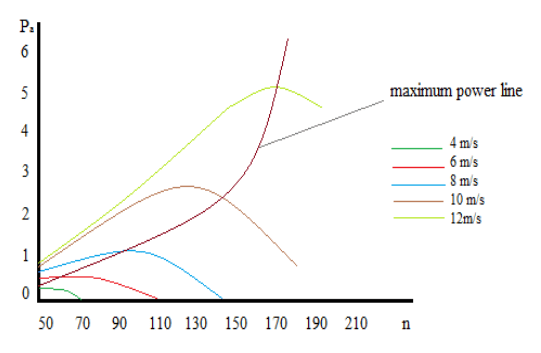
Power control in wind installations is very important. This can be explained by the peculiarity of the aerodynamic characteristics of the wind wheel. In figure 1 shows the dependence of the generated power on the rotation speed of the wind wheel for different wind speeds. From this graph it can be seen that each wind speed corresponds to a certain rotation frequency. In this case, the power of the wind wheel is maximized [1-5].
2. Materials and methods
Power control of a wind electric installation at a constant frequency. The simplest method to implement is the constant speed power control method. As an example of the use of this method, we can cite the design of a wind power plant, in which the wind wheel rotor is directly or through a multiplier connected to the rotor of a synchronous generator with permanent magnets. The generator windings are connected to the input of a diode rectifier bridge, the output of which is connected to the battery.
During the operation of such a wind electric installation, when the wind speed changes, the voltage at the output of the generator and rectifier, respectively, changes. Thus, at low wind speeds, the rotational speed and output voltage become lower than the voltage on the battery, the current in the battery stops flowing, which leads to a decrease in the electromagnetic torque of the generator on the wind wheel shaft. With an increase in wind speed, the generator speed tends to increase, which leads to an increase in the generator output voltage and an increase in the current in the battery. An increase in current leads to an increase in the electromagnetic torque of the generator on the wind wheel shaft, which does not allow it to accelerate above a certain speed, which is how voltage stabilization is achieved.
The advantages of the constant speed power control method are:
1. This method does not require such units as a gearbox or a mechanism for changing the installation angle of the blades, which makes it possible to simplify the design of the wind turbine, while increasing its reliability;
2. This method makes it possible to use a generator with excitation from permanent magnets, which makes it possible to increase the efficiency of the generator and the entire wind turbine as a whole, because such a generator does not require electrical energy to excite the magnetic field;
3. The possibility of using a simple scheme for converting alternating electric current of the generator into a direct current of the battery charge using a diode rectifier bridge makes it possible to simplify the electrical equipment of a wind turbine and reduce the cost of the final product.
The disadvantages of wind electric installation power control at a constant speed are:
– effective operation of the wind turbine is ensured only in a narrow range of wind speeds;
– it is necessary to apply special measures to protect against excess power at wind speeds exceeding the nominal one [6-9].
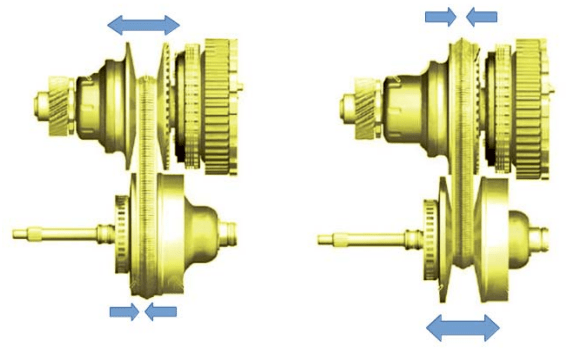
Wind turbine power control by changing the gear ratio of the wind turbine reducer-multiplier. Another way to control the frequency of rotation of the wind wheel rotor under the changing wind speed is the use of a mechanical transmission between the wind wheel shaft and the shaft of an electric generator with a variable or stepwise changeable gear ratio. An example of such devices is a gearbox / multiplier with several gears (fig. 2), or a V-belt variator (fig. 3).
This method, similar to the previous method, allows one to significantly expand the range of wind speeds, while allowing the use of fairly simple synchronous generators designed for a fixed speed.
The advantages of the wind turbine power control method by changing the gear ratio of the wind turbine multiplier gearbox are:
1. The use of a mechanical transmission with a variable gear ratio allows you to significantly expand the range of wind speeds at which the effective operation of the wind turbine is possible;
2. The use of this method makes it possible to preserve the simplicity of the electric converter of the wind power plant by shifting the functions of the actuating device of the wind turbine control system to a controlled gearbox.
The disadvantages of this method:
1. To ensure the functioning of this method in the control system of a wind power plant, the use of an anemometer or other device for determining the current wind speed is required;
2. The use of a gear change device leads to a decrease in the reliability of the mechanical transmission from the wind wheel to the wind turbine generator;
3. The use of a gear change device leads to an increase in mechanical losses in the “wind wheel – generator” path, reducing the overall efficiency of the wind turbine.

Controlling the power of a wind electric installation by stepwise change in the speed of the wind wheel by switching the generator windings. The next most difficult implementation method is the method of controlling the power of a wind electric installation by stepping the rotor speed by switching the generator windings. This method is similar to the method of power control at a constant speed of the wind wheel, differing in that, depending on the wind speed, the design of the wind power plant allows you to change the output voltage of the generator, which allows you to ensure the operation of the wind wheel with a speedthat changes depending on the wind speed, which allows you to ensure efficient operation at several wind speeds.
The advantages of the method of controlling the power of a wind electric installation by stepping the speed of the wind wheel by switching the generator windings are:
1. This method allows you to significantly expand the range of wind speeds at which the effective operation of the wind turbine is possible;
2. The use of this method makes it possible to maintain the simplicity of the electrical converter of the wind power plant by shifting the functions of the executive device of the wind turbine control system to the electromechanical switch of the generator windings.
The disadvantages of this method:
1. To ensure the functioning of this method in the control system of a wind electric installation, it is required to measure the wind speed using an anemometer, or to determine this value by indirect signs, for example, by the magnitude of the angular acceleration of the wind speed;
2. The use of a device for switching the windings of the generator leads to a decrease in the reliability of the electrical equipment of the wind electric installation;
3. In comparison with the method of controlling the power of a wind turbine at a constant speed of the wind wheel, it remains necessary to use special protective equipment to limit the power of the generator at wind speeds exceeding the nominal one [10-15].
Wind turbine power control by changing the installation angle of the blades or the geometric dimensions of the wind turbine. One of the ways to adapt the properties of a wind wheel to changing wind conditions is the method of controlling the power of a wind turbine by changing the installation angle of the blades or the geometric dimensions of the wind wheel. The application of this method involves the use of such a design of the wind wheel, in which it is possible to automatically change the aerodynamic surfaces, leading to a change in the aerodynamic characteristics of the wind wheel in accordance with the changing wind speed. Such a design usually requires equipping the wind wheel with various units to carry out the control function.
The advantages of this method:
1. The use of a mechanized design of the wind wheel allows the most complete use of wind energy in a wide range of operating speeds;
2. The use of this method allows for aerodynamic control of the wind turbine power, providing the most favorable operating conditions, including ensuring the protection of the wind turbine generator from excess power in strong winds.
The disadvantages of the method:
1. To ensure the functioning of this method in the wind turbine control system, it is necessary to use a complex control system for mechanical devices and units to change the geometry of the aerodynamic surfaces of the wind wheel;
2. The use of mechanical devices or units to change the geometry of the aerodynamic surfaces of the wind wheel leads to a decrease in the reliability of the design of the wind turbine, leads to the need to provide maintenance during the operation of the wind turbine;
3. The complication of the wind turbine design leads to an increase in the cost of both wind turbines and operating costs, which adversely affects economic efficiency.
Wind electric installation power control at a variable frequency of rotation of the wind wheel. Under the conditions of constantly changing wind speed and constant geometrical dimensions of the aerodynamic surfaces of the wind wheel, it can be found that the highest efficiency of the wind wheel is achieved by changing the speed of the wind wheel rotor according to a certain pattern. Typically, such a pattern is specified using the term speed – the ratio of the linear speed of the end of the blade to the wind speed. For each design of the wind wheel with its geometric dimensions, there is a certain value of speed at which the wind wheel provides the greatest efficiency. To ensure the efficient operation of a wind turbine, it is necessary to constantly maintain this speed at the required level by changing the frequency of rotation of the wind wheel rotor following the changing wind speed.
It should be noted that with a changing frequency of rotation of the wind wheel shaft and the generator, respectively (with a direct connection of the wind wheel shaft and the electric generator shaft), a synchronous generator with excitation from permanent magnets will produce an electric current that varies in frequency and amplitude. Accordingly, to ensure the correct functioning of the wind turbine, the use of an electrical energy converter is required. Such a converter must ensure the conversion of the alternating current of the generator into a direct current of a given value to ensure such a mode of operation of the wind turbine so that the load power of the generator provides the required frequency of rotation of the wind wheel at a given wind speed.
The advantages of this method:
1. The use of electric control of the speed of rotation of the wind wheel makes it possible to ensure the efficient operation of the wind power plant in a wide range of wind speeds;
2. The use of this method makes it possible to maintain the simplicity of the wind turbine design by shifting the functions of the actuating device of the wind turbine control system to an electric converter;
3. The use of a controlled electrical converter makes it possible to protect the electrical generator from overload in conditions of excessively high wind speeds, for example, in the event of storm winds or storms.
The disadvantages of the method:
1. To ensure the functioning of this method in the wind turbine control system, the use of an anemometer or other device for determining the current wind speed is required;
2. The use of an adjustable electrical converter leads to the complication of the electrical part of the wind turbine design, placing high demands on the reliability of electrical equipment, however, due to the fact that the electronic industry is constantly developing, offering more and more efficient and highly reliable solutions, it can be predicted that in the near future, effective designs that successfully solve the problem may appear [16-20].
3. Conclusion
Having analyzed all these methods of controlling the power of wind turbines, we can conclude that the simplest, most common control method is the method of controlling the power of wind turbines at a constant speed of the wind wheel. At the same time, one of the disadvantages of wind turbines that operate under such control is the inability to ensure efficient operation in a wide range of wind speeds and the importance of additional mechanisms to protect the wind turbine design in case of excess wind power.
The most effective way to ensure wind turbine operation in a wide range of wind speeds is to operate at variable wind wheel speed according to a given algorithm. In this case, when the wind speed changes, the rotation speed of the wind wheel changes, which ensures the operation of the wind wheel with the highest efficiency.
All of these control methods considered are applicable to various designs of wind turbines, which makes it possible to apply the accumulated experience to the entire variety of wind turbines.
REFERENCES
[1]. Marufov I.M, Mammadov N.S., Mukhtarova K.M., Ganiyeva N.A., Aliyeva G.A. “Calculation of the main parameters of the induction levitation device used in vertical axis wind generators” IJTPE, Issue 54, Volume 15, Number 1, March 2023, pp. 184-189
[2]. Mammadov N.S., Ganiyeva N.A., Aliyeva G.A. “Role of Renewable Energy Sources in the World”. Journal of Renewable Energy, Electrical, and Computer Engineering. September, 2022. DOI: 10.29103/jreece.v2i2.8779 pp. 63-67 https://ojs.unimal.ac.id/jreece/issue/view/359
[3]. J. Mauricio, A. Marano, A. Exposito, J. Ramos, “Frequency Regulation Contribution through Variable Speed wind Energy Conversion Systems”, IEEE Trans. Power Systems, Vol. 24, №1, pp. 173-180, France, February 2009
[4]. Mammadov Nijat, Mukhtarova Kubra. “ANALYSIS OF THE SMART GRID SYSTEM FOR RENEWABLE ENERGY SOURCES”, Journal «Universum: technical sciences», 27.02.2023, № 2 (107), pp. 64-67
[5]. Nijat Mammadov, “Analysis of systems and methods of emergency braking of wind turbines”. International Science Journal of Engineering & Agriculture 2 (2), 147-152
[6]. N.S. Mammadov, “Methods for improving the energy efficiency of wind turbines at low wind speeds”, Vestnik nauki, 2023
[7]. Nijat Mammadov , Sona Rzayeva , Nigar Ganiyeva, “Analisys of synchronized asynchronous generator for a wind electric installation”, Przeglad Elektrotechniczny journal, 05/2023 Page no.37,doi- 10.15199/48.2023.05.07
[8]. Mammadov Nijat Sabahaddin, “VIBRATION RESEARCH IN WIND TURBINES”, The 15th International scientific and practical conference “The main directions of the development of scientific research”(April 18–21, 2023) Helsinki, Finland. International Science Group. 2023.
[9]. N. Budisan, V. Groza, O. Prostean, I. Filip, “Rotation Speed and Wind Speed Indirect Measurement Methods for the Control of Windmills with Fixed Blades Turbine”, Instrumentation and Measurement Technology Conference Proceedings, 2008, p.912 – 916.
[10] . P.W Carlin. “The history and state of the art of variable-speed wind turbine technology”, Technical Report NREL/TP–500– 28607, National Renewable Energy Laboratory, USA, 2001.
[11]. Mammadov N.S., Aliyeva G.A., Kerimova S.M., “APPLICATION OF ARTIFICIAL INTELLIGENCE IN WIND ELECTRIC INSTALLATIONS”, Vestnik nauki. – 2023. – Issue.1 – №. 10 (67). – pp. 303-307.
[12]. A. Nayir, E. Rosolowski, L.Jedut, “New trends in wind energy modeling and wind turbine control”, IJTPE, Issue 4, Vol. 2, №3, pp. 51-59, September 2010
[13]. I.N. Rahimli, S.V. Rzayeva, E.E. Umudov, “DIRECTION OF ALTERNATIVE ENERGY”, Vestnik nauki, Issue 2, Vol. 61, №4, April 2023
[14]. N.S. Mammadov, G.A. Aliyeva, “Energy efficiency improving of a wind electric installation using a thyristor switching system for the stator winding of a two-speed asynchronous generator”, IJTPE, Issue 55, Volume 55, Number 2, pp. 285-290
[15] . Nadir Aliyev, Elbrus Ahmedov, Samira Khanahmedova, Sona Rzayeva, «Synthesis of the Exact Parameters of the Electromagnetic Brake of a Wind Electric Installation», Przeglad Elektrotechniczny journal, № 10, Poland, 2023
[16] . Nijat, Mammadov. “Selection of the type of electric generators for a wind electric installation”, Universum journal, Vol.102, №9 pp.65-67,Moscow, Russia, September2022.
[17]. Ilkin Marufov, Aynura Allahverdiyeva, Nijat Mammadov, “Study of application characteristics of cylindrical structure induction levitator in general and vertical axis wind turbines“, Przeglad Elektrotechniczny,2023/10/1
[18]. Aliyev N.A. , Mammadov N.S., “APPLICATION OF ELECTROMAGNETIC CLUTCH SLIPPING IN WIND POWER PLANT“, Deutsche Internationale Zeitschrift für Zeitgenössische Wissenschaft,2023/10/1
[19]. I.M. Marufov, Calculation of the complex resistances of the induction system of the vertical axis wind generator The 4th International scientific and practical conference “Actual problems of modern science” (January 31 – February 3, 2023) Boston, USA. International Science Group. 2023. 439 pp.
[20]. Mammadov Nijat, “PROSPECTS FOR THE DEVELOPMENT OF RENEWABLE ENERGY SOURCES”, The 29th International scientific and practical conference “Modern scientific trends and youth development”(July 25–28, 2023) Warsaw, Poland. International Science Group. 2023. 244 p.
Source & Publisher Item Identifier: PRZEGLĄD ELEKTROTECHNICZNY, ISSN 0033-2097, R. 100 NR 5/2024. doi:10.15199/48.2024.05.44
 Power Quality Blog