Published by 1. Mohammed SAAIDIA, 2. Abdelghani GUECHI, 3. Nedjem-Eddine BENCHOUIA, University Mohamed-Cherif Messaadia of Souk-Ahras . ORCID: 1. 0000-0002-7778-8591; 3. 0000-0002-4761-940
Abstract. Algeria is worldly known as one of the big producers and exporters of fossil fuels. However, by developing an adequate energy policy, it could become one of the great sun power (SP) producers and exporters. Indeed with almost 2 million Km2 sunny superficies, the country detains enormous SP energetic potential funds. However, eventual powerful SP plants deployment could be done far to the southern Algerian desert which makes HVDC technology the best candidate for the transmission of produced electricity towards the north region where are the main industrial poles and the most populated regions for local consumption and eventually farther to the north for electricity exportation to the European countries. The prospection work presented hereafter is a study on the feasibility of using HVDC technology for such possible projects according to country’s existing means and topographical and environmental characteristics.
Streszczenie. Algieria jest znana na całym świecie jako jeden z największych producentów i eksporterów paliw kopalnych. Jednak opracowując odpowiednią politykę energetyczną mogłaby stać się jednym z wielkich producentów i eksporterów energii słonecznej (SP). Rzeczywiście, z prawie 2 milionami km2 słonecznych powierzchni, kraj ten posiada ogromny potencjał energetyczny SP. Jednak ewentualne rozmieszczenie potężnych elektrowni SP mogłoby zostać przeprowadzone daleko na pustyni południowej Algierii, co sprawia, że technologia HVDC jest najlepszym kandydatem do przesyłu wyprodukowanej energii elektrycznej w kierunku regionu północnego, gdzie znajdują się główne bieguny przemysłowe i najbardziej zaludnione regiony do konsumpcji lokalnej i ostatecznie dalej na północ w celu eksportu energii elektrycznej do krajów europejskich. Przedstawione poniżej prace poszukiwawcze są studium wykonalności wykorzystania technologii HVDC do takich możliwych projektów, zgodnie z istniejącymi środkami kraju oraz charakterystyką topograficzną i środowiskową. (Transport energii elektrycznej z wykorzystaniem technologii HVDC dla południowych elektrowni słonecznych w Algierii)
Keywords: HVDC; electrical power transport; sun power; photovoltaic.
Słowa kluczowe: HVDC; przesył energii elektrycznej; moc słoneczna; fotowoltaika.
Introduction
Electricity power production-consumption industry is largely dependent on the transportation process. Indeed, its importance is directly related to the quality of the delivered electricity, the quality of distribution services, the unitary prices and moreover to some environmental concerns. HVAC (High Voltage Alternative Current) was, for a long time, the mostly used technology for electricity power transportation. This was mainly due to the alternative nature of the produced electricity and also to economical raisons. However, technological advancements, electrical power networks developments and emergent electrical power sources have bring to the fore the HVDC (High Voltage Direct Current) old technology as a competing and alternative technology.
Thanks to decades of active research efforts and huge investments, HVDC (high voltage direct current) technology had become a real and practical alternative to HVAC one. The line cost per Km rapidly became in favor of this new alternative over long distances electrical transportation lines (several hundreds of Km) and for powers beyond 200 MWs. Practical financial studies demonstrate that HVDC losses still around only 3% for 1000 Km overhead lines connection [1] . Moreover, gains in used cables (about 50%) as well as huge reduction in the cost of cable supports make the HVDC technology more suitable according to environmental point of view as well as economically. These facts make HVDC systems the most electrical power transportation mean for powerful electrical interconnections between countries and even more between continents. It also happens that this type of electricity technology is more suitable for certain forms of renewable energies like photo-voltaic (PV) energy since the latter is directly produced in DC form [1], [2].
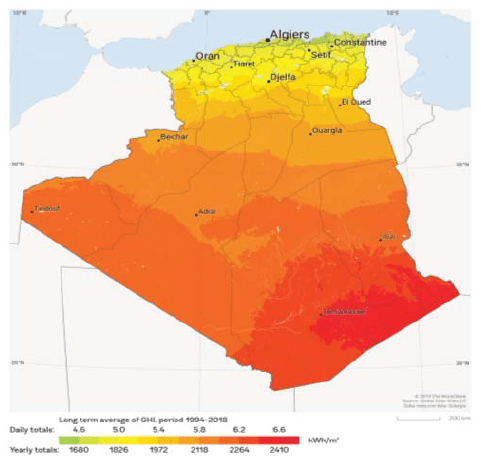
Thanks to its highly sunny 80% of its superficies (about 2 million Km2), Algeria registers one of the worldwide highest sunshine duration from 2,000 to 6,000 Wh/m2 according to regions. This enormous solar power potential could permit a very high production of clean SP energy which is far exceeding its consumption and could makes the country an eventual exporter of this type of highly coveted energy. However, like it’s demonstrated on the map of figure 1, the most sunny sites for possible mass production of this type of energy are far to the south; which makes HVDC electricity transportation technology a suitable candidate in the case of the country and encourages its adoption.
During last decades, researchers, in the HVDC field, were very active and were mainly focused on electronic parts of HVDC systems, especially converters and inverters, the exploitation of SP energy in HVDC form for everyday applications and of course the DC electric power transportation.
This investigating work begin with an overview of the basic notions of the HVDC electrical power transportation system, then a detailed environmental and economic study of the advantages of using HVDC according to the different strategic characteristics of the country is presented. Finally, this study is concluded by highlighting the key-basis of a possible real implementation of the HVDC solution.
HVDC basic notions and importance
By nowadays, HVDC technology has reached high level performances in its different components such as electronic parts, cable characteristics, pylons specifications and management capabilities. These advancements are results of research efforts, laboratory investigations and practical projects deployments. In the following subsections we will detail the principal and fundamental basis of HVDC.
Basic notions on HVDC
Despite the fact that AC technology dominated and still dominating the electrical engineering from the production process to the consumption going through the transport and distribution intermediate operations, the HVDC technology appears to be on the right way to regain one’s share of the market. At the production stage, some of the renewable energy resources like PV systems give DC currents instead of AC ones. The electrical power transportation also have seen the deployment of HVDC electrical networks especially in cases of powerful long distances transport requirements. This welcomed comeback of HVDC was supported essentially by research and applications on DC electricity, semiconductor technology and control theory. This comeback was aided by 7 principal advantages versatile the AC configuration namely [3];
• Low financial investment
• Lower losses for bulk power transmission
• Capability to interconnect asynchronous grids
• More efficiency for underground and submarine transportation
• Improve performances of parallel transmission for AC circuits
• Better controllability since it permits an instant and precise power flow control
• For an equivalent ROW, DC provides 3 times more power than AC.
Moreover, advanced HVDC configurations permit also more advantages namely;
• Costs are close to overhead lines
• Possibility to connect passive loads
• Useful for enhancement of connected AC networks
• Active and reactive power are controlled independently
Reduced delivery times for HVDC projects.
HVDC projects’ deployment
HVDC electrical power transport technology has been, for a long time, used in a limited manner for some important projects. The investments in these projects helped to experiment the new invented technologies and rise the met challenges. Nowadays, HVDC systems become so competitive that under certain conditions it overcomes the HVAC technology which permits an important deployment of HVDC systems. Figure 2 gives a graphical HVDC projects’ spread in different parts of the world.
The globalization of electricity power transportation permits networks interconnections between countries and continents. This new trend imposed the construction of electric transportation lines on long distances and with huge power; which makes HVDC the essential solution to be adopted [4][5].
In Algeria, HVAC is the exclusive technology that is used from the production till the consumption. The availability of oil and gas fuel resources permitted to the exclusive producer of electricity (SONELGAZ) to adopt the simplest strategy based on the construction of production stations close to the consumer which makes the transport of electricity limited to short distances [6].
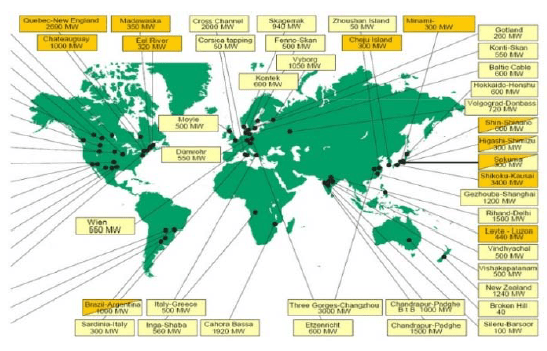
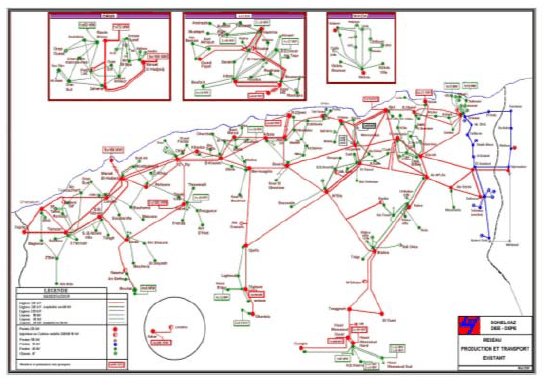
Figure 3 gives an overview of the topology of the electricity production stations and transmission lines of the Algerian network deployment. The production stations goes from 220KV (red circles) down to 60KV (green circles). The transportation lines use the same color codification (red for 220KV and green for 60KV) [7], [8].
However, new development trends tend to change the course of this industry. The following Algerian specificities could drive such a trend:
– Emergence of renewable energies and especially sun power production technologies. – Enormous sun power potentials
– Large sunny areas (more than 2 Million Km2) – Most sunny southern regions are far from populated and industrialized poles (the Sahara)
– Country’s propitious financial situation which could help to put sufficient investments to achieve promising goals
– Country economic strategy aspiring to impose it as a major exporter of renewable electricity, especially towards Europe
Technologists, economists, and even politicians are all aware of energy issues in the coming decades. Renewable energies became not only a trend subject of discussions for different interested actors in Algeria but a real challenge that has to be met. The Algerian electricity and gas company (SONELGAZ), exclusive producer and distributor of electricity in Algeria, had already taken practical steps towards the new renewable energies era. Indeed, SONELGAZ has created a subsidiary which deals with the production of renewable electricity especially PV one. Plans and schedules are ongoing to attain important renewable electrical power production not only for local consumption but also exportation. However, important production stations will be spread far to the south where the most important irradiation rates are recorded. To support this trend, HVDC technology could be deployed according to economic and environmental studies.
Environmental and Economic Aspects
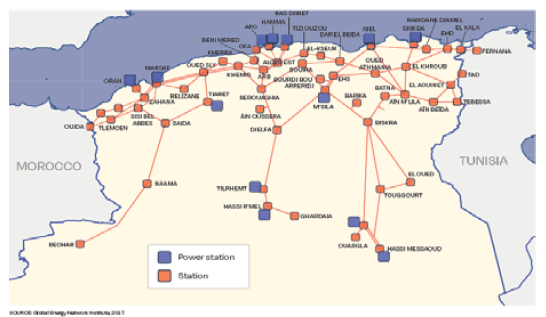
Renewable energies resources are found to be potentially sufficient to respond to the humanity growing energy demand while remaining respectful of the environmental protective policies. Solar energy plants and offshore wind pharms are best examples of such energy resources. However, these resources of energy are located in areas far removed from populated regions and the transmission of the enormous electrical energy is carried out over long distances (Fig. 4).
To solve this problem, the use of HVDC technology is one of the solutions that can help to provide power from these areas. Therefore, new trends to attain a more sustainable world will give the HVDC technology an important role in this way of development. In addition, the new HVDC technology enhancements like VSC, MTC and MMC technologies appear to be economically good alternatives for the future extensions of the transmission networks across the planet.
Power transmission efficiency, economic benefits, technical concerns and environmental issues are the main supports of the HVDC technology.
Environmental advantages of HVDC
• Visual impact and space requirements:
The efficiency of HVDC transportation technology permits more efficient exploitation of existing standard power plants and even new renewable energy ones. This fact will lead to minimize power losses and to improve earth’s exploitation resources which are important parameters to measure the environmental-friendly of any technology [9].
In HVAC electrical power transportation, the over-head transportation trough cables and tower’s is the main mean which is used at 90% of cases since it’s technologically and economically the most efficient mean. HVDC technology offers more alternatives. In HVDC transportation technology the three known transportation means; namely over-head, underground and underwater; could be used alternatively according to environmental topographical characteristics. For over-head transportation mean the tower’s visual impact is therefore reduced to only converter stations comparatively to the case of HVAC [9] [10].
From visual impact point of view and for a comparable power transmission capacity, HVDC overhead transmission lines have less intrusive environmental effect. Example given could be the case of Bipolar HVDC transmission lines which have two conductors and already because of that are simpler in design in comparison with the three-phase structure of a HVAC line of the same capacity and comparable voltage levels. In this case, shorter tower heights are used for HVDC technology which affects environmental and economic parameters [11].
Another exemplar case would be the case when quadric-polar HVDC lines are used for power transmission. Here, flat towers or towers with two cross-arms, according to transmission corridor’s conditions, will be used. For a ±500 kV HVDC transmission line, Figure 5 gives schematic views of these tower types. Approximate tower dimensions are indicated. According to the specificities of the constructed transmission line, a choice of tower design would be done. However, for any case, the dimensions of the towers for the HVDC quadric-polar line are smaller than those used for a double-circuit HVAC line with comparable capacity [11]. Moreover, the width of corridors opened for the electrical line transmission are consequently reduced (about 1/3) in case of HVDC technology compared to HVAC one. Given a line with the same capacity (500KV for example), the corridor for an HVDC connection will be 55m to 60m; however it will need a corridor of 65m to 70m in case of an HVAC double circuit or a corridor of 105m in case of an HVAC single circuit [12].

Moreover, HVDC technology offers superior performances and capabilities when using underground or underwater connections. For underground connections, they will be considered as exclusive for HVDC since for HVAC they will require large tranches to avoid interactivity between the three phase’s cables.
In the case of HVDC, tranches about only 50cm to 80cm large and 1m to 1.5m of deepness are sufficient to contain bipolar electrical transmission line with a power transmission of about 1200 MW. According to an environmental point of view, narrow tranches are the friendliest means for such transmission lines. In the case of submarine transmission lines and over 50 Km, the use of HVDC technology becomes inevitable. Studies demonstrate no consequent effects of established submarine transmission lines on submarine’s life. Furthermore, installed cables do not need any maintenance or servicing operations during their lifetime (except in force majeure cases) which permits their integration to their surrounding environment.
All these environmental specificities could be applied to topographic characteristics of Algerian lands. Indeed, combining information on figure 1 and figure 4, we can easily see that the sunniest areas that already contain infrastructural facilities are the regions of Bechar, at the west, Gardaia, at the center, and Hassi-Messaoud at the east. These areas are at least 700 Km to 800 Km far from the most populated and industrialized northern zones of the country. Added to this, 70% of this distance is flat and uninhabited lands (Desert). Most of the remaining 30% distance are mountainous lands. In the case of electrical power exportation towards Europe, distances could go over a 1000 Km with some hundreds of Km in the Mediterranean Sea.
• Electric and magnetic fields: A well-known physical effects produced by conducting electricity in cables are electric and magnetic fields. These two effects were well studied and efficiently measured. For an HVDC over-head transmission line, for example, the electric field is due to firstly the potential difference between the electrical conductor and the earth and secondly to the space charge clouds that are due to Corona effect in the conductor [13].
As a natural effect, the Electrostatic fields are spread through the global atmosphere but they became stronger around electrical conductors. As this, human bodies are adapted to this type of physical effects but when they still at acceptable natural ranges. However, out of natural ranges values, they will become an ecological and even biological concern for human beings like possible shock hazards [14]. Combination of the electrostatic field and the space charge field creates the electrical field generated by an HVDC transportation line. Fortunately and in the way, the conductors of the HVDC transmission line in corona generate ions of the same polarity as the conductor itself which are drifted either to the ground or to a conductor of opposite polarity.
Measurements of the electrical field distribution at ground level under HVDC electrical line transmission demonstrate that it depends on the distribution of space charges between the conductors and the ground. The presence of space charge with the same polarity as the conductor increases the electrical field at the ground level but those with opposite polarity decreases it [14]. This fact, encourages the use of bipolar and even quadric-polar HVDC line transmissions instead of mono-polar ones since the presence of conductors of opposite polarities will decreases the global density of the electrical field at the ground level.
Table 1. Examples of natural and artificial sources of electric and magnetic fields
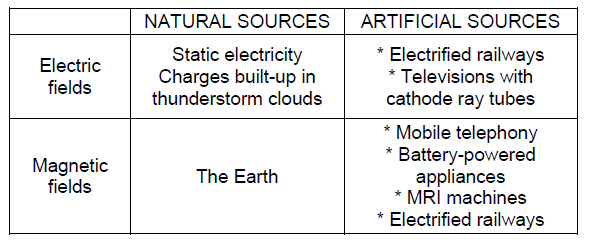
In the same way and for environmental and biological concerns for the human body, the magnetic field associated with an HVDC transmission line was studied. Studies demonstrate that magnetic field had no noticeable effects on the human body. In a counterpart, this physical phenomenon has important influences on certain types of human machines. The well-known case is the disturbances that were measured for the magnetic compass systems mounted on vessels when they became close to an undersea HVDC transmission line [9][10].
• Radio/TV interference:
Here also for radio interference caused by electric power transmission lines, HVDC technology still preferred to HVAC technology. This is due to the fact that for HVDC conductors the result of the corona discharge around them is generated only by conductors of positive polarity hence they are those who generate radio interferences. This encourages the use of bipolar and even quadric-polar HVDC transmission lines which permits an important increase of the transported power without increasing interferences. This could not be applied to HVAC transmission technology since all the transmission conductors are sources of interferences and increasing the number of conductors would imperatively increase these interferences.
Radio frequency perturbations produced by electrical transmission conductors are also subject to weather conditions. Indeed, rainy weather affects the HVDC and HVAC transmission conductors differently since it causes an increase of about 10 dB of radio interference generated by conductors of an HVAC line transmission. However, for conductors of an HVDC line the radio interference decreases considerably under condition of providing a surface voltage gradient of 25kV/cm.
In normal conditions and for an equal capacity transportation of conductors and maximum levels of electrical field intensity on their surfaces, the radio interference level of HVDC lines is typically lower by 6-8 dB than of HVAC lines [11].
However, for HVDC transmission line, converters’ switching modes cause disturbances in the kHz and MHz regions of interference. The main solution to this problem was the introduction of an appropriate shielding of valves which minimizes the amount of these disturbances and makes the radio interference of the HVDC line comparable with AC solutions [15].
• Audible noise:
Audible noise is an easily perceptible problem by each human body. Thus it’s with great concern that designers of electrical transmission lines deal with the control parameters of such a problem for both overhead lines and substations. However, used means to decrease audible noise of these electrical sources are quite costly. As a standard rule, the audible noise from transmission lines should not exceed, in residential areas, 50 dB during the day, or 40 dB at night.
For HVDC systems, the principal sources of audible noises are the substations and the transmission conductors. The substations contain converter-transformers which are the main sources of audible noises. These devices are generally surrounded by screens which provide an efficient limitation of the noise levels that outgo the substations and pollute the environment. On the other side, the transmission lines produce broadband noises which pollute noises extent to high frequencies. Electrical line transmission noise is most prevalent in fair weather. Audible noise levels produced by conductors of HVDC line usually decrease during foul weather which is completely the opposite state for the AC transmission lines for which it increases considerably.
In the case of underground and submarine HVDC transmission lines, no audible noise is perceptible. The main issue rises for the over-head transmission lines during foggy weather.
Consequently, restrictions are imposed on the construction of buildings at the closest areas of a transmission lines and their substations. Studies and measurement demonstrate that audible noise is directly related to line’s voltages levels, technical line’s specifications and the climatic state of the regions crossed by the electrical transmission line [16].
Economic benefits of HVDC
Despite the notorious environmental effects already exposed, the practical implementation of any technological solution (HVDC in this case) is directly linked to the economic parameters and advantages it presents.
As it’s depicted in Figure 6, the establishment of any electric transmission line, in HVDC or HVAC technology, induces costs mainly related to the materials used (cables, towers, electronics), to engineering works (actual installation) and to preparation works (civil works). Other expenses of lesser amounts are also expected including investigation work as well as insurance on the works and on the line.

We present hereafter economic comparatives between comparable transmission lines in HVDC and HVAC technologies.
• Used materials:
Electronics are the most applied costs in the installation of an electrical transmission line (about 63%). Compared to terminal stations of an HVAC connection, terminal converter stations on the two ends of an HVDC electrical transmission line costs much more. However, HVAC connections on long distances increase mutual inductances and capacitances that are related to the nature of the alternative current. These two phenomenon added to losses on the long distances line impose the construction of intermediate switching stations for voltages levels maintain and reactive power compensation. Figure 7 gives an approximate partition of the line cost between the terminal stations’ expenses and the rest of the realization works for both HVDC and HVAC technologies [17].

The Figure 7 also demonstrates that by increasing the line connection distance, the advantage balance goes in favor of the HVDC connection technology [18]. What is exactly the distance from what we opt for HVDC technology depends on several parameters. This distance is called “Break-even distance”.
Cables that are used for electricity transmission are also an important parameter that weights in balance. Indeed, HVDC technology uses much more technological developed cables which means much more expensive but fortunately, the quantity of cables for a comparable HVDC transmission line is reduced at least by the third compared to HVAC one. At the beginning of HVDC transmission line projects, mono polar connections were used. However, newly installed projects are using bipolar transmission lines since for same number cables we can double the transmitted power.
Towers that support cables have more reduced structure in HVDC transmission lines which makes them less high with less weight and consequently much cheaper than those used for HVAC technology [11].
• Engineering works:
Engineering works encompass all technical operations related to the installation of terminal converter stations, the passage of the cables and realization of the necessary tests and verification of the validity of the connection. It represents 10% of the total cost of the transmission line which is a lot.
HVDC transmission lines installation requires that technical staff has to be more specialized since on one hand the electronics technologies involved in this type of installation are the newest and on another hand each new HVDC transmission line is characterized by each own specific technologies like for the types of cables, the valves configurations and so on. This involves more expenses compared to an HVAC transmission line which technologies have already attained its maturity long time ago. However, these supplementary costs are compensated by the reduced works that are required for an HVDC line compared to an HVAC one. Here also the “Break-even distance” has to be determined for a given electrical transmission line.
• Engineering civil works:
Civil works are an important part of the electrical transmission line realization. With an amount of about 14% of the global amount of the whole realization cost of the transmission line, civil works represents the second portion of expenses. Civil works encompass the route study and optimization, the installation of towers for over-head connections, the digging of tranches and their fitting out for underground parts of the line and even works on the seabed for underwater connections. The preliminary study determines the type of connection adapted to each type of terrain such as plains, plateaus, mountains, lakes and seas

The study of the overall cost of an electrical transmission line determines a comparison between realization costs using HVDC and HVAC technologies. A general rule called “Break-even distance”, illustrated on Figure 8, is often used to prevail one over the other [17].
In addition to economic reasons, technical ones are also important to make balance between HVDC and HVAC technologies. Indeed, HVDC technology is well known for providing a practical stability improvement of the network and could make connection between HVAC networks with different operating frequencies.
Current situation and finalized projects
Despite the fact that Algeria is an oil producer country, it is easy to see the political, economic and even public awareness of global energy issues. This awareness is manifested by the fact that everyone knows the importance of new forms of so-called renewable energy production. Even on a public scale, people are ready to embrace the integration of these energies into everyday life. At a larger scale, successive government plans attempt to fit into global efforts in this area. Thus, over the past 15 years there have been some successfully realized projects.
Table 2 and figure 9 give an overview of these projects, some information about each one and their locations on the country territory.
Table 2. Algerian sun power stations and their capacities
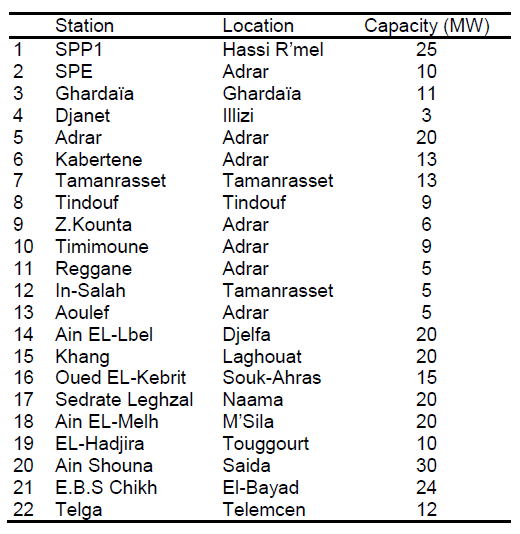
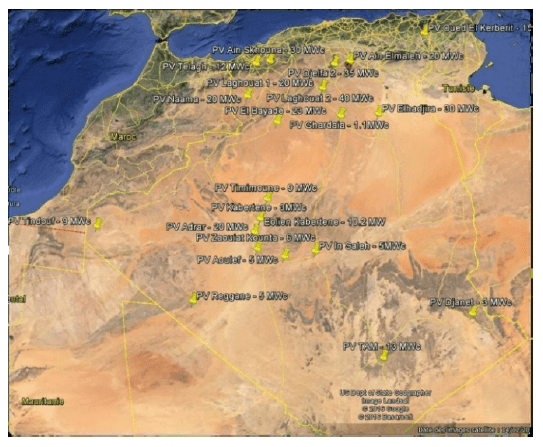
We can see that 10 of the 22 stations are allocated far to the middle and the borders of the Algerian Sahara. Figure 10 gives images of two types of SP power stations, one PV station at the North (Oued-Elkebrit) [19] and one CSP station at the south (Adrar)

Moreover, all Algerian governmental plans are aspiring to bring Algeria from the status of “oil producer and exporter” to “sun power producer and exporter”. In 2019 Algeria had 21.2 GW of electricity installed generating capacity among which only 305 MW were sun power production. According to these plans, the Algerian renewable energy power production could attain 22 GW by 2030. All plans are axed on the realization of centralized SP mega stations (PV and CSP stations) at the regions of Bechar, Timimoun, Gardaia and Hassi-Messaoud. The mean distance from these regions to the northern populated and industrialized zones is about 800 Km which could inevitably enforce the HVDC transportation solution as the best mean for the electrical network interconnection.
Conclusion
The presented study was dedicated to investigate the environmental and economic characteristics of Algeria that permits to deploy an HVDC electrical power transportation network. Firstly, the principle characteristics of HVDC technology were presented and justified. Afterwards, each environmental and economic parameter was studied according to the specificities of the country. For each studied parameter we find that it was propitious to the use of such technology and could be a favorable support to its implementation. At last, the state of the situation in Algeria was presented and expectations also.
REFERENCES
[1] Abhisek Ukil, “Frequency converter based tuned high voltage AC transmission: Design and Implementation Issues”, Region 10 Conference (TENCON) 2016 IEEE, pp. 713-717, 2016.
[2] P.A Gbadega, A. K. Saha, “Loss Study of LCC-Based HVDC Thyristor Valves and Converter Transformers Using IEC 61803 Std. and Component Datasheet Parameters”, PES/IAS PowerAfrica 2018 IEEE, pp. 32-37, 2018.
[3] G.w. Juette ; H. Charbonneau ; H.i. Dobson ; C. Gary ; N. Kolcio ; M. Moreau ; J. Reichman ; E.r. Taylor”CIGRE/IEEE Survey on Extra High Voltage Transmission Line Noise”, IEEE Transactions on Power Apparatus and Systems, vol. PAS-92, pp. 1019-1028, May/June 1970.
[4] Chijioke Joe-Uzuegbu ; Gloria Chukwudebe, “High Voltage Direct Current (HVDC) technology: An alternative means of power transmission”, 3rd IEEE International Conference on Adaptive Science and Technology (ICAST 2011), Nov. 2011, Abuja, Nigeria
[5] Roger Wiget, Göran Andersson, “DC optimal power flow including HVDC grids”, Electrical Power & Energy Conference (EPEC) 2013 IEEE, pp. 1-6, 2013
[6] Herbadji, Ouafa; Slimani, Linda; Bouktir, Tarek, “Solving Bi-Objective Optimal Power Flow using Hybrid method of Biogeography-Based Optimization and Differential Evolution Algorithm: A case study of the Algerian Electrical Network.”, Journal of Electrical Systems . 2016, Vol. 12 Issue 1, p197-215
[7] Ahmed SALHI, Djemai NAIMI, Tarek BOUKTIR, “Fuzzy Multi- Objective Optimal Power Flow Using Genetic Algorithms Applied to Algerian Electrical Network », Journal of Power Engineering and Electrical Engineering, VOL. 11, Issue 6, December 2013
[8] Abdelkader Harrouz ; Meriem Abbes ; Ilhami Colak ; Korhan Kayisli, “Smart grid and renewable energy in Algeria”, 2017 IEEE 6th International Conference on Renewable Energy Research and Applications (ICRERA), November, 2017, San Diego, CA, USA
[9] SEIMENS. High voltage direct current transmission – proven technology for power exchange. brochure from SIEMENS, March 2007, Available online: http://www.siemens.com, 2007.
[10] J. Setrieus and L. Bertling. “Introduction to HVDC technology for reliable electrical power systems”, 10th IEEE International Conference on Probabilistic Methods Applied to Power Systems, pages 1–8, 2008
[11] P.F. de Toledo, “Feasibility of HVDC for city infeed. Thesis for the degree of Licentiate”, Department of Electrical Engineering, KTH, Stockholm, Sweden, 2003
[12] H. Acaroğlu , A. Najafı , Ö. Kara and B. Yürük , “An economic and tchnical review for the utilization of HVDC in Turkey and in the world “, Konya Mühendislik Bilimleri Dergisi, vol. 9, no. 3, pp. 811, Sep. 2021, doi:10.36306/konjes.907309.
[13] Palo Alto, “EPRI: Electrical Effects of HVDC Transmission Lines – State of the science”, CA: EPRI, 2010
[14] PS Maruvada, R D Dallaire, OC Norris-Elye, CV Thio, and JS Goodman, “Environmental effects of the Nelson river HVDC transmission lines – RI, AN, electric field, induced voltage, and ion current distribution test”, IEEE Transactions on Power Apparatus and Systems, Vol. PAS-101, No. 4, April 1982
[15] J. Paulinder; “Operation and control of HVDC links embedded in AC systems”, Thesis for the degree of Licentiate, Chalmers University of Technology, Gothenburg, Sweden, 2003
[16] D. Ravemark and B. Normark, “Light and invisible; Underground transmission with HVDC Light’, ABB, ABB Review, pages 25–29, 2005
[17] B.R. ANDERSEN, “HVDC transmission-opportunities and challenges. AC and DC Power Transmission”, ACDC 2006. The 8th IEE International Conference on, vol., no., pp. 24- 29, 28-31 March 2006
[18] M.P. Bahrman and B.K. Johnson, “The ABCs of HVDC transmission technologies”, IEEE Power and Energy Magazine, 5(2):32–44, 2007
[19] M. Saaidia, T. Belhouchat, N. -E. Benchouia and K. Achibi, “One day ahead prediction of PV power production: case study of Oued-Elkebrit’s station (Algeria),” 2019 1st International Conference on Sustainable Renewable Energy Systems and Applications (ICSRESA), Tebessa, Algeria, 2019, pp. 1-8, doi: 10.1109/ICSRESA49121.2019.9182702.
Authors: dr. Mohammed SAAIDIA, Dpt. of Electrical engineering, University of Souk-Ahras, P.O Box 1553, Souk-Ahras, 41000, Algeria, E-mail: mohamed.saaidia@univ-soukahras.dz; Abdelghani GUECHI, Dpt. of Mechanical engineering, University of Souk-Ahras, P.O Box 1553, Souk-Ahras, 41000, Algeria, E-mail: guechia123@gmail.com; prof. dr. Nedjem-Eddine BENCHOUIA, Dpt. of Mechanical engineering, University of Souk-Ahras, P.O Box 1553, Souk-Ahras, 41000, Algeria, E-mail: n.benchouia@univsoukahras.dz
Source & Publisher Item Identifier: PRZEGLĄD ELEKTROTECHNICZNY, ISSN 0033-2097, R. 99 NR 8/2023. doi:10.15199/48.2023.08.7
 Power Quality Blog