Published by Unipower AB, Metallgatan 4C, 44132 Alingsås, Sweden. Email: info@unipower.se
One important issue is how to trace the source of harmonics. The example below shows harmonic filters connected until 11.00 and there is no voltage distortion as expected. After 11.00 the filters were disconnected due to a fault and voltage harmonics can be seen.
There are at least 2 ways to determine the direction of harmonics

First is to simply look at current with current harmonics and compare with voltage. If there is obvious correlation between current and voltage harmonics, then the source is downstream i.e. the load current is causing the voltage distortion.
The second, and easier, way to study harmonics direction is to study the power harmonics. For each frequency voltage and current creates active power, P. With normal references the sign of P tells the direction of power flow, + means from grid to load (source upstream) and – means from load to grid (source downstream).
Below are the power harmonics from the above example.
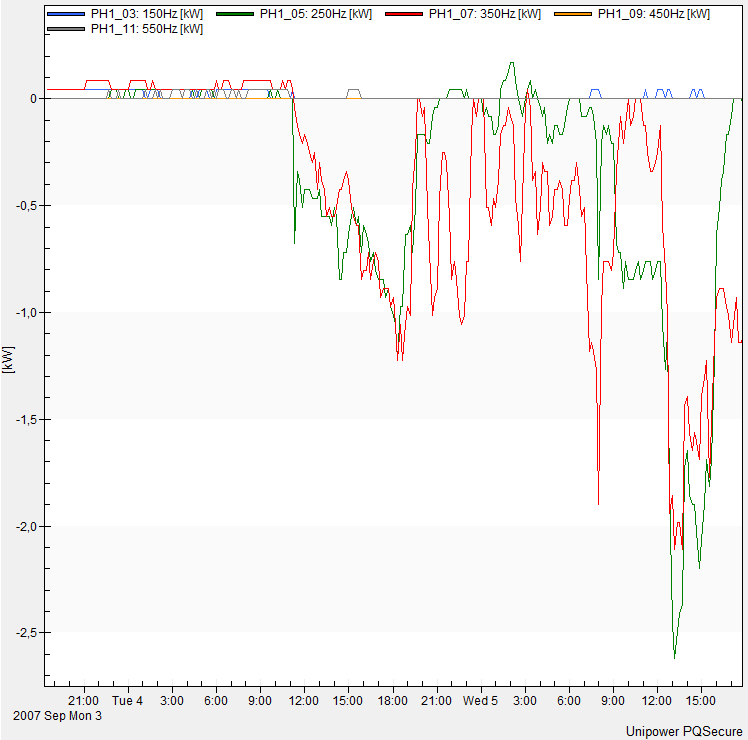
You clearly see that 5th (green) and 7th (red) harmonics have negative sign meaning a downstream direction, i.e. going from load into the grid.
About Unipower: Unipower AB offers a wide range of products for Power Quality measurements and Smart Grid systems.
Originating from a Swedish ABB company in the mid 80’s, Unipower has developed a competitive edge within the field of Power Quality and Smart-Grid solutions. We focus on norm compliance equipment, with a special focus on the requirements for power generation, transmission and distribution.
Our product lines reach from traditional portable PQ analysers to fully integrated and automated Power Quality Management systems for continuous supervision of the energy supply.
Website: unipower.se
Source URL: https://www.unipower.se/about-power-quality/evaluating-direction-of-harmonics/
 Power Quality Blog