Published by Shafqat Mughal, Neeten Sharma, Pankhuri Kishore
Abstract—Power Quality is a major concern of our modern industries and other consumers. Poor quality of supply will affect the performance of customer equipment such as computers, microprocessors adjustable speed drives, power electronic devices, life saving equipment in hospitals, etc. and result in heavy financial losses to customers due to loss of production or breakdown in industries or loss of life in a hospital. The quality of the electric power available to the end user is a matter of increasing concern to the power systems engineer. This paper aims to analyse the effect of power quality problems on the end user. Besides listing the causes behind power quality problems, this paper discusses the various mitigation techniques used to eradicate the power quality problems.
Index Terms—Harmonics, Interruption, Mitigation of Harmonics, Transients
INTRODUCTION
Power quality is a term used to describe electric power that motivates an electrical load and the load’s ability to function properly with that electric power. Without the proper power, an electrical device (or load) may malfunction, fail prematurely or not operate at all. There are many ways in which electric power can be of poor quality and many more causes of such poor quality power. Power quality is certainly a major concern in the present era it becomes especially important with the introduction of sophisticated devices, whose performance is very sensitive to the quality of power supply. Modern industrial processes are based a large amount of electronic devices such as programmable logic controllers and adjustable speed drives. The electronic devices are very sensitive to disturbances [1] and thus industrial loads become less tolerant to power quality problems such as voltage dips, voltage swells, and harmonics. Voltage dips are considered one of the most severe disturbances to the industrial equipment. A paper machine can be affected by disturbances of 10% voltage drop lasting for 100ms. A voltage dip of 75% (of the nominal voltage) with duration shorter than 100ms can result in material loss in the range of thousands of US dollars for the semiconductors industry [2]. Swells and over voltages can cause over heating tripping or even destruction of industrial equipment such as motor drives. Electronic equipments are very sensitive loads against harmonics because their control depends on either the peak value or the zero crossing of the supplied voltage, which are all influenced by the harmonic distortion. The electric power industry is in the business of electricity generation (AC power), electric power transmission and ultimately electricity distribution to a point often located near the electricity meter of the end user of the electric power. The electricity then moves through the distribution and wiring system of the end user until it reaches the load. The complexity of the system to move electric energy from the point of production to the point of consumption combined with variations in weather, electricity demand and other factors provide many opportunities for the quality of power delivered to be compromised. While “power quality” is a convenient term for many, it is actually the quality of the voltage, rather than power or current that is actual topic described by the term. Power is simply the flow of energy and the current demanded by a load is largely uncontrollable. Nevertheless the relationship between the concepts of “voltage quality” and energy quality is unknown.
HOW POWER QUALITY PROBLEMS DEVELOP
It’s always been a question that how the power quality problem develops in a system. Three elements are needed to produce a problematic power line disturbance:
• A source
• A coupling channel
• A receptor
If a receptor that is adversely affected by a power line deviation is not present, no power quality problem is experienced.

The primary coupling methods are:
1. Conductive coupling A disturbance is conducted through the power lines into the equipment.
2. Coupling through common impedance Occurs when currents from two different circuits flow through common impedance such as a common ground The voltage drop across the impedance for each circuit is influenced by the other.
3. Inductive and Capacitive Coupling Radiated electromagnetic fields (EMF) occur during the operation of arc welders, intermittent switching of contacts lightning and/or by intentional radiation from broadcast antennas and radar transmitters. When the EMF couples through the air it does so either capacitively or inductively. If it leads to the improper operation of equipment it is known as Electromagnetic Interference (EMI) or Radio Frequency Interference (RFI). Unshielded power cables can act like receiving antennas.
Once a disturbance is coupled into a system as a voltage deviation it can be transported to a receptor in two basic ways:
1) A normal or transverse mode disturbance is an unwanted potential difference between two current-carrying circuit conductors. In a single-phase circuit it occurs between the phase or ―hot‖ conductor and the neutral conductor.
2) A common mode disturbance is an unwanted potential difference between all of the current-carrying conductors and the grounding conductor. Common mode disturbances include impulses and EMI/RFI noise with respect to ground.
The switch mode power supplies in computers and ancillary equipment can also be a source of power quality problems. The severity of any power line disturbance depends on the relative change in magnitude of the voltage, the duration and the repetition rate of the disturbance, as well as the nature of the electrical load it is impacting.
I. POWER QUALITY PROBLEMS
It is often useful to think of power quality as a compatibility problem: is the equipment connected to the grid compatible with the events on the grid, and is the power delivered by the grid, including the events, compatible with the equipment that is connected? Compatibility problems always have at least two solutions: in this case, either clean up the power, or make the equipment tougher. Ideally electric power would be supplied as a sine wave with the amplitude and frequency given by national standards (in the case of mains) or system specifications (in the case of a power feed not directly attached to the mains) with an impedance of zero ohms at all frequencies. No real life power feed will ever meet this ideal. It can deviate from it in the following ways (among others):
• Variations in the peak or RMS voltage are both important to different types of equipment.
• When the RMS voltage exceeds the nominal voltage by 10 to 80% for 0.5 cycle to 1 minute, the event is called a “swell”.
• A “dip” (in British English) or ―sag” (in American English – the two terms are equivalent) is the opposite situation: the RMS voltage is below the nominal voltage by 10 to 90% for 0.5 cycle to 1 minute.
• Random or repetitive variations in the RMS voltage between 90 and 110% of nominal can produce phenomena known as “flicker” in lighting equipment. Flicker is the impression of unsteadiness of visual sensation induced by a light stimulus on the human eye. A precise definition of such voltage fluctuations that produce flickers have been subject to ongoing debate in more than one scientific community for many years.
• Abrupt, very brief increases in voltage, called “spikes”, “impulses”, or “surges”, generally caused by large inductive loads being turned off, or more severely by lightning.
• “Under voltage” occurs when the nominal voltage drops below 90% for more than 1 minute. The term “brownout” is an apt description for voltage drops somewhere between full power (bright lights) and a blackout (no power – no light). It comes from the noticeable to significant dimming of regular incandescent lights, during system faults or overloading etc., when insufficient power is available to achieve full brightness in (usually) domestic lighting. This term is in common usage has no formal definition but is commonly used to describe a reduction in system voltage by the utility or system operator to decrease demand or to increase system operating margins.
• “Overvoltage” occurs when the nominal voltage rises above 110% for more than 1 minute. Variations in the frequency
• Variations in the wave shape – usually described as harmonics
• Nonzero low-frequency impedance (when a load draws more power, the voltage drops)
• Nonzero high-frequency impedance (when a load demands a large amount of current, then stops demanding it suddenly, there will be a dip or spike in the voltage due to the inductances in the power supply line)
II. CAUSES AND CONSEQUENCES OF POWER QUALITY
The causes and consequences of Power Quality problem can be traced to a specific type of Electrical disturbance. By analyzing the waveform of the disturbance, power quality engineers can determine what problems your facility has and what the optimal solution is
For comparison purposes, a normal voltage waveform is 60 cycles per second – at most plus or minus ten percent of nominal voltage.
Power disturbances can be classified into five categories, each varying in effect, duration and intensity

1) Voltage fluctuations
Voltage fluctuations are changes or swings in the steady-state voltage above or below the designated input range for a piece of equipment. Fluctuations include both sags and swells

• Causes: Large equipment start-up or shut down; sudden change in load; improper wiring; or grounding; utility protection devices
• Vulnerable equipment: Computers; fax machines; variable frequency drives; CNC machines; extruders; motors
• Effects: Data errors; memory loss; equipment shutdown; flickering lights; motors stalling/stopping; reduced motor life
2) Transients
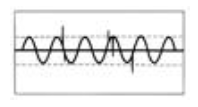
Transients, commonly called “surges,” are sub-cycle disturbances of very short duration that vary greatly in magnitude.
When transient occur, thousands of voltage can be generated into the electrical system, causing problems for equipment down the line.
• Causes: Lighting; normal operation of utility equipment; equipment start-up and shutdown; welding equipment.
• Vulnerable equipment: Phone systems; computers; fax machines; digital scales; gas pump controls; fire/security systems; variable frequency drives; CNC machines; PLCs.
• Effects: Processing errors; computer lock-up; burned circuit boards; degradation of electrical insulation; equipment damage.
3) Electrical noise

Electrical noise is high-frequency interference caused by a number of factors, including arc welding or the operation of some electric motors.
• Causes: Lighting; normal operation of utility equipment; equipment start-up and shutdown; welding equipment.
• Vulnerable equipment: Phone systems; computers; fax machines; digital scales; gas pump controls; fire/security systems; variable frequency drives; CNC machines; PLCs.
• Effects: Processing errors; computer lock-up; burned circuit boards; degradation of electrical insulation; equipment damage.
4) Harmonics

Harmonics are the periodic steady-state distortions of the sine wave due to equipment generating a frequency other than the standard 60 cycles per second
• Causes: Electronic ballasts; non-linear loads; variable frequency drives.
• Vulnerable equipment: Transformers; circuit breakers; phone systems; capacitor banks; motors.
• Effects: Overheating of electrical equipment; random breakers tripping; hot neutrals.
5) Power outages

Power outages are total interruptions of electrical supply. Utilities have installed protection equipment that briefly interrupts power to allow time for a disturbance to dissipate. For example, if lightning strikes a power line, a large voltage is instantly induced into the lines. The protection equipment momentarily interrupts power, allowing time for the surge to dissipate.
• Causes: Ice storms; lightning; wind; utility equipment failure.
• Vulnerable equipment: All electrical equipment.
• Effects: Complete disruption of operation.
III. IDENTIFICATION OF ROOT CAUSES AND ASSESSING SYMPTOMS
Power quality technologists employ technical instrumentation. This instrumentation can range from simple digital multi-metering through to sophisticated waveform analysis instruments. True power quality monitoring requires fulltime monitoring so that steady state effects can be trended and infrequent events can be captured as they occur. A variety of electronic meters are now available for permanent monitoring that offer numerous features at moderate prices. A trained PQ specialist can also employ a portable instrument, or groups of instruments, to diagnose power quality for fixed periods of time. It should be emphasized that power quality monitoring is a highly technical and potentially dangerous skill; even many trained electricians are completely unfamiliar with the details of how power quality measurement is properly carried out. Do not attempt to undertake a power quality measurement exercise without the help of a professional practitioner in the field.
One of the first things that should be carried out before monitoring begins is a check of the effectiveness, safety and operational characteristics of the wiring in the facility. This will ensure that problems like bad grounding, poor terminations and improperly connected loads are not masking other problems or are, in fact, not mistaken for other types of issues.
Some of the elements that might be tracked by a PQ professional are:
• RMS (Root – Mean – Square) Measurements
• Average Measurements
• Peak Measurements
• Harmonic Analysis
• Power Line Event Logging
IV. SOLUTIONS TO POWER QUALITY PROBLEMS
Power quality is an issue that has generated much interest to both electric utilities and customers today. With the increased use of complex and sensitive electronic circuitry, any slight variation in magnitude, frequency or purity of the waveform can often affect and lead to expensive failures of equipment. The performance and operation of these equipments may unavoidably cost customers in lost time and revenue. There are two approaches to the mitigation of power quality problems. The solution to the power quality can be done from customer side or from utility side [4]. First approach is called load conditioning, which ensures that the equipment is less sensitive to power disturbances, allowing the operation even under significant voltage distortion. The other solution is to install line conditioning systems that suppress or counteracts the power system disturbances. Following are important solutions for power quality problems:
A. Lightening and Surge Arresters:
Arresters are designed for lightening protection of transformers, but are not sufficiently voltage limiting for protecting sensitive electronic control circuits from voltage surges.
B. Thyristor Based Static Switches:
The static switch is a versatile device for switching a new element into the circuit when the voltage support is needed. It has a dynamic response time of about one cycle. To correct quickly for voltage spikes, sags or interruptions, the static switch can used to switch one or more of devices such as capacitor, filter, alternate power line, energy storage systems etc. The static switch can be used in the alternate power line applications. T his scheme requires two independent power lines from the utility or could be from utility and localized power generation like those in case of distributed generating systems [4]. Such a scheme can protect up to about 85 % of interruptions and voltage sags.
C. Isolation Transformers
Isolation transformers consist of two coils (primary and secondary) intentionally coupled together, on a magnetic core.
They have two primary functions:
a) They provide isolation between two circuits, by converting electrical energy to magnetic energy and back to electrical energy, thus acting as a new power source.
b) They provide a level of common mode shielding between two circuits.
Since the ability of a transformer to pass high frequency noise varies directly with capacitance, isolation transformers should be designed to minimize the coupling capacitance between primary and secondary sides, while increasing the coupling to ground. Isolation transformers have no direct current path between primary and secondary windings. This feature is not characteristic of an auto-transformer, and therefore an auto-transformer cannot be used as isolation transformer. Unshielded isolation transformers can only attenuate low frequency common mode noise.
High frequency normal mode noise can be attenuated by specially designed and shielded isolation transformers, although it is not frequently required (consult with your electrical system expert).
D. Energy Storage Systems:
Storage systems can be used to protect sensitive production equipments from shutdowns caused by voltage sags or momentary interruptions. These are usually DC storage systems such as UPS, batteries, superconducting magnet energy storage (SMES), storage capacitors or even fly wheels driving DC generators [6]. The output of these devices can be supplied to the system through an inverter on a momentary basis by a fast acting electronic switch. Enough energy is fed to the system to compensate for the energy that would be lost by the voltage sag or interruption. In case of utility supply backed by a localized generation this can be even better accomplished.
E. Electronic tap changing transformer:
A voltage-regulating transformer with an electronic load tap changer can be used with a single line from the utility. It can regulate the voltage drops up to 50% and requires a stiff system (short circuit power to load ratio of 10:1 or better). It can have the provision of coarse or smooth steps intended for occasional voltage variations.
F. Harmonic Filters
Filters are used in some instances to effectively reduce or eliminate certain harmonics [7]. If possible, it is always preferable to use a 12-pluse or higher transformer connection, rather than a filter. Tuned harmonic filters should be used with caution and avoided when possible. Usually, multiple filters are needed, each tuned to a separate harmonic. Each filter causes a parallel resonance as well as a series resonance, and each filter slightly changes the resonances of other filters.
G. Constant-Voltage Transformers:
For many power quality studies, it is possible to greatly improve the sag and momentary interruption tolerance of a facility by protecting control circuits. Constant voltage transformer (CVTs) can be used [6] on control circuits to provide constant voltage with three cycle ride through, or relays and ac contactors can be provided with electronic coil hold-in devices to prevent mis-operation from either low or interrupted voltage.
H. Digital-Electronic and Intelligent Controllers for Load-Frequency Control:
Frequency of the supply power is one of the major determinants of power quality, which affects the equipment performance very drastically. Even the major system components such as Turbine life and interconnected-grid control are directly affected by power frequency. Load frequency controller used specifically for governing power frequency under varying loads must be fast enough to make adjustments against any deviation. In countries like India and other countries of developing world, still use the controllers which are based either or mechanical or electrical devices with inherent dead time and delays and at times also suffer from ageing and associated effects. In future perspective, such controllers can be replaced by their Digital-electronic counterparts.
V. CONCLUSION
In many ways most of electric power engineering has been devoted to the enhancement of the quality of the power supply since the beginning of the use of electricity as a primary source of energy. However, in recent times, the proliferation of a wide variety of microelectronic devices into the electric power system has caused the issue of power quality to become one of critical importance to both the supplier and the user of electricity. This is true because many of the electronic devices in common use today are extremely sensitive to the quality of the electric power that is available.
VI. REFERENCES
[1] H. Hingorani ―Introducing custom power‖ IEEE spectrum, vol.32 no.6 June 1995 p 41-48
[2] Ray Arnold ―Solutions to Power Quality Problems‖ power engineering Journal 2001 pages: 65-73.
[3] John Stones and Alan Collinsion ―Introduction to Power Quality‖ power engineering journal 2001 pages: 58 -64.
[4] Gregory F. Reed, Masatoshi Takeda, “Improved power quality solutions using advanced solid-state switching and static compensation technologies,” Power Engineering Society 1999 Winter Meeting, IEEE
[5] D. S. Dorr, M. B. Hughes, T. M. Gruzs, R. E. Jurewicz, and J. L. Mc- Claine, ―”Interpreting recent power quality surveys to define the electrical Environment,” IEEE Trans. Industry Applications, vol. 33, no. 6,
[6] pp. 1480–1487, Nov./Dec. 1997.
[7] N.G. Hingorani and L. Gyugyi, ―Understanding FACTS: Concepts and Technology of Flexible AC Transmission Systems‖, 1st edition, The Institute of Electrical and Electronics Engineers, 2000.
[8] A. von Jouanne and B. B. Banerjee, ―Voltage unbalance: Power quality Issues, related standards and mitigation techniques,‖ Electric Power Research Institute, Palo Alto, CA, EPRI Final Rep., May 2000.
[9] M. H. J. Bollen, ―Understanding Power Quality Problems—Voltage Sags and Interruptions‖ Piscataway, New York: IEEE Press, 2000.
Source URL: https://www.researchgate.net/publication/319877517
 Power Quality Blog