Published by 1. Abdallah MOUGAY1, 2. Mohamed KHATIR1, 3. Mohamed FLITTI1, 4. Sid-Ahmed ZIDI1, 5. Ahmed Ganoune2, ICEPS Laboratory, Department of Electrical Engineering, Djillali Liabes University, Sidi Bel Abbes, 22000, Algeria (1) Department of Electrical Engineering, Taher Moulay University, Saida, 20000, Algeria (2) . ORCID: 1. : 0000-0001-6676-4466; 2. 0000-0002-3906-9131; 3. 0000-0002-7469-20174. : 0000-0001-7224-8812; 5. 0000-0003-2024-4275.
Abstract. This paper discusses the energy management for the new power system configuration of the telecommunications site that also provides power to electric vehicles. The modeling and control of the proposed system, composed of hybrid energy sources that are photovoltaic panels and a diesel generator with batteries, are also presented. The hybrid system will provide energy to a telecommunications site located in an isolated area. The management algorithm used in this work aims to significantly reduce the investment costs of the power system. From an environmental point of view, the hybrid system can reduce gas emissions from the diesel generator, while maintaining spaced maintenance targets compatible with the operation of the isolated site.
Streszczenie. W artykule omówiono zarządzanie energią w nowej konfiguracji systemu elektroenergetycznego obiektu telekomunikacyjnego, który zapewnia również zasilanie pojazdom elektrycznym. Przedstawiono również modelowanie i sterowanie proponowanym systemem, składającym się z hybrydowych źródeł energii, którymi są panele fotowoltaiczne oraz generator spalinowy z bateriami. System hybrydowy dostarczy energię do zakładu telekomunikacyjnego zlokalizowanego na odizolowanym obszarze. Zastosowany w pracy algorytm zarządzania ma na celu znaczne obniżenie kosztów inwestycyjnych systemu elektroenergetycznego. Z punktu widzenia ochrony środowiska. System hybrydowy może zmniejszyć emisje gazów z generatora Diesla, przy jednoczesnym zachowaniu rozmieszczonych w odstępach celów konserwacji zgodnych z działaniem odizolowanego miejsca. (Zarządzanie energią dla nowej konfiguracji systemu zasilania bazowej stacji nadawczo-odbiorczej (BTS) przeznaczonej do odległych i odizolowanych obszarów)
Keywords: Hybrid system, Base transceiver station (BTS), Photovoltaic system, Diesel generator, Electric vehicle, Batteries.
Słowa kluczowe: hybrydowy system zasilania, bazowa stacja nadawczo-odbiorcza BTS.
Introduction
Algeria is a developing country where many households are located in isolated areas or at a significant distance from the power grid. The costs of connection to the power grid are high and sometimes connection is simply not possible. This is why independent systems are interesting to meet the energy needs of the population in these areas. Generating electricity from renewable energy sources gives consumers greater assurance that their electricity is environmentally friendly. However, the random nature of these sources forces us to establish rules for the design and use of these systems to get the most out of them. On the other hand, the global expansion of cell phone base stations is increasingly taking place in areas where the power grid is often subject to relatively long outages or where access to the power grid is not available. Diesel generators are used to supply power to one or more base transceiver stations (BTS) also in these areas. These require extensive maintenance and consume relatively high levels of diesel fuel [1], [2]. Diesel generators therefore generate high operating costs and mobile network operators face the challenge of limiting the total cost of ownership. In this case, solar photovoltaic energy (PV) seems to be the most attractive solution to meet the energy needs of a case station in many parts of Algeria [3], [4]. Algeria is located between 36°42′ north latitude and 03°13′ east longitude, making it an ideal location for the use of solar energy. The daily solar radiation varies between 3.8 and 6.5 KWh/m², and it should be noted that Algeria has one of the largest solar deposits in the world. The average annual rate of sunshine exceeds 3000 hours. It is also the most important of the whole Mediterranean basin with 169440 TWh/year. The average solar energy received is 1700 KWh/m²/year in the coastal regions, 1900 KWh/m²/year in the highlands and 2650 KWh/m²/year in the Sahara. Our country can therefore cover part of its energy needs with photovoltaic systems. This work introduces a new algorithm that manages and clarifies the transit of energy according to priorities to manage our hybrid system (PV panels + diesel generator + batteries) to ensure the continuous and sustainable reliability of energy to supply the Telecom site in isolation and electric vehicles, and the algorithm determines the optimal size of the photovoltaic generator equipped with batteries and the diesel generator for the BTS [5], [6]. However, regardless of the methodology used and the accuracy with which the different elements of the PV array are taken into account, two types of estimates are still confronted. The first one requires a large climate database and uses an accurate prediction based on complex simulations. The second uses an algorithmic sizing method. The later is the most common method for telecommunication stations characterized by low power [7].
Materials and Methods Presentation of the Telecommunications site
The site is a BTS station, owned by one of the Algerian cell phone network operators, located on the side of the national road No. 6 in an isolated area of a city in southern Algeria called Bechar. The average annual solar radiation in this region is estimated at 5.52 KWh/m2/day. The total power of the instantaneous communication equipment is evaluated from the standby generator screen (power generated), throughout the day because the communication equipment operates 24 hours a day. The site has diesel generators that operate to ensure efficient use and extend the life of the equipment. To avoid the need to refuel every 15 days, a fuel tank is installed with automatic transfer of diesel fuel to the units. This study aims to add solar panels and batteries to the previous system for several reasons; firstly, the presence of year-round solar radiation on the site, secondly to save fuel consumption, thirdly to reduce gas emissions, and fourthly to power electric vehicles in the area. To this end, a hybrid system consisting of solar panels, batteries and a diesel generator was developed.
Supplying electric vehicles with electrical power in a BTS station
The role of a BTS is to convert the electrical energy of a signal into electromagnetic energy carried by an electromagnetic wave (or vice versa). To ensure their operation, GSM mobile relays need a continuous and reliable power supply. This energy often comes from an electrical distribution network with a back-up source [8], [9]. This paper addresses the possibility to power electric cars through a BTS relay. Electric vehicles save energy in a storage unit such as a battery. Electricity is used to drive the wheels of an electric vehicle by means of an electric motor. They have a specific energy storage capacity, which must be replenished by connecting them to an electric charger. Electric cars do not emit pollutants into the atmosphere when driven. Thus, no NOx, fine particles, unburned hydrocarbons or other carbon monoxide, often blamed for their health impact, are released into the environment. There are still particulate emissions from the tires and brakes of all vehicles, but the switch to electric vehicles has an immediate benefit for air quality in cities and near roads. Figure 1 represents an electric vehicle and an electric charger.

The Technical and economic study of a hybrid system
Hybrid systems are technically, economically and ecologically advantageous compared to conventional diesel and renewable photovoltaic systems combined with diesel generation solutions. They provide energy for the telecommunications site with the possibility of charging some electric cars passing through the site and recharging them with electricity via the site’s electric charger. The dimensional rigidity of each electrical installation ensures a better efficiency of the last test, so we simulated all the phases of the photovoltaic panel hybrid system with batteries/Diesel to determine their reliability before installation. For this purpose, a general simulation program of the system over 24 hours was developed. The results of the simulation are represented to visualize the passage of electrical energy from the sources to the load and to the general system.
Presentation of the hybrid system
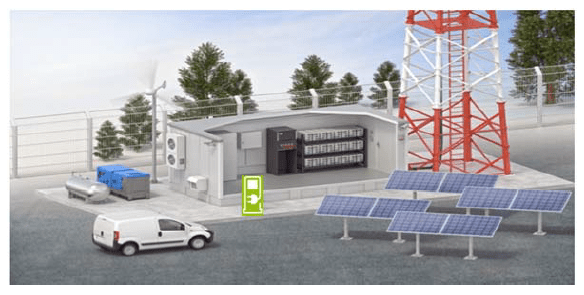
In Figure 2, the hybrid system is composed of four essential parts: a diesel generator operating as a core power generator and a photovoltaic panel field producing renewable energy, and a storage system placed next to the load and the telecommunications site. The electric vehicles represent the load and finally the charger of the electric vehicle.
Case Studied
The unexpected increase in the number of subscribers and the demand for high-speed data has led to enormous growth in cell phone networks in recent years. Indeed, cell phone networks (GSM relay, radar) have evolved to meet the needs of mobile subscribers and the extension of the coverage area. The role of a GSM relay is to convert the electrical energy of a signal into electromagnetic energy carried by an electromagnetic wave (or vice versa). To ensure its operation, the GSM relay needs a stable and reliable power supply. To this end, we prepared a hybrid system consisting of solar panels, a diesel engine and batteries to power the Telecom site and charge the electric cars with an on-site electric charger [10], [11].
Peak power calculation of the photovoltaic panels array
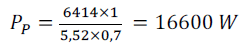
As the irradiation varies from month to month, the peak power of the studied photovoltaic field varies during the months of the year, and the calculation of this power is given by Equation (1):

With: PP: Peak power of the photovoltaic field (W); EReq: Daily requirement (Wh/day); SSTC: Sunshine in STC conditions (SSTC = 1KW/m2); SMonthly: Sunshine scaled annual average (KWh/day/m2); CL: Correction factor applied to take account of the different losses (CL = 0.7).
Thus, the numerical application for this case study is as follows:
Choice of modules
Depending on the total power required by the loads as well as the type of our installation (not connected to the grid), we opted for photovoltaic modules with a power of 580 WP each.
Calculation of the number of photovoltaic panels
The number of photovoltaic panels modules is determined by Equation (2):

with: NP: Number of photovoltaic panel; PP: Total power of photovoltaic fields; PUnitary: Power of a photovoltaic module. Thus, the numerical application for this case study is as follows:

So, if we opt for a NP = 29 panels, the peak power of the field will be:
PP = 29 x 580 = 16820 W
Diesel generator
The proper size of the diesel generator is very important to avoid low load or energy shortage, and the power produced by the diesel generator is represented by Equation (3):

with: PN: Rated output power of the diesel generator [KW]; ηDg: Efficiency of the diesel generator [%]; TDg: Diesel generator running time [h].
The generator set is generally sized to cover peak consumption. In our case, the power reaches 5.8 KW. We therefore choose a diesel generator with a power of 6KW.
Sizing of the battery bank
Energy storage plays an important role in a stand-alone hybrid energy system. In most cases, batteries remain the most cost-effective technology.
Choice of voltage and calculation of capacity
We choose batteries with a voltage of 2V each. Knowing that in the case of our system it is the storage batteries which impose the voltage on the PV field. The battery with 250 Ah storage capacity. For the case of our load, we want to have autonomy of 3 days. The field capacity of standard batteries is given by the relation:

with: CB: Total battery capacity (Ah); RD: Daily requirement (Wh/day); DAuto: Number of days of autonomy; VB: Battery voltage (V); MDD: Maximum depth of discharge (80%); KB: Battery temperature coefficient (0.85).
Thus, the numerical application for this case study is:

The number of batteries is 24 in series which keeps the same capacity of CB = 5895 Ah, which ensures a voltage of V = 48V.
Use and proper functioning
The use of batteries is subject to constraints that must be respected to ensure their proper functioning and longevity. They cannot remain unused for long periods without negative consequences on their lifespan. Repeated random charge/discharge cycles must be avoided. Their state of charge must not reach extreme values to avoid premature degradation. The role of this storage system is to provide the charge for a relatively long period of time (hours or even days). In this work, we seized the different elements that make up our PV/Diesel hybrid system with storage batteries. We studied the energy conversion chain (DC/AC) and proceeded to the choice of the module to be used as well as the power of the generator needed as an emergency source. The objective is to limit the intervention of the generator in the most unfavorable months, for this we dimensioned an efficient storage system to overcome this disadvantage. The optimization of the energy produced by the panel requires the installation of an MPPT regulator, to maximize and force its operation at its maximum power.
Table 1.The hybrid system sizing

The hybrid system architecture
The concept of decentralized electricity has encouraged the development of means of production from renewable sources. The current trend shows that the integration of this type of resource in isolated electrical systems is done in association with the use of a conventional source, such as diesel generators. Thus, the photovoltaic generator operates either in parallel or alternately with the diesel generator. Thus, there are several configurations of PV/Diesel hybrid systems [12], [13].

Figure 3 shows the solar panels will keep the system powered and the batteries charged. In the absence of optical radiation, the storage system will intervene to compensate for the lost energy, but in the absence of optical radiation and the storage system, the generator will compensate for the lost energy when the electrical circuits switch automatically (through the switch) [14].
Economic analysis
It is important to study the economic importance of the hybrid system consisting of solar panels, a diesel generator and batteries to ensure that it is more cost-effective over the life of the project and the environment in terms of reducing gas emissions. To this end, we used the HOMER program to determine all the details of the climate and the amount of energy the site needs every hour, as well as the current price of fuel and the amount of energy that can be stored to continue developing the communication site and electric vehicles with the necessary energy. The goal is to use the hybrid system consisting of a clean renewable energy source, a diesel generator and batteries, and finally we see the installation of the hybrid system. The energy management is carried out according to an algorithm that guarantees a permanent supply of energy at the lowest cost, taking into account the economic aspect.
Energy management strategy
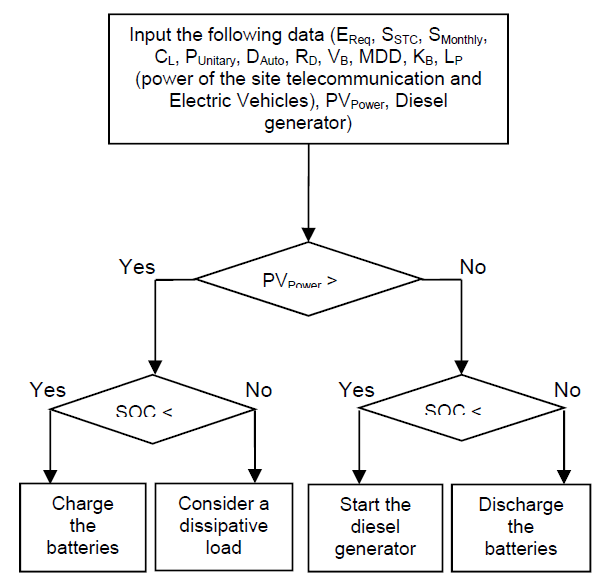
The flowchart is a schematic representation, to show and visualize the transit of energy, in order of priority and according to its usefulness. Figure 4 presents an energy management flowchart of our overall PV/Diesel system. The schematic representation of an autonomous electrical power generation system via a flowchart allows good energy management to ensure continuous and permanent energy reliability and longevity of our PV/Diesel system [15], [16]. Algorithm of the hybrid system
A. Case n°1: PVPower > LP (load power)
If the PVPower supplied by the photovoltaic system is superior to the load power (LP) and the state of charge of the batteries is less than 80%, the surplus will be supplied to the storage batteries. If the state of charge of the batteries is at 80%, the excess produced by the photovoltaic field will be supplied to the dissipative load.
B. Case n°2: PVPower < LP (load power)
If the PVPower supplied by the photovoltaic system is less than the load power (LP) and the state of charge of the batteries is greater than 20%, the batteries provide the energy deficit. On the other hand, if the state of charge of the batteries is less than 20%, the generator will provide the load and the surplus will be used to charge the batteries.
Load characteristic Scenario
The hybrid system (photovoltaic fields with batteries and diesel generator) supplies the Telecom site with power for 24 hours. The presence of sufficient radiation causes the photovoltaic field to produce high power to power the load; otherwise, the storage system powers the load. In the absence of sufficient radiation and the inability of the storage system to provide energy, the diesel generator powers the load. As for the electric vehicles, they are charged at different times by an electric charger located at the telecommunications site: the first vehicle is charged at 2 am with a 3 KW charge, the second vehicle is charged at noon with a 3.5 KW charge and the third vehicle is charged at 5 pm with a 2.5 KW charge (see the table 3). There, it can be argued that our system has the potential to power the telecommunications site and electric vehicles.
Assessment of the electricity consumption of a GSM site and electric vehicles
The relay is equipped with a photovoltaic field with batteries and a diesel generator, and this voltage is converted to DC voltage to power telecommunications equipment. The consumption of GSM relays varies depending on the operating system, the air conditioning requirements of the communication equipment and the site lighting. By estimating the total consumption of a GSM site for this purpose, using measurements (metering) of the sites in service, this consumption can be as high as a few kilowatts. Thus, it will be possible to recharge electric vehicles passing through the site using an electric charger [17], [18].
Table 2. Detail of the Telecom site load during the day

Table 3. Detail of the electric vehicles during the day

Table 4. Global load of Telecom site and electric vehicles in the day

Results and discussion
Simulation results highlight the importance and role of the hybrid system in isolated regions as well as from an economic and environmental perspective.
Load curve for Telecom site
The load characteristic (Telecom site) represents the variation of the energy used over time. In Figure 5, the load curve graph contains three consumption peaks for our isolated site. It can be observed that the phase that takes the interval from 6 pm to 9 pm, its consumption is very high at 7 pm (estimated at 5,167 KW) [19].

Load curve for Telecom site and electric vehicles

Figure 6 represent the total load curve graph (Telecom site + electric vehicles) shows four consumption peaks, and it can be seen that the phase that takes the time interval from 10 am to 2 pm has a very high consumption at noon (estimated at 5.8 KW).
Sunlight profile
Figure 7 shows typical sunshine values over a 24-hour period. Starting at 7 am, sunshine values begin to increase, with a peak at noon, and then decrease to zero at 6 pm.

Battery power curve

Batteries are an additional source to the photovoltaic field, at the end of the charge. Figure 8 illustrates the curve of energy supplied by the batteries. The battery charges from 8 am to 4 pm, while from 6 pm to 10 pm it provides energy to cover the energy deficit. Depending on the peak of the energy supplied by the battery, there are three important intervals:
Between midnight and 8 am, power consumption decreases and the battery begins to provide energy to the site;
Between 8 am and 4 pm, the battery is charging, so it does not provide energy;
From 4 pm to midnight, the battery provides power to the load to cover the energy deficit in the system.
Power curve (PV, LOAD, BATT)
To analyze the power supplied by either the PV field or the batteries on the one hand and the power consumed by the load on the other hand, the power, PV field, load and storage power diagrams of the system are recorded on the same graph in Figure 9.
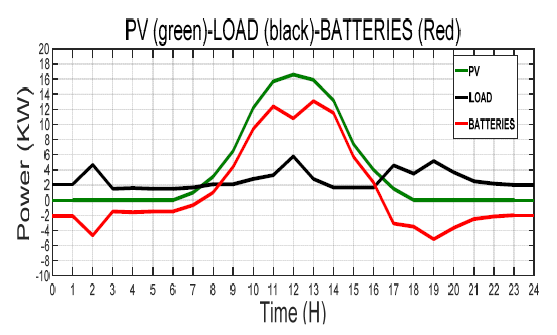
From midnight to 6 am, the batteries exclusively power the charge. Between 6 am and 7 am, the charge is provided by the photovoltaic system and the storage system. From 8 am to 4 pm, the field produces enough energy to power the load and a surplus is supplied to the storage batteries or the dissipating load. From 4 pm to 5 pm, the PV system and the storage system provide the charge. In the absence of sufficient radiation, the power produced by the field is zero and the storage system supplies energy to the load.
The role of a diesel power generator in the hybrid system
In a hybrid system, the photovoltaic field injects energy immediately into the communication site, and stores the surplus in batteries for later use. In the event that the PV system and the storage system do not provide energy, the diesel generator will provide the necessary energy to consider it as a source of energy available at all times [20].
Simulation with HOMER
Enter the necessary data in the software HOMER
• The data of equipment
• The data of the PV generator
• The data of the batteries
• The data of the converter
• Data from the diesel generator
• Data on the fuel
• Control data and system constraints
• Launch of the calculation
• Results
Assessment of the energy resource available on the site
For the data, simply enter the longitude and latitude of the desired location, and a simple click on the “Get Data from the Internet” icon gives the results. Figure 10 shows the solar radiation data for the study area. It can be seen that the radiation varies between 3.200 KWh/m2/ day for the month of December and 7.450 KWh/m2/day for the month of June with an annual average of 5.52063 KWh/m2/day. The monthly brightness index is defined as the ratio of terrestrial radiation to extraterrestrial radiation. The values of the latter vary by location and season. In Figure 10, it is observed that the monthly clarity index varies between 0.590 in December and 0.672 in April and that the annual clarity index is equal to 0.635.

Energy demand assessment (load profile)
In our case study, we imported a data file from the site is a BTS station, owned by one of the Algerian cell phone network operators to present the load profile, as shown in Figure 11 and 12.
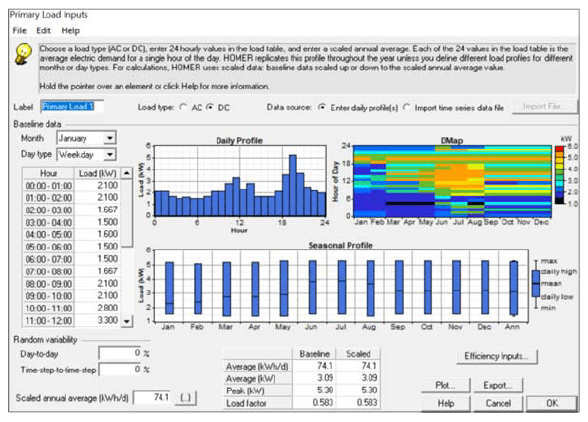

Starting calculations
Once all data entered, we obtain the architecture of the system presented in Figure 13. Now it is enough to launch the calculation. A click on the button ‘calculate’ will display the results.

Considering all inputs, HOMER simulates repeatedly to get suitable solution. Optimization results are displayed in terms of categorized and overall, showing most feasible architecture which satisfied all inputs and constraints that designers give. After simulating all possible configurations, we obtained the overall results shown in Figure 14. We can see the best solution by type of system.

We simulated our system with the HOMER program and obtained the same results as in previous simulations. HOMER simulates system configurations with all combinations of components specified in the entry data. It eliminates the results of all infeasible system configurations, which do not meet the electricity demand and are not compatible with the specified resources and constraints [21]. Results are ranked from highest to lowest in terms of most cost-effective to least cost-effective based on the current net cost of the system. The hybrid system is the most cost-effective over the life of the project, with a cost of 152771 $ and a levelized energy cost of 0.357$/KWh. For a 17 KW PV array system, a 6KW diesel generator, a 24-cell storage system, a 6KW transformer, with a capital cost of 56728$. The results obtained in the simulation results window, represent the detailed technical and economic data on each system installation that HOMER simulates [22], [23].
The figure 15 shows the details of the annual electricity production and consumption for the system. The results indicate in the table 5 that the cost of electricity for a hybrid system with batteries and EV charger is 0.357 $/KWh versus 0.570 $/KWh for the hybrid system without batteries and diesel generator alone 0.640 $/KWh, the hybrid system with batteries and EV charger can be economically viable. It is noted that the hybrid solution with batteries and electric vehicle charger is more reliable and more cost-effective than the other solutions (diesel generator only and hybrid without storage). The analysis of the environmental impact of the studied system allows to determine the emission of air pollutants, we can see that carbon dioxide and nitrogen oxides and carbon monoxide and particles are the principles of combustion gases, the reduction of these emissions is an objective of this study, the hybrid system is the optimal solution because the emissions are lower than the conventional solution (generator). Thus, the hybrid system allows to reduce the use of the generator, which means less gas (CO2 and CO and NOx and PM). The dimensioning of the PV/Diesel electric hybrid energy production system is done based on the knowledge of the energy potential of the site and after evaluation of the daily needs of the isolated studied site. To model the proposed hybrid system, we chose a photovoltaic conversion chain, a model of the cells that make up the panels, to push our field to operate at its maximum power whatever the weather conditions [24], [25]. According to the simulation results, all the characteristics of the hybrid system are more advantageous than diesel alone. Fuel consumption should be increased by switching from the conventional solution (generator only). Considering the technical performance of the hybrid solution, it can be seen that the electric power production is higher in the hybrid system than in the diesel-only system. This is mainly due to the share of renewable energy used in the system, which results in a higher energy surplus than the conventional solution. Thus, the hybrid system can be said to provide a higher load than diesel alone [26], [27]. As a result, the lifetime of the generator set decreases from the hybrid to the conventional solution. Finally, since the emissions of all gases for a hybrid system are much lower than for the conventional diesel solution alone, it can be concluded that from a technical, economic and environmental point of view, the hybrid system is more cost-effective than conventional diesel alone [28], [29].

Table 5. Comparison of the results obtained

Conclusion
The installation of telecommunications networks requires a permanent and uninterrupted power supply and very expensive wiring. Some regions with no means of communication, low population density and difficult access hope one day to be able to communicate with the outside world. Moreover, the aim is to allow operators to cope with a wide variety of constraints during exceptional events. The supply of energy to these facilities is always a delicate issue and the choice of this energy must satisfy both economic and technical conditions. This work focused on the simulation of a photovoltaic system with batteries and a diesel generator to power a telecommunications site and electric vehicles passing through the site via an electric charger. The site is isolated from the electricity distribution network. In addition, details on simulation and dimensioning were provided. To this end, an algorithm was implemented that aims at a good and close management of energy transit to ensure a permanent supply of energy while taking into account the economic aspect of the system. This will make it more profitable over the lifetime of the project and from an environmental point of view in terms of reducing the emissions of gases that cause air pollution. To use HOMER, the user enters the inputs (information on loads, components and resources), HOMER then calculates and displays the results, and the user can examine the results in tables and graphs. HOMER is primarily an economic model and can be used to compare different combinations of component sizes and quantities, and to explore how variations in resource availability and system costs affect the cost of installing and operating different system designs. The installation of a battery photovoltaic generator and a diesel generator for the remote site allows the load to be matched to demand and the power output to be split between the battery photovoltaic generator and the diesel generator. The objective of the simulation is to study and test these performances before its installation. The simulation models, which are sufficiently accurate, are used to create scenarios of conditions closer to practical reality. In perspective, we hope that our simulation and sizing work will be complemented by validation tests in the field to find out the real performance of our hybrid system and that the modeling we carried out will be enriched.
Acknowledgments: This work was supported by Intelligent Control and Electrical Power System (ICEPS) Laboratory of Sidi-Bel- Abbes University, Algeria.
REFERENCES
[1] Bitterlin.I.F., Modelling a reliable wind/PV/storage power system for remote radio base station sites without utility power, Journal of Power Sources, 162 (2006), No.2, 906-912
[2] Afif, B., Merabet, B., Benhamou, A., Chaker, A., Standalone hybrid power system using homer software optimal case sizing of ferraguig (Northwest of Algeria), International Journal of applied Power Engineering, 8 (2019), No.3, 287-298
[3] Yahiaoui, A., Benmansour, K., Tadjine, M., A new sizing algorithm of renewable hybrid systems PV-diesel generator battery: Application to the case of Djanet city of Algeria, 8th International Conference on Modelling, Identification and Control (ICMIC), (2016)
[4] Samer, R., Contribution to the modelling of reversible electrolyser and hydrogen fuel cell systems for coupling to photovoltaic generators, PhD thesis, University of Toulouse, France, 42 (2008), No.8, 183
[5] Rezzouk, H., Mellit, A., Feasibility study and sensitivity analysis of a stand-alone photovoltaic-diesel-battery hybrid energy system in the north of Algeria, Renewable and Sustainable Energy Reviews, 43 (2015), 1134-1150
[6] Mathieu, D., Diagnosis of diesel generator sets by analysis of crankshaft rotation speed, Doctoral thesis, Jean Monnet University, France, 43 (2010), No.1, 215
[7] Issaadi, W., Khireddine, A., Issaadi, S., Management of a base station of a mobile network using a photovoltaic system, Renewable and Sustainable Energy Reviews, 59 (2016), 1570-1590
[8] Kaldellis, J.K., Optimum Hybrid Photovoltaic-Based Solution for Remote Telecommunication Stations, Renewable Energy, 35 (2010), 2307-2315
[9] Alsharif, M., Jeong, K., Hybrid Off-Grid SPV/WTG Power System for Remote Cellular Base Stations Towards Green and Sustainable Cellular Networks in South Korea, Energies, 10 (2017), No.1, 1-23
[10] Benatiallah, A., Mostefaoui, R., Boubekri, M., A comparison of Simplified and Statistical Methods of Sizing Photovoltaic Installation for a Remote Dwelling in the Saharan Region, Journal of the Human-Environmental System, 8 (2005), No.1,1-6
[11] Ike, Dike U., Adoghe, Anthony U., Ademola, A., Analysis of Telecom Base Stations Powered by Solar Energy, International journal of scientific & technology research, 3 (2014), 369-374
[12] Notton, G., Muselli, M., and Louche, A., Autonomous hybrid photovoltaic power plant using a back-up generator: a case study in a Mediterranean Island, Renewable Energy, 7 (1996), No.4, 371-391
[13] Rekioua, Djamila, Matagne, Ernest., Optimization of photovoltaic power systems: Modelization, simulation and Control, Green Energy and Technology Series, Springer, (2012)
[14] Idda, A., Slimani, M.E., Bentouba, S., Hammaoui, Y., Different PV System Configurations for Uninterruptible Power Supply (UPS): Application to GSM Relay, Journal of Advanced Research in Science and Technology, 4 (2017), 574-582
[15] El Khadimi, A., Bchir, L., Zeroual, A., Dimensioning and optimisation technico-economic to a system of energy photovoltaic hybrid wind – with the Storage System, Rev. Energ. Ren, 7 (2004), 73-83
[16] Borrowy, BS., and Salameh, Z.M., Methodology for Optimally Sizing the Combination Battery Bank and PV Array in a Wind/PV Hybrid System, IEEE Transaction on Energy Conversion, 12 (1997), No.1, 73-78
[17] Shafiqur, R., Mahbub Alam, Md., Meyer, J.P., Al-Hadhrami, Luai M., Feasibility study of a wind PV diesel hybrid power system for a village, Renewable Energy, 38 (2012), No.1, 258-268
[18] Shaahid, S.M., El-Amin, I., Rehman, S., Al-Shehri, A., Ahmad, F., Bakashwain, J., Al-Hadhrami, Luai M., Techno-Economic Potential of Retrofitting Diesel Power Systems with Hybrid Wind-Photovoltaic-Diesel Systems for Off-Grid Electrification of Remote Villages of Saudi Arabia, International Journal of Green Energy, 7 (2010), No.6, 632-646
[19] Data file from the site is a BTS station, owned by one of the Algerian cell phone network operators: http://www.algercity.com/economie/operateurs-telephoniques, (2020)
[20] Azah, M., Tamer, k., Design of Hybrid PV/Diesel Generator Systems at Minimum Cost: Case study for kuching, Malaysia, Transmission and Distribution Conference and Exposition (T&D), IEEE PES ,Orlando, FL, (2012), 1-6
[21] Gourbi, A., Bousmaha, I., Brahmi, M., Tilmatine, A., Numerical study of hybrid photovoltaic Power supply system, Journal of power Technologies, 96 (2016), No.2, 137-144
[22] Dekker, J., Nthonotho, M., Chowdhury, S., Economic analysis of PV/diesel hybrid power systems in different climatic zones of South Africa, Electrical Power and Energy Systems, 40 (2012),104-112
[23] Ying-Yi, H., Yuan-Ming, L., Yung-Ruei, C., Yih-Der, L., and Pang-Wei, L., Optimization Capacities of Distributed Generation and Energy Storage in a Small Autonomous Power System Considering Uncertainty in Renewables, Energies, 8 (2015), No.4, 2473-2492
[24] Jacobus, H., Evaluating the impact of adding energy storage on the performance of a hybrid power system, Energy Conversion and Management, 334 (2011), 928-935
[25] Phuangpornpitak, N., Kumar, S., PV hybrid systems for rural electrification in Thailand, Renewable and Sustainable Energy Reviews, 11 (2007), No.7, 1530-1543
[26] Deshmukha, MK., and Deshmukh, SS., Modeling of hybrid renewable energy systems, Renewable and Sustainable Energy Review, 12 (2008), No.1, 235-249
[27] Mondal, A.H., Manfred, D., Hybrid systems for decentralized power generation in Bangladesh, Energy for Sustainable Development, 14 (2010), 48-55
[28] Pirhaghshenasvali, M., Behzad, A., Optimal modeling and sizing of a practical hybrid wind/PV/diesel generation system, The 5th Annual International Power Electronics, Drive Systems and Technologies Conference (PEDSTC), (2014)
[29] Makhija, Satya, P., and Dubey, S.P., Techno-economic analysis of standalone hybrid energy systems to run auxiliaries of a cement plant located in Jamul, Chhattisgarh, India , Environmental Progress & Sustainable Energy, 35 (2015), 221-229
Authors: PhD. Abdallah Mougay, Department of Electrical Engineering, ICEPS Laboratory, Faculty of Electrical Engineering, University of Djillali Liabes, Sidi Bel Abbes, Algeria, E-mail: mougayabdallah.27@gmail.com; Professor. Mohamed Khatir, Department of Electrical Engineering, ICEPS Laboratory, Faculty of Electrical Engineering, University of Djillali Liabes, Sidi Bel Abbes, Algeria, E-mail: med_khatir@yahoo.fr; Dr Mohamed Flitti , Department of Electrical Engineering, ICEPS Laboratory, Faculty of Electrical Engineering, University of Ain Temouchent, Algeria, E-mail:flitti_med@yahoo.fr , Professor Sid-Ahmed Zidi, Department of Electrical Engineering, ICEPC Laboratory ,Faculty of Electrical Engineering, University of Djillali Liabes, Sidi Bel Abbes, Algeria, E-mail: sbzidi@yahoo.fr, PhD. Ahmed Ganoune, Department of Electrical Engineering, Faculty of Electrical Engineering, University of Taher Moulay, Saida, Algeria, E-mail: ahmed.ganoune@univ-saida.dz.
Source & Publisher Item Identifier: PRZEGLĄD ELEKTROTECHNICZNY, ISSN 0033-2097, R. 97 NR 8/2021. doi:10.15199/48.2021.08.01
 Power Quality Blog